Cambridge IGCSE Physics 0625 — 2022 Oct/Nov Paper 3 · Variant 3
0625/33/O/N/22 · 10 questions · 80 marks · ≈90 min
The question paper and its mark scheme, free to read here and free to download. This is Cambridge’s own paper, exactly as it was sat.
Question paper16 pages
Mark scheme13 pages
Answers below. Sit the paper first if you are practising.
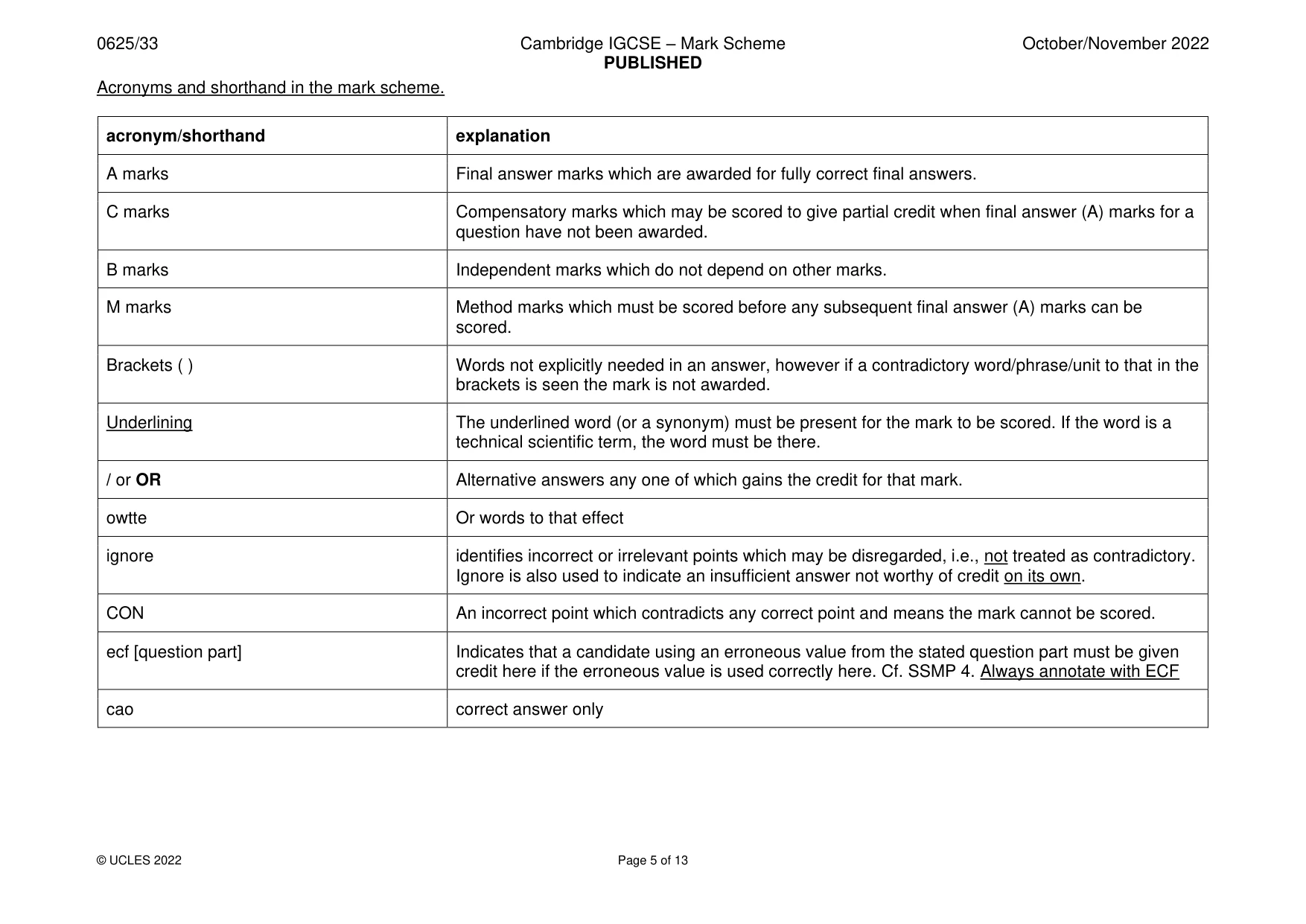
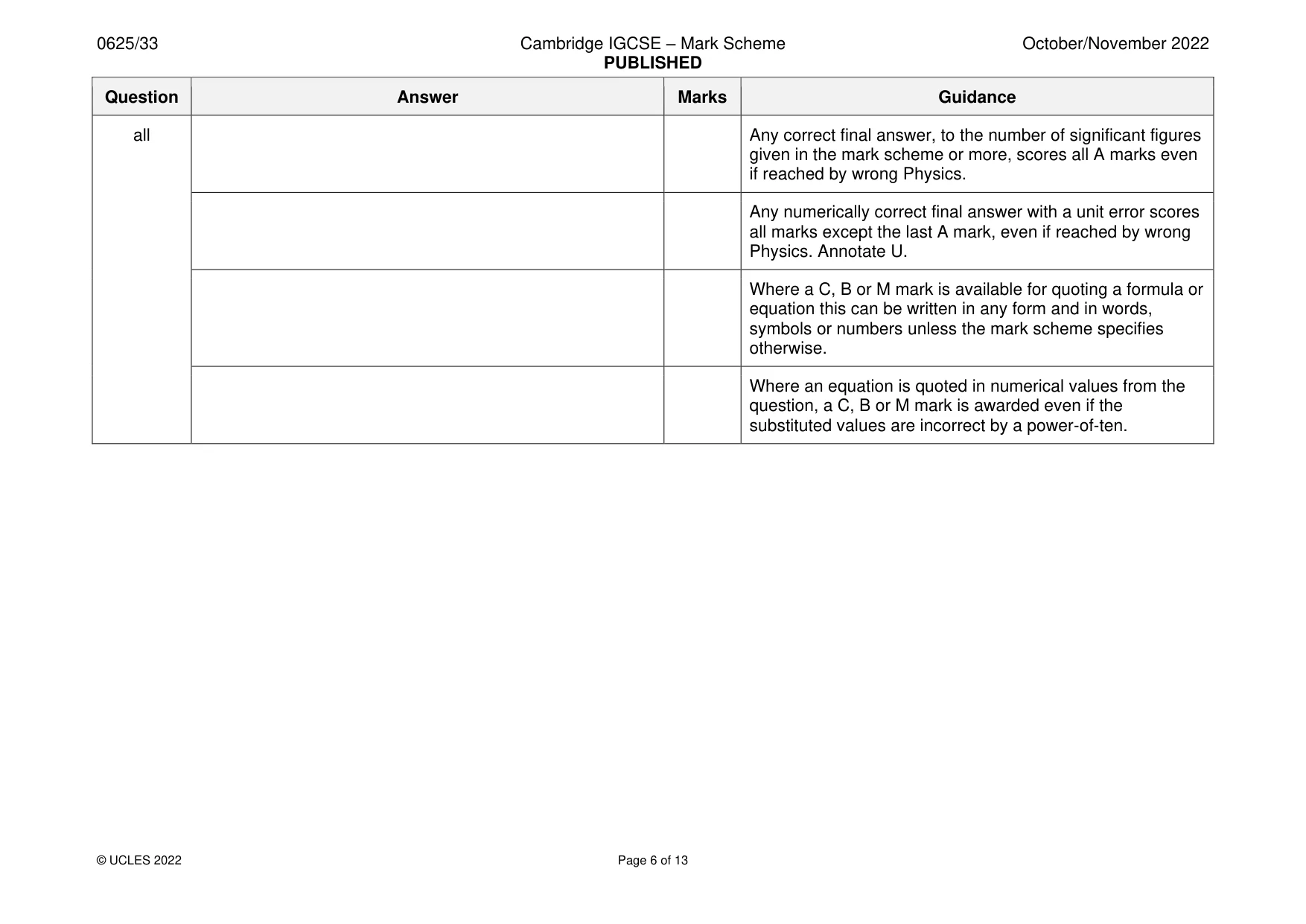
Questions as text
Question 1
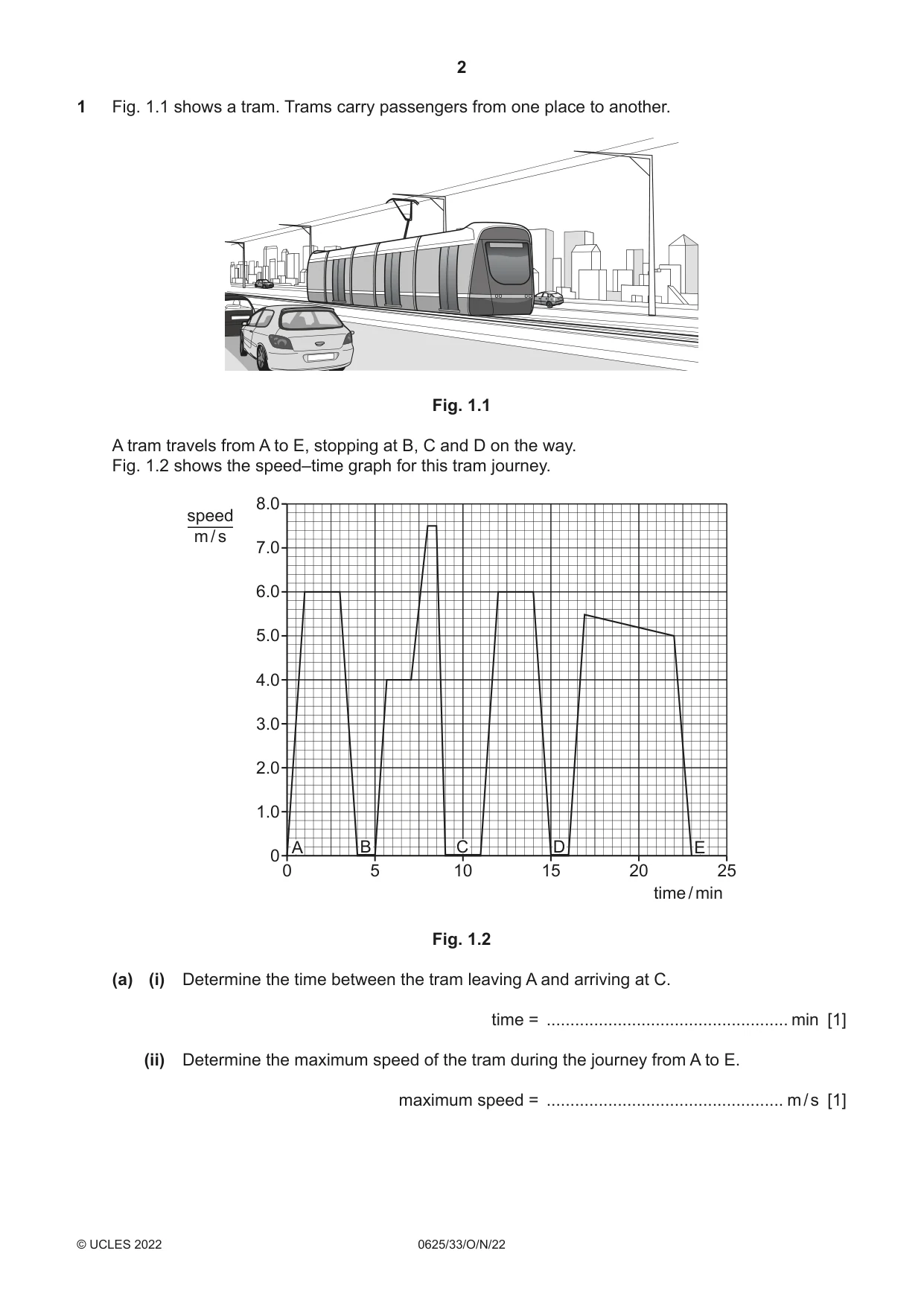
1 Fig. 1.1 shows a tram. Trams carry passengers from one place to another. Fig. 1.1 A tram travels from A to E, stopping at B, C and D on the way. Fig. 1.2 shows the speed–time graph for this tram journey. 8.0 speed m / s 7.0 6.0 5.0 4.0 3.0 2.0 1.0 A B C D E 0 0 5 10 15 20 25 time / min Fig. 1.2 (a) (i) Determine the time between the tram leaving A and arriving at C. time = ................................................... min [1] (ii) Determine the maximum speed of the tram during the journey from A to E. maximum speed = .................................................. m / s [1] (iii) The tram decelerates as it approaches each stop. Use information from Fig. 1.2 to identify the greatest deceleration. Give a reason for your answer. Complete the sentence. The greatest deceleration occurs as the tram approaches ............. . reason ............................................................................................................................... ........................................................................................................................................... [2] (b) The total distance between A and E is 5200 m. The tram takes 1380 s to travel from A to E. Calculate the average speed of the tram between A and E. average speed = .................................................. m / s [3] [Total: 7]
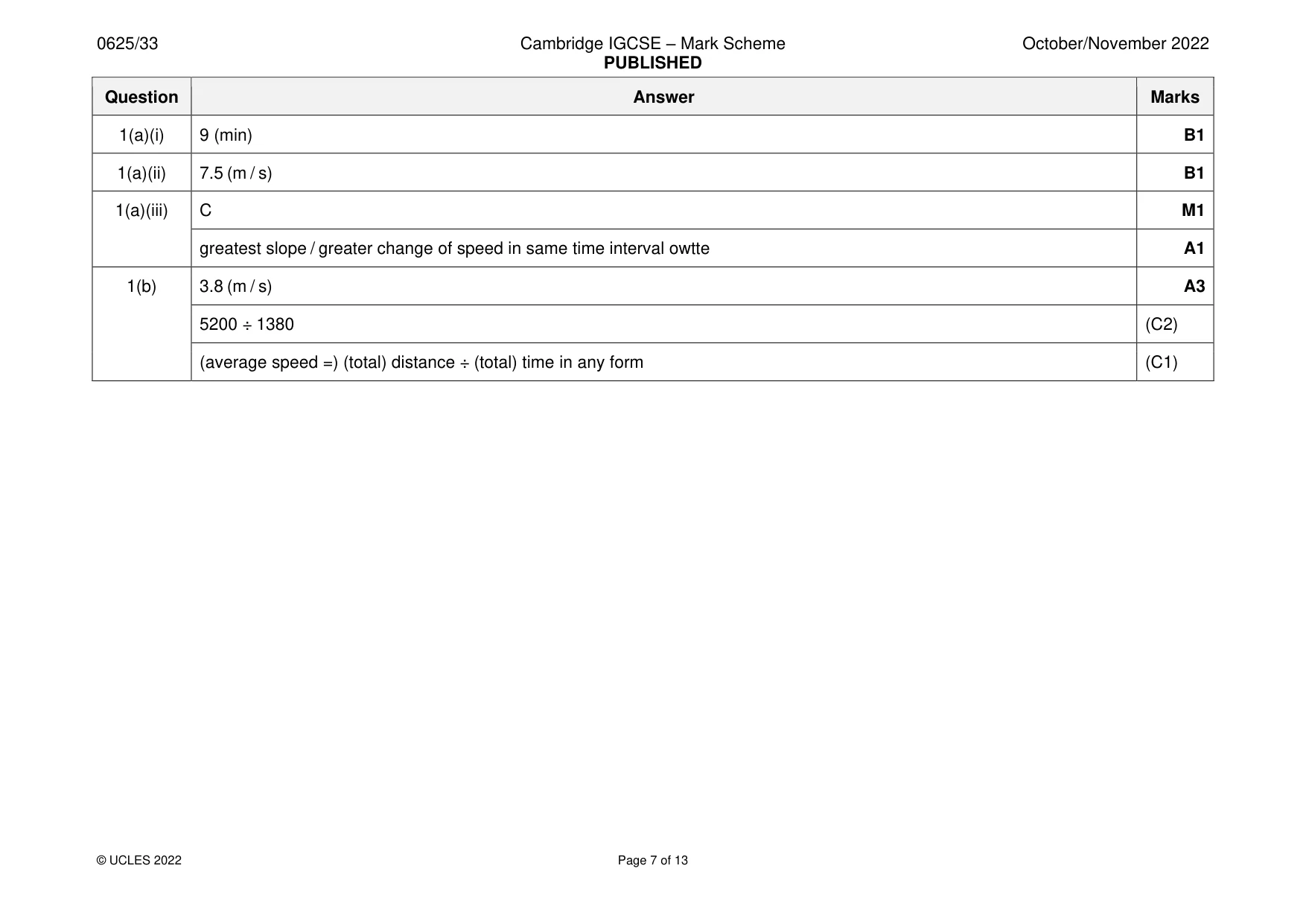
Mark scheme: Question Answer Marks 1(a)(i) 9 (min) B1 1(a)(ii) 7.5 (m / s) B1 1(a)(iii) C M1 greatest slope / greater change of speed in same time interval owtte A1 1(b) 3.8 (m / s) A3 5200 ÷ 1380 (C2) (average speed =) (total) distance ÷ (total) time in any form (C1)
Q2 · A builder buys some tiles to repair a floor
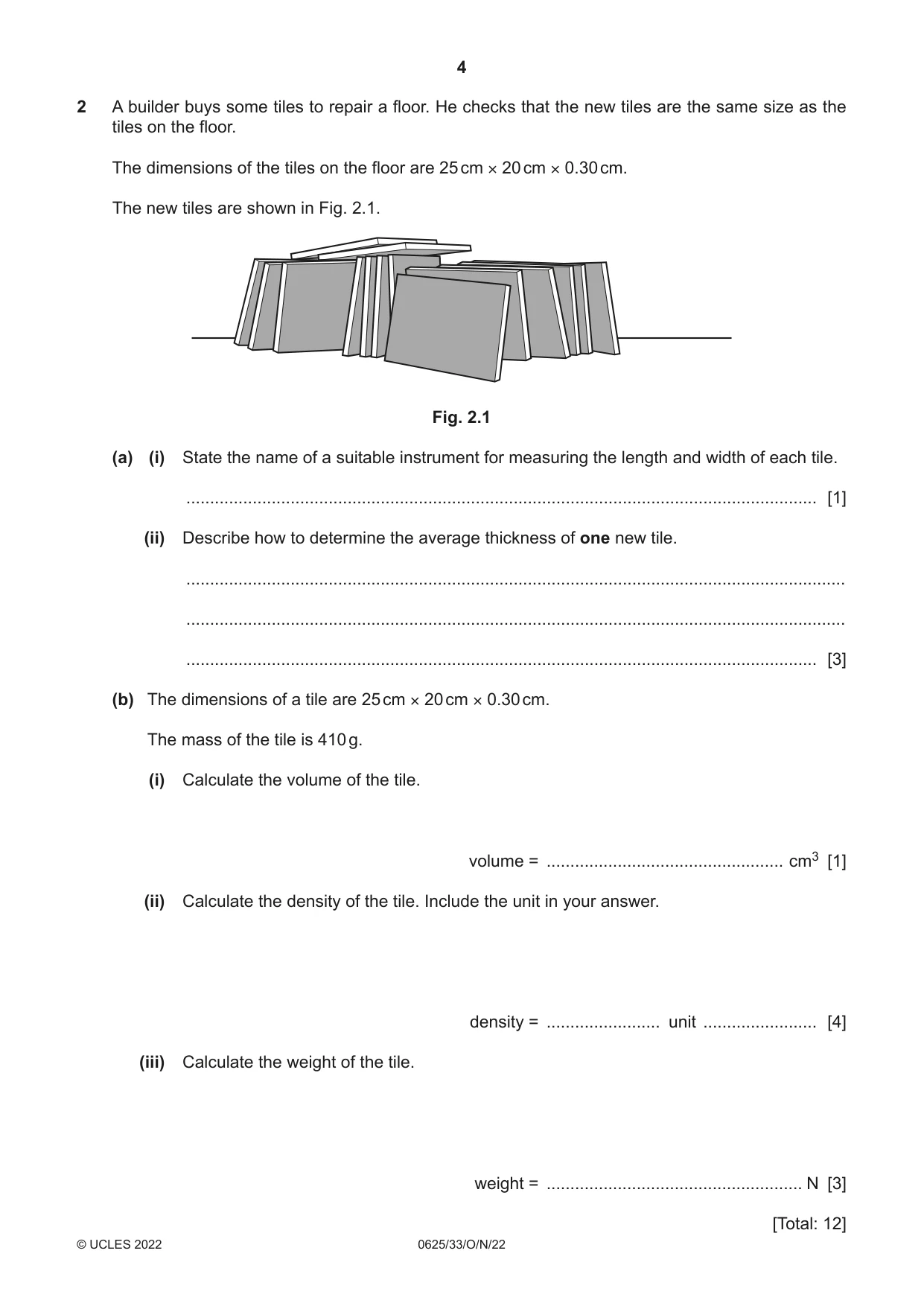
2 A builder buys some tiles to repair a floor. He checks that the new tiles are the same size as the tiles on the floor. The dimensions of the tiles on the floor are 25 cm × 20 cm × 0.30 cm. The new tiles are shown in Fig. 2.1. Fig. 2.1 (a) (i) State the name of a suitable instrument for measuring the length and width of each tile. ..................................................................................................................................... [1] (ii) Describe how to determine the average thickness of one new tile. ........................................................................................................................................... ........................................................................................................................................... ..................................................................................................................................... [3] (b) The dimensions of a tile are 25 cm × 20 cm × 0.30 cm. The mass of the tile is 410 g. (i) Calculate the volume of the tile. volume = .................................................. cm3 [1] (ii) Calculate the density of the tile. Include the unit in your answer. density = ........................ unit ........................ [4] (iii) Calculate the weight of the tile. weight = ...................................................... N [3] [Total: 12]
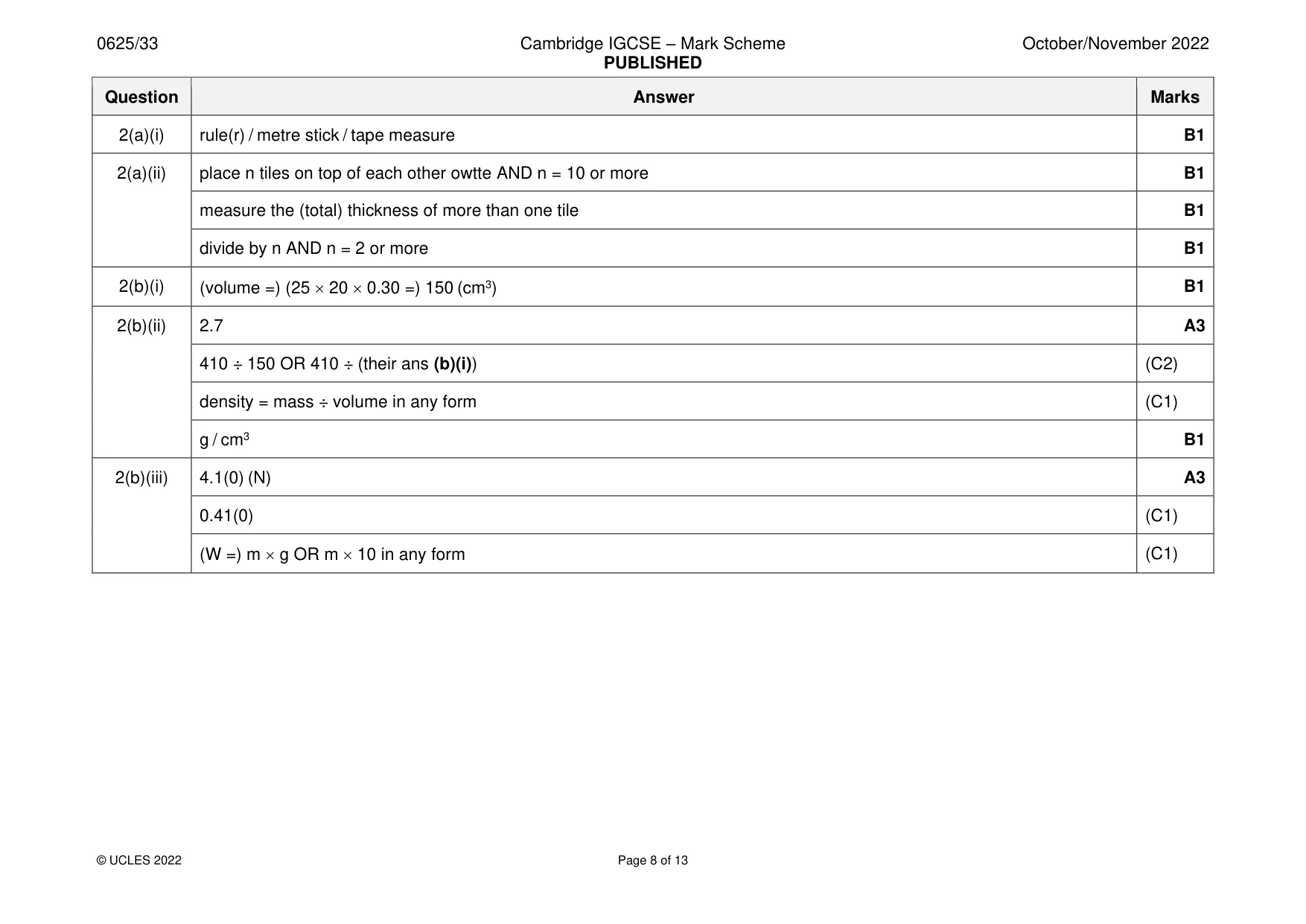
Mark scheme: 2(a)(i) rule(r) / metre stick / tape measure B1 2(a)(ii) place n tiles on top of each other owtte AND n = 10 or more B1 measure the (total) thickness of more than one tile B1 divide by n AND n = 2 or more B1 2(b)(i) (volume =) (25 20 0.30 =) 150 (cm3) B1 2(b)(ii) 2.7 A3 410 ÷ 150 OR 410 ÷ (their ans (b)(i)) (C2) density = mass ÷ volume in any form (C1) g / cm3 B1 2(b)(iii) 4.1(0) (N) A3 0.41(0) (C1) (W =) m g OR m 10 in any form (C1)
More questions on Physical quantities and measurement techniques
Q3 · Table 3.1 contains incomplete information about the input energy and the useful output…
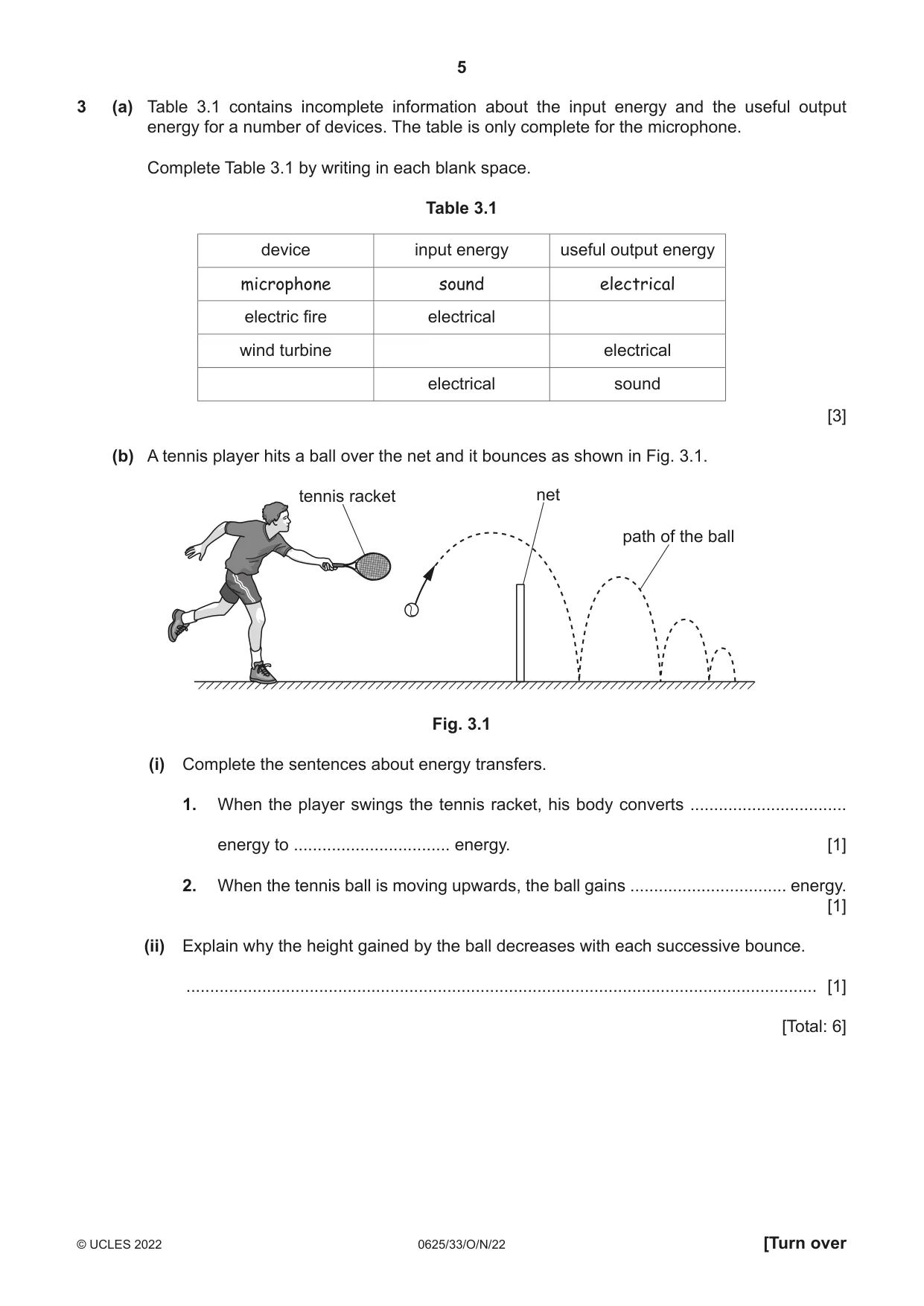
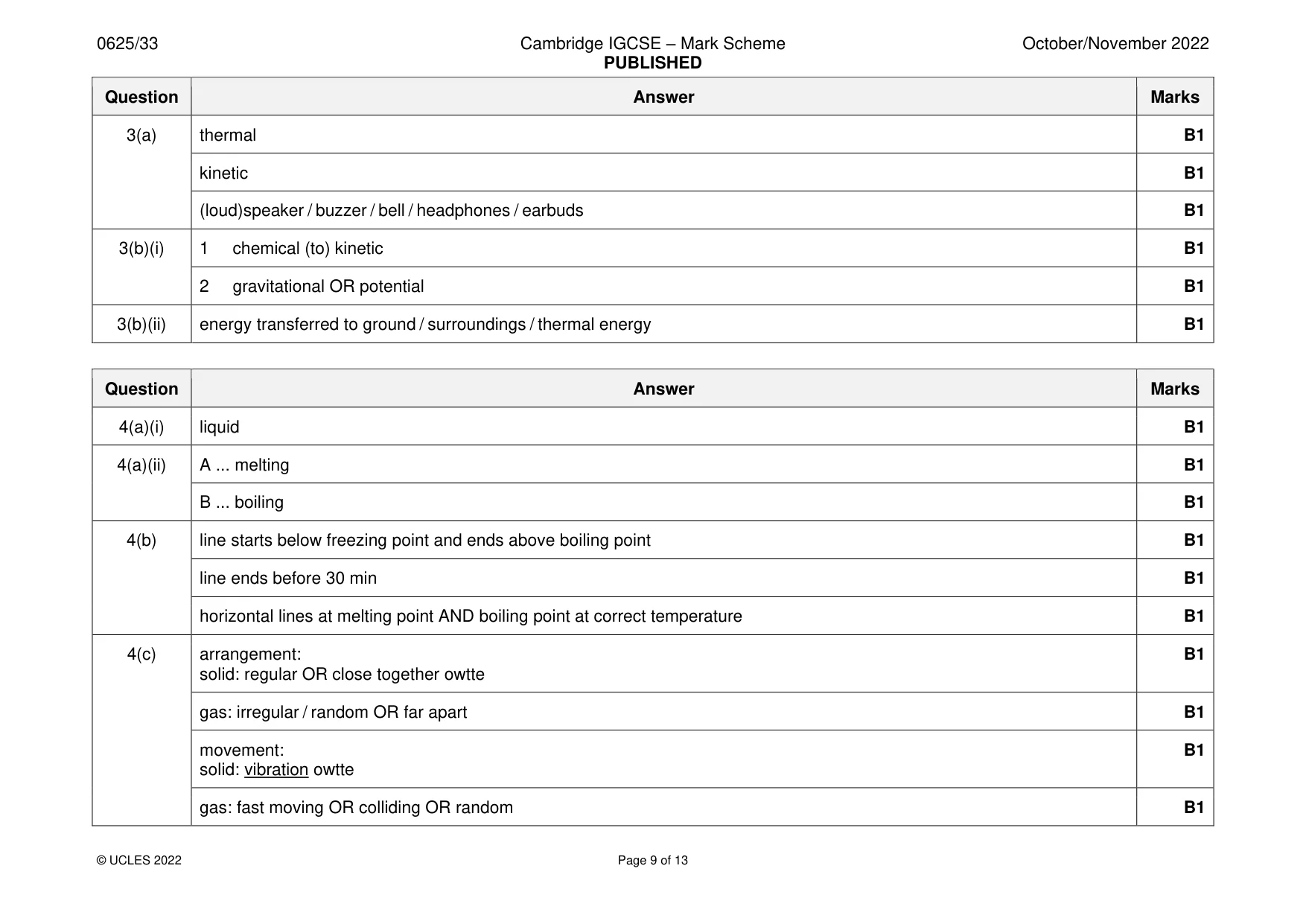
3 (a) Table 3.1 contains incomplete information about the input energy and the useful output energy for a number of devices. The table is only complete for the microphone. Complete Table 3.1 by writing in each blank space. Table 3.1 device input energy useful output energy microphone sound electrical electric fire electrical wind turbine electrical electrical sound [3] (b) A tennis player hits a ball over the net and it bounces as shown in Fig. 3.1. tennis racket net path of the ball Fig. 3.1 (i) Complete the sentences about energy transfers. 1. When the player swings the tennis racket, his body converts ................................. energy to ................................. energy. [1] 2. When the tennis ball is moving upwards, the ball gains ................................. energy. [1] (ii) Explain why the height gained by the ball decreases with each successive bounce. ..................................................................................................................................... [1] [Total: 6]
Mark scheme: 3(a) thermal B1 kinetic B1 (loud)speaker / buzzer / bell / headphones / earbuds B1 3(b)(i) 1 chemical (to) kinetic B1 2 gravitational OR potential B1 3(b)(ii) energy transferred to ground / surroundings / thermal energy B1
Q4 · During an experiment, a heater supplies thermal energy to a substance
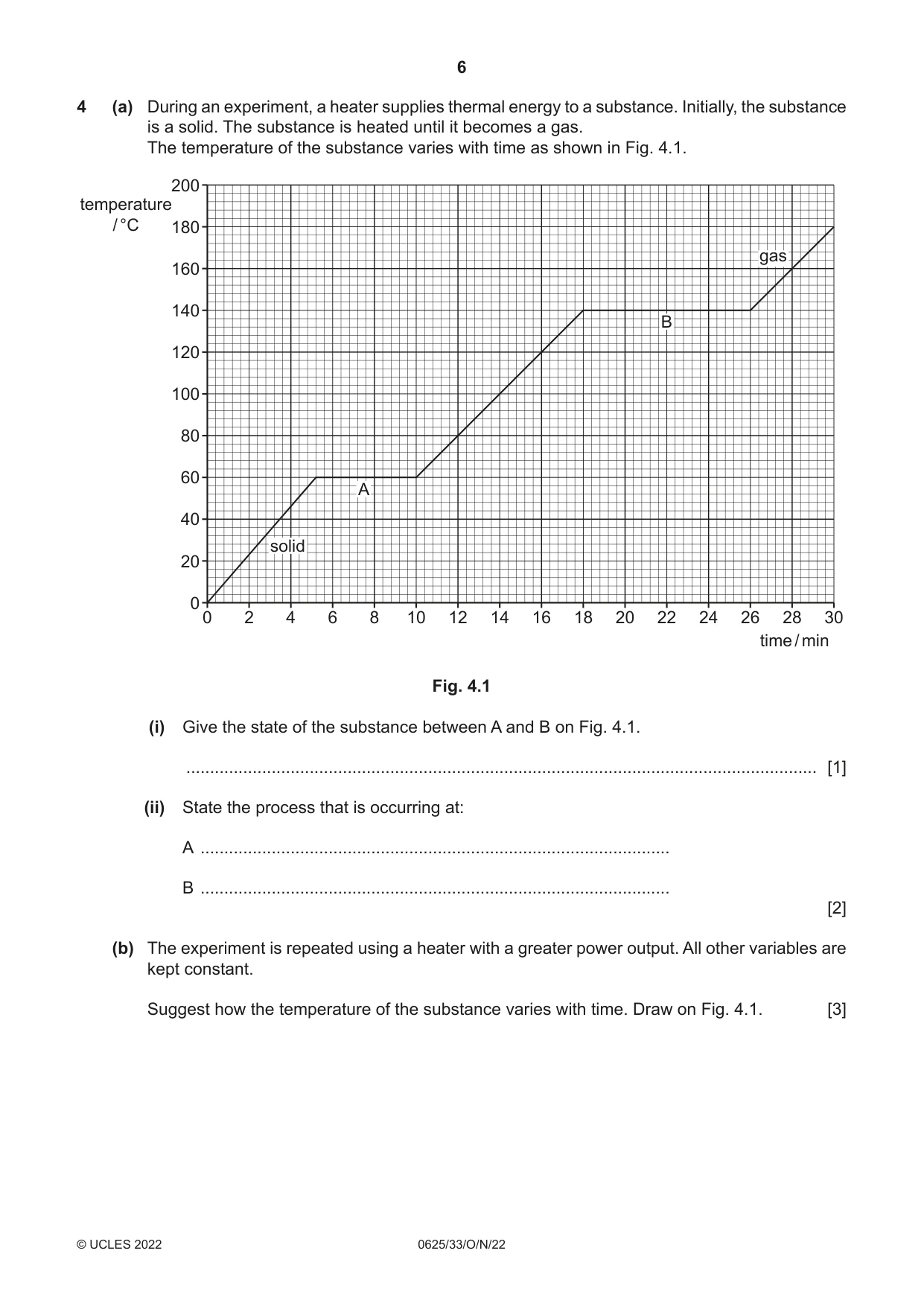
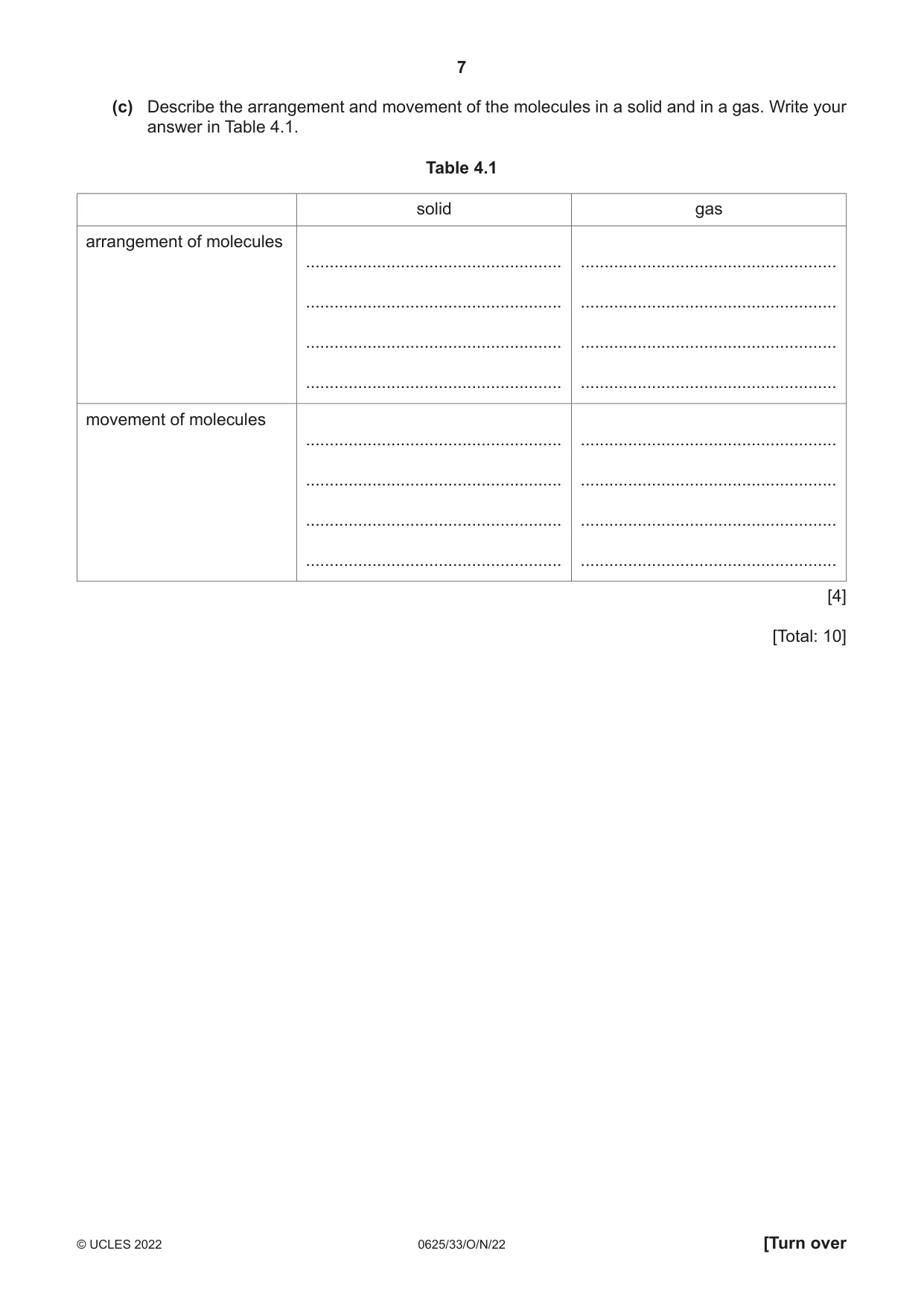
4 (a) During an experiment, a heater supplies thermal energy to a substance. Initially, the substance is a solid. The substance is heated until it becomes a gas. The temperature of the substance varies with time as shown in Fig. 4.1. 200 temperature / °C 180 gas 160 140 B 120 100 80 60 A 40 solid 20 0 0 2 4 6 8 10 12 14 16 18 20 22 24 26 28 30 time / min Fig. 4.1 (i) Give the state of the substance between A and B on Fig. 4.1. ..................................................................................................................................... [1] (ii) State the process that is occurring at: A ................................................................................................... B ................................................................................................... [2] (b) The experiment is repeated using a heater with a greater power output. All other variables are kept constant. Suggest how the temperature of the substance varies with time. Draw on Fig. 4.1. [3] (c) Describe the arrangement and movement of the molecules in a solid and in a gas. Write your answer in Table 4.1. Table 4.1 solid gas arrangement of molecules ...................................................... ...................................................... ...................................................... ...................................................... ...................................................... ...................................................... ...................................................... ...................................................... movement of molecules ...................................................... ...................................................... ...................................................... ...................................................... ...................................................... ...................................................... ...................................................... ...................................................... [4] [Total: 10]
Mark scheme: 4(a)(i) liquid B1 4(a)(ii) A ... melting B1 B ... boiling B1 4(b) line starts below freezing point and ends above boiling point B1 line ends before 30 min B1 horizontal lines at melting point AND boiling point at correct temperature B1 4(c) arrangement: B1 solid: regular OR close together owtte gas: irregular / random OR far apart B1 movement: B1 solid: vibration owtte gas: fast moving OR colliding OR random B1
Q5 · A student shines a ray of red light towards a large glass prism, as shown in Fig
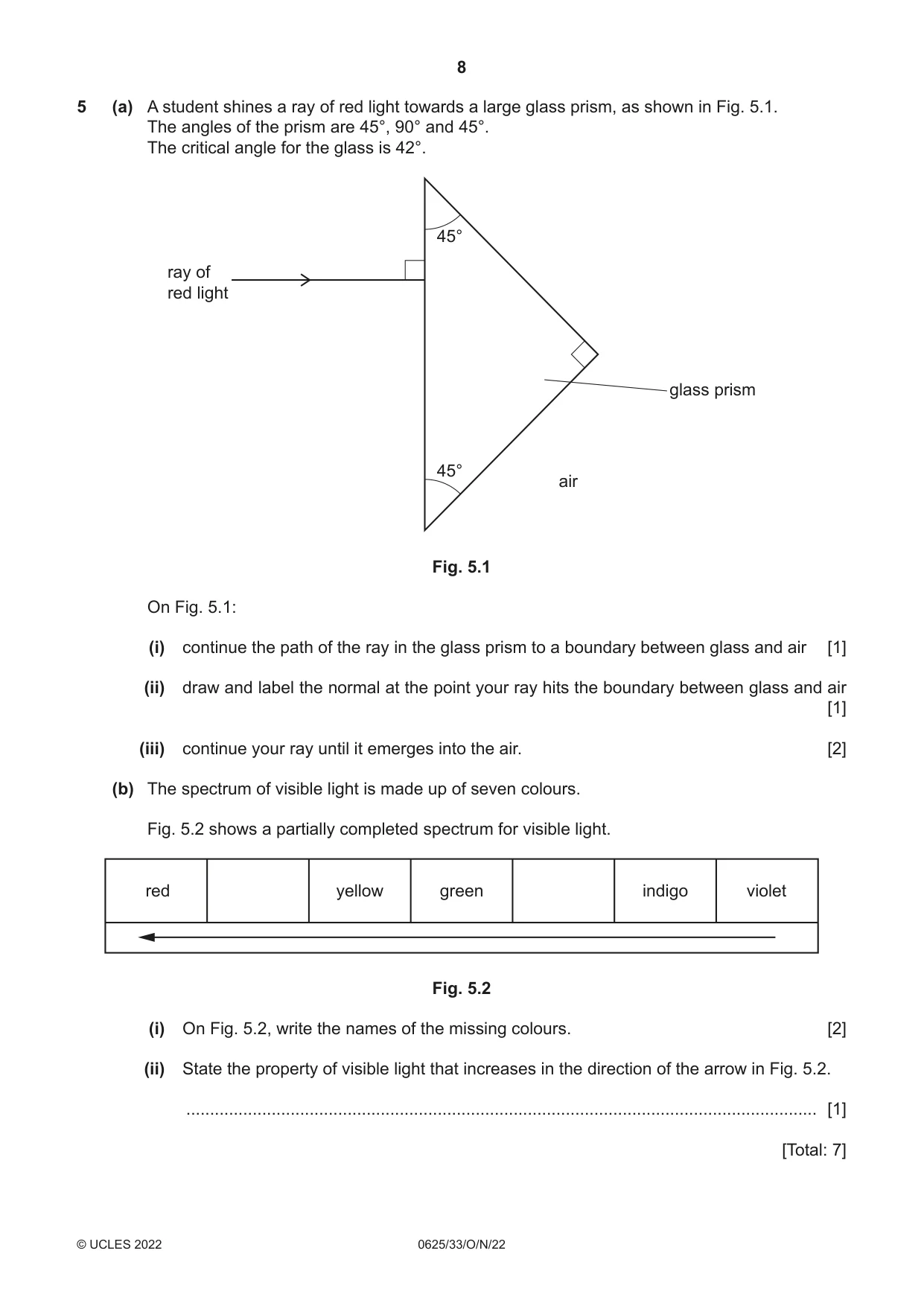
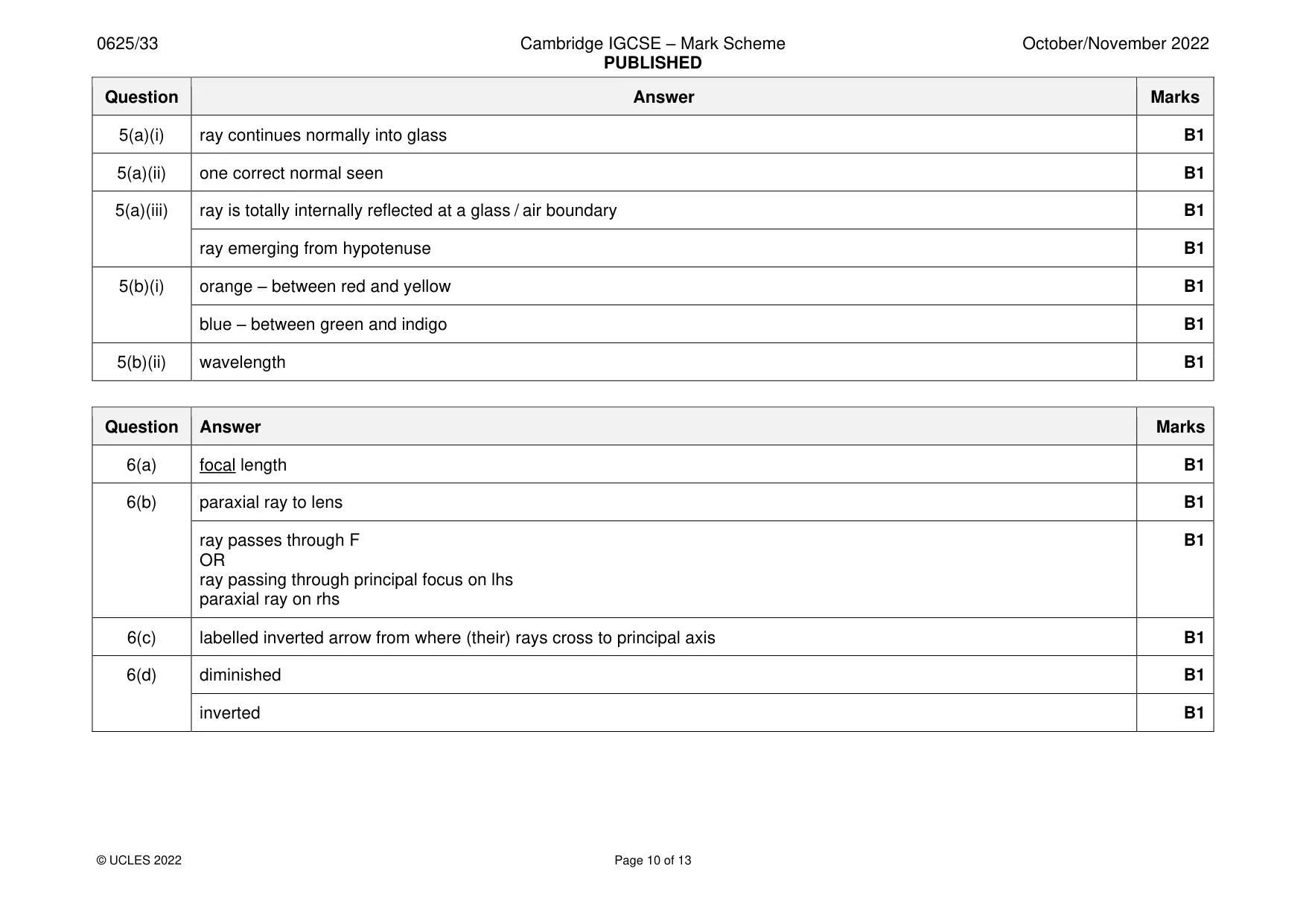
5 (a) A student shines a ray of red light towards a large glass prism, as shown in Fig. 5.1. The angles of the prism are 45°, 90° and 45°. The critical angle for the glass is 42°. 45° ray of red light glass prism 45° air Fig. 5.1 On Fig. 5.1: (i) continue the path of the ray in the glass prism to a boundary between glass and air [1] (ii) draw and label the normal at the point your ray hits the boundary between glass and air [1] (iii) continue your ray until it emerges into the air. [2] (b) The spectrum of visible light is made up of seven colours. Fig. 5.2 shows a partially completed spectrum for visible light. red yellow green indigo violet Fig. 5.2 (i) On Fig. 5.2, write the names of the missing colours. [2] (ii) State the property of visible light that increases in the direction of the arrow in Fig. 5.2. ..................................................................................................................................... [1] [Total: 7]
Mark scheme: 5(a)(i) ray continues normally into glass B1 5(a)(ii) one correct normal seen B1 5(a)(iii) ray is totally internally reflected at a glass / air boundary B1 ray emerging from hypotenuse B1 5(b)(i) orange – between red and yellow B1 blue – between green and indigo B1 5(b)(ii) wavelength B1
Q6 · A vertical arrow O is used as an object for a converging lens
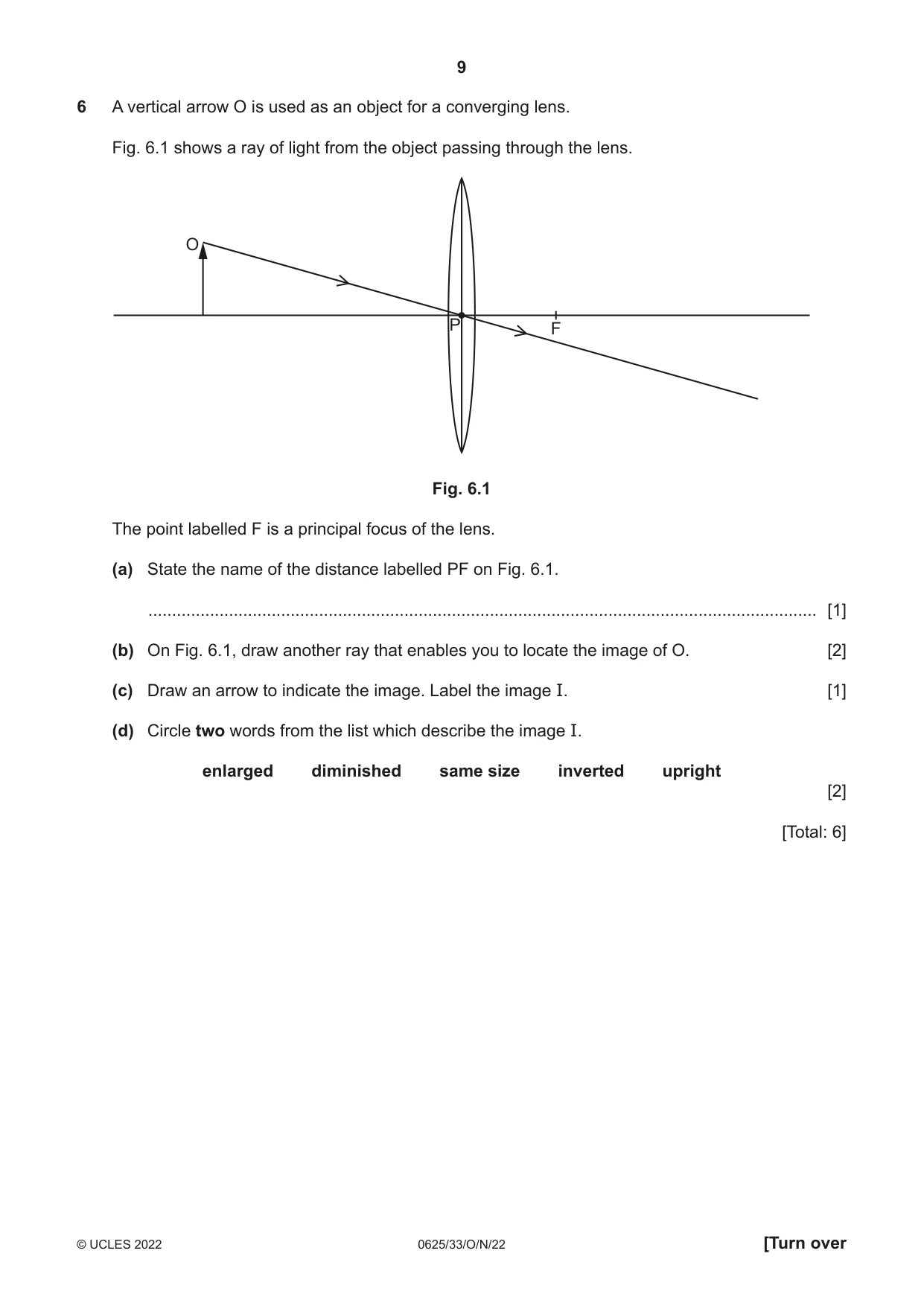
6 A vertical arrow O is used as an object for a converging lens. Fig. 6.1 shows a ray of light from the object passing through the lens. O P F Fig. 6.1 The point labelled F is a principal focus of the lens. (a) State the name of the distance labelled PF on Fig. 6.1. ............................................................................................................................................. [1] (b) On Fig. 6.1, draw another ray that enables you to locate the image of O. [2] (c) Draw an arrow to indicate the image. Label the image I. [1] (d) Circle two words from the list which describe the image I. enlarged diminished same size inverted upright [2] [Total: 6]
Mark scheme: 6(a) focal length B1 6(b) paraxial ray to lens B1 ray passes through F B1 OR ray passing through principal focus on lhs paraxial ray on rhs 6(c) labelled inverted arrow from where (their) rays cross to principal axis B1 6(d) diminished B1 inverted B1
Q7 · Two students, A and B, determine the speed of sound
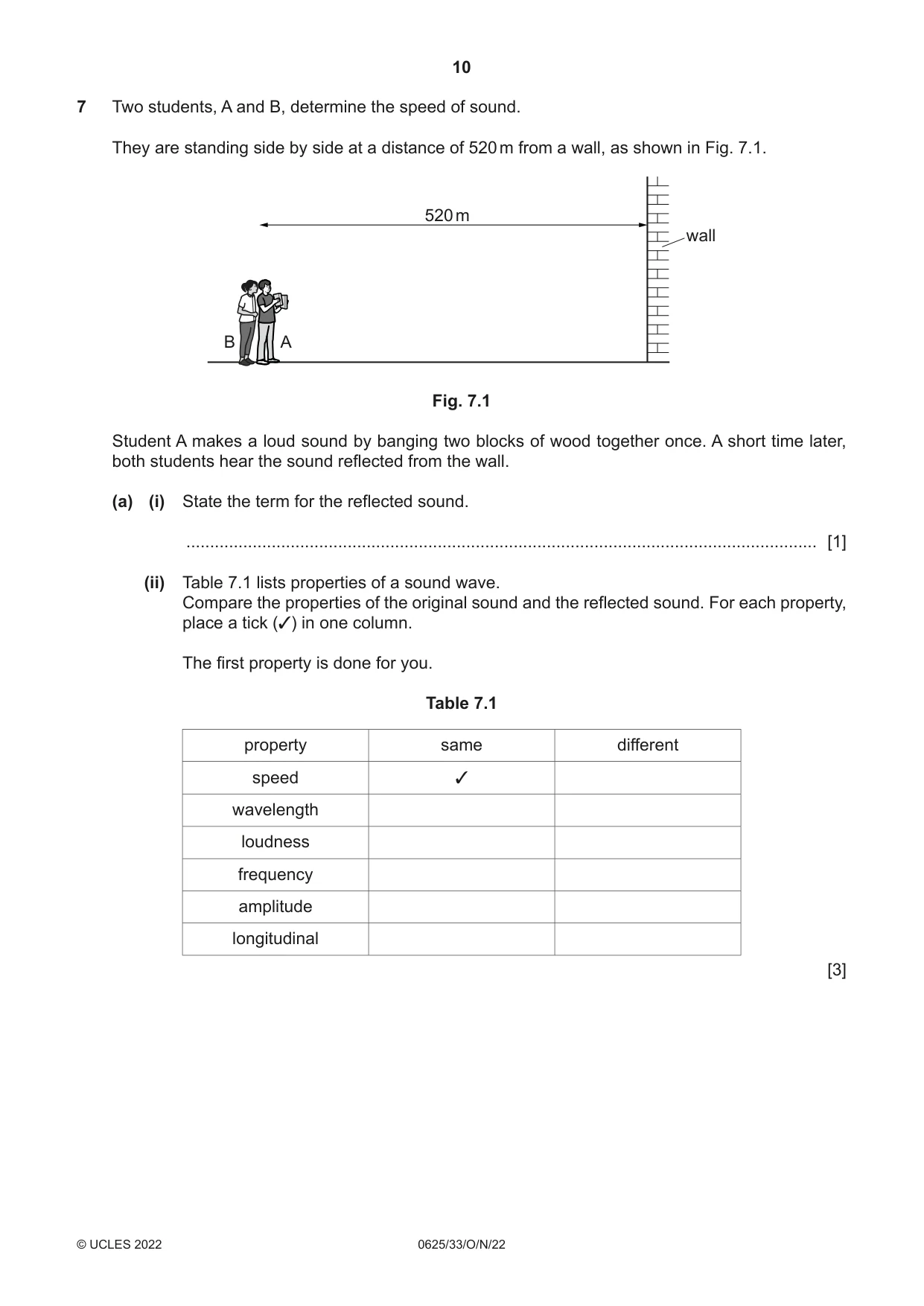
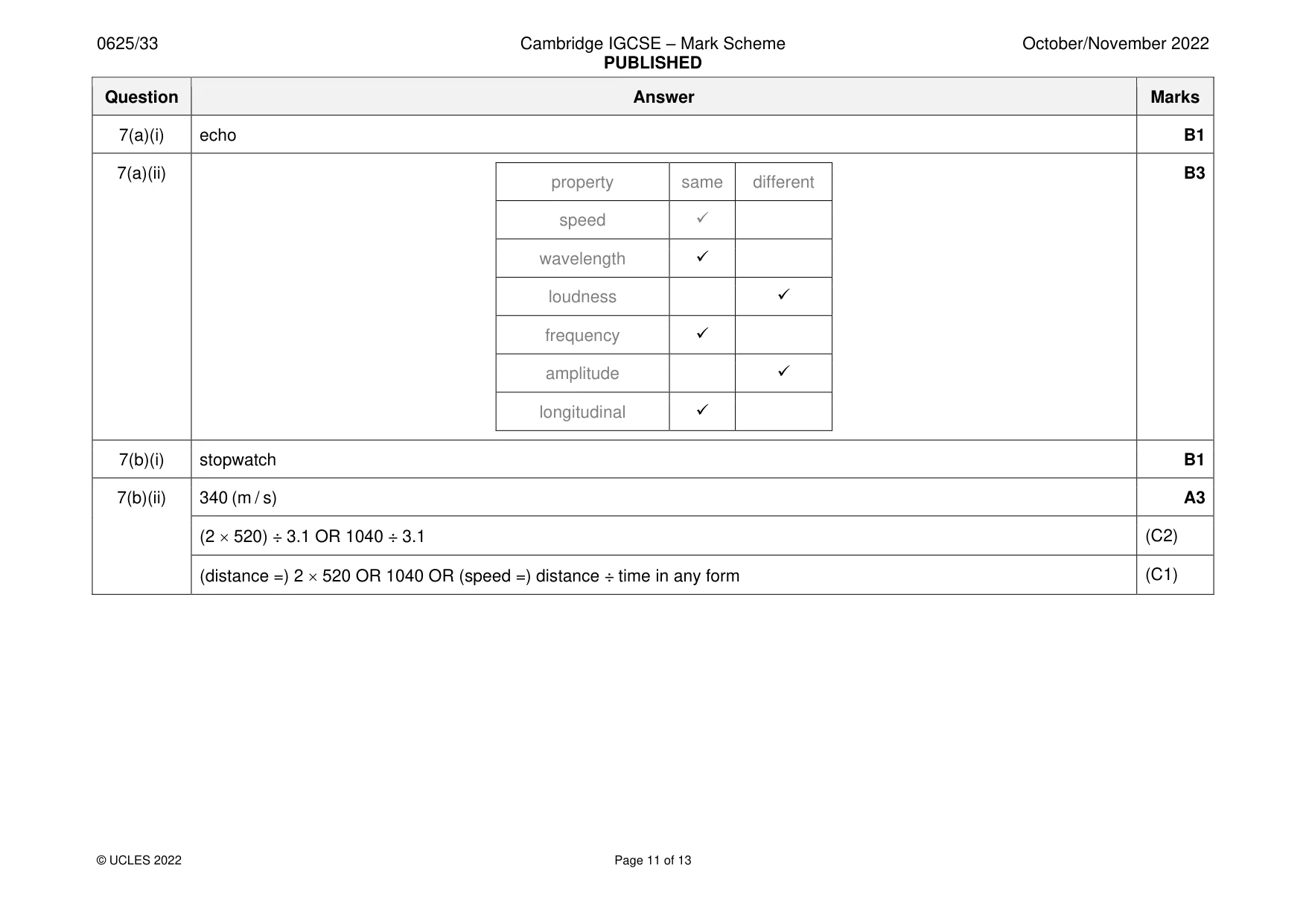
7 Two students, A and B, determine the speed of sound. They are standing side by side at a distance of 520 m from a wall, as shown in Fig. 7.1. 520 m wall B A Fig. 7.1 Student A makes a loud sound by banging two blocks of wood together once. A short time later, both students hear the sound reflected from the wall. (a) (i) State the term for the reflected sound. ..................................................................................................................................... [1] (ii) Table 7.1 lists properties of a sound wave. Compare the properties of the original sound and the reflected sound. For each property, place a tick (✓) in one column. The first property is done for you. Table 7.1 property same different speed ✓ wavelength loudness frequency amplitude longitudinal [3] (b) Student B measures the time between the original sound and the reflected sound. (i) Suggest a suitable device for measuring the time interval between hearing the original sound and hearing the reflected sound. ..................................................................................................................................... [1] (ii) The time interval between hearing the original sound and hearing the reflected sound is 3.1 s. Use information shown in Fig. 7.1 to calculate the speed of sound. speed of sound = .................................................. m / s [3] [Total: 8]
Mark scheme: 7(a)(i) echo B1 7(a)(ii) B3 property same different speed ✓ wavelength ✓ loudness ✓ frequency ✓ amplitude ✓ longitudinal ✓ 7(b)(i) stopwatch B1 7(b)(ii) 340 (m / s) A3 (2 520) ÷ 3.1 OR 1040 ÷ 3.1 (C2) (distance =) 2 520 OR 1040 OR (speed =) distance ÷ time in any form (C1)
Q8 · The security and waiting areas at an airport
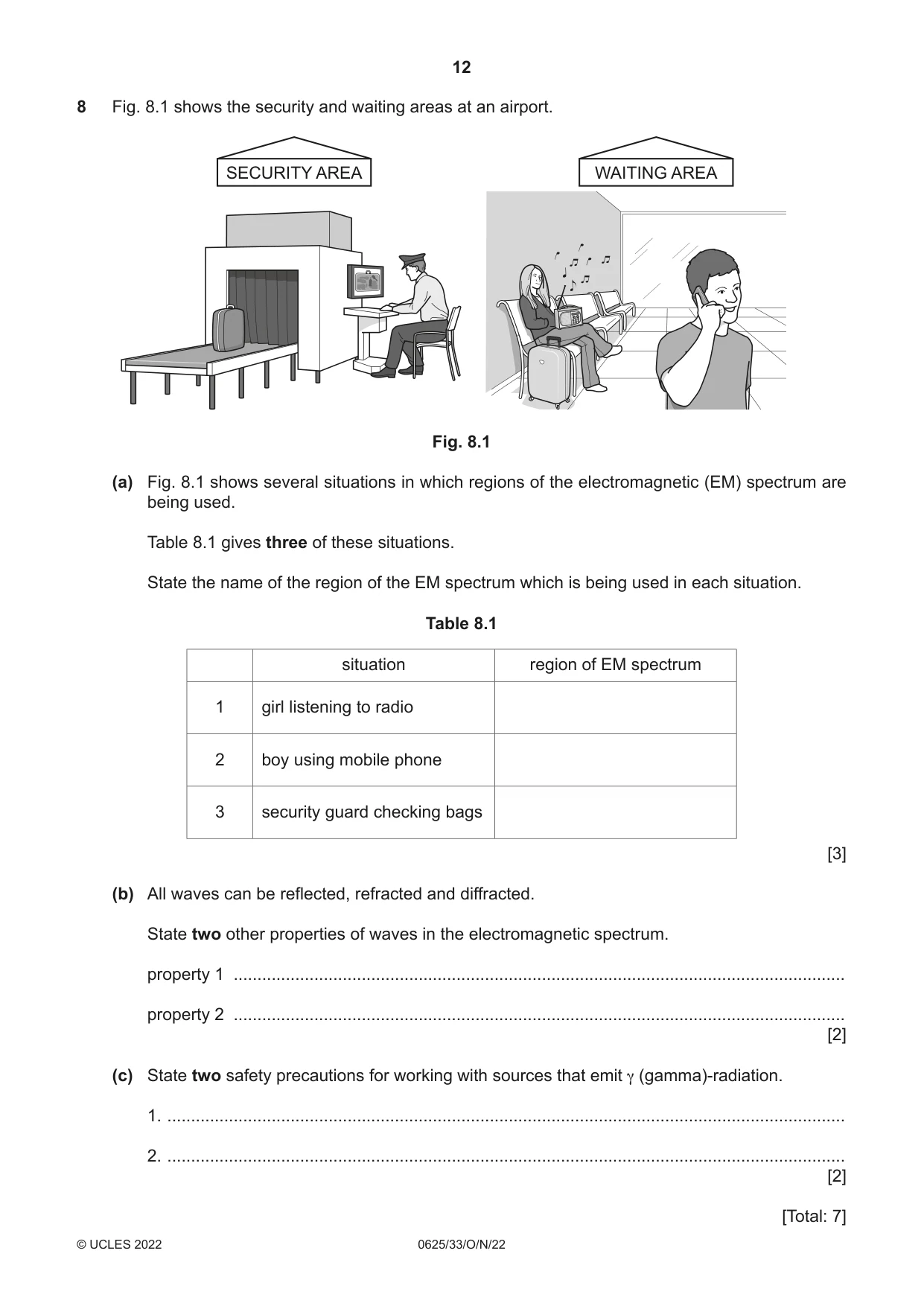
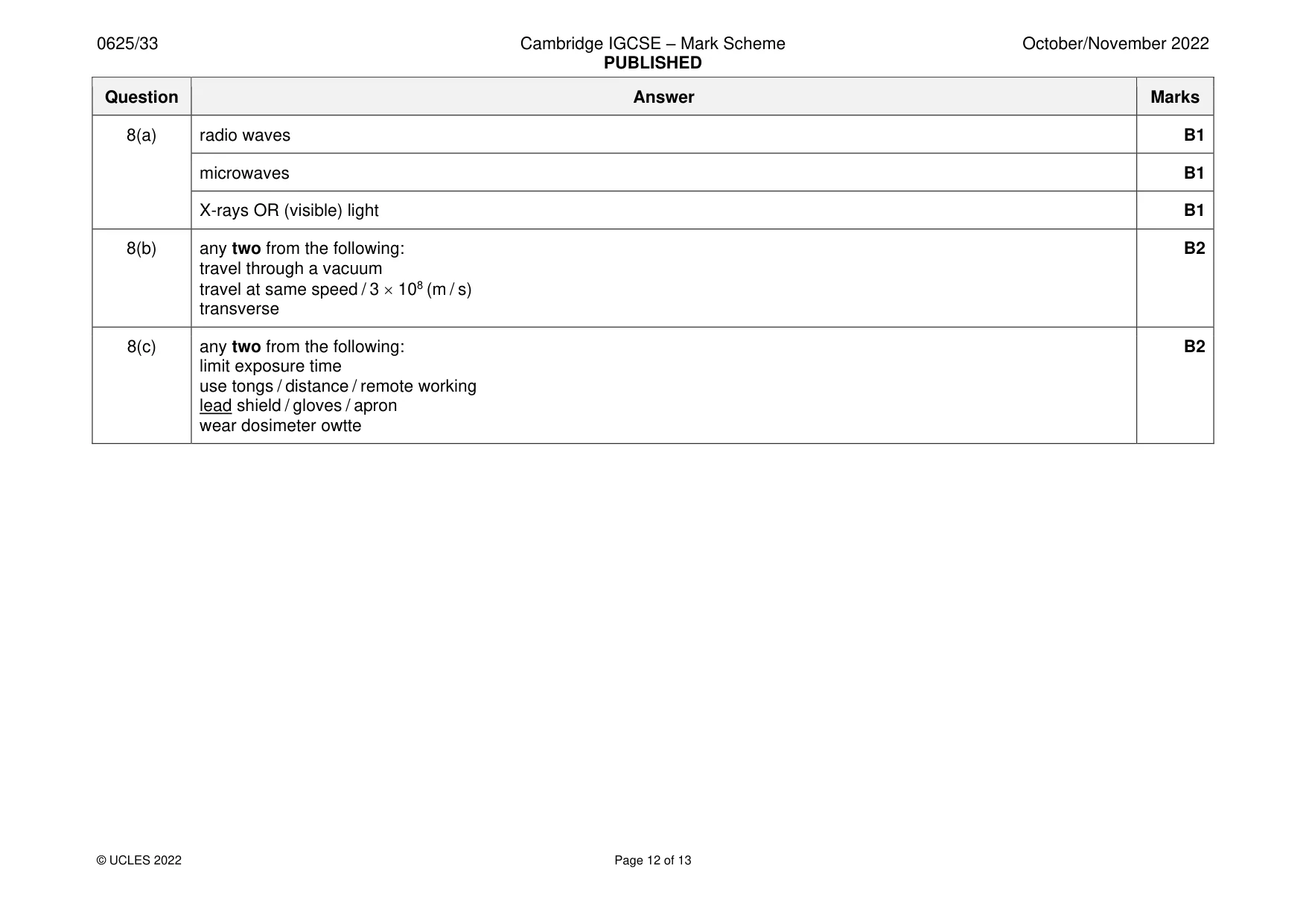
8 Fig. 8.1 shows the security and waiting areas at an airport. SECURITY AREA WAITING AREA Fig. 8.1 (a) Fig. 8.1 shows several situations in which regions of the electromagnetic (EM) spectrum are being used. Table 8.1 gives three of these situations. State the name of the region of the EM spectrum which is being used in each situation. Table 8.1 situation region of EM spectrum 1 girl listening to radio 2 boy using mobile phone 3 security guard checking bags [3] (b) All waves can be reflected, refracted and diffracted. State two other properties of waves in the electromagnetic spectrum. property 1 ................................................................................................................................. property 2 ................................................................................................................................. [2] (c) State two safety precautions for working with sources that emit γ (gamma)-radiation. 1. ............................................................................................................................................... 2. ............................................................................................................................................... [2] [Total: 7]
Mark scheme: 8(a) radio waves B1 microwaves B1 X-rays OR (visible) light B1 8(b) any two from the following: B2 travel through a vacuum travel at same speed / 3 108 (m / s) transverse 8(c) any two from the following: B2 limit exposure time use tongs / distance / remote working lead shield / gloves / apron wear dosimeter owtte
Q9 · A hazardous scenario of using electricity in a kitchen
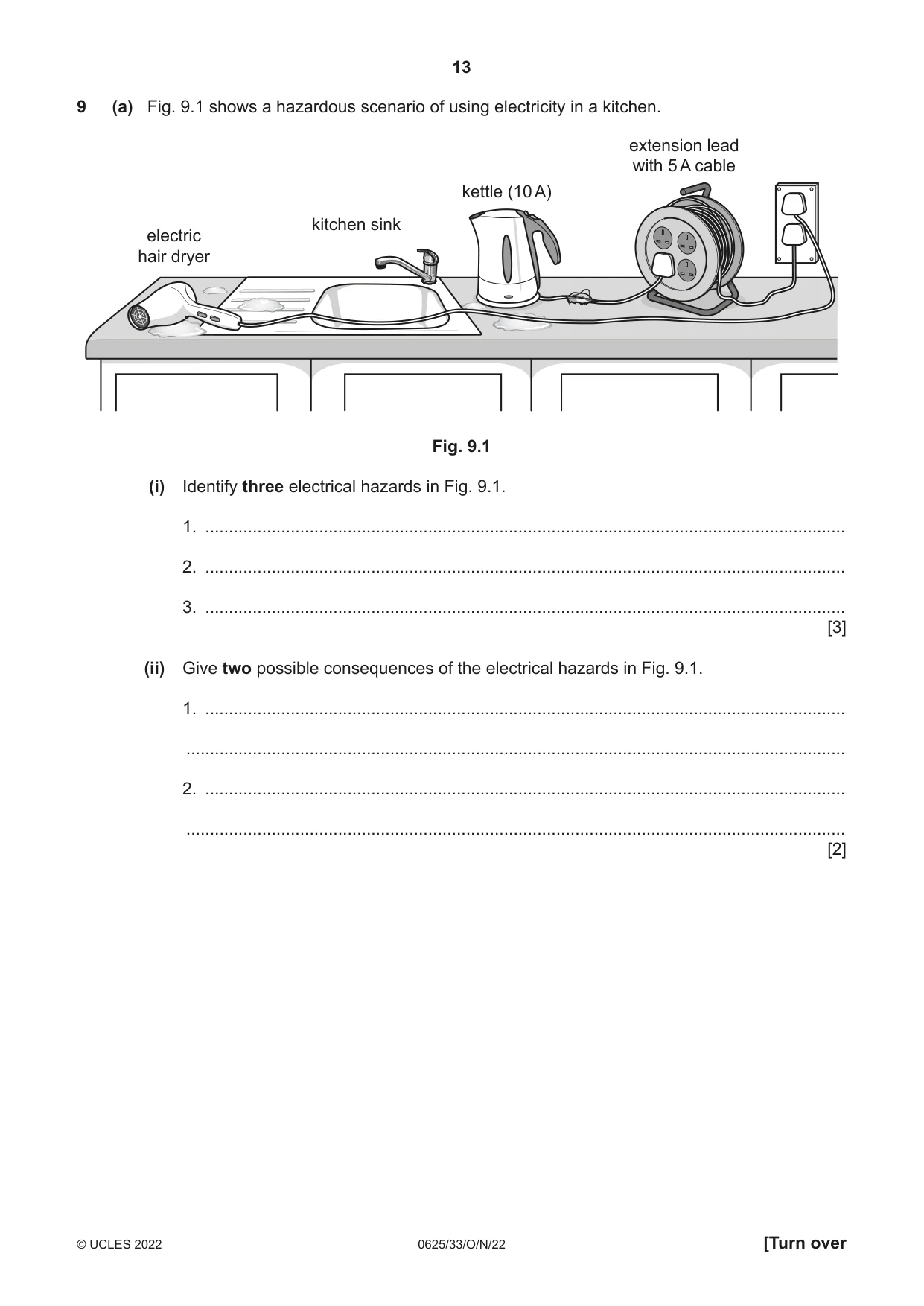
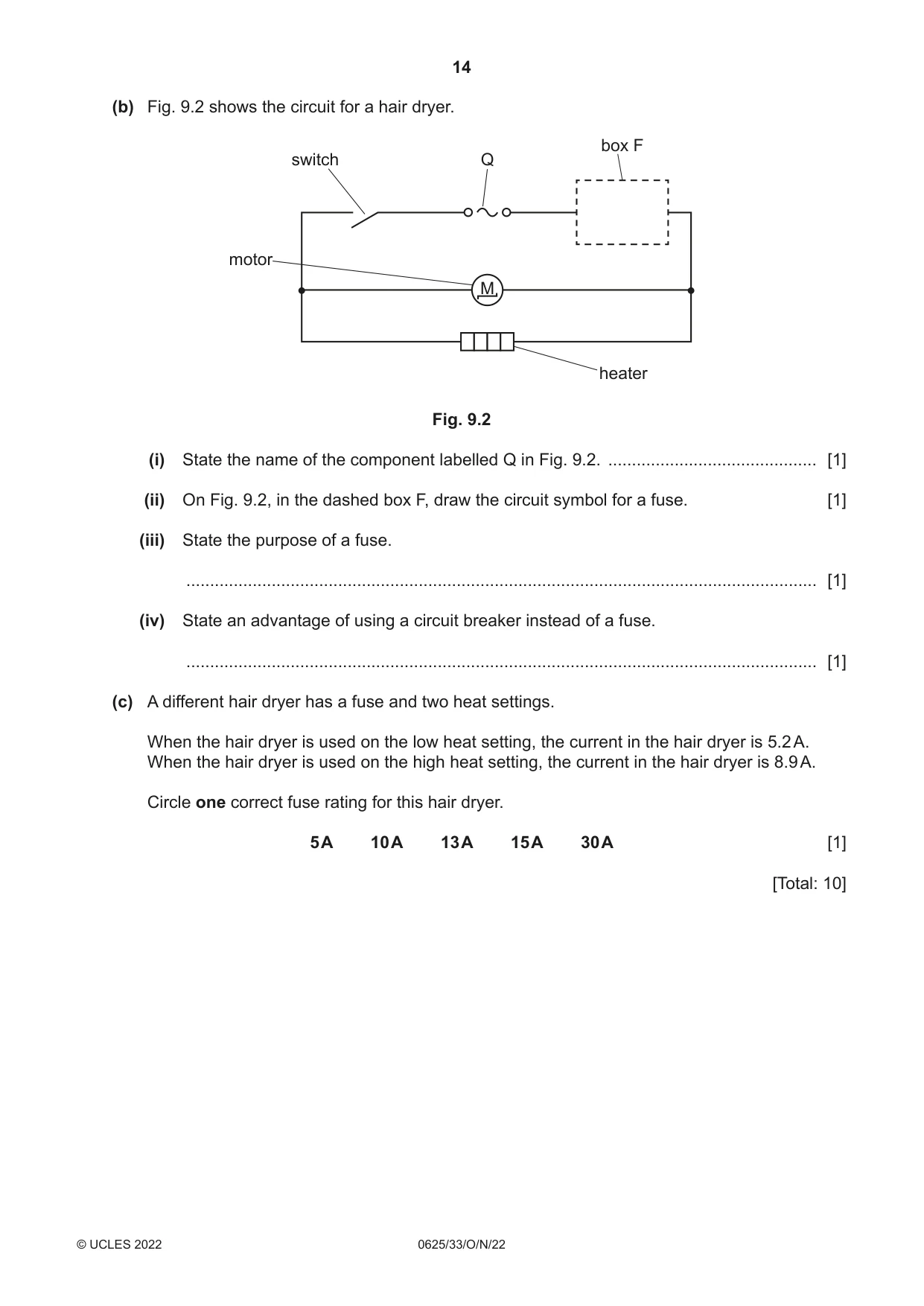
9 (a) Fig. 9.1 shows a hazardous scenario of using electricity in a kitchen. extension lead with 5 A cable kettle (10 A) kitchen sink electric hair dryer Fig. 9.1 (i) Identify three electrical hazards in Fig. 9.1. 1. ....................................................................................................................................... 2. ....................................................................................................................................... 3. ....................................................................................................................................... [3] (ii) Give two possible consequences of the electrical hazards in Fig. 9.1. 1. ....................................................................................................................................... ........................................................................................................................................... 2. ....................................................................................................................................... ........................................................................................................................................... [2] (b) Fig. 9.2 shows the circuit for a hair dryer. box F switch Q motor M heater Fig. 9.2 (i) State the name of the component labelled Q in Fig. 9.2. ............................................ [1] (ii) On Fig. 9.2, in the dashed box F, draw the circuit symbol for a fuse. [1] (iii) State the purpose of a fuse. ..................................................................................................................................... [1] (iv) State an advantage of using a circuit breaker instead of a fuse. ..................................................................................................................................... [1] (c) A different hair dryer has a fuse and two heat settings. When the hair dryer is used on the low heat setting, the current in the hair dryer is 5.2 A. When the hair dryer is used on the high heat setting, the current in the hair dryer is 8.9 A. Circle one correct fuse rating for this hair dryer. 5 A 10 A 13 A 15 A 30 A [1] [Total: 10]
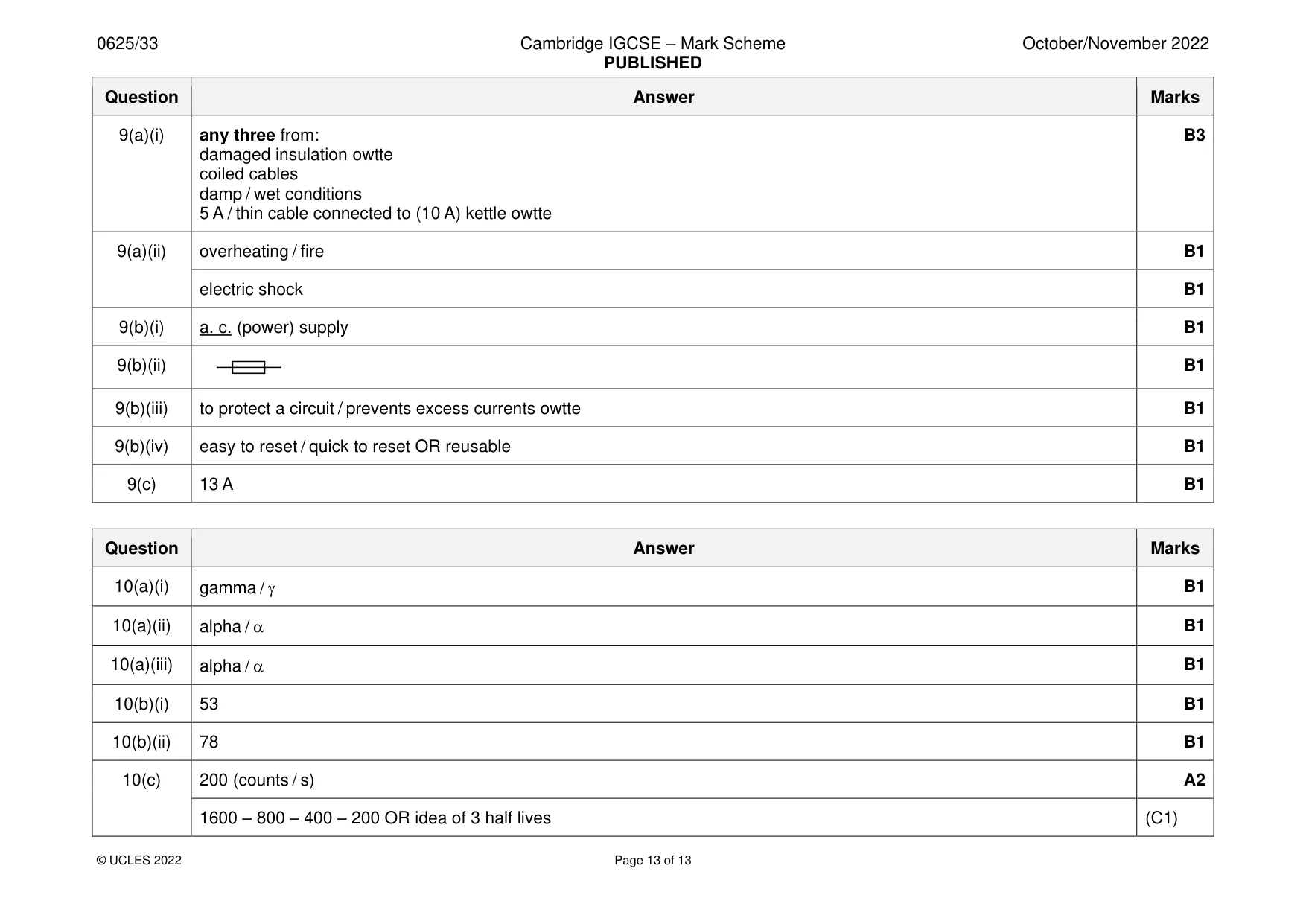
Mark scheme: 9(a)(i) any three from: B3 damaged insulation owtte coiled cables damp / wet conditions 5 A / thin cable connected to (10 A) kettle owtte 9(a)(ii) overheating / fire B1 electric shock B1 9(b)(i) a. c. (power) supply B1 9(b)(ii) B1 9(b)(iii) to protect a circuit / prevents excess currents owtte B1 9(b)(iv) easy to reset / quick to reset OR reusable B1 9(c) 13 A B1
Q10 · State which radioactive emission: (i) is the most penetrating…
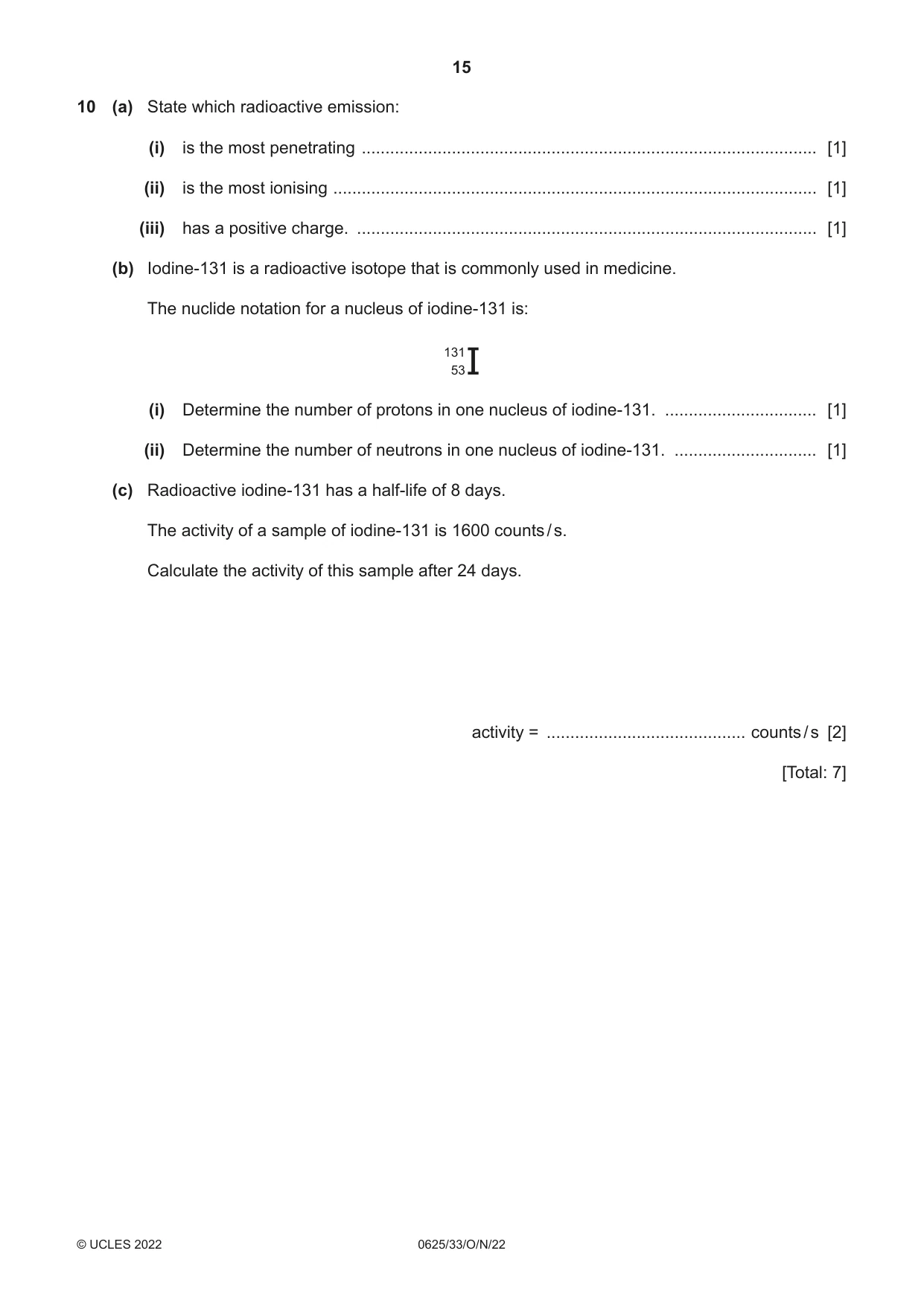
10 (a) State which radioactive emission: (i) is the most penetrating ................................................................................................ [1] (ii) is the most ionising ...................................................................................................... [1] (iii) has a positive charge. ................................................................................................. [1] (b) Iodine-131 is a radioactive isotope that is commonly used in medicine. The nuclide notation for a nucleus of iodine-131 is: 131 53I (i) Determine the number of protons in one nucleus of iodine-131. ................................ [1] (ii) Determine the number of neutrons in one nucleus of iodine-131. .............................. [1] (c) Radioactive iodine-131 has a half-life of 8 days. The activity of a sample of iodine-131 is 1600 counts / s. Calculate the activity of this sample after 24 days. activity = .......................................... counts / s [2] [Total: 7]
Mark scheme: 10(a)(i) gamma / B1 10(a)(ii) alpha / B1 10(a)(iii) alpha / B1 10(b)(i) 53 B1 10(b)(ii) 78 B1 10(c) 200 (counts / s) A2 1600 – 800 – 400 – 200 OR idea of 3 half lives (C1)
What was in this paper
The subtopics covered by these 10 questions, and how many questions each got. Open one in a new tab to see every Cambridge question on it.
What you needed in this session
Cambridge’s own grade thresholds for 2022 Oct/Nov, Paper 3 · Variant 3. A higher threshold means an easier paper — the bar moves with how the cohort did.