Cambridge IGCSE Physics 0625 — 2011 Oct/Nov Paper 3 · Variant 3
0625/33/O/N/11 · 11 questions · 80 marks · ≈90 min
The question paper and its mark scheme, free to read here and free to download. This is Cambridge’s own paper, exactly as it was sat.
Question paper20 pages

Mark scheme7 pages
Answers below. Sit the paper first if you are practising.
Questions as text
Q1 · An astronaut has a mass of 65 kg on Earth, where the gravitational field strength is 10 N…
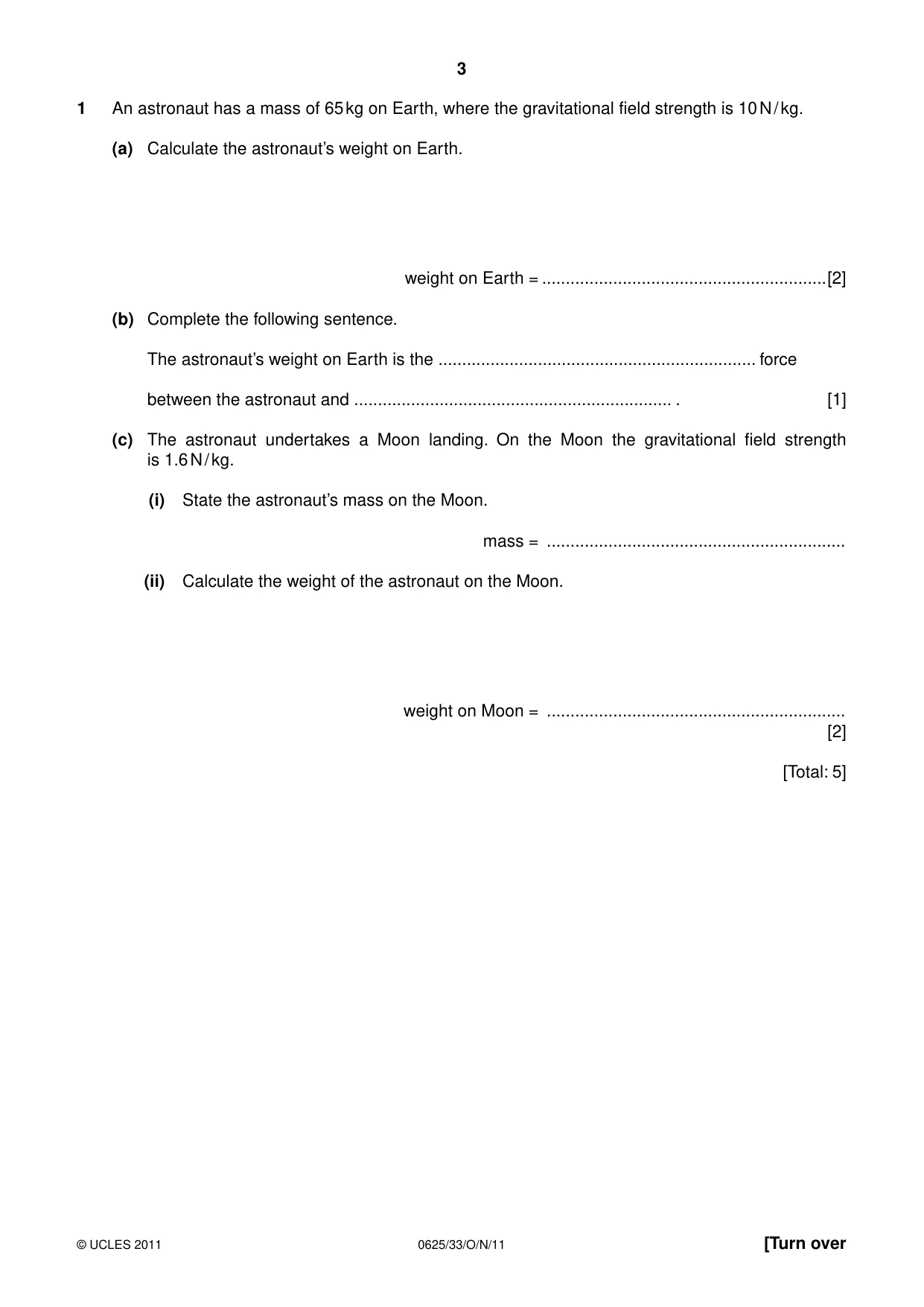
1 An astronaut has a mass of 65 kg on Earth, where the gravitational field strength is 10 N / kg. (a) Calculate the astronaut’s weight on Earth. weight on Earth = ............................................................[2] (b) Complete the following sentence. The astronaut’s weight on Earth is the ................................................................... force between the astronaut and ................................................................... . [1] (c) The astronaut undertakes a Moon landing. On the Moon the gravitational field strength is 1.6 N / kg. (i) State the astronaut’s mass on the Moon. mass = ............................................................... (ii) Calculate the weight of the astronaut on the Moon. weight on Moon = ............................................................... [2] [Total: 5]
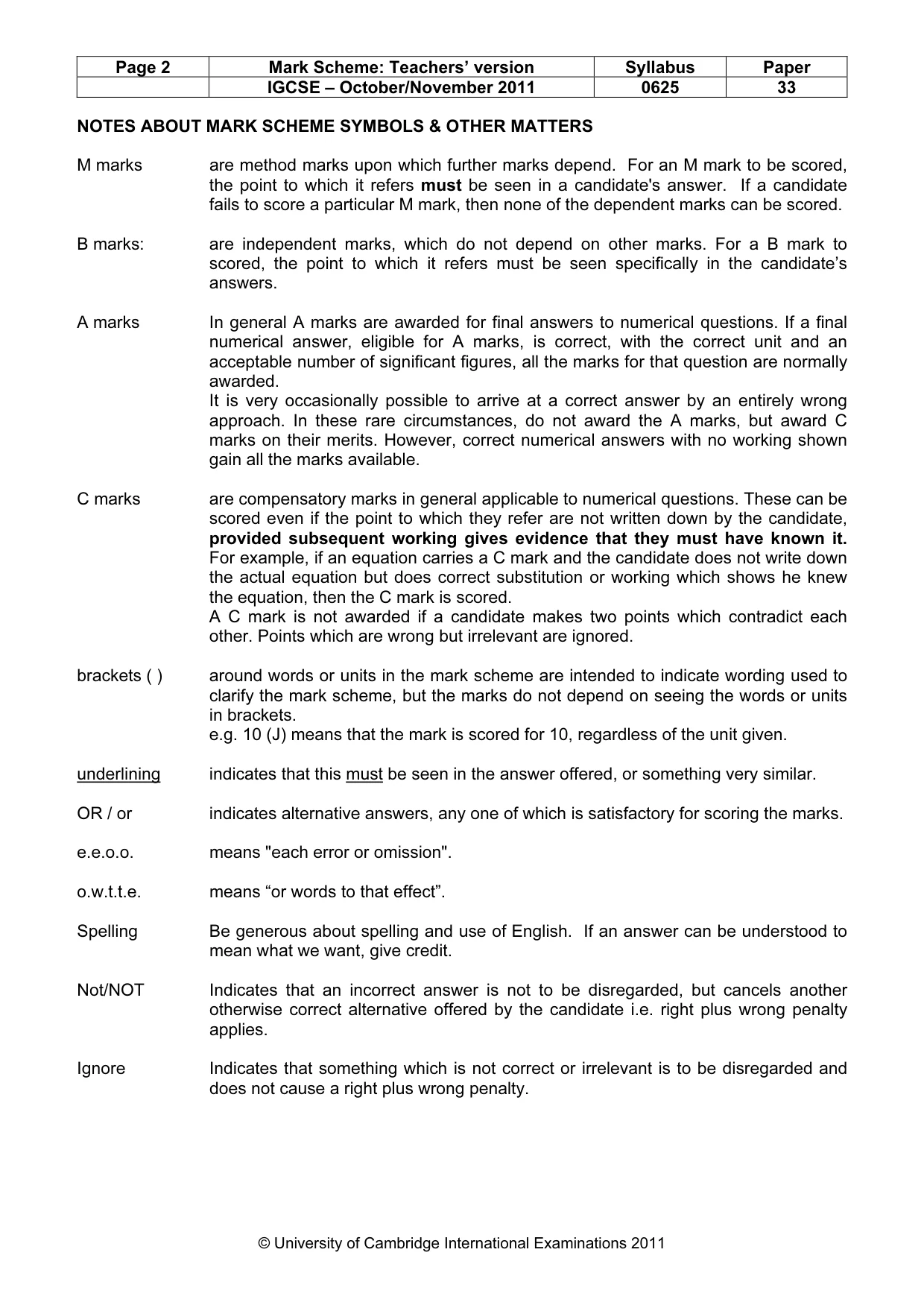
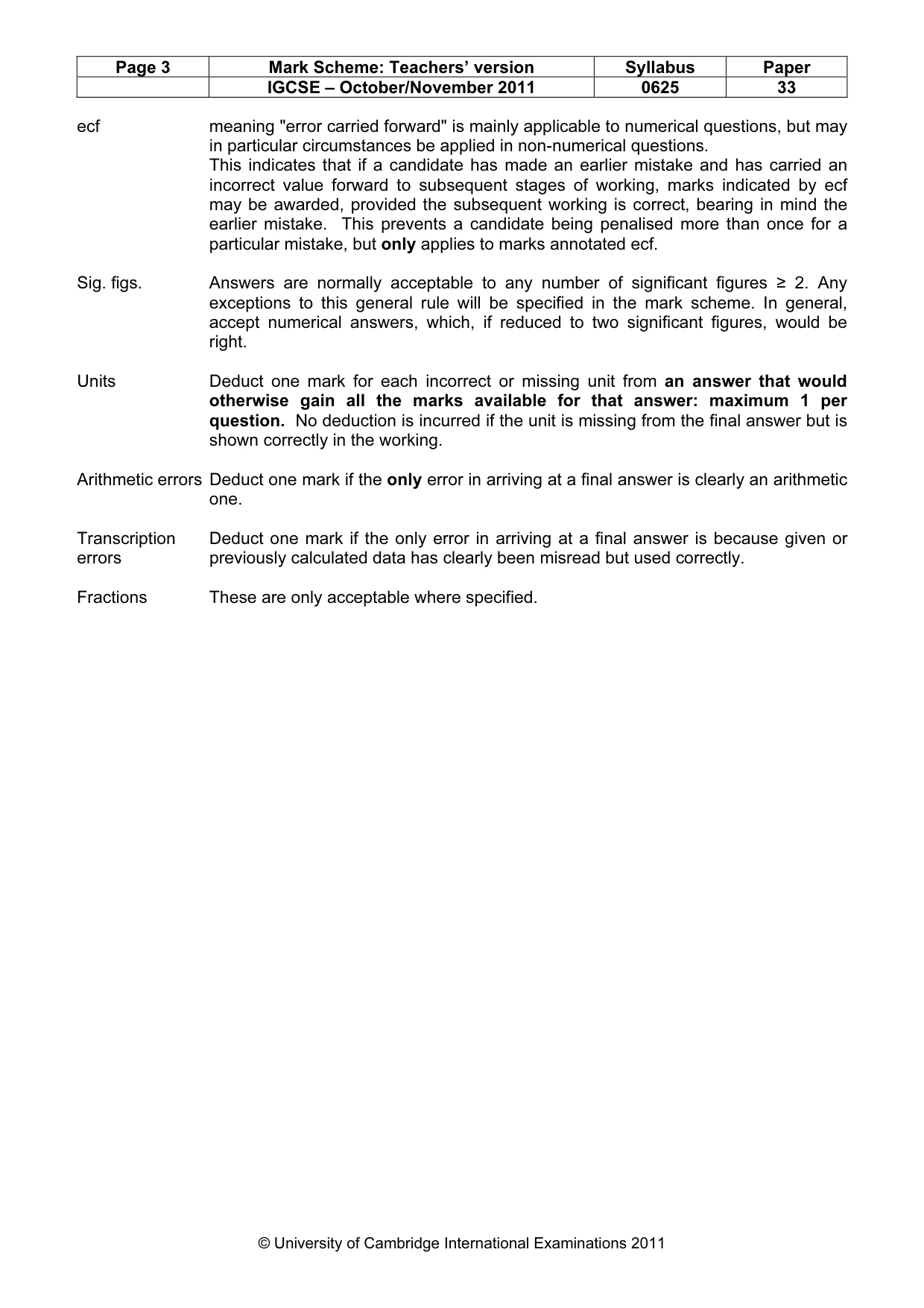
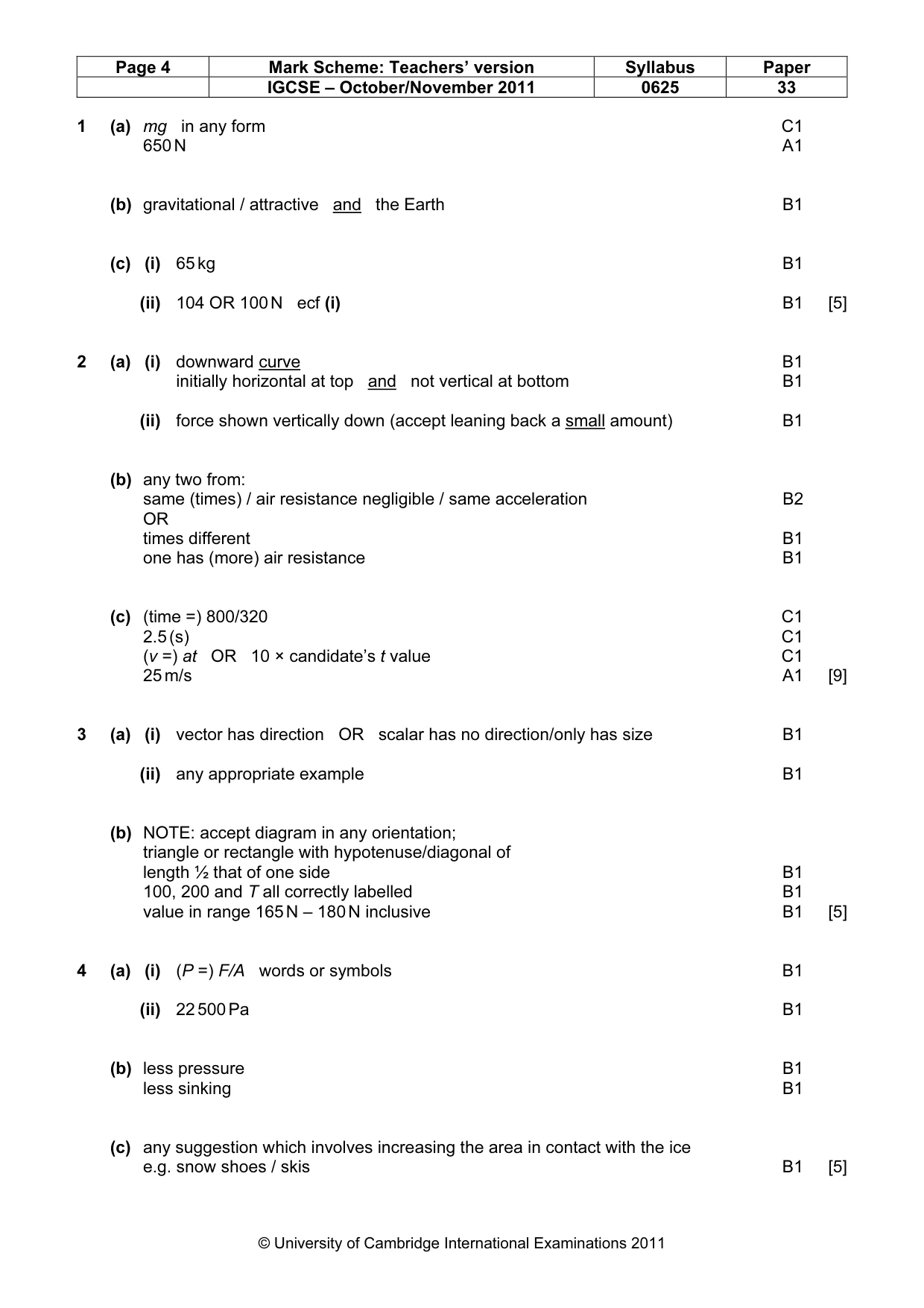
Mark scheme: 1 (a) mg in any form C1 650 N A1 (b) gravitational / attractive and the Earth B1 (c) (i) 65 kg B1 (ii) 104 OR 100 N ecf (i) B1 [5]
Q2 · A person is standing on the top of a cliff, throwing stones into the sea below
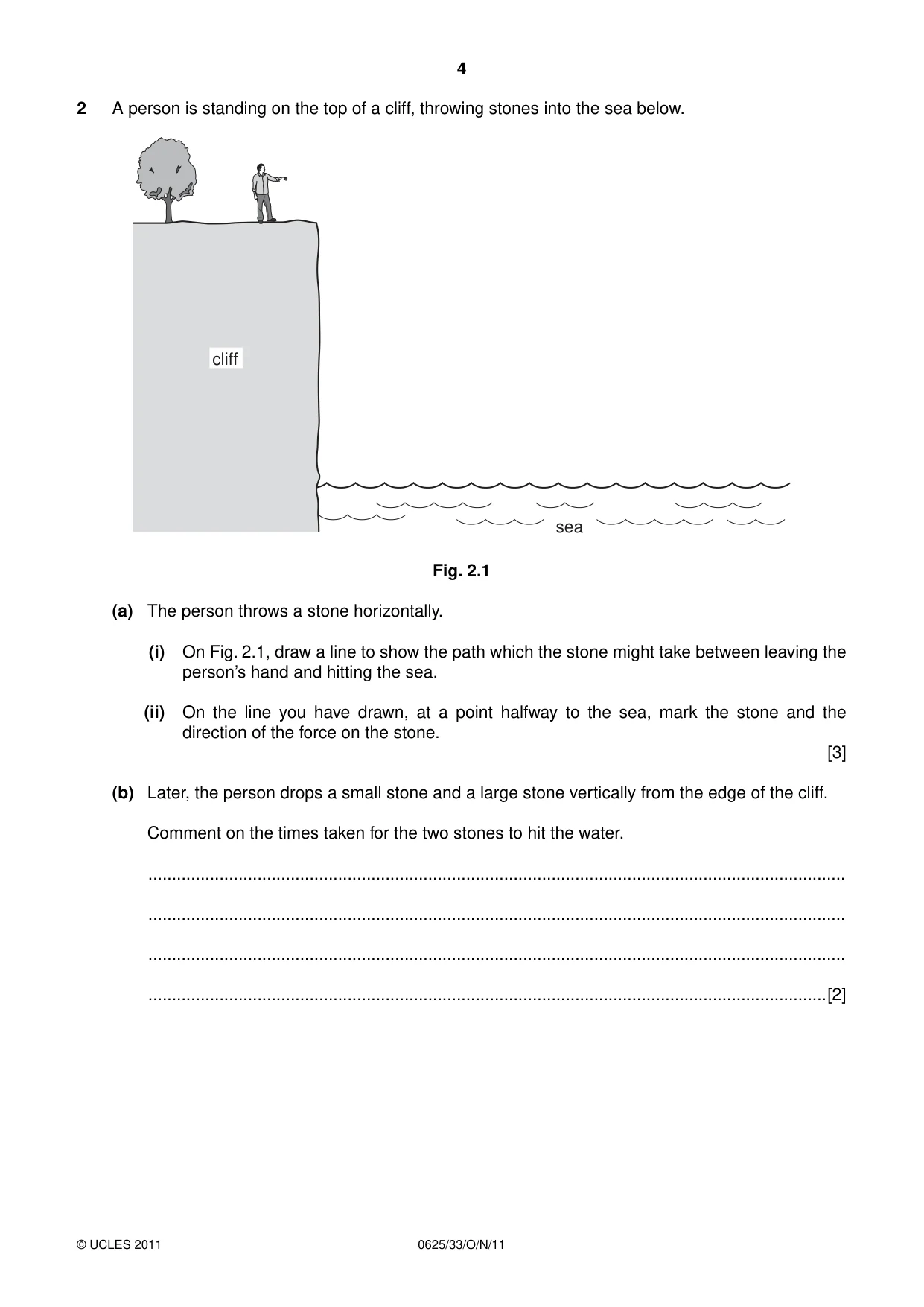
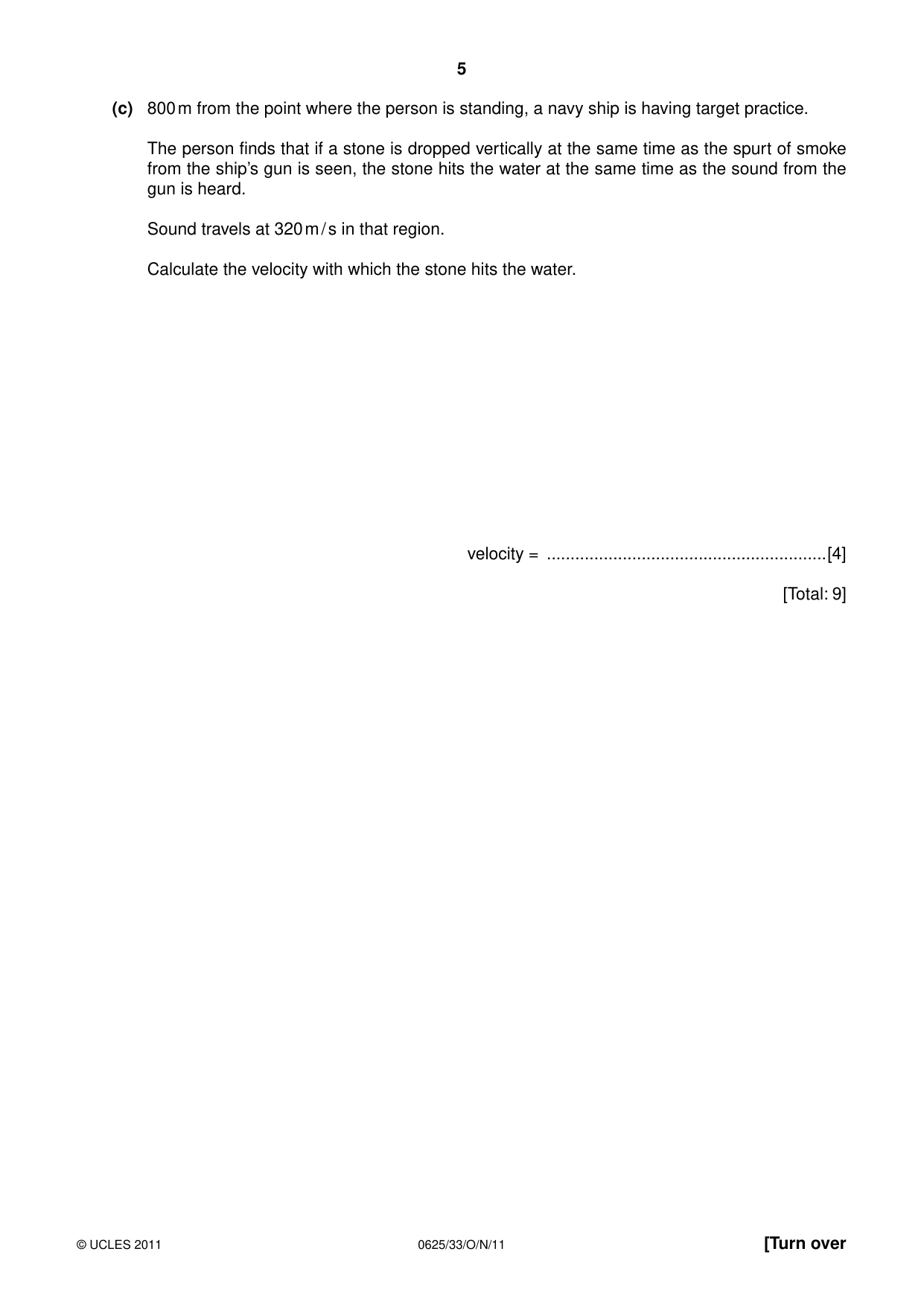
2 A person is standing on the top of a cliff, throwing stones into the sea below. cliff sea Fig. 2.1 (a) The person throws a stone horizontally. (i) On Fig. 2.1, draw a line to show the path which the stone might take between leaving the person’s hand and hitting the sea. (ii) On the line you have drawn, at a point halfway to the sea, mark the stone and the direction of the force on the stone. [3] (b) Later, the person drops a small stone and a large stone vertically from the edge of the cliff. Comment on the times taken for the two stones to hit the water. ................................................................................................................................................... ................................................................................................................................................... ................................................................................................................................................... ...............................................................................................................................................[2] (c) 800 m from the point where the person is standing, a navy ship is having target practice. The person finds that if a stone is dropped vertically at the same time as the spurt of smoke from the ship’s gun is seen, the stone hits the water at the same time as the sound from the gun is heard. Sound travels at 320 m / s in that region. Calculate the velocity with which the stone hits the water. velocity = ...........................................................[4] [Total: 9]
Mark scheme: 2 (a) (i) downward curve B1 initially horizontal at top and not vertical at bottom B1 (ii) force shown vertically down (accept leaning back a small amount) B1 (b) any two from: same (times) / air resistance negligible / same acceleration B2 OR times different B1 one has (more) air resistance B1 (c) (time =) 800/320 C1 2.5 (s) C1 (v =) at OR 10 × candidate’s t value C1 25 m/s A1 [9]
Q3 · State the difference between a scalar quantity and a vector quantity
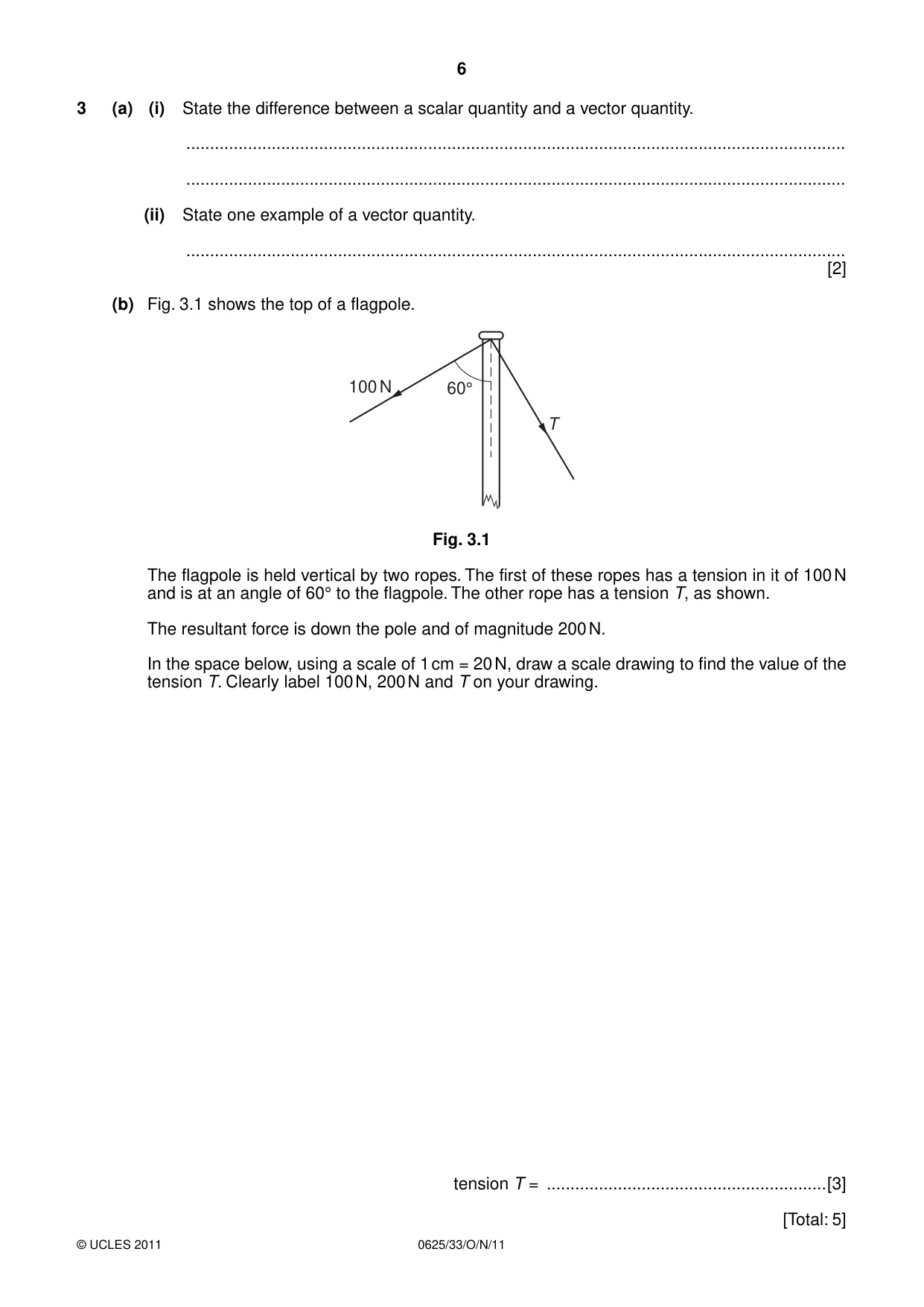
3 (a) (i) State the difference between a scalar quantity and a vector quantity. ........................................................................................................................................... ........................................................................................................................................... (ii) State one example of a vector quantity. ........................................................................................................................................... [2] (b) Fig. 3.1 shows the top of a flagpole. 100 N 60° T Fig. 3.1 The flagpole is held vertical by two ropes. The first of these ropes has a tension in it of 100 N and is at an angle of 60° to the flagpole. The other rope has a tension T, as shown. The resultant force is down the pole and of magnitude 200 N. In the space below, using a scale of 1 cm = 20 N, draw a scale drawing to find the value of the tension T. Clearly label 100 N, 200 N and T on your drawing. tension T = ...........................................................[3] [Total: 5]
Mark scheme: 3 (a) (i) vector has direction OR scalar has no direction/only has size B1 (ii) any appropriate example B1 (b) NOTE: accept diagram in any orientation; triangle or rectangle with hypotenuse/diagonal of length ½ that of one side B1 100, 200 and T all correctly labelled B1 value in range 165 N – 180 N inclusive B1 [5]
More questions on Physical quantities and measurement techniques
Q4 · A soldier wears boots, each having an area of 0.016 m2 in contact with the ground
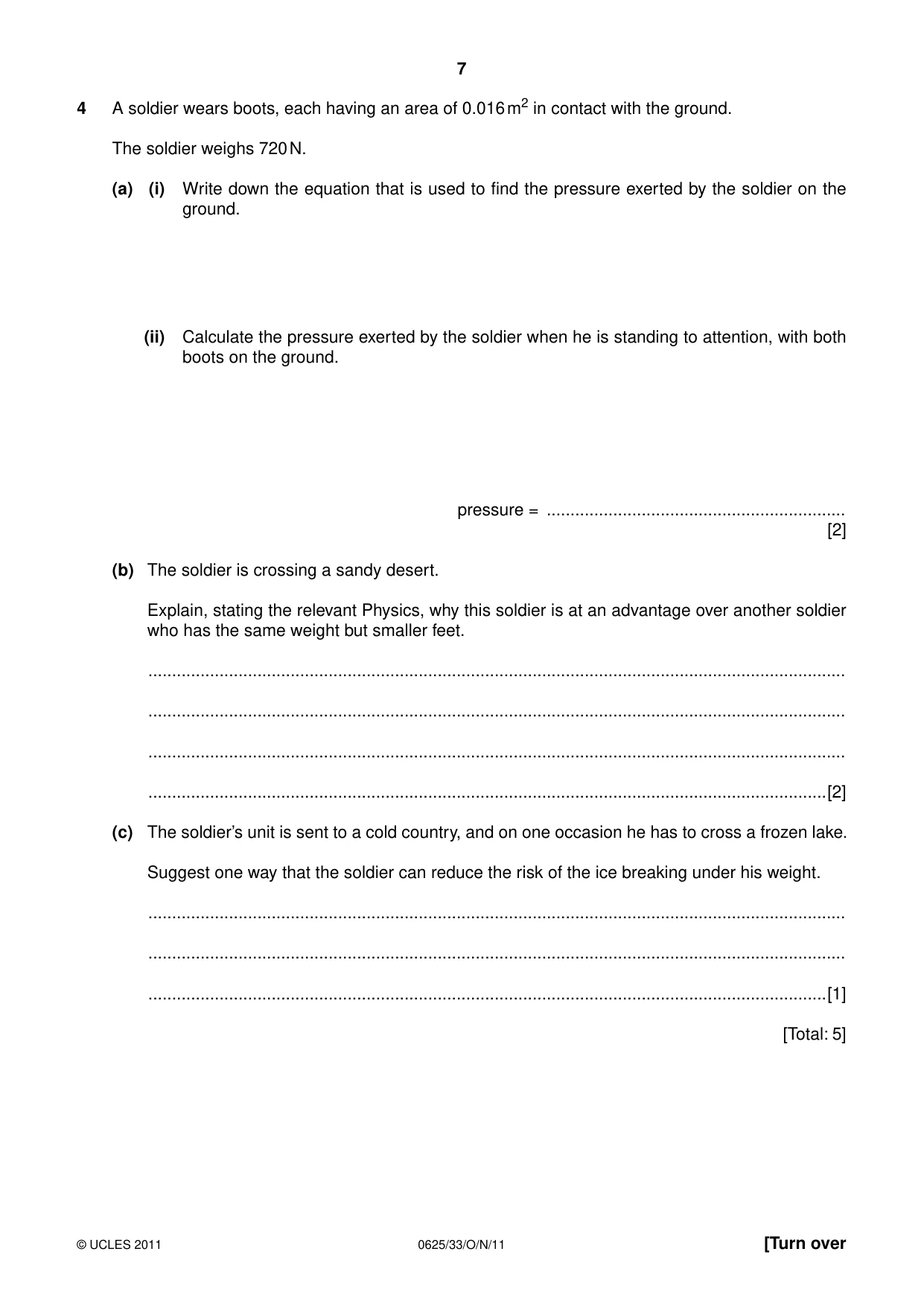
4 A soldier wears boots, each having an area of 0.016 m2 in contact with the ground. The soldier weighs 720 N. (a) (i) Write down the equation that is used to find the pressure exerted by the soldier on the ground. (ii) Calculate the pressure exerted by the soldier when he is standing to attention, with both boots on the ground. pressure = ............................................................... [2] (b) The soldier is crossing a sandy desert. Explain, stating the relevant Physics, why this soldier is at an advantage over another soldier who has the same weight but smaller feet. ................................................................................................................................................... ................................................................................................................................................... ................................................................................................................................................... ...............................................................................................................................................[2] (c) The soldier’s unit is sent to a cold country, and on one occasion he has to cross a frozen lake. Suggest one way that the soldier can reduce the risk of the ice breaking under his weight. ................................................................................................................................................... ................................................................................................................................................... ...............................................................................................................................................[1] [Total: 5]
Mark scheme: 4 (a) (i) (P =) F/A words or symbols B1 (ii) 22 500 Pa B1 (b) less pressure B1 less sinking B1 (c) any suggestion which involves increasing the area in contact with the ice e.g. snow shoes / skis B1 [5] IGCSE – October/November 2011 0625 33
Q5 · Two workmen are employed on a building project, as shown in Fig
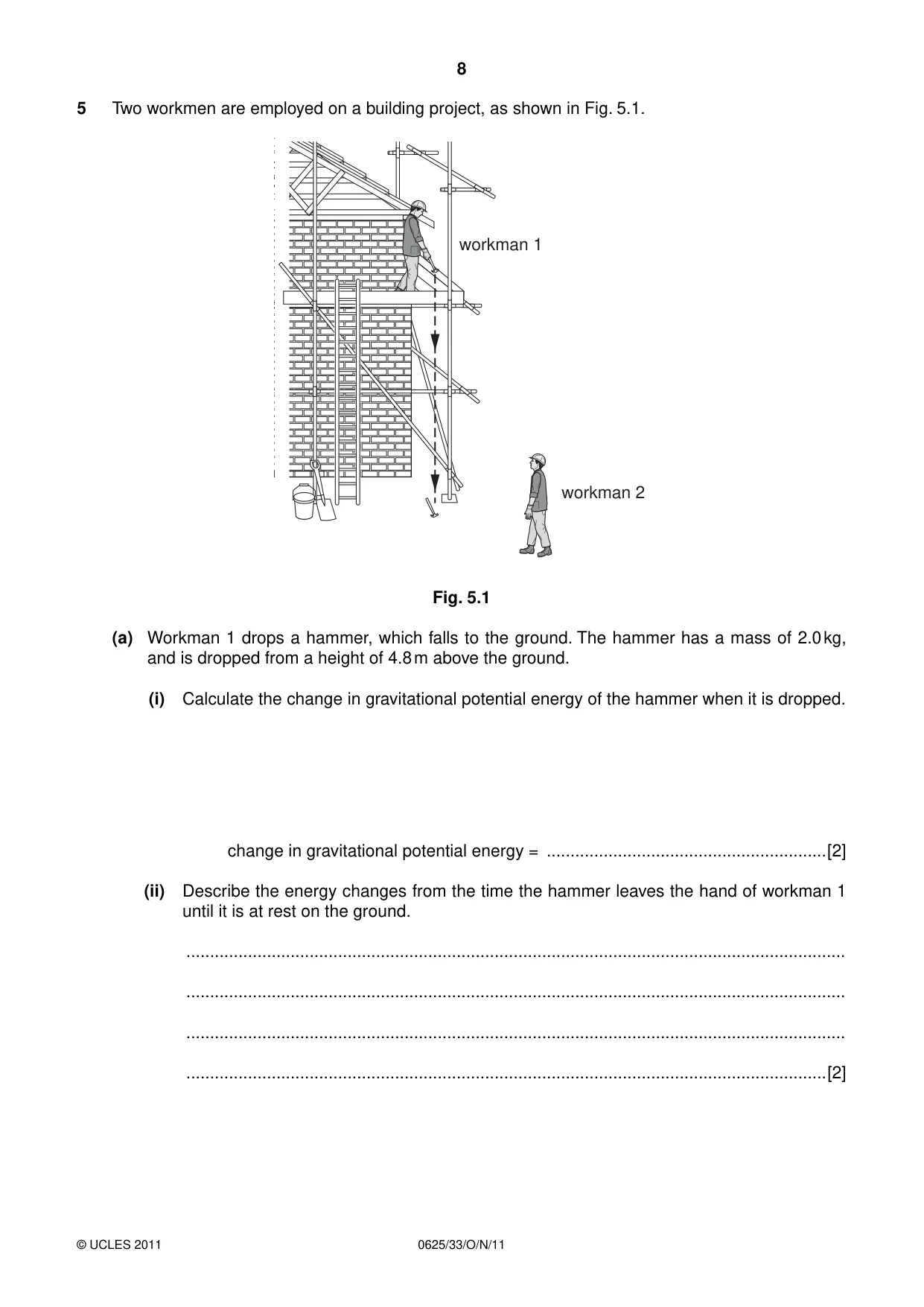
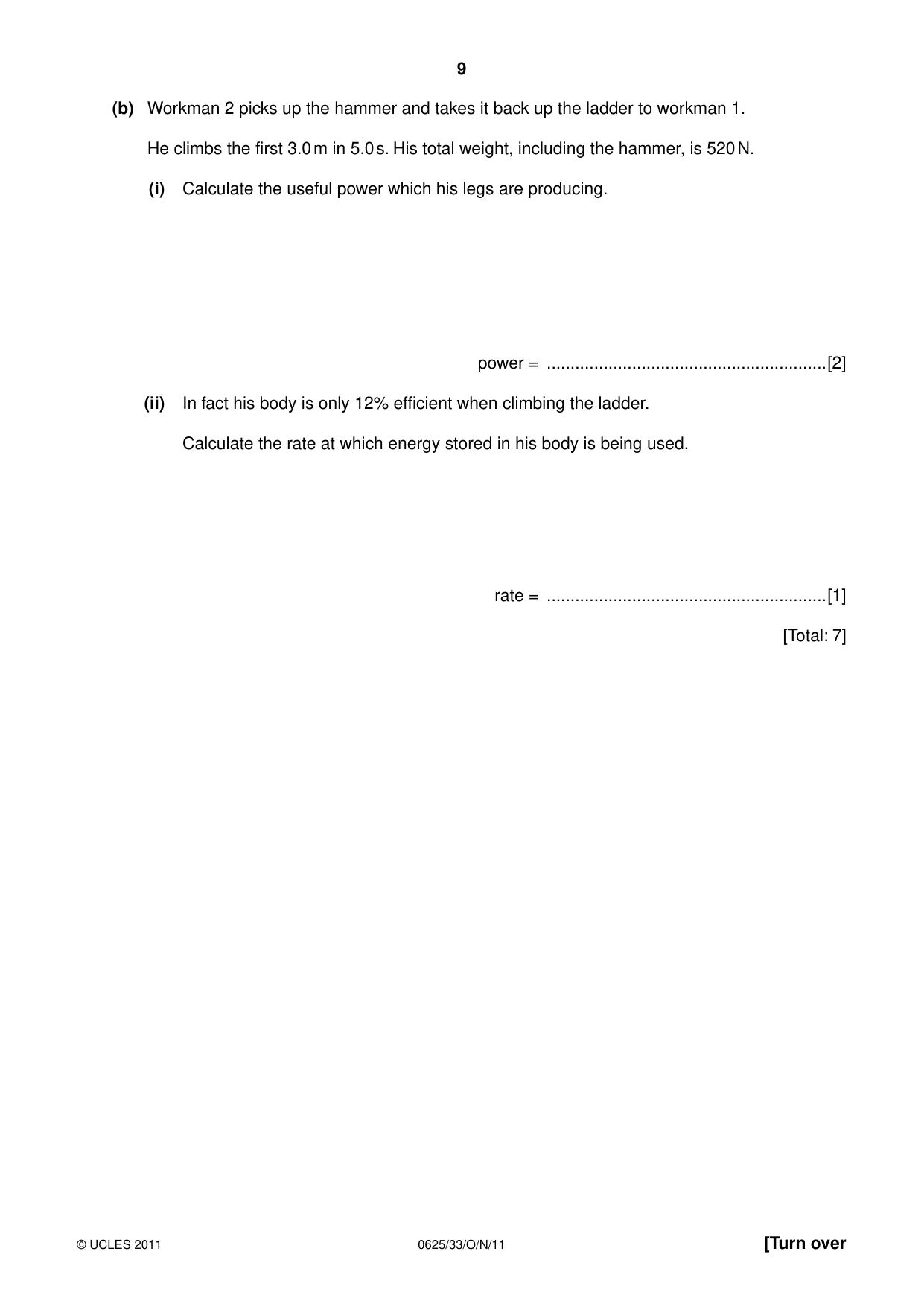
5 Two workmen are employed on a building project, as shown in Fig. 5.1. workman 1 workman 2 Fig. 5.1 (a) Workman 1 drops a hammer, which falls to the ground. The hammer has a mass of 2.0 kg, and is dropped from a height of 4.8 m above the ground. (i) Calculate the change in gravitational potential energy of the hammer when it is dropped. change in gravitational potential energy = ...........................................................[2] (ii) Describe the energy changes from the time the hammer leaves the hand of workman 1 until it is at rest on the ground. ........................................................................................................................................... ........................................................................................................................................... ........................................................................................................................................... .......................................................................................................................................[2] (b) Workman 2 picks up the hammer and takes it back up the ladder to workman 1. He climbs the first 3.0 m in 5.0 s. His total weight, including the hammer, is 520 N. (i) Calculate the useful power which his legs are producing. power = ...........................................................[2] (ii) In fact his body is only 12% efficient when climbing the ladder. Calculate the rate at which energy stored in his body is being used. rate = ...........................................................[1] [Total: 7]
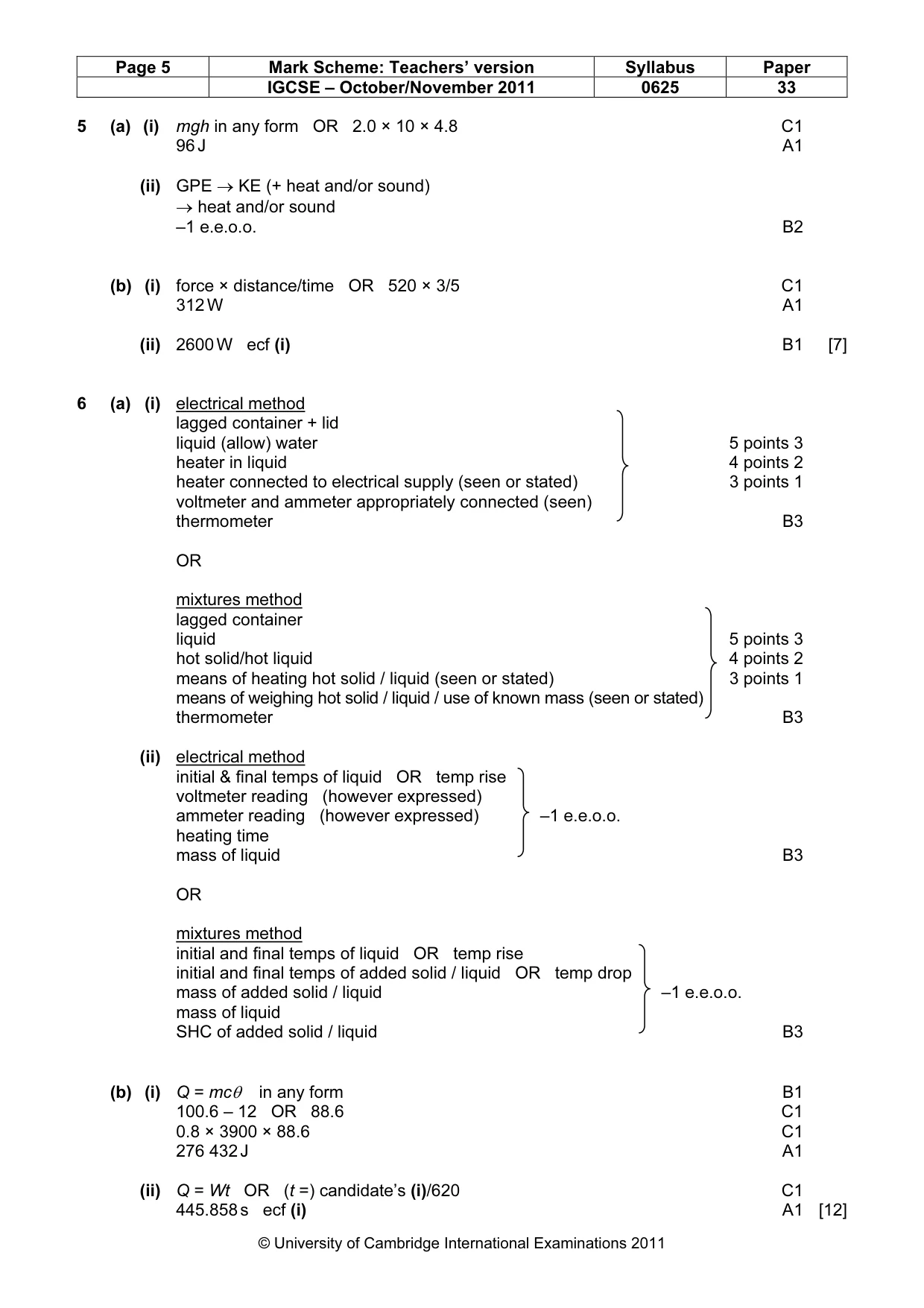
Mark scheme: 5 (a) (i) mgh in any form OR 2.0 × 10 × 4.8 C1 96 J A1 (ii) GPE → KE (+ heat and/or sound) → heat and/or sound –1 e.e.o.o. B2 (b) (i) force × distance/time OR 520 × 3/5 C1 312 W A1 (ii) 2600 W ecf (i) B1 [7]
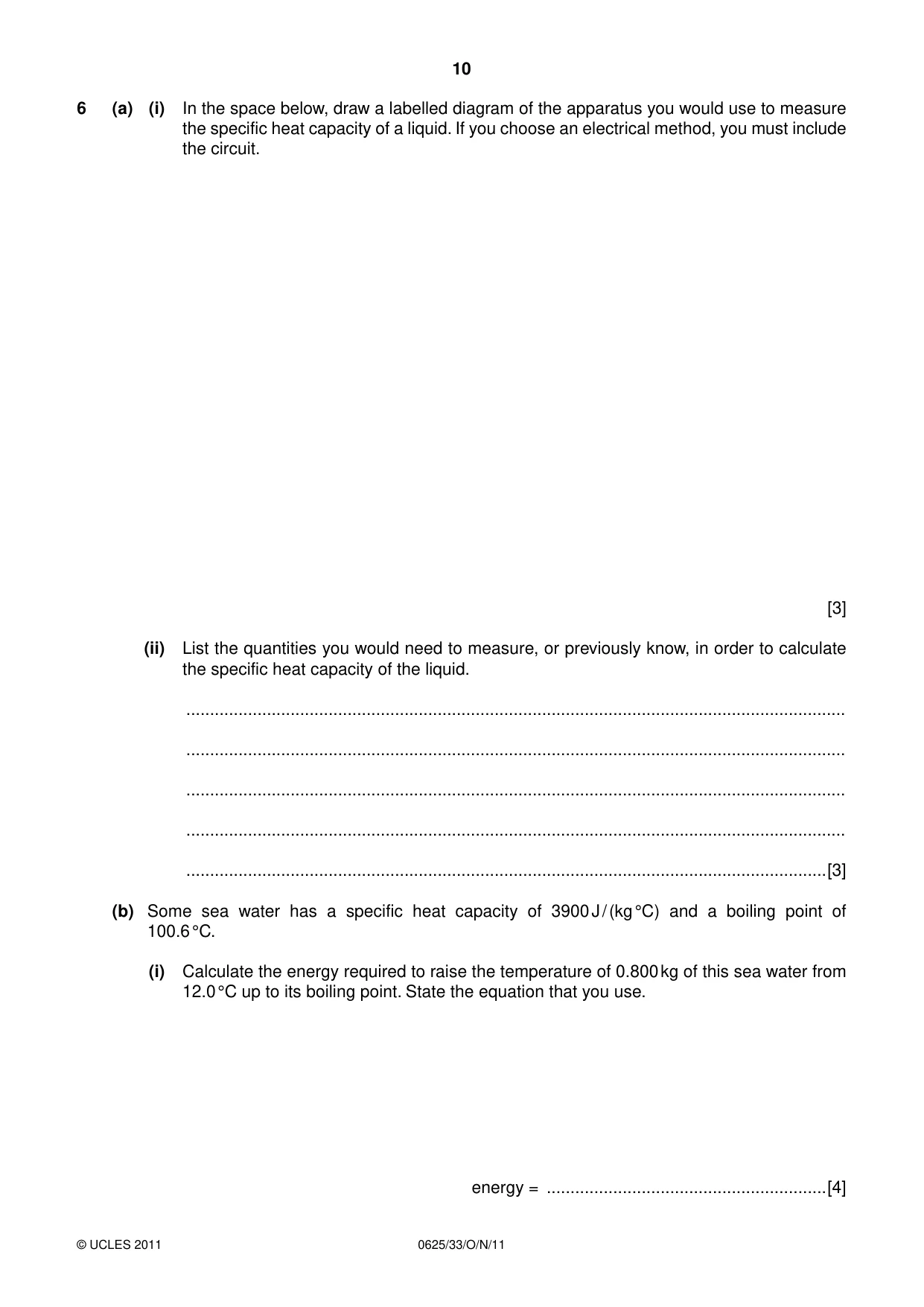
Q6 · In the space below, draw a labelled diagram of the apparatus you would use to measure the…
6 (a) (i) In the space below, draw a labelled diagram of the apparatus you would use to measure the specific heat capacity of a liquid. If you choose an electrical method, you must include the circuit. [3] (ii) List the quantities you would need to measure, or previously know, in order to calculate the specific heat capacity of the liquid. ........................................................................................................................................... ........................................................................................................................................... ........................................................................................................................................... ........................................................................................................................................... .......................................................................................................................................[3] (b) Some sea water has a specific heat capacity of 3900 J / (kg °C) and a boiling point of 100.6 °C. (i) Calculate the energy required to raise the temperature of 0.800 kg of this sea water from 12.0 °C up to its boiling point. State the equation that you use. energy = ...........................................................[4] (ii) The energy to raise the temperature in (b)(i) is supplied at the rate of 620 W. Calculate the time taken to raise the sea water to its boiling point. time = ...........................................................[2] [Total: 12]
Mark scheme: 6 (a) (i) electrical method lagged container + lid liquid (allow) water 5 points 3 heater in liquid 4 points 2 heater connected to electrical supply (seen or stated) 3 points 1 voltmeter and ammeter appropriately connected (seen) thermometer B3 OR mixtures method lagged container liquid 5 points 3 hot solid/hot liquid 4 points 2 means of heating hot solid / liquid (seen or stated) 3 points 1 means of weighing hot solid / liquid / use of known mass (seen or stated) thermometer B3 (ii) electrical method initial & final temps of liquid OR temp rise voltmeter reading (however expressed) ammeter reading (however expressed) –1 e.e.o.o. heating time mass of liquid B3 OR mixtures method initial and final temps of liquid OR temp rise initial and final temps of added solid / liquid OR temp drop mass of added solid / liquid –1 e.e.o.o. mass of liquid SHC of added solid / liquid B3 (b) (i) Q = mcθ in any form B1 100.6 – 12 OR 88.6 C1 0.8 × 3900 × 88.6 C1 276 432 J A1 (ii) Q = Wt OR (t =) candidate’s (i)/620 C1 445.858 s ecf (i) A1 [12] IGCSE – October/November 2011 0625 33
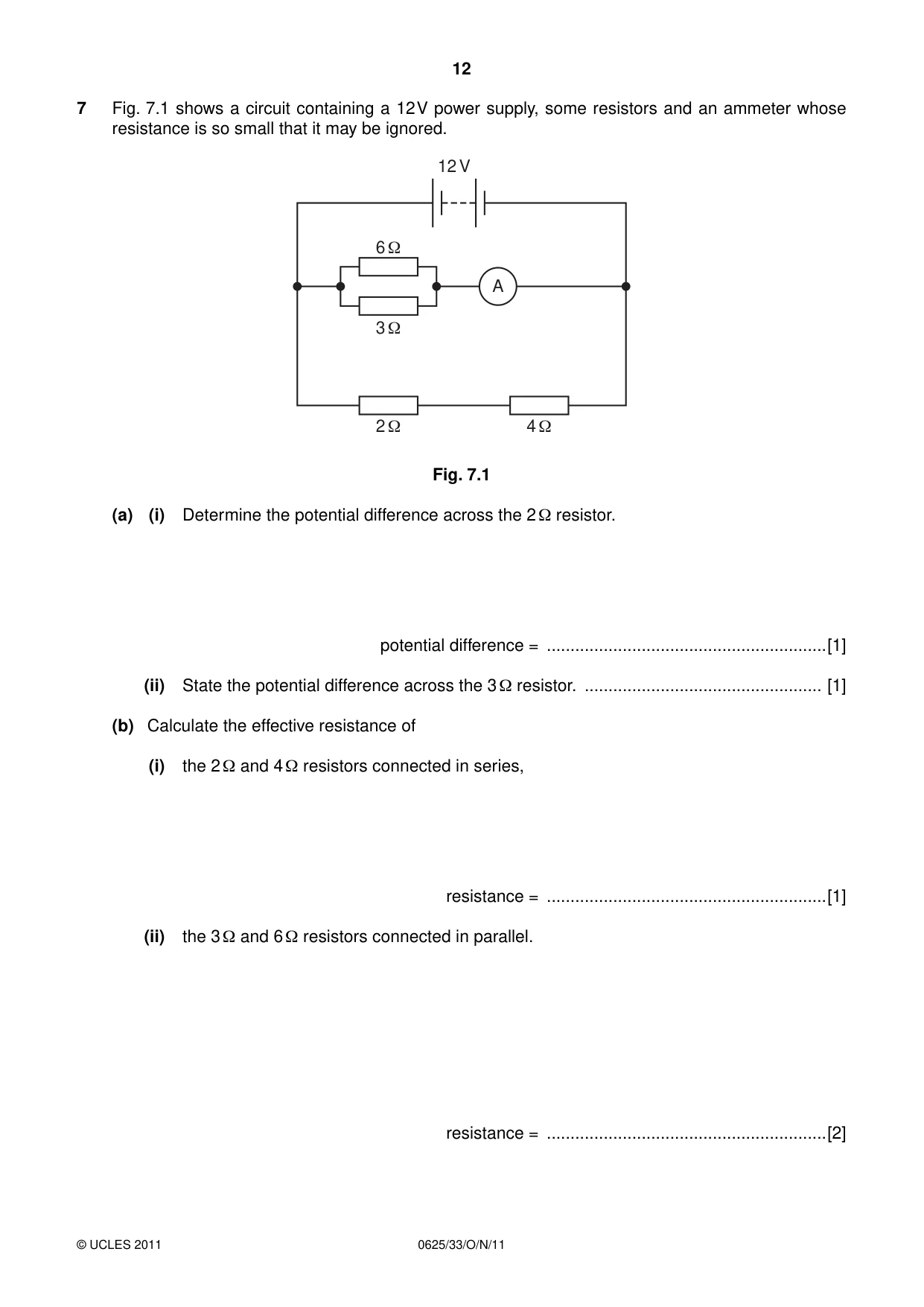
Q7 · A circuit containing a 12 V power supply, some resistors and an ammeter whose resistance…
7 Fig. 7.1 shows a circuit containing a 12 V power supply, some resistors and an ammeter whose resistance is so small that it may be ignored. 12 V 6 Ω A 3 Ω 2 Ω 4 Ω Fig. 7.1 (a) (i) Determine the potential difference across the 2 Ω resistor. potential difference = ...........................................................[1] (ii) State the potential difference across the 3 Ω resistor. .................................................. [1] (b) Calculate the effective resistance of (i) the 2 Ω and 4 Ω resistors connected in series, resistance = ...........................................................[1] (ii) the 3 Ω and 6 Ω resistors connected in parallel. resistance = ...........................................................[2] (c) Calculate the reading on the ammeter. ammeter reading = ...........................................................[2] (d) Without further calculation, state what happens, if anything, to the ammeter reading if (i) the 2 Ω resistor is shorted out with a thick piece of wire, ........................................................................................................................................... (ii) the thick piece of wire from (d)(i) and the 3 Ω resistor are both removed. ........................................................................................................................................... [2] [Total: 9]
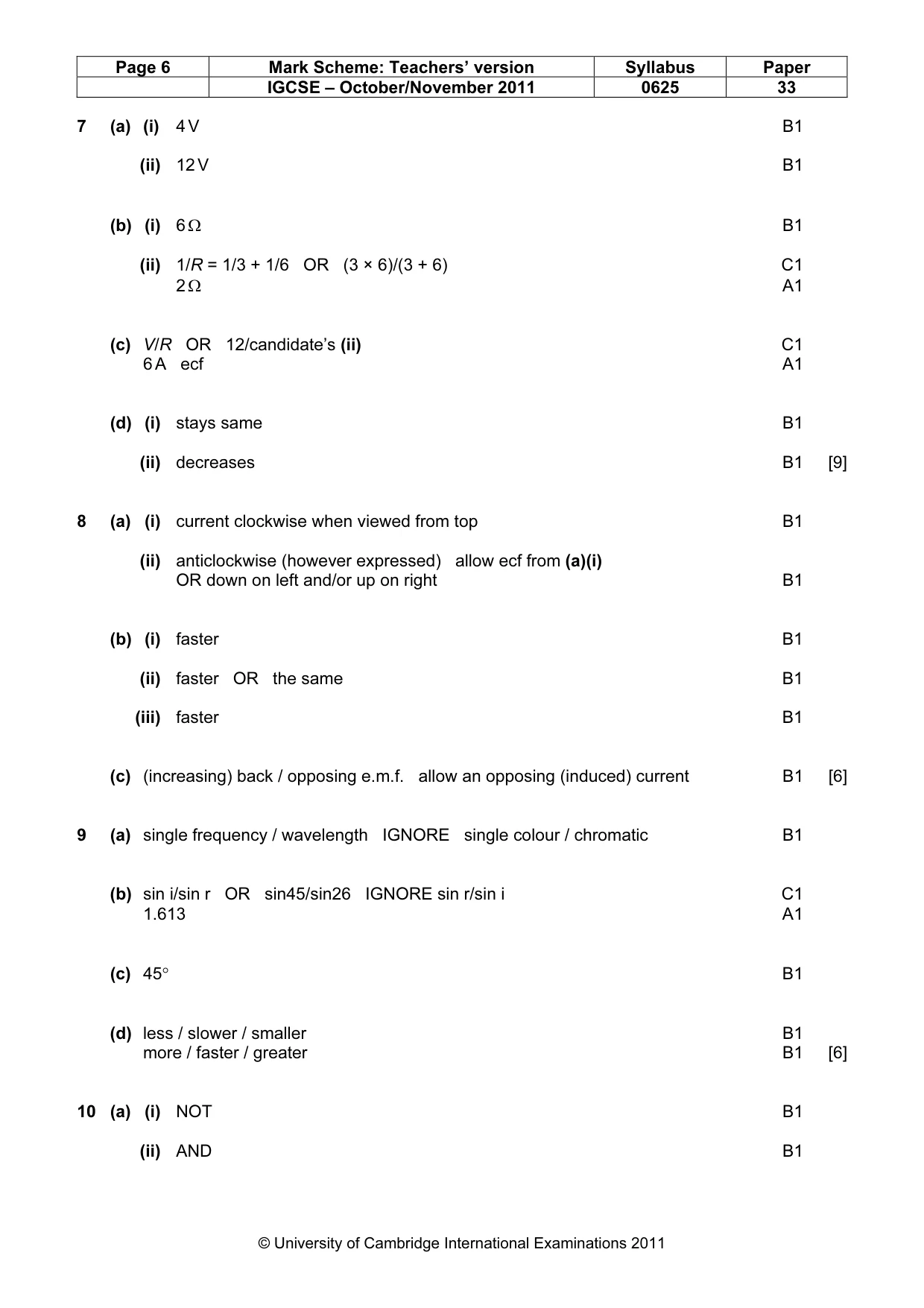
Mark scheme: 7 (a) (i) 4 V B1 (ii) 12 V B1 (b) (i) 6 Ω B1 (ii) 1/R = 1/3 + 1/6 OR (3 × 6)/(3 + 6) C1 2 Ω A1 (c) V/R OR 12/candidate’s (ii) C1 6 A ecf A1 (d) (i) stays same B1 (ii) decreases B1 [9]
Q8 · A simple motor with a rectangular coil that is free to rotate about an axis A1A2
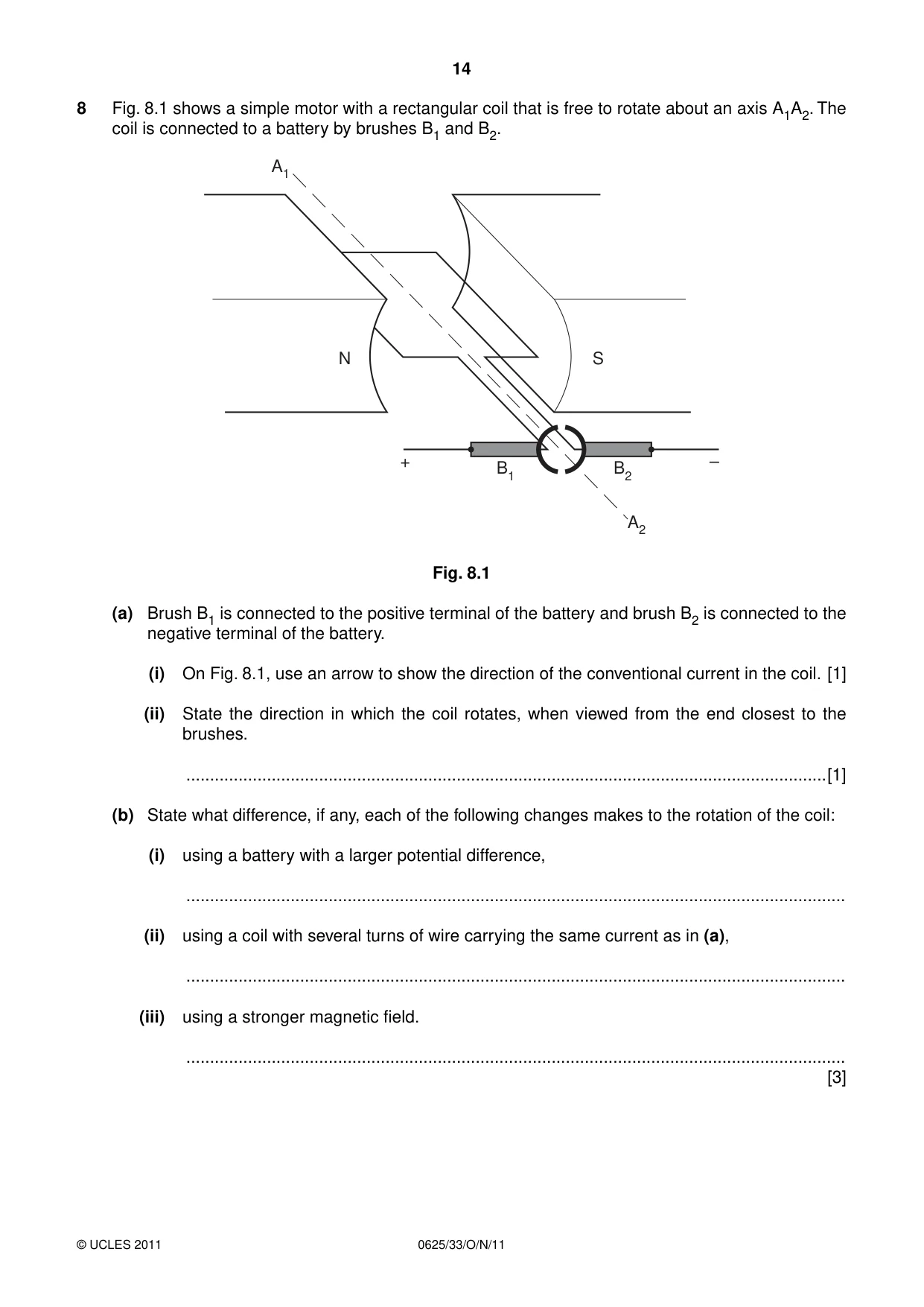
8 Fig. 8.1 shows a simple motor with a rectangular coil that is free to rotate about an axis A1A2. The coil is connected to a battery by brushes B1 and B2. A1 N S + – B1 B2 A2 Fig. 8.1 (a) Brush B1 is connected to the positive terminal of the battery and brush B2 is connected to the negative terminal of the battery. (i) On Fig. 8.1, use an arrow to show the direction of the conventional current in the coil. [1] (ii) State the direction in which the coil rotates, when viewed from the end closest to the brushes. .......................................................................................................................................[1] (b) State what difference, if any, each of the following changes makes to the rotation of the coil: (i) using a battery with a larger potential difference, ........................................................................................................................................... (ii) using a coil with several turns of wire carrying the same current as in (a), ........................................................................................................................................... (iii) using a stronger magnetic field. ........................................................................................................................................... [3] (c) The structure of the motor is very similar to that of an a.c. generator. Use ideas about induction to suggest why the current from the battery falls as the motor speeds up. ................................................................................................................................................... ................................................................................................................................................... ...............................................................................................................................................[1] [Total: 6]
Mark scheme: 8 (a) (i) current clockwise when viewed from top B1 (ii) anticlockwise (however expressed) allow ecf from (a)(i) OR down on left and/or up on right B1 (b) (i) faster B1 (ii) faster OR the same B1 (iii) faster B1 (c) (increasing) back / opposing e.m.f. allow an opposing (induced) current B1 [6]
Q9 · A ray of monochromatic light passing through a rectangular glass block
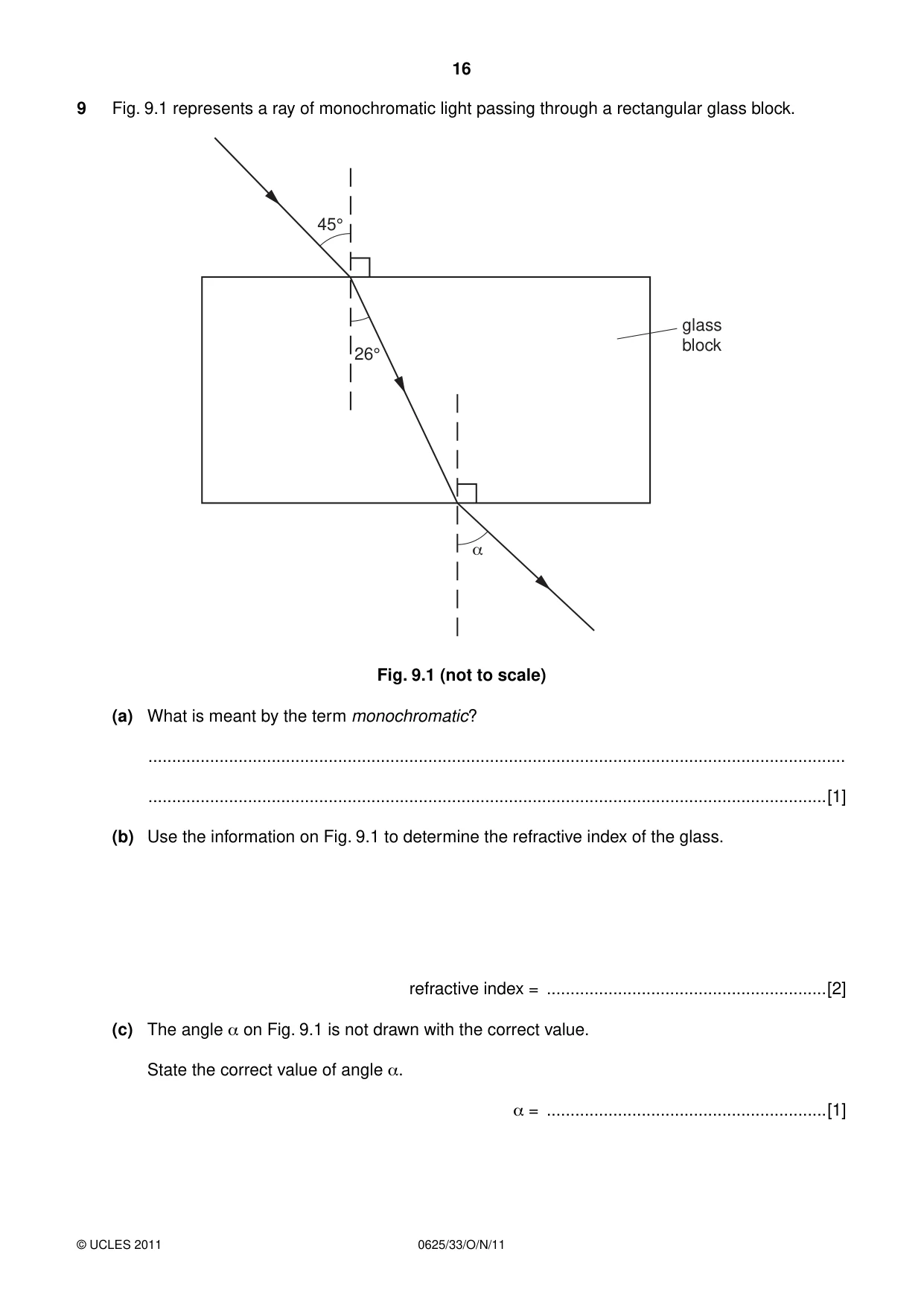
9 Fig. 9.1 represents a ray of monochromatic light passing through a rectangular glass block. 45° glass block 26° α Fig. 9.1 (not to scale) (a) What is meant by the term monochromatic? ................................................................................................................................................... ...............................................................................................................................................[1] (b) Use the information on Fig. 9.1 to determine the refractive index of the glass. refractive index = ...........................................................[2] (c) The angle α on Fig. 9.1 is not drawn with the correct value. State the correct value of angle α. α = ...........................................................[1] (d) After the ray has left the glass block, it passes into a block of ice, whose refractive index is 1.31. How does the speed of light in ice compare with (i) the speed of light in air, ..................................................................................................... (ii) the speed of light in glass. ................................................................................................. [2] [Total: 6]
Mark scheme: 9 (a) single frequency / wavelength IGNORE single colour / chromatic B1 (b) sin i/sin r OR sin45/sin26 IGNORE sin r/sin i C1 1.613 A1 (c) 45° B1 (d) less / slower / smaller B1 more / faster / greater B1 [6]
Q10 · Schematically a digital electronic circuit
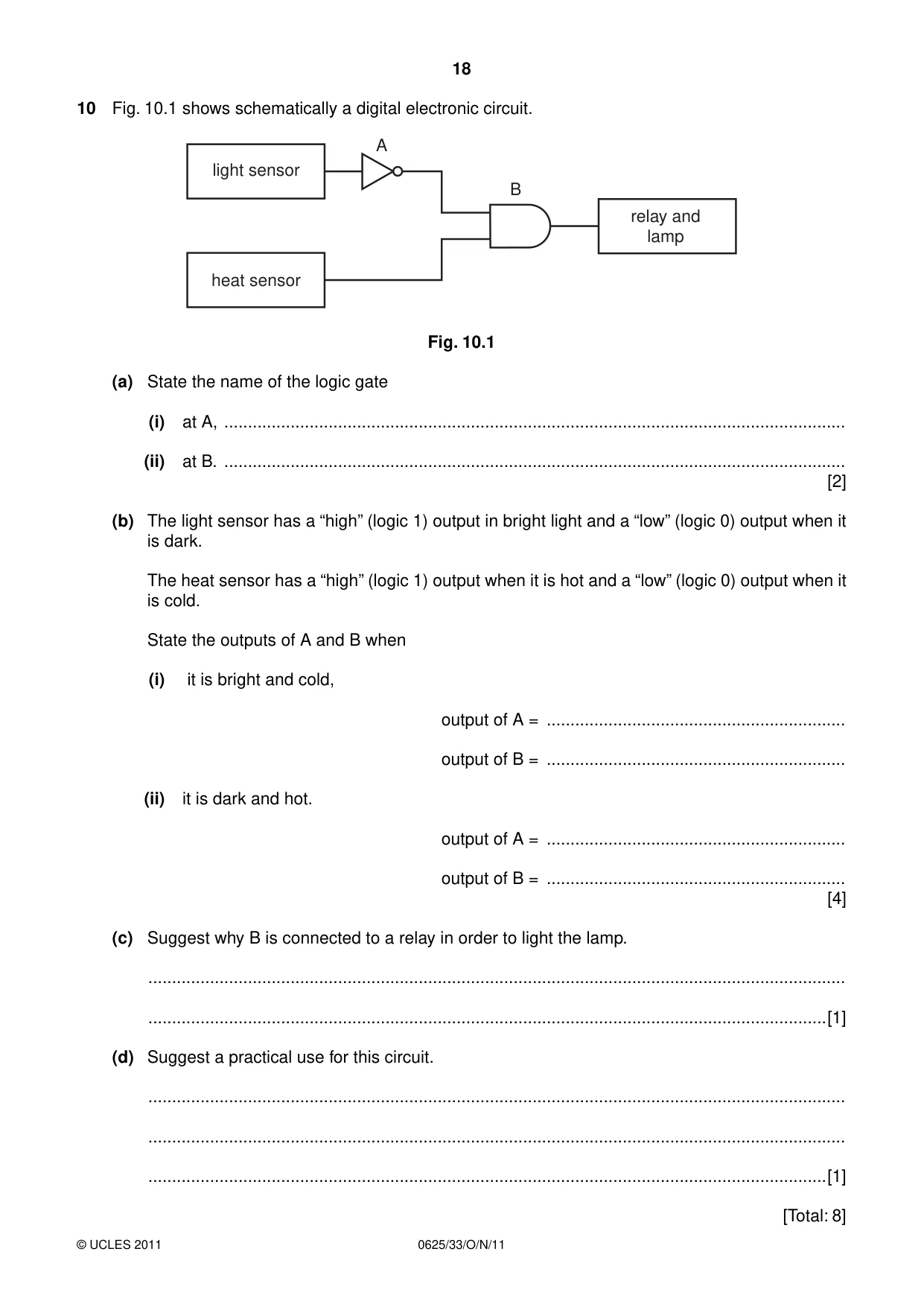
10 Fig. 10.1 shows schematically a digital electronic circuit. A light sensor B relay and lamp heat sensor Fig. 10.1 (a) State the name of the logic gate (i) at A, ................................................................................................................................... (ii) at B. ................................................................................................................................... [2] (b) The light sensor has a “high” (logic 1) output in bright light and a “low” (logic 0) output when it is dark. The heat sensor has a “high” (logic 1) output when it is hot and a “low” (logic 0) output when it is cold. State the outputs of A and B when (i) it is bright and cold, output of A = ............................................................... output of B = ............................................................... (ii) it is dark and hot. output of A = ............................................................... output of B = ............................................................... [4] (c) Suggest why B is connected to a relay in order to light the lamp. ................................................................................................................................................... ...............................................................................................................................................[1] (d) Suggest a practical use for this circuit. ................................................................................................................................................... ................................................................................................................................................... ...............................................................................................................................................[1] [Total: 8]
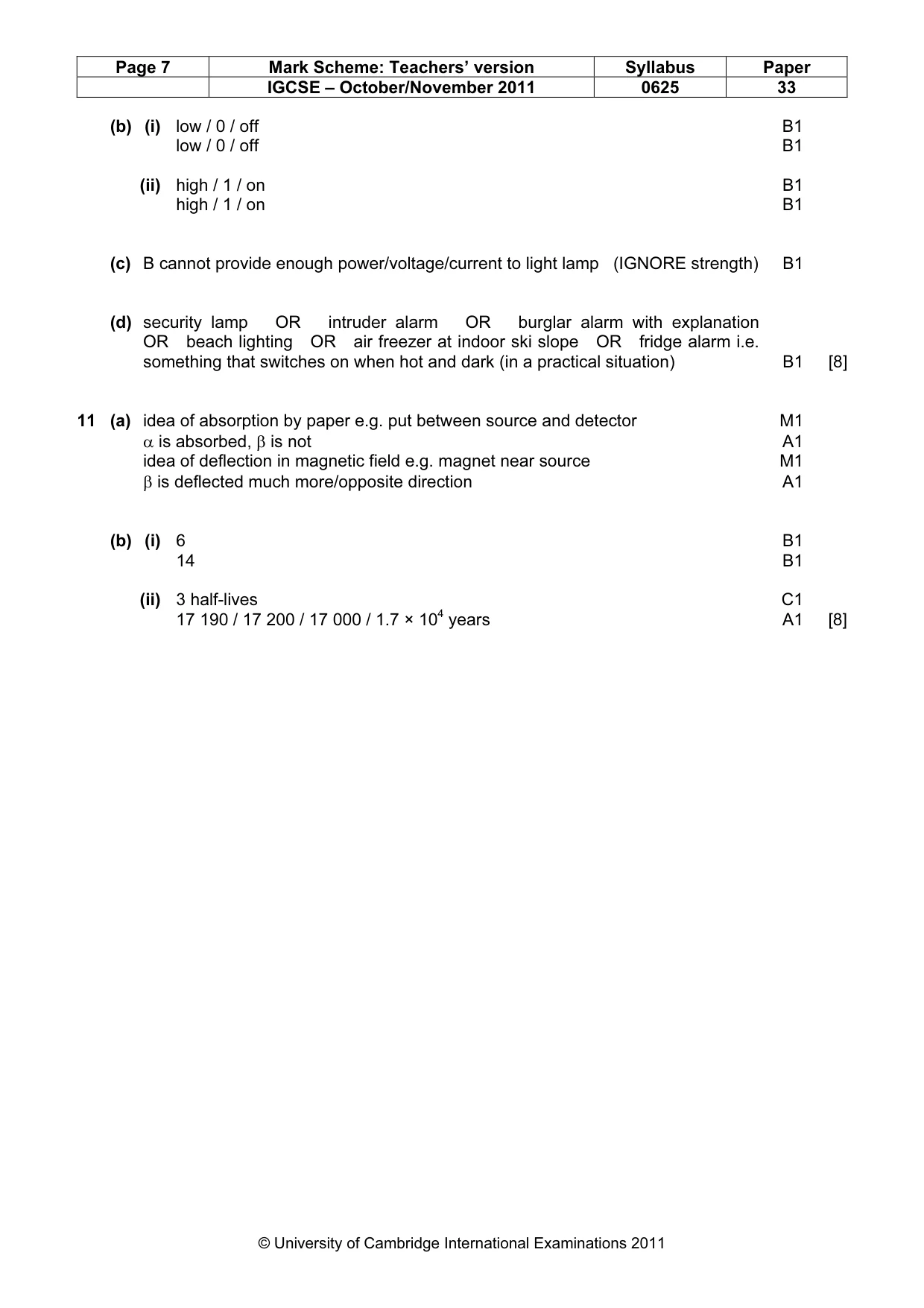
Mark scheme: 10 (a) (i) NOT B1 (ii) AND B1 IGCSE – October/November 2011 0625 33 (b) (i) low / 0 / off B1 low / 0 / off B1 (ii) high / 1 / on B1 high / 1 / on B1 (c) B cannot provide enough power/voltage/current to light lamp (IGNORE strength) B1 (d) security lamp OR intruder alarm OR burglar alarm with explanation OR beach lighting OR air freezer at indoor ski slope OR fridge alarm i.e. something that switches on when hot and dark (in a practical situation) B1 [8]
Q11 · In a laboratory’s secure radioactivity cupboard are two unlabelled radioactive sources
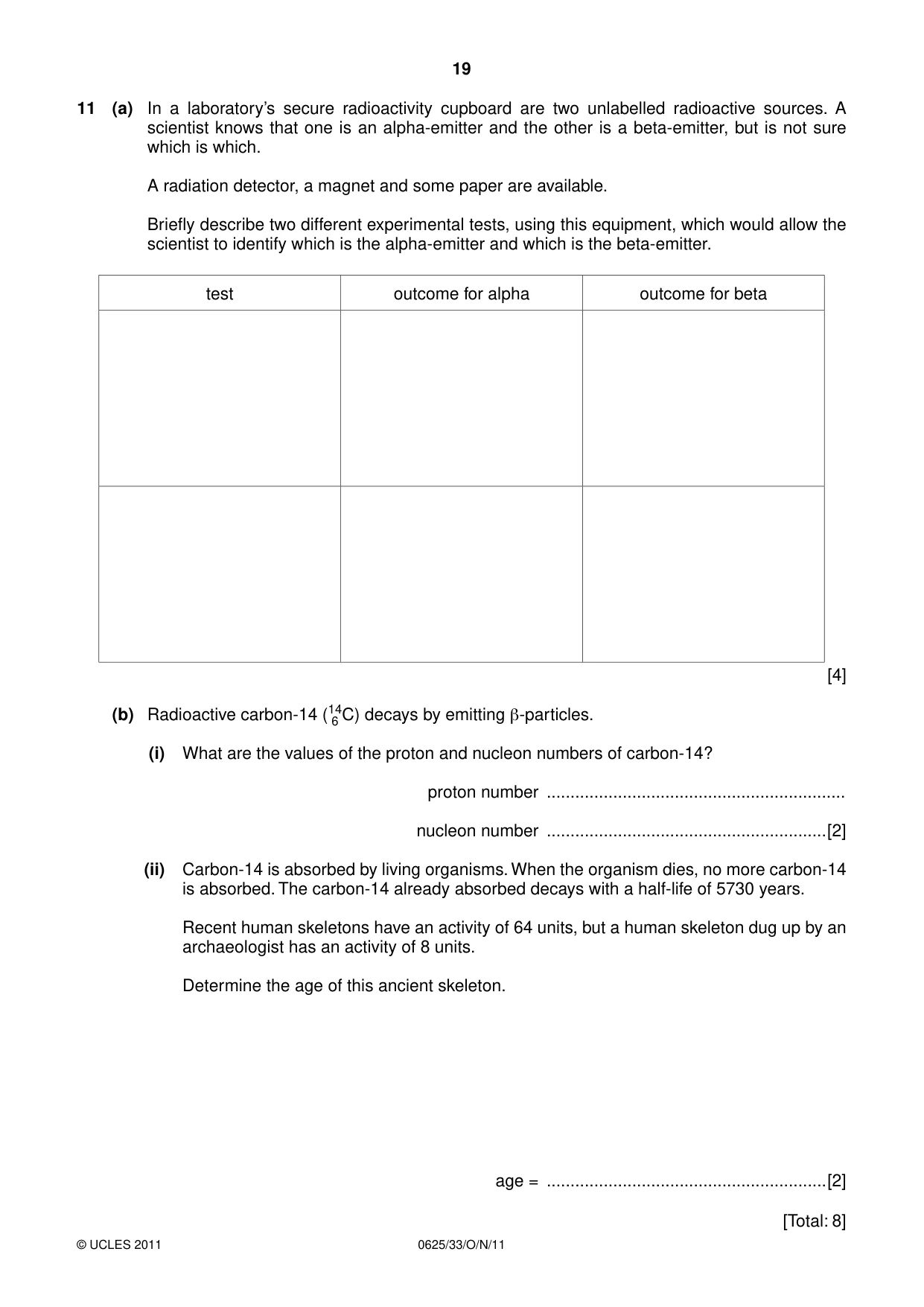
11 (a) In a laboratory’s secure radioactivity cupboard are two unlabelled radioactive sources. A scientist knows that one is an alpha-emitter and the other is a beta-emitter, but is not sure which is which. A radiation detector, a magnet and some paper are available. Briefly describe two different experimental tests, using this equipment, which would allow the scientist to identify which is the alpha-emitter and which is the beta-emitter. test outcome for alpha outcome for beta [4] (b) Radioactive carbon-14 (14 C) decays by emitting β-particles. 6 (i) What are the values of the proton and nucleon numbers of carbon-14? proton number ............................................................... nucleon number ...........................................................[2] (ii) Carbon-14 is absorbed by living organisms. When the organism dies, no more carbon-14 is absorbed. The carbon-14 already absorbed decays with a half-life of 5730 years. Recent human skeletons have an activity of 64 units, but a human skeleton dug up by an archaeologist has an activity of 8 units. Determine the age of this ancient skeleton. age = ...........................................................[2]
Mark scheme: 11 (a) idea of absorption by paper e.g. put between source and detector M1 α is absorbed, β is not A1 idea of deflection in magnetic field e.g. magnet near source M1 β is deflected much more/opposite direction A1 (b) (i) 6 B1 14 B1 (ii) 3 half-lives C1 17 190 / 17 200 / 17 000 / 1.7 × 10⁴ years A1 [8]
What was in this paper
The subtopics covered by these 11 questions, and how many questions each got. Open one in a new tab to see every Cambridge question on it.
What you needed in this session
Cambridge’s own grade thresholds for 2011 Oct/Nov, Paper 3 · Variant 3. A higher threshold means an easier paper — the bar moves with how the cohort did.