Cambridge IGCSE Physics 0625 — 2017 Oct/Nov Paper 3 · Variant 3
0625/33/O/N/17 · 12 questions · 80 marks · ≈90 min
The question paper and its mark scheme, free to read here and free to download. This is Cambridge’s own paper, exactly as it was sat.
Question paper16 pages
Mark scheme8 pages
Answers below. Sit the paper first if you are practising.
Questions as text
Q1 · A student determines the speed of three cars on a straight road
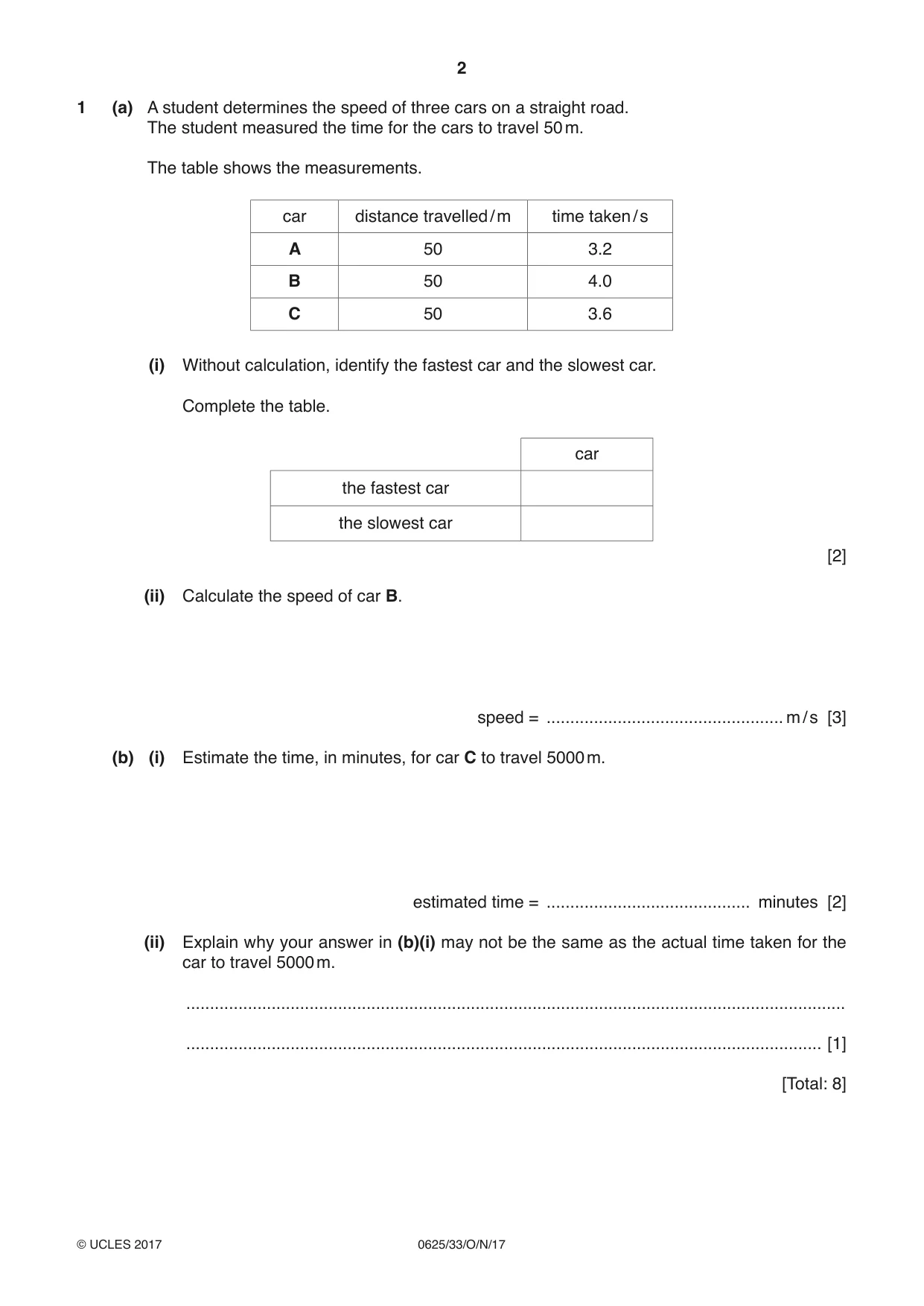
1 (a) A student determines the speed of three cars on a straight road. The student measured the time for the cars to travel 50 m. The table shows the measurements. car distance travelled / m time taken / s A 50 3.2 B 50 4.0 C 50 3.6 (i) Without calculation, identify the fastest car and the slowest car. Complete the table. car the fastest car the slowest car [2] (ii) Calculate the speed of car B. speed = .................................................. m / s [3] (b) (i) Estimate the time, in minutes, for car C to travel 5000 m. estimated time = ........................................... minutes [2] (ii) Explain why your answer in (b)(i) may not be the same as the actual time taken for the car to travel 5000 m. ........................................................................................................................................... ...................................................................................................................................... [1] [Total: 8]
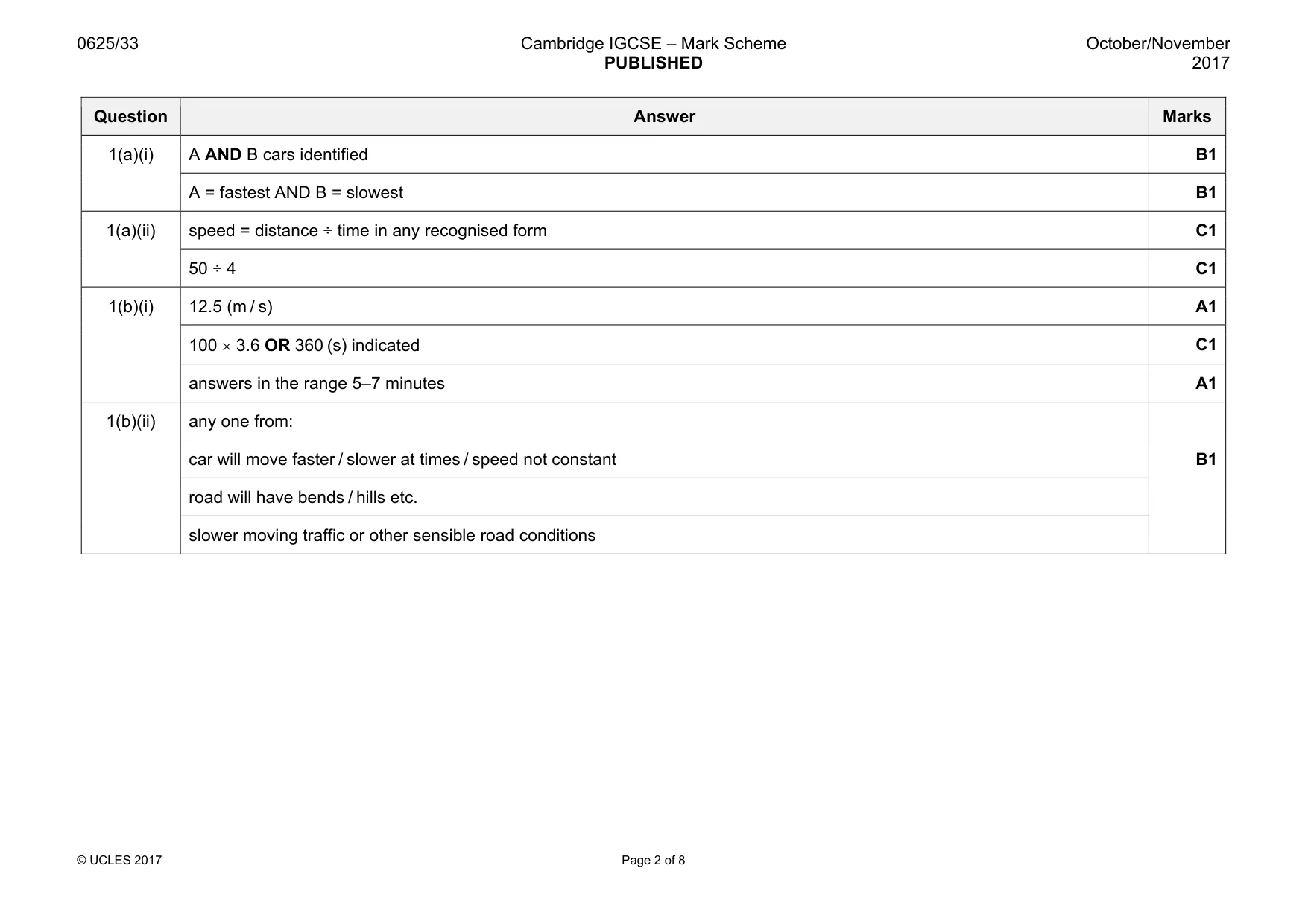
Mark scheme: 1(a)(i) A AND B cars identified B1 A = fastest AND B = slowest B1 1(a)(ii) speed = distance ÷ time in any recognised form C1 50 ÷ 4 C1 1(b)(i) 12.5 (m / s) A1 100 × 3.6 OR 360 (s) indicated C1 answers in the range 5–7 minutes A1 1(b)(ii) any one from: car will move faster / slower at times / speed not constant B1 road will have bends / hills etc. slower moving traffic or other sensible road conditions
Q2 · A metal object discovered by a scientist using a metal detector
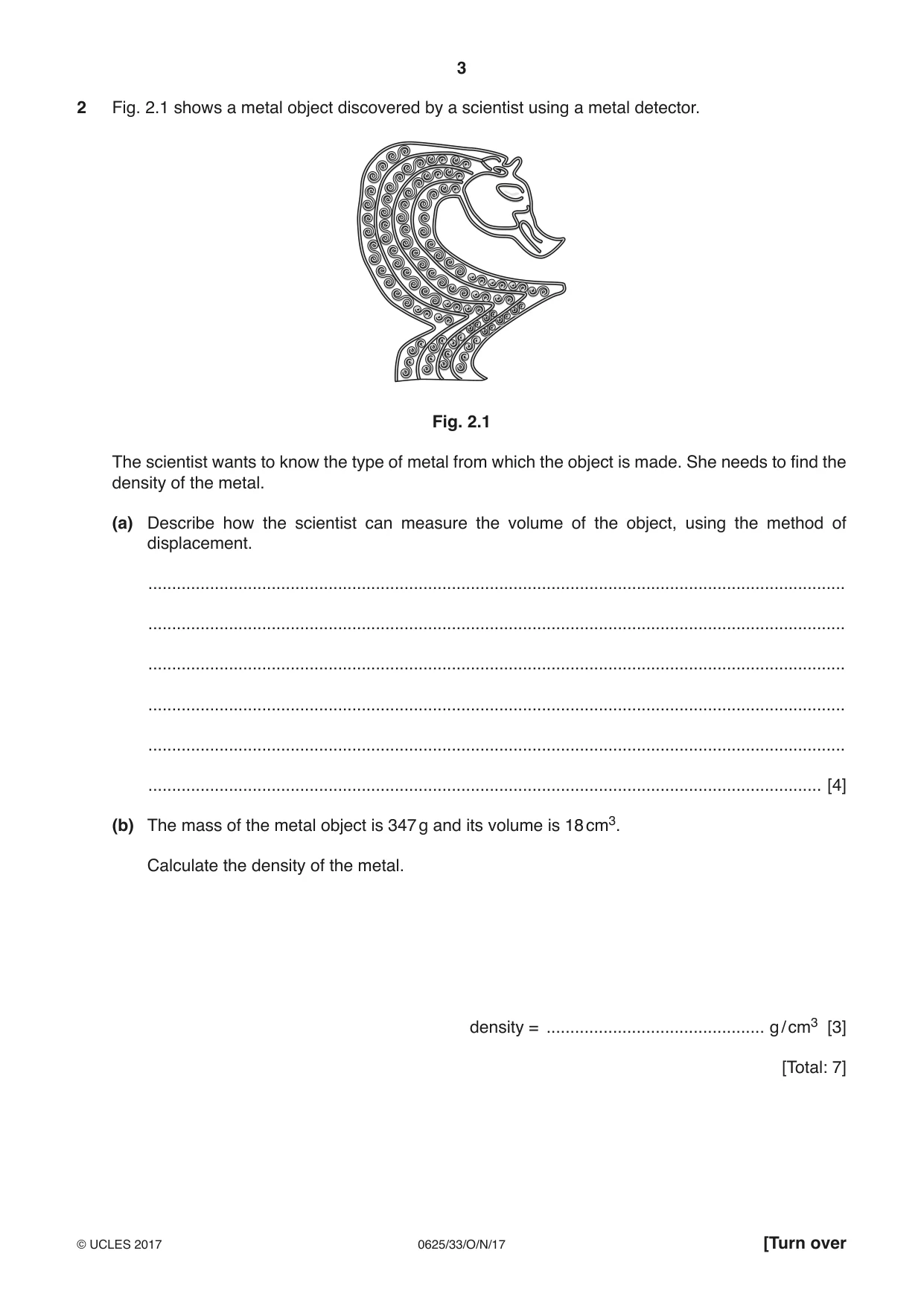
2 Fig. 2.1 shows a metal object discovered by a scientist using a metal detector. Fig. 2.1 The scientist wants to know the type of metal from which the object is made. She needs to find the density of the metal. (a) Describe how the scientist can measure the volume of the object, using the method of displacement. ................................................................................................................................................... ................................................................................................................................................... ................................................................................................................................................... ................................................................................................................................................... ................................................................................................................................................... .............................................................................................................................................. [4] (b) The mass of the metal object is 347 g and its volume is 18 cm3. Calculate the density of the metal. density = .............................................. g / cm3 [3] [Total: 7]
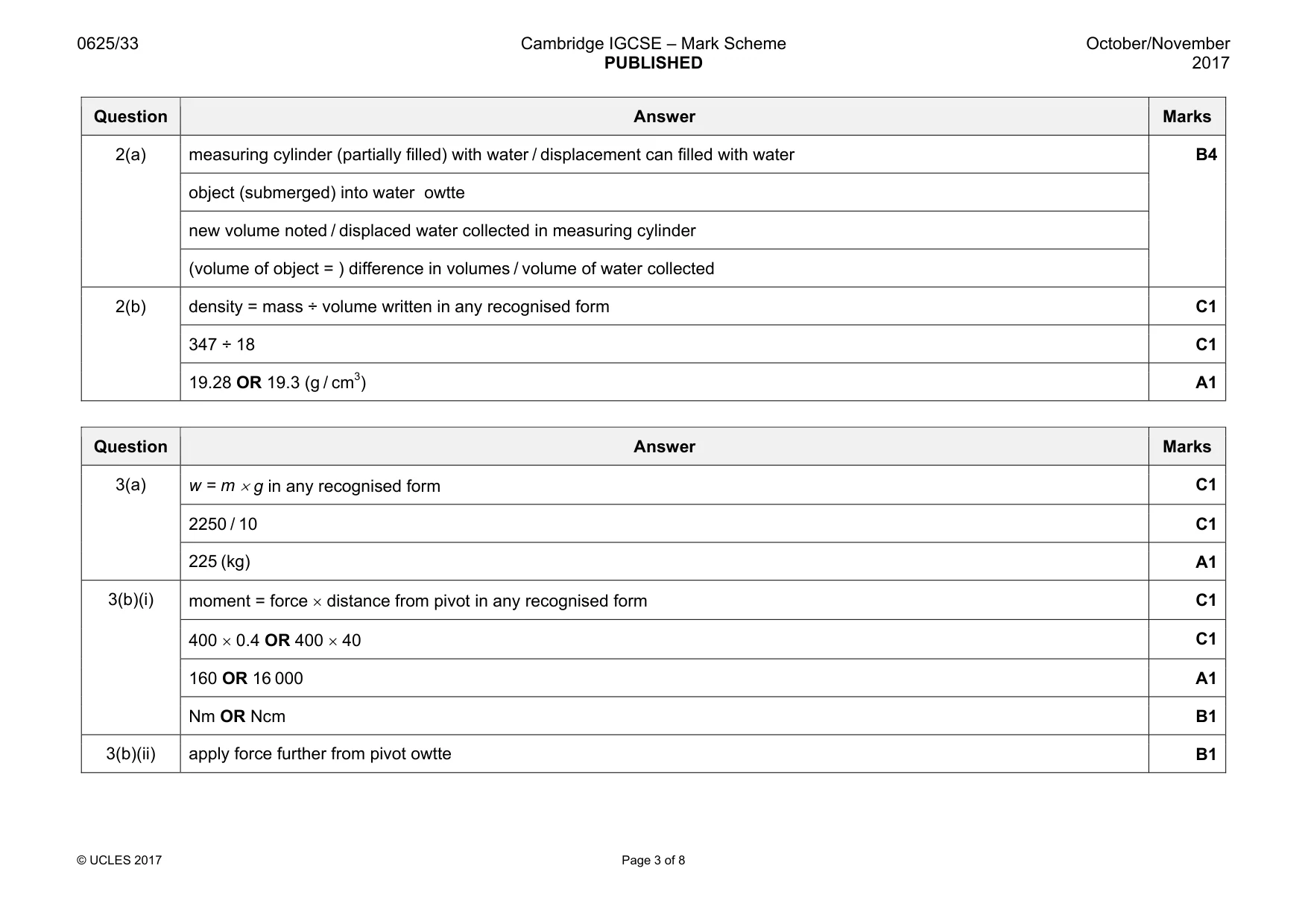
Mark scheme: 2(a) measuring cylinder (partially filled) with water / displacement can filled with water B4 object (submerged) into water owtte new volume noted / displaced water collected in measuring cylinder (volume of object = ) difference in volumes / volume of water collected 2(b) density = mass ÷ volume written in any recognised form C1 347 ÷ 18 C1 19.28 OR 19.3 (g / cm3) A1
Q3 · A large box with a heavy lid
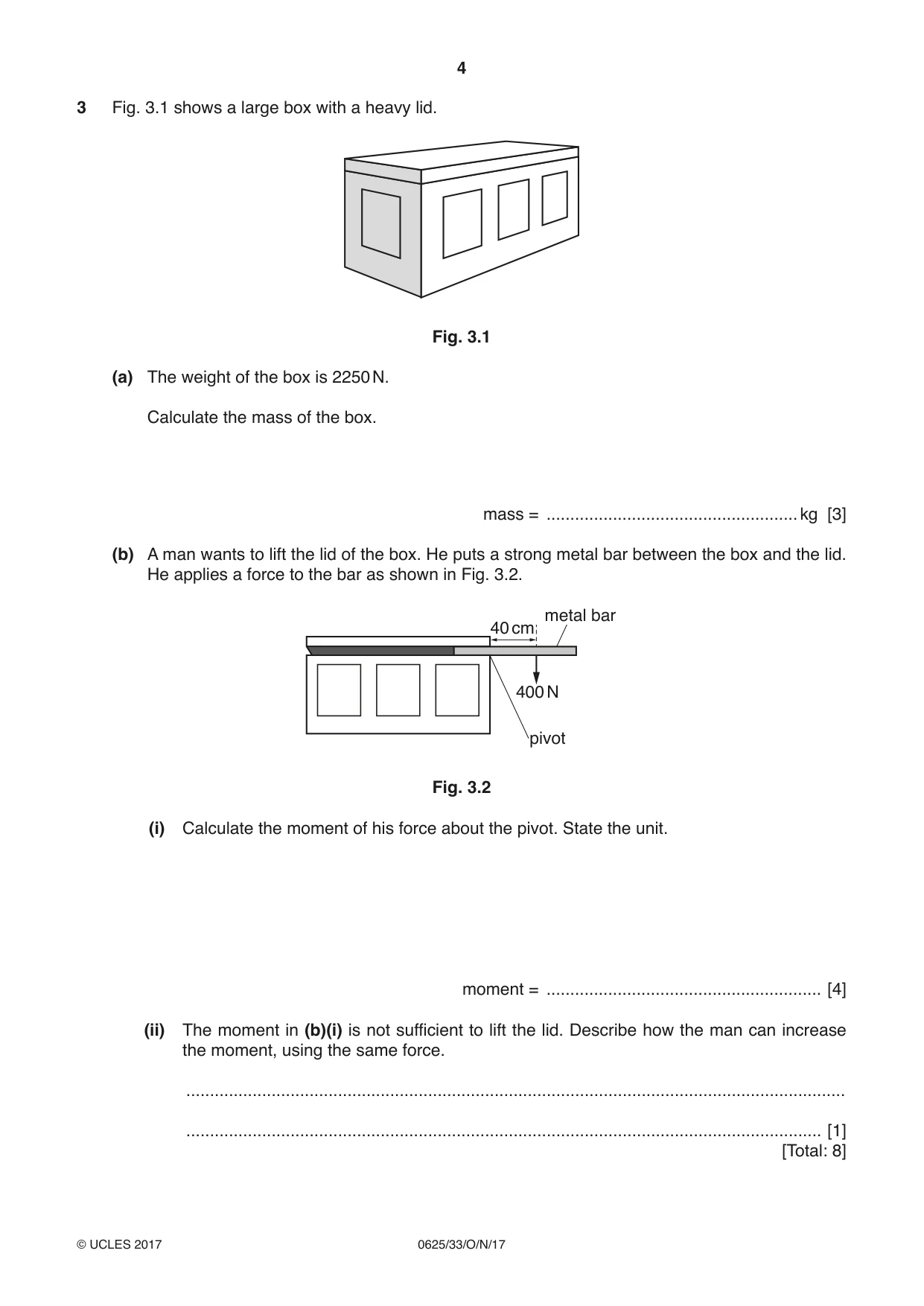
3 Fig. 3.1 shows a large box with a heavy lid. Fig. 3.1 (a) The weight of the box is 2250 N. Calculate the mass of the box. mass = ..................................................... kg [3] (b) A man wants to lift the lid of the box. He puts a strong metal bar between the box and the lid. He applies a force to the bar as shown in Fig. 3.2. metal bar 40 cm 400 N pivot Fig. 3.2 (i) Calculate the moment of his force about the pivot. State the unit. moment = .......................................................... [4] (ii) The moment in (b)(i) is not sufficient to lift the lid. Describe how the man can increase the moment, using the same force. ........................................................................................................................................... ...................................................................................................................................... [1] [Total: 8]
Mark scheme: 3(a) C1 2250 / 10 C1 225 (kg) A1 3(b)(i) moment = force × distance from pivot in any recognised form C1 400 × 0.4 OR 400 × 40 C1 160 OR 16 000 A1 Nm OR Ncm B1 3(b)(ii) apply force further from pivot owtte B1
Q4 · A catapult consists of a rubber band attached to a handle
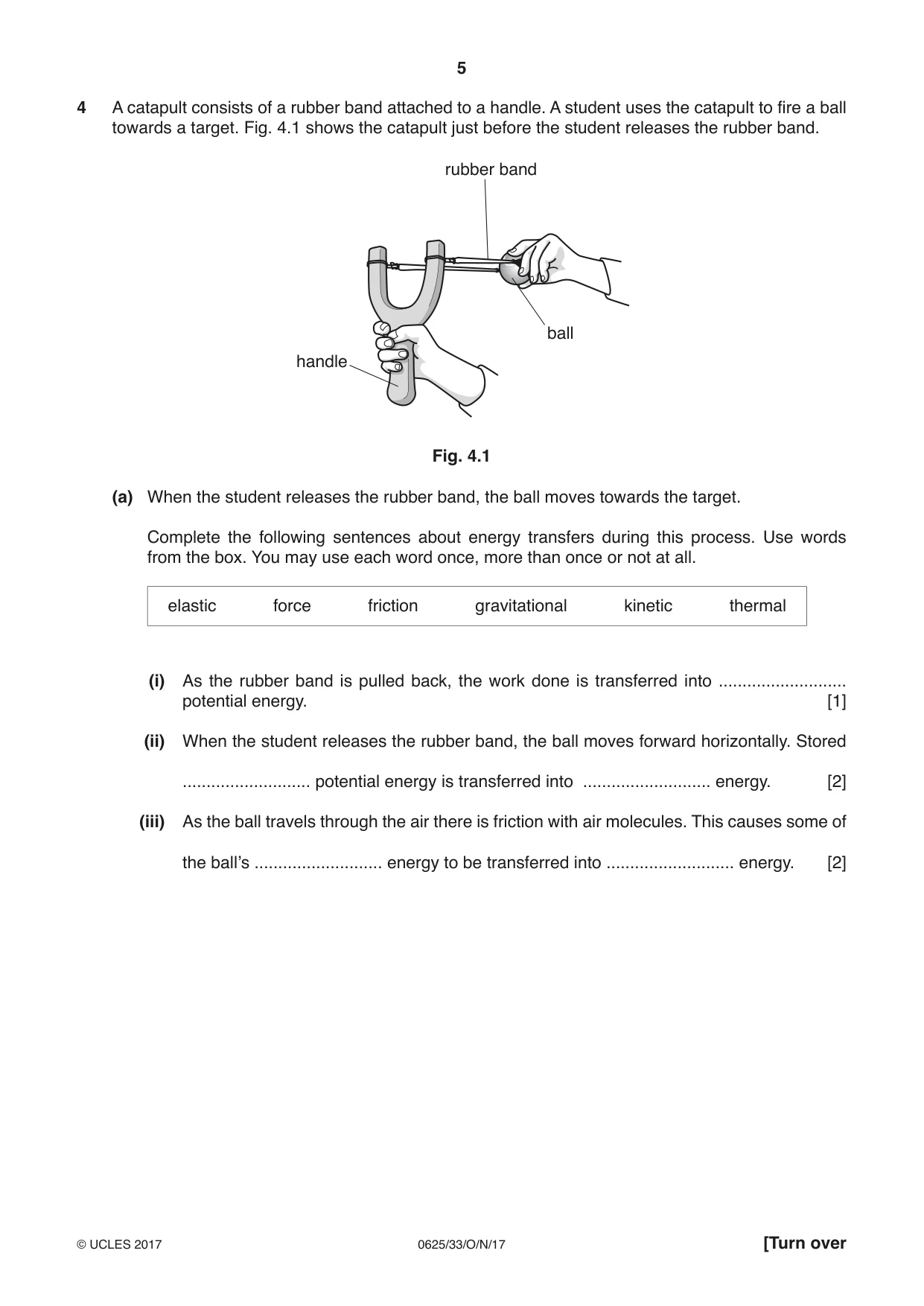
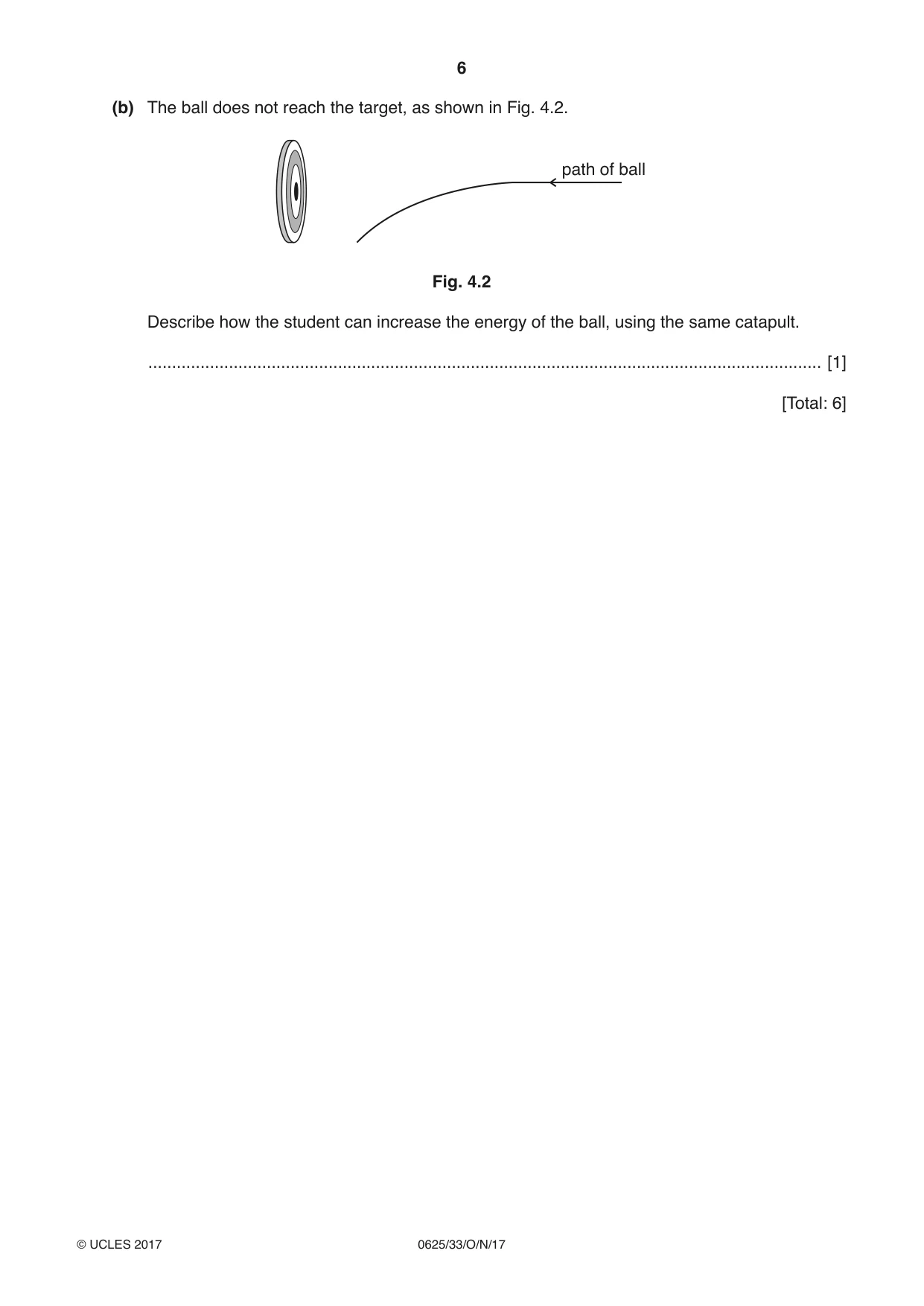
4 A catapult consists of a rubber band attached to a handle. A student uses the catapult to fire a ball towards a target. Fig. 4.1 shows the catapult just before the student releases the rubber band. rubber band ball handle Fig. 4.1 (a) When the student releases the rubber band, the ball moves towards the target. Complete the following sentences about energy transfers during this process. Use words from the box. You may use each word once, more than once or not at all. elastic force friction gravitational kinetic thermal (i) As the rubber band is pulled back, the work done is transferred into ........................... potential energy. [1] (ii) When the student releases the rubber band, the ball moves forward horizontally. Stored ........................... potential energy is transferred into ........................... energy. [2] (iii) As the ball travels through the air there is friction with air molecules. This causes some of the ball’s ........................... energy to be transferred into ........................... energy. [2] (b) The ball does not reach the target, as shown in Fig. 4.2. path of ball Fig. 4.2 Describe how the student can increase the energy of the ball, using the same catapult. .............................................................................................................................................. [1] [Total: 6]
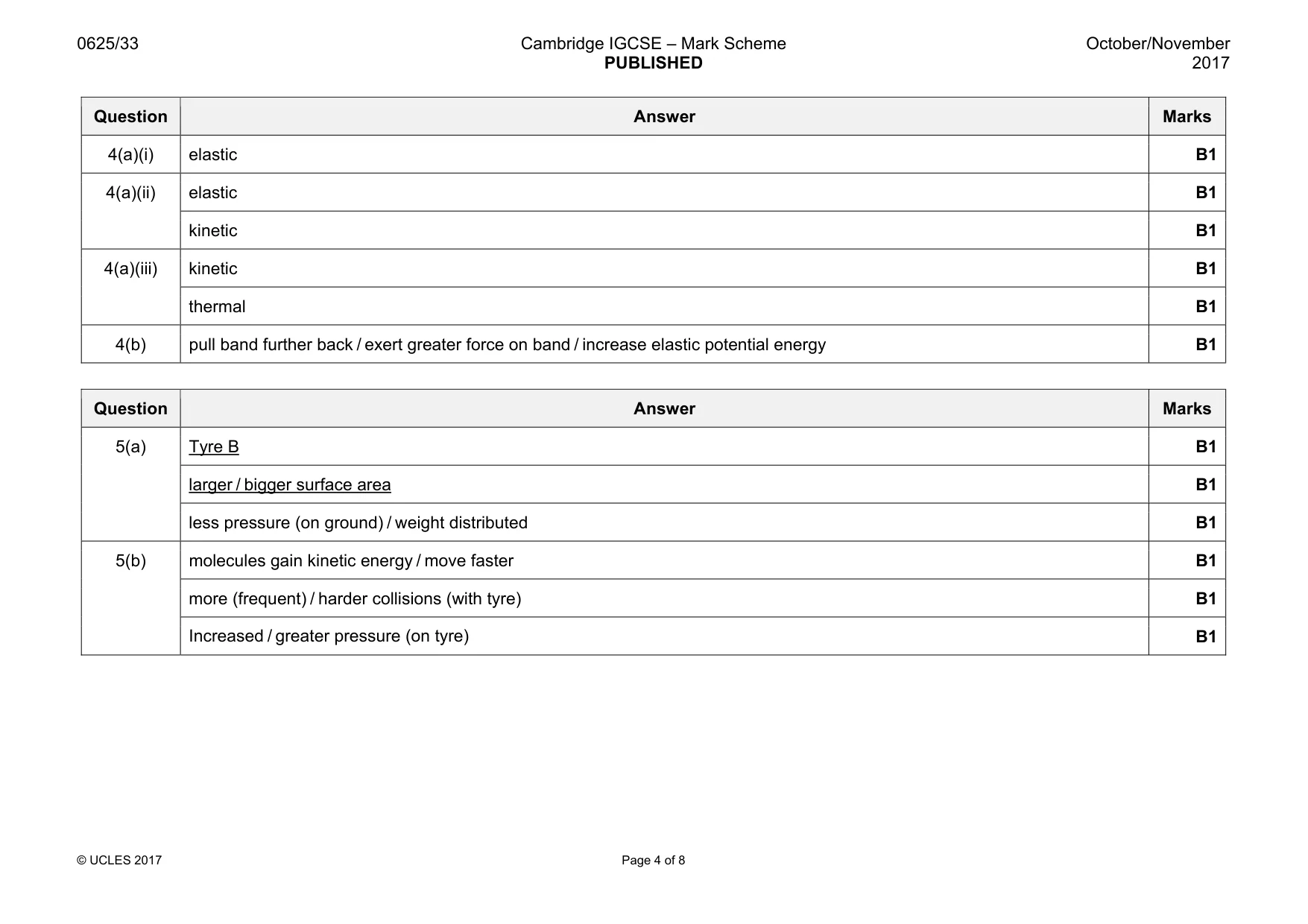
Mark scheme: 4(a)(i) elastic B1 4(a)(ii) elastic B1 kinetic B1 4(a)(iii) kinetic B1 thermal B1 4(b) pull band further back / exert greater force on band / increase elastic potential energy B1
Q5 · A vehicle may have tyres of type A or type B, as shown in Fig
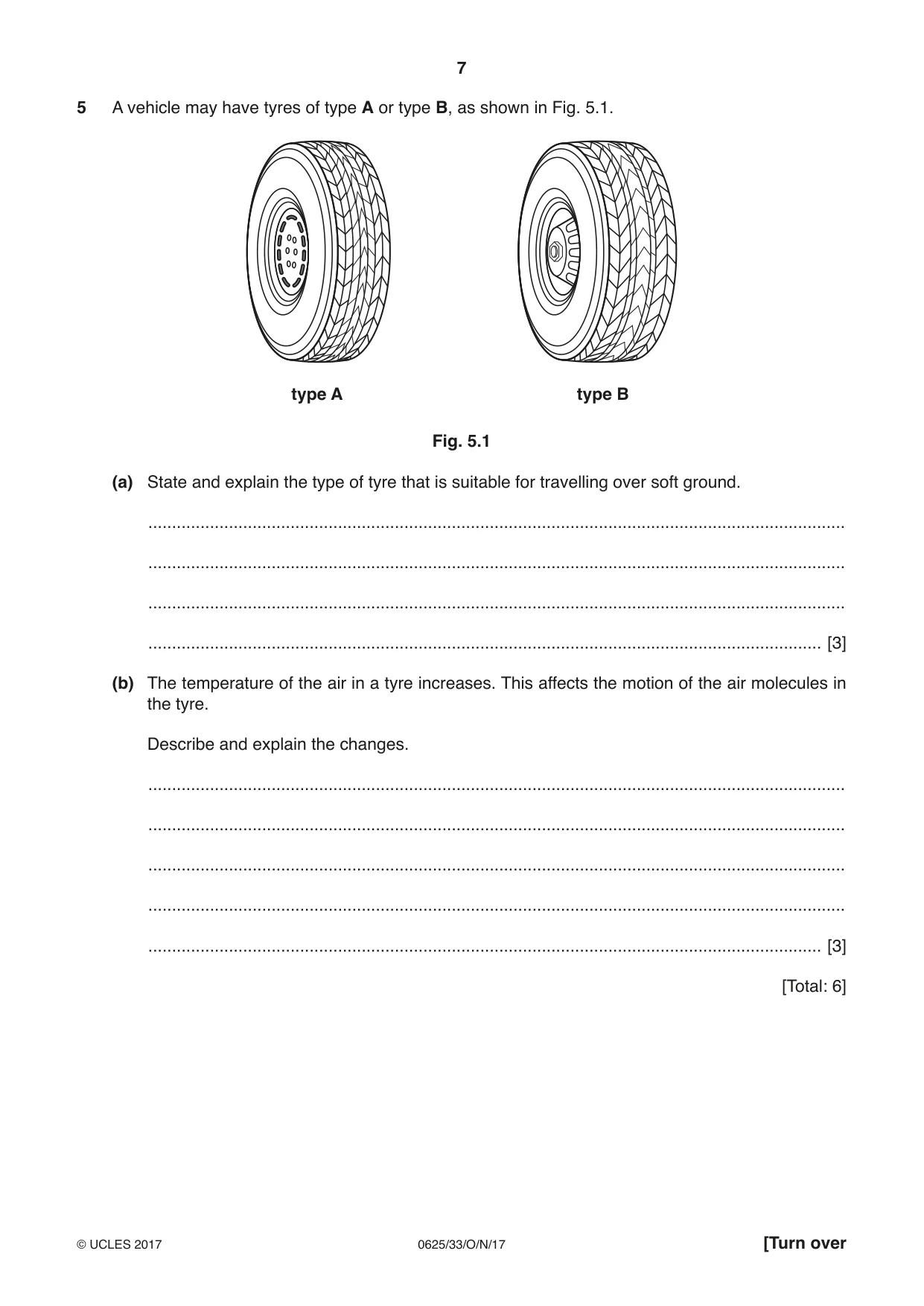
5 A vehicle may have tyres of type A or type B, as shown in Fig. 5.1. type A type B Fig. 5.1 (a) State and explain the type of tyre that is suitable for travelling over soft ground. ................................................................................................................................................... ................................................................................................................................................... ................................................................................................................................................... .............................................................................................................................................. [3] (b) The temperature of the air in a tyre increases. This affects the motion of the air molecules in the tyre. Describe and explain the changes. ................................................................................................................................................... ................................................................................................................................................... ................................................................................................................................................... ................................................................................................................................................... .............................................................................................................................................. [3] [Total: 6]
Mark scheme: 5(a) Tyre B B1 larger / bigger surface area B1 less pressure (on ground) / weight distributed B1 5(b) molecules gain kinetic energy / move faster B1 more (frequent) / harder collisions (with tyre) B1 Increased / greater pressure (on tyre) B1
Question 6
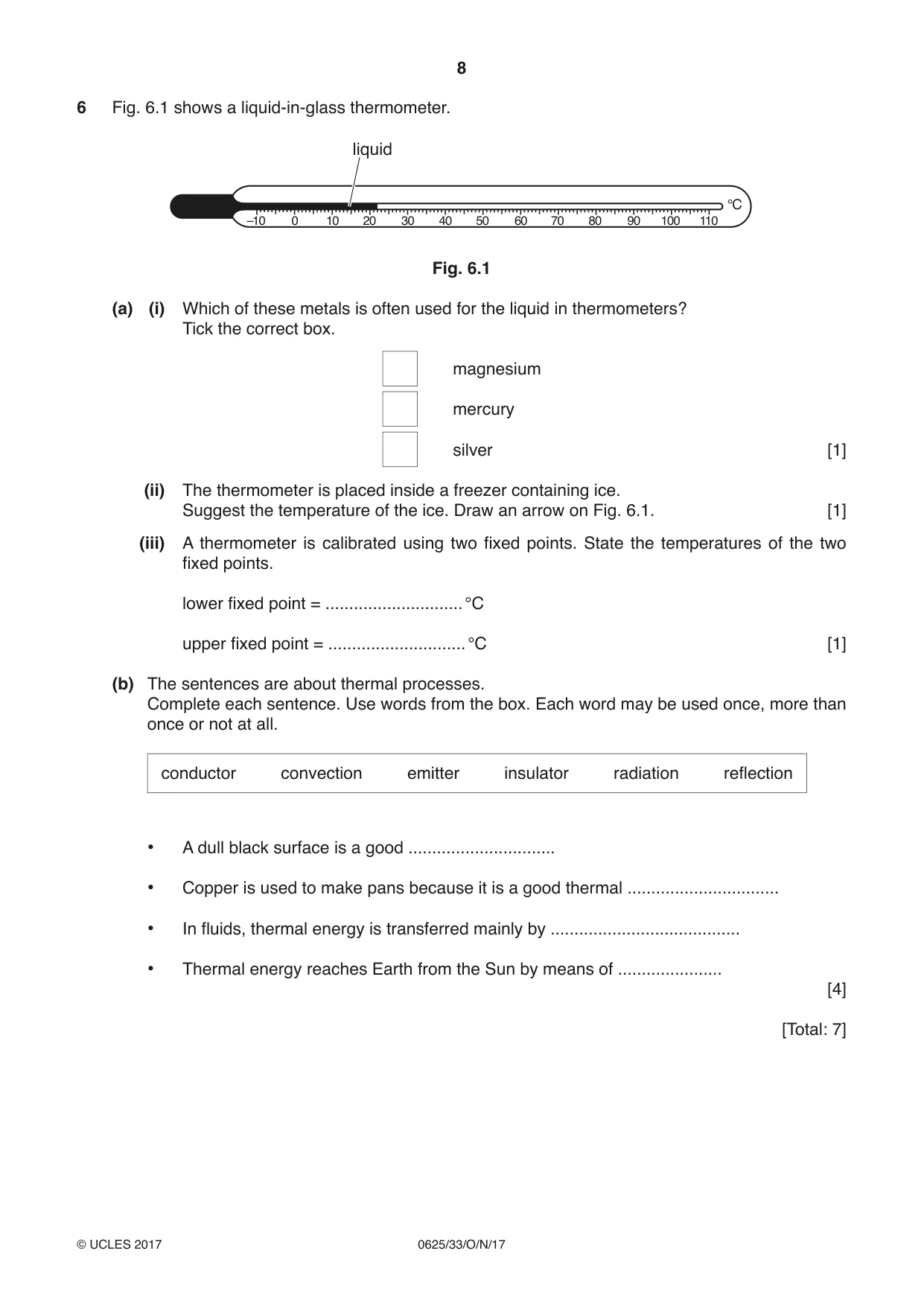
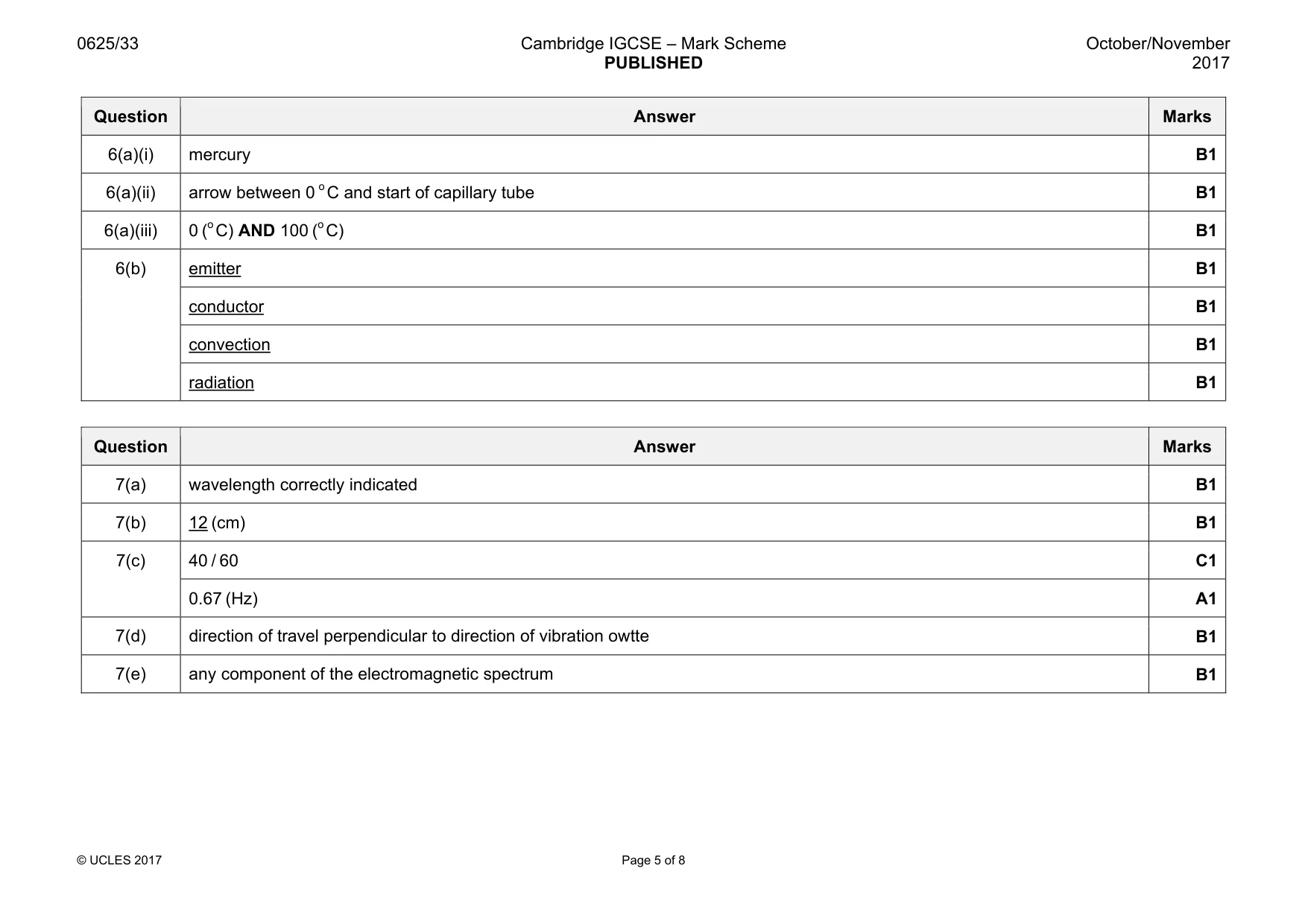
6 Fig. 6.1 shows a liquid-in-glass thermometer. liquid °C –10 0 10 20 30 40 50 60 70 80 90 100 110 Fig. 6.1 (a) (i) Which of these metals is often used for the liquid in thermometers? Tick the correct box. magnesium mercury silver [1] (ii) The thermometer is placed inside a freezer containing ice. Suggest the temperature of the ice. Draw an arrow on Fig. 6.1. [1] (iii) A thermometer is calibrated using two fixed points. State the temperatures of the two fixed points. lower fixed point = ............................. °C upper fixed point = ............................. °C [1] (b) The sentences are about thermal processes. Complete each sentence. Use words from the box. Each word may be used once, more than once or not at all. conductor convection emitter insulator radiation reflection • A dull black surface is a good ............................... • Copper is used to make pans because it is a good thermal ................................ • In fluids, thermal energy is transferred mainly by ........................................ • Thermal energy reaches Earth from the Sun by means of ...................... [4] [Total: 7]
Mark scheme: 6(a)(i) mercury B1 6(a)(ii) arrow between 0 o C and start of capillary tube B1 6(a)(iii) 0 (oC) AND 100 (o C) B1 6(b) emitter B1 conductor B1 convection B1 radiation B1
Q7 · A floating plastic ball attached by a long rope to a weight on the bottom of a lake
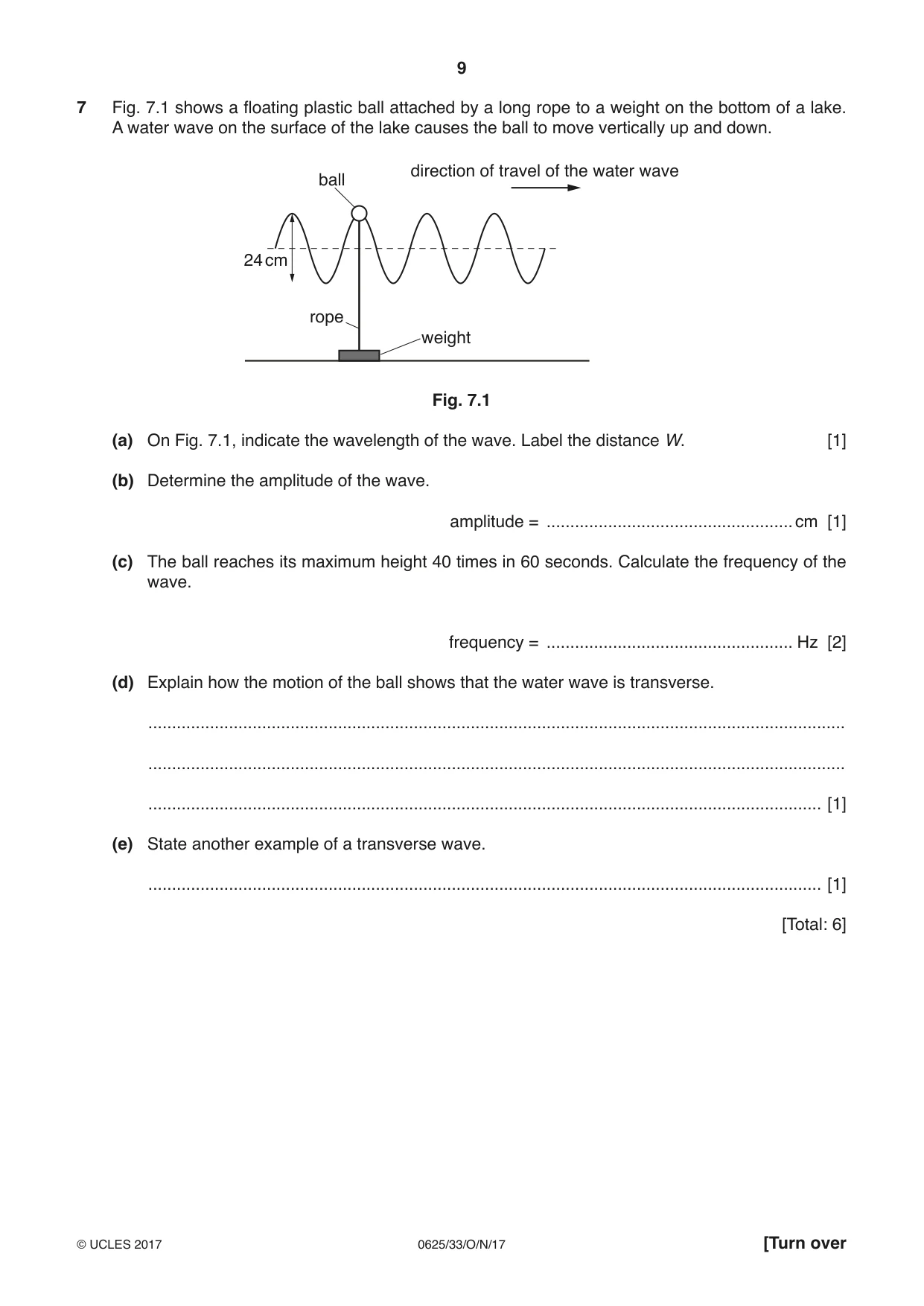
7 Fig. 7.1 shows a floating plastic ball attached by a long rope to a weight on the bottom of a lake. A water wave on the surface of the lake causes the ball to move vertically up and down. direction of travel of the water wave ball 24 cm rope weight Fig. 7.1 (a) On Fig. 7.1, indicate the wavelength of the wave. Label the distance W. [1] (b) Determine the amplitude of the wave. amplitude = .................................................... cm [1] (c) The ball reaches its maximum height 40 times in 60 seconds. Calculate the frequency of the wave. frequency = .................................................... Hz [2] (d) Explain how the motion of the ball shows that the water wave is transverse. ................................................................................................................................................... ................................................................................................................................................... .............................................................................................................................................. [1] (e) State another example of a transverse wave. .............................................................................................................................................. [1] [Total: 6]
Mark scheme: 7(a) wavelength correctly indicated B1 7(b) 12 (cm) B1 7(c) 40 / 60 C1 0.67 (Hz) A1 7(d) direction of travel perpendicular to direction of vibration owtte B1 7(e) any component of the electromagnetic spectrum B1
Q8 · Two parallel rays of light that pass through a thin converging lens
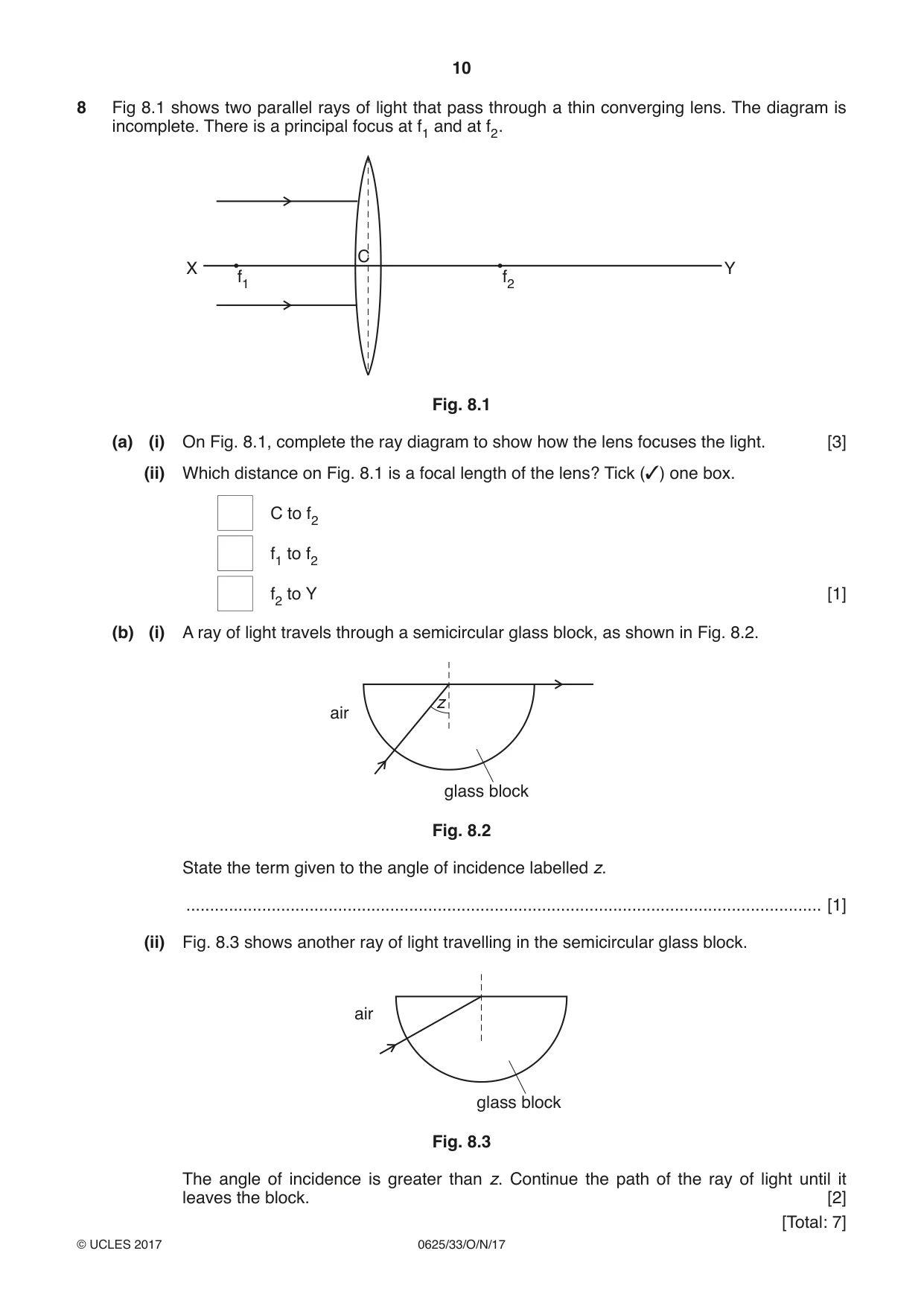
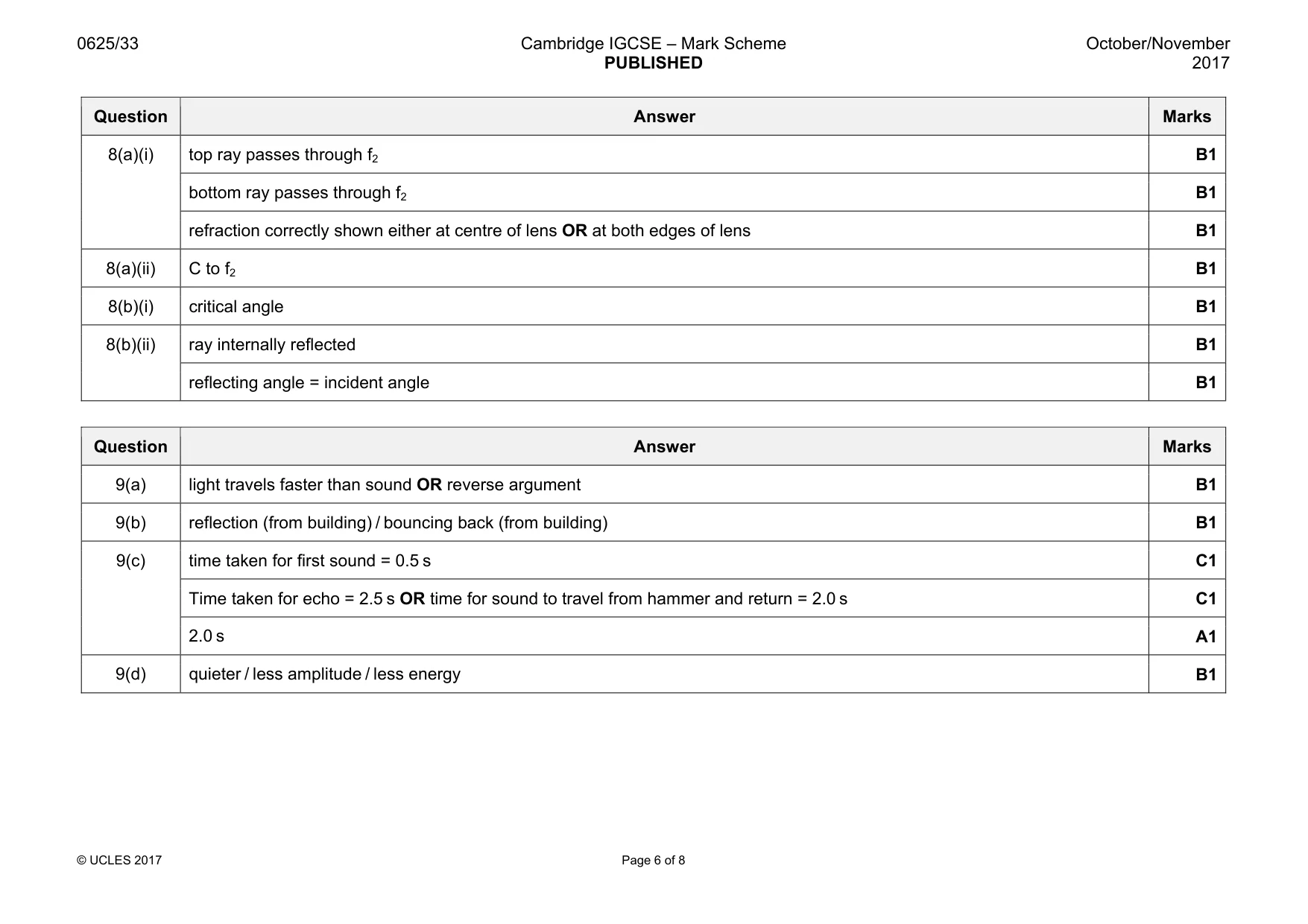
8 Fig 8.1 shows two parallel rays of light that pass through a thin converging lens. The diagram is incomplete. There is a principal focus at f1 and at f2. C X Y f1 f2 Fig. 8.1 (a) (i) On Fig. 8.1, complete the ray diagram to show how the lens focuses the light. [3] (ii) Which distance on Fig. 8.1 is a focal length of the lens? Tick (✓) one box. C to f2 f1 to f2 f2 to Y [1] (b) (i) A ray of light travels through a semicircular glass block, as shown in Fig. 8.2. z air glass block Fig. 8.2 State the term given to the angle of incidence labelled z. ...................................................................................................................................... [1] (ii) Fig. 8.3 shows another ray of light travelling in the semicircular glass block. air glass block Fig. 8.3 The angle of incidence is greater than z. Continue the path of the ray of light until it leaves the block. [2] [Total: 7]
Mark scheme: 8(a)(i) top ray passes through f2 B1 bottom ray passes through f2 B1 refraction correctly shown either at centre of lens OR at both edges of lens B1 8(a)(ii) C to f2 B1 8(b)(i) critical angle B1 8(b)(ii) ray internally reflected B1 reflecting angle = incident angle B1
Q9 · A machine pushes a metal post into the ground using a hammer, as shown in Fig
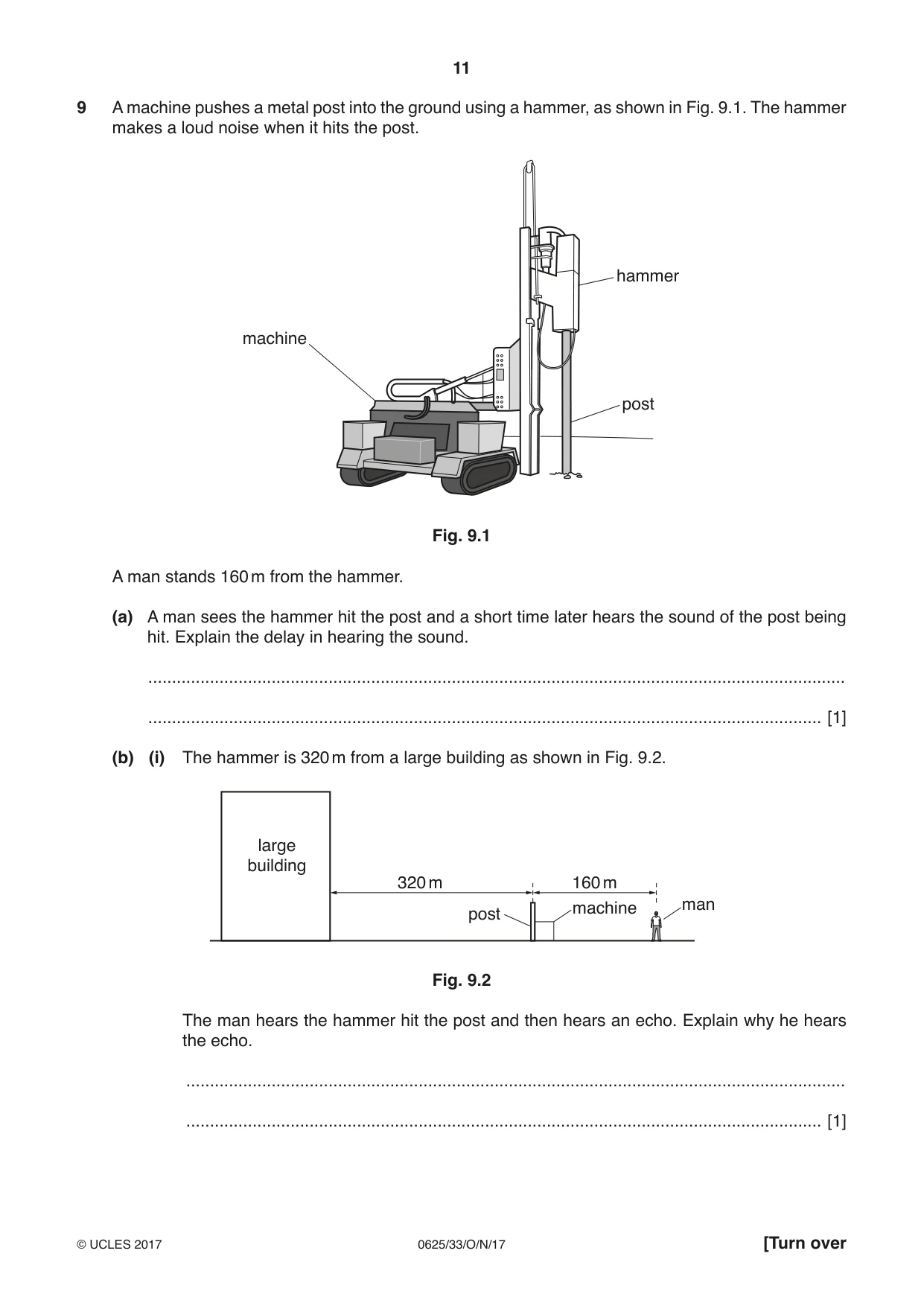
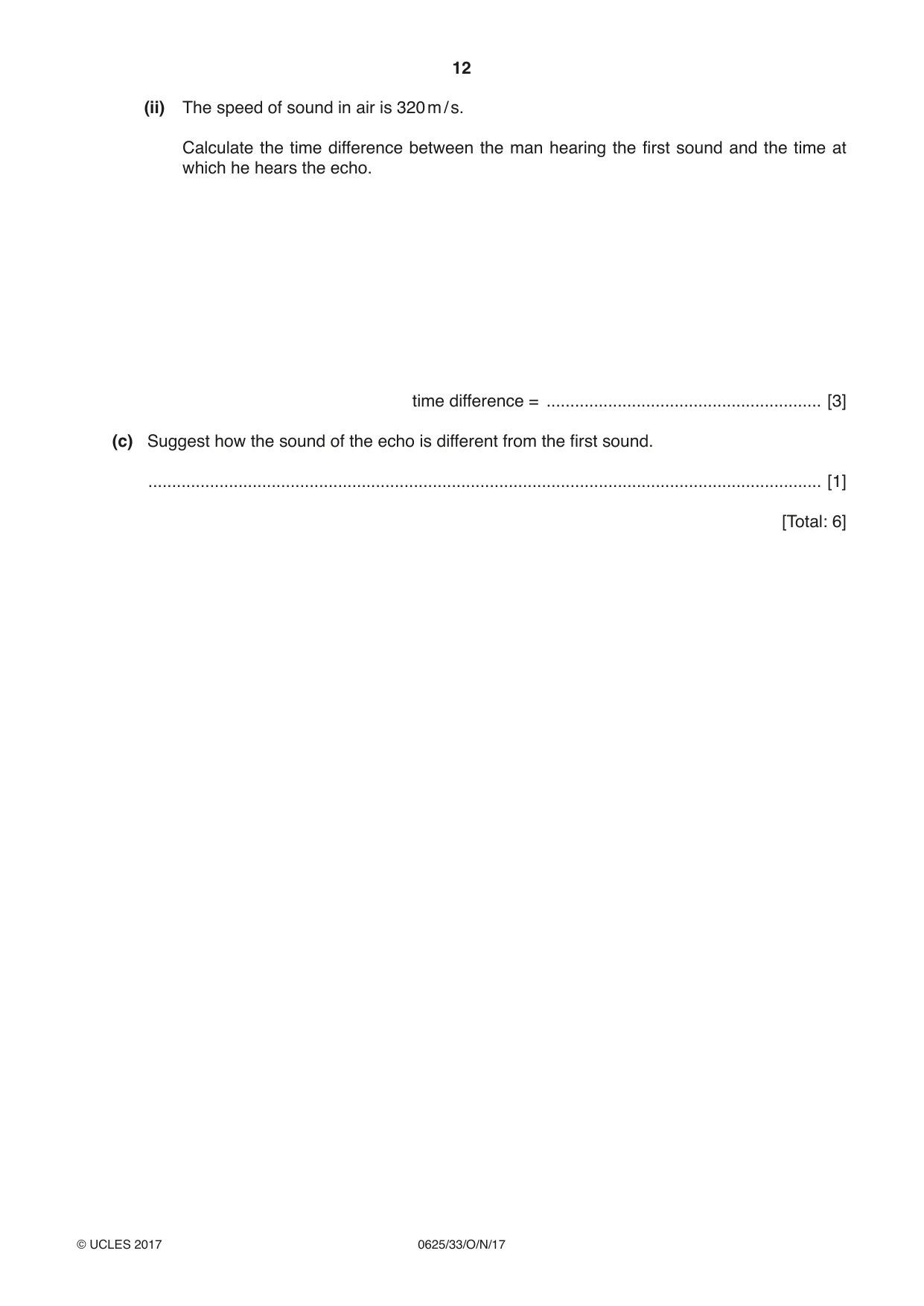
9 A machine pushes a metal post into the ground using a hammer, as shown in Fig. 9.1. The hammer makes a loud noise when it hits the post. hammer machine post Fig. 9.1 A man stands 160 m from the hammer. (a) A man sees the hammer hit the post and a short time later hears the sound of the post being hit. Explain the delay in hearing the sound. ................................................................................................................................................... .............................................................................................................................................. [1] (b) (i) The hammer is 320 m from a large building as shown in Fig. 9.2. large building 320 m 160 m machine man post Fig. 9.2 The man hears the hammer hit the post and then hears an echo. Explain why he hears the echo. ........................................................................................................................................... ...................................................................................................................................... [1] (ii) The speed of sound in air is 320 m / s. Calculate the time difference between the man hearing the first sound and the time at which he hears the echo. time difference = .......................................................... [3] (c) Suggest how the sound of the echo is different from the first sound. .............................................................................................................................................. [1] [Total: 6]
Mark scheme: 9(a) light travels faster than sound OR reverse argument B1 9(b) reflection (from building) / bouncing back (from building) B1 9(c) time taken for first sound = 0.5 s C1 Time taken for echo = 2.5 s OR time for sound to travel from hammer and return = 2.0 s C1 2.0 s A1 9(d) quieter / less amplitude / less energy B1
Q10 · A student places a bar magnet onto a sheet of paper, as shown in Fig
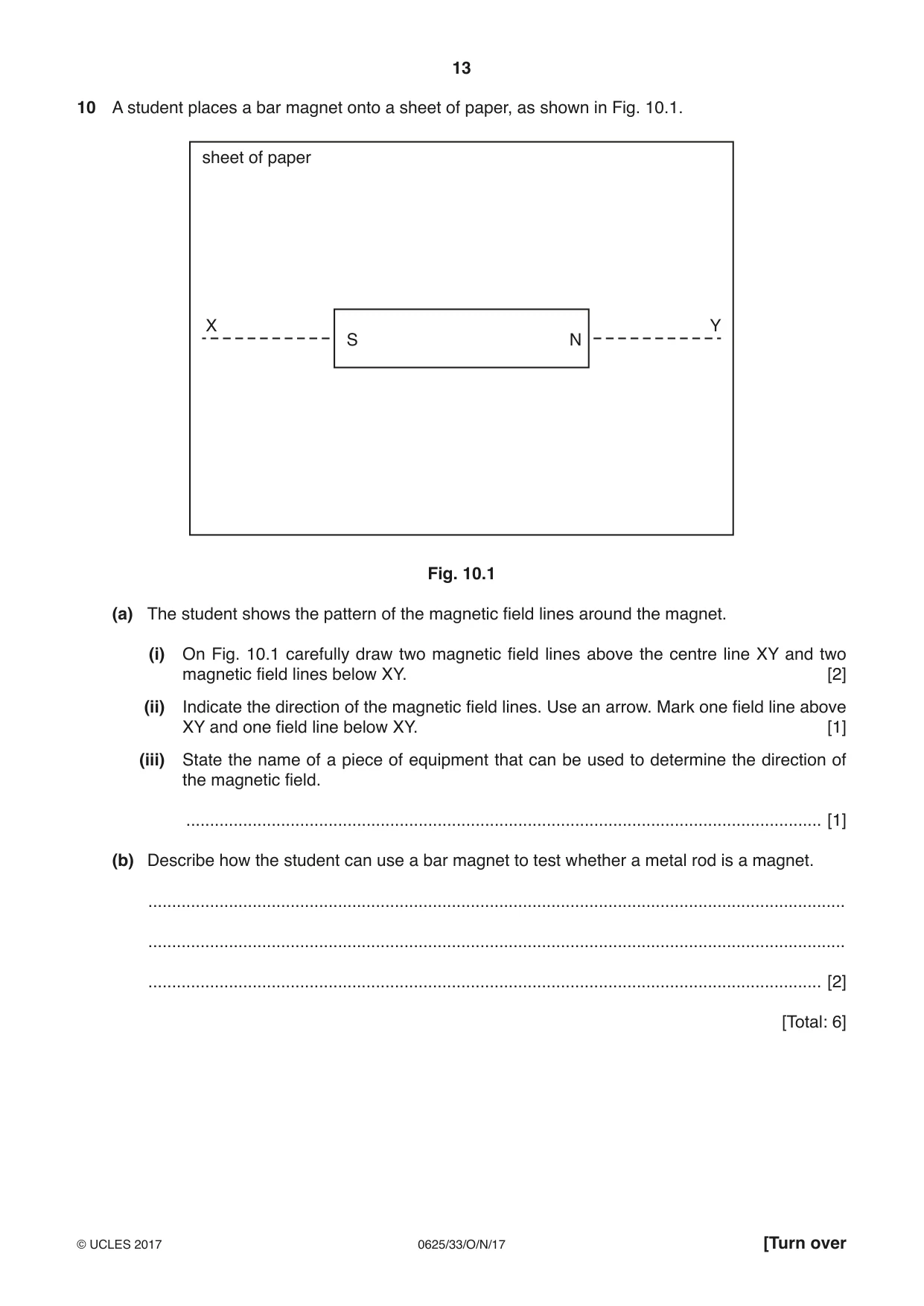
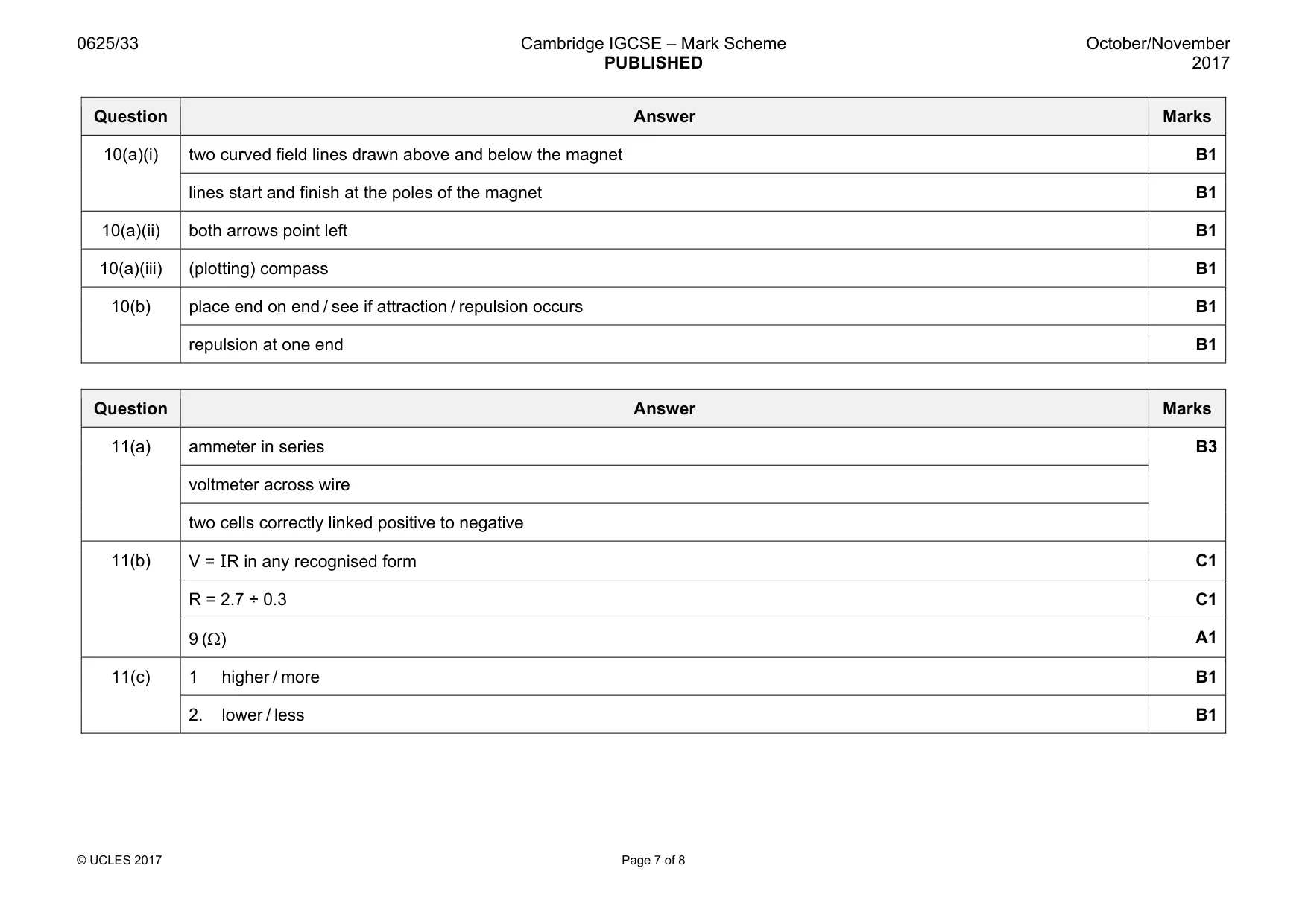
10 A student places a bar magnet onto a sheet of paper, as shown in Fig. 10.1. sheet of paper X Y S N Fig. 10.1 (a) The student shows the pattern of the magnetic field lines around the magnet. (i) On Fig. 10.1 carefully draw two magnetic field lines above the centre line XY and two magnetic field lines below XY. [2] (ii) Indicate the direction of the magnetic field lines. Use an arrow. Mark one field line above XY and one field line below XY. [1] (iii) State the name of a piece of equipment that can be used to determine the direction of the magnetic field. ...................................................................................................................................... [1] (b) Describe how the student can use a bar magnet to test whether a metal rod is a magnet. ................................................................................................................................................... ................................................................................................................................................... .............................................................................................................................................. [2] [Total: 6]
Mark scheme: 10(a)(i) two curved field lines drawn above and below the magnet B1 lines start and finish at the poles of the magnet B1 10(a)(ii) both arrows point left B1 10(a)(iii) (plotting) compass B1 10(b) place end on end / see if attraction / repulsion occurs B1 repulsion at one end B1
Q11 · A student wants to find the resistance of a wire
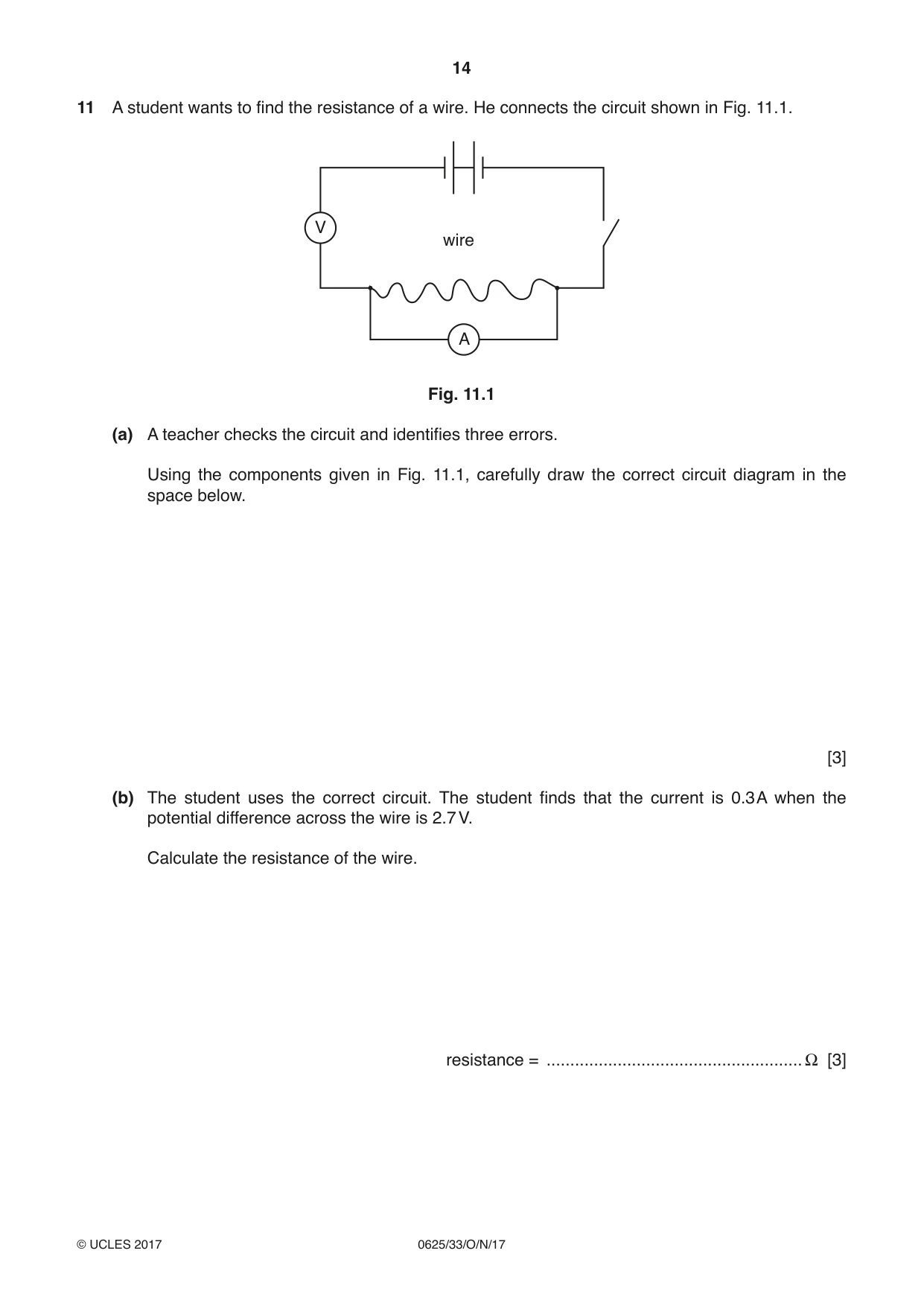
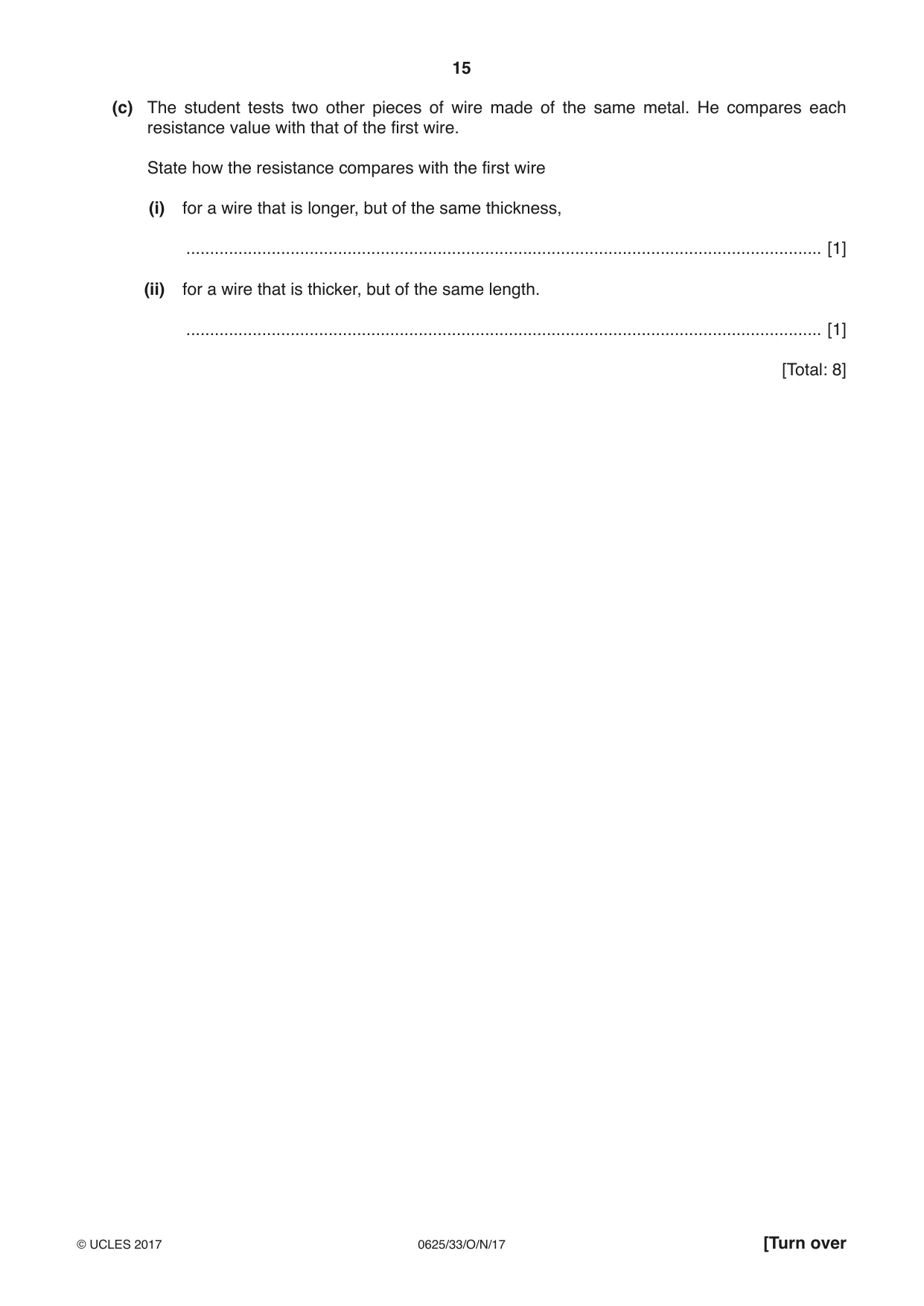
11 A student wants to find the resistance of a wire. He connects the circuit shown in Fig. 11.1. V wire A Fig. 11.1 (a) A teacher checks the circuit and identifies three errors. Using the components given in Fig. 11.1, carefully draw the correct circuit diagram in the space below. [3] (b) The student uses the correct circuit. The student finds that the current is 0.3 A when the potential difference across the wire is 2.7 V. Calculate the resistance of the wire. resistance = ...................................................... Ω [3] (c) The student tests two other pieces of wire made of the same metal. He compares each resistance value with that of the first wire. State how the resistance compares with the first wire (i) for a wire that is longer, but of the same thickness, ...................................................................................................................................... [1] (ii) for a wire that is thicker, but of the same length. ...................................................................................................................................... [1] [Total: 8]
Mark scheme: 11(a) ammeter in series B3 voltmeter across wire two cells correctly linked positive to negative 11(b) V = IR in any recognised form C1 R = 2.7 ÷ 0.3 C1 9 (Ω) A1 11(c) 1 higher / more B1 2. lower / less B1
Q12 · This question is about radioactive materials
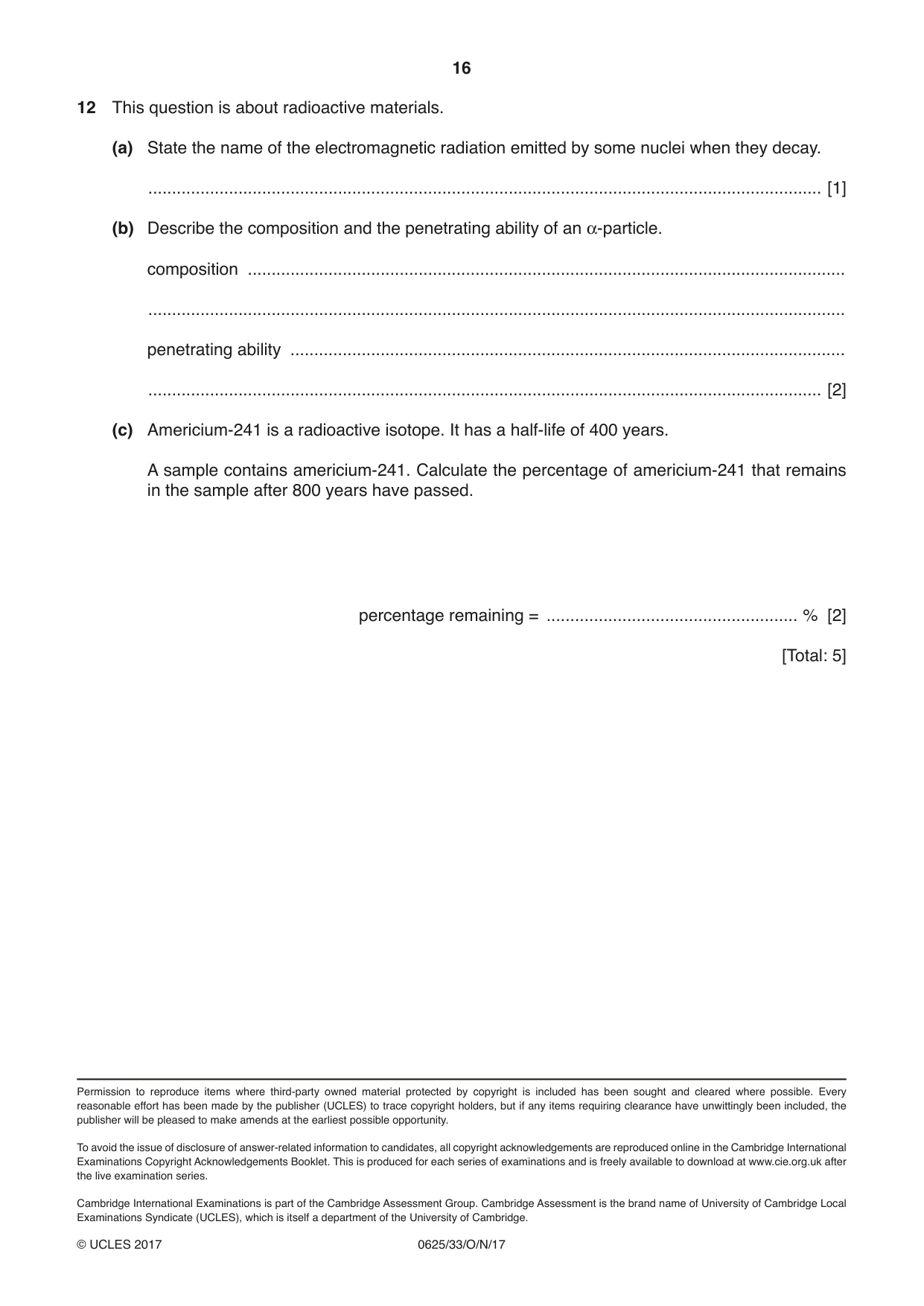
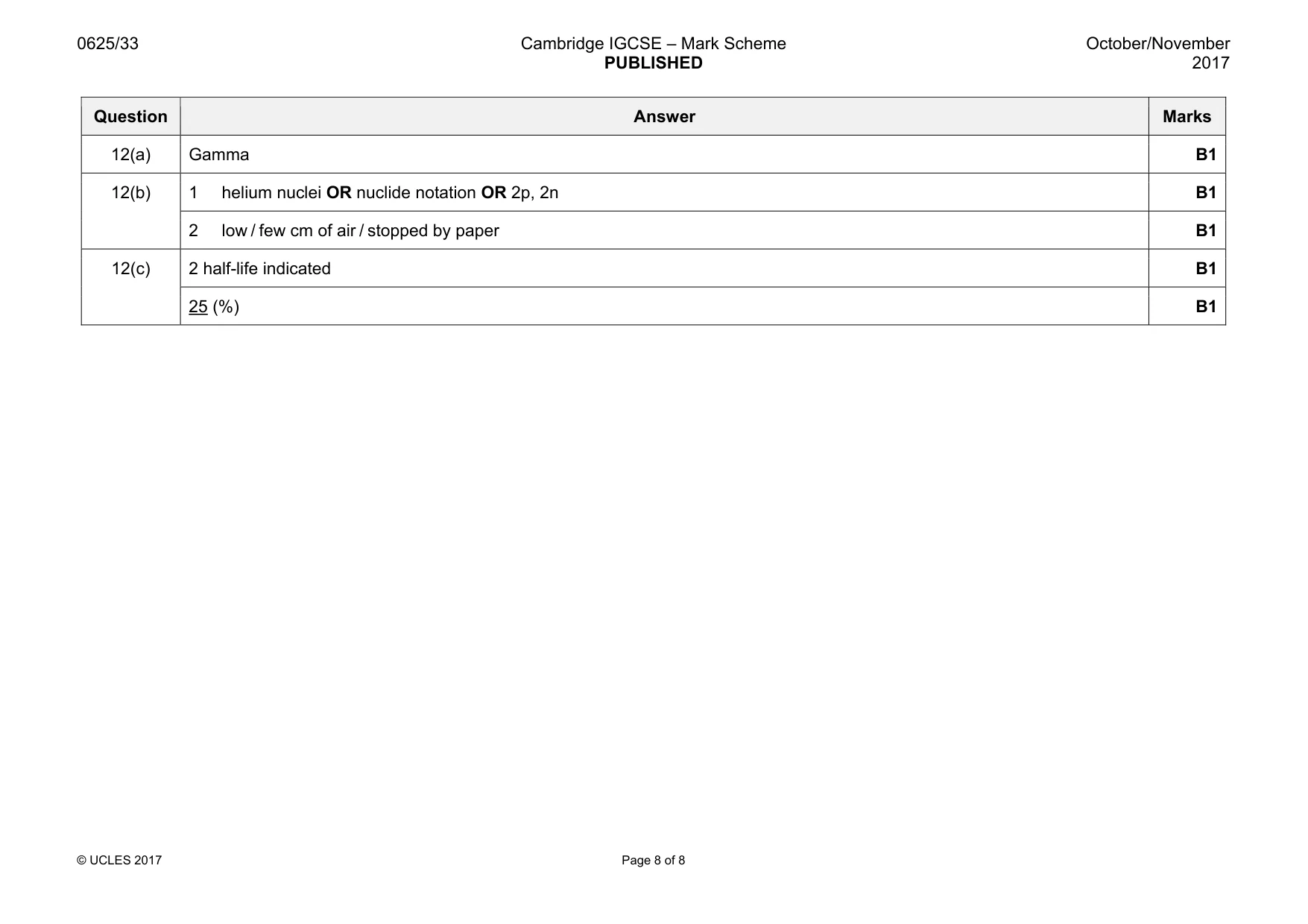
12 This question is about radioactive materials. (a) State the name of the electromagnetic radiation emitted by some nuclei when they decay. .............................................................................................................................................. [1] (b) Describe the composition and the penetrating ability of an α-particle. composition .............................................................................................................................. ................................................................................................................................................... penetrating ability ..................................................................................................................... .............................................................................................................................................. [2] (c) Americium-241 is a radioactive isotope. It has a half-life of 400 years. A sample contains americium-241. Calculate the percentage of americium-241 that remains in the sample after 800 years have passed. percentage remaining = ..................................................... % [2] [Total: 5]
Mark scheme: 12(a) Gamma B1 12(b) 1 helium nuclei OR nuclide notation OR 2p, 2n B1 2 low / few cm of air / stopped by paper B1 12(c) 2 half-life indicated B1 25 (%) B1
What was in this paper
The subtopics covered by these 12 questions, and how many questions each got. Open one in a new tab to see every Cambridge question on it.
What you needed in this session
Cambridge’s own grade thresholds for 2017 Oct/Nov, Paper 3 · Variant 3. A higher threshold means an easier paper — the bar moves with how the cohort did.