Cambridge IGCSE Physics 0625 — 2024 Feb/March Paper 3 · Variant 2
0625/32/F/M/24 · 11 questions · 80 marks · ≈90 min
The question paper and its mark scheme, free to read here and free to download. This is Cambridge’s own paper, exactly as it was sat.
Question paper16 pages


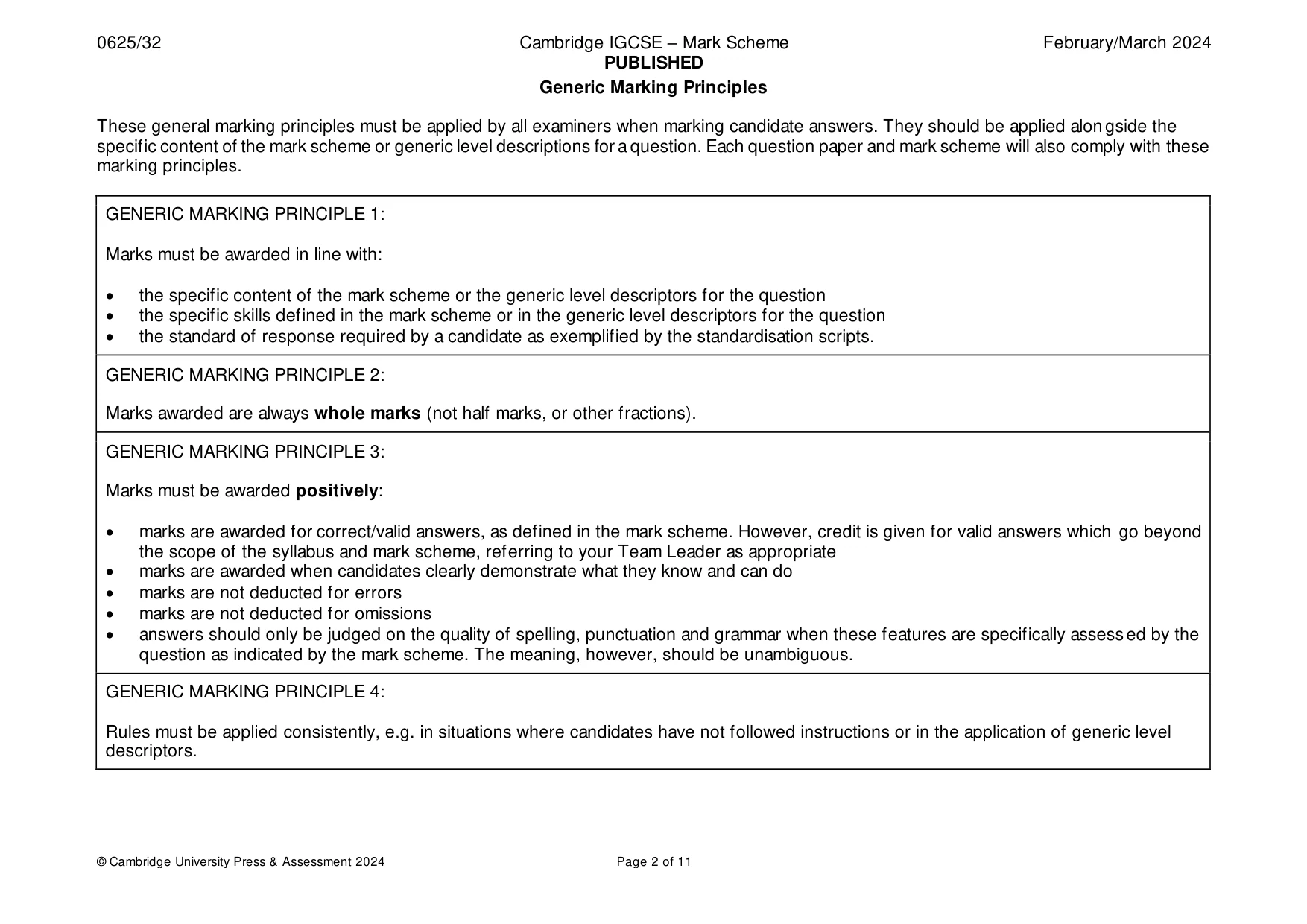
Mark scheme11 pages
Answers below. Sit the paper first if you are practising.
Questions as text
Q1 · The distance–time graph for a student
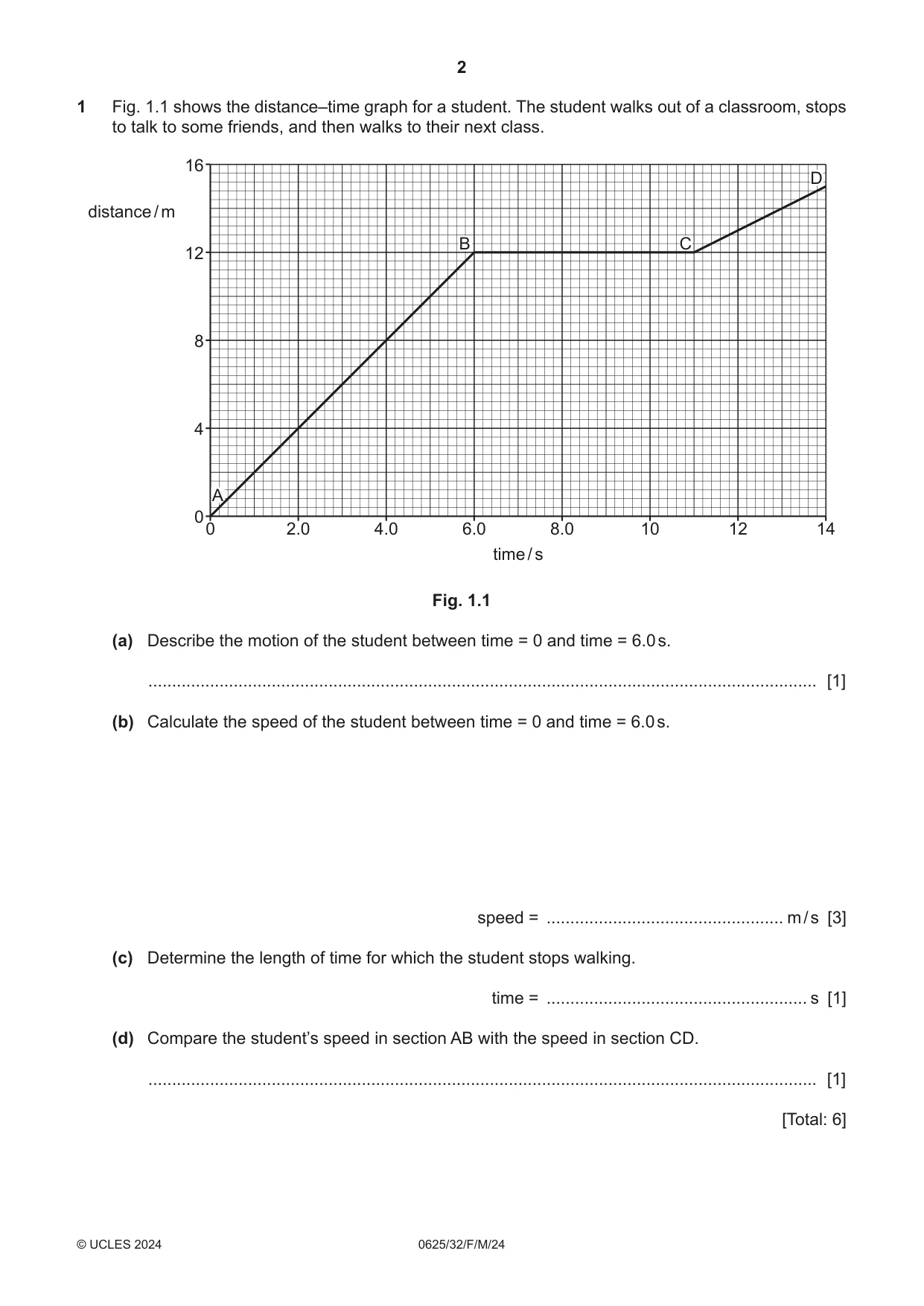
1 Fig. 1.1 shows the distance–time graph for a student. The student walks out of a classroom, stops to talk to some friends, and then walks to their next class. 16 D distance / m B C 12 8 4 A 0 0 2.0 4.0 6.0 8.0 10 12 14 time / s Fig. 1.1 (a) Describe the motion of the student between time = 0 and time = 6.0 s. ............................................................................................................................................. [1] (b) Calculate the speed of the student between time = 0 and time = 6.0 s. speed = .................................................. m / s [3] (c) Determine the length of time for which the student stops walking. time = ....................................................... s [1] (d) Compare the student’s speed in section AB with the speed in section CD. ............................................................................................................................................. [1] [Total: 6]
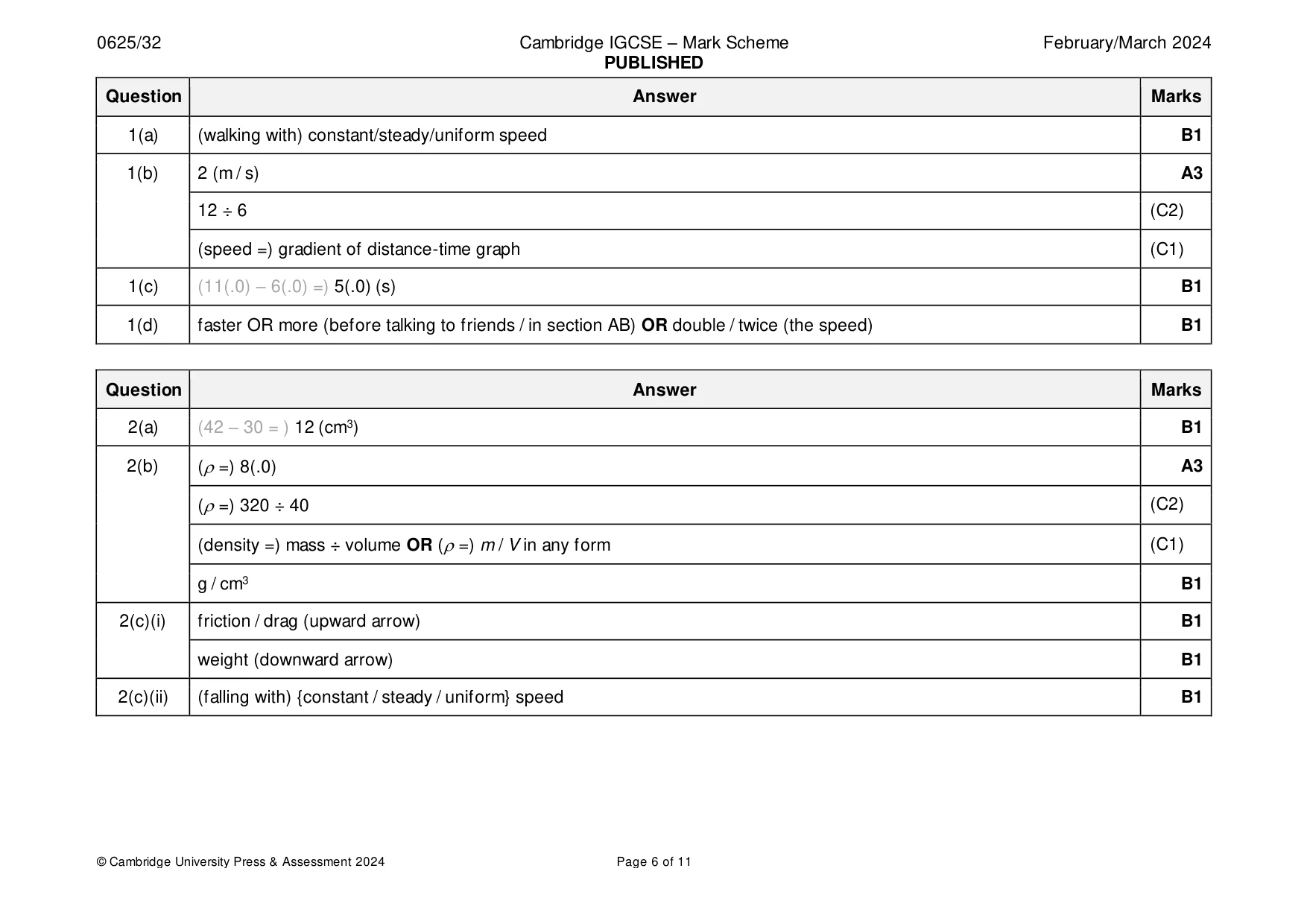
Mark scheme: Question Answer Marks 1(a) (walking with) constant/steady/uniform speed B1 1(b) 2 (m / s) A3 12 ÷ 6 (C2) (speed =) gradient of distance-time graph (C1) 1(c) (11(.0) – 6(.0) =) 5(.0) (s) B1 1(d) faster OR more (before talking to friends / in section AB) OR double / twice (the speed) B1
Q2 · A student determines the volume of a piece of metal
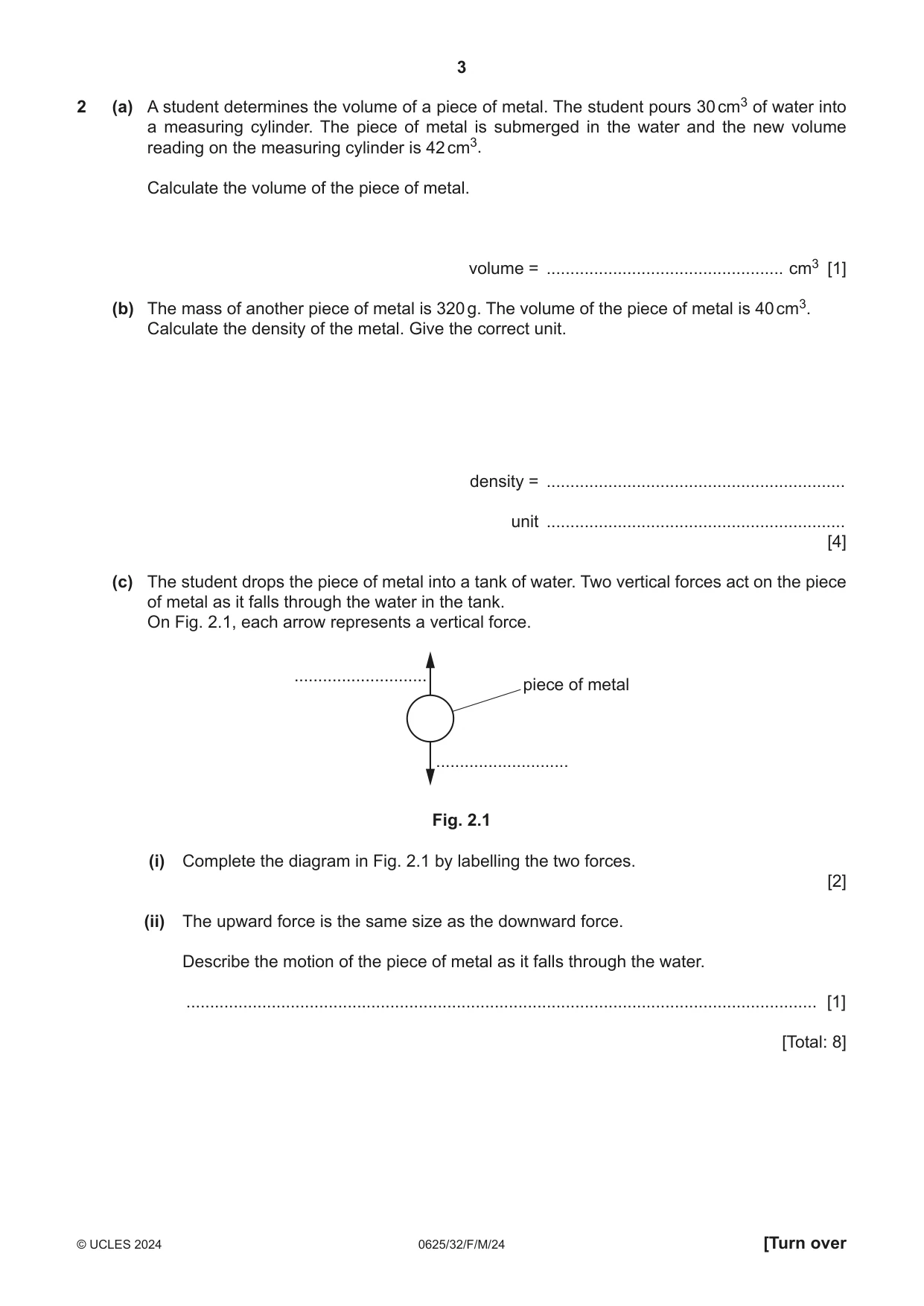
2 (a) A student determines the volume of a piece of metal. The student pours 30 cm3 of water into a measuring cylinder. The piece of metal is submerged in the water and the new volume reading on the measuring cylinder is 42 cm3. Calculate the volume of the piece of metal. volume = .................................................. cm3 [1] (b) The mass of another piece of metal is 320 g. The volume of the piece of metal is 40 cm3. Calculate the density of the metal. Give the correct unit. density = ............................................................... unit ............................................................... [4] (c) The student drops the piece of metal into a tank of water. Two vertical forces act on the piece of metal as it falls through the water in the tank. On Fig. 2.1, each arrow represents a vertical force. ............................ piece of metal ............................ Fig. 2.1 (i) Complete the diagram in Fig. 2.1 by labelling the two forces. [2] (ii) The upward force is the same size as the downward force. Describe the motion of the piece of metal as it falls through the water. ..................................................................................................................................... [1] [Total: 8]
Mark scheme: 2(a) (42 – 30 = ) 12 (cm3) B1 2(b) (=) 8(.0) A3 (=) 320 ÷ 40 (C2) (density =) mass ÷ volume OR (=) m / V in any form (C1) g / cm3 B1 2(c)(i) friction / drag (upward arrow) B1 weight (downward arrow) B1 2(c)(ii) (falling with) {constant / steady / uniform} speed B1
Q3 · A computer on the surface of a desk
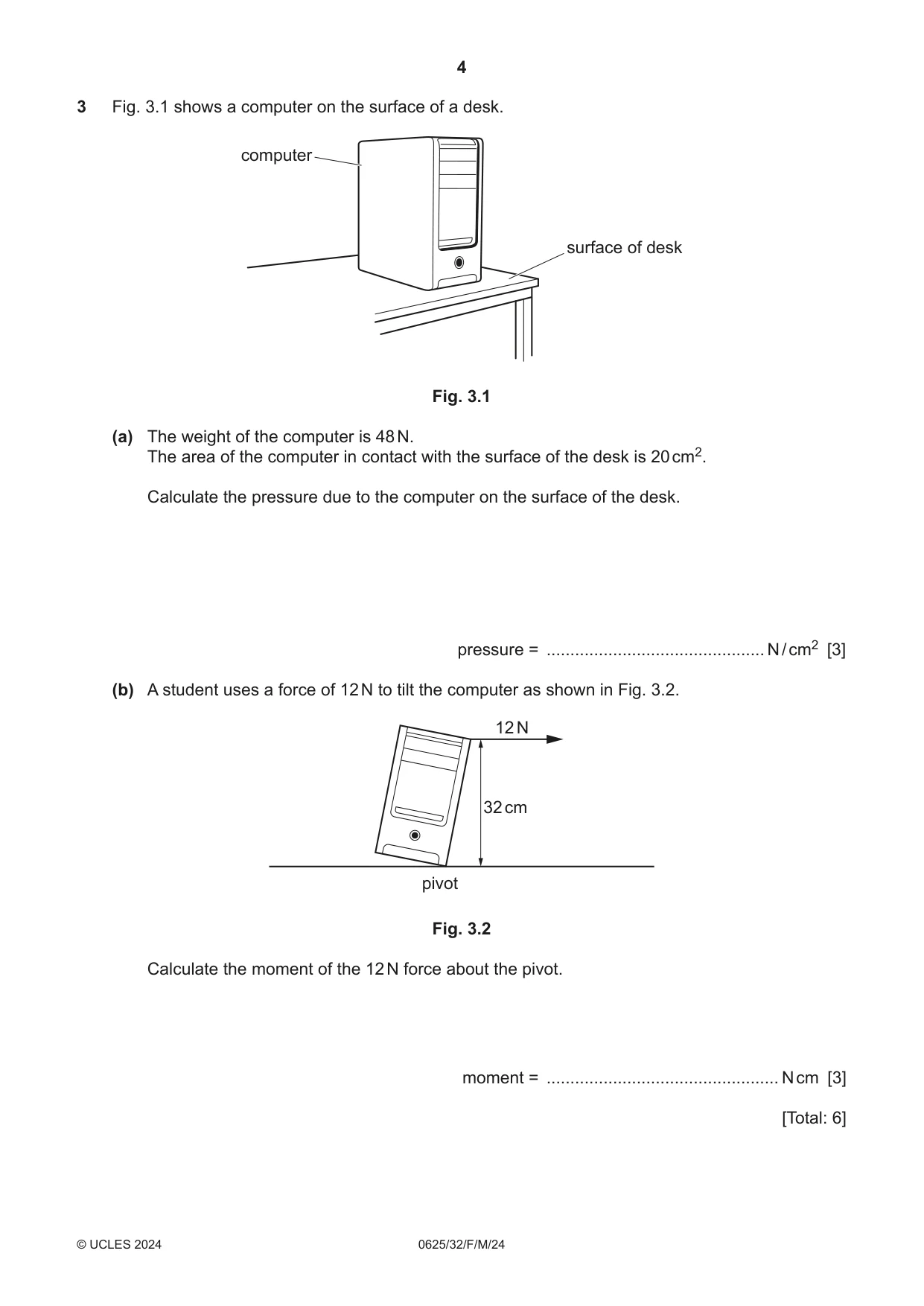
3 Fig. 3.1 shows a computer on the surface of a desk. computer surface of desk Fig. 3.1 (a) The weight of the computer is 48 N. The area of the computer in contact with the surface of the desk is 20 cm2. Calculate the pressure due to the computer on the surface of the desk. pressure = .............................................. N / cm2 [3] (b) A student uses a force of 12 N to tilt the computer as shown in Fig. 3.2. 12 N 32 cm pivot Fig. 3.2 Calculate the moment of the 12 N force about the pivot. moment = ................................................. N cm [3] [Total: 6]
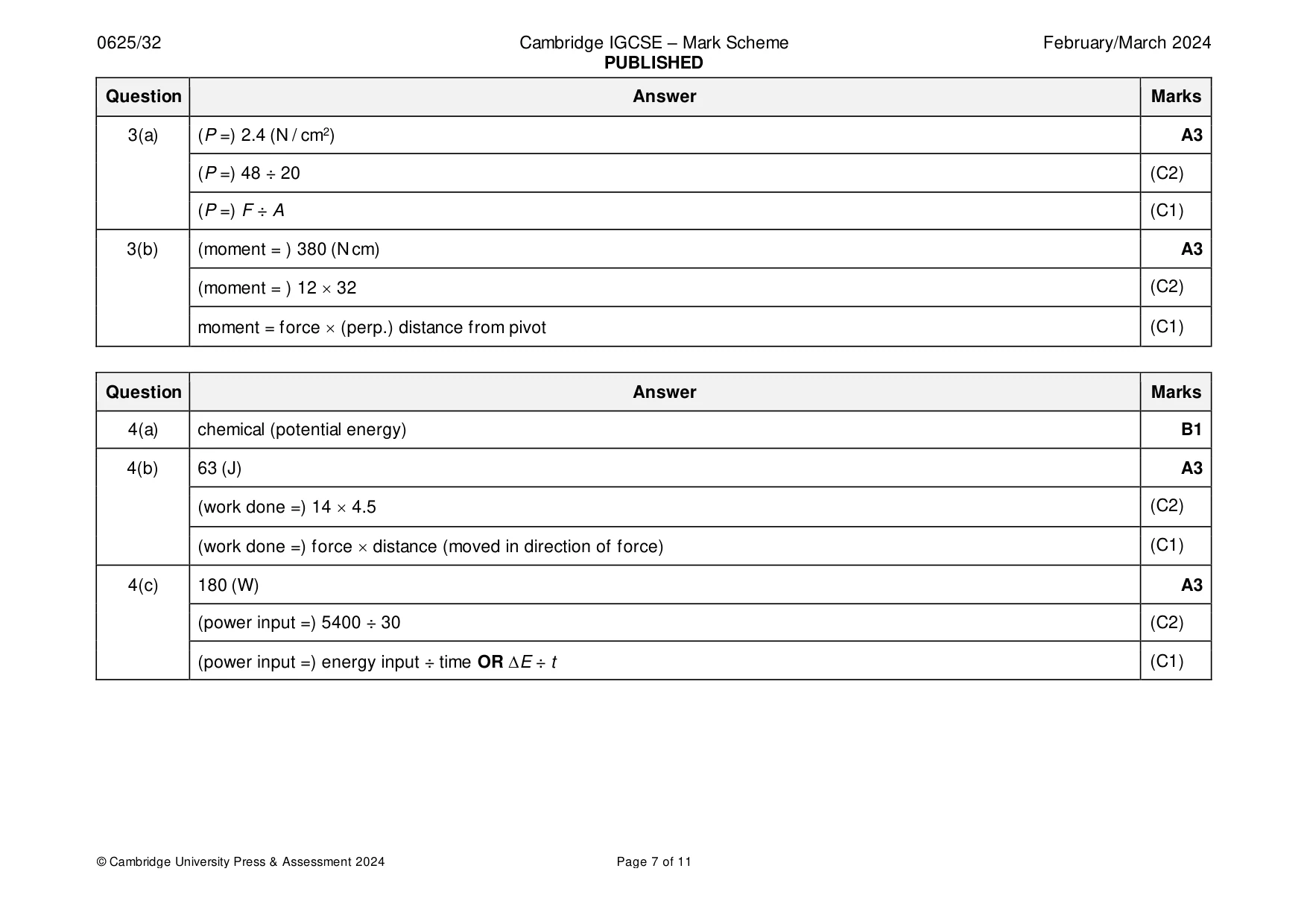
Mark scheme: 3(a) (P =) 2.4 (N / cm2) A3 (P =) 48 ÷ 20 (C2) (P =) F ÷ A (C1) 3(b) (moment = ) 380 (N cm) A3 (moment = ) 12 32 (C2) moment = force (perp.) distance from pivot (C1)
Q4 · A student using a battery-powered device
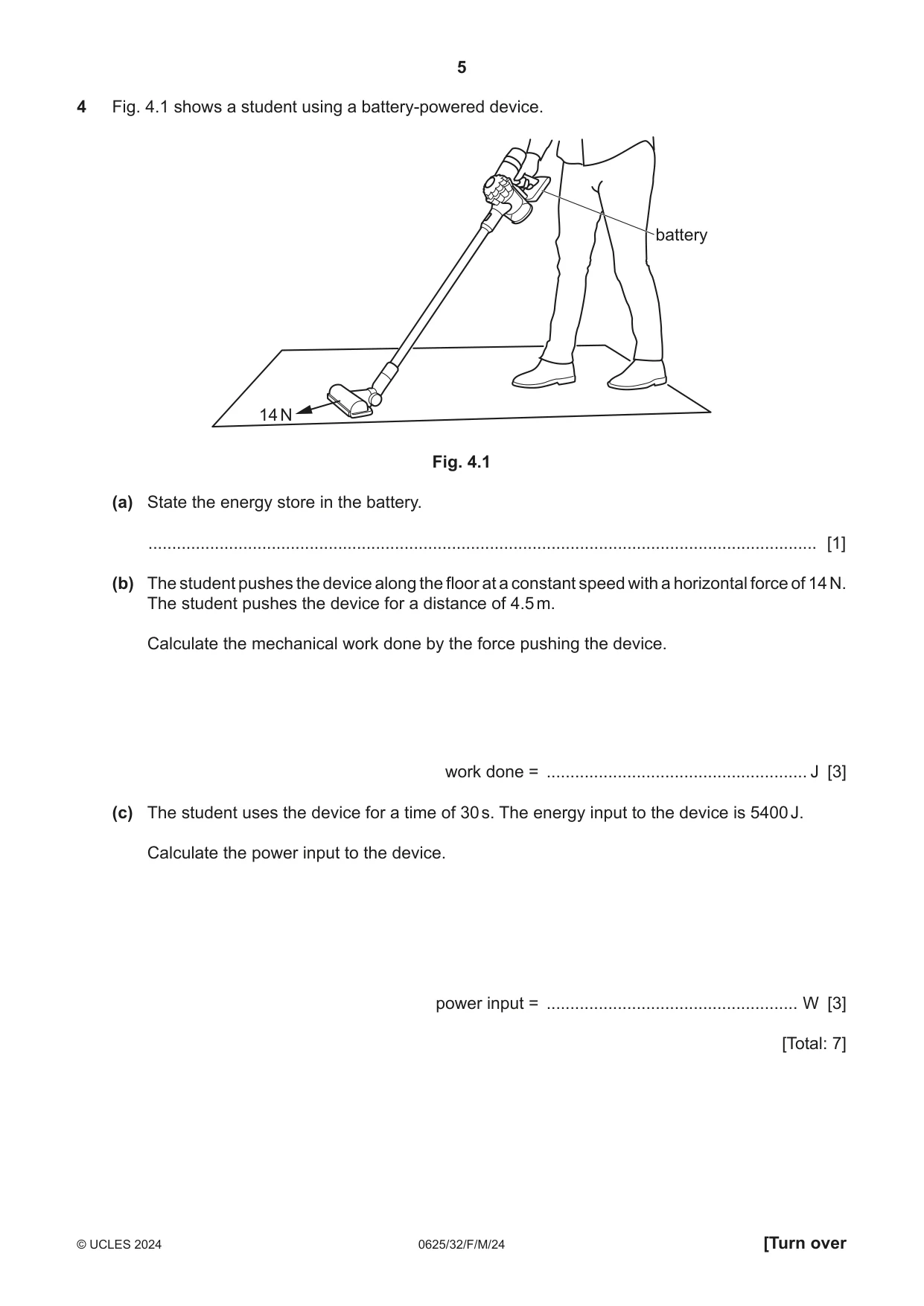
4 Fig. 4.1 shows a student using a battery-powered device. battery 14 N Fig. 4.1 (a) State the energy store in the battery. ............................................................................................................................................. [1] (b) The student pushes the device along the floor at a constant speed with a horizontal force of 14 N. The student pushes the device for a distance of 4.5 m. Calculate the mechanical work done by the force pushing the device. work done = ....................................................... J [3] (c) The student uses the device for a time of 30 s. The energy input to the device is 5400 J. Calculate the power input to the device. power input = ..................................................... W [3] [Total: 7]
Mark scheme: 4(a) chemical (potential energy) B1 4(b) 63 (J) A3 (work done =) 14 4.5 (C2) (work done =) force distance (moved in direction of force) (C1) 4(c) 180 (W) A3 (power input =) 5400 ÷ 30 (C2) (power input =) energy input ÷ time OR E ÷ t (C1)
Q5 · A metal container used for storing petrol
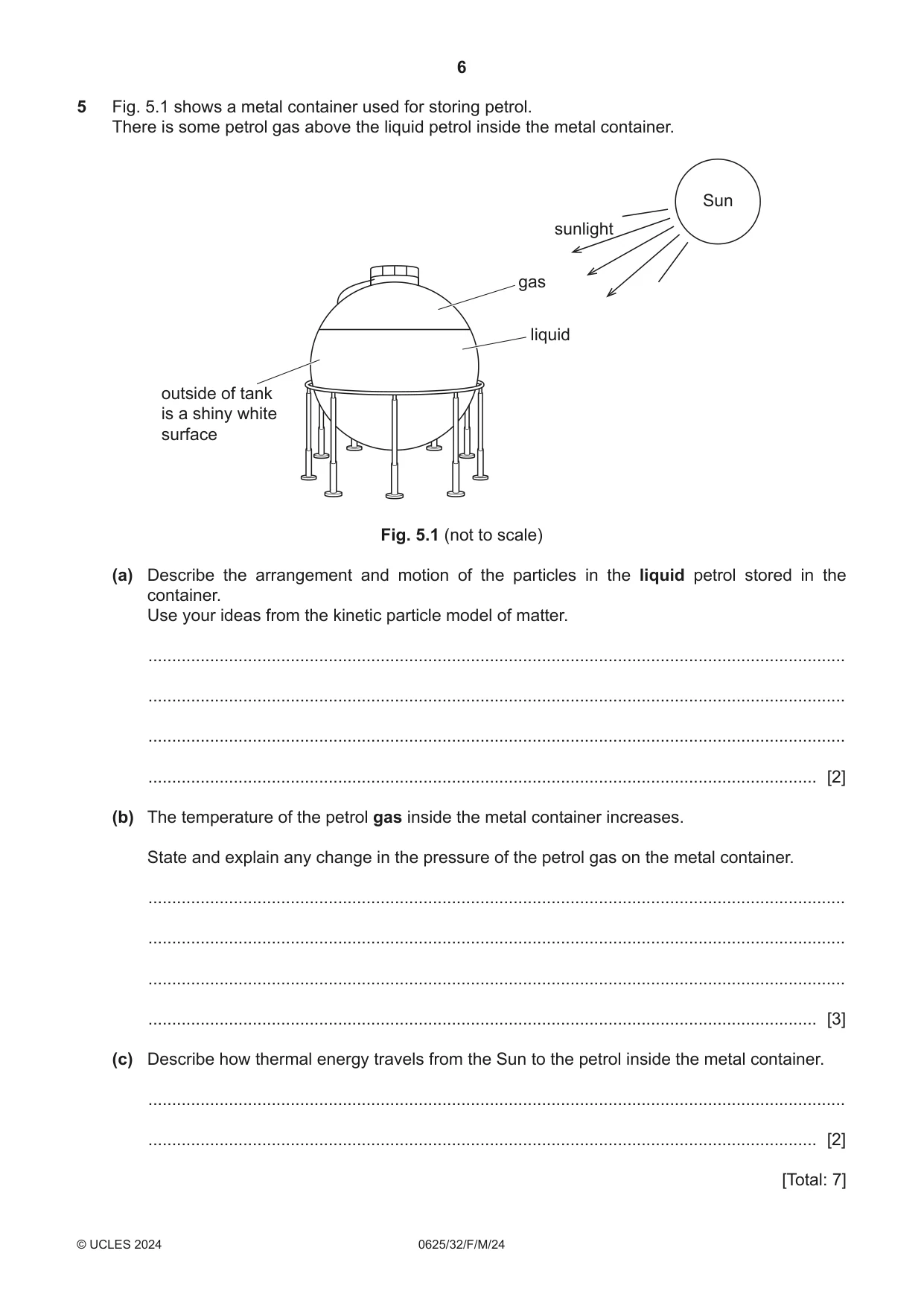
5 Fig. 5.1 shows a metal container used for storing petrol. There is some petrol gas above the liquid petrol inside the metal container. Sun sunlight gas liquid outside of tank is a shiny white surface Fig. 5.1 (not to scale) (a) Describe the arrangement and motion of the particles in the liquid petrol stored in the container. Use your ideas from the kinetic particle model of matter. ................................................................................................................................................... ................................................................................................................................................... ................................................................................................................................................... ............................................................................................................................................. [2] (b) The temperature of the petrol gas inside the metal container increases. State and explain any change in the pressure of the petrol gas on the metal container. ................................................................................................................................................... ................................................................................................................................................... ................................................................................................................................................... ............................................................................................................................................. [3] (c) Describe how thermal energy travels from the Sun to the petrol inside the metal container. ................................................................................................................................................... ............................................................................................................................................. [2] [Total: 7]
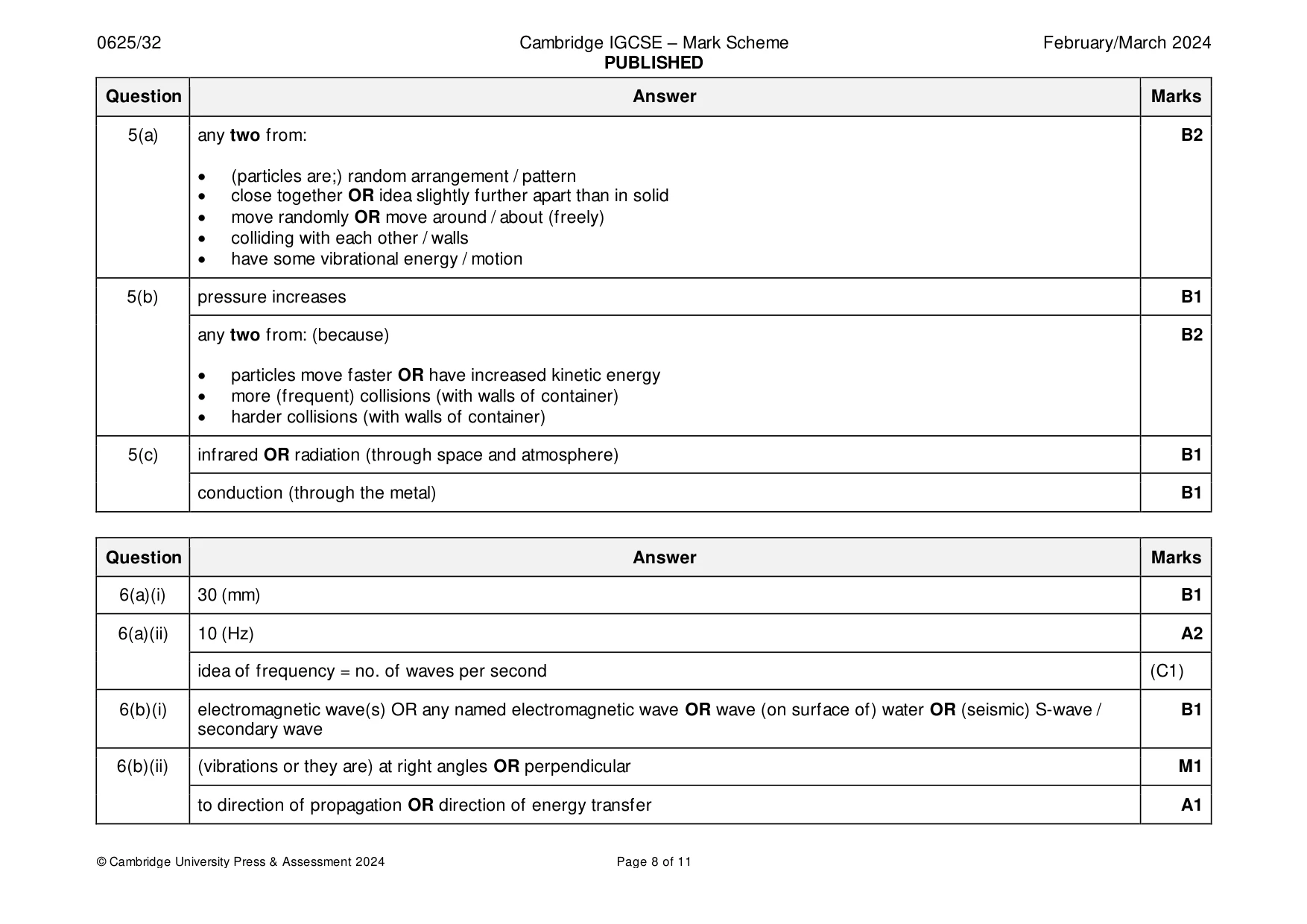
Mark scheme: 5(a) any two from: B2 • (particles are;) random arrangement / pattern • close together OR idea slightly further apart than in solid • move randomly OR move around / about (freely) • colliding with each other / walls • have some vibrational energy / motion 5(b) pressure increases B1 any two from: (because) B2 • particles move faster OR have increased kinetic energy • more (frequent) collisions (with walls of container) • harder collisions (with walls of container) 5(c) infrared OR radiation (through space and atmosphere) B1 conduction (through the metal) B1
Question 6
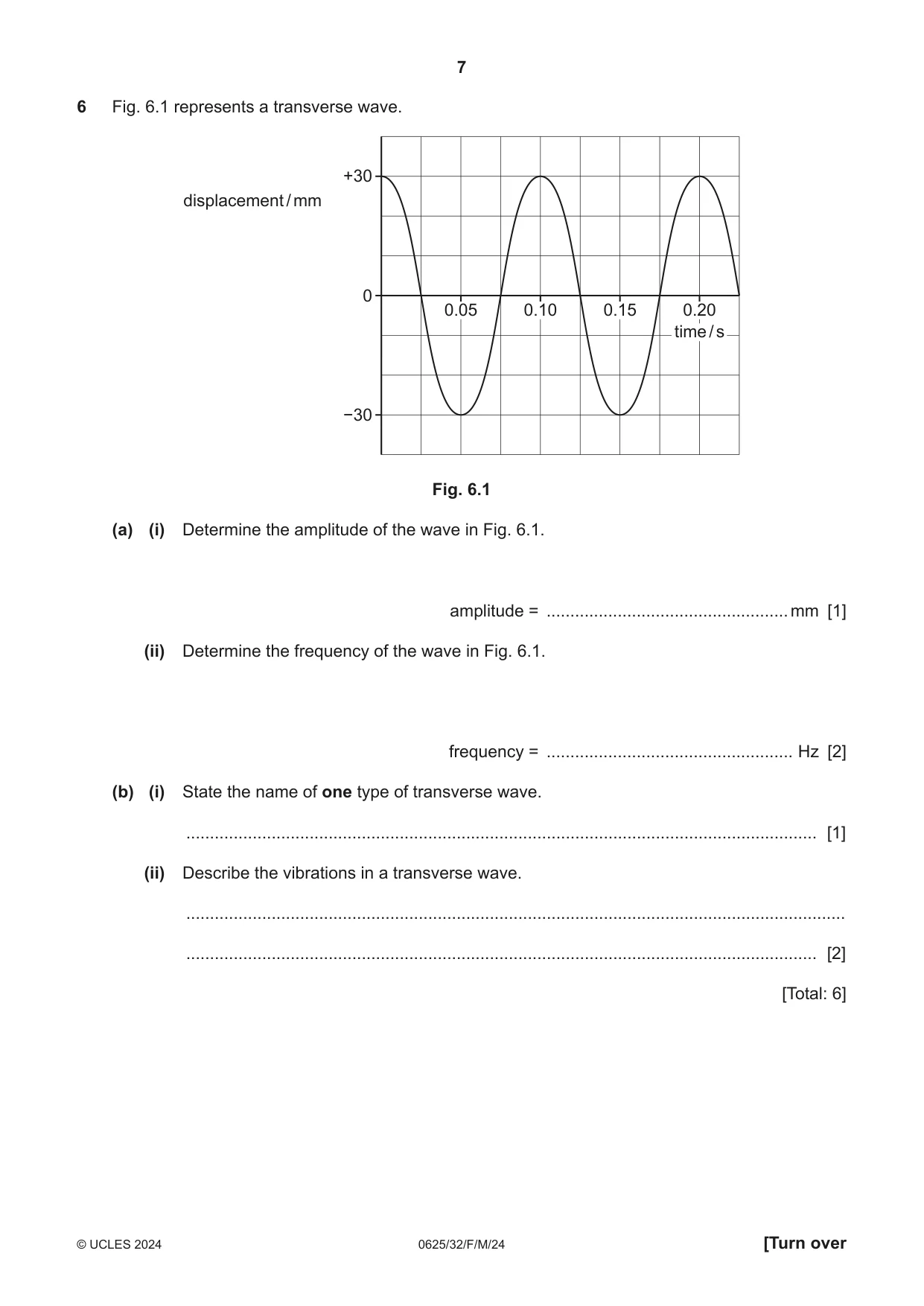
6 Fig. 6.1 represents a transverse wave. +30 displacement / mm 0 0.05 0.10 0.15 0.20 time / s −30 Fig. 6.1 (a) (i) Determine the amplitude of the wave in Fig. 6.1. amplitude = ................................................... mm [1] (ii) Determine the frequency of the wave in Fig. 6.1. frequency = .................................................... Hz [2] (b) (i) State the name of one type of transverse wave. ..................................................................................................................................... [1] (ii) Describe the vibrations in a transverse wave. ........................................................................................................................................... ..................................................................................................................................... [2] [Total: 6]
Mark scheme: 6(a)(i) 30 (mm) B1 6(a)(ii) 10 (Hz) A2 idea of frequency = no. of waves per second (C1) 6(b)(i) electromagnetic wave(s) OR any named electromagnetic wave OR wave (on surface of) water OR (seismic) S-wave / B1 secondary wave 6(b)(ii) (vibrations or they are) at right angles OR perpendicular M1 to direction of propagation OR direction of energy transfer A1
Q7 · An object placed close to a thin converging lens
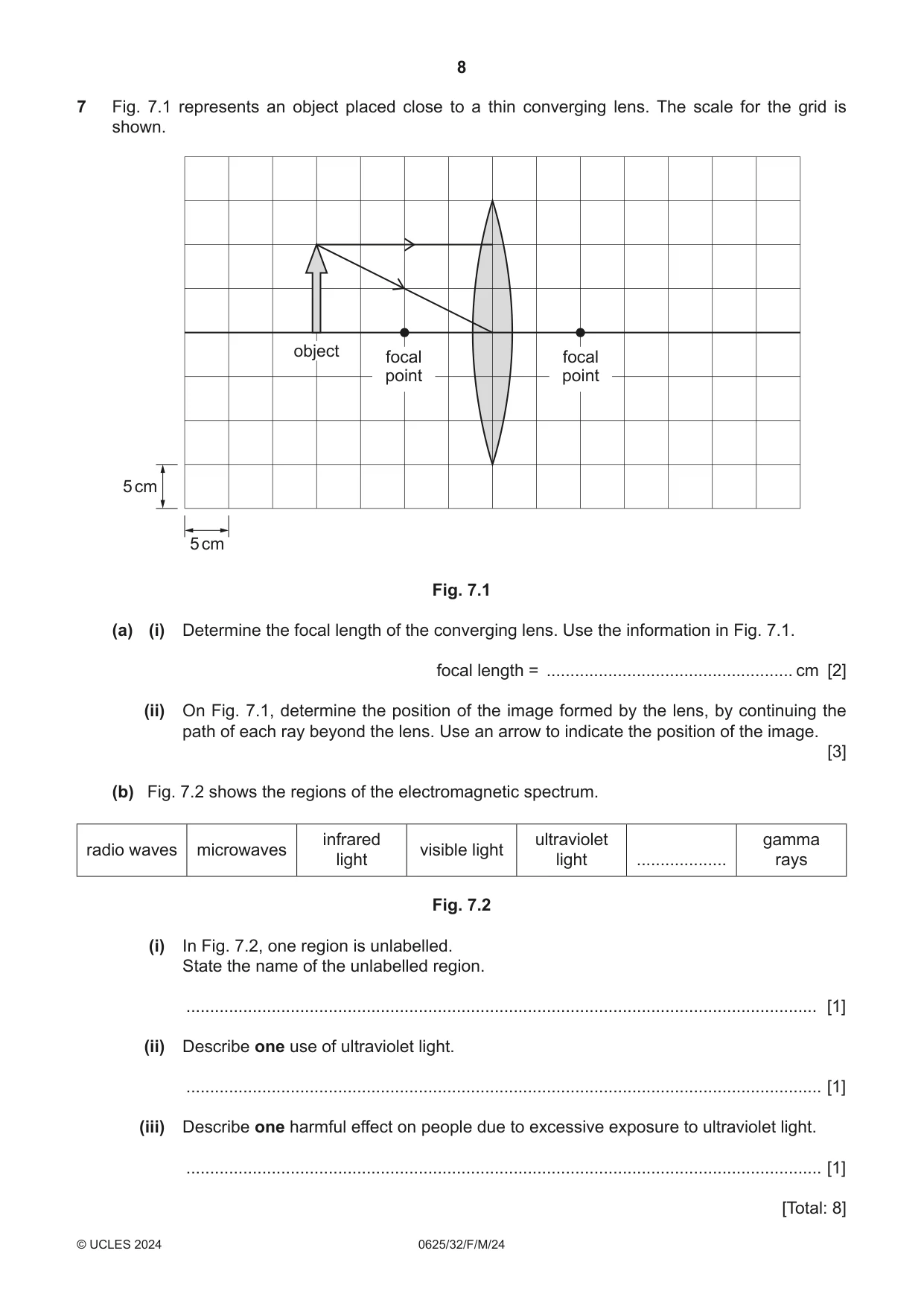
7 Fig. 7.1 represents an object placed close to a thin converging lens. The scale for the grid is shown. object focal focal point point 5 cm 5 cm Fig. 7.1 (a) (i) Determine the focal length of the converging lens. Use the information in Fig. 7.1. focal length = .................................................... cm [2] (ii) On Fig. 7.1, determine the position of the image formed by the lens, by continuing the path of each ray beyond the lens. Use an arrow to indicate the position of the image. [3] (b) Fig. 7.2 shows the regions of the electromagnetic spectrum. infrared ultraviolet gamma radio waves microwaves visible light light light ................... rays Fig. 7.2 (i) In Fig. 7.2, one region is unlabelled. State the name of the unlabelled region. ..................................................................................................................................... [1] (ii) Describe one use of ultraviolet light. ...................................................................................................................................... [1] (iii) Describe one harmful effect on people due to excessive exposure to ultraviolet light. ...................................................................................................................................... [1] [Total: 8]
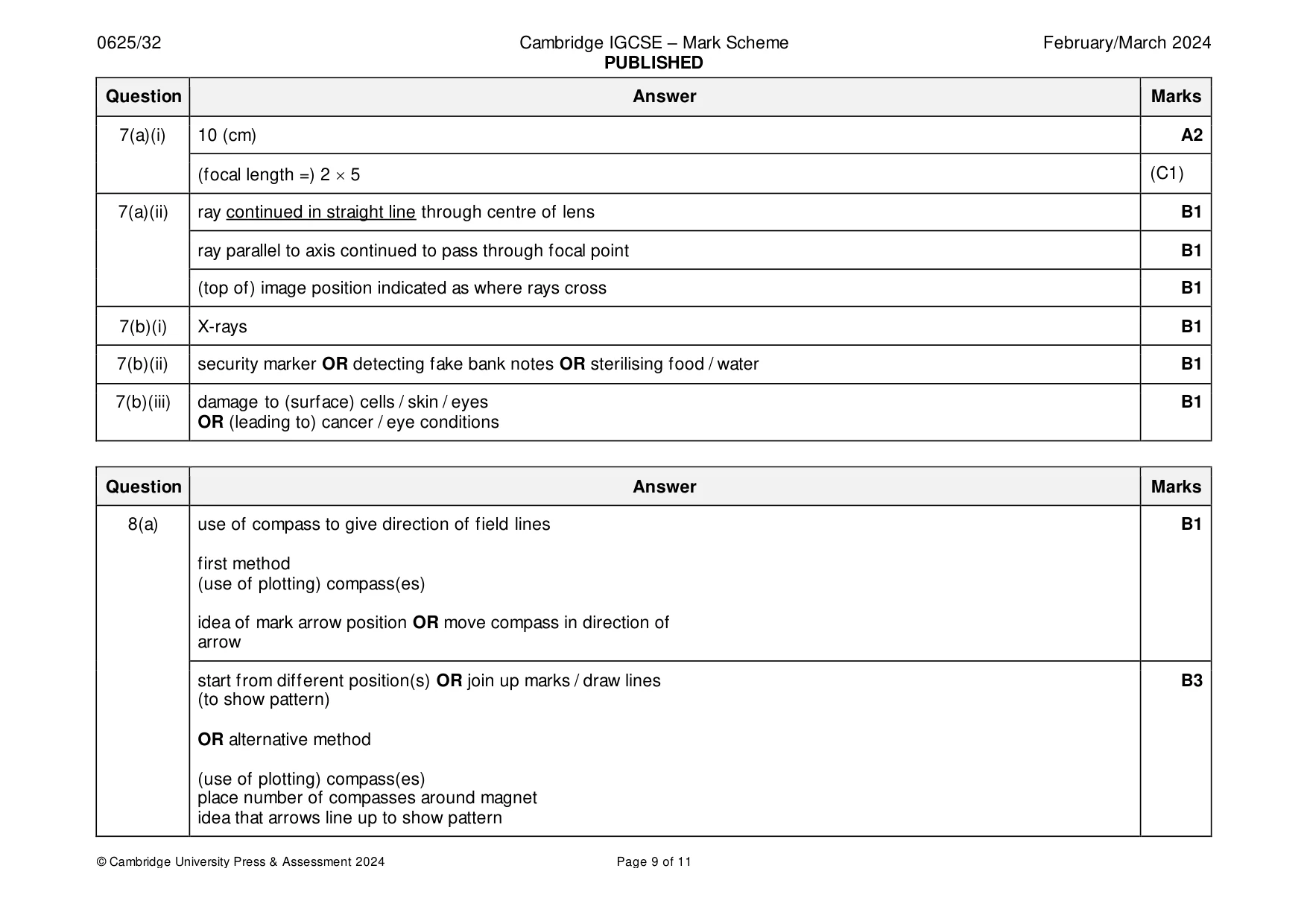
Mark scheme: 7(a)(i) 10 (cm) A2 (focal length =) 2 5 (C1) 7(a)(ii) ray continued in straight line through centre of lens B1 ray parallel to axis continued to pass through focal point B1 (top of) image position indicated as where rays cross B1 7(b)(i) X-rays B1 7(b)(ii) security marker OR detecting fake bank notes OR sterilising food / water B1 7(b)(iii) damage to (surface) cells / skin / eyes B1 OR (leading to) cancer / eye conditions
Q8 · A permanent bar magnet
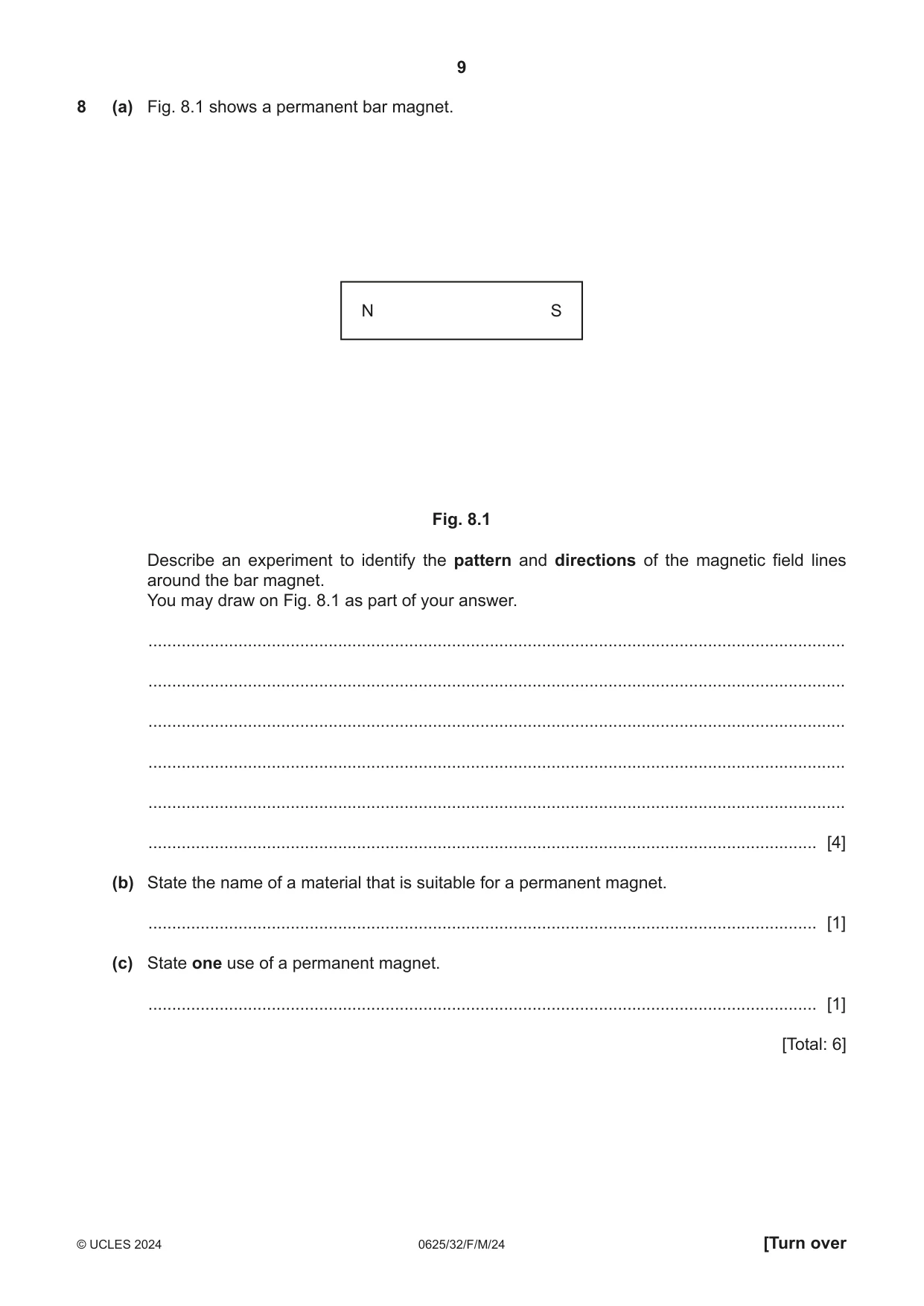
8 (a) Fig. 8.1 shows a permanent bar magnet. N S Fig. 8.1 Describe an experiment to identify the pattern and directions of the magnetic field lines around the bar magnet. You may draw on Fig. 8.1 as part of your answer. ................................................................................................................................................... ................................................................................................................................................... ................................................................................................................................................... ................................................................................................................................................... ................................................................................................................................................... ............................................................................................................................................. [4] (b) State the name of a material that is suitable for a permanent magnet. ............................................................................................................................................. [1] (c) State one use of a permanent magnet. ............................................................................................................................................. [1] [Total: 6]
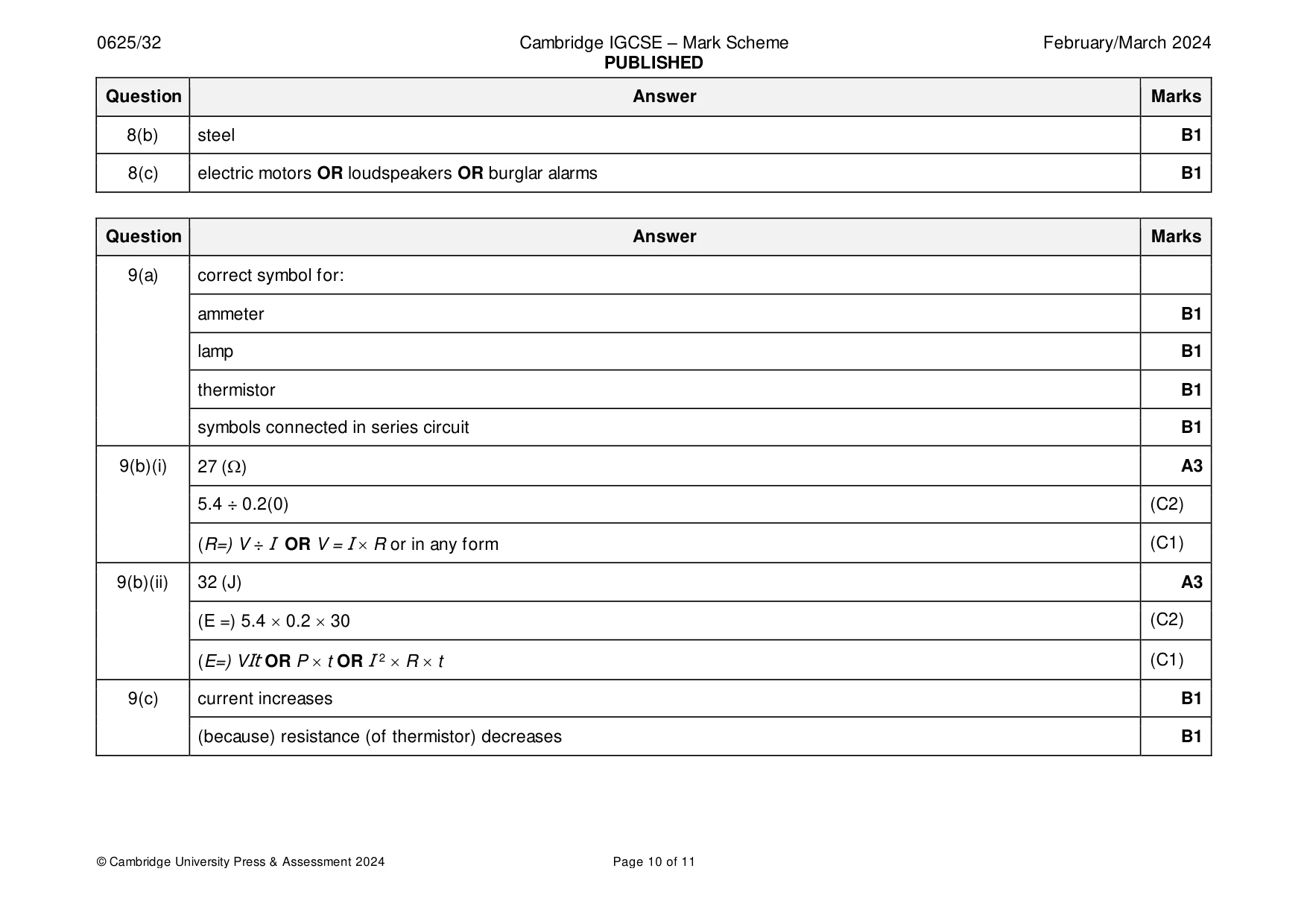
Mark scheme: 8(a) use of compass to give direction of field lines B1 first method (use of plotting) compass(es) idea of mark arrow position OR move compass in direction of arrow start from different position(s) OR join up marks / draw lines B3 (to show pattern) OR alternative method (use of plotting) compass(es) place number of compasses around magnet idea that arrows line up to show pattern 8(b) steel B1 8(c) electric motors OR loudspeakers OR burglar alarms B1
Q9 · A student connects the electrical circuit shown in Fig
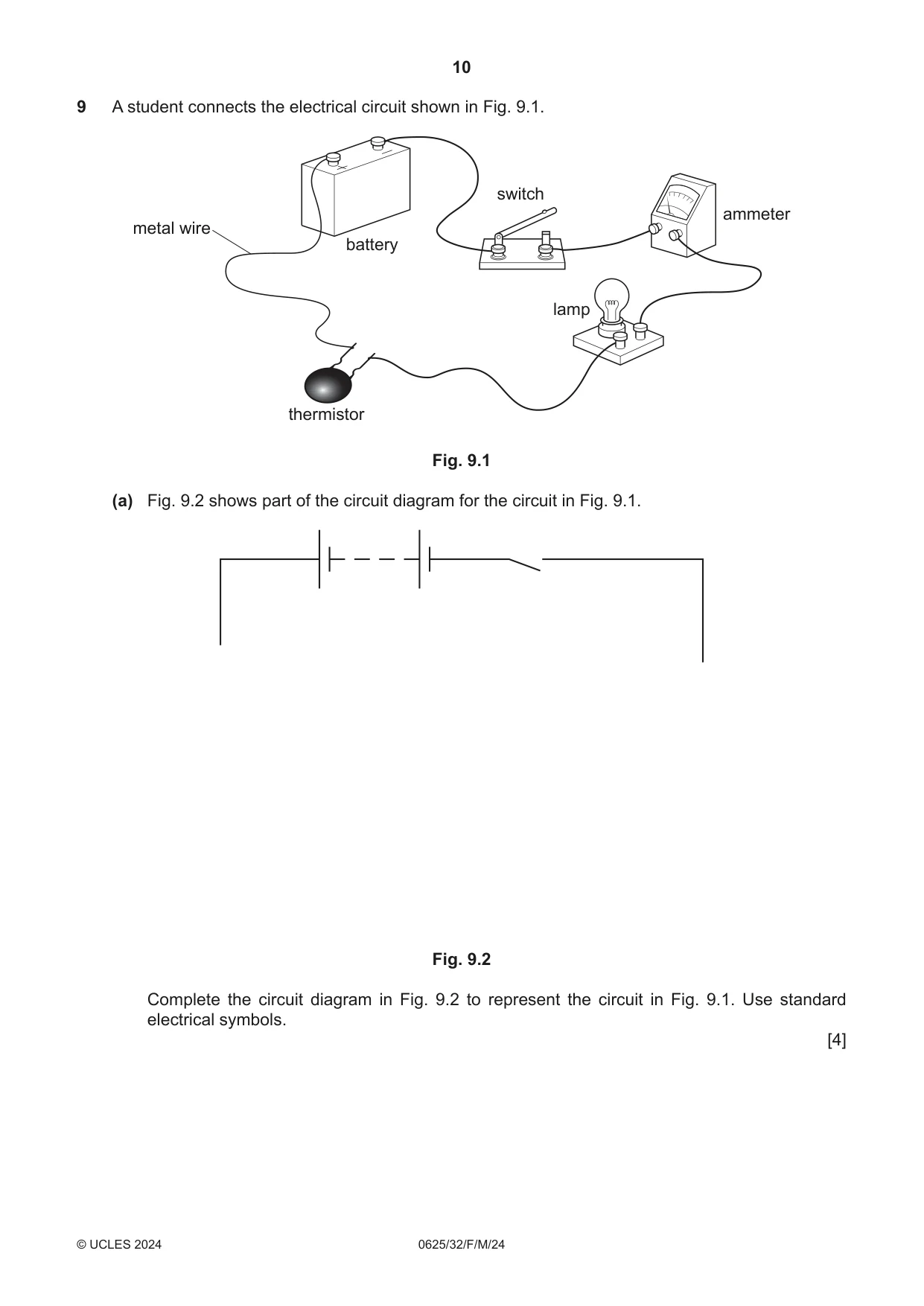
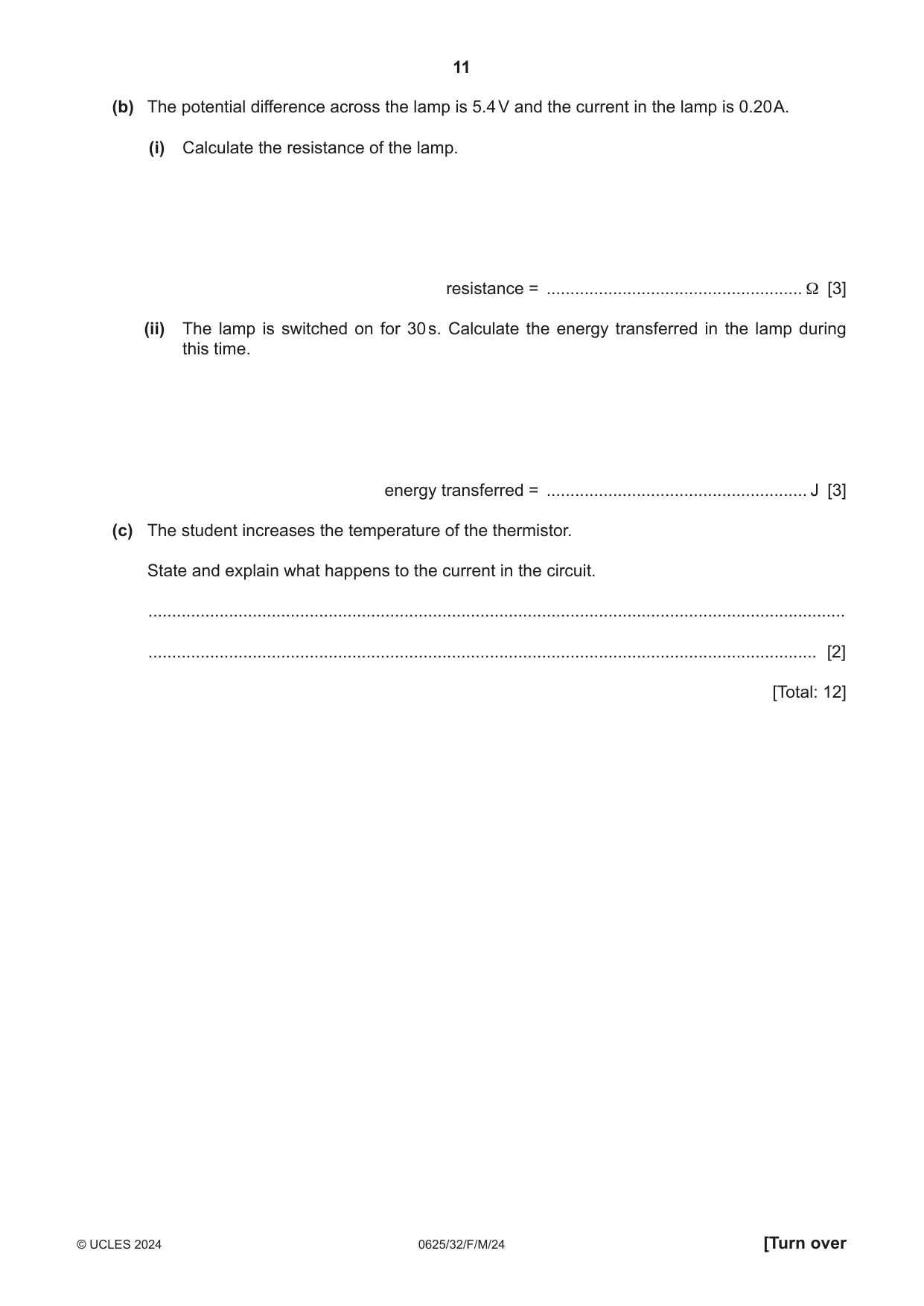
9 A student connects the electrical circuit shown in Fig. 9.1. switch ammeter metal wire battery lamp thermistor Fig. 9.1 (a) Fig. 9.2 shows part of the circuit diagram for the circuit in Fig. 9.1. Fig. 9.2 Complete the circuit diagram in Fig. 9.2 to represent the circuit in Fig. 9.1. Use standard electrical symbols. [4] (b) The potential difference across the lamp is 5.4 V and the current in the lamp is 0.20 A. (i) Calculate the resistance of the lamp. resistance = ...................................................... Ω [3] (ii) The lamp is switched on for 30 s. Calculate the energy transferred in the lamp during this time. energy transferred = ....................................................... J [3] (c) The student increases the temperature of the thermistor. State and explain what happens to the current in the circuit. ................................................................................................................................................... ............................................................................................................................................. [2] [Total: 12]
Mark scheme: 9(a) correct symbol for: ammeter B1 lamp B1 thermistor B1 symbols connected in series circuit B1 9(b)(i) 27 () A3 5.4 ÷ 0.2(0) (C2) (R=) V ÷ I OR V = I R or in any form (C1) 9(b)(ii) 32 (J) A3 (E =) 5.4 0.2 30 (C2) (E=) VItOR P t OR I2 R t (C1) 9(c) current increases B1 (because) resistance (of thermistor) decreases B1
Q10 · An atom of carbon
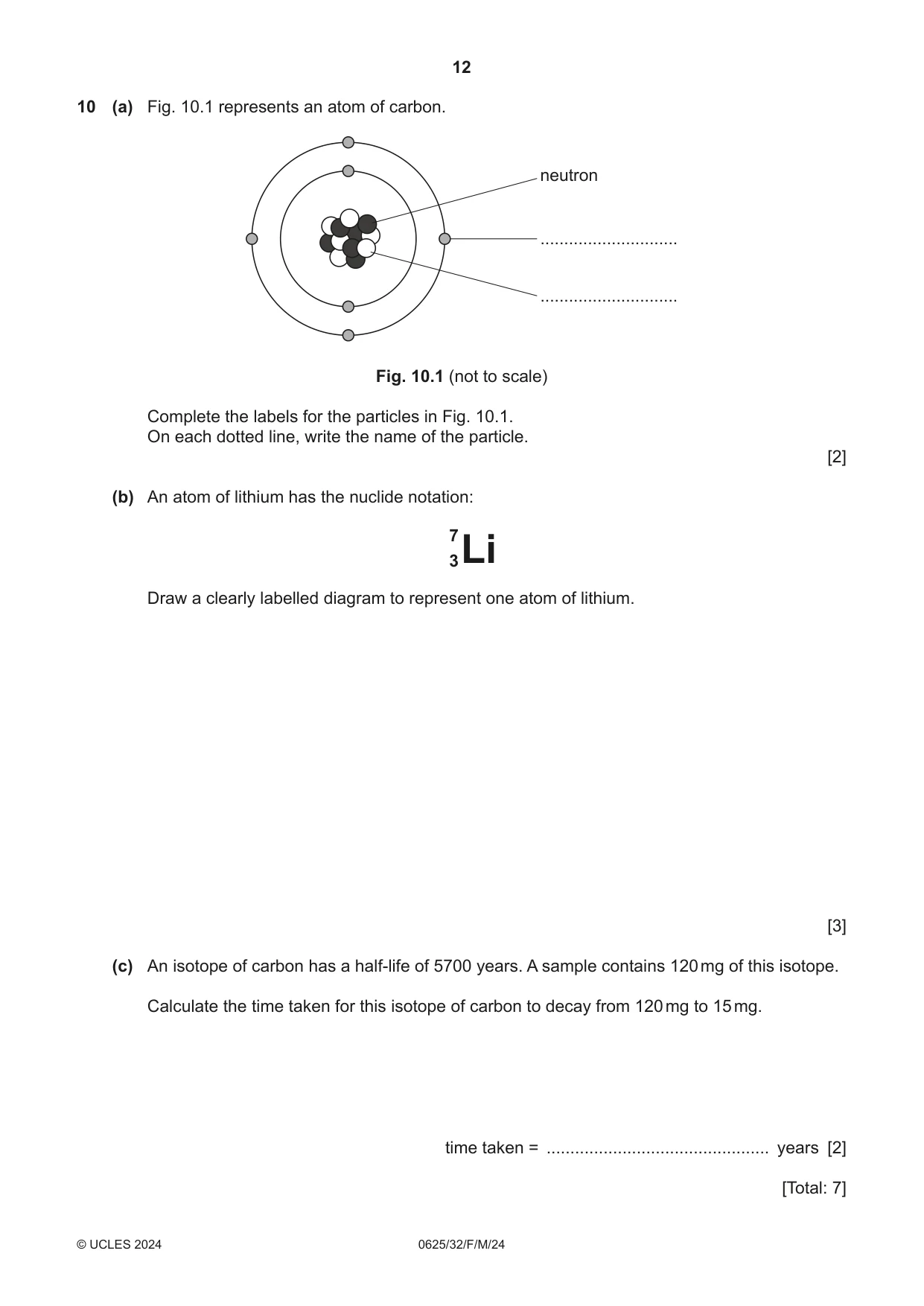
10 (a) Fig. 10.1 represents an atom of carbon. neutron ............................. ............................. Fig. 10.1 (not to scale) Complete the labels for the particles in Fig. 10.1. On each dotted line, write the name of the particle. [2] (b) An atom of lithium has the nuclide notation: 7 3 Li Draw a clearly labelled diagram to represent one atom of lithium. [3] (c) An isotope of carbon has a half-life of 5700 years. A sample contains 120 mg of this isotope. Calculate the time taken for this isotope of carbon to decay from 120 mg to 15 mg. time taken = ............................................... years [2] [Total: 7]
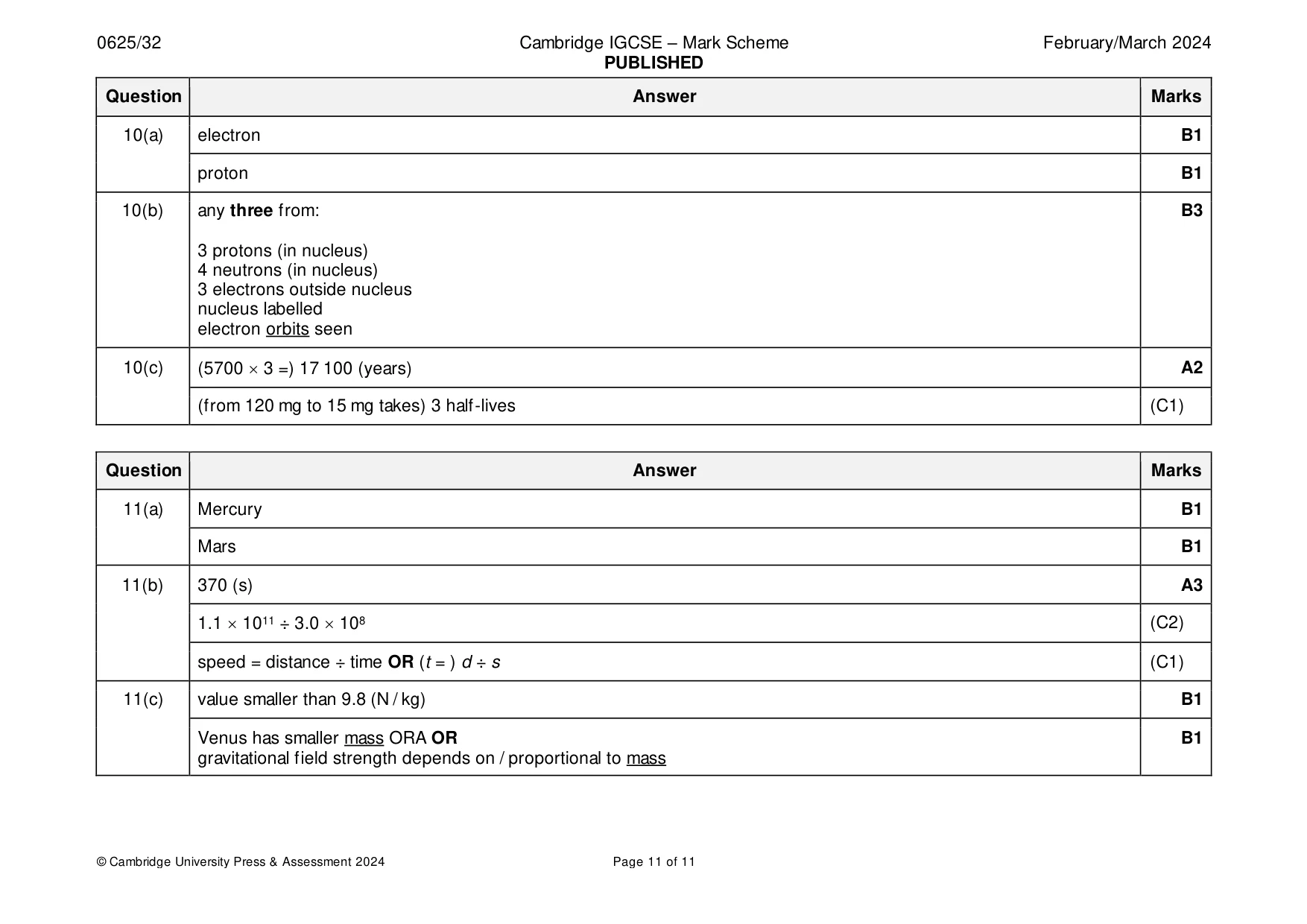
Mark scheme: 10(a) electron B1 proton B1 10(b) any three from: B3 3 protons (in nucleus) 4 neutrons (in nucleus) 3 electrons outside nucleus nucleus labelled electron orbits seen 10(c) (5700 3 =) 17 100 (years) A2 (from 120 mg to 15 mg takes) 3 half-lives (C1)
Q11 · The four planets nearest to the Sun
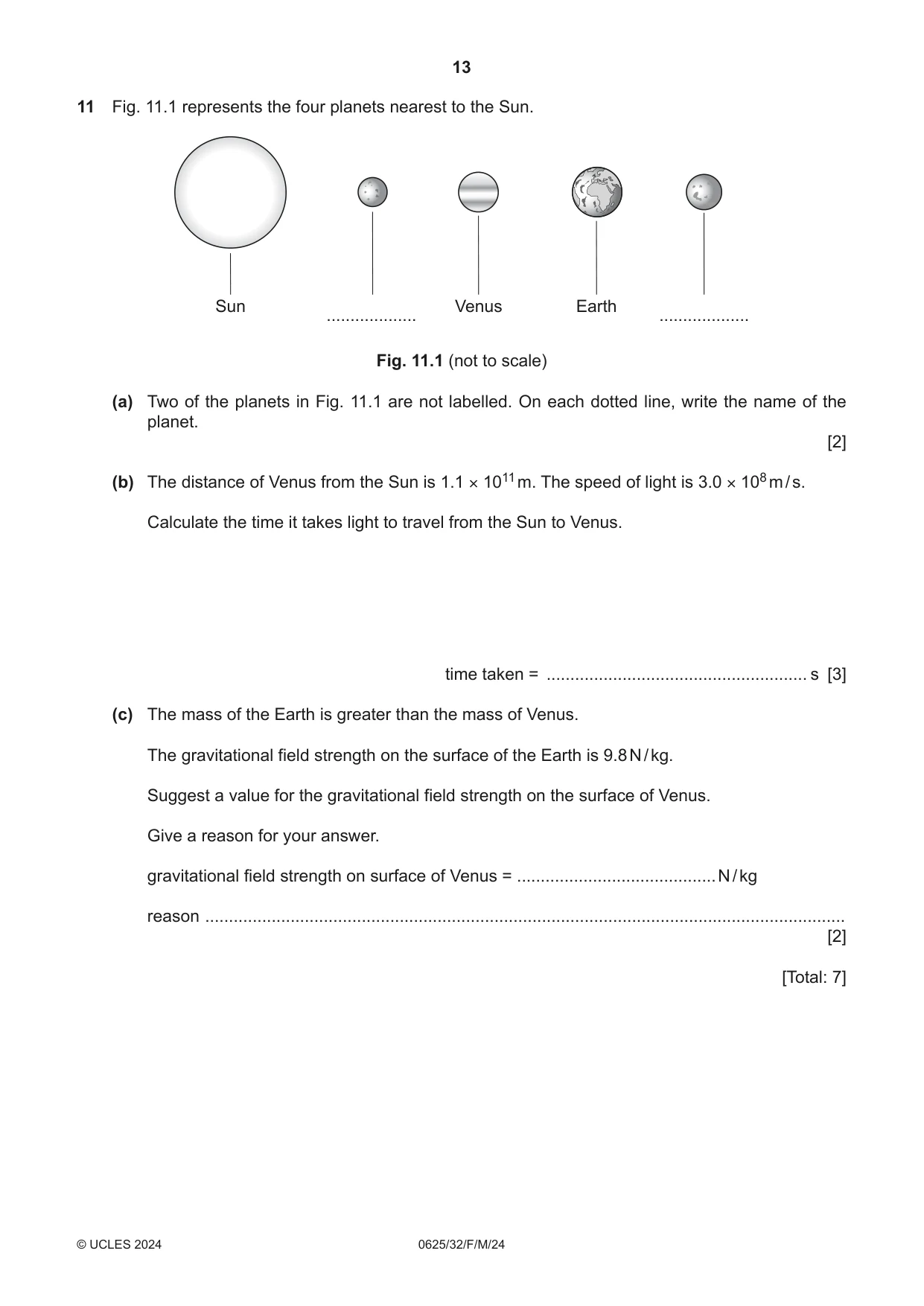
11 Fig. 11.1 represents the four planets nearest to the Sun. Sun Venus Earth ................... ................... Fig. 11.1 (not to scale) (a) Two of the planets in Fig. 11.1 are not labelled. On each dotted line, write the name of the planet. [2] (b) The distance of Venus from the Sun is 1.1 × 10¹¹ m. The speed of light is 3.0 × 10⁸ m / s. Calculate the time it takes light to travel from the Sun to Venus. time taken = ....................................................... s [3] (c) The mass of the Earth is greater than the mass of Venus. The gravitational field strength on the surface of the Earth is 9.8 N / kg. Suggest a value for the gravitational field strength on the surface of Venus. Give a reason for your answer. gravitational field strength on surface of Venus = .......................................... N / kg reason ....................................................................................................................................... [2] [Total: 7]
Mark scheme: 11(a) Mercury B1 Mars B1 11(b) 370 (s) A3 1.1 1011 ÷ 3.0 108 (C2) speed = distance ÷ time OR (t = ) d ÷ s (C1) 11(c) value smaller than 9.8 (N / kg) B1 Venus has smaller mass ORA OR B1 gravitational field strength depends on / proportional to mass
What was in this paper
The subtopics covered by these 11 questions, and how many questions each got. Open one in a new tab to see every Cambridge question on it.
What you needed in this session
Cambridge’s own grade thresholds for 2024 Feb/March, Paper 3 · Variant 2. A higher threshold means an easier paper — the bar moves with how the cohort did.