Cambridge IGCSE Physics 0625 — 2025 Oct/Nov Paper 3 · Variant 2
0625/32/O/N/25 · 10 questions · 80 marks · ≈90 min
The question paper and its mark scheme, free to read here and free to download. This is Cambridge’s own paper, exactly as it was sat.
Question paper16 pages
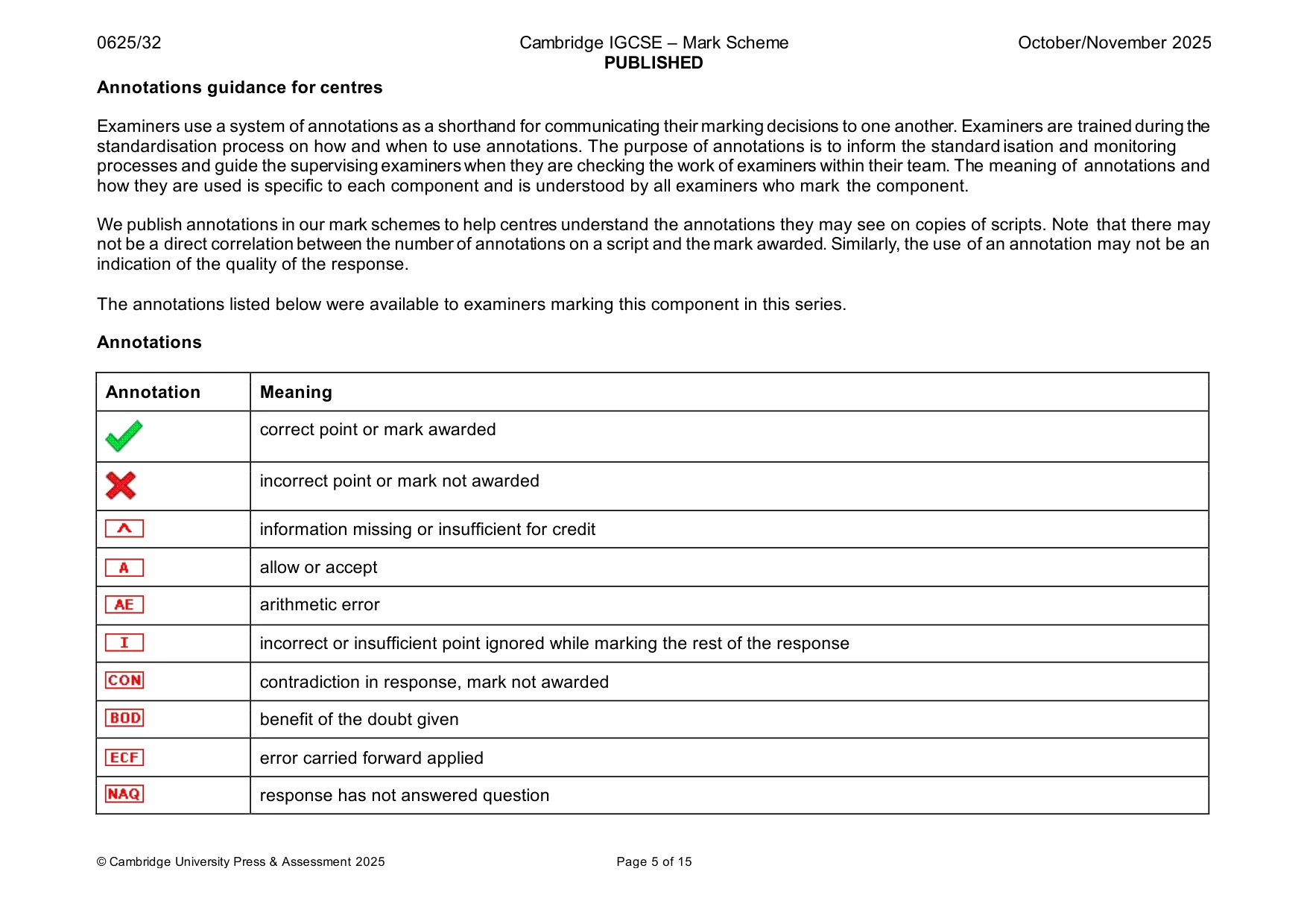
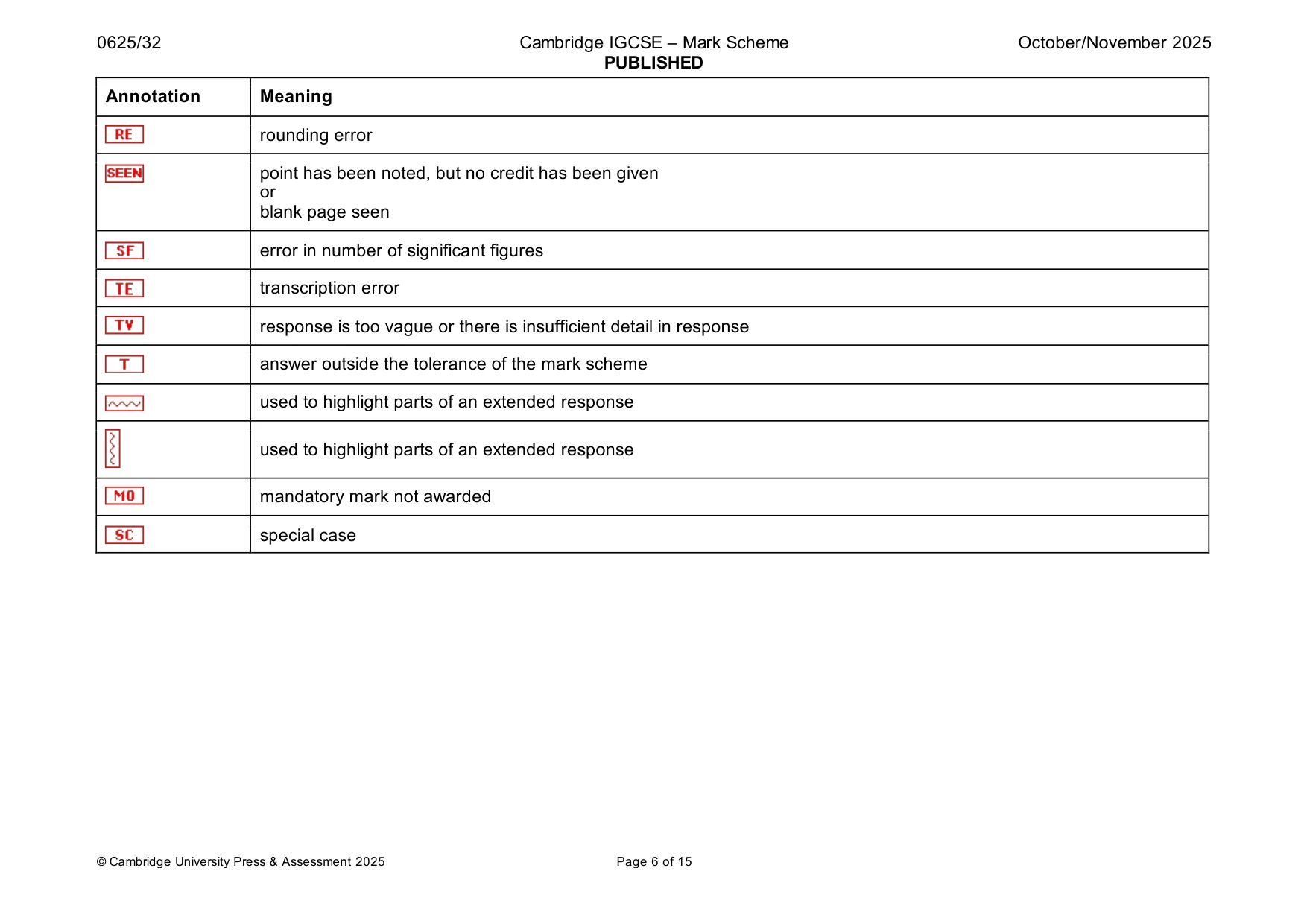
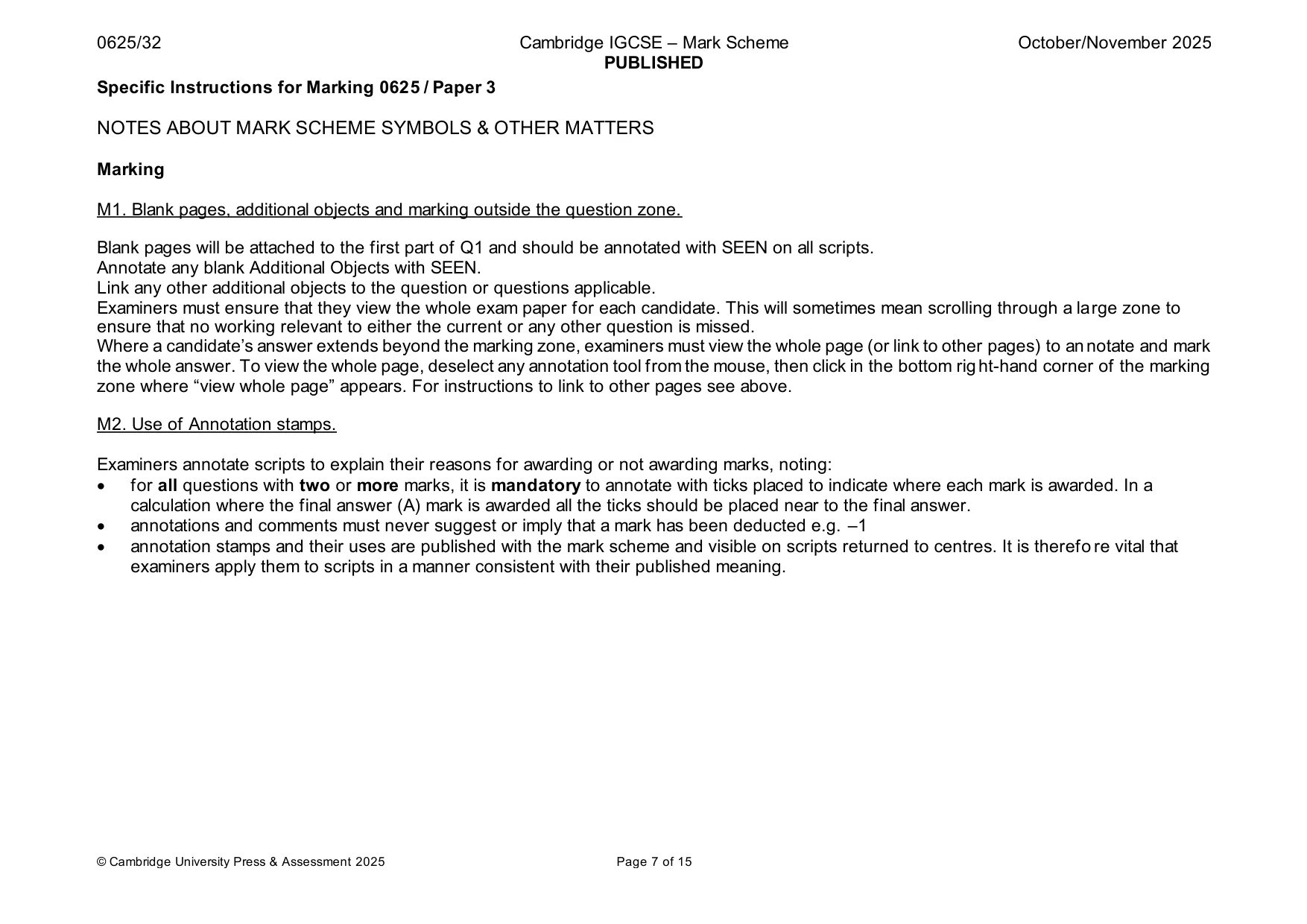
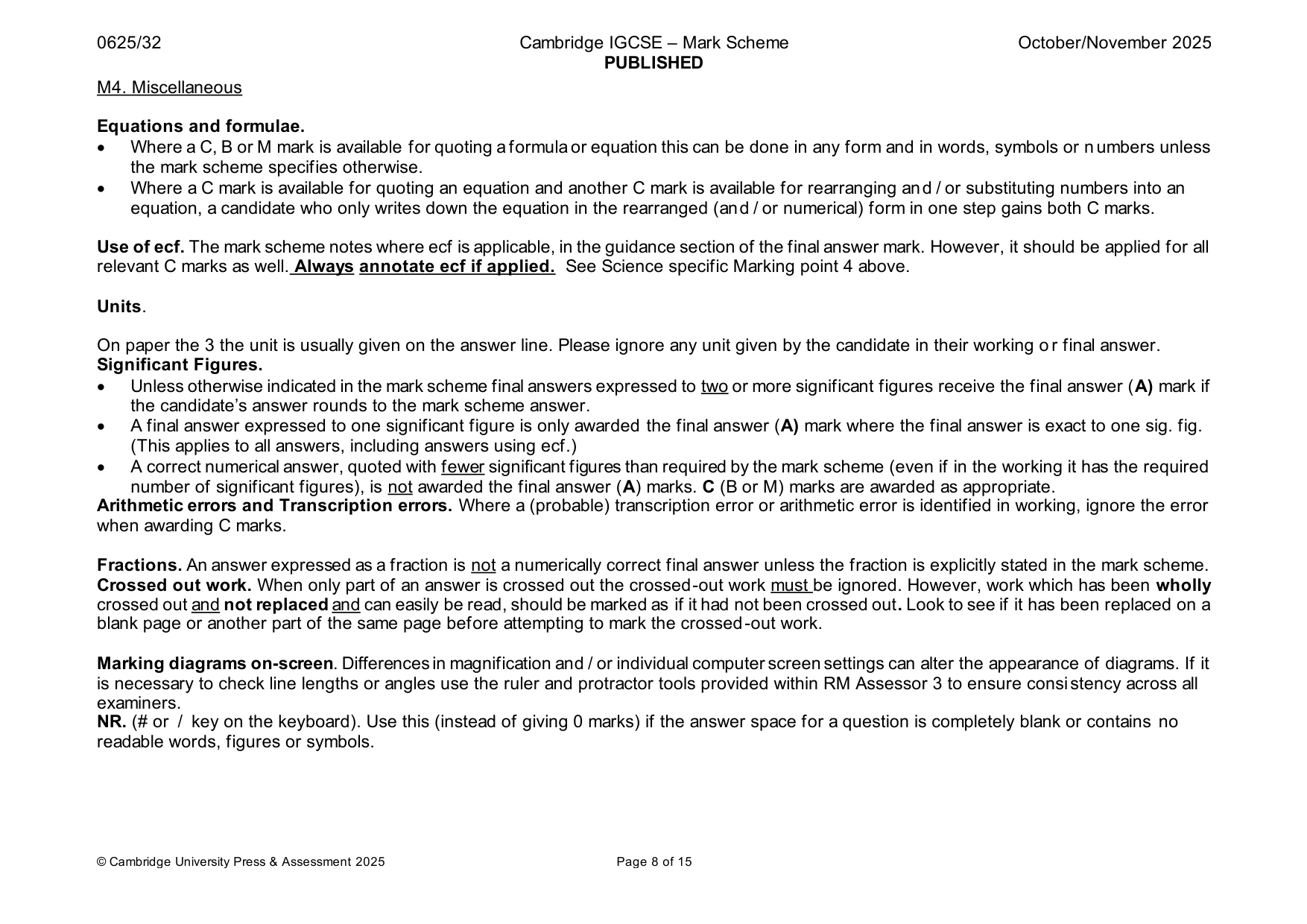
Mark scheme15 pages
Answers below. Sit the paper first if you are practising.
Questions as text
Q1 · The speed–time graph for the journey of a cyclist
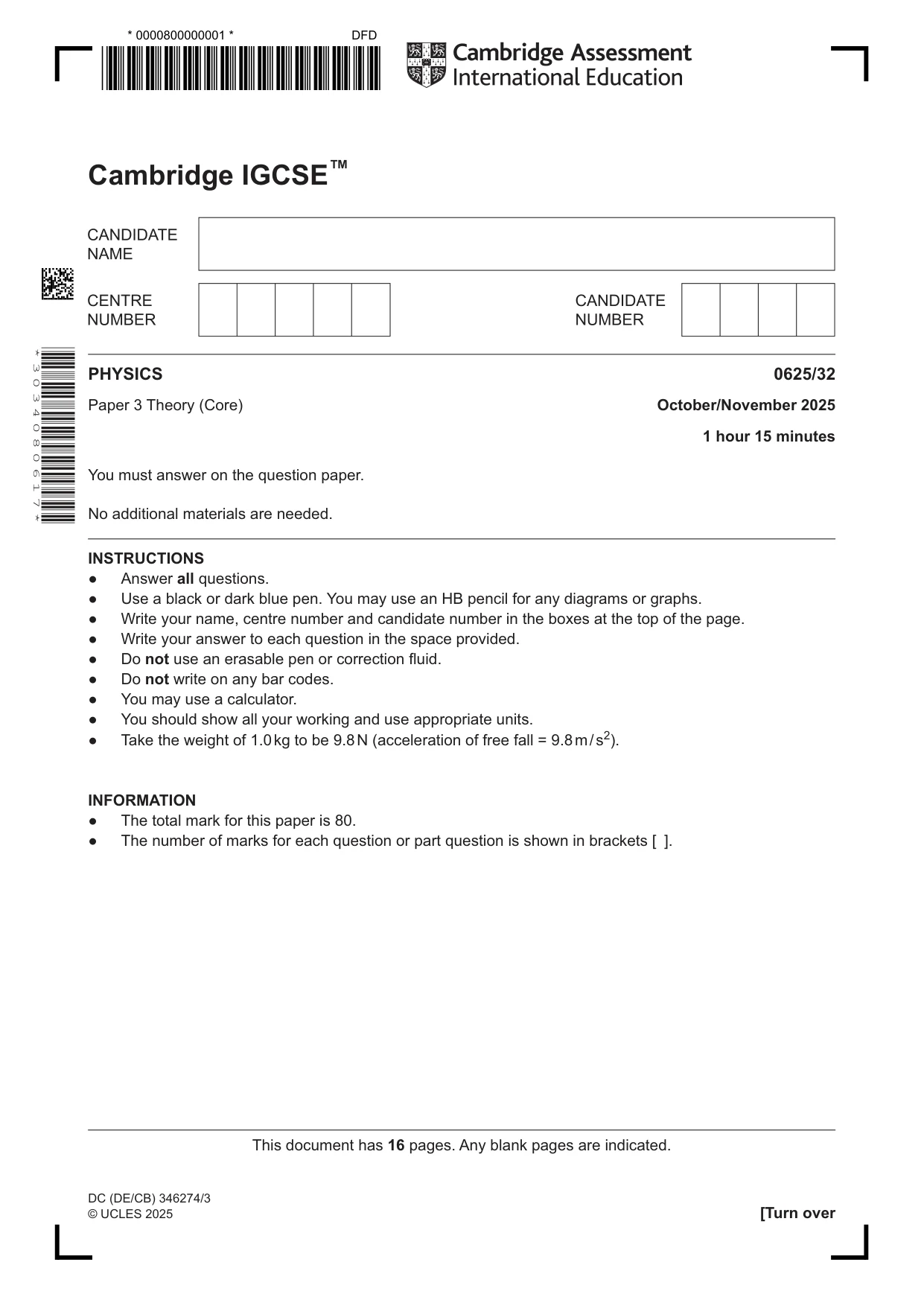
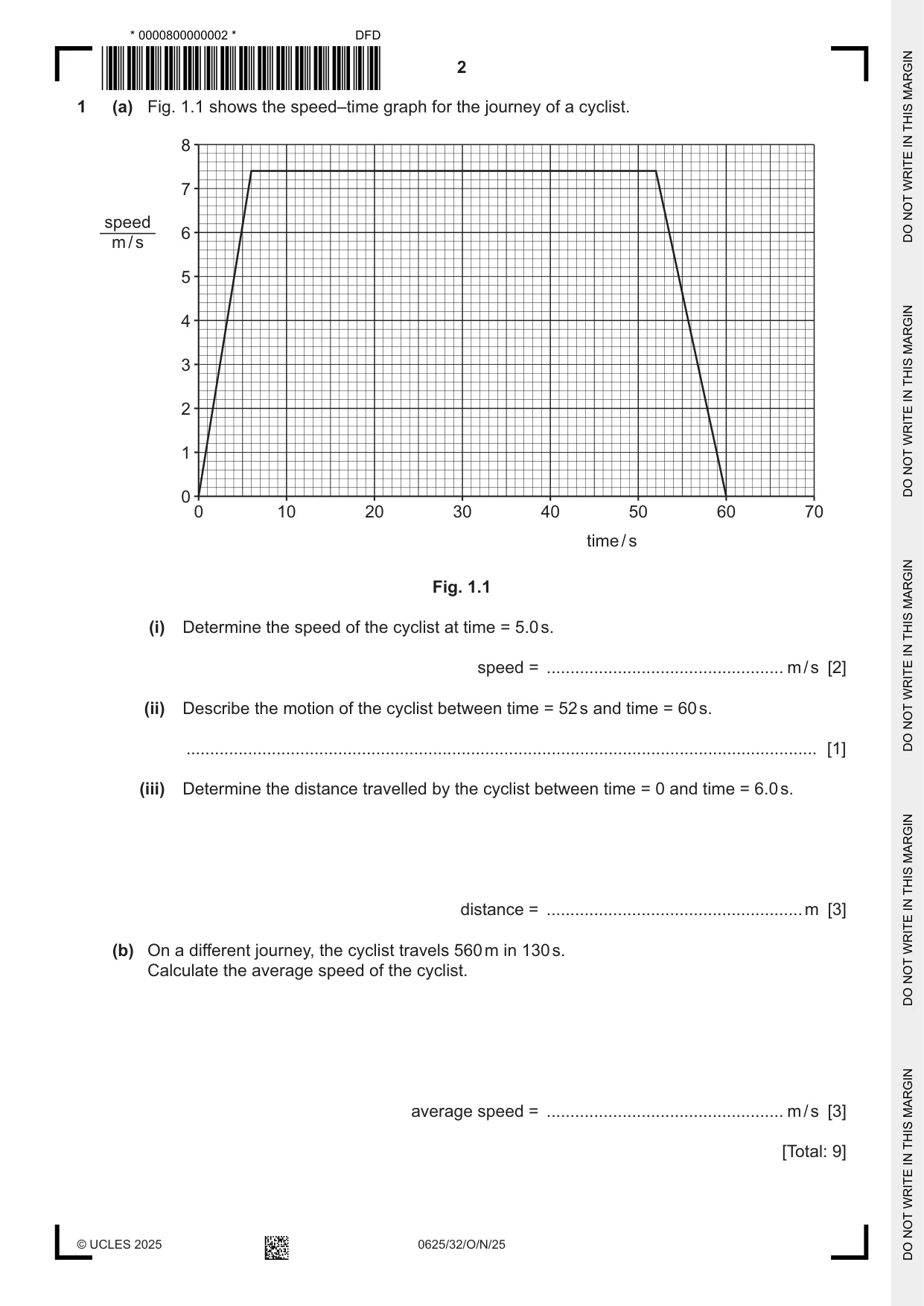
1 (a) Fig. 1.1 shows the speed–time graph for the journey of a cyclist. 8 7 speed 6 m / s 5 4 3 2 1 0 0 10 20 30 40 50 60 70 time / s Fig. 1.1 (i) Determine the speed of the cyclist at time = 5.0 s. speed = .................................................. m / s [2] (ii) Describe the motion of the cyclist between time = 52 s and time = 60 s. ..................................................................................................................................... [1] (iii) Determine the distance travelled by the cyclist between time = 0 and time = 6.0 s. distance = ......................................................m [3] (b) On a different journey, the cyclist travels 560 m in 130 s. Calculate the average speed of the cyclist. average speed = .................................................. m / s [3] [Total: 9]
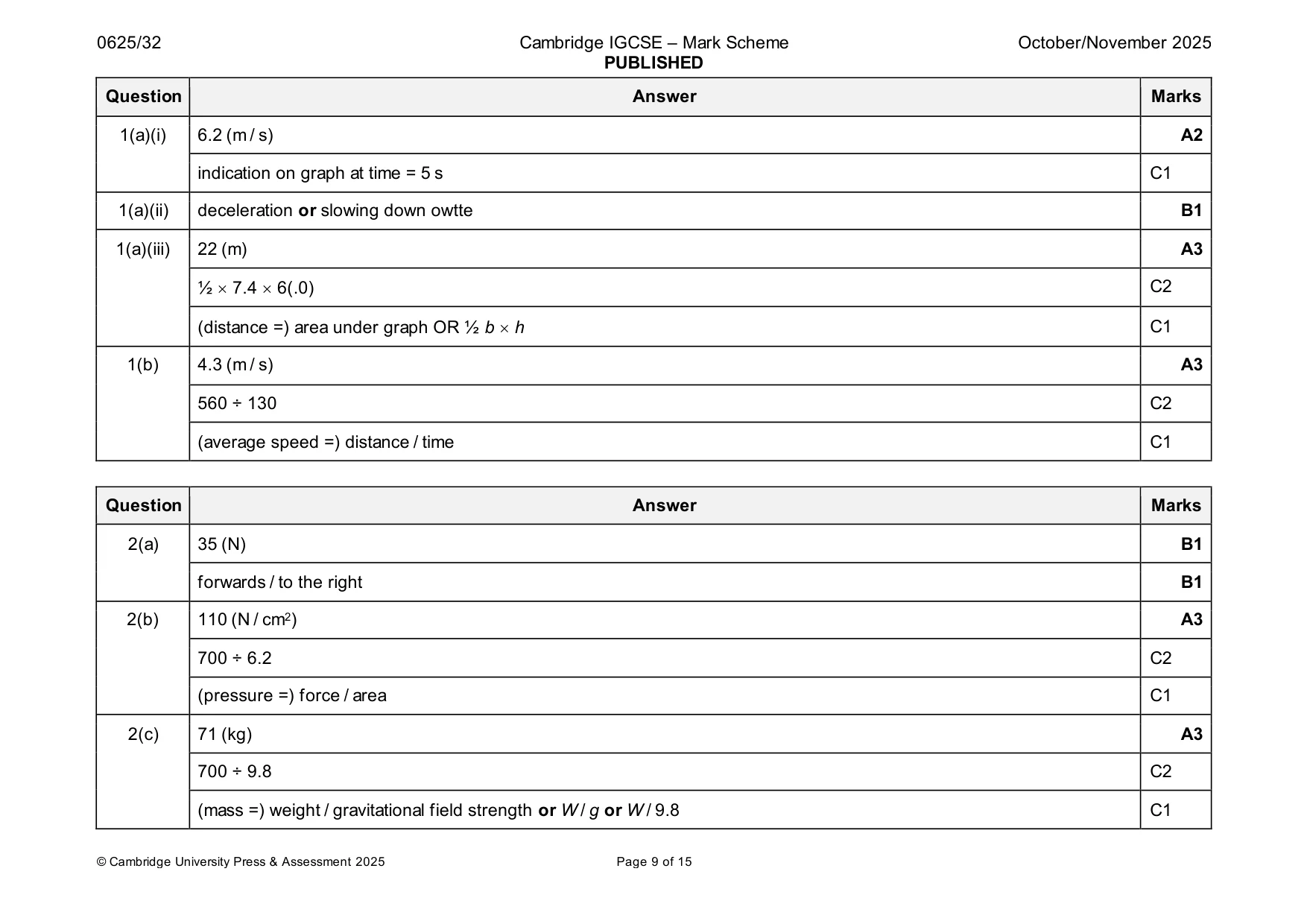
Mark scheme: Question Answer Marks 1(a)(i) 6.2 (m / s) A2 indication on graph at time = 5 s C1 1(a)(ii) deceleration or slowing down owtte B1 1(a)(iii) 22 (m) A3 ½ 7.4 6(.0) C2 (distance =) area under graph OR ½ b h C1 1(b) 4.3 (m / s) A3 560 ÷ 130 C2 (average speed =) distance / time C1
Q2 · The horizontal forces acting on an ice skater
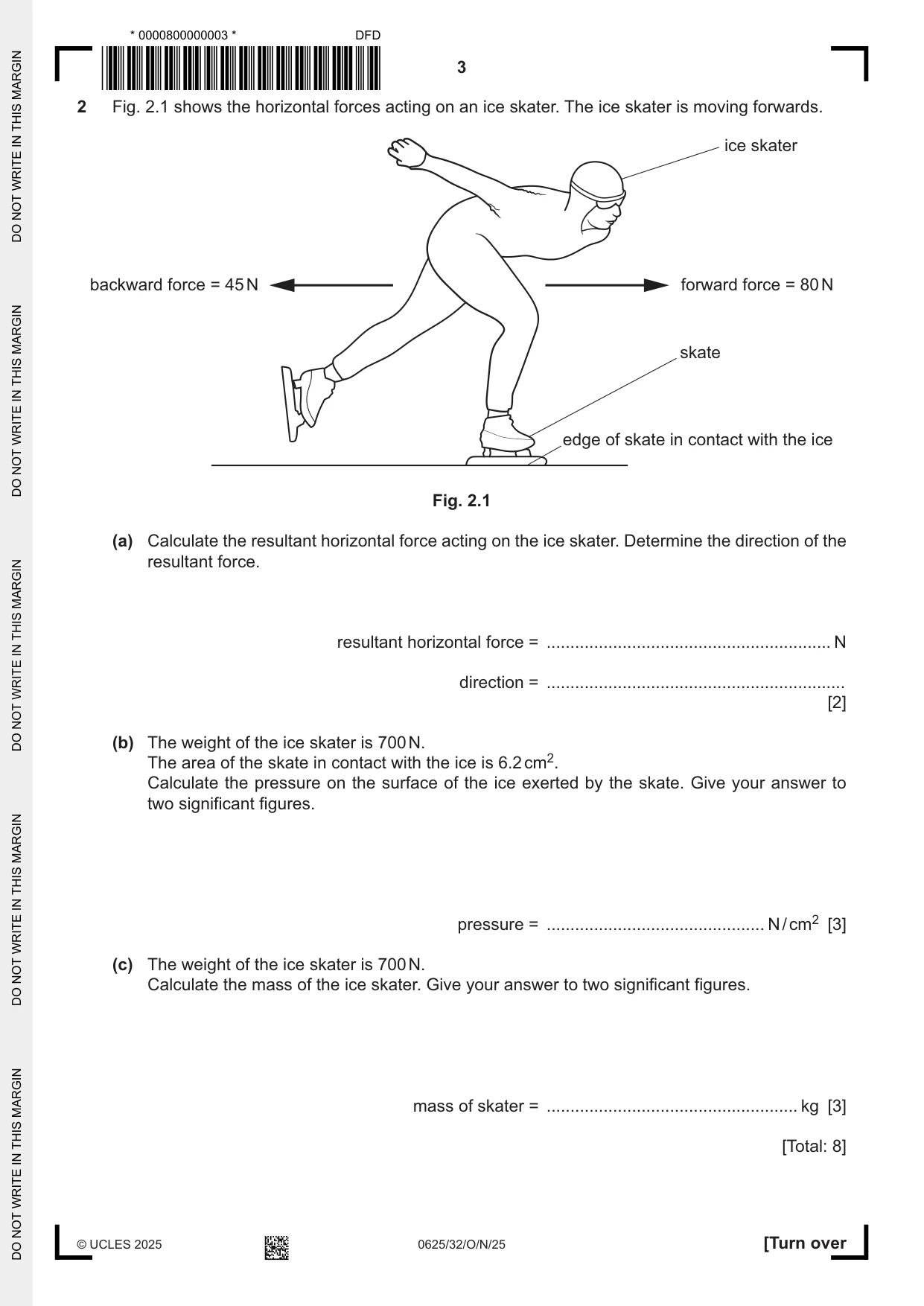
2 Fig. 2.1 shows the horizontal forces acting on an ice skater. The ice skater is moving forwards. ice skater backward force = 45 N forward force = 80 N skate edge of skate in contact with the ice Fig. 2.1 (a) Calculate the resultant horizontal force acting on the ice skater. Determine the direction of the resultant force. resultant horizontal force = ............................................................ N direction = ............................................................... [2] (b) The weight of the ice skater is 700 N. The area of the skate in contact with the ice is 6.2 cm2. Calculate the pressure on the surface of the ice exerted by the skate. Give your answer to two significant figures. pressure = .............................................. N / cm2 [3] (c) The weight of the ice skater is 700 N. Calculate the mass of the ice skater. Give your answer to two significant figures. mass of skater = ..................................................... kg [3] [Total: 8]
Mark scheme: 2(a) 35 (N) B1 forwards / to the right B1 2(b) 110 (N / cm2) A3 700 ÷ 6.2 C2 (pressure =) force / area C1 2(c) 71 (kg) A3 700 ÷ 9.8 C2 (mass =) weight / gravitational field strength or W / g or W / 9.8 C1
Q3 · State the principle of conservation of energy
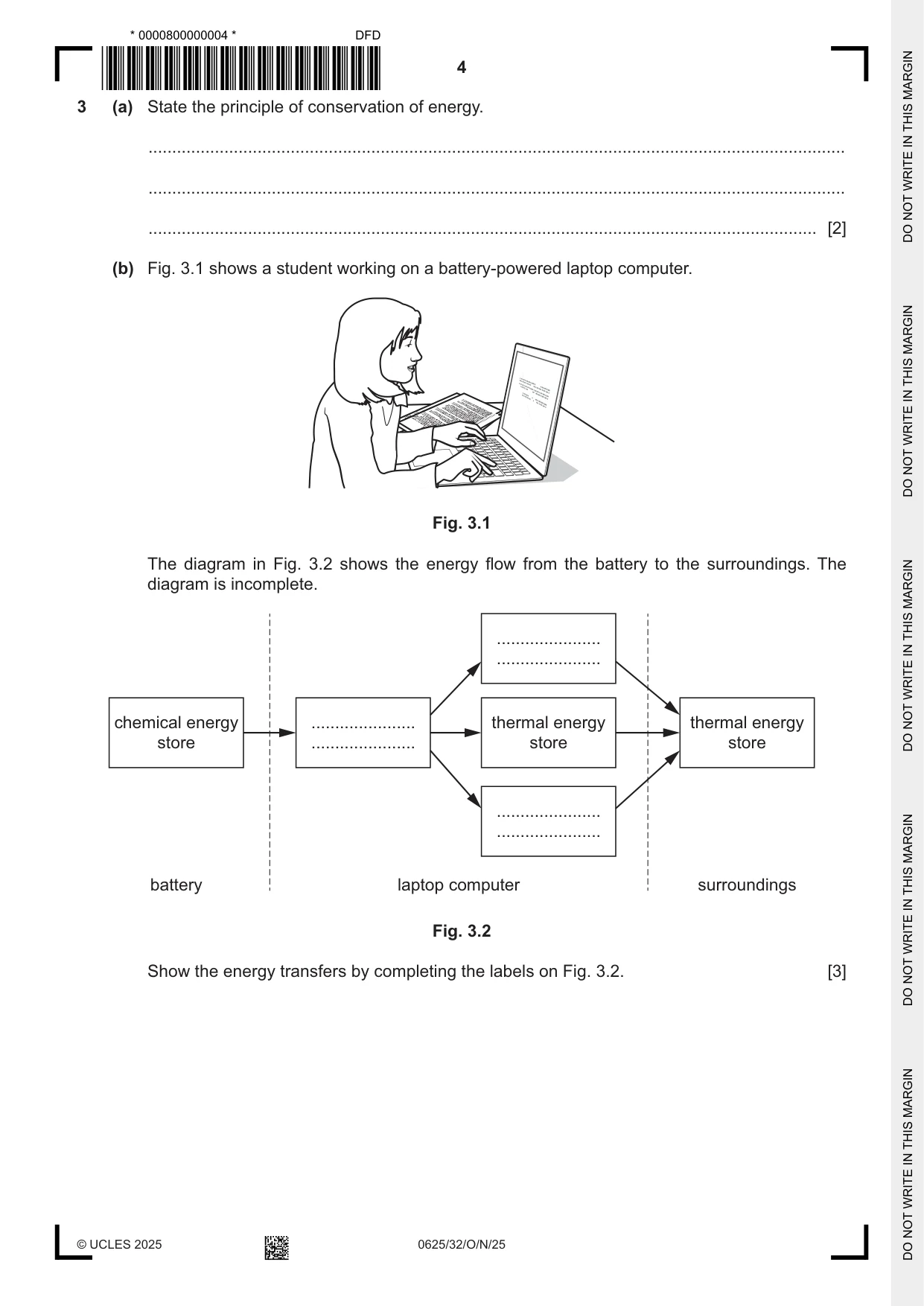
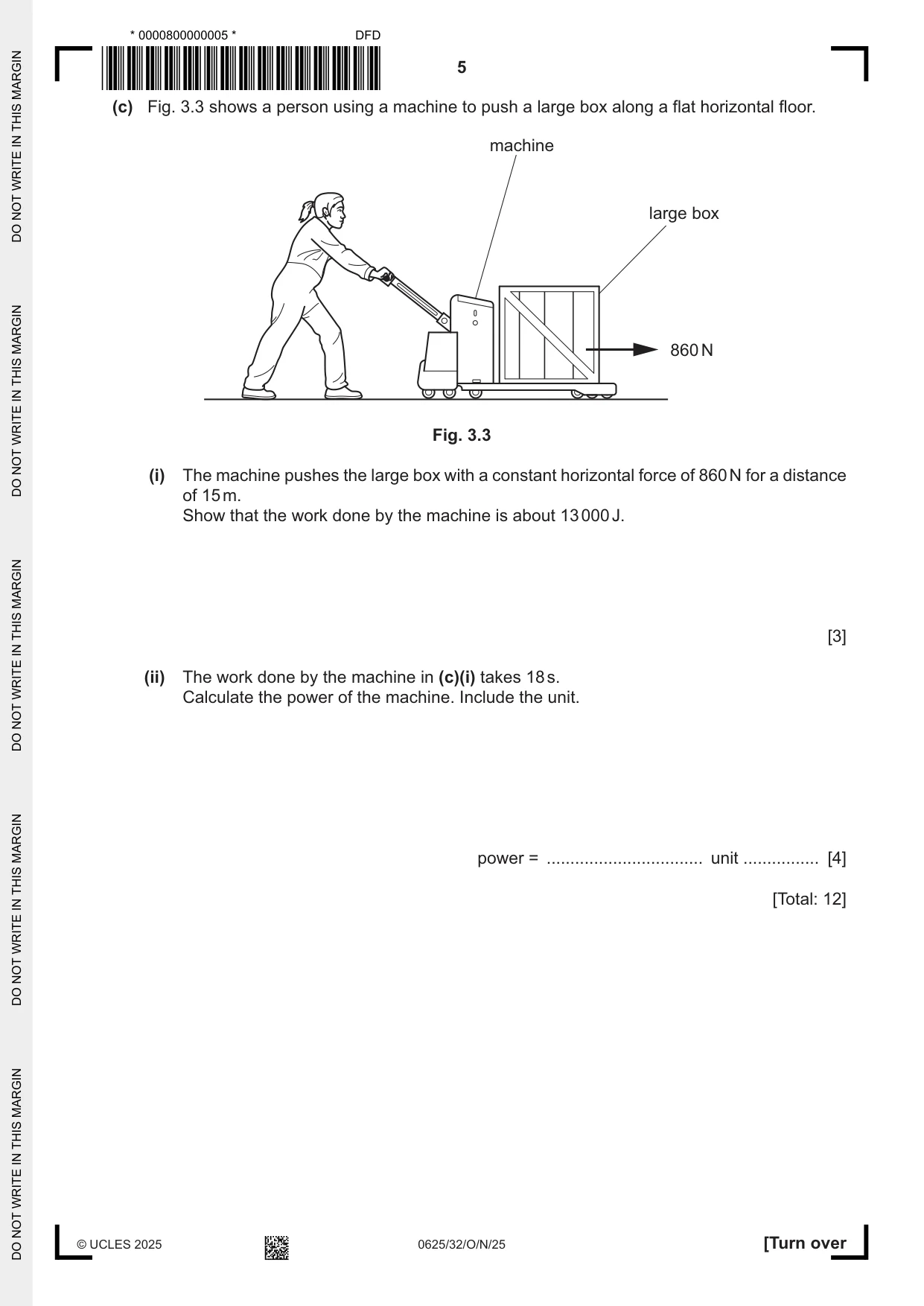
3 (a) State the principle of conservation of energy. ................................................................................................................................................... ................................................................................................................................................... ............................................................................................................................................. [2] (b) Fig. 3.1 shows a student working on a battery-powered laptop computer. Fig. 3.1 The diagram in Fig. 3.2 shows the energy flow from the battery to the surroundings. The diagram is incomplete. ...................... ...................... chemical energy ...................... thermal energy thermal energy store ...................... store store ...................... ...................... battery laptop computer surroundings Fig. 3.2 Show the energy transfers by completing the labels on Fig. 3.2. [3] (c) Fig. 3.3 shows a person using a machine to push a large box along a flat horizontal floor. machine large box 860 N Fig. 3.3 (i) The machine pushes the large box with a constant horizontal force of 860 N for a distance of 15 m. Show that the work done by the machine is about 13 000 J. [3] (ii) The work done by the machine in (c)(i) takes 18 s. Calculate the power of the machine. Include the unit. power = ................................. unit ................ [4] [Total: 12]
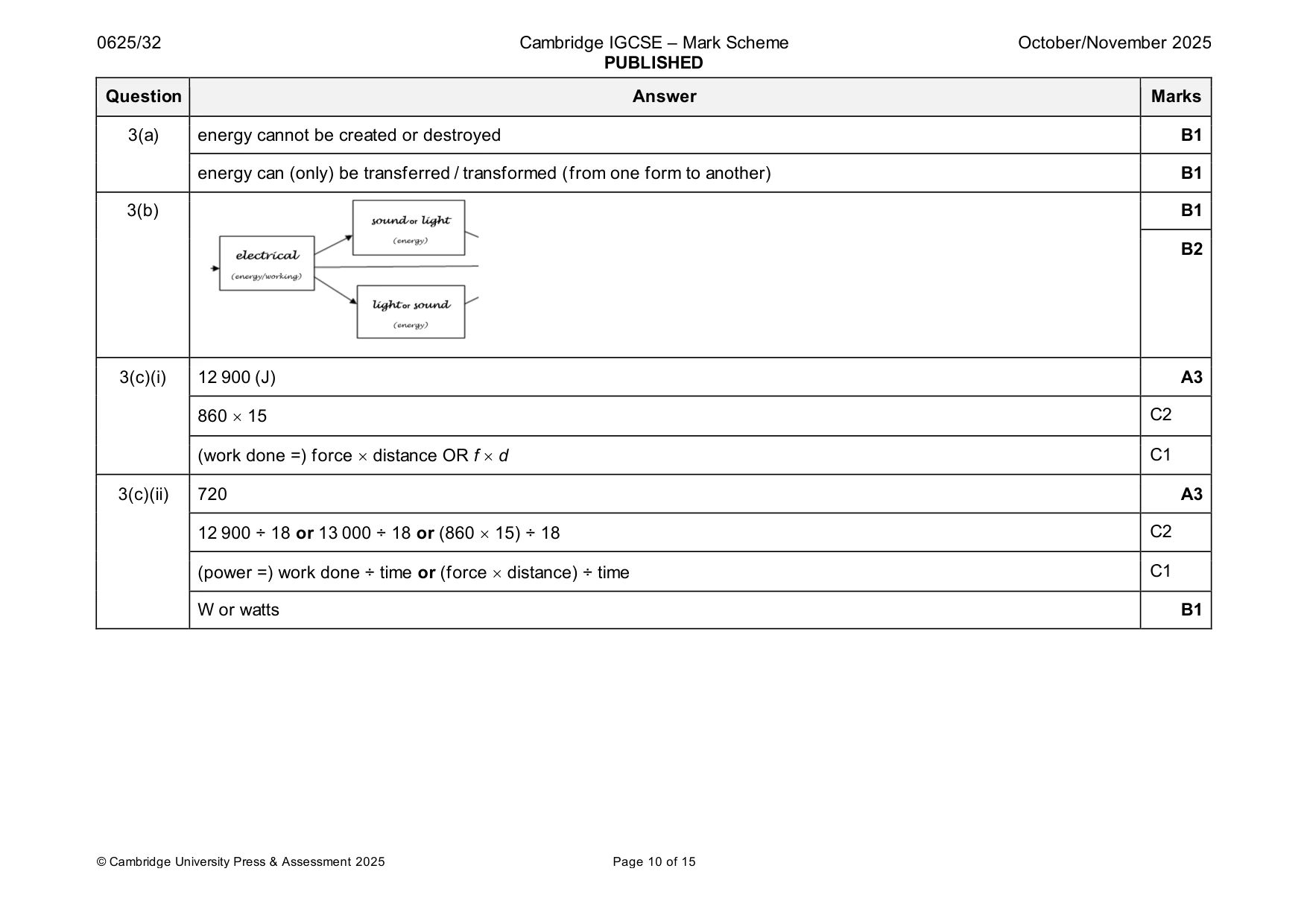
Mark scheme: 3(a) energy cannot be created or destroyed B1 energy can (only) be transferred / transformed (from one form to another) B1 3(b) B1 B2 3(c)(i) 12 900 (J) A3 860 15 C2 (work done =) force distance OR f d C1 3(c)(ii) 720 A3 12 900 ÷ 18 or 13 000 ÷ 18 or (860 15) ÷ 18 C2 (power =) work done ÷ time or (force distance) ÷ time C1 W or watts B1
Q4 · A group of students are studying a topic called ‘Light and Sound’
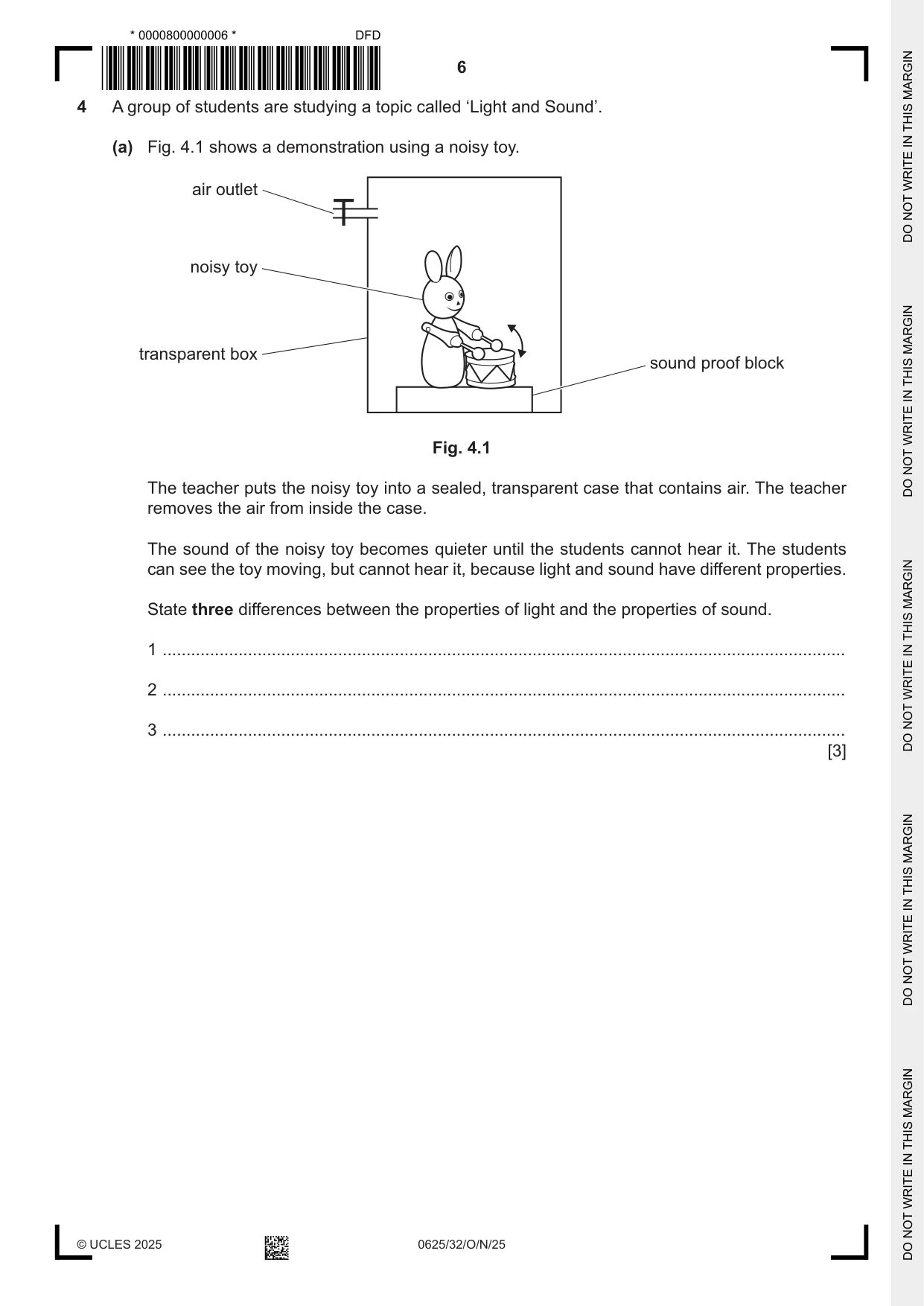
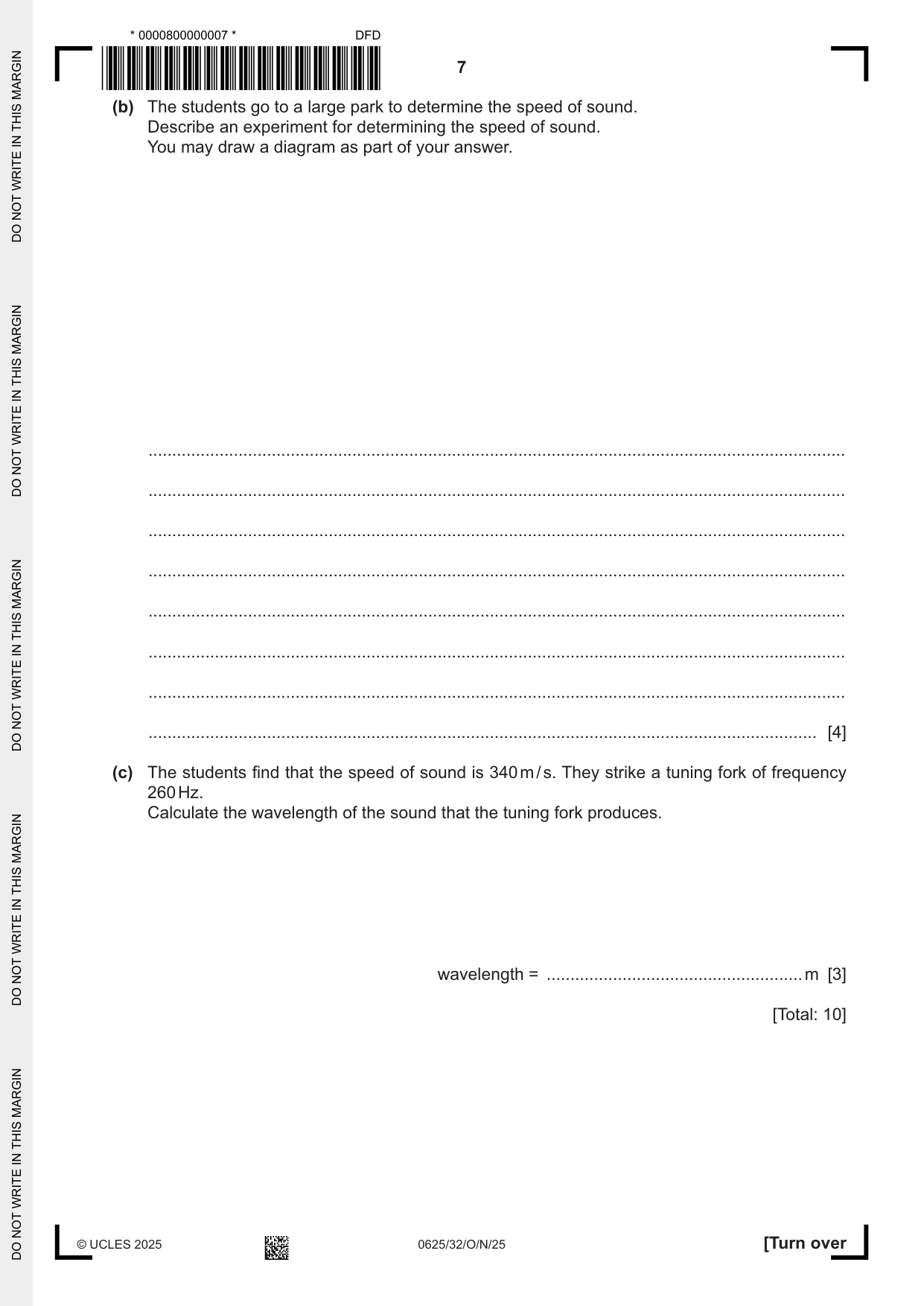
4 A group of students are studying a topic called ‘Light and Sound’. (a) Fig. 4.1 shows a demonstration using a noisy toy. air outlet noisy toy transparent box sound proof block Fig. 4.1 The teacher puts the noisy toy into a sealed, transparent case that contains air. The teacher removes the air from inside the case. The sound of the noisy toy becomes quieter until the students cannot hear it. The students can see the toy moving, but cannot hear it, because light and sound have different properties. State three differences between the properties of light and the properties of sound. 1 ................................................................................................................................................ 2 ................................................................................................................................................ 3 ................................................................................................................................................ [3] (b) The students go to a large park to determine the speed of sound. Describe an experiment for determining the speed of sound. You may draw a diagram as part of your answer. ................................................................................................................................................... ................................................................................................................................................... ................................................................................................................................................... ................................................................................................................................................... ................................................................................................................................................... ................................................................................................................................................... ................................................................................................................................................... ............................................................................................................................................. [4] (c) The students find that the speed of sound is 340 m / s. They strike a tuning fork of frequency 260 Hz. Calculate the wavelength of the sound that the tuning fork produces. wavelength = ......................................................m [3] [Total: 10]
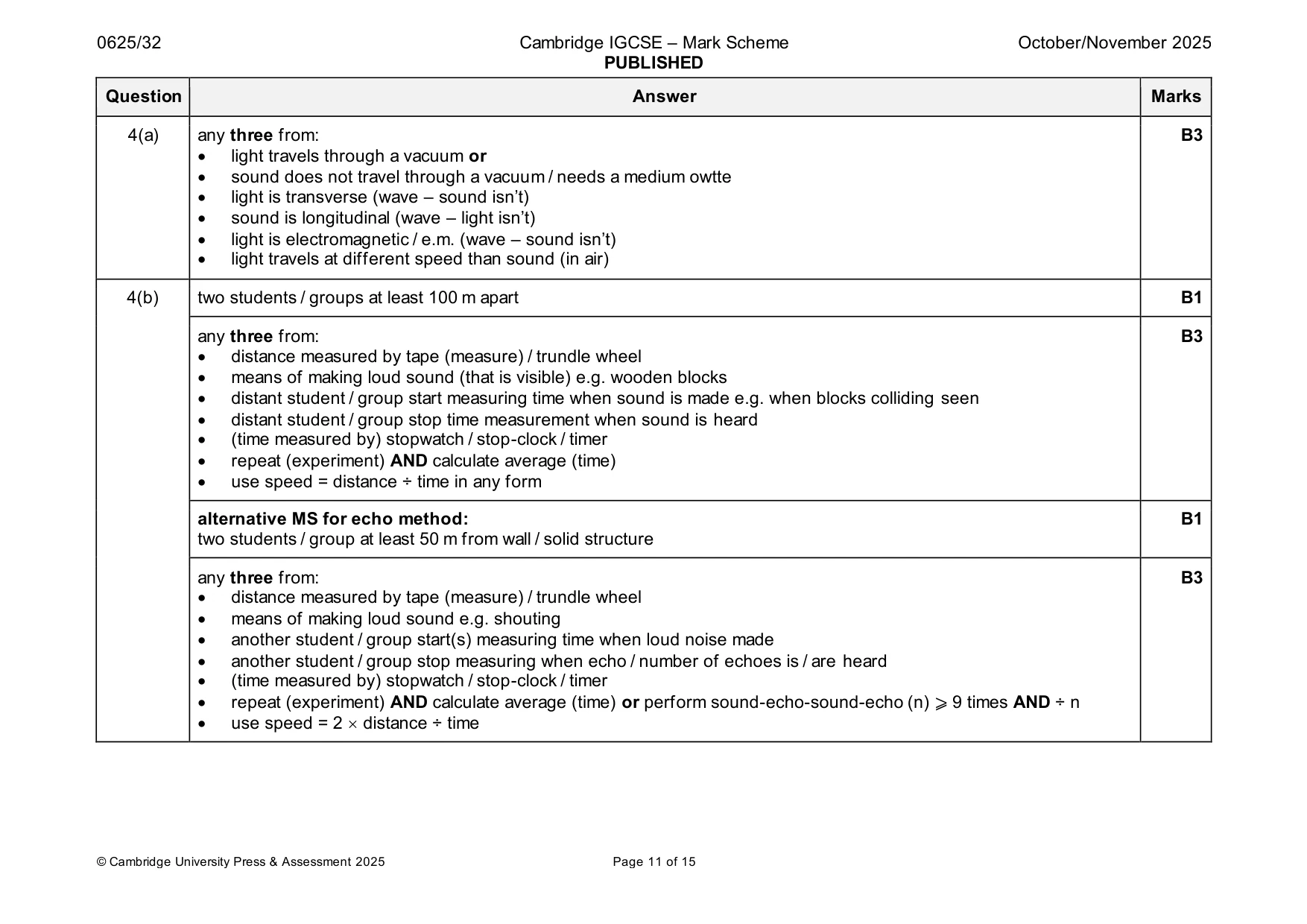
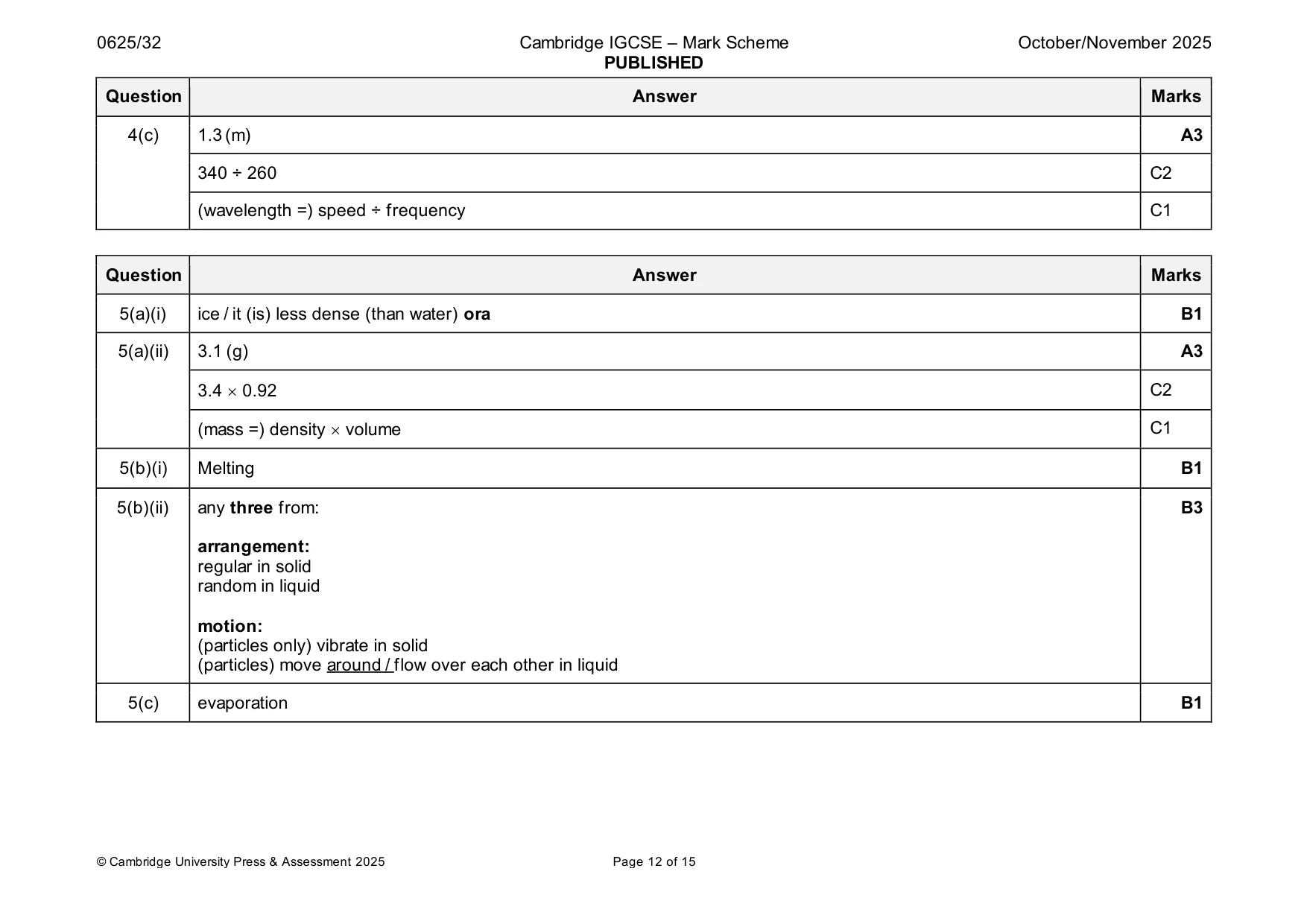
Mark scheme: 4(a) any three from: B3 • light travels through a vacuum or • sound does not travel through a vacuum / needs a medium owtte • light is transverse (wave – sound isn’t) • sound is longitudinal (wave – light isn’t) • light is electromagnetic / e.m. (wave – sound isn’t) • light travels at different speed than sound (in air) 4(b) two students / groups at least 100 m apart B1 any three from: B3 • distance measured by tape (measure) / trundle wheel • means of making loud sound (that is visible) e.g. wooden blocks • distant student / group start measuring time when sound is made e.g. when blocks colliding seen • distant student / group stop time measurement when sound is heard • (time measured by) stopwatch / stop-clock / timer • repeat (experiment) AND calculate average (time) • use speed = distance ÷ time in any form alternative MS for echo method: B1 two students / group at least 50 m from wall / solid structure any three from: B3 • distance measured by tape (measure) / trundle wheel • means of making loud sound e.g. shouting • another student / group start(s) measuring time when loud noise made • another student / group stop measuring when echo / number of echoes is / are heard • (time measured by) stopwatch / stop-clock / timer • repeat (experiment) AND calculate average (time) or perform sound-echo-sound-echo (n) ⩾ 9 times AND ÷ n • use speed = 2 distance ÷ time 4(c) 1.3 (m) A3 340 ÷ 260 C2 (wavelength =) speed ÷ frequency C1
Q5 · Small cubes of ice in a glass of water
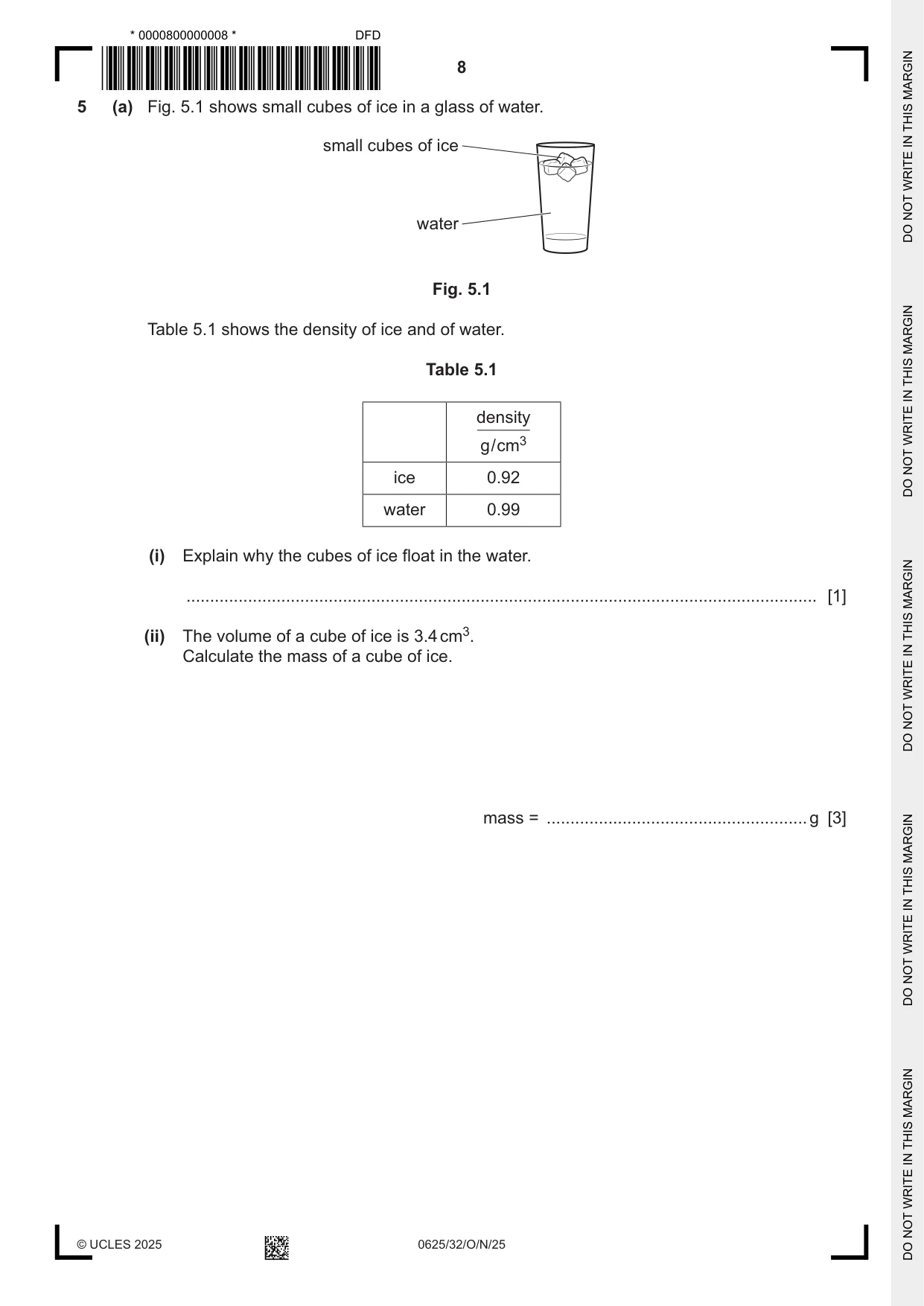
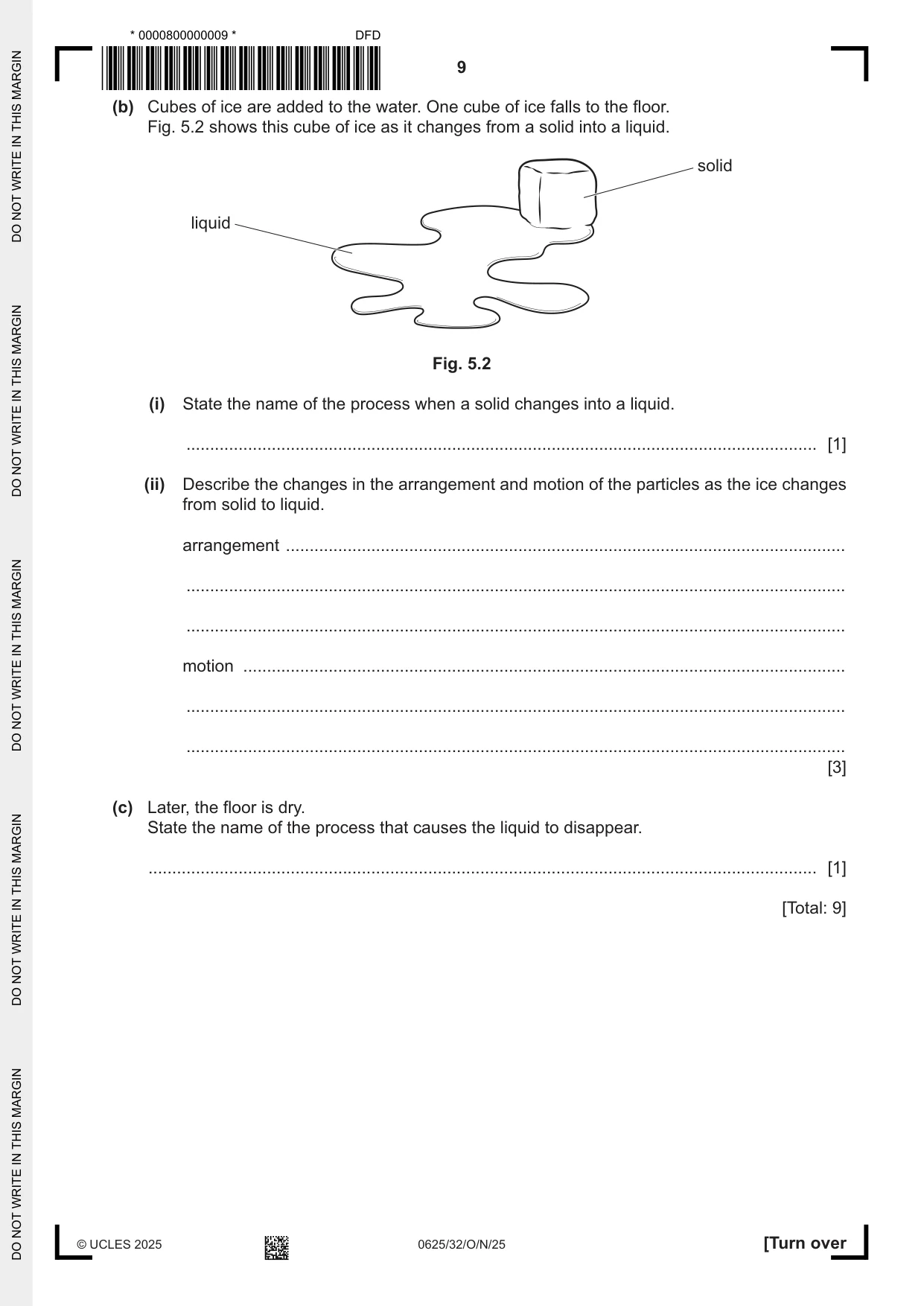
5 (a) Fig. 5.1 shows small cubes of ice in a glass of water. small cubes of ice water Fig. 5.1 Table 5.1 shows the density of ice and of water. Table 5.1 density g / cm3 ice 0.92 water 0.99 (i) Explain why the cubes of ice float in the water. ..................................................................................................................................... [1] (ii) The volume of a cube of ice is 3.4 cm3. Calculate the mass of a cube of ice. mass = .......................................................g [3] (b) Cubes of ice are added to the water. One cube of ice falls to the floor. Fig. 5.2 shows this cube of ice as it changes from a solid into a liquid. solid liquid Fig. 5.2 (i) State the name of the process when a solid changes into a liquid. ..................................................................................................................................... [1] (ii) Describe the changes in the arrangement and motion of the particles as the ice changes from solid to liquid. arrangement ...................................................................................................................... ........................................................................................................................................... ........................................................................................................................................... motion ............................................................................................................................... ........................................................................................................................................... ........................................................................................................................................... [3] (c) Later, the floor is dry. State the name of the process that causes the liquid to disappear. ............................................................................................................................................. [1] [Total: 9]
Mark scheme: 5(a)(i) ice / it (is) less dense (than water) ora B1 5(a)(ii) 3.1 (g) A3 3.4 0.92 C2 (mass =) density volume C1 5(b)(i) Melting B1 5(b)(ii) any three from: B3 arrangement: regular in solid random in liquid motion: (particles only) vibrate in solid (particles) move around / flow over each other in liquid 5(c) evaporation B1
Q6 · An object near a converging lens
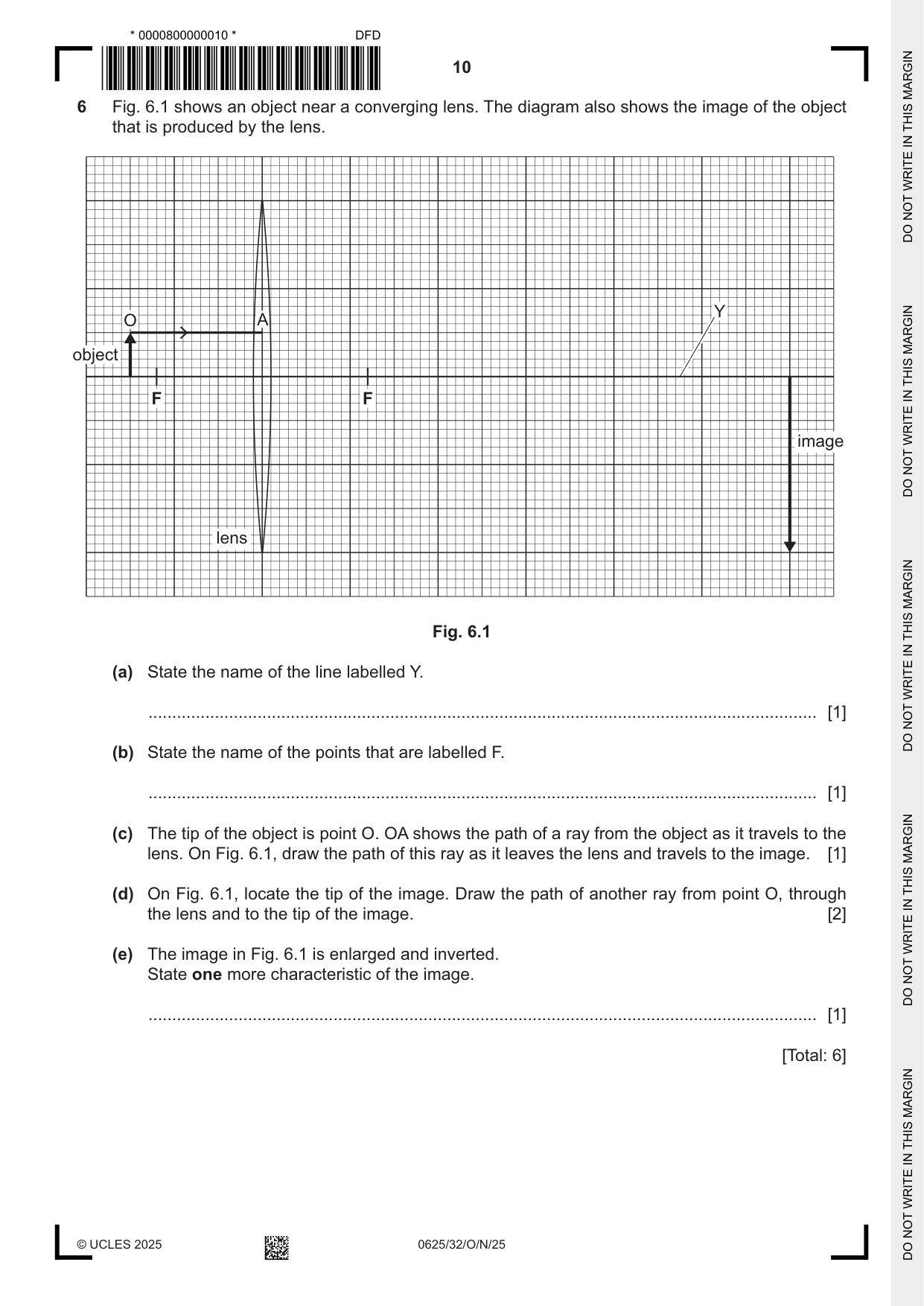
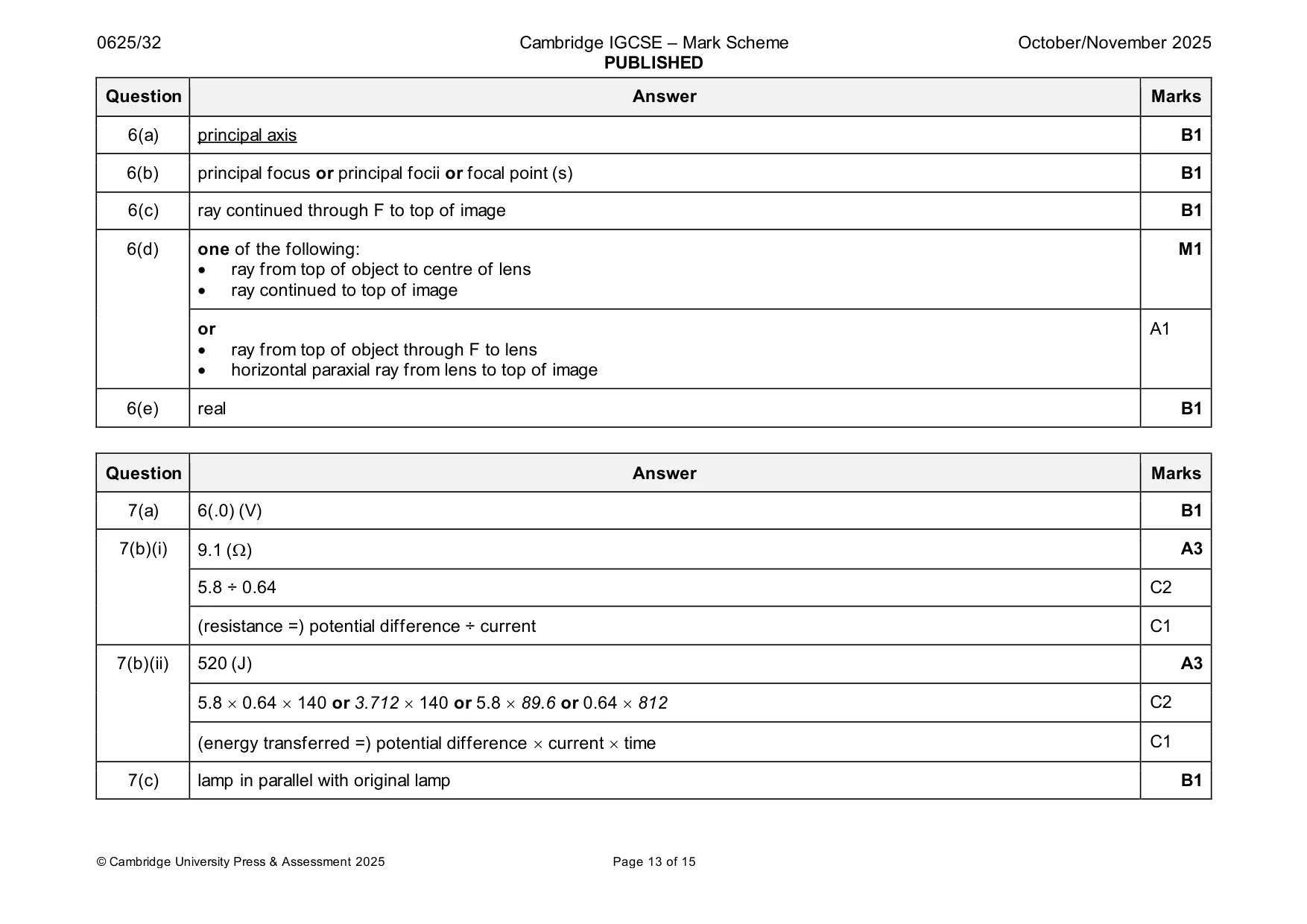
6 Fig. 6.1 shows an object near a converging lens. The diagram also shows the image of the object that is produced by the lens. Y O A object F F image lens Fig. 6.1 (a) State the name of the line labelled Y. ............................................................................................................................................. [1] (b) State the name of the points that are labelled F. ............................................................................................................................................. [1] (c) The tip of the object is point O. OA shows the path of a ray from the object as it travels to the lens. On Fig. 6.1, draw the path of this ray as it leaves the lens and travels to the image. [1] (d) On Fig. 6.1, locate the tip of the image. Draw the path of another ray from point O, through the lens and to the tip of the image. [2] (e) The image in Fig. 6.1 is enlarged and inverted. State one more characteristic of the image. ............................................................................................................................................. [1] [Total: 6]
Mark scheme: 6(a) principal axis B1 6(b) principal focus or principal focii or focal point (s) B1 6(c) ray continued through F to top of image B1 6(d) one of the following: M1 • ray from top of object to centre of lens • ray continued to top of image or A1 • ray from top of object through F to lens • horizontal paraxial ray from lens to top of image 6(e) real B1
Q7 · A lamp connected in series with four 1.5 V cells and an ammeter
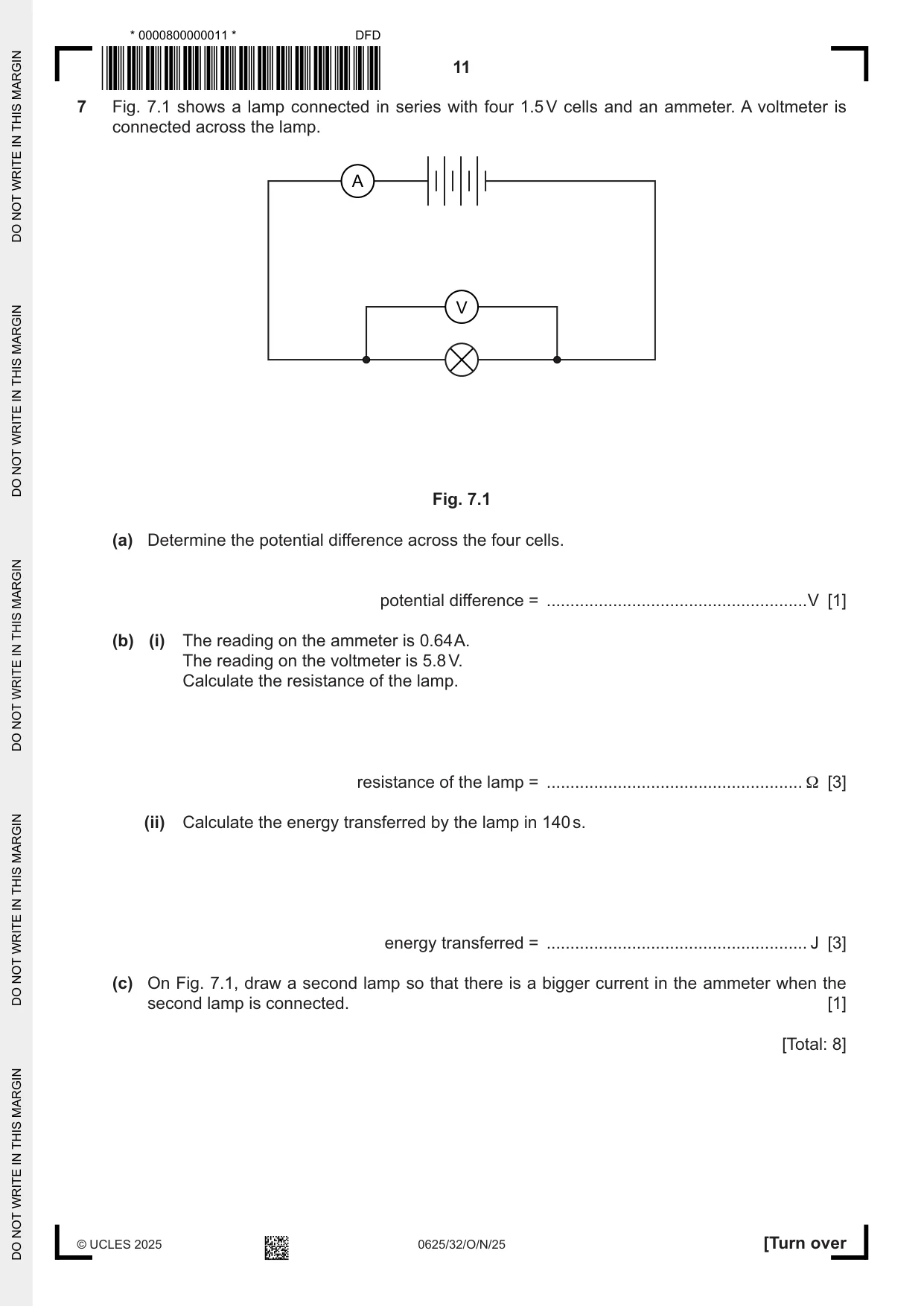
7 Fig. 7.1 shows a lamp connected in series with four 1.5 V cells and an ammeter. A voltmeter is connected across the lamp. A V Fig. 7.1 (a) Determine the potential difference across the four cells. potential difference = .......................................................V [1] (b) (i) The reading on the ammeter is 0.64 A. The reading on the voltmeter is 5.8 V. Calculate the resistance of the lamp. resistance of the lamp = ...................................................... Ω [3] (ii) Calculate the energy transferred by the lamp in 140 s. energy transferred = ....................................................... J [3] (c) On Fig. 7.1, draw a second lamp so that there is a bigger current in the ammeter when the second lamp is connected. [1] [Total: 8]
Mark scheme: 7(a) 6(.0) (V) B1 7(b)(i) 9.1 () A3 5.8 ÷ 0.64 C2 (resistance =) potential difference ÷ current C1 7(b)(ii) 520 (J) A3 5.8 0.64 140 or 3.712 140 or 5.8 89.6 or 0.64 812 C2 (energy transferred =) potential difference current time C1 7(c) lamp in parallel with original lamp B1
Q8 · A toy train on a railway track with a tunnel
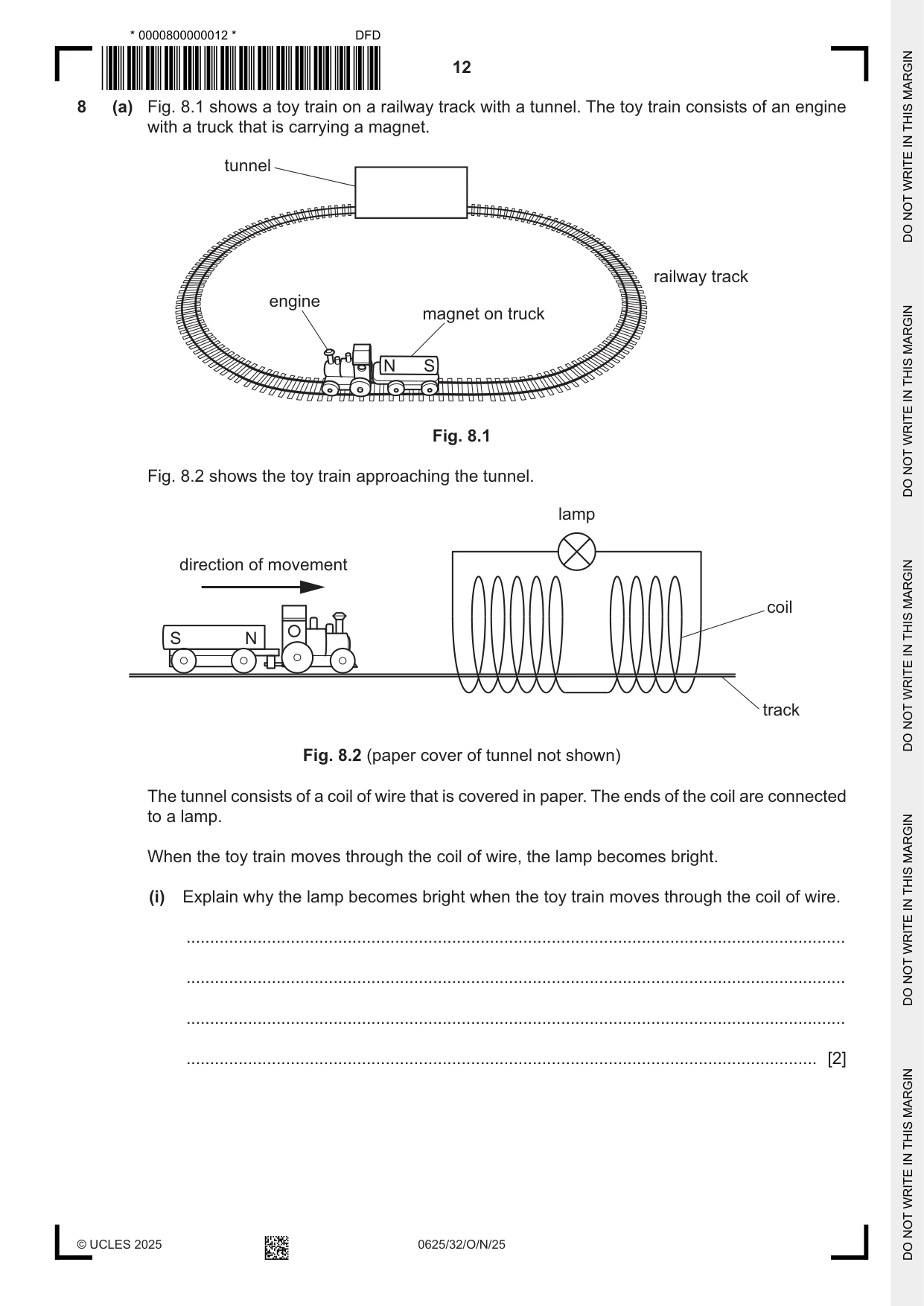
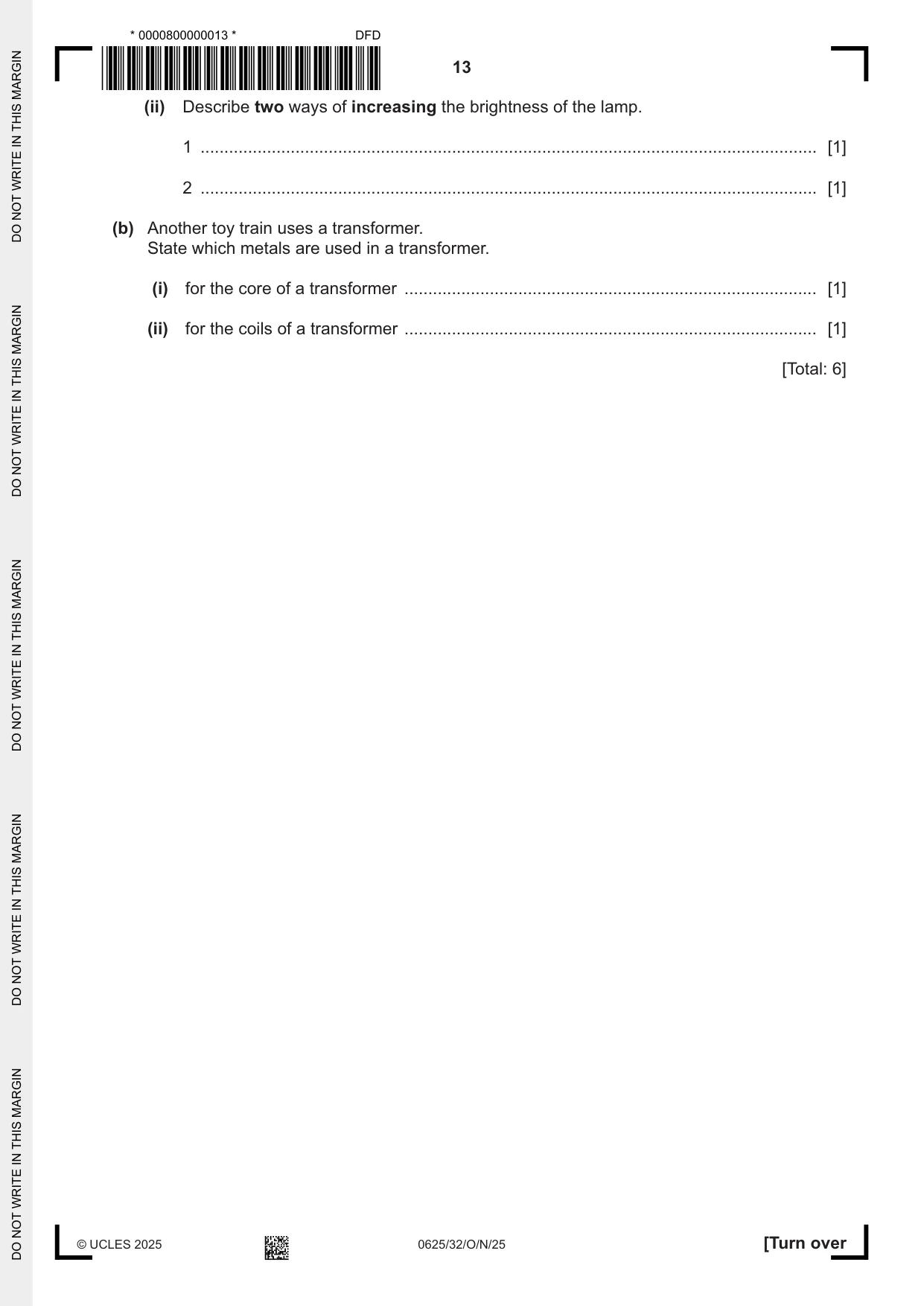
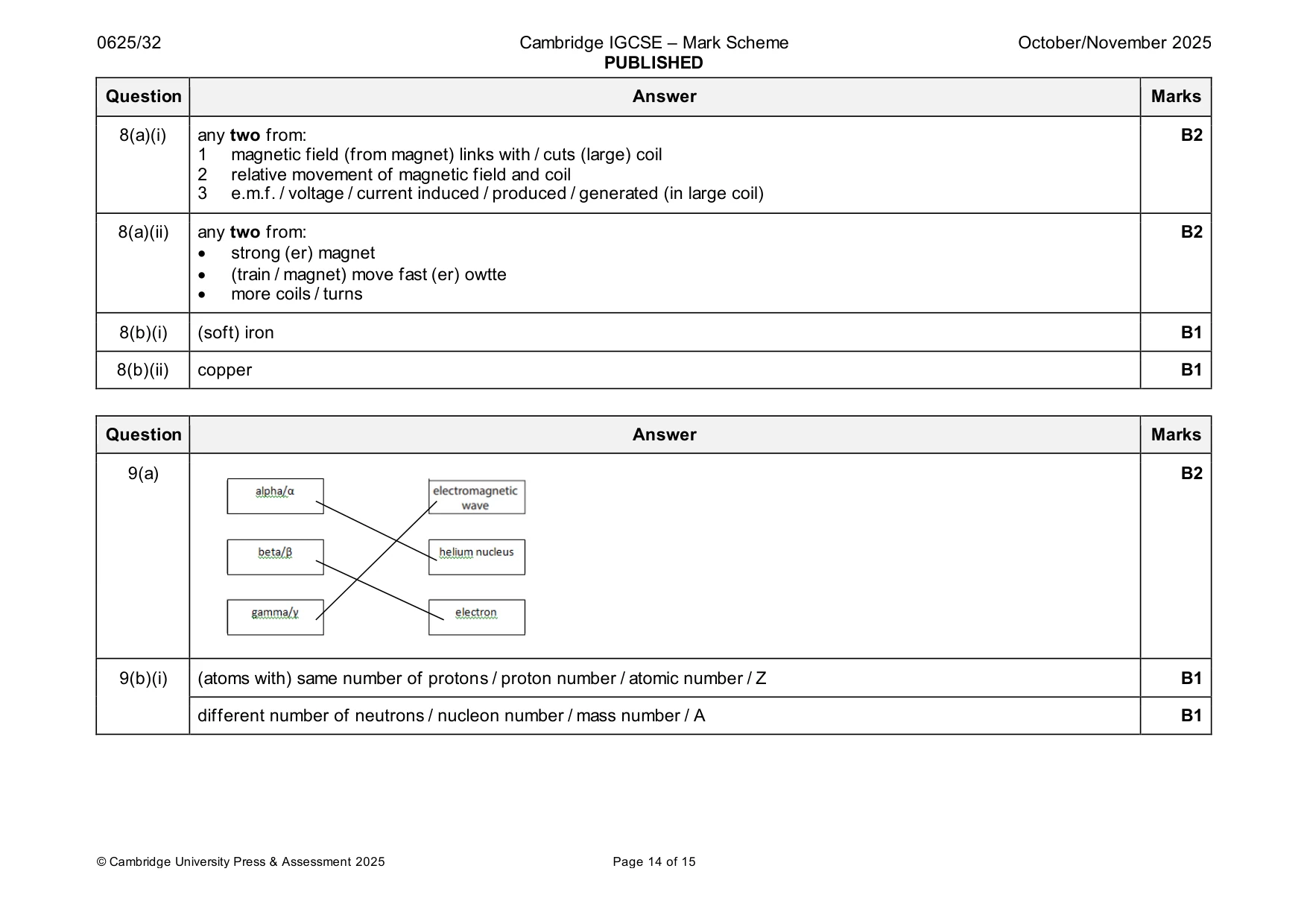
8 (a) Fig. 8.1 shows a toy train on a railway track with a tunnel. The toy train consists of an engine with a truck that is carrying a magnet. tunnel railway track engine magnet on truck N S Fig. 8.1 Fig. 8.2 shows the toy train approaching the tunnel. lamp direction of movement coil S N track Fig. 8.2 (paper cover of tunnel not shown) The tunnel consists of a coil of wire that is covered in paper. The ends of the coil are connected to a lamp. When the toy train moves through the coil of wire, the lamp becomes bright. (i) Explain why the lamp becomes bright when the toy train moves through the coil of wire. ........................................................................................................................................... ........................................................................................................................................... ........................................................................................................................................... ..................................................................................................................................... [2] (ii) Describe two ways of increasing the brightness of the lamp. 1 .................................................................................................................................. [1] 2 .................................................................................................................................. [1] (b) Another toy train uses a transformer. State which metals are used in a transformer. i(i) for the core of a transformer ....................................................................................... [1] (ii) for the coils of a transformer ....................................................................................... [1] [Total: 6]
Mark scheme: 8(a)(i) any two from: B2 1 magnetic field (from magnet) links with / cuts (large) coil 2 relative movement of magnetic field and coil 3 e.m.f. / voltage / current induced / produced / generated (in large coil) 8(a)(ii) any two from: B2 • strong (er) magnet • (train / magnet) move fast (er) owtte • more coils / turns 8(b)(i) (soft) iron B1 8(b)(ii) copper B1
Q9 · Unstable nuclei emit ionising radiation when they decay
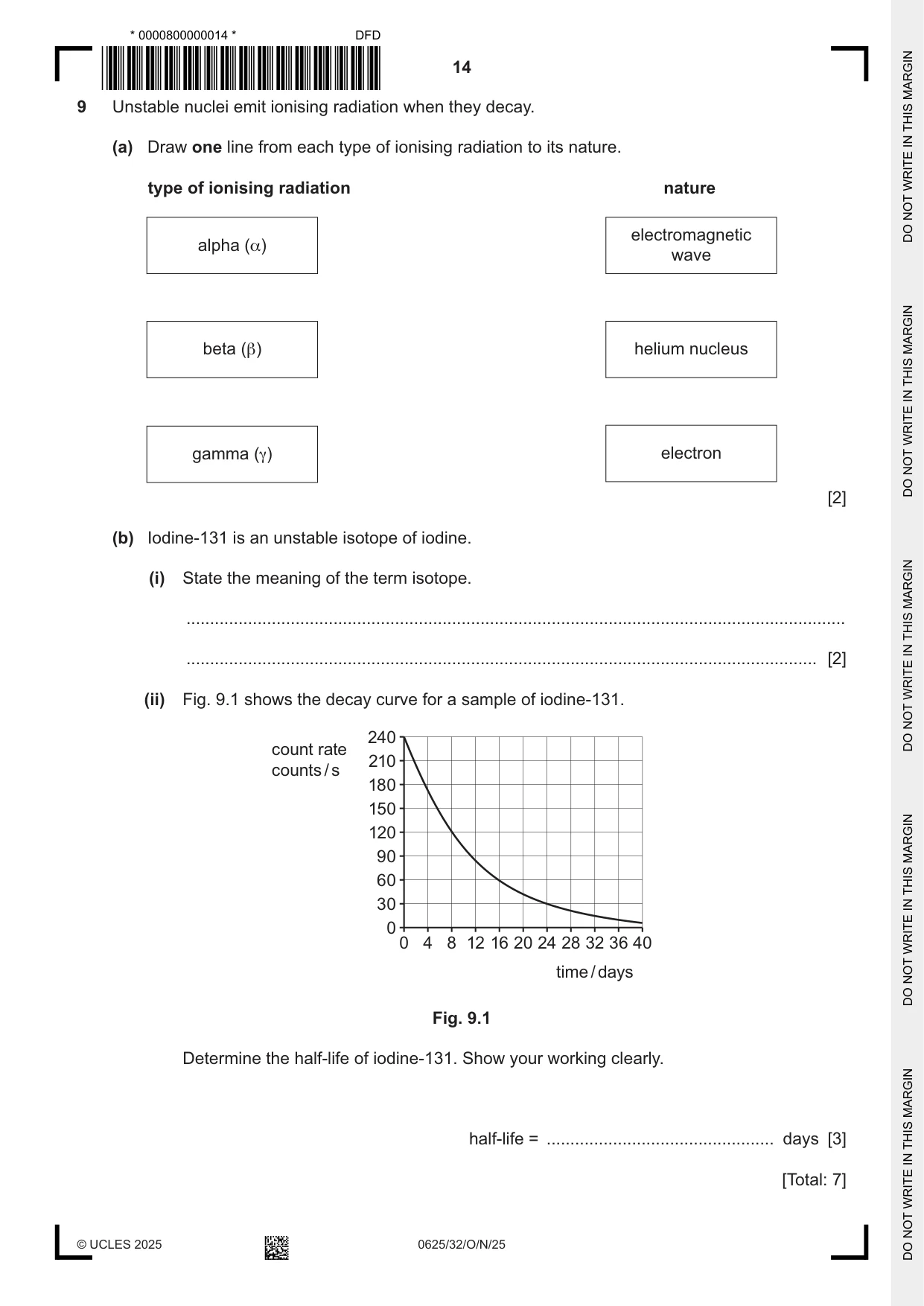
9 Unstable nuclei emit ionising radiation when they decay. (a) Draw one line from each type of ionising radiation to its nature. type of ionising radiation nature electromagnetic alpha (α) wave beta (β) helium nucleus gamma (γ) electron [2] (b) Iodine-131 is an unstable isotope of iodine. (i) State the meaning of the term isotope. ........................................................................................................................................... ..................................................................................................................................... [2] (ii) Fig. 9.1 shows the decay curve for a sample of iodine-131. 240 count rate 210 counts / s 180 150 120 90 60 30 0 0 4 8 12 16 20 24 28 32 36 40 time / days Fig. 9.1 Determine the half-life of iodine-131. Show your working clearly. half-life = ................................................ days [3] [Total: 7]
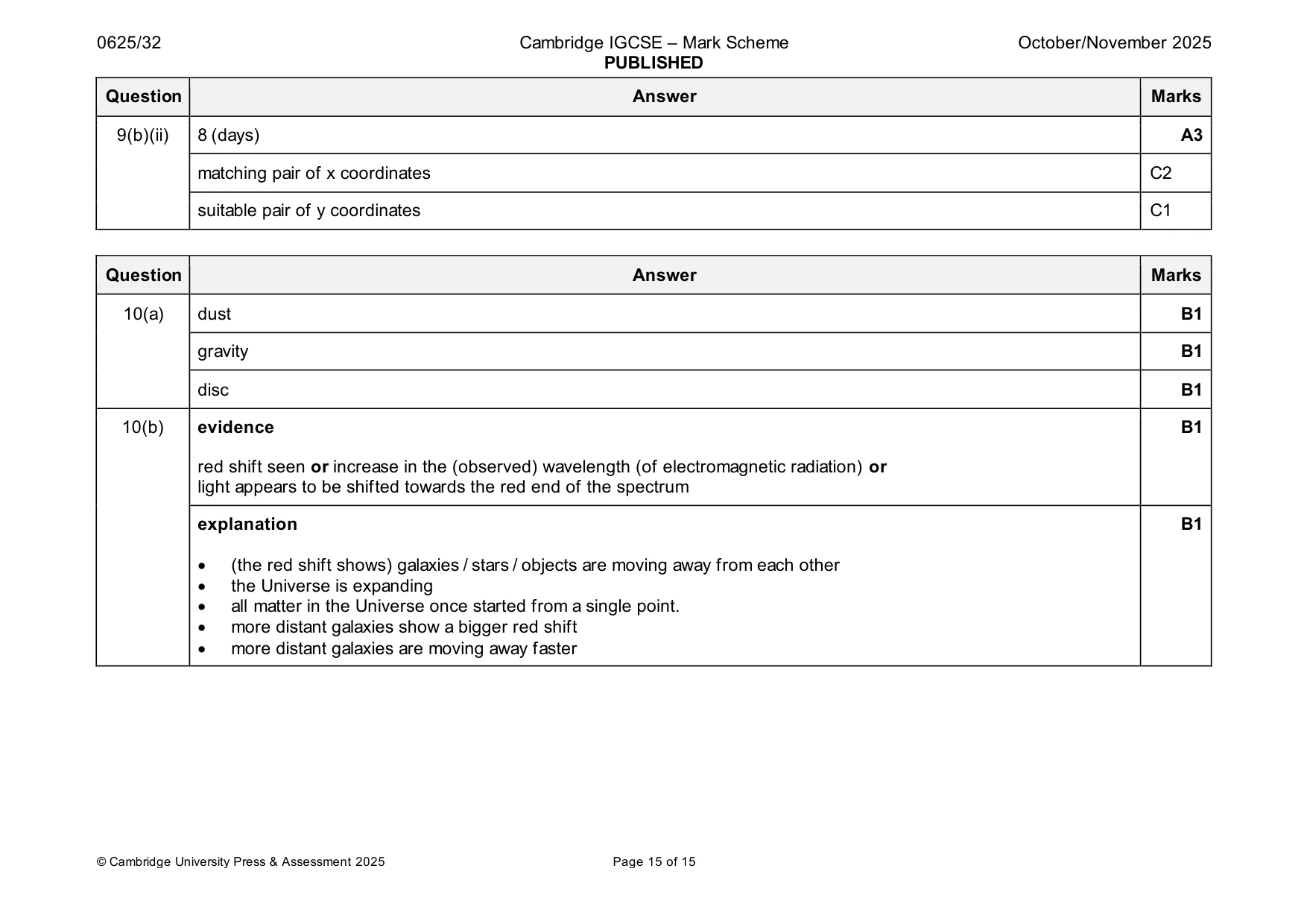
Mark scheme: 9(a) B2 9(b)(i) (atoms with) same number of protons / proton number / atomic number / Z B1 different number of neutrons / nucleon number / mass number / A B1 9(b)(ii) 8 (days) A3 matching pair of x coordinates C2 suitable pair of y coordinates C1
Q10 · Complete these sentences about the formation of the Solar System
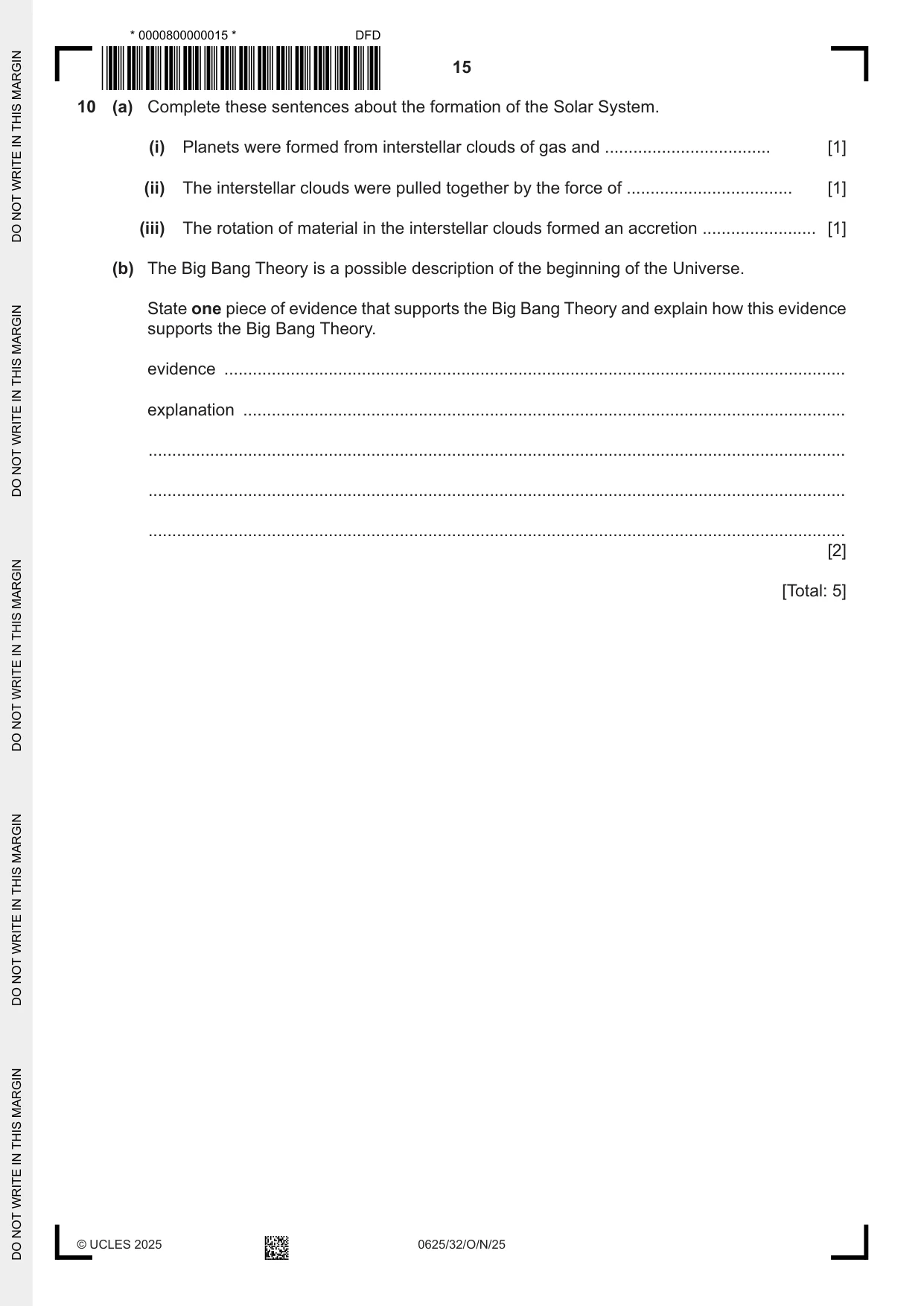
10 (a) Complete these sentences about the formation of the Solar System. (i) Planets were formed from interstellar clouds of gas and ................................... [1] (ii) The interstellar clouds were pulled together by the force of ................................... [1] (iii) The rotation of material in the interstellar clouds formed an accretion ........................ [1] (b) The Big Bang Theory is a possible description of the beginning of the Universe. State one piece of evidence that supports the Big Bang Theory and explain how this evidence supports the Big Bang Theory. evidence ................................................................................................................................... explanation ............................................................................................................................... ................................................................................................................................................... ................................................................................................................................................... ................................................................................................................................................... [2] [Total: 5]
Mark scheme: 10(a) dust B1 gravity B1 disc B1 10(b) evidence B1 red shift seen or increase in the (observed) wavelength (of electromagnetic radiation) or light appears to be shifted towards the red end of the spectrum explanation B1 • (the red shift shows) galaxies / stars / objects are moving away from each other • the Universe is expanding • all matter in the Universe once started from a single point. • more distant galaxies show a bigger red shift • more distant galaxies are moving away faster
What was in this paper
The subtopics covered by these 10 questions, and how many questions each got. Open one in a new tab to see every Cambridge question on it.
What you needed in this session
Cambridge’s own grade thresholds for 2025 Oct/Nov, Paper 3 · Variant 2. A higher threshold means an easier paper — the bar moves with how the cohort did.