Cambridge IGCSE Physics 0625 — 2017 Feb/March Paper 3 · Variant 2
0625/32/F/M/17 · 12 questions · 80 marks · ≈90 min
The question paper and its mark scheme, free to read here and free to download. This is Cambridge’s own paper, exactly as it was sat.
Question paper16 pages
Mark scheme11 pages
Answers below. Sit the paper first if you are practising.
Questions as text
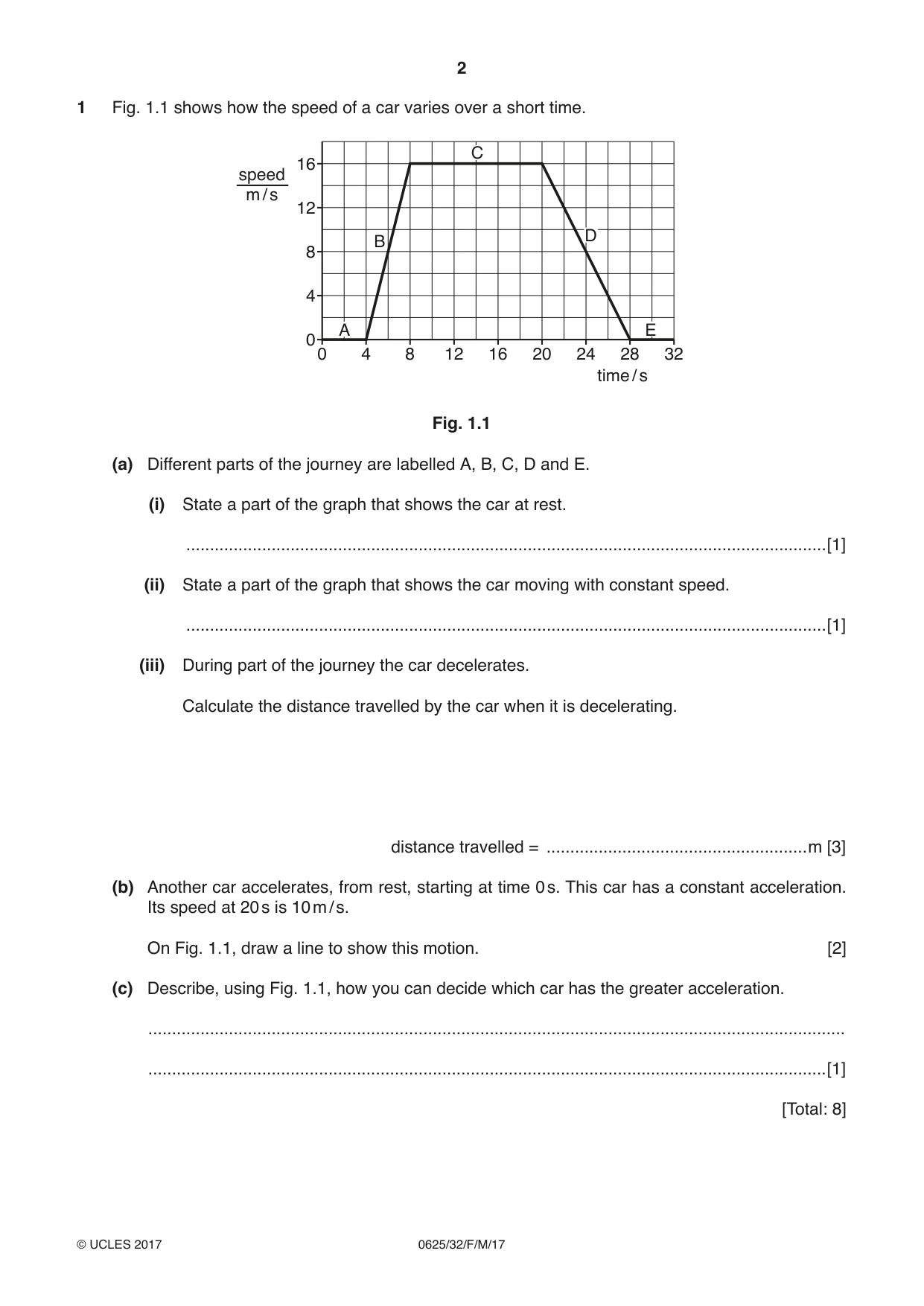
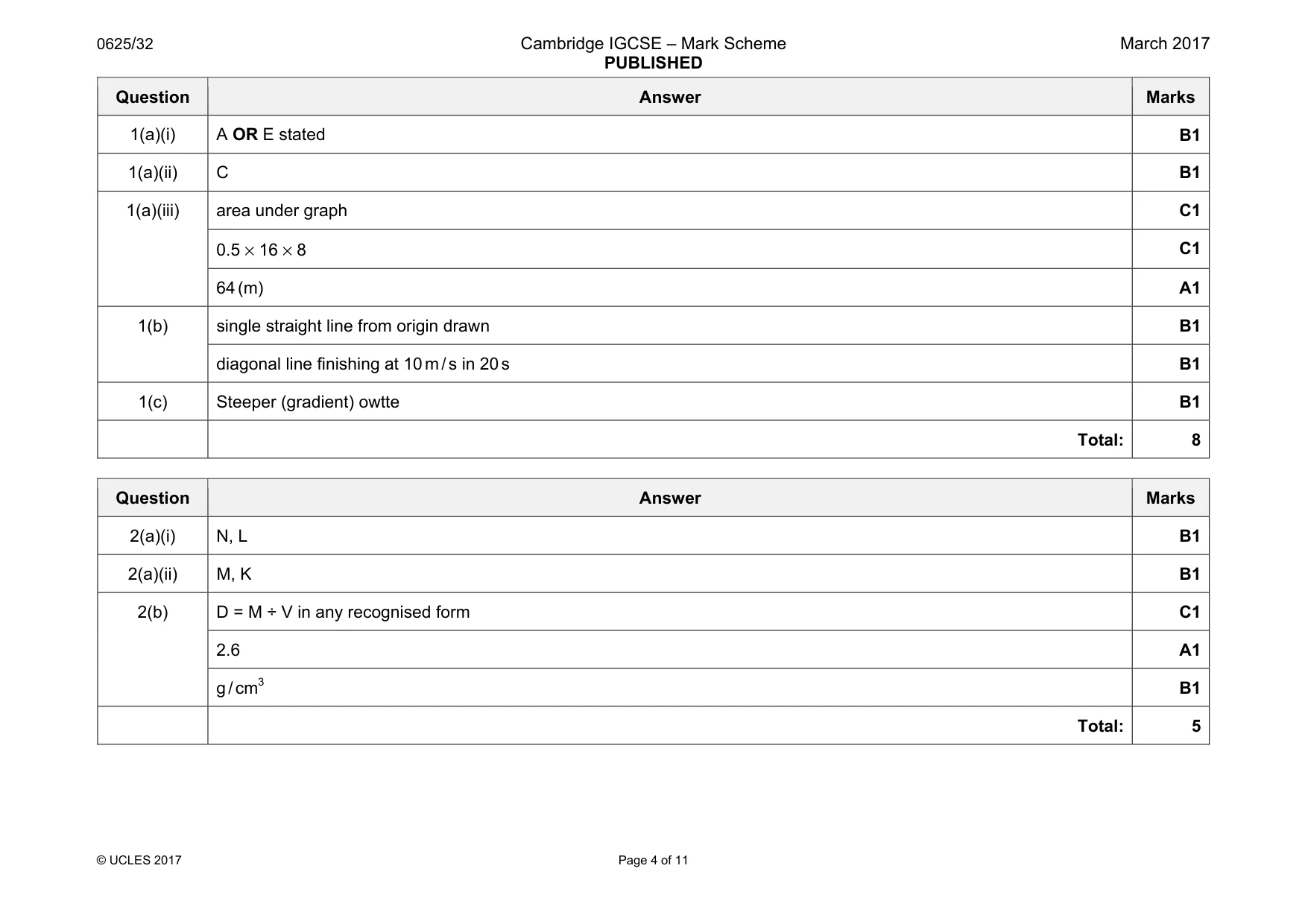
Q1 · How the speed of a car varies over a short time
1 Fig. 1.1 shows how the speed of a car varies over a short time. C 16 speed m / s 12 D B 8 4 A E 0 0 4 8 12 16 20 24 28 32 time / s Fig. 1.1 (a) Different parts of the journey are labelled A, B, C, D and E. (i) State a part of the graph that shows the car at rest. .......................................................................................................................................[1] (ii) State a part of the graph that shows the car moving with constant speed. .......................................................................................................................................[1] (iii) During part of the journey the car decelerates. Calculate the distance travelled by the car when it is decelerating. distance travelled = .......................................................m [3] (b) Another car accelerates, from rest, starting at time 0 s. This car has a constant acceleration. Its speed at 20 s is 10 m / s. On Fig. 1.1, draw a line to show this motion. [2] (c) Describe, using Fig. 1.1, how you can decide which car has the greater acceleration. ................................................................................................................................................... ...............................................................................................................................................[1] [Total: 8]
Mark scheme: 1(a)(i) A OR E stated B1 1(a)(ii) C B1 1(a)(iii) area under graph C1 0.5 × 16 × 8 C1 64 (m) A1 1(b) single straight line from origin drawn B1 diagonal line finishing at 10 m / s in 20 s B1 1(c) Steeper (gradient) owtte B1 Total: 8
Q2 · A student wants to find the density of a small stone
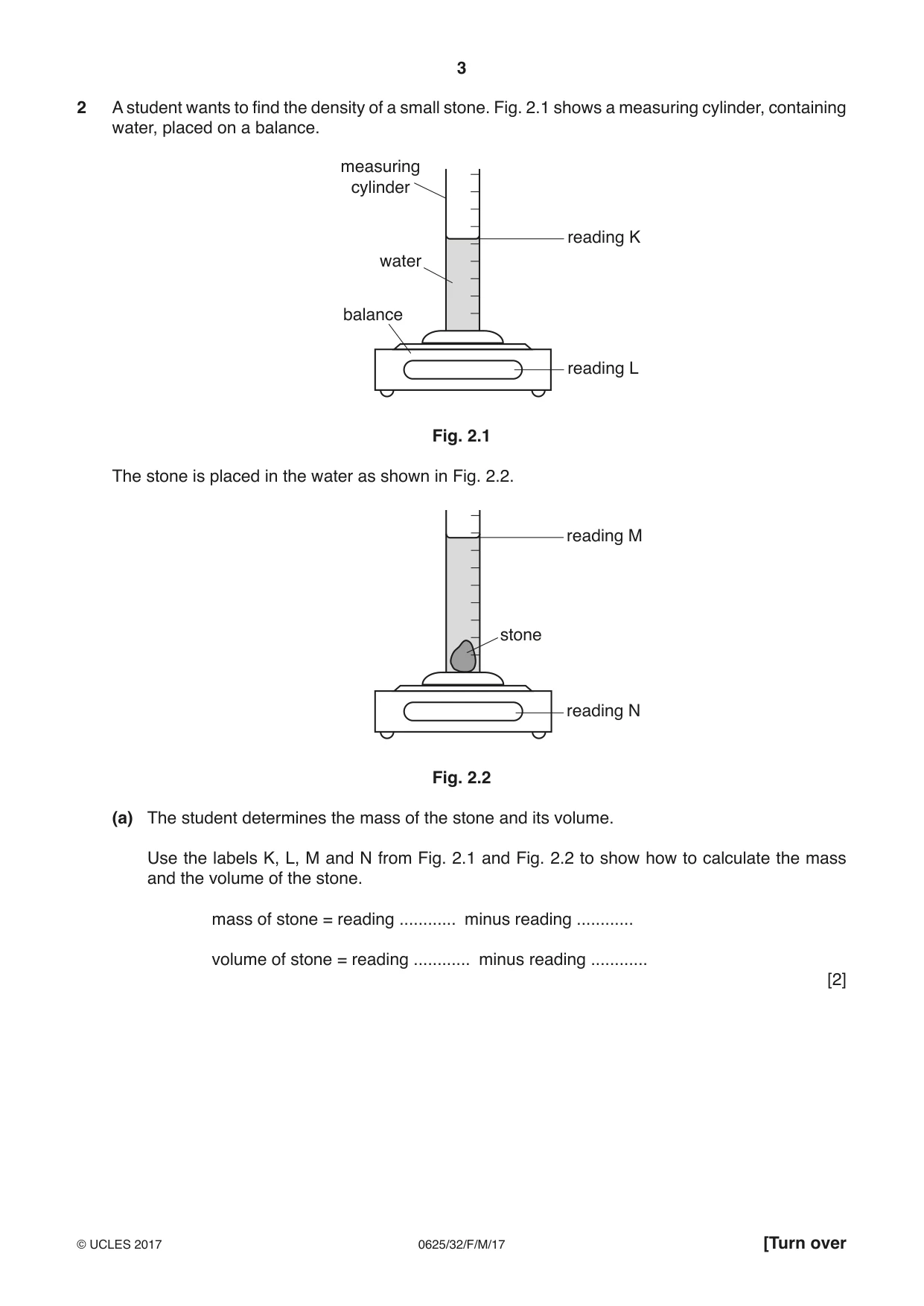
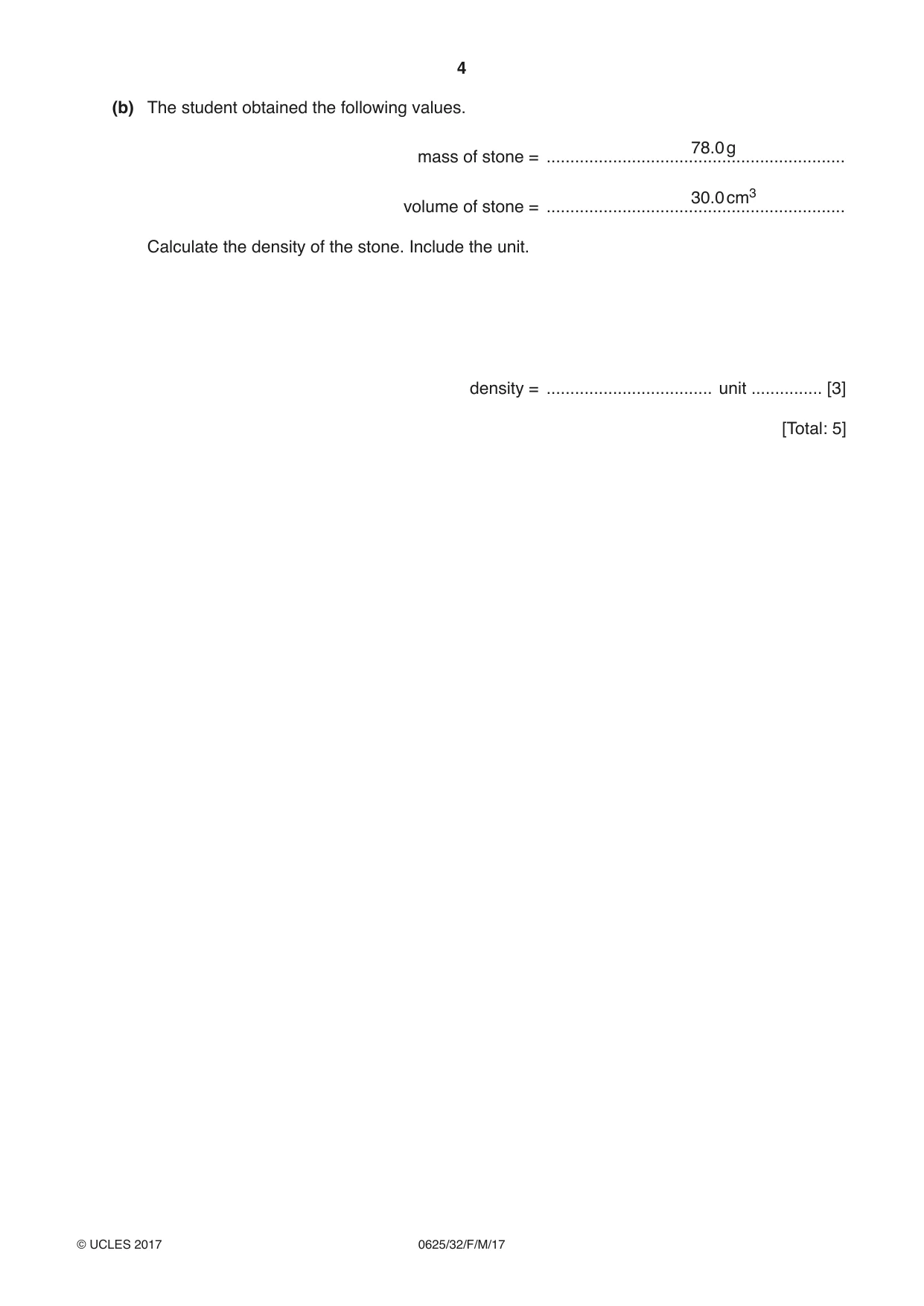
2 A student wants to find the density of a small stone. Fig. 2.1 shows a measuring cylinder, containing water, placed on a balance. measuring cylinder reading K water balance reading L Fig. 2.1 The stone is placed in the water as shown in Fig. 2.2. reading M stone reading N Fig. 2.2 (a) The student determines the mass of the stone and its volume. Use the labels K, L, M and N from Fig. 2.1 and Fig. 2.2 to show how to calculate the mass and the volume of the stone. mass of stone = reading ............ minus reading ............ volume of stone = reading ............ minus reading ............ [2] (b) The student obtained the following values. 78.0 g mass of stone = ............................................................... 30.0 cm3 volume of stone = ............................................................... Calculate the density of the stone. Include the unit. density = ................................... unit ............... [3] [Total: 5]
Mark scheme: 2(a)(i) N, L B1 2(a)(ii) M, K B1 2(b) D = M ÷ V in any recognised form C1 2.6 A1 g / cm3 B1 Total: 5
Q3 · A beam on a pivot
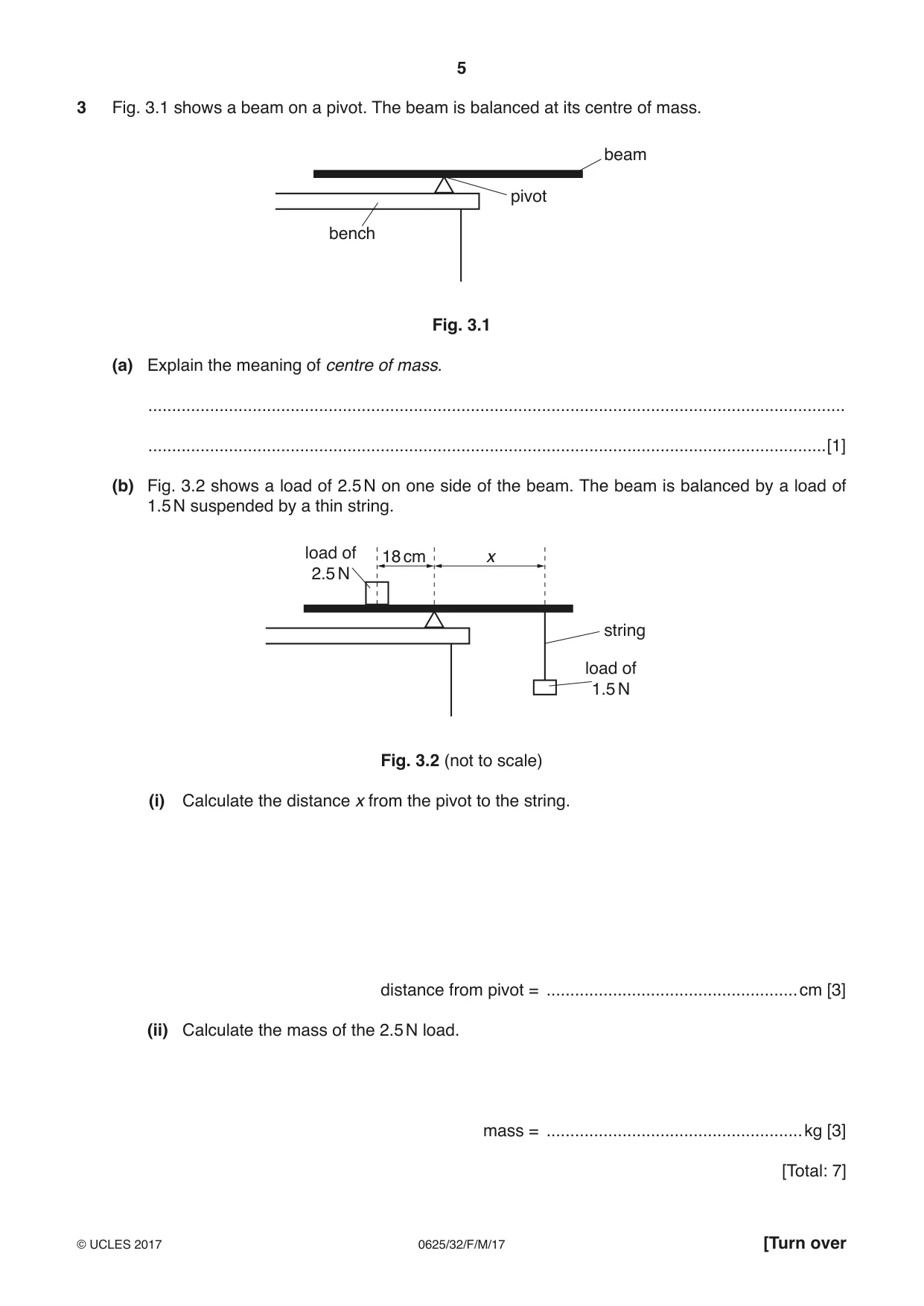
3 Fig. 3.1 shows a beam on a pivot. The beam is balanced at its centre of mass. beam pivot bench Fig. 3.1 (a) Explain the meaning of centre of mass. ................................................................................................................................................... ...............................................................................................................................................[1] (b) Fig. 3.2 shows a load of 2.5 N on one side of the beam. The beam is balanced by a load of 1.5 N suspended by a thin string. load of 18 cm x 2.5 N string load of 1.5 N Fig. 3.2 (not to scale) (i) Calculate the distance x from the pivot to the string. distance from pivot = .....................................................cm [3] (ii) Calculate the mass of the 2.5 N load. mass = ......................................................kg [3] [Total: 7]
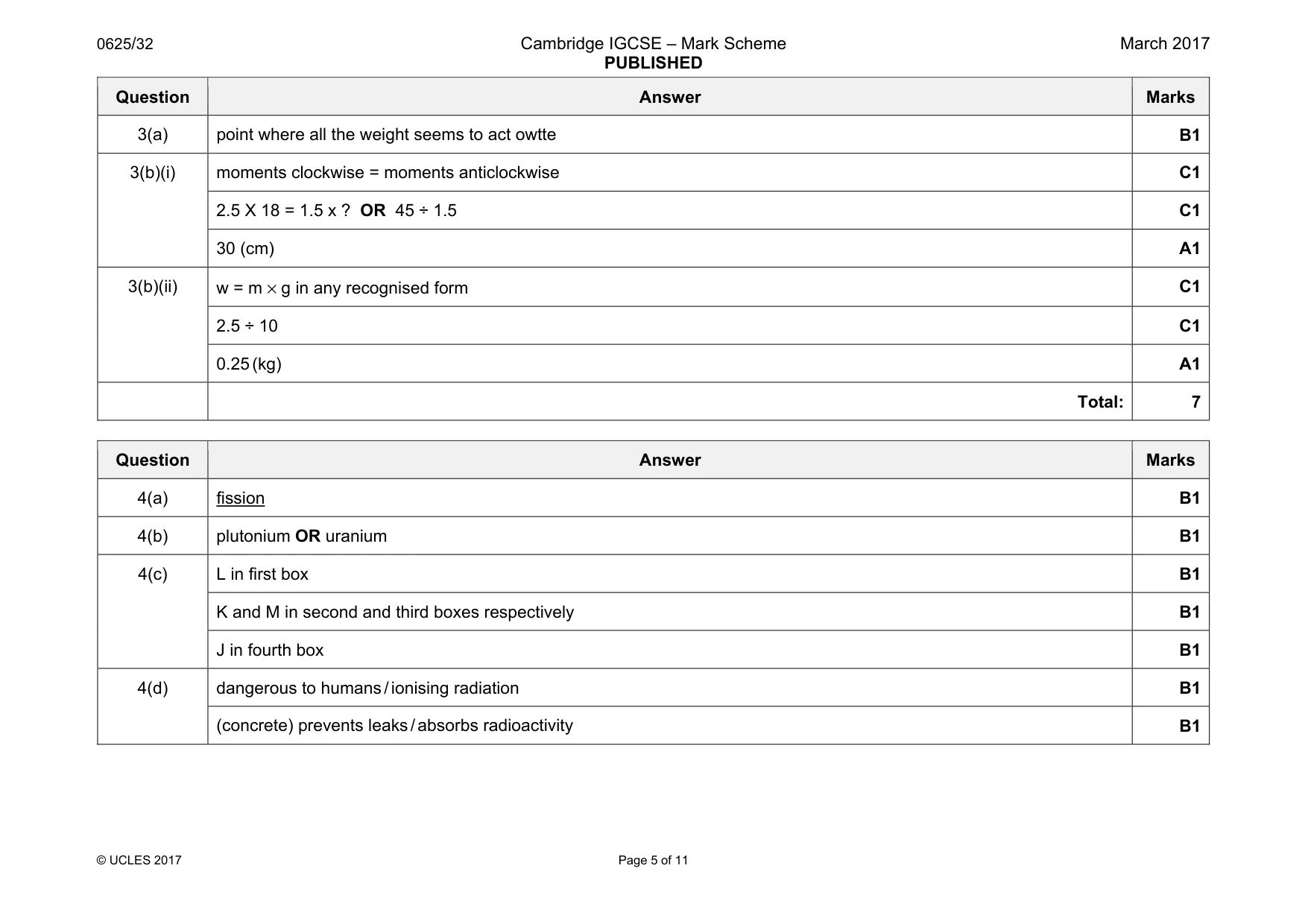
Mark scheme: 3(a) point where all the weight seems to act owtte B1 3(b)(i) moments clockwise = moments anticlockwise C1 2.5 X 18 = 1.5 x ? OR 45 ÷ 1.5 C1 30 (cm) A1 3(b)(ii) w = m × g in any recognised form C1 2.5 ÷ 10 C1 0.25 (kg) A1 Total: 7
Q4 · Nuclear power stations produce a useful form of energy
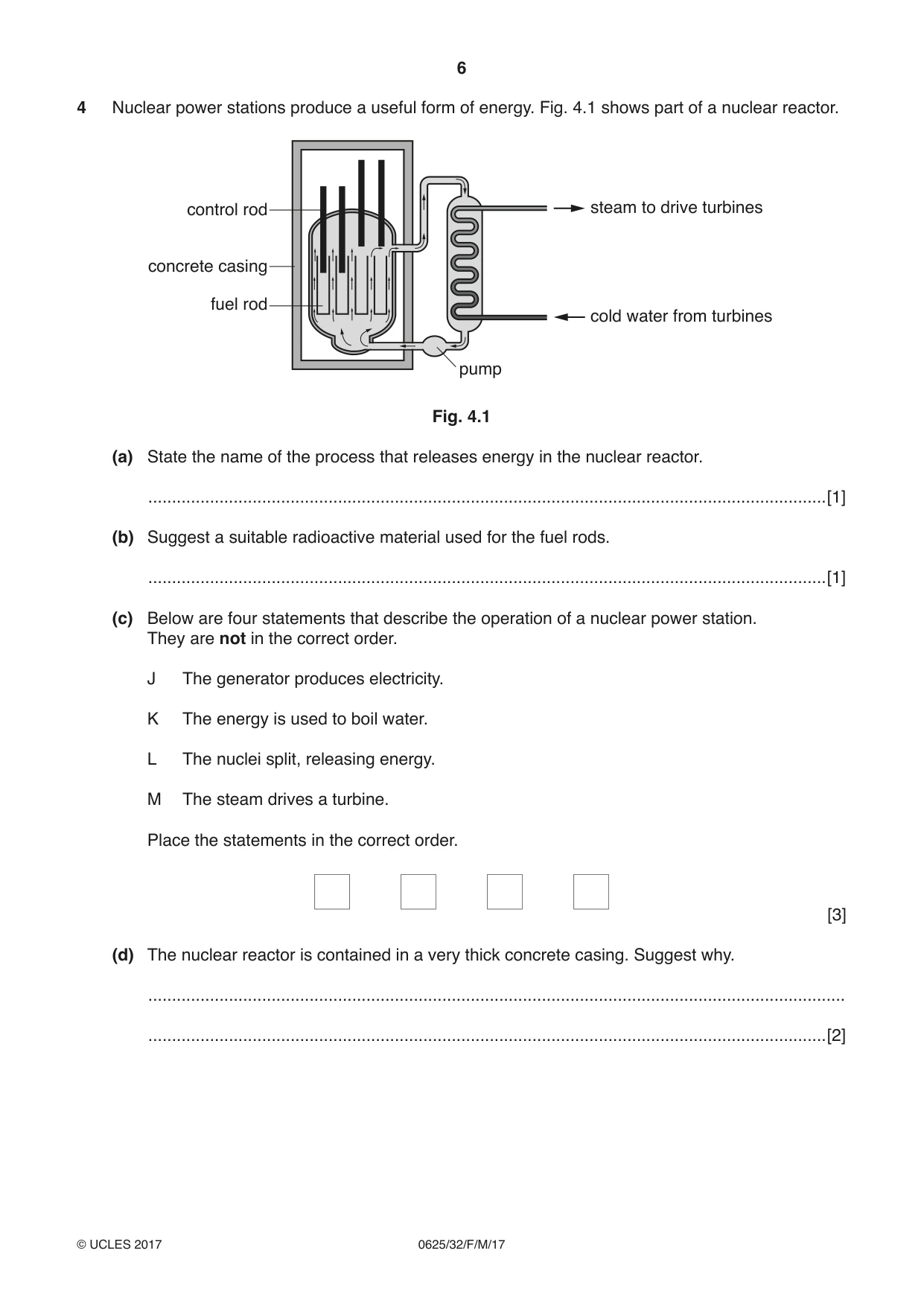
4 Nuclear power stations produce a useful form of energy. Fig. 4.1 shows part of a nuclear reactor. control rod steam to drive turbines concrete casing fuel rod cold water from turbines pump Fig. 4.1 (a) State the name of the process that releases energy in the nuclear reactor. ...............................................................................................................................................[1] (b) Suggest a suitable radioactive material used for the fuel rods. ...............................................................................................................................................[1] (c) Below are four statements that describe the operation of a nuclear power station. They are not in the correct order. J The generator produces electricity. K The energy is used to boil water. L The nuclei split, releasing energy. M The steam drives a turbine. Place the statements in the correct order. [3] (d) The nuclear reactor is contained in a very thick concrete casing. Suggest why. ................................................................................................................................................... ...............................................................................................................................................[2] (e) Suggest one advantage and one disadvantage of a nuclear power station compared with a wind turbine. advantage ................................................................................................................................. ................................................................................................................................................... disadvantage ............................................................................................................................ ................................................................................................................................................... [2] (f) Wind turbines use a renewable source of energy. State the name of another renewable source of energy. ...............................................................................................................................................[1] [Total: 10]
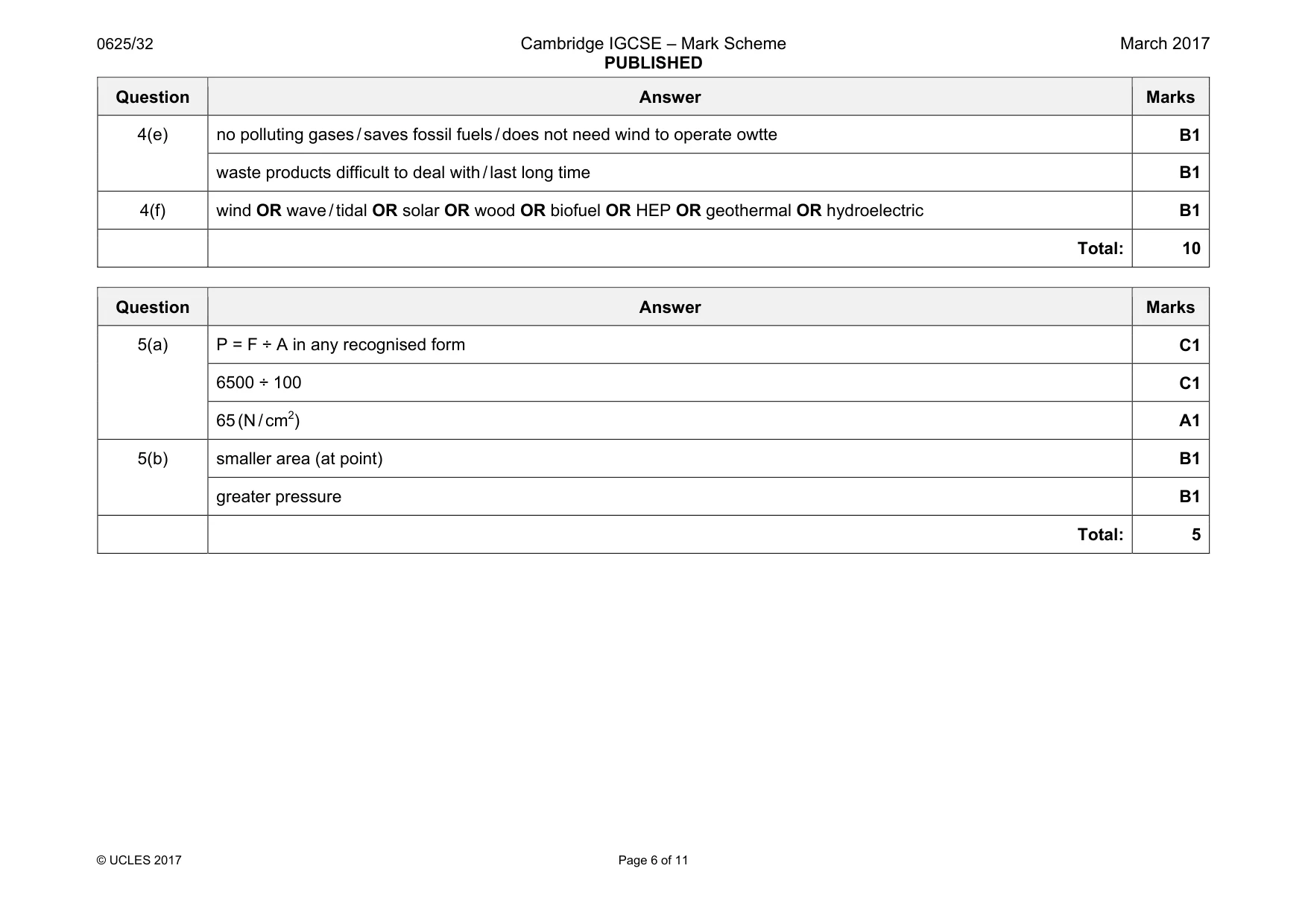
Mark scheme: 4(a) fission B1 4(b) plutonium OR uranium B1 4(c) L in first box B1 K and M in second and third boxes respectively B1 J in fourth box B1 4(d) dangerous to humans / ionising radiation B1 (concrete) prevents leaks / absorbs radioactivity B1 Question Answer Marks 4(e) no polluting gases / saves fossil fuels / does not need wind to operate owtte B1 waste products difficult to deal with / last long time B1 4(f) wind OR wave / tidal OR solar OR wood OR biofuel OR HEP OR geothermal OR hydroelectric B1 Total: 10
Q5 · The bucket at the front of a tractor is used to push fence posts down into the ground, as…
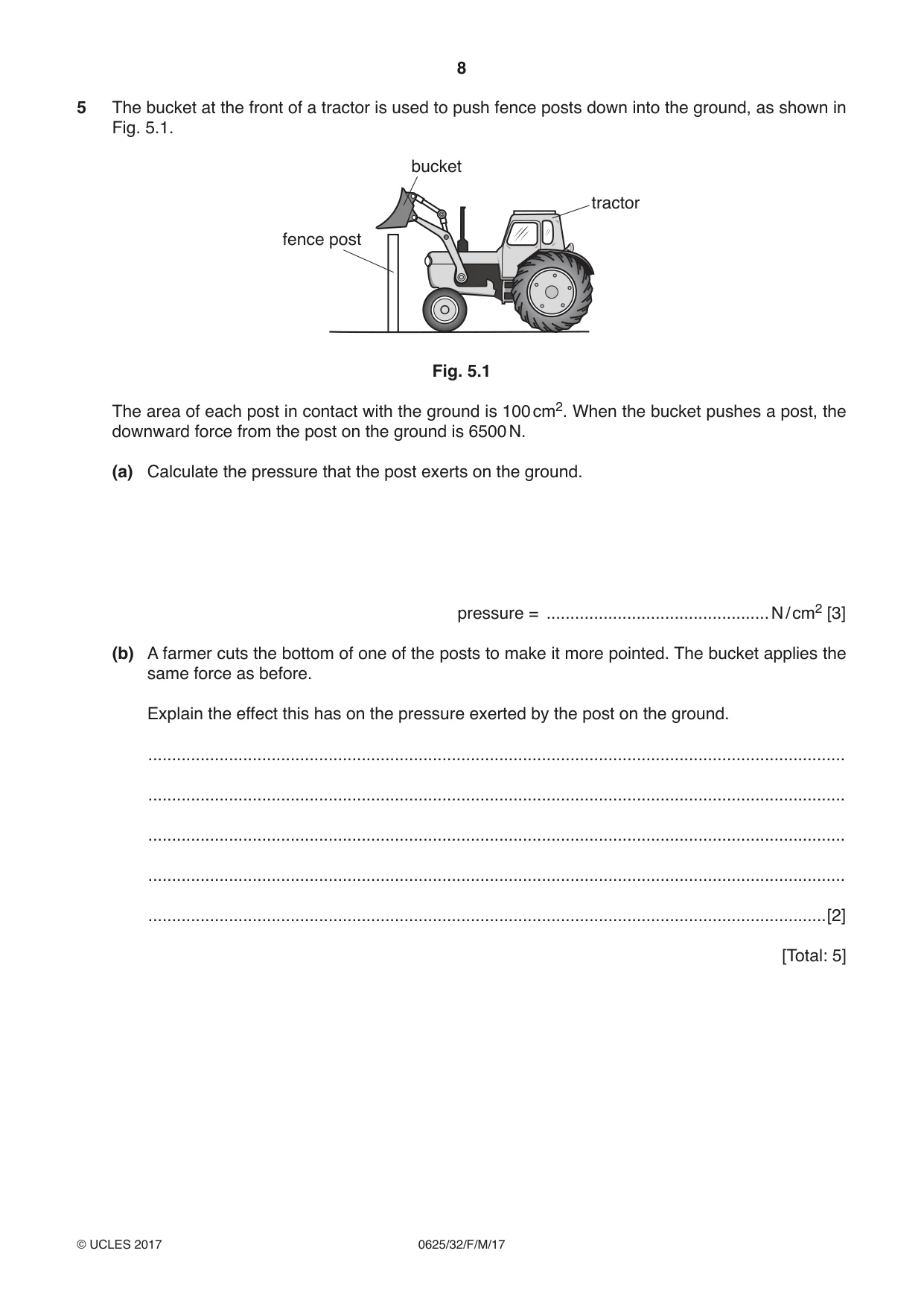
5 The bucket at the front of a tractor is used to push fence posts down into the ground, as shown in Fig. 5.1. bucket tractor fence post Fig. 5.1 The area of each post in contact with the ground is 100 cm2. When the bucket pushes a post, the downward force from the post on the ground is 6500 N. (a) Calculate the pressure that the post exerts on the ground. pressure = ...............................................N / cm2 [3] (b) A farmer cuts the bottom of one of the posts to make it more pointed. The bucket applies the same force as before. Explain the effect this has on the pressure exerted by the post on the ground. ................................................................................................................................................... ................................................................................................................................................... ................................................................................................................................................... ................................................................................................................................................... ...............................................................................................................................................[2] [Total: 5]
Mark scheme: 5(a) P = F ÷ A in any recognised form C1 6500 ÷ 100 C1 65 (N / cm2) A1 5(b) smaller area (at point) B1 greater pressure B1 Total: 5
Q6 · Water can exist as ice, liquid water and steam
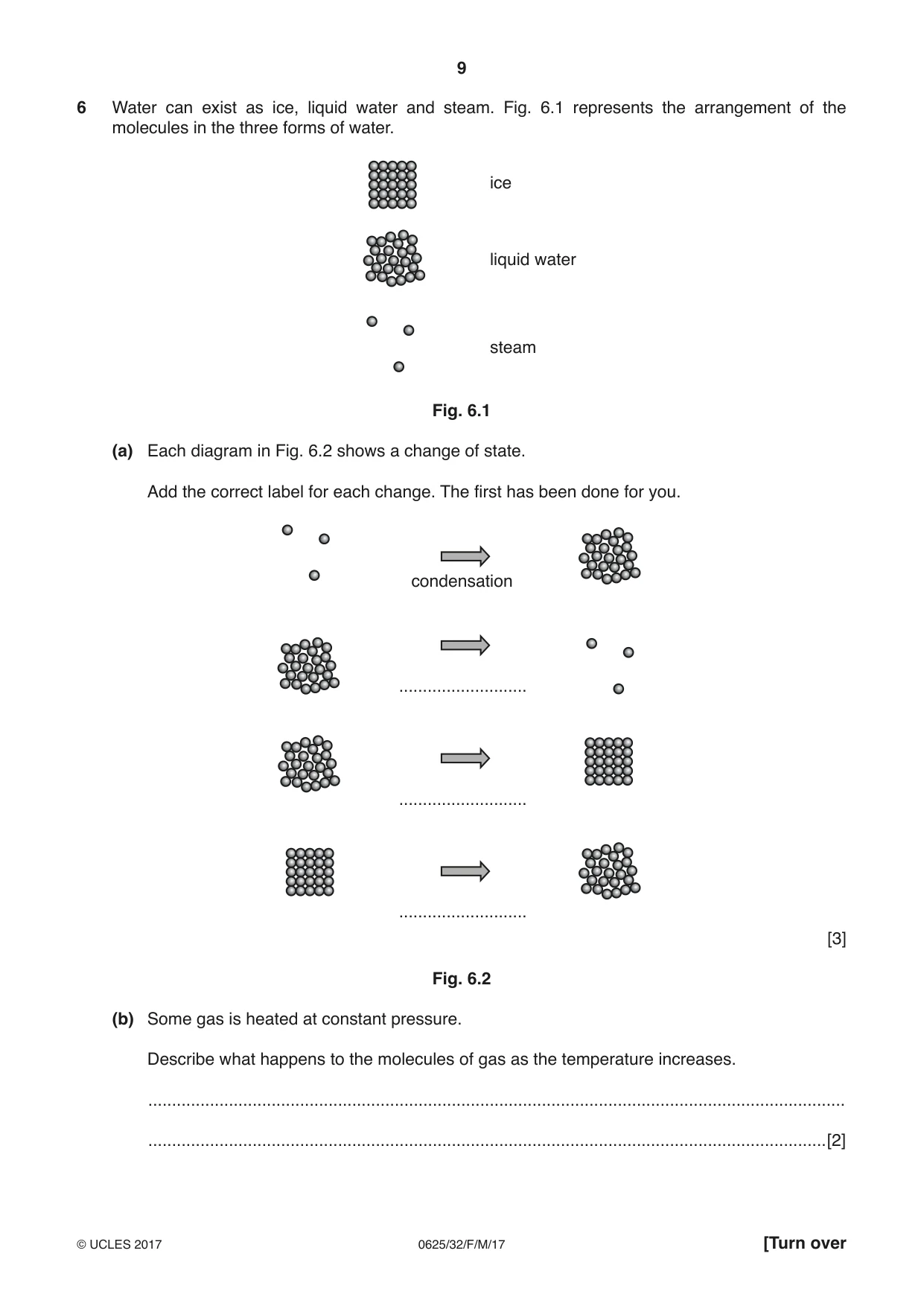
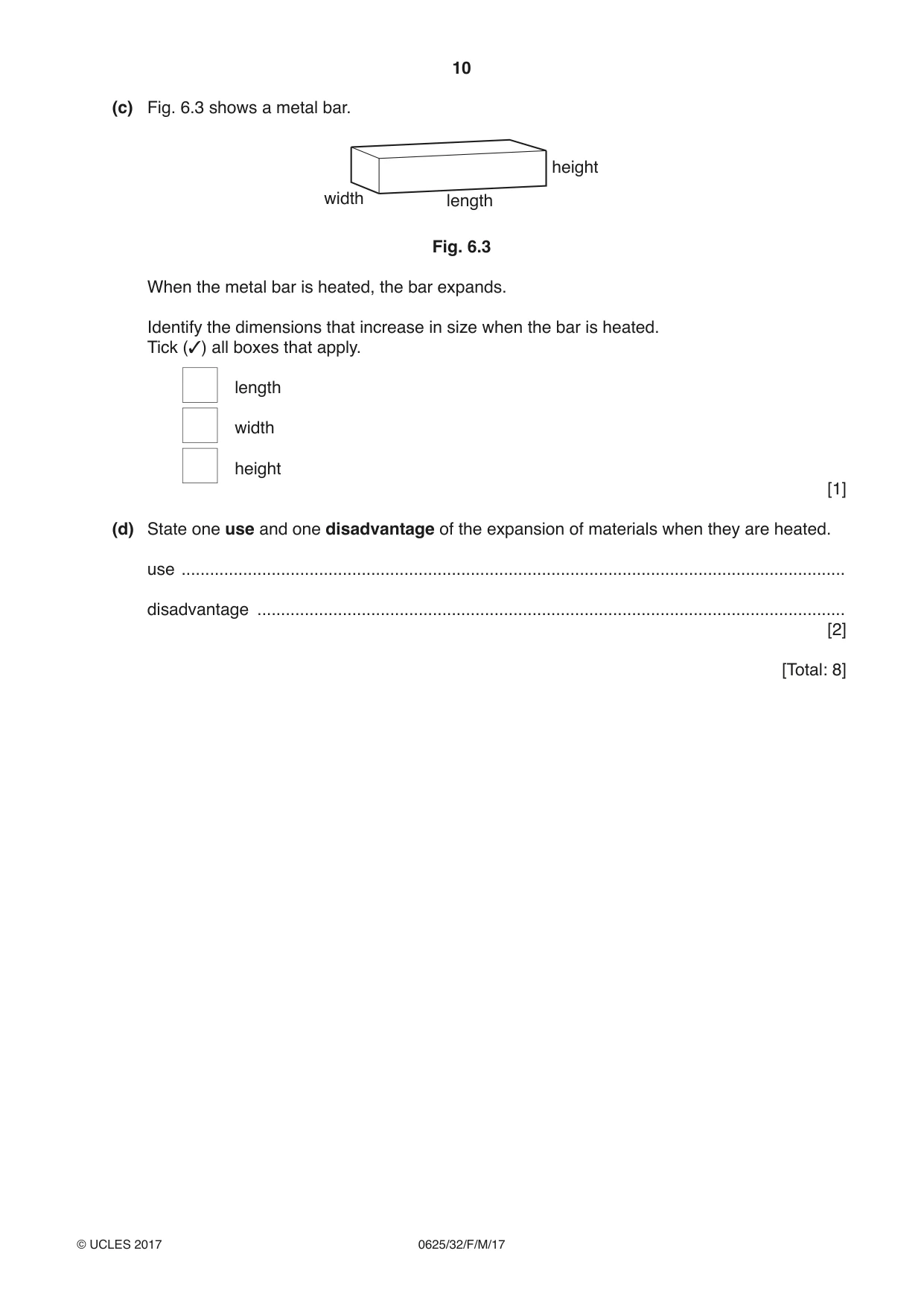
6 Water can exist as ice, liquid water and steam. Fig. 6.1 represents the arrangement of the molecules in the three forms of water. ice liquid water steam Fig. 6.1 (a) Each diagram in Fig. 6.2 shows a change of state. Add the correct label for each change. The first has been done for you. condensation ........................... ........................... ........................... [3] Fig. 6.2 (b) Some gas is heated at constant pressure. Describe what happens to the molecules of gas as the temperature increases. ................................................................................................................................................... ...............................................................................................................................................[2] (c) Fig. 6.3 shows a metal bar. height width length Fig. 6.3 When the metal bar is heated, the bar expands. Identify the dimensions that increase in size when the bar is heated. Tick (3) all boxes that apply. length width height [1] (d) State one use and one disadvantage of the expansion of materials when they are heated. use ............................................................................................................................................ disadvantage ............................................................................................................................ [2] [Total: 8]
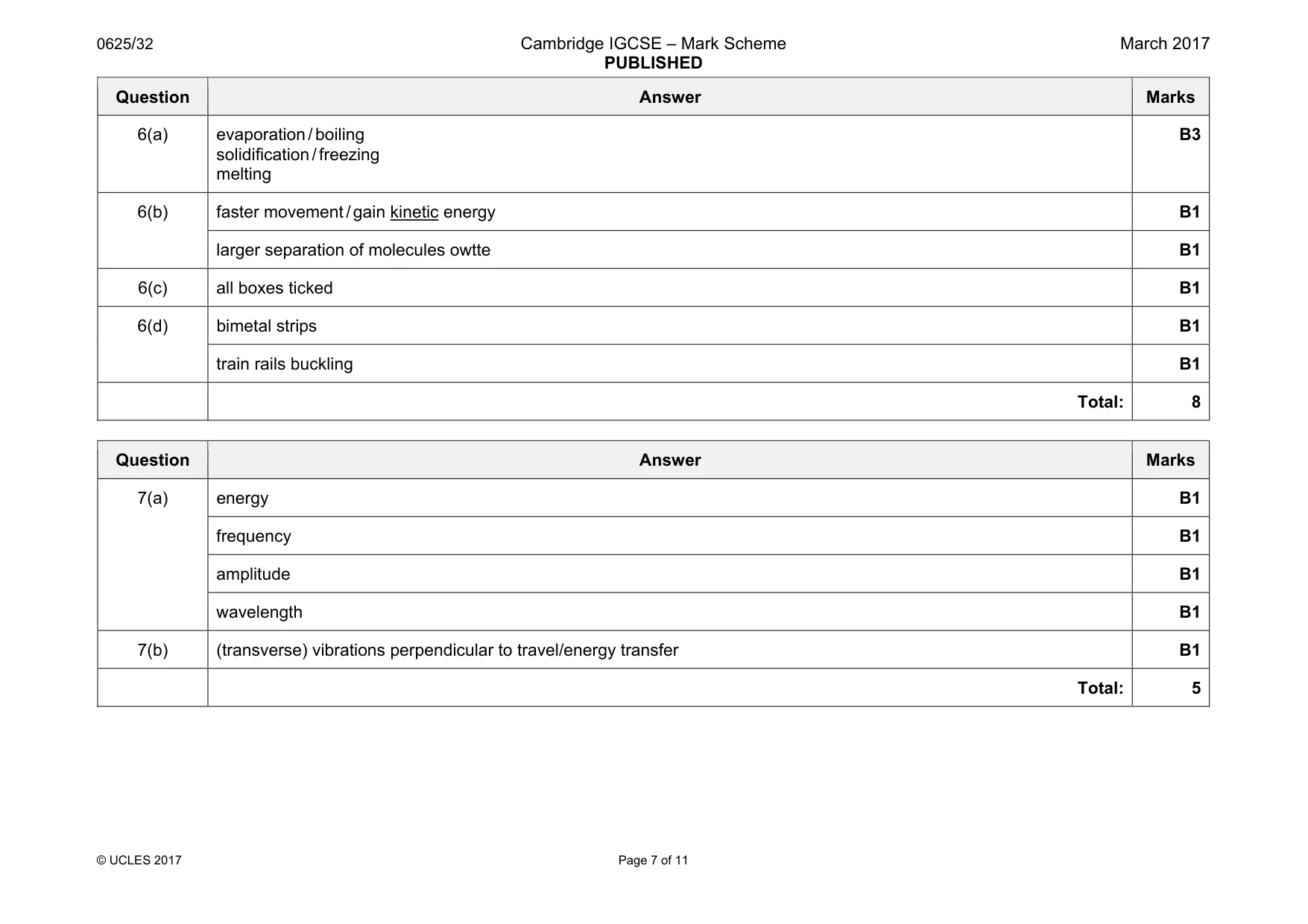
Mark scheme: 6(a) evaporation / boiling solidification / freezing melting B3 6(b) faster movement / gain kinetic energy B1 larger separation of molecules owtte B1 6(c) all boxes ticked B1 6(d) bimetal strips B1 train rails buckling B1 Total: 8
Q7 · A wave on a string
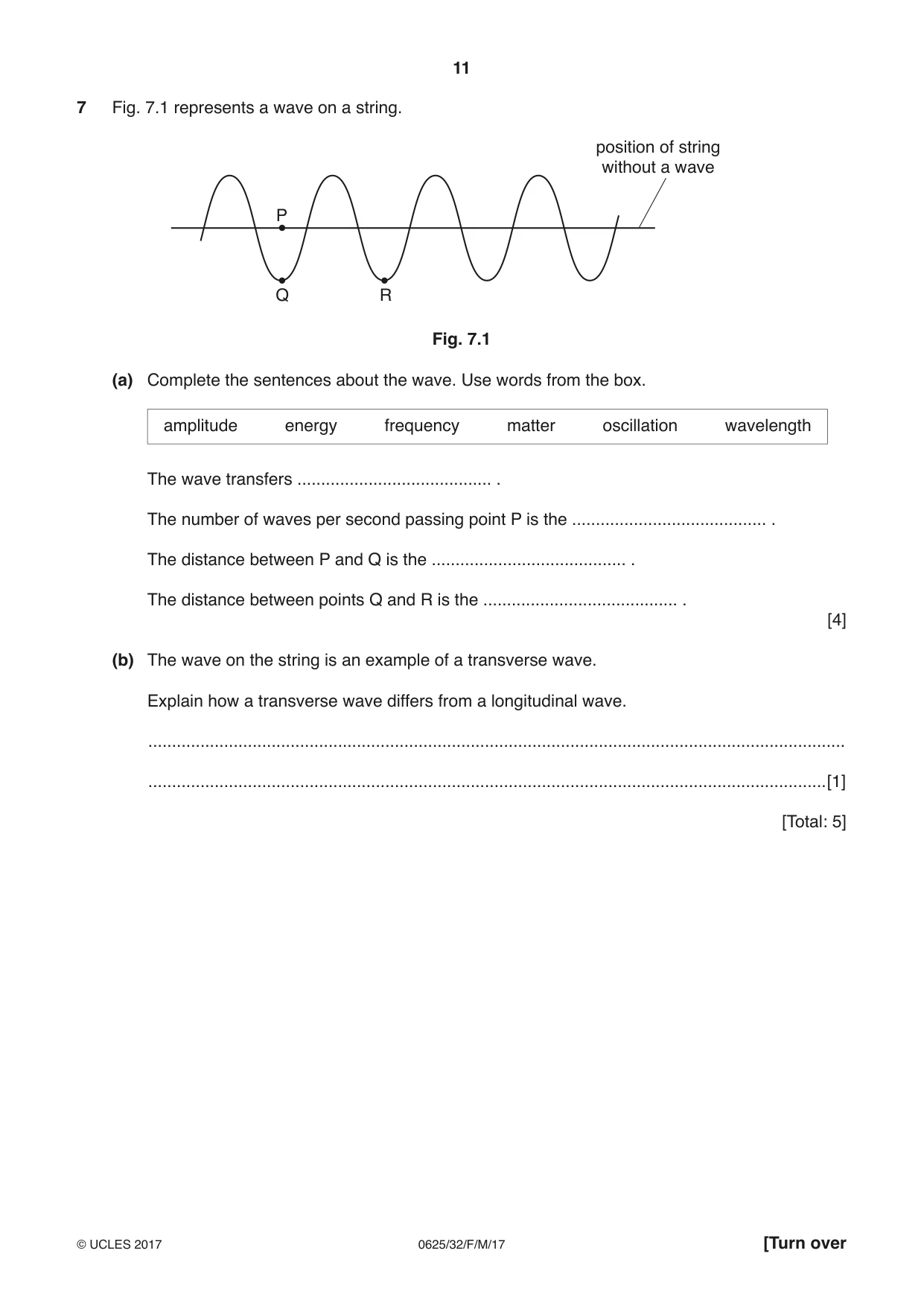
7 Fig. 7.1 represents a wave on a string. position of string without a wave P Q R Fig. 7.1 (a) Complete the sentences about the wave. Use words from the box. amplitude energy frequency matter oscillation wavelength The wave transfers ......................................... . The number of waves per second passing point P is the ......................................... . The distance between P and Q is the ......................................... . The distance between points Q and R is the ......................................... . [4] (b) The wave on the string is an example of a transverse wave. Explain how a transverse wave differs from a longitudinal wave. ................................................................................................................................................... ...............................................................................................................................................[1] [Total: 5]
Mark scheme: 7(a) energy B1 frequency B1 amplitude B1 wavelength B1 7(b) (transverse) vibrations perpendicular to travel/energy transfer B1 Total: 5
Q8 · A cruise ship has a firework display near a cliff as shown in Fig
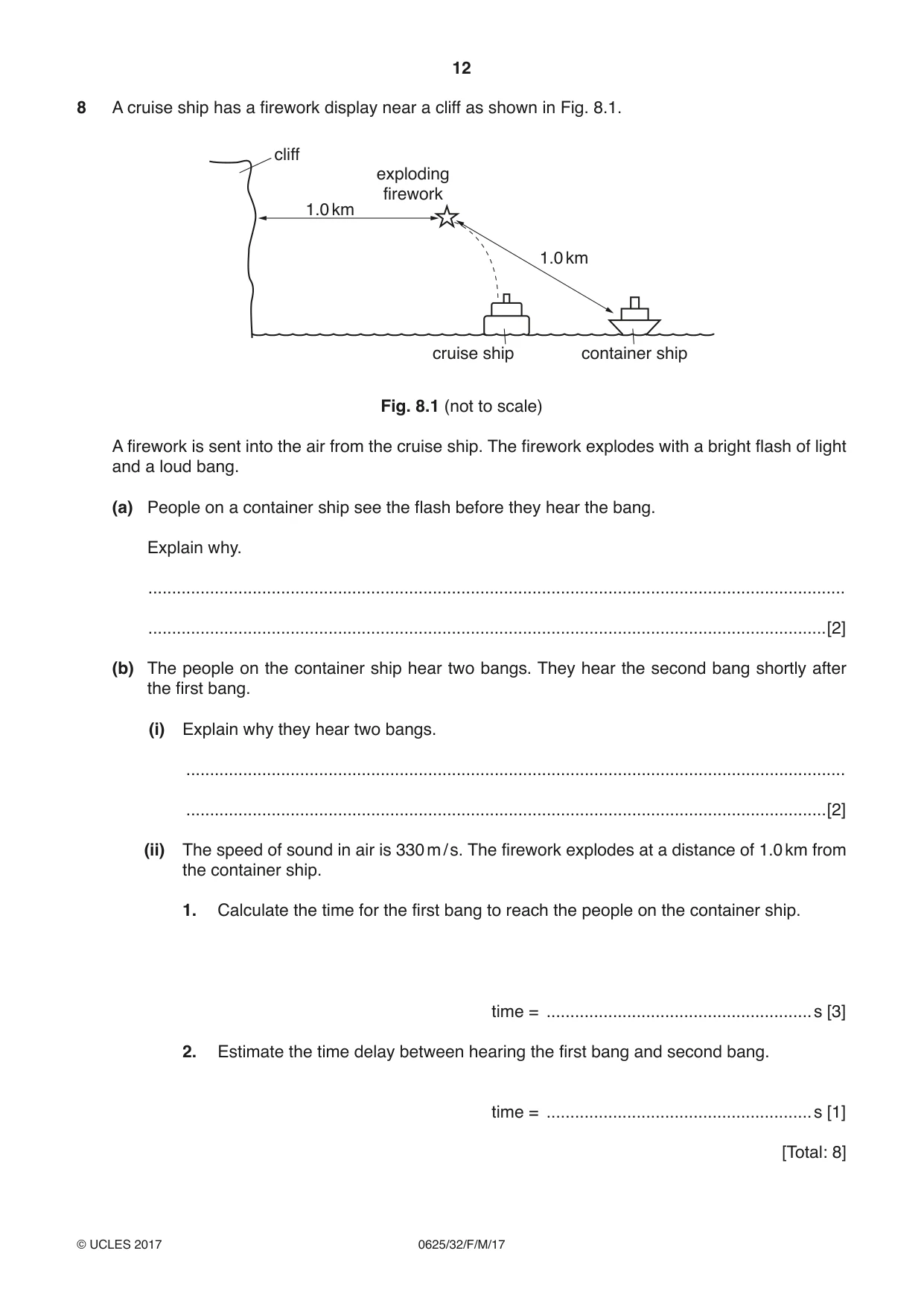
8 A cruise ship has a firework display near a cliff as shown in Fig. 8.1. cliff exploding firework 1.0 km 1.0 km cruise ship container ship Fig. 8.1 (not to scale) A firework is sent into the air from the cruise ship. The firework explodes with a bright flash of light and a loud bang. (a) People on a container ship see the flash before they hear the bang. Explain why. ................................................................................................................................................... ...............................................................................................................................................[2] (b) The people on the container ship hear two bangs. They hear the second bang shortly after the first bang. (i) Explain why they hear two bangs. ........................................................................................................................................... .......................................................................................................................................[2] (ii) The speed of sound in air is 330 m / s. The firework explodes at a distance of 1.0 km from the container ship. 1. Calculate the time for the first bang to reach the people on the container ship. time = ........................................................s [3] 2. Estimate the time delay between hearing the first bang and second bang. time = ........................................................s [1] [Total: 8]
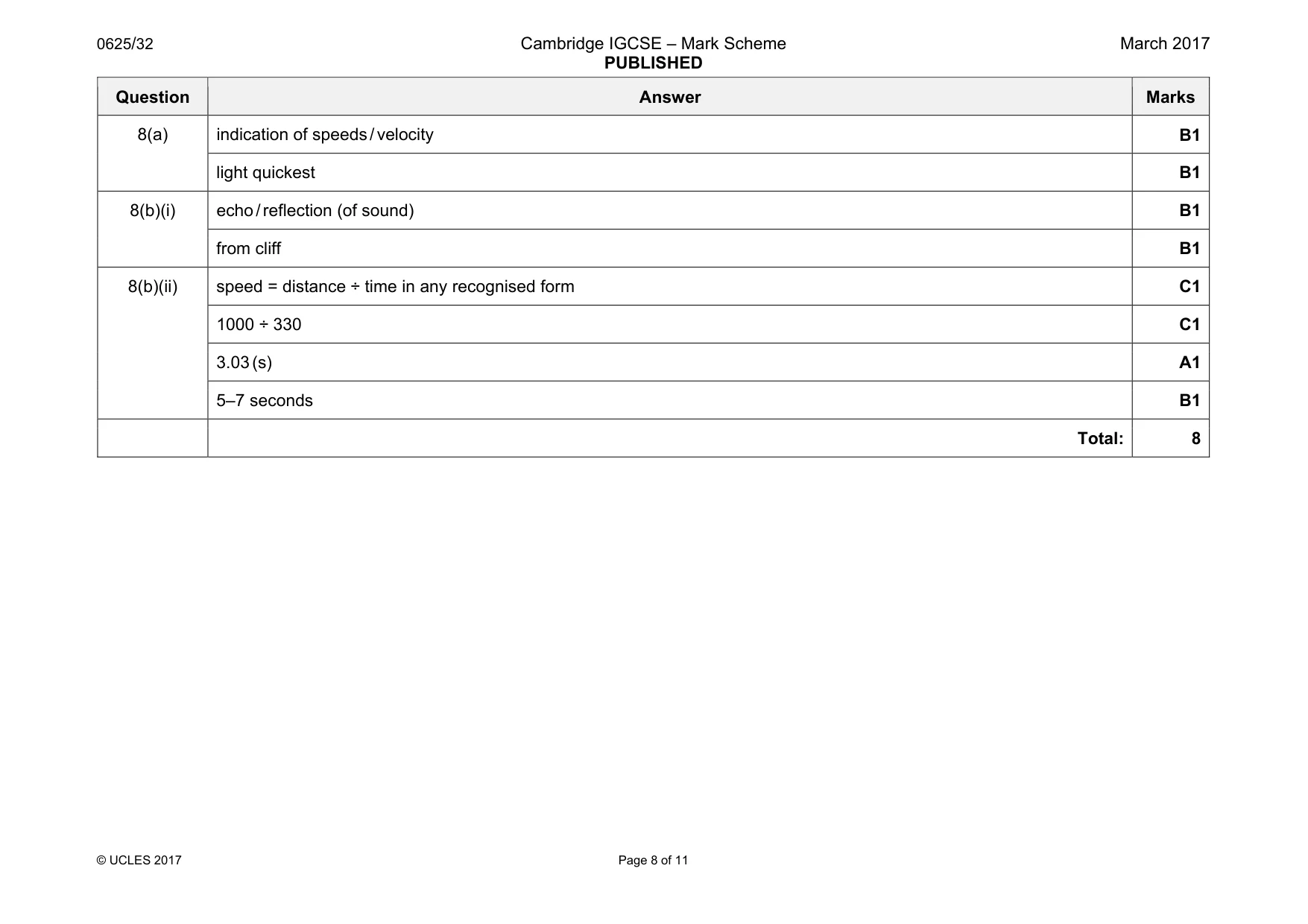
Mark scheme: 8(a) indication of speeds / velocity B1 light quickest B1 8(b)(i) echo / reflection (of sound) B1 from cliff B1 8(b)(ii) speed = distance ÷ time in any recognised form C1 1000 ÷ 330 C1 3.03 (s) A1 5–7 seconds B1 Total: 8
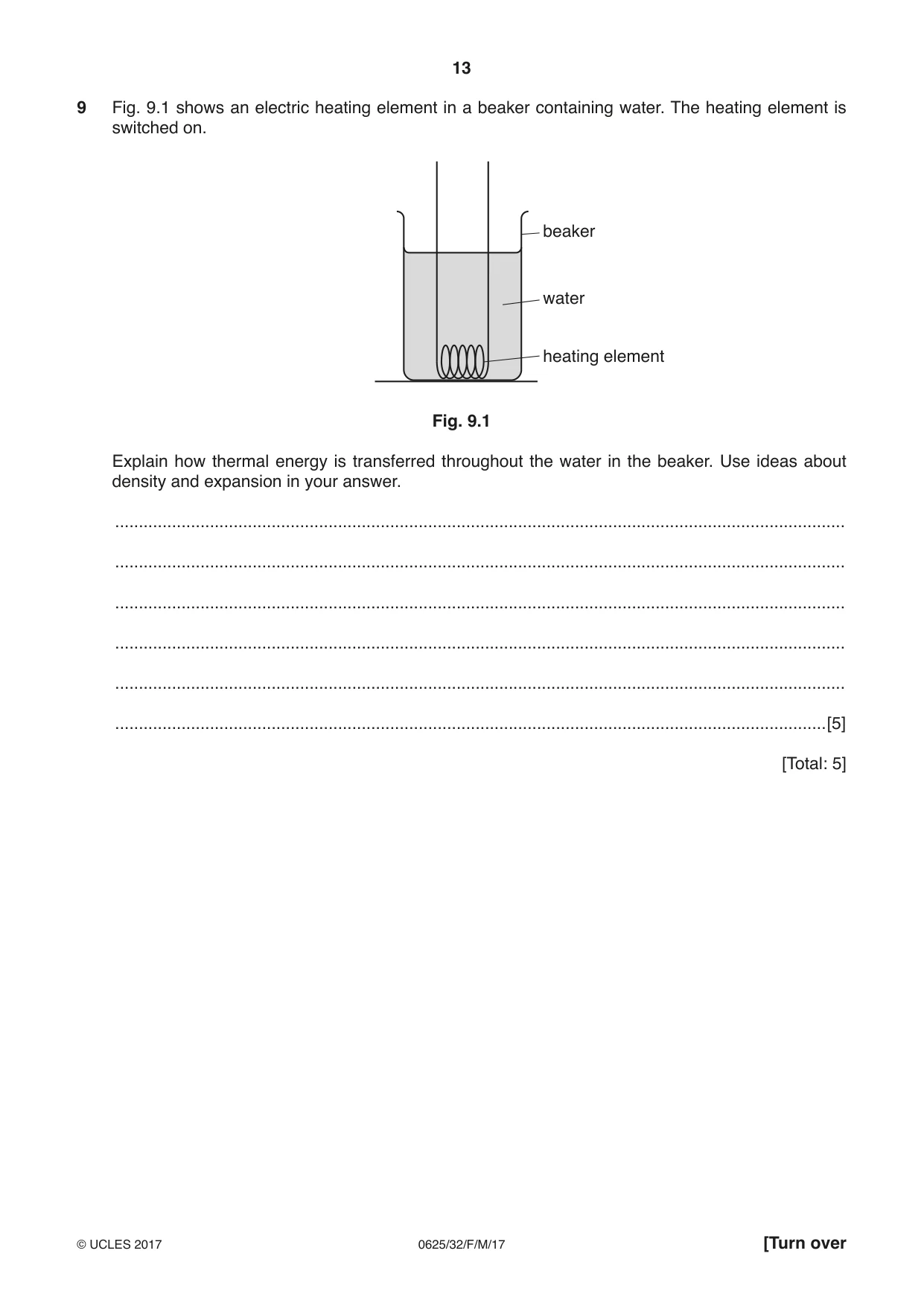
Q9 · An electric heating element in a beaker containing water
9 Fig. 9.1 shows an electric heating element in a beaker containing water. The heating element is switched on. beaker water heating element Fig. 9.1 Explain how thermal energy is transferred throughout the water in the beaker. Use ideas about density and expansion in your answer. .......................................................................................................................................................... .......................................................................................................................................................... .......................................................................................................................................................... .......................................................................................................................................................... .......................................................................................................................................................... ......................................................................................................................................................[5] [Total: 5]
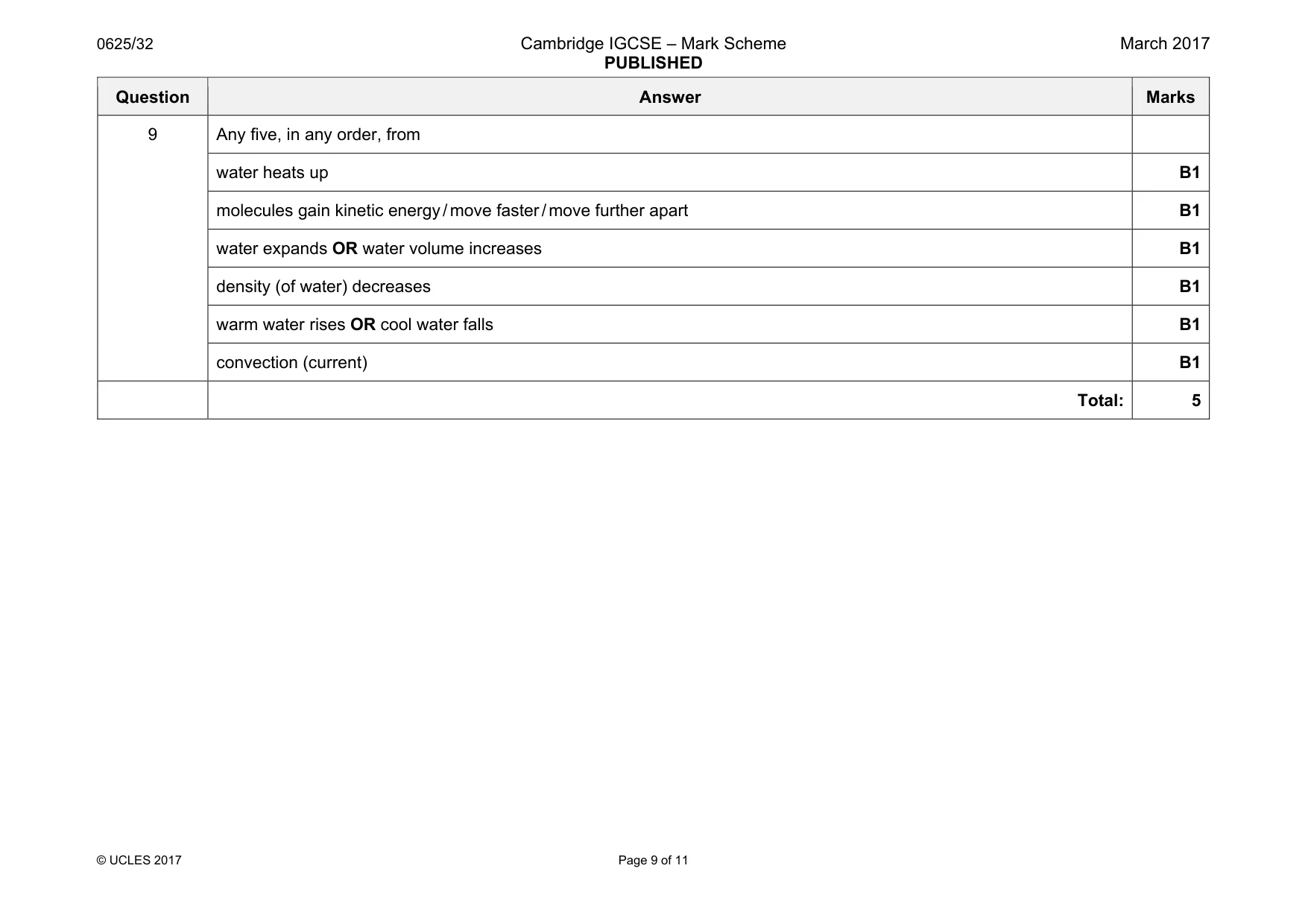
Mark scheme: 9 Any five, in any order, from water heats up B1 molecules gain kinetic energy / move faster / move further apart B1 water expands OR water volume increases B1 density (of water) decreases B1 warm water rises OR cool water falls B1 convection (current) B1 Total: 5
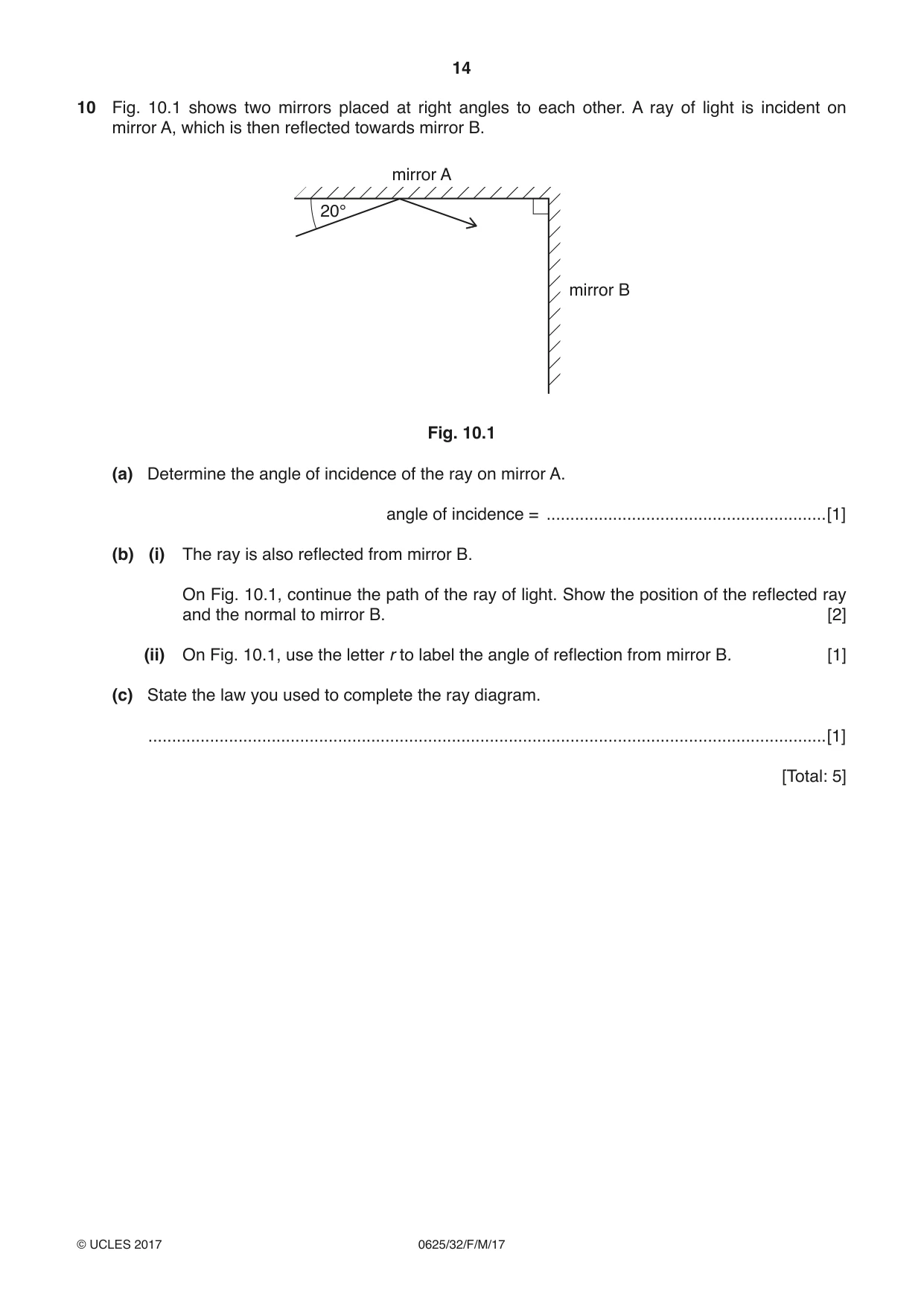
Q10 · Two mirrors placed at right angles to each other
10 Fig. 10.1 shows two mirrors placed at right angles to each other. A ray of light is incident on mirror A, which is then reflected towards mirror B. mirror A 20° mirror B Fig. 10.1 (a) Determine the angle of incidence of the ray on mirror A. angle of incidence = ...........................................................[1] (b) (i) The ray is also reflected from mirror B. On Fig. 10.1, continue the path of the ray of light. Show the position of the reflected ray and the normal to mirror B. [2] (ii) On Fig. 10.1, use the letter r to label the angle of reflection from mirror B. [1] (c) State the law you used to complete the ray diagram. ...............................................................................................................................................[1] [Total: 5]
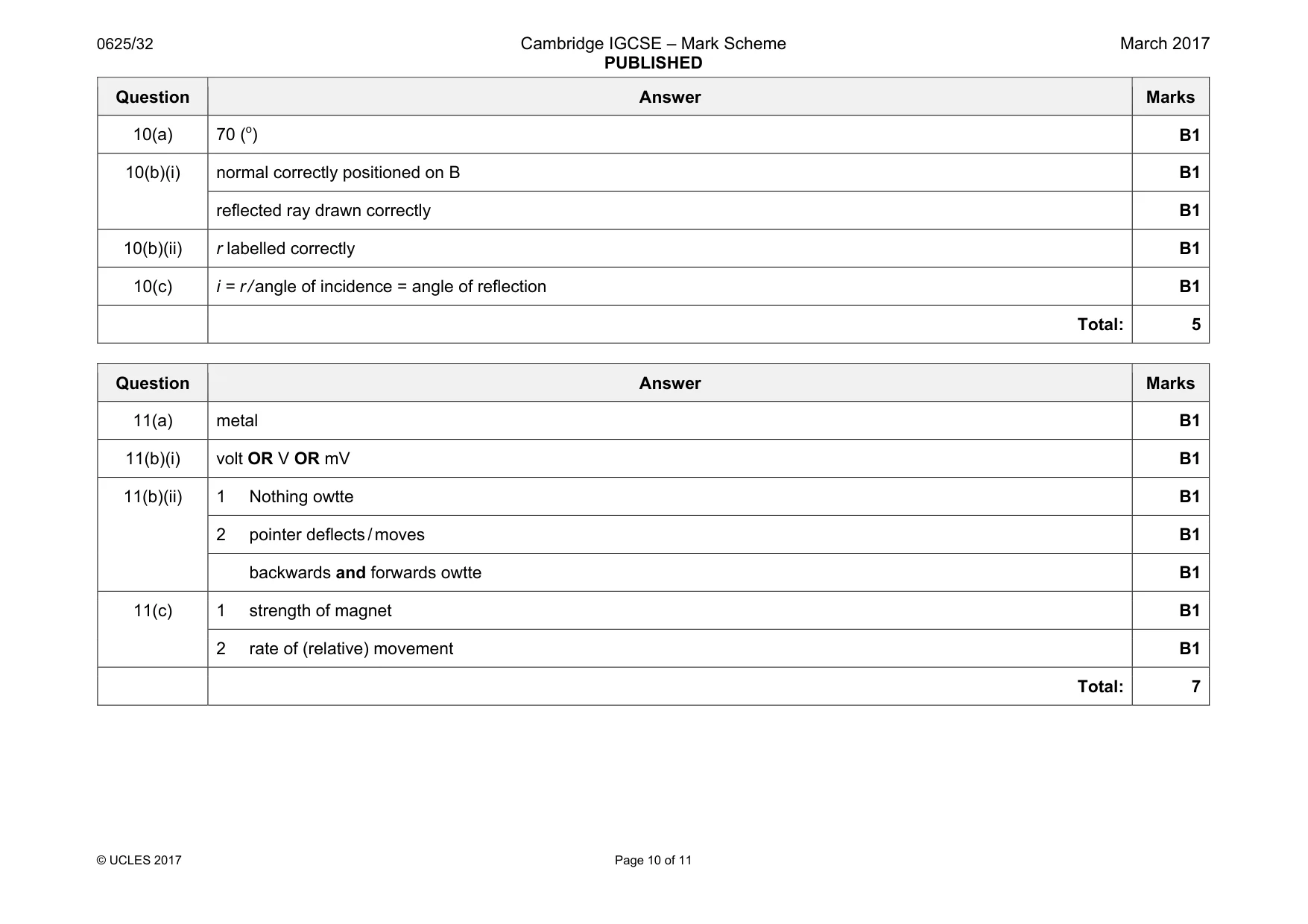
Mark scheme: 10(a) B1 10(b)(i) normal correctly positioned on B B1 reflected ray drawn correctly B1 10(b)(ii) r labelled correctly B1 10(c) i = r / angle of incidence = angle of reflection B1 Total: 5
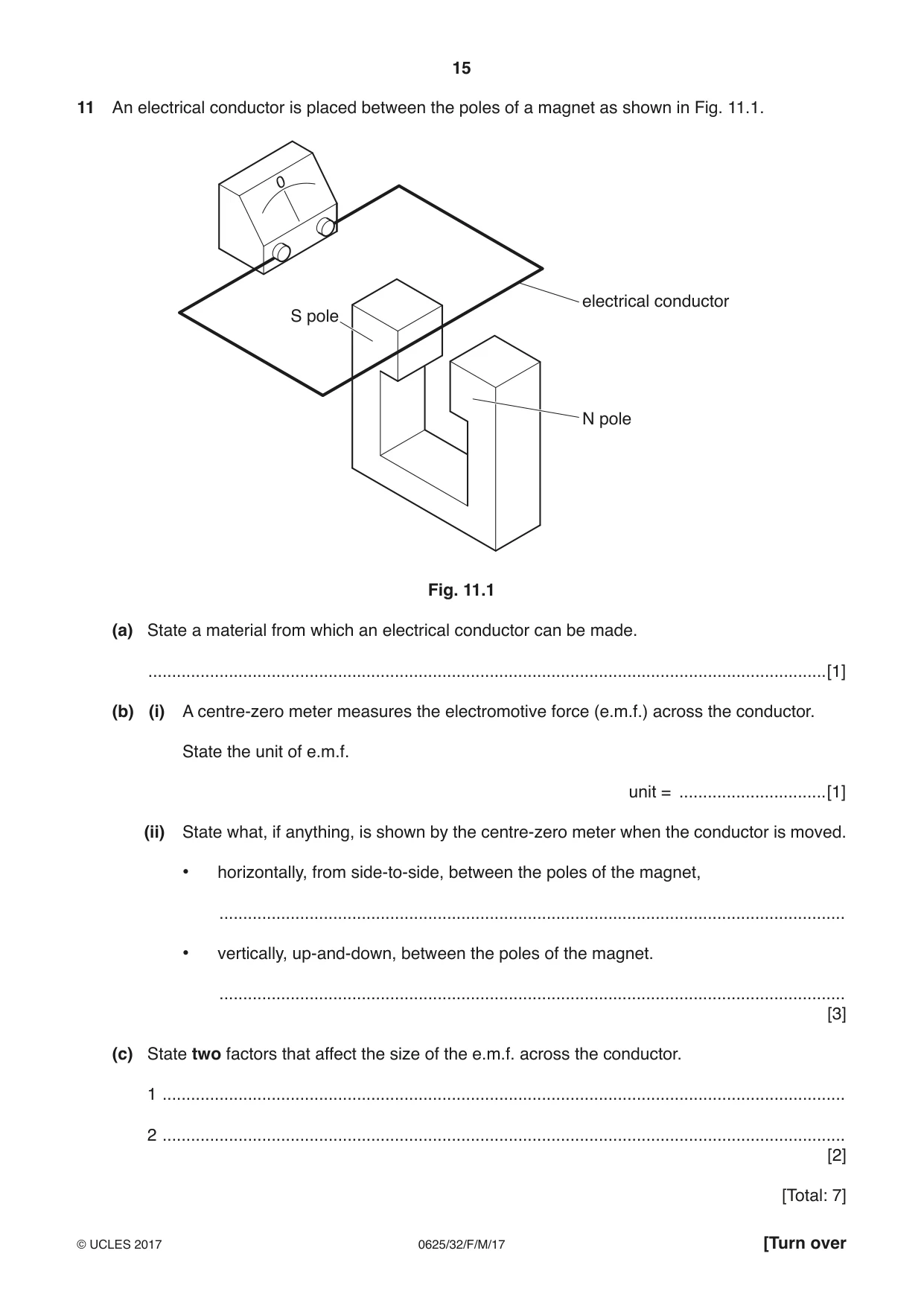
Q11 · An electrical conductor is placed between the poles of a magnet as shown in Fig
11 An electrical conductor is placed between the poles of a magnet as shown in Fig. 11.1. 0 electrical conductor S pole N pole Fig. 11.1 (a) State a material from which an electrical conductor can be made. ...............................................................................................................................................[1] (b) (i) A centre-zero meter measures the electromotive force (e.m.f.) across the conductor. State the unit of e.m.f. unit = ...............................[1] (ii) State what, if anything, is shown by the centre-zero meter when the conductor is moved. • horizontally, from side-to-side, between the poles of the magnet, .................................................................................................................................... • vertically, up-and-down, between the poles of the magnet. .................................................................................................................................... [3] (c) State two factors that affect the size of the e.m.f. across the conductor. 1 ................................................................................................................................................ 2 ................................................................................................................................................ [2] [Total: 7]
Mark scheme: 11(a) metal B1 11(b)(i) volt OR V OR mV B1 11(b)(ii) 1 Nothing owtte B1 2 pointer deflects / moves B1 backwards and forwards owtte B1 11(c) 1 strength of magnet B1 2 rate of (relative) movement B1 Total: 7
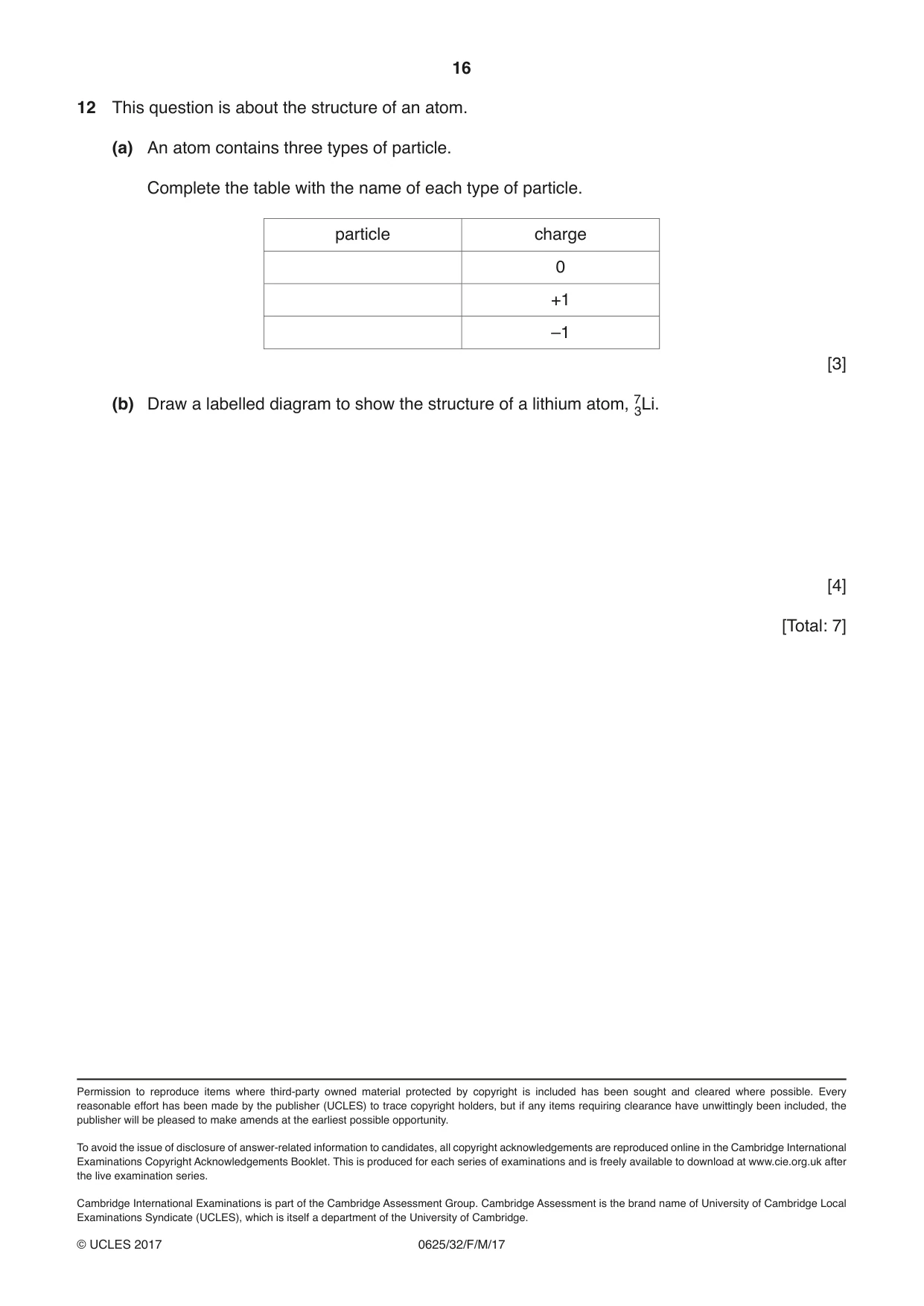
Q12 · This question is about the structure of an atom
12 This question is about the structure of an atom. (a) An atom contains three types of particle. Complete the table with the name of each type of particle. particle charge 0 +1 –1 [3] (b) Draw a labelled diagram to show the structure of a lithium atom, 73Li. [4] [Total: 7]
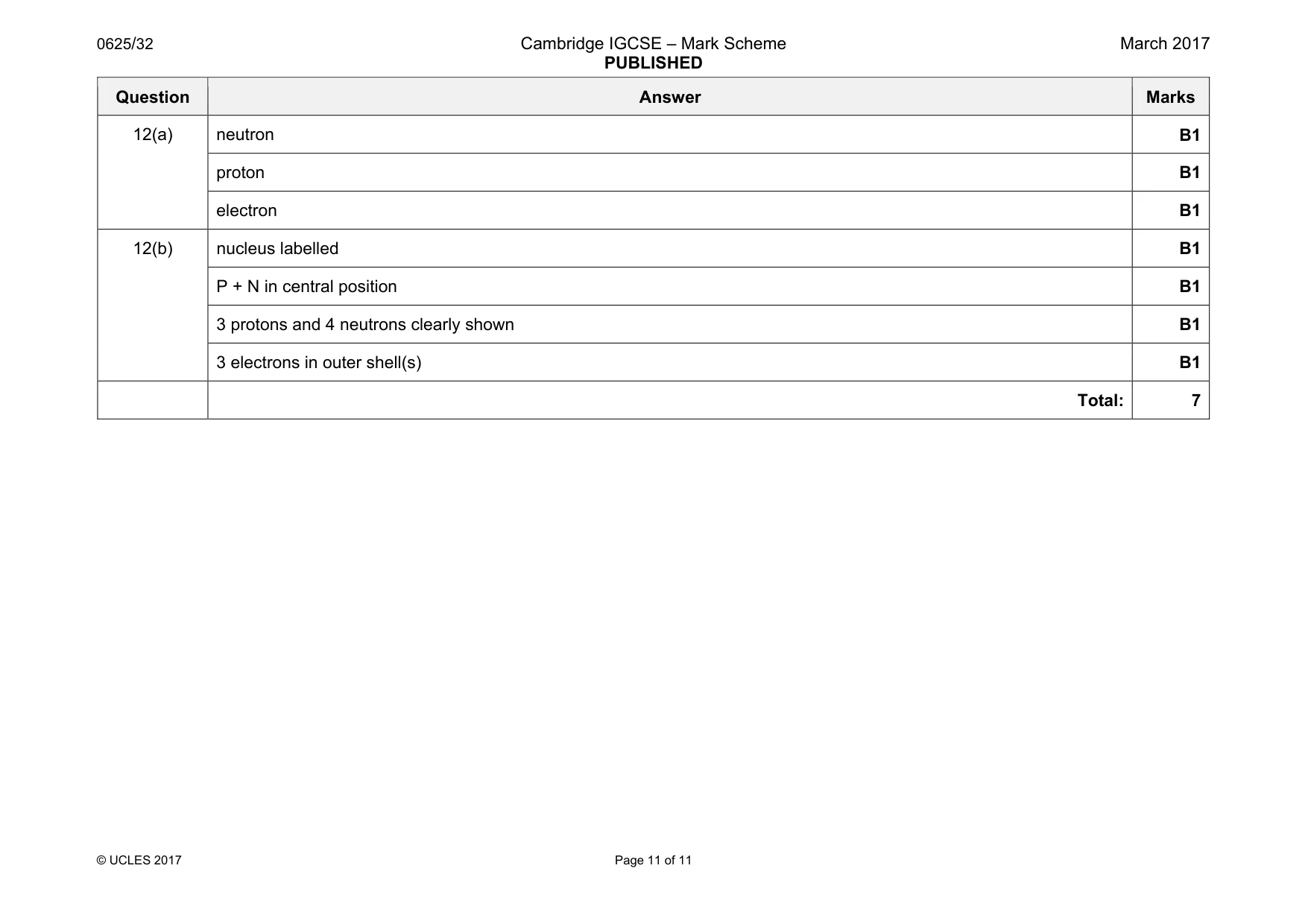
Mark scheme: 12(a) neutron B1 proton B1 electron B1 12(b) nucleus labelled B1 P + N in central position B1 3 protons and 4 neutrons clearly shown B1 3 electrons in outer shell(s) B1 Total: 7
What was in this paper
The subtopics covered by these 12 questions, and how many questions each got. Open one in a new tab to see every Cambridge question on it.
What you needed in this session
Cambridge’s own grade thresholds for 2017 Feb/March, Paper 3 · Variant 2. A higher threshold means an easier paper — the bar moves with how the cohort did.