Cambridge IGCSE Physics 0625 — 2020 Oct/Nov Paper 3 · Variant 3
0625/33/O/N/20 · 11 questions · 80 marks · ≈90 min
The question paper and its mark scheme, free to read here and free to download. This is Cambridge’s own paper, exactly as it was sat.
Question paper20 pages
Mark scheme14 pages
Answers below. Sit the paper first if you are practising.
Questions as text
Q1 · A lorry moving on a straight road
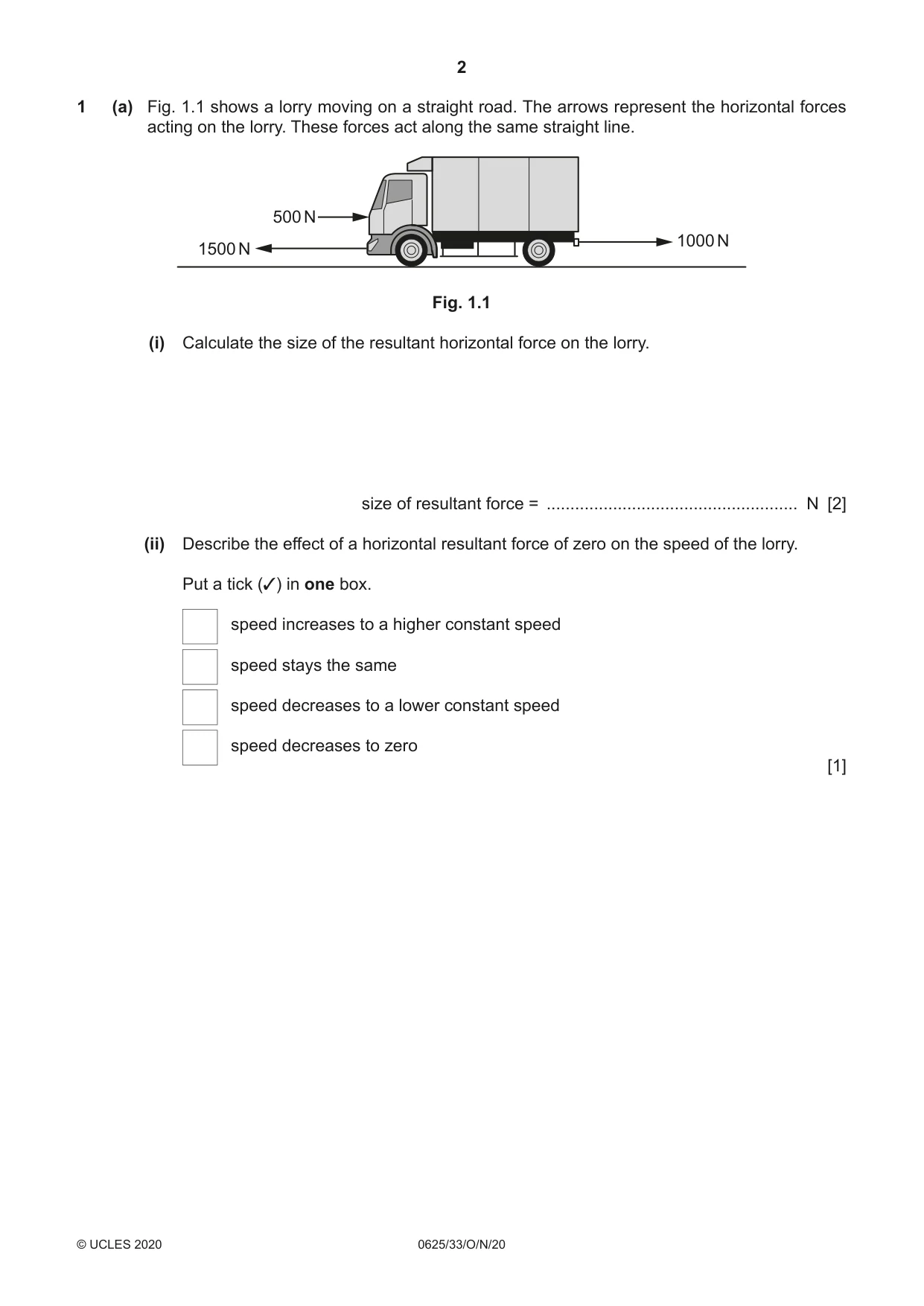
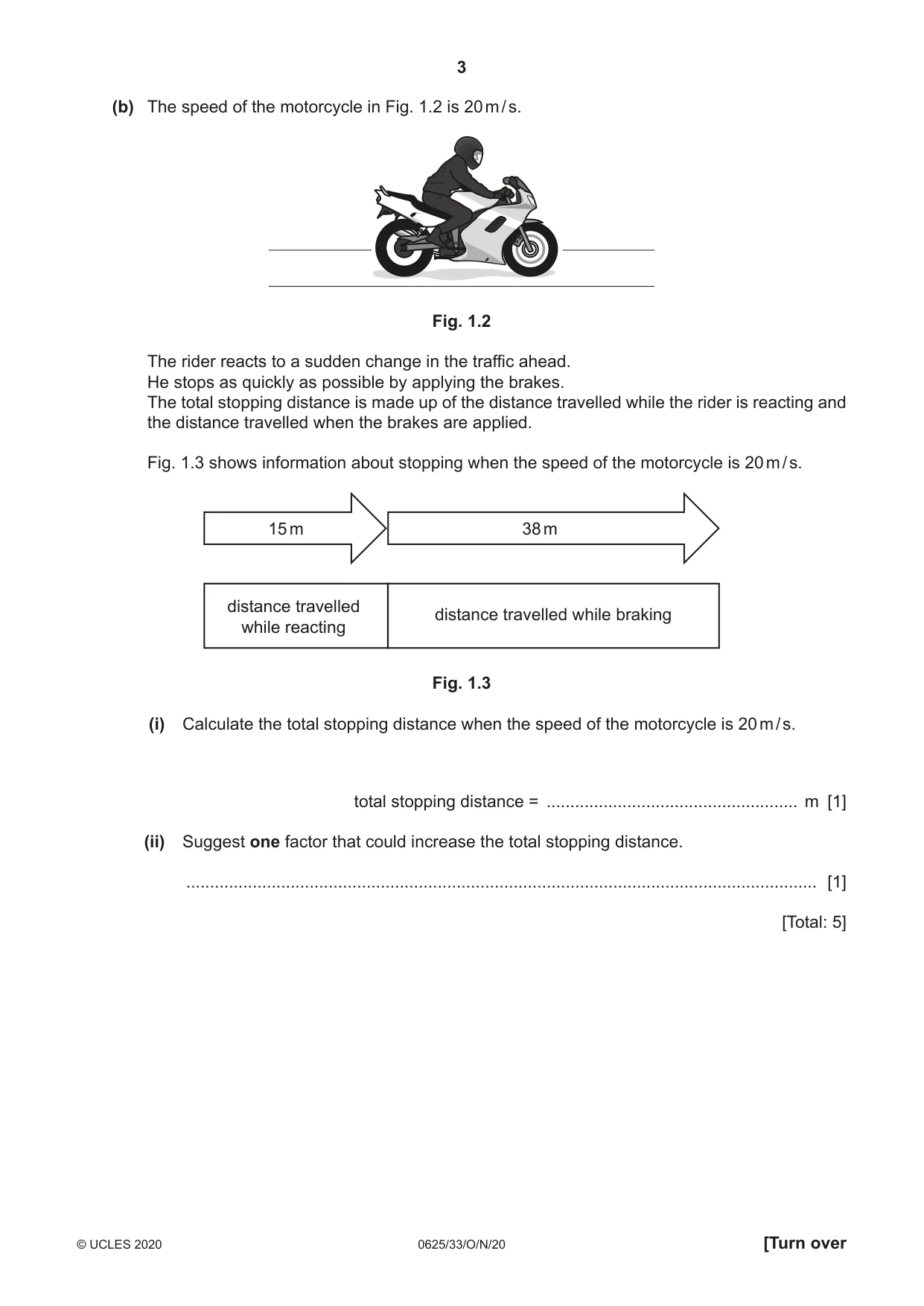
1 (a) Fig. 1.1 shows a lorry moving on a straight road. The arrows represent the horizontal forces acting on the lorry. These forces act along the same straight line. 500 N 1000 N 1500 N Fig. 1.1 (i) Calculate the size of the resultant horizontal force on the lorry. size of resultant force = ..................................................... N [2] (ii) Describe the effect of a horizontal resultant force of zero on the speed of the lorry. Put a tick (3) in one box. speed increases to a higher constant speed speed stays the same speed decreases to a lower constant speed speed decreases to zero [1] (b) The speed of the motorcycle in Fig. 1.2 is 20 m / s. Fig. 1.2 The rider reacts to a sudden change in the traffic ahead. He stops as quickly as possible by applying the brakes. The total stopping distance is made up of the distance travelled while the rider is reacting and the distance travelled when the brakes are applied. Fig. 1.3 shows information about stopping when the speed of the motorcycle is 20 m / s. 15 m 38 m distance travelled distance travelled while braking while reacting Fig. 1.3 (i) Calculate the total stopping distance when the speed of the motorcycle is 20 m / s. total stopping distance = ..................................................... m [1] (ii) Suggest one factor that could increase the total stopping distance. ..................................................................................................................................... [1] [Total: 5]
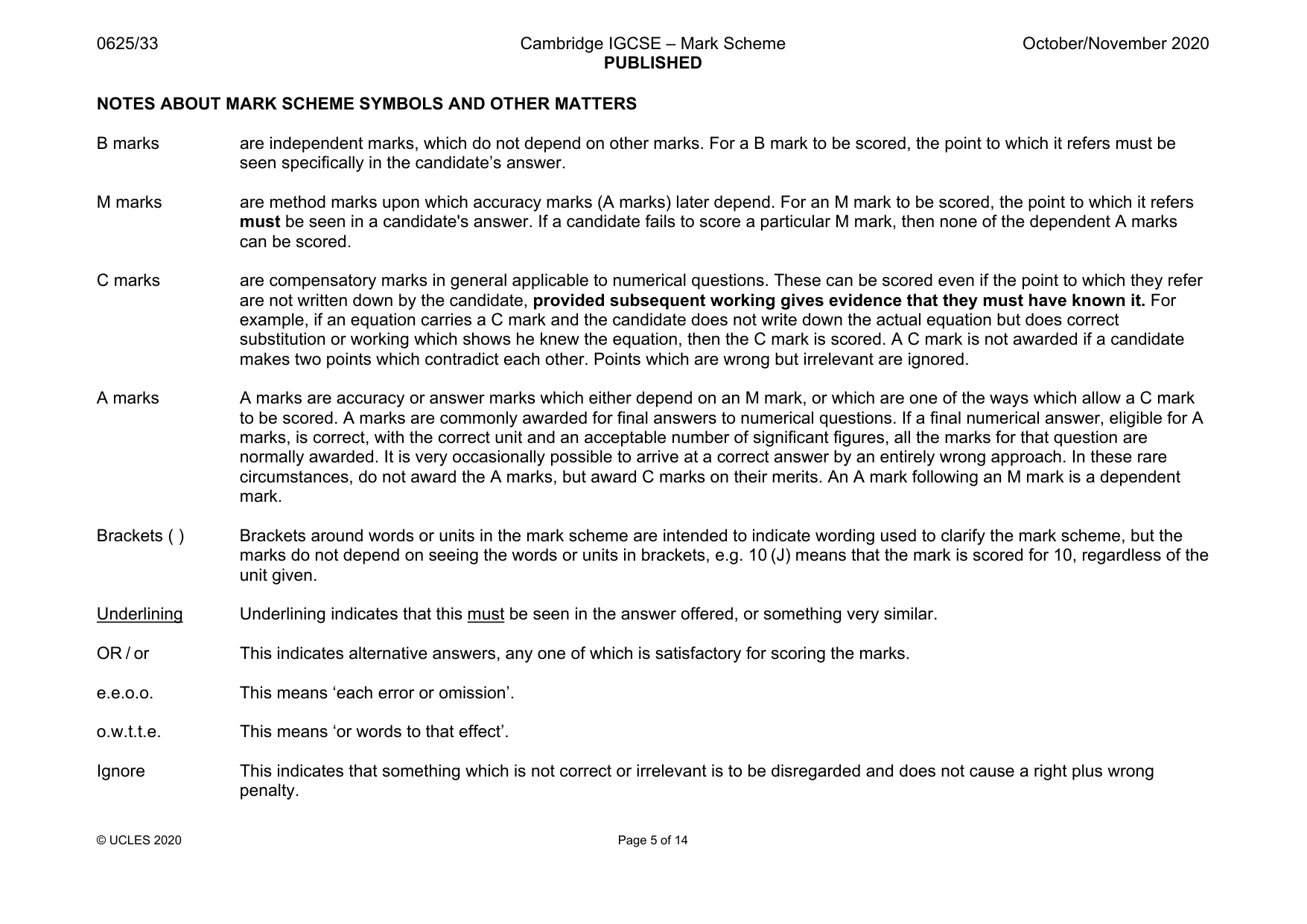
Mark scheme: 1(a)(i) 1000 + 500 OR 1500 OR 1500 – 1500 OR 1500 – their ‘1500’ OR 1500 – 1000 OR 1500 – 500 C1 0 / zero A1 1(a)(ii) 2nd box (speed stays the same) B1 1(b)(i) (15 + 38) = 53 (m) B1 1(b)(ii) reduced friction / wet / icy (conditions) / worn tyres tiredness / drugs / alcohol / higher speed / going down hill B1
Q2 · Two children sitting on a see-saw
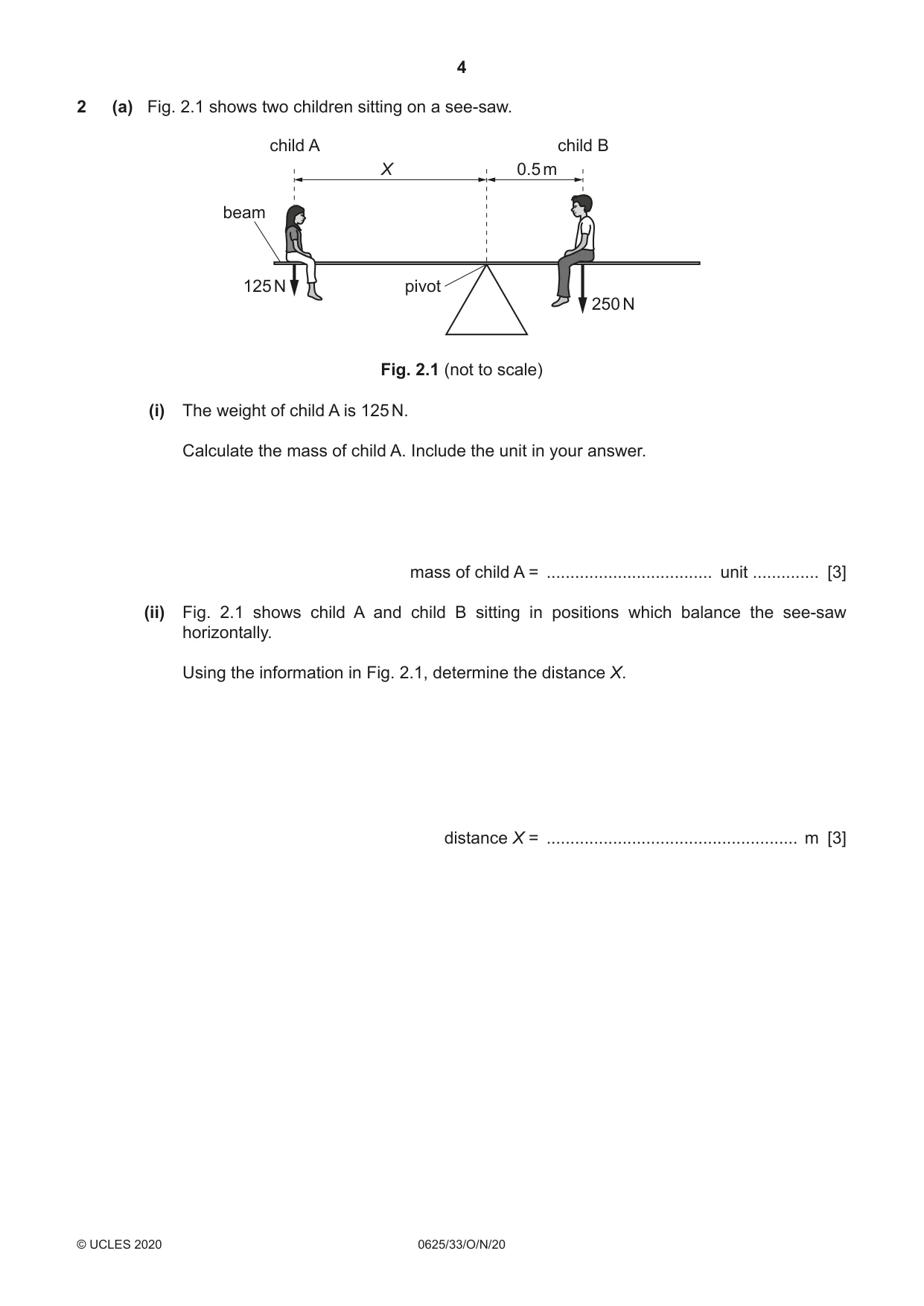
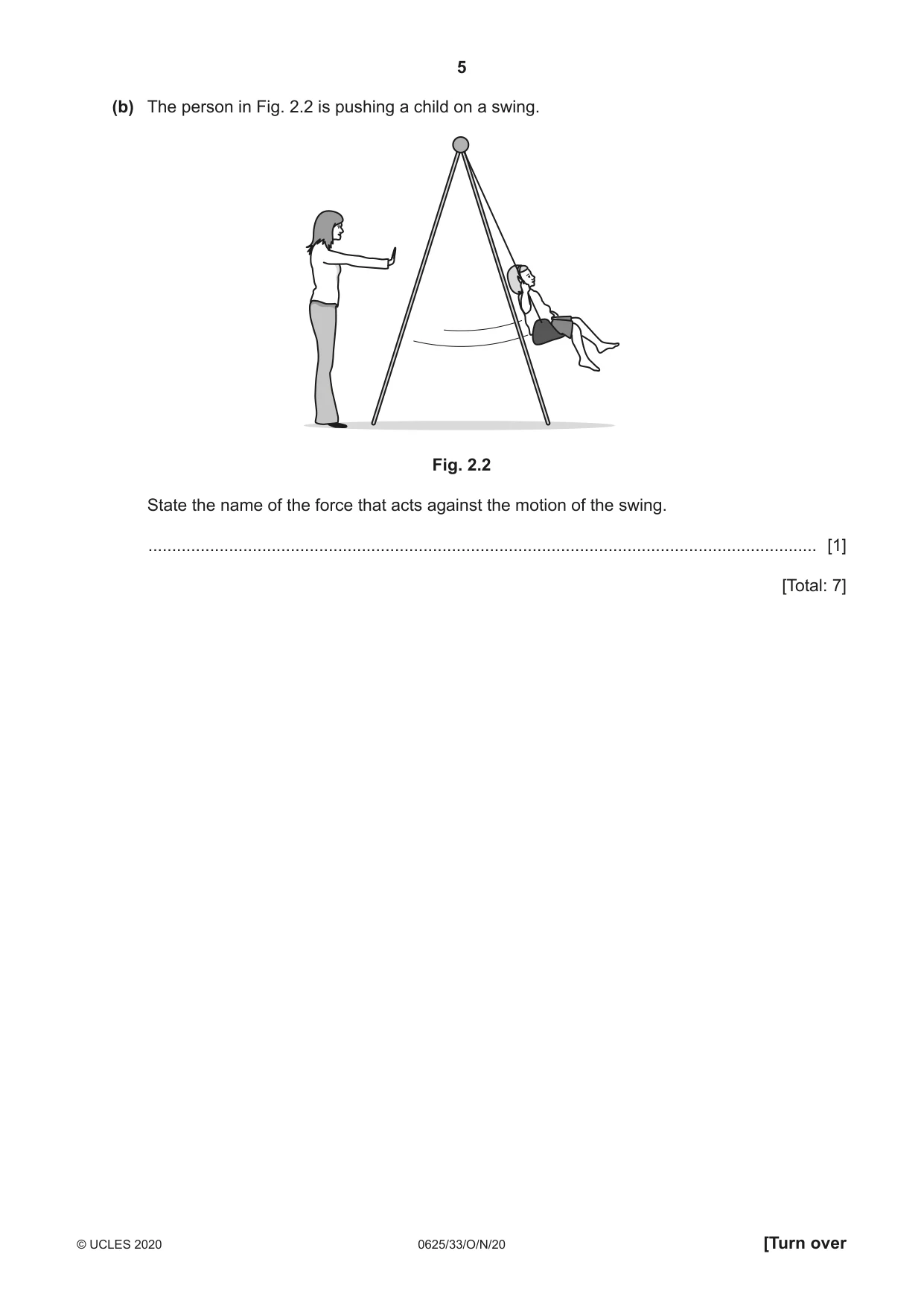
2 (a) Fig. 2.1 shows two children sitting on a see-saw. child A child B X 0.5 m beam 125 N pivot 250 N Fig. 2.1 (not to scale) (i) The weight of child A is 125 N. Calculate the mass of child A. Include the unit in your answer. mass of child A = ................................... unit .............. [3] (ii) Fig. 2.1 shows child A and child B sitting in positions which balance the see-saw horizontally. Using the information in Fig. 2.1, determine the distance X. distance X = ..................................................... m [3] (b) The person in Fig. 2.2 is pushing a child on a swing. Fig. 2.2 State the name of the force that acts against the motion of the swing. ............................................................................................................................................. [1] [Total: 7]
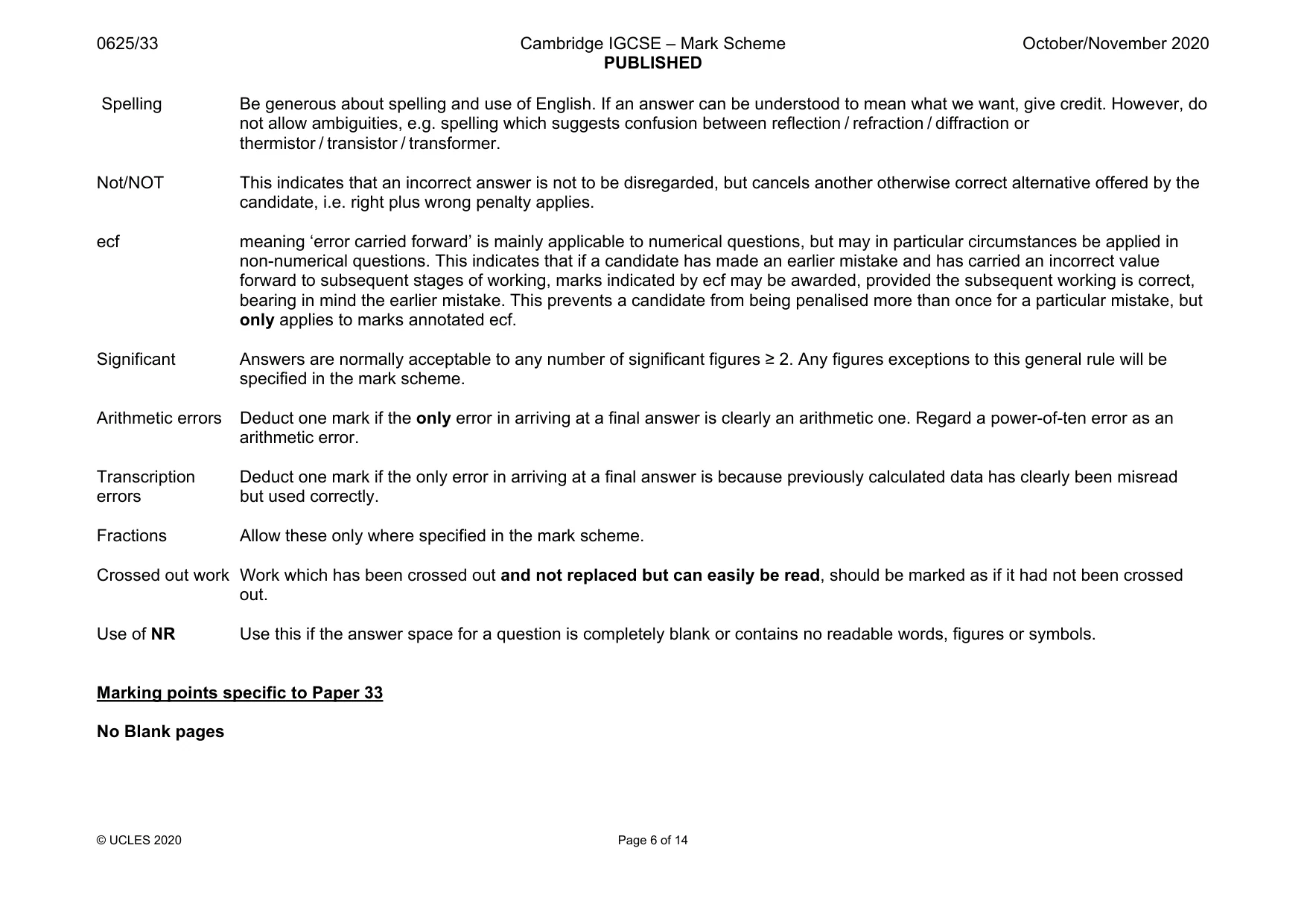
Mark scheme: 2(a)(i) W = mg OR W = 10 × m C1 12.5 A1 kg B1 2(a)(ii) 250 × 0.5 OR X × 125 C1 clockwise moment = anticlockwise moment C1 (X=) 1.0 (m) A1 2(b) air resistance / drag B1
Q3 · A man lifts 40 blocks onto a platform, as shown in Fig
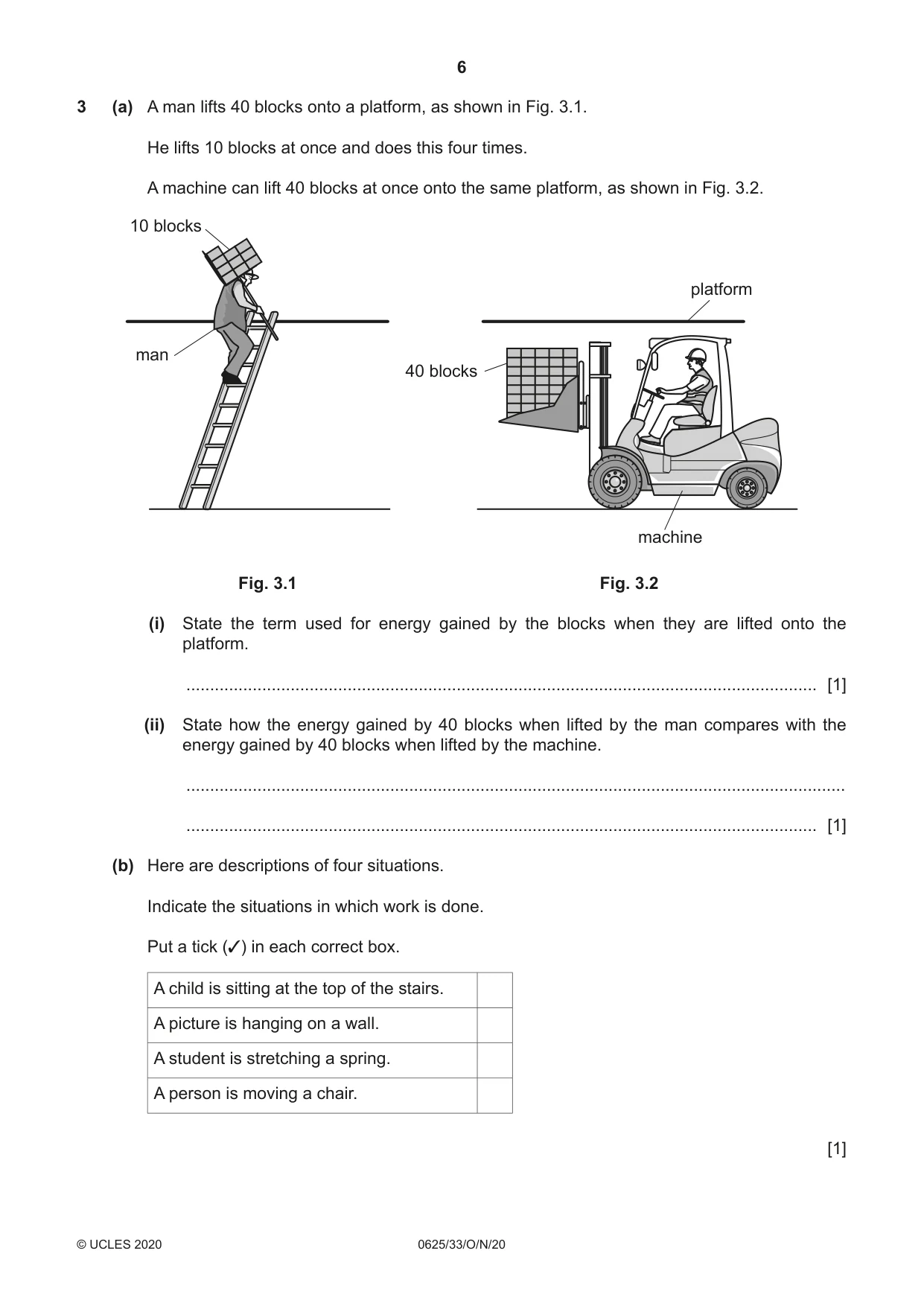
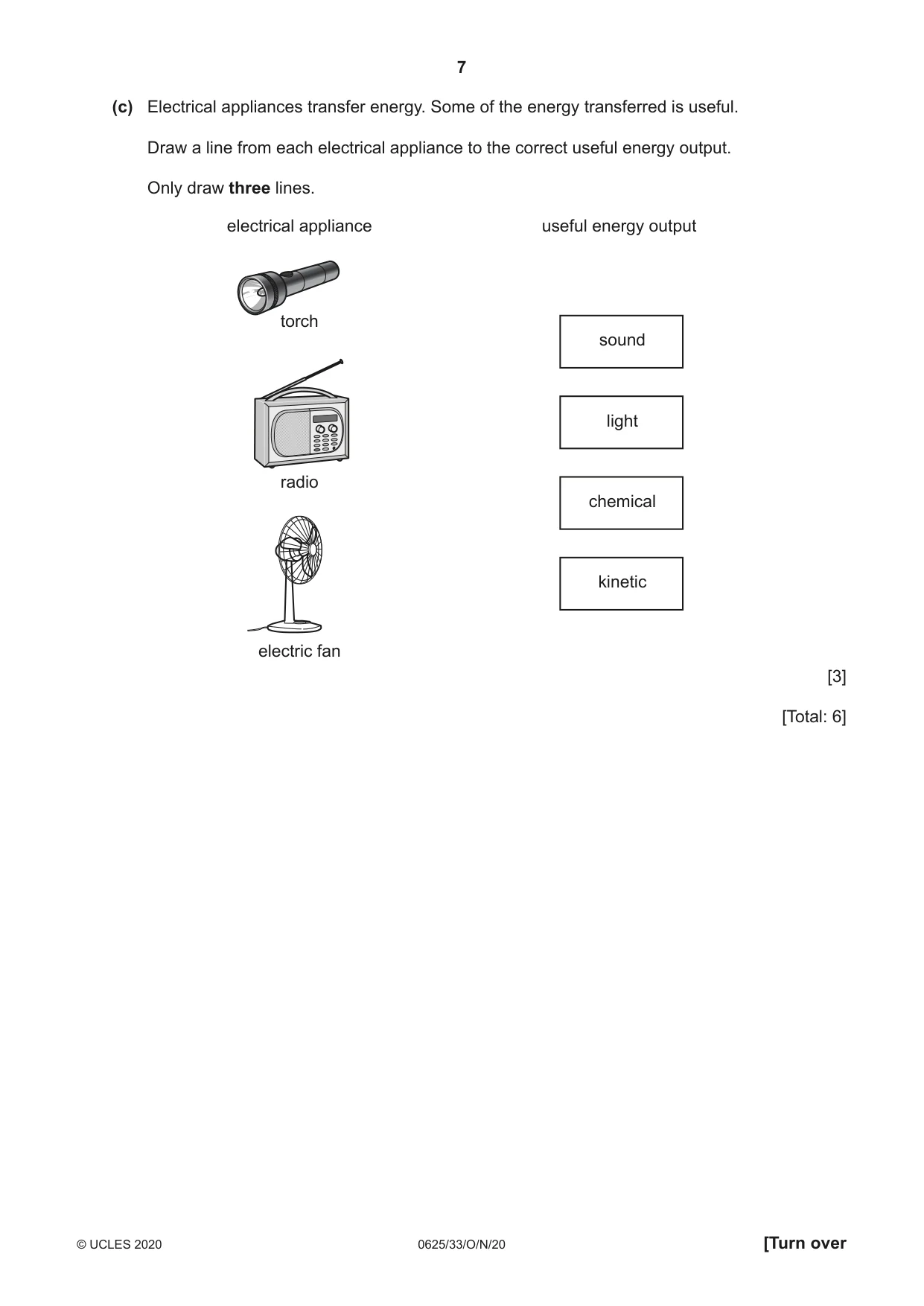
3 (a) A man lifts 40 blocks onto a platform, as shown in Fig. 3.1. He lifts 10 blocks at once and does this four times. A machine can lift 40 blocks at once onto the same platform, as shown in Fig. 3.2. 10 blocks platform man 40 blocks machine Fig. 3.1 Fig. 3.2 (i) State the term used for energy gained by the blocks when they are lifted onto the platform. ..................................................................................................................................... [1] (ii) State how the energy gained by 40 blocks when lifted by the man compares with the energy gained by 40 blocks when lifted by the machine. ........................................................................................................................................... ..................................................................................................................................... [1] (b) Here are descriptions of four situations. Indicate the situations in which work is done. Put a tick (3) in each correct box. A child is sitting at the top of the stairs. A picture is hanging on a wall. A student is stretching a spring. A person is moving a chair. [1] (c) Electrical appliances transfer energy. Some of the energy transferred is useful. Draw a line from each electrical appliance to the correct useful energy output. Only draw three lines. electrical appliance useful energy output torch sound light radio chemical kinetic electric fan [3] [Total: 6]
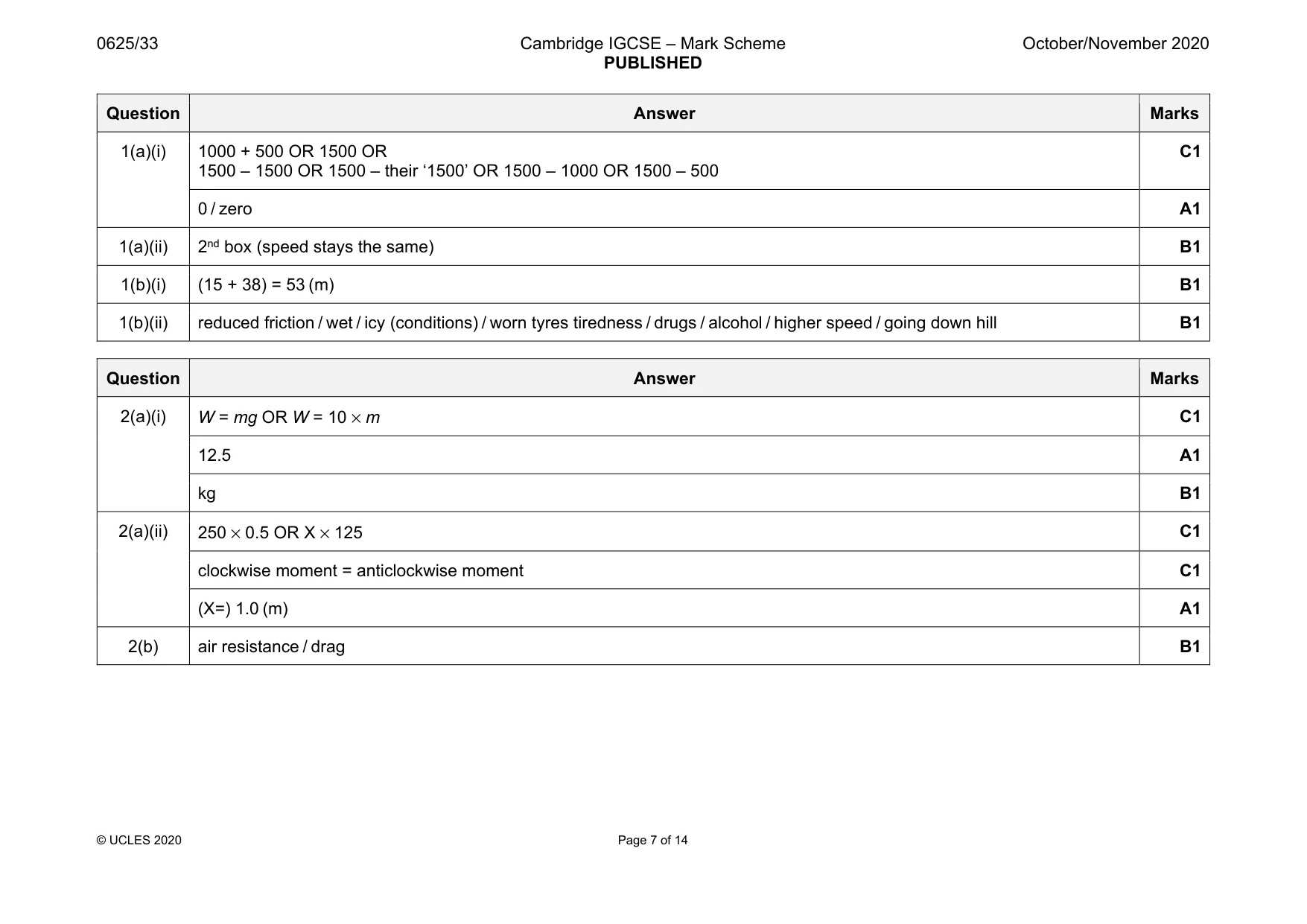
Mark scheme: 3(a)(i) (gravitational) potential (energy) B1 3(a)(ii) the same B1 3(b) A child is sitting at the top of the stairs. A picture is hanging on a wall. A student is stretching a spring. A person is moving a chair. B1 3(c) torch – light B1 radio – sound B1 fan - kinetic B1
Q4 · Some vehicles have wide tyres so that they can drive over soft mud
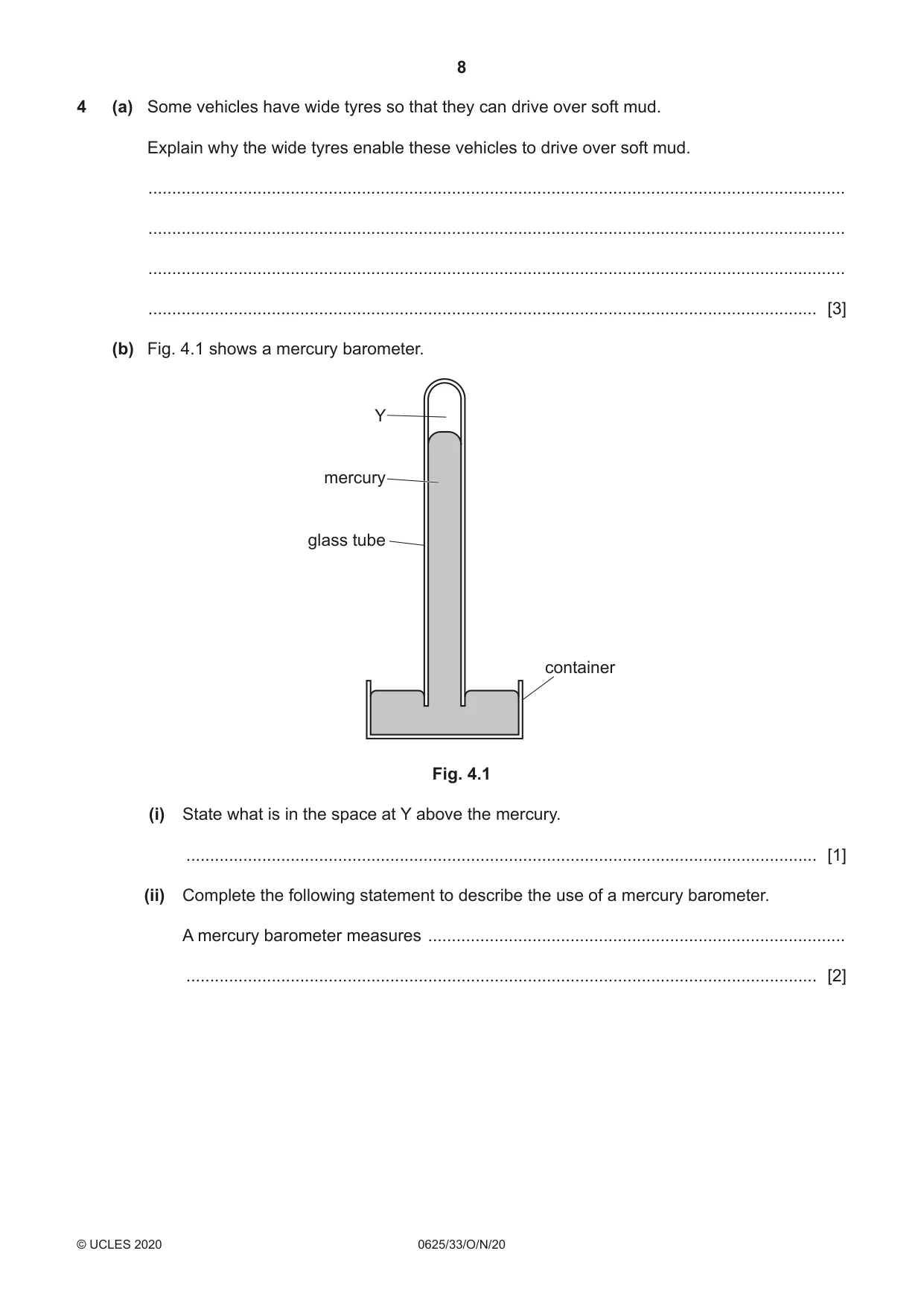
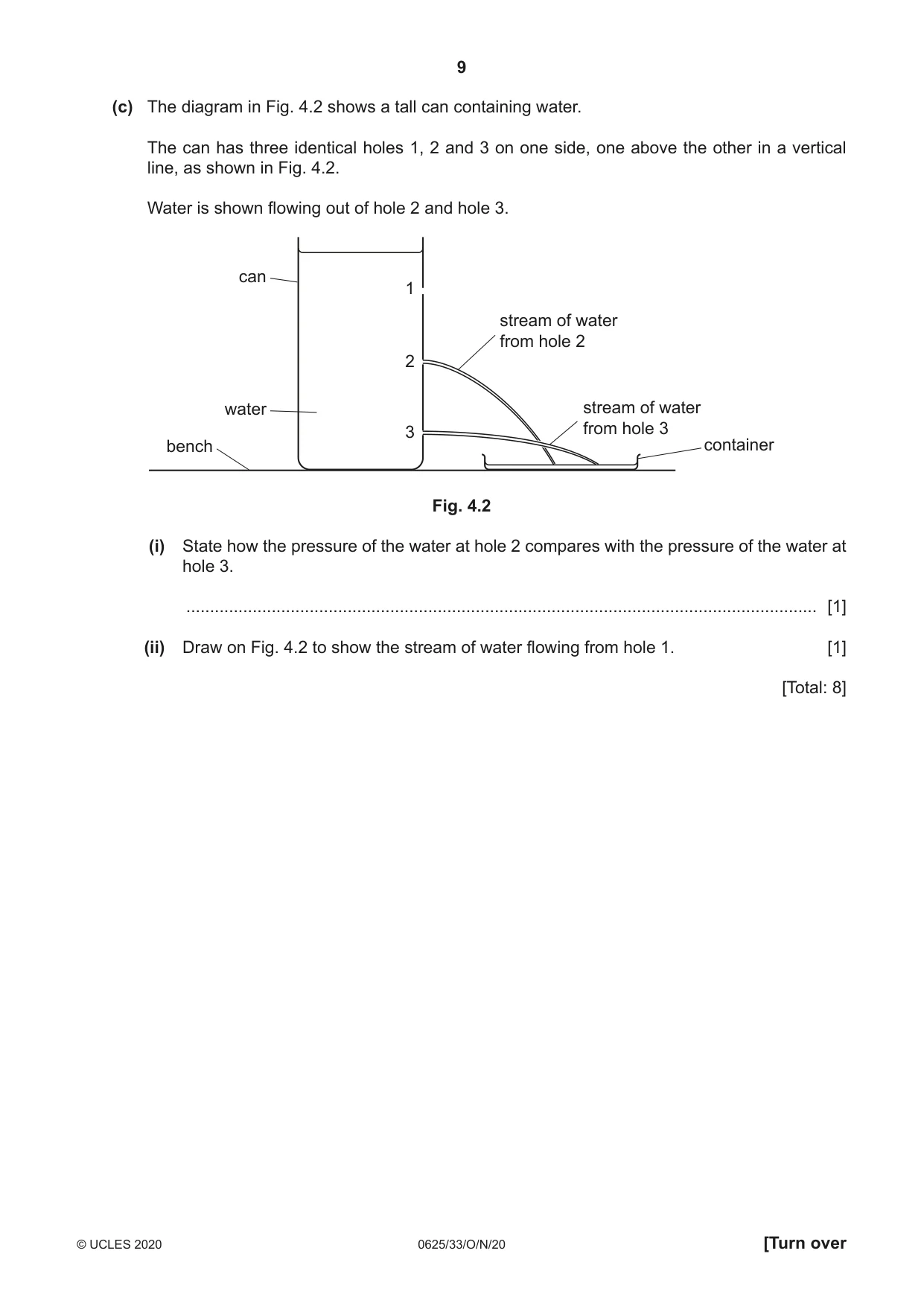
4 (a) Some vehicles have wide tyres so that they can drive over soft mud. Explain why the wide tyres enable these vehicles to drive over soft mud. ................................................................................................................................................... ................................................................................................................................................... ................................................................................................................................................... ............................................................................................................................................. [3] (b) Fig. 4.1 shows a mercury barometer. Y mercury glass tube container Fig. 4.1 (i) State what is in the space at Y above the mercury. ..................................................................................................................................... [1] (ii) Complete the following statement to describe the use of a mercury barometer. A mercury barometer measures ........................................................................................ ..................................................................................................................................... [2] (c) The diagram in Fig. 4.2 shows a tall can containing water. The can has three identical holes 1, 2 and 3 on one side, one above the other in a vertical line, as shown in Fig. 4.2. Water is shown flowing out of hole 2 and hole 3. can 1 stream of water from hole 2 2 water stream of water 3 from hole 3 bench container Fig. 4.2 (i) State how the pressure of the water at hole 2 compares with the pressure of the water at hole 3. ..................................................................................................................................... [1] (ii) Draw on Fig. 4.2 to show the stream of water flowing from hole 1. [1] [Total: 8]
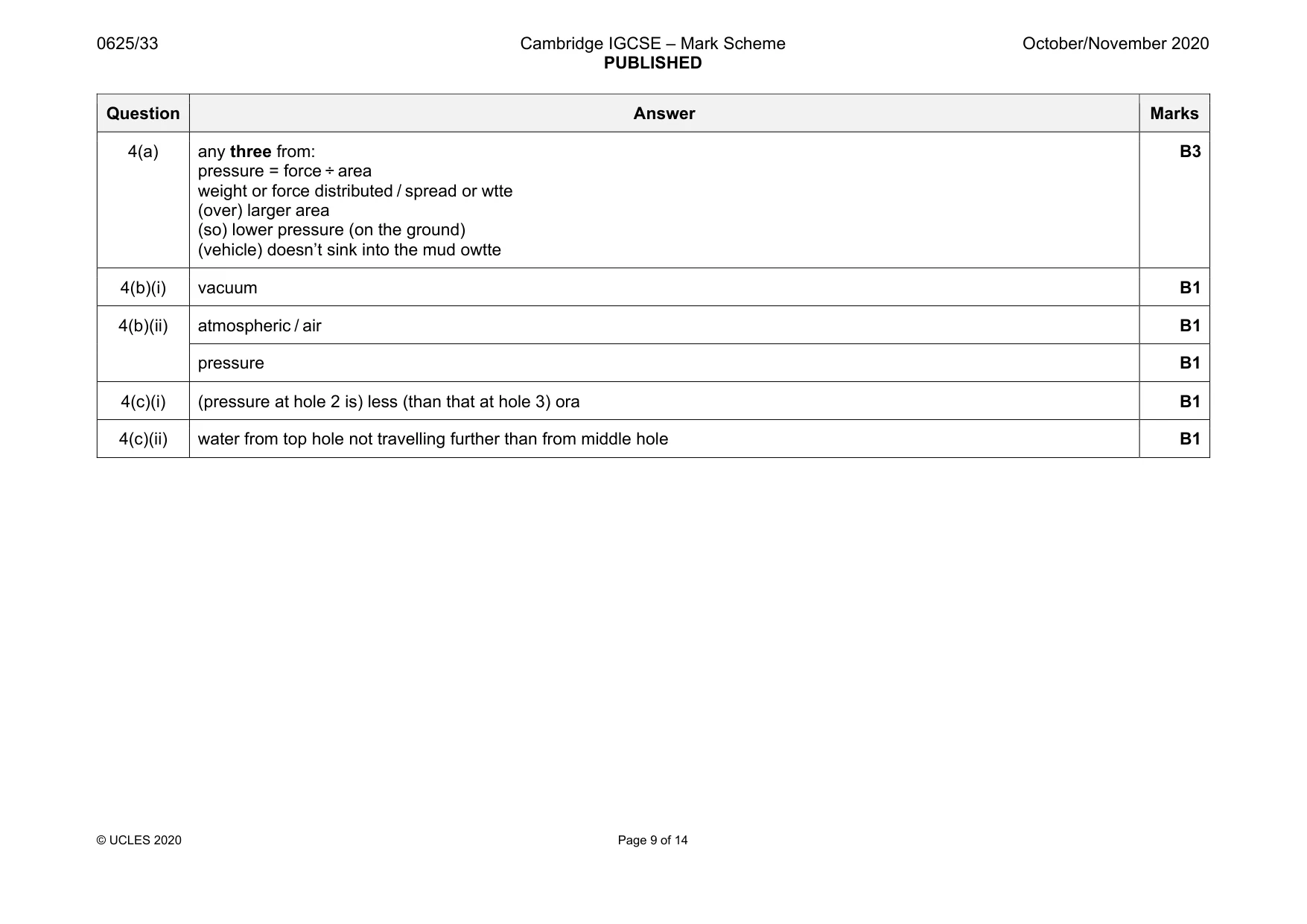
Mark scheme: 4(a) any three from: pressure = force ÷ area weight or force distributed / spread or wtte (over) larger area (so) lower pressure (on the ground) (vehicle) doesn’t sink into the mud owtte 4(b)(i) vacuum B1 4(b)(ii) atmospheric / air B1 pressure B1 4(c)(i) (pressure at hole 2 is) less (than that at hole 3) ora B1 4(c)(ii) water from top hole not travelling further than from middle hole B1
Q5 · Diagrams of the arrangement of molecules in three states of matter and shows descriptions…
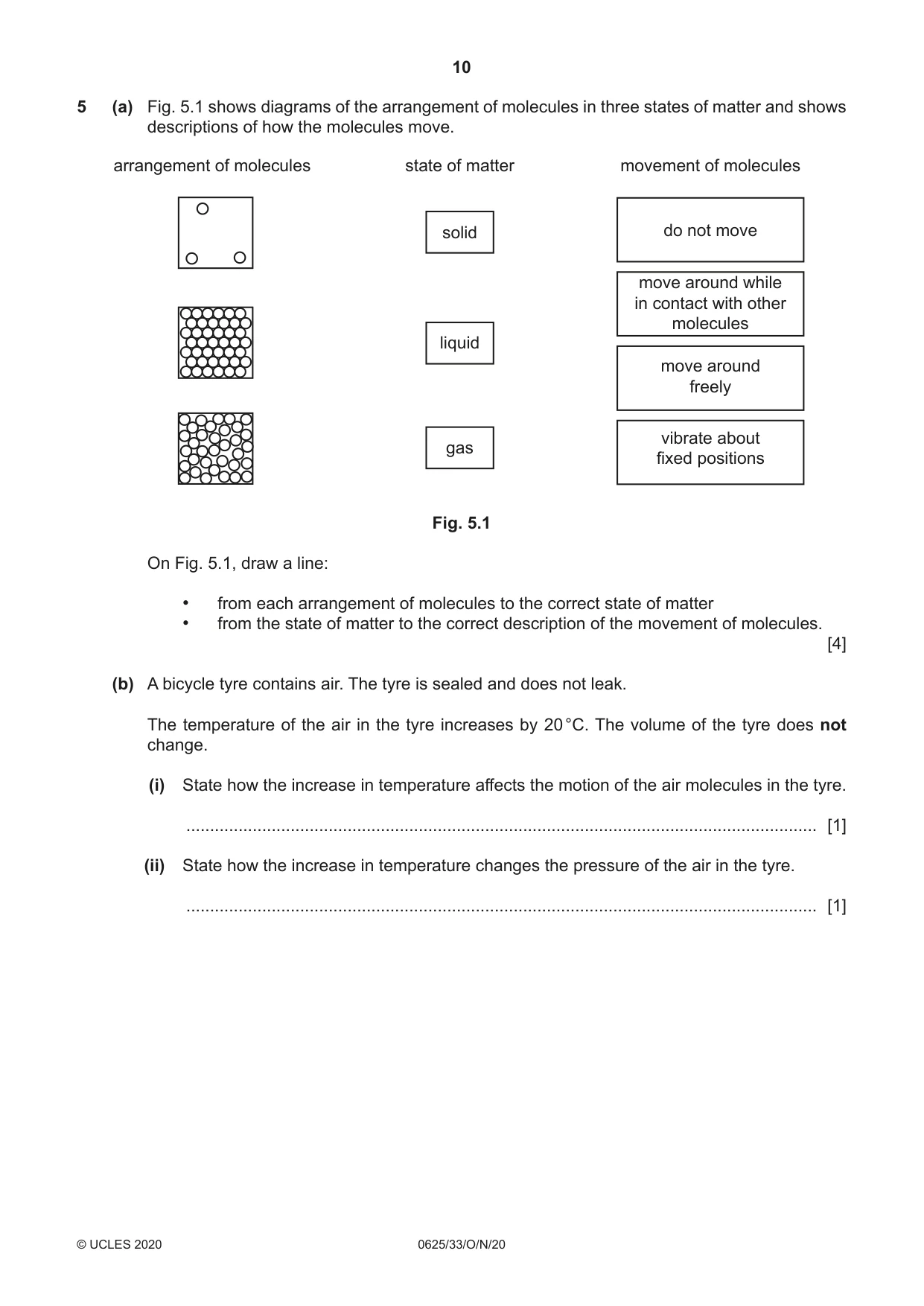
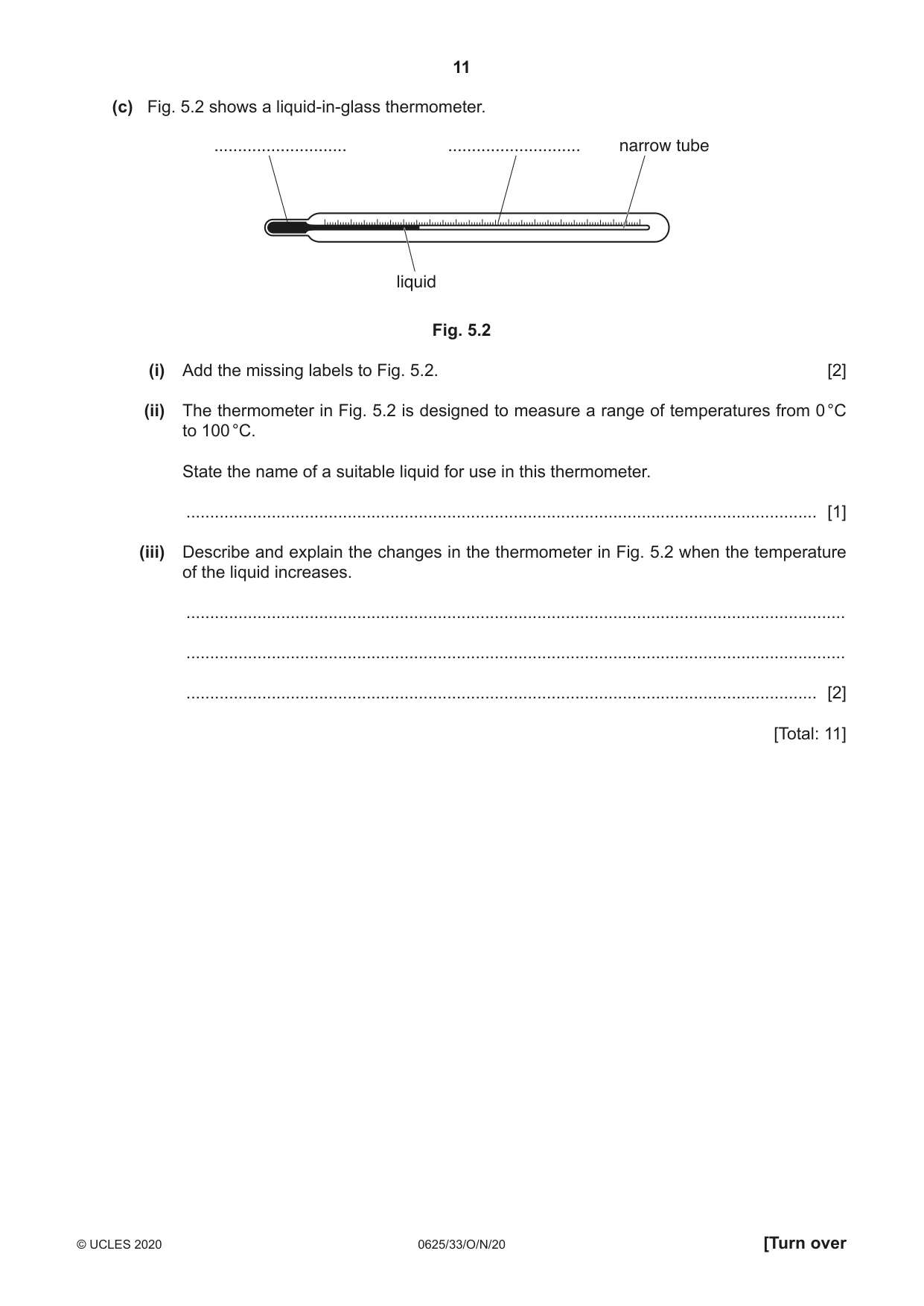
5 (a) Fig. 5.1 shows diagrams of the arrangement of molecules in three states of matter and shows descriptions of how the molecules move. arrangement of molecules state of matter movement of molecules solid do not move move around while in contact with other molecules liquid move around freely vibrate about gas fixed positions Fig. 5.1 On Fig. 5.1, draw a line: • from each arrangement of molecules to the correct state of matter • from the state of matter to the correct description of the movement of molecules. [4] (b) A bicycle tyre contains air. The tyre is sealed and does not leak. The temperature of the air in the tyre increases by 20 °C. The volume of the tyre does not change. (i) State how the increase in temperature affects the motion of the air molecules in the tyre. ..................................................................................................................................... [1] (ii) State how the increase in temperature changes the pressure of the air in the tyre. ..................................................................................................................................... [1] (c) Fig. 5.2 shows a liquid-in-glass thermometer. ............................ ............................ narrow tube liquid Fig. 5.2 (i) Add the missing labels to Fig. 5.2. [2] (ii) The thermometer in Fig. 5.2 is designed to measure a range of temperatures from 0 °C to 100 °C. State the name of a suitable liquid for use in this thermometer. ..................................................................................................................................... [1] (iii) Describe and explain the changes in the thermometer in Fig. 5.2 when the temperature of the liquid increases. ........................................................................................................................................... ........................................................................................................................................... ..................................................................................................................................... [2] [Total: 11]
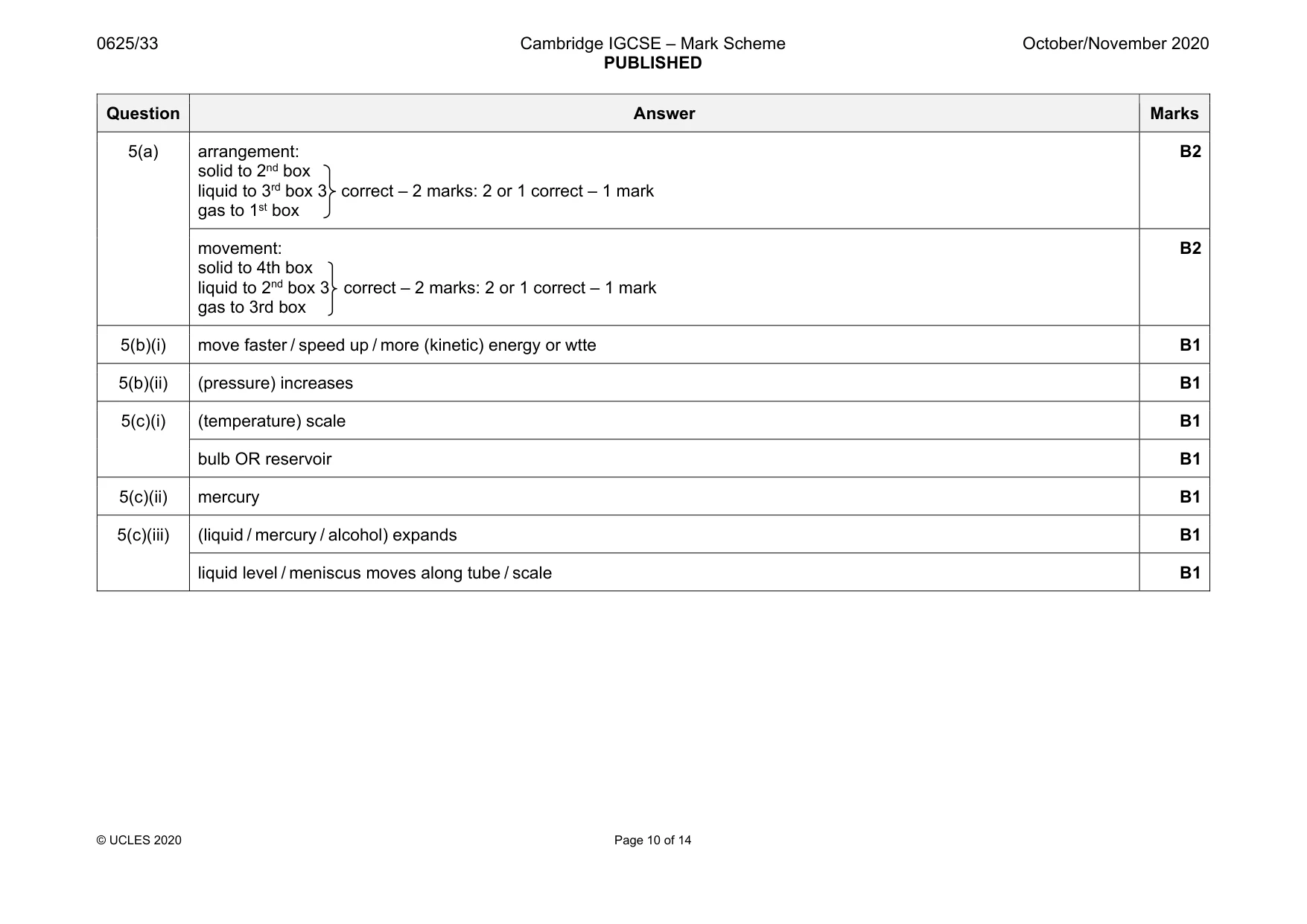
Mark scheme: 5(a) arrangement: solid to 2nd box liquid to 3rd box 3 correct – 2 marks: 2 or 1 correct – 1 mark gas to 1st box movement: solid to 4th box liquid to 2nd box 3 correct – 2 marks: 2 or 1 correct – 1 mark gas to 3rd box B2 5(b)(i) move faster / speed up / more (kinetic) energy or wtte B1 5(b)(ii) (pressure) increases B1 5(c)(i) (temperature) scale B1 bulb OR reservoir B1 5(c)(ii) mercury B1 5(c)(iii) (liquid / mercury / alcohol) expands B1 liquid level / meniscus moves along tube / scale B1
Q6 · An electric kettle containing cold water
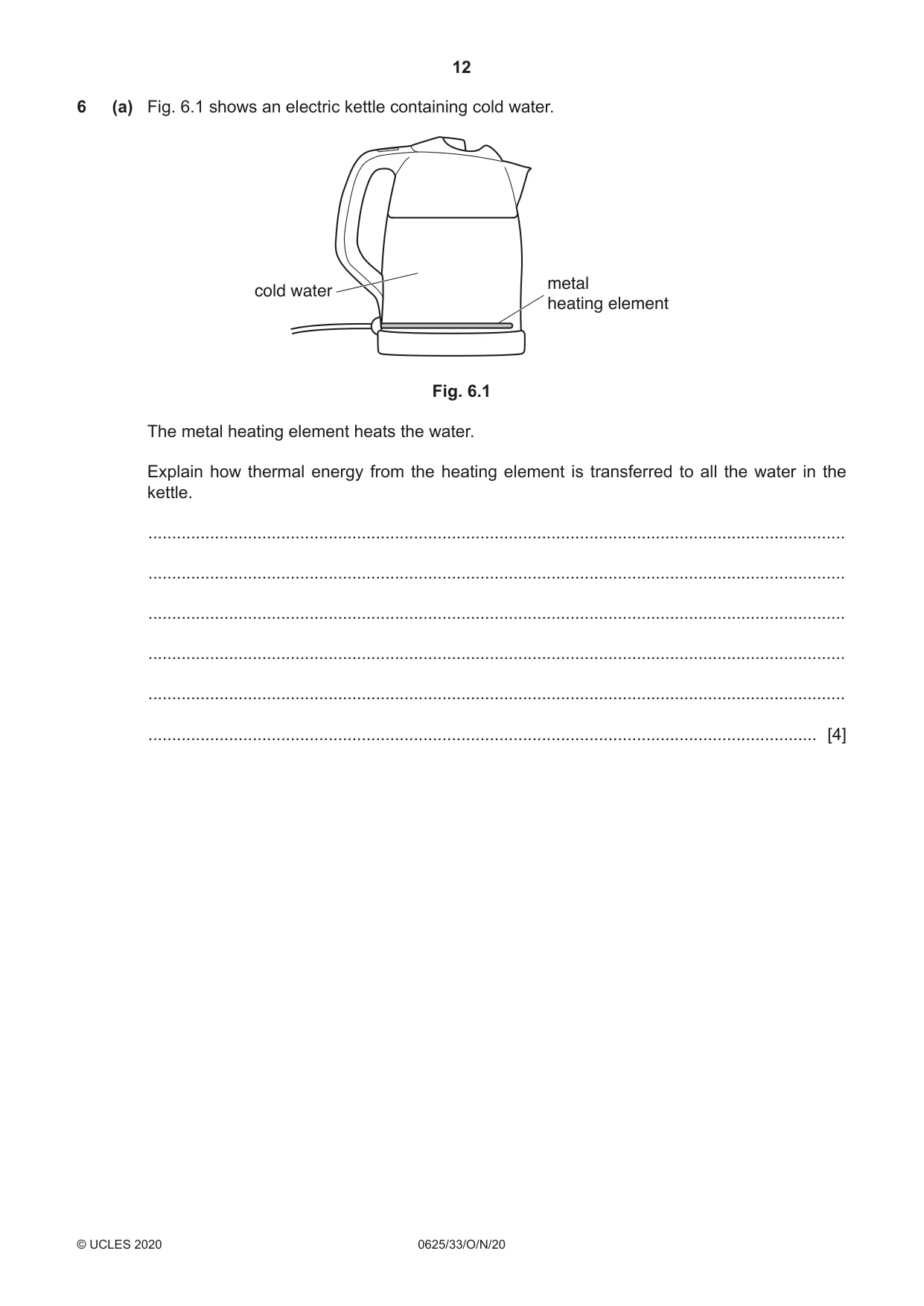
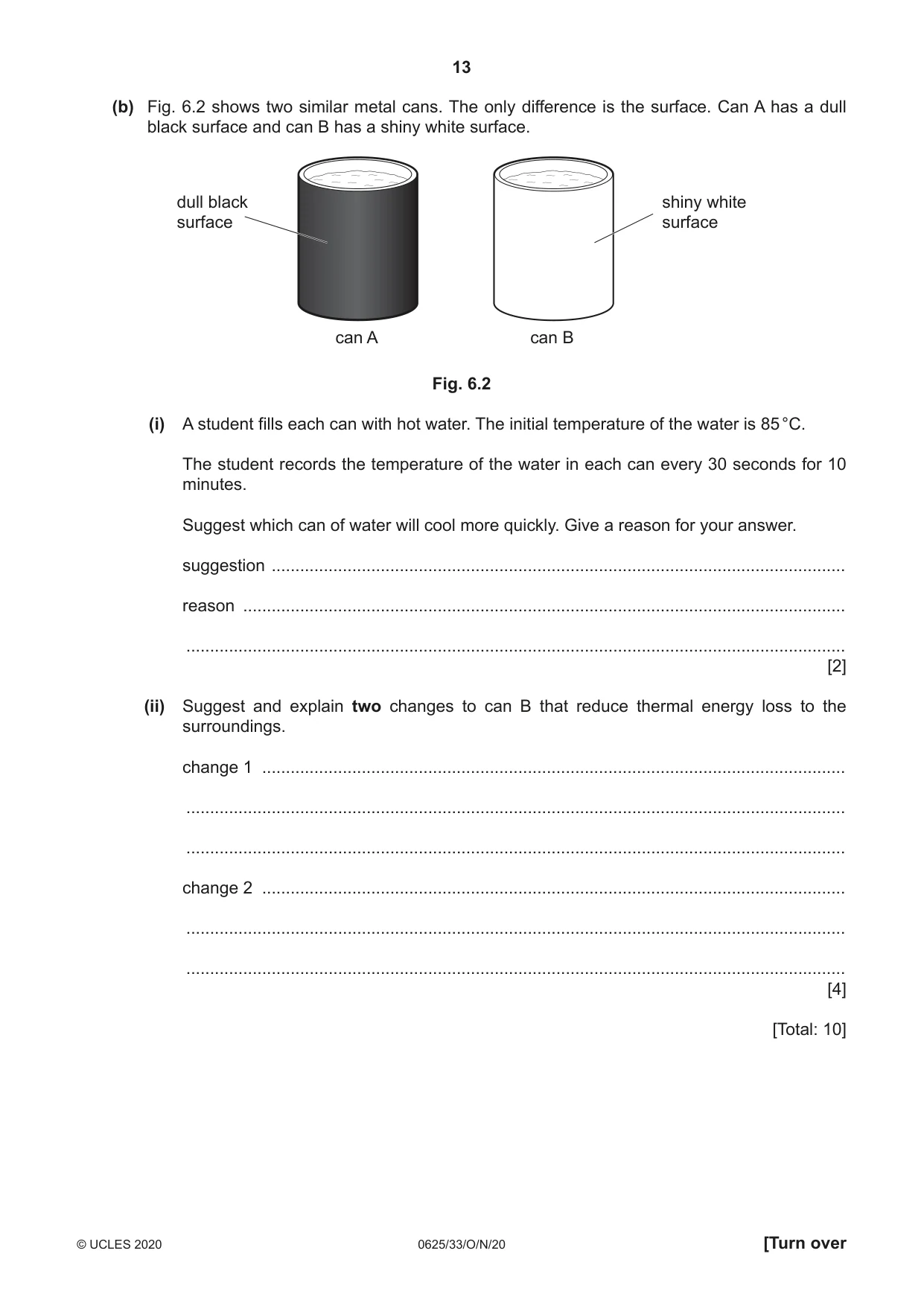
6 (a) Fig. 6.1 shows an electric kettle containing cold water. metal cold water heating element Fig. 6.1 The metal heating element heats the water. Explain how thermal energy from the heating element is transferred to all the water in the kettle. ................................................................................................................................................... ................................................................................................................................................... ................................................................................................................................................... ................................................................................................................................................... ................................................................................................................................................... ............................................................................................................................................. [4] (b) Fig. 6.2 shows two similar metal cans. The only difference is the surface. Can A has a dull black surface and can B has a shiny white surface. dull black shiny white surface surface can A can B Fig. 6.2 (i) A student fills each can with hot water. The initial temperature of the water is 85 °C. The student records the temperature of the water in each can every 30 seconds for 10 minutes. Suggest which can of water will cool more quickly. Give a reason for your answer. suggestion ......................................................................................................................... reason ............................................................................................................................... ........................................................................................................................................... [2] (ii) Suggest and explain two changes to can B that reduce thermal energy loss to the surroundings. change 1 ........................................................................................................................... ........................................................................................................................................... ........................................................................................................................................... change 2 ........................................................................................................................... ........................................................................................................................................... ........................................................................................................................................... [4] [Total: 10]
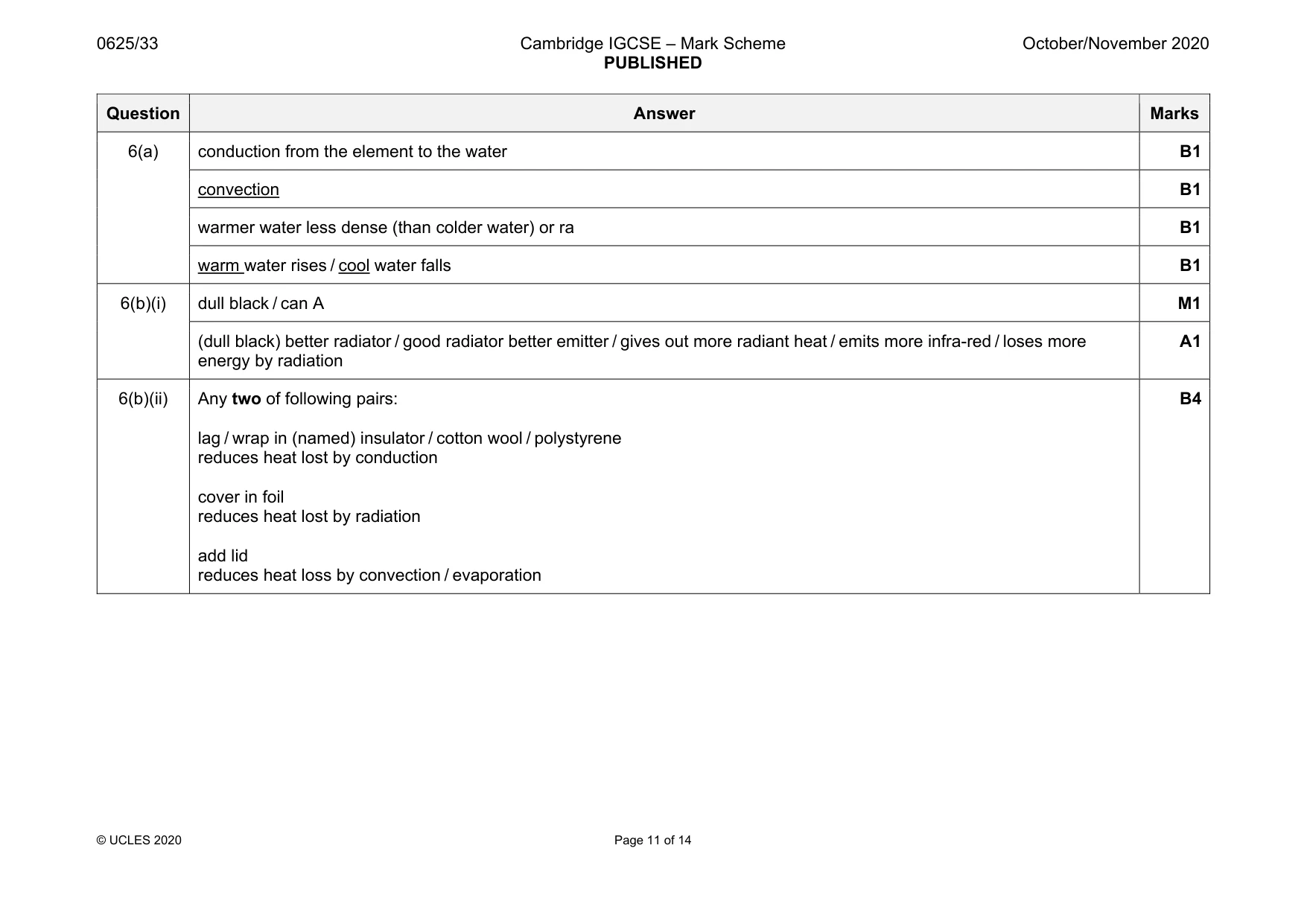
Mark scheme: 6(a) conduction from the element to the water B1 convection B1 warmer water less dense (than colder water) or ra B1 warm water rises / cool water falls B1 6(b)(i) dull black / can A M1 (dull black) better radiator / good radiator better emitter / gives out more radiant heat / emits more infra-red / loses more energy by radiation A1 6(b)(ii) Any two of following pairs: lag / wrap in (named) insulator / cotton wool / polystyrene reduces heat lost by conduction cover in foil reduces heat lost by radiation add lid reduces heat loss by convection / evaporation B4
Q7 · Complete the following sentences about light
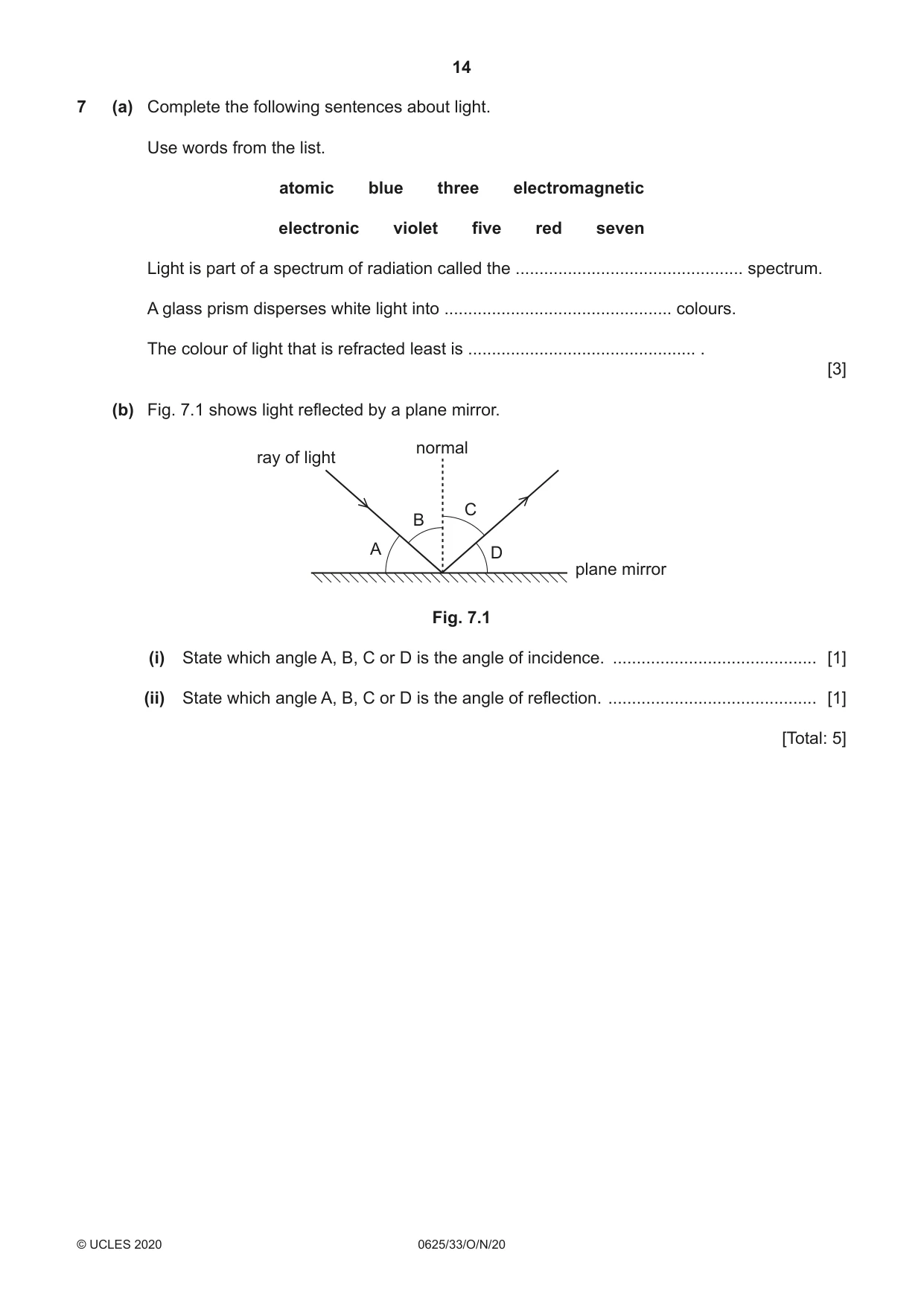
7 (a) Complete the following sentences about light. Use words from the list. atomic blue three electromagnetic electronic violet five red seven Light is part of a spectrum of radiation called the ................................................ spectrum. A glass prism disperses white light into ................................................ colours. The colour of light that is refracted least is ................................................ . [3] (b) Fig. 7.1 shows light reflected by a plane mirror. normal ray of light C B A D plane mirror Fig. 7.1 (i) State which angle A, B, C or D is the angle of incidence. ........................................... [1] (ii) State which angle A, B, C or D is the angle of reflection. ............................................ [1] [Total: 5]
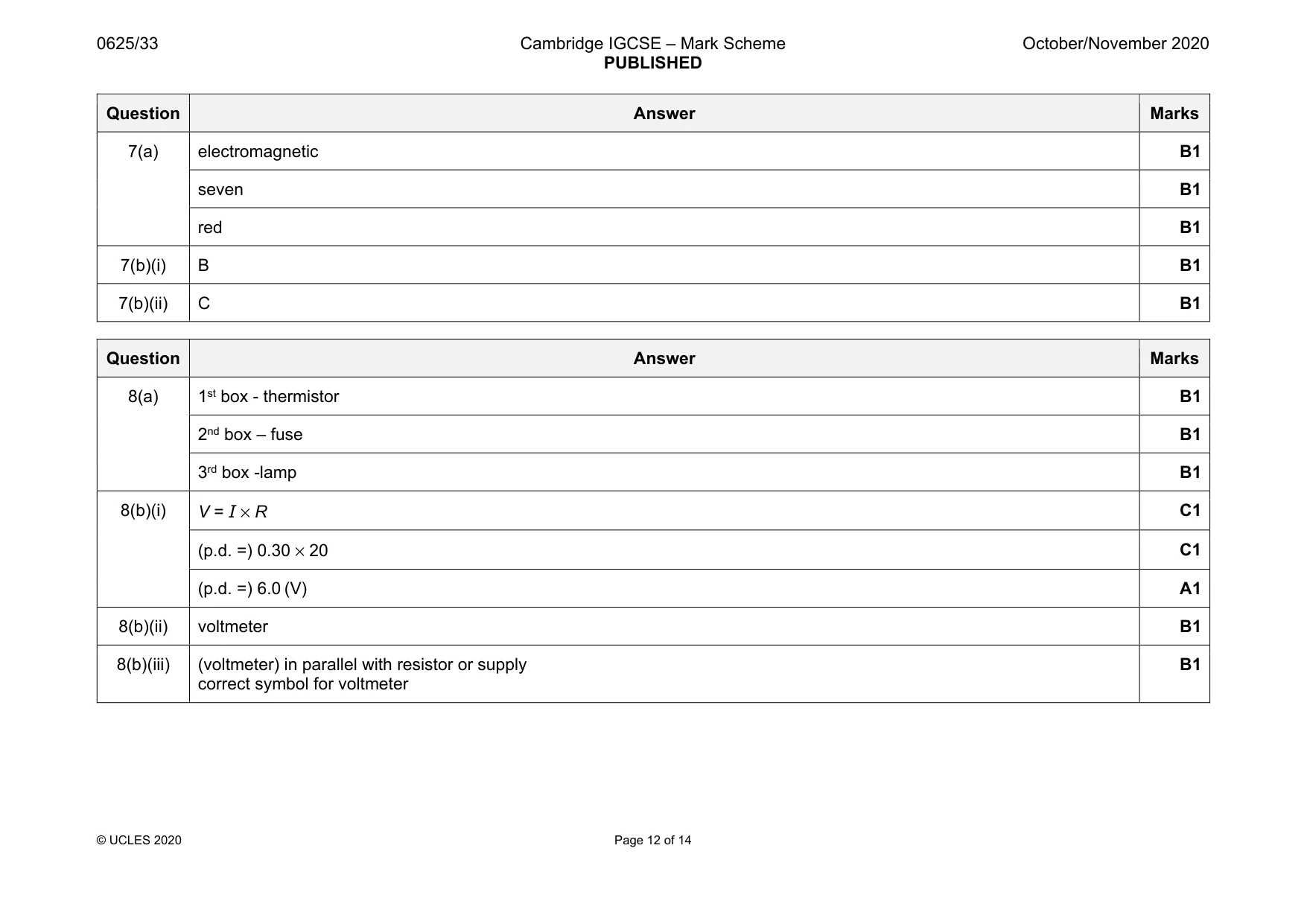
Mark scheme: 7(a) electromagnetic B1 seven B1 red B1 7(b)(i) B B1 7(b)(ii) C B1
Q8 · The electrical symbols for some circuit components
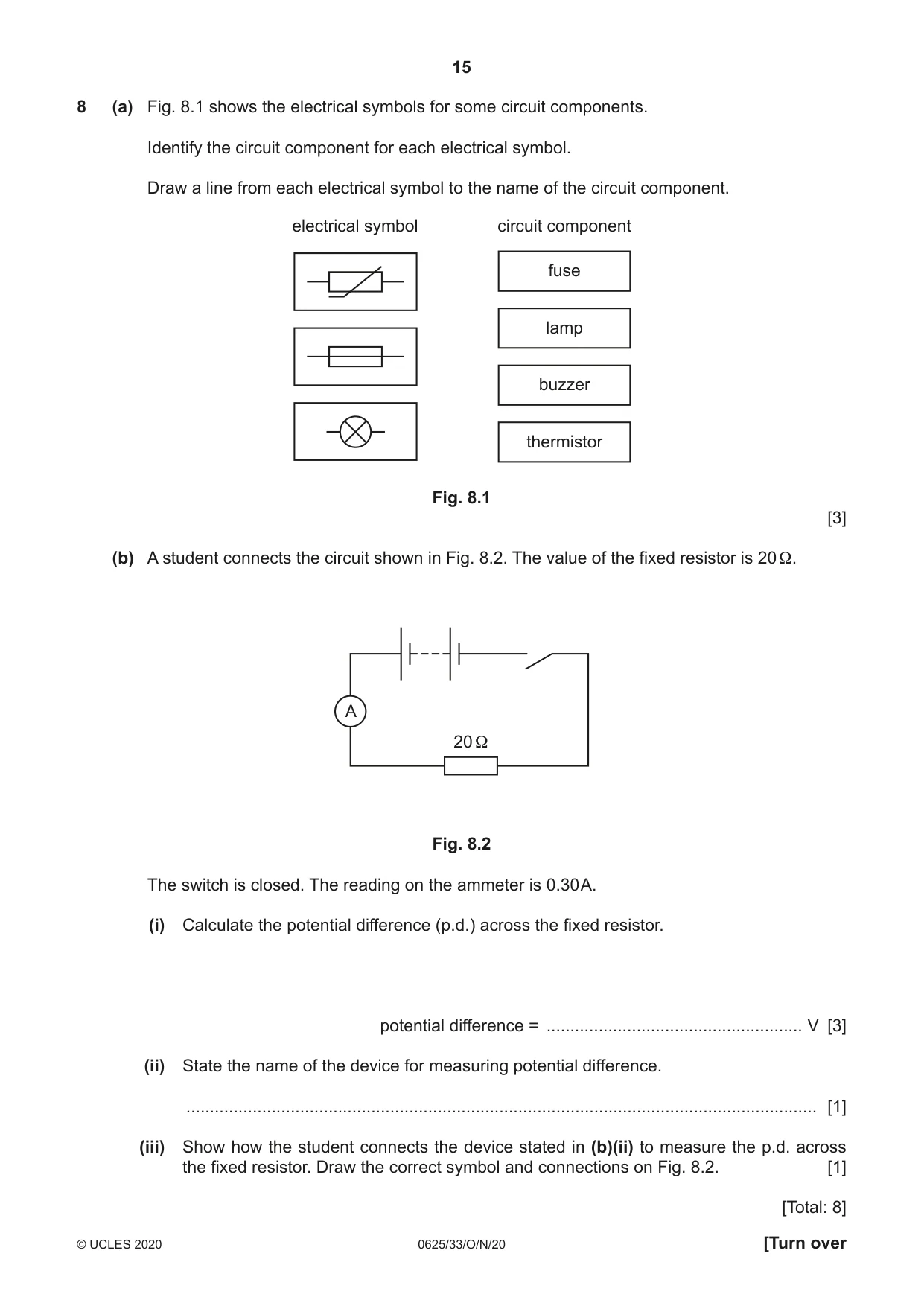
8 (a) Fig. 8.1 shows the electrical symbols for some circuit components. Identify the circuit component for each electrical symbol. Draw a line from each electrical symbol to the name of the circuit component. electrical symbol circuit component fuse lamp buzzer thermistor Fig. 8.1 [3] (b) A student connects the circuit shown in Fig. 8.2. The value of the fixed resistor is 20 Ω. A 20 Ω Fig. 8.2 The switch is closed. The reading on the ammeter is 0.30 A. (i) Calculate the potential difference (p.d.) across the fixed resistor. potential difference = ...................................................... V [3] (ii) State the name of the device for measuring potential difference. ..................................................................................................................................... [1] (iii) Show how the student connects the device stated in (b)(ii) to measure the p.d. across the fixed resistor. Draw the correct symbol and connections on Fig. 8.2. [1] [Total: 8]
Mark scheme: 8(a) 1st box - thermistor B1 2nd box – fuse B1 3rd box -lamp B1 8(b)(i) V = I × R C1 (p.d. =) 0.30 × 20 C1 (p.d. =) 6.0 (V) A1 8(b)(ii) voltmeter B1 8(b)(iii) (voltmeter) in parallel with resistor or supply correct symbol for voltmeter B1
Q9 · A clamp and stand hold a soft-iron bar above a bench
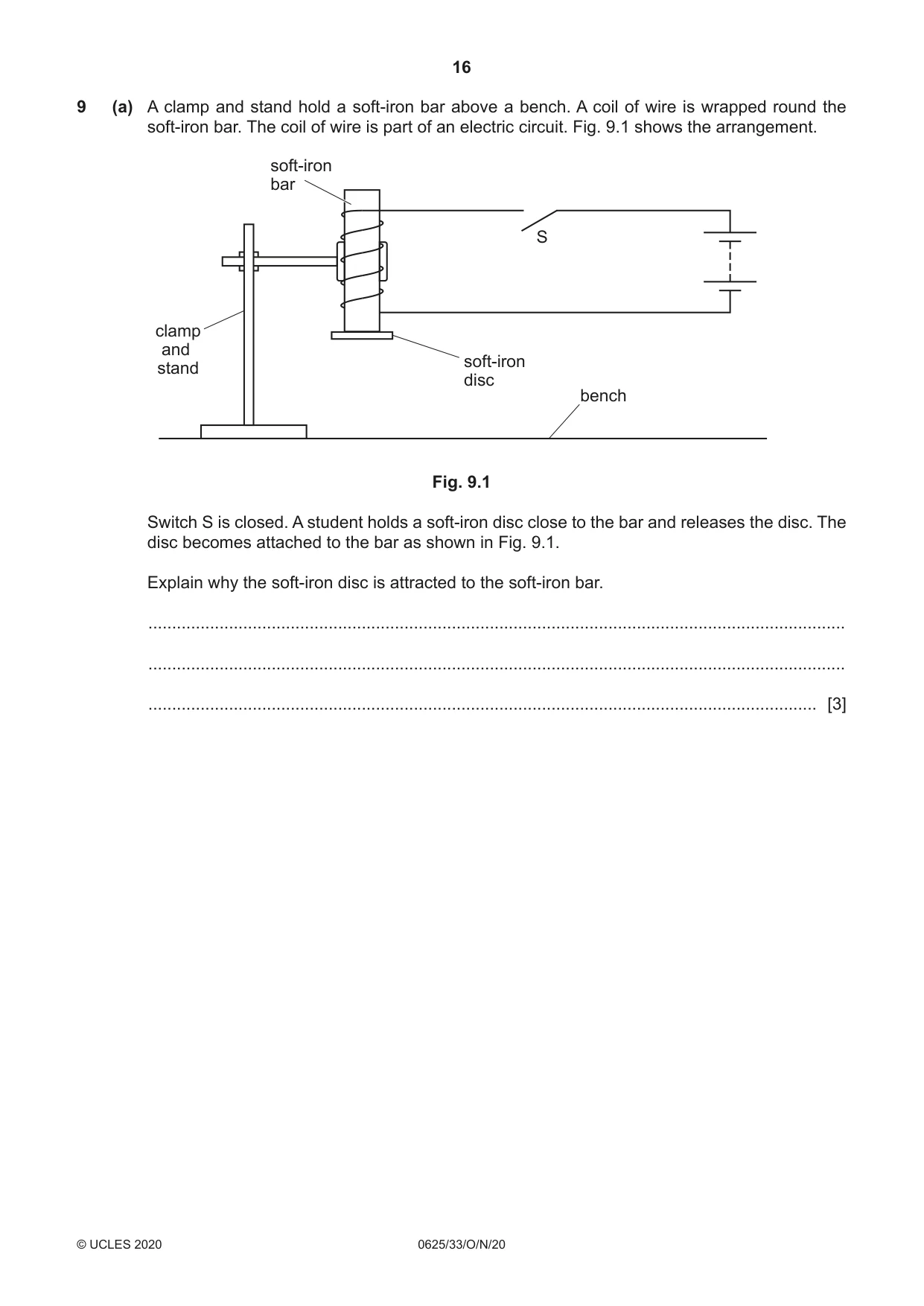
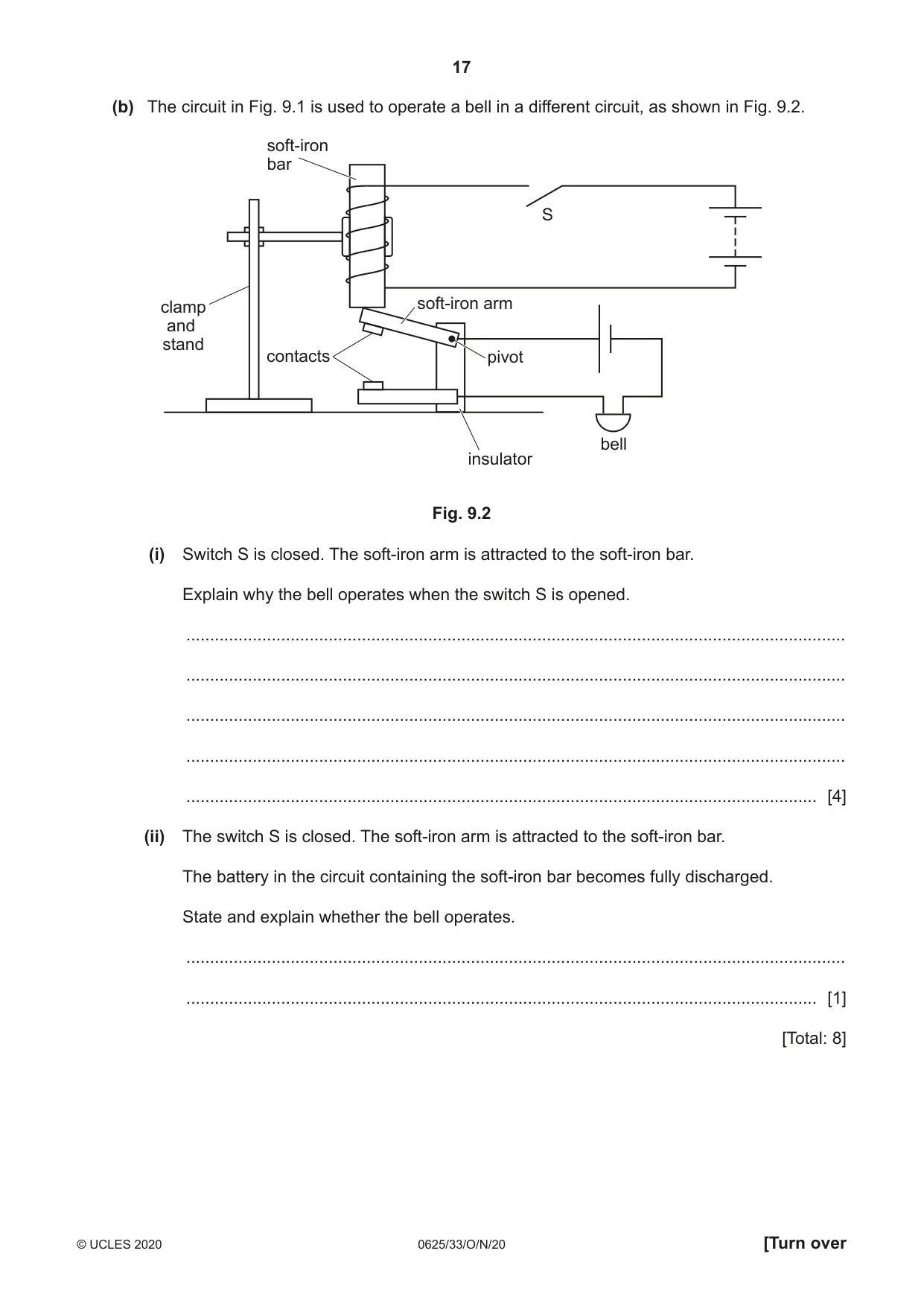
9 (a) A clamp and stand hold a soft-iron bar above a bench. A coil of wire is wrapped round the soft-iron bar. The coil of wire is part of an electric circuit. Fig. 9.1 shows the arrangement. soft-iron bar S clamp and soft-iron stand disc bench Fig. 9.1 Switch S is closed. A student holds a soft-iron disc close to the bar and releases the disc. The disc becomes attached to the bar as shown in Fig. 9.1. Explain why the soft-iron disc is attracted to the soft-iron bar. ................................................................................................................................................... ................................................................................................................................................... ............................................................................................................................................. [3] (b) The circuit in Fig. 9.1 is used to operate a bell in a different circuit, as shown in Fig. 9.2. soft-iron bar S clamp soft-iron arm and stand contacts pivot bell insulator Fig. 9.2 (i) Switch S is closed. The soft-iron arm is attracted to the soft-iron bar. Explain why the bell operates when the switch S is opened. ........................................................................................................................................... ........................................................................................................................................... ........................................................................................................................................... ........................................................................................................................................... ..................................................................................................................................... [4] (ii) The switch S is closed. The soft-iron arm is attracted to the soft-iron bar. The battery in the circuit containing the soft-iron bar becomes fully discharged. State and explain whether the bell operates. ........................................................................................................................................... ..................................................................................................................................... [1] [Total: 8]
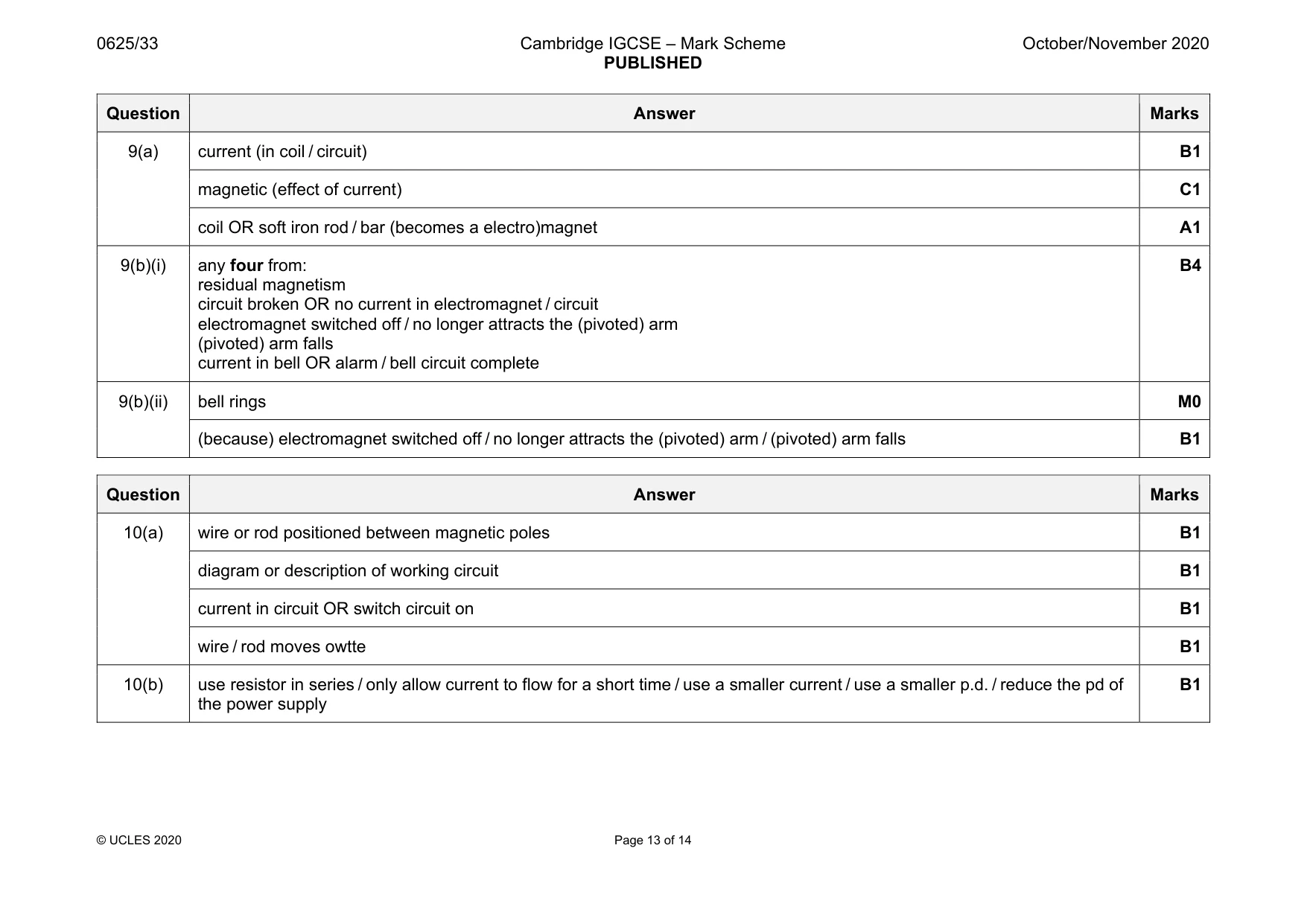
Mark scheme: 9(a) current (in coil / circuit) B1 magnetic (effect of current) C1 coil OR soft iron rod / bar (becomes a electro)magnet A1 9(b)(i) any four from: residual magnetism circuit broken OR no current in electromagnet / circuit electromagnet switched off / no longer attracts the (pivoted) arm (pivoted) arm falls current in bell OR alarm / bell circuit complete B4 9(b)(ii) bell rings M0 (because) electromagnet switched off / no longer attracts the (pivoted) arm / (pivoted) arm falls B1
Q10 · Describe an experiment to show that a force acts on a current-carrying conductor placed…
10 (a) Describe an experiment to show that a force acts on a current-carrying conductor placed in a magnetic field. You may draw a diagram to help your answer. ................................................................................................................................................... ................................................................................................................................................... ................................................................................................................................................... ................................................................................................................................................... ................................................................................................................................................... ................................................................................................................................................... ............................................................................................................................................. [4] (b) A current in a wire can cause the wire to get hot and melt the wire. Describe how to reduce the heating effect of a current. ................................................................................................................................................... ............................................................................................................................................. [1] [Total: 5]
Mark scheme: 10(a) wire or rod positioned between magnetic poles B1 diagram or description of working circuit B1 current in circuit OR switch circuit on B1 wire / rod moves owtte B1 10(b) use resistor in series / only allow current to flow for a short time / use a smaller current / use a smaller p.d. / reduce the pd of the power supply B1
Q11 · The structure of four atoms P, Q, R and S
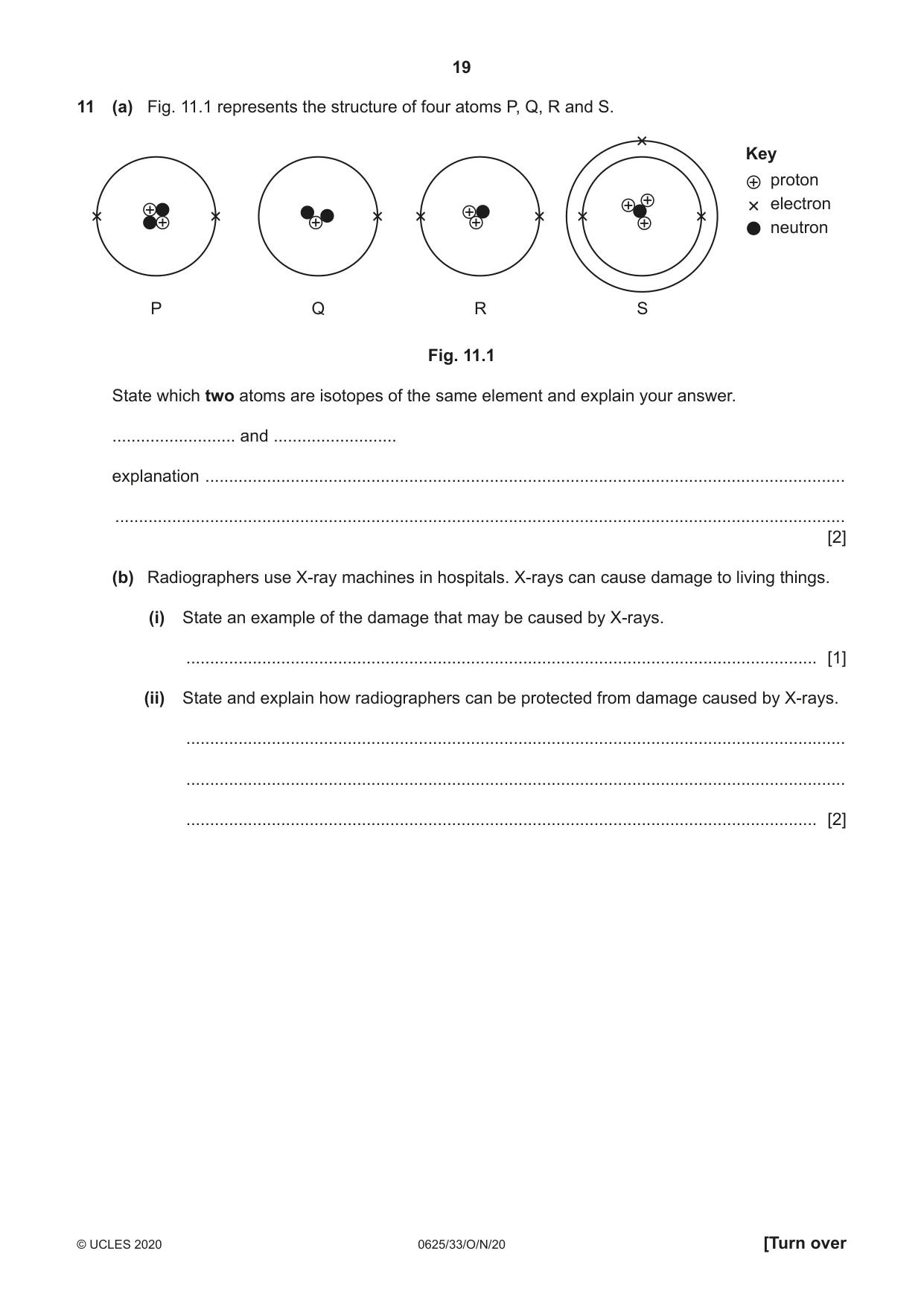
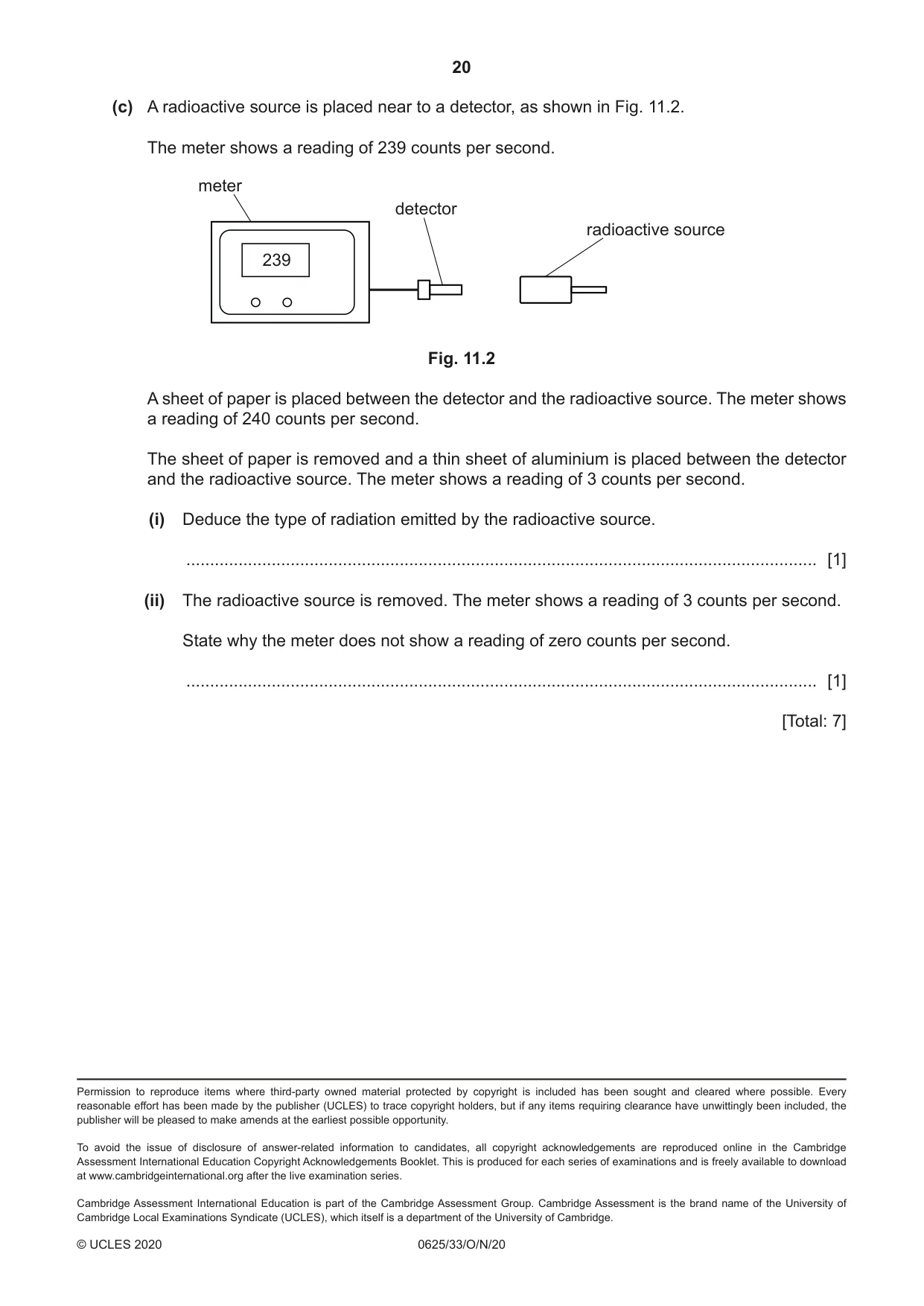
11 (a) Fig. 11.1 represents the structure of four atoms P, Q, R and S. Key + proton + electron + + + + + + + neutron P Q R S Fig. 11.1 State which two atoms are isotopes of the same element and explain your answer. .......................... and .......................... explanation ....................................................................................................................................... .......................................................................................................................................................... [2] (b) Radiographers use X-ray machines in hospitals. X-rays can cause damage to living things. (i) State an example of the damage that may be caused by X-rays. ..................................................................................................................................... [1] (ii) State and explain how radiographers can be protected from damage caused by X-rays. ........................................................................................................................................... ........................................................................................................................................... ..................................................................................................................................... [2] (c) A radioactive source is placed near to a detector, as shown in Fig. 11.2. The meter shows a reading of 239 counts per second. meter detector radioactive source 239 Fig. 11.2 A sheet of paper is placed between the detector and the radioactive source. The meter shows a reading of 240 counts per second. The sheet of paper is removed and a thin sheet of aluminium is placed between the detector and the radioactive source. The meter shows a reading of 3 counts per second. (i) Deduce the type of radiation emitted by the radioactive source. ..................................................................................................................................... [1] (ii) The radioactive source is removed. The meter shows a reading of 3 counts per second. State why the meter does not show a reading of zero counts per second. ..................................................................................................................................... [1] [Total: 7]
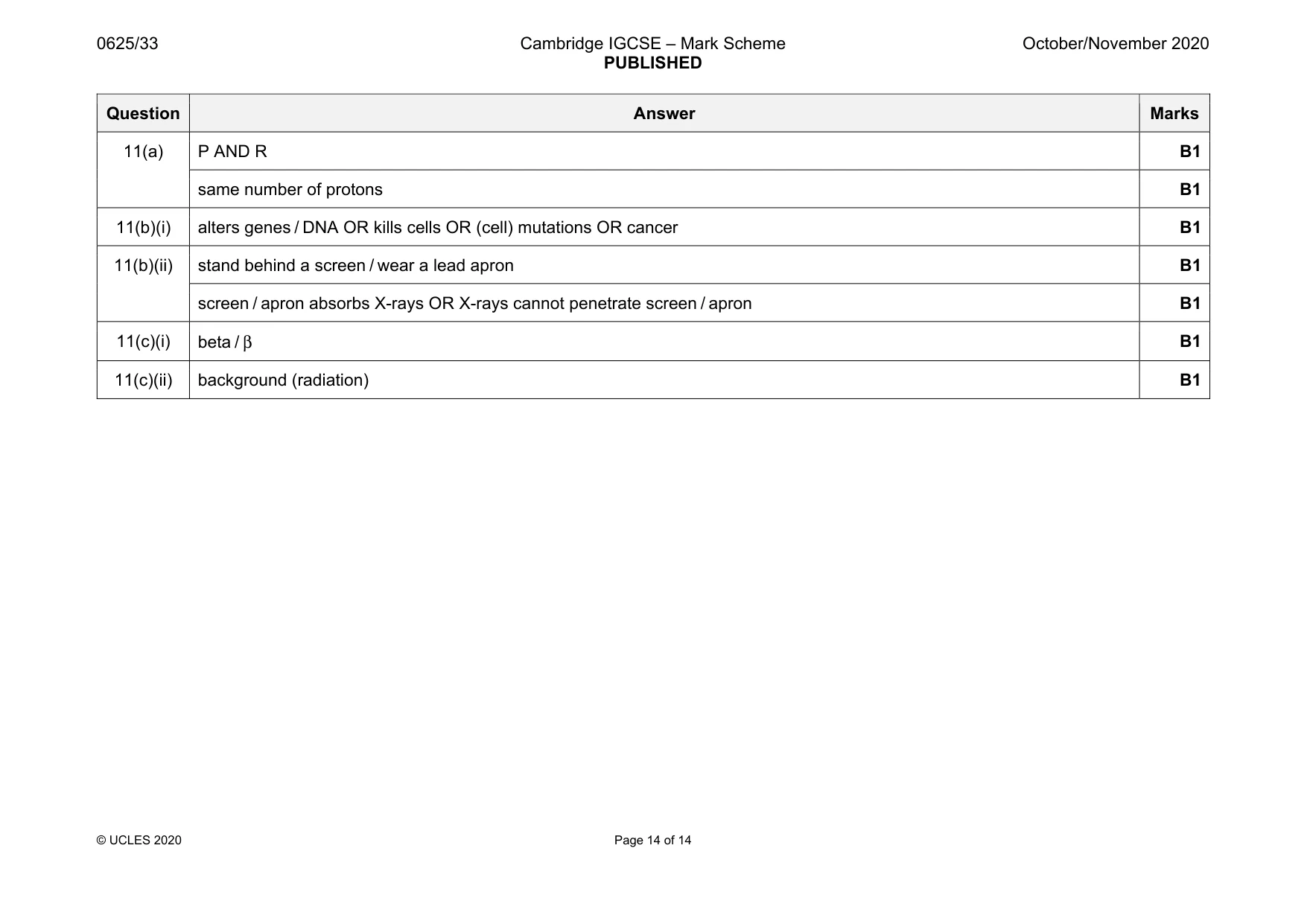
Mark scheme: 11(a) P AND R B1 same number of protons B1 11(b)(i) alters genes / DNA OR kills cells OR (cell) mutations OR cancer B1 11(b)(ii) stand behind a screen / wear a lead apron B1 screen / apron absorbs X-rays OR X-rays cannot penetrate screen / apron B1 11(c)(i) beta / β B1 11(c)(ii) background (radiation) B1
What was in this paper
The subtopics covered by these 11 questions, and how many questions each got. Open one in a new tab to see every Cambridge question on it.
What you needed in this session
Cambridge’s own grade thresholds for 2020 Oct/Nov, Paper 3 · Variant 3. A higher threshold means an easier paper — the bar moves with how the cohort did.