Cambridge IGCSE Physics 0625 — 2025 May/June Paper 3 · Variant 2
0625/32/M/J/25 · 11 questions · 80 marks · ≈90 min
The question paper and its mark scheme, free to read here and free to download. This is Cambridge’s own paper, exactly as it was sat.
Question paper16 pages
Mark scheme18 pages
Answers below. Sit the paper first if you are practising.
Questions as text
Q1 · The speed–time graphs for two racing cars, X and Y, at the beginning of a race
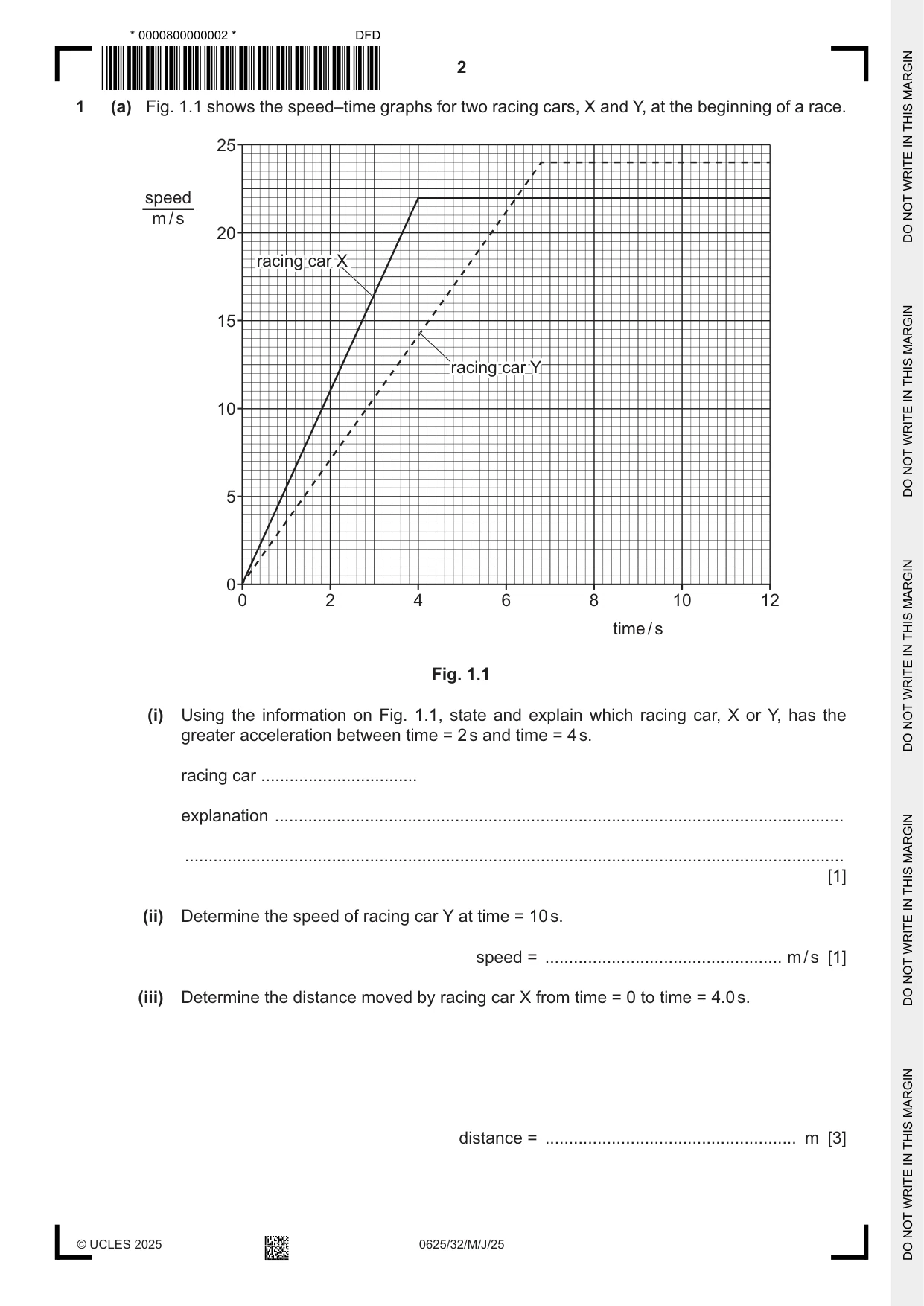
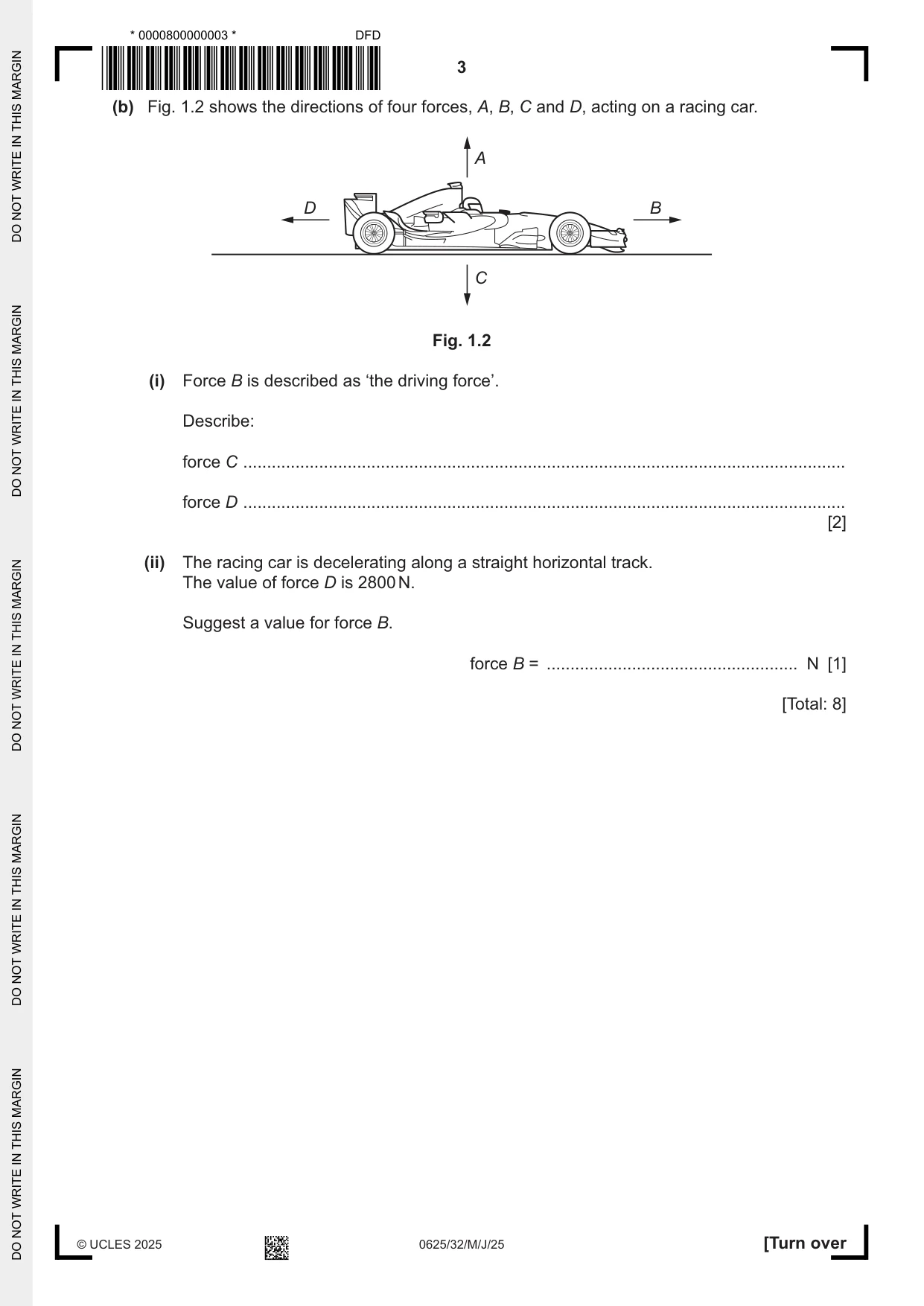
1 (a) Fig. 1.1 shows the speed–time graphs for two racing cars, X and Y, at the beginning of a race. 25 speed m / s 20 racingracing carcar XX 15 racingracing carcar YY 10 5 0 0 2 4 6 8 10 12 time / s Fig. 1.1 (i) Using the information on Fig. 1.1, state and explain which racing car, X or Y, has the greater acceleration between time = 2 s and time = 4 s. racing car ................................. explanation ........................................................................................................................ ........................................................................................................................................... [1] (ii) Determine the speed of racing car Y at time = 10 s. speed = .................................................. m / s [1] (iii) Determine the distance moved by racing car X from time = 0 to time = 4.0 s. distance = ..................................................... m [3] (b) Fig. 1.2 shows the directions of four forces, A, B, C and D, acting on a racing car. A D B C Fig. 1.2 (i) Force B is described as ‘the driving force’. Describe: force C ............................................................................................................................... force D ............................................................................................................................... [2] (ii) The racing car is decelerating along a straight horizontal track. The value of force D is 2800 N. Suggest a value for force B. force B = ..................................................... N [1] [Total: 8]
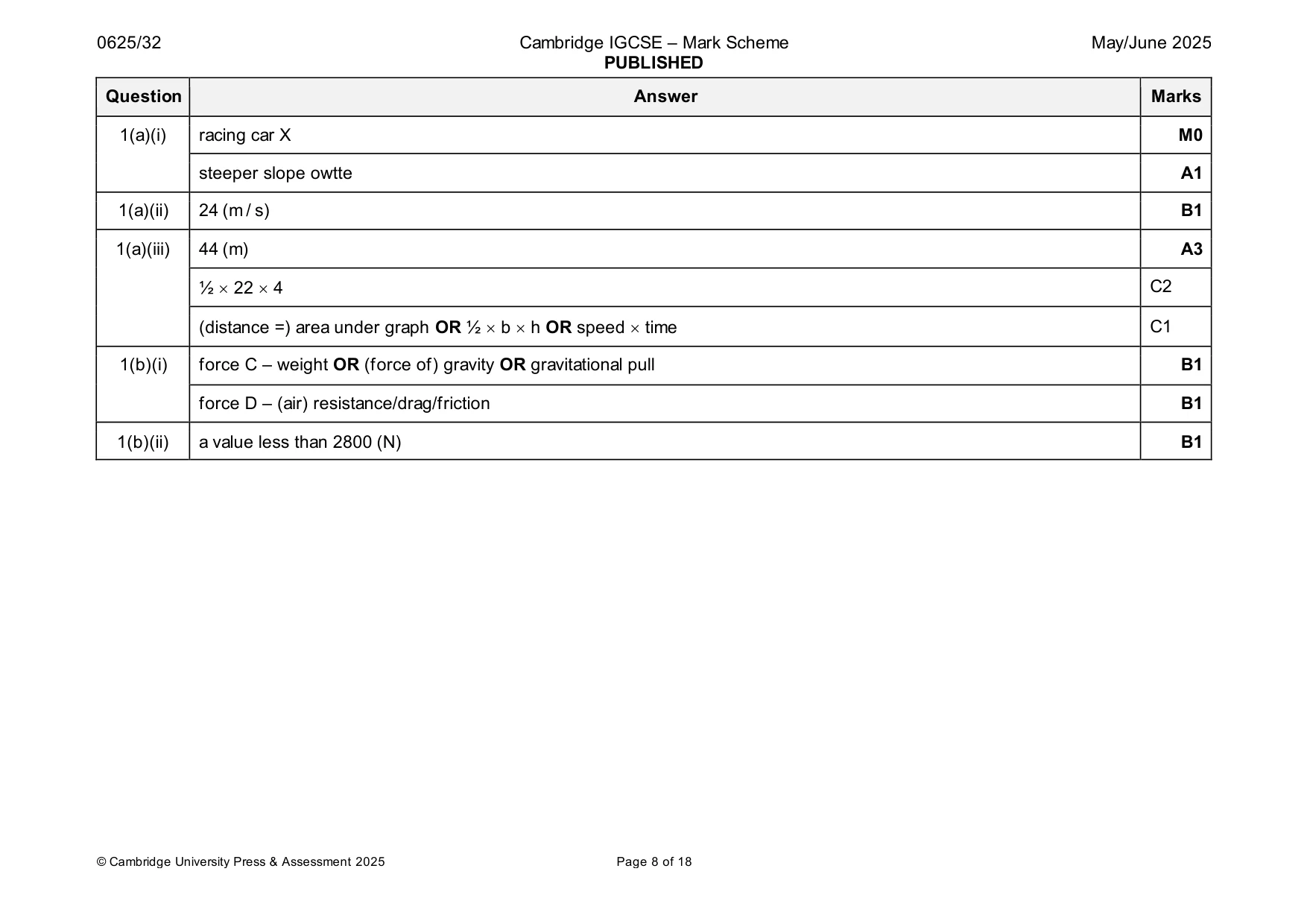
Mark scheme: Question Answer Marks 1(a)(i) racing car X M0 steeper slope owtte A1 1(a)(ii) 24 (m / s) B1 1(a)(iii) 44 (m) A3 ½ 22 4 C2 (distance =) area under graph OR ½ b h OR speed time C1 1(b)(i) force C – weight OR (force of) gravity OR gravitational pull B1 force D – (air) resistance/drag/friction B1 1(b)(ii) a value less than 2800 (N) B1
Q2 · Some buildings are built on large, strong metal rods that are pushed deep into the ground
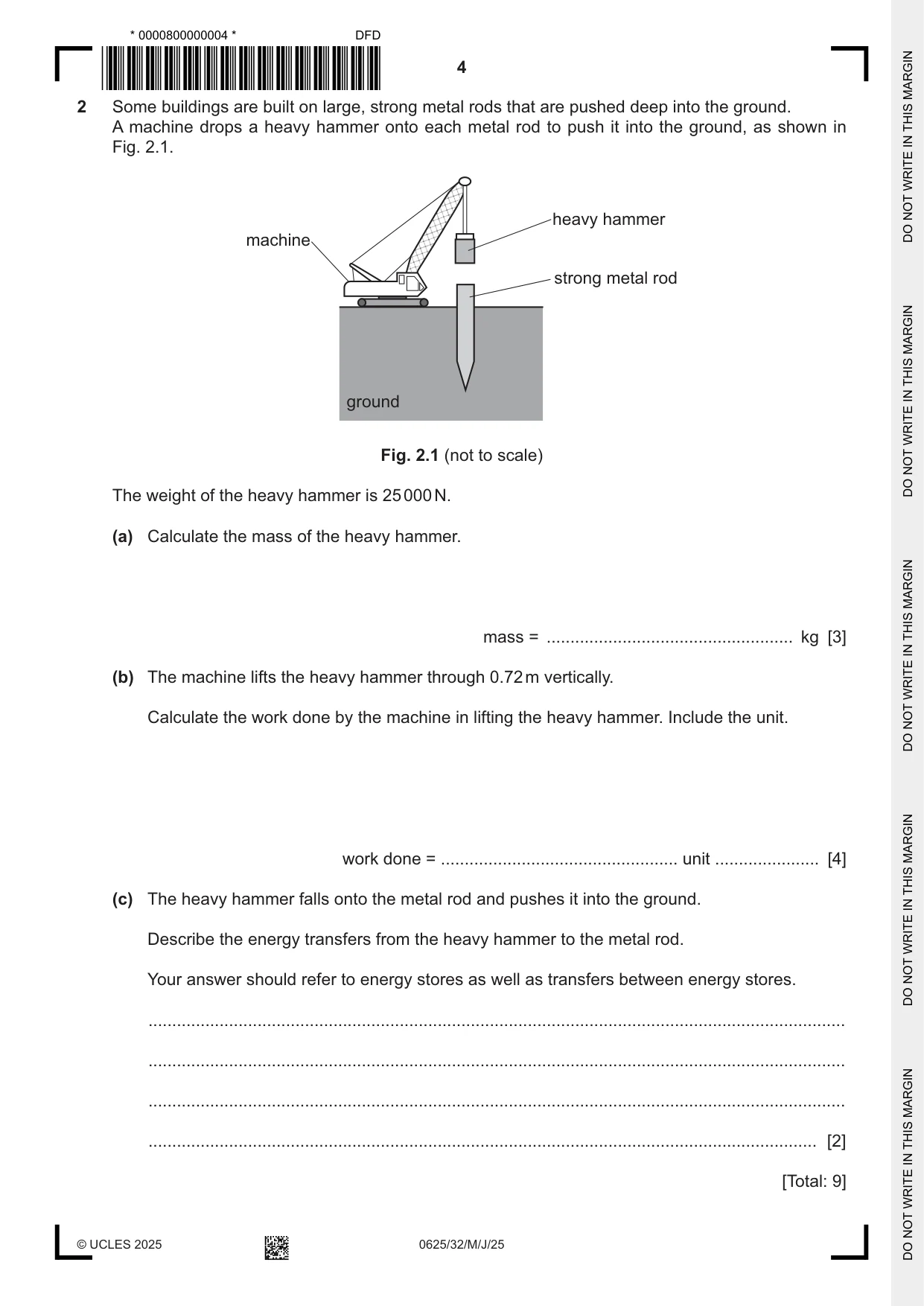
2 Some buildings are built on large, strong metal rods that are pushed deep into the ground. A machine drops a heavy hammer onto each metal rod to push it into the ground, as shown in Fig. 2.1. heavy hammer machine strong metal rod ground Fig. 2.1 (not to scale) The weight of the heavy hammer is 25 000 N. (a) Calculate the mass of the heavy hammer. mass = .................................................... kg [3] (b) The machine lifts the heavy hammer through 0.72 m vertically. Calculate the work done by the machine in lifting the heavy hammer. Include the unit. work done = .................................................. unit ...................... [4] (c) The heavy hammer falls onto the metal rod and pushes it into the ground. Describe the energy transfers from the heavy hammer to the metal rod. Your answer should refer to energy stores as well as transfers between energy stores. ................................................................................................................................................... ................................................................................................................................................... ................................................................................................................................................... ............................................................................................................................................. [2] [Total: 9]
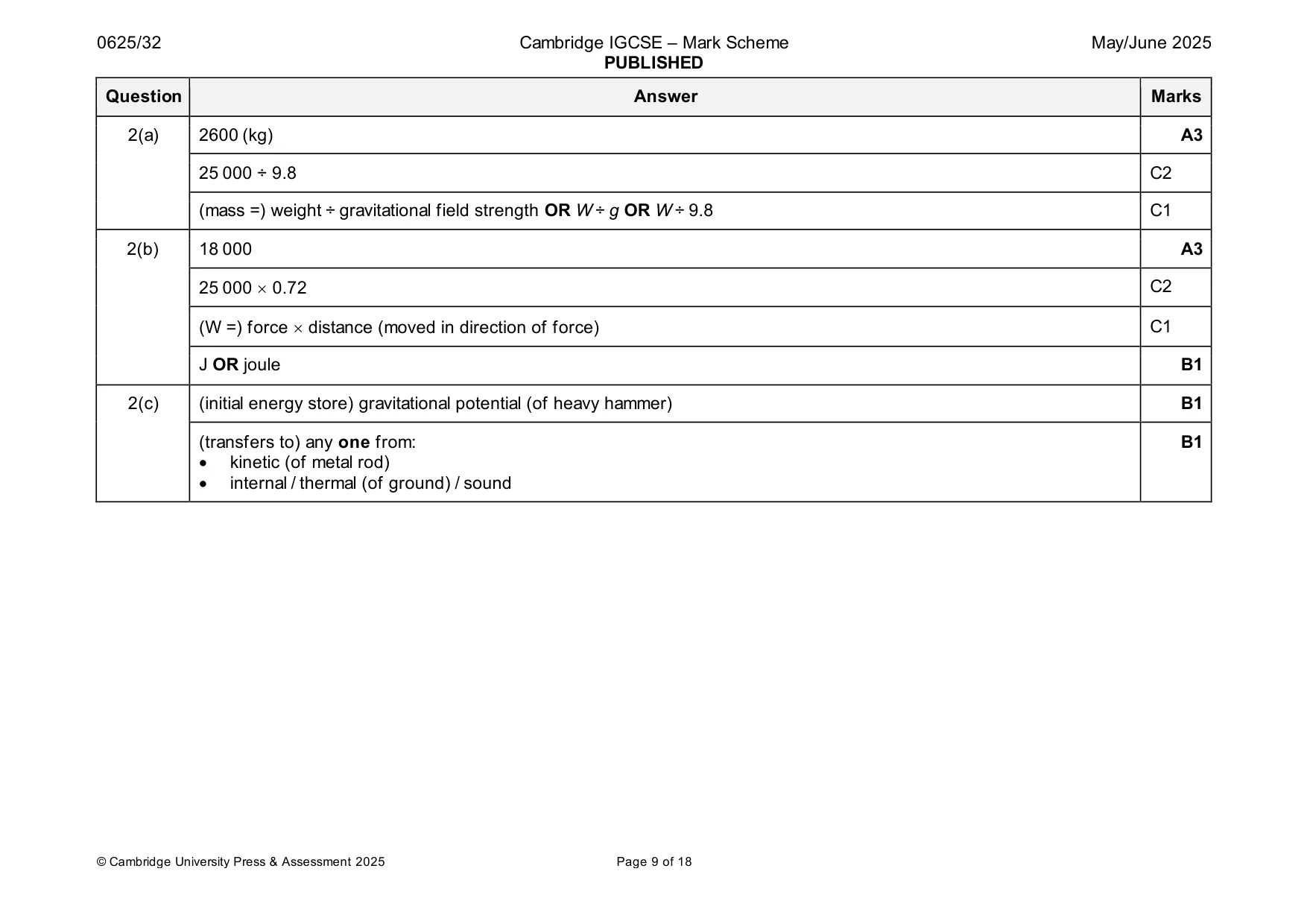
Mark scheme: 2(a) 2600 (kg) A3 25 000 ÷ 9.8 C2 (mass =) weight ÷ gravitational field strength OR W ÷ g OR W ÷ 9.8 C1 2(b) 18 000 A3 25 000 0.72 C2 (W =) force distance (moved in direction of force) C1 J OR joule B1 2(c) (initial energy store) gravitational potential (of heavy hammer) B1 (transfers to) any one from: B1 • kinetic (of metal rod) • internal / thermal (of ground) / sound
Q3 · A student determines the weight W of a metal block by using a 1.5 N load and a uniform…
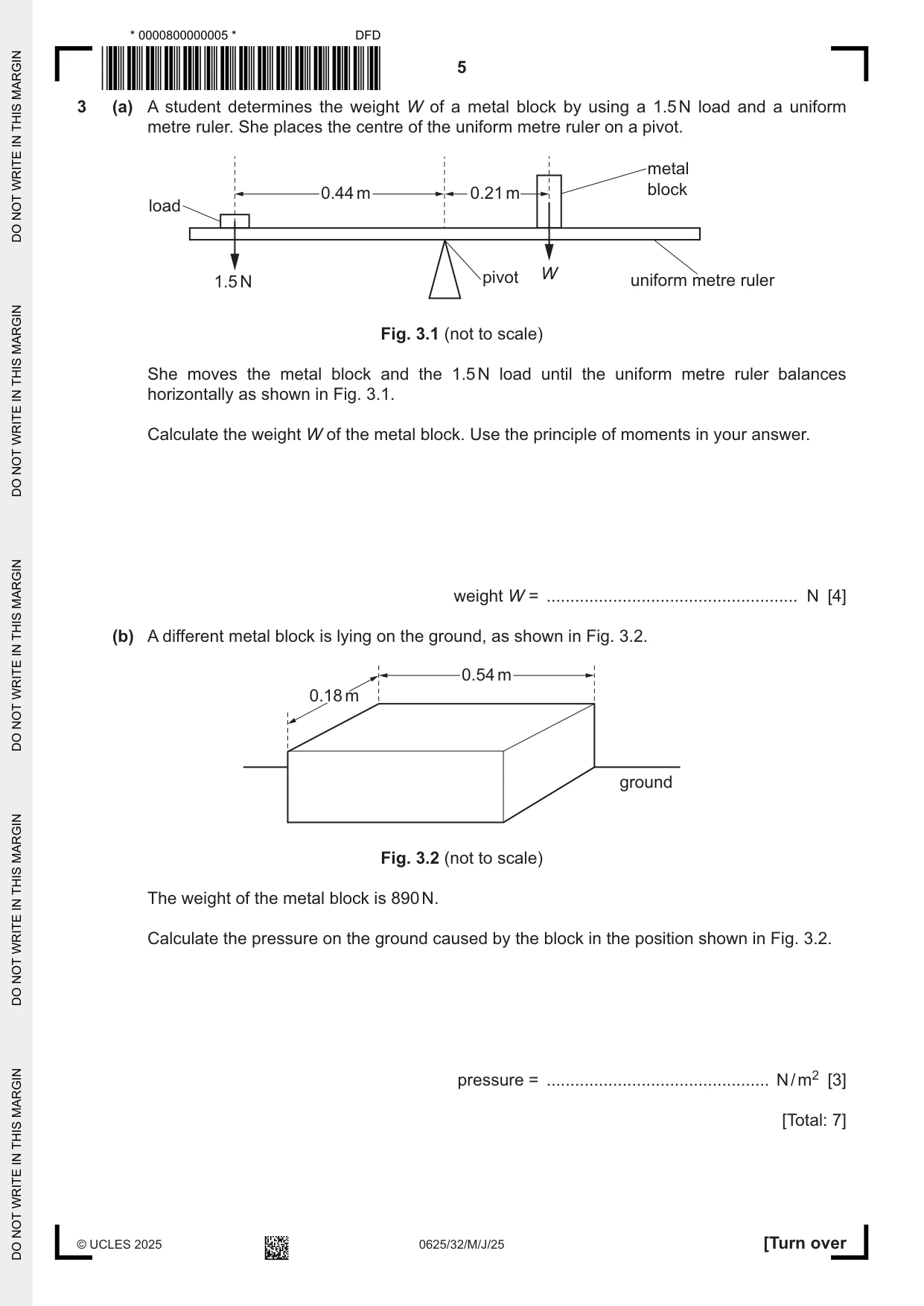
3 (a) A student determines the weight W of a metal block by using a 1.5 N load and a uniform metre ruler. She places the centre of the uniform metre ruler on a pivot. metal 0.44 m 0.21 m block load 1.5 N pivot W uniform metre ruler Fig. 3.1 (not to scale) She moves the metal block and the 1.5 N load until the uniform metre ruler balances horizontally as shown in Fig. 3.1. Calculate the weight W of the metal block. Use the principle of moments in your answer. weight W = ..................................................... N [4] (b) A different metal block is lying on the ground, as shown in Fig. 3.2. 0.54 m 0.18 m ground Fig. 3.2 (not to scale) The weight of the metal block is 890 N. Calculate the pressure on the ground caused by the block in the position shown in Fig. 3.2. pressure = ............................................... N / m2 [3] [Total: 7]
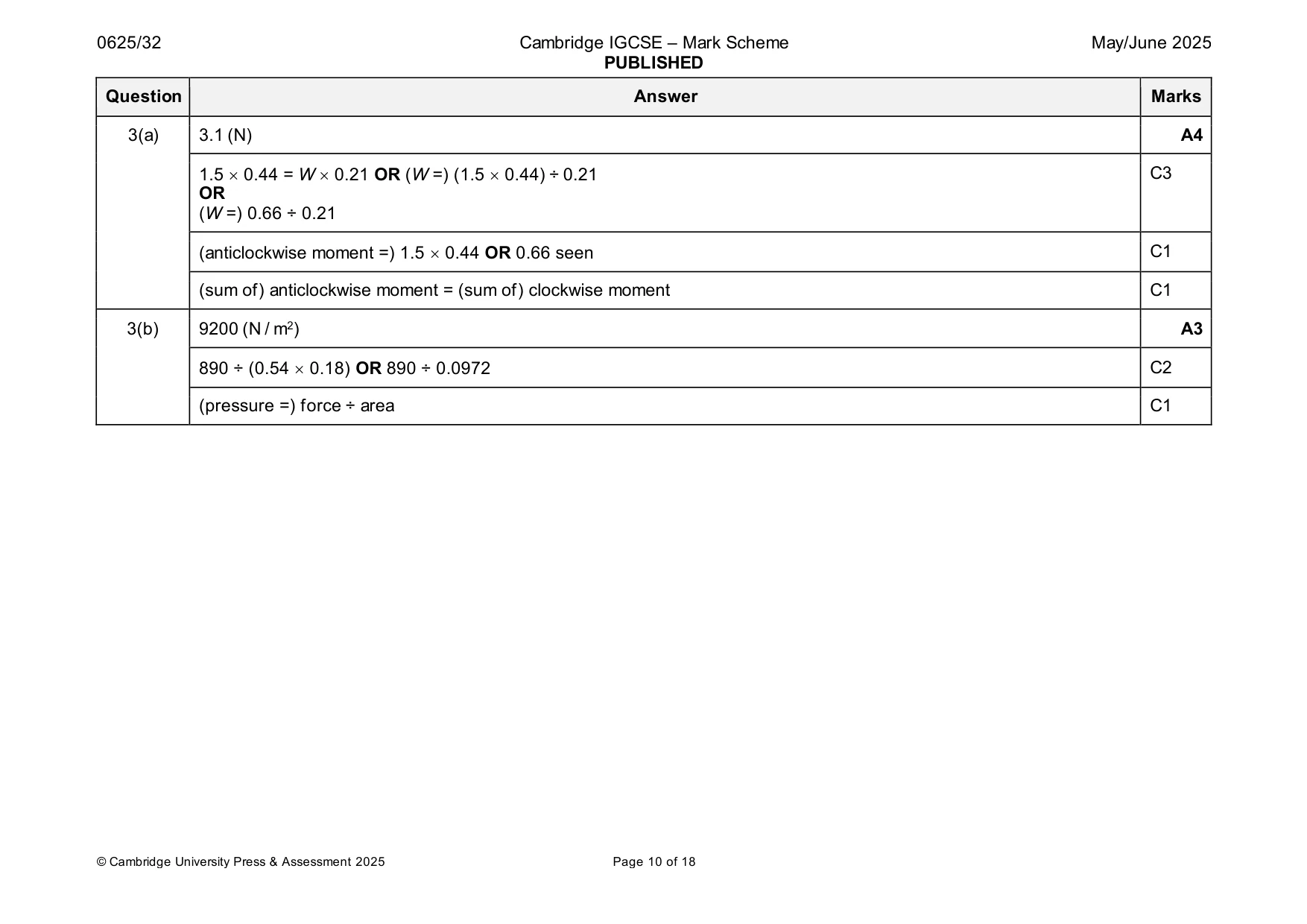
Mark scheme: 3(a) 3.1 (N) A4 1.5 0.44 = W 0.21 OR (W =) (1.5 0.44) ÷ 0.21 C3 OR (W =) 0.66 ÷ 0.21 (anticlockwise moment =) 1.5 0.44 OR 0.66 seen C1 (sum of) anticlockwise moment = (sum of) clockwise moment C1 3(b) 9200 (N / m2) A3 890 ÷ (0.54 0.18) OR 890 ÷ 0.0972 C2 (pressure =) force ÷ area C1
Q4 · Complete the sentences about the kinetic particle model of matter
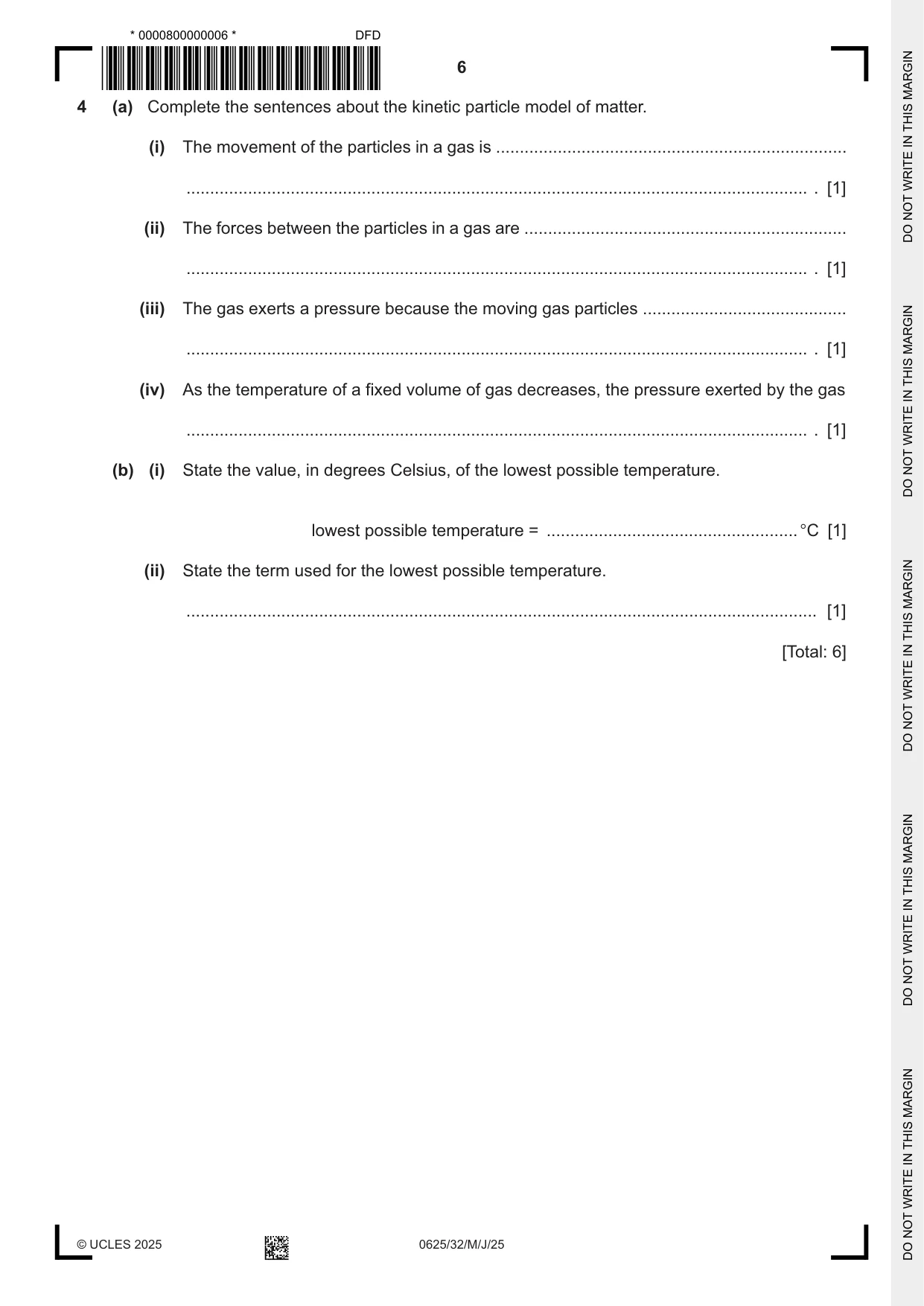
4 (a) Complete the sentences about the kinetic particle model of matter. (i) The movement of the particles in a gas is .......................................................................... ................................................................................................................................... . [1] (ii) The forces between the particles in a gas are .................................................................... ................................................................................................................................... . [1] (iii) The gas exerts a pressure because the moving gas particles ........................................... ................................................................................................................................... . [1] (iv) As the temperature of a fixed volume of gas decreases, the pressure exerted by the gas ................................................................................................................................... . [1] (b) (i) State the value, in degrees Celsius, of the lowest possible temperature. lowest possible temperature = .....................................................°C [1] (ii) State the term used for the lowest possible temperature. ..................................................................................................................................... [1] [Total: 6]
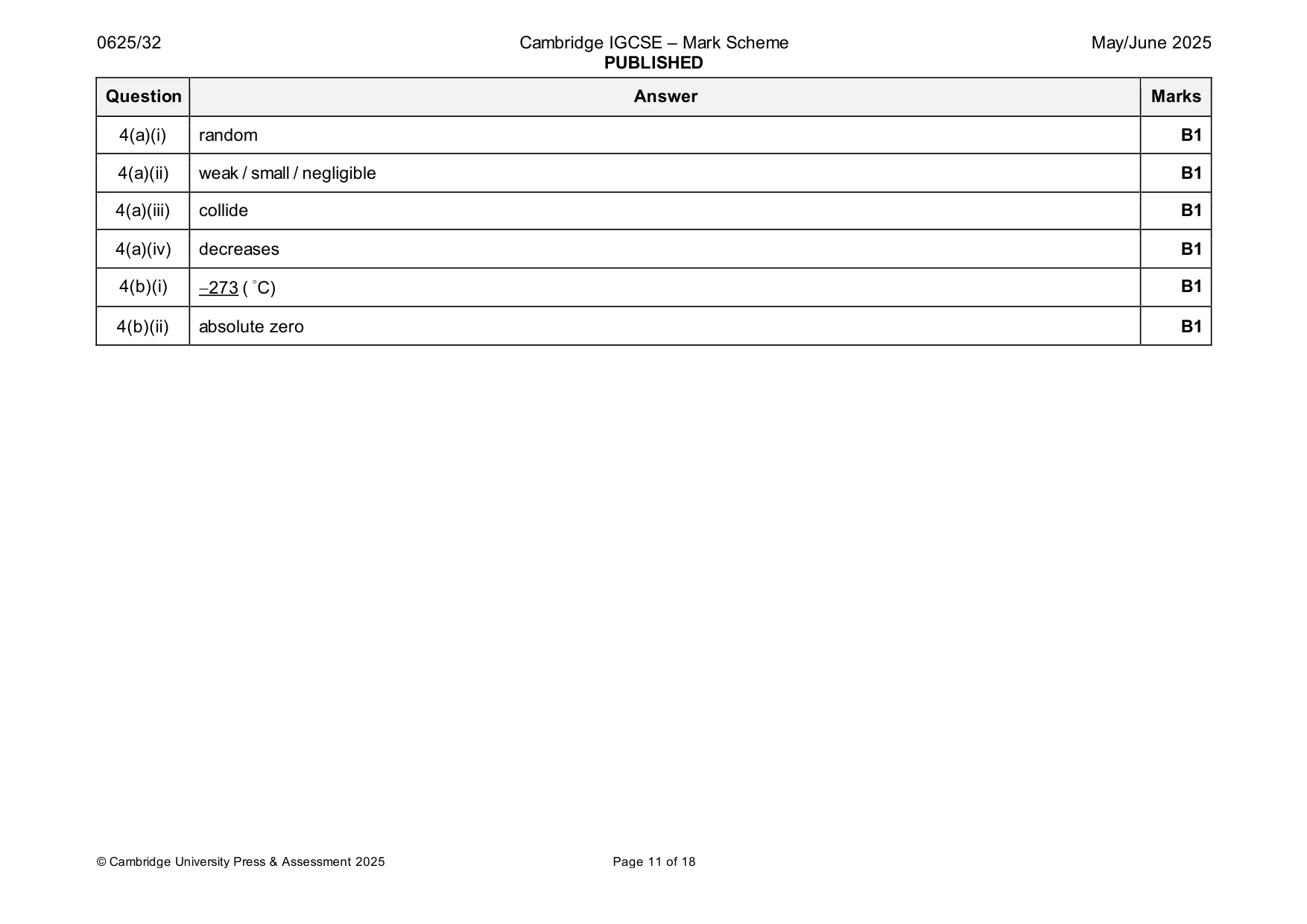
Mark scheme: 4(a)(i) random B1 4(a)(ii) weak / small / negligible B1 4(a)(iii) collide B1 4(a)(iv) decreases B1 4(b)(i) −273 ( C) B1 4(b)(ii) absolute zero B1
Q5 · A teacher produces a water wave in a ripple tank
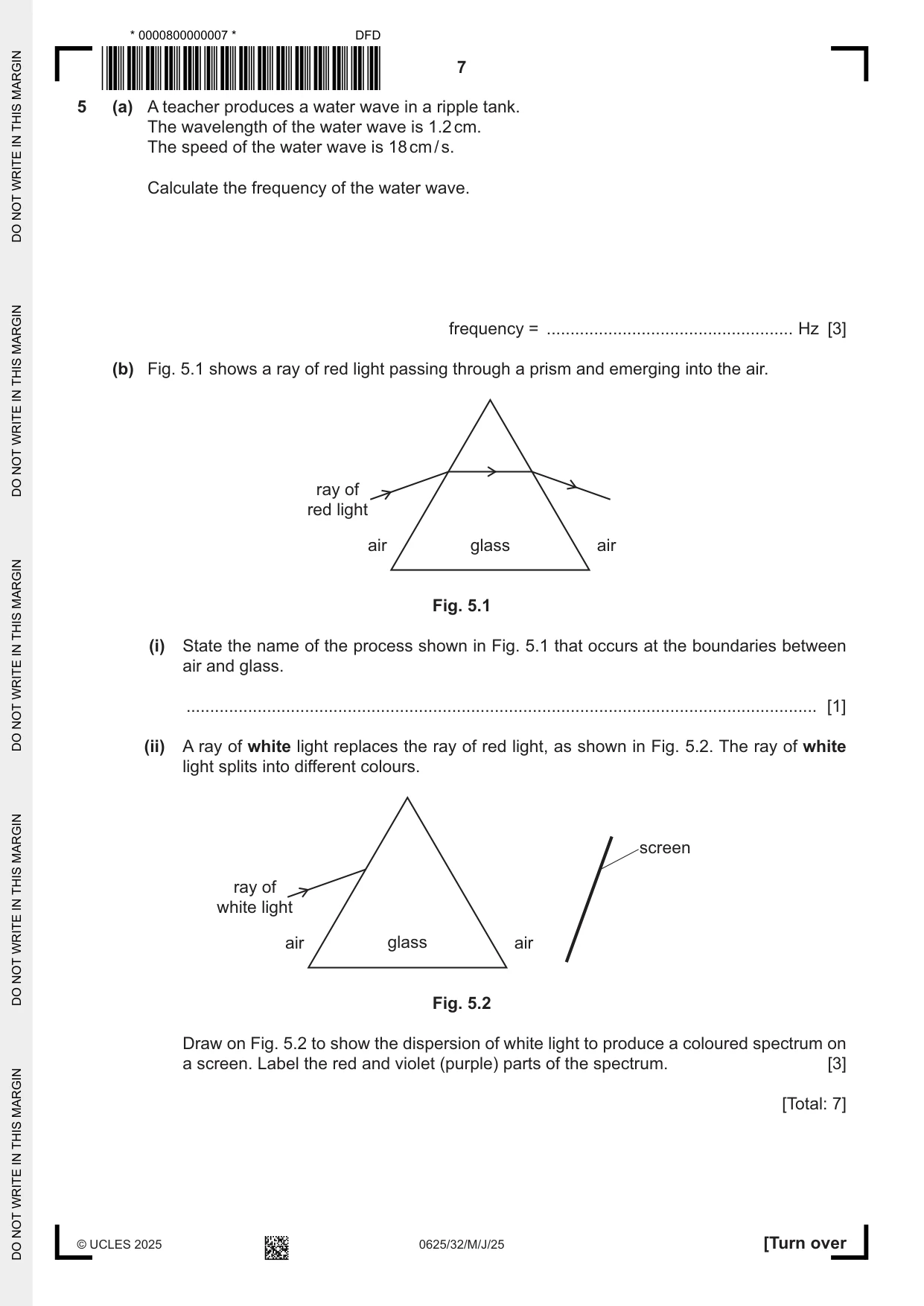
5 (a) A teacher produces a water wave in a ripple tank. The wavelength of the water wave is 1.2 cm. The speed of the water wave is 18 cm / s. Calculate the frequency of the water wave. frequency = .................................................... Hz [3] (b) Fig. 5.1 shows a ray of red light passing through a prism and emerging into the air. ray of red light air glass air Fig. 5.1 (i) State the name of the process shown in Fig. 5.1 that occurs at the boundaries between air and glass. ..................................................................................................................................... [1] (ii) A ray of white light replaces the ray of red light, as shown in Fig. 5.2. The ray of white light splits into different colours. screen ray of white light air glass air Fig. 5.2 Draw on Fig. 5.2 to show the dispersion of white light to produce a coloured spectrum on a screen. Label the red and violet (purple) parts of the spectrum. [3] [Total: 7]
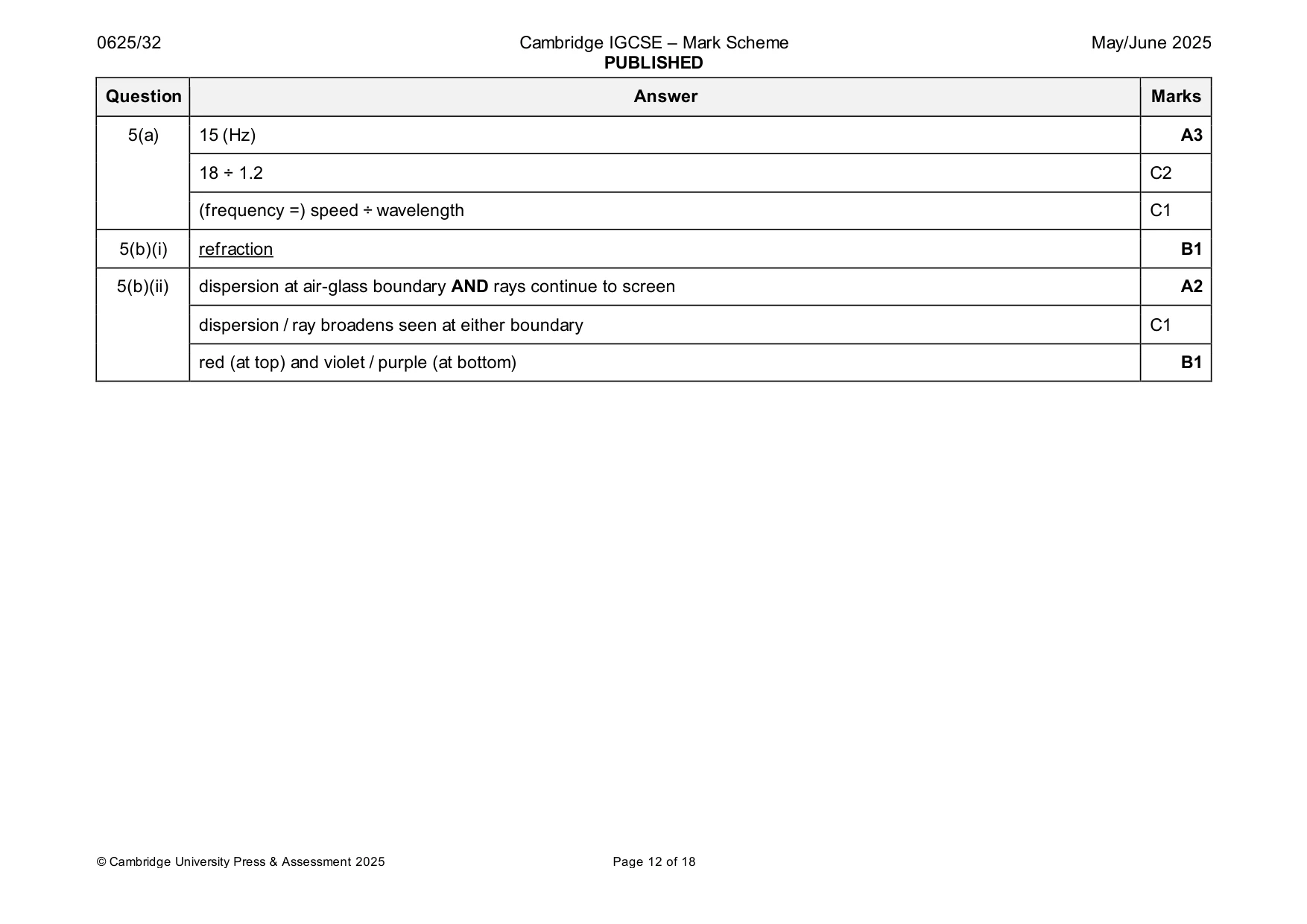
Mark scheme: 5(a) 15 (Hz) A3 18 ÷ 1.2 C2 (frequency =) speed ÷ wavelength C1 5(b)(i) refraction B1 5(b)(ii) dispersion at air-glass boundary AND rays continue to screen A2 dispersion / ray broadens seen at either boundary C1 red (at top) and violet / purple (at bottom) B1
Q6 · A teacher uses the equipment shown in Fig
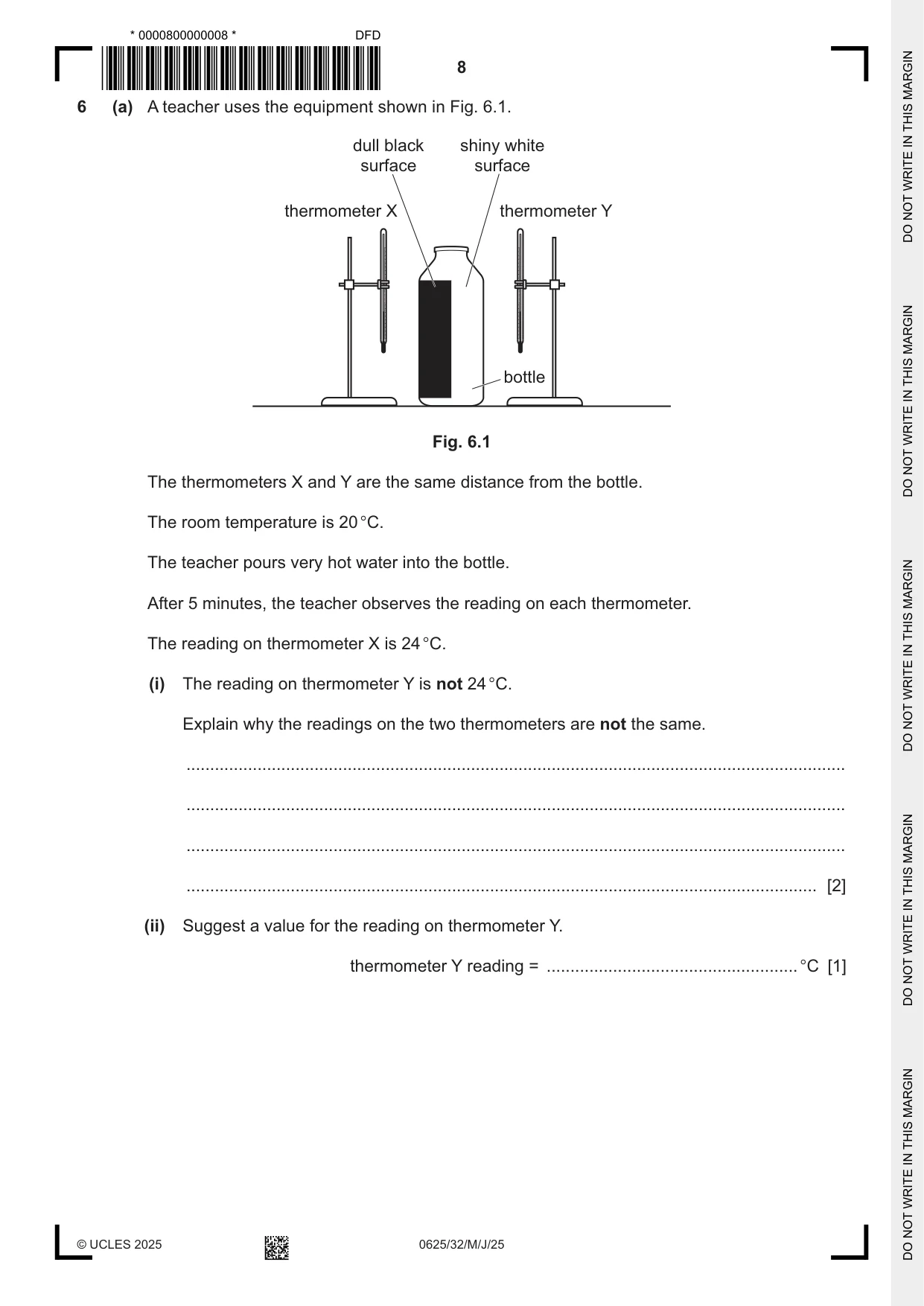
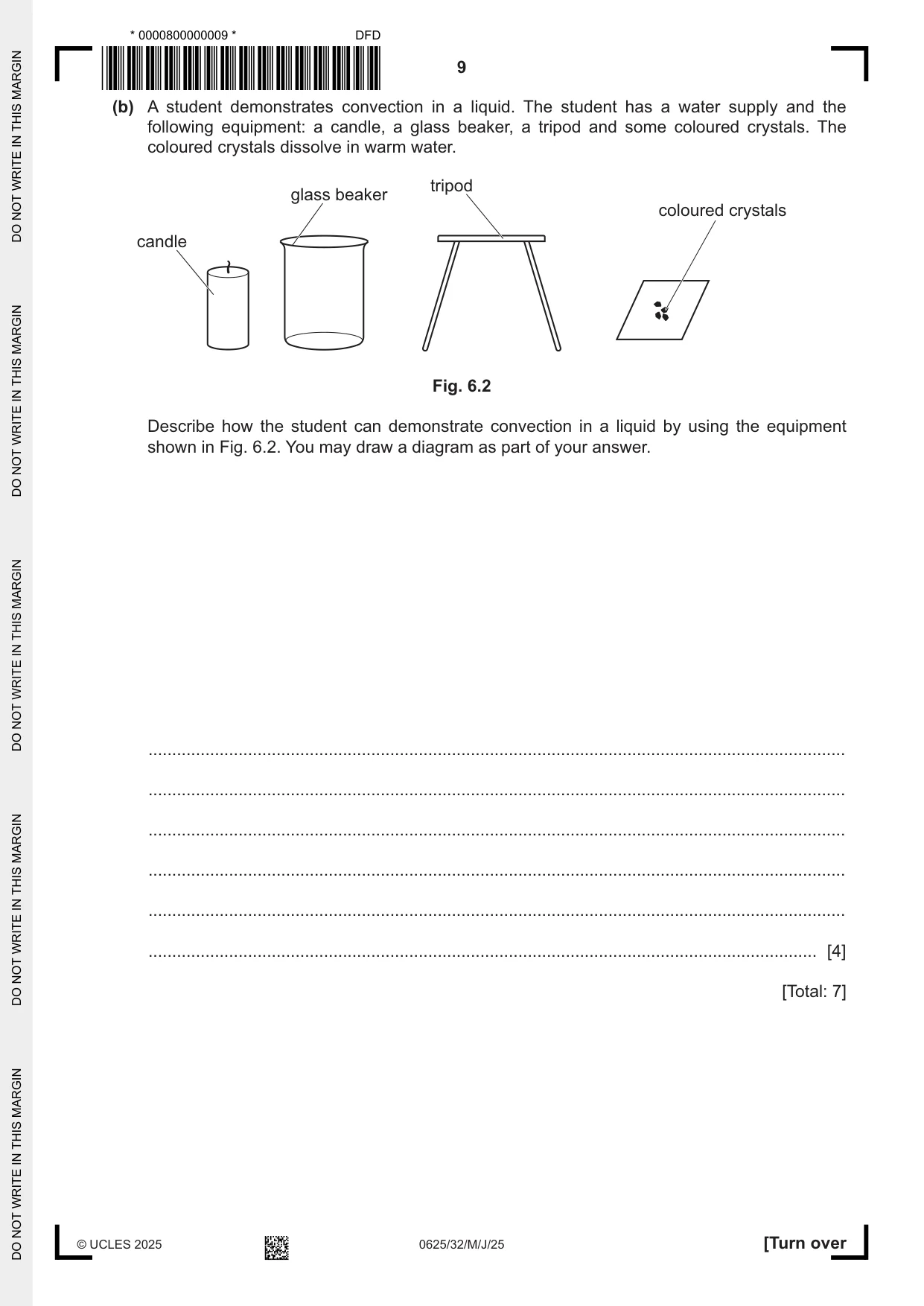
6 (a) A teacher uses the equipment shown in Fig. 6.1. dull black shiny white surface surface thermometer X thermometer Y bottle Fig. 6.1 The thermometers X and Y are the same distance from the bottle. The room temperature is 20 °C. The teacher pours very hot water into the bottle. After 5 minutes, the teacher observes the reading on each thermometer. The reading on thermometer X is 24 °C. (i) The reading on thermometer Y is not 24 °C. Explain why the readings on the two thermometers are not the same. ........................................................................................................................................... ........................................................................................................................................... ........................................................................................................................................... ..................................................................................................................................... [2] (ii) Suggest a value for the reading on thermometer Y. thermometer Y reading = ..................................................... °C [1] (b) A student demonstrates convection in a liquid. The student has a water supply and the following equipment: a candle, a glass beaker, a tripod and some coloured crystals. The coloured crystals dissolve in warm water. tripod glass beaker coloured crystals candle Fig. 6.2 Describe how the student can demonstrate convection in a liquid by using the equipment shown in Fig. 6.2. You may draw a diagram as part of your answer. ................................................................................................................................................... ................................................................................................................................................... ................................................................................................................................................... ................................................................................................................................................... ................................................................................................................................................... ............................................................................................................................................. [4] [Total: 7]
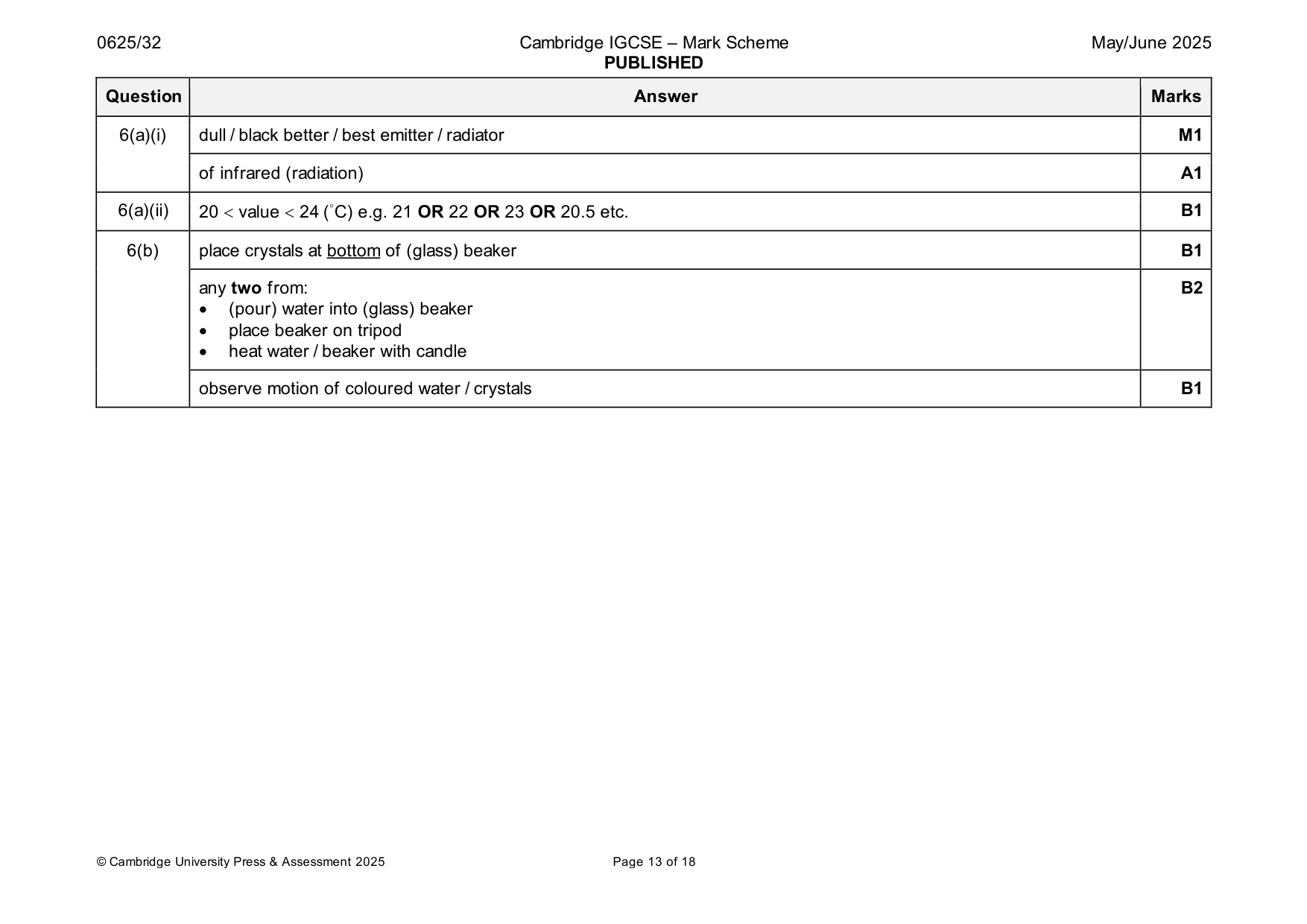
Mark scheme: 6(a)(i) dull / black better / best emitter / radiator M1 of infrared (radiation) A1 6(a)(ii) 20 value 24 (C) e.g. 21 OR 22 OR 23 OR 20.5 etc. B1 6(b) place crystals at bottom of (glass) beaker B1 any two from: B2 • (pour) water into (glass) beaker • place beaker on tripod • heat water / beaker with candle observe motion of coloured water / crystals B1
Q7 · Place ticks (✓) in Table 7.1 to show the properties of sound waves and of microwaves
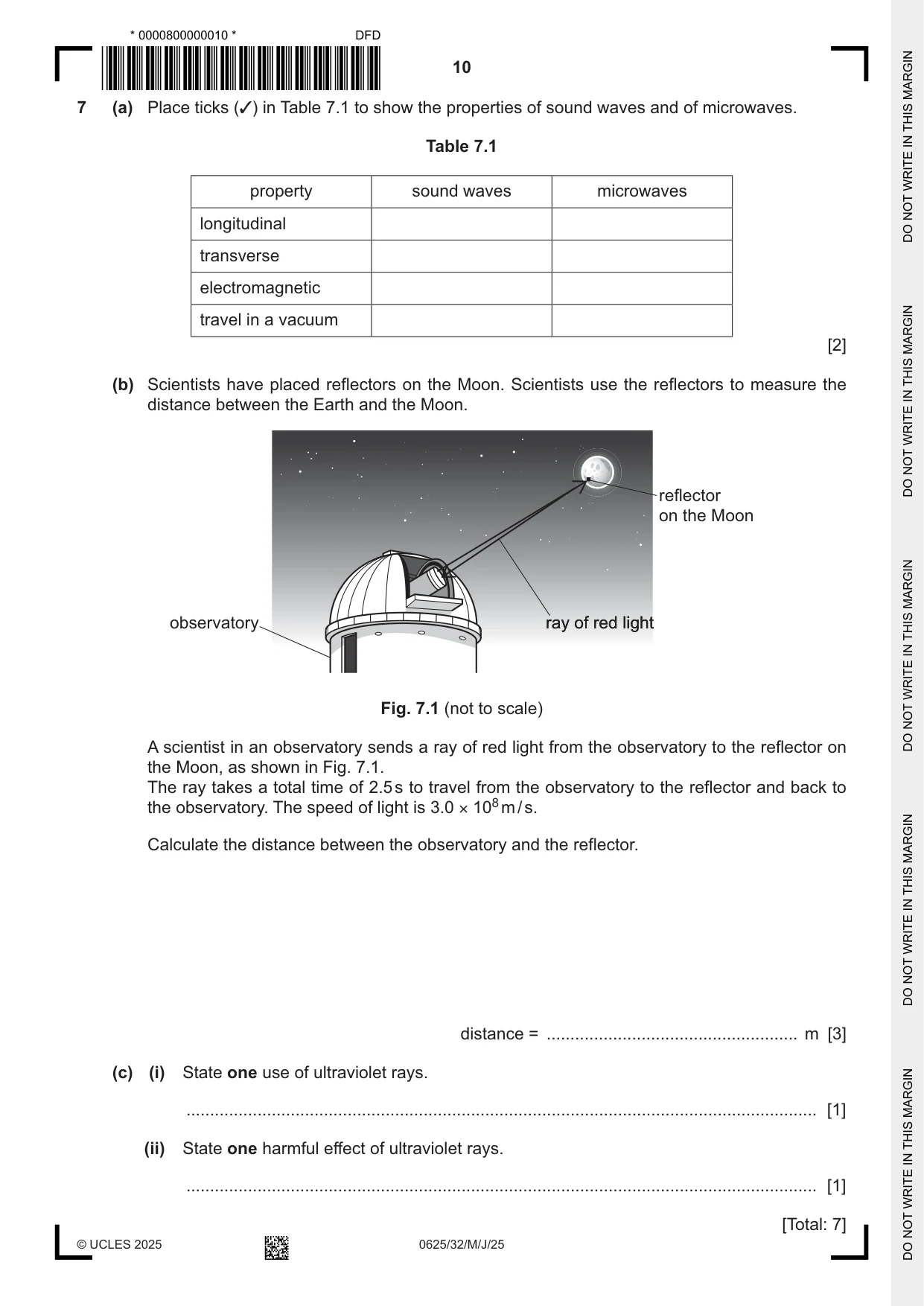
7 (a) Place ticks (✓) in Table 7.1 to show the properties of sound waves and of microwaves. Table 7.1 property sound waves microwaves longitudinal transverse electromagnetic travel in a vacuum [2] (b) Scientists have placed reflectors on the Moon. Scientists use the reflectors to measure the distance between the Earth and the Moon. reflector on the Moon observatory rayray ofof redred lightlight Fig. 7.1 (not to scale) A scientist in an observatory sends a ray of red light from the observatory to the reflector on the Moon, as shown in Fig. 7.1. The ray takes a total time of 2.5 s to travel from the observatory to the reflector and back to the observatory. The speed of light is 3.0 × 10⁸ m / s. Calculate the distance between the observatory and the reflector. distance = ..................................................... m [3] (c) (i) State one use of ultraviolet rays. ..................................................................................................................................... [1] (ii) State one harmful effect of ultraviolet rays. ..................................................................................................................................... [1] [Total: 7]
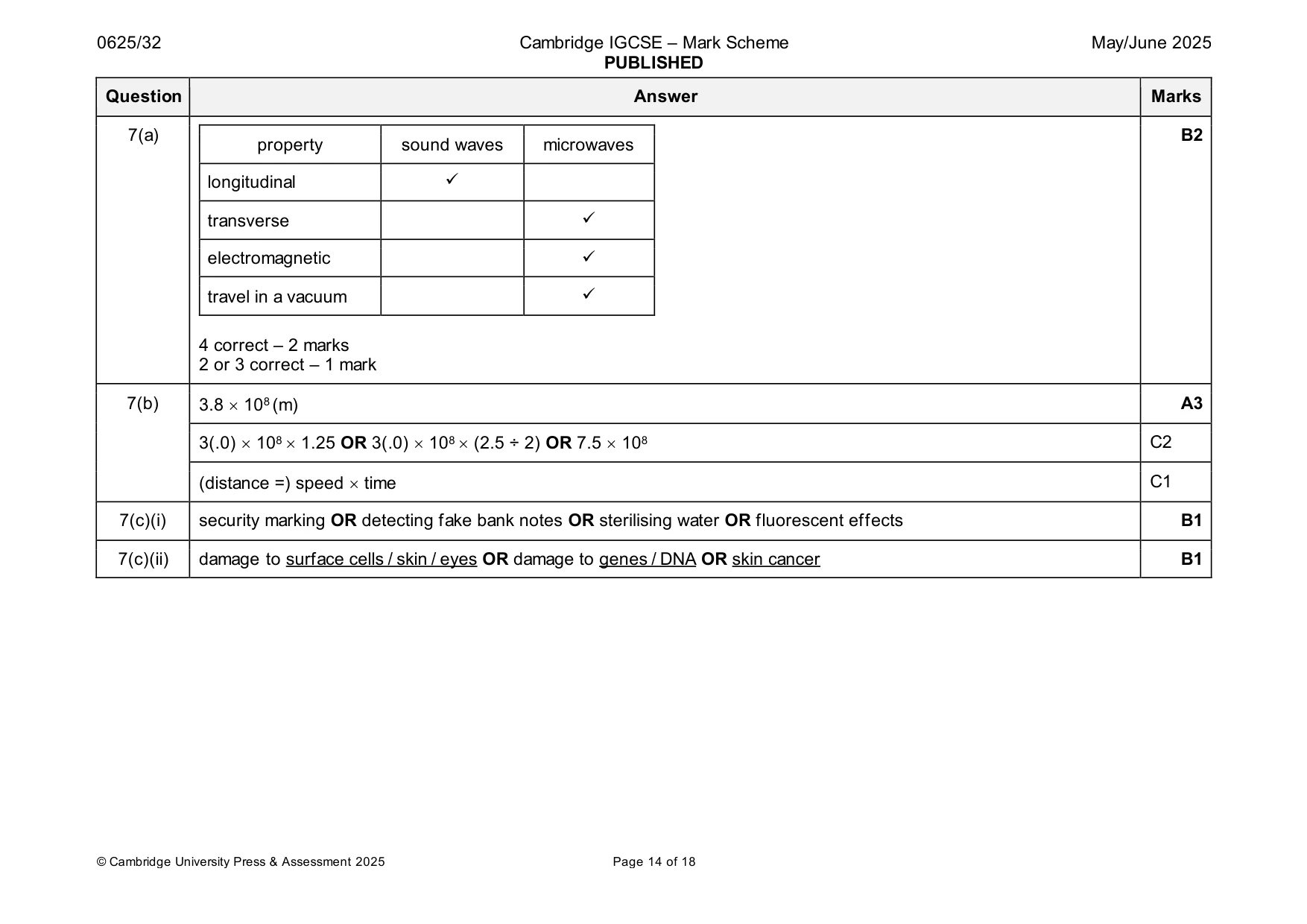
Mark scheme: 7(a) B2 property sound waves microwaves longitudinal ✓ transverse ✓ electromagnetic ✓ travel in a vacuum ✓ 4 correct – 2 marks 2 or 3 correct – 1 mark 7(b) 3.8 108 (m) A3 3(.0) 108 1.25 OR 3(.0) 108 (2.5 ÷ 2) OR 7.5 108 C2 (distance =) speed time C1 7(c)(i) security marking OR detecting fake bank notes OR sterilising water OR fluorescent effects B1 7(c)(ii) damage to surface cells / skin / eyes OR damage to genes / DNA OR skin cancer B1
Q8 · A mains-powered electric fan heater fixed on a bathroom wall
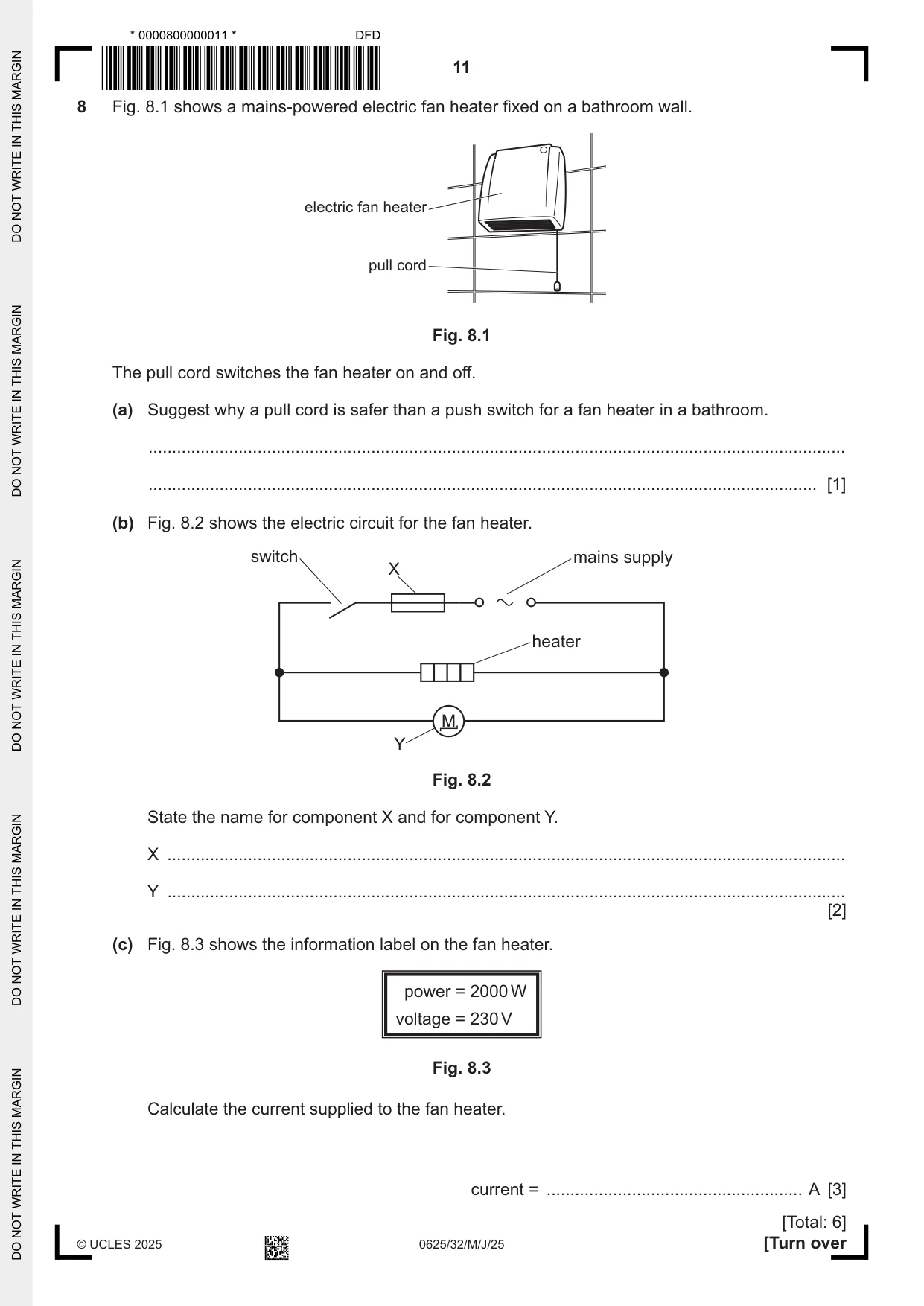
8 Fig. 8.1 shows a mains-powered electric fan heater fixed on a bathroom wall. electric fan heater pull cord Fig. 8.1 The pull cord switches the fan heater on and off. (a) Suggest why a pull cord is safer than a push switch for a fan heater in a bathroom. ................................................................................................................................................... ............................................................................................................................................. [1] (b) Fig. 8.2 shows the electric circuit for the fan heater. switch mains supply X heater M Y Fig. 8.2 State the name for component X and for component Y. X ............................................................................................................................................... Y ............................................................................................................................................... [2] (c) Fig. 8.3 shows the information label on the fan heater. power = 2000 W voltage = 230 V Fig. 8.3 Calculate the current supplied to the fan heater. current = ...................................................... A [3] [Total: 6]
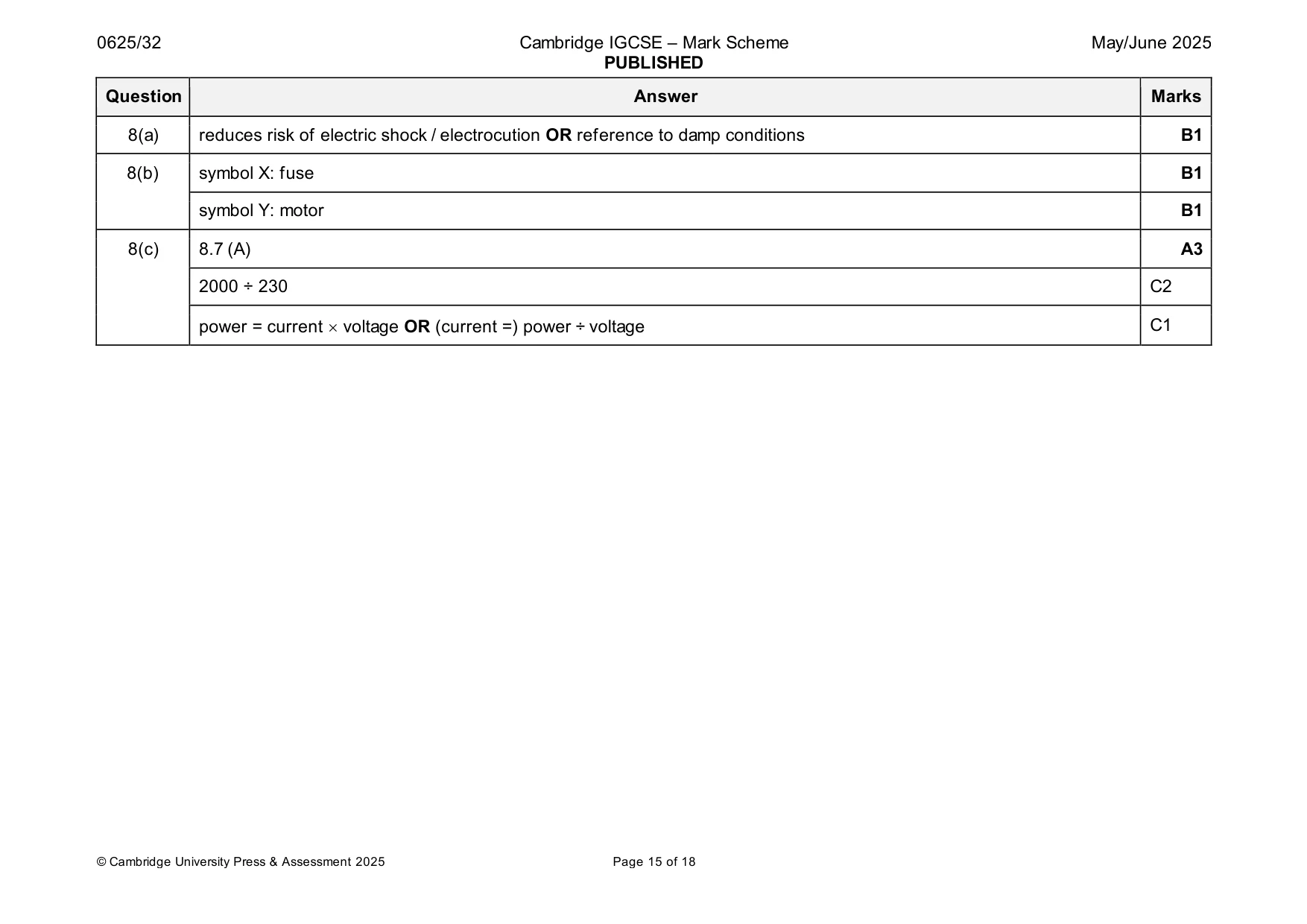
Mark scheme: 8(a) reduces risk of electric shock / electrocution OR reference to damp conditions B1 8(b) symbol X: fuse B1 symbol Y: motor B1 8(c) 8.7 (A) A3 2000 ÷ 230 C2 power = current voltage OR (current =) power ÷ voltage C1
Q9 · Two resistors connected in series
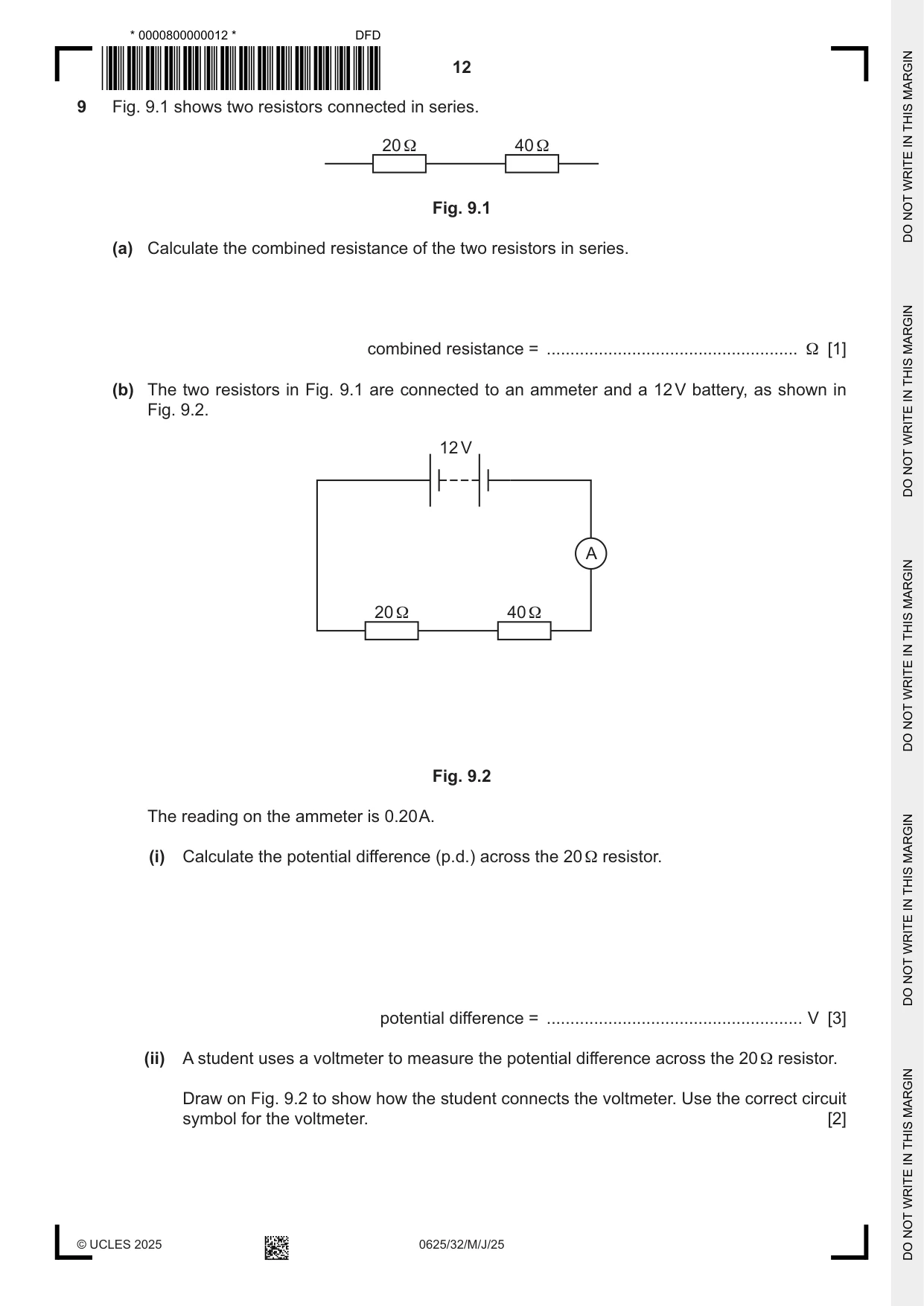
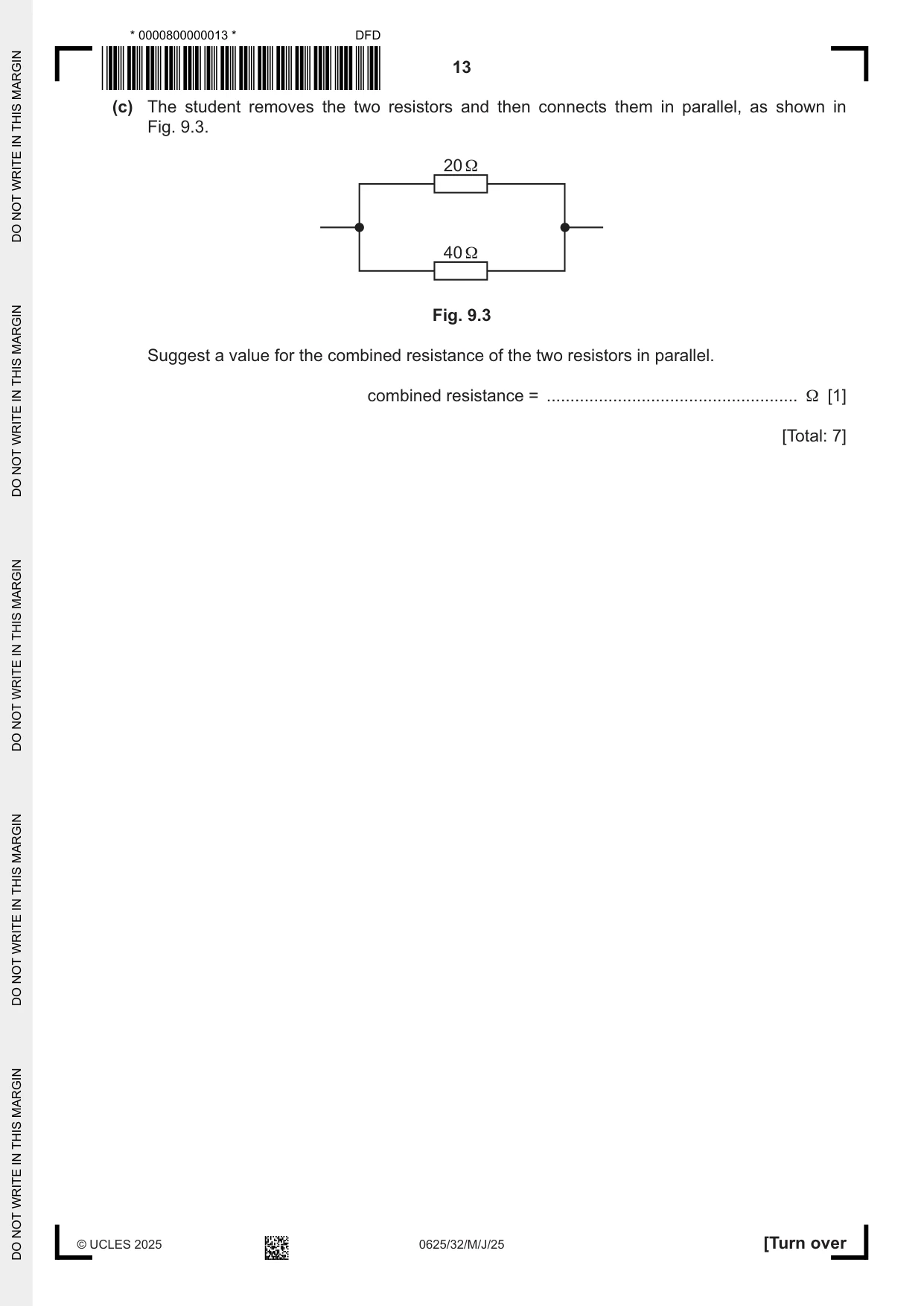
9 Fig. 9.1 shows two resistors connected in series. 20 Ω 40 Ω Fig. 9.1 (a) Calculate the combined resistance of the two resistors in series. combined resistance = ..................................................... Ω [1] (b) The two resistors in Fig. 9.1 are connected to an ammeter and a 12 V battery, as shown in Fig. 9.2. 12 V A 20 Ω 40 Ω Fig. 9.2 The reading on the ammeter is 0.20 A. (i) Calculate the potential difference (p.d.) across the 20 Ω resistor. potential difference = ...................................................... V [3] (ii) A student uses a voltmeter to measure the potential difference across the 20 Ω resistor. Draw on Fig. 9.2 to show how the student connects the voltmeter. Use the correct circuit symbol for the voltmeter. [2] (c) The student removes the two resistors and then connects them in parallel, as shown in Fig. 9.3. 20 Ω 40 Ω Fig. 9.3 Suggest a value for the combined resistance of the two resistors in parallel. combined resistance = ..................................................... Ω [1] [Total: 7]
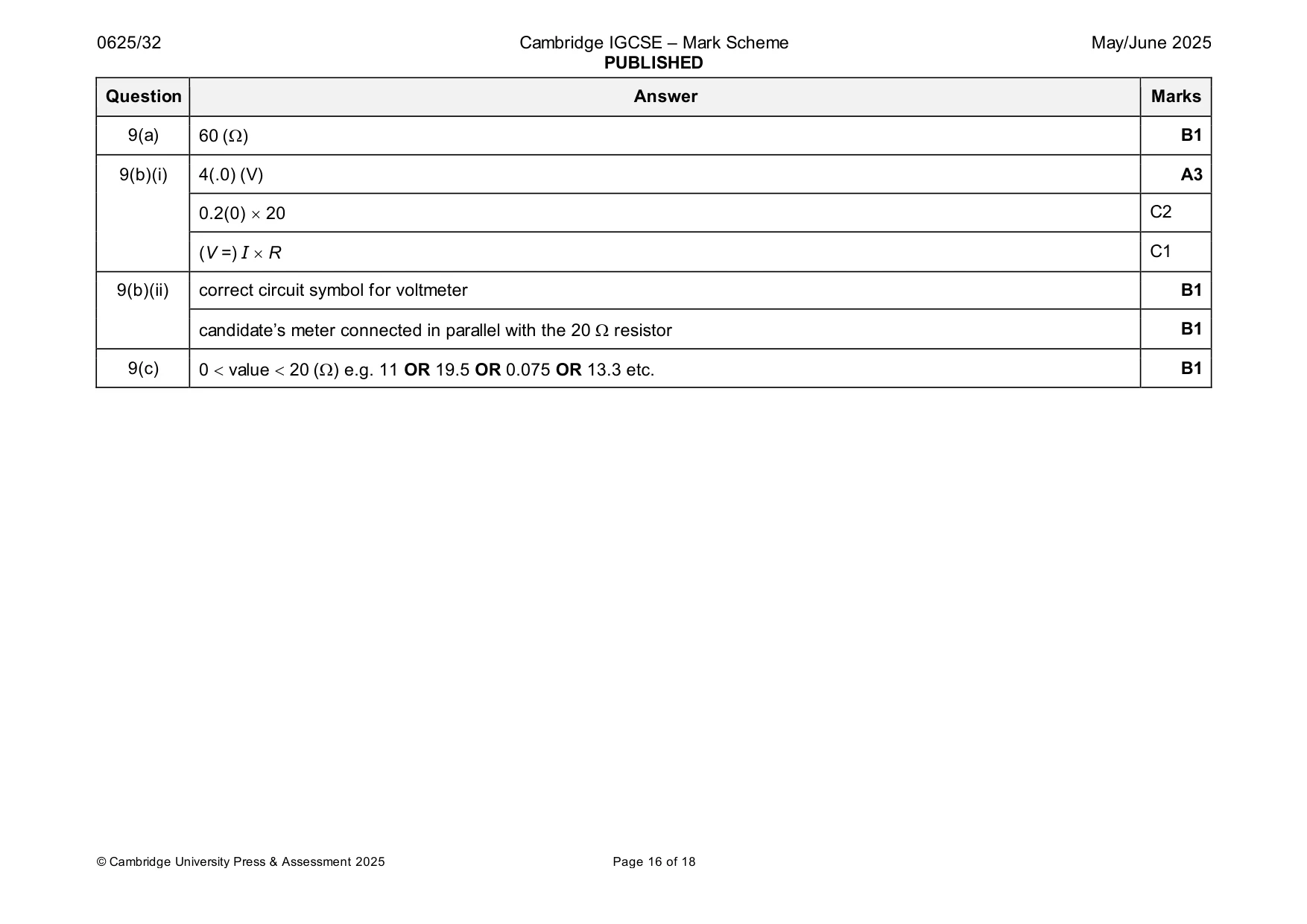
Mark scheme: 9(a) 60 () B1 9(b)(i) 4(.0) (V) A3 0.2(0) 20 C2 (V =) I R C1 9(b)(ii) correct circuit symbol for voltmeter B1 candidate’s meter connected in parallel with the 20 resistor B1 9(c) 0 value 20 () e.g. 11 OR 19.5 OR 0.075 OR 13.3 etc. B1
Q10 · Radon-222 is a radioactive gas that emits alpha (α) particles
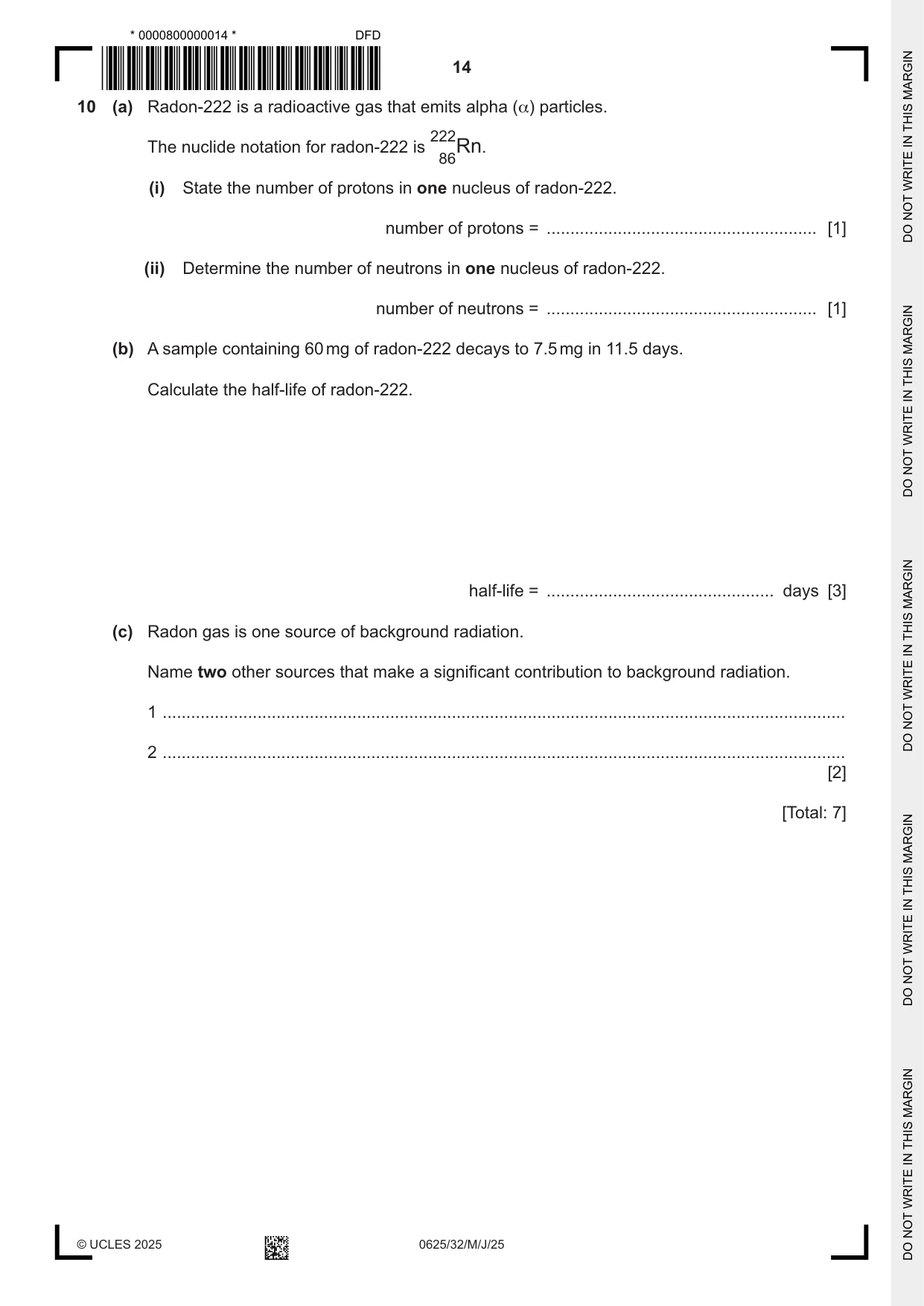
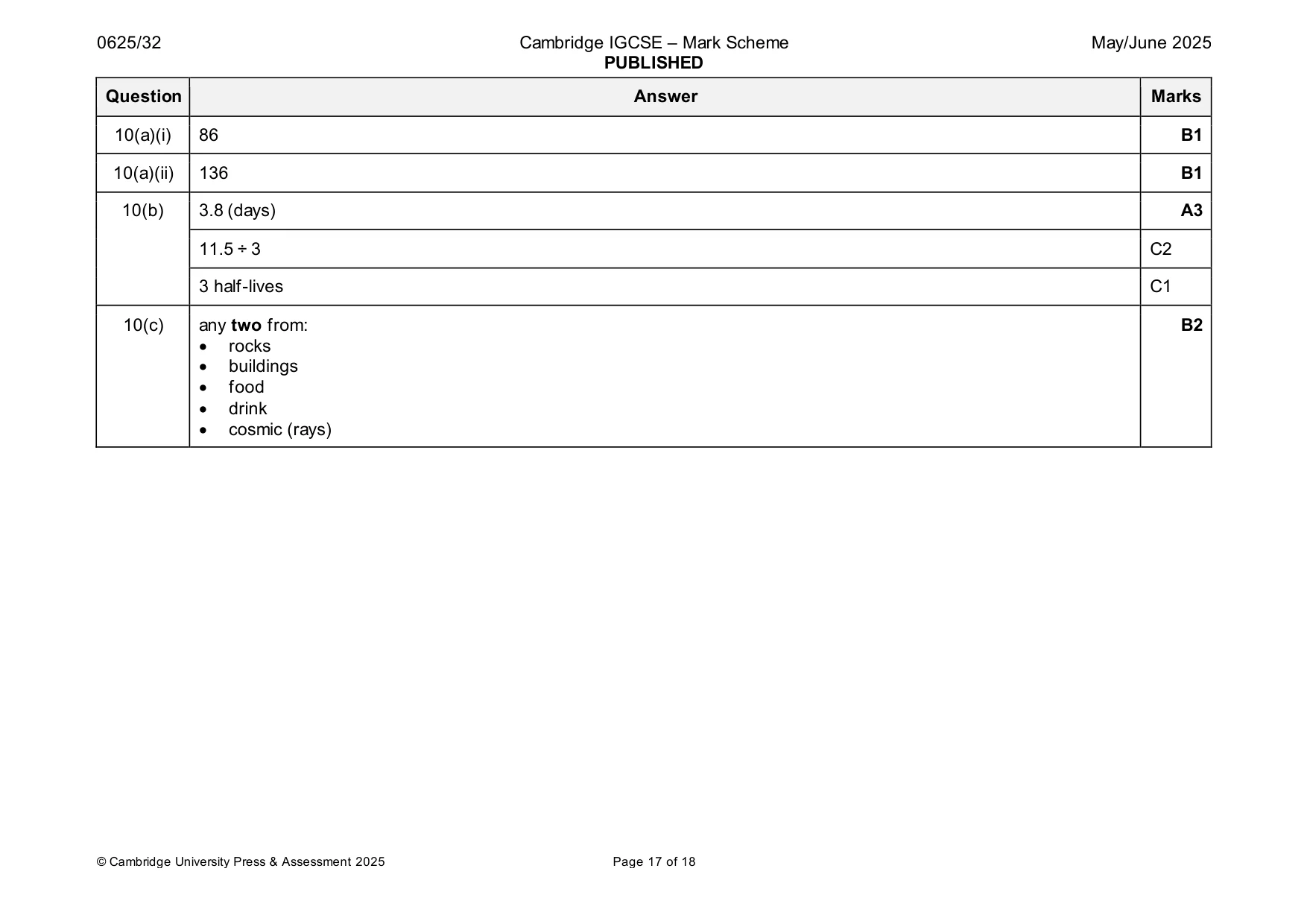
10 (a) Radon-222 is a radioactive gas that emits alpha (α) particles. 222 The nuclide notation for radon-222 is 86Rn. (i) State the number of protons in one nucleus of radon-222. number of protons = ......................................................... [1] (ii) Determine the number of neutrons in one nucleus of radon-222. number of neutrons = ......................................................... [1] (b) A sample containing 60 mg of radon-222 decays to 7.5 mg in 11.5 days. Calculate the half-life of radon-222. half-life = ................................................ days [3] (c) Radon gas is one source of background radiation. Name two other sources that make a significant contribution to background radiation. 1 ................................................................................................................................................ 2 ................................................................................................................................................ [2] [Total: 7]
Mark scheme: 10(a)(i) 86 B1 10(a)(ii) 136 B1 10(b) 3.8 (days) A3 11.5 ÷ 3 C2 3 half-lives C1 10(c) any two from: B2 • rocks • buildings • food • drink • cosmic (rays)
Question 11
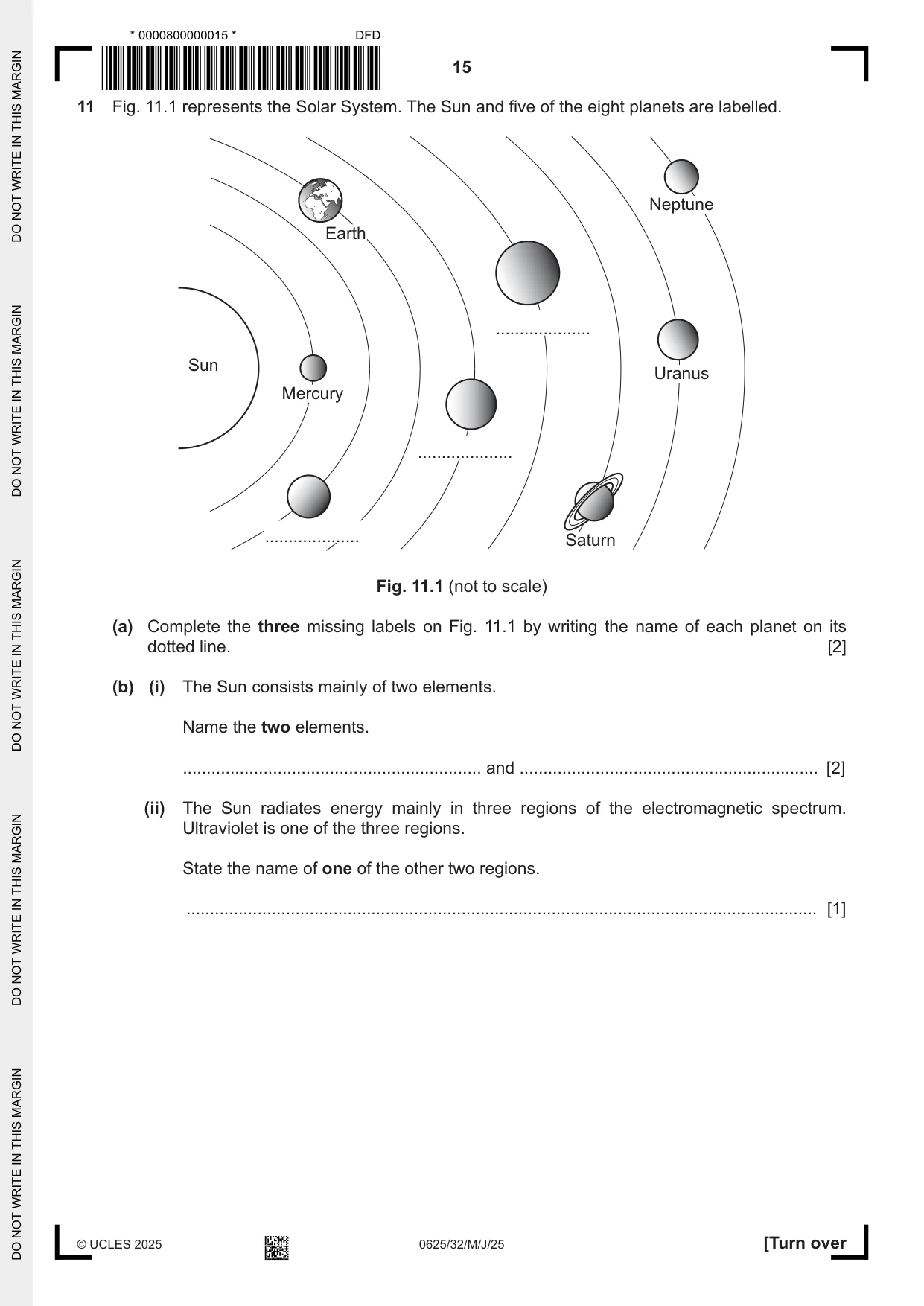
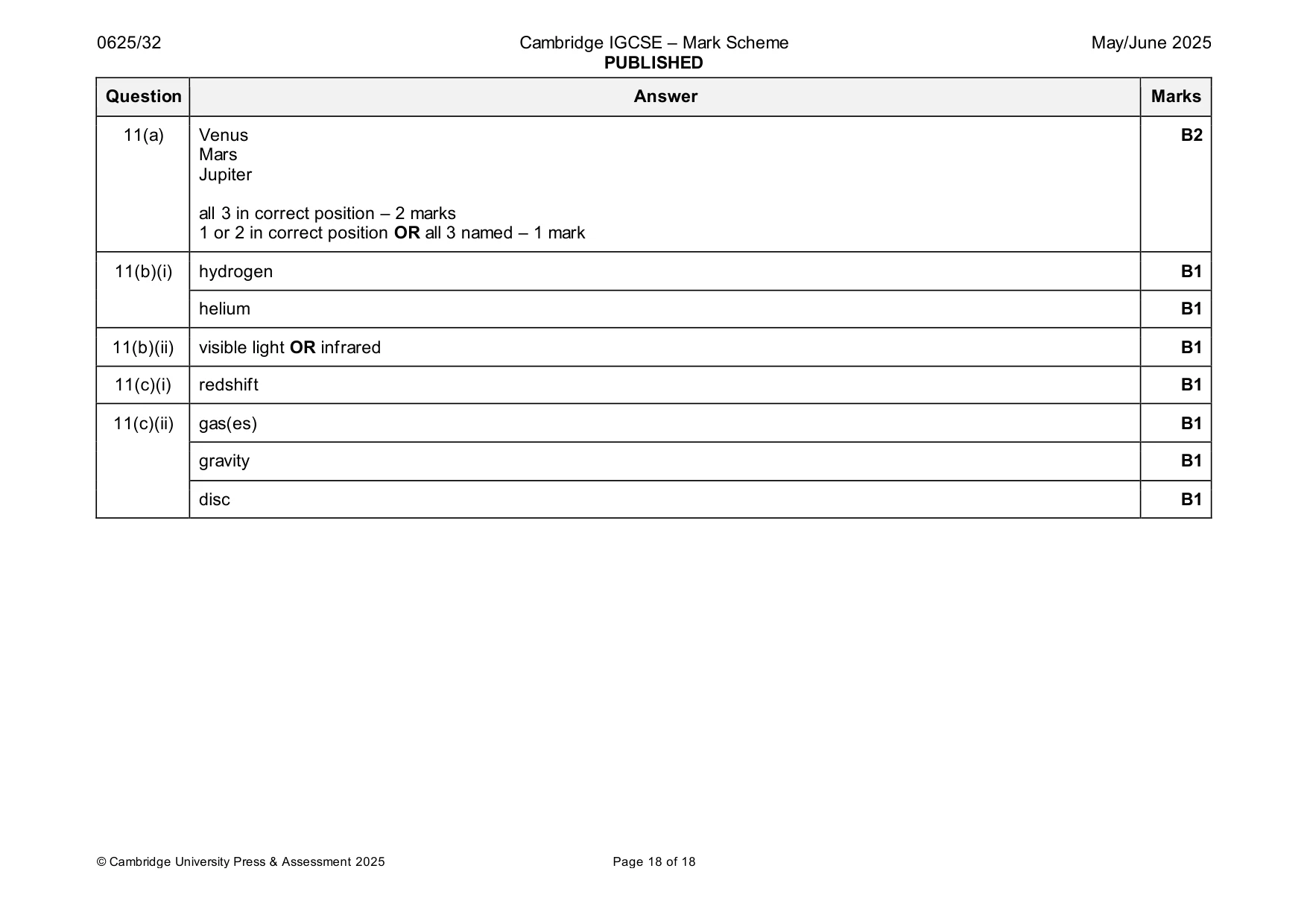
11 Fig. 11.1 represents the Solar System. The Sun and five of the eight planets are labelled. Neptune Earth .................... Sun Uranus Mercury .................... .................... Saturn Fig. 11.1 (not to scale) (a) Complete the three missing labels on Fig. 11.1 by writing the name of each planet on its dotted line. [2] (b) (i) The Sun consists mainly of two elements. Name the two elements. ............................................................... and ............................................................... [2] (ii) The Sun radiates energy mainly in three regions of the electromagnetic spectrum. Ultraviolet is one of the three regions. State the name of one of the other two regions. ..................................................................................................................................... [1] (c) (i) Scientists use the Big Bang Theory to explain the way the Universe began. State one piece of evidence that supports the Big Bang Theory. ........................................................................................................................................... ..................................................................................................................................... [1] (ii) Scientists use the accretion model to explain the formation of the Solar System. Complete the following sentences about the accretion model. In space, there are clouds of dust and ............................................................................ . The material spins around and moves closer together due to the force of ..................... . This forms an accretion ................................................................................................... . [3] [Total: 9]
Mark scheme: 11(a) Venus B2 Mars Jupiter all 3 in correct position – 2 marks 1 or 2 in correct position OR all 3 named – 1 mark 11(b)(i) hydrogen B1 helium B1 11(b)(ii) visible light OR infrared B1 11(c)(i) redshift B1 11(c)(ii) gas(es) B1 gravity B1 disc B1
What was in this paper
The subtopics covered by these 11 questions, and how many questions each got. Open one in a new tab to see every Cambridge question on it.
What you needed in this session
Cambridge’s own grade thresholds for 2025 May/June, Paper 3 · Variant 2. A higher threshold means an easier paper — the bar moves with how the cohort did.