Cambridge IGCSE Physics 0625 — 2021 May/June Paper 3 · Variant 2
0625/32/M/J/21 · 11 questions · 80 marks · ≈90 min
The question paper and its mark scheme, free to read here and free to download. This is Cambridge’s own paper, exactly as it was sat.
Question paper16 pages
Mark scheme10 pages
Answers below. Sit the paper first if you are practising.
Questions as text
Q1 · The core of a transformer
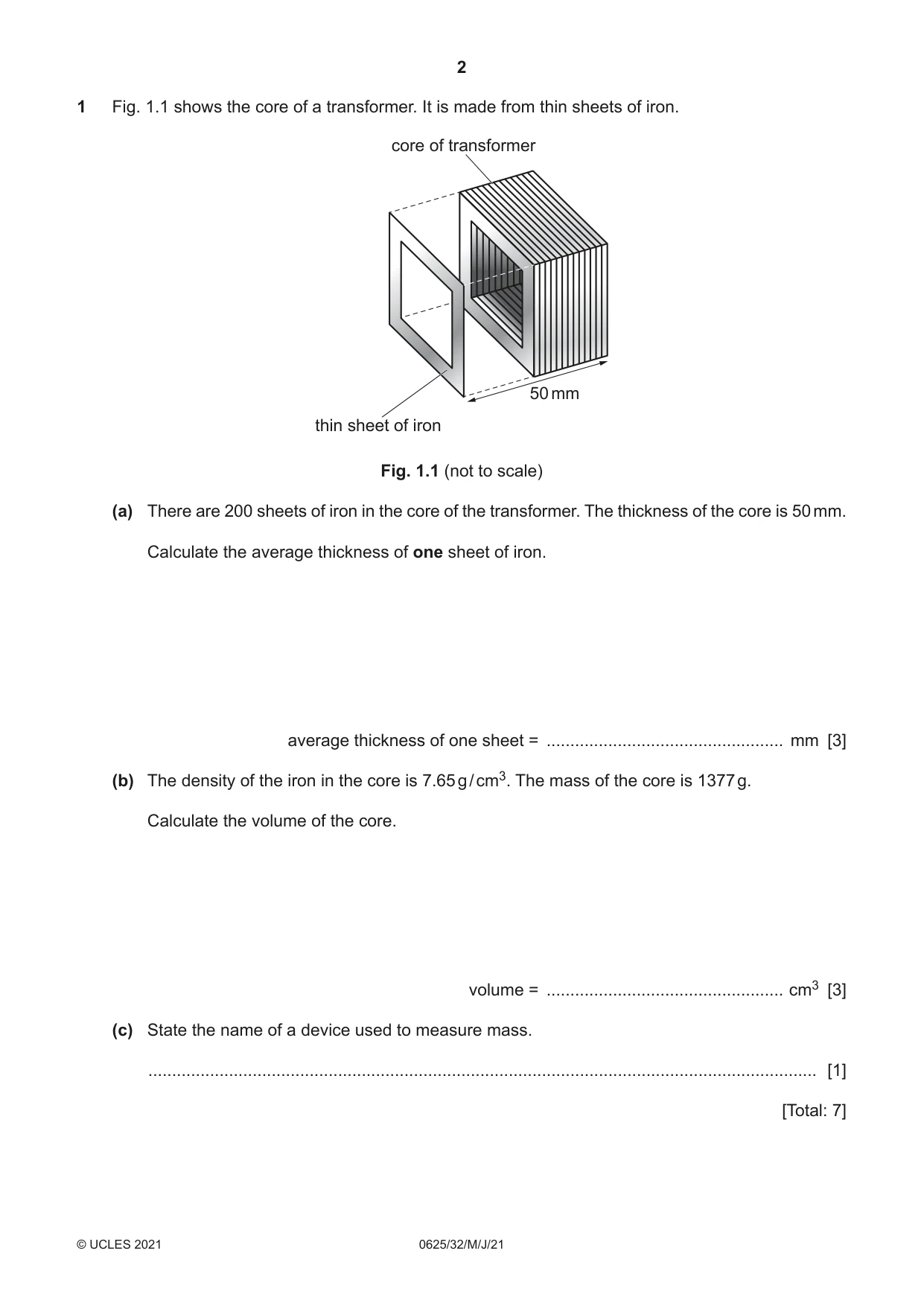
1 Fig. 1.1 shows the core of a transformer. It is made from thin sheets of iron. core of transformer 50 mm thin sheet of iron Fig. 1.1 (not to scale) (a) There are 200 sheets of iron in the core of the transformer. The thickness of the core is 50 mm. Calculate the average thickness of one sheet of iron. average thickness of one sheet = .................................................. mm [3] (b) The density of the iron in the core is 7.65 g / cm3. The mass of the core is 1377 g. Calculate the volume of the core. volume = .................................................. cm3 [3] (c) State the name of a device used to measure mass. ............................................................................................................................................. [1] [Total: 7]
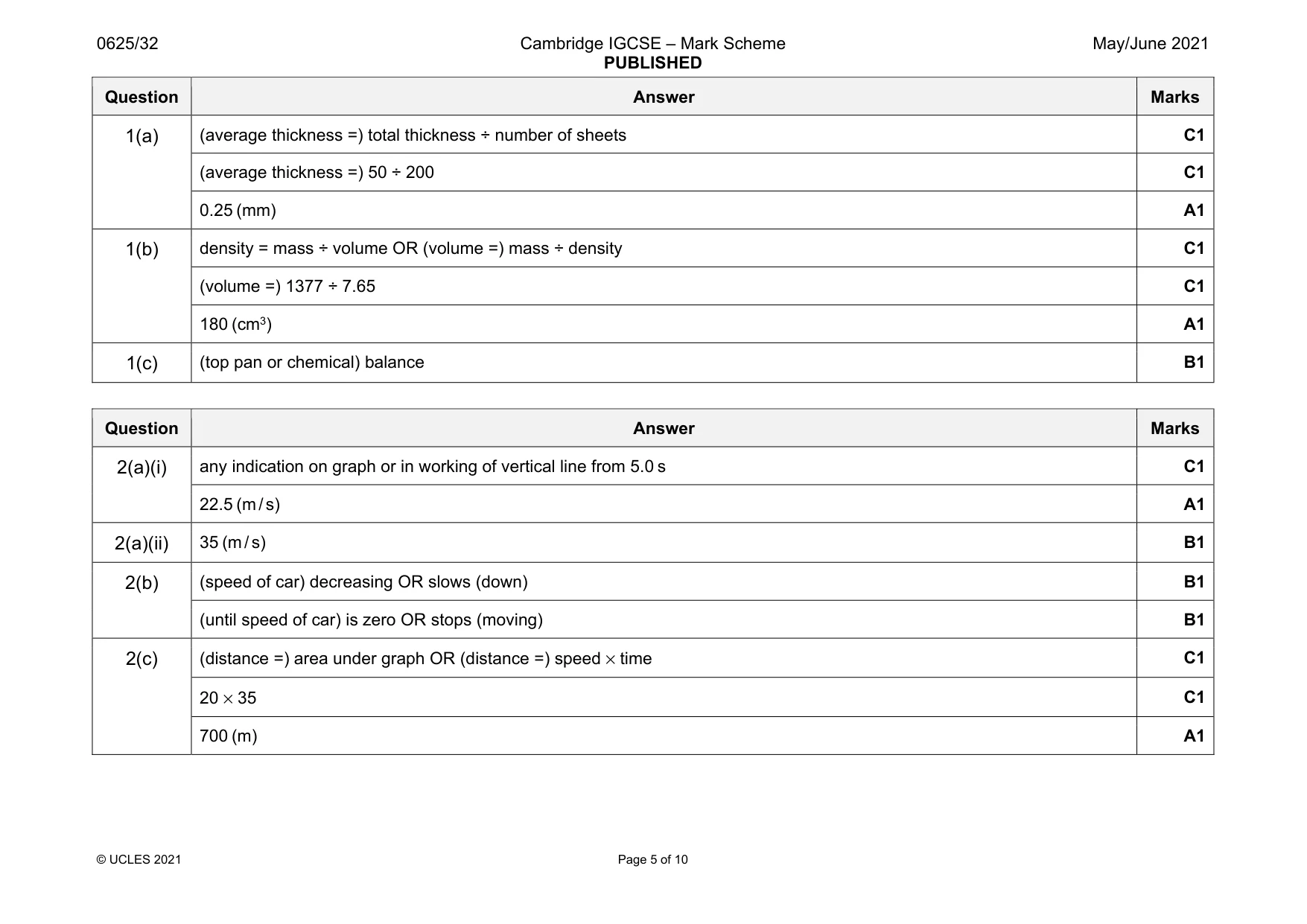
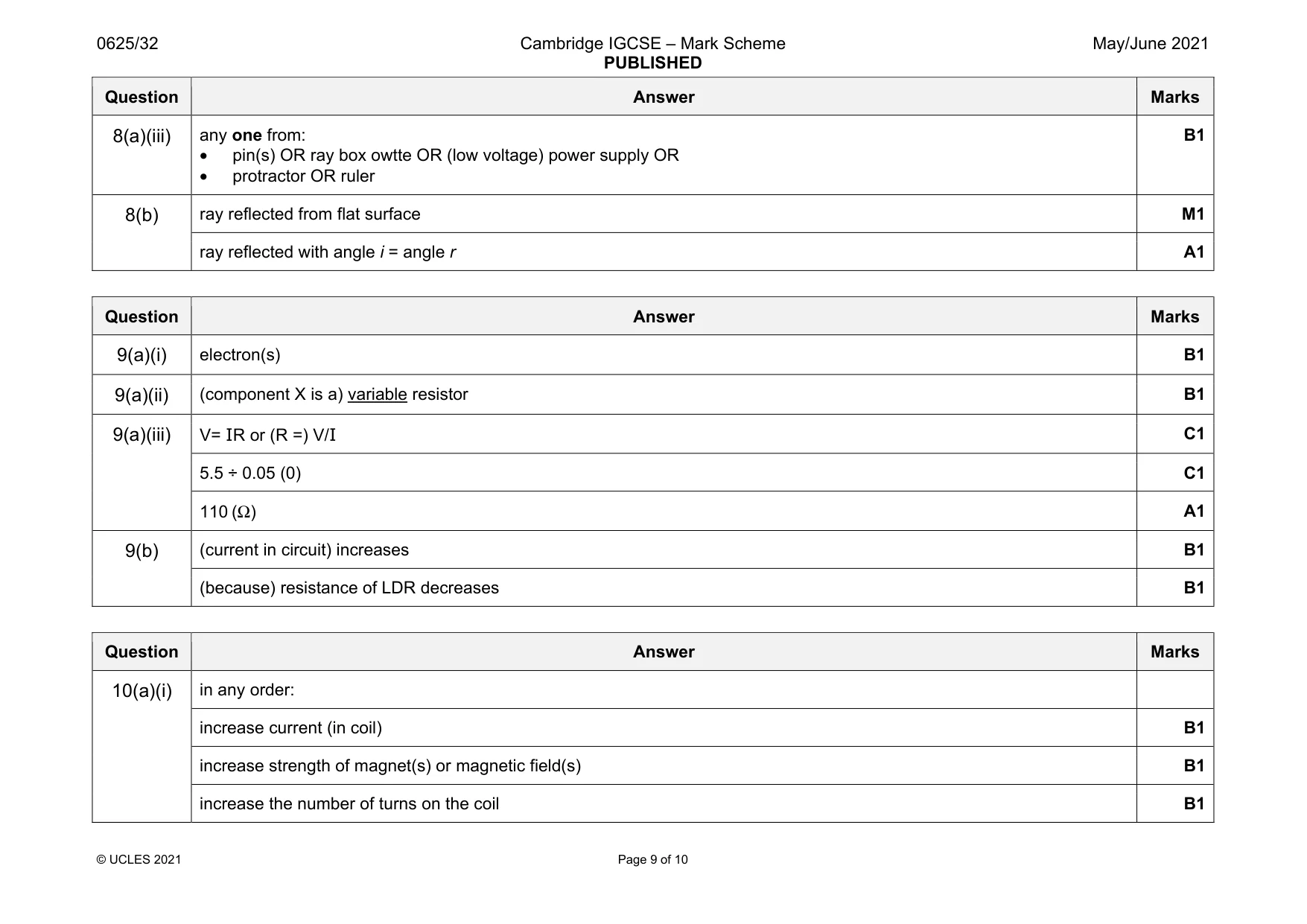
Mark scheme: 1(a) (average thickness =) 50 ÷ 200 C1 0.25 (mm) A1 1(b) density = mass ÷ volume OR (volume =) mass ÷ density C1 (volume =) 1377 ÷ 7.65 C1 180 (cm3) A1 1(c) (top pan or chemical) balance B1
More questions on Physical quantities and measurement techniques
Q2 · How the speed of a car varies between 0 and 60.0 s
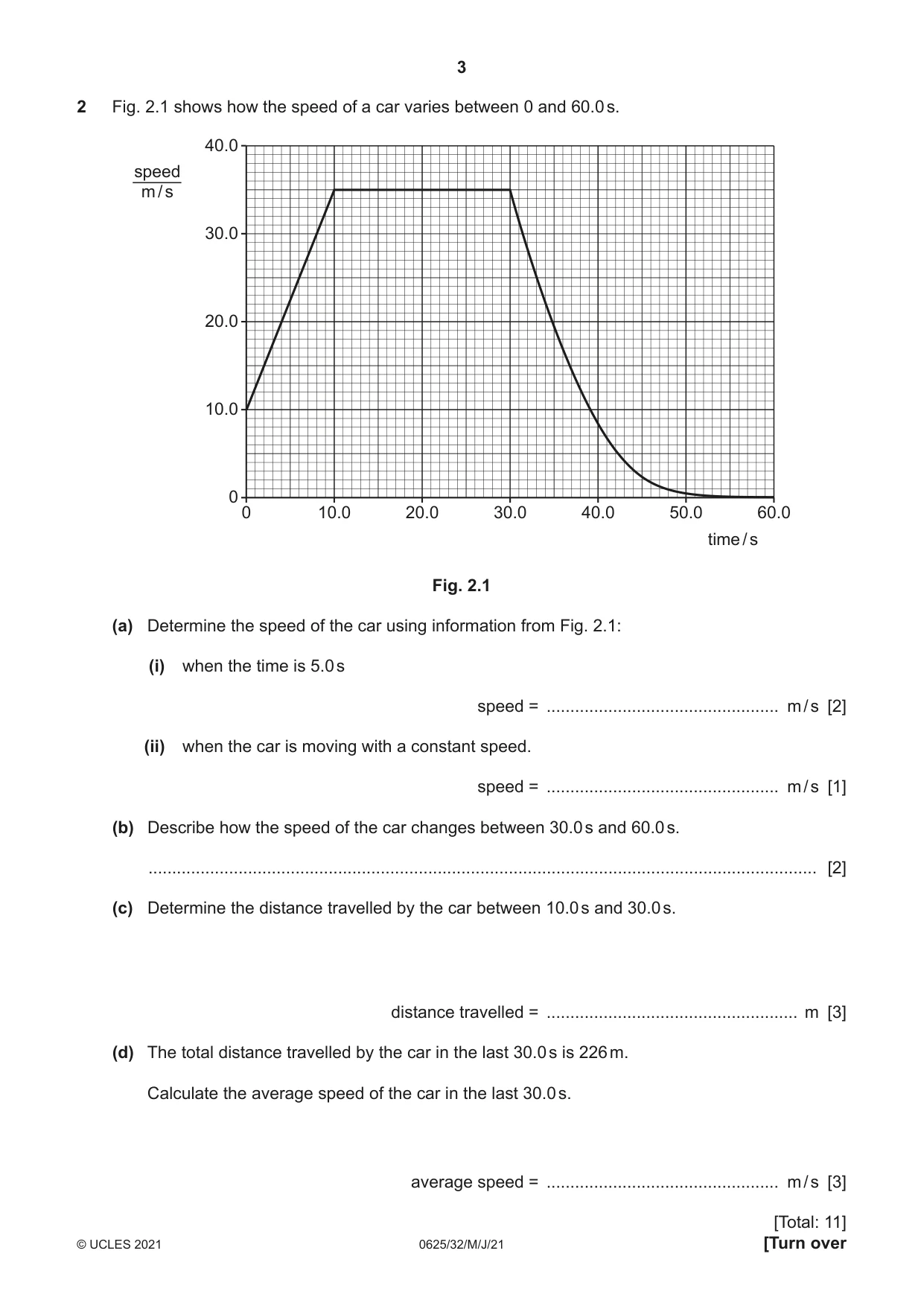
2 Fig. 2.1 shows how the speed of a car varies between 0 and 60.0 s. 40.0 speed m / s 30.0 20.0 10.0 0 0 10.0 20.0 30.0 40.0 50.0 60.0 time / s Fig. 2.1 (a) Determine the speed of the car using information from Fig. 2.1: (i) when the time is 5.0 s speed = ................................................. m / s [2] (ii) when the car is moving with a constant speed. speed = ................................................. m / s [1] (b) Describe how the speed of the car changes between 30.0 s and 60.0 s. ............................................................................................................................................. [2] (c) Determine the distance travelled by the car between 10.0 s and 30.0 s. distance travelled = ..................................................... m [3] (d) The total distance travelled by the car in the last 30.0 s is 226 m. Calculate the average speed of the car in the last 30.0 s. average speed = ................................................. m / s [3] [Total: 11]
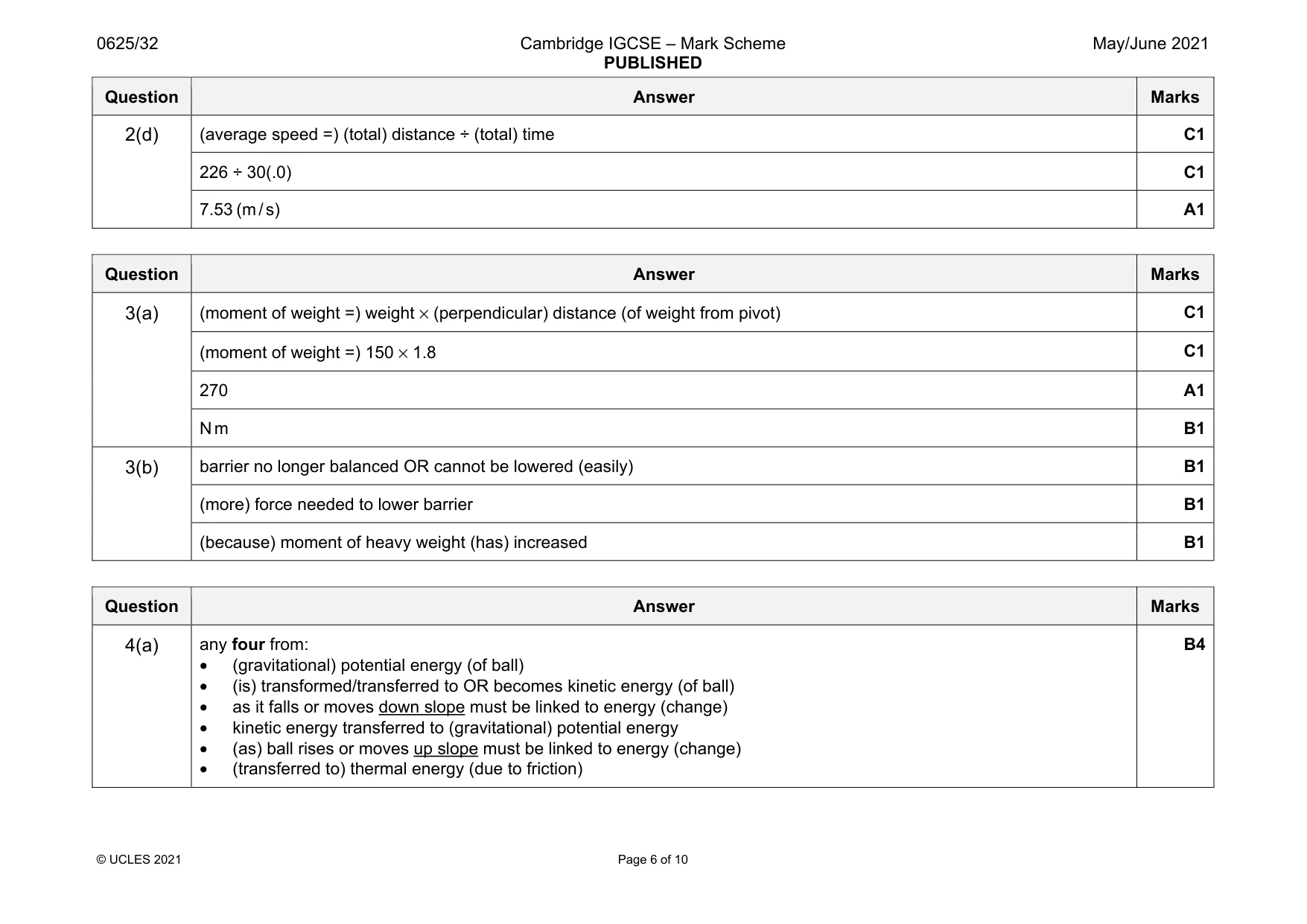
Mark scheme: 2(a)(i) 22.5 (m / s) A1 2(a)(ii) 35 (m / s) B1 2(b) (speed of car) decreasing OR slows (down) B1 (until speed of car) is zero OR stops (moving) B1 2(c) (distance =) area under graph OR (distance =) speed × time C1 20 × 35 C1 700 (m) A1 Question Answer Marks 2(d) (average speed =) (total) distance ÷ (total) time C1 226 ÷ 30(.0) C1 7.53 (m / s) A1
Q3 · A barrier used at a car park
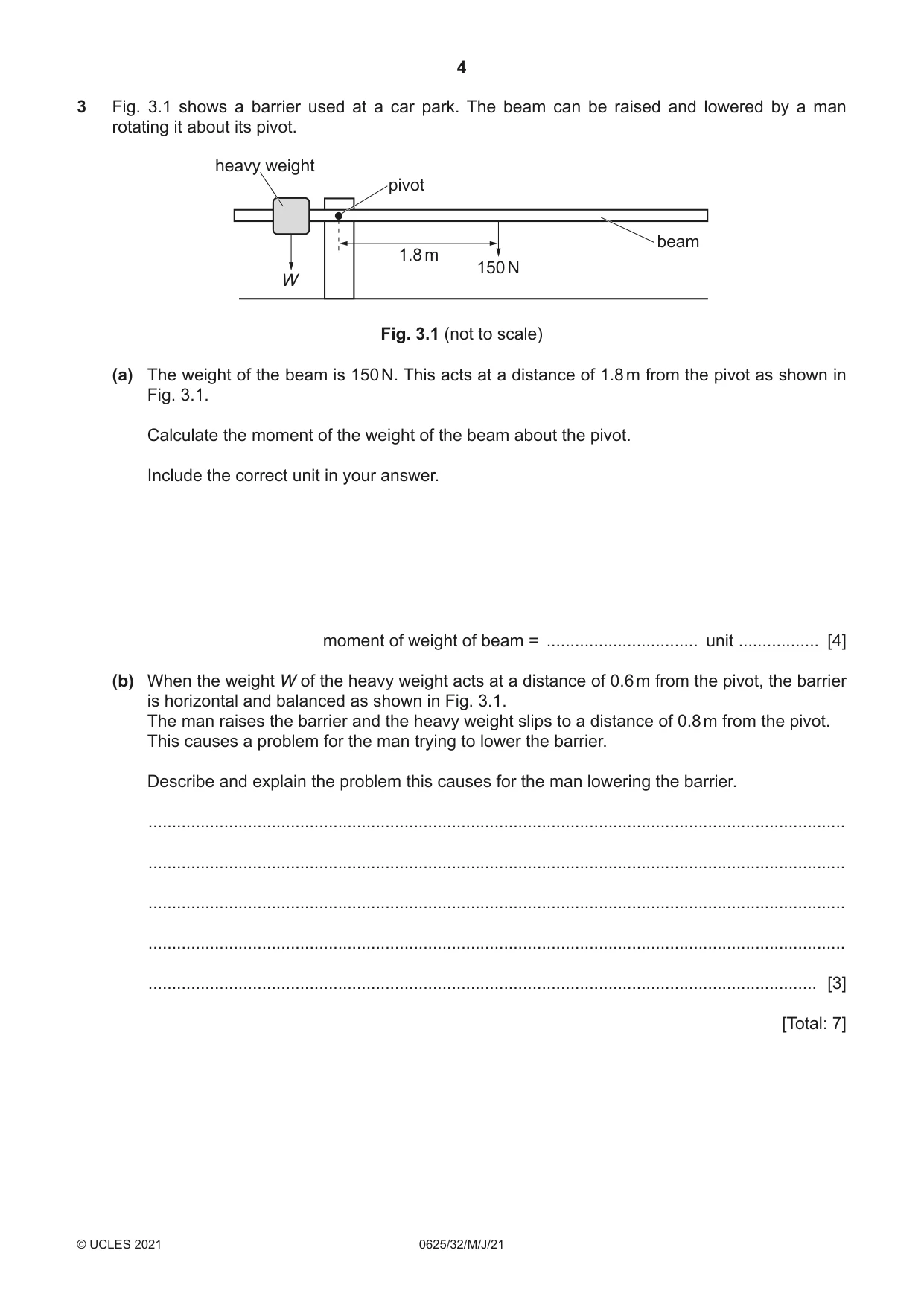
3 Fig. 3.1 shows a barrier used at a car park. The beam can be raised and lowered by a man rotating it about its pivot. heavy weight pivot beam 1.8 m 150 N W Fig. 3.1 (not to scale) (a) The weight of the beam is 150 N. This acts at a distance of 1.8 m from the pivot as shown in Fig. 3.1. Calculate the moment of the weight of the beam about the pivot. Include the correct unit in your answer. moment of weight of beam = ................................ unit ................. [4] (b) When the weight W of the heavy weight acts at a distance of 0.6 m from the pivot, the barrier is horizontal and balanced as shown in Fig. 3.1. The man raises the barrier and the heavy weight slips to a distance of 0.8 m from the pivot. This causes a problem for the man trying to lower the barrier. Describe and explain the problem this causes for the man lowering the barrier. ................................................................................................................................................... ................................................................................................................................................... ................................................................................................................................................... ................................................................................................................................................... ............................................................................................................................................. [3] [Total: 7]
Mark scheme: 3(a) (moment of weight =) weight × (perpendicular) distance (of weight from pivot) (moment of weight =) 150 × 1.8 C1 270 A1 N m B1 3(b) barrier no longer balanced OR cannot be lowered (easily) B1 (more) force needed to lower barrier B1 (because) moment of heavy weight (has) increased B1
Q4 · A student investigates energy changes when a ball rolls down a curved track
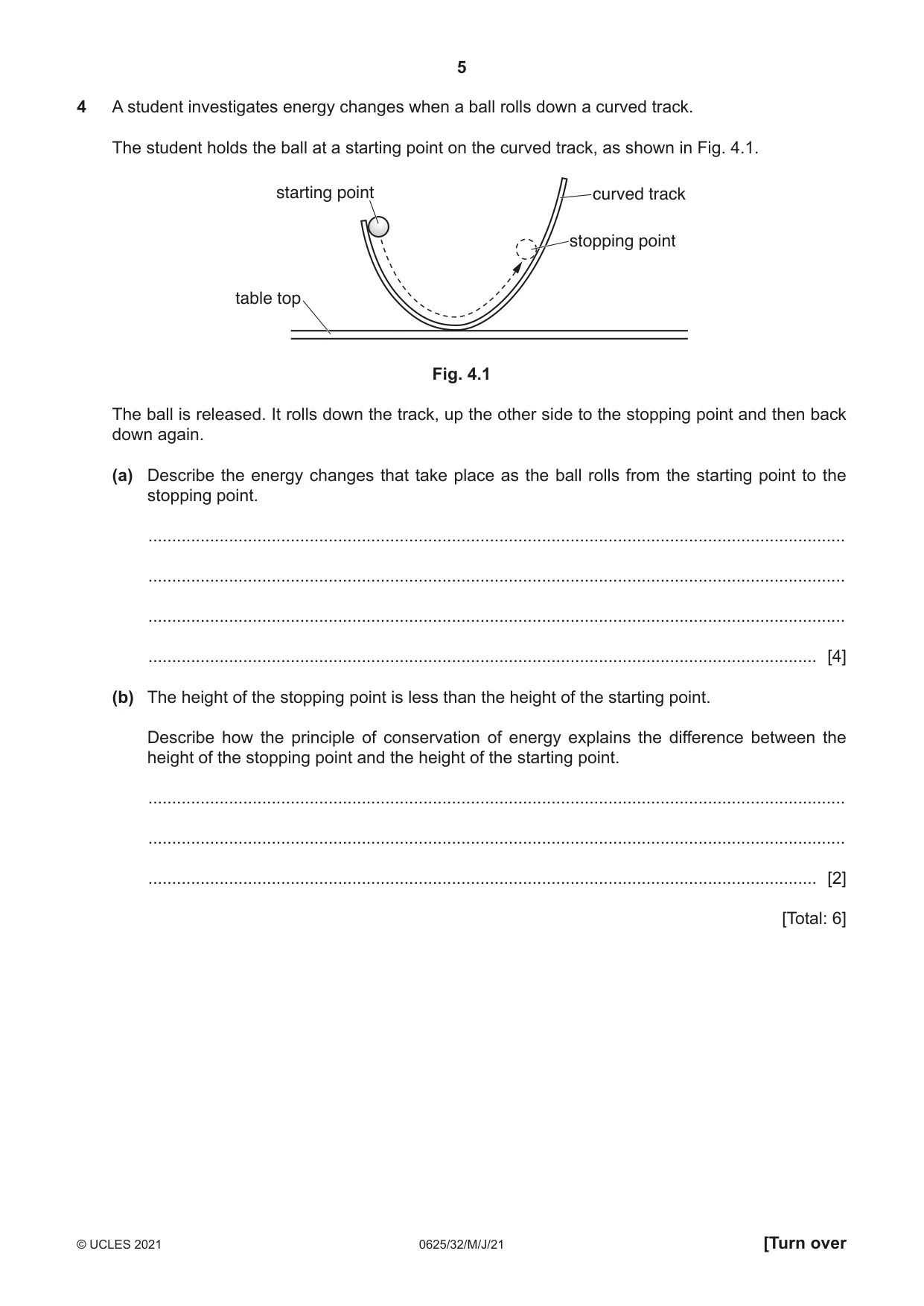
4 A student investigates energy changes when a ball rolls down a curved track. The student holds the ball at a starting point on the curved track, as shown in Fig. 4.1. starting point curved track stopping point table top Fig. 4.1 The ball is released. It rolls down the track, up the other side to the stopping point and then back down again. (a) Describe the energy changes that take place as the ball rolls from the starting point to the stopping point. ................................................................................................................................................... ................................................................................................................................................... ................................................................................................................................................... ............................................................................................................................................. [4] (b) The height of the stopping point is less than the height of the starting point. Describe how the principle of conservation of energy explains the difference between the height of the stopping point and the height of the starting point. ................................................................................................................................................... ................................................................................................................................................... ............................................................................................................................................. [2] [Total: 6]
Mark scheme: 4(a) • (gravitational) potential energy (of ball) • (is) transformed/transferred to OR becomes kinetic energy (of ball) • as it falls or moves down slope must be linked to energy (change) • kinetic energy transferred to (gravitational) potential energy • (as) ball rises or moves up slope must be linked to energy (change) • (transferred to) thermal energy (due to friction) Question Answer Marks 4(b) any two from: • some (of the initial) (G)PE/energy is transferred • (to) thermal energy • (due to) friction/air resistance • ball has less (G)PE/energy at stopping point B2
Q5 · A device connected to a gas cylinder
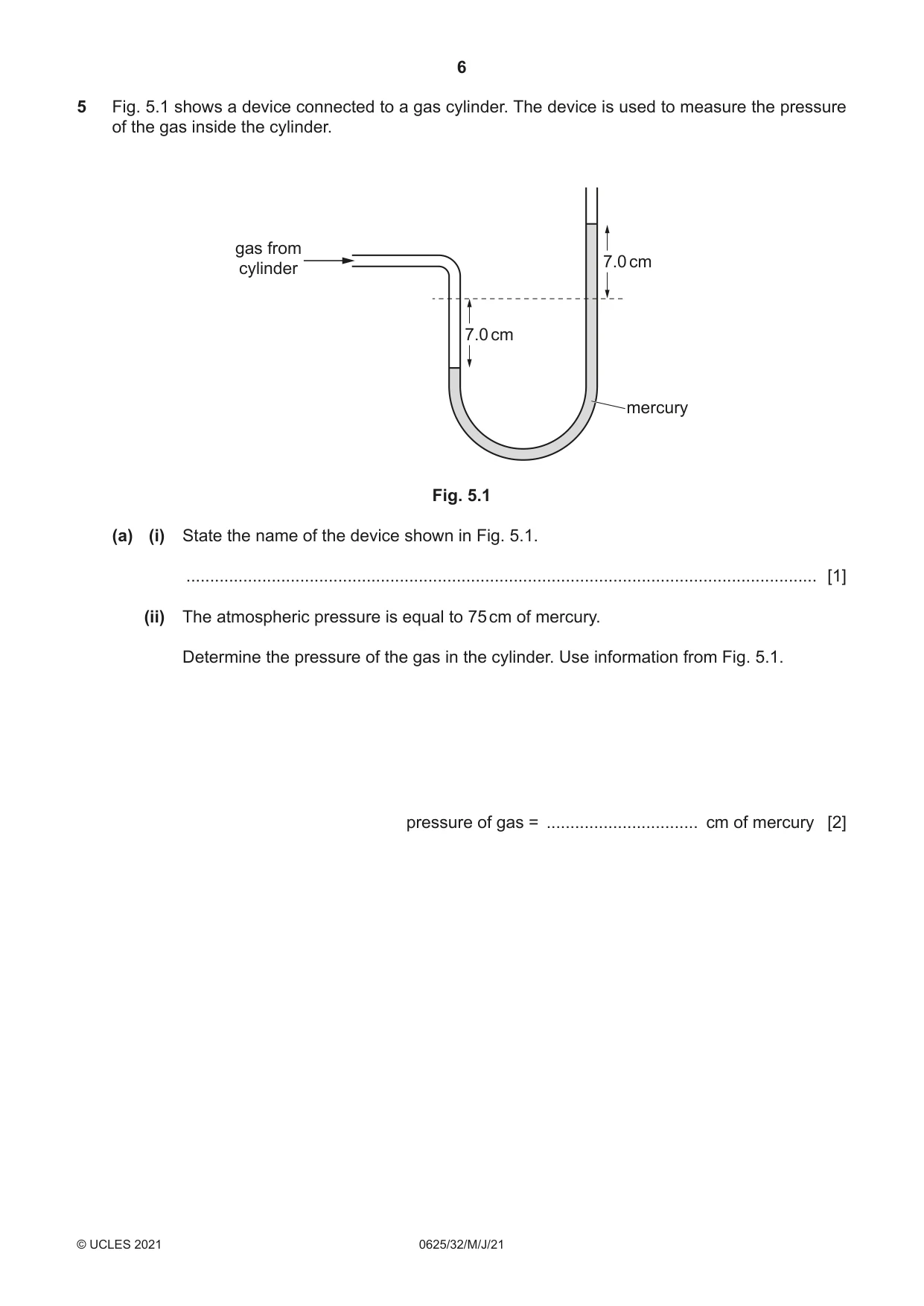
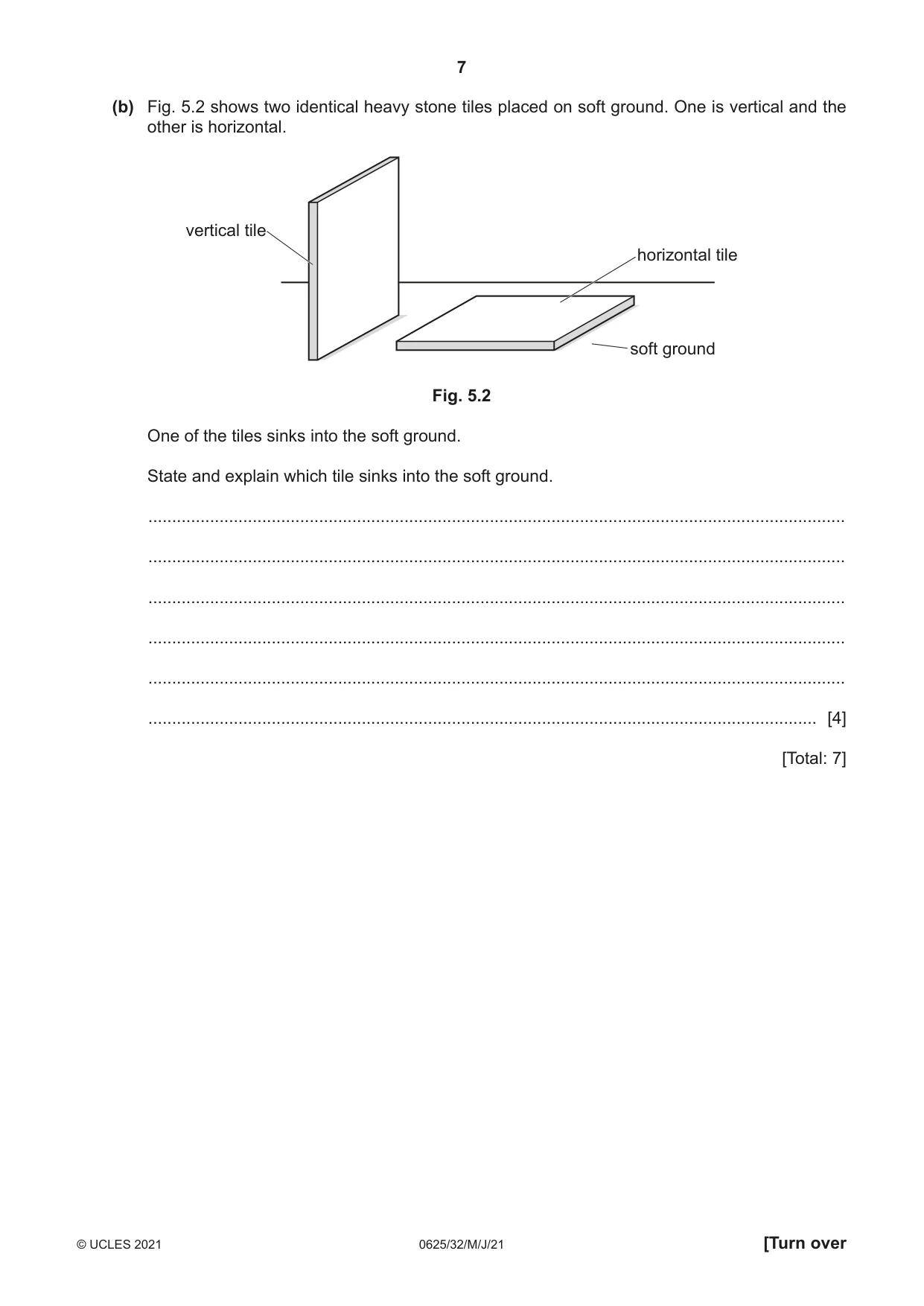
5 Fig. 5.1 shows a device connected to a gas cylinder. The device is used to measure the pressure of the gas inside the cylinder. gas from 7.0 cm cylinder 7.0 cm mercury Fig. 5.1 (a) (i) State the name of the device shown in Fig. 5.1. ..................................................................................................................................... [1] (ii) The atmospheric pressure is equal to 75 cm of mercury. Determine the pressure of the gas in the cylinder. Use information from Fig. 5.1. pressure of gas = ................................ cm of mercury [2] (b) Fig. 5.2 shows two identical heavy stone tiles placed on soft ground. One is vertical and the other is horizontal. vertical tile horizontal tile soft ground Fig. 5.2 One of the tiles sinks into the soft ground. State and explain which tile sinks into the soft ground. ................................................................................................................................................... ................................................................................................................................................... ................................................................................................................................................... ................................................................................................................................................... ................................................................................................................................................... ............................................................................................................................................. [4] [Total: 7]
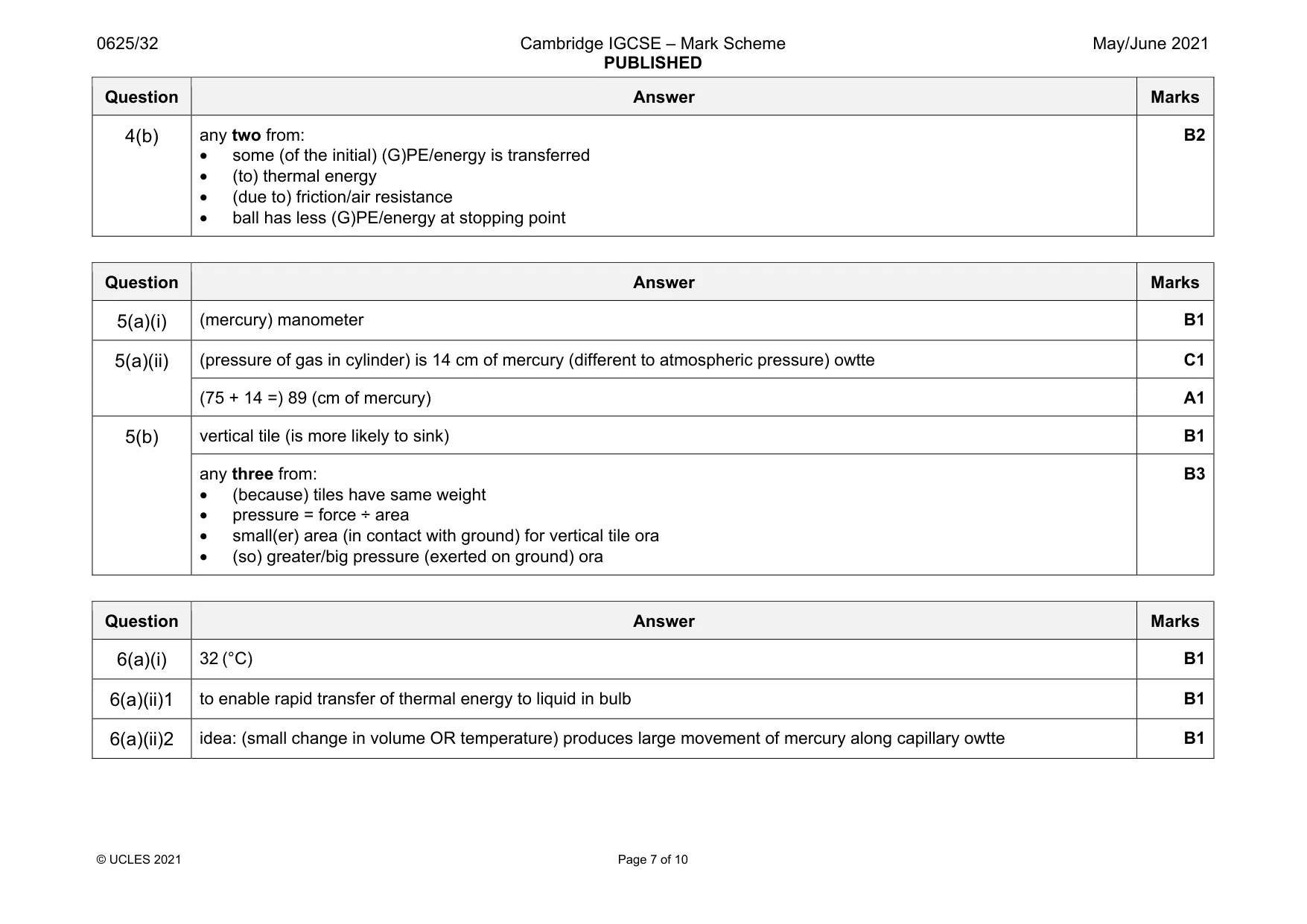
Mark scheme: 5(a)(i) 5(a)(ii) (pressure of gas in cylinder) is 14 cm of mercury (different to atmospheric pressure) owtte C1 (75 + 14 =) 89 (cm of mercury) A1 5(b) vertical tile (is more likely to sink) B1 any three from: • (because) tiles have same weight • pressure = force ÷ area • small(er) area (in contact with ground) for vertical tile ora • (so) greater/big pressure (exerted on ground) ora B3
Question 6
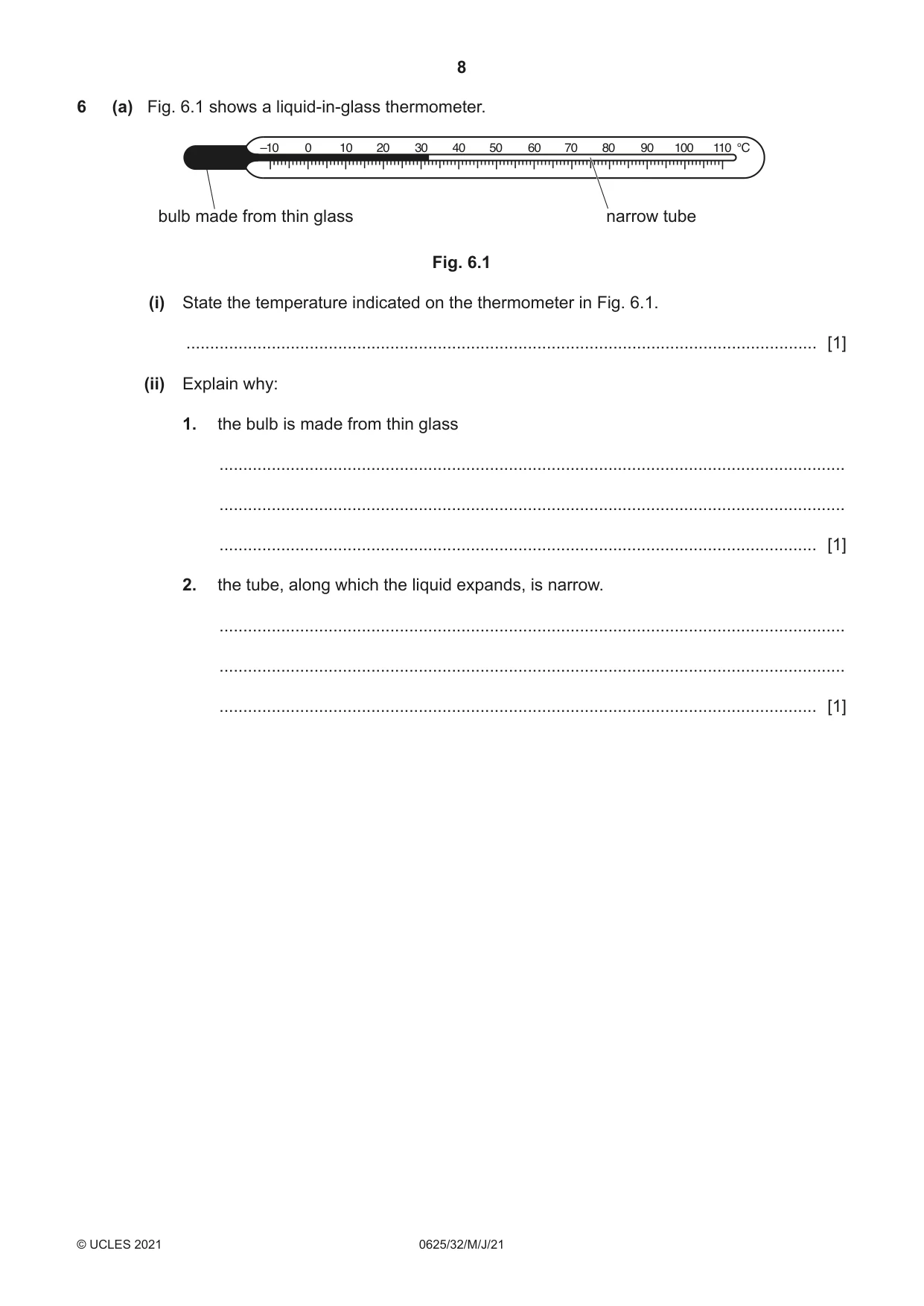
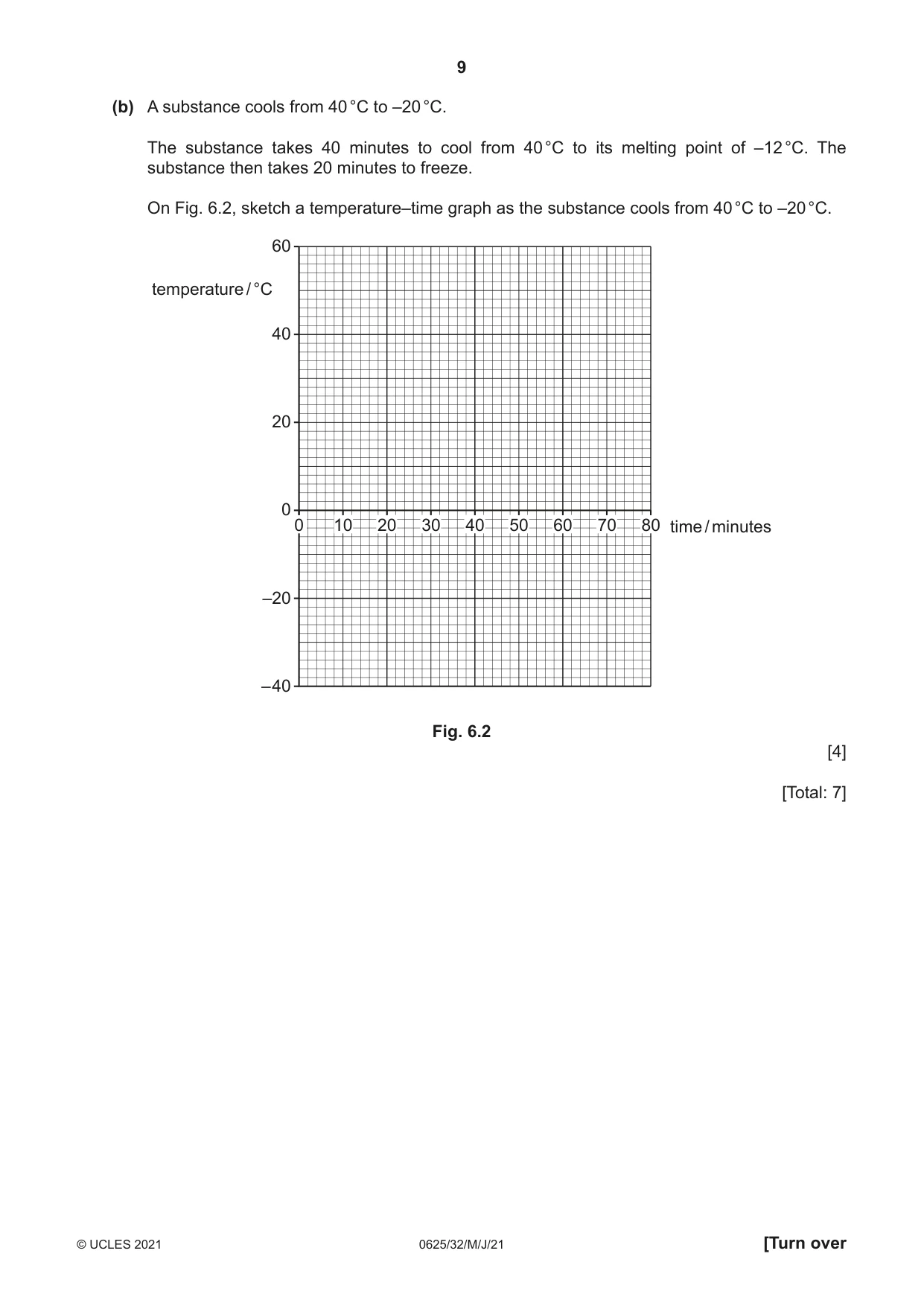
6 (a) Fig. 6.1 shows a liquid-in-glass thermometer. –10 0 10 20 30 40 50 60 70 80 90 100 110 °C bulb made from thin glass narrow tube Fig. 6.1 (i) State the temperature indicated on the thermometer in Fig. 6.1. ..................................................................................................................................... [1] (ii) Explain why: 1. the bulb is made from thin glass .................................................................................................................................... .................................................................................................................................... .............................................................................................................................. [1] 2. the tube, along which the liquid expands, is narrow. .................................................................................................................................... .................................................................................................................................... .............................................................................................................................. [1] (b) A substance cools from 40 °C to –20 °C. The substance takes 40 minutes to cool from 40 °C to its melting point of –12 °C. The substance then takes 20 minutes to freeze. On Fig. 6.2, sketch a temperature–time graph as the substance cools from 40 °C to –20 °C. 60 temperature / °C 40 20 0 0 10 20 30 40 50 60 70 80 time / minutes –20 – 40 Fig. 6.2 [4] [Total: 7]
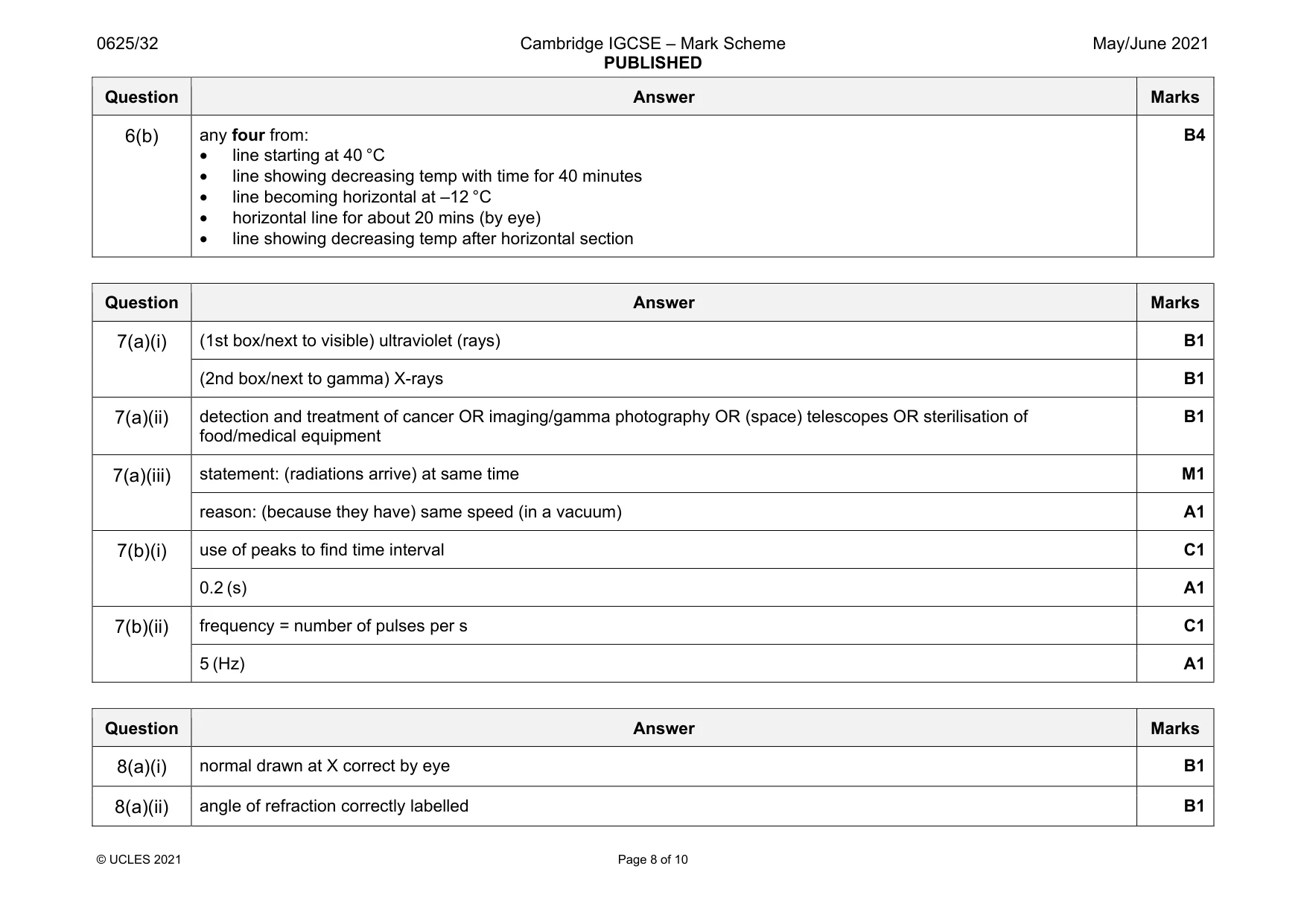
Mark scheme: 6(a)(i) 6(a)(ii)1 to enable rapid transfer of thermal energy to liquid in bulb B1 6(a)(ii)2 idea: (small change in volume OR temperature) produces large movement of mercury along capillary owtte B1 Question Answer Marks 6(b) any four from: • line starting at 40 °C • line showing decreasing temp with time for 40 minutes • line becoming horizontal at –12 °C • horizontal line for about 20 mins (by eye) • line showing decreasing temp after horizontal section B4
Q7 · Both radio waves and γ-rays (gamma) are radiations in the electromagnetic spectrum
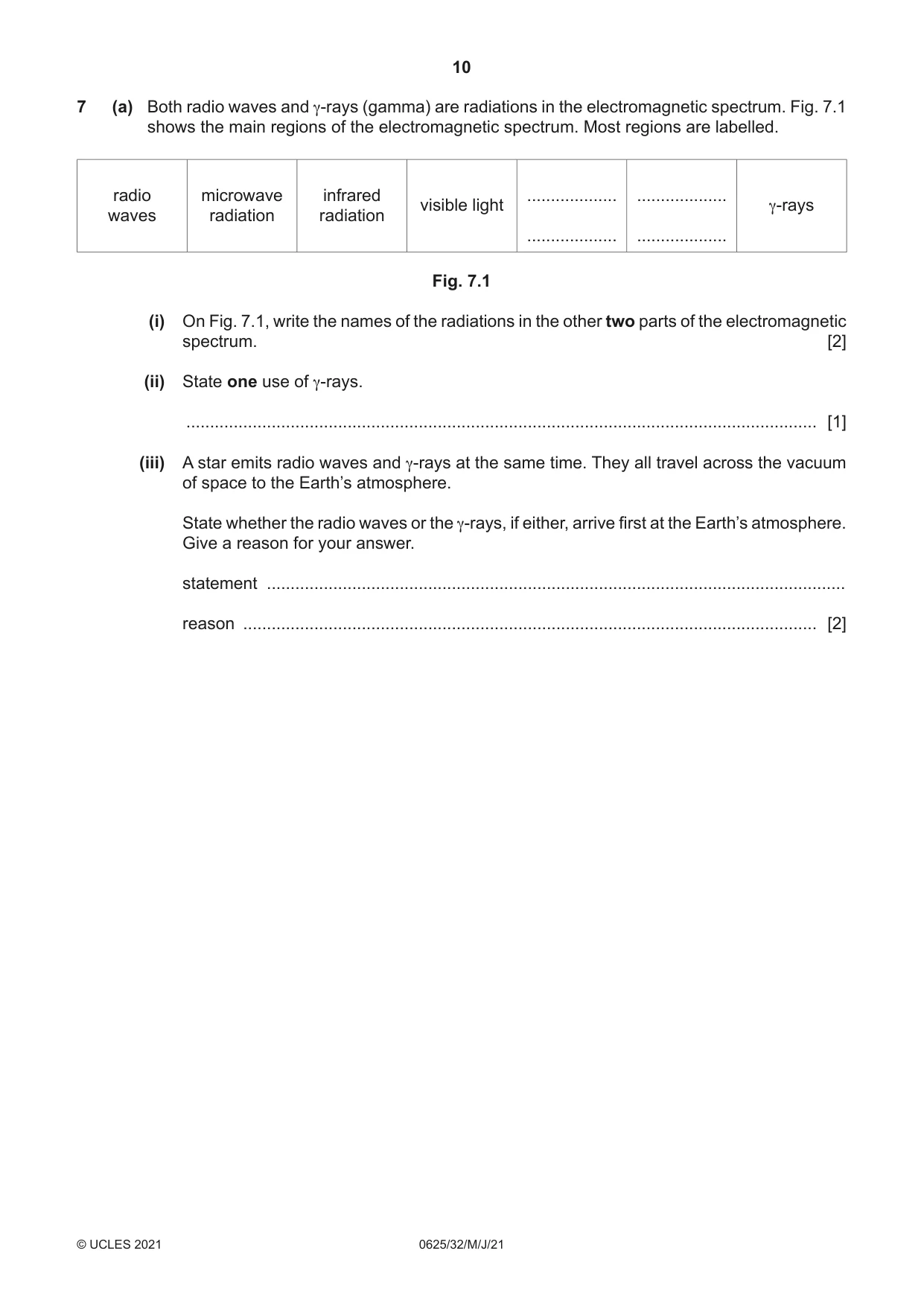
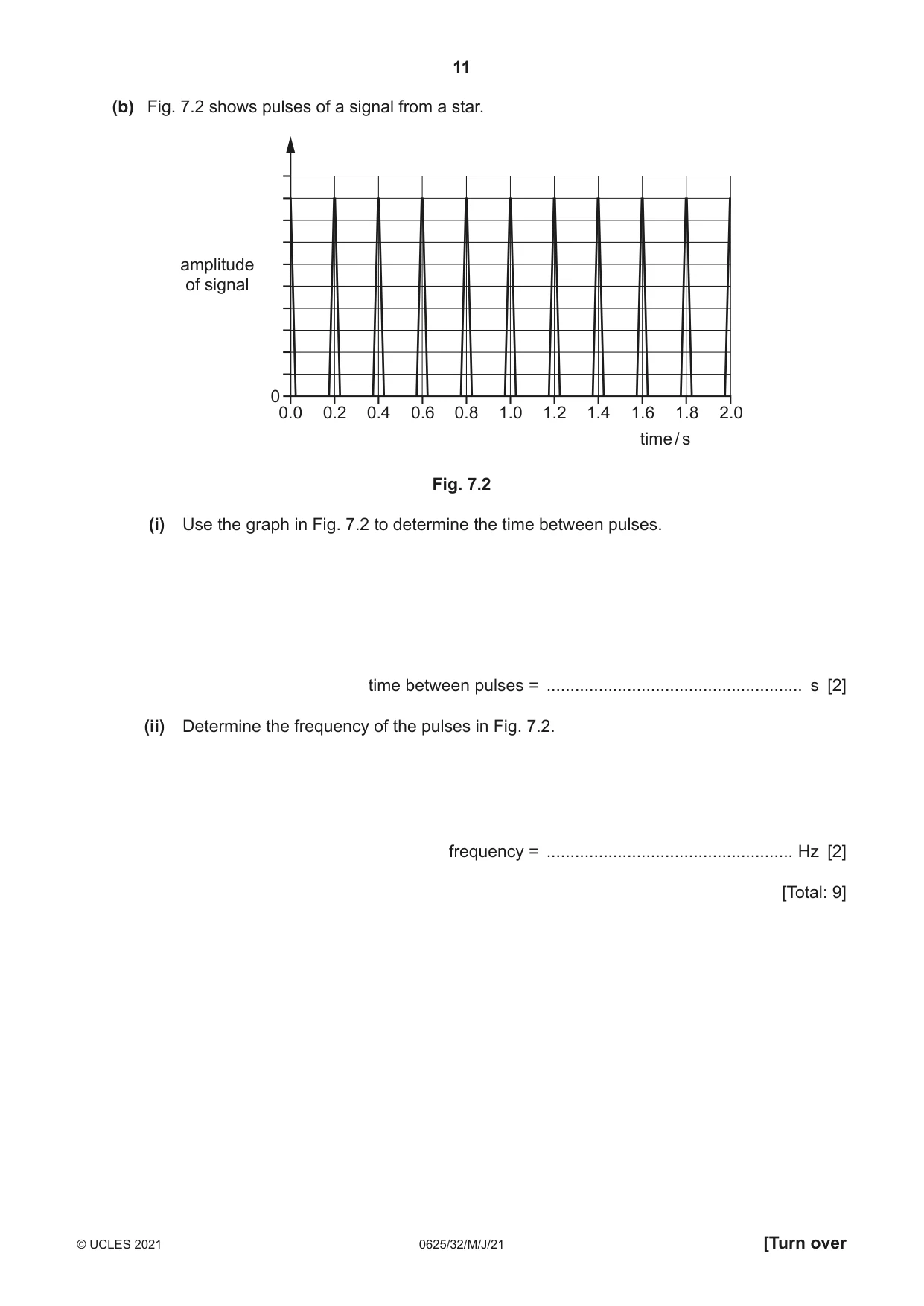
7 (a) Both radio waves and γ-rays (gamma) are radiations in the electromagnetic spectrum. Fig. 7.1 shows the main regions of the electromagnetic spectrum. Most regions are labelled. radio microwave infrared ................... ................... visible light γ-rays waves radiation radiation ................... ................... Fig. 7.1 (i) On Fig. 7.1, write the names of the radiations in the other two parts of the electromagnetic spectrum. [2] (ii) State one use of γ-rays. ..................................................................................................................................... [1] (iii) A star emits radio waves and γ-rays at the same time. They all travel across the vacuum of space to the Earth’s atmosphere. State whether the radio waves or the γ-rays, if either, arrive first at the Earth’s atmosphere. Give a reason for your answer. statement .......................................................................................................................... reason ......................................................................................................................... [2] (b) Fig. 7.2 shows pulses of a signal from a star. amplitude of signal 0 0.0 0.2 0.4 0.6 0.8 1.0 1.2 1.4 1.6 1.8 2.0 time / s Fig. 7.2 (i) Use the graph in Fig. 7.2 to determine the time between pulses. time between pulses = ...................................................... s [2] (ii) Determine the frequency of the pulses in Fig. 7.2. frequency = .................................................... Hz [2] [Total: 9]
Mark scheme: 7(a)(i) (2nd box/next to gamma) X-rays B1 7(a)(ii) detection and treatment of cancer OR imaging/gamma photography OR (space) telescopes OR sterilisation of food/medical equipment B1 7(a)(iii) statement: (radiations arrive) at same time M1 reason: (because they have) same speed (in a vacuum) A1 7(b)(i) use of peaks to find time interval C1 0.2 (s) A1 7(b)(ii) frequency = number of pulses per s C1 5 (Hz) A1
Q8 · A student uses a semicircular glass block to investigate refraction
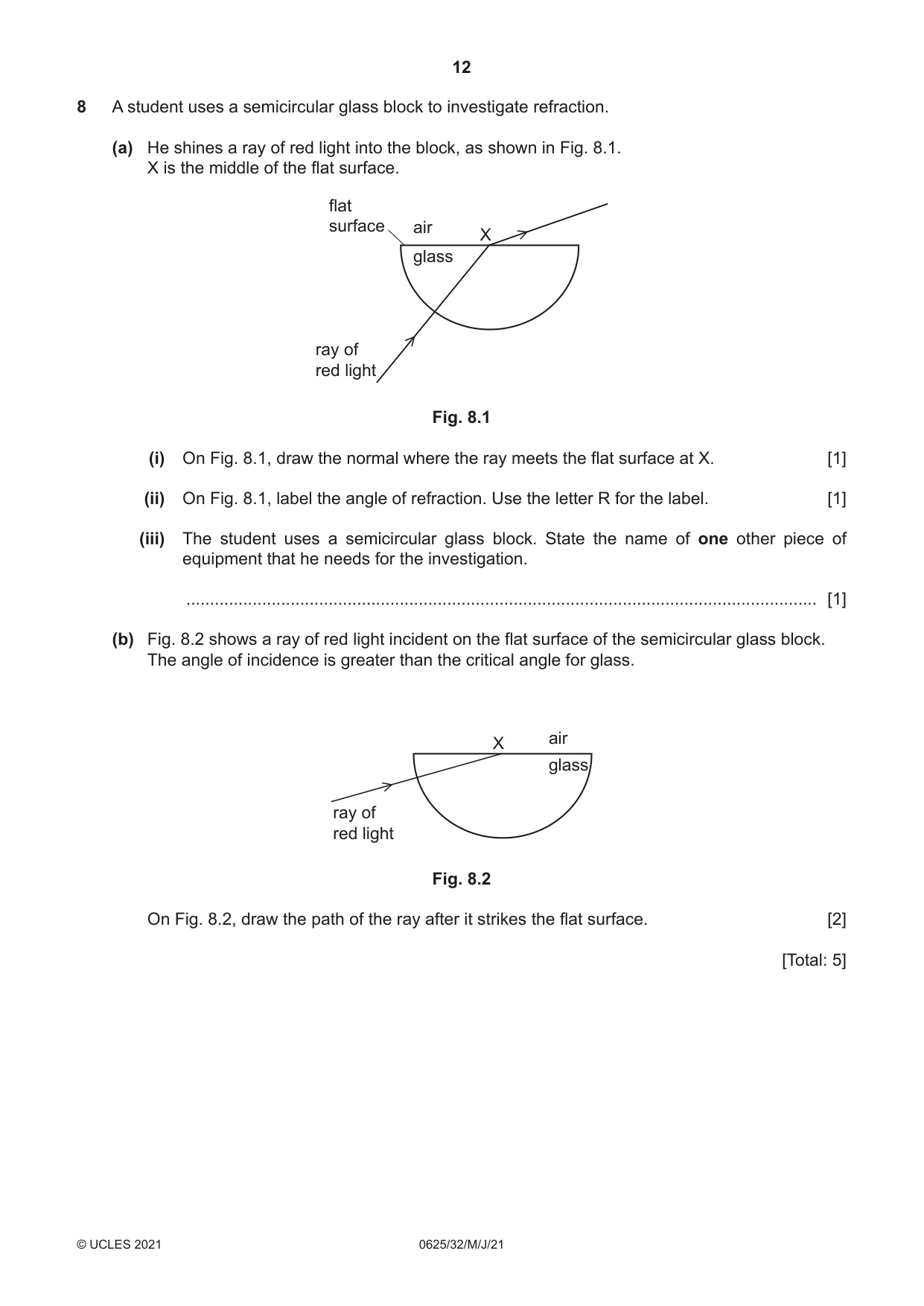
8 A student uses a semicircular glass block to investigate refraction. (a) He shines a ray of red light into the block, as shown in Fig. 8.1. X is the middle of the flat surface. flat surface air X glass ray of red light Fig. 8.1 (i) On Fig. 8.1, draw the normal where the ray meets the flat surface at X. [1] (ii) On Fig. 8.1, label the angle of refraction. Use the letter R for the label. [1] (iii) The student uses a semicircular glass block. State the name of one other piece of equipment that he needs for the investigation. ..................................................................................................................................... [1] (b) Fig. 8.2 shows a ray of red light incident on the flat surface of the semicircular glass block. The angle of incidence is greater than the critical angle for glass. air X glass ray of red light Fig. 8.2 On Fig. 8.2, draw the path of the ray after it strikes the flat surface. [2] [Total: 5]
Mark scheme: 8(a)(i) 8(a)(ii) angle of refraction correctly labelled B1 Question Answer Marks 8(a)(iii) any one from: • pin(s) OR ray box owtte OR (low voltage) power supply OR • protractor OR ruler B1 8(b) ray reflected from flat surface M1 ray reflected with angle i = angle r A1
Question 9
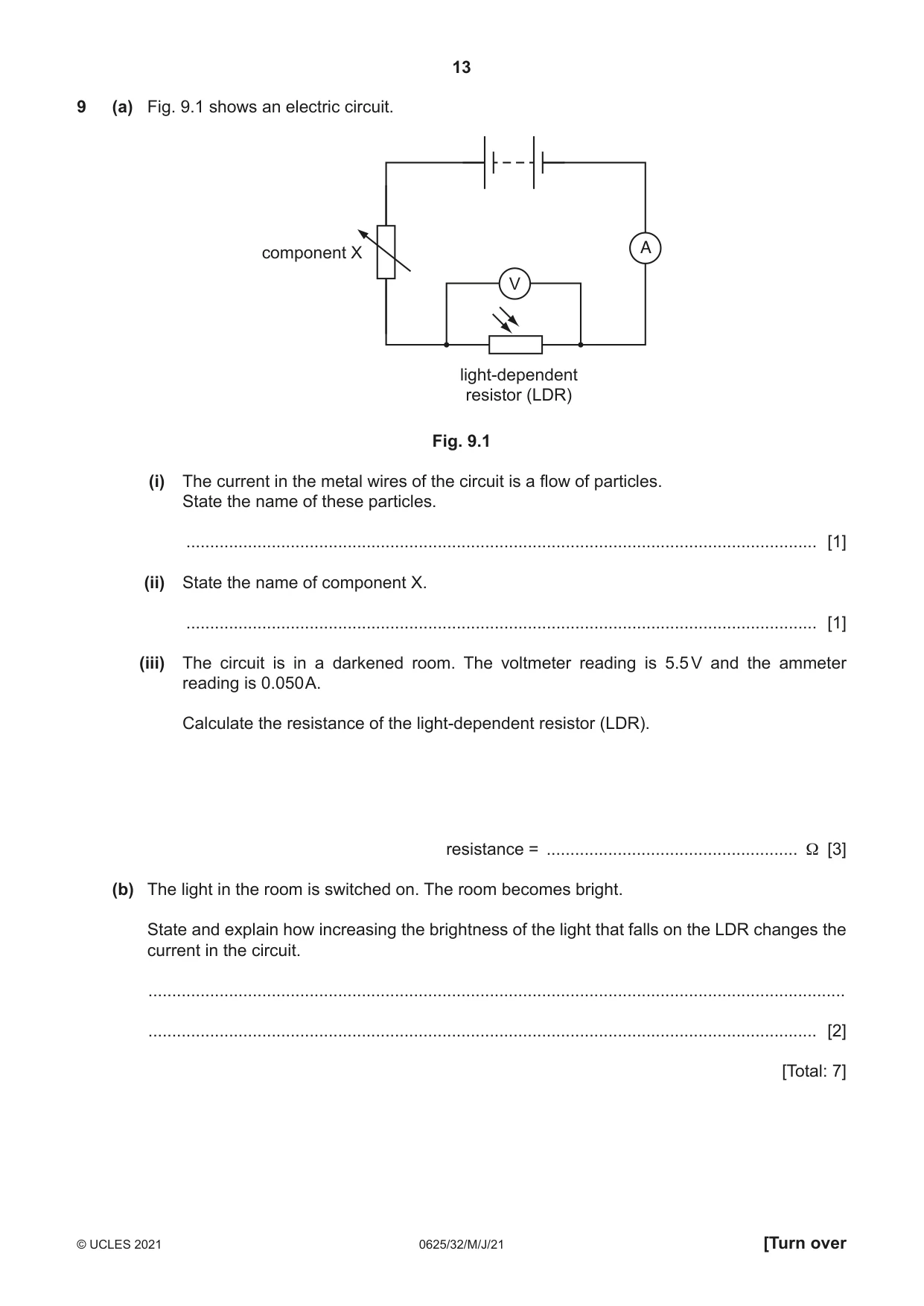
9 (a) Fig. 9.1 shows an electric circuit. component X A V light-dependent resistor (LDR) Fig. 9.1 (i) The current in the metal wires of the circuit is a flow of particles. State the name of these particles. ..................................................................................................................................... [1] (ii) State the name of component X. ..................................................................................................................................... [1] (iii) The circuit is in a darkened room. The voltmeter reading is 5.5 V and the ammeter reading is 0.050 A. Calculate the resistance of the light-dependent resistor (LDR). resistance = ..................................................... Ω [3] (b) The light in the room is switched on. The room becomes bright. State and explain how increasing the brightness of the light that falls on the LDR changes the current in the circuit. ................................................................................................................................................... ............................................................................................................................................. [2] [Total: 7]
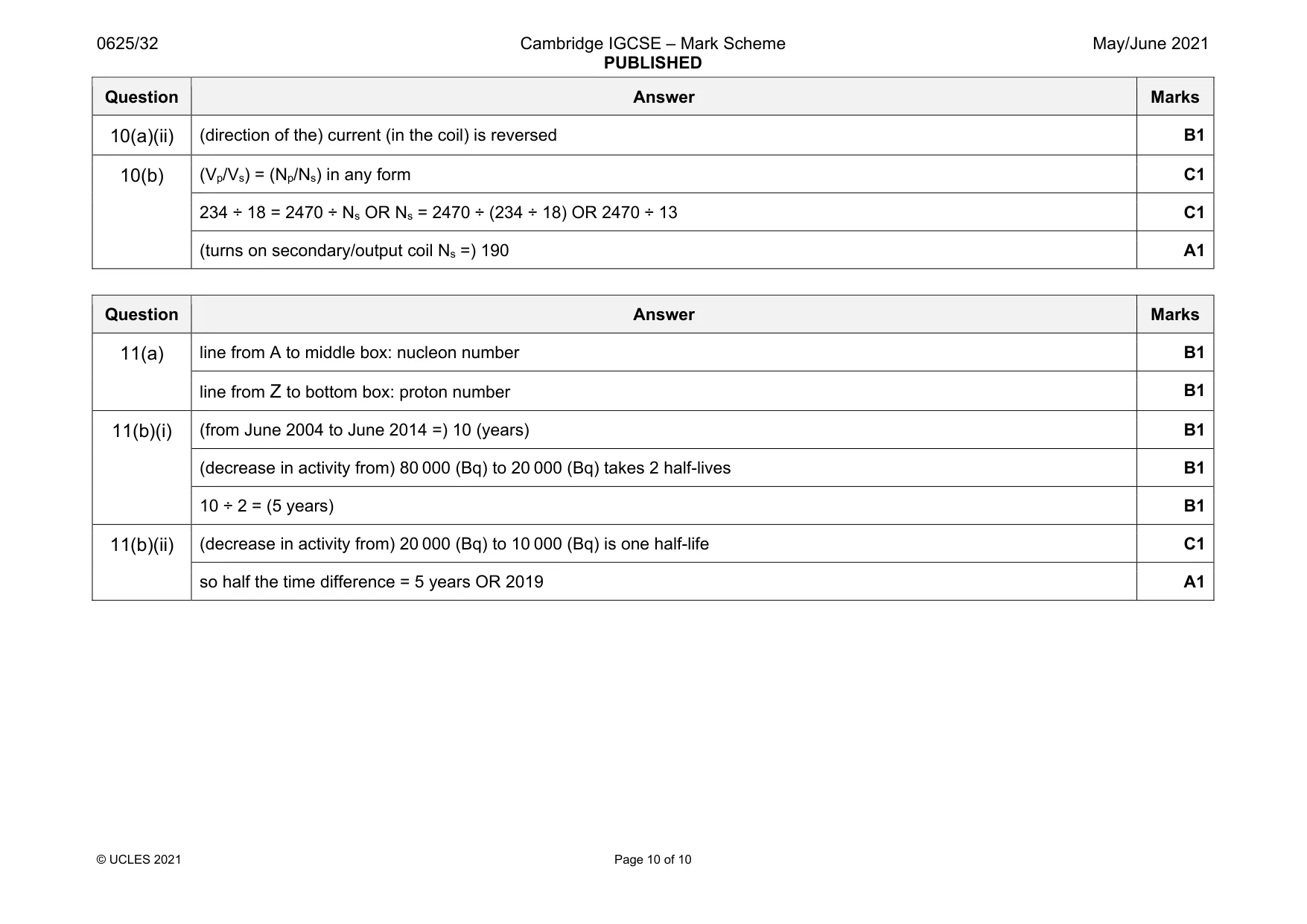
Mark scheme: 9(a)(i) 9(a)(ii) (component X is a) variable resistor B1 9(a)(iii) V= IR or (R =) V/I C1 5.5 ÷ 0.05 (0) C1 110 (Ω) A1 9(b) (current in circuit) increases B1 (because) resistance of LDR decreases B1
Q10 · An electric screwdriver which has an electric motor and a battery
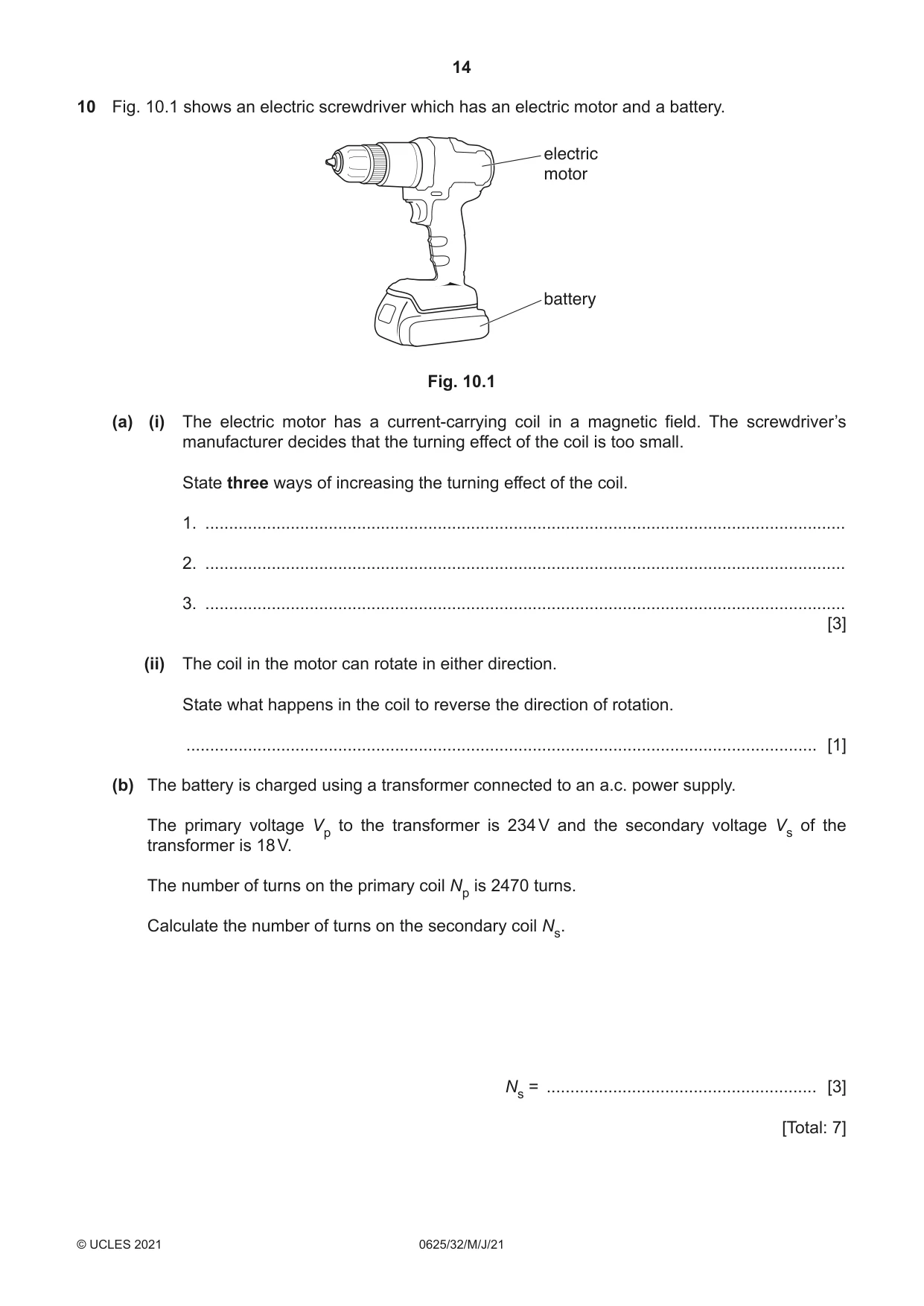
10 Fig. 10.1 shows an electric screwdriver which has an electric motor and a battery. electric motor battery Fig. 10.1 (a) (i) The electric motor has a current-carrying coil in a magnetic field. The screwdriver’s manufacturer decides that the turning effect of the coil is too small. State three ways of increasing the turning effect of the coil. 1. ....................................................................................................................................... 2. ....................................................................................................................................... 3. ....................................................................................................................................... [3] (ii) The coil in the motor can rotate in either direction. State what happens in the coil to reverse the direction of rotation. ..................................................................................................................................... [1] (b) The battery is charged using a transformer connected to an a.c. power supply. The primary voltage Vp to the transformer is 234 V and the secondary voltage Vs of the transformer is 18 V. The number of turns on the primary coil Np is 2470 turns. Calculate the number of turns on the secondary coil Ns. Ns = ......................................................... [3] [Total: 7]
Mark scheme: 10(a)(i) increase current (in coil) B1 increase strength of magnet(s) or magnetic field(s) B1 increase the number of turns on the coil B1 Question Answer Marks 10(a)(ii) (direction of the) current (in the coil) is reversed B1 10(b) (Vp/Vs) = (Np/Ns) in any form C1 234 ÷ 18 = 2470 ÷ Ns OR Ns = 2470 ÷ (234 ÷ 18) OR 2470 ÷ 13 C1 (turns on secondary/output coil Ns =) 190 A1
Q11 · The nuclide notation describes the nucleus of an atom
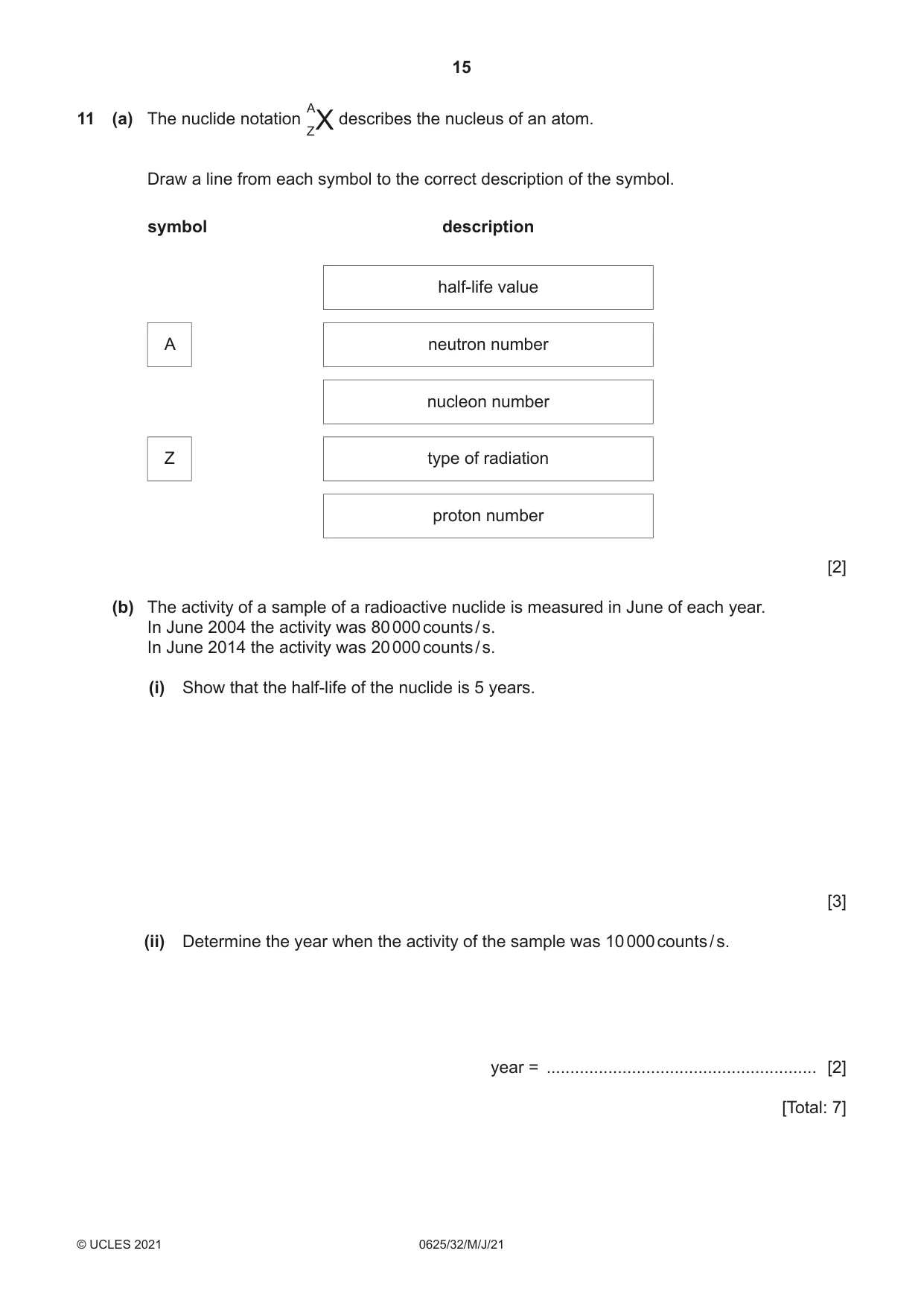
11 (a) The nuclide notation describes the nucleus of an atom. ZX Draw a line from each symbol to the correct description of the symbol. symbol description half-life value A neutron number nucleon number Z type of radiation proton number [2] (b) The activity of a sample of a radioactive nuclide is measured in June of each year. In June 2004 the activity was 80 000 counts / s. In June 2014 the activity was 20 000 counts / s. (i) Show that the half-life of the nuclide is 5 years. [3] (ii) Determine the year when the activity of the sample was 10 000 counts / s. year = ......................................................... [2] [Total: 7]
Mark scheme: 11(a) line from Z to bottom box: proton number B1 11(b)(i) (from June 2004 to June 2014 =) 10 (years) B1 (decrease in activity from) 80 000 (Bq) to 20 000 (Bq) takes 2 half-lives B1 10 ÷ 2 = (5 years) B1 11(b)(ii) (decrease in activity from) 20 000 (Bq) to 10 000 (Bq) is one half-life C1 so half the time difference = 5 years OR 2019 A1
What was in this paper
The subtopics covered by these 11 questions, and how many questions each got. Open one in a new tab to see every Cambridge question on it.
What you needed in this session
Cambridge’s own grade thresholds for 2021 May/June, Paper 3 · Variant 2. A higher threshold means an easier paper — the bar moves with how the cohort did.