Cambridge IGCSE Physics 0625 — 2017 May/June Paper 3 · Variant 3
0625/33/M/J/17 · 12 questions · 80 marks · ≈90 min
The question paper and its mark scheme, free to read here and free to download. This is Cambridge’s own paper, exactly as it was sat.
Question paper16 pages
Mark scheme9 pages
Answers below. Sit the paper first if you are practising.
Questions as text
Q1 · A student measures a book
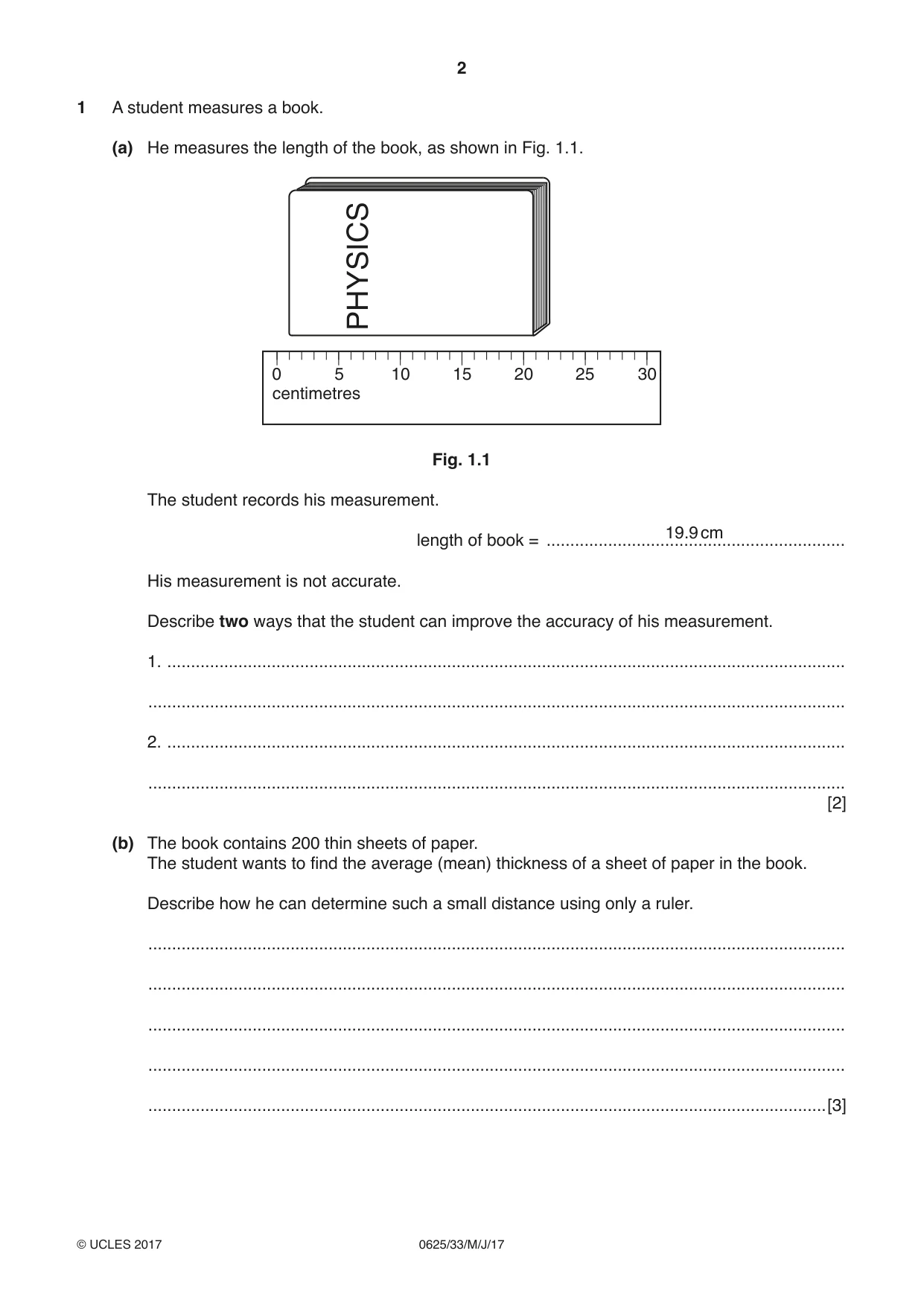
1 A student measures a book. (a) He measures the length of the book, as shown in Fig. 1.1. PHYSICS 0 5 10 15 20 25 30 centimetres Fig. 1.1 The student records his measurement. 19.9 cm length of book = ............................................................... His measurement is not accurate. Describe two ways that the student can improve the accuracy of his measurement. 1. ............................................................................................................................................... ................................................................................................................................................... 2. ............................................................................................................................................... ................................................................................................................................................... [2] (b) The book contains 200 thin sheets of paper. The student wants to find the average (mean) thickness of a sheet of paper in the book. Describe how he can determine such a small distance using only a ruler. ................................................................................................................................................... ................................................................................................................................................... ................................................................................................................................................... ................................................................................................................................................... ...............................................................................................................................................[3] (c) The book has a mass of 400 g. Calculate the weight of the book. Include the unit. weight = ......................................[4] [Total: 9]
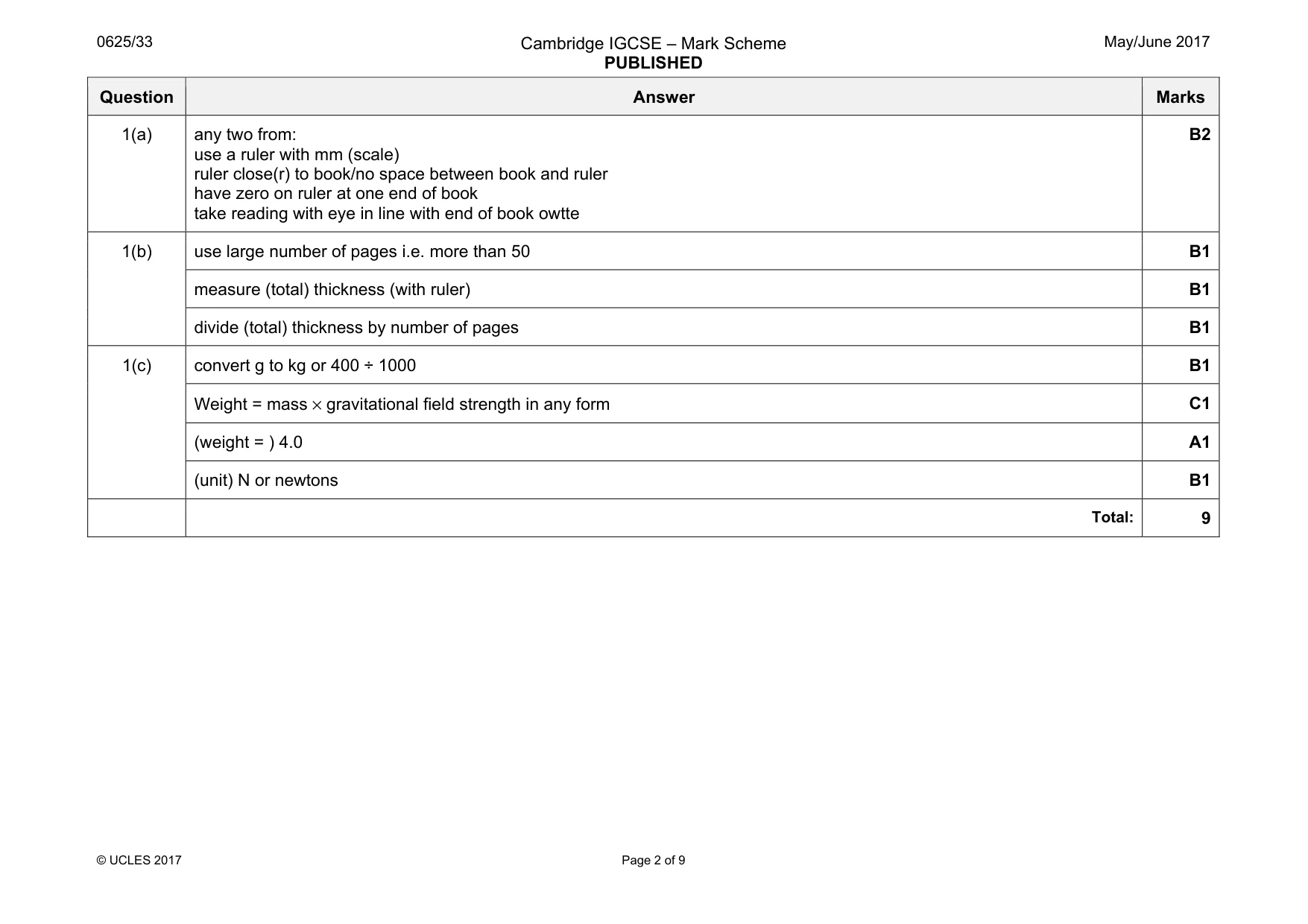
Mark scheme: 1(a) any two from: use a ruler with mm (scale) ruler close(r) to book/no space between book and ruler have zero on ruler at one end of book take reading with eye in line with end of book owtte B2 1(b) use large number of pages i.e. more than 50 B1 measure (total) thickness (with ruler) B1 divide (total) thickness by number of pages B1 1(c) convert g to kg or 400 ÷ 1000 B1 Weight = mass × gravitational field strength in any form C1 (weight = ) 4.0 A1 (unit) N or newtons B1 Total: 9
More questions on Physical quantities and measurement techniques
Q2 · A student has a laptop computer
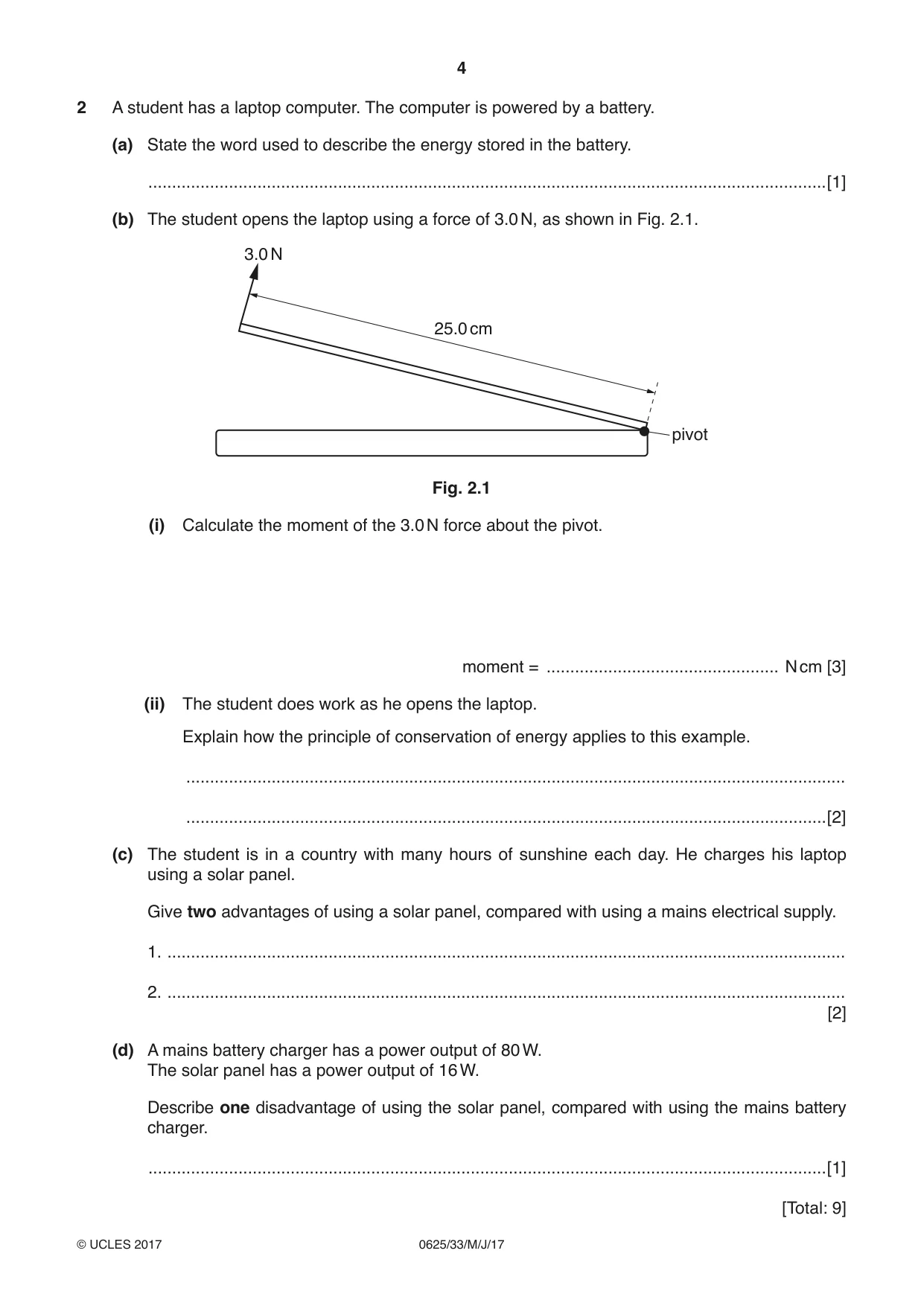
2 A student has a laptop computer. The computer is powered by a battery. (a) State the word used to describe the energy stored in the battery. ...............................................................................................................................................[1] (b) The student opens the laptop using a force of 3.0 N, as shown in Fig. 2.1. 3.0 N 25.0 cm pivot Fig. 2.1 (i) Calculate the moment of the 3.0 N force about the pivot. moment = ................................................. N cm [3] (ii) The student does work as he opens the laptop. Explain how the principle of conservation of energy applies to this example. ........................................................................................................................................... .......................................................................................................................................[2] (c) The student is in a country with many hours of sunshine each day. He charges his laptop using a solar panel. Give two advantages of using a solar panel, compared with using a mains electrical supply. 1. ............................................................................................................................................... 2. ............................................................................................................................................... [2] (d) A mains battery charger has a power output of 80 W. The solar panel has a power output of 16 W. Describe one disadvantage of using the solar panel, compared with using the mains battery charger. ...............................................................................................................................................[1] [Total: 9]
Mark scheme: 2(a) chemical B1 2(b)(i) Moment = force × (perpendicular) distance (from pivot) in any form C1 3.0 × 25.0 C1 75 (N cm) A1 2(b)(ii) any two from: idea that work done = energy gained total energy does not change the student loses chemical energy laptop gains (gravitational) PE (of lid) energy dissipated as thermal energy in the environment B2 2(c) any two from: laptop can be charged anywhere owtte cost of charging is zero (Sun is a) renewable energy (source)/not using fossil fuels B2 2(d) (Takes 5 times) longer to (re-)charge (battery) B1 Total: 9
Q3 · A woman drives a car from town A to town B
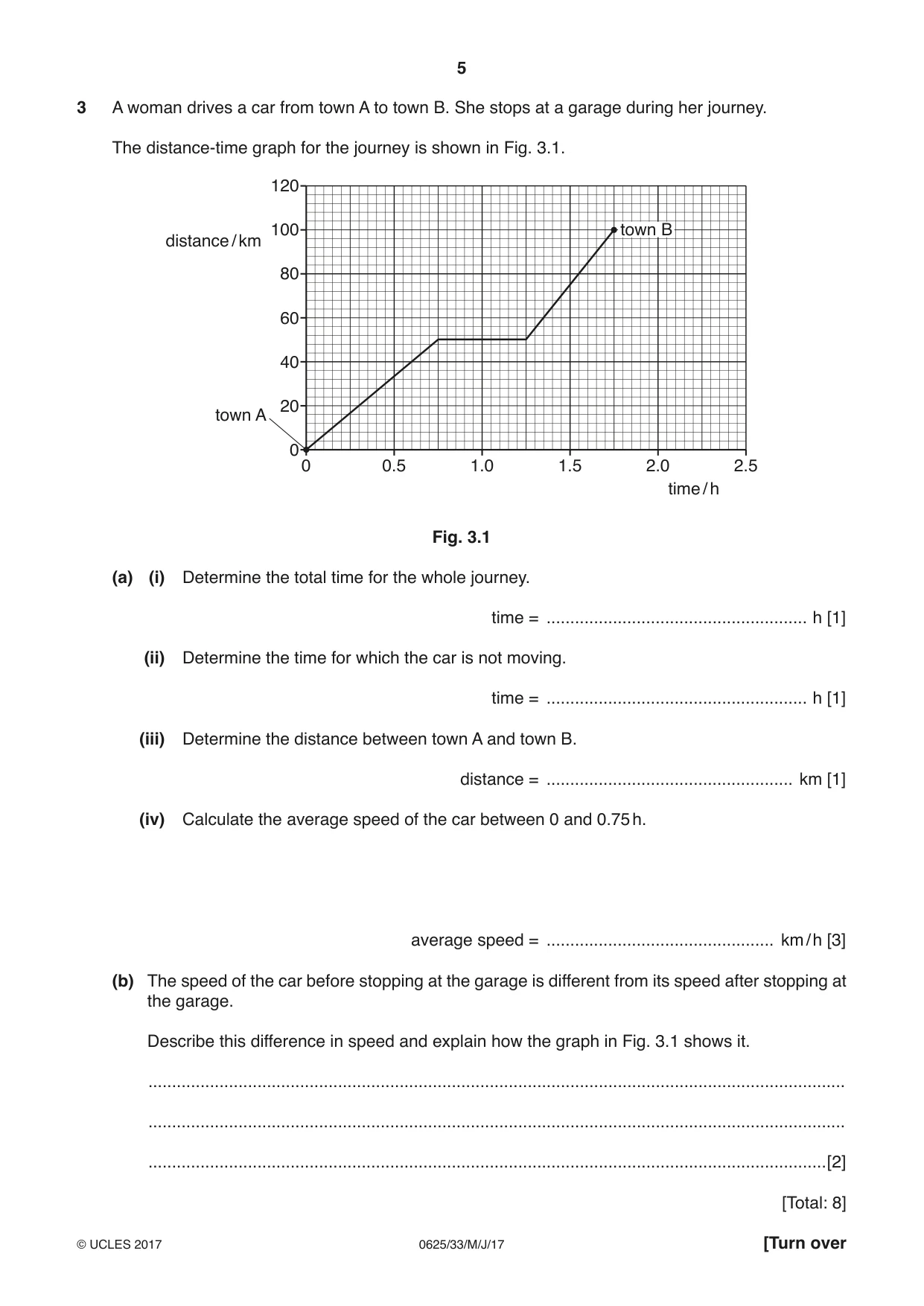
3 A woman drives a car from town A to town B. She stops at a garage during her journey. The distance-time graph for the journey is shown in Fig. 3.1. 120 100 town B distance / km 80 60 40 20 town A 0 0 0.5 1.0 1.5 2.0 2.5 time / h Fig. 3.1 (a) (i) Determine the total time for the whole journey. time = ....................................................... h [1] (ii) Determine the time for which the car is not moving. time = ....................................................... h [1] (iii) Determine the distance between town A and town B. distance = .................................................... km [1] (iv) Calculate the average speed of the car between 0 and 0.75 h. average speed = ................................................ km / h [3] (b) The speed of the car before stopping at the garage is different from its speed after stopping at the garage. Describe this difference in speed and explain how the graph in Fig. 3.1 shows it. ................................................................................................................................................... ................................................................................................................................................... ...............................................................................................................................................[2] [Total: 8]
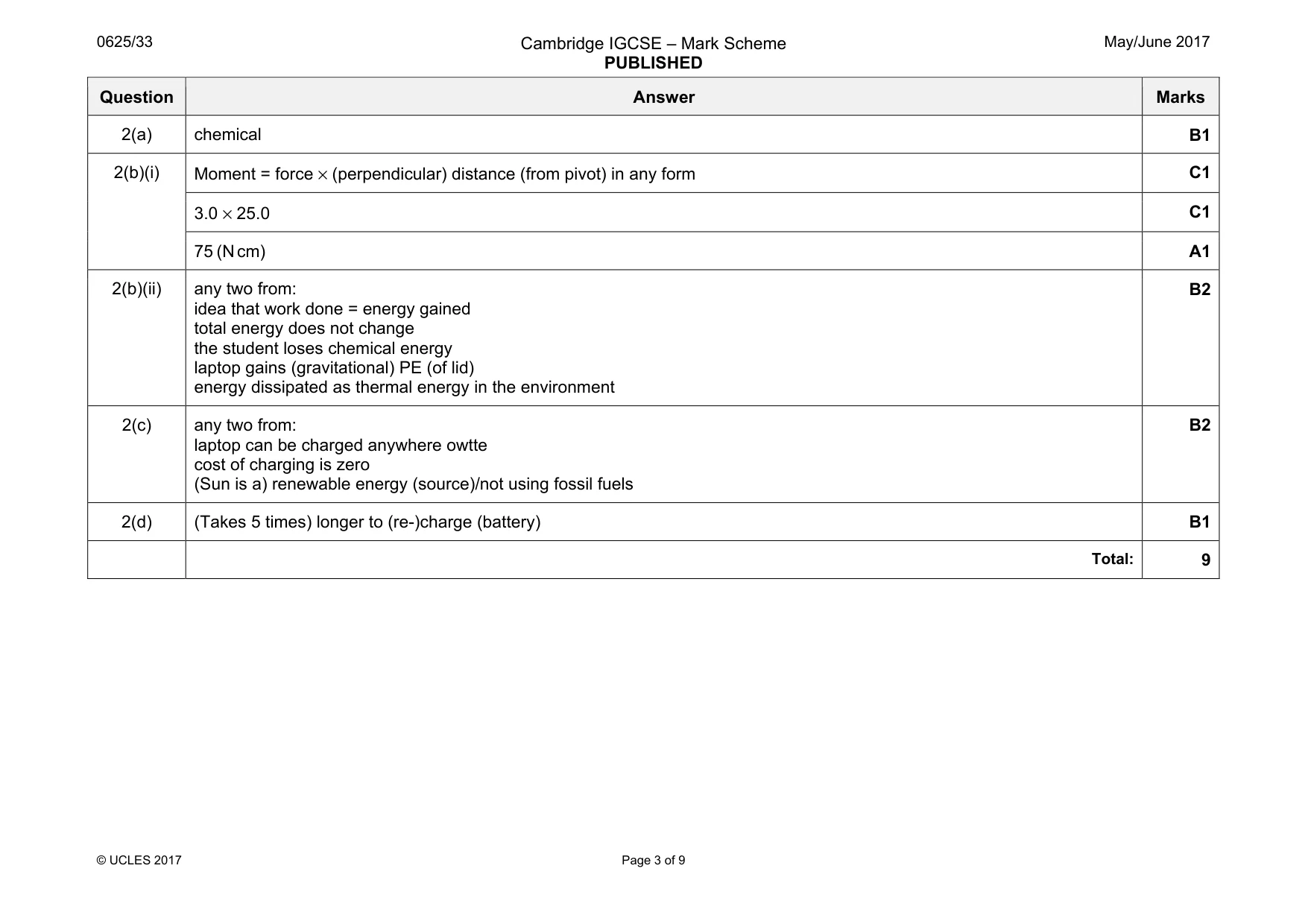
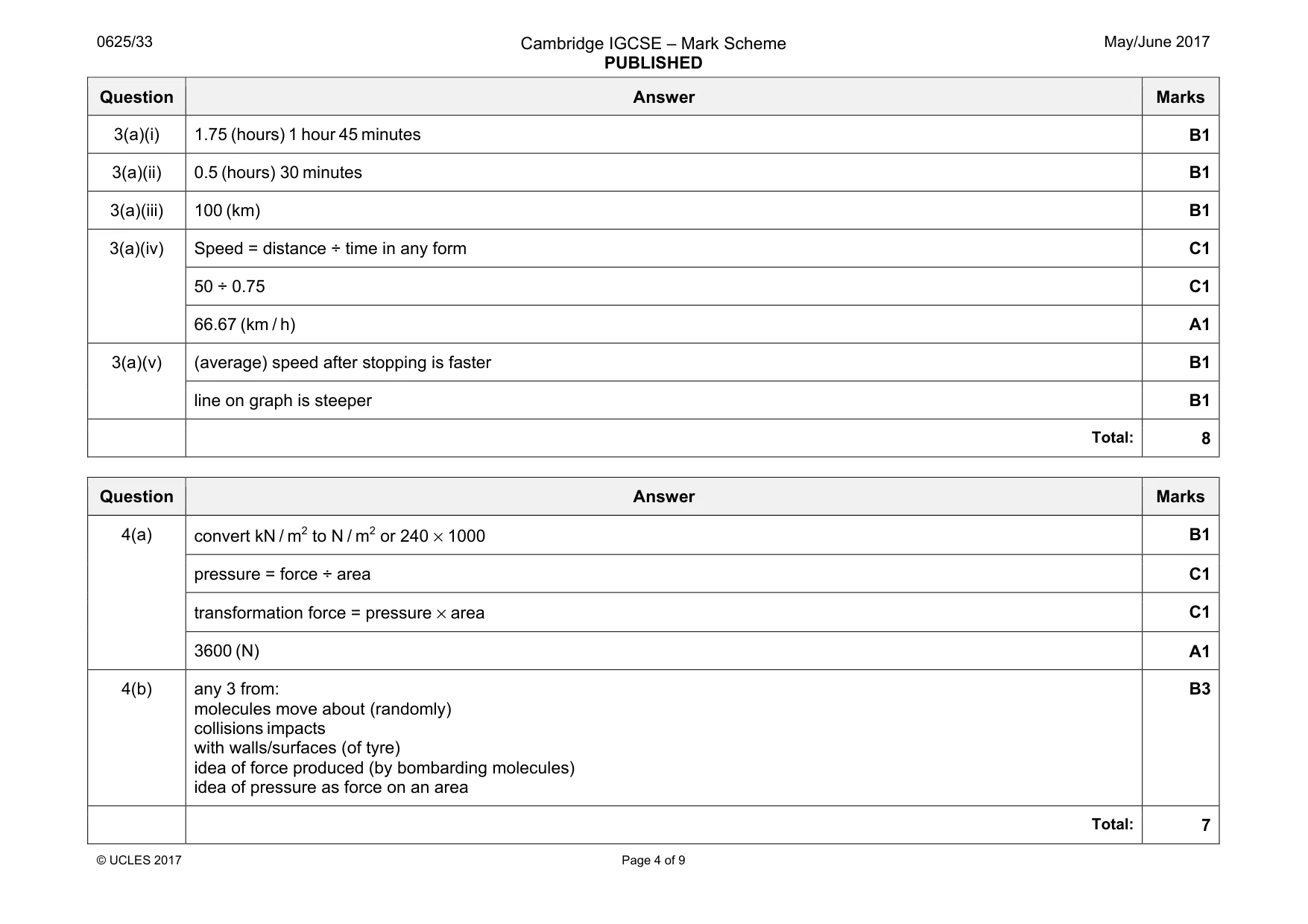
Mark scheme: 3(a)(i) 1.75 (hours) 1 hour 45 minutes B1 3(a)(ii) 0.5 (hours) 30 minutes B1 3(a)(iii) 100 (km) B1 3(a)(iv) Speed = distance ÷ time in any form C1 50 ÷ 0.75 C1 66.67 (km / h) A1 3(a)(v) (average) speed after stopping is faster B1 line on graph is steeper B1 Total: 8
Q4 · A car tyre in contact with the road
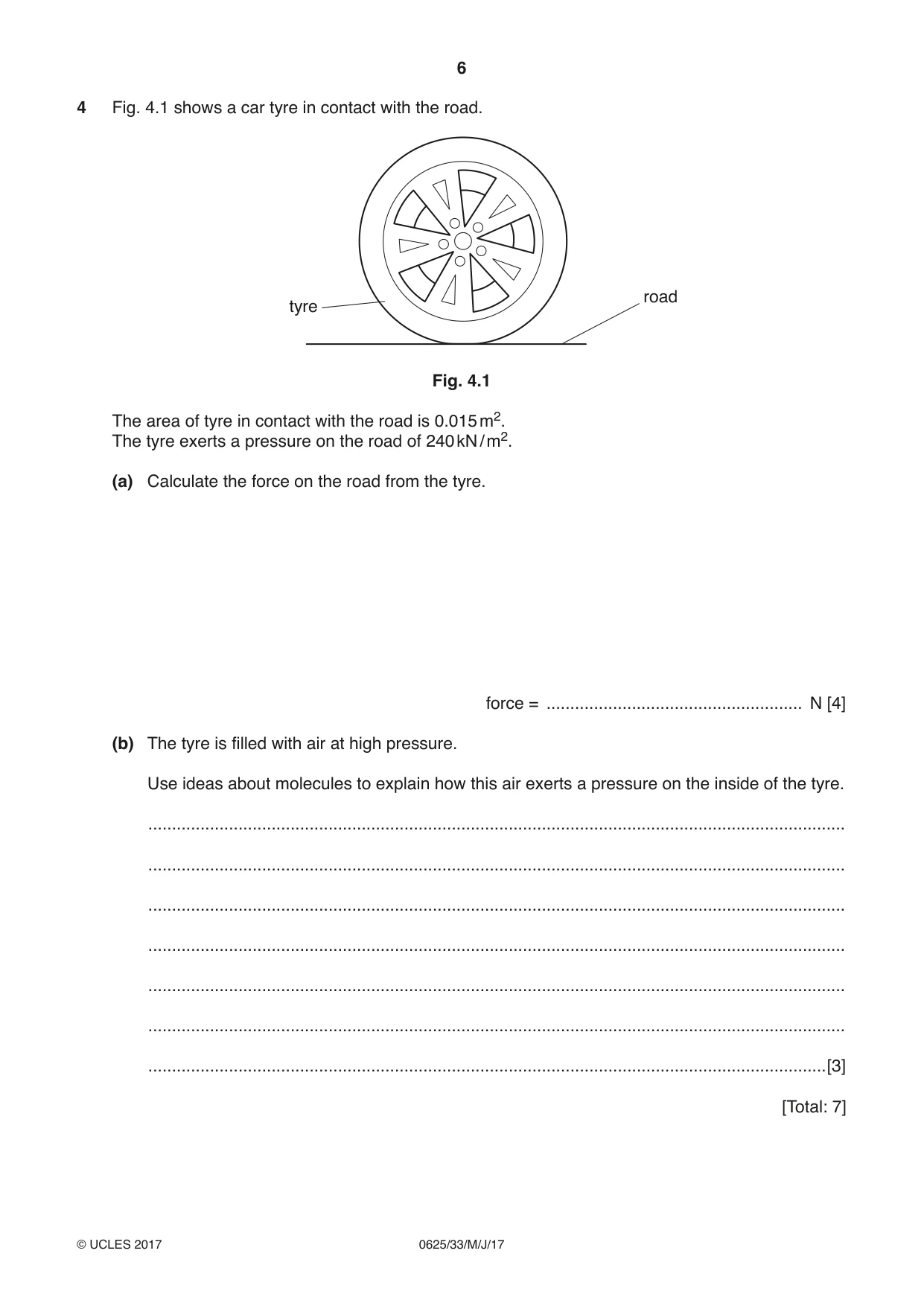
4 Fig. 4.1 shows a car tyre in contact with the road. road tyre Fig. 4.1 The area of tyre in contact with the road is 0.015 m2. The tyre exerts a pressure on the road of 240 kN / m2. (a) Calculate the force on the road from the tyre. force = ...................................................... N [4] (b) The tyre is filled with air at high pressure. Use ideas about molecules to explain how this air exerts a pressure on the inside of the tyre. ................................................................................................................................................... ................................................................................................................................................... ................................................................................................................................................... ................................................................................................................................................... ................................................................................................................................................... ................................................................................................................................................... ...............................................................................................................................................[3] [Total: 7]
Mark scheme: 4(a) B1 pressure = force ÷ area C1 transformation force = pressure × area C1 3600 (N) A1 4(b) any 3 from: molecules move about (randomly) collisions impacts with walls/surfaces (of tyre) idea of force produced (by bombarding molecules) idea of pressure as force on an area B3 Total: 7
Q5 · A nuclear power station generates electricity
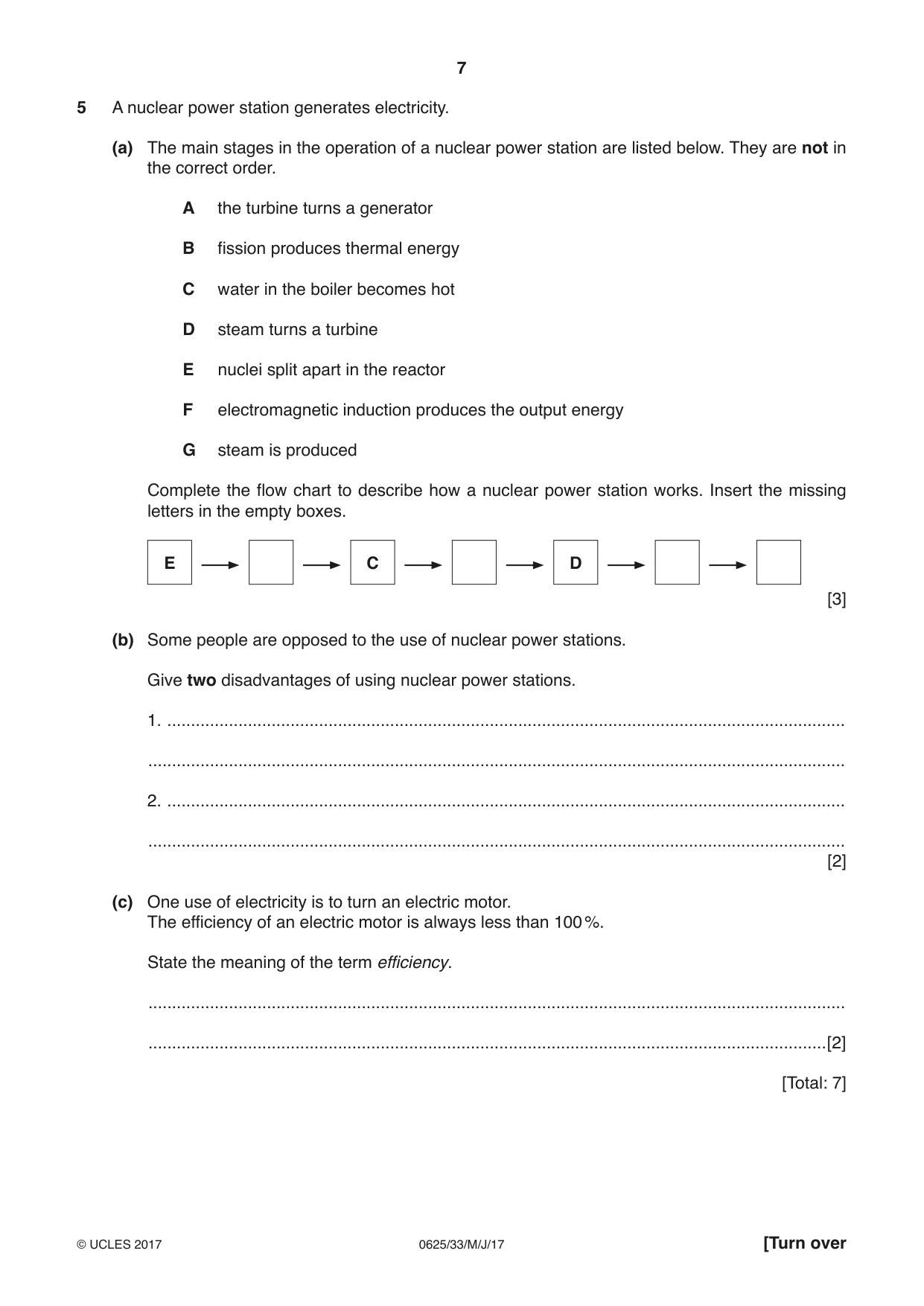
5 A nuclear power station generates electricity. (a) The main stages in the operation of a nuclear power station are listed below. They are not in the correct order. A the turbine turns a generator B fission produces thermal energy C water in the boiler becomes hot D steam turns a turbine E nuclei split apart in the reactor F electromagnetic induction produces the output energy G steam is produced Complete the flow chart to describe how a nuclear power station works. Insert the missing letters in the empty boxes. E C D [3] (b) Some people are opposed to the use of nuclear power stations. Give two disadvantages of using nuclear power stations. 1. ............................................................................................................................................... ................................................................................................................................................... 2. ............................................................................................................................................... ................................................................................................................................................... [2] (c) One use of electricity is to turn an electric motor. The efficiency of an electric motor is always less than 100 %. State the meaning of the term efficiency. ................................................................................................................................................... ...............................................................................................................................................[2] [Total: 7]
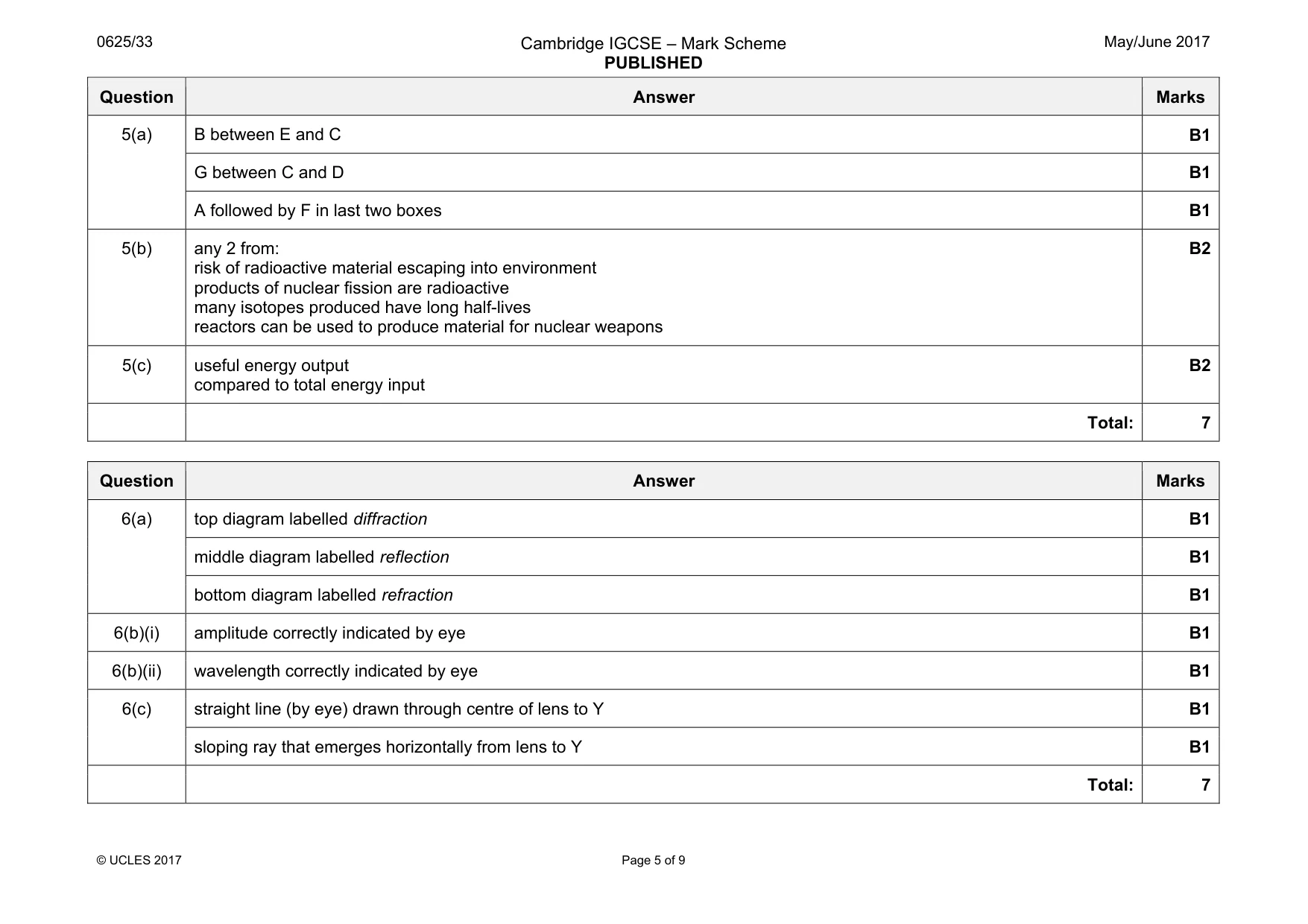
Mark scheme: 5(a) B between E and C B1 G between C and D B1 A followed by F in last two boxes B1 5(b) any 2 from: risk of radioactive material escaping into environment products of nuclear fission are radioactive many isotopes produced have long half-lives reactors can be used to produce material for nuclear weapons B2 5(c) useful energy output compared to total energy input B2 Total: 7
Q6 · The diagrams in Fig
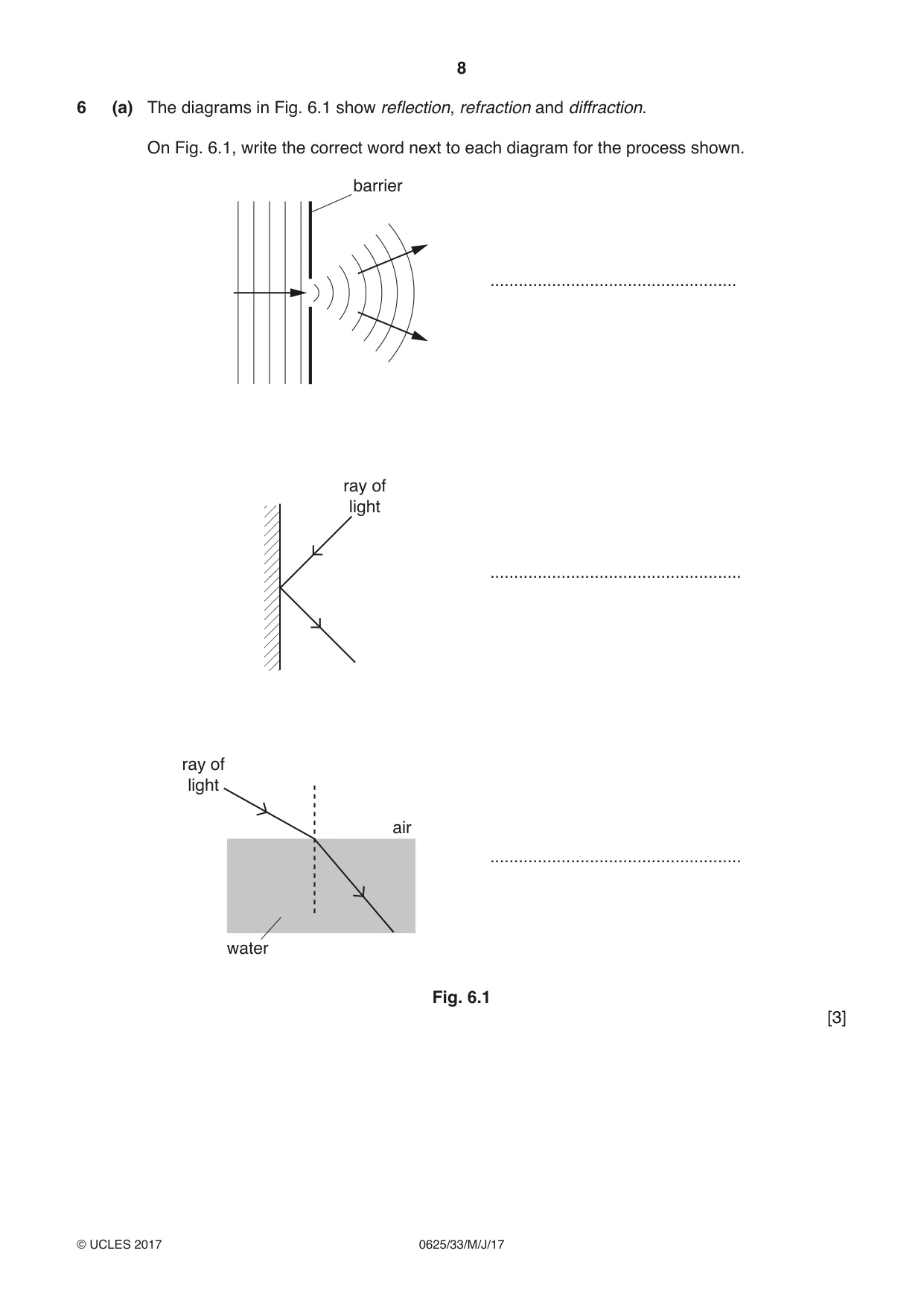
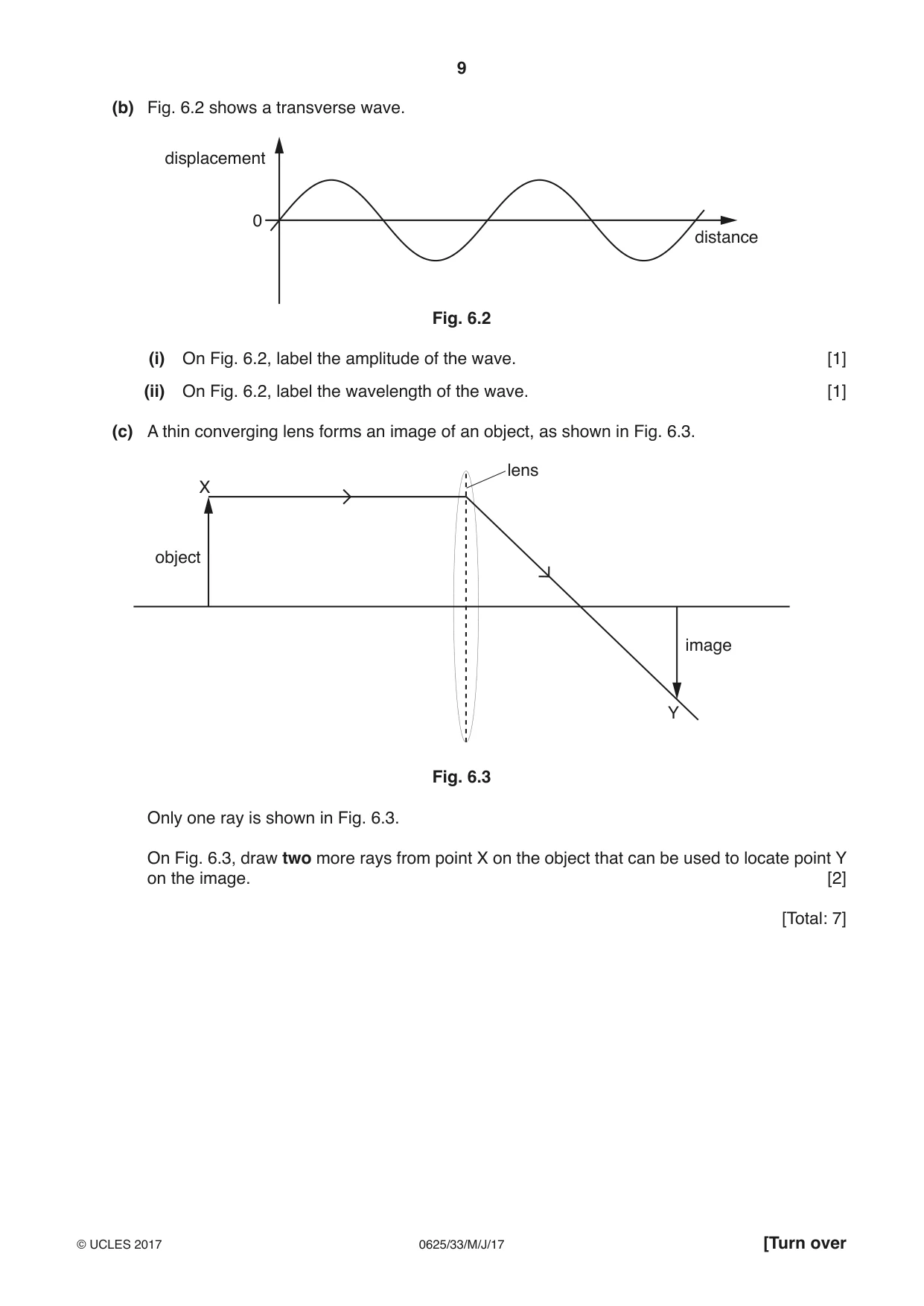
6 (a) The diagrams in Fig. 6.1 show reflection, refraction and diffraction. On Fig. 6.1, write the correct word next to each diagram for the process shown. barrier .................................................... ray of light ..................................................... ray of light air ..................................................... water Fig. 6.1 [3] (b) Fig. 6.2 shows a transverse wave. displacement 0 distance Fig. 6.2 (i) On Fig. 6.2, label the amplitude of the wave. [1] (ii) On Fig. 6.2, label the wavelength of the wave. [1] (c) A thin converging lens forms an image of an object, as shown in Fig. 6.3. lens X object image Y Fig. 6.3 Only one ray is shown in Fig. 6.3. On Fig. 6.3, draw two more rays from point X on the object that can be used to locate point Y on the image. [2] [Total: 7]
Mark scheme: 6(a) B1 middle diagram labelled reflection B1 bottom diagram labelled refraction B1 6(b)(i) amplitude correctly indicated by eye B1 6(b)(ii) wavelength correctly indicated by eye B1 6(c) straight line (by eye) drawn through centre of lens to Y B1 sloping ray that emerges horizontally from lens to Y B1 Total: 7
Q7 · A sound wave is a longitudinal wave
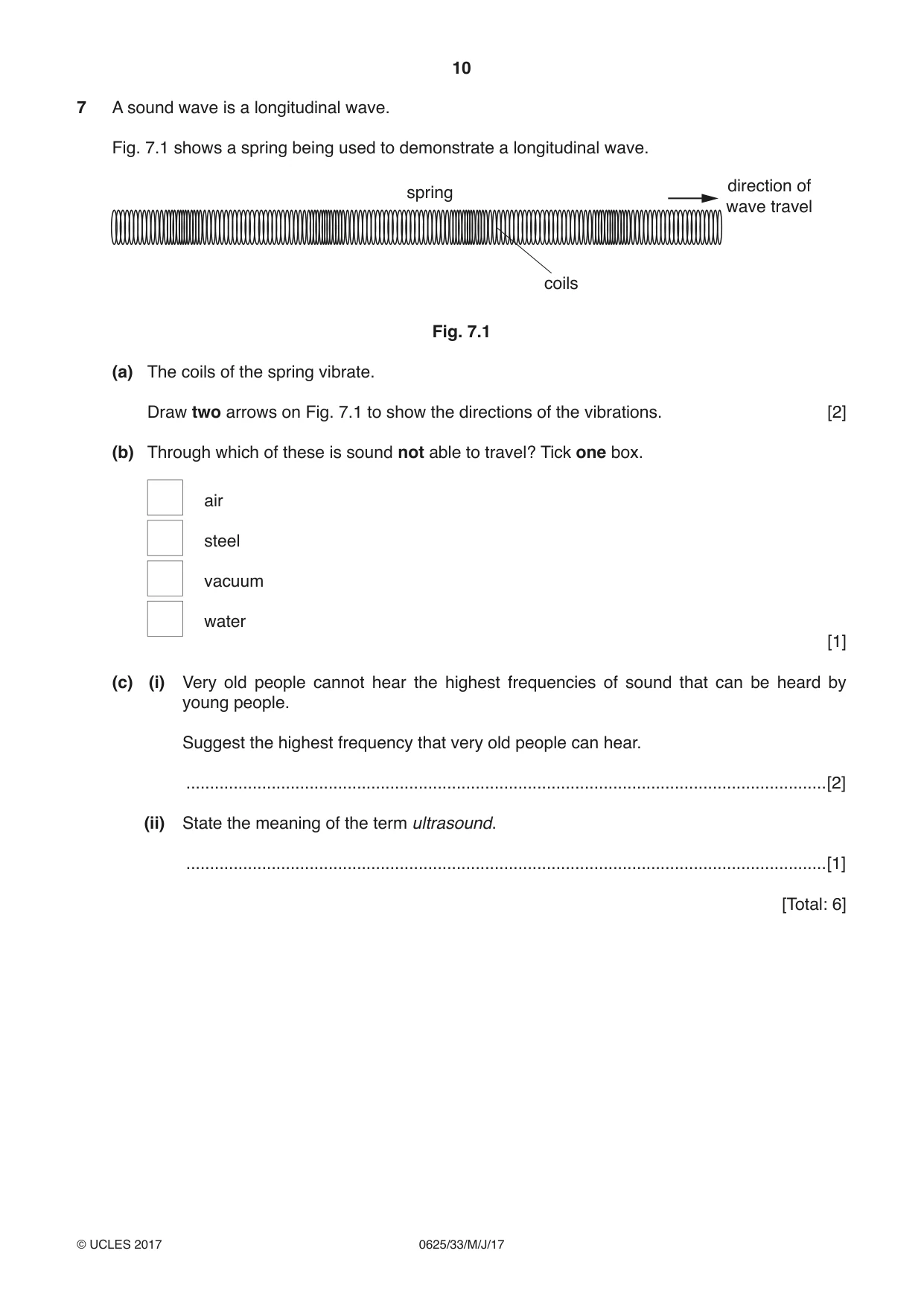
7 A sound wave is a longitudinal wave. Fig. 7.1 shows a spring being used to demonstrate a longitudinal wave. direction of spring wave travel coils Fig. 7.1 (a) The coils of the spring vibrate. Draw two arrows on Fig. 7.1 to show the directions of the vibrations. [2] (b) Through which of these is sound not able to travel? Tick one box. air steel vacuum water [1] (c) (i) Very old people cannot hear the highest frequencies of sound that can be heard by young people. Suggest the highest frequency that very old people can hear. .......................................................................................................................................[2] (ii) State the meaning of the term ultrasound. .......................................................................................................................................[1] [Total: 6]
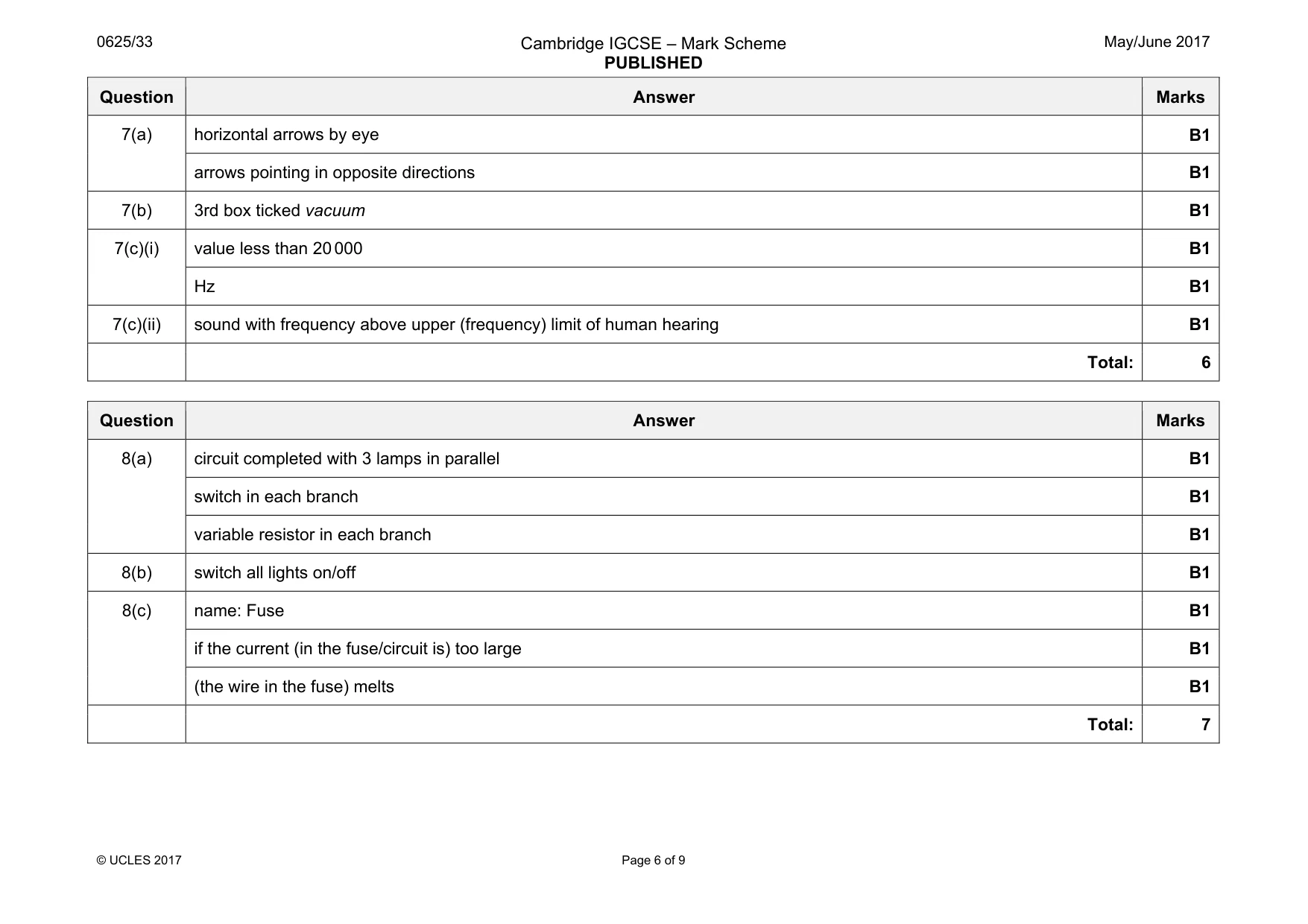
Mark scheme: 7(a) horizontal arrows by eye B1 arrows pointing in opposite directions B1 7(b) 3rd box ticked vacuum B1 7(c)(i) value less than 20 000 B1 Hz B1 7(c)(ii) sound with frequency above upper (frequency) limit of human hearing B1 Total: 6
Q8 · A theatre has three coloured lamps
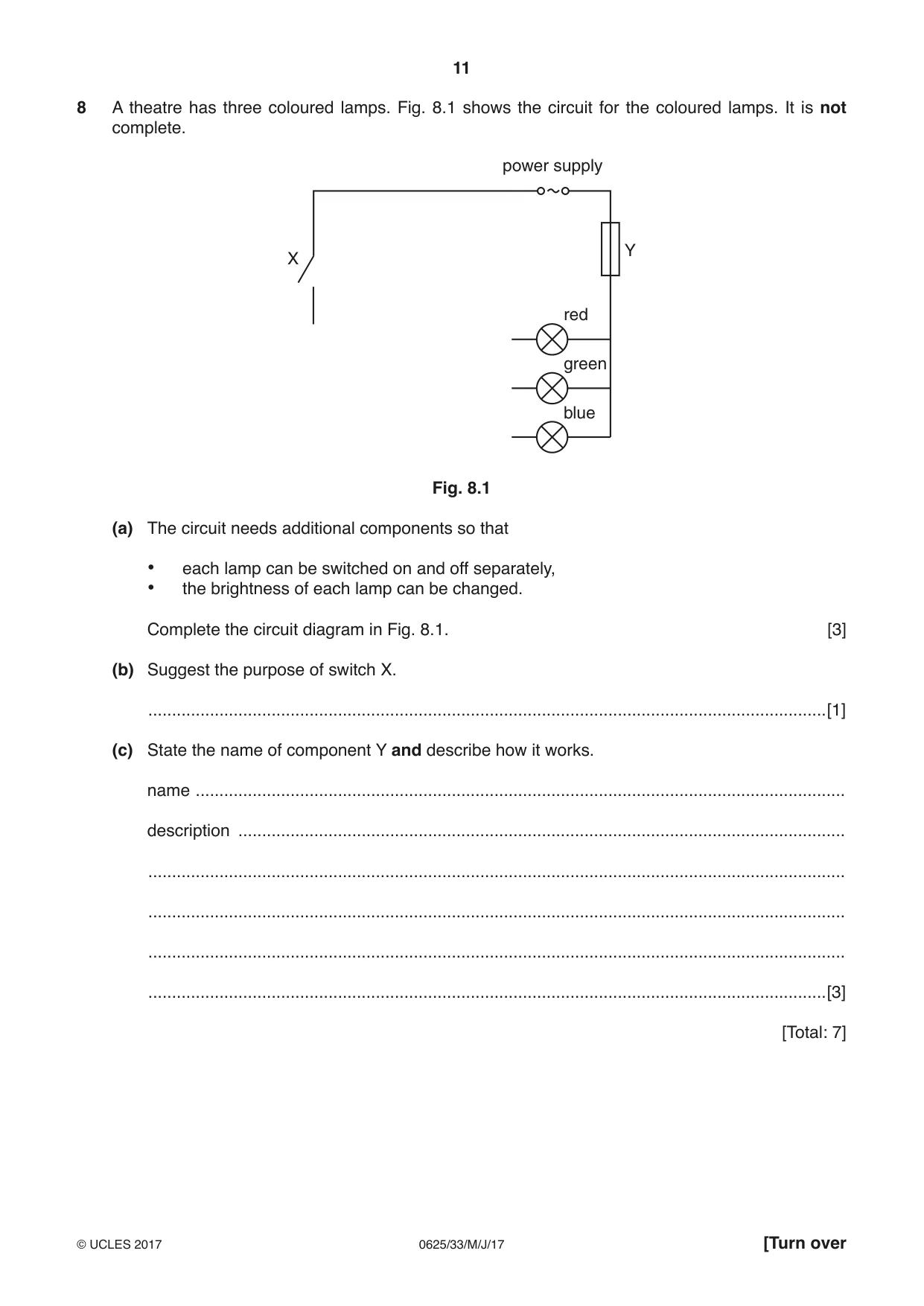
8 A theatre has three coloured lamps. Fig. 8.1 shows the circuit for the coloured lamps. It is not complete. power supply Y X red green blue Fig. 8.1 (a) The circuit needs additional components so that • each lamp can be switched on and off separately, • the brightness of each lamp can be changed. Complete the circuit diagram in Fig. 8.1. [3] (b) Suggest the purpose of switch X. ...............................................................................................................................................[1] (c) State the name of component Y and describe how it works. name ......................................................................................................................................... description ................................................................................................................................ ................................................................................................................................................... ................................................................................................................................................... ................................................................................................................................................... ...............................................................................................................................................[3] [Total: 7]
Mark scheme: 8(a) circuit completed with 3 lamps in parallel B1 switch in each branch B1 variable resistor in each branch B1 8(b) switch all lights on/off B1 8(c) name: Fuse B1 if the current (in the fuse/circuit is) too large B1 (the wire in the fuse) melts B1 Total: 7
Q9 · A student has four similar metal bars
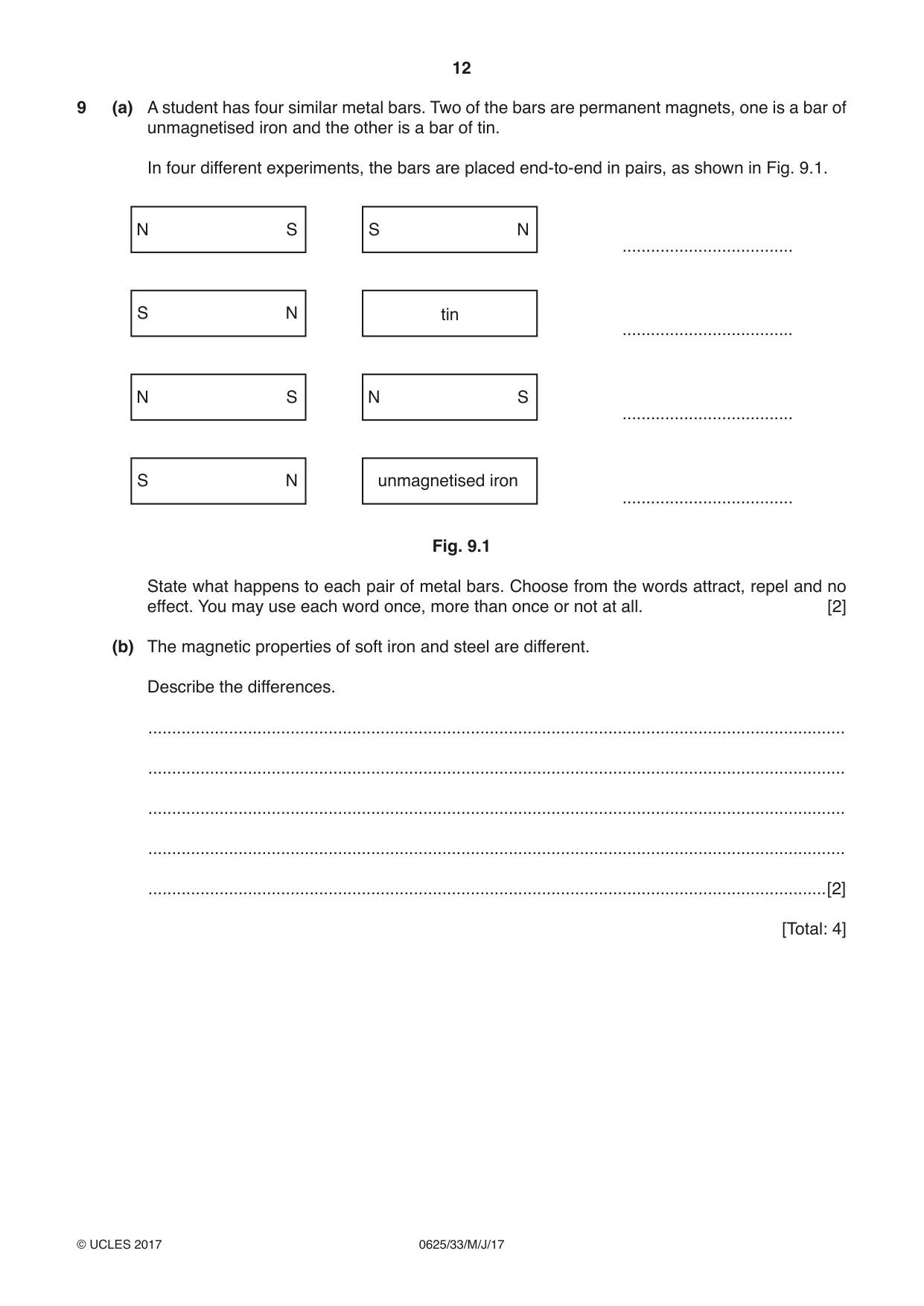
9 (a) A student has four similar metal bars. Two of the bars are permanent magnets, one is a bar of unmagnetised iron and the other is a bar of tin. In four different experiments, the bars are placed end-to-end in pairs, as shown in Fig. 9.1. N S S N .................................... S N tin .................................... N S N S .................................... S N unmagnetised iron .................................... Fig. 9.1 State what happens to each pair of metal bars. Choose from the words attract, repel and no effect. You may use each word once, more than once or not at all. [2] (b) The magnetic properties of soft iron and steel are different. Describe the differences. ................................................................................................................................................... ................................................................................................................................................... ................................................................................................................................................... ................................................................................................................................................... ...............................................................................................................................................[2] [Total: 4]
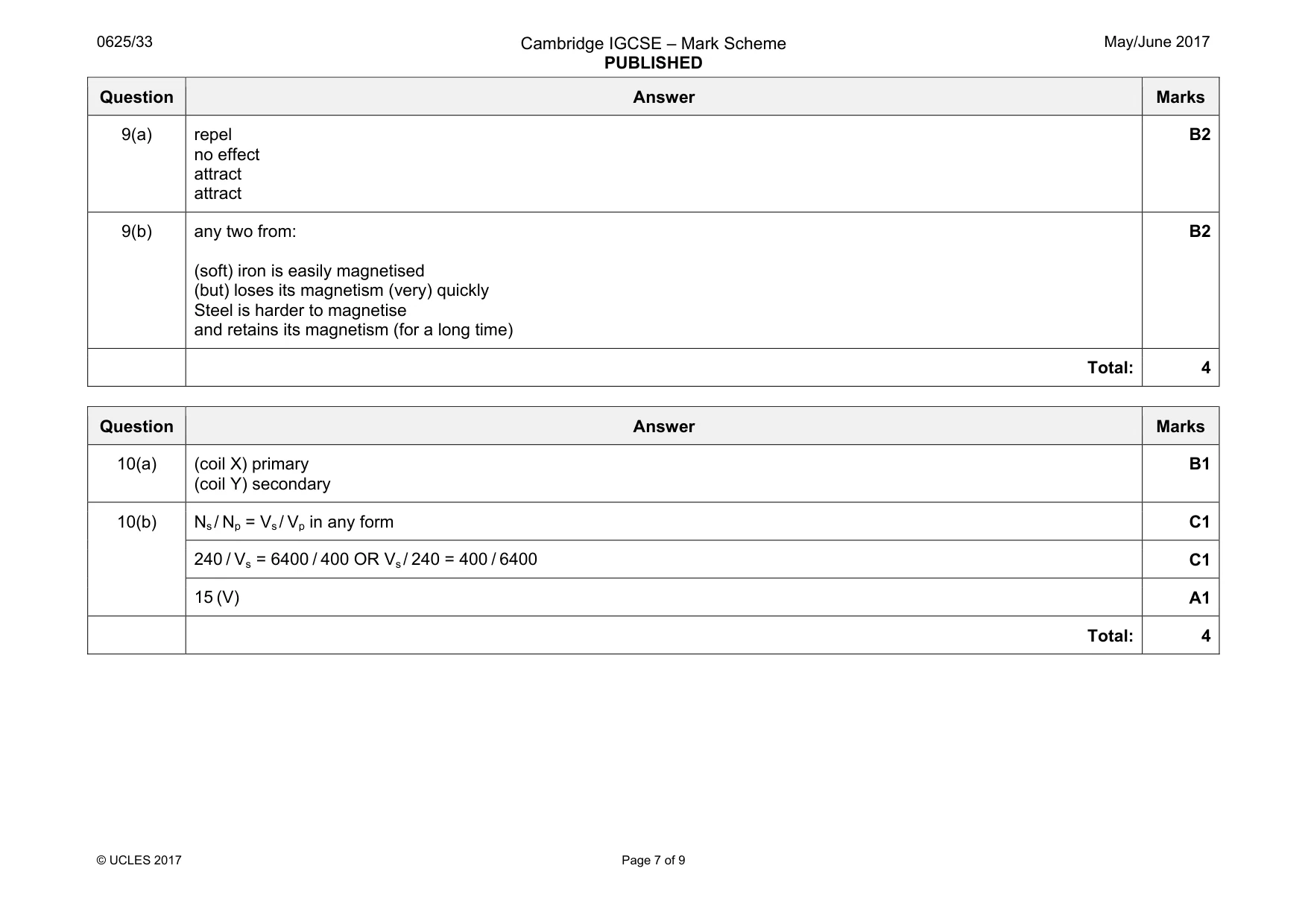
Mark scheme: 9(a) repel no effect attract attract B2 9(b) any two from: (soft) iron is easily magnetised (but) loses its magnetism (very) quickly Steel is harder to magnetise and retains its magnetism (for a long time) B2 Total: 4
Q10 · A transformer is connected to a 240 V supply
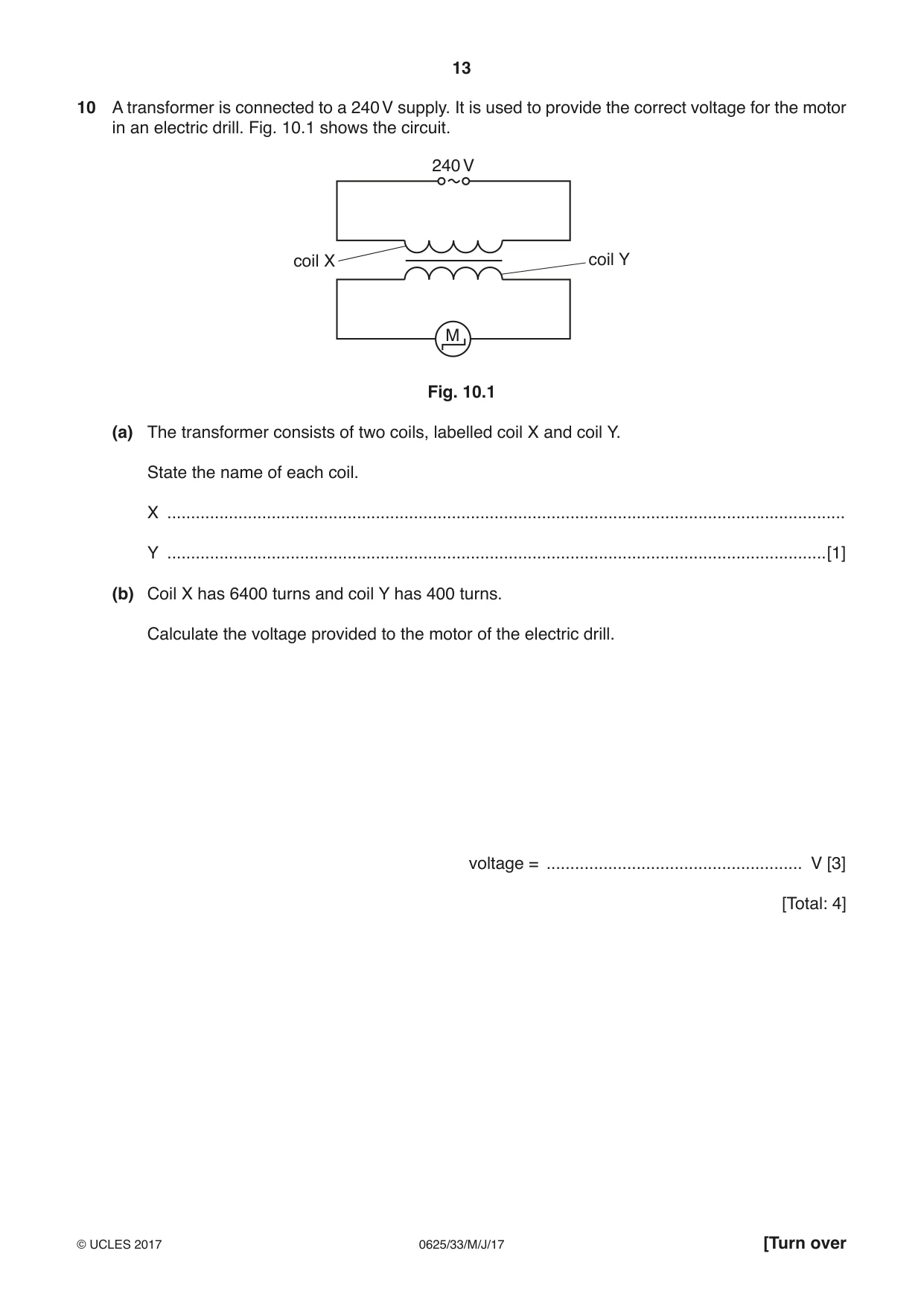
10 A transformer is connected to a 240 V supply. It is used to provide the correct voltage for the motor in an electric drill. Fig. 10.1 shows the circuit. 240 V coil X coil Y M Fig. 10.1 (a) The transformer consists of two coils, labelled coil X and coil Y. State the name of each coil. X ............................................................................................................................................... Y ...........................................................................................................................................[1] (b) Coil X has 6400 turns and coil Y has 400 turns. Calculate the voltage provided to the motor of the electric drill. voltage = ...................................................... V [3] [Total: 4]
Mark scheme: 10(a) (coil X) primary (coil Y) secondary B1 10(b) Ns/ Np = Vs / Vp in any form C1 240 / Vs = 6400 / 400 OR Vs/ 240 = 400 / 6400 C1 15 (V) A1 Total: 4
Q11 · A coil connected in series with a d.c
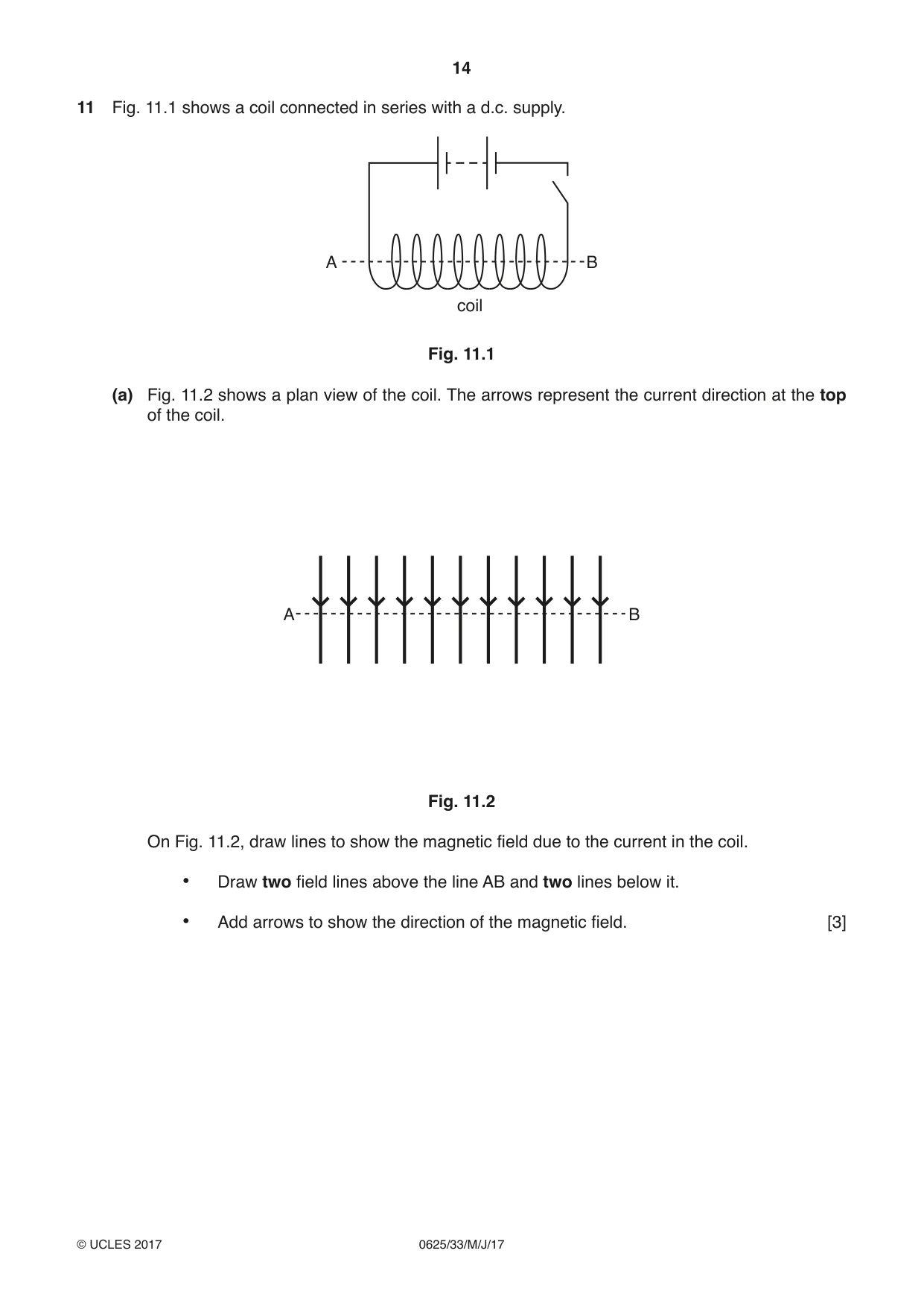
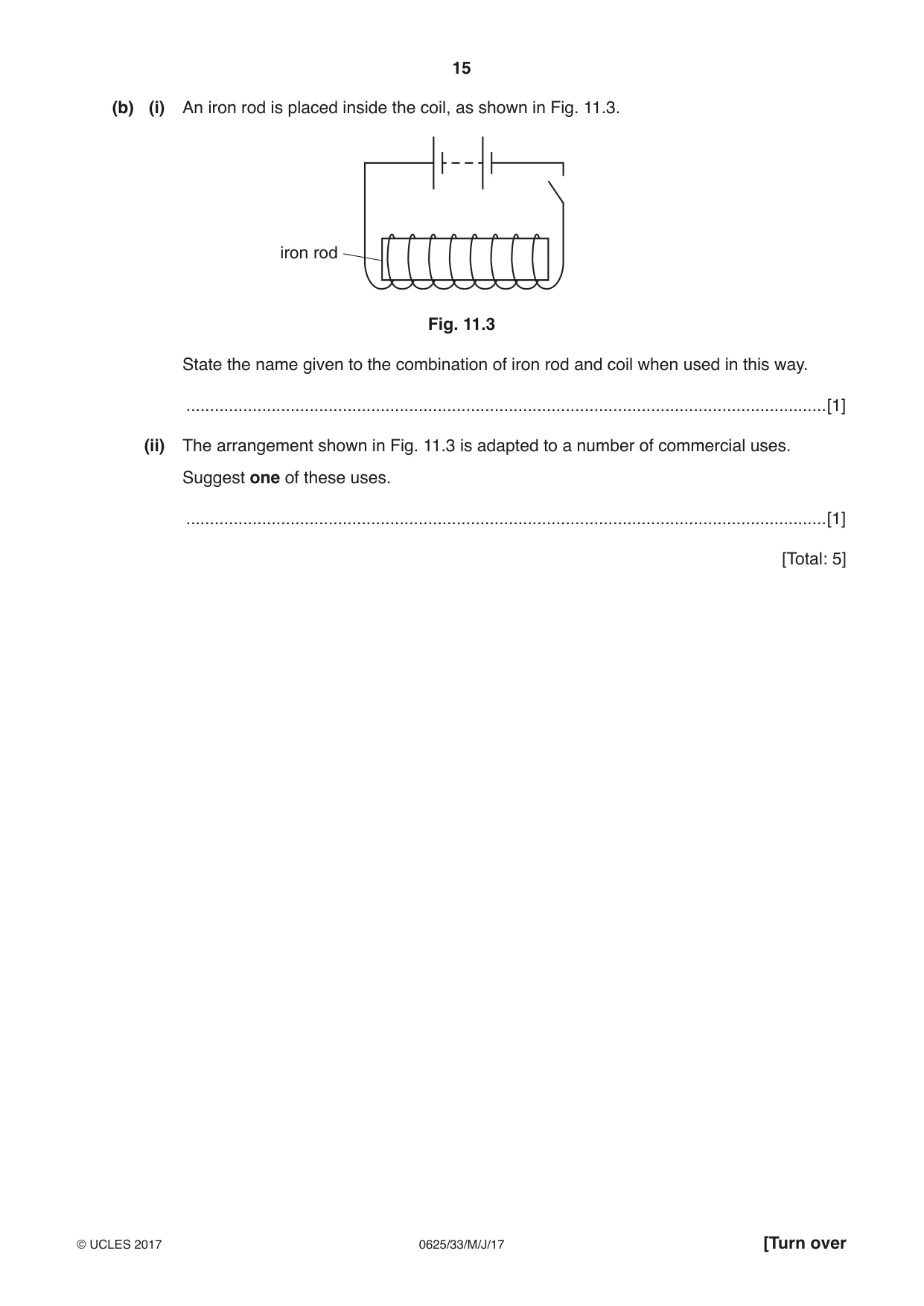
11 Fig. 11.1 shows a coil connected in series with a d.c. supply. A B coil Fig. 11.1 (a) Fig. 11.2 shows a plan view of the coil. The arrows represent the current direction at the top of the coil. A B Fig. 11.2 On Fig. 11.2, draw lines to show the magnetic field due to the current in the coil. • Draw two field lines above the line AB and two lines below it. • Add arrows to show the direction of the magnetic field. [3] (b) (i) An iron rod is placed inside the coil, as shown in Fig. 11.3. iron rod Fig. 11.3 State the name given to the combination of iron rod and coil when used in this way. .......................................................................................................................................[1] (ii) The arrangement shown in Fig. 11.3 is adapted to a number of commercial uses. Suggest one of these uses. .......................................................................................................................................[1] [Total: 5]
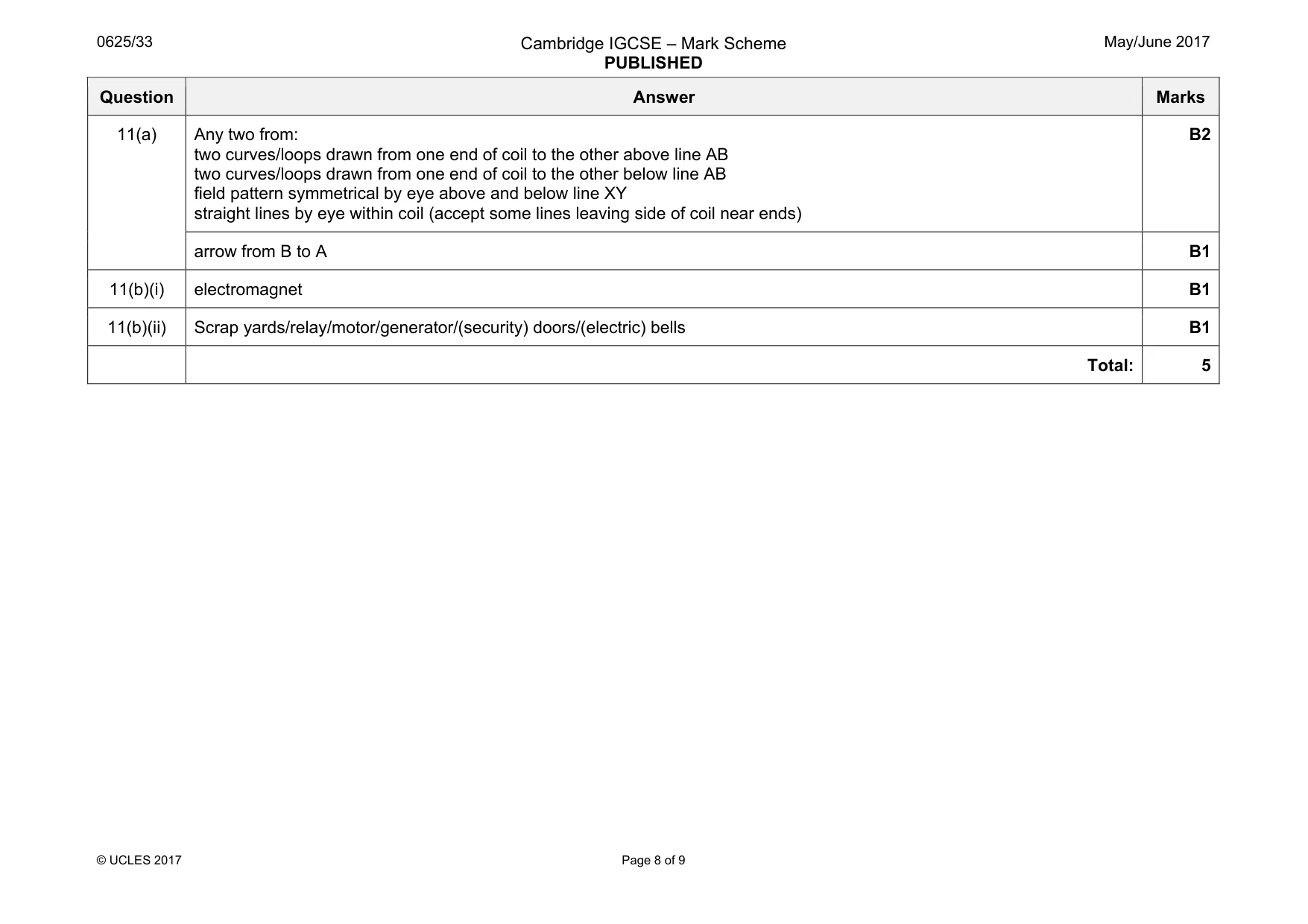
Mark scheme: 11(a) Any two from: two curves/loops drawn from one end of coil to the other above line AB two curves/loops drawn from one end of coil to the other below line AB field pattern symmetrical by eye above and below line XY straight lines by eye within coil (accept some lines leaving side of coil near ends) B2 arrow from B to A B1 11(b)(i) electromagnet B1 11(b)(ii) Scrap yards/relay/motor/generator/(security) doors/(electric) bells B1 Total: 5
Q12 · A scientist has a sample of a radioactive substance
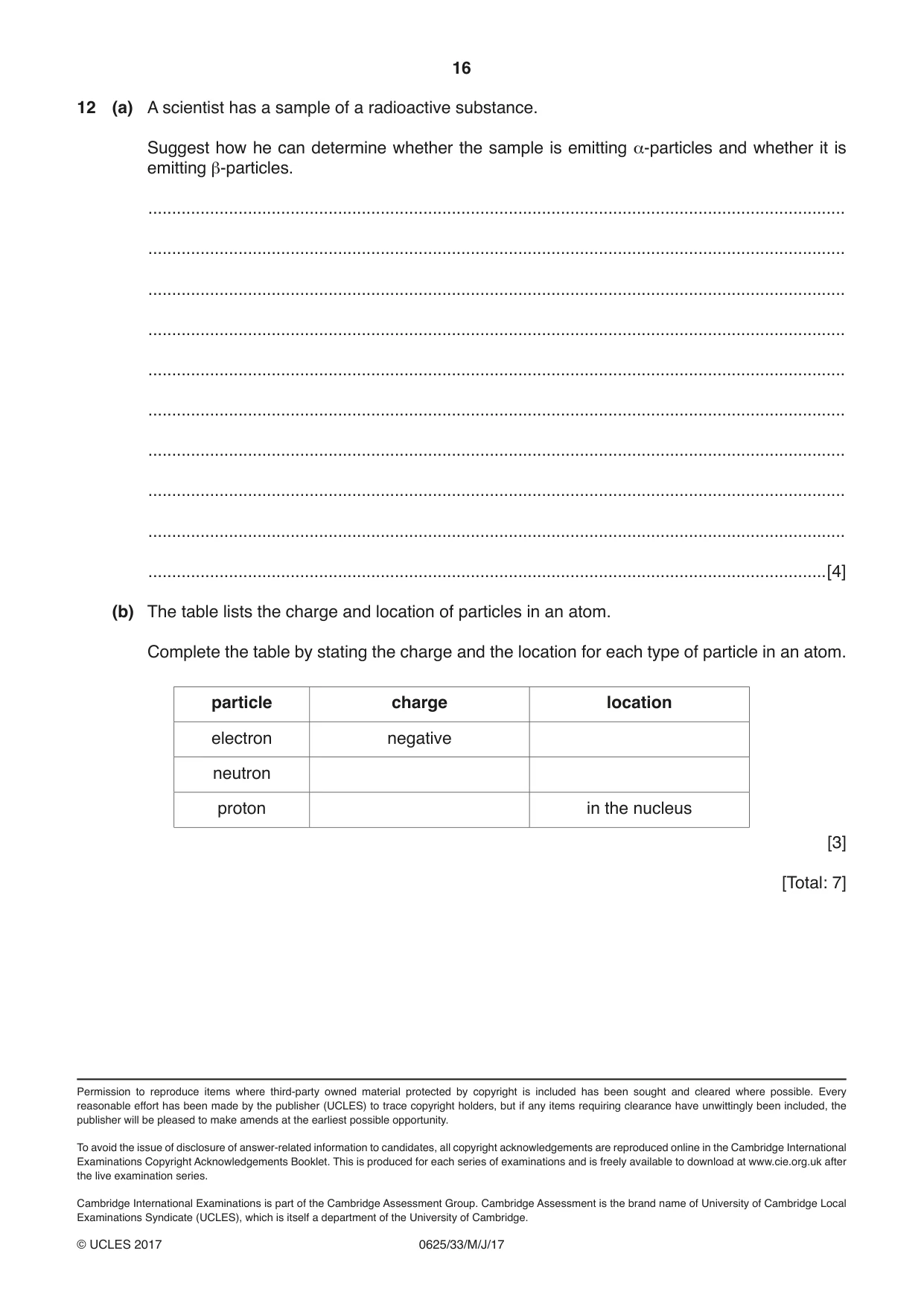
12 (a) A scientist has a sample of a radioactive substance. Suggest how he can determine whether the sample is emitting α-particles and whether it is emitting β-particles. ................................................................................................................................................... ................................................................................................................................................... ................................................................................................................................................... ................................................................................................................................................... ................................................................................................................................................... ................................................................................................................................................... ................................................................................................................................................... ................................................................................................................................................... ................................................................................................................................................... ...............................................................................................................................................[4] (b) The table lists the charge and location of particles in an atom. Complete the table by stating the charge and the location for each type of particle in an atom. particle charge location electron negative neutron proton in the nucleus [3] [Total: 7]
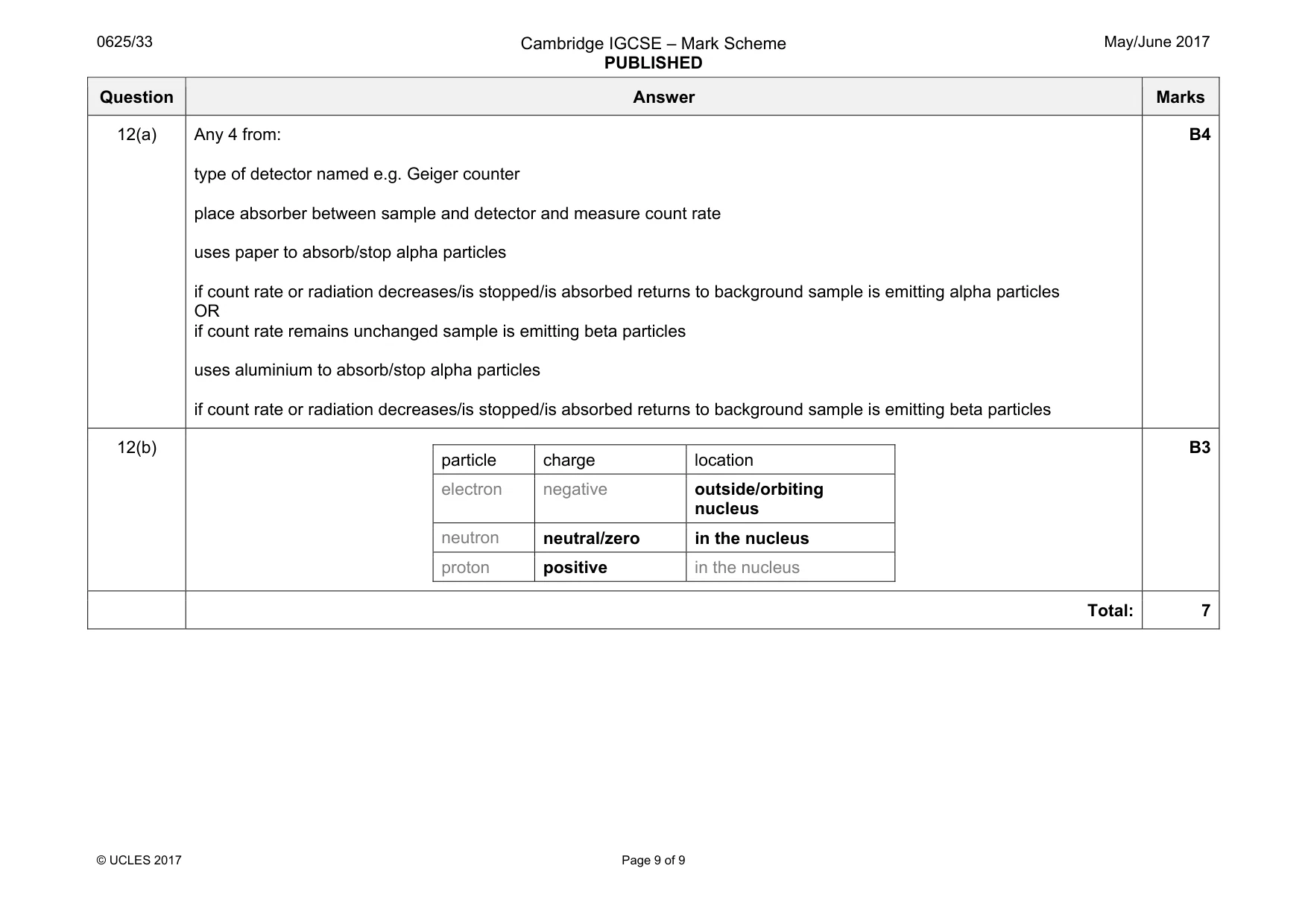
Mark scheme: 12(a) Any 4 from: type of detector named e.g. Geiger counter place absorber between sample and detector and measure count rate uses paper to absorb/stop alpha particles if count rate or radiation decreases/is stopped/is absorbed returns to background sample is emitting alpha particles OR if count rate remains unchanged sample is emitting beta particles uses aluminium to absorb/stop alpha particles if count rate or radiation decreases/is stopped/is absorbed returns to background sample is emitting beta particles B4 12(b) particle charge location electron negative outside/orbiting nucleus neutron neutral/zero in the nucleus proton positive in the nucleus B3 Total: 7
What was in this paper
The subtopics covered by these 12 questions, and how many questions each got. Open one in a new tab to see every Cambridge question on it.
What you needed in this session
Cambridge’s own grade thresholds for 2017 May/June, Paper 3 · Variant 3. A higher threshold means an easier paper — the bar moves with how the cohort did.