Cambridge IGCSE Physics 0625 — 2014 May/June Paper 3 · Variant 1
0625/31/M/J/14 · 11 questions · 80 marks · ≈90 min
The question paper and its mark scheme, free to read here and free to download. This is Cambridge’s own paper, exactly as it was sat.
Question paper12 pages
Mark scheme9 pages
Answers below. Sit the paper first if you are practising.
Questions as text
Question 1
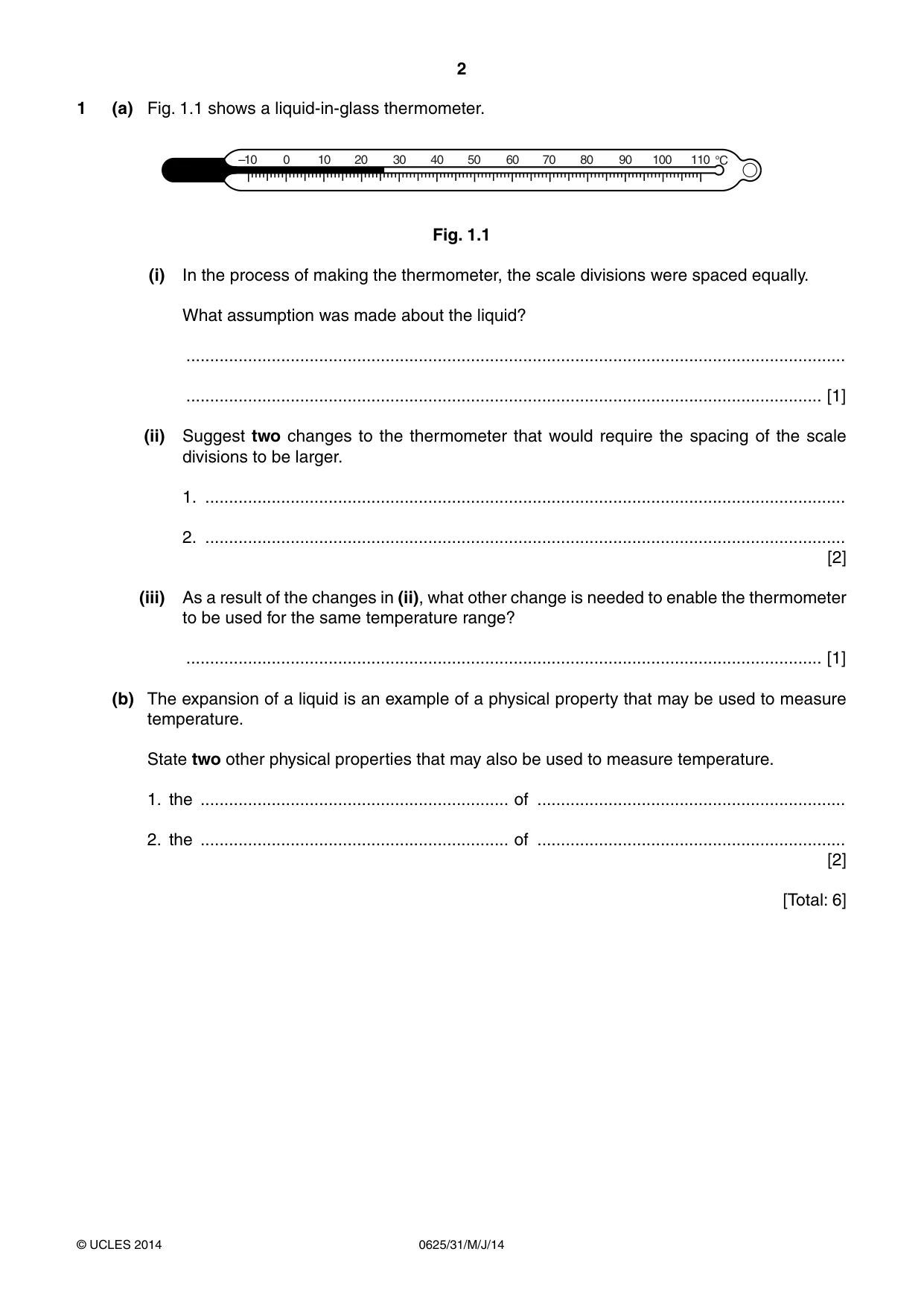
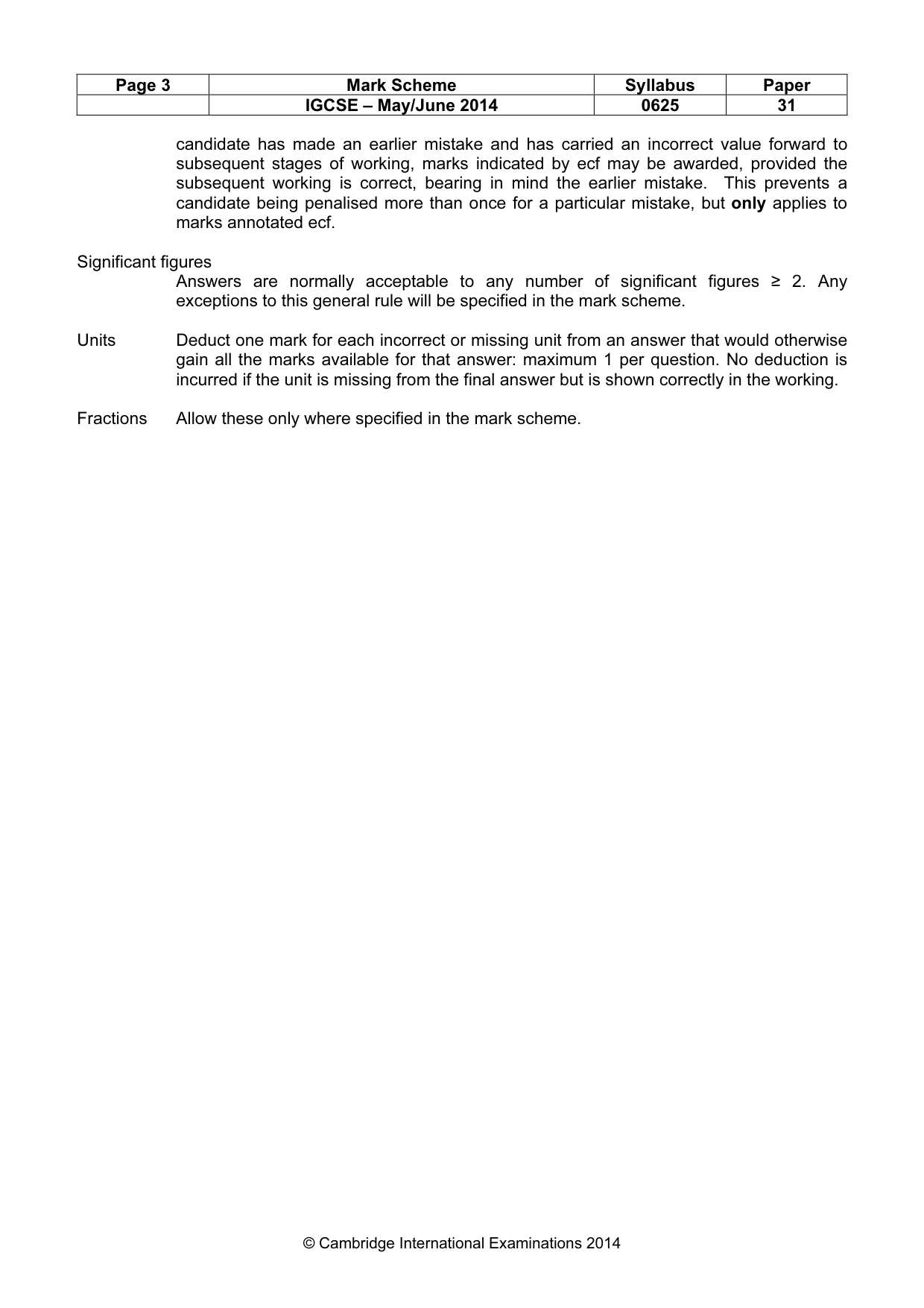
1 (a) Fig. 1.1 shows a liquid-in-glass thermometer. –10 0 10 20 30 40 50 60 70 80 90 100 110 °C Fig. 1.1 (i) In the process of making the thermometer, the scale divisions were spaced equally. What assumption was made about the liquid? ........................................................................................................................................... ...................................................................................................................................... [1] (ii) Suggest two changes to the thermometer that would require the spacing of the scale divisions to be larger. 1. ....................................................................................................................................... 2. ....................................................................................................................................... [2] (iii) As a result of the changes in (ii), what other change is needed to enable the thermometer to be used for the same temperature range? ...................................................................................................................................... [1] (b) The expansion of a liquid is an example of a physical property that may be used to measure temperature. State two other physical properties that may also be used to measure temperature. 1. the ................................................................. of ................................................................. 2. the ................................................................. of ................................................................. [2] [Total: 6]
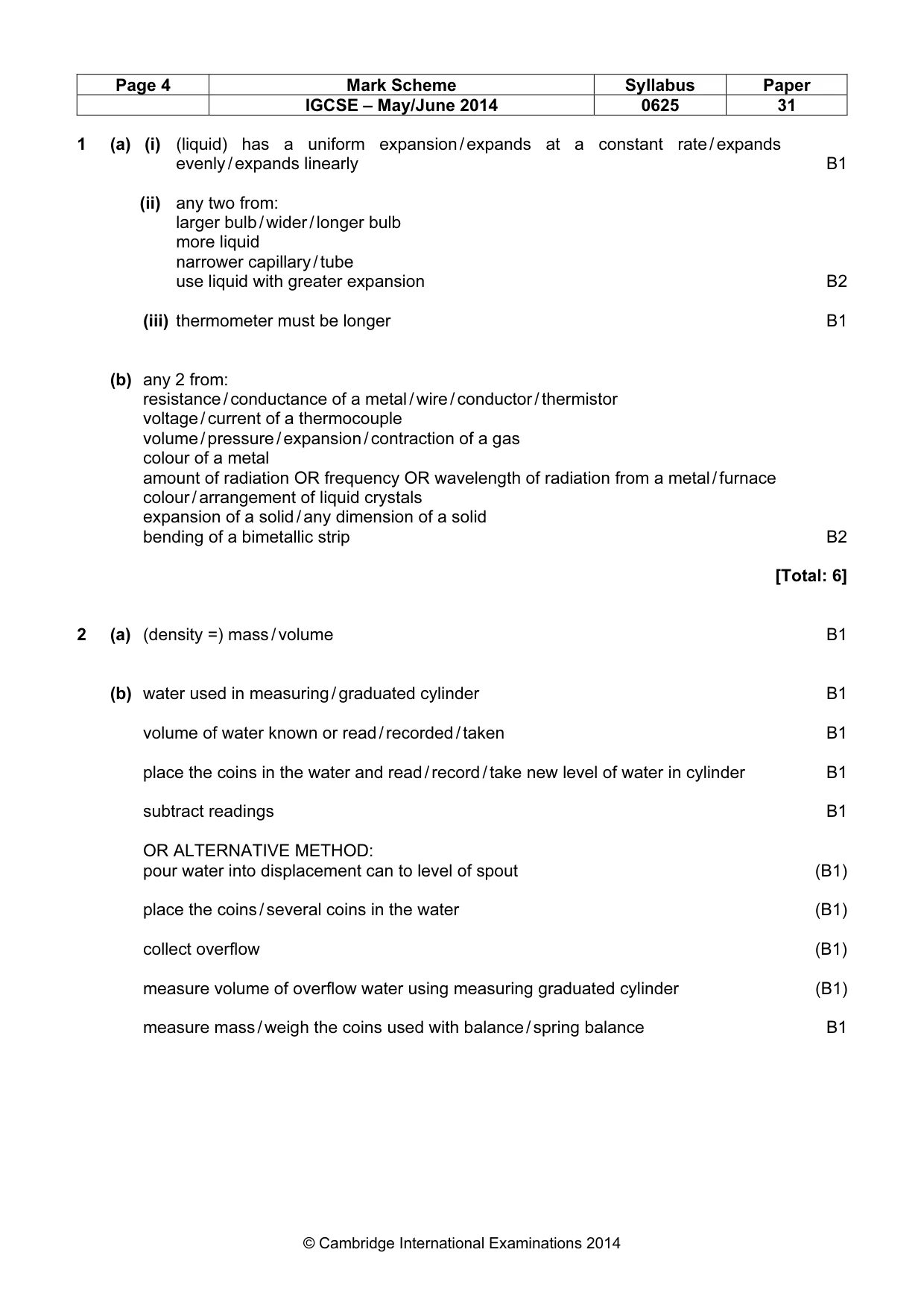
Mark scheme: 1 (a) (i) (liquid) has a uniform expansion / expands at a constant rate / expands evenly / expands linearly B1 (ii) any two from: larger bulb / wider / longer bulb more liquid narrower capillary / tube use liquid with greater expansion B2 (iii) thermometer must be longer B1 (b) any 2 from: resistance / conductance of a metal / wire / conductor / thermistor voltage / current of a thermocouple volume / pressure / expansion / contraction of a gas colour of a metal amount of radiation OR frequency OR wavelength of radiation from a metal / furnace colour / arrangement of liquid crystals expansion of a solid / any dimension of a solid bending of a bimetallic strip B2 [Total: 6]
Q2 · A student has a large number of coins of different diameters, all made of the same metal
2 A student has a large number of coins of different diameters, all made of the same metal. She wishes to find the density of the metal by a method involving placing the coins in water. (a) State the formula needed to calculate the density. .............................................................................................................................................. [1] (b) Describe how the measurements of the required quantities are carried out. ................................................................................................................................................... ................................................................................................................................................... ................................................................................................................................................... ................................................................................................................................................... ................................................................................................................................................... ................................................................................................................................................... ................................................................................................................................................... ................................................................................................................................................... ................................................................................................................................................... ................................................................................................................................................... .............................................................................................................................................. [5] (c) State one precaution taken when carrying out the measurements in (b) to ensure that the result is as accurate as possible. ................................................................................................................................................... .............................................................................................................................................. [1] [Total: 7]
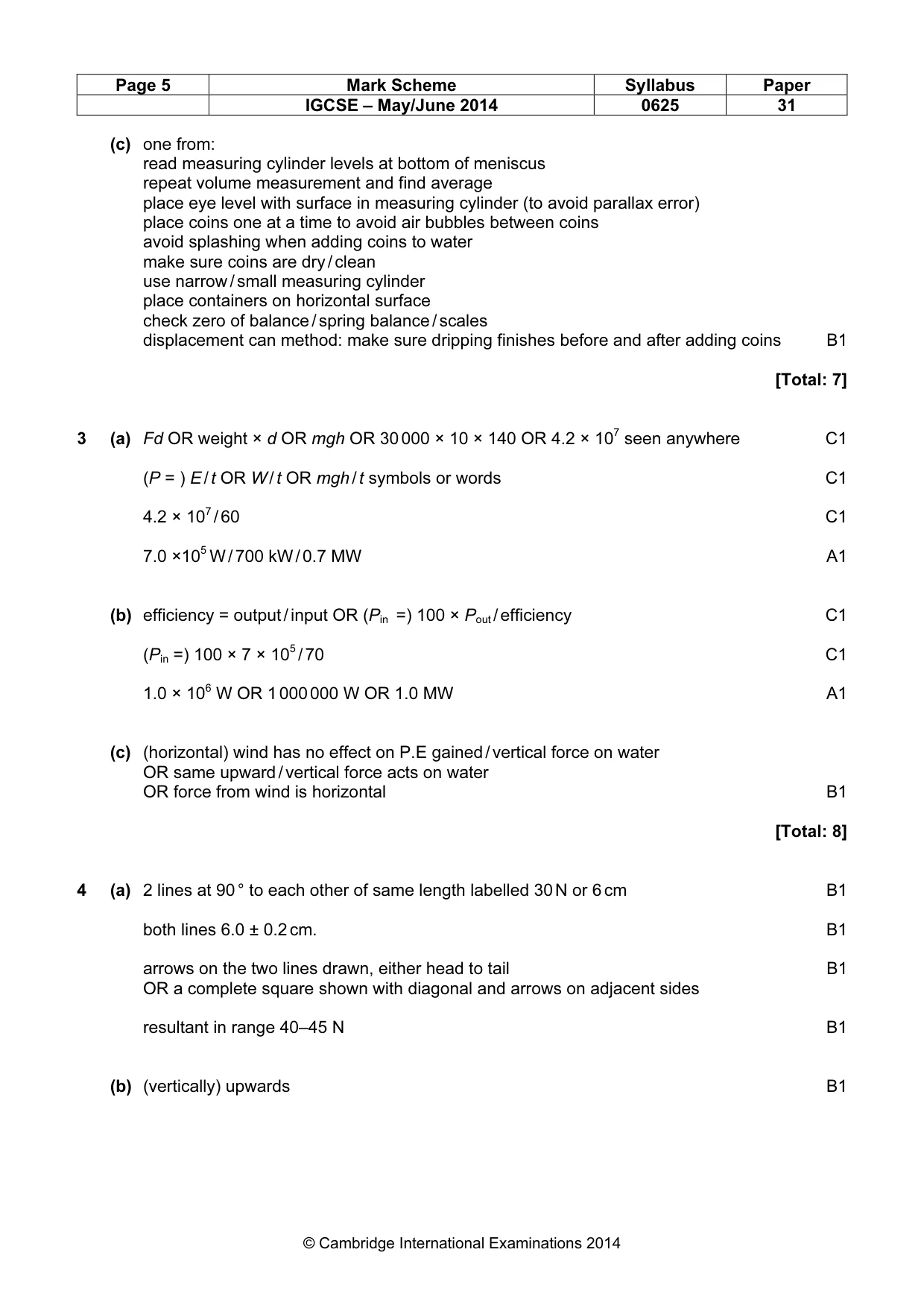
Mark scheme: 2 (a) (density =) mass / volume B1 (b) water used in measuring / graduated cylinder B1 volume of water known or read / recorded / taken B1 place the coins in the water and read / record / take new level of water in cylinder B1 subtract readings B1 OR ALTERNATIVE METHOD: pour water into displacement can to level of spout (B1) place the coins / several coins in the water (B1) collect overflow (B1) measure volume of overflow water using measuring graduated cylinder (B1) measure mass / weigh the coins used with balance / spring balance B1 IGCSE – May/June 2014 0625 31 (c) one from: read measuring cylinder levels at bottom of meniscus repeat volume measurement and find average place eye level with surface in measuring cylinder (to avoid parallax error) place coins one at a time to avoid air bubbles between coins avoid splashing when adding coins to water make sure coins are dry / clean use narrow / small measuring cylinder place containers on horizontal surface check zero of balance / spring balance / scales displacement can method: make sure dripping finishes before and after adding coins B1 [Total: 7] 7
Q3 · On a day with no wind, a fountain in Switzerland propels 30 000 kg of water per minute to…
3 (a) On a day with no wind, a fountain in Switzerland propels 30 000 kg of water per minute to a height of 140 m. Calculate the power used in raising the water. power = ............................................... [4] (b) The efficiency of the pump which operates the fountain is 70%. Calculate the power supplied to the pump. power = ............................................... [3] (c) On another day, a horizontal wind is blowing. The water does not rise vertically. Explain why the water still rises to a height of 140 m. ................................................................................................................................................... .............................................................................................................................................. [1] [Total: 8]
Mark scheme: 3 (a) Fd OR weight × d OR mgh OR 30 000 × 10 × 140 OR 4.2 × 10⁷ seen anywhere C1 (P = ) E / t OR W / t OR mgh / t symbols or words C1 4.2 × 10⁷ / 60 C1 7.0 ×10⁵ W / 700 kW / 0.7 MW A1 (b) efficiency = output / input OR (Pin =) 100 × Pout / efficiency C1 (Pin =) 100 × 7 × 105 / 70 C1 1.0 × 10⁶ W OR 1 000 000 W OR 1.0 MW A1 (c) (horizontal) wind has no effect on P.E gained / vertical force on water OR same upward / vertical force acts on water OR force from wind is horizontal B1 [Total: 8]
Q4 · A heavy ball B of weight W suspended from a fixed beam by two ropes P and Q
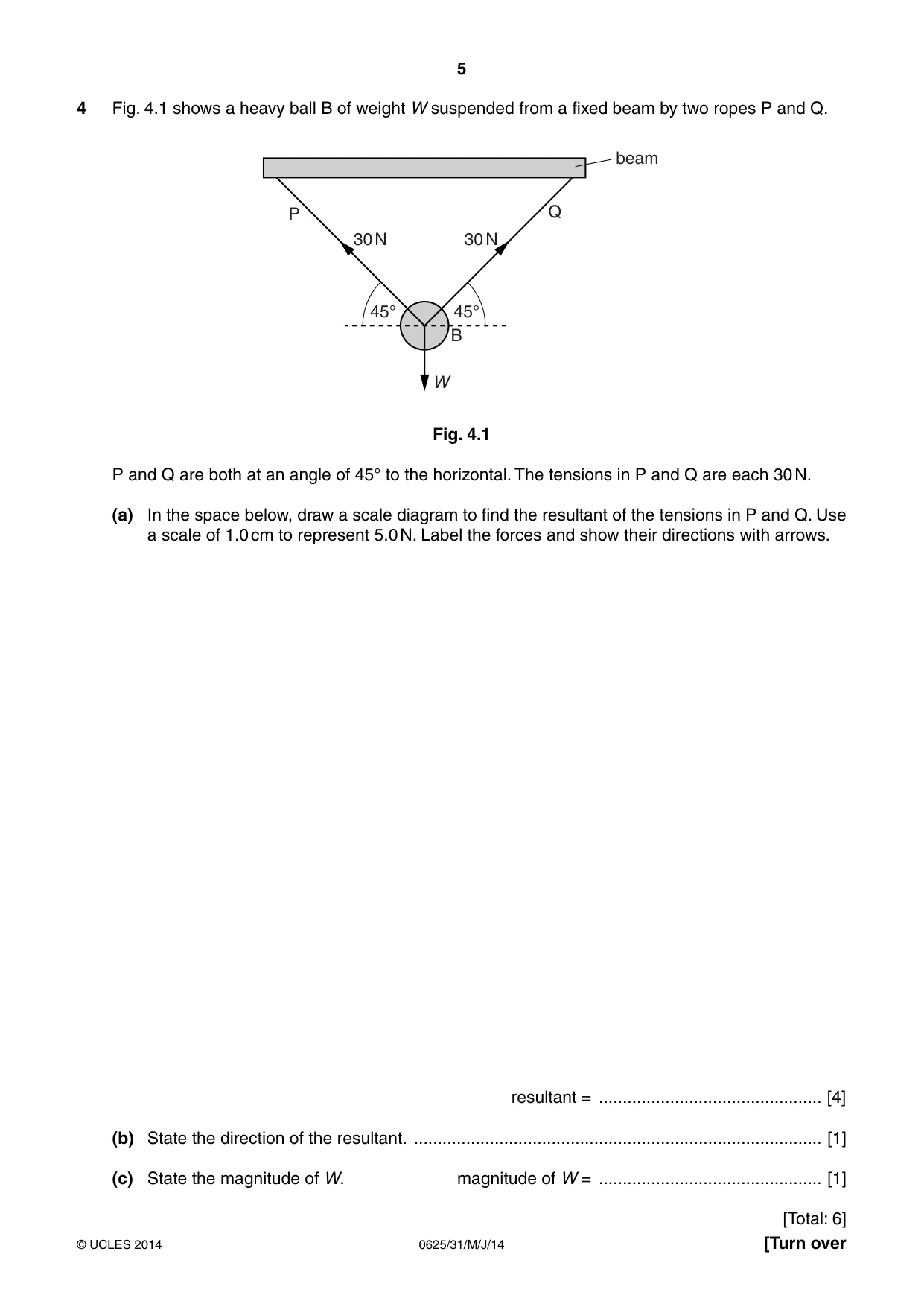
4 Fig. 4.1 shows a heavy ball B of weight W suspended from a fixed beam by two ropes P and Q. beam P Q 30 N 30 N 45° 45° B W Fig. 4.1 P and Q are both at an angle of 45° to the horizontal. The tensions in P and Q are each 30 N. (a) In the space below, draw a scale diagram to find the resultant of the tensions in P and Q. Use a scale of 1.0 cm to represent 5.0 N. Label the forces and show their directions with arrows. resultant = ............................................... [4] (b) State the direction of the resultant. ...................................................................................... [1] (c) State the magnitude of W. magnitude of W = ............................................... [1] [Total: 6]
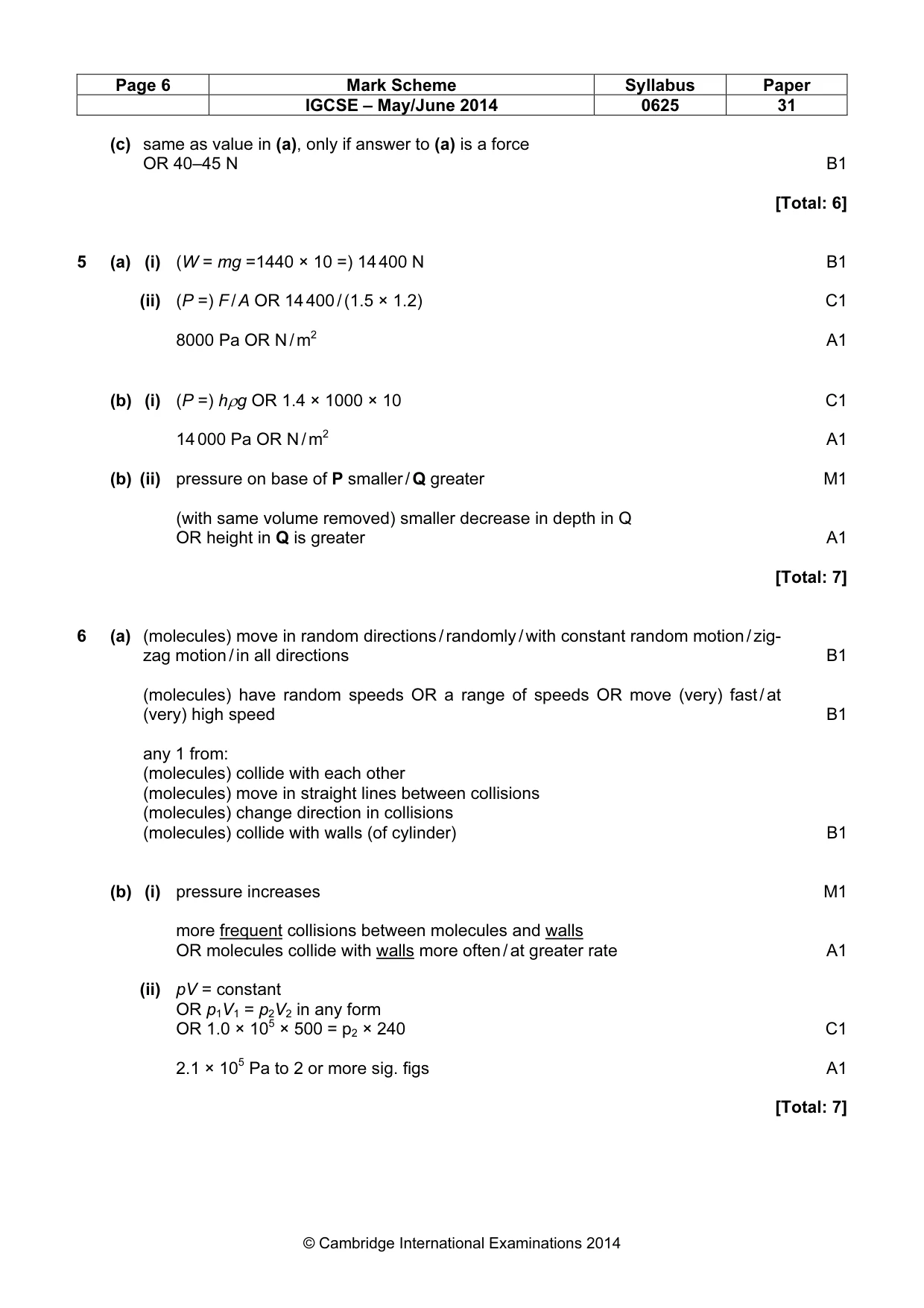
Mark scheme: 4 (a) 2 lines at 90 ° to each other of same length labelled 30 N or 6 cm B1 both lines 6.0 ± 0.2 cm. B1 arrows on the two lines drawn, either head to tail B1 OR a complete square shown with diagonal and arrows on adjacent sides resultant in range 40–45 N B1 (b) (vertically) upwards B1 IGCSE – May/June 2014 0625 31 (c) same as value in (a), only if answer to (a) is a force OR 40–45 N B1 [Total: 6]
Q5 · A water tank has a rectangular base of dimensions 1.5 m by 1.2 m and contains 1440 kg of…
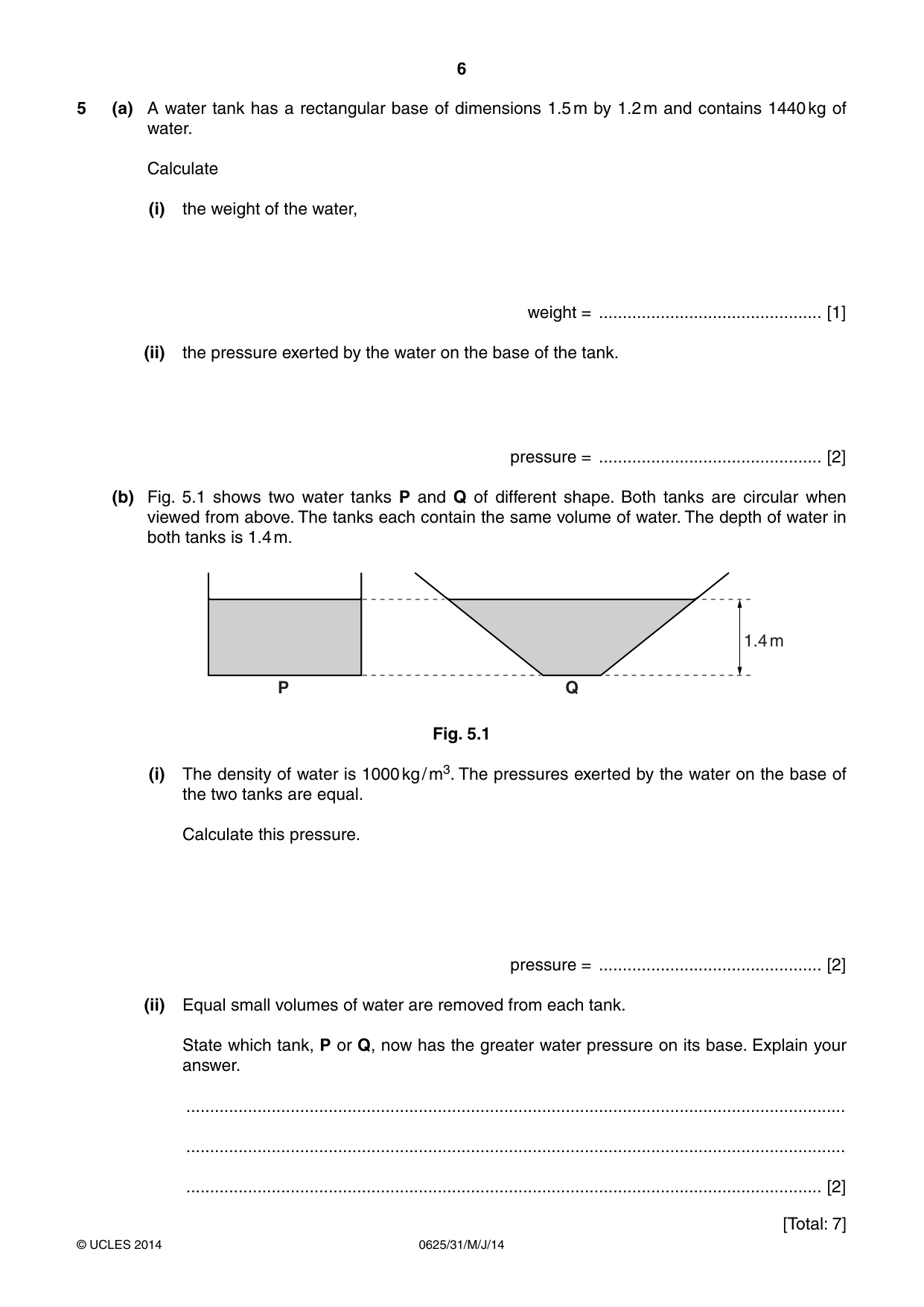
5 (a) A water tank has a rectangular base of dimensions 1.5 m by 1.2 m and contains 1440 kg of water. Calculate (i) the weight of the water, weight = ............................................... [1] (ii) the pressure exerted by the water on the base of the tank. pressure = ............................................... [2] (b) Fig. 5.1 shows two water tanks P and Q of different shape. Both tanks are circular when viewed from above. The tanks each contain the same volume of water. The depth of water in both tanks is 1.4 m. 1.4 m P Q Fig. 5.1 (i) The density of water is 1000 kg / m3. The pressures exerted by the water on the base of the two tanks are equal. Calculate this pressure. pressure = ............................................... [2] (ii) Equal small volumes of water are removed from each tank. State which tank, P or Q, now has the greater water pressure on its base. Explain your answer. ........................................................................................................................................... ........................................................................................................................................... ...................................................................................................................................... [2] [Total: 7]
Mark scheme: 5 (a) (i) (W = mg =1440 × 10 =) 14 400 N B1 (ii) (P =) F / A OR 14 400 / (1.5 × 1.2) C1 8000 Pa OR N / m2 A1 (b) (i) (P =) hρg OR 1.4 × 1000 × 10 C1 14 000 Pa OR N / m2 A1 (b) (ii) pressure on base of P smaller / Q greater M1 (with same volume removed) smaller decrease in depth in Q OR height in Q is greater A1 [Total: 7]
Q6 · A quantity of gas in a cylinder fitted with a piston P
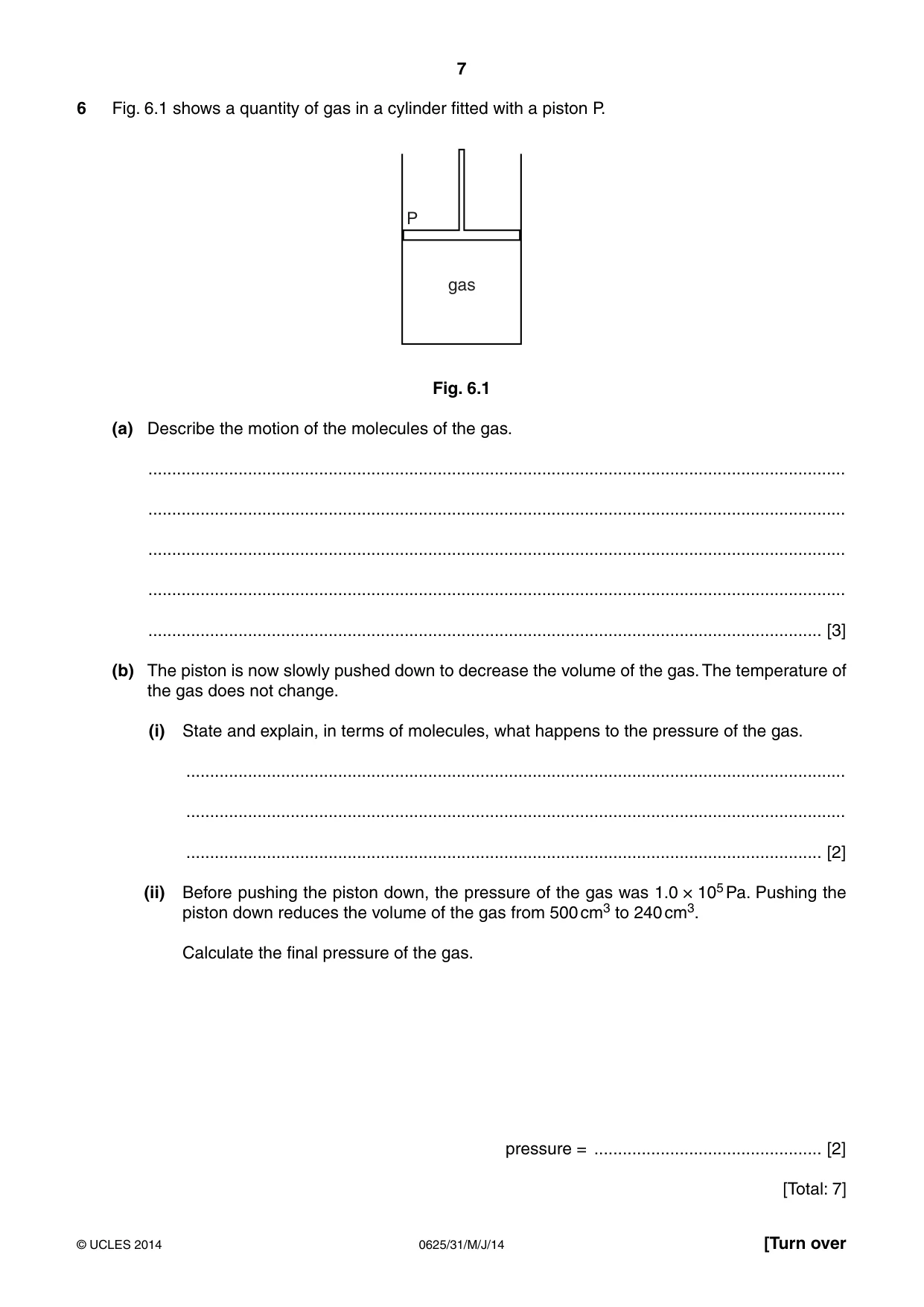
6 Fig. 6.1 shows a quantity of gas in a cylinder fitted with a piston P. P gas Fig. 6.1 (a) Describe the motion of the molecules of the gas. ................................................................................................................................................... ................................................................................................................................................... ................................................................................................................................................... ................................................................................................................................................... .............................................................................................................................................. [3] (b) The piston is now slowly pushed down to decrease the volume of the gas. The temperature of the gas does not change. (i) State and explain, in terms of molecules, what happens to the pressure of the gas. ........................................................................................................................................... ........................................................................................................................................... ...................................................................................................................................... [2] (ii) Before pushing the piston down, the pressure of the gas was 1.0 × 10⁵ Pa. Pushing the piston down reduces the volume of the gas from 500 cm3 to 240 cm3. Calculate the final pressure of the gas. pressure = ................................................ [2] [Total: 7]
Mark scheme: 6 (a) (molecules) move in random directions / randomly / with constant random motion / zig- zag motion / in all directions B1 (molecules) have random speeds OR a range of speeds OR move (very) fast / at (very) high speed B1 any 1 from: (molecules) collide with each other (molecules) move in straight lines between collisions (molecules) change direction in collisions (molecules) collide with walls (of cylinder) B1 (b) (i) pressure increases M1 more frequent collisions between molecules and walls OR molecules collide with walls more often / at greater rate A1 (ii) pV = constant OR p1V1 = p2V2 in any form OR 1.0 × 105 × 500 = p2 × 240 C1 2.1 × 10⁵ Pa to 2 or more sig. figs A1 [Total: 7] IGCSE – May/June 2014 0625 31
Q7 · The following are three statements about boiling
7 (a) The following are three statements about boiling. • A liquid boils at a fixed temperature. • During boiling, vapour can form at any point within the liquid. • Without a supply of thermal energy, boiling stops. Complete the following equivalent statements about evaporation. • A liquid evaporates at ........................................................................................................ ......................................................................................................................................... . • During evaporation ............................................................................................................. ......................................................................................................................................... . • Without a supply of thermal energy, evaporation ............................................................ . [3] (b) A pan containing water boiling at 100 °C is standing on an electrically heated hot-plate. In 20 minutes, 0.075 kg of water is lost as steam. The specific latent heat of vaporisation of water is 2.25 × 10⁶ J / kg. (i) Calculate the energy used in converting 0.075 kg of boiling water to steam. energy = ............................................... [2] (ii) The hot-plate operates at 240 V, 0.65 A. Calculate the energy supplied to the hot-plate in 20 minutes. energy = ............................................... [2] (iii) Suggest why the answers to (b)(i) and (b)(ii) are not the same. ........................................................................................................................................... ...................................................................................................................................... [1] [Total: 8]
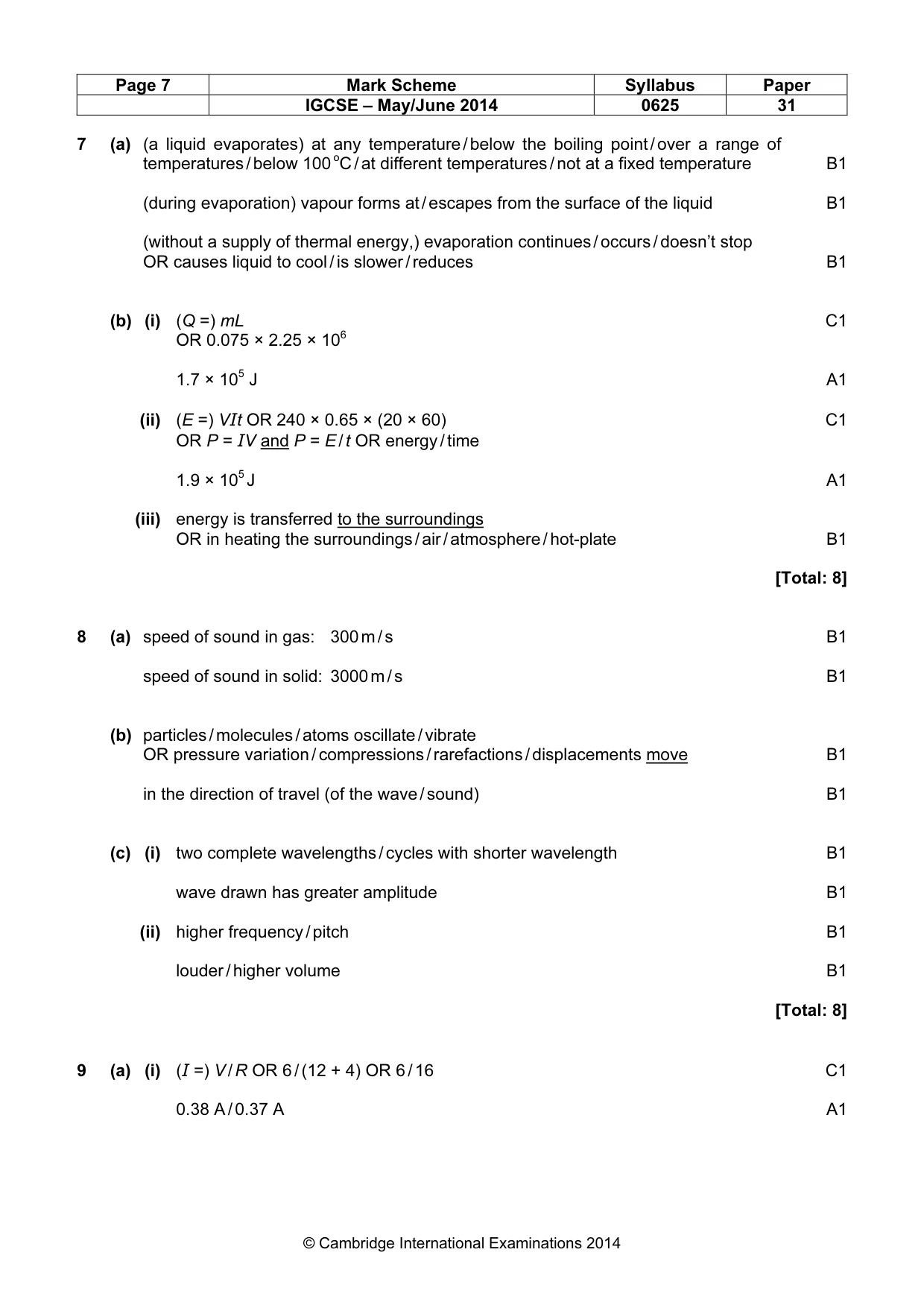
Mark scheme: 7 (a) (a liquid evaporates) at any temperature / below the boiling point / over a range of temperatures / below 100 oC / at different temperatures / not at a fixed temperature B1 (during evaporation) vapour forms at / escapes from the surface of the liquid B1 (without a supply of thermal energy,) evaporation continues / occurs / doesn’t stop OR causes liquid to cool / is slower / reduces B1 (b) (i) (Q =) mL C1 OR 0.075 × 2.25 × 106 1.7 × 10⁵ J A1 (ii) (E =) VIt OR 240 × 0.65 × (20 × 60) C1 OR P = IV and P = E / t OR energy / time 1.9 × 10⁵ J A1 (iii) energy is transferred to the surroundings OR in heating the surroundings / air / atmosphere / hot-plate B1 [Total: 8]
Q8 · Draw a straight line from each quantity on the left-hand side to a speed on the…
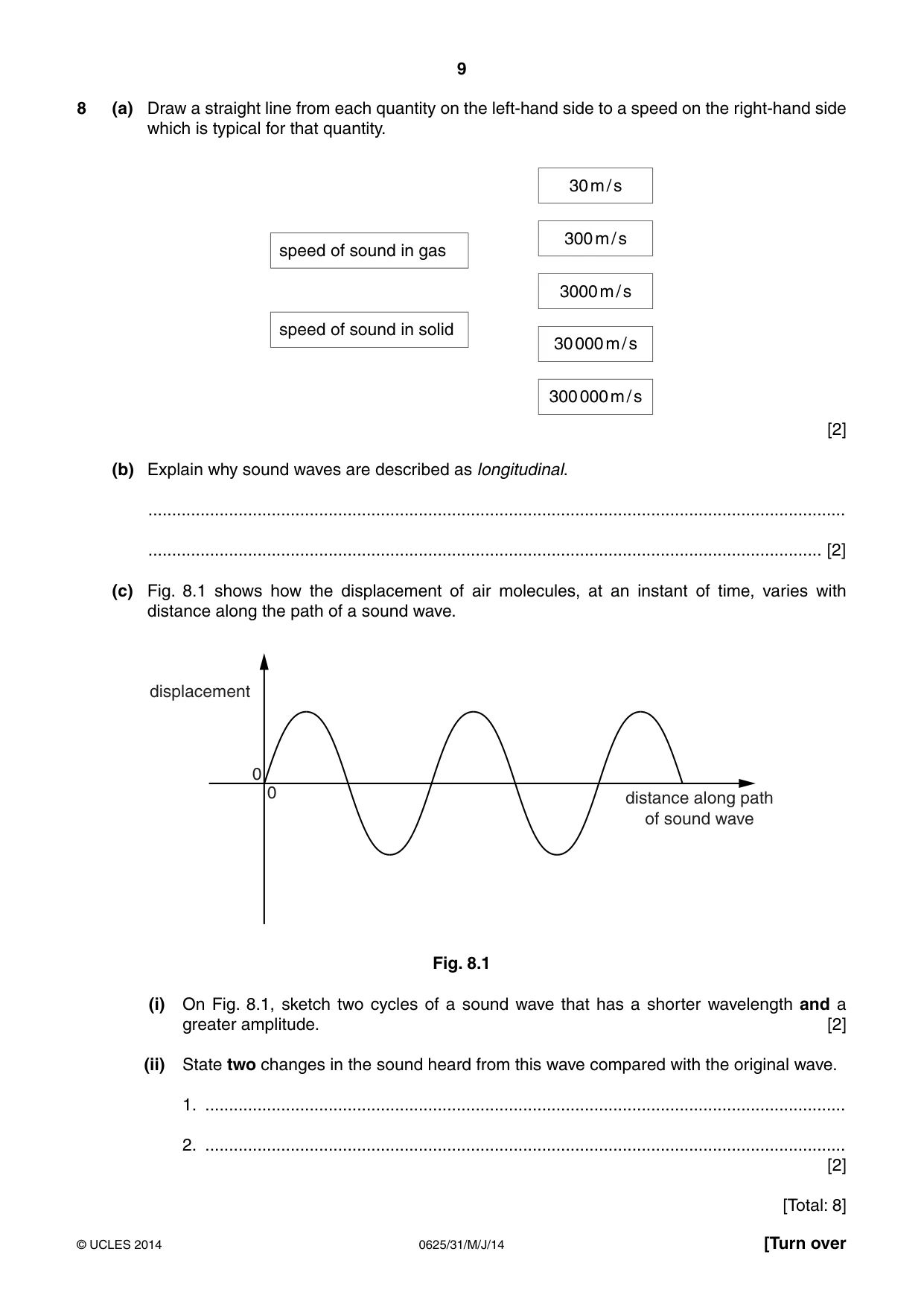
8 (a) Draw a straight line from each quantity on the left-hand side to a speed on the right-hand side which is typical for that quantity. 30 m / s 300 m / s speed of sound in gas 3000 m / s speed of sound in solid 30 000 m / s 300 000 m / s [2] (b) Explain why sound waves are described as longitudinal. ................................................................................................................................................... .............................................................................................................................................. [2] (c) Fig. 8.1 shows how the displacement of air molecules, at an instant of time, varies with distance along the path of a sound wave. displacement 0 0 distance along path of sound wave Fig. 8.1 (i) On Fig. 8.1, sketch two cycles of a sound wave that has a shorter wavelength and a greater amplitude. [2] (ii) State two changes in the sound heard from this wave compared with the original wave. 1. ....................................................................................................................................... 2. ....................................................................................................................................... [2] [Total: 8]
Mark scheme: 8 (a) speed of sound in gas: 300 m / s B1 speed of sound in solid: 3000 m / s B1 (b) particles / molecules / atoms oscillate / vibrate OR pressure variation / compressions / rarefactions / displacements move B1 in the direction of travel (of the wave / sound) B1 (c) (i) two complete wavelengths / cycles with shorter wavelength B1 wave drawn has greater amplitude B1 (ii) higher frequency / pitch B1 louder / higher volume B1 [Total: 8]
Q9 · In the circuit shown in Fig
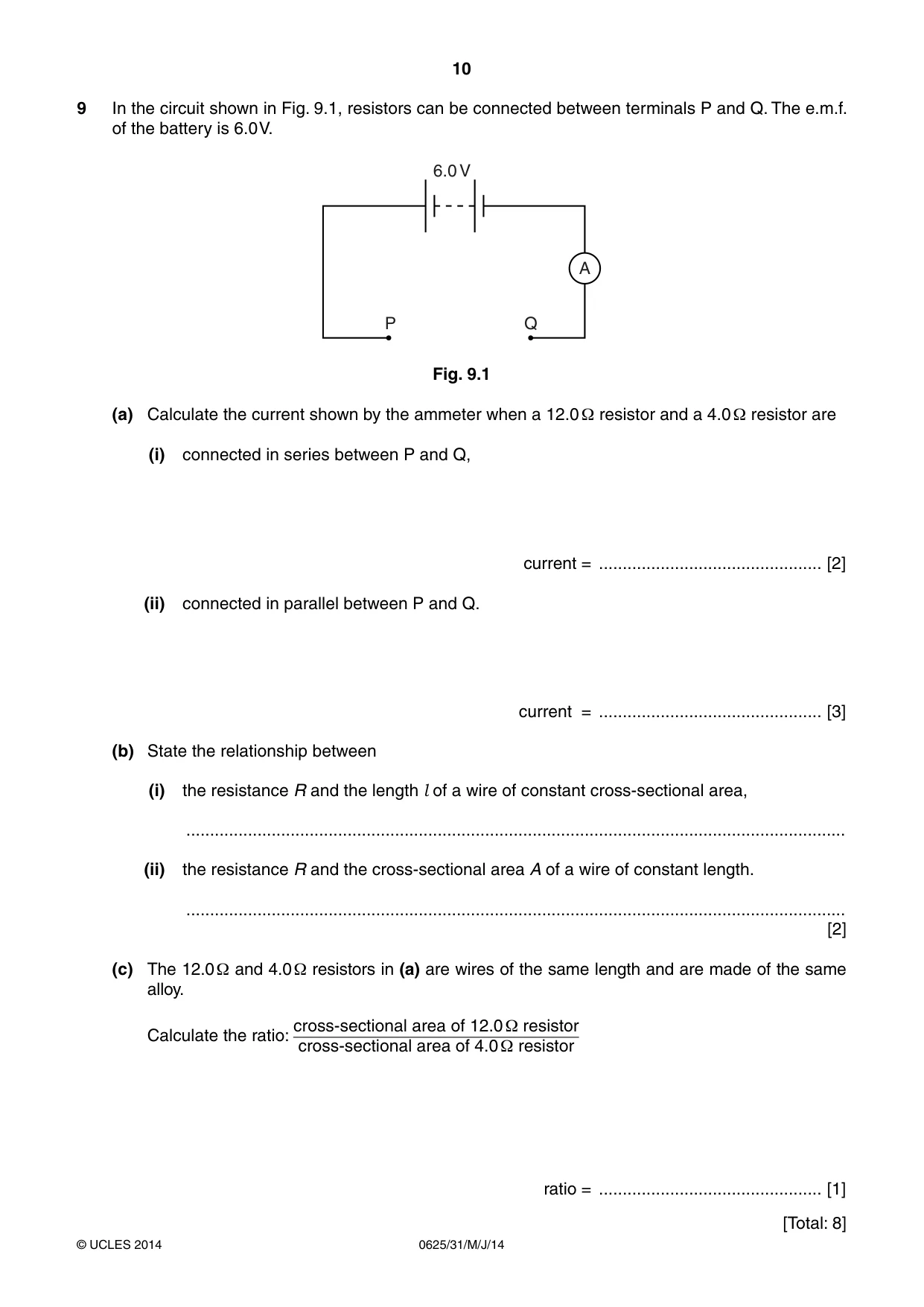
9 In the circuit shown in Fig. 9.1, resistors can be connected between terminals P and Q. The e.m.f. of the battery is 6.0 V. 6.0 V A P Q Fig. 9.1 (a) Calculate the current shown by the ammeter when a 12.0 Ω resistor and a 4.0 Ω resistor are (i) connected in series between P and Q, current = ............................................... [2] (ii) connected in parallel between P and Q. current = ............................................... [3] (b) State the relationship between (i) the resistance R and the length l of a wire of constant cross-sectional area, ........................................................................................................................................... (ii) the resistance R and the cross-sectional area A of a wire of constant length. ........................................................................................................................................... [2] (c) The 12.0 Ω and 4.0 Ω resistors in (a) are wires of the same length and are made of the same alloy. cross-sectional area of 12.0 Ω resistor Calculate the ratio: cross-sectional area of 4.0 Ω resistor ratio = ............................................... [1] [Total: 8]
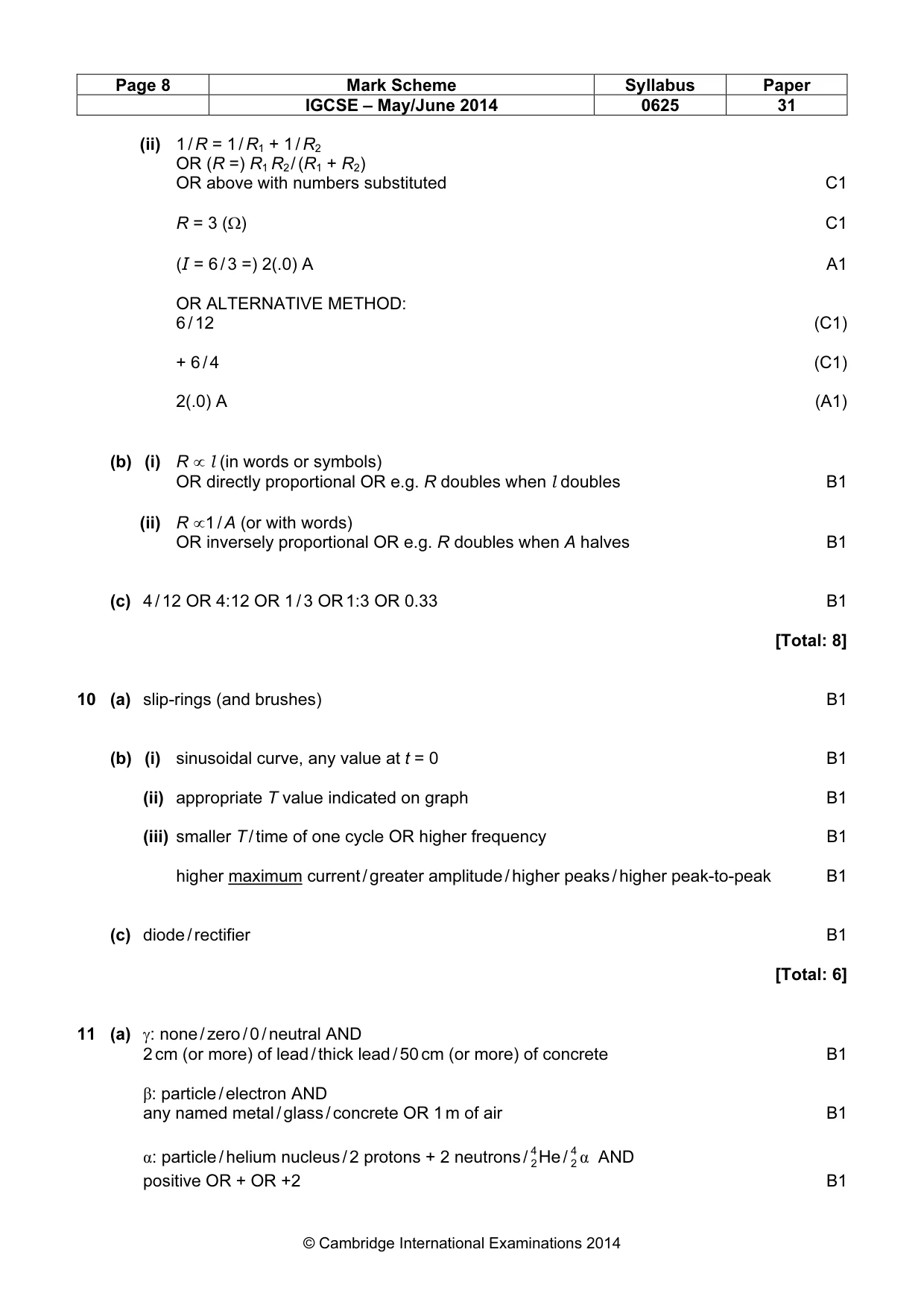
Mark scheme: 9 (a) (i) (I =) V / R OR 6 / (12 + 4) OR 6 / 16 C1 0.38 A / 0.37 A A1 IGCSE – May/June 2014 0625 31 (ii) 1 / R = 1 / R1 + 1 / R2 OR (R =) R1 R2 / (R1 + R2) OR above with numbers substituted C1 R = 3 (Ω) C1 (I = 6 / 3 =) 2(.0) A A1 OR ALTERNATIVE METHOD: 6 / 12 (C1) + 6 / 4 (C1) 2(.0) A (A1) (b) (i) R ∝ l (in words or symbols) OR directly proportional OR e.g. R doubles when l doubles B1 (ii) R ∝1 / A (or with words) OR inversely proportional OR e.g. R doubles when A halves B1 (c) 4 / 12 OR 4:12 OR 1 / 3 OR 1:3 OR 0.33 B1 [Total: 8]
Q10 · A coil of wire rotating steadily in the magnetic field between the poles of a permanent…
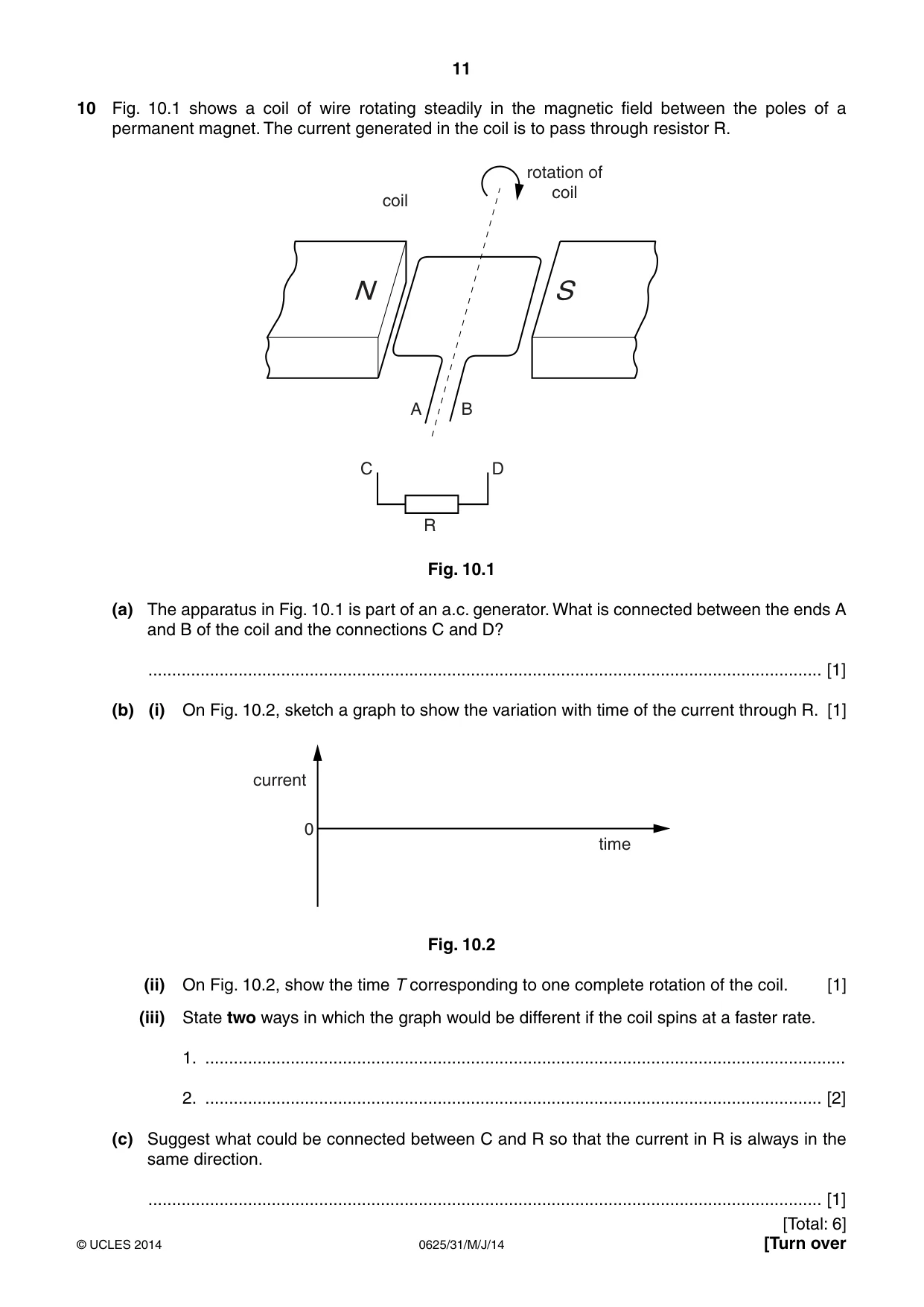
10 Fig. 10.1 shows a coil of wire rotating steadily in the magnetic field between the poles of a permanent magnet. The current generated in the coil is to pass through resistor R. rotation of coil coil N S A B C D R Fig. 10.1 (a) The apparatus in Fig. 10.1 is part of an a.c. generator. What is connected between the ends A and B of the coil and the connections C and D? .............................................................................................................................................. [1] (b) (i) On Fig. 10.2, sketch a graph to show the variation with time of the current through R. [1] current 0 time Fig. 10.2 (ii) On Fig. 10.2, show the time T corresponding to one complete rotation of the coil. [1] (iii) State two ways in which the graph would be different if the coil spins at a faster rate. 1. ....................................................................................................................................... 2. .................................................................................................................................. [2] (c) Suggest what could be connected between C and R so that the current in R is always in the same direction. .............................................................................................................................................. [1] [Total: 6]
Mark scheme: 10 (a) slip-rings (and brushes) B1 (b) (i) sinusoidal curve, any value at t = 0 B1 (ii) appropriate T value indicated on graph B1 (iii) smaller T / time of one cycle OR higher frequency B1 higher maximum current / greater amplitude / higher peaks / higher peak-to-peak B1 (c) diode / rectifier B1 [Total: 6]
Q11 · Complete the table below for the three types of radiation
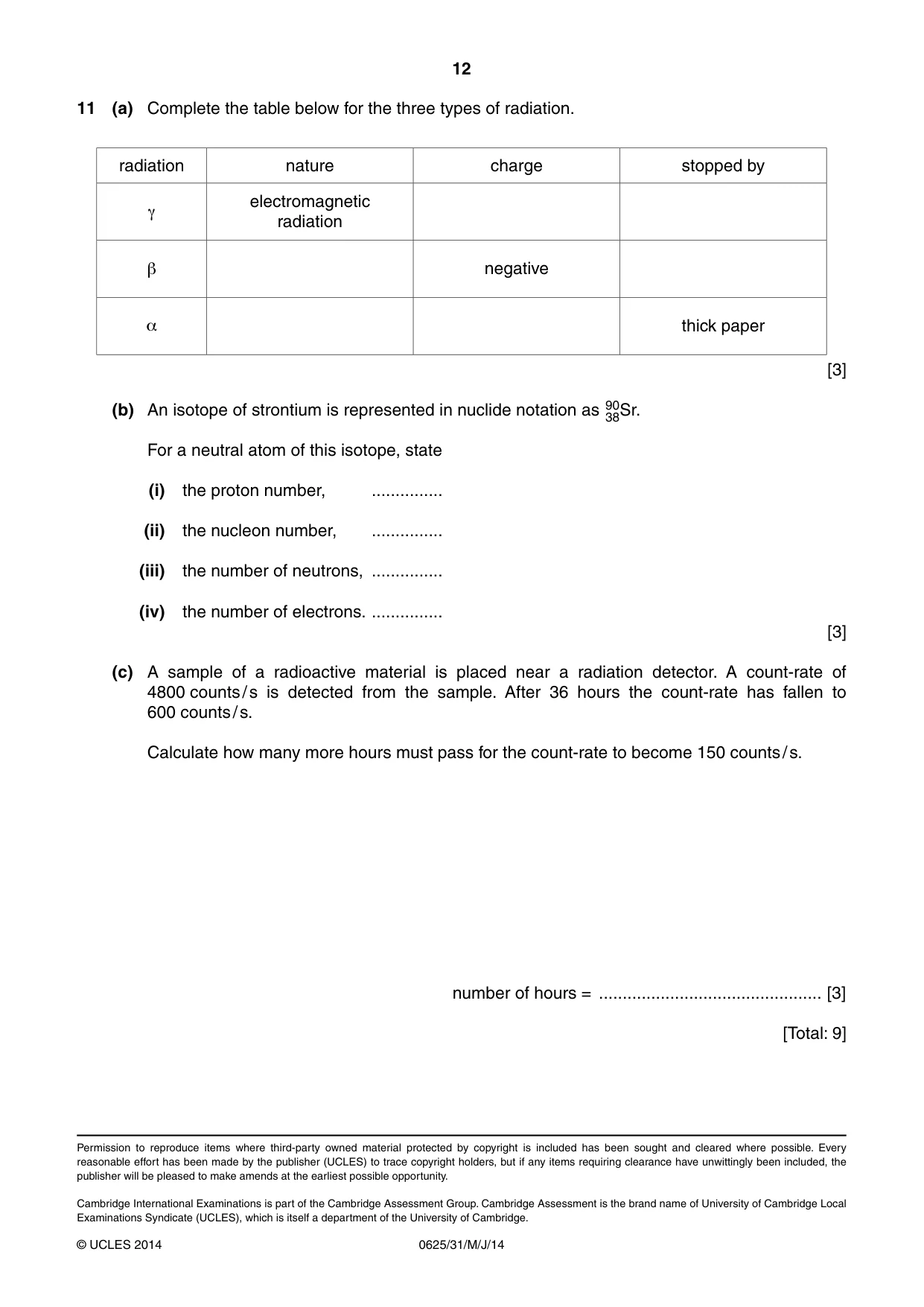
11 (a) Complete the table below for the three types of radiation. radiation nature charge stopped by electromagnetic γ radiation β negative α thick paper [3] (b) An isotope of strontium is represented in nuclide notation as 9038Sr. For a neutral atom of this isotope, state (i) the proton number, ............... (ii) the nucleon number, ............... (iii) the number of neutrons, ............... (iv) the number of electrons. ............... [3] (c) A sample of a radioactive material is placed near a radiation detector. A count-rate of 4800 counts / s is detected from the sample. After 36 hours the count-rate has fallen to 600 counts / s. Calculate how many more hours must pass for the count-rate to become 150 counts / s. number of hours = ............................................... [3] [Total: 9]
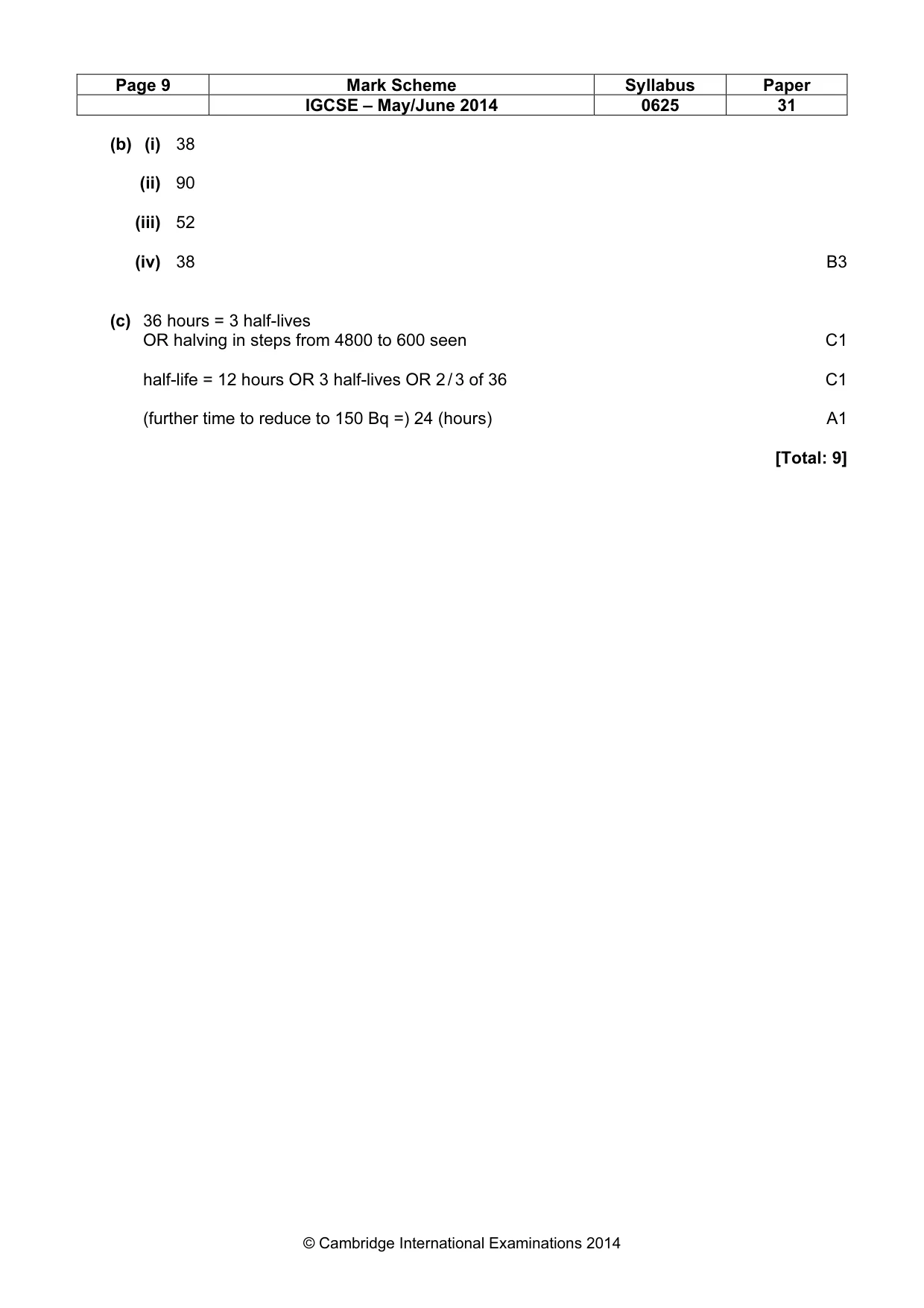
Mark scheme: 11 (a) γ: none / zero / 0 / neutral AND 2 cm (or more) of lead / thick lead / 50 cm (or more) of concrete B1 β: particle / electron AND any named metal / glass / concrete OR 1 m of air B1 α: particle / helium nucleus / 2 protons + 2 neutrons / 42 He / 42 α AND positive OR + OR +2 B1 IGCSE – May/June 2014 0625 31 (b) (i) 38 (ii) 90 (iii) 52 (iv) 38 B3 (c) 36 hours = 3 half-lives OR halving in steps from 4800 to 600 seen C1 half-life = 12 hours OR 3 half-lives OR 2 / 3 of 36 C1 (further time to reduce to 150 Bq =) 24 (hours) A1 [Total: 9]
What was in this paper
The subtopics covered by these 11 questions, and how many questions each got. Open one in a new tab to see every Cambridge question on it.
What you needed in this session
Cambridge’s own grade thresholds for 2014 May/June, Paper 3 · Variant 1. A higher threshold means an easier paper — the bar moves with how the cohort did.