Cambridge IGCSE Physics 0625 — 2019 May/June Paper 3 · Variant 3
0625/33/M/J/19 · 12 questions · 80 marks · ≈90 min
The question paper and its mark scheme, free to read here and free to download. This is Cambridge’s own paper, exactly as it was sat.
Question paper16 pages
Mark scheme9 pages
Answers below. Sit the paper first if you are practising.
Questions as text
Question 1
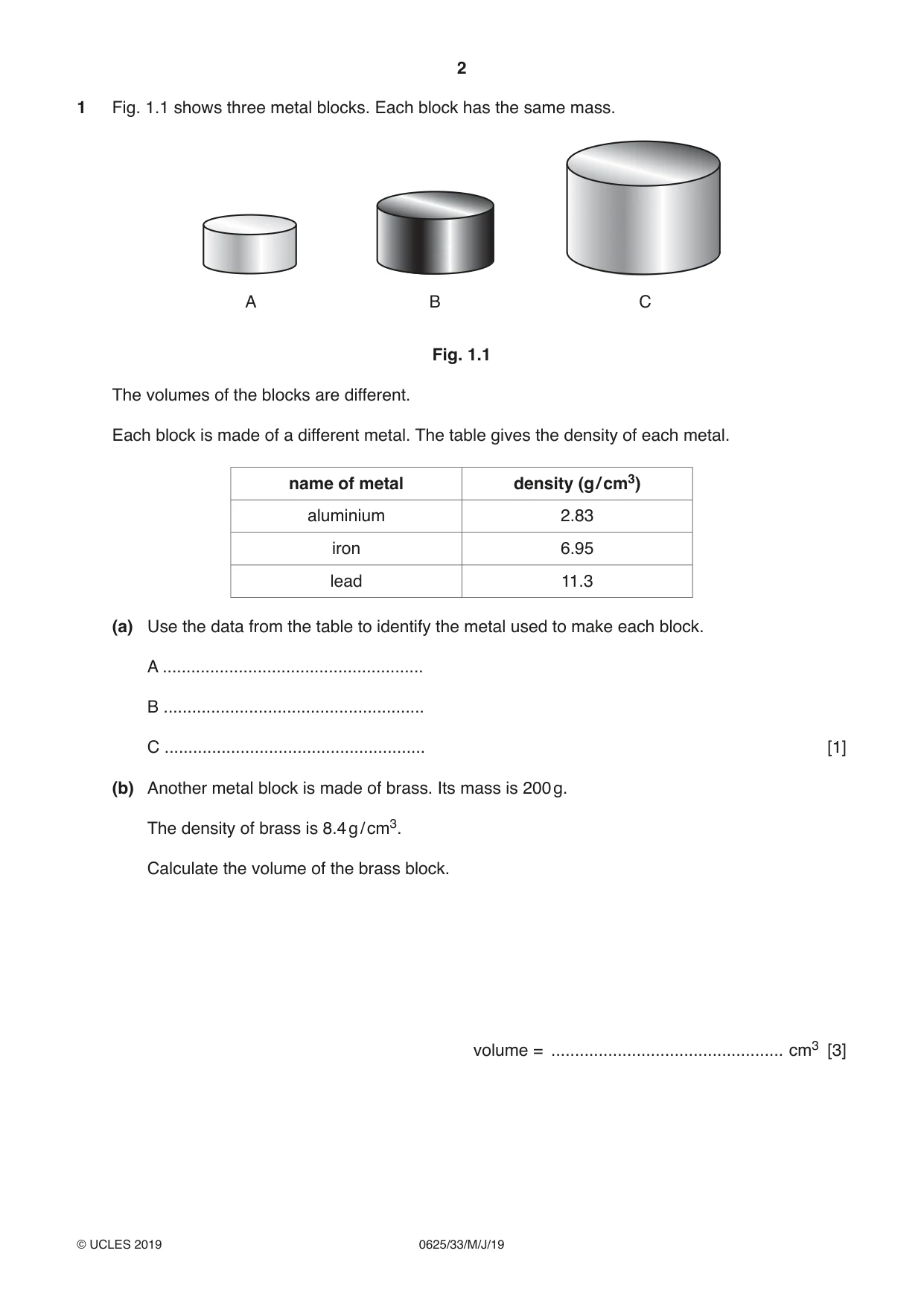
1 Fig. 1.1 shows three metal blocks. Each block has the same mass. A B C Fig. 1.1 The volumes of the blocks are different. Each block is made of a different metal. The table gives the density of each metal. name of metal density (g / cm3) aluminium 2.83 iron 6.95 lead 11.3 (a) Use the data from the table to identify the metal used to make each block. A ....................................................... B ....................................................... C ....................................................... [1] (b) Another metal block is made of brass. Its mass is 200 g. The density of brass is 8.4 g / cm3. Calculate the volume of the brass block. volume = ................................................. cm3 [3] (c) Describe a method for determining the volume of a small, dense, irregularly-shaped object. You may draw a labelled diagram. ................................................................................................................................................... ................................................................................................................................................... ................................................................................................................................................... ................................................................................................................................................... ................................................................................................................................................... ............................................................................................................................................. [4] [Total: 8]
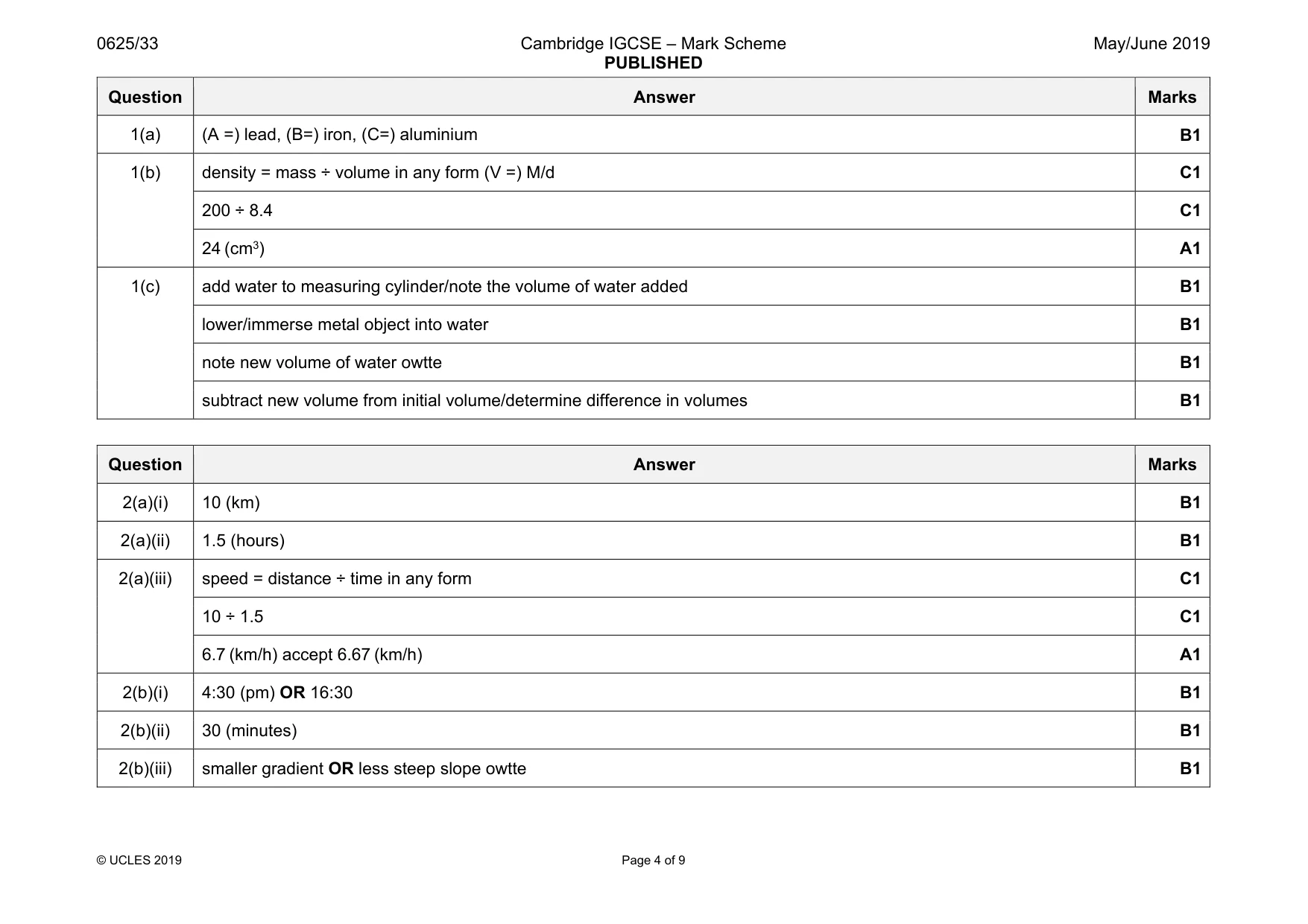
Mark scheme: 1(a) (A =) lead, (B=) iron, (C=) aluminium B1 1(b) density = mass ÷ volume in any form (V =) M/d C1 200 ÷ 8.4 C1 24 (cm3) A1 1(c) add water to measuring cylinder/note the volume of water added B1 lower/immerse metal object into water B1 note new volume of water owtte B1 subtract new volume from initial volume/determine difference in volumes B1
Q2 · A distance-time graph for a man walking from home to a café
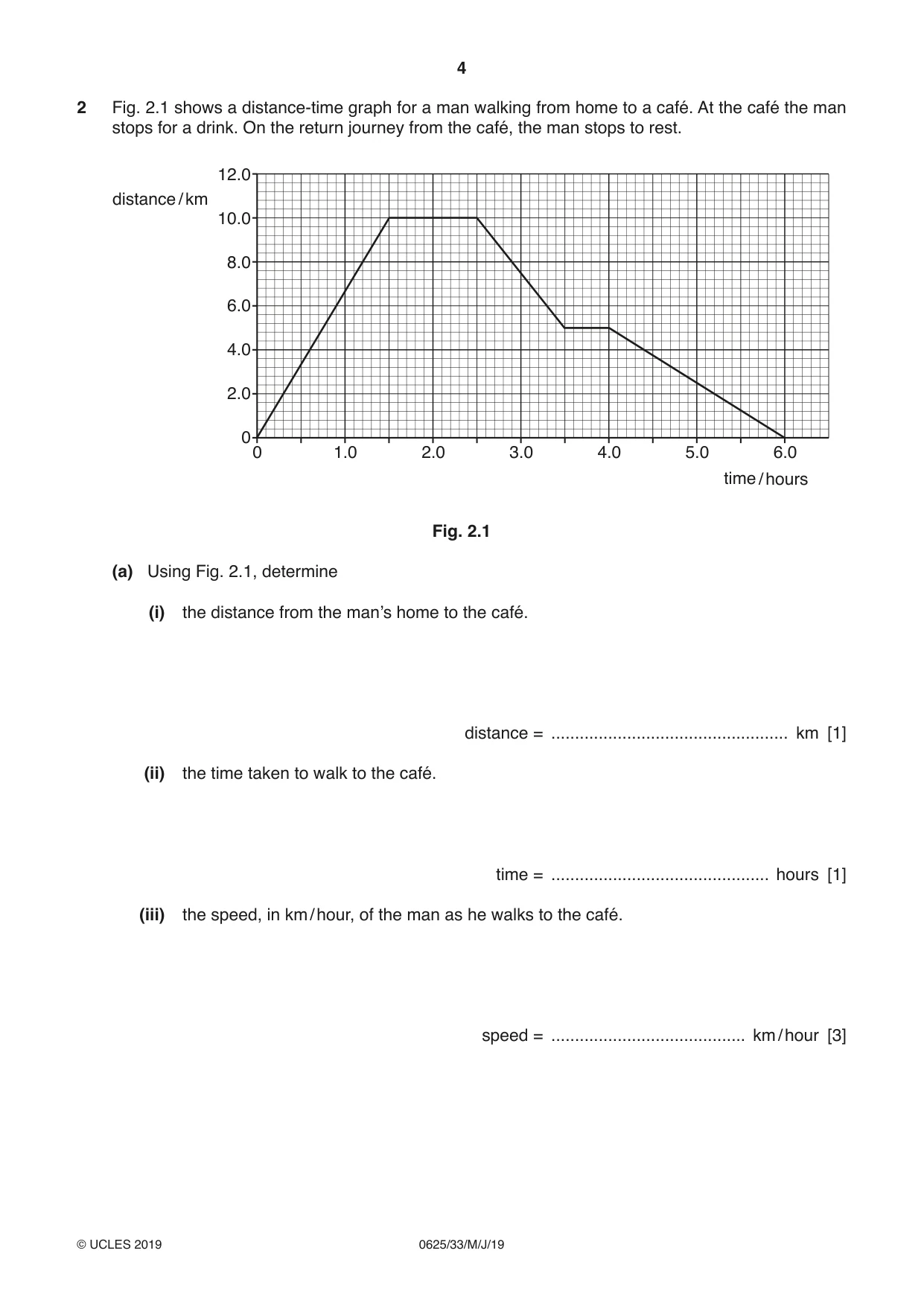
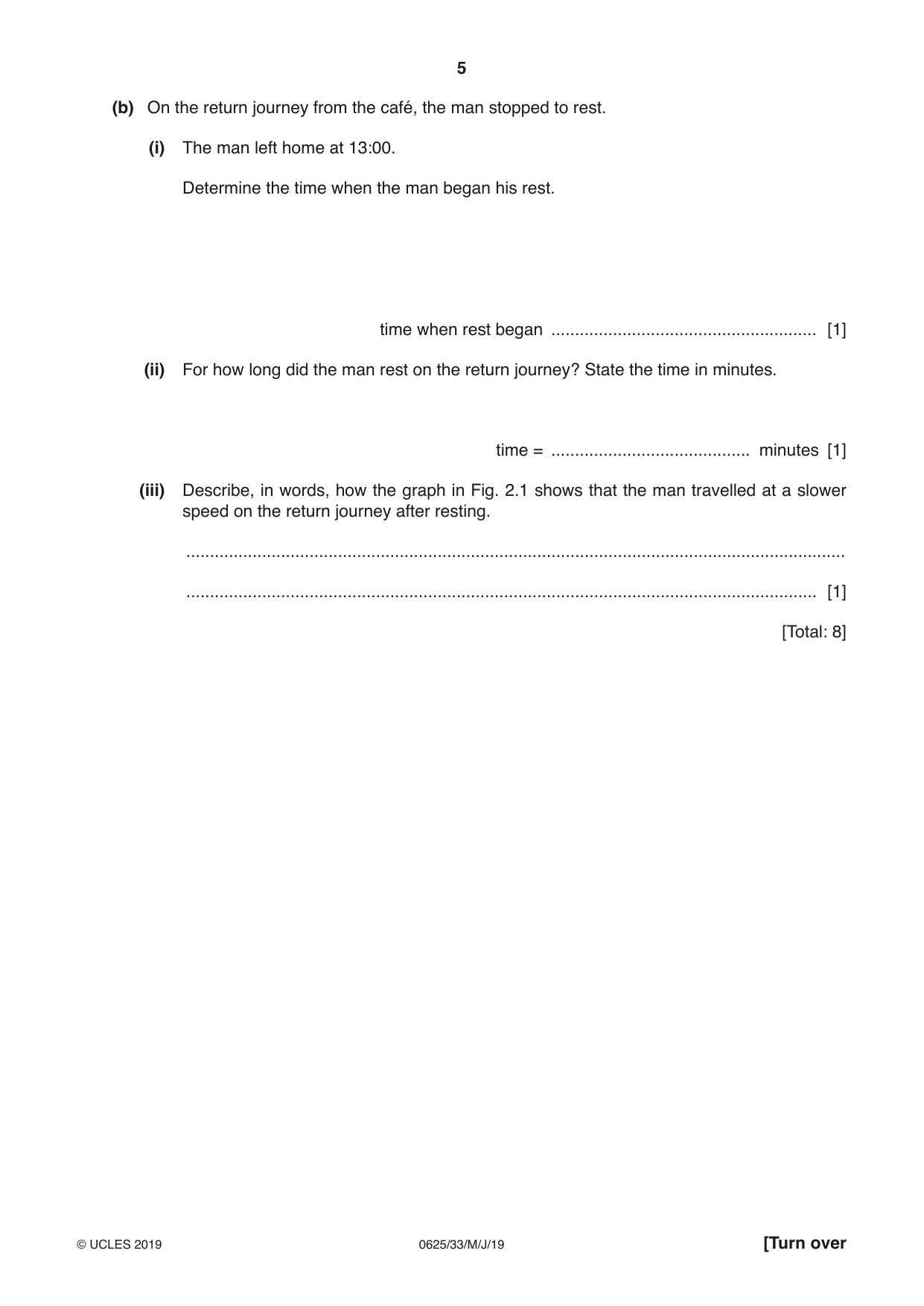
2 Fig. 2.1 shows a distance-time graph for a man walking from home to a café. At the café the man stops for a drink. On the return journey from the café, the man stops to rest. 12.0 distance / km 10.0 8.0 6.0 4.0 2.0 0 0 1.0 2.0 3.0 4.0 5.0 6.0 time / hours Fig. 2.1 (a) Using Fig. 2.1, determine (i) the distance from the man’s home to the café. distance = .................................................. km [1] (ii) the time taken to walk to the café. time = .............................................. hours [1] (iii) the speed, in km / hour, of the man as he walks to the café. speed = ......................................... km / hour [3] (b) On the return journey from the café, the man stopped to rest. (i) The man left home at 13:00. Determine the time when the man began his rest. time when rest began ........................................................ [1] (ii) For how long did the man rest on the return journey? State the time in minutes. time = .......................................... minutes [1] (iii) Describe, in words, how the graph in Fig. 2.1 shows that the man travelled at a slower speed on the return journey after resting. ........................................................................................................................................... ..................................................................................................................................... [1] [Total: 8]
Mark scheme: 2(a)(i) 10 (km) B1 2(a)(ii) 1.5 (hours) B1 2(a)(iii) speed = distance ÷ time in any form C1 10 ÷ 1.5 C1 6.7 (km/h) accept 6.67 (km/h) A1 2(b)(i) 4:30 (pm) OR 16:30 B1 2(b)(ii) 30 (minutes) B1 2(b)(iii) smaller gradient OR less steep slope owtte B1
Q3 · A wheelbarrow and Fig
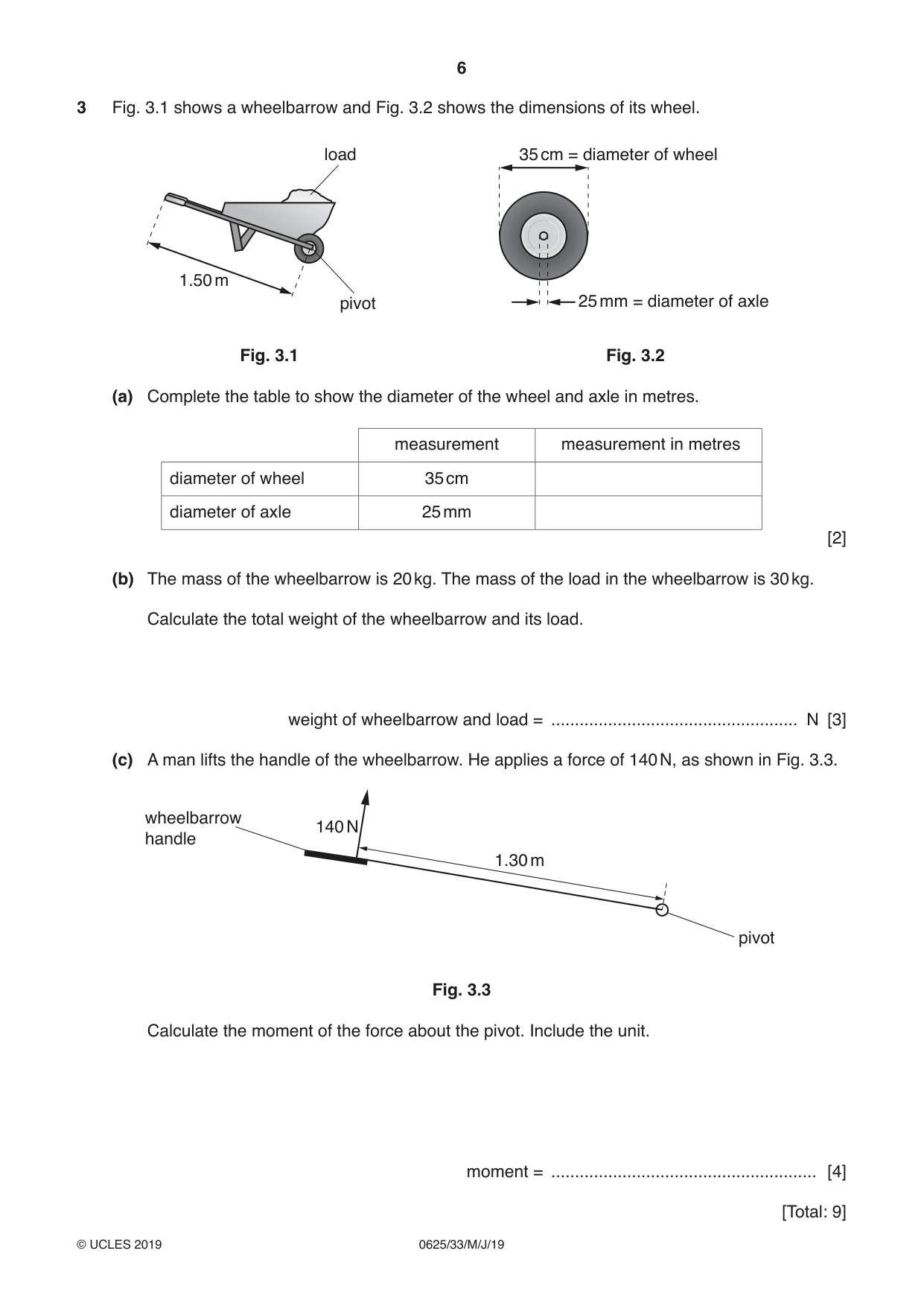
3 Fig. 3.1 shows a wheelbarrow and Fig. 3.2 shows the dimensions of its wheel. load 35 cm = diameter of wheel 1.50 m pivot 25 mm = diameter of axle Fig. 3.1 Fig. 3.2 (a) Complete the table to show the diameter of the wheel and axle in metres. measurement measurement in metres diameter of wheel 35 cm diameter of axle 25 mm [2] (b) The mass of the wheelbarrow is 20 kg. The mass of the load in the wheelbarrow is 30 kg. Calculate the total weight of the wheelbarrow and its load. weight of wheelbarrow and load = .................................................... N [3] (c) A man lifts the handle of the wheelbarrow. He applies a force of 140 N, as shown in Fig. 3.3. wheelbarrow 140 N handle 1.30 m pivot Fig. 3.3 Calculate the moment of the force about the pivot. Include the unit. moment = ........................................................ [4] [Total: 9]
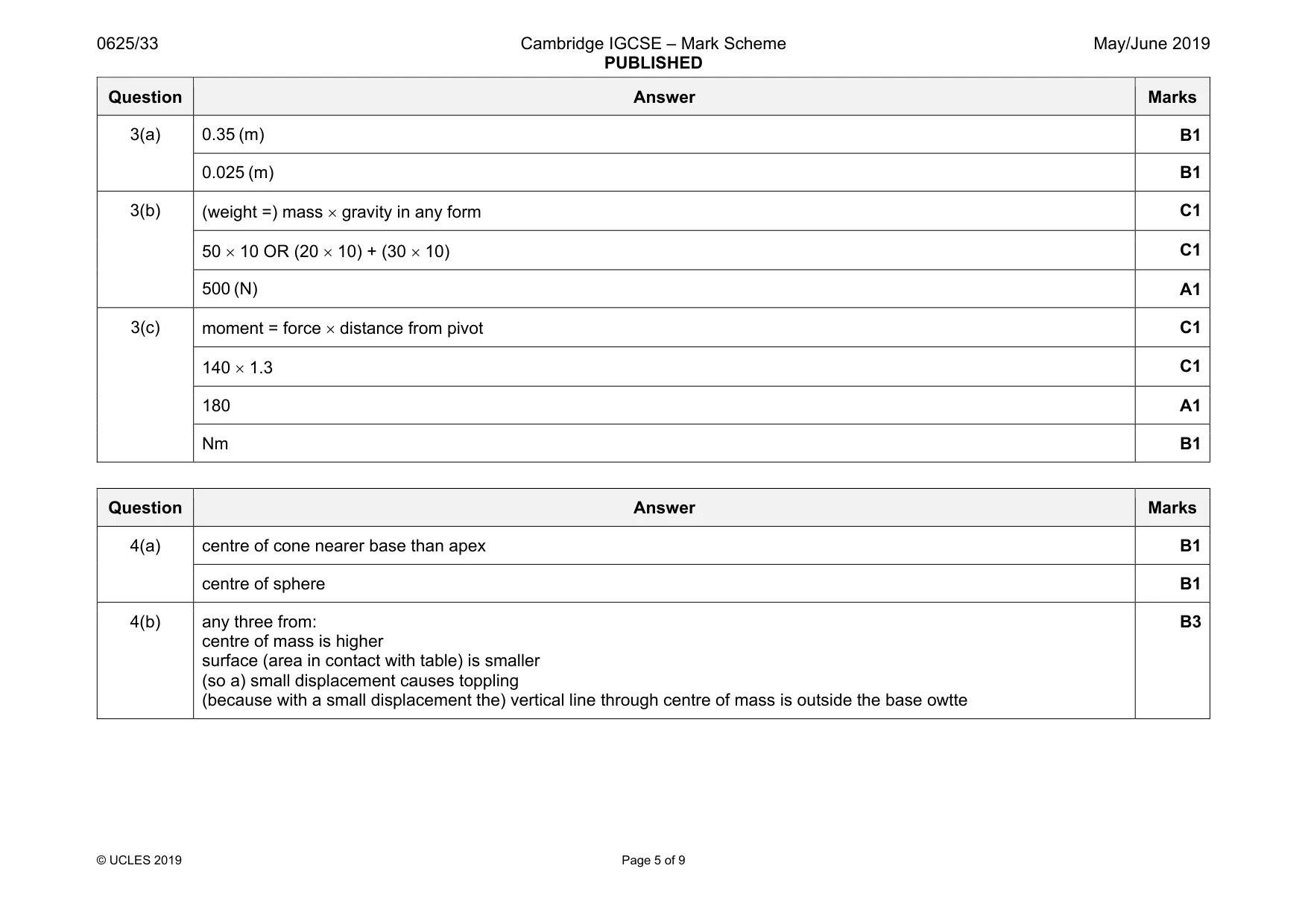
Mark scheme: 3(a) 0.35 (m) B1 0.025 (m) B1 3(b) (weight =) mass × gravity in any form C1 50 × 10 OR (20 × 10) + (30 × 10) C1 500 (N) A1 3(c) moment = force × distance from pivot C1 140 × 1.3 C1 180 A1 Nm B1
Q4 · A flat-top cone and a sphere, resting on a table
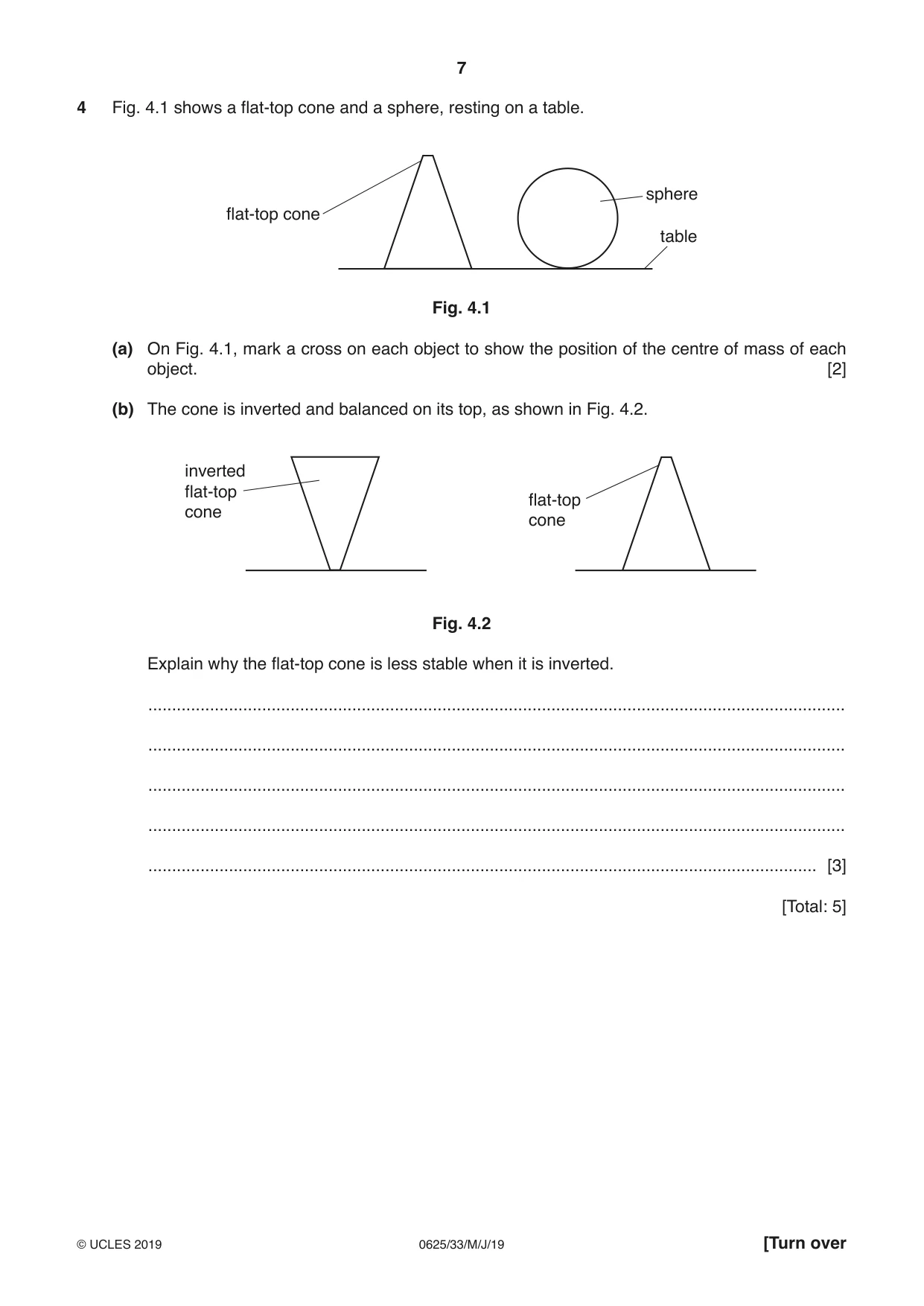
4 Fig. 4.1 shows a flat-top cone and a sphere, resting on a table. sphere flat-top cone table Fig. 4.1 (a) On Fig. 4.1, mark a cross on each object to show the position of the centre of mass of each object. [2] (b) The cone is inverted and balanced on its top, as shown in Fig. 4.2. inverted flat-top flat-top cone cone Fig. 4.2 Explain why the flat-top cone is less stable when it is inverted. ................................................................................................................................................... ................................................................................................................................................... ................................................................................................................................................... ................................................................................................................................................... ............................................................................................................................................. [3] [Total: 5]
Mark scheme: 4(a) centre of cone nearer base than apex B1 centre of sphere B1 4(b) any three from: centre of mass is higher surface (area in contact with table) is smaller (so a) small displacement causes toppling (because with a small displacement the) vertical line through centre of mass is outside the base owtte B3
Q5 · Part of a roller coaster track
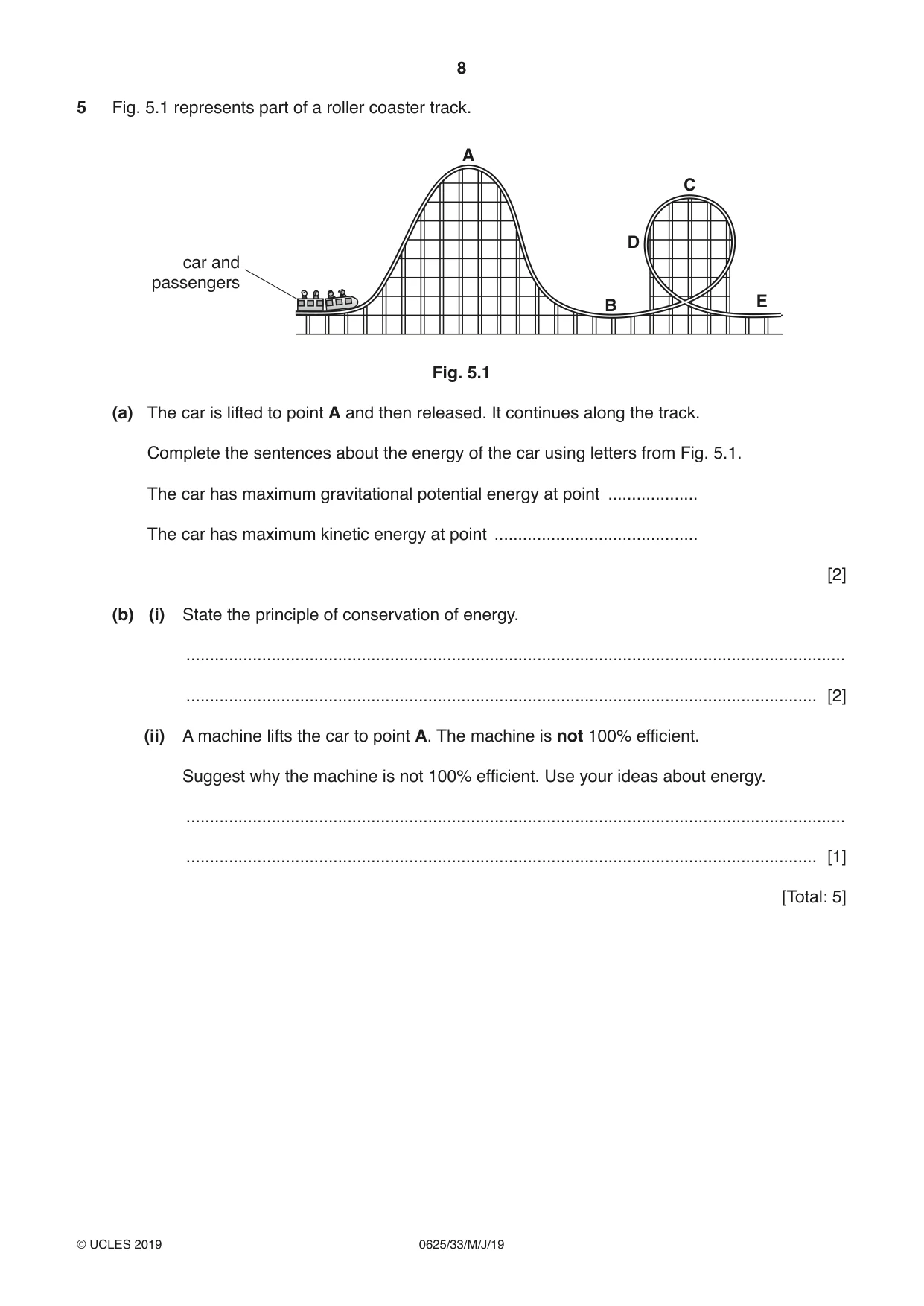
5 Fig. 5.1 represents part of a roller coaster track. A C D car and passengers B E Fig. 5.1 (a) The car is lifted to point A and then released. It continues along the track. Complete the sentences about the energy of the car using letters from Fig. 5.1. The car has maximum gravitational potential energy at point ................... The car has maximum kinetic energy at point ........................................... [2] (b) (i) State the principle of conservation of energy. ........................................................................................................................................... ..................................................................................................................................... [2] (ii) A machine lifts the car to point A. The machine is not 100% efficient. Suggest why the machine is not 100% efficient. Use your ideas about energy. ........................................................................................................................................... ..................................................................................................................................... [1] [Total: 5]
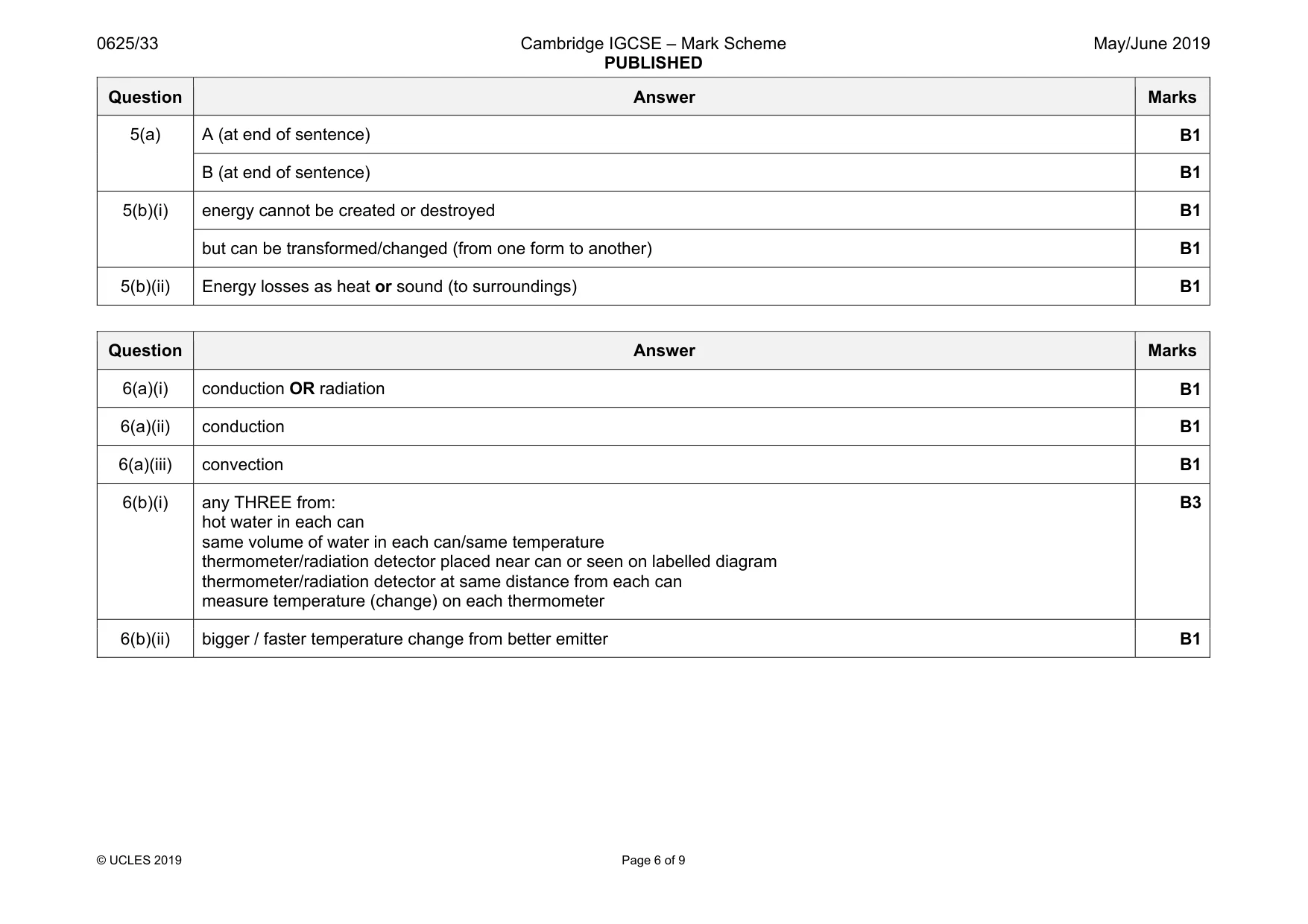
Mark scheme: 5(a) A (at end of sentence) B1 B (at end of sentence) B1 5(b)(i) energy cannot be created or destroyed B1 but can be transformed/changed (from one form to another) B1 5(b)(ii) Energy losses as heat or sound (to surroundings) B1
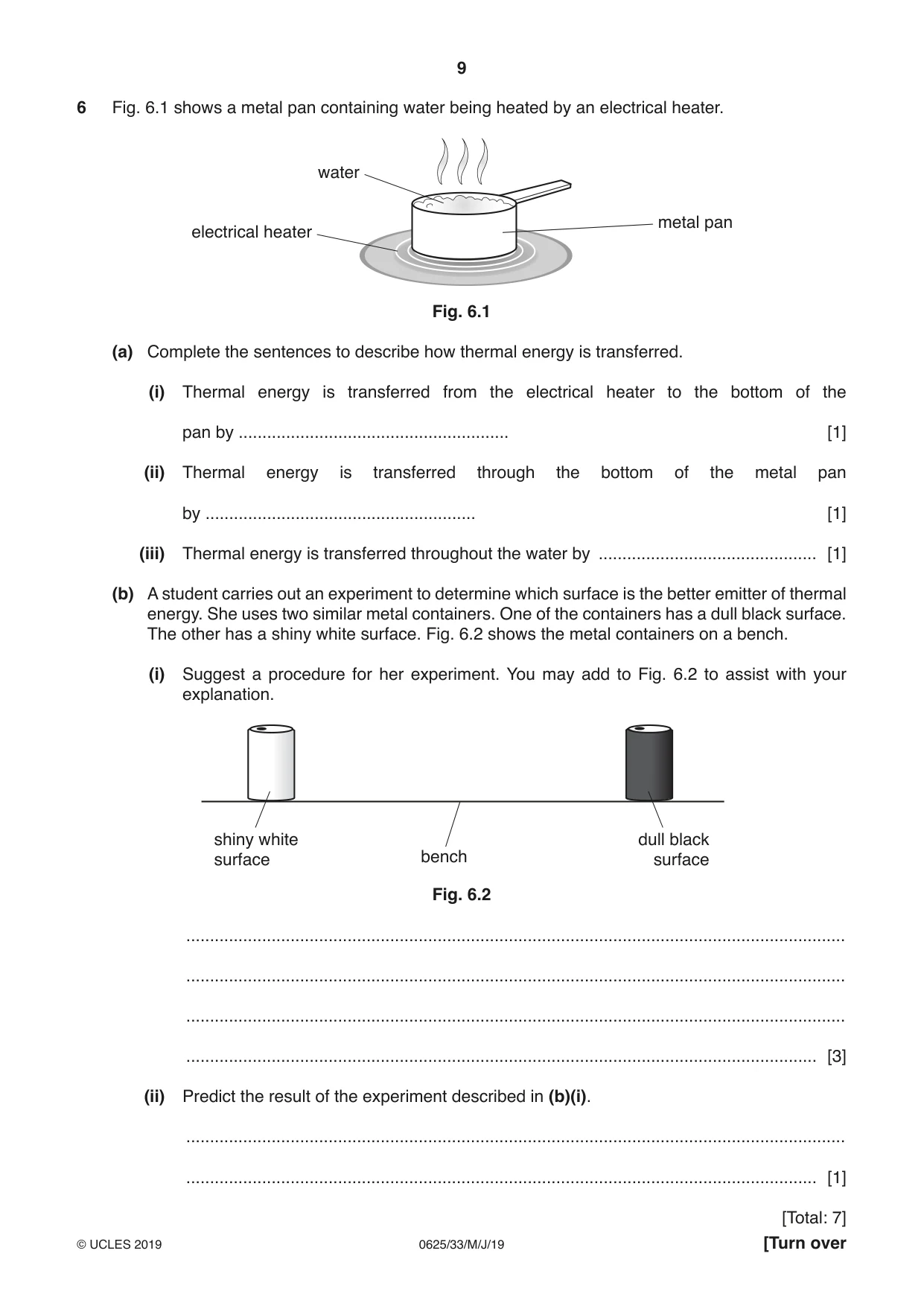
Q6 · A metal pan containing water being heated by an electrical heater
6 Fig. 6.1 shows a metal pan containing water being heated by an electrical heater. water metal pan electrical heater Fig. 6.1 (a) Complete the sentences to describe how thermal energy is transferred. (i) Thermal energy is transferred from the electrical heater to the bottom of the pan by ......................................................... [1] (ii) Thermal energy is transferred through the bottom of the metal pan by ......................................................... [1] (iii) Thermal energy is transferred throughout the water by .............................................. [1] (b) A student carries out an experiment to determine which surface is the better emitter of thermal energy. She uses two similar metal containers. One of the containers has a dull black surface. The other has a shiny white surface. Fig. 6.2 shows the metal containers on a bench. (i) Suggest a procedure for her experiment. You may add to Fig. 6.2 to assist with your explanation. shiny white dull black surface bench surface Fig. 6.2 ........................................................................................................................................... ........................................................................................................................................... ........................................................................................................................................... ..................................................................................................................................... [3] (ii) Predict the result of the experiment described in (b)(i). ........................................................................................................................................... ..................................................................................................................................... [1] [Total: 7]
Mark scheme: 6(a)(i) conduction OR radiation B1 6(a)(ii) conduction B1 6(a)(iii) convection B1 6(b)(i) any THREE from: hot water in each can same volume of water in each can/same temperature thermometer/radiation detector placed near can or seen on labelled diagram thermometer/radiation detector at same distance from each can measure temperature (change) on each thermometer B3 6(b)(ii) bigger / faster temperature change from better emitter B1
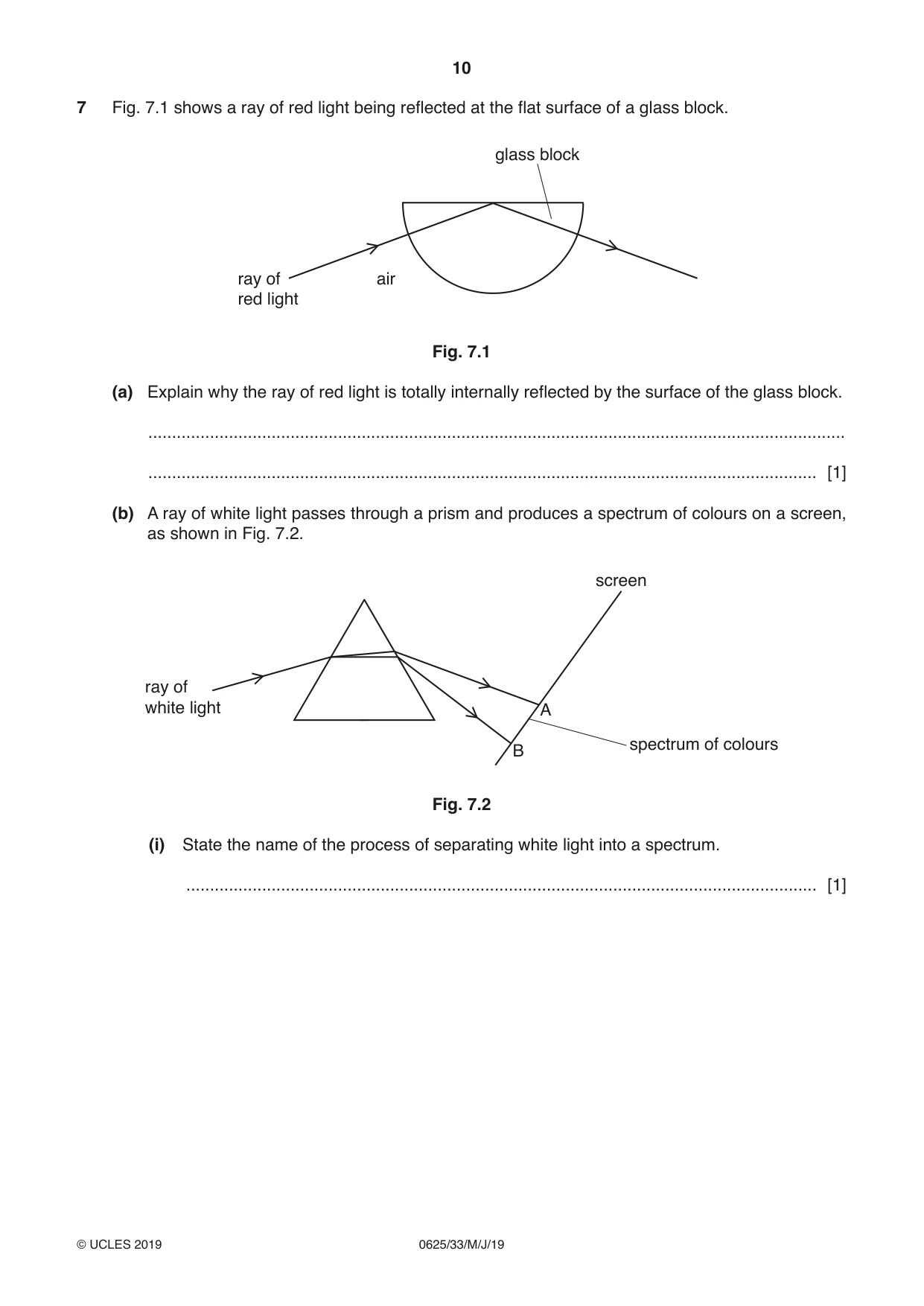
Q7 · A ray of red light being reflected at the flat surface of a glass block
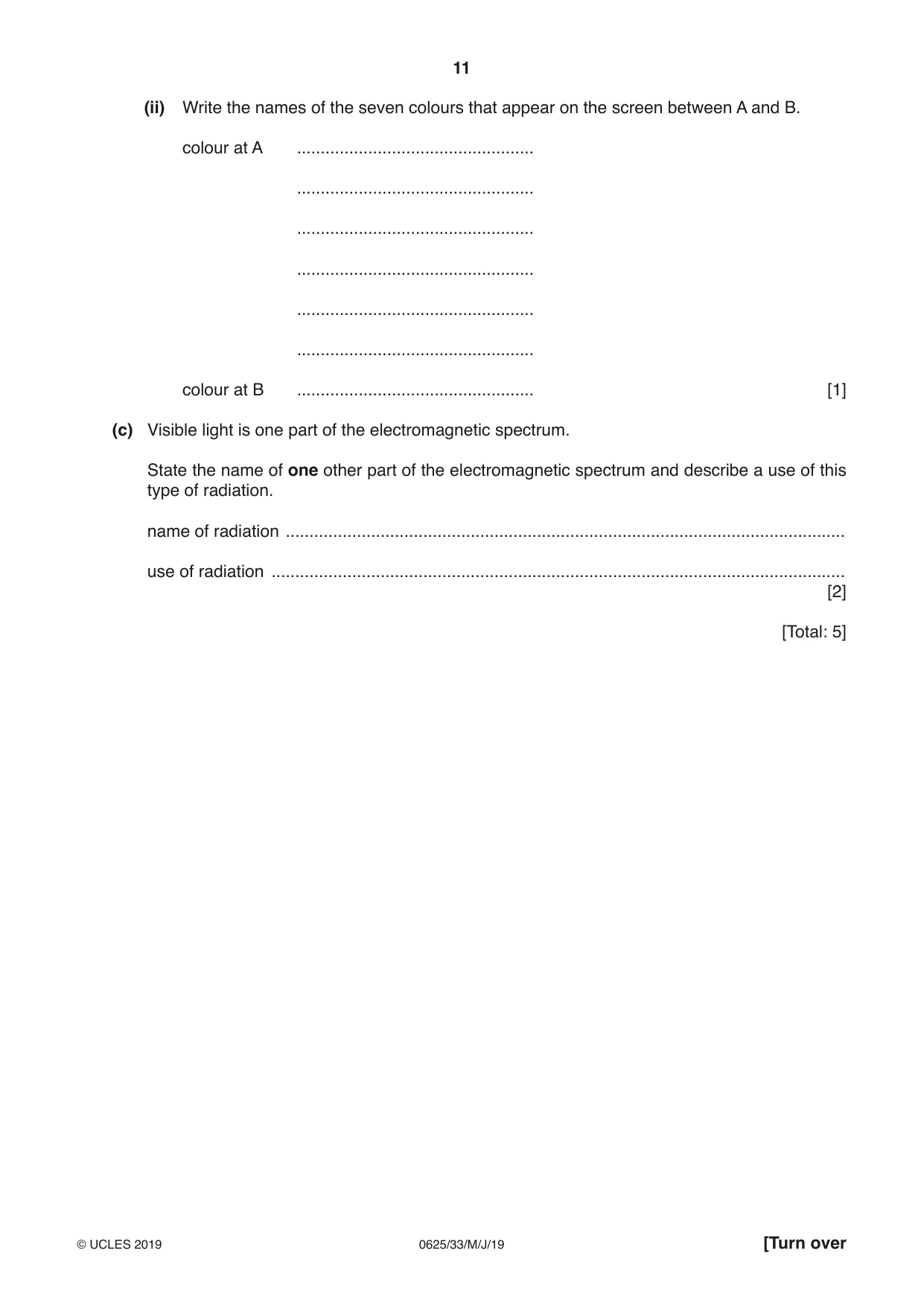
7 Fig. 7.1 shows a ray of red light being reflected at the flat surface of a glass block. glass block ray of air red light Fig. 7.1 (a) Explain why the ray of red light is totally internally reflected by the surface of the glass block. ................................................................................................................................................... ............................................................................................................................................. [1] (b) A ray of white light passes through a prism and produces a spectrum of colours on a screen, as shown in Fig. 7.2. screen ray of white light A spectrum of colours B Fig. 7.2 (i) State the name of the process of separating white light into a spectrum. ..................................................................................................................................... [1] (ii) Write the names of the seven colours that appear on the screen between A and B. colour at A .................................................. .................................................. .................................................. .................................................. .................................................. .................................................. colour at B .................................................. [1] (c) Visible light is one part of the electromagnetic spectrum. State the name of one other part of the electromagnetic spectrum and describe a use of this type of radiation. name of radiation ...................................................................................................................... use of radiation ......................................................................................................................... [2] [Total: 5]
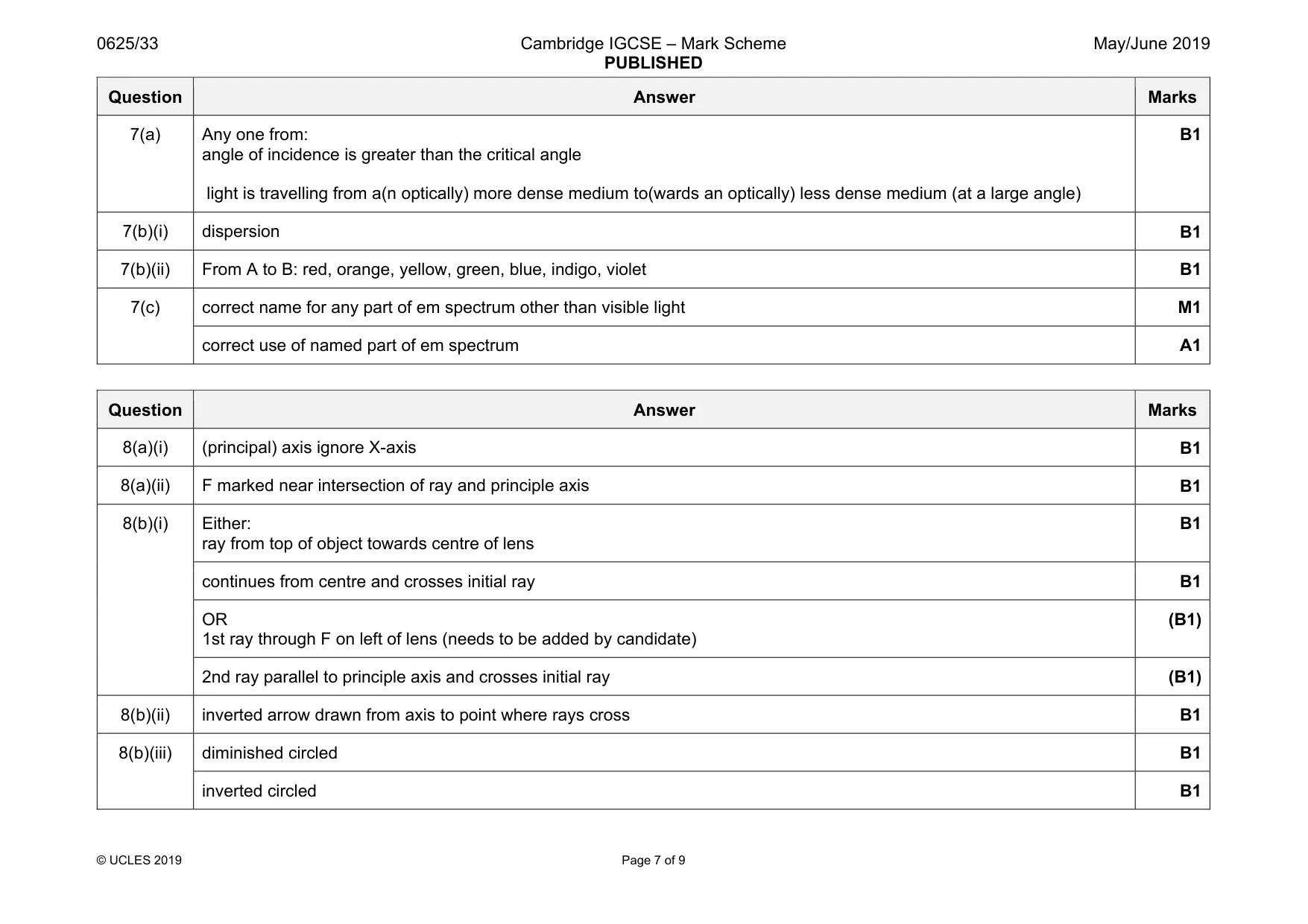
Mark scheme: 7(a) Any one from: angle of incidence is greater than the critical angle light is travelling from a(n optically) more dense medium to(wards an optically) less dense medium (at a large angle) B1 7(b)(i) dispersion B1 7(b)(ii) From A to B: red, orange, yellow, green, blue, indigo, violet B1 7(c) correct name for any part of em spectrum other than visible light M1 correct use of named part of em spectrum A1
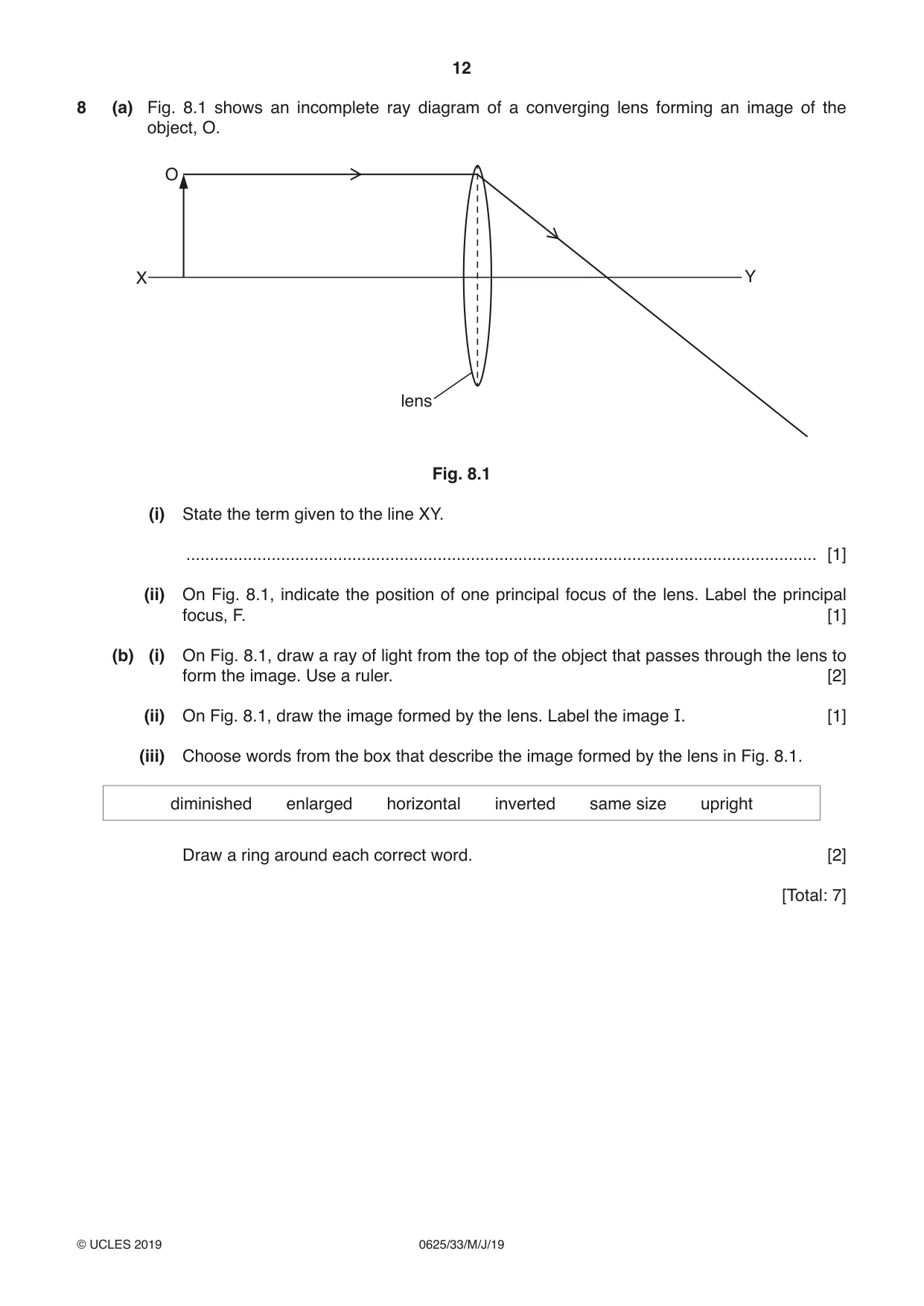
Q8 · An incomplete ray diagram of a converging lens forming an image of the object, O
8 (a) Fig. 8.1 shows an incomplete ray diagram of a converging lens forming an image of the object, O. O X Y lens Fig. 8.1 (i) State the term given to the line XY. ..................................................................................................................................... [1] (ii) On Fig. 8.1, indicate the position of one principal focus of the lens. Label the principal focus, F. [1] (b) (i) On Fig. 8.1, draw a ray of light from the top of the object that passes through the lens to form the image. Use a ruler. [2] (ii) On Fig. 8.1, draw the image formed by the lens. Label the image I. [1] (iii) Choose words from the box that describe the image formed by the lens in Fig. 8.1. diminished enlarged horizontal inverted same size upright Draw a ring around each correct word. [2] [Total: 7]
Mark scheme: 8(a)(i) (principal) axis ignore X-axis B1 8(a)(ii) F marked near intersection of ray and principle axis B1 8(b)(i) Either: ray from top of object towards centre of lens B1 continues from centre and crosses initial ray B1 OR 1st ray through F on left of lens (needs to be added by candidate) (B1) 2nd ray parallel to principle axis and crosses initial ray (B1) 8(b)(ii) inverted arrow drawn from axis to point where rays cross B1 8(b)(iii) diminished circled B1 inverted circled B1
Q9 · A student tests some materials to find which ones are electrical conductors
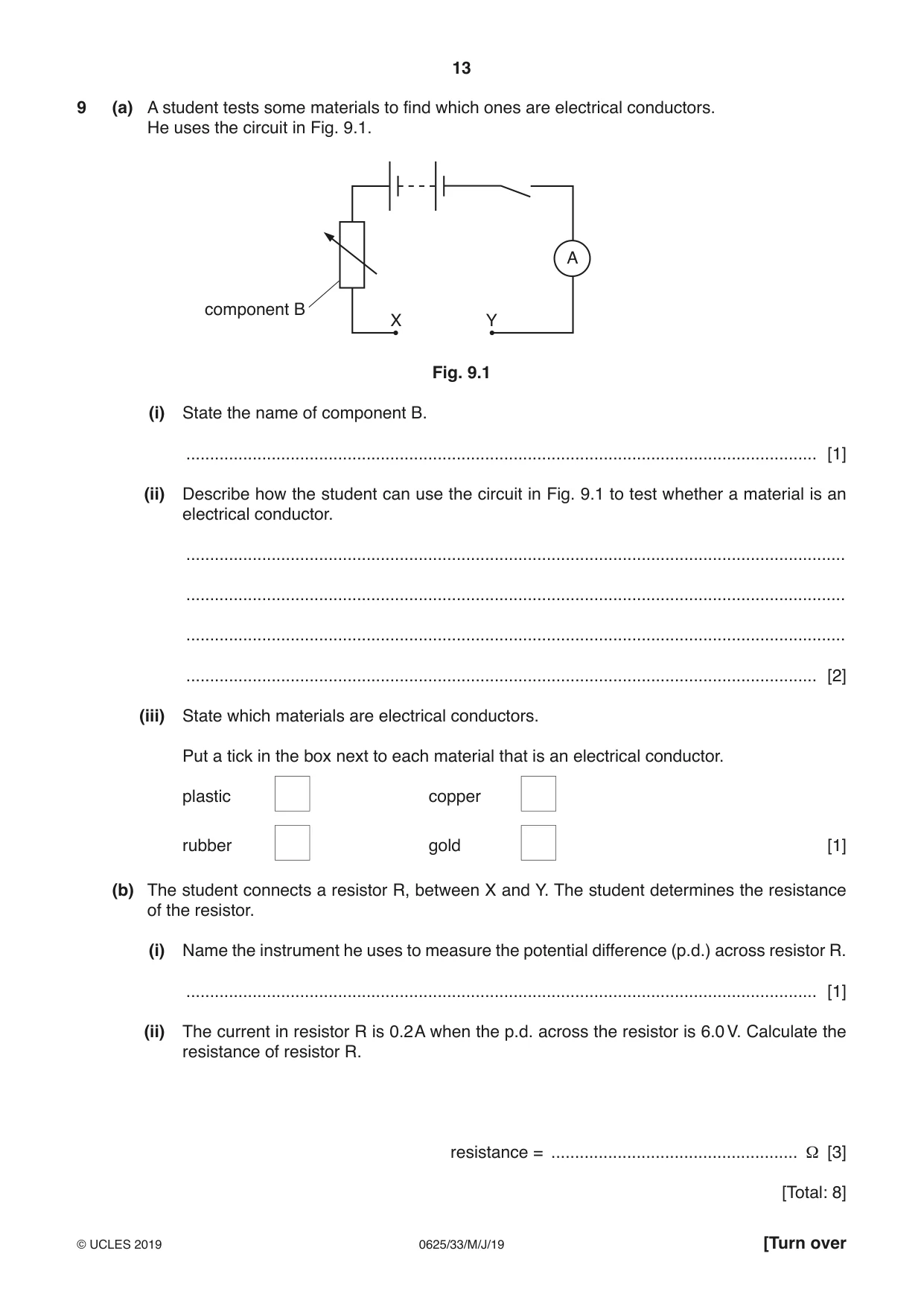
9 (a) A student tests some materials to find which ones are electrical conductors. He uses the circuit in Fig. 9.1. A component B X Y Fig. 9.1 (i) State the name of component B. ..................................................................................................................................... [1] (ii) Describe how the student can use the circuit in Fig. 9.1 to test whether a material is an electrical conductor. ........................................................................................................................................... ........................................................................................................................................... ........................................................................................................................................... ..................................................................................................................................... [2] (iii) State which materials are electrical conductors. Put a tick in the box next to each material that is an electrical conductor. plastic copper rubber gold [1] (b) The student connects a resistor R, between X and Y. The student determines the resistance of the resistor. (i) Name the instrument he uses to measure the potential difference (p.d.) across resistor R. ..................................................................................................................................... [1] (ii) The current in resistor R is 0.2 A when the p.d. across the resistor is 6.0 V. Calculate the resistance of resistor R. resistance = .................................................... Ω [3] [Total: 8]
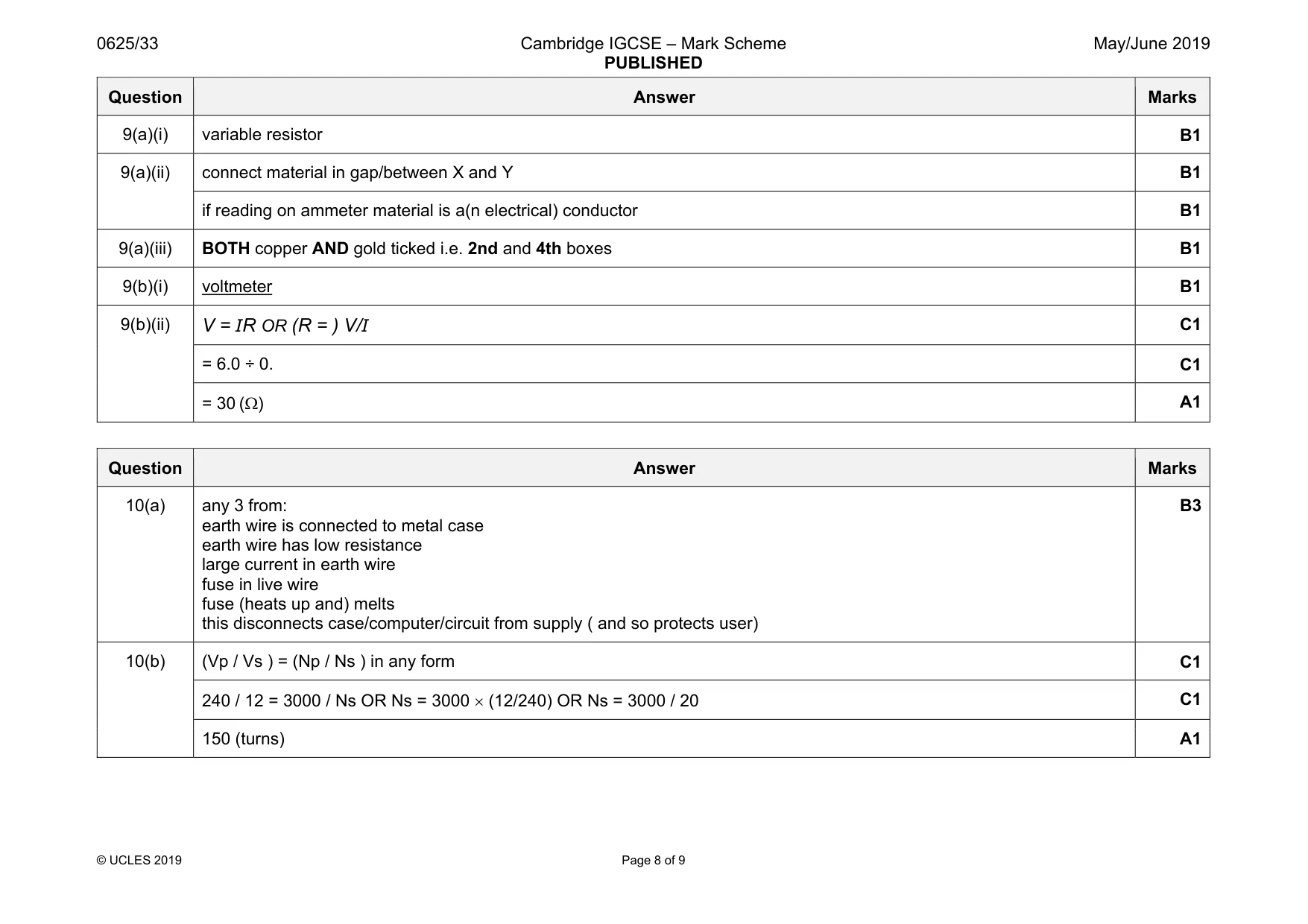
Mark scheme: 9(a)(i) variable resistor B1 9(a)(ii) connect material in gap/between X and Y B1 if reading on ammeter material is a(n electrical) conductor B1 9(a)(iii) BOTH copper AND gold ticked i.e. 2nd and 4th boxes B1 9(b)(i) voltmeter B1 9(b)(ii) V = IR OR (R = ) V/I C1 = 6.0 ÷ 0. C1 = 30 (Ω) A1
Question 10
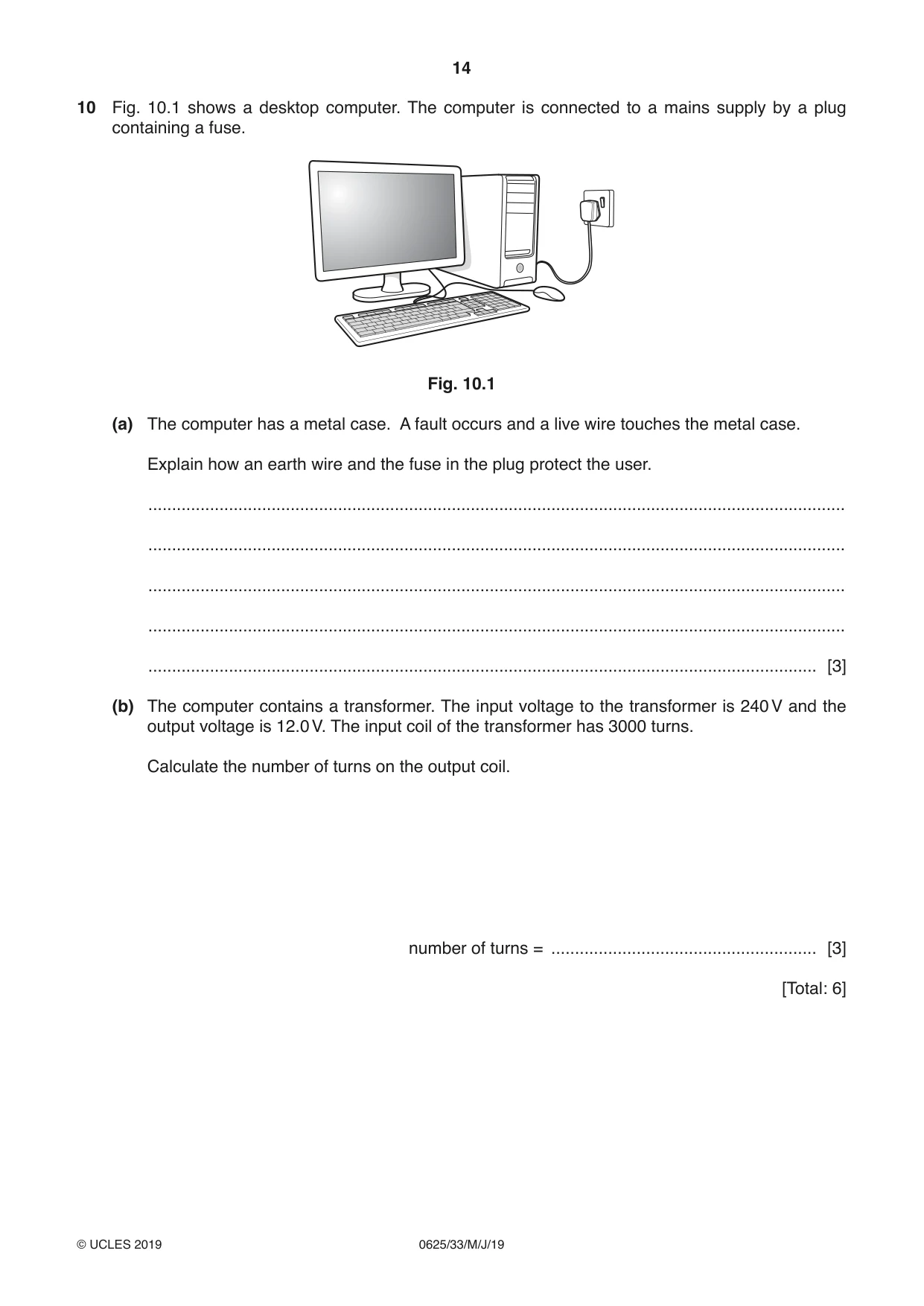
10 Fig. 10.1 shows a desktop computer. The computer is connected to a mains supply by a plug containing a fuse. Fig. 10.1 (a) The computer has a metal case. A fault occurs and a live wire touches the metal case. Explain how an earth wire and the fuse in the plug protect the user. ................................................................................................................................................... ................................................................................................................................................... ................................................................................................................................................... ................................................................................................................................................... ............................................................................................................................................. [3] (b) The computer contains a transformer. The input voltage to the transformer is 240 V and the output voltage is 12.0 V. The input coil of the transformer has 3000 turns. Calculate the number of turns on the output coil. number of turns = ........................................................ [3] [Total: 6]
Mark scheme: 10(a) any 3 from: earth wire is connected to metal case earth wire has low resistance large current in earth wire fuse in live wire fuse (heats up and) melts this disconnects case/computer/circuit from supply ( and so protects user) B3 10(b) (Vp / Vs ) = (Np / Ns ) in any form C1 240 / 12 = 3000 / Ns OR Ns = 3000 × (12/240) OR Ns = 3000 / 20 C1 150 (turns) A1
Q11 · Table 11.1 includes information about the properties of three types of naturally…
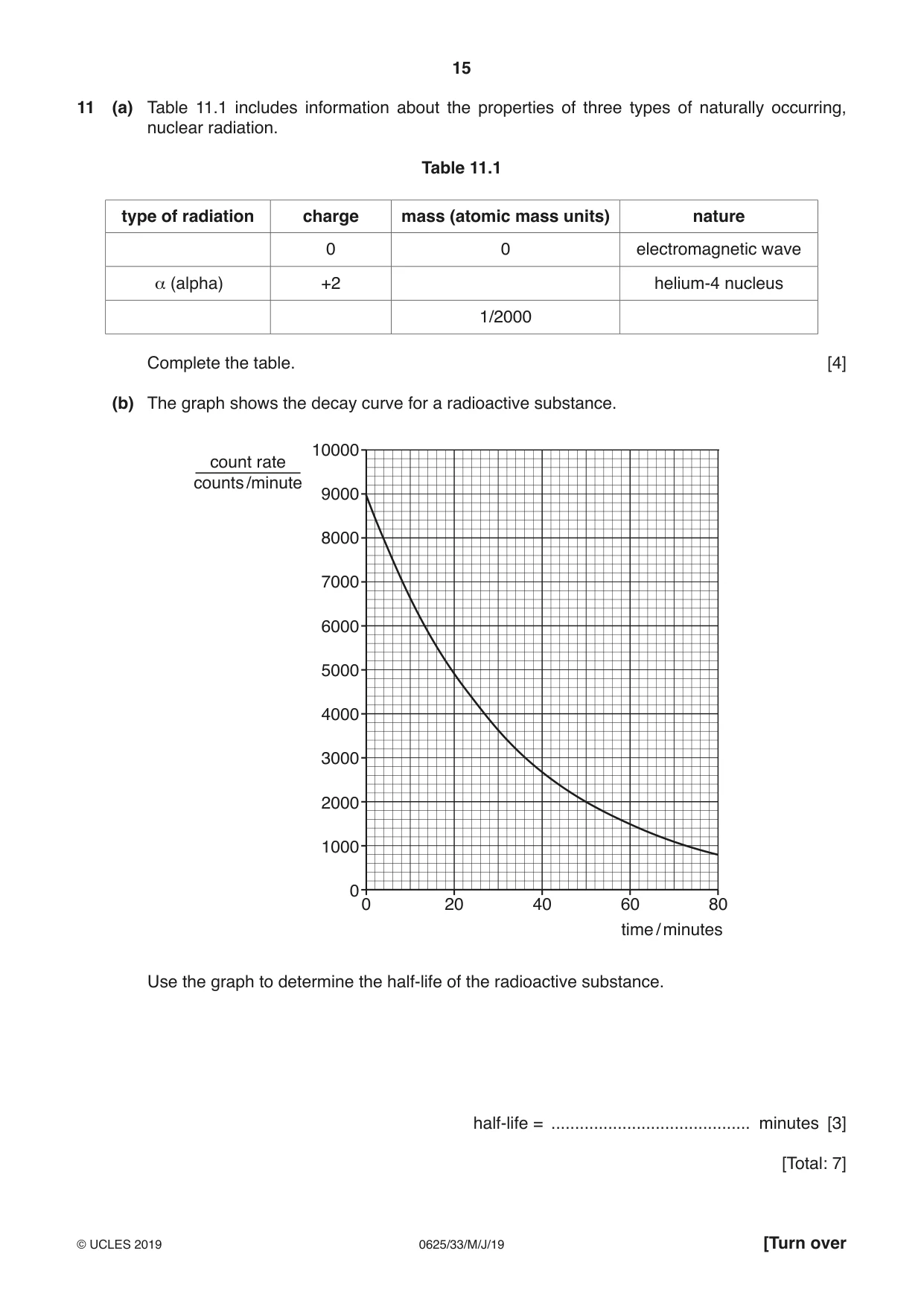
11 (a) Table 11.1 includes information about the properties of three types of naturally occurring, nuclear radiation. Table 11.1 type of radiation charge mass (atomic mass units) nature 0 0 electromagnetic wave α (alpha) +2 helium-4 nucleus 1/2000 Complete the table. [4] (b) The graph shows the decay curve for a radioactive substance. 10000 count rate counts /minute 9000 8000 7000 6000 5000 4000 3000 2000 1000 0 0 20 40 60 80 time / minutes Use the graph to determine the half-life of the radioactive substance. half-life = .......................................... minutes [3] [Total: 7]
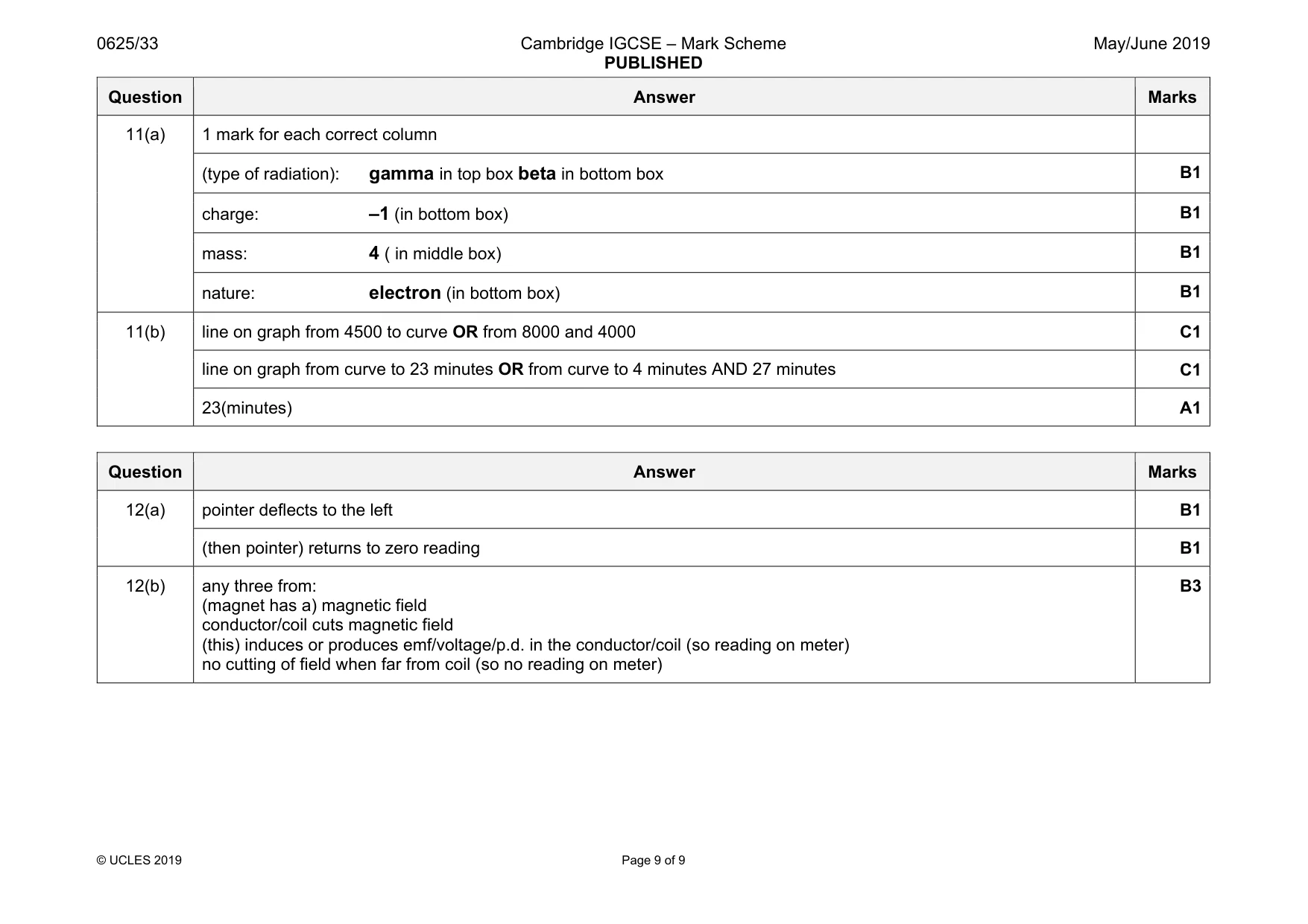
Mark scheme: 11(a) 1 mark for each correct column (type of radiation): gamma in top box beta in bottom box B1 charge: –1 (in bottom box) B1 mass: 4 ( in middle box) B1 nature: electron (in bottom box) B1 11(b) line on graph from 4500 to curve OR from 8000 and 4000 C1 line on graph from curve to 23 minutes OR from curve to 4 minutes AND 27 minutes C1 23(minutes) A1
Q12 · A student uses the equipment shown in Fig
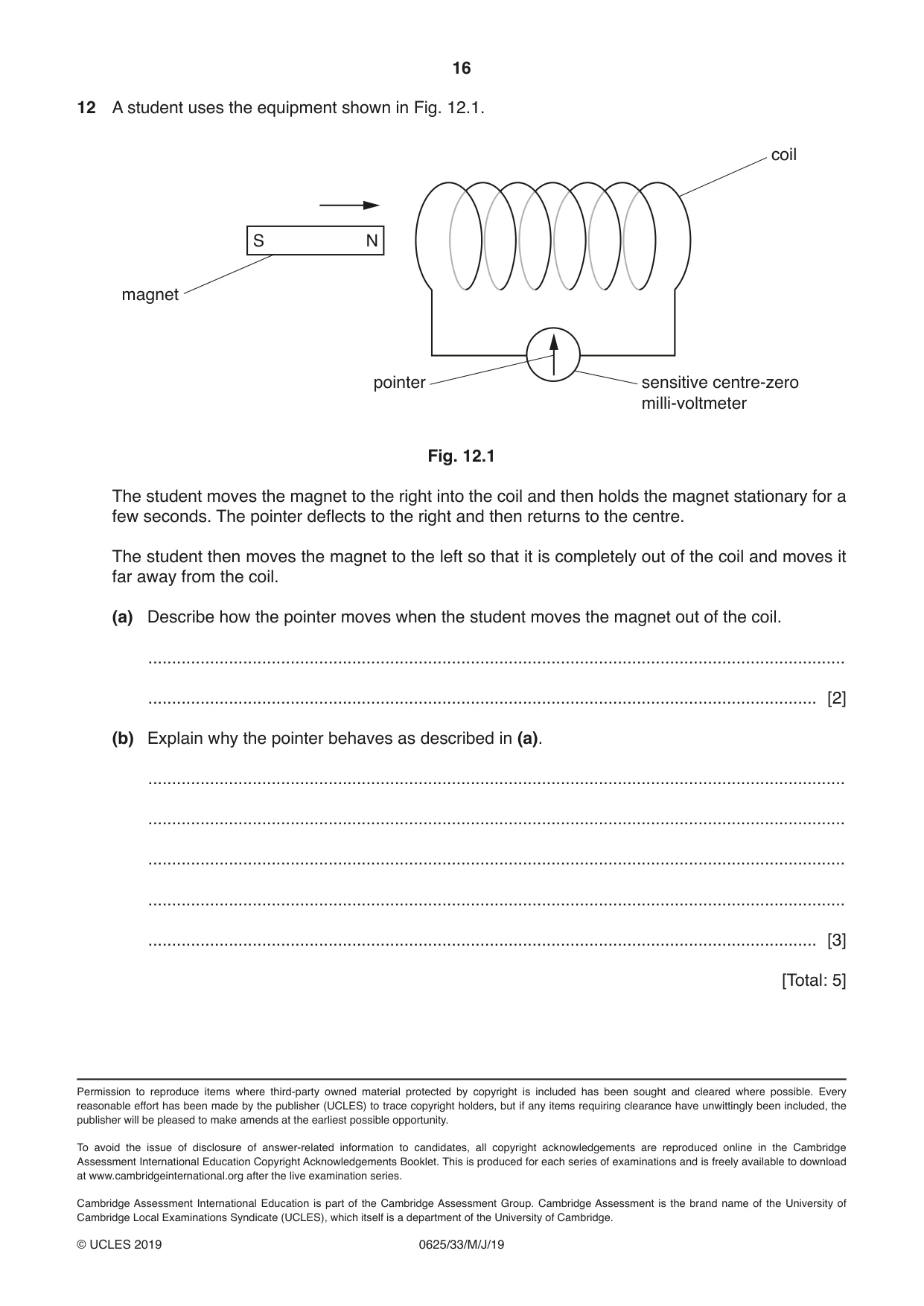
12 A student uses the equipment shown in Fig. 12.1. coil S N magnet pointer sensitive centre-zero milli-voltmeter Fig. 12.1 The student moves the magnet to the right into the coil and then holds the magnet stationary for a few seconds. The pointer deflects to the right and then returns to the centre. The student then moves the magnet to the left so that it is completely out of the coil and moves it far away from the coil. (a) Describe how the pointer moves when the student moves the magnet out of the coil. ................................................................................................................................................... ............................................................................................................................................. [2] (b) Explain why the pointer behaves as described in (a). ................................................................................................................................................... ................................................................................................................................................... ................................................................................................................................................... ................................................................................................................................................... ............................................................................................................................................. [3] [Total: 5]
Mark scheme: 12(a) pointer deflects to the left B1 (then pointer) returns to zero reading B1 12(b) any three from: (magnet has a) magnetic field conductor/coil cuts magnetic field (this) induces or produces emf/voltage/p.d. in the conductor/coil (so reading on meter) no cutting of field when far from coil (so no reading on meter) B3
What was in this paper
The subtopics covered by these 12 questions, and how many questions each got. Open one in a new tab to see every Cambridge question on it.
What you needed in this session
Cambridge’s own grade thresholds for 2019 May/June, Paper 3 · Variant 3. A higher threshold means an easier paper — the bar moves with how the cohort did.