Cambridge IGCSE Physics 0625 — 2022 May/June Paper 3 · Variant 3
0625/33/M/J/22 · 10 questions · 80 marks · ≈90 min
The question paper and its mark scheme, free to read here and free to download. This is Cambridge’s own paper, exactly as it was sat.
Question paper16 pages
Mark scheme13 pages
Answers below. Sit the paper first if you are practising.
Questions as text
Q1 · Children about to run a race
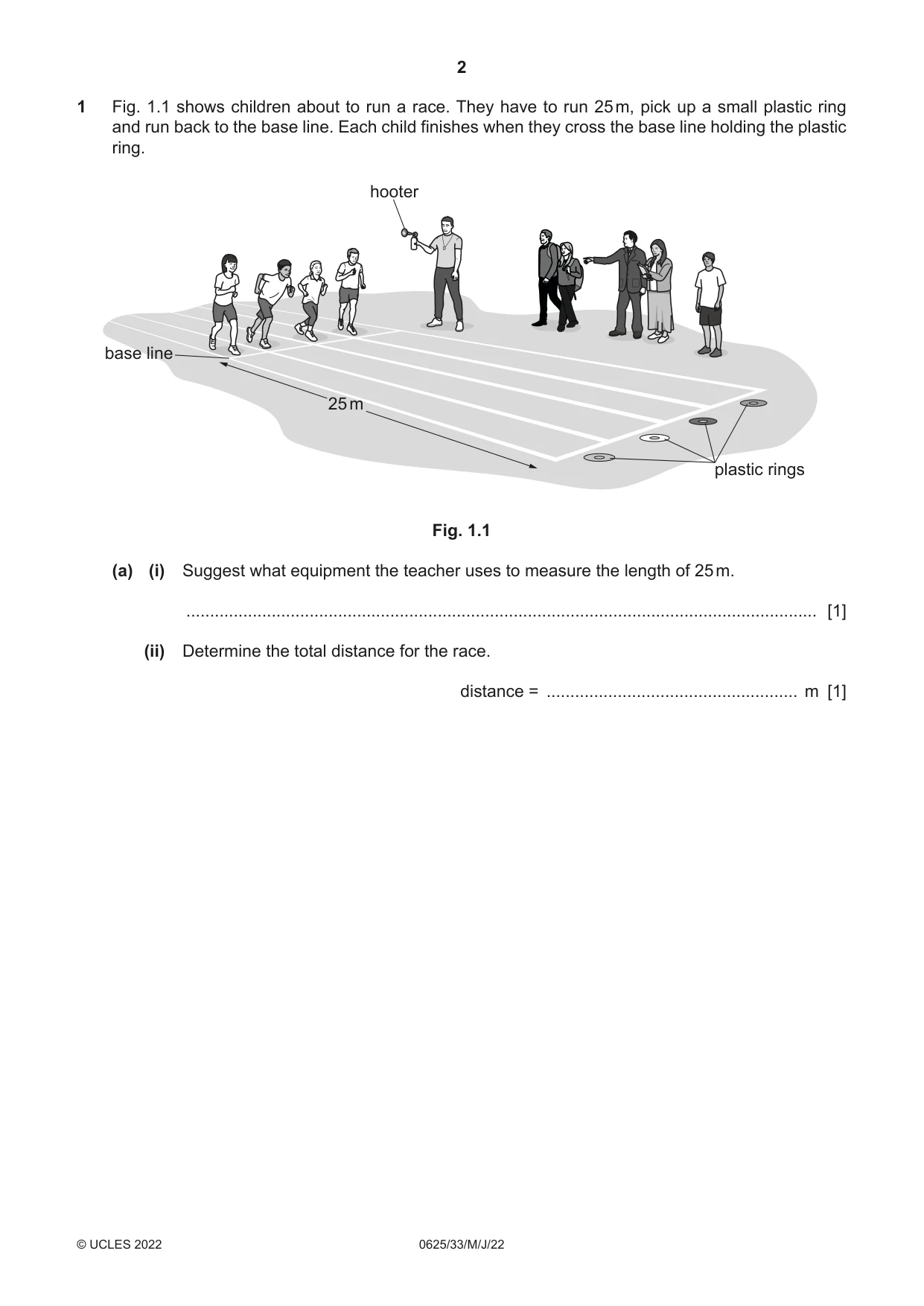
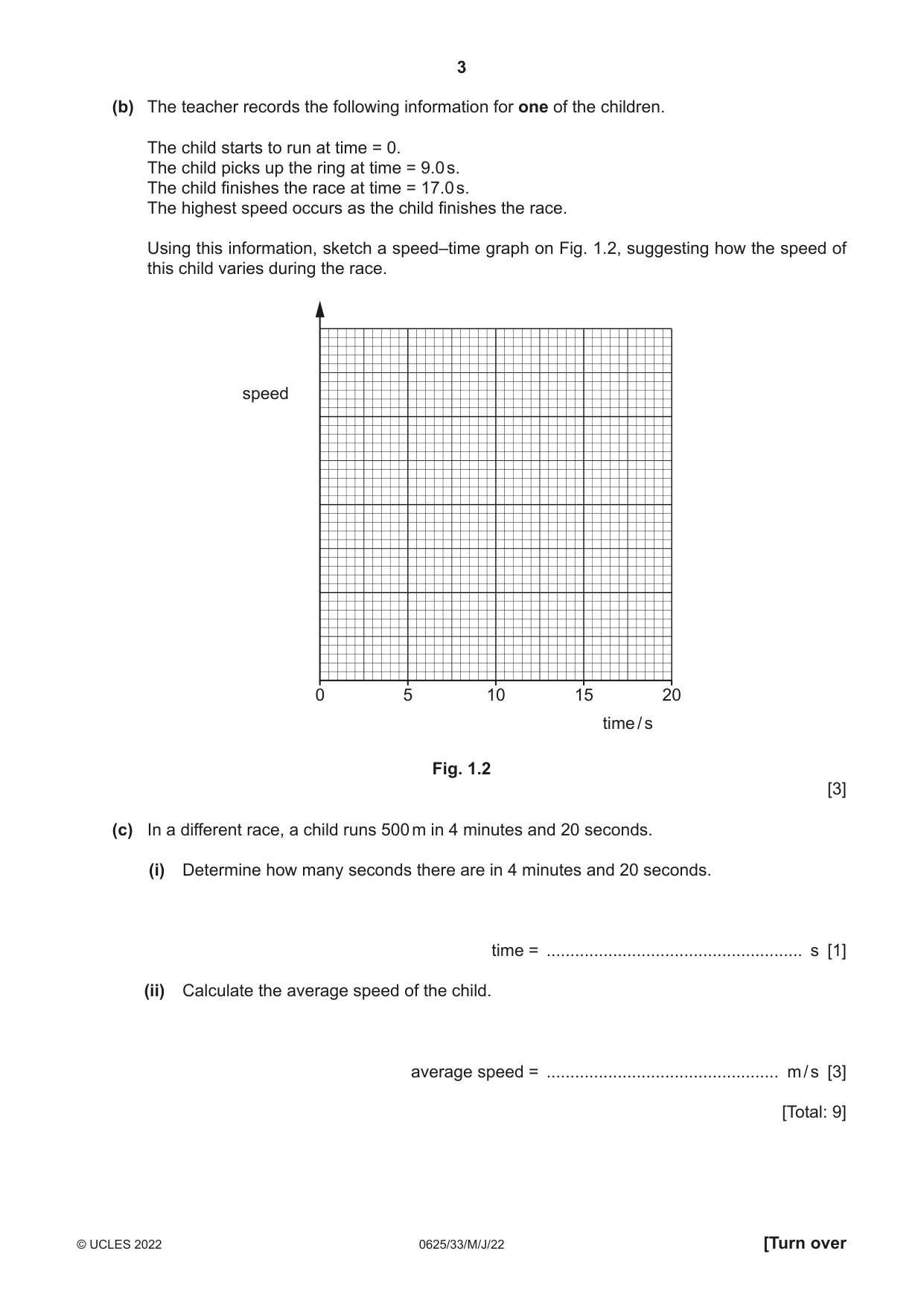
1 Fig. 1.1 shows children about to run a race. They have to run 25 m, pick up a small plastic ring and run back to the base line. Each child finishes when they cross the base line holding the plastic ring. hooter base line 25 m plastic rings Fig. 1.1 (a) (i) Suggest what equipment the teacher uses to measure the length of 25 m. ..................................................................................................................................... [1] (ii) Determine the total distance for the race. distance = ..................................................... m [1] (b) The teacher records the following information for one of the children. The child starts to run at time = 0. The child picks up the ring at time = 9.0 s. The child finishes the race at time = 17.0 s. The highest speed occurs as the child finishes the race. Using this information, sketch a speed–time graph on Fig. 1.2, suggesting how the speed of this child varies during the race. speed 0 5 10 15 20 time / s Fig. 1.2 [3] (c) In a different race, a child runs 500 m in 4 minutes and 20 seconds. (i) Determine how many seconds there are in 4 minutes and 20 seconds. time = ...................................................... s [1] (ii) Calculate the average speed of the child. average speed = ................................................. m / s [3] [Total: 9]
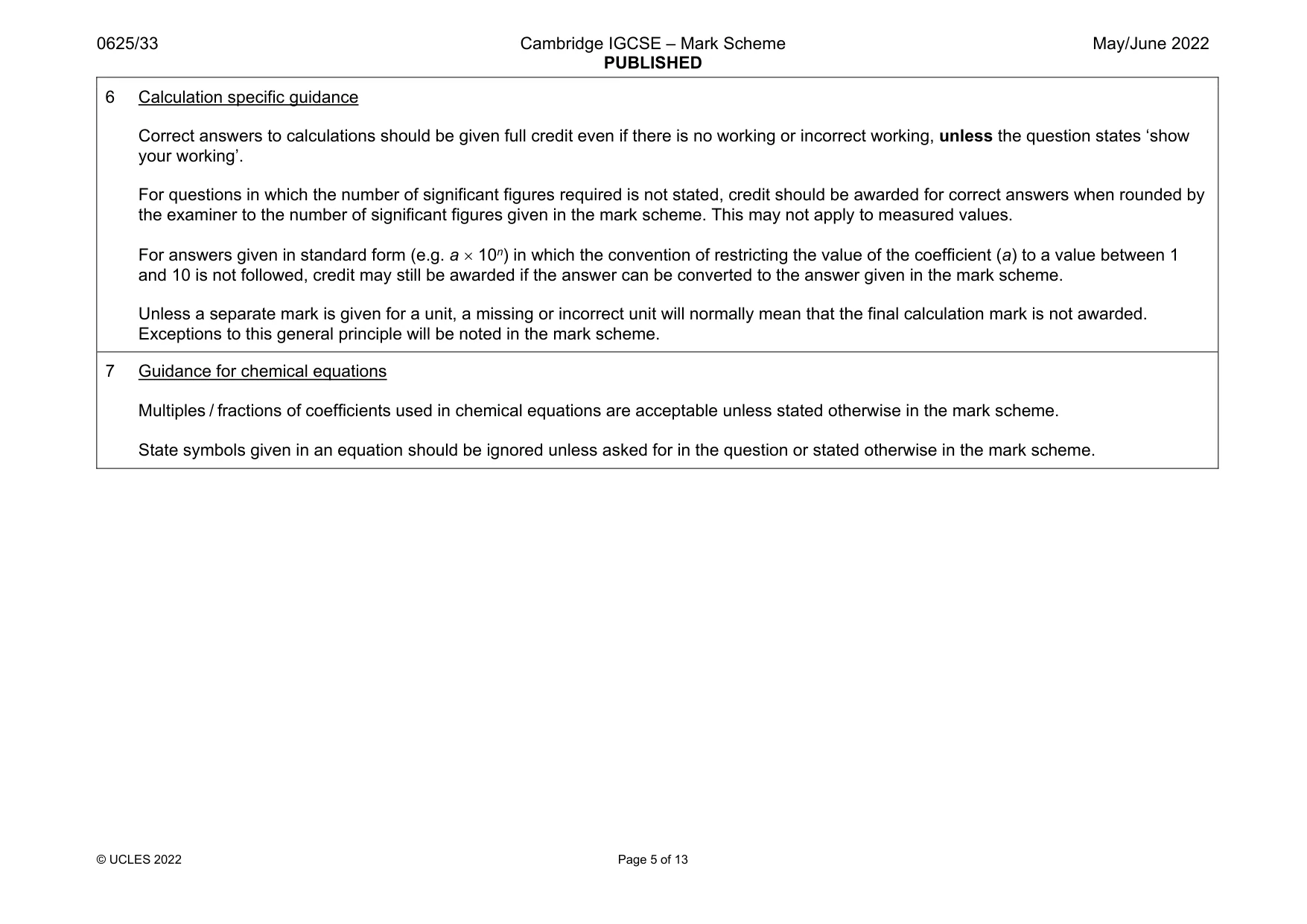
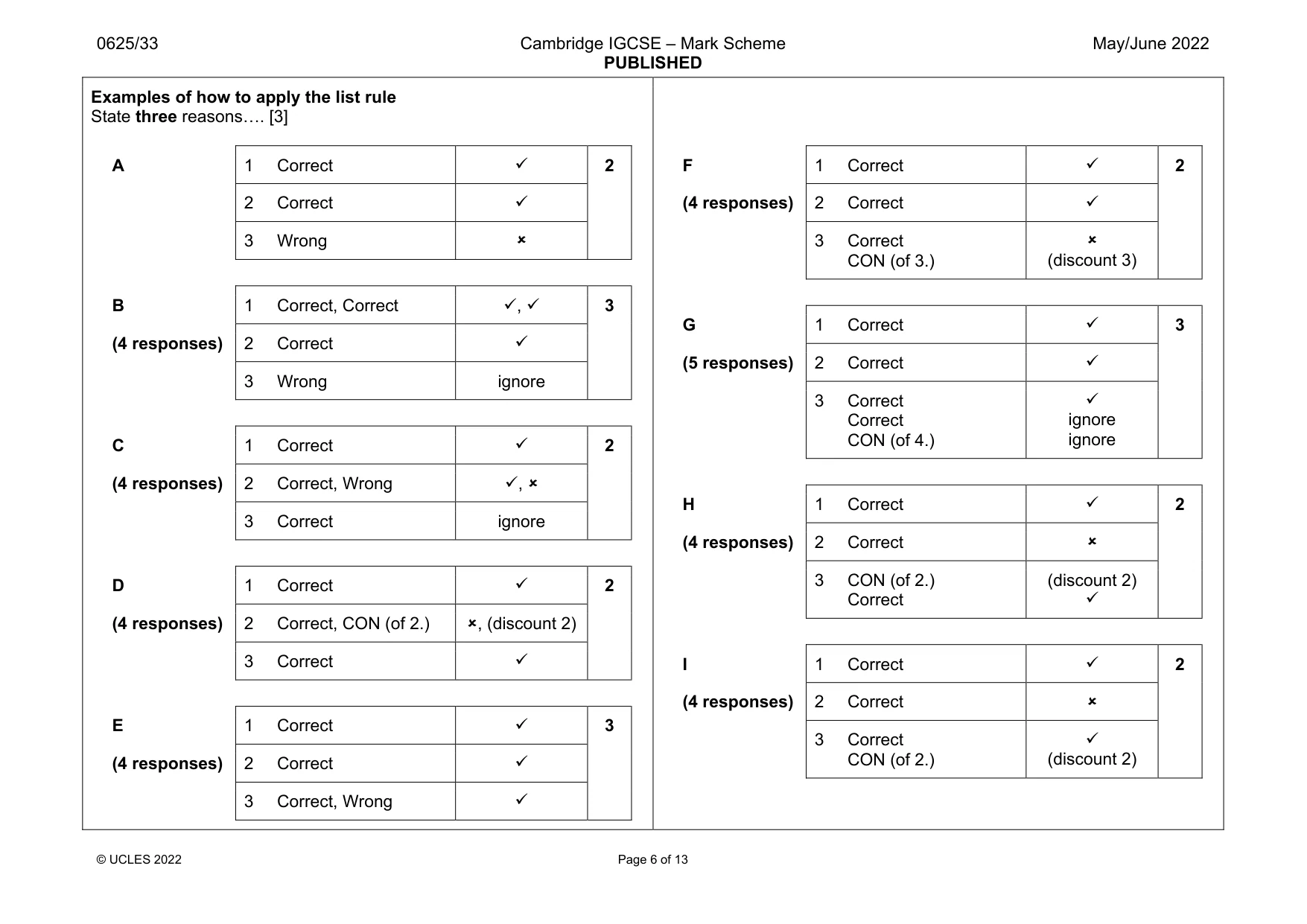
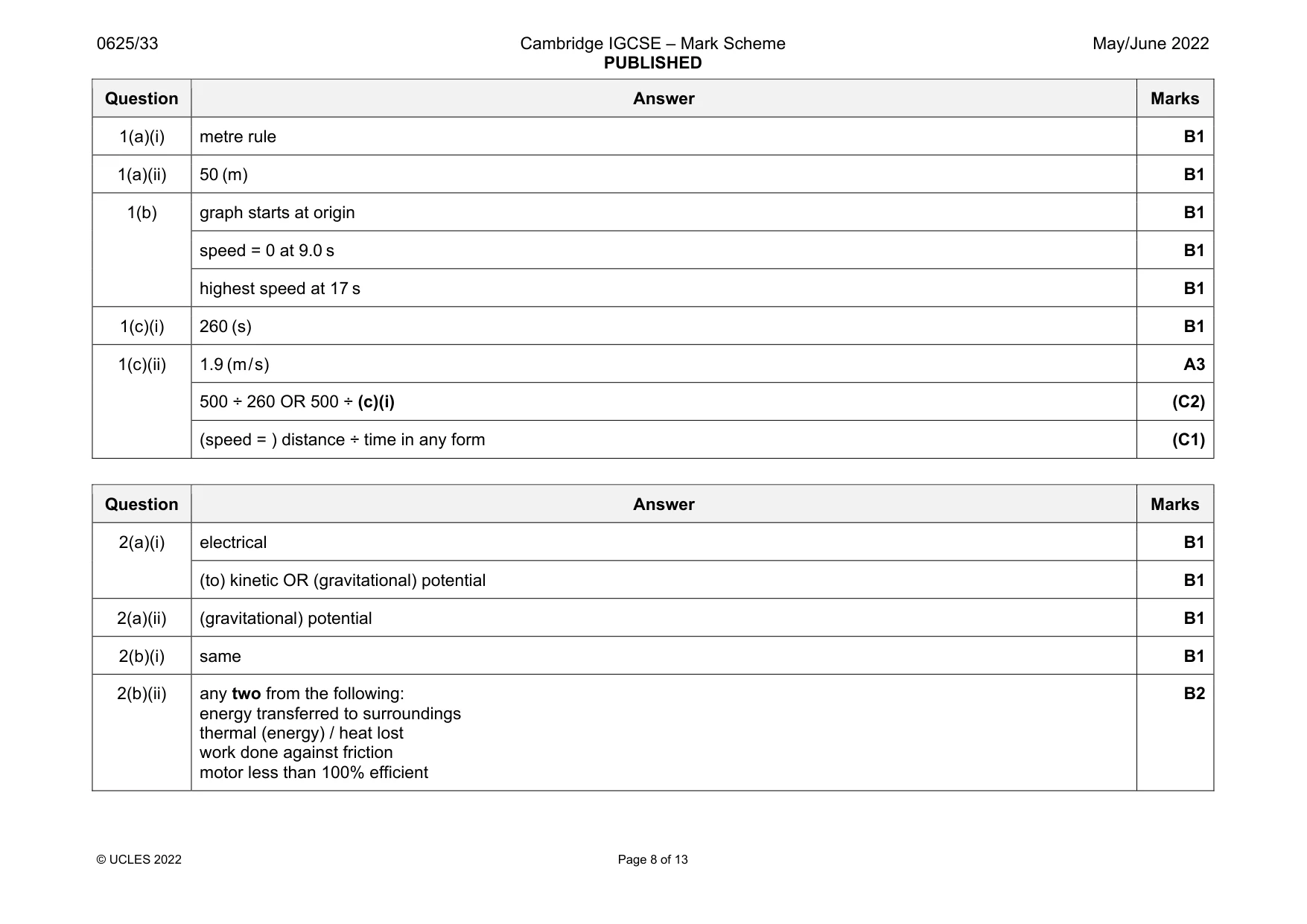
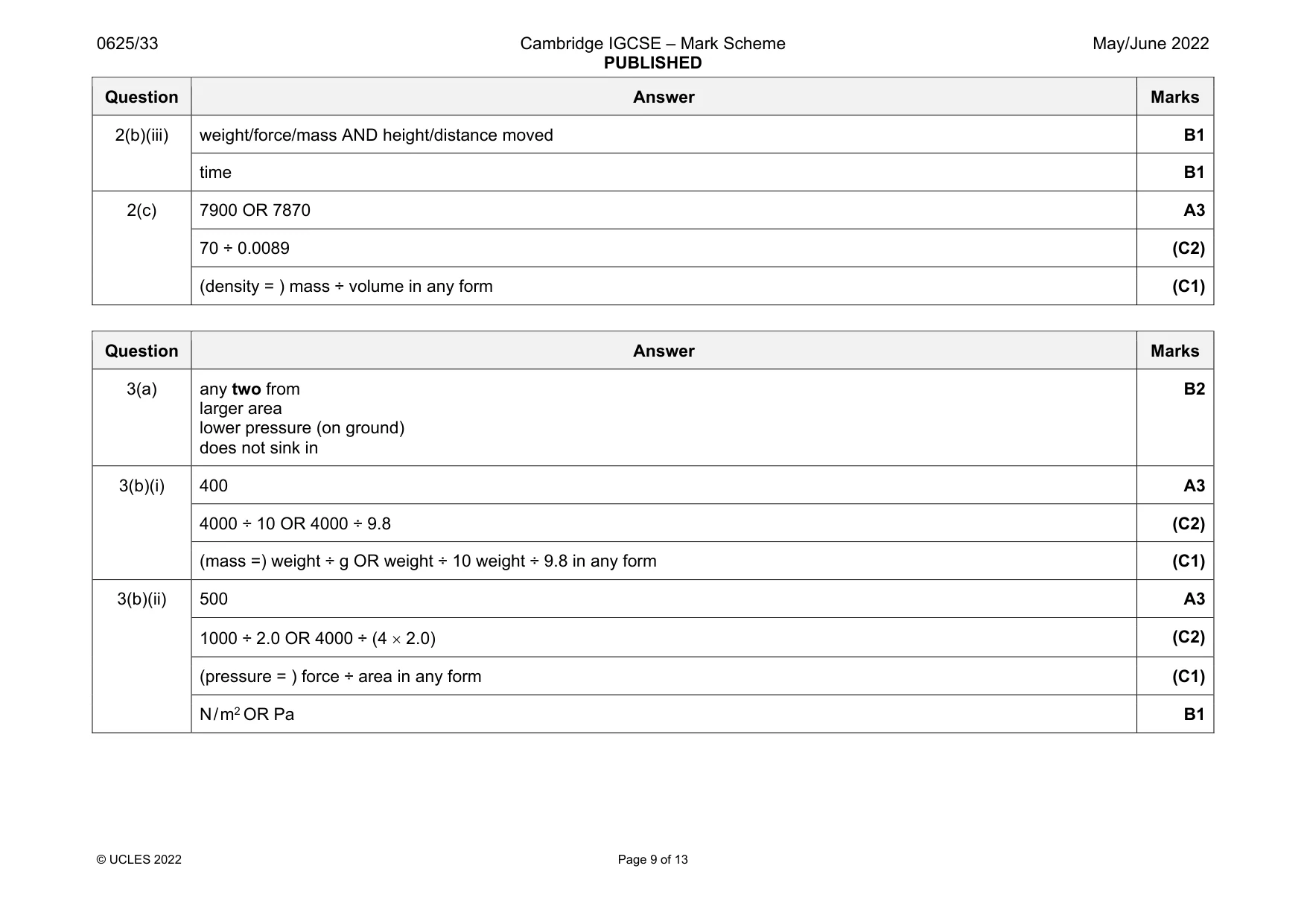
Mark scheme: 1(a)(i) metre rule B1 1(a)(ii) 50 (m) B1 1(b) graph starts at origin B1 speed = 0 at 9.0 s B1 highest speed at 17 s B1 1(c)(i) 260 (s) B1 1(c)(ii) 1.9 (m / s) A3 500 ÷ 260 OR 500 ÷ (c)(i) (C2) (speed = ) distance ÷ time in any form (C1)
Q2 · Two identical metal blocks, A and B, being lifted 3.0 m from ground level
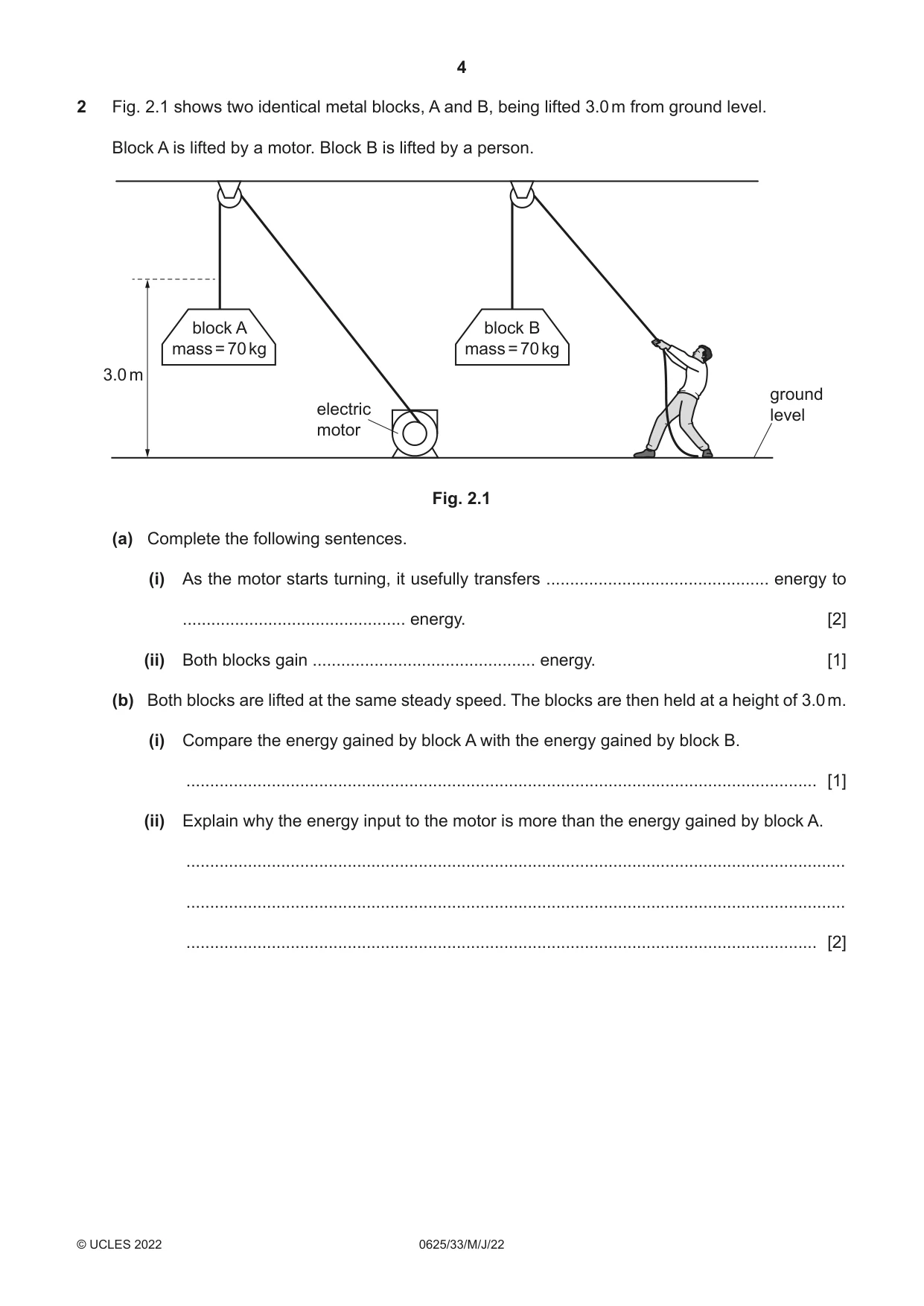
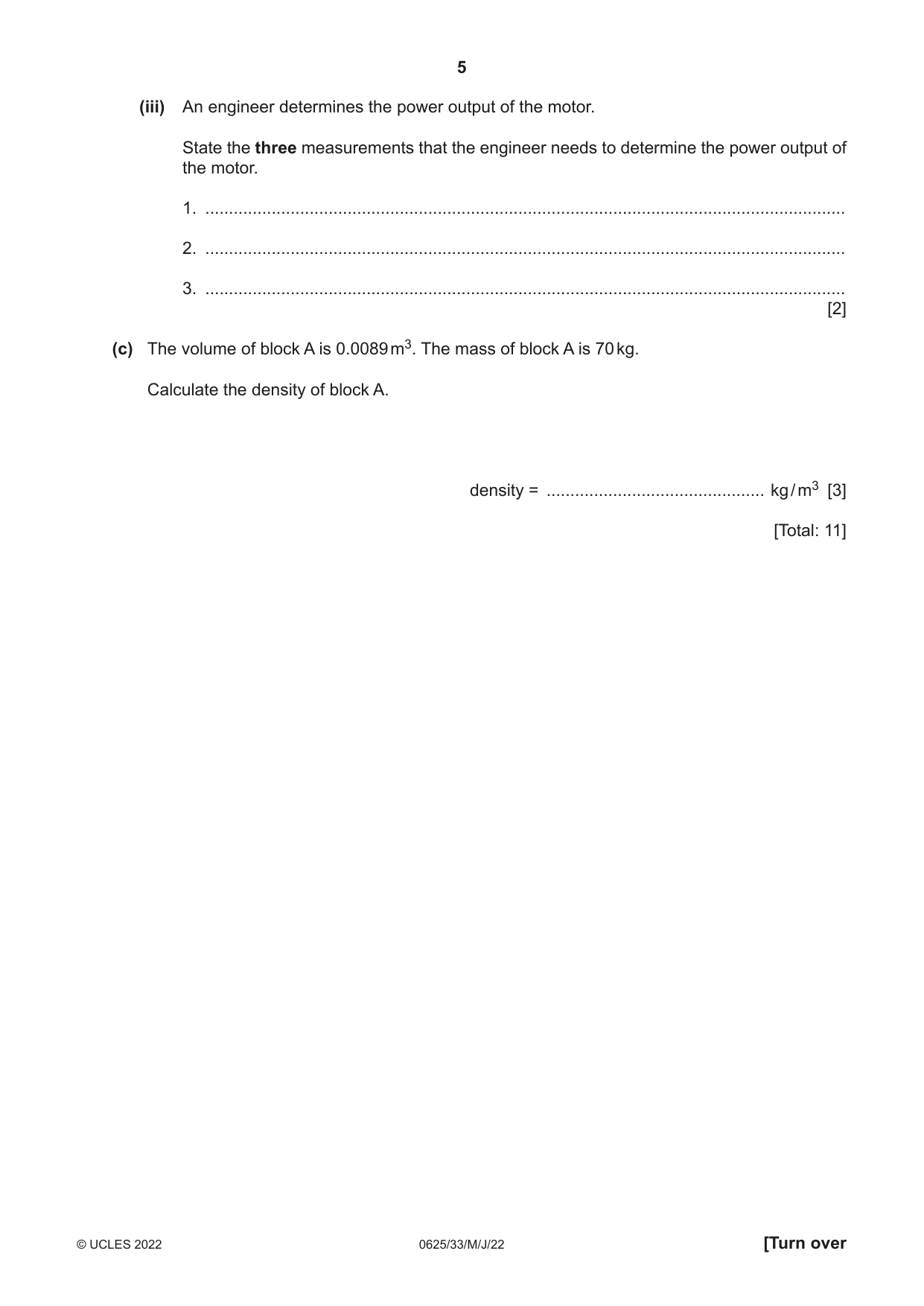
2 Fig. 2.1 shows two identical metal blocks, A and B, being lifted 3.0 m from ground level. Block A is lifted by a motor. Block B is lifted by a person. block A block B mass = 70 kg mass = 70 kg 3.0 m ground electric level motor Fig. 2.1 (a) Complete the following sentences. (i) As the motor starts turning, it usefully transfers ............................................... energy to ............................................... energy. [2] (ii) Both blocks gain ............................................... energy. [1] (b) Both blocks are lifted at the same steady speed. The blocks are then held at a height of 3.0 m. (i) Compare the energy gained by block A with the energy gained by block B. ..................................................................................................................................... [1] (ii) Explain why the energy input to the motor is more than the energy gained by block A. ........................................................................................................................................... ........................................................................................................................................... ..................................................................................................................................... [2] (iii) An engineer determines the power output of the motor. State the three measurements that the engineer needs to determine the power output of the motor. 1. ....................................................................................................................................... 2. ....................................................................................................................................... 3. ....................................................................................................................................... [2] (c) The volume of block A is 0.0089 m3. The mass of block A is 70 kg. Calculate the density of block A. density = .............................................. kg / m3 [3] [Total: 11]
Mark scheme: 2(a)(i) electrical B1 (to) kinetic OR (gravitational) potential B1 2(a)(ii) (gravitational) potential B1 2(b)(i) same B1 2(b)(ii) any two from the following: energy transferred to surroundings thermal (energy) / heat lost work done against friction motor less than 100% efficient B2 Question Answer Marks 2(b)(iii) weight/force/mass AND height/distance moved B1 time B1 2(c) 7900 OR 7870 A3 70 ÷ 0.0089 (C2) (density = ) mass ÷ volume in any form (C1)
Q3 · A vehicle that is designed to travel on snow
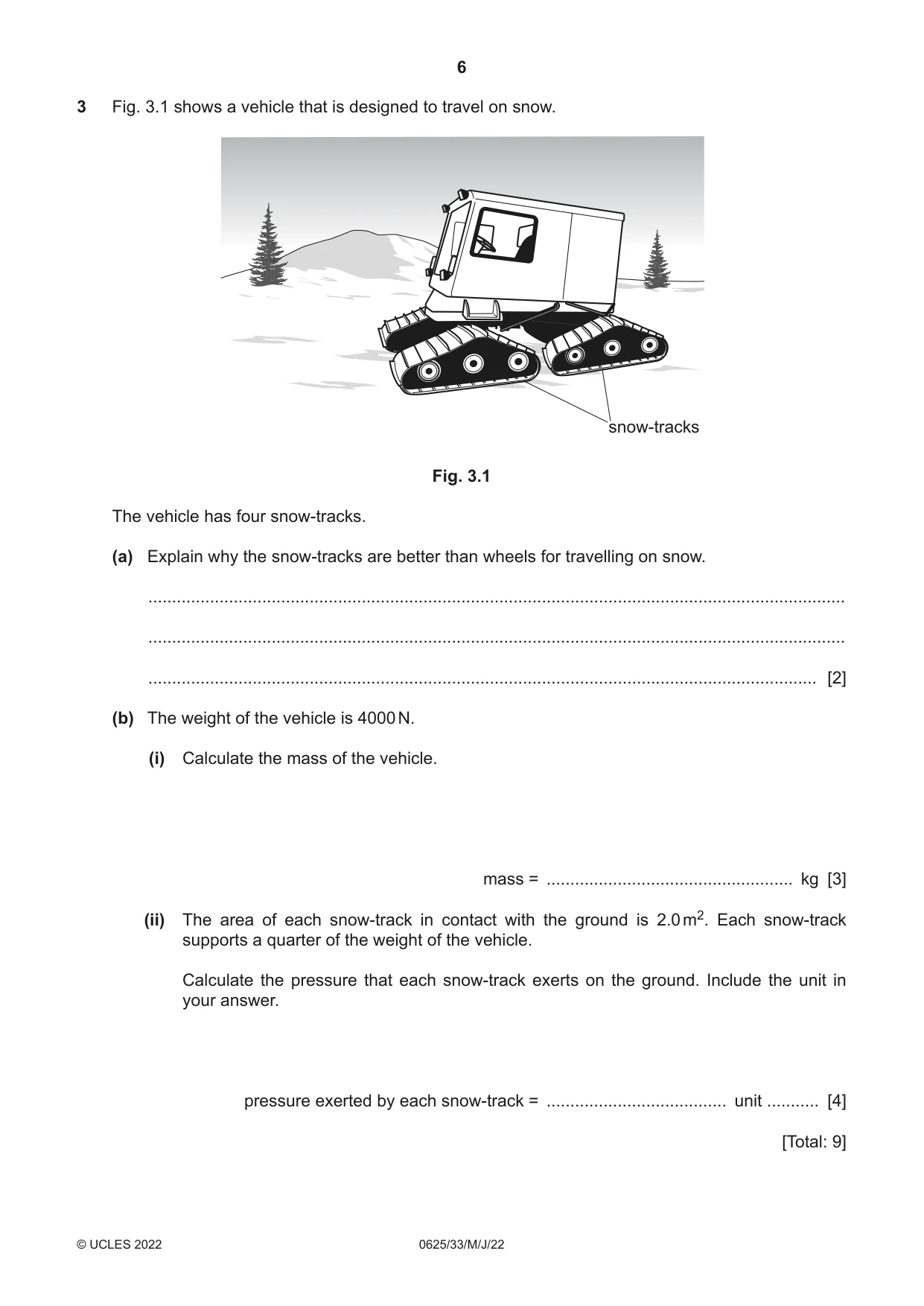
3 Fig. 3.1 shows a vehicle that is designed to travel on snow. snow-tracks Fig. 3.1 The vehicle has four snow-tracks. (a) Explain why the snow-tracks are better than wheels for travelling on snow. ................................................................................................................................................... ................................................................................................................................................... ............................................................................................................................................. [2] (b) The weight of the vehicle is 4000 N. (i) Calculate the mass of the vehicle. mass = .................................................... kg [3] (ii) The area of each snow-track in contact with the ground is 2.0 m2. Each snow-track supports a quarter of the weight of the vehicle. Calculate the pressure that each snow-track exerts on the ground. Include the unit in your answer. pressure exerted by each snow-track = ...................................... unit ........... [4] [Total: 9]
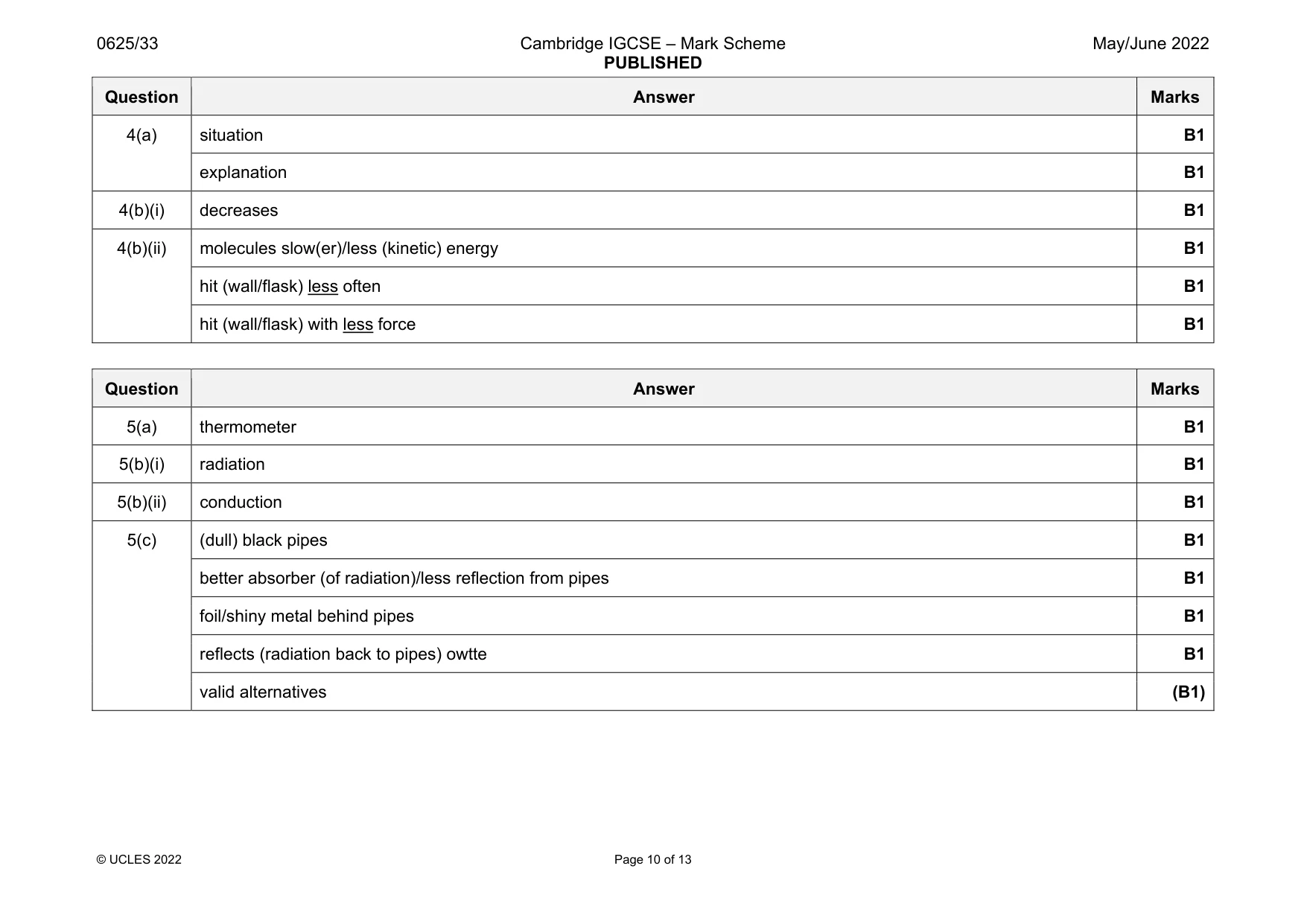
Mark scheme: 3(a) any two from larger area lower pressure (on ground) does not sink in 3(b)(i) 400 A3 4000 ÷ 10 OR 4000 ÷ 9.8 (C2) (mass =) weight ÷ g OR weight ÷ 10 weight ÷ 9.8 in any form (C1) 3(b)(ii) 500 A3 1000 ÷ 2.0 OR 4000 ÷ (4 2.0) (C2) (pressure = ) force ÷ area in any form (C1) N / m2 OR Pa B1
Q4 · State and explain one application of thermal expansion
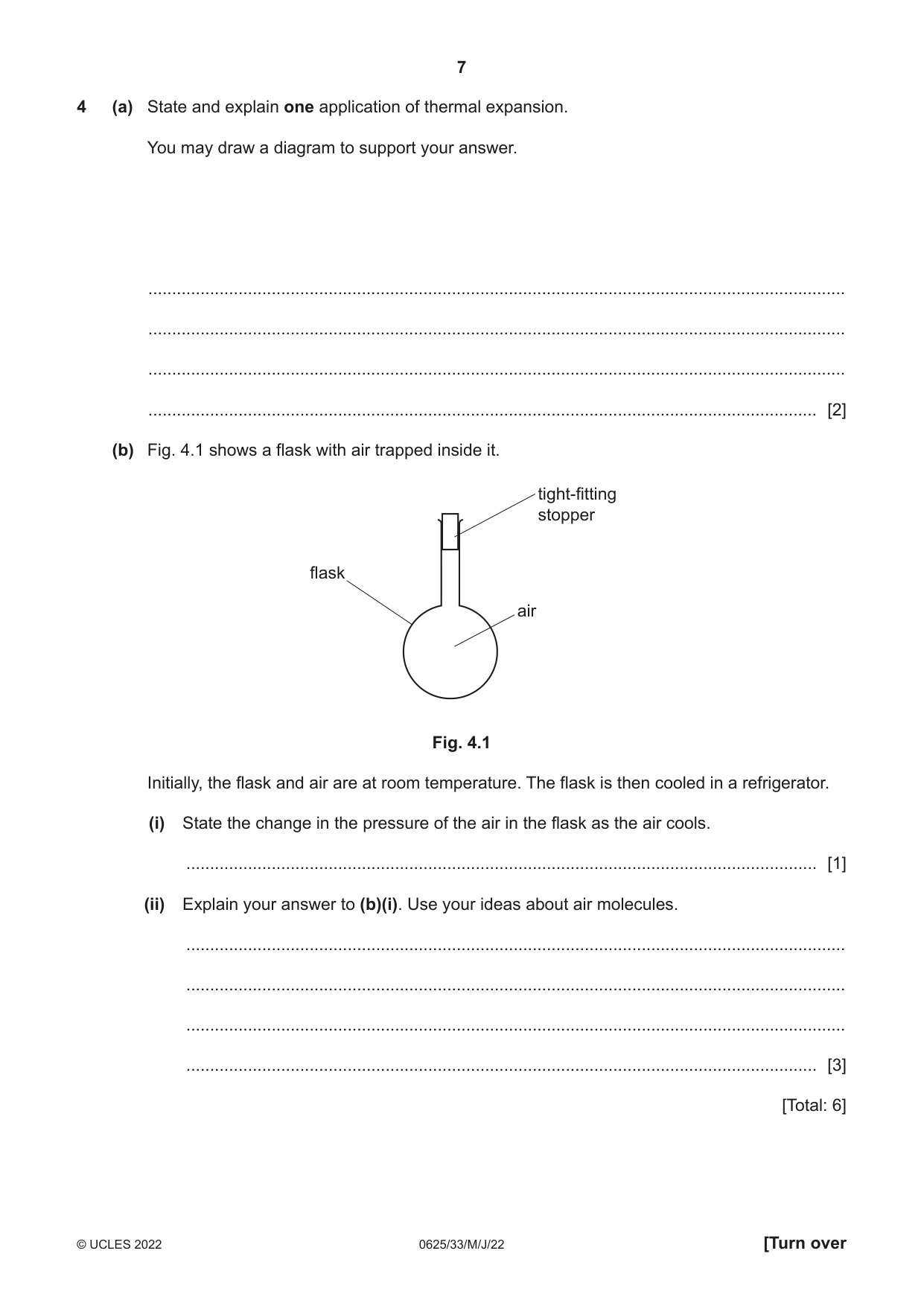
4 (a) State and explain one application of thermal expansion. You may draw a diagram to support your answer. ................................................................................................................................................... ................................................................................................................................................... ................................................................................................................................................... ............................................................................................................................................. [2] (b) Fig. 4.1 shows a flask with air trapped inside it. tight-fitting stopper flask air Fig. 4.1 Initially, the flask and air are at room temperature. The flask is then cooled in a refrigerator. (i) State the change in the pressure of the air in the flask as the air cools. ..................................................................................................................................... [1] (ii) Explain your answer to (b)(i). Use your ideas about air molecules. ........................................................................................................................................... ........................................................................................................................................... ........................................................................................................................................... ..................................................................................................................................... [3] [Total: 6]
Mark scheme: 4(a) situation B1 explanation B1 4(b)(i) decreases B1 4(b)(ii) molecules slow(er)/less (kinetic) energy B1 hit (wall/flask) less often B1 hit (wall/flask) with less force B1
Q5 · An engineer makes a device that absorbs thermal energy from the Sun
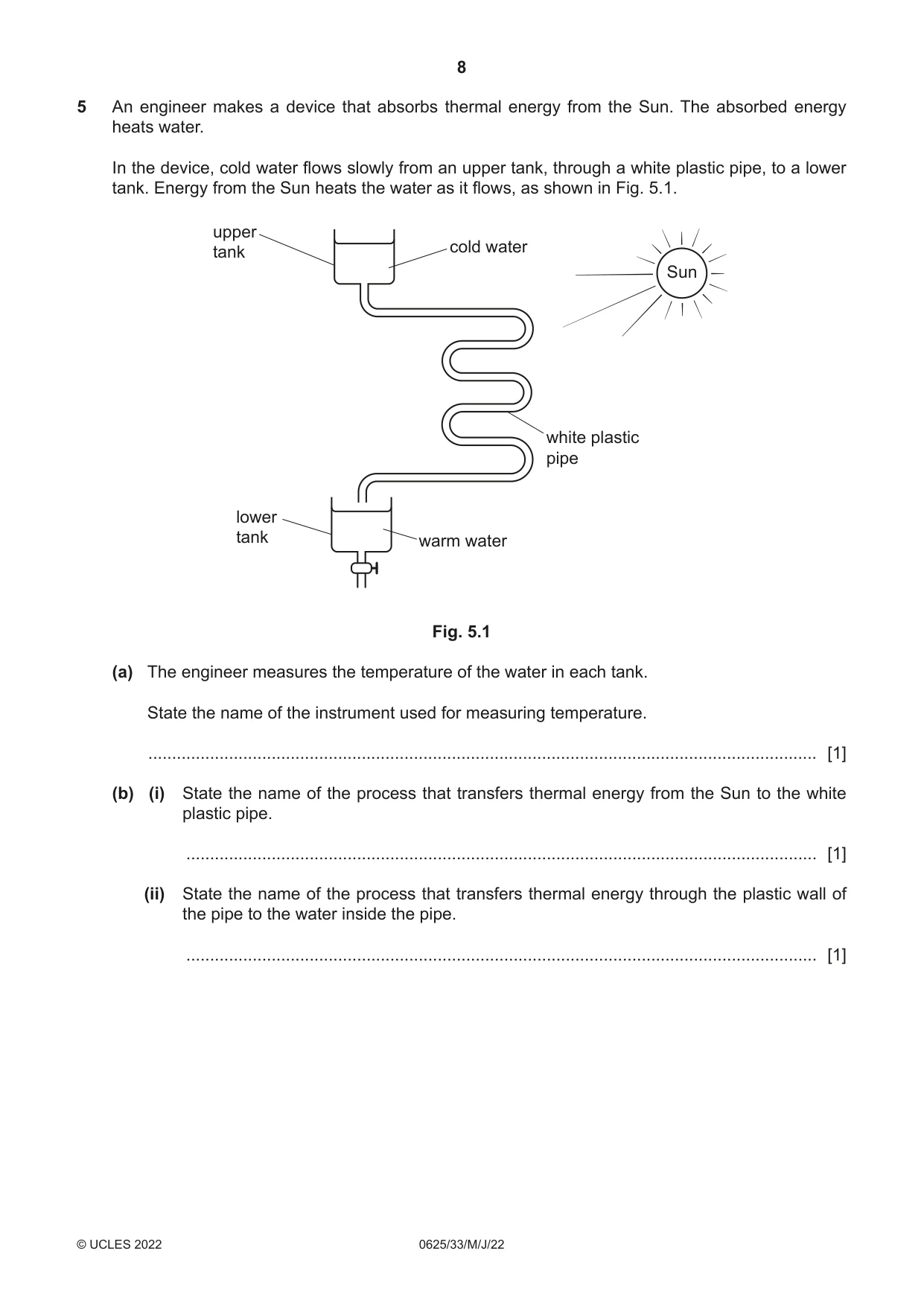
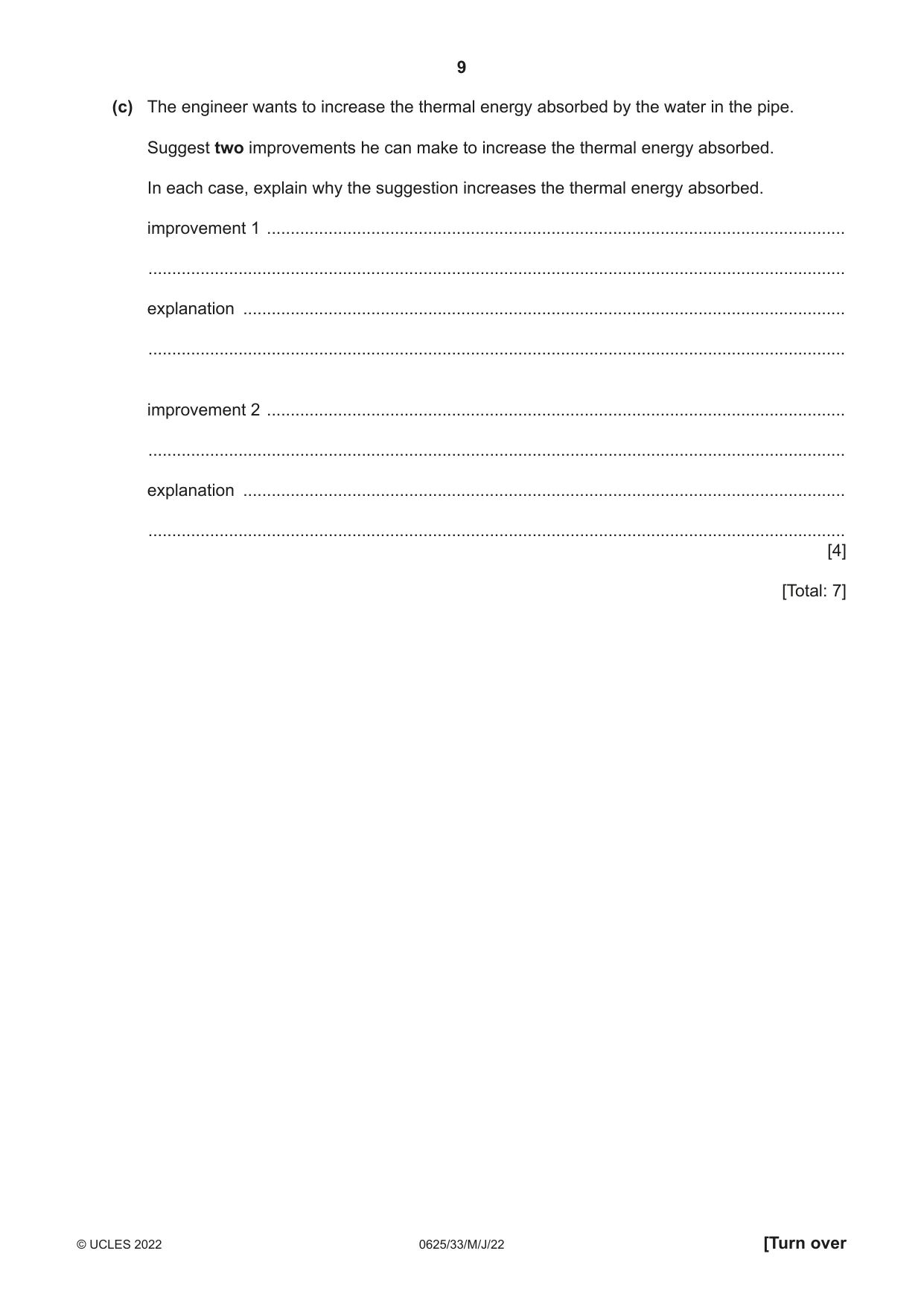
5 An engineer makes a device that absorbs thermal energy from the Sun. The absorbed energy heats water. In the device, cold water flows slowly from an upper tank, through a white plastic pipe, to a lower tank. Energy from the Sun heats the water as it flows, as shown in Fig. 5.1. upper cold water tank Sun white plastic pipe lower tank warm water Fig. 5.1 (a) The engineer measures the temperature of the water in each tank. State the name of the instrument used for measuring temperature. ............................................................................................................................................. [1] (b) (i) State the name of the process that transfers thermal energy from the Sun to the white plastic pipe. ..................................................................................................................................... [1] (ii) State the name of the process that transfers thermal energy through the plastic wall of the pipe to the water inside the pipe. ..................................................................................................................................... [1] (c) The engineer wants to increase the thermal energy absorbed by the water in the pipe. Suggest two improvements he can make to increase the thermal energy absorbed. In each case, explain why the suggestion increases the thermal energy absorbed. improvement 1 .......................................................................................................................... ................................................................................................................................................... explanation ............................................................................................................................... ................................................................................................................................................... improvement 2 .......................................................................................................................... ................................................................................................................................................... explanation ............................................................................................................................... ................................................................................................................................................... [4] [Total: 7]
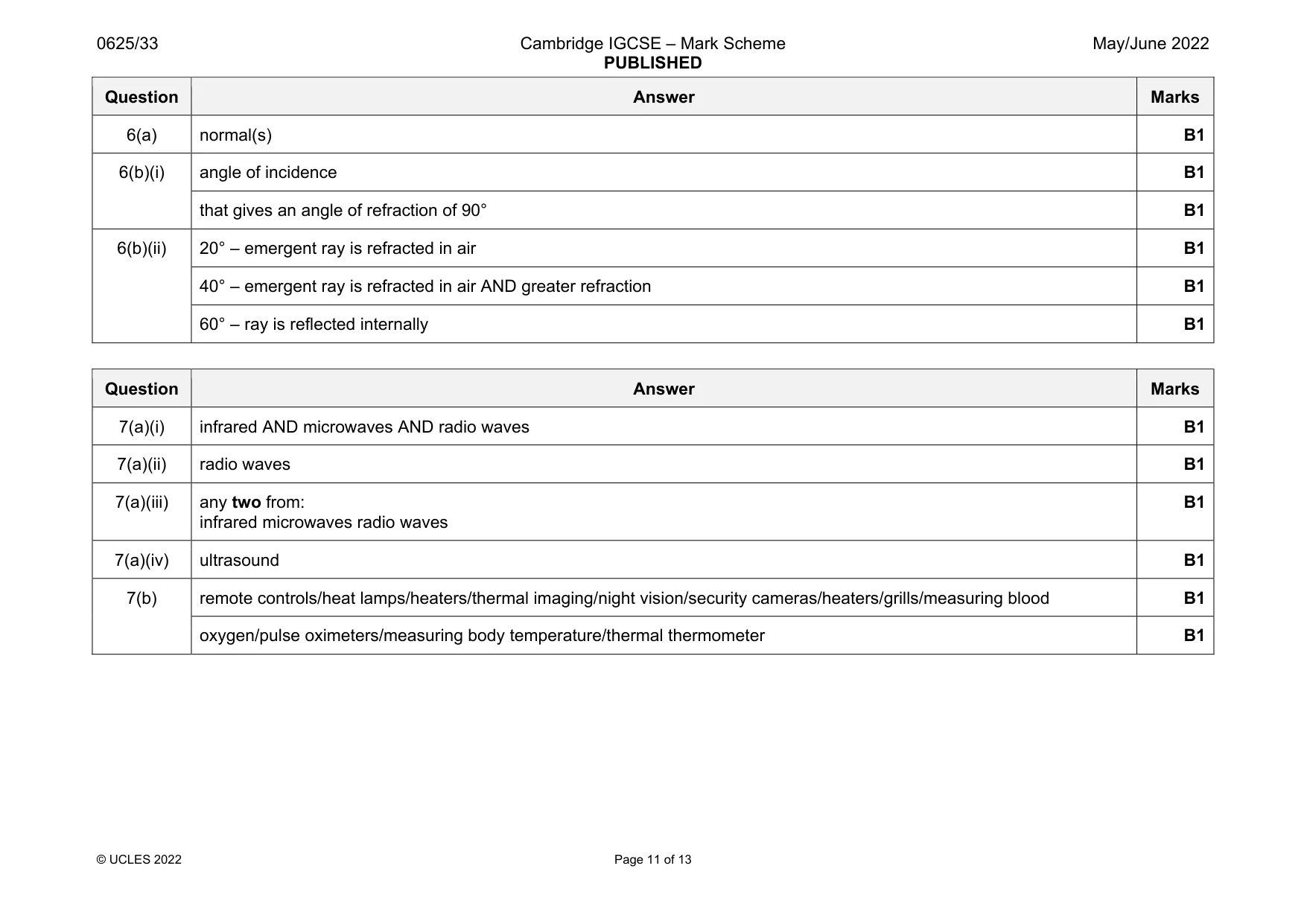
Mark scheme: 5(a) thermometer B1 5(b)(i) radiation B1 5(b)(ii) conduction B1 5(c) (dull) black pipes B1 better absorber (of radiation)/less reflection from pipes B1 foil/shiny metal behind pipes B1 reflects (radiation back to pipes) owtte B1 valid alternatives (B1)
Q6 · A diver is swimming under water
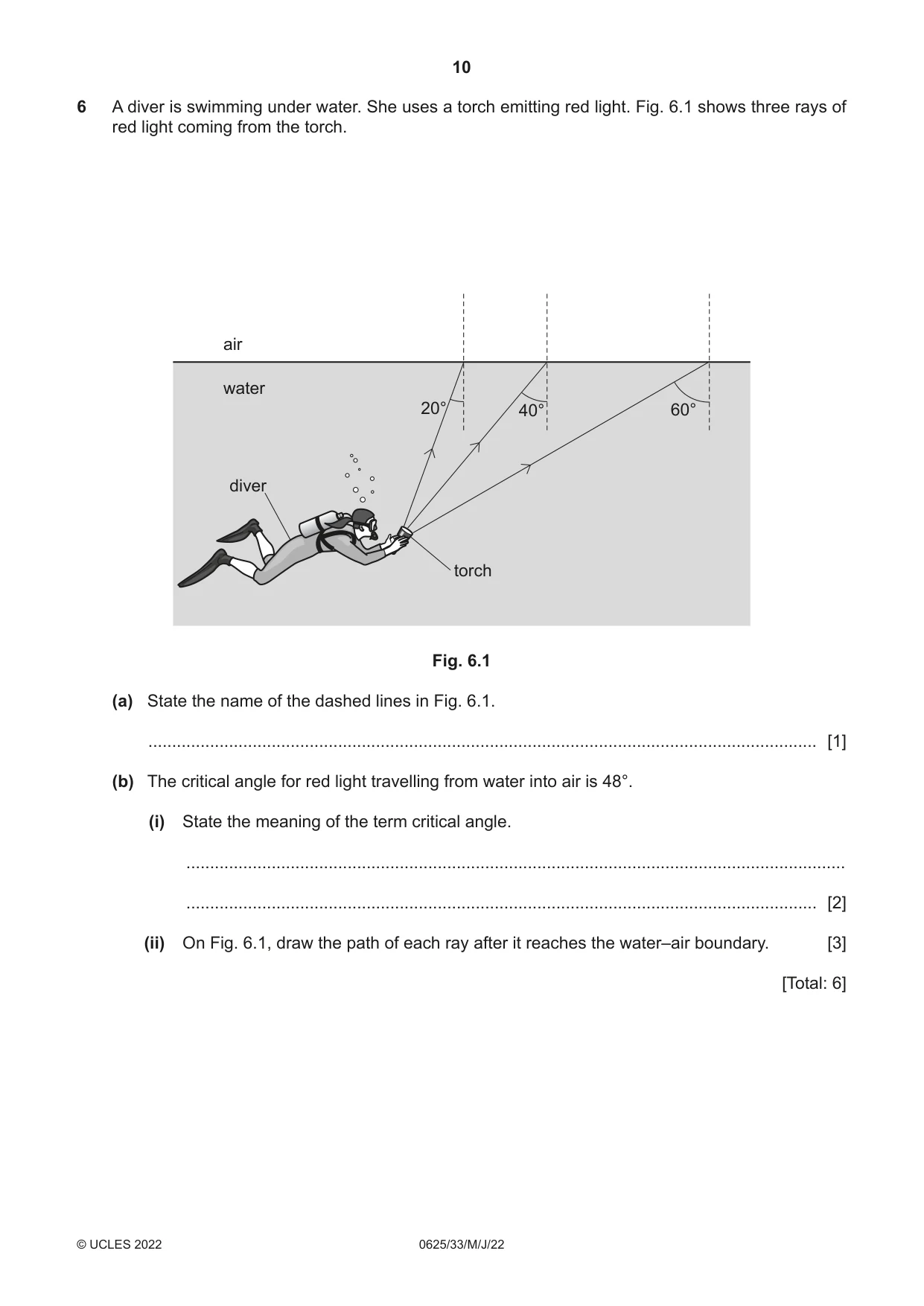
6 A diver is swimming under water. She uses a torch emitting red light. Fig. 6.1 shows three rays of red light coming from the torch. air water 20° 40° 60° diver torch Fig. 6.1 (a) State the name of the dashed lines in Fig. 6.1. ............................................................................................................................................. [1] (b) The critical angle for red light travelling from water into air is 48°. (i) State the meaning of the term critical angle. ........................................................................................................................................... ..................................................................................................................................... [2] (ii) On Fig. 6.1, draw the path of each ray after it reaches the water–air boundary. [3] [Total: 6]
Mark scheme: 6(a) normal(s) B1 6(b)(i) angle of incidence B1 that gives an angle of refraction of 90° B1 6(b)(ii) 20° – emergent ray is refracted in air B1 40° – emergent ray is refracted in air AND greater refraction B1 60° – ray is reflected internally B1
Q7 · This question is about the following four types of wave
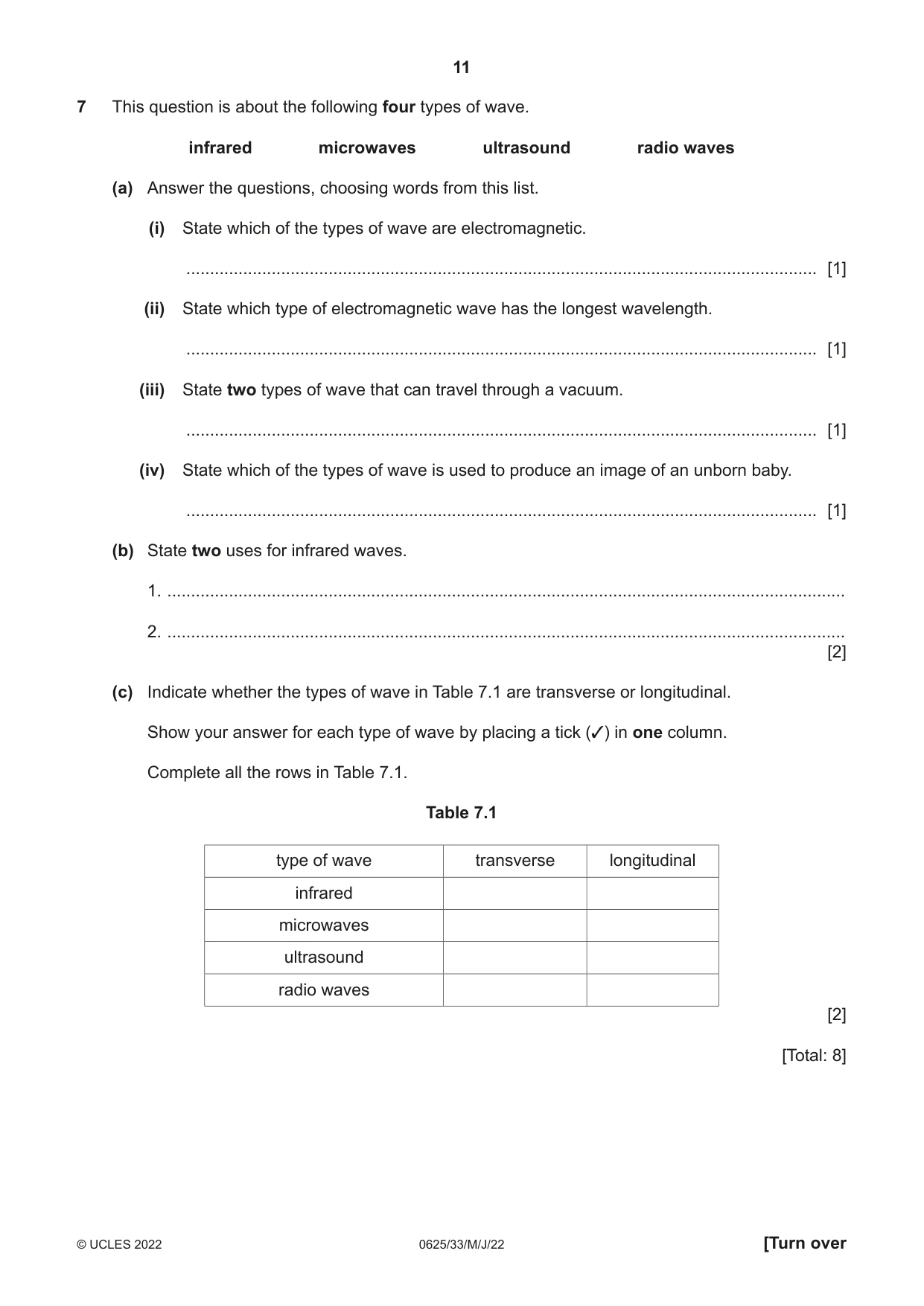
7 This question is about the following four types of wave. infrared microwaves ultrasound radio waves (a) Answer the questions, choosing words from this list. (i) State which of the types of wave are electromagnetic. ..................................................................................................................................... [1] (ii) State which type of electromagnetic wave has the longest wavelength. ..................................................................................................................................... [1] (iii) State two types of wave that can travel through a vacuum. ..................................................................................................................................... [1] (iv) State which of the types of wave is used to produce an image of an unborn baby. ..................................................................................................................................... [1] (b) State two uses for infrared waves. 1. ............................................................................................................................................... 2. ............................................................................................................................................... [2] (c) Indicate whether the types of wave in Table 7.1 are transverse or longitudinal. Show your answer for each type of wave by placing a tick (3) in one column. Complete all the rows in Table 7.1. Table 7.1 type of wave transverse longitudinal infrared microwaves ultrasound radio waves [2] [Total: 8]
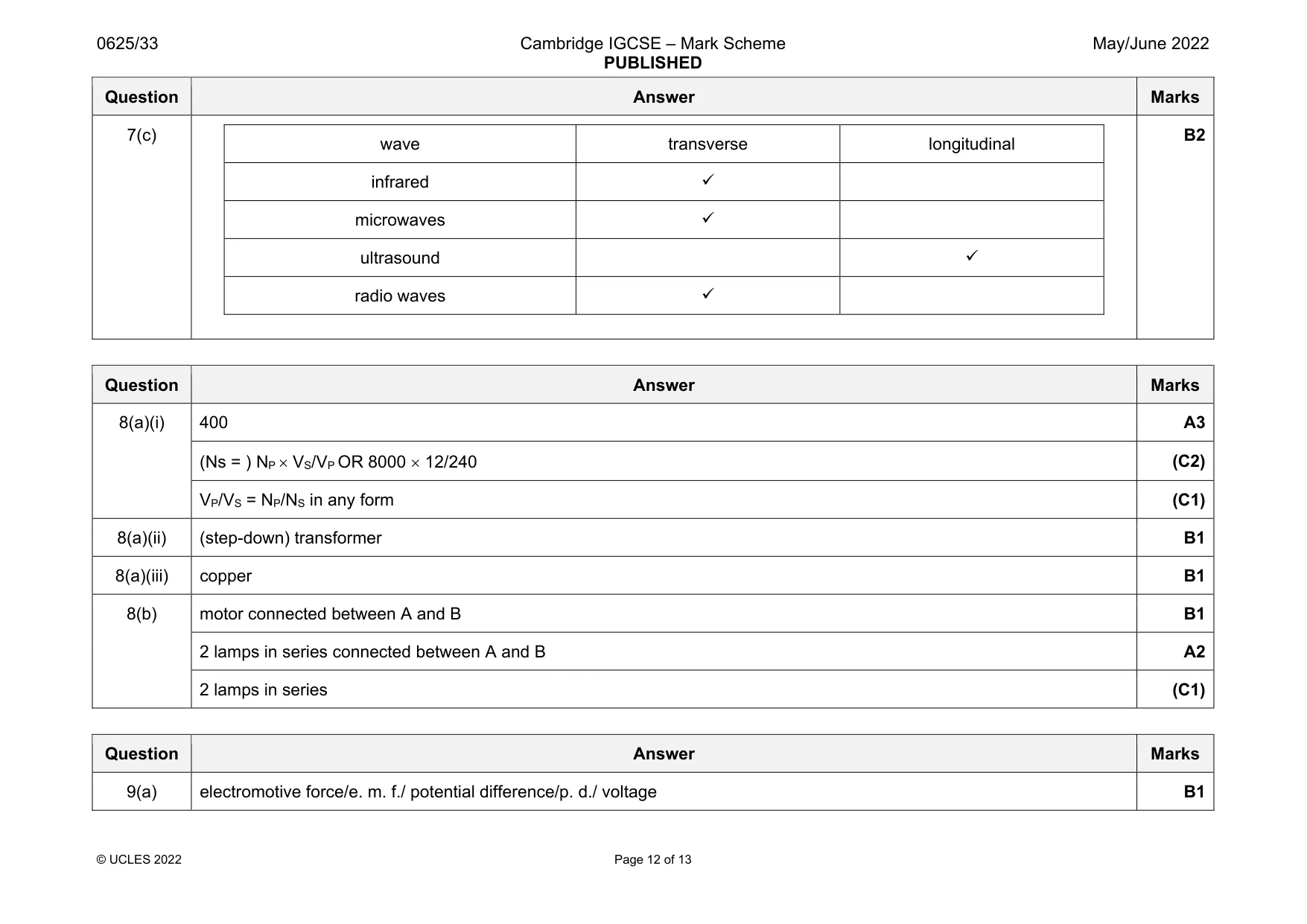
Mark scheme: 7(a)(i) infrared AND microwaves AND radio waves B1 7(a)(ii) radio waves B1 7(a)(iii) any two from: infrared microwaves radio waves B1 7(a)(iv) ultrasound B1 7(b) remote controls/heat lamps/heaters/thermal imaging/night vision/security cameras/heaters/grills/measuring blood B1 oxygen/pulse oximeters/measuring body temperature/thermal thermometer B1 Question Answer Marks 7(c) wave transverse longitudinal infrared microwaves ultrasound radio waves B2
Q8 · The device in Fig
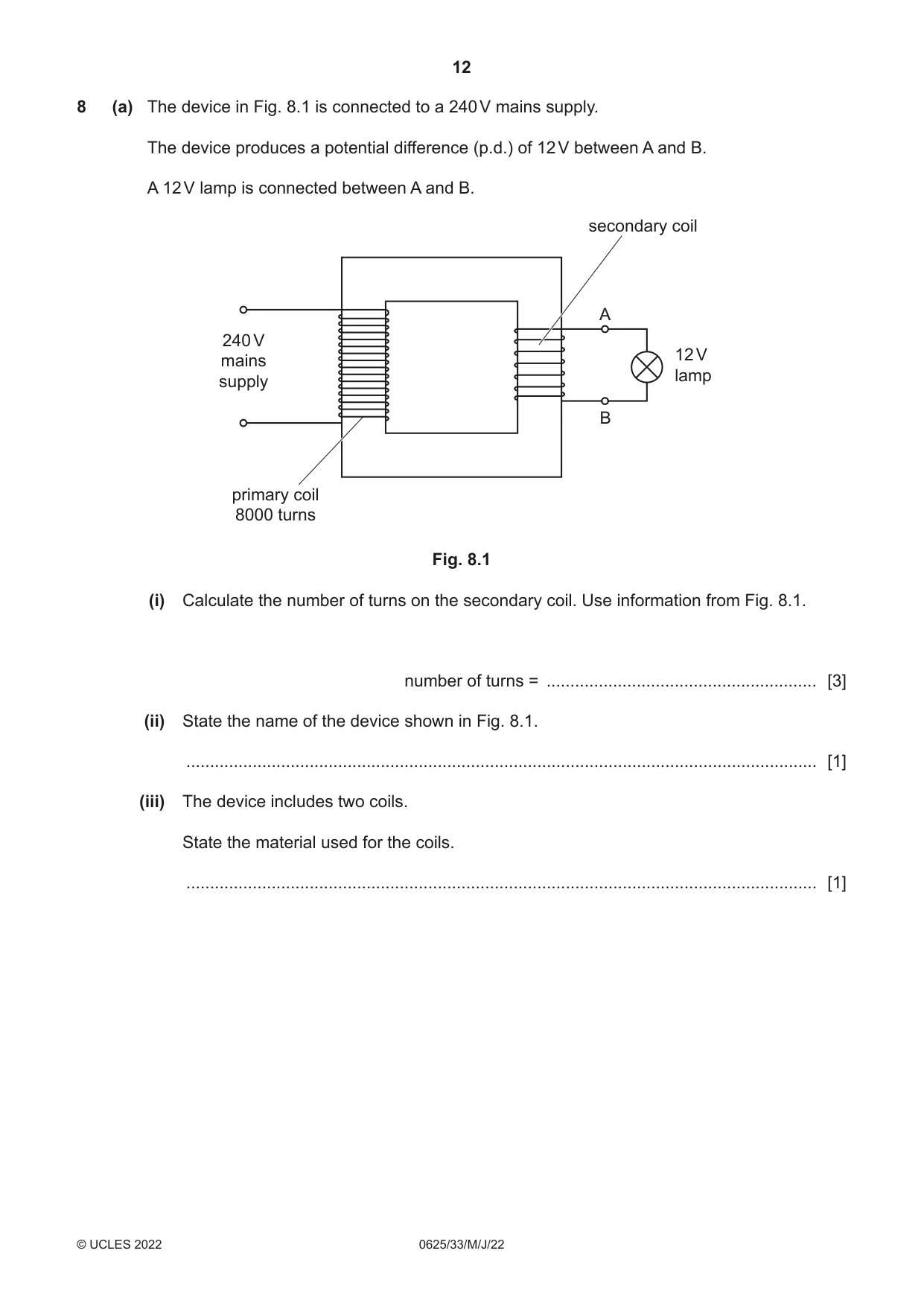
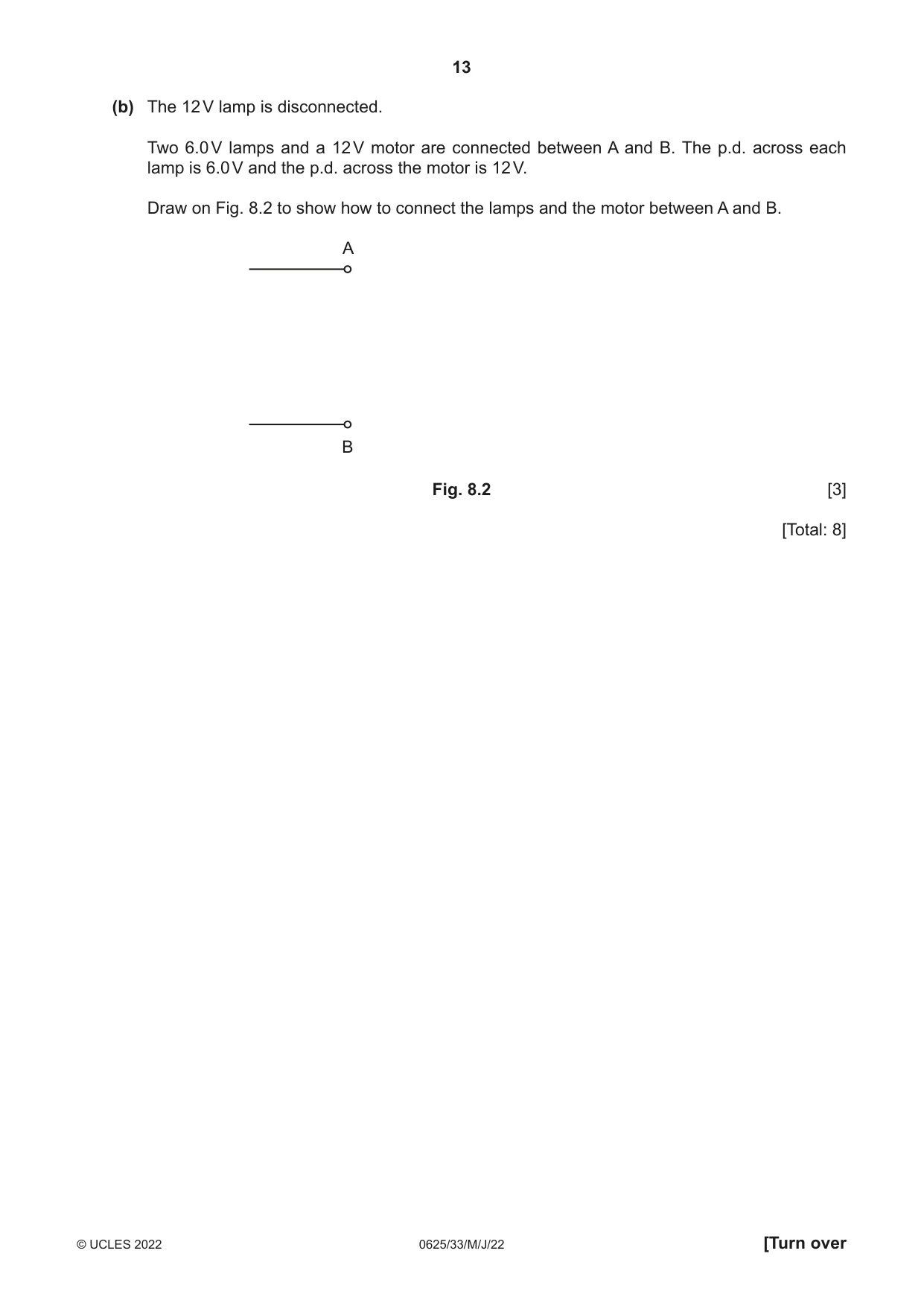
8 (a) The device in Fig. 8.1 is connected to a 240 V mains supply. The device produces a potential difference (p.d.) of 12 V between A and B. A 12 V lamp is connected between A and B. secondary coil A 240 V 12 V mains lamp supply B primary coil 8000 turns Fig. 8.1 (i) Calculate the number of turns on the secondary coil. Use information from Fig. 8.1. number of turns = ......................................................... [3] (ii) State the name of the device shown in Fig. 8.1. ..................................................................................................................................... [1] (iii) The device includes two coils. State the material used for the coils. ..................................................................................................................................... [1] (b) The 12 V lamp is disconnected. Two 6.0 V lamps and a 12 V motor are connected between A and B. The p.d. across each lamp is 6.0 V and the p.d. across the motor is 12 V. Draw on Fig. 8.2 to show how to connect the lamps and the motor between A and B. A B Fig. 8.2 [3] [Total: 8]
Mark scheme: 8(a)(i) 400 A3 (Ns = ) NP VS/VP OR 8000 12/240 (C2) VP/VS = NP/NS in any form (C1) 8(a)(ii) (step-down) transformer B1 8(a)(iii) copper B1 8(b) motor connected between A and B B1 2 lamps in series connected between A and B A2 2 lamps in series (C1)
Q9 · The circuit in Fig
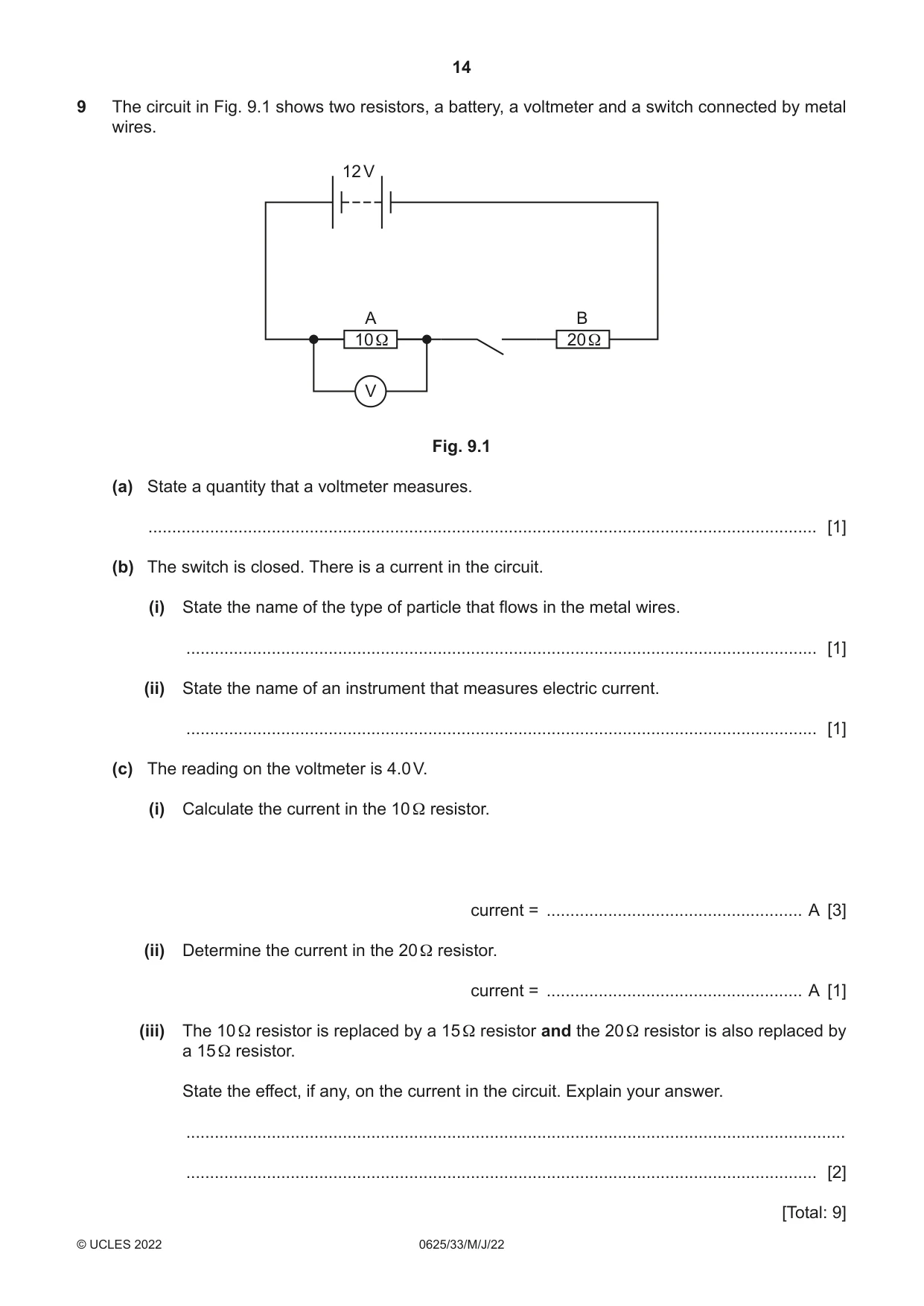
9 The circuit in Fig. 9.1 shows two resistors, a battery, a voltmeter and a switch connected by metal wires. 12 V A B 10Ω 20Ω V Fig. 9.1 (a) State a quantity that a voltmeter measures. ............................................................................................................................................. [1] (b) The switch is closed. There is a current in the circuit. (i) State the name of the type of particle that flows in the metal wires. ..................................................................................................................................... [1] (ii) State the name of an instrument that measures electric current. ..................................................................................................................................... [1] (c) The reading on the voltmeter is 4.0 V. (i) Calculate the current in the 10 Ω resistor. current = ...................................................... A [3] (ii) Determine the current in the 20 Ω resistor. current = ...................................................... A [1] (iii) The 10 Ω resistor is replaced by a 15 Ω resistor and the 20 Ω resistor is also replaced by a 15 Ω resistor. State the effect, if any, on the current in the circuit. Explain your answer. ........................................................................................................................................... ..................................................................................................................................... [2] [Total: 9]
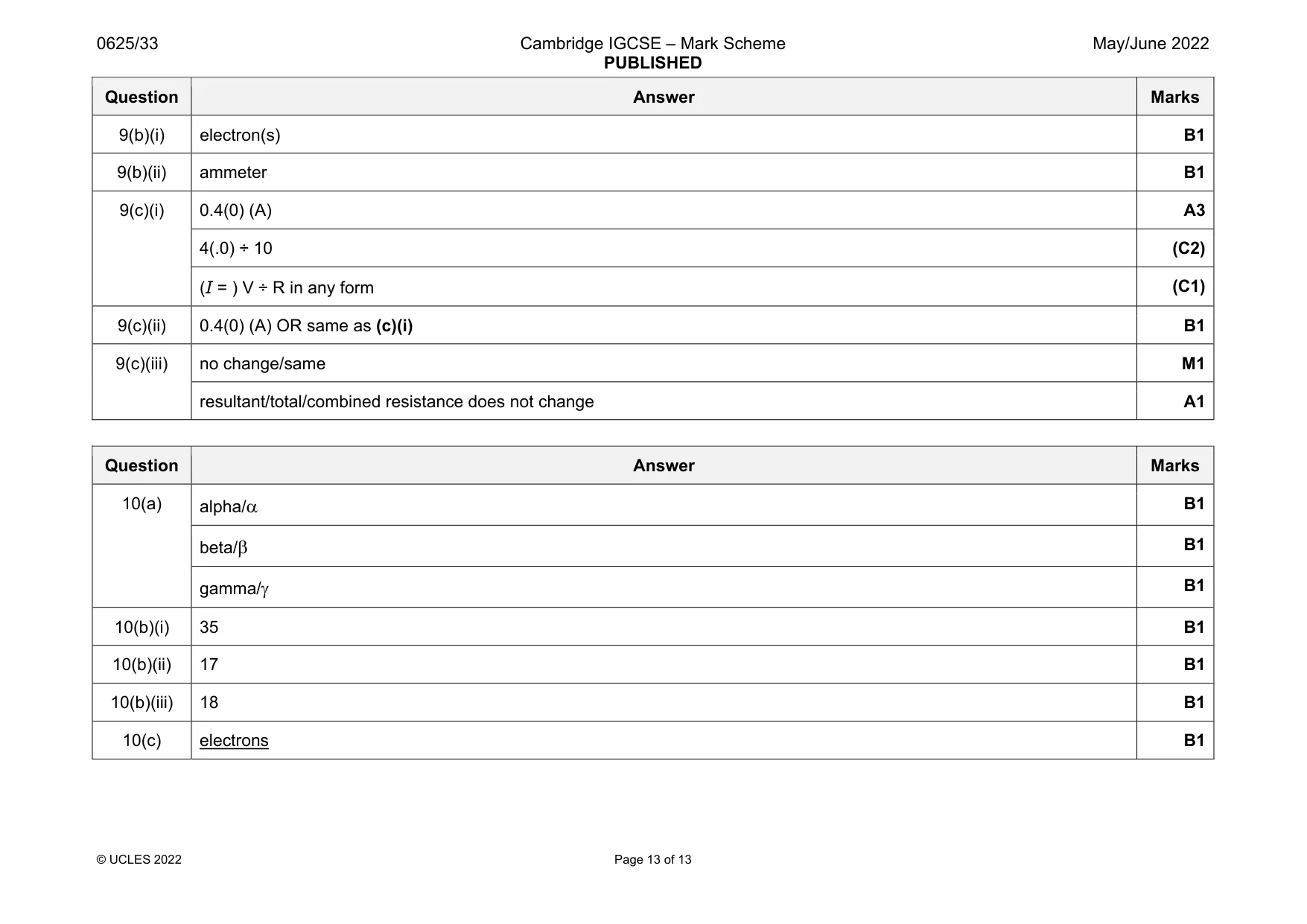
Mark scheme: 9(a) electromotive force/e. m. f./ potential difference/p. d./ voltage B1 Question Answer Marks 9(b)(i) electron(s) B1 9(b)(ii) ammeter B1 9(c)(i) 0.4(0) (A) A3 4(.0) ÷ 10 (C2) (I = ) V ÷ R in any form (C1) 9(c)(ii) 0.4(0) (A) OR same as (c)(i) B1 9(c)(iii) no change/same M1 resultant/total/combined resistance does not change A1
Q10 · State the names of three types of radioactive emission
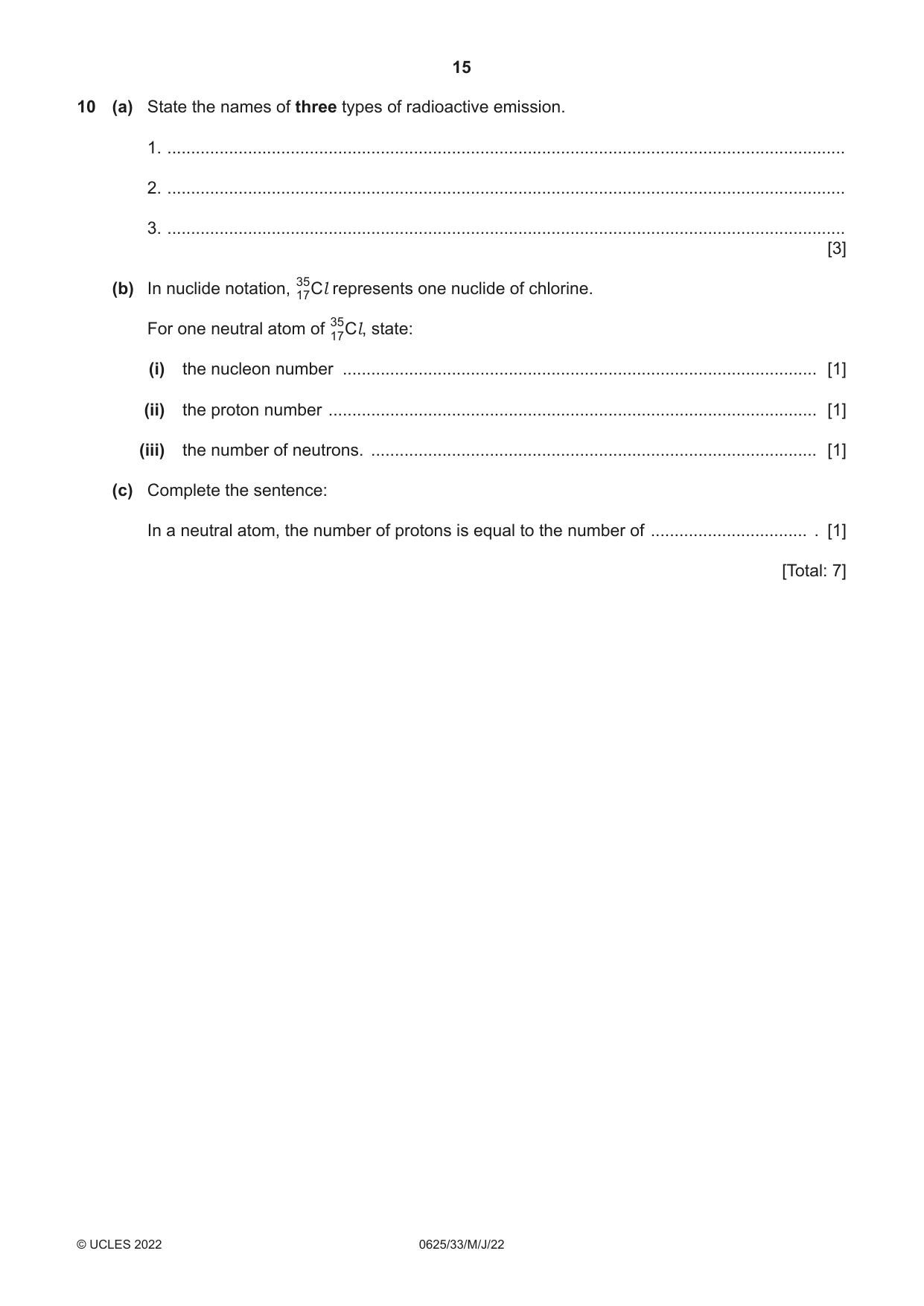
10 (a) State the names of three types of radioactive emission. 1. ............................................................................................................................................... 2. ............................................................................................................................................... 3. ............................................................................................................................................... [3] (b) In nuclide notation, 3517Cl represents one nuclide of chlorine. For one neutral atom of 3517Cl, state: (i) the nucleon number .................................................................................................... [1] (ii) the proton number ....................................................................................................... [1] (iii) the number of neutrons. .............................................................................................. [1] (c) Complete the sentence: In a neutral atom, the number of protons is equal to the number of ................................. . [1] [Total: 7]
Mark scheme: 10(a) B1 beta/ B1 gamma/ B1 10(b)(i) 35 B1 10(b)(ii) 17 B1 10(b)(iii) 18 B1 10(c) electrons B1
What was in this paper
The subtopics covered by these 10 questions, and how many questions each got. Open one in a new tab to see every Cambridge question on it.
What you needed in this session
Cambridge’s own grade thresholds for 2022 May/June, Paper 3 · Variant 3. A higher threshold means an easier paper — the bar moves with how the cohort did.