Cambridge IGCSE Physics 0625 — 2011 May/June Paper 3 · Variant 1
0625/31/M/J/11 · 11 questions · 80 marks · ≈90 min
The question paper and its mark scheme, free to read here and free to download. This is Cambridge’s own paper, exactly as it was sat.
Question paper20 pages
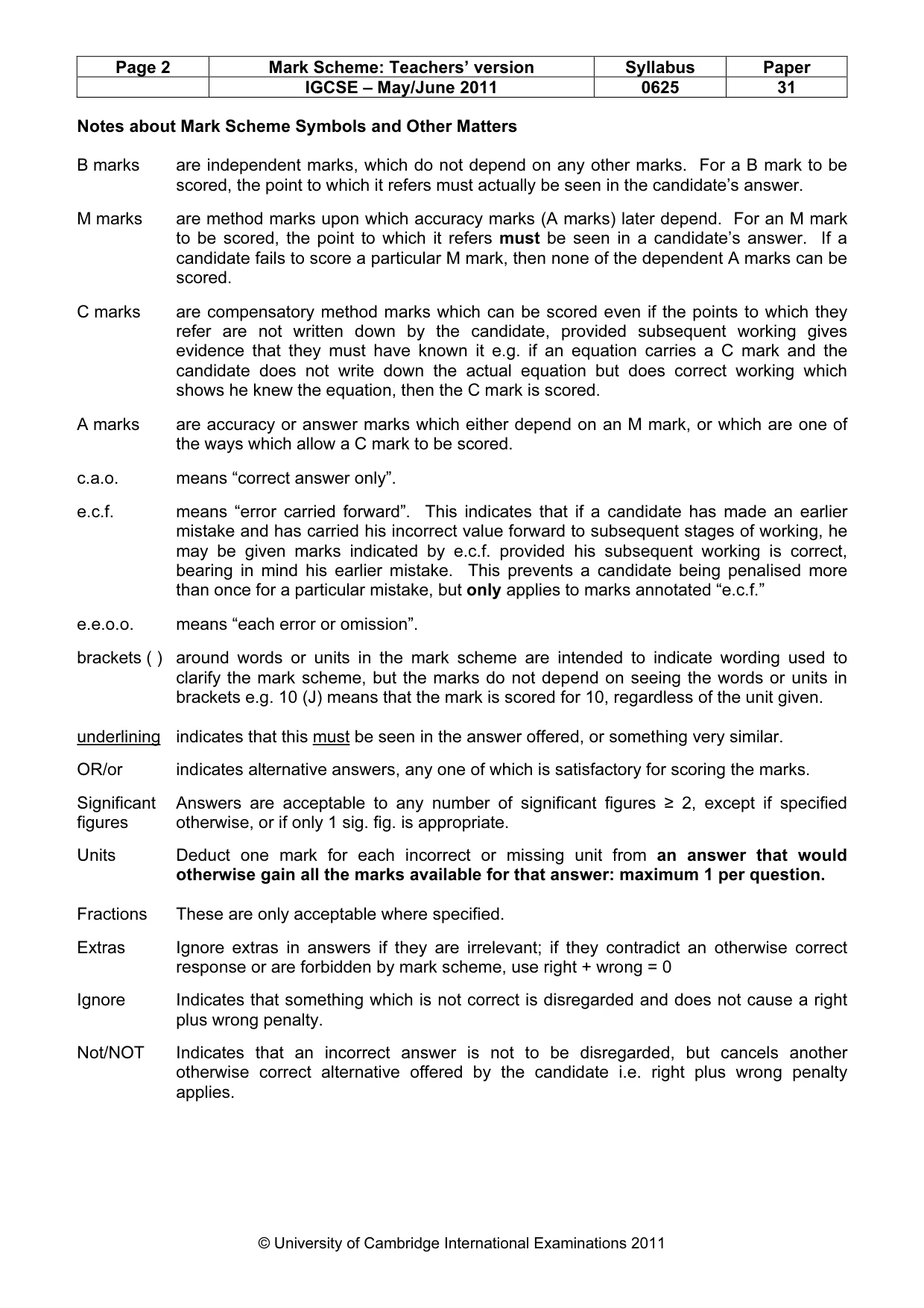
Mark scheme7 pages
Answers below. Sit the paper first if you are practising.
Questions as text
Q1 · In a laboratory, an experiment is carried out to measure the acceleration of a trolley on…
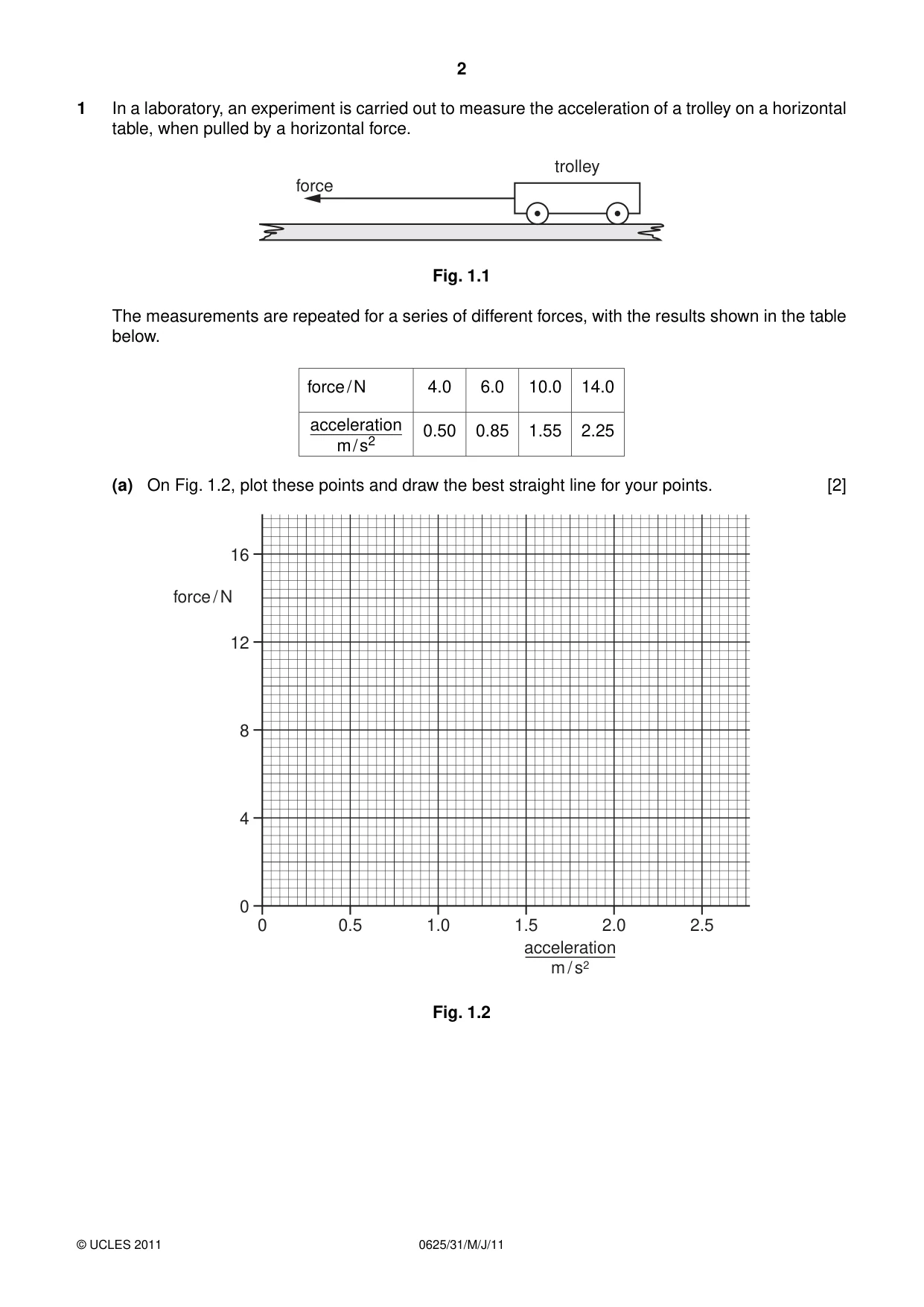
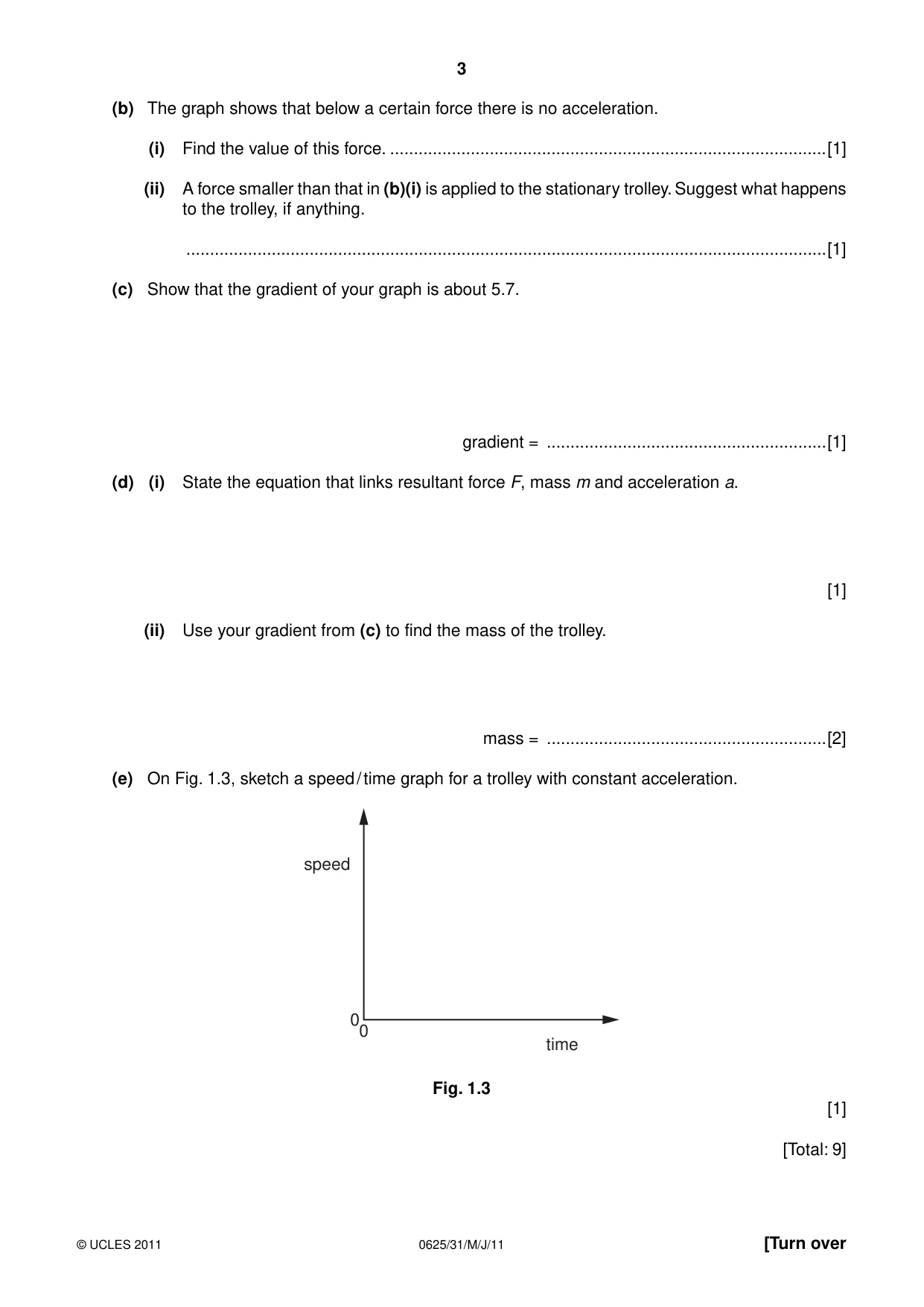
1 In a laboratory, an experiment is carried out to measure the acceleration of a trolley on a horizontal table, when pulled by a horizontal force. trolley force Fig. 1.1 The measurements are repeated for a series of different forces, with the results shown in the table below. force / N 4.0 6.0 10.0 14.0 acceleration 0.50 0.85 1.55 2.25 m / s2 (a) On Fig. 1.2, plot these points and draw the best straight line for your points. [2] 16 force / N 12 8 4 0 0 0.5 1.0 1.5 2.0 2.5 acceleration m / s2 Fig. 1.2 (b) The graph shows that below a certain force there is no acceleration. (i) Find the value of this force. ............................................................................................ [1] (ii) A force smaller than that in (b)(i) is applied to the stationary trolley. Suggest what happens to the trolley, if anything. .......................................................................................................................................[1] (c) Show that the gradient of your graph is about 5.7. gradient = ...........................................................[1] (d) (i) State the equation that links resultant force F, mass m and acceleration a. [1] (ii) Use your gradient from (c) to find the mass of the trolley. mass = ...........................................................[2] (e) On Fig. 1.3, sketch a speed / time graph for a trolley with constant acceleration. speed 0 0 time Fig. 1.3 [1] [Total: 9]
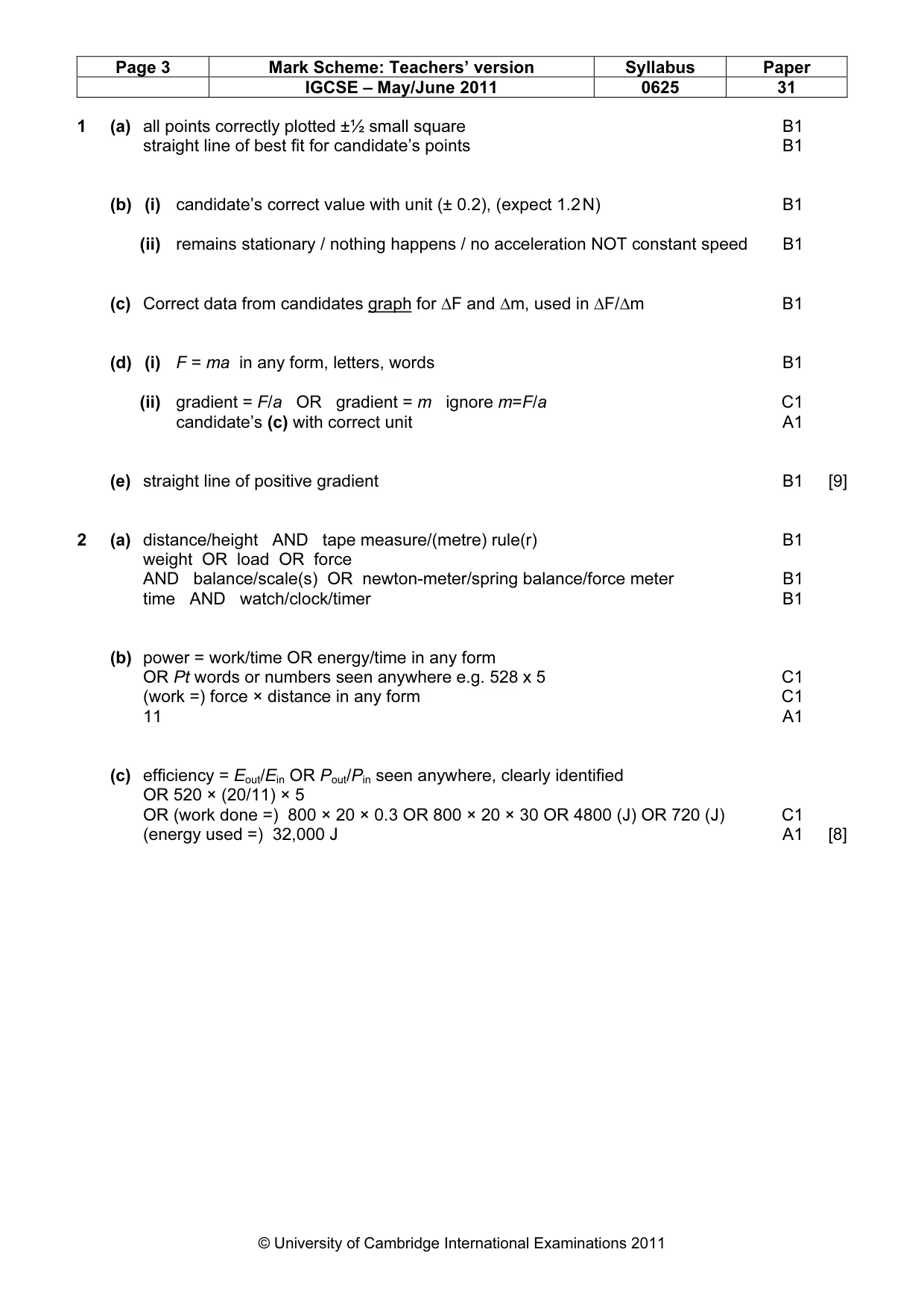
Mark scheme: 1 (a) all points correctly plotted ±½ small square B1 straight line of best fit for candidate’s points B1 (b) (i) candidate’s correct value with unit (± 0.2), (expect 1.2 N) B1 (ii) remains stationary / nothing happens / no acceleration NOT constant speed B1 (c) Correct data from candidates graph for ∆F and ∆m, used in ∆F/∆m B1 (d) (i) F = ma in any form, letters, words B1 (ii) gradient = F/a OR gradient = m ignore m=F/a C1 candidate’s (c) with correct unit A1 (e) straight line of positive gradient B1 [9]
Q2 · Some builders decide to measure their personal power ratings using apparatus they already…
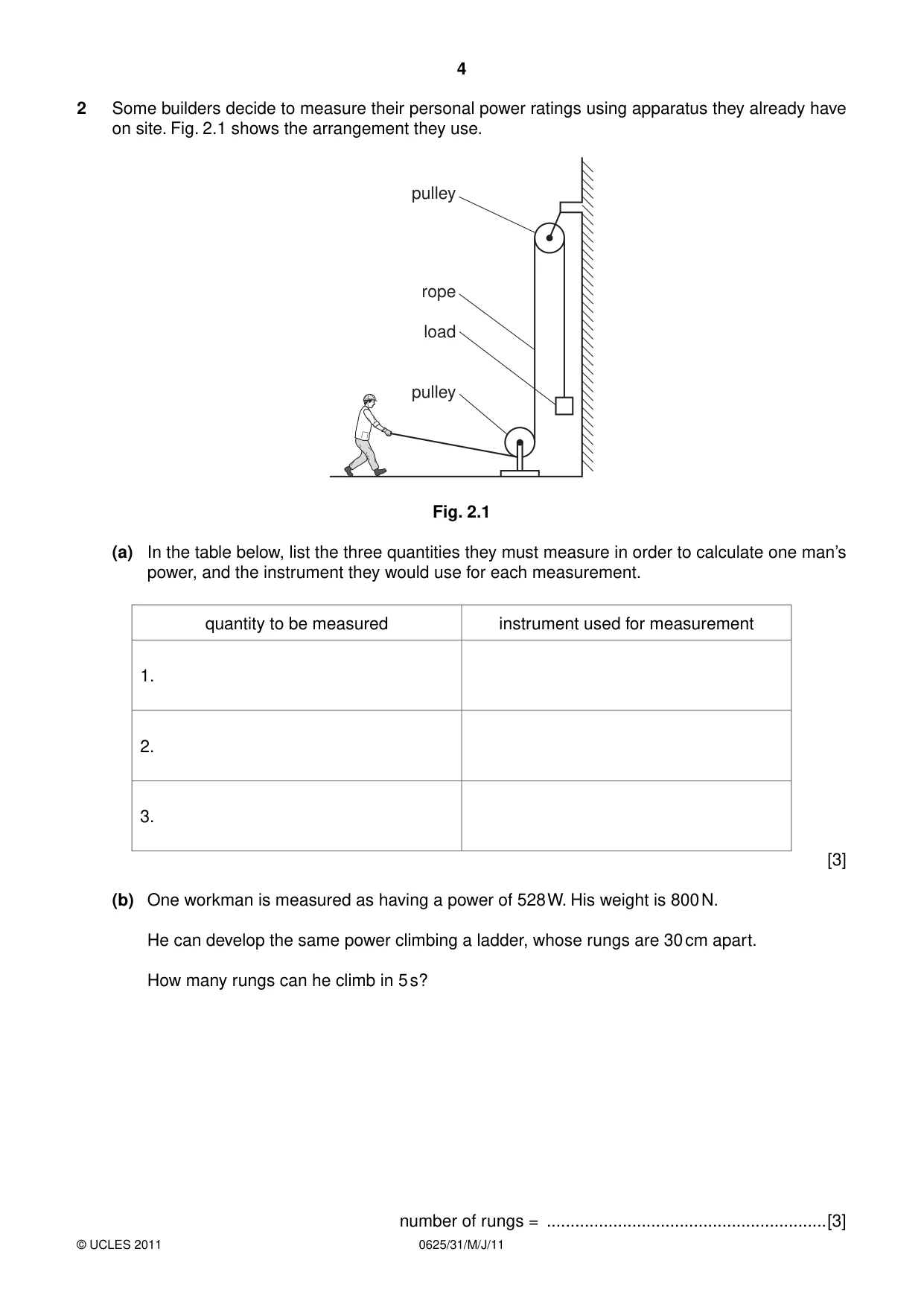
2 Some builders decide to measure their personal power ratings using apparatus they already have on site. Fig. 2.1 shows the arrangement they use. pulley rope load pulley Fig. 2.1 (a) In the table below, list the three quantities they must measure in order to calculate one man’s power, and the instrument they would use for each measurement. quantity to be measured instrument used for measurement 1. 2. 3. [3] (b) One workman is measured as having a power of 528 W. His weight is 800 N. He can develop the same power climbing a ladder, whose rungs are 30 cm apart. How many rungs can he climb in 5 s? number of rungs = ...........................................................[3] (c) The human body is only about 15% efficient when climbing ladders. Calculate the actual energy used from the body of the workman in (b) when he climbs 20 rungs. energy used = ...........................................................[2] [Total: 8]
Mark scheme: 2 (a) distance/height AND tape measure/(metre) rule(r) B1 weight OR load OR force AND balance/scale(s) OR newton-meter/spring balance/force meter B1 time AND watch/clock/timer B1 (b) power = work/time OR energy/time in any form OR Pt words or numbers seen anywhere e.g. 528 x 5 C1 (work =) force × distance in any form C1 11 A1 (c) efficiency = Eout/Ein OR Pout/Pin seen anywhere, clearly identified OR 520 × (20/11) × 5 OR (work done =) 800 × 20 × 0.3 OR 800 × 20 × 30 OR 4800 (J) OR 720 (J) C1 (energy used =) 32,000 J A1 [8] IGCSE – May/June 2011 0625 31
Q3 · During a period of hot weather, the atmospheric pressure on the pond in Fig
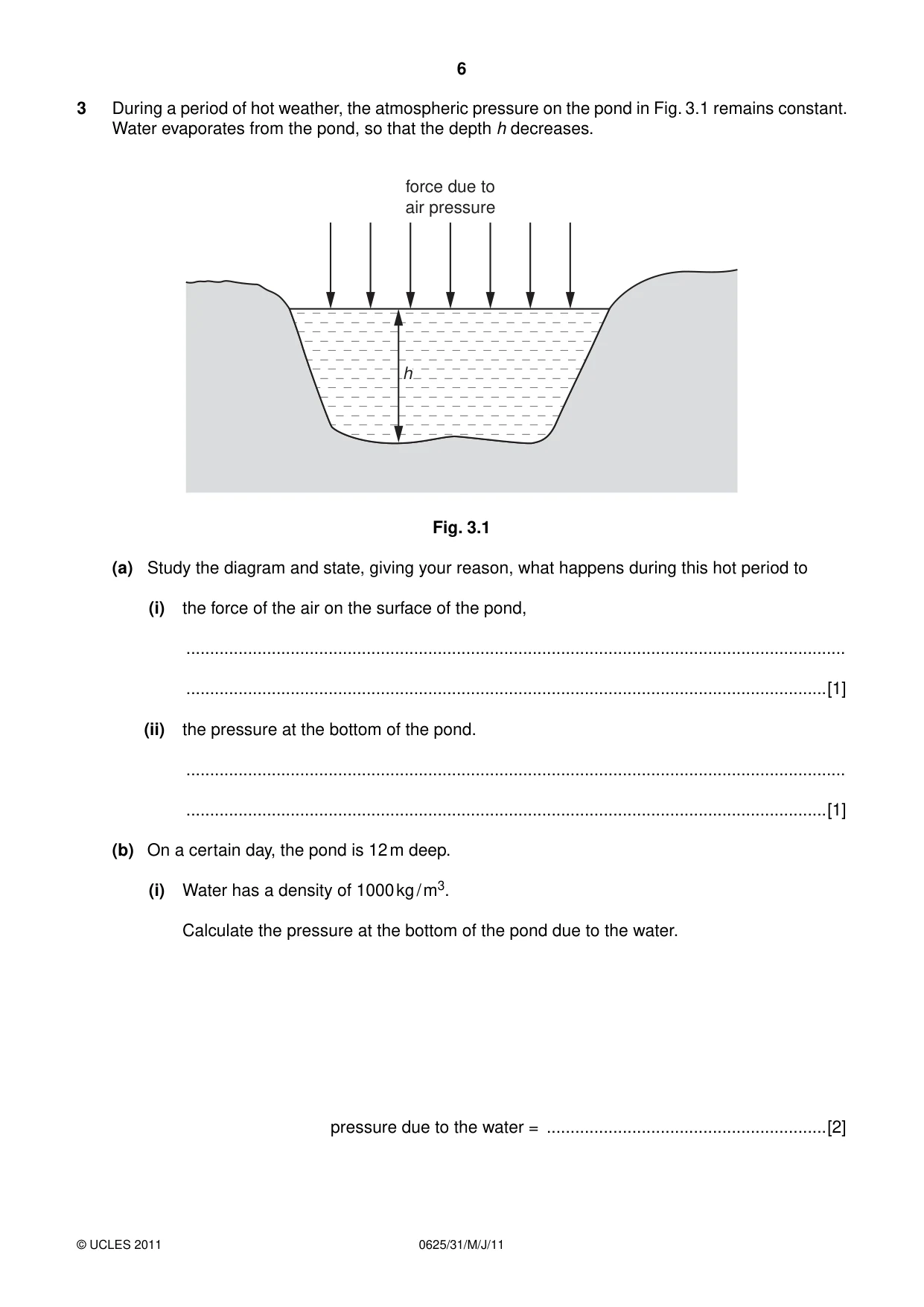
3 During a period of hot weather, the atmospheric pressure on the pond in Fig. 3.1 remains constant. Water evaporates from the pond, so that the depth h decreases. force due to air pressure h Fig. 3.1 (a) Study the diagram and state, giving your reason, what happens during this hot period to (i) the force of the air on the surface of the pond, ........................................................................................................................................... .......................................................................................................................................[1] (ii) the pressure at the bottom of the pond. ........................................................................................................................................... .......................................................................................................................................[1] (b) On a certain day, the pond is 12 m deep. (i) Water has a density of 1000 kg / m3. Calculate the pressure at the bottom of the pond due to the water. pressure due to the water = ...........................................................[2] (ii) Atmospheric pressure on that day is 1.0 × 10⁵ Pa. Calculate the total pressure at the bottom of the pond. total pressure = ...........................................................[1] (iii) A bubble of gas is released from the mud at the bottom of the pond. Its initial volume is 0.5 cm3. Ignoring any temperature differences in the water, calculate the volume of the bubble as it reaches the surface. volume = ...........................................................[2] (iv) In fact, the temperature of the water is greater at the top than at the bottom of the pond. Comment on the bubble volume you have calculated in (b)(iii). ........................................................................................................................................... ........................................................................................................................................... .......................................................................................................................................[1] [Total: 8]
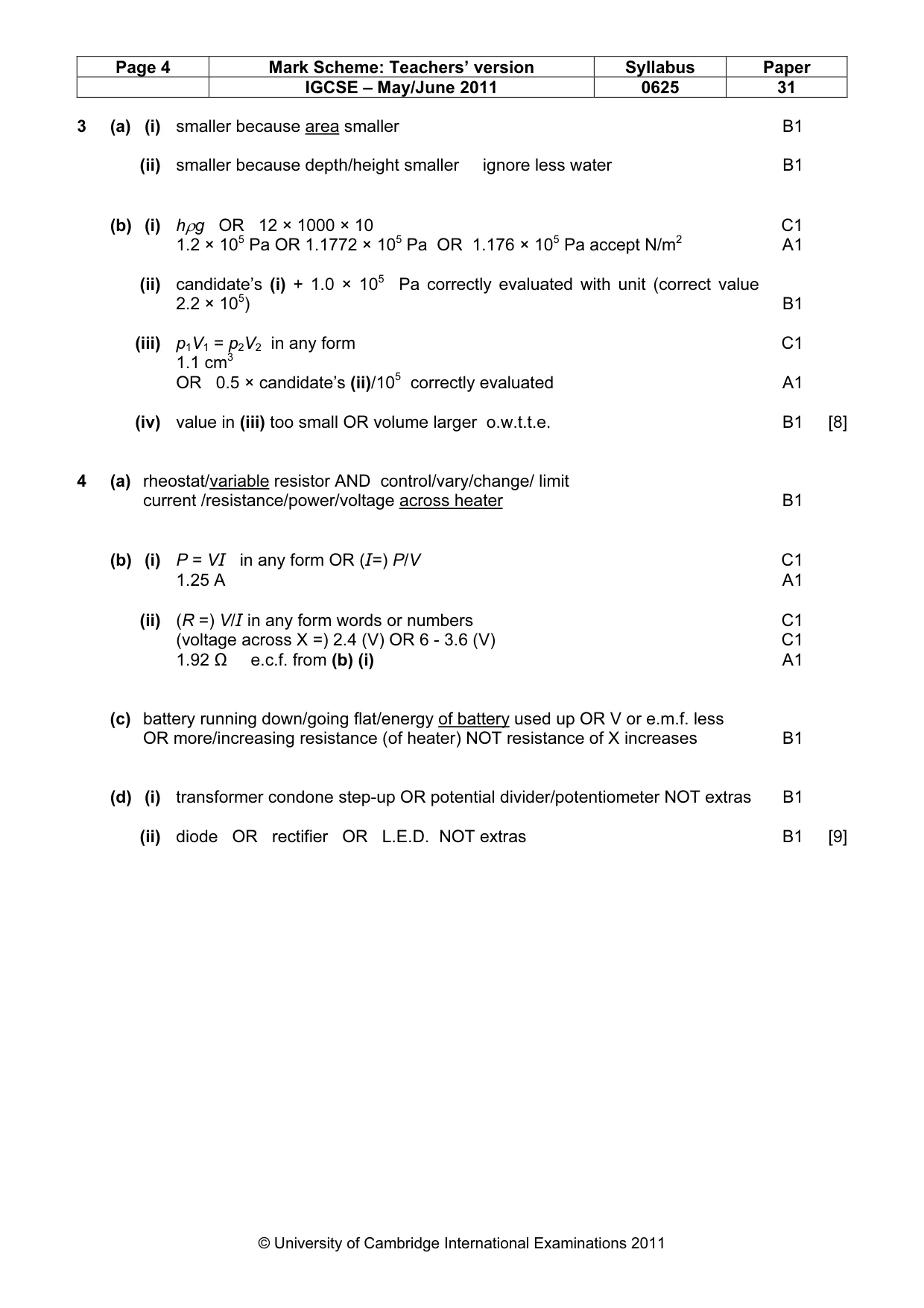
Mark scheme: 3 (a) (i) smaller because area smaller B1 (ii) smaller because depth/height smaller ignore less water B1 (b) (i) hρg OR 12 × 1000 × 10 C1 1.2 × 10⁵ Pa OR 1.1772 × 10⁵ Pa OR 1.176 × 10⁵ Pa accept N/m2 A1 (ii) candidate’s (i) + 1.0 × 10⁵ Pa correctly evaluated with unit (correct value 2.2 × 10⁵) B1 (iii) p1V1 = p2V2 in any form C1 1.1 cm3 OR 0.5 × candidate’s (ii)/105 correctly evaluated A1 (iv) value in (iii) too small OR volume larger o.w.t.t.e. B1 [8]
Q4 · The circuit of Fig
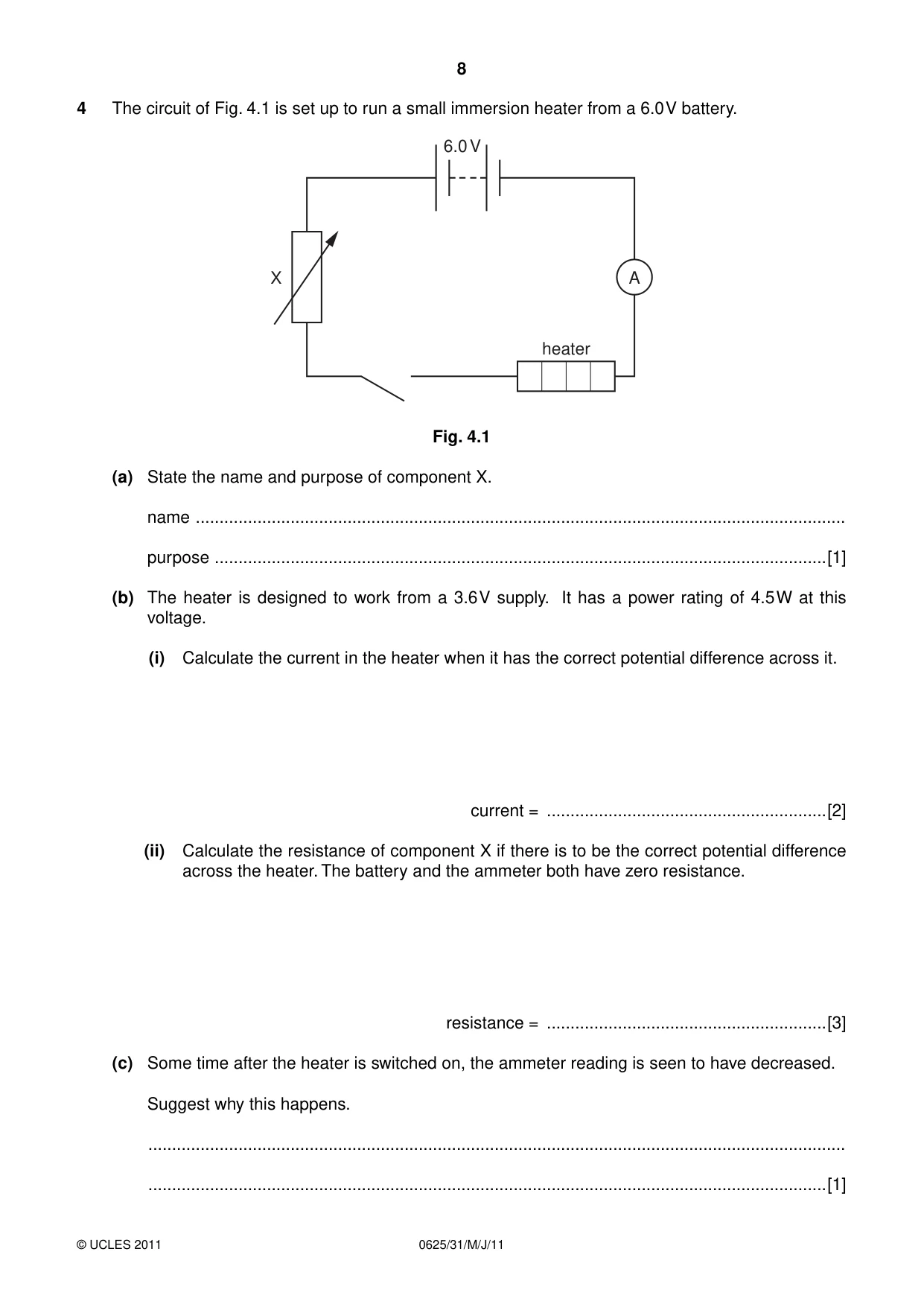
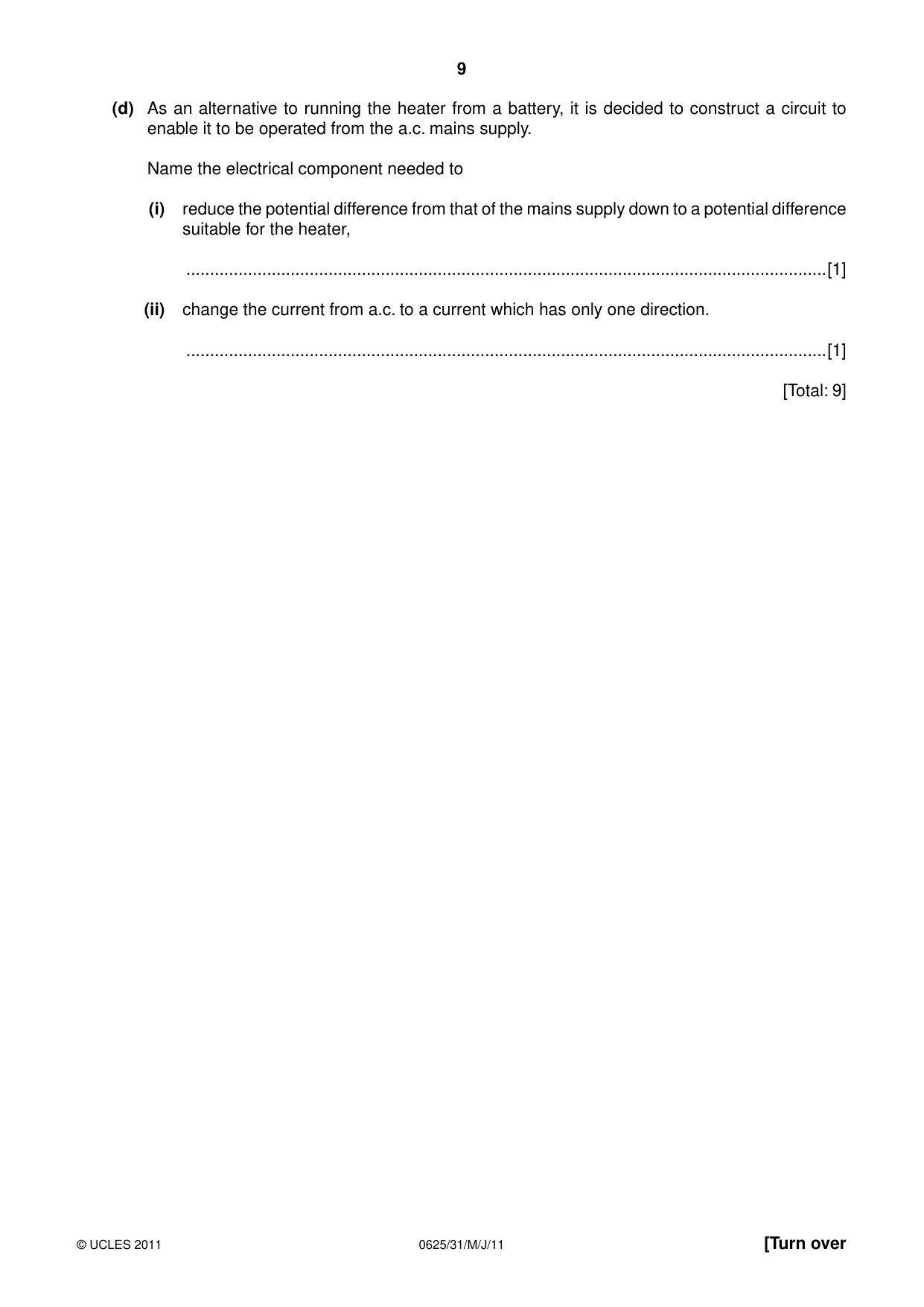
4 The circuit of Fig. 4.1 is set up to run a small immersion heater from a 6.0 V battery. 6.0 V X A heater Fig. 4.1 (a) State the name and purpose of component X. name ......................................................................................................................................... purpose .................................................................................................................................[1] (b) The heater is designed to work from a 3.6 V supply. It has a power rating of 4.5 W at this voltage. (i) Calculate the current in the heater when it has the correct potential difference across it. current = ...........................................................[2] (ii) Calculate the resistance of component X if there is to be the correct potential difference across the heater. The battery and the ammeter both have zero resistance. resistance = ...........................................................[3] (c) Some time after the heater is switched on, the ammeter reading is seen to have decreased. Suggest why this happens. ................................................................................................................................................... ...............................................................................................................................................[1] (d) As an alternative to running the heater from a battery, it is decided to construct a circuit to enable it to be operated from the a.c. mains supply. Name the electrical component needed to (i) reduce the potential difference from that of the mains supply down to a potential difference suitable for the heater, .......................................................................................................................................[1] (ii) change the current from a.c. to a current which has only one direction. .......................................................................................................................................[1] [Total: 9]
Mark scheme: 4 (a) rheostat/variable resistor AND control/vary/change/ limit current /resistance/power/voltage across heater B1 (b) (i) P = VI in any form OR (I=) P/V C1 1.25 A A1 (ii) (R =) V/I in any form words or numbers C1 (voltage across X =) 2.4 (V) OR 6 - 3.6 (V) C1 1.92 Ω e.c.f. from (b) (i) A1 (c) battery running down/going flat/energy of battery used up OR V or e.m.f. less OR more/increasing resistance (of heater) NOT resistance of X increases B1 (d) (i) transformer condone step-up OR potential divider/potentiometer NOT extras B1 (ii) diode OR rectifier OR L.E.D. NOT extras B1 [9] IGCSE – May/June 2011 0625 31
Q5 · The manufacturer’s label on an electric heater is as shown in Fig
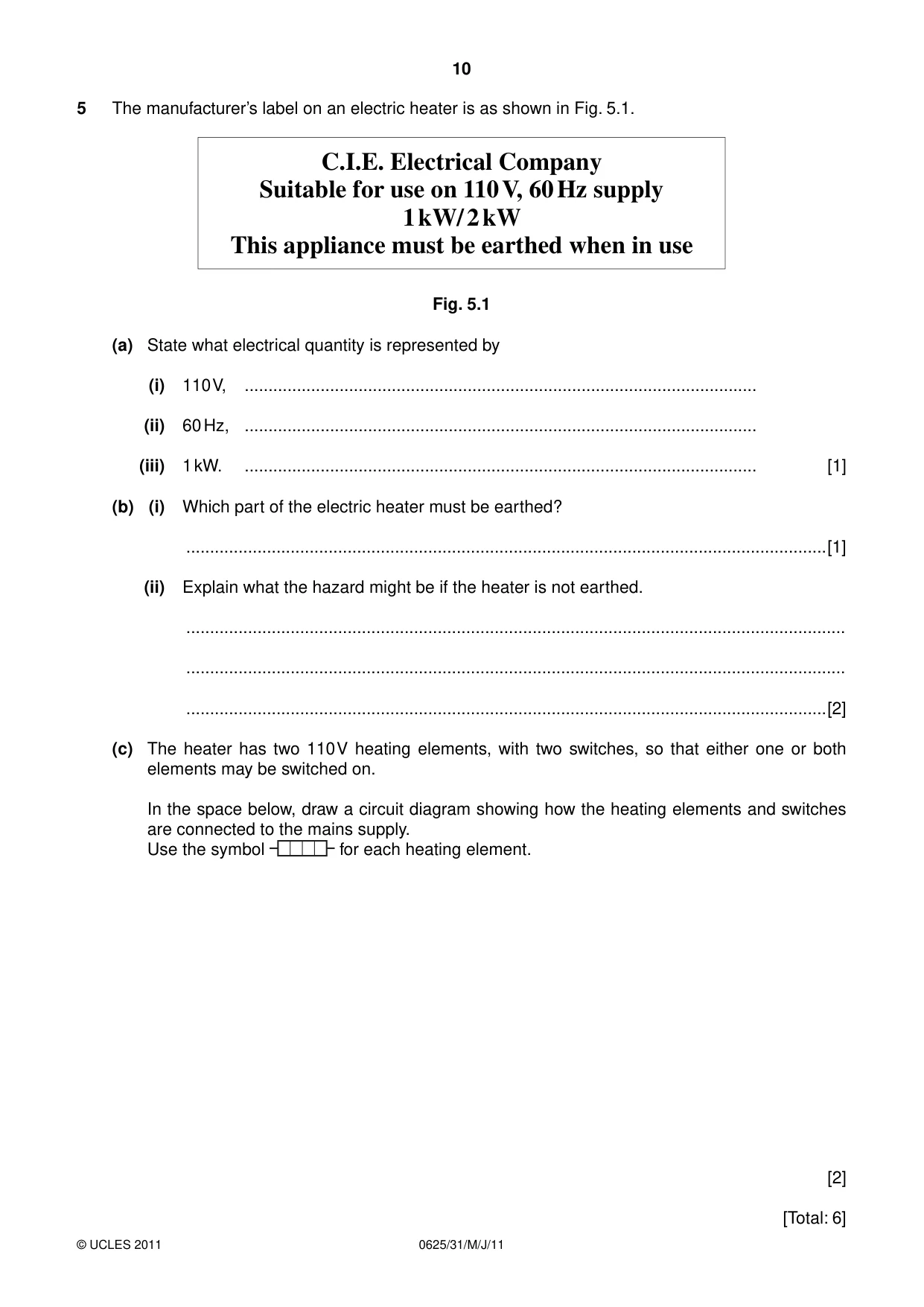
5 The manufacturer’s label on an electric heater is as shown in Fig. 5.1. C.I.E. Electrical Company Suitable for use on 110 V, 60 Hz supply 1 kW/ 2 kW This appliance must be earthed when in use Fig. 5.1 (a) State what electrical quantity is represented by (i) 110 V, ............................................................................................................ (ii) 60 Hz, ............................................................................................................ (iii) 1 kW. ............................................................................................................ [1] (b) (i) Which part of the electric heater must be earthed? .......................................................................................................................................[1] (ii) Explain what the hazard might be if the heater is not earthed. ........................................................................................................................................... ........................................................................................................................................... .......................................................................................................................................[2] (c) The heater has two 110 V heating elements, with two switches, so that either one or both elements may be switched on. In the space below, draw a circuit diagram showing how the heating elements and switches are connected to the mains supply. Use the symbol for each heating element. [2] [Total: 6]
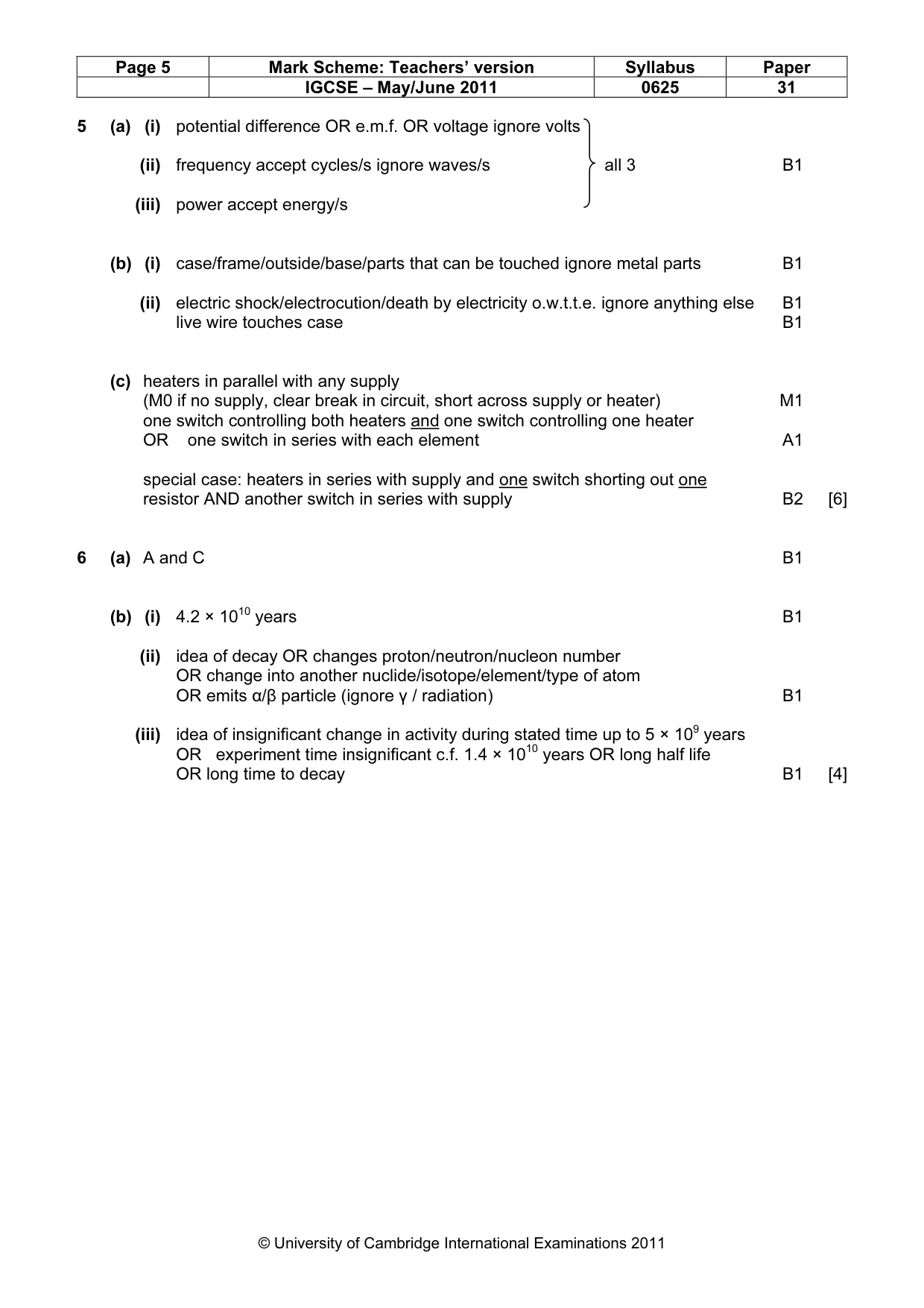
Mark scheme: 5 (a) (i) potential difference OR e.m.f. OR voltage ignore volts (ii) frequency accept cycles/s ignore waves/s all 3 B1 (iii) power accept energy/s (b) (i) case/frame/outside/base/parts that can be touched ignore metal parts B1 (ii) electric shock/electrocution/death by electricity o.w.t.t.e. ignore anything else B1 live wire touches case B1 (c) heaters in parallel with any supply (M0 if no supply, clear break in circuit, short across supply or heater) M1 one switch controlling both heaters and one switch controlling one heater OR one switch in series with each element A1 special case: heaters in series with supply and one switch shorting out one resistor AND another switch in series with supply B2 [6]
Q6 · Six different nuclides have nucleon and proton numbers as follows: nuclide nucleon number…
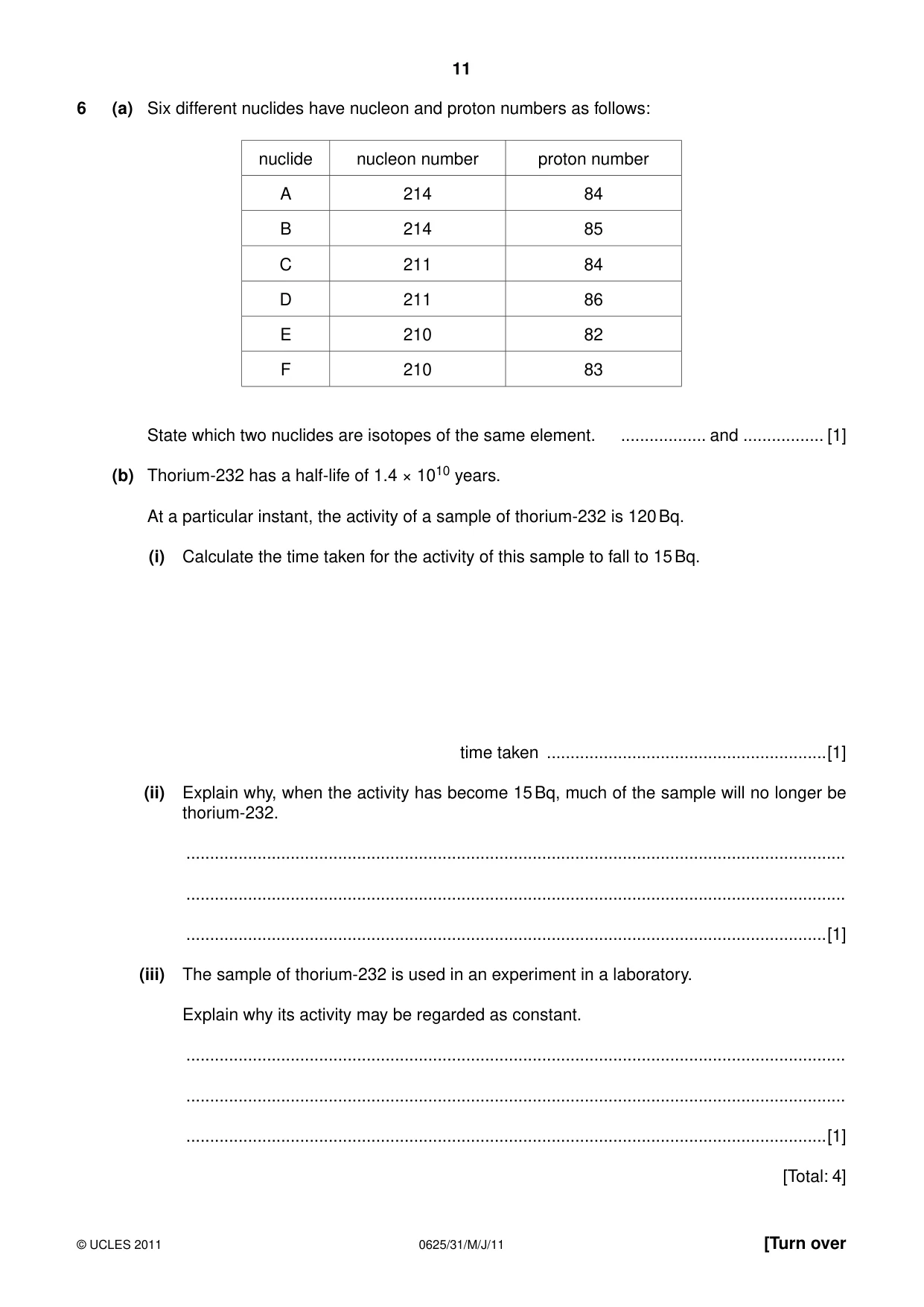
6 (a) Six different nuclides have nucleon and proton numbers as follows: nuclide nucleon number proton number A 214 84 B 214 85 C 211 84 D 211 86 E 210 82 F 210 83 State which two nuclides are isotopes of the same element. .................. and ................. [1] (b) Thorium-232 has a half-life of 1.4 × 10¹⁰ years. At a particular instant, the activity of a sample of thorium-232 is 120 Bq. (i) Calculate the time taken for the activity of this sample to fall to 15 Bq. time taken ...........................................................[1] (ii) Explain why, when the activity has become 15 Bq, much of the sample will no longer be thorium-232. ........................................................................................................................................... ........................................................................................................................................... .......................................................................................................................................[1] (iii) The sample of thorium-232 is used in an experiment in a laboratory. Explain why its activity may be regarded as constant. ........................................................................................................................................... ........................................................................................................................................... .......................................................................................................................................[1] [Total: 4]
Mark scheme: 6 (a) A and C B1 (b) (i) 4.2 × 10¹⁰ years B1 (ii) idea of decay OR changes proton/neutron/nucleon number OR change into another nuclide/isotope/element/type of atom OR emits α/β particle (ignore γ / radiation) B1 (iii) idea of insignificant change in activity during stated time up to 5 × 10⁹ years OR experiment time insignificant c.f. 1.4 × 10¹⁰ years OR long half life OR long time to decay B1 [4] IGCSE – May/June 2011 0625 31
Q7 · The speed of light in air is known to be 3.0 × 10⁸ m / s
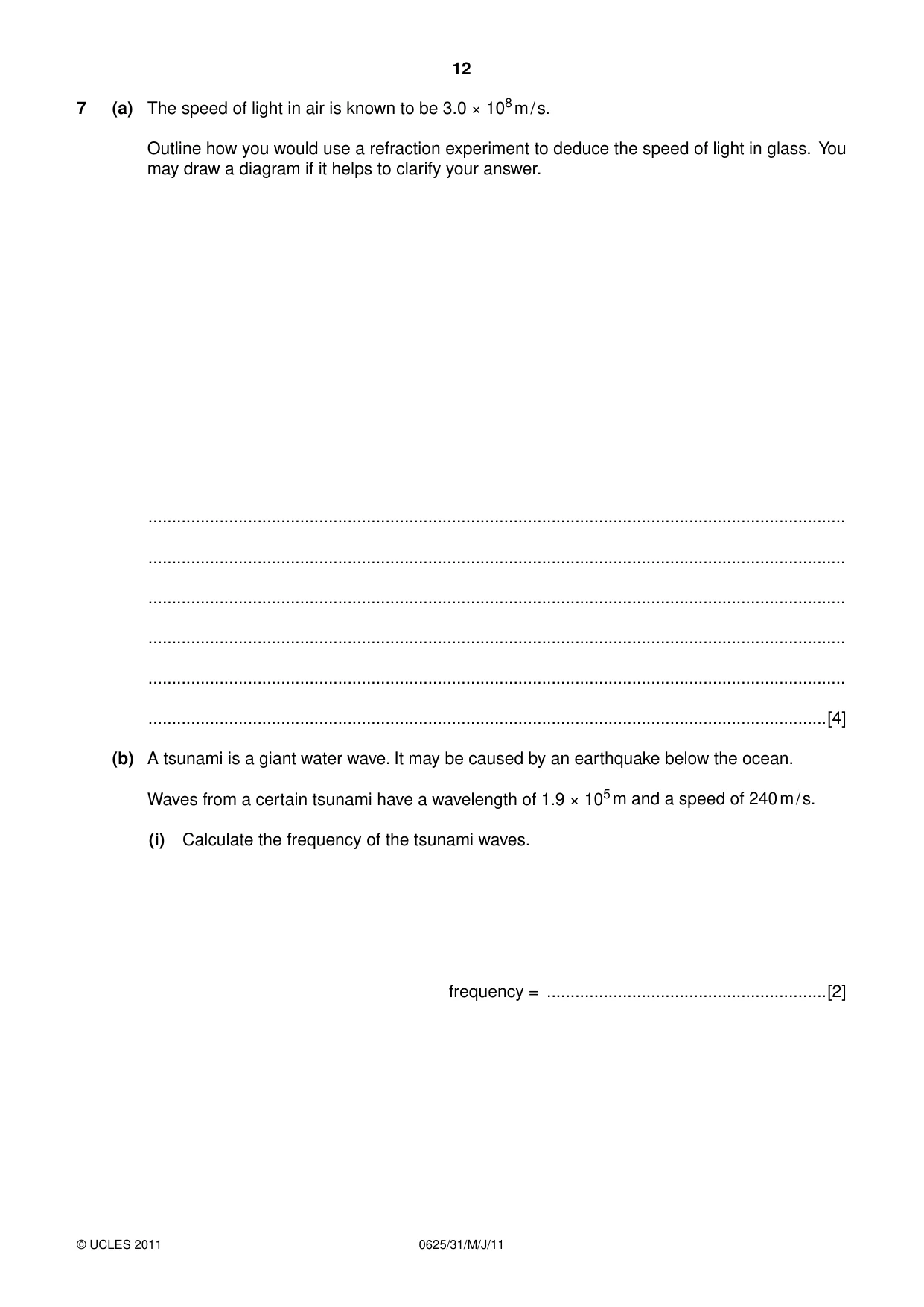
7 (a) The speed of light in air is known to be 3.0 × 10⁸ m / s. Outline how you would use a refraction experiment to deduce the speed of light in glass. You may draw a diagram if it helps to clarify your answer. ................................................................................................................................................... ................................................................................................................................................... ................................................................................................................................................... ................................................................................................................................................... ................................................................................................................................................... ...............................................................................................................................................[4] (b) A tsunami is a giant water wave. It may be caused by an earthquake below the ocean. Waves from a certain tsunami have a wavelength of 1.9 × 10⁵ m and a speed of 240 m / s. (i) Calculate the frequency of the tsunami waves. frequency = ...........................................................[2] (ii) The shock wave from the earthquake travels at 2.5 × 10³ m / s. The centre of the earthquake is 6.0 × 10⁵ m from the coast of a country. Calculate how much warning of the arrival of the tsunami at the coast is given by the earth tremor felt at the coast. warning time = ...........................................................[4] [Total: 10]
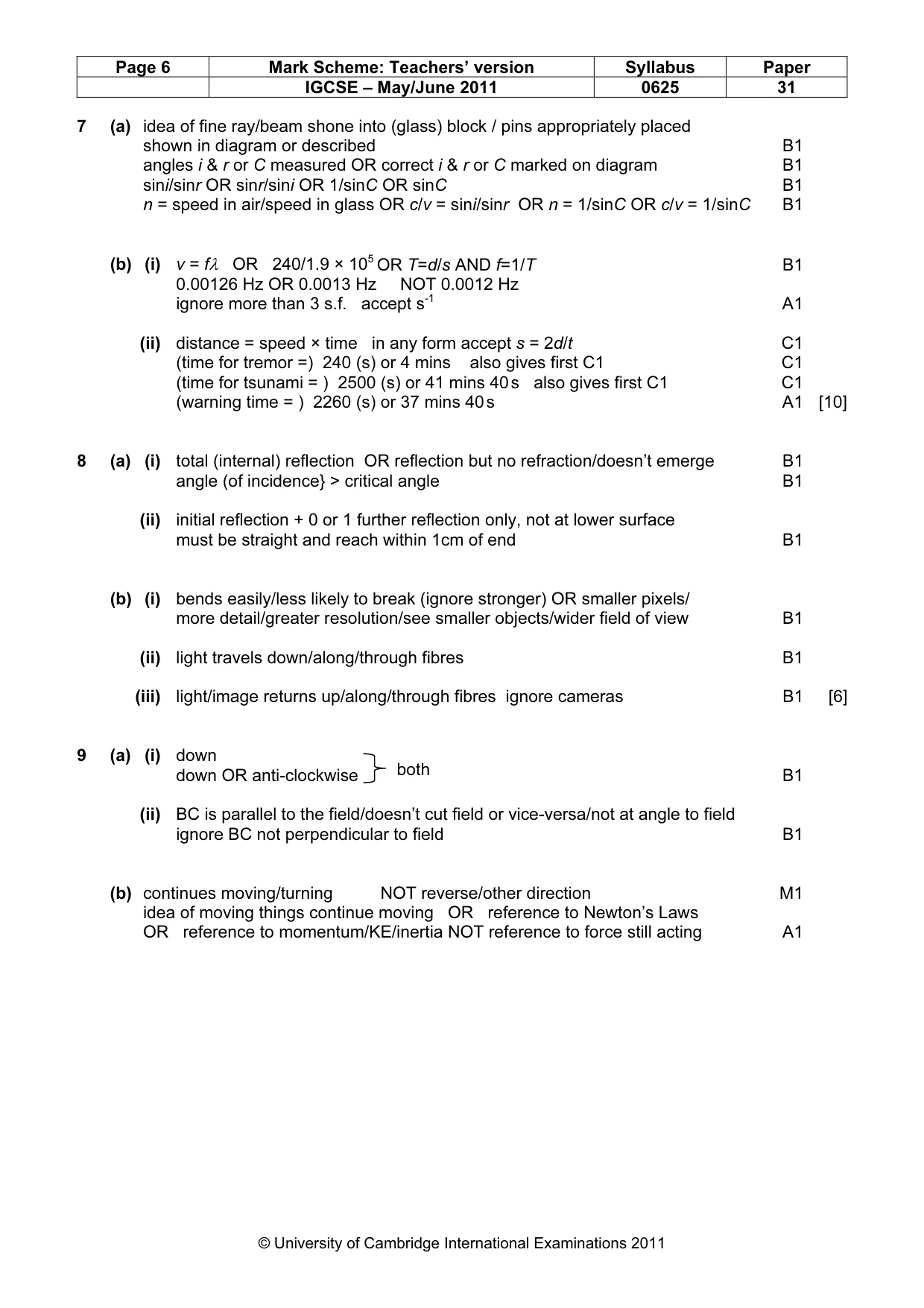
Mark scheme: 7 (a) idea of fine ray/beam shone into (glass) block / pins appropriately placed shown in diagram or described B1 angles i & r or C measured OR correct i & r or C marked on diagram B1 sini/sinr OR sinr/sini OR 1/sinC OR sinC B1 n = speed in air/speed in glass OR c/v = sini/sinr OR n = 1/sinC OR c/v = 1/sinC B1 (b) (i) v = fλ OR 240/1.9 × 105 OR T=d/s AND f=1/T B1 0.00126 Hz OR 0.0013 Hz NOT 0.0012 Hz ignore more than 3 s.f. accept s-1 A1 (ii) distance = speed × time in any form accept s = 2d/t C1 (time for tremor =) 240 (s) or 4 mins also gives first C1 C1 (time for tsunami = ) 2500 (s) or 41 mins 40 s also gives first C1 C1 (warning time = ) 2260 (s) or 37 mins 40 s A1 [10]
Q8 · A section of an optical fibre
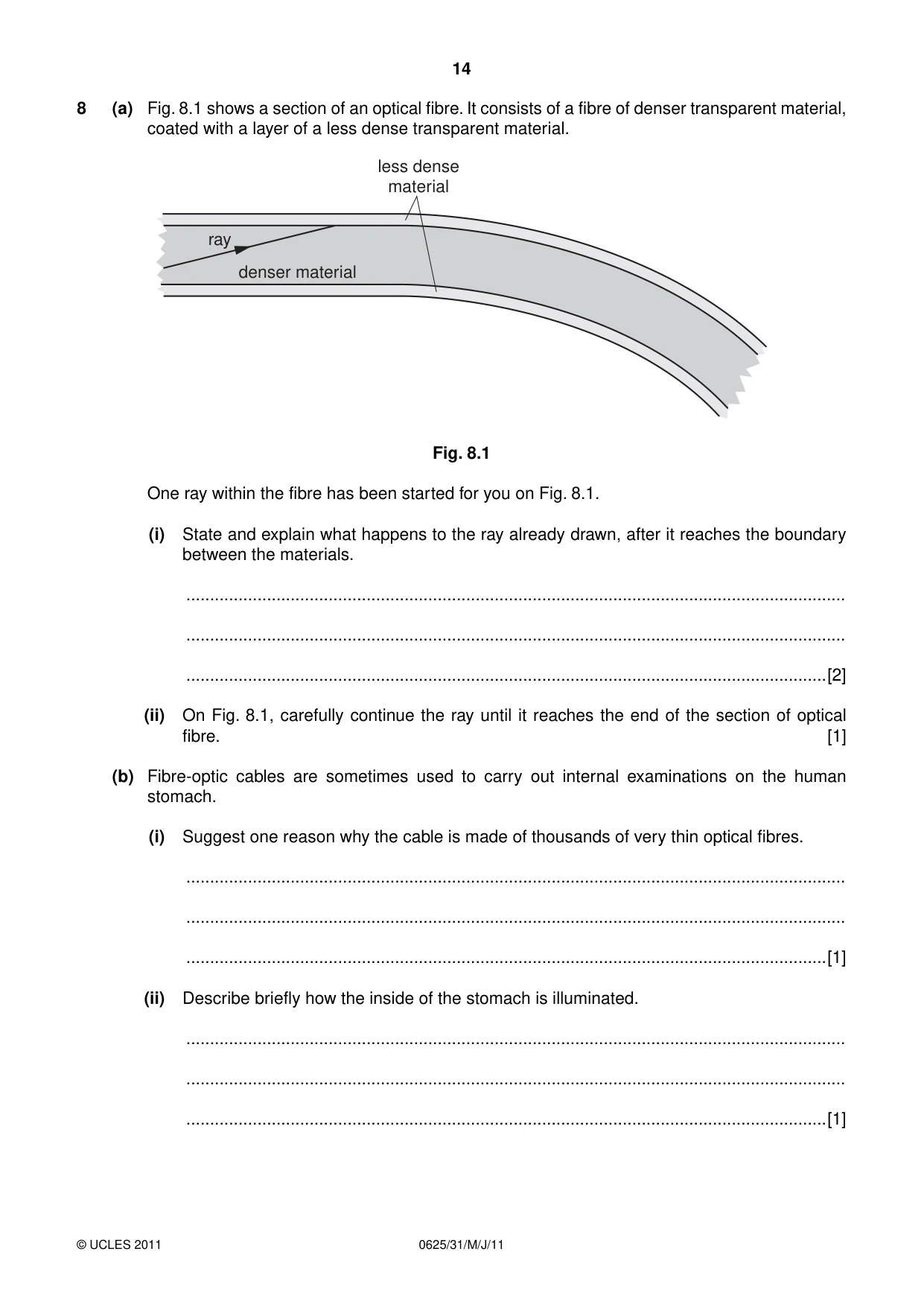
8 (a) Fig. 8.1 shows a section of an optical fibre. It consists of a fibre of denser transparent material, coated with a layer of a less dense transparent material. less dense material ray denser material Fig. 8.1 One ray within the fibre has been started for you on Fig. 8.1. (i) State and explain what happens to the ray already drawn, after it reaches the boundary between the materials. ........................................................................................................................................... ........................................................................................................................................... .......................................................................................................................................[2] (ii) On Fig. 8.1, carefully continue the ray until it reaches the end of the section of optical fibre. [1] (b) Fibre-optic cables are sometimes used to carry out internal examinations on the human stomach. (i) Suggest one reason why the cable is made of thousands of very thin optical fibres. ........................................................................................................................................... ........................................................................................................................................... .......................................................................................................................................[1] (ii) Describe briefly how the inside of the stomach is illuminated. ........................................................................................................................................... ........................................................................................................................................... .......................................................................................................................................[1] (iii) Describe briefly how the light from the stomach is transferred to the detecting equipment outside the body. ........................................................................................................................................... ........................................................................................................................................... .......................................................................................................................................[1] [Total: 6]
Mark scheme: 8 (a) (i) total (internal) reflection OR reflection but no refraction/doesn’t emerge B1 angle (of incidence} > critical angle B1 (ii) initial reflection + 0 or 1 further reflection only, not at lower surface must be straight and reach within 1cm of end B1 (b) (i) bends easily/less likely to break (ignore stronger) OR smaller pixels/ more detail/greater resolution/see smaller objects/wider field of view B1 (ii) light travels down/along/through fibres B1 (iii) light/image returns up/along/through fibres ignore cameras B1 [6]
Q9 · A simple motor is made in a school laboratory
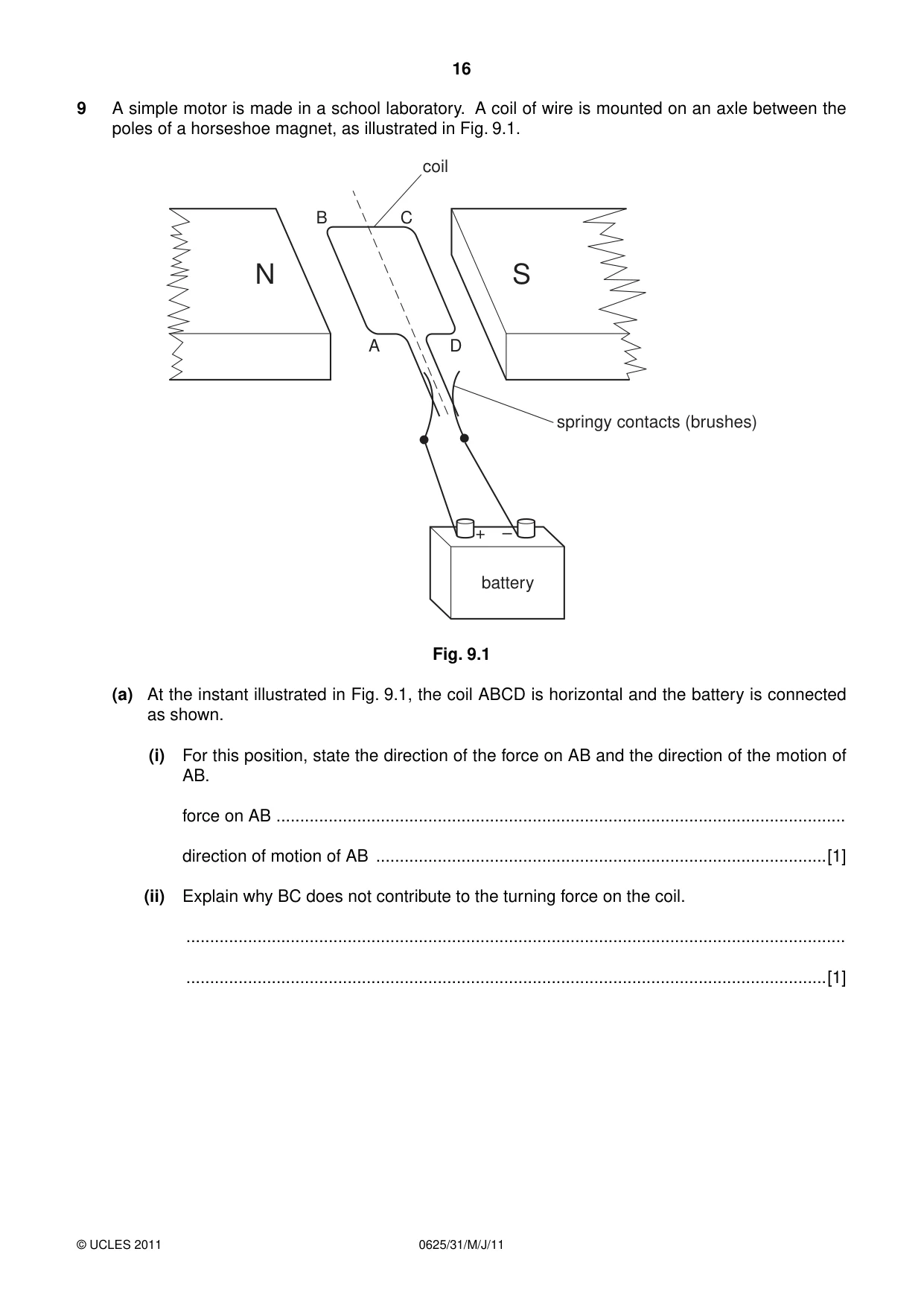
9 A simple motor is made in a school laboratory. A coil of wire is mounted on an axle between the poles of a horseshoe magnet, as illustrated in Fig. 9.1. coil B C N S A D springy contacts (brushes) + – battery Fig. 9.1 (a) At the instant illustrated in Fig. 9.1, the coil ABCD is horizontal and the battery is connected as shown. (i) For this position, state the direction of the force on AB and the direction of the motion of AB. force on AB ........................................................................................................................ direction of motion of AB ...............................................................................................[1] (ii) Explain why BC does not contribute to the turning force on the coil. ........................................................................................................................................... .......................................................................................................................................[1] (b) At the instant when the coil is vertical, the springy contacts do not, in fact, make contact with the ends of the coil. Describe and explain what happens to the coil. ................................................................................................................................................... ................................................................................................................................................... ................................................................................................................................................... ...............................................................................................................................................[2] (c) The motor in Fig. 9.1 does not rotate very quickly. The designer of a commercial motor is required to produce a faster-rotating motor. Suggest one change that could be made to increase the speed of the motor. ................................................................................................................................................... ...............................................................................................................................................[1] [Total: 5]
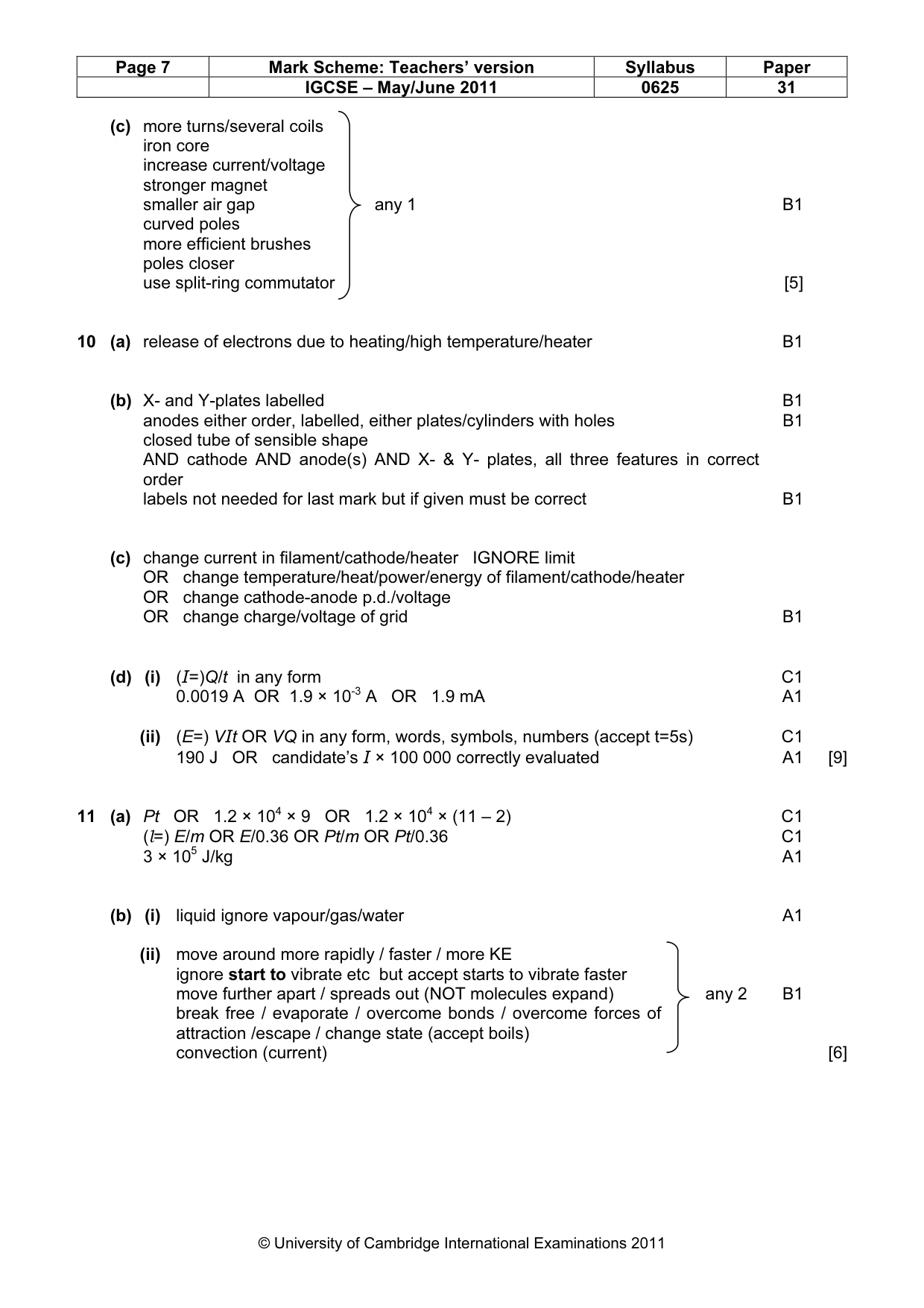
Mark scheme: 9 (a) (i) down both down OR anti-clockwise B1 (ii) BC is parallel to the field/doesn’t cut field or vice-versa/not at angle to field ignore BC not perpendicular to field B1 (b) continues moving/turning NOT reverse/other direction M1 idea of moving things continue moving OR reference to Newton’s Laws OR reference to momentum/KE/inertia NOT reference to force still acting A1 IGCSE – May/June 2011 0625 31 (c) more turns/several coils iron core increase current/voltage stronger magnet smaller air gap any 1 B1 curved poles more efficient brushes poles closer use split-ring commutator [5]
Q10 · A cathode-ray oscilloscope makes use of the process known as thermionic emission
10 (a) A cathode-ray oscilloscope makes use of the process known as thermionic emission. Describe what happens during this process. ................................................................................................................................................... ................................................................................................................................................... ...............................................................................................................................................[1] (b) In the space below, draw a labelled diagram of a cathode-ray oscilloscope. Include in your diagram the tube, the cathode, the accelerating anode, the focusing anode and both X- and Y-plates. Do not attempt to show any external circuits. [3] (c) A cathode ray is a beam of electrons. Suggest one way of controlling the number of electrons in the beam. ................................................................................................................................................... ...............................................................................................................................................[1] (d) One cathode-ray tube has 5000 V between the accelerating anode and the cathode. The beam of electrons carries a total charge of 0.0095 C in 5.0 s. Calculate (i) the current caused by the beam, current = ...........................................................[2] (ii) the energy transferred by the beam in 20 s. energy = ...........................................................[2] [Total: 9] Question 11 is on the next page.
Mark scheme: 10 (a) release of electrons due to heating/high temperature/heater B1 (b) X- and Y-plates labelled B1 anodes either order, labelled, either plates/cylinders with holes B1 closed tube of sensible shape AND cathode AND anode(s) AND X- & Y- plates, all three features in correct order labels not needed for last mark but if given must be correct B1 (c) change current in filament/cathode/heater IGNORE limit OR change temperature/heat/power/energy of filament/cathode/heater OR change cathode-anode p.d./voltage OR change charge/voltage of grid B1 (d) (i) (I=)Q/t in any form C1 0.0019 A OR 1.9 × 10⁻³ A OR 1.9 mA A1 (ii) (E=) VIt OR VQ in any form, words, symbols, numbers (accept t=5s) C1 190 J OR candidate’s I × 100 000 correctly evaluated A1 [9]
Q11 · A mass of 0.36 kg of a certain substance is in the solid state in a well-insulated…
11 A mass of 0.36 kg of a certain substance is in the solid state in a well-insulated container. The substance is heated at the rate of 1.2 × 10⁴ J / minute. 2.0 minutes after starting the heating, the substance is all at the same temperature, and it starts to melt. 11.0 minutes after starting the heating, the substance finishes melting and the temperature starts to rise again. (a) Calculate the specific latent heat of the substance. specific latent heat = ...........................................................[3] (b) (i) After 11 minutes of heating, when the temperature starts rising again, in which state is the substance? .......................................................................................................................................[1] (ii) Describe what happens to the molecules as thermal energy is supplied to them in this state. ........................................................................................................................................... ........................................................................................................................................... ........................................................................................................................................... .......................................................................................................................................[2] [Total: 6]
Mark scheme: 11 (a) Pt OR 1.2 × 104 × 9 OR 1.2 × 104 × (11 – 2) C1 (l=) E/m OR E/0.36 OR Pt/m OR Pt/0.36 C1 3 × 10⁵ J/kg A1 (b) (i) liquid ignore vapour/gas/water A1 (ii) move around more rapidly / faster / more KE ignore start to vibrate etc but accept starts to vibrate faster move further apart / spreads out (NOT molecules expand) any 2 B1 break free / evaporate / overcome bonds / overcome forces of attraction /escape / change state (accept boils) convection (current) [6]
What was in this paper
The subtopics covered by these 11 questions, and how many questions each got. Open one in a new tab to see every Cambridge question on it.
What you needed in this session
Cambridge’s own grade thresholds for 2011 May/June, Paper 3 · Variant 1. A higher threshold means an easier paper — the bar moves with how the cohort did.