Cambridge IGCSE Physics 0625 — 2021 May/June Paper 3 · Variant 3
0625/33/M/J/21 · 11 questions · 80 marks · ≈90 min
The question paper and its mark scheme, free to read here and free to download. This is Cambridge’s own paper, exactly as it was sat.
Question paper16 pages
Mark scheme10 pages
Answers below. Sit the paper first if you are practising.
Questions as text
Q1 · The speed–time graph for a car travelling along a road
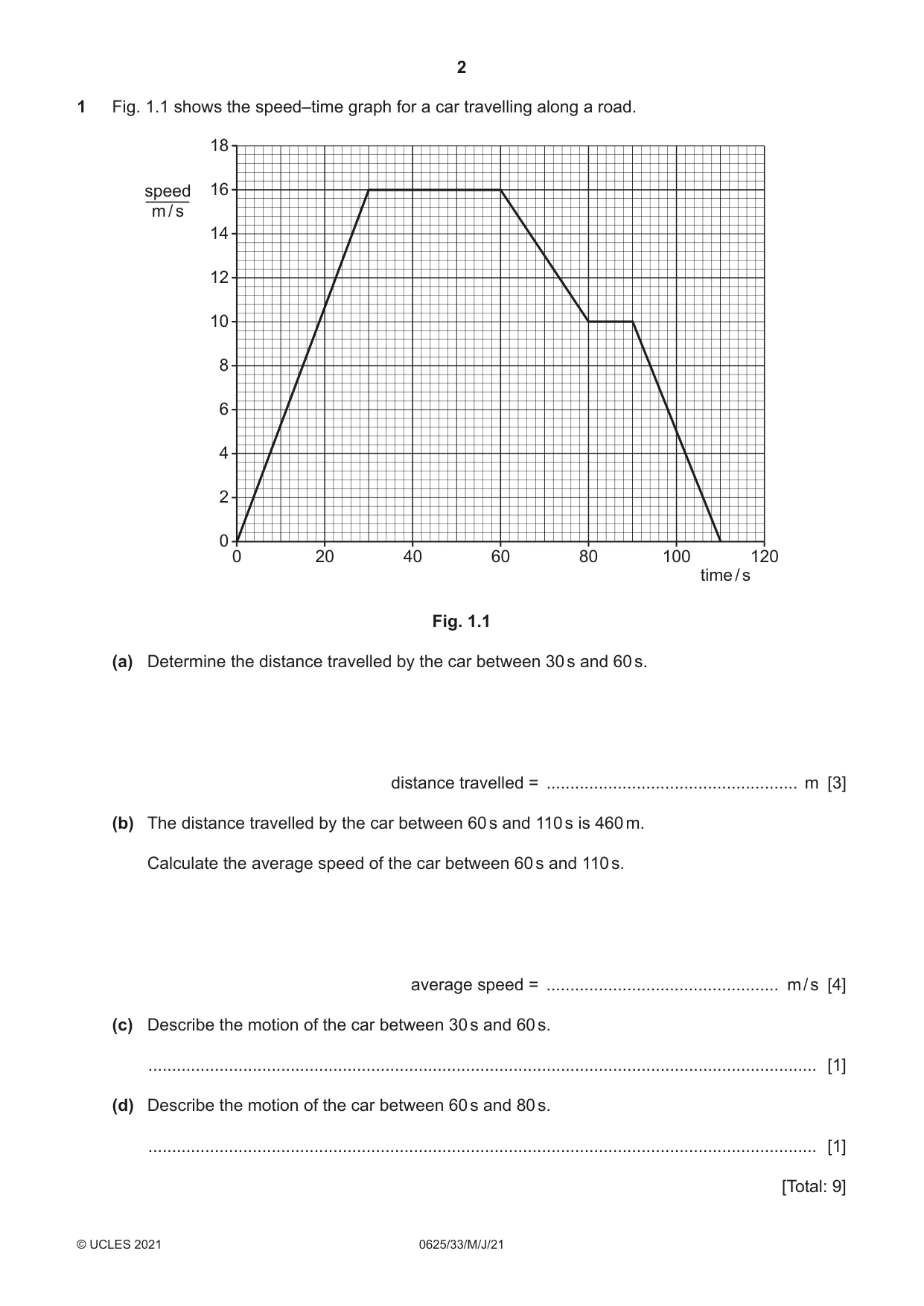
1 Fig. 1.1 shows the speed–time graph for a car travelling along a road. 18 speed 16 m / s 14 12 10 8 6 4 2 0 0 20 40 60 80 100 120 time / s Fig. 1.1 (a) Determine the distance travelled by the car between 30 s and 60 s. distance travelled = ..................................................... m [3] (b) The distance travelled by the car between 60 s and 110 s is 460 m. Calculate the average speed of the car between 60 s and 110 s. average speed = ................................................. m / s [4] (c) Describe the motion of the car between 30 s and 60 s. ............................................................................................................................................. [1] (d) Describe the motion of the car between 60 s and 80 s. ............................................................................................................................................. [1] [Total: 9]
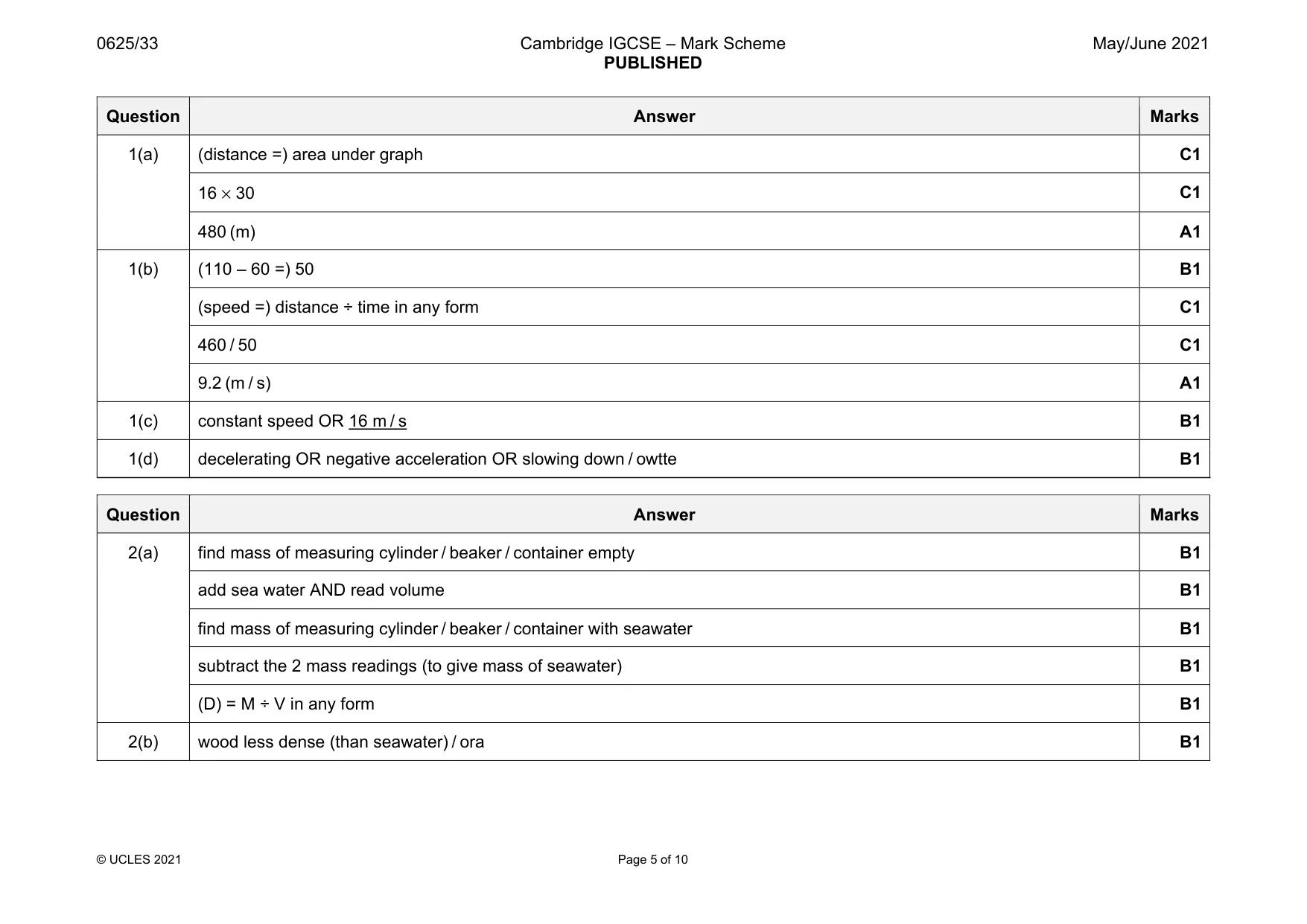
Mark scheme: 1(a) (distance =) area under graph C1 16 × 30 C1 480 (m) A1 1(b) (110 – 60 =) 50 B1 (speed =) distance ÷ time in any form C1 460 / 50 C1 9.2 (m / s) A1 1(c) constant speed OR 16 m / s B1 1(d) decelerating OR negative acceleration OR slowing down / owtte B1
Q2 · A scientist has a measuring cylinder, a beaker of sea water and an electronic balance
2 (a) A scientist has a measuring cylinder, a beaker of sea water and an electronic balance. Describe an experiment to determine the density of the sea water. Include any equations in your answer. ................................................................................................................................................... ................................................................................................................................................... ................................................................................................................................................... ................................................................................................................................................... ................................................................................................................................................... ............................................................................................................................................. [5] (b) A plank of wood floats on the sea. Explain why the wood floats. ................................................................................................................................................... ............................................................................................................................................. [1] [Total: 6]
Mark scheme: 2(a) find mass of measuring cylinder / beaker / container empty B1 add sea water AND read volume B1 find mass of measuring cylinder / beaker / container with seawater B1 subtract the 2 mass readings (to give mass of seawater) B1 (D) = M ÷ V in any form B1 2(b) wood less dense (than seawater) / ora B1
Q3 · A girl and her brother sit on opposite sides of a see-saw as shown in Fig
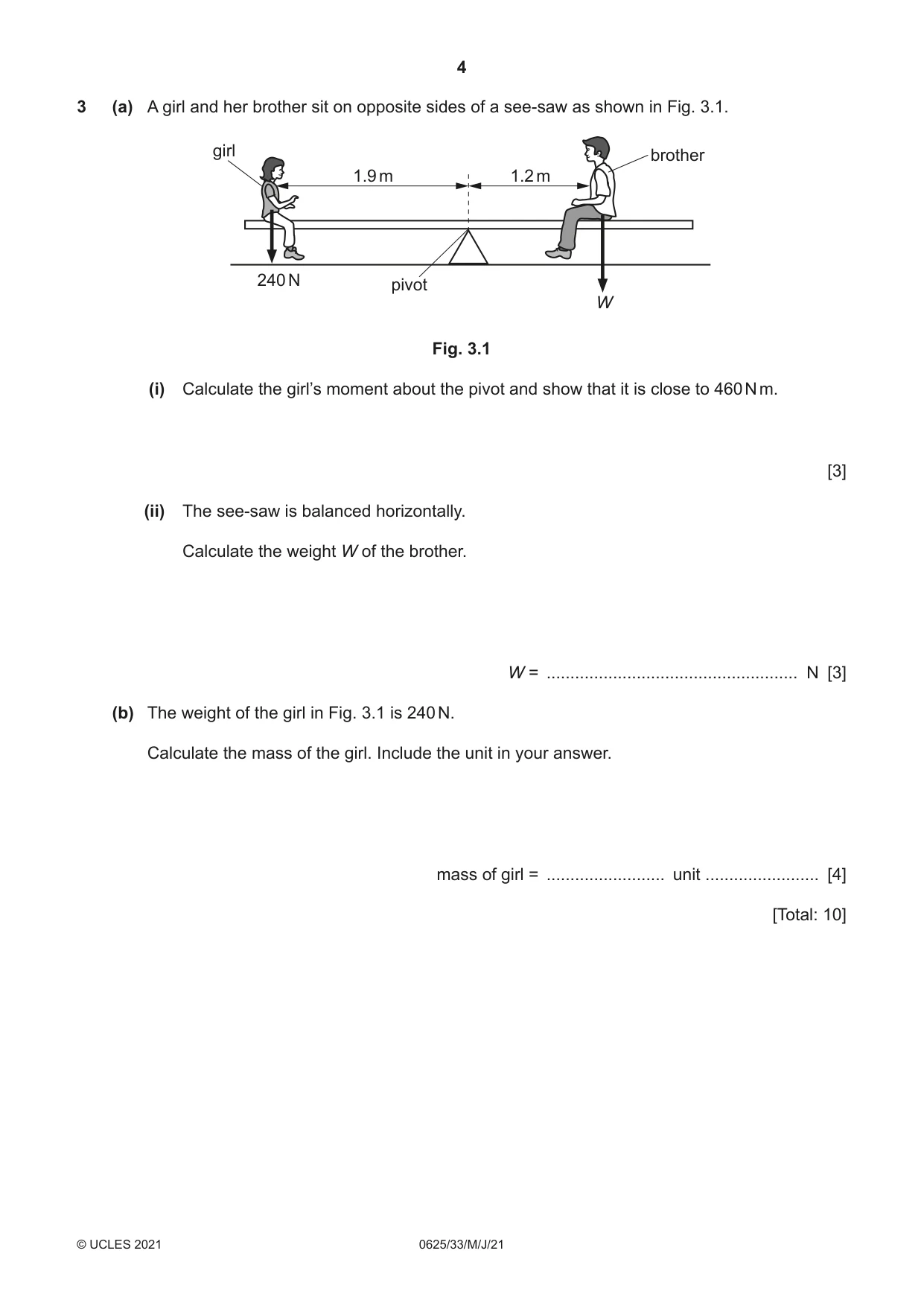
3 (a) A girl and her brother sit on opposite sides of a see-saw as shown in Fig. 3.1. girl brother 1.9 m 1.2 m 240 N pivot W Fig. 3.1 (i) Calculate the girl’s moment about the pivot and show that it is close to 460 N m. [3] (ii) The see-saw is balanced horizontally. Calculate the weight W of the brother. W = ..................................................... N [3] (b) The weight of the girl in Fig. 3.1 is 240 N. Calculate the mass of the girl. Include the unit in your answer. mass of girl = ......................... unit ........................ [4] [Total: 10]
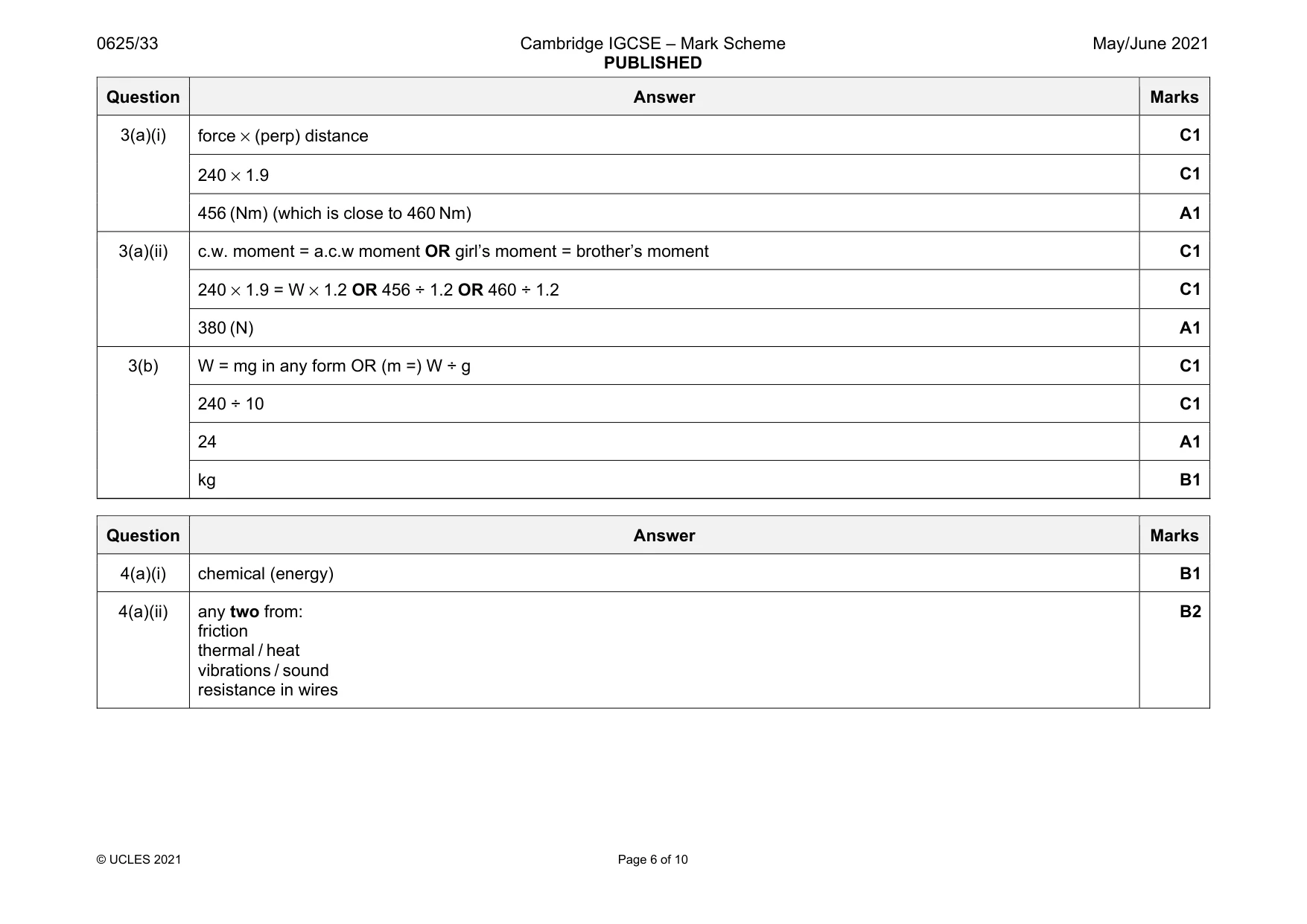
Mark scheme: 3(a)(i) force × (perp) distance C1 240 × 1.9 C1 456 (Nm) (which is close to 460 Nm) A1 3(a)(ii) c.w. moment = a.c.w moment OR girl’s moment = brother’s moment C1 240 × 1.9 = W × 1.2 OR 456 ÷ 1.2 OR 460 ÷ 1.2 C1 380 (N) A1 3(b) W = mg in any form OR (m =) W ÷ g C1 240 ÷ 10 C1 24 A1 kg B1
Q4 · A power station burns fossil fuel to produce electrical energy
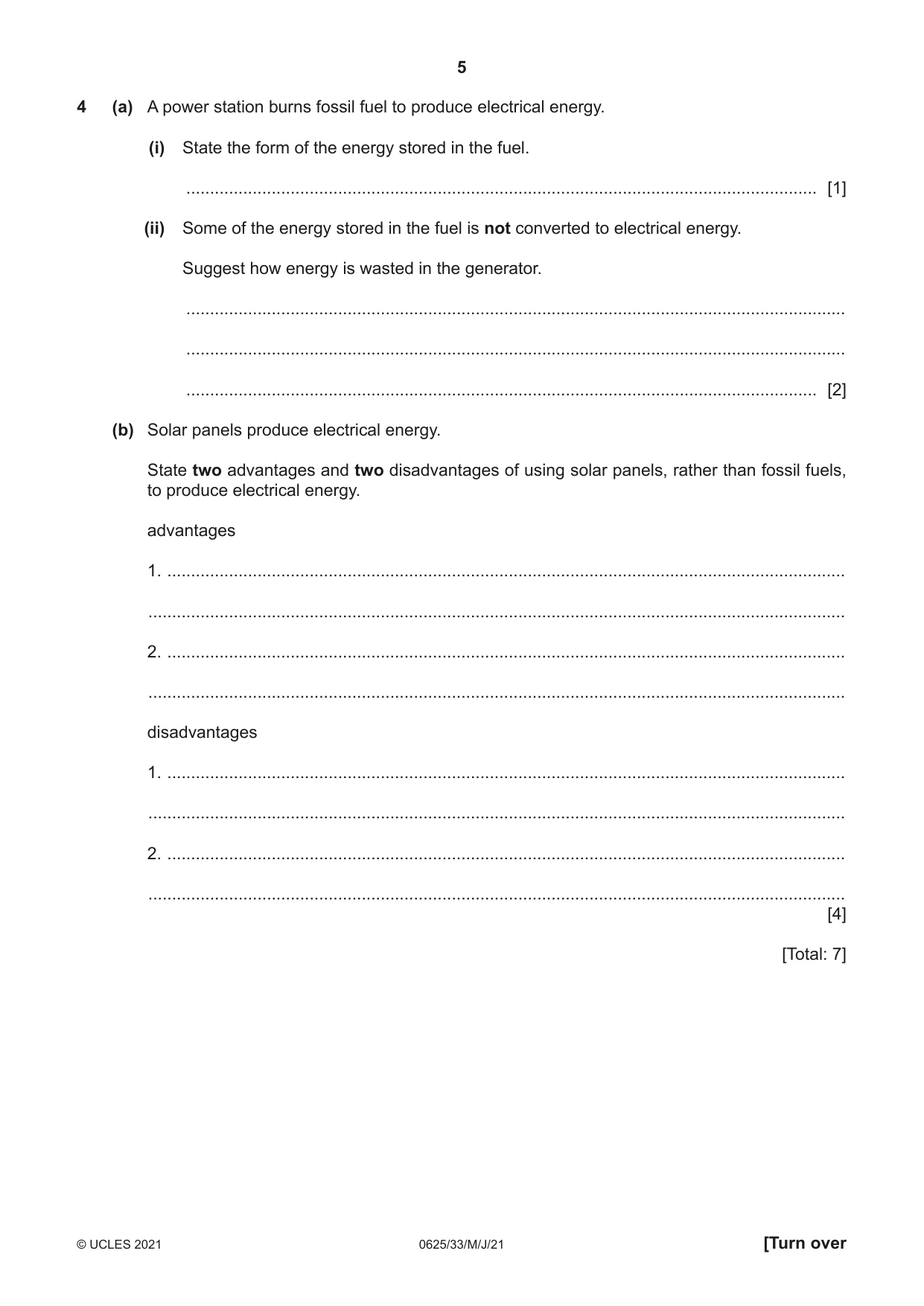
4 (a) A power station burns fossil fuel to produce electrical energy. (i) State the form of the energy stored in the fuel. ..................................................................................................................................... [1] (ii) Some of the energy stored in the fuel is not converted to electrical energy. Suggest how energy is wasted in the generator. ........................................................................................................................................... ........................................................................................................................................... ..................................................................................................................................... [2] (b) Solar panels produce electrical energy. State two advantages and two disadvantages of using solar panels, rather than fossil fuels, to produce electrical energy. advantages 1. ............................................................................................................................................... ................................................................................................................................................... 2. ............................................................................................................................................... ................................................................................................................................................... disadvantages 1. ............................................................................................................................................... ................................................................................................................................................... 2. ............................................................................................................................................... ................................................................................................................................................... [4] [Total: 7]
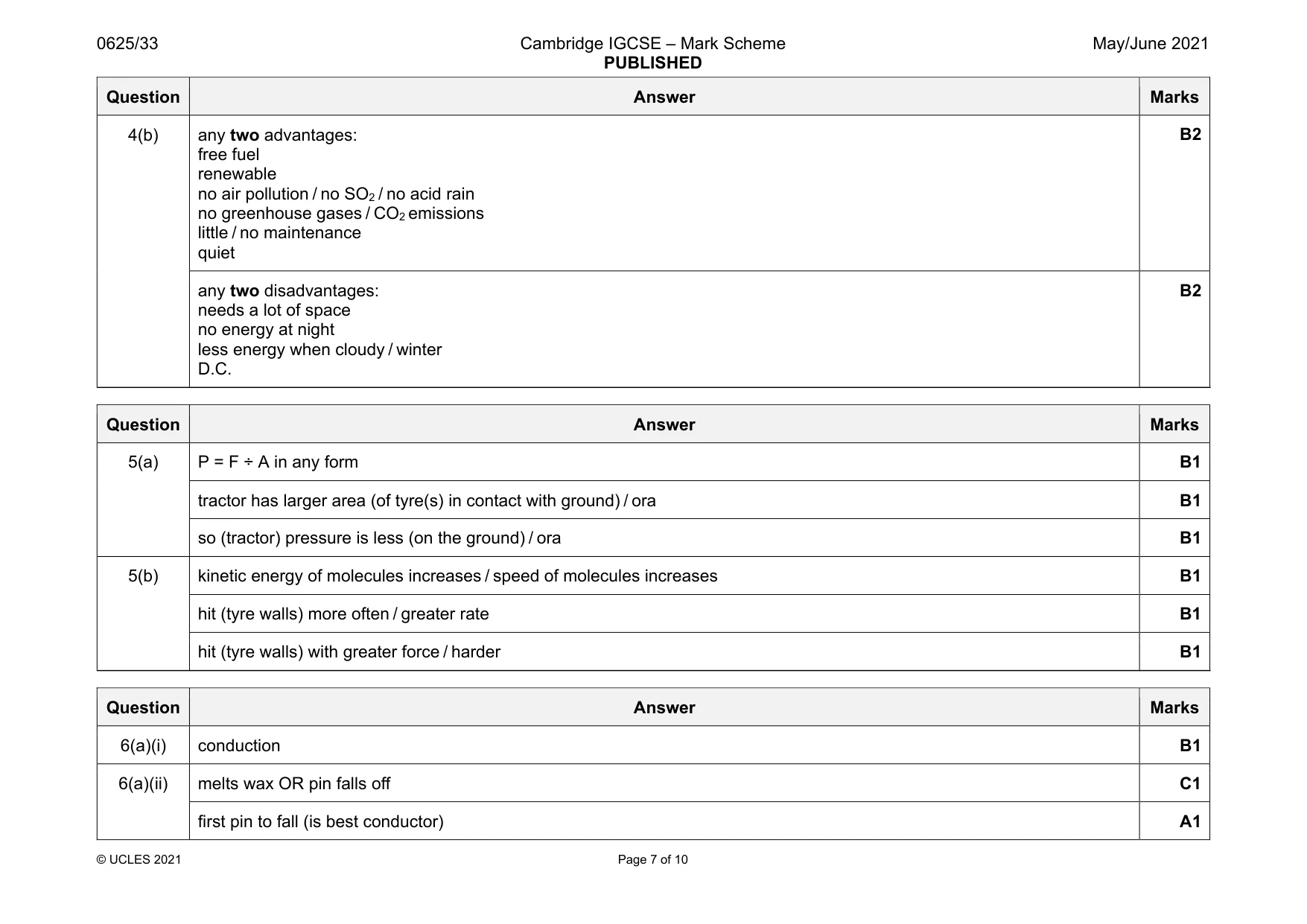
Mark scheme: 4(a)(i) chemical (energy) B1 4(a)(ii) any two from: friction thermal / heat vibrations / sound resistance in wires B2 Question Answer Marks 4(b) any two advantages: free fuel renewable no air pollution / no SO2 / no acid rain no greenhouse gases / CO2 emissions little / no maintenance quiet B2 any two disadvantages: needs a lot of space no energy at night less energy when cloudy / winter D.C. B2
Q5 · A tractor and a car of the same weight
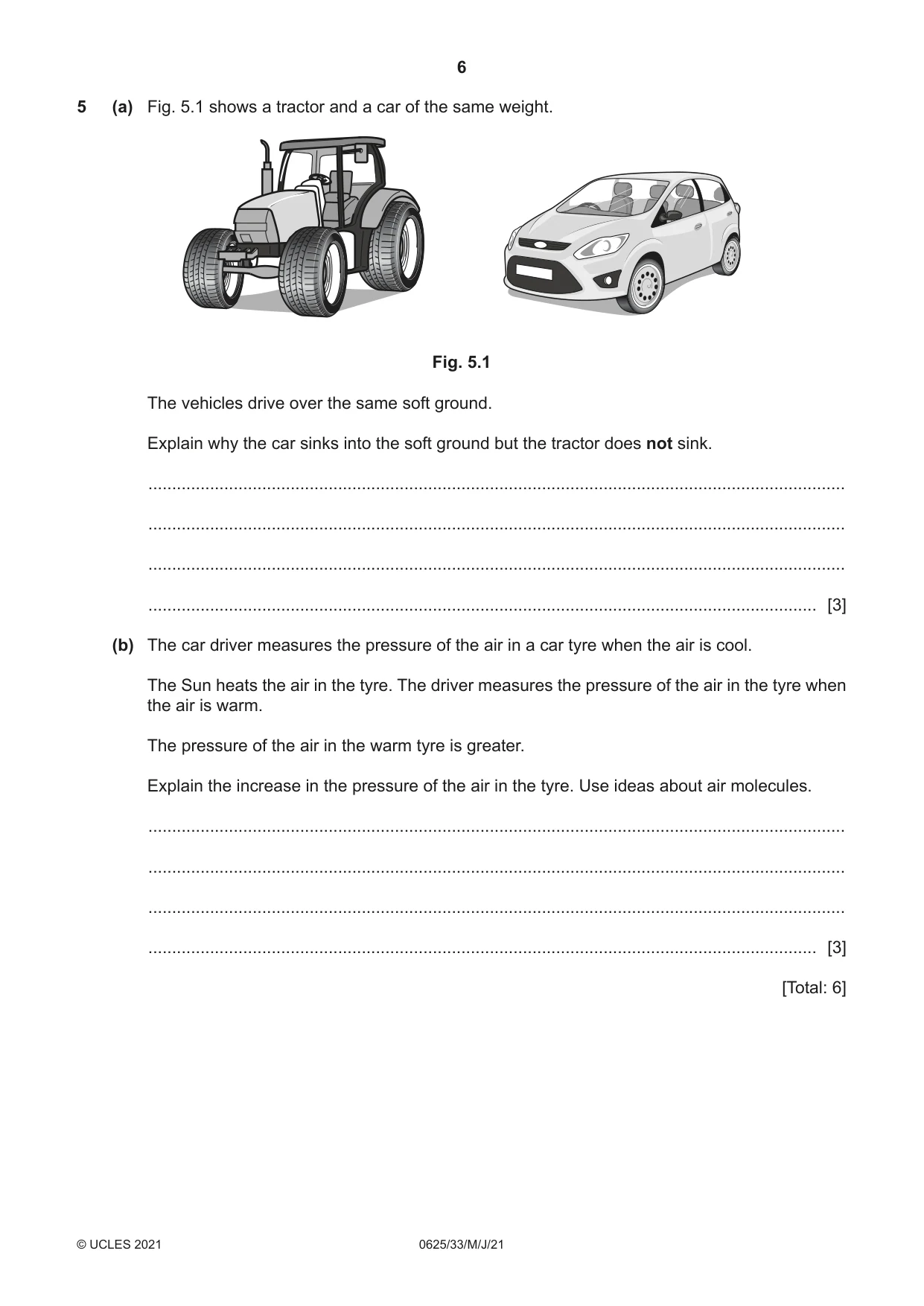
5 (a) Fig. 5.1 shows a tractor and a car of the same weight. Fig. 5.1 The vehicles drive over the same soft ground. Explain why the car sinks into the soft ground but the tractor does not sink. ................................................................................................................................................... ................................................................................................................................................... ................................................................................................................................................... ............................................................................................................................................. [3] (b) The car driver measures the pressure of the air in a car tyre when the air is cool. The Sun heats the air in the tyre. The driver measures the pressure of the air in the tyre when the air is warm. The pressure of the air in the warm tyre is greater. Explain the increase in the pressure of the air in the tyre. Use ideas about air molecules. ................................................................................................................................................... ................................................................................................................................................... ................................................................................................................................................... ............................................................................................................................................. [3] [Total: 6]
Mark scheme: 5(a) P = F ÷ A in any form B1 tractor has larger area (of tyre(s) in contact with ground) / ora B1 so (tractor) pressure is less (on the ground) / ora B1 5(b) kinetic energy of molecules increases / speed of molecules increases B1 hit (tyre walls) more often / greater rate B1 hit (tyre walls) with greater force / harder B1
Q6 · Three rods are identical in size and shape, but each rod is made from a different material
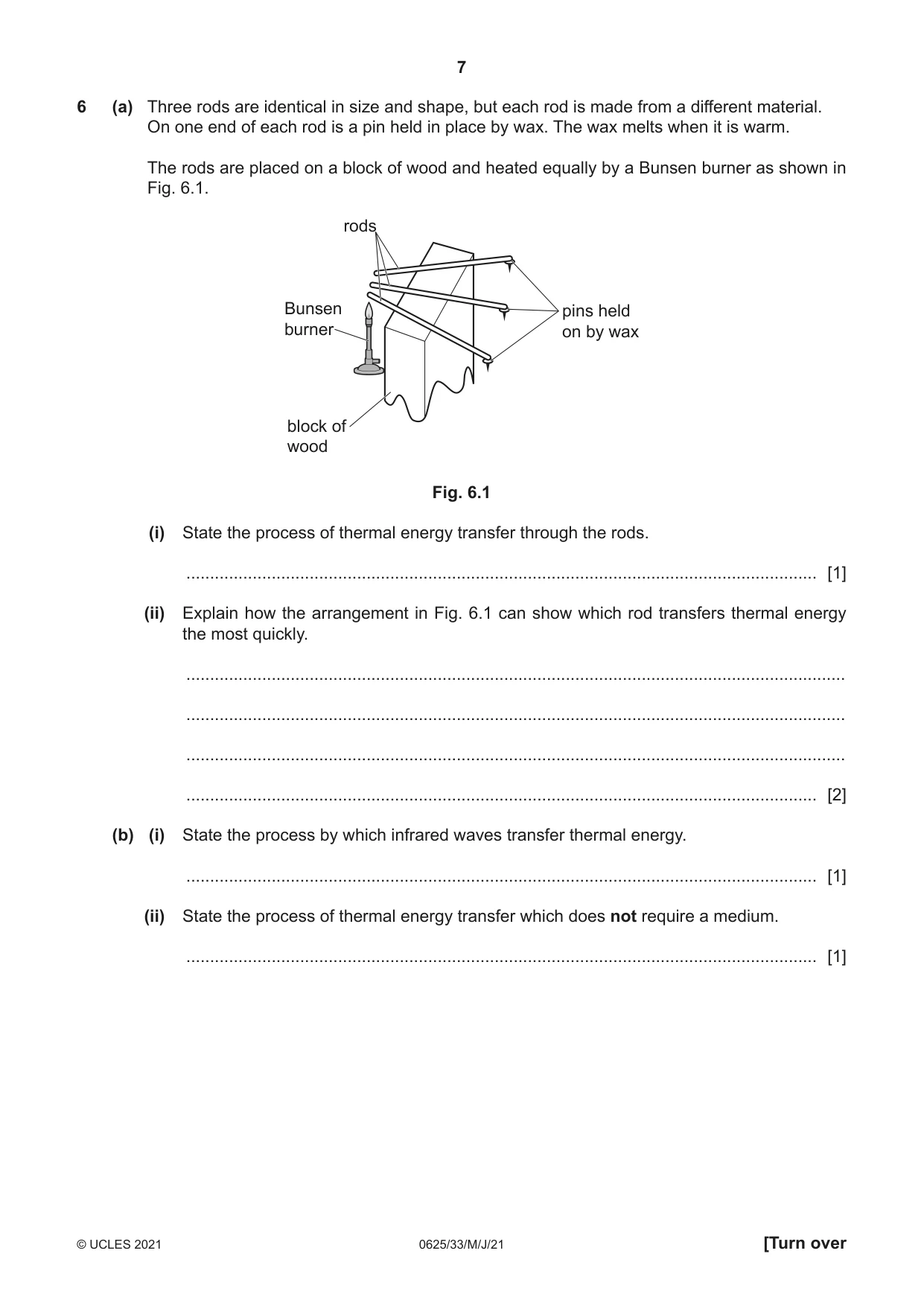
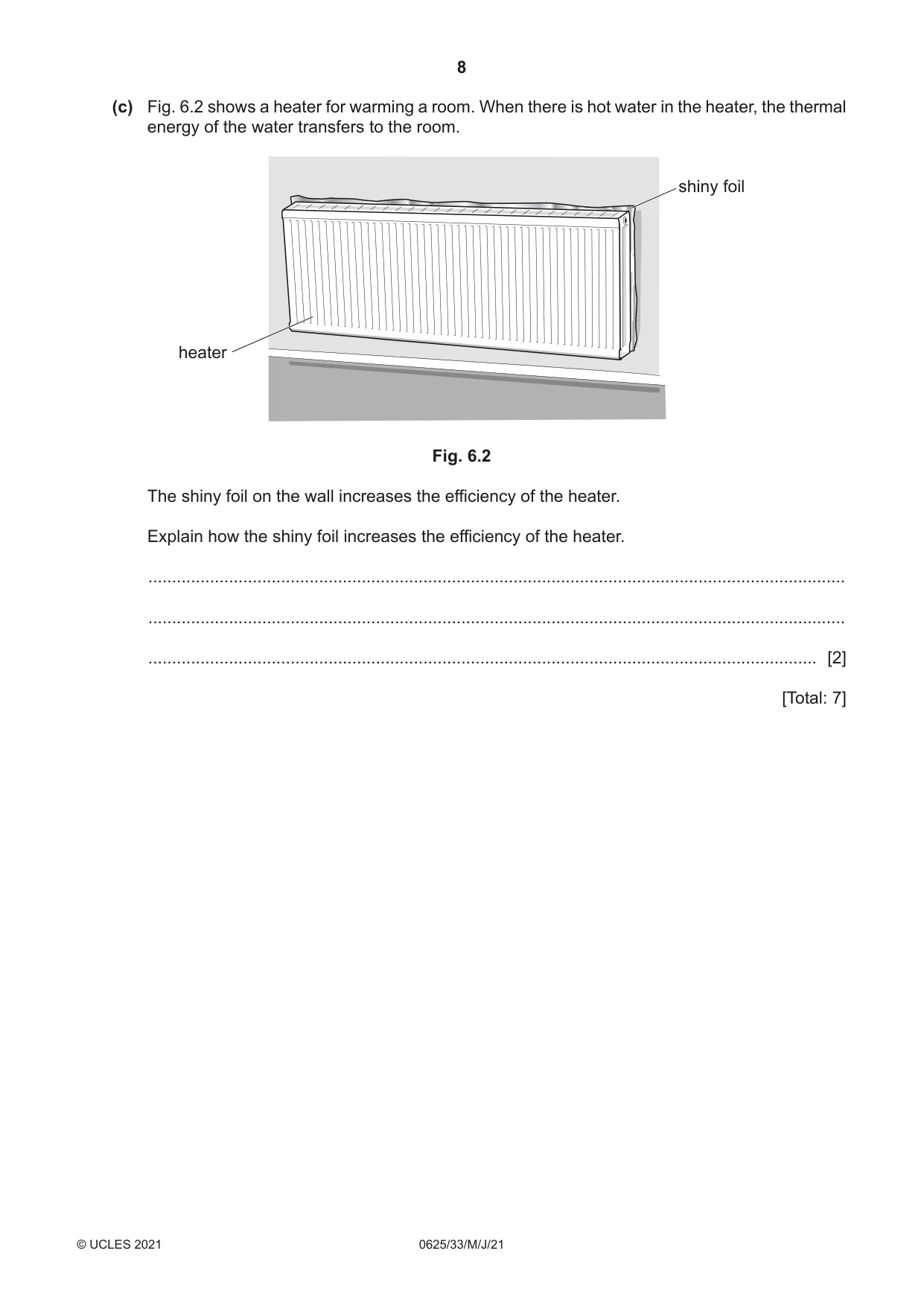
6 (a) Three rods are identical in size and shape, but each rod is made from a different material. On one end of each rod is a pin held in place by wax. The wax melts when it is warm. The rods are placed on a block of wood and heated equally by a Bunsen burner as shown in Fig. 6.1. rods Bunsen pins held burner on by wax block of wood Fig. 6.1 (i) State the process of thermal energy transfer through the rods. ..................................................................................................................................... [1] (ii) Explain how the arrangement in Fig. 6.1 can show which rod transfers thermal energy the most quickly. ........................................................................................................................................... ........................................................................................................................................... ........................................................................................................................................... ..................................................................................................................................... [2] (b) (i) State the process by which infrared waves transfer thermal energy. ..................................................................................................................................... [1] (ii) State the process of thermal energy transfer which does not require a medium. ..................................................................................................................................... [1] (c) Fig. 6.2 shows a heater for warming a room. When there is hot water in the heater, the thermal energy of the water transfers to the room. shiny foil heater Fig. 6.2 The shiny foil on the wall increases the efficiency of the heater. Explain how the shiny foil increases the efficiency of the heater. ................................................................................................................................................... ................................................................................................................................................... ............................................................................................................................................. [2] [Total: 7]
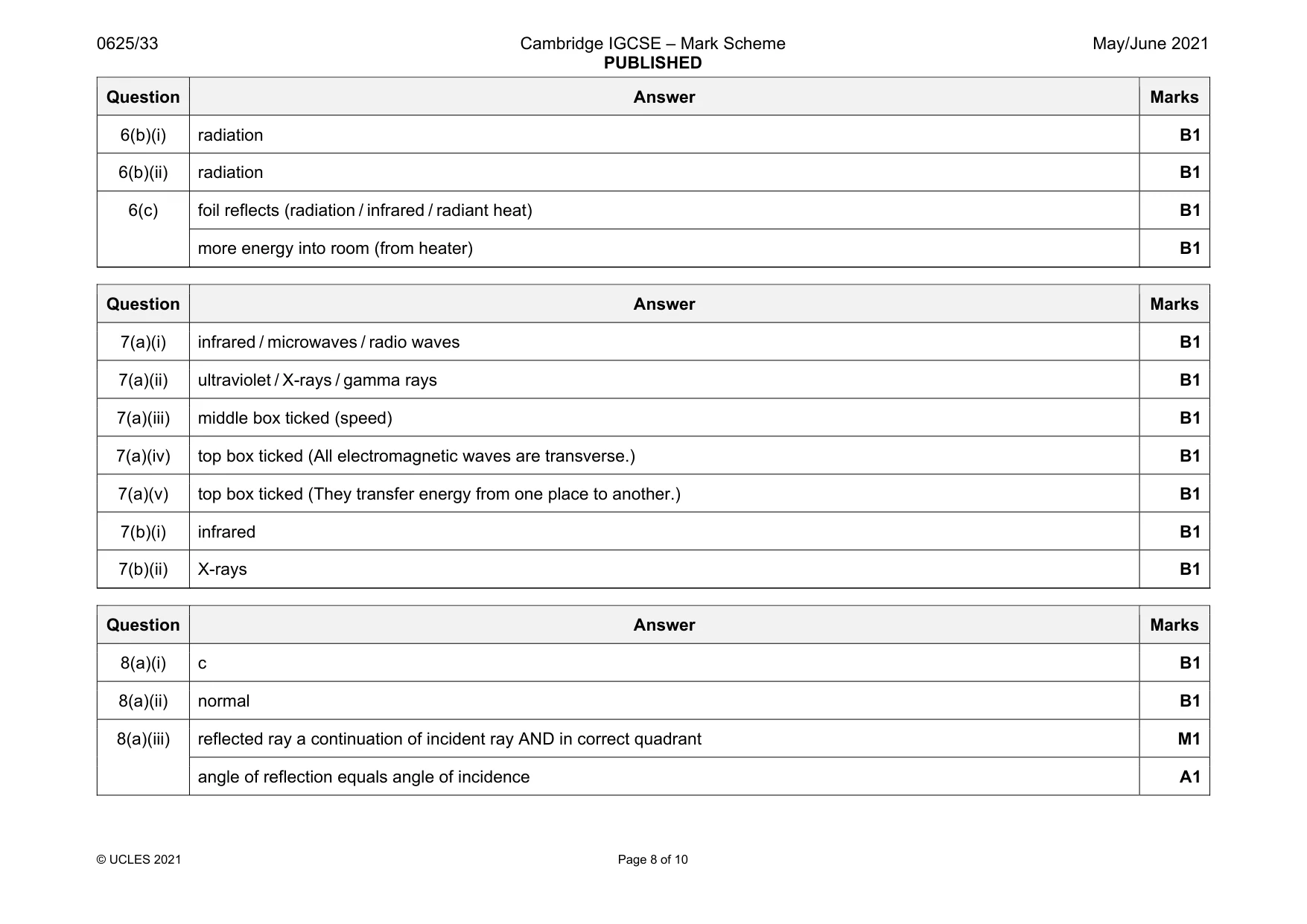
Mark scheme: 6(a)(i) conduction B1 6(a)(ii) melts wax OR pin falls off C1 first pin to fall (is best conductor) A1 Question Answer Marks 6(b)(i) radiation B1 6(b)(ii) radiation B1 6(c) foil reflects (radiation / infrared / radiant heat) B1 more energy into room (from heater) B1
Q7 · This question is about the electromagnetic spectrum
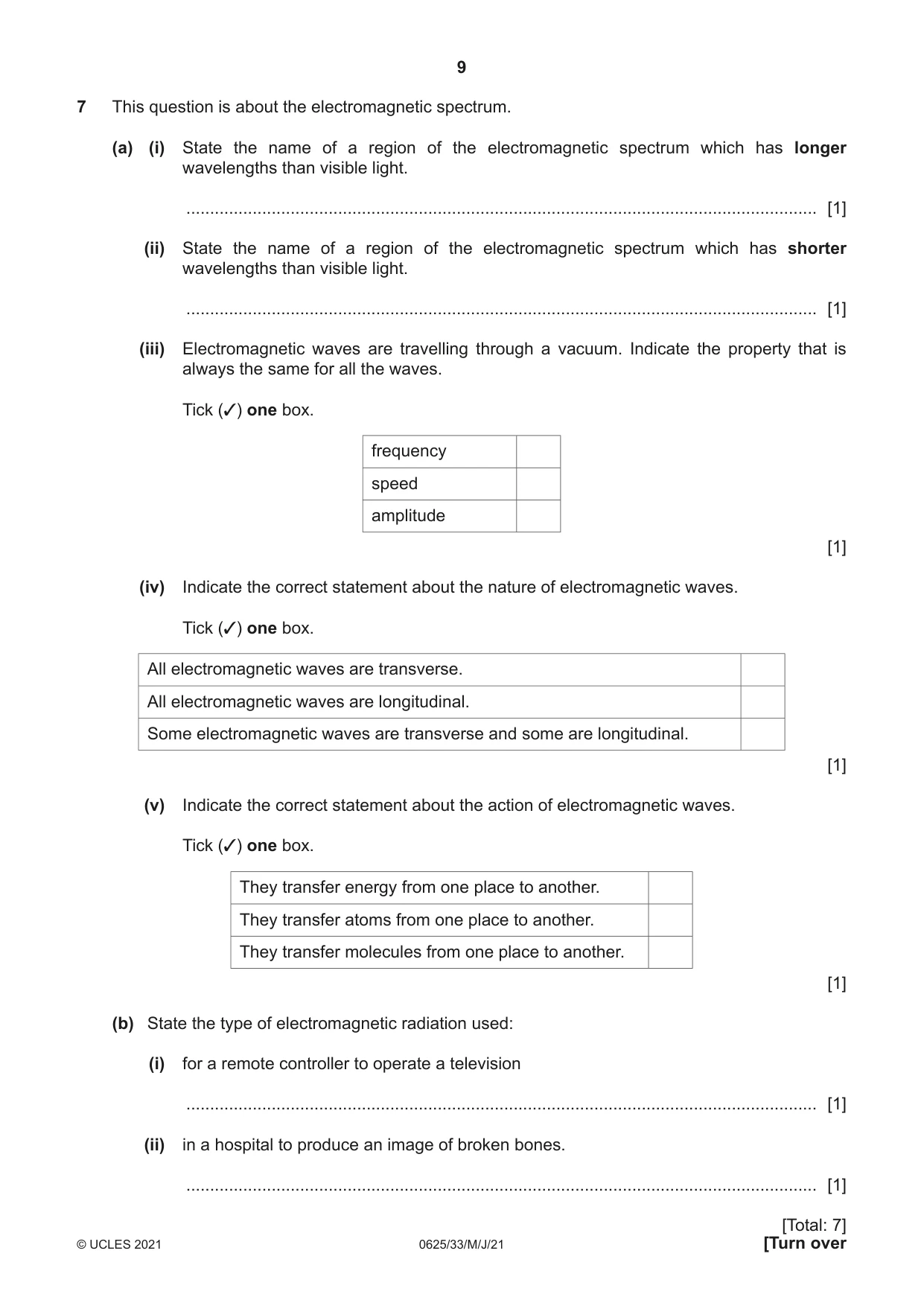
7 This question is about the electromagnetic spectrum. (a) (i) State the name of a region of the electromagnetic spectrum which has longer wavelengths than visible light. ..................................................................................................................................... [1] (ii) State the name of a region of the electromagnetic spectrum which has shorter wavelengths than visible light. ..................................................................................................................................... [1] (iii) Electromagnetic waves are travelling through a vacuum. Indicate the property that is always the same for all the waves. Tick (3) one box. frequency speed amplitude [1] (iv) Indicate the correct statement about the nature of electromagnetic waves. Tick (3) one box. All electromagnetic waves are transverse. All electromagnetic waves are longitudinal. Some electromagnetic waves are transverse and some are longitudinal. [1] (v) Indicate the correct statement about the action of electromagnetic waves. Tick (3) one box. They transfer energy from one place to another. They transfer atoms from one place to another. They transfer molecules from one place to another. [1] (b) State the type of electromagnetic radiation used: (i) for a remote controller to operate a television ..................................................................................................................................... [1] (ii) in a hospital to produce an image of broken bones. ..................................................................................................................................... [1]
Mark scheme: 7(a)(i) infrared / microwaves / radio waves B1 7(a)(ii) ultraviolet / X-rays / gamma rays B1 7(a)(iii) middle box ticked (speed) B1 7(a)(iv) top box ticked (All electromagnetic waves are transverse.) B1 7(a)(v) top box ticked (They transfer energy from one place to another.) B1 7(b)(i) infrared B1 7(b)(ii) X-rays B1
Q8 · A ray of light incident on a plane mirror
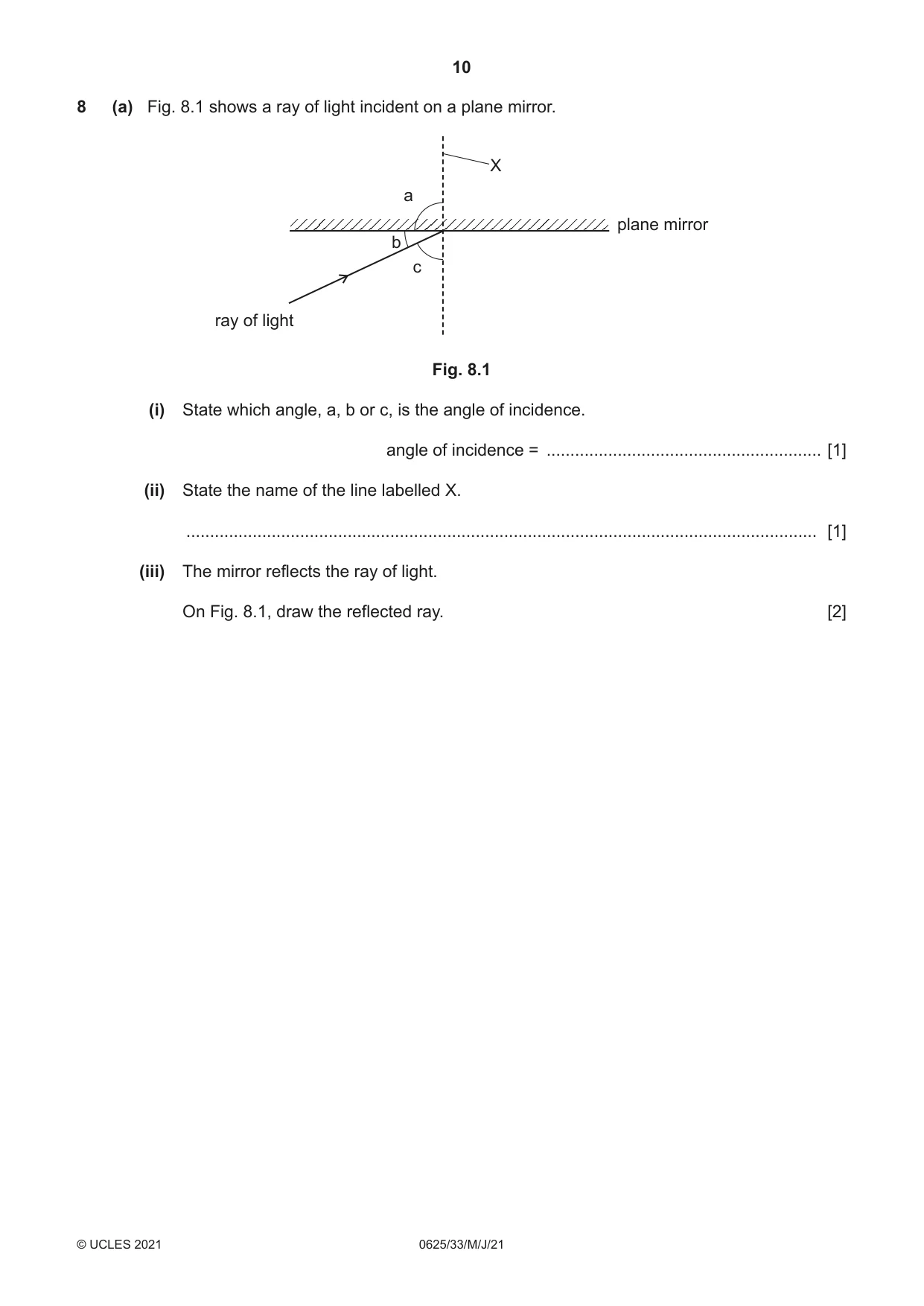
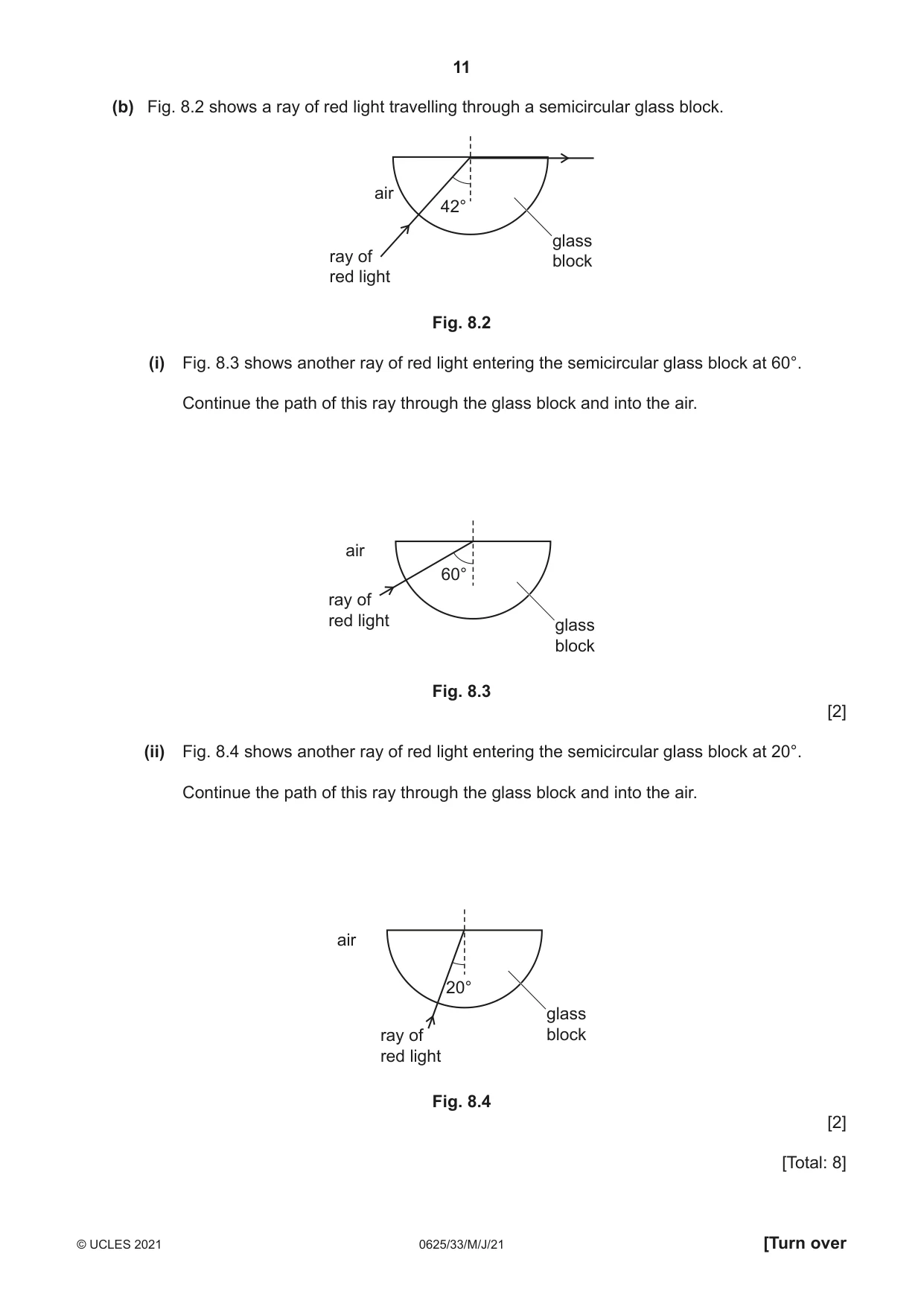
8 (a) Fig. 8.1 shows a ray of light incident on a plane mirror. X a plane mirror b c ray of light Fig. 8.1 (i) State which angle, a, b or c, is the angle of incidence. angle of incidence = .......................................................... [1] (ii) State the name of the line labelled X. ..................................................................................................................................... [1] (iii) The mirror reflects the ray of light. On Fig. 8.1, draw the reflected ray. [2] (b) Fig. 8.2 shows a ray of red light travelling through a semicircular glass block. air 42° glass ray of block red light Fig. 8.2 (i) Fig. 8.3 shows another ray of red light entering the semicircular glass block at 60°. Continue the path of this ray through the glass block and into the air. air 60° ray of red light glass block Fig. 8.3 [2] (ii) Fig. 8.4 shows another ray of red light entering the semicircular glass block at 20°. Continue the path of this ray through the glass block and into the air. air 20° glass ray of block red light Fig. 8.4 [2] [Total: 8]
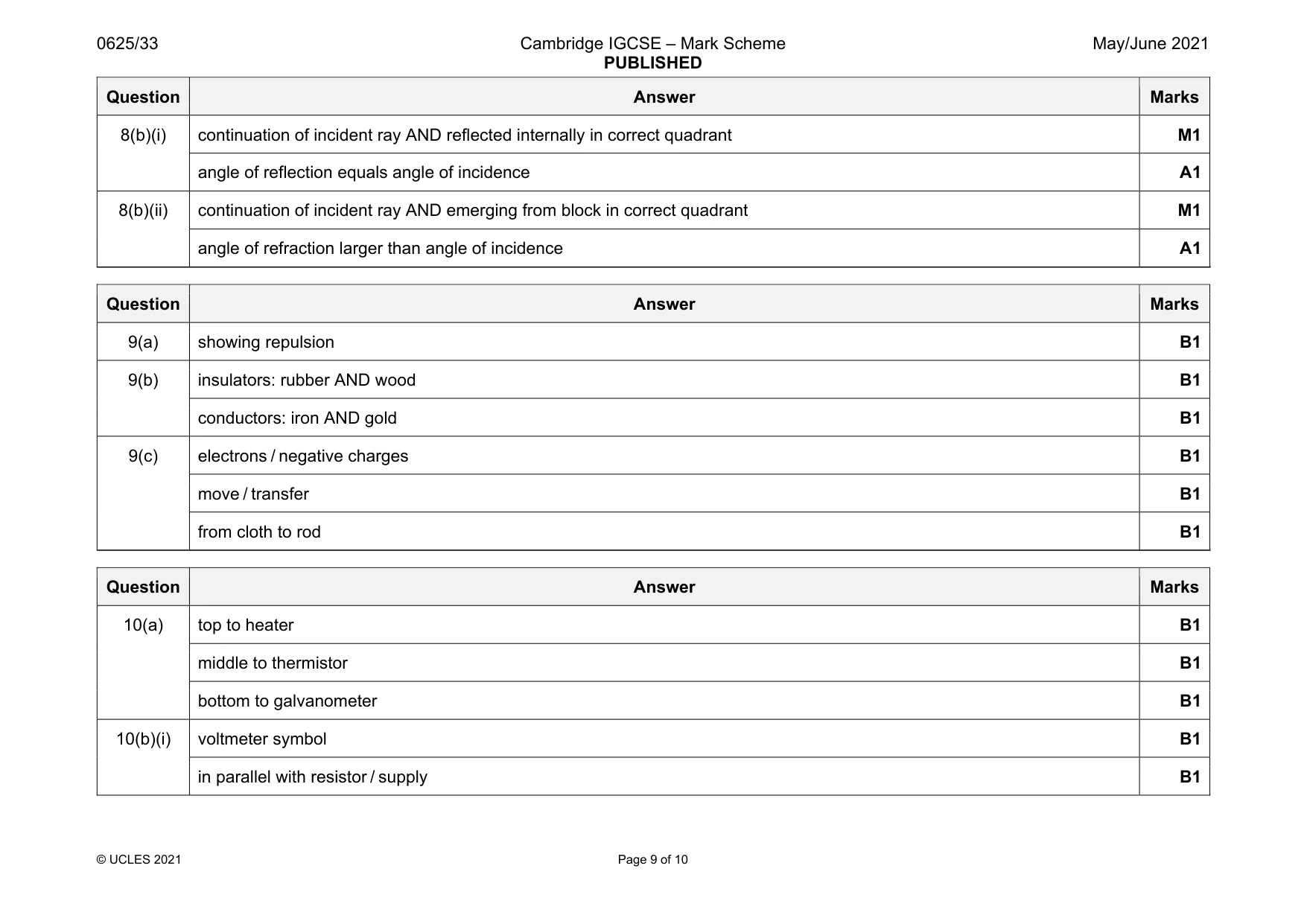
Mark scheme: 8(a)(i) c B1 8(a)(ii) normal B1 8(a)(iii) reflected ray a continuation of incident ray AND in correct quadrant M1 angle of reflection equals angle of incidence A1 Question Answer Marks 8(b)(i) continuation of incident ray AND reflected internally in correct quadrant M1 angle of reflection equals angle of incidence A1 8(b)(ii) continuation of incident ray AND emerging from block in correct quadrant M1 angle of refraction larger than angle of incidence A1
Q9 · Two uncharged balloons suspended from a beam by light thread
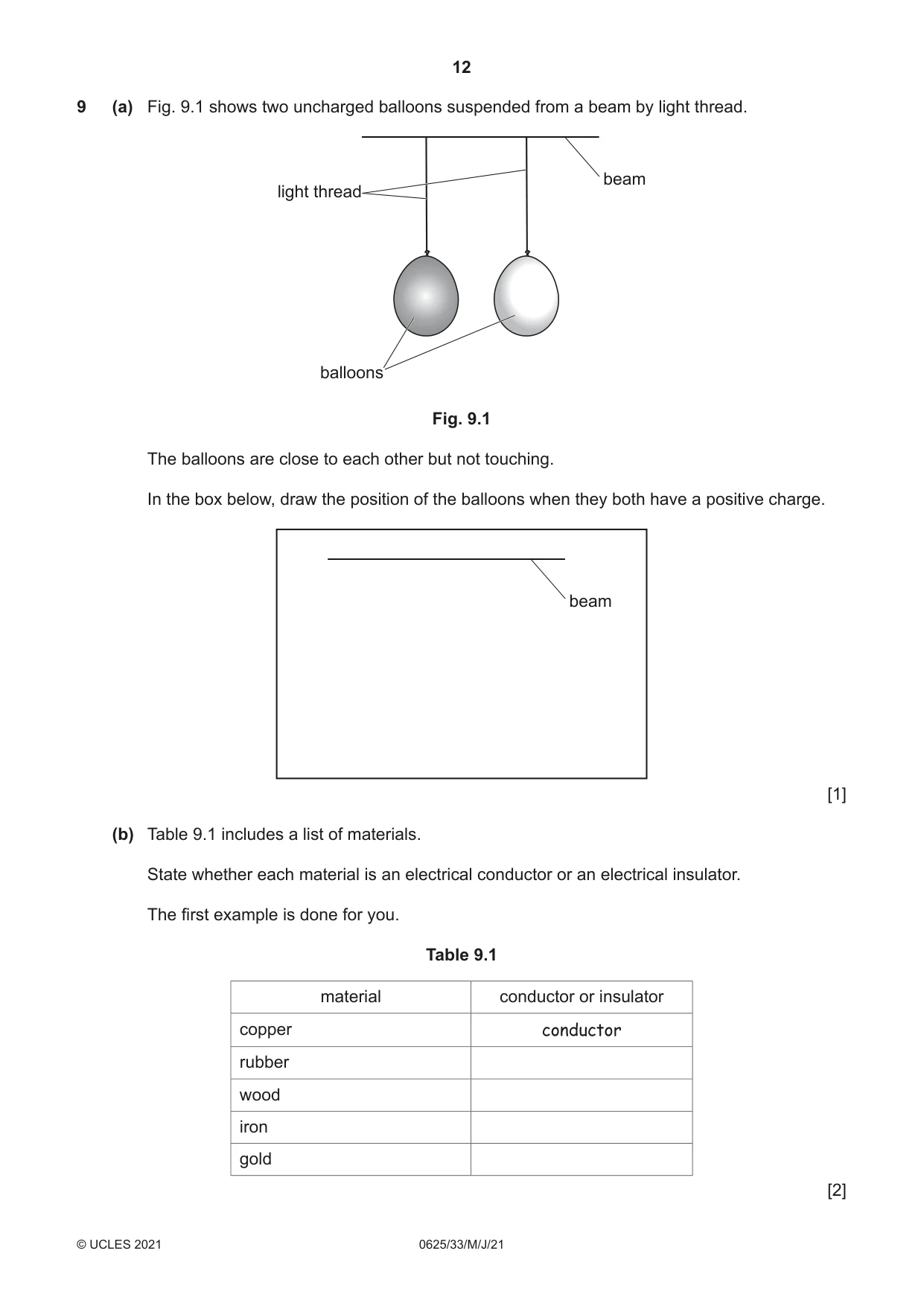
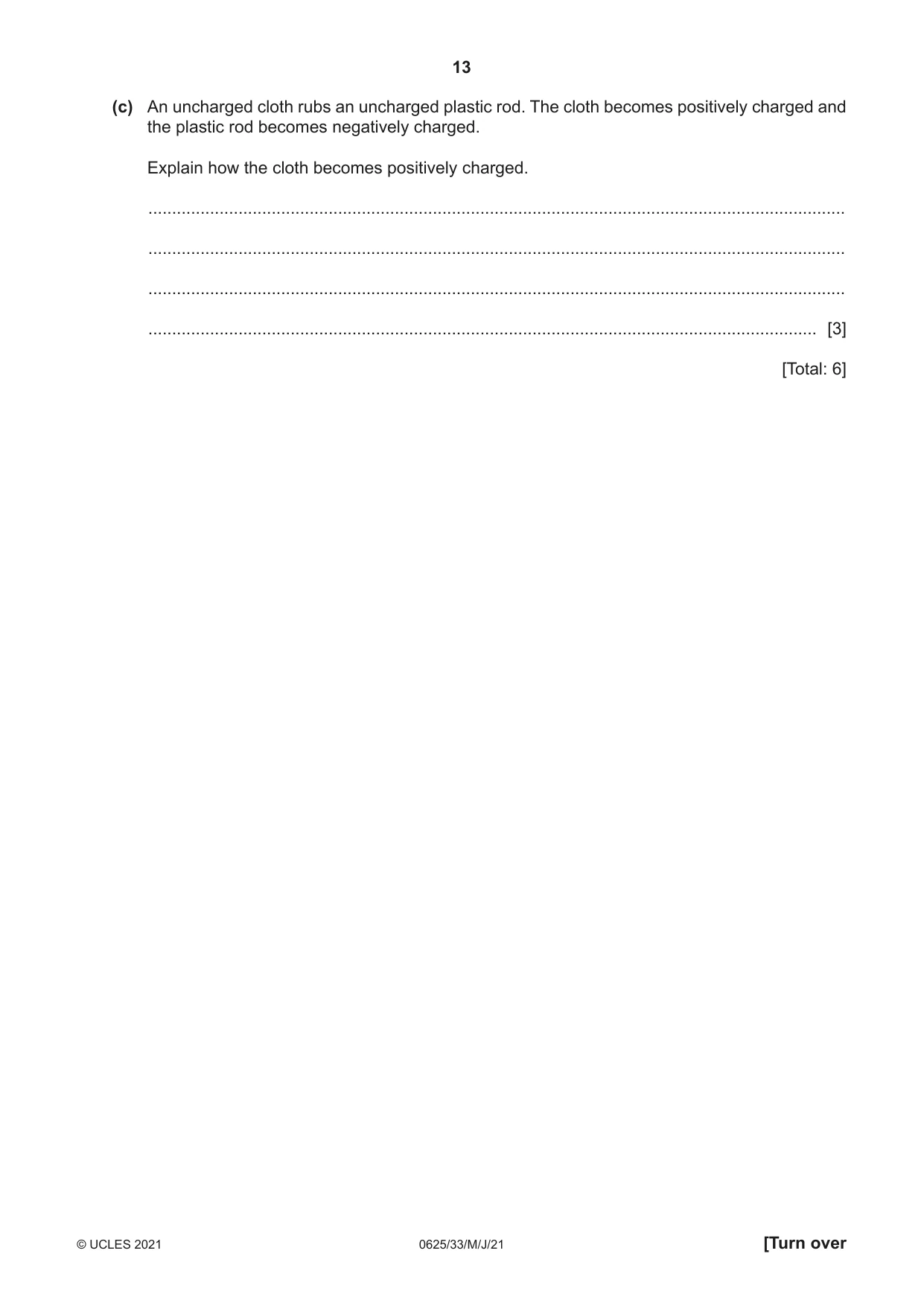
9 (a) Fig. 9.1 shows two uncharged balloons suspended from a beam by light thread. beam light thread balloons Fig. 9.1 The balloons are close to each other but not touching. In the box below, draw the position of the balloons when they both have a positive charge. beam [1] (b) Table 9.1 includes a list of materials. State whether each material is an electrical conductor or an electrical insulator. The first example is done for you. Table 9.1 material conductor or insulator copper conductor rubber wood iron gold [2] (c) An uncharged cloth rubs an uncharged plastic rod. The cloth becomes positively charged and the plastic rod becomes negatively charged. Explain how the cloth becomes positively charged. ................................................................................................................................................... ................................................................................................................................................... ................................................................................................................................................... ............................................................................................................................................. [3] [Total: 6]
Mark scheme: 9(a) showing repulsion B1 9(b) insulators: rubber AND wood B1 conductors: iron AND gold B1 9(c) electrons / negative charges B1 move / transfer B1 from cloth to rod B1
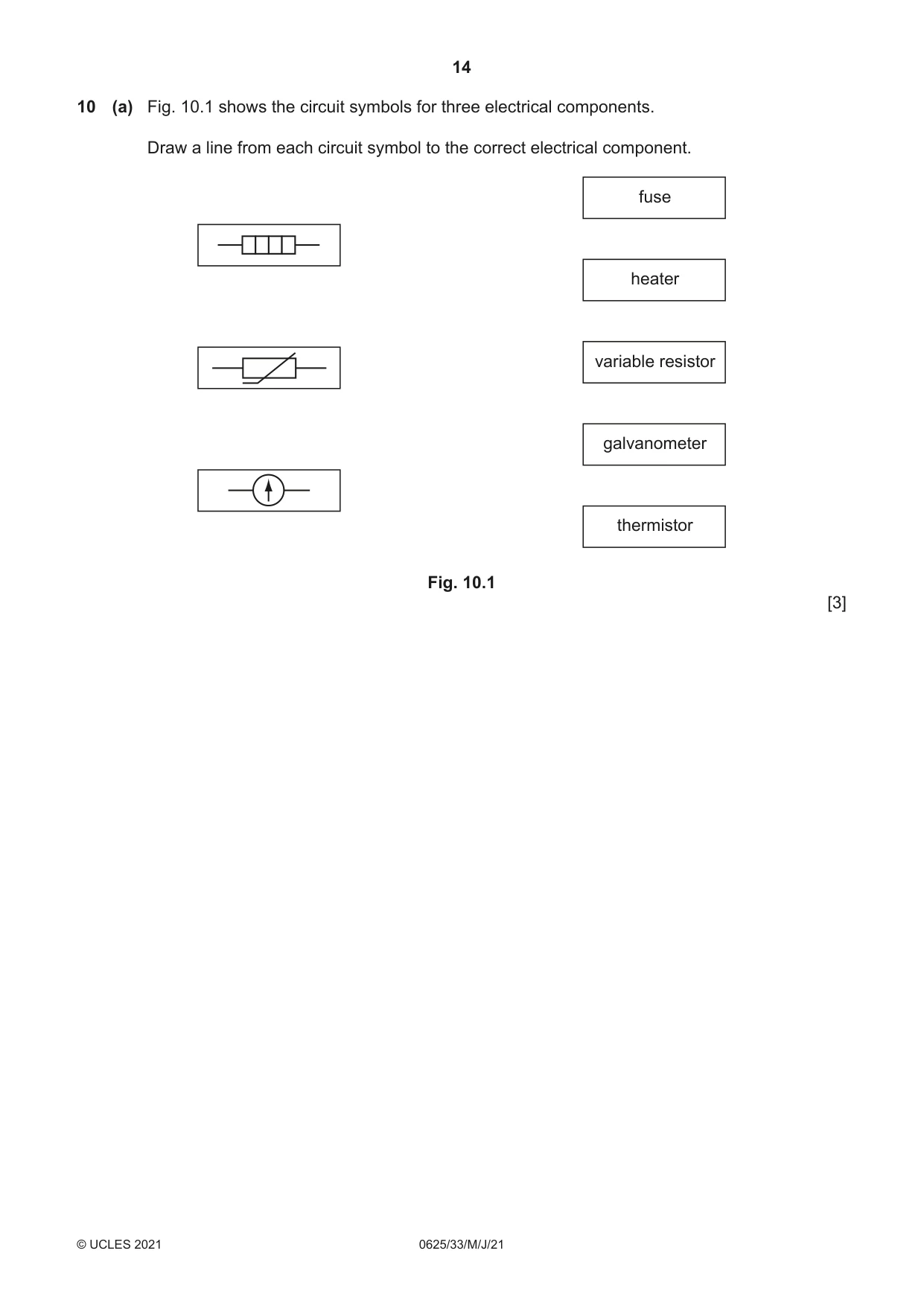
Q10 · The circuit symbols for three electrical components
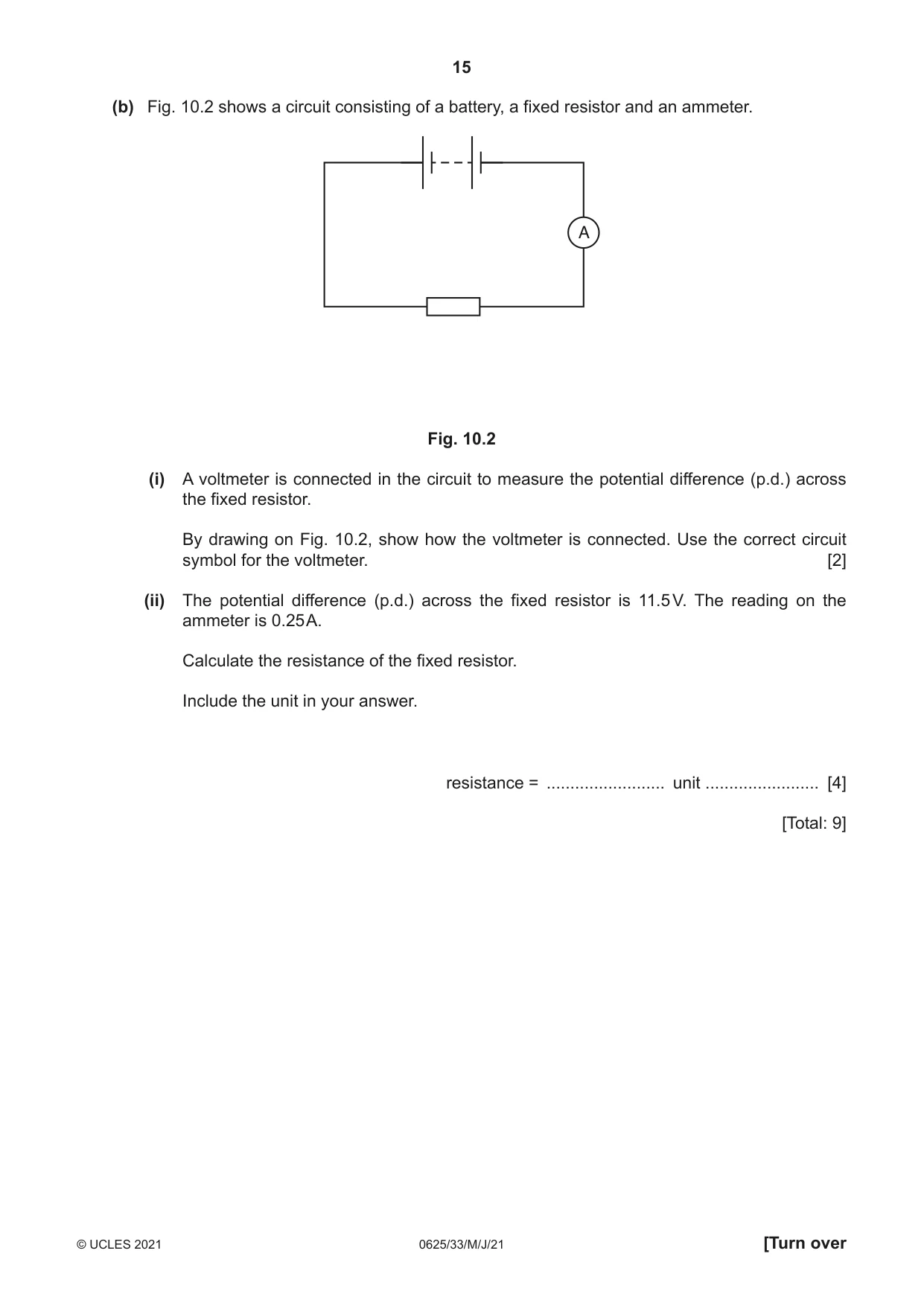
10 (a) Fig. 10.1 shows the circuit symbols for three electrical components. Draw a line from each circuit symbol to the correct electrical component. fuse heater variable resistor galvanometer thermistor Fig. 10.1 [3] (b) Fig. 10.2 shows a circuit consisting of a battery, a fixed resistor and an ammeter. A Fig. 10.2 (i) A voltmeter is connected in the circuit to measure the potential difference (p.d.) across the fixed resistor. By drawing on Fig. 10.2, show how the voltmeter is connected. Use the correct circuit symbol for the voltmeter. [2] (ii) The potential difference (p.d.) across the fixed resistor is 11.5 V. The reading on the ammeter is 0.25 A. Calculate the resistance of the fixed resistor. Include the unit in your answer. resistance = ......................... unit ........................ [4] [Total: 9]
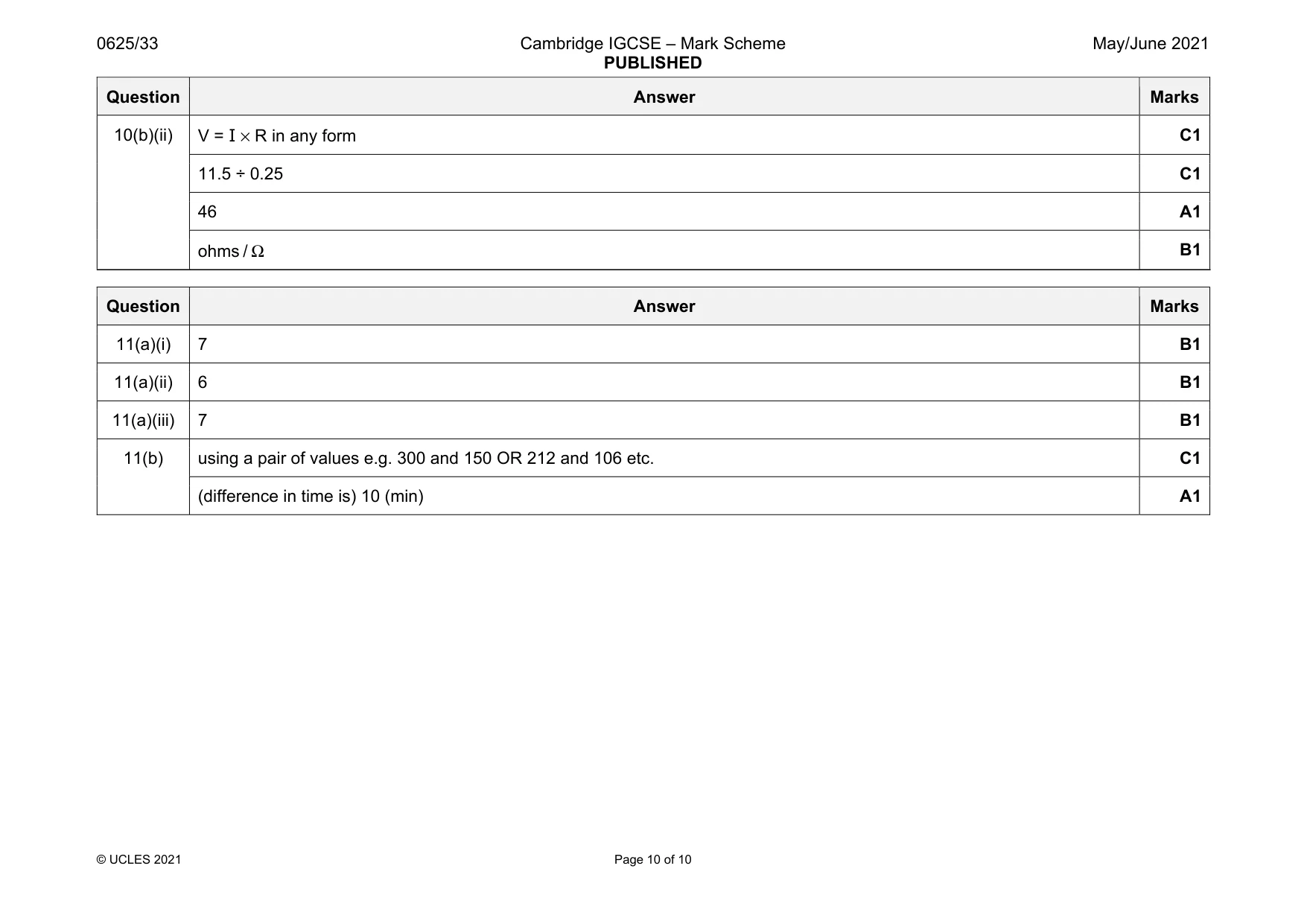
Mark scheme: 10(a) top to heater B1 middle to thermistor B1 bottom to galvanometer B1 10(b)(i) voltmeter symbol B1 in parallel with resistor / supply B1 Question Answer Marks 10(b)(ii) V = I × R in any form C1 11.5 ÷ 0.25 C1 46 A1 ohms / Ω B1
Q11 · A nucleus of nitrogen-13 has the nuclide notation: 7N
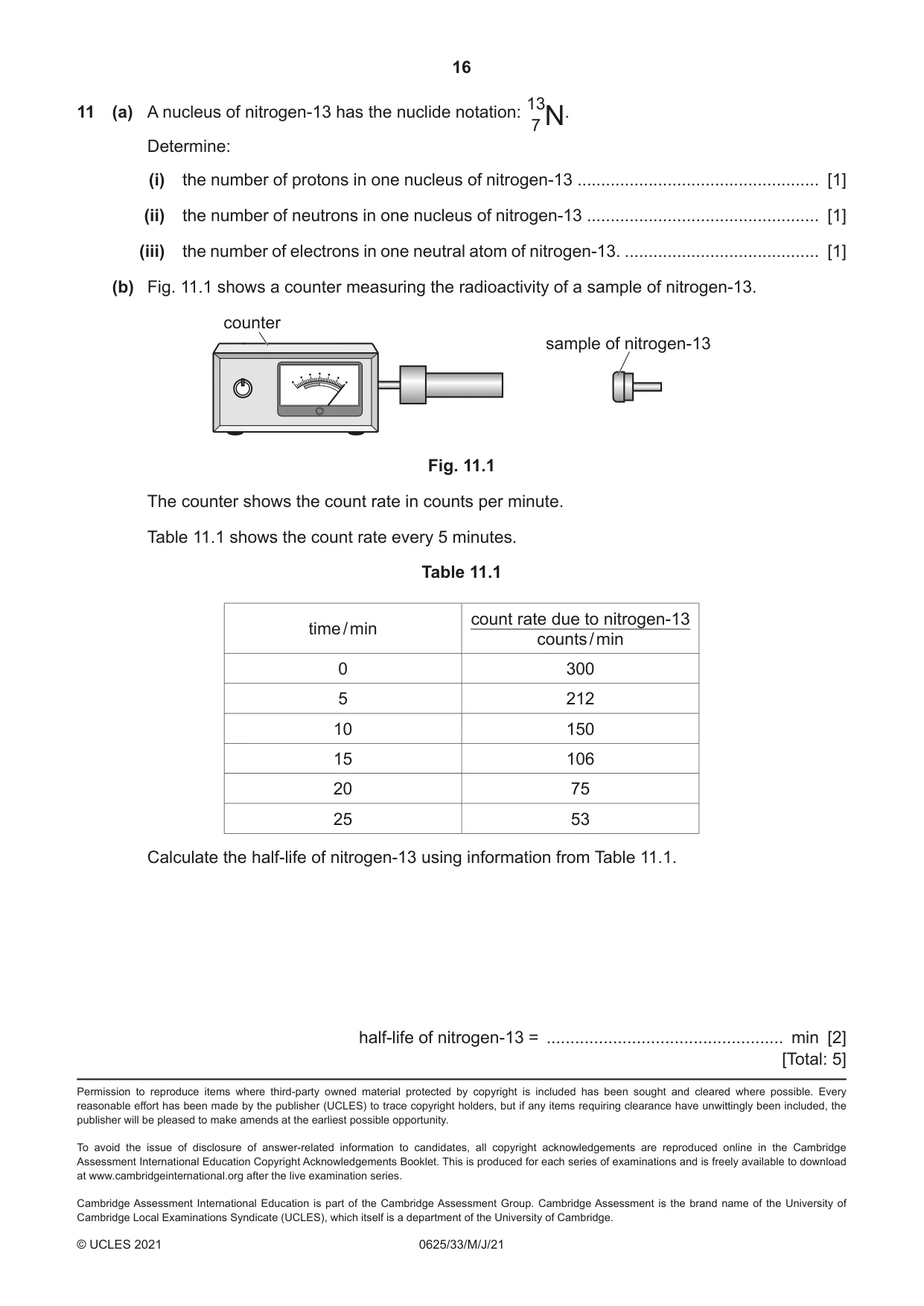
11 (a) A nucleus of nitrogen-13 has the nuclide notation: 7N. Determine: (i) the number of protons in one nucleus of nitrogen-13 ................................................... [1] (ii) the number of neutrons in one nucleus of nitrogen-13 ................................................. [1] (iii) the number of electrons in one neutral atom of nitrogen-13. ......................................... [1] (b) Fig. 11.1 shows a counter measuring the radioactivity of a sample of nitrogen-13. counter sample of nitrogen-13 Fig. 11.1 The counter shows the count rate in counts per minute. Table 11.1 shows the count rate every 5 minutes. Table 11.1 count rate due to nitrogen-13 time / min counts / min 0 300 5 212 10 150 15 106 20 75 25 53 Calculate the half-life of nitrogen-13 using information from Table 11.1. half-life of nitrogen-13 = .................................................. min [2] [Total: 5]
Mark scheme: 11(a)(i) 7 B1 11(a)(ii) 6 B1 11(a)(iii) 7 B1 11(b) using a pair of values e.g. 300 and 150 OR 212 and 106 etc. C1 (difference in time is) 10 (min) A1
What was in this paper
The subtopics covered by these 11 questions, and how many questions each got. Open one in a new tab to see every Cambridge question on it.
What you needed in this session
Cambridge’s own grade thresholds for 2021 May/June, Paper 3 · Variant 3. A higher threshold means an easier paper — the bar moves with how the cohort did.