Cambridge IGCSE Physics 0625 — 2022 May/June Paper 3 · Variant 1
0625/31/M/J/22 · 11 questions · 80 marks · ≈90 min
The question paper and its mark scheme, free to read here and free to download. This is Cambridge’s own paper, exactly as it was sat.
Question paper16 pages
Mark scheme13 pages
Answers below. Sit the paper first if you are practising.
Questions as text
Q1 · A dripping tap and a measuring cylinder
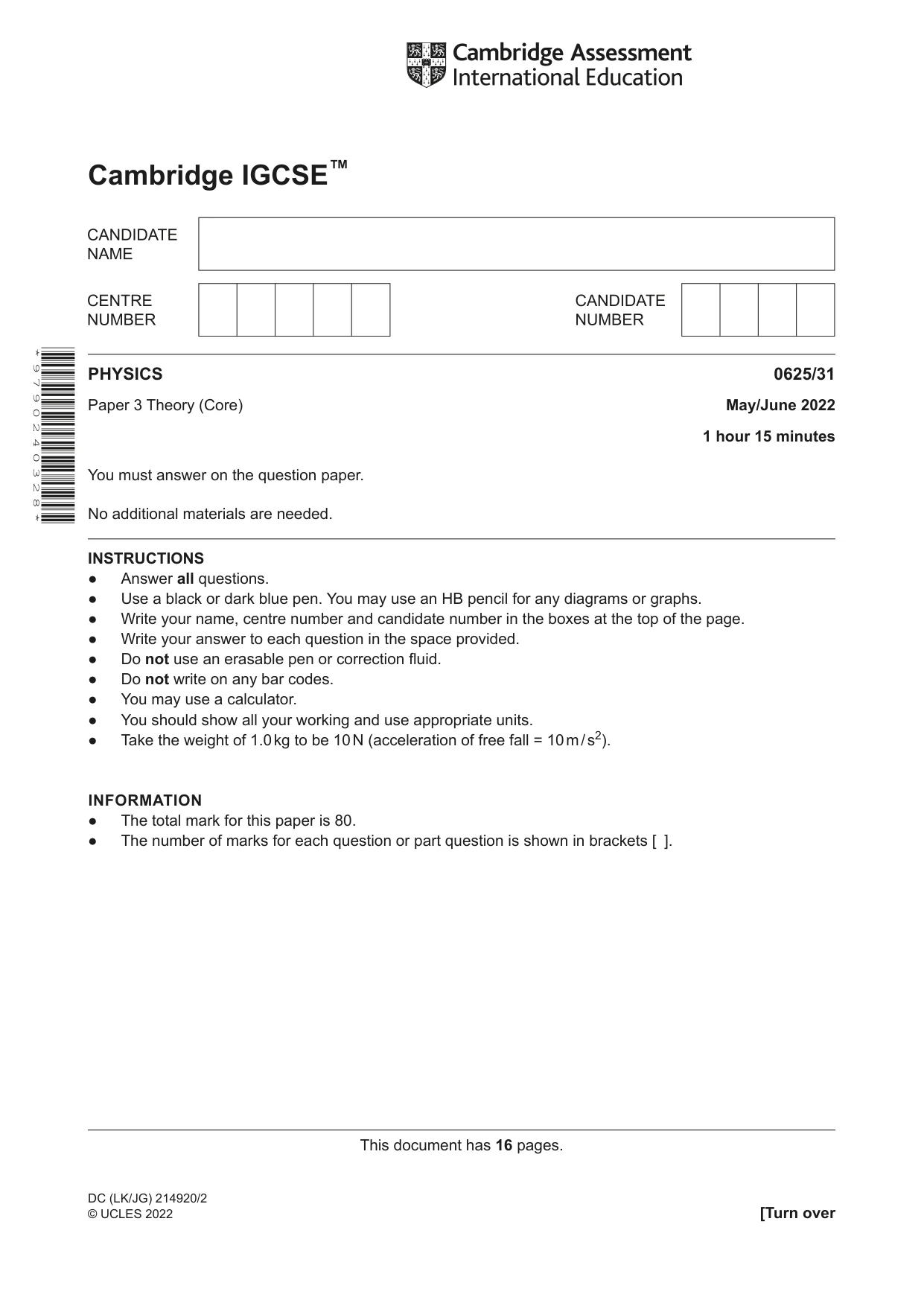
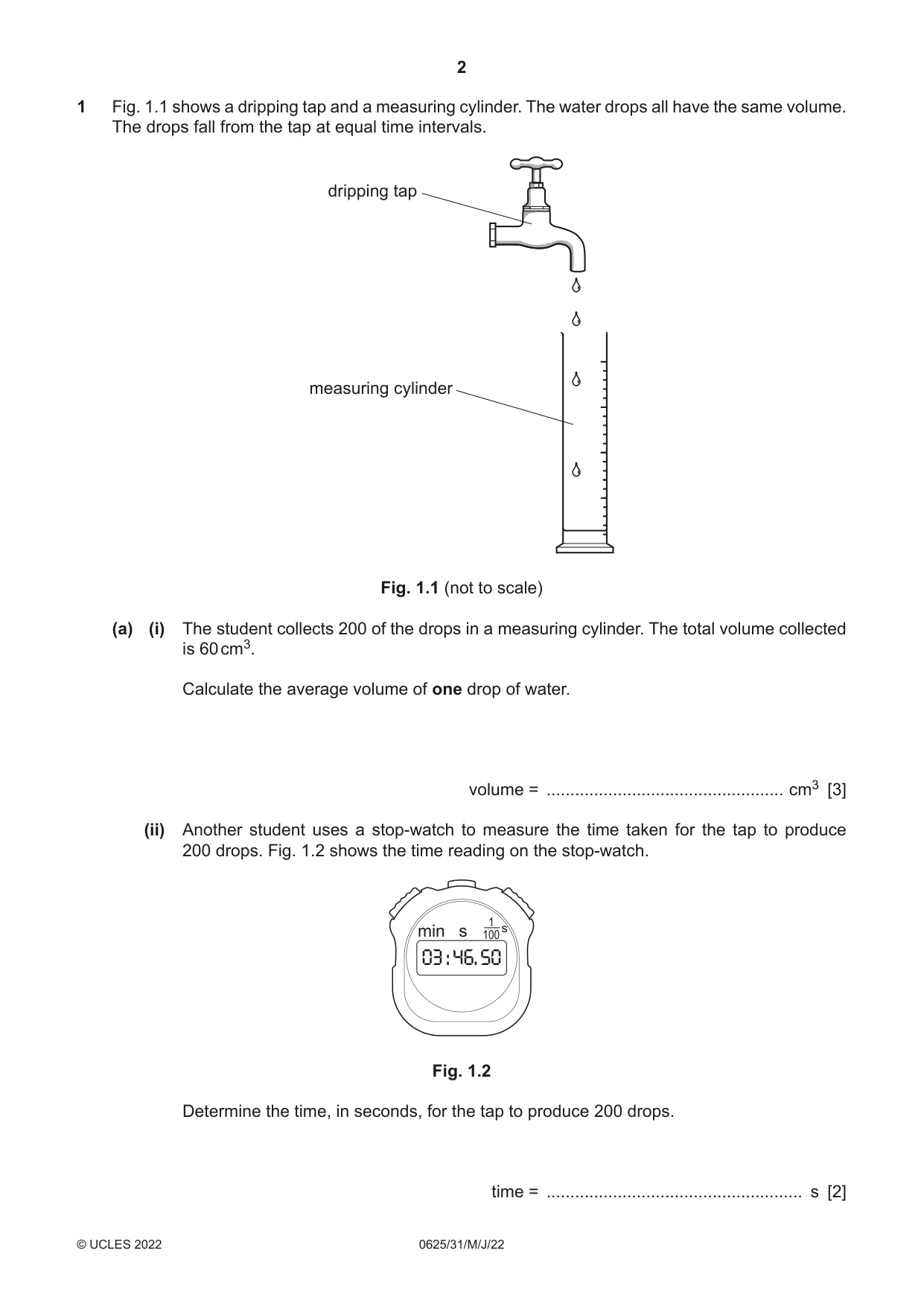
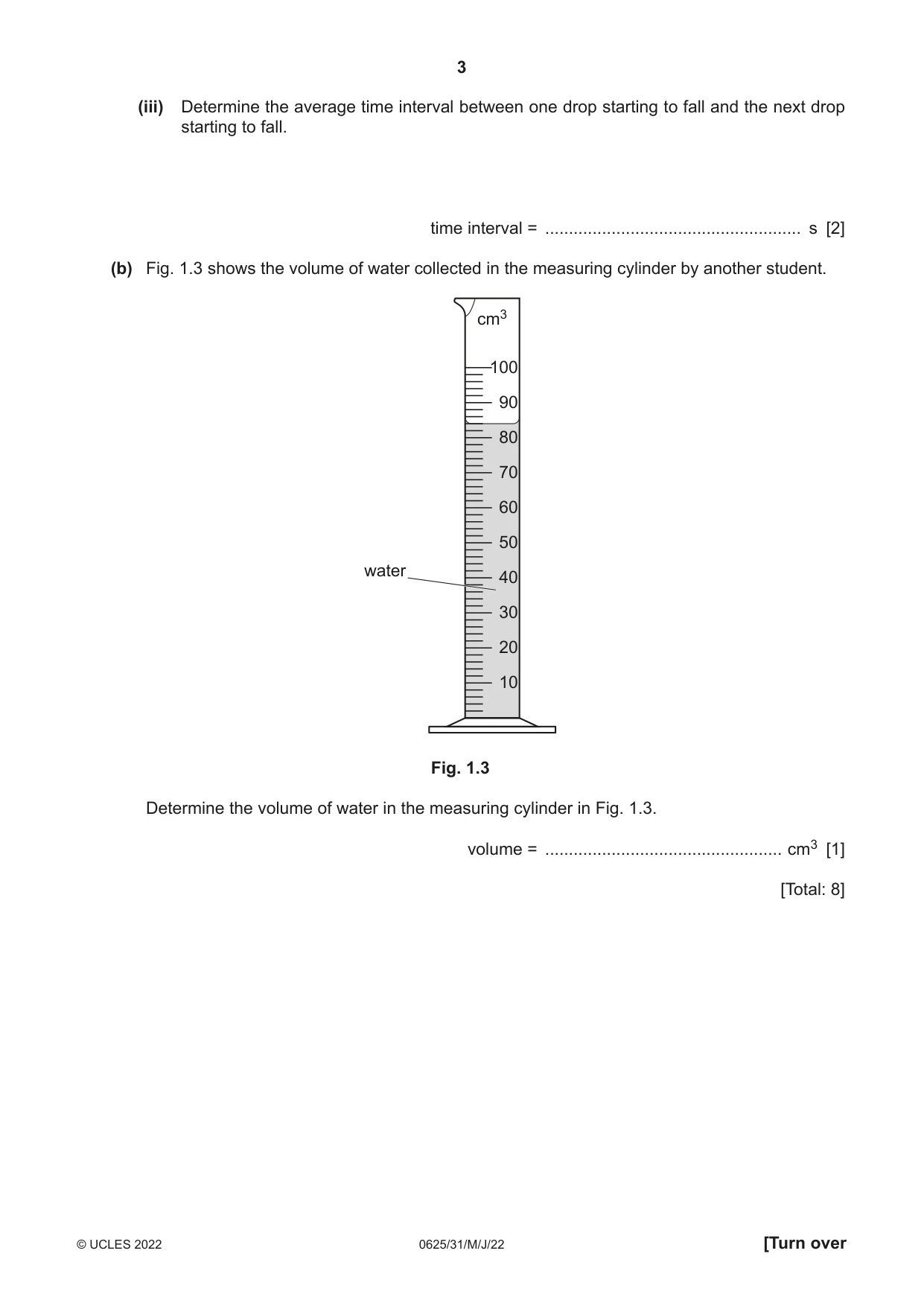
1 Fig. 1.1 shows a dripping tap and a measuring cylinder. The water drops all have the same volume. The drops fall from the tap at equal time intervals. dripping tap measuring cylinder Fig. 1.1 (not to scale) (a) (i) The student collects 200 of the drops in a measuring cylinder. The total volume collected is 60 cm3. Calculate the average volume of one drop of water. volume = .................................................. cm3 [3] (ii) Another student uses a stop-watch to measure the time taken for the tap to produce 200 drops. Fig. 1.2 shows the time reading on the stop-watch. 1 min s 100 s 03 : 46. 50 Fig. 1.2 Determine the time, in seconds, for the tap to produce 200 drops. time = ...................................................... s [2] (iii) Determine the average time interval between one drop starting to fall and the next drop starting to fall. time interval = ...................................................... s [2] (b) Fig. 1.3 shows the volume of water collected in the measuring cylinder by another student. cm3 100 90 80 70 60 50 water 40 30 20 10 Fig. 1.3 Determine the volume of water in the measuring cylinder in Fig. 1.3. volume = .................................................. cm3 [1] [Total: 8]
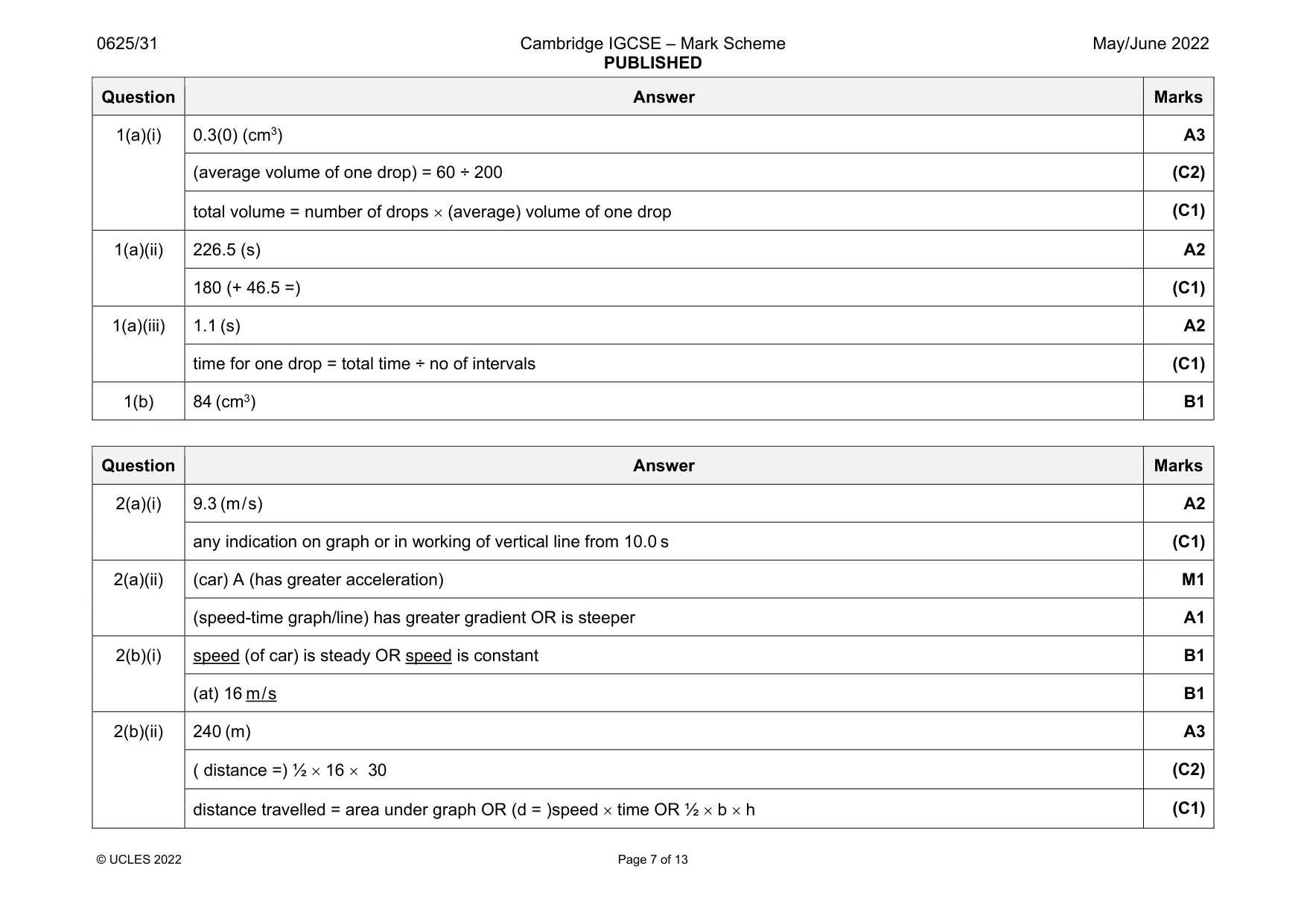
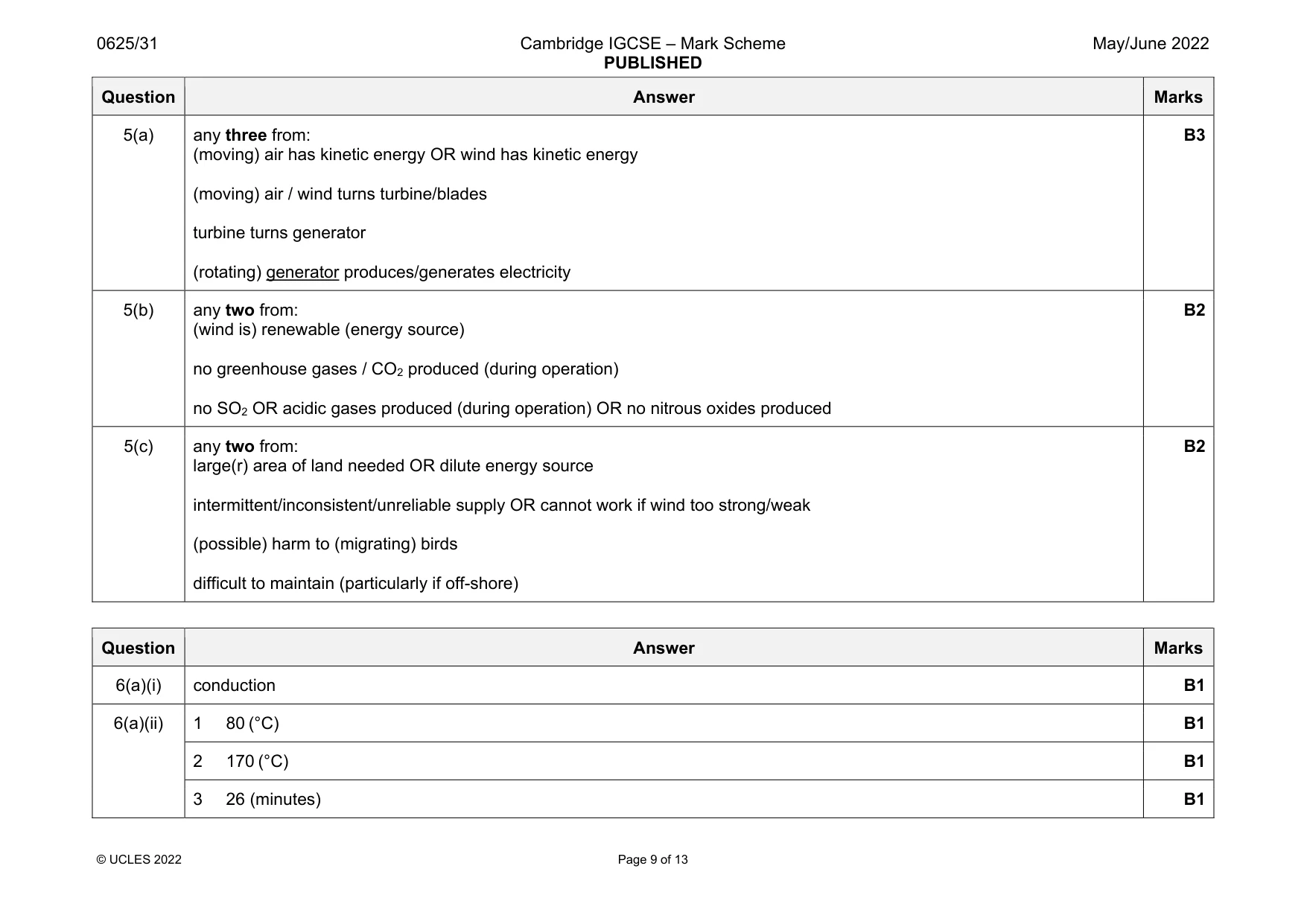
Mark scheme: 1(a)(i) 0.3(0) (cm3) A3 (average volume of one drop) = 60 ÷ 200 (C2) total volume = number of drops (average) volume of one drop (C1) 1(a)(ii) 226.5 (s) A2 180 (+ 46.5 =) (C1) 1(a)(iii) 1.1 (s) A2 time for one drop = total time ÷ no of intervals (C1) 1(b) 84 (cm3) B1
More questions on Physical quantities and measurement techniques
Q2 · State and explain which car, A or B, has the greater acceleration during the first 10…
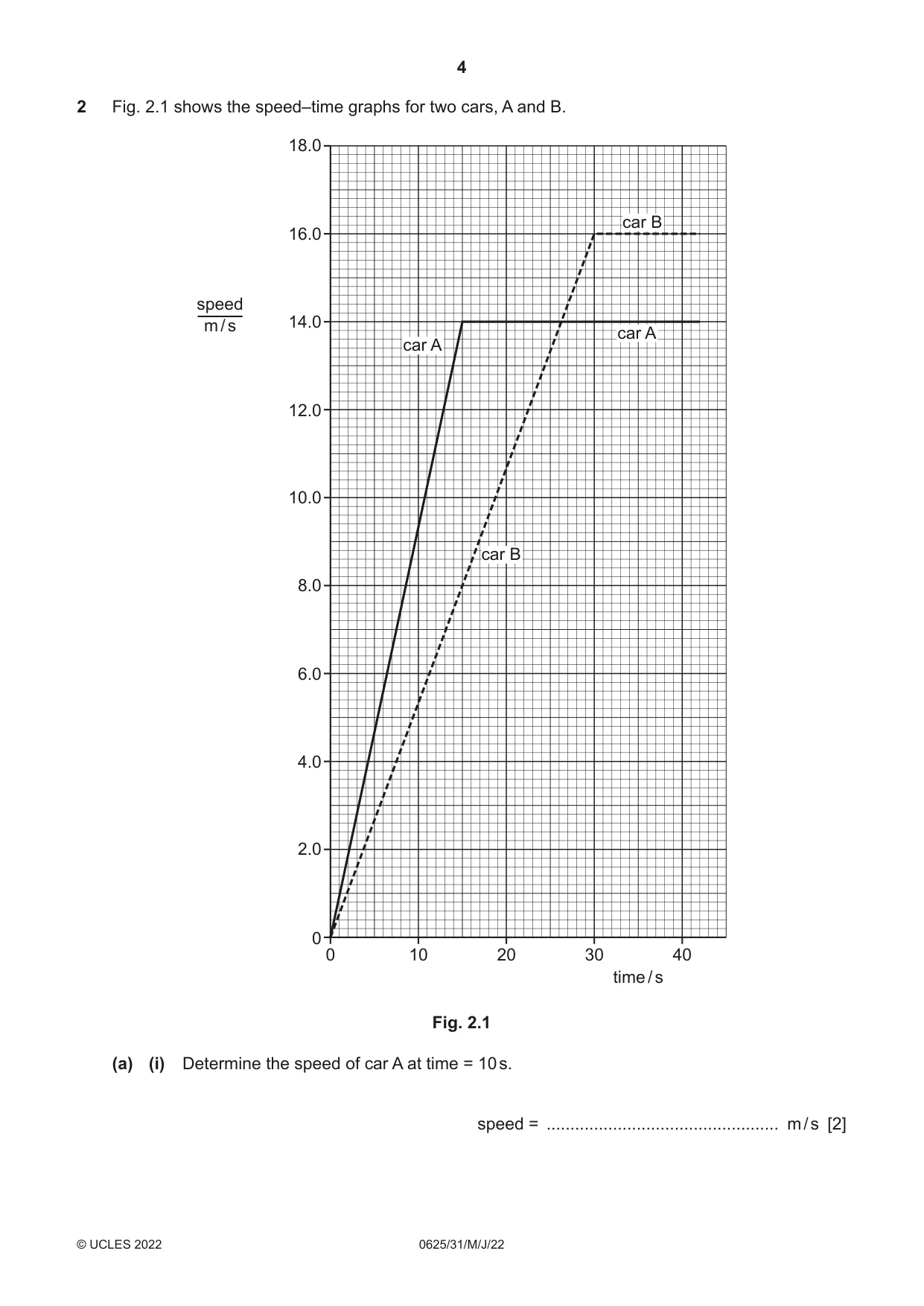
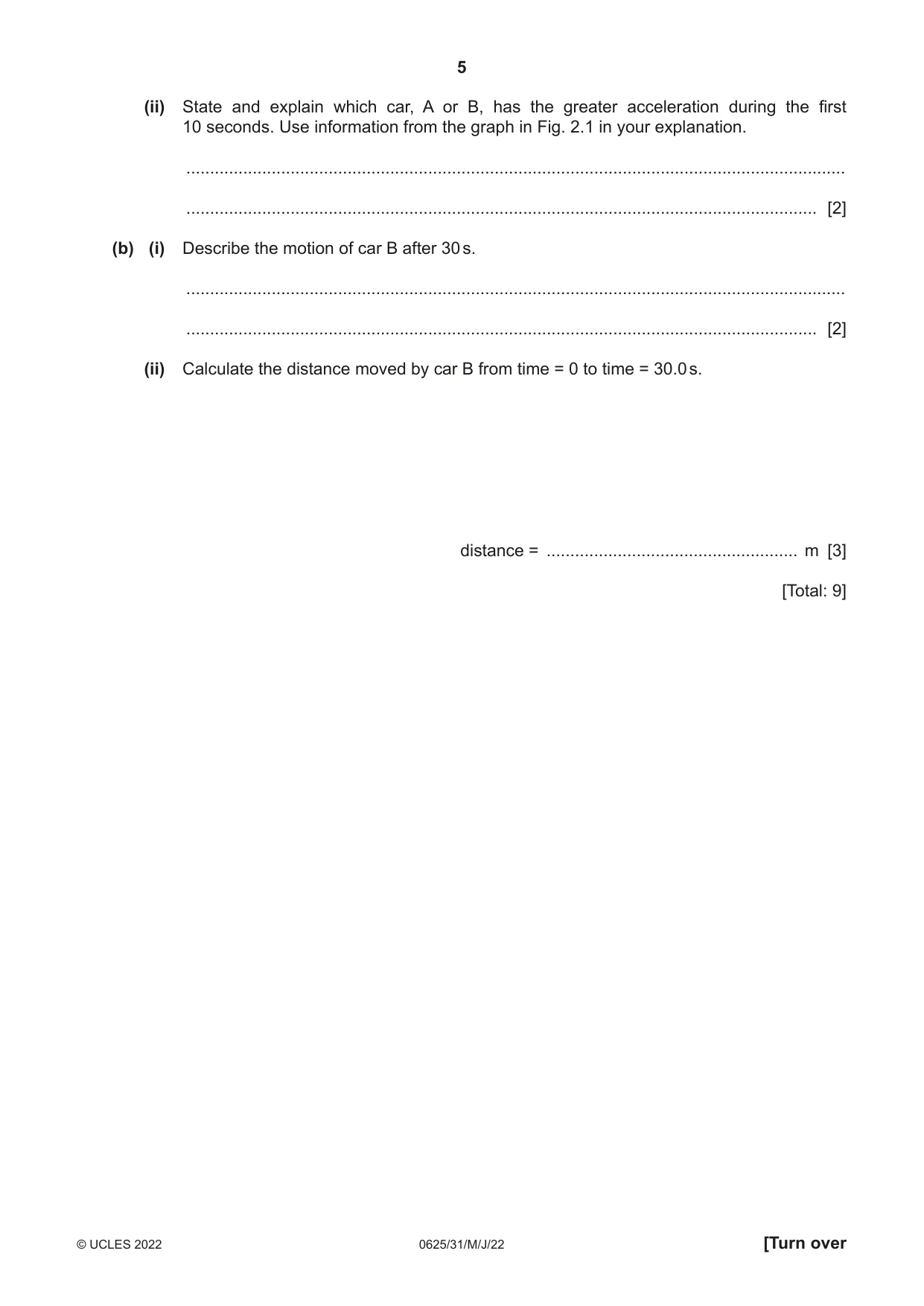
(ii) State and explain which car, A or B, has the greater acceleration during the first 10 seconds. Use information from the graph in Fig. 2.1 in your explanation. ........................................................................................................................................... ..................................................................................................................................... [2] (b) (i) Describe the motion of car B after 30 s. ........................................................................................................................................... ..................................................................................................................................... [2] (ii) Calculate the distance moved by car B from time = 0 to time = 30.0 s. distance = ..................................................... m [3] [Total: 9]
Mark scheme: 2(a)(i) 9.3 (m / s) A2 any indication on graph or in working of vertical line from 10.0 s (C1) 2(a)(ii) (car) A (has greater acceleration) M1 (speed-time graph/line) has greater gradient OR is steeper A1 2(b)(i) speed (of car) is steady OR speed is constant B1 (at) 16 m / s B1 2(b)(ii) 240 (m) A3 ( distance =) ½ 16 30 (C2) distance travelled = area under graph OR (d = )speed time OR ½ b h (C1)
Q3 · A metal block and its dimensions
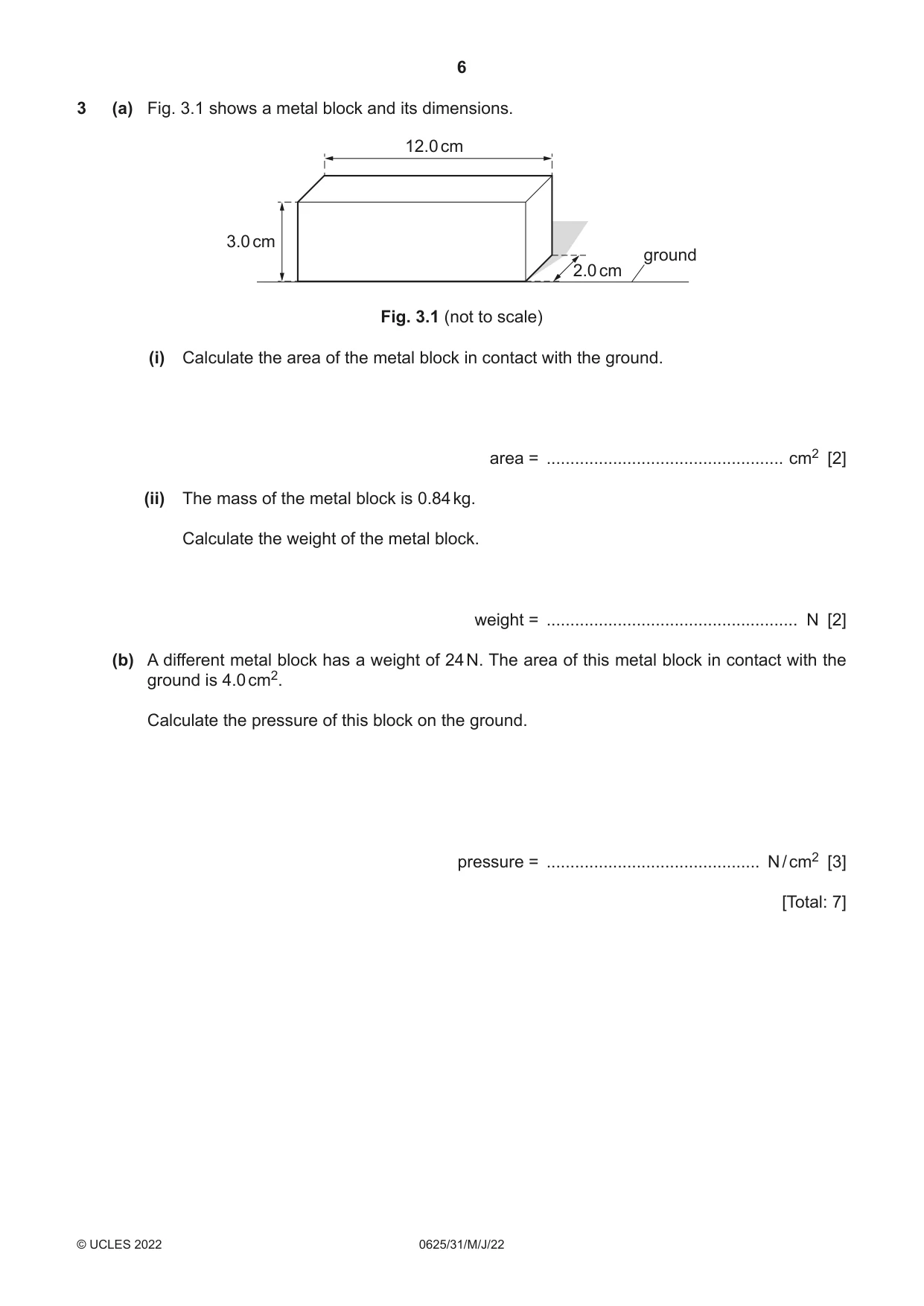
3 (a) Fig. 3.1 shows a metal block and its dimensions. 12.0 cm 3.0 cm ground 2.0 cm Fig. 3.1 (not to scale) (i) Calculate the area of the metal block in contact with the ground. area = .................................................. cm2 [2] (ii) The mass of the metal block is 0.84 kg. Calculate the weight of the metal block. weight = ..................................................... N [2] (b) A different metal block has a weight of 24 N. The area of this metal block in contact with the ground is 4.0 cm2. Calculate the pressure of this block on the ground. pressure = ............................................. N / cm2 [3] [Total: 7]
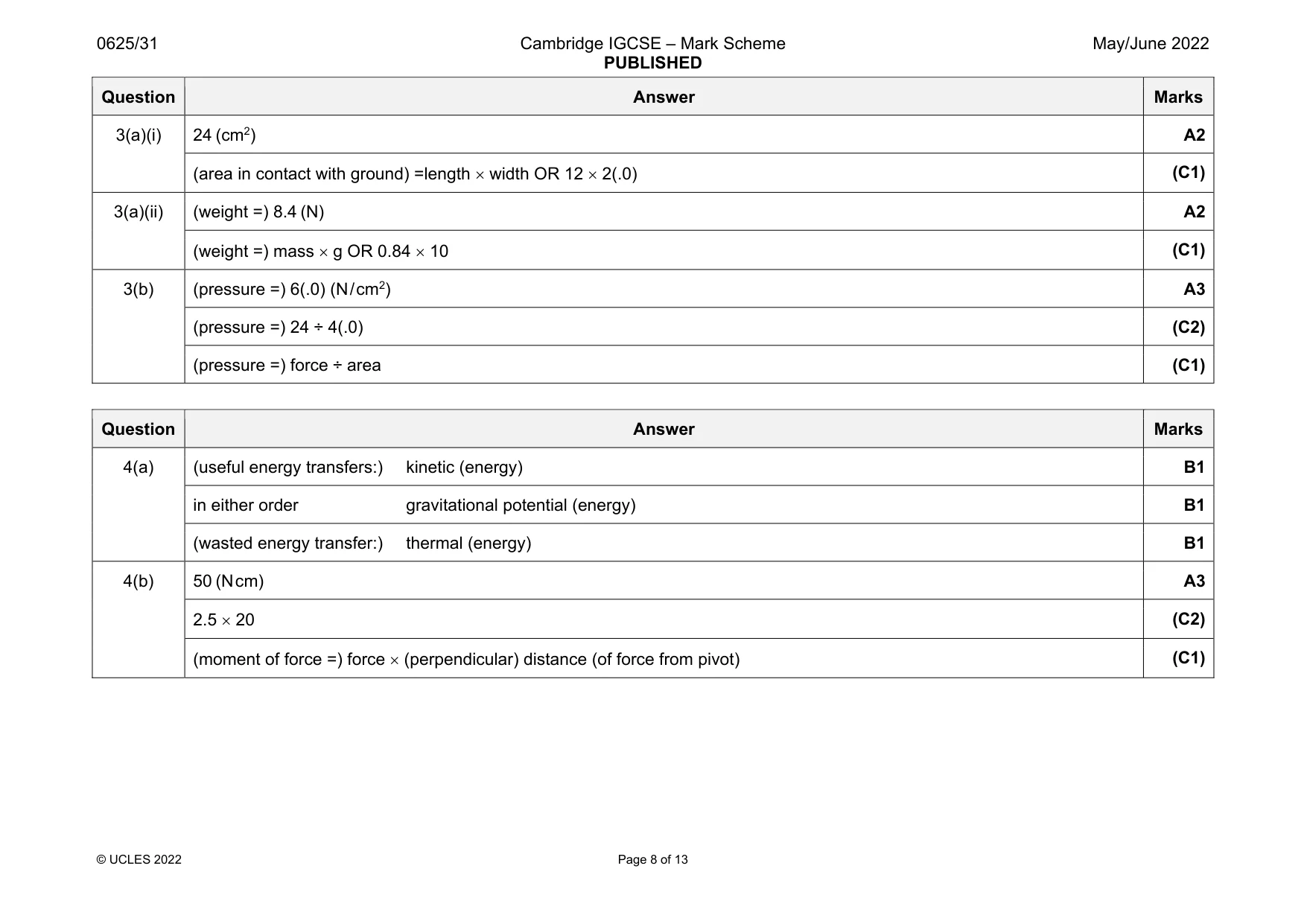
Mark scheme: 3(a)(i) 24 (cm2) A2 (area in contact with ground) =length width OR 12 2(.0) (C1) 3(a)(ii) (weight =) 8.4 (N) A2 (weight =) mass g OR 0.84 10 (C1) 3(b) (pressure =) 6(.0) (N / cm2) A3 (pressure =) 24 ÷ 4(.0) (C2) (pressure =) force ÷ area (C1)
Q4 · An electric motor and pulley wheel being used to raise a load M
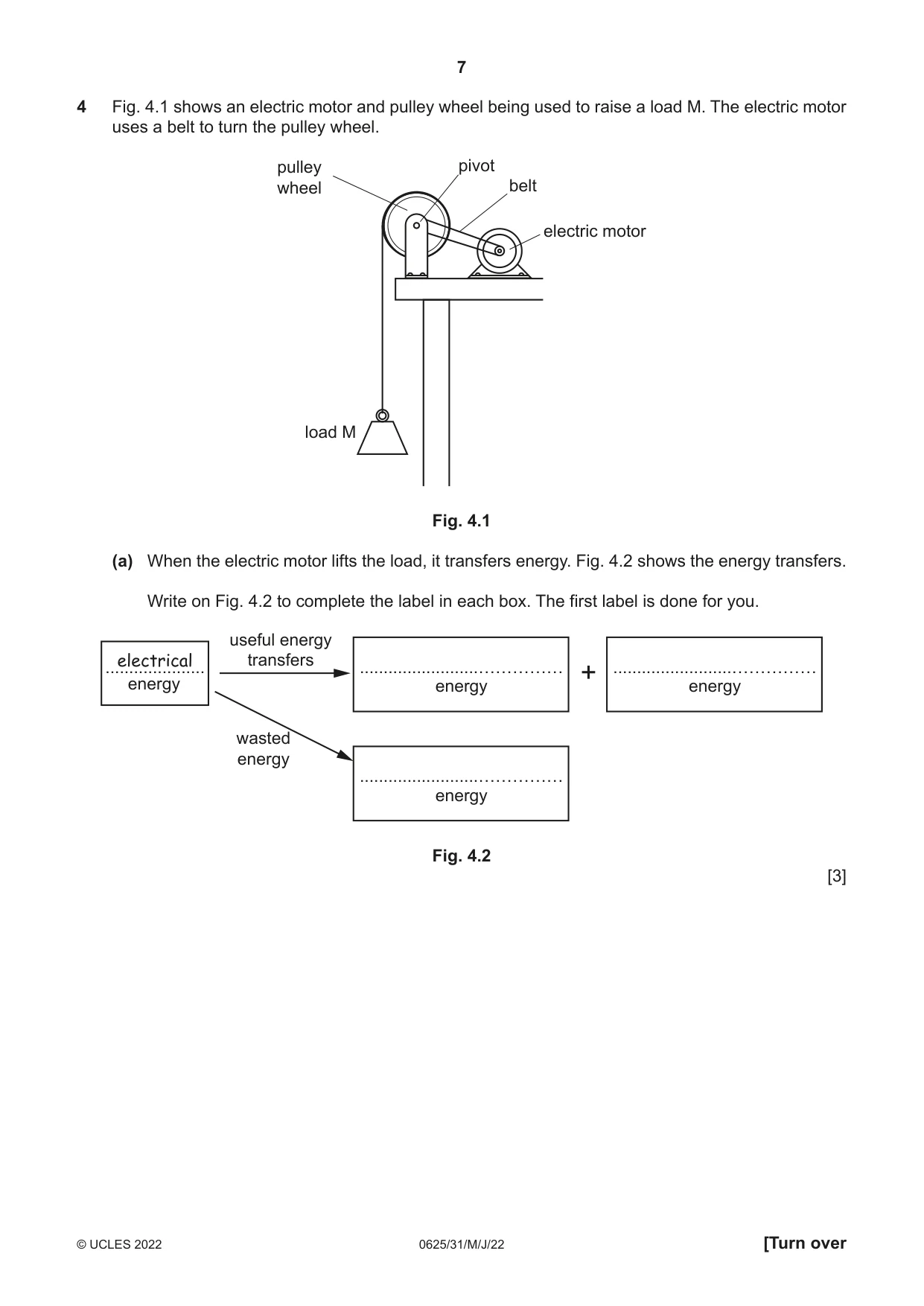
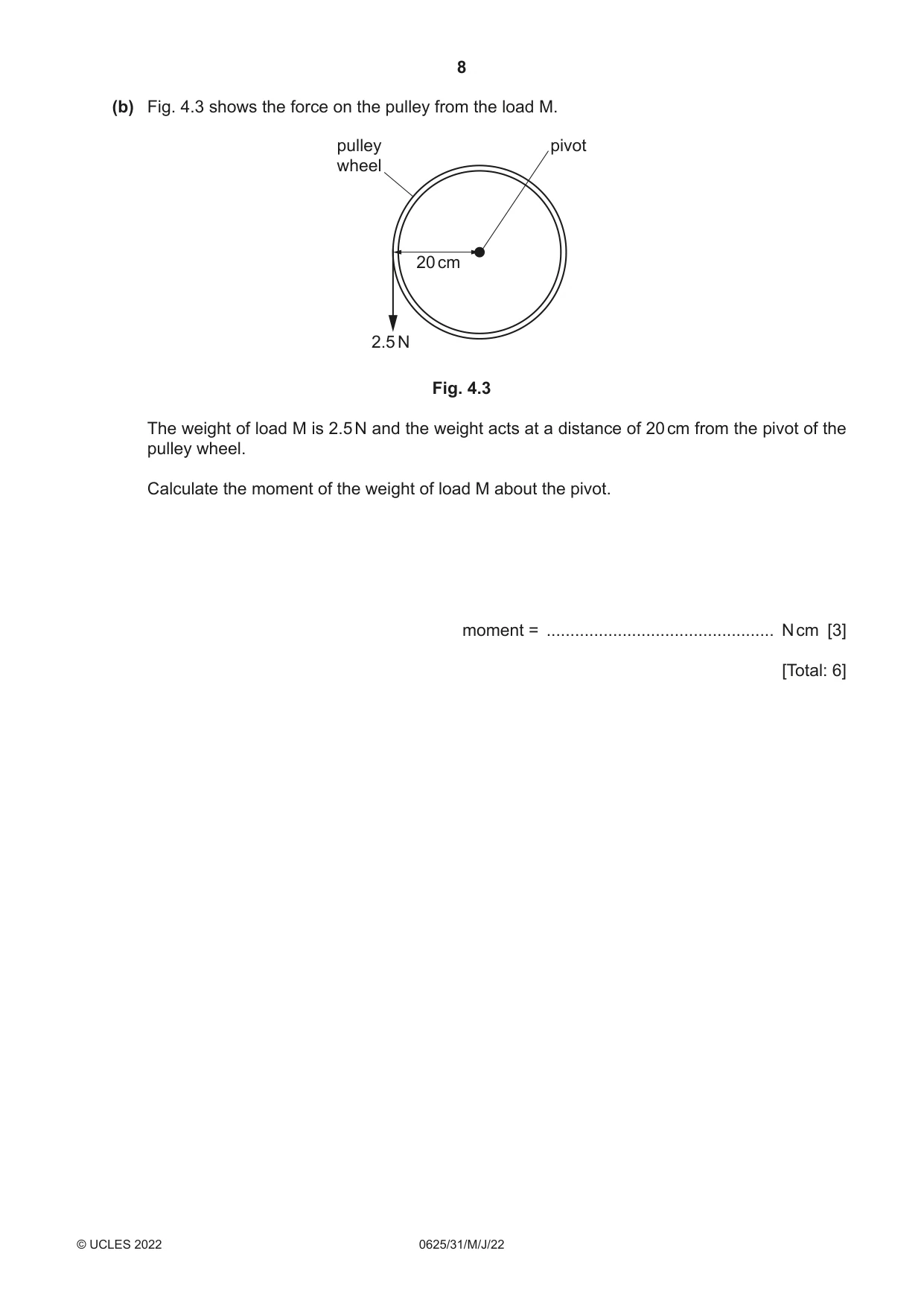
4 Fig. 4.1 shows an electric motor and pulley wheel being used to raise a load M. The electric motor uses a belt to turn the pulley wheel. pulley pivot wheel belt electric motor load M Fig. 4.1 (a) When the electric motor lifts the load, it transfers energy. Fig. 4.2 shows the energy transfers. Write on Fig. 4.2 to complete the label in each box. The first label is done for you. useful energy electrical transfers ..................... .........................…………… + .........................…………… energy energy energy wasted energy .........................…………… energy Fig. 4.2 [3] (b) Fig. 4.3 shows the force on the pulley from the load M. pulley pivot wheel 20 cm 2.5 N Fig. 4.3 The weight of load M is 2.5 N and the weight acts at a distance of 20 cm from the pivot of the pulley wheel. Calculate the moment of the weight of load M about the pivot. moment = ................................................ N cm [3] [Total: 6]
Mark scheme: 4(a) (useful energy transfers:) kinetic (energy) B1 in either order gravitational potential (energy) B1 (wasted energy transfer:) thermal (energy) B1 4(b) 50 (N cm) A3 2.5 20 (C2) (moment of force =) force (perpendicular) distance (of force from pivot) (C1)
Q5 · Describe how a wind turbine generates electricity from energy in the wind
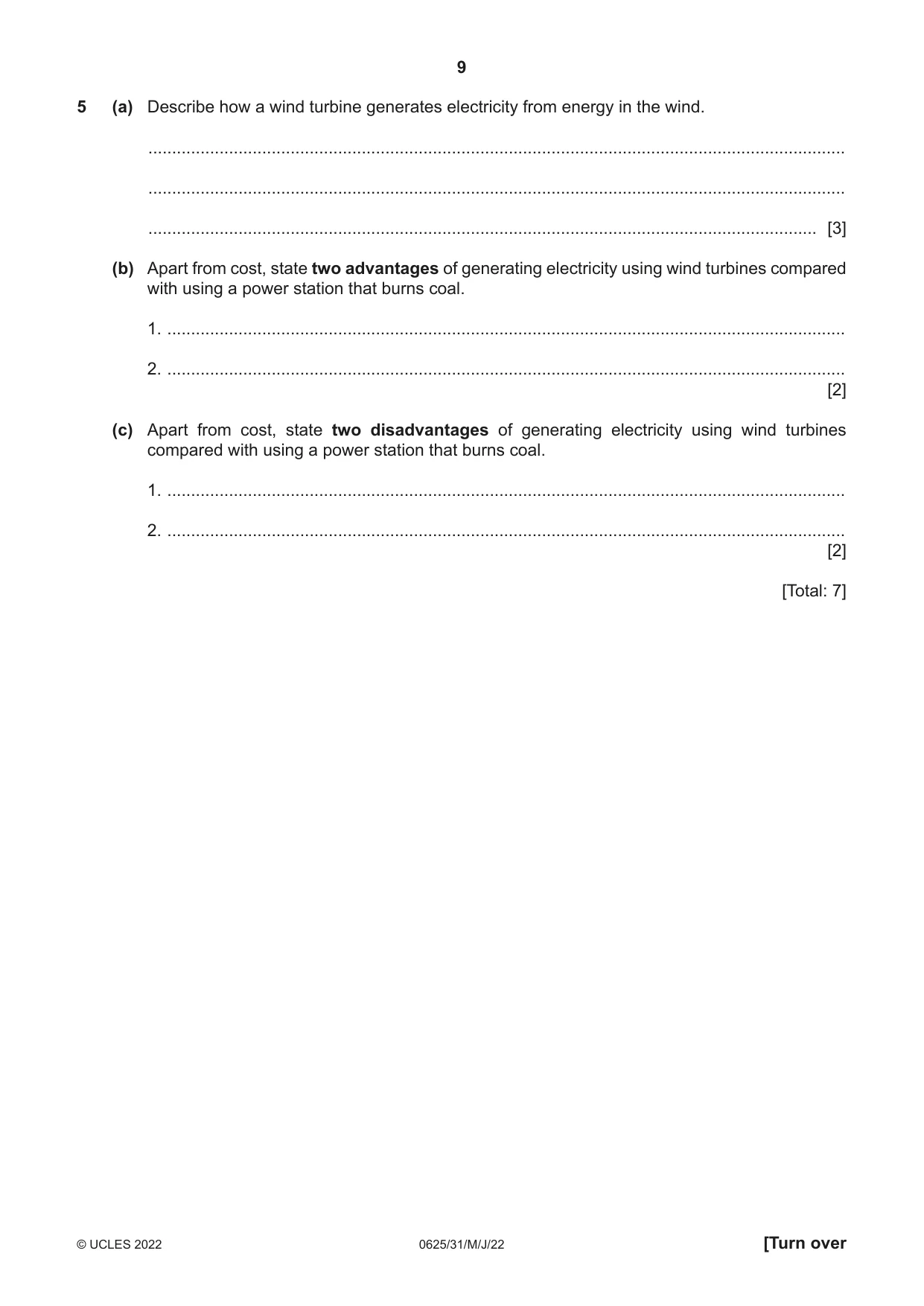
5 (a) Describe how a wind turbine generates electricity from energy in the wind. ................................................................................................................................................... ................................................................................................................................................... ............................................................................................................................................. [3] (b) Apart from cost, state two advantages of generating electricity using wind turbines compared with using a power station that burns coal. 1. ............................................................................................................................................... 2. ............................................................................................................................................... [2] (c) Apart from cost, state two disadvantages of generating electricity using wind turbines compared with using a power station that burns coal. 1. ............................................................................................................................................... 2. ............................................................................................................................................... [2] [Total: 7]
Mark scheme: 5(a) any three from: (moving) air has kinetic energy OR wind has kinetic energy (moving) air / wind turns turbine/blades turbine turns generator (rotating) generator produces/generates electricity B3 5(b) any two from: (wind is) renewable (energy source) no greenhouse gases / CO2 produced (during operation) no SO2 OR acidic gases produced (during operation) OR no nitrous oxides produced B2 5(c) any two from: large(r) area of land needed OR dilute energy source intermittent/inconsistent/unreliable supply OR cannot work if wind too strong/weak (possible) harm to (migrating) birds difficult to maintain (particularly if off-shore) B2
Q6 · A teacher fills a copper can with solid wax and heats the can
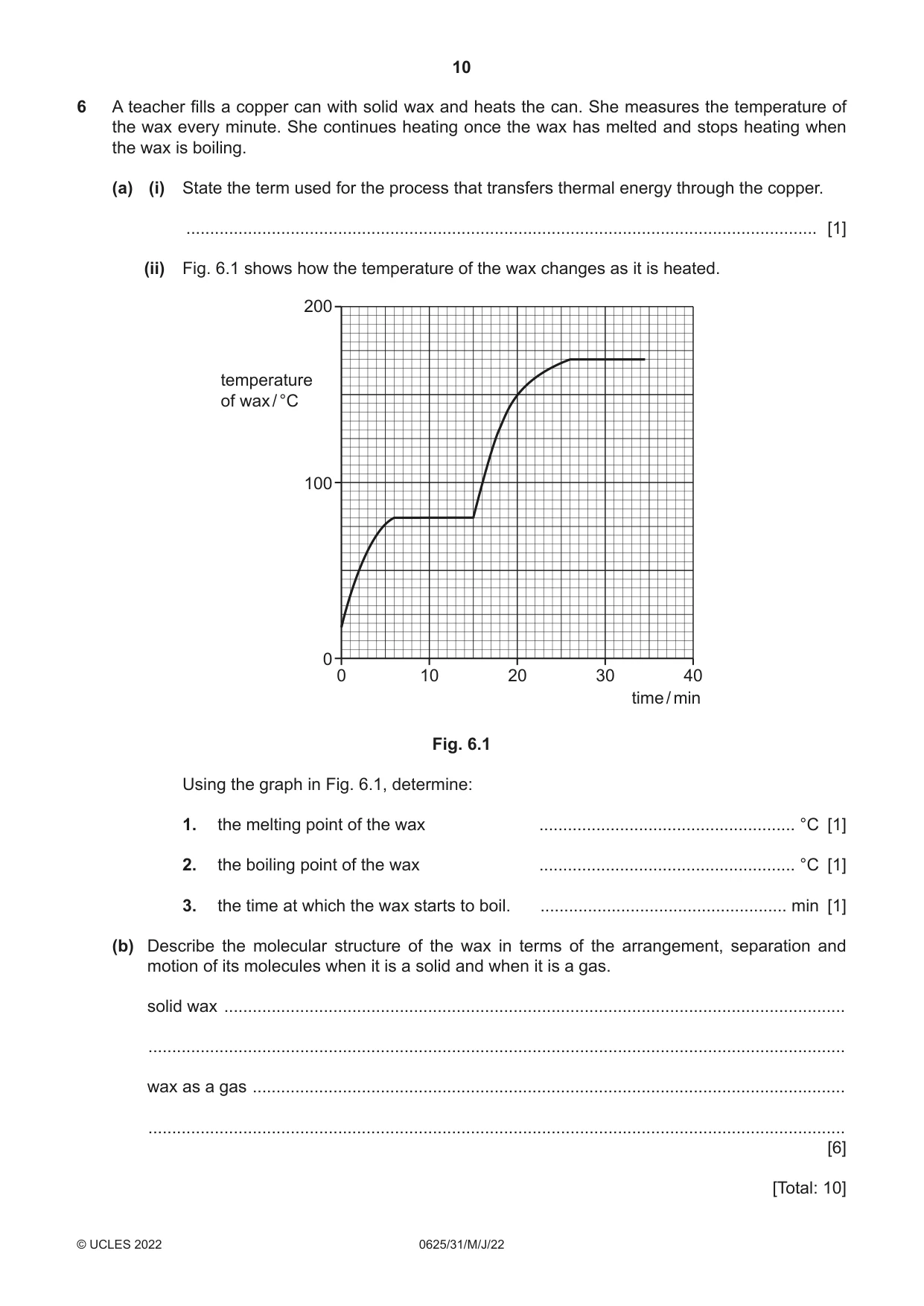
6 A teacher fills a copper can with solid wax and heats the can. She measures the temperature of the wax every minute. She continues heating once the wax has melted and stops heating when the wax is boiling. (a) (i) State the term used for the process that transfers thermal energy through the copper. ..................................................................................................................................... [1] (ii) Fig. 6.1 shows how the temperature of the wax changes as it is heated. 200 temperature of wax / °C 100 0 0 10 20 30 40 time / min Fig. 6.1 Using the graph in Fig. 6.1, determine: 1. the melting point of the wax ...................................................... °C [1] 2. the boiling point of the wax ...................................................... °C [1] 3. the time at which the wax starts to boil. .................................................... min [1] (b) Describe the molecular structure of the wax in terms of the arrangement, separation and motion of its molecules when it is a solid and when it is a gas. solid wax ................................................................................................................................... ................................................................................................................................................... wax as a gas ............................................................................................................................. ................................................................................................................................................... [6] [Total: 10]
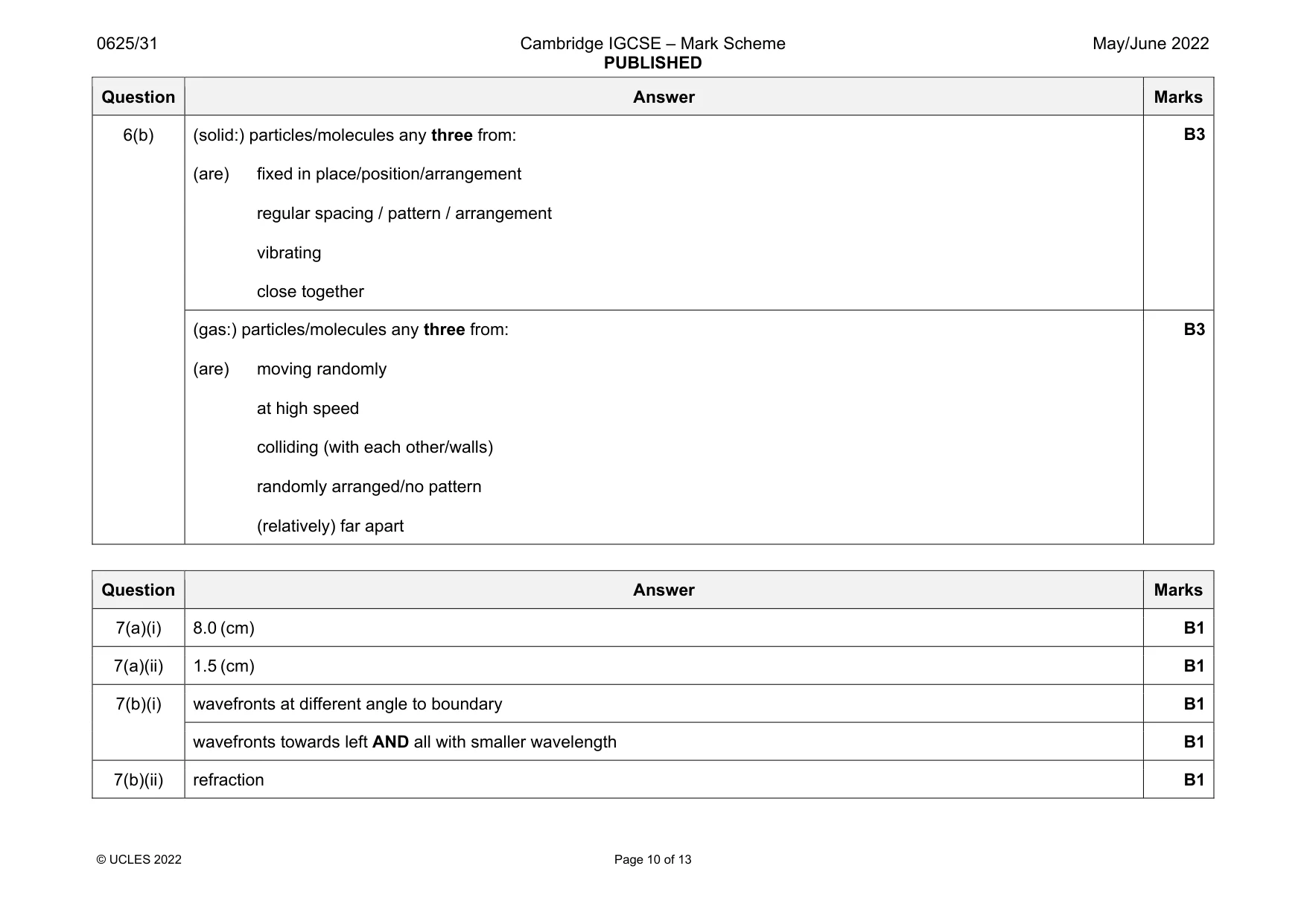
Mark scheme: 6(a)(i) conduction B1 6(a)(ii) 1 80 (°C) B1 2 170 (°C) B1 3 26 (minutes) B1 Question Answer Marks 6(b) (solid:) particles/molecules any three from: (are) fixed in place/position/arrangement regular spacing / pattern / arrangement vibrating close together B3 (gas:) particles/molecules any three from: (are) moving randomly at high speed colliding (with each other/walls) randomly arranged/no pattern (relatively) far apart B3
Q7 · The displacement of particles in a water wave
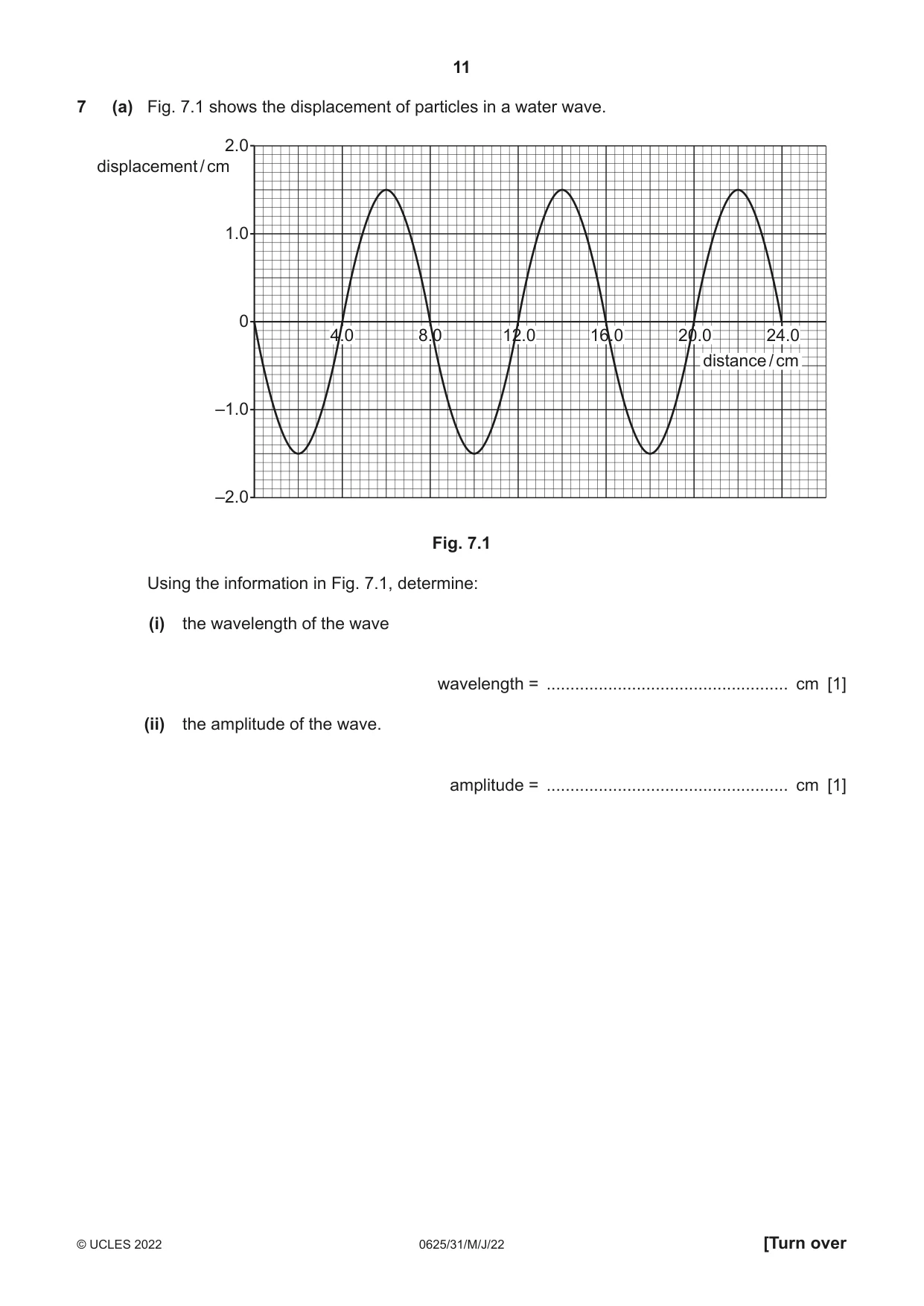
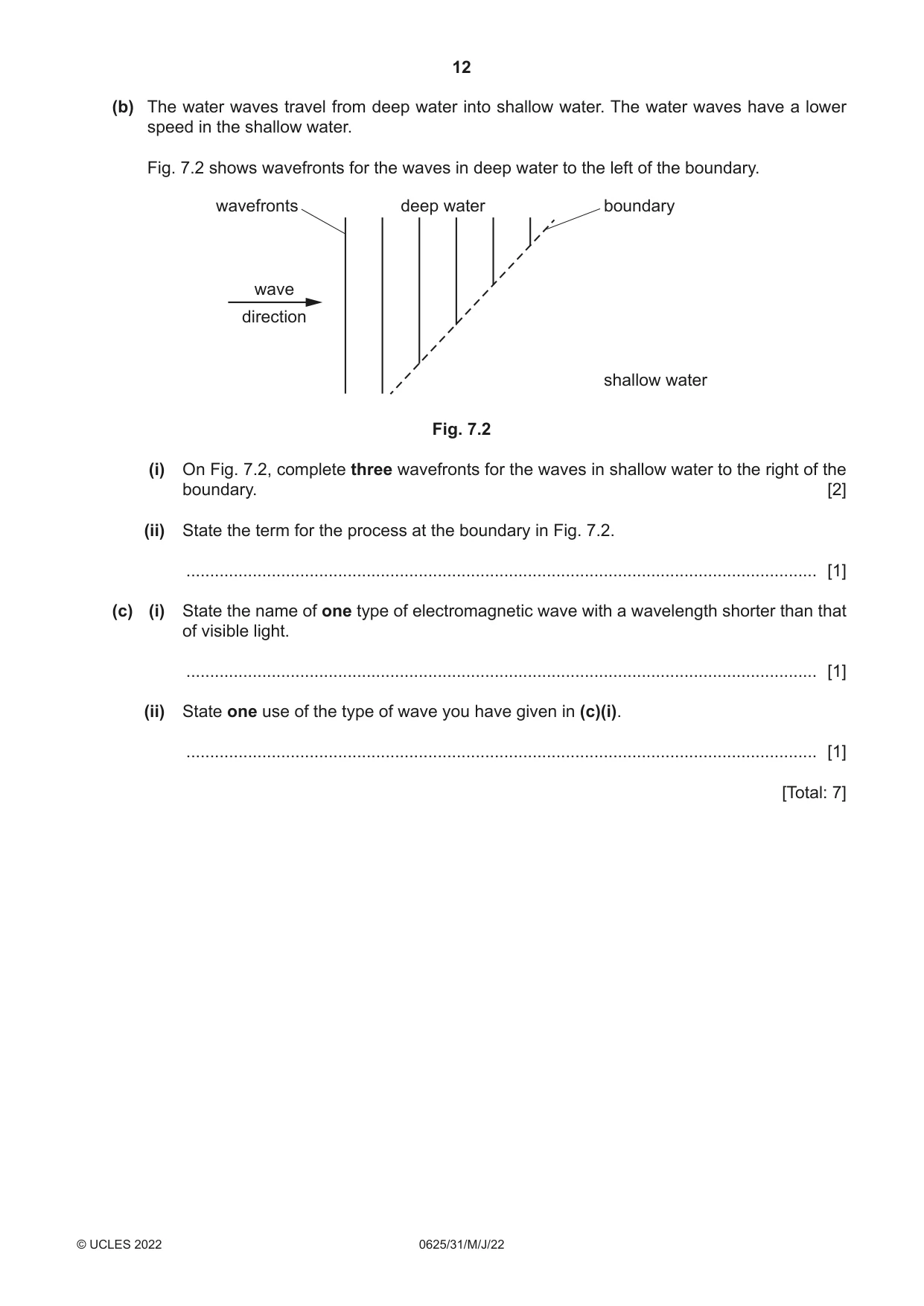
7 (a) Fig. 7.1 shows the displacement of particles in a water wave. 2.0 displacement / cm 1.0 0 4.0 8.0 12.0 16.0 20.0 24.0 distance / cm –1.0 –2.0 Fig. 7.1 Using the information in Fig. 7.1, determine: (i) the wavelength of the wave wavelength = ................................................... cm [1] (ii) the amplitude of the wave. amplitude = ................................................... cm [1] (b) The water waves travel from deep water into shallow water. The water waves have a lower speed in the shallow water. Fig. 7.2 shows wavefronts for the waves in deep water to the left of the boundary. wavefronts deep water boundary wave direction shallow water Fig. 7.2 (i) On Fig. 7.2, complete three wavefronts for the waves in shallow water to the right of the boundary. [2] (ii) State the term for the process at the boundary in Fig. 7.2. ..................................................................................................................................... [1] (c) (i) State the name of one type of electromagnetic wave with a wavelength shorter than that of visible light. ..................................................................................................................................... [1] (ii) State one use of the type of wave you have given in (c)(i). ..................................................................................................................................... [1] [Total: 7]
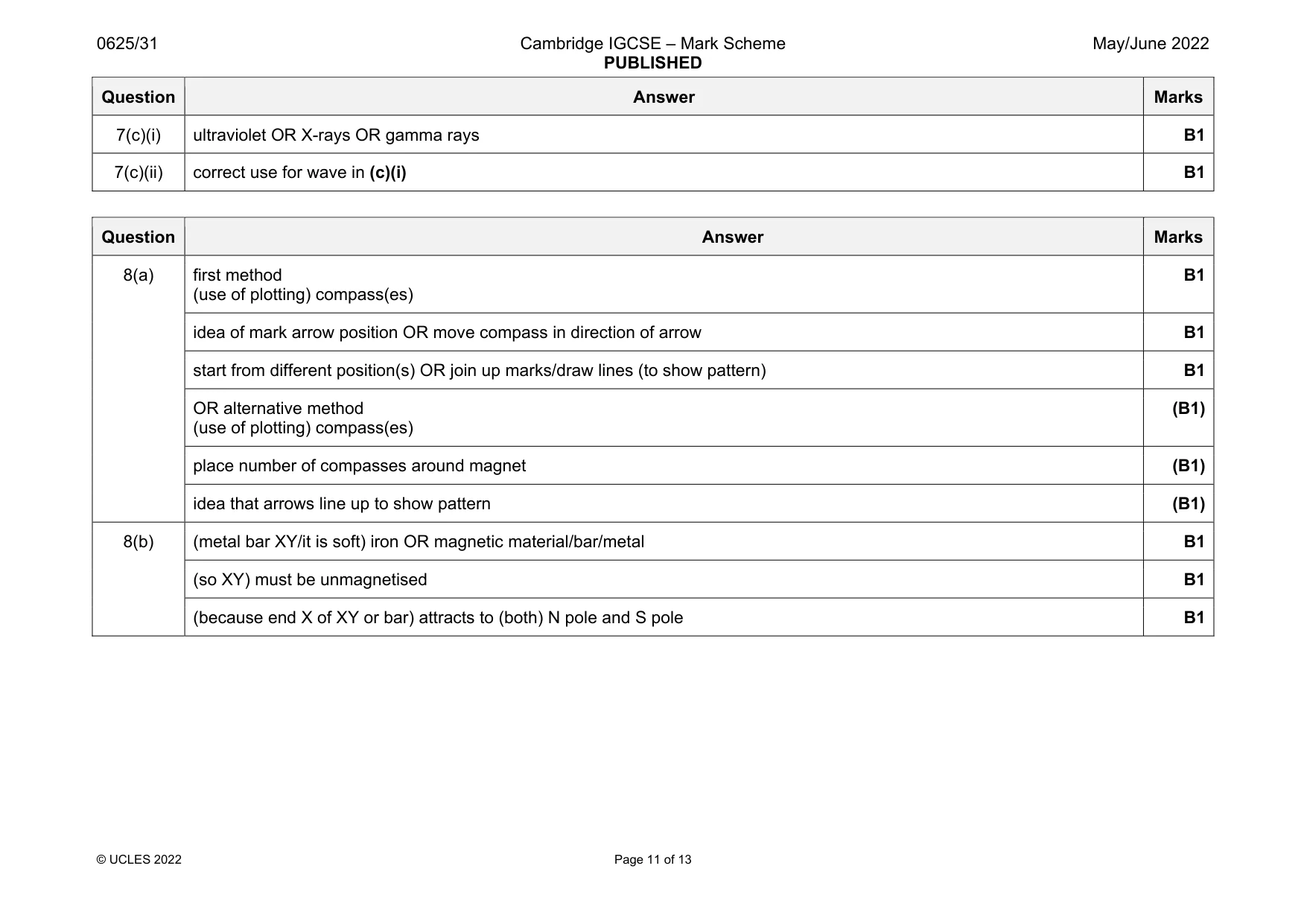
Mark scheme: 7(a)(i) 8.0 (cm) B1 7(a)(ii) 1.5 (cm) B1 7(b)(i) wavefronts at different angle to boundary B1 wavefronts towards left AND all with smaller wavelength B1 7(b)(ii) refraction B1 Question Answer Marks 7(c)(i) ultraviolet OR X-rays OR gamma rays B1 7(c)(ii) correct use for wave in (c)(i) B1
Q8 · A bar magnet on a piece of card
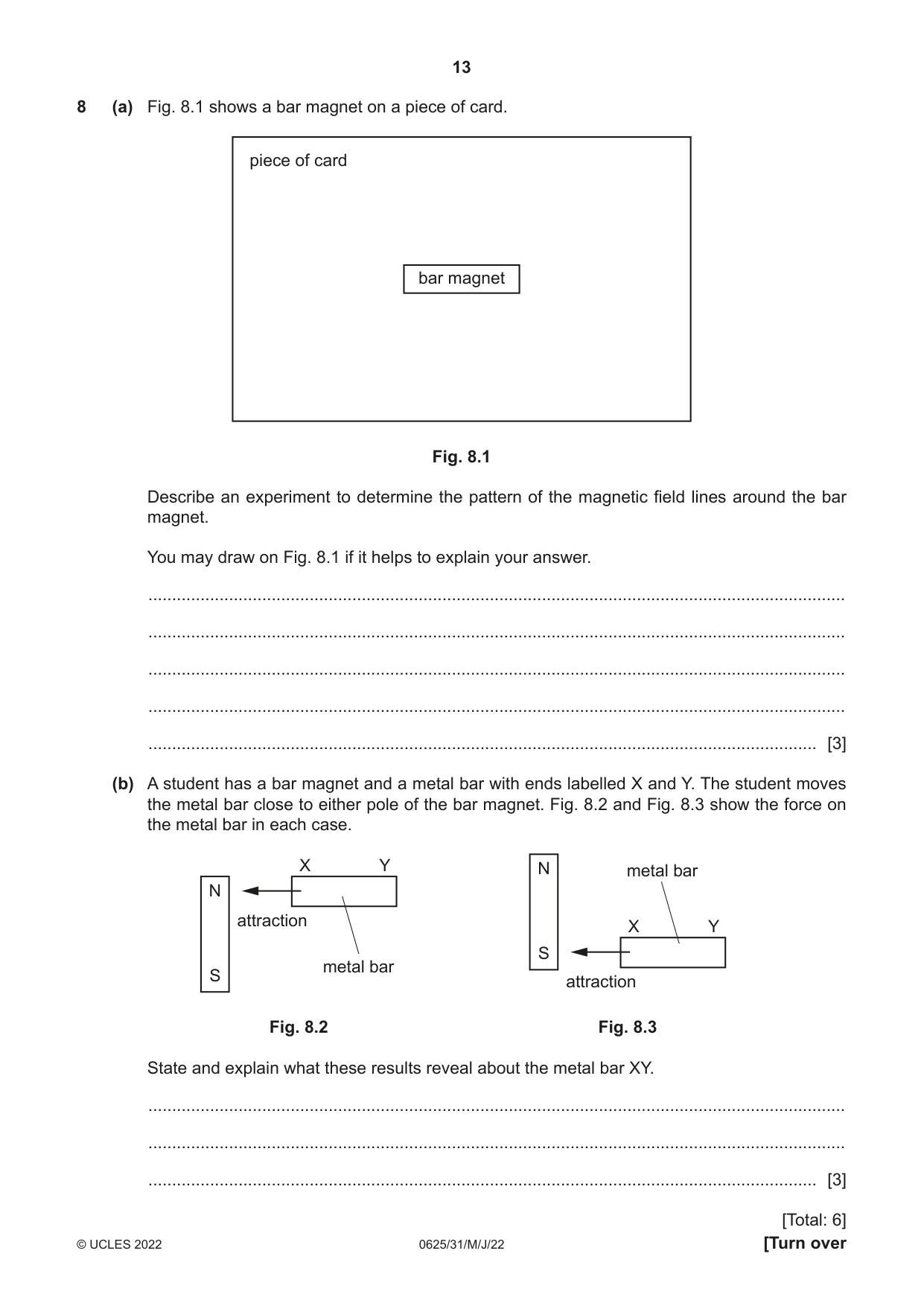
8 (a) Fig. 8.1 shows a bar magnet on a piece of card. piece of card bar magnet Fig. 8.1 Describe an experiment to determine the pattern of the magnetic field lines around the bar magnet. You may draw on Fig. 8.1 if it helps to explain your answer. ................................................................................................................................................... ................................................................................................................................................... ................................................................................................................................................... ................................................................................................................................................... ............................................................................................................................................. [3] (b) A student has a bar magnet and a metal bar with ends labelled X and Y. The student moves the metal bar close to either pole of the bar magnet. Fig. 8.2 and Fig. 8.3 show the force on the metal bar in each case. X Y N metal bar N attraction X Y S metal bar S attraction Fig. 8.2 Fig. 8.3 State and explain what these results reveal about the metal bar XY. ................................................................................................................................................... ................................................................................................................................................... ............................................................................................................................................. [3] [Total: 6]
Mark scheme: 8(a) first method (use of plotting) compass(es) B1 idea of mark arrow position OR move compass in direction of arrow B1 start from different position(s) OR join up marks/draw lines (to show pattern) B1 OR alternative method (use of plotting) compass(es) (B1) place number of compasses around magnet (B1) idea that arrows line up to show pattern (B1) 8(b) (metal bar XY/it is soft) iron OR magnetic material/bar/metal B1 (so XY) must be unmagnetised B1 (because end X of XY or bar) attracts to (both) N pole and S pole B1
Q9 · An electric circuit which includes uninsulated resistance wire XY
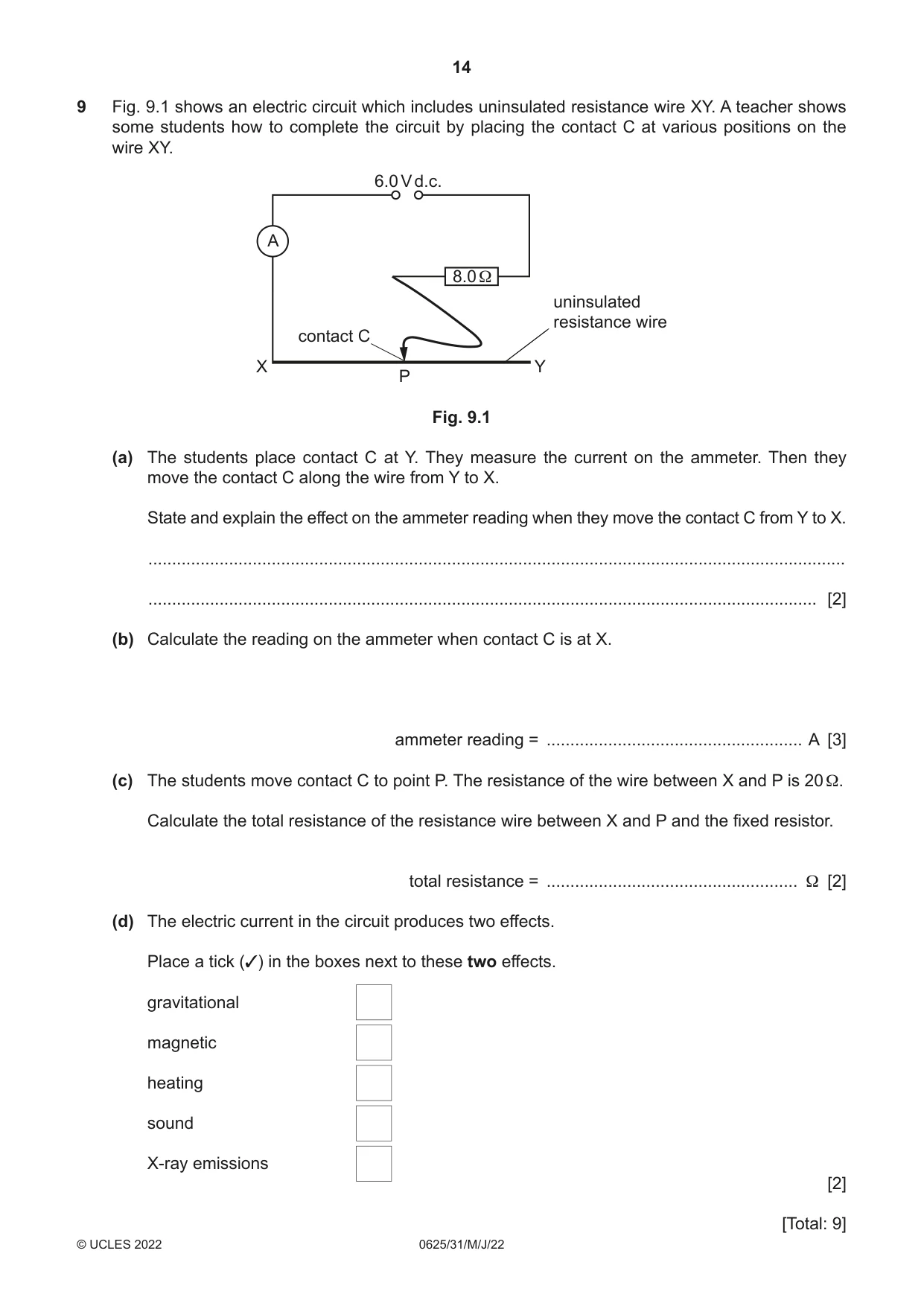
9 Fig. 9.1 shows an electric circuit which includes uninsulated resistance wire XY. A teacher shows some students how to complete the circuit by placing the contact C at various positions on the wire XY. 6.0 V d.c. A 8.0 Ω uninsulated resistance wire contact C X Y P Fig. 9.1 (a) The students place contact C at Y. They measure the current on the ammeter. Then they move the contact C along the wire from Y to X. State and explain the effect on the ammeter reading when they move the contact C from Y to X. ................................................................................................................................................... ............................................................................................................................................. [2] (b) Calculate the reading on the ammeter when contact C is at X. ammeter reading = ...................................................... A [3] (c) The students move contact C to point P. The resistance of the wire between X and P is 20 Ω. Calculate the total resistance of the resistance wire between X and P and the fixed resistor. total resistance = ..................................................... Ω [2] (d) The electric current in the circuit produces two effects. Place a tick (3) in the boxes next to these two effects. gravitational magnetic heating sound X-ray emissions [2] [Total: 9]
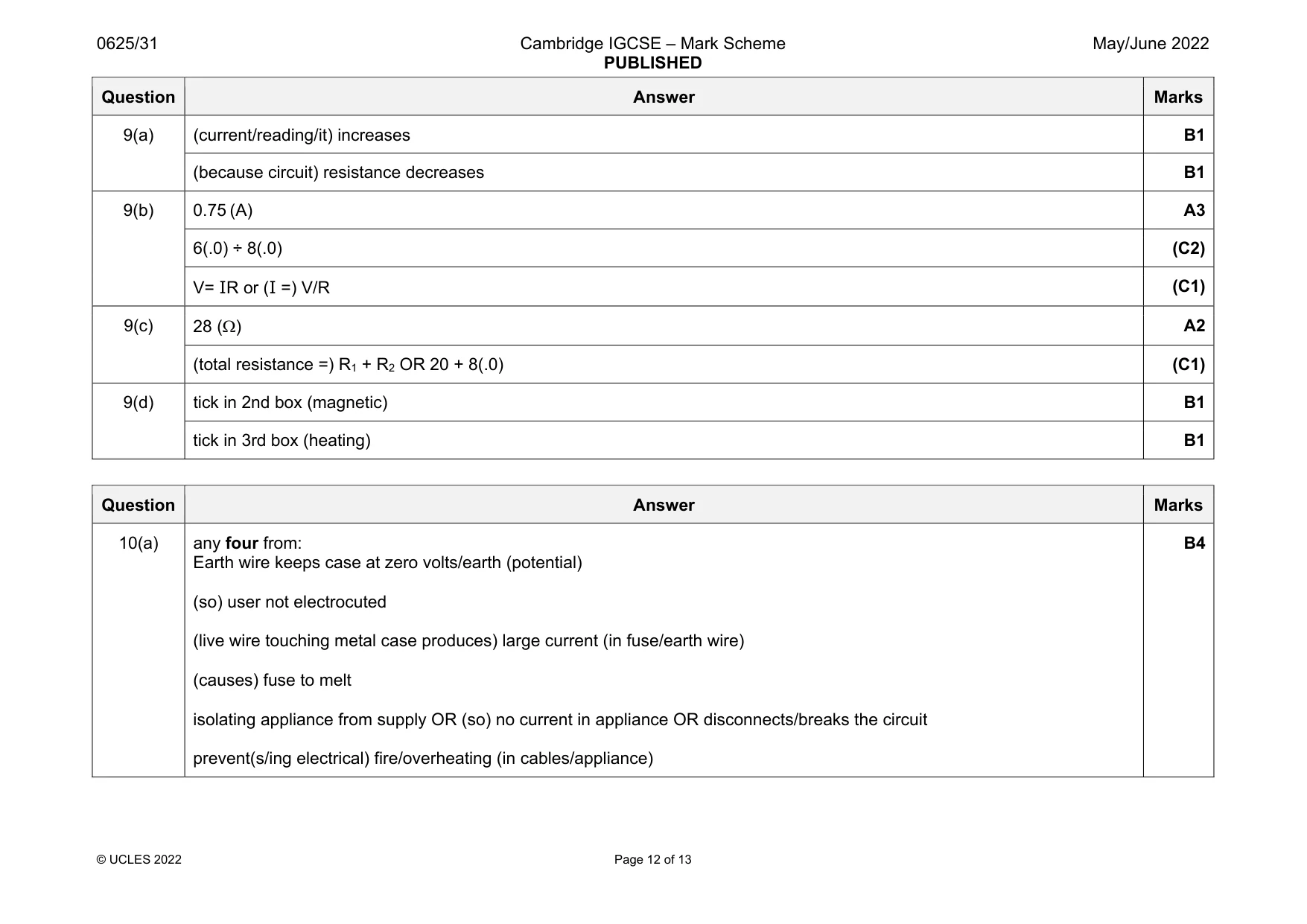
Mark scheme: 9(a) (current/reading/it) increases B1 (because circuit) resistance decreases B1 9(b) 0.75 (A) A3 6(.0) ÷ 8(.0) (C2) V= IR or (I =) V/R (C1) 9(c) 28 () A2 (total resistance =) R1 + R2 OR 20 + 8(.0) (C1) 9(d) tick in 2nd box (magnetic) B1 tick in 3rd box (heating) B1
Q10 · A microwave oven has a metal case and is connected to a 240 V electricity supply
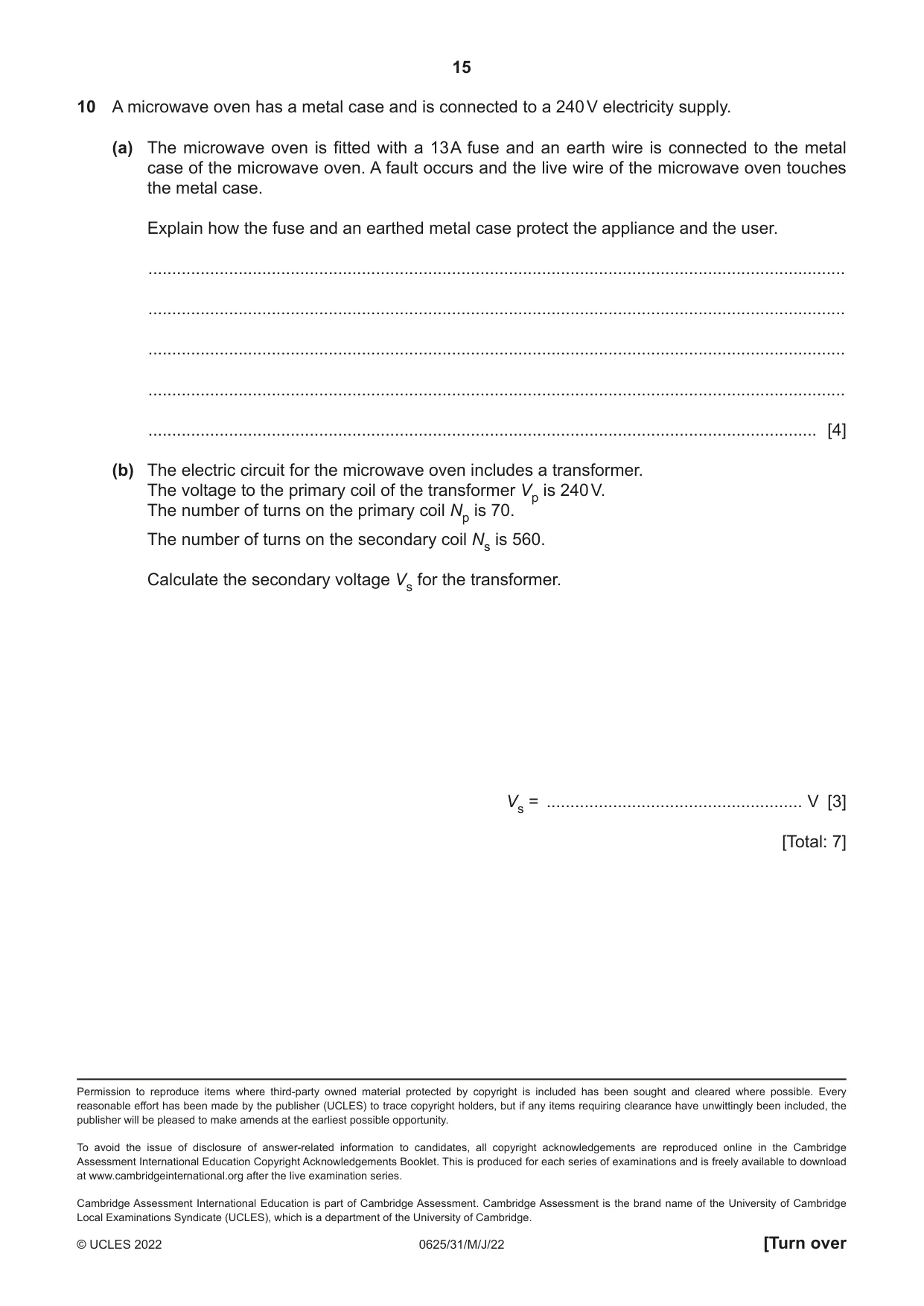
10 A microwave oven has a metal case and is connected to a 240 V electricity supply. (a) The microwave oven is fitted with a 13 A fuse and an earth wire is connected to the metal case of the microwave oven. A fault occurs and the live wire of the microwave oven touches the metal case. Explain how the fuse and an earthed metal case protect the appliance and the user. ................................................................................................................................................... ................................................................................................................................................... ................................................................................................................................................... ................................................................................................................................................... ............................................................................................................................................. [4] (b) The electric circuit for the microwave oven includes a transformer. The voltage to the primary coil of the transformer Vp is 240 V. The number of turns on the primary coil Np is 70. The number of turns on the secondary coil Ns is 560. Calculate the secondary voltage Vs for the transformer. Vs = ...................................................... V [3] [Total: 7]
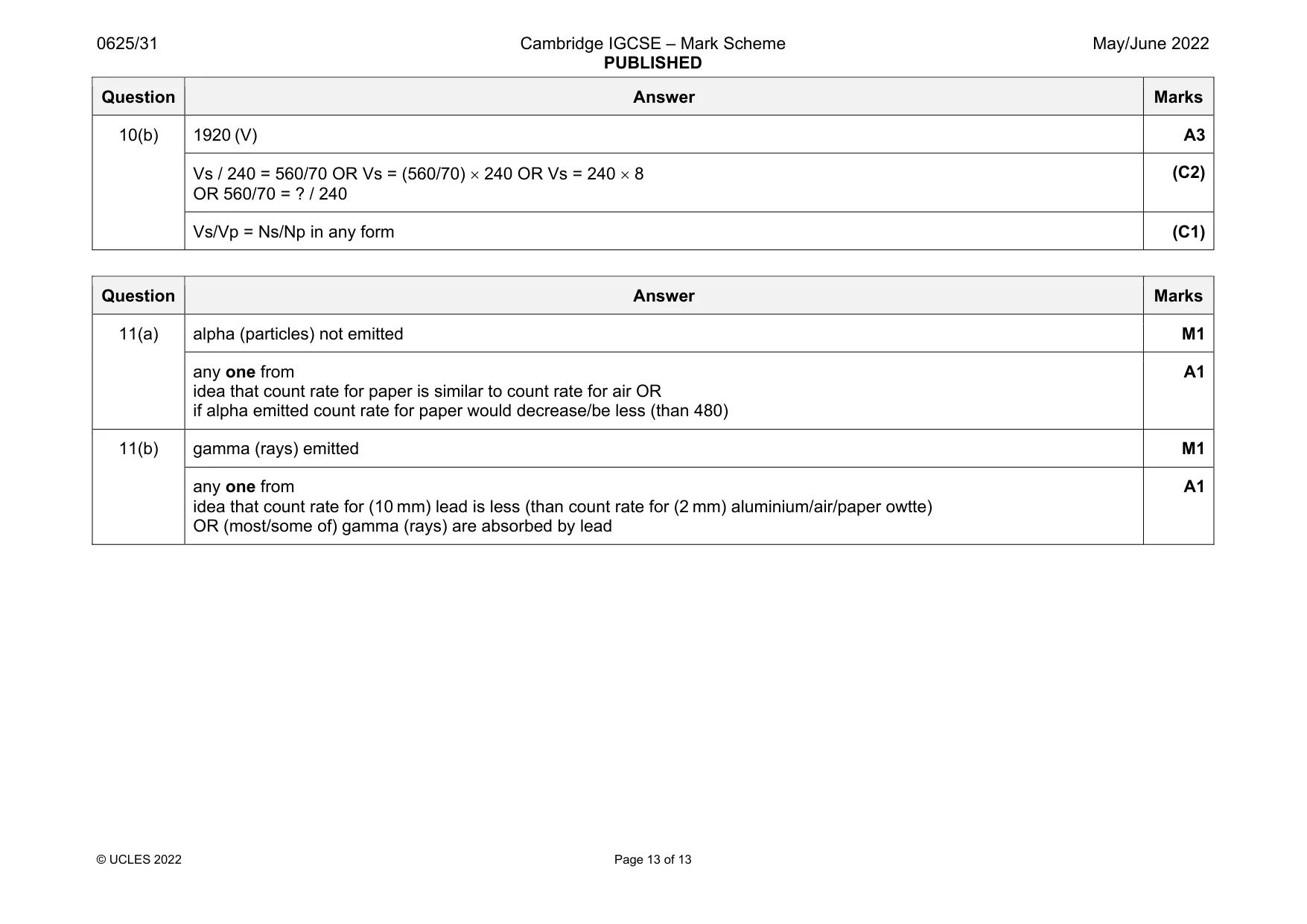
Mark scheme: 10(a) any four from: Earth wire keeps case at zero volts/earth (potential) (so) user not electrocuted (live wire touching metal case produces) large current (in fuse/earth wire) (causes) fuse to melt isolating appliance from supply OR (so) no current in appliance OR disconnects/breaks the circuit prevent(s/ing electrical) fire/overheating (in cables/appliance) Question Answer Marks 10(b) 1920 (V) A3 Vs / 240 = 560/70 OR Vs = (560/70) 240 OR Vs = 240 8 OR 560/70 = ? / 240 (C2) Vs/Vp = Ns/Np in any form (C1)
Q11 · A teacher determines the types of emission from a radioactive source
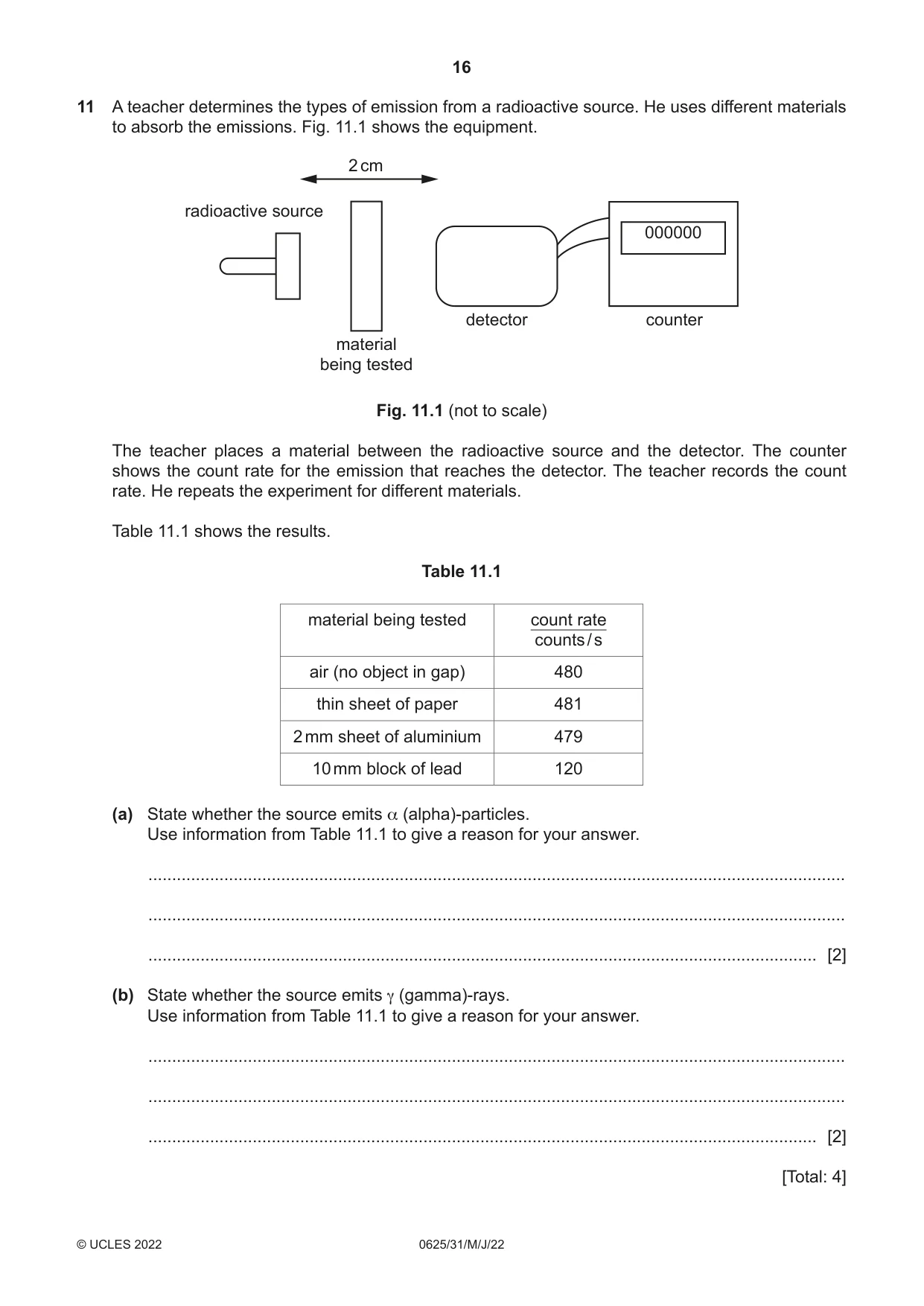
11 A teacher determines the types of emission from a radioactive source. He uses different materials to absorb the emissions. Fig. 11.1 shows the equipment. 2 cm radioactive source 000000 detector counter material being tested Fig. 11.1 (not to scale) The teacher places a material between the radioactive source and the detector. The counter shows the count rate for the emission that reaches the detector. The teacher records the count rate. He repeats the experiment for different materials. Table 11.1 shows the results. Table 11.1 material being tested count rate counts / s air (no object in gap) 480 thin sheet of paper 481 2 mm sheet of aluminium 479 10 mm block of lead 120 (a) State whether the source emits α (alpha)-particles. Use information from Table 11.1 to give a reason for your answer. ................................................................................................................................................... ................................................................................................................................................... ............................................................................................................................................. [2] (b) State whether the source emits γ (gamma)-rays. Use information from Table 11.1 to give a reason for your answer. ................................................................................................................................................... ................................................................................................................................................... ............................................................................................................................................. [2] [Total: 4]
Mark scheme: 11(a) alpha (particles) not emitted M1 any one from idea that count rate for paper is similar to count rate for air OR if alpha emitted count rate for paper would decrease/be less (than 480) A1 11(b) gamma (rays) emitted M1 any one from idea that count rate for (10 mm) lead is less (than count rate for (2 mm) aluminium/air/paper owtte) OR (most/some of) gamma (rays) are absorbed by lead A1
What was in this paper
The subtopics covered by these 11 questions, and how many questions each got. Open one in a new tab to see every Cambridge question on it.
What you needed in this session
Cambridge’s own grade thresholds for 2022 May/June, Paper 3 · Variant 1. A higher threshold means an easier paper — the bar moves with how the cohort did.