Cambridge IGCSE Physics 0625 — 2022 Oct/Nov Paper 3 · Variant 1
0625/31/O/N/22 · 10 questions · 80 marks · ≈90 min
The question paper and its mark scheme, free to read here and free to download. This is Cambridge’s own paper, exactly as it was sat.
Question paper16 pages
Mark scheme13 pages
Answers below. Sit the paper first if you are practising.
Questions as text
Q1 · A measuring cylinder containing some water
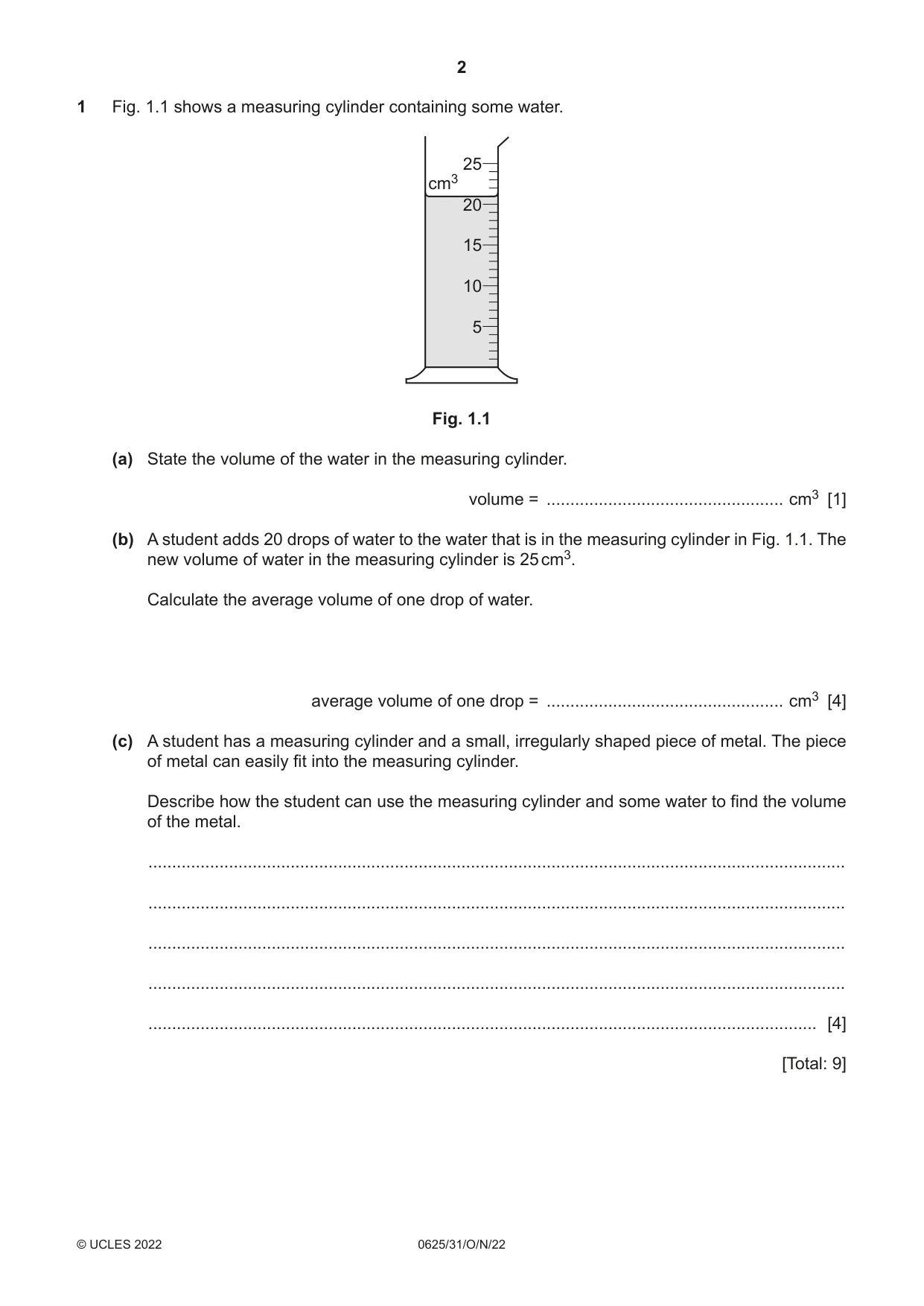
1 Fig. 1.1 shows a measuring cylinder containing some water. 25 cm3 20 15 10 5 Fig. 1.1 (a) State the volume of the water in the measuring cylinder. volume = .................................................. cm3 [1] (b) A student adds 20 drops of water to the water that is in the measuring cylinder in Fig. 1.1. The new volume of water in the measuring cylinder is 25 cm3. Calculate the average volume of one drop of water. average volume of one drop = .................................................. cm3 [4] (c) A student has a measuring cylinder and a small, irregularly shaped piece of metal. The piece of metal can easily fit into the measuring cylinder. Describe how the student can use the measuring cylinder and some water to find the volume of the metal. ................................................................................................................................................... ................................................................................................................................................... ................................................................................................................................................... ................................................................................................................................................... ............................................................................................................................................. [4] [Total: 9]
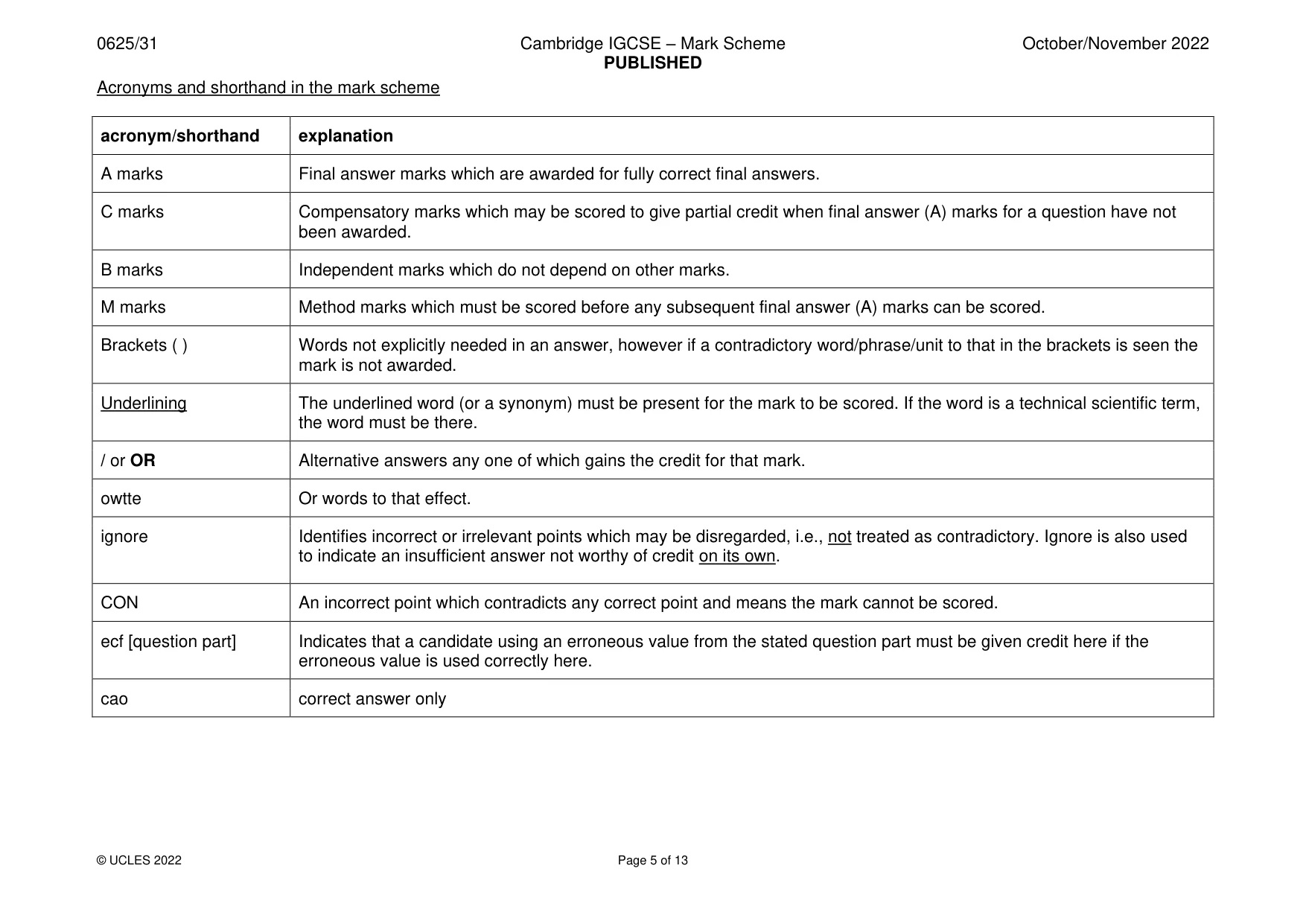
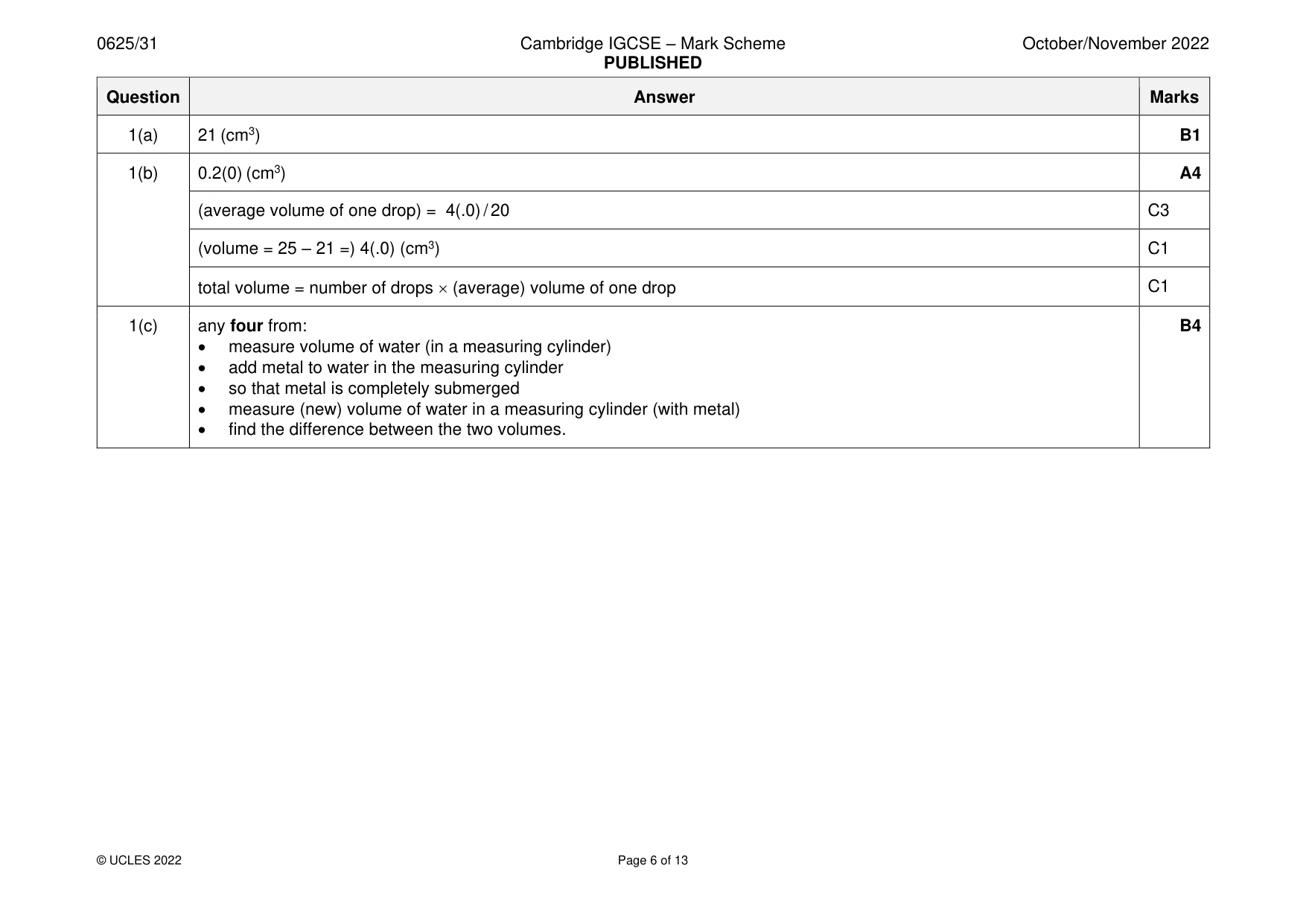
Mark scheme: Question Answer Marks 1(a) 21 (cm3) B1 1(b) 0.2(0) (cm3) A4 (average volume of one drop) = 4(.0) / 20 C3 (volume = 25 – 21 =) 4(.0) (cm3) C1 total volume = number of drops (average) volume of one drop C1 1(c) any four from: B4 • measure volume of water (in a measuring cylinder) • add metal to water in the measuring cylinder • so that metal is completely submerged • measure (new) volume of water in a measuring cylinder (with metal) • find the difference between the two volumes.
More questions on Physical quantities and measurement techniques
Q2 · The horizontal forces acting on a car
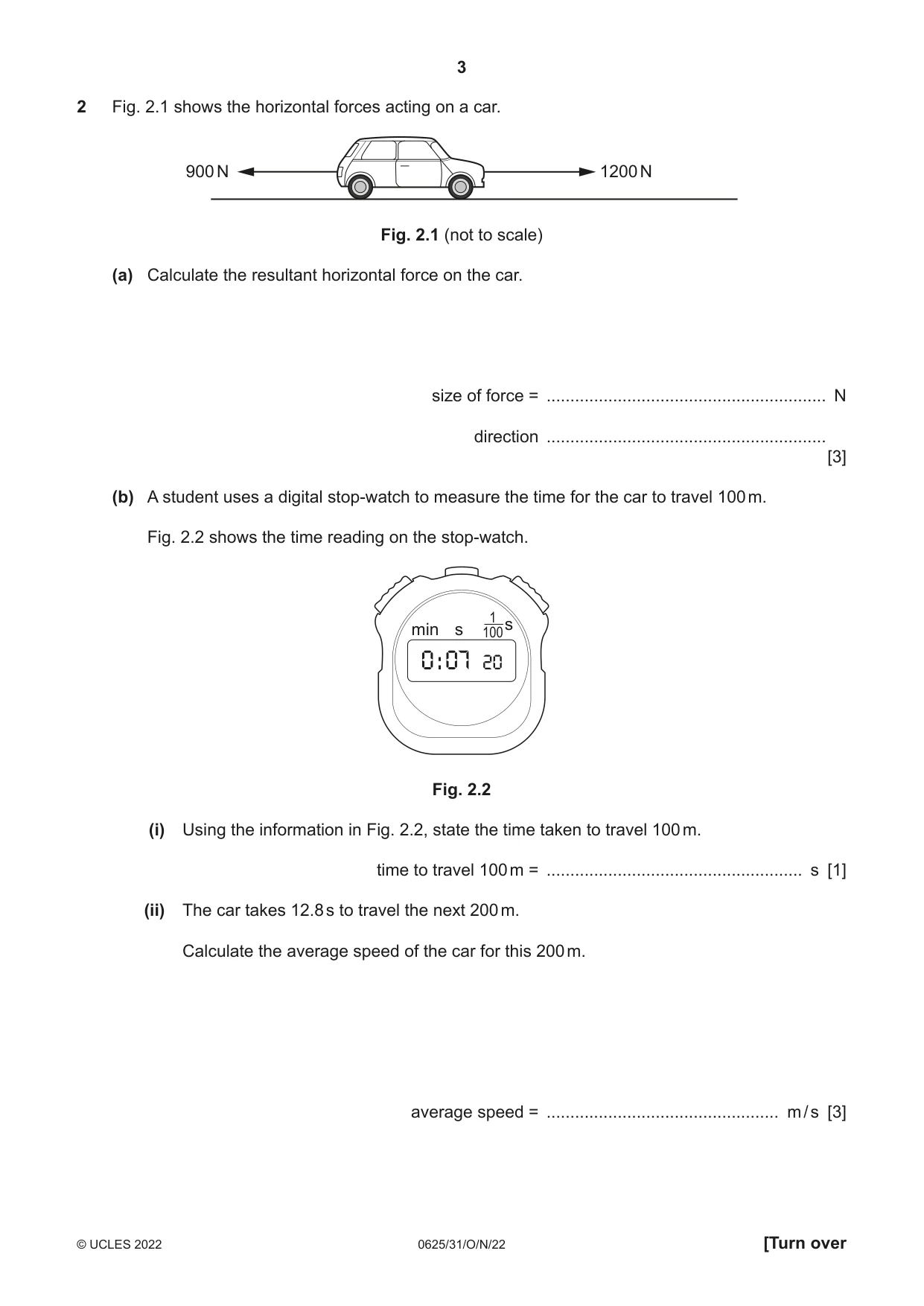
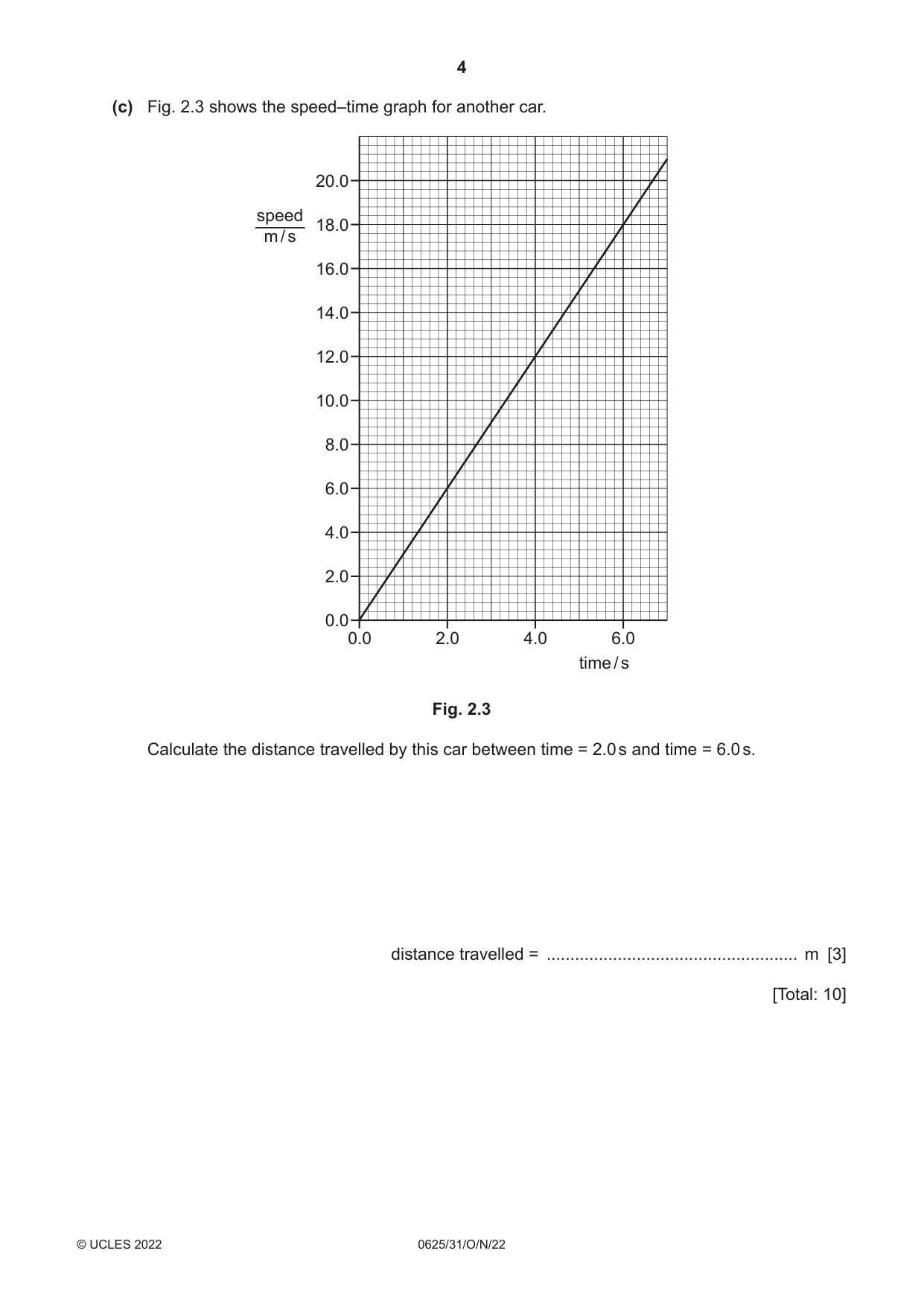
2 Fig. 2.1 shows the horizontal forces acting on a car. 900 N 1200 N Fig. 2.1 (not to scale) (a) Calculate the resultant horizontal force on the car. size of force = ........................................................... N direction ........................................................... [3] (b) A student uses a digital stop-watch to measure the time for the car to travel 100 m. Fig. 2.2 shows the time reading on the stop-watch. 1 s min s 100 0 : 07 20 Fig. 2.2 (i) Using the information in Fig. 2.2, state the time taken to travel 100 m. time to travel 100 m = ...................................................... s [1] (ii) The car takes 12.8 s to travel the next 200 m. Calculate the average speed of the car for this 200 m. average speed = ................................................. m / s [3] (c) Fig. 2.3 shows the speed–time graph for another car. 20.0 speed 18.0 m / s 16.0 14.0 12.0 10.0 8.0 6.0 4.0 2.0 0.0 0.0 2.0 4.0 6.0 time / s Fig. 2.3 Calculate the distance travelled by this car between time = 2.0 s and time = 6.0 s. distance travelled = ..................................................... m [3] [Total: 10]
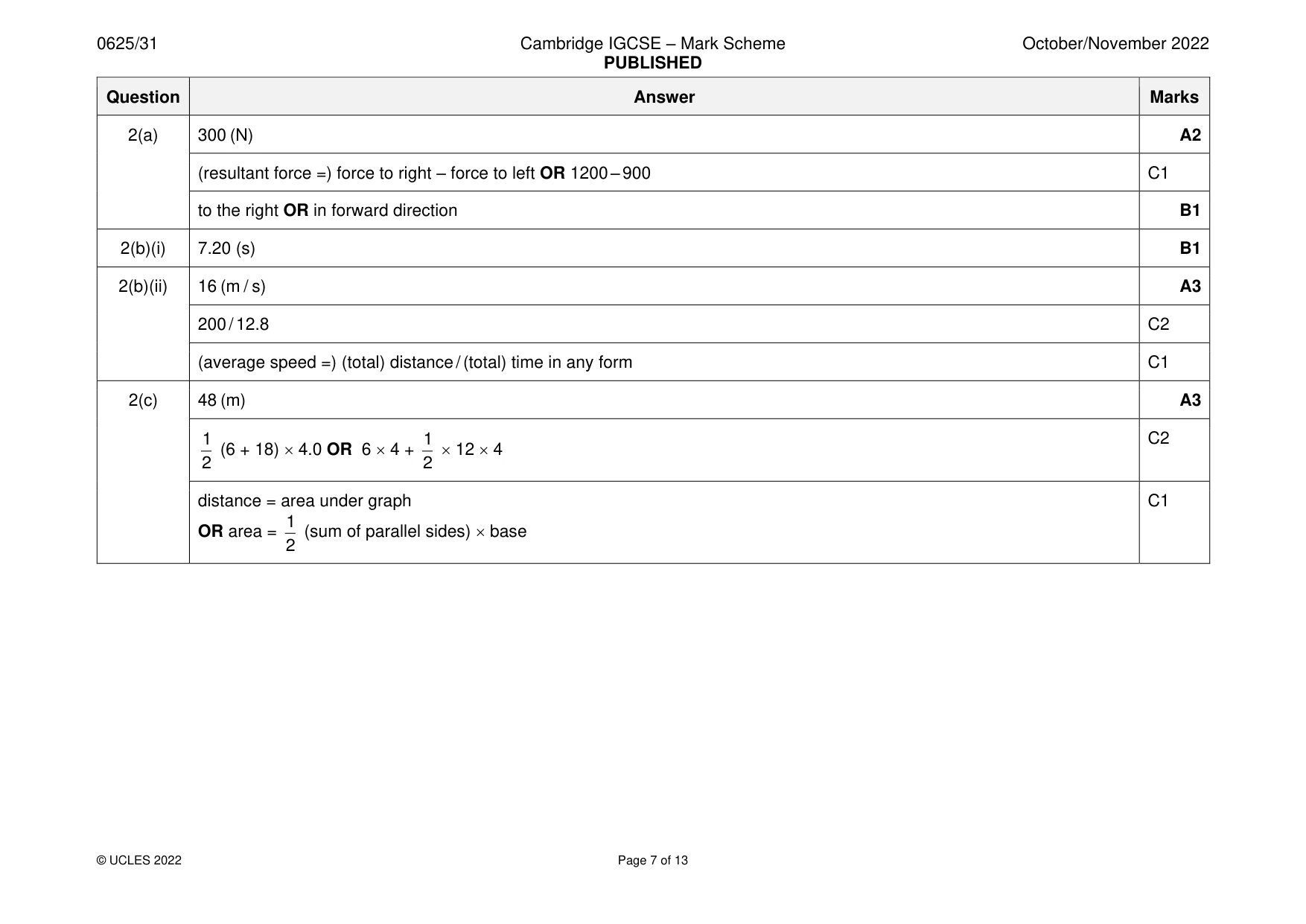
Mark scheme: 2(a) 300 (N) A2 (resultant force =) force to right – force to left OR 1200 – 900 C1 to the right OR in forward direction B1 2(b)(i) 7.20 (s) B1 2(b)(ii) 16 (m / s) A3 200 / 12.8 C2 (average speed =) (total) distance / (total) time in any form C1 2(c) 48 (m) A3 1 1 C2 (6 + 18) 4.0 OR 6 4 + 12 4 2 2 distance = area under graph C1 1 OR area = (sum of parallel sides) base 2
Q3 · A sailor uses a winch to raise a sail on a boat
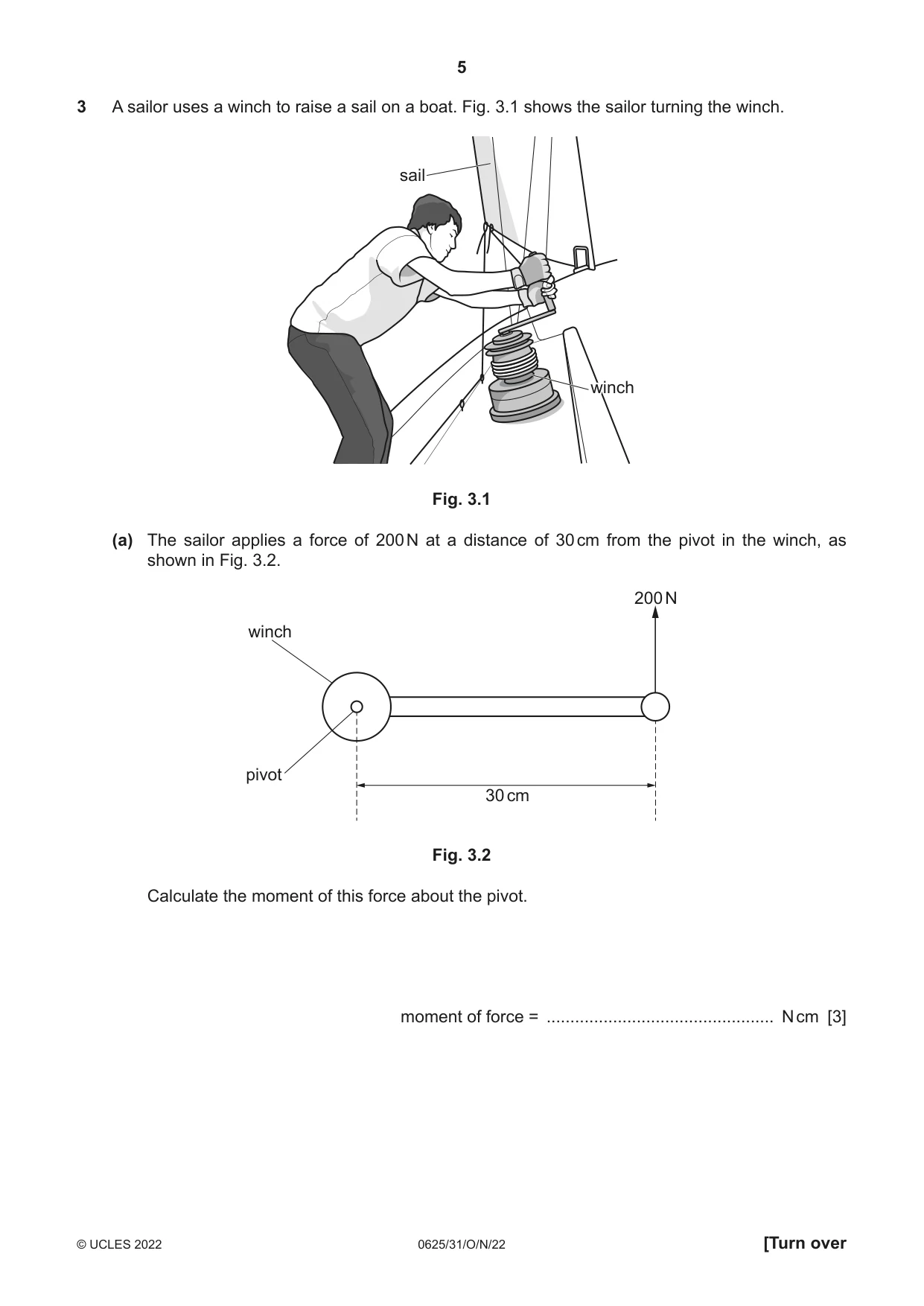
3 A sailor uses a winch to raise a sail on a boat. Fig. 3.1 shows the sailor turning the winch. sail winchwinch Fig. 3.1 (a) The sailor applies a force of 200 N at a distance of 30 cm from the pivot in the winch, as shown in Fig. 3.2. 200 N winch pivot 30 cm Fig. 3.2 Calculate the moment of this force about the pivot. moment of force = ................................................ N cm [3] (b) (i) Describe two useful energy transfers when the sailor uses the winch to raise the sail. 1 ........................................................................................................................................ 2 ........................................................................................................................................ [2] (ii) Describe one non-useful energy transfer when the sailor uses the winch to raise the sail. ..................................................................................................................................... [1] [Total: 6]
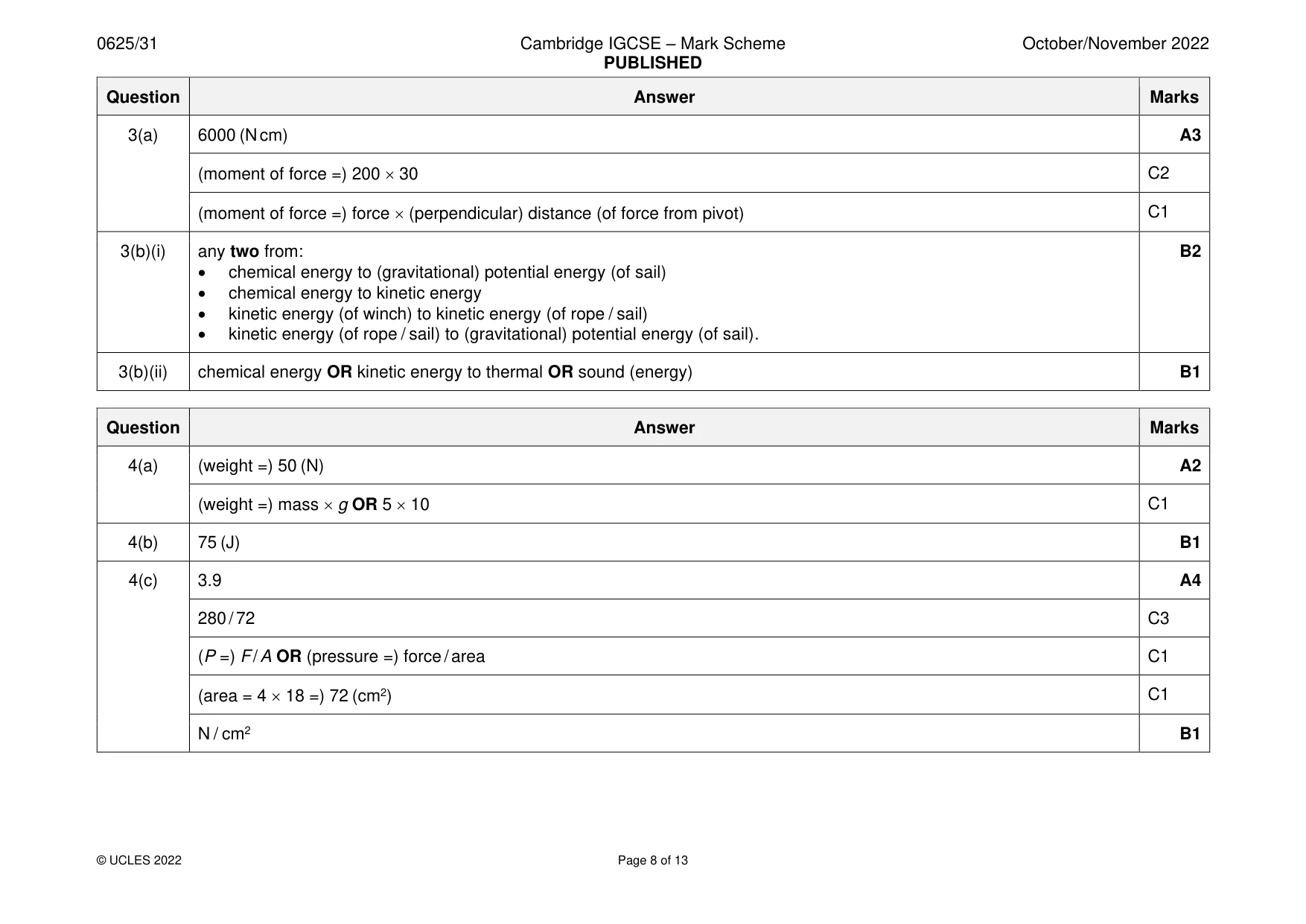
Mark scheme: 3(a) 6000 (N cm) A3 (moment of force =) 200 30 C2 (moment of force =) force (perpendicular) distance (of force from pivot) C1 3(b)(i) any two from: B2 • chemical energy to (gravitational) potential energy (of sail) • chemical energy to kinetic energy • kinetic energy (of winch) to kinetic energy (of rope / sail) • kinetic energy (of rope / sail) to (gravitational) potential energy (of sail). 3(b)(ii) chemical energy OR kinetic energy to thermal OR sound (energy) B1
Q4 · A student has an object with a mass of 5.0 kg
4 (a) A student has an object with a mass of 5.0 kg. Calculate the weight of the object. weight of object = ..................................................... N [2] (b) The student lifts the 5.0 kg object from the floor onto a table. He does 75 J of work on the object in lifting it onto the table. State the amount of gravitational potential energy gained by the object due to being lifted onto the table. gravitational potential energy gained by object = ...................................................... J [1] (c) The weight of a table is 280 N. The table has four legs. The area of each table leg in contact with the floor is 18 cm2. Calculate the pressure of the table on the floor. Give the correct unit. pressure on the floor = ............................... unit .................. [5] [Total: 8]
Mark scheme: 4(a) (weight =) 50 (N) A2 (weight =) mass g OR 5 10 C1 4(b) 75 (J) B1 4(c) 3.9 A4 280 / 72 C3 (P =) F / A OR (pressure =) force / area C1 (area = 4 18 =) 72 (cm2) C1 N / cm2 B1
Q5 · An engineer measures the pressure of the gas in a gas bottle
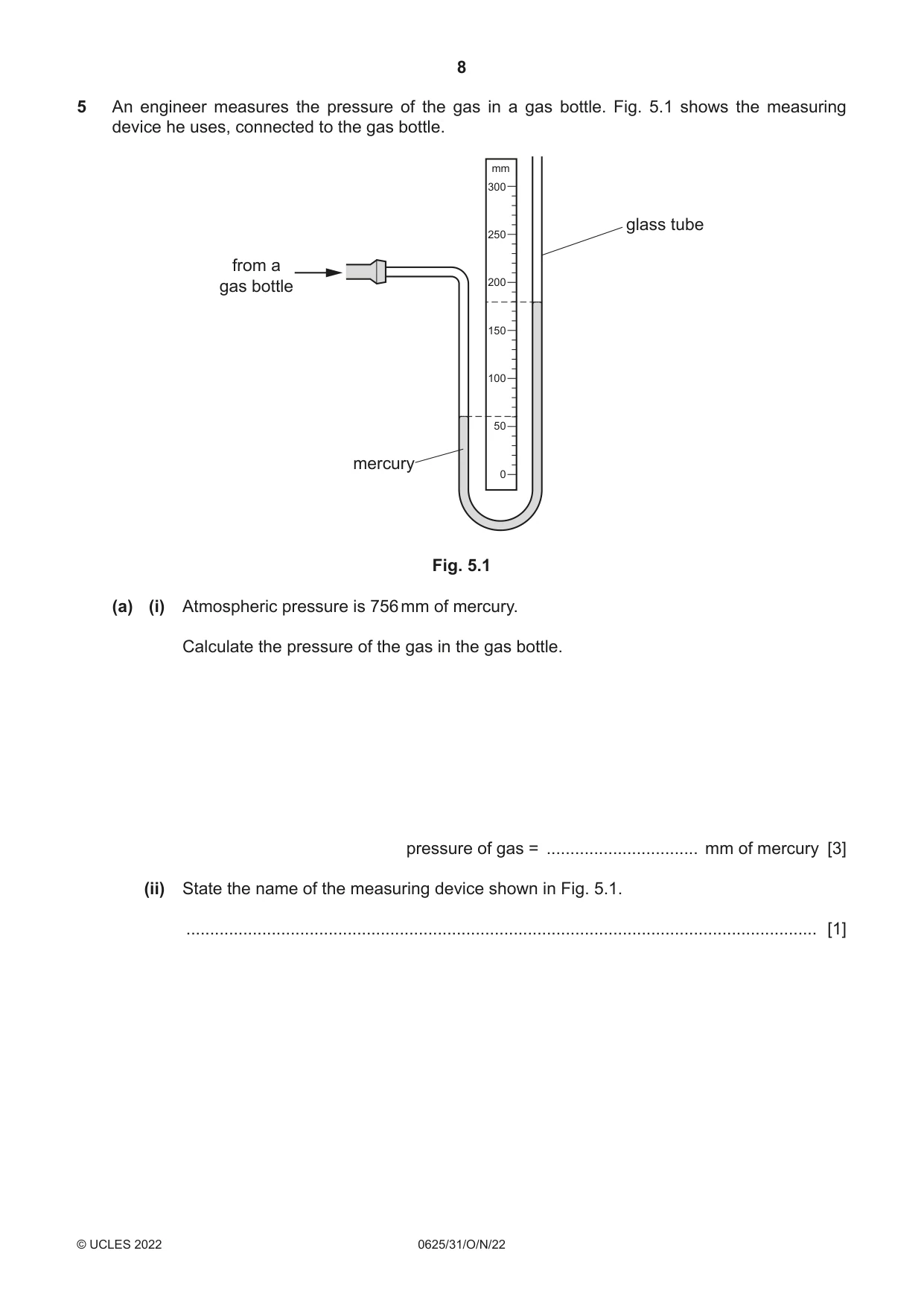
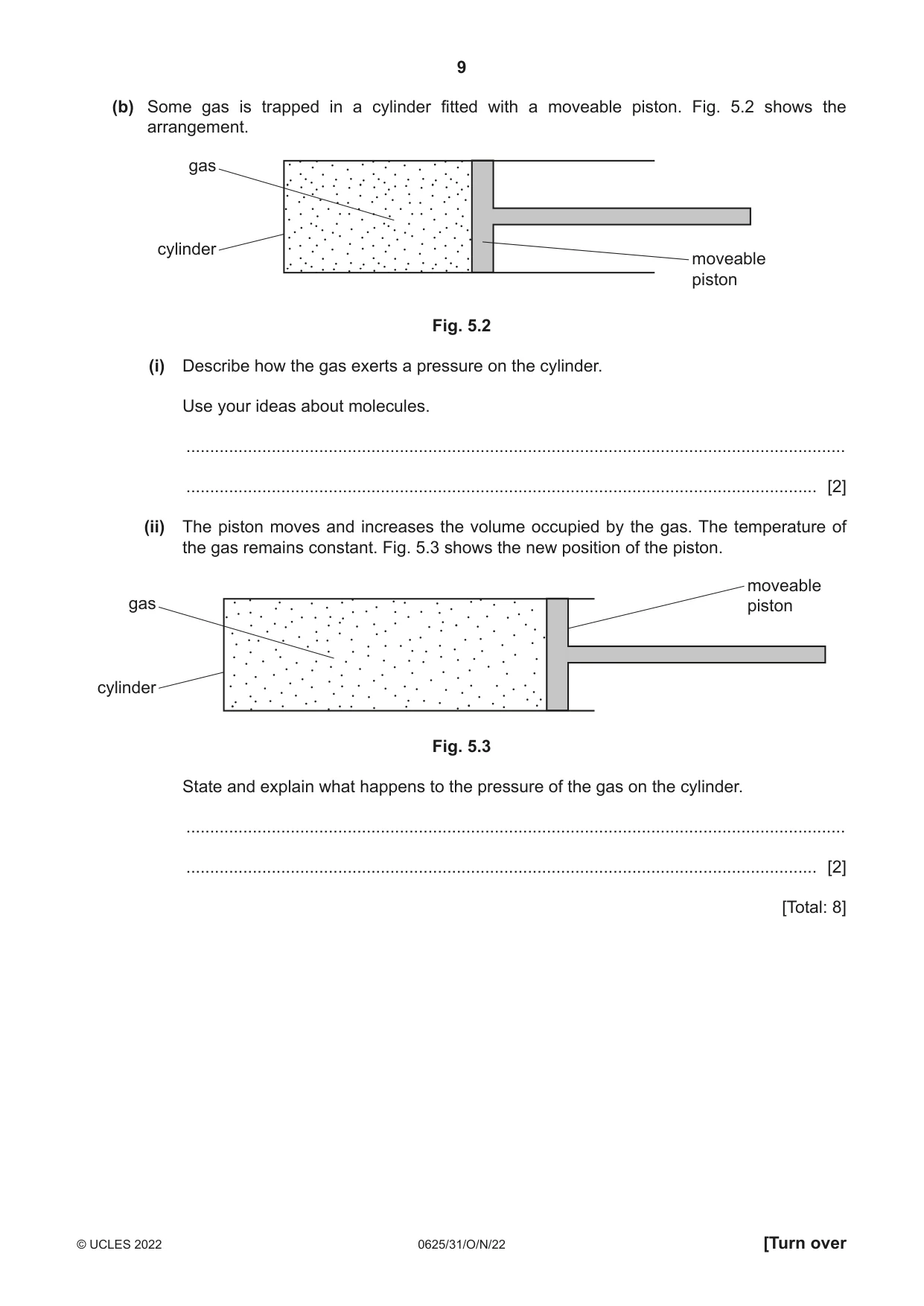
5 An engineer measures the pressure of the gas in a gas bottle. Fig. 5.1 shows the measuring device he uses, connected to the gas bottle. mm 300 glass tube 250 from a gas bottle 200 150 100 50 mercury 0 Fig. 5.1 (a) (i) Atmospheric pressure is 756 mm of mercury. Calculate the pressure of the gas in the gas bottle. pressure of gas = ................................ mm of mercury [3] (ii) State the name of the measuring device shown in Fig. 5.1. ..................................................................................................................................... [1] (b) Some gas is trapped in a cylinder fitted with a moveable piston. Fig. 5.2 shows the arrangement. gas cylinder moveable piston Fig. 5.2 (i) Describe how the gas exerts a pressure on the cylinder. Use your ideas about molecules. ........................................................................................................................................... ..................................................................................................................................... [2] (ii) The piston moves and increases the volume occupied by the gas. The temperature of the gas remains constant. Fig. 5.3 shows the new position of the piston. moveable gas piston cylinder Fig. 5.3 State and explain what happens to the pressure of the gas on the cylinder. ........................................................................................................................................... ..................................................................................................................................... [2] [Total: 8]
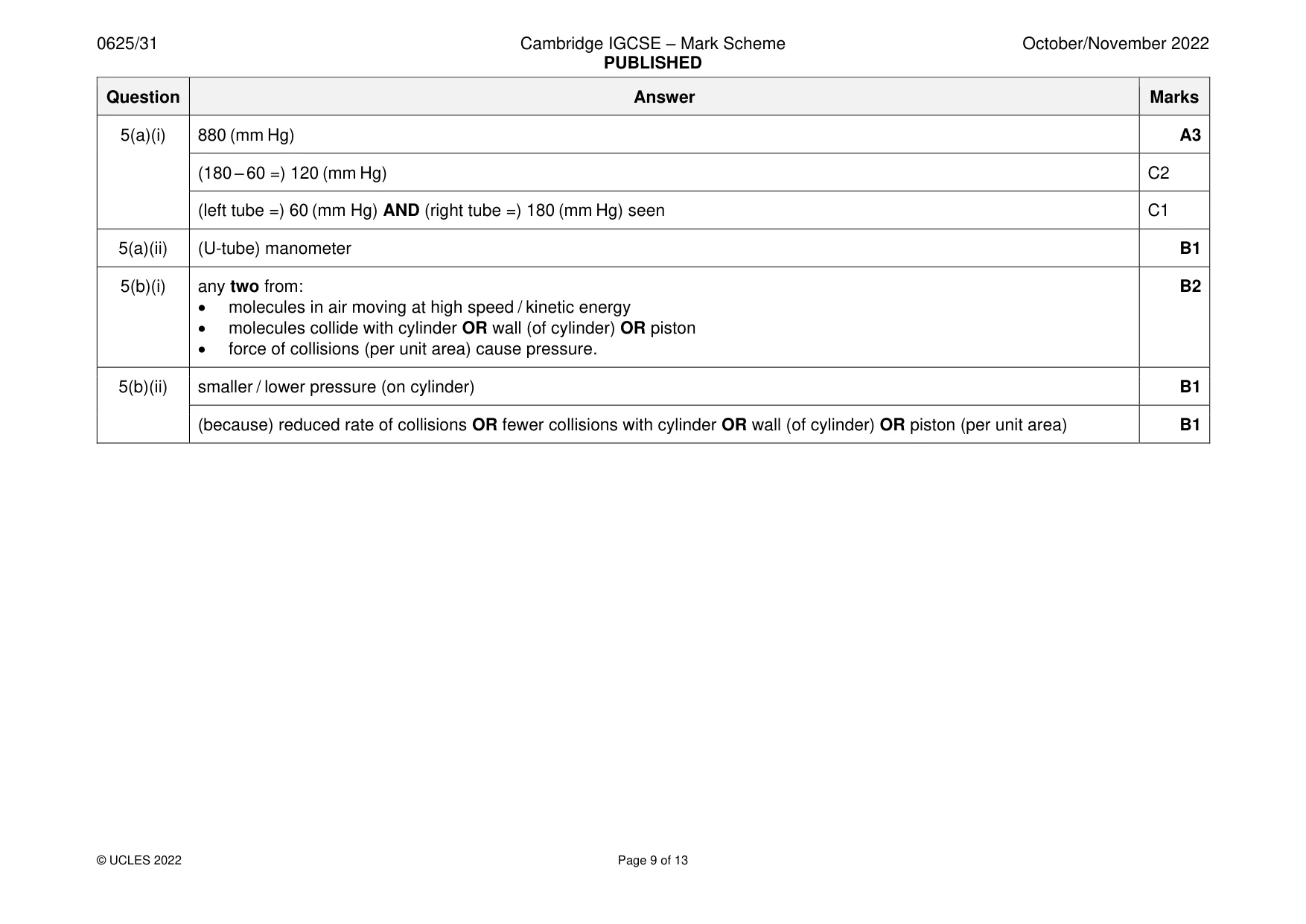
Mark scheme: 5(a)(i) 880 (mm Hg) A3 (180 – 60 =) 120 (mm Hg) C2 (left tube =) 60 (mm Hg) AND (right tube =) 180 (mm Hg) seen C1 5(a)(ii) (U-tube) manometer B1 5(b)(i) any two from: B2 • molecules in air moving at high speed / kinetic energy • molecules collide with cylinder OR wall (of cylinder) OR piston • force of collisions (per unit area) cause pressure. 5(b)(ii) smaller / lower pressure (on cylinder) B1 (because) reduced rate of collisions OR fewer collisions with cylinder OR wall (of cylinder) OR piston (per unit area) B1
Q6 · A student investigates wave properties
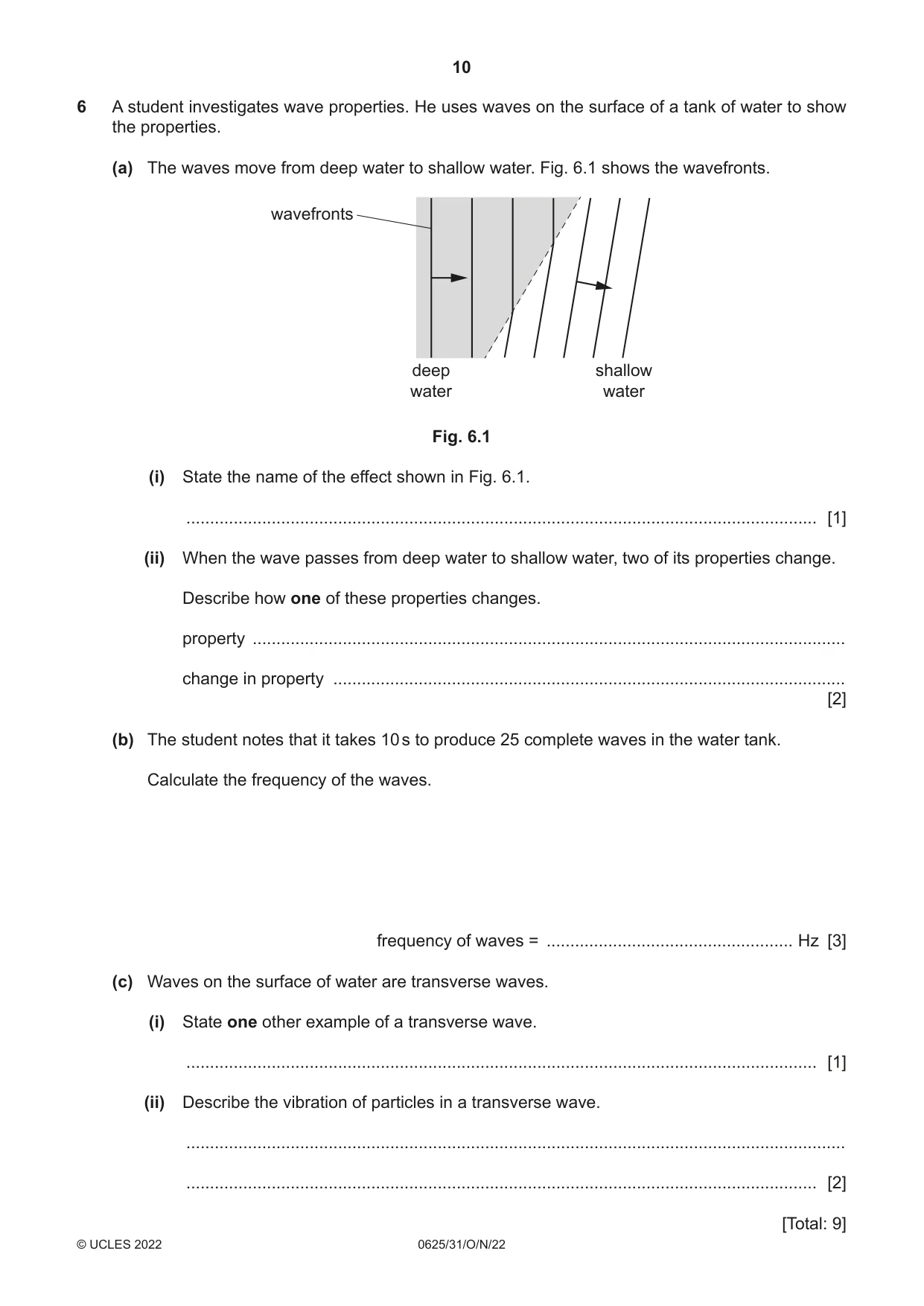
6 A student investigates wave properties. He uses waves on the surface of a tank of water to show the properties. (a) The waves move from deep water to shallow water. Fig. 6.1 shows the wavefronts. wavefronts deep shallow water water Fig. 6.1 (i) State the name of the effect shown in Fig. 6.1. ..................................................................................................................................... [1] (ii) When the wave passes from deep water to shallow water, two of its properties change. Describe how one of these properties changes. property ............................................................................................................................. change in property ............................................................................................................ [2] (b) The student notes that it takes 10 s to produce 25 complete waves in the water tank. Calculate the frequency of the waves. frequency of waves = .................................................... Hz [3] (c) Waves on the surface of water are transverse waves. (i) State one other example of a transverse wave. ..................................................................................................................................... [1] (ii) Describe the vibration of particles in a transverse wave. ........................................................................................................................................... ..................................................................................................................................... [2] [Total: 9]
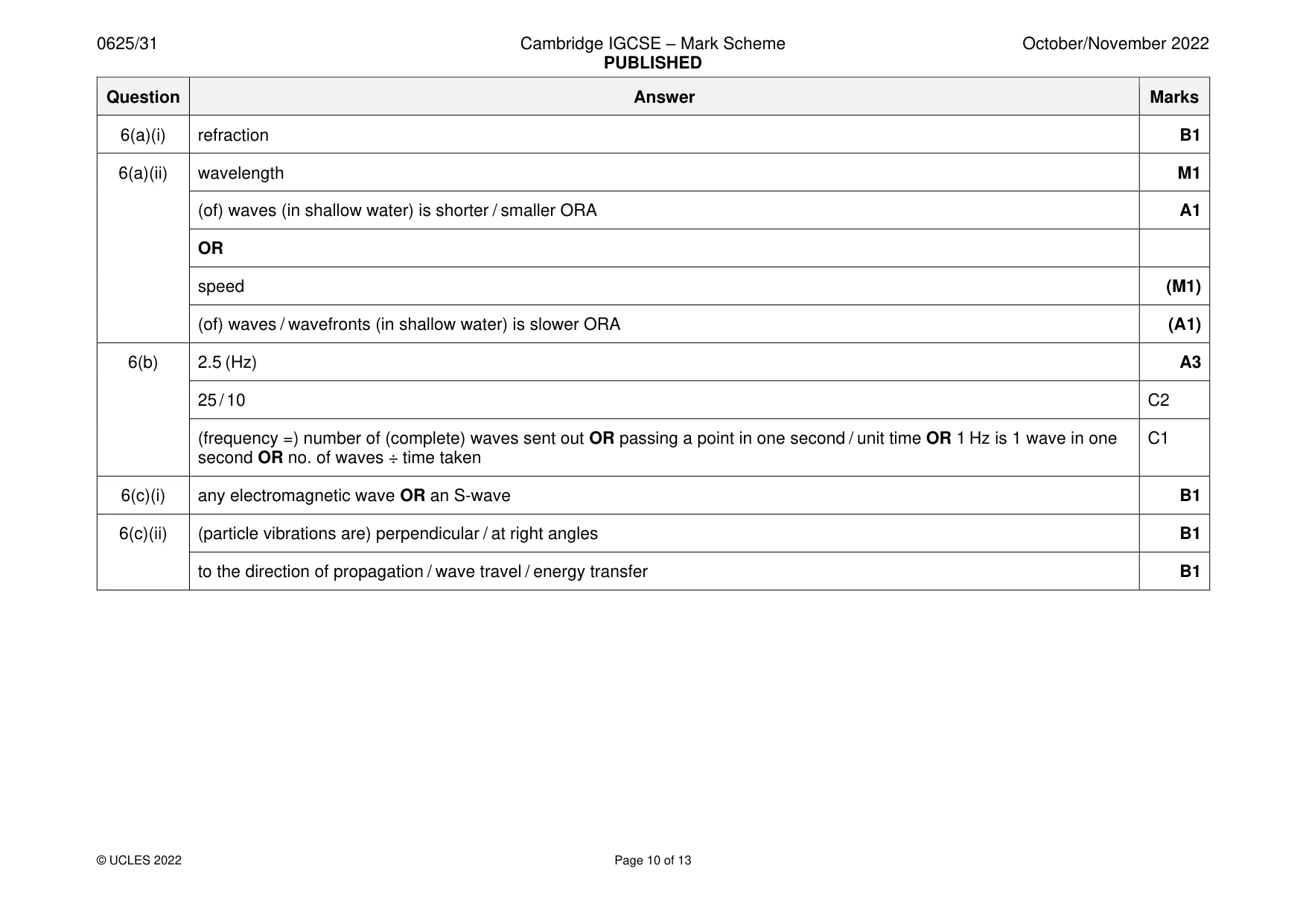
Mark scheme: 6(a)(i) refraction B1 6(a)(ii) wavelength M1 (of) waves (in shallow water) is shorter / smaller ORA A1 OR speed (M1) (of) waves / wavefronts (in shallow water) is slower ORA (A1) 6(b) 2.5 (Hz) A3 25 / 10 C2 (frequency =) number of (complete) waves sent out OR passing a point in one second / unit time OR 1 Hz is 1 wave in one C1 second OR no. of waves ÷ time taken 6(c)(i) any electromagnetic wave OR an S-wave B1 6(c)(ii) (particle vibrations are) perpendicular / at right angles B1 to the direction of propagation / wave travel / energy transfer B1
Q7 · A student has a bar magnet and a metal bar with ends X and Y
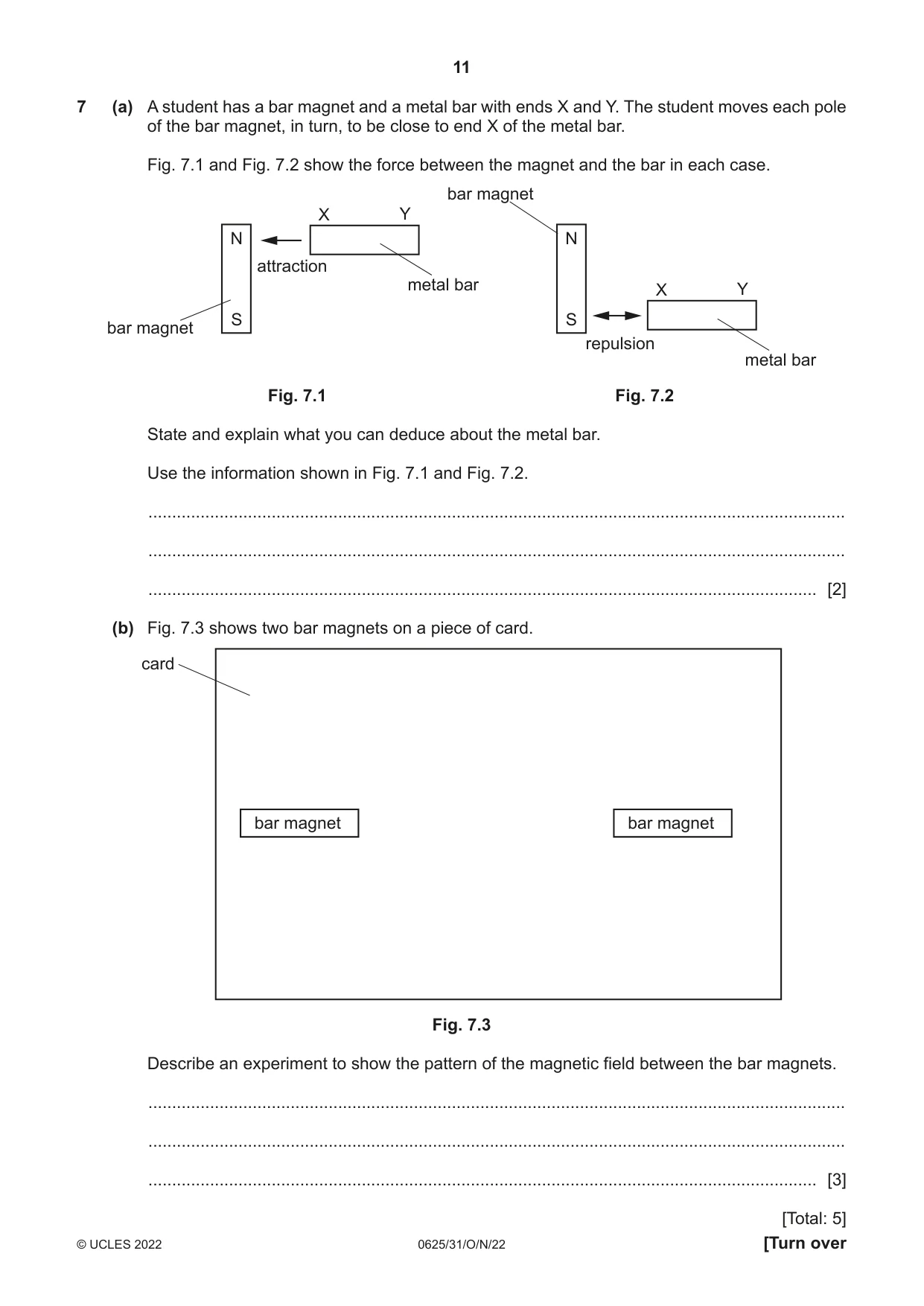
7 (a) A student has a bar magnet and a metal bar with ends X and Y. The student moves each pole of the bar magnet, in turn, to be close to end X of the metal bar. Fig. 7.1 and Fig. 7.2 show the force between the magnet and the bar in each case. bar magnet X Y N N attraction metal bar X Y S S bar magnet repulsion metal bar Fig. 7.1 Fig. 7.2 State and explain what you can deduce about the metal bar. Use the information shown in Fig. 7.1 and Fig. 7.2. ................................................................................................................................................... ................................................................................................................................................... ............................................................................................................................................. [2] (b) Fig. 7.3 shows two bar magnets on a piece of card. card bar magnet bar magnet Fig. 7.3 Describe an experiment to show the pattern of the magnetic field between the bar magnets. ................................................................................................................................................... ................................................................................................................................................... ............................................................................................................................................. [3] [Total: 5]
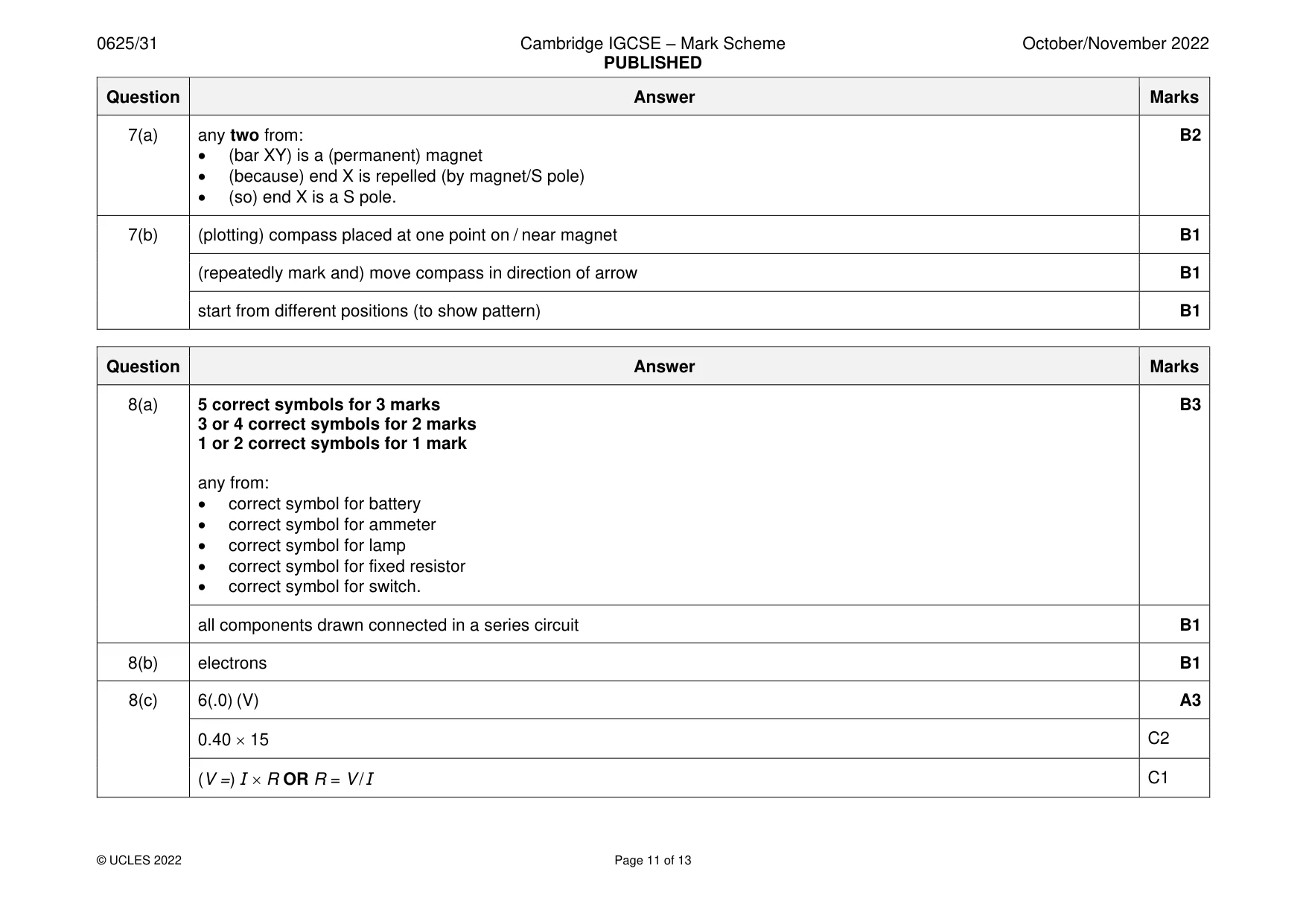
Mark scheme: 7(a) any two from: B2 • (bar XY) is a (permanent) magnet • (because) end X is repelled (by magnet/S pole) • (so) end X is a S pole. 7(b) (plotting) compass placed at one point on / near magnet B1 (repeatedly mark and) move compass in direction of arrow B1 start from different positions (to show pattern) B1
Q8 · An electric circuit set up by a student
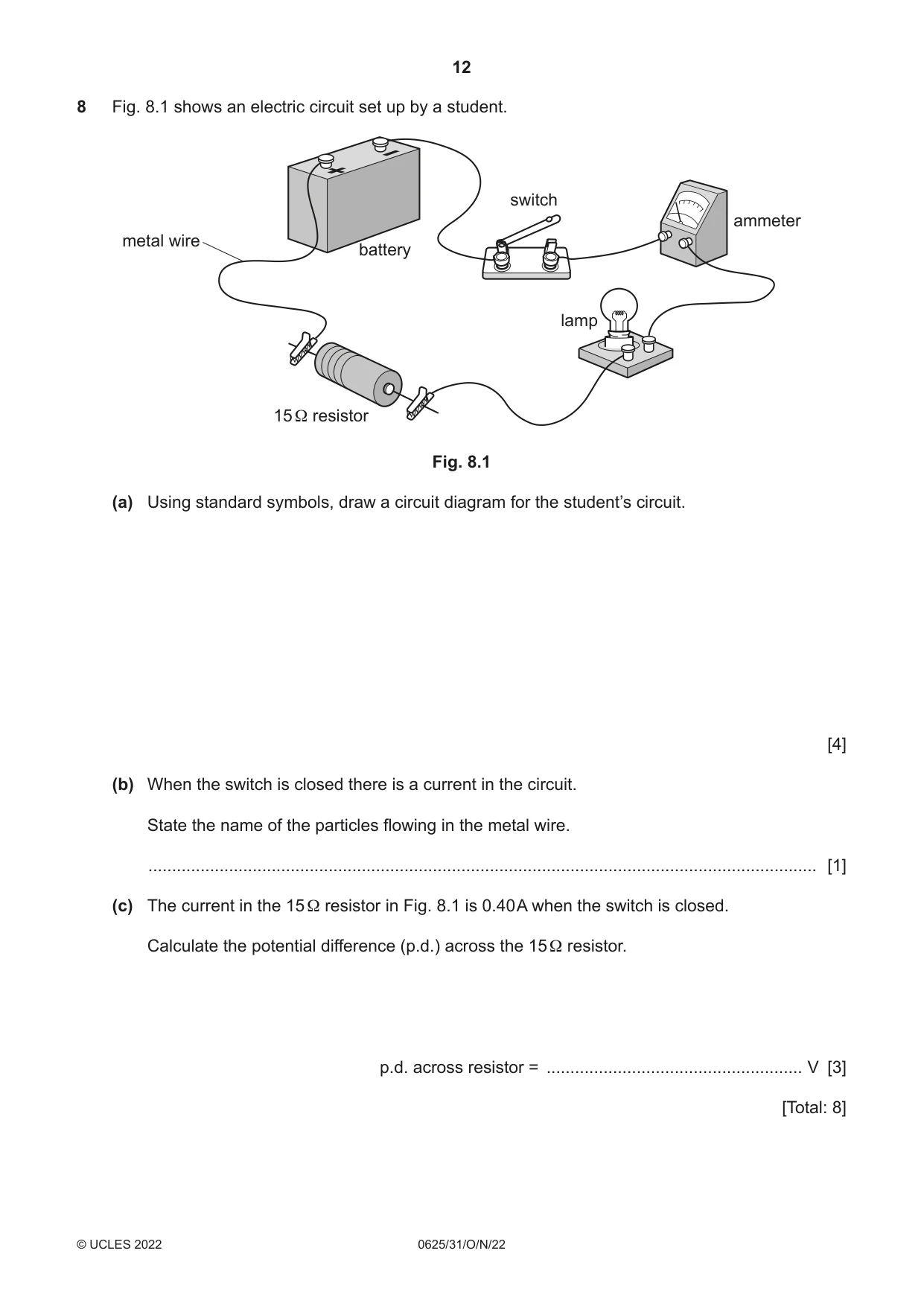
8 Fig. 8.1 shows an electric circuit set up by a student. switch ammeter metal wire battery lamp 15 Ω resistor Fig. 8.1 (a) Using standard symbols, draw a circuit diagram for the student’s circuit. [4] (b) When the switch is closed there is a current in the circuit. State the name of the particles flowing in the metal wire. ............................................................................................................................................. [1] (c) The current in the 15 Ω resistor in Fig. 8.1 is 0.40 A when the switch is closed. Calculate the potential difference (p.d.) across the 15 Ω resistor. p.d. across resistor = ...................................................... V [3] [Total: 8]
Mark scheme: 8(a) 5 correct symbols for 3 marks B3 3 or 4 correct symbols for 2 marks 1 or 2 correct symbols for 1 mark any from: • correct symbol for battery • correct symbol for ammeter • correct symbol for lamp • correct symbol for fixed resistor • correct symbol for switch. all components drawn connected in a series circuit B1 8(b) electrons B1 8(c) 6(.0) (V) A3 0.40 15 C2 (V =) I R OR R = V / I C1
Q9 · A transformer used on a building site
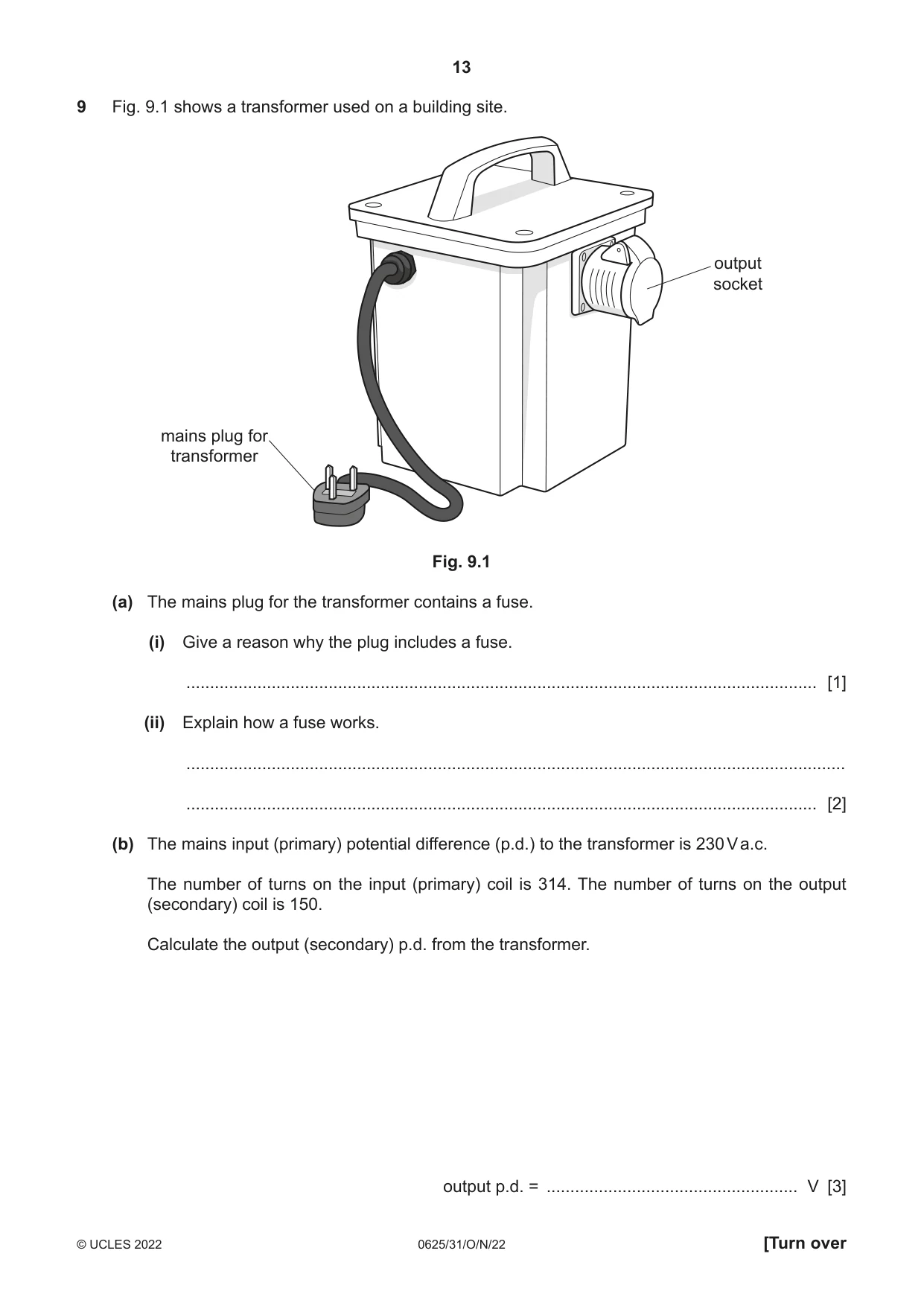
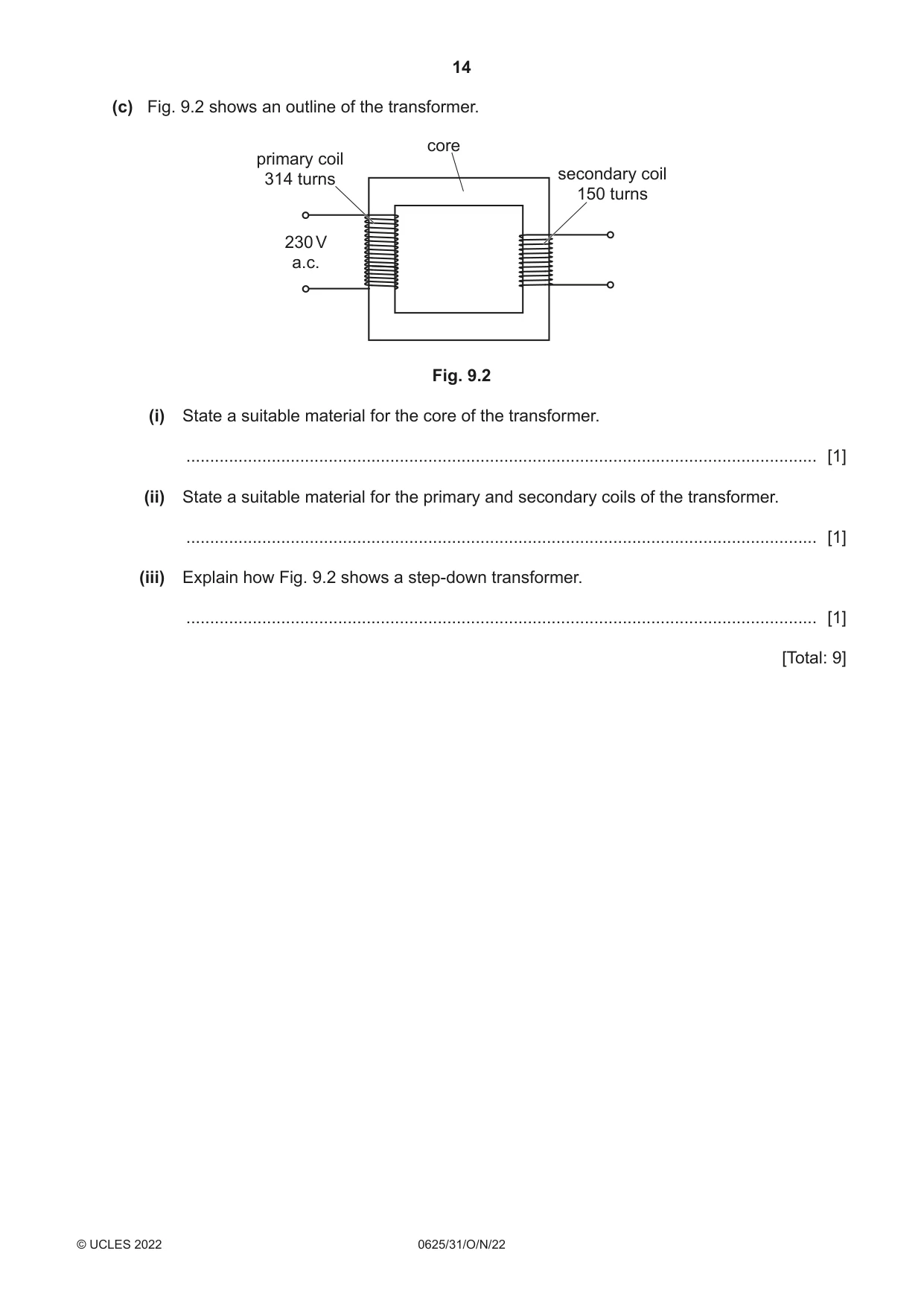
9 Fig. 9.1 shows a transformer used on a building site. output socket mains plug for transformer Fig. 9.1 (a) The mains plug for the transformer contains a fuse. (i) Give a reason why the plug includes a fuse. ..................................................................................................................................... [1] (ii) Explain how a fuse works. ........................................................................................................................................... ..................................................................................................................................... [2] (b) The mains input (primary) potential difference (p.d.) to the transformer is 230 V a.c. The number of turns on the input (primary) coil is 314. The number of turns on the output (secondary) coil is 150. Calculate the output (secondary) p.d. from the transformer. output p.d. = ..................................................... V [3] (c) Fig. 9.2 shows an outline of the transformer. core primary coil secondary coil 314 turns 150 turns 230 V a.c. Fig. 9.2 (i) State a suitable material for the core of the transformer. ..................................................................................................................................... [1] (ii) State a suitable material for the primary and secondary coils of the transformer. ..................................................................................................................................... [1] (iii) Explain how Fig. 9.2 shows a step-down transformer. ..................................................................................................................................... [1] [Total: 9]
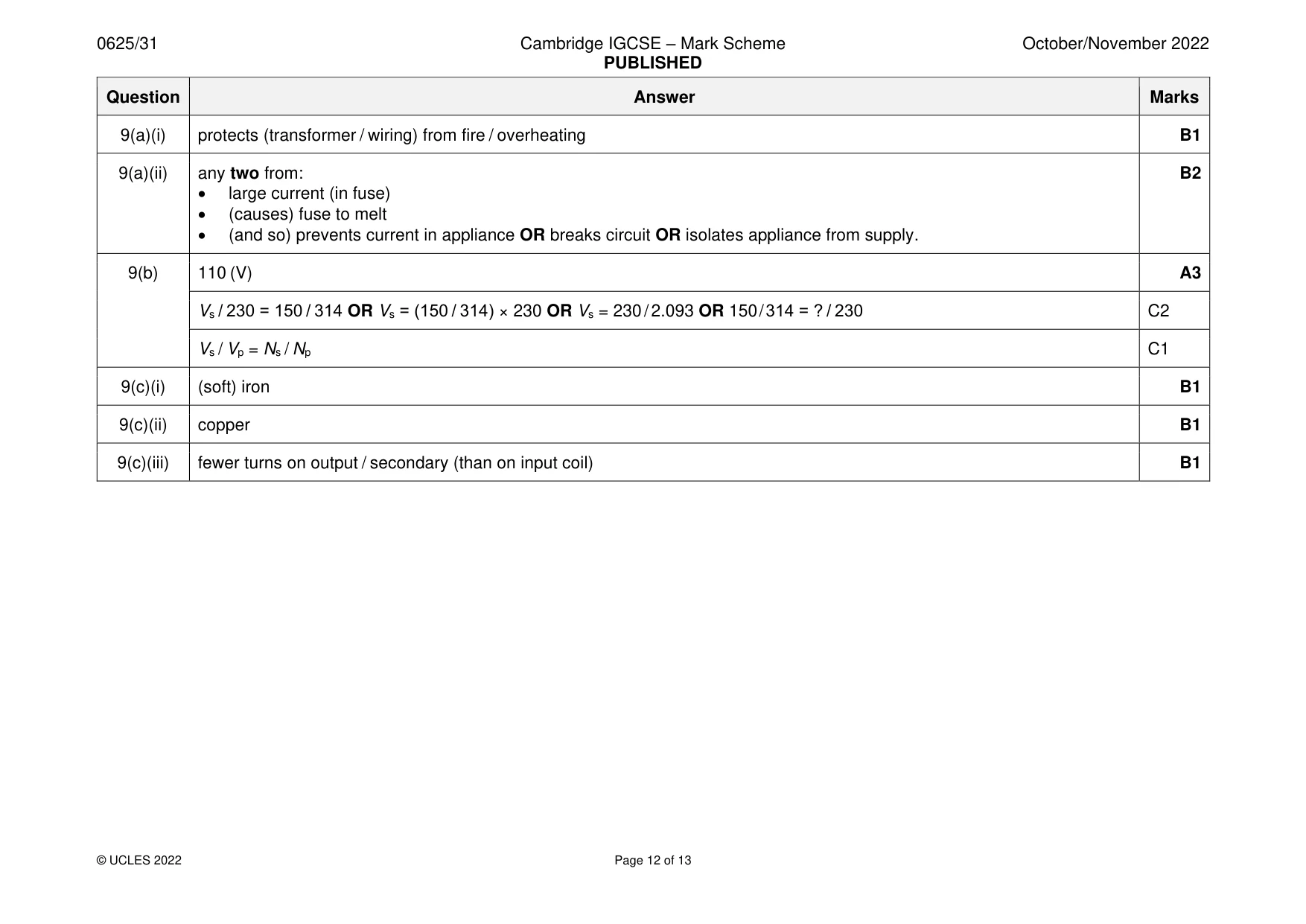
Mark scheme: 9(a)(i) protects (transformer / wiring) from fire / overheating B1 9(a)(ii) any two from: B2 • large current (in fuse) • (causes) fuse to melt • (and so) prevents current in appliance OR breaks circuit OR isolates appliance from supply. 9(b) 110 (V) A3 Vs / 230 = 150 / 314 OR Vs = (150 / 314) × 230 OR Vs = 230 / 2.093 OR 150 / 314 = ? / 230 C2 Vs / Vp = Ns / Np C1 9(c)(i) (soft) iron B1 9(c)(ii) copper B1 9(c)(iii) fewer turns on output / secondary (than on input coil) B1
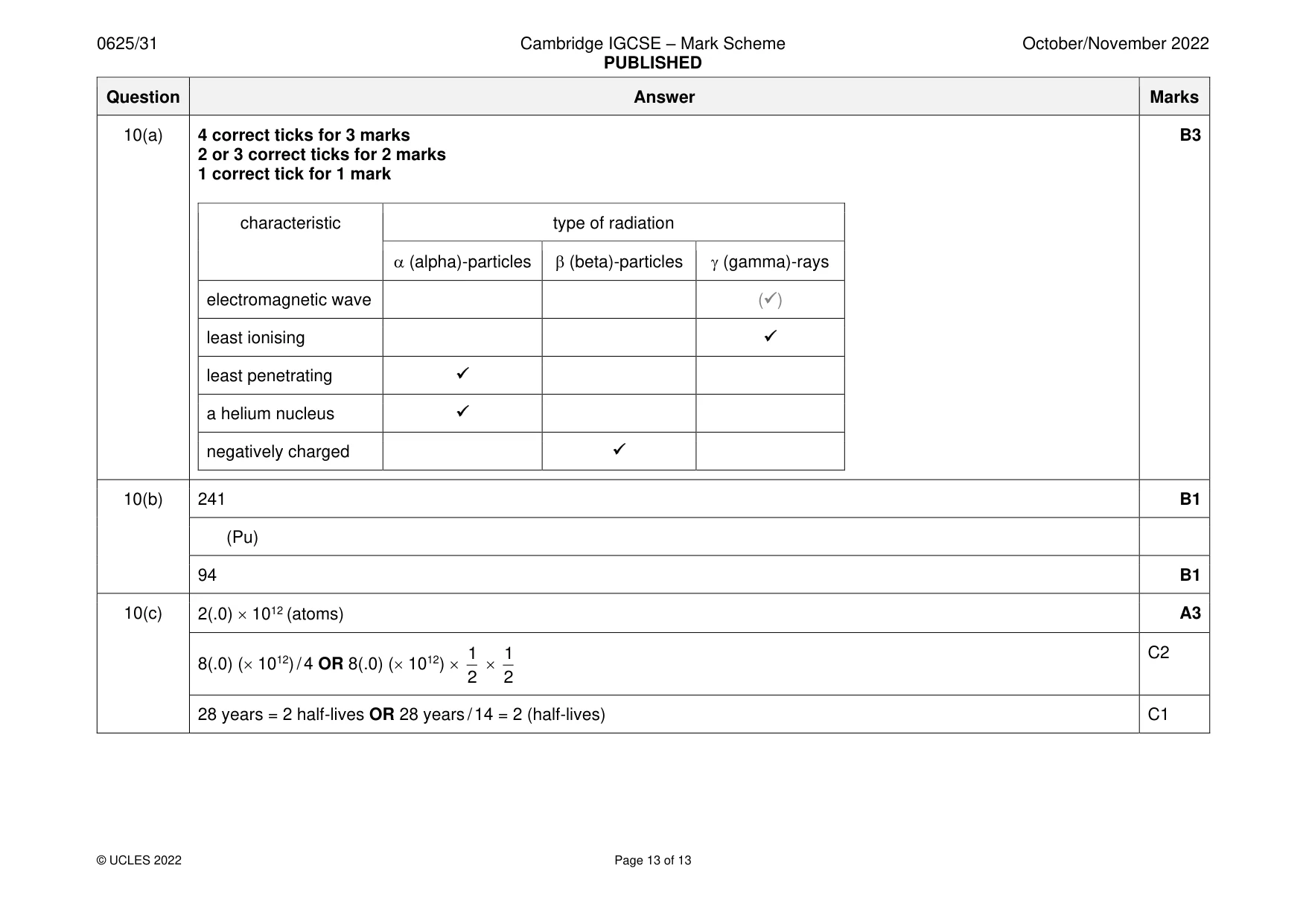
Q10 · Α (alpha)-particles, β (beta)-particles and γ (gamma)-rays have different characteristics
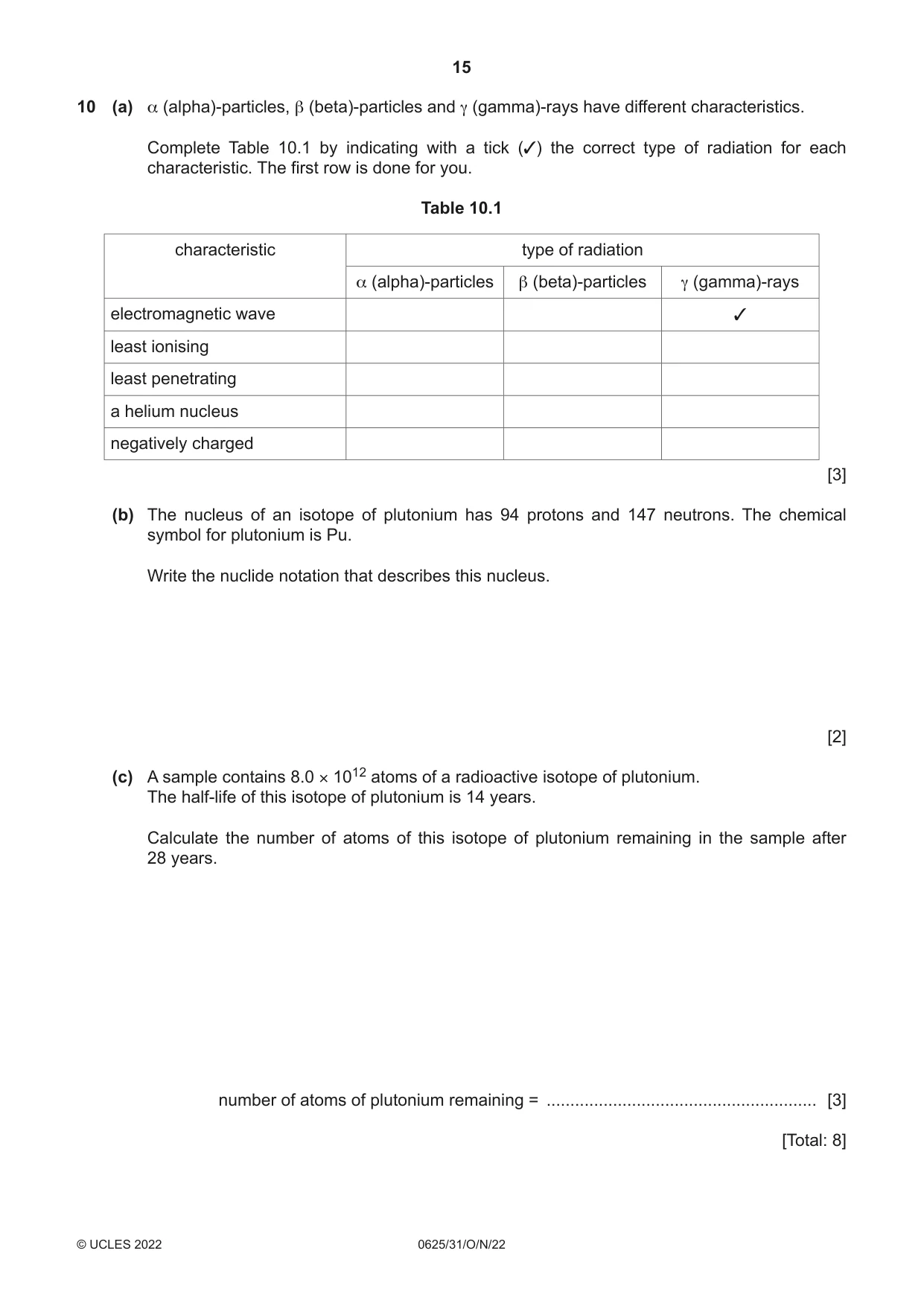
10 (a) α (alpha)-particles, β (beta)-particles and γ (gamma)-rays have different characteristics. Complete Table 10.1 by indicating with a tick (3) the correct type of radiation for each characteristic. The first row is done for you. Table 10.1 characteristic type of radiation α (alpha)-particles β (beta)-particles γ (gamma)-rays electromagnetic wave 3 least ionising least penetrating a helium nucleus negatively charged [3] (b) The nucleus of an isotope of plutonium has 94 protons and 147 neutrons. The chemical symbol for plutonium is Pu. Write the nuclide notation that describes this nucleus. [2] (c) A sample contains 8.0 × 10¹² atoms of a radioactive isotope of plutonium. The half-life of this isotope of plutonium is 14 years. Calculate the number of atoms of this isotope of plutonium remaining in the sample after 28 years. number of atoms of plutonium remaining = ......................................................... [3] [Total: 8]
Mark scheme: 10(a) 4 correct ticks for 3 marks B3 2 or 3 correct ticks for 2 marks 1 correct tick for 1 mark characteristic type of radiation (alpha)-particles (beta)-particles (gamma)-rays electromagnetic wave (✓) least ionising ✓ least penetrating ✓ a helium nucleus ✓ negatively charged ✓ 10(b) 241 B1 (Pu) 94 B1 10(c) 2(.0) 1012 (atoms) A3 1 1 C2 8(.0) ( 1012) / 4 OR 8(.0) ( 1012) 2 2 28 years = 2 half-lives OR 28 years / 14 = 2 (half-lives) C1
What was in this paper
The subtopics covered by these 10 questions, and how many questions each got. Open one in a new tab to see every Cambridge question on it.
What you needed in this session
Cambridge’s own grade thresholds for 2022 Oct/Nov, Paper 3 · Variant 1. A higher threshold means an easier paper — the bar moves with how the cohort did.