Cambridge IGCSE Physics 0625 — 2021 Oct/Nov Paper 3 · Variant 2
0625/32/O/N/21 · 12 questions · 80 marks · ≈90 min
The question paper and its mark scheme, free to read here and free to download. This is Cambridge’s own paper, exactly as it was sat.
Question paper20 pages
Mark scheme14 pages
Answers below. Sit the paper first if you are practising.
Questions as text
Q1 · A cyclist travels to a friend’s house
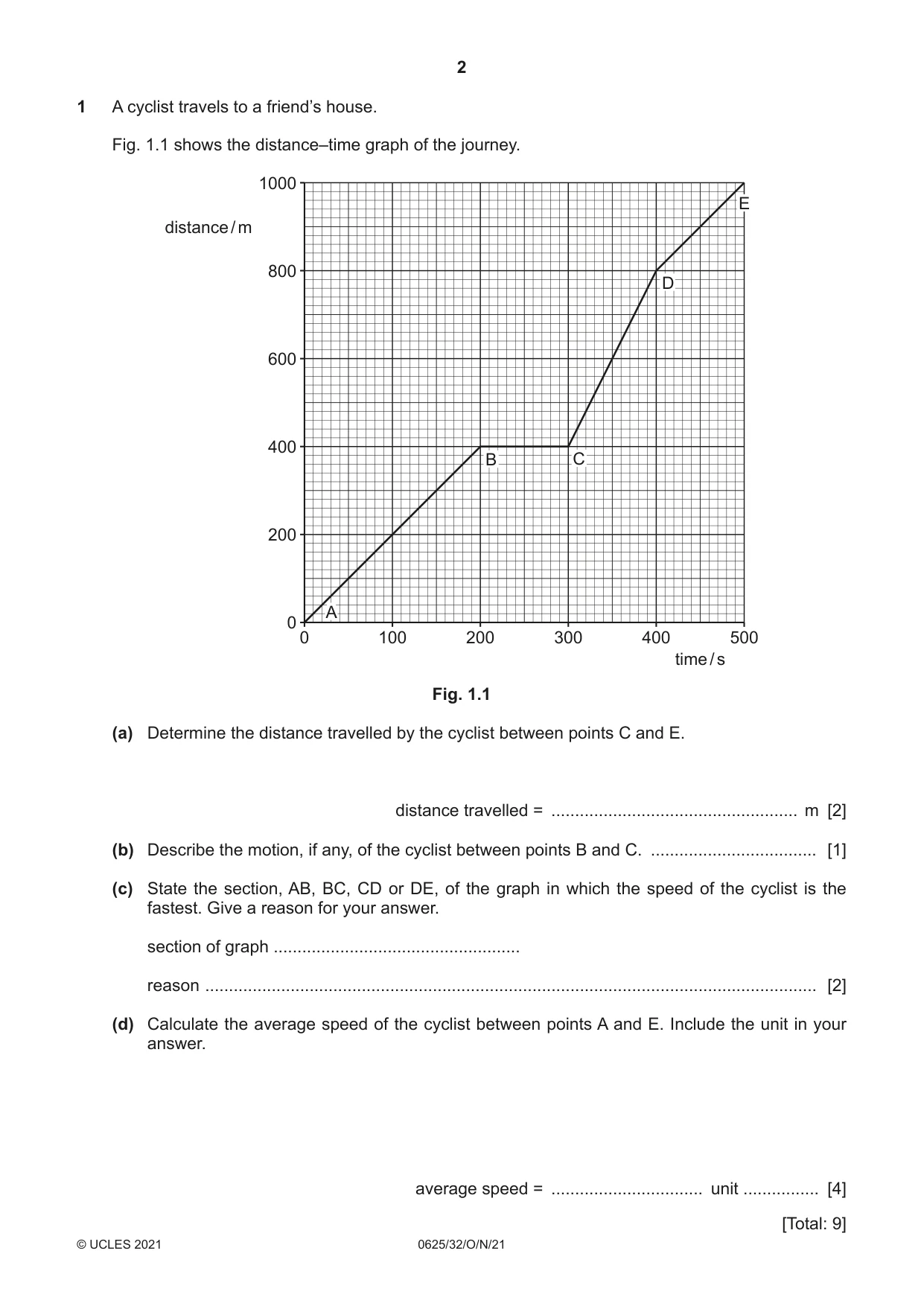
1 A cyclist travels to a friend’s house. Fig. 1.1 shows the distance–time graph of the journey. 1000 E distance / m 800 D 600 400 B C 200 A 0 0 100 200 300 400 500 time / s Fig. 1.1 (a) Determine the distance travelled by the cyclist between points C and E. distance travelled = .................................................... m [2] (b) Describe the motion, if any, of the cyclist between points B and C. ................................... [1] (c) State the section, AB, BC, CD or DE, of the graph in which the speed of the cyclist is the fastest. Give a reason for your answer. section of graph .................................................... reason ................................................................................................................................. [2] (d) Calculate the average speed of the cyclist between points A and E. Include the unit in your answer. average speed = ................................ unit ................ [4] [Total: 9]
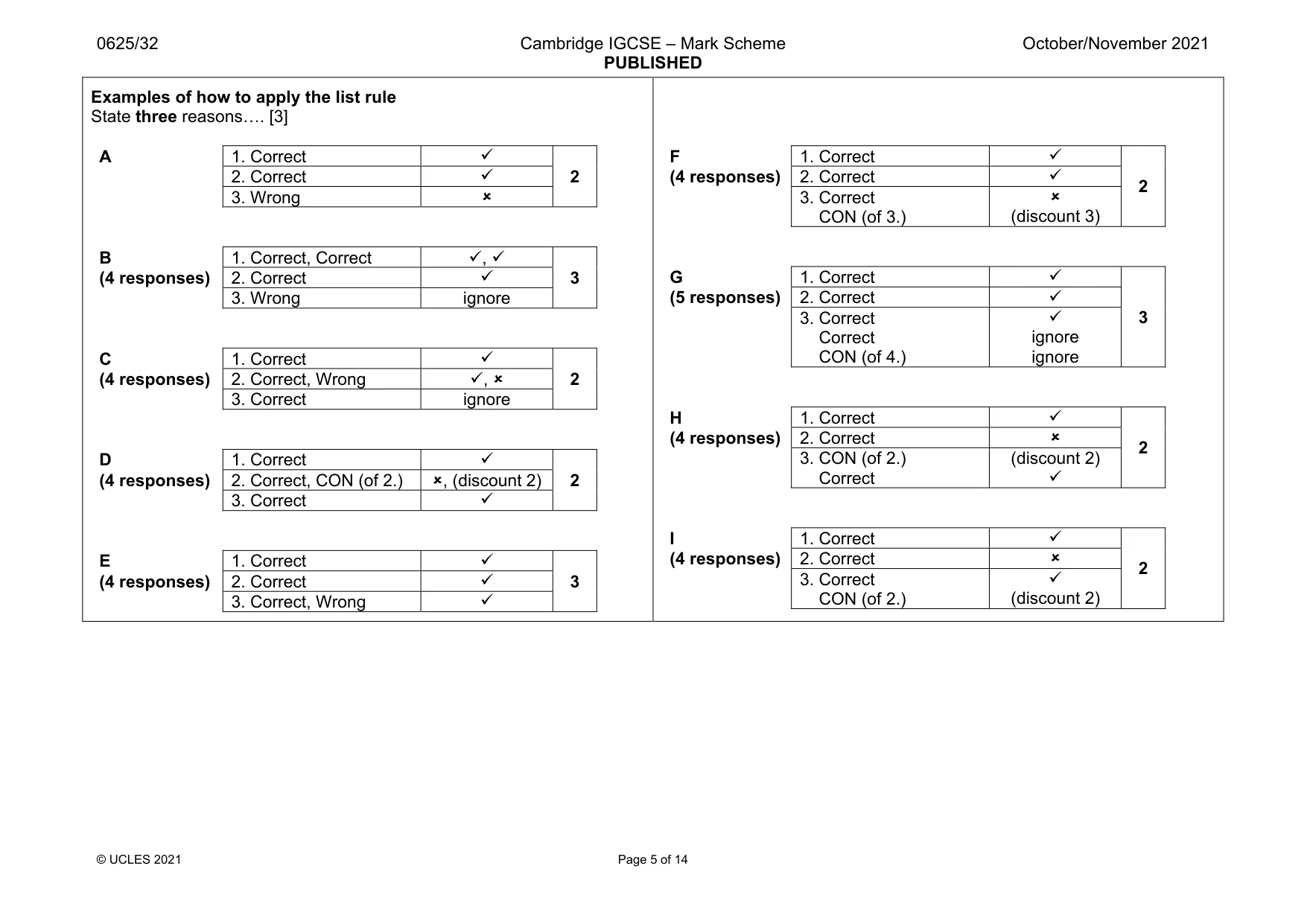
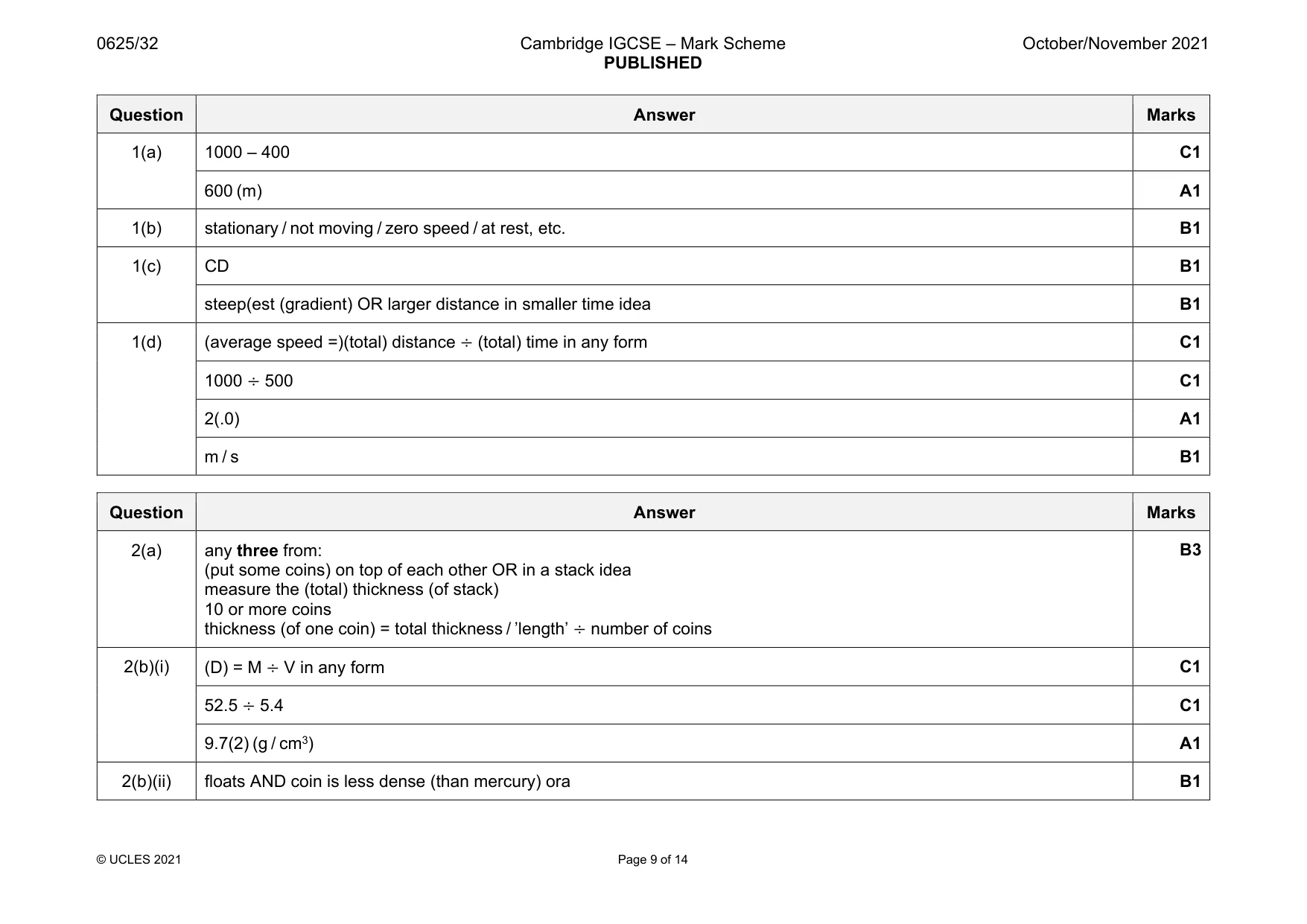
Mark scheme: 1(a) 1000 – 400 C1 600 (m) A1 1(b) stationary / not moving / zero speed / at rest, etc. B1 1(c) CD B1 steep(est (gradient) OR larger distance in smaller time idea B1 1(d) (average speed =)(total) distance ÷ (total) time in any form C1 1000 ÷ 500 C1 2(.0) A1 m / s B1
Q2 · A coin collector has 19 identical coins, as shown in Fig
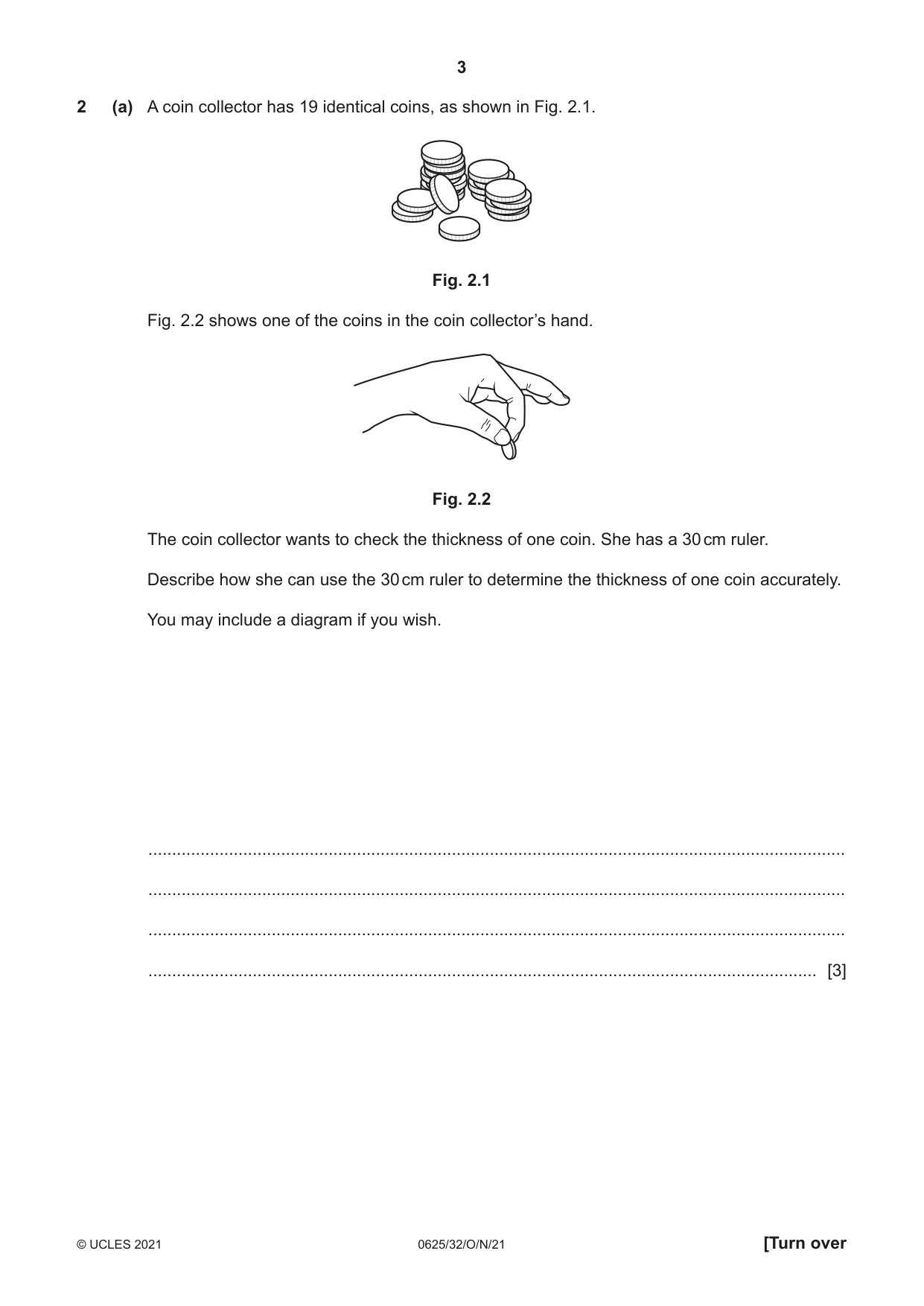
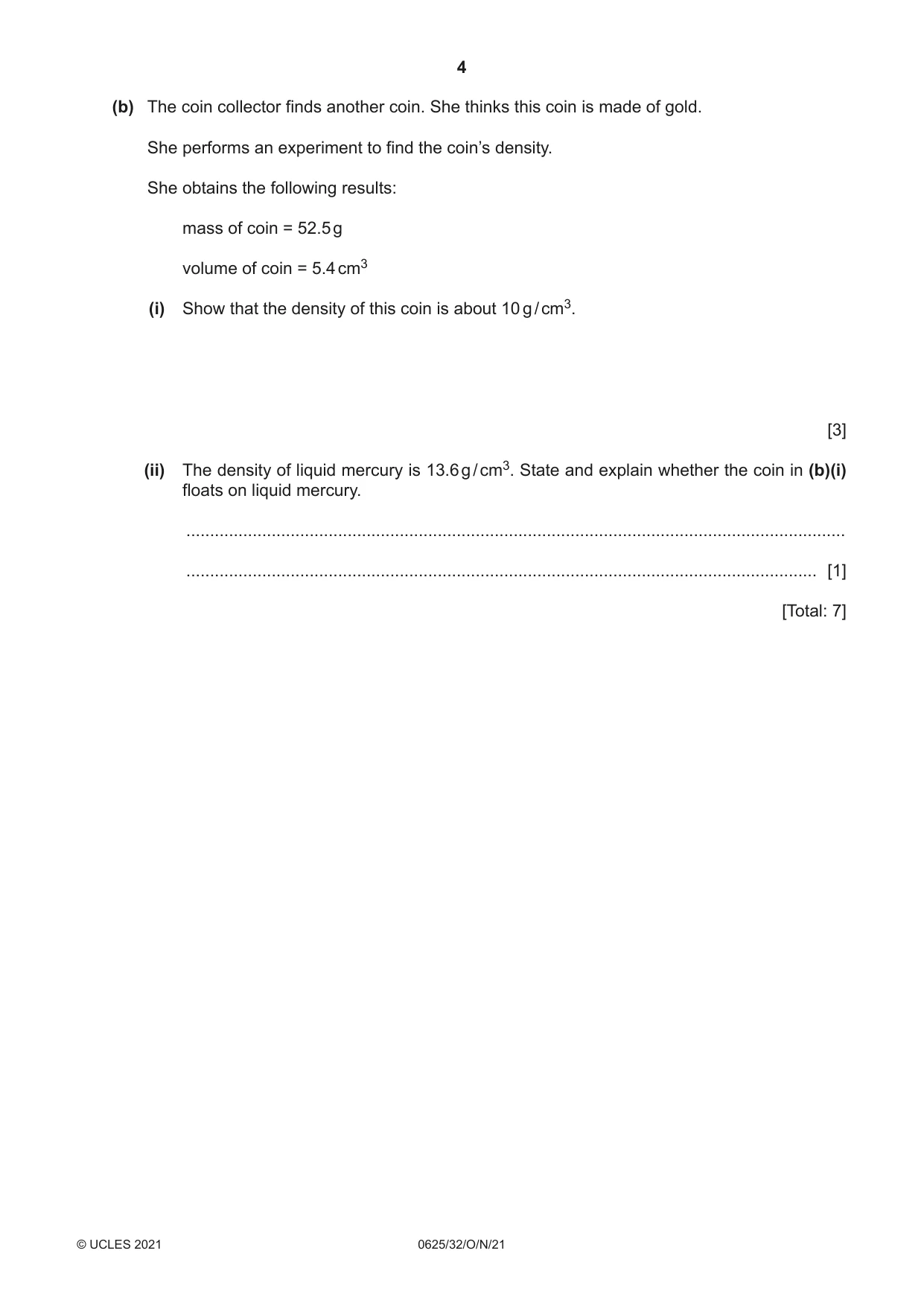
2 (a) A coin collector has 19 identical coins, as shown in Fig. 2.1. Fig. 2.1 Fig. 2.2 shows one of the coins in the coin collector’s hand. Fig. 2.2 The coin collector wants to check the thickness of one coin. She has a 30 cm ruler. Describe how she can use the 30 cm ruler to determine the thickness of one coin accurately. You may include a diagram if you wish. ................................................................................................................................................... ................................................................................................................................................... ................................................................................................................................................... ............................................................................................................................................. [3] (b) The coin collector finds another coin. She thinks this coin is made of gold. She performs an experiment to find the coin’s density. She obtains the following results: mass of coin = 52.5 g volume of coin = 5.4 cm3 (i) Show that the density of this coin is about 10 g / cm3. [3] (ii) The density of liquid mercury is 13.6 g / cm3. State and explain whether the coin in (b)(i) floats on liquid mercury. ........................................................................................................................................... ..................................................................................................................................... [1] [Total: 7]
Mark scheme: 2(a) any three from: (put some coins) on top of each other OR in a stack idea measure the (total) thickness (of stack) 10 or more coins thickness (of one coin) = total thickness / ’length’ ÷ number of coins 2(b)(i) (D) = M ÷ V in any form C1 52.5 ÷ 5.4 C1 9.7(2) (g / cm3) A1 2(b)(ii) floats AND coin is less dense (than mercury) ora B1
Q3 · The vertical forces acting on a toy rocket as it leaves the ground
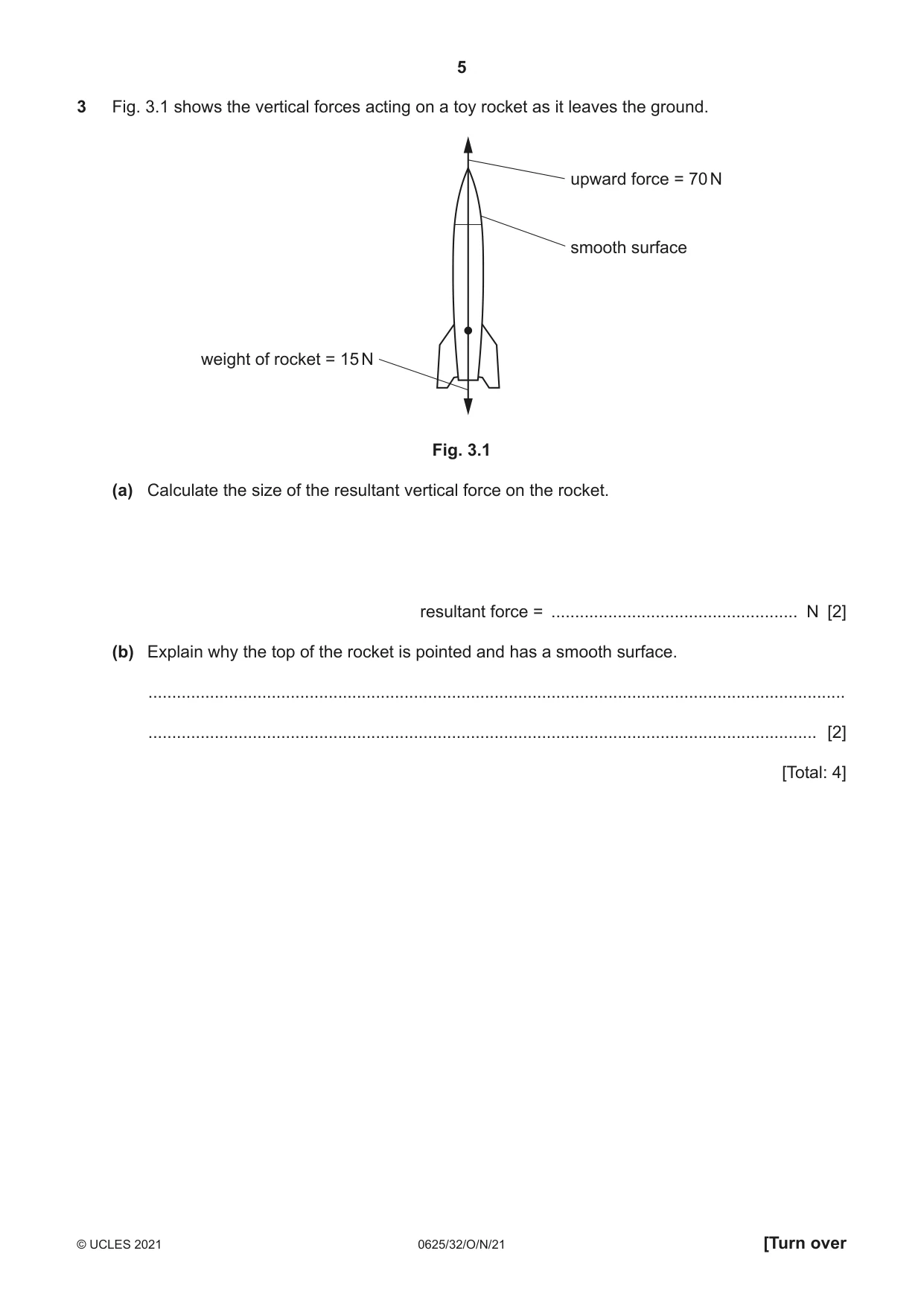
3 Fig. 3.1 shows the vertical forces acting on a toy rocket as it leaves the ground. upward force = 70 N smooth surface weight of rocket = 15 N Fig. 3.1 (a) Calculate the size of the resultant vertical force on the rocket. resultant force = .................................................... N [2] (b) Explain why the top of the rocket is pointed and has a smooth surface. ................................................................................................................................................... ............................................................................................................................................. [2] [Total: 4]
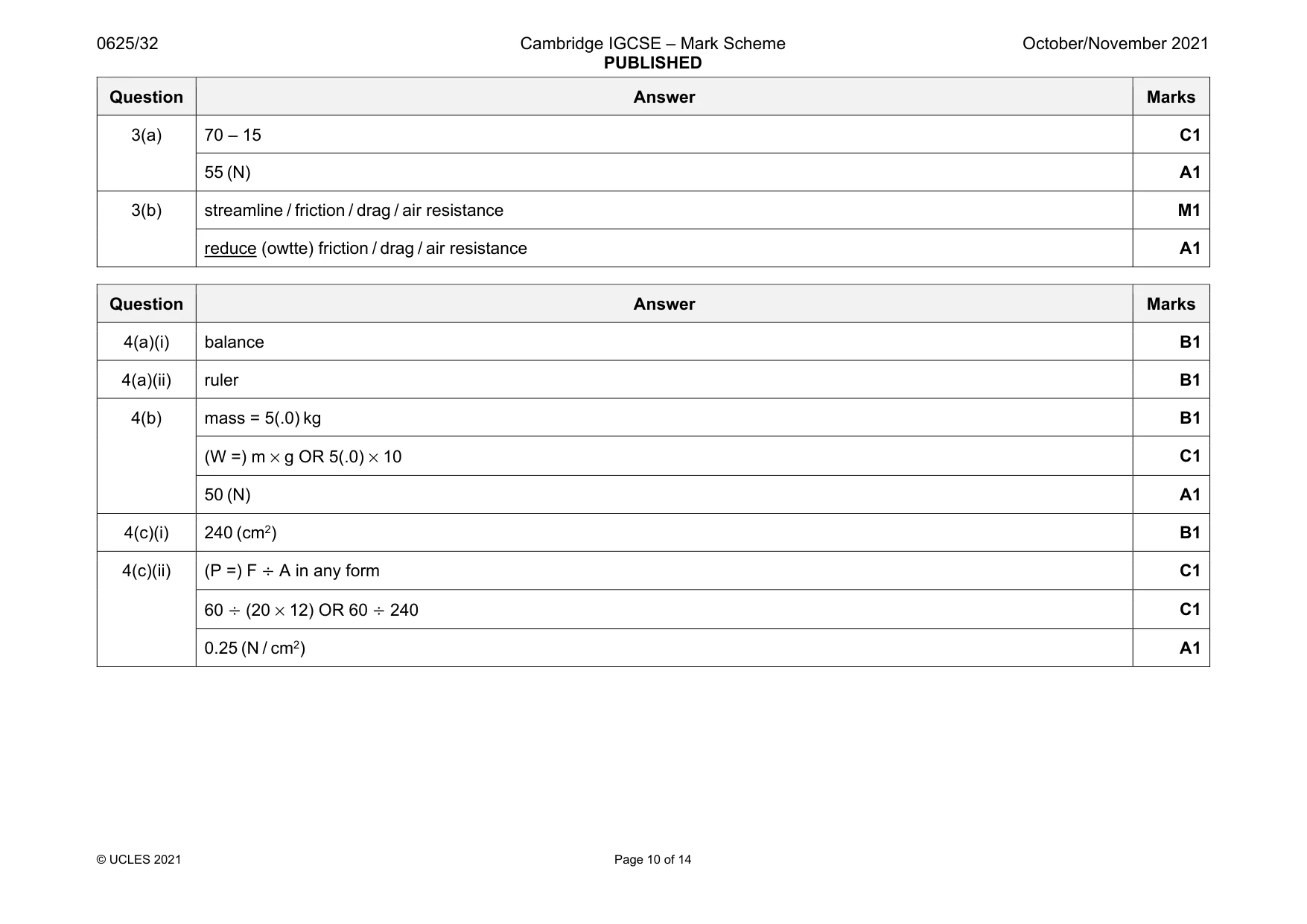
Mark scheme: 3(a) 70 – 15 C1 55 (N) A1 3(b) streamline / friction / drag / air resistance M1 reduce (owtte) friction / drag / air resistance A1
Q4 · A teacher wants to measure the mass of a block of metal
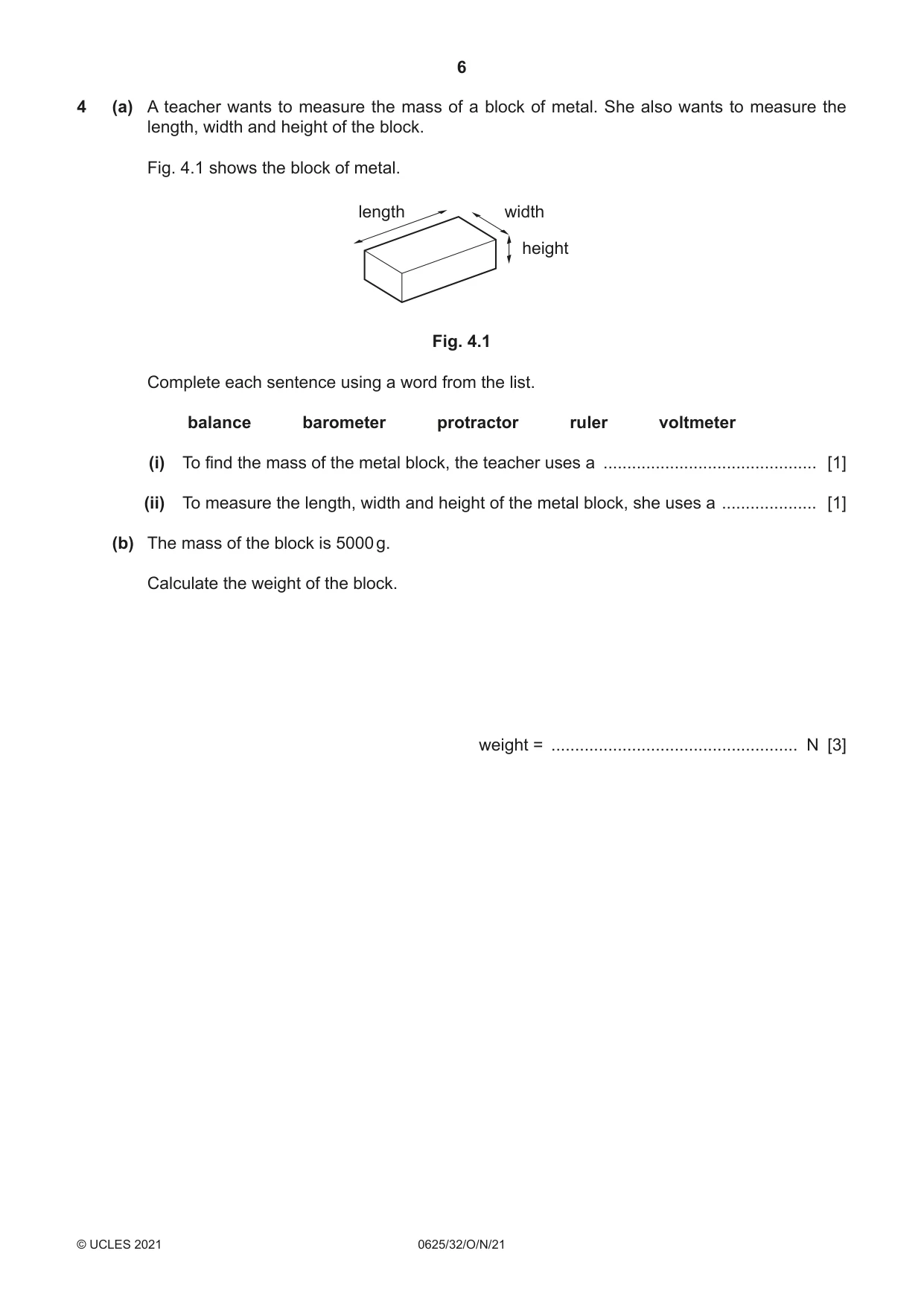
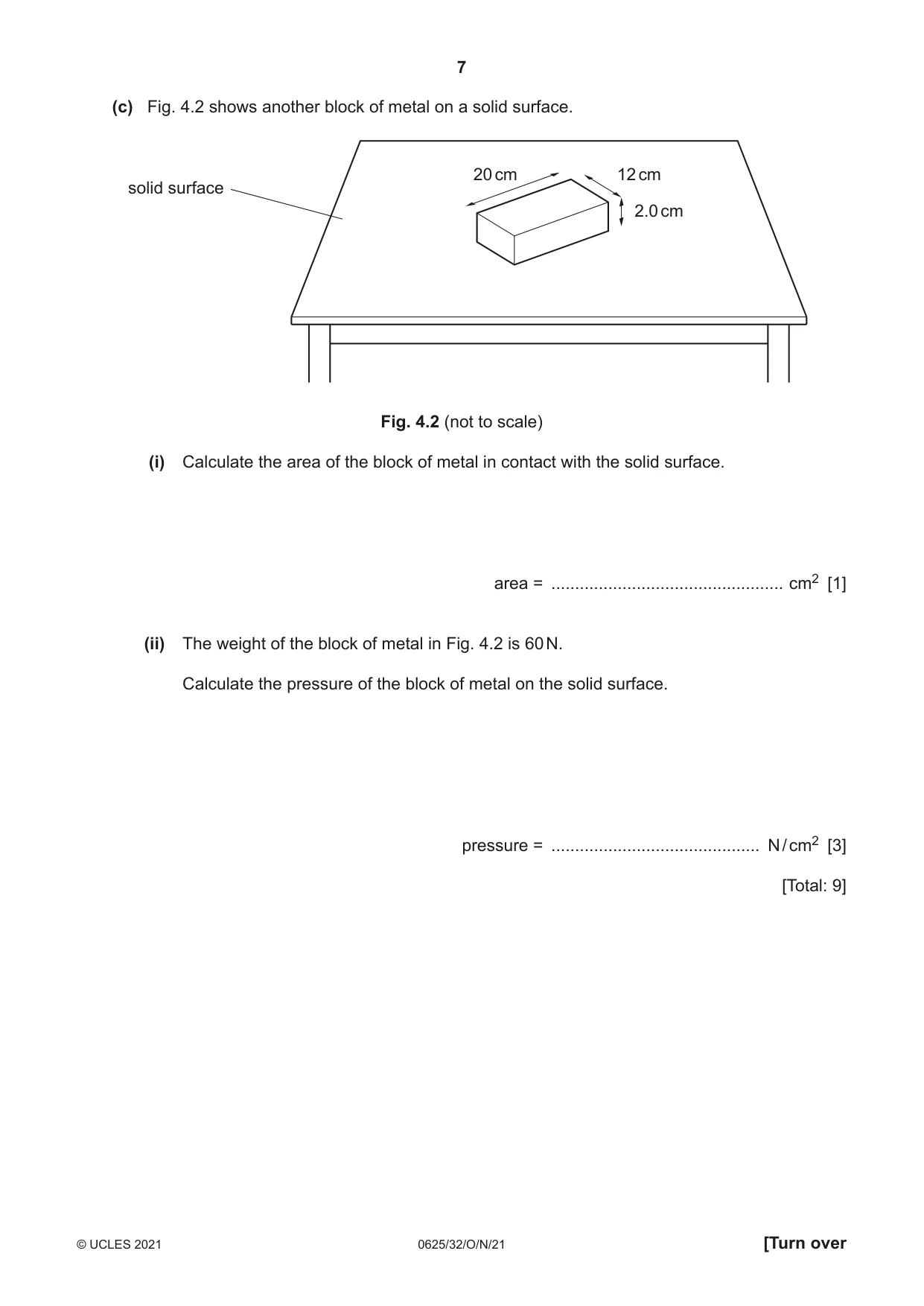
4 (a) A teacher wants to measure the mass of a block of metal. She also wants to measure the length, width and height of the block. Fig. 4.1 shows the block of metal. length width height Fig. 4.1 Complete each sentence using a word from the list. balance barometer protractor ruler voltmeter (i) To find the mass of the metal block, the teacher uses a ............................................. [1] (ii) To measure the length, width and height of the metal block, she uses a .................... [1] (b) The mass of the block is 5000 g. Calculate the weight of the block. weight = .................................................... N [3] (c) Fig. 4.2 shows another block of metal on a solid surface. 20 cm 12 cm solid surface 2.0 cm Fig. 4.2 (not to scale) (i) Calculate the area of the block of metal in contact with the solid surface. area = ................................................. cm2 [1] (ii) The weight of the block of metal in Fig. 4.2 is 60 N. Calculate the pressure of the block of metal on the solid surface. pressure = ............................................ N / cm2 [3] [Total: 9]
Mark scheme: 4(a)(i) balance B1 4(a)(ii) ruler B1 4(b) mass = 5(.0) kg B1 (W =) m × g OR 5(.0) × 10 C1 50 (N) A1 4(c)(i) 240 (cm2) B1 4(c)(ii) (P =) F ÷ A in any form C1 60 ÷ (20 × 12) OR 60 ÷ 240 C1 0.25 (N / cm2) A1
More questions on Physical quantities and measurement techniques
Q5 · A student determines the centre of mass of a piece of wood
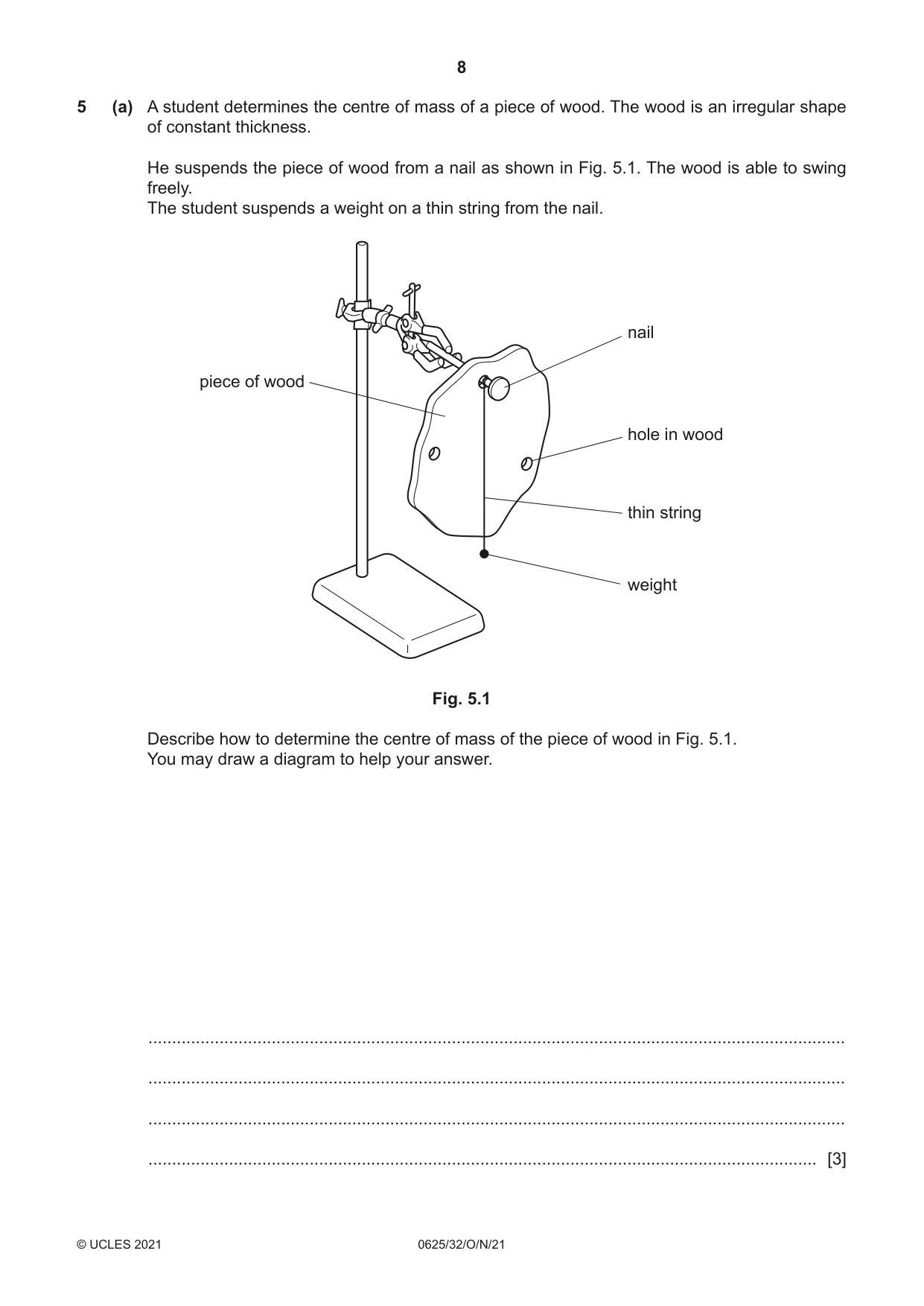
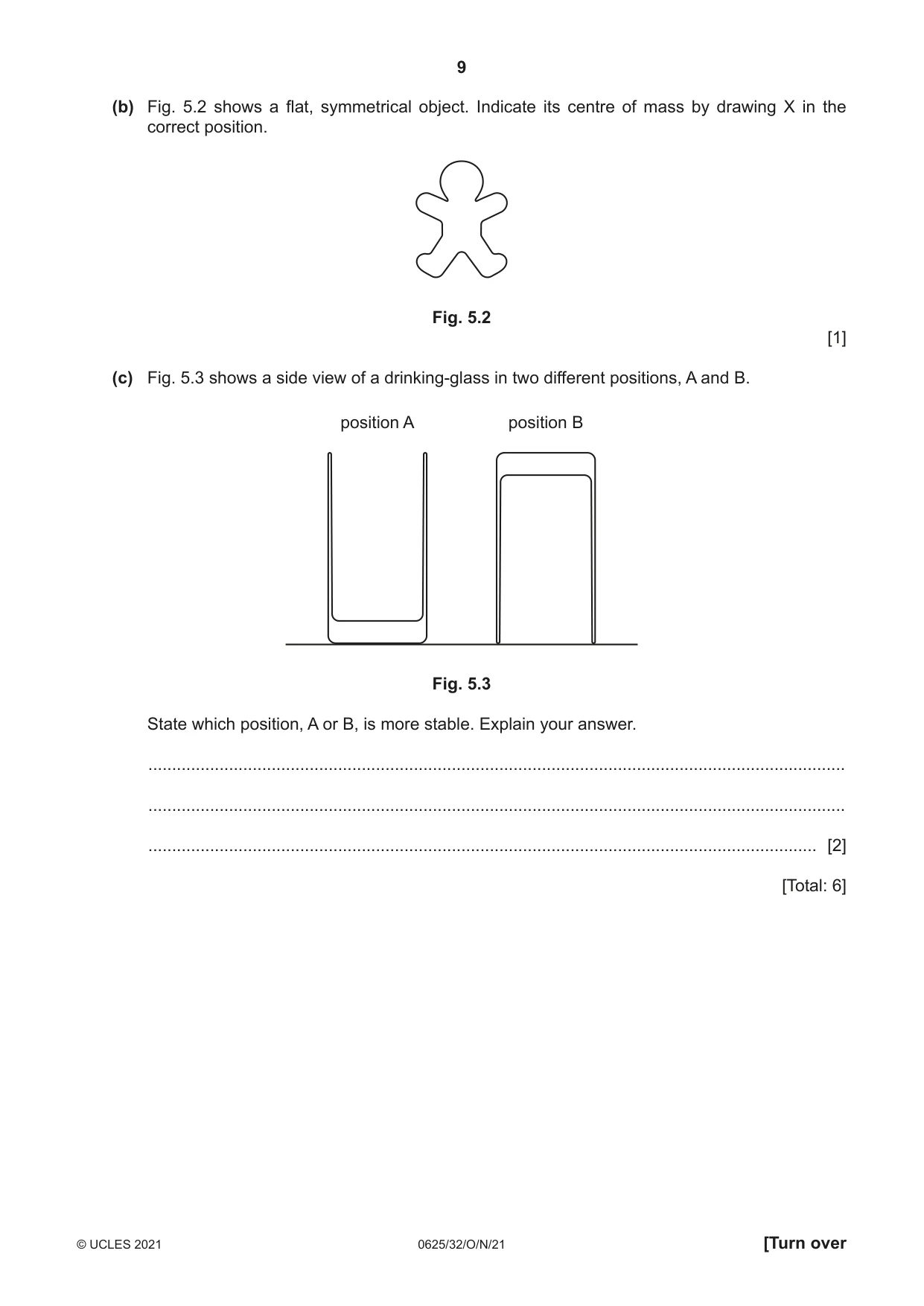
5 (a) A student determines the centre of mass of a piece of wood. The wood is an irregular shape of constant thickness. He suspends the piece of wood from a nail as shown in Fig. 5.1. The wood is able to swing freely. The student suspends a weight on a thin string from the nail. nail piece of wood hole in wood thin string weight Fig. 5.1 Describe how to determine the centre of mass of the piece of wood in Fig. 5.1. You may draw a diagram to help your answer. ................................................................................................................................................... ................................................................................................................................................... ................................................................................................................................................... ............................................................................................................................................. [3] (b) Fig. 5.2 shows a flat, symmetrical object. Indicate its centre of mass by drawing X in the correct position. Fig. 5.2 [1] (c) Fig. 5.3 shows a side view of a drinking-glass in two different positions, A and B. position A position B Fig. 5.3 State which position, A or B, is more stable. Explain your answer. ................................................................................................................................................... ................................................................................................................................................... ............................................................................................................................................. [2] [Total: 6]
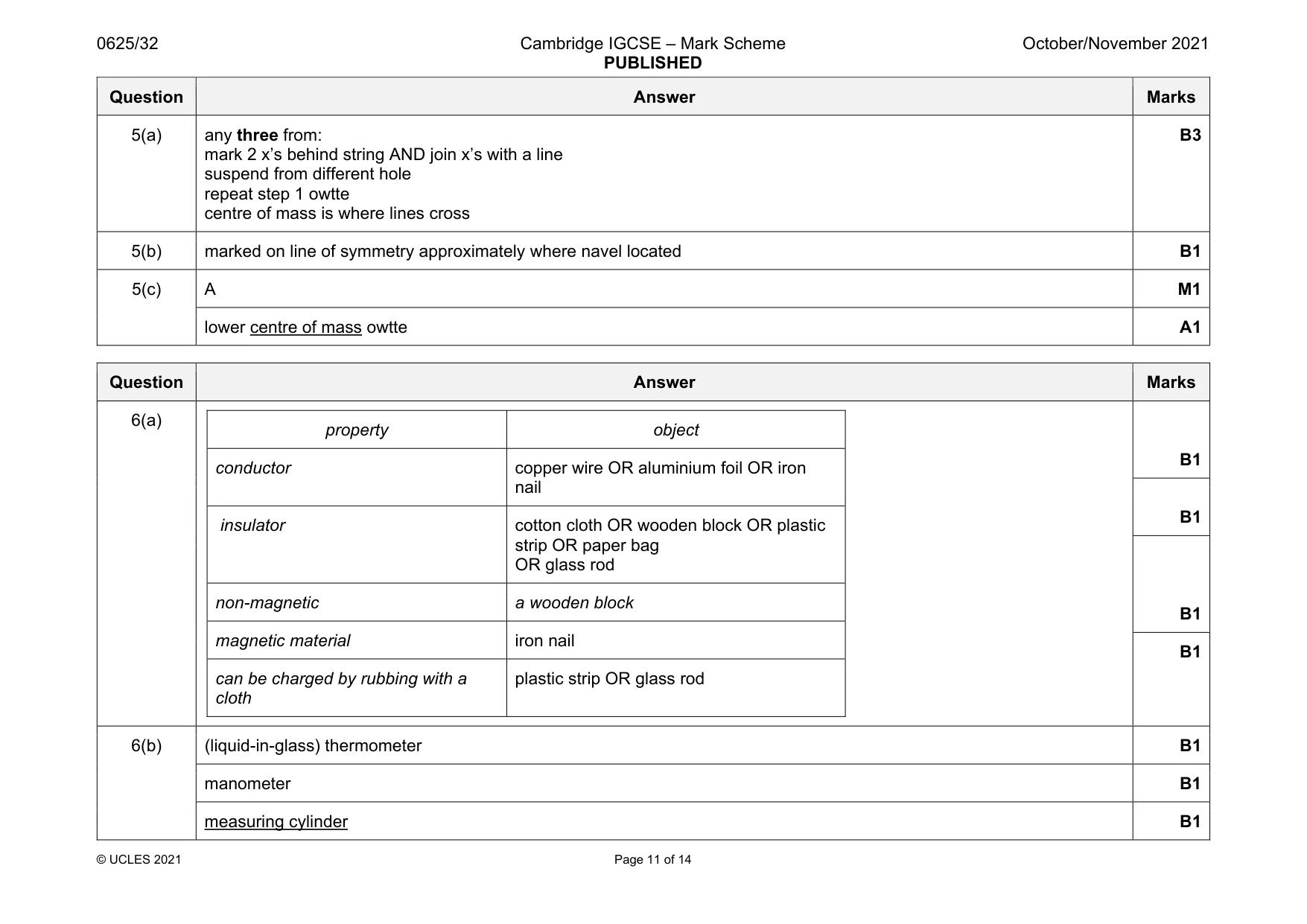
Mark scheme: 5(a) any three from: mark 2 x’s behind string AND join x’s with a line suspend from different hole repeat step 1 owtte centre of mass is where lines cross B3 5(b) marked on line of symmetry approximately where navel located B1 5(c) A M1 lower centre of mass owtte A1
Q6 · A girl has eight objects made of different materials
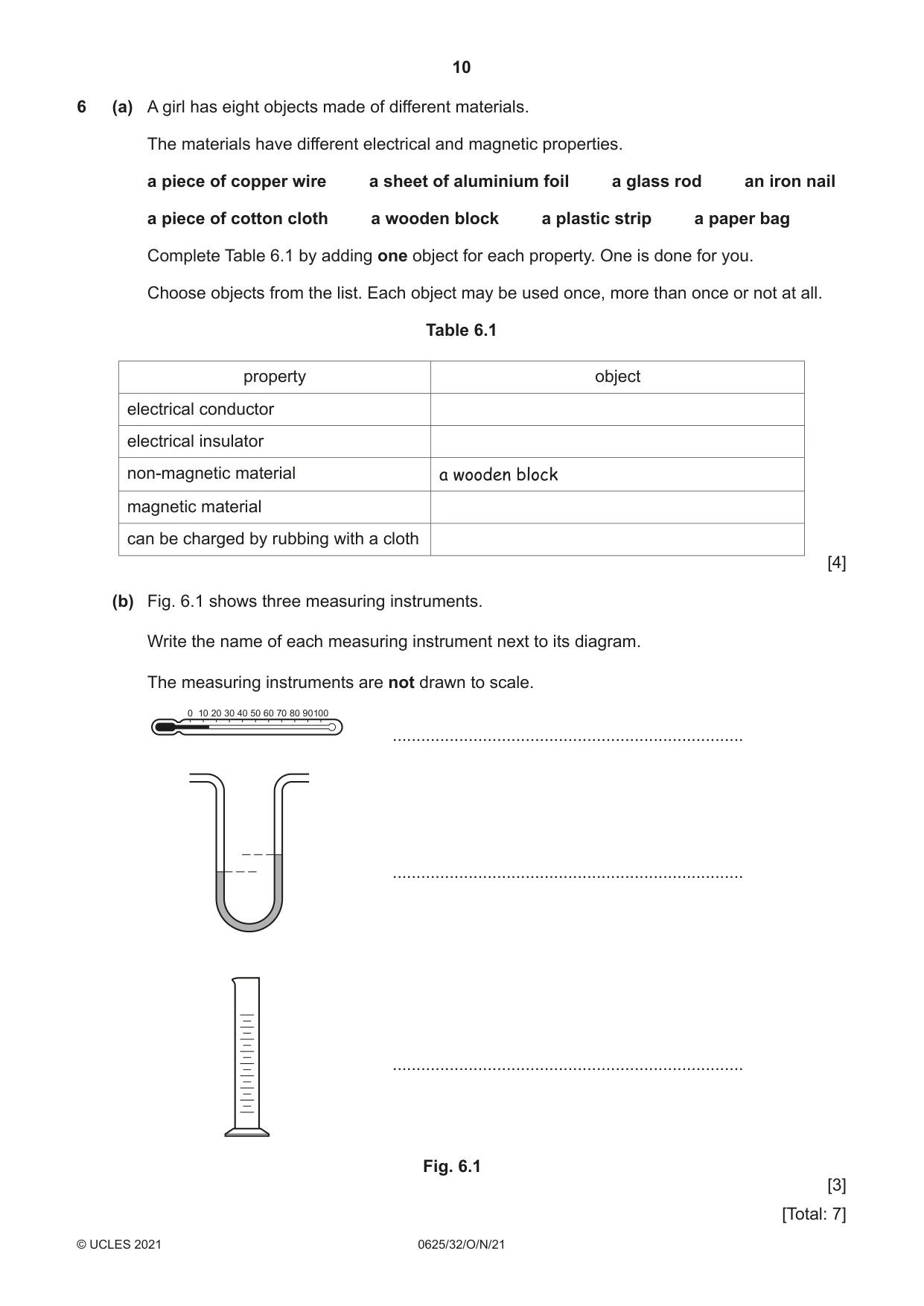
6 (a) A girl has eight objects made of different materials. The materials have different electrical and magnetic properties. a piece of copper wire a sheet of aluminium foil a glass rod an iron nail a piece of cotton cloth a wooden block a plastic strip a paper bag Complete Table 6.1 by adding one object for each property. One is done for you. Choose objects from the list. Each object may be used once, more than once or not at all. Table 6.1 property object electrical conductor electrical insulator non-magnetic material a wooden block magnetic material can be charged by rubbing with a cloth [4] (b) Fig. 6.1 shows three measuring instruments. Write the name of each measuring instrument next to its diagram. The measuring instruments are not drawn to scale. .......................................................................... .......................................................................... .......................................................................... Fig. 6.1 [3] [Total: 7]
Mark scheme: 6(a) property object conductor copper wire OR aluminium foil OR iron nail insulator cotton cloth OR wooden block OR plastic strip OR paper bag OR glass rod non-magnetic a wooden block magnetic material iron nail can be charged by rubbing with a cloth plastic strip OR glass rod B1 B1 B1 B1 6(b) (liquid-in-glass) thermometer B1 manometer B1 measuring cylinder B1
Q7 · A candle underneath a thin, metal fan
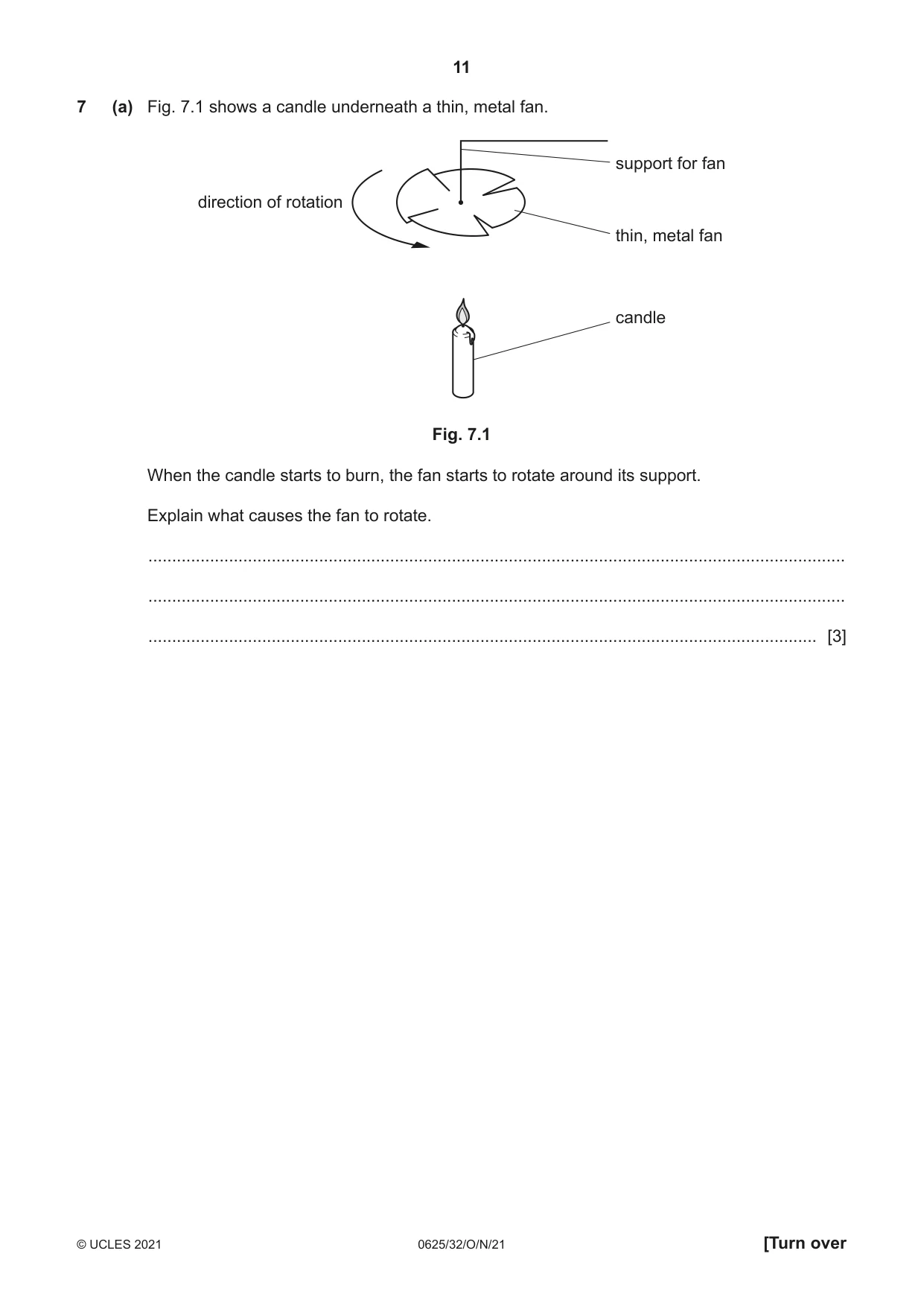
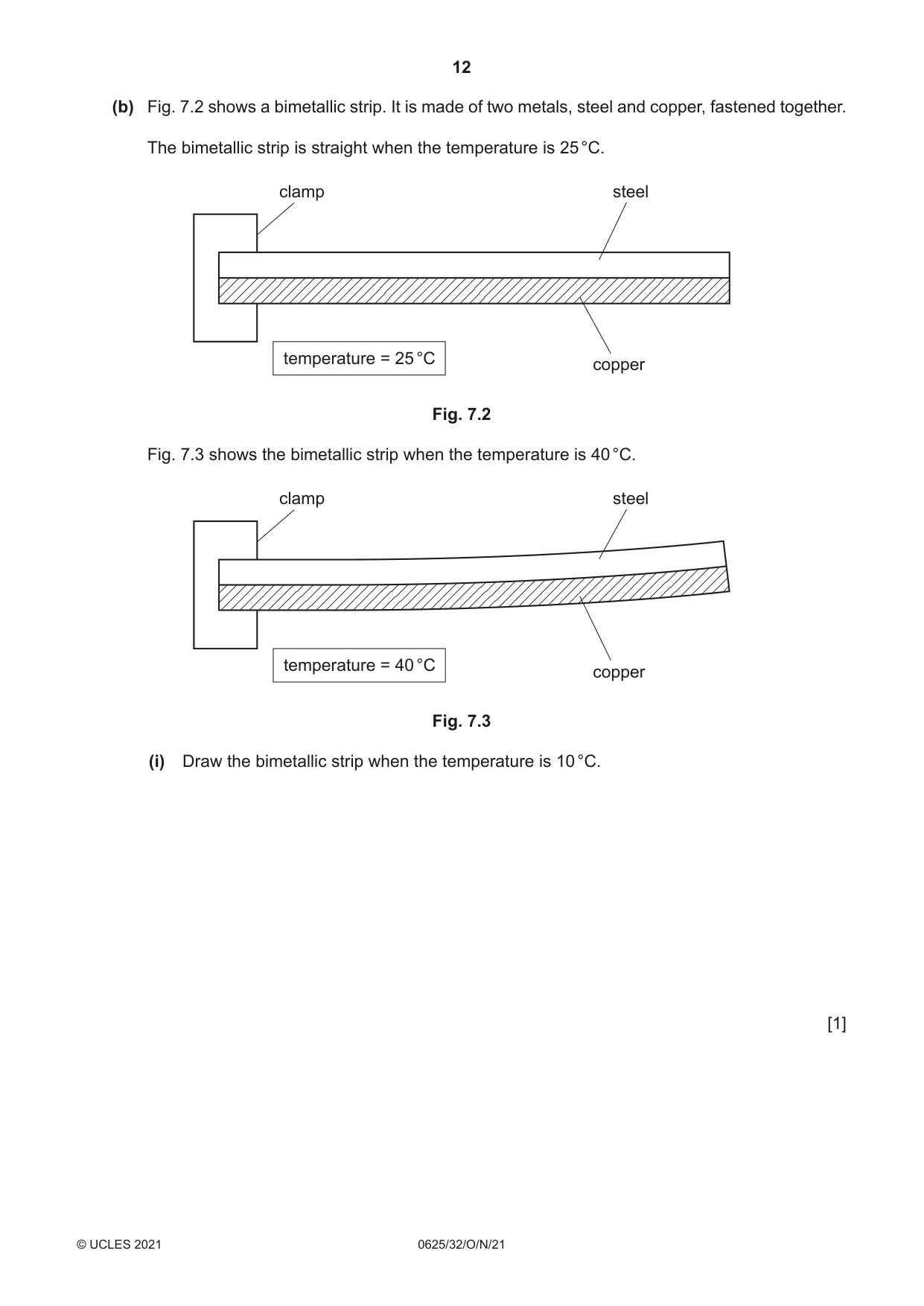
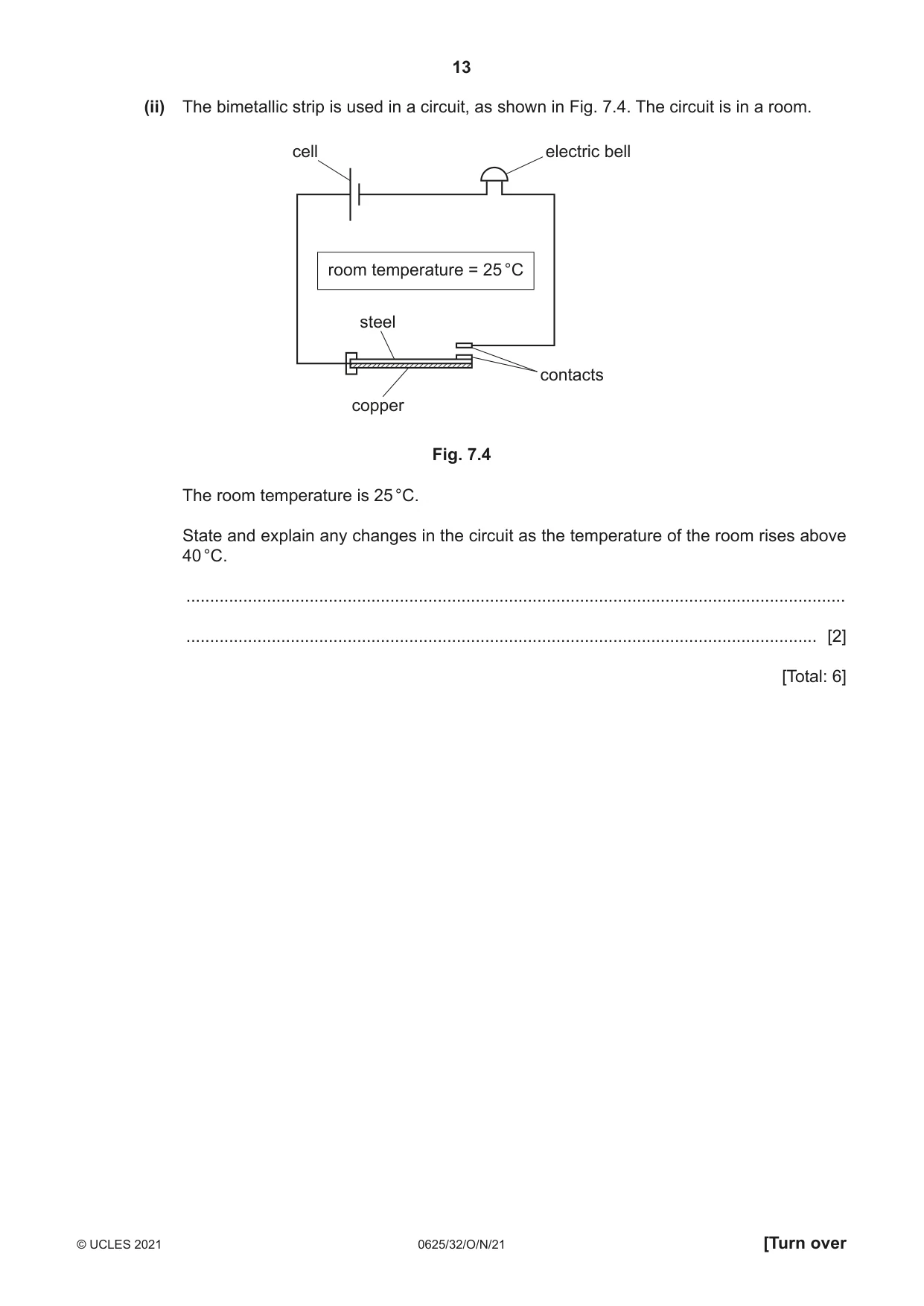
7 (a) Fig. 7.1 shows a candle underneath a thin, metal fan. support for fan direction of rotation thin, metal fan candle Fig. 7.1 When the candle starts to burn, the fan starts to rotate around its support. Explain what causes the fan to rotate. ................................................................................................................................................... ................................................................................................................................................... ............................................................................................................................................. [3] (b) Fig. 7.2 shows a bimetallic strip. It is made of two metals, steel and copper, fastened together. The bimetallic strip is straight when the temperature is 25 °C. clamp steel temperature = 25 °C copper Fig. 7.2 Fig. 7.3 shows the bimetallic strip when the temperature is 40 °C. clamp steel temperature = 40 °C copper Fig. 7.3 (i) Draw the bimetallic strip when the temperature is 10 °C. [1] (ii) The bimetallic strip is used in a circuit, as shown in Fig. 7.4. The circuit is in a room. cell electric bell room temperature = 25 °C steel contacts copper Fig. 7.4 The room temperature is 25 °C. State and explain any changes in the circuit as the temperature of the room rises above 40 °C. ........................................................................................................................................... ..................................................................................................................................... [2] [Total: 6]
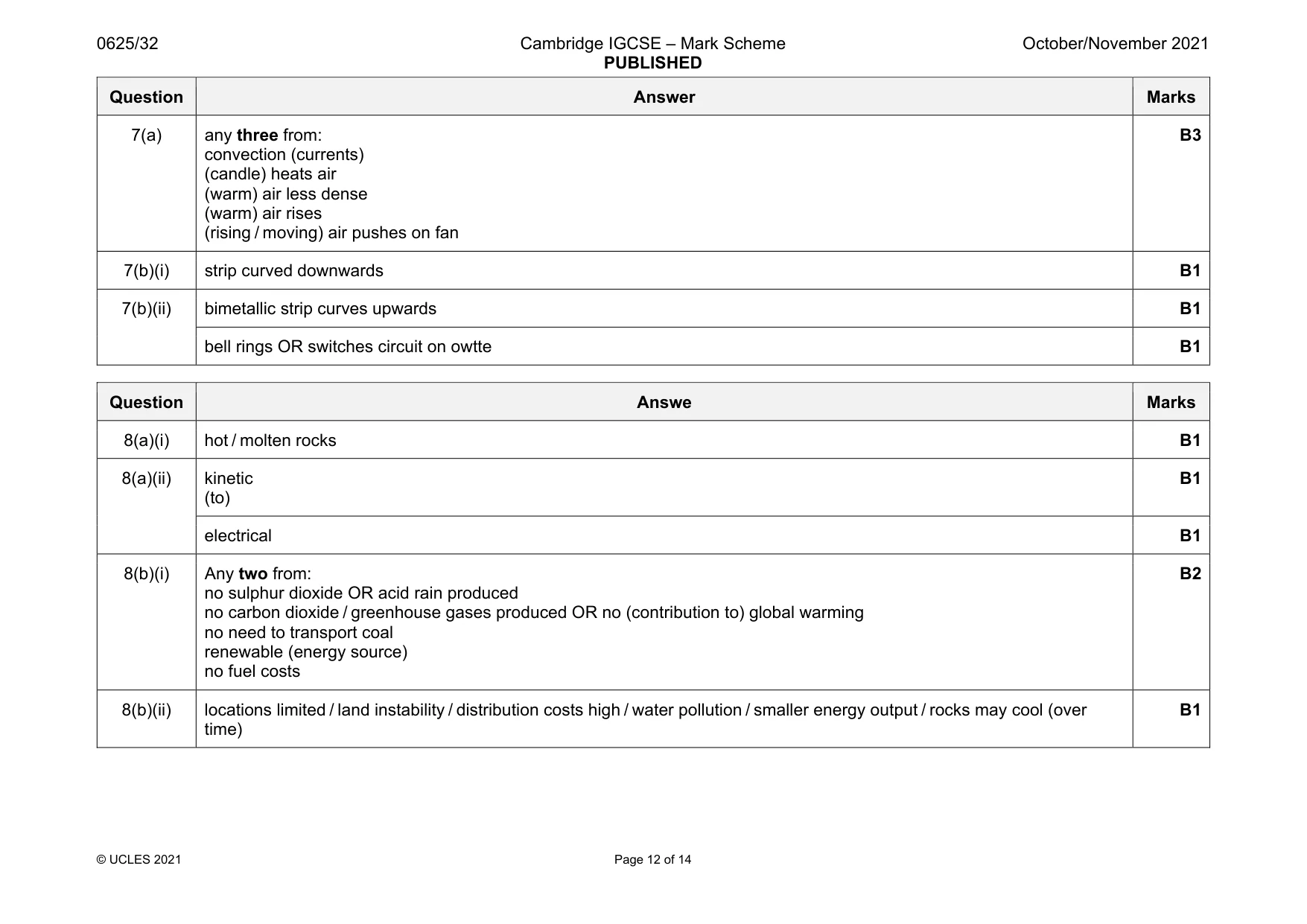
Mark scheme: 7(a) any three from: convection (currents) (candle) heats air (warm) air less dense (warm) air rises (rising / moving) air pushes on fan B3 7(b)(i) strip curved downwards B1 7(b)(ii) bimetallic strip curves upwards B1 bell rings OR switches circuit on owtte B1
Q8 · A simplified diagram of a geothermal power station
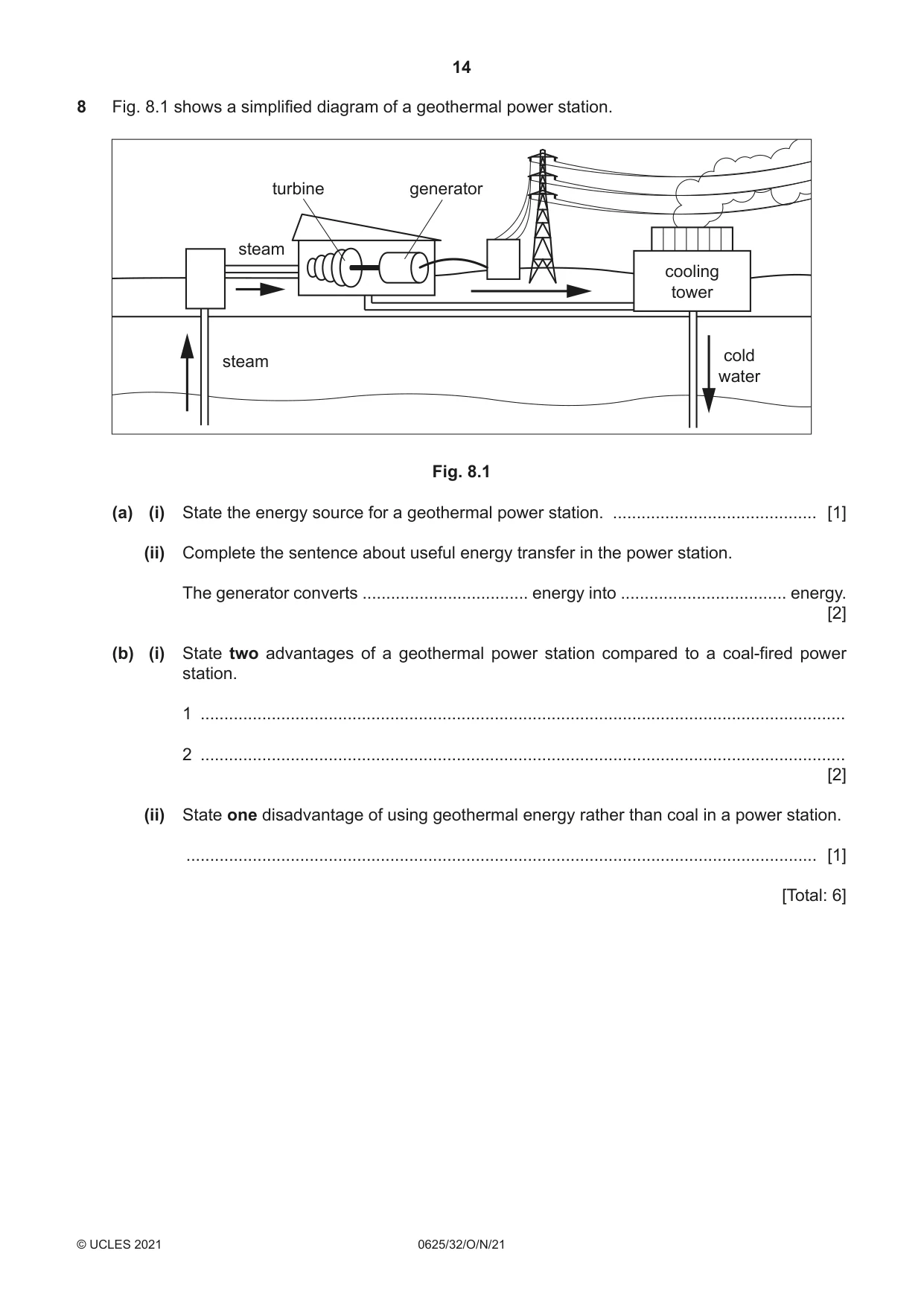
8 Fig. 8.1 shows a simplified diagram of a geothermal power station. turbine generator steam cooling tower cold steam water Fig. 8.1 (a) (i) State the energy source for a geothermal power station. ........................................... [1] (ii) Complete the sentence about useful energy transfer in the power station. The generator converts ................................... energy into ................................... energy. [2] (b) (i) State two advantages of a geothermal power station compared to a coal-fired power station. 1 ........................................................................................................................................ 2 ........................................................................................................................................ [2] (ii) State one disadvantage of using geothermal energy rather than coal in a power station. ..................................................................................................................................... [1] [Total: 6]
Mark scheme: 8(a)(i) hot / molten rocks B1 8(a)(ii) kinetic (to) B1 electrical B1 8(b)(i) Any two from: no sulphur dioxide OR acid rain produced no carbon dioxide / greenhouse gases produced OR no (contribution to) global warming no need to transport coal renewable (energy source) no fuel costs B2 8(b)(ii) locations limited / land instability / distribution costs high / water pollution / smaller energy output / rocks may cool (over time) B1
Q9 · A ray of light reflected by a plane mirror
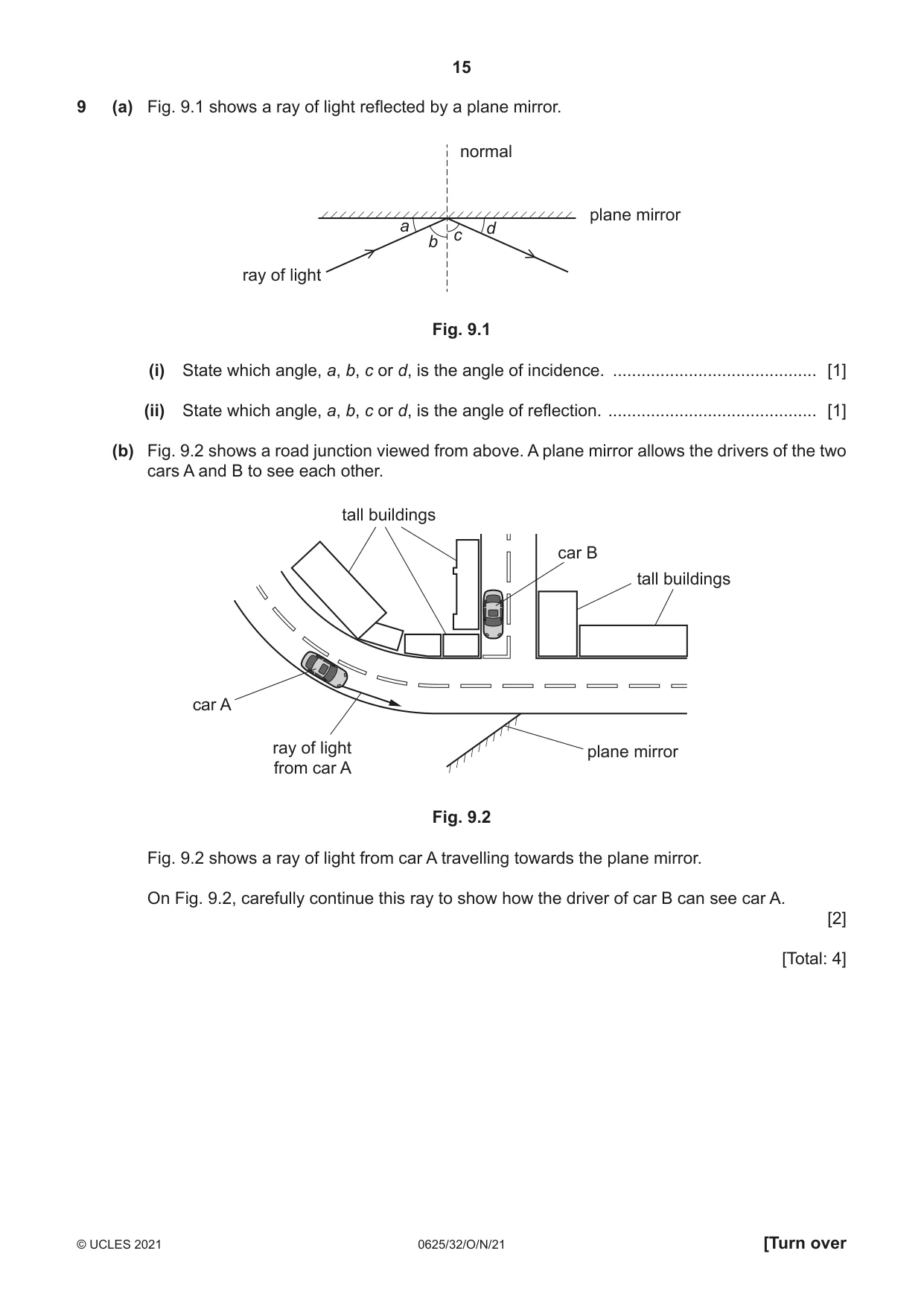
9 (a) Fig. 9.1 shows a ray of light reflected by a plane mirror. normal plane mirror a d c b ray of light Fig. 9.1 (i) State which angle, a, b, c or d, is the angle of incidence. ........................................... [1] (ii) State which angle, a, b, c or d, is the angle of reflection. ............................................ [1] (b) Fig. 9.2 shows a road junction viewed from above. A plane mirror allows the drivers of the two cars A and B to see each other. tall buildings car B tall buildings car A ray of light plane mirror from car A Fig. 9.2 Fig. 9.2 shows a ray of light from car A travelling towards the plane mirror. On Fig. 9.2, carefully continue this ray to show how the driver of car B can see car A. [2] [Total: 4]
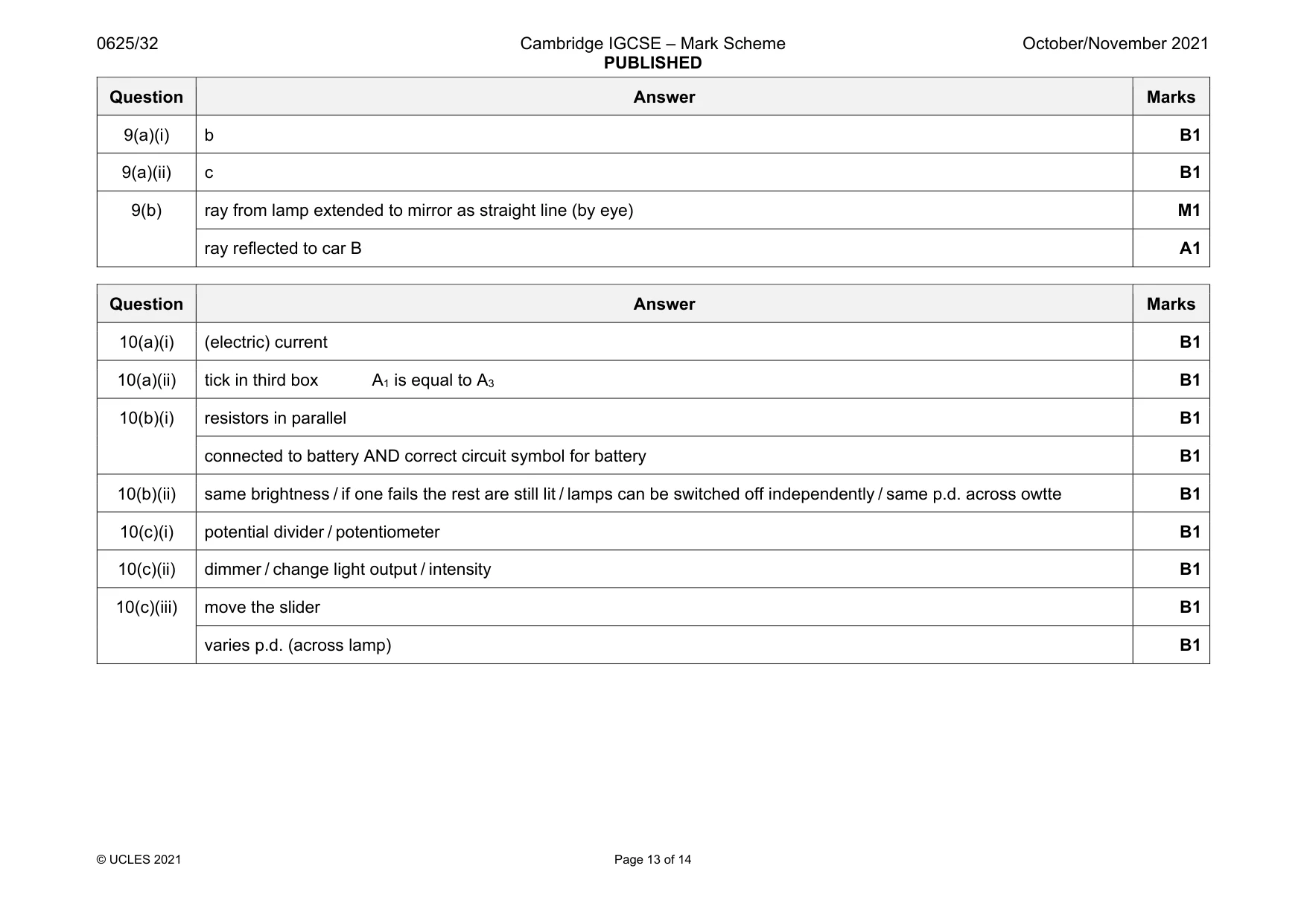
Mark scheme: 9(a)(i) b B1 9(a)(ii) c B1 9(b) ray from lamp extended to mirror as straight line (by eye) M1 ray reflected to car B A1
Q10 · Two resistors connected in series with a cell and three ammeters
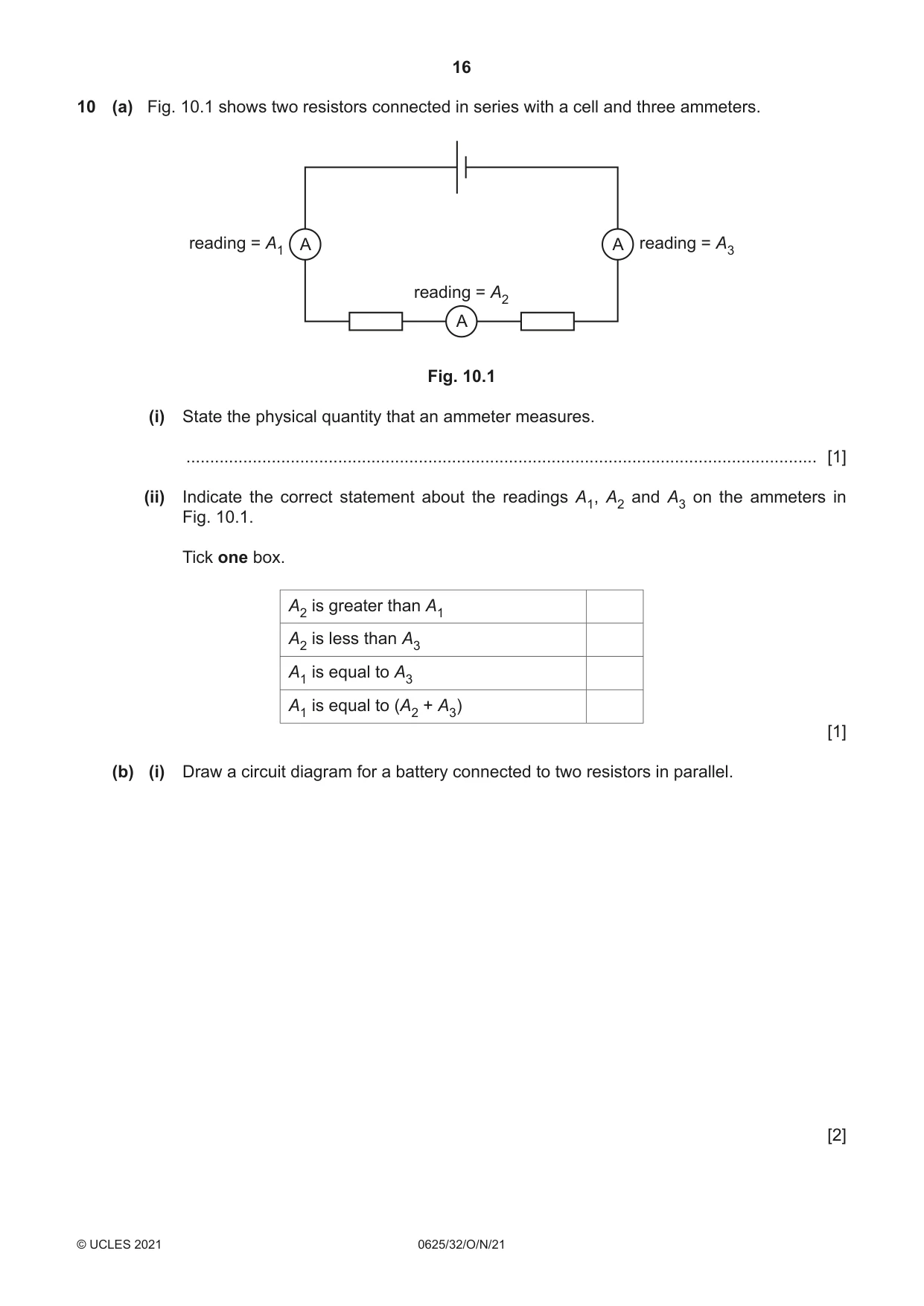
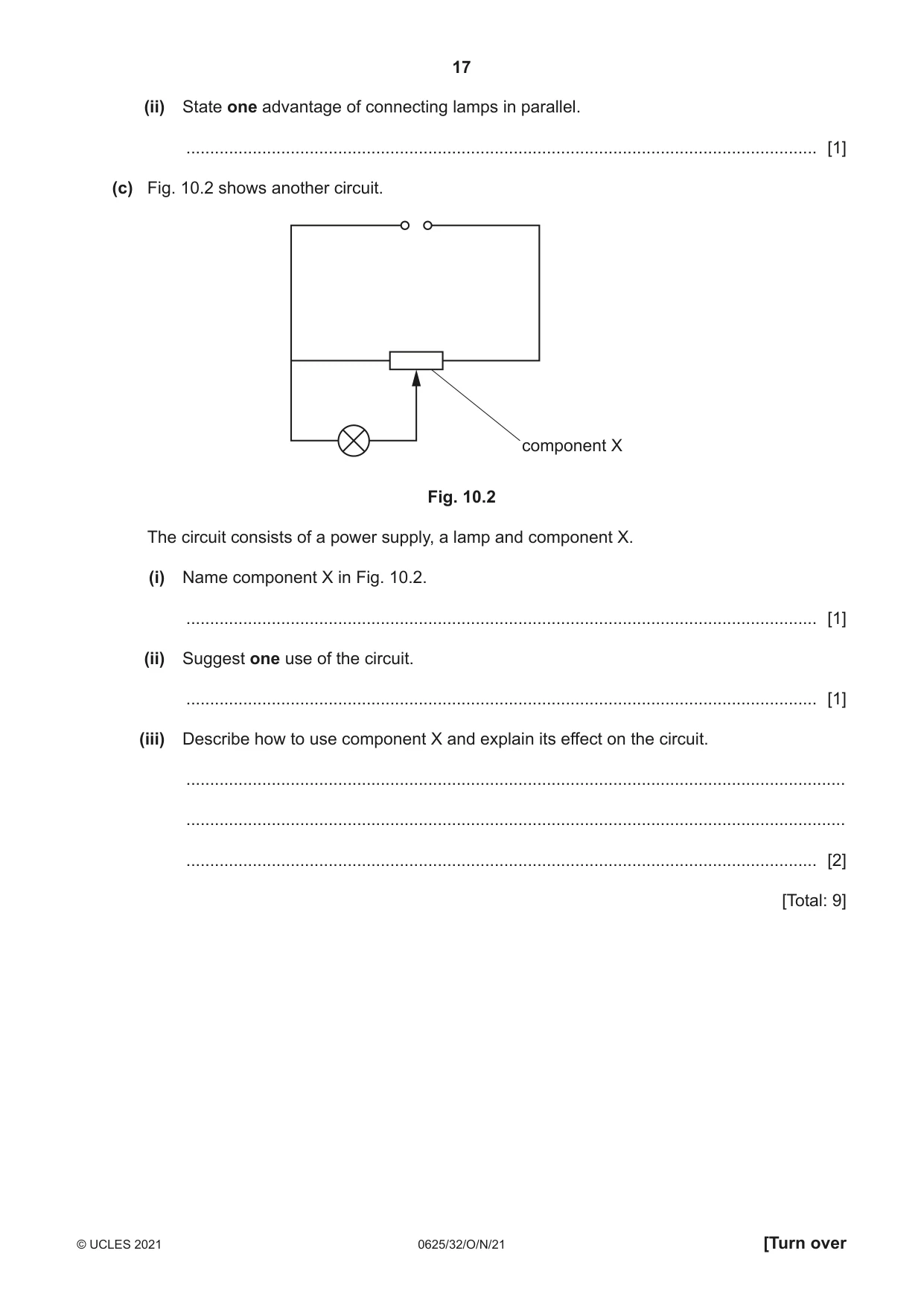
10 (a) Fig. 10.1 shows two resistors connected in series with a cell and three ammeters. reading = A1 A A reading = A3 reading = A2 A Fig. 10.1 (i) State the physical quantity that an ammeter measures. ..................................................................................................................................... [1] (ii) Indicate the correct statement about the readings A1, A2 and A3 on the ammeters in Fig. 10.1. Tick one box. A2 is greater than A1 A2 is less than A3 A1 is equal to A3 A1 is equal to (A2 + A3) [1] (b) (i) Draw a circuit diagram for a battery connected to two resistors in parallel. [2] (ii) State one advantage of connecting lamps in parallel. ..................................................................................................................................... [1] (c) Fig. 10.2 shows another circuit. component X Fig. 10.2 The circuit consists of a power supply, a lamp and component X. (i) Name component X in Fig. 10.2. ..................................................................................................................................... [1] (ii) Suggest one use of the circuit. ..................................................................................................................................... [1] (iii) Describe how to use component X and explain its effect on the circuit. ........................................................................................................................................... ........................................................................................................................................... ..................................................................................................................................... [2] [Total: 9]
Mark scheme: 10(a)(i) (electric) current B1 10(a)(ii) tick in third box A1 is equal to A3 B1 10(b)(i) resistors in parallel B1 connected to battery AND correct circuit symbol for battery B1 10(b)(ii) same brightness / if one fails the rest are still lit / lamps can be switched off independently / same p.d. across owtte B1 10(c)(i) potential divider / potentiometer B1 10(c)(ii) dimmer / change light output / intensity B1 10(c)(iii) move the slider B1 varies p.d. (across lamp) B1
Q11 · A magnet and a coil of wire connected to a galvanometer
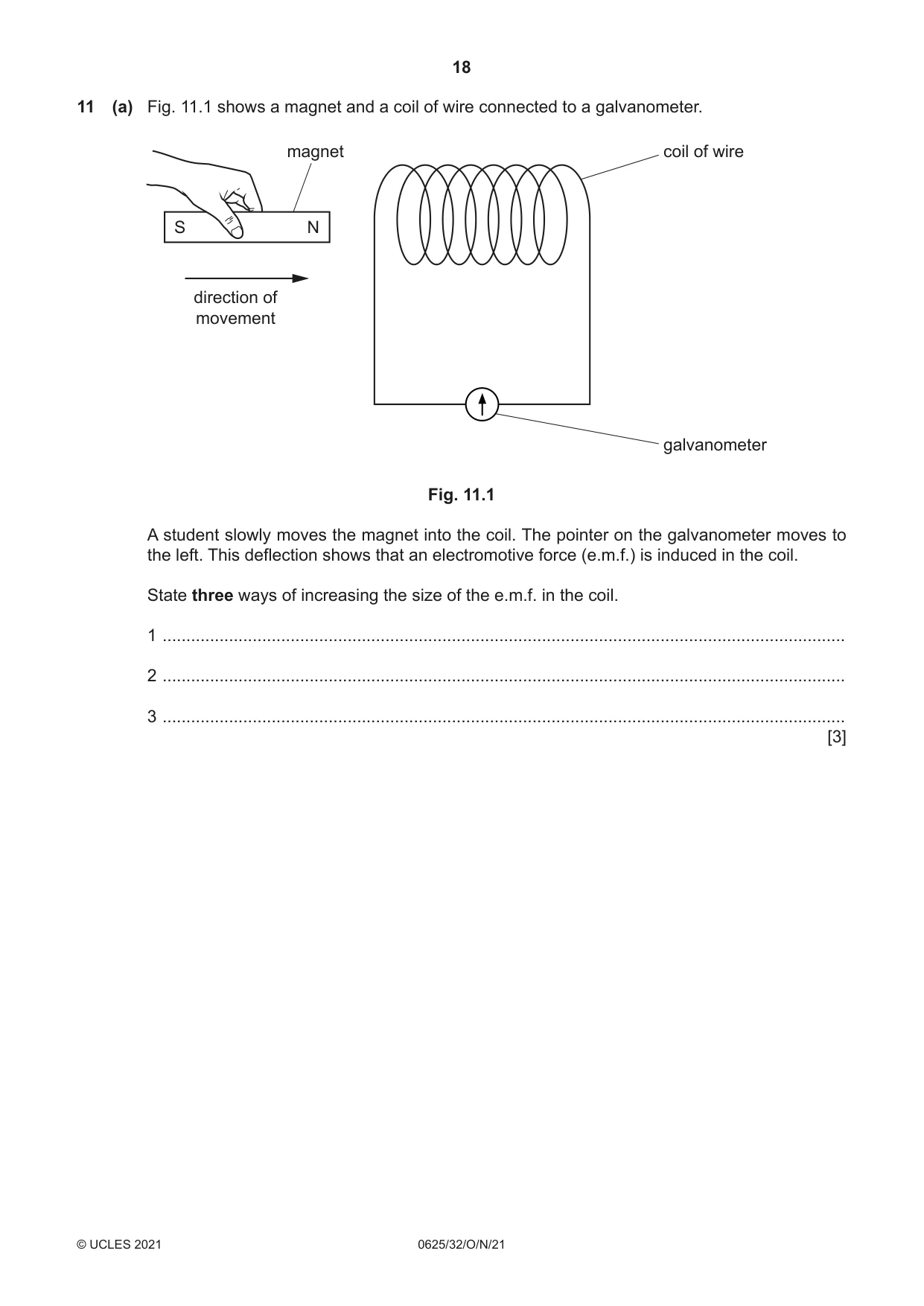
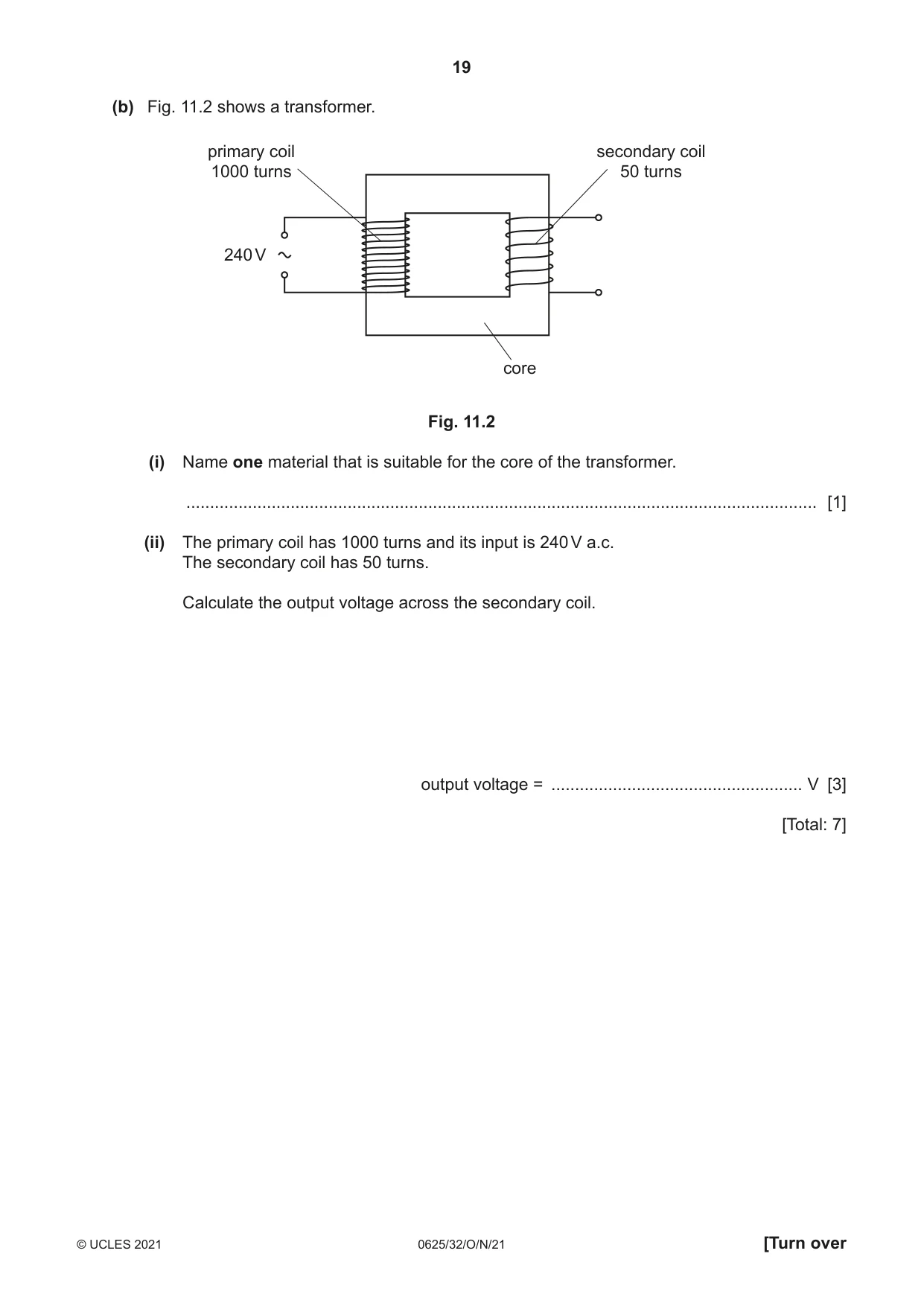
11 (a) Fig. 11.1 shows a magnet and a coil of wire connected to a galvanometer. magnet coil of wire S N direction of movement galvanometer Fig. 11.1 A student slowly moves the magnet into the coil. The pointer on the galvanometer moves to the left. This deflection shows that an electromotive force (e.m.f.) is induced in the coil. State three ways of increasing the size of the e.m.f. in the coil. 1 ................................................................................................................................................ 2 ................................................................................................................................................ 3 ................................................................................................................................................ [3] (b) Fig. 11.2 shows a transformer. primary coil secondary coil 1000 turns 50 turns 240 V core Fig. 11.2 (i) Name one material that is suitable for the core of the transformer. ..................................................................................................................................... [1] (ii) The primary coil has 1000 turns and its input is 240 V a.c. The secondary coil has 50 turns. Calculate the output voltage across the secondary coil. output voltage = ..................................................... V [3] [Total: 7]
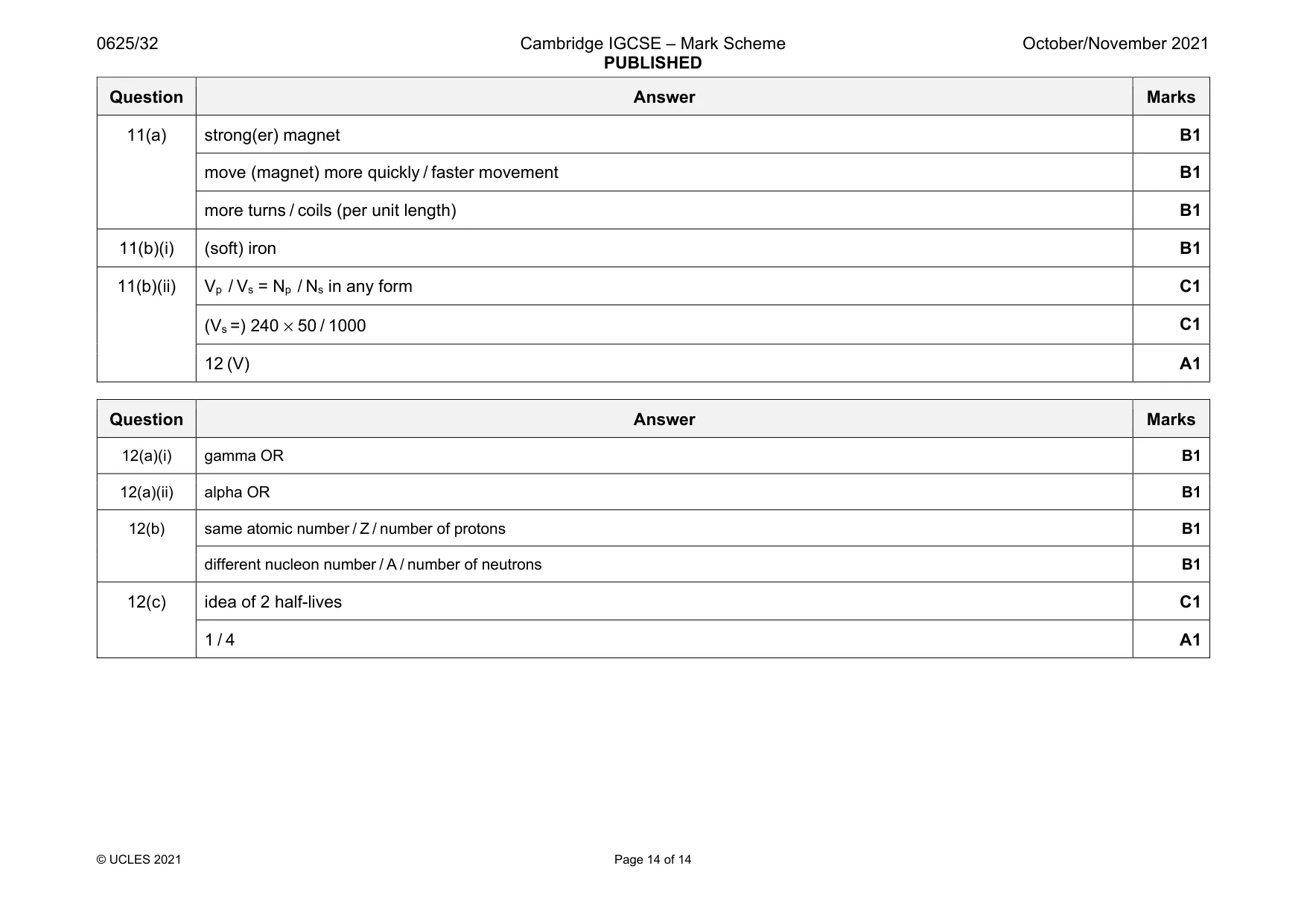
Mark scheme: 11(a) strong(er) magnet B1 move (magnet) more quickly / faster movement B1 more turns / coils (per unit length) B1 11(b)(i) (soft) iron B1 11(b)(ii) Vp / Vs = Np / Ns in any form C1 (Vs =) 240 × 50 / 1000 C1 12 (V) A1
Q12 · State which radioactive emission is: (i) the most penetrating…
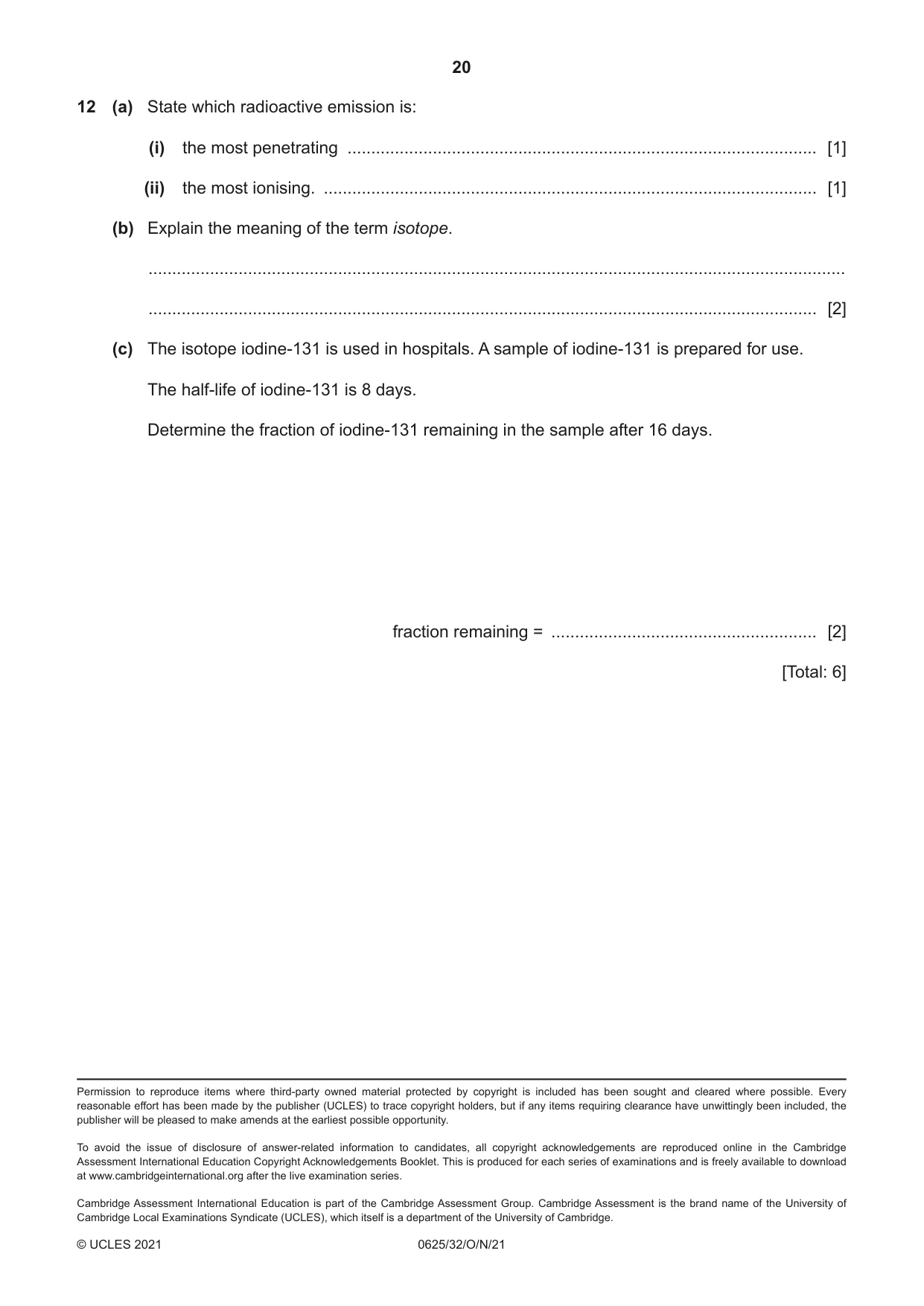
12 (a) State which radioactive emission is: (i) the most penetrating ................................................................................................... [1] (ii) the most ionising. ........................................................................................................ [1] (b) Explain the meaning of the term isotope. ................................................................................................................................................... ............................................................................................................................................. [2] (c) The isotope iodine-131 is used in hospitals. A sample of iodine-131 is prepared for use. The half-life of iodine-131 is 8 days. Determine the fraction of iodine-131 remaining in the sample after 16 days. fraction remaining = ........................................................ [2] [Total: 6]
Mark scheme: 12(a)(i) gamma OR B1 12(a)(ii) alpha OR B1 12(b) same atomic number / Z / number of protons B1 different nucleon number / A / number of neutrons B1 12(c) idea of 2 half-lives C1 1 / 4 A1
What was in this paper
The subtopics covered by these 12 questions, and how many questions each got. Open one in a new tab to see every Cambridge question on it.
What you needed in this session
Cambridge’s own grade thresholds for 2021 Oct/Nov, Paper 3 · Variant 2. A higher threshold means an easier paper — the bar moves with how the cohort did.