Cambridge IGCSE Physics 0625 — 2015 Oct/Nov Paper 3 · Variant 3
0625/33/O/N/15 · 11 questions · 80 marks · ≈90 min
The question paper and its mark scheme, free to read here and free to download. This is Cambridge’s own paper, exactly as it was sat.
Question paper16 pages

Mark scheme7 pages
Answers below. Sit the paper first if you are practising.
Questions as text
Q1 · A plastic ball is dropped from the balcony of a tall building and falls towards the…
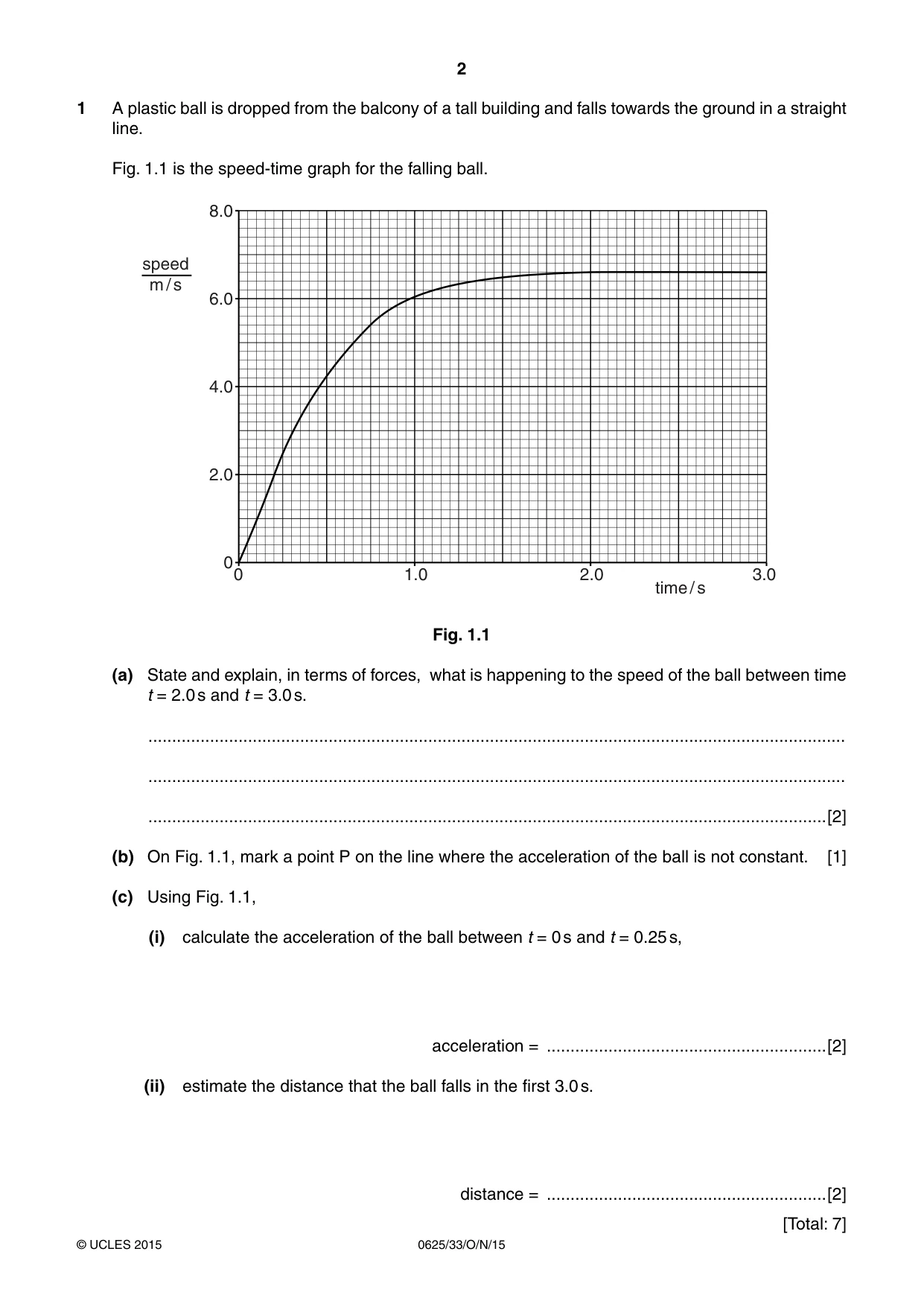
1 A plastic ball is dropped from the balcony of a tall building and falls towards the ground in a straight line. Fig. 1.1 is the speed-time graph for the falling ball. 8.0 speed m / s 6.0 4.0 2.0 0 0 1.0 2.0 3.0 time / s Fig. 1.1 (a) State and explain, in terms of forces, what is happening to the speed of the ball between time t = 2.0 s and t = 3.0 s. ................................................................................................................................................... ................................................................................................................................................... ...............................................................................................................................................[2] (b) On Fig. 1.1, mark a point P on the line where the acceleration of the ball is not constant. [1] (c) Using Fig. 1.1, (i) calculate the acceleration of the ball between t = 0 s and t = 0.25 s, acceleration = ...........................................................[2] (ii) estimate the distance that the ball falls in the first 3.0 s. distance = ...........................................................[2] [Total: 7]
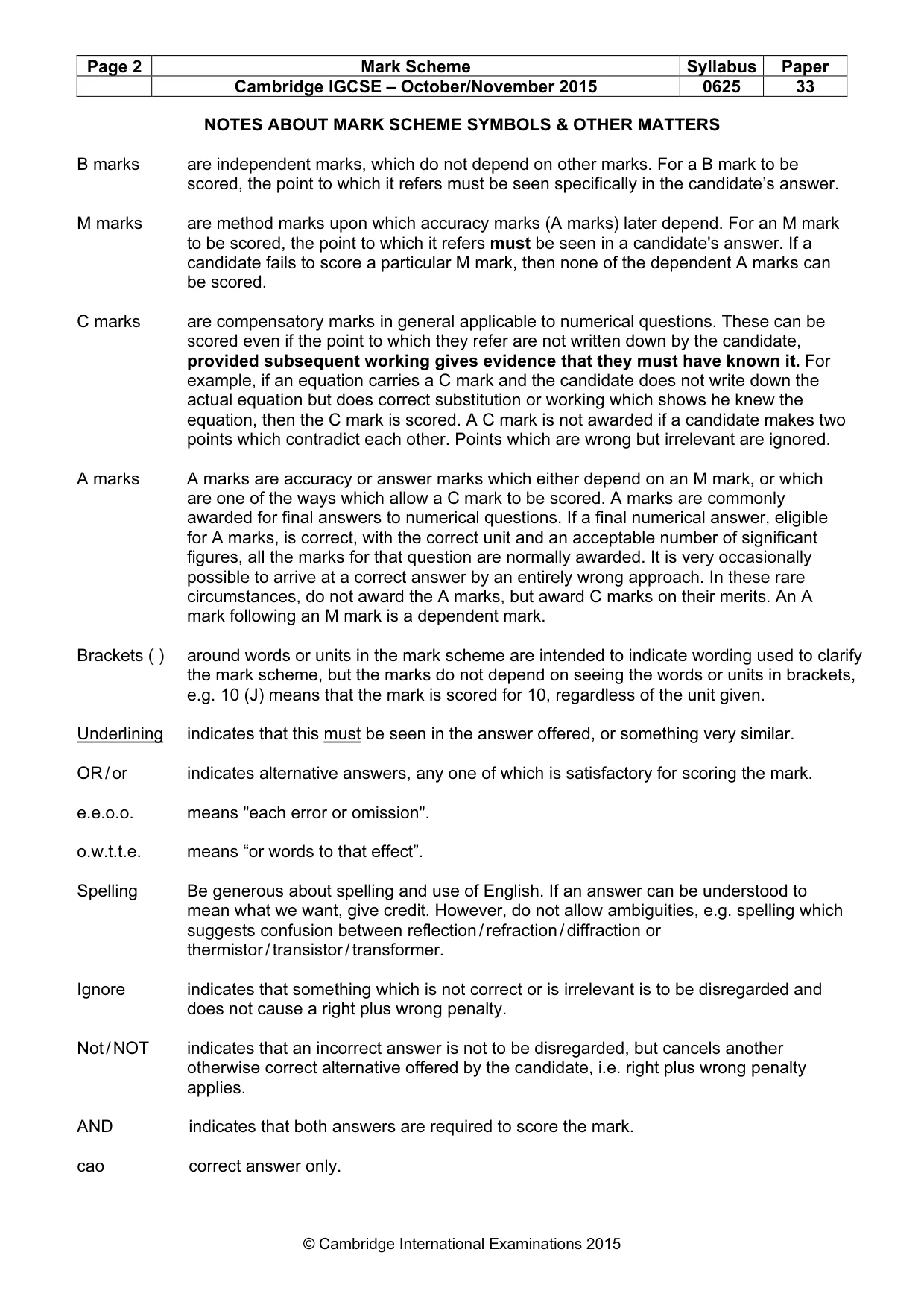
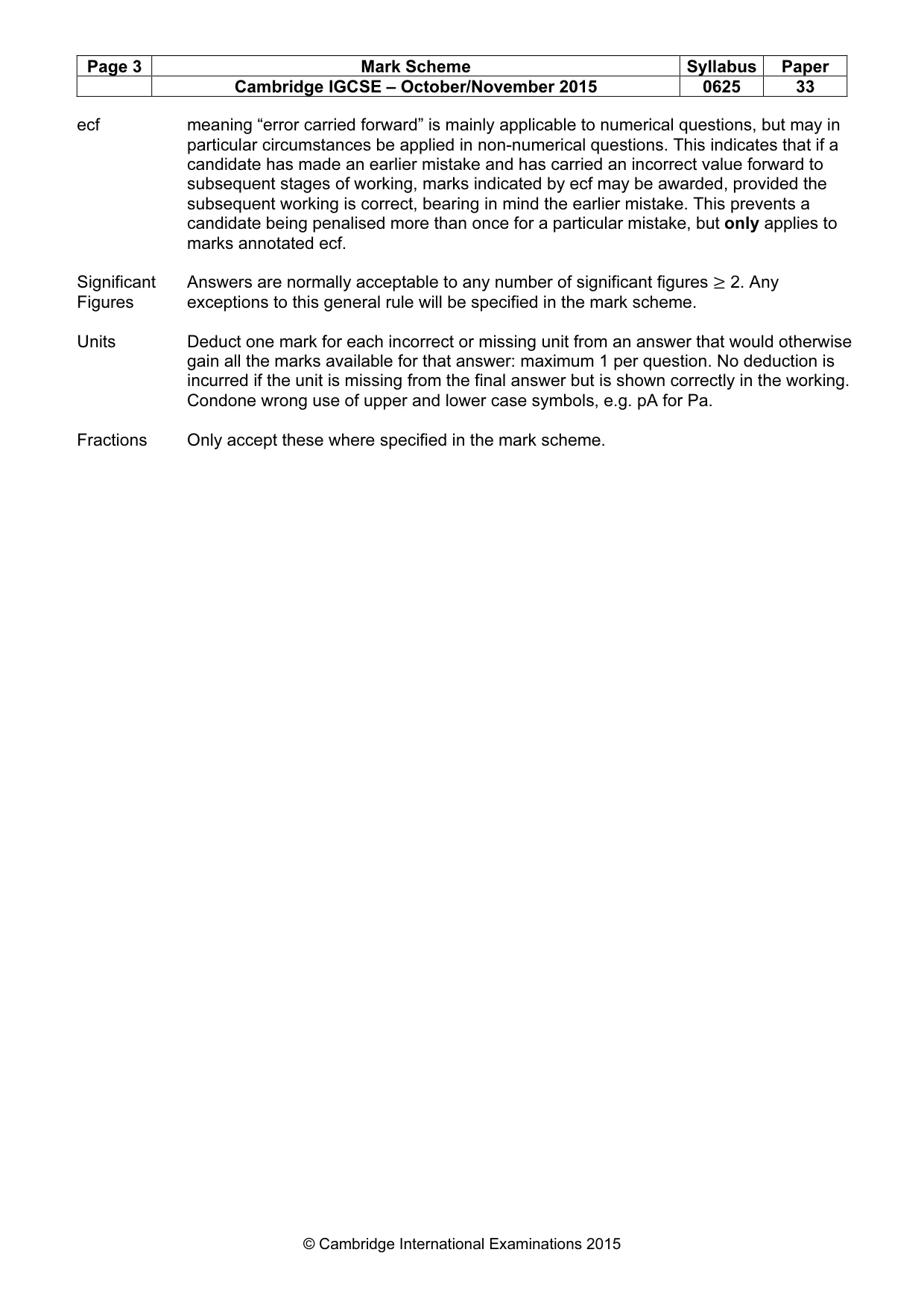
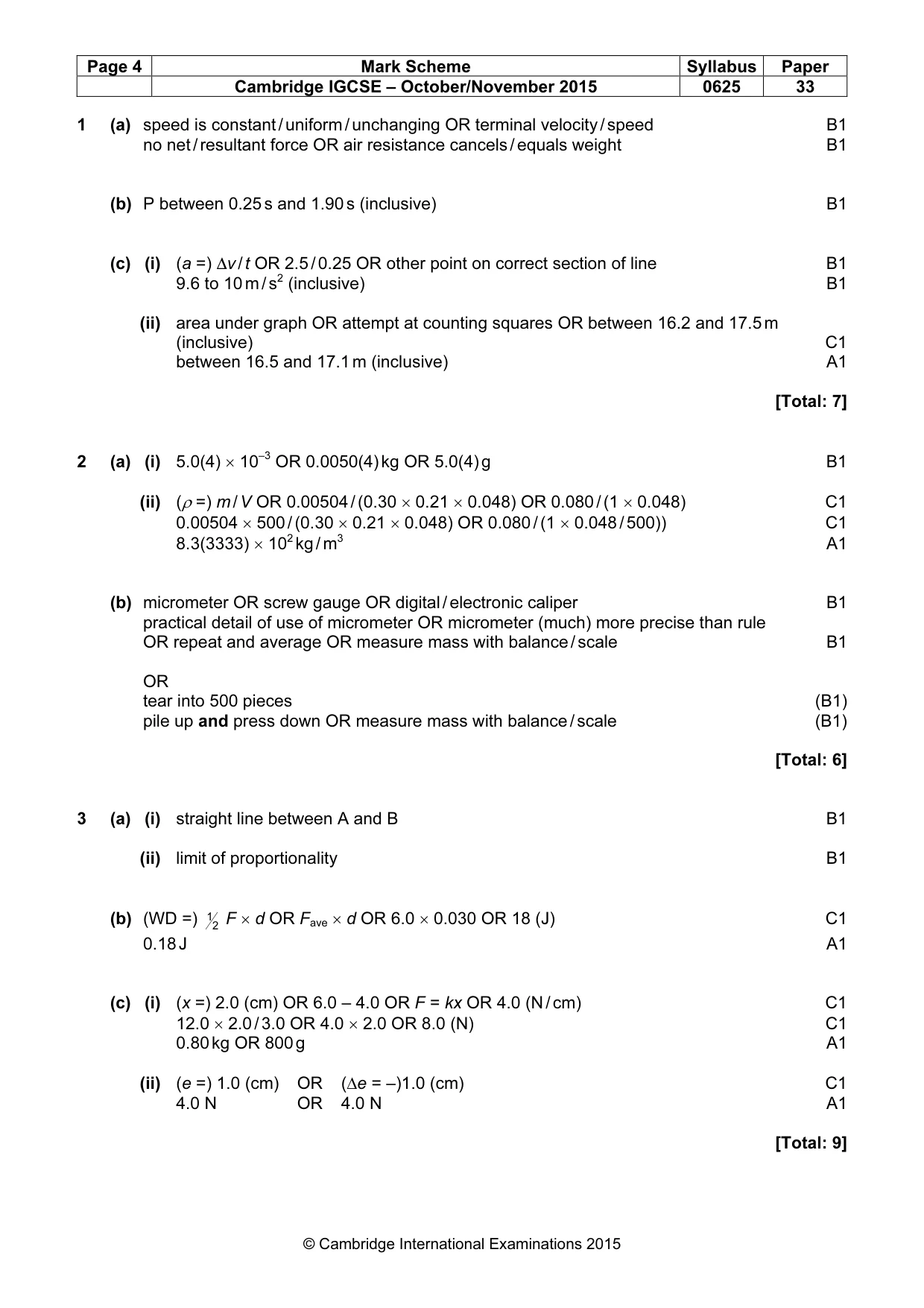
Mark scheme: 1 (a) speed is constant / uniform / unchanging OR terminal velocity / speed B1 no net / resultant force OR air resistance cancels / equals weight B1 (b) P between 0.25 s and 1.90 s (inclusive) B1 (c) (i) (a =) ∆v / t OR 2.5 / 0.25 OR other point on correct section of line B1 9.6 to 10 m / s2 (inclusive) B1 (ii) area under graph OR attempt at counting squares OR between 16.2 and 17.5 m (inclusive) C1 between 16.5 and 17.1 m (inclusive) A1 [Total: 7] 3
Q2 · A student has 500 identical, rectangular sheets of paper
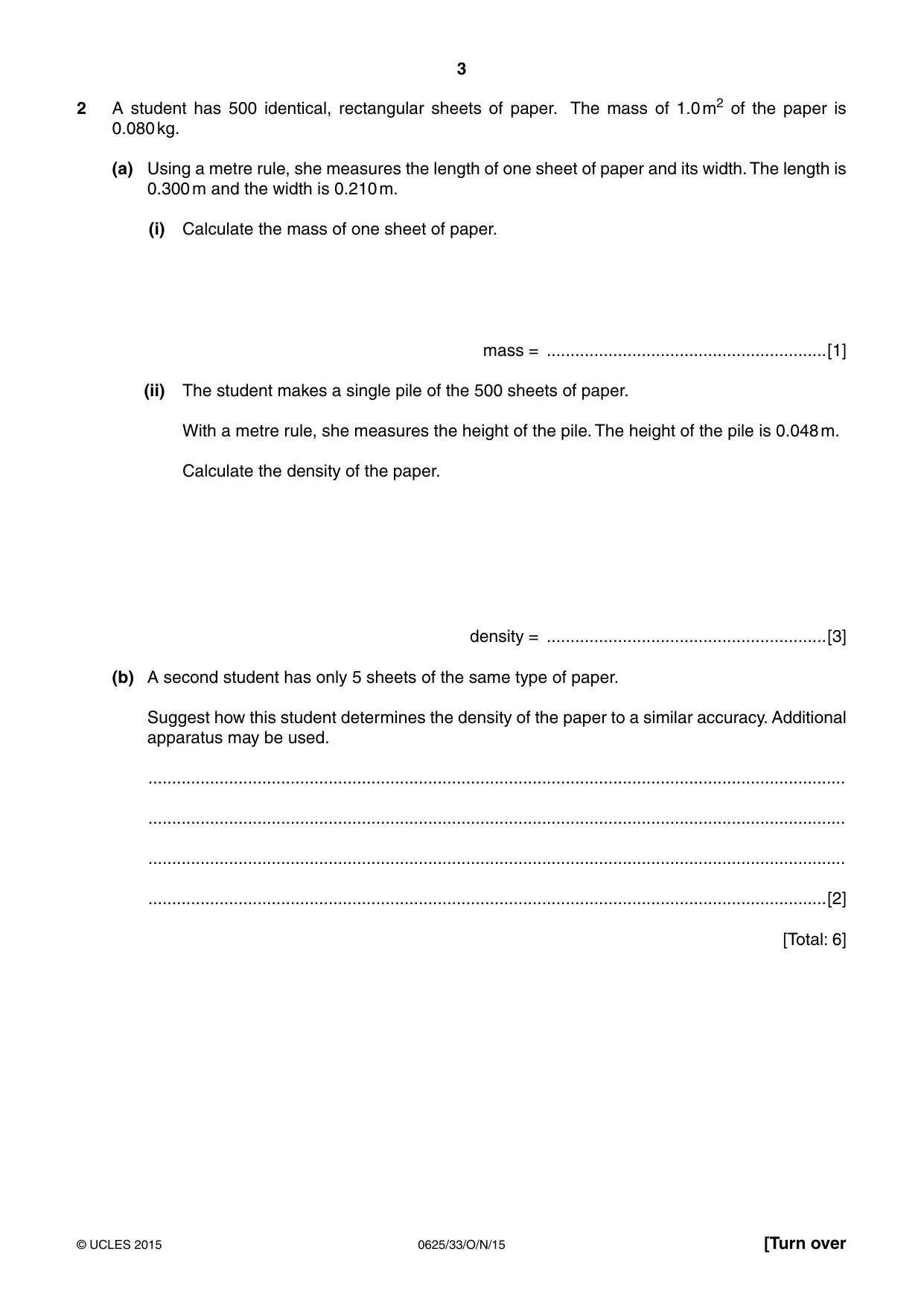
2 A student has 500 identical, rectangular sheets of paper. The mass of 1.0 m2 of the paper is 0.080 kg. (a) Using a metre rule, she measures the length of one sheet of paper and its width. The length is 0.300 m and the width is 0.210 m. (i) Calculate the mass of one sheet of paper. mass = ...........................................................[1] (ii) The student makes a single pile of the 500 sheets of paper. With a metre rule, she measures the height of the pile. The height of the pile is 0.048 m. Calculate the density of the paper. density = ...........................................................[3] (b) A second student has only 5 sheets of the same type of paper. Suggest how this student determines the density of the paper to a similar accuracy. Additional apparatus may be used. ................................................................................................................................................... ................................................................................................................................................... ................................................................................................................................................... ...............................................................................................................................................[2] [Total: 6]
Mark scheme: 2 (a) (i) 5.0(4) × 10–3 OR 0.0050(4) kg OR 5.0(4) g B1 (ii) (ρ =) m / V OR 0.00504 / (0.30 × 0.21 × 0.048) OR 0.080 / (1 × 0.048) C1 0.00504 × 500 / (0.30 × 0.21 × 0.048) OR 0.080 / (1 × 0.048 / 500)) C1 8.3(3333) × 102 kg / m3 A1 (b) micrometer OR screw gauge OR digital / electronic caliper B1 practical detail of use of micrometer OR micrometer (much) more precise than rule OR repeat and average OR measure mass with balance / scale B1 OR tear into 500 pieces (B1) pile up and press down OR measure mass with balance / scale (B1) [Total: 6]
Q3 · Part of the extension-load graph for a spring
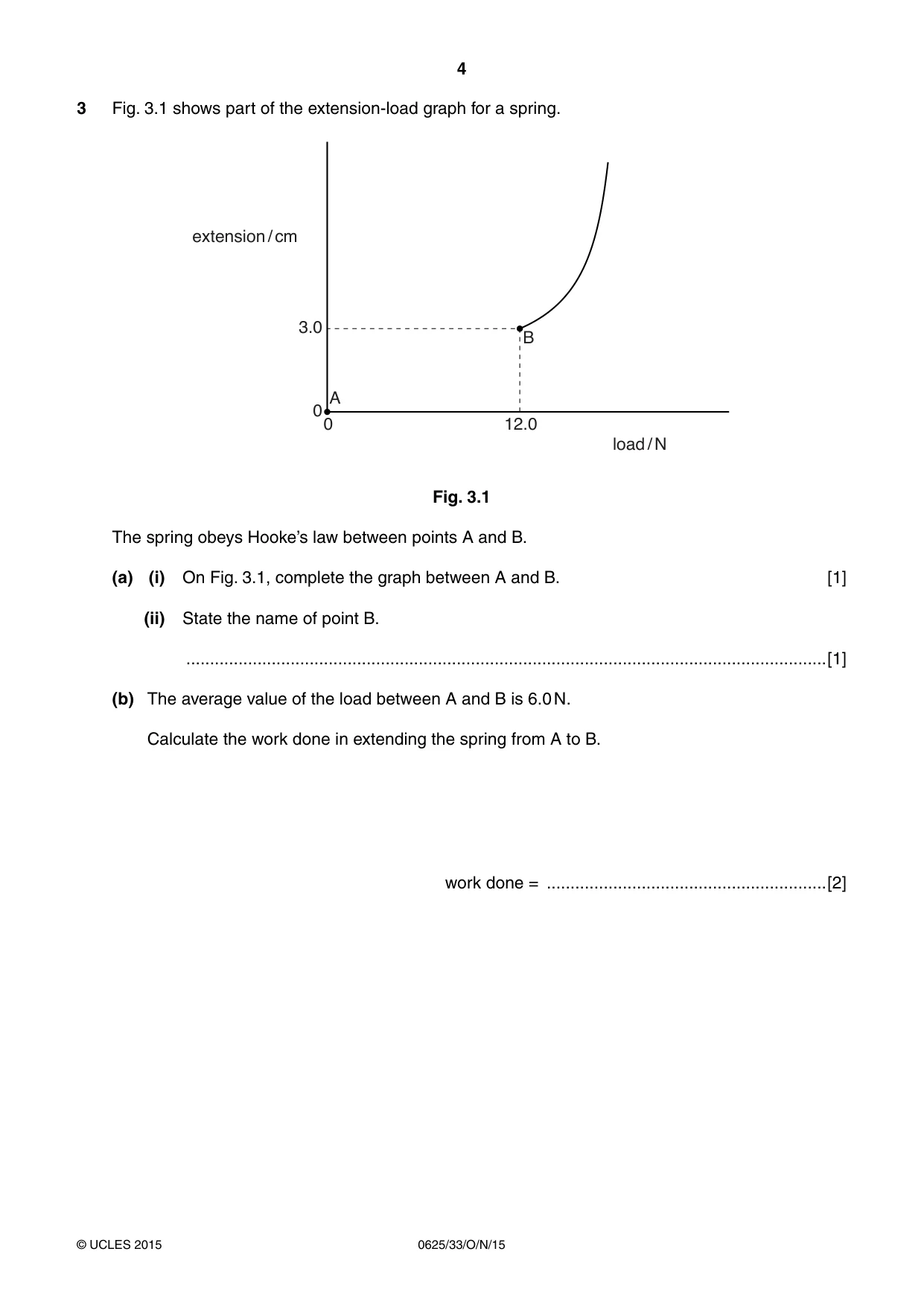
3 Fig. 3.1 shows part of the extension-load graph for a spring. extension / cm 3.0 B A 00 12.0 load / N Fig. 3.1 The spring obeys Hooke’s law between points A and B. (a) (i) On Fig. 3.1, complete the graph between A and B. [1] (ii) State the name of point B. .......................................................................................................................................[1] (b) The average value of the load between A and B is 6.0 N. Calculate the work done in extending the spring from A to B. work done = ...........................................................[2] (c) The spring has an unstretched length of 4.0 cm. An object is hung on the spring and the spring length increases from 4.0 cm to 6.0 cm. (i) Calculate the mass of the object. mass = ...........................................................[3] (ii) The object is immersed in a liquid but remains suspended from the spring. The liquid exerts an upward force on the object and the length of the spring decreases to 5.0 cm. Calculate the upward force exerted on the object by the liquid. upward force = ...........................................................[2] [Total: 9]
Mark scheme: 3 (a) (i) straight line between A and B B1 (ii) limit of proportionality B1 (b) (WD =) 12 F × d OR Fave × d OR 6.0 × 0.030 OR 18 (J) C1 0.18 J A1 (c) (i) (x =) 2.0 (cm) OR 6.0 – 4.0 OR F = kx OR 4.0 (N / cm) C1 12.0 × 2.0 / 3.0 OR 4.0 × 2.0 OR 8.0 (N) C1 0.80 kg OR 800 g A1 (ii) (e =) 1.0 (cm) OR (∆e = –)1.0 (cm) C1 4.0 N OR 4.0 N A1 [Total: 9]
Q4 · A soft rubber ball of mass 0.15 kg is dropped, in a vacuum, from a height of 2.0 m on to…
4 A soft rubber ball of mass 0.15 kg is dropped, in a vacuum, from a height of 2.0 m on to a hard surface. The ball then bounces. (a) State the main energy changes taking place when (i) the ball is falling, ........................................................................................................................................... (ii) the ball hits the surface and is changing shape, ........................................................................................................................................... (iii) the ball is regaining its shape and is rising from the surface. ........................................................................................................................................... [3] (b) Calculate the speed with which the ball hits the surface. speed = .......................................................... [4] (c) After rebounding from the surface, the ball rises to a height of 1.9 m. Suggest why the height to which the ball rises is less than the height from which the ball falls. ................................................................................................................................................... ...............................................................................................................................................[1] [Total: 8]
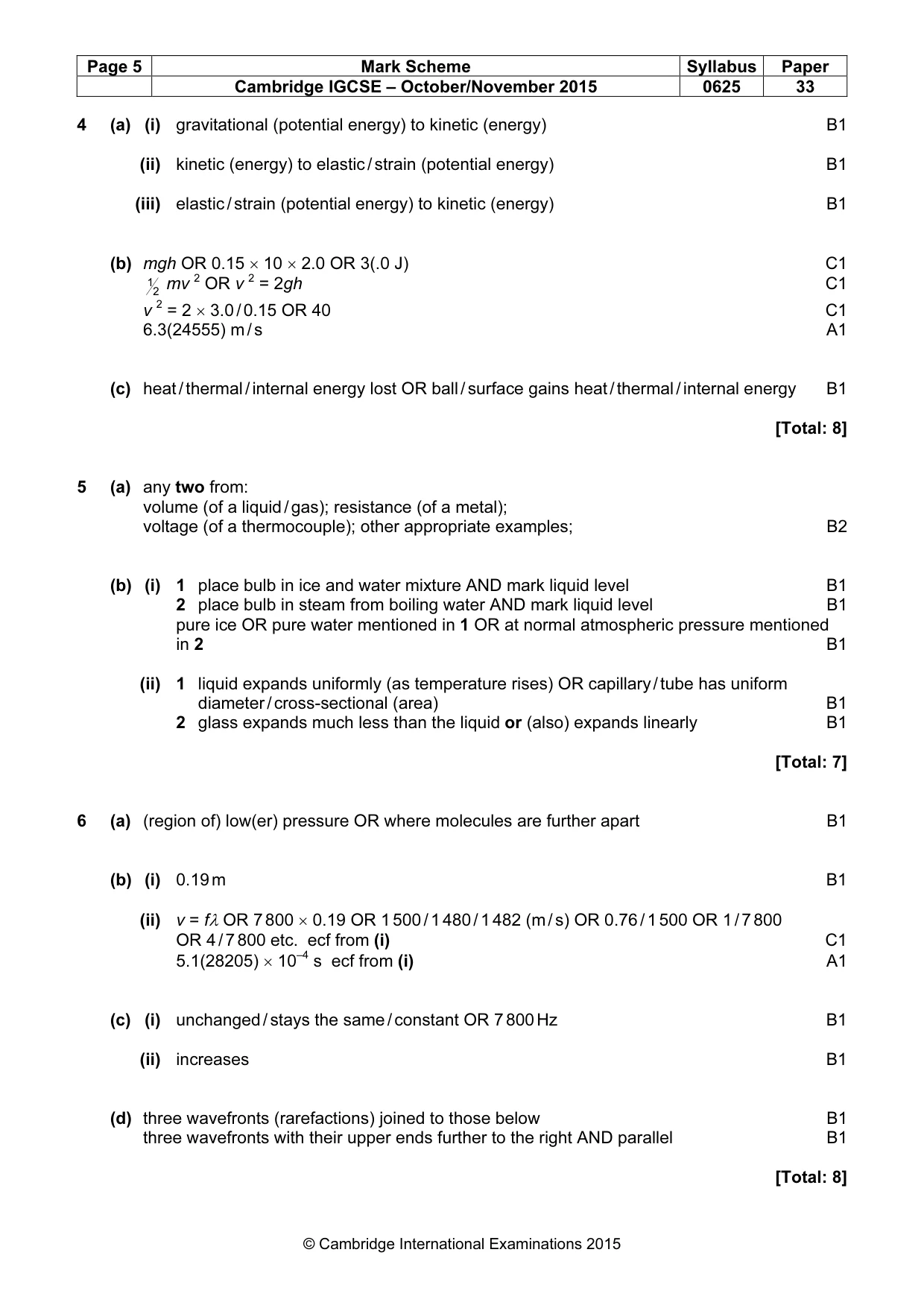
Mark scheme: 4 (a) (i) gravitational (potential energy) to kinetic (energy) B1 (ii) kinetic (energy) to elastic / strain (potential energy) B1 (iii) elastic / strain (potential energy) to kinetic (energy) B1 (b) mgh OR 0.15 × 10 × 2.0 OR 3(.0 J) C1 1 2 mv 2 OR v 2 = 2gh C1 v 2 = 2 × 3.0 / 0.15 OR 40 C1 6.3(24555) m / s A1 (c) heat / thermal / internal energy lost OR ball / surface gains heat / thermal / internal energy B1 [Total: 8]
Q5 · State two examples of physical properties that vary with temperature and that may be used…
5 (a) State two examples of physical properties that vary with temperature and that may be used for the measurement of temperature. 1. ............................................................................................................................................... 2. ............................................................................................................................................... [2] (b) When first manufactured, a liquid-in-glass thermometer has no scale markings. (i) Describe the procedure needed to determine 1. the position on the thermometer of the lower fixed point, .................................................................................................................................... .................................................................................................................................... .................................................................................................................................... 2. the position on the thermometer of the upper fixed point. .................................................................................................................................... .................................................................................................................................... .................................................................................................................................... [3] (ii) Explain why 1. the graduations marked on the thermometer between the fixed points are spaced equally, .................................................................................................................................... ................................................................................................................................[1] 2. the expansion of the glass of the thermometer is ignored. .................................................................................................................................... ................................................................................................................................[1] [Total: 7]
Mark scheme: 5 (a) any two from: volume (of a liquid / gas); resistance (of a metal); voltage (of a thermocouple); other appropriate examples; B2 (b) (i) 1 place bulb in ice and water mixture AND mark liquid level B1 2 place bulb in steam from boiling water AND mark liquid level B1 pure ice OR pure water mentioned in 1 OR at normal atmospheric pressure mentioned in 2 B1 (ii) 1 liquid expands uniformly (as temperature rises) OR capillary / tube has uniform diameter / cross-sectional (area) B1 2 glass expands much less than the liquid or (also) expands linearly B1 [Total: 7]
Q6 · A dolphin produces a sound wave in water of frequency 7800 Hz
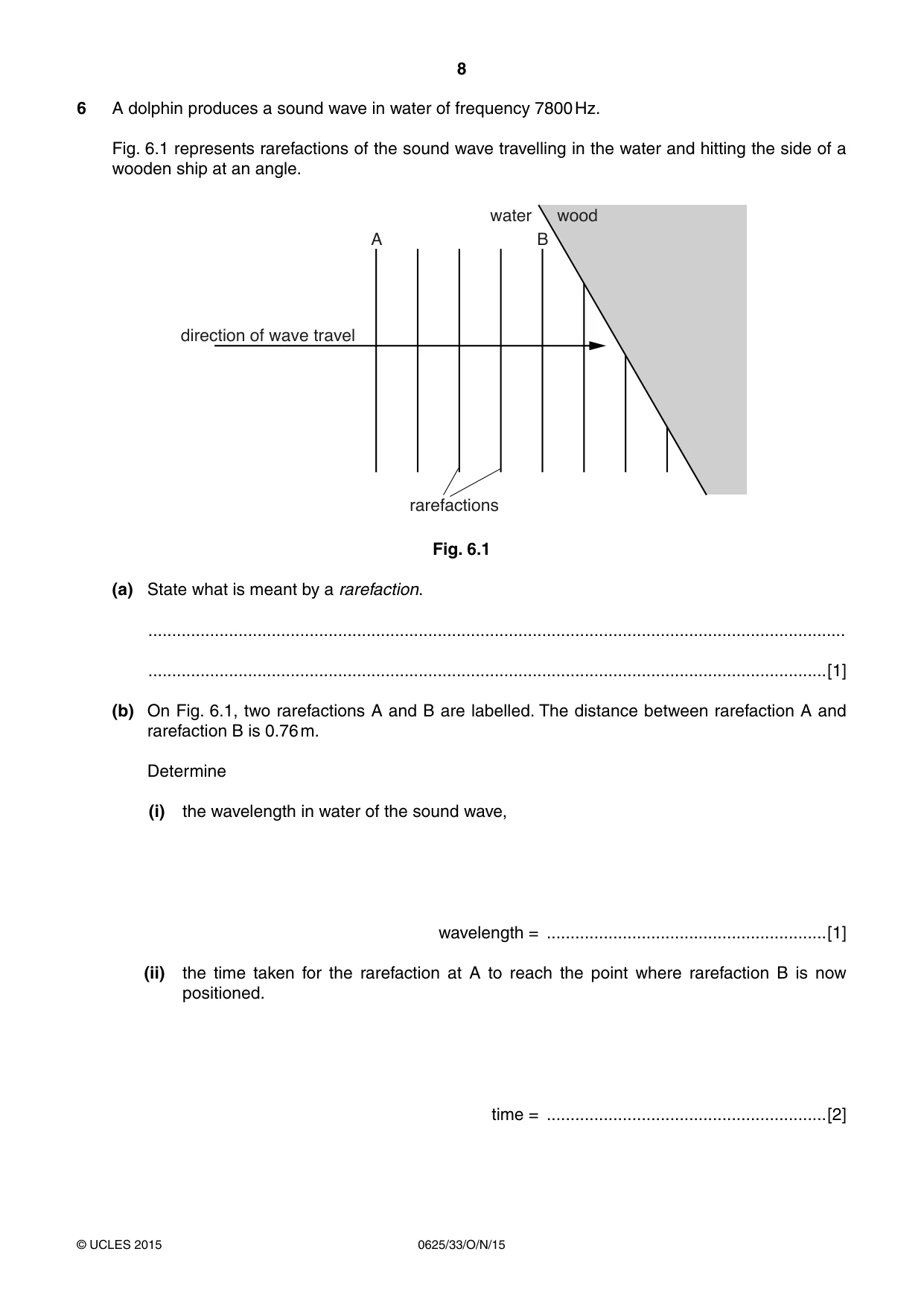
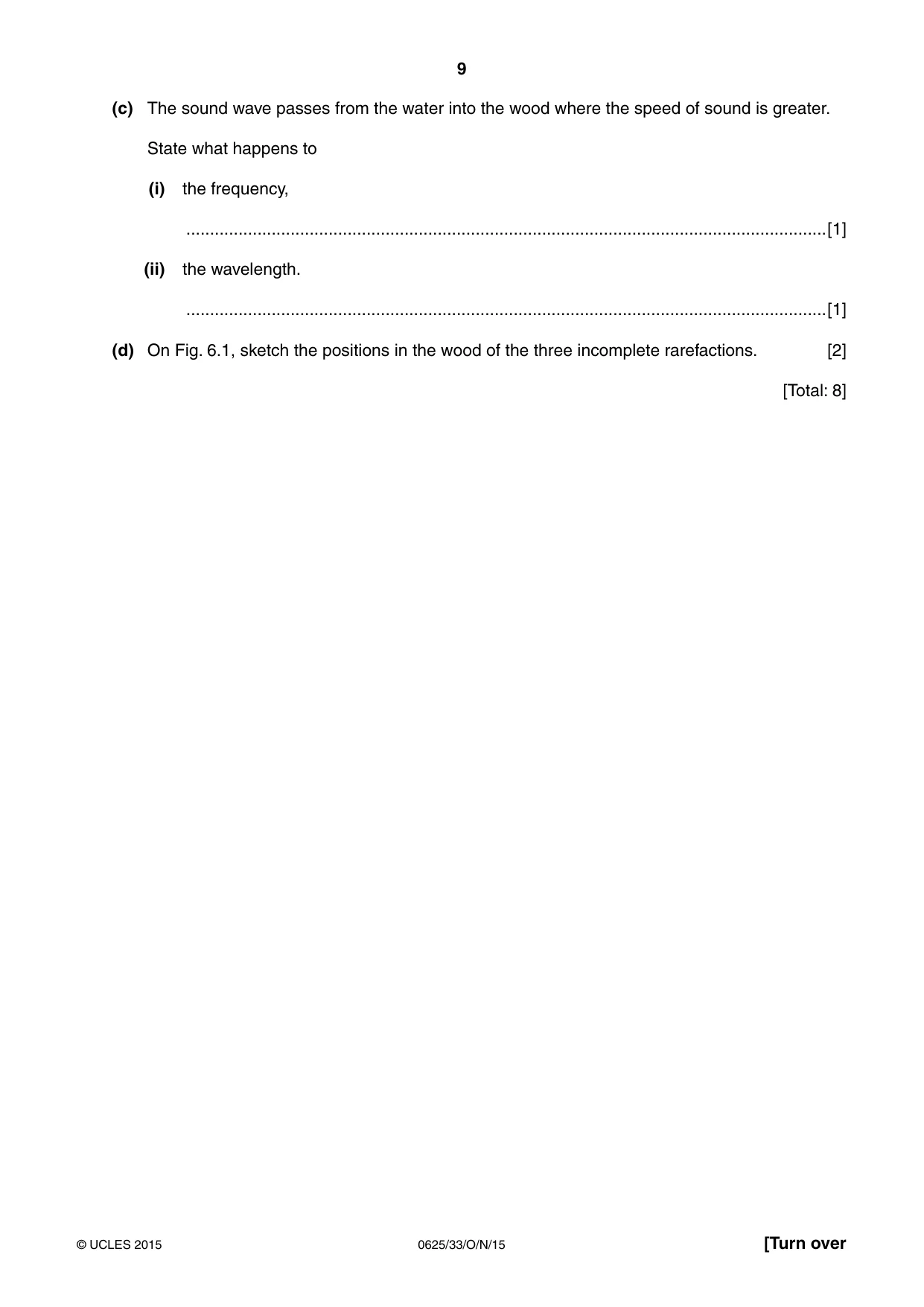
6 A dolphin produces a sound wave in water of frequency 7800 Hz. Fig. 6.1 represents rarefactions of the sound wave travelling in the water and hitting the side of a wooden ship at an angle. water wood A B direction of wave travel rarefactions Fig. 6.1 (a) State what is meant by a rarefaction. ................................................................................................................................................... ...............................................................................................................................................[1] (b) On Fig. 6.1, two rarefactions A and B are labelled. The distance between rarefaction A and rarefaction B is 0.76 m. Determine (i) the wavelength in water of the sound wave, wavelength = ...........................................................[1] (ii) the time taken for the rarefaction at A to reach the point where rarefaction B is now positioned. time = ...........................................................[2] (c) The sound wave passes from the water into the wood where the speed of sound is greater. State what happens to (i) the frequency, .......................................................................................................................................[1] (ii) the wavelength. .......................................................................................................................................[1] (d) On Fig. 6.1, sketch the positions in the wood of the three incomplete rarefactions. [2] [Total: 8]
Mark scheme: 6 (a) (region of) low(er) pressure OR where molecules are further apart B1 (b) (i) 0.19 m B1 (ii) v = fλ OR 7 800 × 0.19 OR 1 500 / 1 480 / 1 482 (m / s) OR 0.76 / 1 500 OR 1 / 7 800 OR 4 / 7 800 etc. ecf from (i) C1 5.1(28205) × 10–4 s ecf from (i) A1 (c) (i) unchanged / stays the same / constant OR 7 800 Hz B1 (ii) increases B1 (d) three wavefronts (rarefactions) joined to those below B1 three wavefronts with their upper ends further to the right AND parallel B1 [Total: 8] 1
Q7 · The refractive index of a type of glass is 1.6
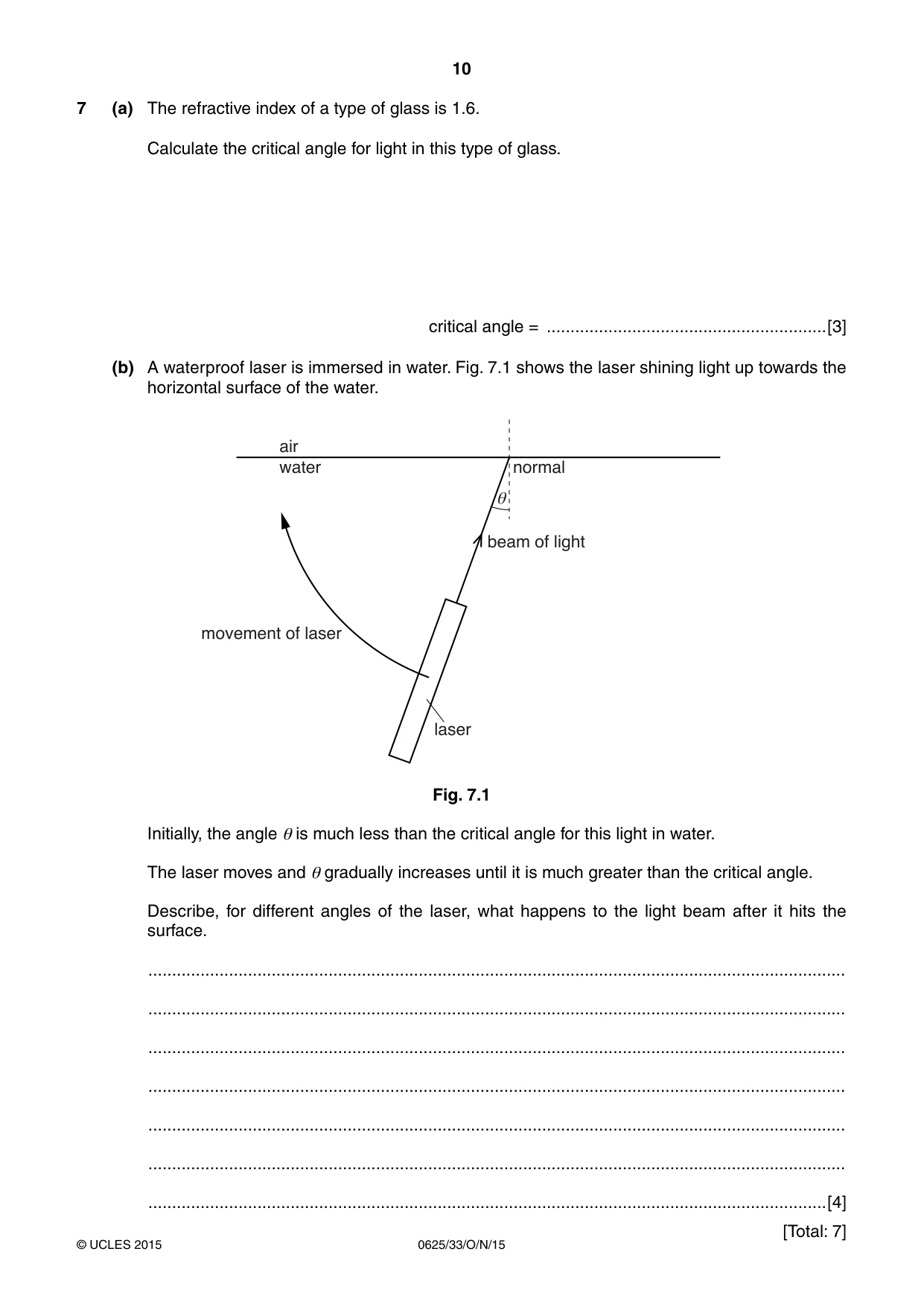
7 (a) The refractive index of a type of glass is 1.6. Calculate the critical angle for light in this type of glass. critical angle = ...........................................................[3] (b) A waterproof laser is immersed in water. Fig. 7.1 shows the laser shining light up towards the horizontal surface of the water. air water normal e beam of light movement of laser laser Fig. 7.1 Initially, the angle θ is much less than the critical angle for this light in water. The laser moves and θ gradually increases until it is much greater than the critical angle. Describe, for different angles of the laser, what happens to the light beam after it hits the surface. ................................................................................................................................................... ................................................................................................................................................... ................................................................................................................................................... ................................................................................................................................................... ................................................................................................................................................... ................................................................................................................................................... ...............................................................................................................................................[4] [Total: 7]
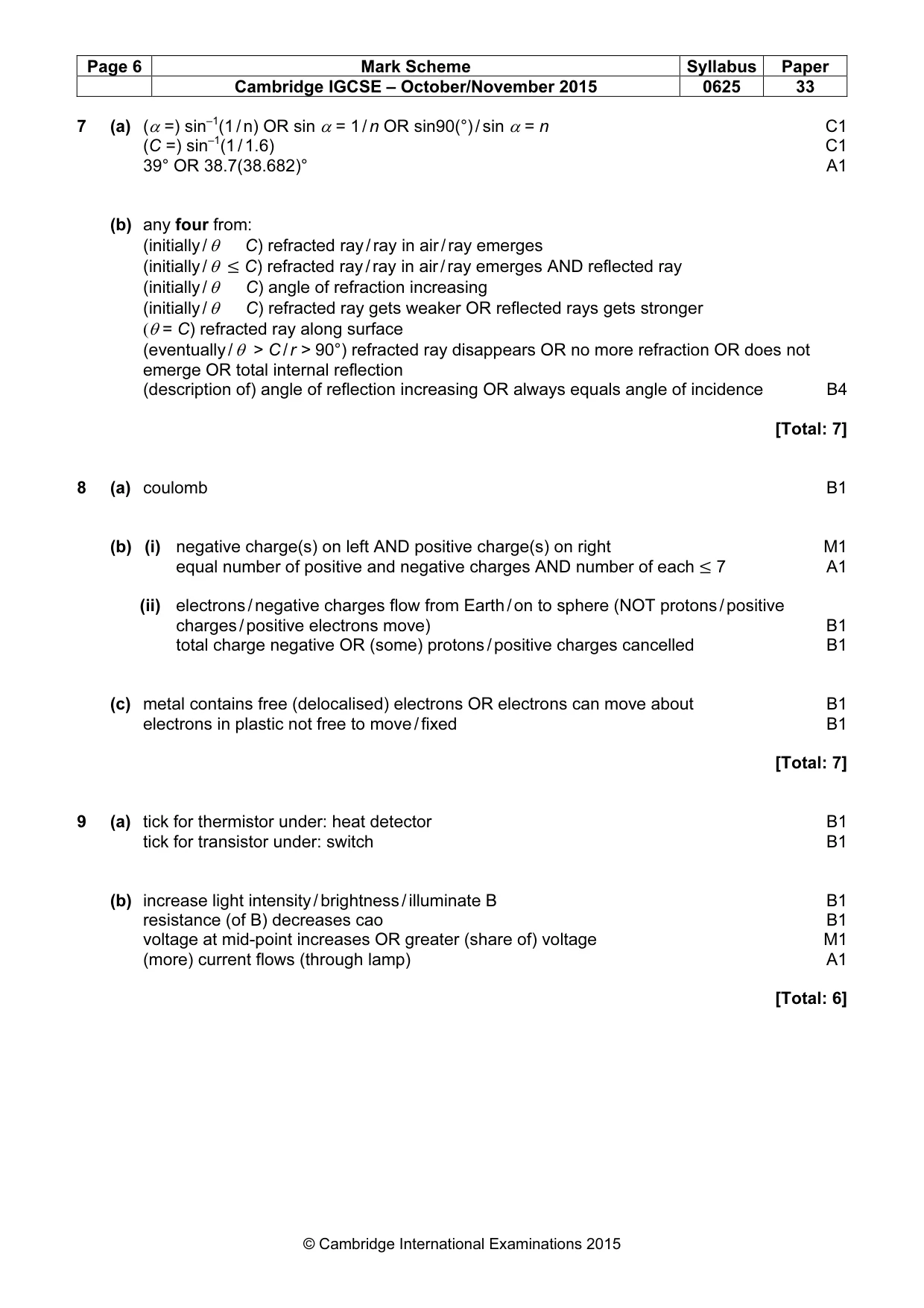
Mark scheme: 7 (a) (α =) sin–1(1 / n) OR sin α = 1 / n OR sin90(°) / sin α = n C1 (C =) sin–1(1 / 1.6) C1 39° OR 38.7(38.682)° A1 (b) any four from: (initially / θ C) refracted ray / ray in air / ray emerges (initially / θ ≤ C) refracted ray / ray in air / ray emerges AND reflected ray (initially / θ C) angle of refraction increasing (initially / θ C) refracted ray gets weaker OR reflected rays gets stronger (θ = C) refracted ray along surface (eventually / θ > C / r > 90°) refracted ray disappears OR no more refraction OR does not emerge OR total internal reflection (description of) angle of reflection increasing OR always equals angle of incidence B4 [Total: 7]
Q8 · A metal sphere, mounted on an insulating plastic stand, is positively charged
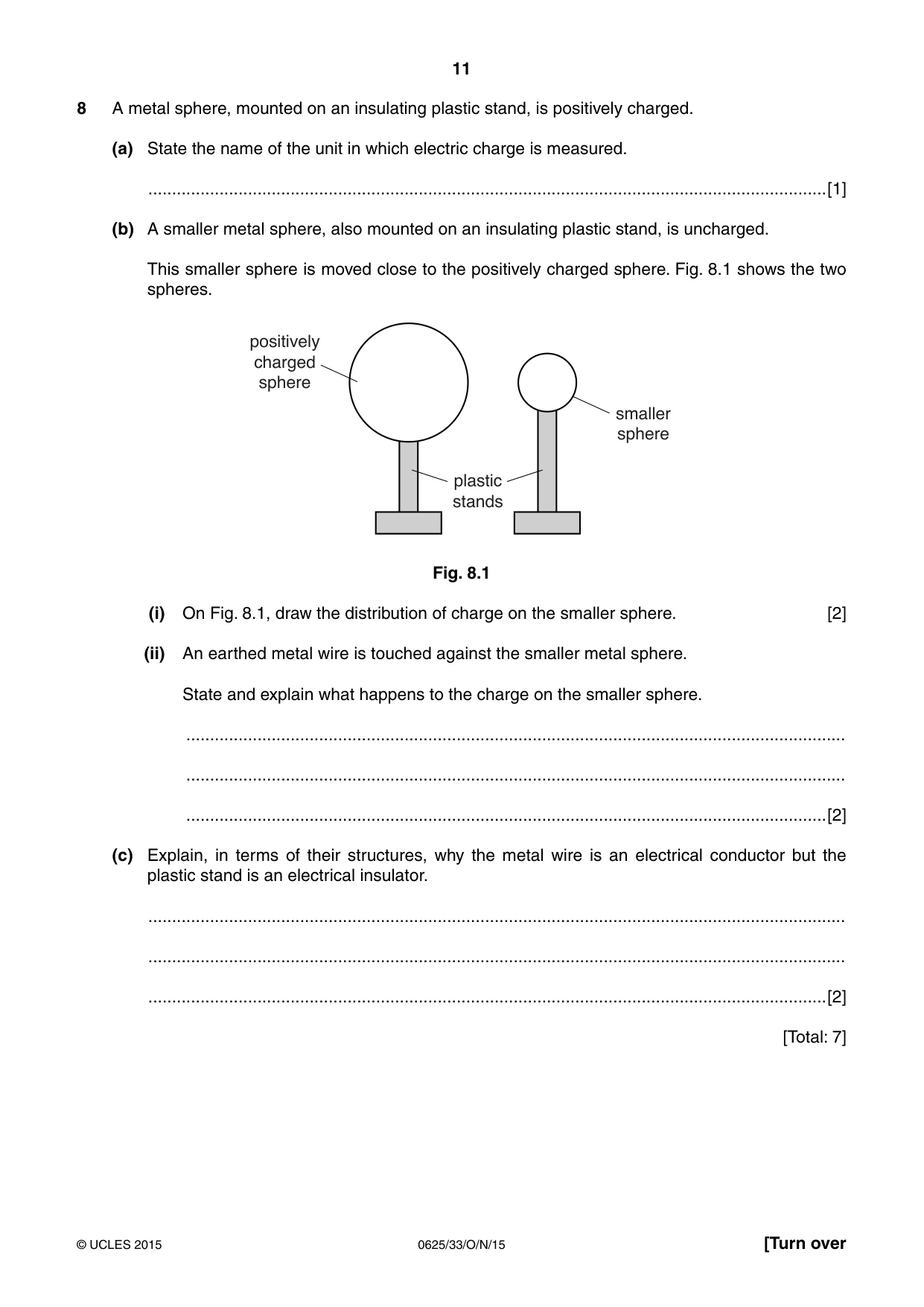
8 A metal sphere, mounted on an insulating plastic stand, is positively charged. (a) State the name of the unit in which electric charge is measured. ...............................................................................................................................................[1] (b) A smaller metal sphere, also mounted on an insulating plastic stand, is uncharged. This smaller sphere is moved close to the positively charged sphere. Fig. 8.1 shows the two spheres. positively charged sphere smaller sphere plastic stands Fig. 8.1 (i) On Fig. 8.1, draw the distribution of charge on the smaller sphere. [2] (ii) An earthed metal wire is touched against the smaller metal sphere. State and explain what happens to the charge on the smaller sphere. ........................................................................................................................................... ........................................................................................................................................... .......................................................................................................................................[2] (c) Explain, in terms of their structures, why the metal wire is an electrical conductor but the plastic stand is an electrical insulator. ................................................................................................................................................... ................................................................................................................................................... ...............................................................................................................................................[2] [Total: 7]
Mark scheme: 8 (a) coulomb B1 (b) (i) negative charge(s) on left AND positive charge(s) on right M1 equal number of positive and negative charges AND number of each ≤ 7 A1 (ii) electrons / negative charges flow from Earth / on to sphere (NOT protons / positive charges / positive electrons move) B1 total charge negative OR (some) protons / positive charges cancelled B1 (c) metal contains free (delocalised) electrons OR electrons can move about B1 electrons in plastic not free to move / fixed B1 [Total: 7]
Q9 · Place one tick in each row of the table to indicate one use of a thermistor and one use…
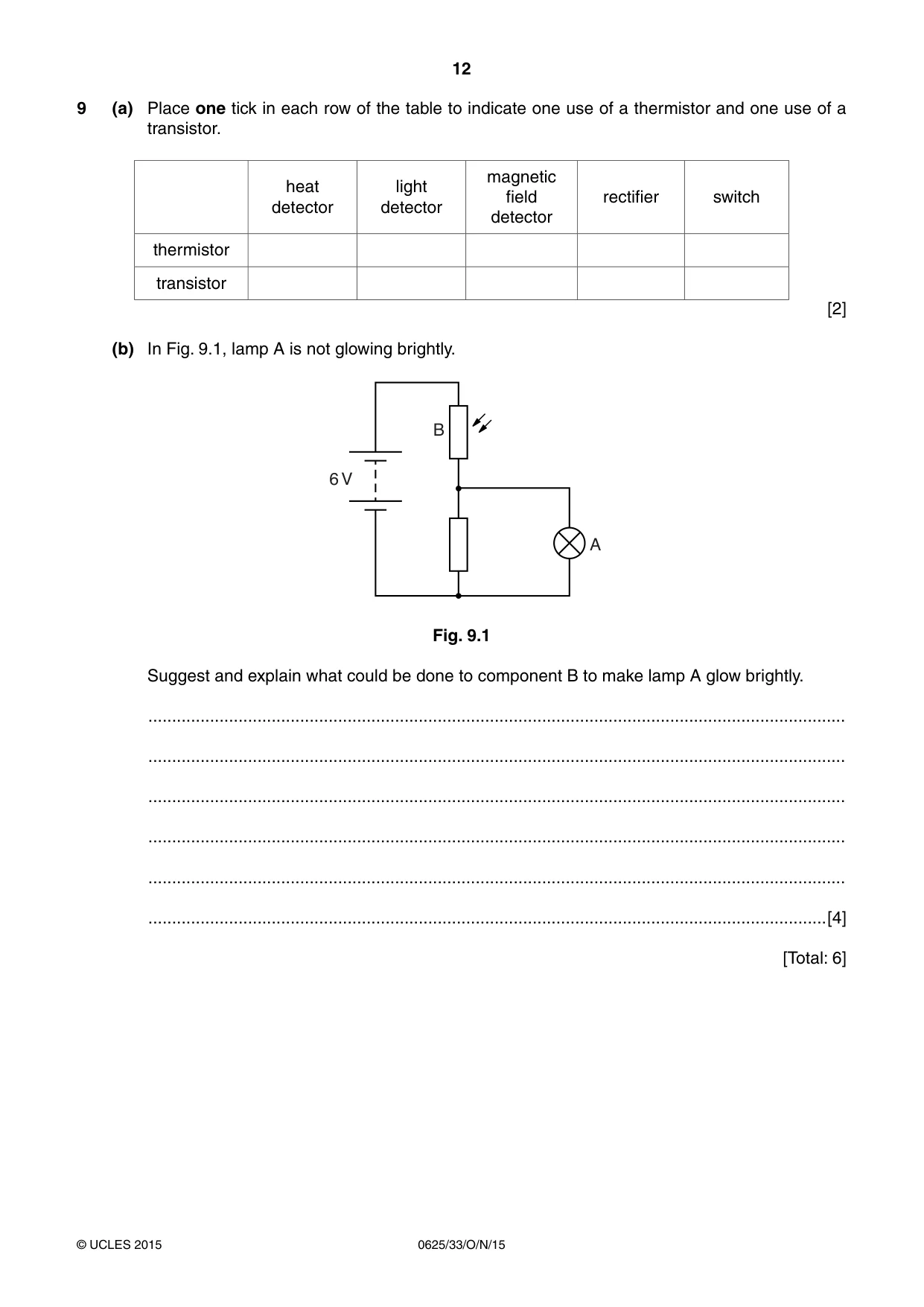
9 (a) Place one tick in each row of the table to indicate one use of a thermistor and one use of a transistor. magnetic heat light field rectifier switch detector detector detector thermistor transistor [2] (b) In Fig. 9.1, lamp A is not glowing brightly. B 6 V A Fig. 9.1 Suggest and explain what could be done to component B to make lamp A glow brightly. ................................................................................................................................................... ................................................................................................................................................... ................................................................................................................................................... ................................................................................................................................................... ................................................................................................................................................... ...............................................................................................................................................[4] [Total: 6]
Mark scheme: 9 (a) tick for thermistor under: heat detector B1 tick for transistor under: switch B1 (b) increase light intensity / brightness / illuminate B B1 resistance (of B) decreases cao B1 voltage at mid-point increases OR greater (share of) voltage M1 (more) current flows (through lamp) A1 [Total: 6]
Q10 · The output of an a.c
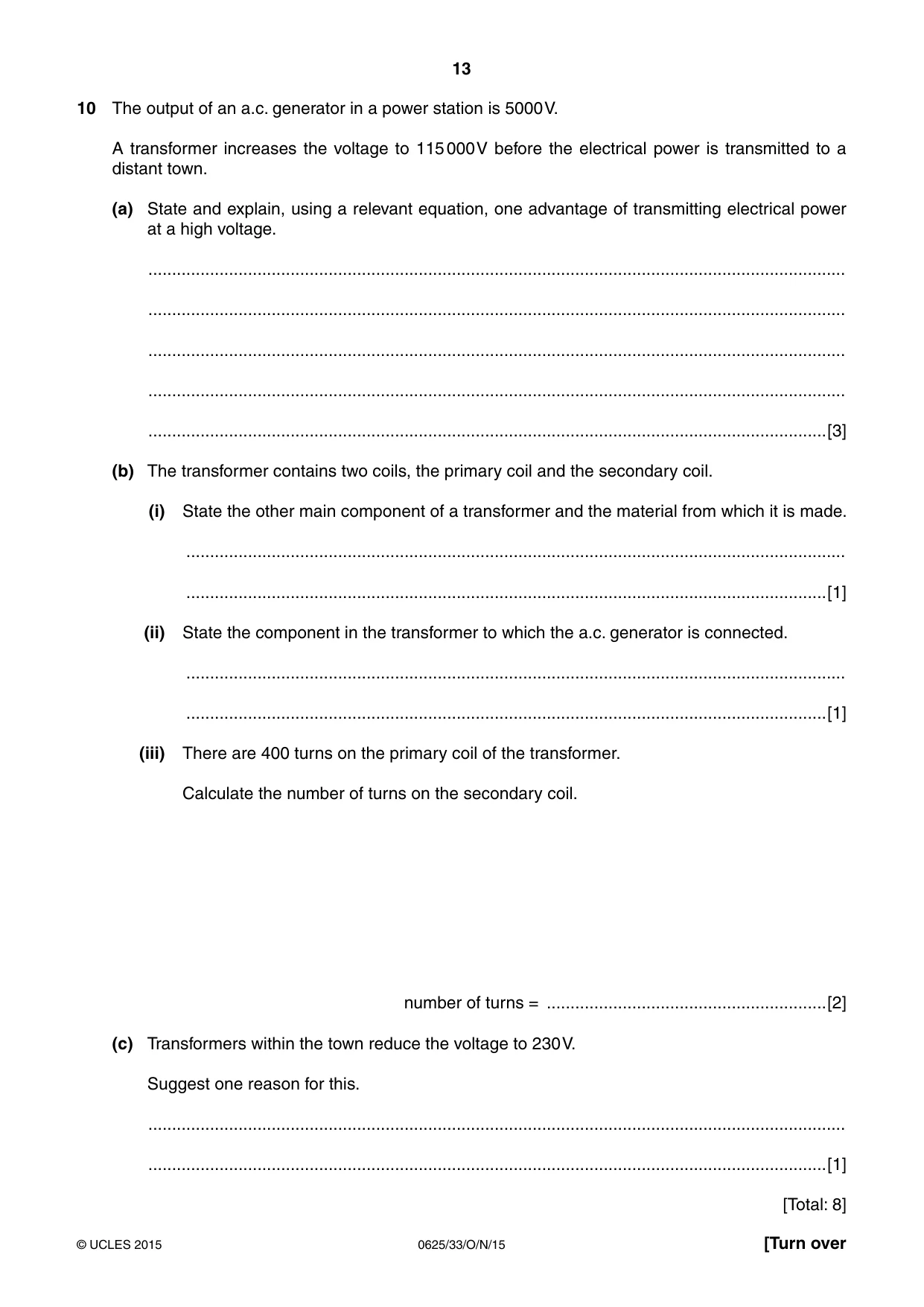
10 The output of an a.c. generator in a power station is 5000 V. A transformer increases the voltage to 115 000 V before the electrical power is transmitted to a distant town. (a) State and explain, using a relevant equation, one advantage of transmitting electrical power at a high voltage. ................................................................................................................................................... ................................................................................................................................................... ................................................................................................................................................... ................................................................................................................................................... ...............................................................................................................................................[3] (b) The transformer contains two coils, the primary coil and the secondary coil. (i) State the other main component of a transformer and the material from which it is made. ........................................................................................................................................... .......................................................................................................................................[1] (ii) State the component in the transformer to which the a.c. generator is connected. ........................................................................................................................................... .......................................................................................................................................[1] (iii) There are 400 turns on the primary coil of the transformer. Calculate the number of turns on the secondary coil. number of turns = ...........................................................[2] (c) Transformers within the town reduce the voltage to 230 V. Suggest one reason for this. ................................................................................................................................................... ...............................................................................................................................................[1] [Total: 8]
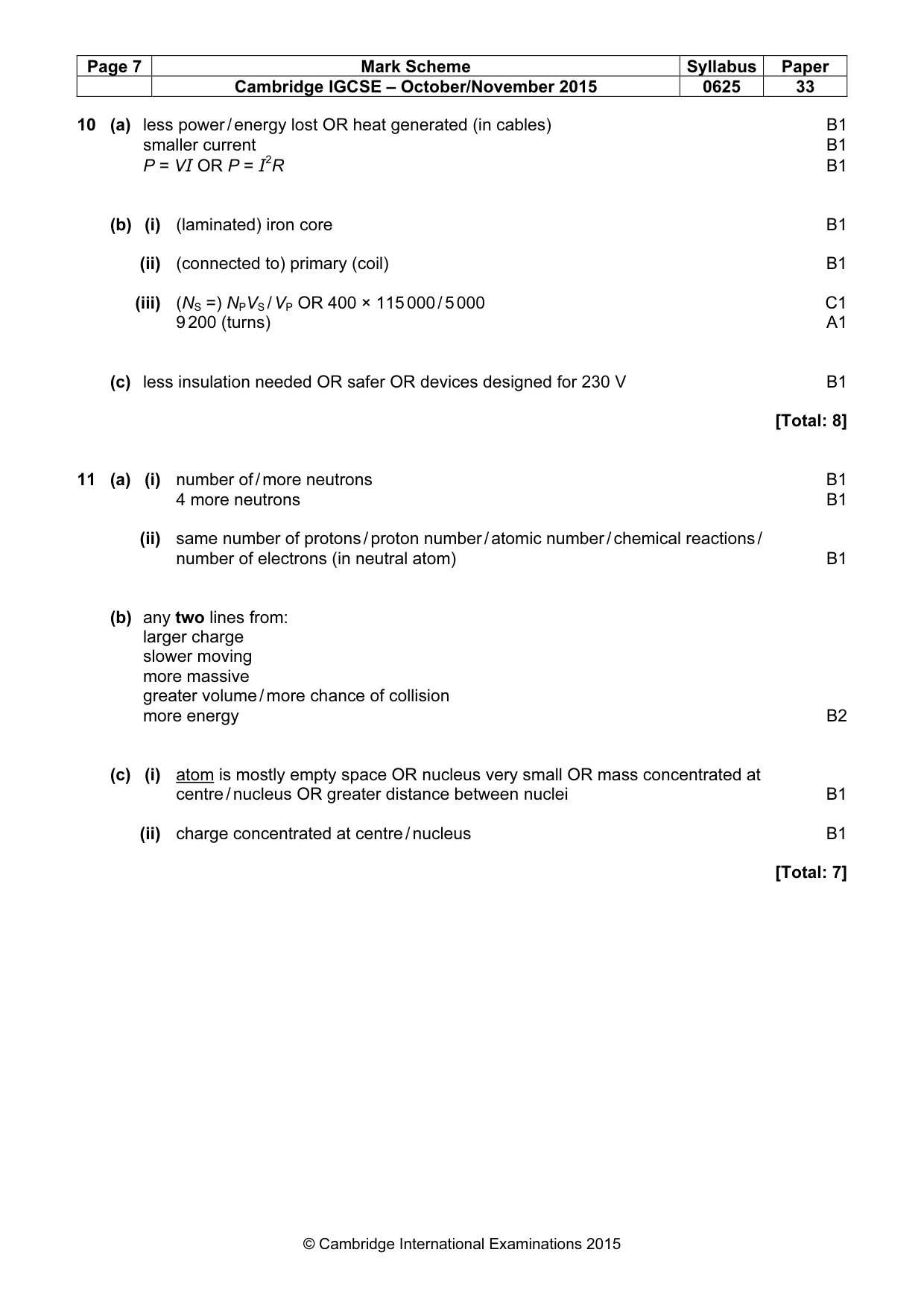
Mark scheme: 10 (a) less power / energy lost OR heat generated (in cables) B1 smaller current B1 P = VI OR P = I2R B1 (b) (i) (laminated) iron core B1 (ii) (connected to) primary (coil) B1 (iii) (NS =) NPVS / VP OR 400 × 115 000 / 5 000 C1 9 200 (turns) A1 (c) less insulation needed OR safer OR devices designed for 230 V B1 [Total: 8]
Q11 · Uranium-238 and uranium-234 are radioactive isotopes of the element uranium
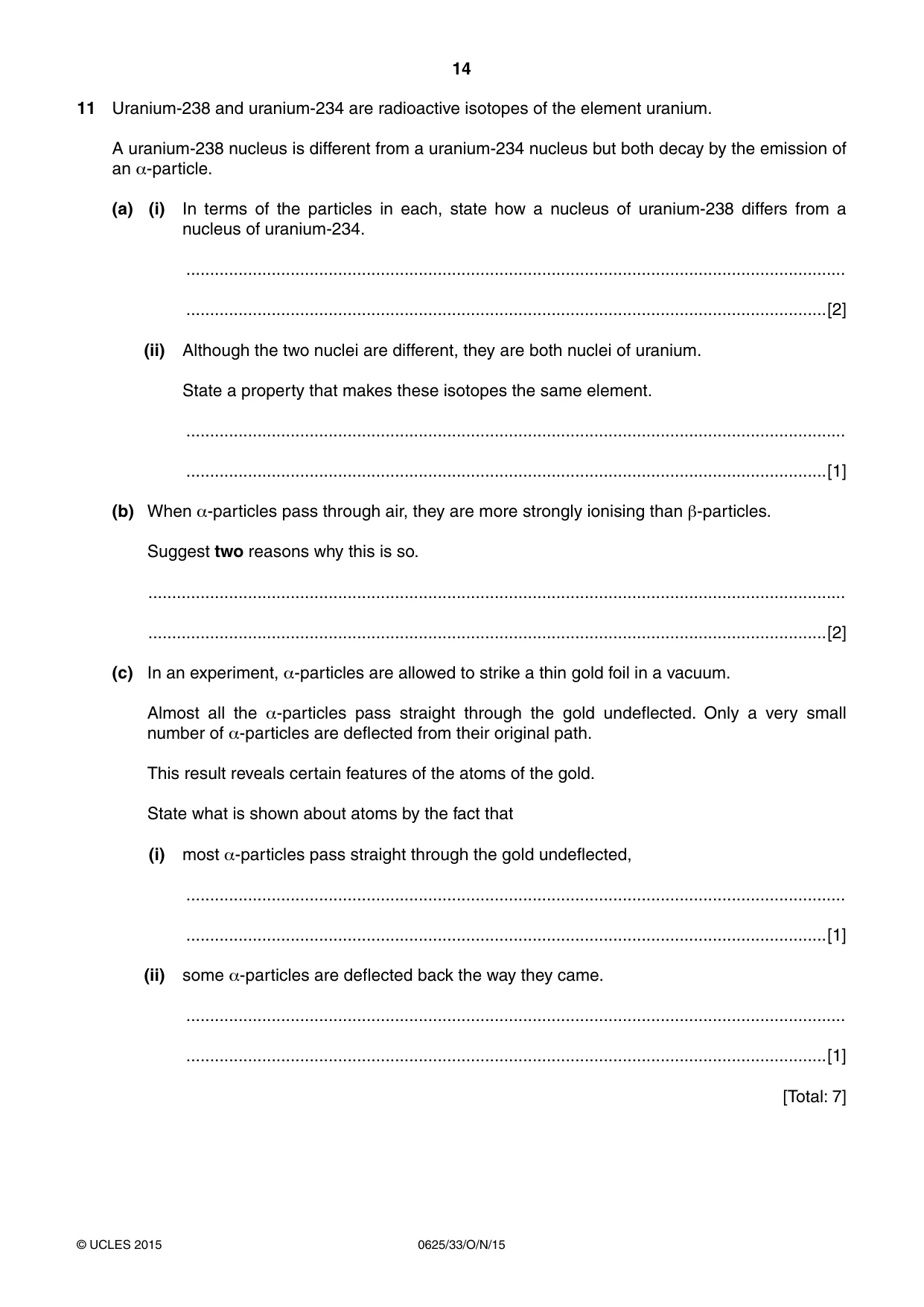
11 Uranium-238 and uranium-234 are radioactive isotopes of the element uranium. A uranium-238 nucleus is different from a uranium-234 nucleus but both decay by the emission of an α-particle. (a) (i) In terms of the particles in each, state how a nucleus of uranium-238 differs from a nucleus of uranium-234. ........................................................................................................................................... .......................................................................................................................................[2] (ii) Although the two nuclei are different, they are both nuclei of uranium. State a property that makes these isotopes the same element. ........................................................................................................................................... .......................................................................................................................................[1] (b) When α-particles pass through air, they are more strongly ionising than β-particles. Suggest two reasons why this is so. ................................................................................................................................................... ...............................................................................................................................................[2] (c) In an experiment, α-particles are allowed to strike a thin gold foil in a vacuum. Almost all the α-particles pass straight through the gold undeflected. Only a very small number of α-particles are deflected from their original path. This result reveals certain features of the atoms of the gold. State what is shown about atoms by the fact that (i) most α-particles pass straight through the gold undeflected, ........................................................................................................................................... .......................................................................................................................................[1] (ii) some α-particles are deflected back the way they came. ........................................................................................................................................... .......................................................................................................................................[1] [Total: 7]
Mark scheme: 11 (a) (i) number of / more neutrons B1 4 more neutrons B1 (ii) same number of protons / proton number / atomic number / chemical reactions / number of electrons (in neutral atom) B1 (b) any two lines from: larger charge slower moving more massive greater volume / more chance of collision more energy B2 (c) (i) atom is mostly empty space OR nucleus very small OR mass concentrated at centre / nucleus OR greater distance between nuclei B1 (ii) charge concentrated at centre / nucleus B1 [Total: 7]
What was in this paper
The subtopics covered by these 11 questions, and how many questions each got. Open one in a new tab to see every Cambridge question on it.
What you needed in this session
Cambridge’s own grade thresholds for 2015 Oct/Nov, Paper 3 · Variant 3. A higher threshold means an easier paper — the bar moves with how the cohort did.