Cambridge IGCSE Physics 0625 — 2025 Feb/March Paper 3 · Variant 2
0625/32/F/M/25 · 12 questions · 80 marks · ≈90 min
The question paper and its mark scheme, free to read here and free to download. This is Cambridge’s own paper, exactly as it was sat.
Question paper16 pages
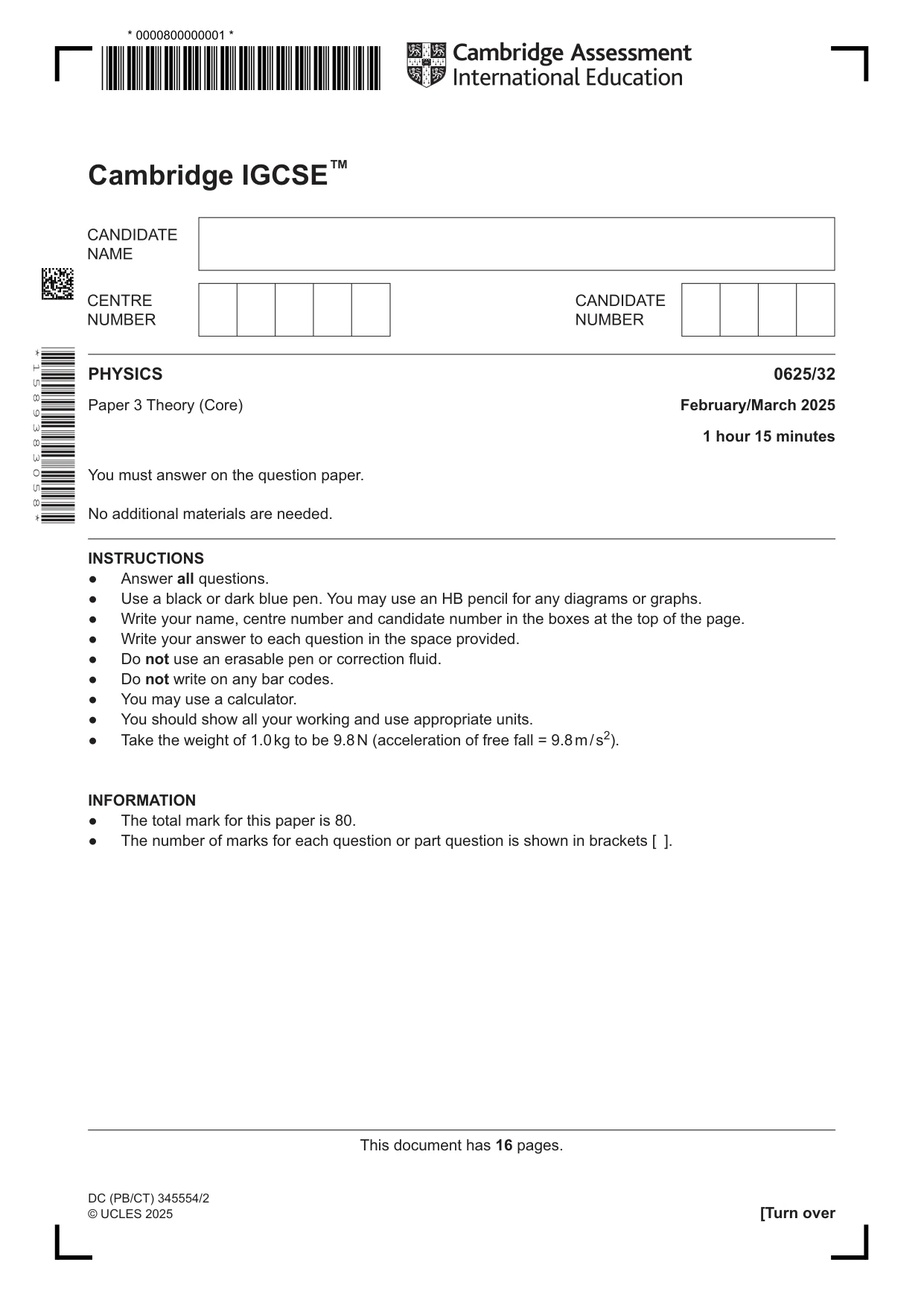
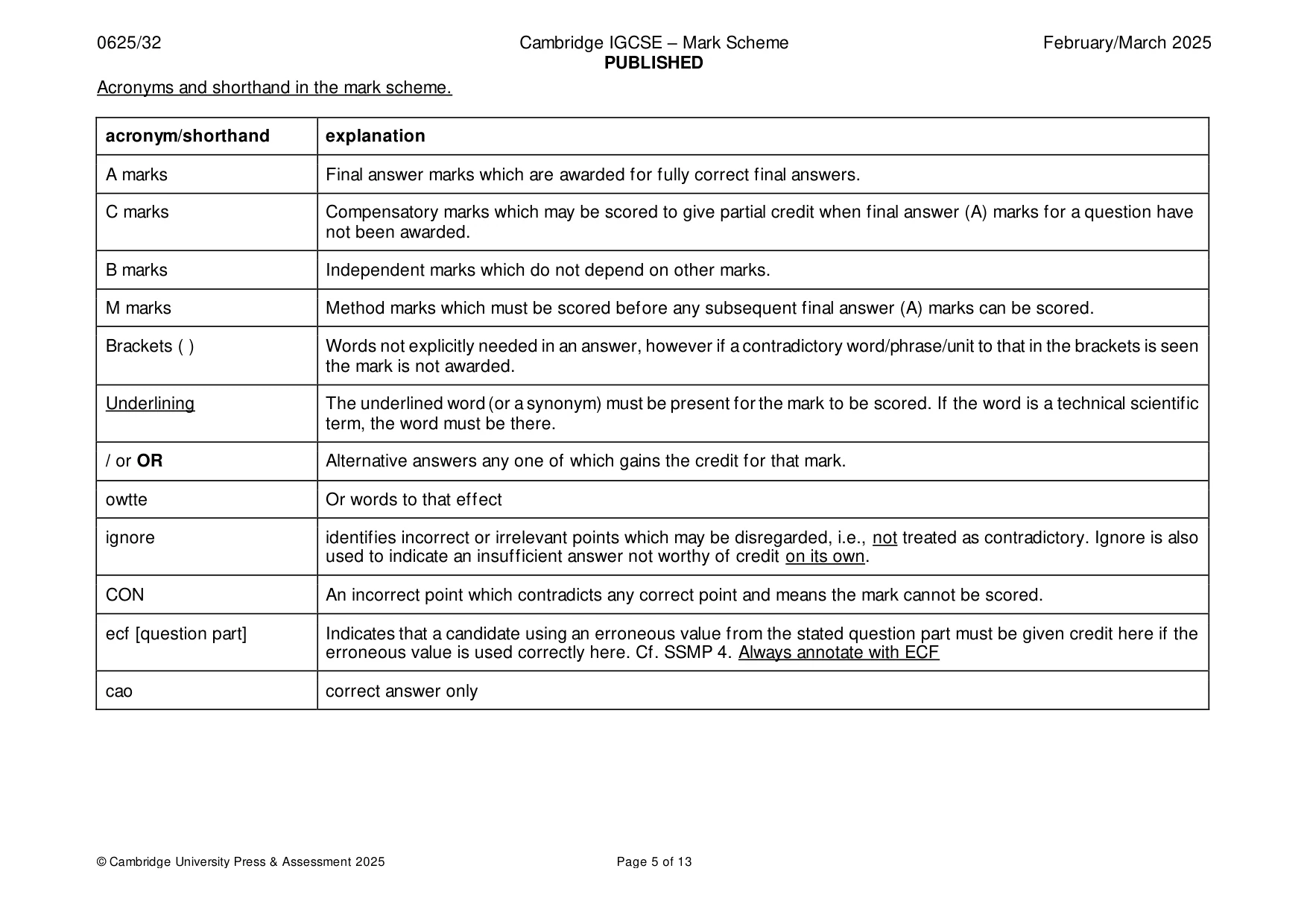
Mark scheme13 pages
Answers below. Sit the paper first if you are practising.
Questions as text
Q1 · The speed-time graph for a ball falling through the air
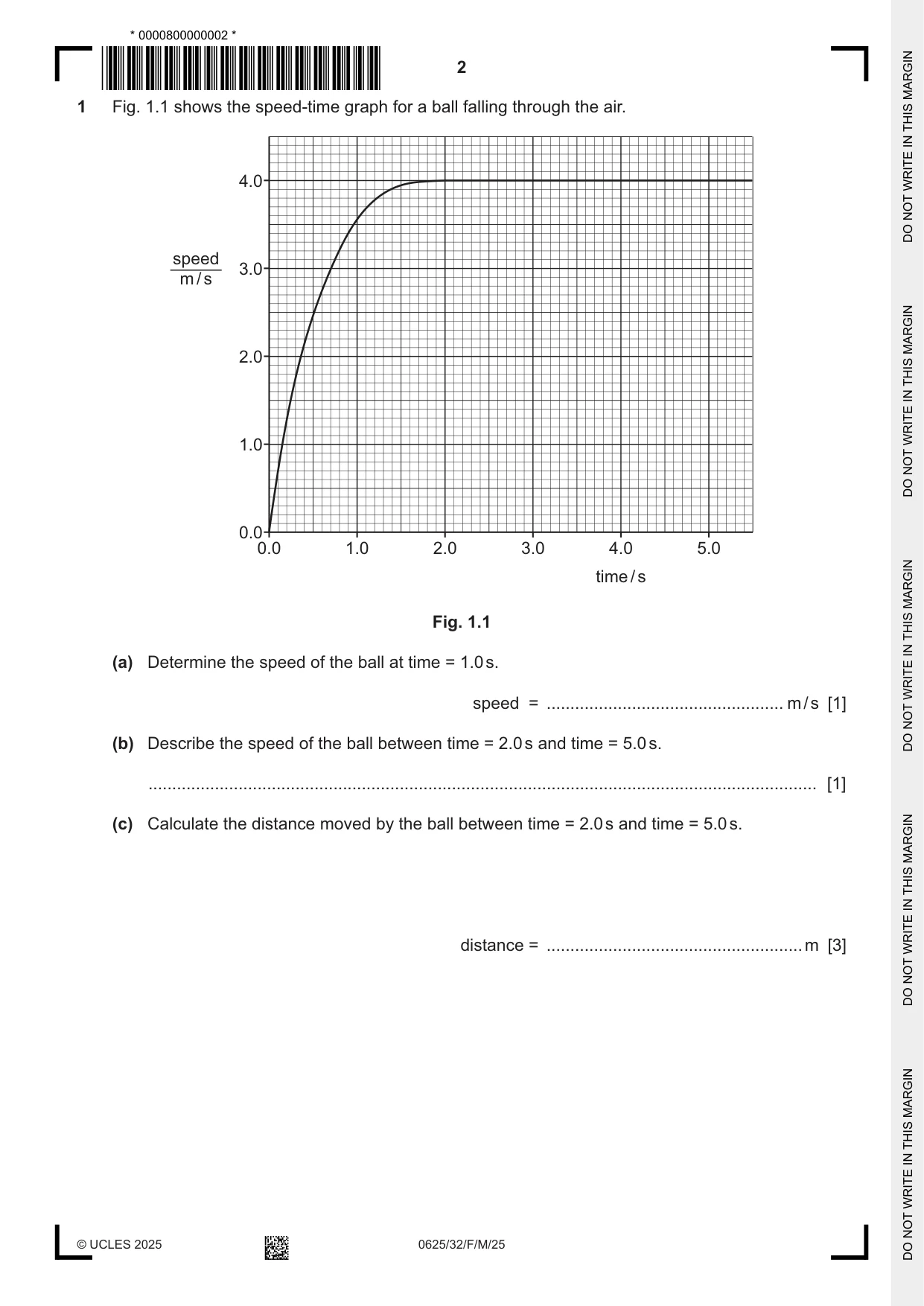
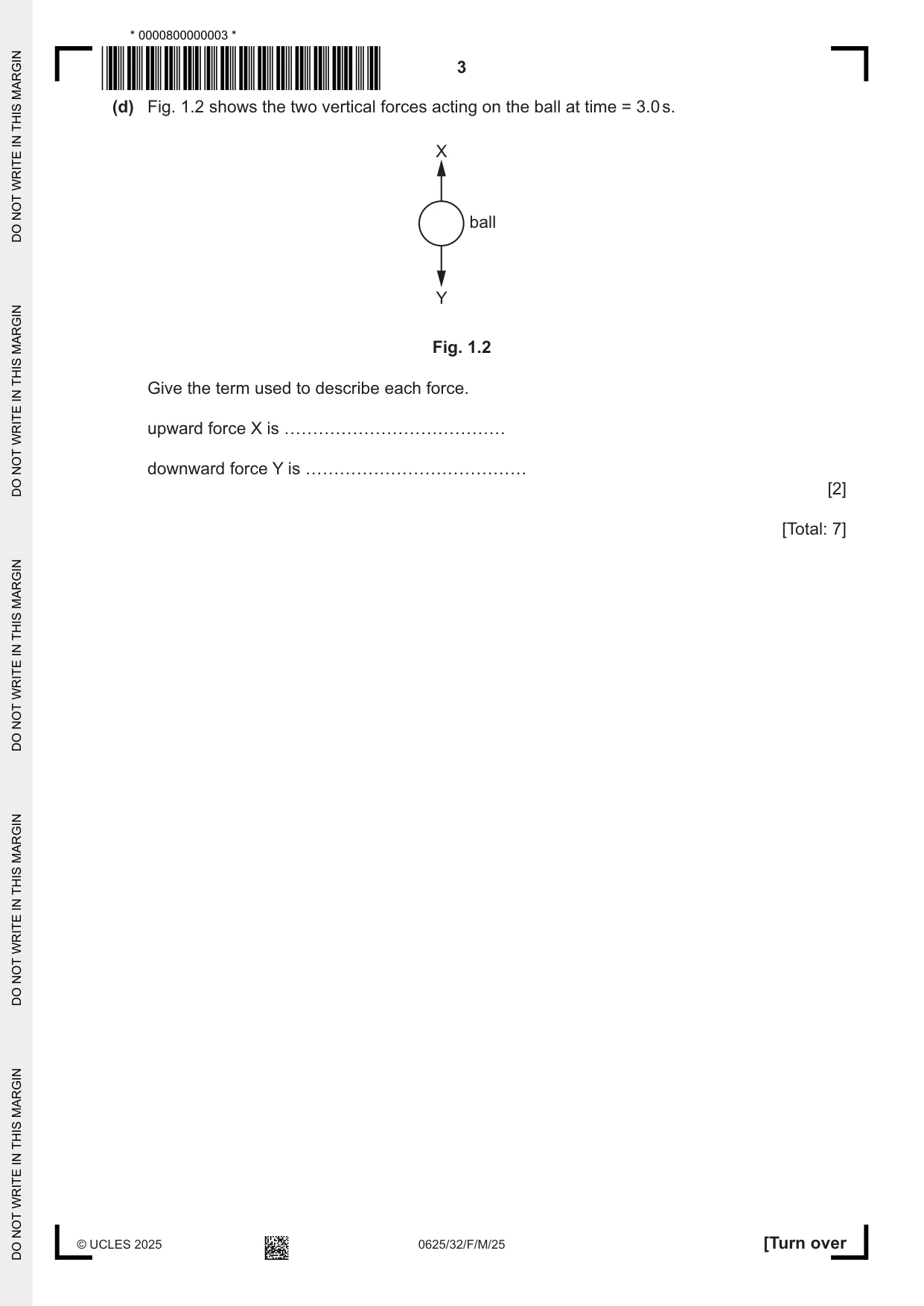
1 Fig. 1.1 shows the speed-time graph for a ball falling through the air. 4.0 speed 3.0 m / s 2.0 1.0 0.0 0.0 1.0 2.0 3.0 4.0 5.0 time / s Fig. 1.1 (a) Determine the speed of the ball at time = 1.0 s. speed = .................................................. m / s [1] (b) Describe the speed of the ball between time = 2.0 s and time = 5.0 s. ............................................................................................................................................. [1] (c) Calculate the distance moved by the ball between time = 2.0 s and time = 5.0 s. distance = ...................................................... m [3] (d) Fig. 1.2 shows the two vertical forces acting on the ball at time = 3.0 s. X ball Y Fig. 1.2 Give the term used to describe each force. upward force X is ………………………………… downward force Y is ………………………………… [2] [Total: 7]
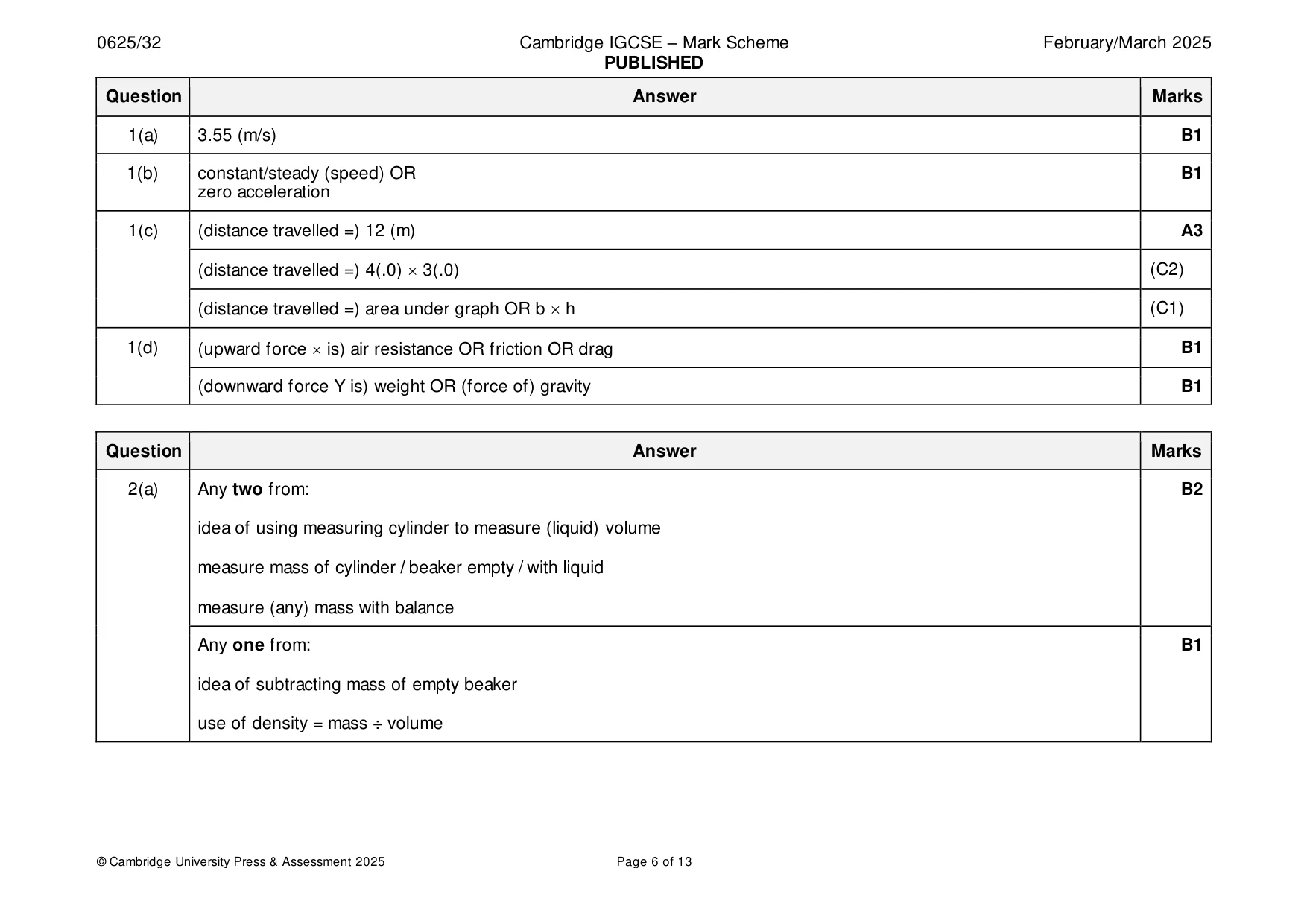
Mark scheme: Question Answer Marks 1(a) 3.55 (m/s) B1 1(b) constant/steady (speed) OR B1 zero acceleration 1(c) (distance travelled =) 12 (m) A3 (distance travelled =) 4(.0) 3(.0) (C2) (distance travelled =) area under graph OR b h (C1) 1(d) (upward force is) air resistance OR friction OR drag B1 (downward force Y is) weight OR (force of) gravity B1
Q2 · A student determines the density of a liquid, by using the equipment shown in Fig
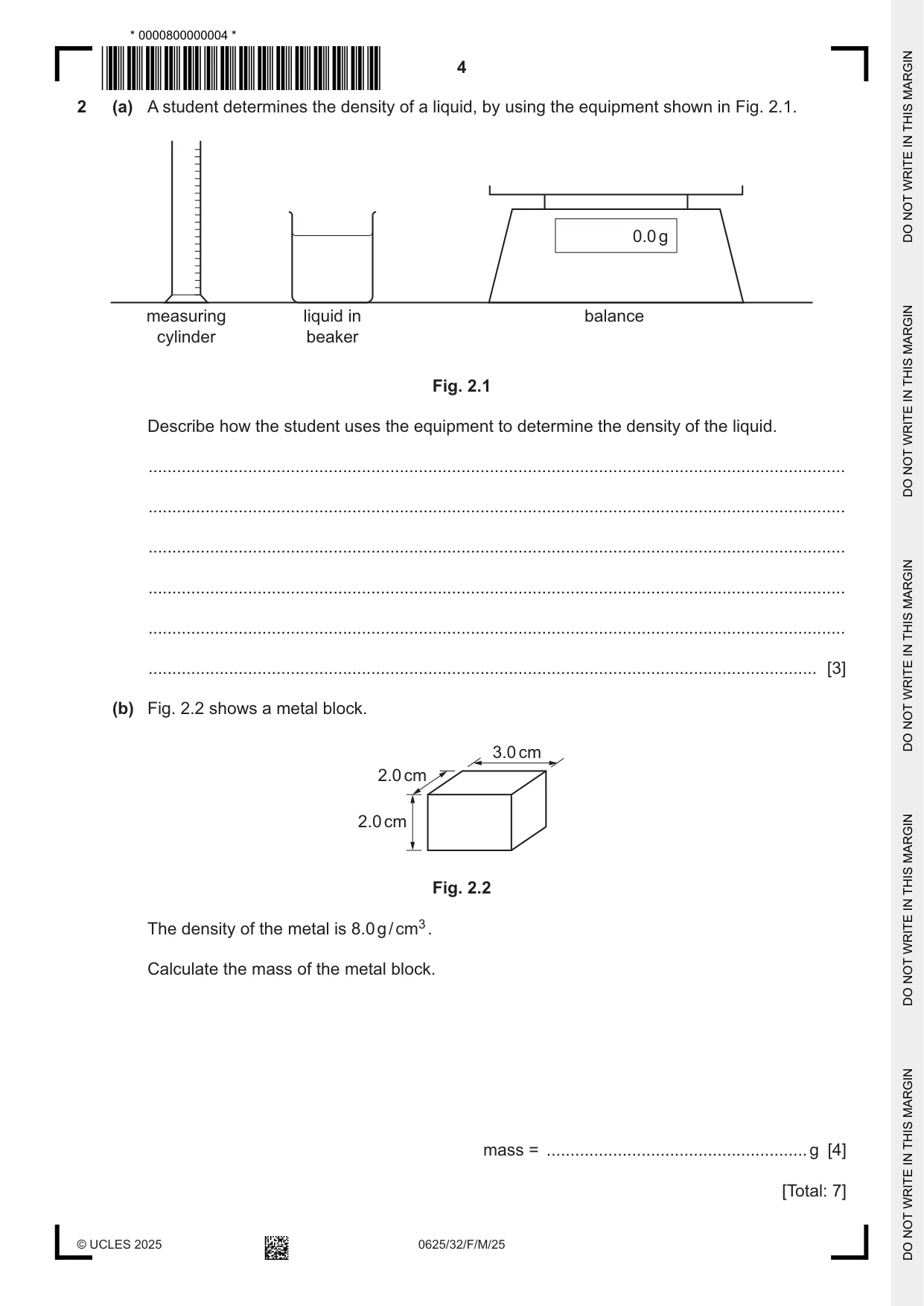
2 (a) A student determines the density of a liquid, by using the equipment shown in Fig. 2.1. 0.0 g measuring liquid in balance cylinder beaker Fig. 2.1 Describe how the student uses the equipment to determine the density of the liquid. ................................................................................................................................................... ................................................................................................................................................... ................................................................................................................................................... ................................................................................................................................................... ................................................................................................................................................... ............................................................................................................................................. [3] (b) Fig. 2.2 shows a metal block. 3.0 cm 2.0 cm 2.0 cm Fig. 2.2 The density of the metal is 8.0 g / cm3 . Calculate the mass of the metal block. mass = ....................................................... g [4] [Total: 7]
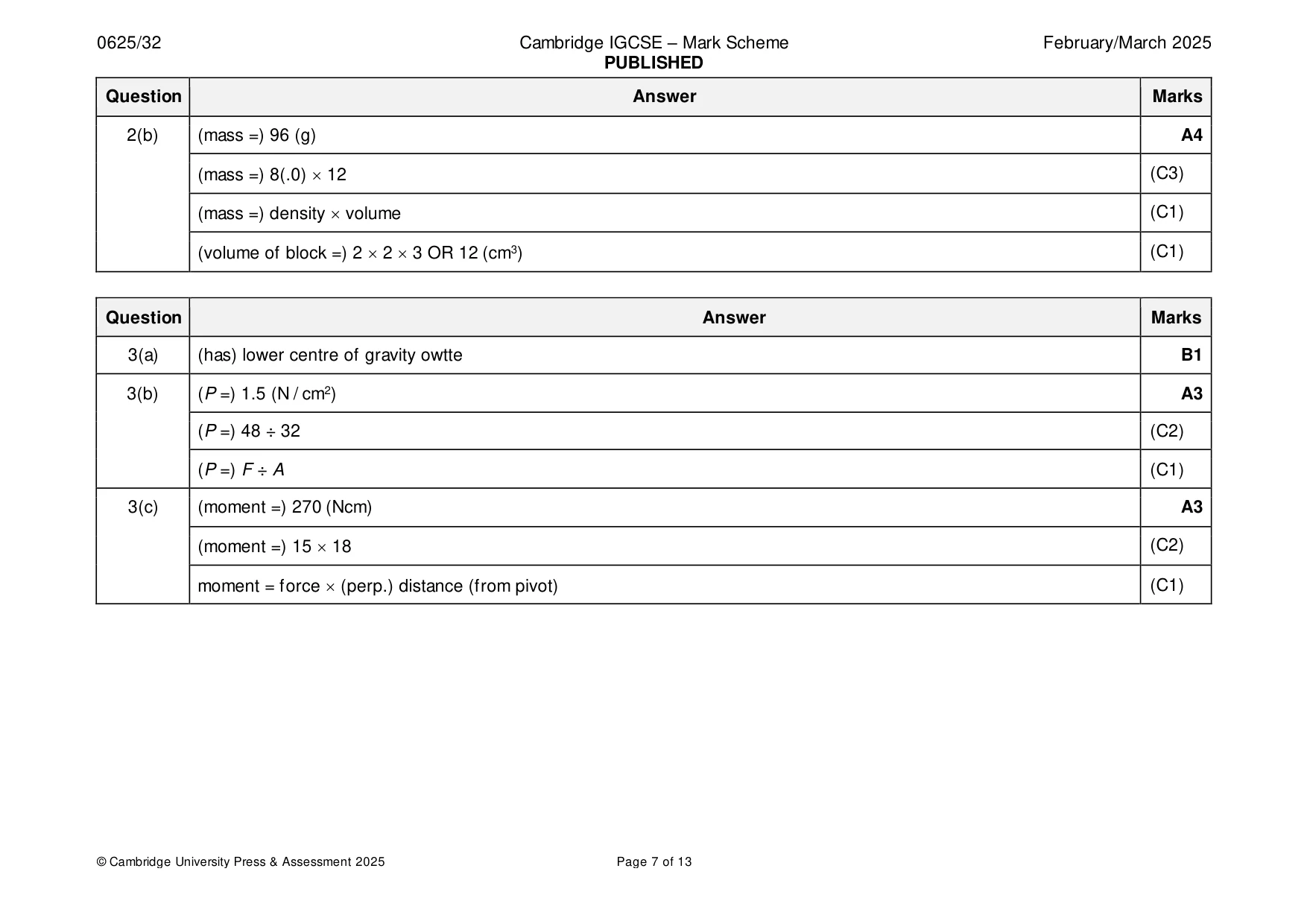
Mark scheme: 2(a) Any two from: B2 idea of using measuring cylinder to measure (liquid) volume measure mass of cylinder / beaker empty / with liquid measure (any) mass with balance Any one from: B1 idea of subtracting mass of empty beaker use of density = mass ÷ volume 2(b) (mass =) 96 (g) A4 (mass =) 8(.0) 12 (C3) (mass =) density volume (C1) (volume of block =) 2 2 3 OR 12 (cm3) (C1)
Q3 · A cross-section through the centre of a solid cone and a cross-section through the centre…
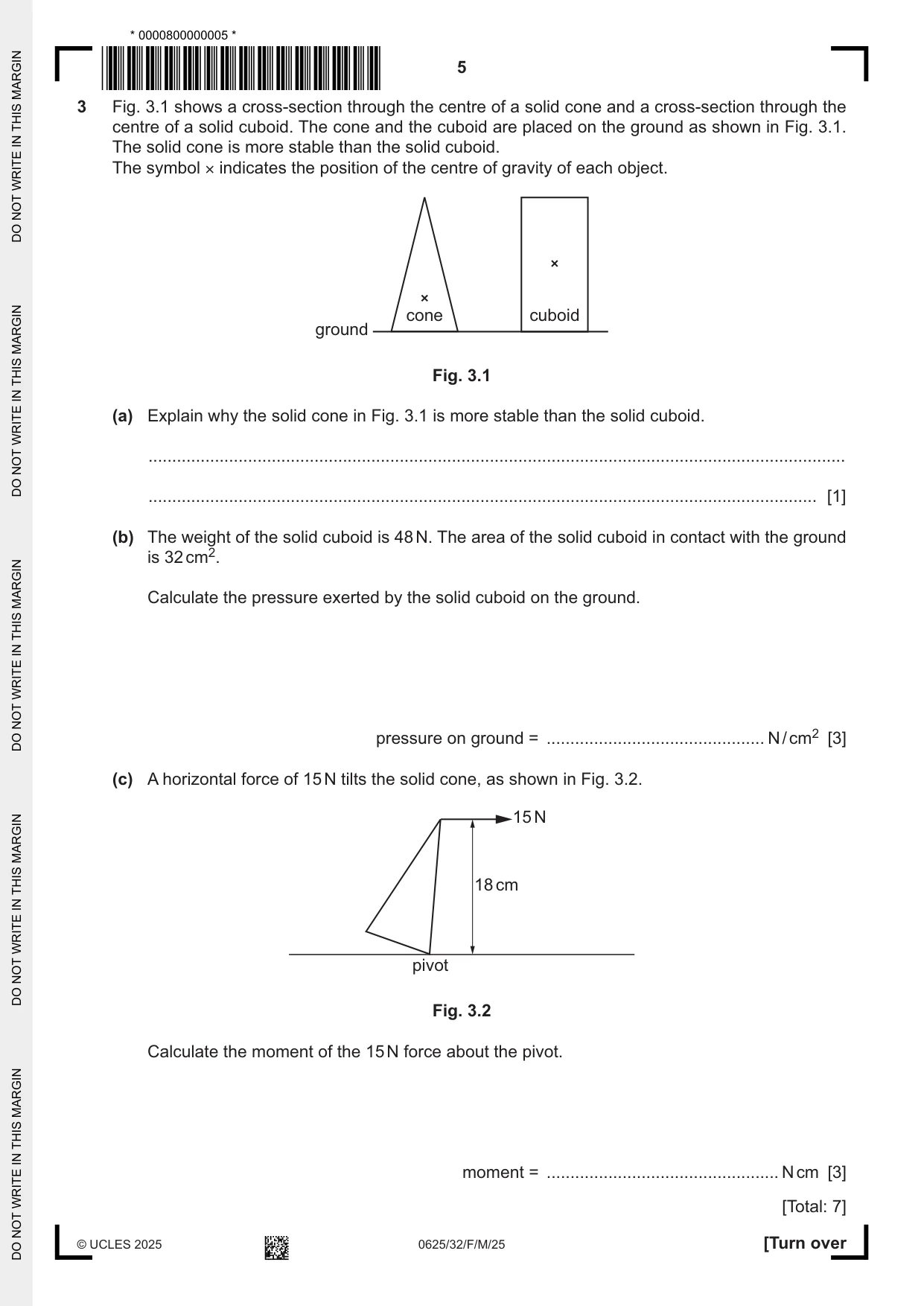
3 Fig. 3.1 shows a cross-section through the centre of a solid cone and a cross-section through the centre of a solid cuboid. The cone and the cuboid are placed on the ground as shown in Fig. 3.1. The solid cone is more stable than the solid cuboid. The symbol × indicates the position of the centre of gravity of each object. cone cuboid ground Fig. 3.1 (a) Explain why the solid cone in Fig. 3.1 is more stable than the solid cuboid. ................................................................................................................................................... ............................................................................................................................................. [1] (b) The weight of the solid cuboid is 48 N. The area of the solid cuboid in contact with the ground is 32 cm2. Calculate the pressure exerted by the solid cuboid on the ground. pressure on ground = .............................................. N / cm2 [3] (c) A horizontal force of 15 N tilts the solid cone, as shown in Fig. 3.2. 15 N 18 cm pivot Fig. 3.2 Calculate the moment of the 15 N force about the pivot. moment = ................................................. N cm [3] [Total: 7]
Mark scheme: 3(a) (has) lower centre of gravity owtte B1 3(b) (P =) 1.5 (N / cm2) A3 (P =) 48 ÷ 32 (C2) (P =) F ÷ A (C1) 3(c) (moment =) 270 (Ncm) A3 (moment =) 15 18 (C2) moment = force (perp.) distance (from pivot) (C1)
Q4 · A power station uses biofuels to generate electrical power
4 A power station uses biofuels to generate electrical power. (a) Describe how the power station generates electrical power from the chemical energy stored in biofuels. ................................................................................................................................................... ................................................................................................................................................... ................................................................................................................................................... ................................................................................................................................................... ................................................................................................................................................... ............................................................................................................................................. [4] (b) State one advantage and one disadvantage, apart from cost, of generating electrical power using biofuels compared with generating electrical power using fossil fuels. advantage ................................................................................................................................. disadvantage ............................................................................................................................. [2] [Total: 6]
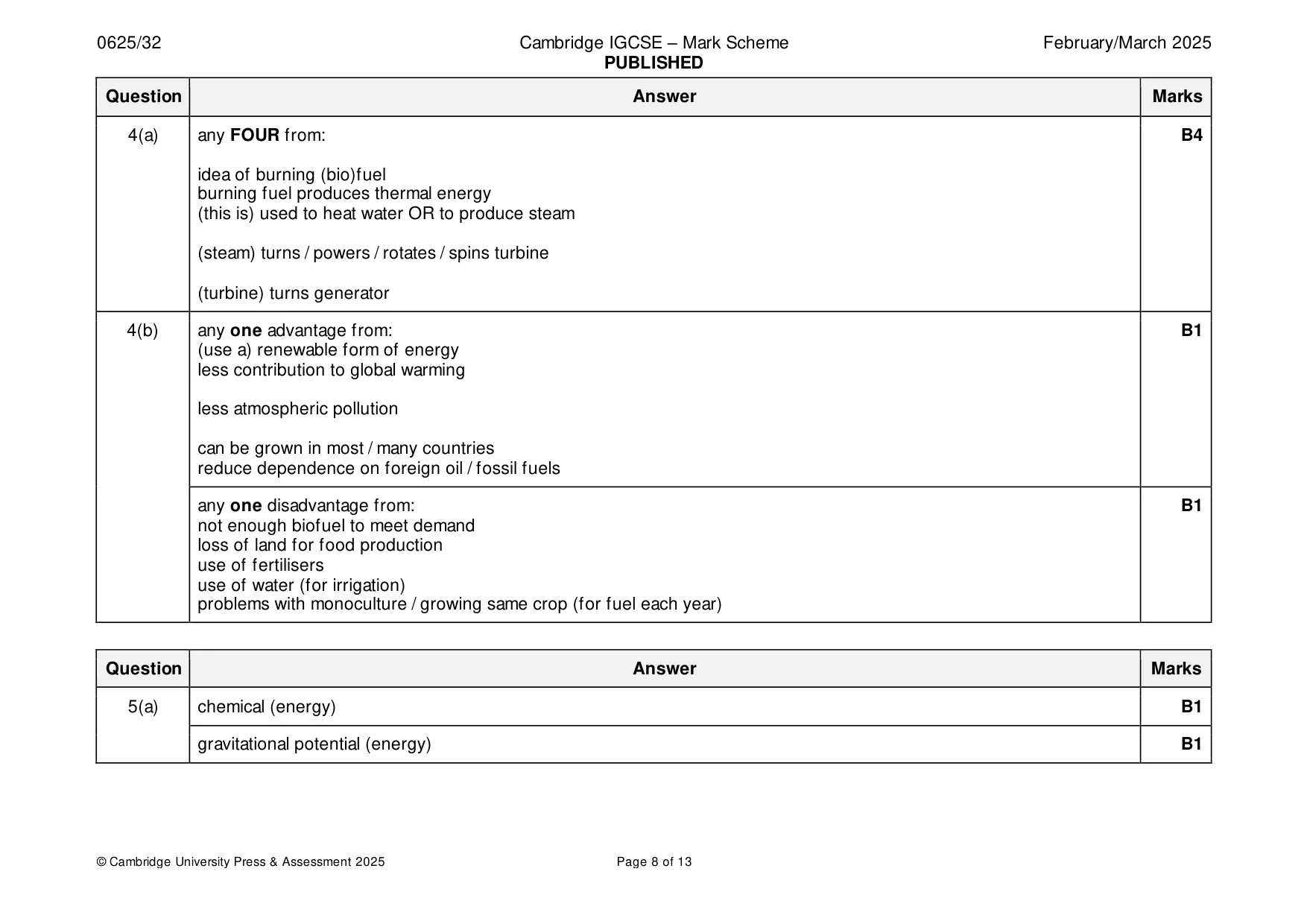
Mark scheme: 4(a) any FOUR from: B4 idea of burning (bio)fuel burning fuel produces thermal energy (this is) used to heat water OR to produce steam (steam) turns / powers / rotates / spins turbine (turbine) turns generator 4(b) any one advantage from: B1 (use a) renewable form of energy less contribution to global warming less atmospheric pollution can be grown in most / many countries reduce dependence on foreign oil / fossil fuels any one disadvantage from: B1 not enough biofuel to meet demand loss of land for food production use of fertilisers use of water (for irrigation) problems with monoculture / growing same crop (for fuel each year)
Q5 · An electric motor lifts a load, as shown in Fig
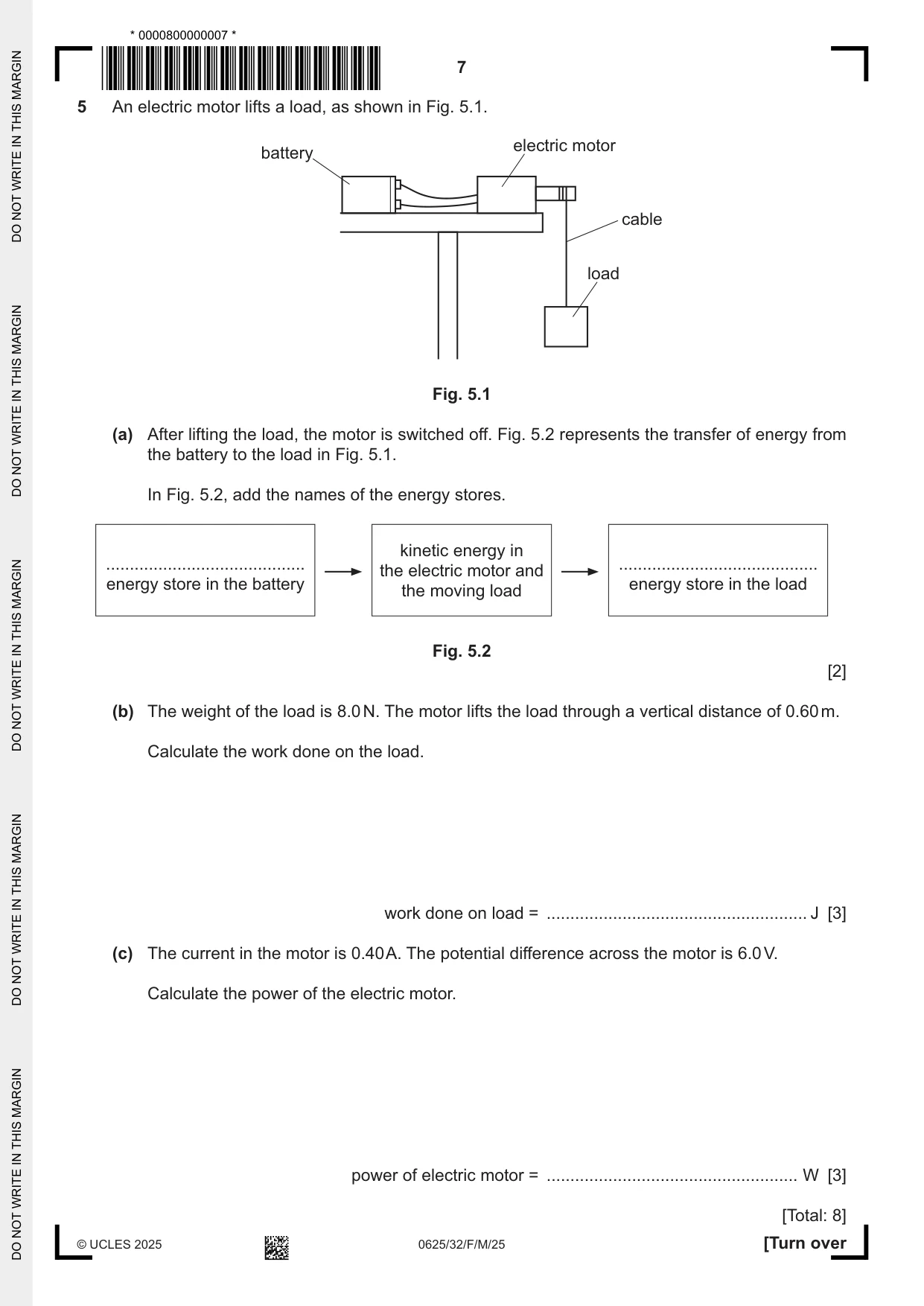
5 An electric motor lifts a load, as shown in Fig. 5.1. electric motor battery cable load Fig. 5.1 (a) After lifting the load, the motor is switched off. Fig. 5.2 represents the transfer of energy from the battery to the load in Fig. 5.1. In Fig. 5.2, add the names of the energy stores. kinetic energy in .......................................... .......................................... the electric motor and energy store in the battery energy store in the load the moving load Fig. 5.2 [2] (b) The weight of the load is 8.0 N. The motor lifts the load through a vertical distance of 0.60 m. Calculate the work done on the load. work done on load = ....................................................... J [3] (c) The current in the motor is 0.40 A. The potential difference across the motor is 6.0 V. Calculate the power of the electric motor. power of electric motor = ..................................................... W [3] [Total: 8]
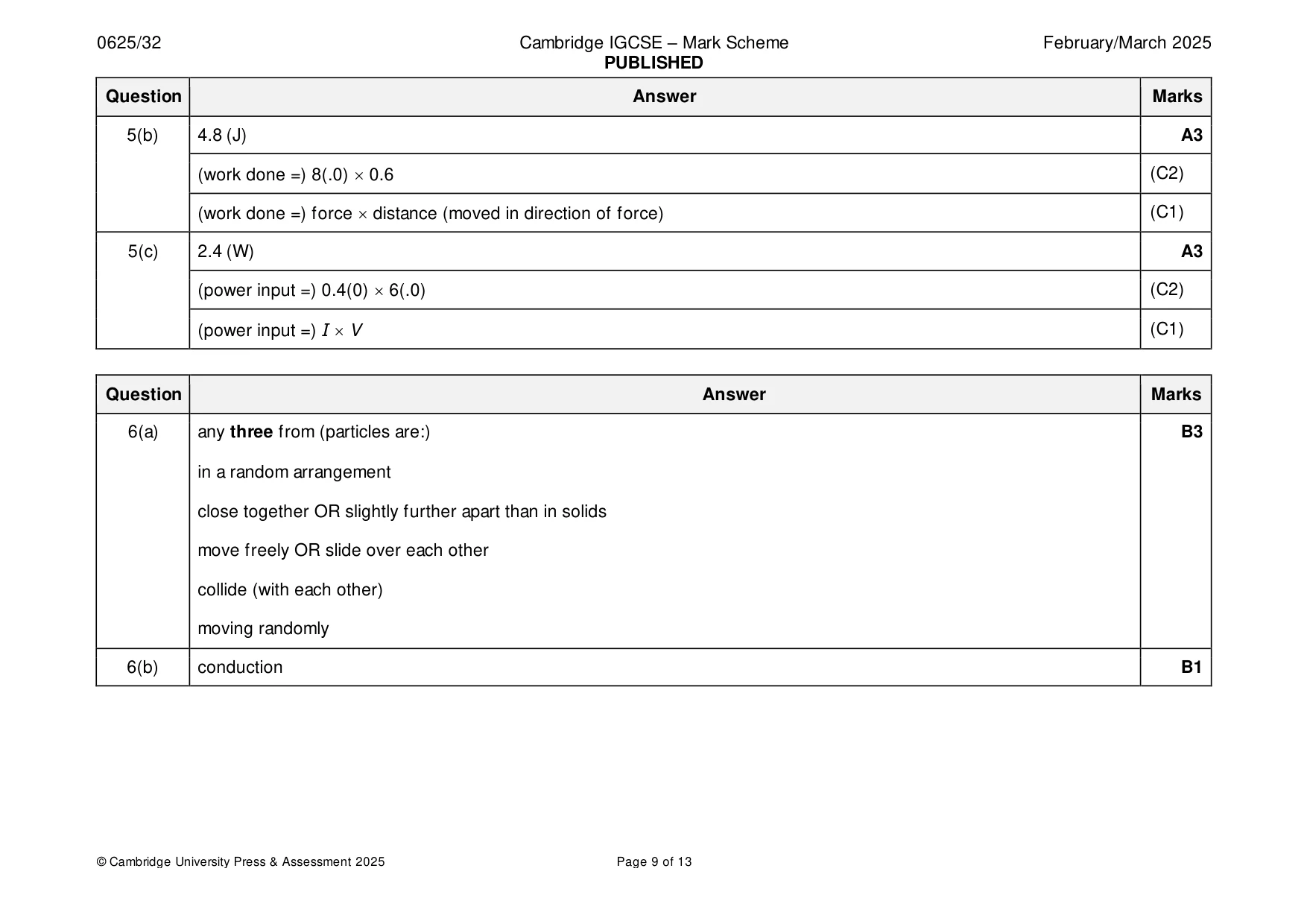
Mark scheme: 5(a) chemical (energy) B1 gravitational potential (energy) B1 5(b) 4.8 (J) A3 (work done =) 8(.0) 0.6 (C2) (work done =) force distance (moved in direction of force) (C1) 5(c) 2.4 (W) A3 (power input =) 0.4(0) 6(.0) (C2) (power input =) I V (C1)
Q6 · A student warms some water in a metal container using an electric heater, as shown in Fig
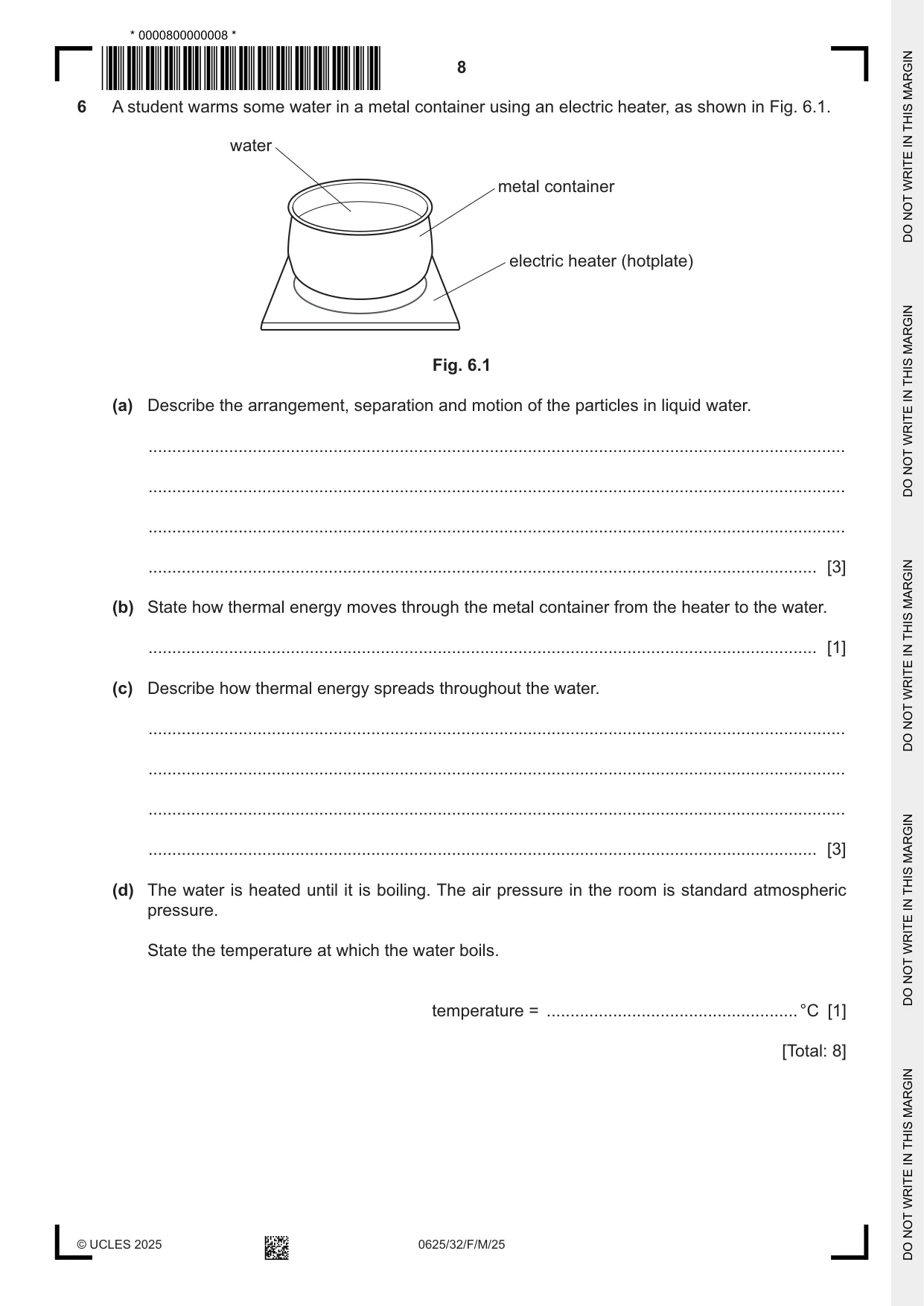
6 A student warms some water in a metal container using an electric heater, as shown in Fig. 6.1. water metal container electric heater (hotplate) Fig. 6.1 (a) Describe the arrangement, separation and motion of the particles in liquid water. ................................................................................................................................................... ................................................................................................................................................... ................................................................................................................................................... ............................................................................................................................................. [3] (b) State how thermal energy moves through the metal container from the heater to the water. ............................................................................................................................................. [1] (c) Describe how thermal energy spreads throughout the water. ................................................................................................................................................... ................................................................................................................................................... ................................................................................................................................................... ............................................................................................................................................. [3] (d) The water is heated until it is boiling. The air pressure in the room is standard atmospheric pressure. State the temperature at which the water boils. temperature = ..................................................... °C [1] [Total: 8]
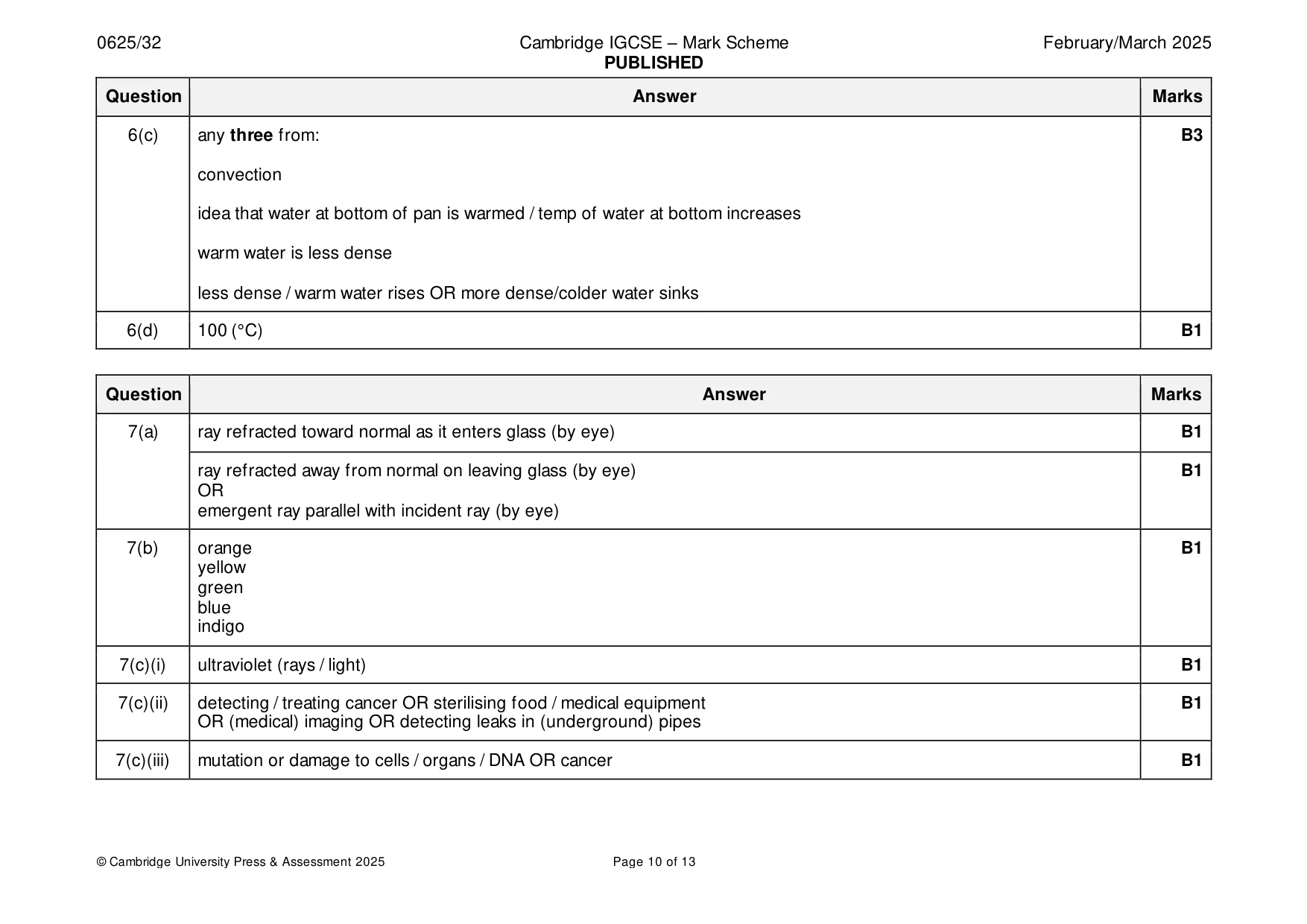
Mark scheme: 6(a) any three from (particles are:) B3 in a random arrangement close together OR slightly further apart than in solids move freely OR slide over each other collide (with each other) moving randomly 6(b) conduction B1 6(c) any three from: B3 convection idea that water at bottom of pan is warmed / temp of water at bottom increases warm water is less dense less dense / warm water rises OR more dense/colder water sinks 6(d) 100 (°C) B1
Q7 · A ray of red light entering one side of a glass block
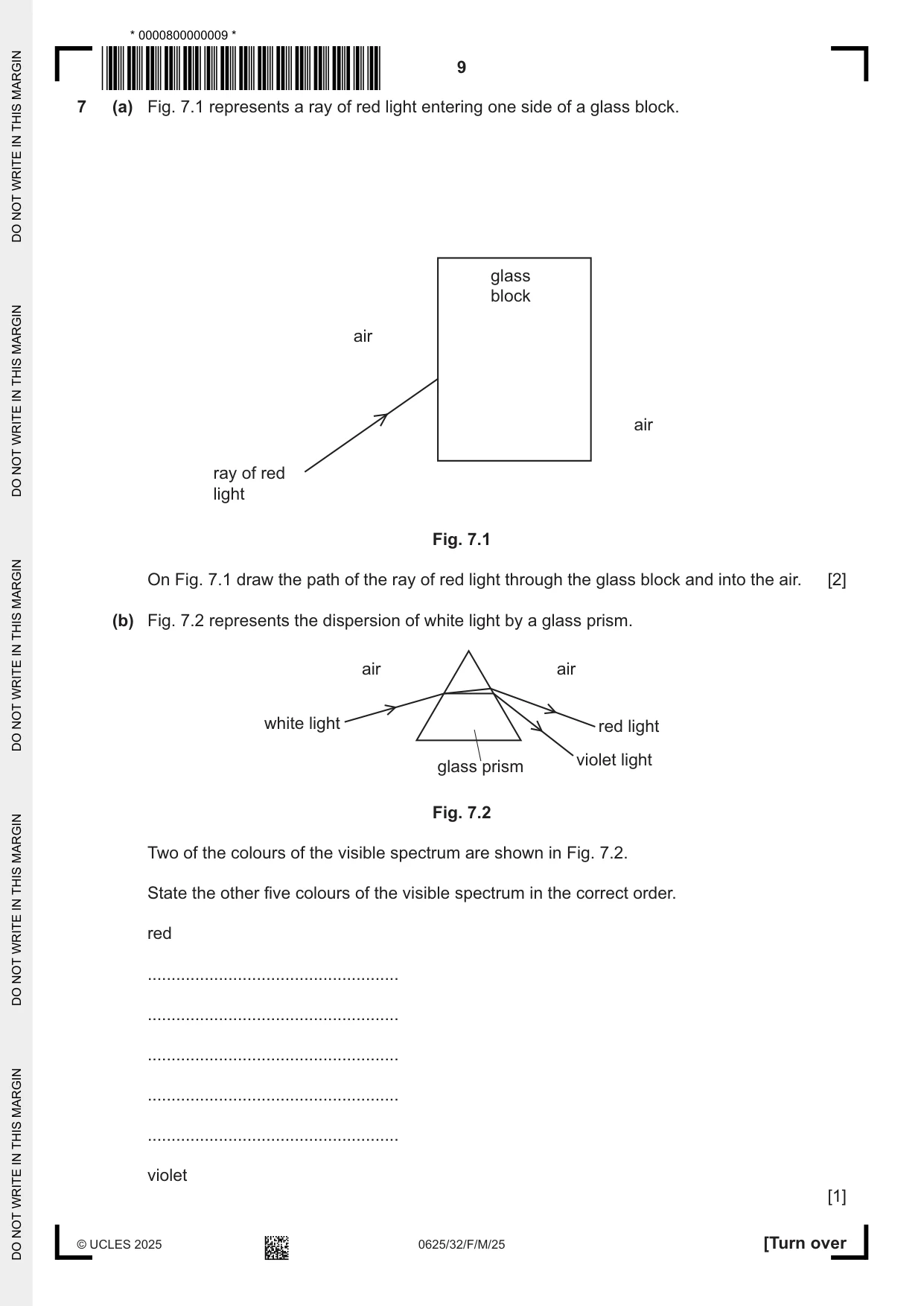
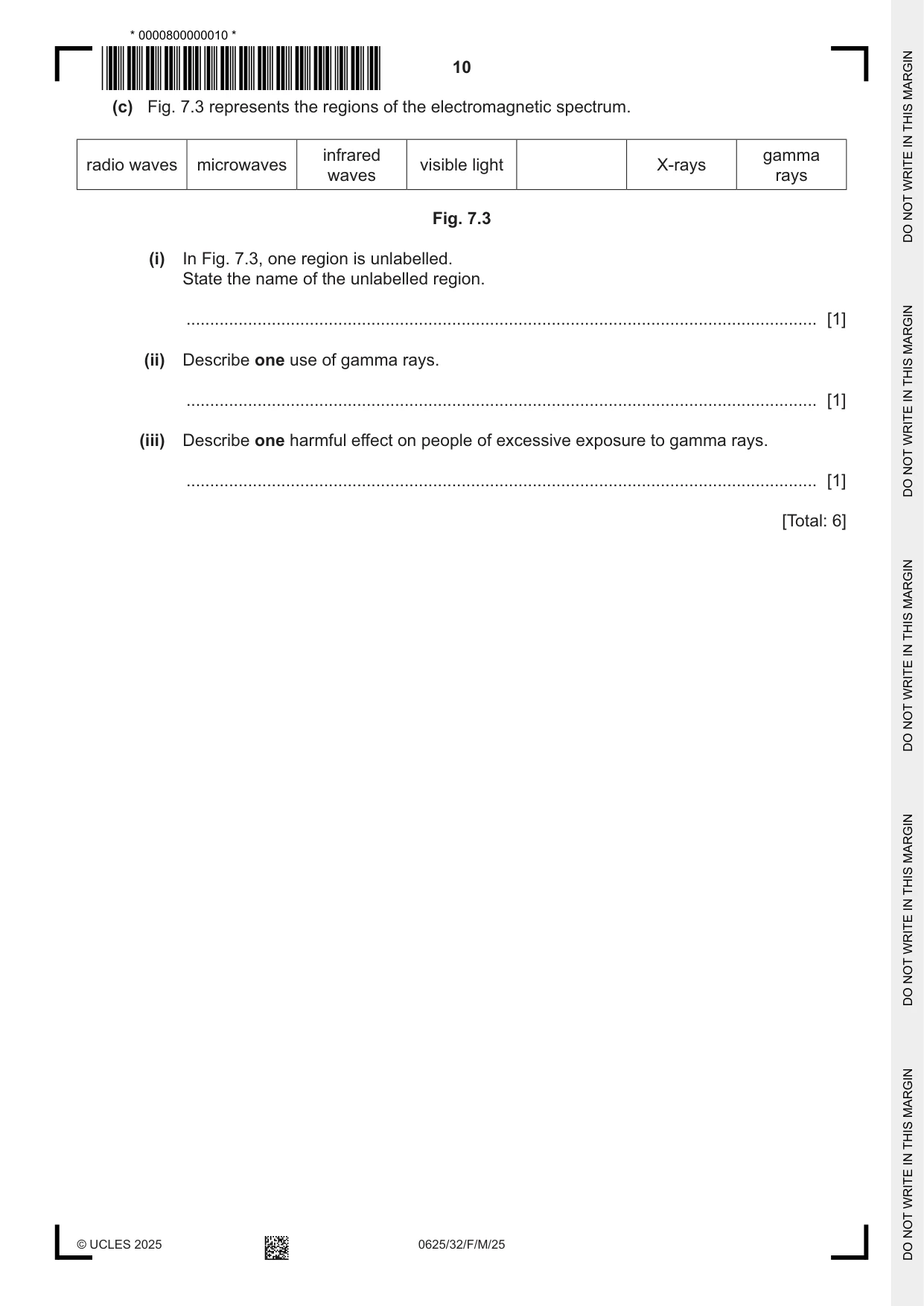
7 (a) Fig. 7.1 represents a ray of red light entering one side of a glass block. glass block air air ray of red light Fig. 7.1 On Fig. 7.1 draw the path of the ray of red light through the glass block and into the air. [2] (b) Fig. 7.2 represents the dispersion of white light by a glass prism. air air white light red light violet light glass prism Fig. 7.2 Two of the colours of the visible spectrum are shown in Fig. 7.2. State the other five colours of the visible spectrum in the correct order. red ..................................................... ..................................................... ..................................................... ..................................................... ..................................................... violet [1] (c) Fig. 7.3 represents the regions of the electromagnetic spectrum. infrared gamma radio waves microwaves visible light X-rays waves rays Fig. 7.3 (i) In Fig. 7.3, one region is unlabelled. State the name of the unlabelled region. ..................................................................................................................................... [1] (ii) Describe one use of gamma rays. ..................................................................................................................................... [1] (iii) Describe one harmful effect on people of excessive exposure to gamma rays. ..................................................................................................................................... [1] [Total: 6]
Mark scheme: 7(a) ray refracted toward normal as it enters glass (by eye) B1 ray refracted away from normal on leaving glass (by eye) B1 OR emergent ray parallel with incident ray (by eye) 7(b) orange B1 yellow green blue indigo 7(c)(i) ultraviolet (rays / light) B1 7(c)(ii) detecting / treating cancer OR sterilising food / medical equipment B1 OR (medical) imaging OR detecting leaks in (underground) pipes 7(c)(iii) mutation or damage to cells / organs / DNA OR cancer B1
Q8 · A student strikes a tuning fork on a wooden block
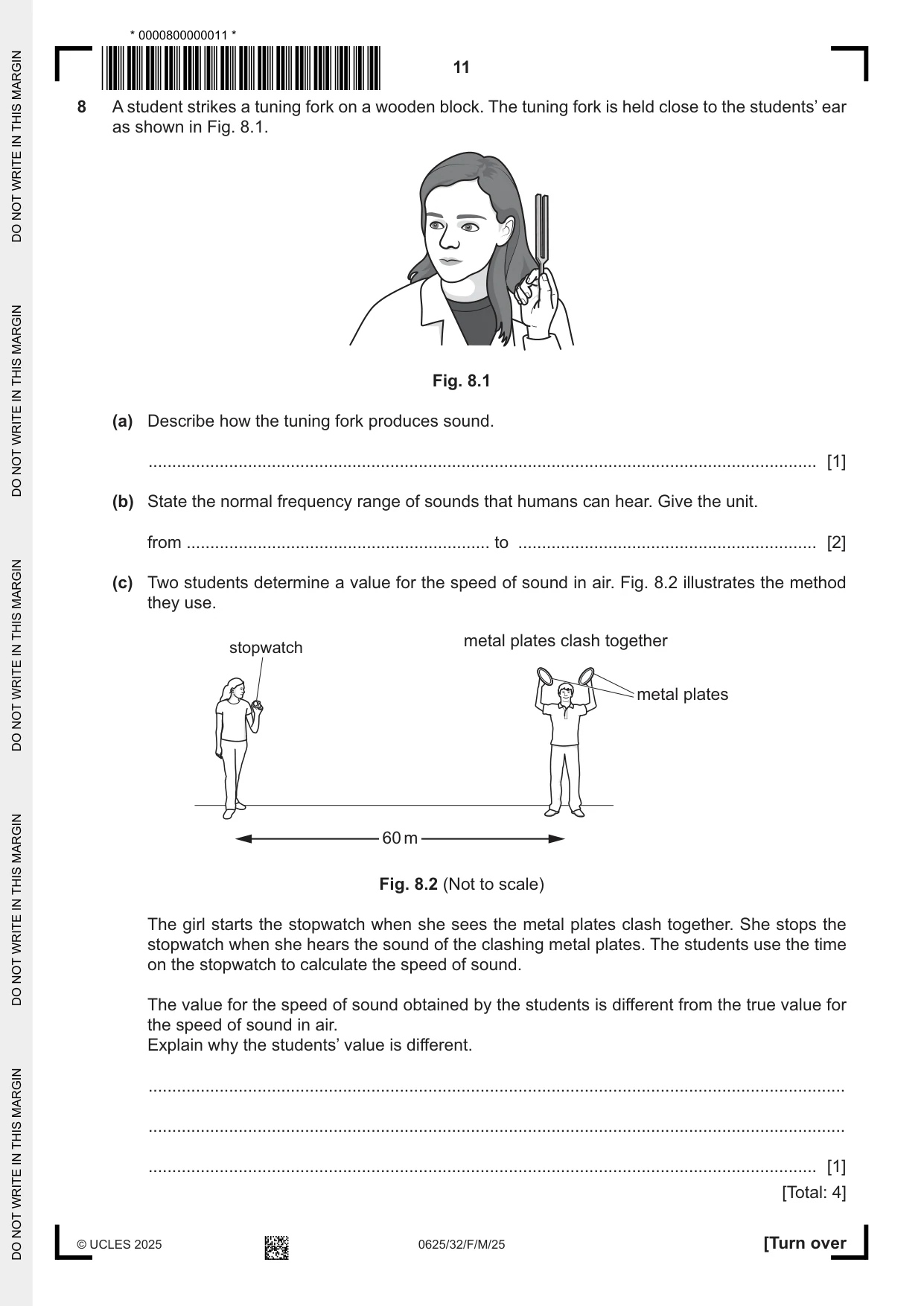
8 A student strikes a tuning fork on a wooden block. The tuning fork is held close to the students’ ear as shown in Fig. 8.1. Fig. 8.1 (a) Describe how the tuning fork produces sound. ............................................................................................................................................. [1] (b) State the normal frequency range of sounds that humans can hear. Give the unit. from ................................................................ to ............................................................... [2] (c) Two students determine a value for the speed of sound in air. Fig. 8.2 illustrates the method they use. metal plates clash together stopwatch metal plates 60 m Fig. 8.2 (Not to scale) The girl starts the stopwatch when she sees the metal plates clash together. She stops the stopwatch when she hears the sound of the clashing metal plates. The students use the time on the stopwatch to calculate the speed of sound. The value for the speed of sound obtained by the students is different from the true value for the speed of sound in air. Explain why the students’ value is different. ................................................................................................................................................... ................................................................................................................................................... ............................................................................................................................................. [1] [Total: 4]
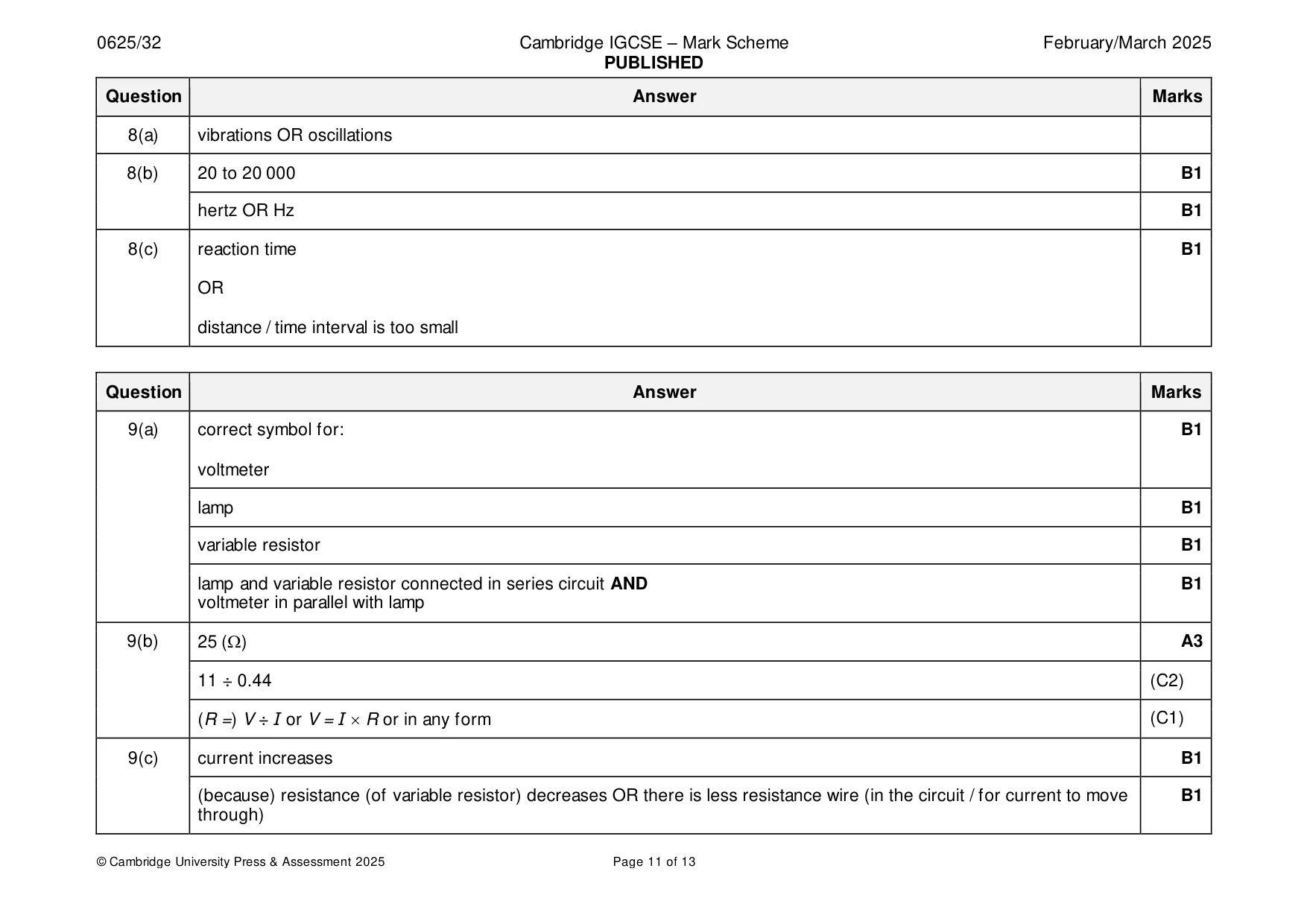
Mark scheme: 8(b) 20 to 20 000 B1 hertz OR Hz B1 8(c) reaction time B1 OR distance / time interval is too small
Q9 · A student set up the electrical circuit that is shown in Fig
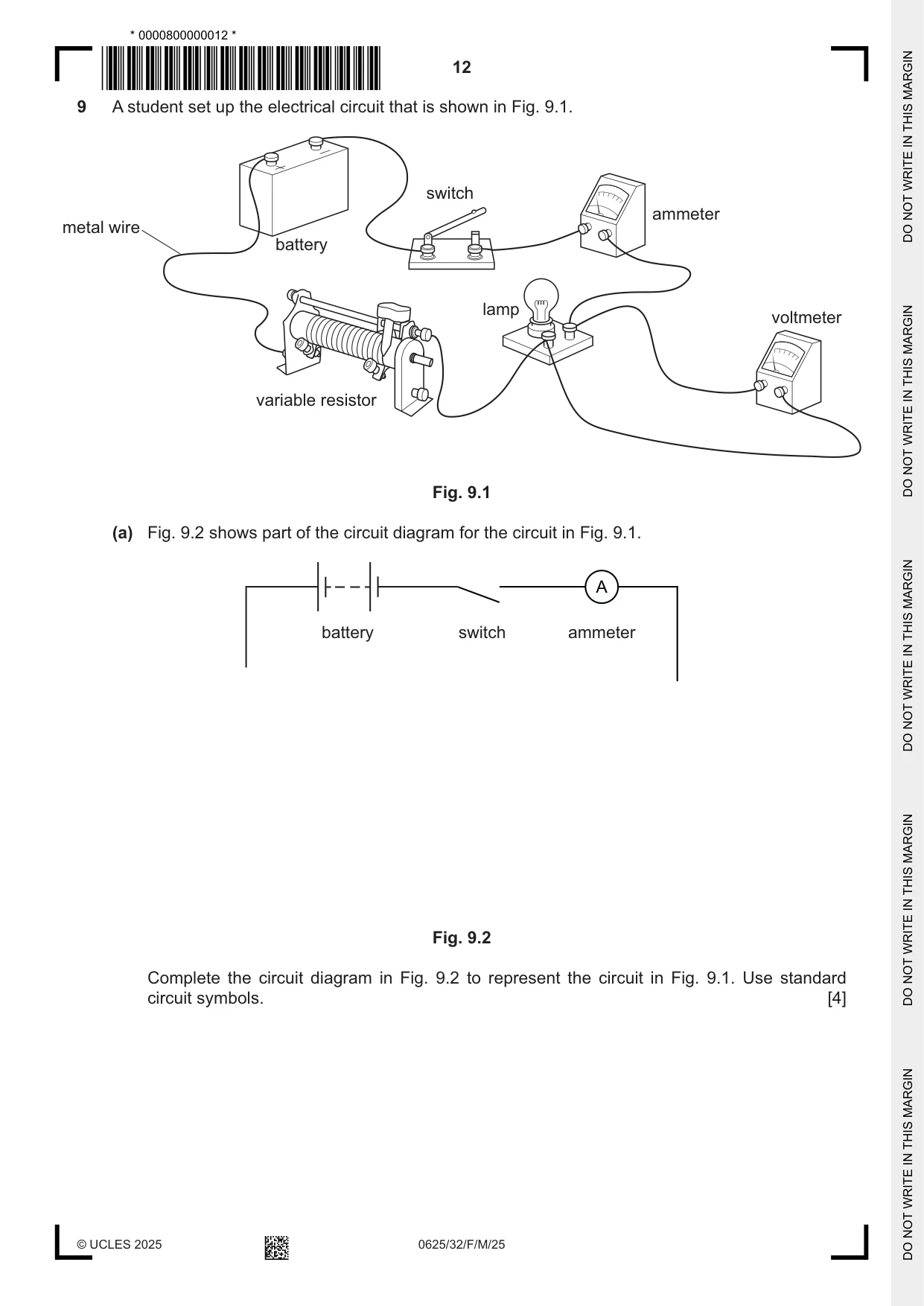
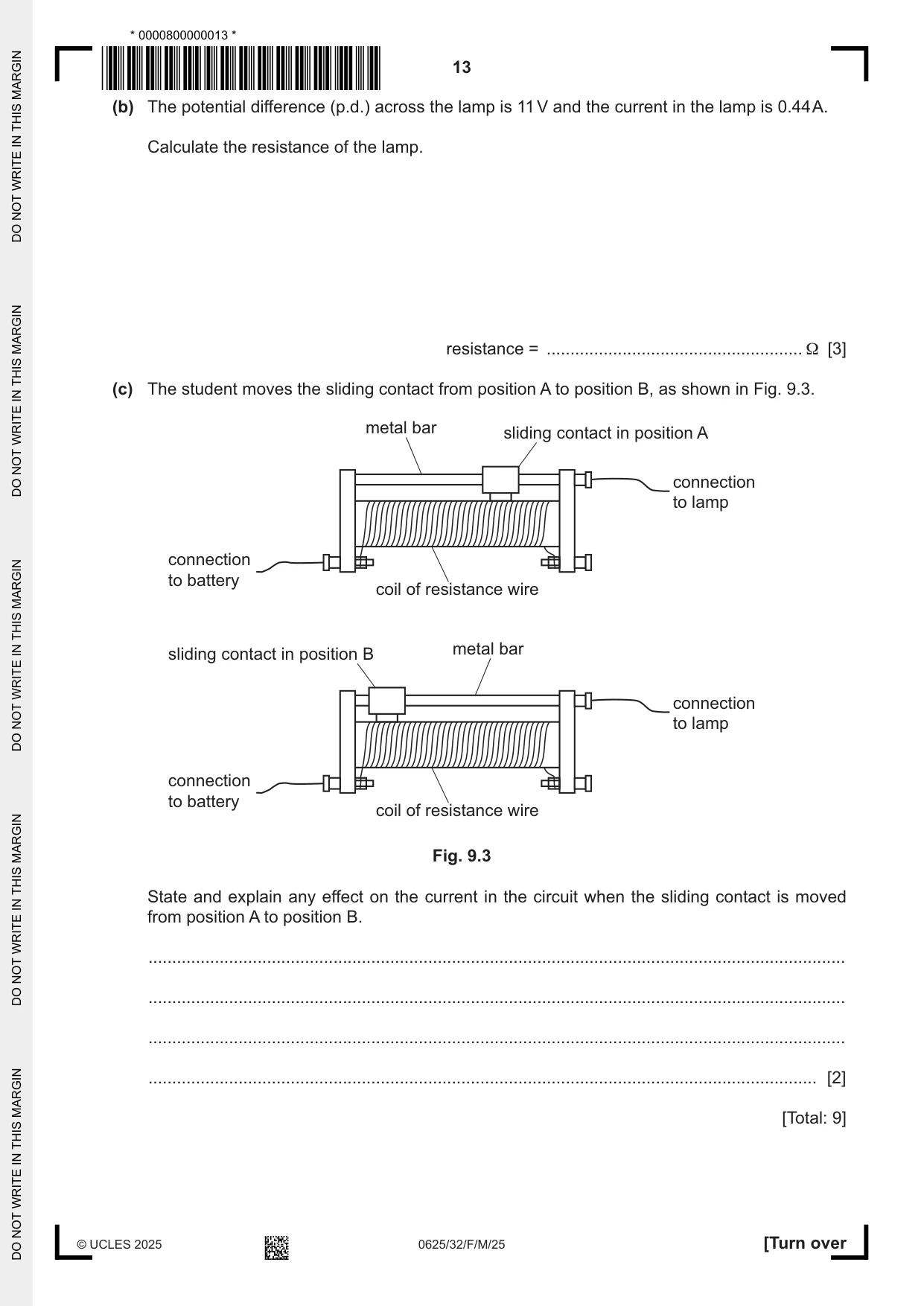
9 A student set up the electrical circuit that is shown in Fig. 9.1. switch ammeter metal wire battery lamp voltmeter variable resistor Fig. 9.1 (a) Fig. 9.2 shows part of the circuit diagram for the circuit in Fig. 9.1. A battery switch ammeter Fig. 9.2 Complete the circuit diagram in Fig. 9.2 to represent the circuit in Fig. 9.1. Use standard circuit symbols. [4] (b) The potential difference (p.d.) across the lamp is 11 V and the current in the lamp is 0.44 A. Calculate the resistance of the lamp. resistance = ...................................................... Ω [3] (c) The student moves the sliding contact from position A to position B, as shown in Fig. 9.3. metal bar sliding contact in position A connection to lamp connection to battery coil of resistance wire metal bar sliding contact in position B connection to lamp connection to battery coil of resistance wire Fig. 9.3 State and explain any effect on the current in the circuit when the sliding contact is moved from position A to position B. ................................................................................................................................................... ................................................................................................................................................... ................................................................................................................................................... ............................................................................................................................................. [2] [Total: 9]
Mark scheme: 9(a) correct symbol for: B1 voltmeter lamp B1 variable resistor B1 lamp and variable resistor connected in series circuit AND B1 voltmeter in parallel with lamp 9(b) 25 () A3 11 ÷ 0.44 (C2) (R =) V ÷ I or V = I R or in any form (C1) 9(c) current increases B1 (because) resistance (of variable resistor) decreases OR there is less resistance wire (in the circuit / for current to move B1 through)
Q10 · The apparatus used by a student to demonstrate electromagnetic induction
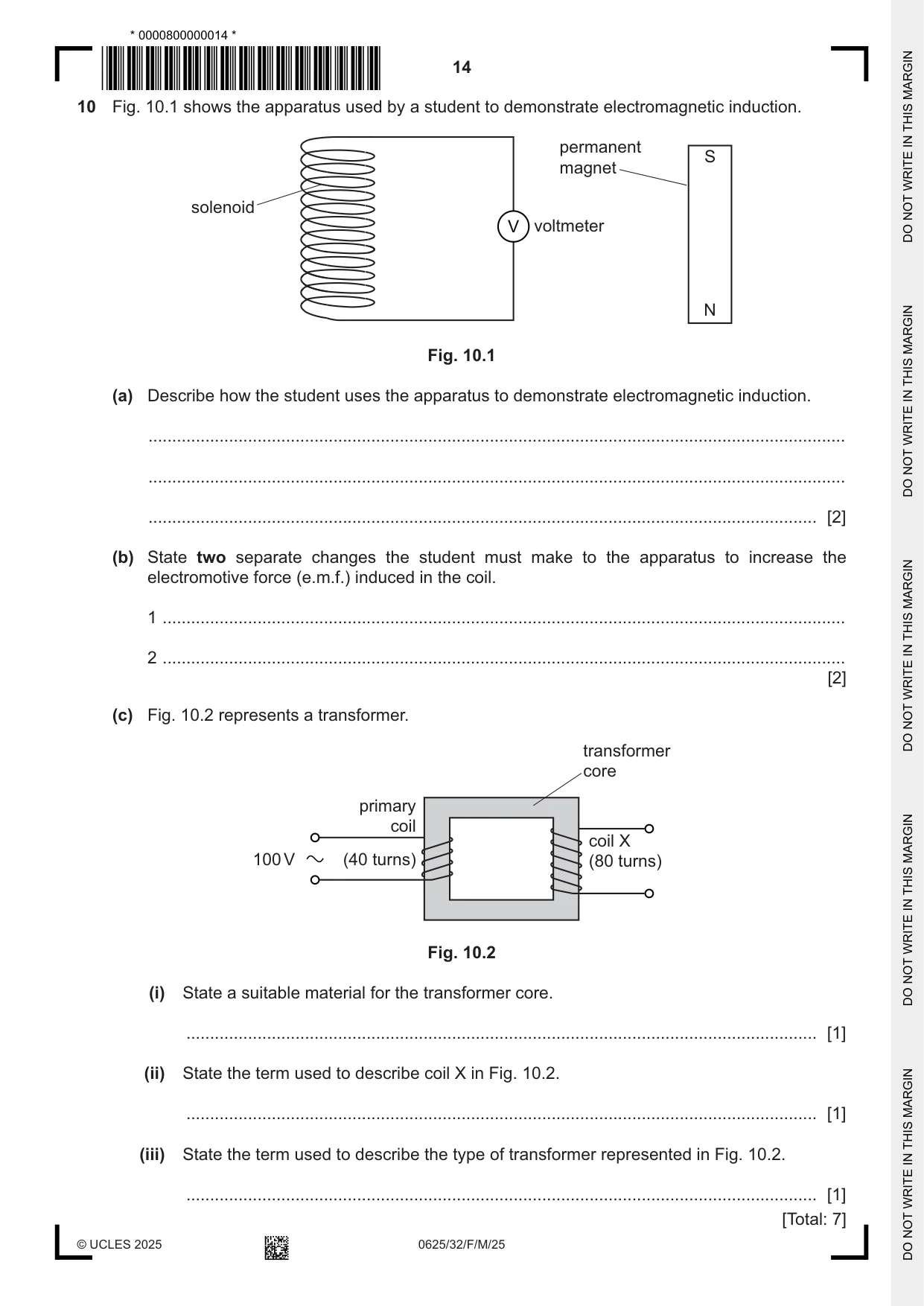
10 Fig. 10.1 shows the apparatus used by a student to demonstrate electromagnetic induction. permanent S magnet solenoid V voltmeter N Fig. 10.1 (a) Describe how the student uses the apparatus to demonstrate electromagnetic induction. ................................................................................................................................................... ................................................................................................................................................... ............................................................................................................................................. [2] (b) State two separate changes the student must make to the apparatus to increase the electromotive force (e.m.f.) induced in the coil. 1 ................................................................................................................................................ 2 ................................................................................................................................................ [2] (c) Fig. 10.2 represents a transformer. transformer core primary coil coil X 100 V (40 turns) (80 turns) Fig. 10.2 (i) State a suitable material for the transformer core. ..................................................................................................................................... [1] (ii) State the term used to describe coil X in Fig. 10.2. ..................................................................................................................................... [1] (iii) State the term used to describe the type of transformer represented in Fig. 10.2. ..................................................................................................................................... [1] [Total: 7]
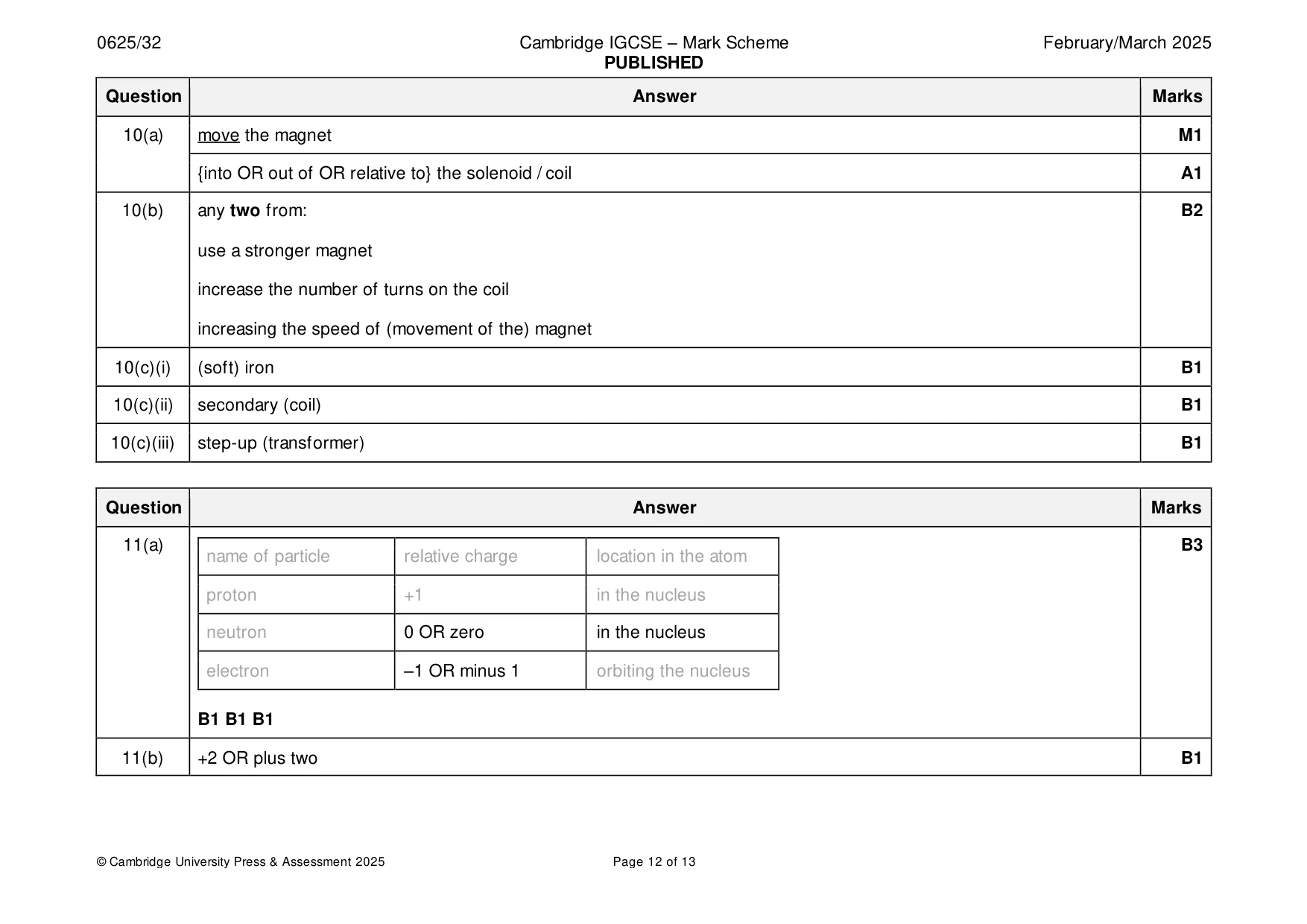
Mark scheme: 10(a) move the magnet M1 {into OR out of OR relative to} the solenoid / coil A1 10(b) any two from: B2 use a stronger magnet increase the number of turns on the coil increasing the speed of (movement of the) magnet 10(c)(i) (soft) iron B1 10(c)(ii) secondary (coil) B1 10(c)(iii) step-up (transformer) B1
Q11 · Information about the particles in an atom
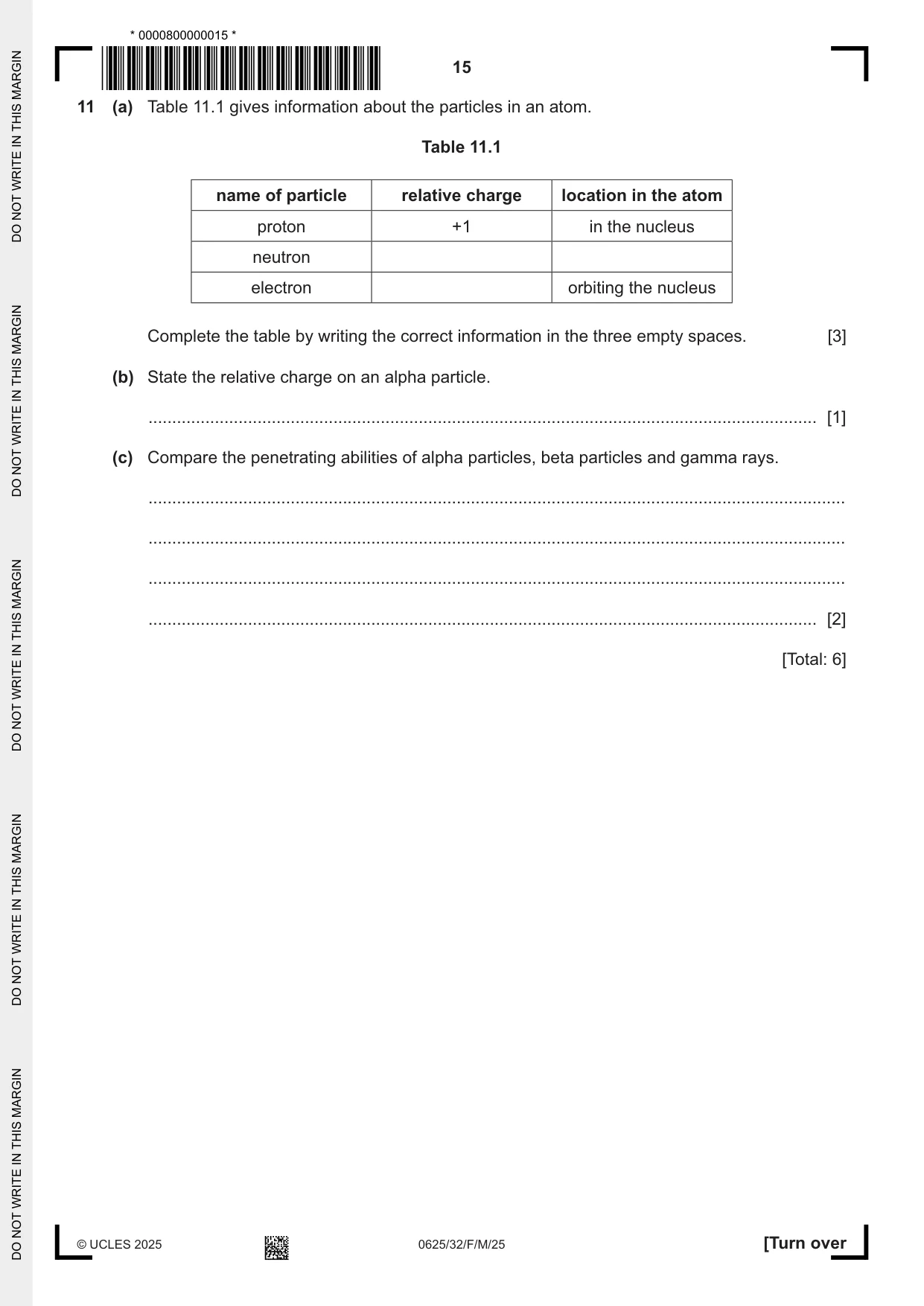
11 (a) Table 11.1 gives information about the particles in an atom. Table 11.1 name of particle relative charge location in the atom proton +1 in the nucleus neutron electron orbiting the nucleus Complete the table by writing the correct information in the three empty spaces. [3] (b) State the relative charge on an alpha particle. ............................................................................................................................................. [1] (c) Compare the penetrating abilities of alpha particles, beta particles and gamma rays. ................................................................................................................................................... ................................................................................................................................................... ................................................................................................................................................... ............................................................................................................................................. [2] [Total: 6]
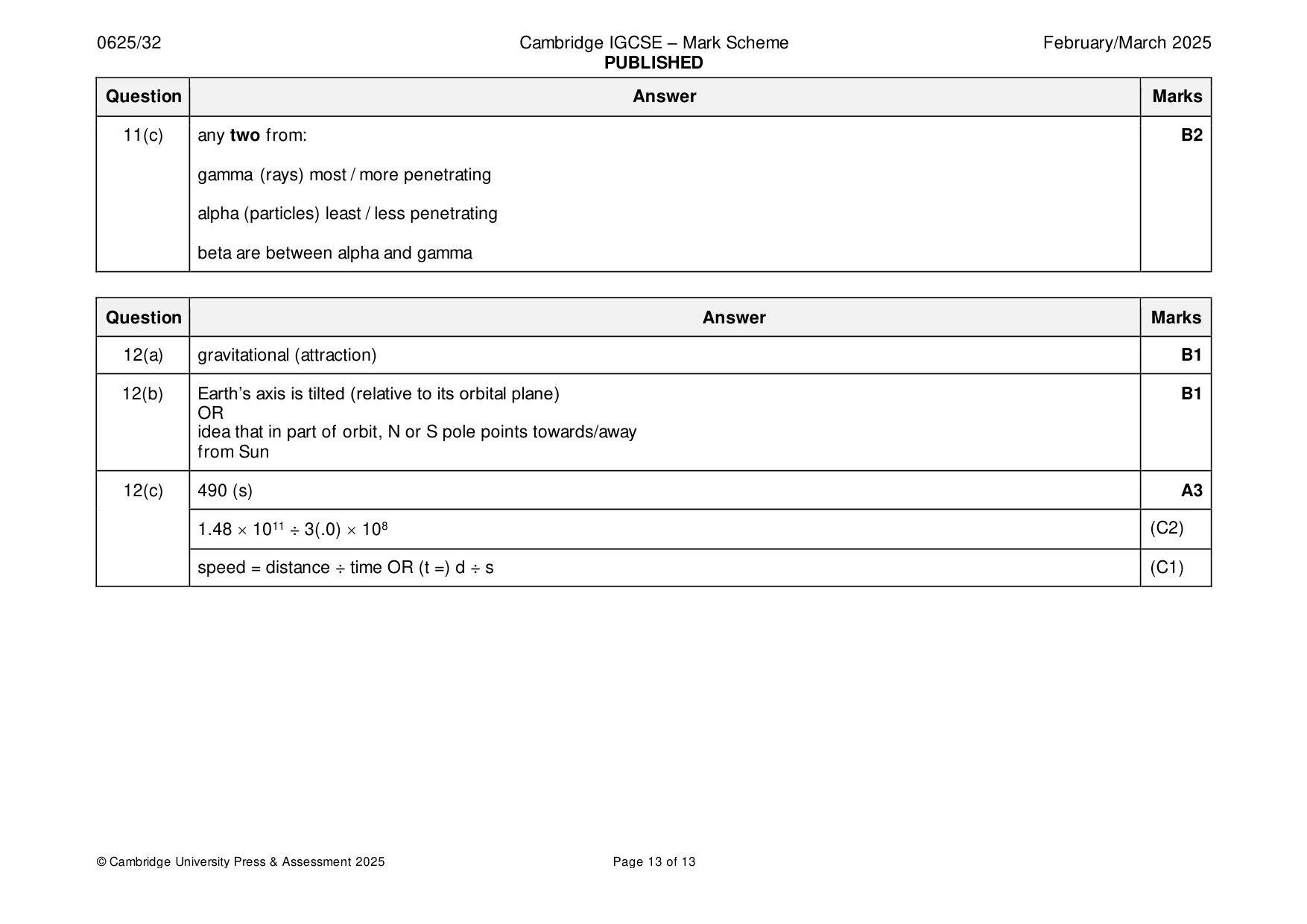
Mark scheme: 11(a) B3 name of particle relative charge location in the atom proton +1 in the nucleus neutron 0 OR zero in the nucleus electron –1 OR minus 1 orbiting the nucleus B1 B1 B1 11(b) +2 OR plus two B1 11(c) any two from: B2 gamma (rays) most / more penetrating alpha (particles) least / less penetrating beta are between alpha and gamma
Q12 · The Earth’s orbit of the Sun
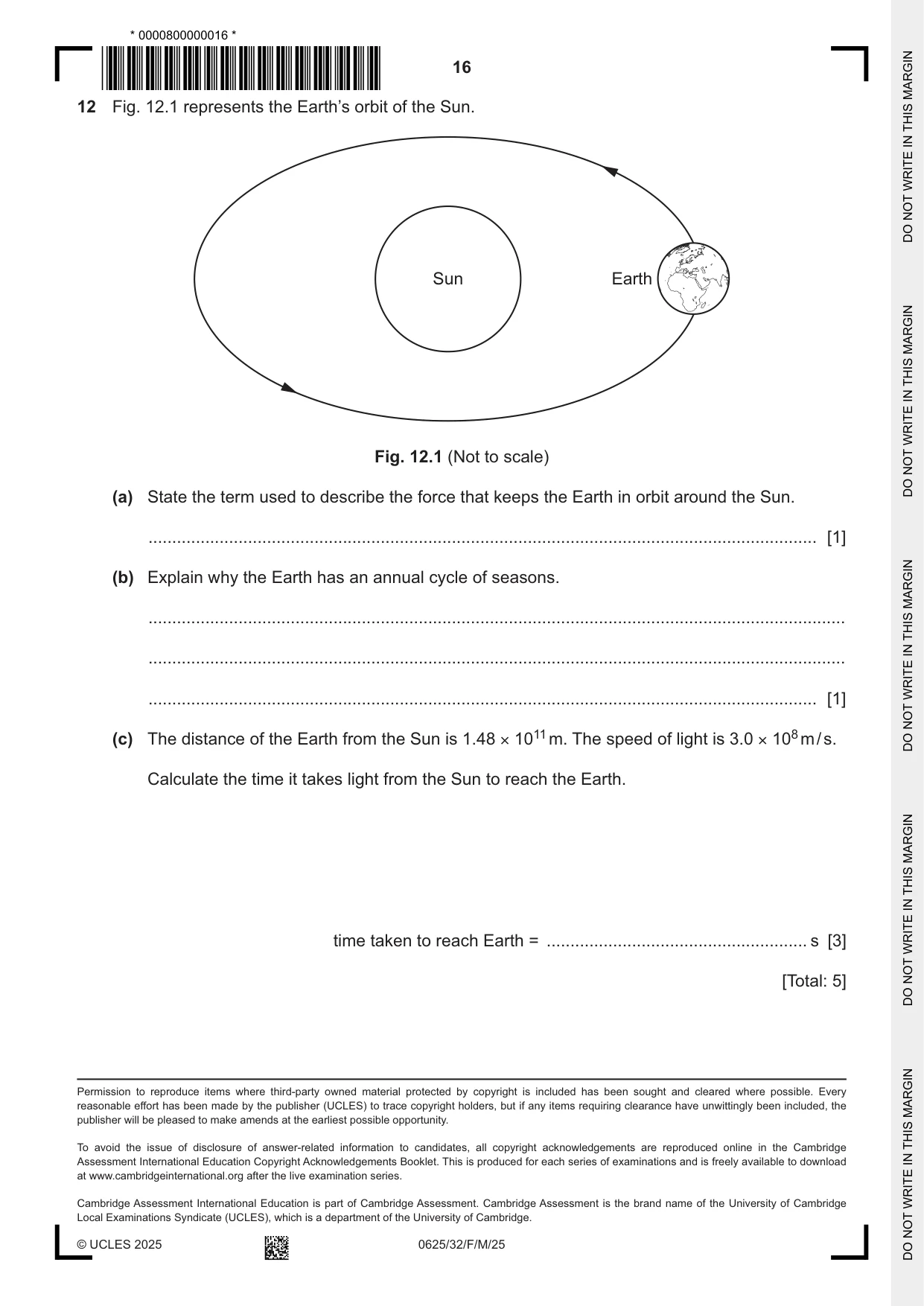
12 Fig. 12.1 represents the Earth’s orbit of the Sun. Sun Earth Fig. 12.1 (Not to scale) (a) State the term used to describe the force that keeps the Earth in orbit around the Sun. ............................................................................................................................................. [1] (b) Explain why the Earth has an annual cycle of seasons. ................................................................................................................................................... ................................................................................................................................................... ............................................................................................................................................. [1] (c) The distance of the Earth from the Sun is 1.48 × 10¹¹ m. The speed of light is 3.0 × 10⁸ m / s. Calculate the time it takes light from the Sun to reach the Earth. time taken to reach Earth = ....................................................... s [3] [Total: 5]
Mark scheme: 12(a) gravitational (attraction) B1 12(b) Earth’s axis is tilted (relative to its orbital plane) B1 OR idea that in part of orbit, N or S pole points towards/away from Sun 12(c) 490 (s) A3 1.48 1011 ÷ 3(.0) 108 (C2) speed = distance ÷ time OR (t =) d ÷ s (C1)
What was in this paper
The subtopics covered by these 12 questions, and how many questions each got. Open one in a new tab to see every Cambridge question on it.
What you needed in this session
Cambridge’s own grade thresholds for 2025 Feb/March, Paper 3 · Variant 2. A higher threshold means an easier paper — the bar moves with how the cohort did.