Cambridge IGCSE Physics 0625 — 2017 Oct/Nov Paper 3 · Variant 1
0625/31/O/N/17 · 12 questions · 80 marks · ≈90 min
The question paper and its mark scheme, free to read here and free to download. This is Cambridge’s own paper, exactly as it was sat.
Question paper20 pages
Mark scheme8 pages
Answers below. Sit the paper first if you are practising.
Questions as text
Q1 · A student clamps a metre rule to the end of a bench, as shown in Fig
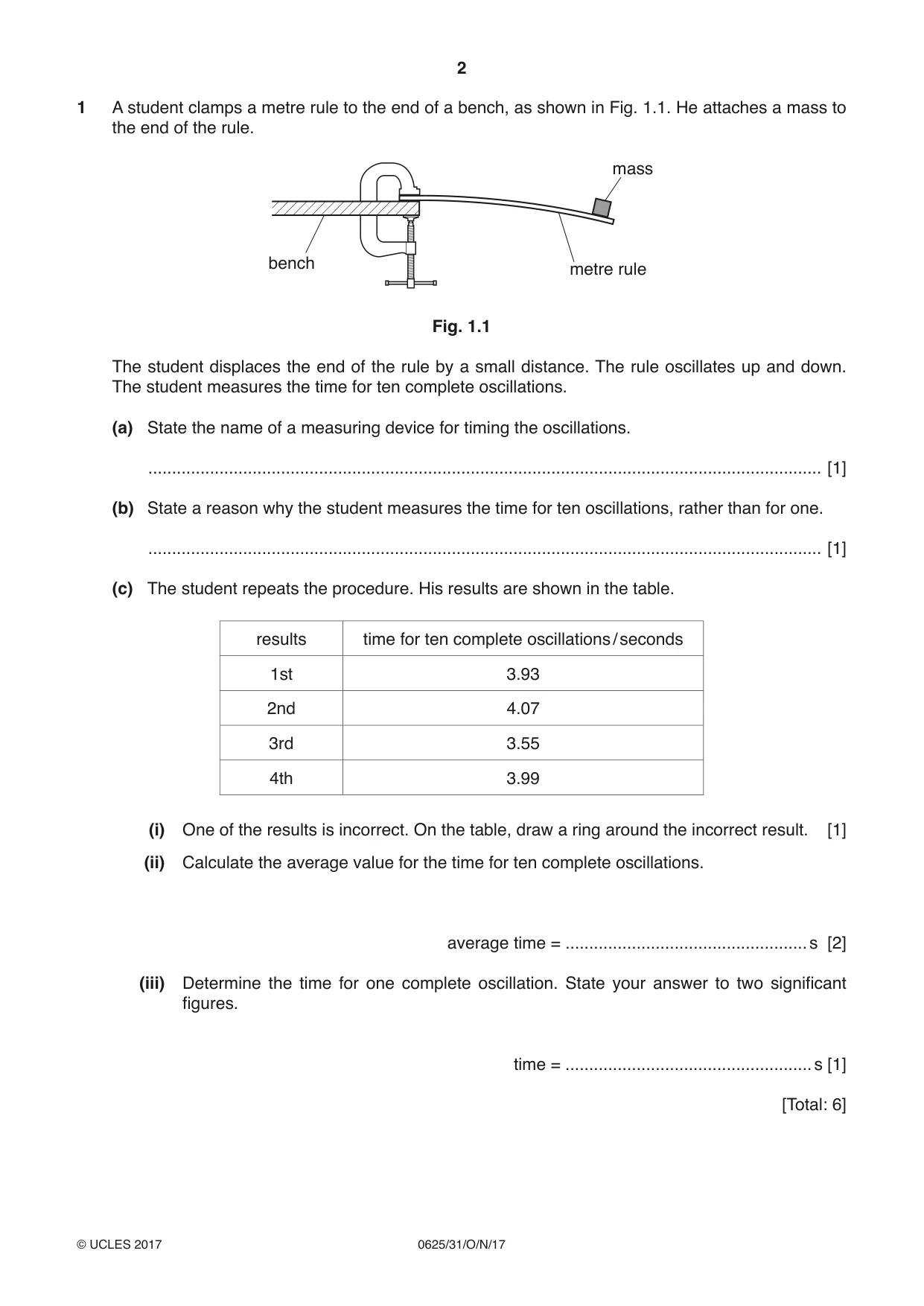
1 A student clamps a metre rule to the end of a bench, as shown in Fig. 1.1. He attaches a mass to the end of the rule. mass bench metre rule Fig. 1.1 The student displaces the end of the rule by a small distance. The rule oscillates up and down. The student measures the time for ten complete oscillations. (a) State the name of a measuring device for timing the oscillations. .............................................................................................................................................. [1] (b) State a reason why the student measures the time for ten oscillations, rather than for one. .............................................................................................................................................. [1] (c) The student repeats the procedure. His results are shown in the table. results time for ten complete oscillations / seconds 1st 3.93 2nd 4.07 3rd 3.55 4th 3.99 (i) One of the results is incorrect. On the table, draw a ring around the incorrect result. [1] (ii) Calculate the average value for the time for ten complete oscillations. average time = ................................................... s [2] (iii) Determine the time for one complete oscillation. State your answer to two significant figures. time = .................................................... s [1] [Total: 6]
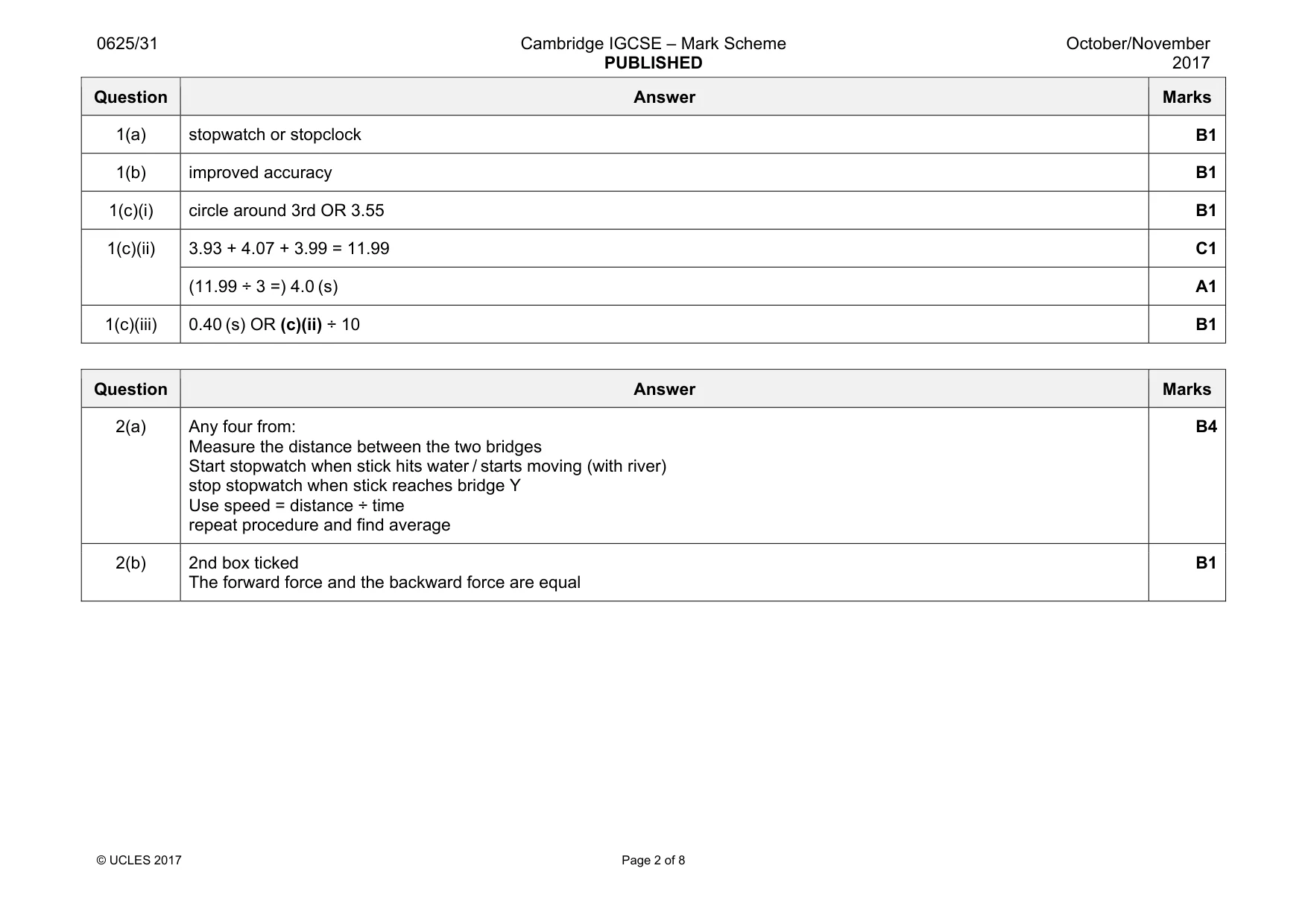
Mark scheme: 1(a) stopwatch or stopclock B1 1(b) improved accuracy B1 1(c)(i) circle around 3rd OR 3.55 B1 1(c)(ii) 3.93 + 4.07 + 3.99 = 11.99 C1 (11.99 ÷ 3 =) 4.0 (s) A1 1(c)(iii) 0.40 (s) OR (c)(ii) ÷ 10 B1
More questions on Physical quantities and measurement techniques
Q2 · A river flowing through a village
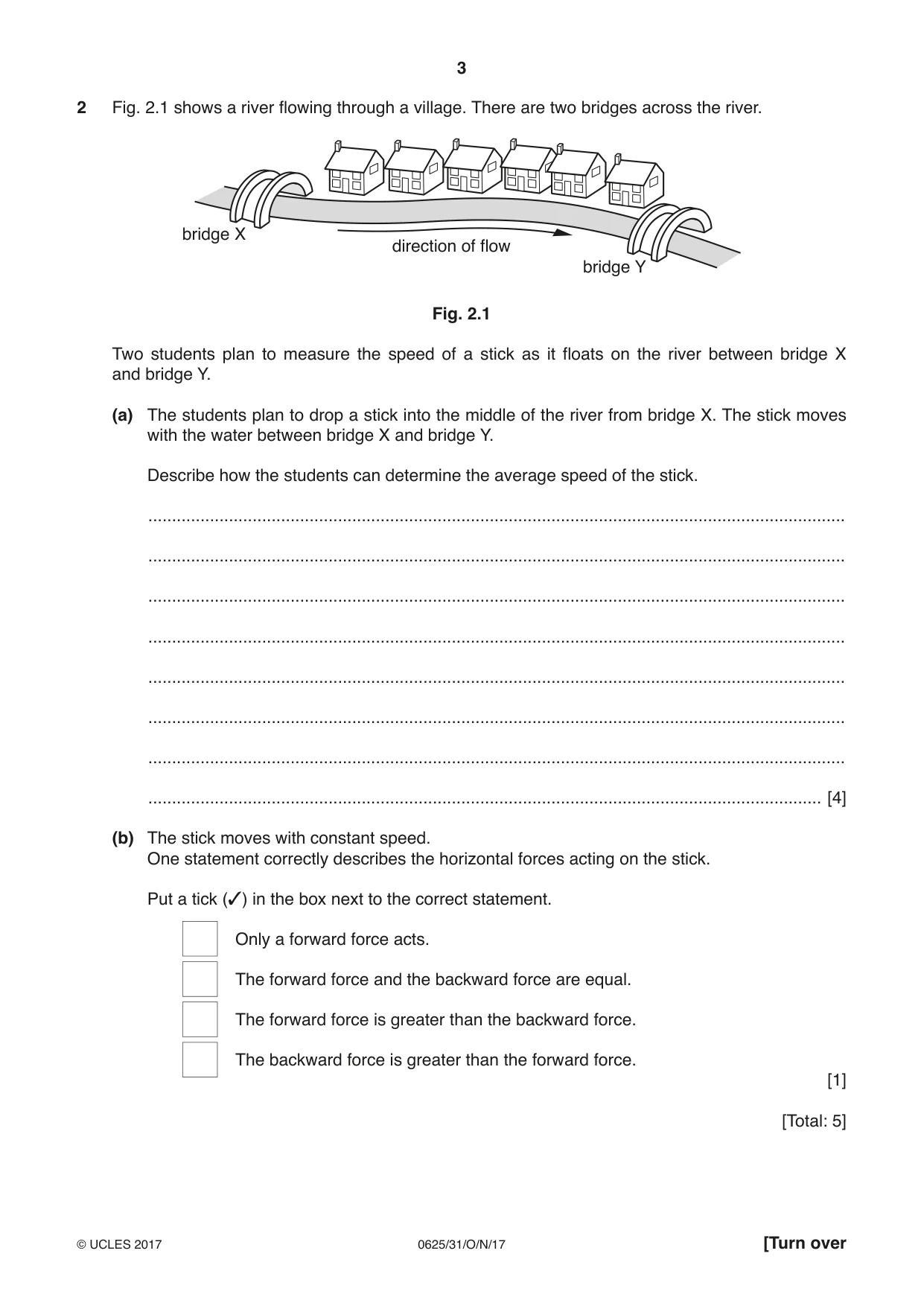
2 Fig. 2.1 shows a river flowing through a village. There are two bridges across the river. bridge X direction of flow bridge Y Fig. 2.1 Two students plan to measure the speed of a stick as it floats on the river between bridge X and bridge Y. (a) The students plan to drop a stick into the middle of the river from bridge X. The stick moves with the water between bridge X and bridge Y. Describe how the students can determine the average speed of the stick. ................................................................................................................................................... ................................................................................................................................................... ................................................................................................................................................... ................................................................................................................................................... ................................................................................................................................................... ................................................................................................................................................... ................................................................................................................................................... .............................................................................................................................................. [4] (b) The stick moves with constant speed. One statement correctly describes the horizontal forces acting on the stick. Put a tick (✓) in the box next to the correct statement. Only a forward force acts. The forward force and the backward force are equal. The forward force is greater than the backward force. The backward force is greater than the forward force. [1] [Total: 5]
Mark scheme: 2(a) Any four from: Measure the distance between the two bridges Start stopwatch when stick hits water / starts moving (with river) stop stopwatch when stick reaches bridge Y Use speed = distance ÷ time repeat procedure and find average B4 2(b) 2nd box ticked The forward force and the backward force are equal B1
Q3 · A warning marker floating on the surface of a lake
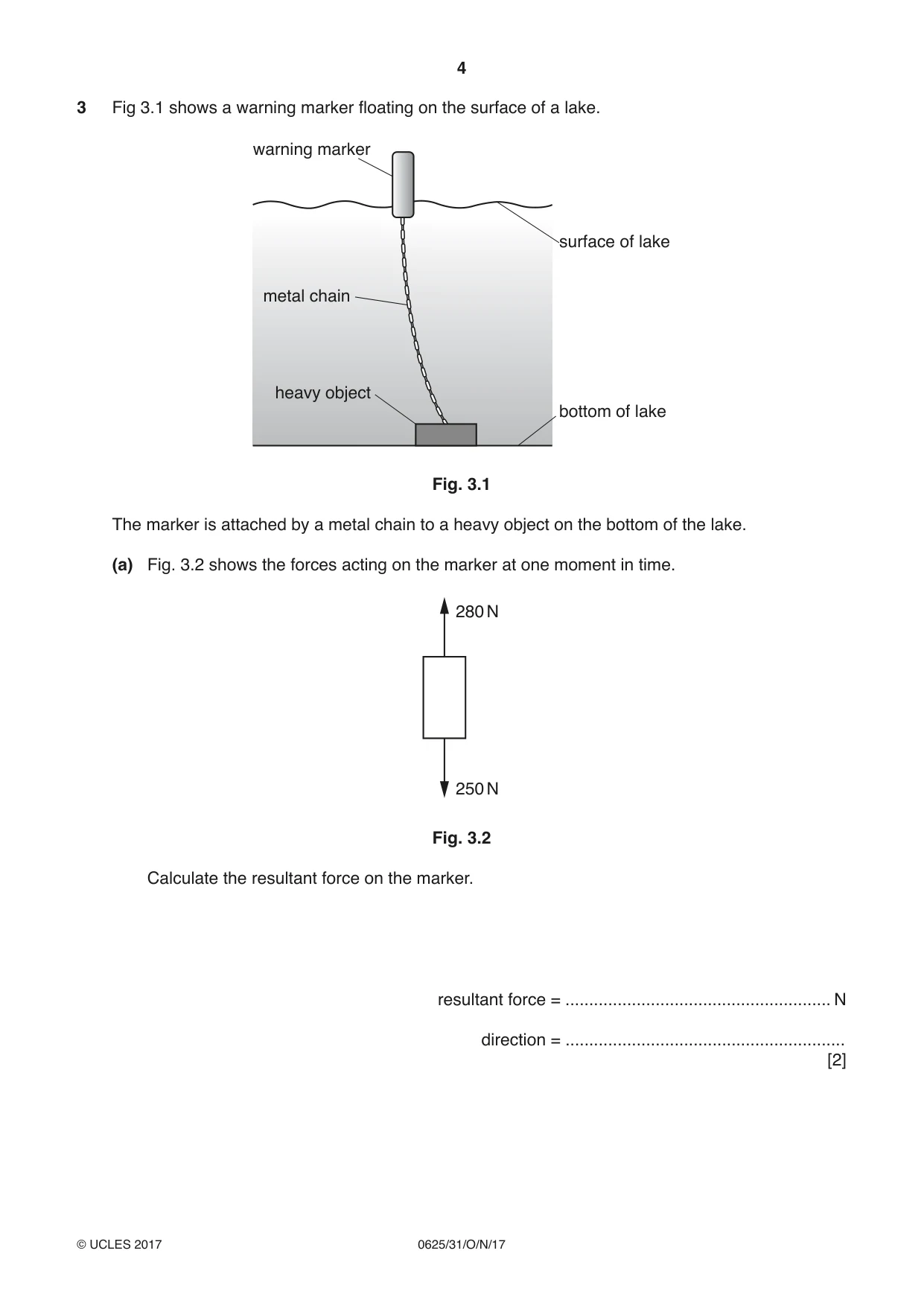
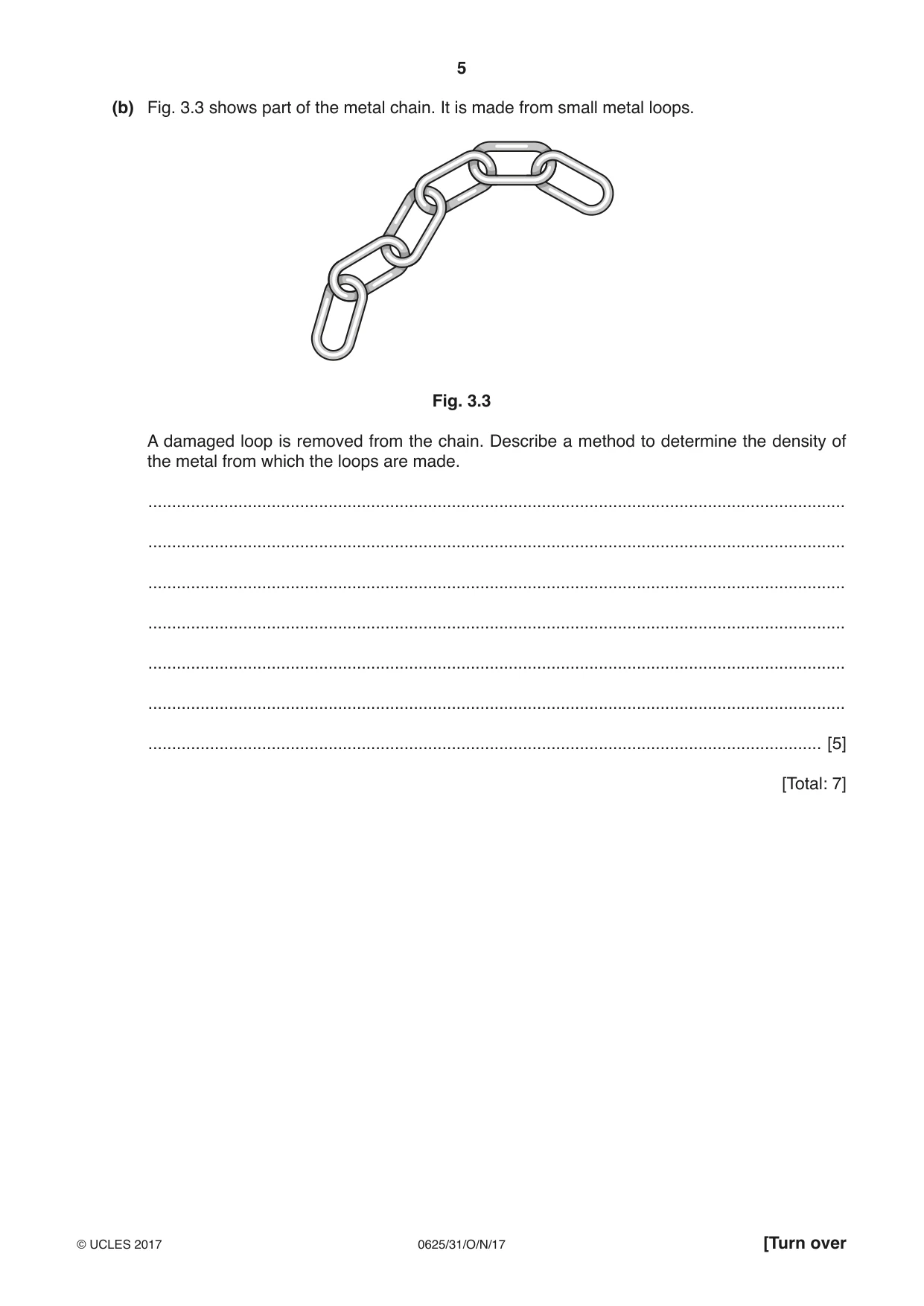
3 Fig 3.1 shows a warning marker floating on the surface of a lake. warning marker surface of lake metal chain heavy object bottom of lake Fig. 3.1 The marker is attached by a metal chain to a heavy object on the bottom of the lake. (a) Fig. 3.2 shows the forces acting on the marker at one moment in time. 280 N 250 N Fig. 3.2 Calculate the resultant force on the marker. resultant force = ........................................................ N direction = ........................................................... [2] (b) Fig. 3.3 shows part of the metal chain. It is made from small metal loops. Fig. 3.3 A damaged loop is removed from the chain. Describe a method to determine the density of the metal from which the loops are made. ................................................................................................................................................... ................................................................................................................................................... ................................................................................................................................................... ................................................................................................................................................... ................................................................................................................................................... ................................................................................................................................................... .............................................................................................................................................. [5] [Total: 7]
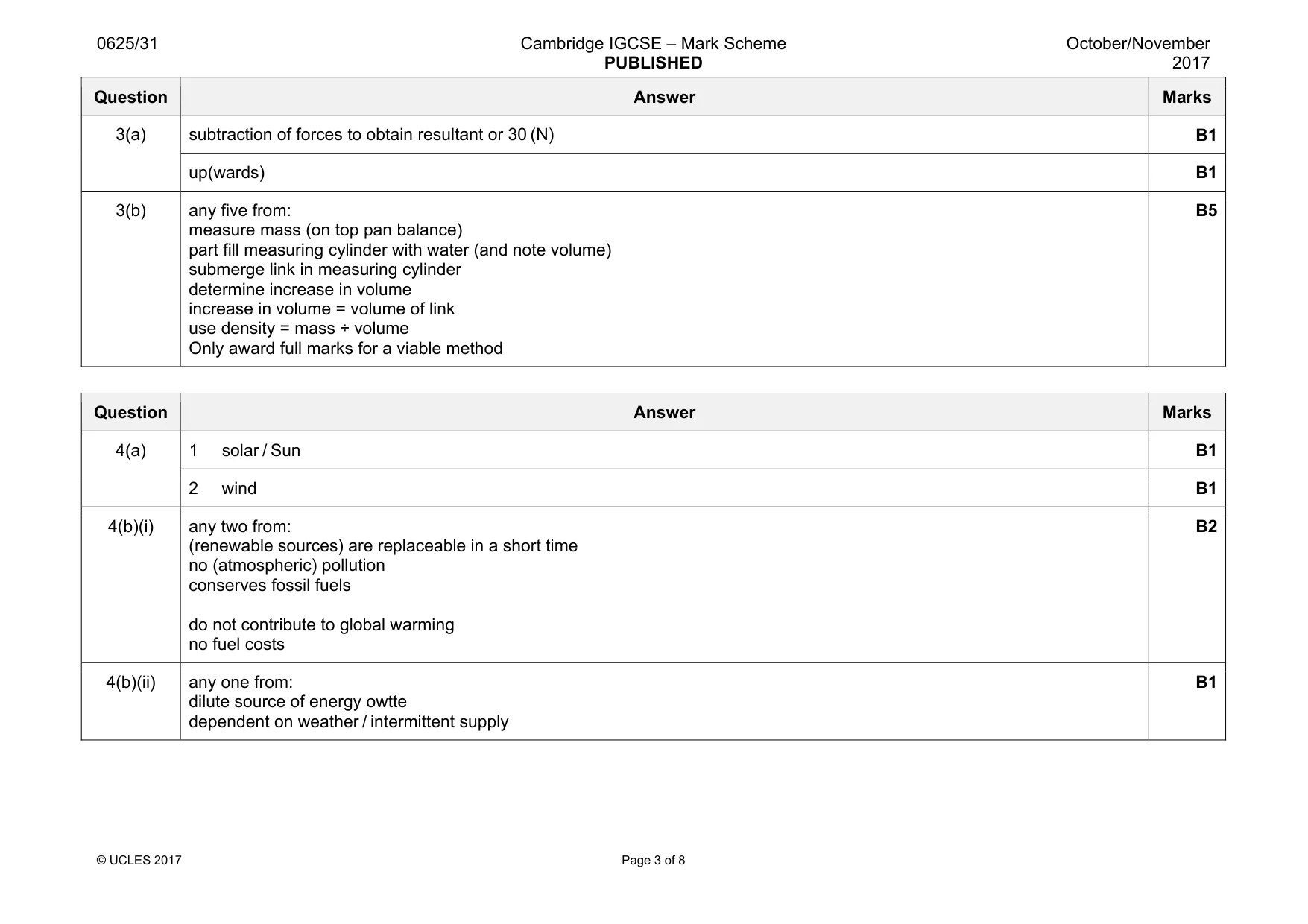
Mark scheme: 3(a) subtraction of forces to obtain resultant or 30 (N) B1 up(wards) B1 3(b) any five from: measure mass (on top pan balance) part fill measuring cylinder with water (and note volume) submerge link in measuring cylinder determine increase in volume increase in volume = volume of link use density = mass ÷ volume Only award full marks for a viable method B5
Q4 · Two methods for generating electricity using renewable sources
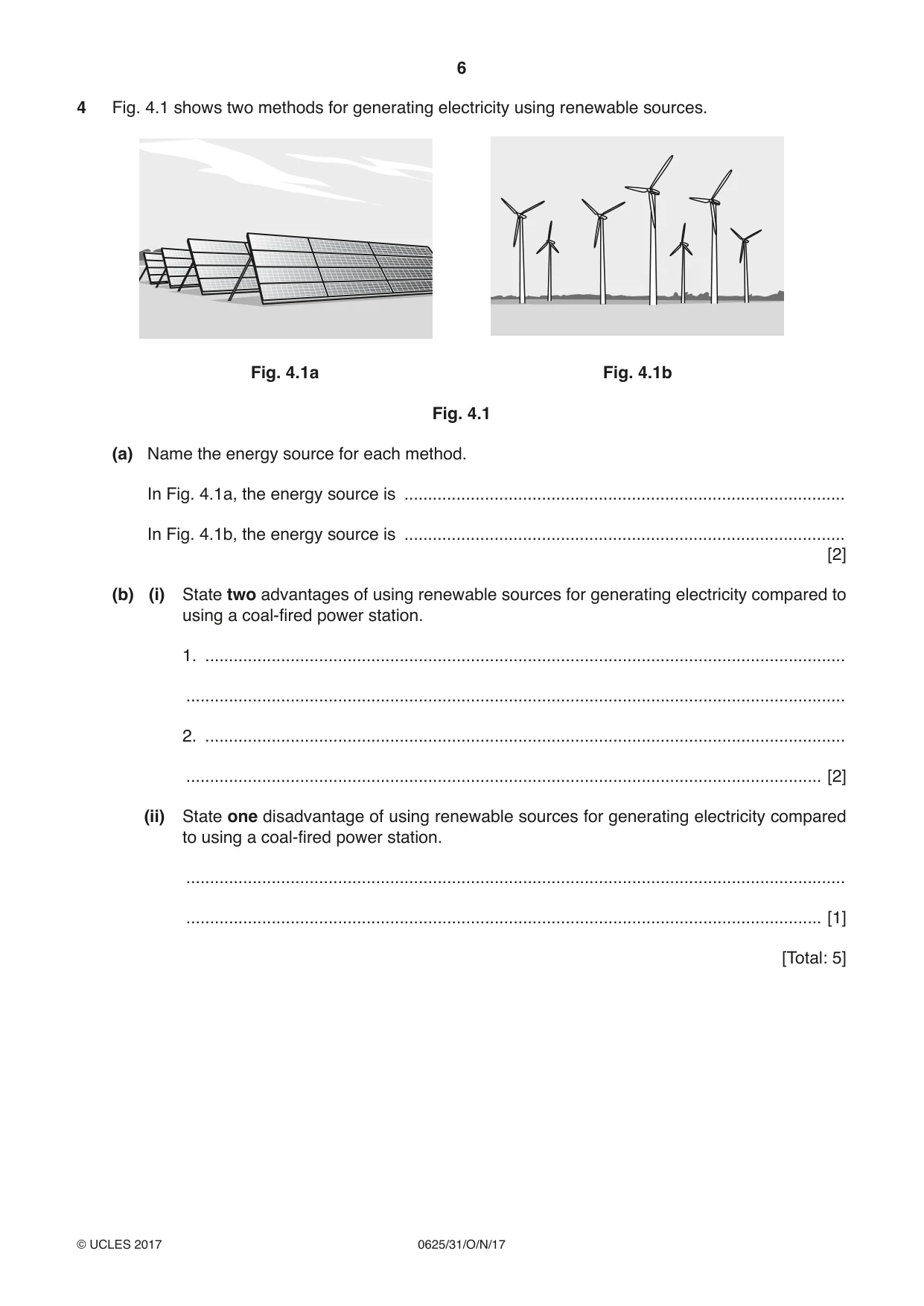
4 Fig. 4.1 shows two methods for generating electricity using renewable sources. Fig. 4.1a Fig. 4.1b Fig. 4.1 (a) Name the energy source for each method. In Fig. 4.1a, the energy source is ............................................................................................. In Fig. 4.1b, the energy source is ............................................................................................. [2] (b) (i) State two advantages of using renewable sources for generating electricity compared to using a coal-fired power station. 1. ....................................................................................................................................... ........................................................................................................................................... 2. ....................................................................................................................................... ...................................................................................................................................... [2] (ii) State one disadvantage of using renewable sources for generating electricity compared to using a coal-fired power station. ........................................................................................................................................... ...................................................................................................................................... [1] [Total: 5]
Mark scheme: 4(a) 1 solar / Sun B1 2 wind B1 4(b)(i) any two from: (renewable sources) are replaceable in a short time no (atmospheric) pollution conserves fossil fuels do not contribute to global warming no fuel costs B2 4(b)(ii) any one from: dilute source of energy owtte dependent on weather / intermittent supply B1
Question 5
5 Complete the sentences. Choose from the words in the box. solid liquid gas The words may be used once, more than once or not at all. (a) The atoms are usually arranged in regular patterns in a ..................... . [1] (b) The state of matter with the lowest density is a ..................... . [1] (c) Evaporation takes place when the most energetic molecules leave the surface of a ..................... . [1] (d) A small force can change the volume of a ..................... . [1] [Total: 4]
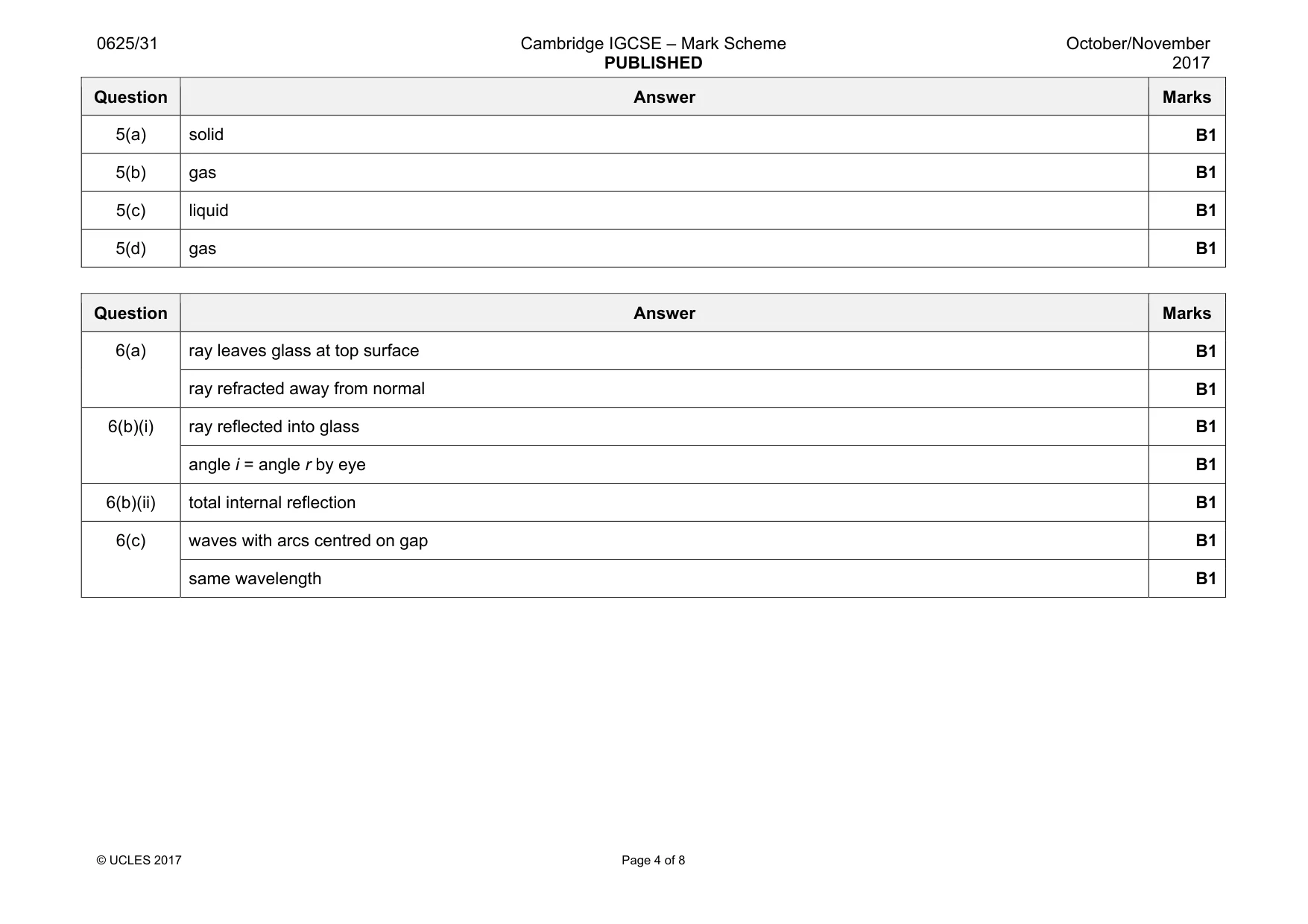
Mark scheme: 5(a) solid B1 5(b) gas B1 5(c) liquid B1 5(d) gas B1
Q6 · A ray of light inside a semi-circular glass block
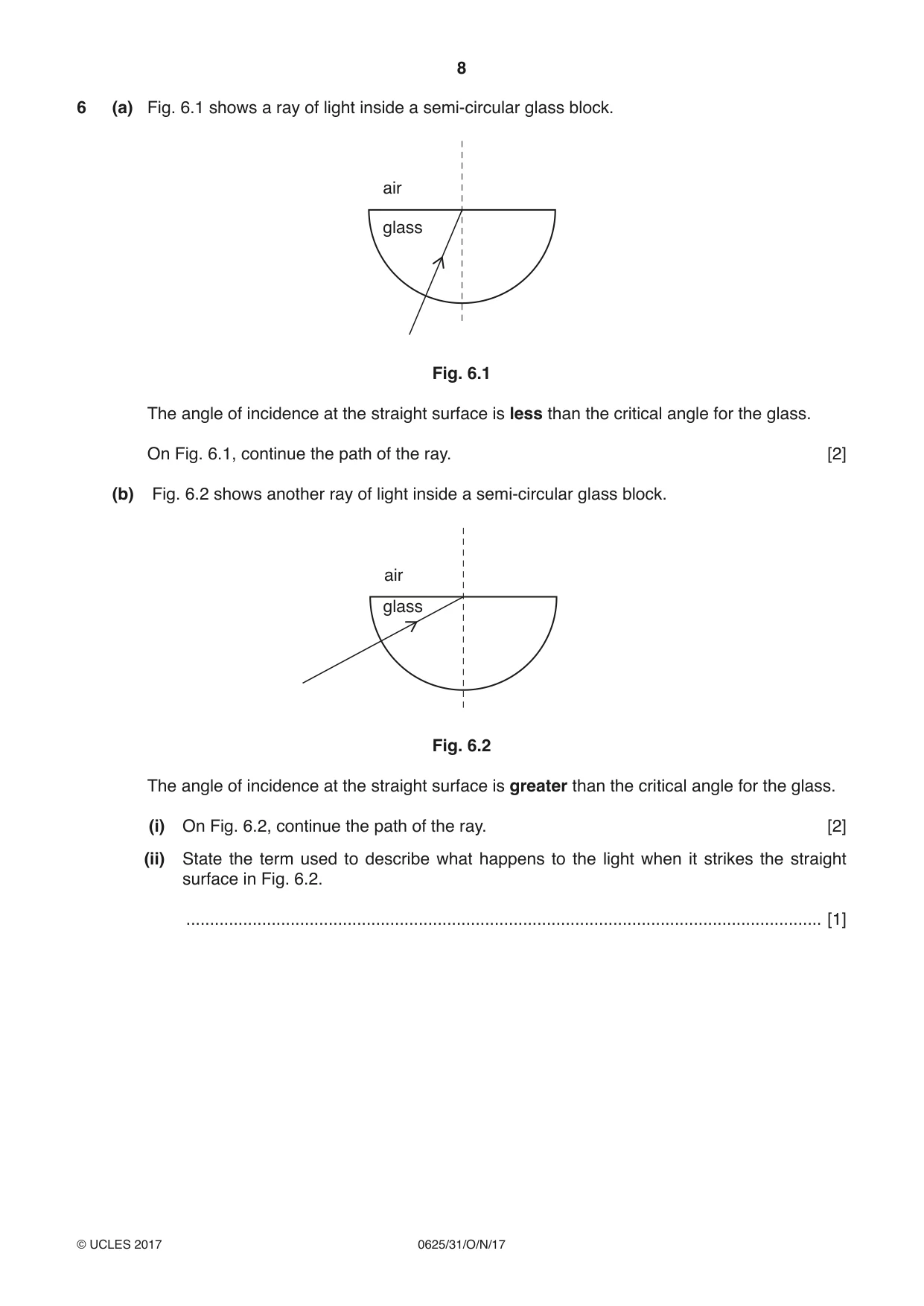
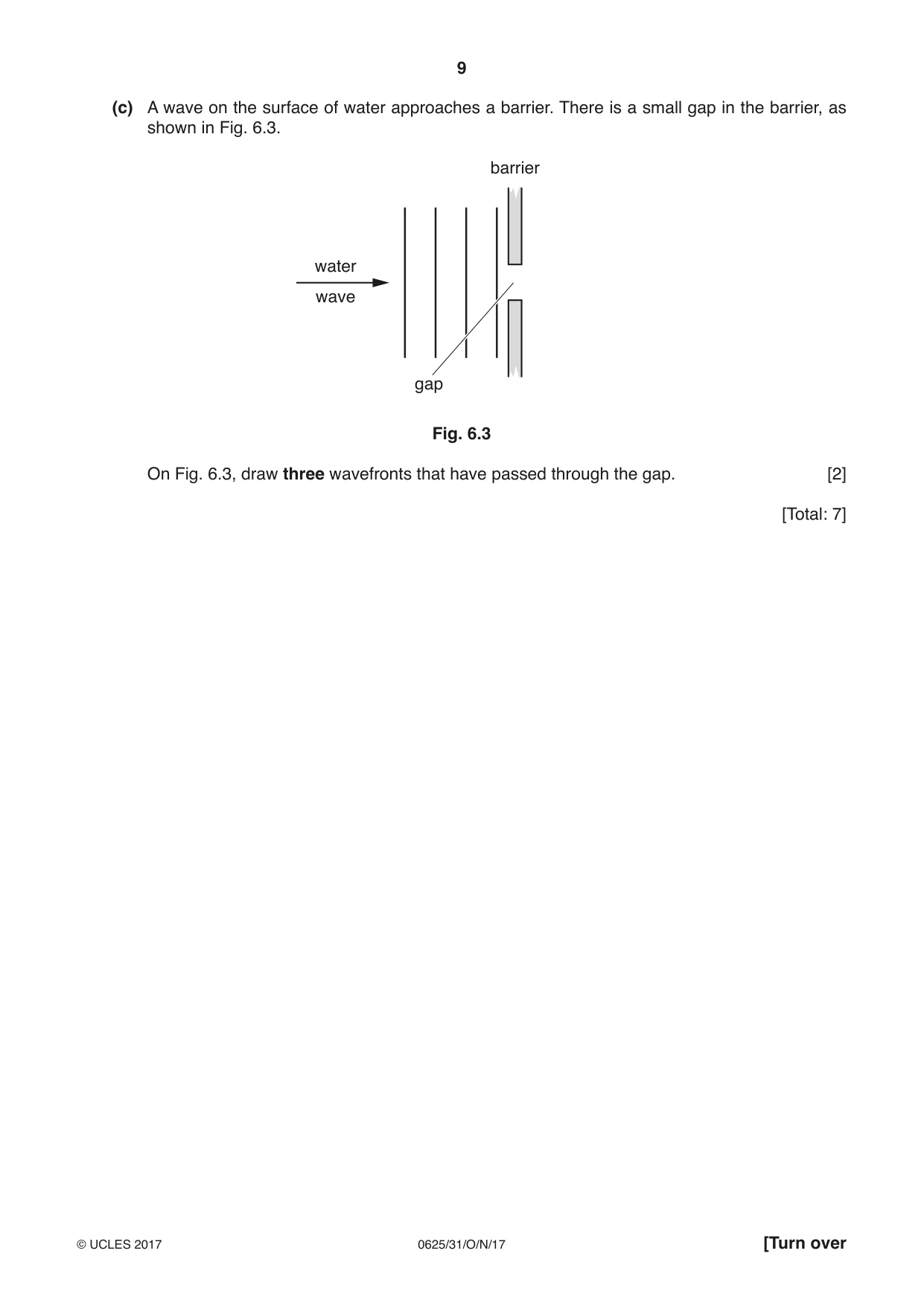
6 (a) Fig. 6.1 shows a ray of light inside a semi-circular glass block. air glass Fig. 6.1 The angle of incidence at the straight surface is less than the critical angle for the glass. On Fig. 6.1, continue the path of the ray. [2] (b) Fig. 6.2 shows another ray of light inside a semi-circular glass block. air glass Fig. 6.2 The angle of incidence at the straight surface is greater than the critical angle for the glass. (i) On Fig. 6.2, continue the path of the ray. [2] (ii) State the term used to describe what happens to the light when it strikes the straight surface in Fig. 6.2. ...................................................................................................................................... [1] (c) A wave on the surface of water approaches a barrier. There is a small gap in the barrier, as shown in Fig. 6.3. barrier water wave gap Fig. 6.3 On Fig. 6.3, draw three wavefronts that have passed through the gap. [2] [Total: 7]
Mark scheme: 6(a) ray leaves glass at top surface B1 ray refracted away from normal B1 6(b)(i) ray reflected into glass B1 angle i = angle r by eye B1 6(b)(ii) total internal reflection B1 6(c) waves with arcs centred on gap B1 same wavelength B1
Q7 · A man listening to a radio
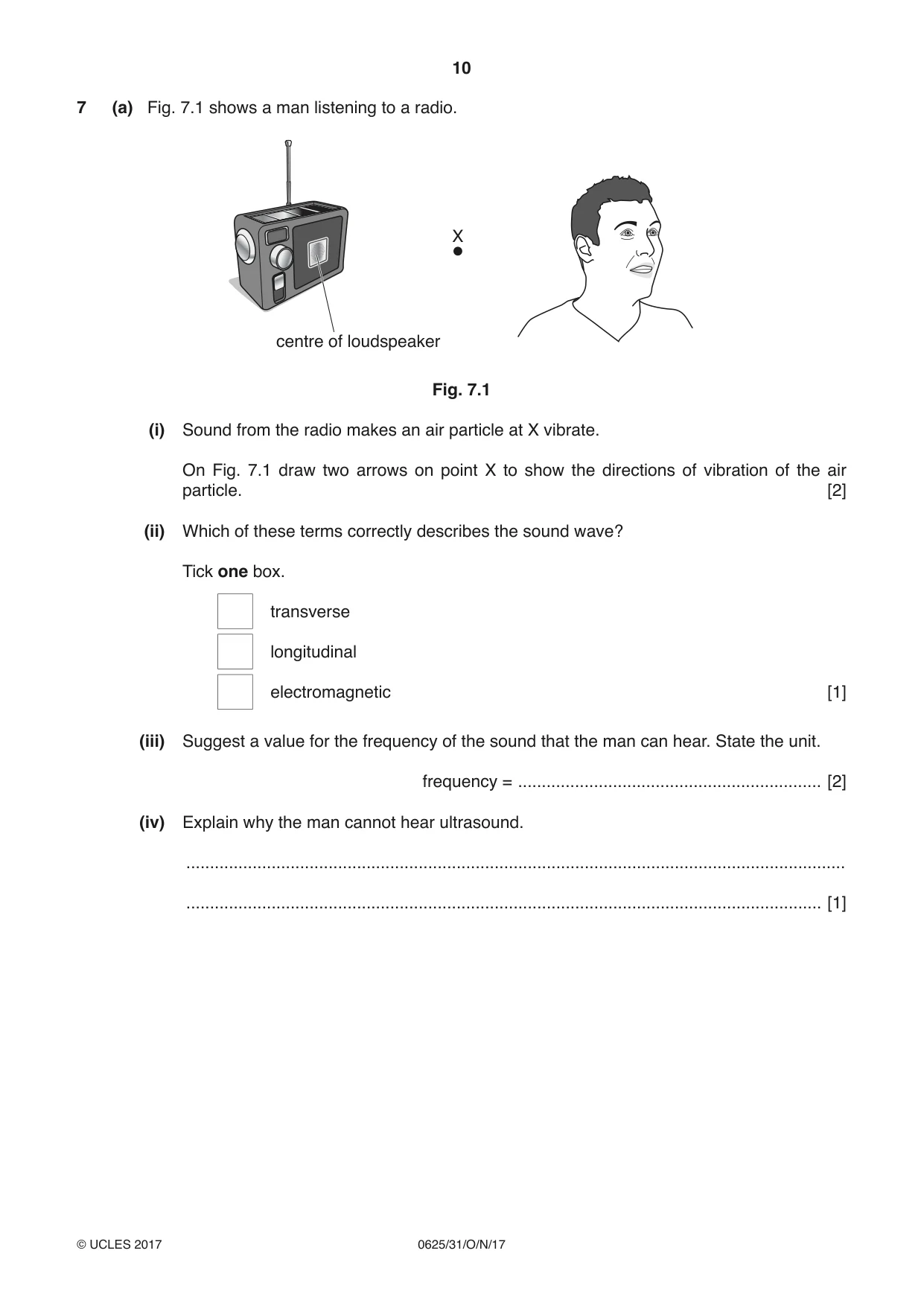
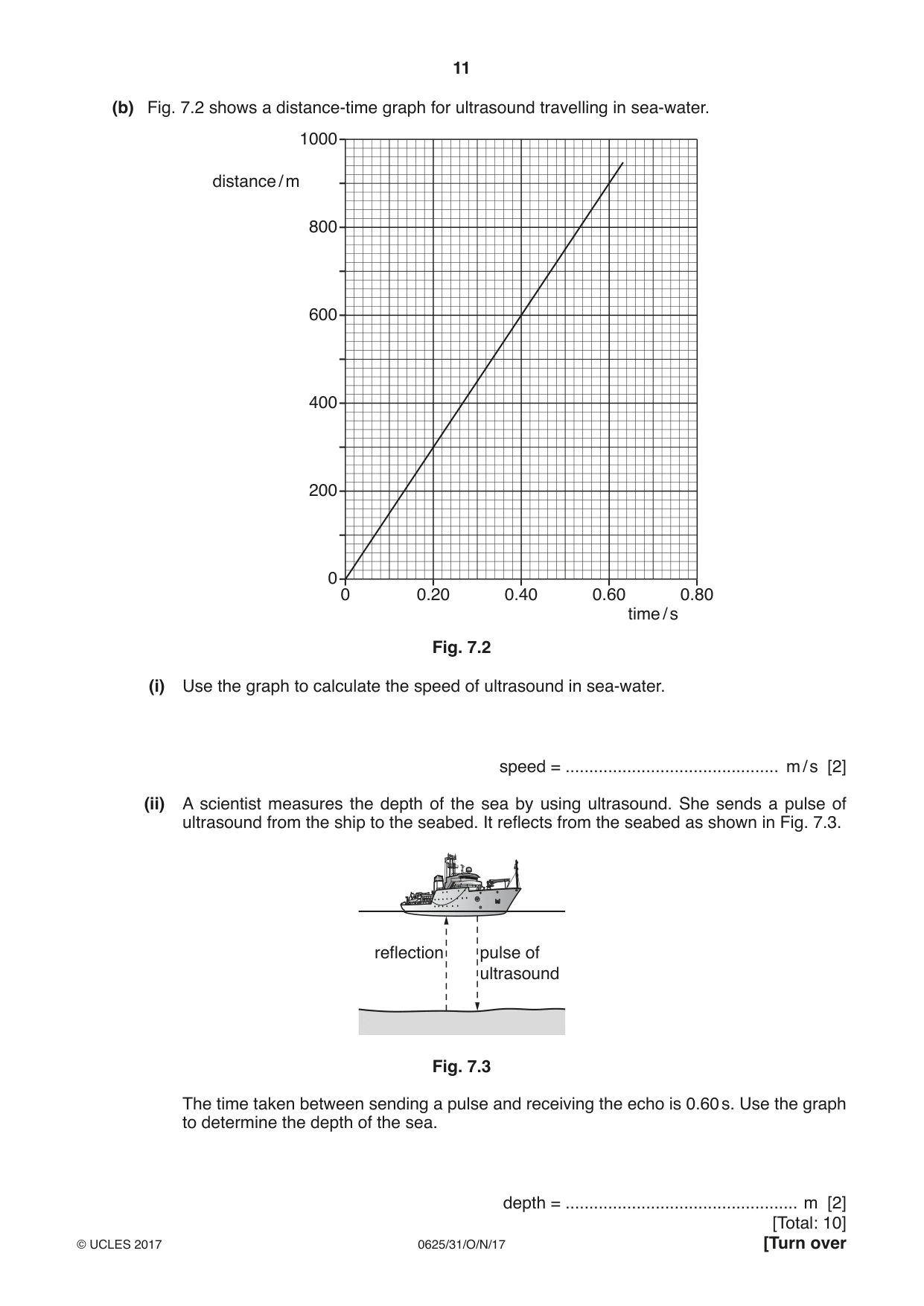
7 (a) Fig. 7.1 shows a man listening to a radio. X centre of loudspeaker Fig. 7.1 (i) Sound from the radio makes an air particle at X vibrate. On Fig. 7.1 draw two arrows on point X to show the directions of vibration of the air particle. [2] (ii) Which of these terms correctly describes the sound wave? Tick one box. transverse longitudinal electromagnetic [1] (iii) Suggest a value for the frequency of the sound that the man can hear. State the unit. frequency = ................................................................ [2] (iv) Explain why the man cannot hear ultrasound. ........................................................................................................................................... ...................................................................................................................................... [1] (b) Fig. 7.2 shows a distance-time graph for ultrasound travelling in sea-water. 1000 distance / m 800 600 400 200 0 0 0.20 0.40 0.60 0.80 time / s Fig. 7.2 (i) Use the graph to calculate the speed of ultrasound in sea-water. speed = ............................................. m / s [2] (ii) A scientist measures the depth of the sea by using ultrasound. She sends a pulse of ultrasound from the ship to the seabed. It reflects from the seabed as shown in Fig. 7.3. reflection pulse of ultrasound Fig. 7.3 The time taken between sending a pulse and receiving the echo is 0.60 s. Use the graph to determine the depth of the sea. depth = ................................................. m [2]
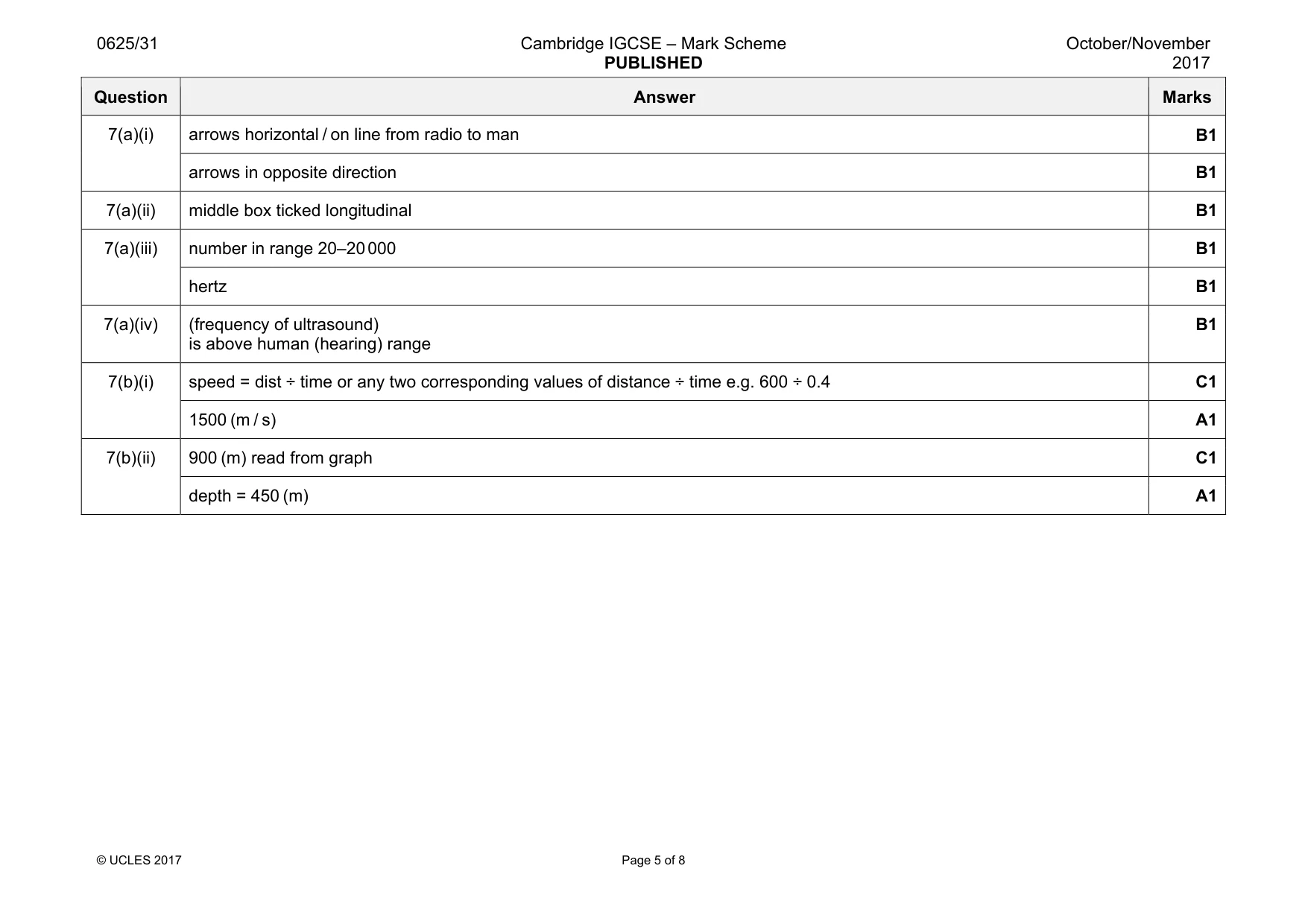
Mark scheme: 7(a)(i) arrows horizontal / on line from radio to man B1 arrows in opposite direction B1 7(a)(ii) middle box ticked longitudinal B1 7(a)(iii) number in range 20–20 000 B1 hertz B1 7(a)(iv) (frequency of ultrasound) is above human (hearing) range B1 7(b)(i) speed = dist ÷ time or any two corresponding values of distance ÷ time e.g. 600 ÷ 0.4 C1 1500 (m / s) A1 7(b)(ii) 900 (m) read from graph C1 depth = 450 (m) A1
Q8 · A plotting compass and a bar magnet
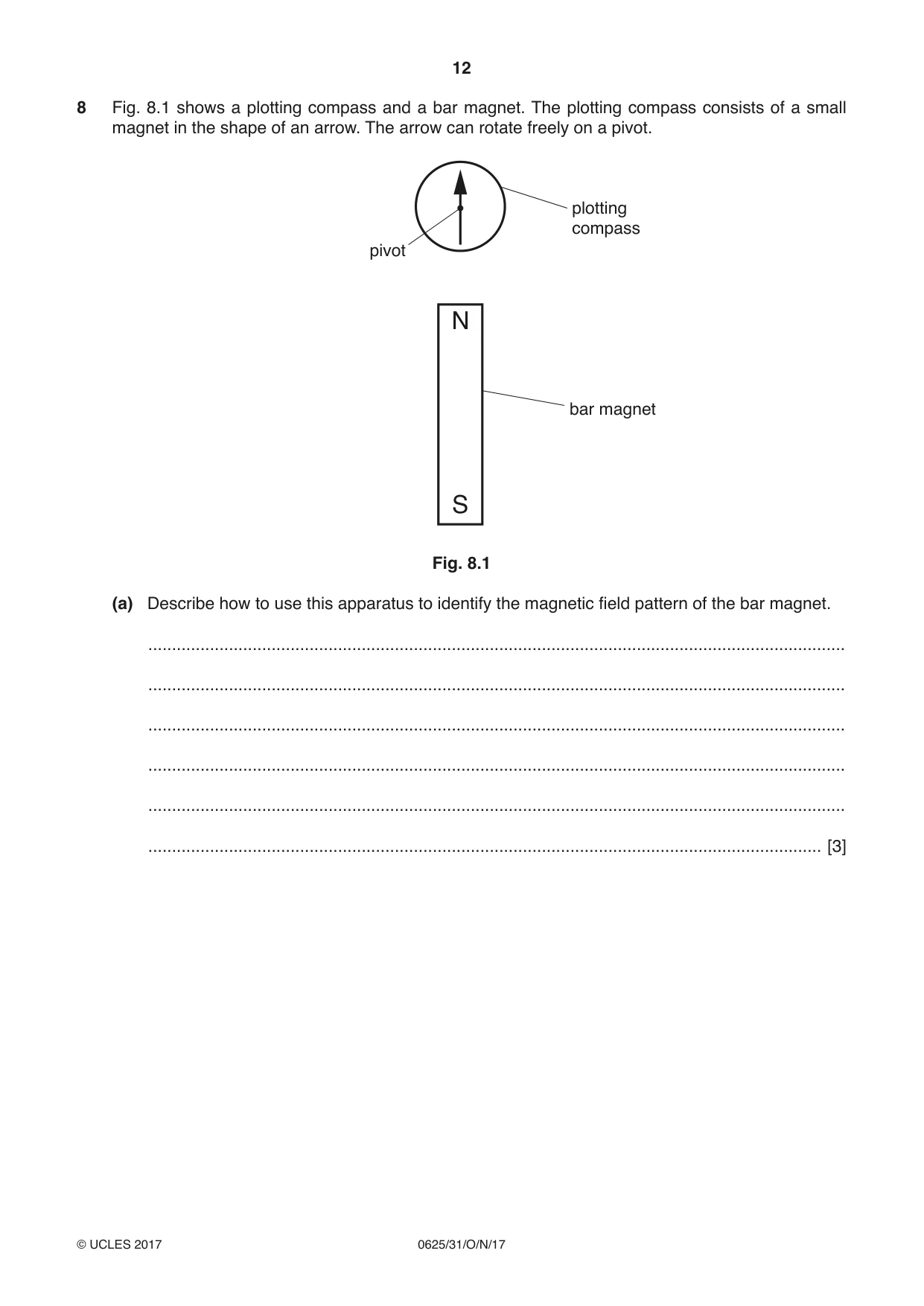
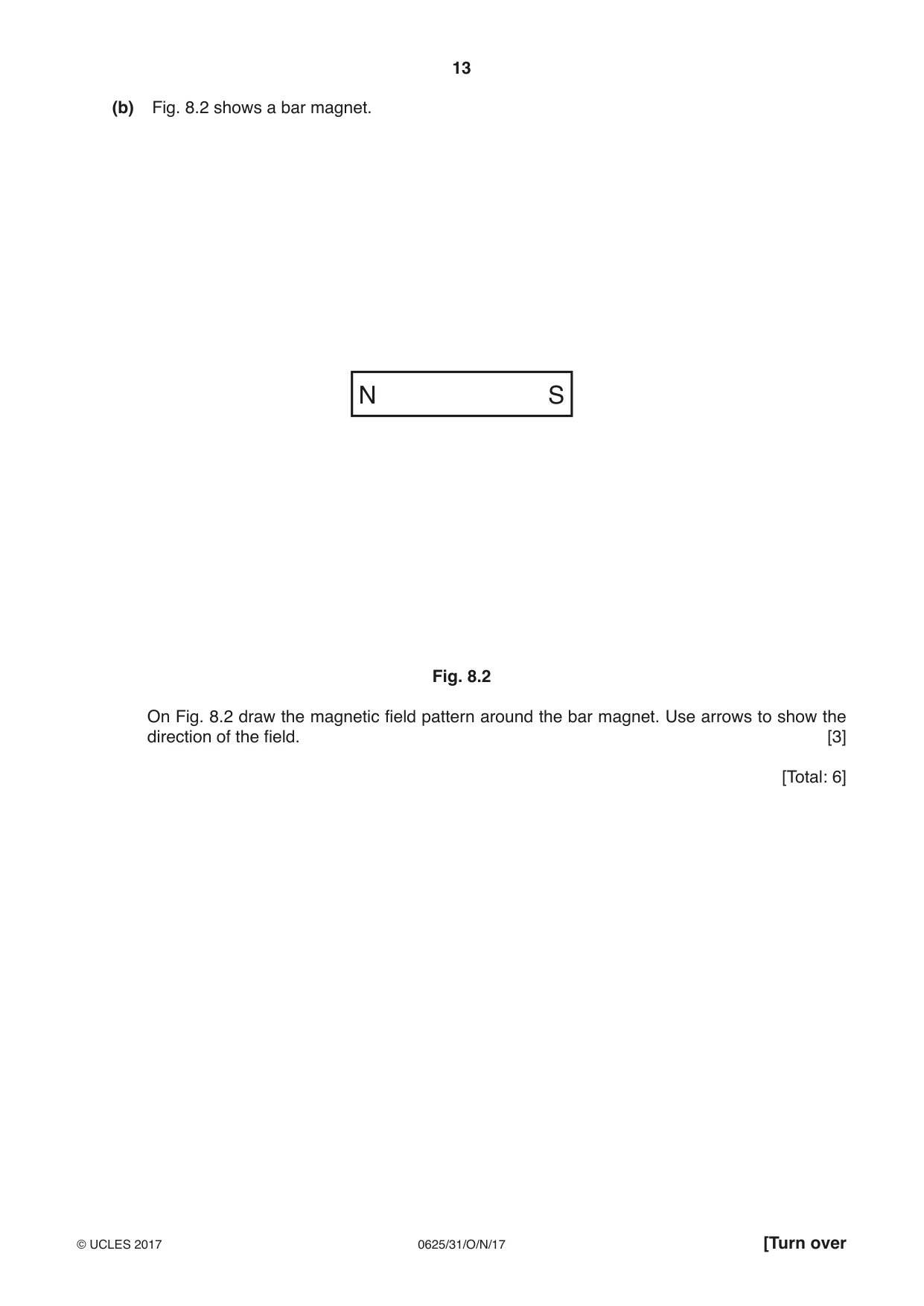
8 Fig. 8.1 shows a plotting compass and a bar magnet. The plotting compass consists of a small magnet in the shape of an arrow. The arrow can rotate freely on a pivot. plotting compass pivot N bar magnet S Fig. 8.1 (a) Describe how to use this apparatus to identify the magnetic field pattern of the bar magnet. ................................................................................................................................................... ................................................................................................................................................... ................................................................................................................................................... ................................................................................................................................................... ................................................................................................................................................... .............................................................................................................................................. [3] (b) Fig. 8.2 shows a bar magnet. N S Fig. 8.2 On Fig. 8.2 draw the magnetic field pattern around the bar magnet. Use arrows to show the direction of the field. [3] [Total: 6]
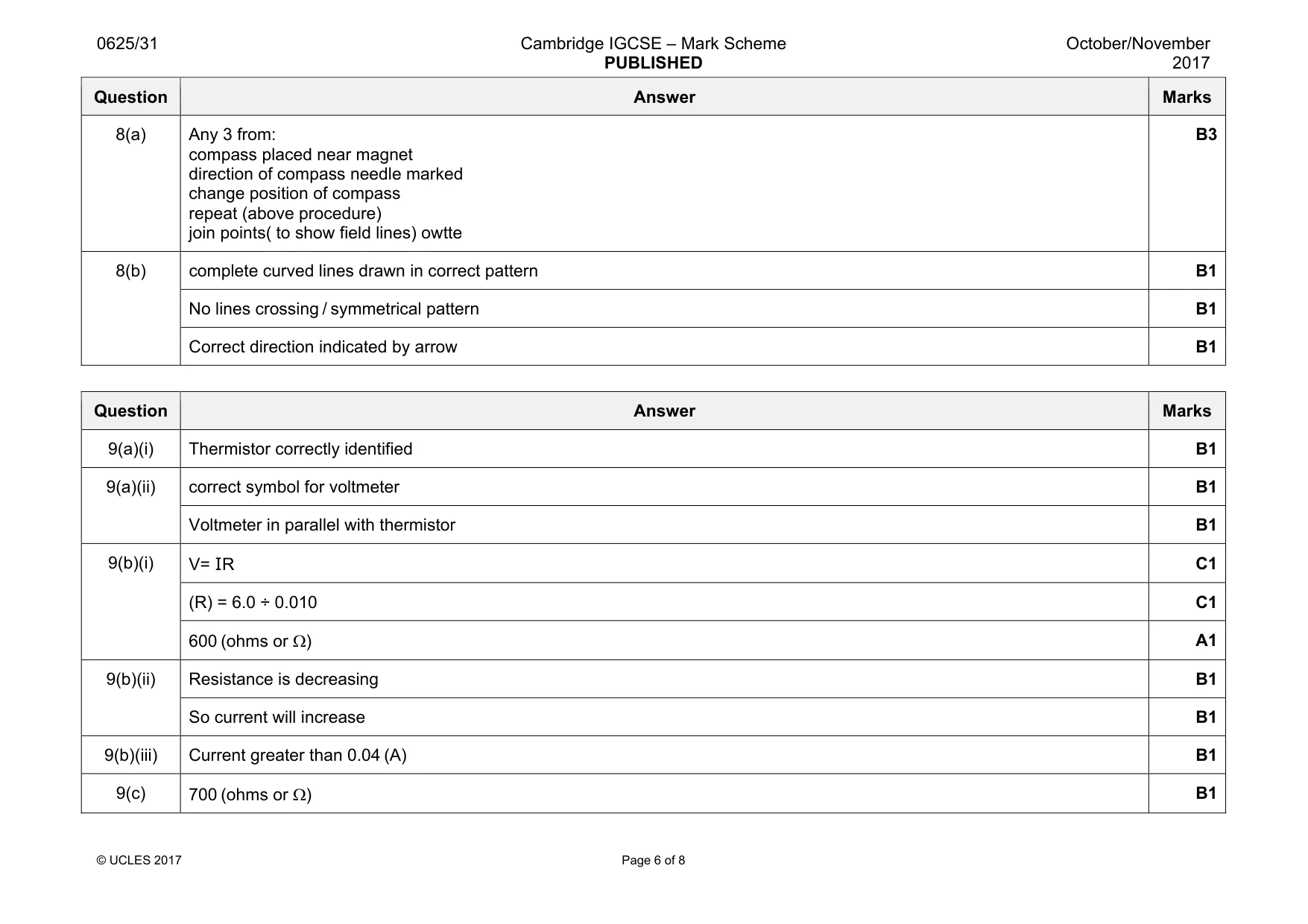
Mark scheme: 8(a) Any 3 from: compass placed near magnet direction of compass needle marked change position of compass repeat (above procedure) join points( to show field lines) owtte B3 8(b) complete curved lines drawn in correct pattern B1 No lines crossing / symmetrical pattern B1 Correct direction indicated by arrow B1
Q9 · A student investigates how the resistance of a thermistor changes with temperature
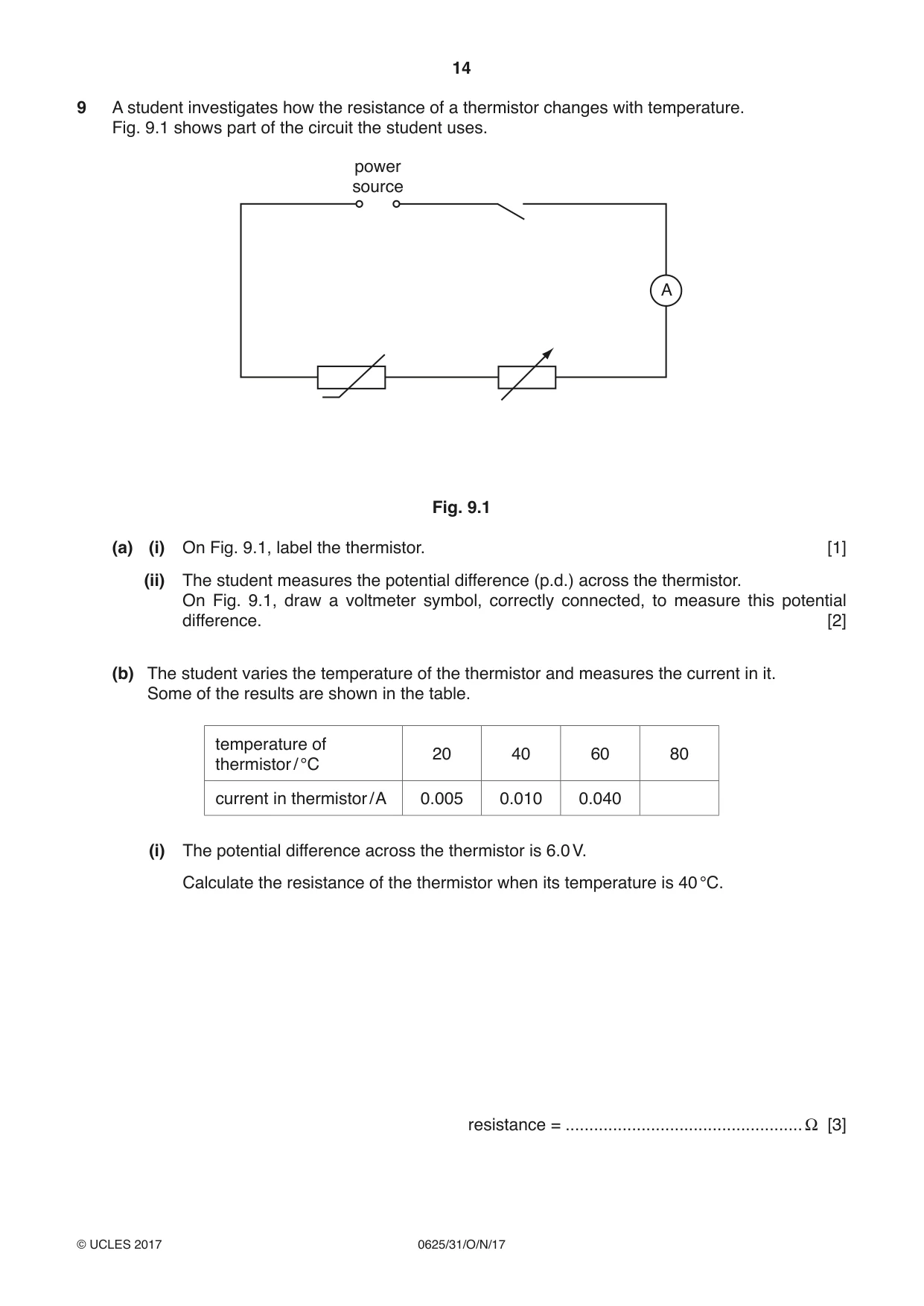
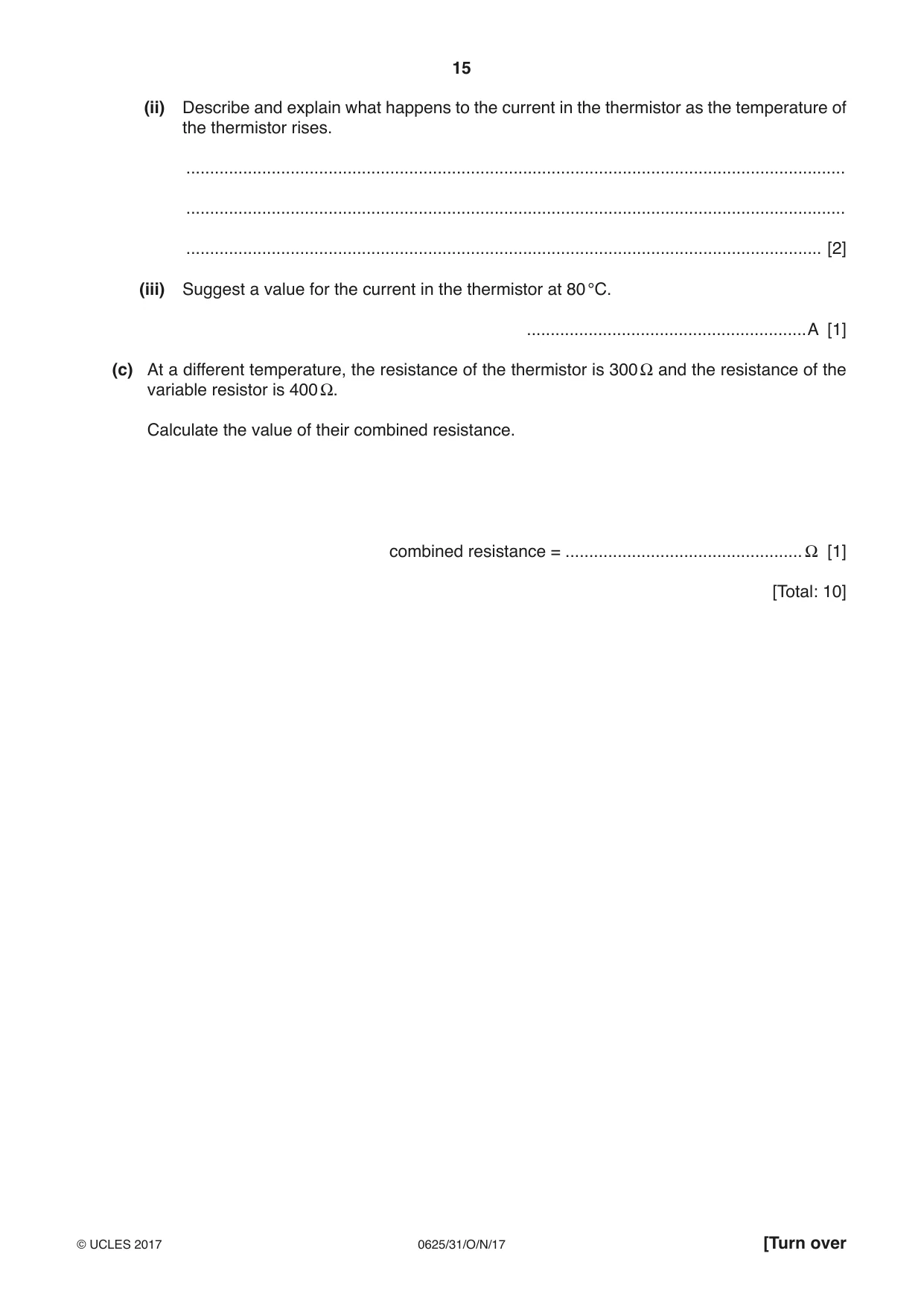
9 A student investigates how the resistance of a thermistor changes with temperature. Fig. 9.1 shows part of the circuit the student uses. power source A Fig. 9.1 (a) (i) On Fig. 9.1, label the thermistor. [1] (ii) The student measures the potential difference (p.d.) across the thermistor. On Fig. 9.1, draw a voltmeter symbol, correctly connected, to measure this potential difference. [2] (b) The student varies the temperature of the thermistor and measures the current in it. Some of the results are shown in the table. temperature of 20 40 60 80 thermistor / °C current in thermistor / A 0.005 0.010 0.040 (i) The potential difference across the thermistor is 6.0 V. Calculate the resistance of the thermistor when its temperature is 40 °C. resistance = .................................................. Ω [3] (ii) Describe and explain what happens to the current in the thermistor as the temperature of the thermistor rises. ........................................................................................................................................... ........................................................................................................................................... ...................................................................................................................................... [2] (iii) Suggest a value for the current in the thermistor at 80 °C. ........................................................... A [1] (c) At a different temperature, the resistance of the thermistor is 300 Ω and the resistance of the variable resistor is 400 Ω. Calculate the value of their combined resistance. combined resistance = .................................................. Ω [1] [Total: 10]
Mark scheme: 9(a)(i) Thermistor correctly identified B1 9(a)(ii) correct symbol for voltmeter B1 Voltmeter in parallel with thermistor B1 9(b)(i) V= IR C1 (R) = 6.0 ÷ 0.010 C1 600 (ohms or Ω) A1 9(b)(ii) Resistance is decreasing B1 So current will increase B1 9(b)(iii) Current greater than 0.04 (A) B1 9(c) 700 (ohms or Ω) B1
Q10 · A student investigates electromagnetic induction
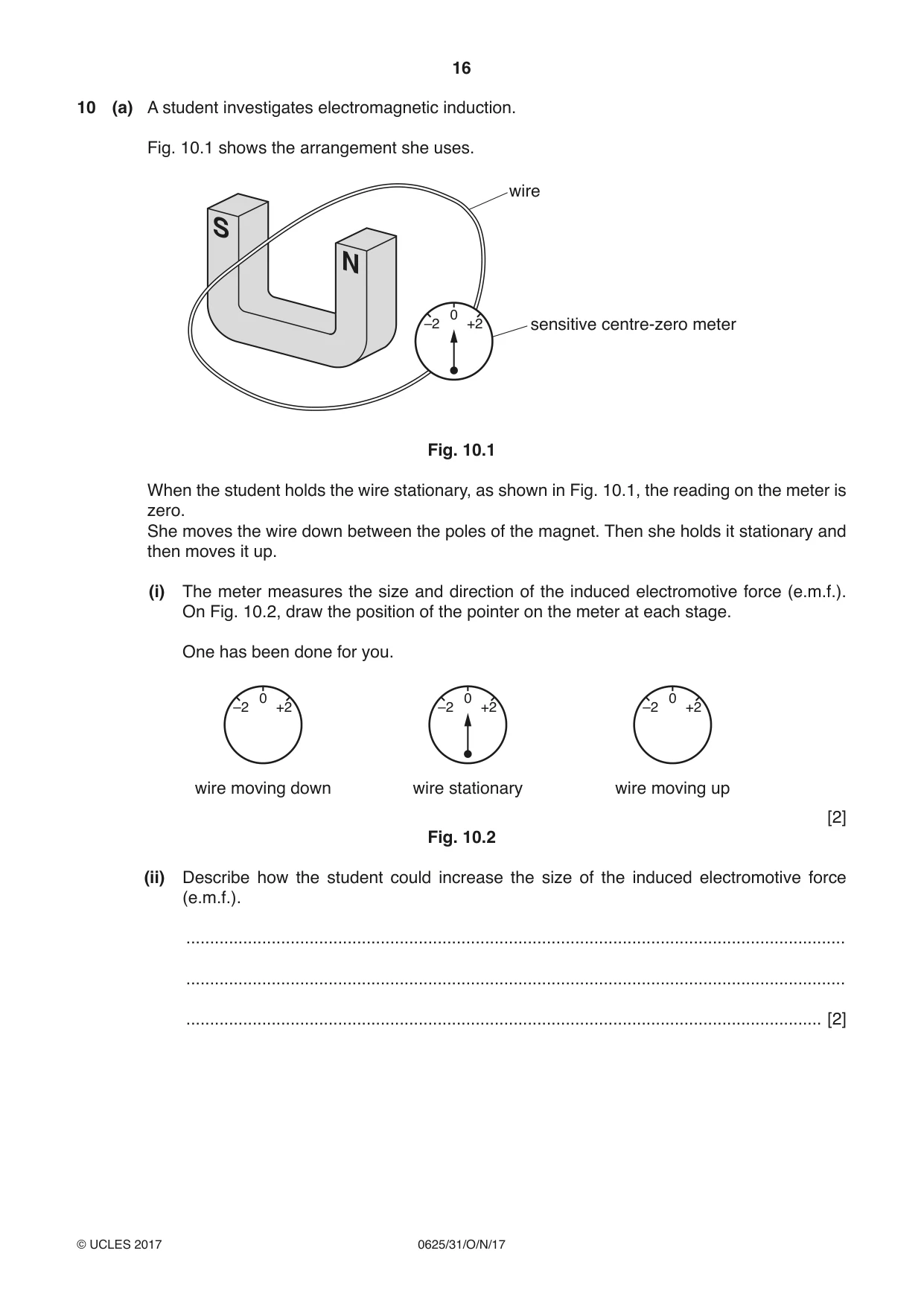
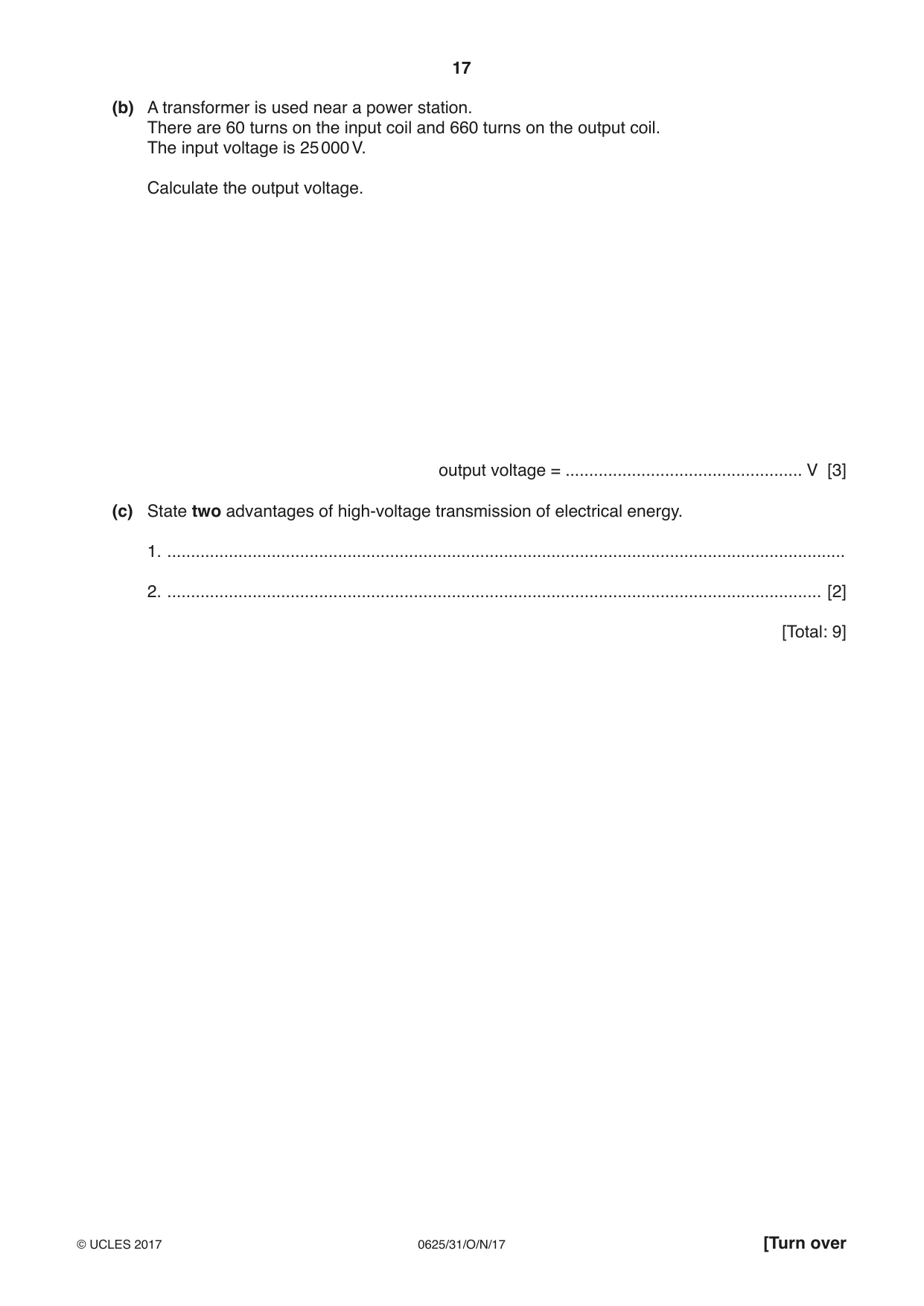
10 (a) A student investigates electromagnetic induction. Fig. 10.1 shows the arrangement she uses. wire S N 0 –2 +2 sensitive centre-zero meter Fig. 10.1 When the student holds the wire stationary, as shown in Fig. 10.1, the reading on the meter is zero. She moves the wire down between the poles of the magnet. Then she holds it stationary and then moves it up. (i) The meter measures the size and direction of the induced electromotive force (e.m.f.). On Fig. 10.2, draw the position of the pointer on the meter at each stage. One has been done for you. 0 0 0 –2 +2 –2 +2 –2 +2 wire moving down wire stationary wire moving up [2] Fig. 10.2 (ii) Describe how the student could increase the size of the induced electromotive force (e.m.f.). ........................................................................................................................................... ........................................................................................................................................... ...................................................................................................................................... [2] (b) A transformer is used near a power station. There are 60 turns on the input coil and 660 turns on the output coil. The input voltage is 25 000 V. Calculate the output voltage. output voltage = .................................................. V [3] (c) State two advantages of high-voltage transmission of electrical energy. 1. ............................................................................................................................................... 2. .......................................................................................................................................... [2] [Total: 9]
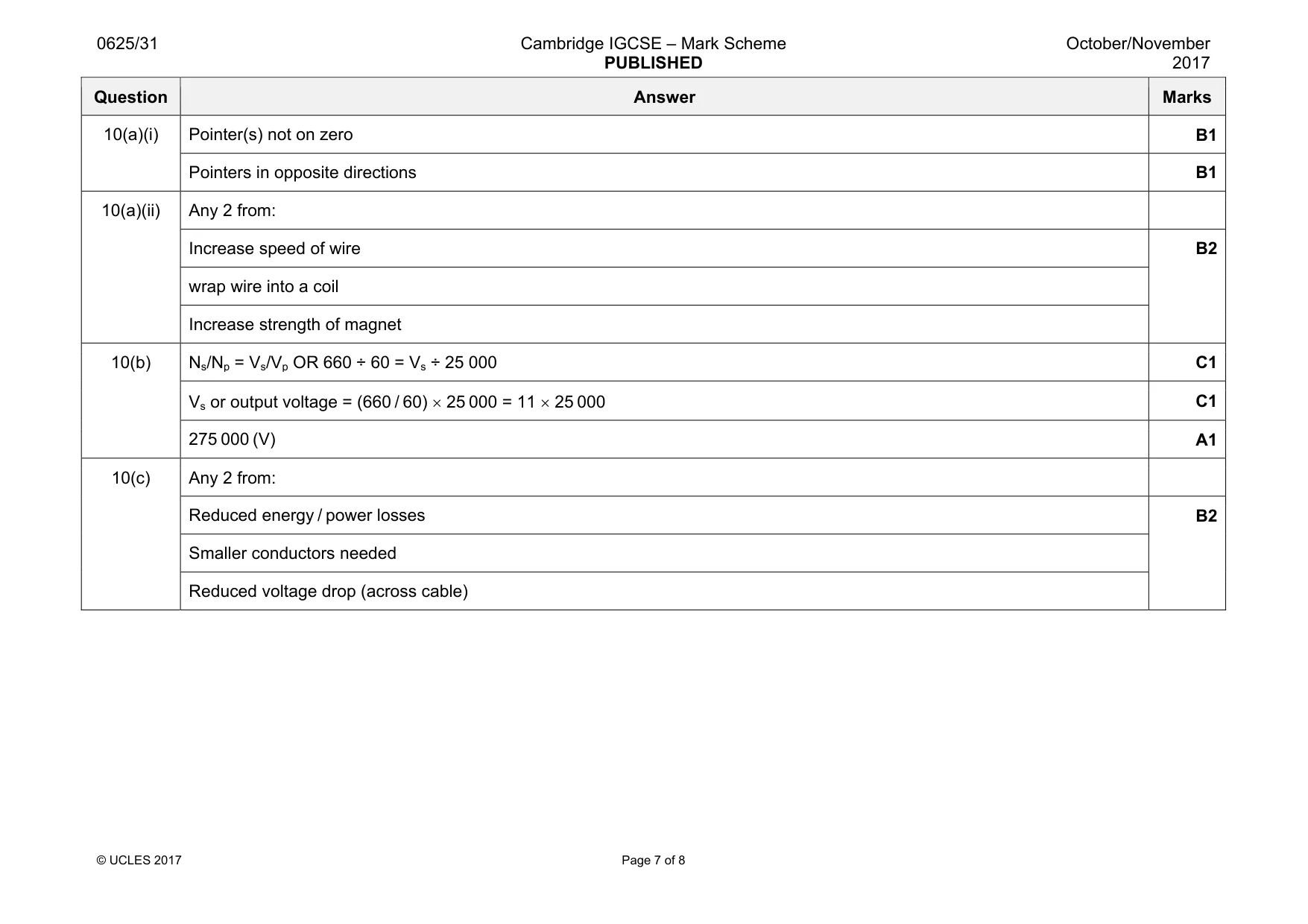
Mark scheme: 10(a)(i) Pointer(s) not on zero B1 Pointers in opposite directions B1 10(a)(ii) Any 2 from: Increase speed of wire B2 wrap wire into a coil Increase strength of magnet 10(b) Ns/Np = Vs/Vp OR 660 ÷ 60 = Vs ÷ 25 000 C1 Vs or output voltage = (660 / 60) × 25 000 = 11 × 25 000 C1 275 000 (V) A1 10(c) Any 2 from: Reduced energy / power losses B2 Smaller conductors needed Reduced voltage drop (across cable)
Q11 · A nucleus of polonium-210 can be represented as 21084Po
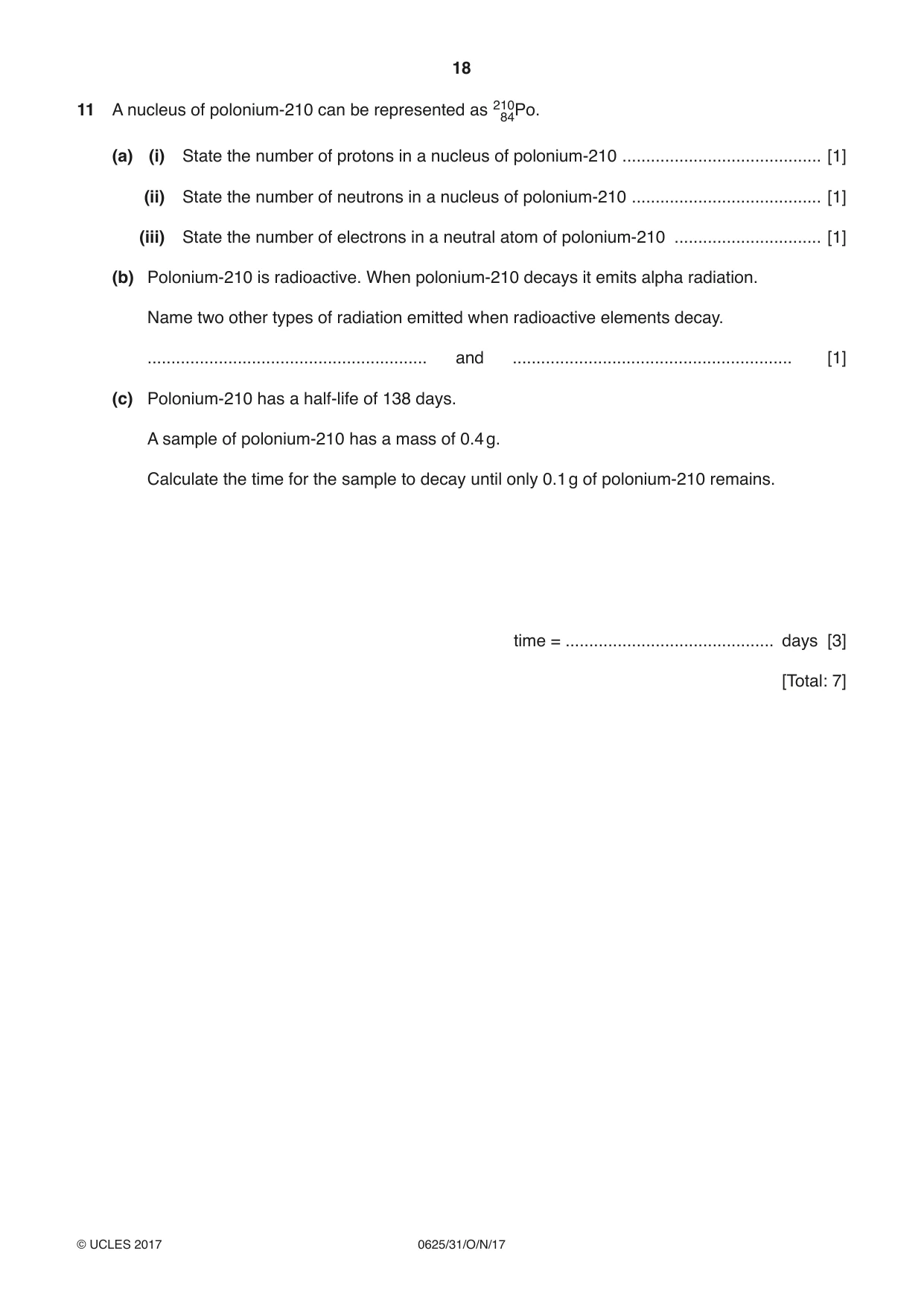
11 A nucleus of polonium-210 can be represented as 21084Po. (a) (i) State the number of protons in a nucleus of polonium-210 .......................................... [1] (ii) State the number of neutrons in a nucleus of polonium-210 ........................................ [1] (iii) State the number of electrons in a neutral atom of polonium-210 ............................... [1] (b) Polonium-210 is radioactive. When polonium-210 decays it emits alpha radiation. Name two other types of radiation emitted when radioactive elements decay. ........................................................... and ........................................................... [1] (c) Polonium-210 has a half-life of 138 days. A sample of polonium-210 has a mass of 0.4 g. Calculate the time for the sample to decay until only 0.1 g of polonium-210 remains. time = ............................................ days [3] [Total: 7]
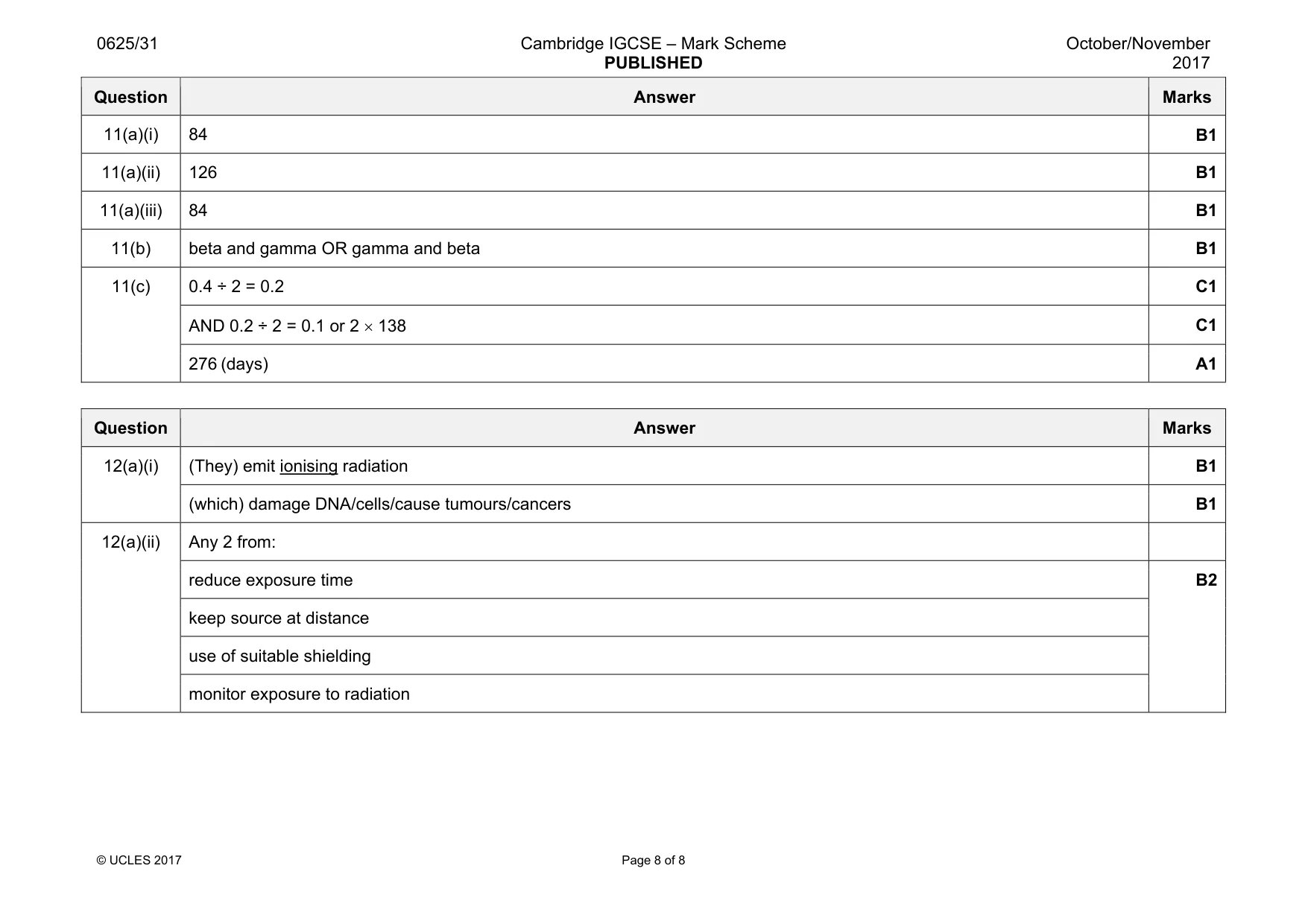
Mark scheme: 11(a)(i) 84 B1 11(a)(ii) 126 B1 11(a)(iii) 84 B1 11(b) beta and gamma OR gamma and beta B1 11(c) 0.4 ÷ 2 = 0.2 C1 AND 0.2 ÷ 2 = 0.1 or 2 × 138 C1 276 (days) A1
Q12 · A scientist needs to reduce the risks when working with radioactive sources
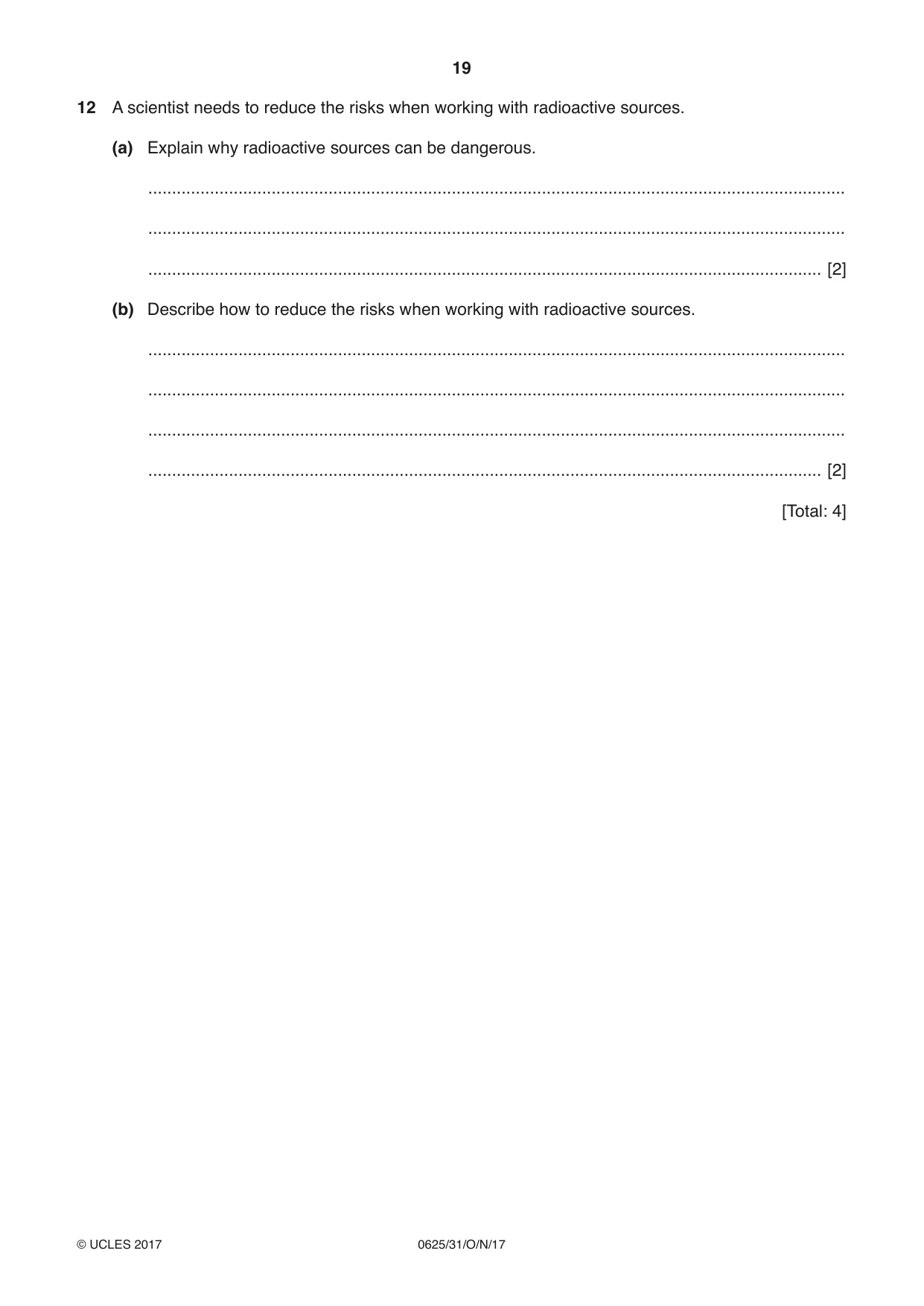
12 A scientist needs to reduce the risks when working with radioactive sources. (a) Explain why radioactive sources can be dangerous. ................................................................................................................................................... ................................................................................................................................................... .............................................................................................................................................. [2] (b) Describe how to reduce the risks when working with radioactive sources. ................................................................................................................................................... ................................................................................................................................................... ................................................................................................................................................... .............................................................................................................................................. [2] [Total: 4]
Mark scheme: 12(a)(i) (They) emit ionising radiation B1 (which) damage DNA/cells/cause tumours/cancers B1 12(a)(ii) Any 2 from: reduce exposure time B2 keep source at distance use of suitable shielding monitor exposure to radiation
What was in this paper
The subtopics covered by these 12 questions, and how many questions each got. Open one in a new tab to see every Cambridge question on it.
What you needed in this session
Cambridge’s own grade thresholds for 2017 Oct/Nov, Paper 3 · Variant 1. A higher threshold means an easier paper — the bar moves with how the cohort did.