Cambridge IGCSE Physics 0625 — 2020 Oct/Nov Paper 3 · Variant 2
0625/32/O/N/20 · 12 questions · 80 marks · ≈90 min
The question paper and its mark scheme, free to read here and free to download. This is Cambridge’s own paper, exactly as it was sat.
Question paper16 pages
Mark scheme15 pages
Answers below. Sit the paper first if you are practising.
Questions as text
Q1 · A box attached to a parachute
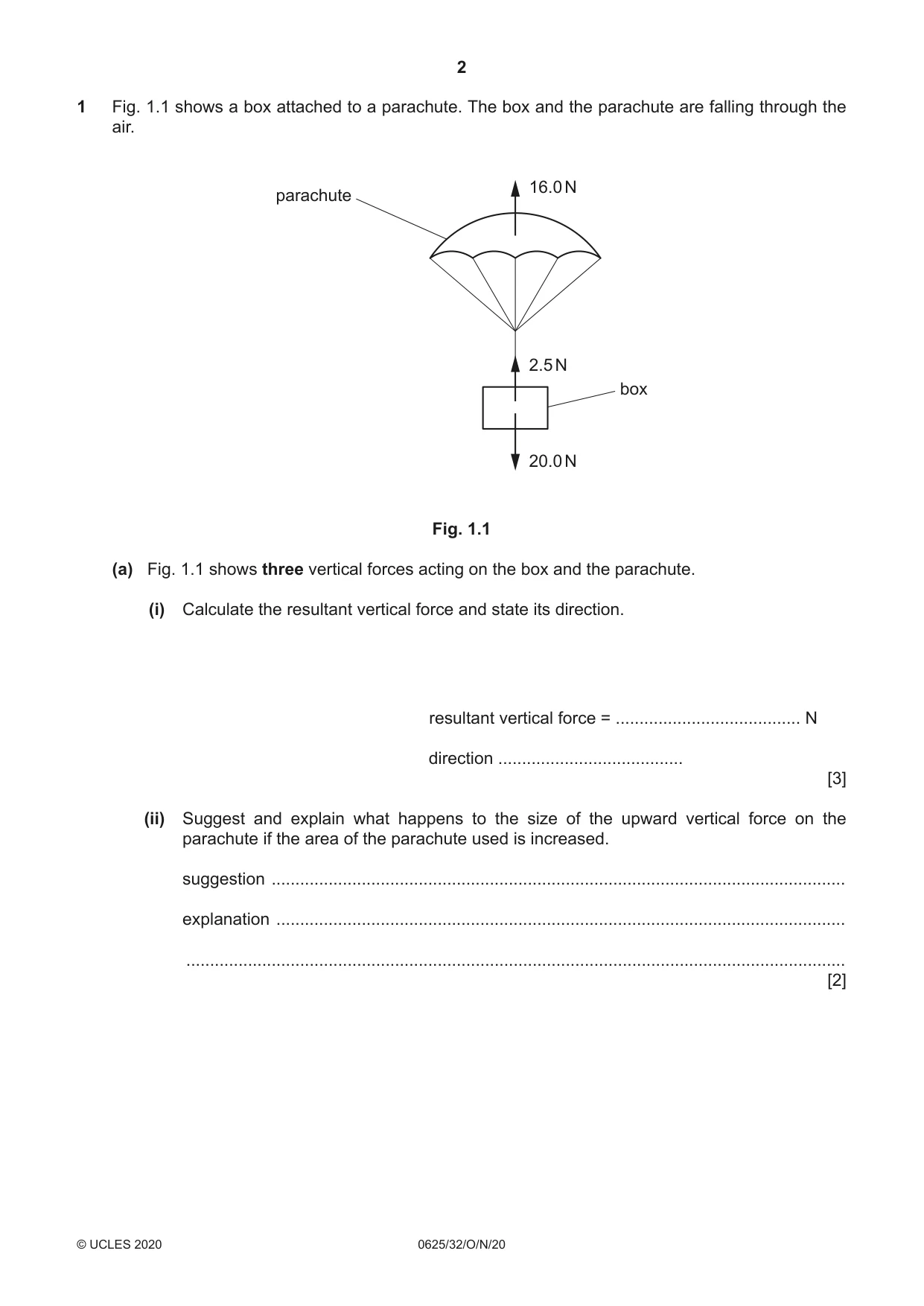
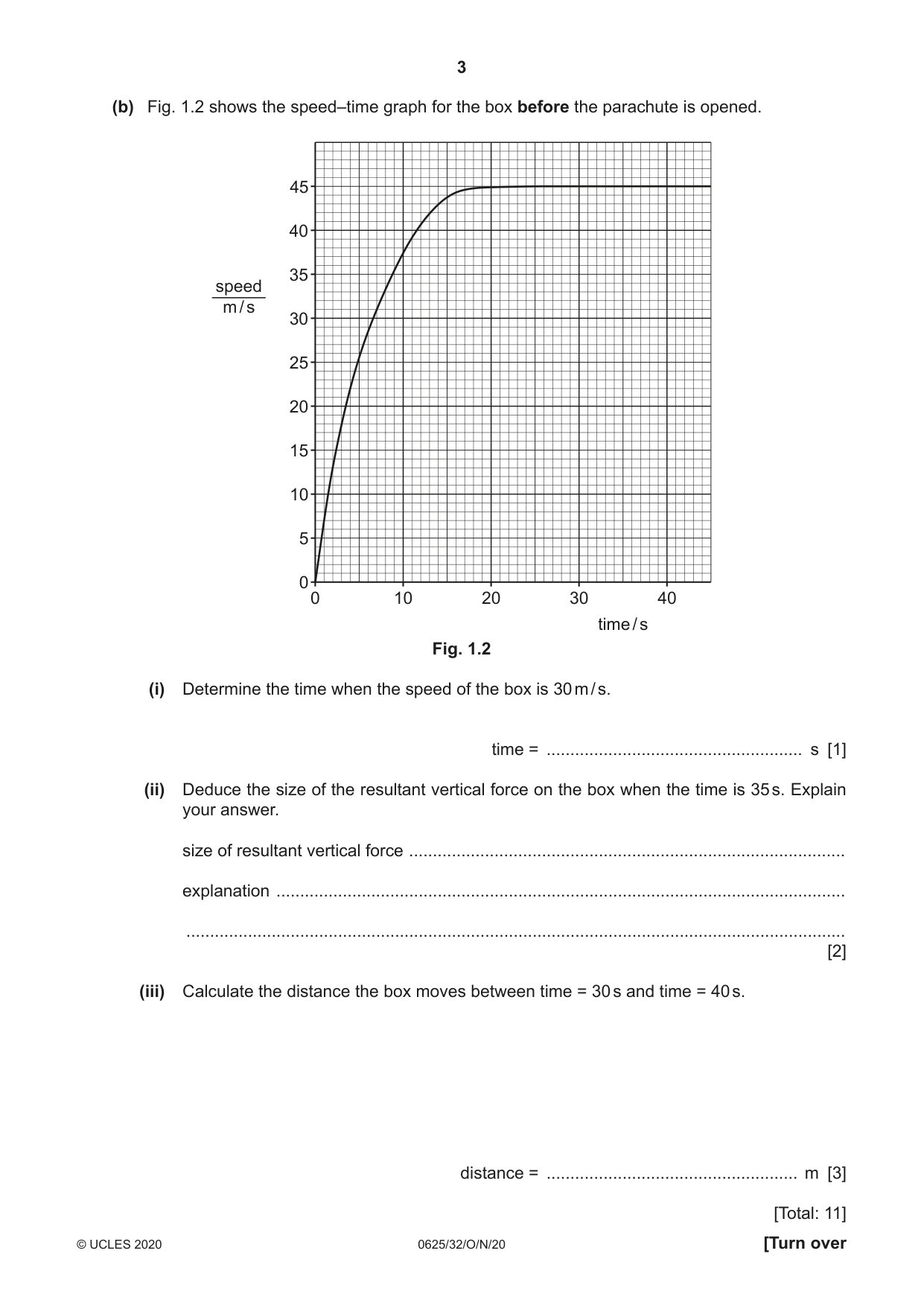
1 Fig. 1.1 shows a box attached to a parachute. The box and the parachute are falling through the air. 16.0 N parachute 2.5 N box 20.0 N Fig. 1.1 (a) Fig. 1.1 shows three vertical forces acting on the box and the parachute. (i) Calculate the resultant vertical force and state its direction. resultant vertical force = ....................................... N direction ....................................... [3] (ii) Suggest and explain what happens to the size of the upward vertical force on the parachute if the area of the parachute used is increased. suggestion ......................................................................................................................... explanation ........................................................................................................................ ........................................................................................................................................... [2] (b) Fig. 1.2 shows the speed–time graph for the box before the parachute is opened. 45 40 35 speed m / s 30 25 20 15 10 5 0 0 10 20 30 40 time / s Fig. 1.2 (i) Determine the time when the speed of the box is 30 m / s. time = ...................................................... s [1] (ii) Deduce the size of the resultant vertical force on the box when the time is 35 s. Explain your answer. size of resultant vertical force ............................................................................................ explanation ........................................................................................................................ ........................................................................................................................................... [2] (iii) Calculate the distance the box moves between time = 30 s and time = 40 s. distance = ..................................................... m [3] [Total: 11]
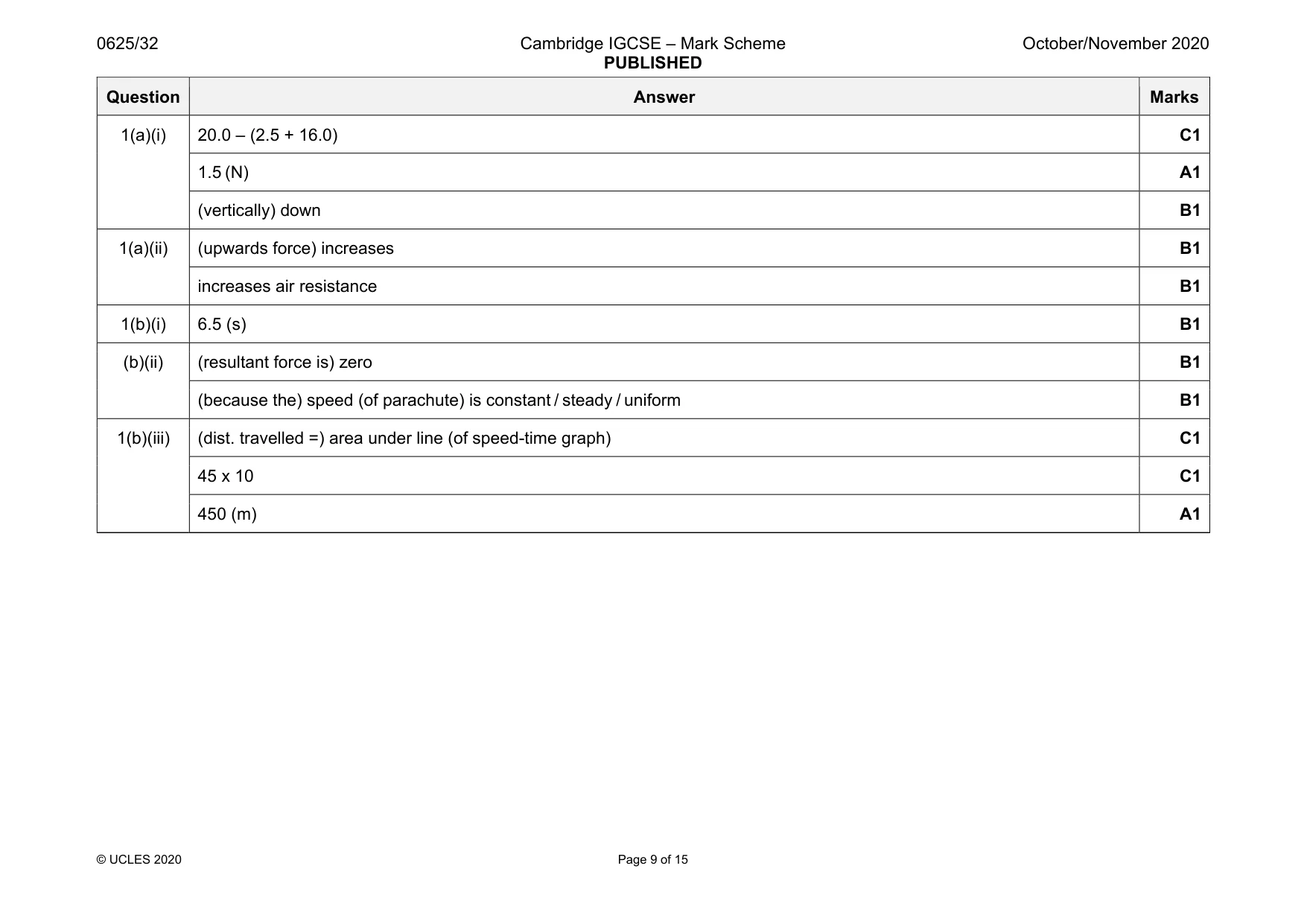
Mark scheme: 1(a)(i) 20.0 – (2.5 + 16.0) C1 1.5 (N) A1 (vertically) down B1 1(a)(ii) (upwards force) increases B1 increases air resistance B1 1(b)(i) 6.5 (s) B1 (b)(ii) (resultant force is) zero B1 (because the) speed (of parachute) is constant / steady / uniform B1 1(b)(iii) (dist. travelled =) area under line (of speed-time graph) C1 45 x 10 C1 450 (m) A1
Q2 · A car driver needs to remove one of the wheels on his car
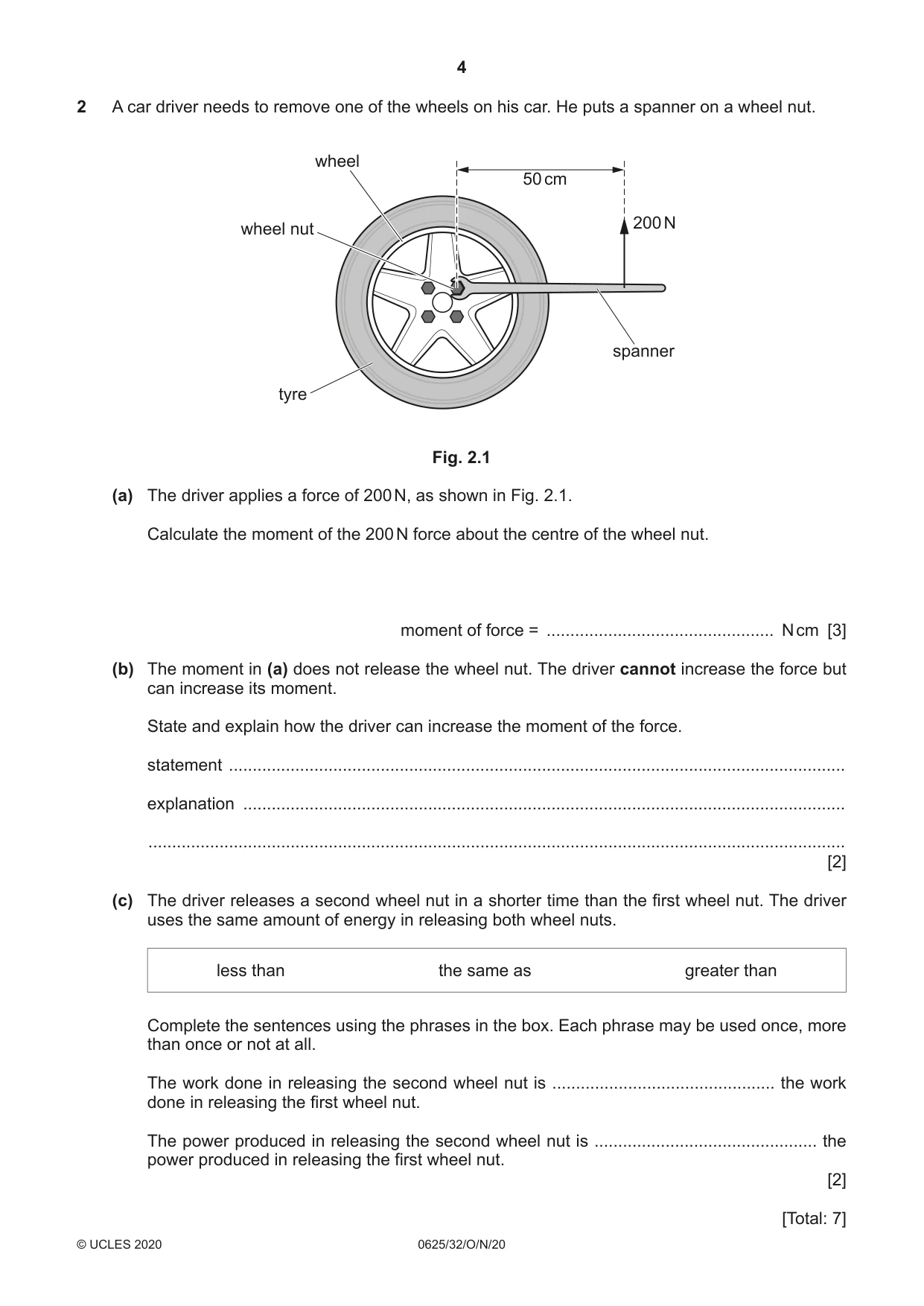
2 A car driver needs to remove one of the wheels on his car. He puts a spanner on a wheel nut. wheel 50 cm 200 N wheel nut spanner tyre Fig. 2.1 (a) The driver applies a force of 200 N, as shown in Fig. 2.1. Calculate the moment of the 200 N force about the centre of the wheel nut. moment of force = ................................................ N cm [3] (b) The moment in (a) does not release the wheel nut. The driver cannot increase the force but can increase its moment. State and explain how the driver can increase the moment of the force. statement .................................................................................................................................. explanation ............................................................................................................................... ................................................................................................................................................... [2] (c) The driver releases a second wheel nut in a shorter time than the first wheel nut. The driver uses the same amount of energy in releasing both wheel nuts. less than the same as greater than Complete the sentences using the phrases in the box. Each phrase may be used once, more than once or not at all. The work done in releasing the second wheel nut is ............................................... the work done in releasing the first wheel nut. The power produced in releasing the second wheel nut is ............................................... the power produced in releasing the first wheel nut. [2] [Total: 7]
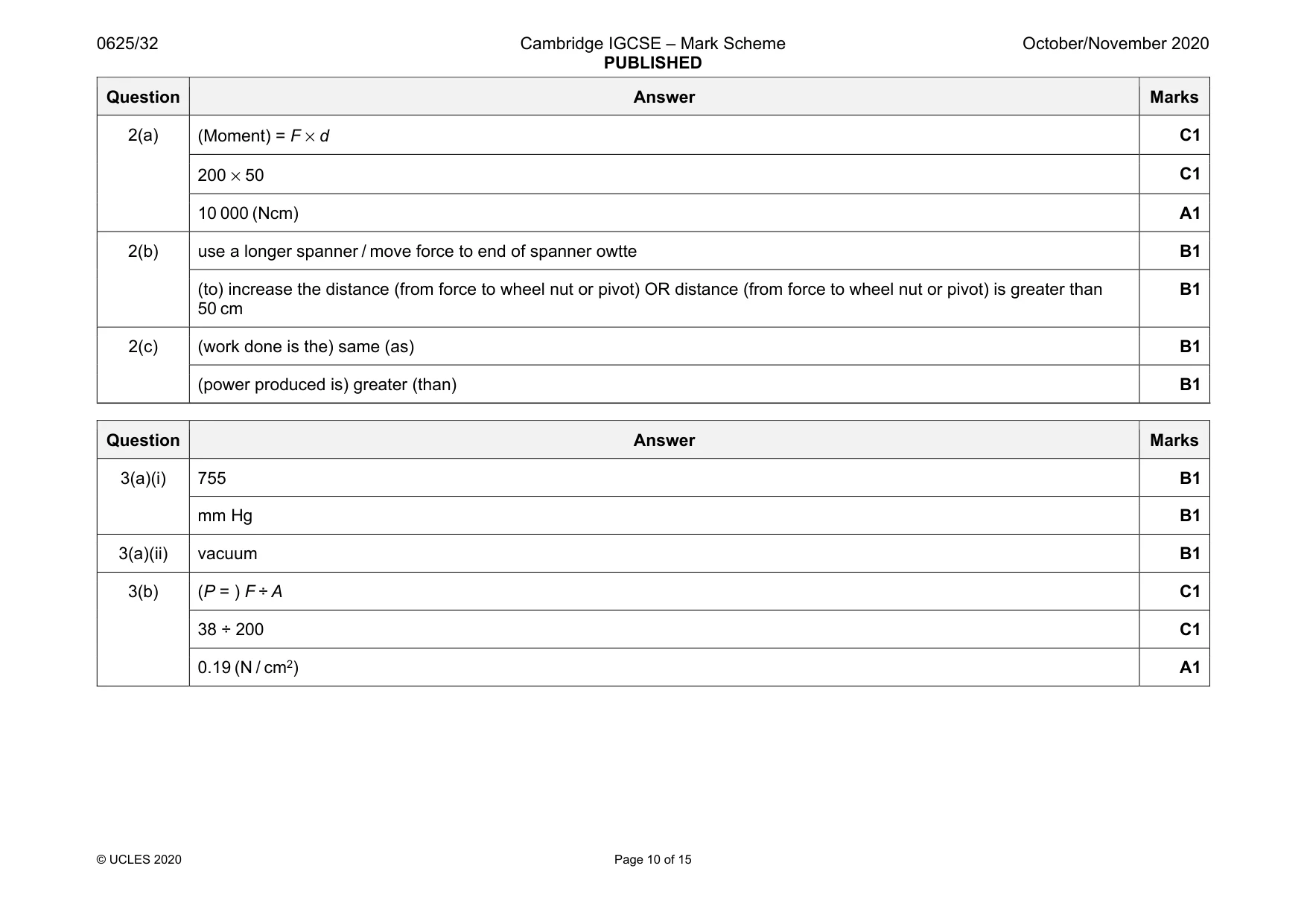
Mark scheme: 2(a) (Moment) = F × d C1 200 × 50 C1 10 000 (Ncm) A1 2(b) use a longer spanner / move force to end of spanner owtte B1 (to) increase the distance (from force to wheel nut or pivot) OR distance (from force to wheel nut or pivot) is greater than 50 cm B1 2(c) (work done is the) same (as) B1 (power produced is) greater (than) B1
Question 3
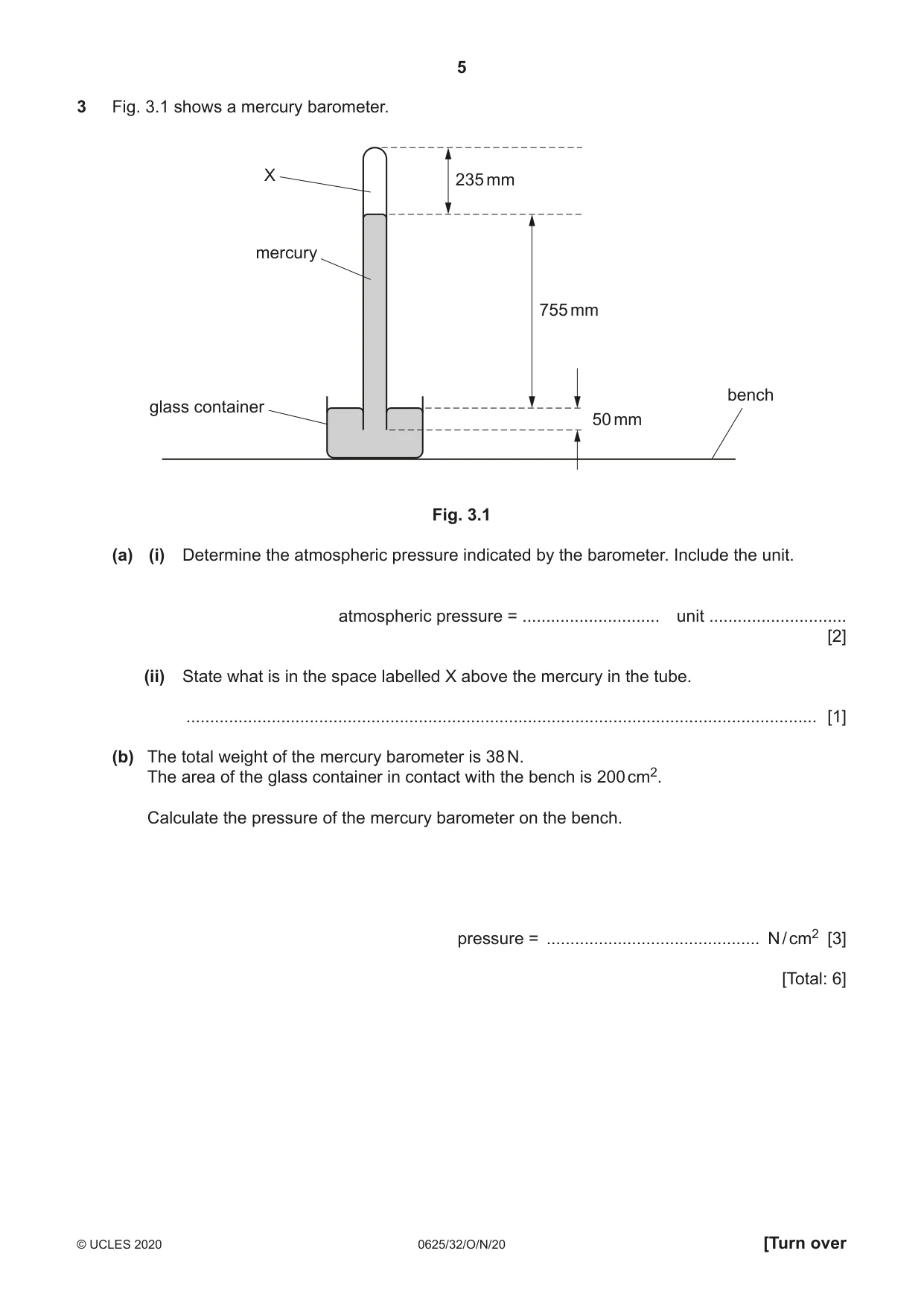
3 Fig. 3.1 shows a mercury barometer. X 235 mm mercury 755 mm bench glass container 50 mm Fig. 3.1 (a) (i) Determine the atmospheric pressure indicated by the barometer. Include the unit. atmospheric pressure = ............................. unit ............................. [2] (ii) State what is in the space labelled X above the mercury in the tube. ..................................................................................................................................... [1] (b) The total weight of the mercury barometer is 38 N. The area of the glass container in contact with the bench is 200 cm2. Calculate the pressure of the mercury barometer on the bench. pressure = ............................................. N / cm2 [3] [Total: 6]
Mark scheme: 3(a)(i) 755 B1 mm Hg B1 3(a)(ii) vacuum B1 3(b) (P = ) F ÷ A C1 38 ÷ 200 C1 0.19 (N / cm2) A1
Q4 · A rigid container is filled with a gas
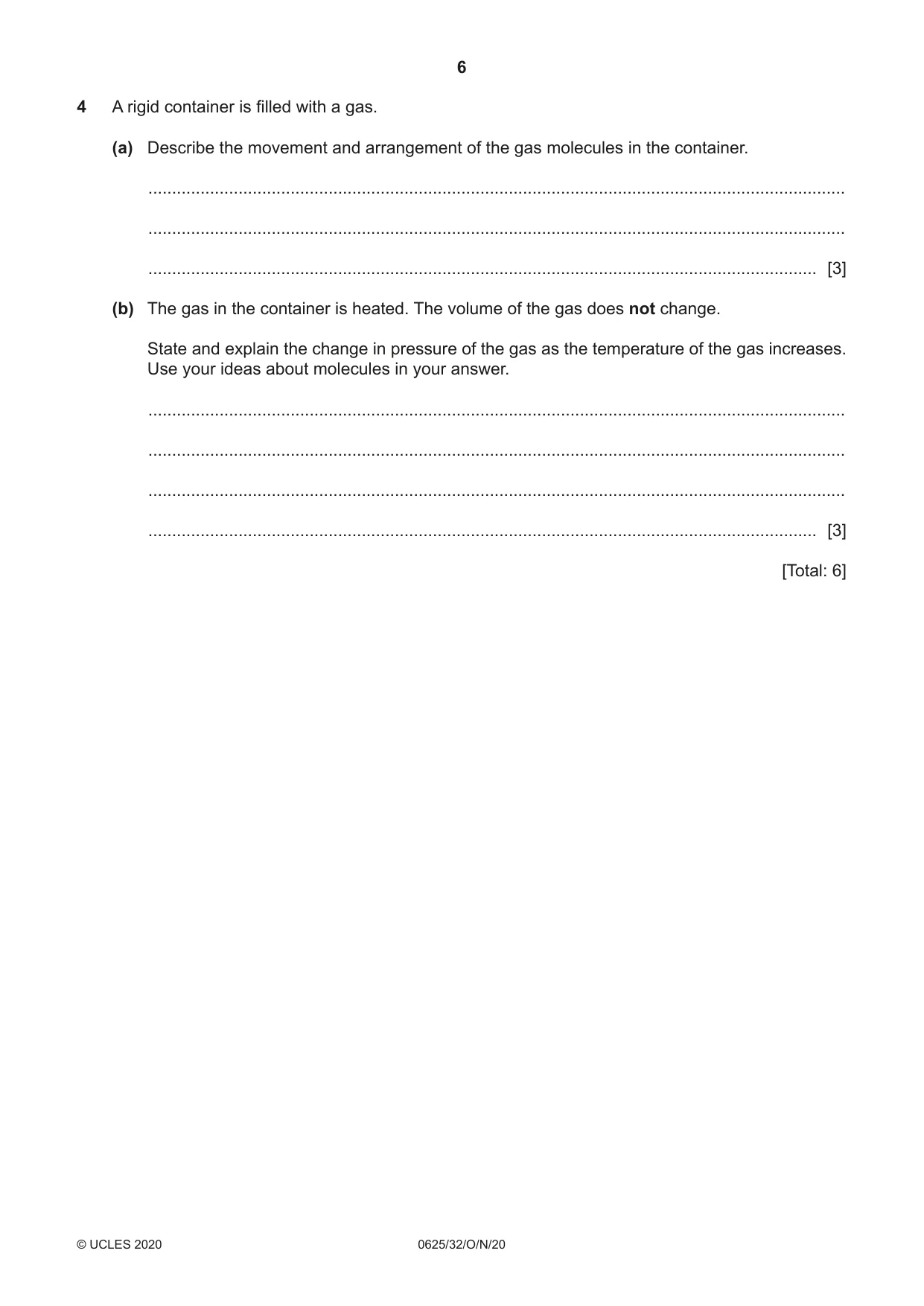
4 A rigid container is filled with a gas. (a) Describe the movement and arrangement of the gas molecules in the container. ................................................................................................................................................... ................................................................................................................................................... ............................................................................................................................................. [3] (b) The gas in the container is heated. The volume of the gas does not change. State and explain the change in pressure of the gas as the temperature of the gas increases. Use your ideas about molecules in your answer. ................................................................................................................................................... ................................................................................................................................................... ................................................................................................................................................... ............................................................................................................................................. [3] [Total: 6]
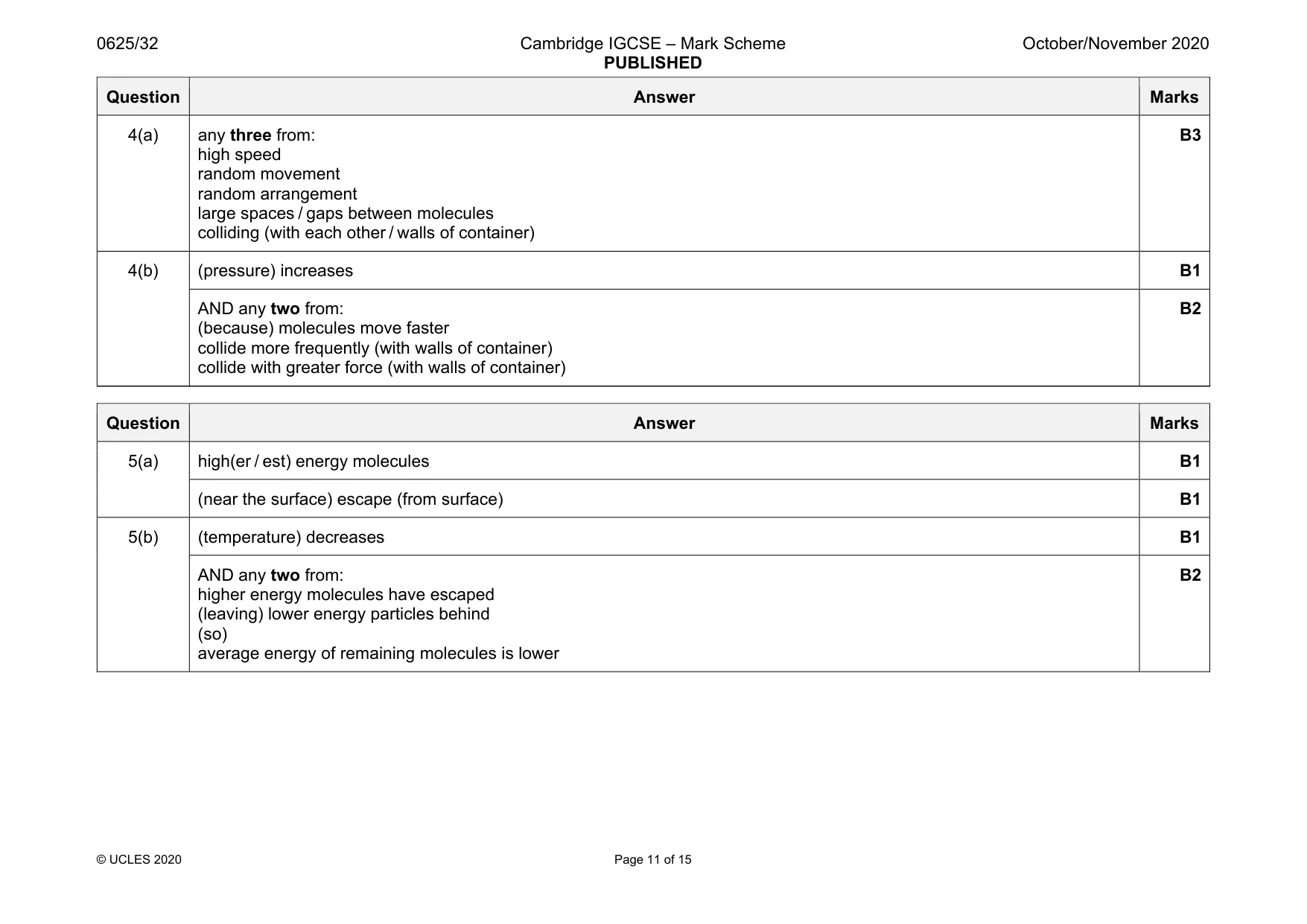
Mark scheme: 4(a) any three from: high speed random movement random arrangement large spaces / gaps between molecules colliding (with each other / walls of container) B3 4(b) (pressure) increases B1 AND any two from: (because) molecules move faster collide more frequently (with walls of container) collide with greater force (with walls of container) B2
Q5 · A beaker contains water
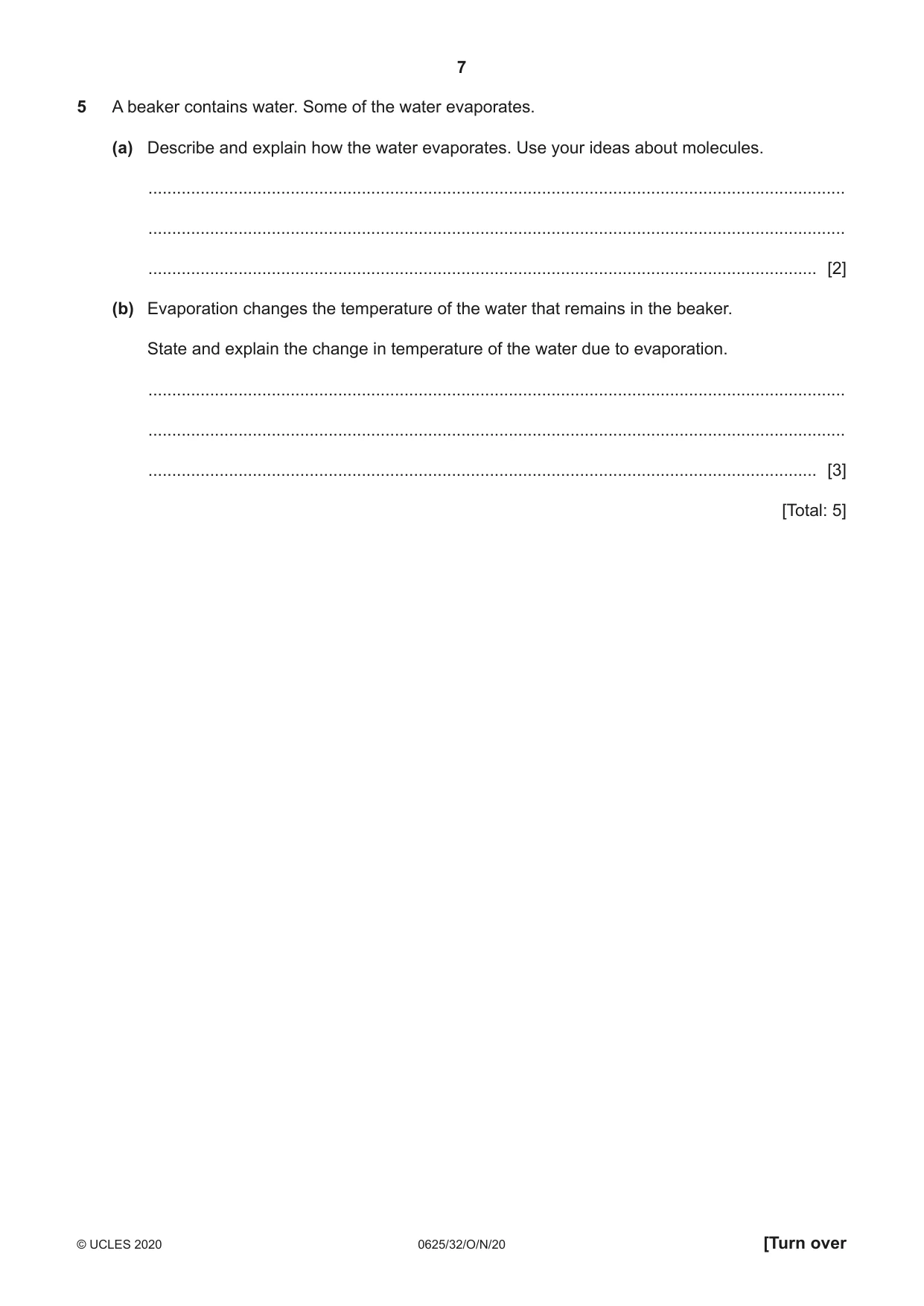
5 A beaker contains water. Some of the water evaporates. (a) Describe and explain how the water evaporates. Use your ideas about molecules. ................................................................................................................................................... ................................................................................................................................................... ............................................................................................................................................. [2] (b) Evaporation changes the temperature of the water that remains in the beaker. State and explain the change in temperature of the water due to evaporation. ................................................................................................................................................... ................................................................................................................................................... ............................................................................................................................................. [3] [Total: 5]
Mark scheme: 5(a) high(er / est) energy molecules B1 (near the surface) escape (from surface) B1 5(b) (temperature) decreases B1 AND any two from: higher energy molecules have escaped (leaving) lower energy particles behind (so) average energy of remaining molecules is lower B2
Q6 · Equipment used to demonstrate convection in air
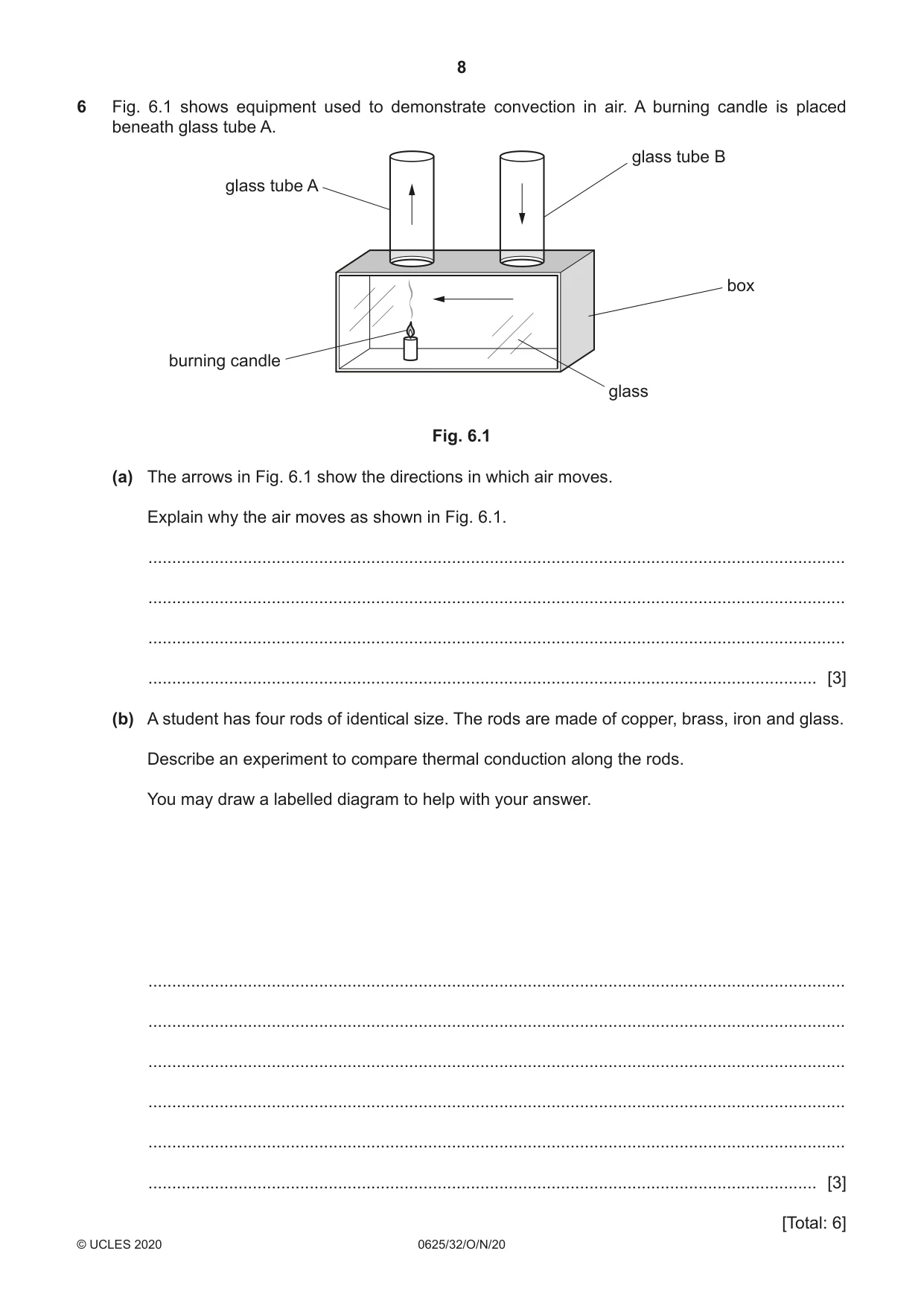
6 Fig. 6.1 shows equipment used to demonstrate convection in air. A burning candle is placed beneath glass tube A. glass tube B glass tube A box burning candle glass Fig. 6.1 (a) The arrows in Fig. 6.1 show the directions in which air moves. Explain why the air moves as shown in Fig. 6.1. ................................................................................................................................................... ................................................................................................................................................... ................................................................................................................................................... ............................................................................................................................................. [3] (b) A student has four rods of identical size. The rods are made of copper, brass, iron and glass. Describe an experiment to compare thermal conduction along the rods. You may draw a labelled diagram to help with your answer. ................................................................................................................................................... ................................................................................................................................................... ................................................................................................................................................... ................................................................................................................................................... ................................................................................................................................................... ............................................................................................................................................. [3] [Total: 6]
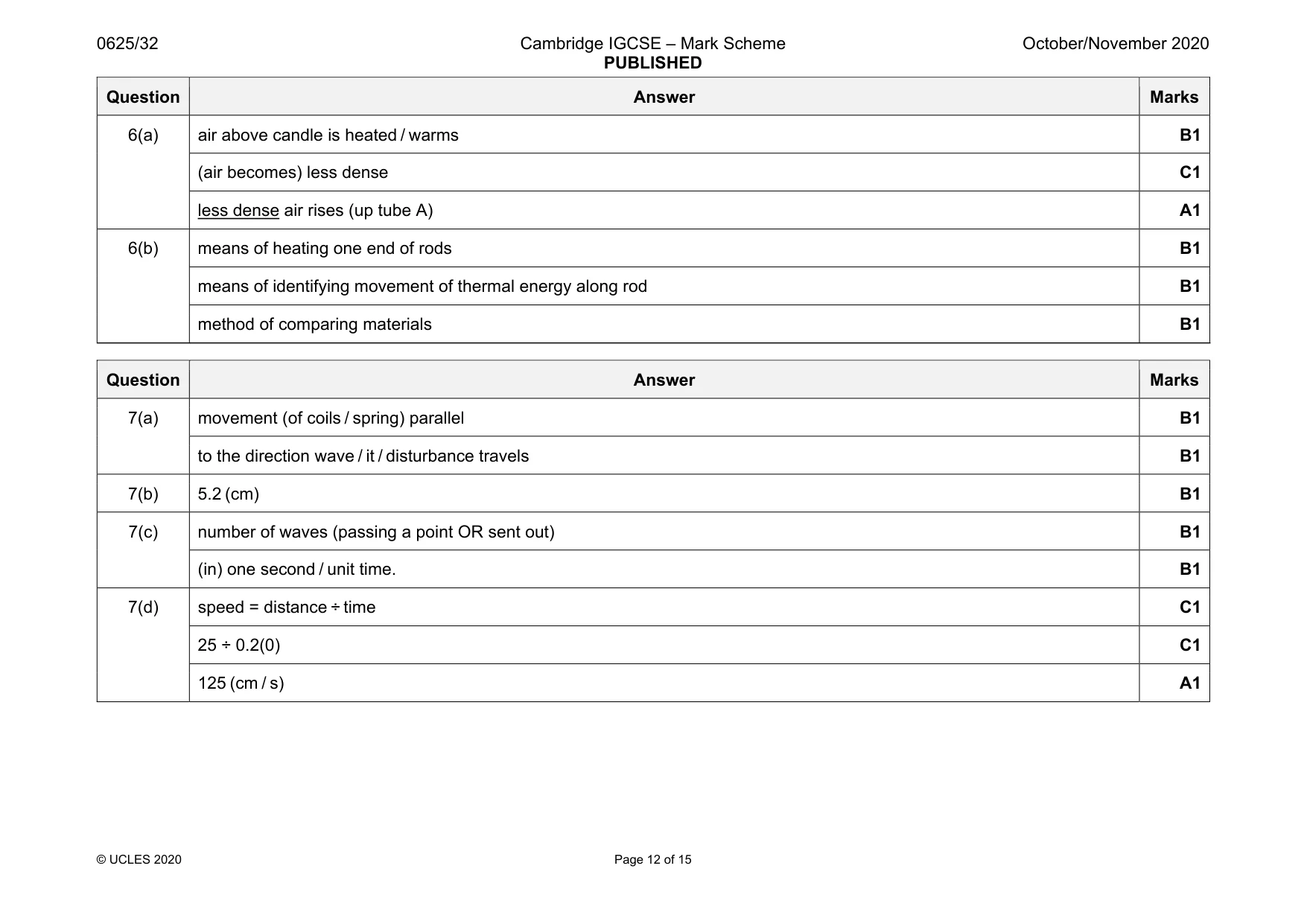
Mark scheme: 6(a) air above candle is heated / warms B1 (air becomes) less dense C1 less dense air rises (up tube A) A1 6(b) means of heating one end of rods B1 means of identifying movement of thermal energy along rod B1 method of comparing materials B1
Q7 · A teacher uses a long spring to demonstrate wave motion
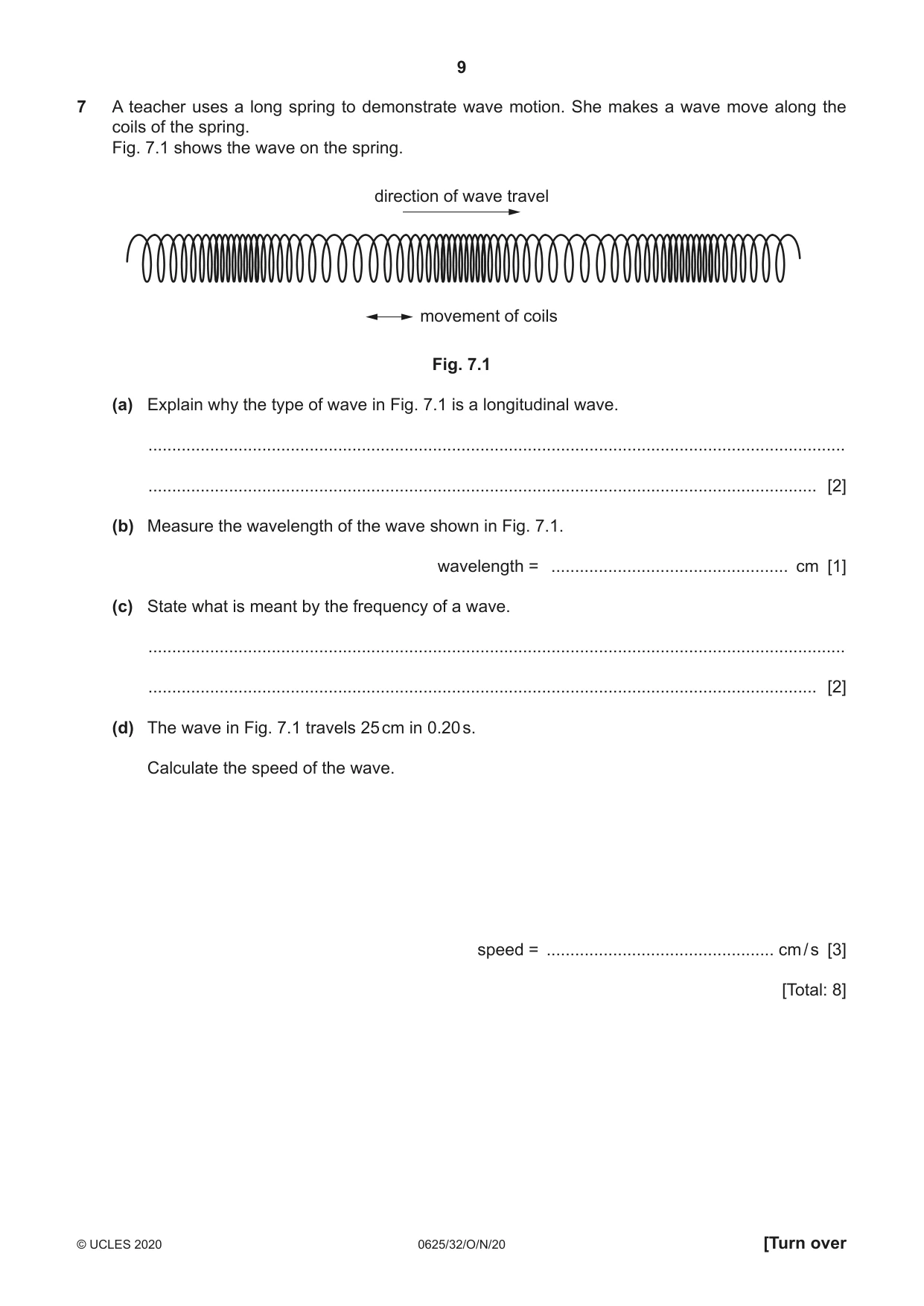
7 A teacher uses a long spring to demonstrate wave motion. She makes a wave move along the coils of the spring. Fig. 7.1 shows the wave on the spring. direction of wave travel movement of coils Fig. 7.1 (a) Explain why the type of wave in Fig. 7.1 is a longitudinal wave. ................................................................................................................................................... ............................................................................................................................................. [2] (b) Measure the wavelength of the wave shown in Fig. 7.1. wavelength = .................................................. cm [1] (c) State what is meant by the frequency of a wave. ................................................................................................................................................... ............................................................................................................................................. [2] (d) The wave in Fig. 7.1 travels 25 cm in 0.20 s. Calculate the speed of the wave. speed = ................................................ cm / s [3] [Total: 8]
Mark scheme: 7(a) movement (of coils / spring) parallel B1 to the direction wave / it / disturbance travels B1 7(b) 5.2 (cm) B1 7(c) number of waves (passing a point OR sent out) B1 (in) one second / unit time. B1 7(d) speed = distance ÷ time C1 25 ÷ 0.2(0) C1 125 (cm / s) A1
Q8 · A converging lens and an object
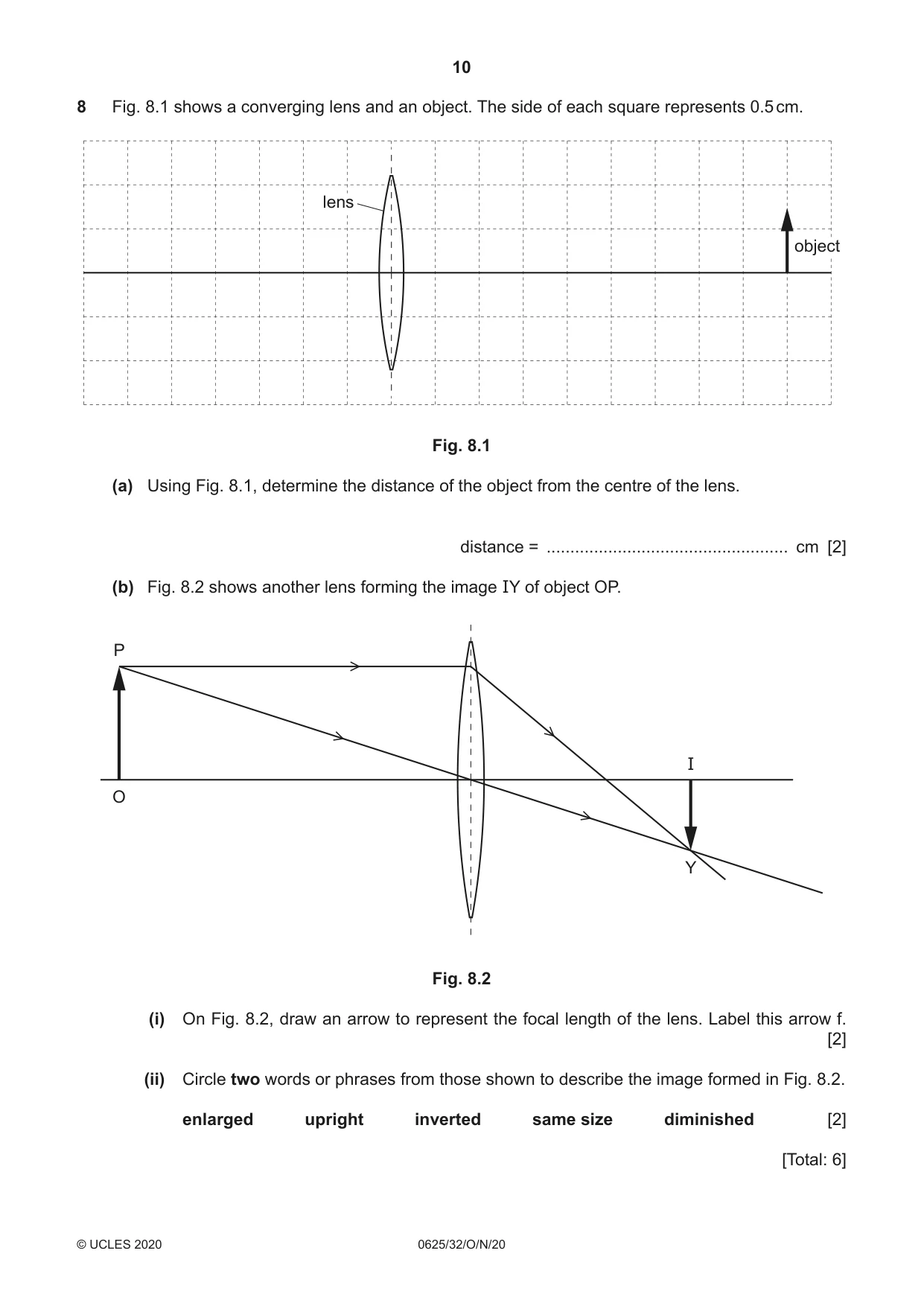
8 Fig. 8.1 shows a converging lens and an object. The side of each square represents 0.5 cm. lens object Fig. 8.1 (a) Using Fig. 8.1, determine the distance of the object from the centre of the lens. distance = ................................................... cm [2] (b) Fig. 8.2 shows another lens forming the image IY of object OP. P I O Y Fig. 8.2 (i) On Fig. 8.2, draw an arrow to represent the focal length of the lens. Label this arrow f. [2] (ii) Circle two words or phrases from those shown to describe the image formed in Fig. 8.2. enlarged upright inverted same size diminished [2] [Total: 6]
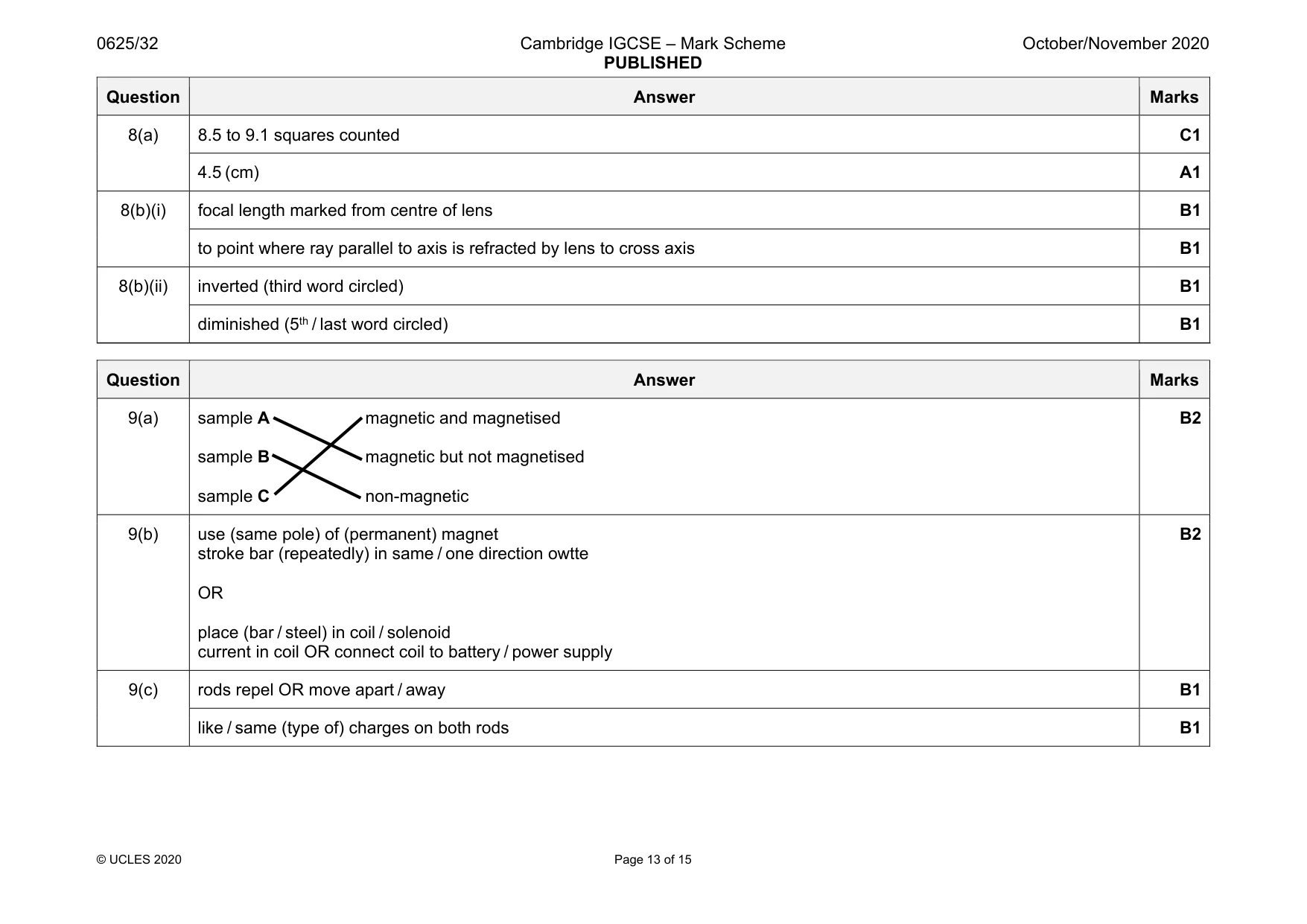
Mark scheme: 8(a) 8.5 to 9.1 squares counted C1 4.5 (cm) A1 8(b)(i) focal length marked from centre of lens B1 to point where ray parallel to axis is refracted by lens to cross axis B1 8(b)(ii) inverted (third word circled) B1 diminished (5th / last word circled) B1
Q9 · A student tests whether a bar magnet affects three different materials
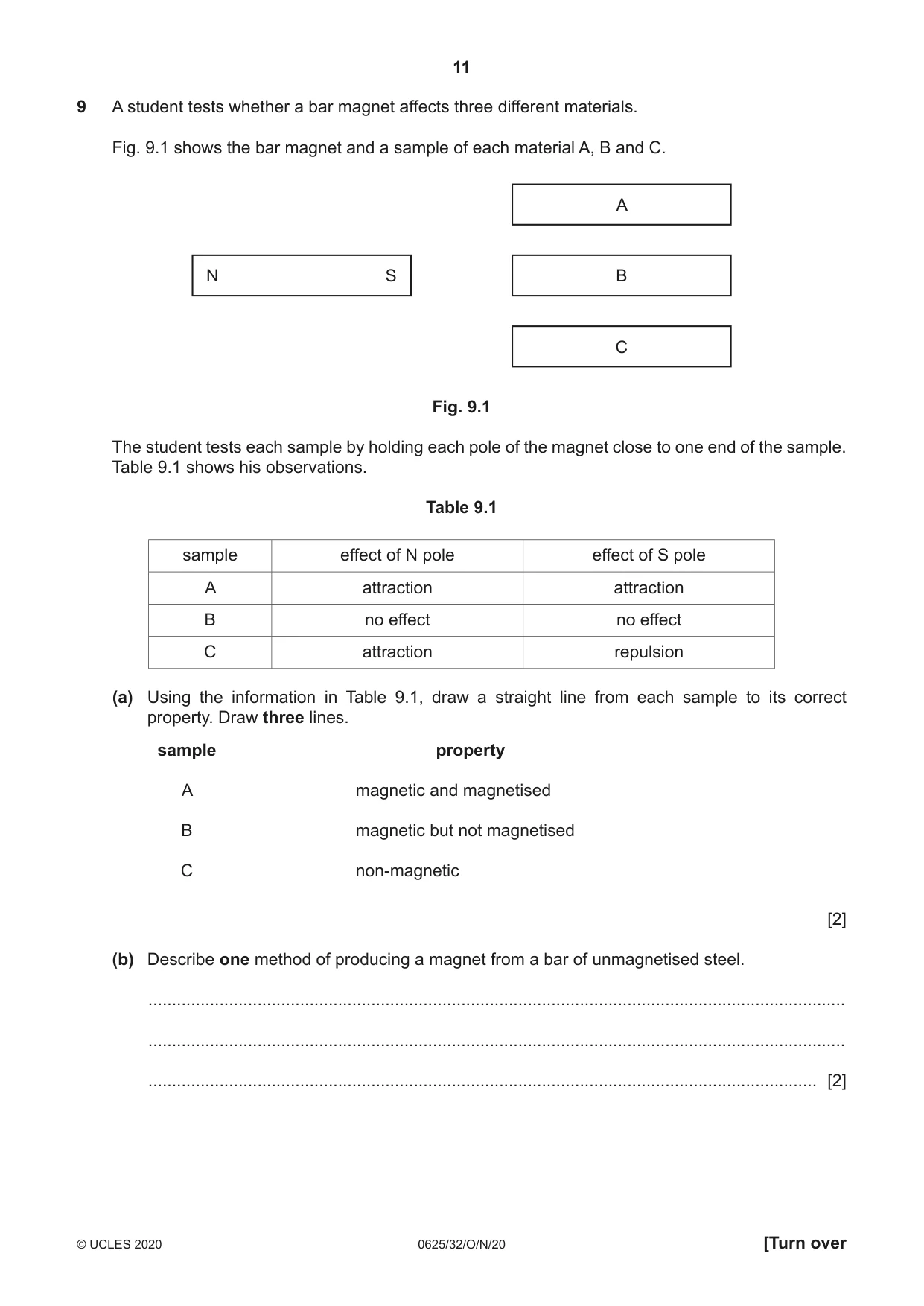
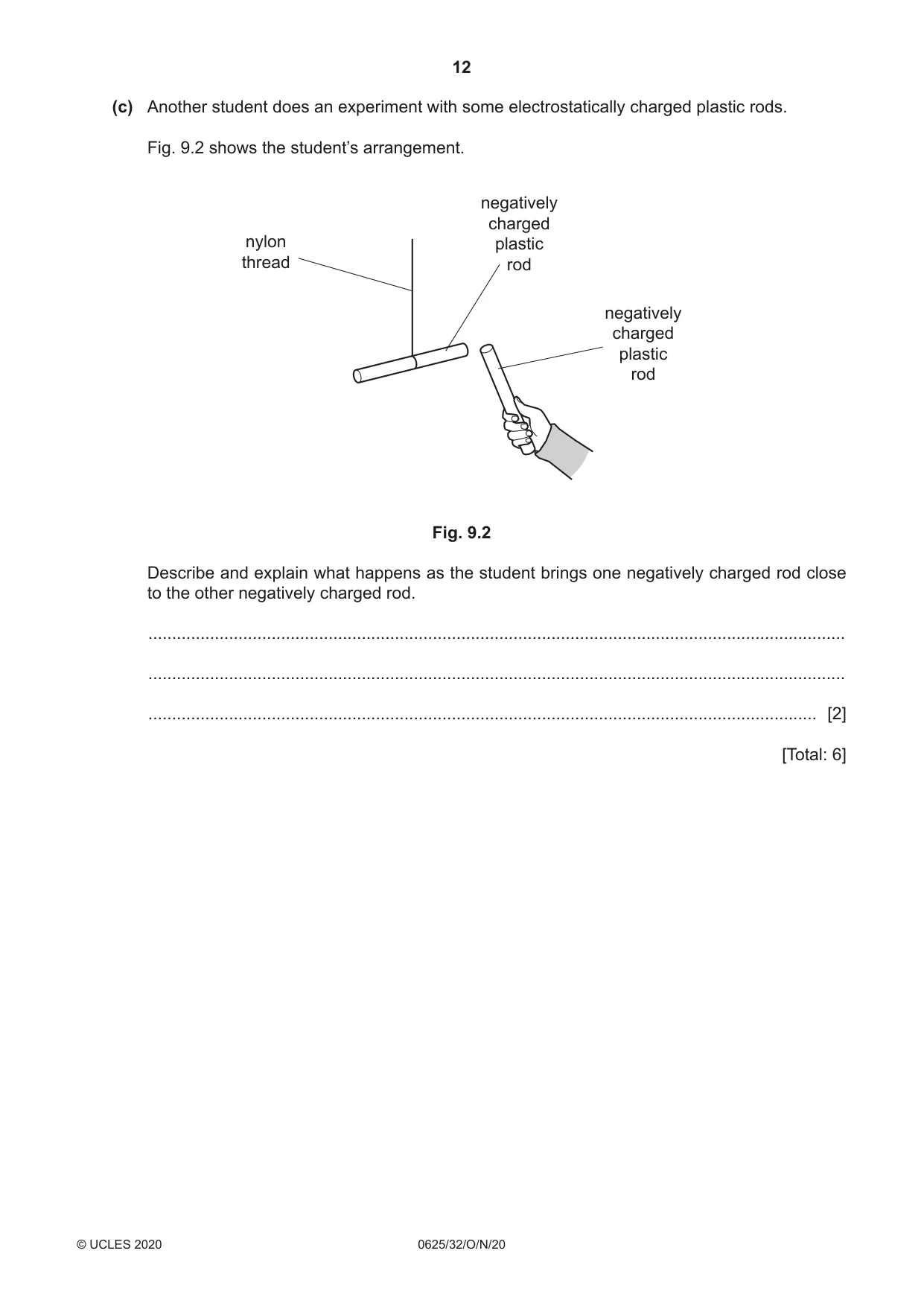
9 A student tests whether a bar magnet affects three different materials. Fig. 9.1 shows the bar magnet and a sample of each material A, B and C. A N S B C Fig. 9.1 The student tests each sample by holding each pole of the magnet close to one end of the sample. Table 9.1 shows his observations. Table 9.1 sample effect of N pole effect of S pole A attraction attraction B no effect no effect C attraction repulsion (a) Using the information in Table 9.1, draw a straight line from each sample to its correct property. Draw three lines. sample property A magnetic and magnetised B magnetic but not magnetised C non-magnetic [2] (b) Describe one method of producing a magnet from a bar of unmagnetised steel. ................................................................................................................................................... ................................................................................................................................................... ............................................................................................................................................. [2] (c) Another student does an experiment with some electrostatically charged plastic rods. Fig. 9.2 shows the student’s arrangement. negatively charged nylon plastic thread rod negatively charged plastic rod Fig. 9.2 Describe and explain what happens as the student brings one negatively charged rod close to the other negatively charged rod. ................................................................................................................................................... ................................................................................................................................................... ............................................................................................................................................. [2] [Total: 6]
Mark scheme: 9(a) sample A magnetic and magnetised sample B magnetic but not magnetised sample C non-magnetic 9(b) use (same pole) of (permanent) magnet stroke bar (repeatedly) in same / one direction owtte OR place (bar / steel) in coil / solenoid current in coil OR connect coil to battery / power supply B2 9(c) rods repel OR move apart / away B1 like / same (type of) charges on both rods B1
Q10 · A metal kettle used for heating water
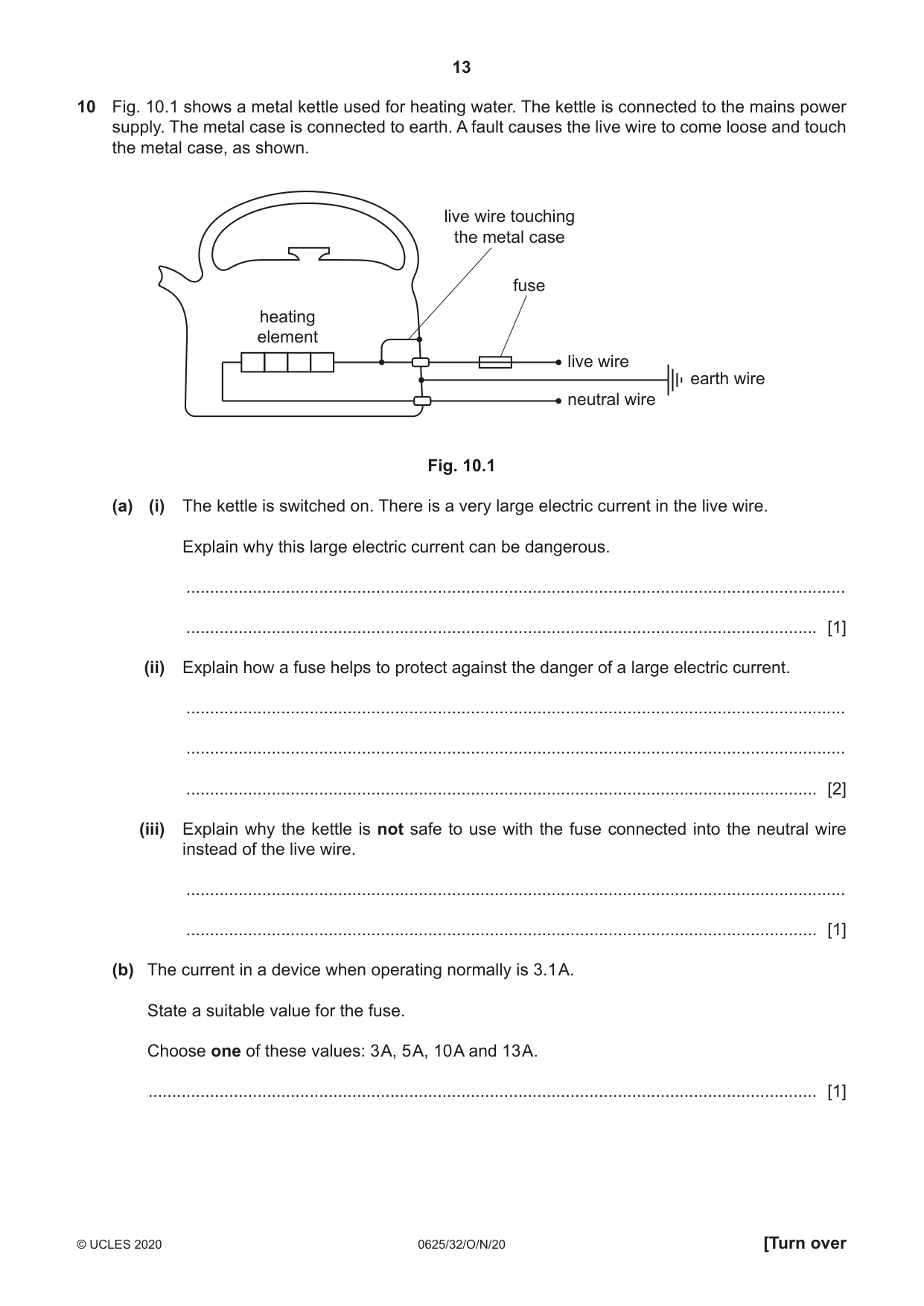
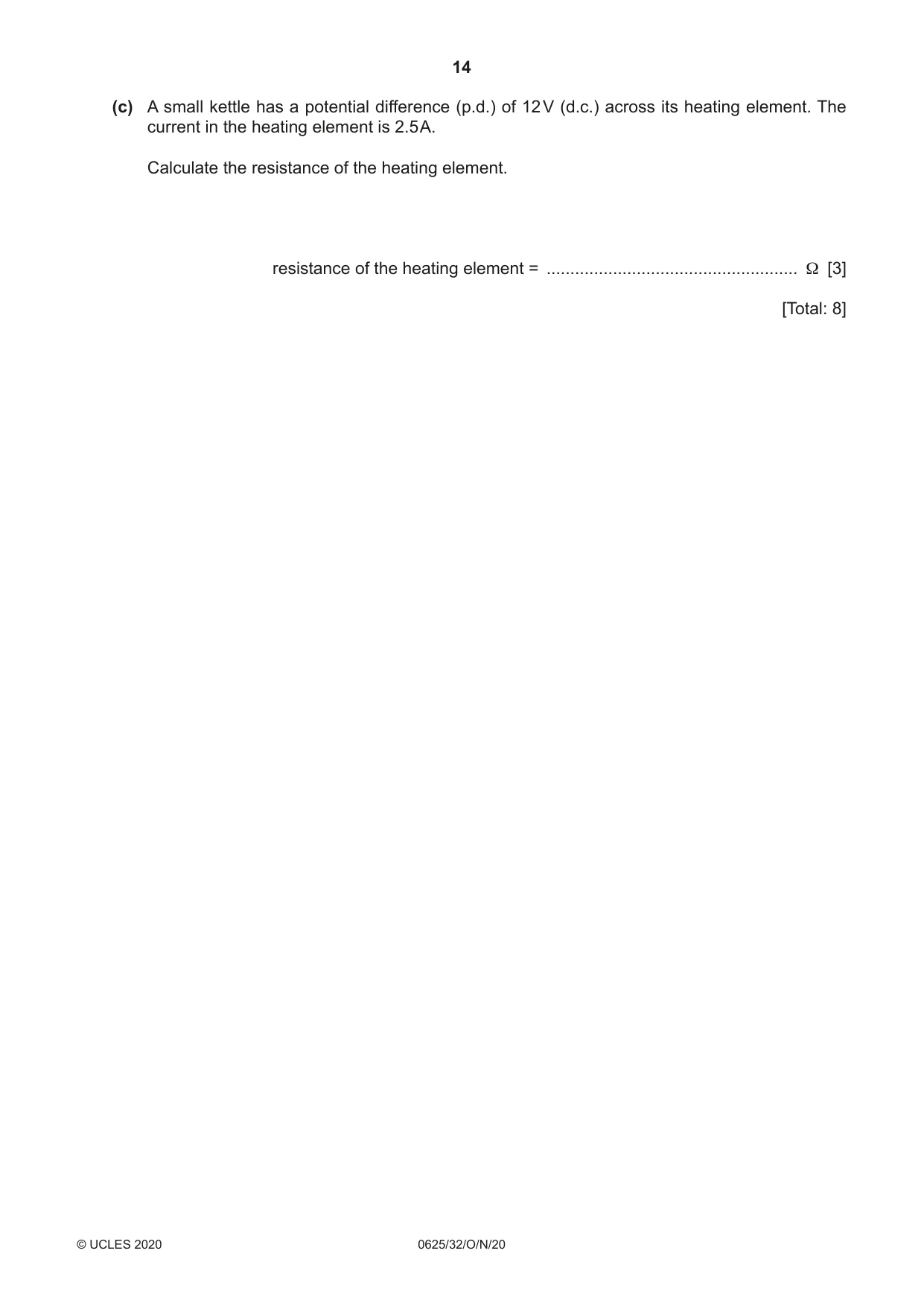
10 Fig. 10.1 shows a metal kettle used for heating water. The kettle is connected to the mains power supply. The metal case is connected to earth. A fault causes the live wire to come loose and touch the metal case, as shown. live wire touching the metal case fuse heating element live wire earth wire neutral wire Fig. 10.1 (a) (i) The kettle is switched on. There is a very large electric current in the live wire. Explain why this large electric current can be dangerous. ........................................................................................................................................... ..................................................................................................................................... [1] (ii) Explain how a fuse helps to protect against the danger of a large electric current. ........................................................................................................................................... ........................................................................................................................................... ..................................................................................................................................... [2] (iii) Explain why the kettle is not safe to use with the fuse connected into the neutral wire instead of the live wire. ........................................................................................................................................... ..................................................................................................................................... [1] (b) The current in a device when operating normally is 3.1 A. State a suitable value for the fuse. Choose one of these values: 3 A, 5 A, 10 A and 13 A. ............................................................................................................................................. [1] (c) A small kettle has a potential difference (p.d.) of 12 V (d.c.) across its heating element. The current in the heating element is 2.5 A. Calculate the resistance of the heating element. resistance of the heating element = ..................................................... Ω [3] [Total: 8]
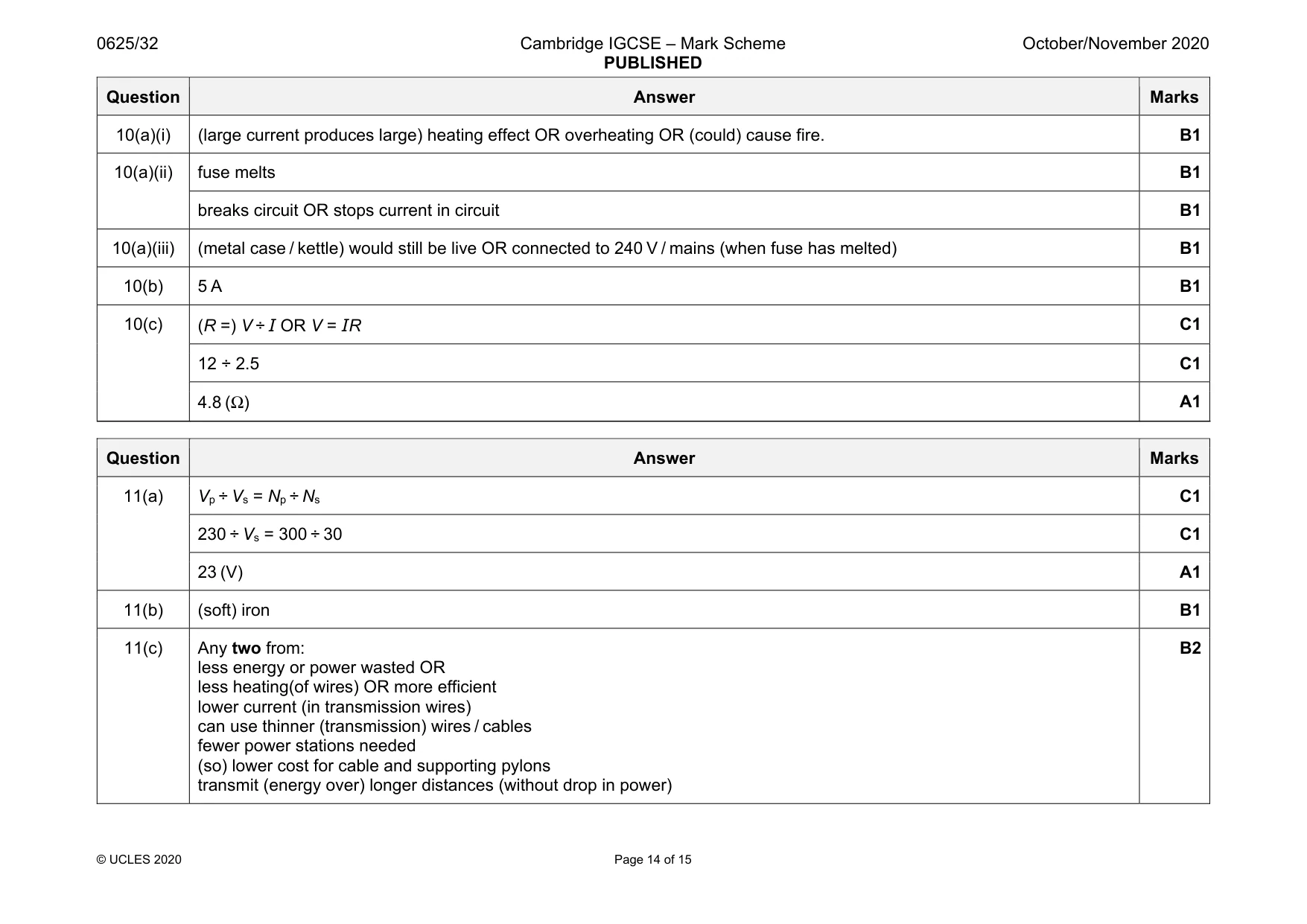
Mark scheme: 10(a)(i) (large current produces large) heating effect OR overheating OR (could) cause fire. B1 10(a)(ii) fuse melts B1 breaks circuit OR stops current in circuit B1 10(a)(iii) (metal case / kettle) would still be live OR connected to 240 V / mains (when fuse has melted) B1 10(b) 5 A B1 10(c) (R =) V ÷ I OR V = IR C1 12 ÷ 2.5 C1 4.8 (Ω) A1
Question 11
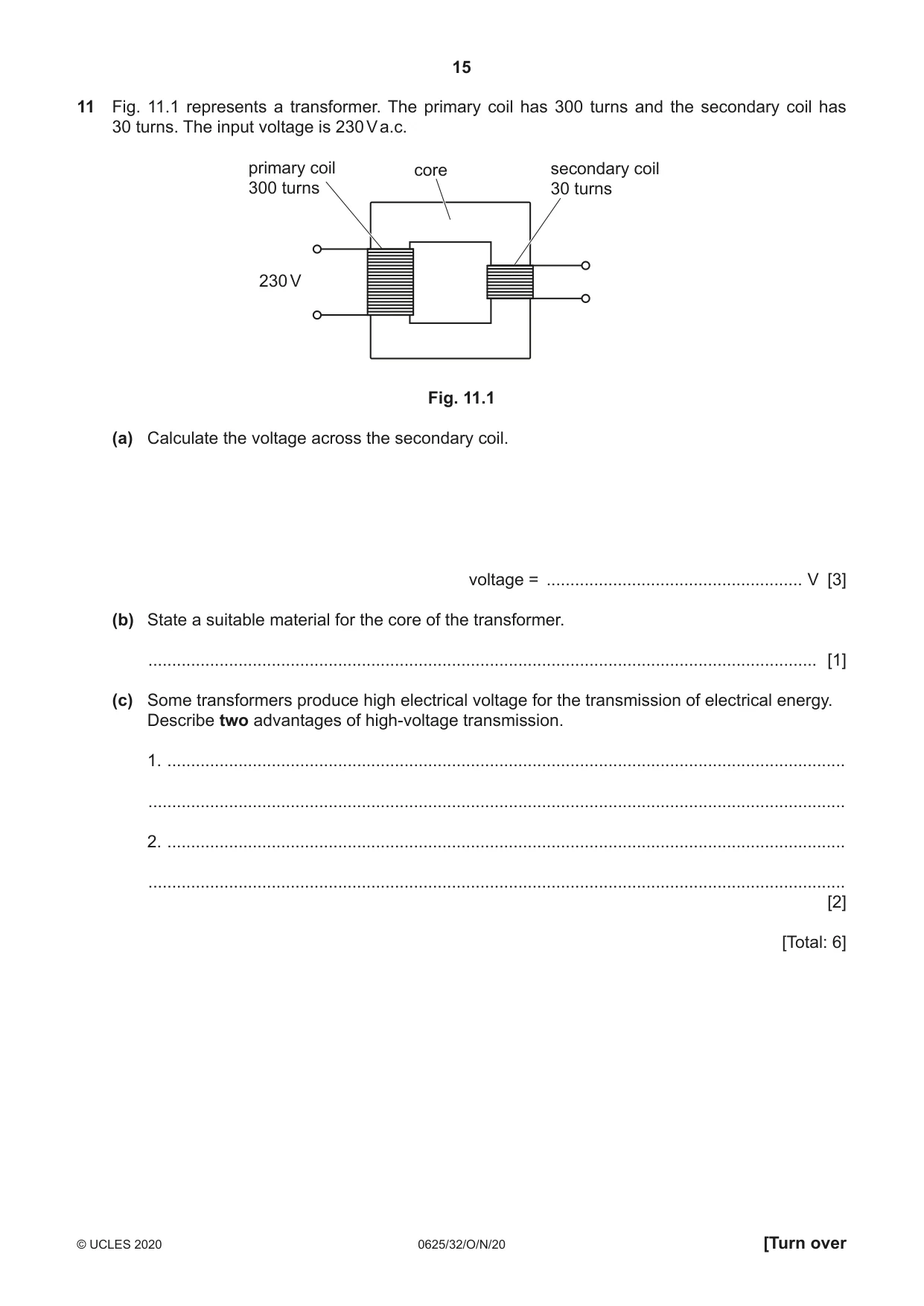
11 Fig. 11.1 represents a transformer. The primary coil has 300 turns and the secondary coil has 30 turns. The input voltage is 230 V a.c. primary coil core secondary coil 300 turns 30 turns 230 V Fig. 11.1 (a) Calculate the voltage across the secondary coil. voltage = ...................................................... V [3] (b) State a suitable material for the core of the transformer. ............................................................................................................................................. [1] (c) Some transformers produce high electrical voltage for the transmission of electrical energy. Describe two advantages of high-voltage transmission. 1. ............................................................................................................................................... ................................................................................................................................................... 2. ............................................................................................................................................... ................................................................................................................................................... [2] [Total: 6]
Mark scheme: 11(a) Vp ÷ Vs = Np ÷ Ns C1 230 ÷ Vs = 300 ÷ 30 C1 23 (V) A1 11(b) (soft) iron B1 11(c) Any two from: less energy or power wasted OR less heating(of wires) OR more efficient lower current (in transmission wires) can use thinner (transmission) wires / cables fewer power stations needed (so) lower cost for cable and supporting pylons transmit (energy over) longer distances (without drop in power) B2
Q12 · A teacher is investigating radioactivity
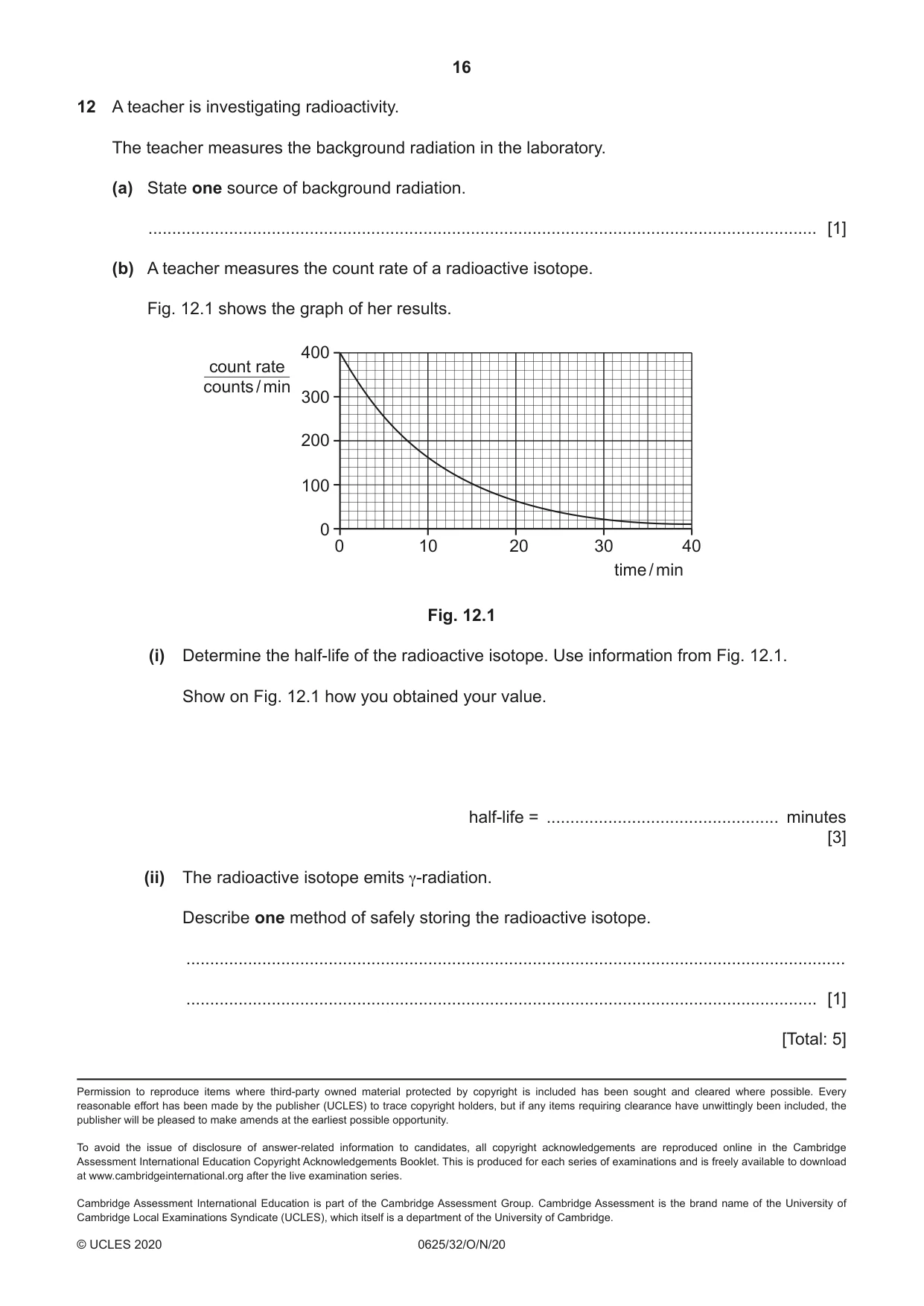
12 A teacher is investigating radioactivity. The teacher measures the background radiation in the laboratory. (a) State one source of background radiation. ............................................................................................................................................. [1] (b) A teacher measures the count rate of a radioactive isotope. Fig. 12.1 shows the graph of her results. 400 count rate counts / min 300 200 100 0 0 10 20 30 40 time / min Fig. 12.1 (i) Determine the half-life of the radioactive isotope. Use information from Fig. 12.1. Show on Fig. 12.1 how you obtained your value. half-life = ................................................. minutes [3] (ii) The radioactive isotope emits γ-radiation. Describe one method of safely storing the radioactive isotope. ........................................................................................................................................... ..................................................................................................................................... [1] [Total: 5]
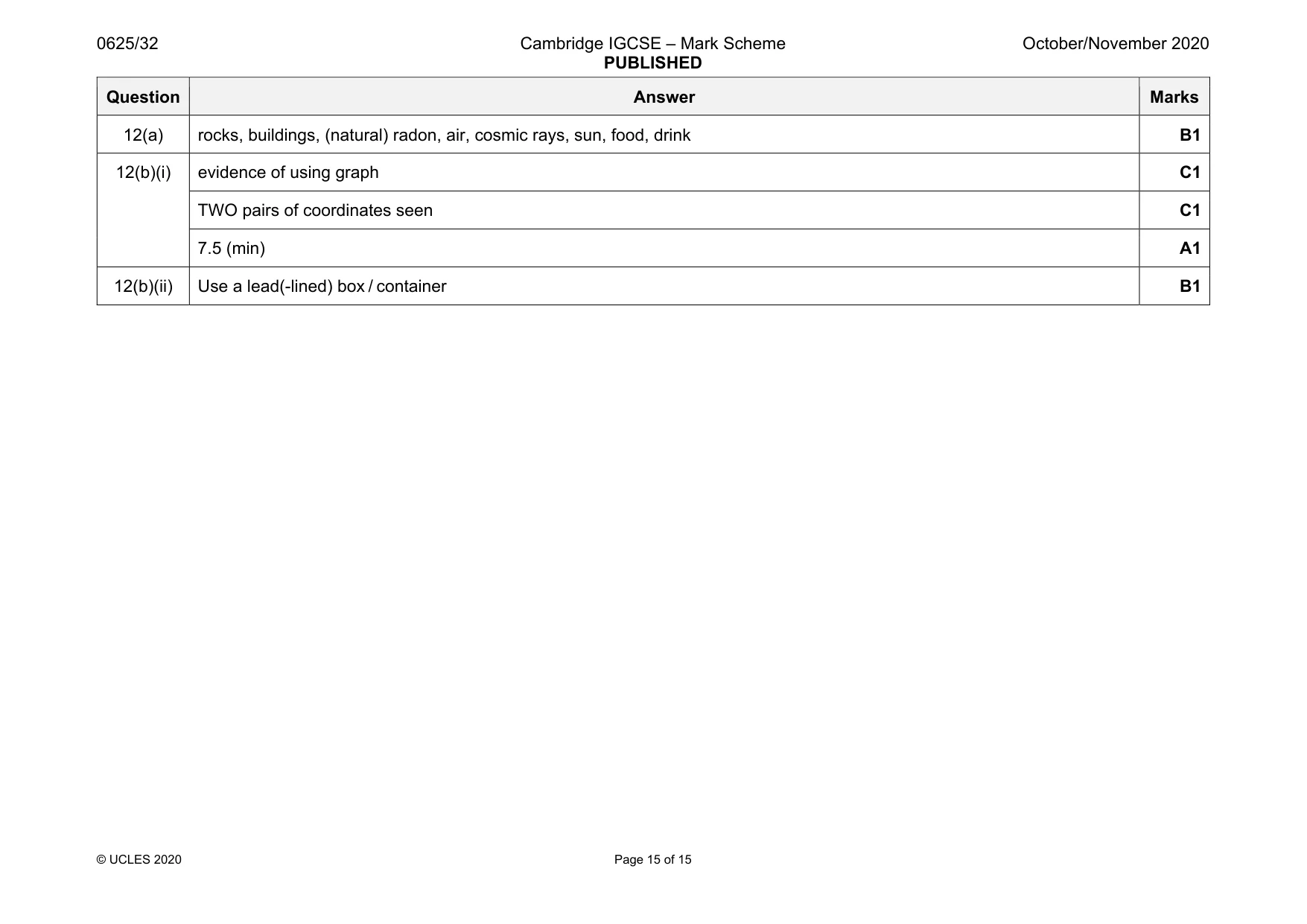
Mark scheme: 12(a) rocks, buildings, (natural) radon, air, cosmic rays, sun, food, drink B1 12(b)(i) evidence of using graph C1 TWO pairs of coordinates seen C1 7.5 (min) A1 12(b)(ii) Use a lead(-lined) box / container B1
What was in this paper
The subtopics covered by these 12 questions, and how many questions each got. Open one in a new tab to see every Cambridge question on it.
What you needed in this session
Cambridge’s own grade thresholds for 2020 Oct/Nov, Paper 3 · Variant 2. A higher threshold means an easier paper — the bar moves with how the cohort did.