Cambridge IGCSE Physics 0625 — 2023 Feb/March Paper 3 · Variant 2
0625/32/F/M/23 · 12 questions · 80 marks · ≈90 min
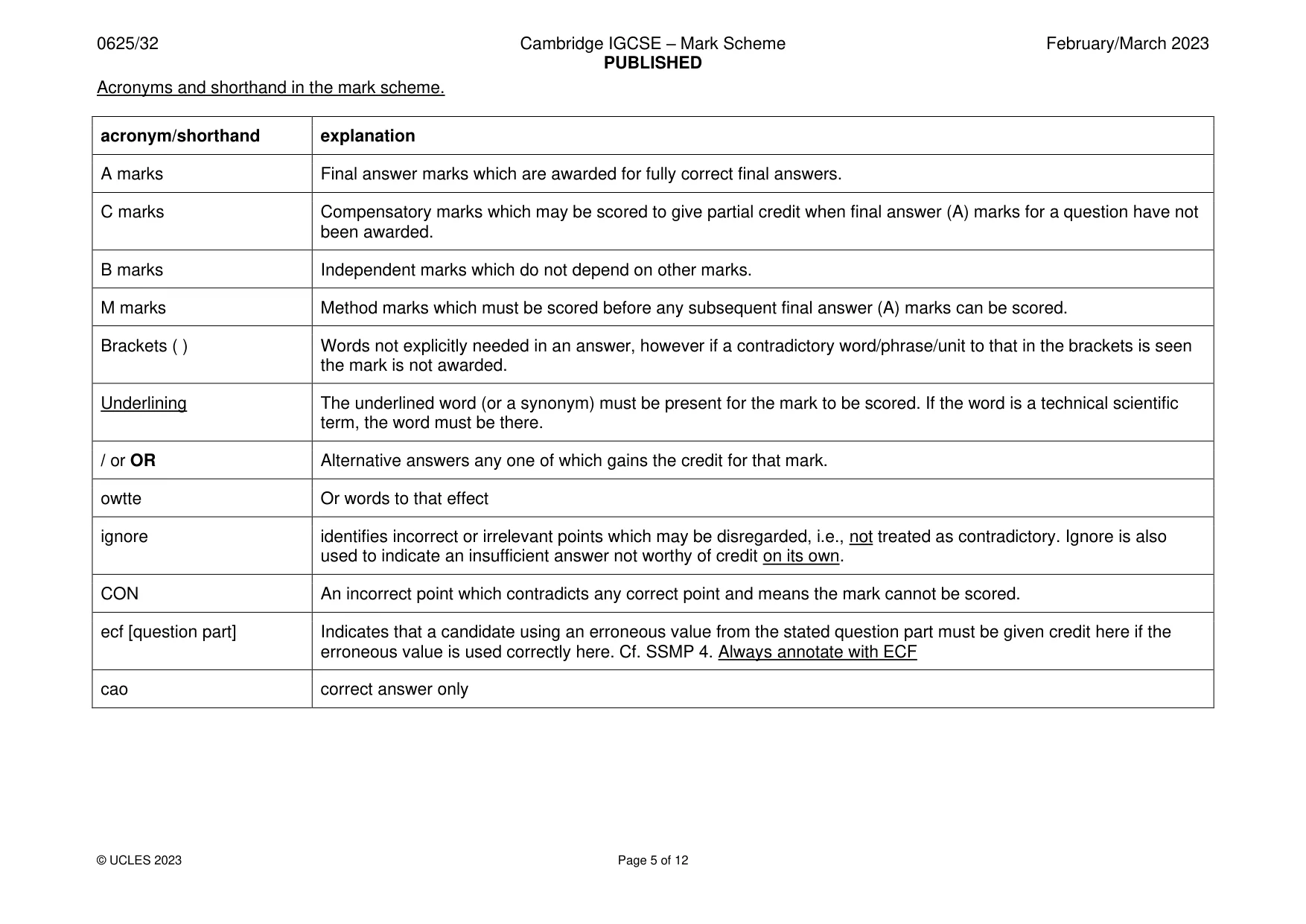
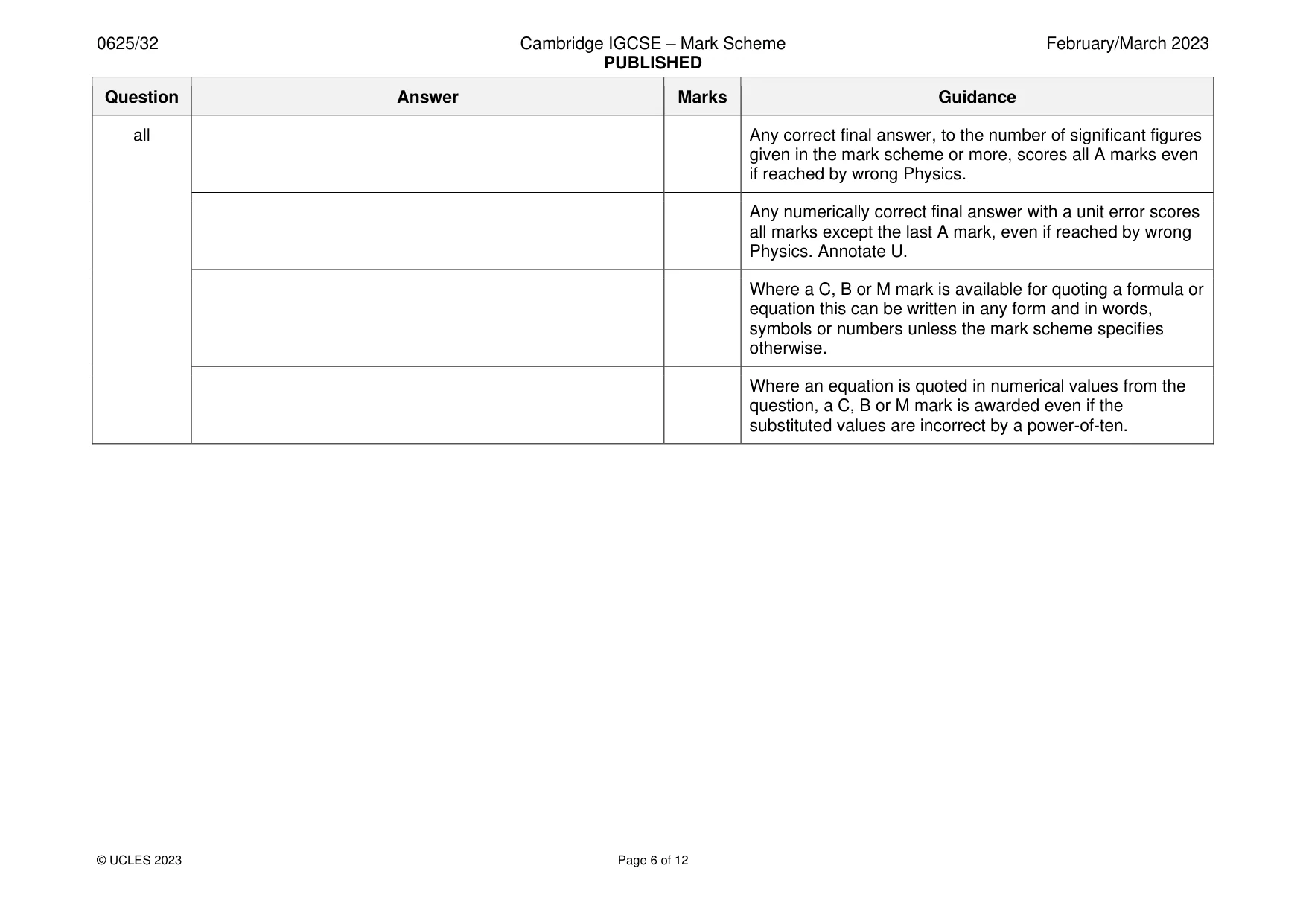
The question paper and its mark scheme, free to read here and free to download. This is Cambridge’s own paper, exactly as it was sat.
Question paper20 pages
Mark scheme12 pages
Answers below. Sit the paper first if you are practising.
Questions as text
Q1 · Two strips of staples
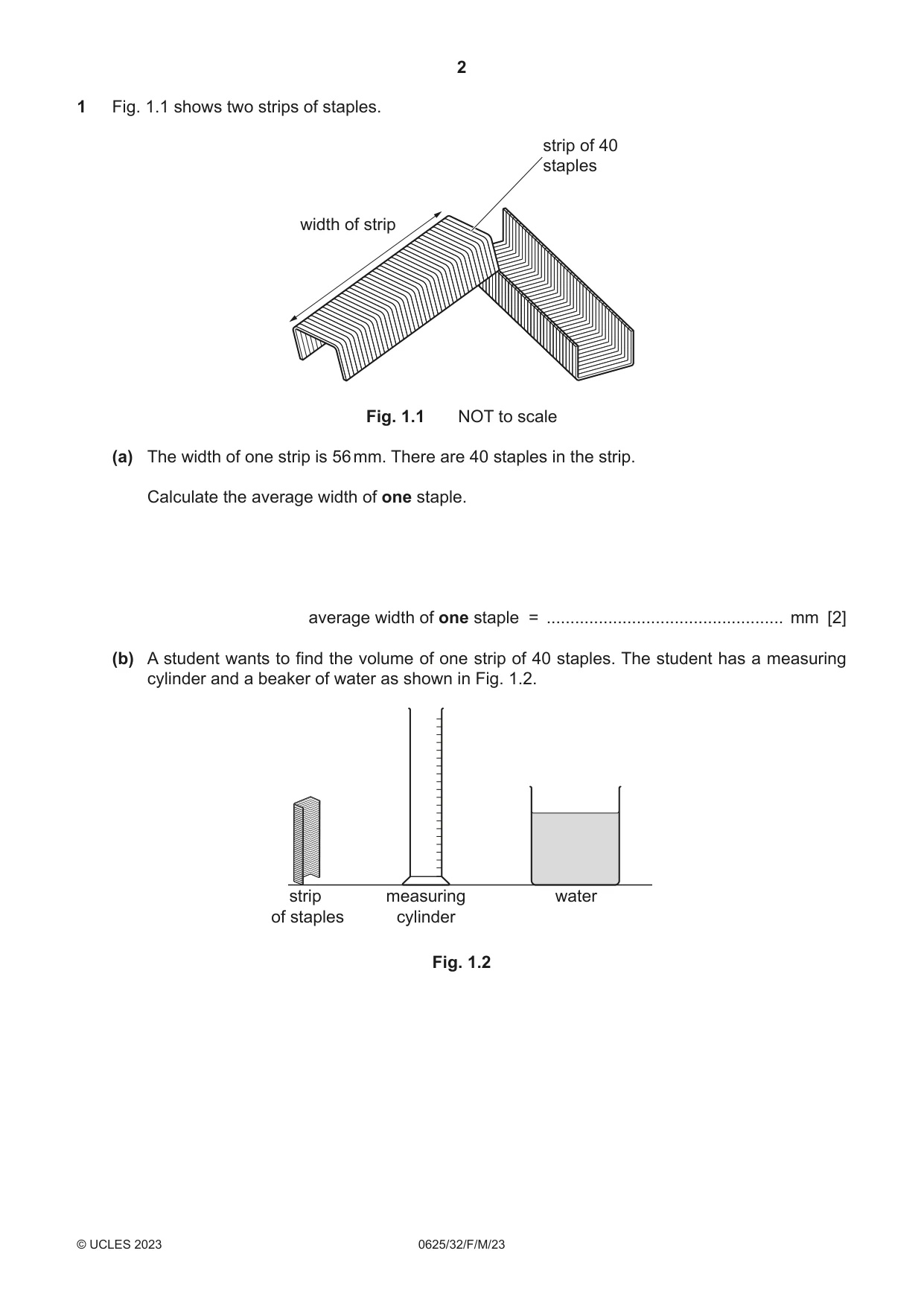
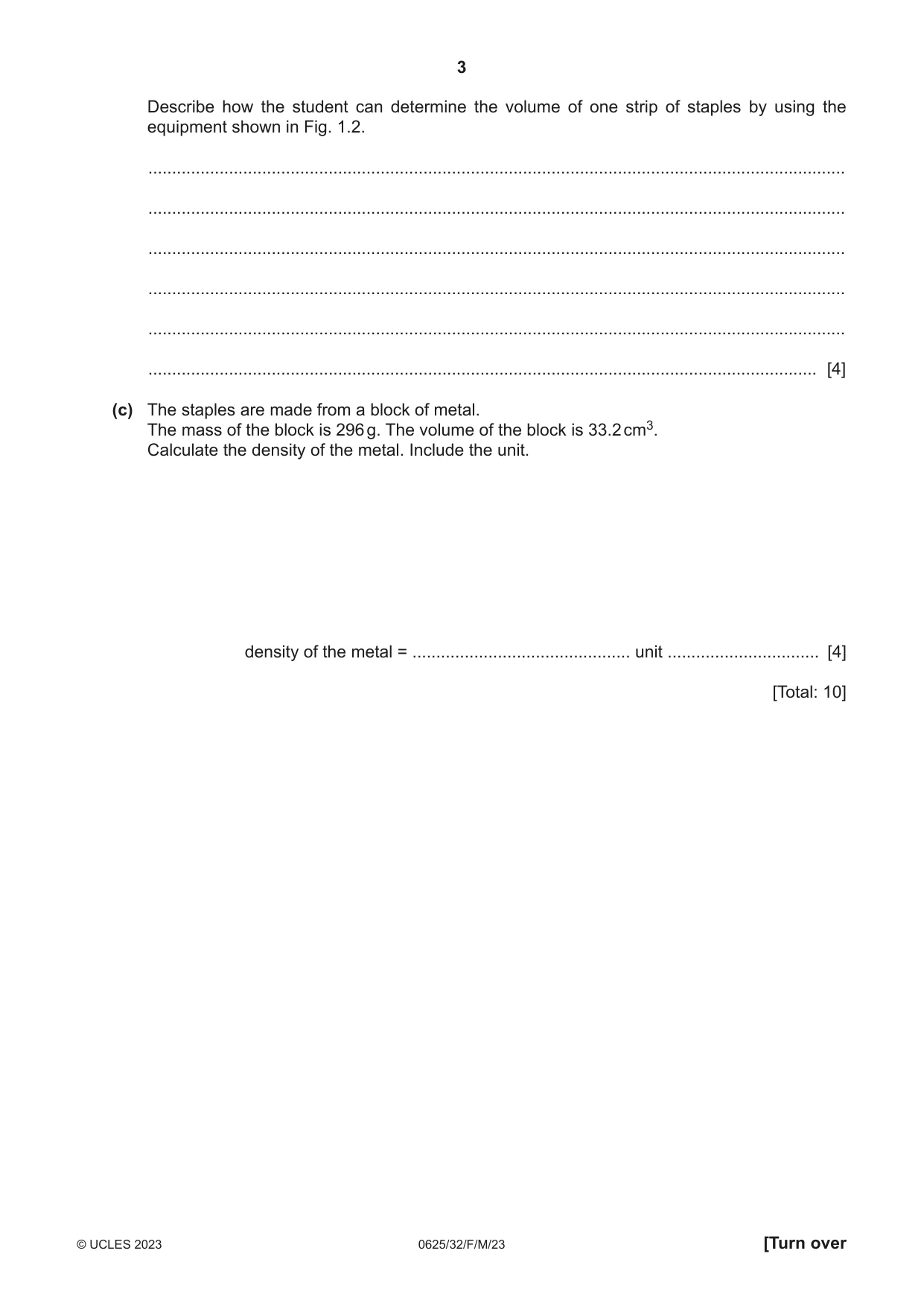
1 Fig. 1.1 shows two strips of staples. strip of 40 staples width of strip Fig. 1.1 NOT to scale (a) The width of one strip is 56 mm. There are 40 staples in the strip. Calculate the average width of one staple. average width of one staple = .................................................. mm [2] (b) A student wants to find the volume of one strip of 40 staples. The student has a measuring cylinder and a beaker of water as shown in Fig. 1.2. strip measuring water of staples cylinder Fig. 1.2 Describe how the student can determine the volume of one strip of staples by using the equipment shown in Fig. 1.2. ................................................................................................................................................... ................................................................................................................................................... ................................................................................................................................................... ................................................................................................................................................... ................................................................................................................................................... ............................................................................................................................................. [4] (c) The staples are made from a block of metal. The mass of the block is 296 g. The volume of the block is 33.2 cm3. Calculate the density of the metal. Include the unit. density of the metal = .............................................. unit ................................ [4] [Total: 10]
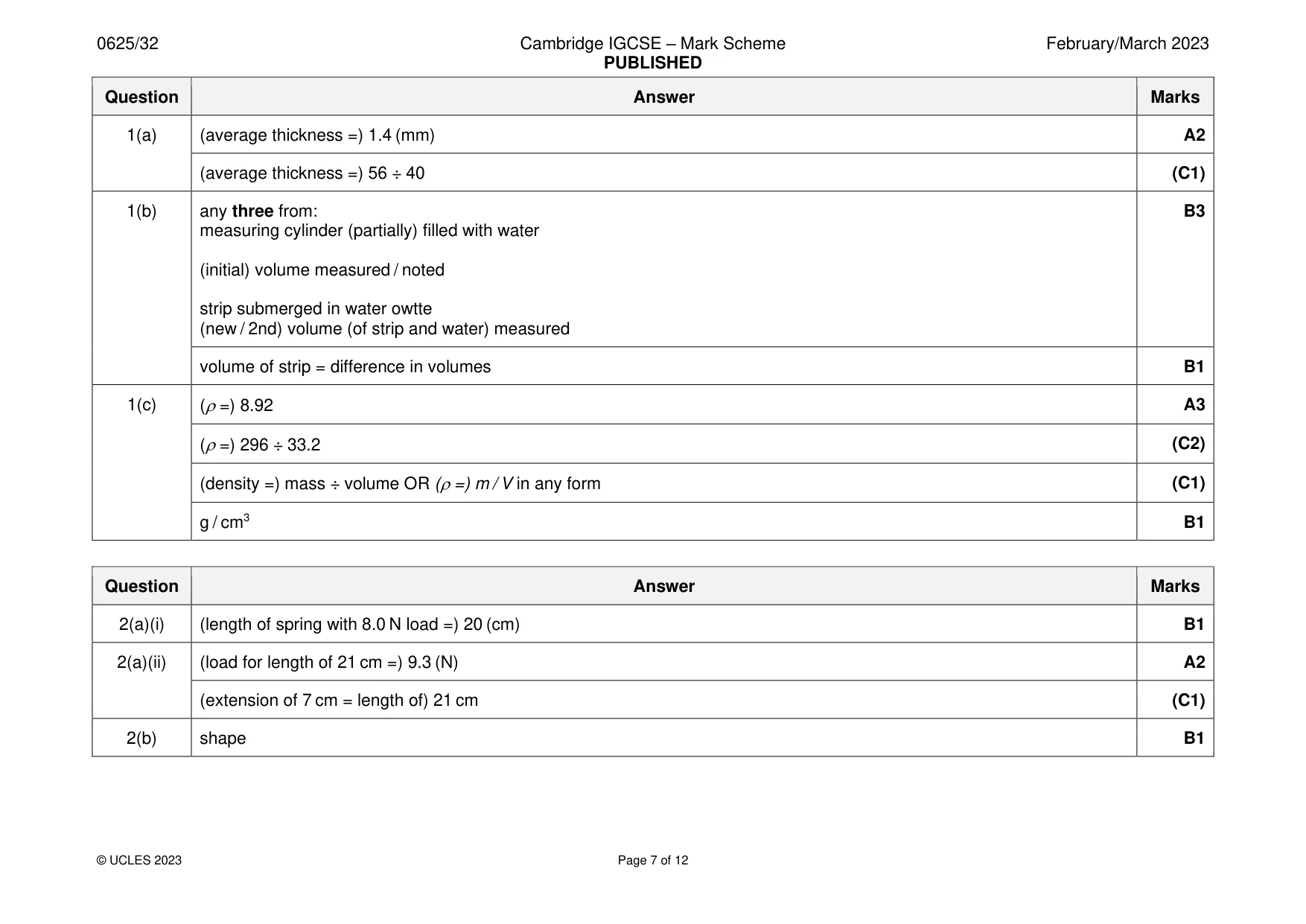
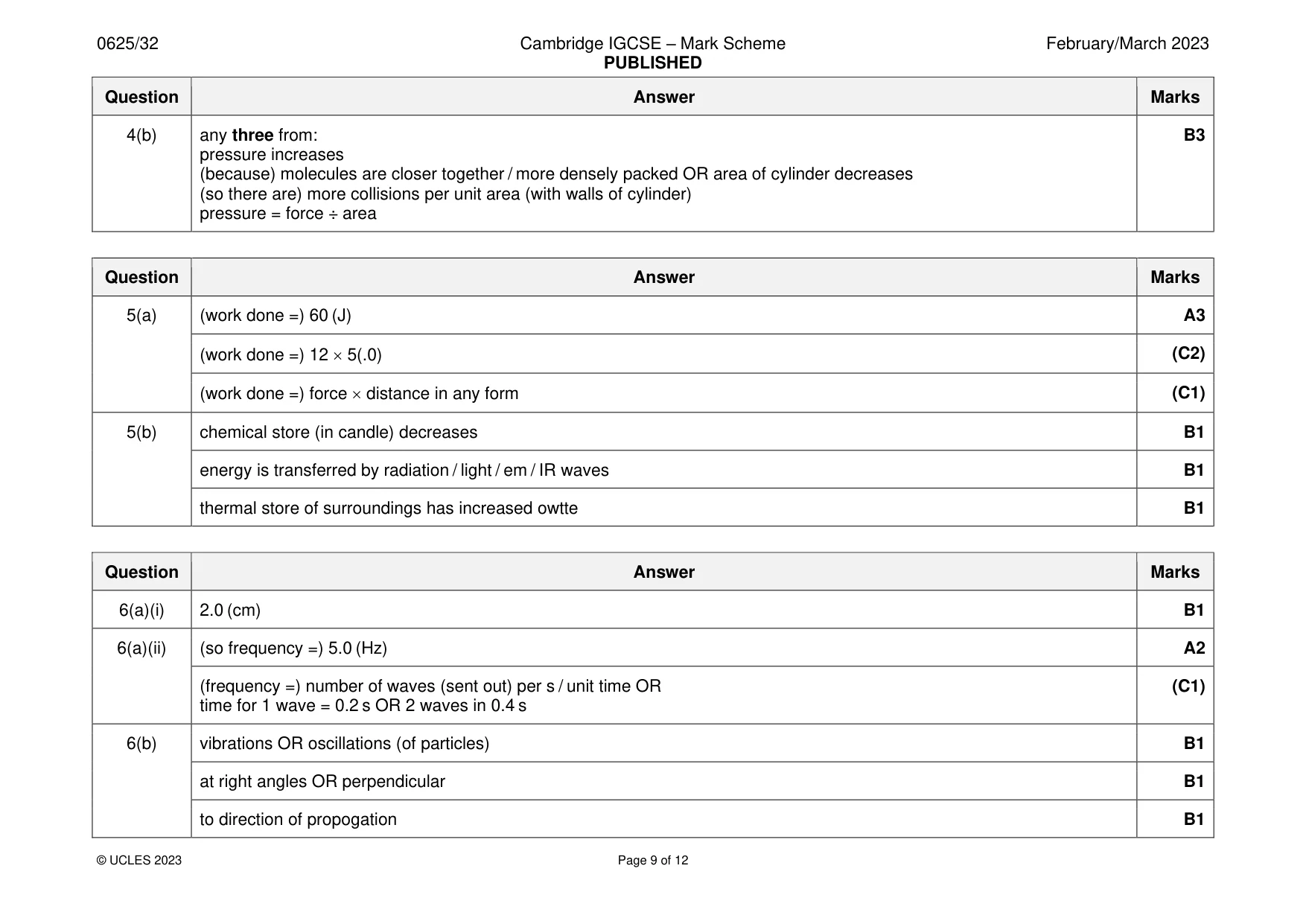
Mark scheme: Question Answer Marks 1(a) (average thickness =) 1.4 (mm) A2 (average thickness =) 56 ÷ 40 (C1) 1(b) any three from: B3 measuring cylinder (partially) filled with water (initial) volume measured / noted strip submerged in water owtte (new / 2nd) volume (of strip and water) measured volume of strip = difference in volumes B1 1(c) (=) 8.92 A3 (=) 296 ÷ 33.2 (C2) (density =) mass ÷ volume OR (=) m / V in any form (C1) g / cm3 B1
More questions on Physical quantities and measurement techniques
Q2 · A student has a spring of length 14.0 cm
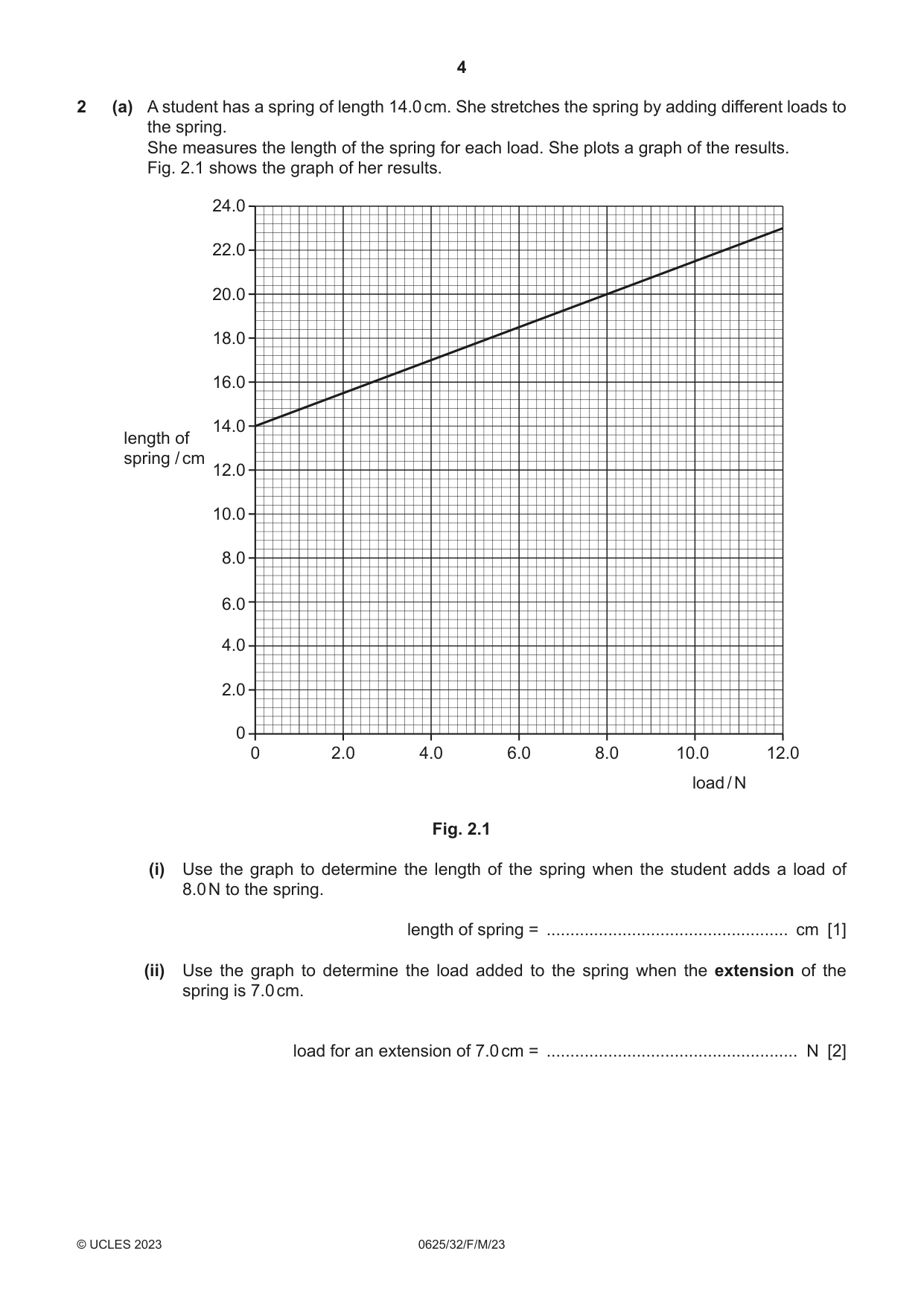
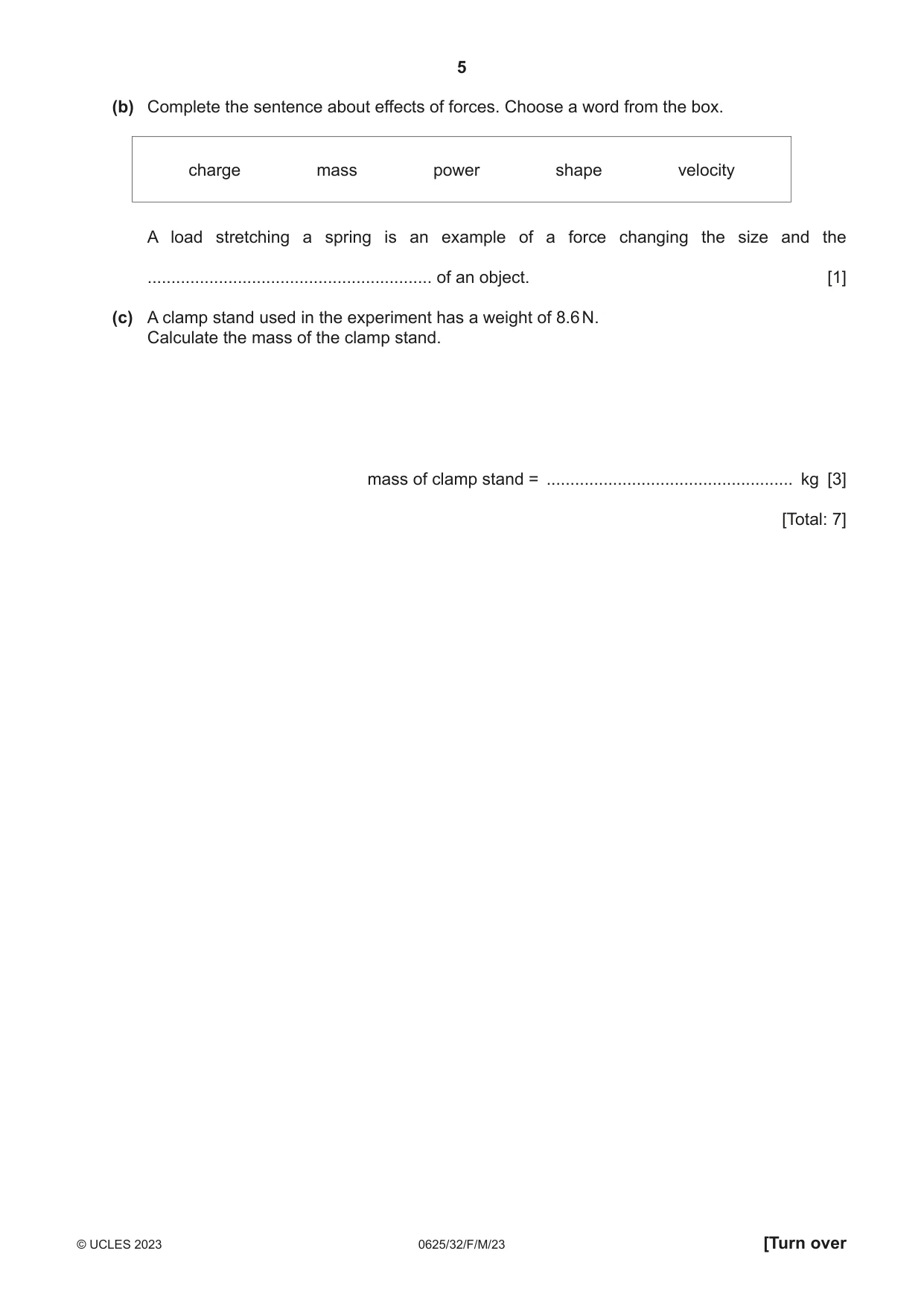
2 (a) A student has a spring of length 14.0 cm. She stretches the spring by adding different loads to the spring. She measures the length of the spring for each load. She plots a graph of the results. Fig. 2.1 shows the graph of her results. 24.0 22.0 20.0 18.0 16.0 14.0 length of spring / cm 12.0 10.0 8.0 6.0 4.0 2.0 0 0 2.0 4.0 6.0 8.0 10.0 12.0 load / N Fig. 2.1 (i) Use the graph to determine the length of the spring when the student adds a load of 8.0 N to the spring. length of spring = ................................................... cm [1] (ii) Use the graph to determine the load added to the spring when the extension of the spring is 7.0 cm. load for an extension of 7.0 cm = ..................................................... N [2] (b) Complete the sentence about effects of forces. Choose a word from the box. charge mass power shape velocity A load stretching a spring is an example of a force changing the size and the ............................................................ of an object. [1] (c) A clamp stand used in the experiment has a weight of 8.6 N. Calculate the mass of the clamp stand. mass of clamp stand = .................................................... kg [3] [Total: 7]
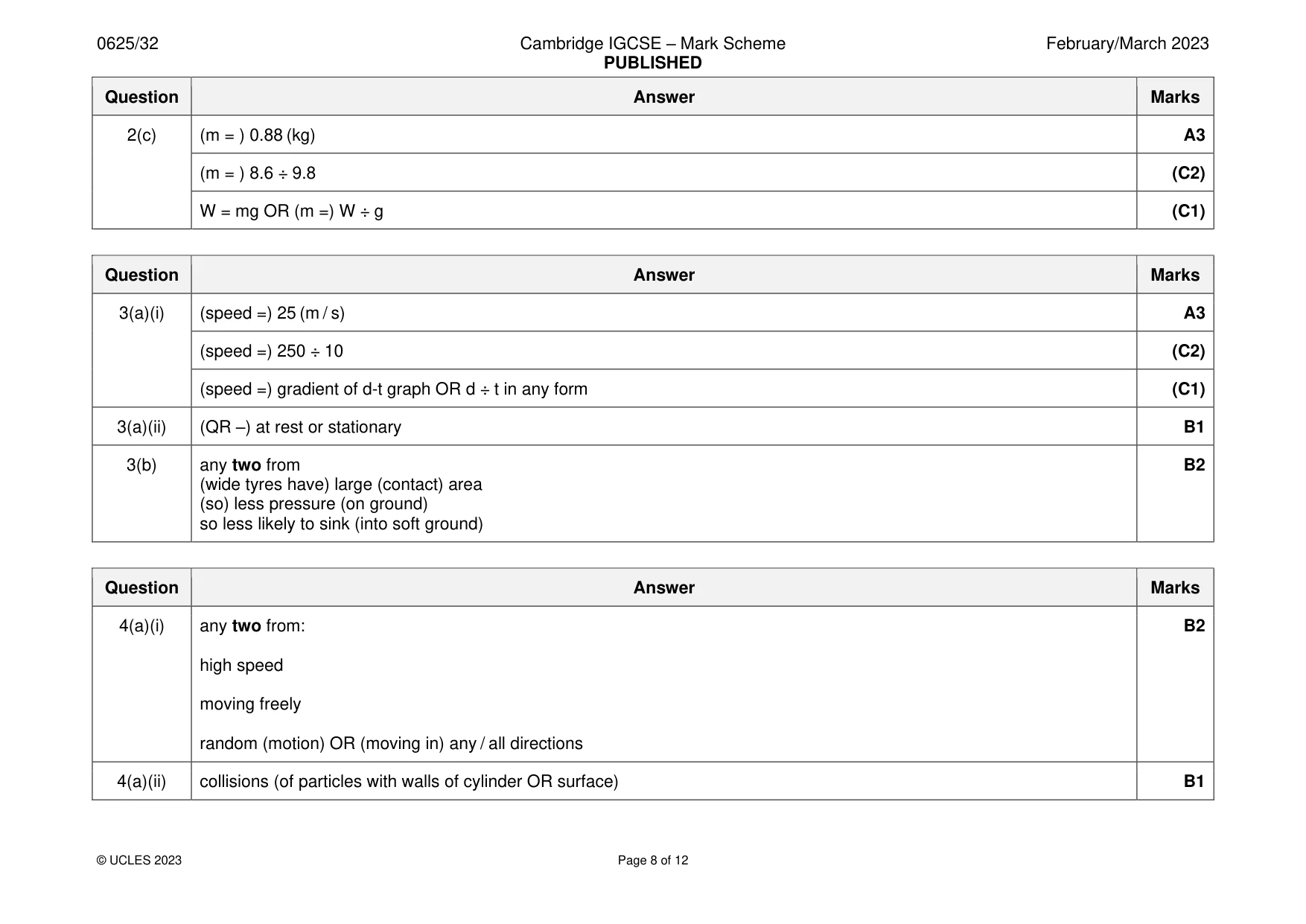
Mark scheme: 2(a)(i) (length of spring with 8.0 N load =) 20 (cm) B1 2(a)(ii) (load for length of 21 cm =) 9.3 (N) A2 (extension of 7 cm = length of) 21 cm (C1) 2(b) shape B1 2(c) (m = ) 0.88 (kg) A3 (m = ) 8.6 ÷ 9.8 (C2) W = mg OR (m =) W ÷ g (C1)
Q3 · The distance-time graph for a cyclist
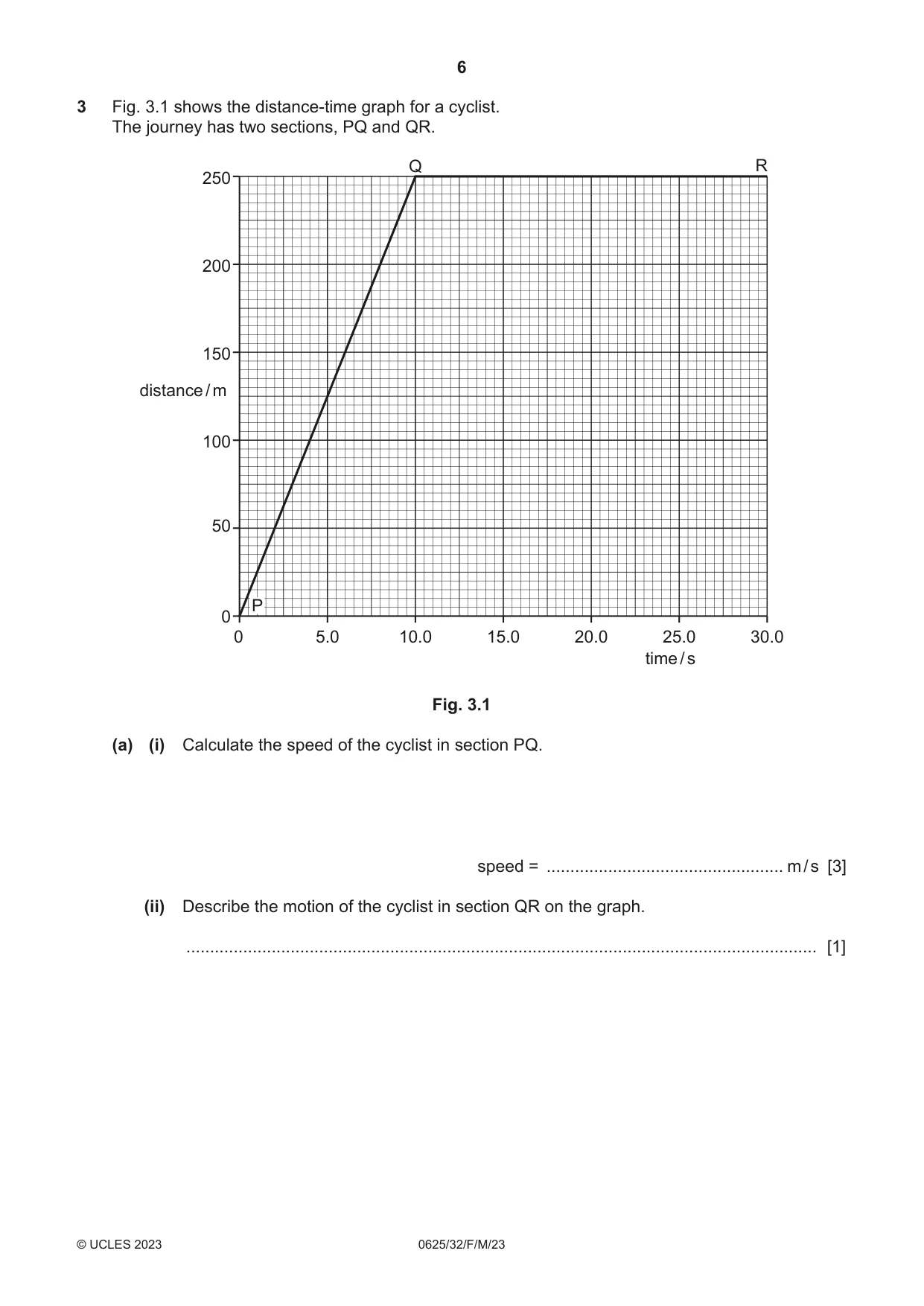
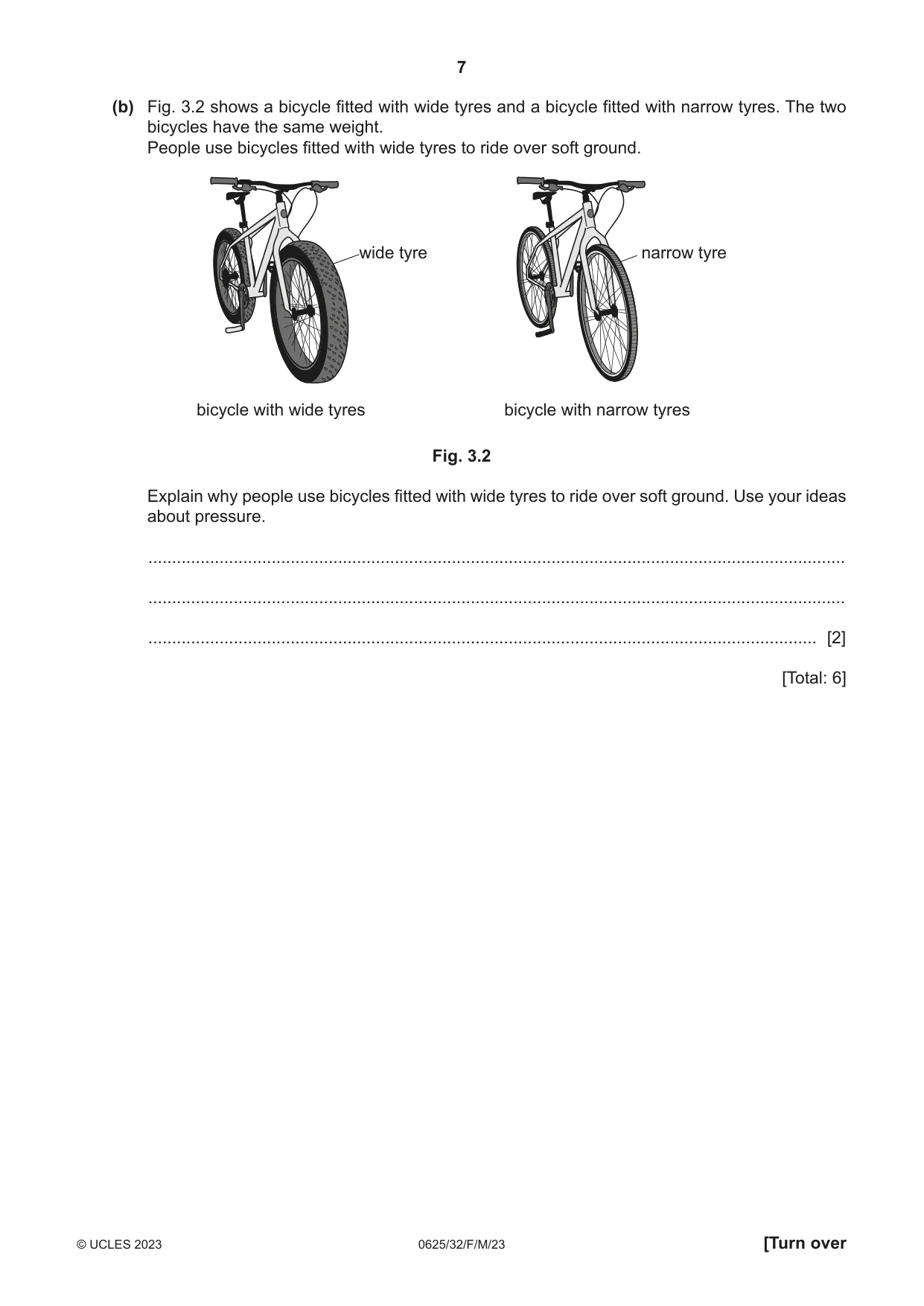
3 Fig. 3.1 shows the distance-time graph for a cyclist. The journey has two sections, PQ and QR. Q R 250 200 150 distance / m 100 50 P 0 0 5.0 10.0 15.0 20.0 25.0 30.0 time / s Fig. 3.1 (a) (i) Calculate the speed of the cyclist in section PQ. speed = .................................................. m / s [3] (ii) Describe the motion of the cyclist in section QR on the graph. ..................................................................................................................................... [1] (b) Fig. 3.2 shows a bicycle fitted with wide tyres and a bicycle fitted with narrow tyres. The two bicycles have the same weight. People use bicycles fitted with wide tyres to ride over soft ground. wide tyre narrow tyre bicycle with wide tyres bicycle with narrow tyres Fig. 3.2 Explain why people use bicycles fitted with wide tyres to ride over soft ground. Use your ideas about pressure. ................................................................................................................................................... ................................................................................................................................................... ............................................................................................................................................. [2] [Total: 6]
Mark scheme: 3(a)(i) (speed =) 25 (m / s) A3 (speed =) 250 ÷ 10 (C2) (speed =) gradient of d-t graph OR d ÷ t in any form (C1) 3(a)(ii) (QR –) at rest or stationary B1 3(b) any two from B2 (wide tyres have) large (contact) area (so) less pressure (on ground) so less likely to sink (into soft ground)
Q4 · Some gas, at room temperature, in a cylinder with a piston that can move
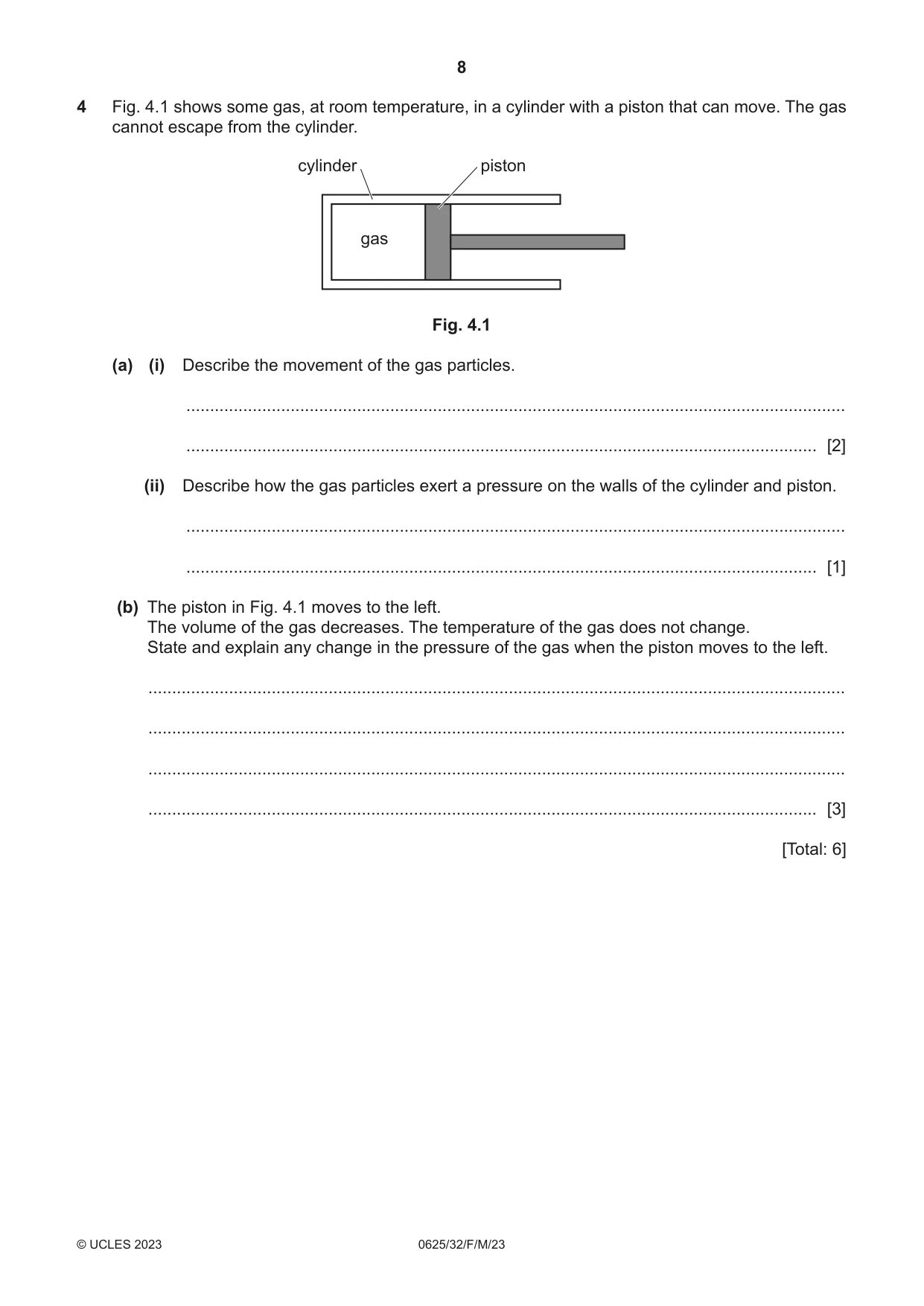
4 Fig. 4.1 shows some gas, at room temperature, in a cylinder with a piston that can move. The gas cannot escape from the cylinder. cylinder piston gas Fig. 4.1 (a) (i) Describe the movement of the gas particles. ........................................................................................................................................... ..................................................................................................................................... [2] (ii) Describe how the gas particles exert a pressure on the walls of the cylinder and piston. ........................................................................................................................................... ..................................................................................................................................... [1] (b) The piston in Fig. 4.1 moves to the left. The volume of the gas decreases. The temperature of the gas does not change. State and explain any change in the pressure of the gas when the piston moves to the left. ................................................................................................................................................... ................................................................................................................................................... ................................................................................................................................................... ............................................................................................................................................. [3] [Total: 6]
Mark scheme: 4(a)(i) any two from: B2 high speed moving freely random (motion) OR (moving in) any / all directions 4(a)(ii) collisions (of particles with walls of cylinder OR surface) B1 4(b) any three from: B3 pressure increases (because) molecules are closer together / more densely packed OR area of cylinder decreases (so there are) more collisions per unit area (with walls of cylinder) pressure = force ÷ area
Q5 · This question is about work, energy stores and energy transfers
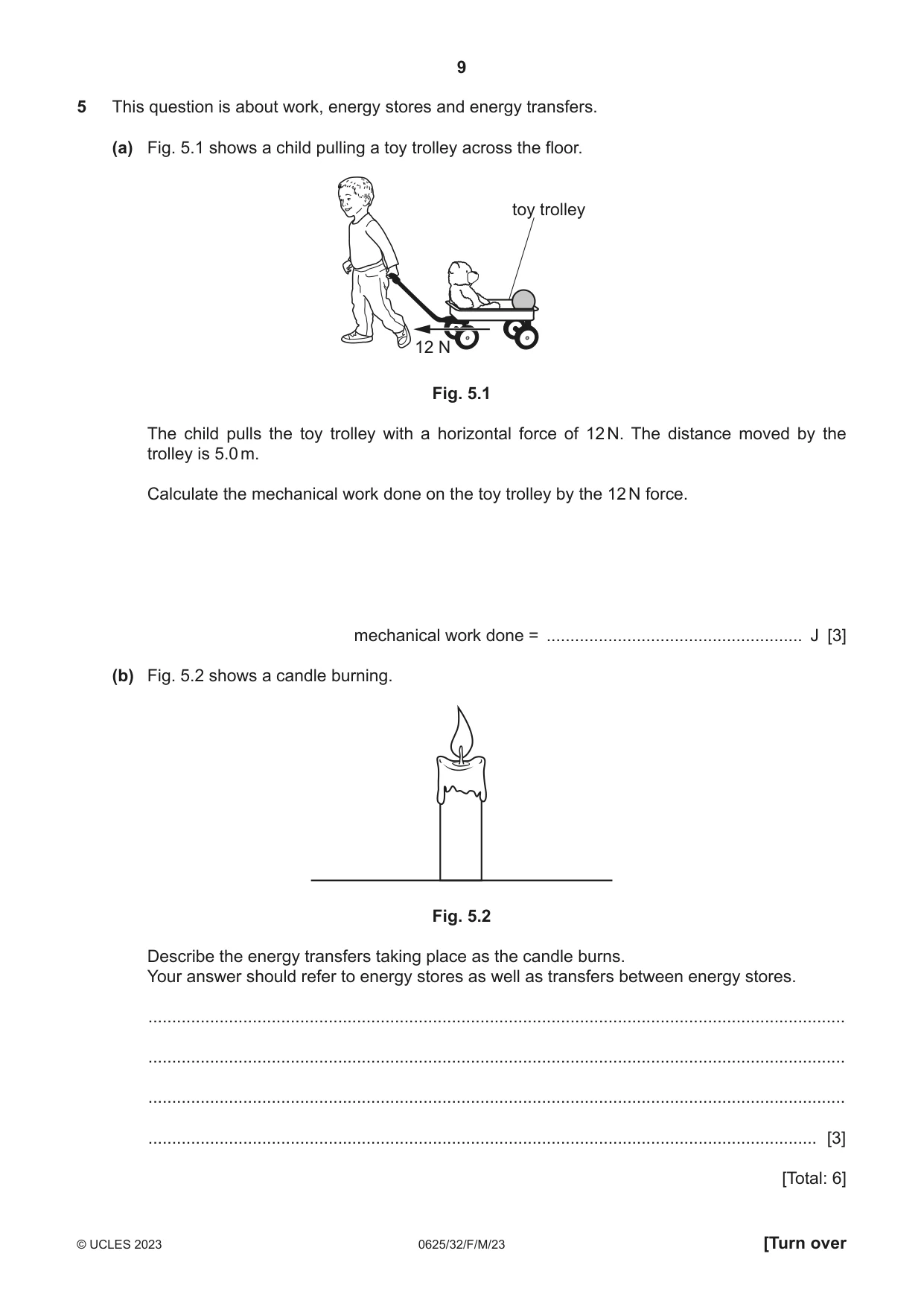
5 This question is about work, energy stores and energy transfers. (a) Fig. 5.1 shows a child pulling a toy trolley across the floor. toy trolley 12 N Fig. 5.1 The child pulls the toy trolley with a horizontal force of 12 N. The distance moved by the trolley is 5.0 m. Calculate the mechanical work done on the toy trolley by the 12 N force. mechanical work done = ...................................................... J [3] (b) Fig. 5.2 shows a candle burning. Fig. 5.2 Describe the energy transfers taking place as the candle burns. Your answer should refer to energy stores as well as transfers between energy stores. ................................................................................................................................................... ................................................................................................................................................... ................................................................................................................................................... ............................................................................................................................................. [3] [Total: 6]
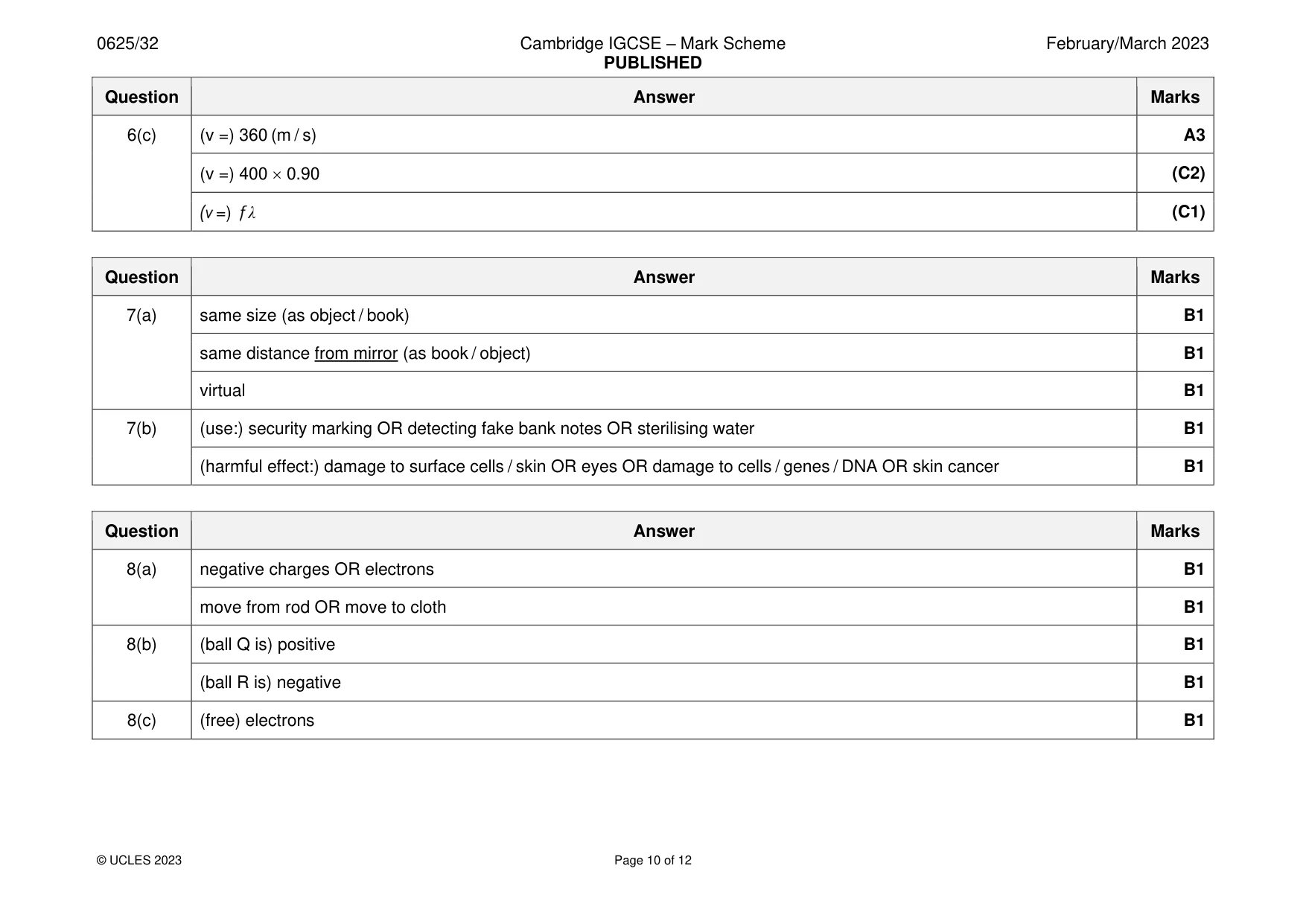
Mark scheme: 5(a) (work done =) 60 (J) A3 (work done =) 12 5(.0) (C2) (work done =) force distance in any form (C1) 5(b) chemical store (in candle) decreases B1 energy is transferred by radiation / light / em / IR waves B1 thermal store of surroundings has increased owtte B1
Q6 · How the displacement of a transverse wave varies with time
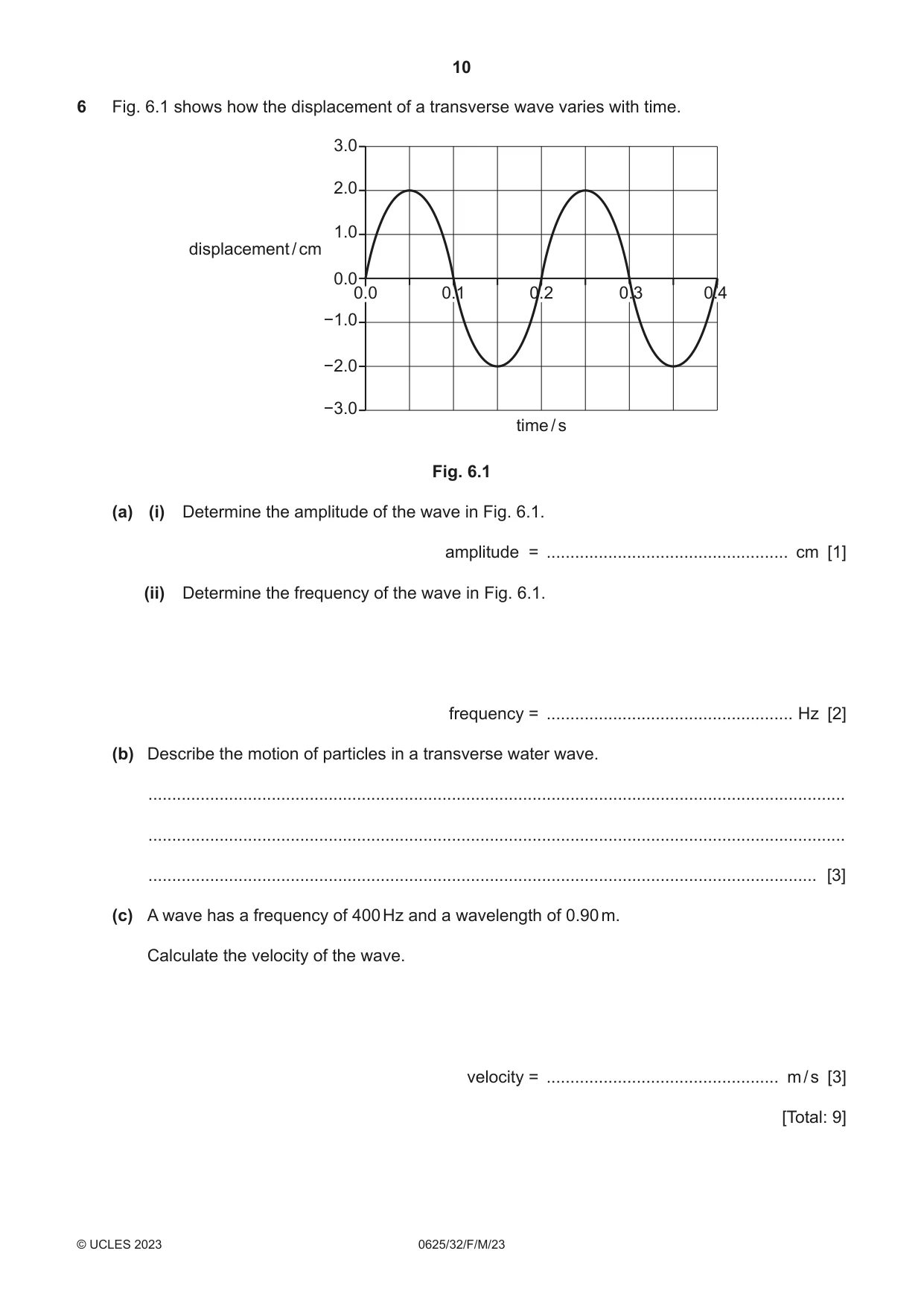
6 Fig. 6.1 shows how the displacement of a transverse wave varies with time. 3.0 2.0 1.0 displacement / cm 0.0 0.00.0 0.10.1 0.20.2 0.30.3 0.40.4 −1.0 −2.0 −3.0 time / s Fig. 6.1 (a) (i) Determine the amplitude of the wave in Fig. 6.1. amplitude = ................................................... cm [1] (ii) Determine the frequency of the wave in Fig. 6.1. frequency = .................................................... Hz [2] (b) Describe the motion of particles in a transverse water wave. ................................................................................................................................................... ................................................................................................................................................... ............................................................................................................................................. [3] (c) A wave has a frequency of 400 Hz and a wavelength of 0.90 m. Calculate the velocity of the wave. velocity = ................................................. m / s [3] [Total: 9]
Mark scheme: 6(a)(i) 2.0 (cm) B1 6(a)(ii) (so frequency =) 5.0 (Hz) A2 (frequency =) number of waves (sent out) per s / unit time OR (C1) time for 1 wave = 0.2 s OR 2 waves in 0.4 s 6(b) vibrations OR oscillations (of particles) B1 at right angles OR perpendicular B1 to direction of propogation B1 6(c) (v =) 360 (m / s) A3 (v =) 400 0.90 (C2) =) λ (C1)
Q7 · A student places a book in front of a plane mirror
7 (a) A student places a book in front of a plane mirror. State three characteristics of the image of the book formed by the plane mirror. 1 ................................................................................................................................................ 2 ................................................................................................................................................ 3 ................................................................................................................................................ [3] (b) Visible light is one region of the electromagnetic spectrum. Another region is ultraviolet radiation. (i) Give one use of ultraviolet radiation. ..................................................................................................................................... [1] (ii) Give one possible harmful effect of excessive exposure to ultraviolet radiation. ..................................................................................................................................... [1] [Total: 5]
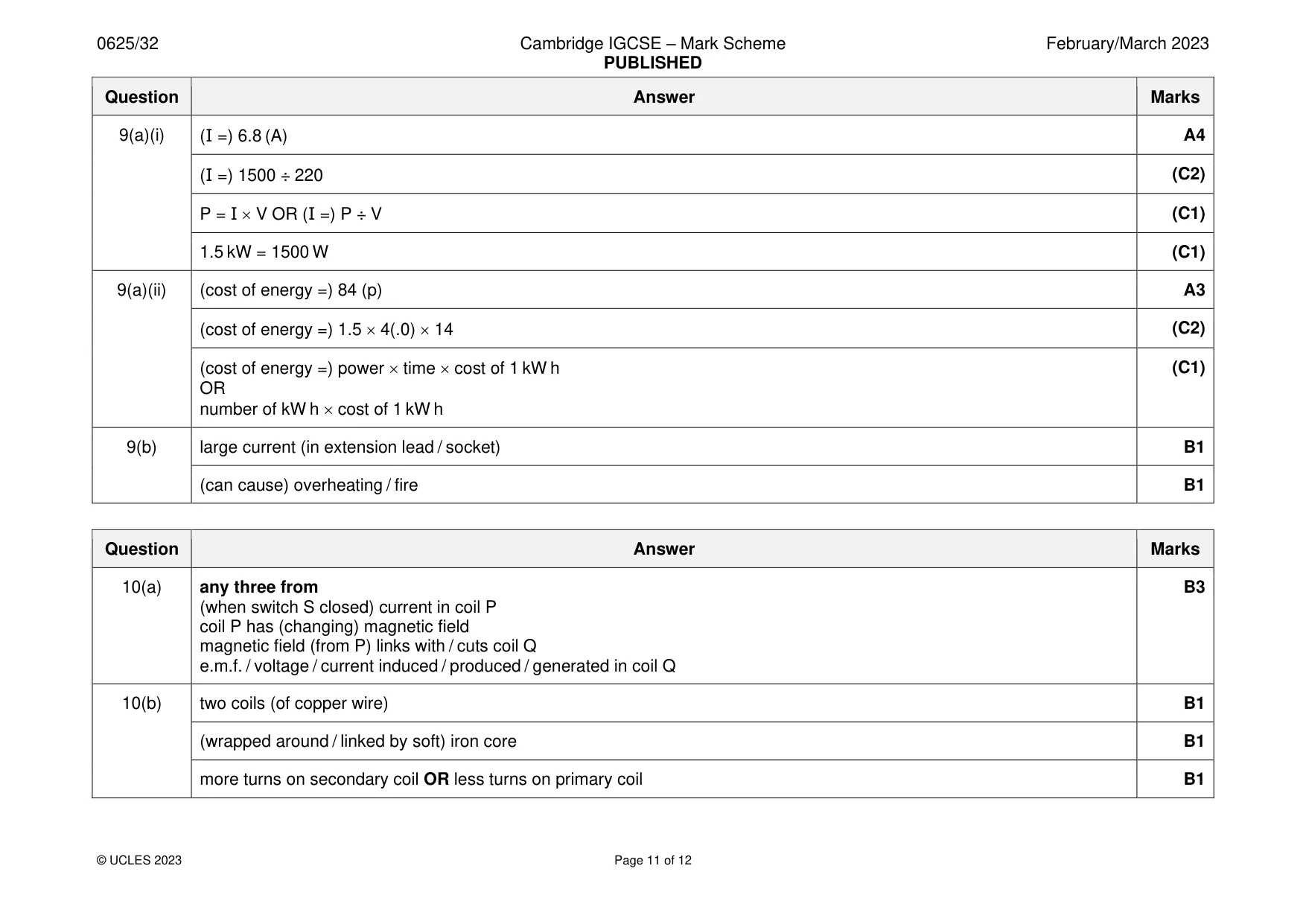
Mark scheme: 7(a) same size (as object / book) B1 same distance from mirror (as book / object) B1 virtual B1 7(b) (use:) security marking OR detecting fake bank notes OR sterilising water B1 (harmful effect:) damage to surface cells / skin OR eyes OR damage to cells / genes / DNA OR skin cancer B1
Q8 · A student uses a dry cloth to rub a plastic rod
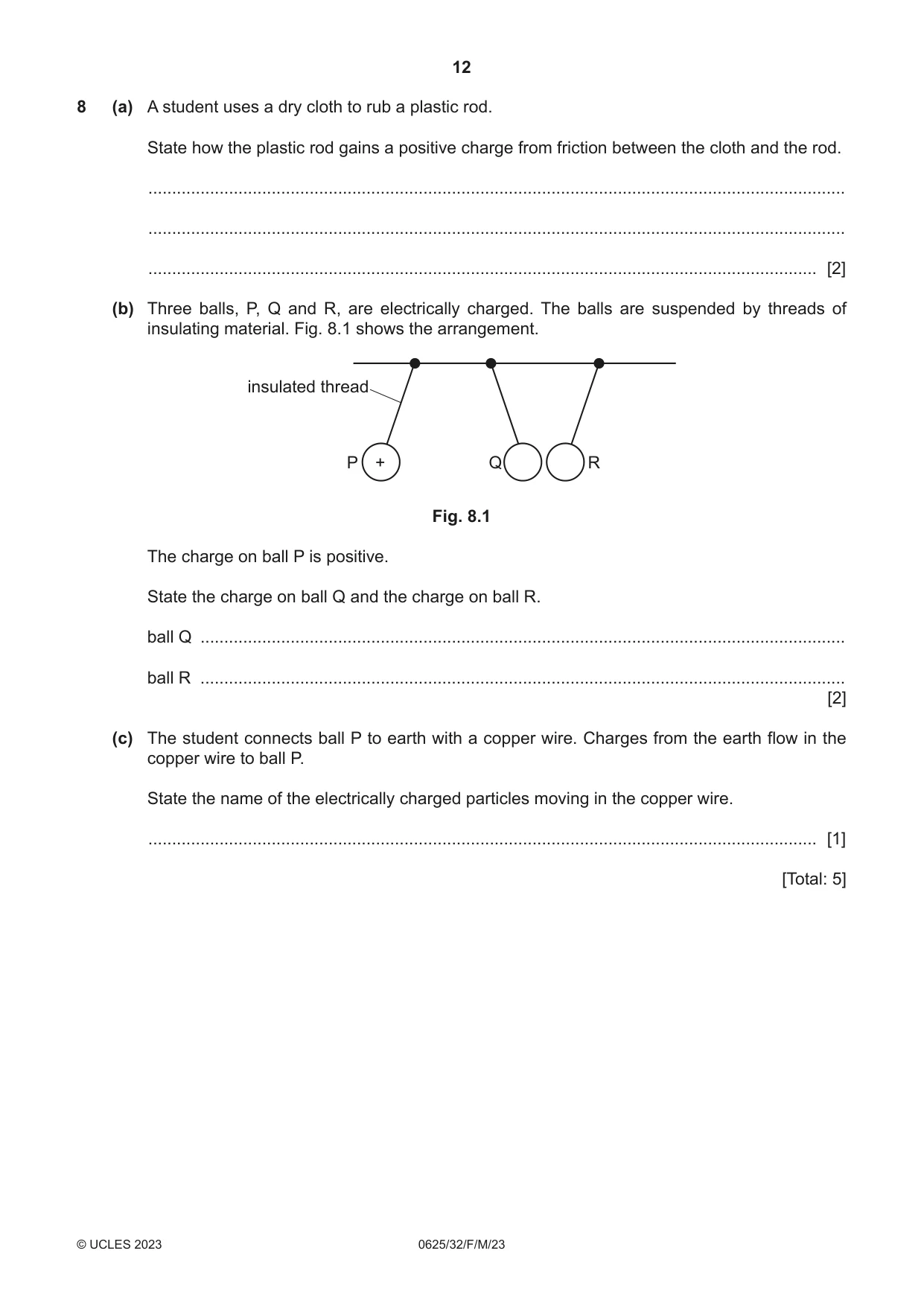
8 (a) A student uses a dry cloth to rub a plastic rod. State how the plastic rod gains a positive charge from friction between the cloth and the rod. ................................................................................................................................................... ................................................................................................................................................... ............................................................................................................................................. [2] (b) Three balls, P, Q and R, are electrically charged. The balls are suspended by threads of insulating material. Fig. 8.1 shows the arrangement. insulated thread P + Q R Fig. 8.1 The charge on ball P is positive. State the charge on ball Q and the charge on ball R. ball Q ........................................................................................................................................ ball R ........................................................................................................................................ [2] (c) The student connects ball P to earth with a copper wire. Charges from the earth flow in the copper wire to ball P. State the name of the electrically charged particles moving in the copper wire. ............................................................................................................................................. [1] [Total: 5]
Mark scheme: 8(a) negative charges OR electrons B1 move from rod OR move to cloth B1 8(b) (ball Q is) positive B1 (ball R is) negative B1 8(c) (free) electrons B1
Question 9
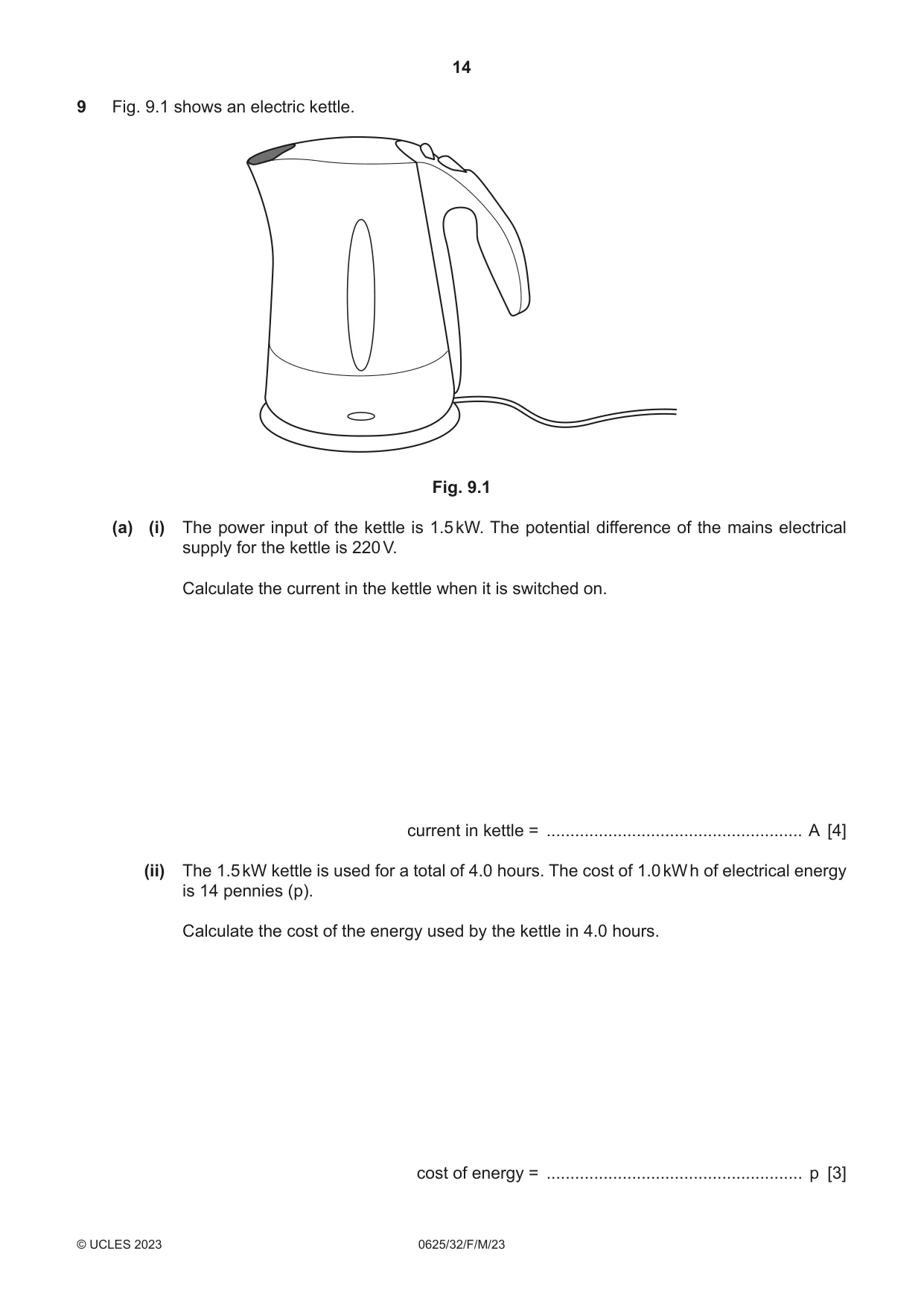
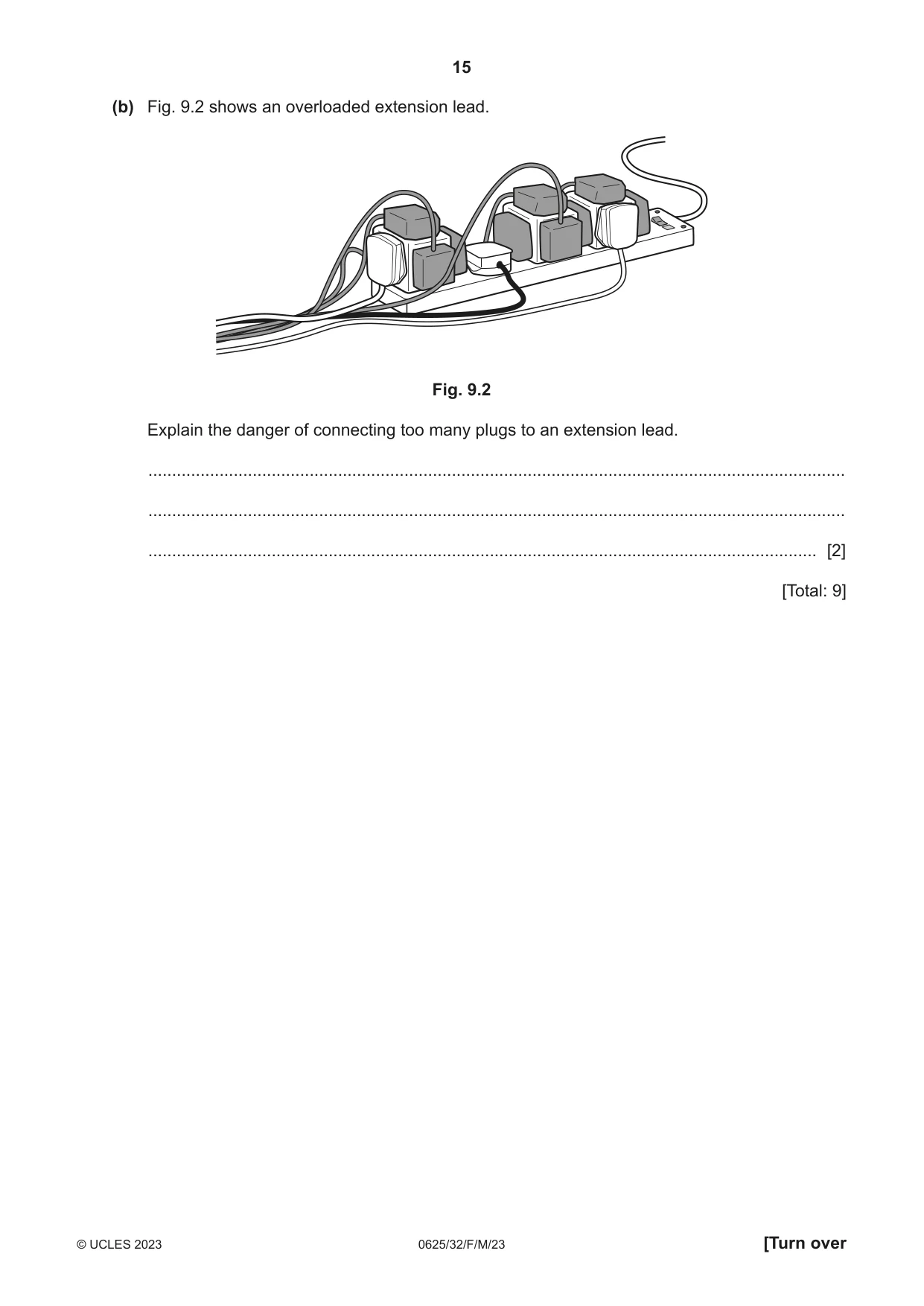
9 Fig. 9.1 shows an electric kettle. Fig. 9.1 (a) (i) The power input of the kettle is 1.5 kW. The potential difference of the mains electrical supply for the kettle is 220 V. Calculate the current in the kettle when it is switched on. current in kettle = ...................................................... A [4] (ii) The 1.5 kW kettle is used for a total of 4.0 hours. The cost of 1.0 kW h of electrical energy is 14 pennies (p). Calculate the cost of the energy used by the kettle in 4.0 hours. cost of energy = ...................................................... p [3] (b) Fig. 9.2 shows an overloaded extension lead. Fig. 9.2 Explain the danger of connecting too many plugs to an extension lead. ................................................................................................................................................... ................................................................................................................................................... ............................................................................................................................................. [2] [Total: 9]
Mark scheme: 9(a)(i) (I =) 6.8 (A) A4 (I =) 1500 ÷ 220 (C2) P = I V OR (I =) P ÷ V (C1) 1.5 kW = 1500 W (C1) 9(a)(ii) (cost of energy =) 84 (p) A3 (cost of energy =) 1.5 4(.0) 14 (C2) (cost of energy =) power time cost of 1 kW h (C1) OR number of kW h cost of 1 kW h 9(b) large current (in extension lead / socket) B1 (can cause) overheating / fire B1
Q10 · Two coils of wire P and Q, each in a circuit
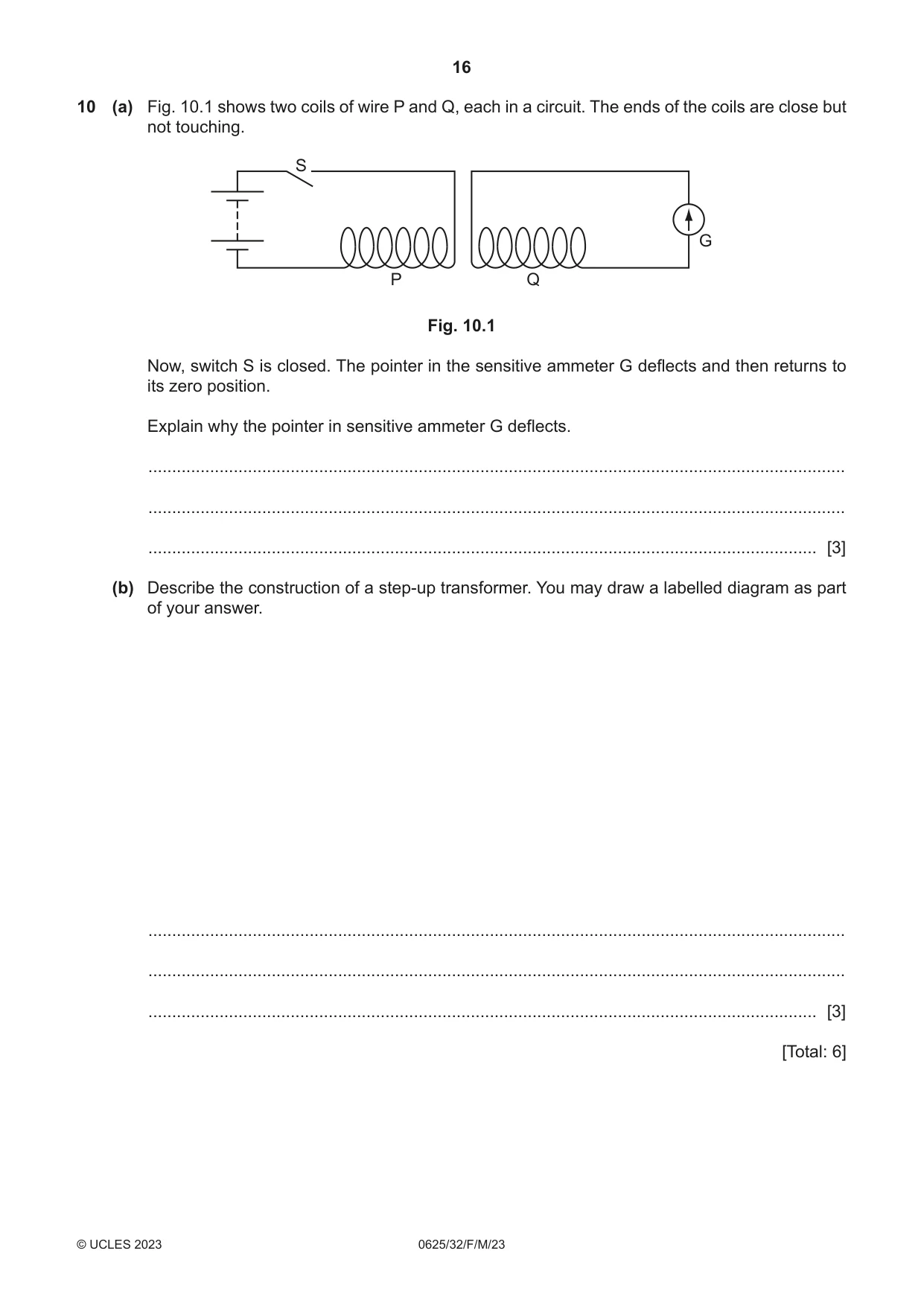
10 (a) Fig. 10.1 shows two coils of wire P and Q, each in a circuit. The ends of the coils are close but not touching. S G P Q Fig. 10.1 Now, switch S is closed. The pointer in the sensitive ammeter G deflects and then returns to its zero position. Explain why the pointer in sensitive ammeter G deflects. ................................................................................................................................................... ................................................................................................................................................... ............................................................................................................................................. [3] (b) Describe the construction of a step-up transformer. You may draw a labelled diagram as part of your answer. ................................................................................................................................................... ................................................................................................................................................... ............................................................................................................................................. [3] [Total: 6]
Mark scheme: 10(a) any three from B3 (when switch S closed) current in coil P coil P has (changing) magnetic field magnetic field (from P) links with / cuts coil Q e.m.f. / voltage / current induced / produced / generated in coil Q 10(b) two coils (of copper wire) B1 (wrapped around / linked by soft) iron core B1 more turns on secondary coil OR less turns on primary coil B1
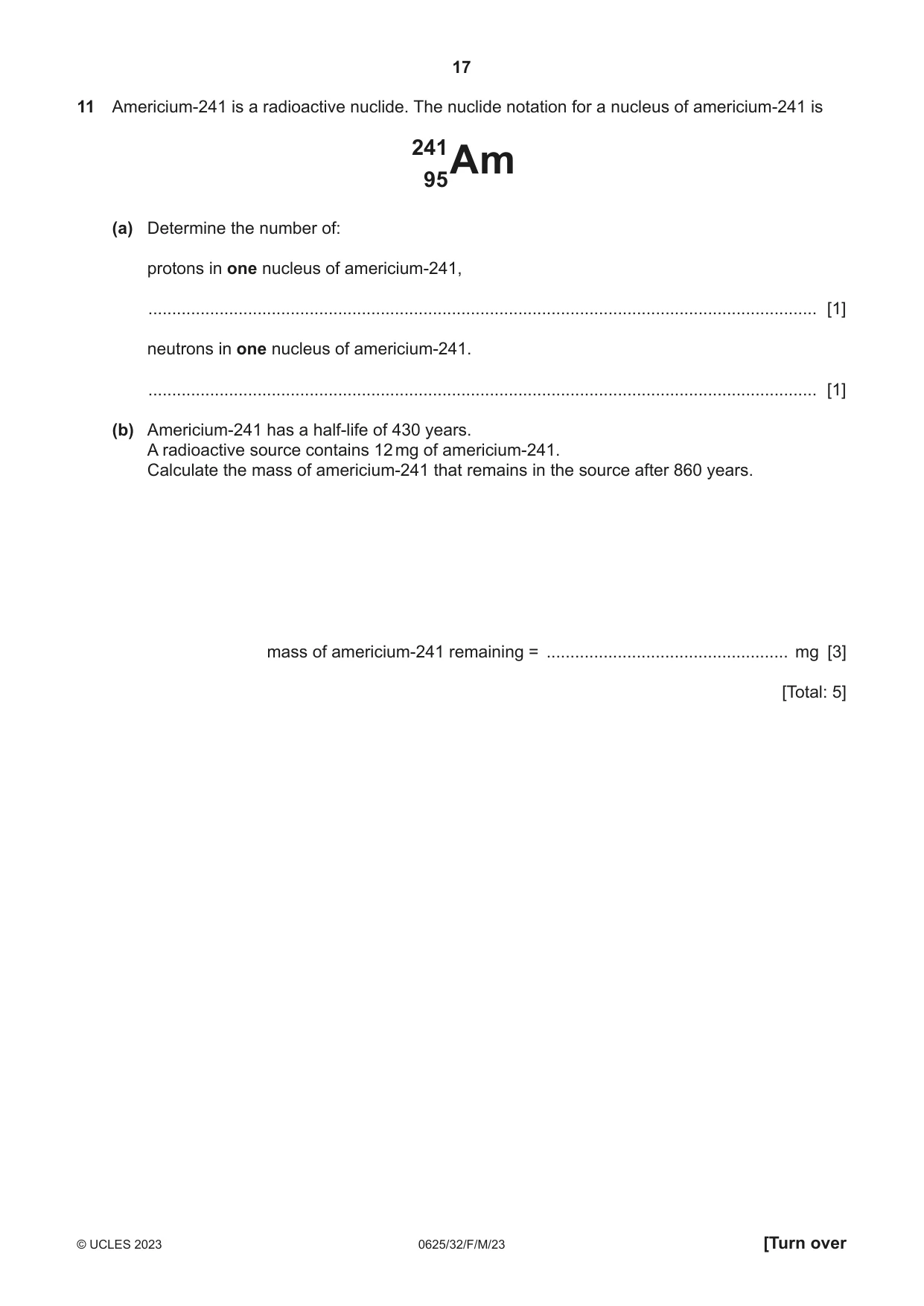
Q11 · Americium-241 is a radioactive nuclide
11 Americium-241 is a radioactive nuclide. The nuclide notation for a nucleus of americium-241 is 241 Am 95 (a) Determine the number of: protons in one nucleus of americium-241, ............................................................................................................................................. [1] neutrons in one nucleus of americium-241. ............................................................................................................................................. [1] (b) Americium-241 has a half-life of 430 years. A radioactive source contains 12 mg of americium-241. Calculate the mass of americium-241 that remains in the source after 860 years. mass of americium-241 remaining = ................................................... mg [3] [Total: 5]
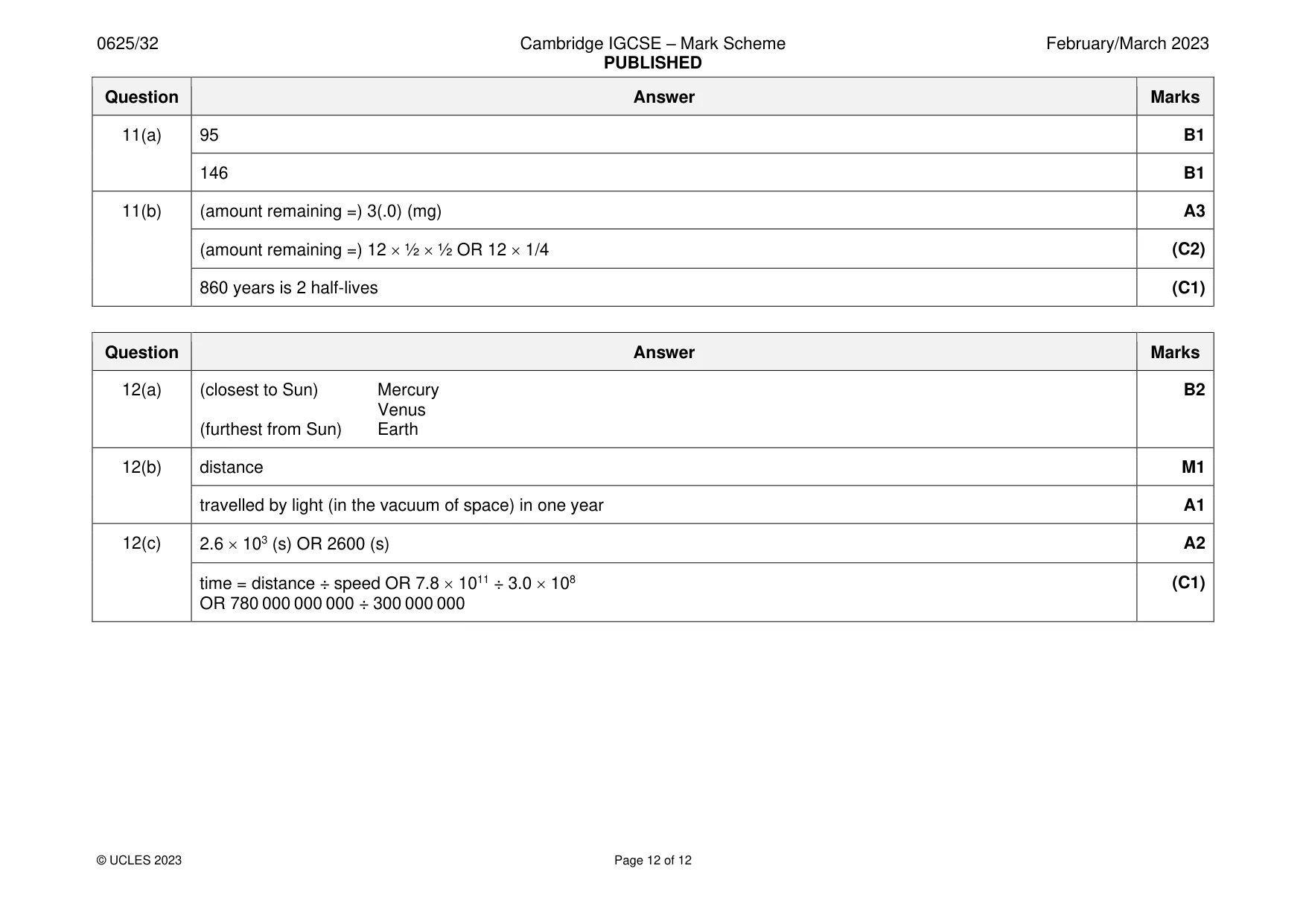
Mark scheme: 11(a) 95 B1 146 B1 11(b) (amount remaining =) 3(.0) (mg) A3 (amount remaining =) 12 ½ ½ OR 12 1/4 (C2) 860 years is 2 half-lives (C1)
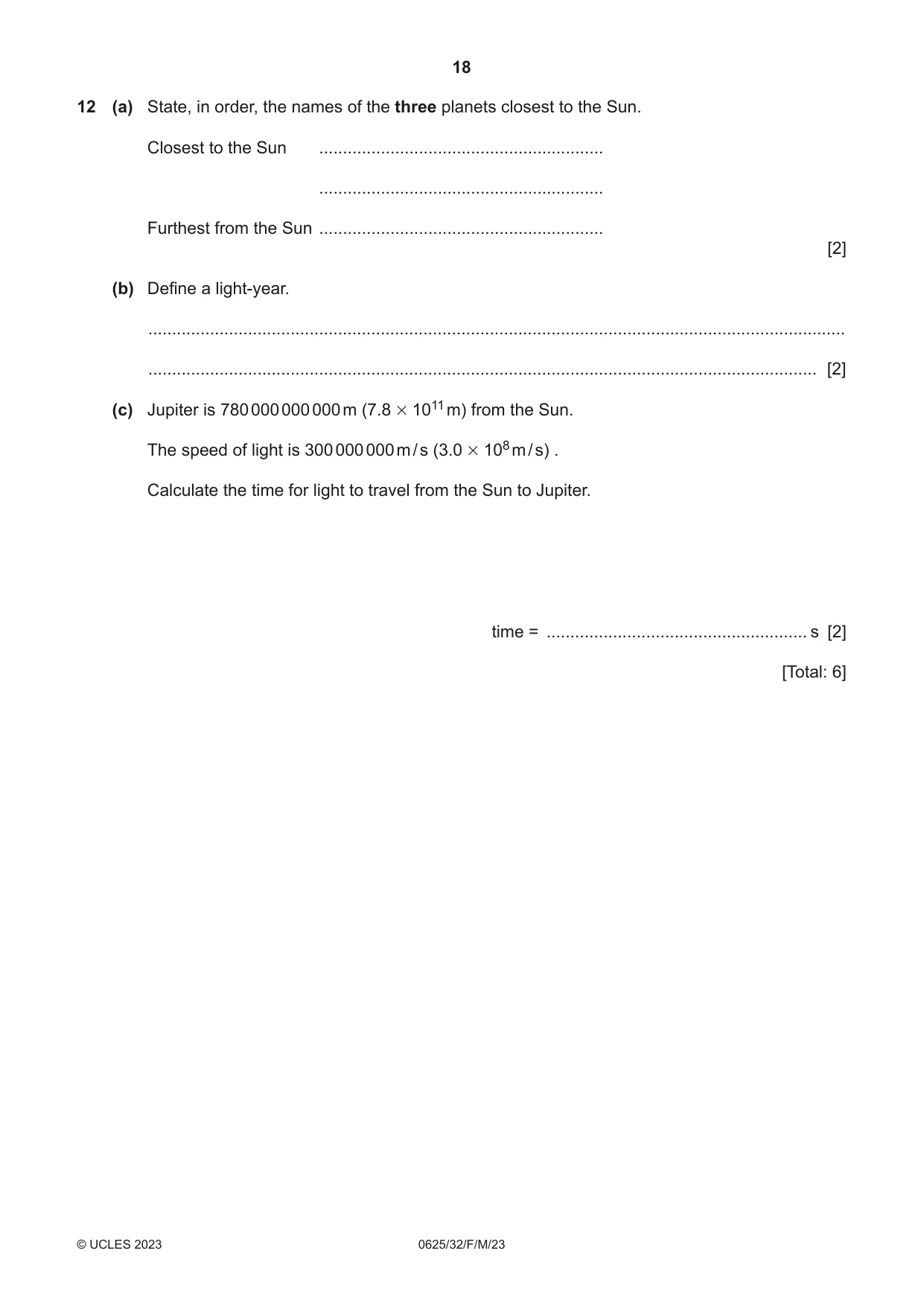
Q12 · State, in order, the names of the three planets closest to the Sun
12 (a) State, in order, the names of the three planets closest to the Sun. Closest to the Sun ............................................................ ............................................................ Furthest from the Sun ............................................................ [2] (b) Define a light-year. ................................................................................................................................................... ............................................................................................................................................. [2] (c) Jupiter is 780 000 000 000 m (7.8 # 1011 m) from the Sun. The speed of light is 300 000 000 m / s (3.0 # 108 m / s) . Calculate the time for light to travel from the Sun to Jupiter. time = ....................................................... s [2] [Total: 6]
Mark scheme: 12(a) (closest to Sun) Mercury B2 Venus (furthest from Sun) Earth 12(b) distance M1 travelled by light (in the vacuum of space) in one year A1 12(c) 2.6 103 (s) OR 2600 (s) A2 time = distance ÷ speed OR 7.8 1011 ÷ 3.0 108 (C1) OR 780 000 000 000 ÷ 300 000 000
What was in this paper
The subtopics covered by these 12 questions, and how many questions each got. Open one in a new tab to see every Cambridge question on it.
What you needed in this session
Cambridge’s own grade thresholds for 2023 Feb/March, Paper 3 · Variant 2. A higher threshold means an easier paper — the bar moves with how the cohort did.