Cambridge IGCSE Physics 0625 — 2015 May/June Paper 3 · Variant 1
0625/31/M/J/15 · 11 questions · 80 marks · ≈90 min
The question paper and its mark scheme, free to read here and free to download. This is Cambridge’s own paper, exactly as it was sat.
Question paper20 pages


Mark scheme8 pages
Answers below. Sit the paper first if you are practising.
Questions as text
Question 1
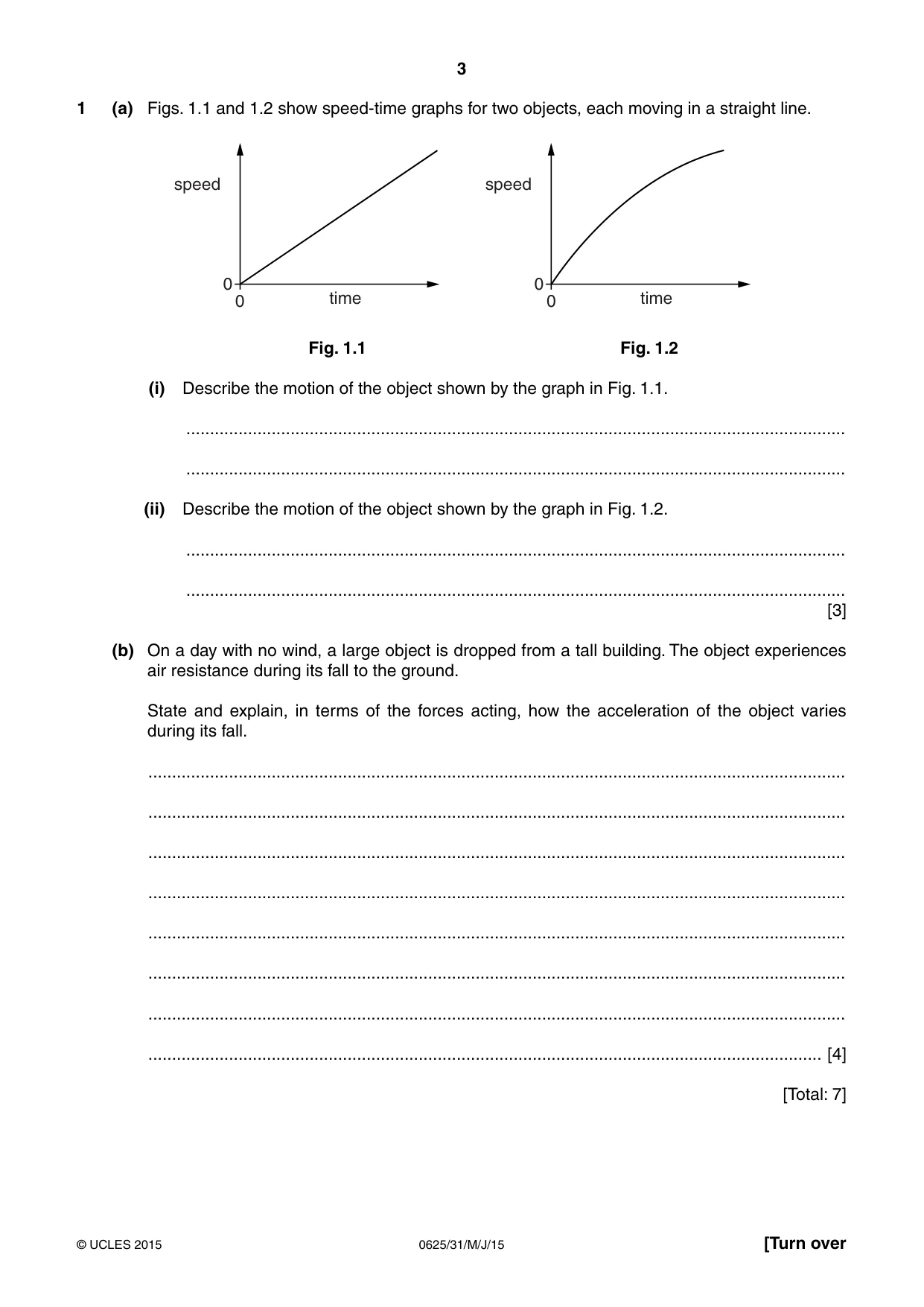
1 (a) Figs. 1.1 and 1.2 show speed-time graphs for two objects, each moving in a straight line. speed speed 0 0 0 time 0 time Fig. 1.1 Fig. 1.2 (i) Describe the motion of the object shown by the graph in Fig. 1.1. ........................................................................................................................................... ........................................................................................................................................... (ii) Describe the motion of the object shown by the graph in Fig. 1.2. ........................................................................................................................................... ........................................................................................................................................... [3] (b) On a day with no wind, a large object is dropped from a tall building. The object experiences air resistance during its fall to the ground. State and explain, in terms of the forces acting, how the acceleration of the object varies during its fall. ................................................................................................................................................... ................................................................................................................................................... ................................................................................................................................................... ................................................................................................................................................... ................................................................................................................................................... ................................................................................................................................................... ................................................................................................................................................... .............................................................................................................................................. [4] [Total: 7]
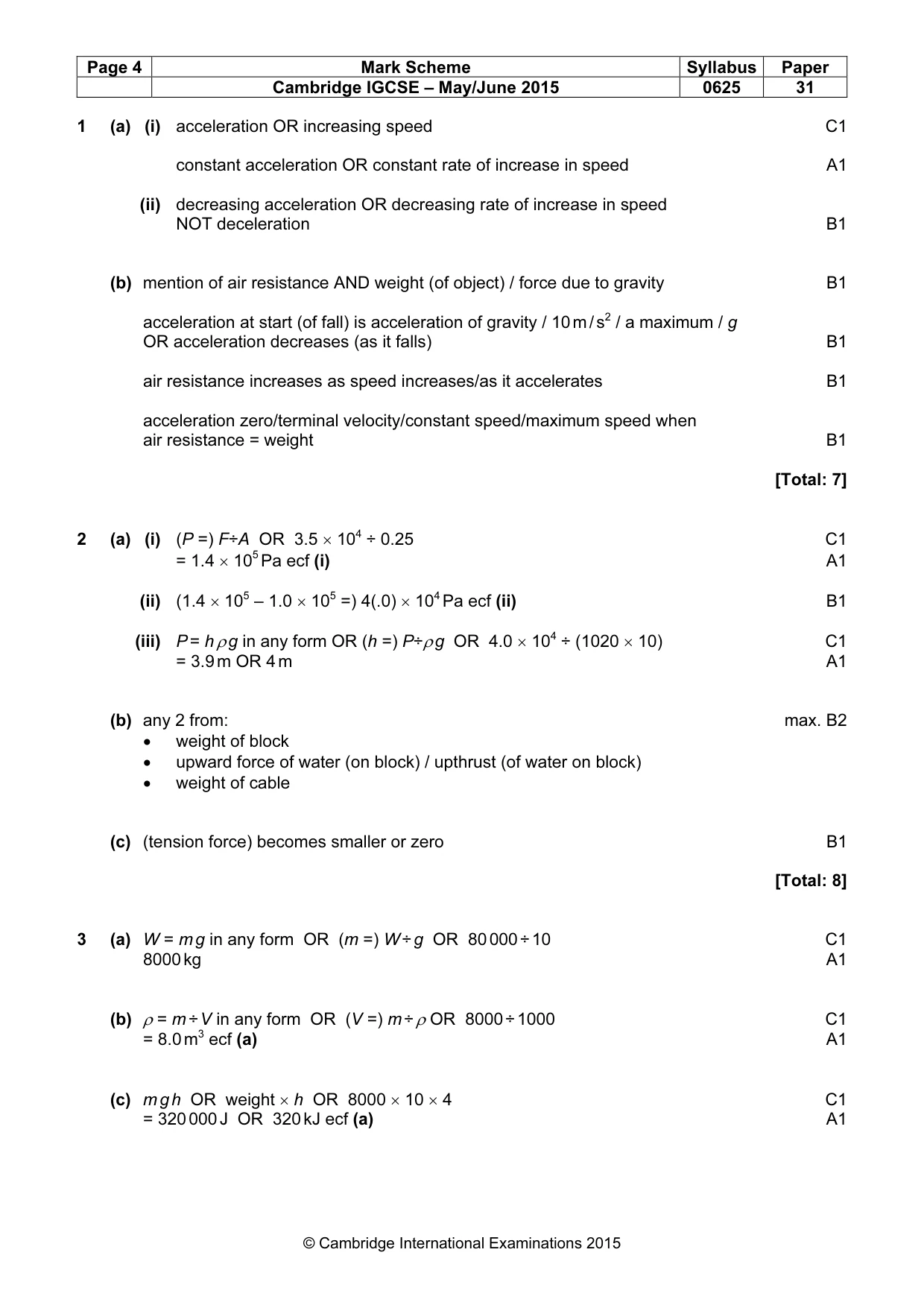
Mark scheme: 1 (a) (i) acceleration OR increasing speed C1 constant acceleration OR constant rate of increase in speed A1 (ii) decreasing acceleration OR decreasing rate of increase in speed NOT deceleration B1 (b) mention of air resistance AND weight (of object) / force due to gravity B1 acceleration at start (of fall) is acceleration of gravity / 10 m / s2 / a maximum / g OR acceleration decreases (as it falls) B1 air resistance increases as speed increases/as it accelerates B1 acceleration zero/terminal velocity/constant speed/maximum speed when air resistance = weight B1 [Total: 7] 4
Q2 · A large stone block is to be part of a harbour wall
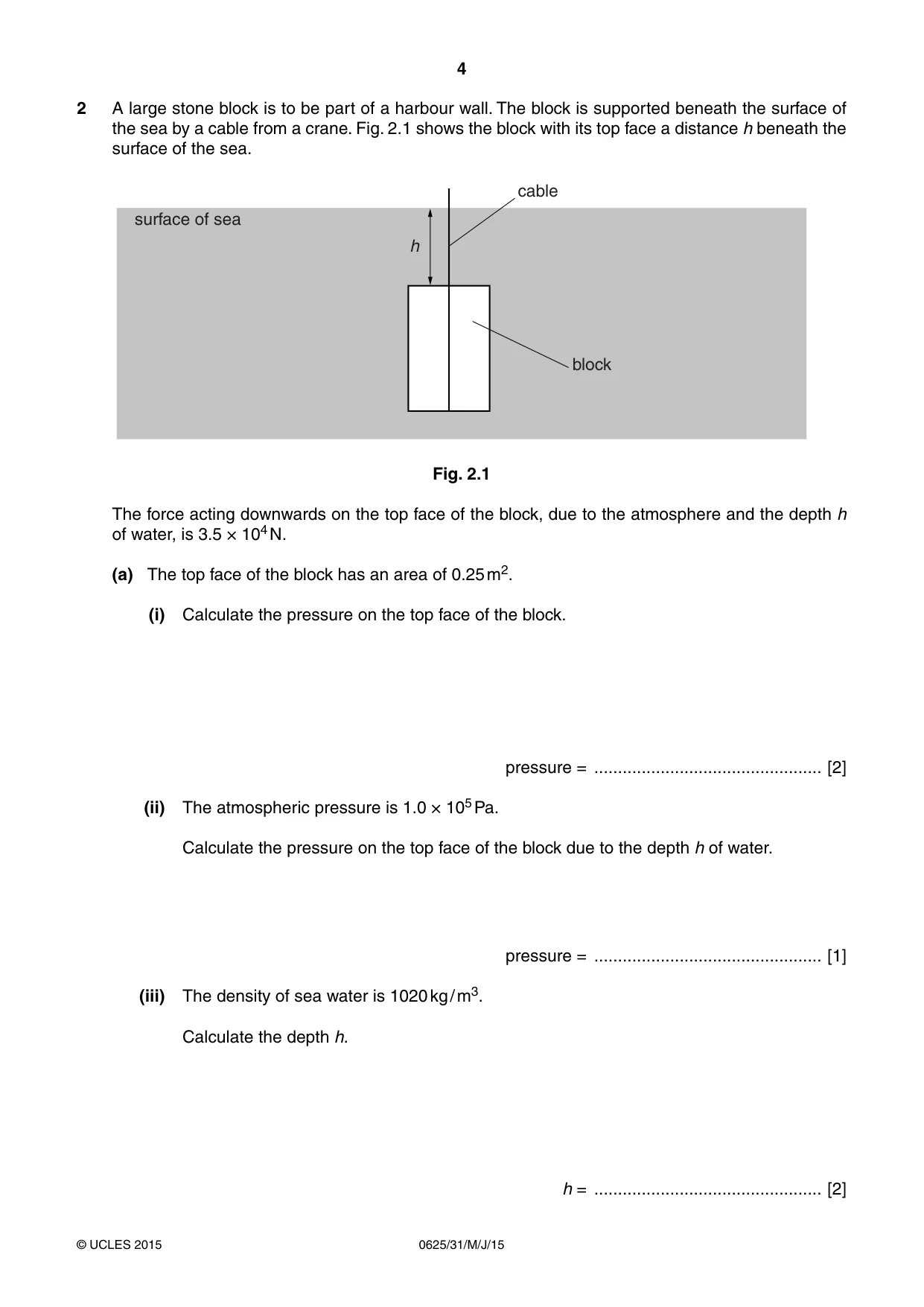
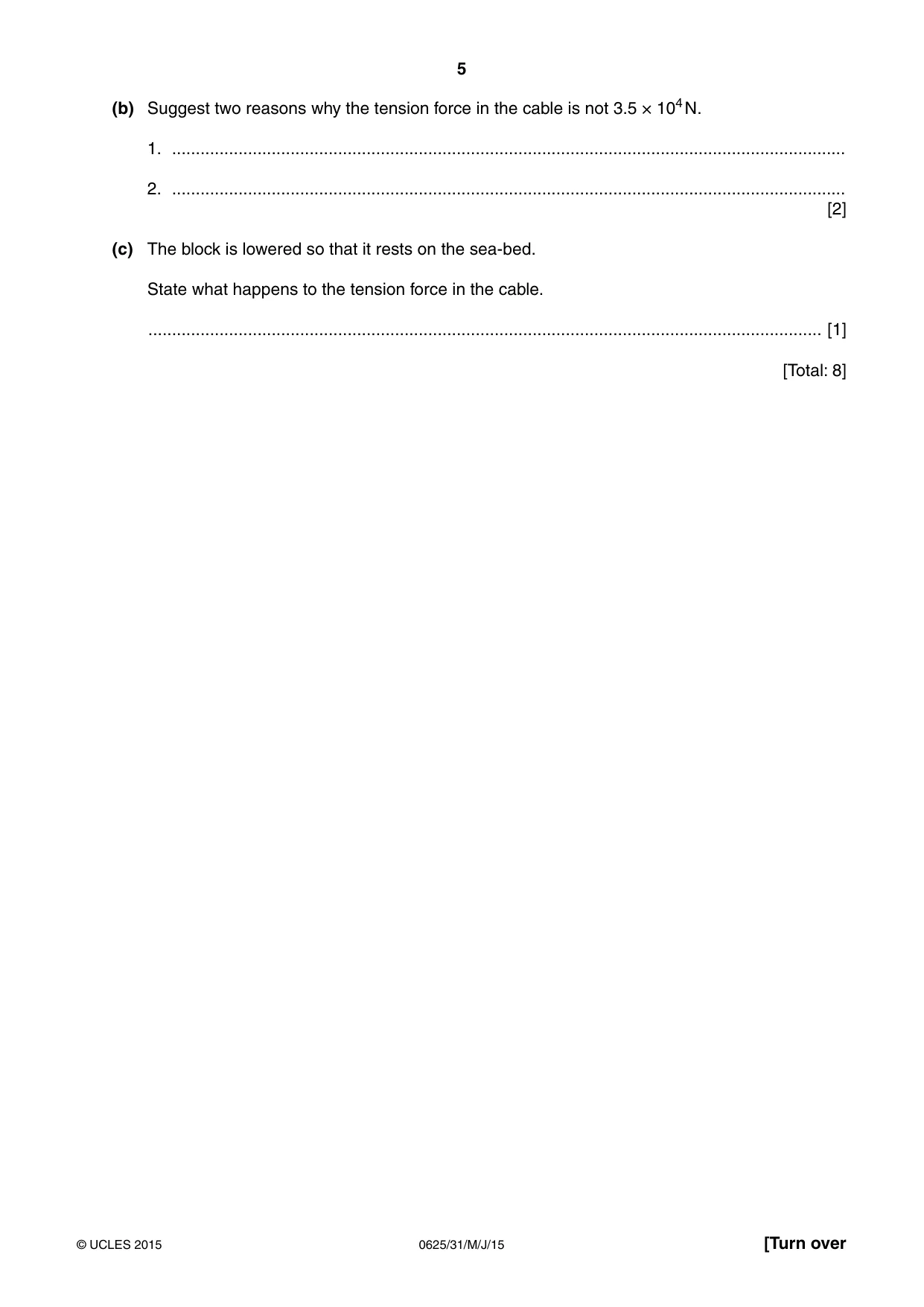
2 A large stone block is to be part of a harbour wall. The block is supported beneath the surface of the sea by a cable from a crane. Fig. 2.1 shows the block with its top face a distance h beneath the surface of the sea. cable surface of sea h block Fig. 2.1 The force acting downwards on the top face of the block, due to the atmosphere and the depth h of water, is 3.5 × 10⁴ N. (a) The top face of the block has an area of 0.25 m2. (i) Calculate the pressure on the top face of the block. pressure = ................................................ [2] (ii) The atmospheric pressure is 1.0 × 10⁵ Pa. Calculate the pressure on the top face of the block due to the depth h of water. pressure = ................................................ [1] (iii) The density of sea water is 1020 kg / m3. Calculate the depth h. h = ................................................ [2] (b) Suggest two reasons why the tension force in the cable is not 3.5 × 10⁴ N. 1. .............................................................................................................................................. 2. .............................................................................................................................................. [2] (c) The block is lowered so that it rests on the sea-bed. State what happens to the tension force in the cable. .............................................................................................................................................. [1] [Total: 8]
Mark scheme: 2 (a) (i) (P =) F÷A OR 3.5 × 10⁴ ÷ 0.25 C1 = 1.4 × 10⁵ Pa ecf (i) A1 (ii) (1.4 × 10⁵ – 1.0 × 105 =) 4(.0) × 104 Pa ecf (ii) B1 (iii) P = h ρ g in any form OR (h =) P÷ρ g OR 4.0 × 10⁴ ÷ (1020 × 10) C1 = 3.9 m OR 4 m A1 (b) any 2 from: max. B2 • weight of block • upward force of water (on block) / upthrust (of water on block) • weight of cable (c) (tension force) becomes smaller or zero B1 [Total: 8]
Q3 · An early water-powered device used to raise a heavy load
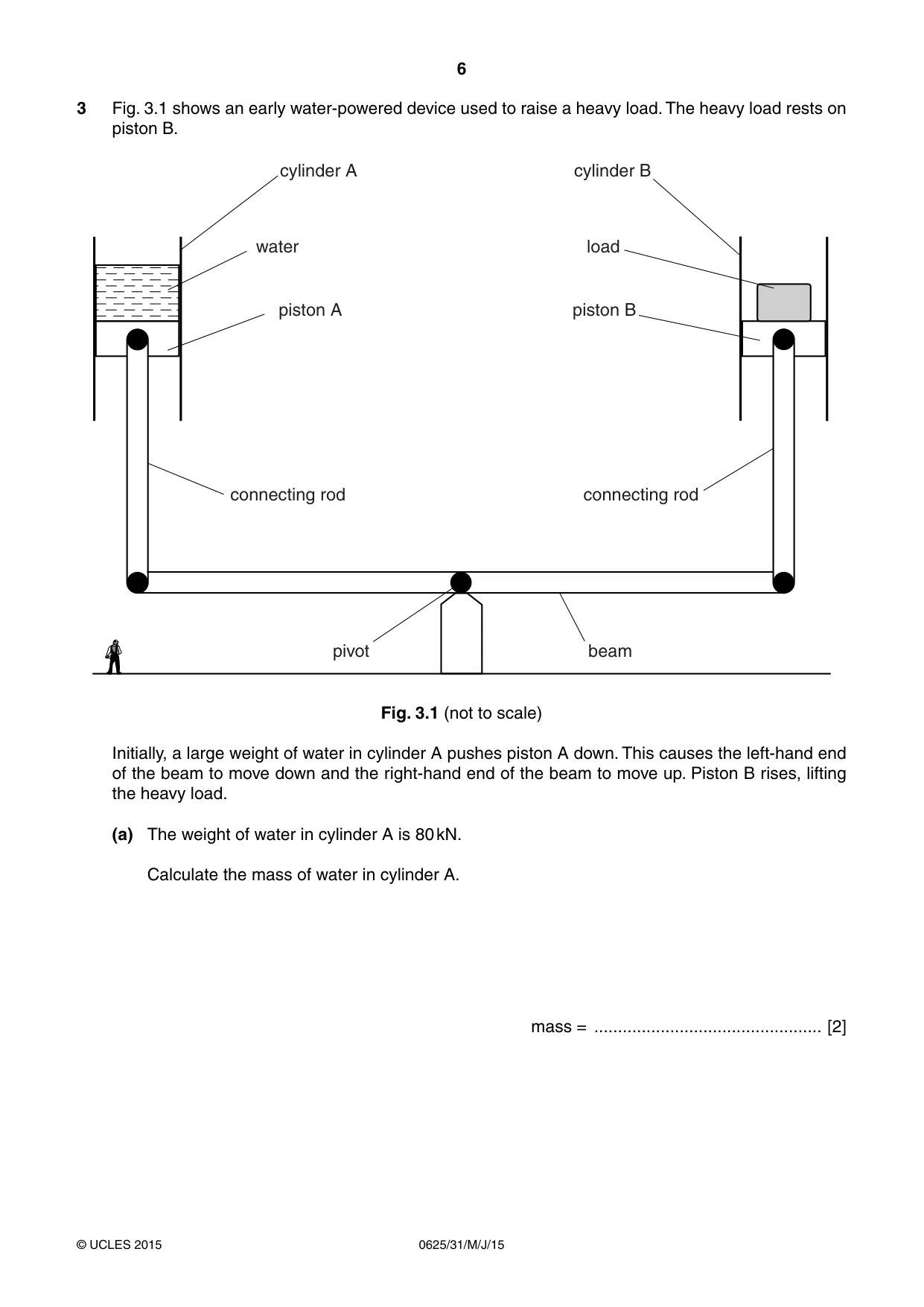
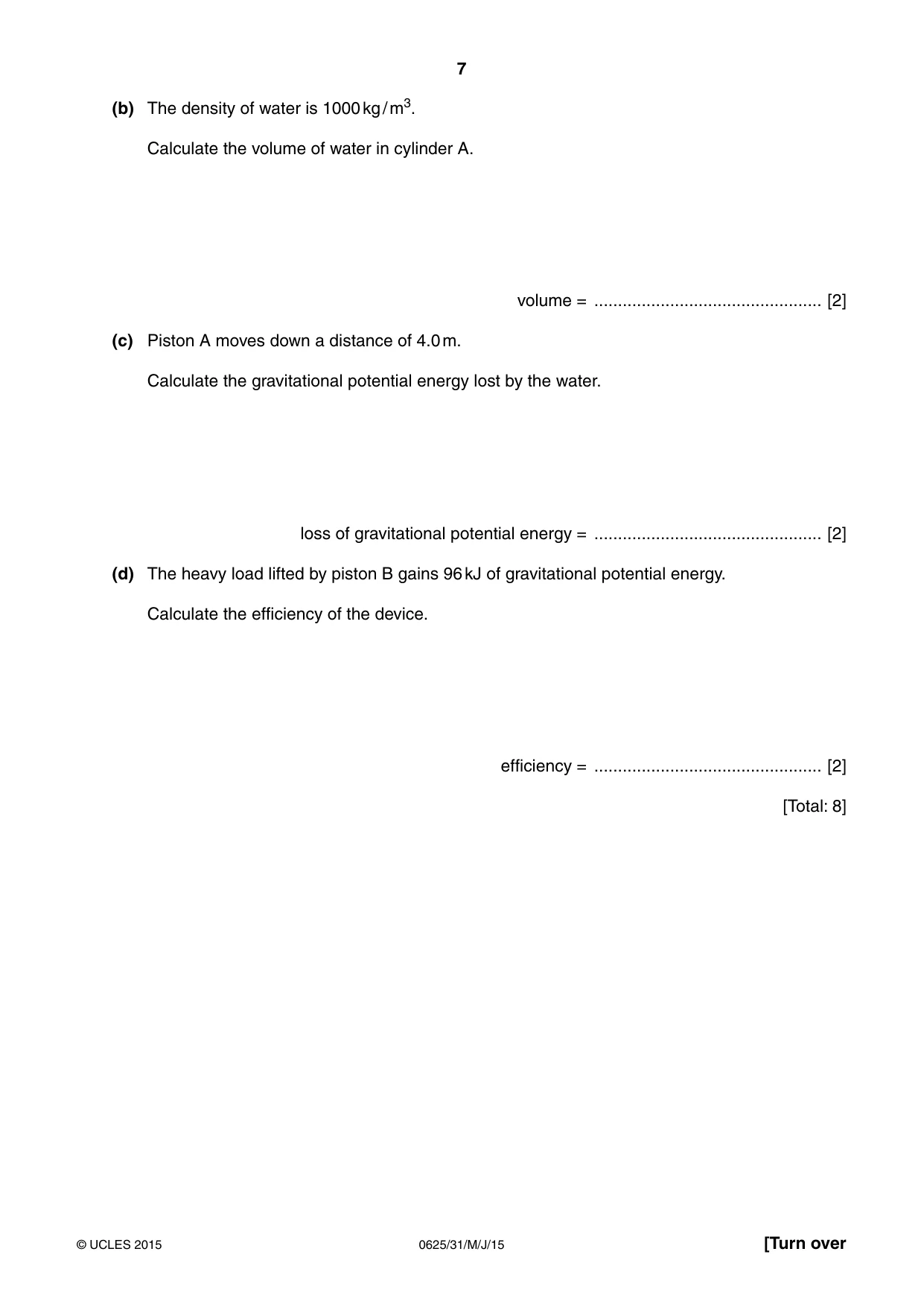
3 Fig. 3.1 shows an early water-powered device used to raise a heavy load. The heavy load rests on piston B. cylinder A cylinder B water load piston A piston B connecting rod connecting rod pivot beam Fig. 3.1 (not to scale) Initially, a large weight of water in cylinder A pushes piston A down. This causes the left-hand end of the beam to move down and the right-hand end of the beam to move up. Piston B rises, lifting the heavy load. (a) The weight of water in cylinder A is 80 kN. Calculate the mass of water in cylinder A. mass = ................................................ [2] (b) The density of water is 1000 kg / m3. Calculate the volume of water in cylinder A. volume = ................................................ [2] (c) Piston A moves down a distance of 4.0 m. Calculate the gravitational potential energy lost by the water. loss of gravitational potential energy = ................................................ [2] (d) The heavy load lifted by piston B gains 96 kJ of gravitational potential energy. Calculate the efficiency of the device. efficiency = ................................................ [2] [Total: 8]
Mark scheme: 3 (a) W = m g in any form OR (m =) W ÷ g OR 80 000 ÷ 10 C1 8000 kg A1 (b) ρ = m ÷ V in any form OR (V =) m ÷ ρ OR 8000 ÷ 1000 C1 = 8.0 m3 ecf (a) A1 (c) m g h OR weight × h OR 8000 × 10 × 4 C1 = 320 000 J OR 320 kJ ecf (a) A1 (d) (efficiency = ) output (energy) ÷ input (energy) (× 100) OR 96 ÷ 320 (× 100) C1 = 0.30 OR 30% ecf (c) A1 [Total: 8]
Q4 · State two ways in which the molecular structure of a liquid is different from the…
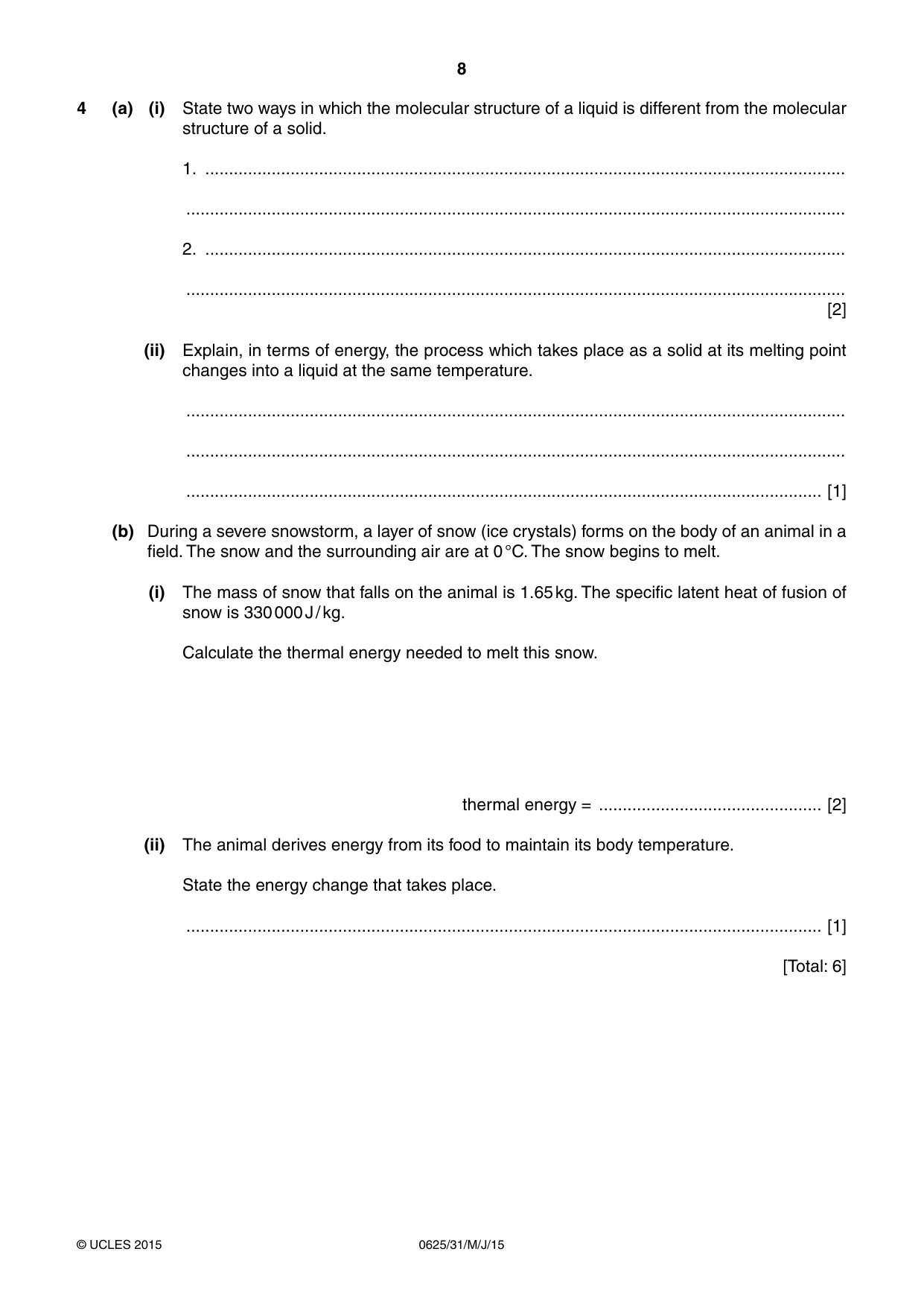
4 (a) (i) State two ways in which the molecular structure of a liquid is different from the molecular structure of a solid. 1. ....................................................................................................................................... ........................................................................................................................................... 2. ....................................................................................................................................... ........................................................................................................................................... [2] (ii) Explain, in terms of energy, the process which takes place as a solid at its melting point changes into a liquid at the same temperature. ........................................................................................................................................... ........................................................................................................................................... ...................................................................................................................................... [1] (b) During a severe snowstorm, a layer of snow (ice crystals) forms on the body of an animal in a field. The snow and the surrounding air are at 0 °C. The snow begins to melt. (i) The mass of snow that falls on the animal is 1.65 kg. The specific latent heat of fusion of snow is 330 000 J / kg. Calculate the thermal energy needed to melt this snow. thermal energy = ............................................... [2] (ii) The animal derives energy from its food to maintain its body temperature. State the energy change that takes place. ...................................................................................................................................... [1] [Total: 6]
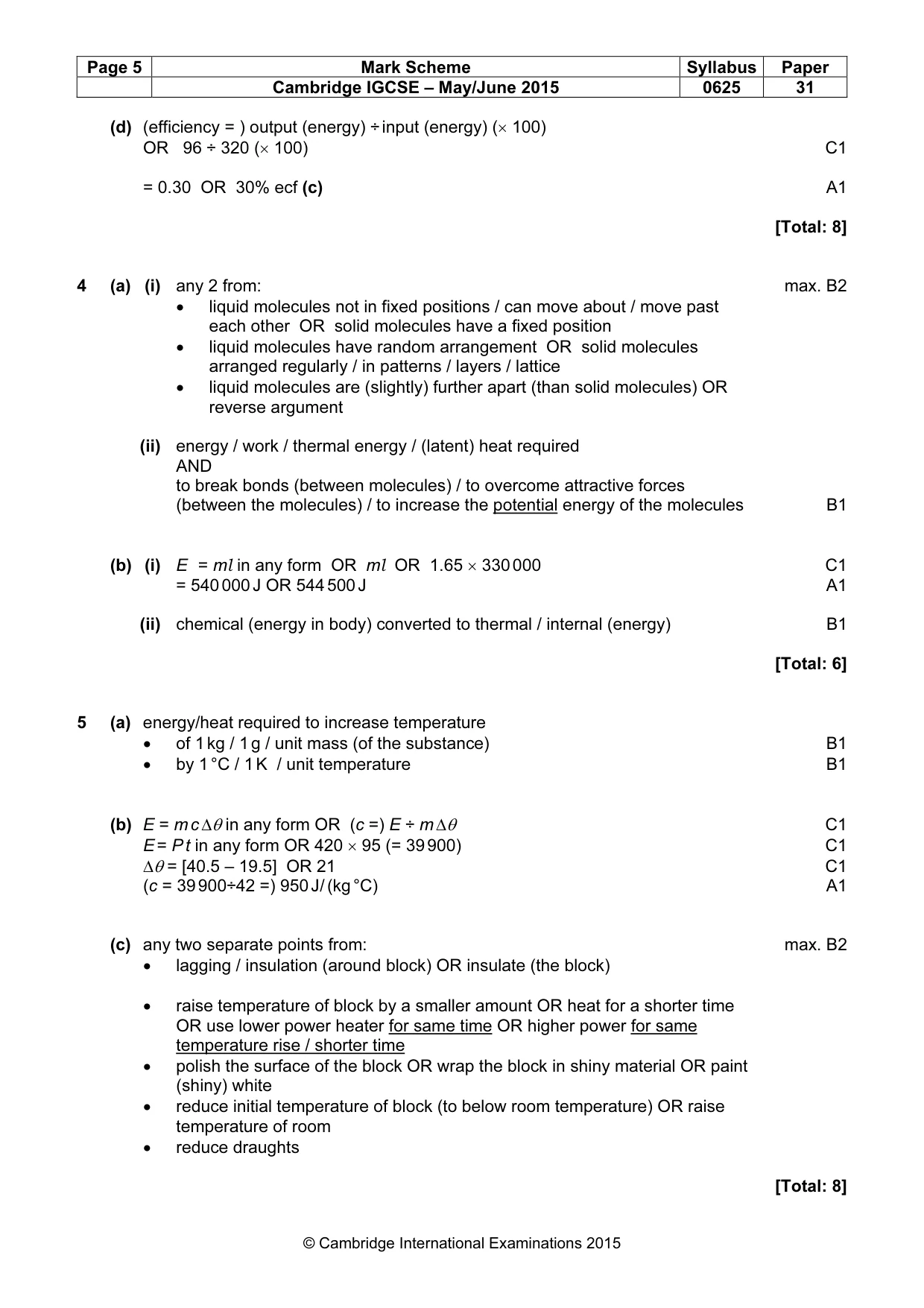
Mark scheme: 4 (a) (i) any 2 from: max. B2 • liquid molecules not in fixed positions / can move about / move past each other OR solid molecules have a fixed position • liquid molecules have random arrangement OR solid molecules arranged regularly / in patterns / layers / lattice • liquid molecules are (slightly) further apart (than solid molecules) OR reverse argument (ii) energy / work / thermal energy / (latent) heat required AND to break bonds (between molecules) / to overcome attractive forces (between the molecules) / to increase the potential energy of the molecules B1 (b) (i) E = ml in any form OR ml OR 1.65 × 330 000 C1 = 540 000 J OR 544 500 J A1 (ii) chemical (energy in body) converted to thermal / internal (energy) B1 [Total: 6]
Q5 · State what is meant by the specific heat capacity of a substance
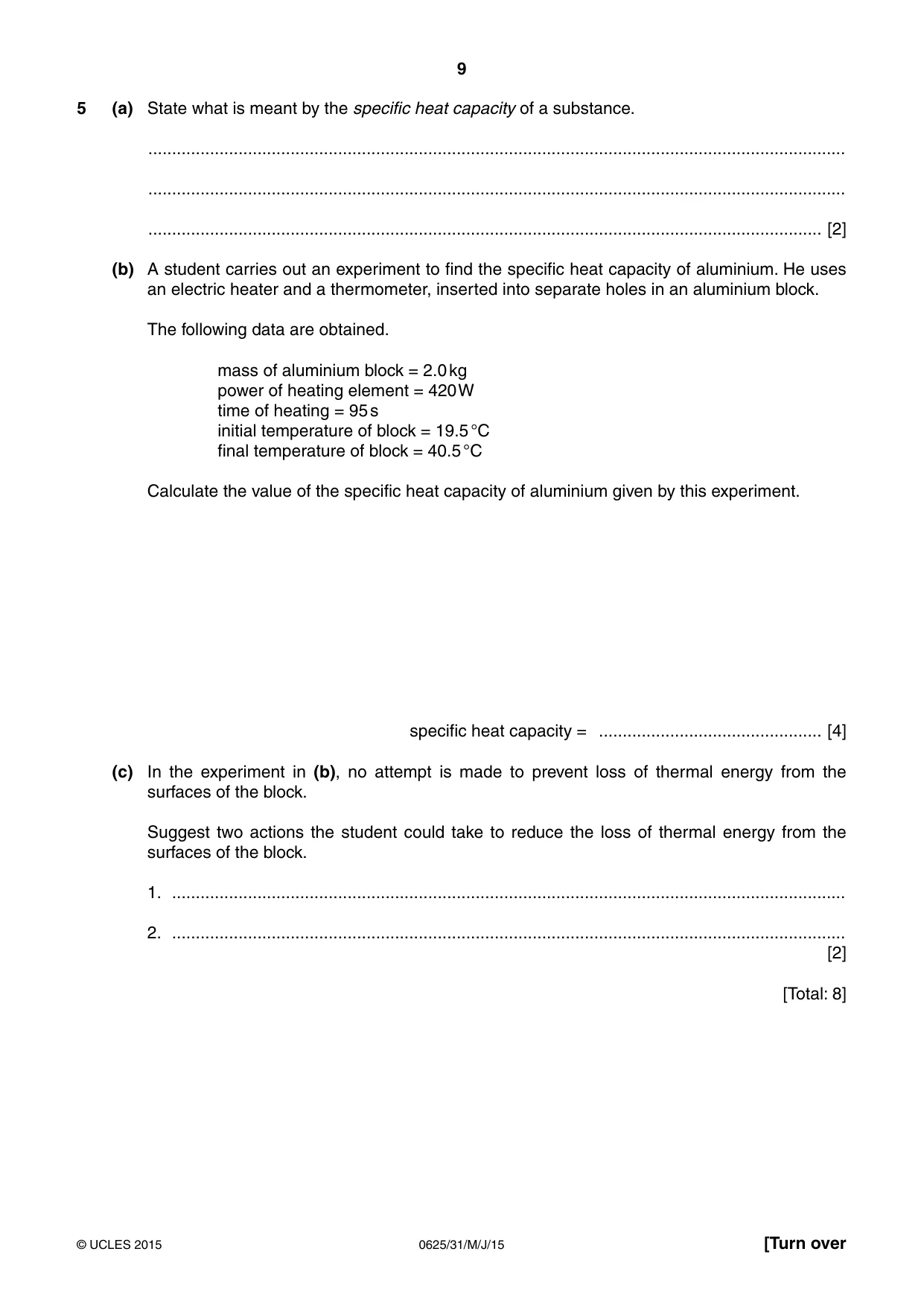
5 (a) State what is meant by the specific heat capacity of a substance. ................................................................................................................................................... ................................................................................................................................................... .............................................................................................................................................. [2] (b) A student carries out an experiment to find the specific heat capacity of aluminium. He uses an electric heater and a thermometer, inserted into separate holes in an aluminium block. The following data are obtained. mass of aluminium block = 2.0 kg power of heating element = 420 W time of heating = 95 s initial temperature of block = 19.5 °C final temperature of block = 40.5 °C Calculate the value of the specific heat capacity of aluminium given by this experiment. specific heat capacity = ............................................... [4] (c) In the experiment in (b), no attempt is made to prevent loss of thermal energy from the surfaces of the block. Suggest two actions the student could take to reduce the loss of thermal energy from the surfaces of the block. 1. .............................................................................................................................................. 2. .............................................................................................................................................. [2] [Total: 8]
Mark scheme: 5 (a) energy/heat required to increase temperature • of 1 kg / 1 g / unit mass (of the substance) B1 • by 1 °C / 1 K / unit temperature B1 (b) E = m c ∆θ in any form OR (c =) E ÷ m ∆θ C1 E = P t in any form OR 420 × 95 (= 39 900) C1 ∆θ = [40.5 – 19.5] OR 21 C1 (c = 39 900÷42 =) 950 J / (kg °C) A1 (c) any two separate points from: max. B2 • lagging / insulation (around block) OR insulate (the block) • raise temperature of block by a smaller amount OR heat for a shorter time OR use lower power heater for same time OR higher power for same temperature rise / shorter time • polish the surface of the block OR wrap the block in shiny material OR paint (shiny) white • reduce initial temperature of block (to below room temperature) OR raise temperature of room • reduce draughts [Total: 8]
Q6 · A water wave in a tank travels from a region where the speed of the wave is faster into a…
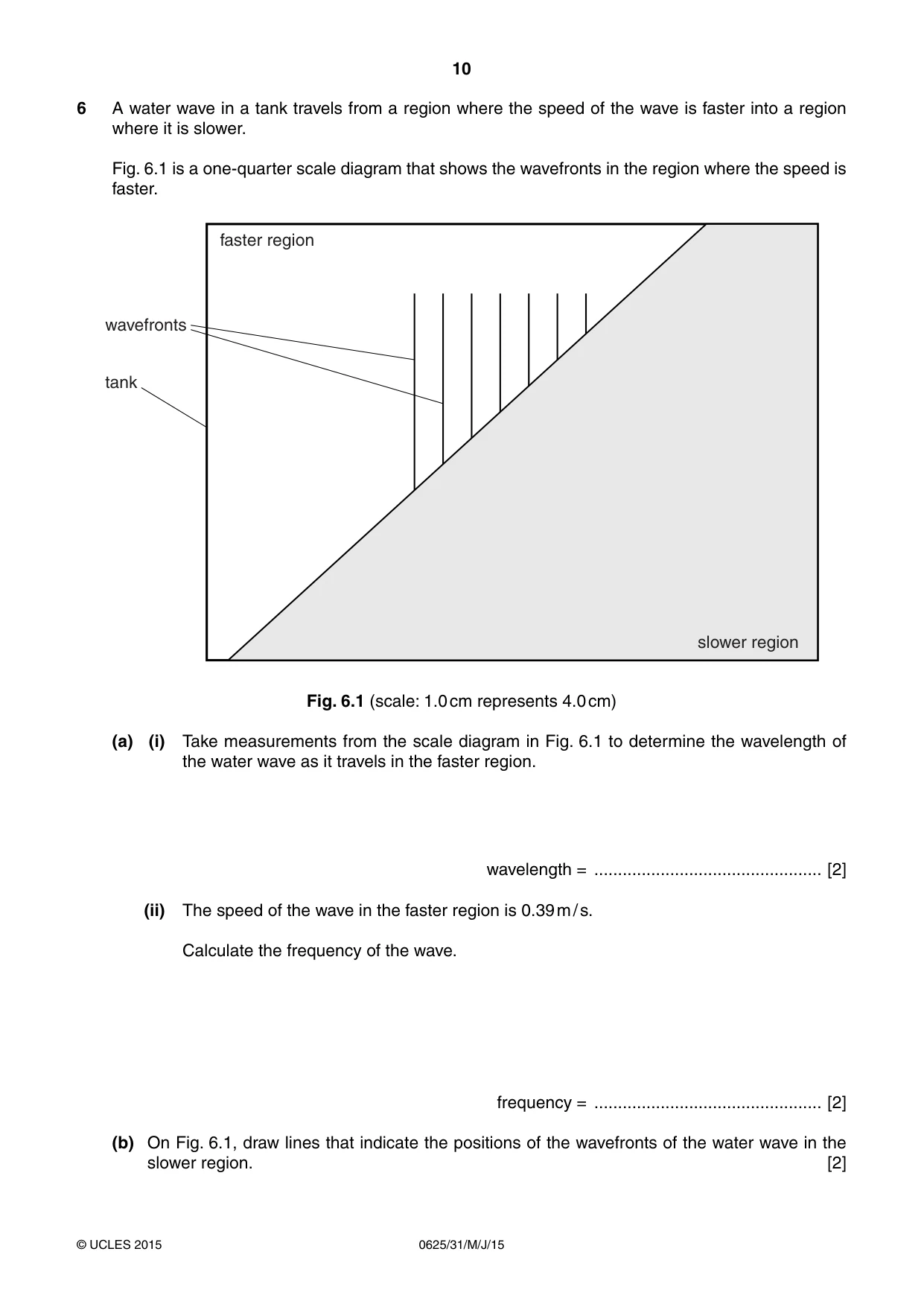
6 A water wave in a tank travels from a region where the speed of the wave is faster into a region where it is slower. Fig. 6.1 is a one-quarter scale diagram that shows the wavefronts in the region where the speed is faster. faster region wavefronts tank slower region Fig. 6.1 (scale: 1.0 cm represents 4.0 cm) (a) (i) Take measurements from the scale diagram in Fig. 6.1 to determine the wavelength of the water wave as it travels in the faster region. wavelength = ................................................ [2] (ii) The speed of the wave in the faster region is 0.39 m / s. Calculate the frequency of the wave. frequency = ................................................ [2] (b) On Fig. 6.1, draw lines that indicate the positions of the wavefronts of the water wave in the slower region. [2] (c) State what happens to the frequency of the water wave as it passes into the slower region. ................................................................................................................................................... .............................................................................................................................................. [1] [Total: 7]
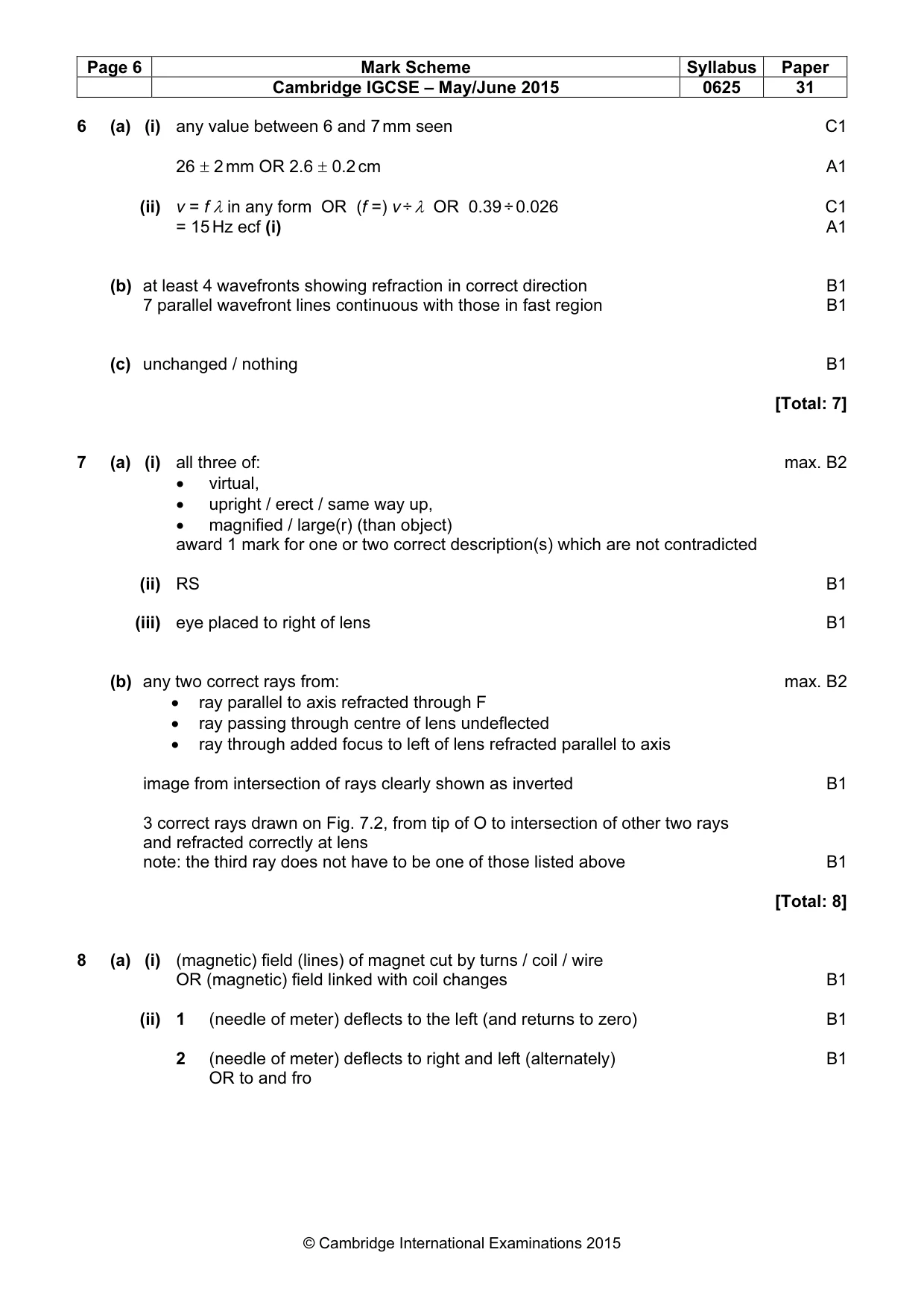
Mark scheme: 6 (a) (i) any value between 6 and 7 mm seen C1 26 ± 2 mm OR 2.6 ± 0.2 cm A1 (ii) v = f λ in any form OR (f =) v ÷ λ OR 0.39 ÷ 0.026 C1 = 15 Hz ecf (i) A1 (b) at least 4 wavefronts showing refraction in correct direction B1 7 parallel wavefront lines continuous with those in fast region B1 (c) unchanged / nothing B1 [Total: 7]
Q7 · An object O placed in front of a converging lens
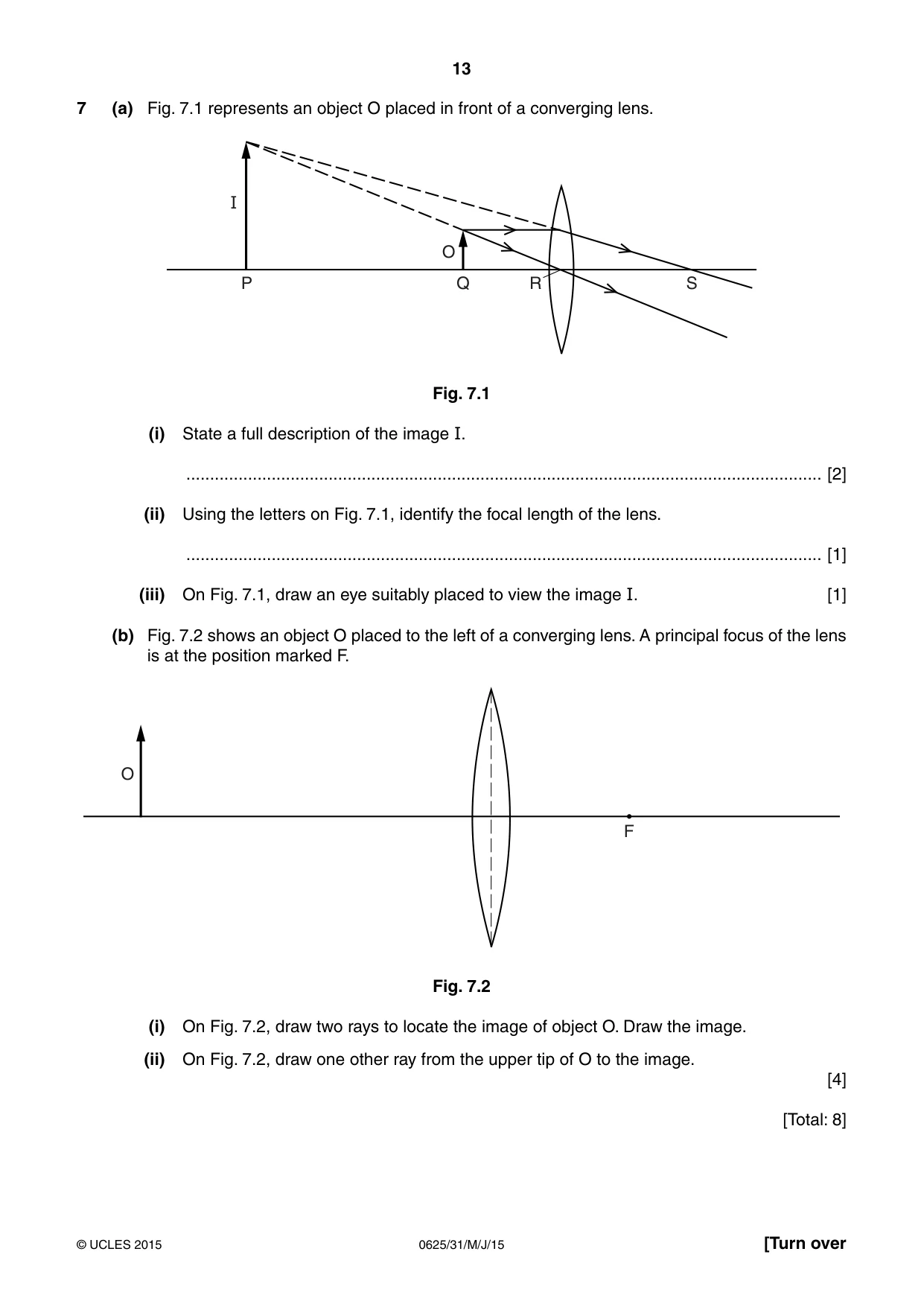
7 (a) Fig. 7.1 represents an object O placed in front of a converging lens. I O P Q R S Fig. 7.1 (i) State a full description of the image I. ...................................................................................................................................... [2] (ii) Using the letters on Fig. 7.1, identify the focal length of the lens. ...................................................................................................................................... [1] (iii) On Fig. 7.1, draw an eye suitably placed to view the image I. [1] (b) Fig. 7.2 shows an object O placed to the left of a converging lens. A principal focus of the lens is at the position marked F. O F Fig. 7.2 (i) On Fig. 7.2, draw two rays to locate the image of object O. Draw the image. (ii) On Fig. 7.2, draw one other ray from the upper tip of O to the image. [4] [Total: 8]
Mark scheme: 7 (a) (i) all three of: max. B2 • virtual, • upright / erect / same way up, • magnified / large(r) (than object) award 1 mark for one or two correct description(s) which are not contradicted (ii) RS B1 (iii) eye placed to right of lens B1 (b) any two correct rays from: max. B2 • ray parallel to axis refracted through F • ray passing through centre of lens undeflected • ray through added focus to left of lens refracted parallel to axis image from intersection of rays clearly shown as inverted B1 3 correct rays drawn on Fig. 7.2, from tip of O to intersection of other two rays and refracted correctly at lens note: the third ray does not have to be one of those listed above B1 [Total: 8]
Q8 · A bar magnet suspended by a spring over a coil
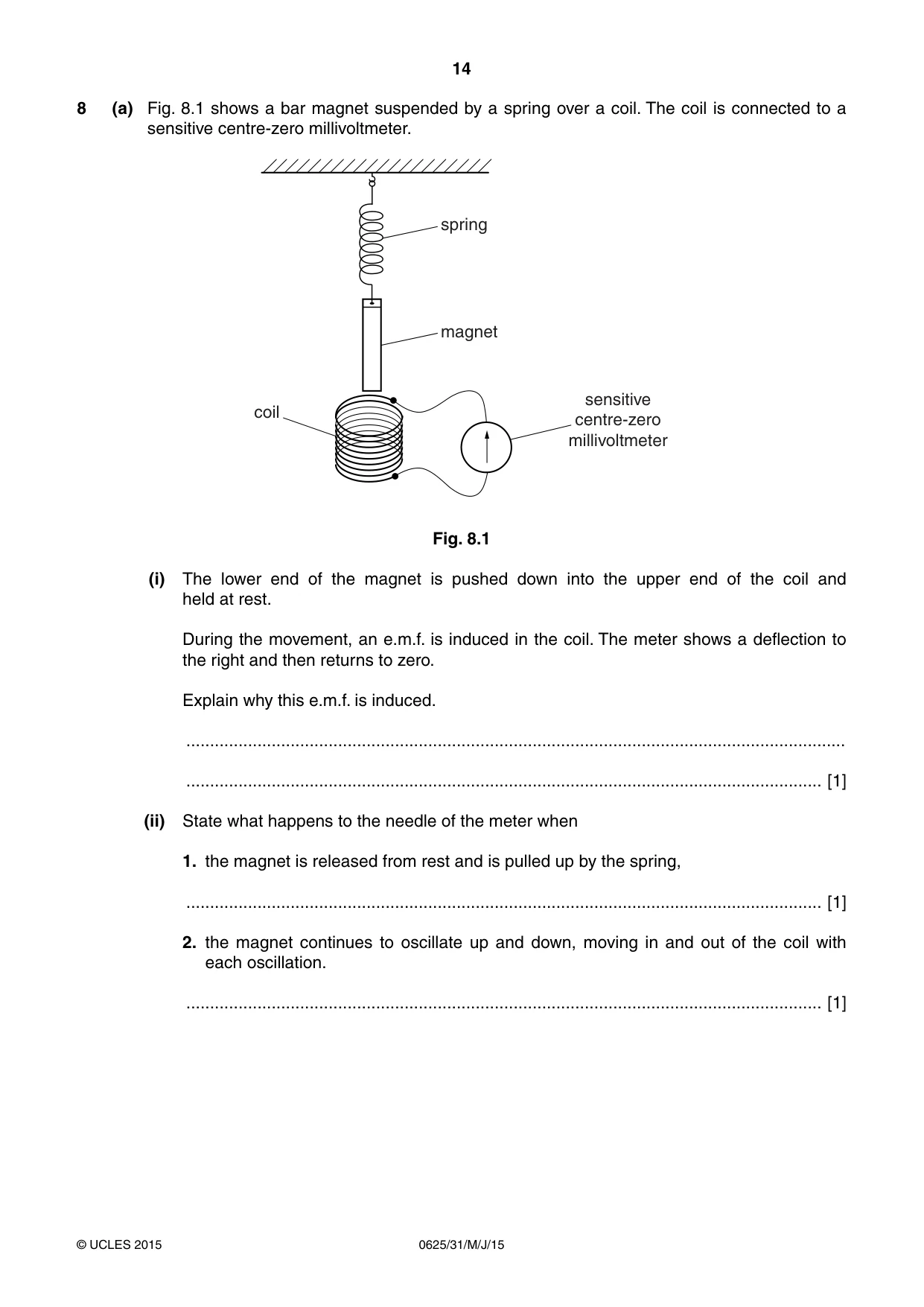
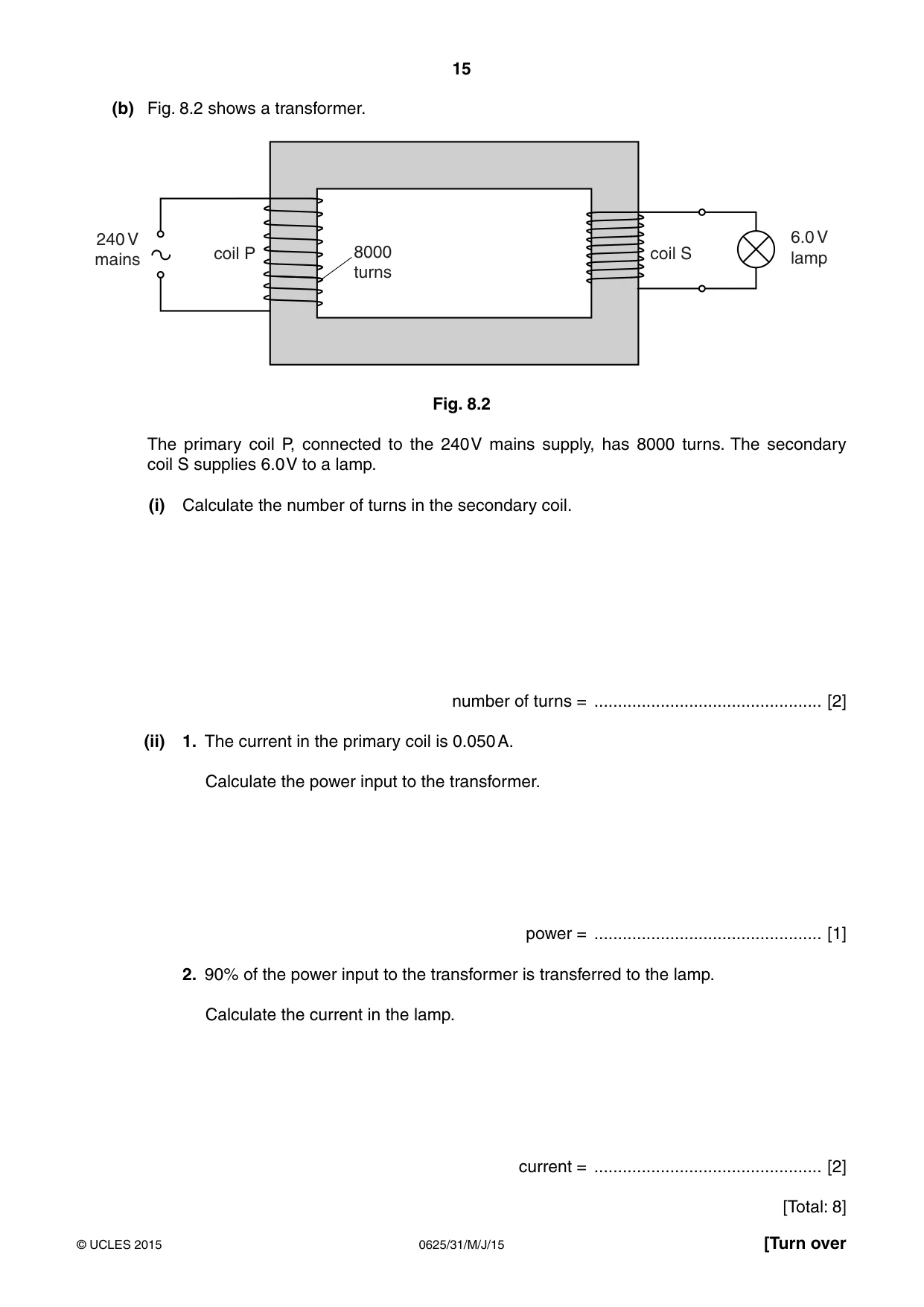
8 (a) Fig. 8.1 shows a bar magnet suspended by a spring over a coil. The coil is connected to a sensitive centre-zero millivoltmeter. spring magnet sensitive coil centre-zero millivoltmeter Fig. 8.1 (i) The lower end of the magnet is pushed down into the upper end of the coil and held at rest. During the movement, an e.m.f. is induced in the coil. The meter shows a deflection to the right and then returns to zero. Explain why this e.m.f. is induced. ........................................................................................................................................... ...................................................................................................................................... [1] (ii) State what happens to the needle of the meter when 1. the magnet is released from rest and is pulled up by the spring, ...................................................................................................................................... [1] 2. the magnet continues to oscillate up and down, moving in and out of the coil with each oscillation. ...................................................................................................................................... [1] (b) Fig. 8.2 shows a transformer. 240 V 6.0 V coil P 8000 coil S lampmains turns Fig. 8.2 The primary coil P, connected to the 240 V mains supply, has 8000 turns. The secondary coil S supplies 6.0 V to a lamp. (i) Calculate the number of turns in the secondary coil. number of turns = ................................................ [2] (ii) 1. The current in the primary coil is 0.050 A. Calculate the power input to the transformer. power = ................................................ [1] 2. 90% of the power input to the transformer is transferred to the lamp. Calculate the current in the lamp. current = ................................................ [2] [Total: 8]
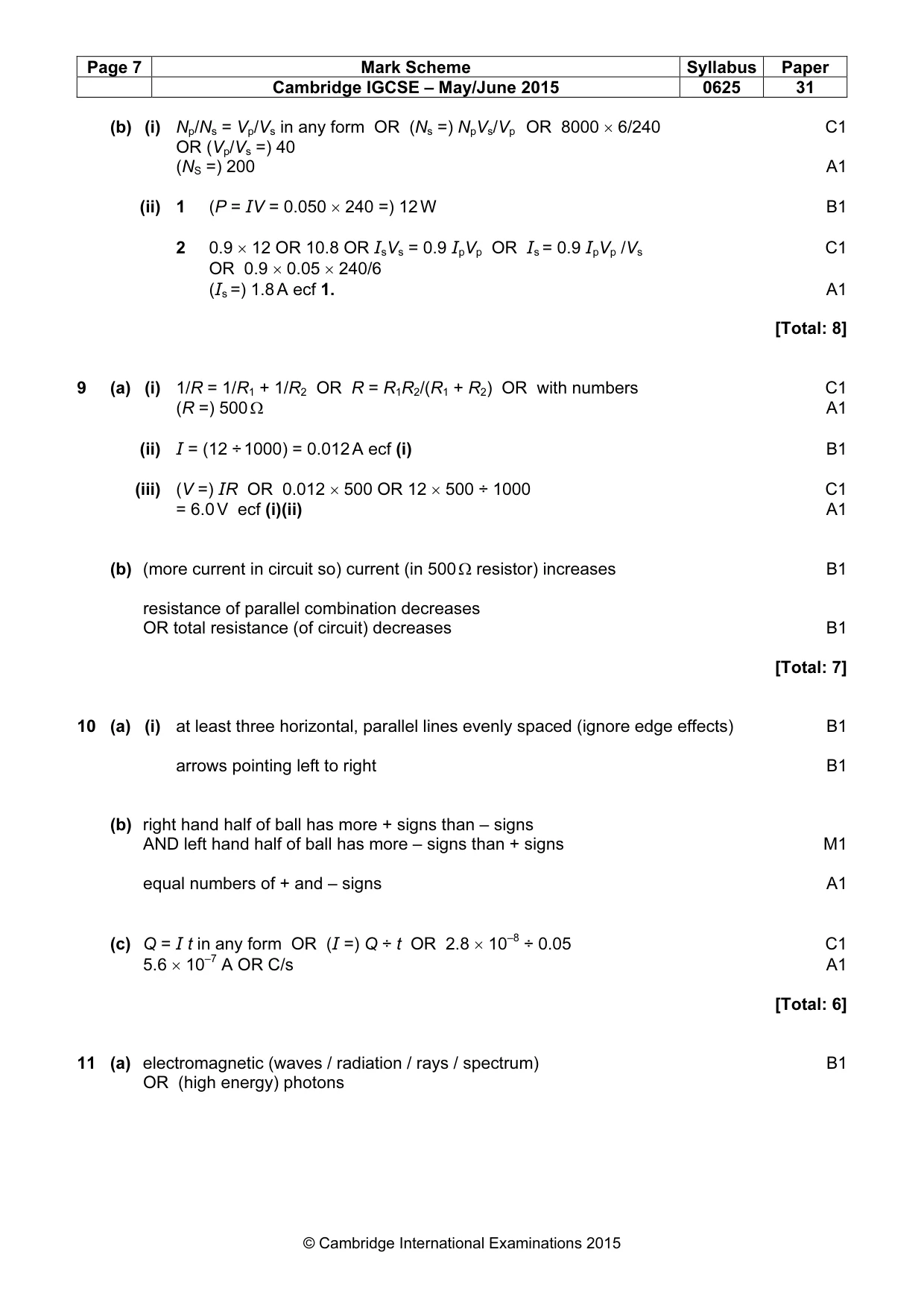
Mark scheme: 8 (a) (i) (magnetic) field (lines) of magnet cut by turns / coil / wire OR (magnetic) field linked with coil changes B1 (ii) 1 (needle of meter) deflects to the left (and returns to zero) B1 2 (needle of meter) deflects to right and left (alternately) B1 OR to and fro (b) (i) Np/Ns = Vp/Vs in any form OR (Ns =) NpVs/Vp OR 8000 × 6/240 C1 OR (Vp/Vs =) 40 (NS =) 200 A1 (ii) 1 (P = IV = 0.050 × 240 =) 12 W B1 2 0.9 × 12 OR 10.8 OR IsVs = 0.9 IpVp OR Is = 0.9 IpVp /Vs C1 OR 0.9 × 0.05 × 240/6 (Is =) 1.8 A ecf 1. A1 [Total: 8]
Question 9
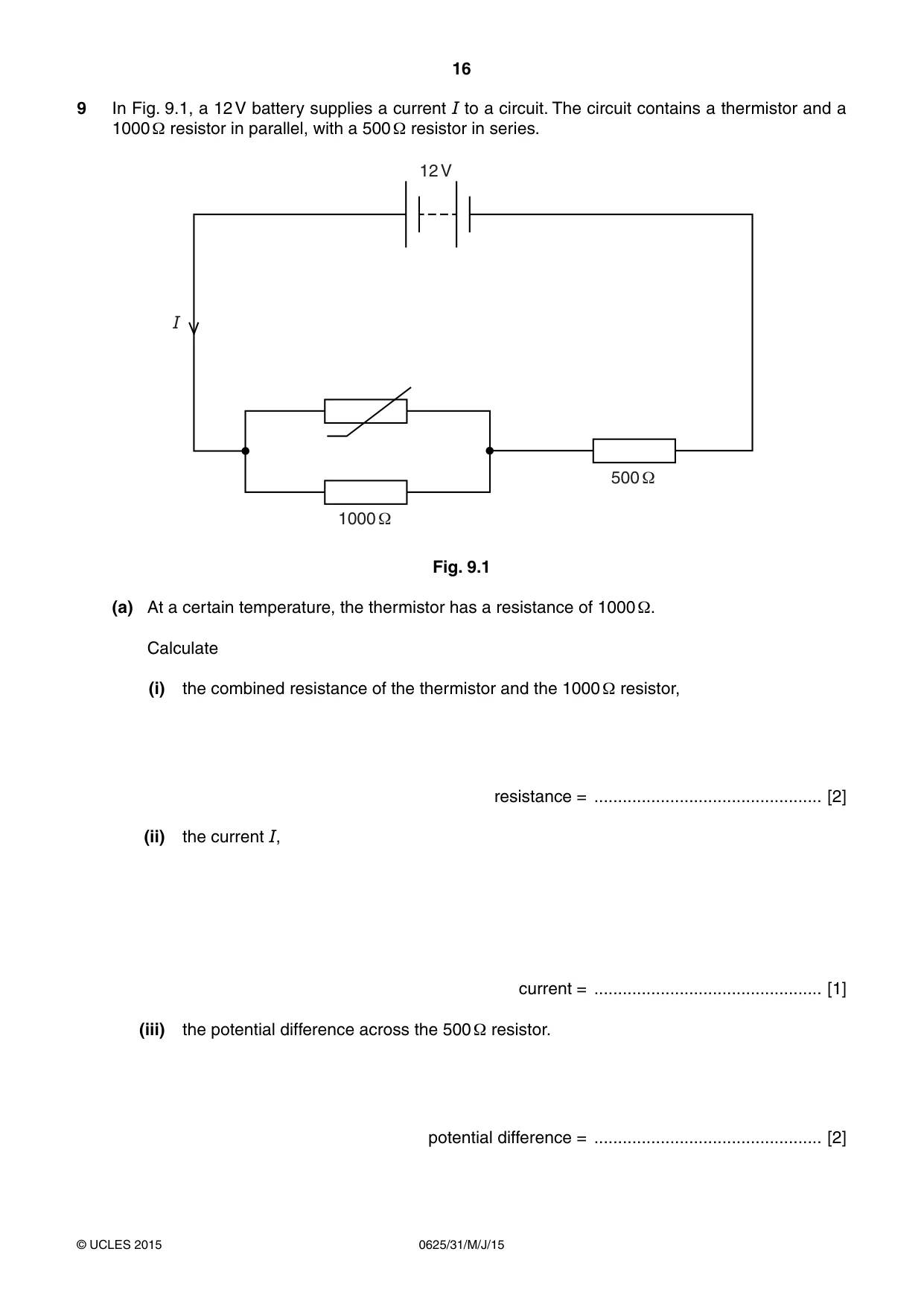
9 In Fig. 9.1, a 12 V battery supplies a current I to a circuit. The circuit contains a thermistor and a 1000 Ω resistor in parallel, with a 500 Ω resistor in series. 12 V I 500 1 1000 1 Fig. 9.1 (a) At a certain temperature, the thermistor has a resistance of 1000 Ω. Calculate (i) the combined resistance of the thermistor and the 1000 Ω resistor, resistance = ................................................ [2] (ii) the current I, current = ................................................ [1] (iii) the potential difference across the 500 Ω resistor. potential difference = ................................................ [2] (b) The temperature of the thermistor is increased so that its resistance decreases. State the effect of this change in resistance on the current through the 500 Ω resistor. Explain your answer. ................................................................................................................................................... ................................................................................................................................................... .............................................................................................................................................. [2] [Total: 7]
Mark scheme: 9 (a) (i) 1/R = 1/R1 + 1/R2 OR R = R1R2/(R1 + R2) OR with numbers C1 (R =) 500 Ω A1 (ii) I = (12 ÷ 1000) = 0.012 A ecf (i) B1 (iii) (V =) IR OR 0.012 × 500 OR 12 × 500 ÷ 1000 C1 = 6.0 V ecf (i)(ii) A1 (b) (more current in circuit so) current (in 500 Ω resistor) increases B1 resistance of parallel combination decreases OR total resistance (of circuit) decreases B1 [Total: 7]
Q10 · Two parallel conducting plates connected to a very high voltage supply
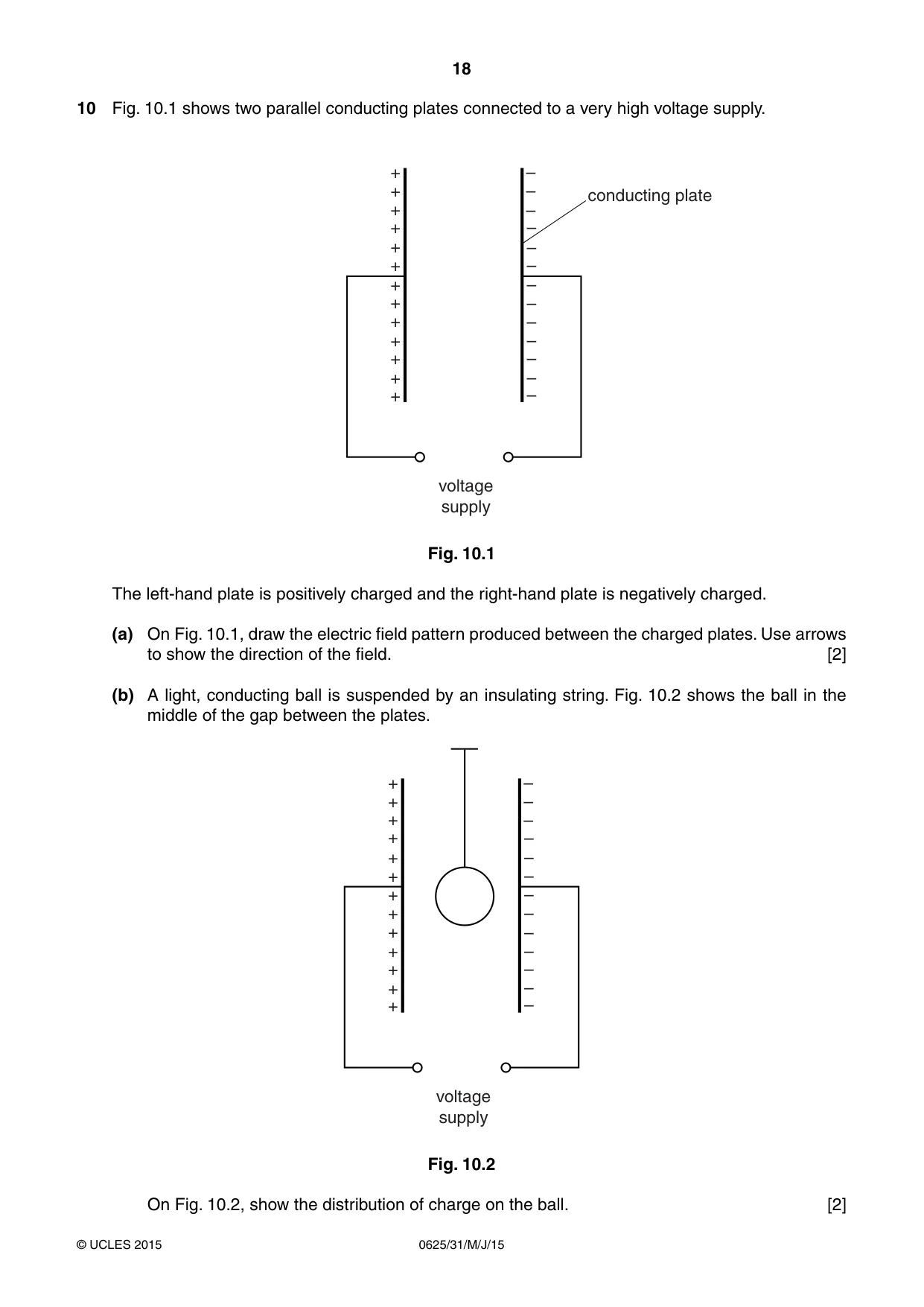
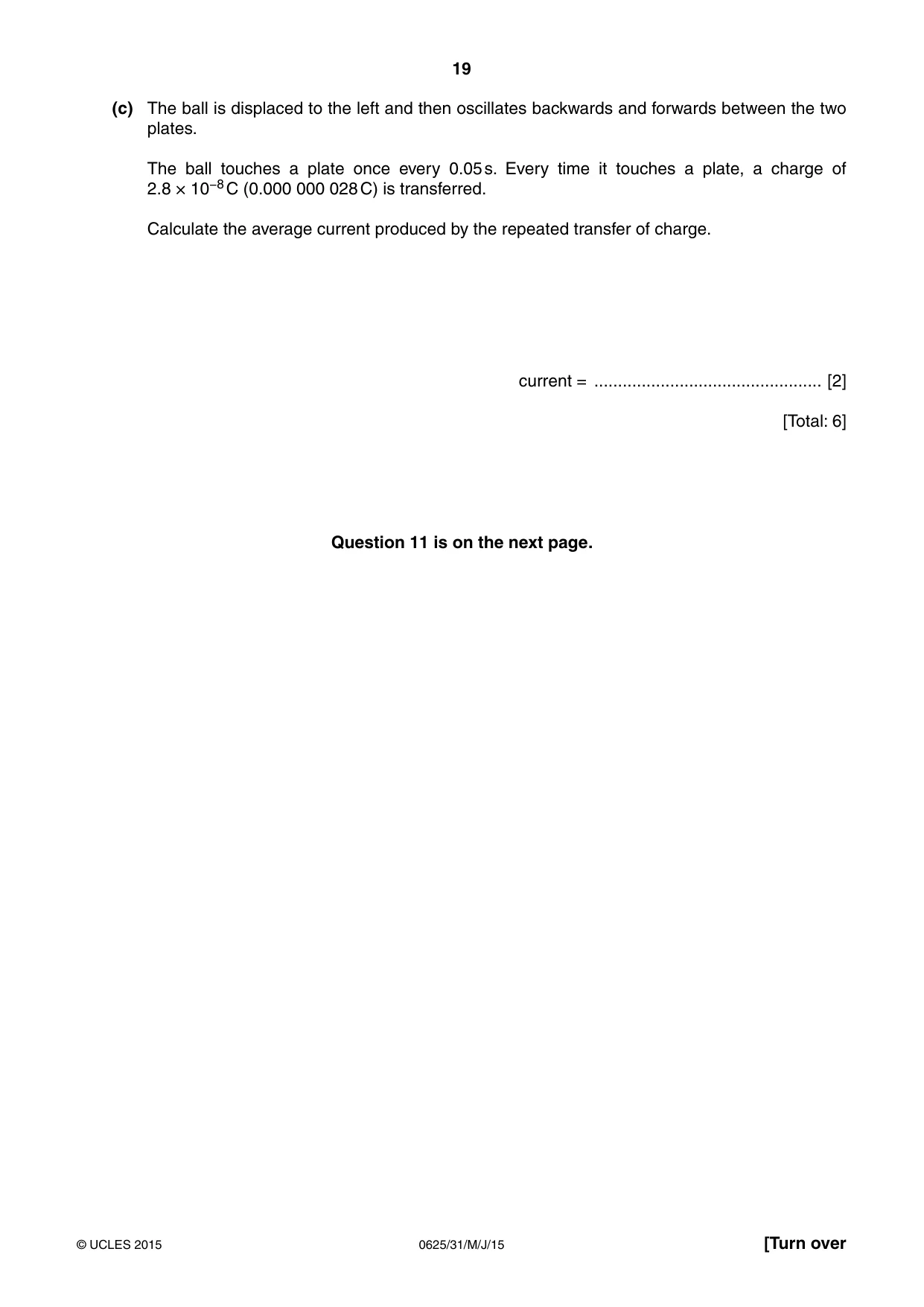
10 Fig. 10.1 shows two parallel conducting plates connected to a very high voltage supply. + – + – conducting plate + – + – + – + – + – + – + – + – + – + – + – voltage supply Fig. 10.1 The left-hand plate is positively charged and the right-hand plate is negatively charged. (a) On Fig. 10.1, draw the electric field pattern produced between the charged plates. Use arrows to show the direction of the field. [2] (b) A light, conducting ball is suspended by an insulating string. Fig. 10.2 shows the ball in the middle of the gap between the plates. + – + – + – + – + – + – + – + – + – + – + – + – + – voltage supply Fig. 10.2 On Fig. 10.2, show the distribution of charge on the ball. [2] (c) The ball is displaced to the left and then oscillates backwards and forwards between the two plates. The ball touches a plate once every 0.05 s. Every time it touches a plate, a charge of 2.8 × 10⁻⁸ C (0.000 000 028 C) is transferred. Calculate the average current produced by the repeated transfer of charge. current = ................................................ [2] [Total: 6] Question 11 is on the next page.
Mark scheme: 10 (a) (i) at least three horizontal, parallel lines evenly spaced (ignore edge effects) B1 arrows pointing left to right B1 (b) right hand half of ball has more + signs than – signs AND left hand half of ball has more – signs than + signs M1 equal numbers of + and – signs A1 (c) Q = I t in any form OR (I =) Q ÷ t OR 2.8 × 10⁻⁸ ÷ 0.05 C1 5.6 × 10⁻⁷ A OR C/s A1 [Total: 6]
Q11 · State the nature of γ-rays
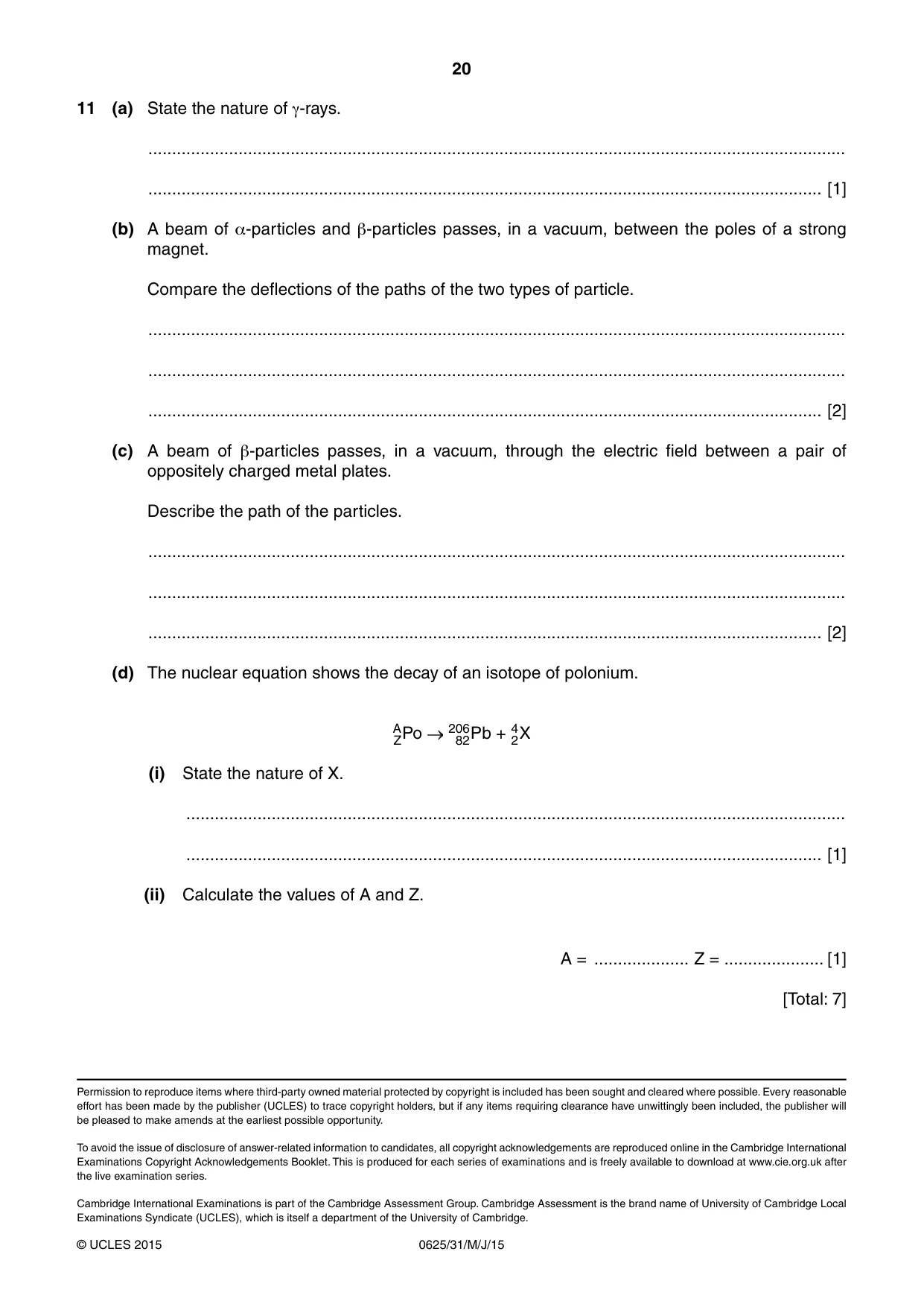
11 (a) State the nature of γ-rays. ................................................................................................................................................... .............................................................................................................................................. [1] (b) A beam of α-particles and β-particles passes, in a vacuum, between the poles of a strong magnet. Compare the deflections of the paths of the two types of particle. ................................................................................................................................................... ................................................................................................................................................... .............................................................................................................................................. [2] (c) A beam of β-particles passes, in a vacuum, through the electric field between a pair of oppositely charged metal plates. Describe the path of the particles. ................................................................................................................................................... ................................................................................................................................................... .............................................................................................................................................. [2] (d) The nuclear equation shows the decay of an isotope of polonium. A Po 206 Pb + 4 X Z 82 2 (i) State the nature of X. ........................................................................................................................................... ...................................................................................................................................... [1] (ii) Calculate the values of A and Z. A = .................... Z = ..................... [1] [Total: 7]
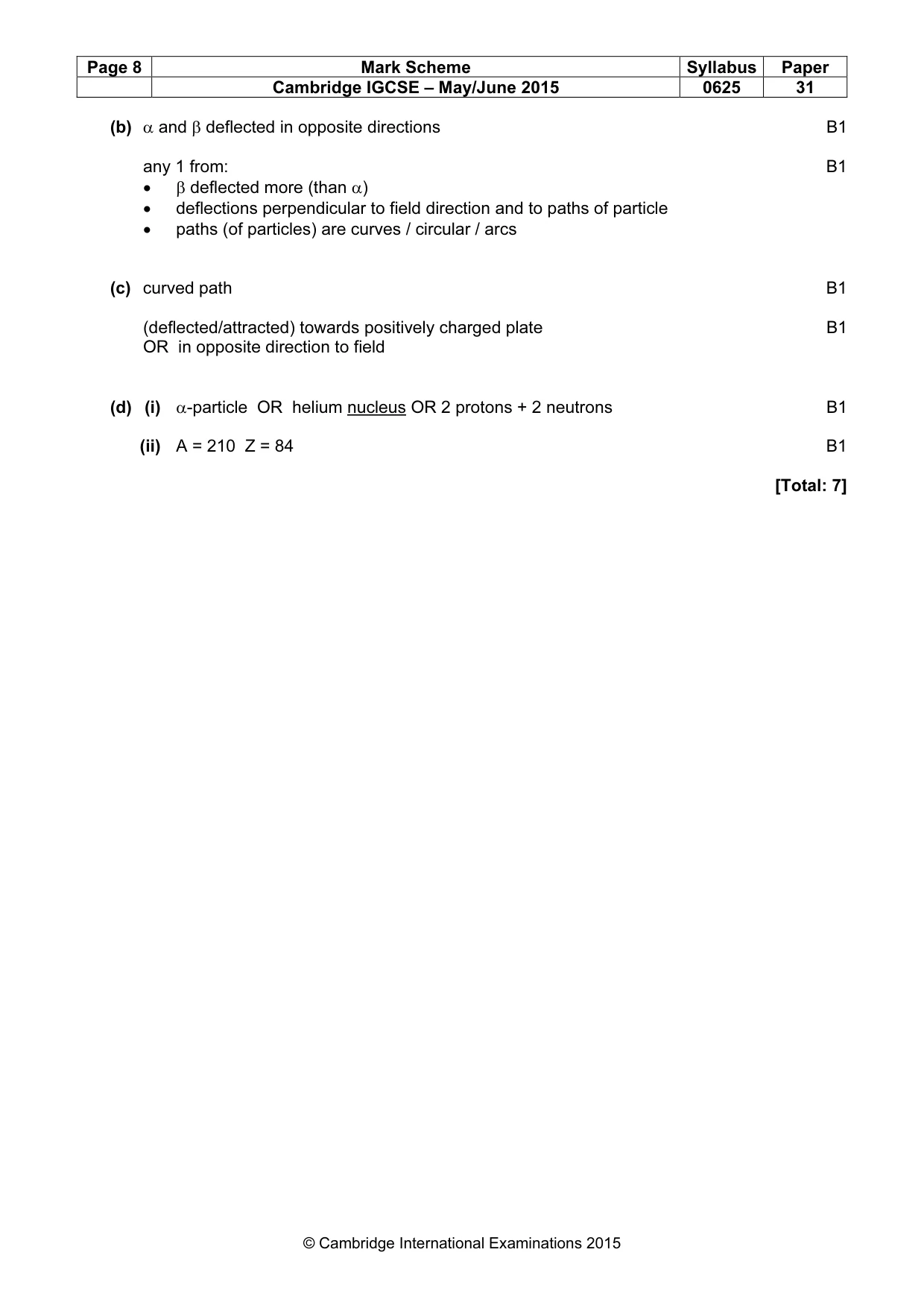
Mark scheme: 11 (a) electromagnetic (waves / radiation / rays / spectrum) B1 OR (high energy) photons (b) α and β deflected in opposite directions B1 any 1 from: B1 • β deflected more (than α) • deflections perpendicular to field direction and to paths of particle • paths (of particles) are curves / circular / arcs (c) curved path B1 (deflected/attracted) towards positively charged plate B1 OR in opposite direction to field (d) (i) α-particle OR helium nucleus OR 2 protons + 2 neutrons B1 (ii) A = 210 Z = 84 B1 [Total: 7]
What was in this paper
The subtopics covered by these 11 questions, and how many questions each got. Open one in a new tab to see every Cambridge question on it.
What you needed in this session
Cambridge’s own grade thresholds for 2015 May/June, Paper 3 · Variant 1. A higher threshold means an easier paper — the bar moves with how the cohort did.