Questions as text
Q1 · In 1903 Arthur Lapworth became the first chemist to investigate a reaction mechanism 9701/11 Oct/Nov 2005
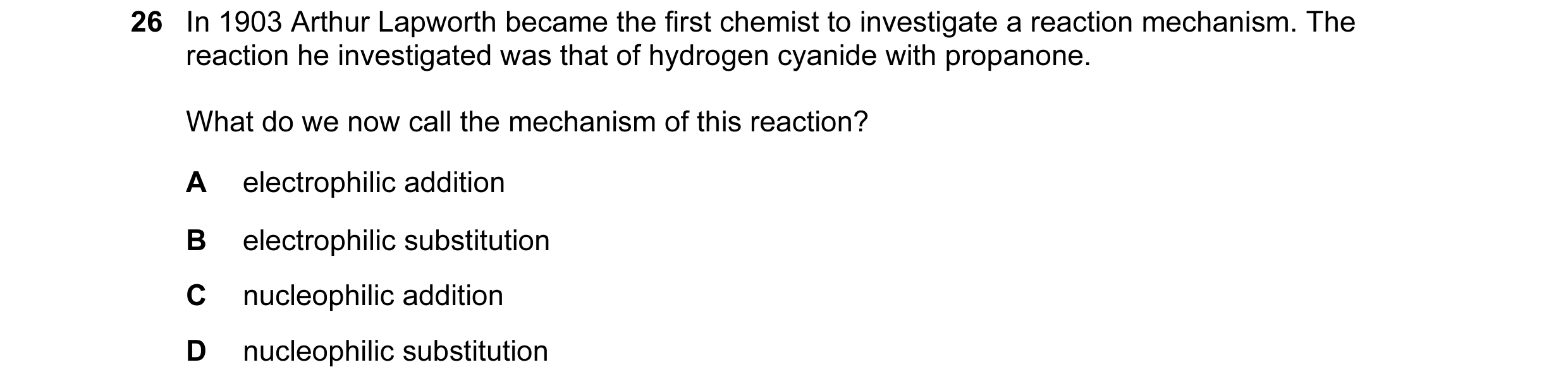
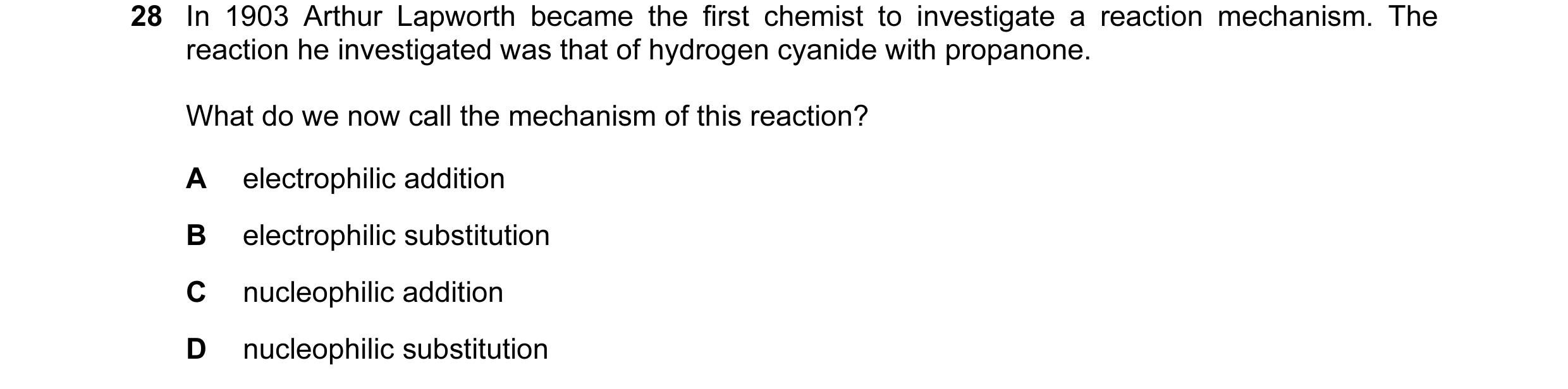
26 In 1903 Arthur Lapworth became the first chemist to investigate a reaction mechanism. The reaction he investigated was that of hydrogen cyanide with propanone. What do we now call the mechanism of this reaction? A electrophilic addition B electrophilic substitution C nucleophilic addition D nucleophilic substitution
1 marks
Answer: C
This question in 9701/11 Oct/Nov 2005
Q2 · How can the rate of reaction between ethanal and aqueous hydrogen cyanide be increased? 9701/11 May/June 2006
39 How can the rate of reaction between ethanal and aqueous hydrogen cyanide be increased? 1 by irradiation with ultraviolet light 2 by a rise in temperature 3 by the addition of a small quantity of aqueous sodium cyanide
1 marks
Answer: C
This question in 9701/11 May/June 2006
Q3 · When (chloromethyl)benzene, C6H5CH2Cl, is treated in succession with two reagents X and… 9701/11 Oct/Nov 2006
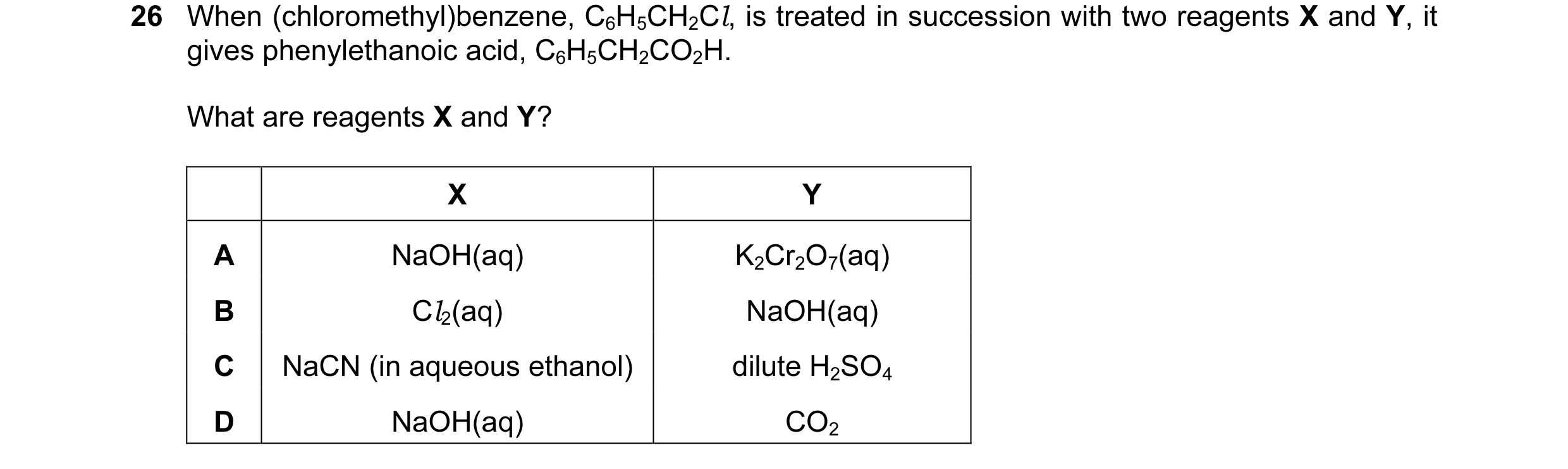
26 When (chloromethyl)benzene, C6H5CH2Cl, is treated in succession with two reagents X and Y, it gives phenylethanoic acid, C6H5CH2CO2H. What are reagents X and Y? X Y A NaOH(aq) K2Cr2O7(aq) B Cl2(aq) NaOH(aq) C NaCN (in aqueous ethanol) dilute H2SO4 D NaOH(aq) CO2
1 marks
Answer: C
This question in 9701/11 Oct/Nov 2006
Q4 · Apples, the fruit of trees of the genus Malus, are rich in malic acid 9701/11 Oct/Nov 2006
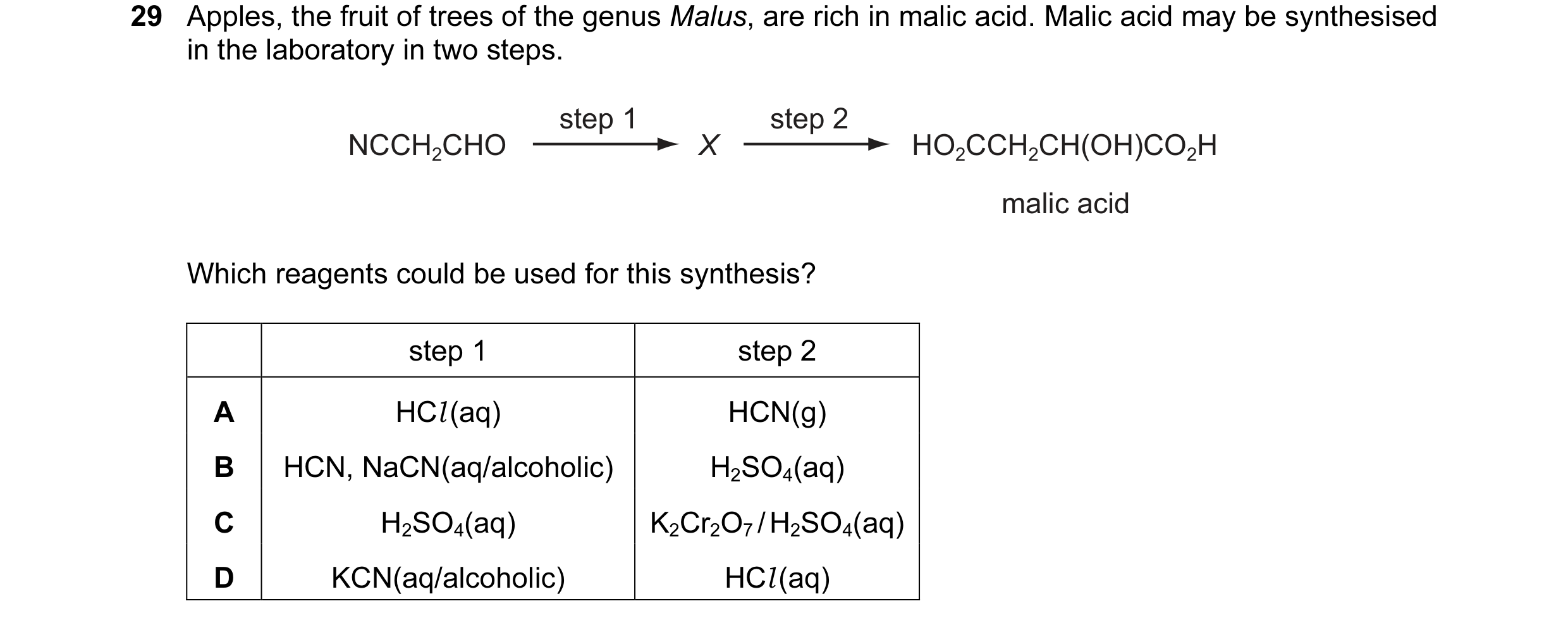
29 Apples, the fruit of trees of the genus Malus, are rich in malic acid. Malic acid may be synthesised in the laboratory in two steps. step 1 step 2 NCCH2CHO X HO2CCH2CH(OH)CO2H malic acid Which reagents could be used for this synthesis? step 1 step 2 A HCl (aq) HCN(g) B HCN, NaCN(aq/alcoholic) H2SO4(aq) C H2SO4(aq) K2Cr2O7 / H2SO4(aq) D KCN(aq/alcoholic) HCl (aq)
1 marks
Answer: B
This question in 9701/11 Oct/Nov 2006
Q5 · Butanedioic acid occurs in amber, algae, lichens, sugar cane and beets 9701/11 Oct/Nov 2007
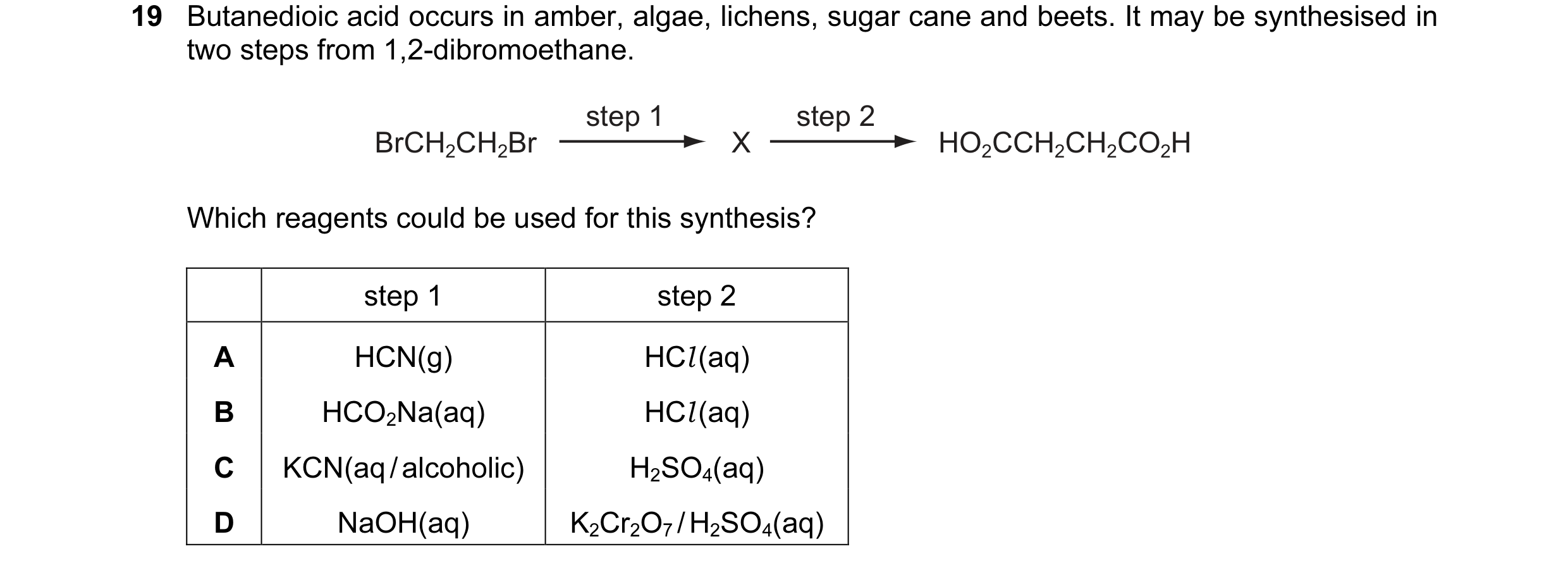
26 Butanedioic acid occurs in amber, algae, lichens, sugar cane and beets. It may be synthesised in two steps from 1,2-dibromoethane. step 1 step 2 BrCH2CH2Br X HO2CCH2CH2CO2H Which reagents could be used for this synthesis? step 1 step 2 A HCN(g) HCl (aq) B HCO2Na(aq) HCl (aq) C KCN(aq/alcoholic) H2SO4(aq) D NaOH(aq) K2Cr2O7 / H2SO4(aq)
1 marks
Answer: C
This question in 9701/11 Oct/Nov 2007
Q6 · In the reaction between an aldehyde and HCN catalysed by NaCN, which statements about the… 9701/11 Oct/Nov 2007
39 In the reaction between an aldehyde and HCN catalysed by NaCN, which statements about the reaction mechanism are true? 1 A new carbon-carbon bond is formed. 2 In the intermediate, the oxygen carries a negative charge. 3 The last stage involves the formation of a hydrogen-oxygen bond.
1 marks
Answer: A
This question in 9701/11 Oct/Nov 2007
Q7 · The product of the reaction between propanone and hydrogen cyanide is hydrolysed under… 9701/11 Oct/Nov 2008
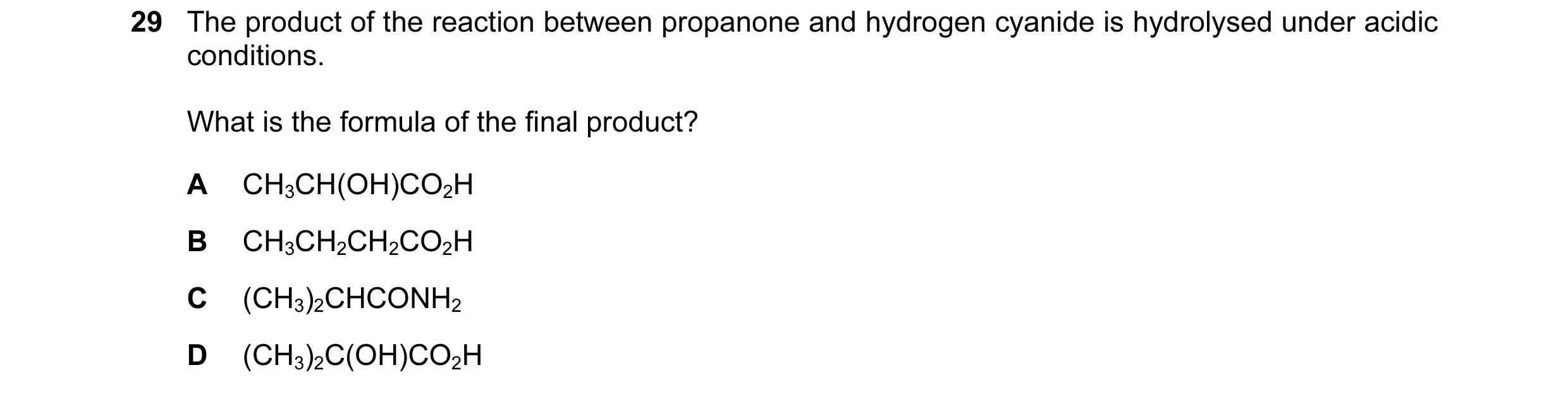
29 The product of the reaction between propanone and hydrogen cyanide is hydrolysed under acidic conditions. What is the formula of the final product? A CH3CH(OH)CO2H B CH3CH2CH2CO2H C (CH3)2CHCONH2 D (CH3)2C(OH)CO2H
1 marks
Answer: D
This question in 9701/11 Oct/Nov 2008
Q8 · How can the rate of reaction between ethanal and aqueous hydrogen cyanide be increased? 9701/11 May/June 2009
39 How can the rate of reaction between ethanal and aqueous hydrogen cyanide be increased? 1 by irradiation with ultraviolet light 2 by a rise in temperature 3 by the addition of a small quantity of aqueous sodium cyanide
1 marks
Answer: C
This question in 9701/11 May/June 2009
Q9 · The characteristic odour of rum is attributed to the compound 2-ethyl-3-methylbutanoic… 9701/11 Oct/Nov 2009
29 The characteristic odour of rum is attributed to the compound 2-ethyl-3-methylbutanoic acid. CH3 C2H5 H3C C C C OH H H O 2-ethyl-3-methylbutanoic acid Which compound will produce 2-ethyl-3-methylbutanoic acid by heating under reflux with alcoholic sodium cyanide and subsequent acid hydrolysis of the reaction product? CH3 A CH3 CH CH2 CHBr CH3 CH3 B CH3 CH CHBr CH2 CH3 CH3 C2H5 C CH3 CH CH CH2Br CH3 CH2Br D CH3 CH CH2 CH CH3
1 marks
Answer: B
This question in 9701/11 Oct/Nov 2009
Q10 · Propanoic acid occurs naturally as a result of the bacterial fermentation of milk, and is… 9701/11 May/June 2010
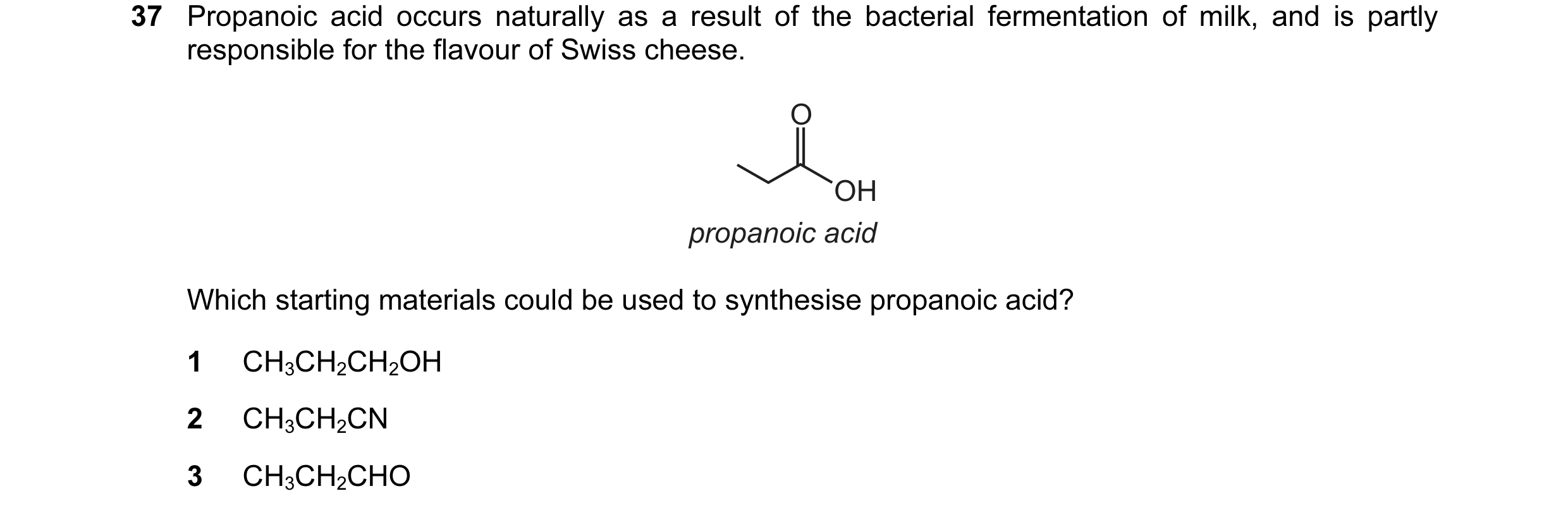
37 Propanoic acid occurs naturally as a result of the bacterial fermentation of milk, and is partly responsible for the flavour of Swiss cheese. O OH propanoic acid Which starting materials could be used to synthesise propanoic acid? 1 CH3CH2CH2OH 2 CH3CH2CN 3 CH3CH2CHO
1 marks
Answer: A
This question in 9701/11 May/June 2010
Q11 · Tartaric acid is present in some wines 9701/11 Oct/Nov 2010
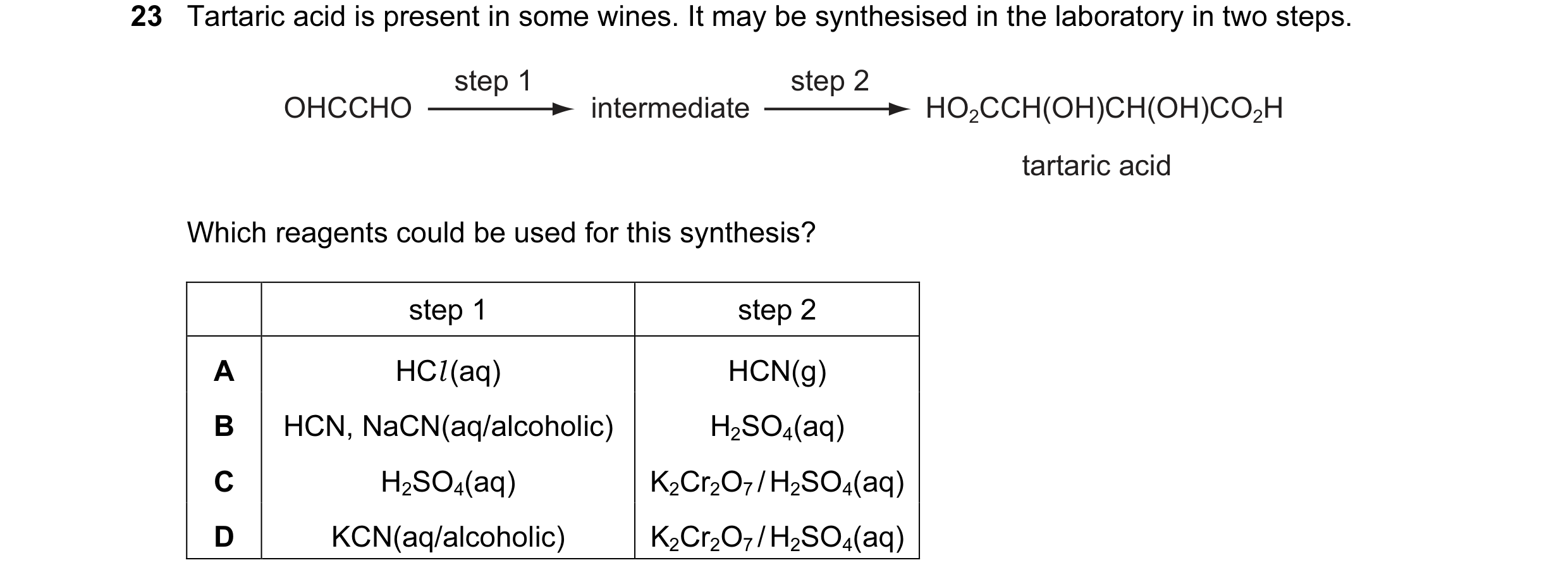
23 Tartaric acid is present in some wines. It may be synthesised in the laboratory in two steps. step 1 step 2 OHCCHO intermediate HO2CCH(OH)CH(OH)CO2H tartaric acid Which reagents could be used for this synthesis? step 1 step 2 A HCl (aq) HCN(g) B HCN, NaCN(aq/alcoholic) H2SO4(aq) C H2SO4(aq) K2Cr2O7 / H2SO4(aq) D KCN(aq/alcoholic) K2Cr2O7 / H2SO4(aq)
1 marks
Answer: B
This question in 9701/11 Oct/Nov 2010
Q12 · CH3CH2COCH2CH3 reacts with hydrogen cyanide to form a cyanohydrin 9701/12 Oct/Nov 2010
29 CH3CH2COCH2CH3 reacts with hydrogen cyanide to form a cyanohydrin. Which feature applies to the product? A It has one chiral centre. B It is formed by electrophilic addition. C It is formed via a C–OH intermediate. D Its formation requires the use of cyanide ions as a catalyst.
1 marks
Answer: D
This question in 9701/12 Oct/Nov 2010
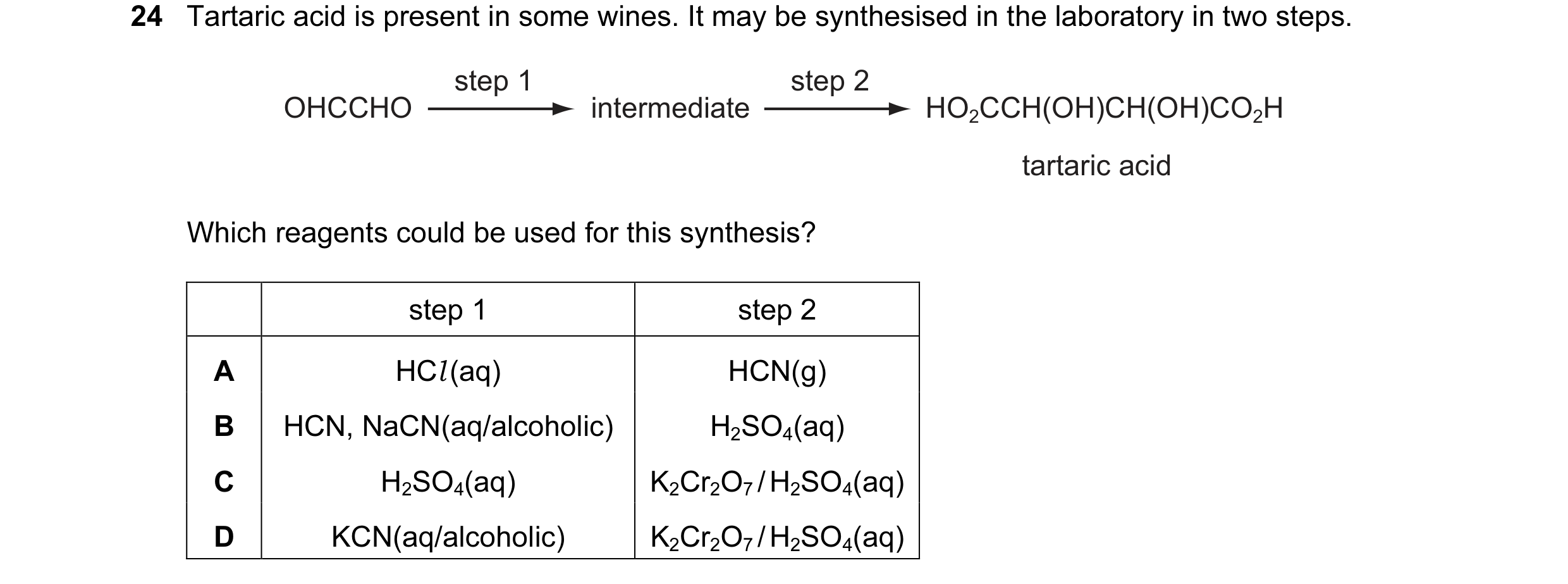
Q13 · Tartaric acid is present in some wines 9701/13 Oct/Nov 2010
24 Tartaric acid is present in some wines. It may be synthesised in the laboratory in two steps. step 1 step 2 OHCCHO intermediate HO2CCH(OH)CH(OH)CO2H tartaric acid Which reagents could be used for this synthesis? step 1 step 2 A HCl (aq) HCN(g) B HCN, NaCN(aq/alcoholic) H2SO4(aq) C H2SO4(aq) K2Cr2O7 / H2SO4(aq) D KCN(aq/alcoholic) K2Cr2O7 / H2SO4(aq)
1 marks
Answer: B
This question in 9701/13 Oct/Nov 2010
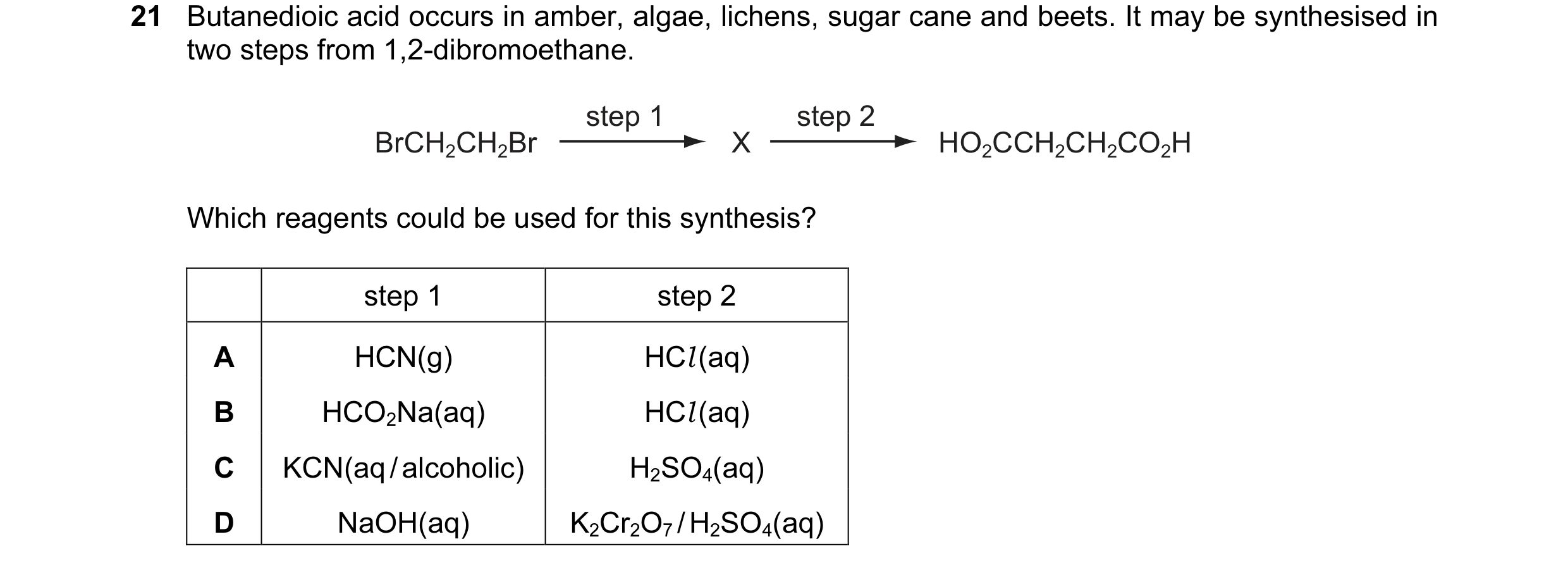
Q14 · Butanedioic acid occurs in amber, algae, lichens, sugar cane and beets 9701/11 May/June 2011
21 Butanedioic acid occurs in amber, algae, lichens, sugar cane and beets. It may be synthesised in two steps from 1,2-dibromoethane. step 1 step 2 BrCH2CH2Br X HO2CCH2CH2CO2H Which reagents could be used for this synthesis? step 1 step 2 A HCN(g) HCl (aq) B HCO2Na(aq) HCl (aq) C KCN(aq / alcoholic) H2SO4(aq) D NaOH(aq) K2Cr2O7 / H2SO4(aq)
1 marks
Answer: C
This question in 9701/11 May/June 2011
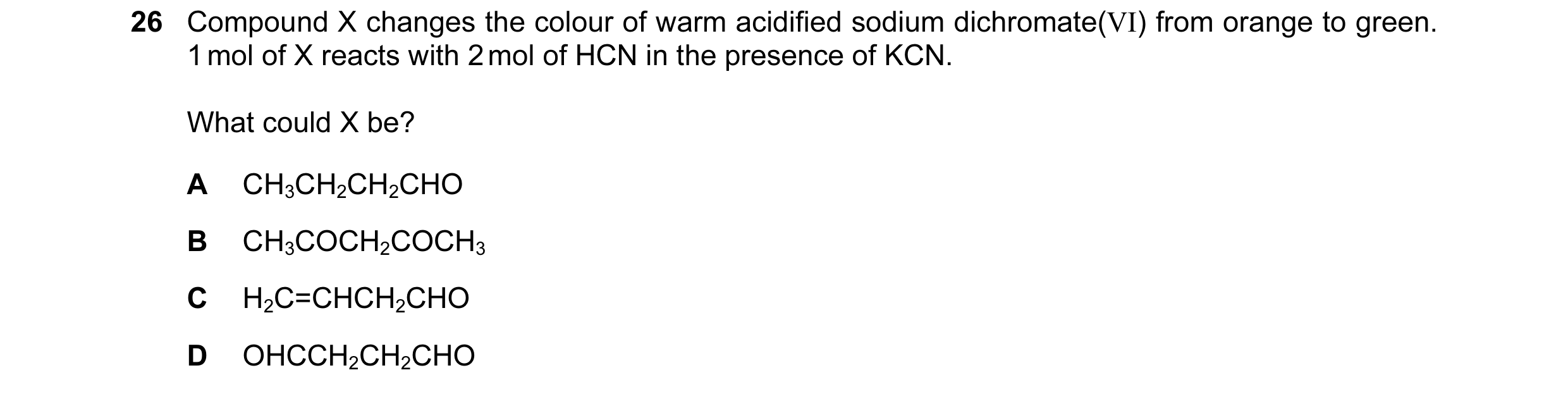
Q15 · Compound X changes the colour of warm acidified sodium dichromate(VI) from orange to green 9701/11 May/June 2011
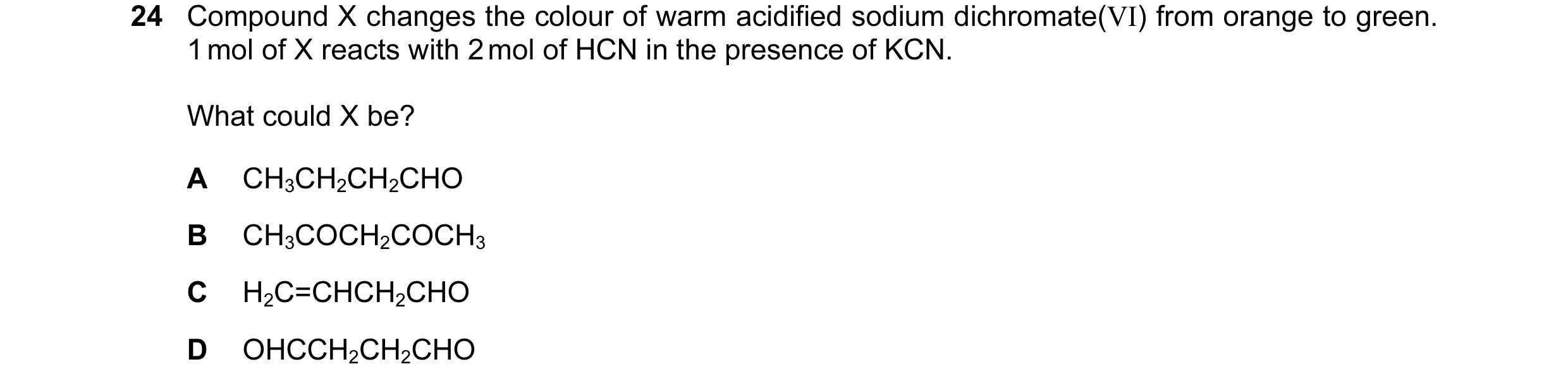
26 Compound X changes the colour of warm acidified sodium dichromate(VI) from orange to green. 1 mol of X reacts with 2 mol of HCN in the presence of KCN. What could X be? A CH3CH2CH2CHO B CH3COCH2COCH3 C H2C=CHCH2CHO D OHCCH2CH2CHO
1 marks
Answer: D
This question in 9701/11 May/June 2011
Q16 · In the reaction between an aldehyde and HCN, catalysed by NaCN, which statements about… 9701/12 May/June 2011
39 In the reaction between an aldehyde and HCN, catalysed by NaCN, which statements about the reaction mechanism are correct? 1 A new carbon-carbon bond is formed. 2 In the intermediate, the oxygen carries a negative charge. 3 The last stage involves the formation of a hydrogen-oxygen bond.
1 marks
Answer: A
This question in 9701/12 May/June 2011
Q17 · Butanedioic acid occurs in amber, algae, lichens, sugar cane and beets 9701/13 May/June 2011
19 Butanedioic acid occurs in amber, algae, lichens, sugar cane and beets. It may be synthesised in two steps from 1,2-dibromoethane. step 1 step 2 BrCH2CH2Br X HO2CCH2CH2CO2H Which reagents could be used for this synthesis? step 1 step 2 A HCN(g) HCl (aq) B HCO2Na(aq) HCl (aq) C KCN(aq / alcoholic) H2SO4(aq) D NaOH(aq) K2Cr2O7 / H2SO4(aq)
1 marks
Answer: C
This question in 9701/13 May/June 2011
Q18 · Compound X changes the colour of warm acidified sodium dichromate(VI) from orange to green 9701/13 May/June 2011
24 Compound X changes the colour of warm acidified sodium dichromate(VI) from orange to green. 1 mol of X reacts with 2 mol of HCN in the presence of KCN. What could X be? A CH3CH2CH2CHO B CH3COCH2COCH3 C H2C=CHCH2CHO D OHCCH2CH2CHO
1 marks
Answer: D
This question in 9701/13 May/June 2011
Q19 · On acid hydrolysis, which compounds produce propanoic acid? 9701/11 Oct/Nov 2011
39 On acid hydrolysis, which compounds produce propanoic acid? 1 CH3CH2CO2CH3 2 CH3CH2CH2CN 3 CH3CH2CH2Cl
1 marks
Answer: D
This question in 9701/11 Oct/Nov 2011
Q20 · In a sequence of reactions, ethanal is converted into a compound H 9701/12 Oct/Nov 2011
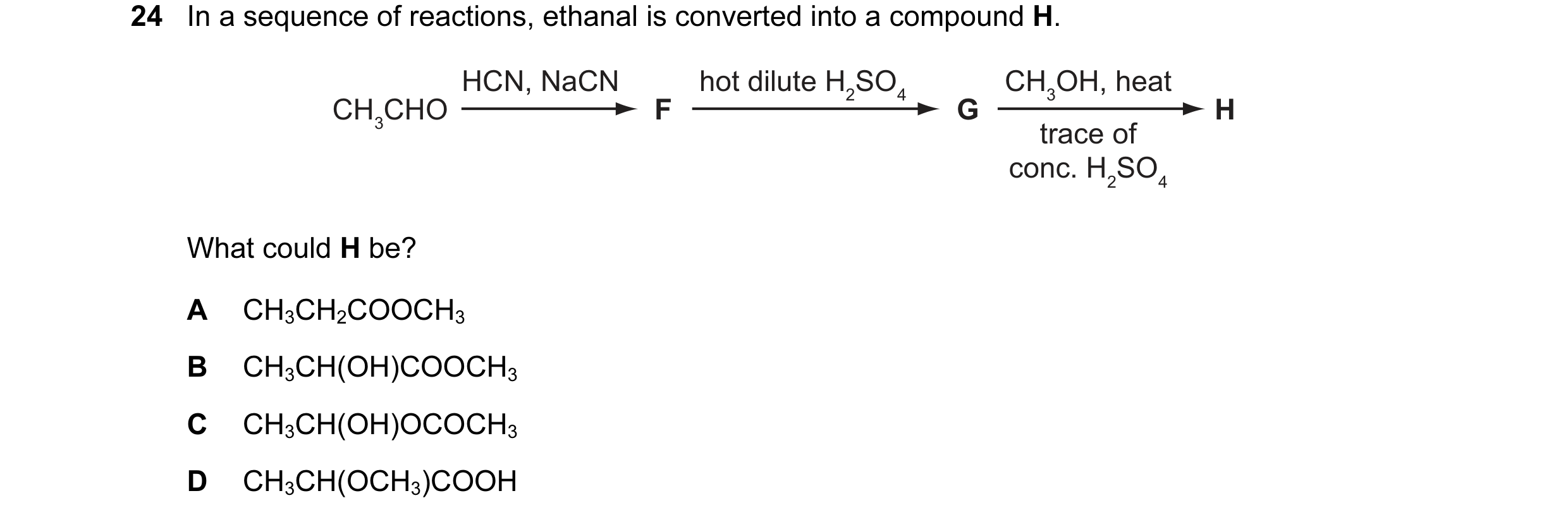
24 In a sequence of reactions, ethanal is converted into a compound H. HCN, NaCN hot dilute H2SO4 CH3OH, heat CH3CHO F G H trace of conc. H2SO4 What could H be? A CH3CH2COOCH3 B CH3CH(OH)COOCH3 C CH3CH(OH)OCOCH3 D CH3CH(OCH3)COOH
1 marks
This question in 9701/12 Oct/Nov 2011
Q21 · Which compounds will produce ethanoic acid when boiled under reflux with dilute alkali… 9701/12 Oct/Nov 2011
39 Which compounds will produce ethanoic acid when boiled under reflux with dilute alkali followed by acidification? 1 CH3CH2Cl 2 CH3CO2CH3 3 CH3CN
1 marks
This question in 9701/12 Oct/Nov 2011
Q22 · On acid hydrolysis, which compounds produce propanoic acid? 9701/13 Oct/Nov 2011
38 On acid hydrolysis, which compounds produce propanoic acid? 1 CH3CH2CO2CH3 2 CH3CH2CH2CN 3 CH3CH2CH2Cl
1 marks
Answer: D
This question in 9701/13 Oct/Nov 2011
Q23 · Which compound, on reaction with hydrogen cyanide, produces a compound with a chiral… 9701/11 May/June 2012
25 Which compound, on reaction with hydrogen cyanide, produces a compound with a chiral centre? A CH3CHO B CH3CH2COCH2CH3 C CH3CO2CH3 D HCHO
1 marks
Answer: A
This question in 9701/11 May/June 2012
Q24 · When 1-bromopropane is treated in succession with two reagents, X and Y, it produces… 9701/12 May/June 2012
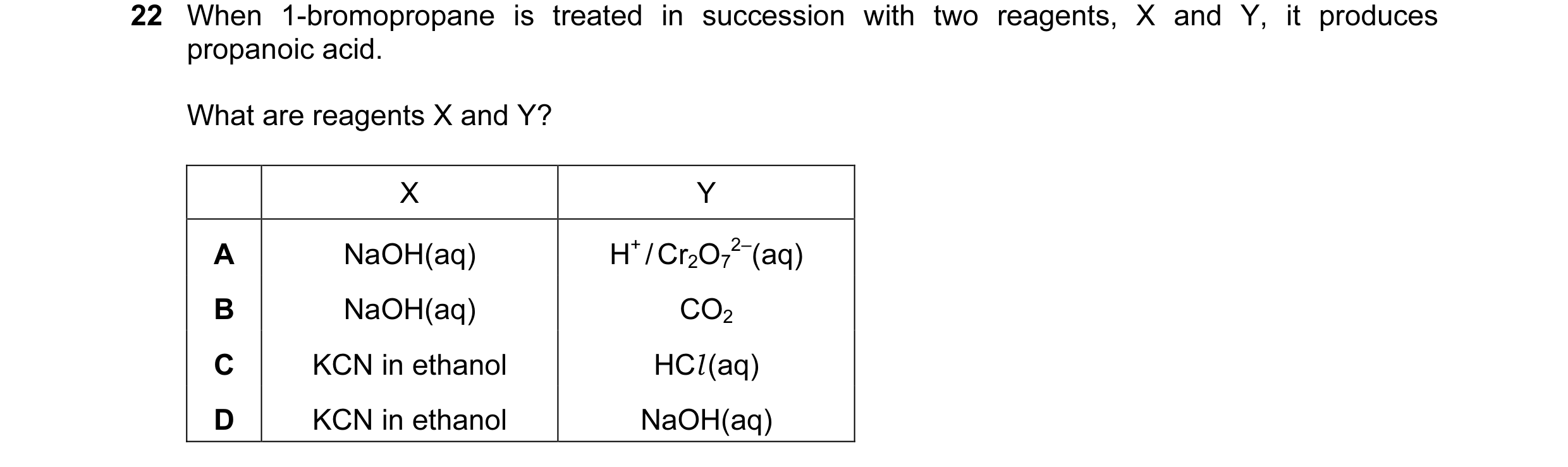
22 When 1-bromopropane is treated in succession with two reagents, X and Y, it produces propanoic acid. What are reagents X and Y? X Y A NaOH(aq) H+ / Cr2O7 2–(aq) B NaOH(aq) CO2 C KCN in ethanol HCl (aq) D KCN in ethanol NaOH(aq)
1 marks
Answer: A
This question in 9701/12 May/June 2012
Q25 · Which compound, on reaction with hydrogen cyanide, produces a compound with a chiral… 9701/13 May/June 2012
26 Which compound, on reaction with hydrogen cyanide, produces a compound with a chiral centre? A CH3CHO B CH3CH2COCH2CH3 C CH3CO2CH3 D HCHO
1 marks
Answer: A
This question in 9701/13 May/June 2012
Q26 · In 1903 Arthur Lapworth became the first chemist to investigate a reaction mechanism 9701/11 Oct/Nov 2012
28 In 1903 Arthur Lapworth became the first chemist to investigate a reaction mechanism. The reaction he investigated was that of hydrogen cyanide with propanone. What do we now call the mechanism of this reaction? A electrophilic addition B electrophilic substitution C nucleophilic addition D nucleophilic substitution
1 marks
Answer: C
This question in 9701/11 Oct/Nov 2012
Q27 · In 1903 Arthur Lapworth became the first chemist to investigate a reaction mechanism 9701/12 Oct/Nov 2012
28 In 1903 Arthur Lapworth became the first chemist to investigate a reaction mechanism. The reaction he investigated was that of hydrogen cyanide with propanone. What do we now call the mechanism of this reaction? A electrophilic addition B electrophilic substitution C nucleophilic addition D nucleophilic substitution
1 marks
Answer: C
This question in 9701/12 Oct/Nov 2012
Q28 · Which pair of reactions could have the same common intermediate? 9701/13 Oct/Nov 2012
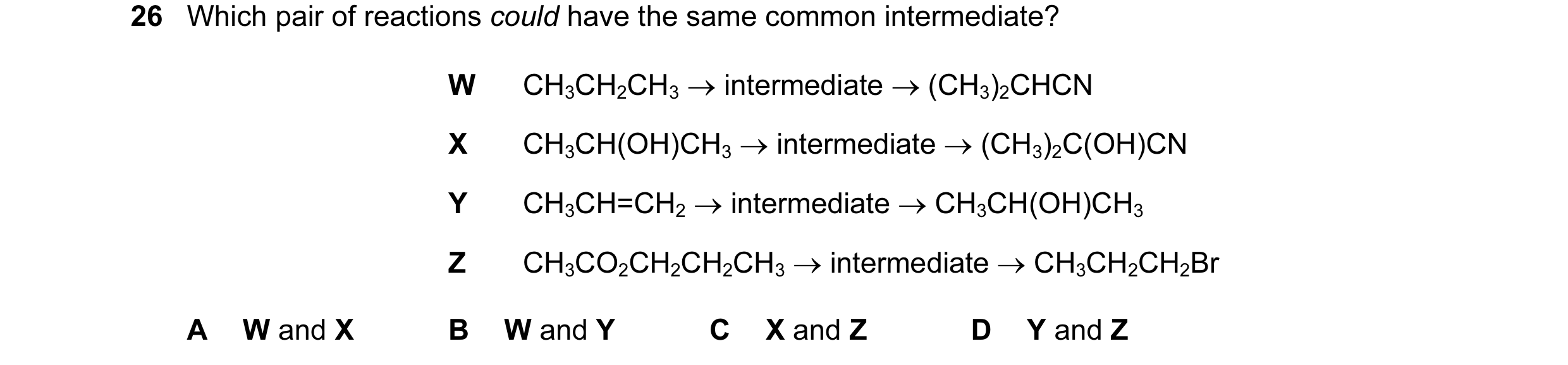
26 Which pair of reactions could have the same common intermediate? W CH3CH2CH3 → intermediate → (CH3)2CHCN X CH3CH(OH)CH3 → intermediate → (CH3)2C(OH)CN Y CH3CH=CH2 → intermediate → CH3CH(OH)CH3 Z CH3CO2CH2CH2CH3 → intermediate → CH3CH2CH2Br A W and X B W and Y C X and Z D Y and Z
1 marks
Answer: B
This question in 9701/13 Oct/Nov 2012
Q29 · Which changes in bonding occur during the reaction of ethanal and hydrogen cyanide? 9701/13 Oct/Nov 2012
40 Which changes in bonding occur during the reaction of ethanal and hydrogen cyanide? 1 A carbon-carbon bond is formed. 2 A carbon-hydrogen bond is broken. 3 A carbon-nitrogen bond is broken.
1 marks
Answer: B
This question in 9701/13 Oct/Nov 2012
Q30 · Chloroethane can be used to make sodium propanoate 9701/11 May/June 2013
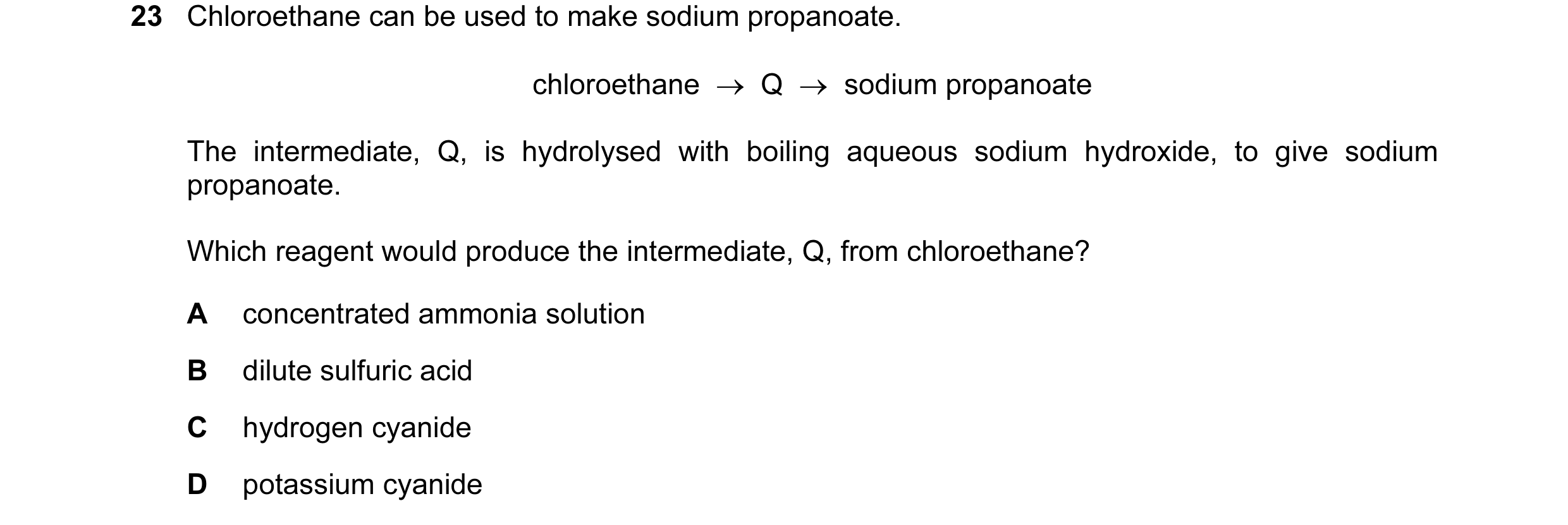
23 Chloroethane can be used to make sodium propanoate. chloroethane → Q → sodium propanoate The intermediate, Q, is hydrolysed with boiling aqueous sodium hydroxide, to give sodium propanoate. Which reagent would produce the intermediate, Q, from chloroethane? A concentrated ammonia solution B dilute sulfuric acid C hydrogen cyanide D potassium cyanide
1 marks
Answer: D
This question in 9701/11 May/June 2013
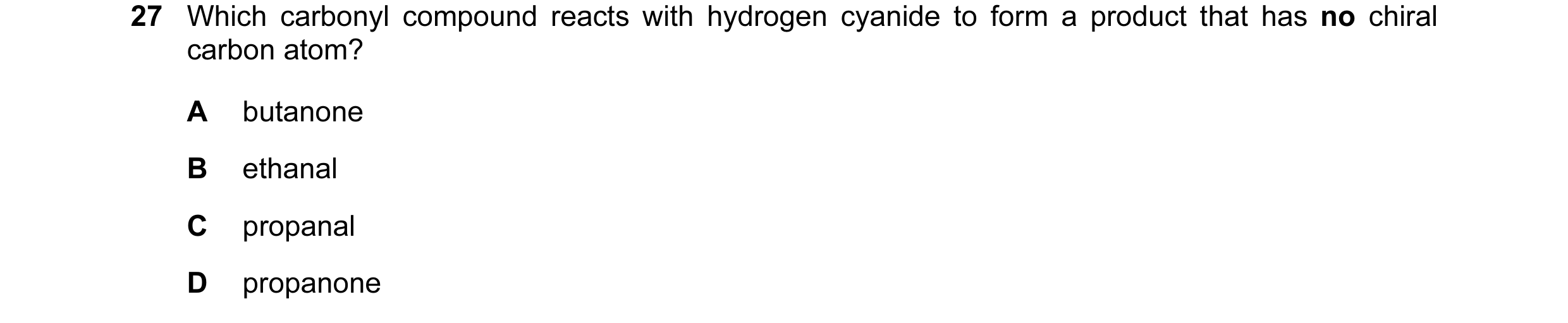
Q31 · Which carbonyl compound reacts with hydrogen cyanide to form a product that has no chiral… 9701/12 May/June 2013
27 Which carbonyl compound reacts with hydrogen cyanide to form a product that has no chiral carbon atom? A butanone B ethanal C propanal D propanone
1 marks
Answer: D
This question in 9701/12 May/June 2013
Q32 · Ethanoic acid, CH3CO2H, is an important chemical which is used in the industrial… 9701/13 May/June 2013
40 Ethanoic acid, CH3CO2H, is an important chemical which is used in the industrial manufacture of rayon and aspirin. Which processes can be used to make ethanoic acid? 1 hydrolysis of ethanenitrile 2 oxidation of ethanol 3 oxidation of ethanal
1 marks
Answer: A
This question in 9701/13 May/June 2013
Q33 · The compounds below are treated with hydrogen cyanide 9701/11 Oct/Nov 2013
40 The compounds below are treated with hydrogen cyanide. Which compounds react and produce a molecule containing a chiral centre? 1 butanal 2 pentan-3-one 3 2-chlorobutane
1 marks
Answer: D
This question in 9701/11 Oct/Nov 2013
Q34 · The compounds below are treated with hydrogen cyanide 9701/12 Oct/Nov 2013
40 The compounds below are treated with hydrogen cyanide. Which compounds react and produce a molecule containing a chiral centre? 1 butanal 2 pentan-3-one 3 2-chlorobutane
1 marks
Answer: D
This question in 9701/12 Oct/Nov 2013
Q35 · The reaction of ethanal, CH3CHO, with HCN to form a cyanohydrin is catalysed by NaCN 9701/13 Oct/Nov 2013
38 The reaction of ethanal, CH3CHO, with HCN to form a cyanohydrin is catalysed by NaCN. What are features of the intermediate of this reaction? 1 It is chiral. 2 It has a single negative charge on one of its atoms. 3 It is a nucleophile.
1 marks
Answer: A
This question in 9701/13 Oct/Nov 2013
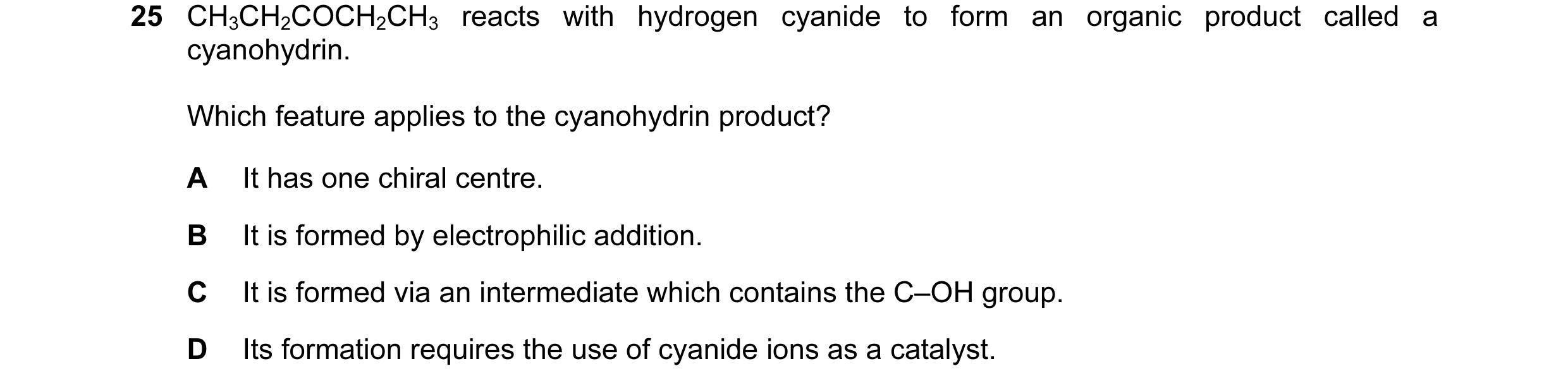
Q36 · CH3CH2COCH2CH3 reacts with hydrogen cyanide to form an organic product called a… 9701/11 May/June 2014
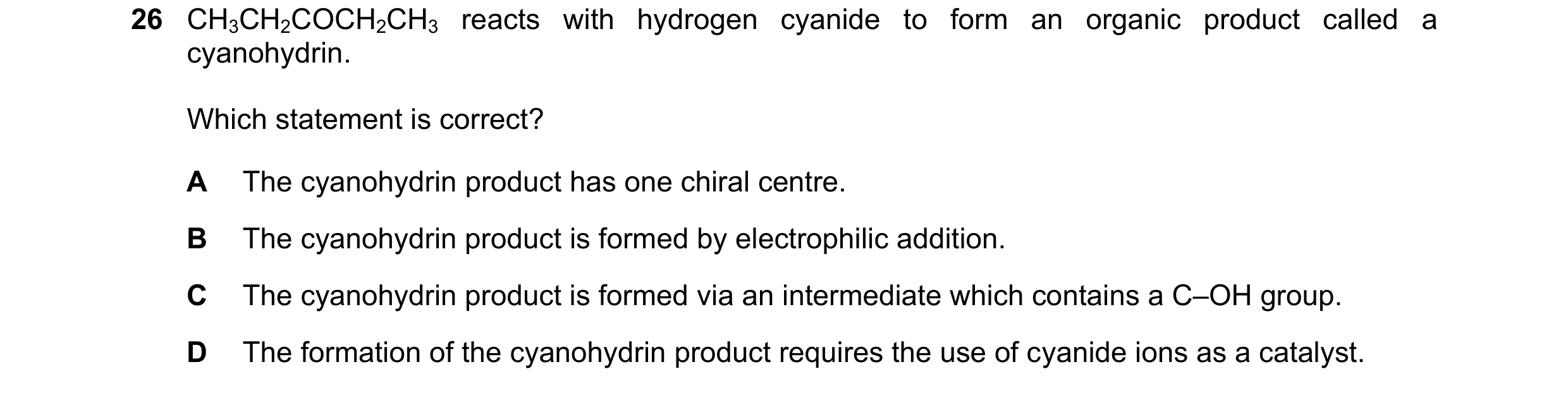
25 CH3CH2COCH2CH3 reacts with hydrogen cyanide to form an organic product called a cyanohydrin. Which feature applies to the cyanohydrin product? A It has one chiral centre. B It is formed by electrophilic addition. C It is formed via an intermediate which contains the C–OH group. D Its formation requires the use of cyanide ions as a catalyst.
1 marks
Answer: D
This question in 9701/11 May/June 2014
Q37 · When hydrolysed with dilute sulfuric acid, which compounds produce propanoic acid? 9701/13 May/June 2014
38 When hydrolysed with dilute sulfuric acid, which compounds produce propanoic acid? 1 CH3CH2CO2CH3 2 CH3CH2CH2CN 3 CH3CH2CH2Cl
1 marks
Answer: D
This question in 9701/13 May/June 2014
Q38 · Propanal will react with hydrogen cyanide to form 2-hydroxybutanenitrile 9701/11 Oct/Nov 2014
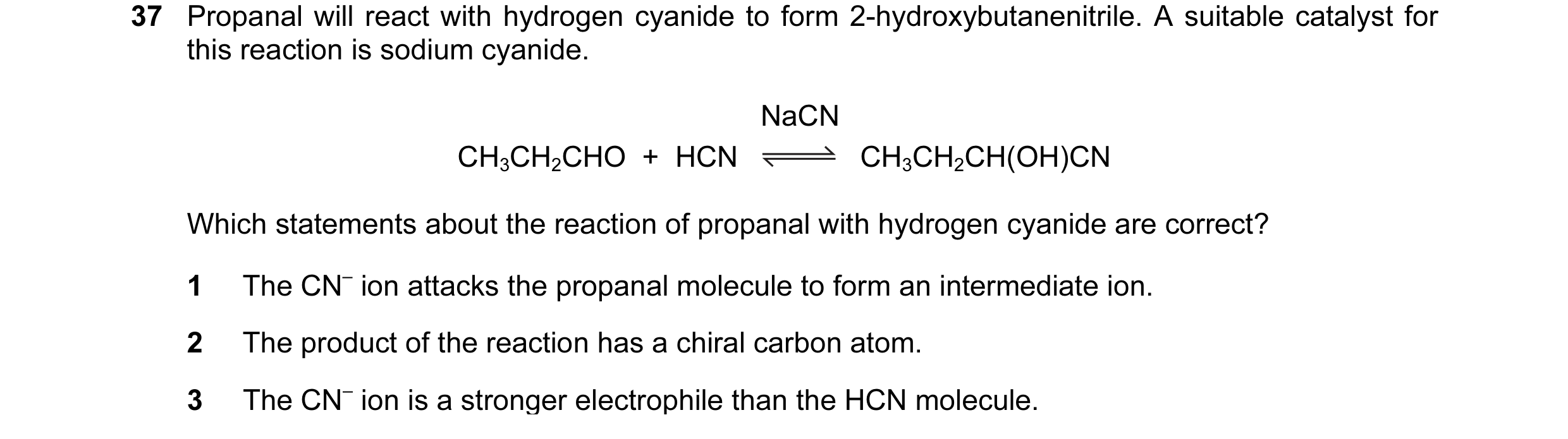
37 Propanal will react with hydrogen cyanide to form 2-hydroxybutanenitrile. A suitable catalyst for this reaction is sodium cyanide. NaCN CH3CH2CHO + HCN CH3CH2CH(OH)CN Which statements about the reaction of propanal with hydrogen cyanide are correct? 1 The CN– ion attacks the propanal molecule to form an intermediate ion. 2 The product of the reaction has a chiral carbon atom. 3 The CN– ion is a stronger electrophile than the HCN molecule.
1 marks
Answer: B
This question in 9701/11 Oct/Nov 2014
Q39 · Propanal will react with hydrogen cyanide to form 2-hydroxybutanenitrile 9701/12 Oct/Nov 2014
37 Propanal will react with hydrogen cyanide to form 2-hydroxybutanenitrile. A suitable catalyst for this reaction is sodium cyanide. NaCN CH3CH2CHO + HCN CH3CH2CH(OH)CN Which statements about the reaction of propanal with hydrogen cyanide are correct? 1 The CN– ion attacks the propanal molecule to form an intermediate ion. 2 The product of the reaction has a chiral carbon atom. 3 The CN– ion is a stronger electrophile than the HCN molecule.
1 marks
Answer: B
This question in 9701/12 Oct/Nov 2014
Q40 · The compound 2-ethyl-3-methylbutanoic acid is used as a flavouring in some food 9701/13 Oct/Nov 2014
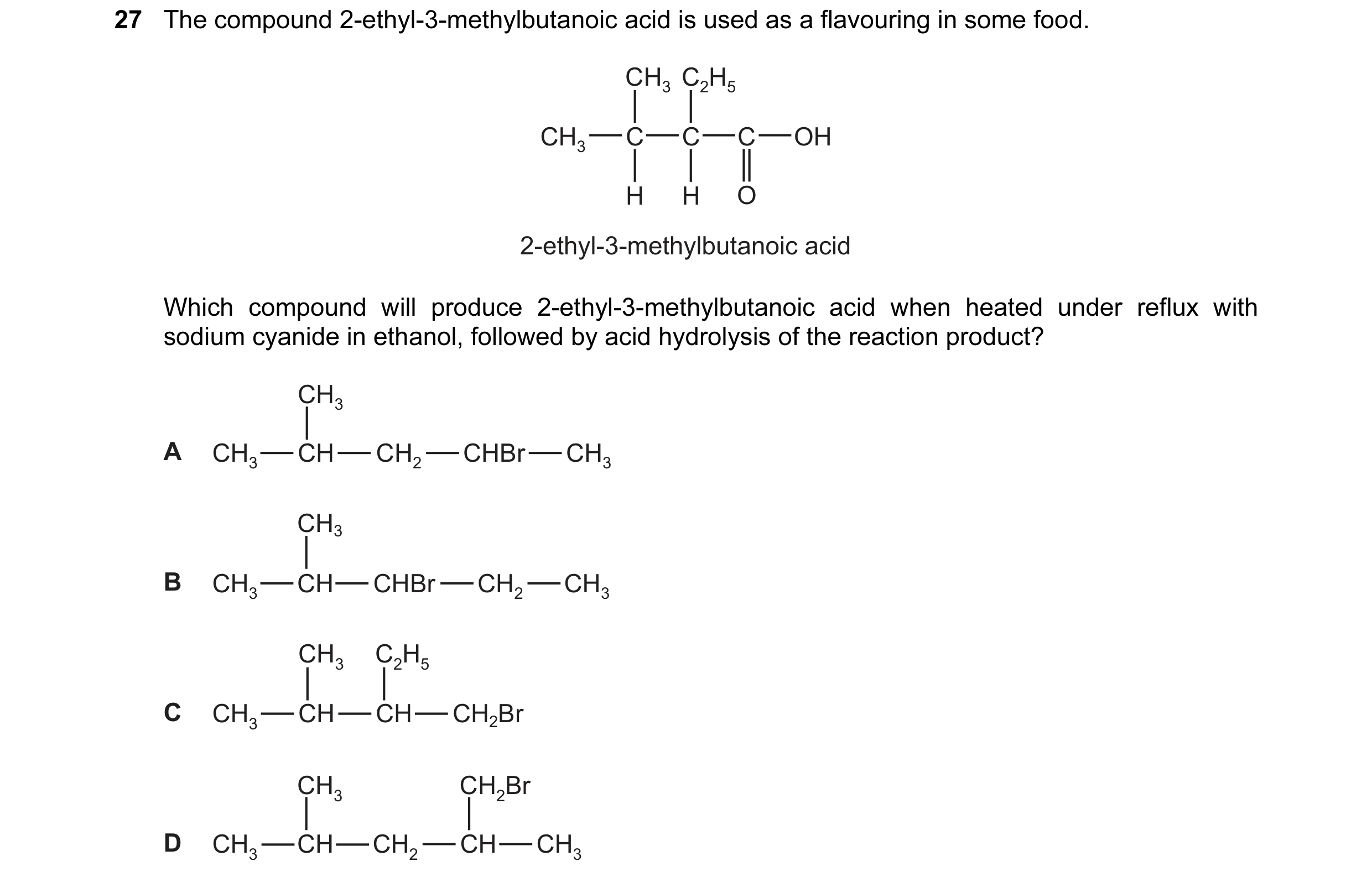
27 The compound 2-ethyl-3-methylbutanoic acid is used as a flavouring in some food. CH3 C2H5 CH3 C C C OH H H O 2-ethyl-3-methylbutanoic acid Which compound will produce 2-ethyl-3-methylbutanoic acid when heated under reflux with sodium cyanide in ethanol, followed by acid hydrolysis of the reaction product? CH3 A CH3 CH CH2 CHBr CH3 CH3 B CH3 CH CHBr CH2 CH3 CH3 C2H5 C CH3 CH CH CH2Br CH3 CH2Br D CH3 CH CH2 CH CH3
1 marks
Answer: B
This question in 9701/13 Oct/Nov 2014
Q41 · Propanal will react with hydrogen cyanide to form 2-hydroxybutanenitrile 9701/13 Oct/Nov 2014
40 Propanal will react with hydrogen cyanide to form 2-hydroxybutanenitrile. A suitable catalyst for this reaction is sodium cyanide. NaCN CH3CH2CHO + HCN CH3CH2CH(OH)CN Which statements about the reaction of propanal with hydrogen cyanide are correct? 1 The sodium cyanide provides a stronger nucleophile than HCN. 2 The reaction mechanism involves two steps. 3 The product of the reaction has a chiral carbon atom.
1 marks
Answer: A
This question in 9701/13 Oct/Nov 2014
Q42 · Butanedioic acid may be synthesised in two steps from 1,2-dibromoethane 9701/12 May/June 2015
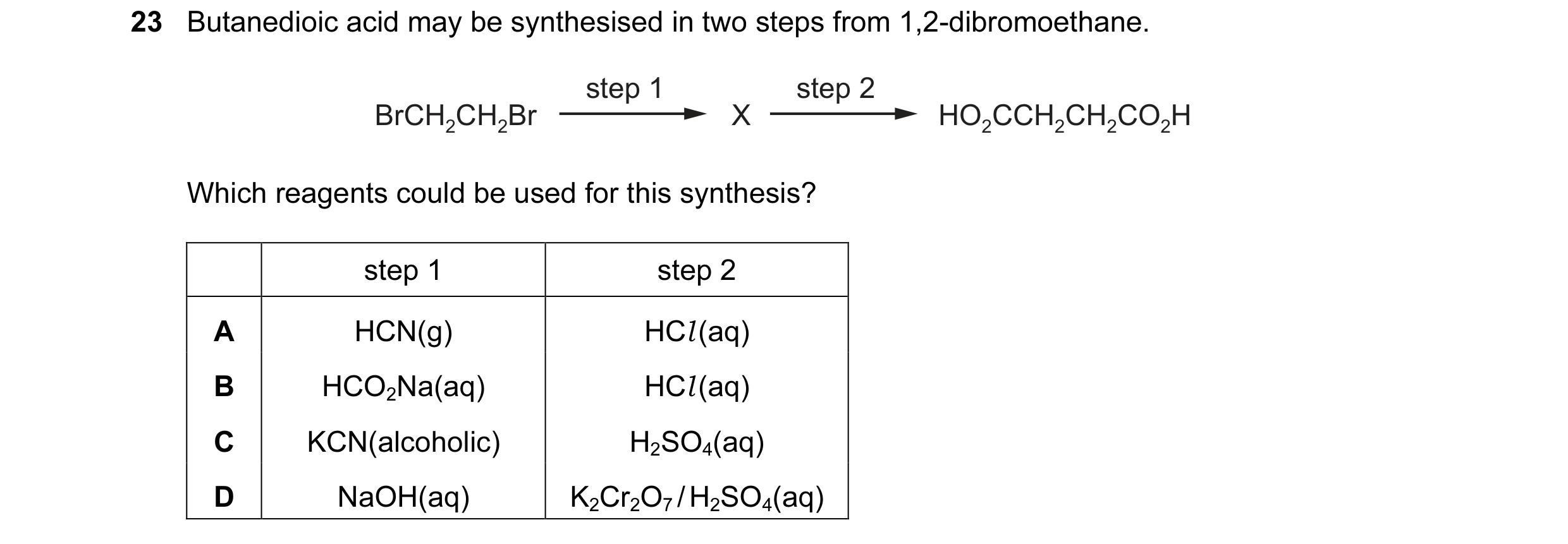
23 Butanedioic acid may be synthesised in two steps from 1,2-dibromoethane. step 1 step 2 BrCH2CH2Br X HO2CCH2CH2CO2H Which reagents could be used for this synthesis? step 1 step 2 A HCN(g) HCl (aq) B HCO2Na(aq) HCl (aq) C KCN(alcoholic) H2SO4(aq) D NaOH(aq) K2Cr2O7 / H2SO4(aq)
1 marks
Answer: C
This question in 9701/12 May/June 2015
Q43 · Propanone and hydrogen cyanide react together by this mechanism 9701/12 May/June 2015
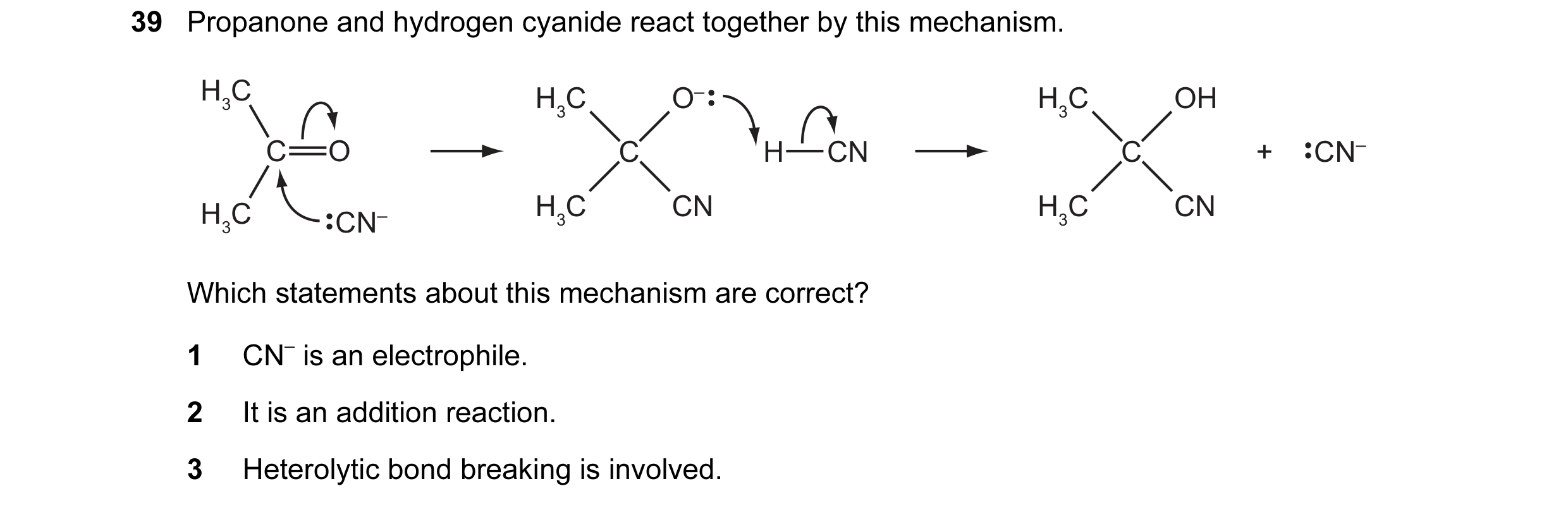
39 Propanone and hydrogen cyanide react together by this mechanism. H3C H3C O– H3C OH C O C H CN C + CN– H3C H3C CN H3C CN CN– Which statements about this mechanism are correct? 1 CN– is an electrophile. 2 It is an addition reaction. 3 Heterolytic bond breaking is involved.
1 marks
Answer: C
This question in 9701/12 May/June 2015
Q44 · Compound Q can be made from propanone 9701/12 Oct/Nov 2015
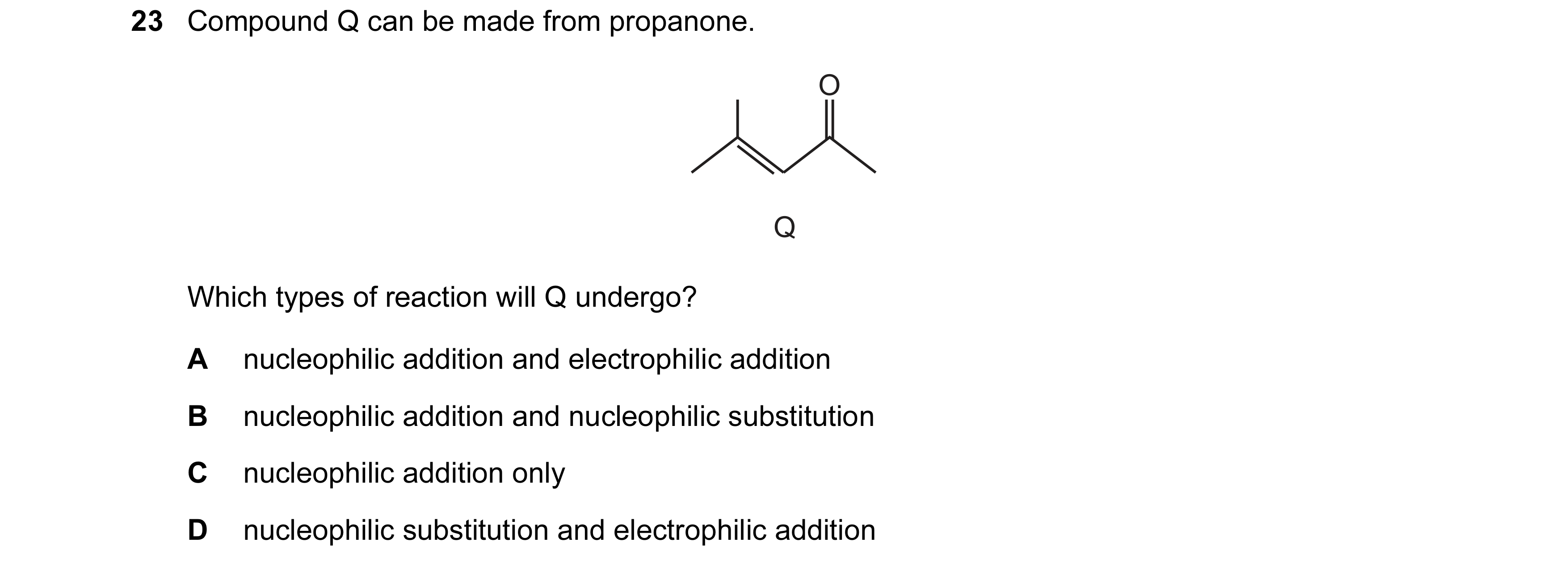
23 Compound Q can be made from propanone. O Q Which types of reaction will Q undergo? A nucleophilic addition and electrophilic addition B nucleophilic addition and nucleophilic substitution C nucleophilic addition only D nucleophilic substitution and electrophilic addition
1 marks
This question in 9701/12 Oct/Nov 2015
Q45 · What is the mechanism for the reaction of ethanal, CH3CHO, with hydrogen cyanide, HCN, in… 9701/12 Oct/Nov 2015
27 What is the mechanism for the reaction of ethanal, CH3CHO, with hydrogen cyanide, HCN, in the presence of a base? O O– O A CH3 C H CH3 C H CH3 C + H– CN– CN CN O –O H C N OH B CH3 C H CH3 C H CH3 C H + CN– CN– CN CN O H C N OH OH + C CH3 C H CH3 C H CH3 C H CN– CN D initiation HCN H • + • CN O O • propagation CH3C + • CN CH3C H H CN O • OH CH3C H + H CN CH3C H + • CN CN CN O • OH termination CH3C H + H • CH3C H CN CN
1 marks
This question in 9701/12 Oct/Nov 2015
Q46 · Several steps are involved in the synthesis of 2-hydroxypropanoic acid from ethanol 9701/11 May/June 2016
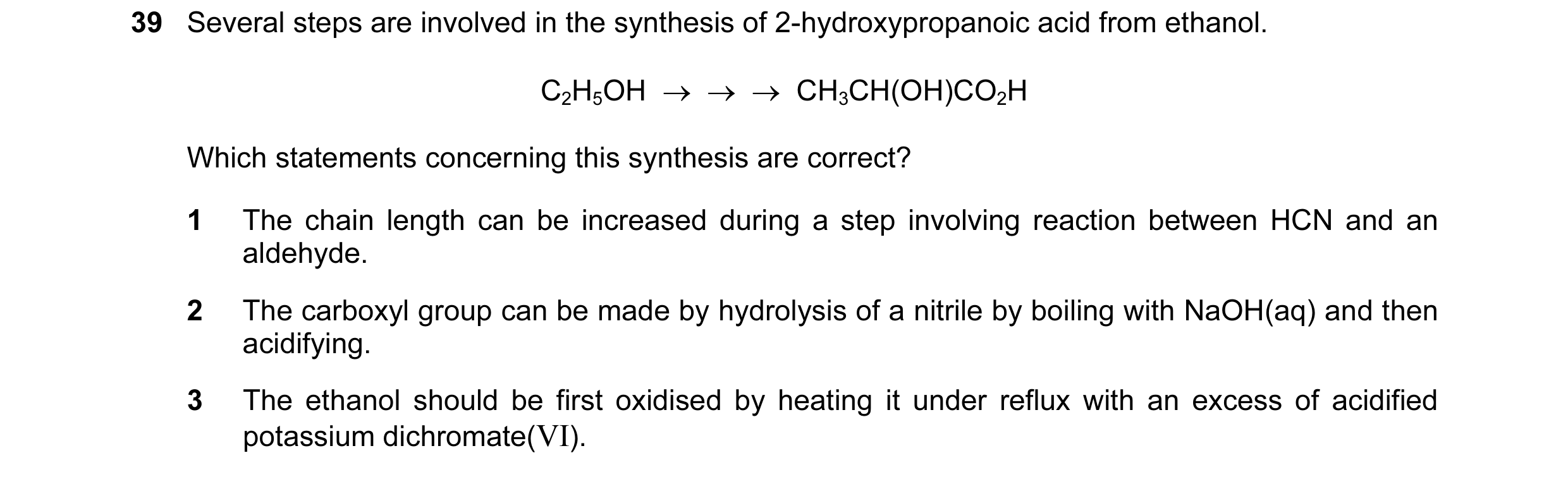
39 Several steps are involved in the synthesis of 2-hydroxypropanoic acid from ethanol. C2H5OH → → → CH3CH(OH)CO2H Which statements concerning this synthesis are correct? 1 The chain length can be increased during a step involving reaction between HCN and an aldehyde. 2 The carboxyl group can be made by hydrolysis of a nitrile by boiling with NaOH(aq) and then acidifying. 3 The ethanol should be first oxidised by heating it under reflux with an excess of acidified potassium dichromate(VI).
1 marks
Answer: B
This question in 9701/11 May/June 2016
Q47 · Propanal reacts with hydrogen cyanide to form 2-hydroxybutanenitrile 9701/12 May/June 2016
39 Propanal reacts with hydrogen cyanide to form 2-hydroxybutanenitrile. A suitable catalyst for this reaction is sodium cyanide. NaCN CH3CH2CHO + HCN CH3CH2CH(OH)CN Which statements about the reaction of propanal with hydrogen cyanide are correct? 1 The sodium cyanide provides a stronger nucleophile than HCN. 2 The reaction can be classified as nucleophilic substitution. 3 The hydrogen cyanide molecule attacks the propanal molecule to form an intermediate ion.
1 marks
Answer: D
This question in 9701/12 May/June 2016
Q48 · Ethanal and hydrogen cyanide react together to form a compound used in the production of… 9701/13 May/June 2016
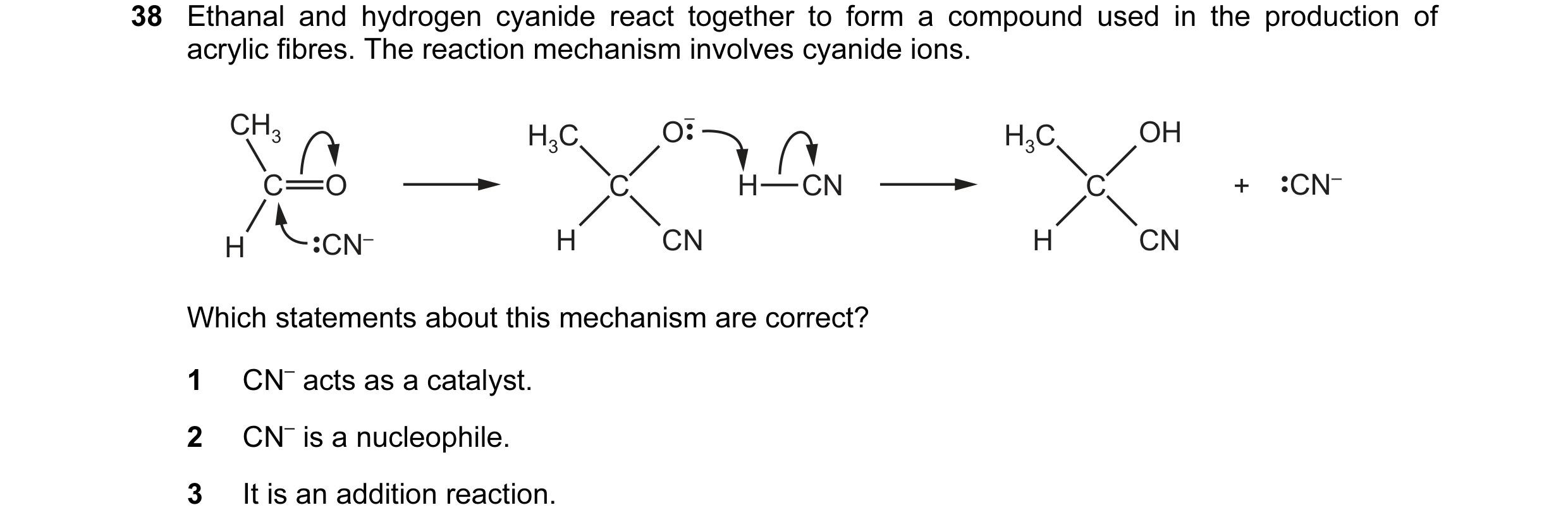
38 Ethanal and hydrogen cyanide react together to form a compound used in the production of acrylic fibres. The reaction mechanism involves cyanide ions. CH3 H3C O – H3C OH C O C H CN C + CN– H CN– H CN H CN Which statements about this mechanism are correct? 1 CN– acts as a catalyst. 2 CN– is a nucleophile. 3 It is an addition reaction.
1 marks
Answer: A
This question in 9701/13 May/June 2016
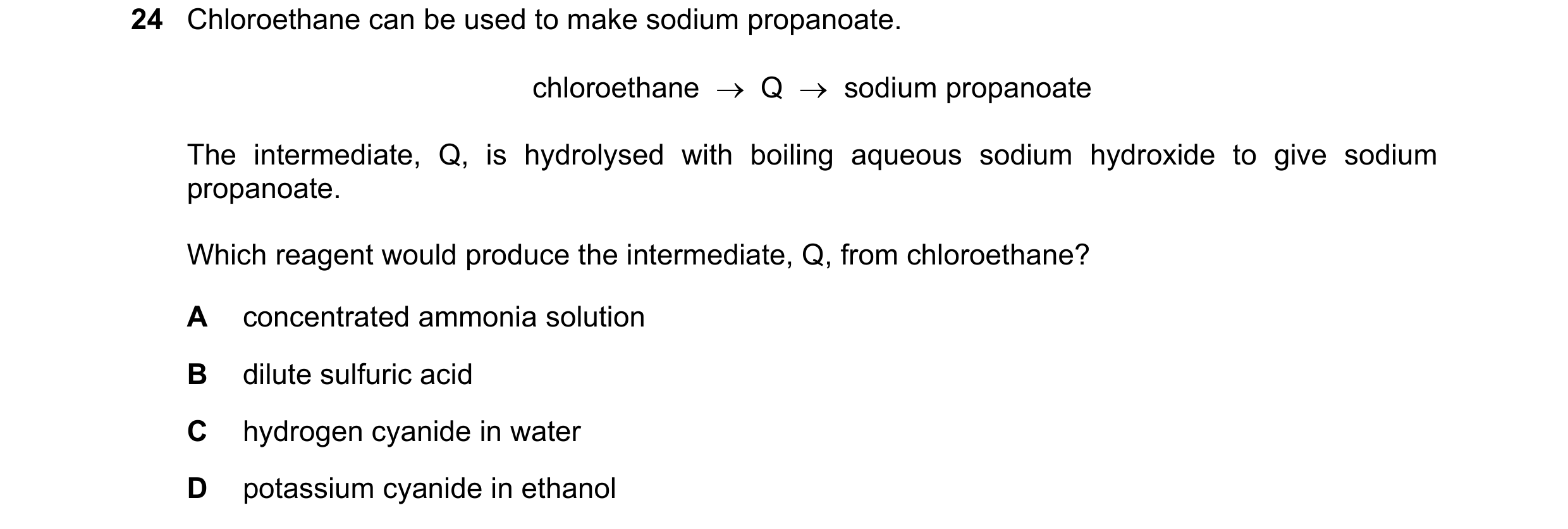
Q49 · Chloroethane can be used to make sodium propanoate 9701/11 Oct/Nov 2016
24 Chloroethane can be used to make sodium propanoate. chloroethane → Q → sodium propanoate The intermediate, Q, is hydrolysed with boiling aqueous sodium hydroxide to give sodium propanoate. Which reagent would produce the intermediate, Q, from chloroethane? A concentrated ammonia solution B dilute sulfuric acid C hydrogen cyanide in water D potassium cyanide in ethanol
1 marks
Answer: D
This question in 9701/11 Oct/Nov 2016
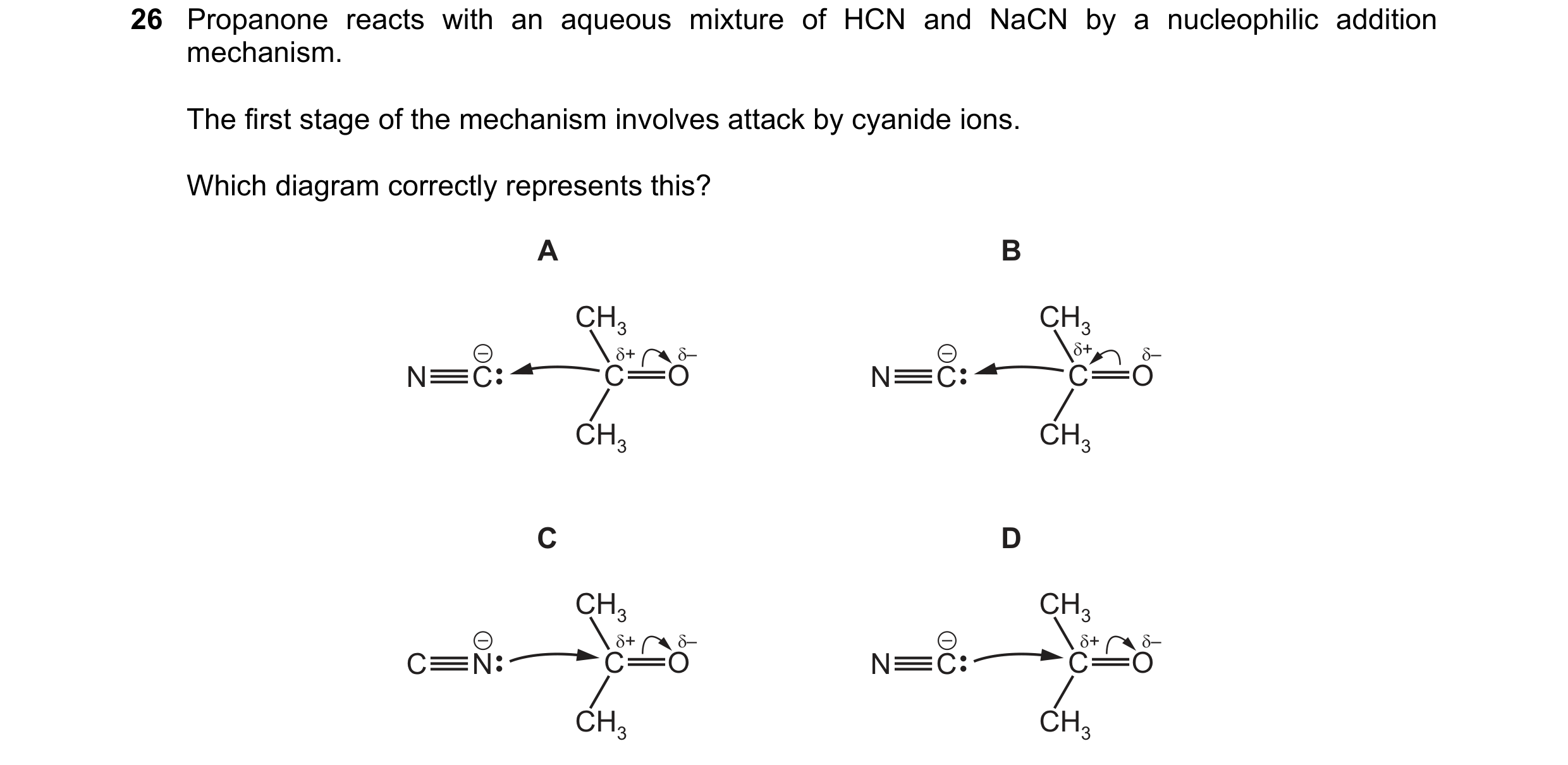
Q50 · Propanone reacts with an aqueous mixture of HCN and NaCN by a nucleophilic addition… 9701/11 Oct/Nov 2016
26 Propanone reacts with an aqueous mixture of HCN and NaCN by a nucleophilic addition mechanism. The first stage of the mechanism involves attack by cyanide ions. Which diagram correctly represents this? A B CH3 CH3 – δ+ δ– – δ+ δ– N C C O N C C O CH3 CH3 C D CH3 CH3 – δ+ δ– – δ+ δ– C N C O N C C O CH3 CH3
1 marks
Answer: D
This question in 9701/11 Oct/Nov 2016
Q51 · Chloroethane can be used to make sodium propanoate 9701/13 Oct/Nov 2016
24 Chloroethane can be used to make sodium propanoate. chloroethane → Q → sodium propanoate The intermediate, Q, is hydrolysed with boiling aqueous sodium hydroxide to give sodium propanoate. Which reagent would produce the intermediate, Q, from chloroethane? A concentrated ammonia solution B dilute sulfuric acid C hydrogen cyanide in water D potassium cyanide in ethanol
1 marks
Answer: D
This question in 9701/13 Oct/Nov 2016
Q52 · Propanone reacts with an aqueous mixture of HCN and NaCN by a nucleophilic addition… 9701/13 Oct/Nov 2016
26 Propanone reacts with an aqueous mixture of HCN and NaCN by a nucleophilic addition mechanism. The first stage of the mechanism involves attack by cyanide ions. Which diagram correctly represents this? A B CH3 CH3 – δ+ δ– – δ+ δ– N C C O N C C O CH3 CH3 C D CH3 CH3 – δ+ δ– – δ+ δ– C N C O N C C O CH3 CH3
1 marks
Answer: D
This question in 9701/13 Oct/Nov 2016
Q53 · A carbonyl compound X will react with HCN in the presence of NaCN to make a compound with… 9701/12 May/June 2017
20 A carbonyl compound X will react with HCN in the presence of NaCN to make a compound with Mr 85. Compound X does not react with Fehling’s reagent. What is X? A butanal B butanone C propanal D propanone
1 marks
Answer: D
This question in 9701/12 May/June 2017
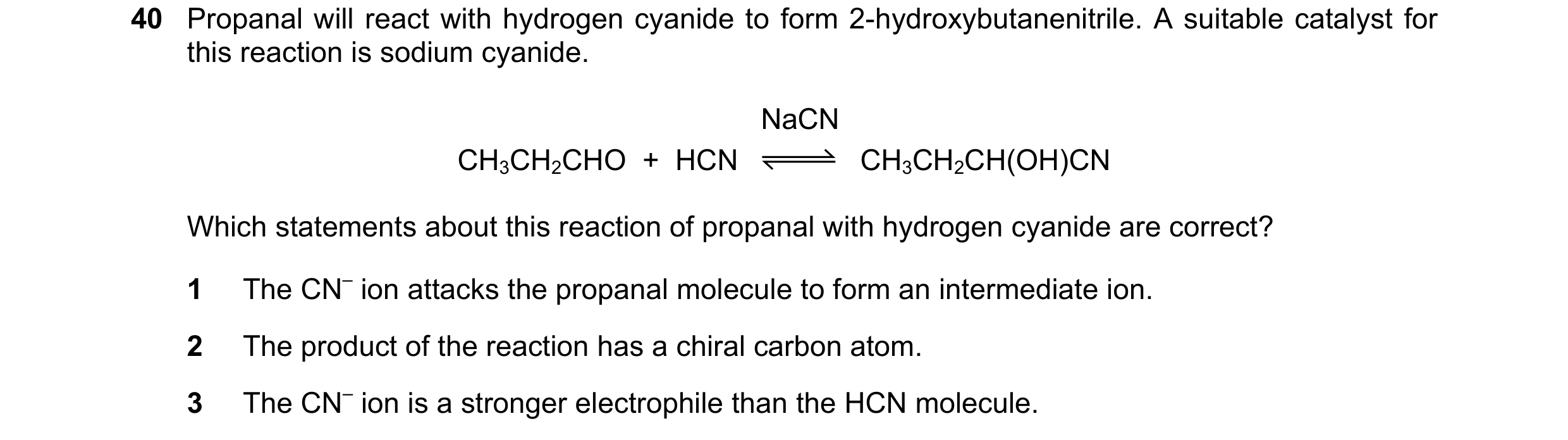
Q54 · Propanal will react with hydrogen cyanide to form 2-hydroxybutanenitrile 9701/13 May/June 2017
40 Propanal will react with hydrogen cyanide to form 2-hydroxybutanenitrile. A suitable catalyst for this reaction is sodium cyanide. NaCN CH3CH2CHO + HCN CH3CH2CH(OH)CN Which statements about this reaction of propanal with hydrogen cyanide are correct? 1 The CN– ion attacks the propanal molecule to form an intermediate ion. 2 The product of the reaction has a chiral carbon atom. 3 The CN– ion is a stronger electrophile than the HCN molecule.
1 marks
Answer: B
This question in 9701/13 May/June 2017
Q55 · The reaction of ethanal, CH3CHO, with HCN to form 2-hydroxypropanenitrile is catalysed by… 9701/11 Oct/Nov 2017
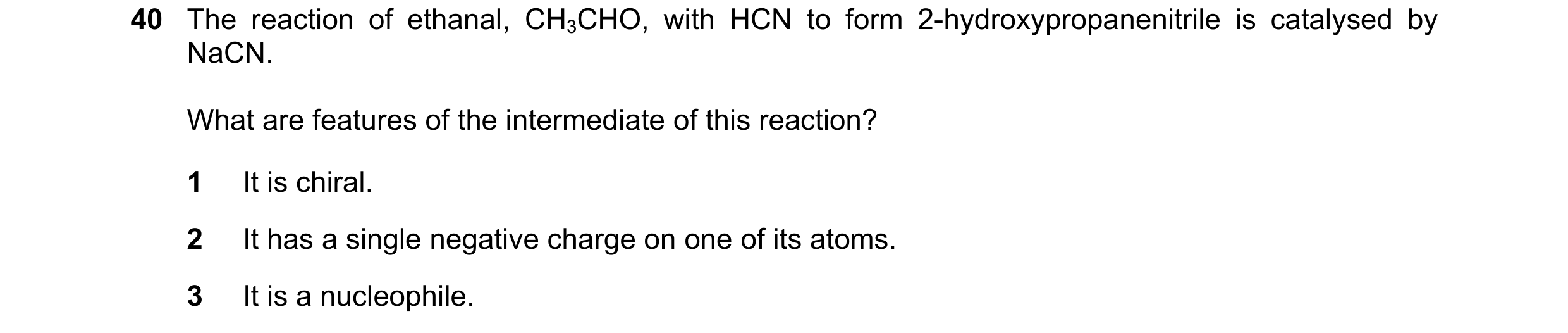
40 The reaction of ethanal, CH3CHO, with HCN to form 2-hydroxypropanenitrile is catalysed by NaCN. What are features of the intermediate of this reaction? 1 It is chiral. 2 It has a single negative charge on one of its atoms. 3 It is a nucleophile.
1 marks
Answer: A
This question in 9701/11 Oct/Nov 2017
Q56 · Compound M is an important ingredient in perfume 9701/12 Oct/Nov 2017
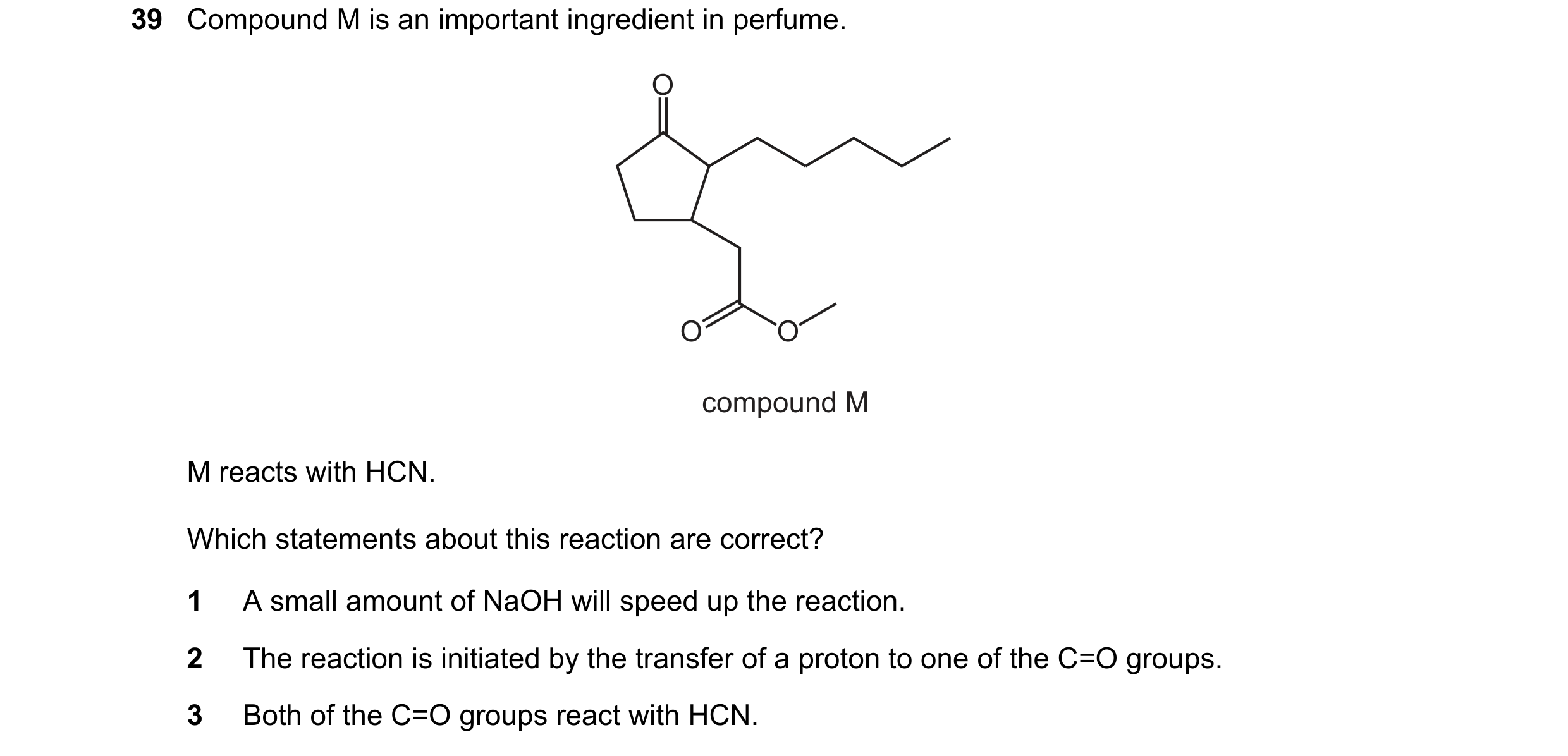
39 Compound M is an important ingredient in perfume. O O O compound M M reacts with HCN. Which statements about this reaction are correct? 1 A small amount of NaOH will speed up the reaction. 2 The reaction is initiated by the transfer of a proton to one of the C=O groups. 3 Both of the C=O groups react with HCN.
1 marks
Answer: D
This question in 9701/12 Oct/Nov 2017
Q57 · The reaction of ethanal, CH3CHO, with HCN to form 2-hydroxypropanenitrile is catalysed by… 9701/13 Oct/Nov 2017
40 The reaction of ethanal, CH3CHO, with HCN to form 2-hydroxypropanenitrile is catalysed by NaCN. What are features of the intermediate of this reaction? 1 It is chiral. 2 It has a single negative charge on one of its atoms. 3 It is a nucleophile.
1 marks
Answer: A
This question in 9701/13 Oct/Nov 2017
Q58 · Propanal reacts with hydrogen cyanide to form 2-hydroxybutanenitrile 9701/12 Feb/March 2018
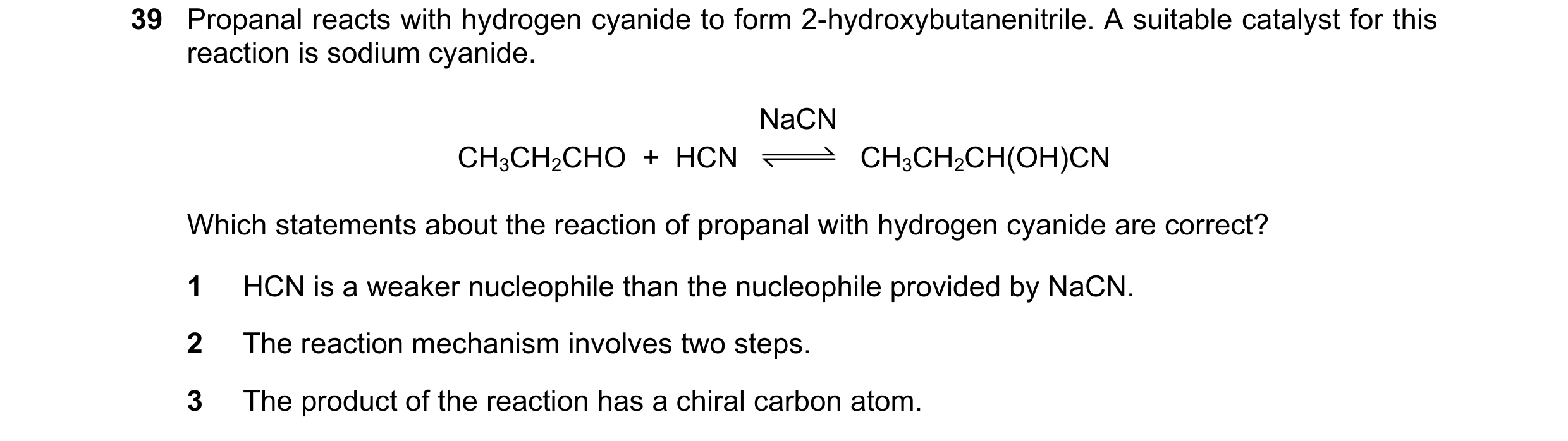
39 Propanal reacts with hydrogen cyanide to form 2-hydroxybutanenitrile. A suitable catalyst for this reaction is sodium cyanide. NaCN CH3CH2CHO + HCN CH3CH2CH(OH)CN Which statements about the reaction of propanal with hydrogen cyanide are correct? 1 HCN is a weaker nucleophile than the nucleophile provided by NaCN. 2 The reaction mechanism involves two steps. 3 The product of the reaction has a chiral carbon atom.
1 marks
Answer: A
This question in 9701/12 Feb/March 2018
Q59 · What is the mechanism for the reaction of ethanal, CH3CHO, with hydrogen cyanide, HCN, in… 9701/11 May/June 2018
26 What is the mechanism for the reaction of ethanal, CH3CHO, with hydrogen cyanide, HCN, in the presence of NaCN? O O– O A CH3 C H CH3 C H CH3 C + H– CN– CN CN O –O H C N OH B CH3 C H CH3 C H CH3 C H + CN– CN– CN CN O H C N OH OH C CH3 C H CH3 + C H CH3 C H CN– CN D initiation HCN H • + • CN O O • propagation CH3 C + • CN CH3 C H H CN O • OH CH3 C H + H CN CH3 C H + • CN CN CN O • OH termination CH3 C H + H • CH3 C H CN CN
1 marks
Answer: B
This question in 9701/11 May/June 2018
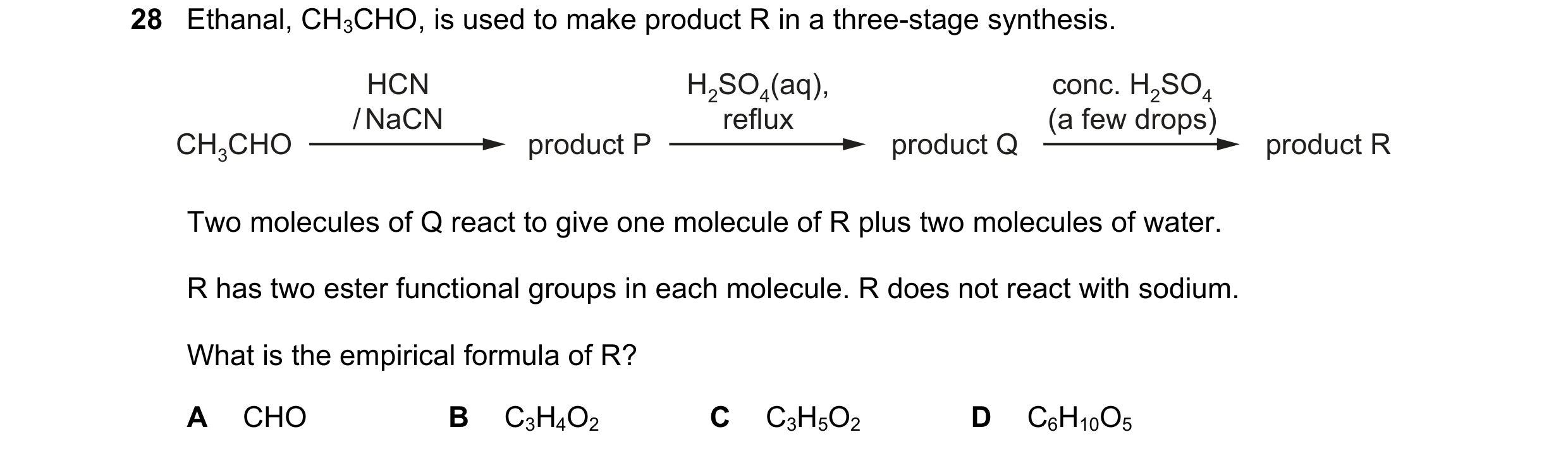
Q60 · Ethanal, CH3CHO, is used to make product R in a three-stage synthesis 9701/12 May/June 2018
28 Ethanal, CH3CHO, is used to make product R in a three-stage synthesis. HCN H2SO4(aq), conc. H2SO4 / NaCN reflux (a few drops) CH3CHO product P product Q product R Two molecules of Q react to give one molecule of R plus two molecules of water. R has two ester functional groups in each molecule. R does not react with sodium. What is the empirical formula of R? A CHO B C3H4O2 C C3H5O2 D C6H10O5
1 marks
Answer: B
This question in 9701/12 May/June 2018
Q61 · A student carried out a two-stage synthesis in which CH3CH2CH2Br was converted into… 9701/13 May/June 2018
28 A student carried out a two-stage synthesis in which CH3CH2CH2Br was converted into CH3CH2CH2CO2H. Which compound could have been formed by the first stage of this synthesis? A CH3CH2CH2OH B CH3CH2CH2CHO C CH3CH2CN D CH3CH2CH2CN
1 marks
Answer: D
This question in 9701/13 May/June 2018
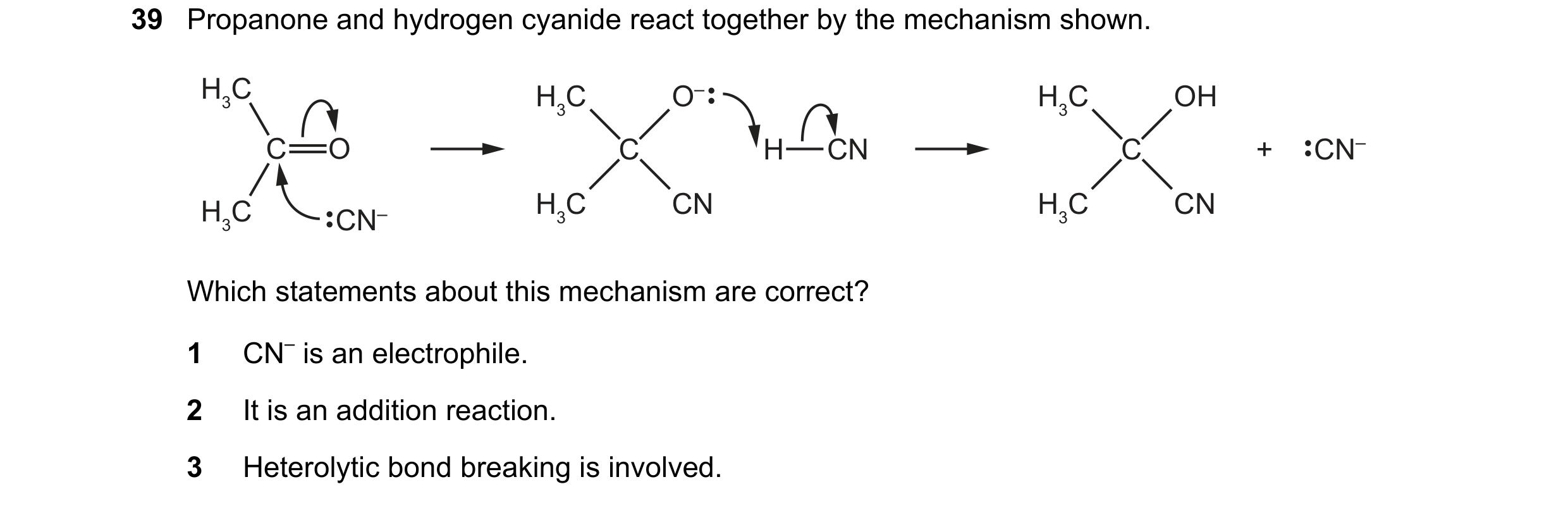
Q62 · Propanone and hydrogen cyanide react together by the mechanism shown 9701/13 May/June 2018
39 Propanone and hydrogen cyanide react together by the mechanism shown. H3C H3C O– H3C OH C O C H CN C + CN– H3C H3C CN H3C CN CN– Which statements about this mechanism are correct? 1 CN– is an electrophile. 2 It is an addition reaction. 3 Heterolytic bond breaking is involved.
1 marks
Answer: C
This question in 9701/13 May/June 2018
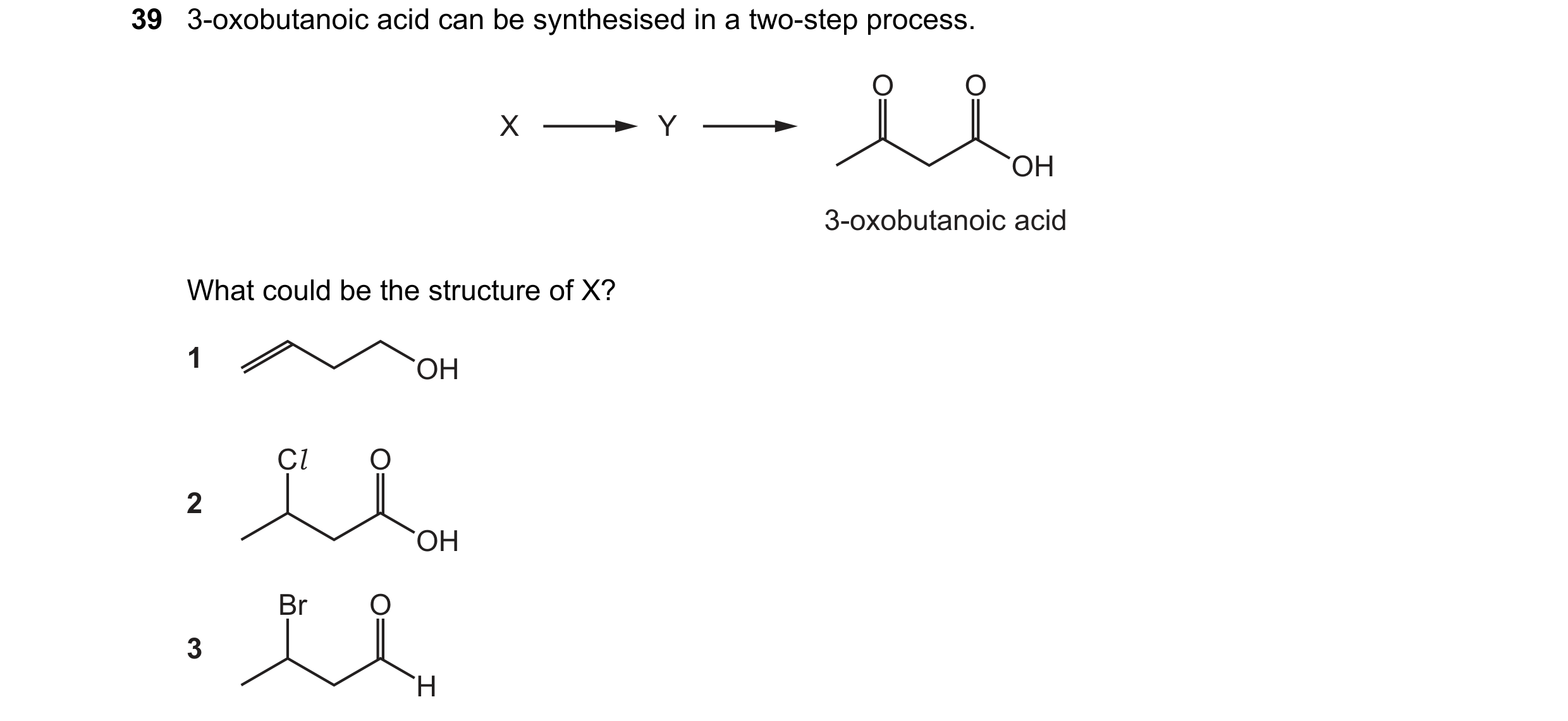
Q63 · 3-oxobutanoic acid can be synthesised in a two-step process 9701/11 Oct/Nov 2018
39 3-oxobutanoic acid can be synthesised in a two-step process. O O X Y OH 3-oxobutanoic acid What could be the structure of X? 1 OH Cl O 2 OH Br O 3 H
1 marks
Answer: A
This question in 9701/11 Oct/Nov 2018
Q64 · Ethanal reacts with HCN in the presence of KCN 9701/11 Oct/Nov 2018
40 Ethanal reacts with HCN in the presence of KCN. Which changes in bonding occur during this reaction? 1 A carbon-carbon bond is formed. 2 A carbon-hydrogen bond is broken. 3 A carbon-nitrogen bond is broken.
1 marks
Answer: B
This question in 9701/11 Oct/Nov 2018
Q65 · Which compound can be used to make propanoic acid by treatment with a single reagent? 9701/12 Oct/Nov 2018
29 Which compound can be used to make propanoic acid by treatment with a single reagent? A CH2=CHCH2CH3 B CH3CH2CH2CN C CH3CH(OH)CN D CH3CH(OH)CH3
1 marks
Answer: A
This question in 9701/12 Oct/Nov 2018
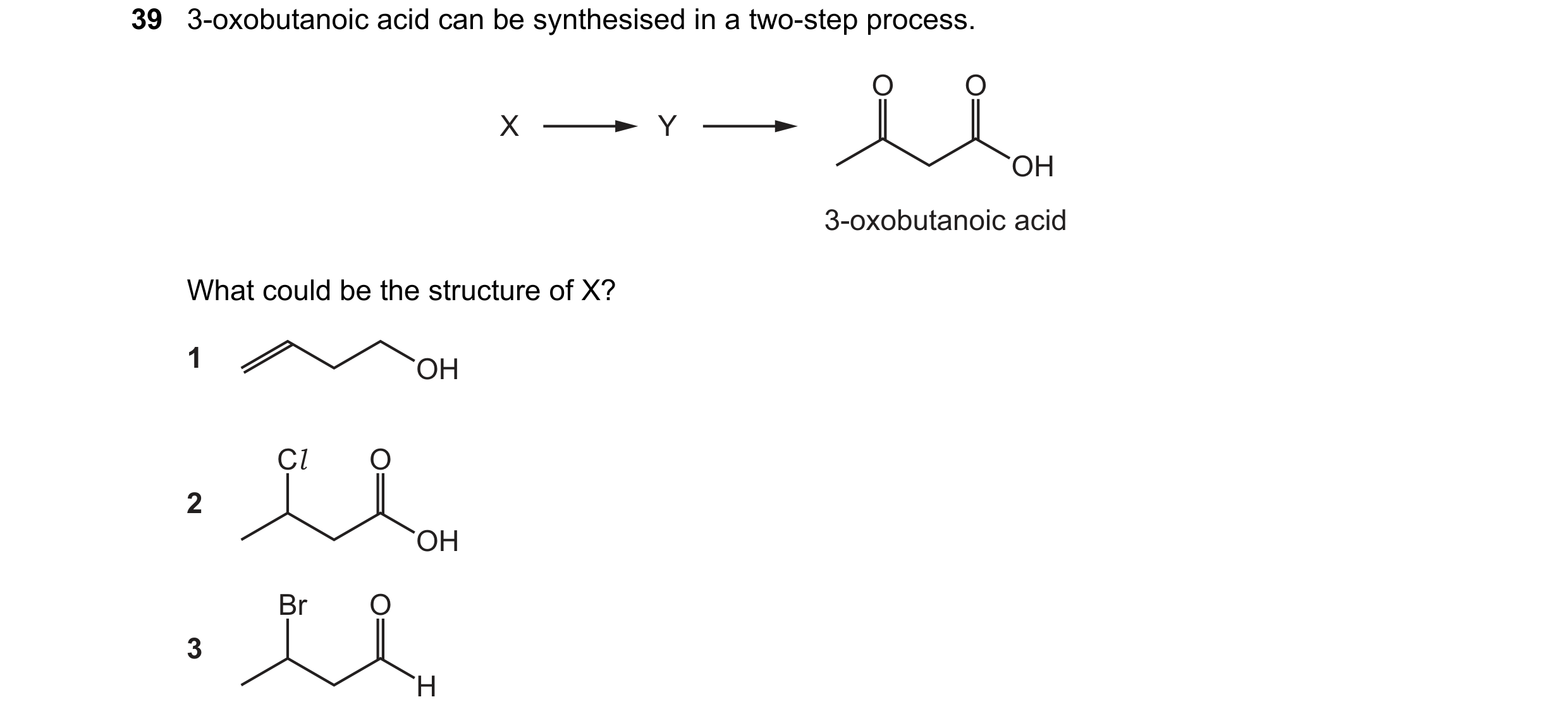
Q66 · 3-oxobutanoic acid can be synthesised in a two-step process 9701/13 Oct/Nov 2018
39 3-oxobutanoic acid can be synthesised in a two-step process. O O X Y OH 3-oxobutanoic acid What could be the structure of X? 1 OH Cl O 2 OH Br O 3 H
1 marks
Answer: A
This question in 9701/13 Oct/Nov 2018
Q67 · Ethanal reacts with HCN in the presence of KCN 9701/13 Oct/Nov 2018
40 Ethanal reacts with HCN in the presence of KCN. Which changes in bonding occur during this reaction? 1 A carbon-carbon bond is formed. 2 A carbon-hydrogen bond is broken. 3 A carbon-nitrogen bond is broken.
1 marks
Answer: B
This question in 9701/13 Oct/Nov 2018
Q68 · The compounds listed are reacted with hydrogen cyanide 9701/12 Feb/March 2019
39 The compounds listed are reacted with hydrogen cyanide. Which compounds produce a molecule containing a chiral centre? 1 butanal 2 butanone 3 pentan-2-one
1 marks
Answer: A
This question in 9701/12 Feb/March 2019
Q69 · Carboxylic acids can be prepared from alcohols, nitriles or esters 9701/12 Feb/March 2019
40 Carboxylic acids can be prepared from alcohols, nitriles or esters. Which statements are correct? 1 Both primary and secondary alcohols can be oxidised to carboxylic acids. 2 Carboxylic acids can be made from nitriles by hydrolysis. 3 Ethyl propanoate gives propanoic acid when reacted with hydrochloric acid.
1 marks
Answer: C
This question in 9701/12 Feb/March 2019
Q70 · Carboxylic acids can be made by several different reactions 9701/11 May/June 2019
39 Carboxylic acids can be made by several different reactions. Which statements are correct? 1 The acid hydrolysis of CH3CH2CN will make ethanoic acid. 2 The oxidation of CH3CH2CH2CH2OH will make butanoic acid. 3 The oxidation of CH3CH2CHO will make propanoic acid.
1 marks
Answer: C
This question in 9701/11 May/June 2019
Q71 · Structural isomerism only should be considered when answering this question 9701/13 May/June 2019
28 Structural isomerism only should be considered when answering this question. A set of isomeric compounds, with molecular formula C5H10O, all react in a 1 : 1 ratio with an excess of HCN by nucleophilic addition. How many isomeric compounds are in the set? A 5 B 6 C 7 D 8
1 marks
Answer: C
This question in 9701/13 May/June 2019
Q72 · Hydrogen cyanide reacts with propanone in the presence of potassium cyanide 9701/11 Oct/Nov 2019
39 Hydrogen cyanide reacts with propanone in the presence of potassium cyanide. Which statements about this reaction are correct? 1 The cyanide ion is a catalyst for the reaction. 2 This is an addition reaction. 3 The intermediate behaves as a base.
1 marks
Answer: A
This question in 9701/11 Oct/Nov 2019
Q73 · Bromoethane undergoes nucleophilic substitution reactions 9701/12 Oct/Nov 2019
38 Bromoethane undergoes nucleophilic substitution reactions. Which statements are correct? 1 Bromoethane reacts with aqueous NaOH to make ethanol. 2 Bromoethane reacts with ethanolic NH3 to make ethylamine. 3 Bromoethane reacts with ethanolic KCN to make ethanenitrile.
1 marks
Answer: B
This question in 9701/12 Oct/Nov 2019
Q74 · Hydrogen cyanide reacts with propanone in the presence of potassium cyanide 9701/13 Oct/Nov 2019
39 Hydrogen cyanide reacts with propanone in the presence of potassium cyanide. Which statements about this reaction are correct? 1 The cyanide ion is a catalyst for the reaction. 2 This is an addition reaction. 3 The intermediate behaves as a base.
1 marks
Answer: A
This question in 9701/13 Oct/Nov 2019
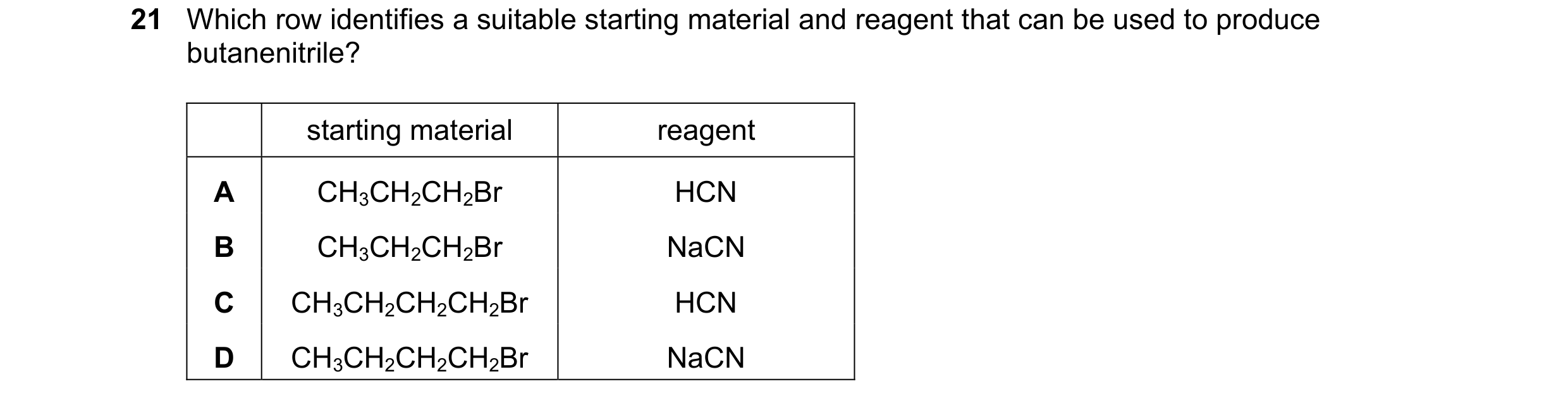
Q75 · Which row identifies a suitable starting material and reagent that can be used to produce… 9701/12 Feb/March 2020
21 Which row identifies a suitable starting material and reagent that can be used to produce butanenitrile? starting material reagent A CH3CH2CH2Br HCN B CH3CH2CH2Br NaCN C CH3CH2CH2CH2Br HCN D CH3CH2CH2CH2Br NaCN
1 marks
Answer: B
This question in 9701/12 Feb/March 2020
Q76 · Ethanal and hydrogen cyanide react together 9701/12 Feb/March 2020
37 Ethanal and hydrogen cyanide react together. The reaction mechanism involves cyanide ions. CH3 H3C O – H3C OH C O C H CN C + CN– H CN– H CN H CN Which statements about this mechanism are correct? 1 CN– acts as a catalyst. 2 CN– is a nucleophile. 3 It is an addition reaction.
1 marks
Answer: A
This question in 9701/12 Feb/March 2020
Q77 · Which reaction produces an organic anion with a good yield? 9701/11 May/June 2020
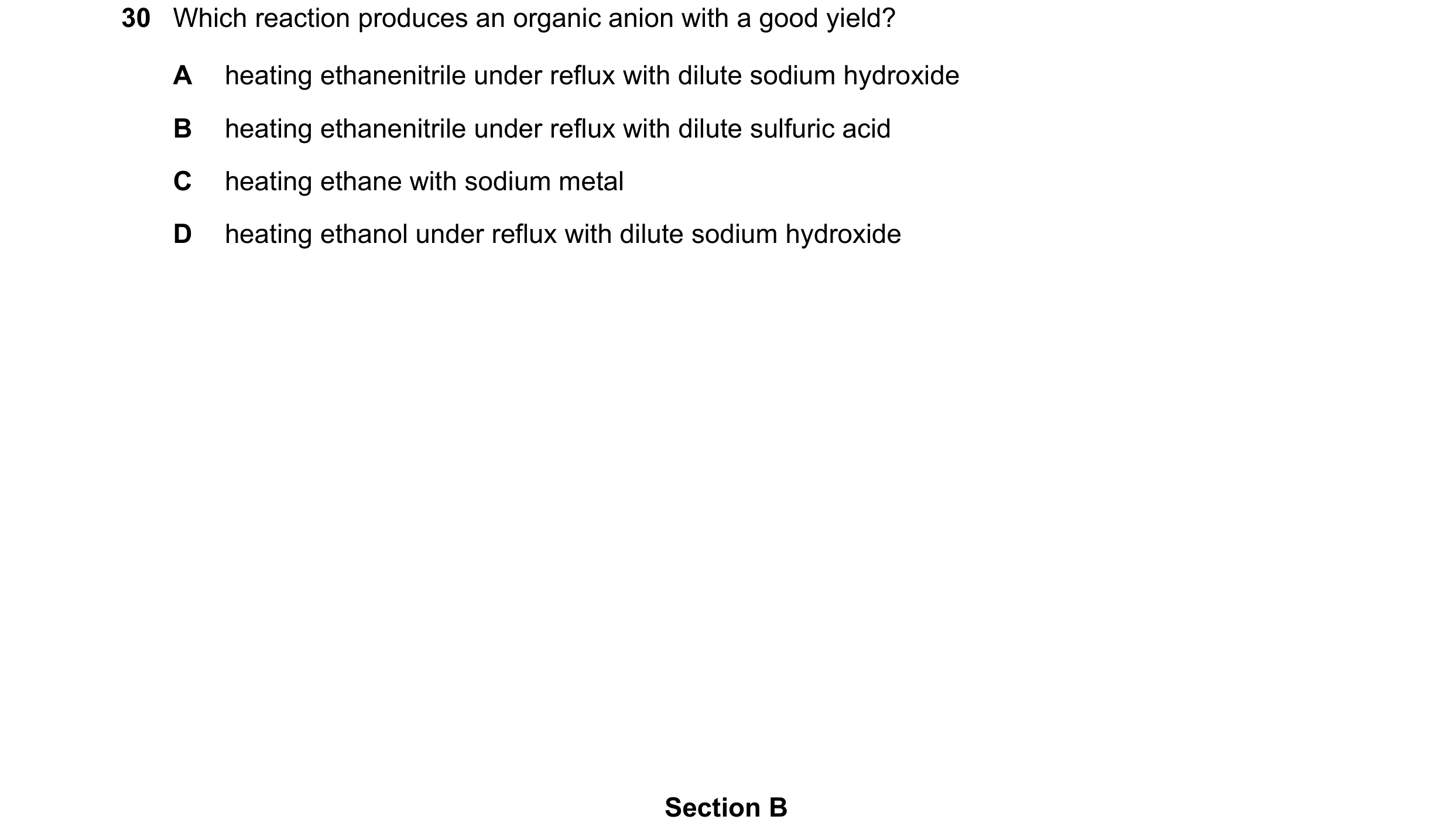
30 Which reaction produces an organic anion with a good yield? A heating ethanenitrile under reflux with dilute sodium hydroxide B heating ethanenitrile under reflux with dilute sulfuric acid C heating ethane with sodium metal D heating ethanol under reflux with dilute sodium hydroxide Section B
1 marks
Answer: A
This question in 9701/11 May/June 2020
Q78 · Which row correctly shows the type of mechanism of each of the two reactions? 9701/12 May/June 2020
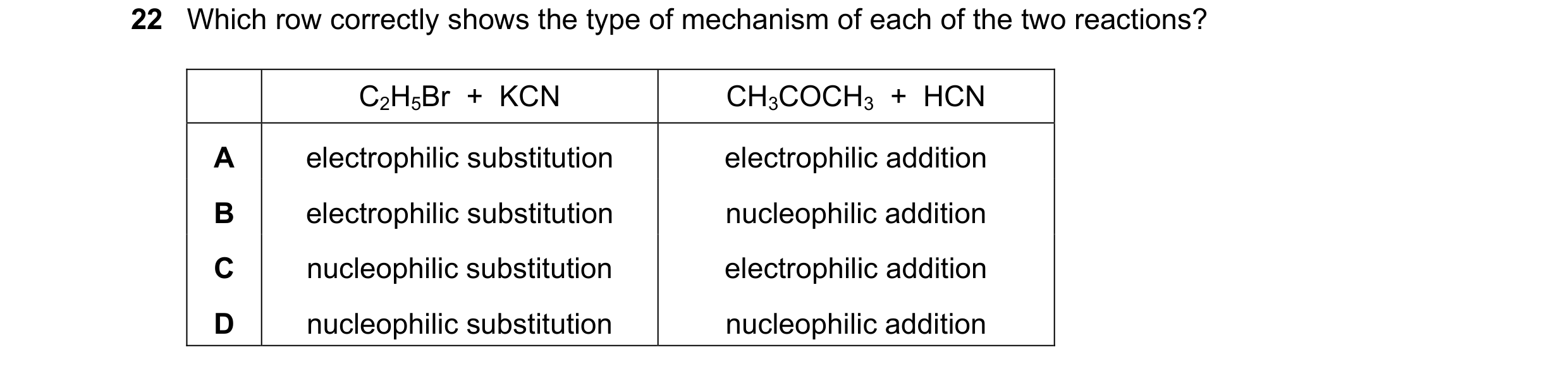
22 Which row correctly shows the type of mechanism of each of the two reactions? C2H5Br + KCN CH3COCH3 + HCN A electrophilic substitution electrophilic addition B electrophilic substitution nucleophilic addition C nucleophilic substitution electrophilic addition D nucleophilic substitution nucleophilic addition
1 marks
Answer: D
This question in 9701/12 May/June 2020
Q79 · Propanal reacts with hydrogen cyanide 9701/12 May/June 2020
38 Propanal reacts with hydrogen cyanide. Which absorptions are present in the infra-red spectrum of the product? 1 a weak absorption in the range 2200–2250 cm–1 2 a strong absorption in the range 3200–3600 cm–1 3 a strong absorption in the range 1040–1300 cm–1
1 marks
Answer: A
This question in 9701/12 May/June 2020
Q80 · Butanoic acid can be produced from 1-bromopropane in two steps using reagents V and W as… 9701/13 May/June 2020
23 Butanoic acid can be produced from 1-bromopropane in two steps using reagents V and W as shown. reagent V reagent W 1-bromopropane compound Q butanoic acid What could be reagents V and W? V W A KCN in ethanol HCl (aq) B KCN in ethanol NaOH(aq) C NH3 in ethanol HCl (aq) D NaOH(aq) H+ / Cr2O7 2–(aq)
1 marks
Answer: A
This question in 9701/13 May/June 2020
Q81 · Propanal reacts with hydrogen cyanide to form 2-hydroxybutanenitrile 9701/13 May/June 2020
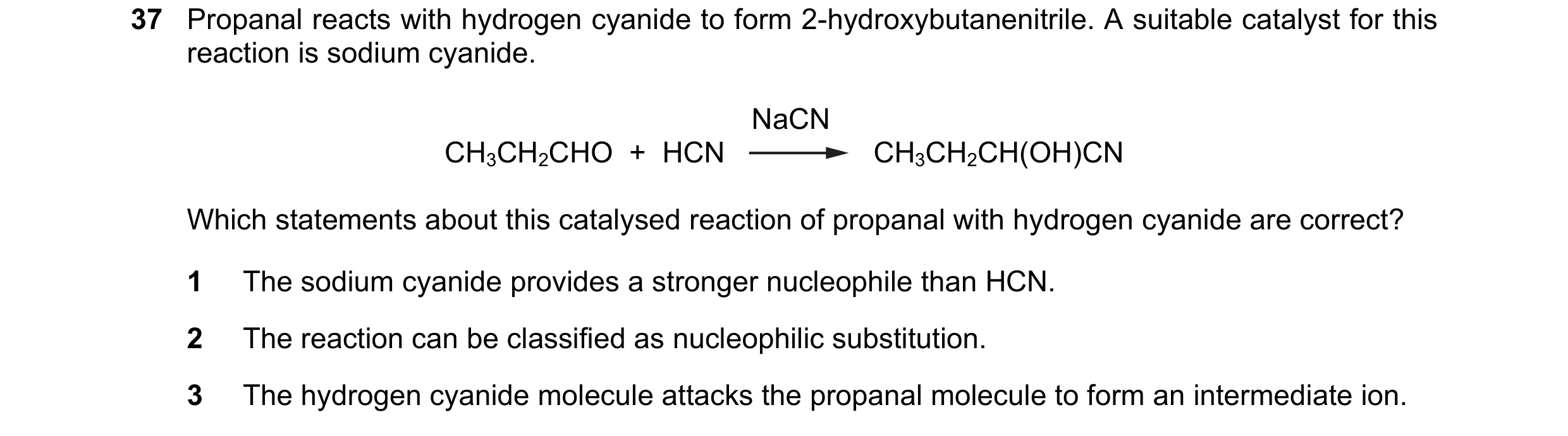
37 Propanal reacts with hydrogen cyanide to form 2-hydroxybutanenitrile. A suitable catalyst for this reaction is sodium cyanide. NaCN CH3CH2CHO + HCN CH3CH2CH(OH)CN Which statements about this catalysed reaction of propanal with hydrogen cyanide are correct? 1 The sodium cyanide provides a stronger nucleophile than HCN. 2 The reaction can be classified as nucleophilic substitution. 3 The hydrogen cyanide molecule attacks the propanal molecule to form an intermediate ion.
1 marks
Answer: D
This question in 9701/13 May/June 2020
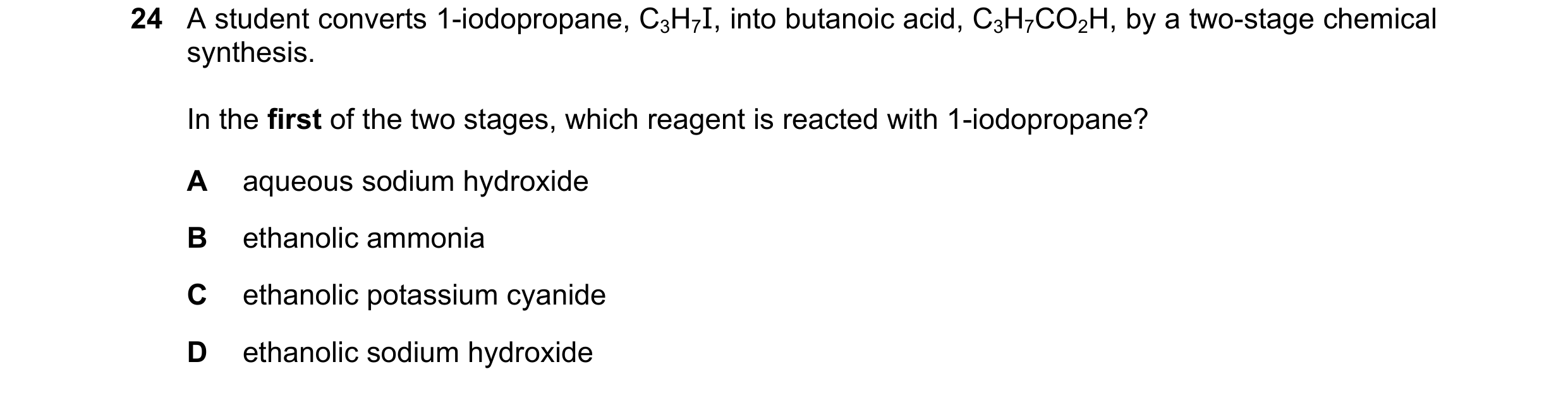
Q82 · A student converts 1-iodopropane, C3H7I, into butanoic acid, C3H7CO2H, by a two-stage… 9701/11 Oct/Nov 2020
24 A student converts 1-iodopropane, C3H7I, into butanoic acid, C3H7CO2H, by a two-stage chemical synthesis. In the first of the two stages, which reagent is reacted with 1-iodopropane? A aqueous sodium hydroxide B ethanolic ammonia C ethanolic potassium cyanide D ethanolic sodium hydroxide
1 marks
Answer: C
This question in 9701/11 Oct/Nov 2020
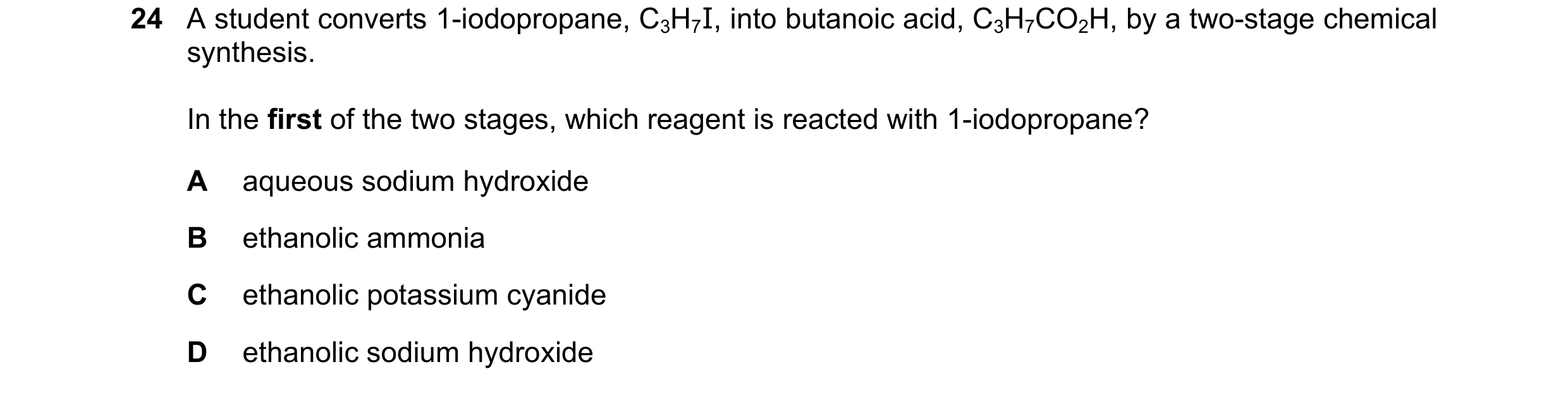
Q83 · A student converts 1-iodopropane, C3H7I, into butanoic acid, C3H7CO2H, by a two-stage… 9701/13 Oct/Nov 2020
24 A student converts 1-iodopropane, C3H7I, into butanoic acid, C3H7CO2H, by a two-stage chemical synthesis. In the first of the two stages, which reagent is reacted with 1-iodopropane? A aqueous sodium hydroxide B ethanolic ammonia C ethanolic potassium cyanide D ethanolic sodium hydroxide
1 marks
Answer: C
This question in 9701/13 Oct/Nov 2020
Q84 · The diagram shows the formation of compound Y from compound X in a chemical reaction 9701/12 Feb/March 2021
26 The diagram shows the formation of compound Y from compound X in a chemical reaction. R1 and R2 are alkyl groups. Y R1 OH KCN X + HCN C R2 CN Which row about this reaction is correct? mechanism compound X A electrophilic addition aldehyde B electrophilic addition ketone C nucleophilic addition ketone D nucleophilic addition aldehyde
1 marks
Answer: C
This question in 9701/12 Feb/March 2021
Q85 · Which statement is correct for the reaction of carbonyl compounds with HCN? 9701/11 May/June 2021
28 Which statement is correct for the reaction of carbonyl compounds with HCN? A The reaction is catalysed by concentrated H2SO4. B Pentan-2-one and HCN react to give a chiral product. C The reaction is a condensation reaction. D The reaction is nucleophilic substitution.
1 marks
Answer: B
This question in 9701/11 May/June 2021
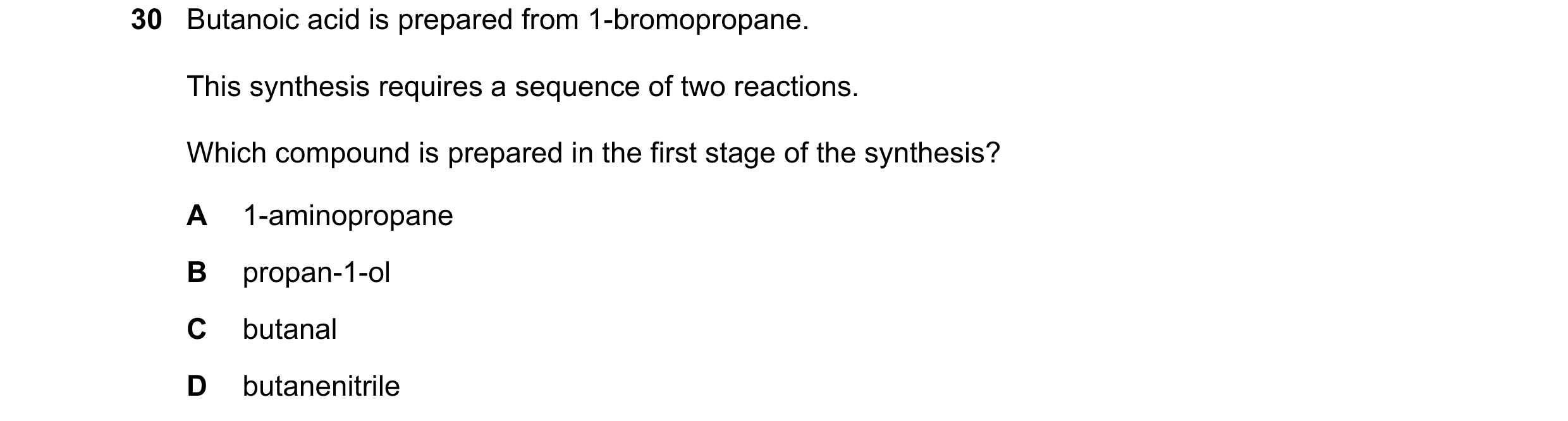
Q86 · Butanoic acid is prepared from 1-bromopropane 9701/11 May/June 2021
30 Butanoic acid is prepared from 1-bromopropane. This synthesis requires a sequence of two reactions. Which compound is prepared in the first stage of the synthesis? A 1-aminopropane B propan-1-ol C butanal D butanenitrile
1 marks
Answer: D
This question in 9701/11 May/June 2021
Q87 · Which reaction mechanism for the formation of CzH;CH(OH)(CN) is correct? 9701/12 May/June 2021
28 Which reaction mechanism for the formation of CzH;CH(OH)(CN) is correct?
H*
> or OH
A oy Ss) ———$> 4 ———“—— H
— Cs C
NSC H | |
H*
7 o:J OH
\ ; a +
B wy > —> 4 —_—_>
—c; / C
N=C H | |
N
H*
54 o: OH
O + +
Cc Sf —+» —_>
=c:__” C
NSC H | |
N
H*
1 marks
Answer: D
This question in 9701/12 May/June 2021
Q88 · The synthesis shown may be used for the production of propan-1-ol 9701/12 May/June 2021
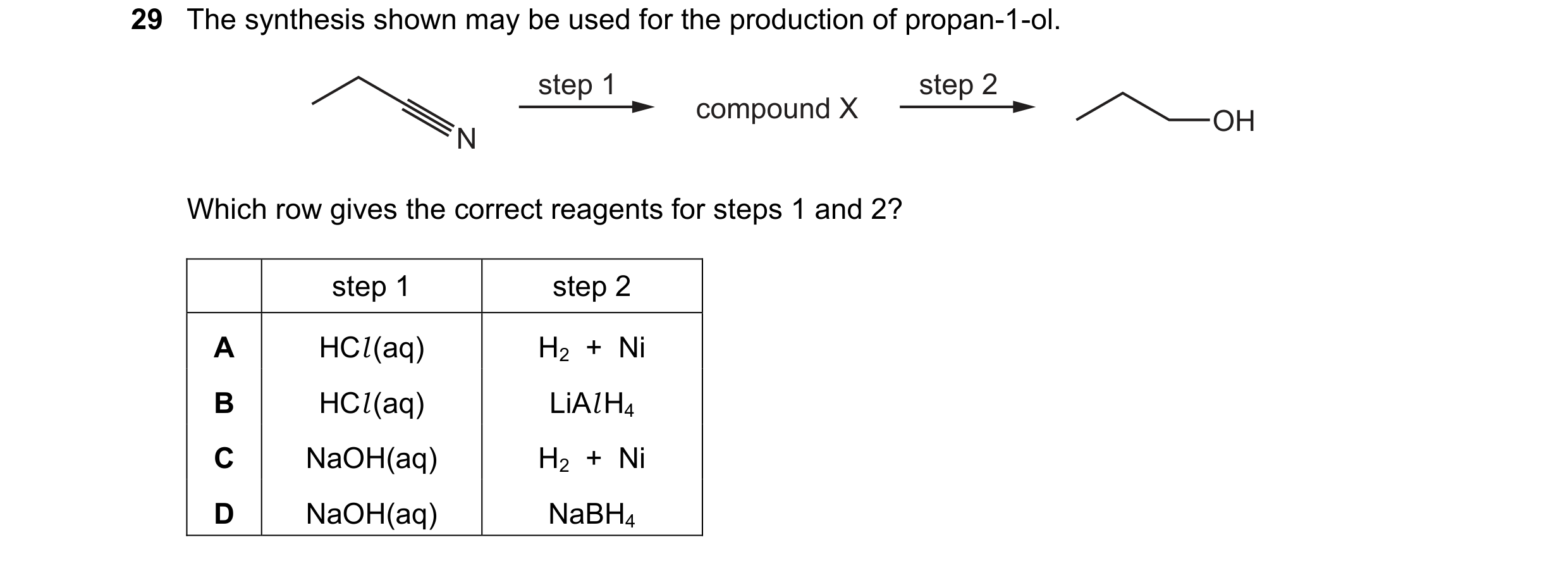
29 The synthesis shown may be used for the production of propan-1-ol. step 1 step 2 compound X OH N Which row gives the correct reagents for steps 1 and 2? step 1 step 2 A HCl (aq) H2 + Ni B HCl (aq) LiAl H4 C NaOH(aq) H2 + Ni D NaOH(aq) NaBH4
1 marks
Answer: B
This question in 9701/12 May/June 2021
Q89 · Which mixtures form a carboxylic acid as one of the products? 9701/12 May/June 2021
40 Which mixtures form a carboxylic acid as one of the products?
O
1 AK + H,SO,(aq) >
O-
2 AK, + H,SO,(aq) >
3 NRA + H80,(aq) >
1 marks
Answer: B
This question in 9701/12 May/June 2021
Q90 · The diagram shows the structure of a compound formed by the reaction of HCN with a… 9701/13 May/June 2021
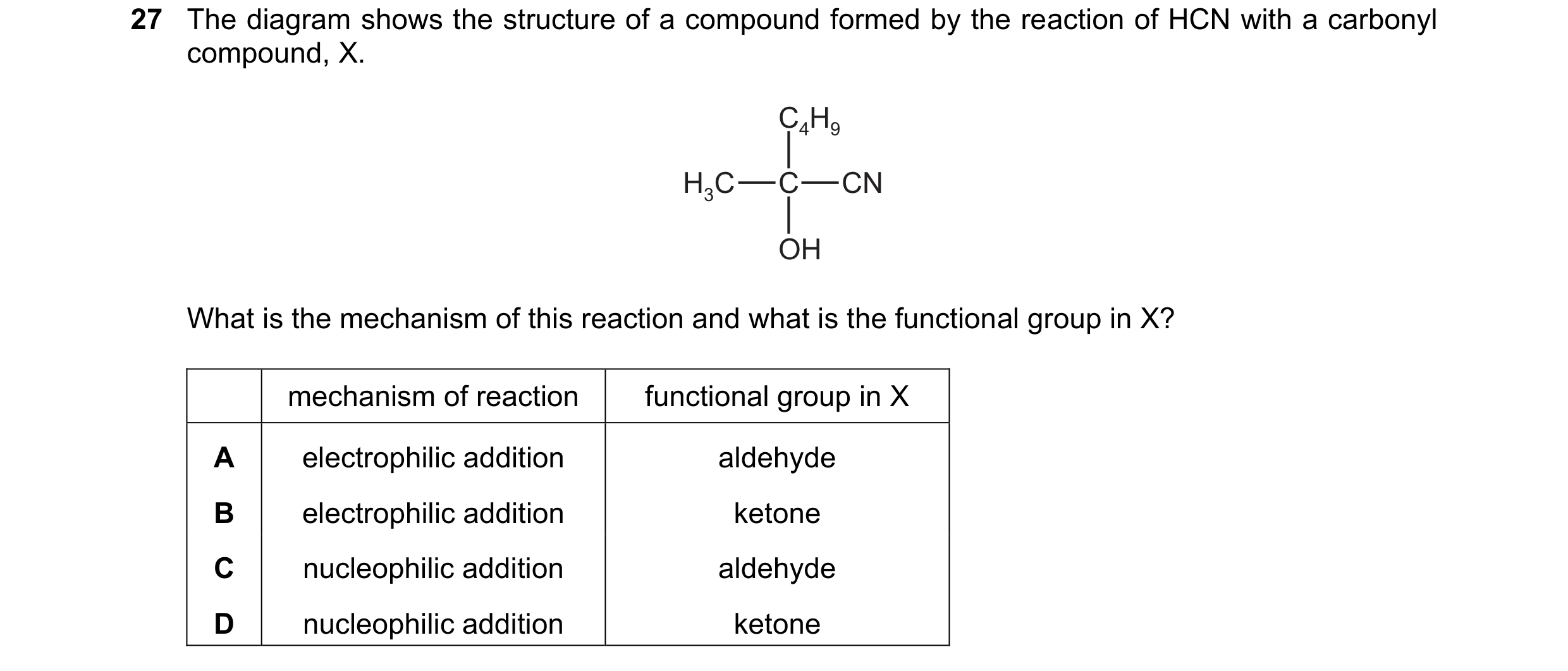
27 The diagram shows the structure of a compound formed by the reaction of HCN with a carbonyl compound, X. C4H9 H3C C CN OH What is the mechanism of this reaction and what is the functional group in X? mechanism of reaction functional group in X A electrophilic addition aldehyde B electrophilic addition ketone C nucleophilic addition aldehyde D nucleophilic addition ketone
1 marks
Answer: D
This question in 9701/13 May/June 2021
Q91 · Compound Y is treated with a single reagent under suitable conditions 9701/13 May/June 2021
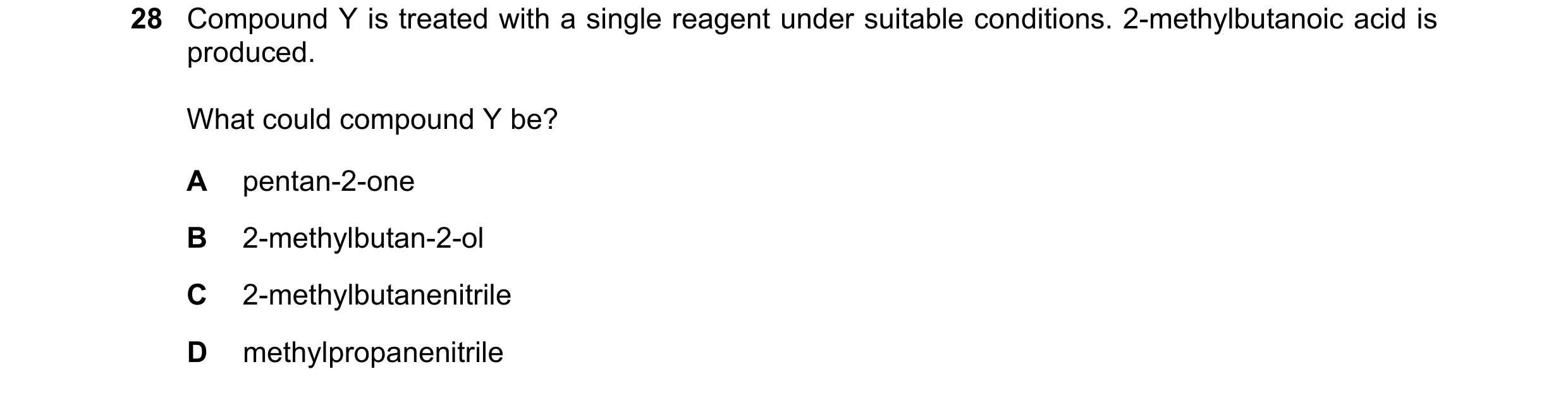
28 Compound Y is treated with a single reagent under suitable conditions. 2-methylbutanoic acid is produced. What could compound Y be? A pentan-2-one B 2-methylbutan-2-ol C 2-methylbutanenitrile D methylpropanenitrile
1 marks
Answer: C
This question in 9701/13 May/June 2021
Q92 · CH3CH2COCH2CH3 reacts with hydrogen cyanide to form an organic product called a… 9701/11 Oct/Nov 2021
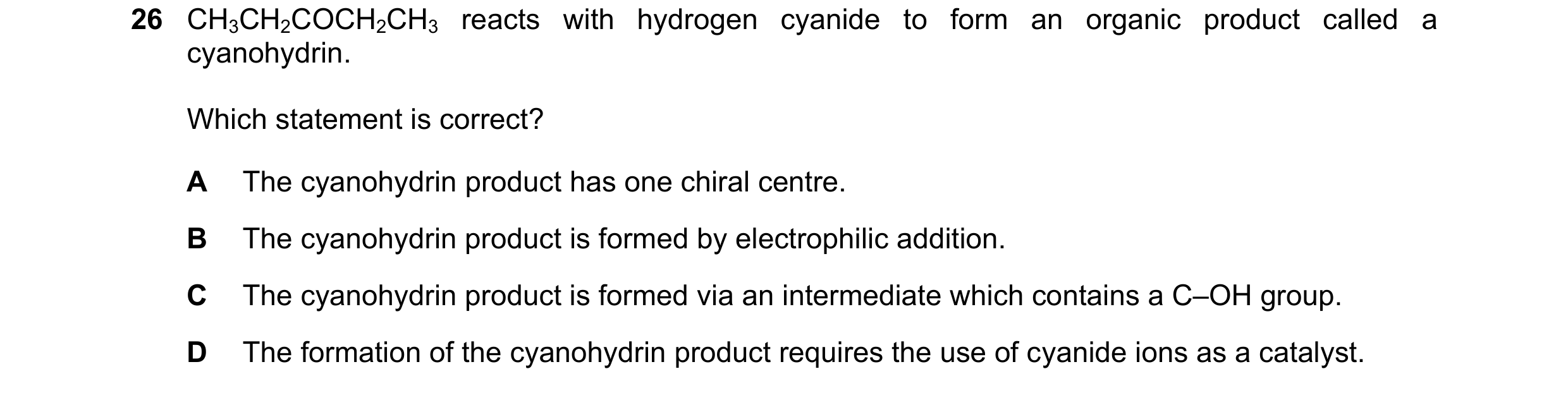
26 CH3CH2COCH2CH3 reacts with hydrogen cyanide to form an organic product called a cyanohydrin. Which statement is correct? A The cyanohydrin product has one chiral centre. B The cyanohydrin product is formed by electrophilic addition. C The cyanohydrin product is formed via an intermediate which contains a C–OH group. D The formation of the cyanohydrin product requires the use of cyanide ions as a catalyst.
1 marks
Answer: D
This question in 9701/11 Oct/Nov 2021
Q93 · Butanoic acid can be made from 1-bromopropane in two stages 9701/12 Oct/Nov 2021
24 Butanoic acid can be made from 1-bromopropane in two stages. stage 1 CH3CH2CH2Br CH3CH2CH2CN stage 2 CH3CH2CH2CN CH3CH2CH2CO2H Which types of reaction are stage 1 and stage 2? stage 1 stage 2 A electrophilic addition hydrolysis B electrophilic addition oxidation C nucleophilic substitution hydrolysis D nucleophilic substitution oxidation
1 marks
Answer: C
This question in 9701/12 Oct/Nov 2021
Q94 · Organic compound Z has an alcohol group and a carboxylic acid group 9701/12 Oct/Nov 2021
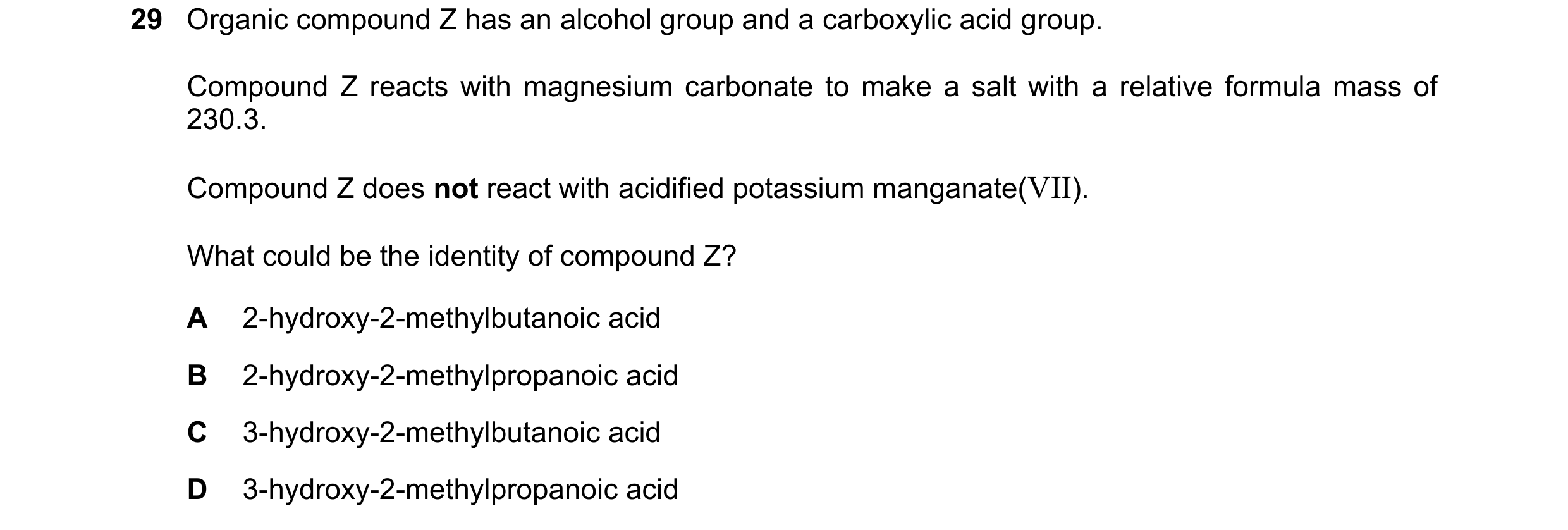
29 Organic compound Z has an alcohol group and a carboxylic acid group. Compound Z reacts with magnesium carbonate to make a salt with a relative formula mass of 230.3. Compound Z does not react with acidified potassium manganate(VII). What could be the identity of compound Z? A 2-hydroxy-2-methylbutanoic acid B 2-hydroxy-2-methylpropanoic acid C 3-hydroxy-2-methylbutanoic acid D 3-hydroxy-2-methylpropanoic acid
1 marks
Answer: B
This question in 9701/12 Oct/Nov 2021
Q95 · Which of the reactions give products containing a chiral centre? 9701/12 Oct/Nov 2021
39 Which of the reactions give products containing a chiral centre? 1 CH2(OH)COCO2H + an excess of HCN 2 CH2(OH)COCO2H + an excess of NaBH4 3 CH2(OH)COCO2H + an excess of LiAl H4
1 marks
Answer: B
This question in 9701/12 Oct/Nov 2021
Q96 · CH3CH2COCH2CH3 reacts with hydrogen cyanide to form an organic product called a… 9701/13 Oct/Nov 2021
26 CH3CH2COCH2CH3 reacts with hydrogen cyanide to form an organic product called a cyanohydrin. Which statement is correct? A The cyanohydrin product has one chiral centre. B The cyanohydrin product is formed by electrophilic addition. C The cyanohydrin product is formed via an intermediate which contains a C–OH group. D The formation of the cyanohydrin product requires the use of cyanide ions as a catalyst.
1 marks
Answer: D
This question in 9701/13 Oct/Nov 2021
Q97 · Ethanol can be used to make propanenitrile in two steps 9701/11 May/June 2022
26 Ethanol can be used to make propanenitrile in two steps. X Y CH3CH2OH CH3CH2Br CH3CH2CN What types of reaction are X and Y? X Y A free-radical substitution electrophilic substitution B free-radical substitution nucleophilic substitution C nucleophilic substitution nucleophilic substitution D nucleophilic substitution electrophilic substitution
1 marks
Answer: C
This question in 9701/11 May/June 2022
Q98 · A carbonyl compound, X, reacts with HCN in the presence of NaCN to make a compound with… 9701/11 May/June 2022
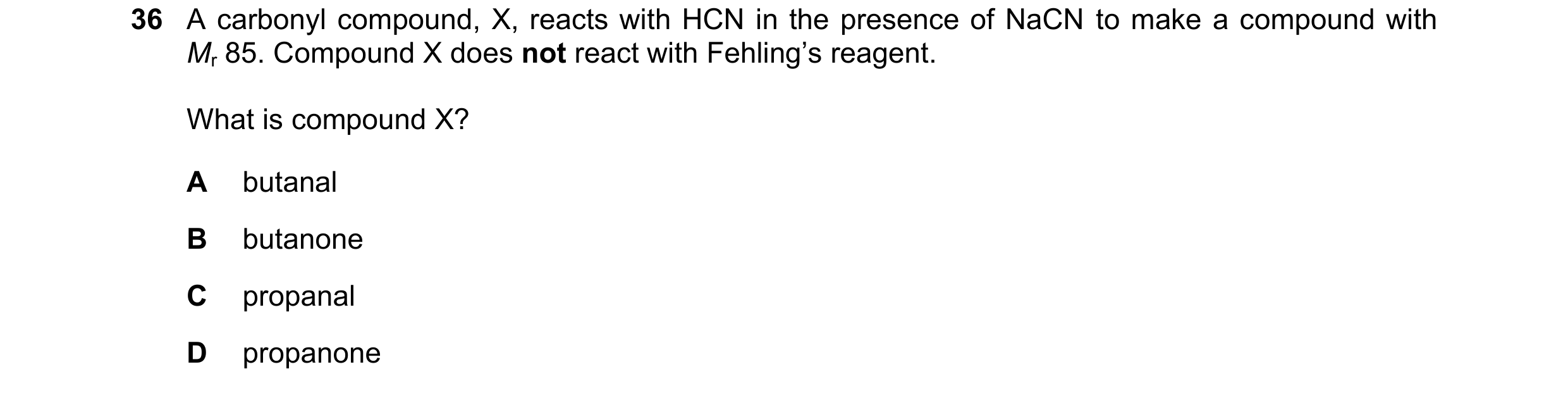
36 A carbonyl compound, X, reacts with HCN in the presence of NaCN to make a compound with Mr 85. Compound X does not react with Fehling’s reagent. What is compound X? A butanal B butanone C propanal D propanone
1 marks
Answer: D
This question in 9701/11 May/June 2022
Q99 · Which reaction has a nucleophilic addition mechanism and gives a good yield of product… 9701/13 May/June 2022
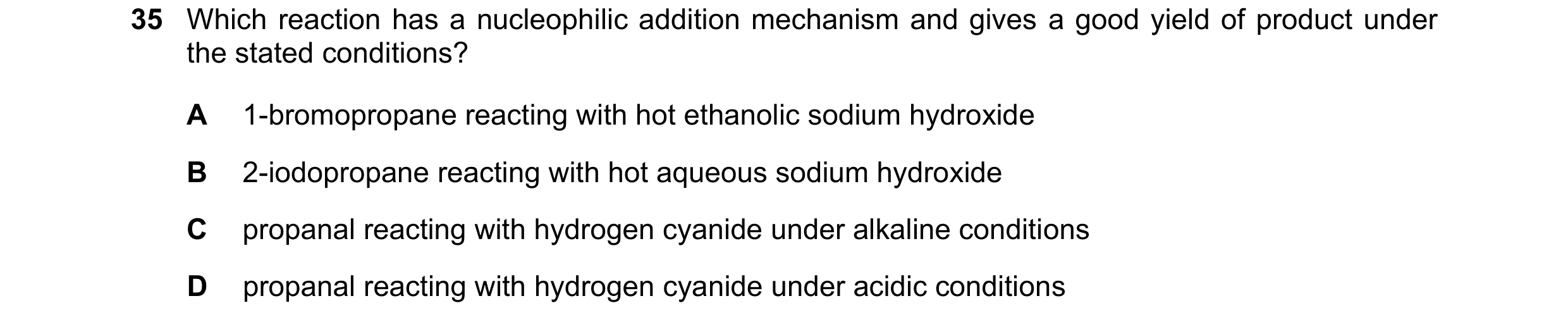
35 Which reaction has a nucleophilic addition mechanism and gives a good yield of product under the stated conditions? A 1-bromopropane reacting with hot ethanolic sodium hydroxide B 2-iodopropane reacting with hot aqueous sodium hydroxide C propanal reacting with hydrogen cyanide under alkaline conditions D propanal reacting with hydrogen cyanide under acidic conditions
1 marks
Answer: C
This question in 9701/13 May/June 2022
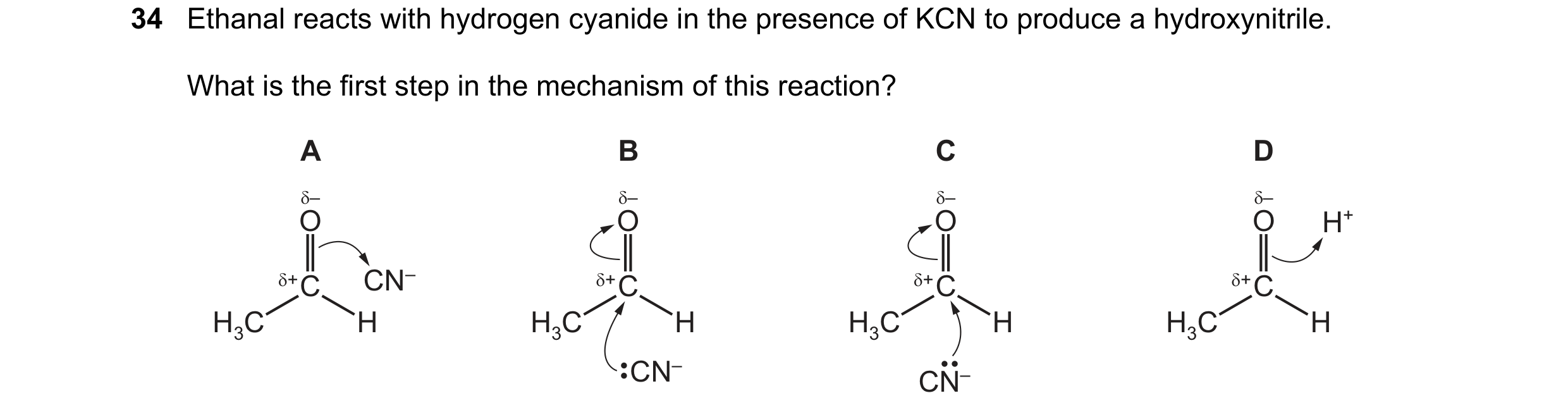
Q100 · Ethanal reacts with hydrogen cyanide in the presence of KCN to produce a hydroxynitrile 9701/11 Oct/Nov 2022
34 Ethanal reacts with hydrogen cyanide in the presence of KCN to produce a hydroxynitrile.
What is the first step in the mechanism of this reaction?
A B c D
0 0 0 0
H*
In, Cl C| |“
st+C ~=CN sC aC tC
H,cC~ H H.07/ ™“H H,c~ oH H,cC~ H
2CN- chi
1 marks
Answer: B
This question in 9701/11 Oct/Nov 2022
Q101 · Which mechanism describes the reaction of aldehydes and ketones with HCN + NaCN? 9701/12 Oct/Nov 2022
36 Which mechanism describes the reaction of aldehydes and ketones with HCN + NaCN? A electrophilic addition B electrophilic substitution C nucleophilic addition D nucleophilic substitution
1 marks
Answer: C
This question in 9701/12 Oct/Nov 2022
Q102 · Propyl propanoate can be synthesised in three steps using propanenitrile as the only… 9701/12 Oct/Nov 2022
37 Propyl propanoate can be synthesised in three steps using propanenitrile as the only organic starting material. In step 1, the nitrile is converted into compound X. In step 2, compound X is converted into compound Y. In step 3, compound Y is reacted with more of compound X to give propyl propanoate. step 1 step 2 step 3 CH3CH2CN X Y CH3CH2CO2CH2CH2CH3 Which reagents are suitable for carrying out step 1 and step 2? step 1 step 2 A HCl (aq) conc. H2SO4 B HCl (aq) LiAl H4 C NaOH(aq) conc. H2SO4 D NaOH(aq) NaBH4
1 marks
Answer: B
This question in 9701/12 Oct/Nov 2022
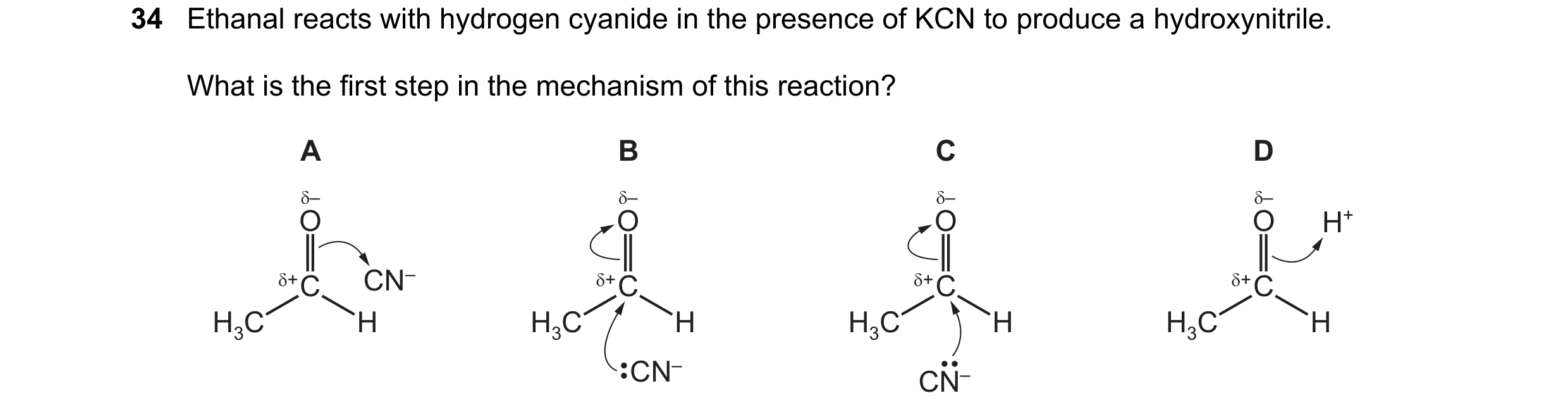
Q103 · Ethanal reacts with hydrogen cyanide in the presence of KCN to produce a hydroxynitrile 9701/13 Oct/Nov 2022
34 Ethanal reacts with hydrogen cyanide in the presence of KCN to produce a hydroxynitrile.
What is the first step in the mechanism of this reaction?
A B c D
0 0 0 0
H*
In, Cl C| |“
st+C ~=CN sC aC tC
H,cC~ H H.07/ ™“H H,c~ oH H,cC~ H
2CN- chi
1 marks
Answer: B
This question in 9701/13 Oct/Nov 2022
Q104 · Which reagents and conditions would result in the formation of butanenitrile, CH3CH2CH2CN? 9701/12 Feb/March 2023
26 Which reagents and conditions would result in the formation of butanenitrile, CH3CH2CH2CN? A 1-bromobutane heated under pressure with ammonia in ethanol B 1-bromopropane heated with potassium cyanide in ethanol C propanal heated with hydrogen cyanide in the presence of potassium cyanide D propanone heated with hydrogen cyanide in the presence of potassium cyanide
1 marks
Answer: B
This question in 9701/12 Feb/March 2023
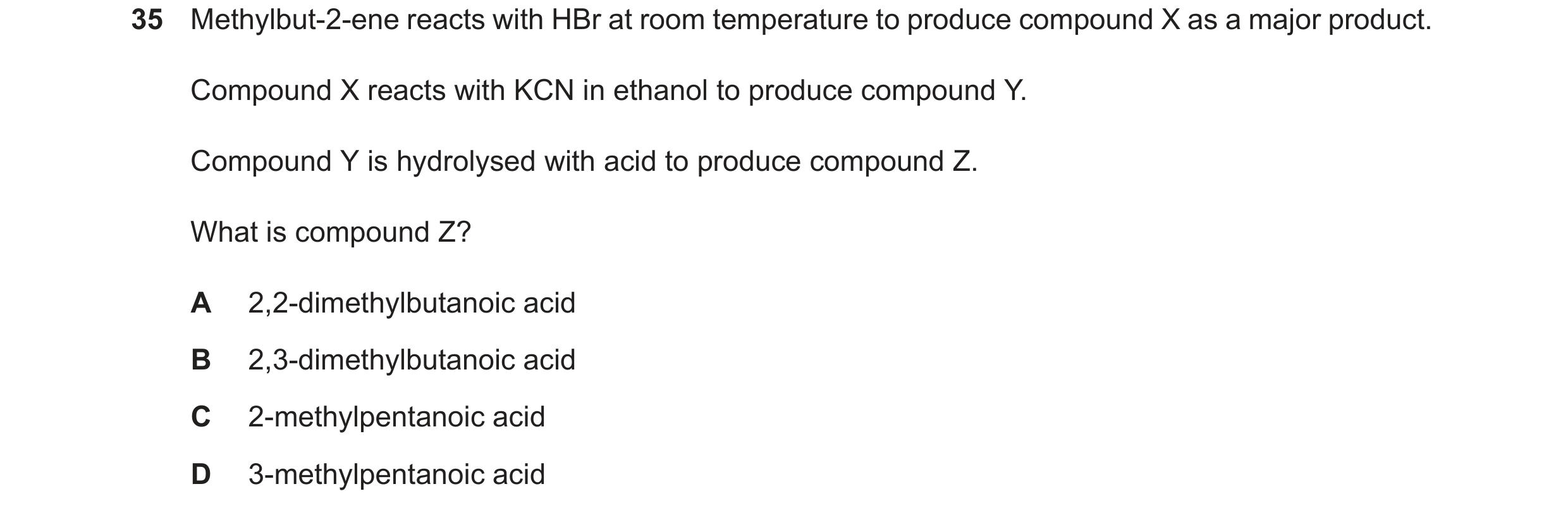
Q105 · Methylbut-2-ene reacts with HBr at room temperature to produce compound X as a major… 9701/13 May/June 2023
35 Methylbut-2-ene reacts with HBr at room temperature to produce compound X as a major product. Compound X reacts with KCN in ethanol to produce compound Y. Compound Y is hydrolysed with acid to produce compound Z. What is compound Z? A 2,2-dimethylbutanoic acid B 2,3-dimethylbutanoic acid C 2-methylpentanoic acid D 3-methylpentanoic acid
1 marks
Answer: A
This question in 9701/13 May/June 2023
Q106 · Propanoic acid can be made from bromoethane using a two-stage synthesis 9701/11 Oct/Nov 2023
32 Propanoic acid can be made from bromoethane using a two-stage synthesis. Which pair of reagents is most suitable? reagent for stage 1 reagent for stage 2 A hydrogen cyanide aqueous sodium hydroxide B aqueous sodium hydroxide excess acidified potassium dichromate(VI) C ethanolic sodium hydroxide acidified potassium manganate(VII) D potassium cyanide dilute hydrochloric acid
1 marks
Answer: D
This question in 9701/11 Oct/Nov 2023
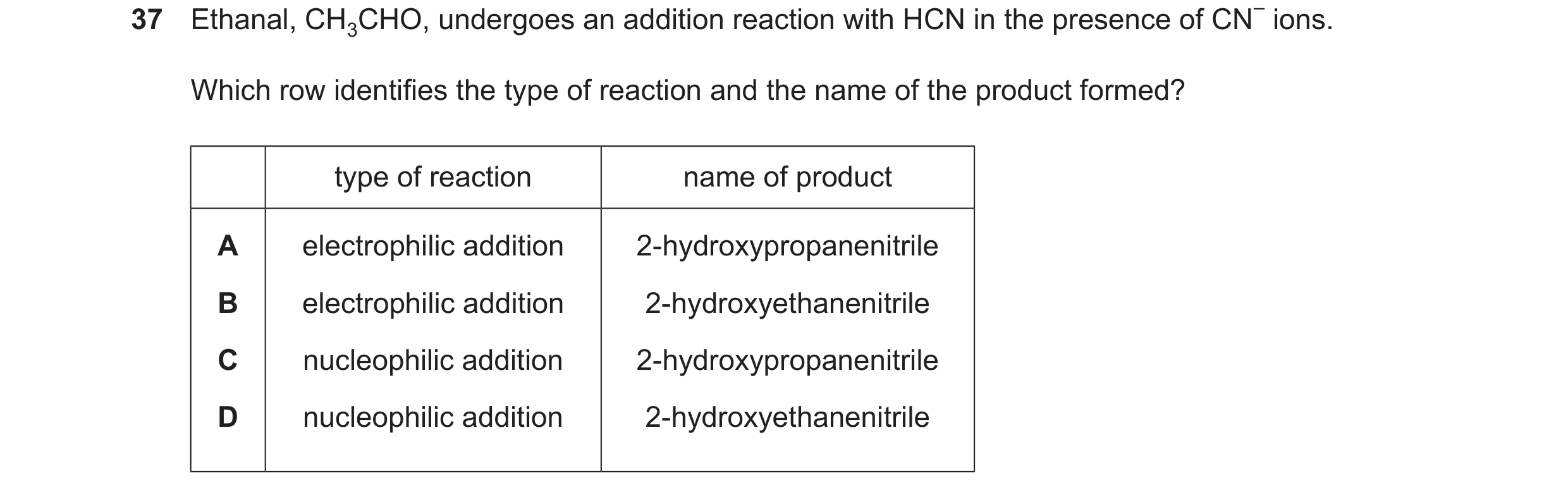
Q107 · Which row identifies the type of reaction and the name of the product formed? 9701/11 Oct/Nov 2023
37 Which row identifies the type of reaction and the name of the product formed? type of reaction name of product A electrophilic addition 2-hydroxypropanenitrile B electrophilic addition 2-hydroxyethanenitrile C nucleophilic addition 2-hydroxypropanenitrile D nucleophilic addition 2-hydroxyethanenitrile
1 marks
Answer: C
This question in 9701/11 Oct/Nov 2023
Q108 · Which reaction takes place by a nucleophilic addition mechanism? 9701/12 Oct/Nov 2023
36 Which reaction takes place by a nucleophilic addition mechanism? A propene reacting with hydrogen bromide B 2-bromopropane reacting with sodium hydroxide in ethanol C propanone reacting with hydrogen cyanide D methane reacting with chlorine
1 marks
Answer: C
This question in 9701/12 Oct/Nov 2023
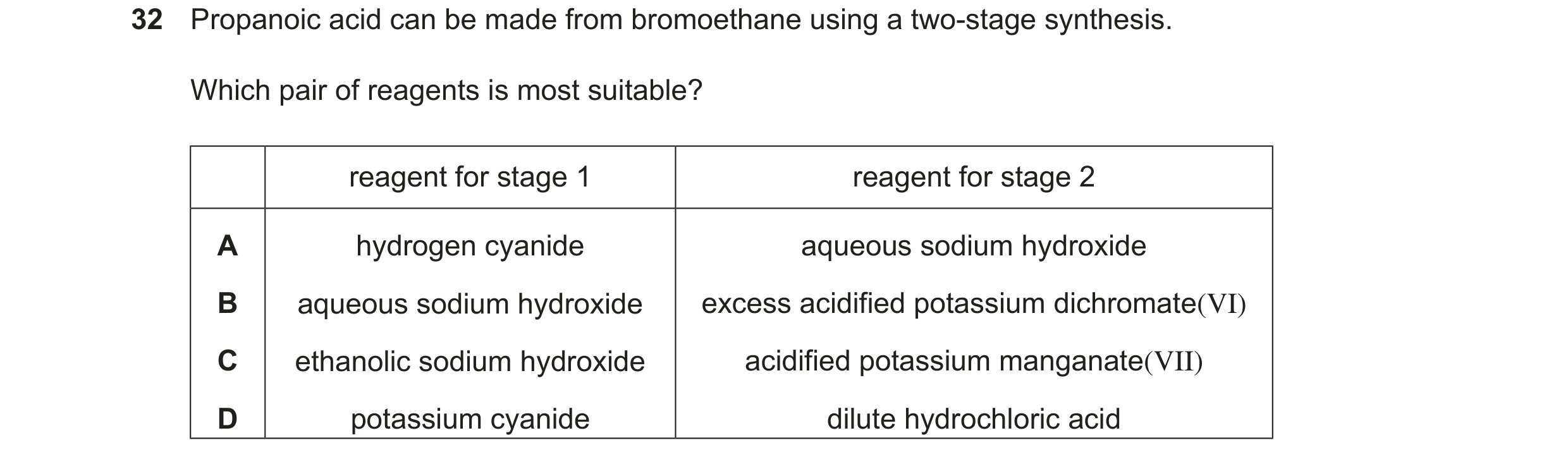
Q109 · Propanoic acid can be made from bromoethane using a two-stage synthesis 9701/13 Oct/Nov 2023
32 Propanoic acid can be made from bromoethane using a two-stage synthesis. Which pair of reagents is most suitable? reagent for stage 1 reagent for stage 2 A hydrogen cyanide aqueous sodium hydroxide B aqueous sodium hydroxide excess acidified potassium dichromate(VI) C ethanolic sodium hydroxide acidified potassium manganate(VII) D potassium cyanide dilute hydrochloric acid
1 marks
Answer: D
This question in 9701/13 Oct/Nov 2023
Q110 · Which row identifies the type of reaction and the name of the product formed? 9701/13 Oct/Nov 2023
37 Which row identifies the type of reaction and the name of the product formed? type of reaction name of product A electrophilic addition 2-hydroxypropanenitrile B electrophilic addition 2-hydroxyethanenitrile C nucleophilic addition 2-hydroxypropanenitrile D nucleophilic addition 2-hydroxyethanenitrile
1 marks
Answer: C
This question in 9701/13 Oct/Nov 2023
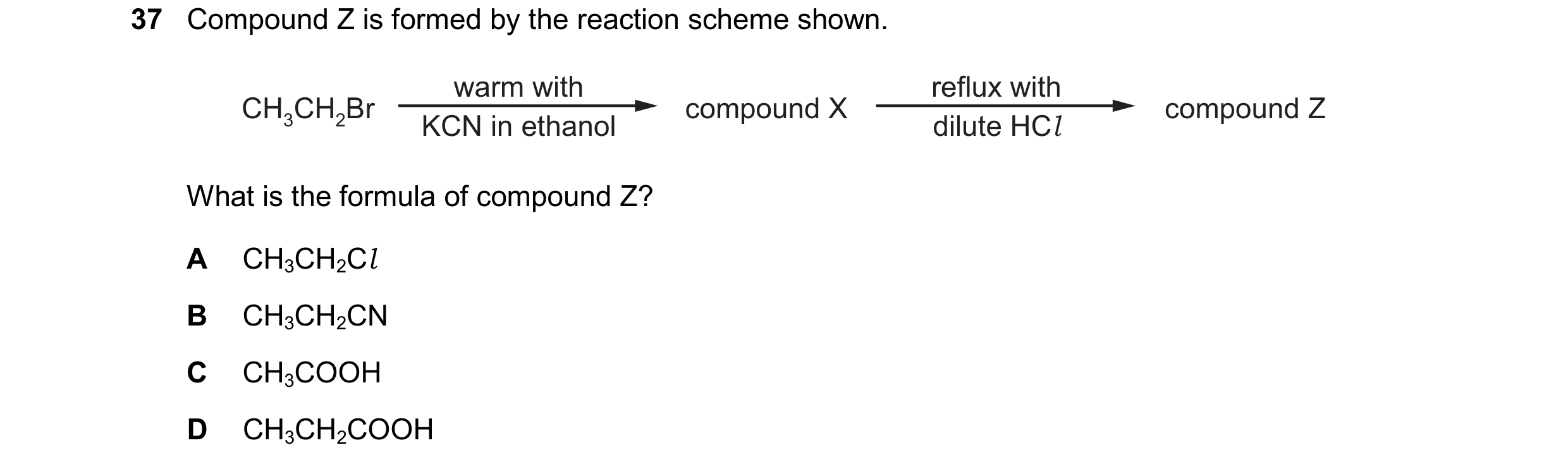
Q111 · Compound Z is formed by the reaction scheme shown 9701/12 Feb/March 2024
37 Compound Z is formed by the reaction scheme shown. warm with reflux with CH3CH2Br compound X compound Z KCN in ethanol dilute HCl What is the formula of compound Z? A CH3CH2Cl B CH3CH2CN C CH3COOH D CH3CH2COOH
1 marks
Answer: D
This question in 9701/12 Feb/March 2024
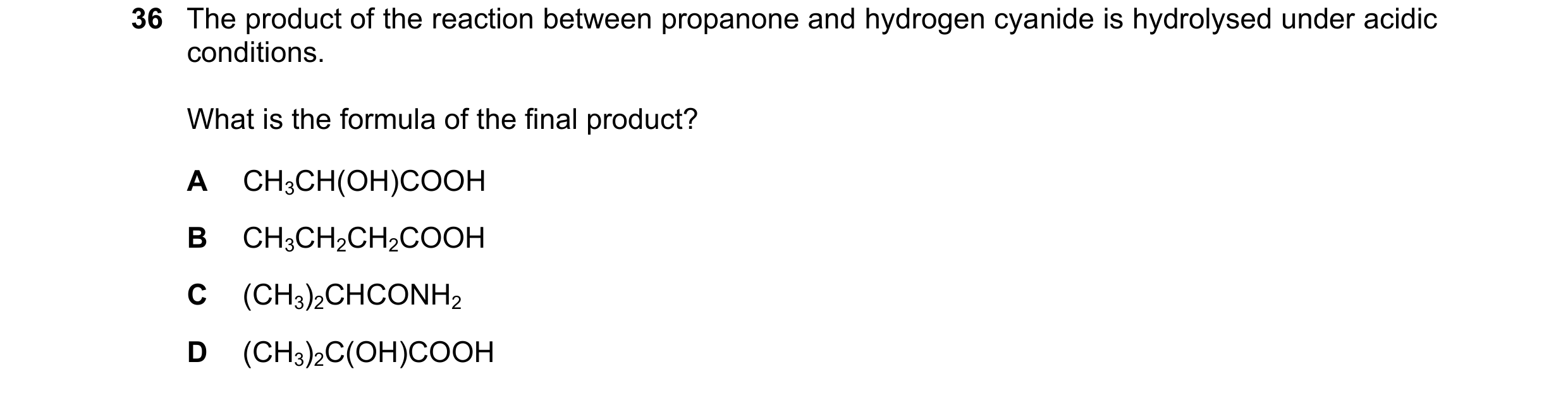
Q112 · The product of the reaction between propanone and hydrogen cyanide is hydrolysed under… 9701/11 May/June 2024
36 The product of the reaction between propanone and hydrogen cyanide is hydrolysed under acidic conditions. What is the formula of the final product? A CH3CH(OH)COOH B CH3CH2CH2COOH C (CH3)2CHCONH2 D (CH3)2C(OH)COOH
1 marks
Answer: D
This question in 9701/11 May/June 2024
Q113 · Which pair of reagents reacts to form a product with a chiral carbon atom? 9701/12 May/June 2024
37 Which pair of reagents reacts to form a product with a chiral carbon atom? A CH3CH=CH2 + HBr B (CH3)2C=O + NaBH4 C CH3CH2CHO + HCN D CH3COOH + CH3CH2OH
1 marks
Answer: C
This question in 9701/12 May/June 2024
Q114 · Chloroethane can be used to make sodium propanoate 9701/13 May/June 2024
31 Chloroethane can be used to make sodium propanoate. chloroethane intermediate Q sodium propanoate Intermediate Q is hydrolysed with boiling aqueous NaOH to give sodium propanoate. Which reagent would produce intermediate Q from chloroethane? A concentrated ammonia solution B dilute sulfuric acid C hydrogen cyanide in water D potassium cyanide in ethanol
1 marks
Answer: D
This question in 9701/13 May/June 2024
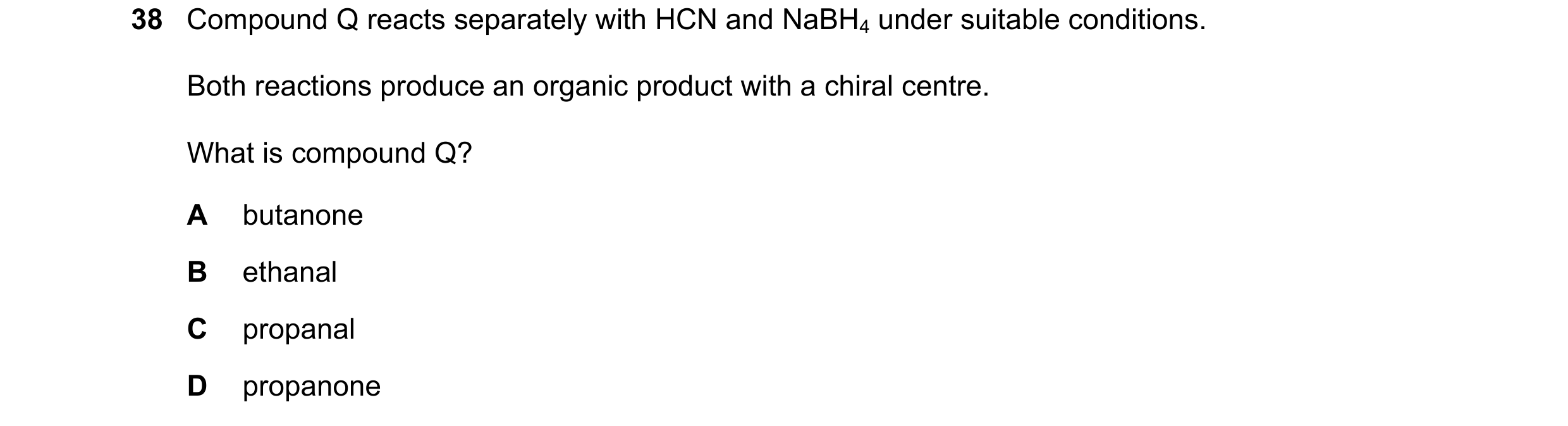
Q115 · Compound Q reacts separately with HCN and NaBH4 under suitable conditions 9701/13 May/June 2024
38 Compound Q reacts separately with HCN and NaBH4 under suitable conditions. Both reactions produce an organic product with a chiral centre. What is compound Q? A butanone B ethanal C propanal D propanone
1 marks
Answer: A
This question in 9701/13 May/June 2024
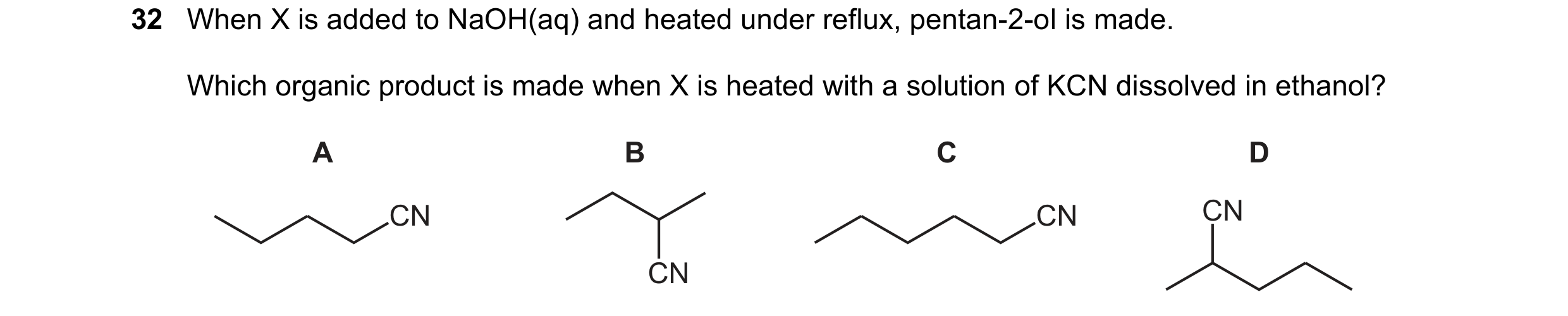
Q116 · When X is added to NaOH(aq) and heated under reflux, pentan-2-ol is made 9701/11 Oct/Nov 2024
32 When X is added to NaOH(aq) and heated under reflux, pentan-2-ol is made. Which organic product is made when X is heated with a solution of KCN dissolved in ethanol? A B C D CN CN CN CN
1 marks
Answer: D
This question in 9701/11 Oct/Nov 2024
Q117 · Which compound, on reaction with hydrogen cyanide, produces a compound with a chiral… 9701/11 Oct/Nov 2024
36 Which compound, on reaction with hydrogen cyanide, produces a compound with a chiral centre? A CH3CHO B CH3CH2COCH2CH3 C CH3CO2CH3 D HCHO
1 marks
Answer: A
This question in 9701/11 Oct/Nov 2024
Q118 · (CH3)3CCN reacts to form alcohol Y via the reaction sequence shown 9701/11 Oct/Nov 2024
38 (CH3)3CCN reacts to form alcohol Y via the reaction sequence shown. H+(aq) LiAl H4 (CH3)3CCN X alcohol Y reaction 1 reaction 2 Which row names the molecule X and the class of alcohol Y? name of molecule X class of alcohol Y A 2,2-dimethylbutanoic acid primary B 3,3-dimethylbutanoic acid tertiary C dimethylpropanoic acid primary D dimethylpropanoic acid tertiary
1 marks
Answer: C
This question in 9701/11 Oct/Nov 2024
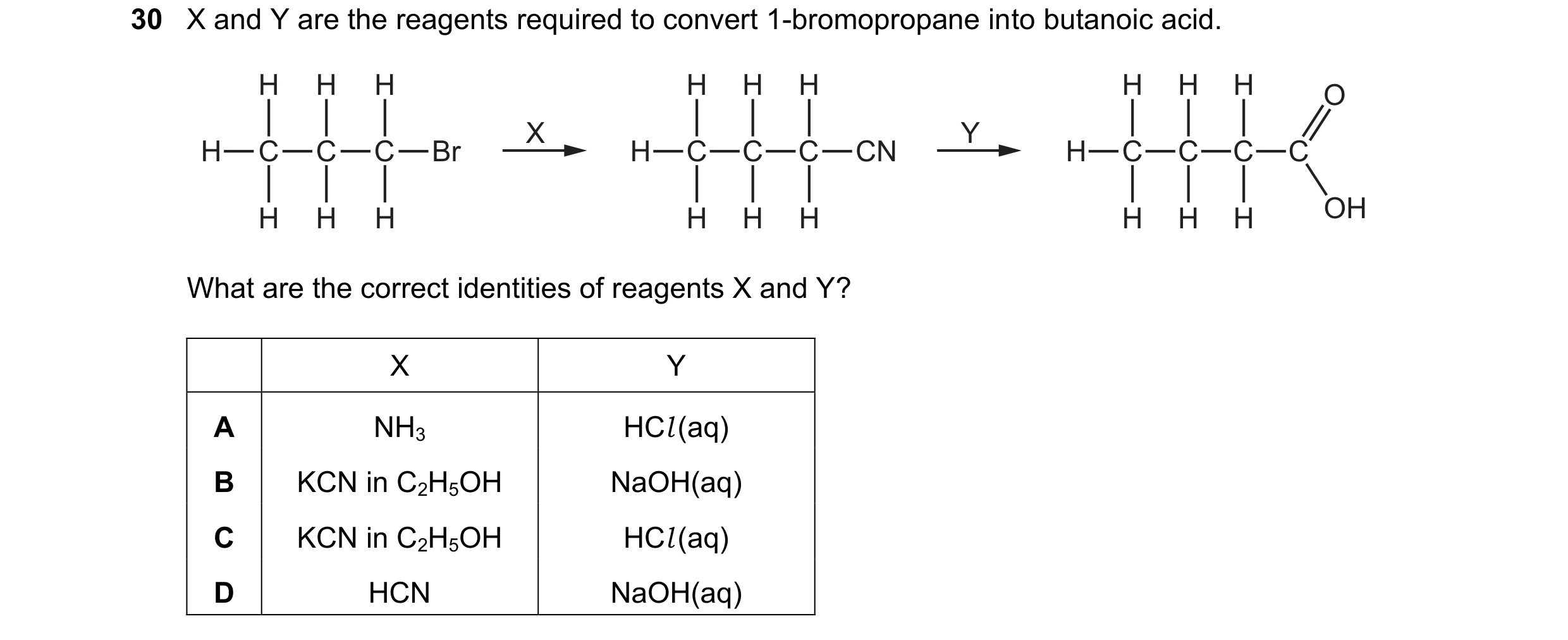
Q119 · X and Y are the reagents required to convert 1-bromopropane into butanoic acid 9701/12 Oct/Nov 2024
30 X and Y are the reagents required to convert 1-bromopropane into butanoic acid. H H H H H H H H H O X Y H C C C Br H C C C CN H C C C C H H H H H H H H H OH What are the correct identities of reagents X and Y? X Y A NH3 HCl (aq) B KCN in C2H5OH NaOH(aq) C KCN in C2H5OH HCl (aq) D HCN NaOH(aq)
1 marks
Answer: C
This question in 9701/12 Oct/Nov 2024
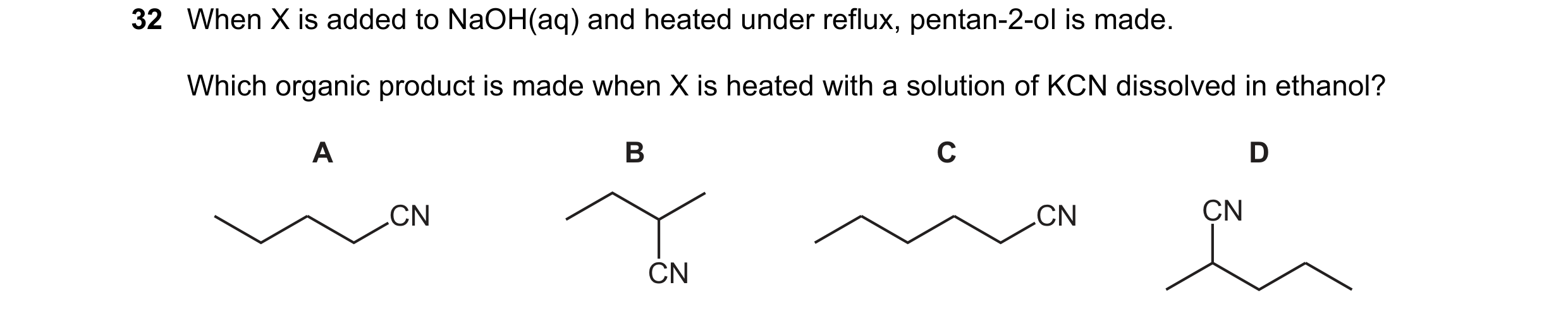
Q120 · When X is added to NaOH(aq) and heated under reflux, pentan-2-ol is made 9701/13 Oct/Nov 2024
32 When X is added to NaOH(aq) and heated under reflux, pentan-2-ol is made. Which organic product is made when X is heated with a solution of KCN dissolved in ethanol? A B C D CN CN CN CN
1 marks
Answer: D
This question in 9701/13 Oct/Nov 2024
Q121 · Which compound, on reaction with hydrogen cyanide, produces a compound with a chiral… 9701/13 Oct/Nov 2024
36 Which compound, on reaction with hydrogen cyanide, produces a compound with a chiral centre? A CH3CHO B CH3CH2COCH2CH3 C CH3CO2CH3 D HCHO
1 marks
Answer: A
This question in 9701/13 Oct/Nov 2024
Q122 · (CH3)3CCN reacts to form alcohol Y via the reaction sequence shown 9701/13 Oct/Nov 2024
38 (CH3)3CCN reacts to form alcohol Y via the reaction sequence shown. H+(aq) LiAl H4 (CH3)3CCN X alcohol Y reaction 1 reaction 2 Which row names the molecule X and the class of alcohol Y? name of molecule X class of alcohol Y A 2,2-dimethylbutanoic acid primary B 3,3-dimethylbutanoic acid tertiary C dimethylpropanoic acid primary D dimethylpropanoic acid tertiary
1 marks
Answer: C
This question in 9701/13 Oct/Nov 2024
Q123 · What is the mechanism of the reaction of hydrogen cyanide with propanone? 9701/12 Feb/March 2025
27 What is the mechanism of the reaction of hydrogen cyanide with propanone? A electrophilic addition B electrophilic substitution C nucleophilic addition D nucleophilic substitution
1 marks
Answer: C
This question in 9701/12 Feb/March 2025
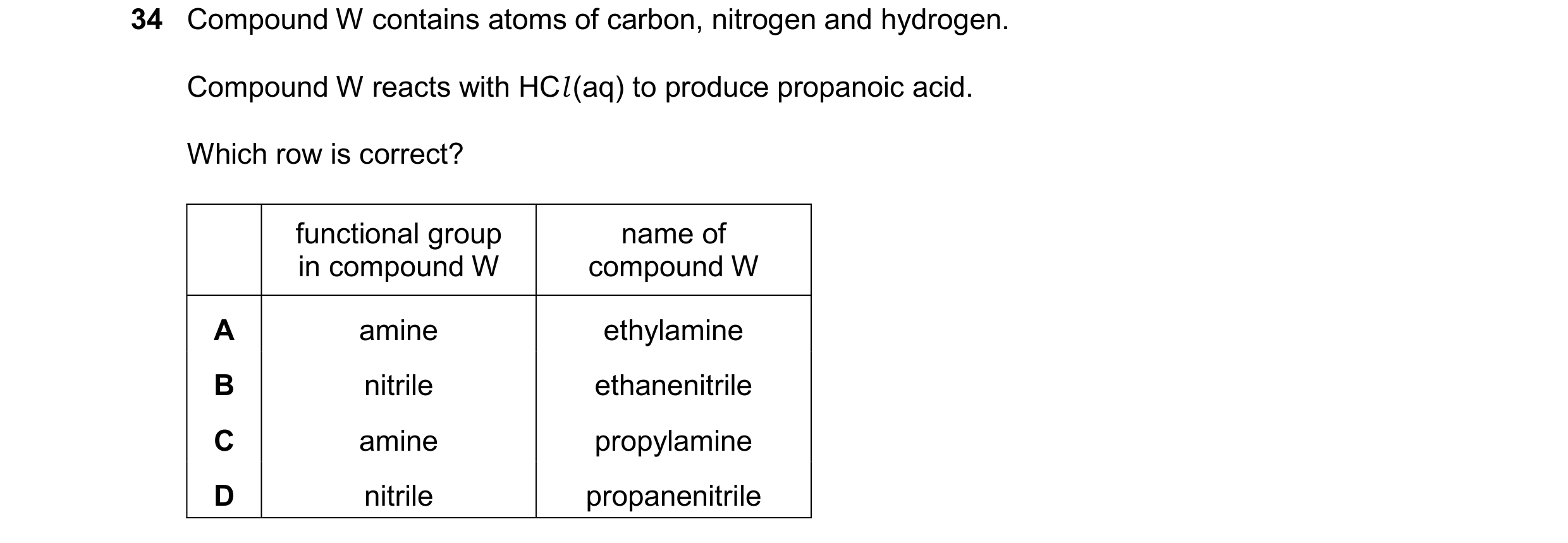
Q124 · Compound W contains atoms of carbon, nitrogen and hydrogen 9701/11 May/June 2025
34 Compound W contains atoms of carbon, nitrogen and hydrogen. Compound W reacts with HCl(aq) to produce propanoic acid. Which row is correct? functional group in compound W name of compound W A amine ethylamine B nitrile ethanenitrile C amine propylamine D nitrile propanenitrile
1 marks
Answer: D
This question in 9701/11 May/June 2025
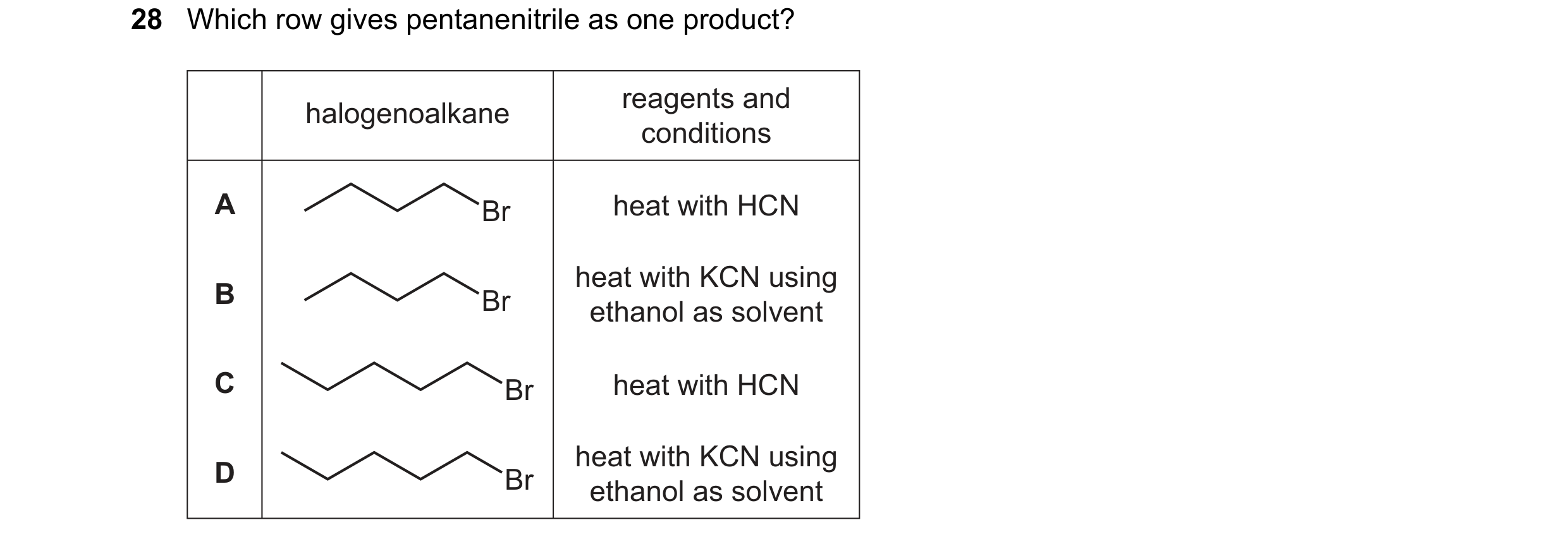
Q125 · Which row gives pentanenitrile as one product? 9701/12 May/June 2025
28 Which row gives pentanenitrile as one product? reagents and halogenoalkane conditions A heat with HCN Br B heat with KCN using Br ethanol as solvent C heat with HCN Br D heat with KCN using Br ethanol as solvent
1 marks
Answer: B
This question in 9701/12 May/June 2025
Q126 · 0.200mol ethanenitrile reacts with an excess of dilute sodium hydroxide 9701/13 May/June 2025
26 0.200mol ethanenitrile reacts with an excess of dilute sodium hydroxide. The reaction produces organic compound S and ammonia gas only. The reaction has an 80.0% yield. Which mass of S is produced? A 9.60g B 13.1g C 15.4g D 16.4g
1 marks
Answer: B
This question in 9701/13 May/June 2025
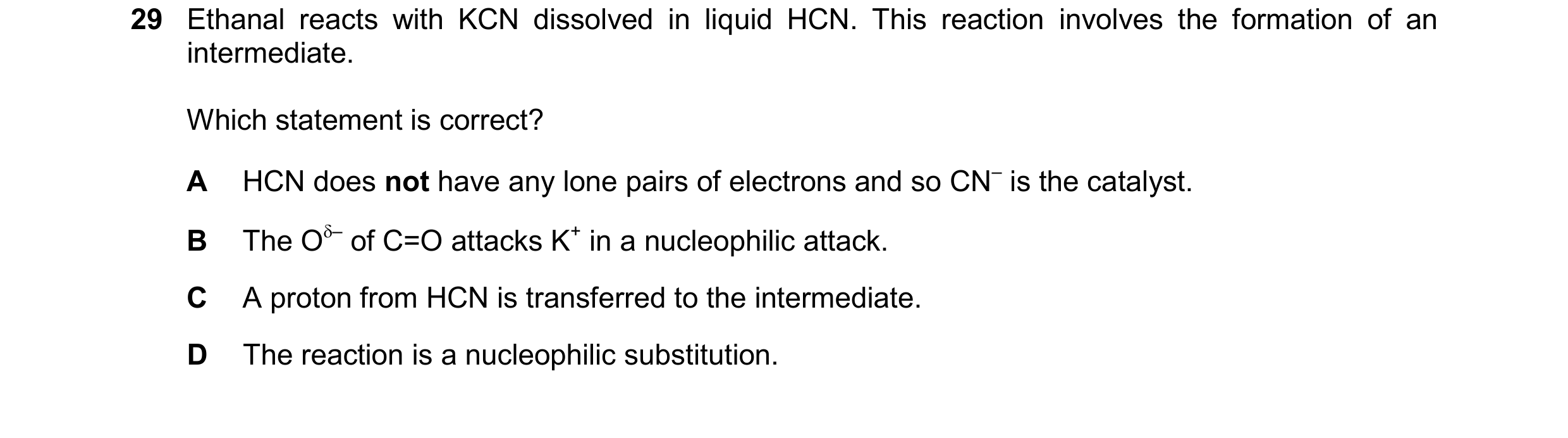
Q127 · Ethanal reacts with KCN dissolved in liquid HCN 9701/13 May/June 2025
29 Ethanal reacts with KCN dissolved in liquid HCN. This reaction involves the formation of an intermediate. Which statement is correct? A HCN does not have any lone pairs of electrons and so CN– is the catalyst. B The O– of C=O attacks K+ in a nucleophilic attack. C A proton from HCN is transferred to the intermediate. D The reaction is a nucleophilic substitution.
1 marks
Answer: C
This question in 9701/13 May/June 2025
Q128 · The reaction shown can be used to lengthen a carbon chain 9701/13 May/June 2025
34 The reaction shown can be used to lengthen a carbon chain. CH3CH2CH2Br + CN– CH3CH2CH2CN + Br– Which row shows the correct reagent and conditions for this reaction? reagent conditions A KCN heat under reflux in dilute sulfuric acid B KCN heat under reflux in ethanol C HCN heat under reflux in dilute sulfuric acid D HCN heat under reflux in ethanol
1 marks
Answer: B
This question in 9701/13 May/June 2025
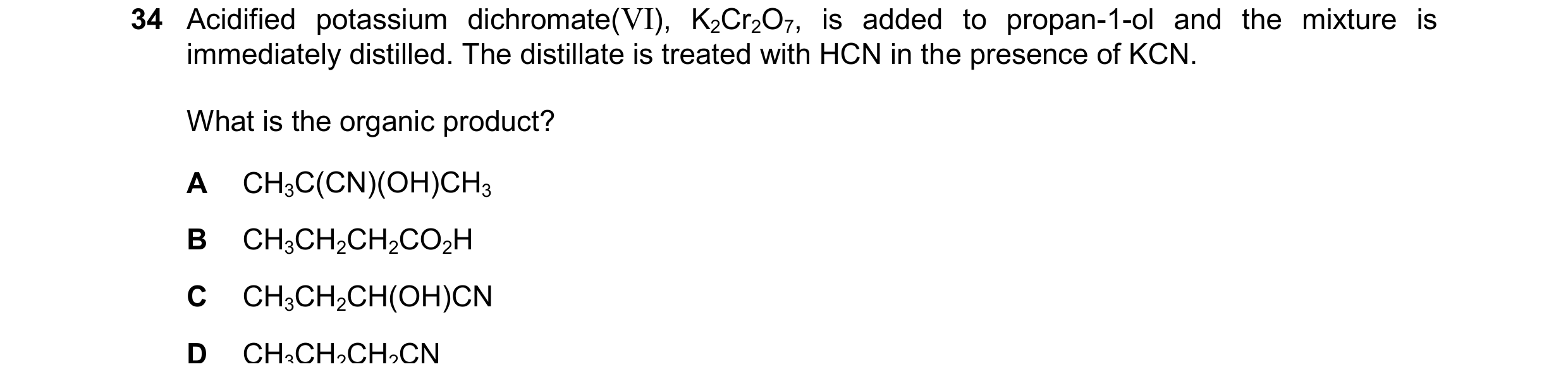
Q129 · Acidified potassium dichromate(VI), K2Cr2O7, is added to propan-1-ol and the mixture is… 9701/14 May/June 2025
34 Acidified potassium dichromate(VI), K2Cr2O7, is added to propan-1-ol and the mixture is immediately distilled. The distillate is treated with HCN in the presence of KCN. What is the organic product? A CH3C(CN)(OH)CH3 B CH3CH2CH2CO2H C CH3CH2CH(OH)CN D CH3CH2CH2CN
1 marks
Answer: C
This question in 9701/14 May/June 2025
Q130 · Separate samples of 1-bromopropane are used in two different reactions 9701/14 May/June 2025
38 Separate samples of 1-bromopropane are used in two different reactions. reaction 1 1-bromopropane is converted into compound X by heating it under pressure with ammonia in ethanol. reaction 2 1-bromopropane is converted into compound Y. Compound Y undergoes hydrolysis to form butanoic acid. Which row identifies compound X and describes the reagents used in reaction 2 to make compound Y? identity of compound X reagents for reaction 2 A CH3CH2CH2NH2 HCN(aq) B CH3CH2CH2NH2 KCN dissolved in ethanol C CH3CH2CH2OH HCN(aq) D CH3CH2CH2OH KCN dissolved in ethanol
1 marks
Answer: B
This question in 9701/14 May/June 2025
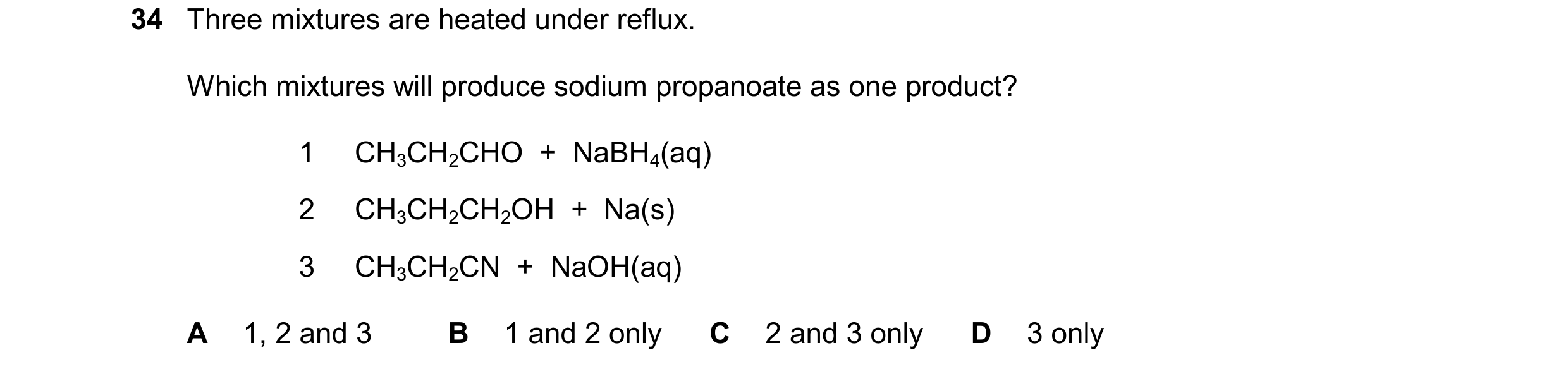
Q131 · Three mixtures are heated under reflux 9701/11 Oct/Nov 2025
34 Three mixtures are heated under reflux. Which mixtures will produce sodium propanoate as one product? 1 CH3CH2CHO + NaBH4(aq) 2 CH3CH2CH2OH + Na(s) 3 CH3CH2CN + NaOH(aq) A 1, 2 and 3 B 1 and 2 only C 2 and 3 only D 3 only
1 marks
Answer: D
This question in 9701/11 Oct/Nov 2025
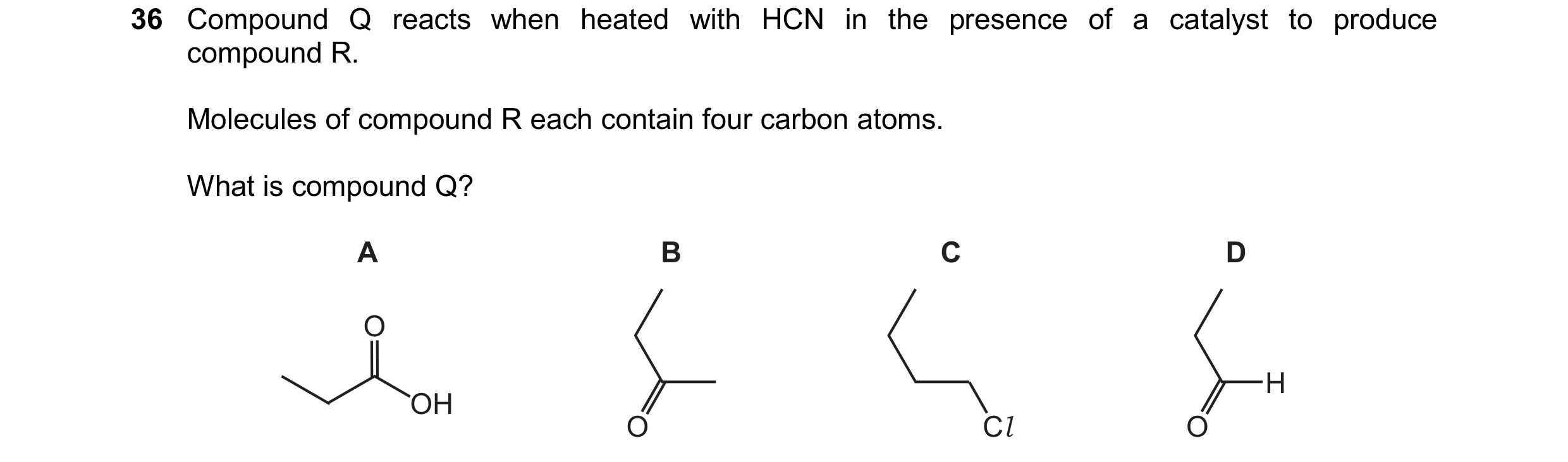
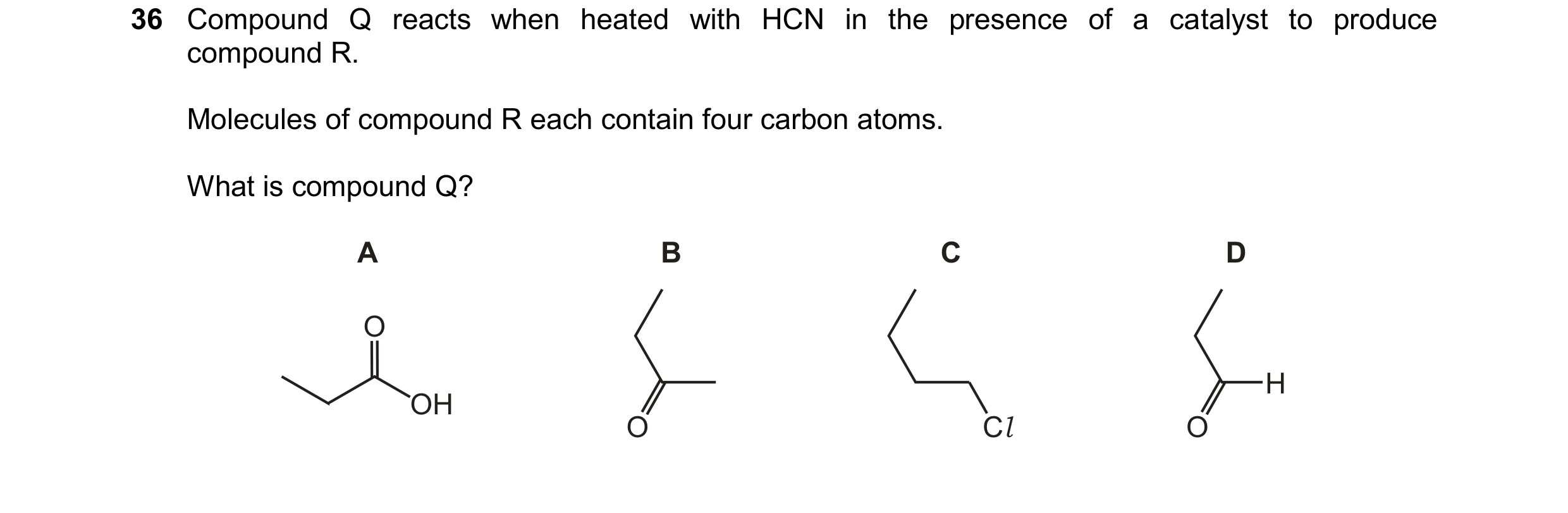
Q132 · Compound Q reacts when heated with HCN in the presence of a catalyst to produce compound R 9701/11 Oct/Nov 2025
36 Compound Q reacts when heated with HCN in the presence of a catalyst to produce compound R. Molecules of compound R each contain four carbon atoms. What is compound Q? O B O OH A O H D Cl C
1 marks
Answer: D
This question in 9701/11 Oct/Nov 2025
Q133 · Which reaction mixture produces a nitrile? 9701/12 Oct/Nov 2025
30 Which reaction mixture produces a nitrile? A halogenoalkane with KCN in ethanol B halogenoalkane with NH3 in ethanol C ketone with 2,4-DNPH D carboxylic acid with NH3 in water
1 marks
Answer: A
This question in 9701/12 Oct/Nov 2025
Q134 · An organometallic lithium compound, RLi, contains the nucleophile R– 9701/12 Oct/Nov 2025
34 An organometallic lithium compound, RLi, contains the nucleophile R–. CH3CH2Li reacts with pentan-2-one. The mechanism is nucleophilic addition. The first step produces an anion which is then protonated to form the final product. Which organic product is formed? A B C D OH OH OH OH
1 marks
Answer: B
This question in 9701/12 Oct/Nov 2025
Q135 · Which organic starting material could be used in a single reaction to produce propanoic… 9701/12 Oct/Nov 2025
36 Which organic starting material could be used in a single reaction to produce propanoic acid? A ethanenitrile B propan-2-ol C propanal D propyl ethanoate
1 marks
Answer: C
This question in 9701/12 Oct/Nov 2025
Q136 · Butylamine can be produced by the reaction of butanenitrile with hydrogen in the presence… 9701/12 Oct/Nov 2025
38 Butylamine can be produced by the reaction of butanenitrile with hydrogen in the presence of a suitable catalyst. Which volume of hydrogen, measured at room conditions, is required to react completely with 0.500 g of butanenitrile? A 145 cm3 B 174 cm3 C 289 cm3 D 348 cm3
1 marks
Answer: D
This question in 9701/12 Oct/Nov 2025
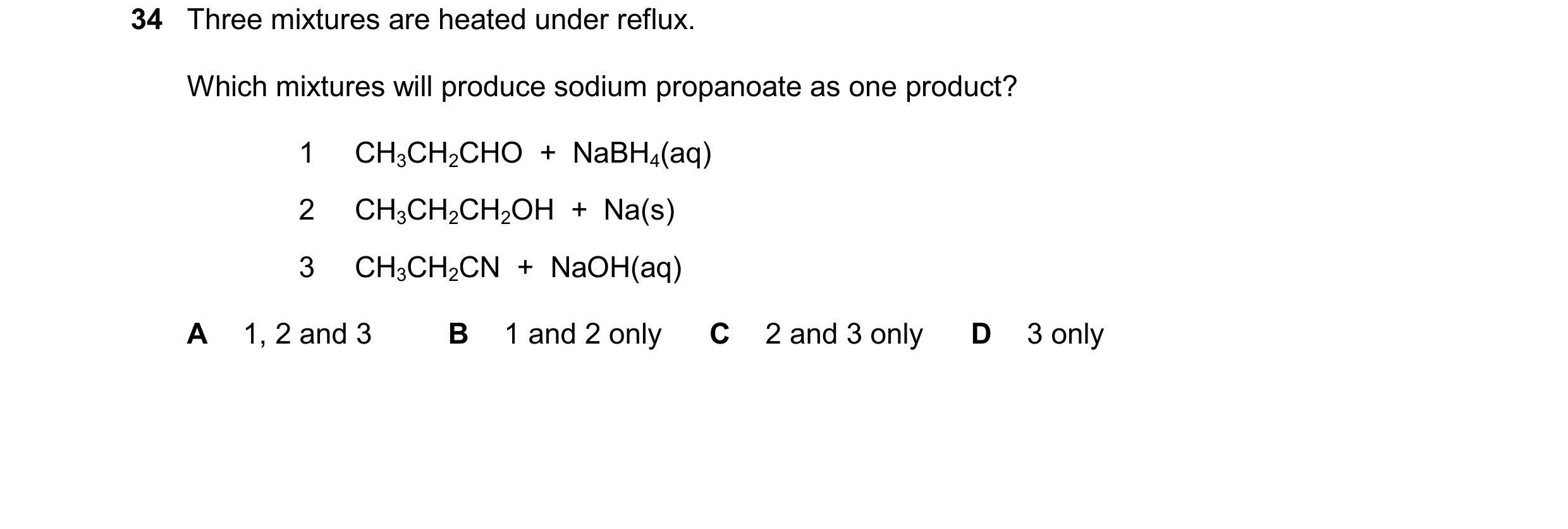
Q137 · Three mixtures are heated under reflux 9701/13 Oct/Nov 2025
34 Three mixtures are heated under reflux. Which mixtures will produce sodium propanoate as one product? 1 CH3CH2CHO + NaBH4(aq) 2 CH3CH2CH2OH + Na(s) 3 CH3CH2CN + NaOH(aq) A 1, 2 and 3 B 1 and 2 only C 2 and 3 only D 3 only
1 marks
Answer: D
This question in 9701/13 Oct/Nov 2025
Q138 · Compound Q reacts when heated with HCN in the presence of a catalyst to produce compound R 9701/13 Oct/Nov 2025
36 Compound Q reacts when heated with HCN in the presence of a catalyst to produce compound R. Molecules of compound R each contain four carbon atoms. What is compound Q? O B O OH A O H D Cl C
1 marks
Answer: D
This question in 9701/13 Oct/Nov 2025

 1 / 36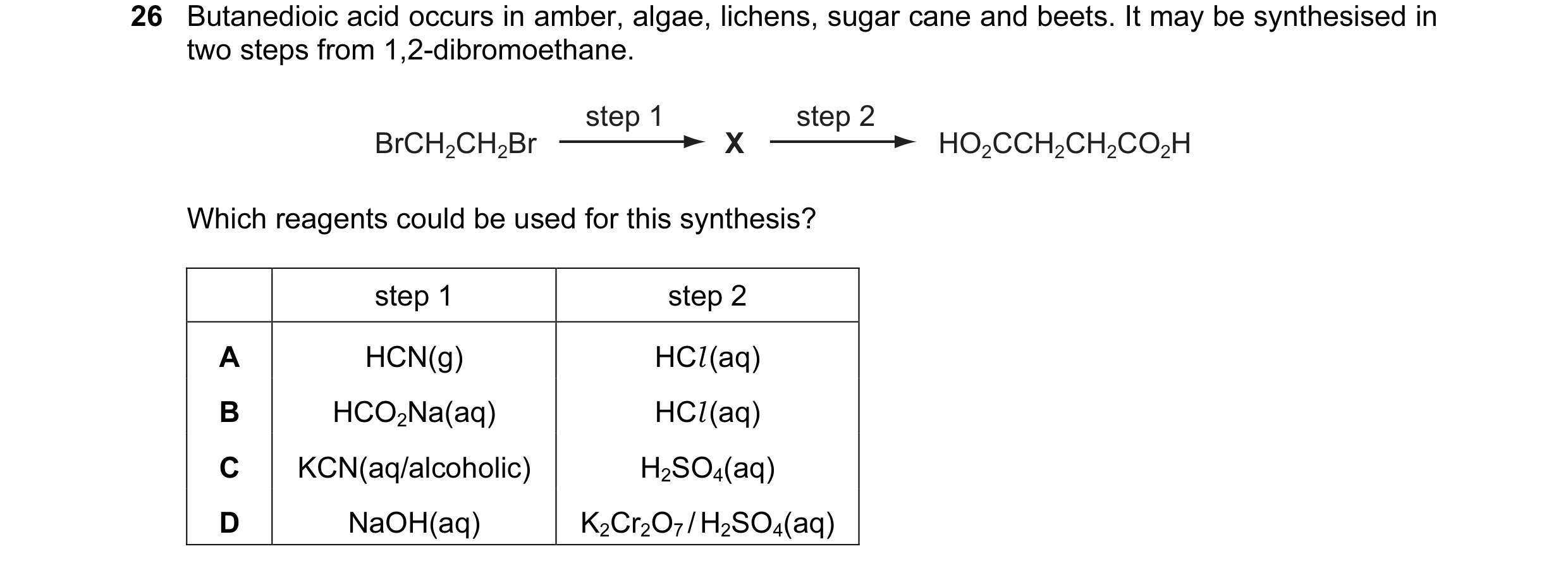

 2 / 36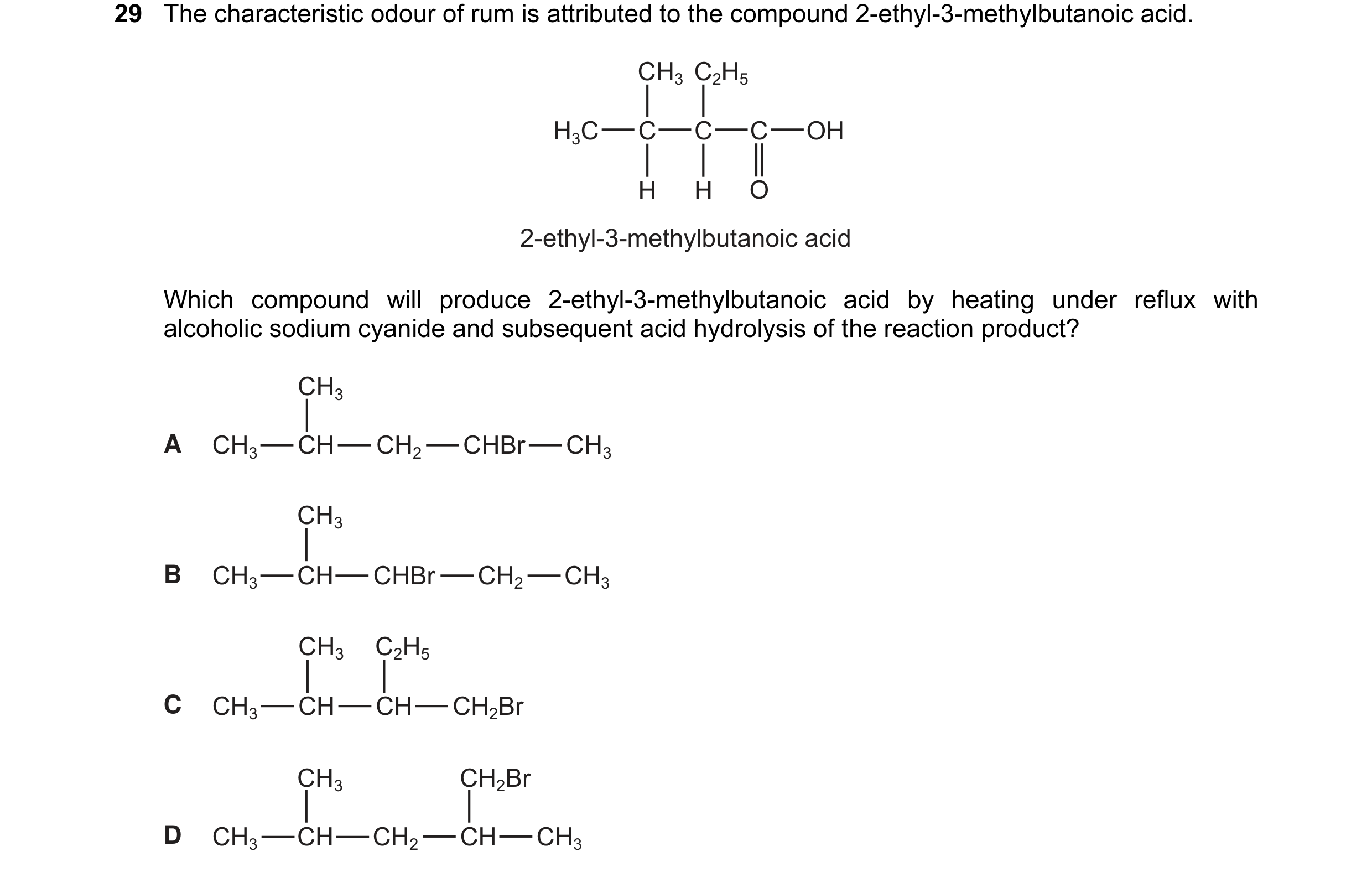
 3 / 36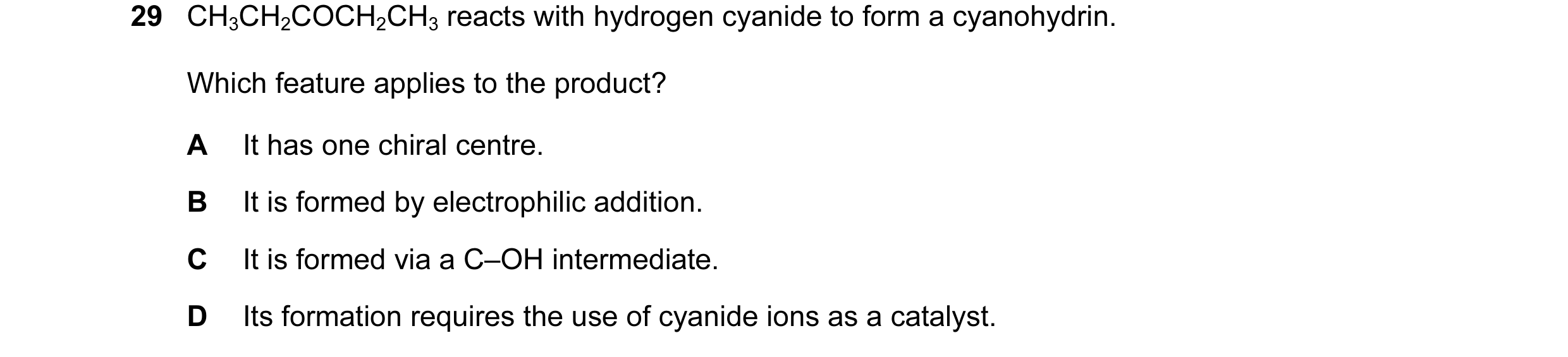
 4 / 36

 5 / 36



 6 / 36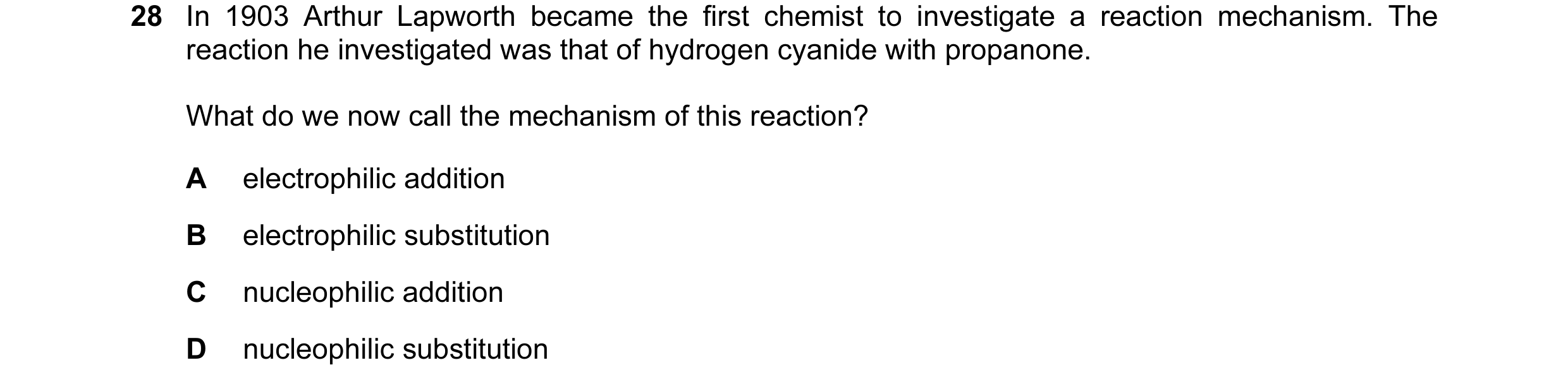

 7 / 36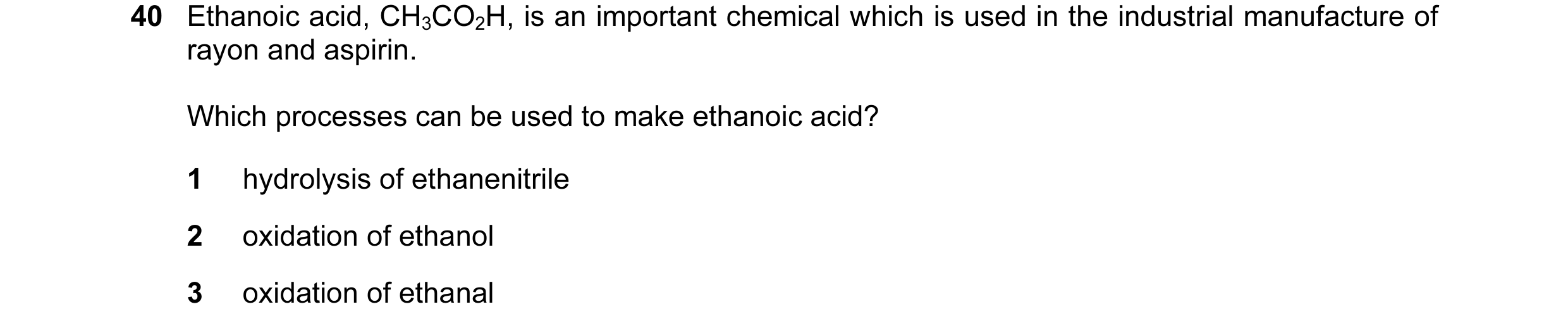



 8 / 36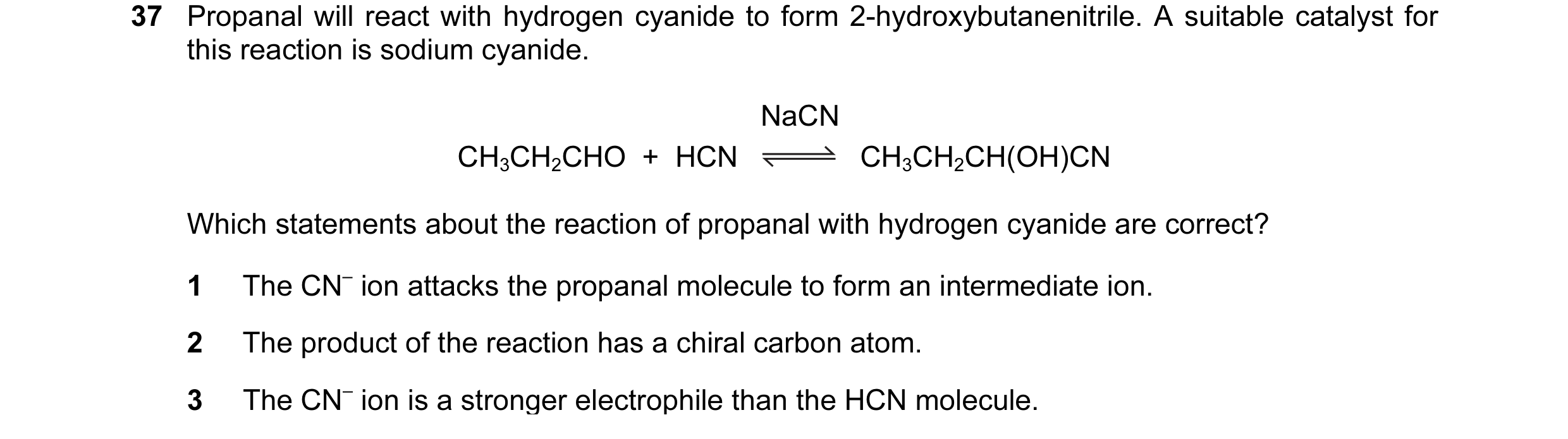
 9 / 36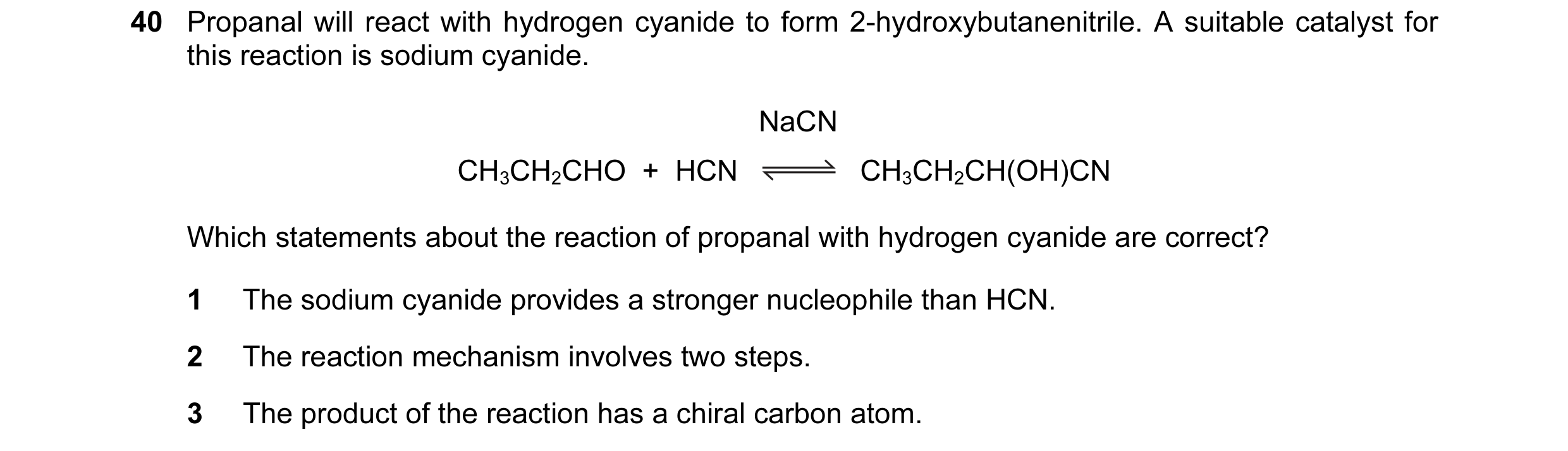
 10 / 36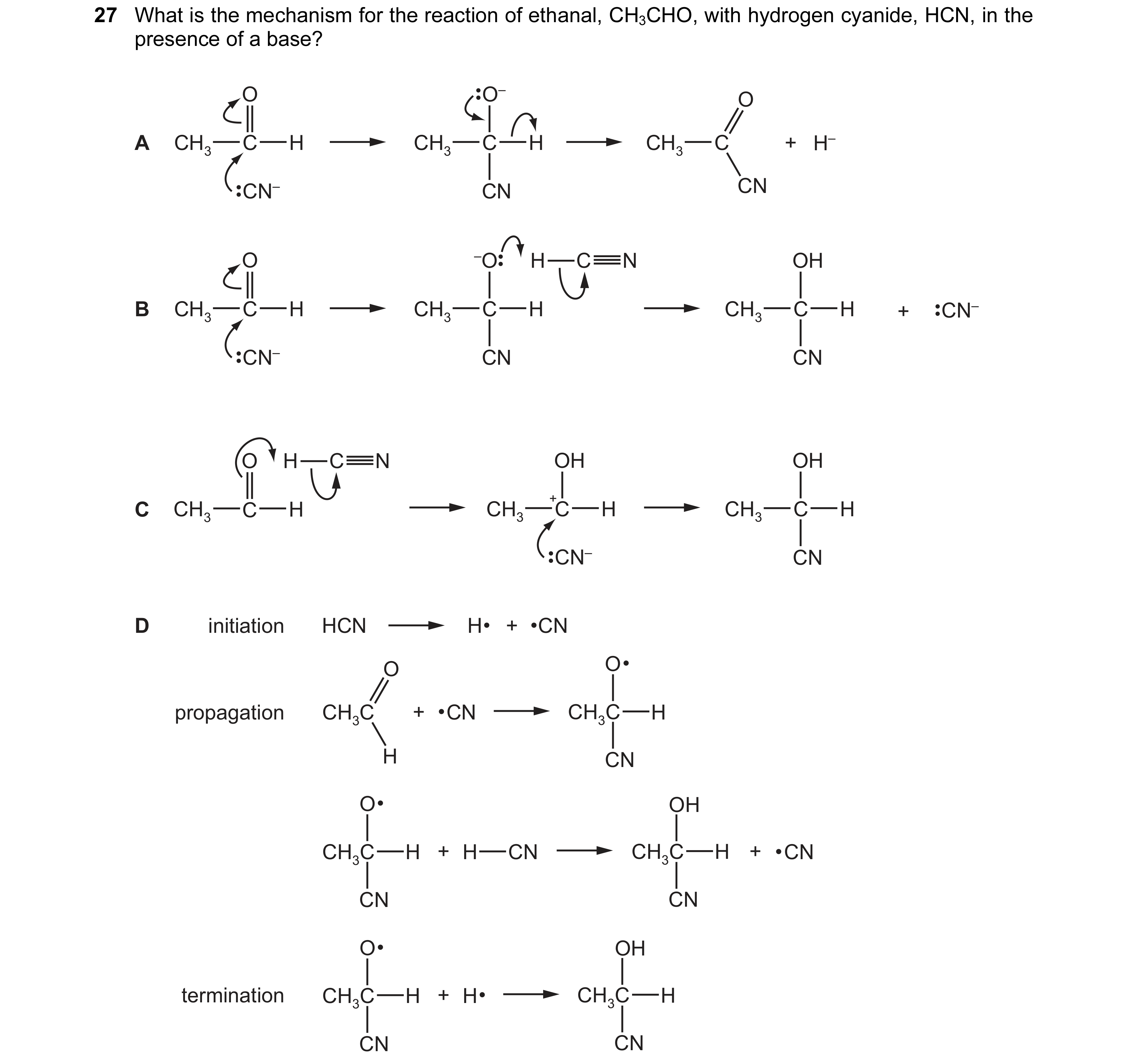
 11 / 36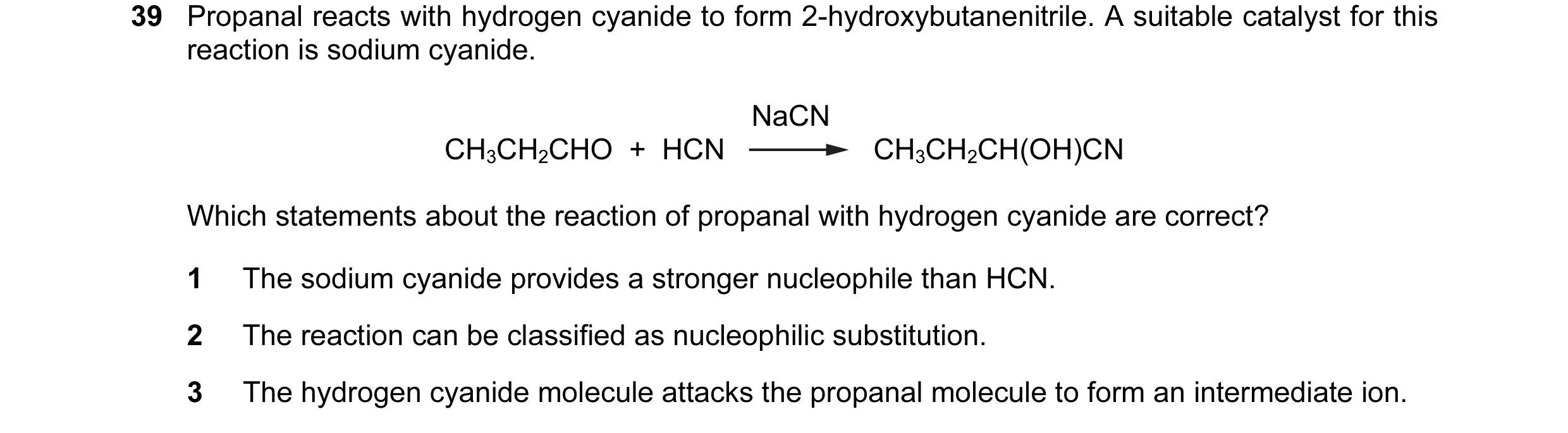
 12 / 36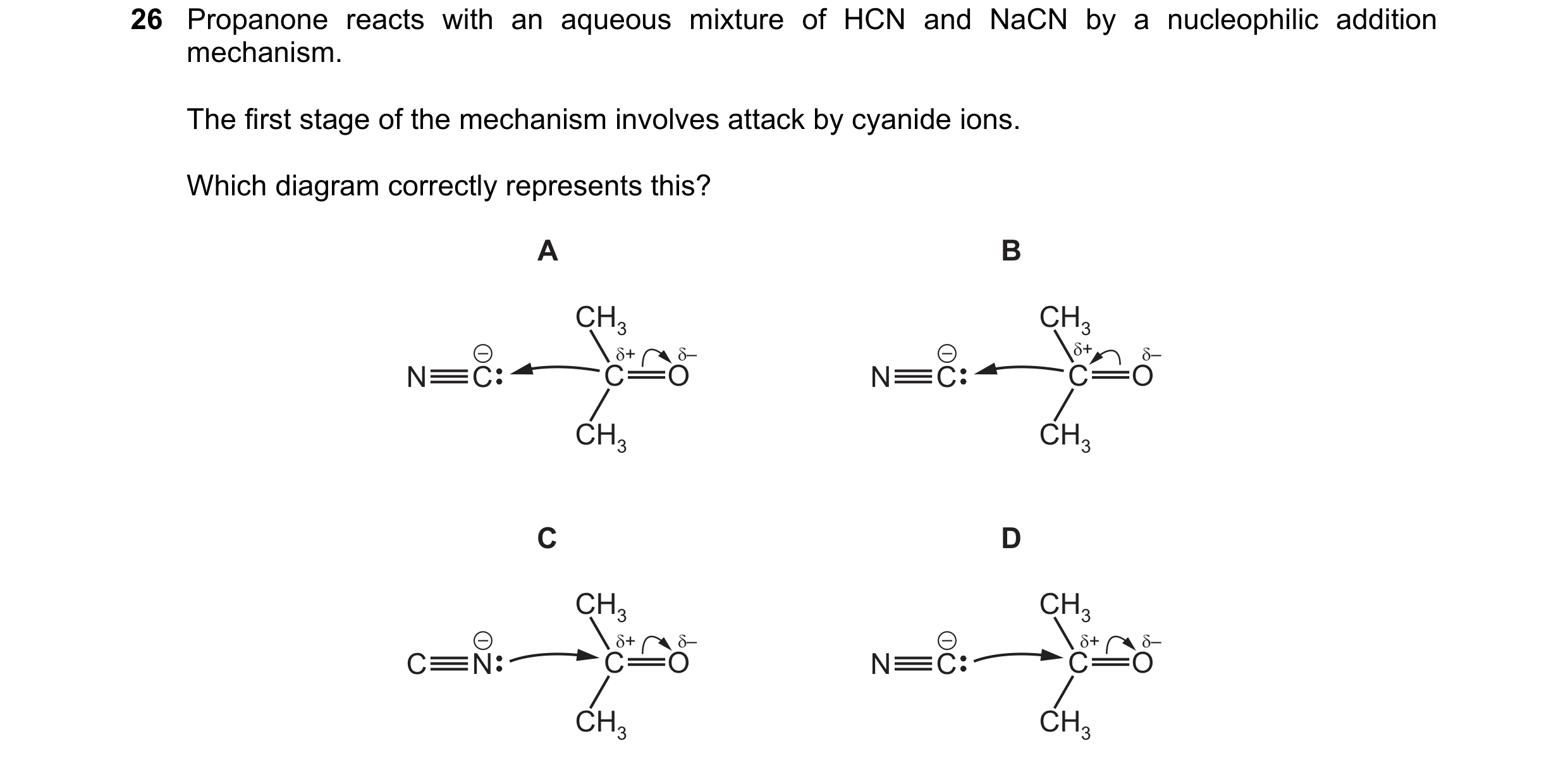
 13 / 36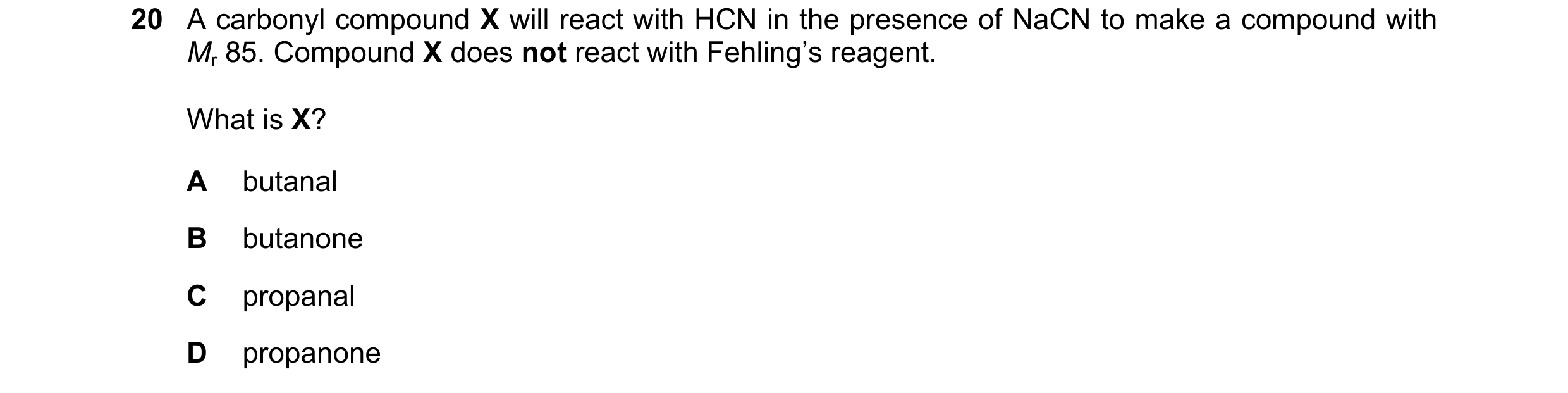
 14 / 36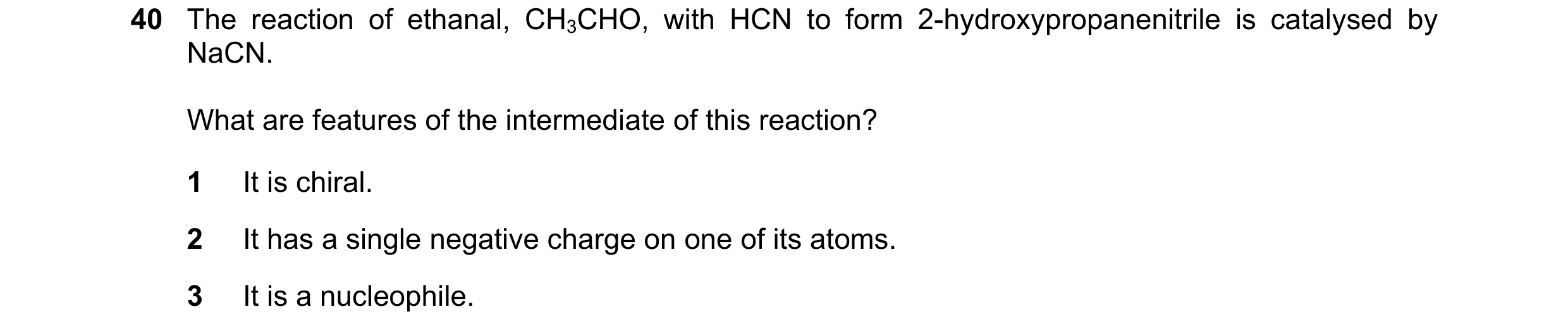
 15 / 36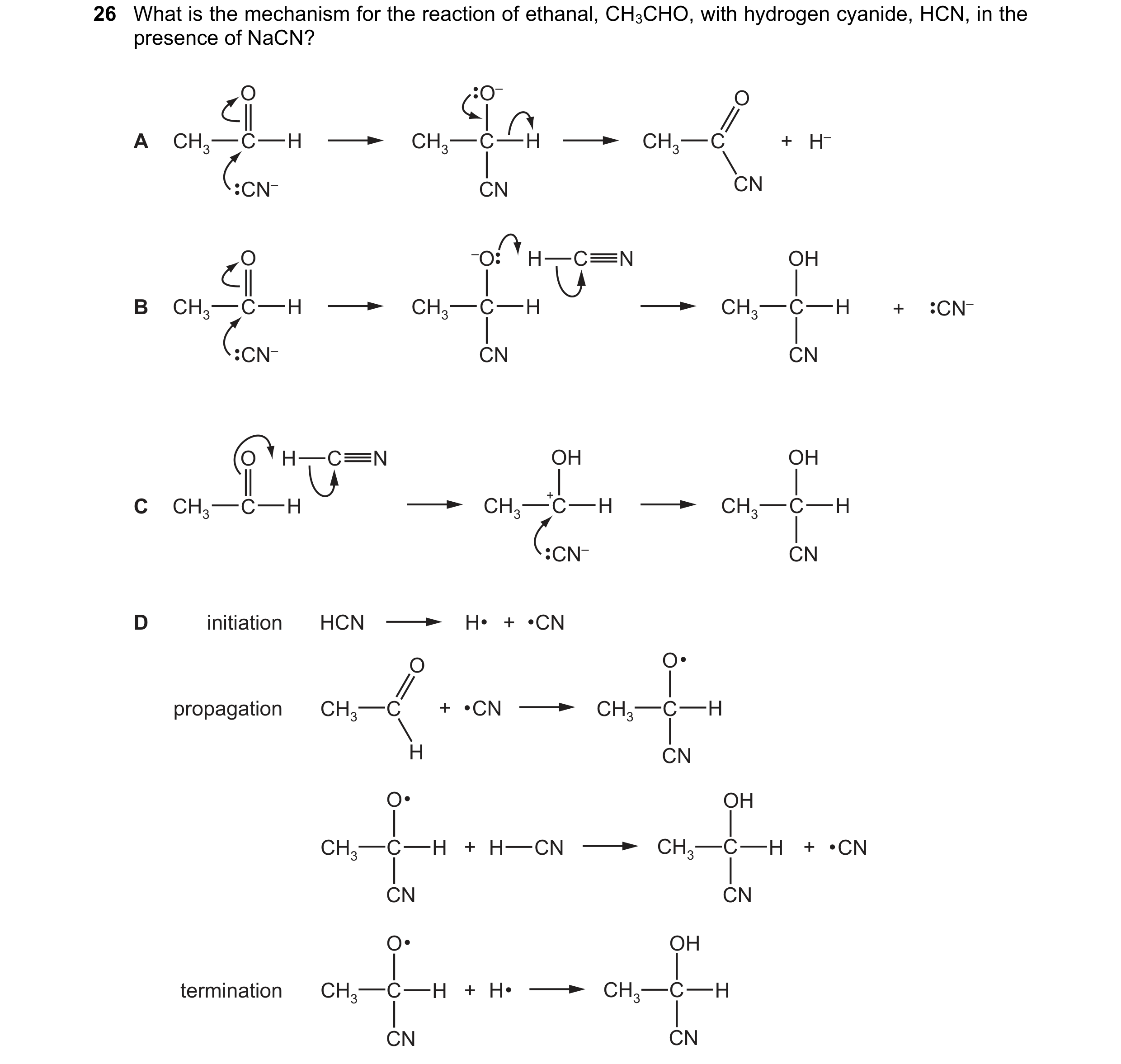
 16 / 36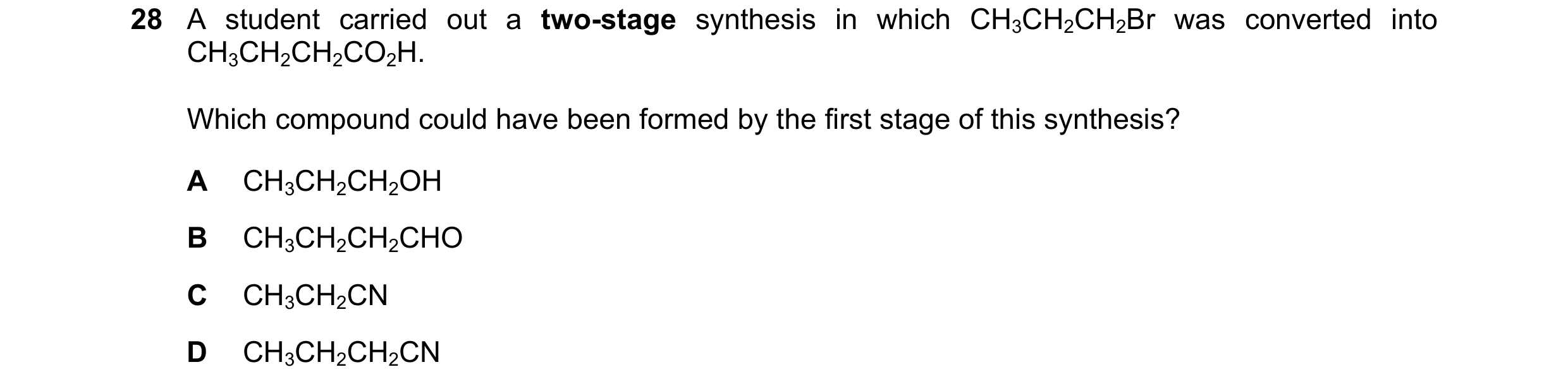
 17 / 36


 18 / 36




 19 / 36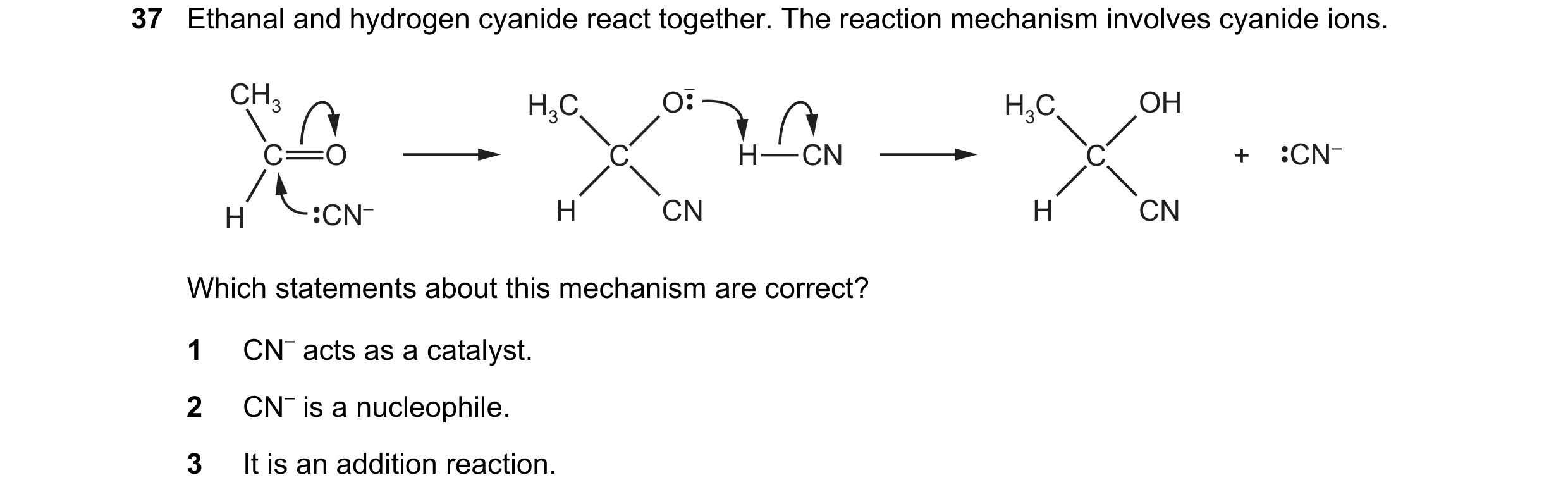
 20 / 36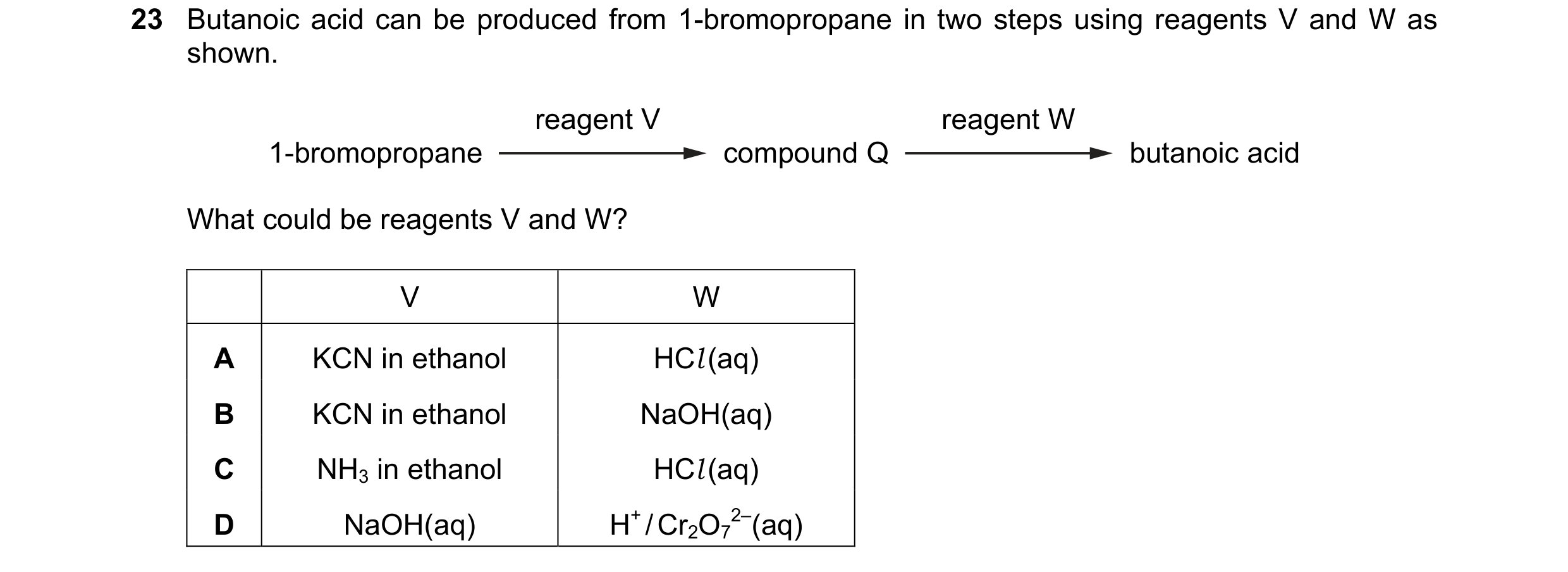
 21 / 36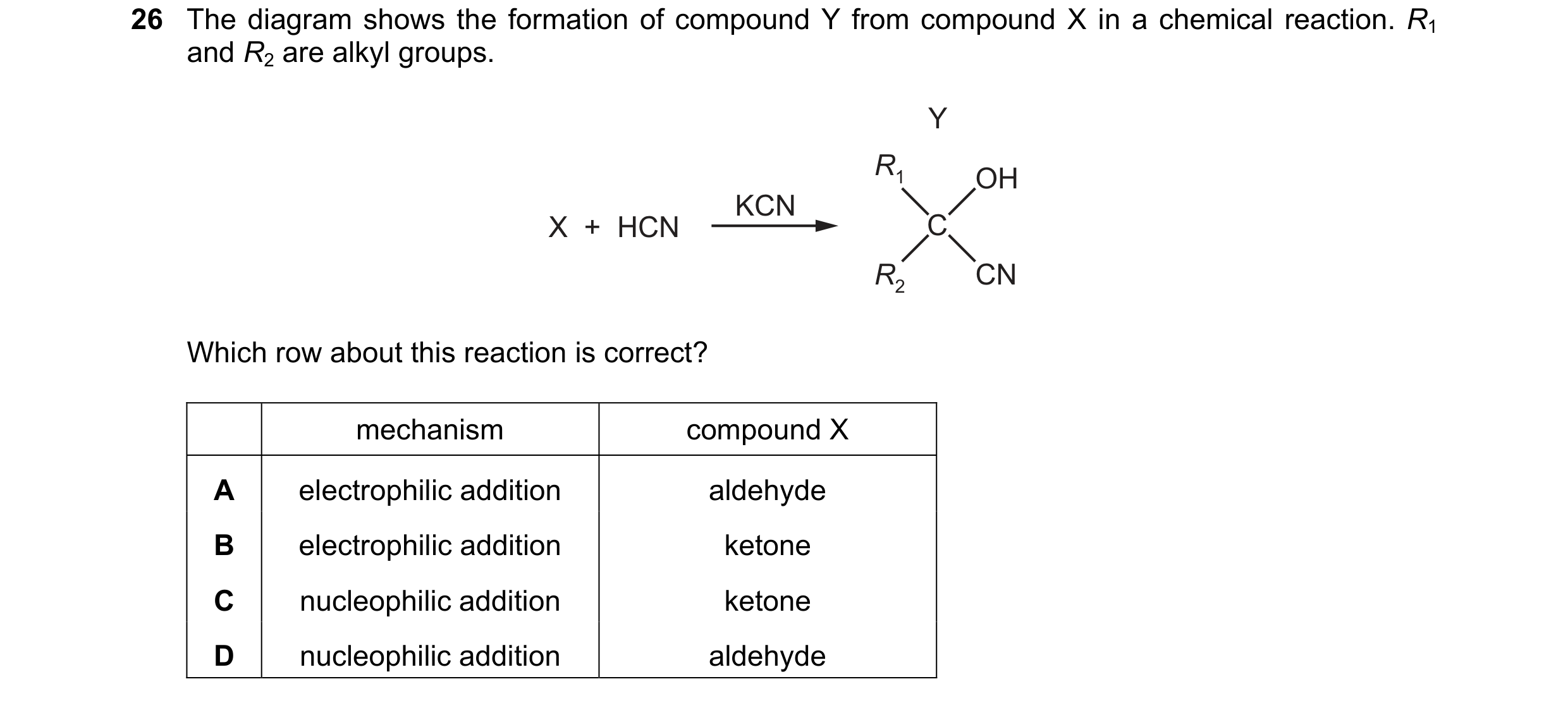

 22 / 36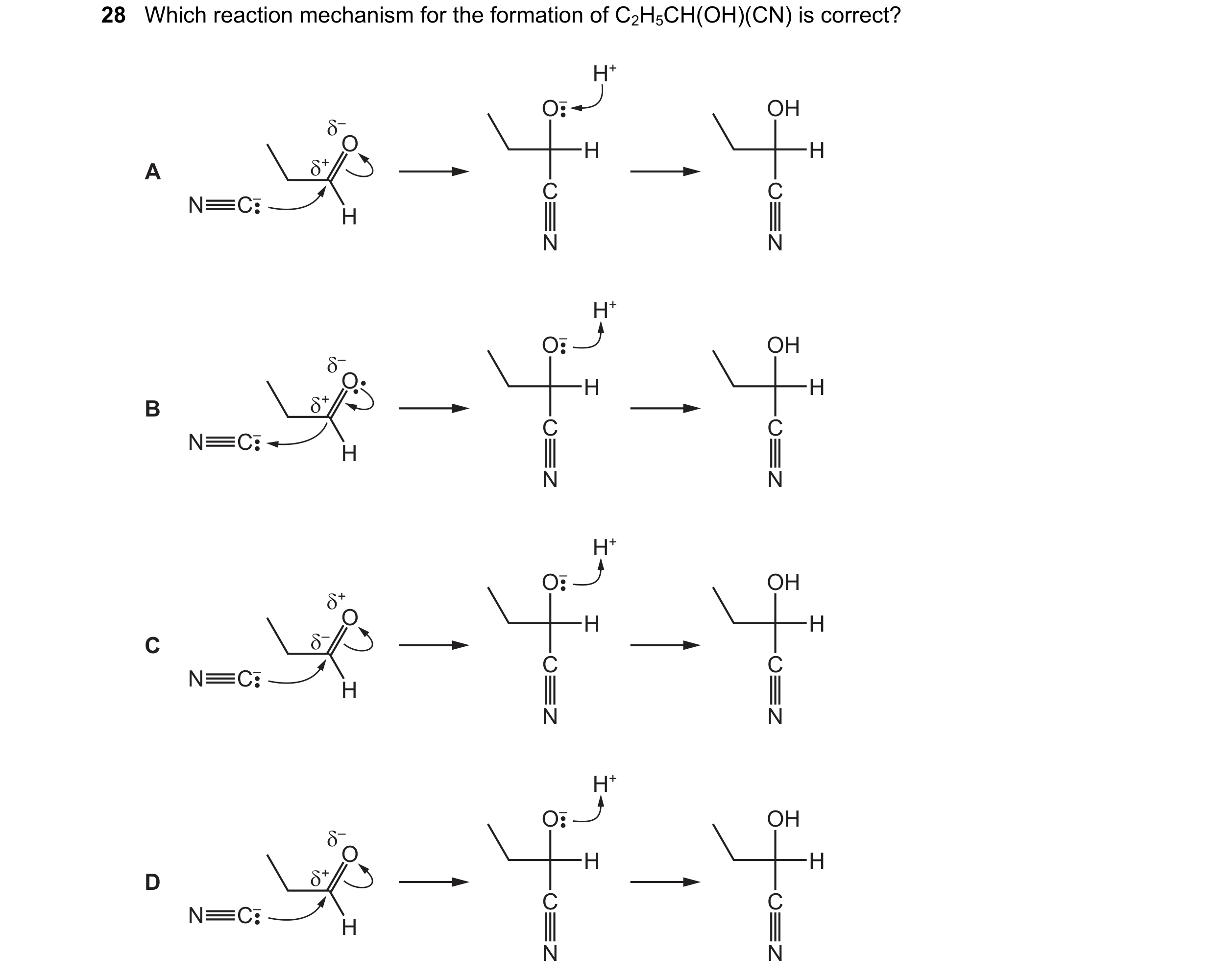
 23 / 36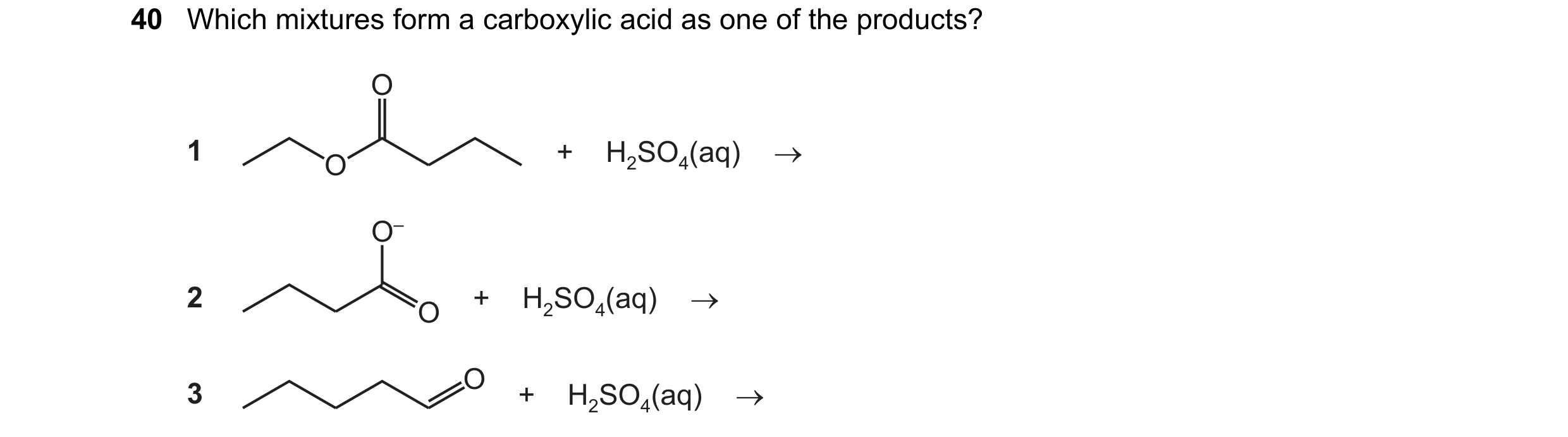
 24 / 36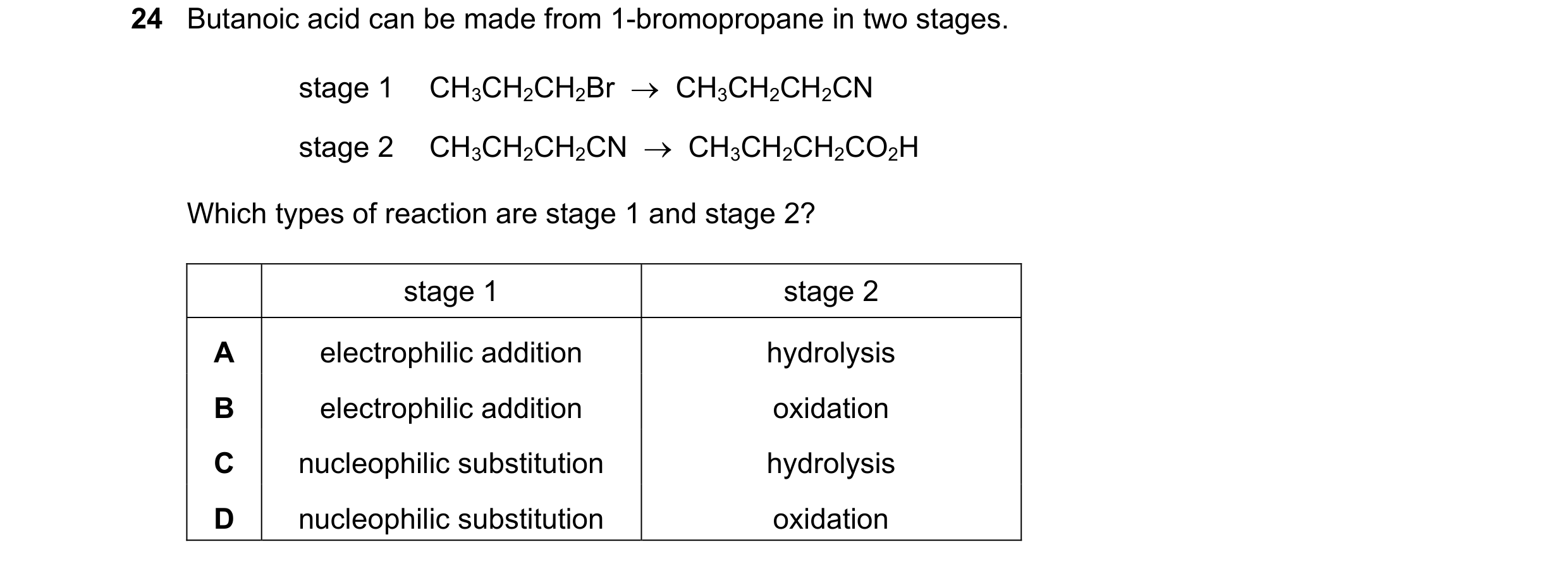

 25 / 36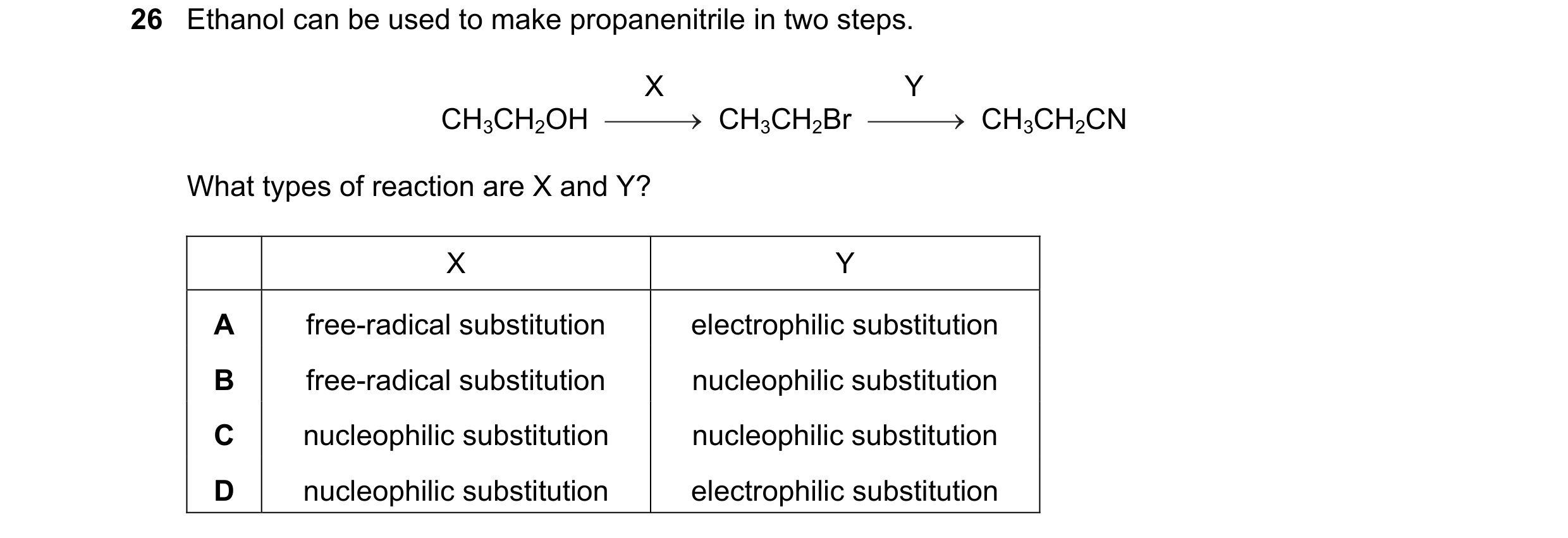
 26 / 36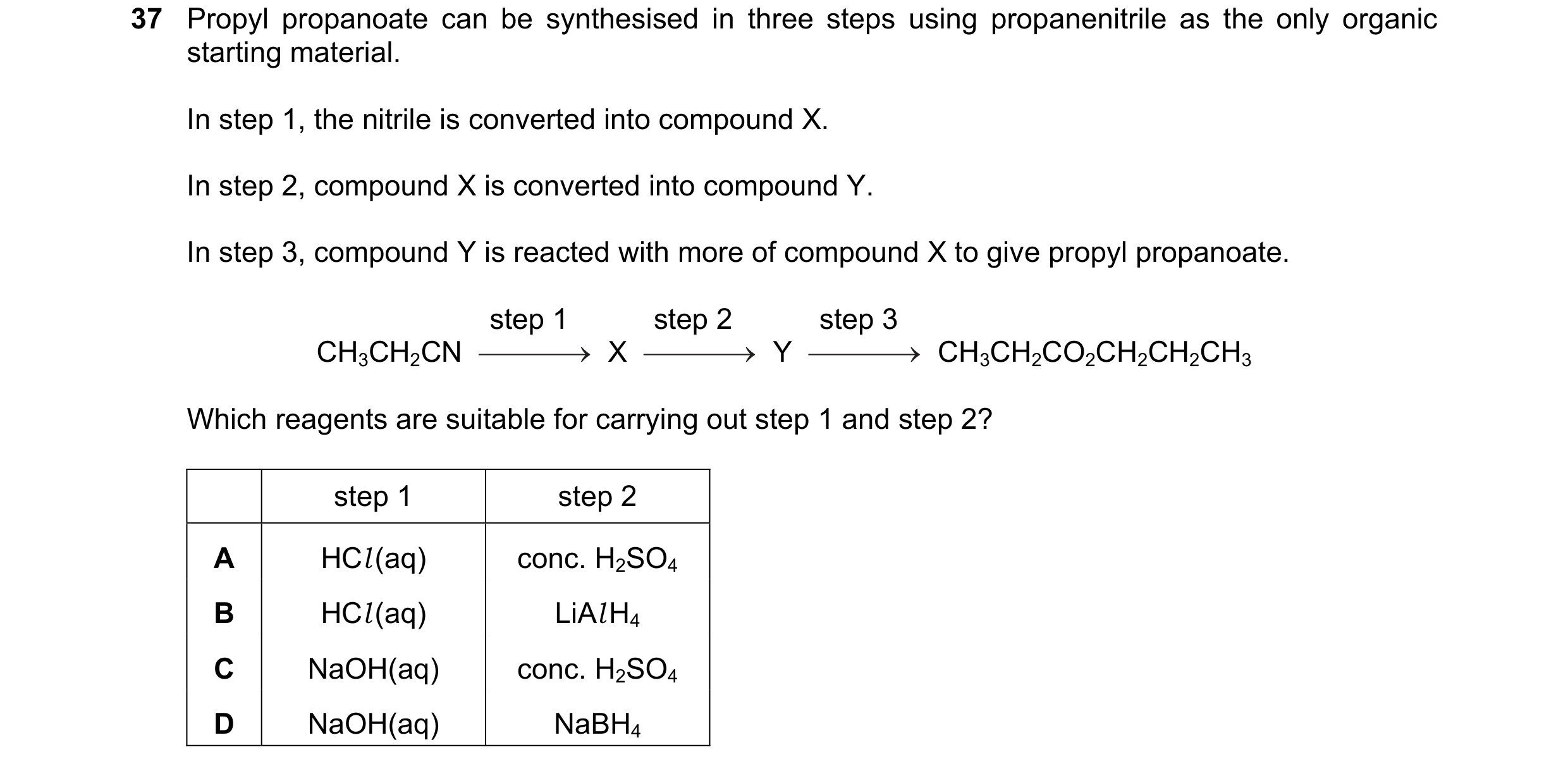

 27 / 36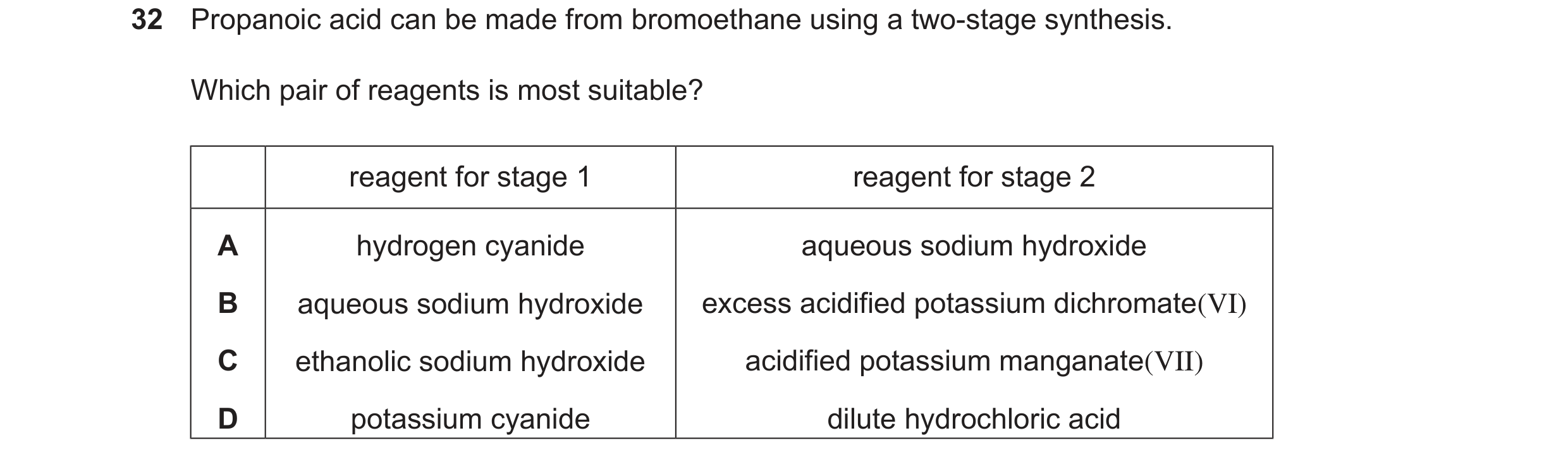

 28 / 36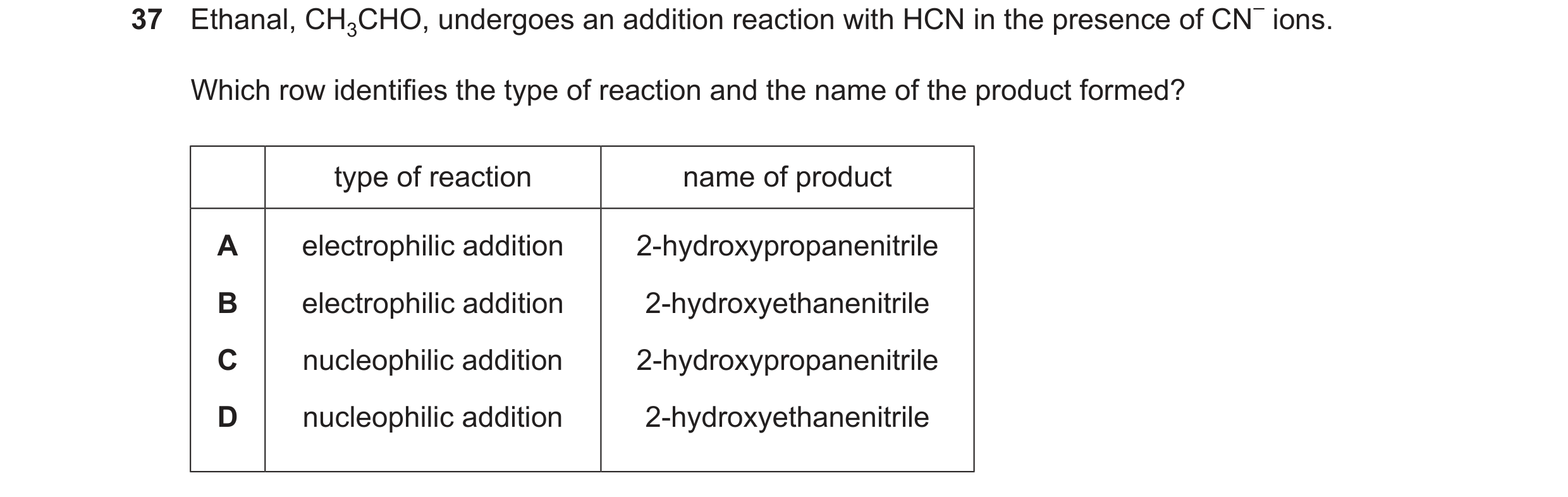
 29 / 36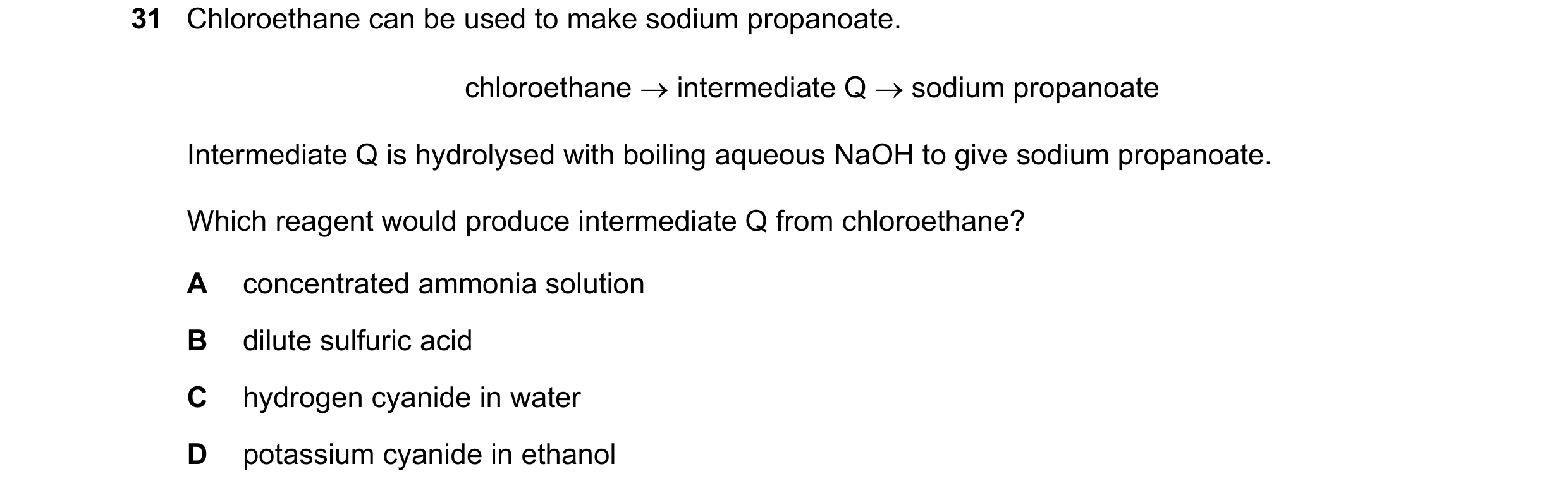
 30 / 36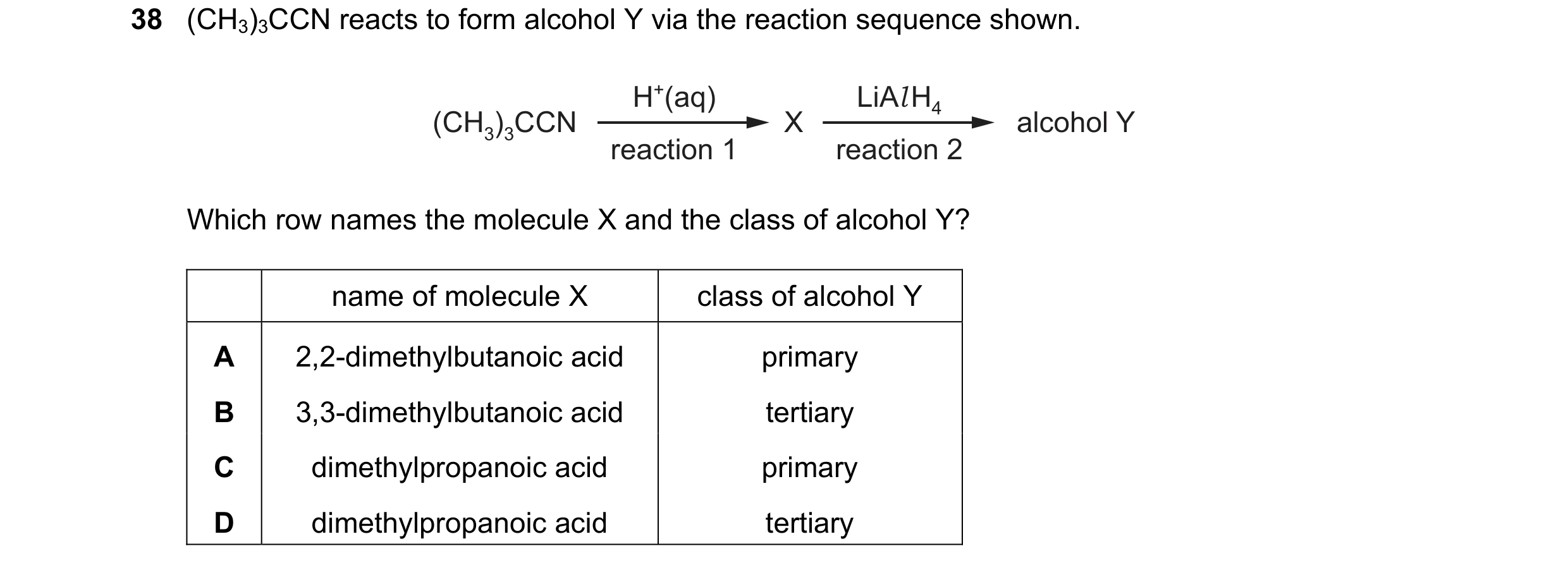
 31 / 36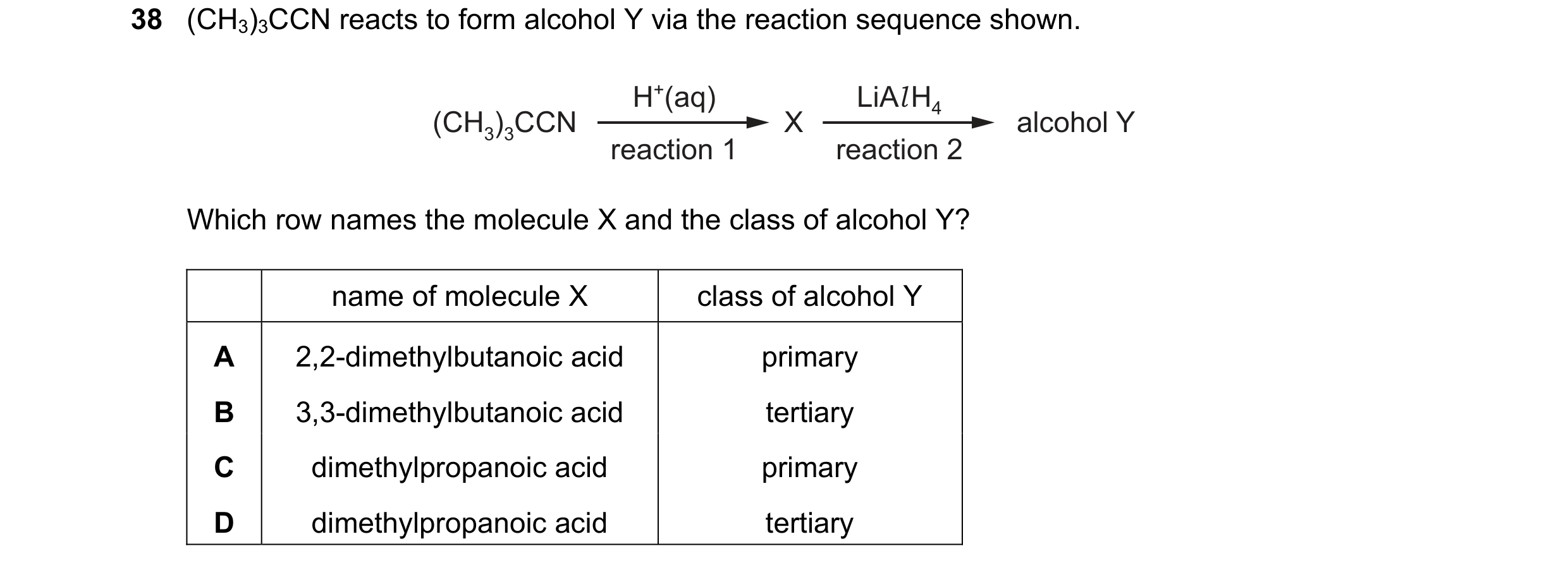

 32 / 36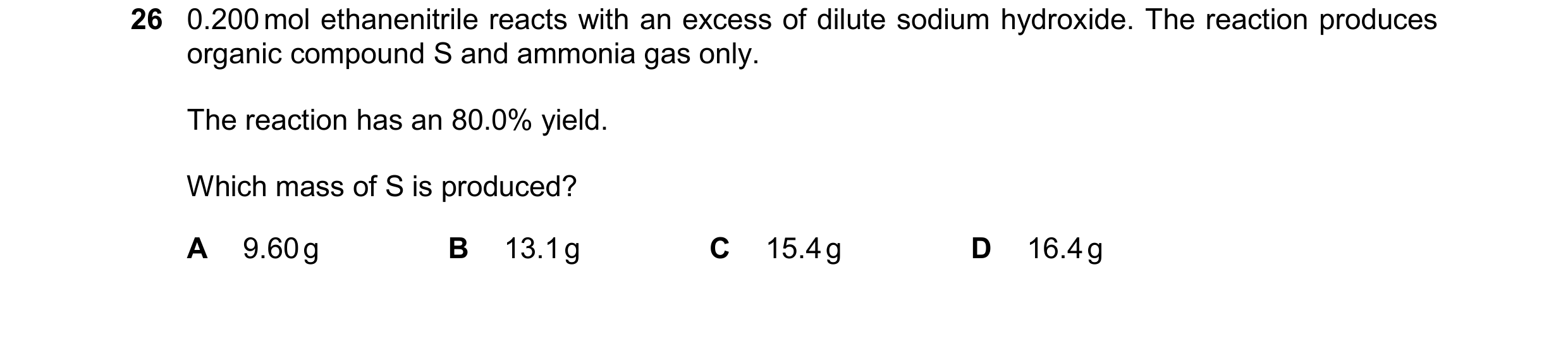
 33 / 36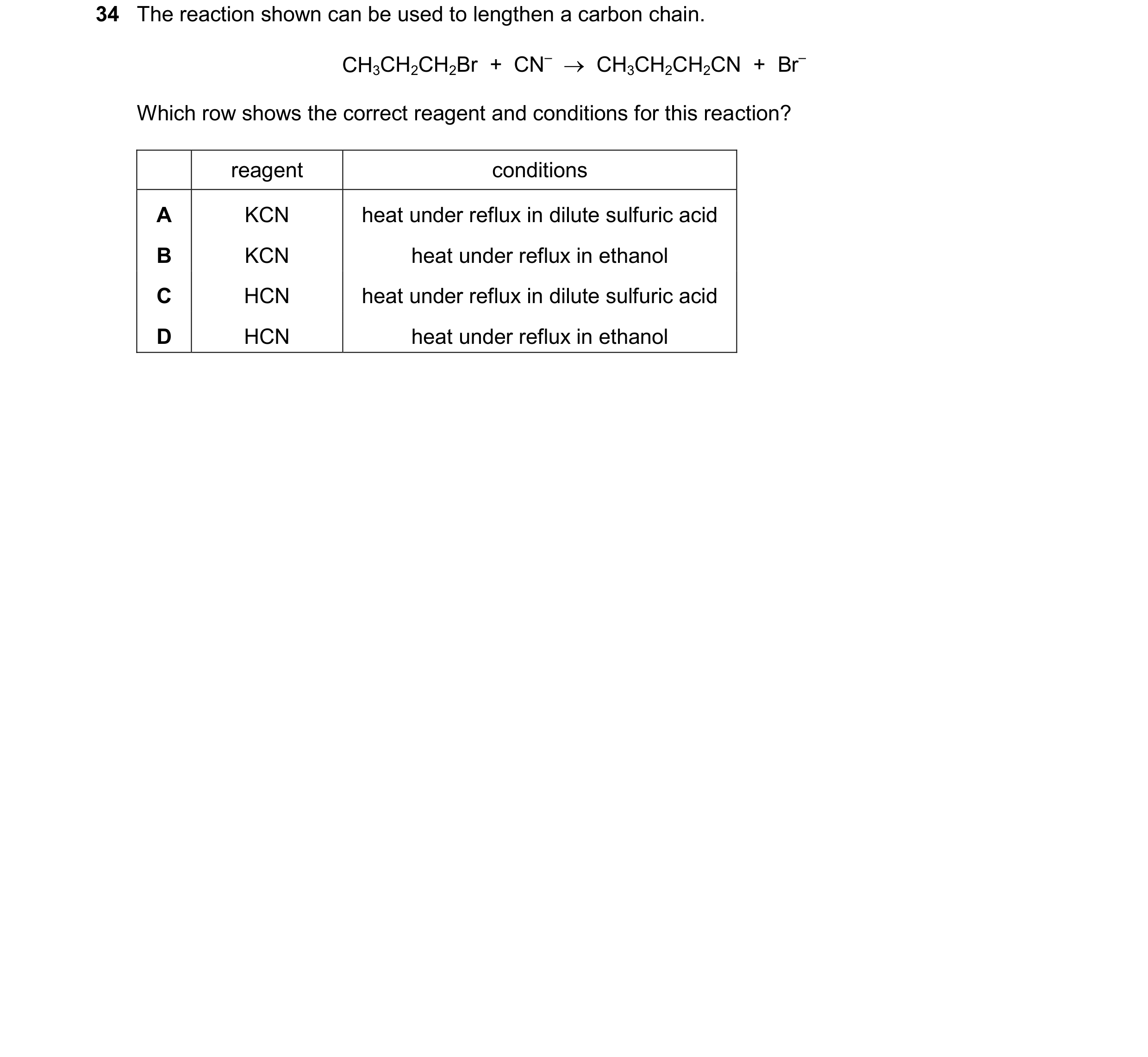
 34 / 36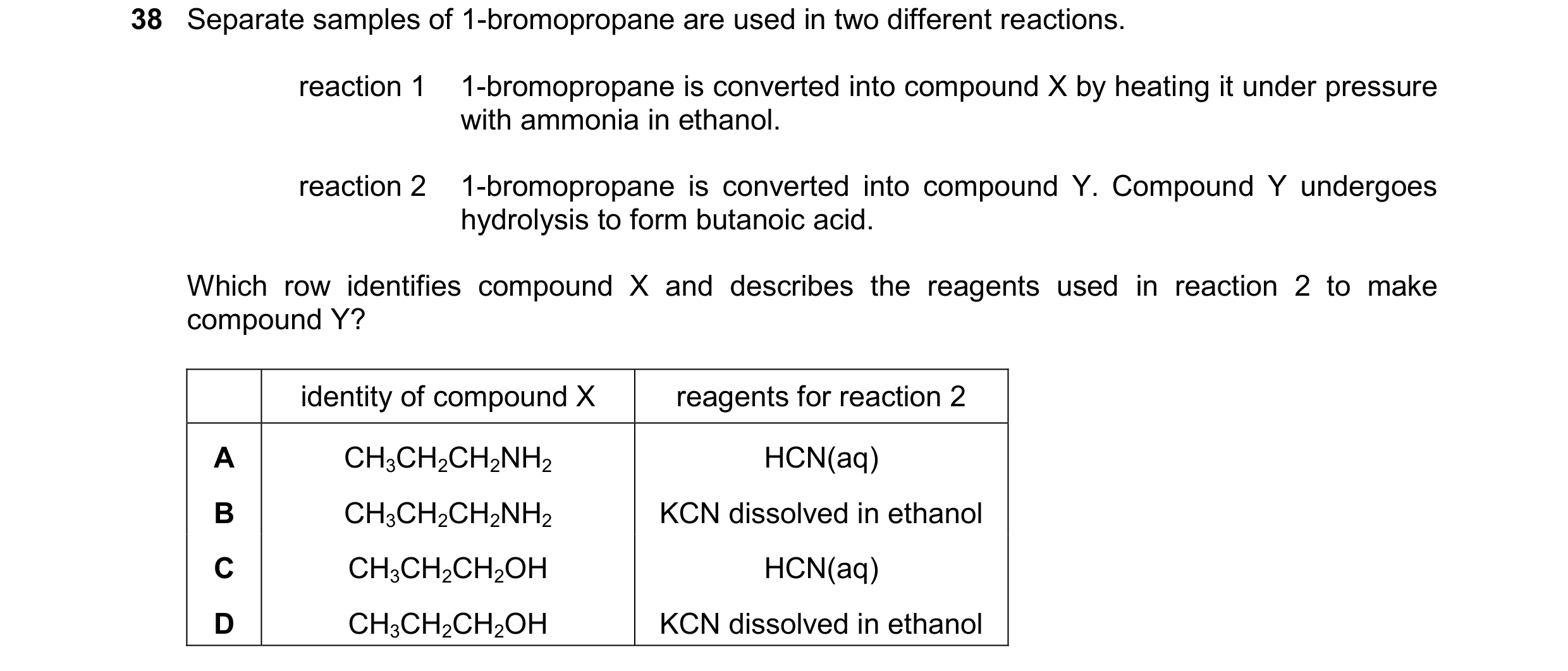
 35 / 36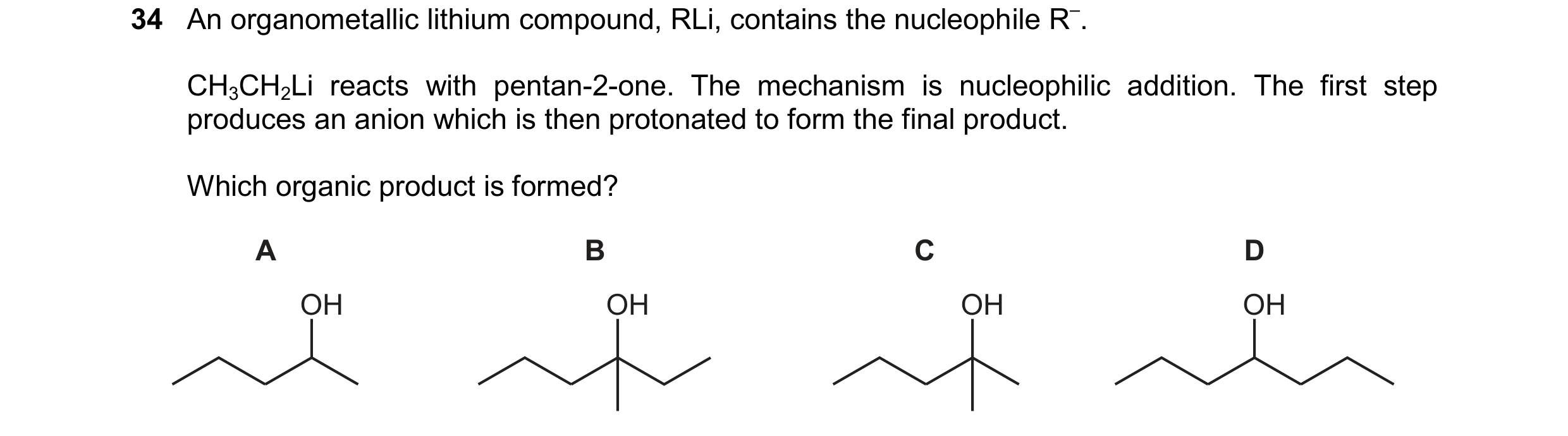


 36 / 36