Questions as text
Q1 · When a mineral was heated in a Bunsen flame to constant mass, a colourless gas that… 9701/11 Oct/Nov 2005
16 When a mineral was heated in a Bunsen flame to constant mass, a colourless gas that turned lime water milky was evolved. The remaining solid was cooled and then added to aqueous hydrochloric acid. Vigorous effervescence was seen. What was the mineral? A aragonite, CaCO3 B artinite, MgCO3.Mg(OH)2.3H2O C barytocalcite, BaCO3.CaCO3 D dolomite, CaCO3.MgCO3
1 marks
Answer: C
This question in 9701/11 Oct/Nov 2005
Q2 · What properties enable magnesium oxide to be used as a refractory lining in a furnace? 9701/11 Oct/Nov 2005
35 What properties enable magnesium oxide to be used as a refractory lining in a furnace? 1 It has a high melting point. 2 It has a low thermal conductivity. 3 It does not react with basic slags.
1 marks
Answer: A
This question in 9701/11 Oct/Nov 2005
Q3 · Use of the Data Booklet is relevant to this question 9701/11 May/June 2006
16 Use of the Data Booklet is relevant to this question. What mass of solid residue can be obtained from the thermal decomposition of 4.10 g of anhydrous calcium nitrate? A 0.70 g B 1.00 g C 1.40 g D 2.25 g
1 marks
Answer: C
This question in 9701/11 May/June 2006
Q4 · Hydroxyapatite, a basic calcium phosphate, Ca(OH)2.3Ca3(PO4)2, is the mineral found in… 9701/11 May/June 2006
35 Hydroxyapatite, a basic calcium phosphate, Ca(OH)2.3Ca3(PO4)2, is the mineral found in bone. In older people, calcium ions can be lost from the hydroxyapatite, weakening the bone structure. In such cases, strontium salts are administered to strengthen the bone. The strontium ions replace the lost calcium ions in the hydroxyapatite. Which statements are correct? 1 Strontium ions are nearly the same size as calcium ions and so may easily replace them in the hydroxyapatite. 2 Strontium hydroxide is less soluble than calcium hydroxide and so will precipitate better in the bone structure. 3 There is ionic, covalent and metallic bonding in hydroxyapatite which gives it strength.
1 marks
Answer: D
This question in 9701/11 May/June 2006
Q5 · Magnesium oxide may be used for the lining of an electric furnace for making crockery 9701/11 Oct/Nov 2006
7 Magnesium oxide may be used for the lining of an electric furnace for making crockery. Which properties of magnesium oxide help to explain this use? strong forces ionic electrical between particles bonding conductor A yes yes no B yes no yes C no yes no D no no yes
1 marks
Answer: A
This question in 9701/11 Oct/Nov 2006
Q6 · Steam is passed over heated magnesium to give compound X and hydrogen 9701/11 Oct/Nov 2006
13 Steam is passed over heated magnesium to give compound X and hydrogen. What is not a property of compound X? A It has a high melting point. B It is a basic oxide. C It is a white solid. D It is very soluble in water.
1 marks
Answer: D
This question in 9701/11 Oct/Nov 2006
Q7 · A 5.00 g sample of an anhydrous Group II metal nitrate loses 3.29 g in mass on strong… 9701/11 Oct/Nov 2006
14 A 5.00 g sample of an anhydrous Group II metal nitrate loses 3.29 g in mass on strong heating. Which metal is present? A magnesium B calcium C strontium D barium
1 marks
Answer: B
This question in 9701/11 Oct/Nov 2006
Q8 · Which magnesium compounds lose mass when heated by a Bunsen flame? 9701/11 Oct/Nov 2006
34 Which magnesium compounds lose mass when heated by a Bunsen flame? 1 magnesium carbonate 2 magnesium nitrate 3 magnesium oxide
1 marks
Answer: B
This question in 9701/11 Oct/Nov 2006
Q9 · When dangerous chemicals are transported by road, vehicles must carry signs that indicate… 9701/11 Oct/Nov 2007
12 When dangerous chemicals are transported by road, vehicles must carry signs that indicate what measures should be taken in the event of a spillage of the chemical carried. Which material must be used if there were a spillage of metallic sodium? A ethanol B jets of water C sand D water spray
1 marks
Answer: C
This question in 9701/11 Oct/Nov 2007
Q10 · Use of the Data Booklet is relevant to this question 9701/11 Oct/Nov 2007
14 Use of the Data Booklet is relevant to this question. The sketch graph shows the variation of one physical or chemical property with another for the Group II elements. y x What are the correct labels for the axes? x-axis y-axis A atomic number mass number B atomic number melting point C first ionisation energy atomic number D first ionisation energy atomic radius
1 marks
Answer: A
This question in 9701/11 Oct/Nov 2007
Q11 · The chemical properties of an element at the top of a group in the Periodic Table are… 9701/11 Oct/Nov 2007
15 The chemical properties of an element at the top of a group in the Periodic Table are often different from those of the rest of the elements in the group. Of the following properties of beryllium and its compounds, which property is typical of the elements below it in Group II? A Be does not react with hot water. B BeCl2 is covalent. C Be(NO3)2 produces BeO on thermal decomposition. D BeO dissolves in alkalis.
1 marks
Answer: C
This question in 9701/11 Oct/Nov 2007
Q12 · When a firework is lit a fuel and an oxidising agent react 9701/11 Oct/Nov 2007
35 When a firework is lit a fuel and an oxidising agent react. In such a firework, magnesium is the fuel and barium nitrate is the oxidising agent. Which solid products are produced when the firework is lit? 1 BaO 2 MgO 3 Mg(NO3)2
1 marks
Answer: B
This question in 9701/11 Oct/Nov 2007
Q13 · The electronic structure of the outer shell of the element radium is 7s2 9701/11 May/June 2008
35 The electronic structure of the outer shell of the element radium is 7s2. Which statements will be correct for radium within its group? 1 The element will decompose water, liberating hydrogen. 2 The element will show an oxidation number of +2 in all its compounds. 3 Radium has the highest first ionisation energy.
1 marks
Answer: B
This question in 9701/11 May/June 2008
Q14 · Due to their similar ionic radii, the reactions of lithium and magnesium and their… 9701/11 Oct/Nov 2008
16 Due to their similar ionic radii, the reactions of lithium and magnesium and their corresponding compounds are very similar. Which statement concerning the reactions of lithium and its compounds is correct? A Lithium carbonate decomposes on heating at a relatively low temperature, forming lithium oxide and carbon dioxide. B Lithium nitrate decomposes on heating, forming lithium nitrite and oxygen. C Lithium burns only slowly in oxygen. D Lithium reacts violently with cold water, liberating hydrogen.
1 marks
Answer: A
This question in 9701/11 Oct/Nov 2008
Q15 · Which statements concerning the Group II elements magnesium, calcium and barium are… 9701/11 Oct/Nov 2008
34 Which statements concerning the Group II elements magnesium, calcium and barium are correct? 1 Their reactivity increases with increasing relative atomic mass. 2 The oxidation number exhibited in their stable compounds is +2. 3 On strong heating, their nitrates give off oxygen only.
1 marks
Answer: B
This question in 9701/11 Oct/Nov 2008
Q16 · In some fireworks there is a reaction between powdered aluminium and powdered barium… 9701/11 May/June 2009
11 In some fireworks there is a reaction between powdered aluminium and powdered barium nitrate in which heat is evolved and an unreactive gas is produced. What is the equation for this reaction? A 2Al + Ba(NO3)2 → Al2O3 + BaO + 2NO B 4Al + 4Ba(NO3)2 → 2Al2O3 + 4Ba(NO2)2 + O2 C 10Al + 3Ba(NO3)2 → 5Al2O3 + 3BaO + 3N2 D 10Al + 18Ba(NO3)2 → 10Al(NO3)3 + 18BaO + 3N2
1 marks
Answer: C
This question in 9701/11 May/June 2009
Q17 · River water in a chalky agricultural area may contain Ca2+, Mg2+, CO 2 − , HCO , Cl − and… 9701/11 May/June 2009
13 River water in a chalky agricultural area may contain Ca2+, Mg2+, CO 2 − , HCO , Cl − and − NO − 3 3 3 ions. In a waterworks, such water is treated by adding a calculated quantity of calcium hydroxide. What will be precipitated following the addition of calcium hydroxide? A CaCl2 B CaCO3 C Ca(NO3) 2 D Mg(NO3)2
1 marks
Answer: B
This question in 9701/11 May/June 2009
Q18 · Mohr’s salt is a pale green crystalline solid which is soluble in water 9701/11 May/June 2009
18 Mohr’s salt is a pale green crystalline solid which is soluble in water. It is a ‘double sulfate’ which contains two cations, one of which is Fe2+. The identity of the second cation was determined by heating solid Mohr’s salt with solid sodium hydroxide and a colourless gas was evolved. The gas readily dissolved in water giving an alkaline solution. A grey-green solid residue was also formed which was insoluble in water. What are the identities of the gas and the solid residue? gas residue A H2 FeSO4 B NH3 Na2SO4 C NH3 Fe(OH)2 D SO2 Fe(OH)2
1 marks
Answer: C
This question in 9701/11 May/June 2009
Q19 · The rock dolomite is a double carbonate of magnesium and calcium, CaCO3.MgCO3 9701/11 May/June 2009
35 The rock dolomite is a double carbonate of magnesium and calcium, CaCO3.MgCO3. When heated strongly, a product called calcined dolomite is formed which is used to line some furnaces for the production of metals. Why is calcined dolomite used for this purpose? 1 It is a refractory material. 2 It will absorb acidic impurities in metallurgical processes. 3 It will reduce metallic oxides to metals.
1 marks
Answer: B
This question in 9701/11 May/June 2009
Q20 · Use of the Data Booklet is relevant to this question 9701/11 Oct/Nov 2009
3 Use of the Data Booklet is relevant to this question. The graph represents the variation of a property of the Group II elements. property Be Mg Ca Sr Ba What is this property? A ionic radius B ionisation energy C neutron / proton ratio D rate of reaction with water
1 marks
Answer: B
This question in 9701/11 Oct/Nov 2009
Q21 · A farmer added lime to damp soil, followed by the nitrogenous fertiliser ammonium sulfate 9701/11 Oct/Nov 2009
35 A farmer added lime to damp soil, followed by the nitrogenous fertiliser ammonium sulfate. A chemical reaction occurred in the soil. Which substances were formed in this reaction? 1 sulfuric acid 2 calcium sulfate 3 ammonia
1 marks
Answer: C
This question in 9701/11 Oct/Nov 2009
Q22 · Use of the Data Booklet is relevant to this question 9701/11 May/June 2010
8 Use of the Data Booklet is relevant to this question. 2.920 g of a Group II metal, X, reacts with an excess of chlorine to form 5.287 g of a compound with formula XCl2. What is metal X? A barium B calcium C magnesium D strontium
1 marks
Answer: D
This question in 9701/11 May/June 2010
Q23 · Which property of Group II elements (beryllium to barium) decreases with increasing… 9701/11 May/June 2010
17 Which property of Group II elements (beryllium to barium) decreases with increasing atomic number? A reactivity with water B second ionisation energy C solubility of hydroxides D stability of the carbonates
1 marks
Answer: B
This question in 9701/11 May/June 2010
Q24 · When organic refuse decomposes in water carboxylic acids are formed 9701/11 May/June 2010
34 When organic refuse decomposes in water carboxylic acids are formed. The water becomes acidic and aquatic life is destroyed. Which additives are suitable to remove this acid pollution? 1 calcium carbonate 2 calcium hydroxide 3 potassium nitrate
1 marks
Answer: B
This question in 9701/11 May/June 2010
Q25 · Use of the Data Booklet is relevant to this question 9701/12 May/June 2010
8 Use of the Data Booklet is relevant to this question. 2.920 g of a Group II metal, X, reacts with an excess of chlorine to form 5.287 g of a compound with formula XCl2. What is metal X? A barium B calcium C magnesium D strontium
1 marks
Answer: D
This question in 9701/12 May/June 2010
Q26 · Which property of Group II elements (beryllium to barium) decreases with increasing… 9701/12 May/June 2010
19 Which property of Group II elements (beryllium to barium) decreases with increasing atomic number? A reactivity with water B second ionisation energy C solubility of hydroxides D stability of the carbonates
1 marks
Answer: B
This question in 9701/12 May/June 2010
Q27 · Use of the Data Booklet is relevant to this question 9701/13 May/June 2010
9 Use of the Data Booklet is relevant to this question. 2.920 g of a Group II metal, X, reacts with an excess of chlorine to form 5.287 g of a compound with formula XCl2. What is metal X? A barium B calcium C magnesium D strontium
1 marks
Answer: D
This question in 9701/13 May/June 2010
Q28 · Which property of Group II elements (beryllium to barium) decreases with increasing… 9701/13 May/June 2010
18 Which property of Group II elements (beryllium to barium) decreases with increasing atomic number? A reactivity with water B second ionisation energy C solubility of hydroxides D stability of the carbonates
1 marks
Answer: B
This question in 9701/13 May/June 2010
Q29 · When organic refuse decomposes in water carboxylic acids are formed 9701/13 May/June 2010
35 When organic refuse decomposes in water carboxylic acids are formed. The water becomes acidic and aquatic life is destroyed. Which additives are suitable to remove this acid pollution? 1 calcium carbonate 2 calcium hydroxide 3 potassium nitrate
1 marks
Answer: B
This question in 9701/13 May/June 2010
Q30 · When magnesium nitrate, Mg(NO3)2.7H2O, is heated, which three gases are given off? 9701/11 Oct/Nov 2010
14 When magnesium nitrate, Mg(NO3)2.7H2O, is heated, which three gases are given off? A dinitrogen oxide, oxygen, water vapour B hydrogen, nitrogen, oxygen C hydrogen, nitrogen dioxide, oxygen D nitrogen dioxide, oxygen, water vapour
1 marks
Answer: D
This question in 9701/11 Oct/Nov 2010
Q31 · Which property of beryllium and its compounds is typical of the elements below it in… 9701/11 Oct/Nov 2010
19 Which property of beryllium and its compounds is typical of the elements below it in Group II? A Be does not react with hot water. B BeCl2 is covalent. C Be(NO3)2 produces BeO on thermal decomposition. D BeO dissolves in alkalis.
1 marks
Answer: C
This question in 9701/11 Oct/Nov 2010
Q32 · Samples of calcium and barium are separately added to beakers of cold water containing a… 9701/11 Oct/Nov 2010
34 Samples of calcium and barium are separately added to beakers of cold water containing a few drops of litmus solution. Which observations will be made with only the calcium and not with the barium? 1 A white suspension appears in the water. 2 The solution turns blue. 3 A gas is evolved.
1 marks
Answer: D
This question in 9701/11 Oct/Nov 2010
Q33 · Equimolar quantities of magnesium carbonate and strontium carbonate are separately heated… 9701/12 Oct/Nov 2010
12 Equimolar quantities of magnesium carbonate and strontium carbonate are separately heated to bring about complete thermal decomposition. The minimum temperature for this to occur is called Td. The cold residues are separately added to equal volumes of water and the change in pH is measured. The change in pH is called ∆pH. Which metal has the higher value of Td, and the greater value of ∆pH? Td ∆pH A Mg Mg B Mg Sr C Sr Mg D Sr Sr
1 marks
Answer: D
This question in 9701/12 Oct/Nov 2010
Q34 · Use of the Data Booklet is relevant to this question 9701/12 Oct/Nov 2010
14 Use of the Data Booklet is relevant to this question. Which mass of solid residue can be obtained from the thermal decomposition of 4.10 g of anhydrous calcium nitrate? A 0.70 g B 1.00 g C 1.40 g D 2.25 g
1 marks
Answer: C
This question in 9701/12 Oct/Nov 2010
Q35 · When ammonia, NH3, is produced in a school or college laboratory, it is usually dried… 9701/12 Oct/Nov 2010
31 When ammonia, NH3, is produced in a school or college laboratory, it is usually dried before being collected. Which drying agents may be used to dry ammonia? 1 calcium oxide, CaO 2 phosphorus(V) oxide, P4O10 3 concentrated sulfuric acid, H2SO4
1 marks
Answer: D
This question in 9701/12 Oct/Nov 2010
Q36 · When magnesium nitrate, Mg(NO3)2.7H2O, is heated, which three gases are given off? 9701/13 Oct/Nov 2010
17 When magnesium nitrate, Mg(NO3)2.7H2O, is heated, which three gases are given off? A dinitrogen oxide, oxygen, water vapour B hydrogen, nitrogen, oxygen C hydrogen, nitrogen dioxide, oxygen D nitrogen dioxide, oxygen, water vapour
1 marks
Answer: D
This question in 9701/13 Oct/Nov 2010
Q37 · Which property of beryllium and its compounds is typical of the elements below it in… 9701/13 Oct/Nov 2010
19 Which property of beryllium and its compounds is typical of the elements below it in Group II? A Be does not react with hot water. B BeCl2 is covalent. C Be(NO3)2 produces BeO on thermal decomposition. D BeO dissolves in alkalis.
1 marks
Answer: C
This question in 9701/13 Oct/Nov 2010
Q38 · Samples of calcium and barium are separately added to beakers of cold water containing a… 9701/13 Oct/Nov 2010
35 Samples of calcium and barium are separately added to beakers of cold water containing a few drops of litmus solution. Which observations will be made with only the calcium and not with the barium? 1 A white suspension appears in the water. 2 The solution turns blue. 3 A gas is evolved.
1 marks
Answer: D
This question in 9701/13 Oct/Nov 2010
Q39 · Which oxides react with water to give a solution of pH 10 or higher? 9701/11 May/June 2011
35 Which oxides react with water to give a solution of pH 10 or higher? 1 CaO 2 Na2O 3 SrO
1 marks
Answer: A
This question in 9701/11 May/June 2011
Q40 · Which factor helps to explain why the first ionisation energies of the Group I elements… 9701/13 May/June 2011
2 Which factor helps to explain why the first ionisation energies of the Group I elements decrease from lithium to sodium to potassium to rubidium? A The nuclear charge of the elements increases. B The outer electron is in an ‘s’ subshell. C The repulsion between spin-paired electrons increases. D The shielding effect of the inner shells increases.
1 marks
Answer: D
This question in 9701/13 May/June 2011
Q41 · Steam is passed over heated magnesium to give compound X and hydrogen 9701/13 May/June 2011
14 Steam is passed over heated magnesium to give compound X and hydrogen. What is not a property of compound X? A It has an Mr of 40.3. B It is basic. C It is a white solid. D It is very soluble in water.
1 marks
Answer: D
This question in 9701/13 May/June 2011
Q42 · Which oxides react with water to give a solution of pH 10 or higher? 9701/13 May/June 2011
38 Which oxides react with water to give a solution of pH 10 or higher? 1 CaO 2 Na2O 3 SrO
1 marks
Answer: A
This question in 9701/13 May/June 2011
Q43 · Three elements, X, Y and Z, have the physical properties shown in the table 9701/11 Oct/Nov 2011
1 Three elements, X, Y and Z, have the physical properties shown in the table. melting point boiling point density element / g cm-3 / °C / °C X –7 59 3.12 Y 98 883 0.97 Z 649 1107 1.74 What could be the identities of X, Y and Z? X Y Z A Br2 Al Si B Br2 Na Mg C I2 Mg Na D I2 Si K
1 marks
Answer: B
This question in 9701/11 Oct/Nov 2011
Q44 · Lime mortar is made from quicklime, water and sand 9701/12 Oct/Nov 2011
18 Lime mortar is made from quicklime, water and sand. Over a period of time, lime mortar changes into a much harder form. Both fresh and old lime mortar react with aqueous hydrochloric acid but only the old lime mortar effervesces during the reaction. Which equation describes the change from fresh to old lime mortar? A CaO + CO2 → CaCO3 B CaO + H2O → Ca(OH)2 C Ca(OH)2 → CaO + H2O D Ca(OH)2 + CO2 → CaCO3 + H2O
1 marks
This question in 9701/12 Oct/Nov 2011
Q45 · Use of the Data Booklet is relevant to this question 9701/12 Oct/Nov 2011
34 Use of the Data Booklet is relevant to this question. Which properties would be expected for radium, 88Ra, or its compounds? 1 Radium carbonate would not decompose at the temperature of a Bunsen flame. 2 Radium hydroxide is very insoluble. 3 Radium does not react with cold water.
1 marks
This question in 9701/12 Oct/Nov 2011
Q46 · When a firework is lit, a fuel and an oxidising agent react together 9701/12 Oct/Nov 2011
35 When a firework is lit, a fuel and an oxidising agent react together. In one such firework, magnesium is the fuel and barium nitrate is the oxidising agent. Which solids are produced when the firework is lit? 1 BaO 2 MgO 3 Mg(NO3)2
1 marks
This question in 9701/12 Oct/Nov 2011
Q47 · Use of the Data Booklet is relevant to this question 9701/13 Oct/Nov 2011
14 Use of the Data Booklet is relevant to this question. A 5.00 g sample of an anhydrous Group II metal nitrate loses 3.29 g in mass when heated strongly. Which metal is present? A magnesium B calcium C strontium D barium
1 marks
Answer: B
This question in 9701/13 Oct/Nov 2011
Q48 · Use of the Data Booklet is relevant to this question 9701/13 Oct/Nov 2011
15 Use of the Data Booklet is relevant to this question. A significant contribution to atmospheric carbon dioxide levels comes from the thermal decomposition of limestone, in the manufacture of cement and of lime for agricultural purposes. Cement works roast 1000 million tonnes of limestone per year and a further 200 million tonnes is roasted in kilns to make lime. What is the total annual mass output of carbon dioxide (in million tonnes) from these two processes? A 440 B 527 C 660 D 880
1 marks
Answer: B
This question in 9701/13 Oct/Nov 2011
Q49 · Total removal of the pollutant sulfur dioxide, SO2, is difficult, both for economic and… 9701/13 Oct/Nov 2011
20 Total removal of the pollutant sulfur dioxide, SO2, is difficult, both for economic and technical reasons. The quantities emitted from furnace chimneys can be lowered by using desulfurisation plants. The gases are scrubbed (washed) with calcium hydroxide to remove the SO2. What is the main product formed initially? A Ca(HSO4)2 B CaS C CaSO3 D CaSO4
1 marks
Answer: C
This question in 9701/13 Oct/Nov 2011
Q50 · A farmer spreads lime on land which has already been treated with an ammonium nitrate… 9701/13 Oct/Nov 2011
35 A farmer spreads lime on land which has already been treated with an ammonium nitrate fertiliser. Which reactions will occur in the treated soil? 1 Ca(OH)2 + 2NH4 +(aq) → Ca2+(aq) + 2NH3 + 2H2O 2 Ca(OH)2 + 2H+(aq) → Ca2+(aq) + 2H2O 3 Ca(OH)2 + CO2 → CaCO3 + H2O
1 marks
Answer: A
This question in 9701/13 Oct/Nov 2011
Q51 · Use of the Data Booklet is relevant to this question 9701/11 May/June 2012
13 Use of the Data Booklet is relevant to this question. When a mineral was heated in a Bunsen flame to constant mass, a colourless gas that turned lime water milky was evolved. The remaining solid was cooled and then added to aqueous hydrochloric acid. Vigorous effervescence was seen. What was the mineral? A aragonite, CaCO3 B artinite, MgCO3.Mg(OH)2.3H2O C barytocalcite, BaCO3.CaCO3 D dolomite, CaCO3.MgCO3
1 marks
Answer: C
This question in 9701/11 May/June 2012
Q52 · The oxides BaO, CaO, MgO and SrO all produce alkaline solutions when added to water 9701/11 May/June 2012
15 The oxides BaO, CaO, MgO and SrO all produce alkaline solutions when added to water. Which oxide produces the saturated solution with the highest pH? A BaO(aq) B CaO(aq) C MgO(aq) D SrO(aq)
1 marks
Answer: A
This question in 9701/11 May/June 2012
Q53 · Slaked lime, Ca(OH)2, may be made from limestone, CaCO3 9701/12 May/June 2012
14 Slaked lime, Ca(OH)2, may be made from limestone, CaCO3. On heating in a lime kiln at 1000 °C, limestone decomposes as follows. reaction 1 CaCO3(s) → CaO(s) + CO2(g) Water is then reacted with calcium oxide, CaO, as follows. reaction 2 CaO(s) + H2O(l) → Ca(OH)2(s) What are the enthalpy changes of these reactions? reaction 1 reaction 2 A endothermic endothermic B endothermic exothermic C exothermic endothermic D exothermic exothermic
1 marks
Answer: B
This question in 9701/12 May/June 2012
Q54 · What can be seen when a piece of magnesium ribbon is placed in cold water? 9701/12 May/June 2012
17 What can be seen when a piece of magnesium ribbon is placed in cold water? A A vigorous effervescence occurs. B Bubbles of gas form slowly on the magnesium. C The magnesium floats on the surface of the water and reacts quickly. D The magnesium glows and a white solid is produced.
1 marks
Answer: B
This question in 9701/12 May/June 2012
Q55 · Use of the Data Booklet is relevant to this question 9701/13 May/June 2012
12 Use of the Data Booklet is relevant to this question. When a mineral was heated in a Bunsen flame to constant mass, a colourless gas that turned lime water milky was evolved. The remaining solid was cooled and then added to aqueous hydrochloric acid. Vigorous effervescence was seen. What was the mineral? A aragonite, CaCO3 B artinite, MgCO3.Mg(OH)2.3H2O C barytocalcite, BaCO3.CaCO3 D dolomite, CaCO3.MgCO3
1 marks
Answer: C
This question in 9701/13 May/June 2012
Q56 · The oxides BaO, CaO, MgO and SrO all produce alkaline solutions when added to water 9701/13 May/June 2012
14 The oxides BaO, CaO, MgO and SrO all produce alkaline solutions when added to water. Which oxide produces the saturated solution with the highest pH? A BaO(aq) B CaO(aq) C MgO(aq) D SrO(aq)
1 marks
Answer: A
This question in 9701/13 May/June 2012
Q57 · Aluminium is extracted by the electrolysis of a molten mixture containing aluminium oxide 9701/11 Oct/Nov 2012
7 Aluminium is extracted by the electrolysis of a molten mixture containing aluminium oxide. By a similar method, magnesium is extracted by the electrolysis of a molten mixture containing magnesium chloride. Which statement about the extraction of magnesium is correct? A Magnesium ions travel to the anode and are oxidised to magnesium metal. B Magnesium ions travel to the anode and are reduced to magnesium metal. C Magnesium ions travel to the cathode and are oxidised to magnesium metal. D Magnesium ions travel to the cathode and are reduced to magnesium metal.
1 marks
Answer: D
This question in 9701/11 Oct/Nov 2012
Q58 · What are the trends in the stated properties as Group II is descended from magnesium to… 9701/11 Oct/Nov 2012
14 What are the trends in the stated properties as Group II is descended from magnesium to barium? decomposition temperature of the first ionisation energy carbonate A decreases decreases B decreases increases C increases decreases D increases increases
1 marks
Answer: C
This question in 9701/11 Oct/Nov 2012
Q59 · Use of the Data Booklet is relevant to this question 9701/11 Oct/Nov 2012
15 Use of the Data Booklet is relevant to this question. The nitrates of beryllium, calcium, magnesium, and strontium all decompose in the same way when heated. When 2.00 g of one of these anhydrous nitrates is decomposed, 1.32 g of gas is produced. What is the nitrate? A beryllium nitrate B calcium nitrate C magnesium nitrate D strontium nitrate
1 marks
Answer: B
This question in 9701/11 Oct/Nov 2012
Q60 · Aluminium is extracted by the electrolysis of a molten mixture containing aluminium oxide 9701/12 Oct/Nov 2012
7 Aluminium is extracted by the electrolysis of a molten mixture containing aluminium oxide. By a similar method, magnesium is extracted by the electrolysis of a molten mixture containing magnesium chloride. Which statement about the extraction of magnesium is correct? A Magnesium ions travel to the anode and are oxidised to magnesium metal. B Magnesium ions travel to the anode and are reduced to magnesium metal. C Magnesium ions travel to the cathode and are oxidised to magnesium metal. D Magnesium ions travel to the cathode and are reduced to magnesium metal.
1 marks
Answer: D
This question in 9701/12 Oct/Nov 2012
Q61 · What are the trends in the stated properties as Group II is descended from magnesium to… 9701/12 Oct/Nov 2012
14 What are the trends in the stated properties as Group II is descended from magnesium to barium? decomposition temperature of the first ionisation energy carbonate A decreases decreases B decreases increases C increases decreases D increases increases
1 marks
Answer: C
This question in 9701/12 Oct/Nov 2012
Q62 · Use of the Data Booklet is relevant to this question 9701/12 Oct/Nov 2012
15 Use of the Data Booklet is relevant to this question. The nitrates of beryllium, calcium, magnesium, and strontium all decompose in the same way when heated. When 2.00 g of one of these anhydrous nitrates is decomposed, 1.32 g of gas is produced. What is the nitrate? A beryllium nitrate B calcium nitrate C magnesium nitrate D strontium nitrate
1 marks
Answer: B
This question in 9701/12 Oct/Nov 2012
Q63 · Use of the Data Booklet is relevant to this question 9701/13 Oct/Nov 2012
14 Use of the Data Booklet is relevant to this question. When 3.00 g of an anhydrous nitrate of a Group II metal is decomposed, 1.53 g of gas is produced. What is the nitrate compound? A beryllium nitrate B calcium nitrate C magnesium nitrate D strontium nitrate
1 marks
Answer: D
This question in 9701/13 Oct/Nov 2012
Q64 · Rat poison needs to be insoluble in rain water but soluble at the low pH of stomach… 9701/13 Oct/Nov 2012
16 Rat poison needs to be insoluble in rain water but soluble at the low pH of stomach contents. What is a suitable barium compound to use for rat poison? A barium carbonate B barium chloride C barium hydroxide D barium sulfate
1 marks
Answer: A
This question in 9701/13 Oct/Nov 2012
Q65 · In which row of the table are all statements comparing the compounds of magnesium and… 9701/11 May/June 2013
13 In which row of the table are all statements comparing the compounds of magnesium and barium correct? solubility of hydroxides solubility of sulfates solubility of solubility of barium solubility of solubility of barium magnesium hydroxide magnesium sulfate sulfate hydroxide A higher lower higher lower B higher lower lower higher C lower higher higher lower D lower higher lower higher
1 marks
Answer: C
This question in 9701/11 May/June 2013
Q66 · Use of the Data Booklet is relevant to this question 9701/11 May/June 2013
16 Use of the Data Booklet is relevant to this question. Magnesium nitrate, Mg(NO3)2, will decompose when heated to give a white solid and a mixture of gases. One of the gases released is an oxide of nitrogen, X. 7.4 g of anhydrous magnesium nitrate is heated until no further reaction takes place. What mass of X is produced? A 1.5 g B 2.3 g C 3.0 g D 4.6 g
1 marks
Answer: D
This question in 9701/11 May/June 2013
Q67 · The Group II metals have higher melting points than the Group I metals 9701/11 May/June 2013
32 The Group II metals have higher melting points than the Group I metals. Which factors could contribute towards the higher melting points? 1 There are smaller interatomic distances in the metallic lattices of the Group II metals. 2 More electrons are available from each Group II metal atom for bonding the atom into the metallic lattice. 3 Group II metals have a higher first ionisation energy than the corresponding Group I metal.
1 marks
Answer: B
This question in 9701/11 May/June 2013
Q68 · Solids W, X, Y and Z are compounds of two different Group II metals 9701/11 May/June 2013
35 Solids W, X, Y and Z are compounds of two different Group II metals. Some of their applications are described below. Compound W is used as a refractory lining material in kilns. Compound X is used as a building material. It can also be heated in a kiln to form compound Y. When Y is hydrated, it forms compound Z which is used agriculturally to treat soils. Which statements about these compounds are correct? 1 More acid is neutralised by 1 g of W than by 1 g of X. 2 The metallic element in W reacts with water more quickly than the metallic element in Y. 3 Adding Z to a soil decreases the pH of the soil.
1 marks
Answer: D
This question in 9701/11 May/June 2013
Q69 · Use of the Data Booklet is relevant to this question 9701/12 May/June 2013
13 Use of the Data Booklet is relevant to this question. Magnesium nitrate, Mg(NO3)2, will decompose when heated to give a white solid and a mixture of gases. One of the gases released is oxygen. 29.7 g of anhydrous magnesium nitrate is heated until no further reaction takes place. What mass of oxygen is produced? A 3.2 g B 6.4 g C 12.8 g D 19.2 g
1 marks
Answer: A
This question in 9701/12 May/June 2013
Q70 · In which row of the table are all statements comparing the compounds of calcium and… 9701/12 May/June 2013
14 In which row of the table are all statements comparing the compounds of calcium and barium correct? solubility of solubility of thermal stability of thermal stability of calcium hydroxide barium hydroxide calcium carbonate barium carbonate A higher lower higher lower B higher lower lower higher C lower higher higher lower D lower higher lower higher
1 marks
Answer: D
This question in 9701/12 May/June 2013
Q71 · Solids W, X, Y and Z are compounds of two different Group II metals 9701/12 May/June 2013
34 Solids W, X, Y and Z are compounds of two different Group II metals. Some of their applications are described below. Compound W is used as a refractory lining material in kilns. Compound X is used as a building material. It can also be heated in a kiln to form compound Y. When Y is hydrated, it forms compound Z which is used agriculturally to treat soils. Which statements about these compounds are correct? 1 Adding W to water has less effect on pH than adding Y. 2 Adding Z to soil increases the pH of the soil. 3 The metallic element in Y reacts with cold water more quickly than the metallic element in W.
1 marks
Answer: A
This question in 9701/12 May/June 2013
Q72 · Use of the Data Booklet is relevant to this question 9701/13 May/June 2013
12 Use of the Data Booklet is relevant to this question. Anhydrous magnesium nitrate, Mg(NO3)2 , will decompose when heated, giving a white solid and a mixture of two gases X and Y. Y is oxygen. mass of X released What is the ratio ? mass of Y released A 1 B 1 C 1 D 1 0 . 174 0 . 267 0 . 348 3 . 43
1 marks
Answer: A
This question in 9701/13 May/June 2013
Q73 · In which row of the table are all statements comparing magnesium and barium correct? 9701/13 May/June 2013
13 In which row of the table are all statements comparing magnesium and barium correct? fourth ionisation reaction of fourth ionisation reaction of barium energy of magnesium with energy of barium with cold water magnesium cold water A higher lower faster slower B higher lower slower faster C lower higher faster slower D lower higher slower faster
1 marks
Answer: B
This question in 9701/13 May/June 2013
Q74 · Solids W, X, Y and Z are compounds of two different Group II metals 9701/13 May/June 2013
35 Solids W, X, Y and Z are compounds of two different Group II metals. Some of their applications are described below. Compound W is used as a refractory lining material in kilns. Compound X is used as a building material. It can also be heated in a kiln to form compound Y. When Y is hydrated, it forms compound Z which is used agriculturally to treat soils. Which statements about these compounds are correct? 1 More acid is neutralised by 2.0 g of X than by 2.0 g of W. 2 The Mr of X is greater than the Mr of Y by 44.0. 3 The metallic element in Y reacts with cold water more quickly then the metallic element in W.
1 marks
Answer: C
This question in 9701/13 May/June 2013
Q75 · Strontium metal can be obtained by the electrolysis of molten strontium bromide, SrBr2… 9701/11 Oct/Nov 2013
12 Strontium metal can be obtained by the electrolysis of molten strontium bromide, SrBr2, using the apparatus shown in the diagram. steel cathode atmosphere of argon graphite anode molten strontium molten strontium bromide heat Why is an atmosphere of argon used around the cathode? A A thin film of a compound of strontium and argon forms on the surface protecting the freshly formed metal. B The argon keeps the strontium molten. C The argon stops the molten strontium rising too high in the tube. D Without the argon, strontium oxide would form in the air.
1 marks
Answer: D
This question in 9701/11 Oct/Nov 2013
Q76 · A metal, X, reacts with water to produce a colourless solution which gives a white… 9701/11 Oct/Nov 2013
13 A metal, X, reacts with water to produce a colourless solution which gives a white precipitate when mixed with aqueous sulfuric acid. What is metal X? A barium B magnesium C potassium D sodium
1 marks
Answer: A
This question in 9701/11 Oct/Nov 2013
Q77 · Which property increases in value going down Group II? 9701/11 Oct/Nov 2013
14 Which property increases in value going down Group II? A electronegativity B ionic radius C maximum oxidation number D second ionisation energy
1 marks
Answer: B
This question in 9701/11 Oct/Nov 2013
Q78 · Which row correctly identifies the uses of some of the compounds of Group II metals? 9701/11 Oct/Nov 2013
15 Which row correctly identifies the uses of some of the compounds of Group II metals? used as a used in agriculture refractory lining to increase the pH in kilns of a soil A CaO Ca(OH)2 B CaO Mg(OH)2 C MgO Ca(OH)2 D MgO Mg(OH)2
1 marks
Answer: C
This question in 9701/11 Oct/Nov 2013
Q79 · Which statement explains the observation that magnesium hydroxide dissolves in aqueous… 9701/11 Oct/Nov 2013
17 Which statement explains the observation that magnesium hydroxide dissolves in aqueous ammonium chloride, but not in aqueous sodium chloride? A The ionic radius of the NH4 + ion is similar to that of Mg2+ but not that of Na+. B NH4Cl dissociates less fully than NaCl. C The Na+ and Mg2+ ions have the same number of electrons. D The NH4 + ion can donate a proton.
1 marks
Answer: D
This question in 9701/11 Oct/Nov 2013
Q80 · A metal, X, reacts with water to produce a colourless solution which gives a white… 9701/12 Oct/Nov 2013
13 A metal, X, reacts with water to produce a colourless solution which gives a white precipitate when mixed with aqueous sulfuric acid. What is metal X? A barium B magnesium C potassium D sodium
1 marks
Answer: A
This question in 9701/12 Oct/Nov 2013
Q81 · Which property increases in value going down Group II? 9701/12 Oct/Nov 2013
14 Which property increases in value going down Group II? A electronegativity B ionic radius C maximum oxidation number D second ionisation energy
1 marks
Answer: B
This question in 9701/12 Oct/Nov 2013
Q82 · Which row correctly identifies the uses of some of the compounds of Group II metals? 9701/12 Oct/Nov 2013
15 Which row correctly identifies the uses of some of the compounds of Group II metals? used as a used in agriculture refractory lining to increase the pH in kilns of a soil A CaO Ca(OH)2 B CaO Mg(OH)2 C MgO Ca(OH)2 D MgO Mg(OH)2
1 marks
Answer: C
This question in 9701/12 Oct/Nov 2013
Q83 · The diagram shows some applications of compounds of Group II elements 9701/13 Oct/Nov 2013
13 The diagram shows some applications of compounds of Group II elements. used as a refractory lining in furnaces or kilns 1 4 calcium 2 used as a 5 magnesium carbonate building material oxide 3 6 used to manufacture an agricultural chemical to adjust soil pH Which numbered links are correct? calcium carbonate magnesium oxide A 1, 2 and 3 4 and 5 only B 1, 2 and 3 5 and 6 only C 2 and 3 only 4 only D 2 and 3 only 6 only
1 marks
Answer: C
This question in 9701/13 Oct/Nov 2013
Q84 · River water in a chalky agricultural area may contain Ca2+, Mg2+, CO3 2–, HCO3 –, Cl −… 9701/13 Oct/Nov 2013
14 River water in a chalky agricultural area may contain Ca2+, Mg2+, CO3 2–, HCO3 –, Cl − and NO3 – ions. In a water treatment plant, such water is treated by adding a calculated quantity of calcium hydroxide. What will be precipitated from the river water following the addition of calcium hydroxide? A CaCl 2 B CaCO3 C Ca(NO3)2 D Mg(NO3)2
1 marks
Answer: B
This question in 9701/13 Oct/Nov 2013
Q85 · When equal volumes of saturated solutions of barium hydroxide and calcium hydroxide are… 9701/11 May/June 2014
13 When equal volumes of saturated solutions of barium hydroxide and calcium hydroxide are mixed, a white precipitate, Y, forms. The mixture is filtered and carbon dioxide is bubbled through the filtrate, producing a second white precipitate, Z. What are Y and Z? Y Z A Ba(OH)2 Ca(OH)2 B Ba(OH)2 CaCO3 C Ca(OH)2 BaCO3 D Ca(OH)2 Ba(OH)2
1 marks
Answer: C
This question in 9701/11 May/June 2014
Q86 · When calcium is burnt in oxygen, what colour is the flame? 9701/11 May/June 2014
15 When calcium is burnt in oxygen, what colour is the flame? A green B red C white D yellow
1 marks
Answer: B
This question in 9701/11 May/June 2014
Q87 · Group II nitrates undergo thermal decomposition according to the following equation 9701/11 May/June 2014
17 Group II nitrates undergo thermal decomposition according to the following equation. X(NO3)2 → XO + 2NO2 + 2 1 O2 Which Group II nitrate requires the highest temperature to bring about its thermal decomposition? A barium nitrate B calcium nitrate C magnesium nitrate D strontium nitrate
1 marks
Answer: A
This question in 9701/11 May/June 2014
Q88 · When barium is burnt in oxygen, what colour is the flame? 9701/12 May/June 2014
12 When barium is burnt in oxygen, what colour is the flame? A green B orange C red D white
1 marks
Answer: A
This question in 9701/12 May/June 2014
Q89 · Which statement about the oxides and hydroxides of the Group II elements Mg, Ca, Sr and… 9701/12 May/June 2014
15 Which statement about the oxides and hydroxides of the Group II elements Mg, Ca, Sr and Ba is correct? A Each of the oxides reacts readily with water to form a solution of pH 12 or above. B Magnesium oxide is used as a furnace lining because it has a giant molecular structure and hence a high melting point. C The hydroxides are produced directly by the thermal decomposition of the corresponding nitrates. D The solubility of the hydroxides increases from Mg(OH)2 to Ba(OH)2.
1 marks
Answer: D
This question in 9701/12 May/June 2014
Q90 · Use of the Data Booklet is relevant to this question 9701/13 May/June 2014
13 Use of the Data Booklet is relevant to this question. X is an s-block element. X forms an insoluble carbonate with the formula XCO3. X forms a hydroxide that is more soluble than strontium hydroxide. What could be the identity of X? A barium B calcium C cobalt D rubidium
1 marks
Answer: A
This question in 9701/13 May/June 2014
Q91 · Which substance will not be a product of the thermal decomposition of hydrated magnesium… 9701/13 May/June 2014
15 Which substance will not be a product of the thermal decomposition of hydrated magnesium nitrate? A dinitrogen monoxide B magnesium oxide C oxygen D steam
1 marks
Answer: A
This question in 9701/13 May/June 2014
Q92 · When strontium is burnt in oxygen, what colour is the flame? 9701/13 May/June 2014
19 When strontium is burnt in oxygen, what colour is the flame? A green B red C white D yellow
1 marks
Answer: B
This question in 9701/13 May/June 2014
Q93 · Total removal of the pollutant sulfur dioxide, SO2, is difficult 9701/11 Oct/Nov 2014
18 Total removal of the pollutant sulfur dioxide, SO2, is difficult. The quantities emitted from furnace chimneys can be lowered by using desulfurisation plants. The gases are reacted with calcium hydroxide to remove the SO2. What is the main product formed initially? A Ca(HSO4)2 B CaS C CaSO3 D CaSO4
1 marks
Answer: C
This question in 9701/11 Oct/Nov 2014
Q94 · Which statements about calcium oxide are correct? 9701/11 Oct/Nov 2014
36 Which statements about calcium oxide are correct? 1 It reacts with cold water. 2 It is produced when calcium nitrate is heated. 3 It can be reduced by heating with magnesium.
1 marks
Answer: B
This question in 9701/11 Oct/Nov 2014
Q95 · Total removal of the pollutant sulfur dioxide, SO2, is difficult 9701/12 Oct/Nov 2014
18 Total removal of the pollutant sulfur dioxide, SO2, is difficult. The quantities emitted from furnace chimneys can be lowered by using desulfurisation plants. The gases are reacted with calcium hydroxide to remove the SO2. What is the main product formed initially? A Ca(HSO4)2 B CaS C CaSO3 D CaSO4
1 marks
Answer: C
This question in 9701/12 Oct/Nov 2014
Q96 · Which statements about calcium oxide are correct? 9701/12 Oct/Nov 2014
36 Which statements about calcium oxide are correct? 1 It reacts with cold water. 2 It is produced when calcium nitrate is heated. 3 It can be reduced by heating with magnesium.
1 marks
Answer: B
This question in 9701/12 Oct/Nov 2014
Q97 · Pieces of calcium and magnesium are reacted separately with cold water 9701/13 Oct/Nov 2014
13 Pieces of calcium and magnesium are reacted separately with cold water. Pieces of calcium and magnesium are also burned separately with oxygen. Which row correctly describes the observations from these reactions? calcium magnesium calcium magnesium with cold water with cold water with oxygen with oxygen A rapid bubbling slow bubbling red flame white flame B rapid bubbling slow bubbling white flame red flame C slow bubbling rapid bubbling red flame white flame D slow bubbling rapid bubbling white flame red flame
1 marks
Answer: A
This question in 9701/13 Oct/Nov 2014
Q98 · X is a mixture of two compounds of Group II elements 9701/13 Oct/Nov 2014
16 X is a mixture of two compounds of Group II elements. X can undergo thermal decomposition to produce a white solid and only two gaseous products. One of the gaseous products relights a glowing splint. What could be the components of mixture X? A MgCl 2 and CaCO3 B MgCO3 and Ca(NO3)2 C Mg(NO3)2 and Ca(NO3)2 D MgO and CaSO4
1 marks
Answer: C
This question in 9701/13 Oct/Nov 2014
Q99 · A student examines two semi-precious stones; one is agate, SiO2, and the other is… 9701/13 Oct/Nov 2014
19 A student examines two semi-precious stones; one is agate, SiO2, and the other is calcite, CaCO3. How could they be distinguished? A Add a fixed amount of cold aqueous sodium hydroxide to each separately and measure any temperature change. B Heat each separately over a gentle Bunsen flame and note which one melts first. C Shake each separately with dilute hydrochloric acid and test any gas formed. D Shake each separately with distilled water and add a few drops of Universal Indicator.
1 marks
Answer: C
This question in 9701/13 Oct/Nov 2014
Q100 · The three minerals below are obtained from mines around the world 9701/11 May/June 2015
13 The three minerals below are obtained from mines around the world. Each one behaves as a mixture of two carbonate compounds. They can be used as fire retardants because they decompose in the heat, producing CO2. This gas smothers the fire. barytocite BaCa(CO3)2 dolomite CaMg(CO3)2 huntite Mg3Ca(CO3)4 What is the order of effectiveness as fire retardant, from best to worst? best worst A dolomite barytocite huntite B dolomite huntite barytocite C huntite barytocite dolomite D huntite dolomite barytocite
1 marks
Answer: D
This question in 9701/11 May/June 2015
Q101 · Use of the Data Booklet is relevant to this question 9701/11 May/June 2015
19 Use of the Data Booklet is relevant to this question. Which mass of solid residue will be obtained from the thermal decomposition of 4.10 g of anhydrous calcium nitrate? A 0.70 g B 1.00 g C 1.40 g D 2.25 g
1 marks
Answer: C
This question in 9701/11 May/June 2015
Q102 · X is a Group II metal 9701/11 May/June 2015
36 X is a Group II metal. It forms a sulfate which is more soluble than barium sulfate. It forms a hydroxide which is more soluble than calcium hydroxide. What could be the identity of X? 1 strontium 2 magnesium 3 beryllium
1 marks
Answer: D
This question in 9701/11 May/June 2015
Q103 · Use of the Data Booklet is relevant to this question 9701/12 May/June 2015
12 Use of the Data Booklet is relevant to this question. When 3.00 g of an anhydrous nitrate of a Group II metal is decomposed, 1.53 g of gas is produced. What is the nitrate compound? A beryllium nitrate B calcium nitrate C magnesium nitrate D strontium nitrate
1 marks
Answer: D
This question in 9701/12 May/June 2015
Q104 · What happens when a piece of magnesium ribbon is placed in cold water? 9701/12 May/June 2015
13 What happens when a piece of magnesium ribbon is placed in cold water? A A vigorous effervescence occurs. B Bubbles of gas form slowly on the magnesium. C The magnesium floats on the surface of the water and reacts quickly. D The magnesium glows and a white solid is produced.
1 marks
Answer: B
This question in 9701/12 May/June 2015
Q105 · Compound X releases carbon dioxide gas and forms a white solid, Y, when it is heated 9701/12 May/June 2015
14 Compound X releases carbon dioxide gas and forms a white solid, Y, when it is heated. Neither X nor Y are soluble in water. Compound Y is used as a refractory kiln lining. What is compound X? A CaCO3 B CaO C MgCO3 D MgO
1 marks
Answer: C
This question in 9701/12 May/June 2015
Q106 · Which property decreases on descending Group II? 9701/12 Oct/Nov 2015
12 Which property decreases on descending Group II? A radius of the cation, M2+ B reactivity of the element with water C shielding of outermost electrons D the ease of thermal decomposition of the carbonates, MCO3
1 marks
This question in 9701/12 Oct/Nov 2015
Q107 · Which statements about calcium and strontium compounds are correct? 9701/12 Oct/Nov 2015
35 Which statements about calcium and strontium compounds are correct? 1 When calcium oxide and strontium oxide are added to water they both produce alkalis. 2 Calcium hydroxide is more soluble than strontium hydroxide. 3 Calcium sulfate is less soluble than strontium sulfate.
1 marks
This question in 9701/12 Oct/Nov 2015
Q108 · When dealing with a spillage of metallic sodium it is important that no toxic or… 9701/12 Feb/March 2016
13 When dealing with a spillage of metallic sodium it is important that no toxic or flammable products are formed. Which material should be used if there is a spillage of metallic sodium? A dilute hydrochloric acid B ethanol C sand D water spray
1 marks
Answer: C
This question in 9701/12 Feb/March 2016
Q109 · River water in a chalky agricultural area contains Ca2+, Mg2+, CO3 2–, HCO3 –, Cl − and… 9701/12 Feb/March 2016
18 River water in a chalky agricultural area contains Ca2+, Mg2+, CO3 2–, HCO3 –, Cl − and NO3 – ions. In a water treatment plant, such water is treated by adding a calculated quantity of calcium hydroxide. What will be precipitated from the river water following the addition of calcium hydroxide? A CaCl 2 B CaCO3 C Ca(NO3)2 D Mg(NO3)2
1 marks
Answer: B
This question in 9701/12 Feb/March 2016
Q110 · A sample containing 0.40 mol of calcium nitrate was decomposed by heating in a roaring… 9701/12 Feb/March 2016
36 A sample containing 0.40 mol of calcium nitrate was decomposed by heating in a roaring Bunsen burner flame until there was no further decomposition. What are the products of this reaction? 1 0.40 mol of calcium oxide 2 0.40 mol of nitrogen, N2(g) 3 0.40 mol of oxygen, O2(g)
1 marks
Answer: D
This question in 9701/12 Feb/March 2016
Q111 · A white powder is known to be a mixture of magnesium oxide and aluminium oxide 9701/11 May/June 2016
6 A white powder is known to be a mixture of magnesium oxide and aluminium oxide. 100 cm3 of 2 mol dm–3 NaOH(aq) is just sufficient to cause the aluminium oxide in x grams of the mixture to dissolve. The reaction occurring is Al 2O3 + 2OH– + 3H2O → 2Al (OH)4 –. 800 cm3 of 2 mol dm–3 HCl (aq) is just sufficient to cause all of the oxide in x grams of the mixture to dissolve. The reactions occurring are Al 2O3 + 6H+ → 2Al 3+ + 3H2O and MgO + 2H+ → Mg2+ + H2O. How many moles of each oxide are present in x grams of the mixture? aluminium magnesium oxide oxide A 0.05 0.25 B 0.05 0.50 C 0.10 0.25 D 0.10 0.50
1 marks
Answer: D
This question in 9701/11 May/June 2016
Q112 · X and Y are both Group 2 metals 9701/11 May/June 2016
14 X and Y are both Group 2 metals. X and Y both form hydroxide compounds, but X(OH)2 is more soluble in water than Y(OH)2. If a piece of metal Y is put into cold water a very slow reaction occurs, and only a very few, small hydrogen bubbles can be seen. What could be the identities of X and Y? X Y A barium magnesium B barium strontium C calcium strontium D magnesium calcium
1 marks
Answer: A
This question in 9701/11 May/June 2016
Q113 · In some areas lime, Ca(OH)2, is added to soil to improve crop growth 9701/11 May/June 2016
16 In some areas lime, Ca(OH)2, is added to soil to improve crop growth. Which statement correctly describes a reason why lime improves crop growth? A Lime acts as a catalyst which speeds up the release of nitrates into the soil. B Lime is an effective pesticide and protects the plants from damage. C Lime is used to reduce the acidity of the soil. D Lime lowers the pH of the soil.
1 marks
Answer: C
This question in 9701/11 May/June 2016
Q114 · Solutions of Mg(NO3)2 and Ba(NO3)2 separately undergo a series of reactions 9701/13 May/June 2016
14 Solutions of Mg(NO3)2 and Ba(NO3)2 separately undergo a series of reactions. sodium carbonate excess excess solution HCl (aq) NaOH(aq) Mg(NO3)2(aq) M N P sodium carbonate excess excess solution HCl (aq) NaOH(aq) Ba(NO3)2(aq) Q R S M, N and P are magnesium compounds. Q, R and S are barium compounds. How many of M, N, P, Q, R and S are white precipitates? A 2 B 3 C 4 D 5
1 marks
Answer: B
This question in 9701/13 May/June 2016
Q115 · Anhydrous magnesium nitrate, Mg(NO3)2 , will decompose when heated, giving a white solid… 9701/13 May/June 2016
15 Anhydrous magnesium nitrate, Mg(NO3)2 , will decompose when heated, giving a white solid and a mixture of two gases X and Y. Y is oxygen. mass of X released What is the ratio ? mass of Y released A 1 B 1 C 1 D 1 0 . 174 0 . 267 0 . 348 3 . 43
1 marks
Answer: A
This question in 9701/13 May/June 2016
Q116 · Steam is passed over heated magnesium to give compound J and hydrogen 9701/13 May/June 2016
16 Steam is passed over heated magnesium to give compound J and hydrogen. What is not a property of compound J? A It has an Mr of 40.3. B It is basic. C It is a white solid. D It is very soluble in water.
1 marks
Answer: D
This question in 9701/13 May/June 2016
Q117 · Magnesium nitrate, Mg(NO3)2, will decompose when heated to give a white solid and a… 9701/11 Oct/Nov 2016
16 Magnesium nitrate, Mg(NO3)2, will decompose when heated to give a white solid and a mixture of gases. One of the gases released is an oxide of nitrogen, X. 7.4 g of anhydrous magnesium nitrate is heated until no further reaction takes place. What mass of X is produced? A 1.5 g B 2.3 g C 3.0 g D 4.6 g
1 marks
Answer: D
This question in 9701/11 Oct/Nov 2016
Q118 · Compound T is a white crystalline solid 9701/11 Oct/Nov 2016
17 Compound T is a white crystalline solid. When a sample of T was mixed with aqueous sodium hydroxide and heated, a pungent smelling gas was produced which turned damp red litmus paper blue. This same gas produced dense white smoke with hydrogen chloride gas. Further testing of a solution of T with barium chloride solution produced a dense white precipitate which did not dissolve when dilute hydrochloric acid was added to the mixture. What is the identity of compound T? A ammonium carbonate B ammonium sulfate C sodium carbonate D sodium sulfate
1 marks
Answer: B
This question in 9701/11 Oct/Nov 2016
Q119 · Which row of the table gives correct comparisons between the solubilities of calcium and… 9701/11 Oct/Nov 2016
18 Which row of the table gives correct comparisons between the solubilities of calcium and barium hydroxide and the thermal stabilities of calcium and barium carbonate? solubility thermal stability calcium hydroxide barium hydroxide calcium carbonate barium carbonate A higher lower higher lower B higher lower lower higher C lower higher higher lower D lower higher lower higher
1 marks
Answer: D
This question in 9701/11 Oct/Nov 2016
Q120 · Magnesium nitrate, Mg(NO3)2, will decompose when heated to give a white solid and a… 9701/13 Oct/Nov 2016
16 Magnesium nitrate, Mg(NO3)2, will decompose when heated to give a white solid and a mixture of gases. One of the gases released is an oxide of nitrogen, X. 7.4 g of anhydrous magnesium nitrate is heated until no further reaction takes place. What mass of X is produced? A 1.5 g B 2.3 g C 3.0 g D 4.6 g
1 marks
Answer: D
This question in 9701/13 Oct/Nov 2016
Q121 · Which row of the table gives correct comparisons between the solubilities of calcium and… 9701/13 Oct/Nov 2016
18 Which row of the table gives correct comparisons between the solubilities of calcium and barium hydroxide and the thermal stabilities of calcium and barium carbonate? solubility thermal stability calcium hydroxide barium hydroxide calcium carbonate barium carbonate A higher lower higher lower B higher lower lower higher C lower higher higher lower D lower higher lower higher
1 marks
Answer: D
This question in 9701/13 Oct/Nov 2016
Q122 · Trends are seen in the physical and chemical properties of the elements of Group 2 and… 9701/12 May/June 2017
14 Trends are seen in the physical and chemical properties of the elements of Group 2 and their compounds. Which property shows a decrease from magnesium to barium? A the rate of the reaction between the element and dilute hydrochloric acid B the solubility of the hydroxides C the solubility of the sulfates D the temperature of decomposition of the carbonates
1 marks
Answer: C
This question in 9701/12 May/June 2017
Q123 · Calcium oxide is added to water and the resulting mixture is filtered 9701/12 May/June 2017
15 Calcium oxide is added to water and the resulting mixture is filtered. This filtrate is X. When carbon dioxide is bubbled through filtrate X, a white precipitate is formed. Which equation for this reaction of filtrate X with carbon dioxide is correct? A CaO + CO2 → CaCO3 B Ca(OH)2 + CO2 → CaO + H2CO3 C 2CaO + H2O + CO2 → CaCO3 + Ca(OH)2 D Ca(OH)2 + CO2 → CaCO3 + H2O
1 marks
Answer: D
This question in 9701/12 May/June 2017
Q124 · The table gives information about calcium carbonate and calcium hydroxide 9701/13 May/June 2017
14 The table gives information about calcium carbonate and calcium hydroxide. Which row is correct? calcium hydroxide calcium carbonate can be manufactured is more soluble than using calcium calcium hydroxide carbonate as a starting material A no no B no yes C yes no D yes yes
1 marks
Answer: B
This question in 9701/13 May/June 2017
Q125 · Which row correctly describes the reactions of calcium and strontium with water? 9701/13 May/June 2017
15 Which row correctly describes the reactions of calcium and strontium with water? substance reduced substance oxidised more vigorous reaction A calcium or strontium water calcium + water B calcium or strontium water strontium + water C water calcium or strontium calcium + water D water calcium or strontium strontium + water
1 marks
Answer: D
This question in 9701/13 May/June 2017
Q126 · Which compound would most usually be added to soil to reduce its acidity? 9701/11 Oct/Nov 2017
14 Which compound would most usually be added to soil to reduce its acidity? A aluminium hydroxide B calcium hydroxide C magnesium hydroxide D sodium hydroxide
1 marks
Answer: B
This question in 9701/11 Oct/Nov 2017
Q127 · The mineral dolomite is a mixture of magnesium carbonate and calcium carbonate 9701/11 Oct/Nov 2017
15 The mineral dolomite is a mixture of magnesium carbonate and calcium carbonate. An aqueous reagent, X, was added to a small sample of dolomite. Effervescence was seen and a white solid, Y, was formed. What could be the correct identity of reagent X and solid Y? reagent X solid Y A hydrochloric acid calcium chloride B hydrochloric acid magnesium chloride C sulfuric acid calcium sulfate D sulfuric acid magnesium sulfate
1 marks
Answer: C
This question in 9701/11 Oct/Nov 2017
Q128 · Which statements about the elements barium and calcium and their compounds are correct? 9701/11 Oct/Nov 2017
35 Which statements about the elements barium and calcium and their compounds are correct? 1 Barium nitrate decomposes at a higher temperature than calcium nitrate. 2 Barium hydroxide is more soluble in water than is calcium hydroxide. 3 Calcium is more reactive with water than is barium.
1 marks
Answer: B
This question in 9701/11 Oct/Nov 2017
Q129 · Radium is an element below barium in Group 2 of the Periodic Table 9701/12 Oct/Nov 2017
14 Radium is an element below barium in Group 2 of the Periodic Table. Which equation shows what happens when solid radium nitrate, Ra(NO3)2, is heated strongly? A Ra(NO3)2(s) → RaO(s) + N2O(g) + 2O2(g) B 2Ra(NO3)2(s) → 2RaO(s) + 2N2(g) + 5O2(g) C 2Ra(NO3)2(s) → 2RaO(s) + 4NO2(g) + O2(g) D 4Ra(NO3)2(s) → 2Ra2O(s) + 8NO2(g) + 3O2(g)
1 marks
Answer: C
This question in 9701/12 Oct/Nov 2017
Q130 · Exactly 3.705 kg of substance Y are needed to neutralise 100 moles of HCl (aq) 9701/12 Oct/Nov 2017
15 Exactly 3.705 kg of substance Y are needed to neutralise 100 moles of HCl (aq). What could be substance Y? A Ca B CaO C Ca(OH)2 D CaCO3
1 marks
Answer: C
This question in 9701/12 Oct/Nov 2017
Q131 · X is a mixture of two compounds of Group 2 elements 9701/12 Oct/Nov 2017
19 X is a mixture of two compounds of Group 2 elements. X undergoes thermal decomposition to produce a white solid and only two gaseous products. One of the gaseous products relights a glowing splint. What could be the components of mixture X? A MgCl 2 and CaCO3 B MgCO3 and Ca(NO3)2 C Mg(NO3)2 and Ca(NO3)2 D MgO and CaO
1 marks
Answer: C
This question in 9701/12 Oct/Nov 2017
Q132 · Which statements correctly describe a trend on going down Group 2? 9701/12 Oct/Nov 2017
35 Which statements correctly describe a trend on going down Group 2? 1 Reactivity of the elements increases. 2 First ionisation energy of the elements decreases. 3 The hydroxides become more soluble in water.
1 marks
Answer: A
This question in 9701/12 Oct/Nov 2017
Q133 · Which compound would most usually be added to soil to reduce its acidity? 9701/13 Oct/Nov 2017
14 Which compound would most usually be added to soil to reduce its acidity? A aluminium hydroxide B calcium hydroxide C magnesium hydroxide D sodium hydroxide
1 marks
Answer: B
This question in 9701/13 Oct/Nov 2017
Q134 · The mineral dolomite is a mixture of magnesium carbonate and calcium carbonate 9701/13 Oct/Nov 2017
15 The mineral dolomite is a mixture of magnesium carbonate and calcium carbonate. An aqueous reagent, X, was added to a small sample of dolomite. Effervescence was seen and a white solid, Y, was formed. What could be the correct identity of reagent X and solid Y? reagent X solid Y A hydrochloric acid calcium chloride B hydrochloric acid magnesium chloride C sulfuric acid calcium sulfate D sulfuric acid magnesium sulfate
1 marks
Answer: C
This question in 9701/13 Oct/Nov 2017
Q135 · Which statements about the elements barium and calcium and their compounds are correct? 9701/13 Oct/Nov 2017
35 Which statements about the elements barium and calcium and their compounds are correct? 1 Barium nitrate decomposes at a higher temperature than calcium nitrate. 2 Barium hydroxide is more soluble in water than is calcium hydroxide. 3 Calcium is more reactive with water than is barium.
1 marks
Answer: B
This question in 9701/13 Oct/Nov 2017
Q136 · When 3.00 g of an anhydrous nitrate of a Group 2 metal is decomposed, 1.53 g of gas is… 9701/11 May/June 2018
18 When 3.00 g of an anhydrous nitrate of a Group 2 metal is decomposed, 1.53 g of gas is produced. What is the nitrate compound? A beryllium nitrate B calcium nitrate C magnesium nitrate D strontium nitrate
1 marks
Answer: D
This question in 9701/11 May/June 2018
Q137 · Which row correctly describes one property of barium and one property of barium oxide? 9701/11 May/June 2018
19 Which row correctly describes one property of barium and one property of barium oxide? observation when pH of solution obtained when barium metal is a spatula measure of BaO is added to water added to 100 cm3 of water A a few gas bubbles 8 form on the metal surface B a few gas bubbles 13 form on the metal surface C rapid effervescence is seen 8 D rapid effervescence is seen 13
1 marks
Answer: D
This question in 9701/11 May/June 2018
Q138 · To manufacture cement, 1000 million tonnes of limestone are decomposed each year 9701/12 May/June 2018
15 To manufacture cement, 1000 million tonnes of limestone are decomposed each year. To manufacture lime for agriculture, 200 million tonnes of limestone are decomposed each year. What is the total mass of carbon dioxide in million tonnes produced from these two processes in a year? A 440 B 528 C 660 D 880
1 marks
Answer: B
This question in 9701/12 May/June 2018
Q139 · In Group 2 of the Periodic Table, the properties of the elements and their compounds show… 9701/12 May/June 2018
16 In Group 2 of the Periodic Table, the properties of the elements and their compounds show regular change down the group. Which property shows a decrease from magnesium to barium? A the decomposition temperature of the carbonates B the decomposition temperature of the nitrates C the solubility of the hydroxides D the solubility of the sulfates
1 marks
Answer: D
This question in 9701/12 May/June 2018
Q140 · Solid barium oxide is added to some ammonium sulfate solution in a test-tube and the… 9701/12 May/June 2018
36 Solid barium oxide is added to some ammonium sulfate solution in a test-tube and the mixture is warmed. A piece of damp red litmus paper is held over the mouth of the test-tube. Which observations would be made? 1 The damp litmus paper initially turns from red to blue. 2 A white precipitate forms in the test-tube. 3 A brown gas is evolved with strong heating.
1 marks
Answer: B
This question in 9701/12 May/June 2018
Q141 · An ore contains magnesium carbonate and barium carbonate 9701/13 May/June 2018
14 An ore contains magnesium carbonate and barium carbonate. A sample of the ore is dissolved in nitric acid. How could this solution be processed into a magnesium compound and a separate barium compound? A Add HCl (aq), filter off the solid barium chloride. B Add HCl (aq), filter off the solid magnesium chloride. C Add H2SO4(aq), filter off the solid barium sulfate. D Add H2SO4(aq), filter off the solid magnesium sulfate.
1 marks
Answer: C
This question in 9701/13 May/June 2018
Q142 · When calcium and calcium hydride, CaH2, react separately with water, they each produce a… 9701/13 May/June 2018
15 When calcium and calcium hydride, CaH2, react separately with water, they each produce a white solid and a colourless gas. The white solid is the same compound in each reaction. Which statement is correct? A Both Ca and CaH2 produce H2. B Both Ca and CaH2 produce O2. C Ca produces H2 and CaH2 produces O2. D Ca produces O2 and CaH2 produces H2.
1 marks
Answer: A
This question in 9701/13 May/June 2018
Q143 · Which statements are correct? 9701/13 May/June 2018
32 Which statements are correct? 1 Magnesium carbonate decomposes at a lower temperature than calcium carbonate. 2 Calcium hydroxide is more soluble in water than magnesium hydroxide. 3 Calcium is a stronger reducing agent than magnesium.
1 marks
Answer: A
This question in 9701/13 May/June 2018
Q144 · A 4.00 g sample of an anhydrous Group 2 metal nitrate is heated strongly until there is… 9701/12 Oct/Nov 2018
14 A 4.00 g sample of an anhydrous Group 2 metal nitrate is heated strongly until there is no further change. A solid residue of mass 1.37 g is formed. Which metal is present? A barium B calcium C magnesium D strontium
1 marks
Answer: B
This question in 9701/12 Oct/Nov 2018
Q145 · In which row are all statements comparing magnesium and barium correct? 9701/12 Oct/Nov 2018
15 In which row are all statements comparing magnesium and barium correct? fourth ionisation energy reaction with water magnesium barium magnesium barium A higher lower faster slower B higher lower slower faster C lower higher faster slower D lower higher slower faster
1 marks
Answer: B
This question in 9701/12 Oct/Nov 2018
Q146 · Which statements concerning calcium hydroxide are correct? 9701/12 Oct/Nov 2018
36 Which statements concerning calcium hydroxide are correct? 1 It is less soluble in water than strontium hydroxide. 2 When it is added to water an alkaline solution is formed. 3 It is used in agriculture to lower soil pH.
1 marks
Answer: B
This question in 9701/12 Oct/Nov 2018
Q147 · 5.0 g samples of the carbonates of barium, copper, lithium and magnesium are decomposed… 9701/13 Oct/Nov 2018
4 5.0 g samples of the carbonates of barium, copper, lithium and magnesium are decomposed to the metal oxides and carbon dioxide. For which compound is there the greatest loss in mass? A barium carbonate B copper(II) carbonate C lithium carbonate D magnesium carbonate
1 marks
Answer: C
This question in 9701/13 Oct/Nov 2018
Q148 · A sample of anhydrous calcium nitrate is placed in a test-tube and heated in a roaring… 9701/13 Oct/Nov 2018
15 A sample of anhydrous calcium nitrate is placed in a test-tube and heated in a roaring Bunsen flame until it decomposes. The description of the gas in the test-tube is then noted. A glowing splint is then put into the test-tube and any changes are noted. Which observations are correct? description of the result of gas in the test-tube glowing splint test A brown the splint goes out B brown the splint relights C colourless the splint goes out D colourless the splint relights
1 marks
Answer: B
This question in 9701/13 Oct/Nov 2018
Q149 · Which statement explains the observation that magnesium hydroxide dissolves in aqueous… 9701/13 Oct/Nov 2018
18 Which statement explains the observation that magnesium hydroxide dissolves in aqueous ammonium chloride, but not in aqueous sodium chloride? A The ionic radius of the NH4 + ion is similar to that of Mg2+ but not that of Na+. B NH4Cl dissociates less fully than NaCl. C The Na+ and Mg2+ ions have the same number of electrons. D The NH4 + ion can donate a proton.
1 marks
Answer: D
This question in 9701/13 Oct/Nov 2018
Q150 · Which reaction routes can be used to make a pure sample of barium sulfate? 9701/13 Oct/Nov 2018
35 Which reaction routes can be used to make a pure sample of barium sulfate? heat dilute dilute filter, wash 1 Ba metal product product 2 product 3 in O2 HCl H2SO4 and dry strong solid an excess dilute filter, wash 2 Ba(NO3)2 product 2 product 3 heat in air product of water H2SO4 and dry dilute dilute filter, wash 3 Ba(OH)2 product product 2 HNO3 H2SO4 and dry
1 marks
Answer: A
This question in 9701/13 Oct/Nov 2018
Q151 · Which properties increase from magnesium to barium? 9701/13 Oct/Nov 2018
36 Which properties increase from magnesium to barium? 1 ionic radius of the cation M2+ 2 screening of outermost electrons by inner shells 3 solubility of the hydroxides, M(OH)2, in water
1 marks
Answer: A
This question in 9701/13 Oct/Nov 2018
Q152 · Metal T reacts with water to produce a colourless solution 9701/12 Feb/March 2019
14 Metal T reacts with water to produce a colourless solution. A white precipitate is produced when this colourless solution is mixed with aqueous sulfuric acid. What is metal T? A barium B magnesium C potassium D sodium
1 marks
Answer: A
This question in 9701/12 Feb/March 2019
Q153 · When calcium nitrate thermally decomposes, oxygen is one of the products 9701/12 Feb/March 2019
15 When calcium nitrate thermally decomposes, oxygen is one of the products. Which volume of oxygen is produced under room conditions when 0.50 mol of calcium nitrate thermally decomposes? A 6.0 dm3 B 12.0 dm3 C 18.0 dm3 D 30.0 dm3
1 marks
Answer: A
This question in 9701/12 Feb/March 2019
Q154 · L, M and N are Group 2 metals 9701/12 Feb/March 2019
16 L, M and N are Group 2 metals. L reacts more vigorously with dilute hydrochloric acid than N does. M(OH)2 is more soluble than N(OH)2. What could be the identities of L, M and N? L M N A Ba Ca Sr B Ba Sr Ca C Ca Ba Sr D Sr Ca Ba
1 marks
Answer: B
This question in 9701/12 Feb/March 2019
Q155 · Substance X reacts with water 9701/11 May/June 2019
14 Substance X reacts with water. A gas is given off and the pH of the solution increases. The solution is then reacted with sulfuric acid and a white precipitate forms. What could be substance X? A barium B barium oxide C magnesium D magnesium oxide
1 marks
Answer: A
This question in 9701/11 May/June 2019
Q156 · Solutions of 0.1 mol dm–3 Mg(NO3)2 and 0.1 mol dm–3 Ba(NO3)2 separately undergo a series… 9701/11 May/June 2019
15 Solutions of 0.1 mol dm–3 Mg(NO3)2 and 0.1 mol dm–3 Ba(NO3)2 separately undergo a series of reactions using pure reagents. sodium carbonate excess HCl (aq) excess solution then boil NaOH(aq) Mg(NO3)2(aq) M N P sodium carbonate excess HCl (aq) excess solution then boil NaOH(aq) Ba(NO3)2(aq) Q R S M, N and P are magnesium compounds. Q, R and S are barium compounds. How many of M, N, P, Q, R and S are white precipitates? A 2 B 3 C 4 D 5
1 marks
Answer: B
This question in 9701/11 May/June 2019
Q157 · A mixture of magnesium carbonate and magnesium nitrate is heated strongly in a hard-glass… 9701/11 May/June 2019
36 A mixture of magnesium carbonate and magnesium nitrate is heated strongly in a hard-glass test-tube. Which gases are formed? 1 carbon dioxide 2 nitrogen dioxide 3 oxygen
1 marks
Answer: A
This question in 9701/11 May/June 2019
Q158 · How many of the solutions shown, when added to separate portions of magnesium sulfate… 9701/12 May/June 2019
15 How many of the solutions shown, when added to separate portions of magnesium sulfate solution, produce a white precipitate? HCl (aq) NH3(aq) (NH4)2CO3(aq) Ba(NO3)2(aq) A 0 B 1 C 2 D 3
1 marks
Answer: D
This question in 9701/12 May/June 2019
Q159 · A white solid, Z, is soluble in water 9701/12 May/June 2019
16 A white solid, Z, is soluble in water. A sample of Z is heated with a Bunsen burner until there is no further change. When the residue is shaken with water a solution is formed with no solid remaining. What could Z be? A MgCO3 B Mg(NO3)2 C BaCO3 D Ba(NO3)2
1 marks
Answer: D
This question in 9701/12 May/June 2019
Q160 · Which reactions involving calcium and its compounds produce two gaseous products? 9701/12 May/June 2019
35 Which reactions involving calcium and its compounds produce two gaseous products? 1 heating solid anhydrous calcium nitrate 2 heating solid anhydrous calcium carbonate 3 adding calcium metal to water
1 marks
Answer: D
This question in 9701/12 May/June 2019
Q161 · Dilute hydrochloric acid is added to solid barium carbonate and solid magnesium carbonate… 9701/13 May/June 2019
14 Dilute hydrochloric acid is added to solid barium carbonate and solid magnesium carbonate in separate test-tubes. Dilute sodium hydroxide is added to 0.1 mol dm–3 barium chloride and 0.1 mol dm–3 magnesium chloride in separate test-tubes. Which row is correct? BaCO3(s) BaCl 2(aq) MgCO3(s) MgCl 2(aq) + HCl (aq) + NaOH(aq) + HCl (aq) + NaOH(aq) A no change white ppt no change no change B effervescence no change effervescence no change C effervescence no change effervescence white ppt D effervescence white ppt effervescence white ppt
1 marks
Answer: C
This question in 9701/13 May/June 2019
Q162 · River water in an agricultural area contains NH4 +, CO3 2–, HCO3 –, Cl − and NO3 – ions 9701/13 May/June 2019
15 River water in an agricultural area contains NH4 +, CO3 2–, HCO3 –, Cl − and NO3 – ions. In a water treatment plant, this water is treated by adding a calculated quantity of calcium hydroxide. What is precipitated from the river water when calcium hydroxide is added? A CaCl 2 B CaCO3 C Ca(NO3)2 D NH4OH
1 marks
Answer: B
This question in 9701/13 May/June 2019
Q163 · A 5.00 g sample of an anhydrous Group 2 metal nitrate loses 3.29 g in mass when heated… 9701/11 Oct/Nov 2019
14 A 5.00 g sample of an anhydrous Group 2 metal nitrate loses 3.29 g in mass when heated strongly. Which metal is present? A magnesium B calcium C strontium D barium
1 marks
Answer: B
This question in 9701/11 Oct/Nov 2019
Q164 · Solutions P and Q each contain a different Group 2 ion at the same concentration 9701/11 Oct/Nov 2019
15 Solutions P and Q each contain a different Group 2 ion at the same concentration. One contains Mg2+, the other contains Ba2+. Tests are carried out on separate 5 cm3 samples of P and Q. test 1: add 1 cm3 of 0.1 mol dm–3 Na2SO4(aq) test 2: add 1 cm3 of 0.1 mol dm–3 NaOH(aq) What are the results of these tests? results in test 1 results in test 2 A more precipitate with Ba2+ more precipitate with Ba2+ B more precipitate with Ba2+ more precipitate with Mg2+ C more precipitate with Mg2+ more precipitate with Ba2+ D more precipitate with Mg2+ more precipitate with Mg2+
1 marks
Answer: B
This question in 9701/11 Oct/Nov 2019
Q165 · Which statement about the compounds of Group 2 elements magnesium to barium is correct? 9701/12 Oct/Nov 2019
13 Which statement about the compounds of Group 2 elements magnesium to barium is correct? A Carbonates of Group 2 elements produce bubbles when added to dilute nitric acid. B Nitrates of Group 2 elements produce nitrogen and oxygen on heating. C Oxides of Group 2 elements produce bubbles when added to dilute hydrochloric acid. D The oxides of Group 2 elements are amphoteric.
1 marks
Answer: A
This question in 9701/12 Oct/Nov 2019
Q166 · When equal volumes of saturated solutions of barium hydroxide and calcium hydroxide are… 9701/12 Oct/Nov 2019
14 When equal volumes of saturated solutions of barium hydroxide and calcium hydroxide are mixed, a white precipitate, Y, forms. The mixture is filtered and carbon dioxide is bubbled through the filtrate, producing a second white precipitate, Z. What are Y and Z? Y Z A Ba(OH)2 Ca(OH)2 B Ba(OH)2 CaCO3 C Ca(OH)2 BaCO3 D Ca(OH)2 Ba(OH)2
1 marks
Answer: C
This question in 9701/12 Oct/Nov 2019
Q167 · A 5.00 g sample of an anhydrous Group 2 metal nitrate loses 3.29 g in mass when heated… 9701/13 Oct/Nov 2019
14 A 5.00 g sample of an anhydrous Group 2 metal nitrate loses 3.29 g in mass when heated strongly. Which metal is present? A magnesium B calcium C strontium D barium
1 marks
Answer: B
This question in 9701/13 Oct/Nov 2019
Q168 · Solutions P and Q each contain a different Group 2 ion at the same concentration 9701/13 Oct/Nov 2019
15 Solutions P and Q each contain a different Group 2 ion at the same concentration. One contains Mg2+, the other contains Ba2+. Tests are carried out on separate 5 cm3 samples of P and Q. test 1: add 1 cm3 of 0.1 mol dm–3 Na2SO4(aq) test 2: add 1 cm3 of 0.1 mol dm–3 NaOH(aq) What are the results of these tests? results in test 1 results in test 2 A more precipitate with Ba2+ more precipitate with Ba2+ B more precipitate with Ba2+ more precipitate with Mg2+ C more precipitate with Mg2+ more precipitate with Ba2+ D more precipitate with Mg2+ more precipitate with Mg2+
1 marks
Answer: B
This question in 9701/13 Oct/Nov 2019
Q169 · Compound Z is insoluble in water but soluble at low pH 9701/12 Feb/March 2020
13 Compound Z is insoluble in water but soluble at low pH. What could be compound Z? A barium carbonate B barium chloride C barium hydroxide D barium sulfate
1 marks
Answer: A
This question in 9701/12 Feb/March 2020
Q170 · A student investigates calcium nitrate crystals by heating them in the apparatus shown 9701/12 Feb/March 2020
17 A student investigates calcium nitrate crystals by heating them in the apparatus shown. A colourless gas leaves the apparatus at Y. A flame is held to this gas. lighted splint Y calcium nitrate crystals heat water with a few drops of litmus Which observations would the student make? litmus solution flame at Y A changes to blue flame burns more brightly B changes to blue flame goes out C changes to red flame burns more brightly D changes to red flame goes out
1 marks
Answer: C
This question in 9701/12 Feb/March 2020
Q171 · An excess of MgO is shaken with water 9701/11 May/June 2020
14 An excess of MgO is shaken with water. The resulting mixture is filtered into test-tube P. An excess of BaO is shaken with water. The resulting mixture is filtered into test-tube Q. Which oxide reacts more readily with water and which filtrate has the lower pH? oxide reacts more test-tube with readily with water filtrate of lower pH A BaO P B BaO Q C MgO P D MgO Q
1 marks
Answer: A
This question in 9701/11 May/June 2020
Q172 · 0.25 g of anhydrous magnesium nitrate is heated strongly until it completely decomposes 9701/11 May/June 2020
17 0.25 g of anhydrous magnesium nitrate is heated strongly until it completely decomposes. What is the total volume of gas produced, measured under room conditions? A 40 cm3 B 81 cm3 C 101 cm3 D 202 cm3
1 marks
Answer: C
This question in 9701/11 May/June 2020
Q173 · Magnesium nitrate, Mg(NO3)2, decomposes when heated to give a white solid and a mixture… 9701/12 May/June 2020
13 Magnesium nitrate, Mg(NO3)2, decomposes when heated to give a white solid and a mixture of gases. One of the gases released is an oxide of nitrogen, X. 7.4 g of anhydrous magnesium nitrate is heated until no further reaction takes place. What mass of X is produced? A 1.5 g B 2.3 g C 3.0 g D 4.6 g
1 marks
Answer: D
This question in 9701/12 May/June 2020
Q174 · Which property shows an increase from magnesium to barium? 9701/12 May/June 2020
17 Which property shows an increase from magnesium to barium? A the first ionisation energy of the elements B the oxidising power of the metals C the solubility of the hydroxides D the solubility of the sulfates
1 marks
Answer: C
This question in 9701/12 May/June 2020
Q175 · Compound T is a white crystalline solid 9701/13 May/June 2020
12 Compound T is a white crystalline solid. When a sample of compound T is mixed with aqueous sodium hydroxide and heated, a gas is produced which turns damp red litmus paper blue. Further testing of a solution of compound T with aqueous barium chloride produces a dense white precipitate which does not dissolve when dilute hydrochloric acid is added to the mixture. What is the identity of compound T? A ammonium carbonate B ammonium sulfate C sodium carbonate D sodium sulfate
1 marks
Answer: B
This question in 9701/13 May/June 2020
Q176 · The statements apply to the elements in Group 2 9701/13 May/June 2020
14 The statements apply to the elements in Group 2. Which statement is correct? A As atomic number increases, ionic radius increases. B As atomic number increases, reducing ability decreases. C As atomic number increases, first ionisation energy increases. D As atomic radius increases, first ionisation energy increases.
1 marks
Answer: A
This question in 9701/13 May/June 2020
Q177 · Which property shows an increase from calcium to barium going down Group 2? 9701/13 May/June 2020
18 Which property shows an increase from calcium to barium going down Group 2? A the ease of decomposition of the carbonates B the solubility of the hydroxides C the solubility of the sulfates D the volume of hydrogen given off when 1 g of the metal reacts with water
1 marks
Answer: B
This question in 9701/13 May/June 2020
Q178 · Strontium nitrate is heated strongly for several minutes 9701/13 May/June 2020
35 Strontium nitrate is heated strongly for several minutes. Which statements are correct? 1 A brown gas is produced. 2 A gas is produced that relights a glowing splint. 3 A white powder remains after heating.
1 marks
Answer: A
This question in 9701/13 May/June 2020
Q179 · This question is about two elements in Group 2, Q and R 9701/11 Oct/Nov 2020
13 This question is about two elements in Group 2, Q and R. Three of the statements shown are correct for metal Q. The one remaining statement is correct for metal R. Which statement applies to R? A A saturated solution of the hydroxide of this metal has the higher pH value. B This metal has a carbonate that is used in agriculture to reduce the acidity of soil. C This metal has the greater atomic radius. D This metal reacts more quickly with cold water.
1 marks
Answer: B
This question in 9701/11 Oct/Nov 2020
Q180 · A student mixes pairs of chemicals together in separate test-tubes 9701/11 Oct/Nov 2020
15 A student mixes pairs of chemicals together in separate test-tubes. ● excess calcium (s) + water (l) ● barium chloride (aq) + strontium hydroxide (aq) ● calcium carbonate (s) + excess hydrochloric acid (aq) ● magnesium sulfate (aq) + barium nitrate (aq) How many of the mixtures produce a white, solid product? A 0 B 1 C 2 D 3
1 marks
Answer: C
This question in 9701/11 Oct/Nov 2020
Q181 · What are the trends in the stated properties as Group 2 is descended from magnesium to… 9701/11 Oct/Nov 2020
18 What are the trends in the stated properties as Group 2 is descended from magnesium to barium? decomposition temperature of the first ionisation energy carbonate A decreases increases B decreases decreases C increases increases D increases decreases
1 marks
Answer: D
This question in 9701/11 Oct/Nov 2020
Q182 · Sulfur dioxide, SO2, reacts with calcium hydroxide in aqueous solution 9701/11 Oct/Nov 2020
19 Sulfur dioxide, SO2, reacts with calcium hydroxide in aqueous solution. What is the main product that is first formed? A Ca(HSO4)2 B CaS C CaSO3 D CaSO4
1 marks
Answer: C
This question in 9701/11 Oct/Nov 2020
Q183 · This question is about two elements in Group 2, Q and R 9701/13 Oct/Nov 2020
13 This question is about two elements in Group 2, Q and R. Three of the statements shown are correct for metal Q. The one remaining statement is correct for metal R. Which statement applies to R? A A saturated solution of the hydroxide of this metal has the higher pH value. B This metal has a carbonate that is used in agriculture to reduce the acidity of soil. C This metal has the greater atomic radius. D This metal reacts more quickly with cold water.
1 marks
Answer: B
This question in 9701/13 Oct/Nov 2020
Q184 · A student mixes pairs of chemicals together in separate test-tubes 9701/13 Oct/Nov 2020
15 A student mixes pairs of chemicals together in separate test-tubes. ● excess calcium (s) + water (l) ● barium chloride (aq) + strontium hydroxide (aq) ● calcium carbonate (s) + excess hydrochloric acid (aq) ● magnesium sulfate (aq) + barium nitrate (aq) How many of the mixtures produce a white, solid product? A 0 B 1 C 2 D 3
1 marks
Answer: C
This question in 9701/13 Oct/Nov 2020
Q185 · What are the trends in the stated properties as Group 2 is descended from magnesium to… 9701/13 Oct/Nov 2020
18 What are the trends in the stated properties as Group 2 is descended from magnesium to barium? decomposition temperature of the first ionisation energy carbonate A decreases increases B decreases decreases C increases increases D increases decreases
1 marks
Answer: D
This question in 9701/13 Oct/Nov 2020
Q186 · Sulfur dioxide, SO2, reacts with calcium hydroxide in aqueous solution 9701/13 Oct/Nov 2020
19 Sulfur dioxide, SO2, reacts with calcium hydroxide in aqueous solution. What is the main product that is first formed? A Ca(HSO4)2 B CaS C CaSO3 D CaSO4
1 marks
Answer: C
This question in 9701/13 Oct/Nov 2020
Q187 · Which row correctly describes one property of barium and one property of barium oxide? 9701/12 Feb/March 2021
14 Which row correctly describes one property of barium and one property of barium oxide? observation when pH of solution obtained when barium metal is a spatula measure of BaO is added to water added to 100 cm3 of water A a few gas bubbles 8 form on the metal surface B a few gas bubbles 13 form on the metal surface C rapid effervescence is seen 8 D rapid effervescence is seen 13
1 marks
Answer: D
This question in 9701/12 Feb/March 2021
Q188 · An anhydrous white salt, Z, is heated strongly for 30 minutes 9701/12 Feb/March 2021
15 An anhydrous white salt, Z, is heated strongly for 30 minutes. A mixture of gases is given off. The solid remaining in the test-tube is then dissolved in a small volume of dilute hydrochloric acid. The addition of a few drops of dilute sulfuric acid to the test-tube causes a white precipitate to form. Which substance could be Z? A barium carbonate B barium nitrate C magnesium carbonate D magnesium nitrate
1 marks
Answer: B
This question in 9701/12 Feb/March 2021
Q189 · Q is a mixture of a Group 2 oxide and a Group 2 sulfate 9701/11 May/June 2021
14 Q is a mixture of a Group 2 oxide and a Group 2 sulfate. Q contains equal amounts of the two compounds. Q is shaken with water and the resulting mixture filtered; a solid residue is obtained. There is no reaction when the solid residue is shaken with HCl (aq). Shaking the filtrate with H2SO4(aq) produces a white precipitate. What could be Q? A BaO + BaSO4 B BaO + MgSO4 C MgO + BaSO4 D MgO + MgSO4
1 marks
Answer: A
This question in 9701/11 May/June 2021
Q190 · Which substance will not be a product of the thermal decomposition of hydrated magnesium… 9701/11 May/June 2021
15 Which substance will not be a product of the thermal decomposition of hydrated magnesium nitrate? A dinitrogen monoxide B magnesium oxide C oxygen D steam
1 marks
Answer: A
This question in 9701/11 May/June 2021
Q191 · Which statements are correct? 9701/11 May/June 2021
36 Which statements are correct? 1 Magnesium carbonate decomposes at a lower temperature than calcium carbonate. 2 Calcium hydroxide is more soluble in water than magnesium hydroxide. 3 Calcium is a stronger reducing agent than magnesium.
1 marks
Answer: A
This question in 9701/11 May/June 2021
Q192 · A farmer requires a solid compound to raise the pH of the soil in a field from 5.5 to… 9701/12 May/June 2021
14 A farmer requires a solid compound to raise the pH of the soil in a field from 5.5 to above 6.0. Which compound could the farmer use? A (NH4)2SO4 B NH4NO3 C Ca(OH)2 D Ca(NO3)2
1 marks
Answer: C
This question in 9701/12 May/June 2021
Q193 · Z is an anhydrous compound of a Group 2 element 9701/12 May/June 2021
15 Z is an anhydrous compound of a Group 2 element. When it is heated, Z undergoes thermal decomposition to produce two different gases. Z has relatively low thermal stability compared to other Group 2 compounds containing the same anion as Z. What is compound Z? A barium carbonate B barium nitrate C magnesium carbonate D magnesium nitrate
1 marks
Answer: D
This question in 9701/12 May/June 2021
Q194 · Which reaction routes can be used to make a pure sample of barium sulfate? 9701/12 May/June 2021
36 Which reaction routes can be used to make a pure sample of barium sulfate? heat dilute dilute filter, wash 1 Ba product product product in O2 HCl H2SO4 and dry strong solid an excess dilute filter, wash 2 Ba(NO3)2 product product heat in air product of water H2SO4 and dry dilute dilute filter, wash 3 Ba(OH)2 product product HNO3 H2SO4 and dry
1 marks
Answer: A
This question in 9701/12 May/June 2021
Q195 · Which statement is correct? 9701/13 May/June 2021
17 Which statement is correct? A Doctors can use the very insoluble MgSO4 to investigate the digestive system. B Farmers can lower the pH of soil by spreading CaCO3 on it. C Students can test a solution for SO4 2– ions by using Ba(NO3)2(aq) followed by HNO3(aq). D The insoluble hydroxide, Ba(OH)2, can be safely used to lower the acidity of the stomach.
1 marks
Answer: C
This question in 9701/13 May/June 2021
Q196 · A solid, X, was placed in an excess of the liquid Y 9701/13 May/June 2021
18 A solid, X, was placed in an excess of the liquid Y. A colourless gas was given off and a white precipitate was seen. The precipitate was not X. What could be the identities of X and Y? X Y A BaCO3 H2O B Ca dilute H2SO4 C Mg dilute H2SO4 D SrCO3 dilute HCl
1 marks
Answer: B
This question in 9701/13 May/June 2021
Q197 · In which list are all three compounds soluble in water? 9701/11 Oct/Nov 2021
14 In which list are all three compounds soluble in water? A barium chloride, calcium carbonate, magnesium hydroxide B barium hydroxide, calcium hydroxide, strontium carbonate C barium chloride, barium hydroxide, magnesium sulfate D barium sulfate, calcium sulfate, magnesium hydroxide
1 marks
Answer: C
This question in 9701/11 Oct/Nov 2021
Q198 · Anhydrous magnesium nitrate, Mg(NO3)2, decomposes when heated, giving a white solid and a… 9701/11 Oct/Nov 2021
15 Anhydrous magnesium nitrate, Mg(NO3)2, decomposes when heated, giving a white solid and a mixture of two gases, X and Y. Y is oxygen. What is the ratio mass of X released ? mass of Y released A 1 B 1 C 1 D 1 0 . 174 0 . 267 0 . 348 3 . 43
1 marks
Answer: A
This question in 9701/11 Oct/Nov 2021
Q199 · Which statements about calcium oxide are correct? 9701/11 Oct/Nov 2021
36 Which statements about calcium oxide are correct? 1 It can be reduced by heating with magnesium. 2 It is produced when calcium nitrate is heated. 3 It reacts with cold water.
1 marks
Answer: C
This question in 9701/11 Oct/Nov 2021
Q200 · Which statement about the compounds of the Group 2 metals is correct? 9701/12 Oct/Nov 2021
13 Which statement about the compounds of the Group 2 metals is correct? A Barium carbonate is less thermally stable than strontium carbonate. B Barium sulfate is less soluble than magnesium sulfate. C Calcium hydroxide is less soluble than magnesium hydroxide. D Calcium nitrate is more thermally stable than strontium nitrate.
1 marks
Answer: B
This question in 9701/12 Oct/Nov 2021
Q201 · A 0.005 mol sample of anhydrous calcium carbonate is completely thermally decomposed to… 9701/12 Oct/Nov 2021
14 A 0.005 mol sample of anhydrous calcium carbonate is completely thermally decomposed to give 100 cm3 of gas. In a separate experiment carried out under the same conditions, a 0.005 mol sample of anhydrous calcium nitrate is completely thermally decomposed. The volume of gaseous products is measured. What total volume of gaseous products is produced from the calcium nitrate? A 50 cm3 B 100 cm3 C 200 cm3 D 250 cm3
1 marks
Answer: D
This question in 9701/12 Oct/Nov 2021
Q202 · X is the ion of a metal which burns with a red flame 9701/12 Oct/Nov 2021
17 X is the ion of a metal which burns with a red flame. Y is an ion that reacts with concentrated H2SO4 to produce H2S. What could be the formula of a compound containing X and Y? A BaBr2 B BaI2 C SrBr2 D SrI2
1 marks
Answer: D
This question in 9701/12 Oct/Nov 2021
Q203 · In separate experiments, 5.0 g samples of each of four s-block metals are added to an… 9701/11 May/June 2022
3 In separate experiments, 5.0 g samples of each of four s-block metals are added to an excess of water. The gas evolved is collected and its volume measured under the same conditions of temperature and pressure for each sample. Which metal produces the largest volume of gas? A calcium B potassium C rubidium D strontium
1 marks
Answer: A
This question in 9701/11 May/June 2022
Q204 · A mixture contains magnesium carbonate and barium carbonate only 9701/11 May/June 2022
20 A mixture contains magnesium carbonate and barium carbonate only. A sample of the mixture is dissolved in nitric acid to produce a solution. How could this solution be processed into a magnesium compound and a separate barium compound? A Add HCl (aq), filter off the solid barium chloride. B Add HCl (aq), filter off the solid magnesium chloride. C Add H2SO4(aq), filter off the solid barium sulfate. D Add H2SO4(aq), filter off the solid magnesium sulfate.
1 marks
Answer: C
This question in 9701/11 May/June 2022
Q205 · A sample of magnesium nitrate is heated in the apparatus shown 9701/11 May/June 2022
21 A sample of magnesium nitrate is heated in the apparatus shown. gas collected magnesium nitrate trough water heat The pH of the solution in the trough is measured. The gas collected is tested with a glowing splint. What are the results? pH of solution splint test in trough A 8 relights B 2 relights C 8 extinguished D 2 extinguished
1 marks
Answer: B
This question in 9701/11 May/June 2022
Q206 · NH3(aq) is added to separate samples of NaCl (aq), MgCl 2(aq), BaCl 2(aq) and SiCl 4(l) 9701/12 May/June 2022
17 NH3(aq) is added to separate samples of NaCl (aq), MgCl 2(aq), BaCl 2(aq) and SiCl 4(l). Under the conditions of this experiment, only two samples will produce a white precipitate when NH3(aq) is added. What are these two samples? A MgCl 2(aq) and BaCl 2(aq) B MgCl 2(aq) and SiCl 4(l) C NaCl (aq) and BaCl 2(aq) D NaCl (aq) and SiCl 4(l)
1 marks
Answer: B
This question in 9701/12 May/June 2022
Q207 · The table gives information about calcium carbonate and calcium hydroxide 9701/12 May/June 2022
20 The table gives information about calcium carbonate and calcium hydroxide. Which row is correct? calcium hydroxide calcium carbonate is can be manufactured more soluble in water using calcium carbonate than calcium hydroxide as a starting material A no no B no yes C yes no D yes yes
1 marks
Answer: B
This question in 9701/12 May/June 2022
Q208 · Q is a Group 2 metal 9701/12 May/June 2022
21 Q is a Group 2 metal. An excess of QCO3(s) is added to H2SO4(aq) followed by filtration. A sample of QSO4 is then obtained by evaporation of the filtrate. What could be the identity of Q? A barium, calcium or magnesium B barium or calcium only C calcium only D calcium or magnesium only
1 marks
Answer: D
This question in 9701/12 May/June 2022
Q209 · NaOH(aq) is added to separate samples of magnesium chloride and barium chloride solutions 9701/13 May/June 2022
20 NaOH(aq) is added to separate samples of magnesium chloride and barium chloride solutions. H2SO4(aq) is then added slowly to each reaction mixture until in excess. What is observed at the end of the reaction sequence? MgCl 2(aq) BaCl 2(aq) A colourless solution only colourless solution only B colourless solution only white precipitate C white precipitate colourless solution only D white precipitate white precipitate
1 marks
Answer: B
This question in 9701/13 May/June 2022
Q210 · A 4.00 g sample of an anhydrous Group 2 metal nitrate, Z, is heated strongly until there… 9701/13 May/June 2022
21 A 4.00 g sample of an anhydrous Group 2 metal nitrate, Z, is heated strongly until there is no further change of mass. A solid residue of mass 1.37 g is formed. Which metal is present in Z? A barium B calcium C magnesium D strontium
1 marks
Answer: B
This question in 9701/13 May/June 2022
Q211 · The carbonate of an s-block element is reacted with an excess of hydrochloric acid 9701/11 Oct/Nov 2022
8 The carbonate of an s-block element is reacted with an excess of hydrochloric acid. 0.833 g of the carbonate releases 200 cm3 of gas, measured under room conditions. What is the identity of the metal carbonate? A Na2CO3 B K2CO3 C MgCO3 D CaCO3
1 marks
Answer: D
This question in 9701/11 Oct/Nov 2022
Q212 · The oxides BaO, CaO, MgO and SrO all produce alkaline solutions when added to water 9701/11 Oct/Nov 2022
19 The oxides BaO, CaO, MgO and SrO all produce alkaline solutions when added to water. Which oxide produces the saturated solution with the highest pH? A BaO B CaO C MgO D SrO
1 marks
Answer: A
This question in 9701/11 Oct/Nov 2022
Q213 · Which row is correct? 9701/11 Oct/Nov 2022
20 Which row is correct? the temperature needed to the solubility of decompose Group 2 metal nitrates Group 2 sulfates A decreases down the group decreases down the group B decreases down the group increases down the group C increases down the group increases down the group D increases down the group decreases down the group
1 marks
Answer: D
This question in 9701/11 Oct/Nov 2022
Q214 · Calcium oxide and magnesium sulfide each react with acid 9701/12 Oct/Nov 2022
4 Calcium oxide and magnesium sulfide each react with acid. CaO(s) + 2H+(aq) Ca2+(aq) + H2O(l) MgS(s) + 2H+(aq) Mg2+(aq) + H2S(g) A mixture of these two compounds, X, reacts with exactly 0.125 mol of dilute hydrochloric acid. The amount of hydrogen sulfide formed is 0.0250 mol. What was the mass of calcium oxide in mixture X? A 1.4 g B 2.1 g C 2.8 g D 4.2 g
1 marks
Answer: B
This question in 9701/12 Oct/Nov 2022
Q215 · The nitrates of beryllium, calcium, magnesium and strontium all decompose in the same way… 9701/12 Oct/Nov 2022
19 The nitrates of beryllium, calcium, magnesium and strontium all decompose in the same way when heated. When 2.00 g of one of these anhydrous nitrates is decomposed, 1.32 g of gas is produced. What is the nitrate? A beryllium nitrate B calcium nitrate C magnesium nitrate D strontium nitrate
1 marks
Answer: B
This question in 9701/12 Oct/Nov 2022
Q216 · In the diagram, each test-tube W, X, Y and Z contains 25 cm3 of a 0.1 mol dm–3 solution… 9701/12 Oct/Nov 2022
20 In the diagram, each test-tube W, X, Y and Z contains 25 cm3 of a 0.1 mol dm–3 solution of a salt. W X Y Z 25 cm3 25 cm3 25 cm3 25 cm3 BaCl 2(aq) MgCl 2(aq) BaCl 2(aq) MgCl 2(aq) To test-tubes W and X, 25 cm3 of 0.1 mol dm–3 NaOH(aq) is added. To test-tubes Y and Z, 25 cm3 of 0.1 mol dm–3 H2SO4(aq) is added. In which of test-tubes W and X does the liquid have the higher pH and which of test-tubes Y and Z has the greater mass of precipitate? greater mass higher pH of precipitate A W Y B W Z C X Y D X Z
1 marks
Answer: A
This question in 9701/12 Oct/Nov 2022
Q217 · R is a solid 9701/12 Oct/Nov 2022
23 R is a solid. R fizzes when hydrochloric acid is added. R reacts with hot aqueous sodium hydroxide, giving off a gas which turns red litmus blue. What is the formula of R? A NH4CO3 B (NH4)2CO3 C (NH4)2HCO3 D (NH4)2SO4
1 marks
Answer: B
This question in 9701/12 Oct/Nov 2022
Q218 · The carbonate of an s-block element is reacted with an excess of hydrochloric acid 9701/13 Oct/Nov 2022
8 The carbonate of an s-block element is reacted with an excess of hydrochloric acid. 0.833 g of the carbonate releases 200 cm3 of gas, measured under room conditions. What is the identity of the metal carbonate? A Na2CO3 B K2CO3 C MgCO3 D CaCO3
1 marks
Answer: D
This question in 9701/13 Oct/Nov 2022
Q219 · The oxides BaO, CaO, MgO and SrO all produce alkaline solutions when added to water 9701/13 Oct/Nov 2022
19 The oxides BaO, CaO, MgO and SrO all produce alkaline solutions when added to water. Which oxide produces the saturated solution with the highest pH? A BaO B CaO C MgO D SrO
1 marks
Answer: A
This question in 9701/13 Oct/Nov 2022
Q220 · Equal volumes of saturated solutions of magnesium hydroxide, calcium hydroxide and… 9701/13 May/June 2023
23 Equal volumes of saturated solutions of magnesium hydroxide, calcium hydroxide and strontium hydroxide are completely neutralised with dilute sulfuric acid. The water is gently evaporated from each of the resulting solutions, leaving the corresponding solid sulfates. These solid sulfates are completely dissolved in the minimum volume of water needed to produce saturated solutions. Which statement about the volumes of water needed to dissolve the sulfates is correct? A The calcium sulfate will require the greatest volume of water. B The magnesium sulfate will require the greatest volume of water. C The strontium sulfate will require the greatest volume of water. D They will all require the same volume of water.
1 marks
Answer: C
This question in 9701/13 May/June 2023
Q221 · Which row correctly describes the separate reactions of calcium and strontium with water? 9701/11 Oct/Nov 2023
19 Which row correctly describes the separate reactions of calcium and strontium with water? substance reduced substance oxidised more vigorous reaction A calcium or strontium water calcium + water B calcium or strontium water strontium + water C water calcium or strontium calcium + water D water calcium or strontium strontium + water
1 marks
Answer: D
This question in 9701/11 Oct/Nov 2023
Q222 · L and M are both compounds of Group 2 elements 9701/11 Oct/Nov 2023
20 L and M are both compounds of Group 2 elements. L and M are both soluble in water. When solutions of L and M are mixed, a white precipitate is formed. What could be L and M? A barium chloride and magnesium sulfate B barium sulfate and magnesium chloride C barium nitrate and magnesium chloride D barium carbonate and magnesium nitrate
1 marks
Answer: A
This question in 9701/11 Oct/Nov 2023
Q223 · A 5.00g sample of an anhydrous Group 2 metal nitrate loses 3.29g in mass when heated… 9701/11 Oct/Nov 2023
21 A 5.00g sample of an anhydrous Group 2 metal nitrate loses 3.29g in mass when heated strongly. Which metal is present? A magnesium B calcium C strontium D barium
1 marks
Answer: B
This question in 9701/11 Oct/Nov 2023
Q224 · What happens when a piece of magnesium ribbon is placed in cold water? 9701/12 Oct/Nov 2023
21 What happens when a piece of magnesium ribbon is placed in cold water? A A vigorous effervescence occurs. B Bubbles of gas form slowly on the magnesium. C The magnesium floats on the surface of the water and reacts quickly. D The magnesium glows and a white solid is produced.
1 marks
Answer: B
This question in 9701/12 Oct/Nov 2023
Q225 · Which row correctly describes the separate reactions of calcium and strontium with water? 9701/13 Oct/Nov 2023
19 Which row correctly describes the separate reactions of calcium and strontium with water? substance reduced substance oxidised more vigorous reaction A calcium or strontium water calcium + water B calcium or strontium water strontium + water C water calcium or strontium calcium + water D water calcium or strontium strontium + water
1 marks
Answer: D
This question in 9701/13 Oct/Nov 2023
Q226 · L and M are both compounds of Group 2 elements 9701/13 Oct/Nov 2023
20 L and M are both compounds of Group 2 elements. L and M are both soluble in water. When solutions of L and M are mixed, a white precipitate is formed. What could be L and M? A barium chloride and magnesium sulfate B barium sulfate and magnesium chloride C barium nitrate and magnesium chloride D barium carbonate and magnesium nitrate
1 marks
Answer: A
This question in 9701/13 Oct/Nov 2023
Q227 · A 5.00g sample of an anhydrous Group 2 metal nitrate loses 3.29g in mass when heated… 9701/13 Oct/Nov 2023
21 A 5.00g sample of an anhydrous Group 2 metal nitrate loses 3.29g in mass when heated strongly. Which metal is present? A magnesium B calcium C strontium D barium
1 marks
Answer: B
This question in 9701/13 Oct/Nov 2023
Q228 · Separate samples of magnesium and calcium are added to an excess of dilute sulfuric acid 9701/12 Feb/March 2024
19 Separate samples of magnesium and calcium are added to an excess of dilute sulfuric acid. The observations are summarised in the table. metal observations magnesium vigorous reaction, bubbles of gas produced, magnesium completely dissolves calcium vigorous reaction initially, bubbles of gas produced, reaction soon stops and leaves most of the calcium unreacted Which statement explains the difference in these observations? A Calcium is a better oxidising agent than magnesium. B Calcium is a better reducing agent than magnesium. C Magnesium is a more reactive metal with all dilute acids than calcium. D Magnesium sulfate is more soluble than calcium sulfate.
1 marks
Answer: D
This question in 9701/12 Feb/March 2024
Q229 · Dolomite is a double carbonate, CaMg(CO3)2, and can be used instead of calcium carbonate… 9701/12 Feb/March 2024
20 Dolomite is a double carbonate, CaMg(CO3)2, and can be used instead of calcium carbonate for treating acidic soils. The three statements all refer to the agricultural use of these carbonates. 1 Dolomite and calcium carbonate are both less soluble than Ca(OH)2. 2 One mole of dolomite has the same neutralising effect as one mole of calcium carbonate. 3 Dolomite and calcium carbonate both increase the pH of acidic soils. Which statements are correct? A 1 and 2 only B 1 and 3 only C 2 and 3 only D 1, 2 and 3
1 marks
Answer: B
This question in 9701/12 Feb/March 2024
Q230 · The diagram shows the process of adding calcium nitrate and strontium nitrate to separate… 9701/12 Feb/March 2024
22 The diagram shows the process of adding calcium nitrate and strontium nitrate to separate boiling tubes and heating them. Identical conditions are used. Ca(NO3)2 water containing Sr(NO3)2 water containing universal indicator universal indicator heat heat As the reactions proceed, the water containing universal indicator changes colour. Which row describes the colour change and identifies the nitrate that causes the quickest colour change? colour change of nitrate that causes the universal indicator quickest colour change A green to blue Ca(NO3)2 B green to blue Sr(NO3)2 C green to red Ca(NO3)2 D green to red Sr(NO3)2
1 marks
Answer: C
This question in 9701/12 Feb/March 2024
Q231 · All solubility data in this question is given at the same temperature 9701/11 May/June 2024
19 All solubility data in this question is given at the same temperature. The table gives some data for compounds of calcium and for compounds of X, an unidentified element in Group 2. decomposition solubility of sulfate solubility of hydroxide element temperature of / mol per 100 g of water / mol per 100 g of water carbonate / C Ca 840 4.66 10–3 1.53 10–3 X 1150 What is the missing data for element X? solubility of sulfate solubility of hydroxide / mol per 100 g of water / mol per 100 g of water A 7.11 10–5 2.00 10–5 B 7.11 10–5 3.37 10–3 C 1.83 10–1 2.00 10–5 D 1.83 10–1 3.37 10–3
1 marks
Answer: B
This question in 9701/11 May/June 2024
Q232 · What is the total volume of gas produced, measured at room conditions, when 0.010 mol of… 9701/11 May/June 2024
20 What is the total volume of gas produced, measured at room conditions, when 0.010 mol of anhydrous magnesium nitrate is completely decomposed by heating? A 240 cm3 B 480 cm3 C 600 cm3 D 720 cm3
1 marks
Answer: C
This question in 9701/11 May/June 2024
Q233 · Compound Q dissolves in water 9701/11 May/June 2024
22 Compound Q dissolves in water. Q(aq) does not react with dilute sulfuric acid. Q(aq) forms a precipitate when aqueous silver nitrate is added. This precipitate is partially soluble in aqueous ammonia. What could be compound Q? A barium bromide B barium iodide C magnesium bromide D magnesium iodide
1 marks
Answer: C
This question in 9701/11 May/June 2024
Q234 · A mixture of calcium carbonate, calcium nitrate, strontium carbonate and strontium… 9701/12 May/June 2024
17 A mixture of calcium carbonate, calcium nitrate, strontium carbonate and strontium nitrate is thermally decomposed. The decomposition reaction of each substance goes to completion. Each substance is anhydrous. How many different products are formed? A 4 B 5 C 7 D 8
1 marks
Answer: B
This question in 9701/12 May/June 2024
Q235 · W is a solid that reacts with water to produce an alkaline solution 9701/12 May/June 2024
18 W is a solid that reacts with water to produce an alkaline solution. The addition of two drops of dilute H2SO4 to this alkaline solution produces a white precipitate. What could be the identity of solid W? A magnesium hydroxide B magnesium oxide C barium oxide D phosphorus oxide
1 marks
Answer: C
This question in 9701/12 May/June 2024
Q236 · X is an impure sample of a Group 2 metal carbonate, MCO3 9701/13 May/June 2024
1 X is an impure sample of a Group 2 metal carbonate, MCO3. X contains 57% by mass of MCO3. The impurities in X do not react with hydrochloric acid. 7.4 g of X is reacted with an excess of dilute hydrochloric acid. 0.050 mol of the Group 2 metal chloride is produced. What is the identity of the Group 2 metal? A Mg B Ca C Sr D Ba
1 marks
Answer: A
This question in 9701/13 May/June 2024
Q237 · A sample consisting of 1.0 mol of anhydrous calcium nitrate is completely decomposed by… 9701/13 May/June 2024
19 A sample consisting of 1.0 mol of anhydrous calcium nitrate is completely decomposed by strong heating. What is the total amount of gas produced in this reaction? A 1.0 mol B 2.0 mol C 2.5 mol D 3.0 mol
1 marks
Answer: C
This question in 9701/13 May/June 2024
Q238 · Steam is passed over heated magnesium to give compound J and hydrogen 9701/13 May/June 2024
20 Steam is passed over heated magnesium to give compound J and hydrogen. What is not a property of compound J? A It has an Mr of 40.3. B It is basic. C It is a white solid. D It is very soluble in water.
1 marks
Answer: D
This question in 9701/13 May/June 2024
Q239 · V and W are two compounds 9701/11 Oct/Nov 2024
19 V and W are two compounds. Each one contains a different Group 2 element. A sample of each solid is added to water, shaken, and the pH of the resulting solution is measured. compound V W pH 13.6 9.4 Which row could identify V and W? V W A BaSO4 MgSO4 B MgSO4 BaSO4 C Ba(OH)2 Mg(OH)2 D Mg(OH)2 Ba(OH)2
1 marks
Answer: C
This question in 9701/11 Oct/Nov 2024
Q240 · Compound L decomposes on heating 9701/11 Oct/Nov 2024
20 Compound L decomposes on heating. One of the products is gas M. M reacts with unburned hydrocarbons to form peroxyacetyl nitrate, PAN. What could be the formula of L? A CaNO3 B Ca(NO3)2 C MgCO3 D Mg(CO3)2
1 marks
Answer: B
This question in 9701/11 Oct/Nov 2024
Q241 · X is a Group 2 element in either Period 3 or Period 5 9701/12 Oct/Nov 2024
20 X is a Group 2 element in either Period 3 or Period 5. X(OH)2 is less soluble in water than Ca(OH)2. When X(NO3)2 is heated, it decomposes. Which row is correct? equation describing identity of X decomposition of X(NO3)2 A Mg X(NO3)2 X + 2NO2 + O2 B Mg 2X(NO3)2 2XO + 4NO2 + O2 C Sr X(NO3)2 X + 2NO2 + O2 D Sr 2X(NO3)2 2XO + 4NO2 + O2
1 marks
Answer: B
This question in 9701/12 Oct/Nov 2024
Q242 · Which statement comparing magnesium and barium, or their compounds, is correct? 9701/12 Oct/Nov 2024
21 Which statement comparing magnesium and barium, or their compounds, is correct? A Magnesium reacts with dilute hydrochloric acid more rapidly than barium does. B One mole of magnesium carbonate gives off a greater amount of gas when it reacts with an excess of dilute hydrochloric acid than one mole of barium carbonate does. C The solubility of magnesium sulfate in water is greater than the solubility of barium sulfate in water. D Magnesium carbonate undergoes thermal decomposition less readily than barium carbonate does.
1 marks
Answer: C
This question in 9701/12 Oct/Nov 2024
Q243 · V and W are two compounds 9701/13 Oct/Nov 2024
19 V and W are two compounds. Each one contains a different Group 2 element. A sample of each solid is added to water, shaken, and the pH of the resulting solution is measured. compound V W pH 13.6 9.4 Which row could identify V and W? V W A BaSO4 MgSO4 B MgSO4 BaSO4 C Ba(OH)2 Mg(OH)2 D Mg(OH)2 Ba(OH)2
1 marks
Answer: C
This question in 9701/13 Oct/Nov 2024
Q244 · Compound L decomposes on heating 9701/13 Oct/Nov 2024
20 Compound L decomposes on heating. One of the products is gas M. M reacts with unburned hydrocarbons to form peroxyacetyl nitrate, PAN. What could be the formula of L? A CaNO3 B Ca(NO3)2 C MgCO3 D Mg(CO3)2
1 marks
Answer: B
This question in 9701/13 Oct/Nov 2024
Q245 · A reaction scheme for a Group 2 metal, M, is shown 9701/12 Feb/March 2025
18 A reaction scheme for a Group 2 metal, M, is shown. reacts with reacts with reacts with oxygen water sulfuric acid M X Y Z Which row is correct as M descends Group 2 from Mg to Ba? solubility of Y solubility of Z in water in water A decreases decreases B decreases increases C increases decreases D increases increases
1 marks
Answer: C
This question in 9701/12 Feb/March 2025
Q246 · River water in an agricultural area contains NH4 +, CO3 2–, HCO3 –, Cl and NO3 – ions 9701/12 Feb/March 2025
21 River water in an agricultural area contains NH4 +, CO3 2–, HCO3 –, Cl and NO3 – ions. This water is treated by adding a calculated quantity of calcium hydroxide. What is precipitated from the river water when calcium hydroxide is added? A CaCl 2 B CaCO3 C Ca(NO3)2 D NH4OH
1 marks
Answer: B
This question in 9701/12 Feb/March 2025
Q247 · Radium is an element below barium in Group 2 of the Periodic Table 9701/11 May/June 2025
21 Radium is an element below barium in Group 2 of the Periodic Table. Which equation shows what happens when solid radium nitrate, Ra(NO3)2, is heated strongly? A 2Ra(NO3)2(s) 2RaO(s) + 4NO2(g) + O2(g) B 2Ra(NO3)2(s) 2RaO(s) + 2N2(g) + 5O2(g) C Ra(NO3)2(s) RaO(s) + N2O(g) + 2O2(g) D 4Ra(NO3)2(s) 2Ra2O(s) + 8NO2(g) + 3O2(g)
1 marks
Answer: A
This question in 9701/11 May/June 2025
Q248 · Which statement is correct? 9701/13 May/June 2025
18 Which statement is correct? A Barium oxide reacts with water at room temperature to form barium hydroxide and hydrogen. B Calcium oxide does not react with water at room temperature. C Magnesium hydroxide reacts with steam to form magnesium oxide and hydrogen. D Strontium oxide reacts with water at room temperature to form strontium hydroxide only.
1 marks
Answer: D
This question in 9701/13 May/June 2025
Q249 · W, X, Y and Z are Group 2 elements barium, calcium, magnesium and strontium but not in… 9701/13 May/June 2025
24 W, X, Y and Z are Group 2 elements barium, calcium, magnesium and strontium but not in that order. W reacts faster with dilute hydrochloric acid than Y. The hydroxide of X is less soluble in water than the hydroxide of W. The sulfate of Y is the most soluble of the sulfates of W, X, Y and Z. The carbonate of Z decomposes more slowly than the carbonate of W at the same temperature. What is the Mr of the nitrate of W? A 148.3 B 164.1 C 211.6 D 261.3
1 marks
Answer: C
This question in 9701/13 May/June 2025
Q250 · Substance J reacts with water 9701/14 May/June 2025
19 Substance J reacts with water. A gas is given off and the pH of the solution increases. The solution is then reacted with sulfuric acid and a white precipitate forms. What could be substance J? A barium B barium oxide C magnesium D magnesium oxide
1 marks
Answer: A
This question in 9701/14 May/June 2025
Q251 · The flow diagram shows two successive reactions starting from element Q 9701/14 May/June 2025
22 The flow diagram shows two successive reactions starting from element Q. Element Q is either calcium or barium. 1 heat with oxygen element Q compound R 2 add to water Element Q forms a nitrate that is less thermally stable than strontium nitrate. What is the identity of compound R? A CaO B Ca(OH)2 C BaO D Ba(OH)2
1 marks
Answer: B
This question in 9701/14 May/June 2025
Q252 · The trends seen in Group 2 can be used to predict the properties of radium and its… 9701/11 Oct/Nov 2025
19 The trends seen in Group 2 can be used to predict the properties of radium and its compounds. Which statement is correct? A Radium has the highest second ionisation energy of the elements in Group 2. B Radium hydroxide is the least soluble of the hydroxides of the elements in Group 2. C Radium carbonate has the lowest thermal stability of the carbonates of the elements in Group 2. D Radium reacts faster with water than the other elements in Group 2.
1 marks
Answer: D
This question in 9701/11 Oct/Nov 2025
Q253 · Equal masses of CaCO3, Ca(NO3)2, BaCO3 and Ba(NO3)2 are thermally decomposed 9701/11 Oct/Nov 2025
20 Equal masses of CaCO3, Ca(NO3)2, BaCO3 and Ba(NO3)2 are thermally decomposed. The volume of gas produced in each experiment is measured under the same conditions. Which compound will produce the greatest volume of gas? A CaCO3 B Ca(NO3)2 C BaCO3 D Ba(NO3)2
1 marks
Answer: B
This question in 9701/11 Oct/Nov 2025
Q254 · The trends seen in Group 2 can be used to predict the properties of radium and its… 9701/13 Oct/Nov 2025
19 The trends seen in Group 2 can be used to predict the properties of radium and its compounds. Which statement is correct? A Radium has the highest second ionisation energy of the elements in Group 2. B Radium hydroxide is the least soluble of the hydroxides of the elements in Group 2. C Radium carbonate has the lowest thermal stability of the carbonates of the elements in Group 2. D Radium reacts faster with water than the other elements in Group 2.
1 marks
Answer: D
This question in 9701/13 Oct/Nov 2025
Q255 · Equal masses of CaCO3, Ca(NO3)2, BaCO3 and Ba(NO3)2 are thermally decomposed 9701/13 Oct/Nov 2025
20 Equal masses of CaCO3, Ca(NO3)2, BaCO3 and Ba(NO3)2 are thermally decomposed. The volume of gas produced in each experiment is measured under the same conditions. Which compound will produce the greatest volume of gas? A CaCO3 B Ca(NO3)2 C BaCO3 D Ba(NO3)2
1 marks
Answer: B
This question in 9701/13 Oct/Nov 2025


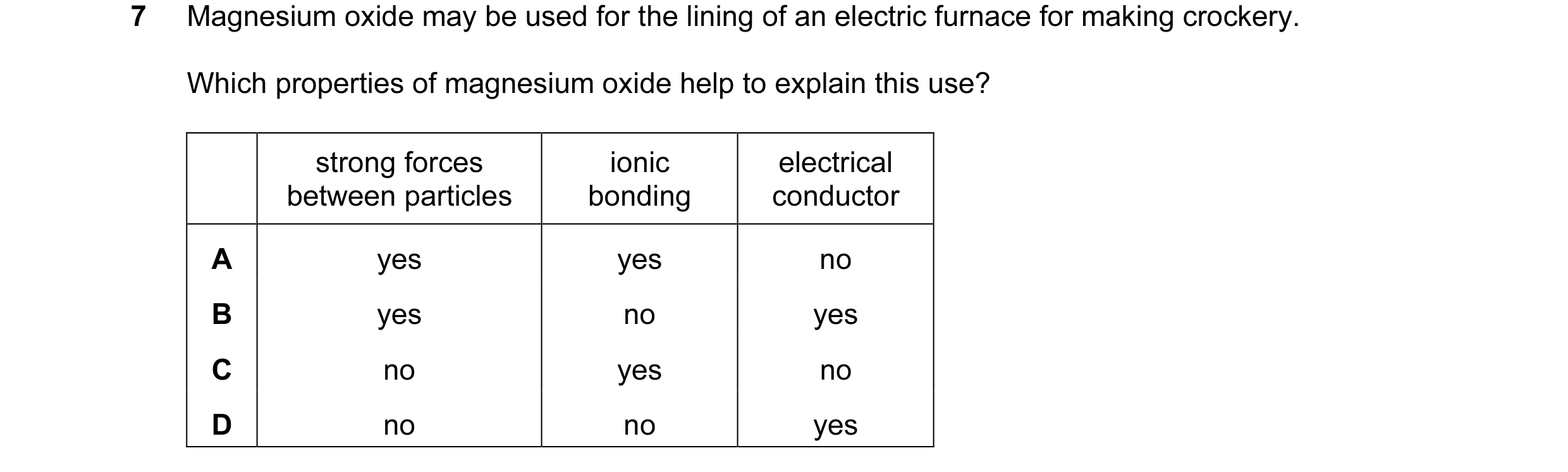 1 / 57

 2 / 57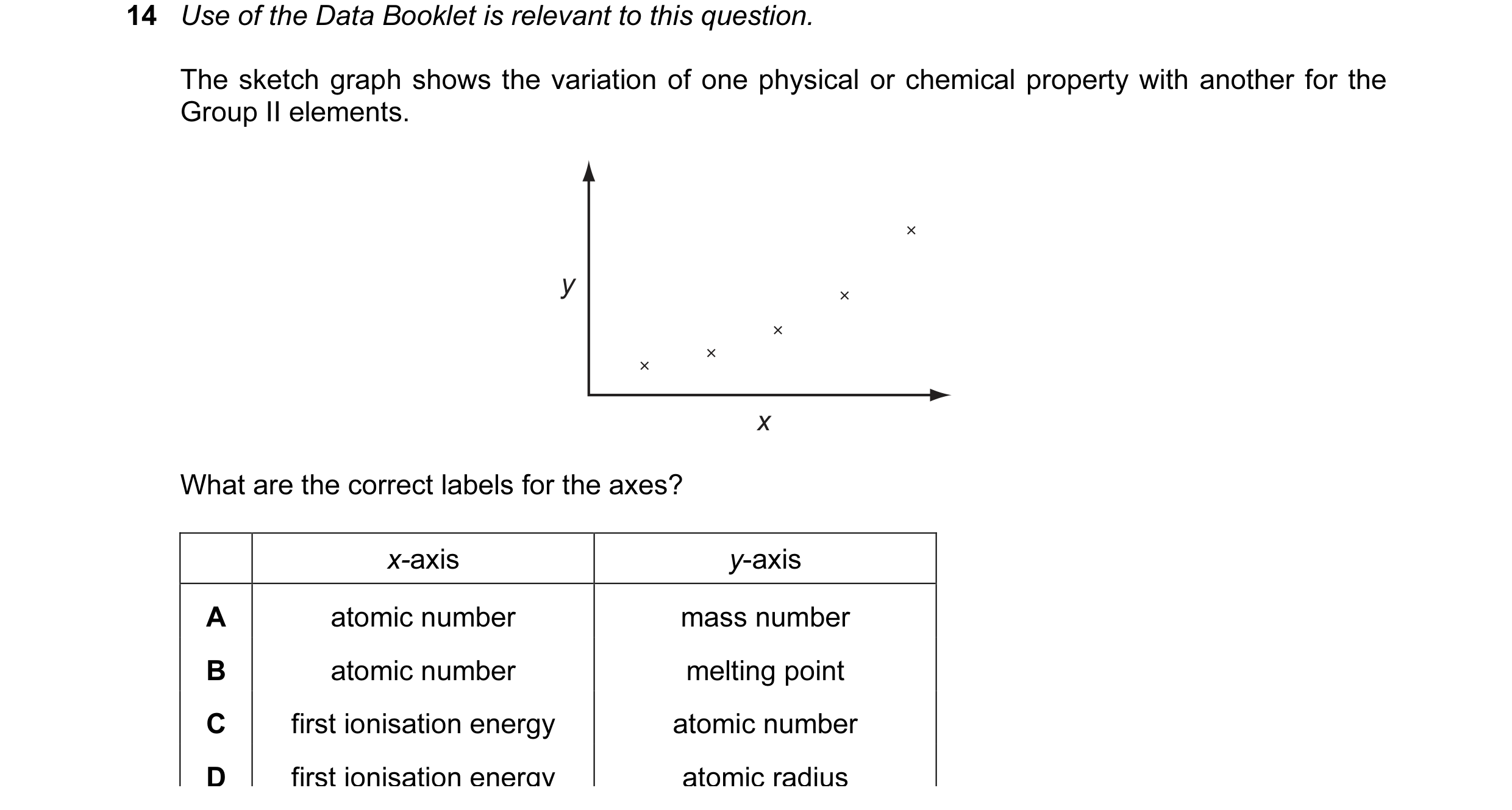
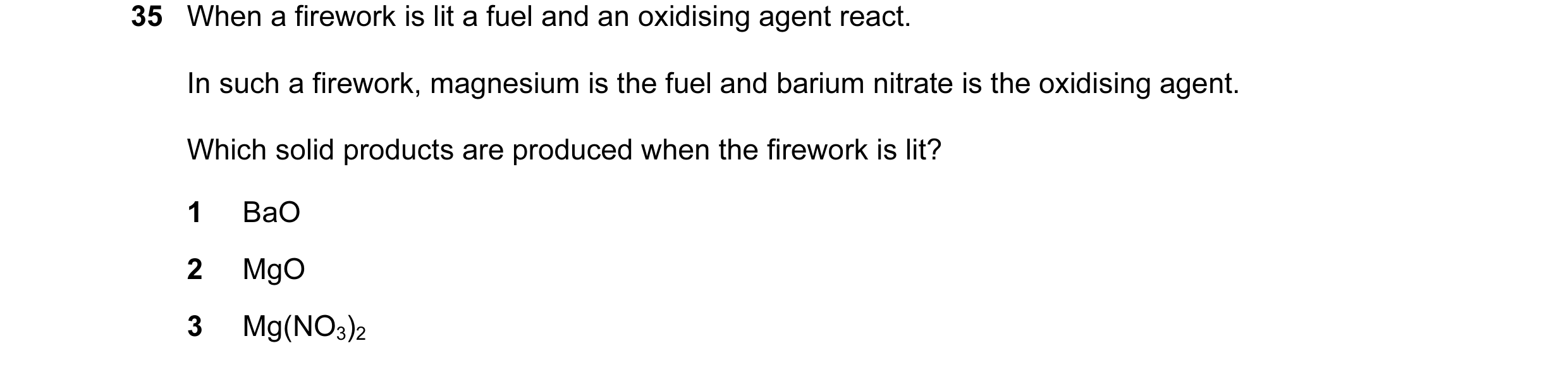
 3 / 57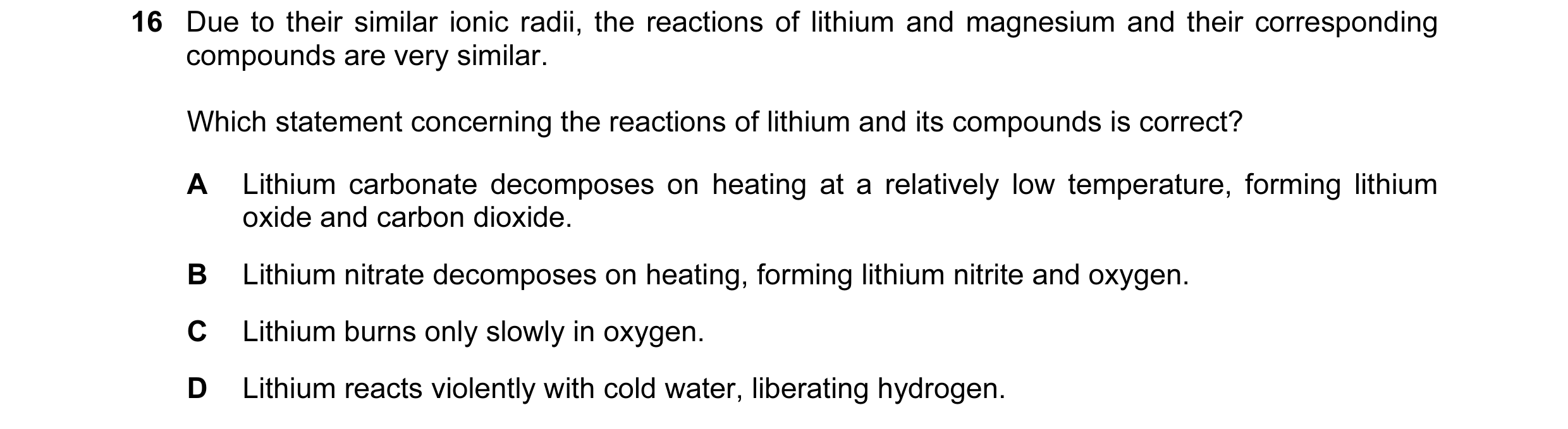

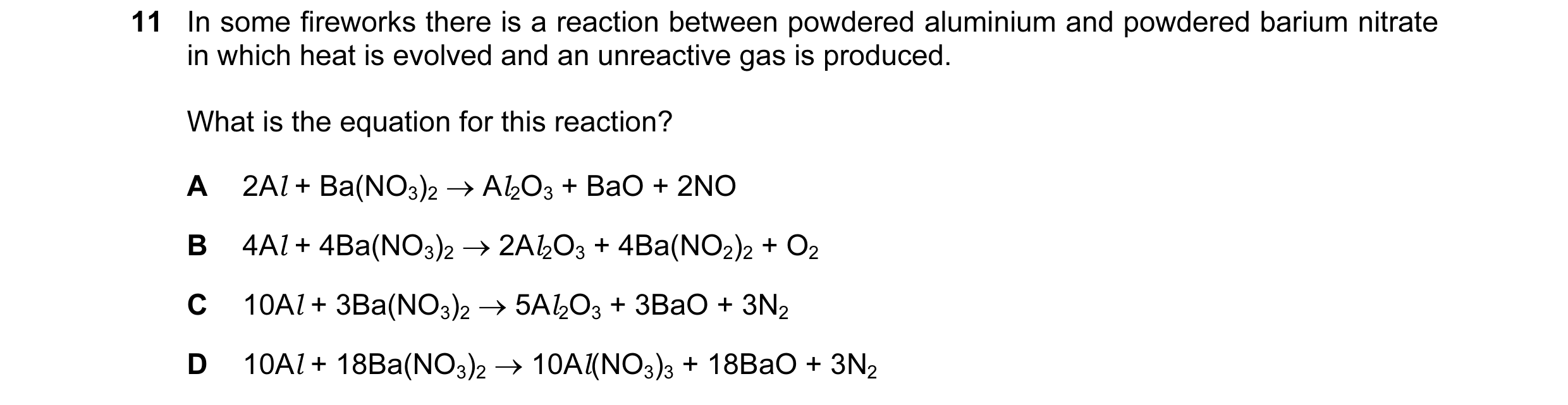
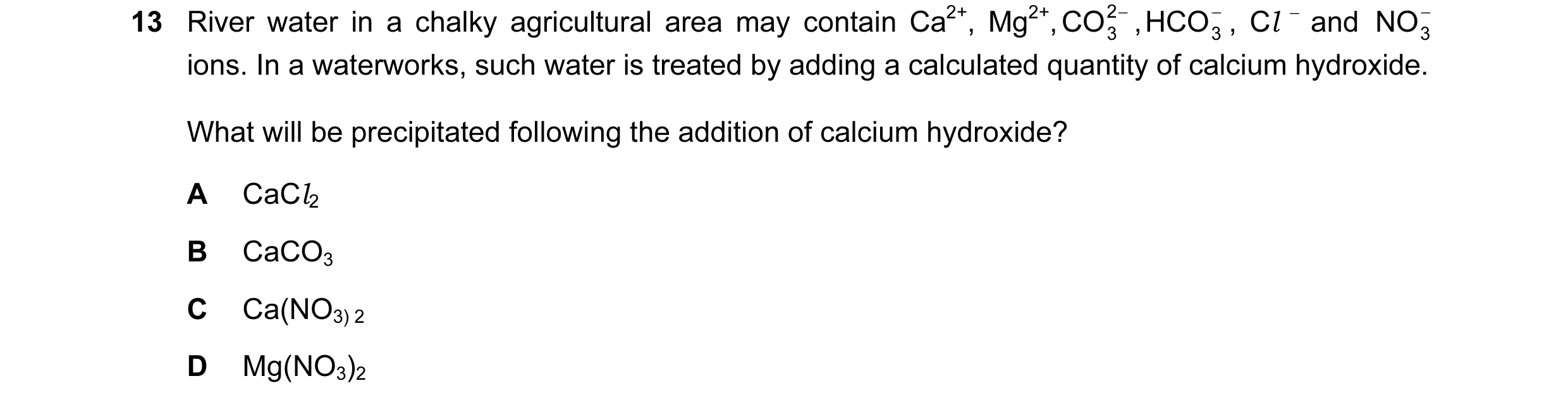 4 / 57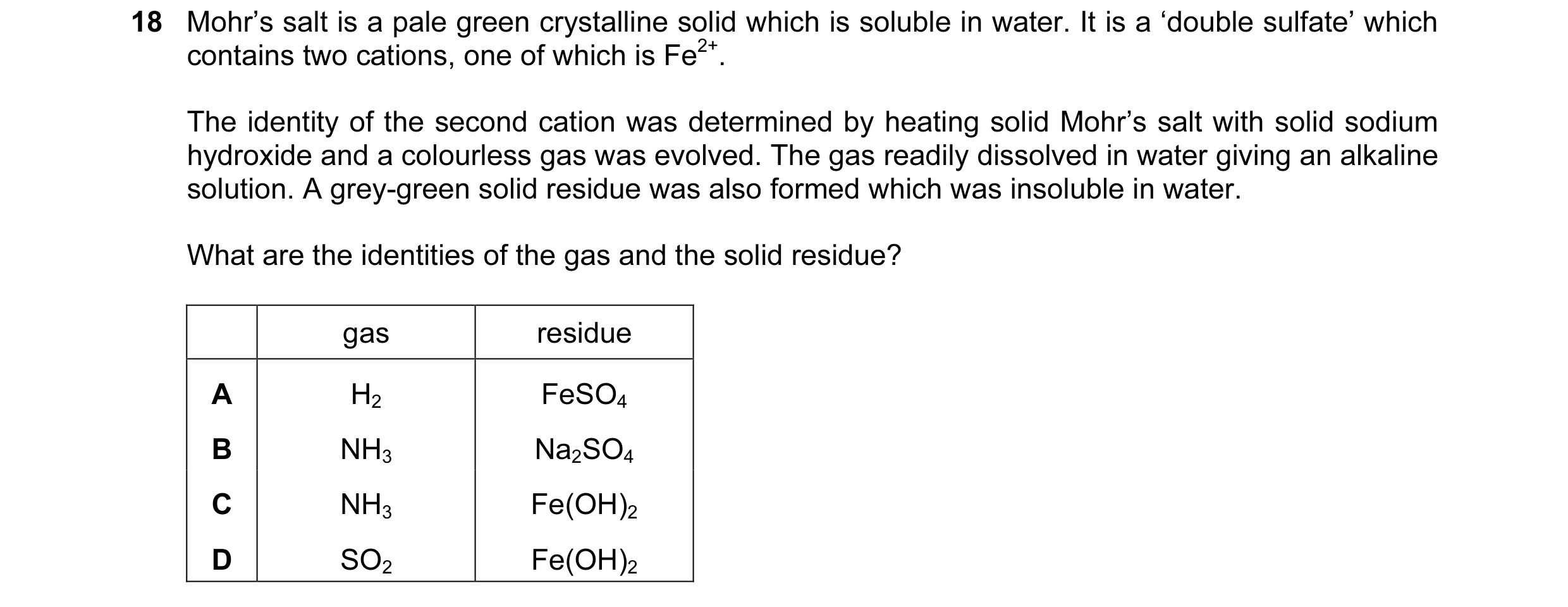
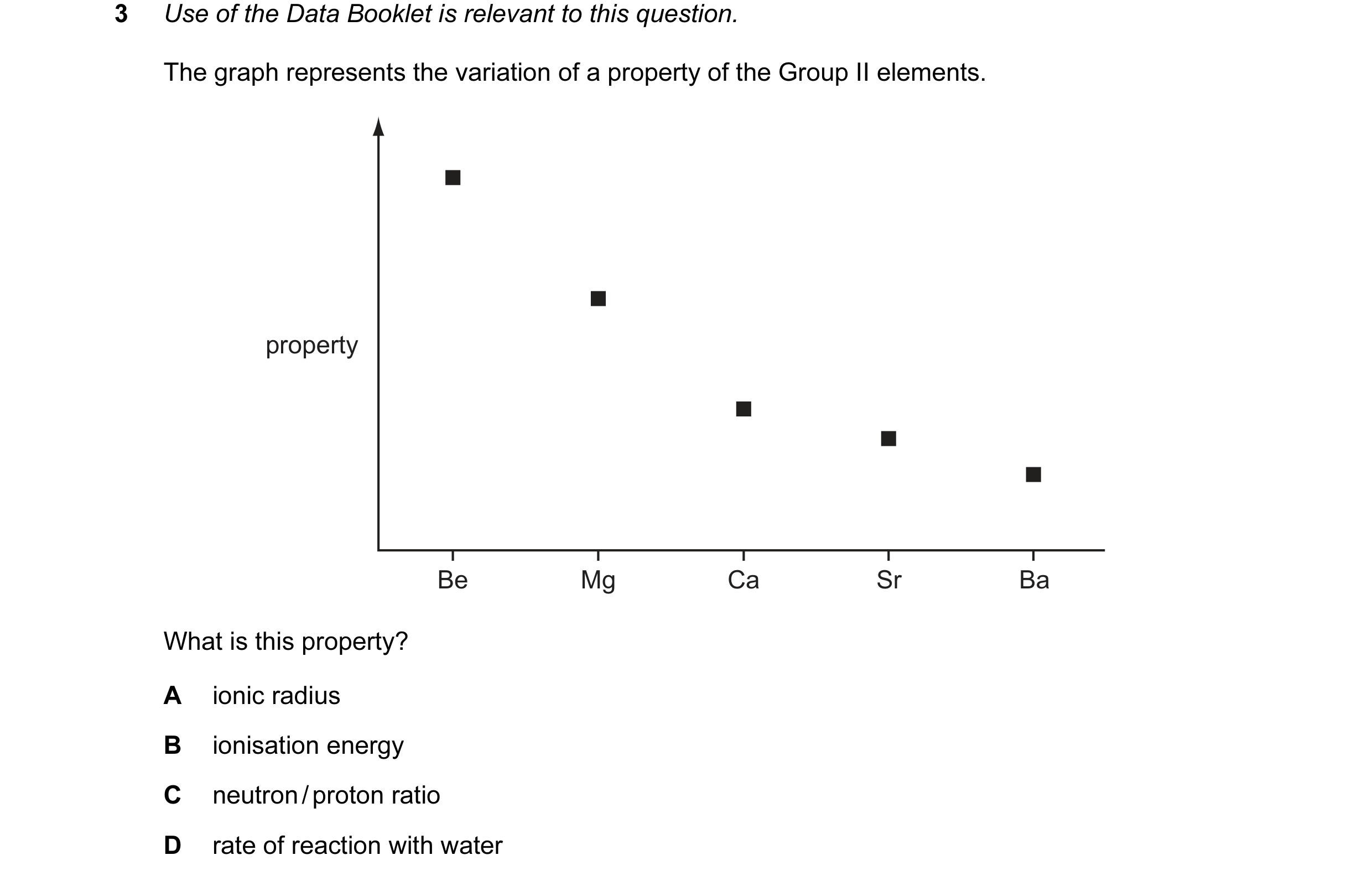 5 / 57
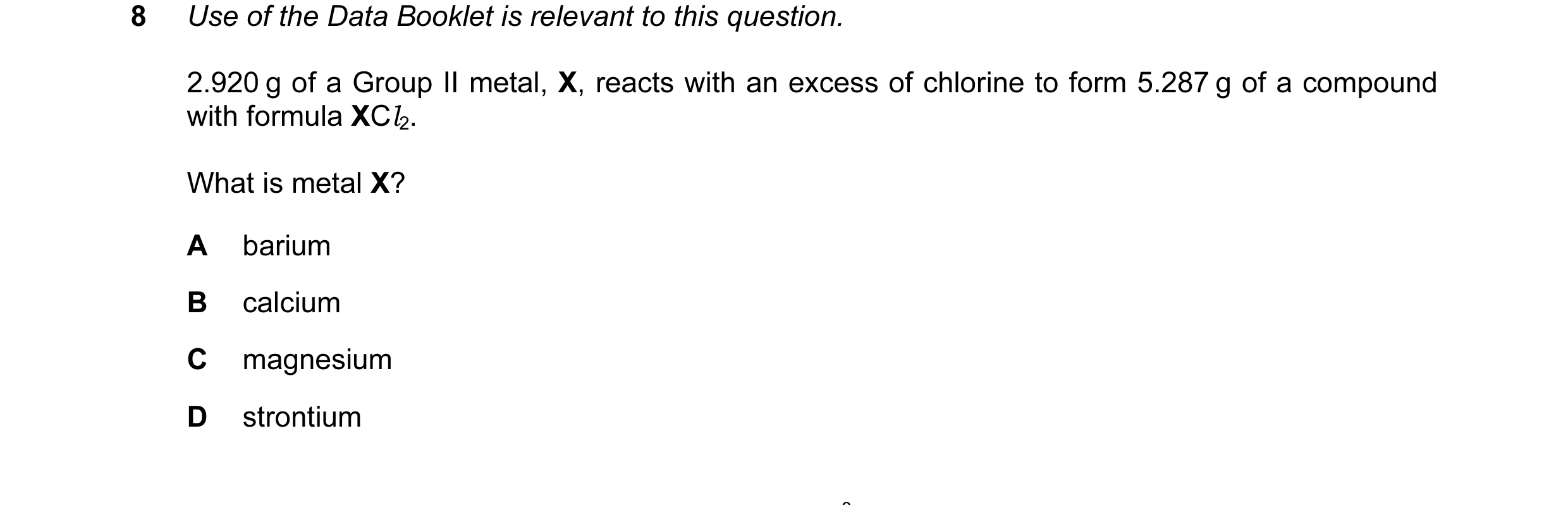
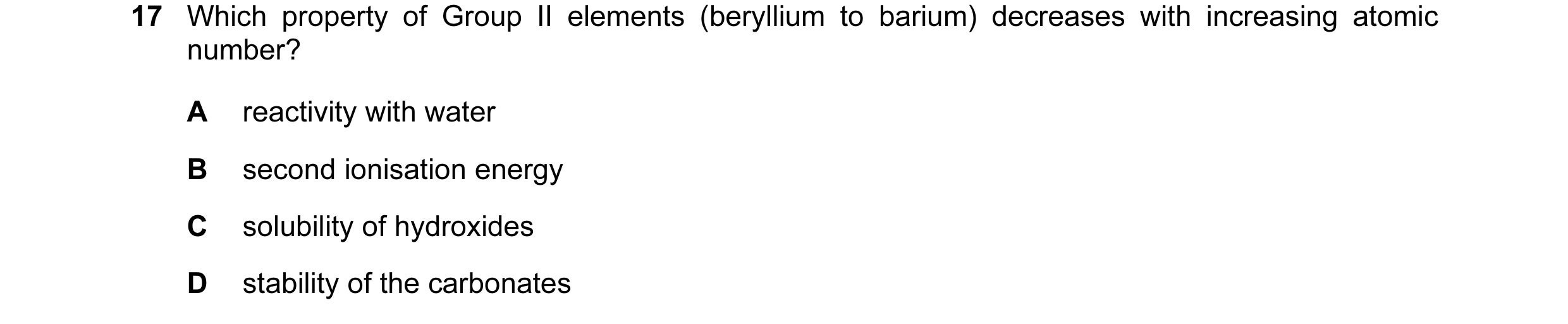
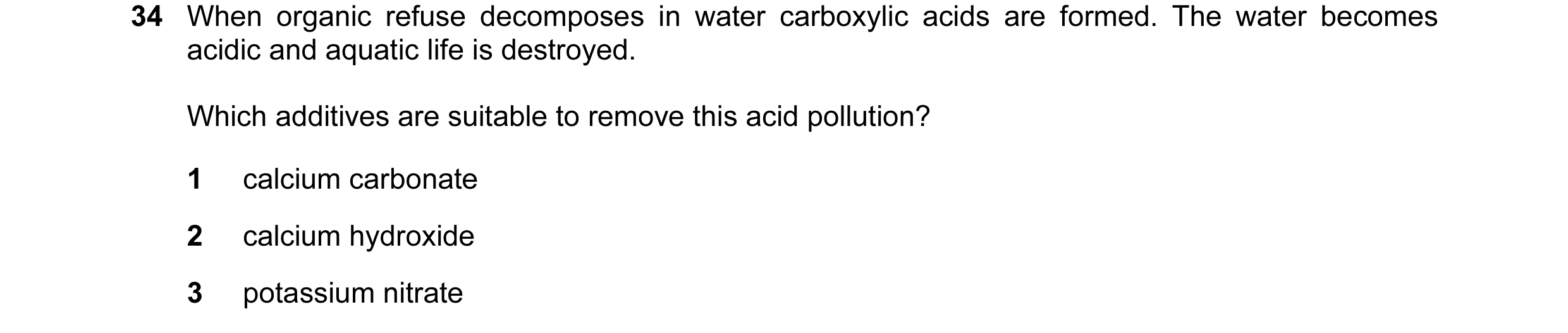
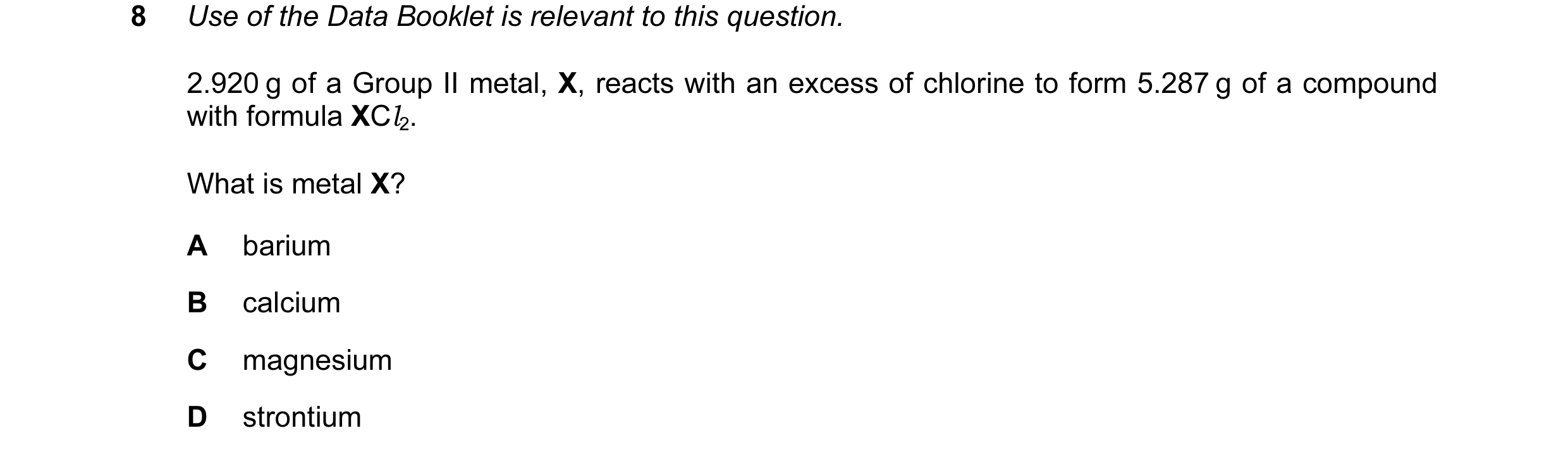 6 / 57

 7 / 57
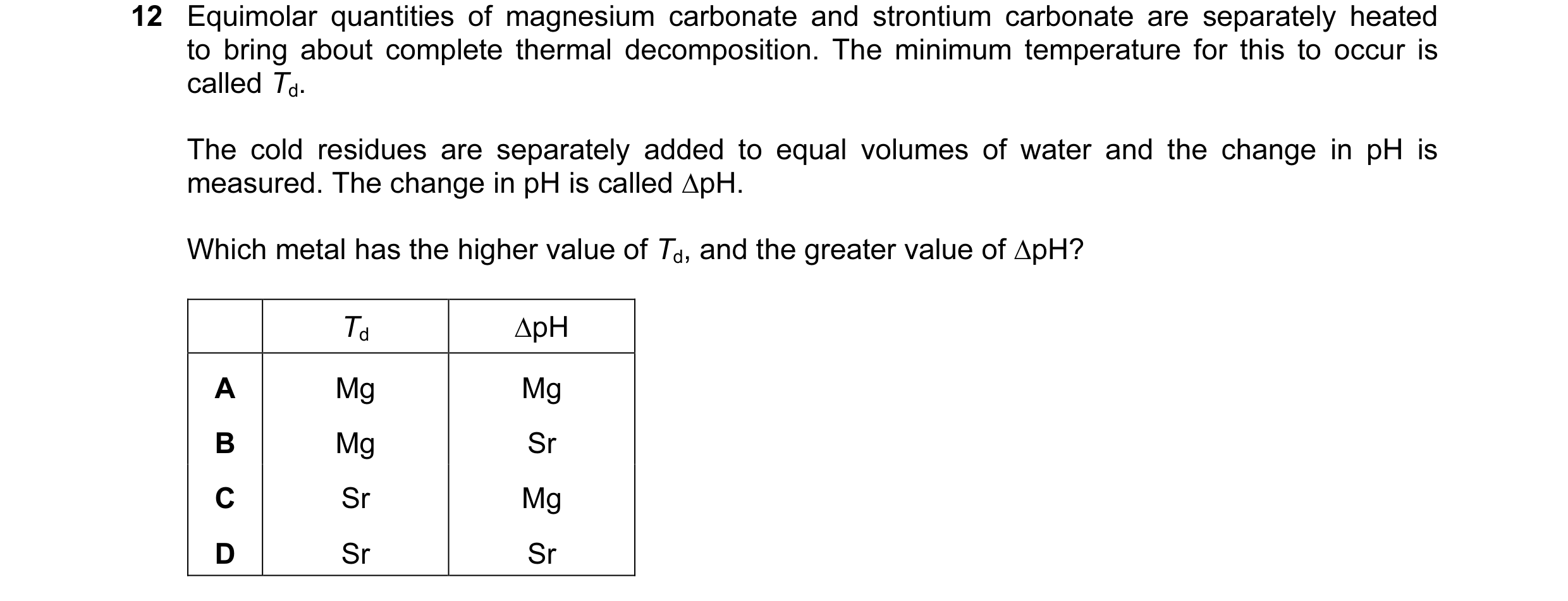

 8 / 57

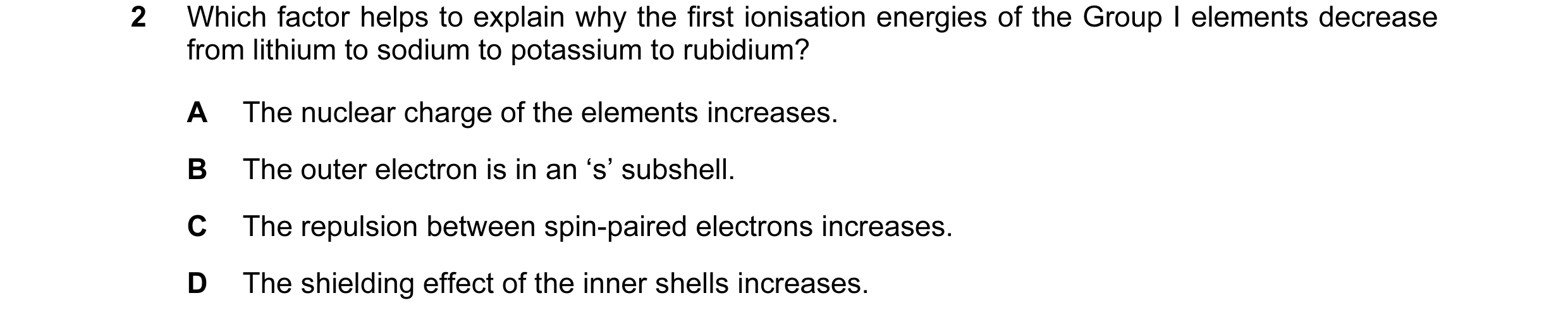
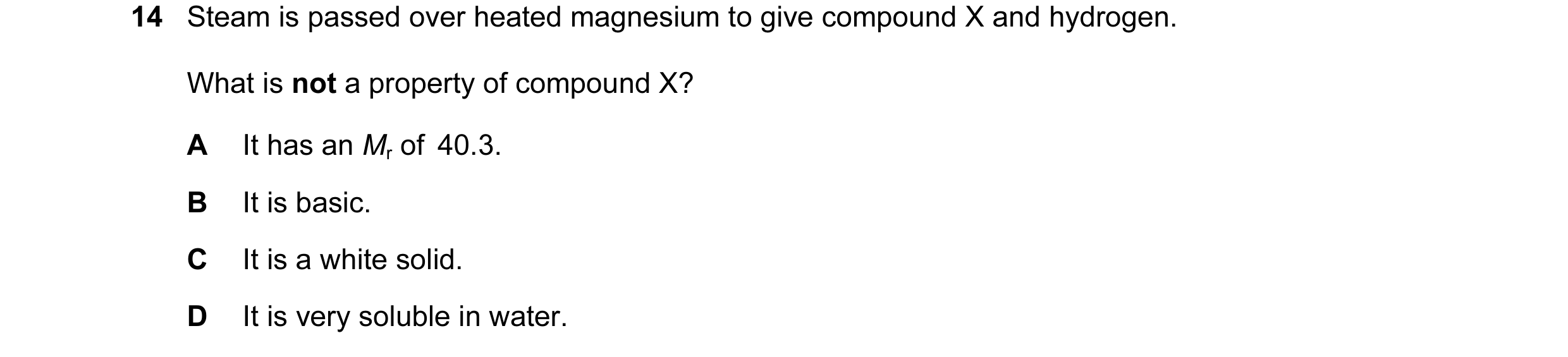
 9 / 57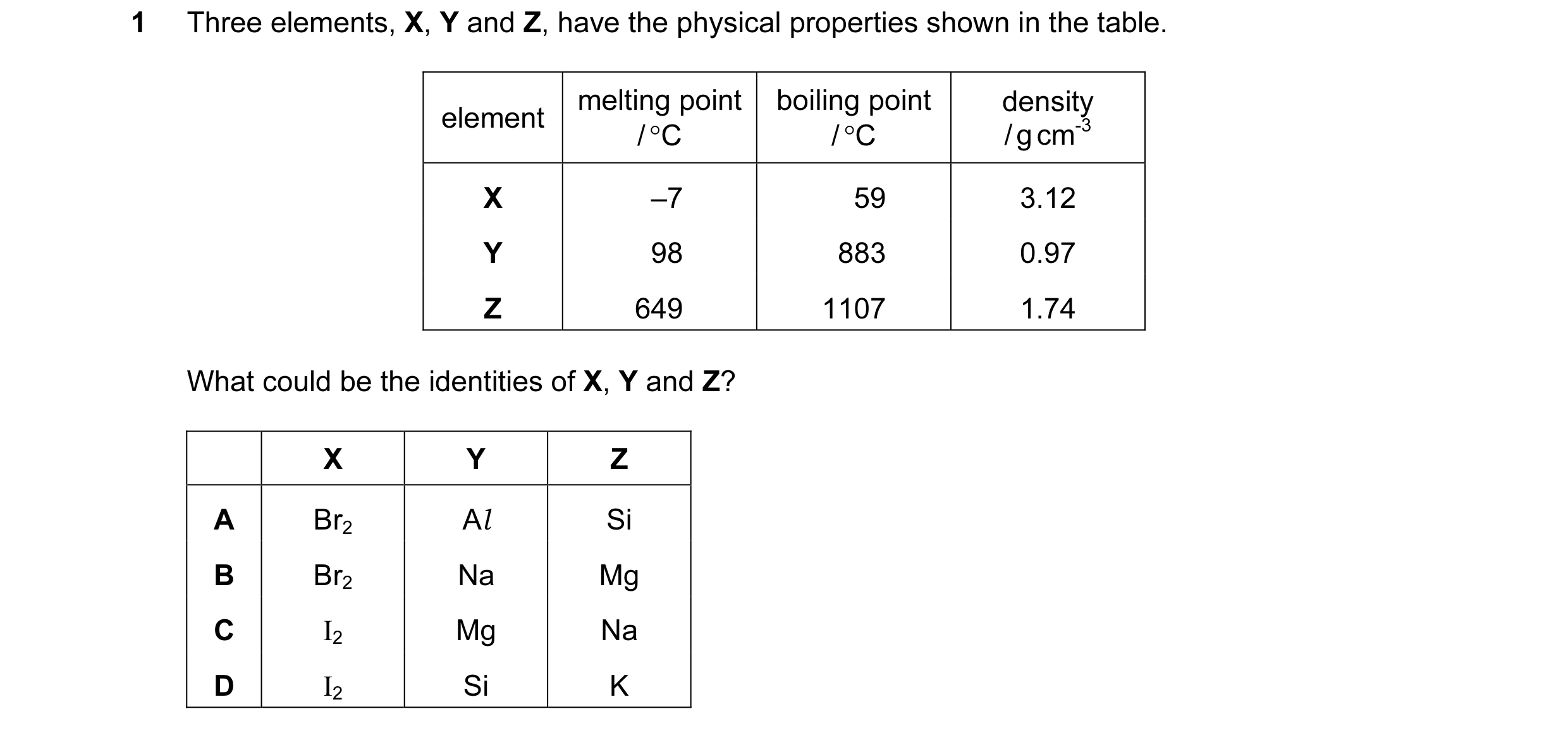
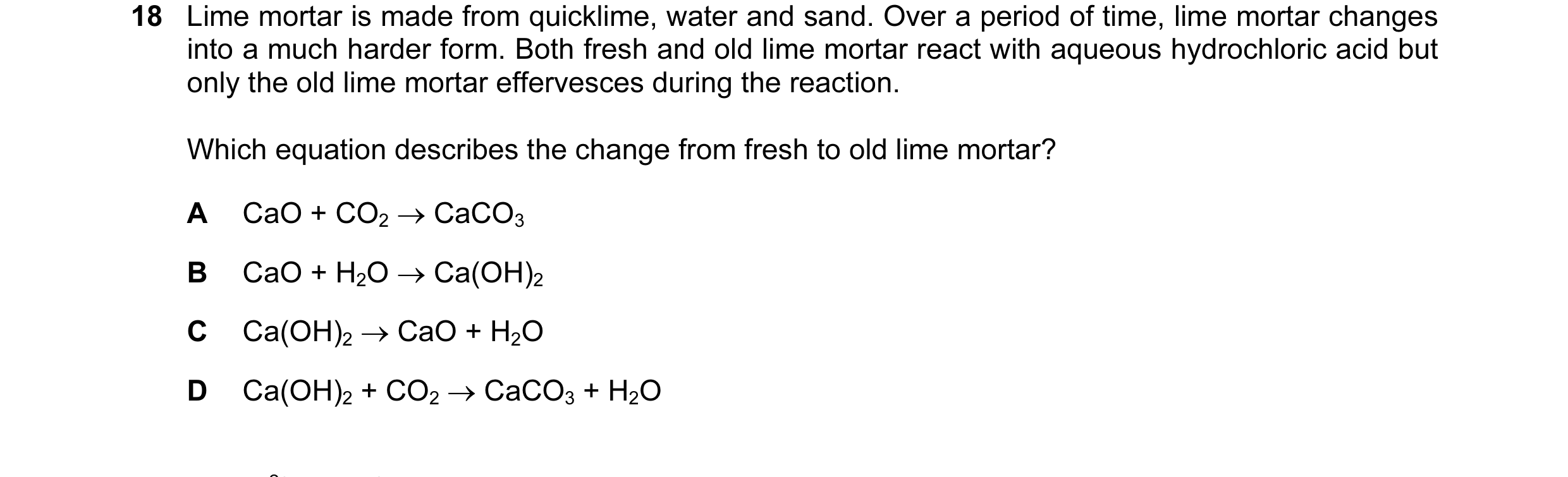

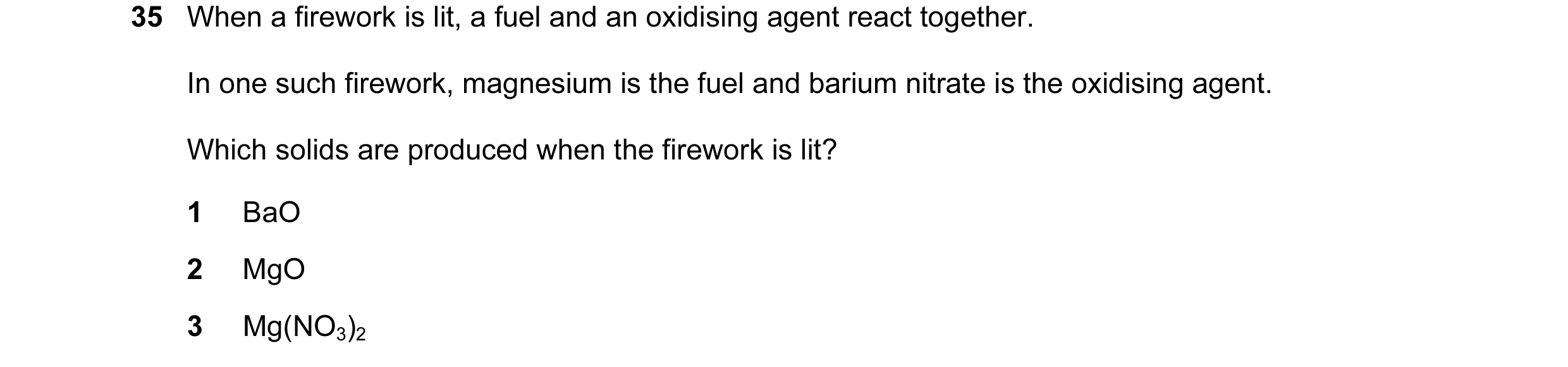 10 / 57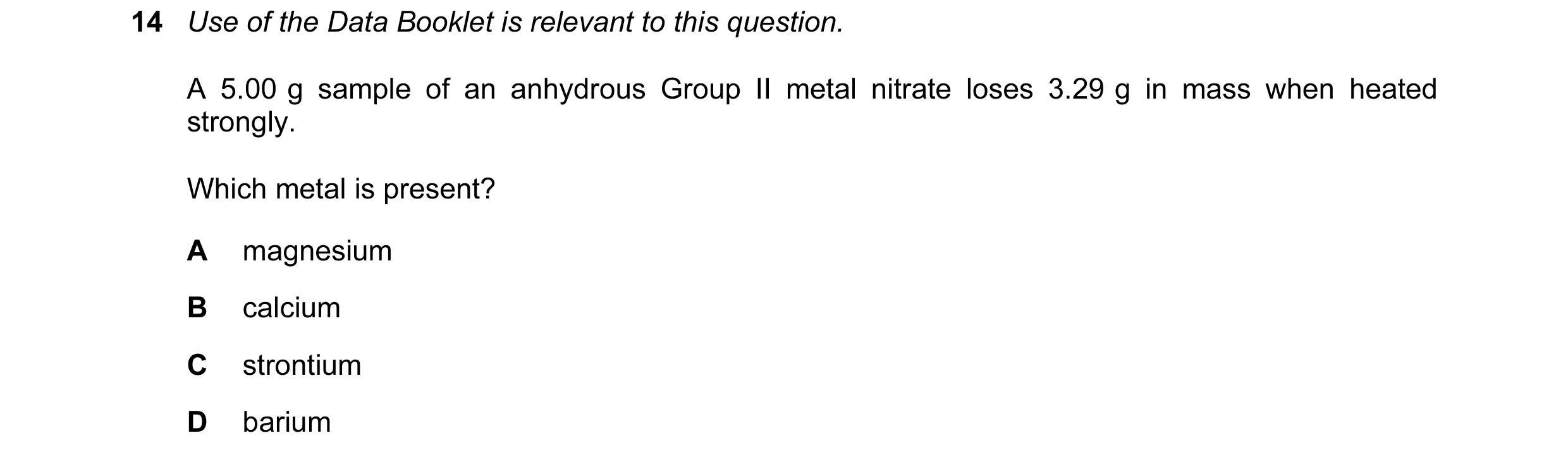
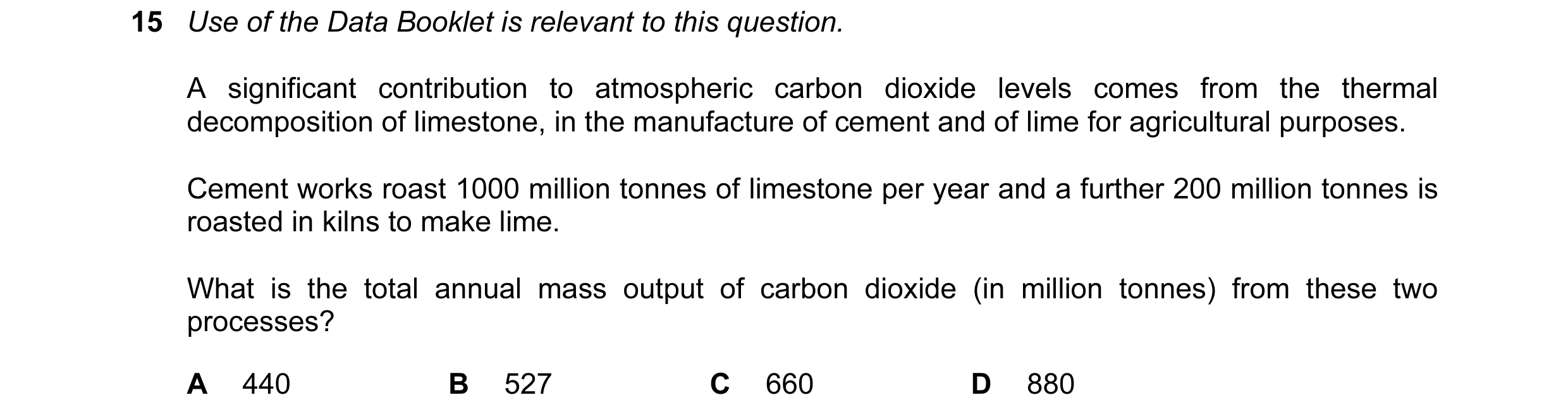

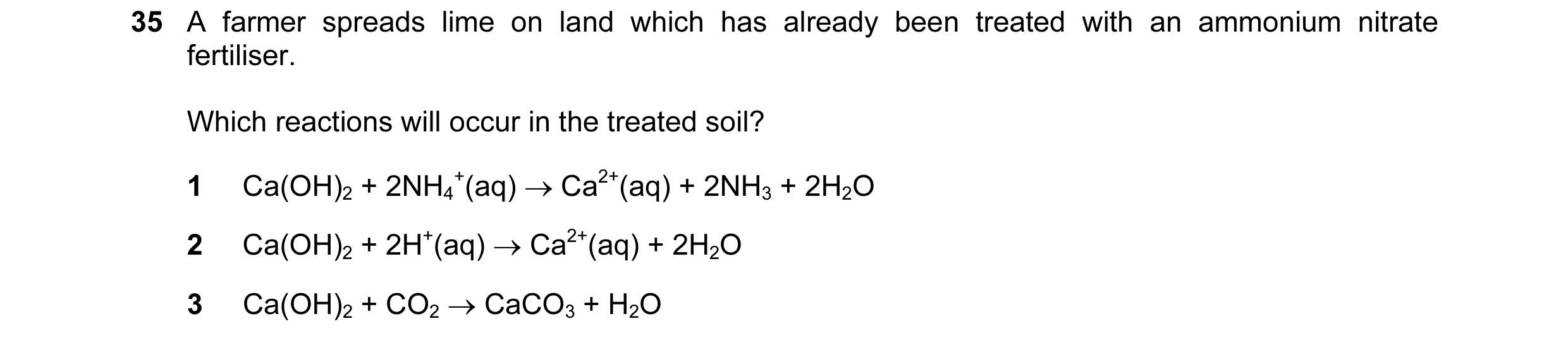
 11 / 57

 12 / 57
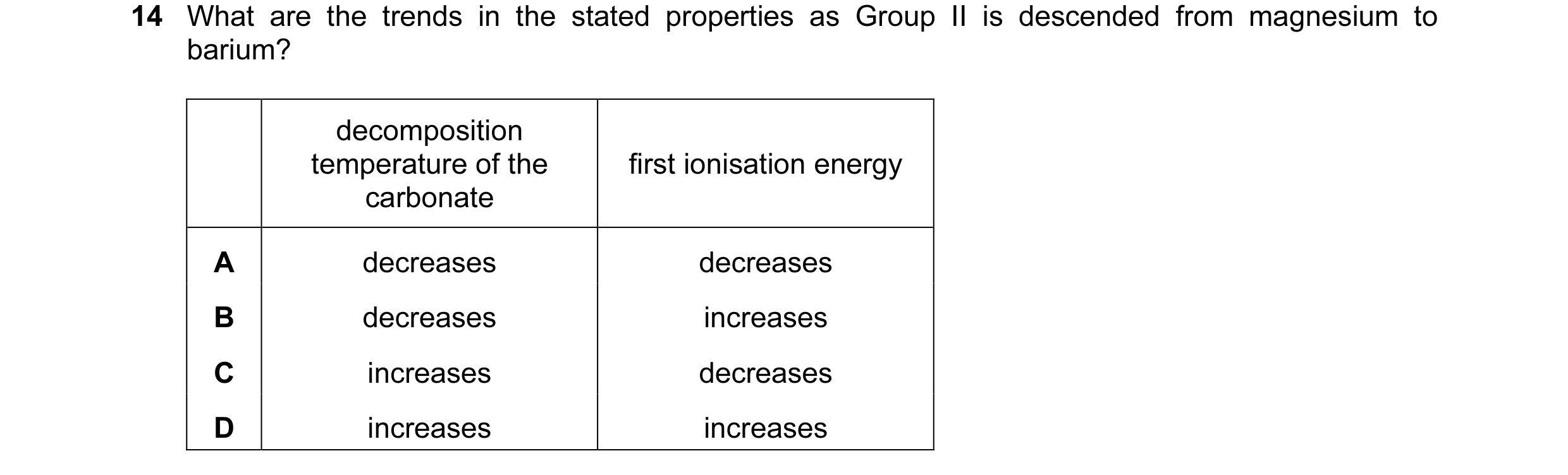
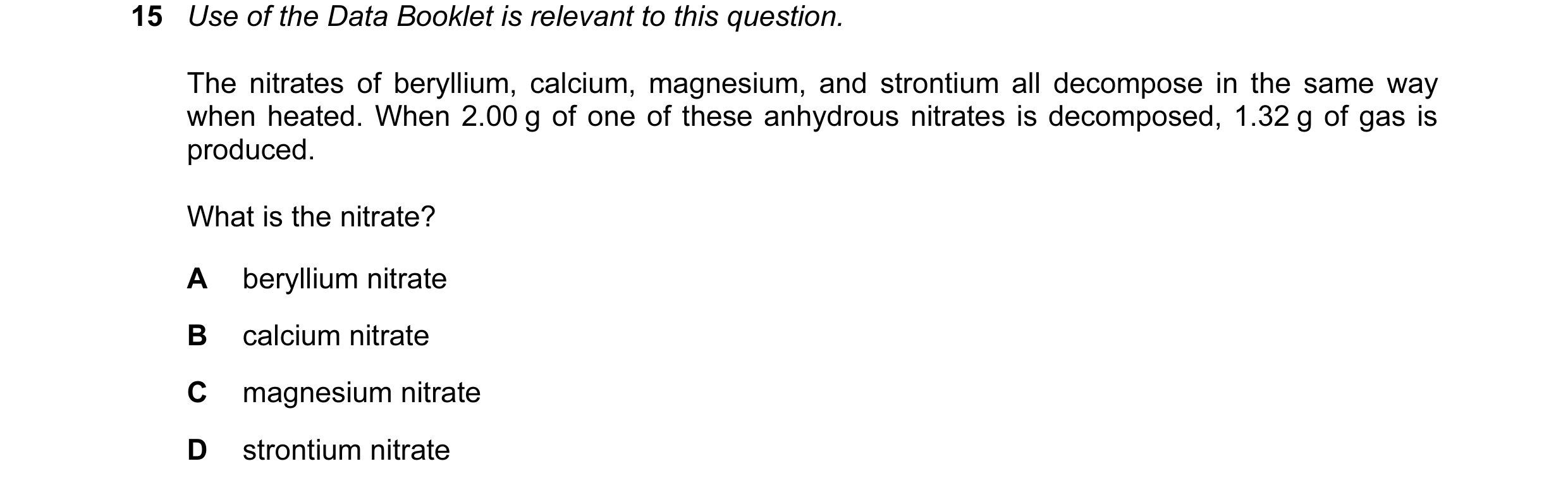
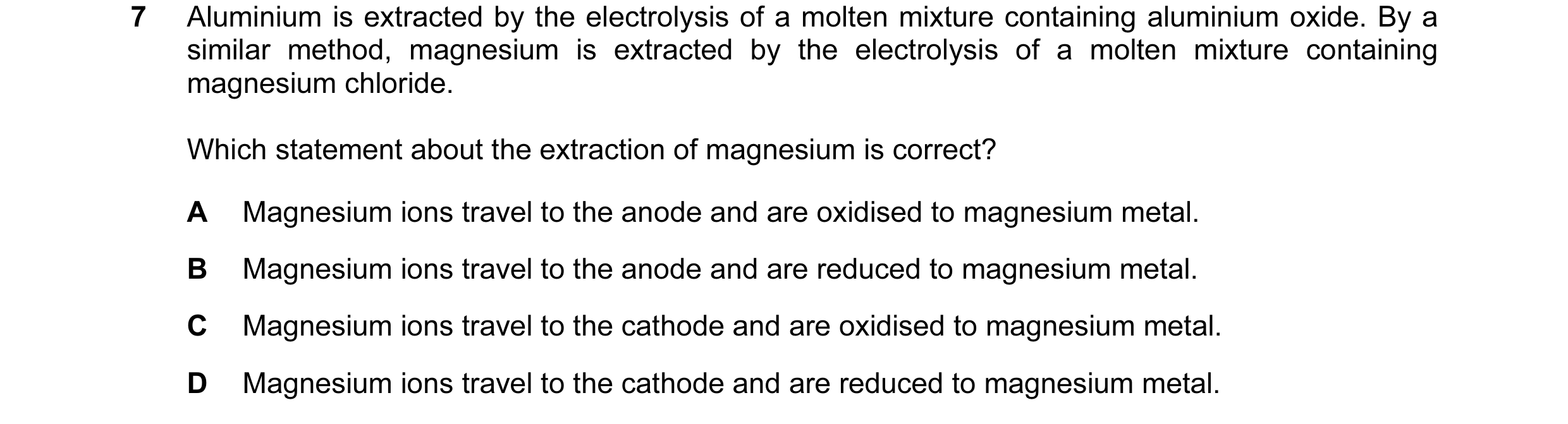 13 / 57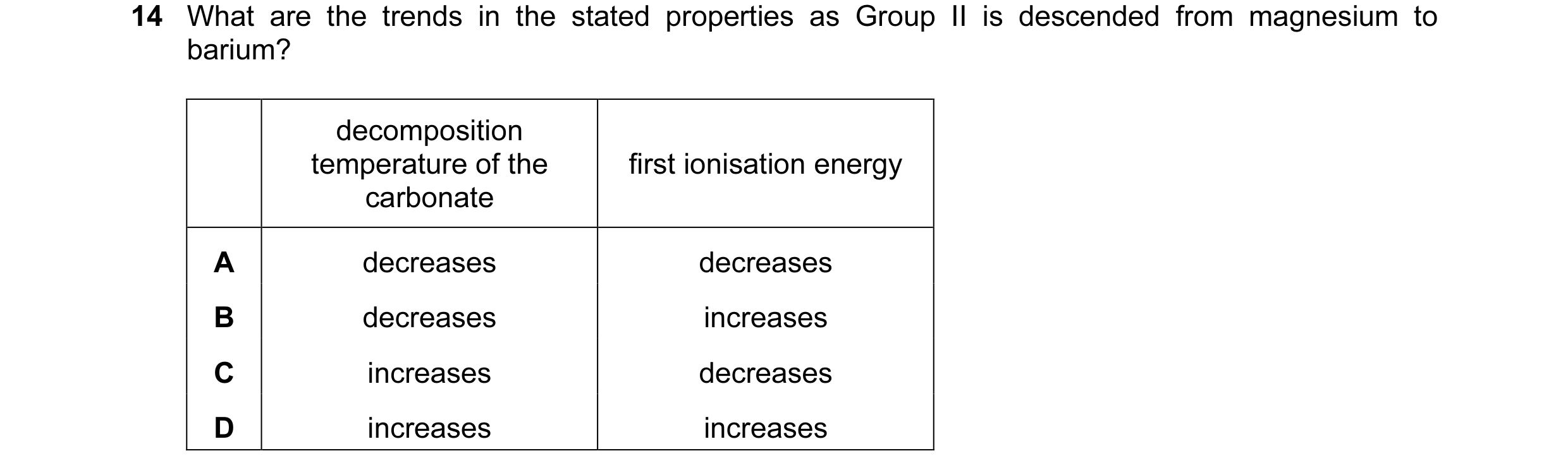
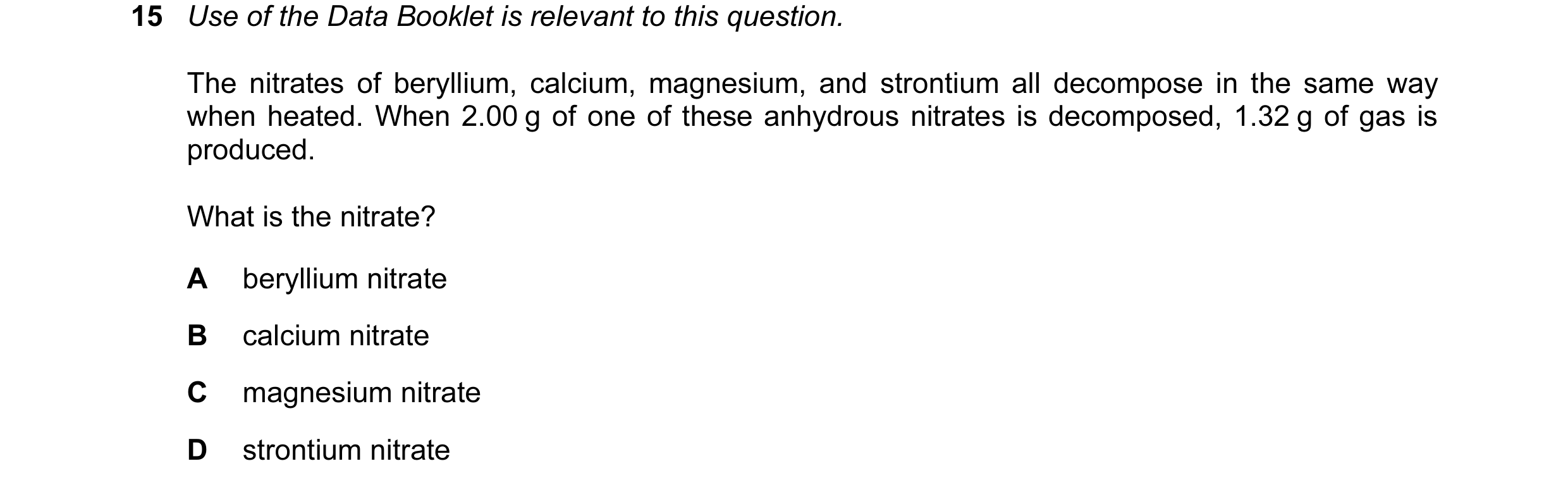
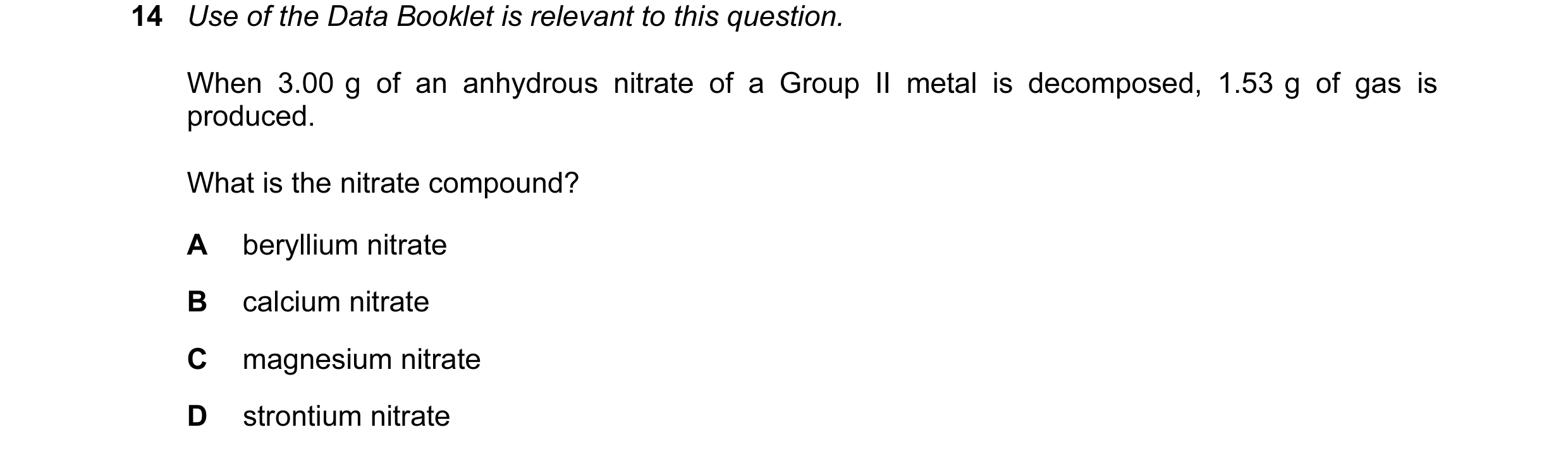
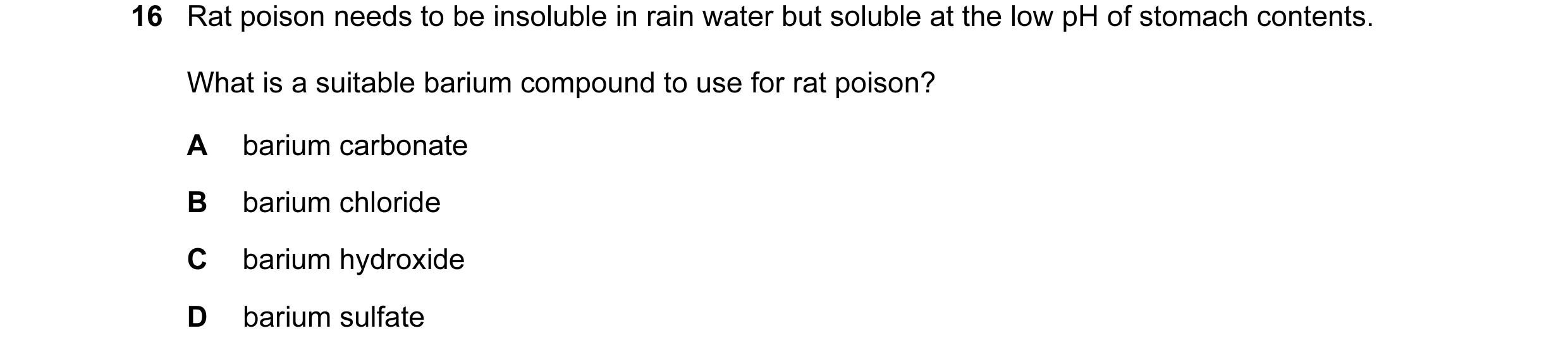 14 / 57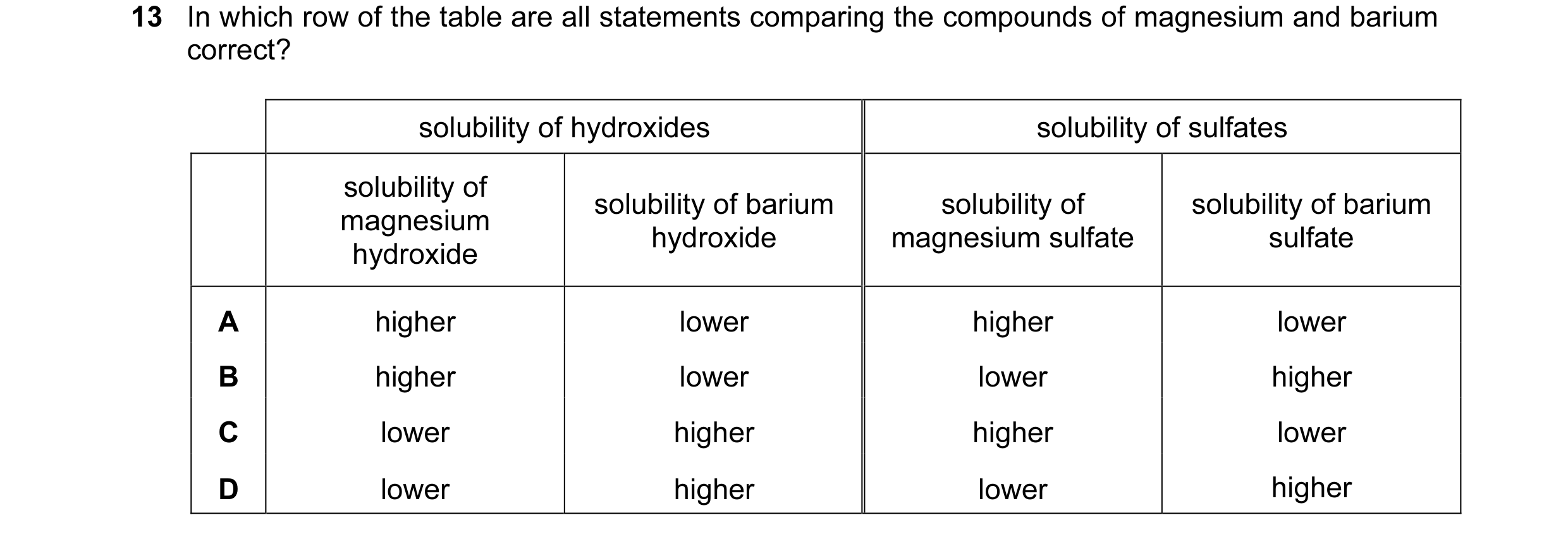
 15 / 57
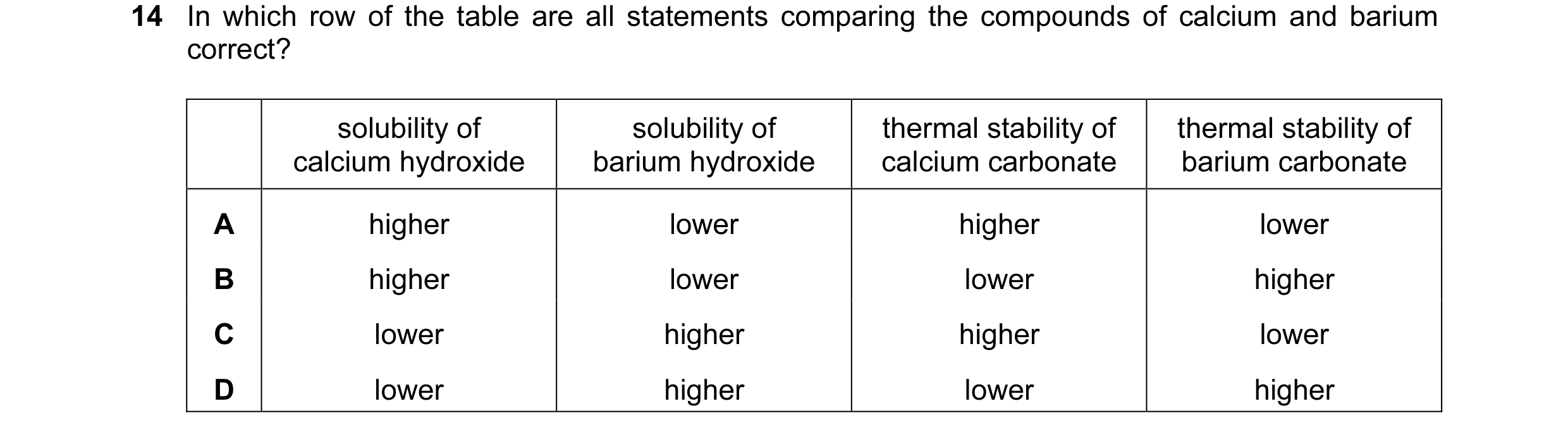
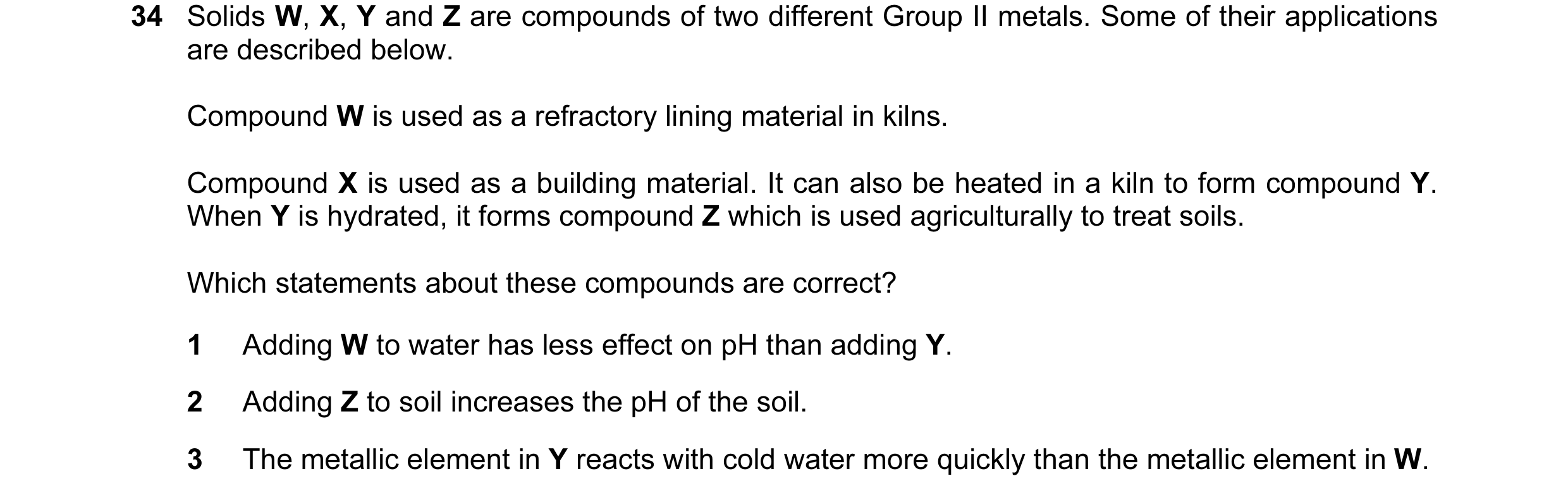
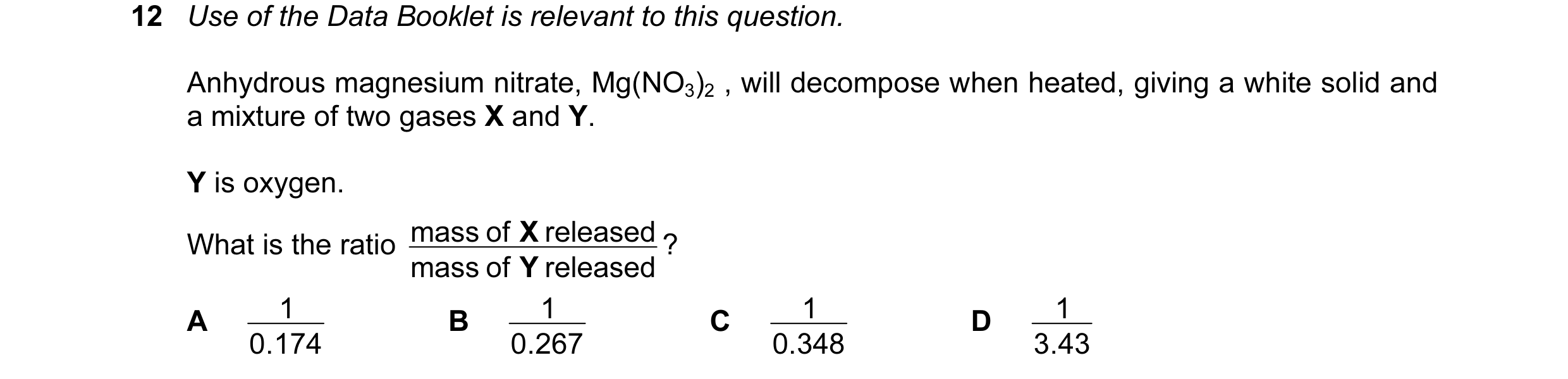 16 / 57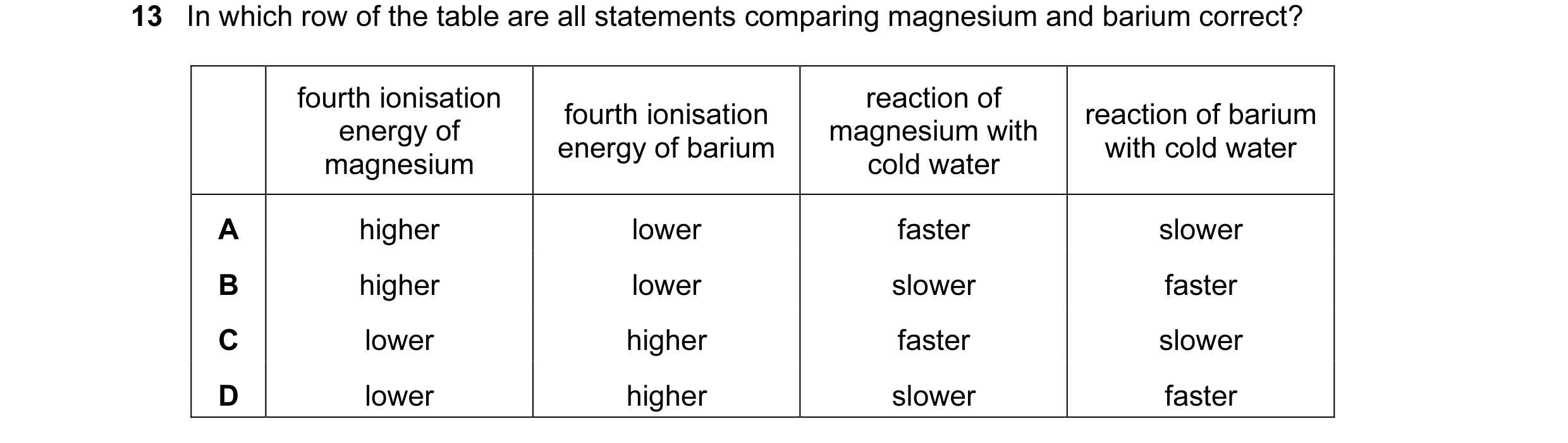
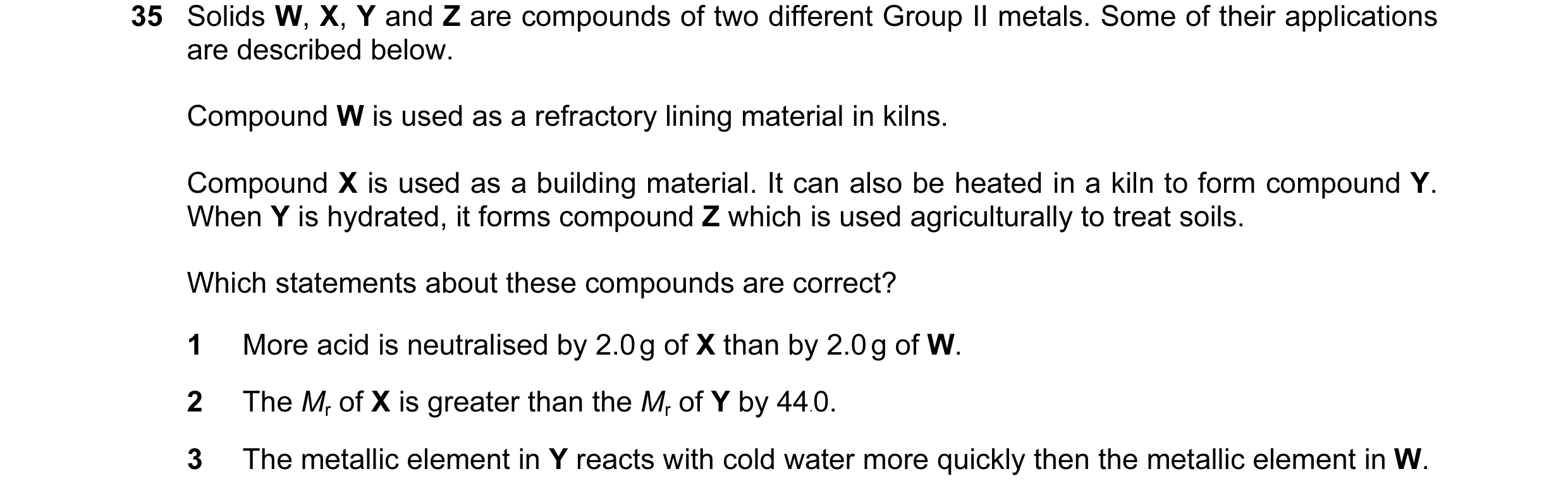
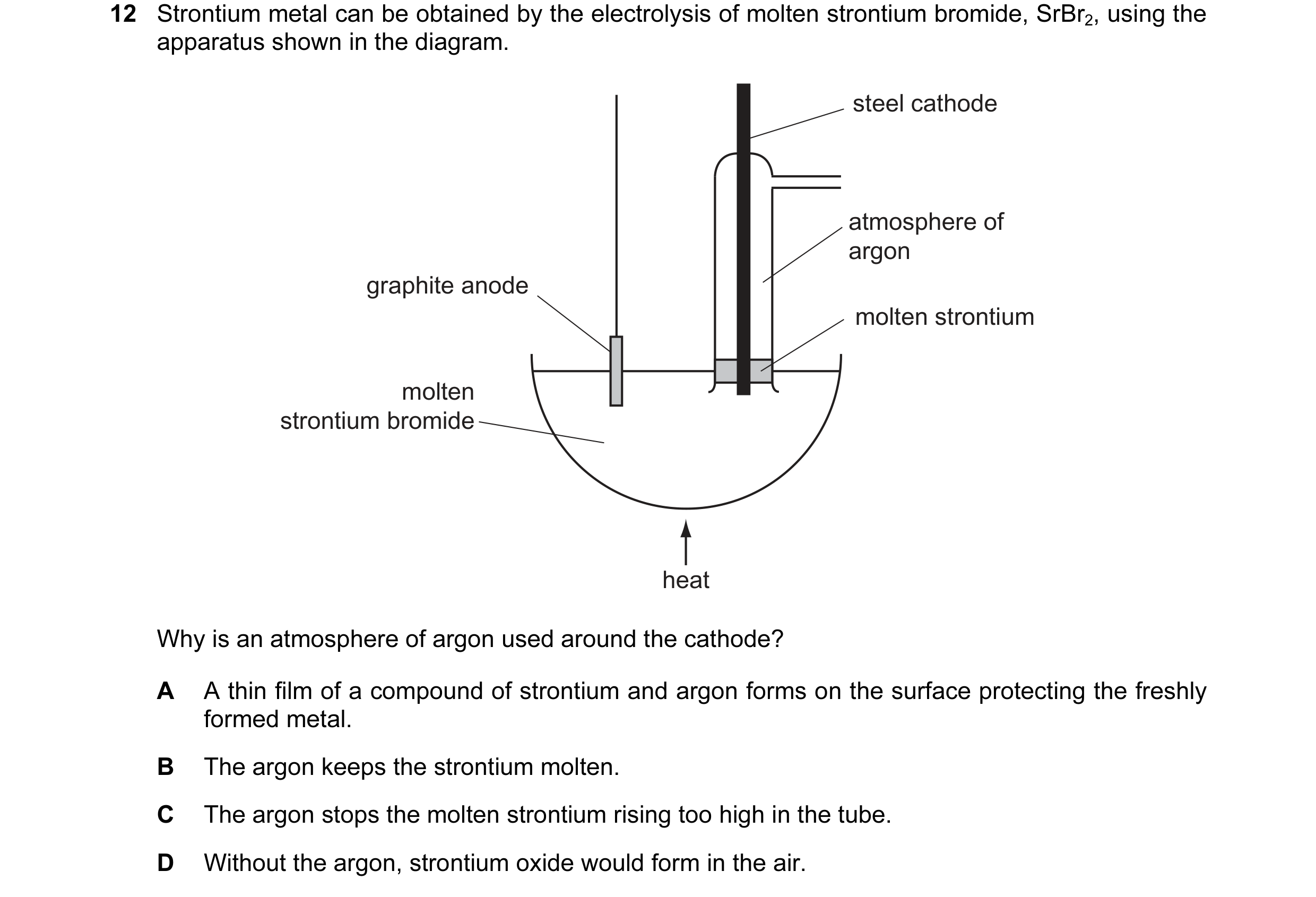 17 / 57

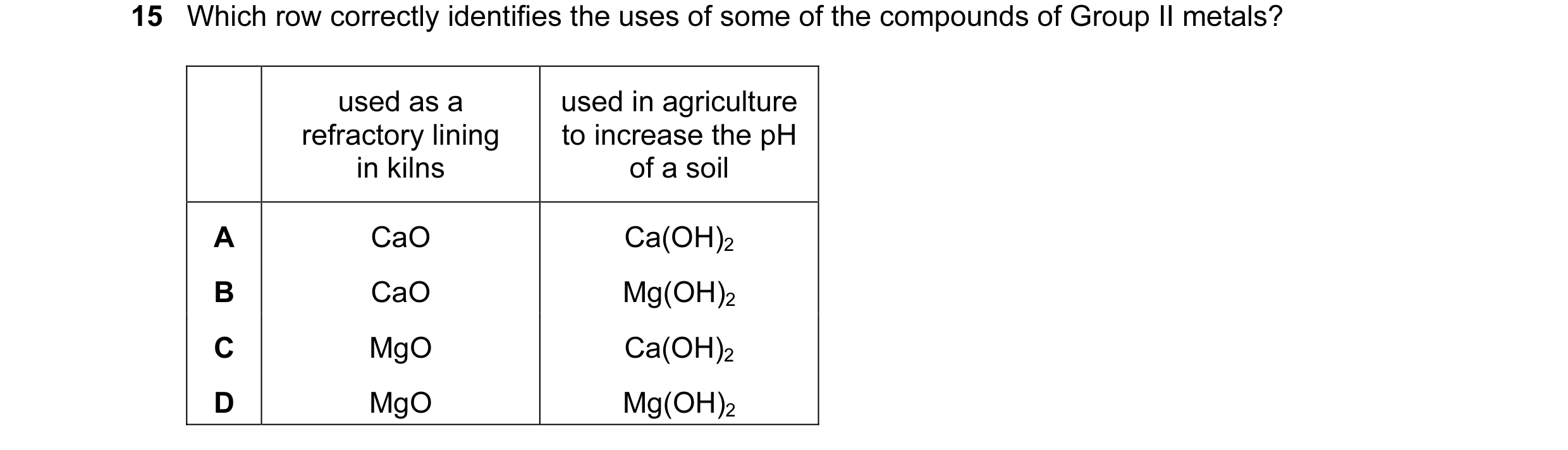
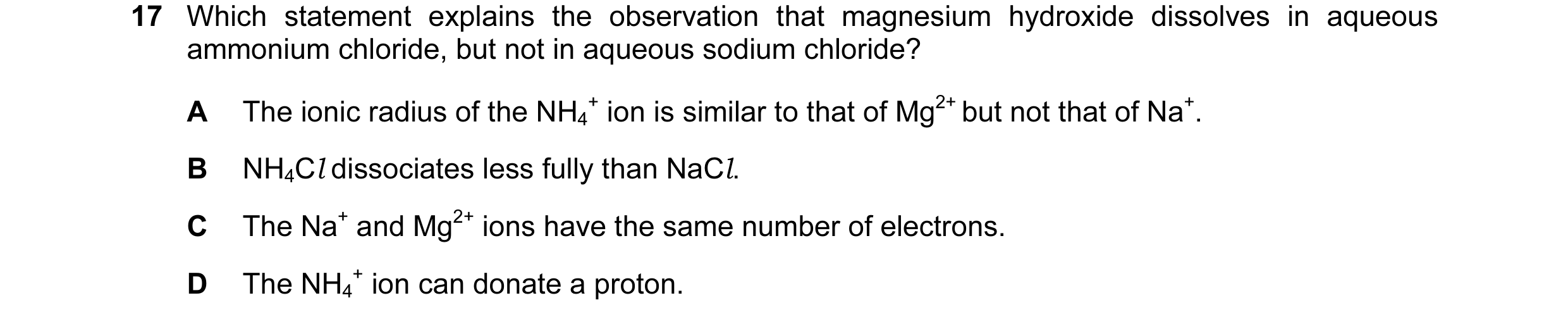
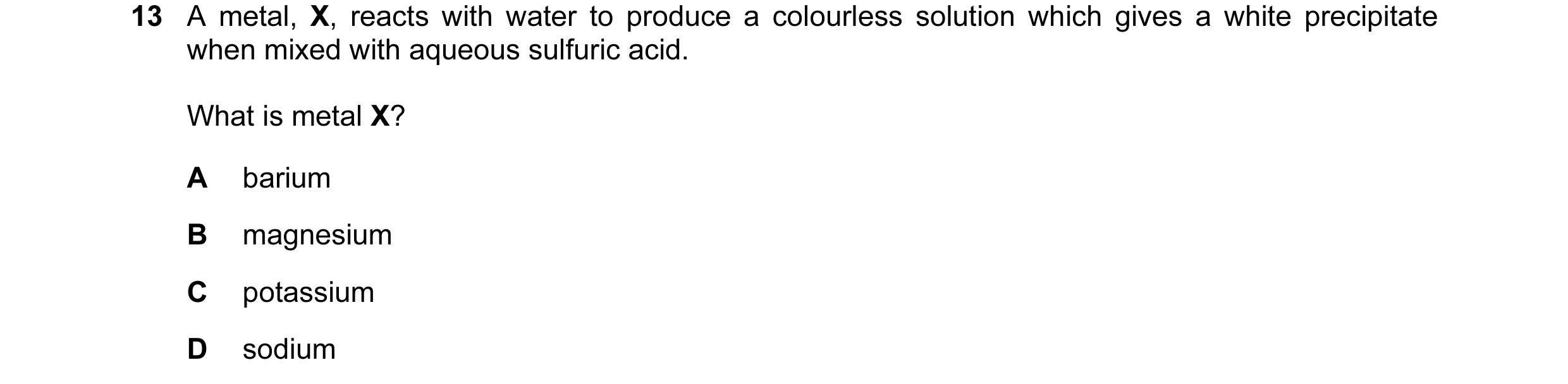 18 / 57
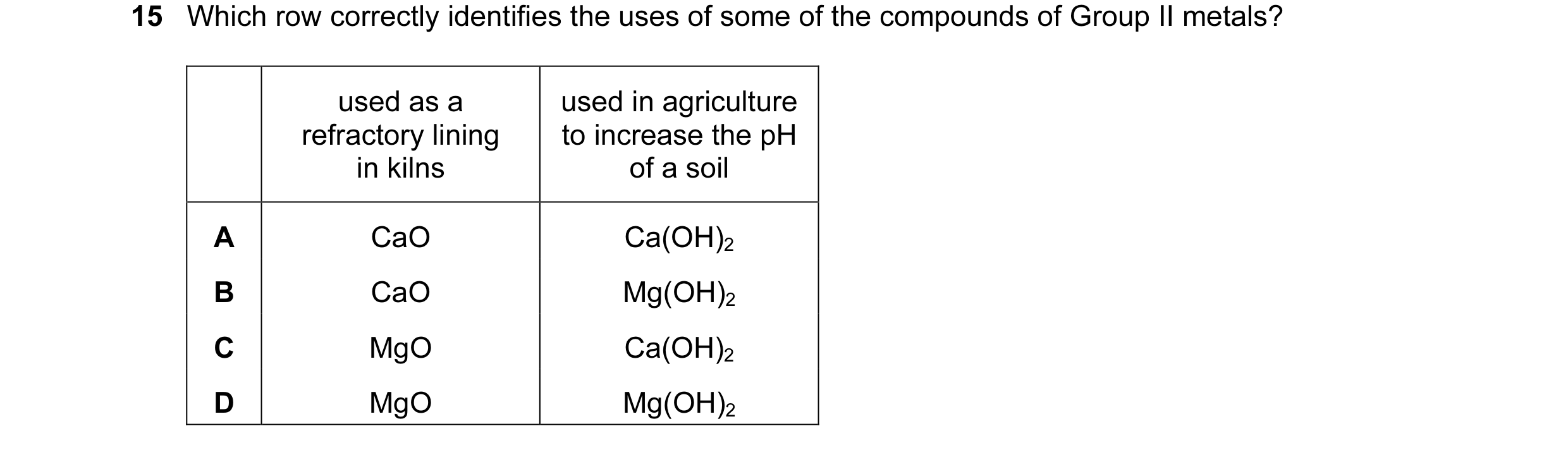
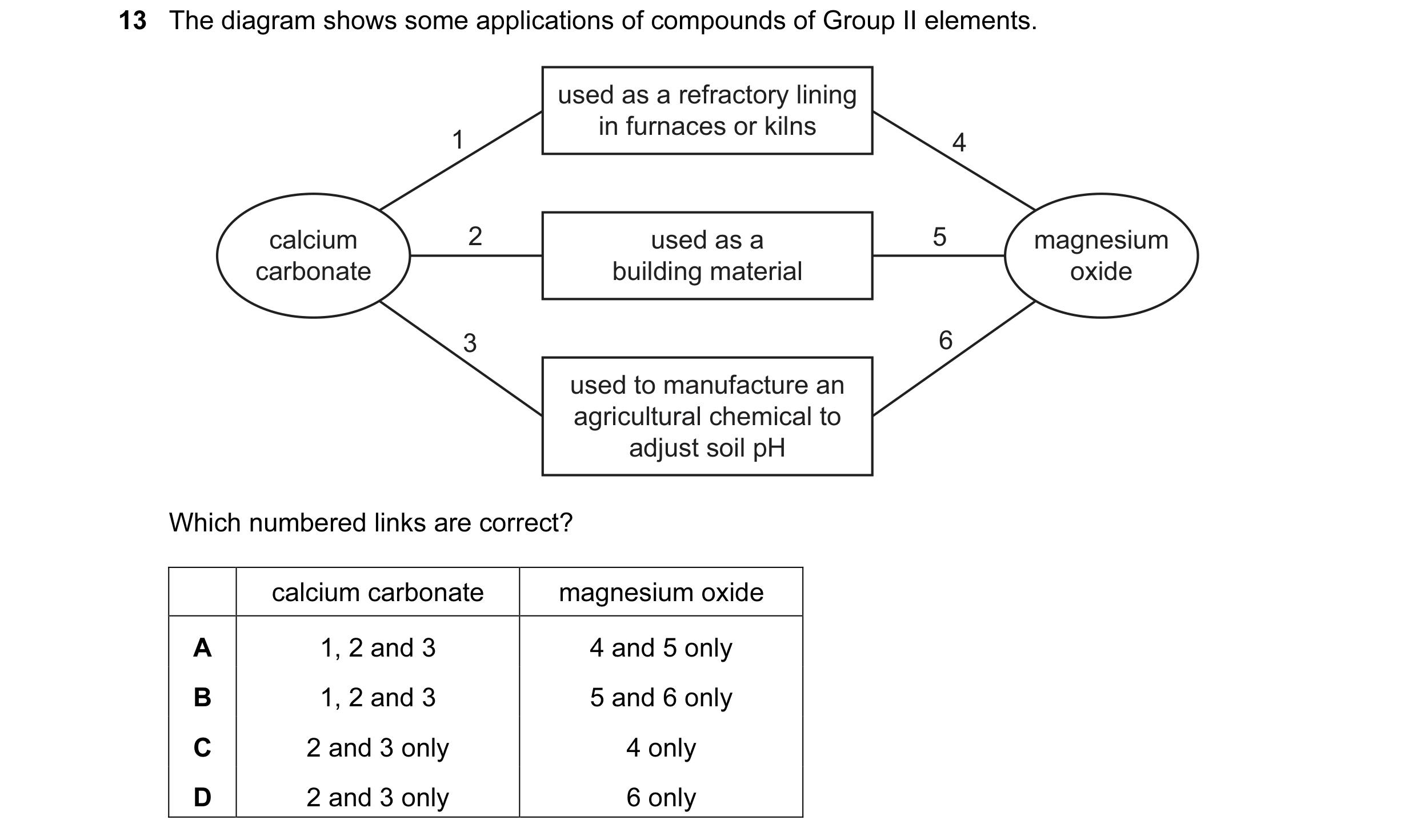
 19 / 57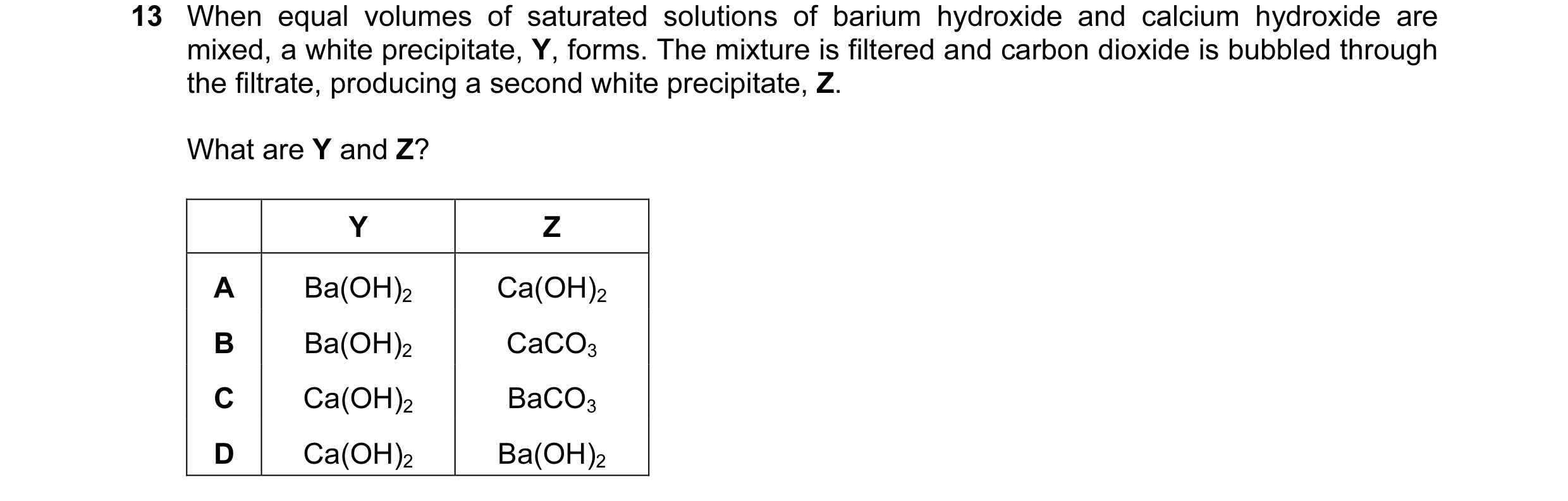

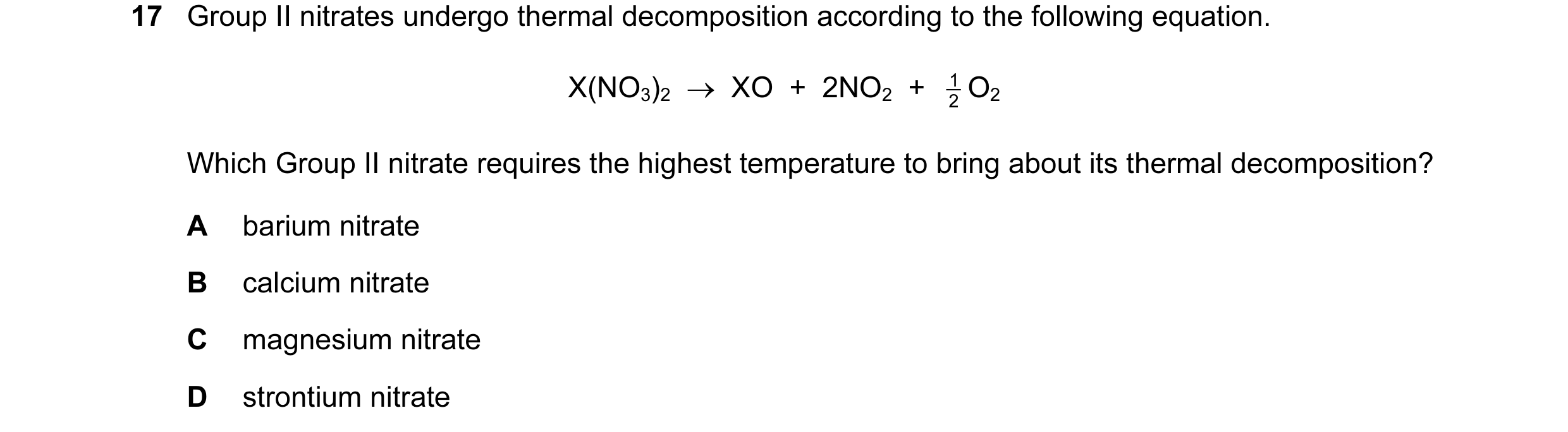

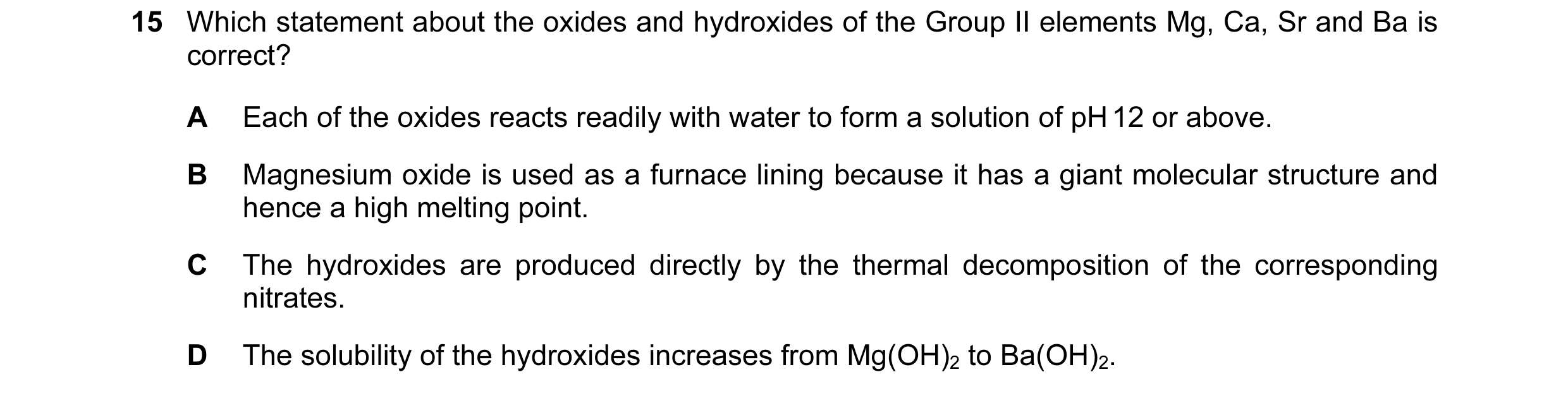 20 / 57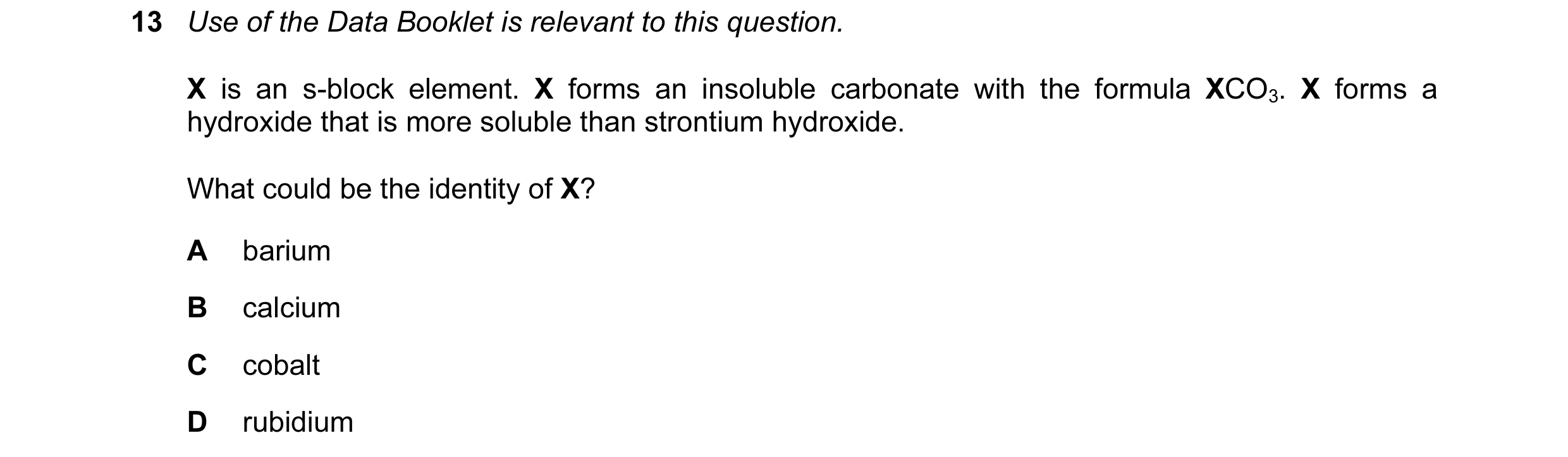



 21 / 57
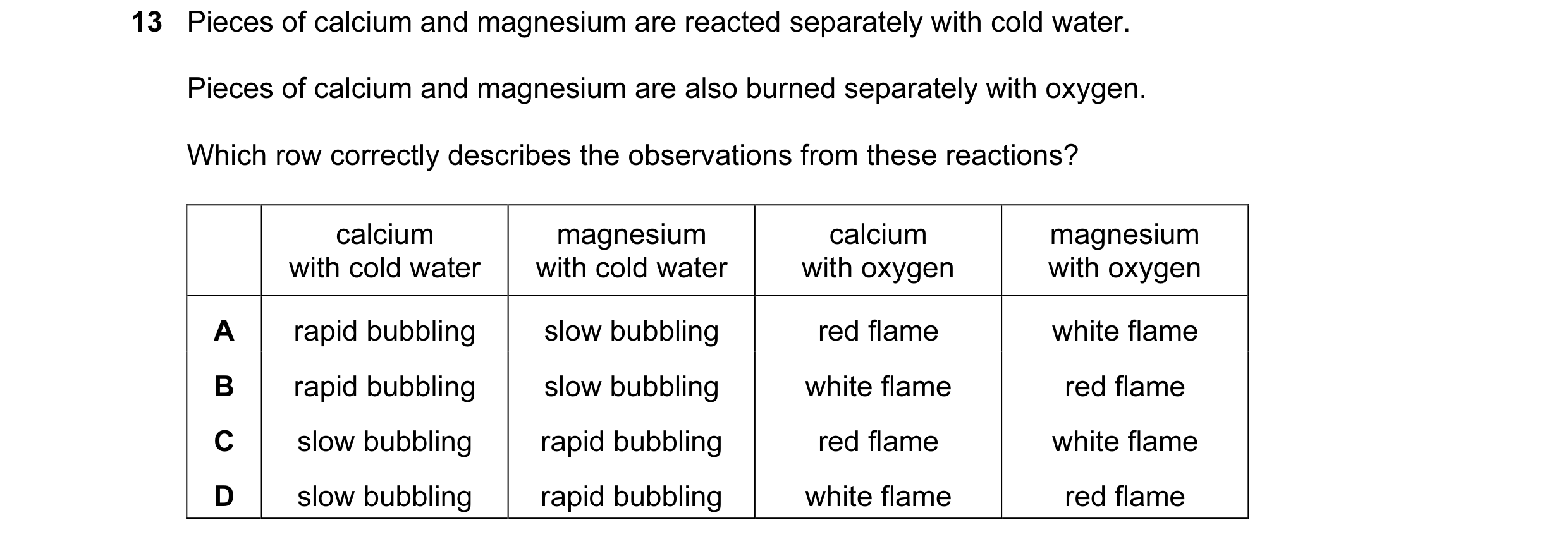
 22 / 57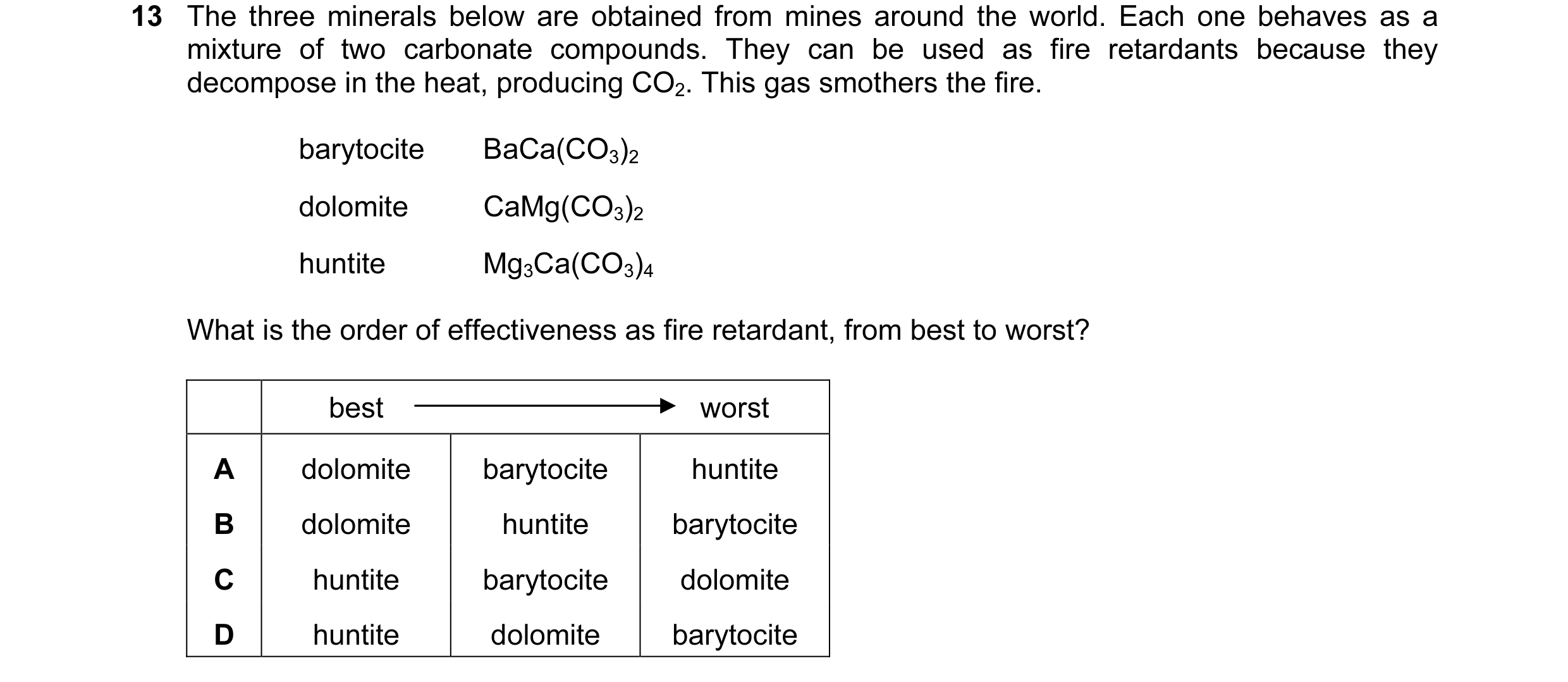

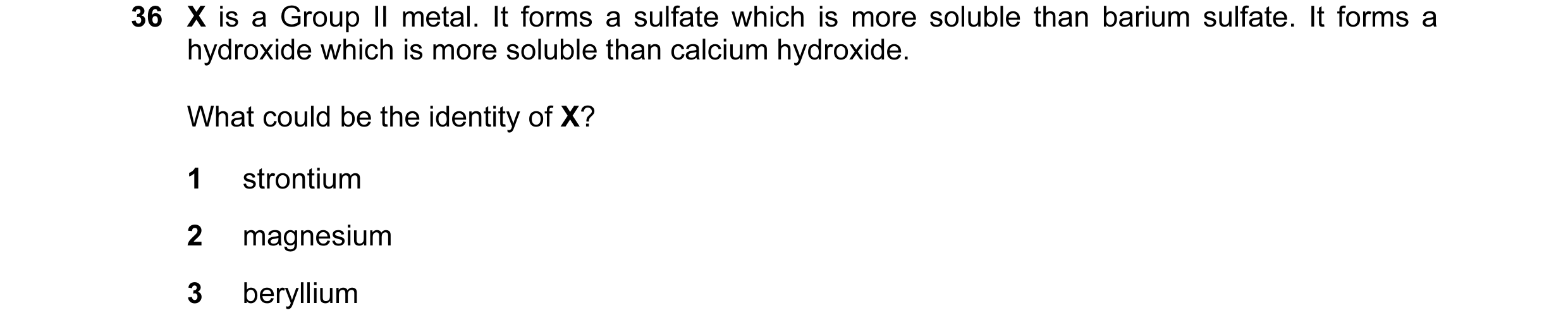
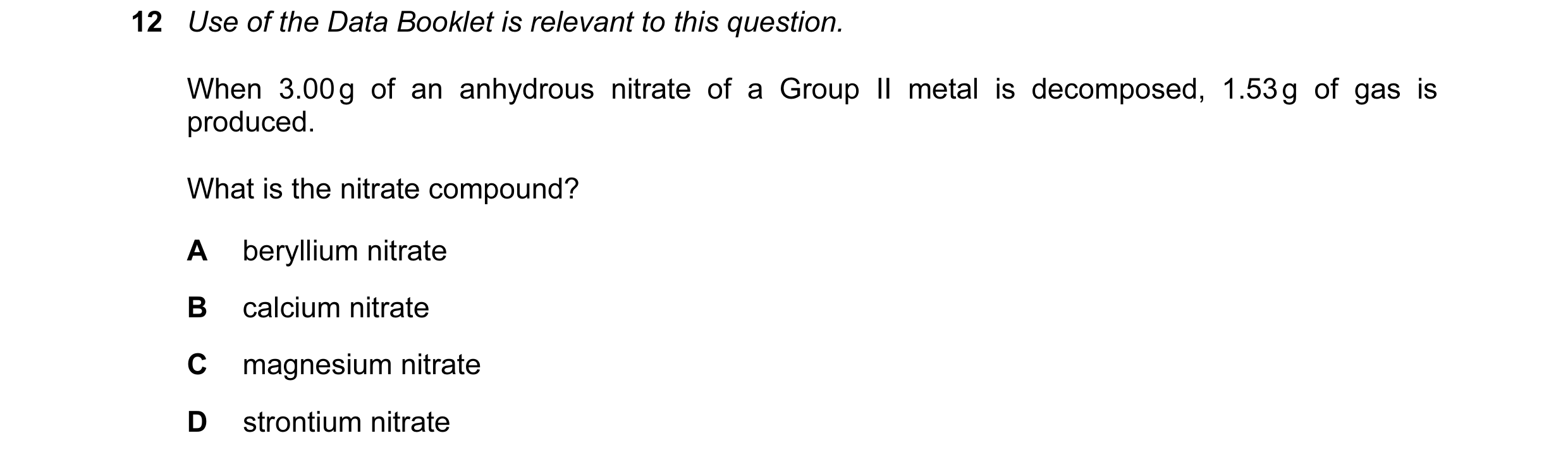
 23 / 57


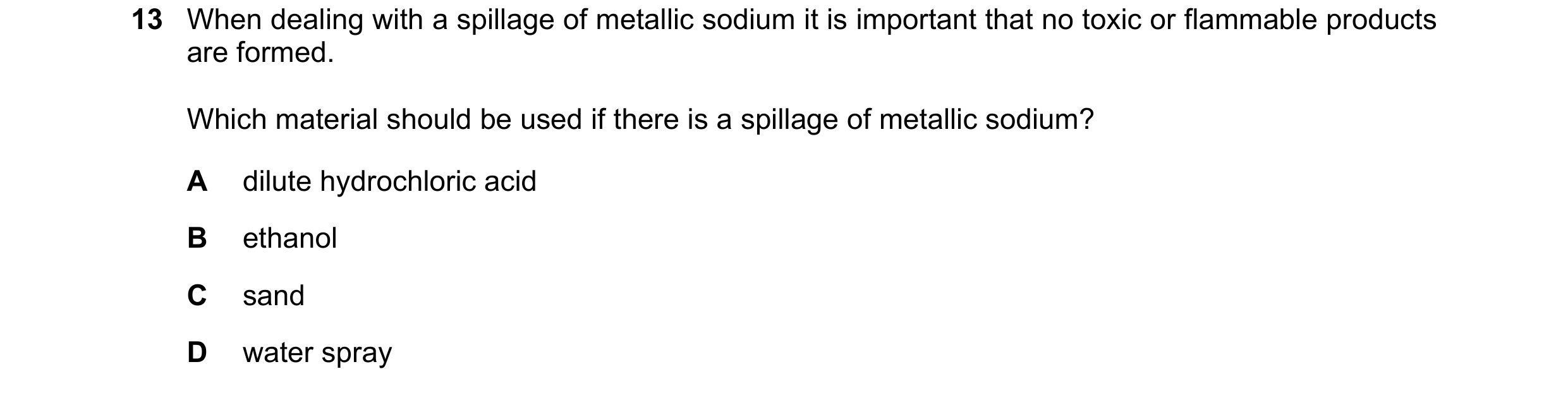

 24 / 57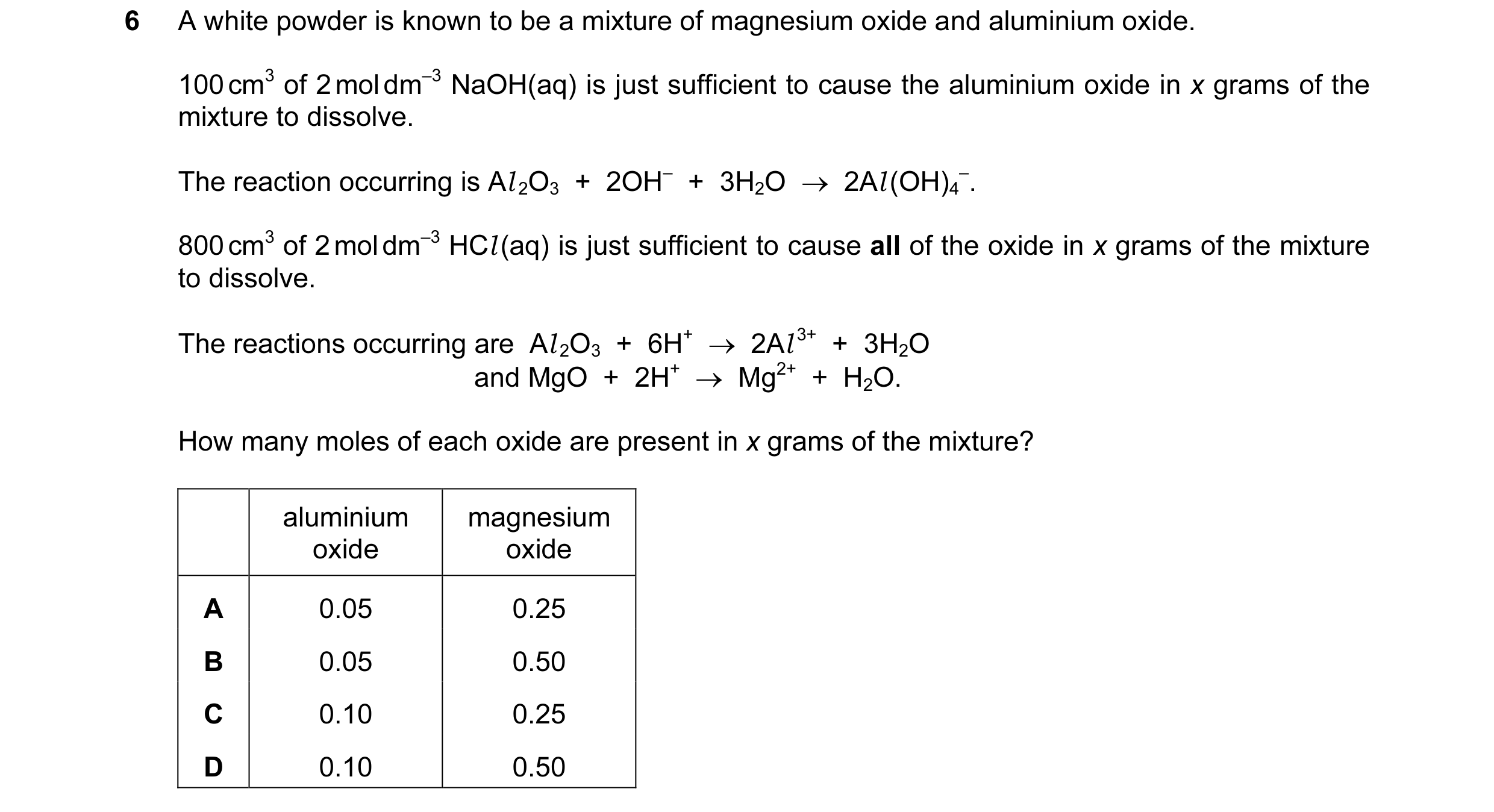
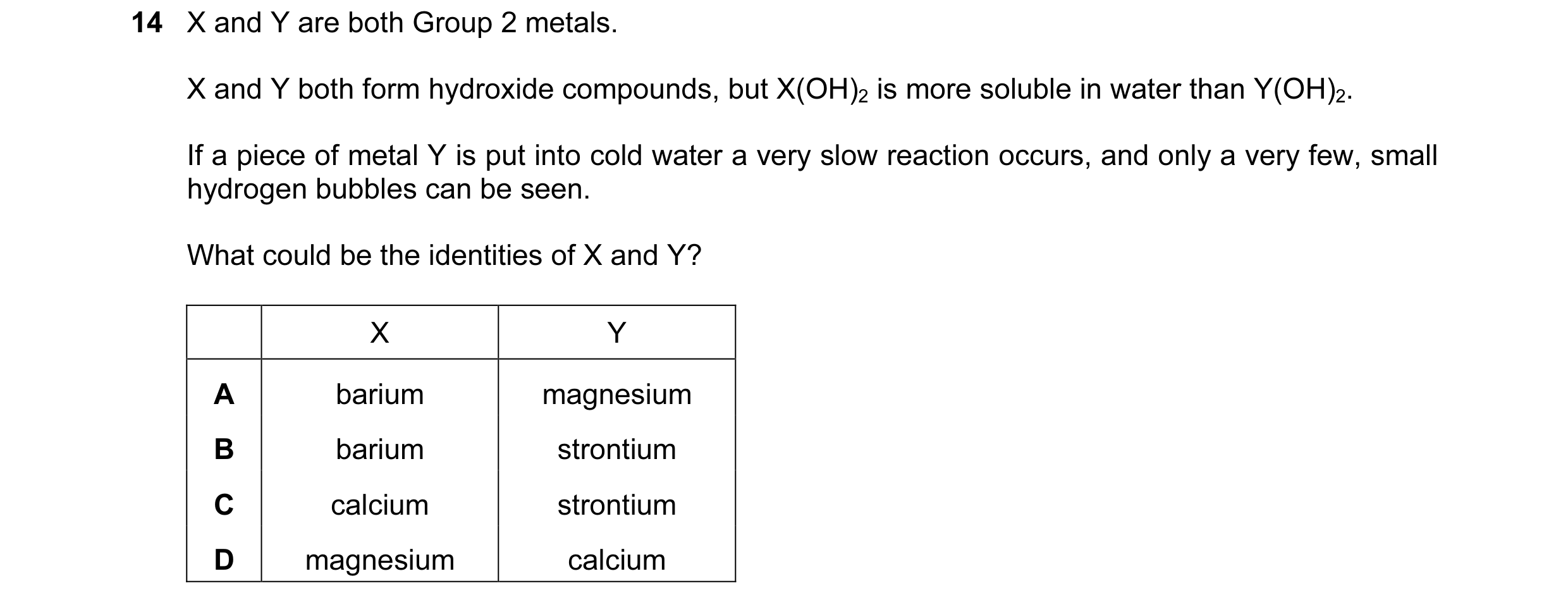
 25 / 57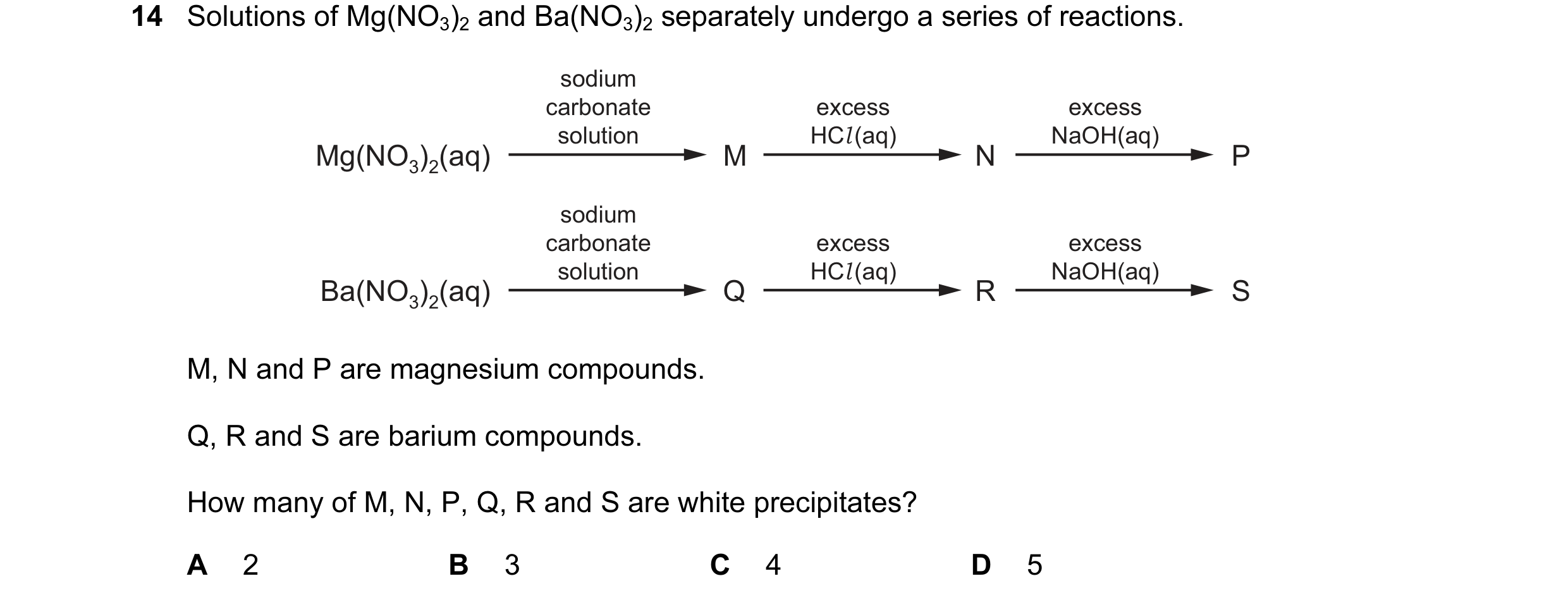

 26 / 57
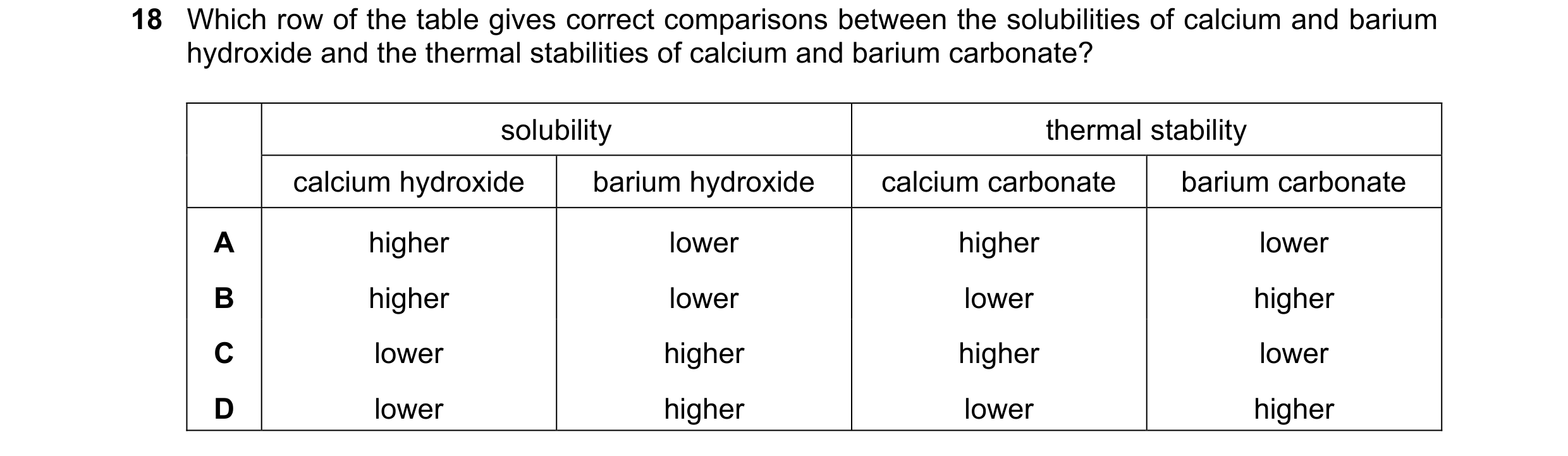

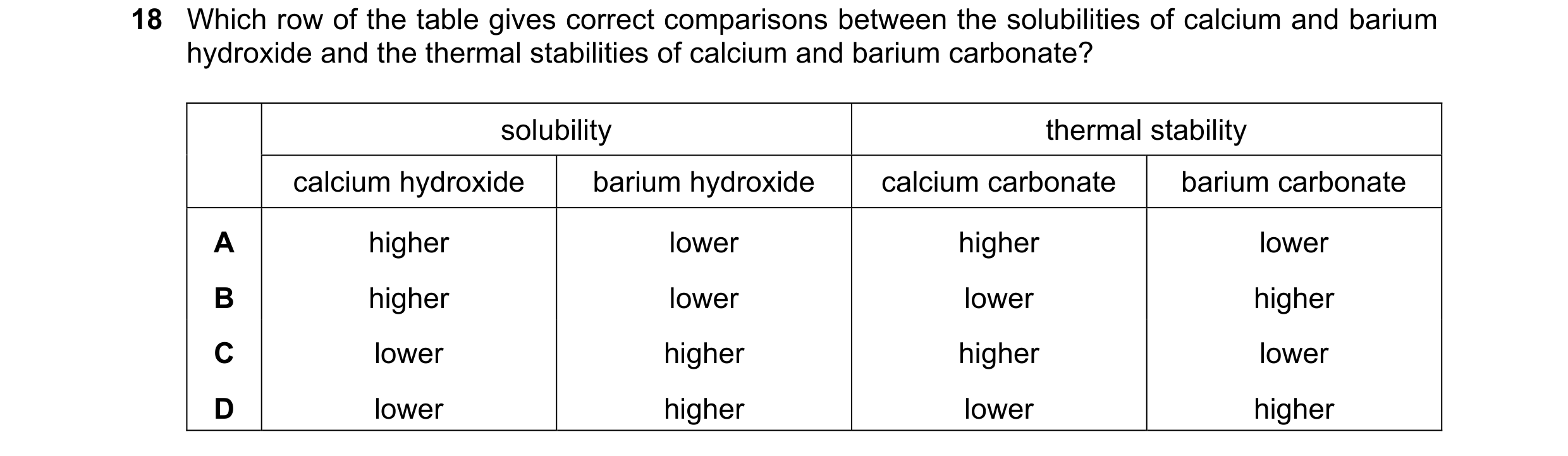 27 / 57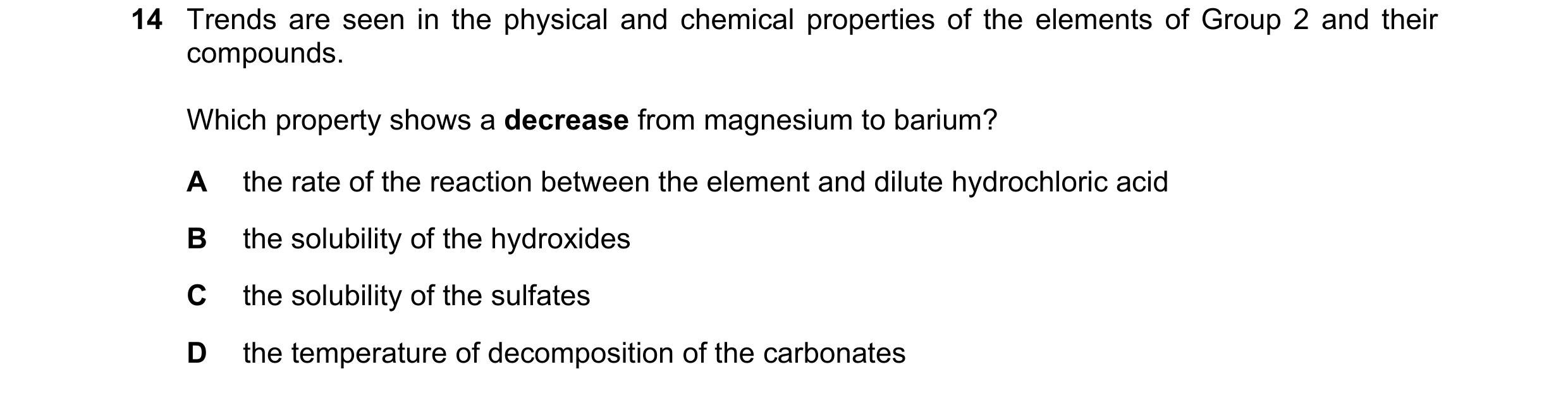
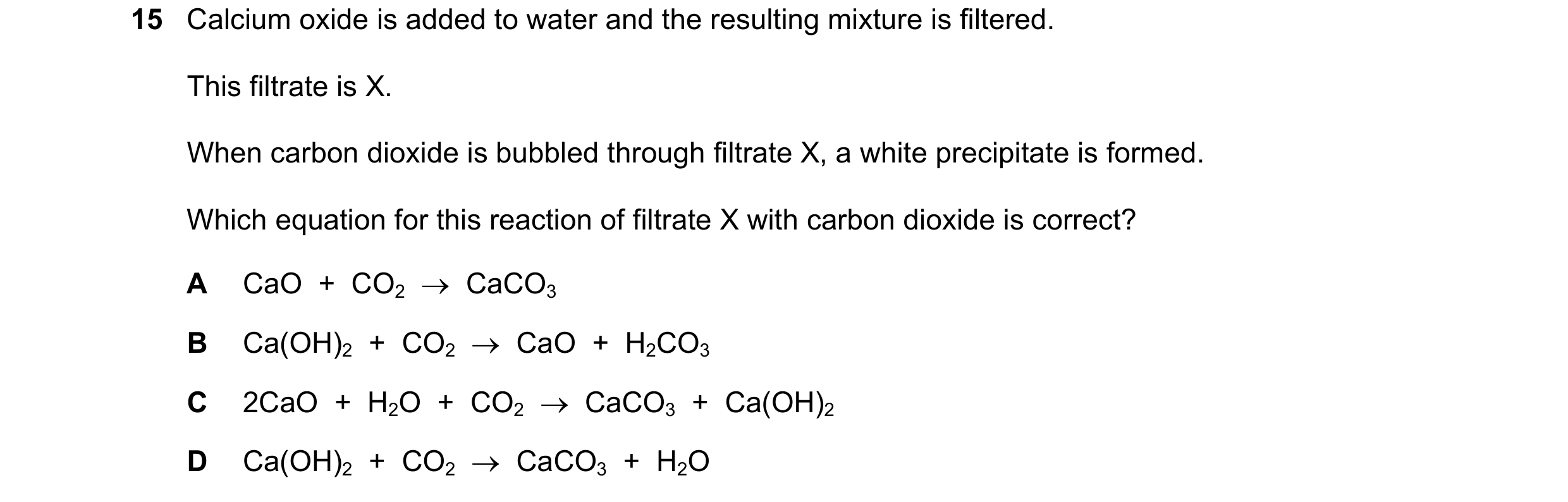
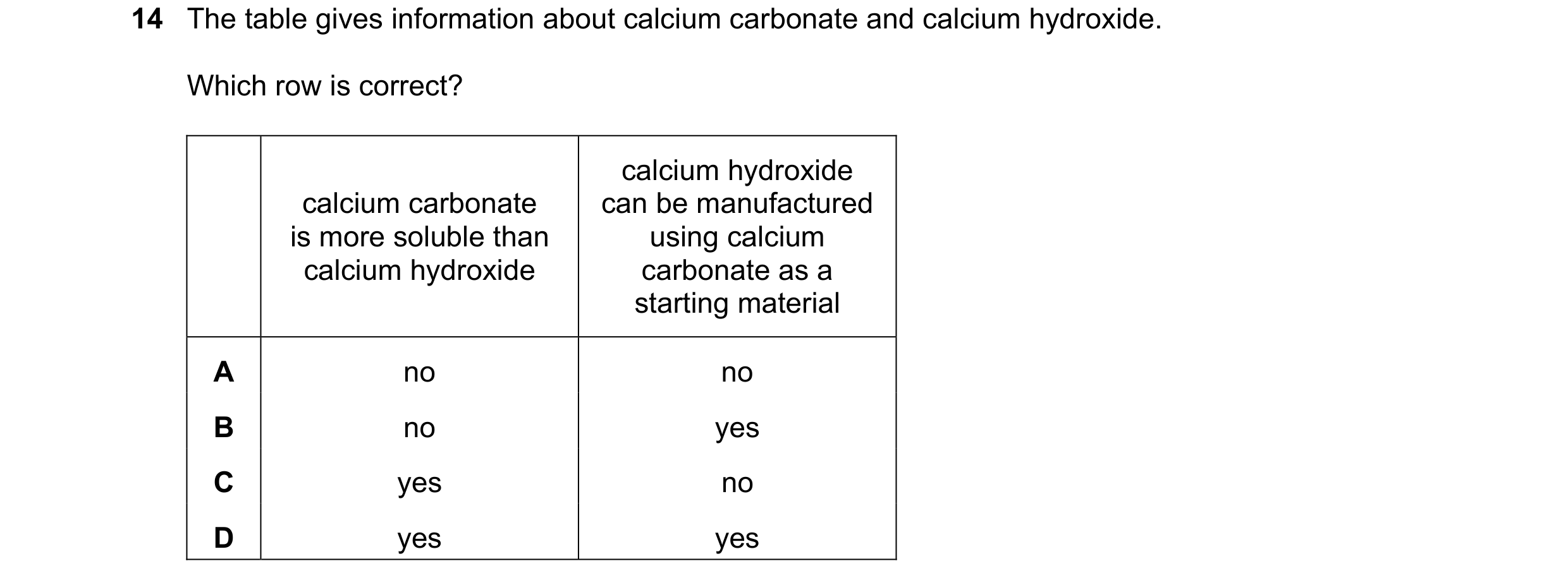
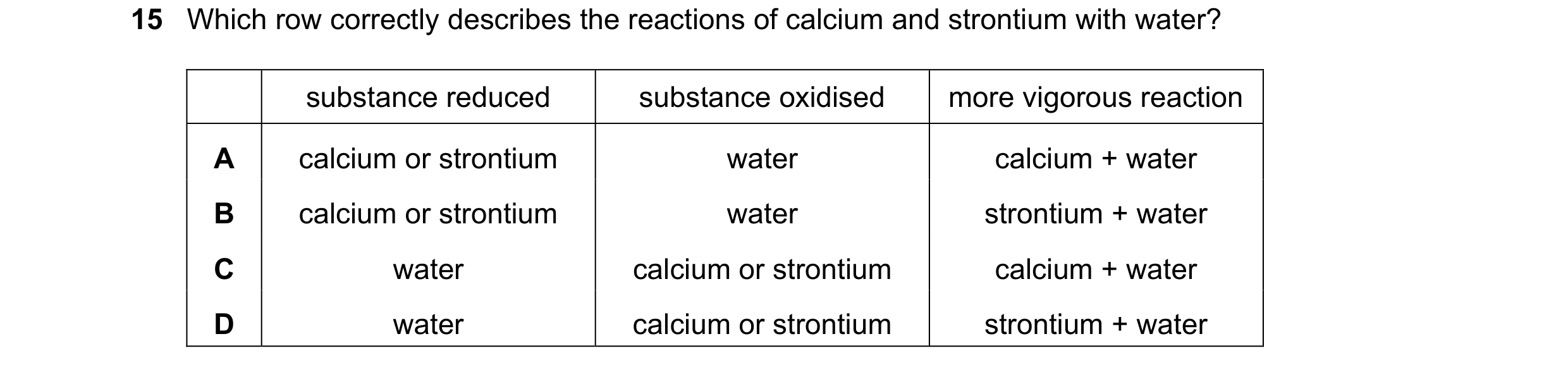 28 / 57
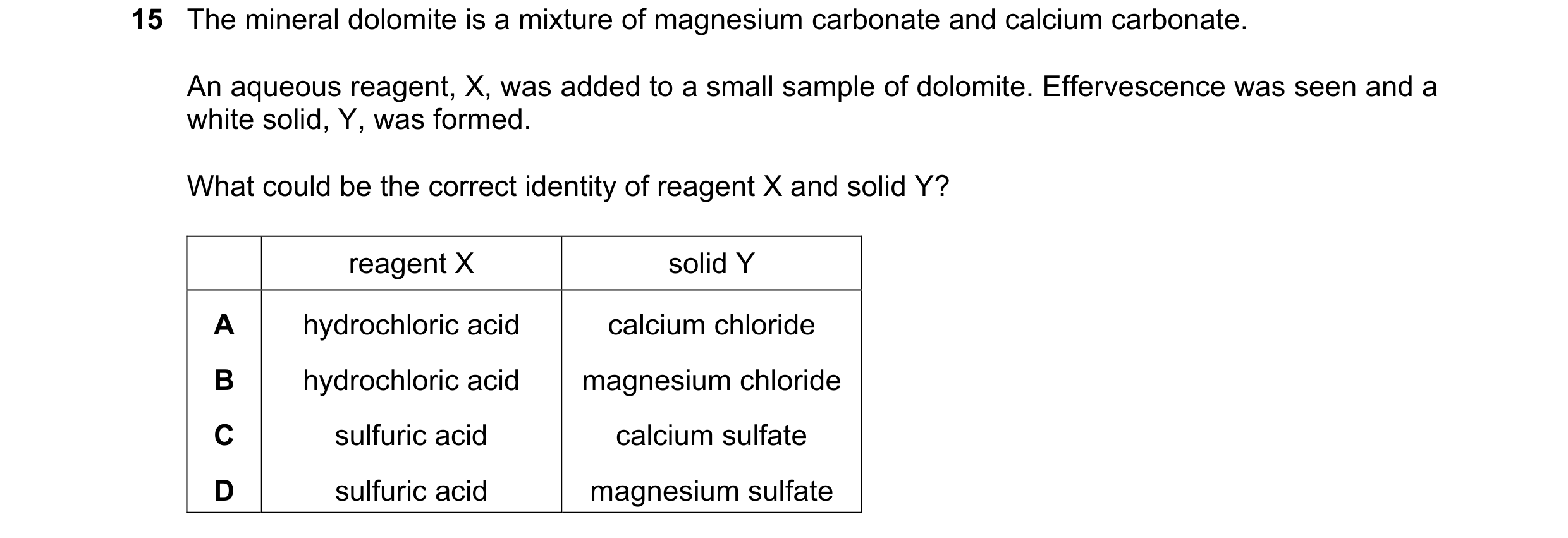

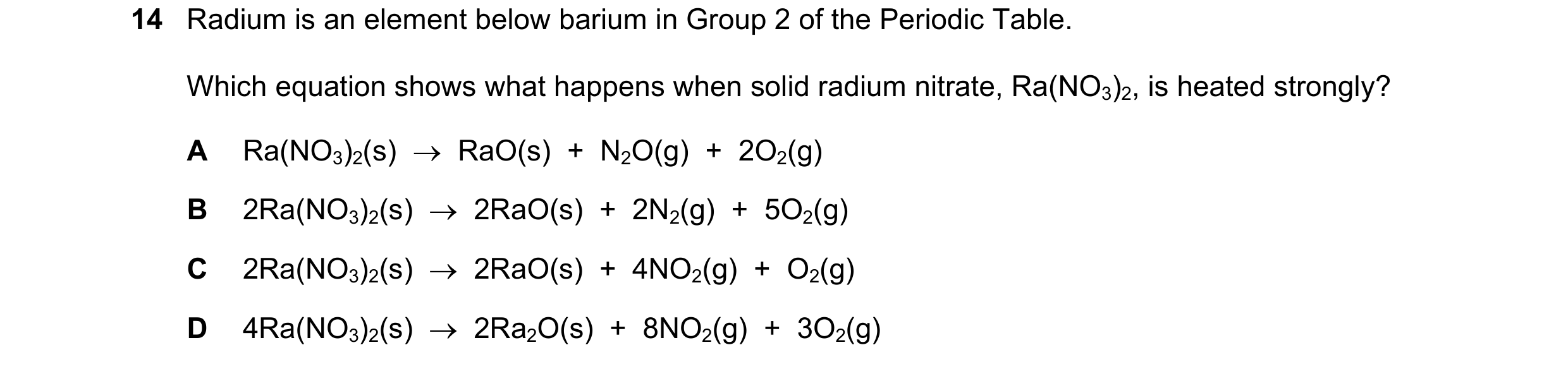
 29 / 57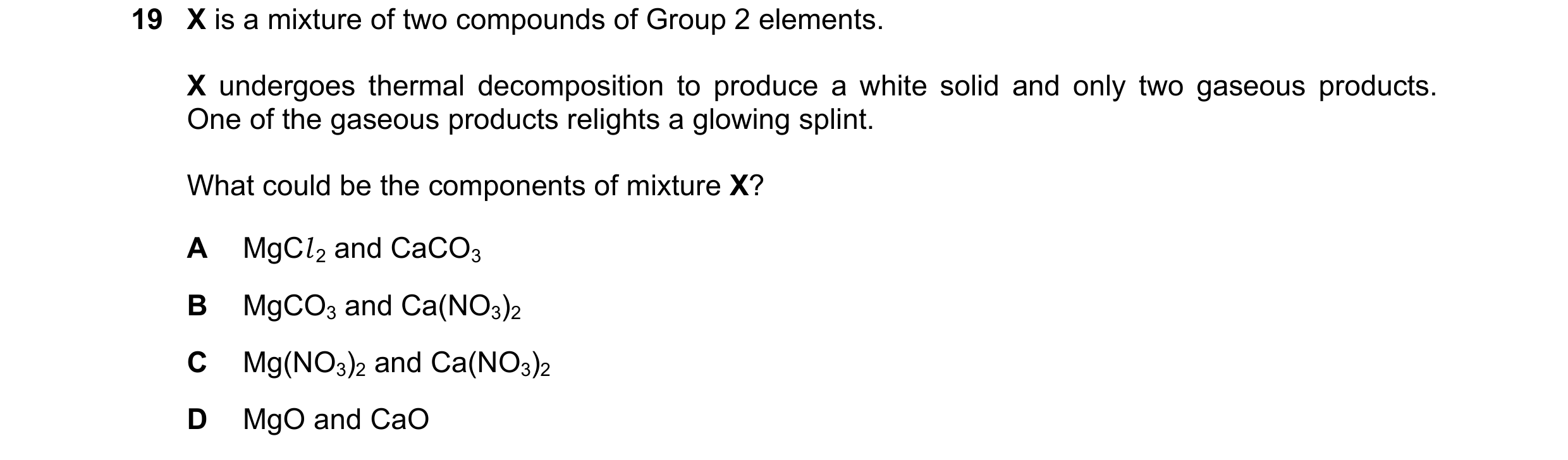


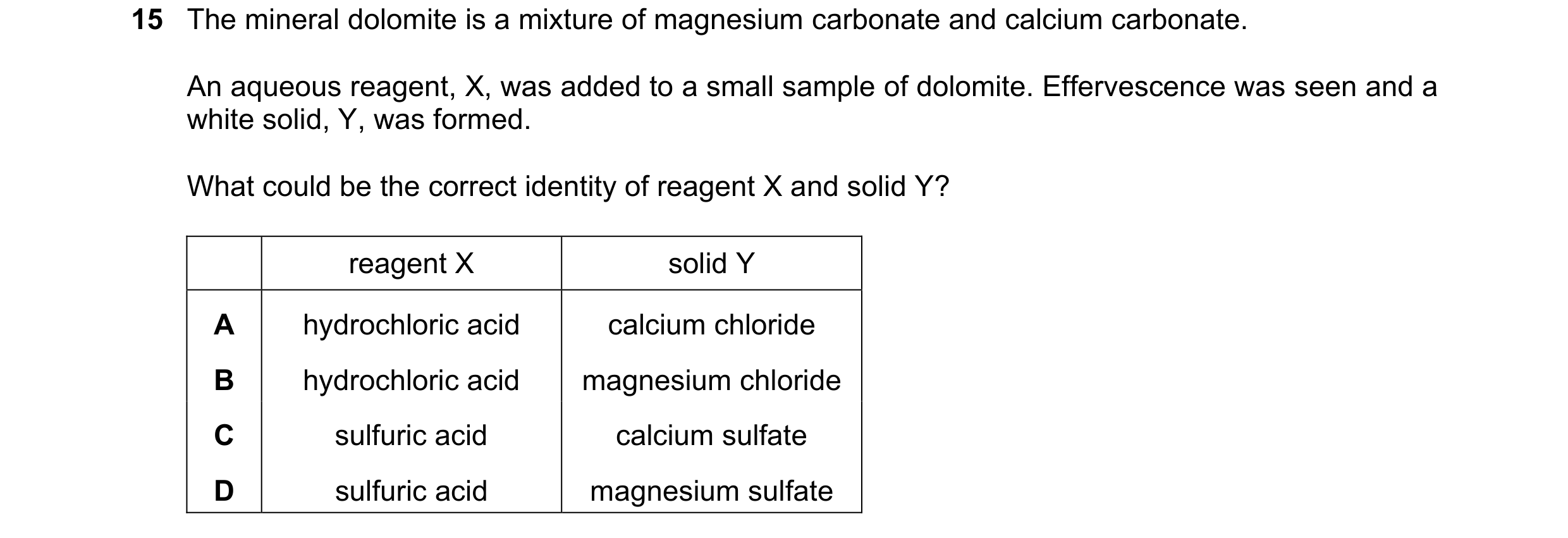
 30 / 57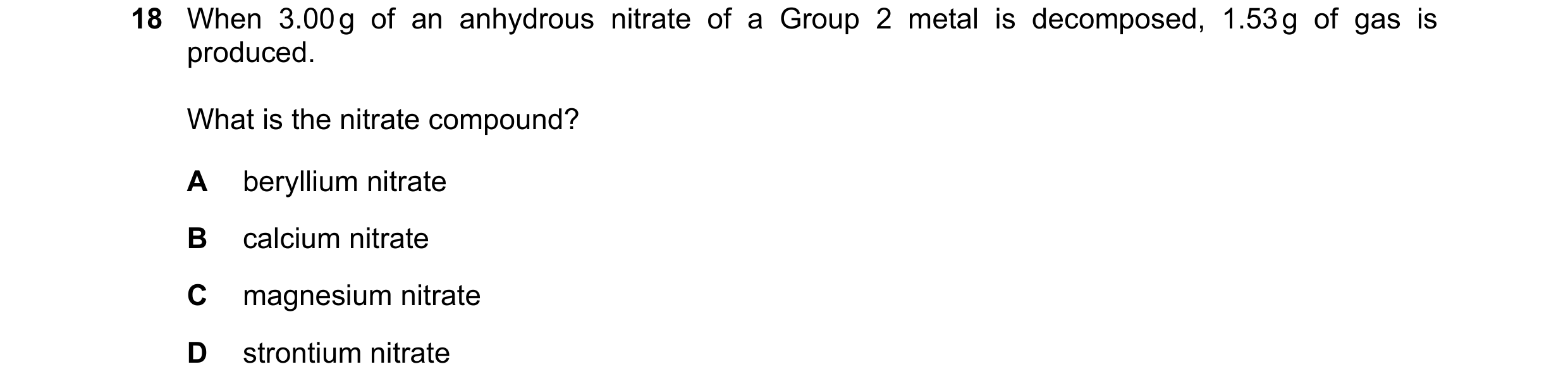
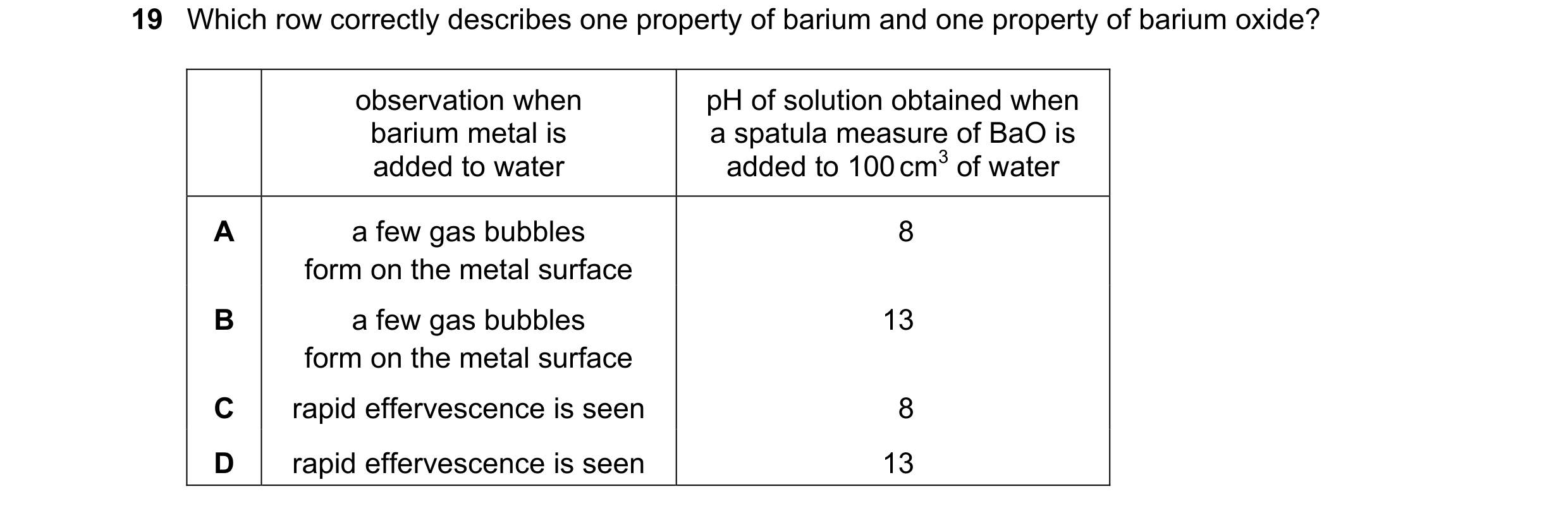

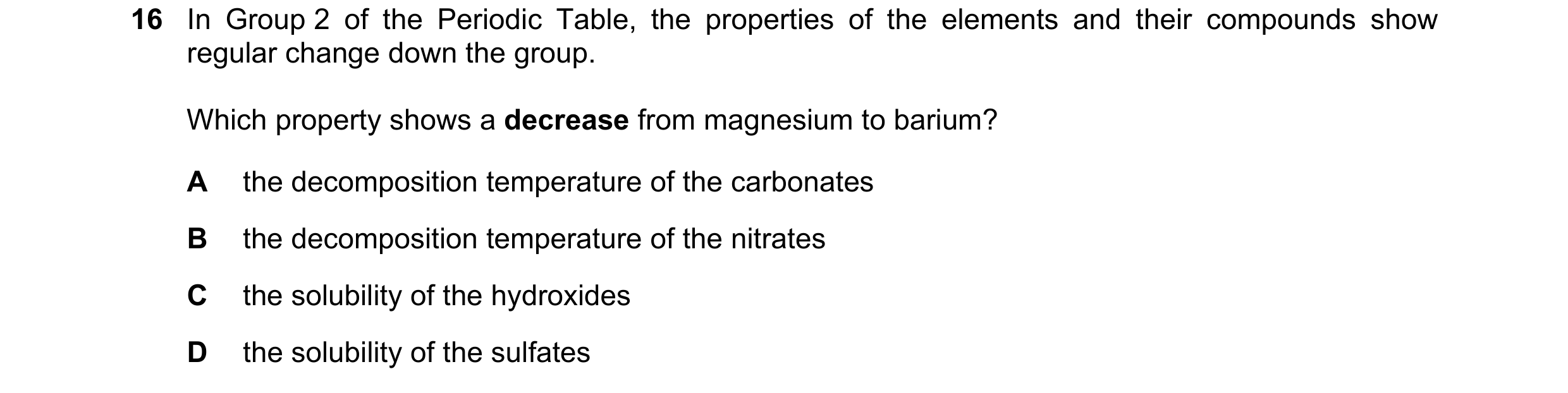
 31 / 57

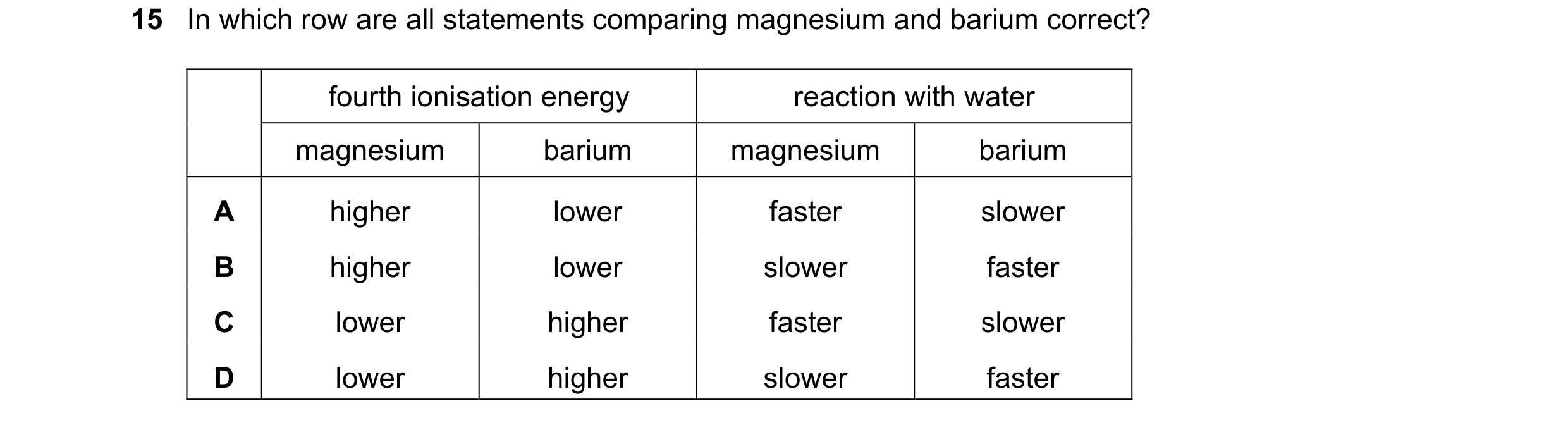 32 / 57
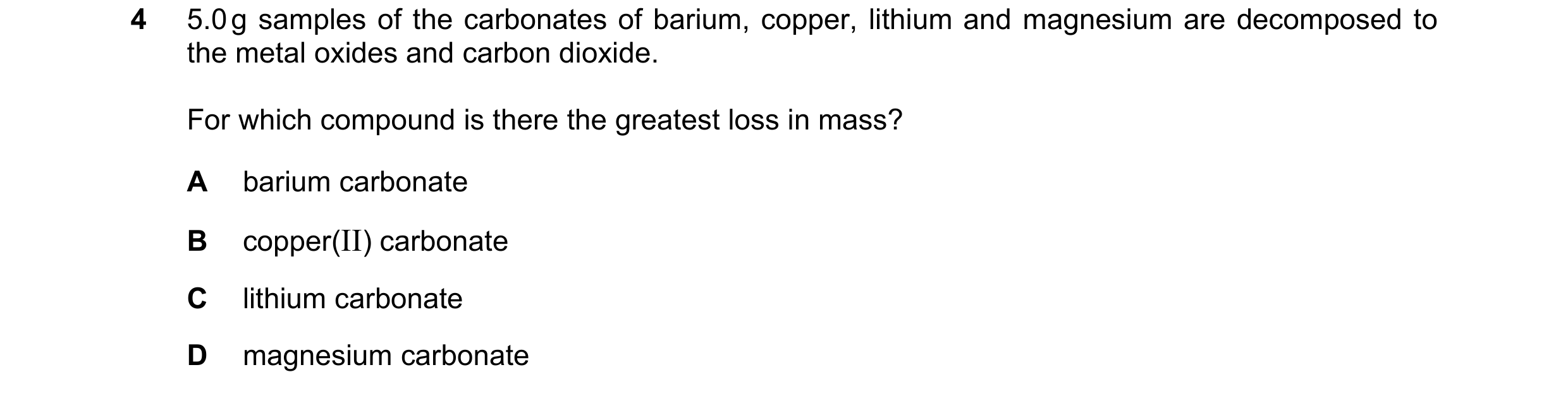
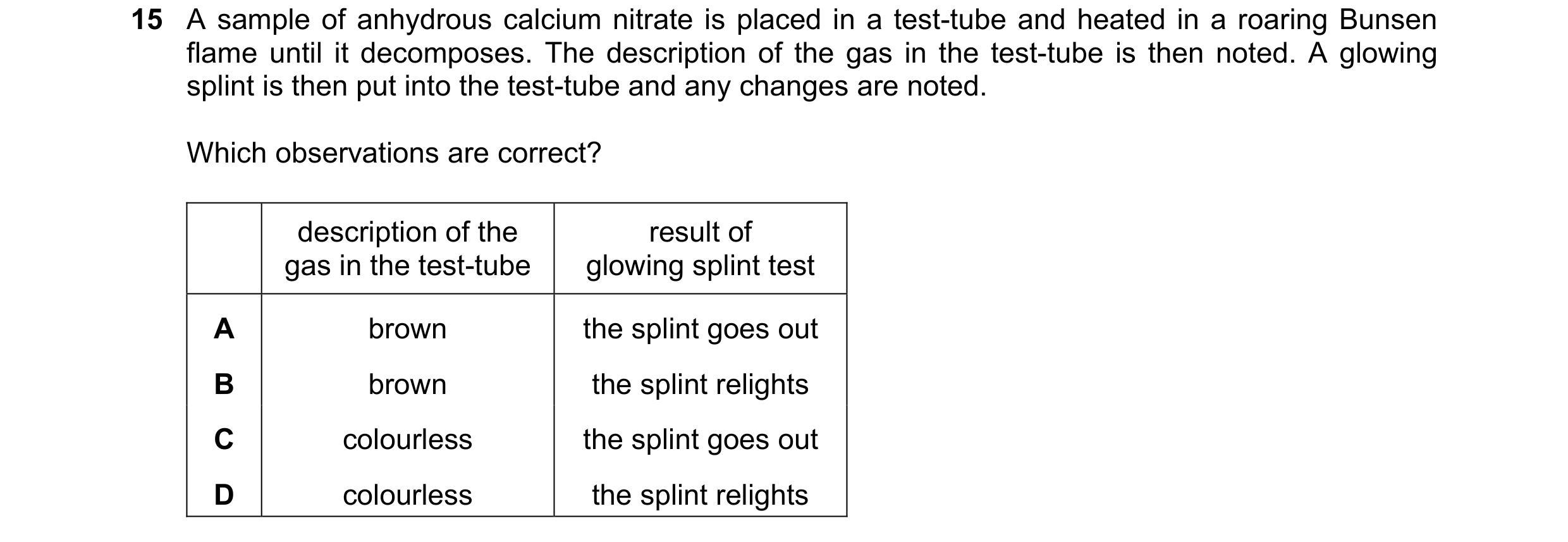
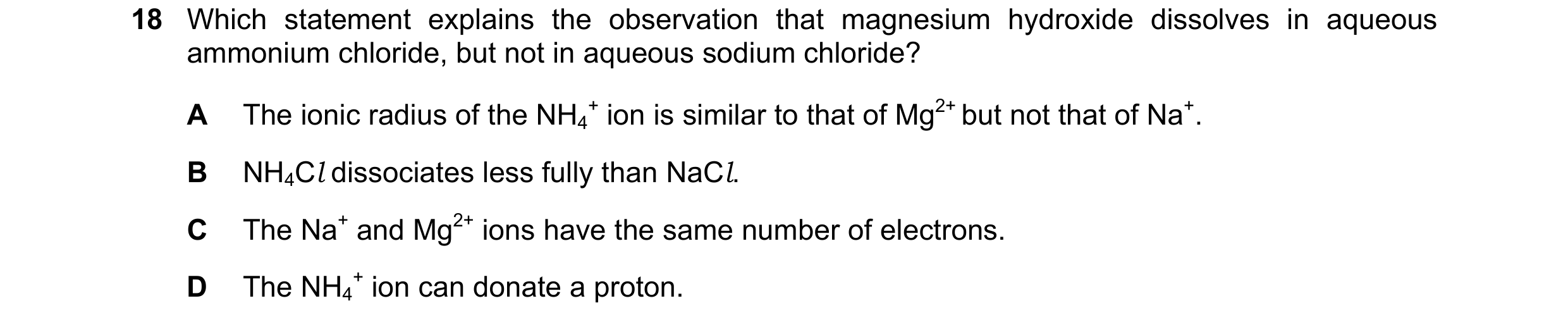
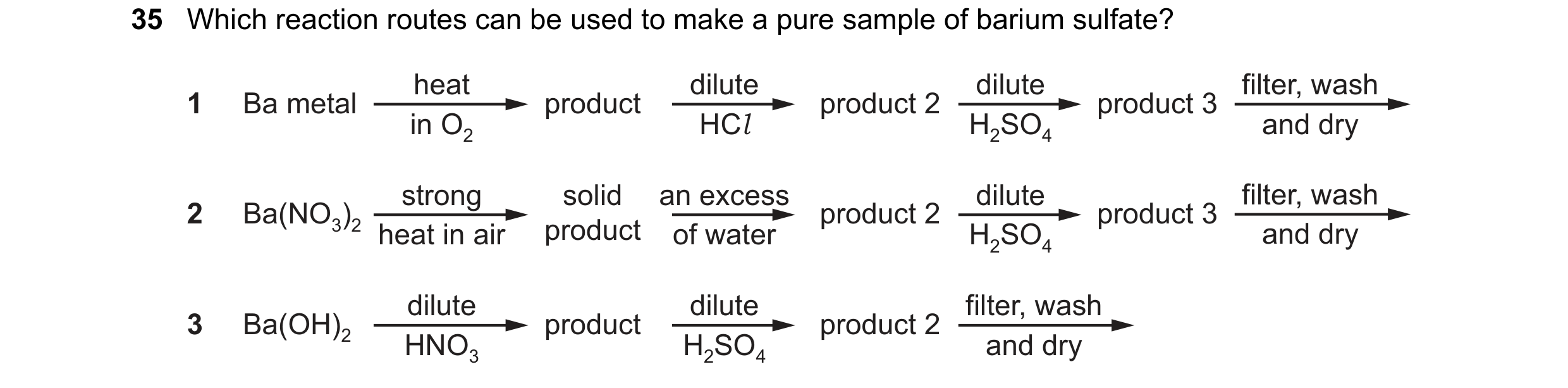 33 / 57
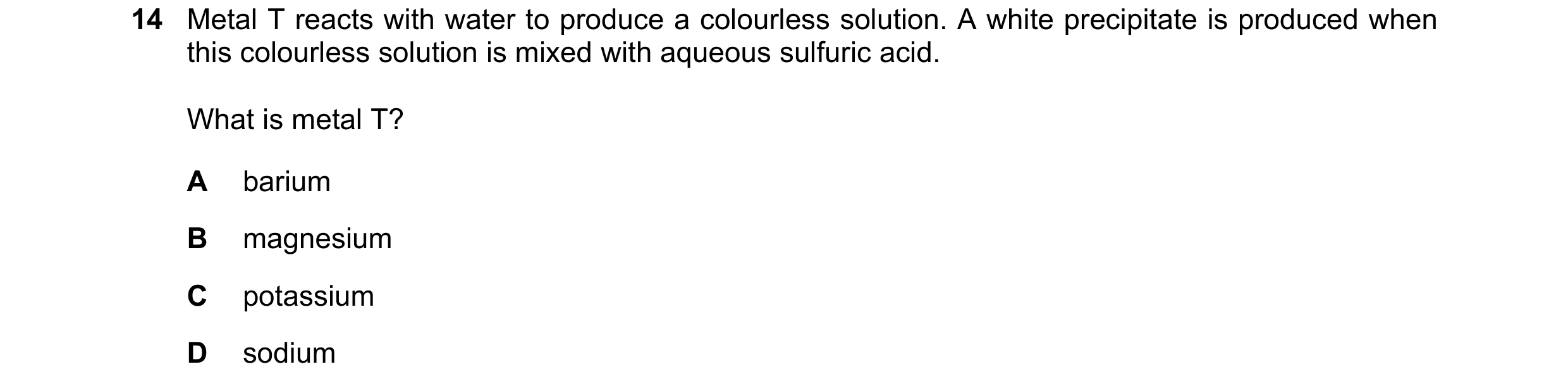

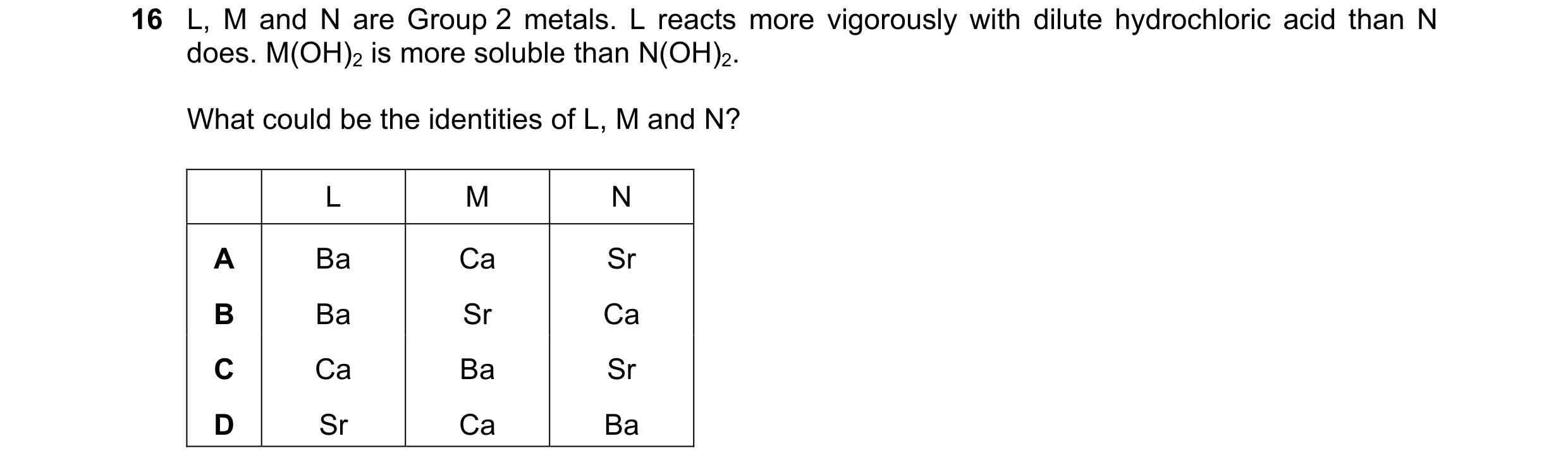
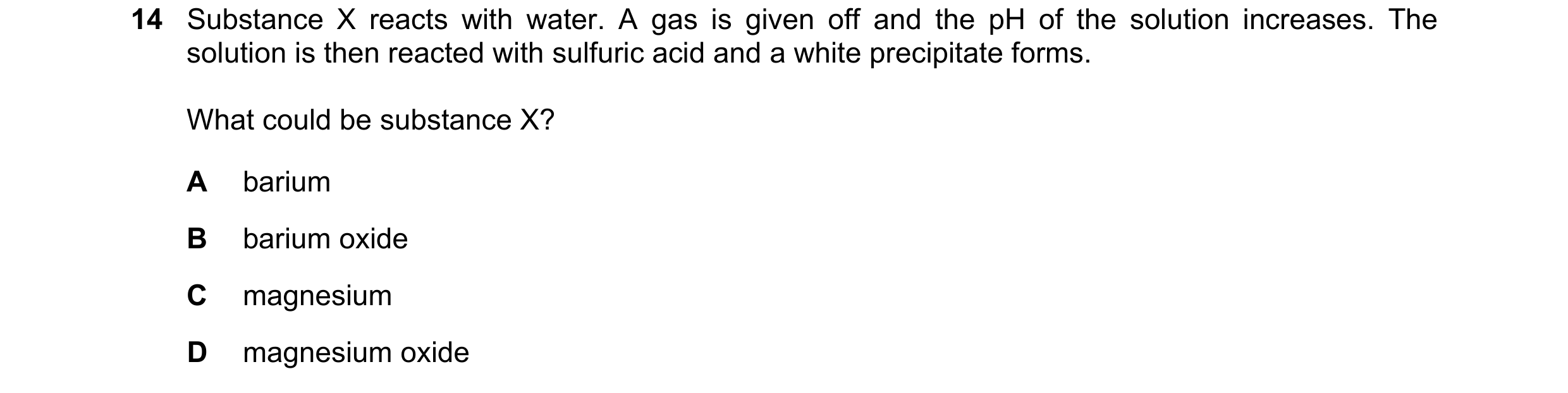 34 / 57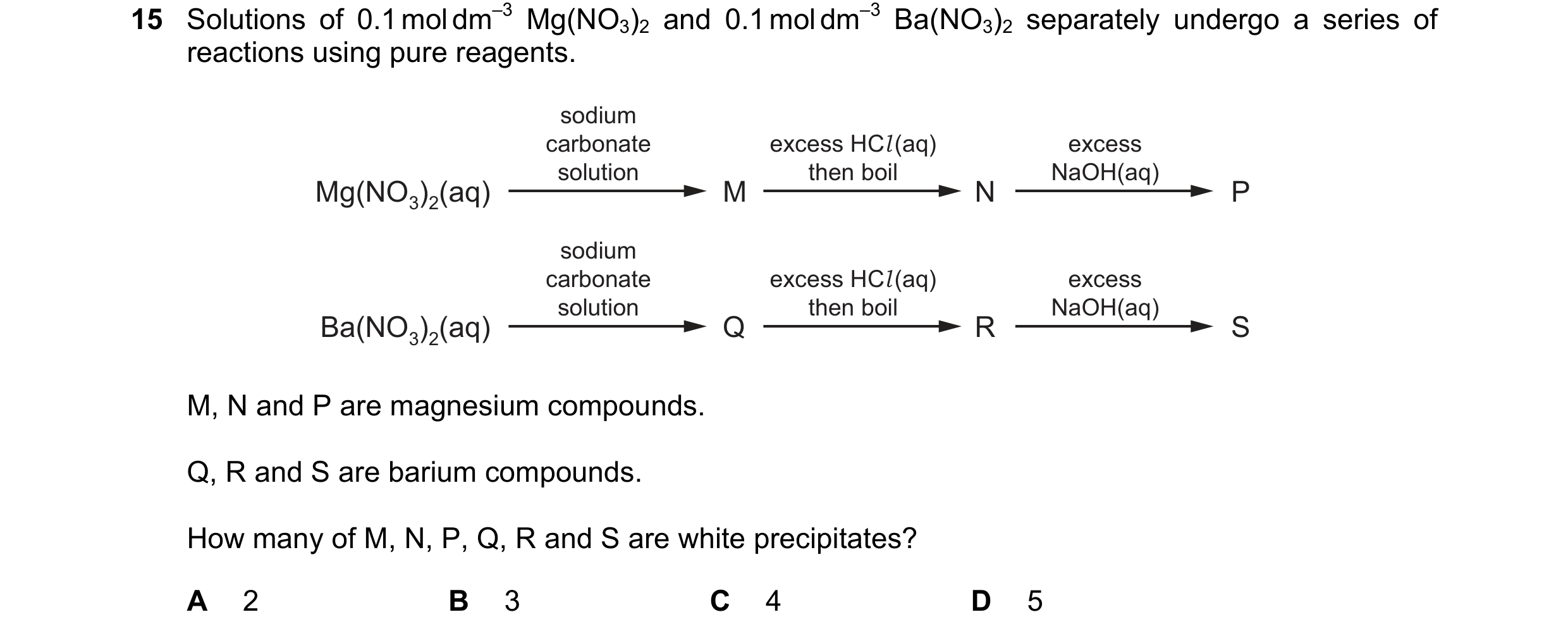


 35 / 57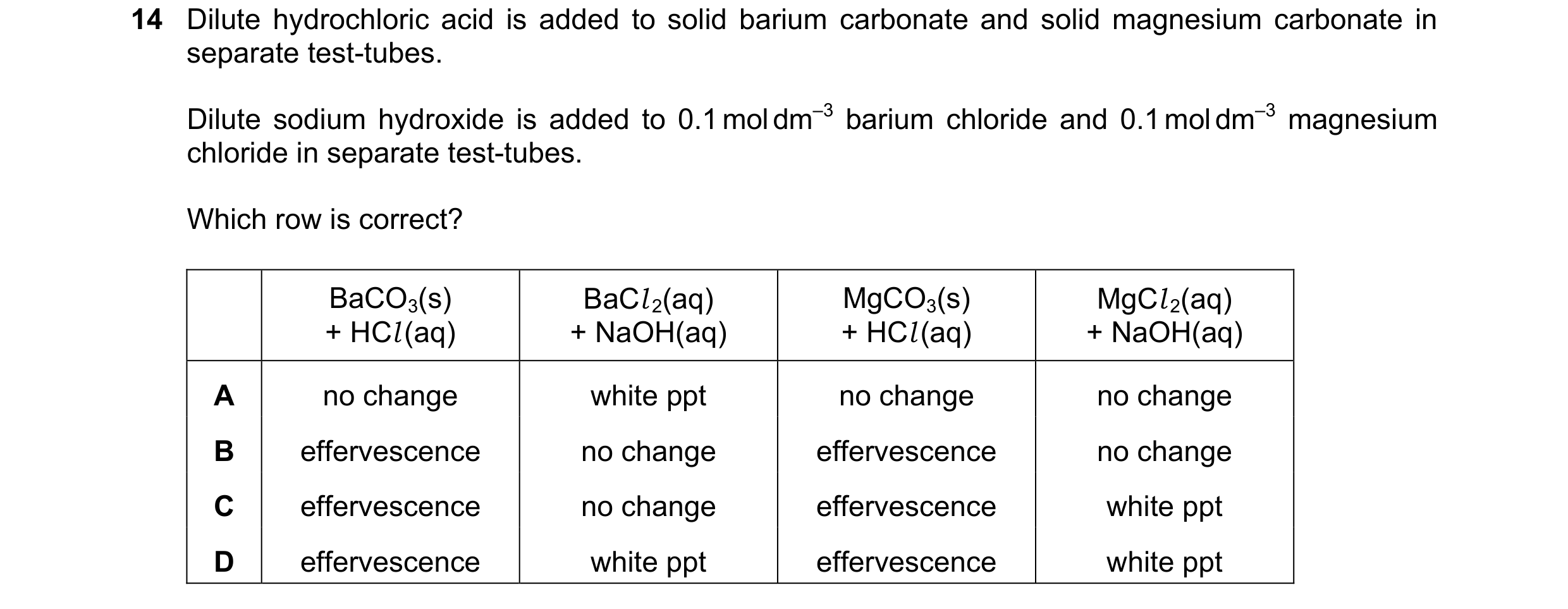

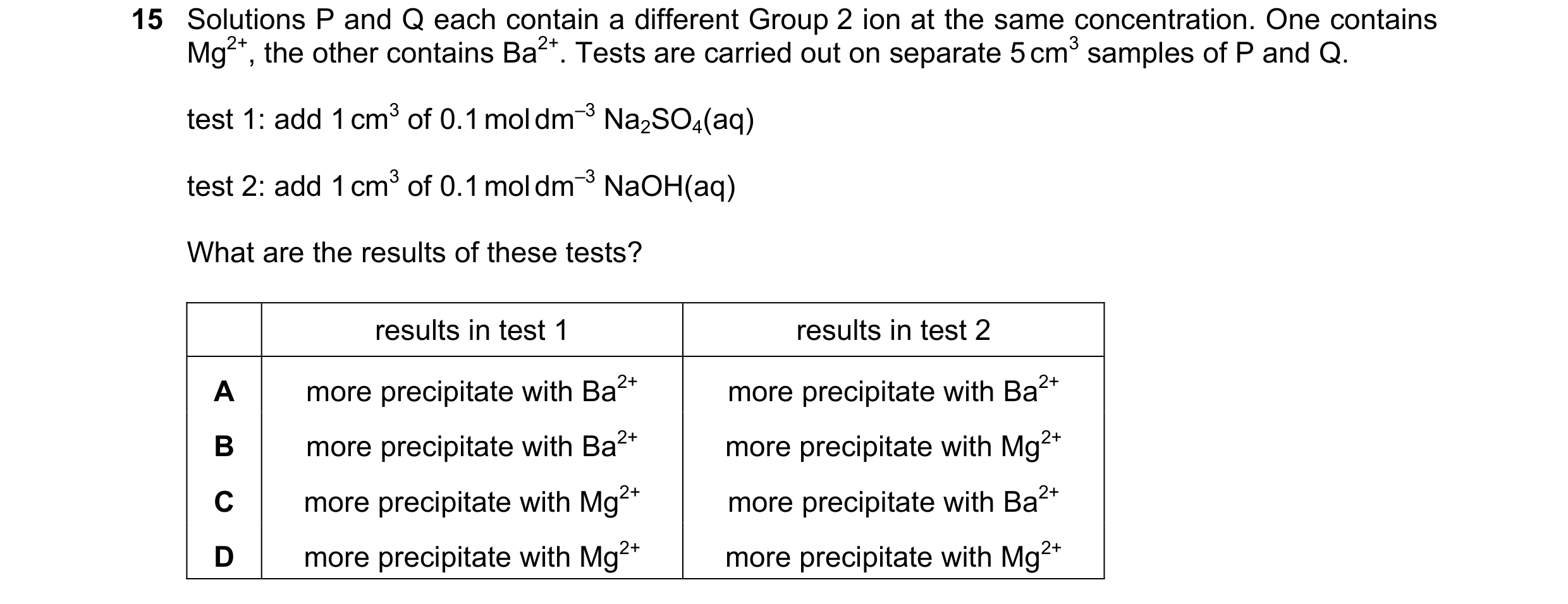 36 / 57
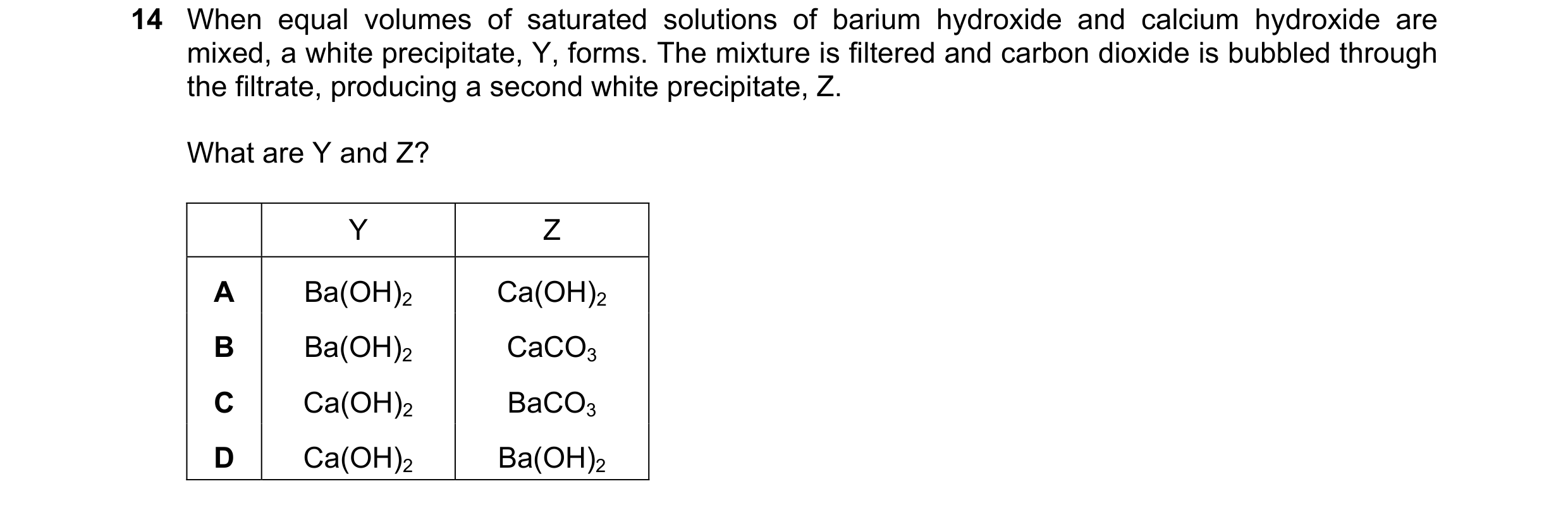
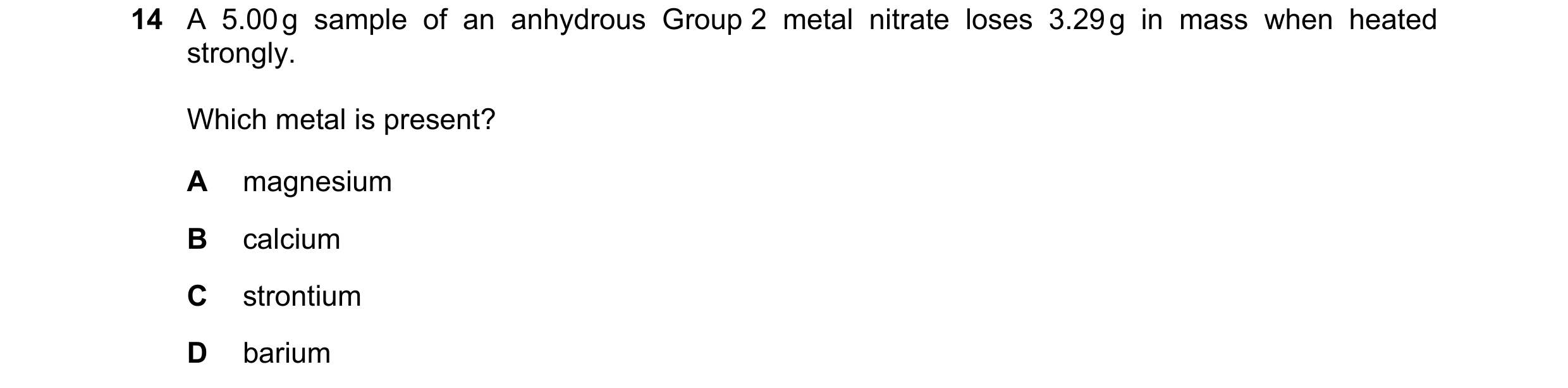
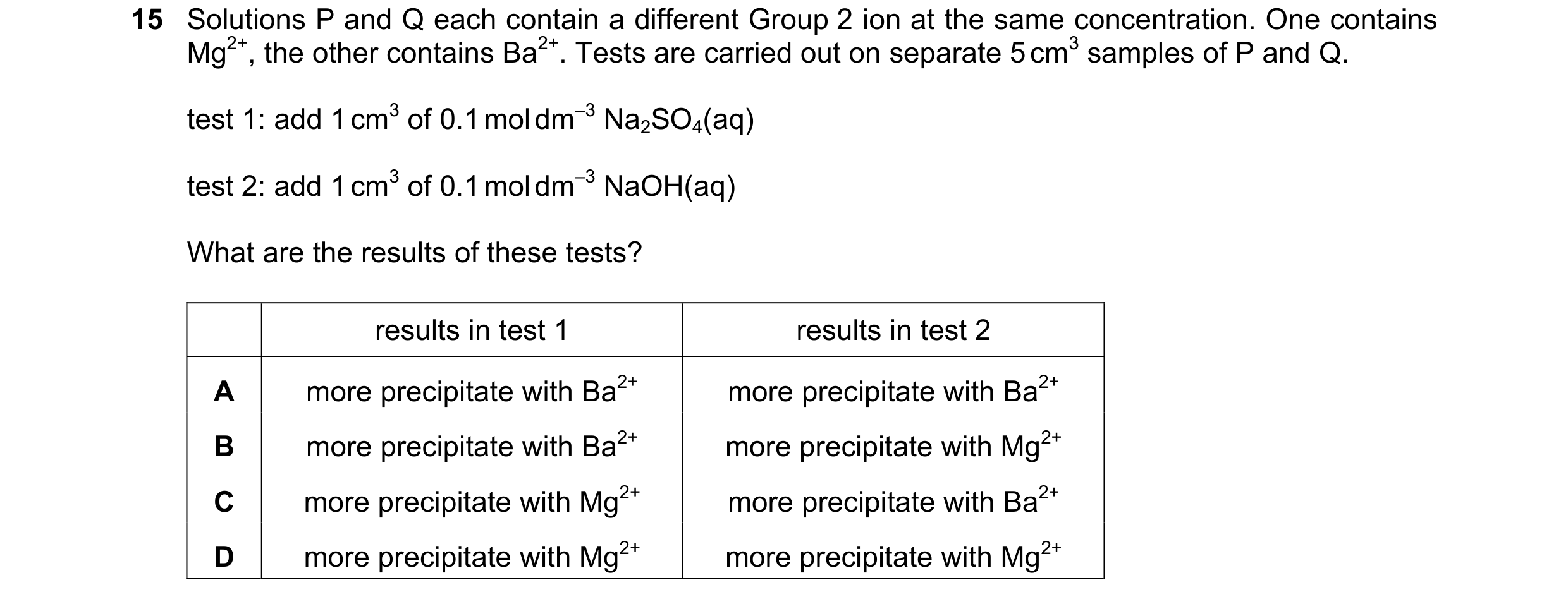 37 / 57
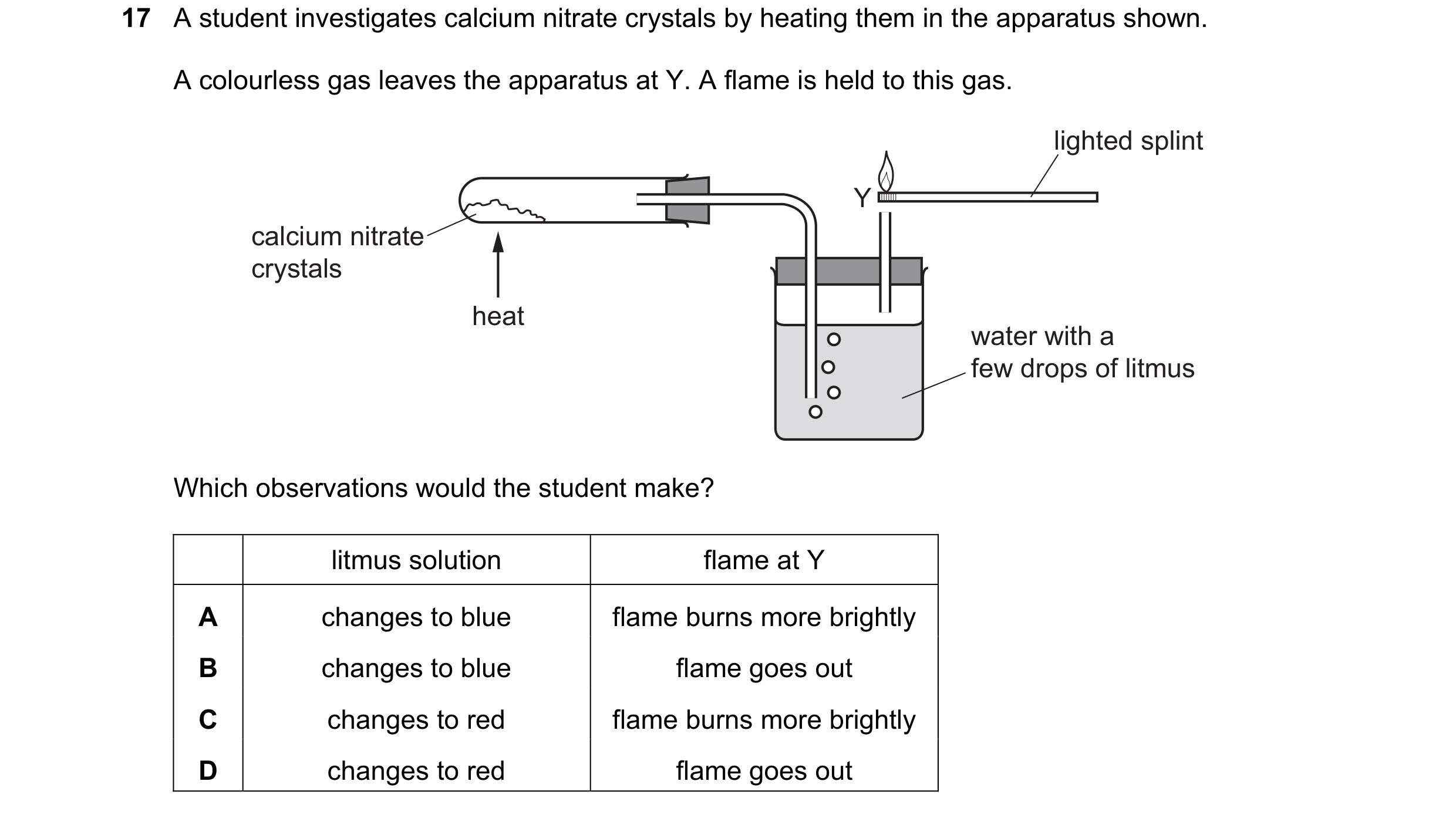
 38 / 57

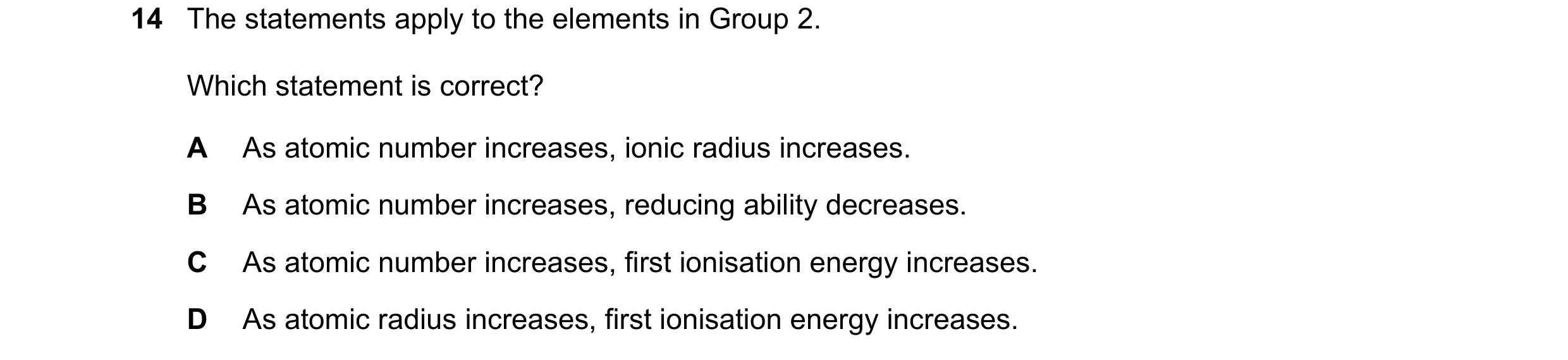
 39 / 57
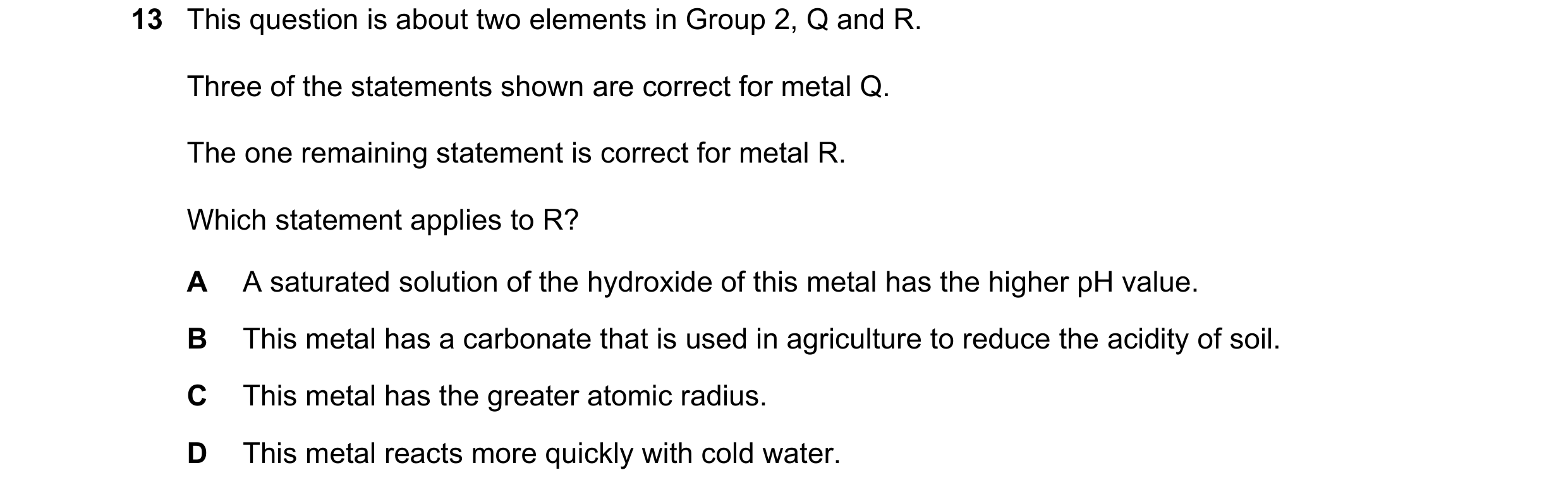
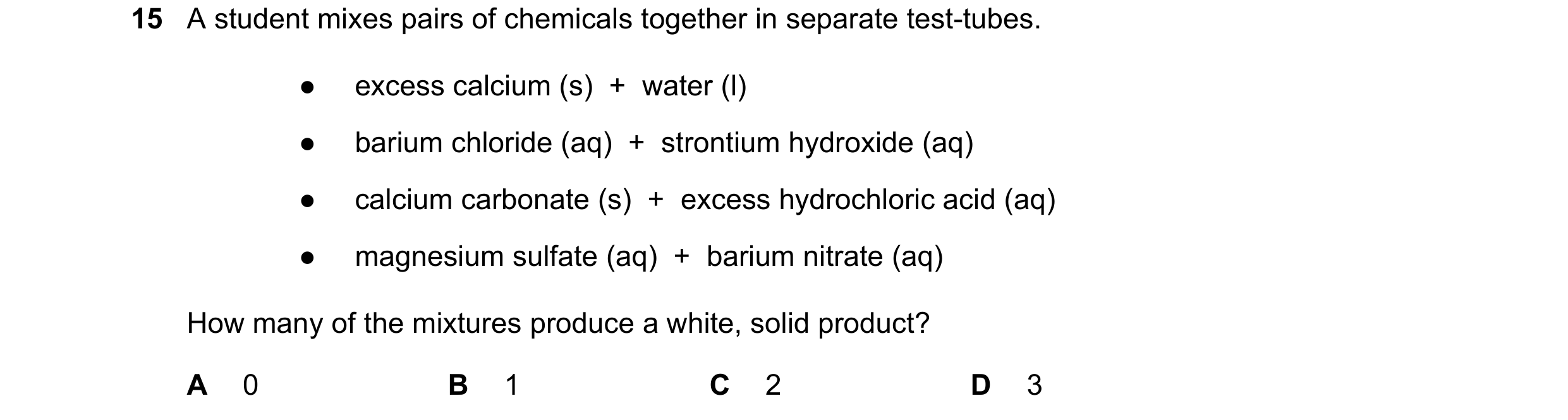
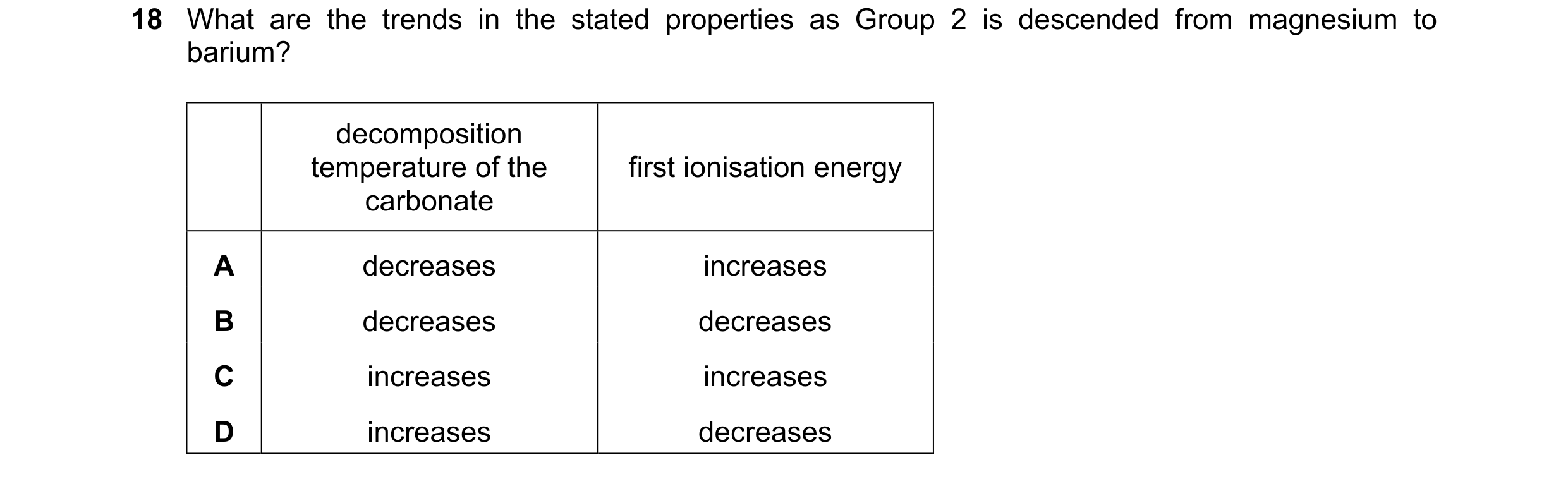
 40 / 57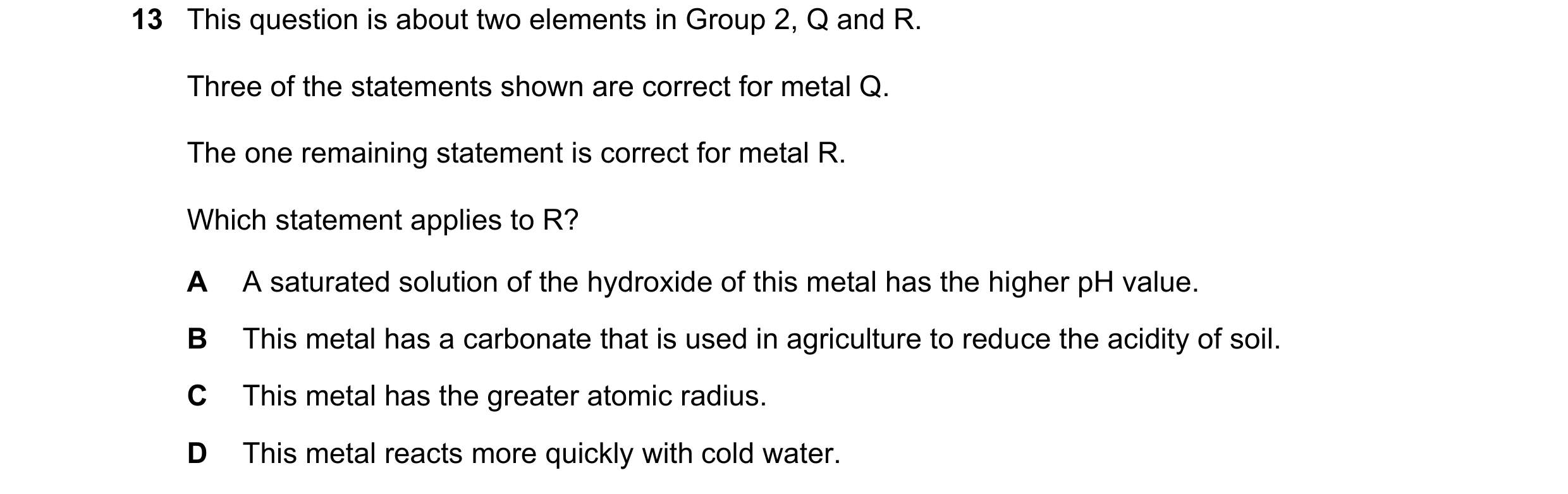
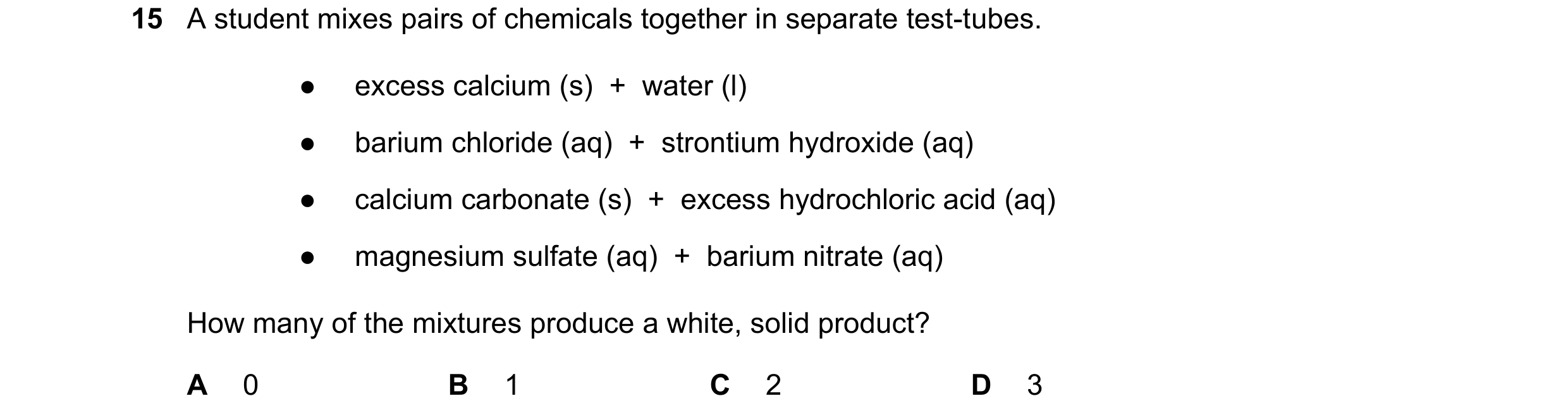
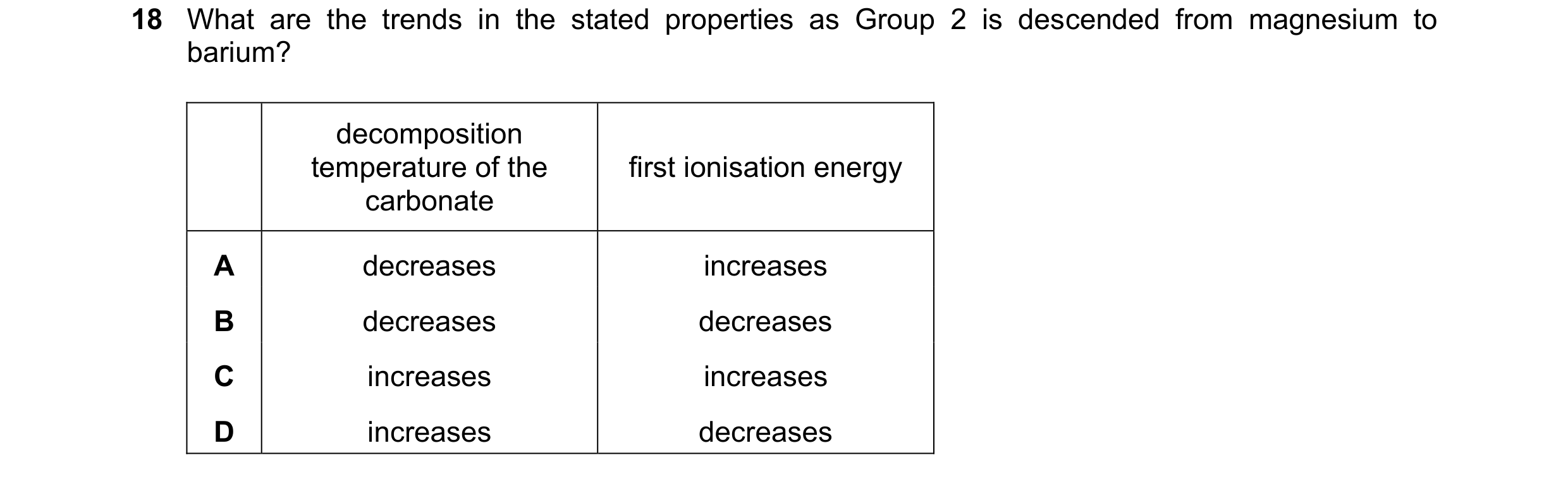
 41 / 57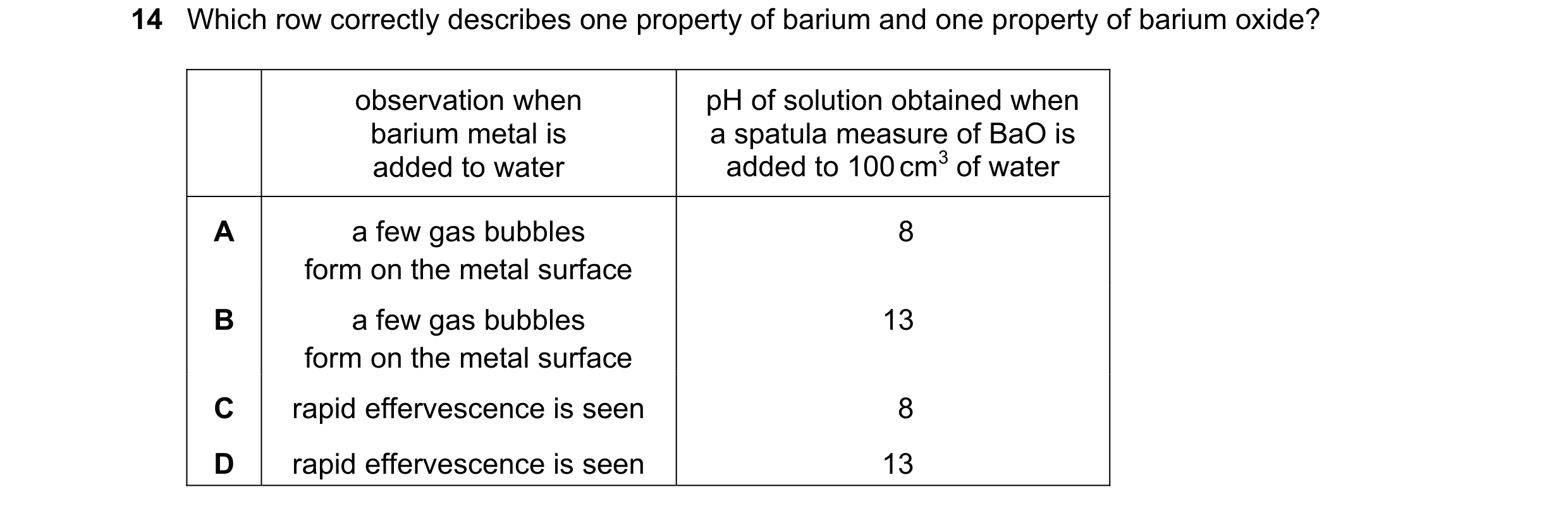
 42 / 57
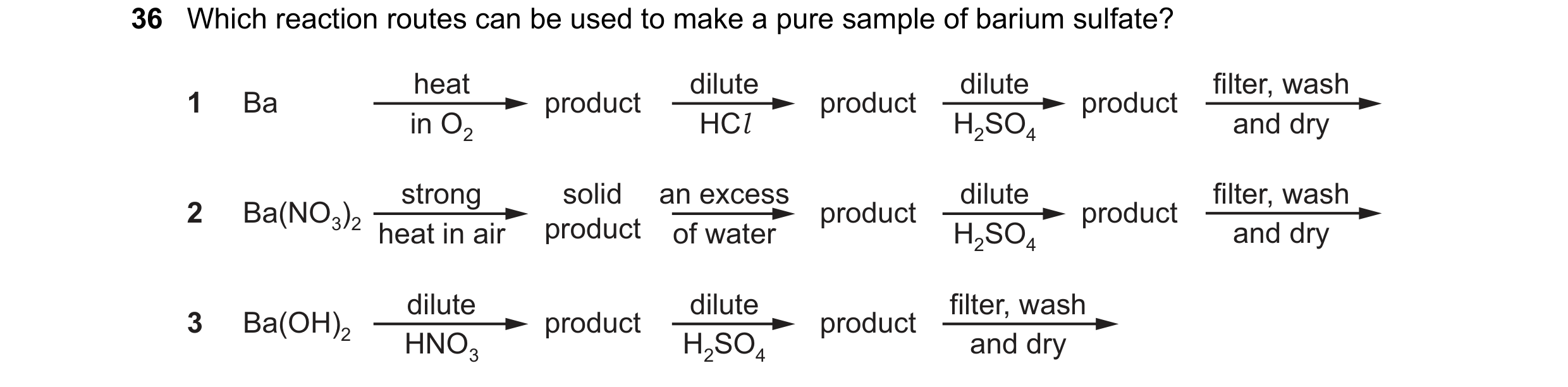

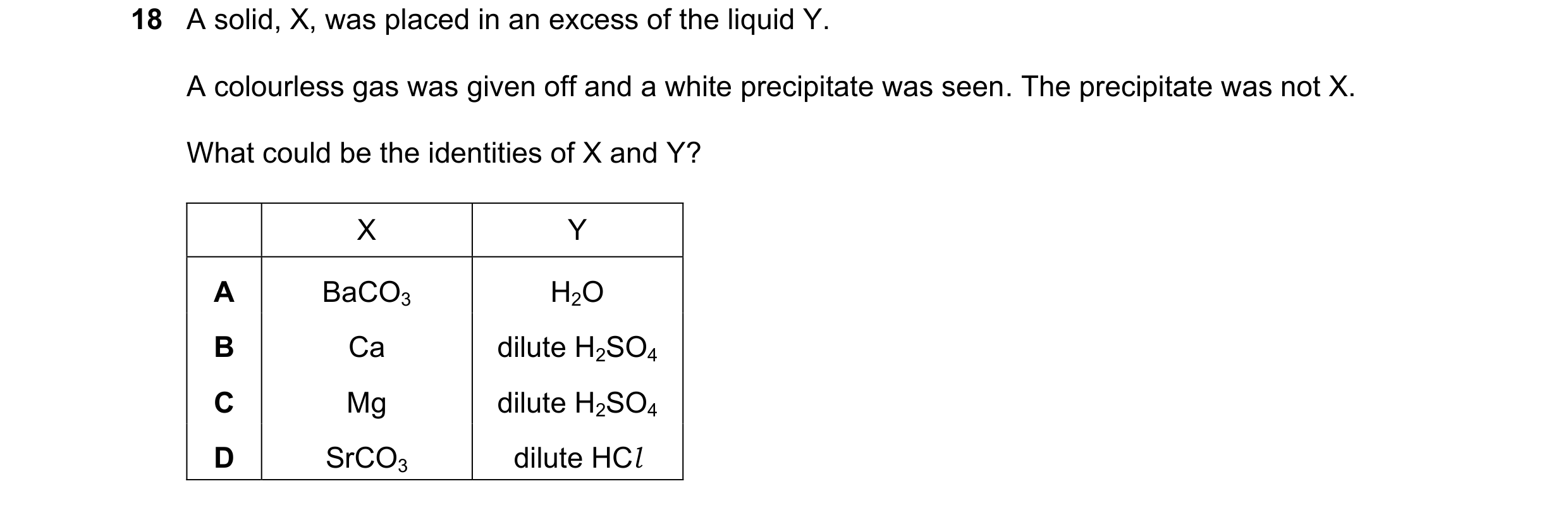 43 / 57
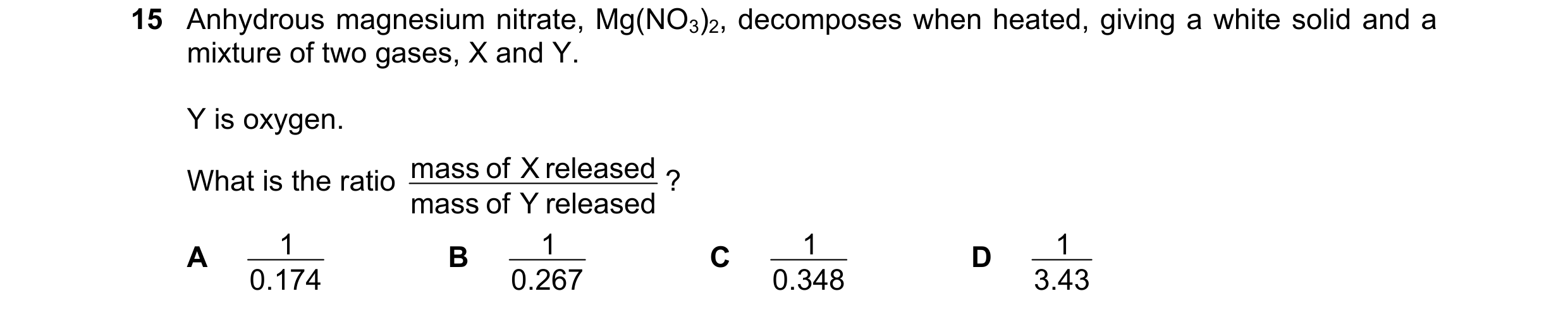


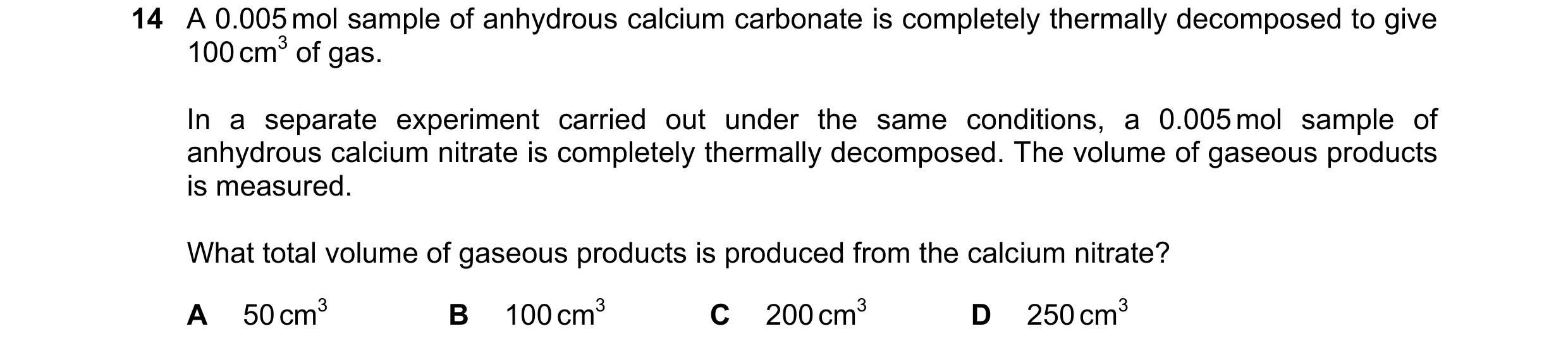
 44 / 57
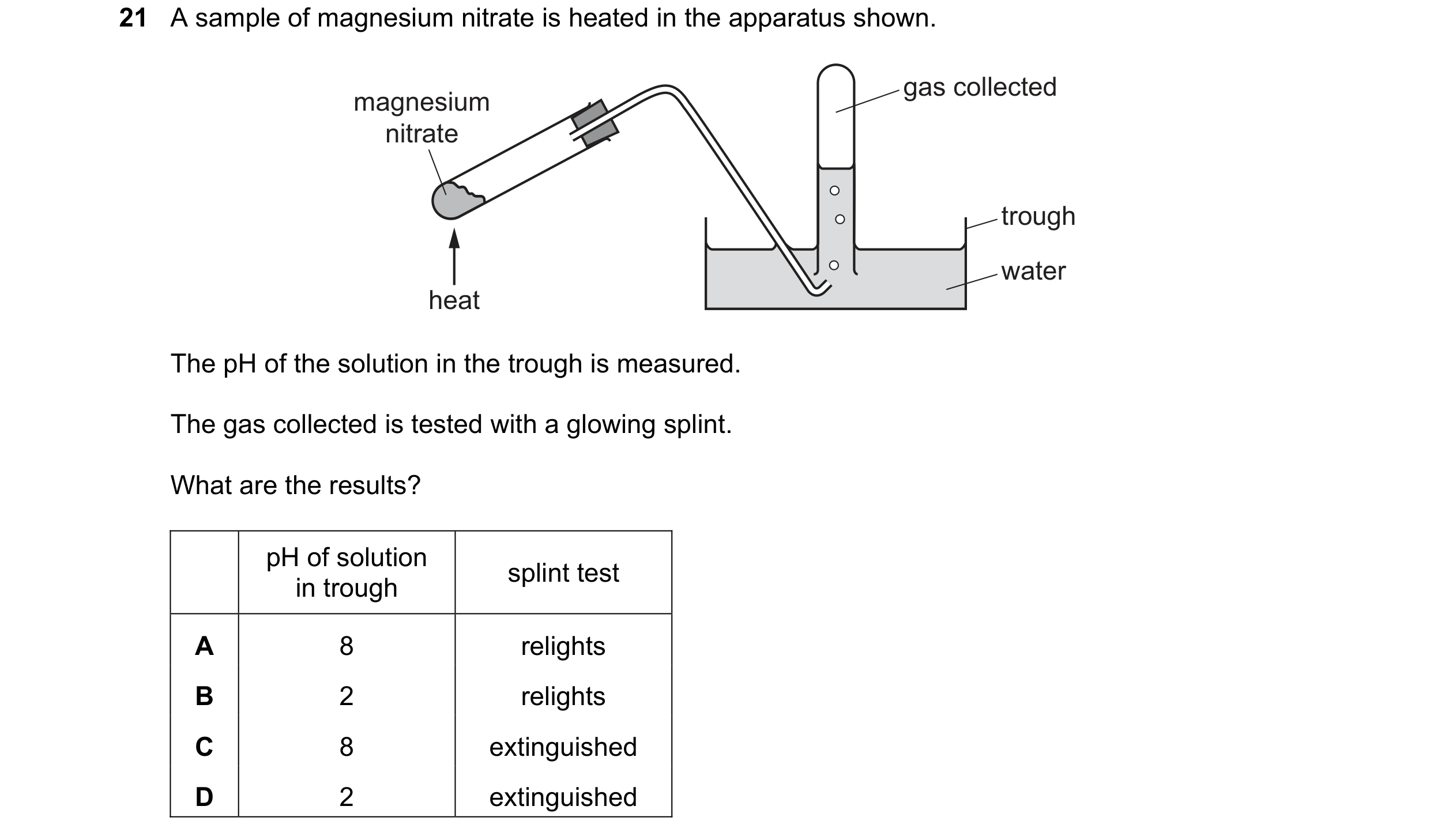 45 / 57
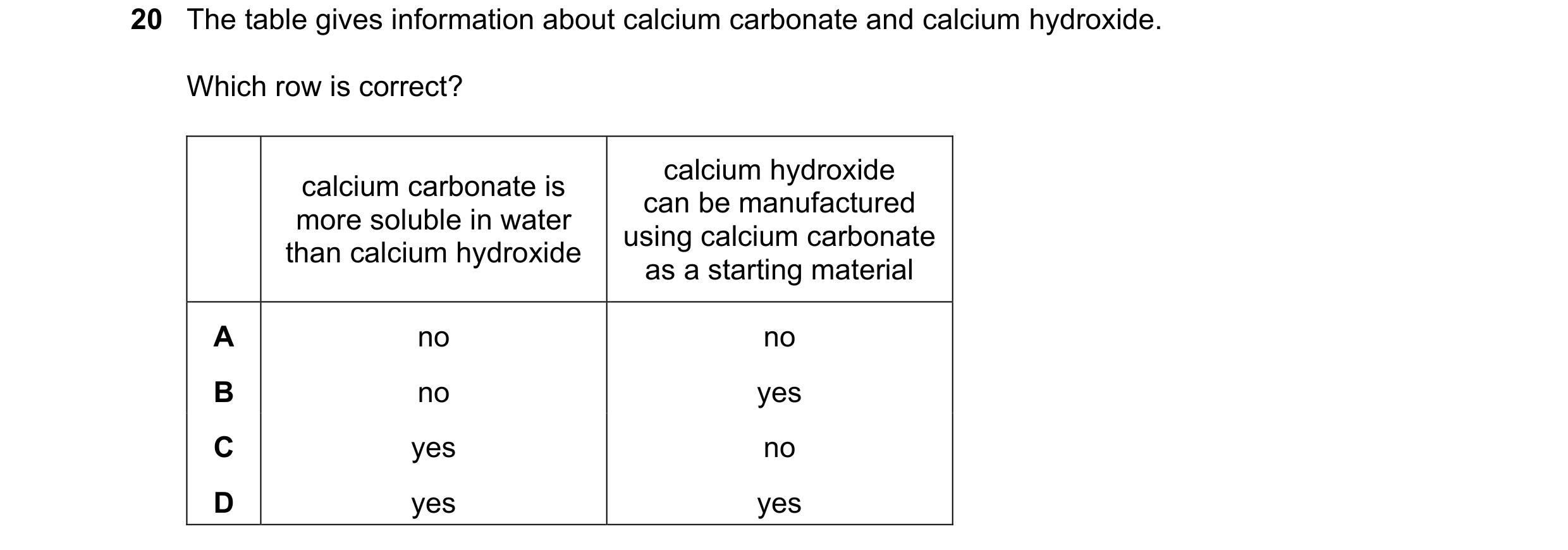
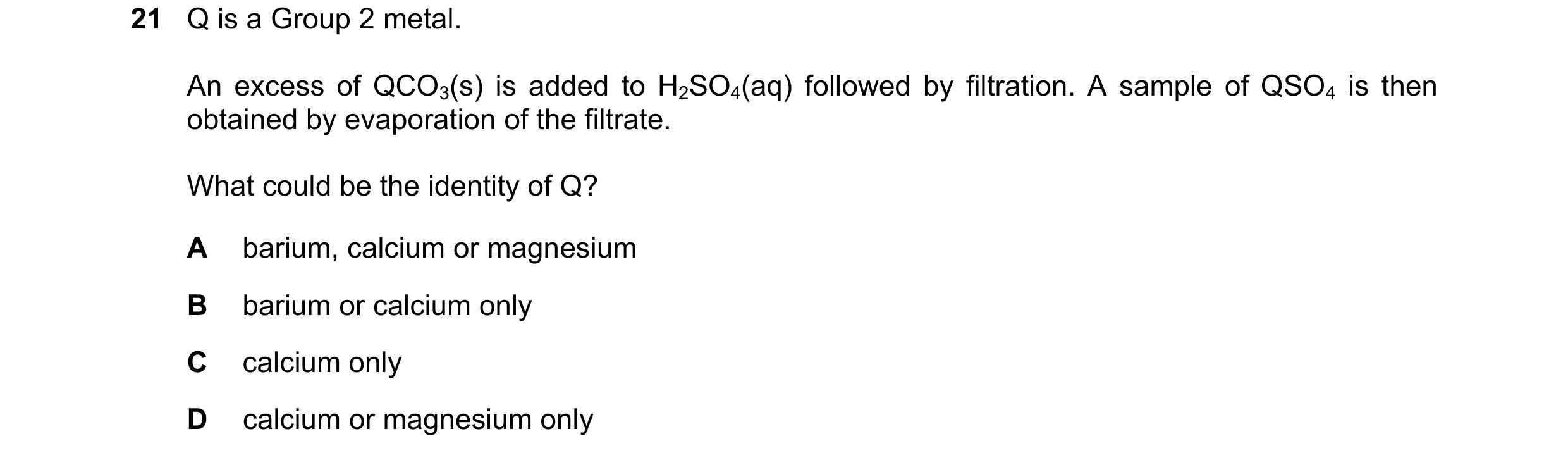
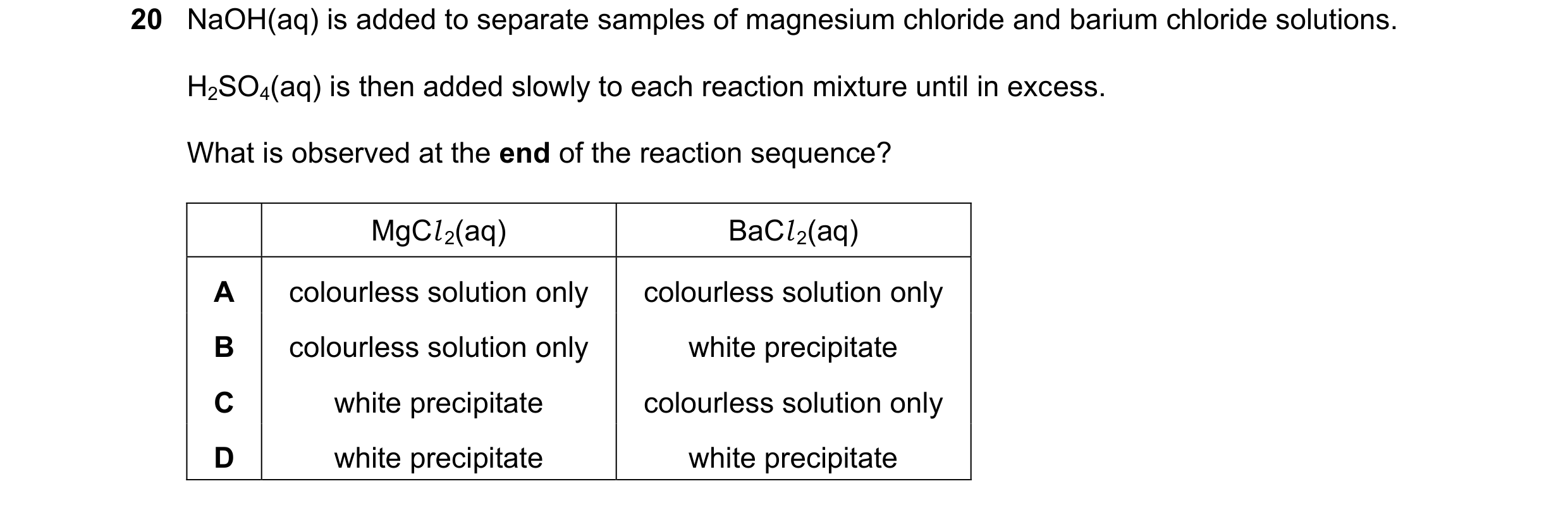 46 / 57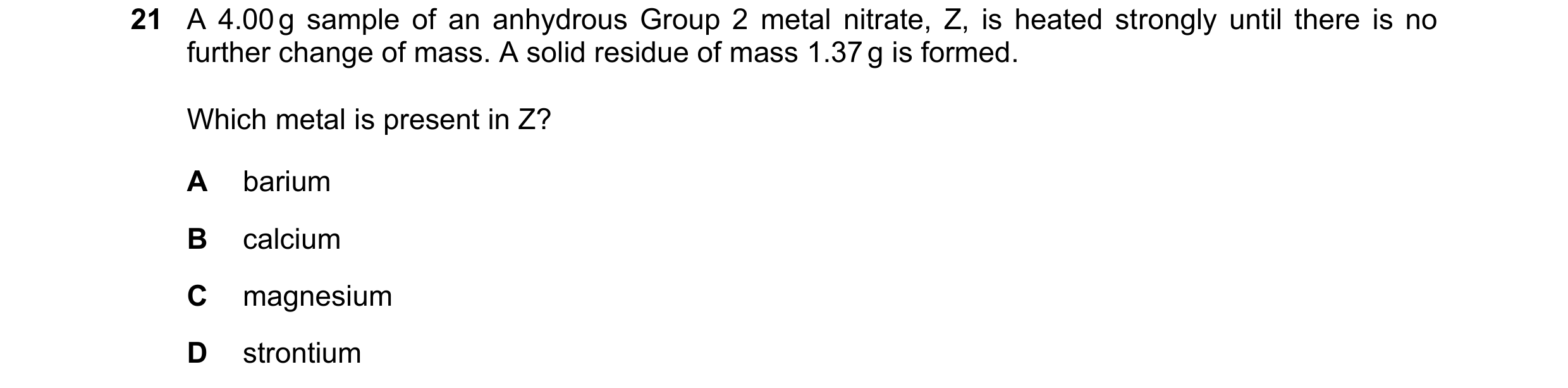


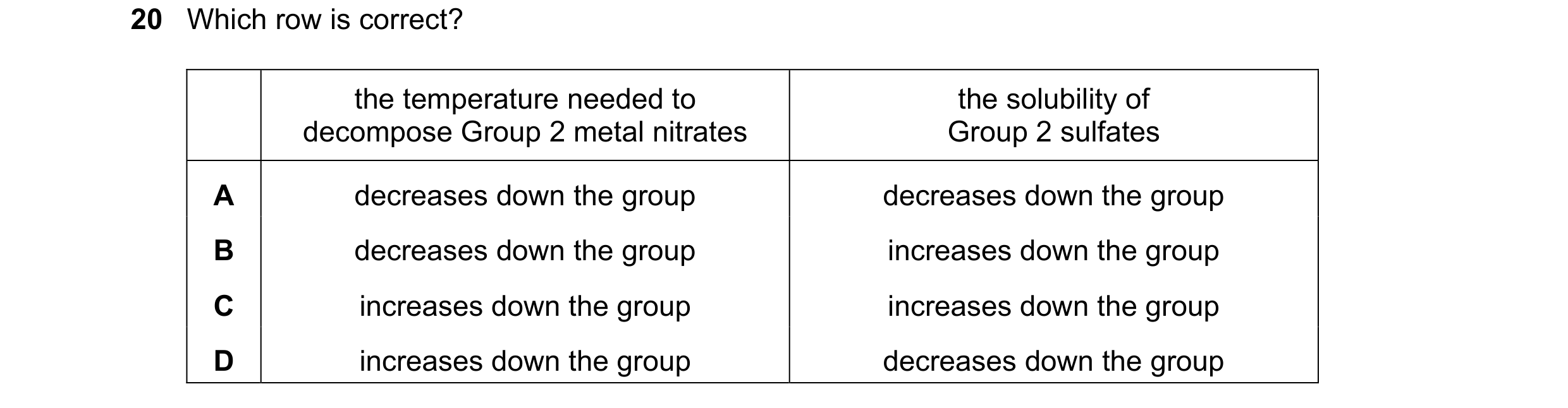
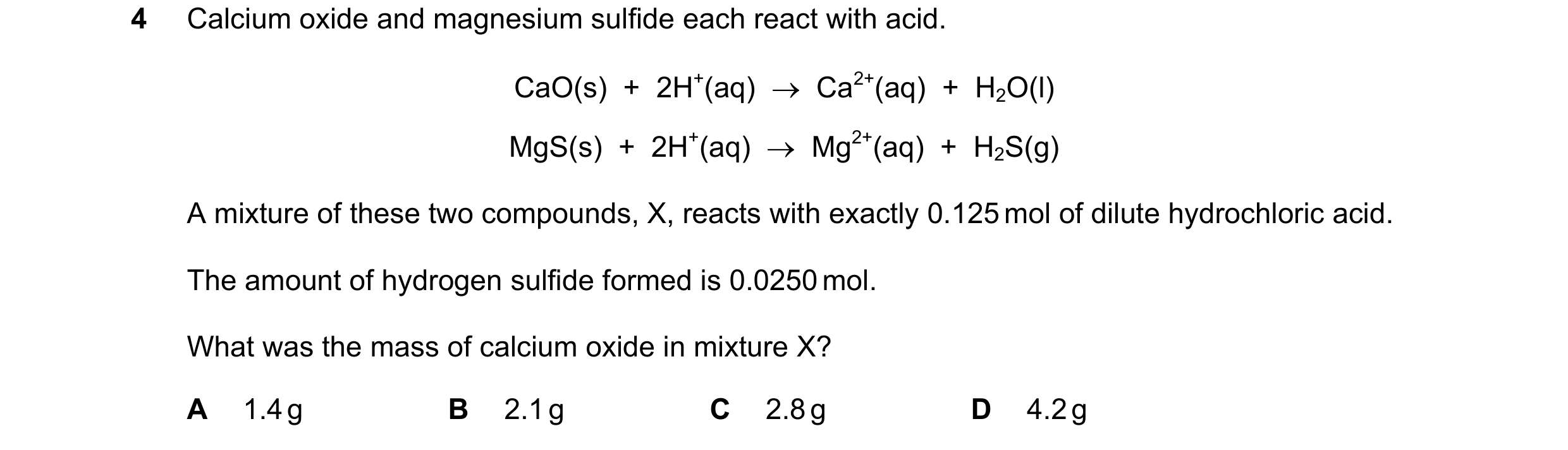 47 / 57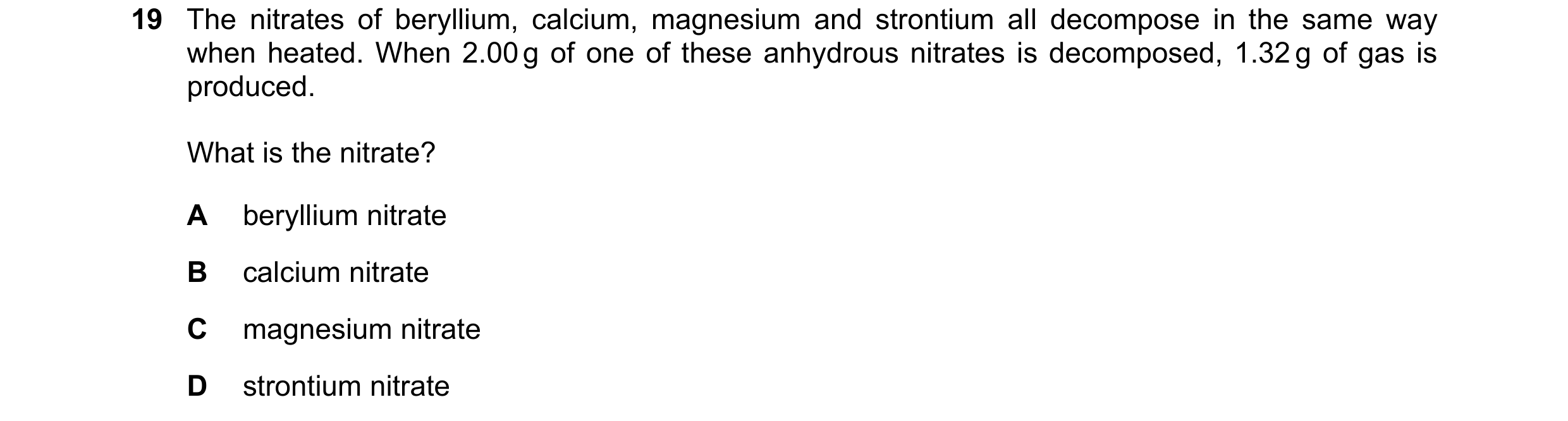
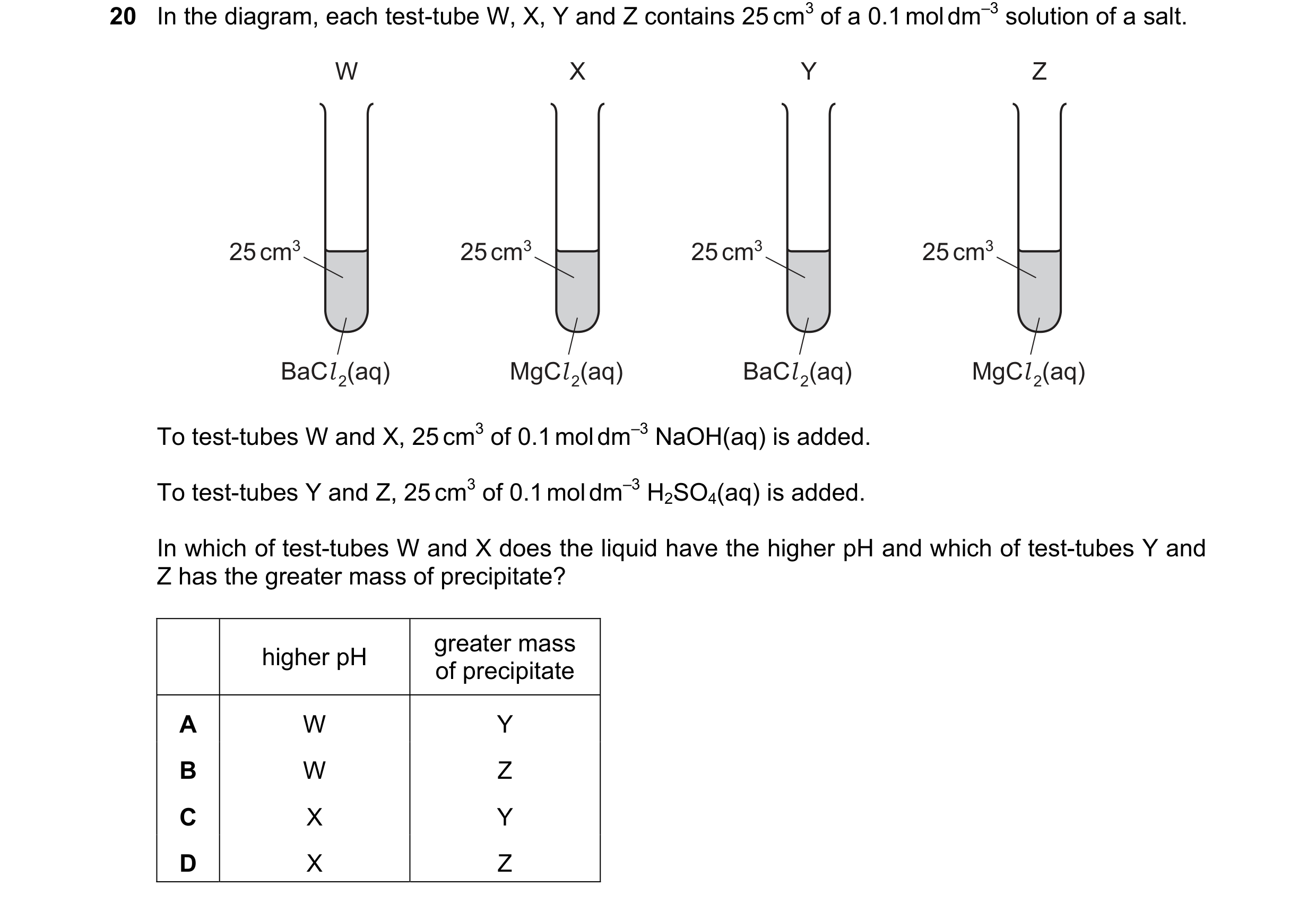

 48 / 57
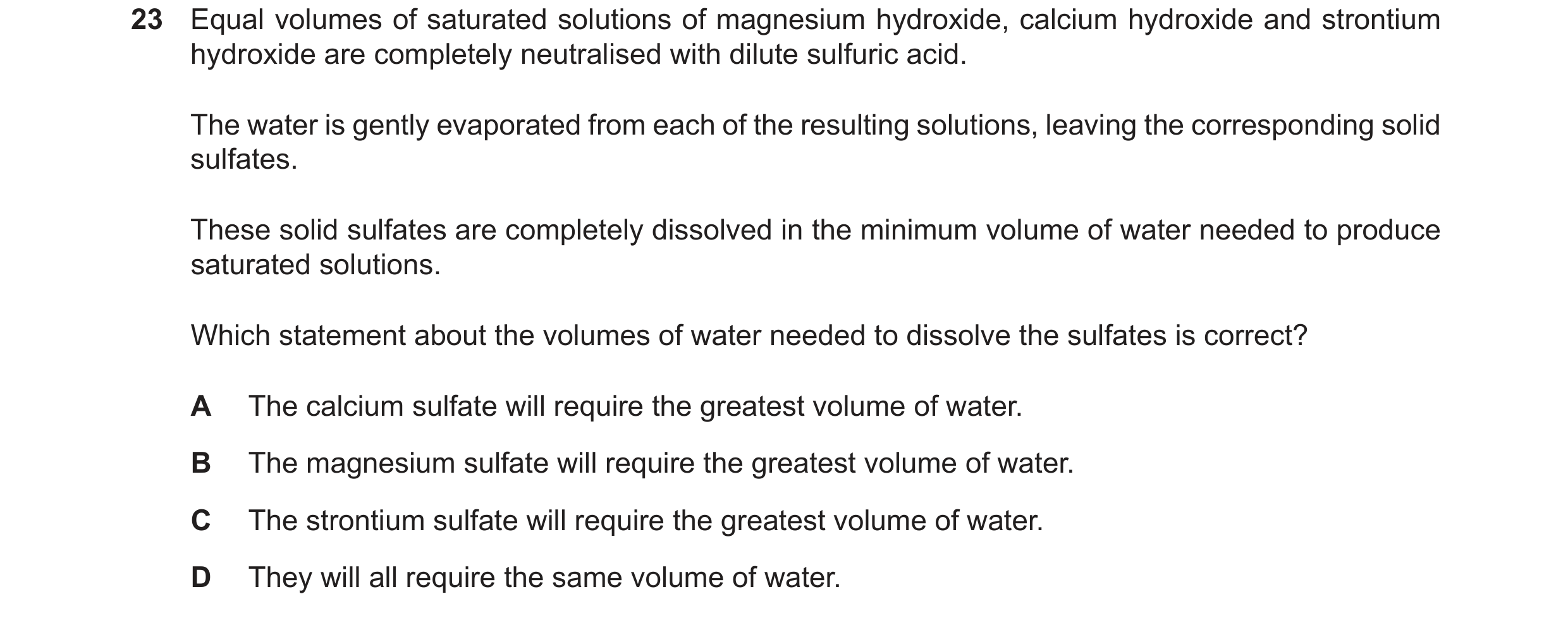
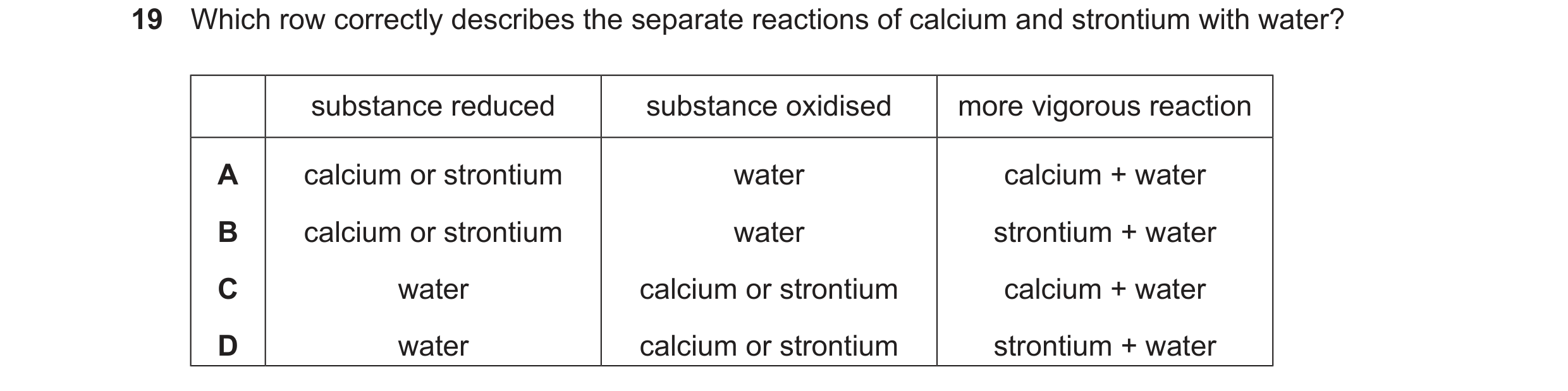
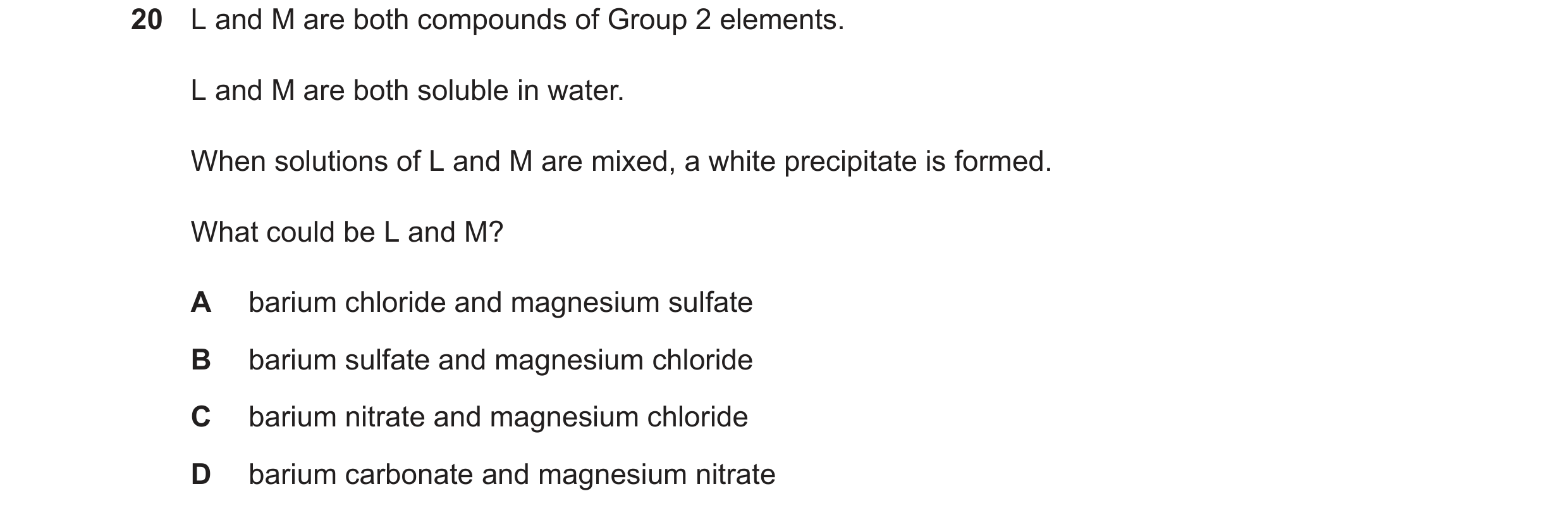 49 / 57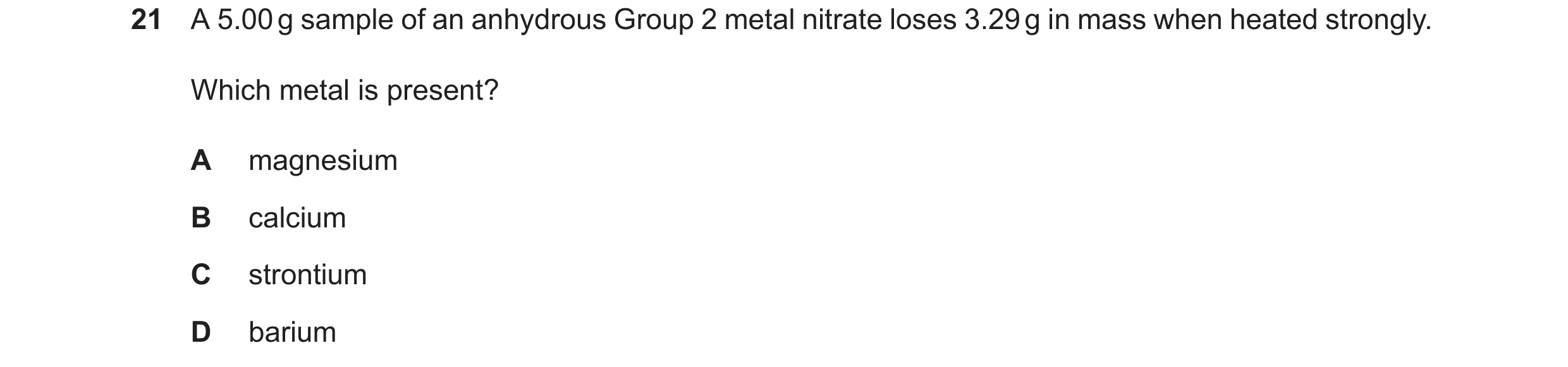

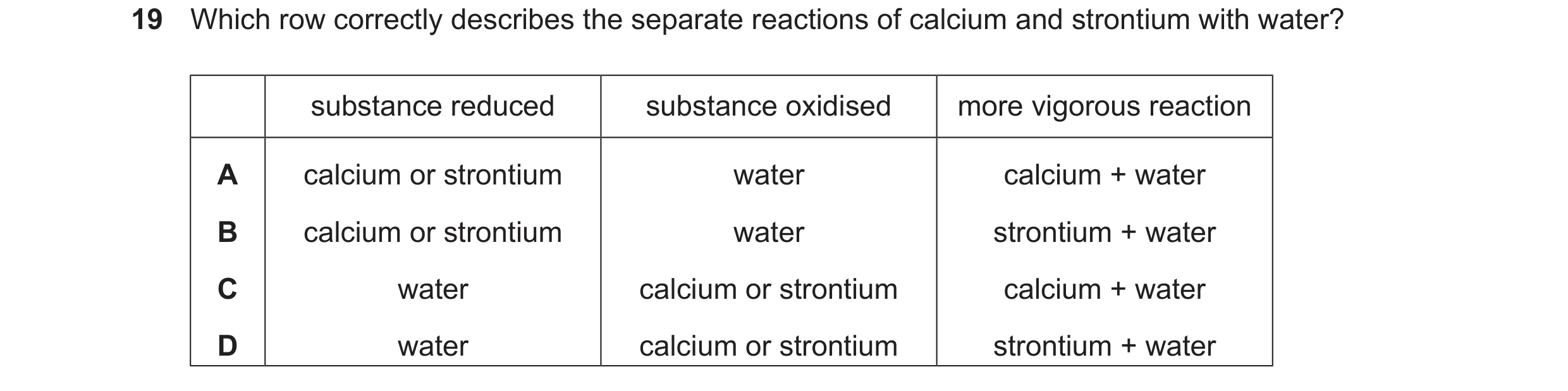
 50 / 57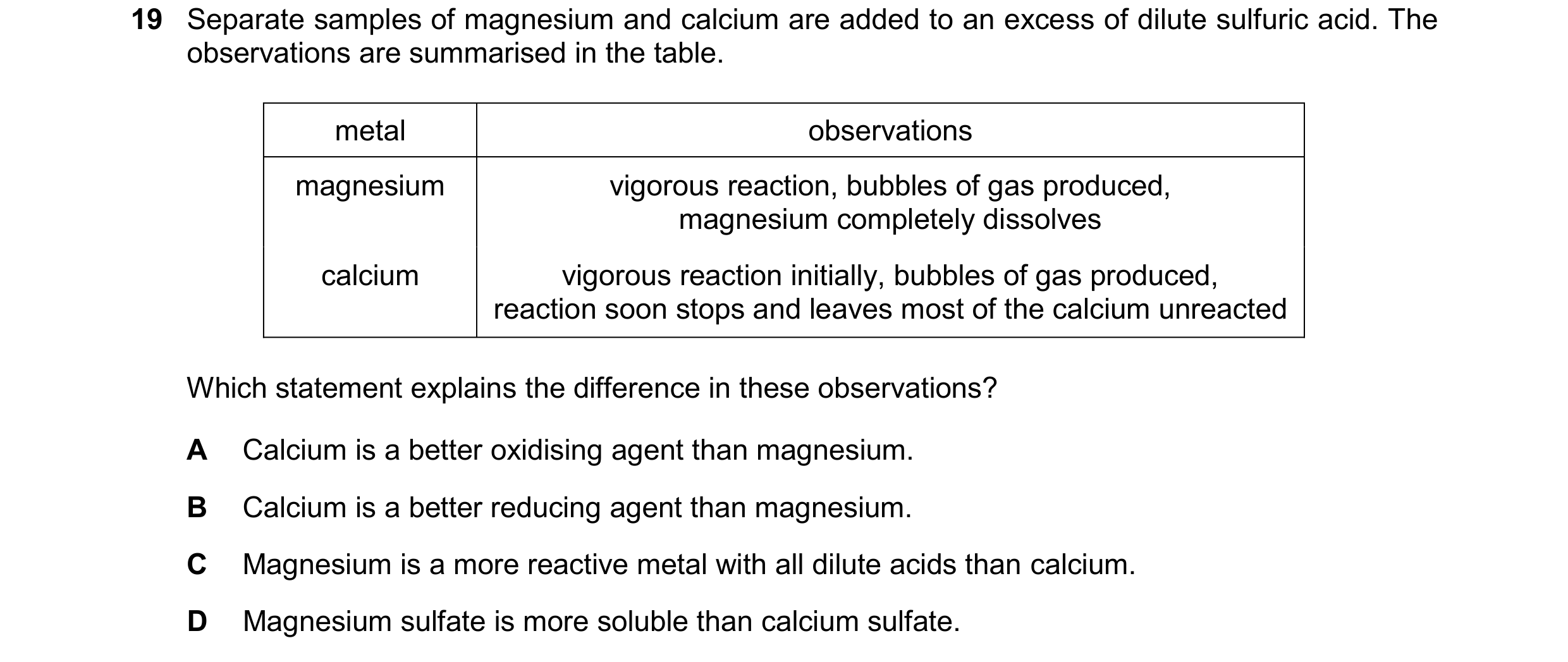
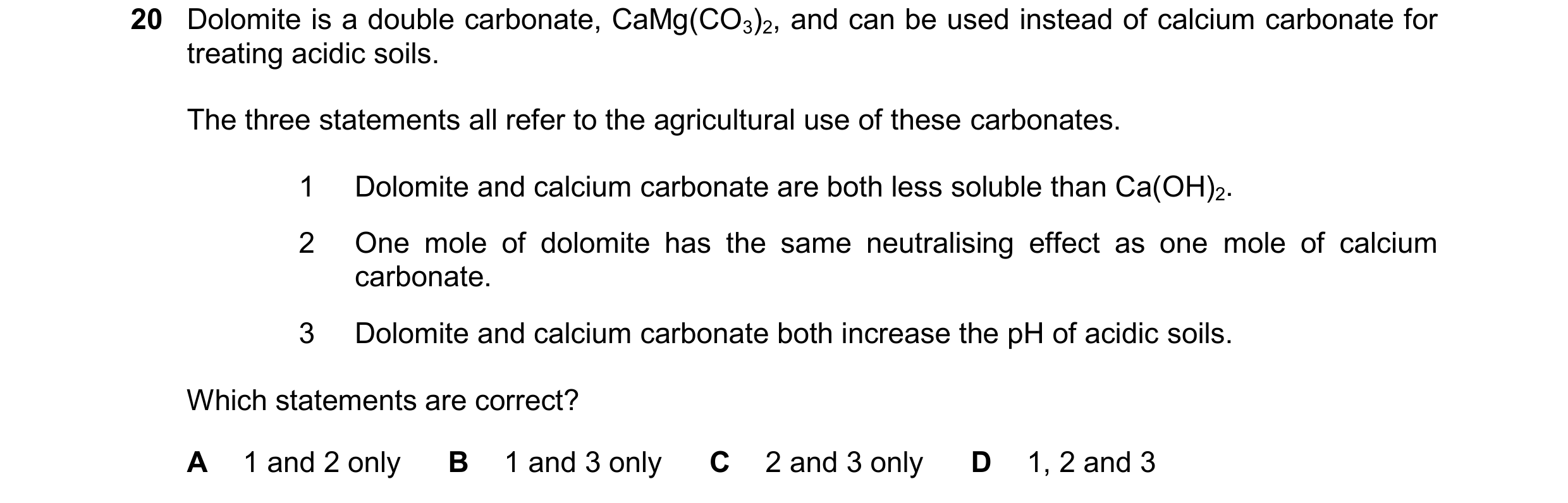
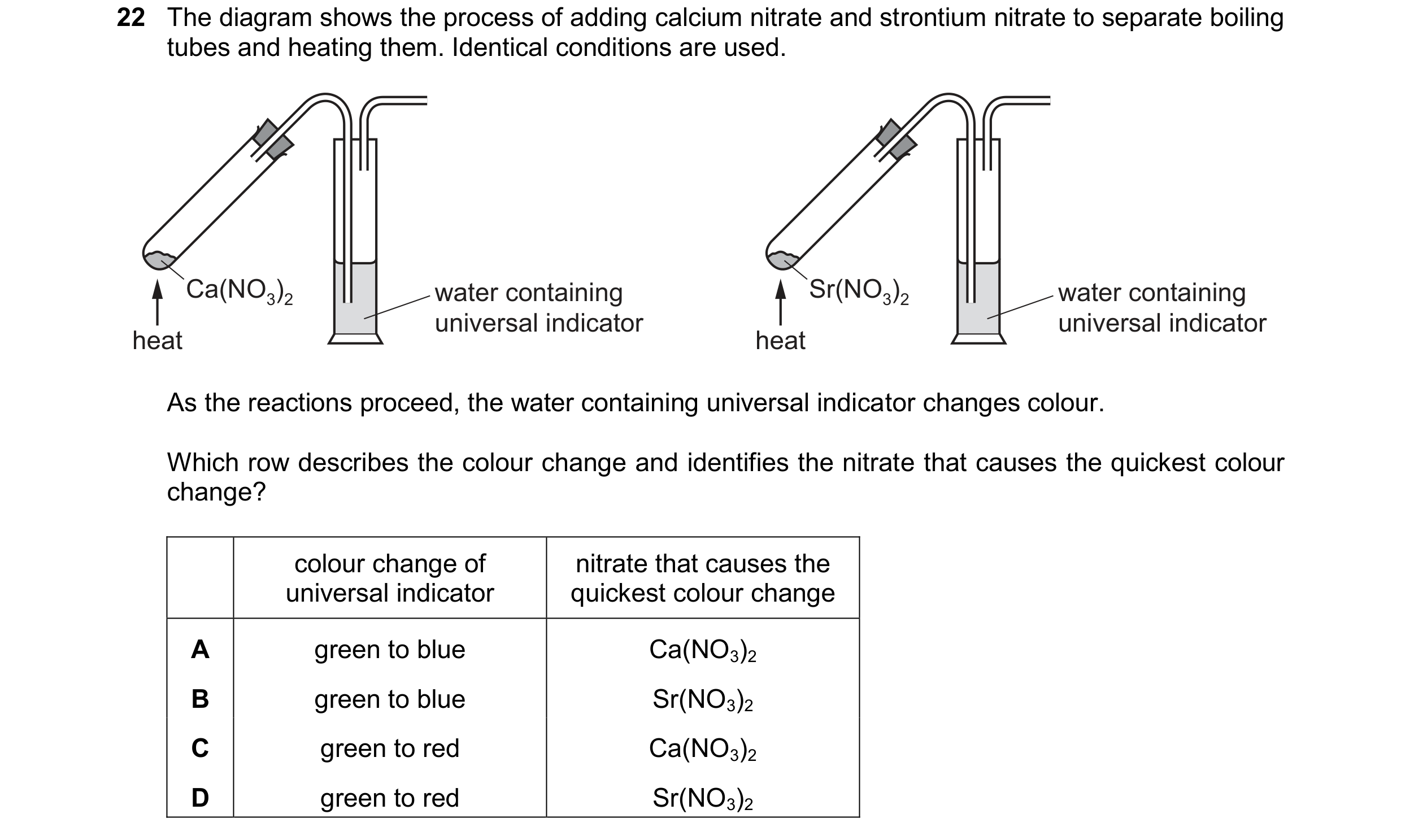 51 / 57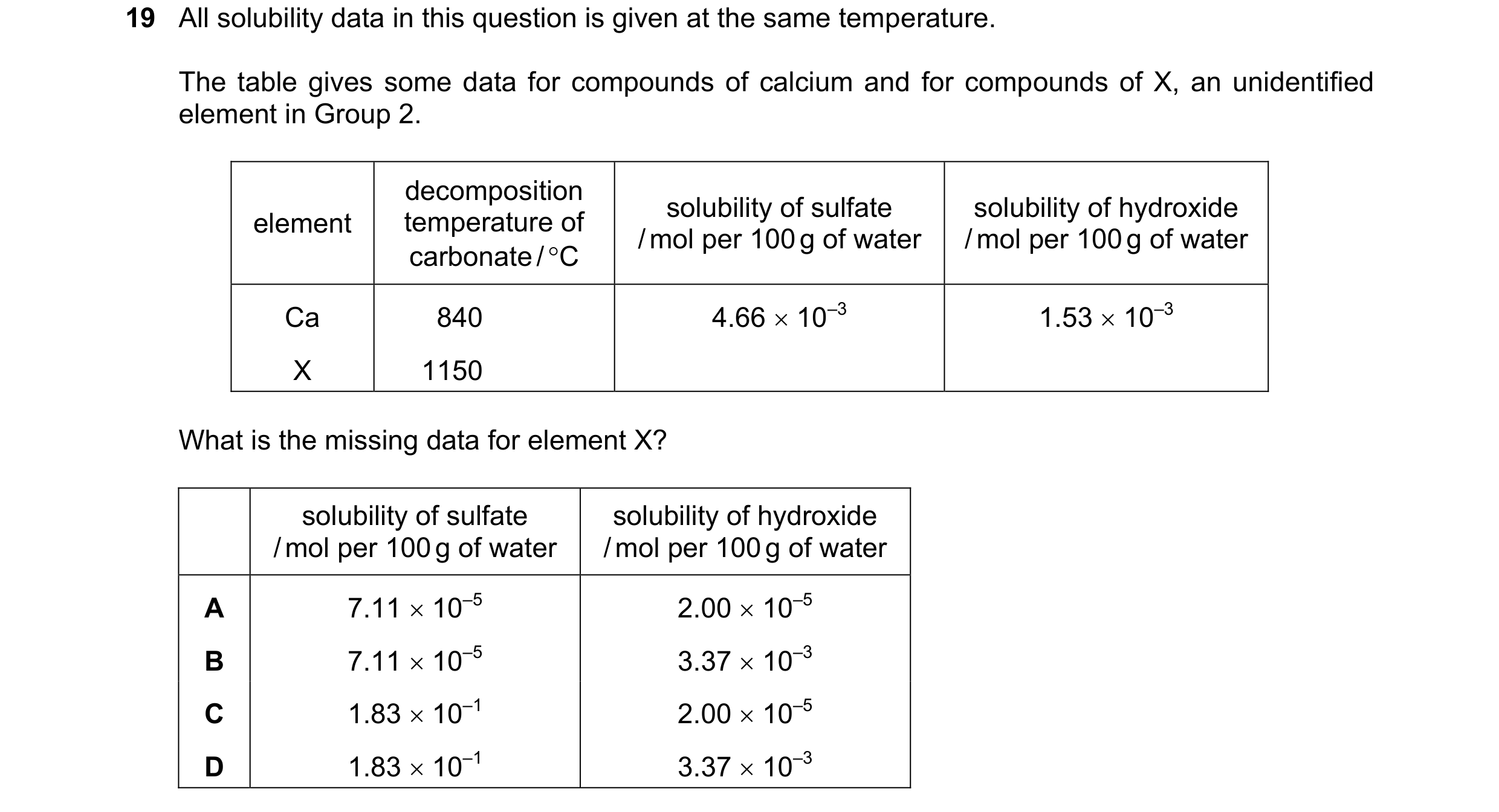

 52 / 57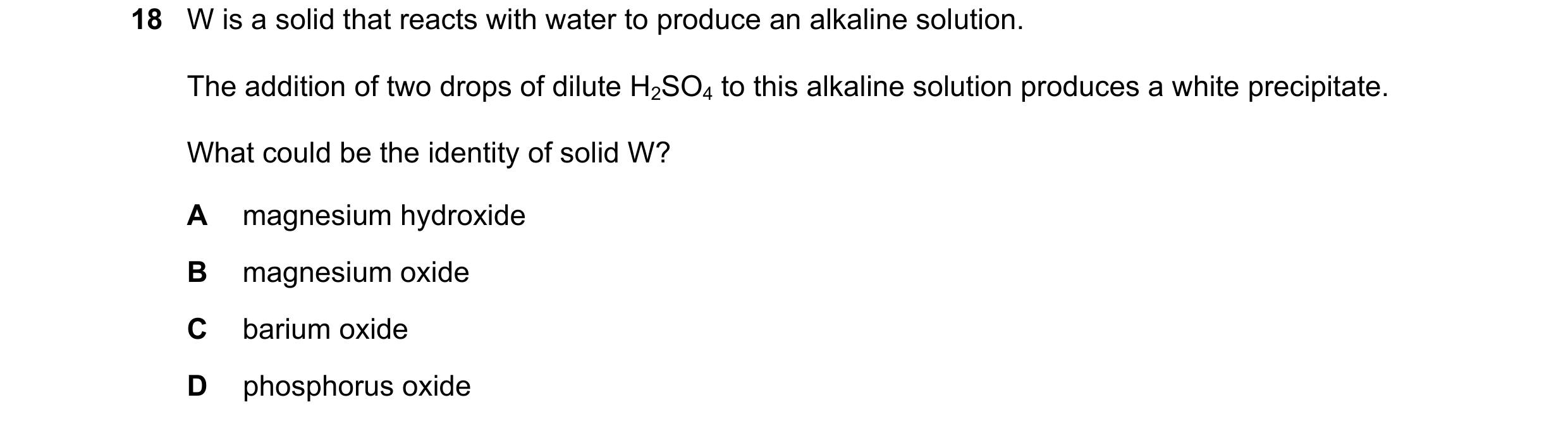
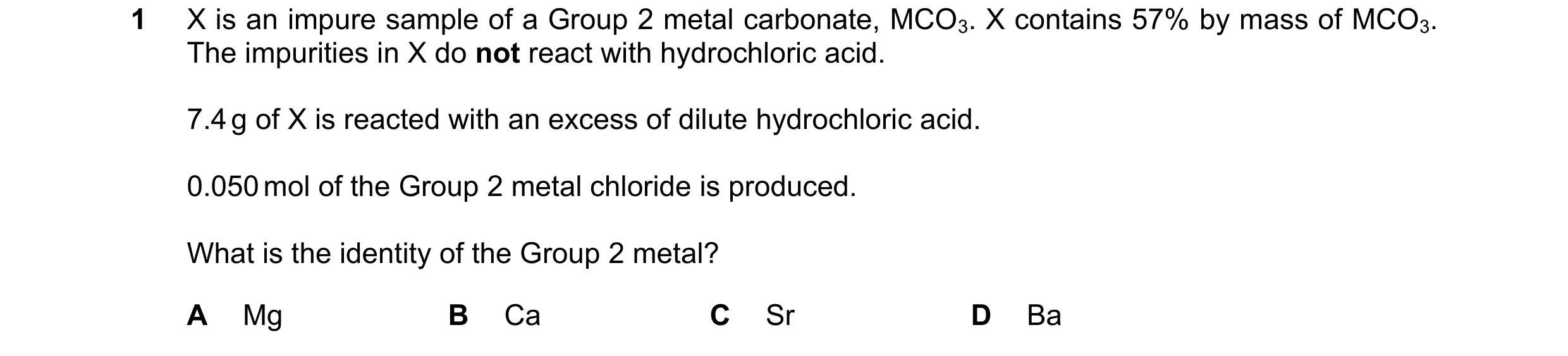

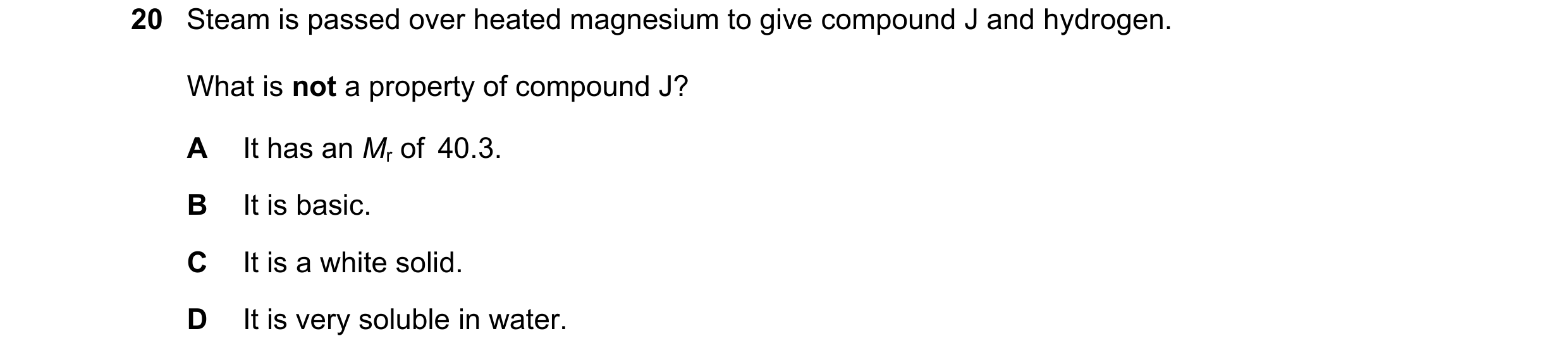
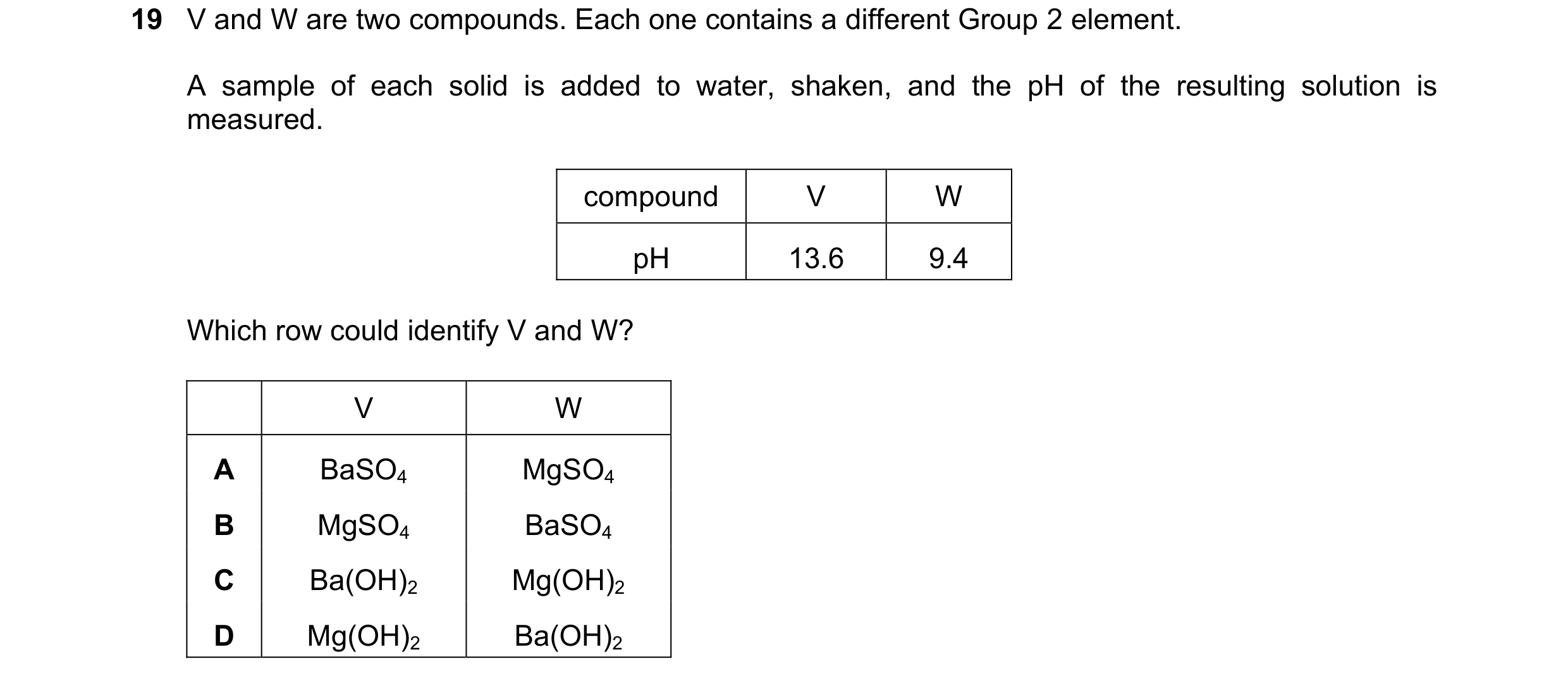 53 / 57
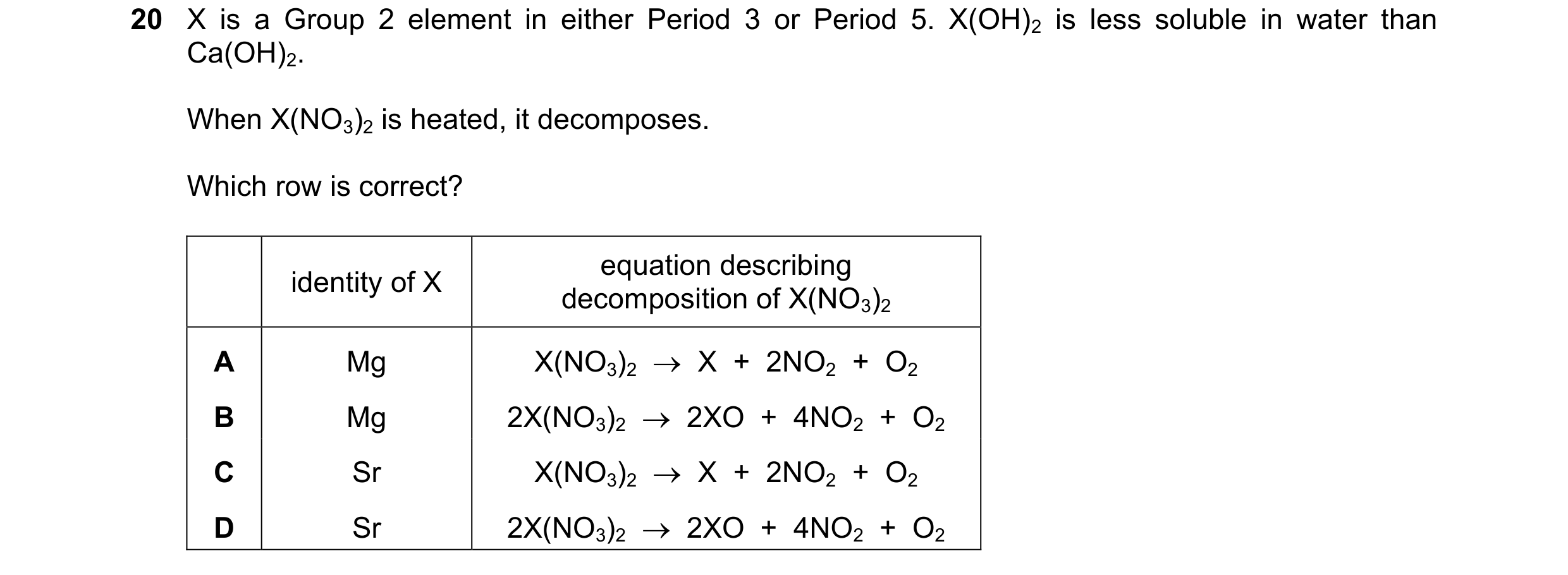
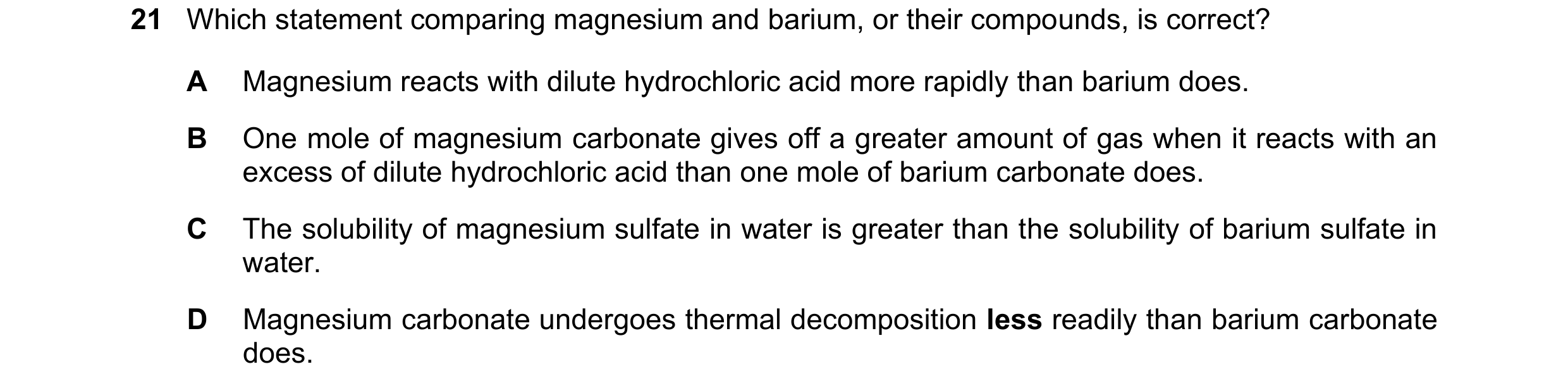
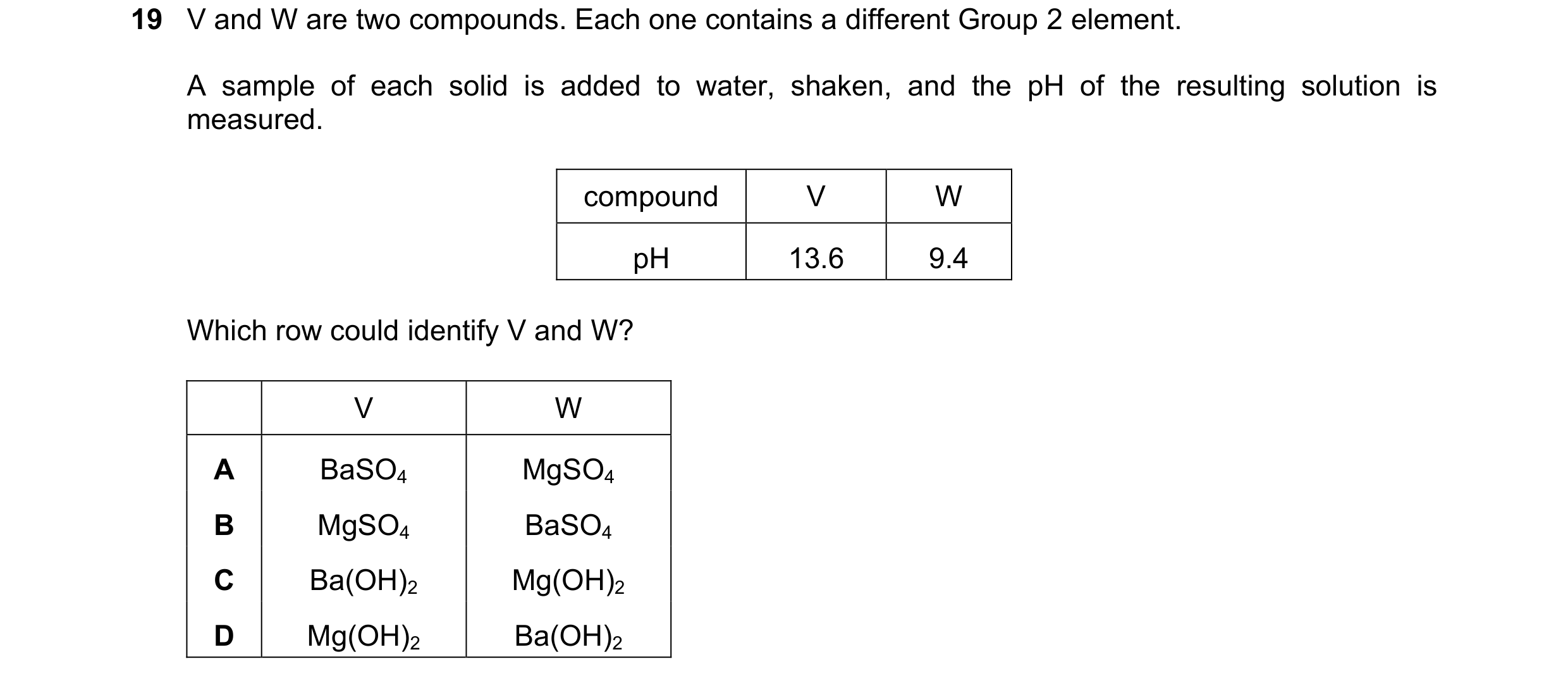 54 / 57
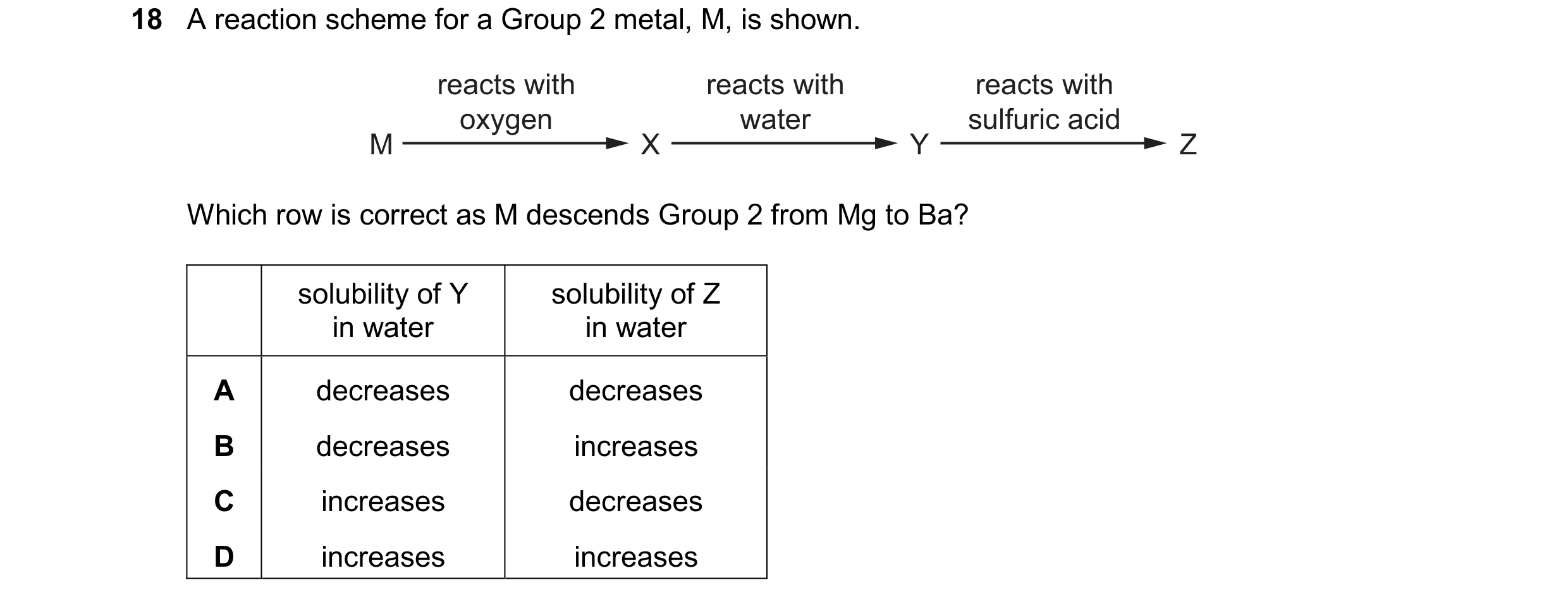

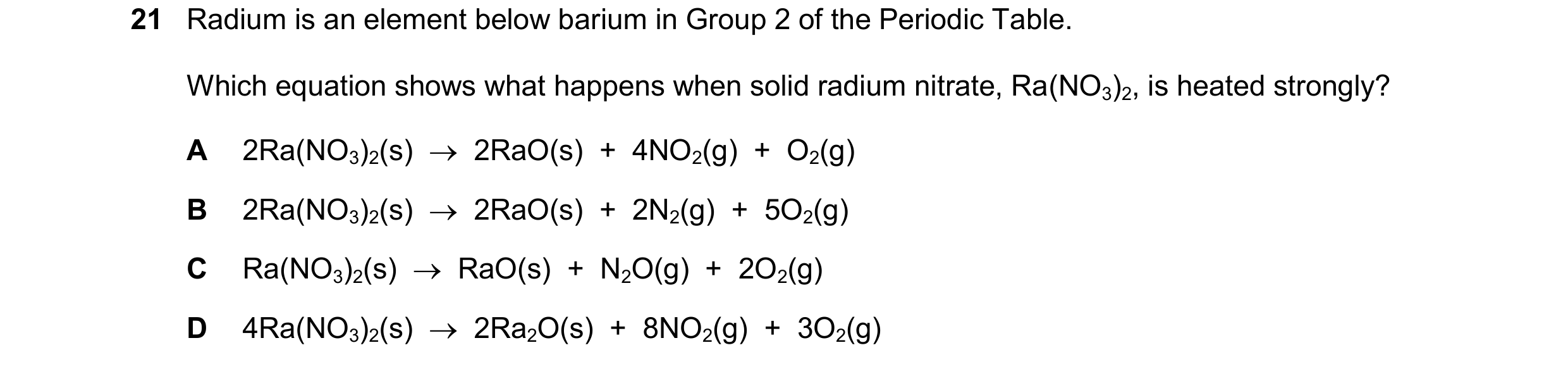
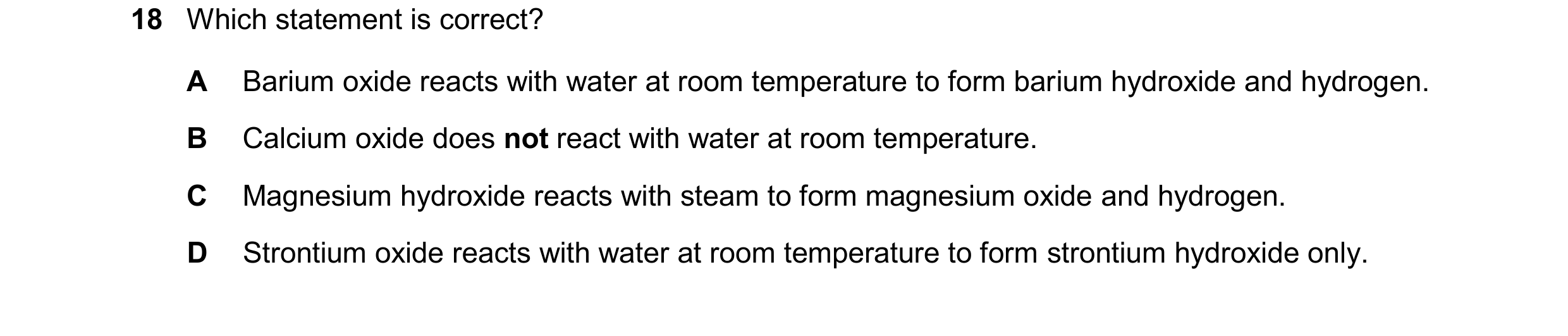 55 / 57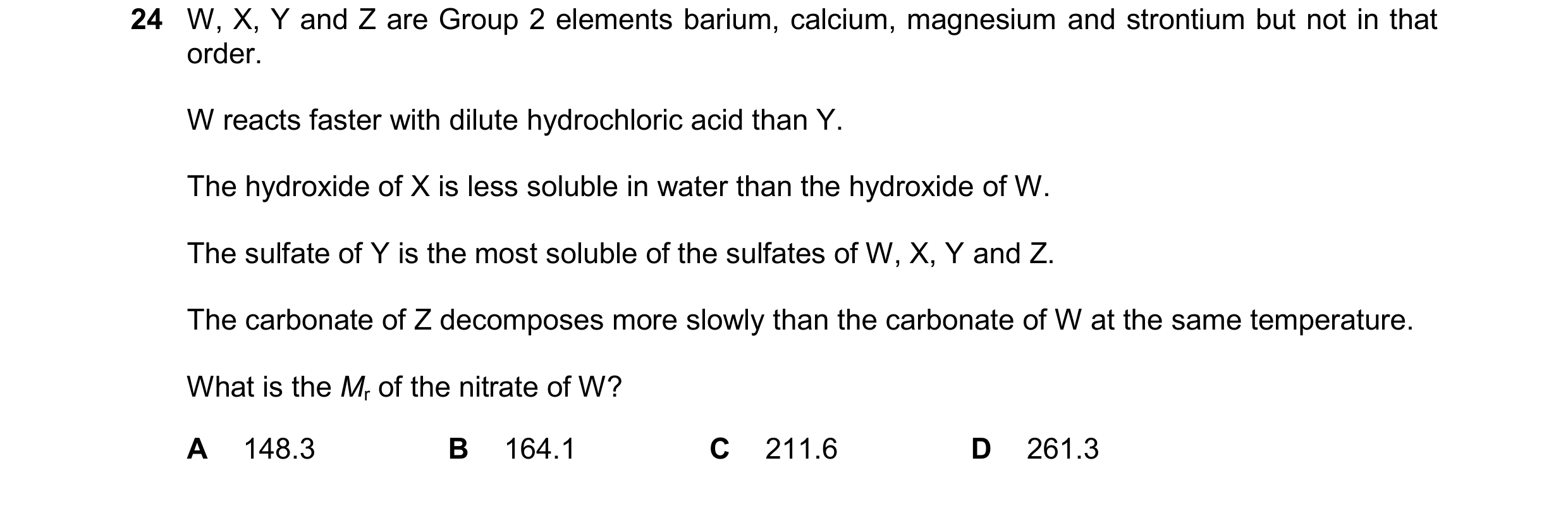
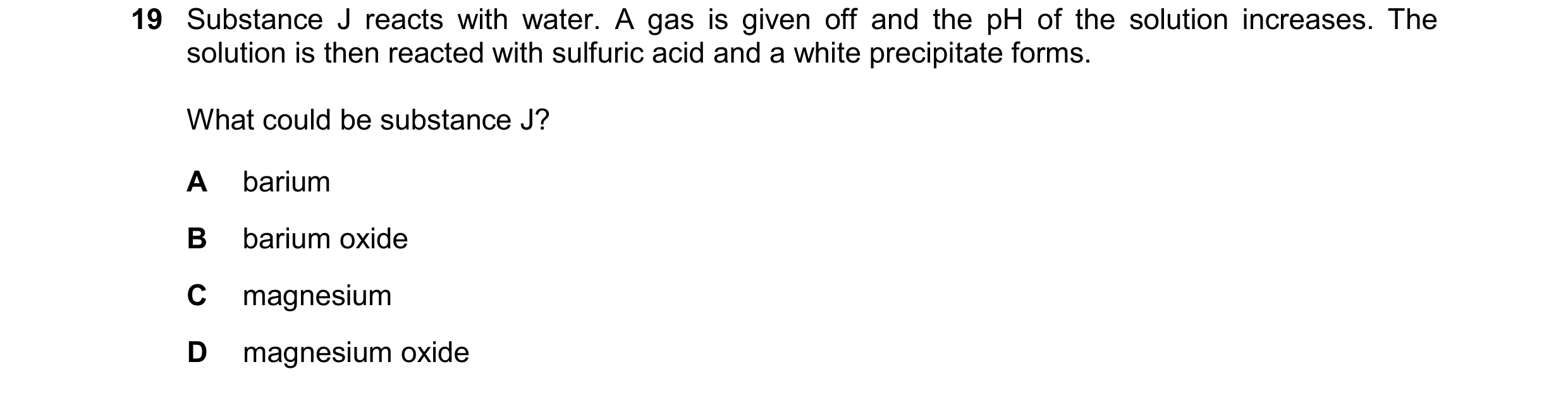
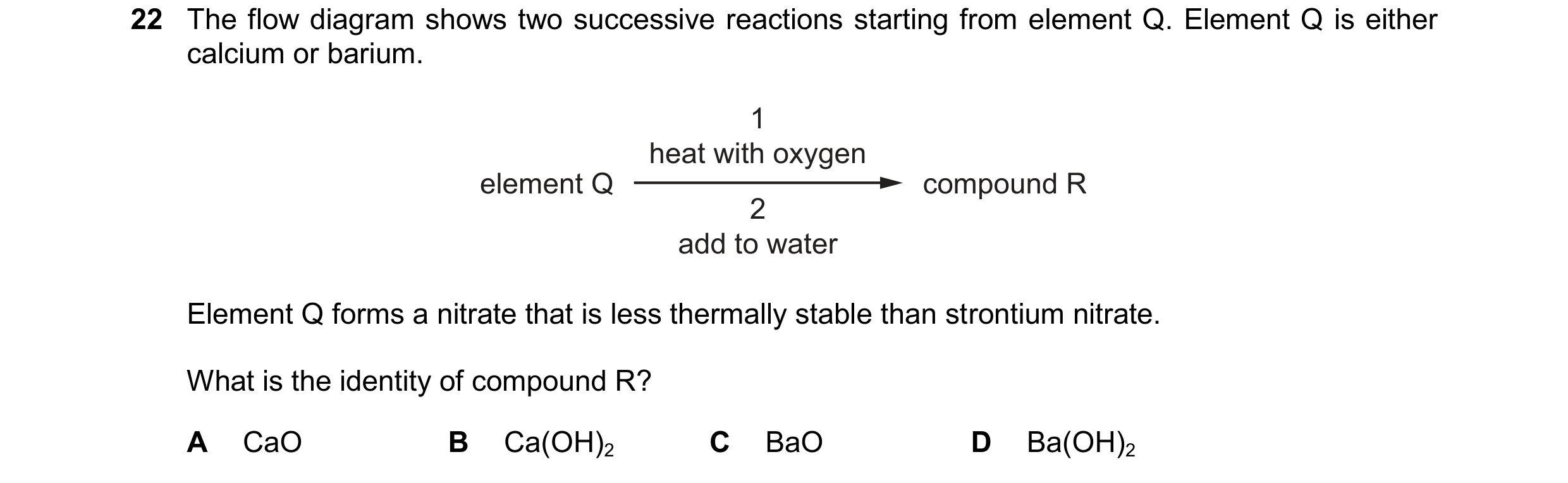
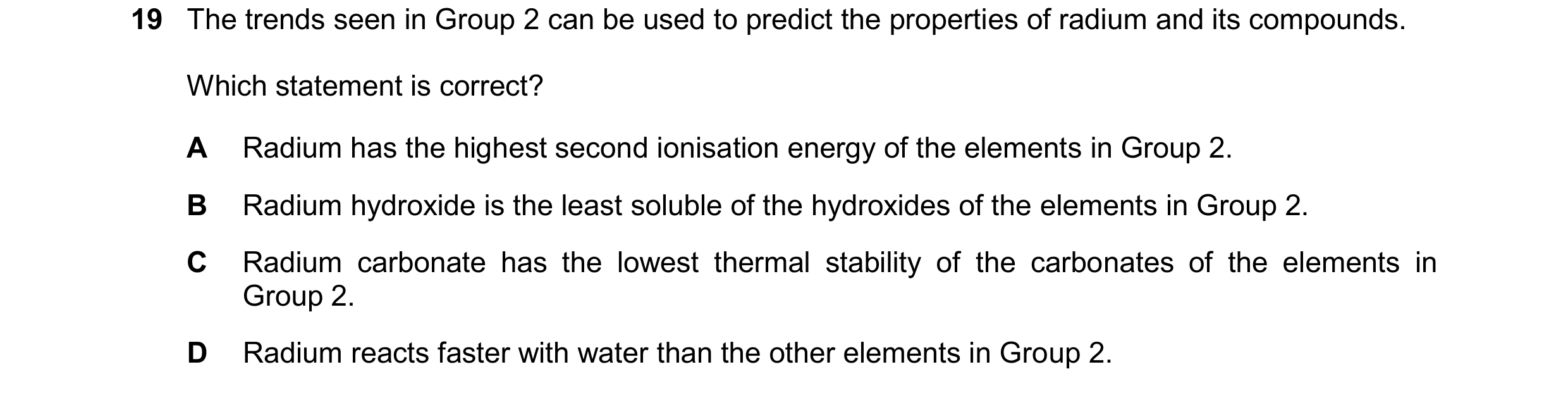 56 / 57
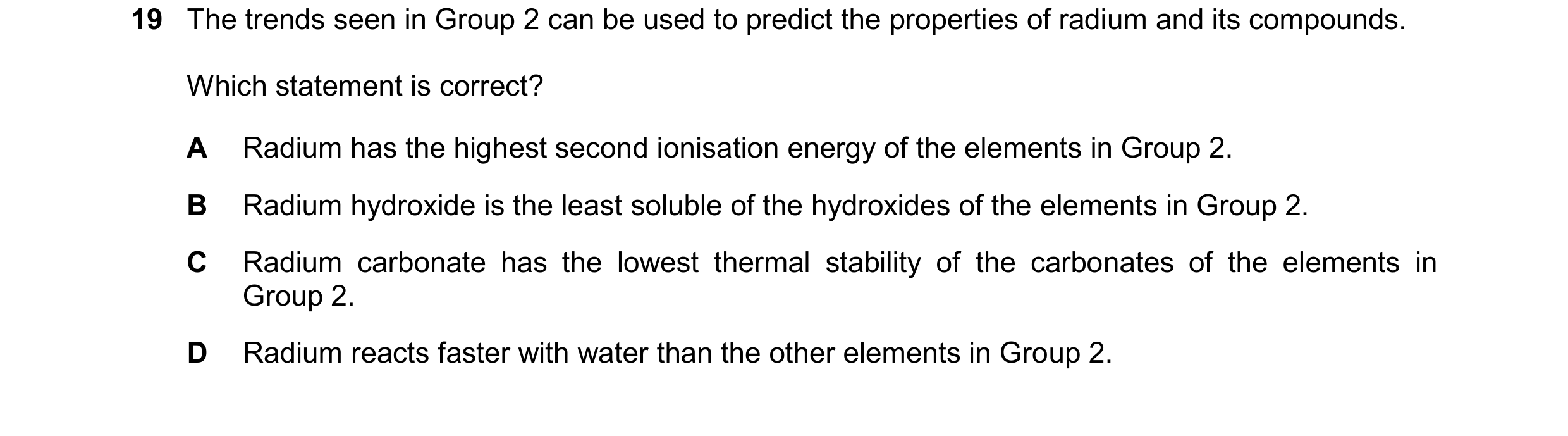
 57 / 57