Questions as text
Q1 · One mole of magnesium, aluminium and sulphur are each completely burned in an excess of… 9701/11 Oct/Nov 2005
12 One mole of magnesium, aluminium and sulphur are each completely burned in an excess of oxygen gas. Which graph shows the moles of oxygen used in each case? A B moles of moles of oxygen oxygen used used 0 0 Mg Al S Mg Al S C D moles of moles of oxygen oxygen used used 0 0 Mg Al S Mg Al S
1 marks
Answer: D
This question in 9701/11 Oct/Nov 2005
Q2 · The oxide and chloride of an element X are separately mixed with water 9701/11 May/June 2006
14 The oxide and chloride of an element X are separately mixed with water. The two resulting solutions have the same effect on litmus. What is element X? A sodium B magnesium C aluminium D phosphorus
1 marks
Answer: D
This question in 9701/11 May/June 2006
Q3 · Steam is passed over heated magnesium to give compound X and hydrogen 9701/11 Oct/Nov 2006
13 Steam is passed over heated magnesium to give compound X and hydrogen. What is not a property of compound X? A It has a high melting point. B It is a basic oxide. C It is a white solid. D It is very soluble in water.
1 marks
Answer: D
This question in 9701/11 Oct/Nov 2006
Q4 · In an experiment, 0.1 g samples of Na2O, MgO, P4O10 and SO2 are added to separate 100 cm3… 9701/11 May/June 2008
13 In an experiment, 0.1 g samples of Na2O, MgO, P4O10 and SO2 are added to separate 100 cm3 volumes of water. For which oxide is the resulting mixture most alkaline? A Na2O B MgO C P4O10 D SO2
1 marks
Answer: A
This question in 9701/11 May/June 2008
Q5 · Which oxide, when mixed with water, will produce the most acidic solution? 9701/11 Oct/Nov 2008
13 Which oxide, when mixed with water, will produce the most acidic solution? A CO B CO2 C SiO2 D P2O5
1 marks
Answer: D
This question in 9701/11 Oct/Nov 2008
Q6 · Which statement correctly describes what happens when silicon tetrachloride is added to… 9701/11 Oct/Nov 2009
13 Which statement correctly describes what happens when silicon tetrachloride is added to water? A The SiCl4 dissolves to give a neutral solution only. B The SiCl4 reacts to give an acidic solution only. C The SiCl4 reacts to give a precipitate and an acidic solution. D The SiCl4 reacts to give a precipitate and a neutral solution.
1 marks
Answer: C
This question in 9701/11 Oct/Nov 2009
Q7 · The oxide and chloride of an element X are separately mixed with water 9701/11 Oct/Nov 2009
14 The oxide and chloride of an element X are separately mixed with water. The two resulting solutions have the same effect on litmus. What is element X? A sodium B magnesium C aluminium D phosphorus
1 marks
Answer: D
This question in 9701/11 Oct/Nov 2009
Q8 · Which element of the third period requires the least number of moles of oxygen for the… 9701/11 May/June 2010
18 Which element of the third period requires the least number of moles of oxygen for the complete combustion of 1 mol of the element? A aluminium B magnesium C phosphorus D sodium
1 marks
Answer: D
This question in 9701/11 May/June 2010
Q9 · Two properties of non-metallic elements and their atoms are as follows 9701/11 May/June 2010
19 Two properties of non-metallic elements and their atoms are as follows. property 1 has an oxide that can form a strong acid in water property 2 has no paired 3p electrons Which properties do phosphorus and sulfur have? phosphorus sulfur A 1 and 2 1 only B 1 only 1 and 2 C 1 and 2 1 and 2 D 2 only 1 only
1 marks
Answer: A
This question in 9701/11 May/June 2010
Q10 · Which element of the third period requires the least number of moles of oxygen for the… 9701/12 May/June 2010
16 Which element of the third period requires the least number of moles of oxygen for the complete combustion of 1 mol of the element? A aluminium B magnesium C phosphorus D sodium
1 marks
Answer: D
This question in 9701/12 May/June 2010
Q11 · Two properties of non-metallic elements and their atoms are as follows 9701/12 May/June 2010
17 Two properties of non-metallic elements and their atoms are as follows. property 1 has an oxide that can form a strong acid in water property 2 has no paired 3p electrons Which properties do phosphorus and sulfur have? phosphorus sulfur A 1 and 2 1 only B 1 only 1 and 2 C 1 and 2 1 and 2 D 2 only 1 only
1 marks
Answer: A
This question in 9701/12 May/June 2010
Q12 · Two properties of non-metallic elements and their atoms are as follows 9701/13 May/June 2010
16 Two properties of non-metallic elements and their atoms are as follows. property 1 has an oxide that can form a strong acid in water property 2 has no paired 3p electrons Which properties do phosphorus and sulfur have? phosphorus sulfur A 1 and 2 1 only B 1 only 1 and 2 C 1 and 2 1 and 2 D 2 only 1 only
1 marks
Answer: A
This question in 9701/13 May/June 2010
Q13 · Which element of the third period requires the least number of moles of oxygen for the… 9701/13 May/June 2010
19 Which element of the third period requires the least number of moles of oxygen for the complete combustion of 1 mol of the element? A aluminium B magnesium C phosphorus D sodium
1 marks
Answer: D
This question in 9701/13 May/June 2010
Q14 · Which property of beryllium and its compounds is typical of the elements below it in… 9701/13 Oct/Nov 2010
19 Which property of beryllium and its compounds is typical of the elements below it in Group II? A Be does not react with hot water. B BeCl2 is covalent. C Be(NO3)2 produces BeO on thermal decomposition. D BeO dissolves in alkalis.
1 marks
Answer: C
This question in 9701/13 Oct/Nov 2010
Q15 · Steam is passed over heated magnesium to give compound X and hydrogen 9701/11 May/June 2011
14 Steam is passed over heated magnesium to give compound X and hydrogen. What is not a property of compound X? A It has an Mr of 40.3. B It is basic. C It is a white solid. D It is very soluble in water.
1 marks
Answer: D
This question in 9701/11 May/June 2011
Q16 · Which statements are correct? 9701/11 May/June 2011
34 Which statements are correct? 1 Aluminium chloride dissolves in water to give an acidic solution. 2 Magnesium chloride dissolves in water to give a slightly acidic solution. 3 Sodium chloride dissolves in water to give an alkaline solution.
1 marks
Answer: B
This question in 9701/11 May/June 2011
Q17 · Which oxides react with water to give a solution of pH 10 or higher? 9701/11 May/June 2011
35 Which oxides react with water to give a solution of pH 10 or higher? 1 CaO 2 Na2O 3 SrO
1 marks
Answer: A
This question in 9701/11 May/June 2011
Q18 · The highest oxides of the elements sodium to chlorine are separately added to water 9701/12 May/June 2011
14 The highest oxides of the elements sodium to chlorine are separately added to water. Which diagram best represents the pH of the resulting mixtures? A B pH pH Na2O Al 2O3SiO2 P4O10 SO3 Cl 2O7 Na2O Al 2O3SiO2 P4O10 SO3 Cl 2O7 MgO MgO C D pH pH Na2O Al 2O3SiO2 P4O10 SO3 Cl 2O7 Na2O Al 2O3SiO2 P4O10 SO3 Cl 2O7 MgO MgO
1 marks
Answer: B
This question in 9701/12 May/June 2011
Q19 · Why does aluminium oxide dissolve in sodium hydroxide solution? 9701/12 May/June 2011
16 Why does aluminium oxide dissolve in sodium hydroxide solution? A Aluminium oxide can behave as a base. B Aluminium oxide can behave as an acid. C Aluminium oxide has a giant structure. D The bonding in aluminium oxide is ionic.
1 marks
Answer: B
This question in 9701/12 May/June 2011
Q20 · Steam is passed over heated magnesium to give compound X and hydrogen 9701/13 May/June 2011
14 Steam is passed over heated magnesium to give compound X and hydrogen. What is not a property of compound X? A It has an Mr of 40.3. B It is basic. C It is a white solid. D It is very soluble in water.
1 marks
Answer: D
This question in 9701/13 May/June 2011
Q21 · Which statements are correct? 9701/13 May/June 2011
36 Which statements are correct? 1 Aluminium chloride dissolves in water to give an acidic solution. 2 Magnesium chloride dissolves in water to give a slightly acidic solution. 3 Sodium chloride dissolves in water to give an alkaline solution.
1 marks
Answer: B
This question in 9701/13 May/June 2011
Q22 · Which oxides react with water to give a solution of pH 10 or higher? 9701/13 May/June 2011
38 Which oxides react with water to give a solution of pH 10 or higher? 1 CaO 2 Na2O 3 SrO
1 marks
Answer: A
This question in 9701/13 May/June 2011
Q23 · Which element shows the greatest tendency to form some covalent compounds? 9701/11 Oct/Nov 2011
13 Which element shows the greatest tendency to form some covalent compounds? A aluminium B magnesium C neon D potassium
1 marks
Answer: A
This question in 9701/11 Oct/Nov 2011
Q24 · In a car engine, non-metallic element X forms a pollutant oxide Y 9701/11 Oct/Nov 2011
36 In a car engine, non-metallic element X forms a pollutant oxide Y. Further oxidation of Y to Z occurs spontaneously in the atmosphere. In this further oxidation, 1 mol of Y reacts with 0.5 mol of gaseous oxygen. Which statements about X, Y and Z are correct? 1 X forms a basic hydride. 2 Y is a diatomic molecule. 3 Z is a polar molecule.
1 marks
Answer: A
This question in 9701/11 Oct/Nov 2011
Q25 · Which element shows the greatest tendency to form some covalent compounds? 9701/13 Oct/Nov 2011
13 Which element shows the greatest tendency to form some covalent compounds? A aluminium B magnesium C neon D potassium
1 marks
Answer: A
This question in 9701/13 Oct/Nov 2011
Q26 · The period 4 elements gallium (Ga), germanium (Ge), arsenic (As) and selenium (Se) are… 9701/12 May/June 2012
15 The period 4 elements gallium (Ga), germanium (Ge), arsenic (As) and selenium (Se) are the elements below aluminium, silicon, phosphorus and sulfur in the Periodic Table, a portion of which is shown below. period 3 elements Al Si P S period 4 elements Ga Ge As Se The properties of each period 4 element resemble those of the period 3 element directly above it. Which period 4 elements form oxides that dissolve in water to give an acid solution? A As and Se B Ga and Ge C Ga and Se D Se only
1 marks
Answer: A
This question in 9701/12 May/June 2012
Q27 · Use of the Data Booklet is relevant to this question 9701/11 Oct/Nov 2012
17 Use of the Data Booklet is relevant to this question. 1.15 g of a metallic element reacts with 300 cm3 of oxygen at 298 K and 1 atm pressure, to form an oxide which contains O2– ions. What could be the identity of the metal? A calcium B magnesium C potassium D sodium
1 marks
Answer: D
This question in 9701/11 Oct/Nov 2012
Q28 · Elements X and Y are both in period three 9701/11 Oct/Nov 2012
18 Elements X and Y are both in period three. When the chloride of X is added to water, it reacts and a solution of pH 2 is produced. When the chloride of Y is added to water, it dissolves and a solution of pH 7 is produced. Which statement explains these observations? A Both chlorides hydrolyse in water. B X is phosphorus and Y is aluminium. C X is silicon and Y is sodium. D X is sodium and Y is phosphorus.
1 marks
Answer: C
This question in 9701/11 Oct/Nov 2012
Q29 · Which of these substances have a giant structure? 9701/11 Oct/Nov 2012
33 Which of these substances have a giant structure? 1 silicon(IV) oxide 2 baked clay found in crockery 3 phosphorus(V) oxide
1 marks
Answer: B
This question in 9701/11 Oct/Nov 2012
Q30 · When added to water, which oxides will not cause a change in pH? 9701/11 Oct/Nov 2012
36 When added to water, which oxides will not cause a change in pH? 1 Al 2O3 2 SiO2 3 P4O10
1 marks
Answer: B
This question in 9701/11 Oct/Nov 2012
Q31 · Elements X and Y are both in period three 9701/12 Oct/Nov 2012
18 Elements X and Y are both in period three. When the chloride of X is added to water, it reacts and a solution of pH 2 is produced. When the chloride of Y is added to water, it dissolves and a solution of pH 7 is produced. Which statement explains these observations? A Both chlorides hydrolyse in water. B X is phosphorus and Y is aluminium. C X is silicon and Y is sodium. D X is sodium and Y is phosphorus.
1 marks
Answer: C
This question in 9701/12 Oct/Nov 2012
Q32 · Which of these substances have a giant structure? 9701/12 Oct/Nov 2012
33 Which of these substances have a giant structure? 1 silicon(IV) oxide 2 baked clay found in crockery 3 phosphorus(V) oxide
1 marks
Answer: B
This question in 9701/12 Oct/Nov 2012
Q33 · When added to water, which oxides will not cause a change in pH? 9701/12 Oct/Nov 2012
36 When added to water, which oxides will not cause a change in pH? 1 Al 2O3 2 SiO2 3 P4O10
1 marks
Answer: B
This question in 9701/12 Oct/Nov 2012
Q34 · During steel-making the impurity P4O10 is removed by reacting it with calcium oxide 9701/13 Oct/Nov 2012
9 During steel-making the impurity P4O10 is removed by reacting it with calcium oxide. The only product of this reaction is the salt calcium phosphate, Ca3(PO4)2. In this reaction, how many moles of calcium oxide react with one mole of P4O10? A 1 B 1.5 C 3 D 6
1 marks
Answer: D
This question in 9701/13 Oct/Nov 2012
Q35 · Mohr’s salt is a pale green crystalline solid which is soluble in water 9701/13 Oct/Nov 2012
13 Mohr’s salt is a pale green crystalline solid which is soluble in water. It contains two cations, one of which is Fe2+ and one anion which is SO4 2–. The identity of the second cation was determined by heating solid Mohr’s salt with solid sodium hydroxide and a colourless gas was evolved. The gas readily dissolved in water giving an alkaline solution. A grey-green solid residue was also formed which was insoluble in water. What are the identities of the gas and the solid residue? gas residue A NH3 Fe(OH)2 B NH3 Na2SO4 C SO2 Fe(OH)2 D SO2 Na2SO4
1 marks
Answer: A
This question in 9701/13 Oct/Nov 2012
Q36 · Which oxide, when mixed with water, will produce the solution with the lowest pH? 9701/13 Oct/Nov 2012
18 Which oxide, when mixed with water, will produce the solution with the lowest pH? A CO2 B Na2O C P4O10 D SiO2
1 marks
Answer: C
This question in 9701/13 Oct/Nov 2012
Q37 · Use of the Data Booklet is relevant to this question 9701/13 May/June 2013
32 Use of the Data Booklet is relevant to this question. Which statements are correct when referring to the atoms 23Na and 24Mg? 1 They have the same number of full electron orbitals. 2 They have the same number of neutrons. 3 They are both reducing agents.
1 marks
Answer: C
This question in 9701/13 May/June 2013
Q38 · Element J is a solid 9701/13 May/June 2013
36 Element J is a solid. It occurs as a contaminant of fossil fuels. Its oxide K is formed in car engines. In the atmosphere, K can be further oxidised to L. Which statements about J, K and L are correct? 1 Atoms of J have paired p electrons. 2 The atmospheric oxidation of K to L is a catalysed reaction. 3 With water, L forms a strong acid.
1 marks
Answer: A
This question in 9701/13 May/June 2013
Q39 · Carbon, nitrogen and sulfur are non-metals 9701/13 Oct/Nov 2013
16 Carbon, nitrogen and sulfur are non-metals. Which statement about their oxides, XO2, is correct? (Where X represents carbon, nitrogen or sulfur.) A All of the XO2 molecules are linear. B In XO2, each element has its highest oxidation number. C All XO2 molecules dissolve in water to form dibasic acids. D All XO2 molecules are formed as a result of burning petrol in a car engine.
1 marks
Answer: D
This question in 9701/13 Oct/Nov 2013
Q40 · Which oxide is insoluble in aqueous sodium hydroxide? 9701/13 Oct/Nov 2013
17 Which oxide is insoluble in aqueous sodium hydroxide? A MgO B Al 2O3 C P4O10 D SO2
1 marks
Answer: A
This question in 9701/13 Oct/Nov 2013
Q41 · Use of the Data Booklet is relevant to this question 9701/13 Oct/Nov 2013
19 Use of the Data Booklet is relevant to this question. Elements J and K react together to form compound L. Elements J and K are both in Period 3. Element J has the smallest atomic radius in Period 3. There are only two elements in Period 3 which have a lower melting point than element K. Which compound could be L? A MgCl 2 B MgS C Na2S D PCl 3
1 marks
Answer: D
This question in 9701/13 Oct/Nov 2013
Q42 · Which chlorides of Period 3 elements will form a neutral solution when added to water? 9701/13 Oct/Nov 2013
36 Which chlorides of Period 3 elements will form a neutral solution when added to water? 1 NaCl 2 Al 2Cl 6 3 PCl 5
1 marks
Answer: D
This question in 9701/13 Oct/Nov 2013
Q43 · Which description of the bonding and acid / base nature of aluminium oxide is correct? 9701/11 May/June 2014
16 Which description of the bonding and acid / base nature of aluminium oxide is correct? bonding acid / base nature A covalent amphoteric B covalent basic C ionic amphoteric D ionic basic
1 marks
Answer: C
This question in 9701/11 May/June 2014
Q44 · X and Y are oxides of different Period 3 elements 9701/12 May/June 2014
13 X and Y are oxides of different Period 3 elements. If one mole of Y is added to water, the solution formed is neutralised by exactly one mole of X. What could be the identities of X and Y? X Y A Al 2O3 P4O10 B Al 2O3 SO3 C Na2O P4O10 D Na2O SO3
1 marks
Answer: D
This question in 9701/12 May/June 2014
Q45 · A student investigated the chloride of a Period 3 element 9701/13 May/June 2014
12 A student investigated the chloride of a Period 3 element. This is what he wrote down as his record of what he did and what he saw. The compound was a white crystalline solid. It dissolved easily in water to give a solution of pH 12. When placed in a test-tube and heated in a roaring Bunsen flame, the compound melted after several minutes heating. What can be deduced from this record? A At least one of the recorded observations is incorrect. B The compound was magnesium chloride, MgCl 2. C The compound was phosphorus pentachloride, PCl 5. D The compound was sodium chloride, NaCl.
1 marks
Answer: A
This question in 9701/13 May/June 2014
Q46 · Which properties do compounds of aluminium and silicon have in common? 9701/13 May/June 2014
18 Which properties do compounds of aluminium and silicon have in common? A Aqueous solutions of their chlorides contain aluminium or silicon cations. B Their chlorides have co-ordinate bonding. C Their oxides are amphoteric. D Their oxides are insoluble in water.
1 marks
Answer: D
This question in 9701/13 May/June 2014
Q47 · Element X, in Period 3, has the following properties 9701/11 Oct/Nov 2014
12 Element X, in Period 3, has the following properties. ● Its oxide has a giant structure. ● It forms covalent bonds with chlorine. ● Its oxide will neutralise HCl (aq). What is element X? A Mg B Al C Si D P
1 marks
Answer: B
This question in 9701/11 Oct/Nov 2014
Q48 · Which property is not associated with the element sodium? 9701/11 Oct/Nov 2014
13 Which property is not associated with the element sodium? A It can react with cold water to form hydrogen. B It forms a basic oxide. C It forms a neutral chloride. D It is an oxidising agent.
1 marks
Answer: D
This question in 9701/11 Oct/Nov 2014
Q49 · Which oxide does not react with cold dilute sodium hydroxide to produce a salt? 9701/11 Oct/Nov 2014
19 Which oxide does not react with cold dilute sodium hydroxide to produce a salt? A Al 2O3 B P4O10 C SO2 D SiO2
1 marks
Answer: D
This question in 9701/11 Oct/Nov 2014
Q50 · Element X, in Period 3, has the following properties 9701/12 Oct/Nov 2014
12 Element X, in Period 3, has the following properties. ● Its oxide has a giant structure. ● It forms covalent bonds with chlorine. ● Its oxide will neutralise HCl (aq). What is element X? A Mg B Al C Si D P
1 marks
Answer: B
This question in 9701/12 Oct/Nov 2014
Q51 · Which property is not associated with the element sodium? 9701/12 Oct/Nov 2014
13 Which property is not associated with the element sodium? A It can react with cold water to form hydrogen. B It forms a basic oxide. C It forms a neutral chloride. D It is an oxidising agent.
1 marks
Answer: D
This question in 9701/12 Oct/Nov 2014
Q52 · Which oxide does not react with cold dilute sodium hydroxide to produce a salt? 9701/12 Oct/Nov 2014
19 Which oxide does not react with cold dilute sodium hydroxide to produce a salt? A Al 2O3 B P4O10 C SO2 D SiO2
1 marks
Answer: D
This question in 9701/12 Oct/Nov 2014
Q53 · X, Y and Z are compounds of three elements in Period 3 9701/13 Oct/Nov 2014
14 X, Y and Z are compounds of three elements in Period 3. Their electrical conductivities are shown in the table. X Y Z conductivity of the compound does not does not good in the molten state conduct conduct conductivity of the mixture obtained does not good good by adding the compound to water conduct What could be compounds X, Y and Z? X Y Z A Al 2O3 SiCl 4 NaF B NaF Al 2O3 SiCl 4 C NaF SiCl 4 SiO2 D SiCl 4 Al 2O3 SiO2
1 marks
Answer: C
This question in 9701/13 Oct/Nov 2014
Q54 · An element Y reacts according to the following sequence 9701/13 Oct/Nov 2014
17 An element Y reacts according to the following sequence. burns an excess of in O2 HCl (aq) NaOH(aq) NaOH(aq) Y white solid solution white precipitate solution What could be element Y? A Al B Ca C Mg D P
1 marks
Answer: A
This question in 9701/13 Oct/Nov 2014
Q55 · One molecule of the oxide of element Z reacts with six molecules of water to produce an… 9701/13 Oct/Nov 2014
18 One molecule of the oxide of element Z reacts with six molecules of water to produce an acidic compound. What is element Z? A aluminium B phosphorus C sodium D sulfur
1 marks
Answer: B
This question in 9701/13 Oct/Nov 2014
Q56 · Which observations are made when a sample of silicon chloride, SiCl 4, is added to a… 9701/11 May/June 2015
14 Which observations are made when a sample of silicon chloride, SiCl 4, is added to a beaker of water? A No visible changes are observed. B Steamy fumes and a white precipitate are both observed. C The appearance of a white precipitate is the only observation. D The appearance of steamy fumes is the only observation.
1 marks
Answer: B
This question in 9701/11 May/June 2015
Q57 · When added to water, which oxides will cause a change in the pH of the water? 9701/12 May/June 2015
35 When added to water, which oxides will cause a change in the pH of the water? 1 SiO2 2 CaO 3 SO2
1 marks
Answer: C
This question in 9701/12 May/June 2015
Q58 · Which chloride of a Period 3 element dissolves in water to form a solution with a pH of 7? 9701/12 Oct/Nov 2015
14 Which chloride of a Period 3 element dissolves in water to form a solution with a pH of 7? A aluminium chloride B phosphorus(V) chloride C silicon(IV) chloride D sodium chloride
1 marks
This question in 9701/12 Oct/Nov 2015
Q59 · Consecutive elements X, Y and Z are in Period 3 of the Periodic Table 9701/12 Feb/March 2016
12 Consecutive elements X, Y and Z are in Period 3 of the Periodic Table. Element Y has the highest first ionisation energy and the lowest melting point of these three elements. What are the identities of X, Y and Z? A sodium, magnesium, aluminium B magnesium, aluminium, silicon C aluminium, silicon, phosphorus D silicon, phosphorus, sulfur
1 marks
Answer: D
This question in 9701/12 Feb/March 2016
Q60 · Elements D and E are both in Period 3 9701/11 May/June 2016
13 Elements D and E are both in Period 3. Element D has the smallest atomic radius in Period 3. There are only two elements in Period 3 which have a lower melting point than element E. Elements D and E react together to form compound L. Which compound could be L? A MgCl 2 B MgS C Na2S D PCl 3
1 marks
Answer: D
This question in 9701/11 May/June 2016
Q61 · A little water is added to each of the following compounds and the mixture warmed 9701/11 May/June 2016
34 A little water is added to each of the following compounds and the mixture warmed. For which compounds will an acidic gas be evolved? 1 aluminium chloride 2 silicon tetrachloride 3 phosphorous pentachloride
1 marks
Answer: A
This question in 9701/11 May/June 2016
Q62 · The oxide and chloride of an element X are separately mixed with water 9701/13 May/June 2016
12 The oxide and chloride of an element X are separately mixed with water. The two resulting solutions have the same effect on litmus. What could element X be? A Al B Ca C Na D P
1 marks
Answer: D
This question in 9701/13 May/June 2016
Q63 · Water is added to anhydrous aluminium chloride to make a 0.1 mol dm–3 solution 9701/11 Oct/Nov 2016
35 Water is added to anhydrous aluminium chloride to make a 0.1 mol dm–3 solution. Which observations are correct? 1 The reaction is endothermic. 2 The solution is acidic. 3 The solution contains the ion [Al (H2O)6]3+.
1 marks
Answer: C
This question in 9701/11 Oct/Nov 2016
Q64 · Water is added to anhydrous aluminium chloride to make a 0.1 mol dm–3 solution 9701/13 Oct/Nov 2016
35 Water is added to anhydrous aluminium chloride to make a 0.1 mol dm–3 solution. Which observations are correct? 1 The reaction is endothermic. 2 The solution is acidic. 3 The solution contains the ion [Al (H2O)6]3+.
1 marks
Answer: C
This question in 9701/13 Oct/Nov 2016
Q65 · Which chlorides, when added to water, can produce a solution with a pH of less than 5? 9701/12 May/June 2017
35 Which chlorides, when added to water, can produce a solution with a pH of less than 5? 1 SiCl 4 2 Al Cl 3 3 MgCl 2
1 marks
Answer: B
This question in 9701/12 May/June 2017
Q66 · Magnesium chloride, MgCl 2, and silicon tetrachloride, SiCl 4, are separately added to… 9701/13 May/June 2017
12 Magnesium chloride, MgCl 2, and silicon tetrachloride, SiCl 4, are separately added to water. What are the approximate pH values of the solutions formed? MgCl 2 SiCl 4 A 0–3 0–3 B 0–3 6–7 C 6–7 0–3 D 6–7 6–7
1 marks
Answer: C
This question in 9701/13 May/June 2017
Q67 · An element Y reacts according to the following sequence 9701/11 Oct/Nov 2017
13 An element Y reacts according to the following sequence. burns an excess of in O2 HCl (aq) NaOH(aq) NaOH(aq) Y white solid solution white precipitate solution What could be element Y? A Al B Ca C Mg D P
1 marks
Answer: A
This question in 9701/11 Oct/Nov 2017
Q68 · Element Z has a giant structure 9701/12 Oct/Nov 2017
13 Element Z has a giant structure. The chloride of Z reacts with water to give a solution with a pH less than 5. Which row shows two elements which could be Z? A aluminium, magnesium B aluminium, silicon C phosphorus, magnesium D phosphorus, silicon
1 marks
Answer: B
This question in 9701/12 Oct/Nov 2017
Q69 · An element Y reacts according to the following sequence 9701/13 Oct/Nov 2017
13 An element Y reacts according to the following sequence. burns an excess of in O2 HCl (aq) NaOH(aq) NaOH(aq) Y white solid solution white precipitate solution What could be element Y? A Al B Ca C Mg D P
1 marks
Answer: A
This question in 9701/13 Oct/Nov 2017
Q70 · Which oxide is insoluble in aqueous sodium hydroxide? 9701/12 Feb/March 2018
13 Which oxide is insoluble in aqueous sodium hydroxide? A MgO B Al 2O3 C P4O10 D SO2
1 marks
Answer: A
This question in 9701/12 Feb/March 2018
Q71 · X, Y and Z are three elements in the third period 9701/12 Feb/March 2018
14 X, Y and Z are three elements in the third period. ● X reacts with chlorine to give a liquid product. ● Y reacts with chlorine to give a solid product that dissolves in water to give a solution of pH 7. ● Z reacts with chlorine to give a solid product that dissolves in water to give a solution of pH 6. Which elements are good conductors of electricity? A X and Y B Y and Z C Y only D Z only
1 marks
Answer: B
This question in 9701/12 Feb/March 2018
Q72 · Silicon is heated in an excess of chlorine, producing compound J 9701/11 May/June 2018
12 Silicon is heated in an excess of chlorine, producing compound J. Excess water is added to the sample of J produced. Which row is correct? Is HCl produced structure of J when water is added to J? A giant molecular no B giant molecular yes C simple molecular no D simple molecular yes
1 marks
Answer: D
This question in 9701/11 May/June 2018
Q73 · Which oxide does not react with cold, dilute sodium hydroxide to produce a salt? 9701/12 May/June 2018
12 Which oxide does not react with cold, dilute sodium hydroxide to produce a salt? A Al 2O3 B P4O10 C SO2 D SiO2
1 marks
Answer: D
This question in 9701/12 May/June 2018
Q74 · Which description of the bonding and acid / base nature of aluminium oxide is correct? 9701/13 May/June 2018
12 Which description of the bonding and acid / base nature of aluminium oxide is correct? bonding acid / base nature A simple covalent amphoteric B giant covalent basic only C ionic amphoteric D ionic basic only
1 marks
Answer: C
This question in 9701/13 May/June 2018
Q75 · X and Y are elements of the third period 9701/13 May/June 2018
13 X and Y are elements of the third period. X and Y are individually heated in excess chlorine. Each product is purified and then separately added to water, producing two solutions. Both solutions have a pH of less than 5. What could be X and Y? A Na and P B Mg and Al C Mg and Si D Si and P
1 marks
Answer: D
This question in 9701/13 May/June 2018
Q76 · Sodium and sulfur are burned separately in oxygen 9701/11 Oct/Nov 2018
12 Sodium and sulfur are burned separately in oxygen. Each reaction has a distinctive coloured flame. Which row is correct? Na + O2 S + O2 A white blue B white yellow C yellow blue D yellow yellow
1 marks
Answer: C
This question in 9701/11 Oct/Nov 2018
Q77 · X and Y are elements in Period 3 of the Periodic Table 9701/11 Oct/Nov 2018
13 X and Y are elements in Period 3 of the Periodic Table. ● The oxide of X is a solid at room temperature. This oxide has a giant structure. ● The chloride of X does not react with water. ● Argon is the only element in Period 3 with a lower melting point than Y. What could be the formula of a compound formed between elements X and Y? A Al 2S3 B MgS C NaCl D PCl 5
1 marks
Answer: C
This question in 9701/11 Oct/Nov 2018
Q78 · Which observations are made when a sample of silicon chloride, SiCl 4, is added to a… 9701/12 Oct/Nov 2018
13 Which observations are made when a sample of silicon chloride, SiCl 4, is added to a beaker of water? A No visible change is observed. B Steamy fumes and a precipitate are both observed. C The appearance of a precipitate is the only observation. D The appearance of steamy fumes is the only observation.
1 marks
Answer: B
This question in 9701/12 Oct/Nov 2018
Q79 · A sample containing x mol of Al 2Cl 6 is dissolved in water to give solution W 9701/12 Oct/Nov 2018
35 A sample containing x mol of Al 2Cl 6 is dissolved in water to give solution W. In order to precipitate all of the aluminium as its hydroxide, y mol of sodium hydroxide are required. More of the alkali is added to re-dissolve the precipitate, giving solution Z. Which statements are correct? 1 the initial pH of solution W is below 7 2 y = 3x 3 Z contains x mol of aluminium
1 marks
Answer: D
This question in 9701/12 Oct/Nov 2018
Q80 · Sodium and sulfur are burned separately in oxygen 9701/13 Oct/Nov 2018
12 Sodium and sulfur are burned separately in oxygen. Each reaction has a distinctive coloured flame. Which row is correct? Na + O2 S + O2 A white blue B white yellow C yellow blue D yellow yellow
1 marks
Answer: C
This question in 9701/13 Oct/Nov 2018
Q81 · X and Y are elements in Period 3 of the Periodic Table 9701/13 Oct/Nov 2018
13 X and Y are elements in Period 3 of the Periodic Table. ● The oxide of X is a solid at room temperature. This oxide has a giant structure. ● The chloride of X does not react with water. ● Argon is the only element in Period 3 with a lower melting point than Y. What could be the formula of a compound formed between elements X and Y? A Al 2S3 B MgS C NaCl D PCl 5
1 marks
Answer: C
This question in 9701/13 Oct/Nov 2018
Q82 · Which row describes the structure and bonding of SiO2 and SiCl 4? 9701/13 Oct/Nov 2018
14 Which row describes the structure and bonding of SiO2 and SiCl 4? SiO2 SiCl 4 bonding structure bonding structure A covalent giant covalent giant B covalent giant covalent simple C ionic giant covalent giant D ionic giant covalent simple
1 marks
Answer: B
This question in 9701/13 Oct/Nov 2018
Q83 · X, Y and Z are elements in Period 3 of the Periodic Table 9701/12 Feb/March 2019
12 X, Y and Z are elements in Period 3 of the Periodic Table. The results of some experiments carried out with compounds of these elements are shown. result of adding result of adding result of adding element the oxide of the the chloride of the the oxide of the element to H2O(l) element to H2O(l) element to HCl (aq) X no reaction hydrolyses forms chloride salt Y forms hydroxide dissolves forms chloride salt Z forms acid hydrolyses hydrolyses Which statement could be correct? A X is Al and Y is Mg. B X is Si and Y is Na. C Y is Al and Z is P. D Y is Na and Z is Al .
1 marks
Answer: A
This question in 9701/12 Feb/March 2019
Q84 · A solid Period 3 element, Q, is reacted with oxygen gas 9701/12 Feb/March 2019
13 A solid Period 3 element, Q, is reacted with oxygen gas. Compound R is formed. When R is added to water the pH decreases. What could be the empirical formula of R? A Q2O4 B Q2O5 C Q4O10 D Q5O2
1 marks
Answer: B
This question in 9701/12 Feb/March 2019
Q85 · 1.15 g of a metallic element needs 300 cm3 of oxygen for complete reaction, under room… 9701/11 May/June 2019
12 1.15 g of a metallic element needs 300 cm3 of oxygen for complete reaction, under room conditions, to form an oxide which contains O2– ions. What could be the identity of this metallic element? A calcium B magnesium C potassium D sodium
1 marks
Answer: D
This question in 9701/11 May/June 2019
Q86 · Which oxides, when placed in cold water for one day, will react with the water? 9701/11 May/June 2019
35 Which oxides, when placed in cold water for one day, will react with the water? 1 MgO 2 Al 2O3 3 SiO2
1 marks
Answer: D
This question in 9701/11 May/June 2019
Q87 · X is either chlorine or an oxide of chlorine 9701/12 May/June 2019
9 X is either chlorine or an oxide of chlorine. X reacts with water, under suitable conditions, to form the two acids HCl and HCl O3 in the mole ratio of 1 (HCl ) : 5 (HCl O3). What could be X? A Cl 2 B Cl 2O C Cl O2 D Cl 2O7
1 marks
Answer: C
This question in 9701/12 May/June 2019
Q88 · Element Q readily oxidises in air 9701/12 May/June 2019
12 Element Q readily oxidises in air. The oxide produced reacts with water to form a solution of very low pH. Where could element Q be found in the Periodic Table? period group A 2 1 B 2 14 C 3 14 D 3 15
1 marks
Answer: D
This question in 9701/12 May/June 2019
Q89 · Elements D and E are both in Period 3 9701/12 May/June 2019
14 Elements D and E are both in Period 3. Element D has the smallest atomic radius in Period 3. There are only two elements in Period 3 which have a lower melting point than element E. Elements D and E react together to form compound L. Which compound could be L? A MgCl 2 B MgS C Na2S D PCl 3
1 marks
Answer: D
This question in 9701/12 May/June 2019
Q90 · Element W is in period three of the Periodic Table and has a solid, white oxide, X 9701/13 May/June 2019
4 Element W is in period three of the Periodic Table and has a solid, white oxide, X. X is thermally stable and has a very high melting point. X is slightly soluble in water. Which row describes the structure and bonding of X? structure bonding A giant covalent three dimensional lattice B strong double bonds covalent within small molecules C giant ionic three dimensional lattice D strong ionic bonds ionic within small molecules
1 marks
Answer: C
This question in 9701/13 May/June 2019
Q91 · Which oxide will cause an increase in pH when added to water? 9701/11 Oct/Nov 2019
12 Which oxide will cause an increase in pH when added to water? A MgO B Al 2O3 C SiO2 D SO2
1 marks
Answer: A
This question in 9701/11 Oct/Nov 2019
Q92 · Silicon forms a tetrachloride, SiCl 4 9701/12 Oct/Nov 2019
35 Silicon forms a tetrachloride, SiCl 4. Which statements are correct? 1 In SiCl 4, the Si is δ+ and each Cl is δ–. 2 SiCl 4 is a liquid at room temperature. 3 SiCl 4 reacts with water to give an acidic solution and a precipitate.
1 marks
Answer: A
This question in 9701/12 Oct/Nov 2019
Q93 · Which oxide will cause an increase in pH when added to water? 9701/13 Oct/Nov 2019
12 Which oxide will cause an increase in pH when added to water? A MgO B Al 2O3 C SiO2 D SO2
1 marks
Answer: A
This question in 9701/13 Oct/Nov 2019
Q94 · X and Y are oxides of different Period 3 elements 9701/12 Feb/March 2020
12 X and Y are oxides of different Period 3 elements. If one mole of X is added to water, the solution formed is neutralised by exactly one mole of Y. What could be the identities of X and Y? X Y A P4O10 Al 2O3 B SO3 Al 2O3 C P4O10 Na2O D SO3 Na2O
1 marks
Answer: D
This question in 9701/12 Feb/March 2020
Q95 · Sodium, magnesium and aluminium are three elements in Period 3 of the Periodic Table 9701/12 Feb/March 2020
16 Sodium, magnesium and aluminium are three elements in Period 3 of the Periodic Table. Each element forms an oxide. Which row is correct? sodium oxide magnesium oxide aluminium oxide A basic amphoteric amphoteric B giant ionic giant ionic simple molecular C high melting point high melting point low melting point D readily reacts with water slight reaction with water no reaction with water
1 marks
Answer: D
This question in 9701/12 Feb/March 2020
Q96 · Which statements are correct? 9701/12 Feb/March 2020
36 Which statements are correct? 1 Aluminium chloride dissolves in water to give an acidic solution. 2 Magnesium chloride dissolves in water to give a solution of pH close to 7. 3 Sodium chloride dissolves in water to give an alkaline solution.
1 marks
Answer: B
This question in 9701/12 Feb/March 2020
Q97 · Element Z has a giant structure 9701/11 May/June 2020
15 Element Z has a giant structure. The chloride of Z reacts with water to give a solution with a pH less than 5. Which pair shows two elements which could be Z? A aluminium, magnesium B aluminium, silicon C phosphorus, magnesium D phosphorus, silicon
1 marks
Answer: B
This question in 9701/11 May/June 2020
Q98 · Sodium, aluminium and silicon are three elements in Period 3 9701/11 May/June 2020
16 Sodium, aluminium and silicon are three elements in Period 3. Each element forms an oxide. Which row has three correct properties of these oxides? sodium oxide aluminium oxide silicon dioxide A basic basic amphoteric B giant ionic giant ionic simple molecular C high melting point low melting point high melting point D reacts with water no reaction with water no reaction with water
1 marks
Answer: D
This question in 9701/11 May/June 2020
Q99 · What is the order of increasing melting point of the three chlorides shown? 9701/11 May/June 2020
19 What is the order of increasing melting point of the three chlorides shown? CCl 4 MgCl 2 PCl 5 lowest highest melting point melting point A CCl 4 PCl 5 MgCl 2 B MgCl 2 CCl 4 PCl 5 C MgCl 2 PCl 5 CCl 4 D PCl 5 CCl 4 MgCl 2
1 marks
Answer: A
This question in 9701/11 May/June 2020
Q100 · One molecule of an oxide of element Z reacts with six molecules of water to produce an… 9701/12 May/June 2020
16 One molecule of an oxide of element Z reacts with six molecules of water to produce an acidic compound. What is element Z? A aluminium B phosphorus C silicon D sulfur
1 marks
Answer: B
This question in 9701/12 May/June 2020
Q101 · Which element, when burned in oxygen, can form an oxide that is a reducing agent? 9701/13 May/June 2020
15 Which element, when burned in oxygen, can form an oxide that is a reducing agent? A Na B Mg C Al D S
1 marks
Answer: D
This question in 9701/13 May/June 2020
Q102 · Element X is in Period 3 9701/13 May/June 2020
19 Element X is in Period 3. It reacts rapidly with water to form an alkaline solution. Which statement about the chloride of element X is correct? A It conducts electricity when molten. B It has a melting point of less than 100 °C. C It has covalent bonding. D It reacts rapidly with cold water.
1 marks
Answer: A
This question in 9701/13 May/June 2020
Q103 · When added to water, which oxides will not cause a change in pH? 9701/13 May/June 2020
36 When added to water, which oxides will not cause a change in pH? 1 Al 2O3 2 SiO2 3 P4O10
1 marks
Answer: B
This question in 9701/13 May/June 2020
Q104 · X and Y are two elements in Period 3 of the Periodic Table 9701/11 Oct/Nov 2020
12 X and Y are two elements in Period 3 of the Periodic Table. They combine to form compound Z. X forms a soluble acidic oxide. The oxidation number of X in this oxide is +4. Y forms an amphoteric oxide. What is the formula of compound Z? A Al P B Al 2S3 C Si2P5 D SiS2
1 marks
Answer: B
This question in 9701/11 Oct/Nov 2020
Q105 · Three test-tubes, X, Y and Z, each contain water 9701/11 Oct/Nov 2020
36 Three test-tubes, X, Y and Z, each contain water. ● A small amount of NaCl is added to test-tube X. ● A small amount of SiCl 4 is added to test-tube Y. ● A small amount of Al Cl 3 is added to test-tube Z. After a short time, two drops of universal indicator solution are added to each test-tube. Which statements can be correct? 1 The pH in test-tube X is 7. 2 The pH in test-tube Y is 2. 3 The pH in test-tube Z is 2.
1 marks
Answer: A
This question in 9701/11 Oct/Nov 2020
Q106 · Element X, in Period 3, has the following properties 9701/12 Oct/Nov 2020
12 Element X, in Period 3, has the following properties. ● Its oxide has a giant structure. ● It forms covalent bonds with chlorine. ● Its oxide will neutralise HCl (aq). What is element X? A Mg B Al C Si D P
1 marks
Answer: B
This question in 9701/12 Oct/Nov 2020
Q107 · Compound X is the oxide of a Period 3 element 9701/12 Oct/Nov 2020
19 Compound X is the oxide of a Period 3 element. Compound X reacts with water to give an acidic solution. A solution is prepared by reacting 0.100 g of compound X with an excess of water. This solution is neutralised by exactly 25.0 cm3 of 0.100 mol dm–3 sodium hydroxide solution. What could be the identity of compound X? A Al 2O3 B MgO C P4O10 D SO3
1 marks
Answer: D
This question in 9701/12 Oct/Nov 2020
Q108 · X and Y are two elements in Period 3 of the Periodic Table 9701/13 Oct/Nov 2020
12 X and Y are two elements in Period 3 of the Periodic Table. They combine to form compound Z. X forms a soluble acidic oxide. The oxidation number of X in this oxide is +4. Y forms an amphoteric oxide. What is the formula of compound Z? A Al P B Al 2S3 C Si2P5 D SiS2
1 marks
Answer: B
This question in 9701/13 Oct/Nov 2020
Q109 · Three test-tubes, X, Y and Z, each contain water 9701/13 Oct/Nov 2020
36 Three test-tubes, X, Y and Z, each contain water. ● A small amount of NaCl is added to test-tube X. ● A small amount of SiCl 4 is added to test-tube Y. ● A small amount of Al Cl 3 is added to test-tube Z. After a short time, two drops of universal indicator solution are added to each test-tube. Which statements can be correct? 1 The pH in test-tube X is 7. 2 The pH in test-tube Y is 2. 3 The pH in test-tube Z is 2.
1 marks
Answer: A
This question in 9701/13 Oct/Nov 2020
Q110 · Which observations are made when a sample of silicon chloride, SiCl 4, is added to a… 9701/12 Feb/March 2021
12 Which observations are made when a sample of silicon chloride, SiCl 4, is added to a beaker of water? A No visible change is observed. B Steamy fumes and a precipitate are both observed. C The appearance of a precipitate is the only observation. D The appearance of steamy fumes is the only observation.
1 marks
Answer: B
This question in 9701/12 Feb/March 2021
Q111 · A sample containing x mol of Al 2Cl 6 is dissolved in water to give solution W 9701/12 Feb/March 2021
35 A sample containing x mol of Al 2Cl 6 is dissolved in water to give solution W. In order to precipitate all of the aluminium as its hydroxide, y mol of sodium hydroxide are required. More of the alkali is added to re-dissolve the precipitate, giving solution Z. Which statements are correct? 1 the initial pH of solution W is below 7 2 y = 3x 3 Z contains x mol of aluminium
1 marks
Answer: D
This question in 9701/12 Feb/March 2021
Q112 · Element X is in Period 3 9701/11 May/June 2021
12 Element X is in Period 3. Element X forms a solid oxide Y. Y reacts with hot concentrated hydrochloric acid. Y reacts with hot aqueous sodium hydroxide to form a compound in which X is part of an anion. How many p electrons does one atom of X have in its outer shell? A 0 B 1 C 2 D 3
1 marks
Answer: B
This question in 9701/11 May/June 2021
Q113 · R is an oxide of Period 3 element T 9701/11 May/June 2021
19 R is an oxide of Period 3 element T. 5.00 g of R contains 2.50 g of T. What is T? A magnesium B aluminium C silicon D sulfur
1 marks
Answer: D
This question in 9701/11 May/June 2021
Q114 · A sample of SiCl 4 is added to cold water 9701/12 May/June 2021
12 A sample of SiCl 4 is added to cold water. Which statement describes the mixture formed at the end of the reaction? A acidic solution with no precipitate B acidic solution with white precipitate C neutral solution with no precipitate D neutral solution with white precipitate
1 marks
Answer: B
This question in 9701/12 May/June 2021
Q115 · L and M are elements in Period 3 of the Periodic Table 9701/12 May/June 2021
13 L and M are elements in Period 3 of the Periodic Table. ● The oxide of L is a solid at room temperature. This oxide has a giant structure. ● The chloride of L does not react with water. ● Argon is the only element in Period 3 with a lower melting point than M. Which formula represents a compound of elements L and M? A Al 2S3 B MgS C NaCl D PCl 5
1 marks
Answer: C
This question in 9701/12 May/June 2021
Q116 · Which oxides will cause a change in pH when added to water? 9701/12 May/June 2021
35 Which oxides will cause a change in pH when added to water? 1 CaO 2 Al 2O3 3 SiO2
1 marks
Answer: D
This question in 9701/12 May/June 2021
Q117 · Two oxides of Period 3 elements are added separately to water 9701/13 May/June 2021
19 Two oxides of Period 3 elements are added separately to water. Both react to form colourless solutions. One solution is alkaline, the other is acidic. What could be the two oxides? A Al 2O3 and SiO2 B Al 2O3 and P4O10 C Na2O and P4O10 D Na2O and SiO2
1 marks
Answer: C
This question in 9701/13 May/June 2021
Q118 · Which element requires the least number of moles of oxygen for the complete combustion of… 9701/11 Oct/Nov 2021
12 Which element requires the least number of moles of oxygen for the complete combustion of 1 mol of its atoms? A aluminium B magnesium C phosphorus D sodium
1 marks
Answer: D
This question in 9701/11 Oct/Nov 2021
Q119 · An element, Y, reacts according to the following sequence 9701/11 Oct/Nov 2021
13 An element, Y, reacts according to the following sequence. burns an excess of in O2 HCl (aq) NaOH(aq) NaOH(aq) Y white solid solution white precipitate solution What could be element Y? A Na B Mg C Al D P
1 marks
Answer: C
This question in 9701/11 Oct/Nov 2021
Q120 · Which elements form a chloride in which both covalent bonding and coordinate (dative… 9701/11 Oct/Nov 2021
35 Which elements form a chloride in which both covalent bonding and coordinate (dative covalent) bonding are present? 1 Al 2 Si 3 Mg
1 marks
Answer: D
This question in 9701/11 Oct/Nov 2021
Q121 · A mixture of two Period 3 oxides are added to water 9701/12 Oct/Nov 2021
12 A mixture of two Period 3 oxides are added to water. A solution forms with a pH of just below 7. What could be the constituents of the mixture? A Al 2O3 and MgO B Na2O and MgO C Na2O and P4O10 D SO3 and P4O10
1 marks
Answer: C
This question in 9701/12 Oct/Nov 2021
Q122 · Which element requires the least number of moles of oxygen for the complete combustion of… 9701/13 Oct/Nov 2021
12 Which element requires the least number of moles of oxygen for the complete combustion of 1 mol of its atoms? A aluminium B magnesium C phosphorus D sodium
1 marks
Answer: D
This question in 9701/13 Oct/Nov 2021
Q123 · An element, Y, reacts according to the following sequence 9701/13 Oct/Nov 2021
13 An element, Y, reacts according to the following sequence. burns an excess of in O2 HCl (aq) NaOH(aq) NaOH(aq) Y white solid solution white precipitate solution What could be element Y? A Na B Mg C Al D P
1 marks
Answer: C
This question in 9701/13 Oct/Nov 2021
Q124 · Which elements form a chloride in which both covalent bonding and coordinate (dative… 9701/13 Oct/Nov 2021
35 Which elements form a chloride in which both covalent bonding and coordinate (dative covalent) bonding are present? 1 Al 2 Si 3 Mg
1 marks
Answer: D
This question in 9701/13 Oct/Nov 2021
Q125 · Which statement about aluminium chloride is correct? 9701/11 May/June 2022
6 Which statement about aluminium chloride is correct? A Aluminium chloride has a much higher melting point than magnesium chloride due to the small size of the aluminium ion. B Anhydrous aluminium chloride reacts vigorously with water to form a solution with a pH greater than 7. C Each Al 2Cl 6 molecule found in aluminium chloride vapour contains two coordinate bonds. D The bonding between aluminium and chlorine is strongly ionic due to the large difference in electronegativity.
1 marks
Answer: C
This question in 9701/11 May/June 2022
Q126 · Which statement for the element in Period 3 and Group 13 of the Periodic Table is correct? 9701/11 May/June 2022
18 Which statement for the element in Period 3 and Group 13 of the Periodic Table is correct? A It has the highest melting point of the elements in its period. B It has exactly one electron in its shell with principal quantum number 3. C It forms an oxide that reacts with aqueous sodium hydroxide. D It forms a chloride that dissolves in water to give a neutral solution.
1 marks
Answer: C
This question in 9701/11 May/June 2022
Q127 · A student reacts 0.100 mol of each of sodium, magnesium and phosphorus atoms separately… 9701/11 May/June 2022
19 A student reacts 0.100 mol of each of sodium, magnesium and phosphorus atoms separately with an excess of oxygen. Which rows are correct? mass of oxide oxide formed / g 1 sodium 3.10 2 magnesium 4.03 3 phosphorus 7.10 A 1, 2 and 3 B 1 and 2 only C 1 and 3 only D 2 and 3 only
1 marks
Answer: A
This question in 9701/11 May/June 2022
Q128 · Silicon is heated in an excess of chlorine, producing compound J 9701/11 May/June 2022
23 Silicon is heated in an excess of chlorine, producing compound J. An excess of water is added to the sample of J produced. Which row is correct? Is HCl produced structure of J when water is added to J? A giant molecular no B giant molecular yes C simple molecular no D simple molecular yes
1 marks
Answer: D
This question in 9701/11 May/June 2022
Q129 · NH3(aq) is added to separate samples of NaCl (aq), MgCl 2(aq), BaCl 2(aq) and SiCl 4(l) 9701/12 May/June 2022
17 NH3(aq) is added to separate samples of NaCl (aq), MgCl 2(aq), BaCl 2(aq) and SiCl 4(l). Under the conditions of this experiment, only two samples will produce a white precipitate when NH3(aq) is added. What are these two samples? A MgCl 2(aq) and BaCl 2(aq) B MgCl 2(aq) and SiCl 4(l) C NaCl (aq) and BaCl 2(aq) D NaCl (aq) and SiCl 4(l)
1 marks
Answer: B
This question in 9701/12 May/June 2022
Q130 · Solid R is added to a solution of ammonium nitrate and the mixture is heated 9701/12 May/June 2022
25 Solid R is added to a solution of ammonium nitrate and the mixture is heated. A gas is given off which turns red litmus to blue. What could be R? A aluminium chloride B magnesium chloride C sodium oxide D phosphorus oxide
1 marks
Answer: C
This question in 9701/12 May/June 2022
Q131 · Which row is correct? 9701/13 May/June 2022
18 Which row is correct? element with the greater element with an fifth ionisation energy amphoteric oxide A aluminium aluminium only B aluminium both aluminium and phosphorus C phosphorus aluminium only D phosphorus both aluminium and phosphorus
1 marks
Answer: A
This question in 9701/13 May/June 2022
Q132 · Each of the chlorides listed is added to water 9701/13 May/June 2022
19 Each of the chlorides listed is added to water. 1 aluminium chloride 2 magnesium chloride 3 silicon tetrachloride 4 phosphorus pentachloride Which chlorides form an aqueous solution that reacts with sodium carbonate to produce carbon dioxide? A 1 and 2 only B 3 and 4 only C 1, 3 and 4 only D 1, 2, 3 and 4
1 marks
Answer: C
This question in 9701/13 May/June 2022
Q133 · Separate 1.0 g samples of Na2O, MgO, Al 2O3, SiO2, NaCl, MgCl 2, Al 2Cl 6 and SiCl 4 are… 9701/11 Oct/Nov 2022
25 Separate 1.0 g samples of Na2O, MgO, Al 2O3, SiO2, NaCl, MgCl 2, Al 2Cl 6 and SiCl 4 are added to separate beakers containing water and stirred. The number of beakers containing a white solid is Q. An excess of NaOH(aq) is then added to each beaker and stirred. The number of beakers now containing a white solid is R. Which row is correct? Q R A 3 2 B 3 3 C 4 3 D 4 4
1 marks
Answer: D
This question in 9701/11 Oct/Nov 2022
Q134 · Why is the first ionisation energy of phosphorus greater than the first ionisation energy… 9701/12 Oct/Nov 2022
1 Why is the first ionisation energy of phosphorus greater than the first ionisation energy of silicon? A A phosphorus atom has one more proton in its nucleus. B The atomic radius of a phosphorus atom is greater. C The outer electron in a phosphorus atom is more shielded. D The outer electron in a phosphorus atom is paired.
1 marks
Answer: A
This question in 9701/12 Oct/Nov 2022
Q135 · Element X requires strong heating to react with oxygen 9701/12 Oct/Nov 2022
17 Element X requires strong heating to react with oxygen. Element X reacts with chlorine to give a covalently-bonded chloride. What could be the identity of element X? A magnesium B phosphorus C sodium D silicon
1 marks
Answer: D
This question in 9701/12 Oct/Nov 2022
Q136 · T is an element in Period 3 9701/12 Oct/Nov 2022
25 T is an element in Period 3. The first ionisation energy of T is lower than that of the element with one less proton. The oxide of T does not react with water. What is the identity of T? A aluminium B silicon C sodium D sulfur
1 marks
Answer: A
This question in 9701/12 Oct/Nov 2022
Q137 · The electrical conductivities of two compounds, Y and Z, are shown 9701/13 Oct/Nov 2022
17 The electrical conductivities of two compounds, Y and Z, are shown. for Y for Z conductivity of the compound good does not in the liquid state conduct conductivity of the mixture obtained good good by adding the compound to water What are compounds Y and Z? Y Z A Al 2O3 SiCl 4 B NaCl Al 2O3 C NaCl SiCl 4 D SiCl 4 Al 2O3
1 marks
Answer: C
This question in 9701/13 Oct/Nov 2022
Q138 · Separate 1.0 g samples of Na2O, MgO, Al 2O3, SiO2, NaCl, MgCl 2, Al 2Cl 6 and SiCl 4 are… 9701/13 Oct/Nov 2022
25 Separate 1.0 g samples of Na2O, MgO, Al 2O3, SiO2, NaCl, MgCl 2, Al 2Cl 6 and SiCl 4 are added to separate beakers containing water and stirred. The number of beakers containing a white solid is Q. An excess of NaOH(aq) is then added to each beaker and stirred. The number of beakers now containing a white solid is R. Which row is correct? Q R A 3 2 B 3 3 C 4 3 D 4 4
1 marks
Answer: D
This question in 9701/13 Oct/Nov 2022
Q139 · Two Period 3 elements, X and Y, burn separately in oxygen to form solid oxides 9701/12 Feb/March 2023
19 Two Period 3 elements, X and Y, burn separately in oxygen to form solid oxides. The oxide of X is insoluble in water. The oxide of Y dissolves in water to form a solution which dissolves the oxide of X. What could X and Y be? X Y A aluminium sodium B magnesium sodium C silicon phosphorus D silicon sulfur
1 marks
Answer: A
This question in 9701/12 Feb/March 2023
Q140 · Which row describes the structure and bonding of SiO2 and SiCl 4? 9701/12 Feb/March 2023
20 Which row describes the structure and bonding of SiO2 and SiCl 4? SiO2 SiCl 4 structure bonding structure bonding A giant covalent giant covalent B giant covalent simple covalent C giant ionic giant covalent D giant ionic simple covalent
1 marks
Answer: B
This question in 9701/12 Feb/March 2023
Q141 · The elements magnesium and phosphorus are reacted separately with an excess of oxygen to… 9701/13 May/June 2023
22 The elements magnesium and phosphorus are reacted separately with an excess of oxygen to form their oxides. Each oxide is then added separately to water and the pH values of the resulting solutions are measured. The same two elements are reacted separately with an excess of chlorine to form their chlorides. Each chloride is then added separately to water and the pH values of the resulting solutions are measured. Which row is correct? oxide giving chloride giving the higher pH the higher pH A magnesium magnesium B magnesium phosphorus C phosphorus magnesium D phosphorus phosphorus
1 marks
Answer: A
This question in 9701/13 May/June 2023
Q142 · X, Y and Z are elements all found within Groups 13, 14 and 15 of the Periodic Table 9701/11 Oct/Nov 2023
16 X, Y and Z are elements all found within Groups 13, 14 and 15 of the Periodic Table. X is in the same group in the Periodic Table as Y. Y and Z are in Period 3. The first ionisation energy of X is greater than the first ionisation energy of Y. The melting point of Z is less than the melting point of Y. Y and Z both form chlorides which are white solids. These white solids react with water to produce solutions with a pH of less than 4. Which row of the table shows the possible identities of X and Y? X Y A B Al B Ge Si C As P D N P
1 marks
Answer: A
This question in 9701/11 Oct/Nov 2023
Q143 · Bromocresol green is an acid-base indicator 9701/11 Oct/Nov 2023
18 Bromocresol green is an acid-base indicator. Below a pH of 3.8 it is yellow. Above a pH of 5.4 it is blue. Between these values it is green. Bromocresol green is added to the aqueous solution formed when the chloride of element T is added to water. The colour becomes yellow. When an excess of the solid oxide of element U is slowly added to this yellow solution, the indicator turns green then blue. Which row could identify element T and element U? element T element U A silicon sodium B silicon phosphorus C magnesium sodium D magnesium phosphorus
1 marks
Answer: A
This question in 9701/11 Oct/Nov 2023
Q144 · Which mixture results in a solution with the highest pH? 9701/12 Oct/Nov 2023
20 Which mixture results in a solution with the highest pH? A 1.0g of aluminium oxide and 1.0g of aluminium chloride B 1.0g of magnesium oxide and 1.0g of magnesium chloride C 1.0g of phosphorus oxide and 1.0g of phosphorus chloride D 1.0g of silicon dioxide and 1.0g of silicon chloride
1 marks
Answer: B
This question in 9701/12 Oct/Nov 2023
Q145 · What happens when a piece of magnesium ribbon is placed in cold water? 9701/12 Oct/Nov 2023
21 What happens when a piece of magnesium ribbon is placed in cold water? A A vigorous effervescence occurs. B Bubbles of gas form slowly on the magnesium. C The magnesium floats on the surface of the water and reacts quickly. D The magnesium glows and a white solid is produced.
1 marks
Answer: B
This question in 9701/12 Oct/Nov 2023
Q146 · X, Y and Z are elements all found within Groups 13, 14 and 15 of the Periodic Table 9701/13 Oct/Nov 2023
16 X, Y and Z are elements all found within Groups 13, 14 and 15 of the Periodic Table. X is in the same group in the Periodic Table as Y. Y and Z are in Period 3. The first ionisation energy of X is greater than the first ionisation energy of Y. The melting point of Z is less than the melting point of Y. Y and Z both form chlorides which are white solids. These white solids react with water to produce solutions with a pH of less than 4. Which row of the table shows the possible identities of X and Y? X Y A B Al B Ge Si C As P D N P
1 marks
Answer: A
This question in 9701/13 Oct/Nov 2023
Q147 · Bromocresol green is an acid-base indicator 9701/13 Oct/Nov 2023
18 Bromocresol green is an acid-base indicator. Below a pH of 3.8 it is yellow. Above a pH of 5.4 it is blue. Between these values it is green. Bromocresol green is added to the aqueous solution formed when the chloride of element T is added to water. The colour becomes yellow. When an excess of the solid oxide of element U is slowly added to this yellow solution, the indicator turns green then blue. Which row could identify element T and element U? element T element U A silicon sodium B silicon phosphorus C magnesium sodium D magnesium phosphorus
1 marks
Answer: A
This question in 9701/13 Oct/Nov 2023
Q148 · The relative magnitude of the property X of five elements is shown 9701/12 Feb/March 2024
16 The relative magnitude of the property X of five elements is shown. P, Q, R, S and T are all in Period 3 and have consecutive atomic numbers. The letters are not the actual chemical symbols of the elements. R Q P X S T atomic number Which row is correct for property X and element R? property X element R A electrical conductivity Al B electronegativity Si C melting point Al D second ionisation energy Si
1 marks
Answer: A
This question in 9701/12 Feb/March 2024
Q149 · Element X is in Period 3 9701/12 Feb/March 2024
17 Element X is in Period 3. Element X reacts with oxygen to produce a solid, Y. When solid Y is added to water, a solution with a pH of less than 7 is produced. What is the identity of element X? A sodium B silicon C phosphorus D sulfur
1 marks
Answer: C
This question in 9701/12 Feb/March 2024
Q150 · Z is a compound of two elements, X and Y 9701/11 May/June 2024
3 Z is a compound of two elements, X and Y. Element X shows a very large increase between its 5th and 6th ionisation energies. It has the second largest 1st ionisation energy in its group. Element Y shows a very large increase between its 6th and 7th ionisation energies. It has the largest 1st ionisation energy in its group. What is compound Z? A NO2 B PCl 5 C P4O10 D SF6
1 marks
Answer: C
This question in 9701/11 May/June 2024
Q151 · Elements Y and Z are both in Period 3 of the Periodic Table 9701/11 May/June 2024
16 Elements Y and Z are both in Period 3 of the Periodic Table. When the chloride of element Y is added to water, it reacts and a solution of pH 2 is produced. When the chloride of element Z is added to water, it dissolves and a solution of pH 7 is produced. Which statement explains these observations? A Both chlorides hydrolyse in water. B Element Y is magnesium and element Z is sodium. C Element Y is phosphorus and element Z is aluminium. D Element Y is silicon and element Z is sodium.
1 marks
Answer: D
This question in 9701/11 May/June 2024
Q152 · Aluminium, silicon and phosphorus are elements in Period 3 of the Periodic Table 9701/11 May/June 2024
17 Aluminium, silicon and phosphorus are elements in Period 3 of the Periodic Table. Each element forms an oxide. Which row is correct? Al 2O3 SiO2 P4O10 A basic amphoteric acidic B giant ionic giant ionic simple molecular C high melting point high melting point low melting point D vigorous reaction with water slight reaction with water vigorous reaction with water
1 marks
Answer: C
This question in 9701/11 May/June 2024
Q153 · Which statement is correct? 9701/12 May/June 2024
16 Which statement is correct? A Aluminium chloride has a giant ionic lattice of Al 3+ and Cl – ions. B Sodium chloride dissolves in water, forming hydrogen chloride and sodium hydroxide. C The strong covalent bonds in silicon chloride prevent it from reacting with water. D When phosphorus(V) chloride is added to water, the resulting solution conducts electricity.
1 marks
Answer: D
This question in 9701/12 May/June 2024
Q154 · Sodium is added to water to form solution Y 9701/12 May/June 2024
20 Sodium is added to water to form solution Y. The pH of solution Y is measured. When powdered substance X is added to solution Y, the pH falls. Which two compounds could each be substance X? A MgCl 2 and Al (OH)3 B MgCl 2 and K2O C NaCl and Al (OH)3 D NaCl and K2O
1 marks
Answer: A
This question in 9701/12 May/June 2024
Q155 · Which statement is correct? 9701/12 May/June 2024
25 Which statement is correct? A Adding sodium oxide to water gives a lower pH solution than adding silicon oxide to water. B The oxidation state of sodium in its chloride is higher than the oxidation state of silicon in its chloride. C The atomic radius of sodium is larger than that of silicon. D The melting point of the chloride of sodium is lower than the melting point of the chloride of silicon.
1 marks
Answer: C
This question in 9701/12 May/June 2024
Q156 · Magnesium, aluminium and silicon are elements in the Periodic Table 9701/13 May/June 2024
16 Magnesium, aluminium and silicon are elements in the Periodic Table. Each element forms an oxide. Which row is correct? MgO Al 2O3 SiO2 A basic amphoteric amphoteric B giant ionic simple molecular giant ionic C high melting point high melting point low melting point D slight reaction with water no reaction with water no reaction with water
1 marks
Answer: D
This question in 9701/13 May/June 2024
Q157 · Which statement correctly describes what happens when silicon tetrachloride is added to… 9701/13 May/June 2024
17 Which statement correctly describes what happens when silicon tetrachloride is added to water? A The SiCl 4 dissolves to give a neutral solution only. B The SiCl 4 reacts to give an acidic solution only. C The SiCl 4 reacts to give a precipitate and an acidic solution. D The SiCl 4 reacts to give a precipitate and a neutral solution.
1 marks
Answer: C
This question in 9701/13 May/June 2024
Q158 · X and Y are two elements from Period 3 of the Periodic Table 9701/13 May/June 2024
18 X and Y are two elements from Period 3 of the Periodic Table. Element X has a higher electrical conductivity than element Y. Element Y has a higher melting point than element X. Which formula is a compound formed from element X and element Y? A MgS B Mg2Si C NaCl D SiCl 4
1 marks
Answer: B
This question in 9701/13 May/June 2024
Q159 · What are the acid–base nature and structure of SO2? 9701/11 Oct/Nov 2024
16 What are the acid–base nature and structure of SO2? acid–base nature structure A acidic giant covalent lattice B acidic simple molecular C basic giant covalent lattice D basic simple molecular
1 marks
Answer: B
This question in 9701/11 Oct/Nov 2024
Q160 · Elements X and Y are in Period 3 of the Periodic Table 9701/11 Oct/Nov 2024
17 Elements X and Y are in Period 3 of the Periodic Table. Element X is either phosphorus or sulfur. Element Y is either sodium or magnesium. Element X forms an oxide that reacts with water to give a solution containing the aqueous anion XO4 2–. One mole of element Y reacts with one mole of chlorine molecules. At the end of the reaction, all of the element Y and all of the chlorine molecules have been used up. What are elements X and Y? X Y A phosphorus sodium B phosphorus magnesium C sulfur sodium D sulfur magnesium
1 marks
Answer: D
This question in 9701/11 Oct/Nov 2024
Q161 · Q is a semi-conductor 9701/11 Oct/Nov 2024
18 Q is a semi-conductor. The chloride of Q reacts with water to form white fumes and an acidic solution. Which Period 3 element is Q? A magnesium B aluminium C silicon D phosphorus
1 marks
Answer: C
This question in 9701/11 Oct/Nov 2024
Q162 · Which oxide is insoluble in aqueous sodium hydroxide? 9701/12 Oct/Nov 2024
17 Which oxide is insoluble in aqueous sodium hydroxide? A MgO B Al 2O3 C P4O10 D SO2
1 marks
Answer: A
This question in 9701/12 Oct/Nov 2024
Q163 · Sodium and sulfur are burned separately in oxygen 9701/12 Oct/Nov 2024
18 Sodium and sulfur are burned separately in oxygen. Each reaction has a distinctive coloured flame. Which row is correct? Na + O2 S + O2 A white flame blue flame B white flame yellow flame C yellow flame blue flame D yellow flame yellow flame
1 marks
Answer: C
This question in 9701/12 Oct/Nov 2024
Q164 · What are the acid–base nature and structure of SO2? 9701/13 Oct/Nov 2024
16 What are the acid–base nature and structure of SO2? acid–base nature structure A acidic giant covalent lattice B acidic simple molecular C basic giant covalent lattice D basic simple molecular
1 marks
Answer: B
This question in 9701/13 Oct/Nov 2024
Q165 · Elements X and Y are in Period 3 of the Periodic Table 9701/13 Oct/Nov 2024
17 Elements X and Y are in Period 3 of the Periodic Table. Element X is either phosphorus or sulfur. Element Y is either sodium or magnesium. Element X forms an oxide that reacts with water to give a solution containing the aqueous anion XO4 2–. One mole of element Y reacts with one mole of chlorine molecules. At the end of the reaction, all of the element Y and all of the chlorine molecules have been used up. What are elements X and Y? X Y A phosphorus sodium B phosphorus magnesium C sulfur sodium D sulfur magnesium
1 marks
Answer: D
This question in 9701/13 Oct/Nov 2024
Q166 · Q is a semi-conductor 9701/13 Oct/Nov 2024
18 Q is a semi-conductor. The chloride of Q reacts with water to form white fumes and an acidic solution. Which Period 3 element is Q? A magnesium B aluminium C silicon D phosphorus
1 marks
Answer: C
This question in 9701/13 Oct/Nov 2024
Q167 · Q, R and S are consecutive elements in Period 3 of the Periodic Table 9701/12 Feb/March 2025
17 Q, R and S are consecutive elements in Period 3 of the Periodic Table. Element R has the highest first ionisation energy and the lowest melting point of these three elements. What are the identities of Q, R and S? Q R S A Na Mg Al B Mg Al Si C Al Si P D Si P S
1 marks
Answer: D
This question in 9701/12 Feb/March 2025
Q168 · J is either MgCl 2 or Al Cl 3 9701/12 Feb/March 2025
20 J is either MgCl 2 or Al Cl 3. K is either SiO2 or SiCl 4. add drops of aqueous white add an excess of aqueous precipitate J(aq) sodium hydroxide precipitate sodium hydroxide dissolves add water misty white fumes and a K white precipitate in a solution with pH less than 7 Which row is correct? identity of J identity of K A Al Cl 3 SiCl 4 B Al Cl 3 SiO2 C MgCl 2 SiCl 4 D MgCl 2 SiO2
1 marks
Answer: A
This question in 9701/12 Feb/March 2025
Q169 · Compound X contains two Period 3 elements, Y and Z 9701/11 May/June 2025
24 Compound X contains two Period 3 elements, Y and Z. Compound X reacts with water to form only two products: a slightly soluble hydroxide and compound Q. Q is a compound of element Z and hydrogen. Compound Q burns in moist air to produce an oxide and water. The oxidation number of element Z in the oxide is +5. Which row identifies element Y and element Z? element Y element Z A Mg P B Na S C Na P D Mg S
1 marks
Answer: A
This question in 9701/11 May/June 2025
Q170 · The oxide and chloride of an element X are separately mixed with water 9701/12 May/June 2025
16 The oxide and chloride of an element X are separately mixed with water. The two resulting solutions have the same effect on litmus. What could element X be? A Al B Ca C Na D P
1 marks
Answer: D
This question in 9701/12 May/June 2025
Q171 · Elements Y and Z are both in Period 3 9701/12 May/June 2025
22 Elements Y and Z are both in Period 3. Element Y has the smallest atomic radius in Period 3. There are only two elements in Period 3 that have a lower melting point than element Z. Elements Y and Z react together to form compound R. Which compound could be R? A MgCl 2 B MgS C Na2S D PCl 3
1 marks
Answer: D
This question in 9701/12 May/June 2025
Q172 · Three statements about the chemical periodicity of Period 3 oxides are listed 9701/13 May/June 2025
20 Three statements about the chemical periodicity of Period 3 oxides are listed. 1 The maximum oxidation state of the Period 3 elements in their oxides increases from sodium to phosphorus, then decreases from phosphorus to sulfur. 2 The oxides from sodium to aluminium dissolve in water without hydrolysis; from silicon to sulfur they are hydrolysed by water. 3 The structure and bonding changes from giant ionic to giant covalent to simple molecular. Which statements are correct? A 1, 2 and 3 B 1 only C 2 and 3 only D 3 only
1 marks
Answer: D
This question in 9701/13 May/June 2025
Q173 · X, Y and Z are elements in Period 3 of the Periodic Table 9701/14 May/June 2025
21 X, Y and Z are elements in Period 3 of the Periodic Table. The results of some experiments carried out with compounds of these elements are shown. result of adding result of adding result of adding element the oxide of the the chloride of the the oxide of the element to H2O(l) element to H2O(l) element to HCl (aq) X no reaction hydrolyses forms chloride salt Y forms hydroxide dissolves forms chloride salt Z forms acid hydrolyses hydrolyses Which statement is correct? A Element X is Al and element Y is Mg. B Element X is Si and element Y is Na. C Element Y is Al and element Z is P. D Element Y is Na and element Z is Al .
1 marks
Answer: A
This question in 9701/14 May/June 2025
Q174 · What increases for each successive element in Period 3 from sodium to sulfur? 9701/14 May/June 2025
24 What increases for each successive element in Period 3 from sodium to sulfur? A the highest oxidation number of the element seen in an oxide B the melting point of the elements C the number of occupied orbitals in the atom D the pH of the solutions of the chlorides in water
1 marks
Answer: A
This question in 9701/14 May/June 2025
Q175 · The atomic radii and ionic radii for three elements in Period 3 are shown 9701/11 Oct/Nov 2025
16 The atomic radii and ionic radii for three elements in Period 3 are shown. atomic radius/nm ionic radius/nm element X 0.118 0.053 element Y 0.099 0.180 element Z 0.160 0.072 Using this data, which statement is correct? A Element X has lower electrical conductivity than element Y. B Element Y has a higher melting point than element X. C Element Y and element Z react to form an ionic compound. D Element Z forms ionic compounds by gaining electrons.
1 marks
Answer: C
This question in 9701/11 Oct/Nov 2025
Q176 · Three equations are listed 9701/11 Oct/Nov 2025
17 Three equations are listed. x, y and z are all whole numbers. 1 xAl + yO2zAl2O3 2 xMg + yO2zMgO 3 xNa + yO2zNa2O Which equations can be balanced if x = 4 and z = 2? A 1 and 3 B 1 only C 2 only D 3 only
1 marks
Answer: A
This question in 9701/11 Oct/Nov 2025
Q177 · Compound X is an oxide of a Period 3 element 9701/12 Oct/Nov 2025
18 Compound X is an oxide of a Period 3 element. Compound X is a white solid at 25 °C. It reacts with water to form an acidic solution. What is compound X? A aluminium oxide B silicon dioxide C sulfur dioxide D phosphorus(V) oxide
1 marks
Answer: D
This question in 9701/12 Oct/Nov 2025
Q178 · Element E is in Period 3 9701/12 Oct/Nov 2025
23 Element E is in Period 3. It forms a chloride which reacts with a small amount of water to produce a white precipitate and steamy fumes. This precipitate is soluble in NaOH(aq) and in HCl (aq). What is element E? A magnesium B aluminium C silicon D phosphorus
1 marks
Answer: B
This question in 9701/12 Oct/Nov 2025
Q179 · Three equations are listed 9701/13 Oct/Nov 2025
17 Three equations are listed. x, y and z are all whole numbers. 1 xAl + yO2zAl2O3 2 xMg + yO2zMgO 3 xNa + yO2zNa2O Which equations can be balanced if x = 4 and z = 2? A 1 and 3 B 1 only C 2 only D 3 only
1 marks
Answer: A
This question in 9701/13 Oct/Nov 2025
Q180 · Which oxide has a simple structure rather than a giant structure? 9701/13 Oct/Nov 2025
18 Which oxide has a simple structure rather than a giant structure? A MgO B Al2O3 C SiO2 D P4O10
1 marks
Answer: D
This question in 9701/13 Oct/Nov 2025
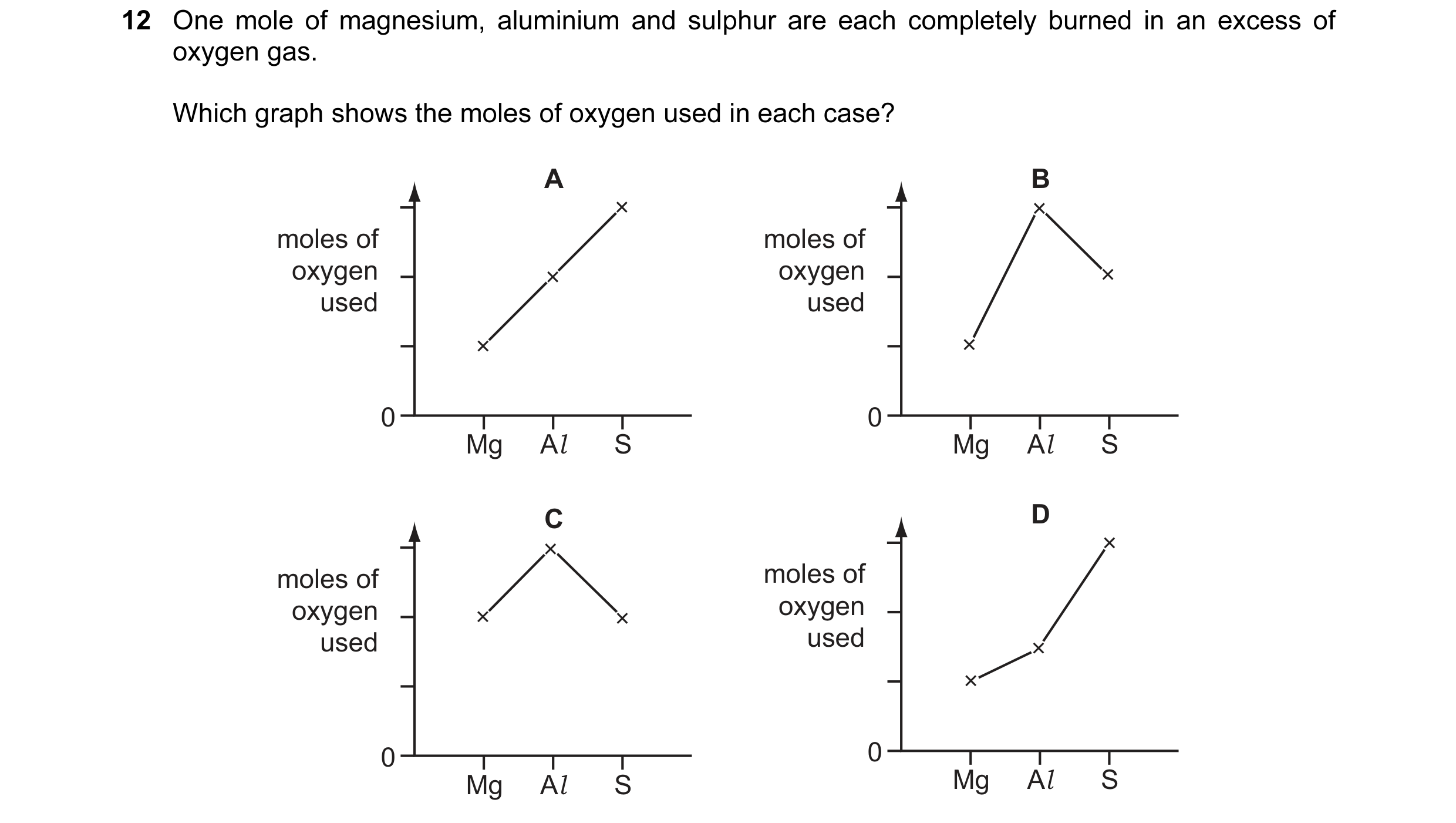
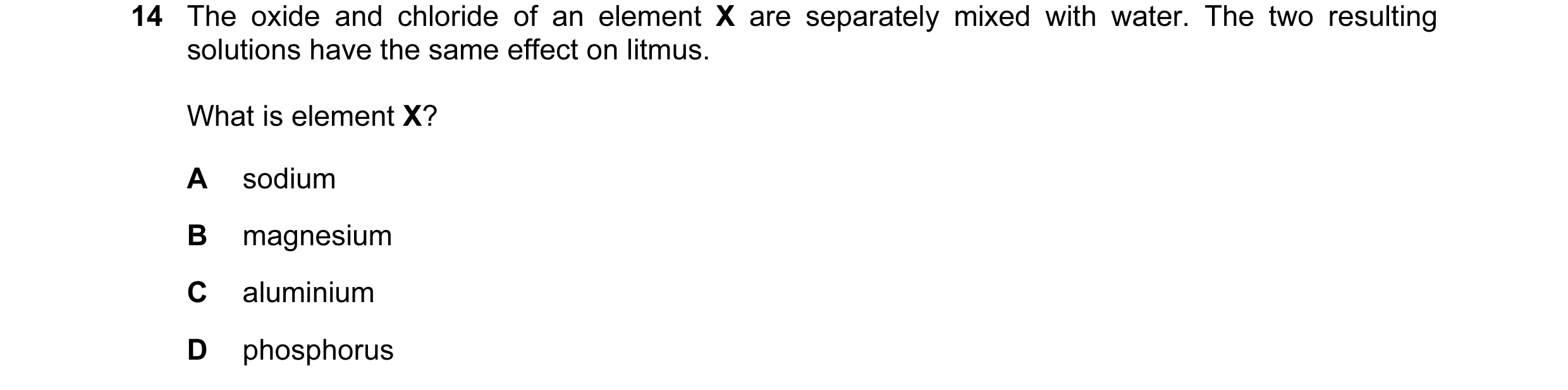
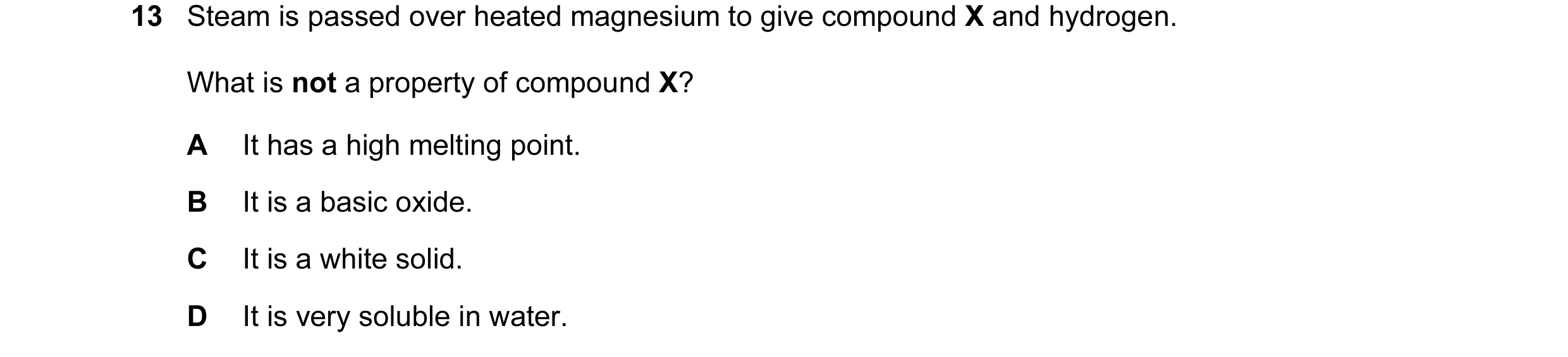

 1 / 40
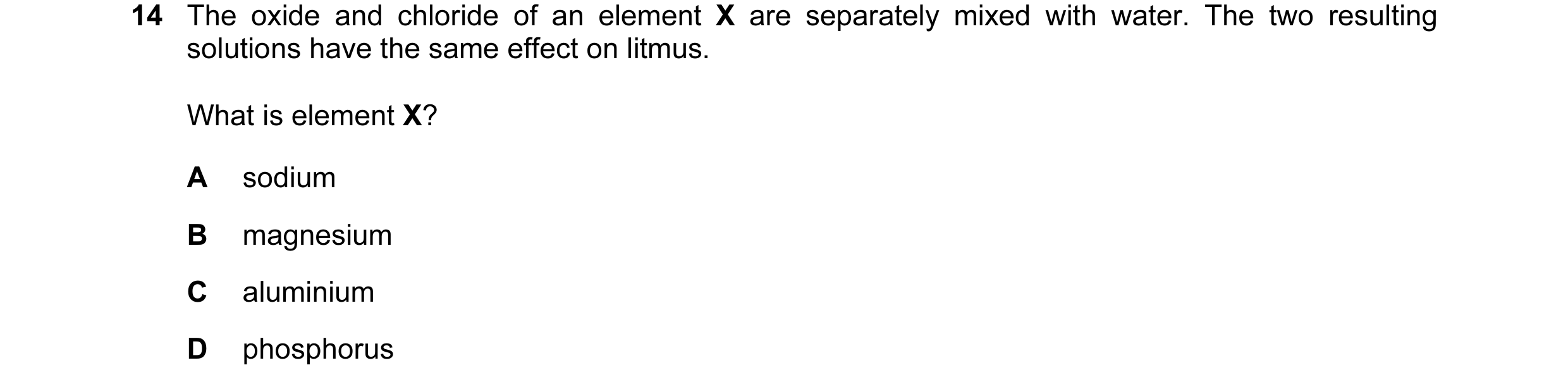
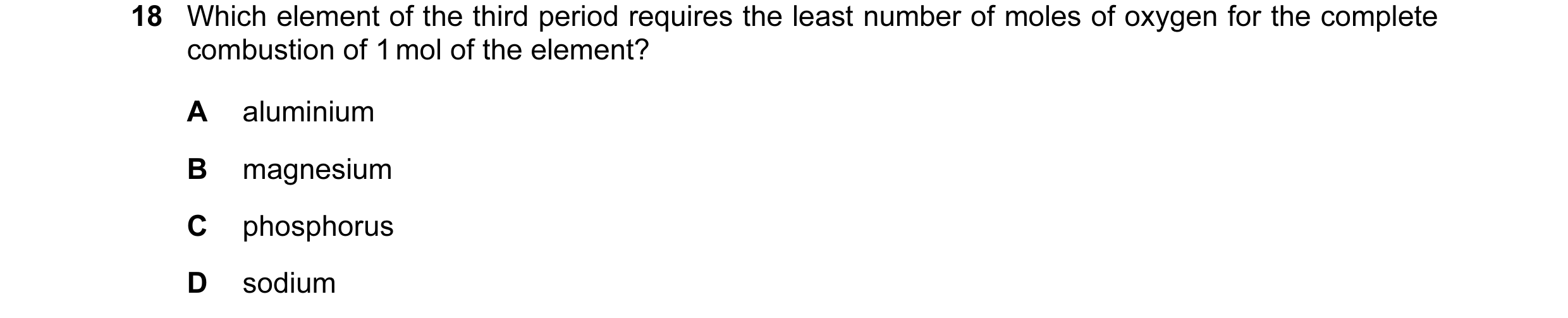
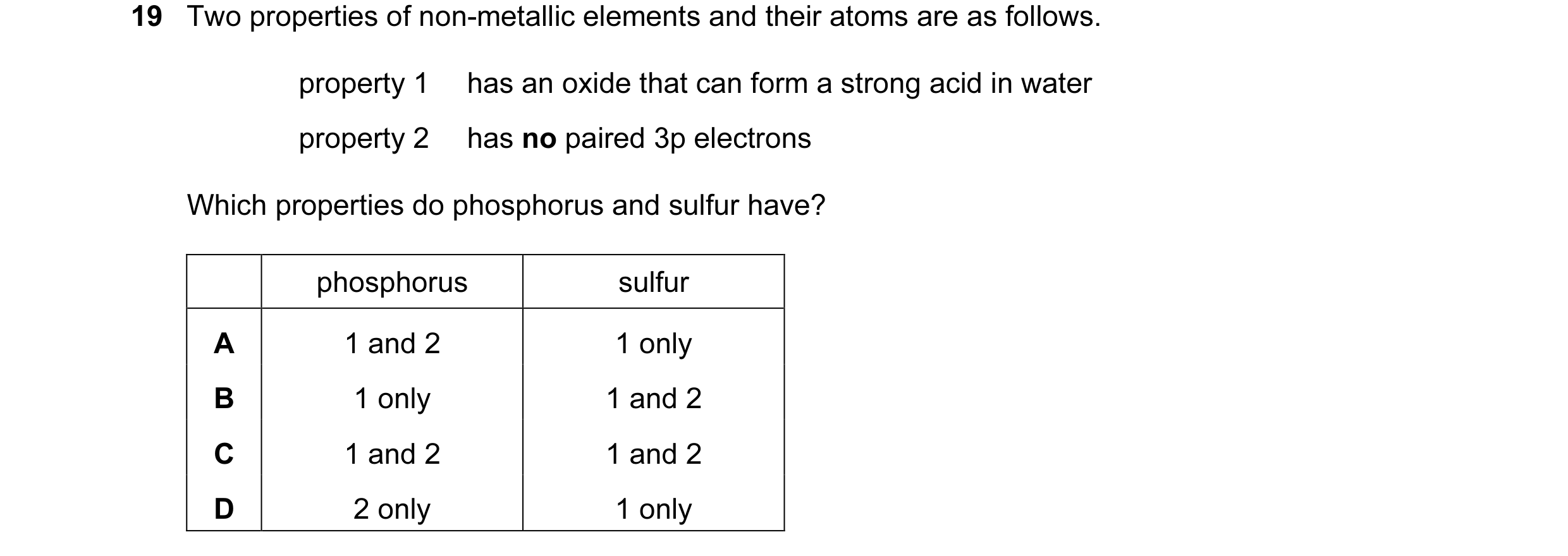
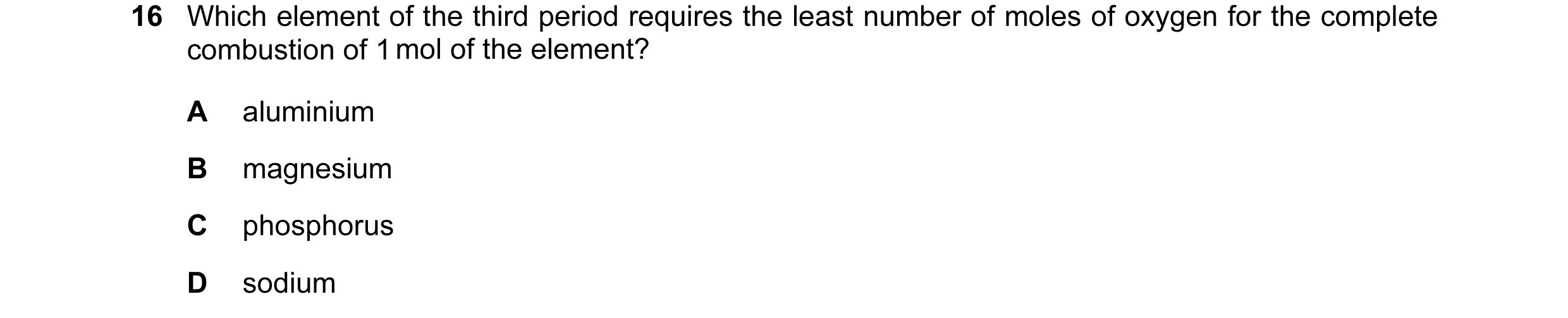 2 / 40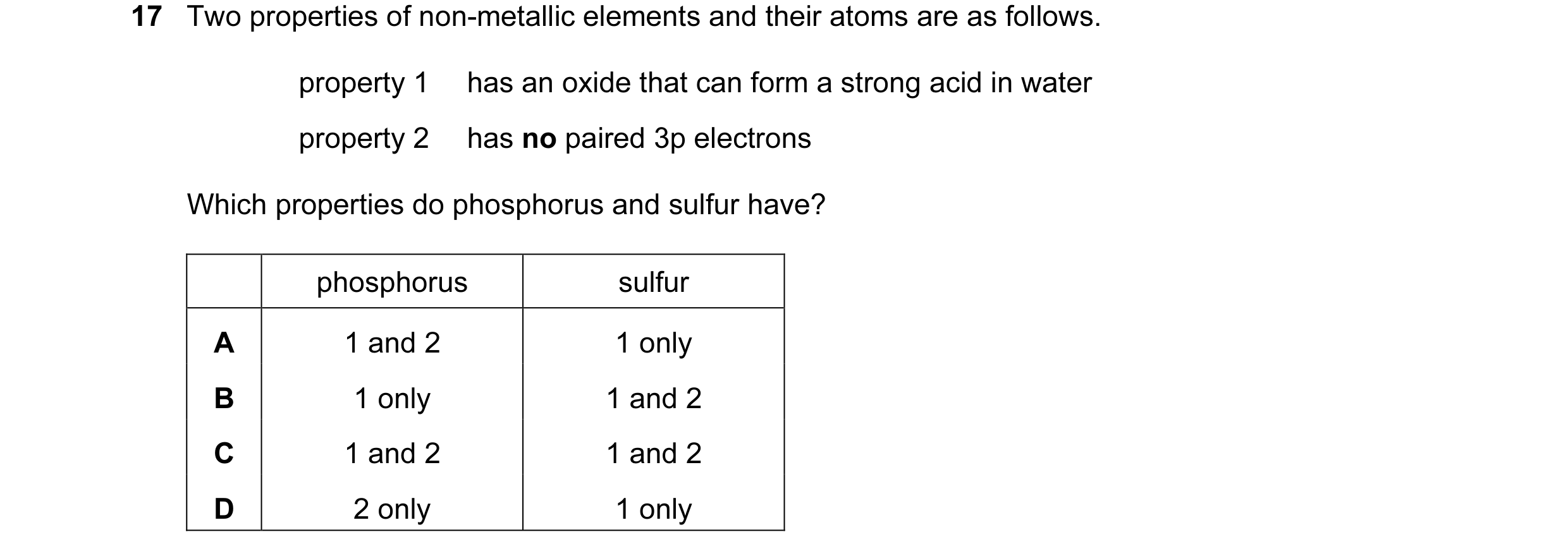
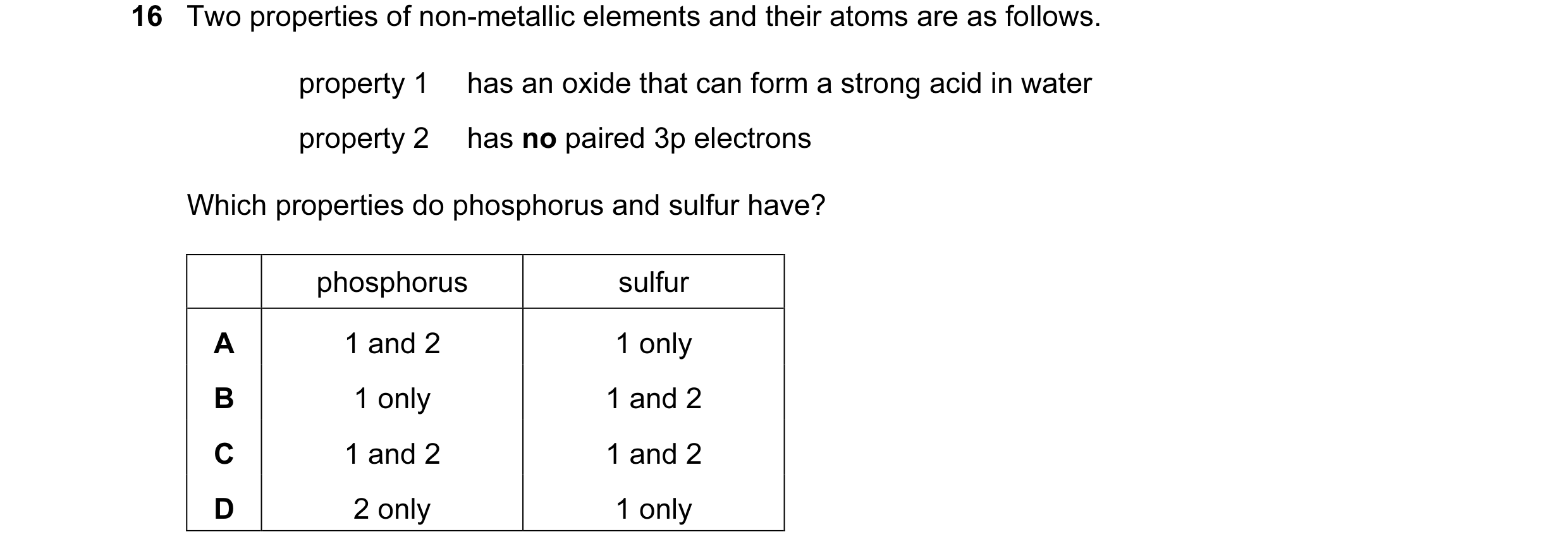
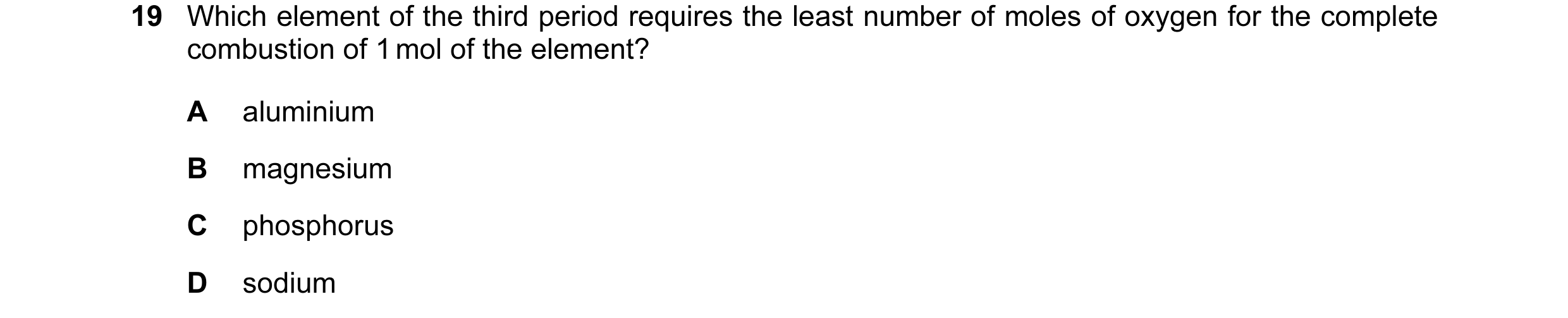
 3 / 40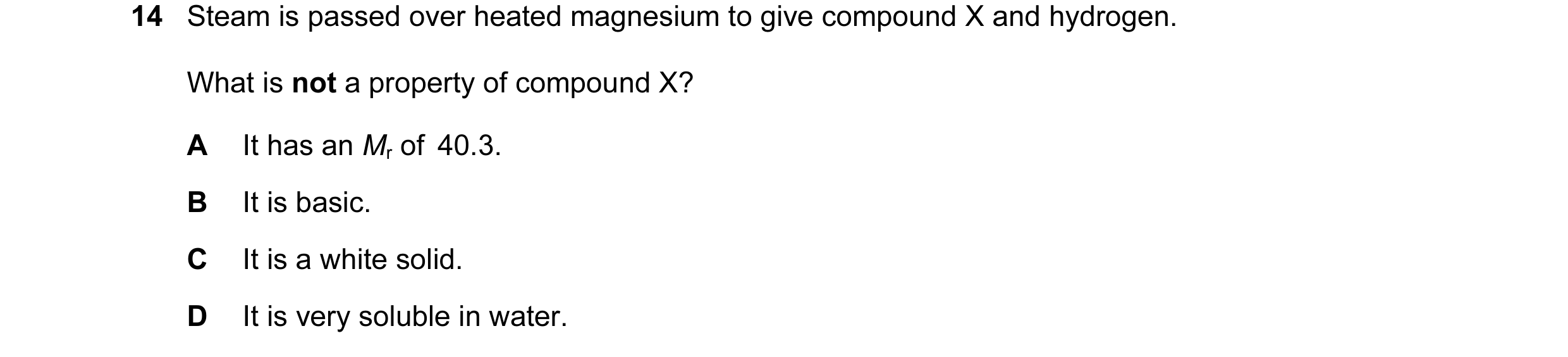

 4 / 40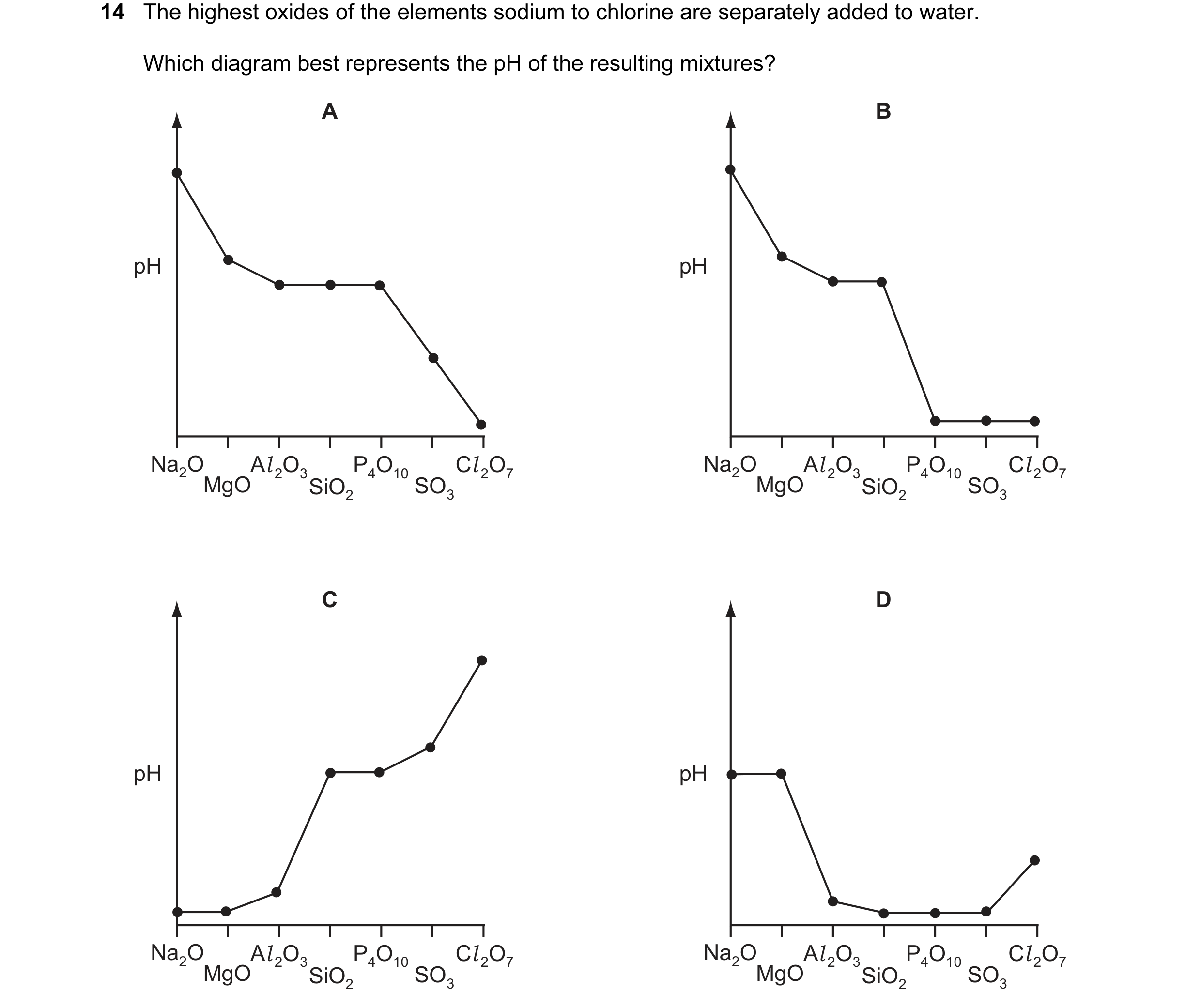

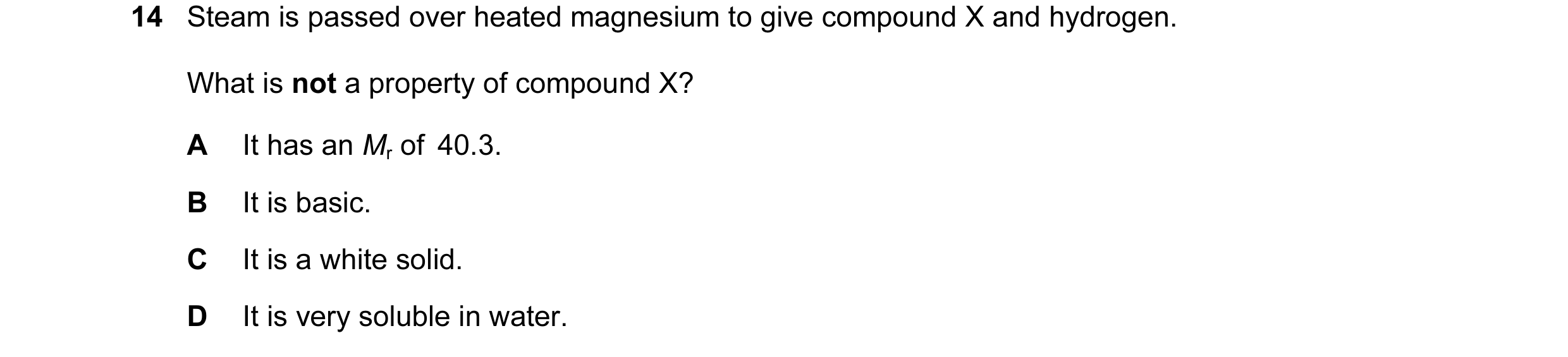 5 / 40


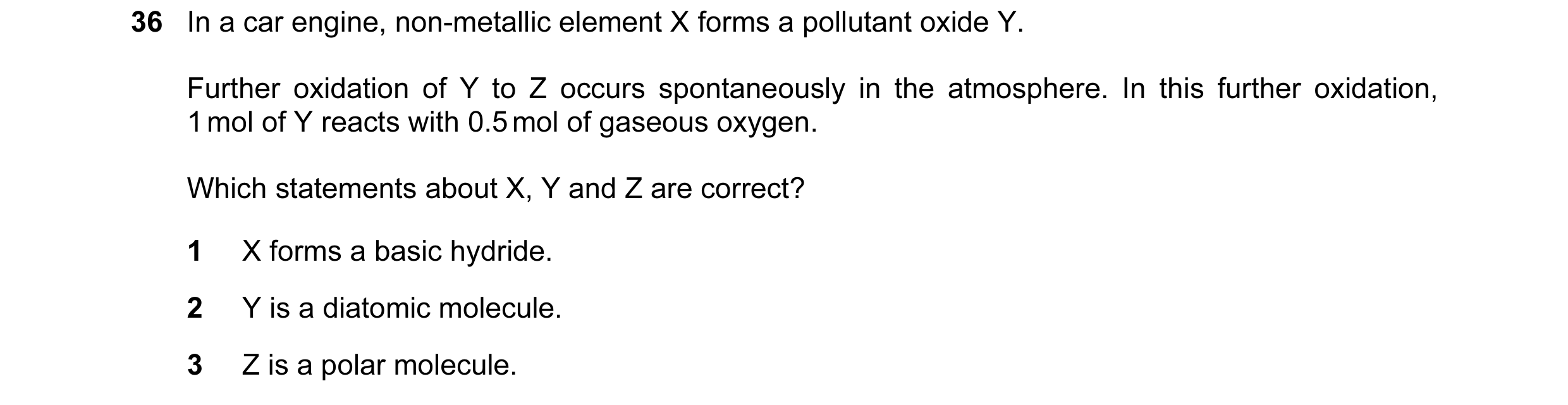

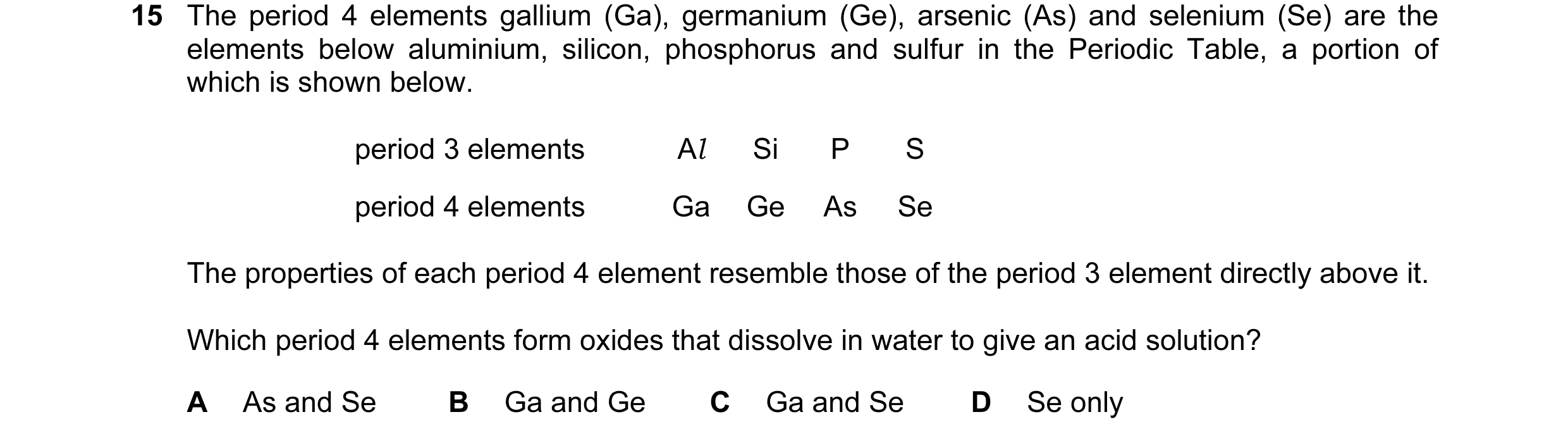 6 / 40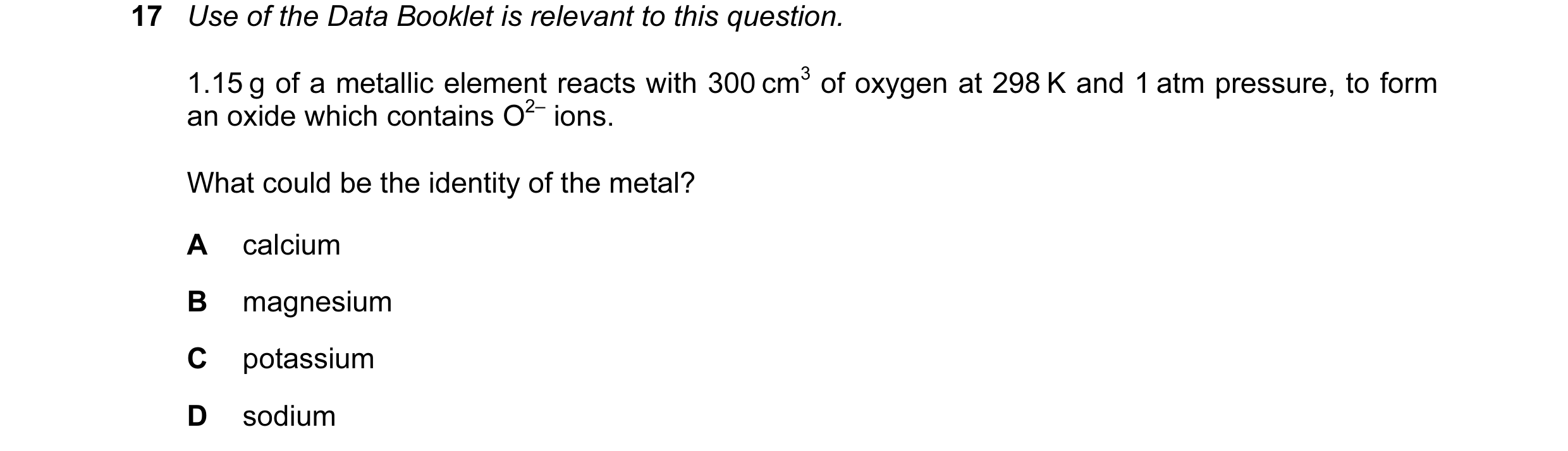
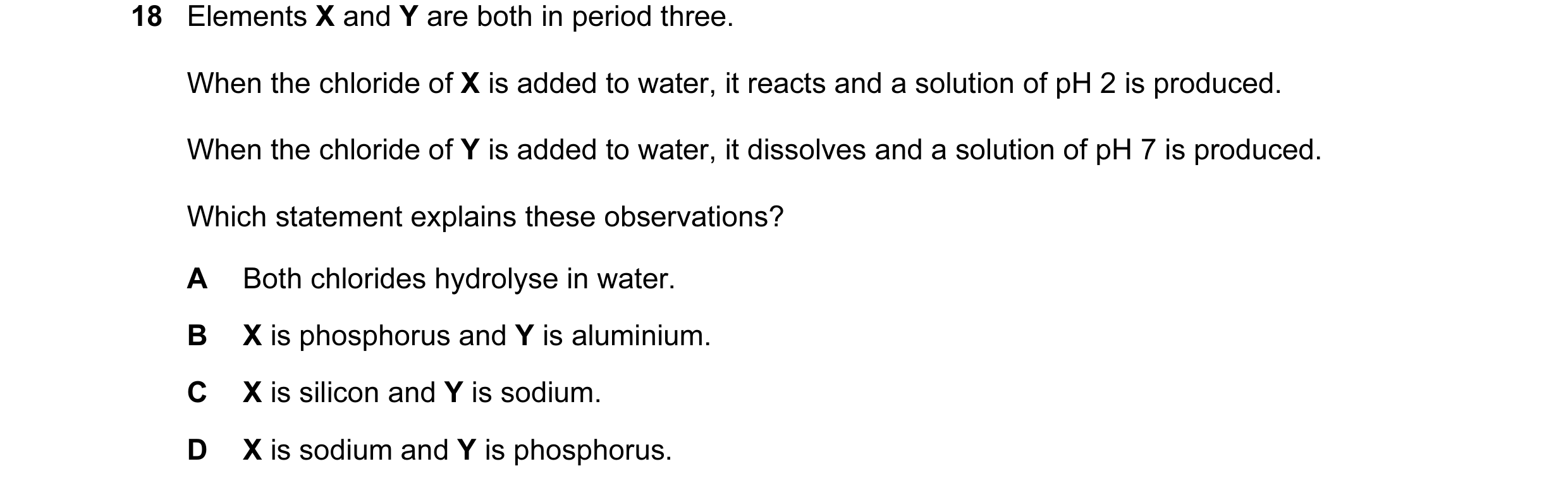


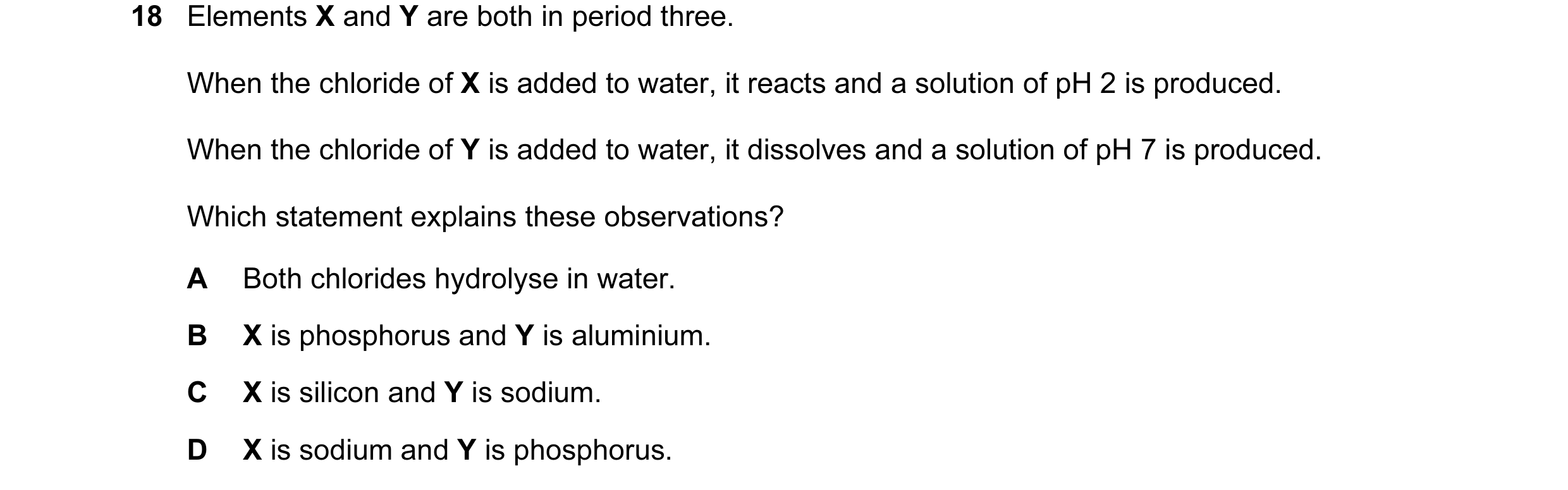 7 / 40

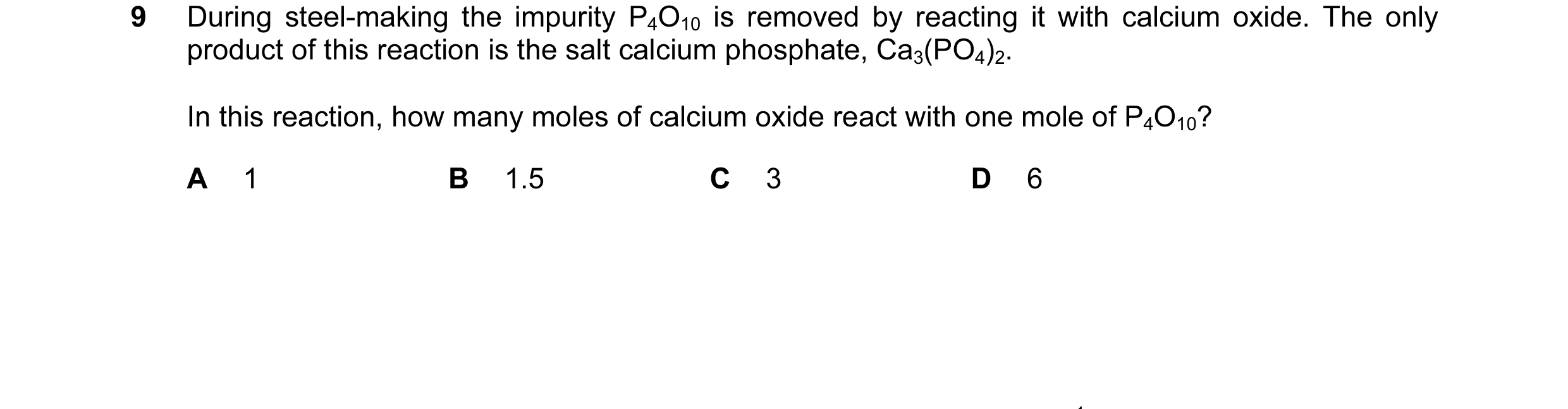
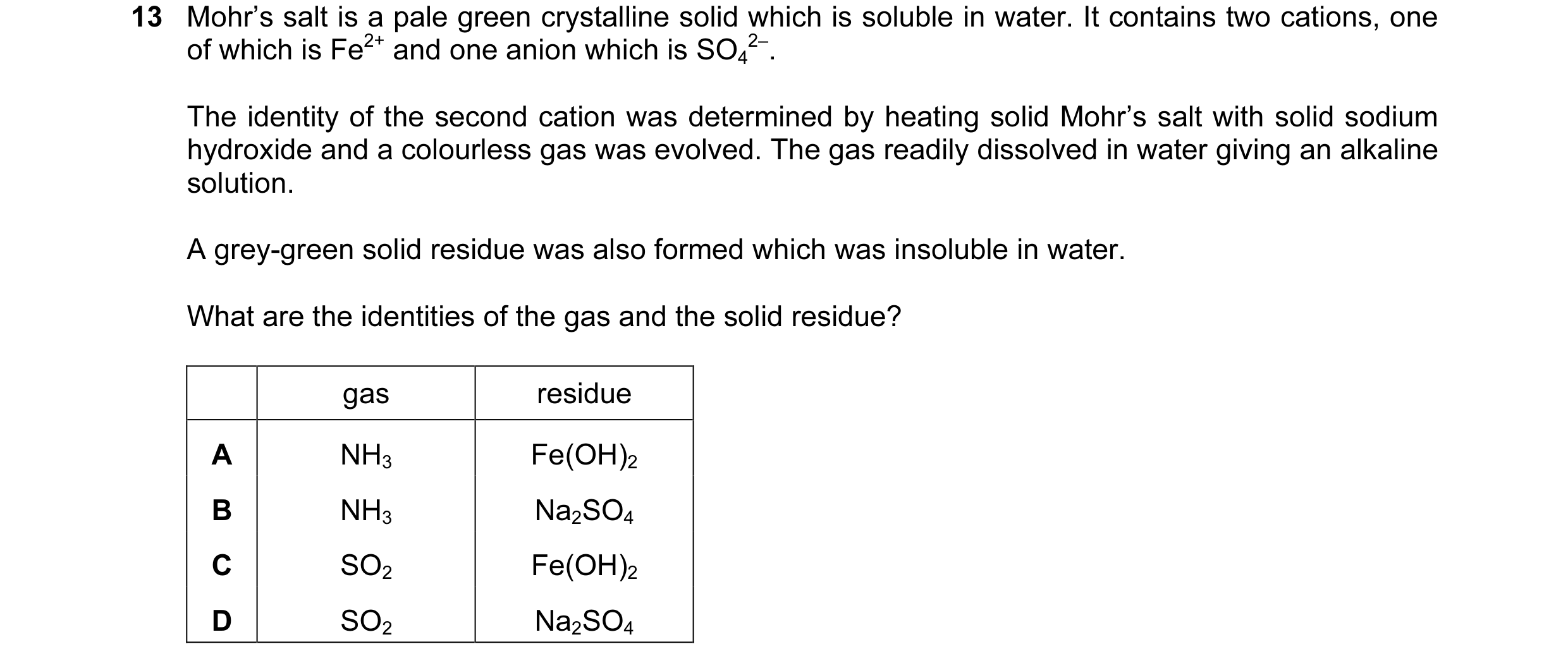

 8 / 40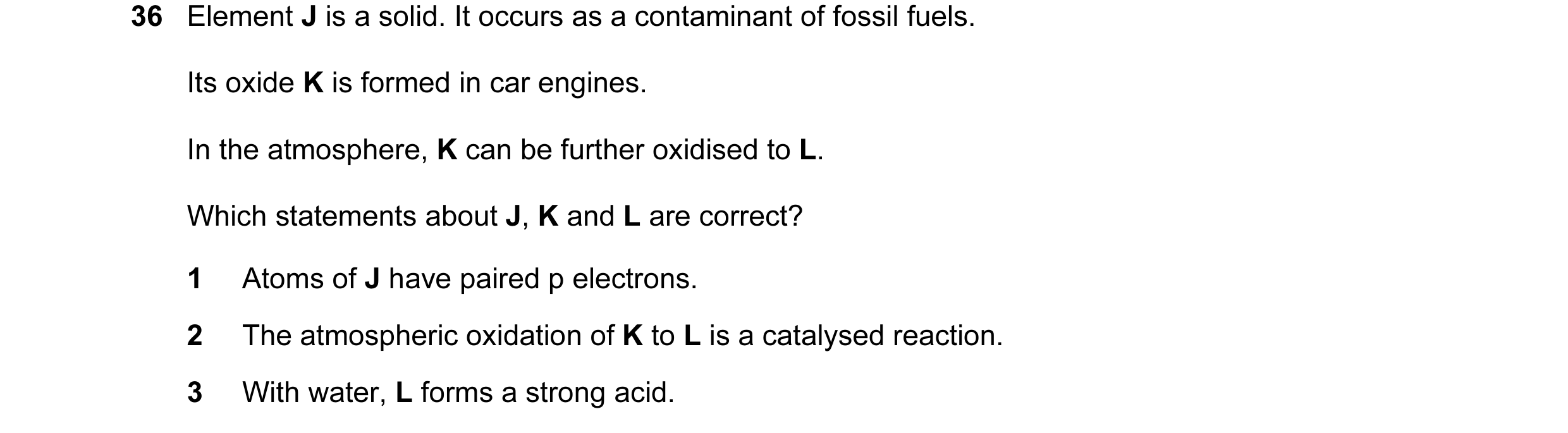
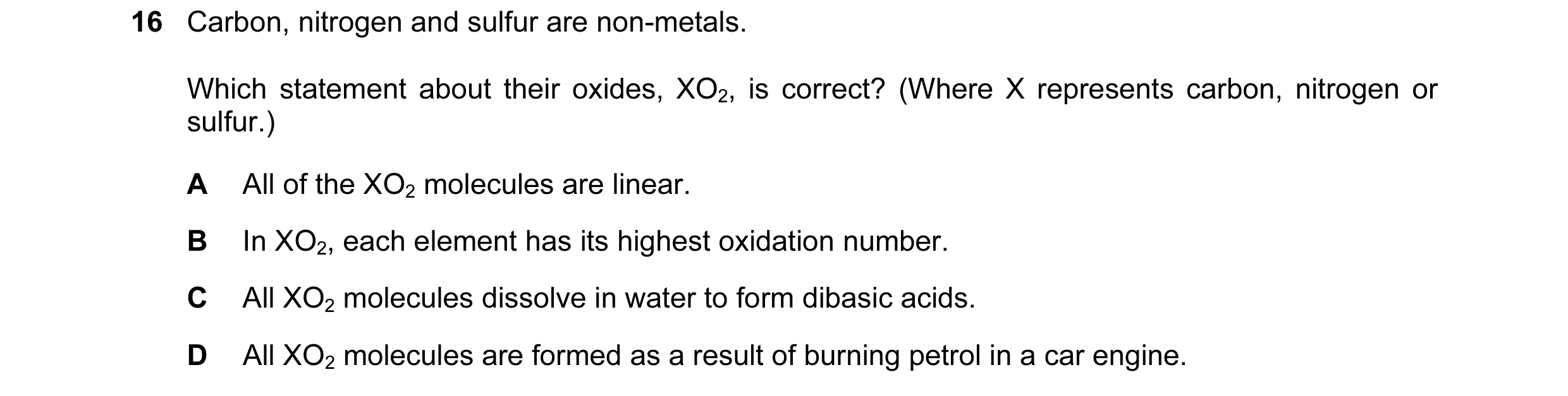

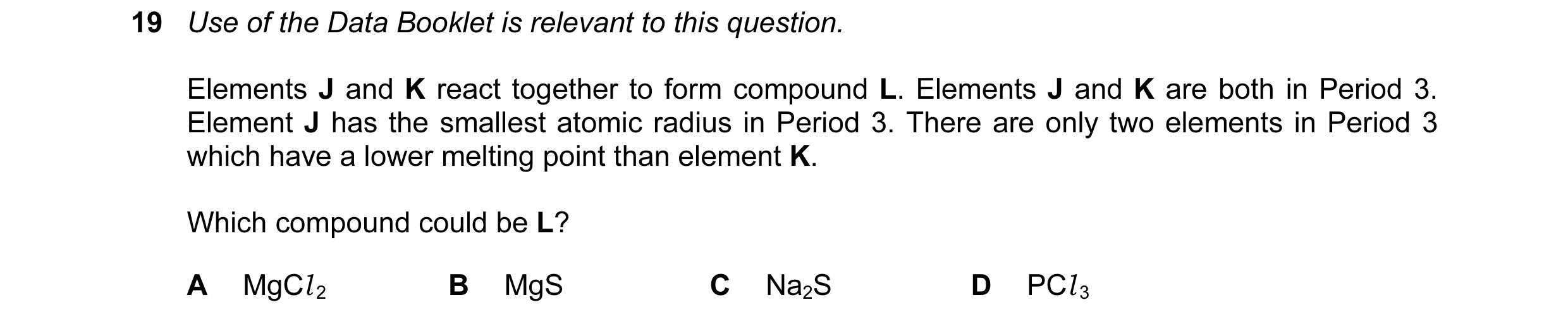

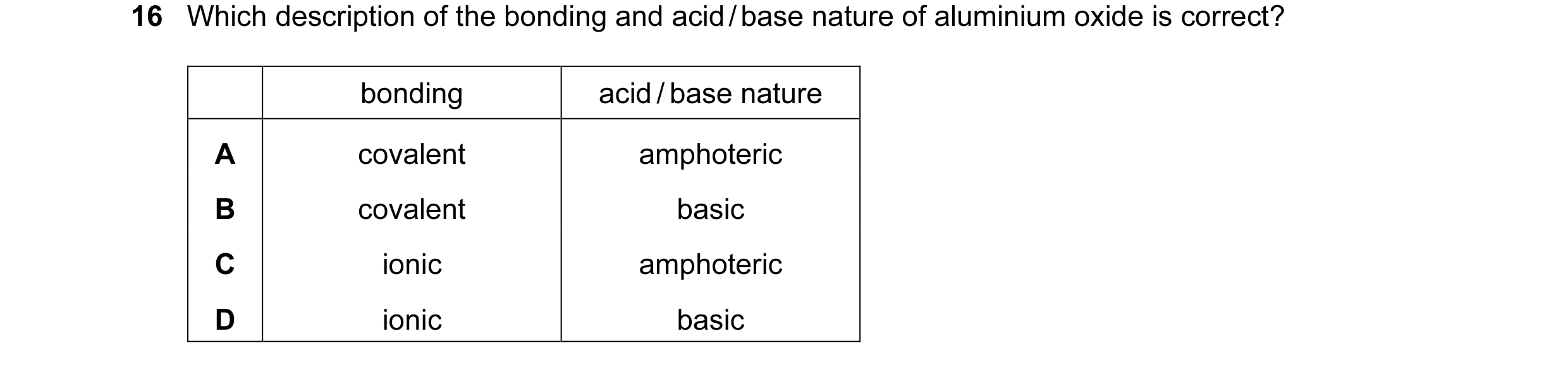 9 / 40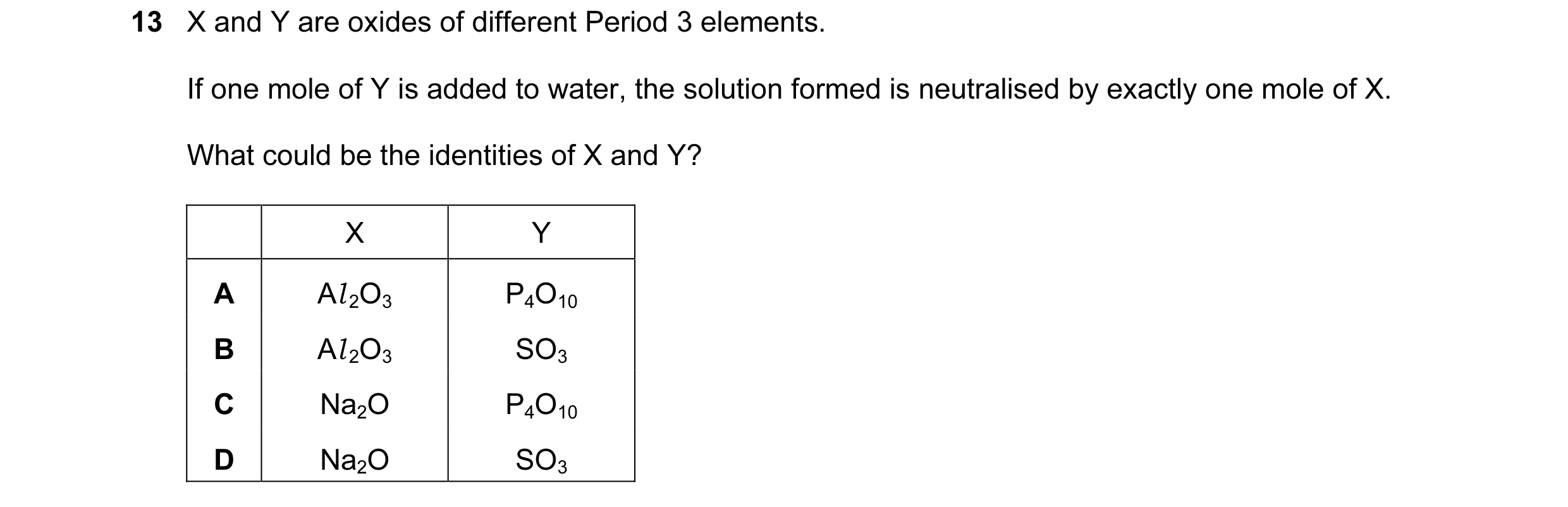
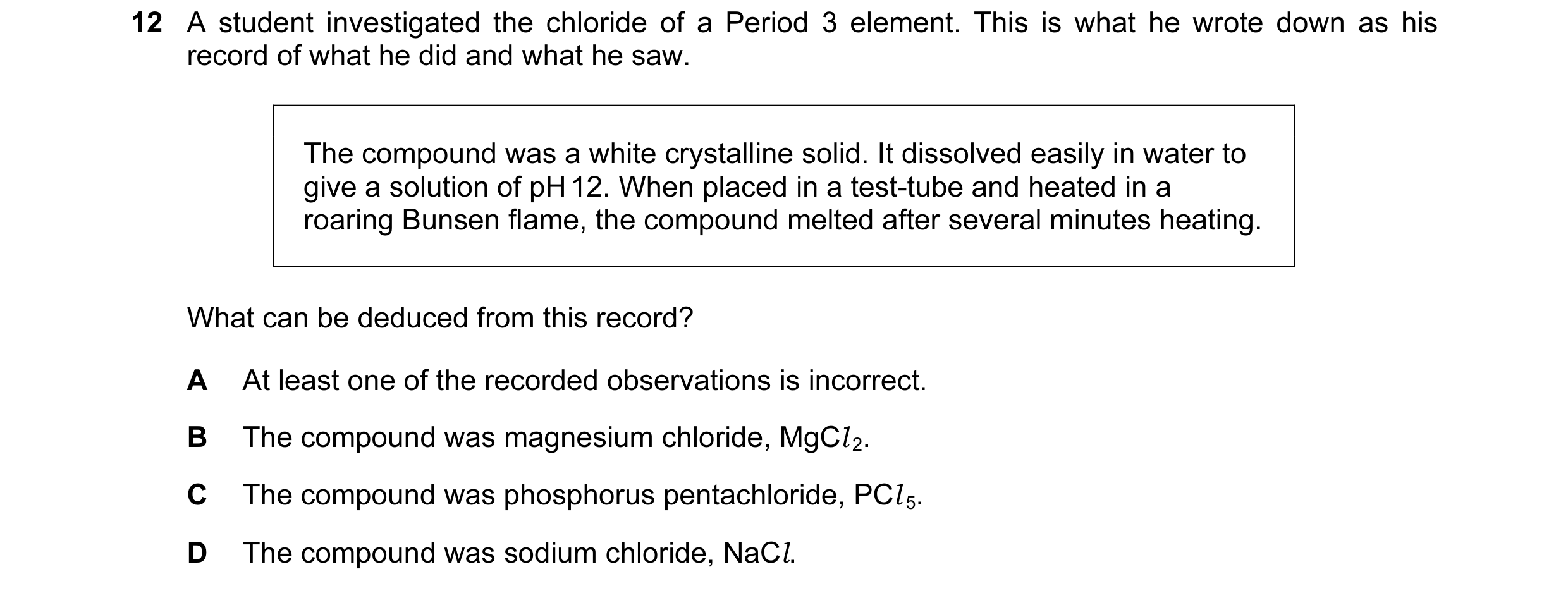

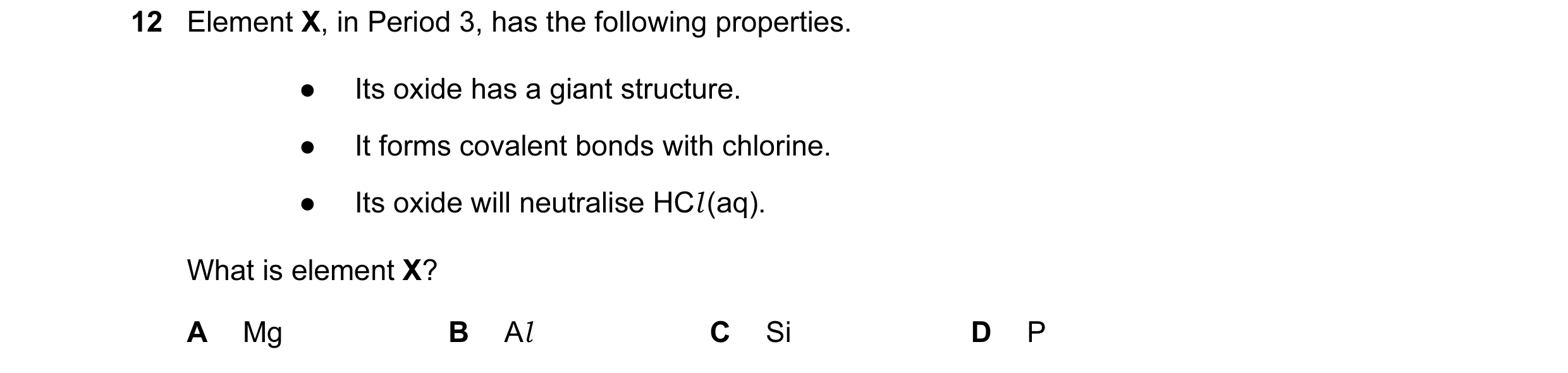
 10 / 40
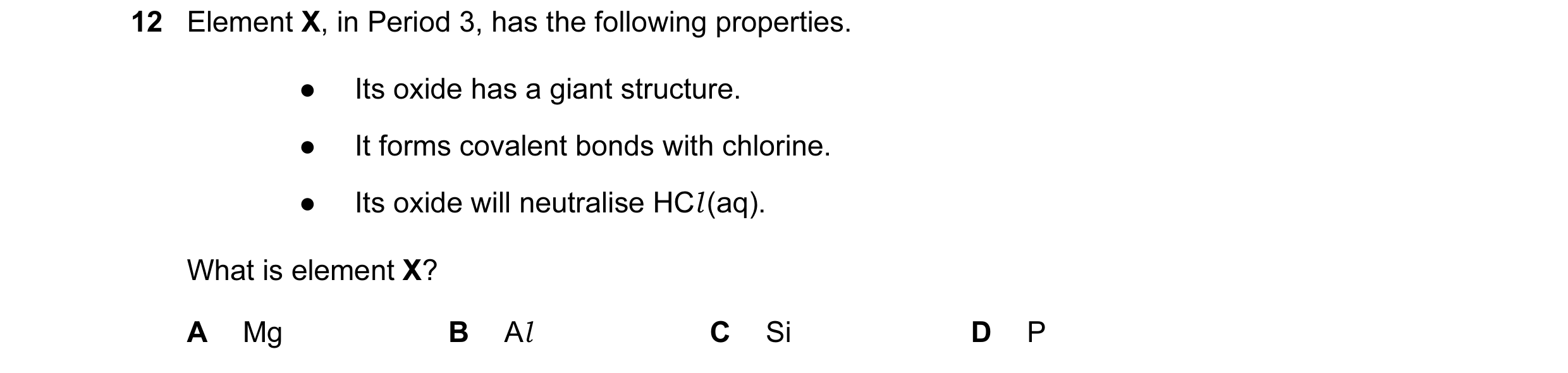


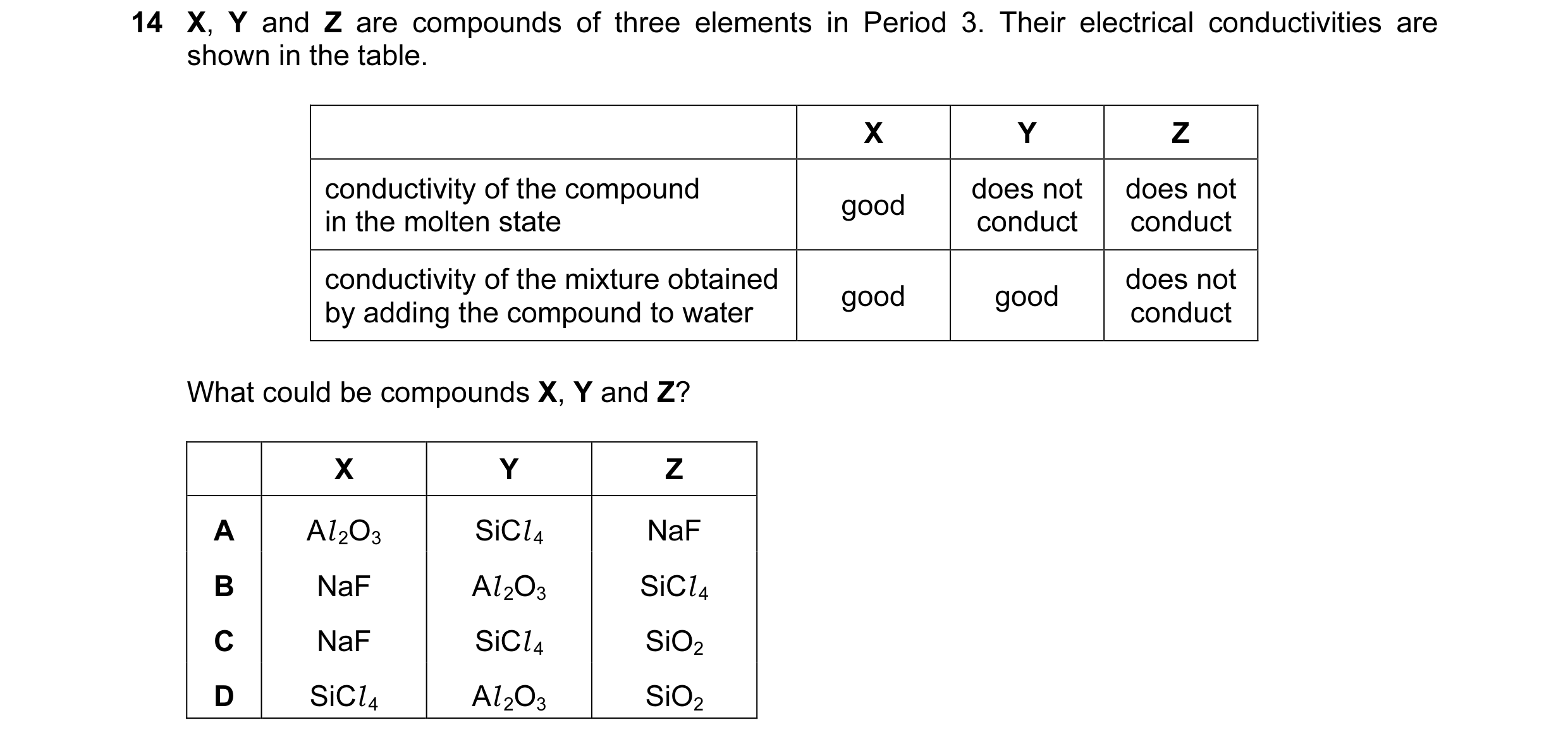
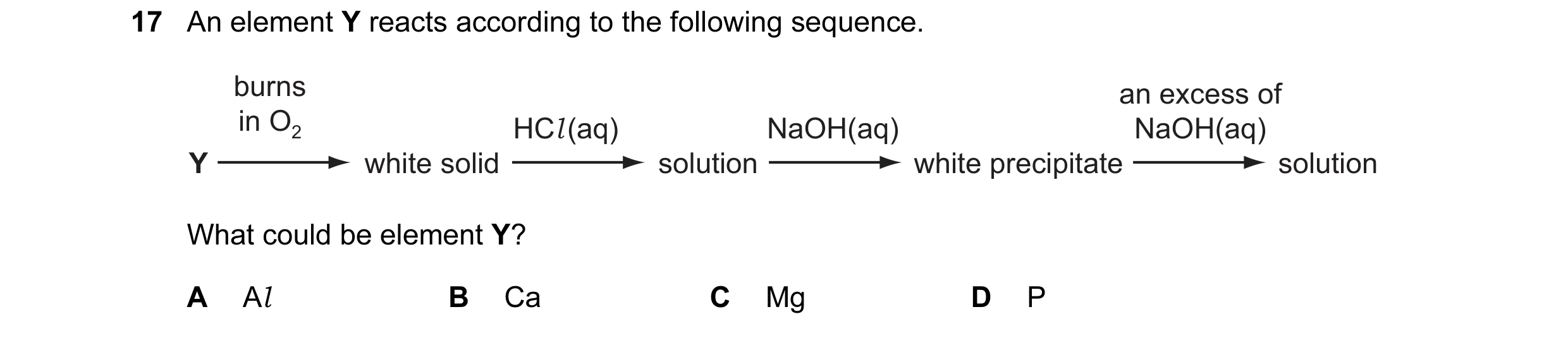 11 / 40


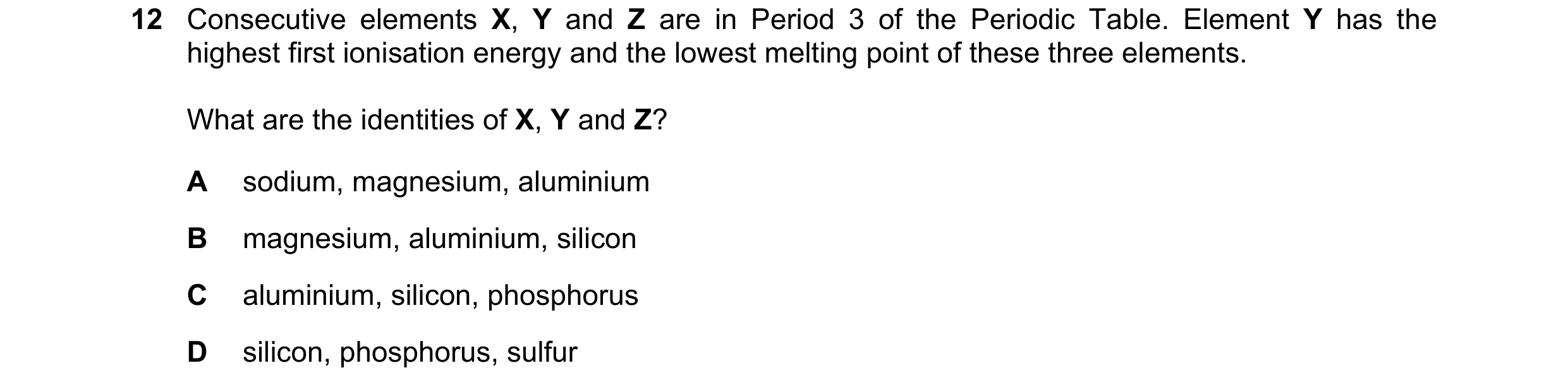
 12 / 40




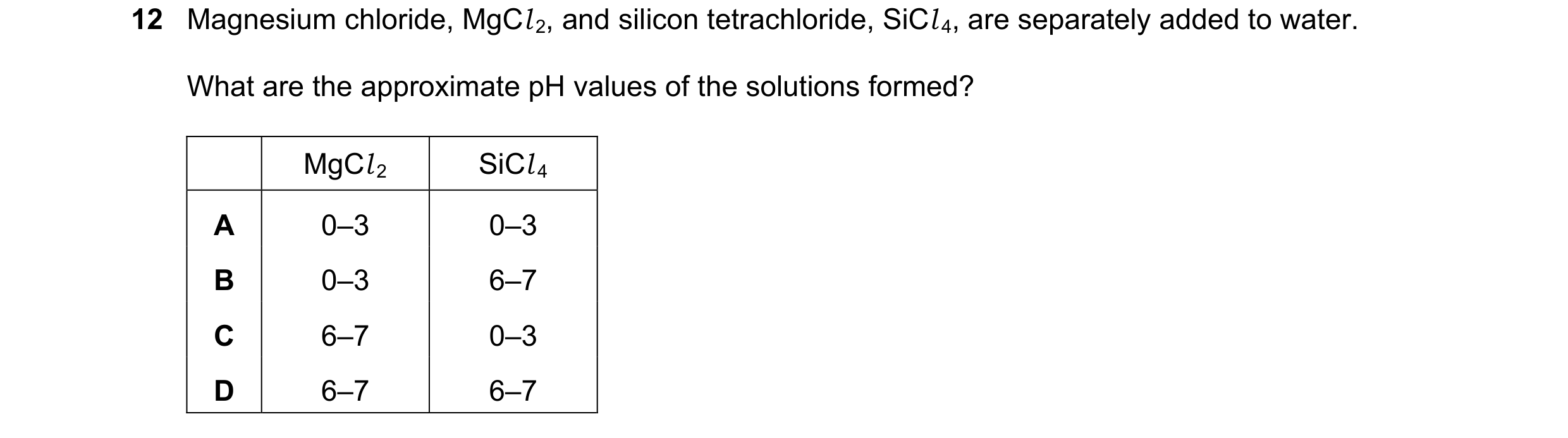 13 / 40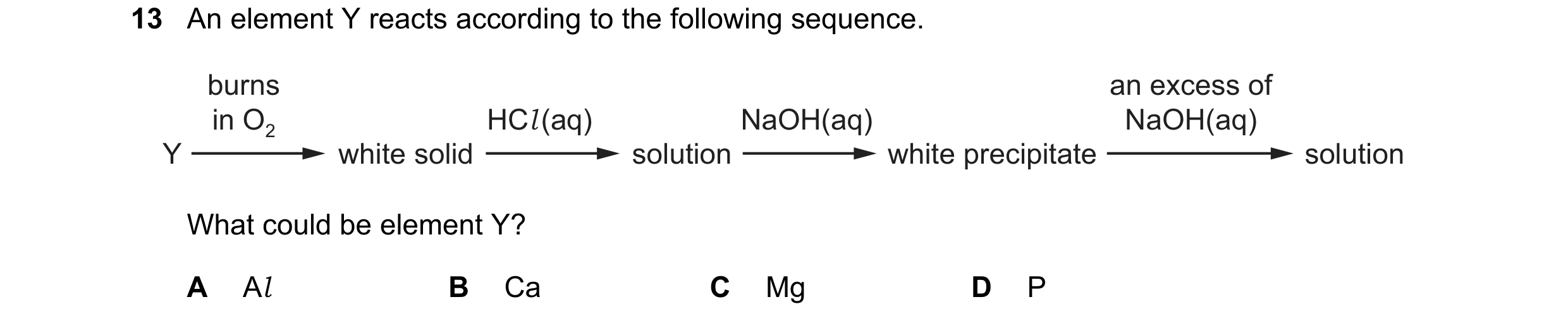
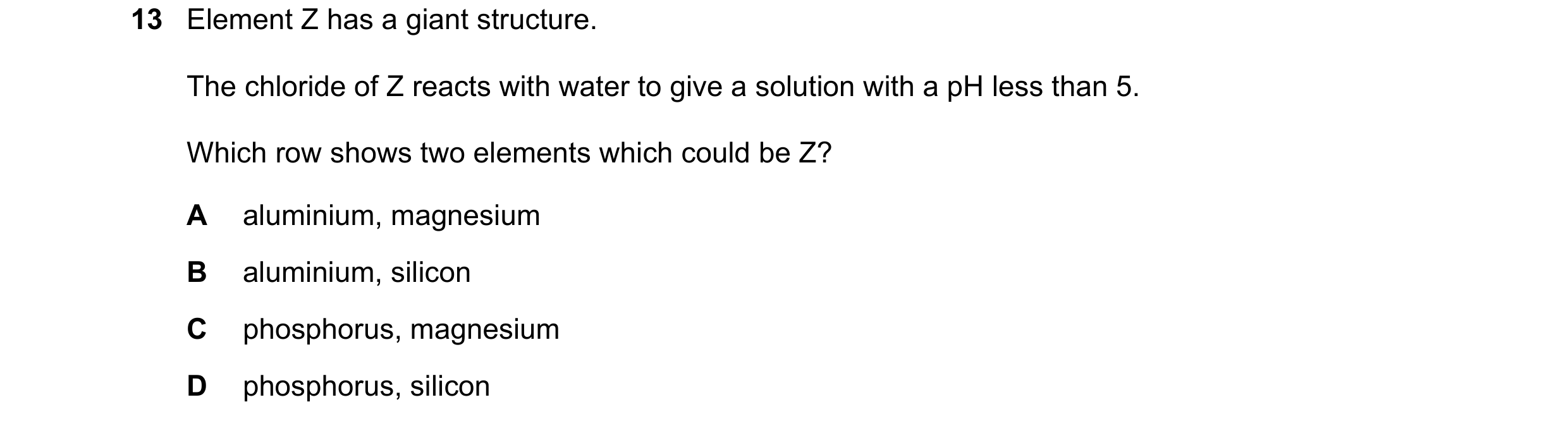
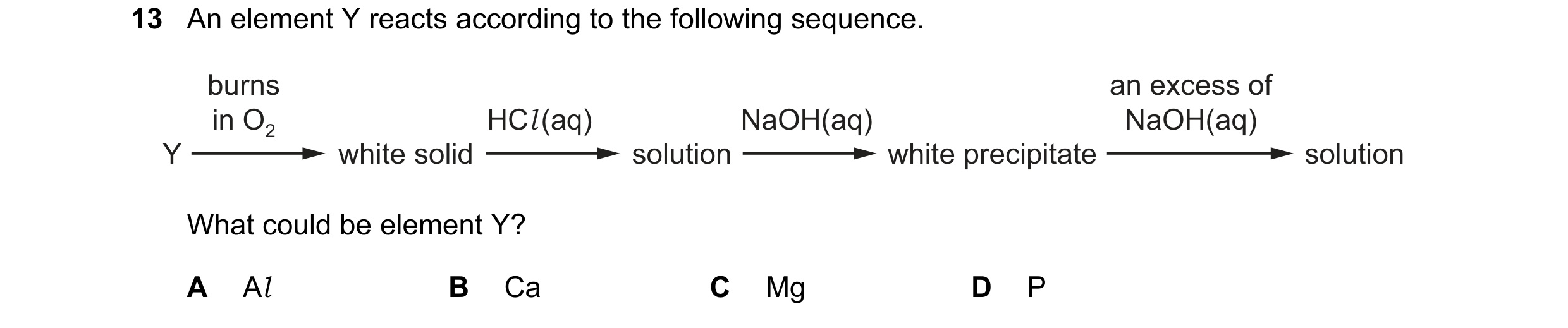

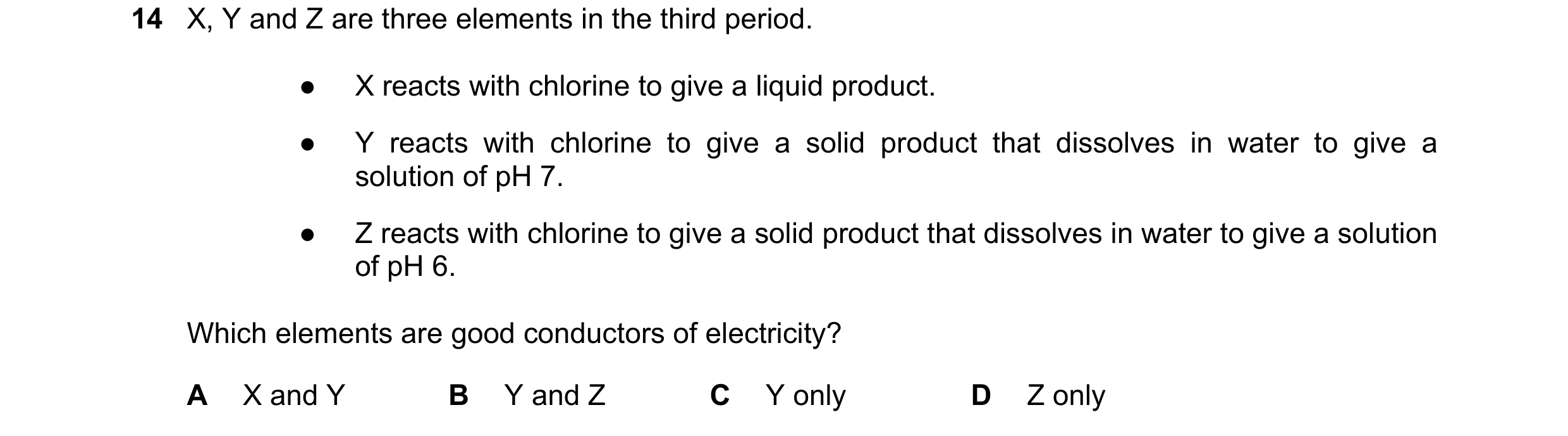 14 / 40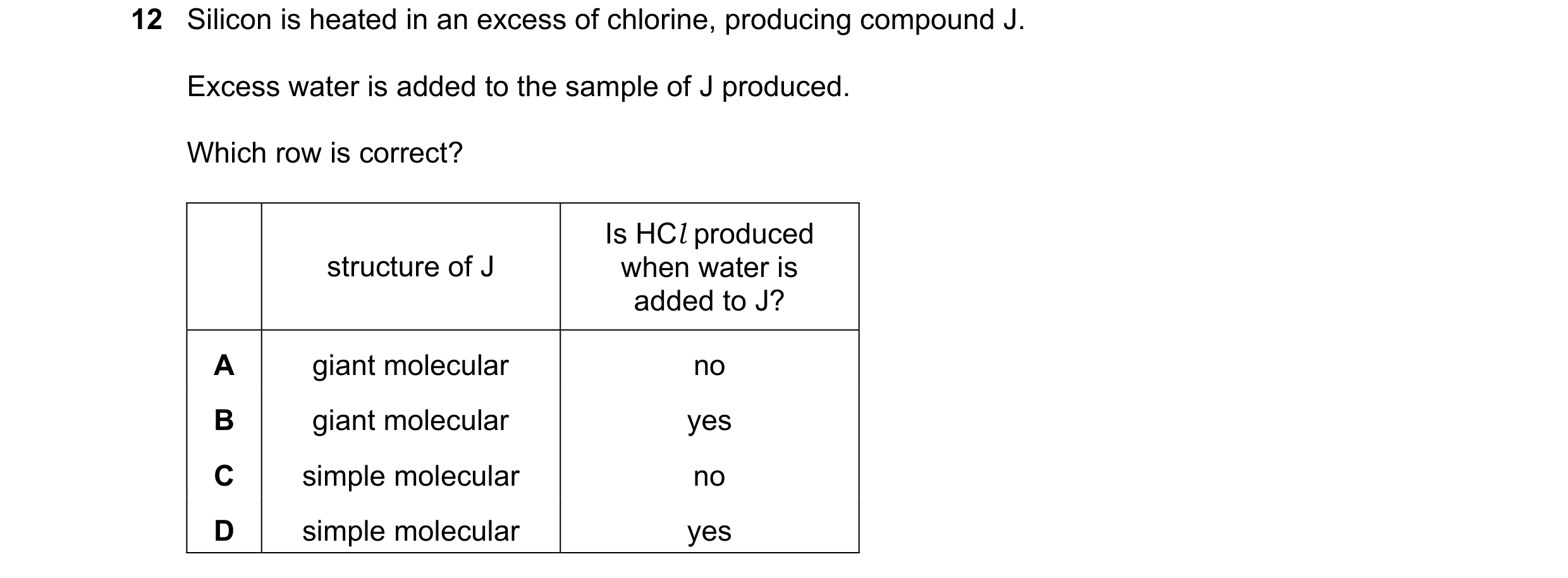

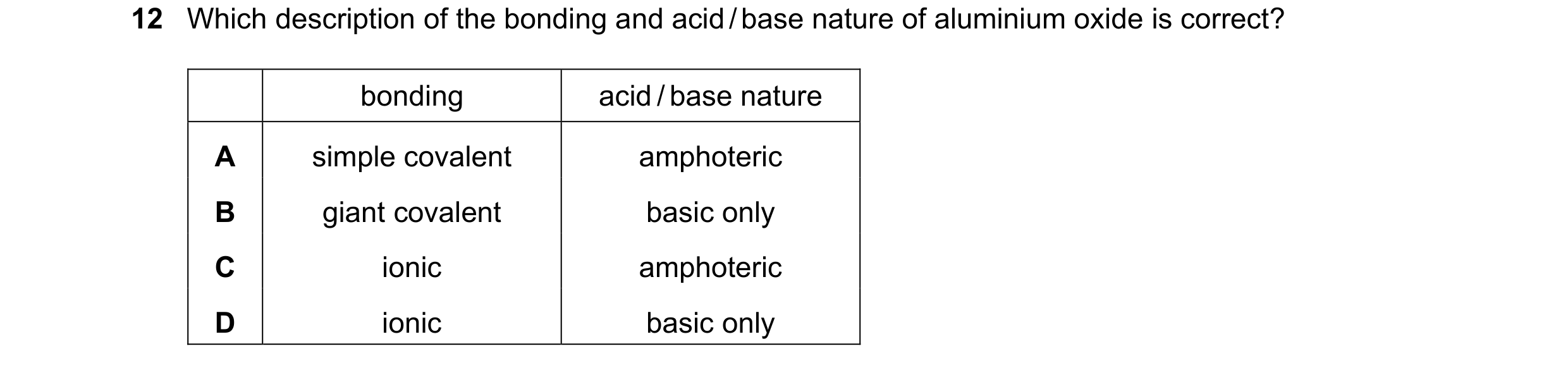

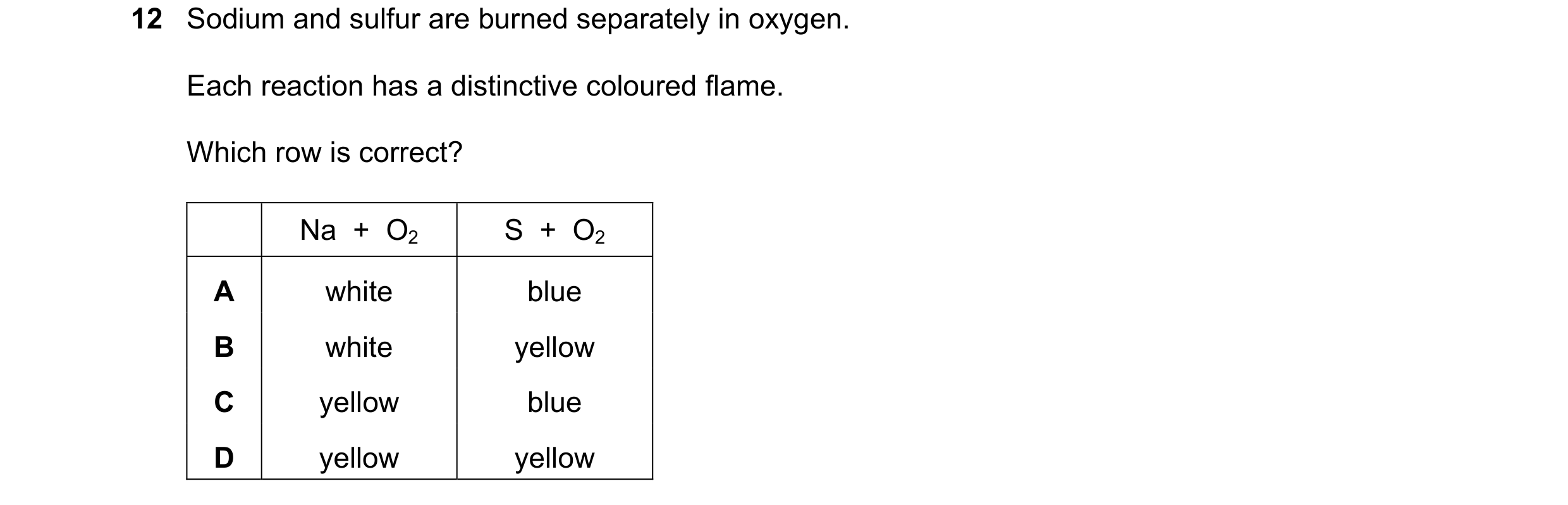 15 / 40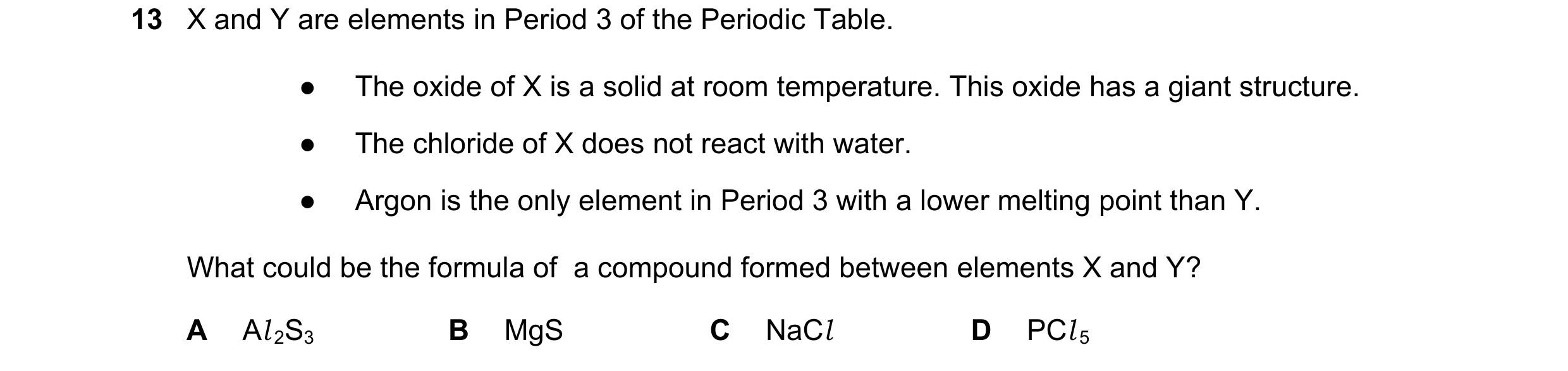
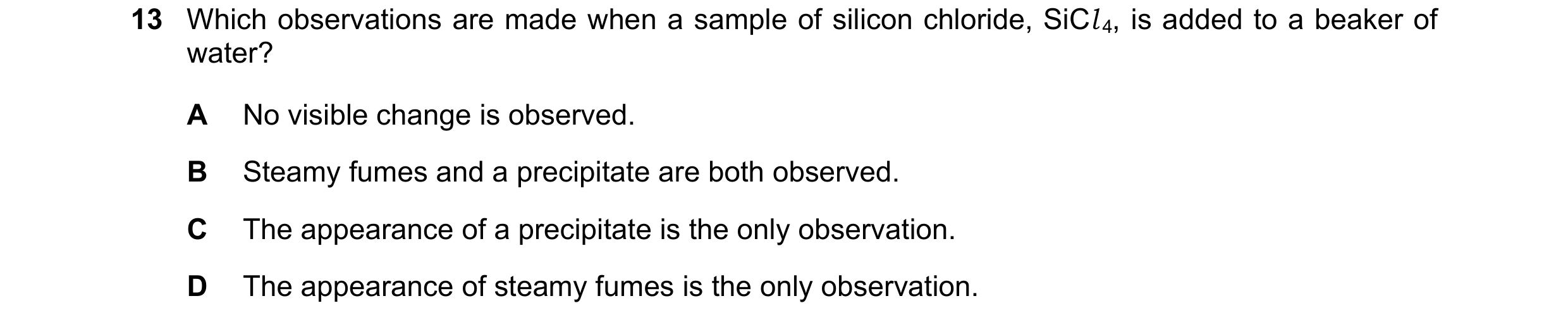
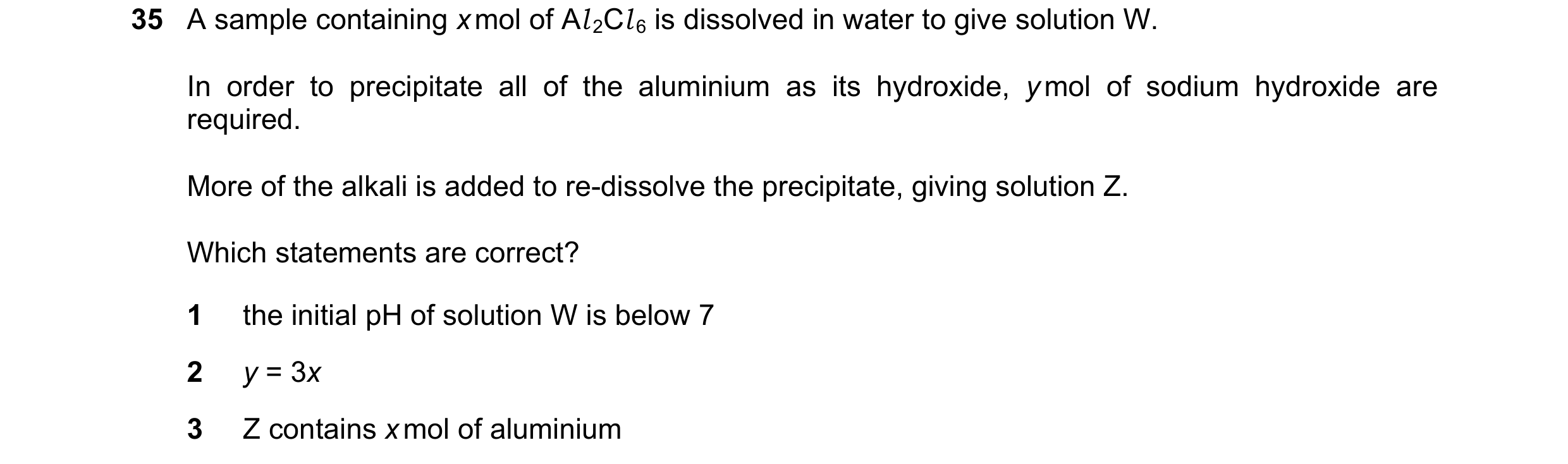
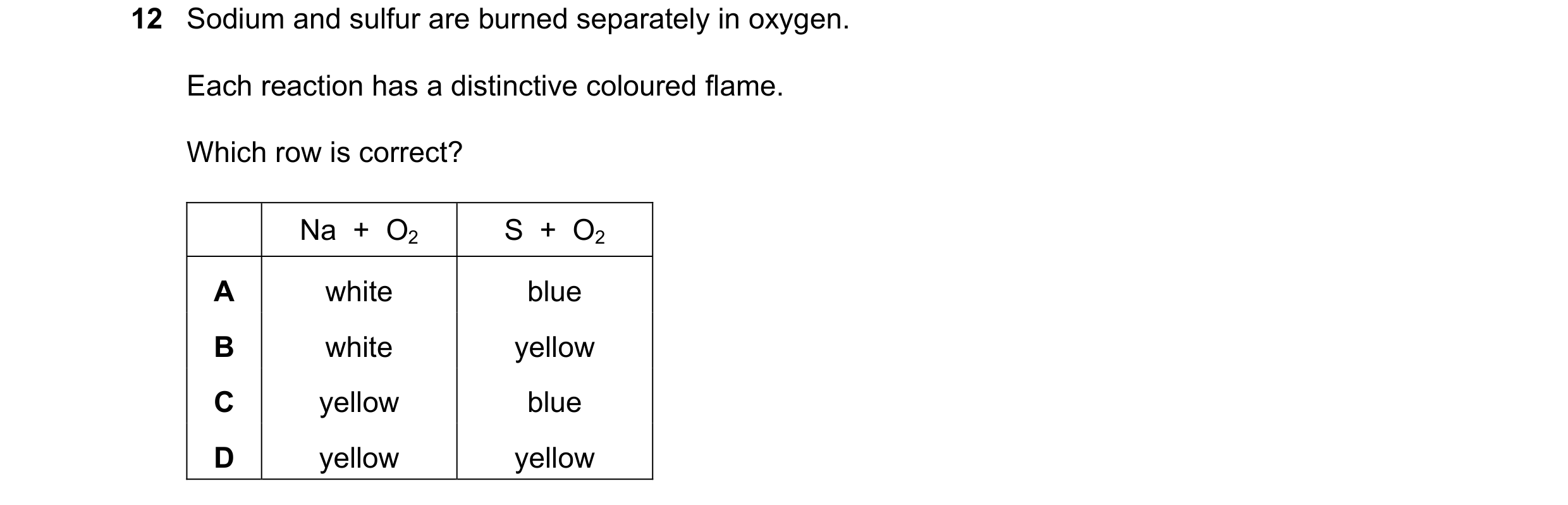
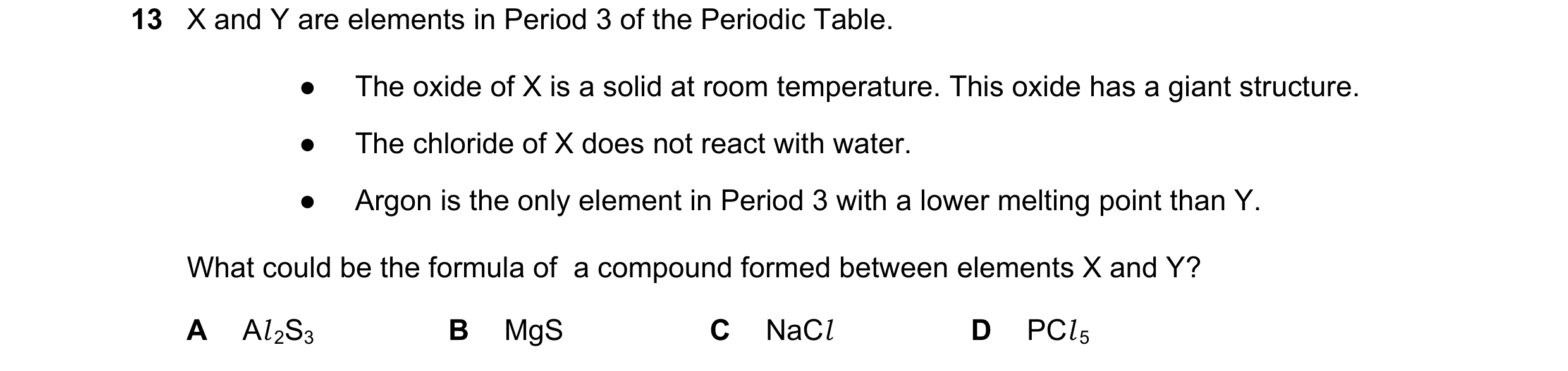 16 / 40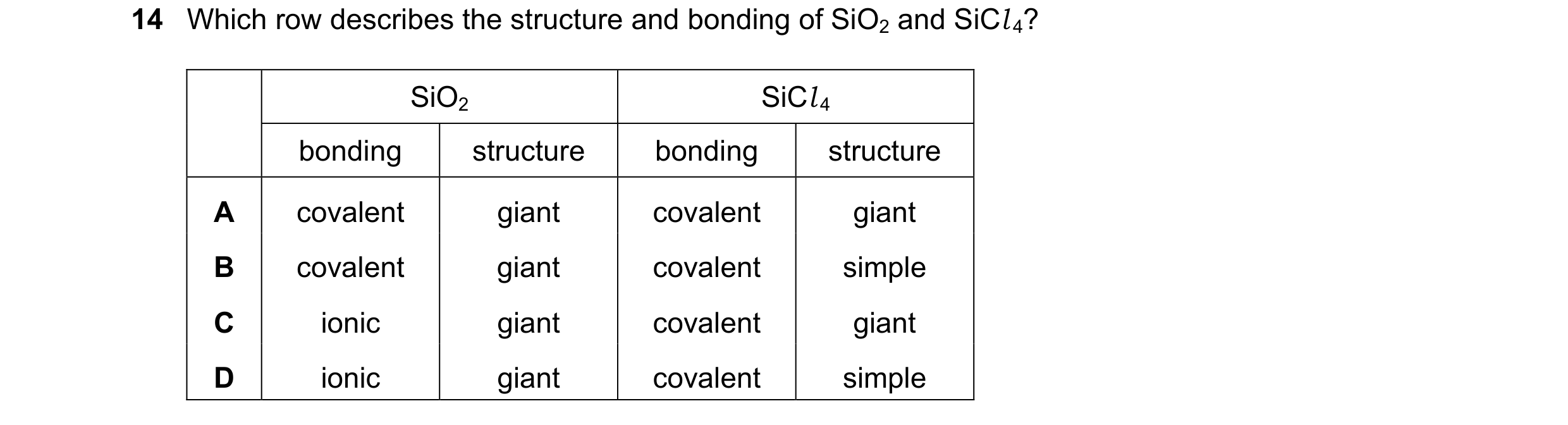
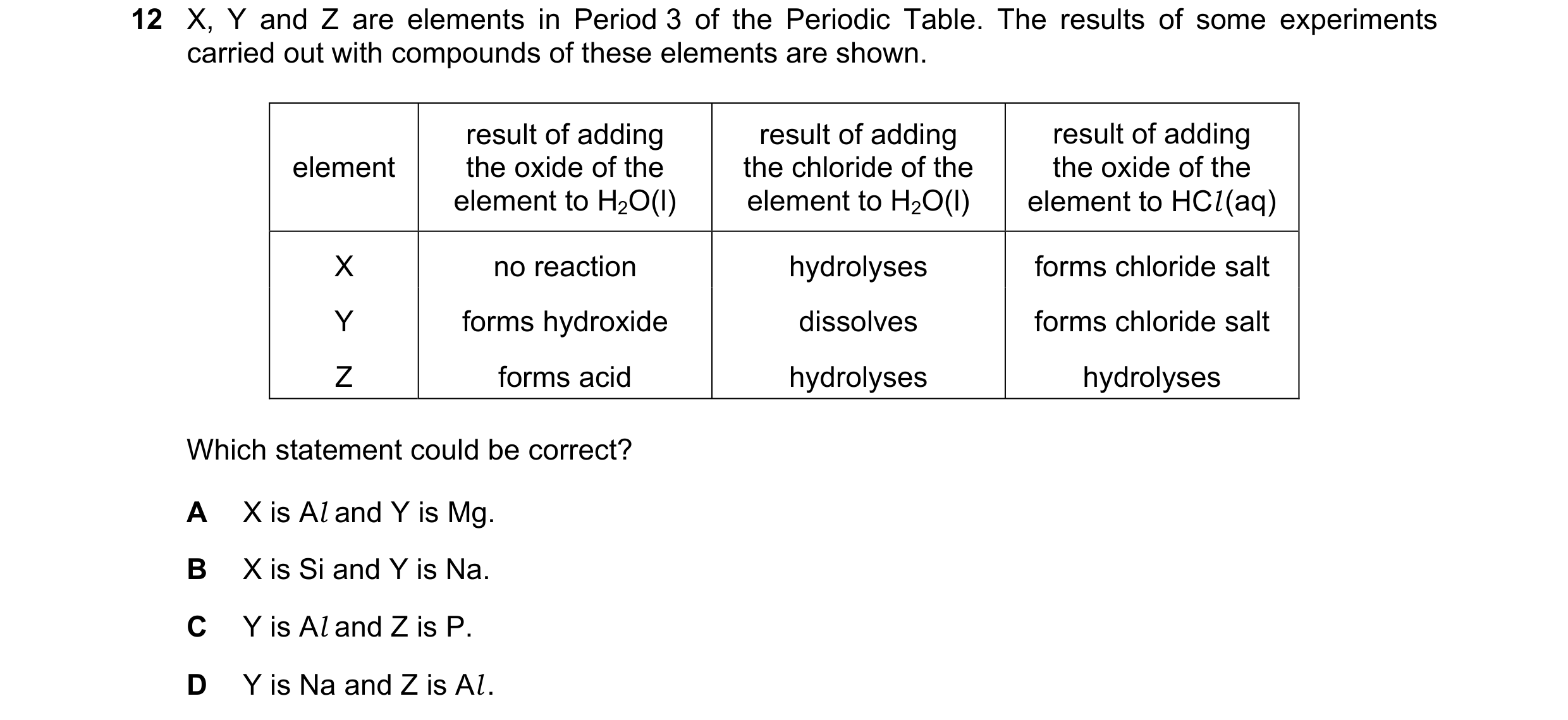

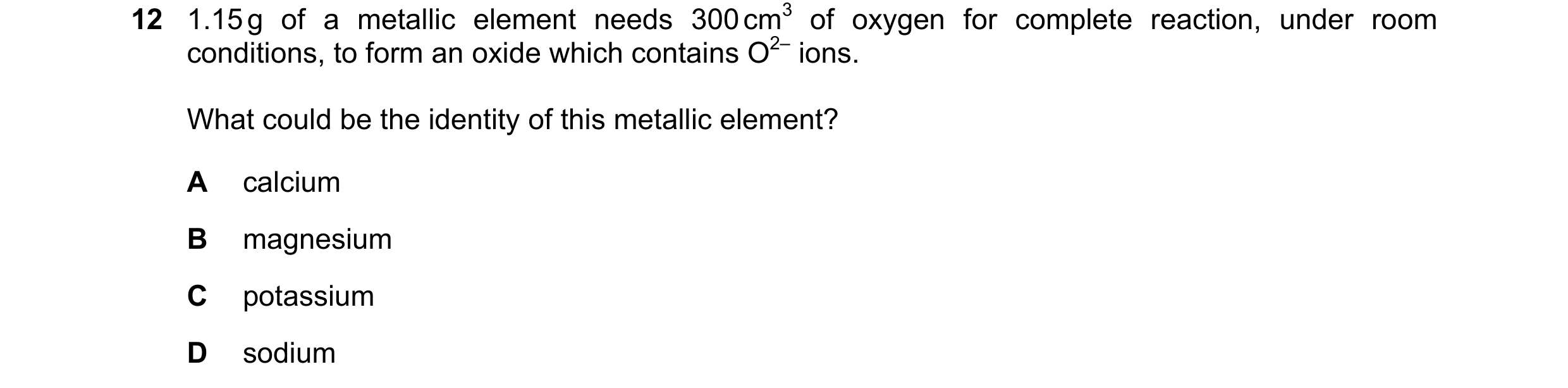
 17 / 40
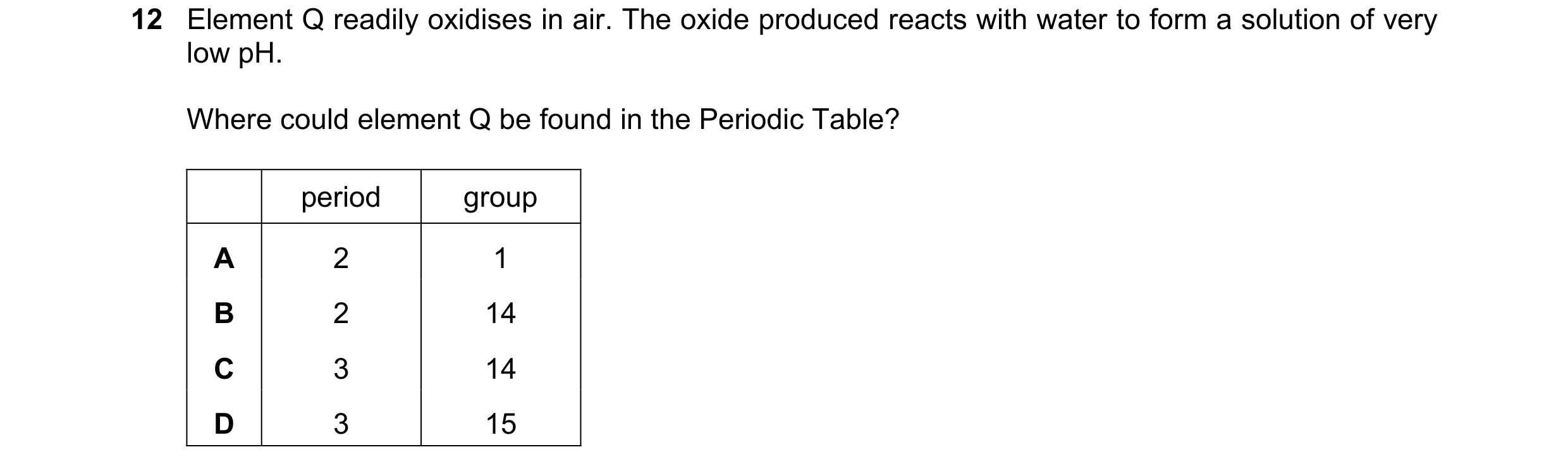

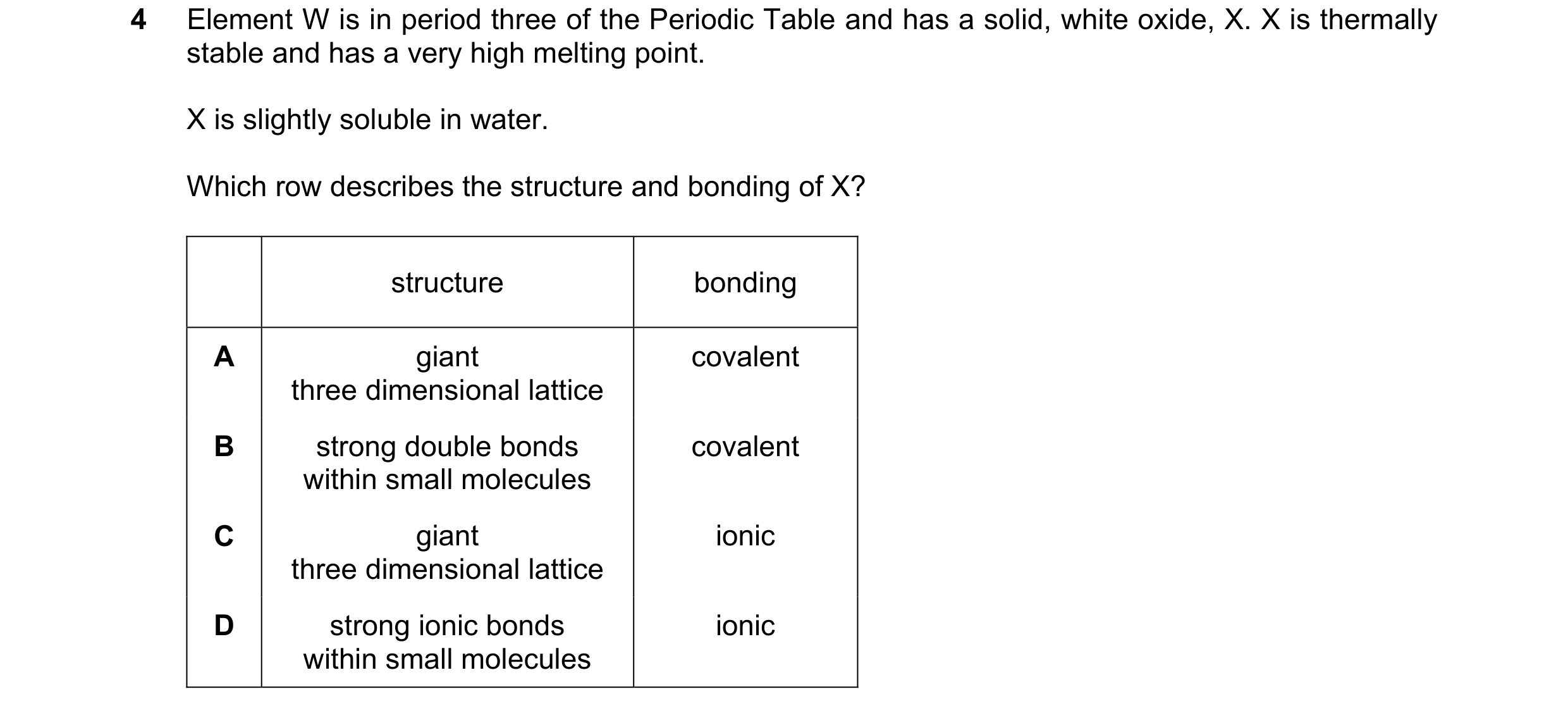
 18 / 40

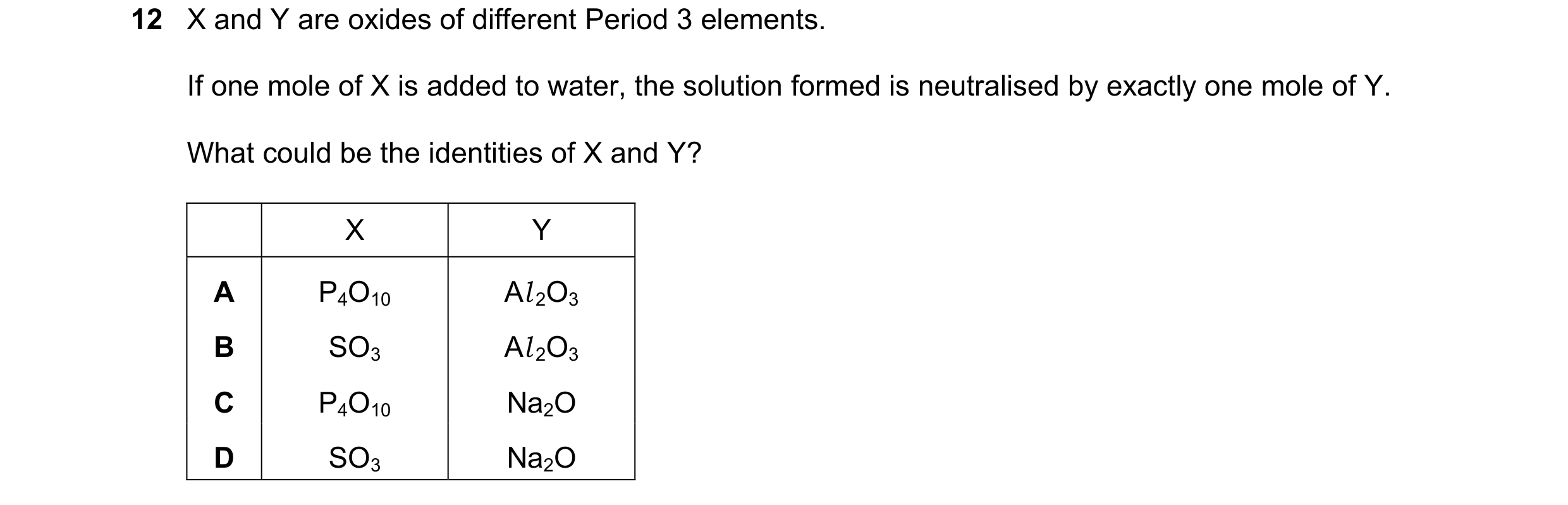
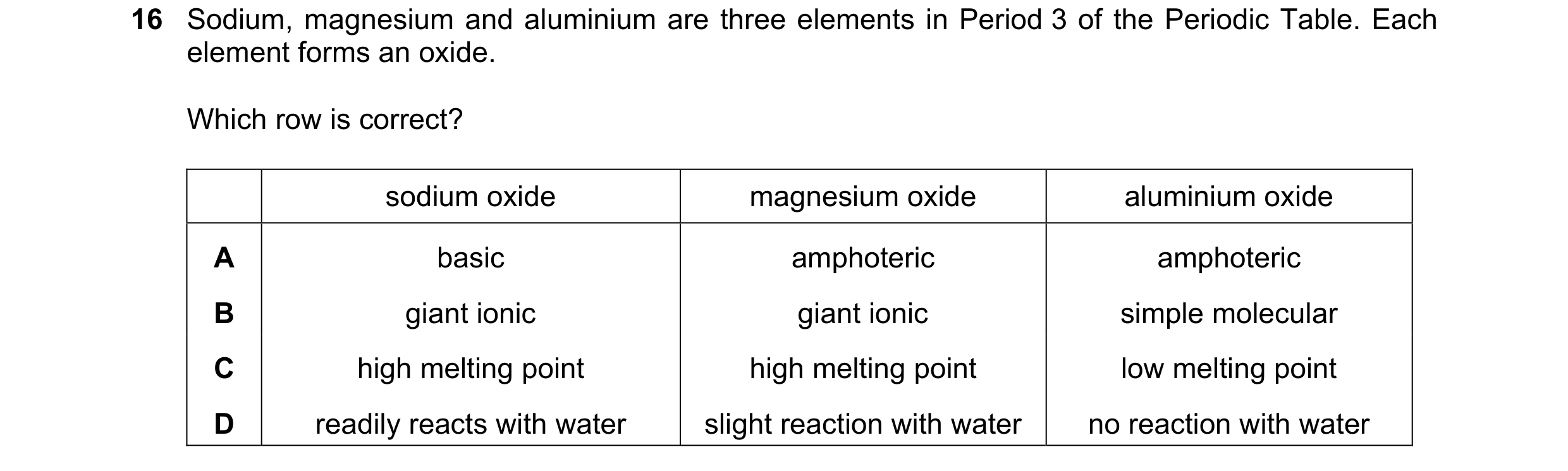
 19 / 40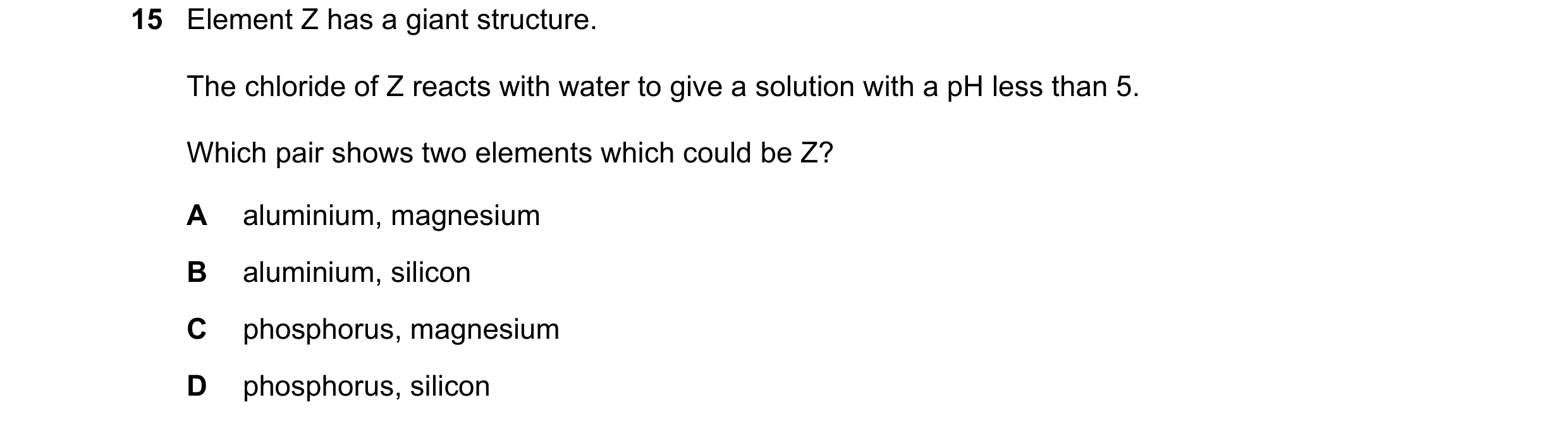
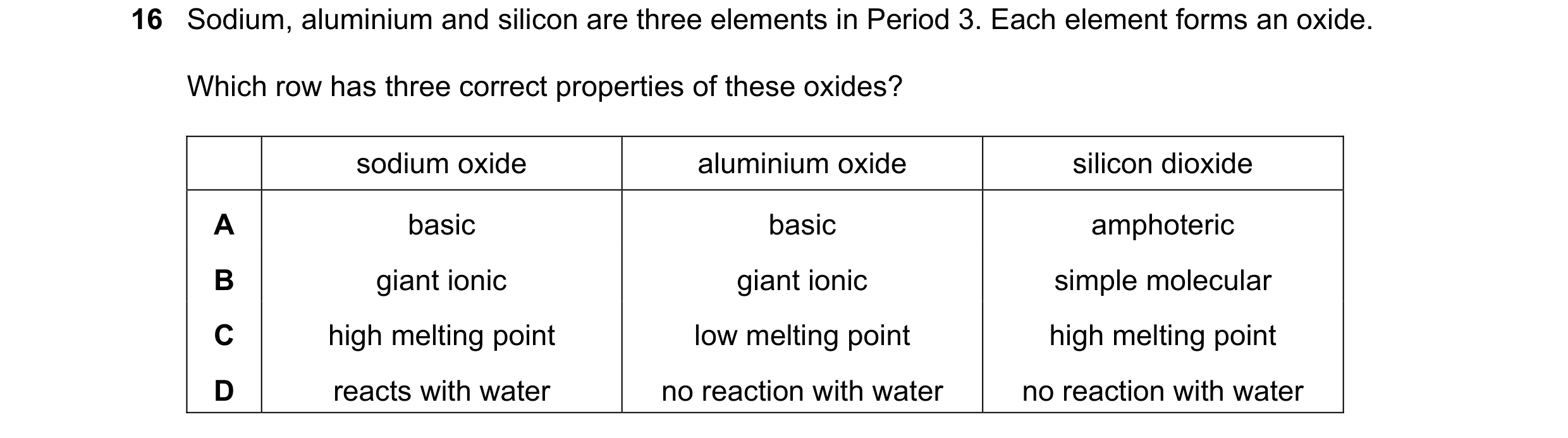
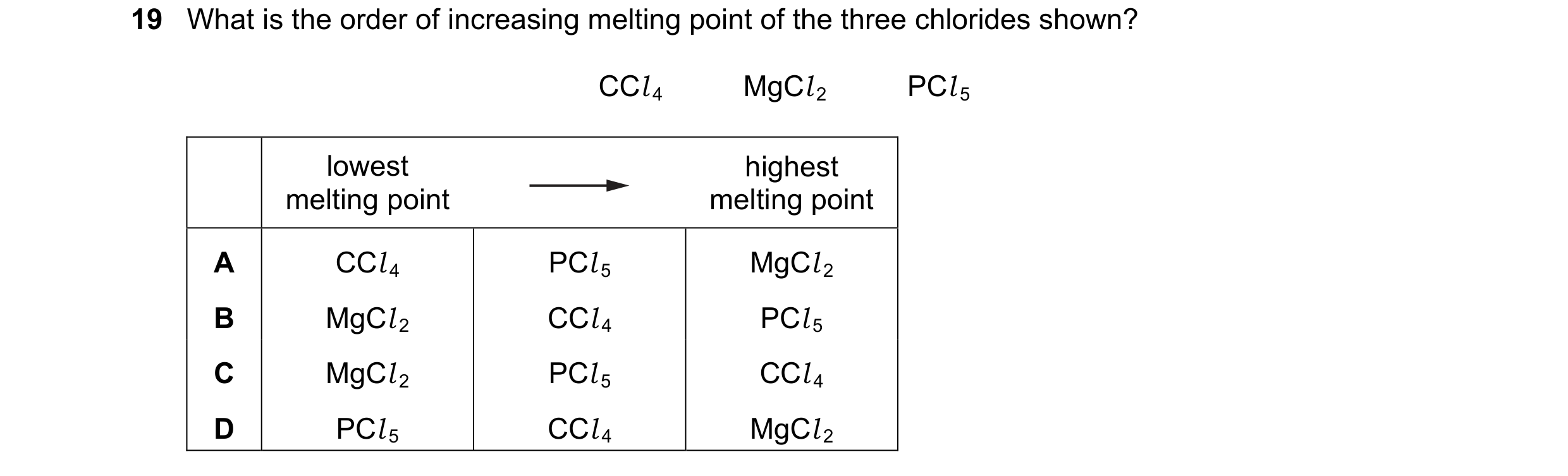
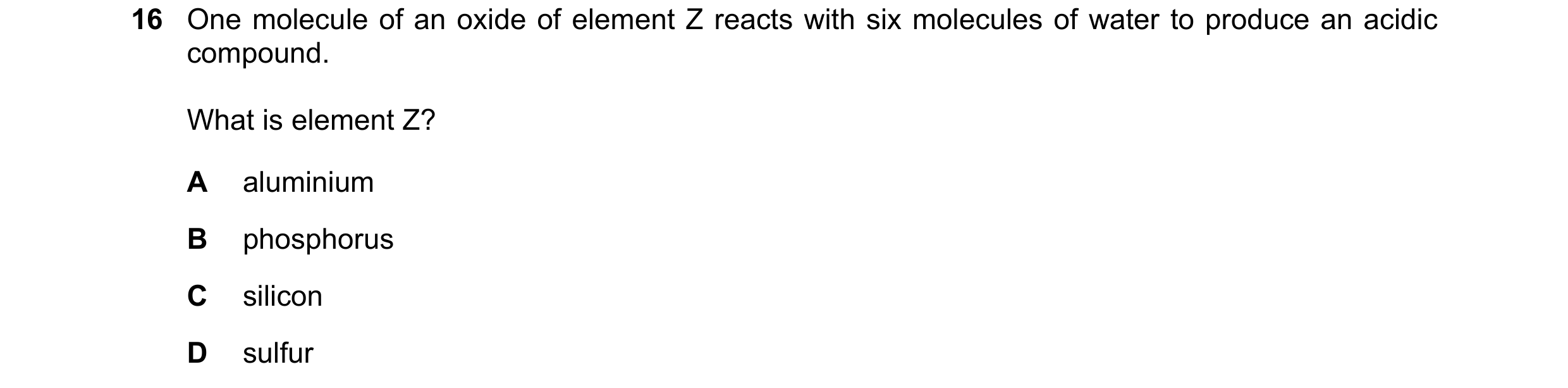
 20 / 40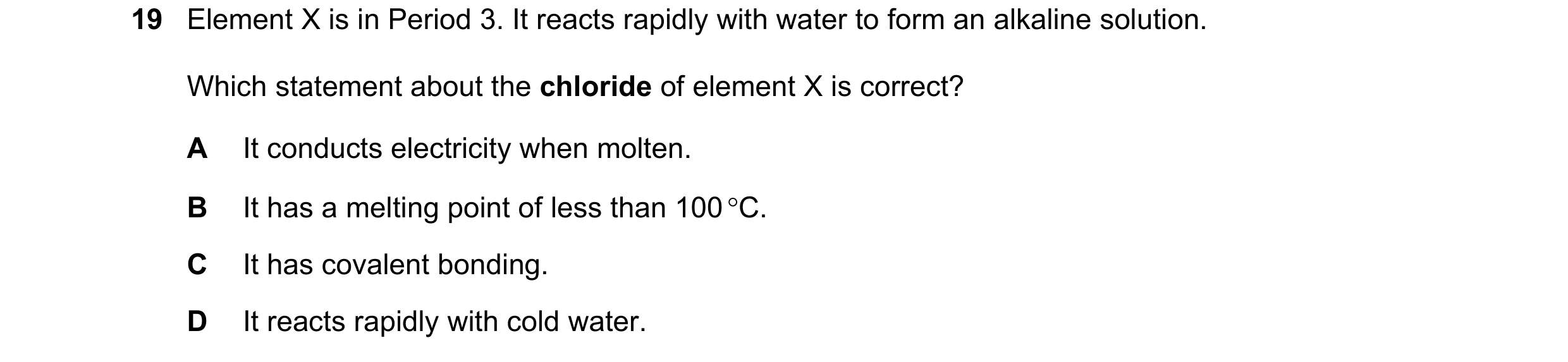

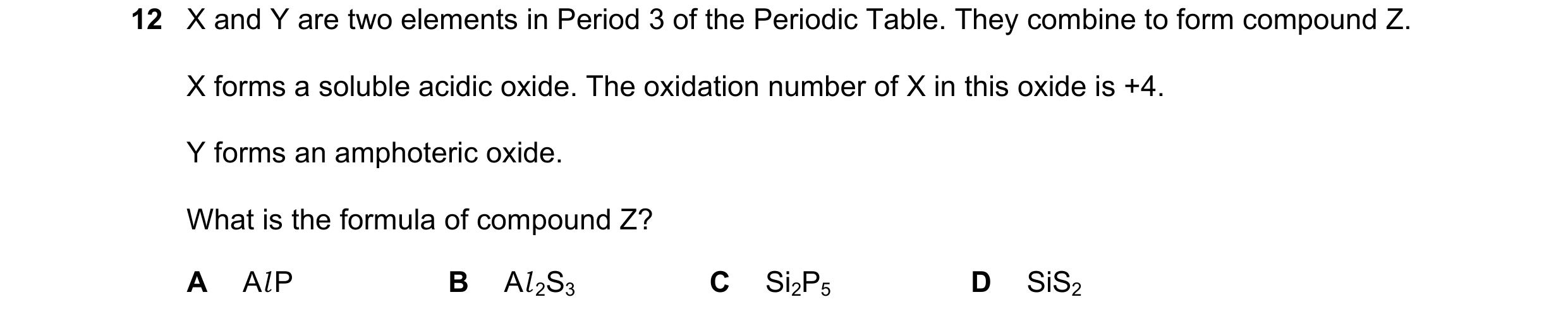
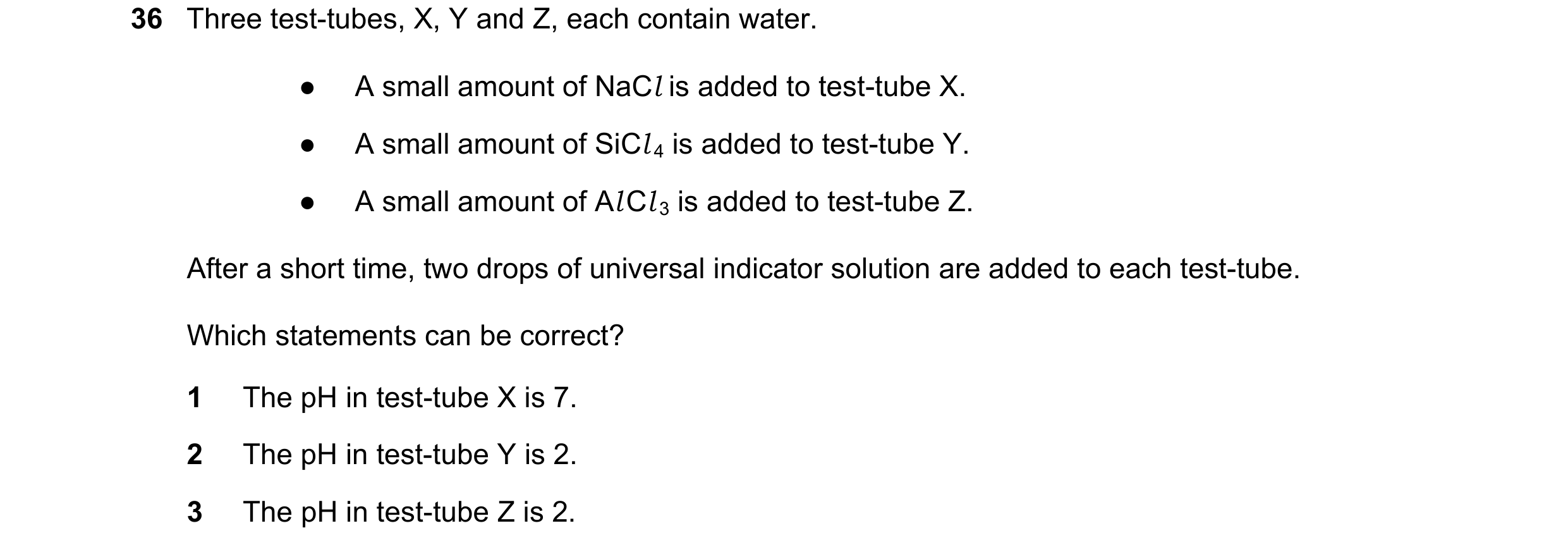
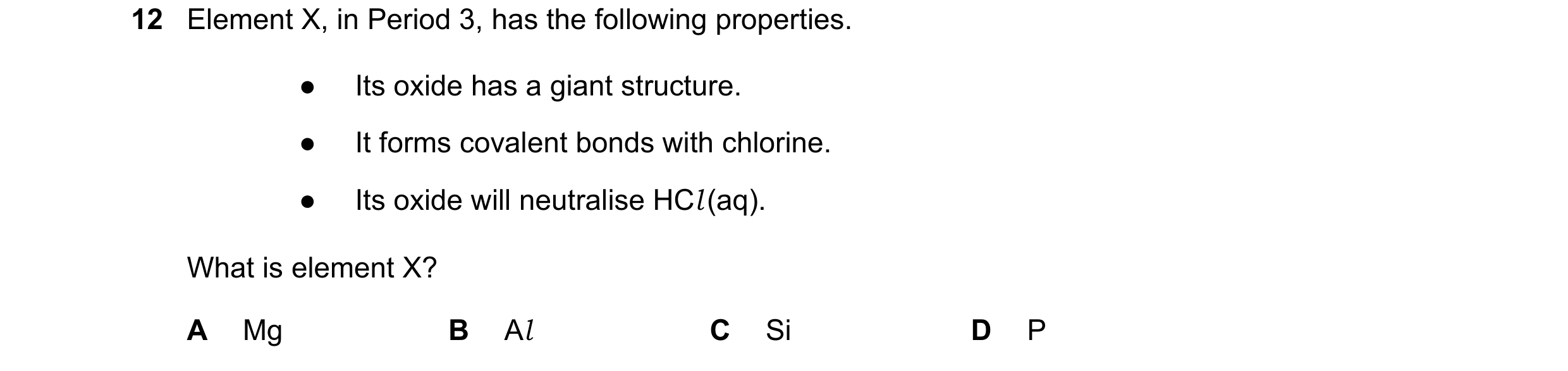 21 / 40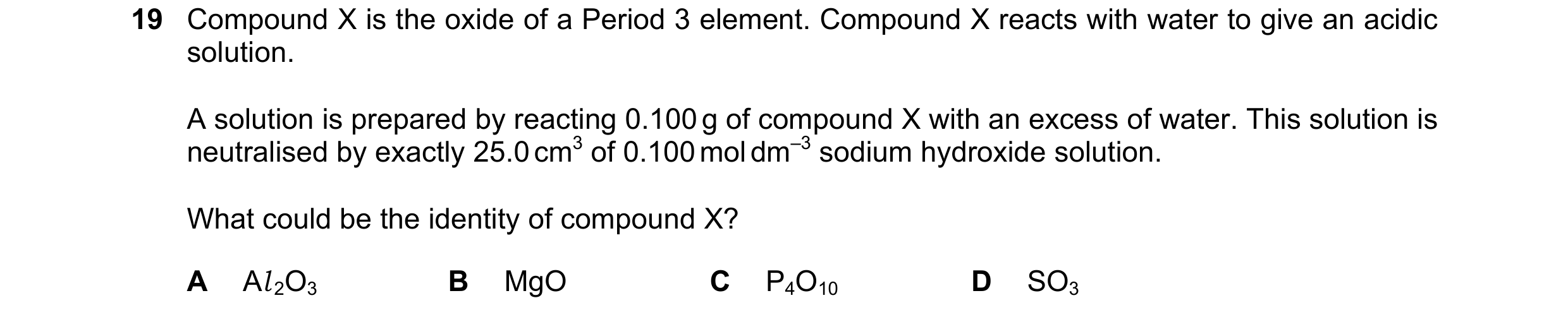
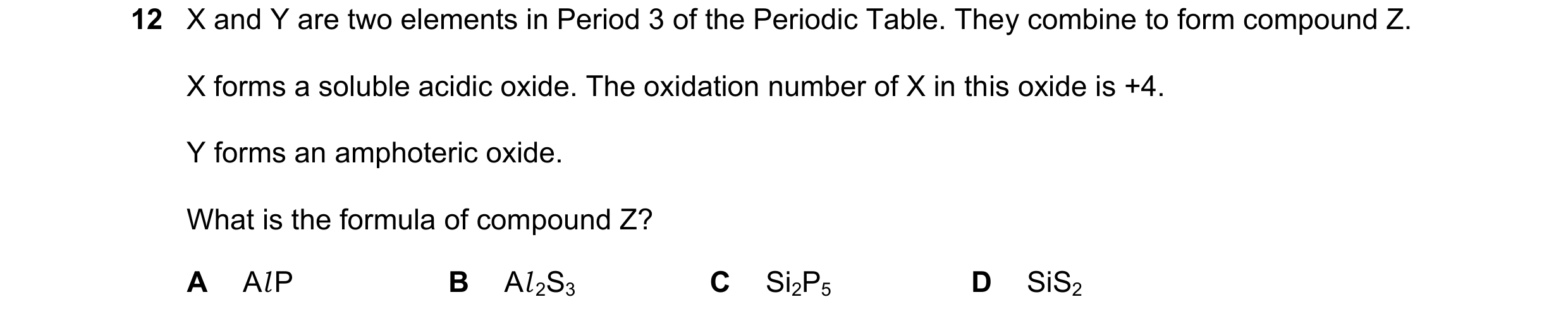
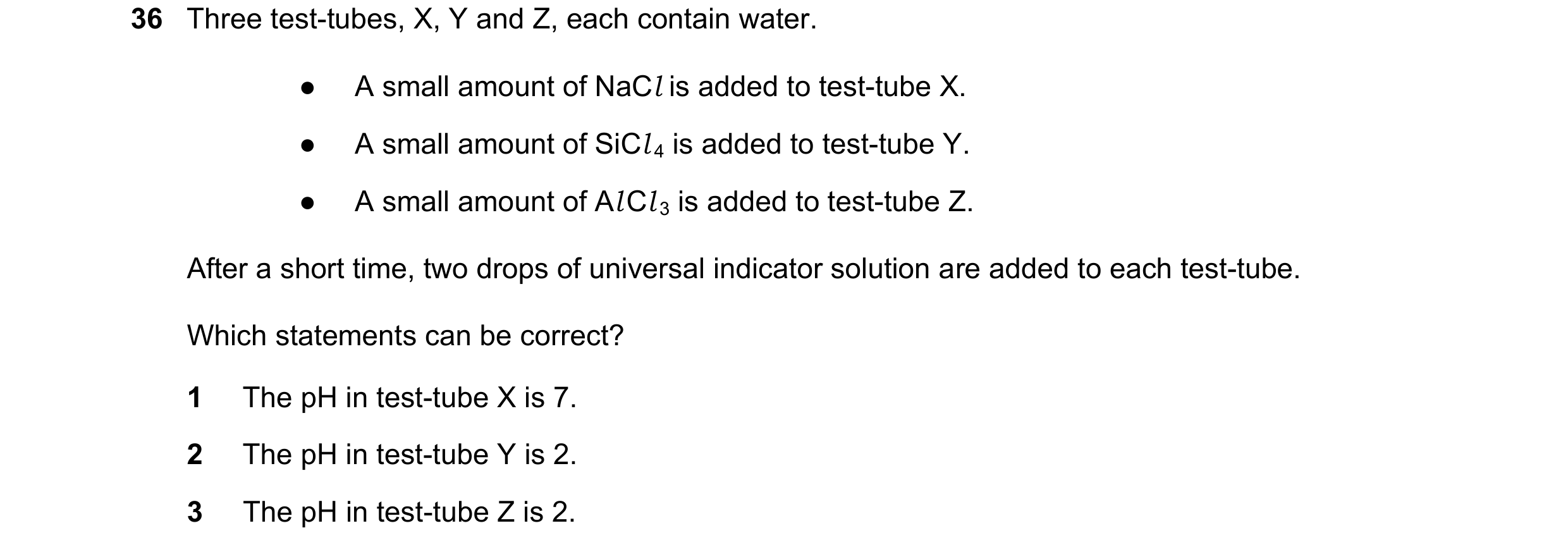
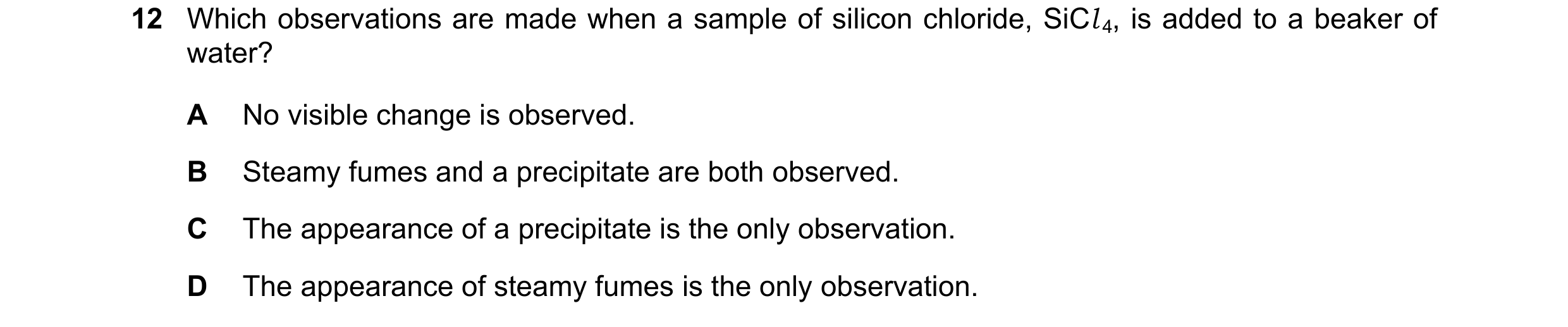
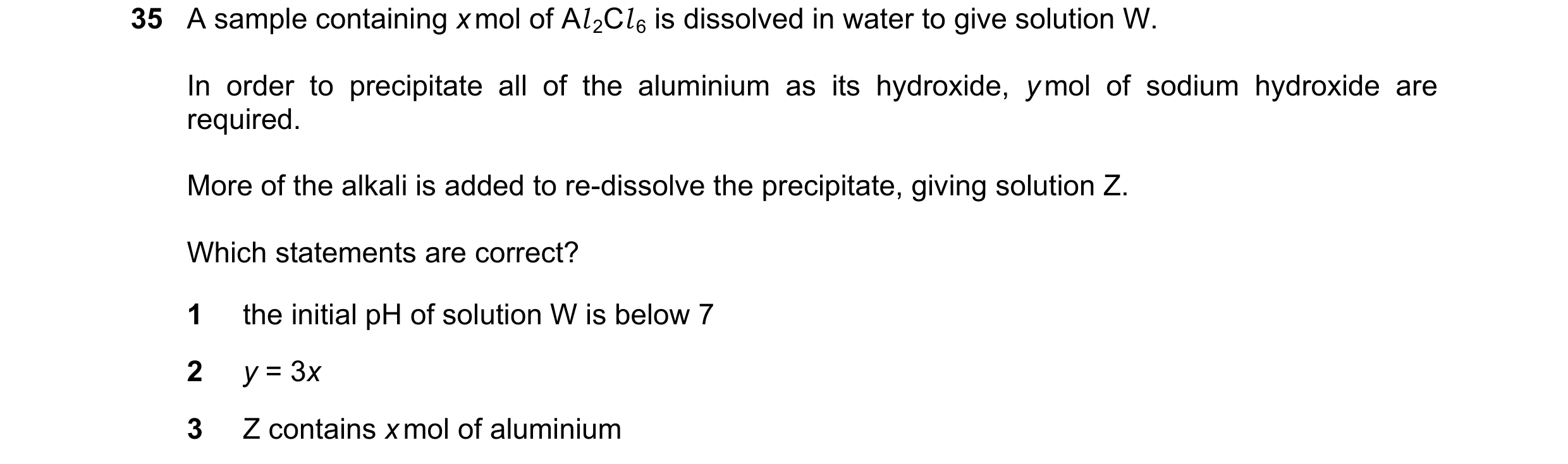 22 / 40
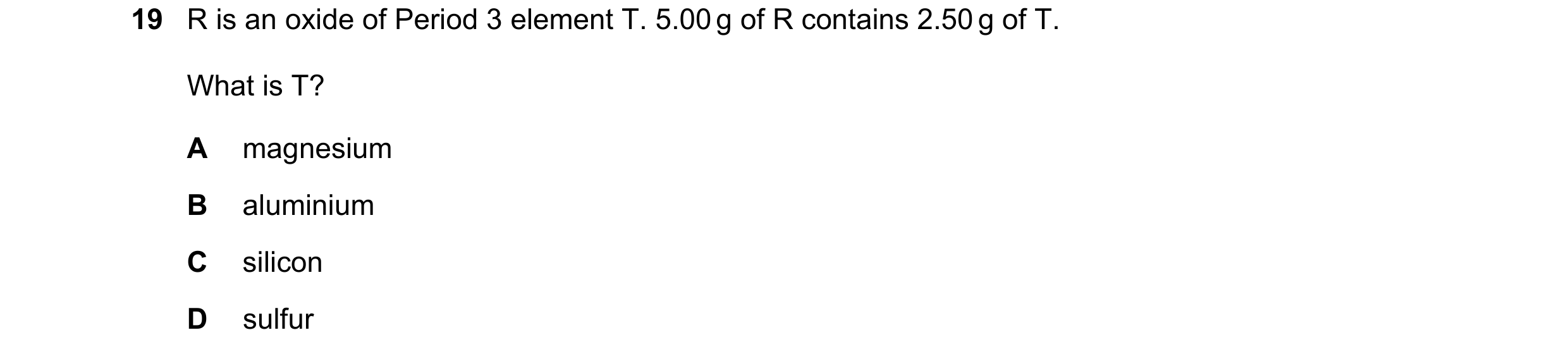
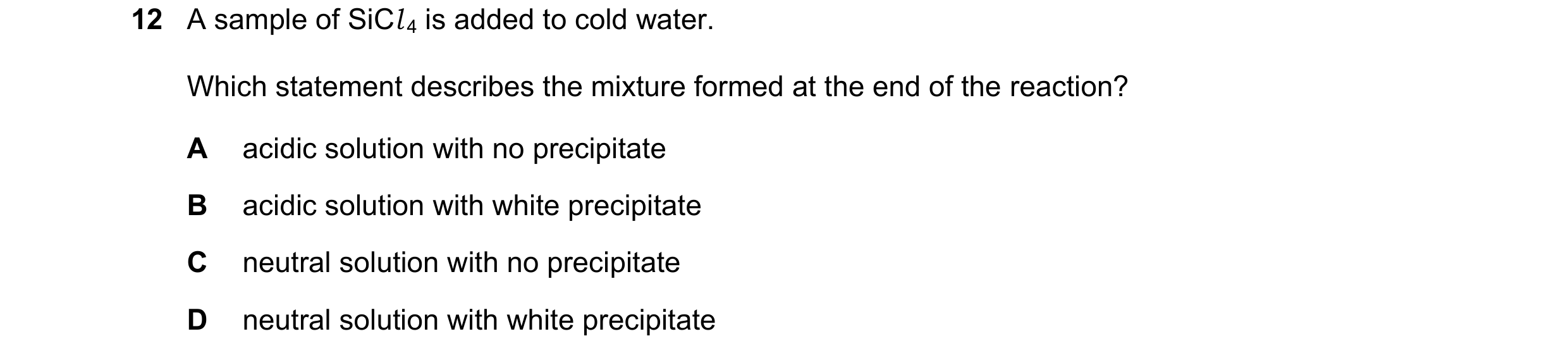
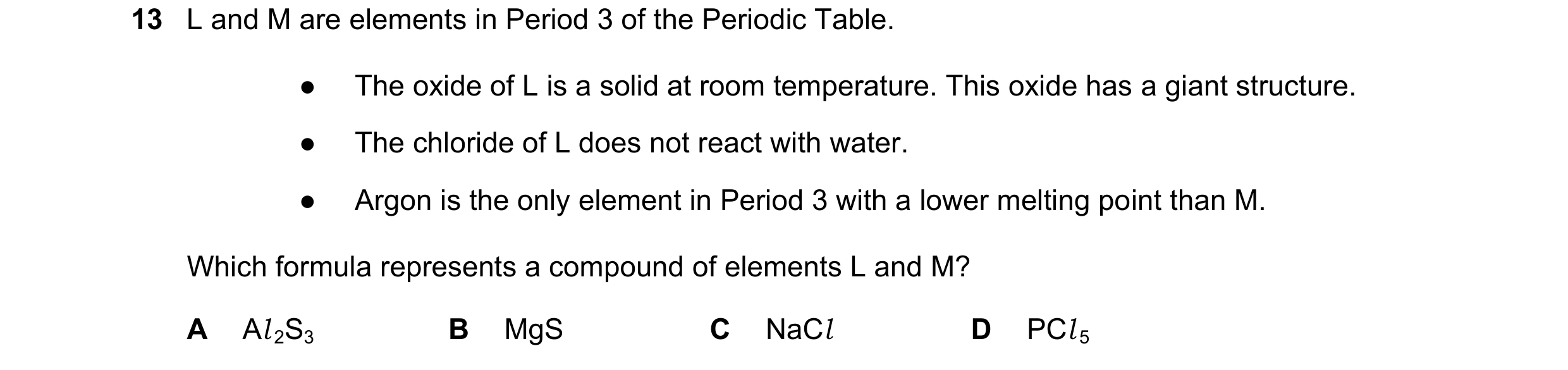

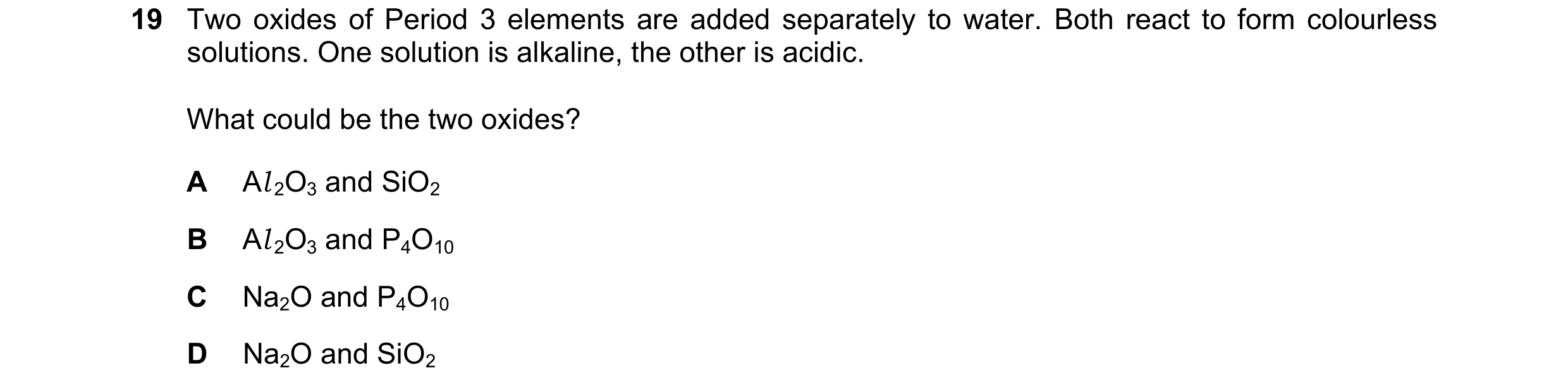 23 / 40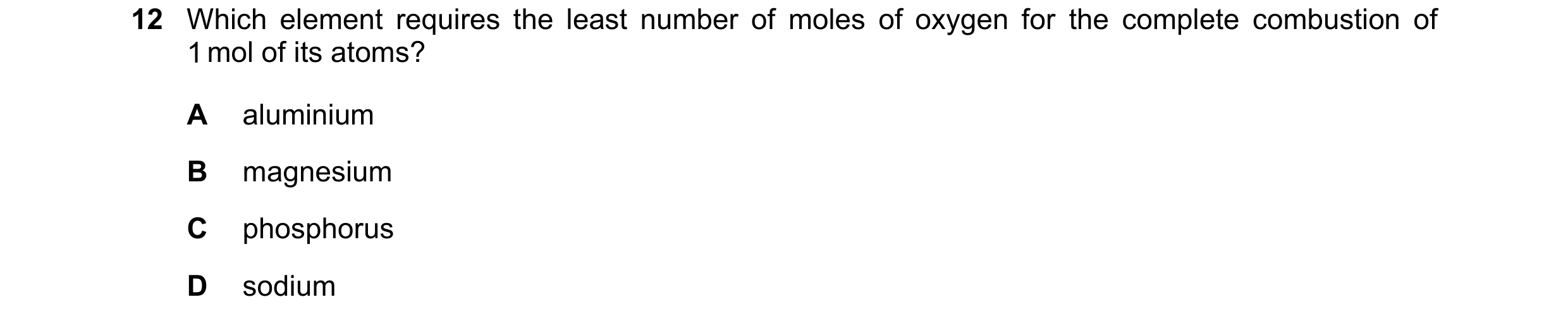
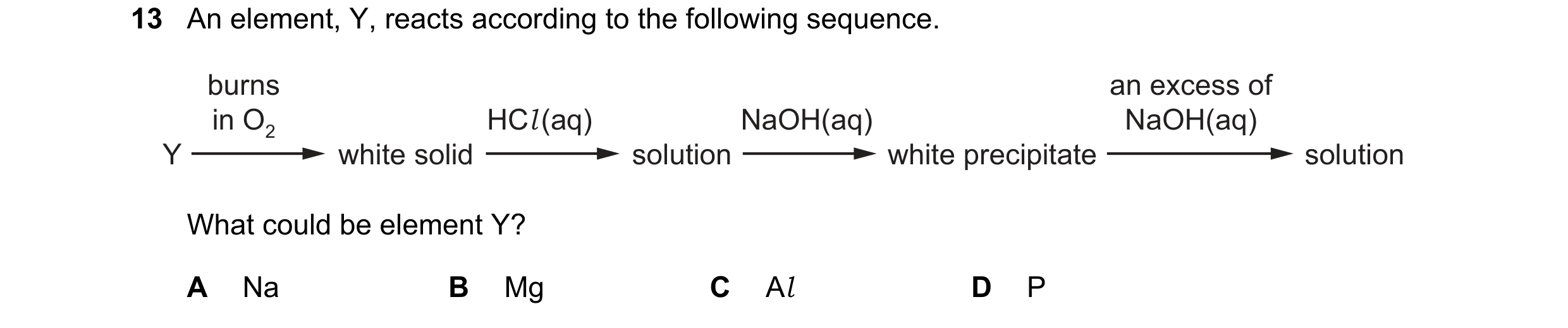

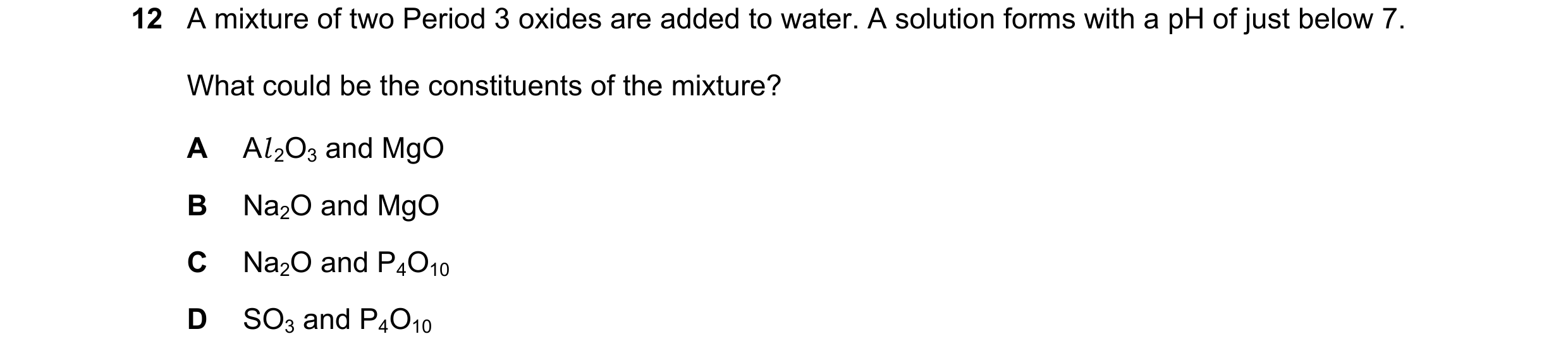
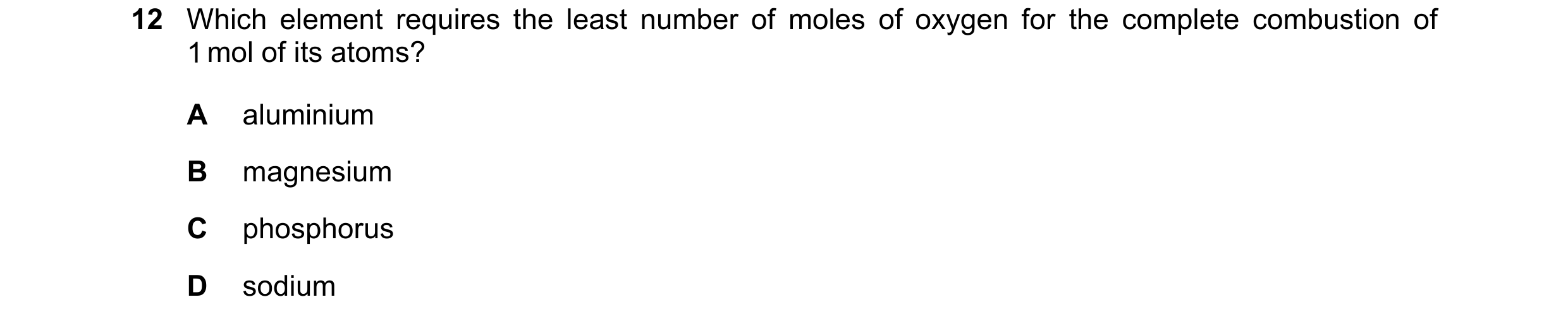
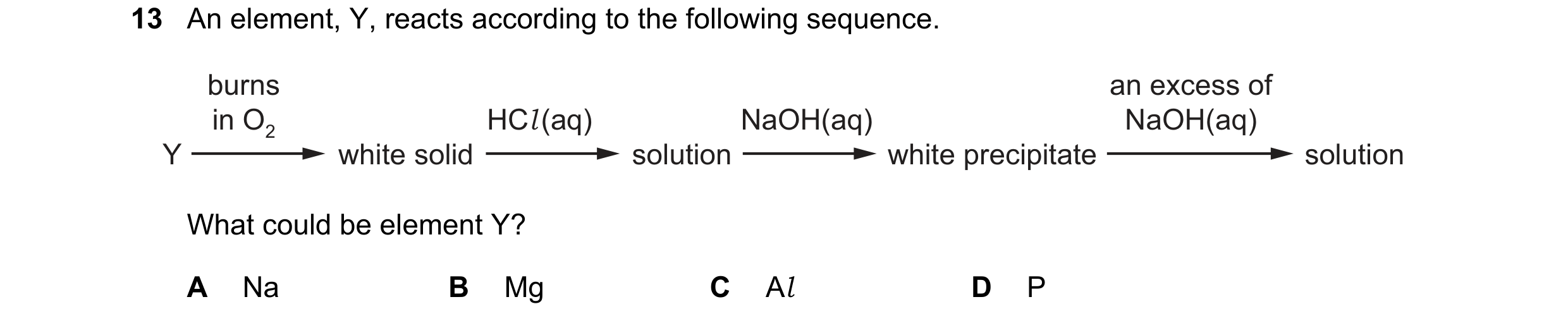 24 / 40
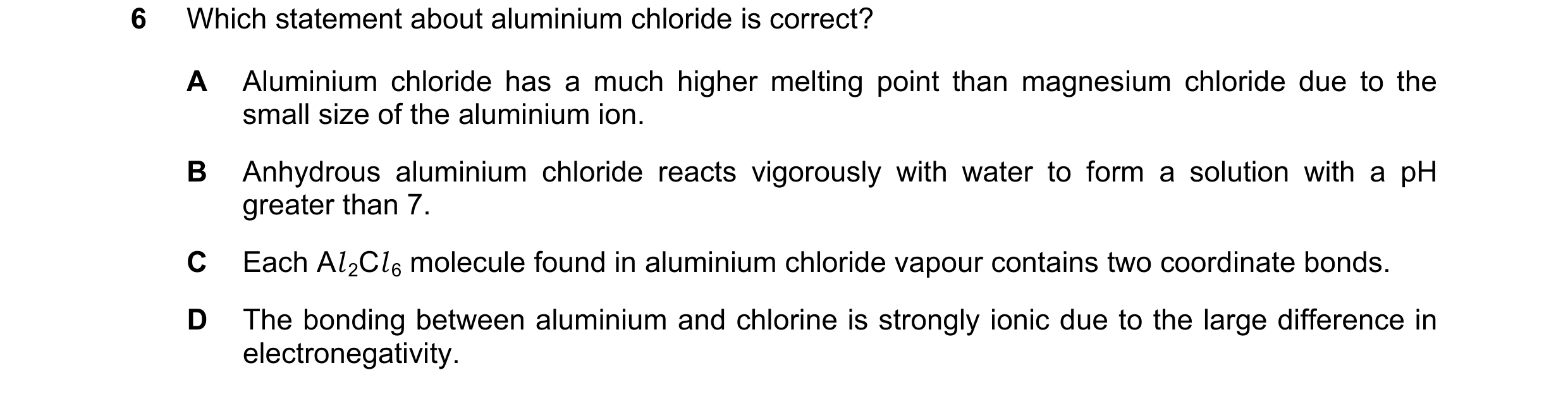

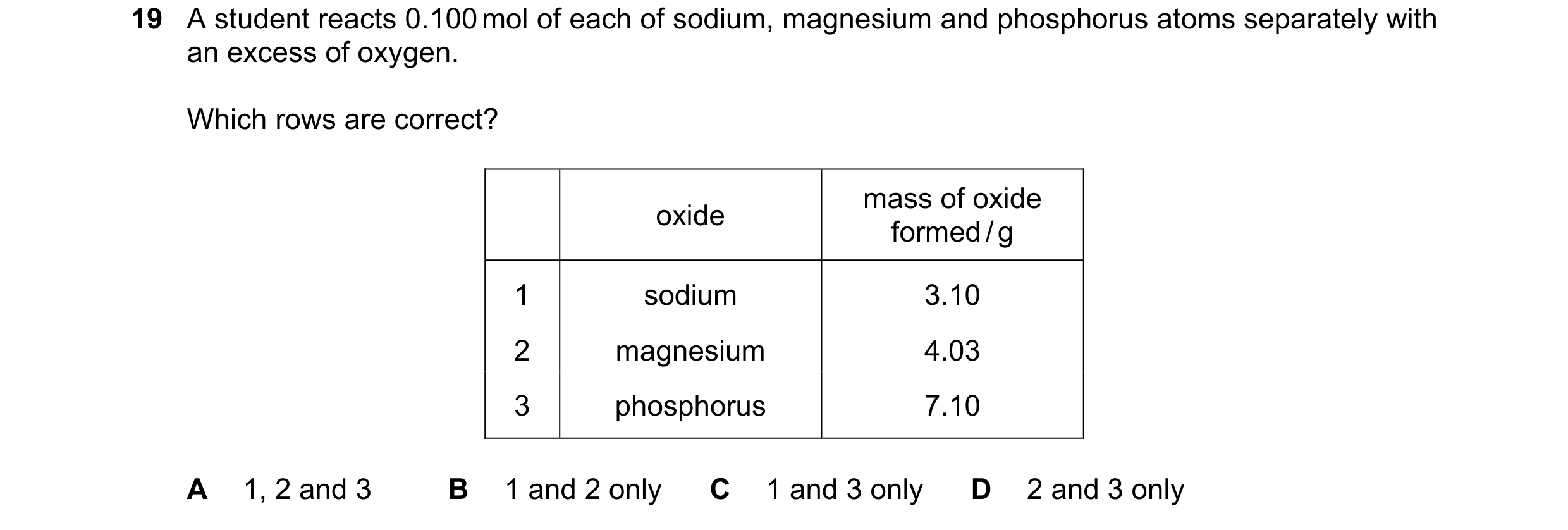
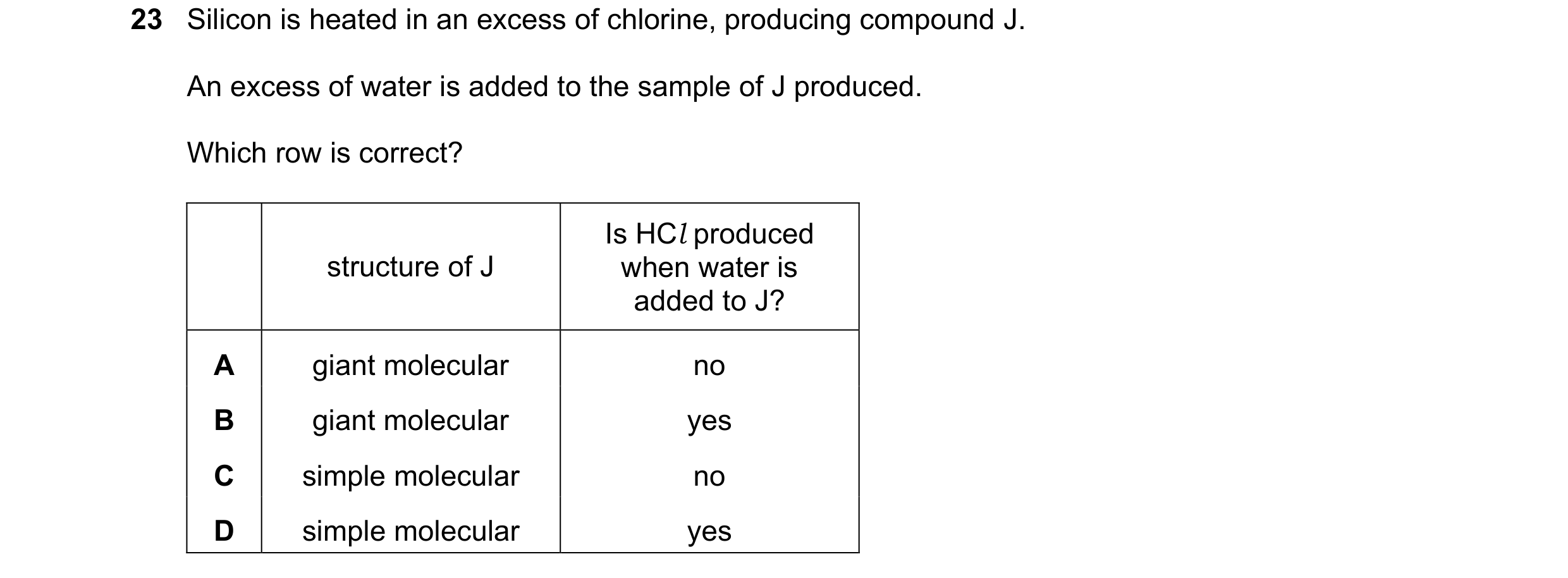 25 / 40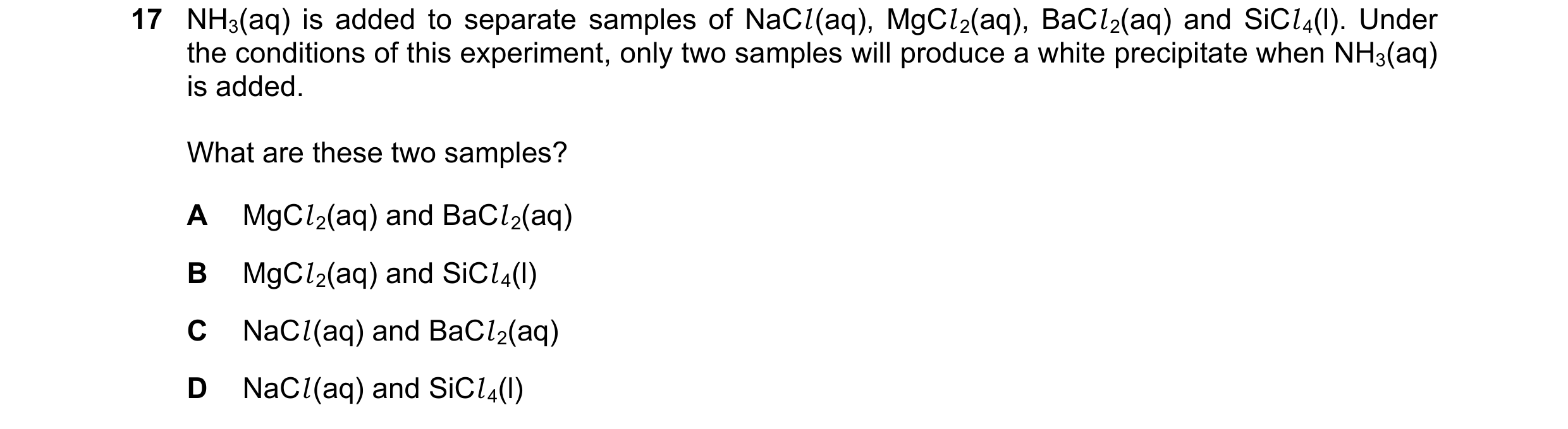
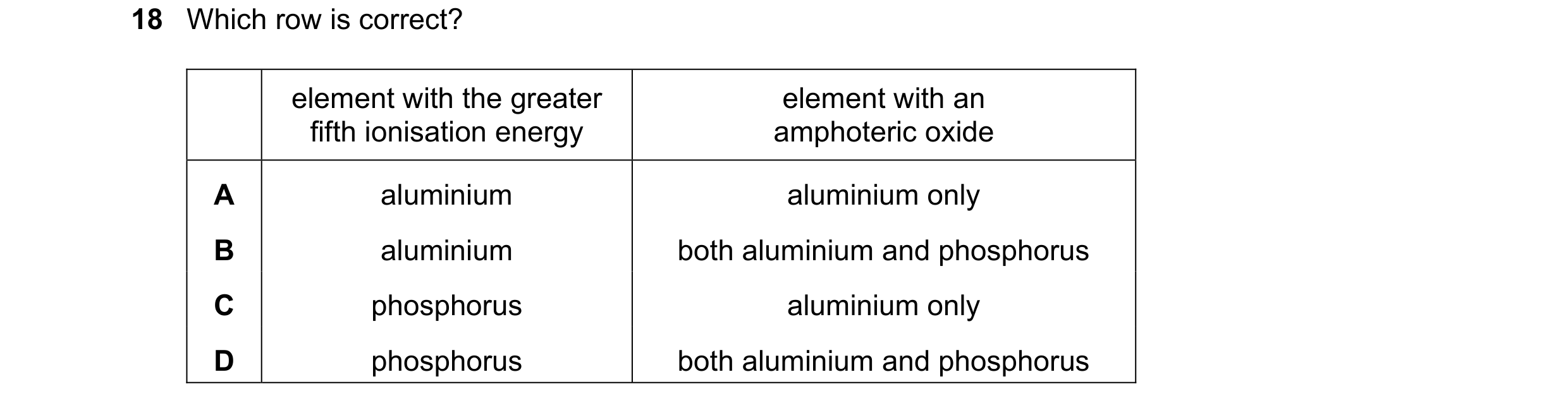
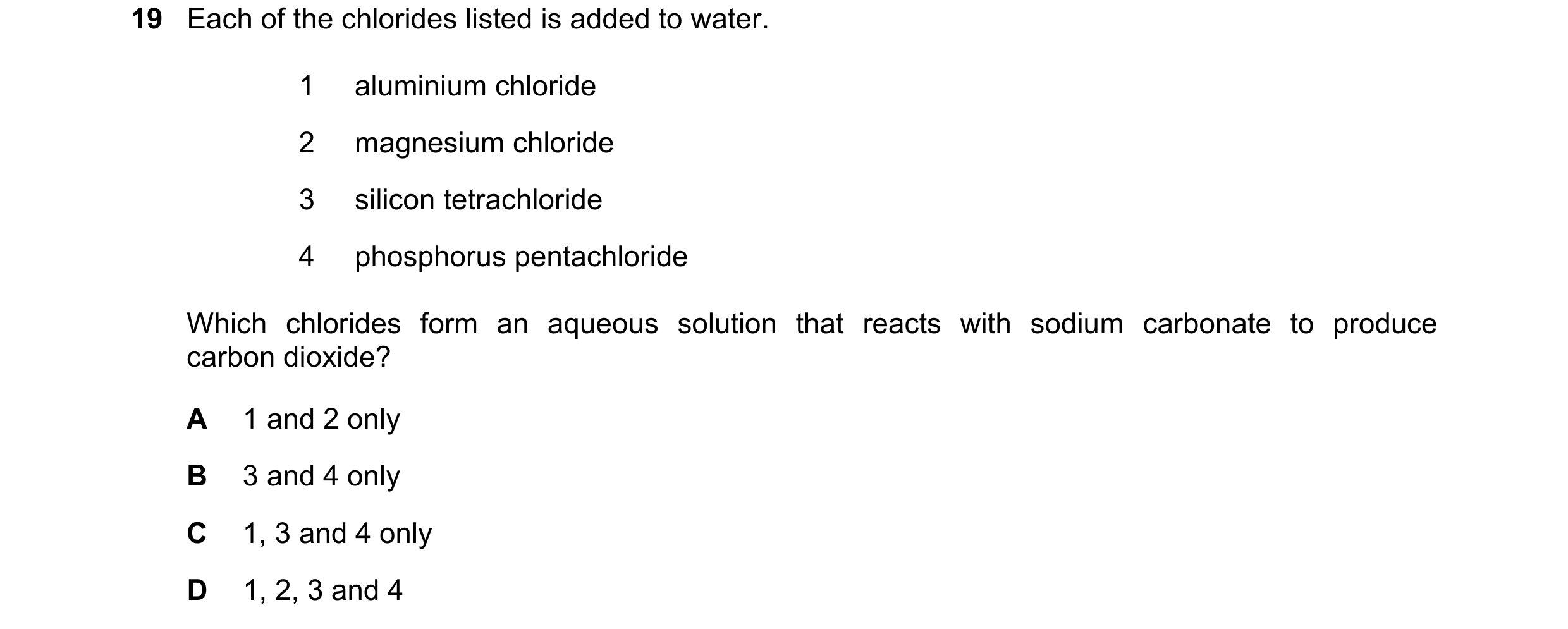 26 / 40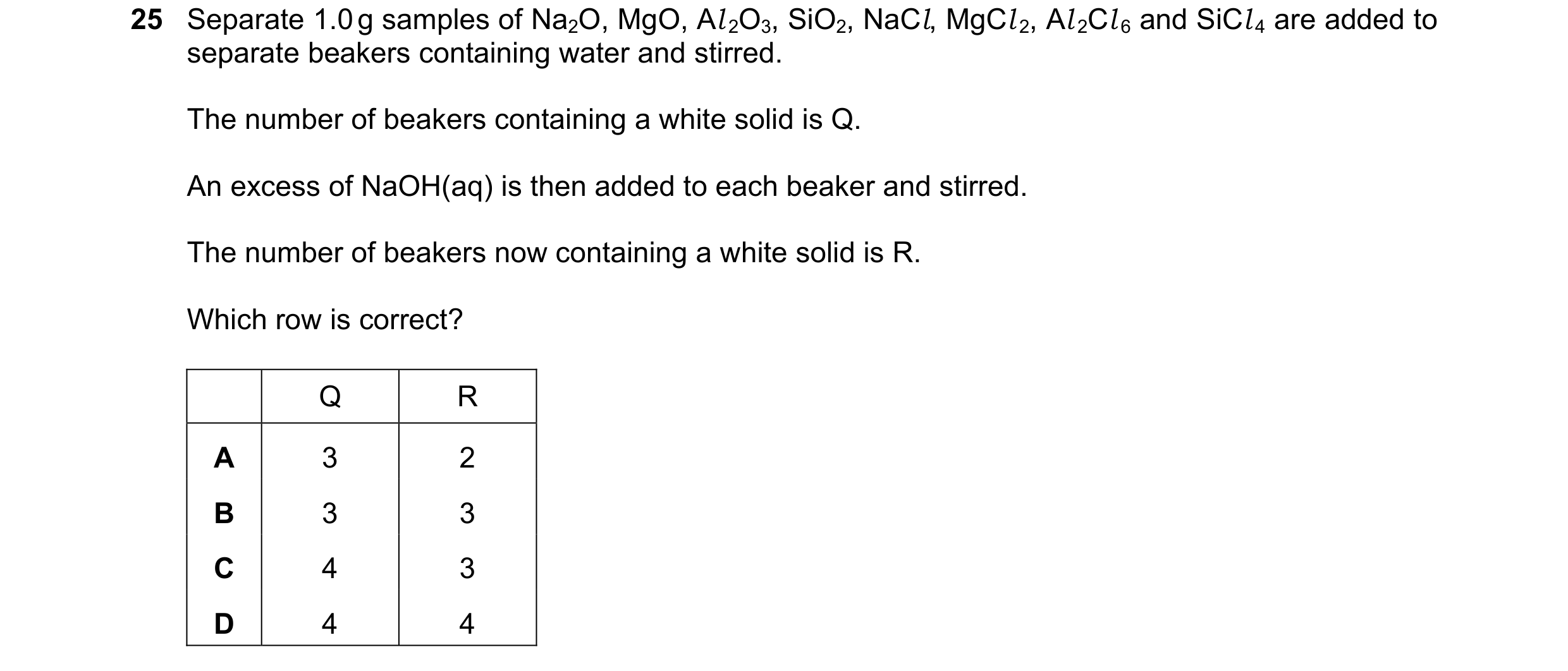

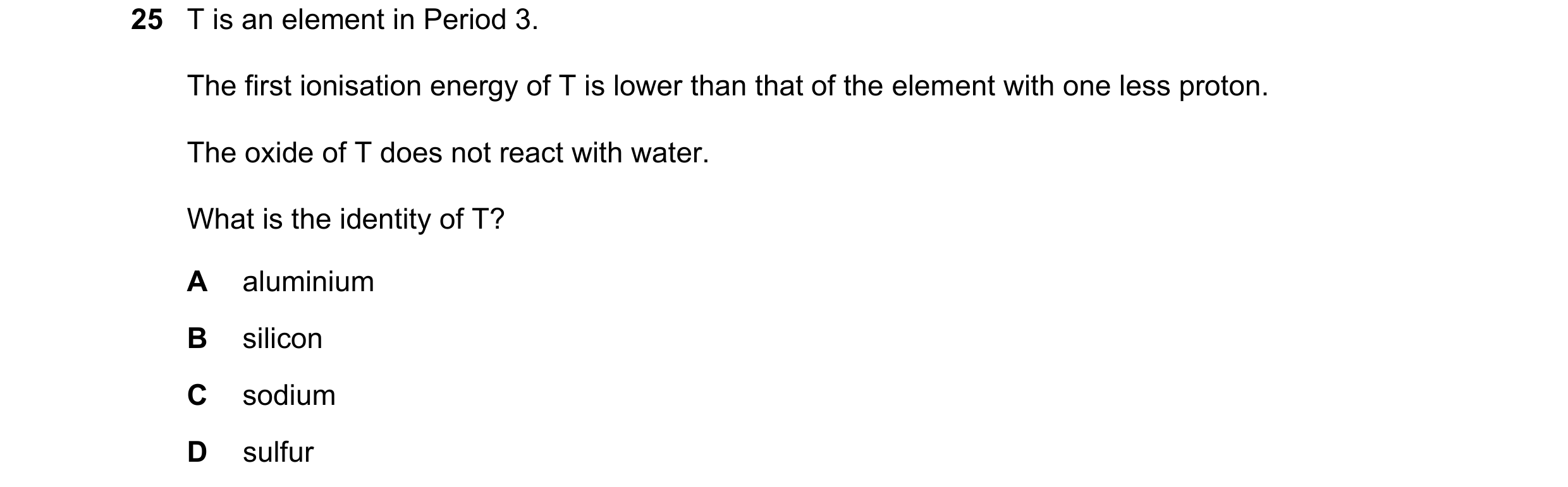 27 / 40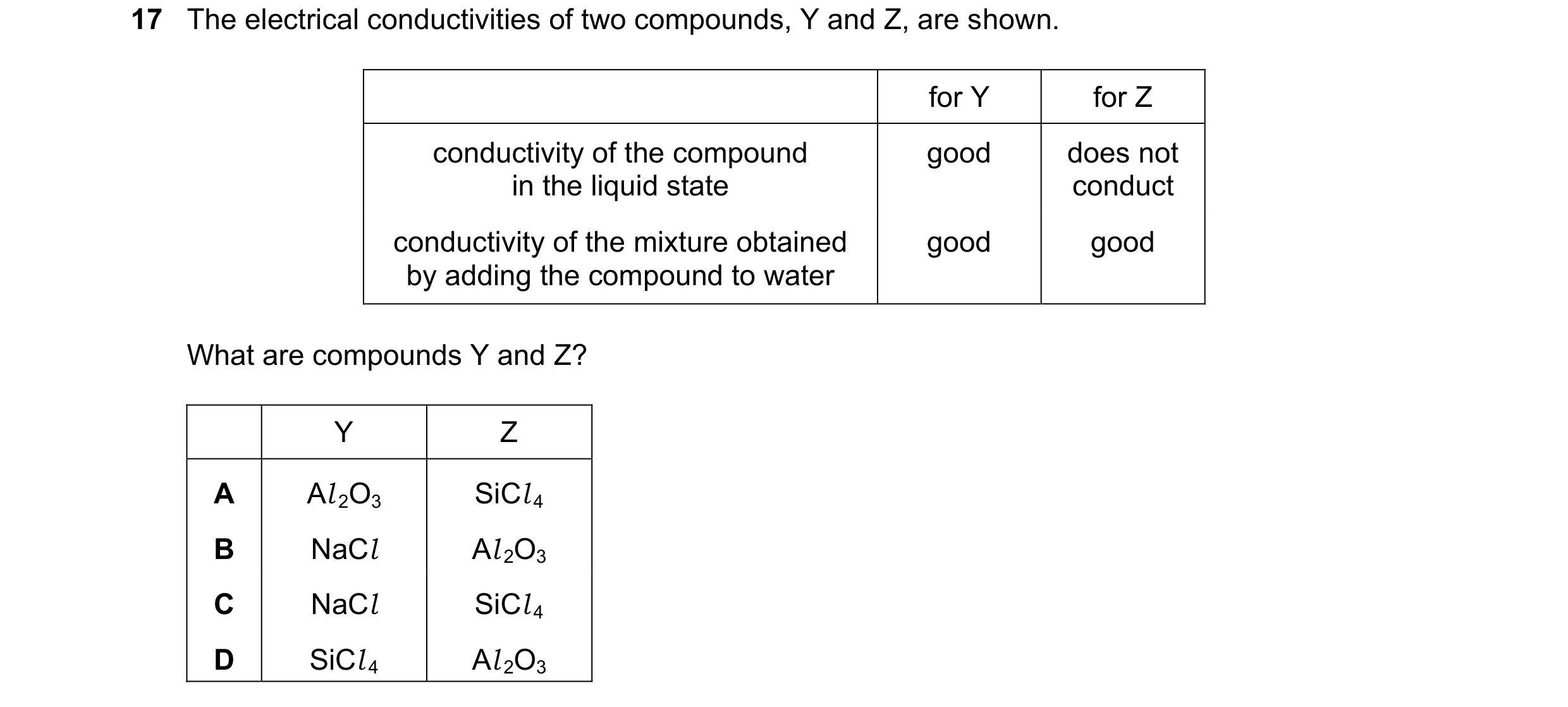
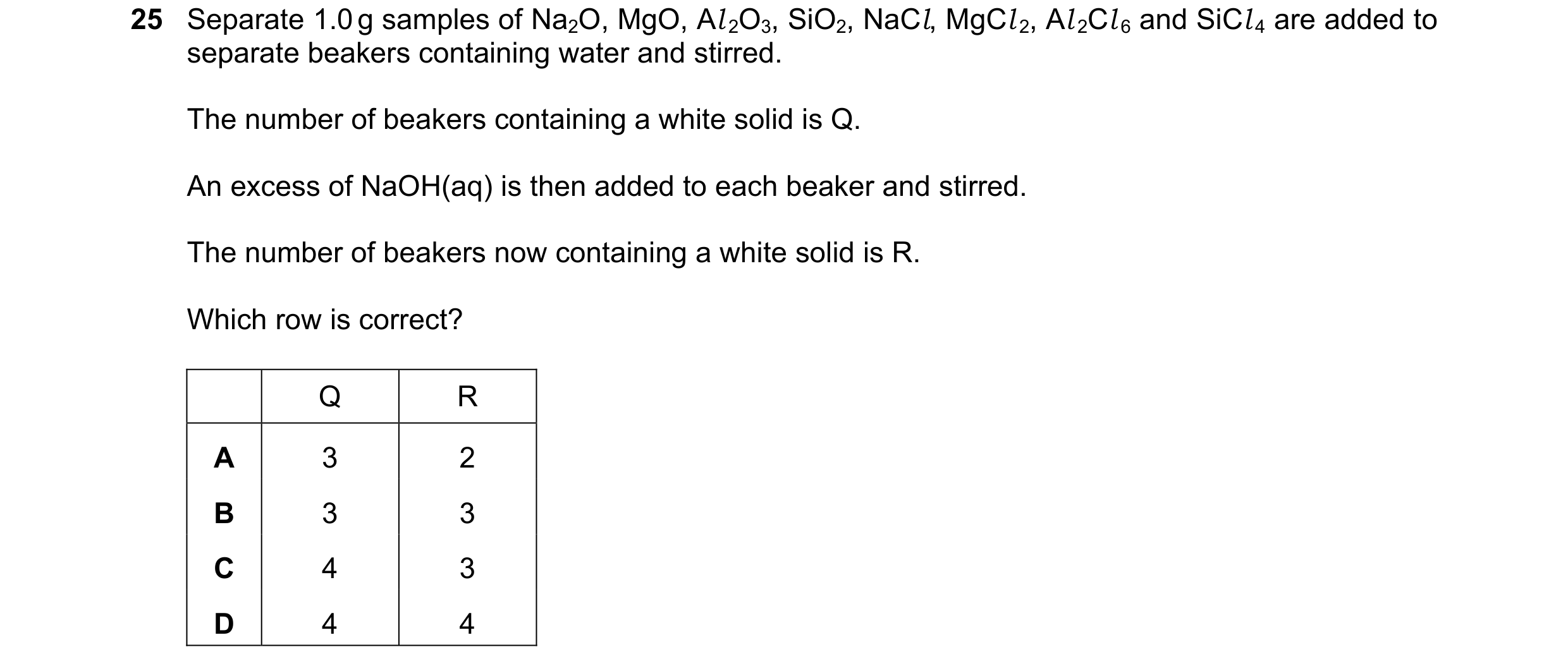
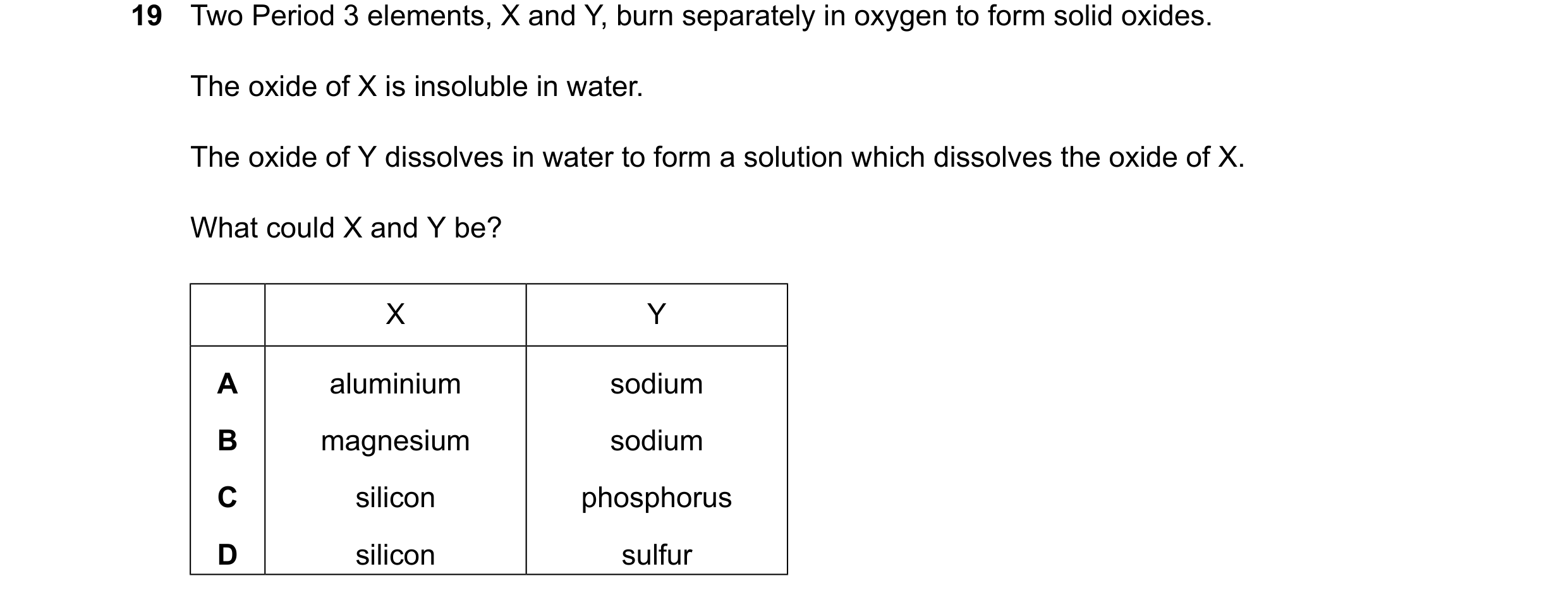 28 / 40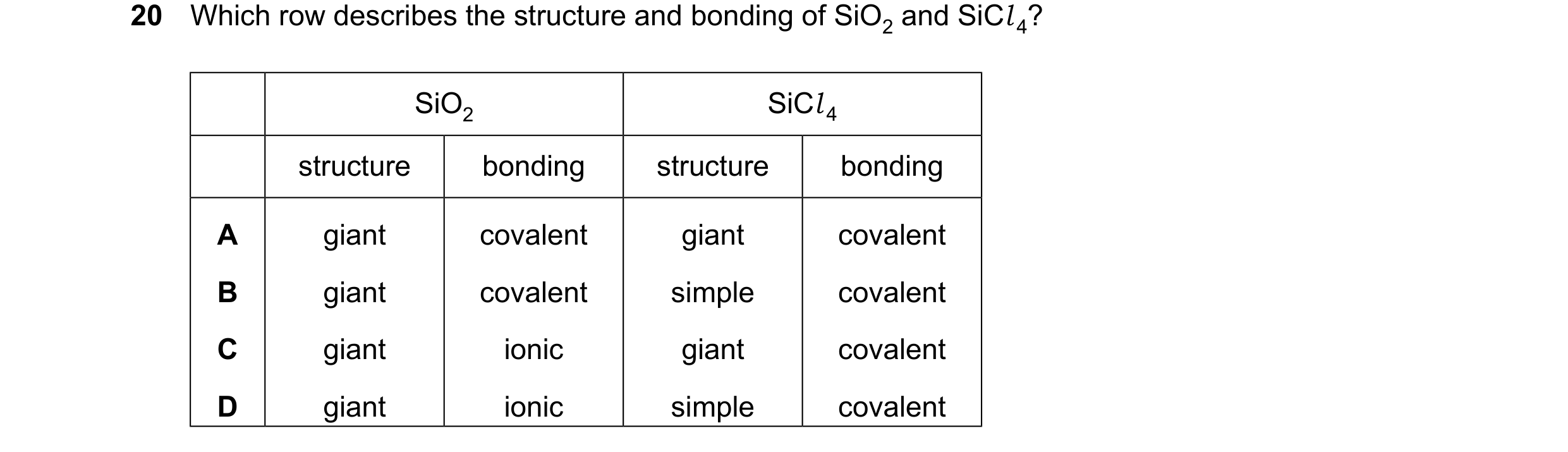
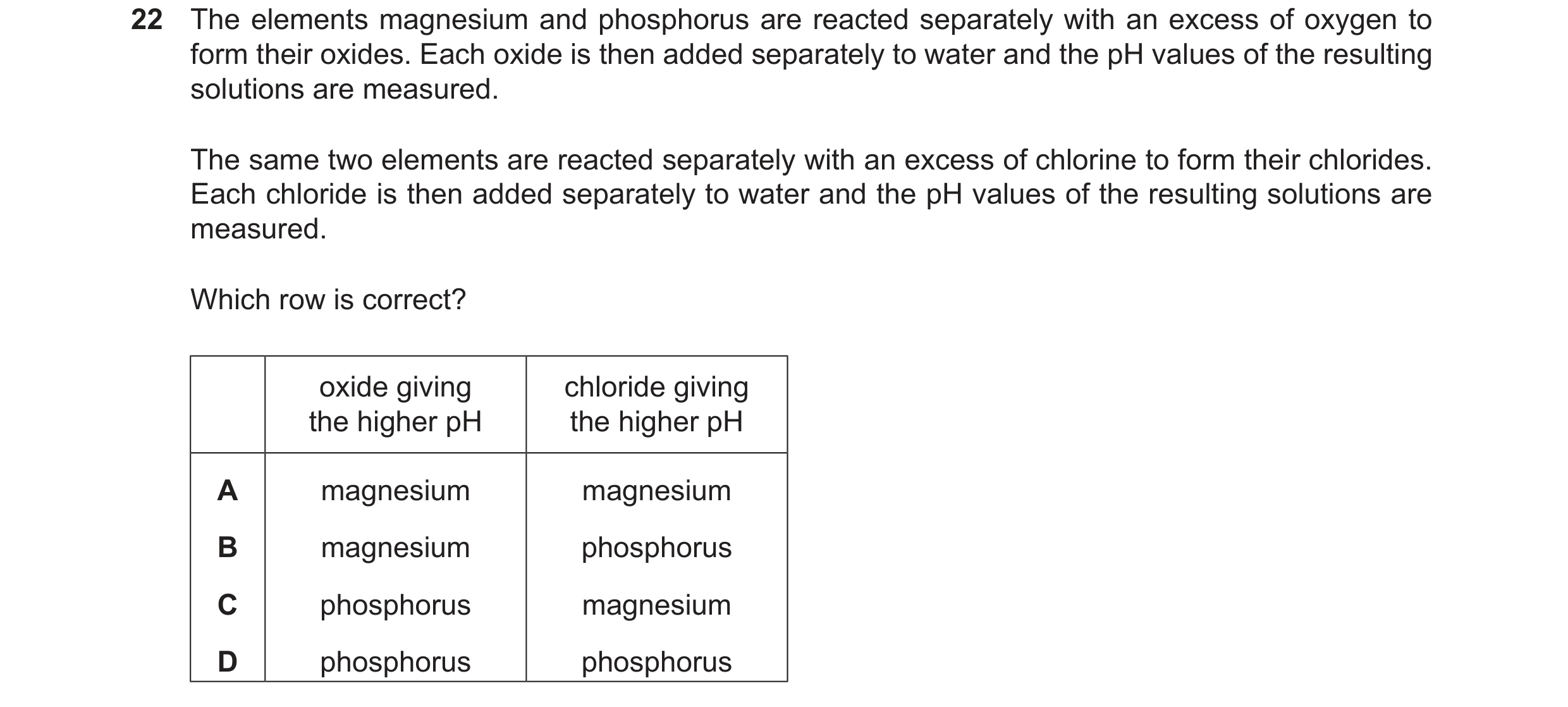
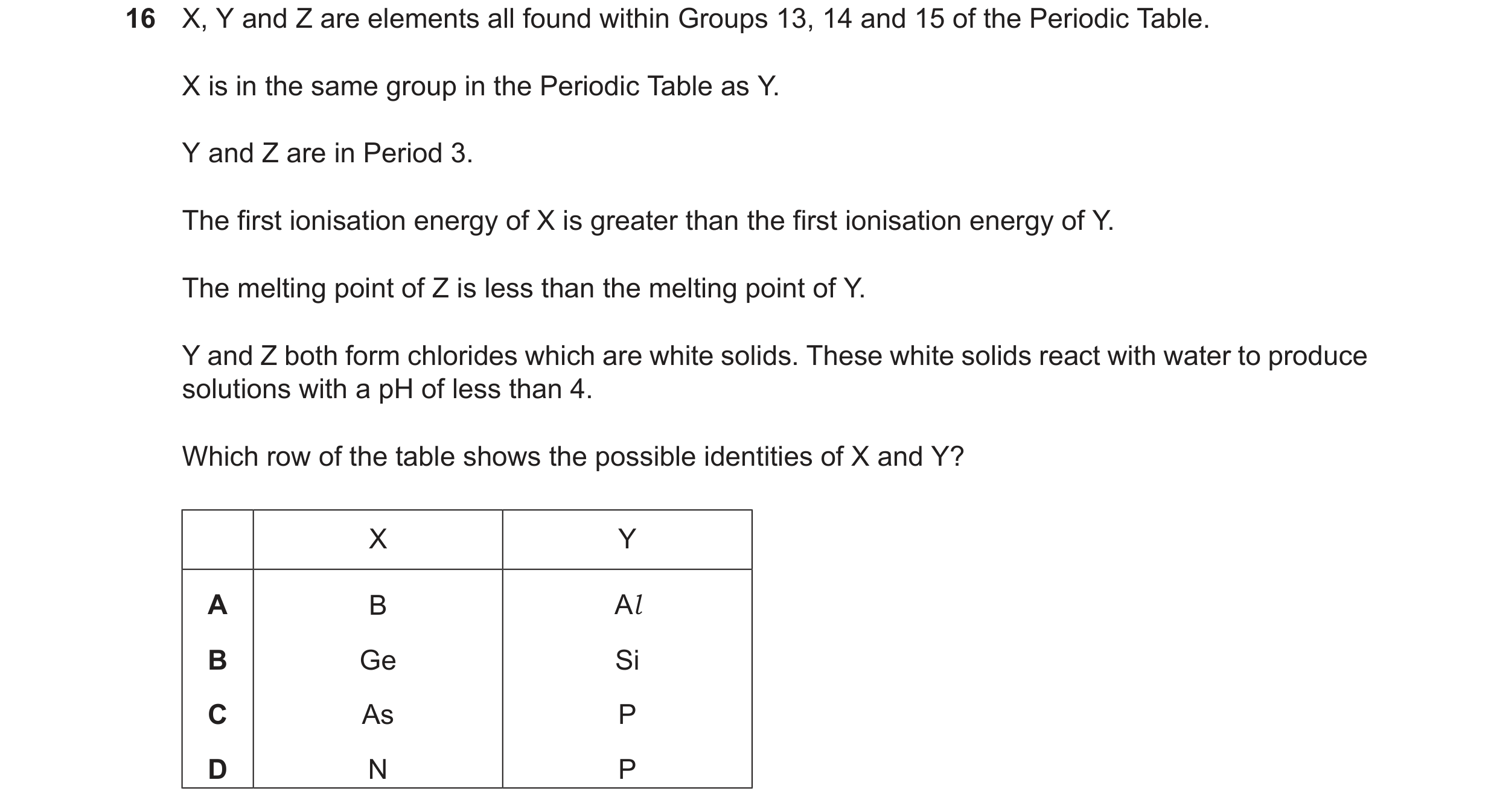 29 / 40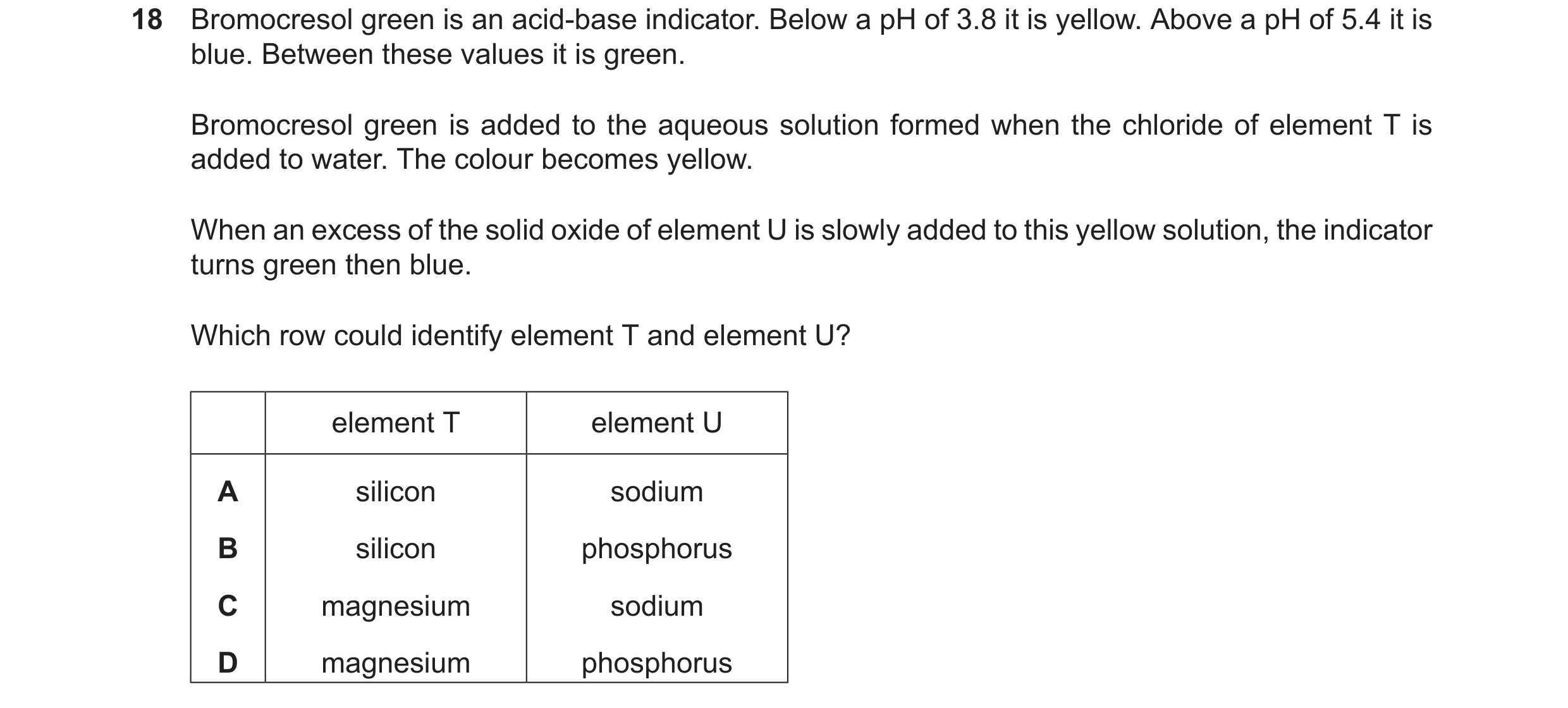
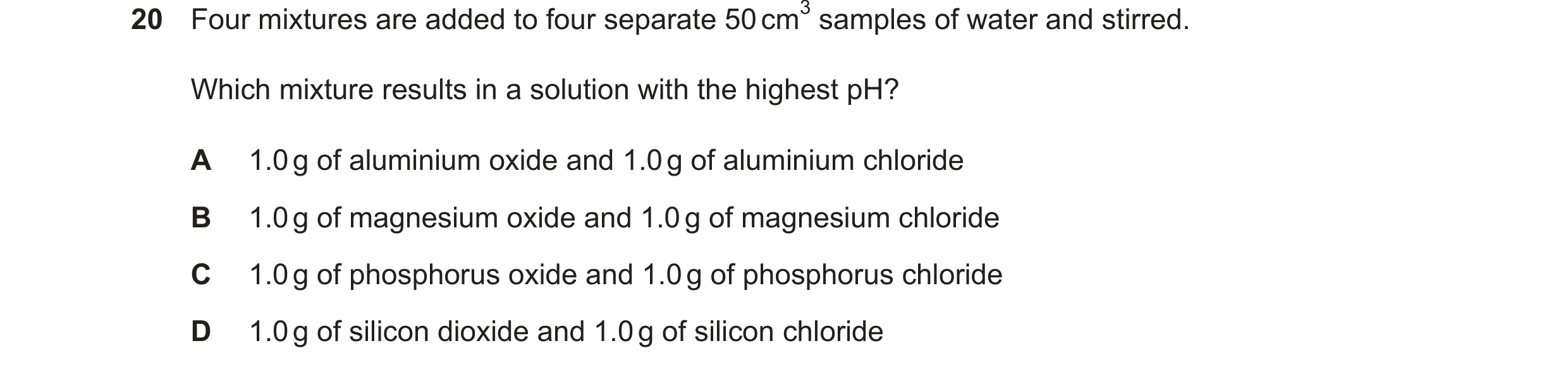
 30 / 40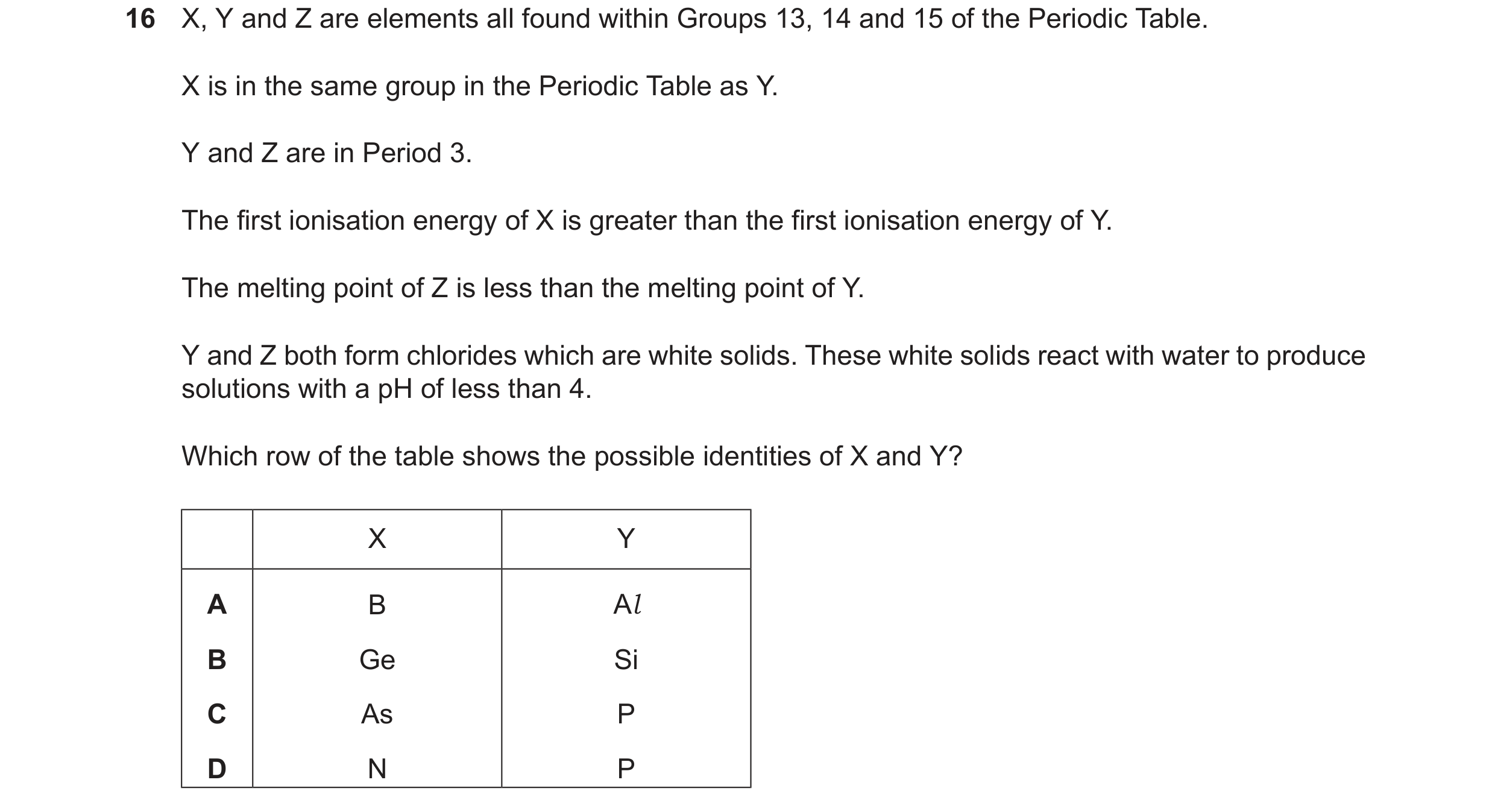
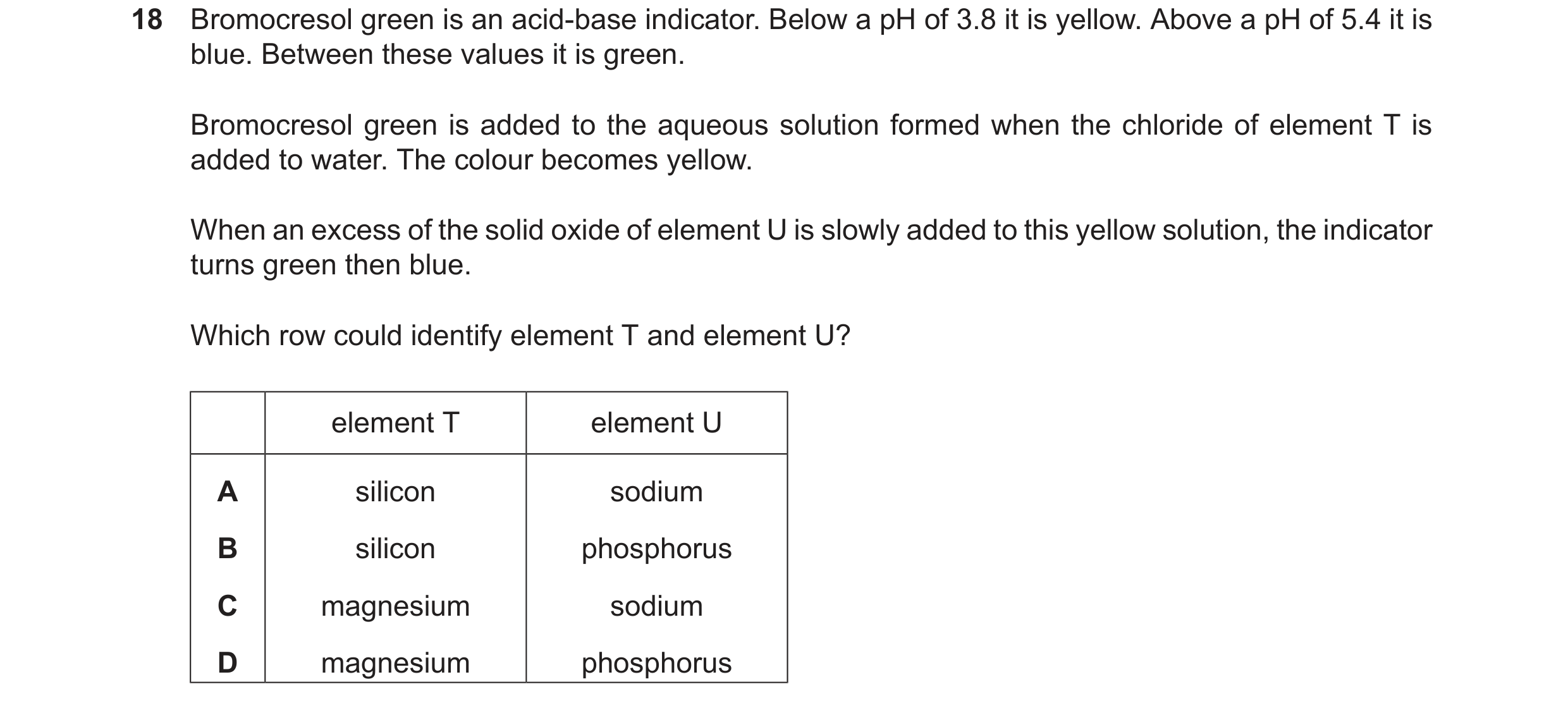 31 / 40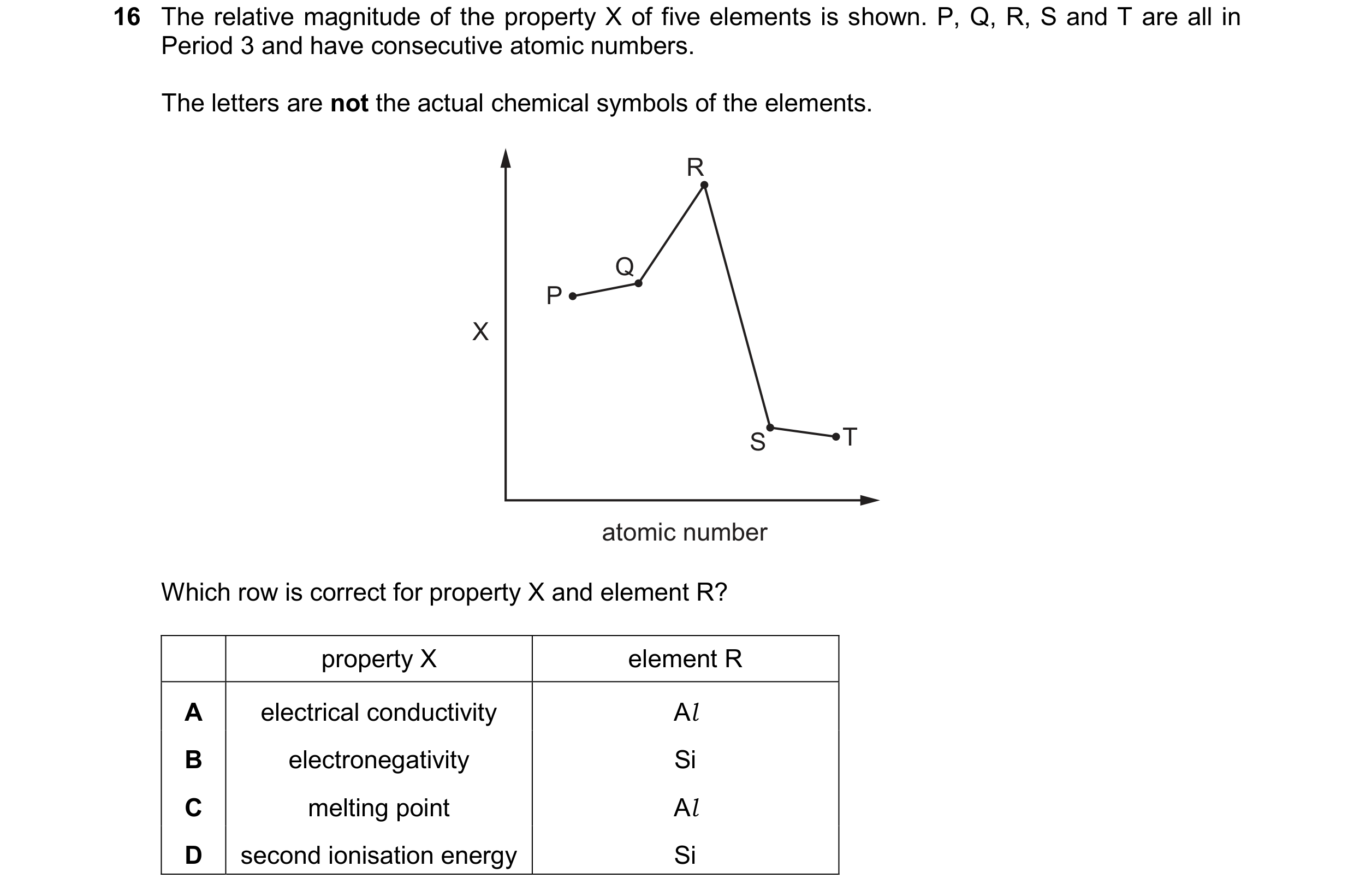
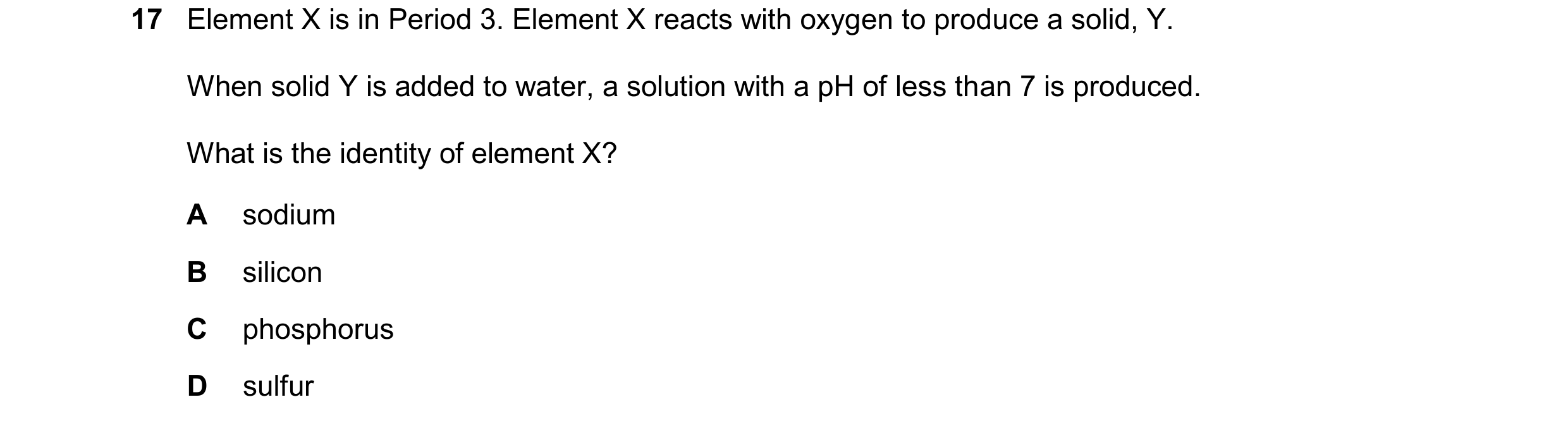
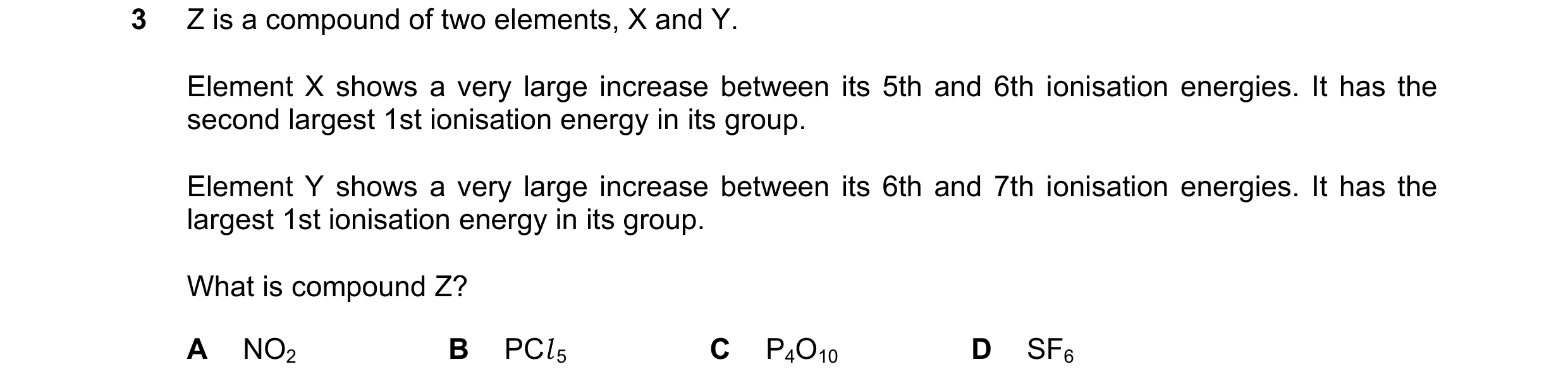 32 / 40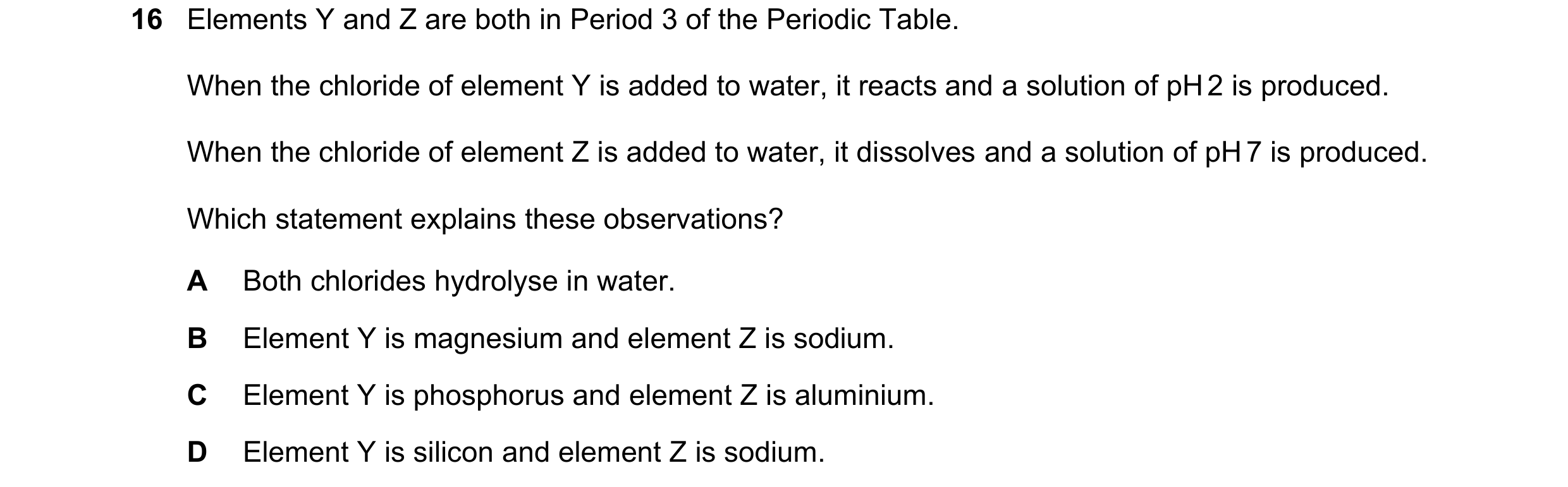
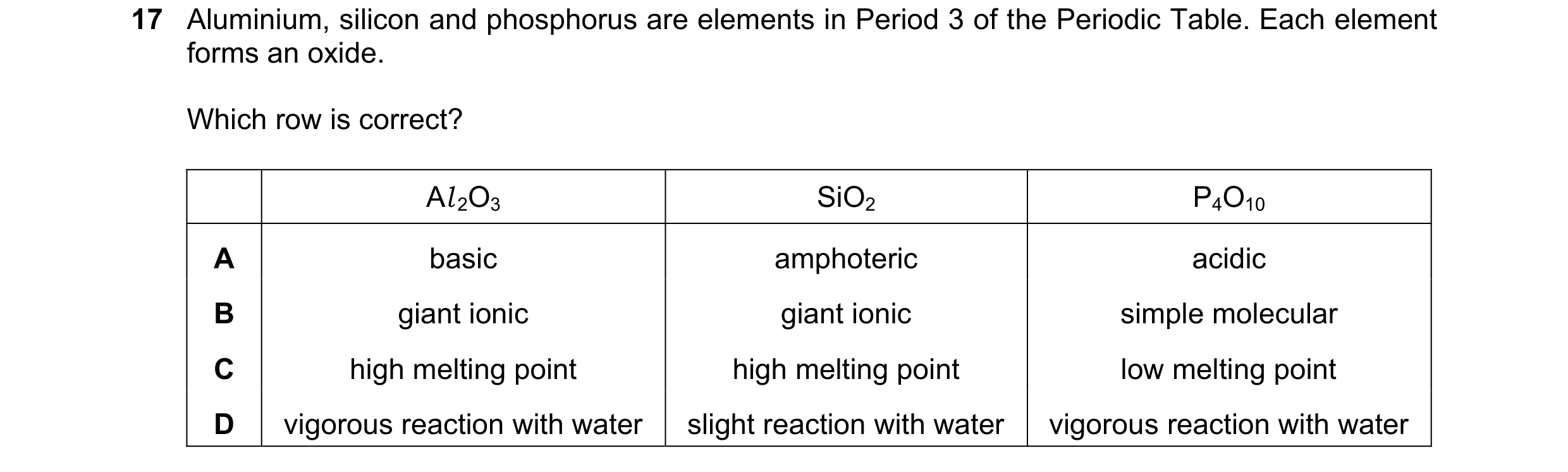

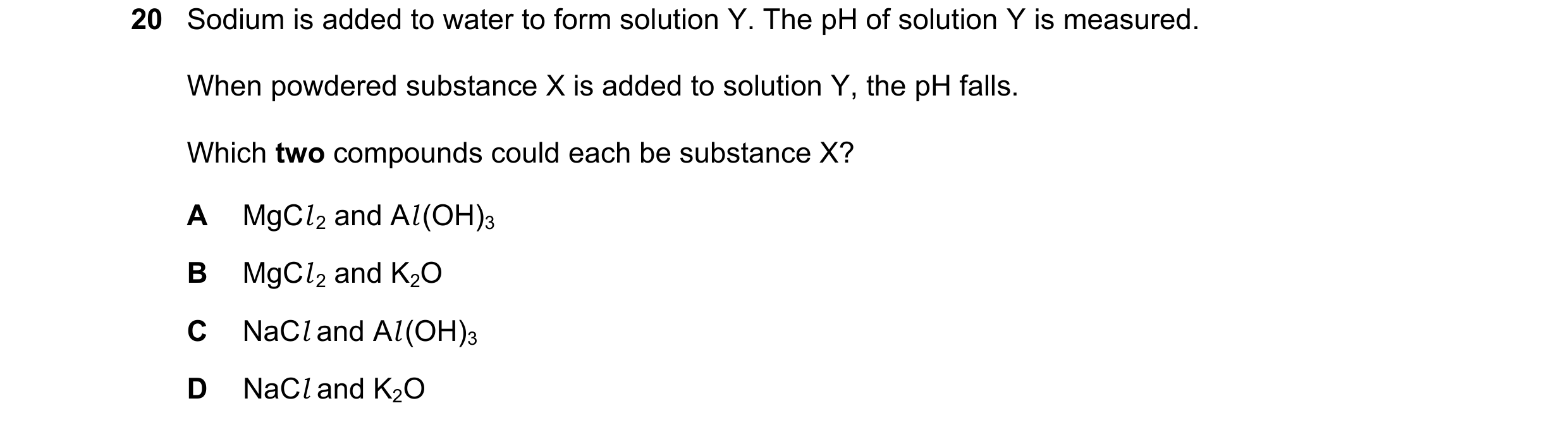
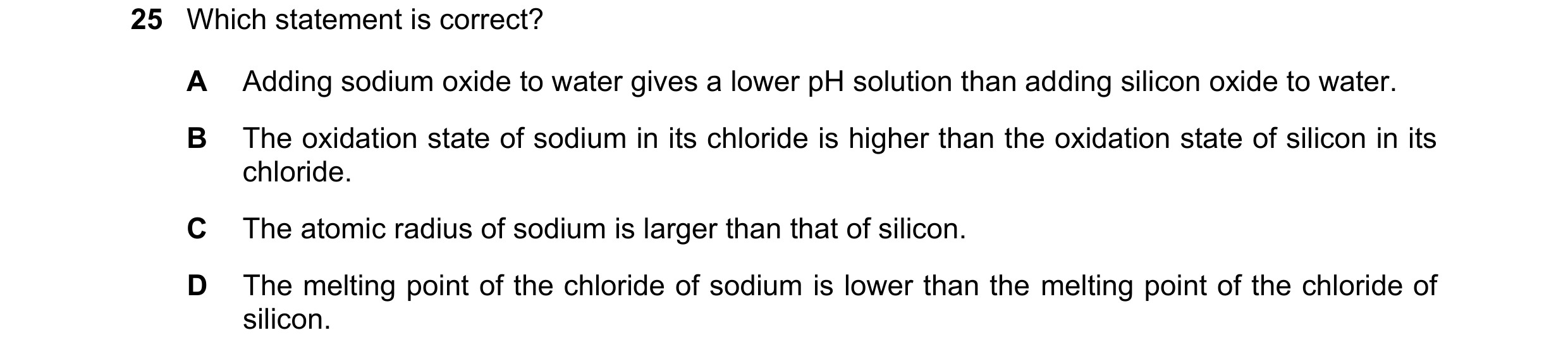 33 / 40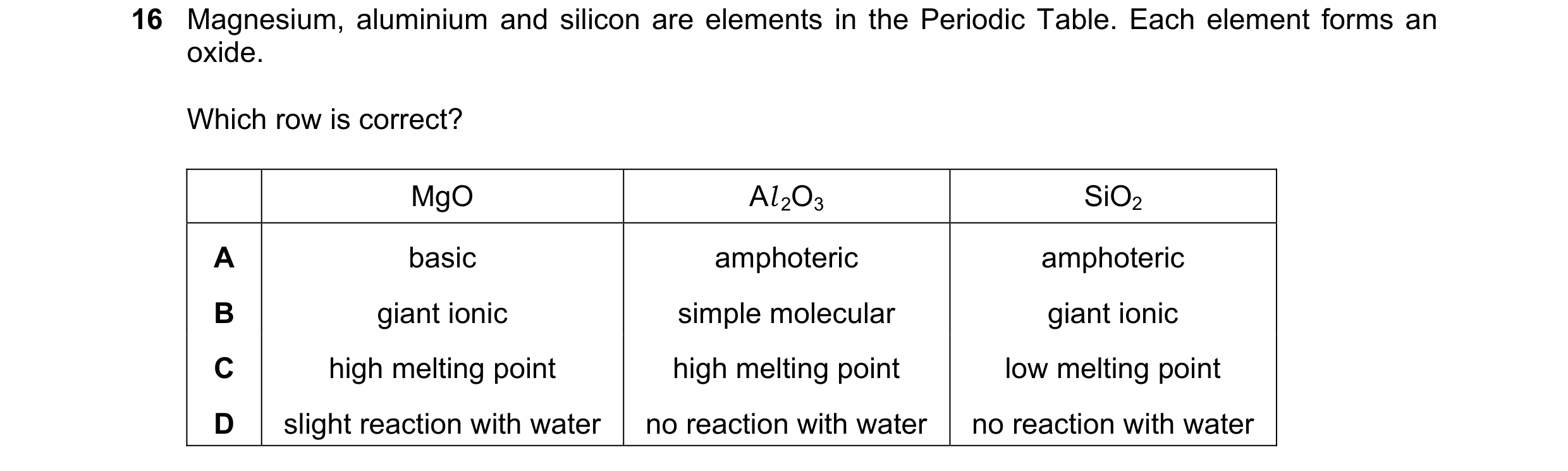


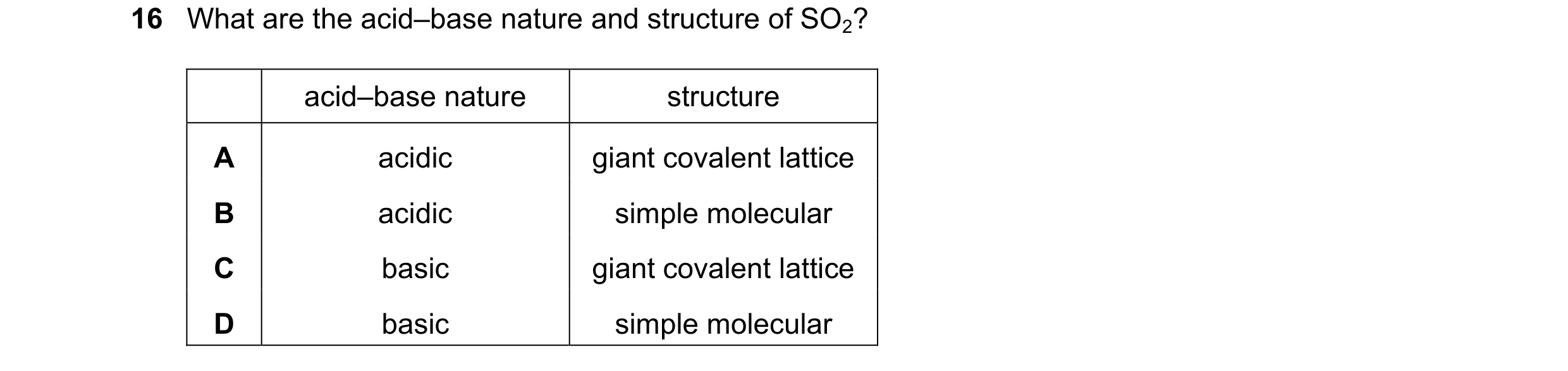 34 / 40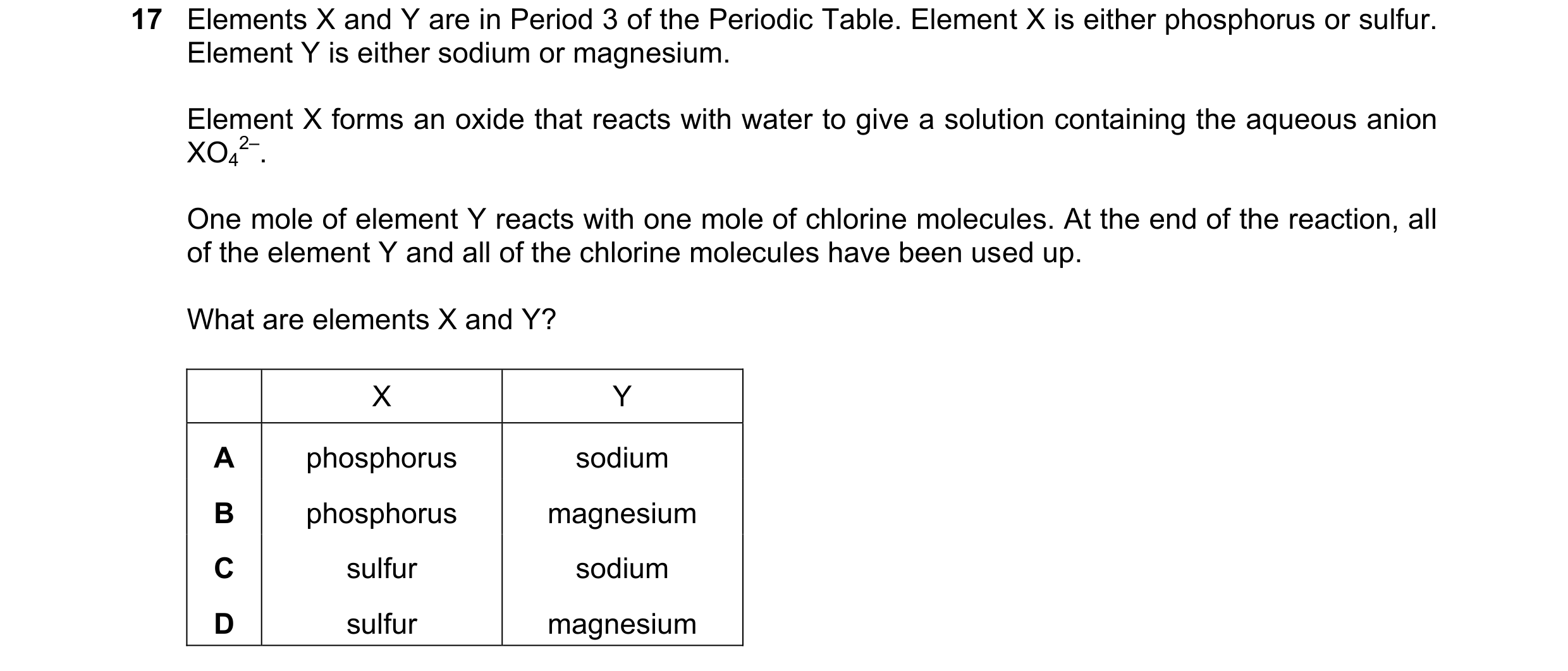
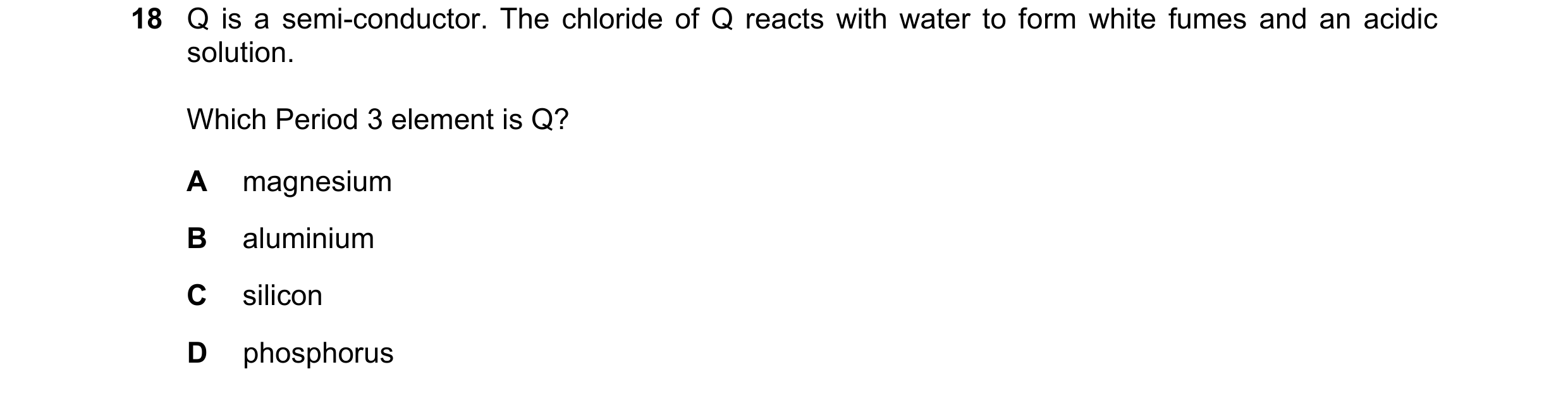

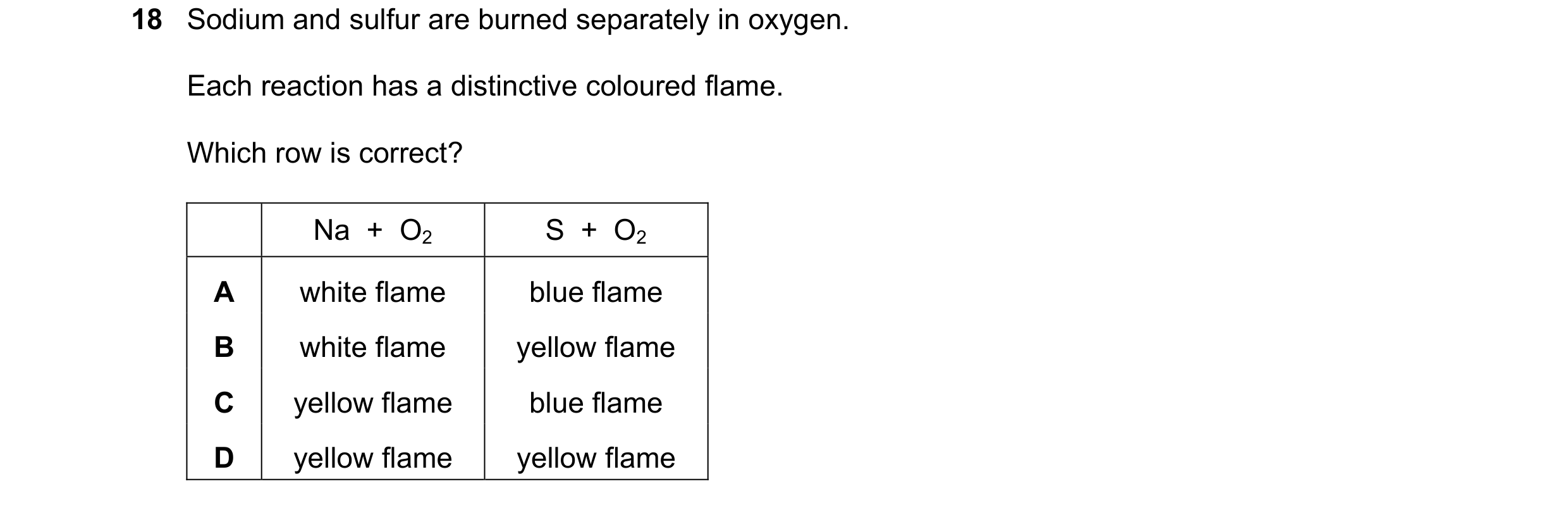
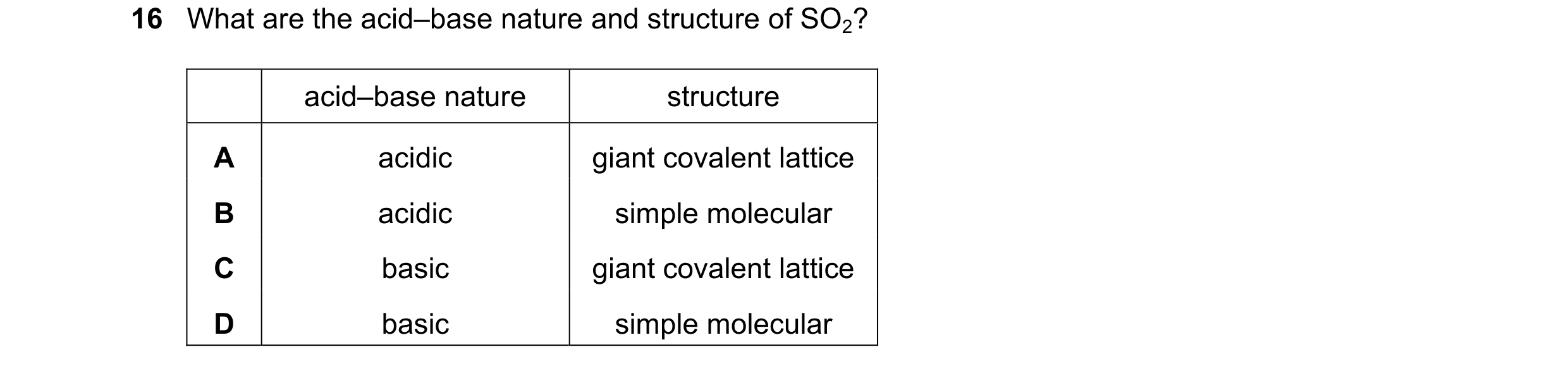 35 / 40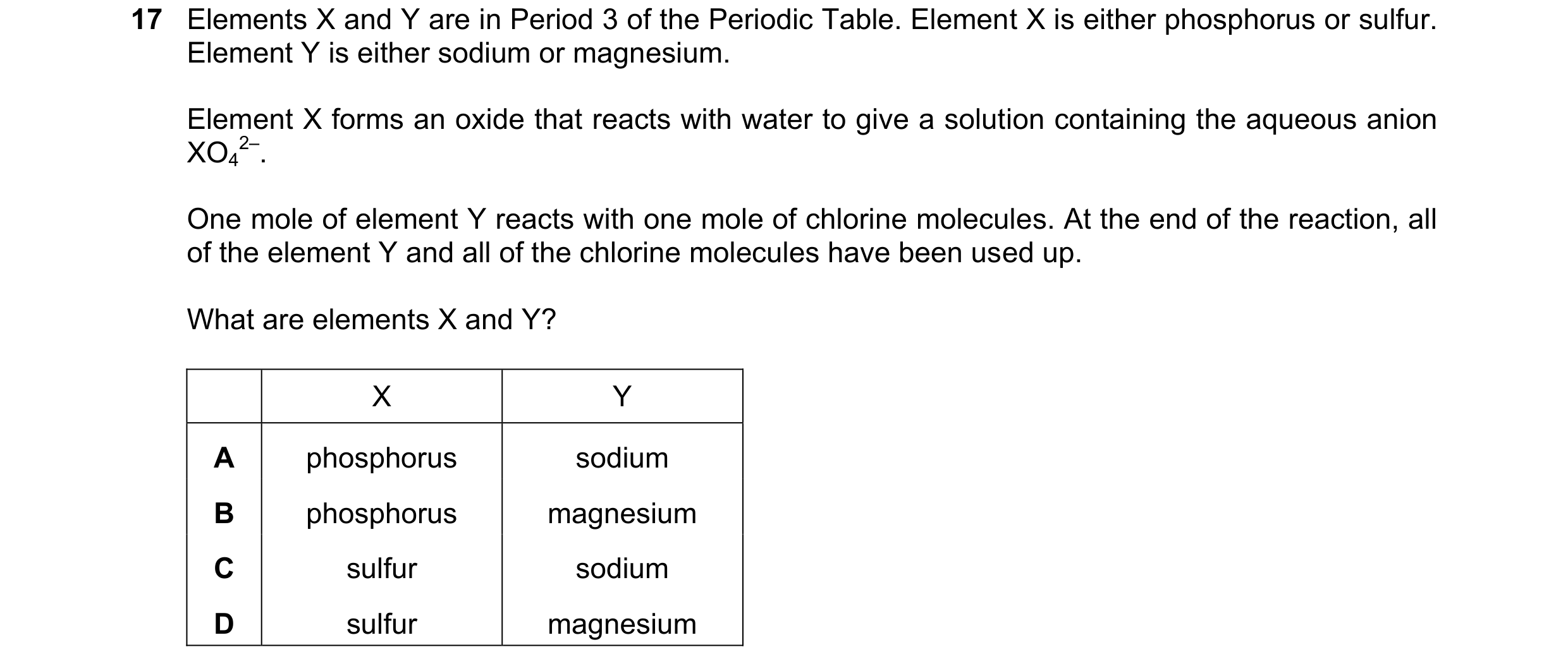
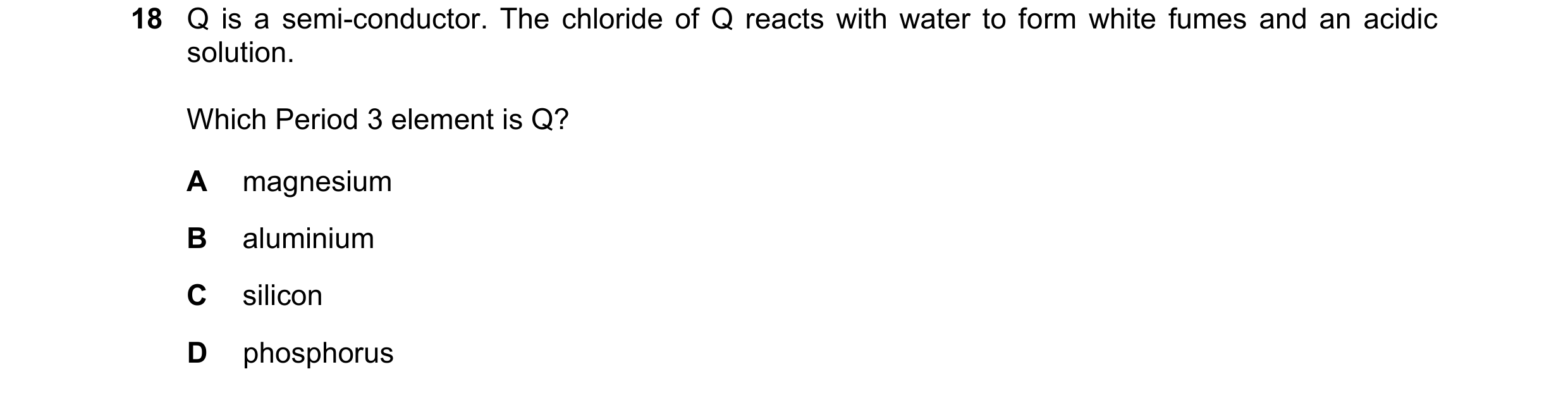
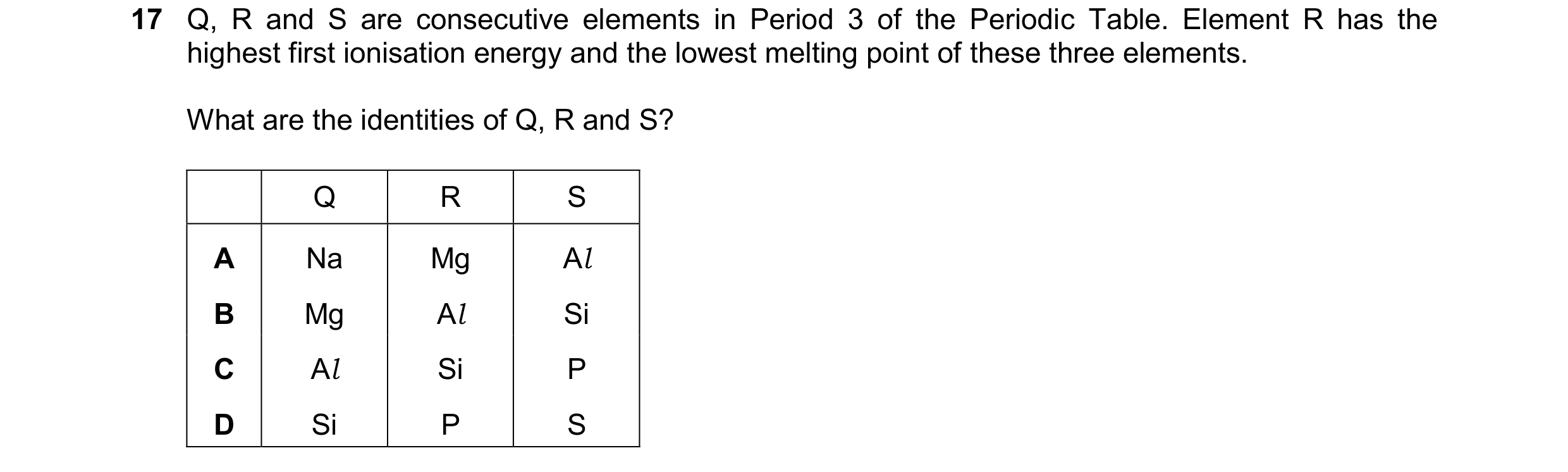 36 / 40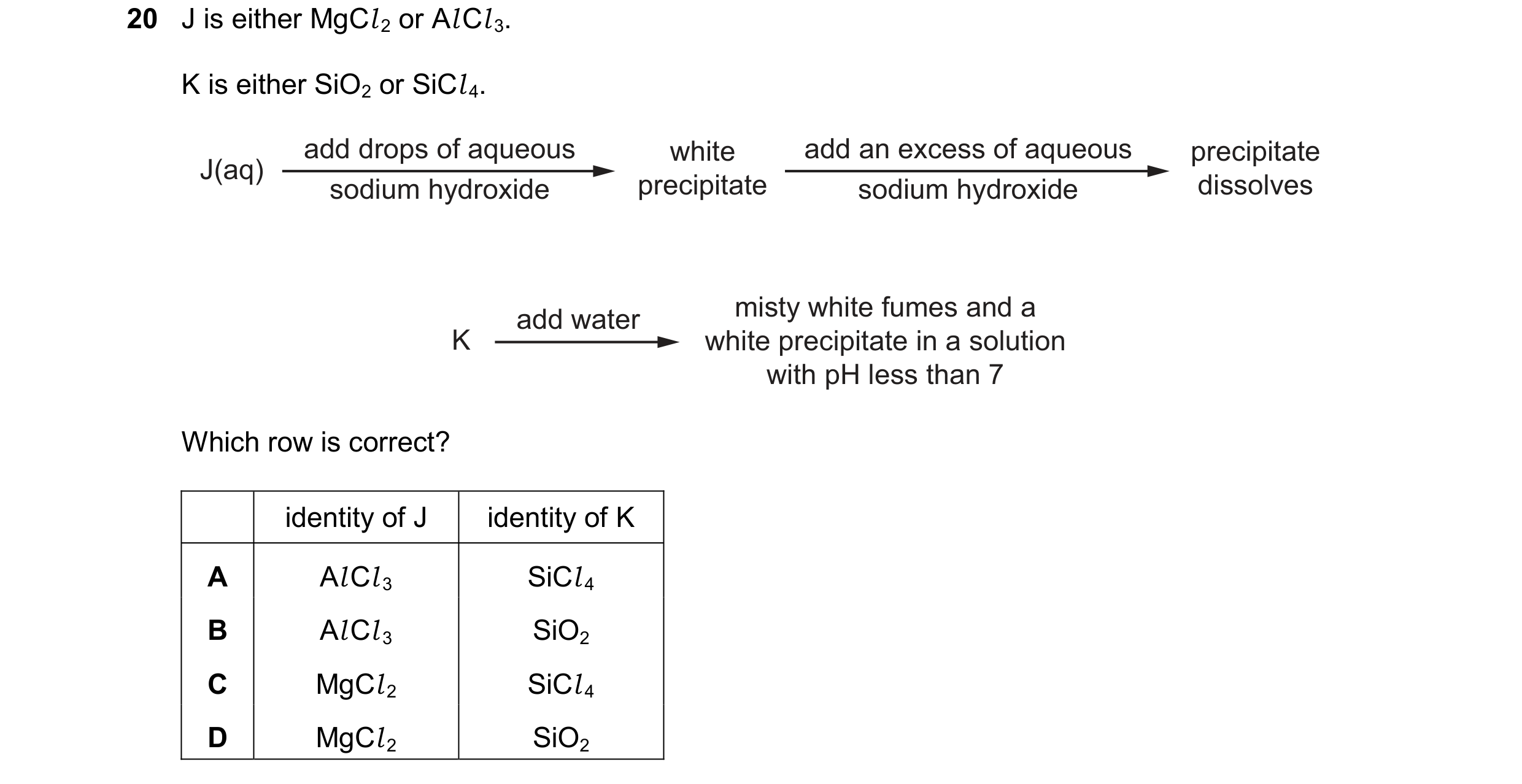
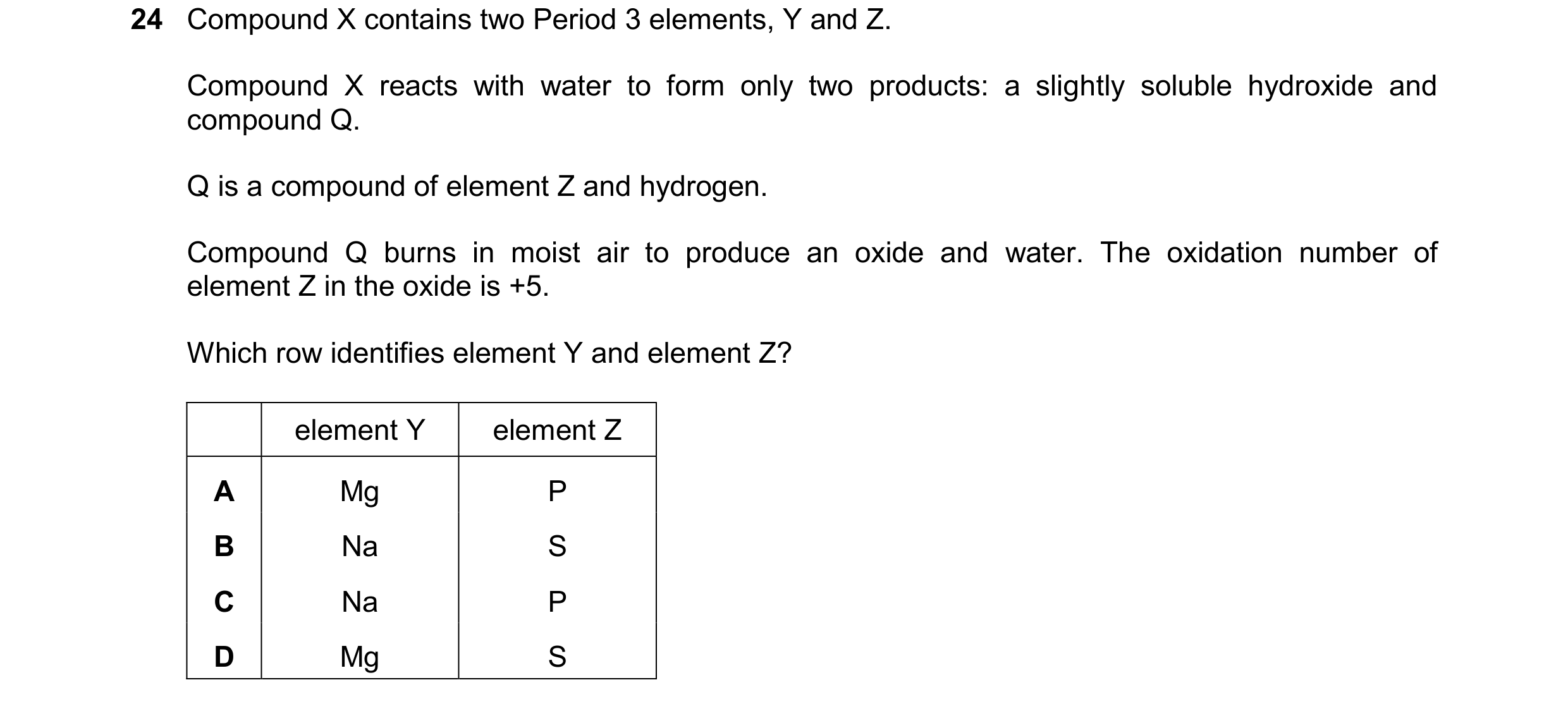

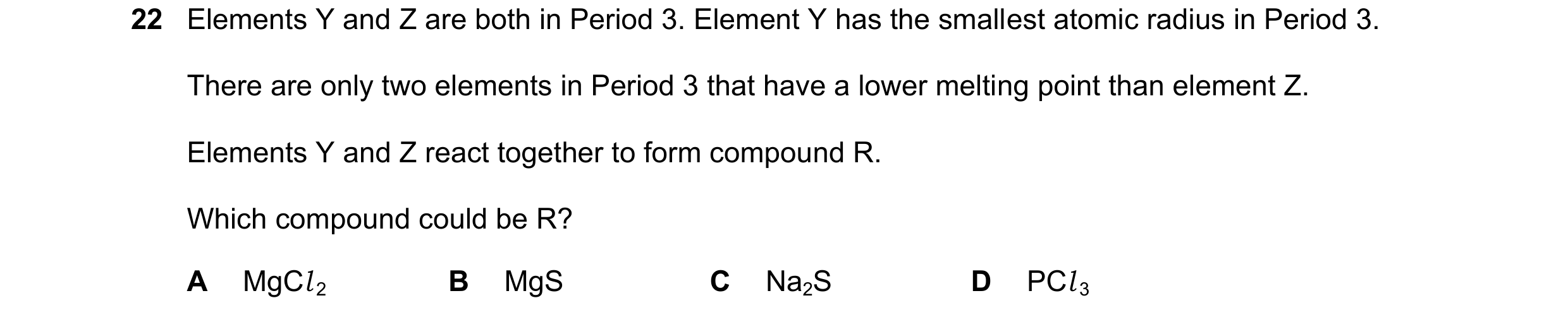 37 / 40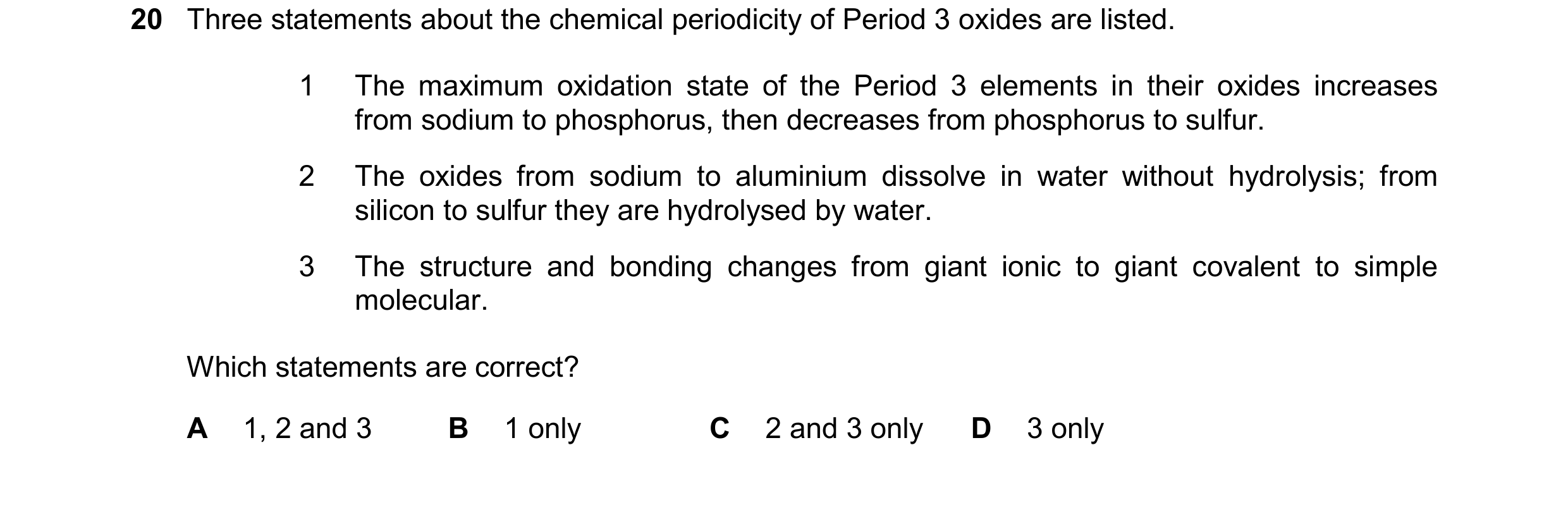
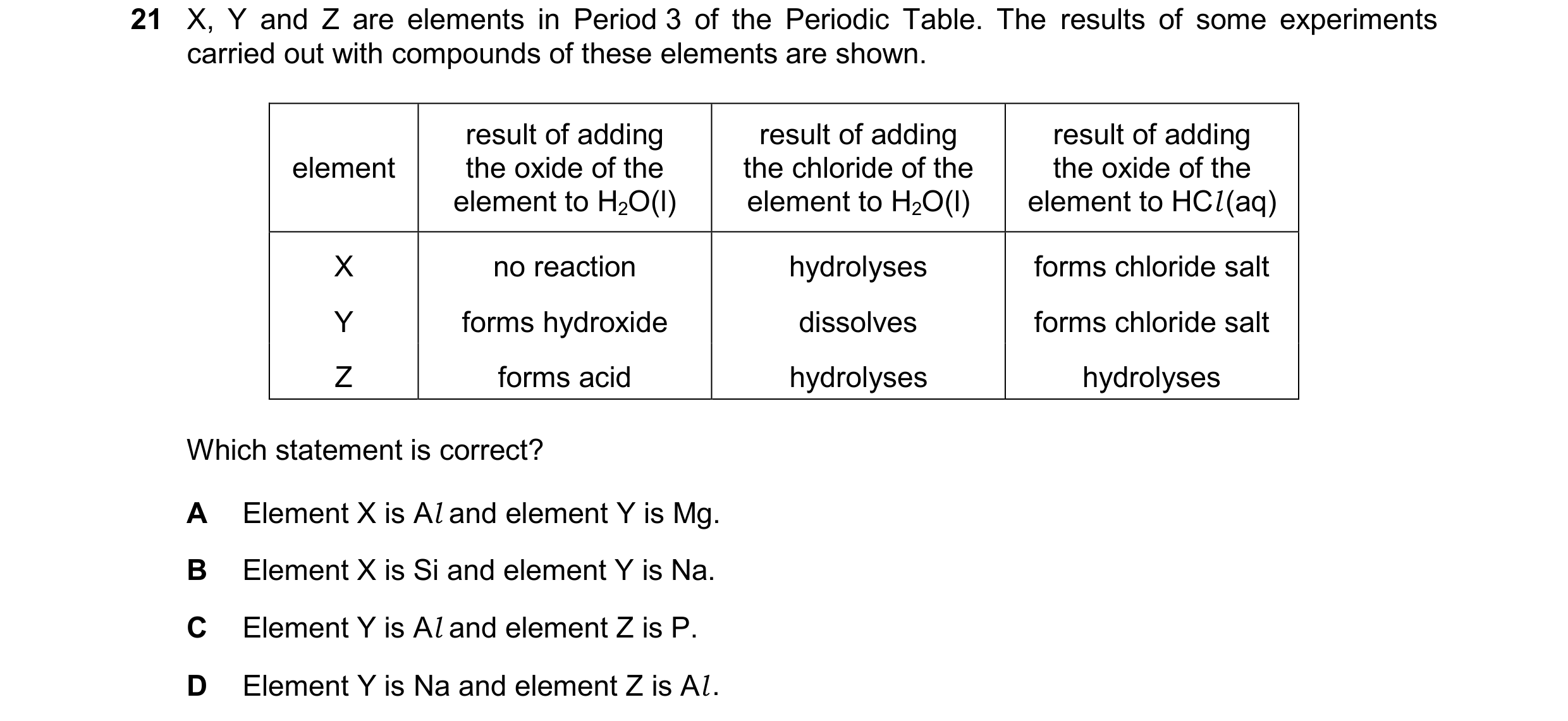
 38 / 40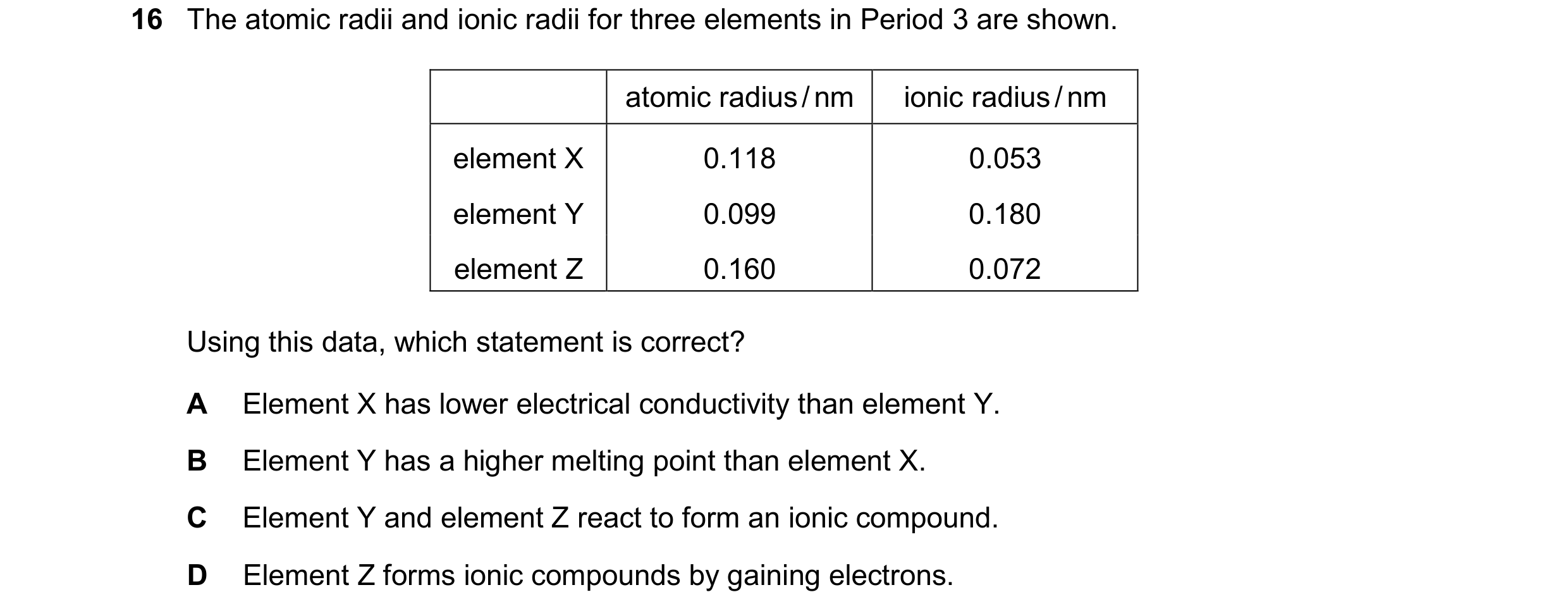
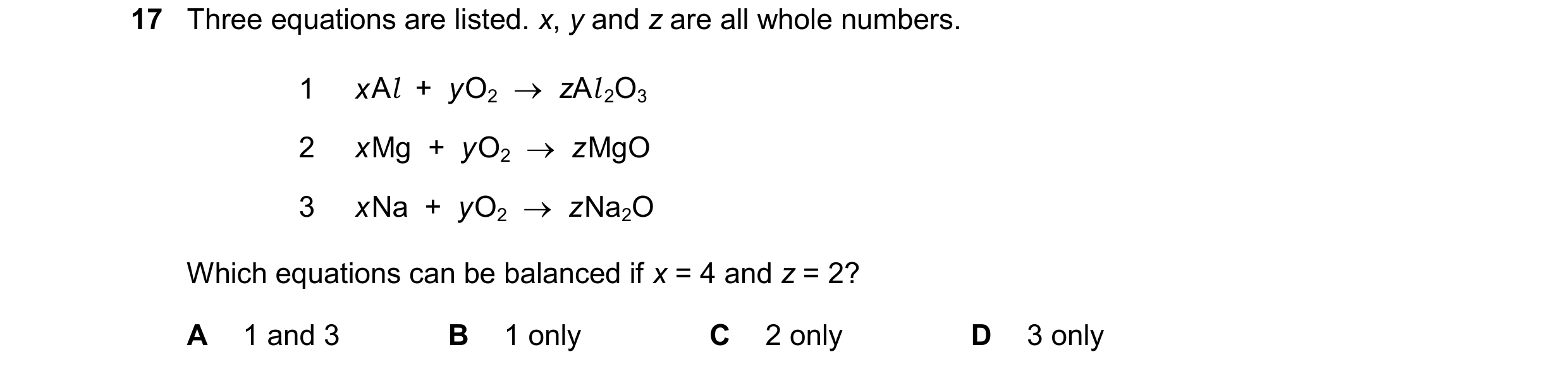
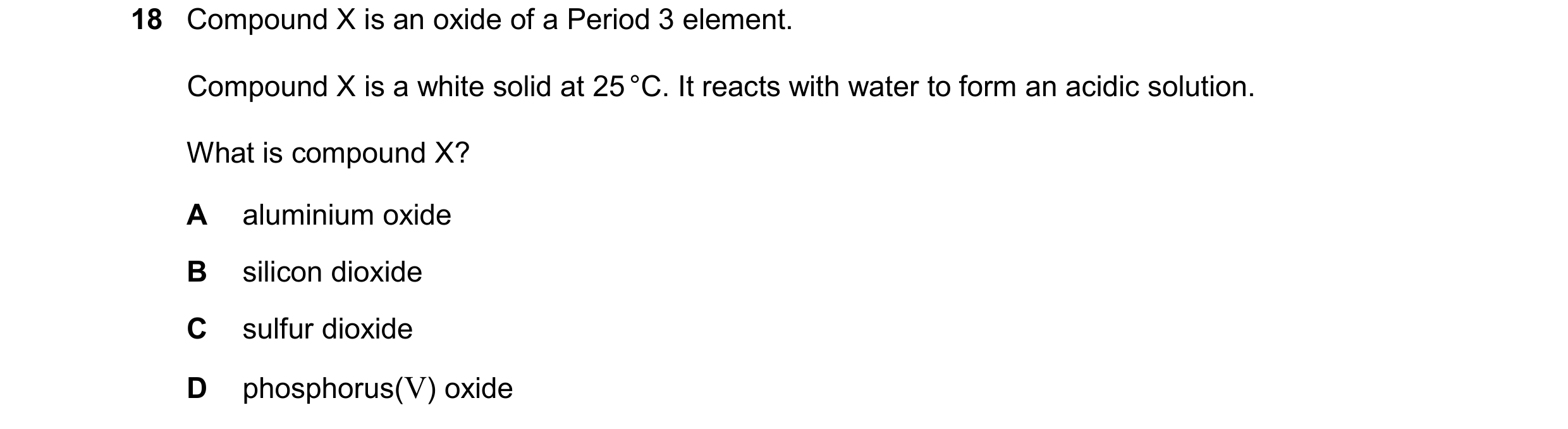
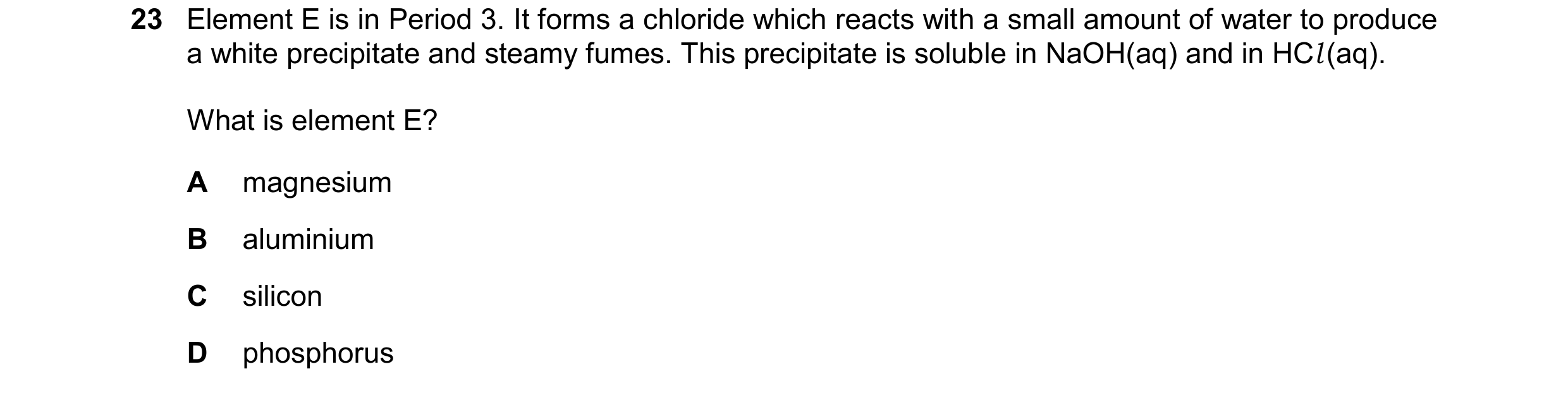 39 / 40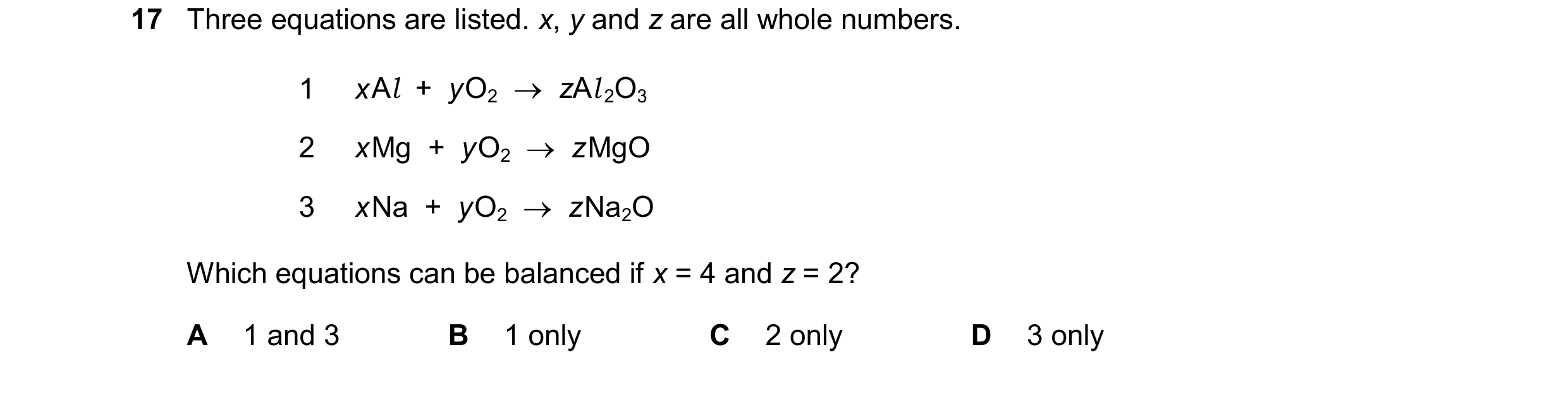
 40 / 40