Questions as text
Q1 · A partnership maintains both capital and current accounts for its partners 9706/11 May/June 2006
15 A partnership maintains both capital and current accounts for its partners. What is the correct accounting entry for recording interest on capital for partner X? account to be debited account to be credited A Profit and Loss Appropriation X’s Capital B Profit and Loss Appropriation X’s Current C X’s Capital Profit and Loss Appropriation D X’s Current Profit and Loss Appropriation
1 marks
Answer: B
This question in 9706/11 May/June 2006
Q2 · Dele and Iyabo are partners in a business and share profits in the ratio of 3:1 9706/11 May/June 2006
18 Dele and Iyabo are partners in a business and share profits in the ratio of 3:1. Their net profit is $80 000. The following information is available: Dele Iyabo $ $ interest on capitals 3 000 2 500 interest on drawings 500 1 000 How will the residual net profit be shared? Dele Iyabo $ $ A 57 000 19 000 B 58 875 21 125 C 59 500 20 500 D 60 500 19 500
1 marks
Answer: A
This question in 9706/11 May/June 2006
Q3 · A company has issued non-cumulative preference shares and ordinary shares 9706/11 Oct/Nov 2006
5 A company has issued non-cumulative preference shares and ordinary shares. Which statement is correct? A If no preference dividend is paid, it is carried forward to a future year. B Preference shareholders always get a dividend. C Preference shareholders and ordinary shareholders always get a dividend. D Preference shareholders may get a dividend.
1 marks
Answer: D
This question in 9706/11 Oct/Nov 2006
Q4 · Hilary and Lee commenced in partnership on 1 January 2005 9706/11 Oct/Nov 2006
17 Hilary and Lee commenced in partnership on 1 January 2005. There was no partnership agreement concerning the division of interest on the loan or of profits. Hilary Lee $ $ capital contributions 5000 600 loan to partnership – 1000 At the year end, 31 December 2005, net profit before the loan interest was $8850. What would be Hilary’s share of the profit? A $4400 B $4425 C $4800 D $4827
1 marks
Answer: A
This question in 9706/11 Oct/Nov 2006
Q5 · A director-owned company needs additional funds 9706/11 Oct/Nov 2006
19 A director-owned company needs additional funds. Which method of finance might lead to a reduction of the director’s control of the business? A bank loan B debenture C ordinary share issue D preference share issue
1 marks
Answer: C
This question in 9706/11 Oct/Nov 2006
Q6 · The following information is available for the partnership of Atul and Mansoor at 31… 9706/11 May/June 2007
14 The following information is available for the partnership of Atul and Mansoor at 31 December: $ net profit before appropriations 60 000 salary of Atul 9 000 drawings: Atul 12 000 Mansoor 13 000 interest on capital: Atul 400 Mansoor 500 Residual profits are shared between Atul and Mansoor in the ratio 2 : 1. What is Mansoor’s share of total profit for the year? A $16 200 B $17 000 C $17 100 D $17 200
1 marks
Answer: D
This question in 9706/11 May/June 2007
Q7 · A company makes a bonus issue of shares 9706/11 May/June 2007
18 A company makes a bonus issue of shares. What is the effect on the net assets and the reserves in the balance sheet? net assets reserves A increase decrease B increase unchanged C unchanged decrease D unchanged increase
1 marks
Answer: C
This question in 9706/11 May/June 2007
Q8 · What appears as a credit entry in the appropriation account of a partnership? 9706/11 May/June 2008
16 What appears as a credit entry in the appropriation account of a partnership? A goodwill B interest on capital C net trading profit D partnership salaries
1 marks
Answer: C
This question in 9706/11 May/June 2008
Q9 · A company’s capital is $ ordinary shares of $1.00 each 200 000 share premium account 80… 9706/11 May/June 2008
19 A company’s capital is $ ordinary shares of $1.00 each 200 000 share premium account 80 000 revenue reserves 160 000 Changes now to be made (in the order given) • A one for one bonus issue • A rights issue of 100 000 ordinary shares of $1.00 each at $1.40 per share The company wishes to maximise the amounts available to pay dividends. What will be the ordinary capital and reserves of the company? ordinary share capital share premium revenue reserves $ $ $ A 500 000 40 000 40 000 B 500 000 80 000 nil C 540 000 nil 40 000 D 540 000 40 000 40 000
1 marks
Answer: A
This question in 9706/11 May/June 2008
Q10 · The table shows how a property appears in the balance sheet 9706/11 Oct/Nov 2008
5 The table shows how a property appears in the balance sheet. $ land and buildings 100 000 accumulated depreciation (40 000) net book value 60 000 The land and buildings are revalued to $150 000. What is the journal entry to record the revaluation? Dr Cr $ $ A land and buildings 50 000 profit and loss account 50 000 B land and buildings 50 000 accumulated depreciation 40 000 revaluation reserve 90 000 C land and buildings 50 000 revaluation reserve 50 000 D land and buildings 90 000 revaluation reserve 90 000
1 marks
Answer: B
This question in 9706/11 Oct/Nov 2008
Q11 · When a businessman introduces capital into his business, the transaction is debited in… 9706/11 Oct/Nov 2008
7 When a businessman introduces capital into his business, the transaction is debited in the cash book and credited to his capital account. Of which accounting principle is this an example? A entity B going concern C matching D prudence
1 marks
Answer: A
This question in 9706/11 Oct/Nov 2008
Q12 · How can net profit be calculated? 9706/11 Oct/Nov 2008
11 How can net profit be calculated? A Closing Capital + Drawings – Additional Capital – Opening Capital B Closing Capital – Drawings + Additional Capital – Opening Capital C Opening Capital + Drawings – Additional Capital – Closing Capital D Opening Capital – Drawings – Additional Capital – Closing Capital
1 marks
Answer: A
This question in 9706/11 Oct/Nov 2008
Q13 · Which transaction would appear in both the receipts and payments account and the income… 9706/11 Oct/Nov 2008
14 Which transaction would appear in both the receipts and payments account and the income and expenditure account of a cricket club? A the club bank balance B the depreciation of the club pavilion C the purchase of a motorised lawn mower D the rent of the cricket ground
1 marks
Answer: D
This question in 9706/11 Oct/Nov 2008
Q14 · Information about the final accounts of a partnership is given 9706/11 Oct/Nov 2008
18 Information about the final accounts of a partnership is given. $ net profit before interest 160 000 interest on bank loan 14 000 interest credited to capital accounts 15 000 drawings 70 000 partnership salaries 24 000 What is the remaining balance of profits to be appropriated amongst the partners? A $66 000 B $107 000 C $121 000 D $137 000
1 marks
Answer: B
This question in 9706/11 Oct/Nov 2008
Q15 · What is the effect on a company’s balance sheet of issuing bonus shares? 9706/11 Oct/Nov 2008
19 What is the effect on a company’s balance sheet of issuing bonus shares? A the bank balance will be increased B the long term liabilities will be increased C the reserves will be reduced D the share capital will be reduced
1 marks
Answer: C
This question in 9706/11 Oct/Nov 2008
Q16 · A company, with an existing issued share capital of 200 000 ordinary shares of $0.50… 9706/11 Oct/Nov 2008
20 A company, with an existing issued share capital of 200 000 ordinary shares of $0.50 each, made a one for four bonus issue. This was later followed by a one for two rights issue at $1.20 per share. What will be the balance on the share capital account after these transactions? A $125 000 B $187 500 C $270 000 D $375 000
1 marks
Answer: B
This question in 9706/11 Oct/Nov 2008
Q17 · A business sells some of its stock for $500 on credit to a customer 9706/11 May/June 2009
11 A business sells some of its stock for $500 on credit to a customer. The stock originally cost $600. What is the effect of this transaction on the balance sheet? current assets owner’s capital A decrease by $100 decrease by $100 B decrease by $100 increase by $100 C increase by $100 decrease by $100 D increase by $100 increase by $100
1 marks
Answer: A
This question in 9706/11 May/June 2009
Q18 · X and Y are partners in a business 9706/11 May/June 2009
15 X and Y are partners in a business. X receives an annual salary of $5000 from the partnership and the balance of profits and losses is shared between X and Y in the ratio of 3 : 2 respectively. In the last financial year, the net profit was $30 000. How much was credited to each partner for the year? X Y $ $ A 10 000 15 000 B 12 000 18 000 C 20 000 10 000 D 21 000 14 000
1 marks
Answer: C
This question in 9706/11 May/June 2009
Q19 · A shareholder sells some ordinary shares for more than he paid for them 9706/11 May/June 2009
20 A shareholder sells some ordinary shares for more than he paid for them. What is the effect on the company balance sheet? ordinary share capital share premium account A decrease decrease B decrease increase C no effect decrease D no effect no effect
1 marks
Answer: D
This question in 9706/11 May/June 2009
Q20 · At the beginning of the year a company has authorised share capital of 800 000 ordinary… 9706/11 May/June 2009
21 At the beginning of the year a company has authorised share capital of 800 000 ordinary shares of $0.25 each and an issued share capital of 400 000 ordinary shares of $0.25. During the year the company makes a further issue of 200 000 ordinary shares at a price of $0.60. What is the balance on the share capital account at the end of the year? A $150 000 B $220 000 C $250 000 D $350 000
1 marks
Answer: A
This question in 9706/11 May/June 2009
Q21 · A business is separate from its owner 9706/11 Oct/Nov 2009
5 A business is separate from its owner. This results in only business transactions being recorded in the accounts. Which accounting principle applies? A business entity B materiality C money measurement D prudence
1 marks
Answer: A
This question in 9706/11 Oct/Nov 2009
Q22 · A new business was established with opening capital of $15 000 9706/11 Oct/Nov 2009
10 A new business was established with opening capital of $15 000. At the end of the year net assets were $20 000. During the year the proprietor’s drawings were $3000 and this resulted in an overdraft at the end of the year of $4000. What was the profit during the year? A $2000 B $4000 C $5000 D $8000
1 marks
Answer: D
This question in 9706/11 Oct/Nov 2009
Q23 · X and Y are in partnership 9706/11 Oct/Nov 2009
14 X and Y are in partnership. Their profit and loss appropriation account shows the following. X Y total $ $ $ interest on capital 1 600 1 800 3 400 interest charged on drawings 500 400 900 partners’ salaries 2 000 3 000 5 000 share of profit 8 000 12 000 20 000 What is the net profit before appropriations? A $17 500 B $22 500 C $27 500 D $29 300
1 marks
Answer: C
This question in 9706/11 Oct/Nov 2009
Q24 · A new business was established with opening capital of $15 000 9706/12 Oct/Nov 2009
9 A new business was established with opening capital of $15 000. At the end of the year net assets were $20 000. During the year the proprietor’s drawings were $3000 and this resulted in an overdraft at the end of the year of $4000. What was the profit during the year? A $2000 B $4000 C $5000 D $8000
1 marks
Answer: D
This question in 9706/12 Oct/Nov 2009
Q25 · The summarised balance sheets for a business for two years are as follows 9706/12 Oct/Nov 2009
12 The summarised balance sheets for a business for two years are as follows. year 1 year 2 $ $ fixed assets 9 000 12 000 current assets 6 000 8 000 less current liabilities (5 000) (6 000) net assets 10 000 14 000 The drawings in year 1 were $5000 and in year 2 $3000. What is the net profit for year 2? A $1000 B $4000 C $5000 D $7000
1 marks
Answer: D
This question in 9706/12 Oct/Nov 2009
Q26 · X and Y are in partnership 9706/12 Oct/Nov 2009
13 X and Y are in partnership. Their profit and loss appropriation account shows the following. X Y total $ $ $ interest on capital 1 600 1 800 3 400 interest charged on drawings 500 400 900 partners’ salaries 2 000 3 000 5 000 share of profit 8 000 12 000 20 000 What is the net profit before appropriations? A $17 500 B $22 500 C $27 500 D $29 300
1 marks
Answer: C
This question in 9706/12 Oct/Nov 2009
Q27 · An extract from a company’s balance sheet is given 9706/12 Oct/Nov 2009
15 An extract from a company’s balance sheet is given. $000 issued ordinary share capital 250 issued preference shares 180 profit and loss account 320 share premium account 125 8 % debentures 100 What are the ordinary shareholders’ funds? A $695 000 B $775 000 C $875 000 D $975 000
1 marks
Answer: C
This question in 9706/12 Oct/Nov 2009
Q28 · An extract from a company’s balance sheet shows the following 9706/12 Oct/Nov 2009
16 An extract from a company’s balance sheet shows the following. $000 issued ordinary shares of $0.25 each 600 share premium account 150 retained profits 300 The company makes a rights issue of one new ordinary share for each three held, at a price of $0.30 per share. All shares were taken up. What does the new balance sheet show? issued ordinary share premium share capital $000 $000 A 600 120 B 800 150 C 800 190 D 800 600
1 marks
Answer: C
This question in 9706/12 Oct/Nov 2009
Q29 · A company’s Balance Sheet at 31 December 2008 includes: $ Ordinary shares of $1.00 12 000… 9706/12 Oct/Nov 2009
17 A company’s Balance Sheet at 31 December 2008 includes: $ Ordinary shares of $1.00 12 000 Profit and Loss Account 4000 In January 2009, the company made a bonus issue of one share for every four held. In June 2009, the company made a rights issue at $1.60 of one share for every two held. By how much did these transactions increase the company’s bank balance? A $9600 B $12 000 C $12 800 D $19 200
1 marks
Answer: C
This question in 9706/12 Oct/Nov 2009
Q30 · The table shows balances at the end of a year 9706/12 Oct/Nov 2009
30 The table shows balances at the end of a year. $ expenses prepaid 6 000 expenses accrued 4 000 bank overdraft 11 500 trade creditors 13 400 trade debtors 10 500 loan (2015) 20 000 What is the total of current liabilities? A $16 500 B $17 400 C $28 900 D $48 900
1 marks
Answer: C
This question in 9706/12 Oct/Nov 2009
Q31 · The personal spending of the owner of a business is not recognised as a business expense 9706/11 May/June 2010
5 The personal spending of the owner of a business is not recognised as a business expense. Which accounting principle is being applied? A business entity B consistency C money measurement D prudence
1 marks
Answer: A
This question in 9706/11 May/June 2010
Q32 · A business obtained a machine by means of a hire purchase agreement 9706/11 May/June 2010
6 A business obtained a machine by means of a hire purchase agreement. It showed the machine in its balance sheet at the cash price of $30 000 although only $10 000 has been repaid. Which accounting principle is involved? A accruals B materiality C prudence D substance over form
1 marks
Answer: D
This question in 9706/11 May/June 2010
Q33 · A firm has incomplete accounting records 9706/11 May/June 2010
13 A firm has incomplete accounting records. The following figures are known. $ capital at start of year 20 000 owner’s drawings 7 000 capital at end of year 30 000 How much profit has the firm made during the year? A $7000 B $17 000 C $27 000 D $30 000
1 marks
Answer: B
This question in 9706/11 May/June 2010
Q34 · X, Y and Z are in partnership sharing profits and losses in the ratio 5 : 2 : 3 9706/11 May/June 2010
16 X, Y and Z are in partnership sharing profits and losses in the ratio 5 : 2 : 3. Y is entitled to a salary of $18 000 per annum. Partners receive interest at 6 % per annum on their capital account balances at the start of the year. At the beginning of the year, capital account balances were: X $30 000 Y $22 000 Z $20 000 The net profit before salary and interest for the year is $140 000. What is Y’s share of the total profits? A $23 536 B $28 000 C $42 856 D $46 000
1 marks
Answer: C
This question in 9706/11 May/June 2010
Q35 · L and M are in partnership 9706/11 May/June 2010
17 L and M are in partnership. Which item should appear in the partnership appropriation account? A additional capital contributed by M B cash drawings of L and M during the year C salary due to L D salary paid to M’s wife
1 marks
Answer: C
This question in 9706/11 May/June 2010
Q36 · A company is set up with an authorised share capital of $3 million 9706/11 May/June 2010
18 A company is set up with an authorised share capital of $3 million. It plans to purchase immediately a factory for $1 million. Preliminary expenses will be $100 000 and the immediate requirement for working capital will be $800 000. It will also require new equipment costing $600 000 in 12 months time. What is the minimum amount the company needs to raise now? A $1 000 000 B $1 900 000 C $2 500 000 D $3 000 000
1 marks
Answer: B
This question in 9706/11 May/June 2010
Q37 · At 1 January 2009 the capital structure of a company was as follows 9706/11 May/June 2010
19 At 1 January 2009 the capital structure of a company was as follows. $ issued share capital 100 000 ordinary shares of $1 each 100 000 share premium account 30 000 On 1 April 2009 the company made a rights issue of 20 000 shares of $1 each for $36 000. On 1 June 2009 a bonus issue of one share for every six in issue was made. The share premium account was used for this purpose. What is the balance on the share premium account at 31 December 2009? A $26 000 B $34 000 C $46 000 D $56 000
1 marks
Answer: A
This question in 9706/11 May/June 2010
Q38 · When is a share premium account opened? 9706/11 May/June 2010
20 When is a share premium account opened? A when shares are issued at a price above nominal value B when shares are redeemed by the company at a premium C when shares are sold by a shareholder at a price above their nominal value D when the company issues bonus shares
1 marks
Answer: A
This question in 9706/11 May/June 2010
Q39 · The personal spending of the owner of a business is not recognised as a business expense 9706/12 May/June 2010
4 The personal spending of the owner of a business is not recognised as a business expense. Which accounting principle is being applied? A business entity B consistency C money measurement D prudence
1 marks
Answer: A
This question in 9706/12 May/June 2010
Q40 · X, Y and Z are in partnership sharing profits and losses in the ratio 5 : 2 : 3 9706/12 May/June 2010
15 X, Y and Z are in partnership sharing profits and losses in the ratio 5 : 2 : 3. Y is entitled to a salary of $18 000 per annum. Partners receive interest at 6 % per annum on their capital account balances at the start of the year. At the beginning of the year, capital account balances were: X $30 000 Y $22 000 Z $20 000 The net profit before salary and interest for the year is $140 000. What is Y’s share of the total profits? A $23 536 B $28 000 C $42 856 D $46 000
1 marks
Answer: C
This question in 9706/12 May/June 2010
Q41 · L and M are in partnership 9706/12 May/June 2010
16 L and M are in partnership. Which item should appear in the partnership appropriation account? A additional capital contributed by M B cash drawings of L and M during the year C salary due to L D salary paid to M’s wife
1 marks
Answer: C
This question in 9706/12 May/June 2010
Q42 · A company is set up with an authorised share capital of $3 million 9706/12 May/June 2010
17 A company is set up with an authorised share capital of $3 million. It plans to purchase immediately a factory for $1 million. Preliminary expenses will be $100 000 and the immediate requirement for working capital will be $800 000. It will also require new equipment costing $600 000 in 12 months time. What is the minimum amount the company needs to raise now? A $1 000 000 B $1 900 000 C $2 500 000 D $3 000 000
1 marks
Answer: B
This question in 9706/12 May/June 2010
Q43 · At 1 January 2009 the capital structure of a company was as follows 9706/12 May/June 2010
18 At 1 January 2009 the capital structure of a company was as follows. $ issued share capital 100 000 ordinary shares of $1 each 100 000 share premium account 30 000 On 1 April 2009 the company made a rights issue of 20 000 shares of $1 each for $36 000. On 1 June 2009 a bonus issue of one share for every six in issue was made. The share premium account was used for this purpose. What is the balance on the share premium account at 31 December 2009? A $26 000 B $34 000 C $46 000 D $56 000
1 marks
Answer: A
This question in 9706/12 May/June 2010
Q44 · When is a share premium account opened? 9706/12 May/June 2010
19 When is a share premium account opened? A when shares are issued at a price above nominal value B when shares are redeemed by the company at a premium C when shares are sold by a shareholder at a price above their nominal value D when the company issues bonus shares
1 marks
Answer: A
This question in 9706/12 May/June 2010
Q45 · X, Y and Z are in partnership sharing profits and losses in the ratio 5 : 2 : 3 9706/13 May/June 2010
14 X, Y and Z are in partnership sharing profits and losses in the ratio 5 : 2 : 3. Y is entitled to a salary of $18 000 per annum. Partners receive interest at 6 % per annum on their capital account balances at the start of the year. At the beginning of the year, capital account balances were: X $30 000 Y $22 000 Z $20 000 The net profit before salary and interest for the year is $140 000. What is Y’s share of the total profits? A $23 536 B $28 000 C $42 856 D $46 000
1 marks
Answer: C
This question in 9706/13 May/June 2010
Q46 · L and M are in partnership 9706/13 May/June 2010
15 L and M are in partnership. Which item should appear in the partnership appropriation account? A additional capital contributed by M B cash drawings of L and M during the year C salary due to L D salary paid to M’s wife
1 marks
Answer: C
This question in 9706/13 May/June 2010
Q47 · A company is set up with an authorised share capital of $3 million 9706/13 May/June 2010
16 A company is set up with an authorised share capital of $3 million. It plans to purchase immediately a factory for $1 million. Preliminary expenses will be $100 000 and the immediate requirement for working capital will be $800 000. It will also require new equipment costing $600 000 in 12 months time. What is the minimum amount the company needs to raise now? A $1 000 000 B $1 900 000 C $2 500 000 D $3 000 000
1 marks
Answer: B
This question in 9706/13 May/June 2010
Q48 · At 1 January 2009 the capital structure of a company was as follows 9706/13 May/June 2010
17 At 1 January 2009 the capital structure of a company was as follows. $ issued share capital 100 000 ordinary shares of $1 each 100 000 share premium account 30 000 On 1 April 2009 the company made a rights issue of 20 000 shares of $1 each for $36 000. On 1 June 2009 a bonus issue of one share for every six in issue was made. The share premium account was used for this purpose. What is the balance on the share premium account at 31 December 2009? A $26 000 B $34 000 C $46 000 D $56 000
1 marks
Answer: A
This question in 9706/13 May/June 2010
Q49 · When is a share premium account opened? 9706/13 May/June 2010
18 When is a share premium account opened? A when shares are issued at a price above nominal value B when shares are redeemed by the company at a premium C when shares are sold by a shareholder at a price above their nominal value D when the company issues bonus shares
1 marks
Answer: A
This question in 9706/13 May/June 2010
Q50 · Information relating to a club’s subscription is: $ received during the year 20 000 paid… 9706/11 Oct/Nov 2010
12 Information relating to a club’s subscription is: $ received during the year 20 000 paid in advance in the previous year 2 000 paid in advance during the current year 1 000 There were no subscriptions in arrears at the start or end of the year. Individual subscriptions have remained constant at $500 per annum for the last two years. How many members does the club have? A 38 B 40 C 42 D 44
1 marks
Answer: C
This question in 9706/11 Oct/Nov 2010
Q51 · X and Y are in partnership, sharing residual profits and losses equally after the… 9706/11 Oct/Nov 2010
13 X and Y are in partnership, sharing residual profits and losses equally after the payments below are made. 1 2 % interest is charged on partners’ drawings 2 salary to Y of $10 000 The partners’ drawings for the year were: X $12 000 Y $8000 The net profit for the current year is $52 000. How much will each partner receive in share of residual profits? A $10 800 B $11 200 C $20 800 D $21 200
1 marks
Answer: D
This question in 9706/11 Oct/Nov 2010
Q52 · X started a business 3 years ago and now has a capital of $175 000 9706/11 Oct/Nov 2010
16 X started a business 3 years ago and now has a capital of $175 000. Over that period his profits have been $73 000 and his drawings $52 000. In year 2 he introduced cash of $35 000 and in year 3 he took out of the business, for his own use, a non current (fixed) asset with a net book value of $4000. How much capital did he start the business with? A $67 000 B $115 000 C $123 000 D $158 000
1 marks
Answer: C
This question in 9706/11 Oct/Nov 2010
Q53 · What does the application of the accounting principle of consistency ensure? 9706/12 Oct/Nov 2010
4 What does the application of the accounting principle of consistency ensure? A that all losses are provided for B that assets are recorded at their actual cost C that financial statements are produced annually D that profits are calculated the same way each year
1 marks
Answer: D
This question in 9706/12 Oct/Nov 2010
Q54 · X and Y are in partnership, sharing residual profits and losses equally after the… 9706/12 Oct/Nov 2010
13 X and Y are in partnership, sharing residual profits and losses equally after the payments below are made. 1 2 % interest is charged on partners’ drawings 2 salary to Y of $10 000 The partners’ drawings for the year were: X $12 000 Y $8000 The net profit for the current year is $52 000. How much will each partner receive in share of residual profits? A $10 800 B $11 200 C $20 800 D $21 200
1 marks
Answer: D
This question in 9706/12 Oct/Nov 2010
Q55 · X started a business 3 years ago and now has a capital of $175 000 9706/12 Oct/Nov 2010
16 X started a business 3 years ago and now has a capital of $175 000. Over that period his profits have been $73 000 and his drawings $52 000. In year 2 he introduced cash of $35 000 and in year 3 he took out of the business, for his own use, a non current (fixed) asset with a net book value of $4000. How much capital did he start the business with? A $67 000 B $115 000 C $123 000 D $158 000
1 marks
Answer: C
This question in 9706/12 Oct/Nov 2010
Q56 · X and Y are in partnership, sharing residual profits and losses equally after the… 9706/13 Oct/Nov 2010
12 X and Y are in partnership, sharing residual profits and losses equally after the payments below are made. 1 2 % interest is charged on partners’ drawings 2 salary to Y of $10 000 The partners’ drawings for the year were: X $12 000 Y $8000 The net profit for the current year is $52 000. How much will each partner receive in share of residual profits? A $10 800 B $11 200 C $20 800 D $21 200
1 marks
Answer: D
This question in 9706/13 Oct/Nov 2010
Q57 · The following summarised information has been taken from the balance sheet of a… 9706/11 May/June 2011
4 The following summarised information has been taken from the balance sheet of a partnership. $ non-current assets 42 000 capital accounts 36 000 current accounts (debit) 5 000 current liabilities 7 000 non-current liabilities 15 000 What is the amount of current assets? A $6000 B $11 000 C $17 000 D $21 000
1 marks
Answer: B
This question in 9706/11 May/June 2011
Q58 · A partnership provides the following financial information for the year ended 30 June 2011 9706/11 May/June 2011
11 A partnership provides the following financial information for the year ended 30 June 2011. $000 profit from operations 240 bank interest payable 21 interest credited to current accounts 15 drawings 100 partnership salaries 95 What is the residual balance of profits to be appropriated between the partners? A $9000 B $104 000 C $109 000 D $204 000
1 marks
Answer: C
This question in 9706/11 May/June 2011
Q59 · A new business was established with opening capital of $20 000 9706/11 May/June 2011
12 A new business was established with opening capital of $20 000. At the end of the first year, assets less liabilities were $26 000. The owner withdrew $7000 as drawings during the year and this resulted in a bank overdraft of $5000 at the end of the year. What was the profit during the first year? A $8000 B $12 000 C $13 000 D $18 000
1 marks
Answer: C
This question in 9706/11 May/June 2011
Q60 · The following summarised information has been taken from the balance sheet of a… 9706/12 May/June 2011
13 The following summarised information has been taken from the balance sheet of a partnership. $ non-current assets 42 000 capital accounts 36 000 current accounts (debit) 5 000 current liabilities 7 000 non-current liabilities 15 000 What is the amount of current assets? A $6000 B $11 000 C $17 000 D $21 000
1 marks
Answer: B
This question in 9706/12 May/June 2011
Q61 · A partnership provides the following financial information for the year ended 30 June 2011 9706/12 May/June 2011
16 A partnership provides the following financial information for the year ended 30 June 2011. $000 profit from operations 240 bank interest payable 21 interest credited to current accounts 15 drawings 100 partnership salaries 95 What is the residual balance of profits to be appropriated between the partners? A $9000 B $104 000 C $109 000 D $204 000
1 marks
Answer: C
This question in 9706/12 May/June 2011
Q62 · The following summarised information has been taken from the balance sheet of a… 9706/13 May/June 2011
5 The following summarised information has been taken from the balance sheet of a partnership. $ non-current assets 42 000 capital accounts 36 000 current accounts (debit) 5 000 current liabilities 7 000 non-current liabilities 15 000 What is the amount of current assets? A $6000 B $11 000 C $17 000 D $21 000
1 marks
Answer: B
This question in 9706/13 May/June 2011
Q63 · A new business was established with opening capital of $20 000 9706/13 May/June 2011
13 A new business was established with opening capital of $20 000. At the end of the first year, assets less liabilities were $26 000. The owner withdrew $7000 as drawings during the year and this resulted in a bank overdraft of $5000 at the end of the year. What was the profit during the first year? A $8000 B $12 000 C $13 000 D $18 000
1 marks
Answer: C
This question in 9706/13 May/June 2011
Q64 · X, Y and Z are in partnership, sharing profits in the ratio 2 : 2 : 1 9706/11 Oct/Nov 2011
11 X, Y and Z are in partnership, sharing profits in the ratio 2 : 2 : 1. X is allowed an annual salary of $10 000. Y has made a loan to the partnership on which the partnership pays interest of $5000 each year. Profit for the year before appropriations is $150 000. What is Z’s total appropriation of profit for the year? A $27 000 B $28 000 C $29 000 D $30 000
1 marks
Answer: B
This question in 9706/11 Oct/Nov 2011
Q65 · What should companies not show as non-current assets in their balance sheets? 9706/12 Oct/Nov 2011
3 What should companies not show as non-current assets in their balance sheets? A plant bought on hire purchase B plant fully depreciated C plant held on finance leases D plant held on operating leases
1 marks
Answer: D
This question in 9706/12 Oct/Nov 2011
Q66 · If partners do not draw up a partnership agreement, the provisions of the Partnership Act… 9706/12 Oct/Nov 2011
12 If partners do not draw up a partnership agreement, the provisions of the Partnership Act apply. Which statement is true as a provision of the Partnership Act? A Interest on drawings is charged at 5 % a year. B Interest on loans from partners is to be at 8 % a year. C Partners are not entitled to salaries. D Profits are to be shared in the ratio of fixed capitals.
1 marks
Answer: C
This question in 9706/12 Oct/Nov 2011
Q67 · X and Y have been business partners for several years, sharing profits in the ratio of 2:1 9706/12 Oct/Nov 2011
13 X and Y have been business partners for several years, sharing profits in the ratio of 2:1. Y now wishes to retire and leave X to continue with a new business partner. Y’s capital account amounts to $15 800 and his current account shows a debit balance of $3500. Goodwill is valued at $6600. The book values of certain tangible assets are to be valued upwards by $3000. What is the amount due to Y on his retirement from the business? A $13 500 B $15 500 C $20 500 D $22 500
1 marks
Answer: B
This question in 9706/12 Oct/Nov 2011
Q68 · What occurs in a rights issue of shares? 9706/12 Oct/Nov 2011
19 What occurs in a rights issue of shares? A Any premium on the issue is added to a capital reserve. B Any premium on the issue is added to a revenue reserve. C Any premium on the issue is written off to the income statement. D The nominal value of the issue is written off to the income statement.
1 marks
Answer: A
This question in 9706/12 Oct/Nov 2011
Q69 · X, Y and Z are in partnership, sharing profits in the ratio 2 : 2 : 1 9706/13 Oct/Nov 2011
10 X, Y and Z are in partnership, sharing profits in the ratio 2 : 2 : 1. X is allowed an annual salary of $10 000. Y has made a loan to the partnership on which the partnership pays interest of $5000 each year. Profit for the year before appropriations is $150 000. What is Z’s total appropriation of profit for the year? A $27 000 B $28 000 C $29 000 D $30 000
1 marks
Answer: B
This question in 9706/13 Oct/Nov 2011
Q70 · An investor owns 10 000 5 % preference shares in Howdo Limited 9706/13 Oct/Nov 2011
16 An investor owns 10 000 5 % preference shares in Howdo Limited. One year Howdo does not have enough profits to pay the preference dividend. The investor is not too worried as he expects the profits to improve and he thinks the directors will pay the missed dividend the following year. Which type of preference shares does the investor own? A cumulative B non-cumulative C participating D redeemable
1 marks
Answer: A
This question in 9706/13 Oct/Nov 2011
Q71 · The table shows information about four partners in a partnership 9706/11 May/June 2012
9 The table shows information about four partners in a partnership. Which partner has the greatest net reward from interest on capital and interest on drawings? fixed capital annual drawings $ $ A 20 000 30 000 B 20 000 50 000 C 60 000 30 000 D 60 000 50 000
1 marks
Answer: C
This question in 9706/11 May/June 2012
Q72 · In which account should a partner’s drawings appear in the partnership’s end-of-year… 9706/11 May/June 2012
10 In which account should a partner’s drawings appear in the partnership’s end-of-year financial statements? A appropriation account B income statement C partner’s capital account D partner’s current account
1 marks
Answer: D
This question in 9706/11 May/June 2012
Q73 · A company has an issued share capital of 200 000 6 % cumulative preference shares of $1… 9706/11 May/June 2012
14 A company has an issued share capital of 200 000 6 % cumulative preference shares of $1 each fully paid and 800 000 ordinary shares of $1 each fully paid. Assuming that the company earns no profit in the year, which statement is correct? A Both preference and ordinary shares are paid a dividend in the year. B The unpaid dividends for both preference and ordinary shares are carried forward to a future year. C The unpaid preference dividend is carried forward to a future year. D The preference shares are paid a total dividend of $12 000 in the year.
1 marks
Answer: C
This question in 9706/11 May/June 2012
Q74 · A non-current asset costing $206 000, with a net book value of $131 000, is revalued to… 9706/12 May/June 2012
3 A non-current asset costing $206 000, with a net book value of $131 000, is revalued to $275 000. How should the revaluation be recorded? A Dr Asset at cost $69 000 Cr Revaluation reserve $69 000 B Dr Provision for depreciation $75 000 Dr Asset at cost $69 000 Cr Revaluation reserve $144 000 C Dr Provision for depreciation $144 000 Cr Revaluation reserve $144 000 D Dr Revaluation reserve $144 000 Cr Asset at cost $69 000 Cr Provision for depreciation $75 000
1 marks
Answer: B
This question in 9706/12 May/June 2012
Q75 · A sole trader owns a vehicle valued at $4000 for his own use and a vehicle valued at… 9706/12 May/June 2012
5 A sole trader owns a vehicle valued at $4000 for his own use and a vehicle valued at $2500 for business use. On 1 April 2012 he sold the business vehicle. On the same date he bought a new vehicle for $8000 for his own use and transferred his old vehicle to the business. What is the change in the value of vehicles in the business accounts? A $1500 B $4000 C $5500 D $6500
1 marks
Answer: A
This question in 9706/12 May/June 2012
Q76 · The table shows information about four partners in a partnership 9706/12 May/June 2012
10 The table shows information about four partners in a partnership. Which partner has the greatest net reward from interest on capital and interest on drawings? fixed capital annual drawings $ $ A 20 000 30 000 B 20 000 50 000 C 60 000 30 000 D 60 000 50 000
1 marks
Answer: C
This question in 9706/12 May/June 2012
Q77 · X and Y are in partnership sharing the profits equally 9706/12 May/June 2012
11 X and Y are in partnership sharing the profits equally. No goodwill account is maintained in the accounts. Z joins the partnership and pays $30 000 cash for his share of the goodwill. Profits are to be shared equally between X, Y and Z. What are the increases in the capital accounts on the admission of Z into the partnership? capital accounts X Y Z $ $ $ A 10 000 10 000 10 000 B – – 30 000 C 15 000 15 000 – D – – –
1 marks
Answer: C
This question in 9706/12 May/June 2012
Q78 · Which statements about non-profit making organisations are correct? 9706/12 May/June 2012
12 Which statements about non-profit making organisations are correct? 1 A club or society may engage in trading activities. 2 A club or society may suffer bad debts. 3 Subscriptions are credited to the income and expenditure account in the year in which they are received. 4 The term ‘excess of expenditure over income’ replaces ‘profit for the year’. A 1 and 2 B 1 and 4 C 2 and 3 D 3 and 4
1 marks
Answer: A
This question in 9706/12 May/June 2012
Q79 · A company has an issued share capital of 200 000 6 % cumulative preference shares of $1… 9706/12 May/June 2012
15 A company has an issued share capital of 200 000 6 % cumulative preference shares of $1 each fully paid and 800 000 ordinary shares of $1 each fully paid. Assuming that the company earns no profit in the year, which statement is correct? A Both preference and ordinary shares are paid a dividend in the year. B The unpaid dividends for both preference and ordinary shares are carried forward to a future year. C The unpaid preference dividend is carried forward to a future year. D The preference shares are paid a total dividend of $12 000 in the year.
1 marks
Answer: C
This question in 9706/12 May/June 2012
Q80 · The following items appear in the books of a builder 9706/13 May/June 2012
6 The following items appear in the books of a builder. $ rent of own home 3 000 rent of builder’s yard 2 500 housekeeping expenses 2 000 overalls 100 loose tools 300 equipment 3 000 lorries 1 500 rates on business premises 650 rent of business premises 3 500 assistant’s wages 3 000 What is the total business expenditure? A $11 250 B $14 550 C $16 550 D $19 550
1 marks
Answer: B
This question in 9706/13 May/June 2012
Q81 · Which statement is correct? 9706/11 Oct/Nov 2012
4 Which statement is correct? A All reserves are created by a transfer from retained earnings. B Revaluation reserves appear in the non-current assets section of the statement of financial position. C Some reserves are treated as current liabilities at the financial year end. D Total reserves form part of shareholders’ equity.
1 marks
Answer: D
This question in 9706/11 Oct/Nov 2012
Q82 · A trader provided the following information 9706/11 Oct/Nov 2012
6 A trader provided the following information. $ gross profit 3 000 motor expenses for repairs to private motor car 500 wages paid to staff 1 000 rent paid for premises 600 interest on home loan 700 What is the profit for the year? A $200 B $700 C $900 D $1400
1 marks
Answer: D
This question in 9706/11 Oct/Nov 2012
Q83 · In the absence of a partnership agreement partners are: 1 entitled to interest on the… 9706/11 Oct/Nov 2012
13 In the absence of a partnership agreement partners are: 1 entitled to interest on the capitals at 5 % per annum 2 entitled to interest on loans at 5 % per annum 3 entitled to interest on loans at 10 % per annum 4 not entitled to interest on capitals 5 not entitled to interest on loans Which statements are correct? A 1 and 2 B 2 and 4 C 3 and 4 D 4 and 5
1 marks
Answer: B
This question in 9706/11 Oct/Nov 2012
Q84 · X and Y are in partnership 9706/11 Oct/Nov 2012
14 X and Y are in partnership. Their income statement and appropriation account shows the following. $ depreciation of non-current assets 5 000 interest on loan from Y 600 interest on capital 2 400 interest charged on drawings 900 partners’ salaries 5 000 residual profit 12 000 What is the profit for the year before any appropriations? A $18 500 B $19 100 C $20 300 D $25 900
1 marks
Answer: A
This question in 9706/11 Oct/Nov 2012
Q85 · A company raises cash by issuing 8 % debentures 9706/11 Oct/Nov 2012
19 A company raises cash by issuing 8 % debentures. What is the effect on the company’s profits and net current assets in the year of issue? profits net current assets A decrease decrease B decrease increase C increase decrease D increase increase
1 marks
Answer: B
This question in 9706/11 Oct/Nov 2012
Q86 · A company is financed by 25 000 $1 ordinary shares 9706/11 Oct/Nov 2012
20 A company is financed by 25 000 $1 ordinary shares. The company wishes to finance expansion by issuing 5000 $1 ordinary shares at a premium of $0.20 and $10 000 debentures. What will be the new equity figure in the statement of financial position? A $30 000 B $31 000 C $40 000 D $41 000
1 marks
Answer: B
This question in 9706/11 Oct/Nov 2012
Q87 · Which item appears in the financial statements of a limited company but not in those of a… 9706/12 Oct/Nov 2012
13 Which item appears in the financial statements of a limited company but not in those of a sole trader or partnership? A dividends paid B other payables C other receivables D trade payables
1 marks
Answer: A
This question in 9706/12 Oct/Nov 2012
Q88 · Which items would appear in a partnership’s appropriation account? 9706/12 Oct/Nov 2012
14 Which items would appear in a partnership’s appropriation account? 1 partners’ interest on capital 2 partners’ introduction of new capital 3 salaries of employees 4 salaries of partners A 1 and 2 B 1 and 4 C 2 and 3 D 3 and 4
1 marks
Answer: B
This question in 9706/12 Oct/Nov 2012
Q89 · A business does not keep complete accounting records 9706/12 Oct/Nov 2012
16 A business does not keep complete accounting records. The following information is known: $ capital at start of year 52 000 capital at end of year 55 000 owner’s drawings in year 13 000 capital introduced during the year 25 000 What is the profit/loss for the year? A loss $9000 B profit $9000 C loss $15 000 D profit $15 000
1 marks
Answer: A
This question in 9706/12 Oct/Nov 2012
Q90 · A company has issued non-cumulative preference shares and ordinary shares 9706/12 Oct/Nov 2012
19 A company has issued non-cumulative preference shares and ordinary shares. Which statement is correct? A If no preference dividend is paid, it is carried forward to a future year. B Preference shareholders always get a dividend. C Preference shareholders and ordinary shareholders always get a dividend. D Preference shareholders may get a dividend.
1 marks
Answer: D
This question in 9706/12 Oct/Nov 2012
Q91 · A company has an authorised share capital of 1 000 000 $0.50 ordinary shares 9706/12 Oct/Nov 2012
20 A company has an authorised share capital of 1 000 000 $0.50 ordinary shares. Its issued share capital is 800 000 shares. An ordinary dividend of 7½ % is declared. How much is payable to the shareholders? A $30 000 B $37 500 C $60 000 D $75 000
1 marks
Answer: A
This question in 9706/12 Oct/Nov 2012
Q92 · Which of these statements are correct? 9706/13 Oct/Nov 2012
4 Which of these statements are correct? 1 A share premium account is classified as a reserve. 2 A revaluation reserve may be negative if a non-current asset decreases in value. A 1 only B 2 only C both 1 and 2 D neither 1 nor 2
1 marks
Answer: A
This question in 9706/13 Oct/Nov 2012
Q93 · Which statement regarding partnerships, constituted under a partnership agreement, is… 9706/13 Oct/Nov 2012
14 Which statement regarding partnerships, constituted under a partnership agreement, is always correct? A Each partner is paid interest on capital. B Each partner must introduce the same amount of capital. C Each partner must share profits and losses equally. D Each partner receives a salary only if set out in the agreement.
1 marks
Answer: D
This question in 9706/13 Oct/Nov 2012
Q94 · X and Y are in partnership, sharing profits and losses in the ratio of 2:1 9706/13 Oct/Nov 2012
15 X and Y are in partnership, sharing profits and losses in the ratio of 2:1. X had taken goods costing $1500 from the business for his own use. The goods had been treated as a sale and credited to the sales account at their normal selling price of $2400. It was agreed that the goods should have been credited to the purchases account and not to sales and the records were corrected accordingly. Which entries should be made in the partners’ current accounts to make the correction? current accounts X Y $ $ A credit 300 debit 300 B debit 600 debit 300 C debit 1000 debit 500 D debit 1600 debit 800
1 marks
Answer: A
This question in 9706/13 Oct/Nov 2012
Q95 · Which statements about debentures and ordinary shares are correct? 9706/13 Oct/Nov 2012
20 Which statements about debentures and ordinary shares are correct? debentures ordinary shares A can be issued at a premium are never issued at a premium B holders are owners of a company holders are creditors of a company C interest is a charge against profit dividends are an appropriation of profit D interest varies from year to year dividends are paid at the same rate each year
1 marks
Answer: C
This question in 9706/13 Oct/Nov 2012
Q96 · A club’s income and expenditure account for 2012 showed rent and rates of $4000 9706/11 May/June 2013
4 A club’s income and expenditure account for 2012 showed rent and rates of $4000. On 31 December 2012 rent owing was $600 and rates paid in advance was $800. What was the amount shown in the receipts and payments account for rent and rates for the year ended 31 December 2012? A $3800 B $4000 C $4200 D $5400
1 marks
Answer: C
This question in 9706/11 May/June 2013
Q97 · X and Y are in partnership sharing profits equally 9706/11 May/June 2013
17 X and Y are in partnership sharing profits equally. They have capital account balances of $30 000 and $80 000 respectively. Z joins the partnership and pays $10 000 for his share of goodwill. The new profit-sharing ratio is 2 : 2 : 1. What is the balance on Y’s capital account after Z joins? A $70 000 B $75 000 C $85 000 D $90 000
1 marks
Answer: C
This question in 9706/11 May/June 2013
Q98 · What do the reserves of limited companies include? 9706/11 May/June 2013
20 What do the reserves of limited companies include? A debentures B ordinary shares C preference shares D share premium
1 marks
Answer: D
This question in 9706/11 May/June 2013
Q99 · Which stakeholder in a limited company has a voting right? 9706/11 May/June 2013
21 Which stakeholder in a limited company has a voting right? A company accountant B debenture holder C ordinary shareholder D preference shareholder
1 marks
Answer: C
This question in 9706/11 May/June 2013
Q100 · The summarised statements of financial position for a business for two years are as… 9706/12 May/June 2013
12 The summarised statements of financial position for a business for two years are as follows. year 1 year 2 $ $ non-current assets 9 000 12 000 current assets 6 000 8 000 less current liabilities (5 000) (6 000) net assets 10 000 14 000 The drawings in year 1 were $5000 and in year 2 $3000. What is the profit for year 2? A $1000 B $4000 C $5000 D $7000
1 marks
Answer: D
This question in 9706/12 May/June 2013
Q101 · During the year ended 31 December 2012 a business made a profit of $31 000 9706/12 May/June 2013
14 During the year ended 31 December 2012 a business made a profit of $31 000. A dividend of 8% was paid on the 200 000 ordinary shares of $0.50 each, and $12 000 was transferred to general reserve. The retained earnings of the business on 31 December 2012 amounted to $68 000. What was the balance of retained earnings on 1 January 2012? A $41 000 B $57 000 C $65 000 D $79 000
1 marks
Answer: B
This question in 9706/12 May/June 2013
Q102 · X and Y have been in partnership for some years sharing profits in the ratio of 3 : 2 9706/12 May/June 2013
15 X and Y have been in partnership for some years sharing profits in the ratio of 3 : 2. Z joins the partnership and introduces cash of $40 000. The profit-sharing will now be X - 40%, Y - 30% and Z - 30%. Goodwill is valued at $60 000. After joining the partnership, what is the balance of Z’s capital account? A $18 000 credit B $22 000 debit C $22 000 credit D $40 000 credit
1 marks
Answer: C
This question in 9706/12 May/June 2013
Q103 · Which statement about a receipts and payments account is correct? 9706/12 May/June 2013
16 Which statement about a receipts and payments account is correct? A Capital expenditure is not included. B Figures are adjusted for prepayments and accruals. C Income appears on the debit side. D It is like an income statement for a limited company.
1 marks
Answer: C
This question in 9706/12 May/June 2013
Q104 · An extract from a statement of financial position is as follows 9706/12 May/June 2013
20 An extract from a statement of financial position is as follows. $ ordinary share capital 50 000 general reserve 10 000 retained earnings 4 000 10% debentures 20 000 What is the value of the shareholders’ funds? A $50 000 B $54 000 C $64 000 D $80 000
1 marks
Answer: C
This question in 9706/12 May/June 2013
Q105 · The table shows balances at the end of a year 9706/13 May/June 2013
5 The table shows balances at the end of a year. $ expenses prepaid 6 000 expenses accrued 4 000 bank overdraft 11 500 trade payables 13 400 trade receivables 10 500 loan (2017) 20 000 What is the total of current liabilities? A $16 500 B $17 400 C $28 900 D $48 900
1 marks
Answer: C
This question in 9706/13 May/June 2013
Q106 · L and M are in partnership 9706/13 May/June 2013
13 L and M are in partnership. Which item should appear in the partnership appropriation account? A additional capital contributed by M B cash drawings of L and M during the year C salary due to L D salary paid to M’s wife
1 marks
Answer: C
This question in 9706/13 May/June 2013
Q107 · A new business was established with opening capital of $15 000 9706/13 May/June 2013
14 A new business was established with opening capital of $15 000. At the end of the year net assets were $20 000. During the year the proprietor’s drawings were $3000 and this resulted in an overdraft at the end of the year of $4000. What was the profit for the year? A $2000 B $5000 C $7000 D $8000
1 marks
Answer: D
This question in 9706/13 May/June 2013
Q108 · S and T are in partnership sharing profits and losses in the ratio 3 : 2 9706/13 May/June 2013
16 S and T are in partnership sharing profits and losses in the ratio 3 : 2. Their fixed capital accounts have balances of S $80 000 and T $60 000. Interest is allowed on these at the rate of 6% per year. Profit for the year was $100 000. What is the division of profits between the partners? S T $ $ A 49 400 50 600 B 50 600 49 400 C 59 760 40 240 D 60 000 40 000
1 marks
Answer: C
This question in 9706/13 May/June 2013
Q109 · Which account is adjusted for the valuation of goodwill? 9706/13 May/June 2013
17 Which account is adjusted for the valuation of goodwill? A appropriation B bank C capital D premises
1 marks
Answer: C
This question in 9706/13 May/June 2013
Q110 · A shareholder in a company sells his shares to another person 9706/13 May/June 2013
21 A shareholder in a company sells his shares to another person. What is the effect on the share capital account of the company? A It is increased by any premium paid for the shares. B It is increased by the selling price of the shares. C It is reduced by the value of shares sold. D It remains unaltered.
1 marks
Answer: D
This question in 9706/13 May/June 2013
Q111 · A business sells computers 9706/11 Oct/Nov 2013
7 A business sells computers. When they value their inventory they exclude the value of the inventory that is over one year old, as they may be obsolete. Which accounting principle does this demonstrate? A going concern B historical cost C prudence D realisation
1 marks
Answer: C
This question in 9706/11 Oct/Nov 2013
Q112 · X and Y are in partnership sharing residual profits and losses in the ratio 7 : 3 9706/11 Oct/Nov 2013
14 X and Y are in partnership sharing residual profits and losses in the ratio 7 : 3. Their fixed capital accounts have balances of X $40 000; Y $60 000. Interest is allowed on these at the rate of 10% per year. X is paid a salary of $40 000 per year. Profit for the year was $200 000. What was the division of profits between the partners? X Y $ $ A 137 000 63 000 B 140 000 60 000 C 149 000 51 000 D 152 000 48 000
1 marks
Answer: C
This question in 9706/11 Oct/Nov 2013
Q113 · X, Y and Z are in partnership, sharing profits, X 40%, Y 20% and Z 40% 9706/11 Oct/Nov 2013
15 X, Y and Z are in partnership, sharing profits, X 40%, Y 20% and Z 40%. Existing goodwill is shown in the ledger as $10 000. The partners agree that the goodwill is now worth $40 000 and they agree to share future profits equally. They also agree that, in future, goodwill is not to appear in the ledger. Which journal entry will record this change? debit credit $ $ A X 1 334 Y 7 333 Z 1 333 goodwill 10 000 B X 10 000 Y 10 000 Z 10 000 goodwill 30 000 C X 12 000 Y 6 000 Z 12 000 goodwill 30 000 D X 13 334 Y 13 333 Z 13 333 goodwill 40 000
1 marks
Answer: A
This question in 9706/11 Oct/Nov 2013
Q114 · X becomes a partner in a business receiving a 25% share in the profits 9706/12 Oct/Nov 2013
17 X becomes a partner in a business receiving a 25% share in the profits. He pays in $60 000 as his capital. The goodwill of the business is valued at $40 000. What is the balance on X’s capital account, if goodwill is not included in the books? A $20 000 B $50 000 C $60 000 D $70 000
1 marks
Answer: B
This question in 9706/12 Oct/Nov 2013
Q115 · The following information relates to a company’s non-current assets at 31 December 9706/13 Oct/Nov 2013
10 The following information relates to a company’s non-current assets at 31 December. cost price disposal value $ $ motor vehicles 25 000 18 000 equipment 48 000 36 000 fixtures and fittings 12 000 5 000 The company has a serious cash shortage and will cease to trade within the next two months. What is the total value for non-current assets in the company’s statement of financial position at 31 December? A $26 000 B $59 000 C $85 000 D $144 000
1 marks
Answer: B
This question in 9706/13 Oct/Nov 2013
Q116 · W, X, Y and Z are in partnership 9706/13 Oct/Nov 2013
18 W, X, Y and Z are in partnership. What would be shown in the partnership appropriation account? A drawings made by W B goods taken for the personal use of Y C interest on a loan made by Z D interest on drawings made by X
1 marks
Answer: D
This question in 9706/13 Oct/Nov 2013
Q117 · When is a share premium account opened? 9706/13 Oct/Nov 2013
21 When is a share premium account opened? A when shares are issued at a price above nominal value B when shares are issued at a price below nominal value C when shares are sold by a shareholder at a price above their nominal value D when shares are sold by a shareholder at a price below their nominal value
1 marks
Answer: A
This question in 9706/13 Oct/Nov 2013
Q118 · Fred and Perry are in business sharing profits and losses in the ratio 3 : 1 9706/11 May/June 2014
15 Fred and Perry are in business sharing profits and losses in the ratio 3 : 1. Fred’s capital account balance is $90 000 and Perry’s is $60 000. Bill is introduced as a new partner and invests $50 000 as capital. Goodwill is valued at $20 000 and is not to be retained in the books of account. The new profit sharing ratio will be 2 : 2 : 1. What is the capital account balance of Fred after making the goodwill adjustments? A $5700 B $83 000 C $97 000 D $105 000
1 marks
Answer: C
This question in 9706/11 May/June 2014
Q119 · A company issues 500 000 ordinary shares of $1 each for $3 each and $250 000 6% debentures 9706/11 May/June 2014
18 A company issues 500 000 ordinary shares of $1 each for $3 each and $250 000 6% debentures. By which amount will the net assets of the company increase? A no increase B $750 000 C $1 500 000 D $1 750 000
1 marks
Answer: C
This question in 9706/11 May/June 2014
Q120 · An investor owns 10 000 5% preference shares in Howdo Limited 9706/11 May/June 2014
19 An investor owns 10 000 5% preference shares in Howdo Limited. One year Howdo Limited does not have enough profits to pay the preference dividend. The investor expects the profits to improve and he thinks the directors will pay the missed dividend the following year. Which type of preference shares does the investor own? A cumulative B non-cumulative C participating D redeemable
1 marks
Answer: A
This question in 9706/11 May/June 2014
Q121 · Which items would appear in a partnership’s appropriation account, in the absence of a… 9706/12 May/June 2014
15 Which items would appear in a partnership’s appropriation account, in the absence of a partnership agreement? 1 profit for the year 2 partners’ interest on drawings 3 partners’ salaries 4 partners’ share of profits A 1 and 2 B 1 and 4 C 2 and 3 D 3 and 4
1 marks
Answer: B
This question in 9706/12 May/June 2014
Q122 · A partnership makes a profit for the year of $108 000 before taking account of… 9706/12 May/June 2014
16 A partnership makes a profit for the year of $108 000 before taking account of appropriations. Other financial information is as follows. X Y Z salary – – $10 000 capital balance $50 000 $40 000 $10 000 profit sharing ratio 5 3 2 Interest on capital is allowed at 8% per annum. What is Z’s share of the profit for the year? A $18 000 B $18 800 C $28 000 D $28 800
1 marks
Answer: D
This question in 9706/12 May/June 2014
Q123 · A shareholder sells some shares for less than he paid for them 9706/12 May/June 2014
19 A shareholder sells some shares for less than he paid for them. What happens to the share capital of the company? A decreases by the nominal value of the shares sold B decreases by the sales proceeds of the shares sold C increases by the amount received from the sale of the shares D remains the same as before
1 marks
Answer: D
This question in 9706/12 May/June 2014
Q124 · Which shares are entitled to have arrears of dividend carried forward to future years? 9706/12 May/June 2014
20 Which shares are entitled to have arrears of dividend carried forward to future years? A cumulative preference shares B non-cumulative preference shares C ordinary shares D redeemable shares
1 marks
Answer: A
This question in 9706/12 May/June 2014
Q125 · A company issues shares at a premium 9706/12 May/June 2014
21 A company issues shares at a premium. Which effect does the issue have on the company’s statement of financial position? net assets share capital A decrease decrease B decrease no effect C increase increase D increase no effect
1 marks
Answer: C
This question in 9706/12 May/June 2014
Q126 · A company’s financial statements include the following 9706/12 May/June 2014
22 A company’s financial statements include the following. $ profit before interest 200 000 profit for the year 140 000 issued share capital 500 000 reserves 160 000 non-current liabilities 380 000 What is the return on capital employed? A 19.2% B 21.2% C 30.3% D 40.0%
1 marks
Answer: A
This question in 9706/12 May/June 2014
Q127 · A sports club maintains a life subscriptions account 9706/13 May/June 2014
13 A sports club maintains a life subscriptions account. How should the balance on the account appear in the financial statements? A asset in the statement of financial position B expenditure in the income and expenditure account C income in the income and expenditure account D liability in the statement of financial position
1 marks
Answer: D
This question in 9706/13 May/June 2014
Q128 · X and Y are in partnership sharing profits equally 9706/13 May/June 2014
14 X and Y are in partnership sharing profits equally. They admit Z who brings in $10 000 capital and takes 3 1 share of the profit. Goodwill is valued at $9000 but goodwill is not to be retained in the books of account. What is the balance on Z’s capital account immediately after his introduction? A $1000 credit B $5500 credit C $7000 credit D $10 000 credit
1 marks
Answer: C
This question in 9706/13 May/June 2014
Q129 · A company has ordinary share capital of $80 000 9706/13 May/June 2014
17 A company has ordinary share capital of $80 000. Each share has a nominal value of $0.25. A dividend of $0.06 per share is paid. What is the total dividend paid? A $1200 B $4800 C $15 200 D $19 200
1 marks
Answer: D
This question in 9706/13 May/June 2014
Q130 · A company issues for cash 50 000 shares of $5 each at a premium of $15 each and $300 000… 9706/13 May/June 2014
19 A company issues for cash 50 000 shares of $5 each at a premium of $15 each and $300 000 4% debentures. By which amount will the net assets of the company increase? A $250 000 B $550 000 C $1 000 000 D $1 300 000
1 marks
Answer: C
This question in 9706/13 May/June 2014
Q131 · A shareholder sells some ordinary shares for more than he paid for them 9706/13 May/June 2014
20 A shareholder sells some ordinary shares for more than he paid for them. What is the effect on the company statement of financial position? ordinary share capital share premium account A decrease decrease B decrease increase C no effect decrease D no effect no effect
1 marks
Answer: D
This question in 9706/13 May/June 2014
Q132 · Frank and George have been in partnership for a number of years, sharing profits and… 9706/11 Oct/Nov 2014
10 Frank and George have been in partnership for a number of years, sharing profits and losses in the ratio 2 : 1. They decide to admit Harry into the partnership. The new profit and loss sharing ratio between Frank, George and Harry will be 3 : 2 : 1. Goodwill is to be valued but will not remain in the books of account. How does the introduction of Harry to the partnership affect the capital accounts of Frank and George? Frank capital account George capital account A increase decrease B increase no change C no change increase D no change no change
1 marks
Answer: B
This question in 9706/11 Oct/Nov 2014
Q133 · Which item will not appear in the income statement of a sole trader? 9706/11 Oct/Nov 2014
11 Which item will not appear in the income statement of a sole trader? A accounting charges B bank loan interest C director’s fee D hire charge for leased machinery
1 marks
Answer: C
This question in 9706/11 Oct/Nov 2014
Q134 · What is not part of a company’s equity? 9706/11 Oct/Nov 2014
12 What is not part of a company’s equity? A debentures B ordinary share capital C retained earnings D share premium
1 marks
Answer: A
This question in 9706/11 Oct/Nov 2014
Q135 · Partnership capitals are $60 000 for X and $90 000 for Y 9706/11 Oct/Nov 2014
15 Partnership capitals are $60 000 for X and $90 000 for Y. The partnership agreement provides for interest on capitals at 10% per annum, but makes no other financial provisions. Profits for the current year total $75 000. How will the total profits be divided between the partners? X Y $ $ A 30 000 45 000 B 36 000 39 000 C 37 500 37 500 D 39 000 36 000
1 marks
Answer: B
This question in 9706/11 Oct/Nov 2014
Q136 · Z is admitted as a new partner in the partnership of X and Y 9706/11 Oct/Nov 2014
18 Z is admitted as a new partner in the partnership of X and Y. He brings the following into the business. $ cash 20 000 inventory 6 000 vehicle 11 000 Interest on capital is calculated at 10% per annum. There is no goodwill on Z’s admission. What will be Z’s interest on capital? A $1700 B $2000 C $3100 D $3700
1 marks
Answer: D
This question in 9706/11 Oct/Nov 2014
Q137 · Radis Limited pays dividends on ordinary shares in the range of 8% to 12% each year 9706/11 Oct/Nov 2014
19 Radis Limited pays dividends on ordinary shares in the range of 8% to 12% each year. The current dividend is $20 000. The directors do not wish to increase this by more than 25% in the coming year. There are currently 400 000 ordinary shares of $0.50 each in issue. The company now wishes to issue more shares. What is the maximum number of shares it can issue while keeping its dividend in the usual range? A 8333 shares B 16 667 shares C 12 500 shares D 225 000 shares
1 marks
Answer: D
This question in 9706/11 Oct/Nov 2014
Q138 · Why are debentures usually secured on a company’s assets? 9706/11 Oct/Nov 2014
20 Why are debentures usually secured on a company’s assets? A so that debenture holders can be certain of receiving their interest B so that debenture holders can receive the profits earned by the use of those assets C to enable debenture holders to get their money back if the business is sold D to entitle debenture holders to vote at the Annual General Meeting
1 marks
Answer: C
This question in 9706/11 Oct/Nov 2014
Q139 · Goodwill is adjusted in partners’ accounts when there is a change in the profit sharing… 9706/12 Oct/Nov 2014
9 Goodwill is adjusted in partners’ accounts when there is a change in the profit sharing ratio. How is this recorded? debit credit A capital accounts in new profit sharing ratio capital accounts in old profit sharing ratio B capital accounts in old profit sharing ratio capital accounts in new profit sharing ratio C current accounts in new profit sharing ratio current accounts in old profit sharing ratio D current accounts in old profit sharing ratio current accounts in new profit sharing ratio
1 marks
Answer: A
This question in 9706/12 Oct/Nov 2014
Q140 · The following information is available for a partnership at 31 December 2013 9706/12 Oct/Nov 2014
13 The following information is available for a partnership at 31 December 2013. $ residual loss 3 000 total salaries to partners 5 000 total interest on capital 27 000 total drawings 14 000 total interest on drawings 700 How much is the profit for the year? A $14 300 B $20 300 C $28 300 D $34 300
1 marks
Answer: C
This question in 9706/12 Oct/Nov 2014
Q141 · The following balances are extracted from the books of Juno Limited 9706/12 Oct/Nov 2014
15 The following balances are extracted from the books of Juno Limited. 30 April 2014 30 April 2013 $ $ ordinary shares of $0.50 each 700 000 500 000 share premium 90 000 50 000 How many ordinary shares have been issued during the year ended 30 April 2014? A 200 000 B 240 000 C 400 000 D 480 000
1 marks
Answer: C
This question in 9706/12 Oct/Nov 2014
Q142 · A company issues 1 000 000 ordinary shares of $1 each at a premium of 20% 9706/12 Oct/Nov 2014
16 A company issues 1 000 000 ordinary shares of $1 each at a premium of 20%. Which value will be shown for ordinary shares in the statement of financial position? A $200 000 B $800 000 C $1 000 000 D $1 200 000
1 marks
Answer: C
This question in 9706/12 Oct/Nov 2014
Q143 · Which items increase when a company issues new shares? 9706/12 Oct/Nov 2014
17 Which items increase when a company issues new shares? A equity and bank B equity and current liabilities C intangible assets and current liabilities D intangible assets and equity
1 marks
Answer: A
This question in 9706/12 Oct/Nov 2014
Q144 · X Limited and Y Limited both started trading on 1 January 2001 9706/12 Oct/Nov 2014
22 X Limited and Y Limited both started trading on 1 January 2001. Each year, both businesses had a profit from operations of $20 000. On 31 December 2013 retained earnings were as follows: $ X Limited 145 000 Y Limited 95 000 Which statement explains the difference? A X Limited has transferred higher amounts to general reserve. B X Limited pays a higher dividend per share. C Y Limited has fewer shares in issue. D Y Limited has a higher level of debt.
1 marks
Answer: D
This question in 9706/12 Oct/Nov 2014
Q145 · Which rule does not apply in the absence of a partnership agreement? 9706/13 Oct/Nov 2014
12 Which rule does not apply in the absence of a partnership agreement? A interest on loans is charged at 6% per annum B no interest on capital is charged C no salaries are paid to partners D profits and losses are shared equally between the partners
1 marks
Answer: A
This question in 9706/13 Oct/Nov 2014
Q146 · The equity of a limited company is as follows 9706/13 Oct/Nov 2014
15 The equity of a limited company is as follows. at 31 December 2012 at 31 December 2013 $ $ ordinary shares of $0.50 each 400 000 400 000 7% preference shares of $1 each 200 000 200 000 retained earnings 4 000 ? Profit for the year 2013 was $300 000. Dividends paid in 2013 were as follows: ordinary shares: $0.20 per share preference shares: half-year dividend What were the retained earnings at 31 December 2013? A $133 000 B $144 000 C $210 000 D $217 000
1 marks
Answer: B
This question in 9706/13 Oct/Nov 2014
Q147 · X is admitted to a partnership sharing 20% of its profits and losses 9706/13 Oct/Nov 2014
19 X is admitted to a partnership sharing 20% of its profits and losses. The goodwill of the firm is valued at $30 000. X is to pay $25 000 into the partnership. What will be the balance on X’s capital account after adjusting for goodwill? A $5000 Cr B $19 000 Cr C $25 000 Cr D $31 000 Cr
1 marks
Answer: B
This question in 9706/13 Oct/Nov 2014
Q148 · The table shows an extract from the statement of financial position of a limited company… 9706/13 Oct/Nov 2014
22 The table shows an extract from the statement of financial position of a limited company at 30 June 2014. $ 4% debenture (2018 – 2019) 30 000 5% preference share capital 20 000 ordinary shares of $1 each 80 000 The company declared a dividend of $0.05 per share. This was paid on 31 March 2014. What is the total amount of equity dividends paid for the year ended 30 June 2014? A $1000 B $4000 C $5000 D $6200
1 marks
Answer: B
This question in 9706/13 Oct/Nov 2014
Q149 · The following information is available at the end of the financial year 9706/11 May/June 2015
5 The following information is available at the end of the financial year. $ net assets 850 000 drawings 47 300 loss for the year 135 600 What is the value of capital at the start of the year? A $667 100 B $761 700 C $938 300 D $1 032 900
1 marks
Answer: D
This question in 9706/11 May/June 2015
Q150 · The following information has been taken from a summarised statement of financial position 9706/11 May/June 2015
11 The following information has been taken from a summarised statement of financial position. $ non-current assets 175 000 current assets 45 000 current liabilities ? 100 000 ordinary shares of $1 each 100 000 share premium 65 000 retained earnings 35 000 What is the value of the current liabilities? A $20 000 B $55 000 C $70 000 D $120 000
1 marks
Answer: A
This question in 9706/11 May/June 2015
Q151 · Which item appears as a credit entry in the appropriation account of a partnership? 9706/11 May/June 2015
13 Which item appears as a credit entry in the appropriation account of a partnership? A goodwill B interest on capital C partnership salaries D profit for the year
1 marks
Answer: D
This question in 9706/11 May/June 2015
Q152 · Alice and Bharti have been in partnership sharing profits and losses in the ratio of 3 : 2 9706/11 May/June 2015
14 Alice and Bharti have been in partnership sharing profits and losses in the ratio of 3 : 2. The balances on the partners’ capital accounts at 31 December 2014 are shown. $ Alice 32 000 Bharti 18 000 The partners decided to share profits and losses equally with effect from 1 January 2015. There was no goodwill account in the books. Goodwill is valued at $30 000 and is not to be retained in the books of account. What is the balance on Alice’s capital account after the adjustment for goodwill? A $15 000 B $18 000 C $35 000 D $50 000
1 marks
Answer: C
This question in 9706/11 May/June 2015
Q153 · How is any premium on an issue of shares treated? 9706/11 May/June 2015
16 How is any premium on an issue of shares treated? A added to a capital reserve B added to a revenue reserve C deducted from a capital reserve D deducted from a revenue reserve
1 marks
Answer: A
This question in 9706/11 May/June 2015
Q154 · The following statement describes a type of preference share 9706/11 May/June 2015
17 The following statement describes a type of preference share. ‘Shareholders are entitled to a fixed annual dividend with any unpaid dividends being paid out of future profits’. Which type of preference share does it describe? A cumulative B non-cumulative C participating D redeemable
1 marks
Answer: A
This question in 9706/11 May/June 2015
Q155 · How should interest charged on a partner’s drawings account be treated? 9706/12 May/June 2015
12 How should interest charged on a partner’s drawings account be treated? A credited to the appropriation account B credited to the income statement C debited to the appropriation account D debited to the income statement
1 marks
Answer: A
This question in 9706/12 May/June 2015
Q156 · Kay and Lay share profits and losses in the ratio of 3 : 1 9706/12 May/June 2015
13 Kay and Lay share profits and losses in the ratio of 3 : 1. Capital account balances are Kay $100 000 and Lay $84 000. There was no goodwill account in the books. The partners change the profit sharing ratio to 4 : 1. Goodwill is valued at $54 000 and is not to be retained in the books of account. What is the balance on Lay’s capital account after the adjustment for goodwill? A $70 500 B $81 300 C $86 700 D $97 500
1 marks
Answer: C
This question in 9706/12 May/June 2015
Q157 · A new business was established with opening capital of $20 000 9706/12 May/June 2015
19 A new business was established with opening capital of $20 000. At the end of the first year, assets less liabilities were $26 000. The owner withdrew $7000 as drawings during the year and this resulted in a bank overdraft of $5000 at the end of the year. What was the profit during the first year? A $8000 B $12 000 C $13 000 D $18 000
1 marks
Answer: C
This question in 9706/12 May/June 2015
Q158 · A business has the following assets and liabilities at the start of the year 9706/13 May/June 2015
11 A business has the following assets and liabilities at the start of the year. a motor car valued at $2500 inventory which cost $4000 with a sale value of $5800 bank overdraft of $500 a loan to a friend from the business bank account $1000 What is the capital account balance at the start of the year? A $5000 B $7000 C $8000 D $8800
1 marks
Answer: B
This question in 9706/13 May/June 2015
Q159 · The provisions of the Partnership Act apply if partners do not draw up a partnership… 9706/13 May/June 2015
14 The provisions of the Partnership Act apply if partners do not draw up a partnership agreement. Which statement is true as a provision of the Partnership Act? A Interest on drawings is charged at 5% a year. B Interest on loans from partners is to be at 8% a year. C Partners are not entitled to salaries. D Profits are to be shared in the ratio of fixed capitals.
1 marks
Answer: C
This question in 9706/13 May/June 2015
Q160 · Adil and Bashir are in partnership sharing profits and losses in the ratio 2 : 1 9706/13 May/June 2015
15 Adil and Bashir are in partnership sharing profits and losses in the ratio 2 : 1. Chandra joins the partnership and profits and losses are now to be shared between Adil, Bashir and Chandra in the ratio 3 : 2 : 1. The balances of the partners’ capital accounts prior to the introduction of Chandra are as shown. $ Adil 20 000 Bashir 10 000 Goodwill is to be valued at $36 000 and is not to be retained in the books of account. What is the balance on Adil’s capital account after the introduction of Chandra? A $20 000 B $26 000 C $38 000 D $44 000
1 marks
Answer: B
This question in 9706/13 May/June 2015
Q161 · A motor vehicle retailer has the following transactions 9706/11 Oct/Nov 2015
7 A motor vehicle retailer has the following transactions. 1 issue of shares 2 sale of motor vehicles 3 sale of surplus premises Which transaction(s) are capital income? A 1 only B 1 and 3 C 2 only D 2 and 3
1 marks
Answer: B
This question in 9706/11 Oct/Nov 2015
Q162 · Which item appears as a reserve in a statement of financial position? 9706/11 Oct/Nov 2015
8 Which item appears as a reserve in a statement of financial position? A bank overdraft B provision for depreciation C provision for doubtful debts D share premium
1 marks
Answer: D
This question in 9706/11 Oct/Nov 2015
Q163 · Which entries are made to record interest on capital in partnership accounts? 9706/11 Oct/Nov 2015
16 Which entries are made to record interest on capital in partnership accounts? debit credit A appropriation account capital account B appropriation account current account C capital account appropriation account D current account appropriation account
1 marks
Answer: B
This question in 9706/11 Oct/Nov 2015
Q164 · Two partners, X and Y, have a capital account of $10 000 each and share profits and… 9706/11 Oct/Nov 2015
17 Two partners, X and Y, have a capital account of $10 000 each and share profits and losses equally. They agree to admit Z to the partnership and continue to share profits and losses equally. There is no goodwill account in the books. At that time goodwill is valued at $15 000 but is not to be retained in the books of account. What will be the balance on X’s capital account after the admission of Z? A $10 000 B $12 500 C $15 000 D $17 500
1 marks
Answer: B
This question in 9706/11 Oct/Nov 2015
Q165 · Information from a partnership’s accounts is shown 9706/11 Oct/Nov 2015
21 Information from a partnership’s accounts is shown. $ profit for the year before interest 15 000 interest on partner’s loan to the firm 1 000 interest on capital 2 000 drawings 10 000 Which profit figure is to be appropriated between the partners? A $3000 B $13 000 C $14 000 D $15 000
1 marks
Answer: C
This question in 9706/11 Oct/Nov 2015
Q166 · Which item will not be shown as part of the equity in the statement of financial position… 9706/11 Oct/Nov 2015
24 Which item will not be shown as part of the equity in the statement of financial position of a limited company? A debentures B ordinary share capital C retained earnings D share premium
1 marks
Answer: A
This question in 9706/11 Oct/Nov 2015
Q167 · Which items increase when a company issues new shares? 9706/12 Oct/Nov 2015
21 Which items increase when a company issues new shares? 1 cash (and cash equivalents) 2 equity 3 non-current liabilities 4 retained earnings A 1 and 2 B 1 and 3 C 2 and 3 D 2 and 4
1 marks
Answer: A
This question in 9706/12 Oct/Nov 2015
Q168 · A depreciated non-current asset is revalued upwards 9706/13 Oct/Nov 2015
5 A depreciated non-current asset is revalued upwards. What is the effect of this on the statement of financial position? A Non-current assets increase, equity decreases. B Non-current assets increase, equity increases. C Non-current assets increase, retained earnings decrease. D Non-current assets increase, retained earnings increase.
1 marks
Answer: B
This question in 9706/13 Oct/Nov 2015
Q169 · Omar wishes to become a trader 9706/12 Feb/March 2016
4 Omar wishes to become a trader. He decides to buy an existing business in a good location. He pays more for the business than its net asset value. How is the extra amount paid shown in the books of the new business? account to account to be debited be credited A capital goodwill B goodwill bank C goodwill capital D premises goodwill
1 marks
Answer: C
This question in 9706/12 Feb/March 2016
Q170 · P joined the partnership of G and H 9706/12 Feb/March 2016
13 P joined the partnership of G and H. He brought into the business the following assets. non-current assets cost $25 000, valued at $38 000 inventory cost $6000, valued at $4500 cash $20 000 There was no goodwill arising when P joined the partnership. What was the balance on P’s capital account? A $20 000 B $49 500 C $51 000 D $62 500
1 marks
Answer: D
This question in 9706/12 Feb/March 2016
Q171 · X and Y have capital accounts of $50 000 each and share profits equally 9706/12 Feb/March 2016
14 X and Y have capital accounts of $50 000 each and share profits equally. They plan to admit Z into partnership. The new profit sharing ratio will be 2 : 2 : 1. The balances on the capital accounts will also be in this ratio. Goodwill is valued at $20 000 and will not be retained in the books of account. How much cash will Z need to pay to join the partnership? A $25 000 B $26 000 C $29 000 D $30 000
1 marks
Answer: D
This question in 9706/12 Feb/March 2016
Q172 · David and Jane have been business partners for several years, sharing profits in the… 9706/12 Feb/March 2016
15 David and Jane have been business partners for several years, sharing profits in the ratio of 2 : 1. Jane now wishes to retire. Her capital account amounts to $15 800 and her current account shows a debit balance of $3500. Goodwill is valued at $6600. The book values of certain tangible assets are to be valued upwards by $3000. What is the amount due to Jane on her retirement from the business? A $15 500 B $18 700 C $22 500 D $25 700
1 marks
Answer: A
This question in 9706/12 Feb/March 2016
Q173 · Which is not an appropriation of partnership profit? 9706/12 Feb/March 2016
16 Which is not an appropriation of partnership profit? A interest on capital B interest on drawings C interest on loan D share of profit
1 marks
Answer: C
This question in 9706/12 Feb/March 2016
Q174 · A limited company intends to issue shares at a price above the nominal value 9706/12 Feb/March 2016
17 A limited company intends to issue shares at a price above the nominal value. Which items, apart from bank balance, will be affected by the share issue? A share capital, capital reserves and revenue reserves B share capital and capital reserves only C share capital and revenue reserves only D share capital only
1 marks
Answer: B
This question in 9706/12 Feb/March 2016
Q175 · A company issues one million ordinary shares of $1 each at $1.30 per share 9706/12 Feb/March 2016
18 A company issues one million ordinary shares of $1 each at $1.30 per share. It also issues a debenture for $500 000. What is the increase in the equity of the company? A $1 000 000 B $1 300 000 C $1 500 000 D $1 800 000
1 marks
Answer: B
This question in 9706/12 Feb/March 2016
Q176 · The statement of financial position showed the following balances at 31 December 2015 9706/11 May/June 2016
14 The statement of financial position showed the following balances at 31 December 2015. X Y $ $ capital accounts 20 000 10 000 current accounts 1 000 debit 2 500 credit Net assets at 1 January 2015 were $14 000. Property had been revalued upwards by $12 000 during the year ended 31 December 2015. No drawings had been made during the year. What was the profit for the year ended 31 December 2015? A $2500 B $5500 C $14 500 D $17 500
1 marks
Answer: B
This question in 9706/11 May/June 2016
Q177 · Smith and Jones are in partnership sharing profits and losses in the ratio 3 : 2… 9706/11 May/June 2016
15 Smith and Jones are in partnership sharing profits and losses in the ratio 3 : 2 respectively. Profit for the year was $152 000. Smith was charged interest on drawings of $1650. Jones had a partnership salary of $40 000. What was Smith’s share of residual profit? A $66 210 B $68 190 C $114 210 D $116 190
1 marks
Answer: B
This question in 9706/11 May/June 2016
Q178 · X, Y and Z have been in business sharing profits in the ratio 3 : 2 : 1 9706/11 May/June 2016
16 X, Y and Z have been in business sharing profits in the ratio 3 : 2 : 1. Y decided to retire at the end of the year when the balance on his capital account was $39 400. On that date the assets were revalued upwards by $57 000. The partnership does not account for goodwill. Y took a car valued at $4800 as part of the amount due to him. How much cash did Y receive? A $25 200 B $44 100 C $53 600 D $58 400
1 marks
Answer: C
This question in 9706/11 May/June 2016
Q179 · A company has a bank balance of $20 000 9706/11 May/June 2016
17 A company has a bank balance of $20 000. The company’s equity and reserves are shown. $ ordinary shares of $0.50 each 10 000 capital reserves 5 000 revenue reserves 3 000 The directors wish to pay the maximum dividend possible. How much of the bank balance will be used to pay the dividend? A $3000 B $5000 C $8000 D $20 000
1 marks
Answer: A
This question in 9706/11 May/June 2016
Q180 · Which statement about rights issues is true? 9706/11 May/June 2016
18 Which statement about rights issues is true? A Shares can be sold to anyone. B Shares can only be offered to existing shareholders. C Shares cannot be sold at a premium. D Shares cannot be sold at less than the market price.
1 marks
Answer: B
This question in 9706/11 May/June 2016
Q181 · A limited company's financial statements contain the following items 9706/11 May/June 2016
19 A limited company's financial statements contain the following items. 1 bonus issue of ordinary shares 2 debenture interest 3 profit for the year 4 profit on disposal of non-current assets Which items would be found in the statement of changes in equity? A 1 and 2 B 1 and 3 C 2 and 3 D 2 and 4
1 marks
Answer: B
This question in 9706/11 May/June 2016
Q182 · A company issued 25 000 ordinary shares of $0.50 each at a premium of 25% 9706/11 May/June 2016
20 A company issued 25 000 ordinary shares of $0.50 each at a premium of 25%. They had a market value of $1.50 each. What is the value of ordinary share capital in the statement of financial position? A $12 500 B $15 625 C $31 250 D $37 500
1 marks
Answer: A
This question in 9706/11 May/June 2016
Q183 · X and Y were in partnership sharing profit and losses equally 9706/12 May/June 2016
13 X and Y were in partnership sharing profit and losses equally. They then admitted Z into the partnership and profits and losses were still shared equally. The following transactions took place. 1 Z introduced capital of $50 000. 2 Goodwill was valued at $30 000. No goodwill account is kept in the books of account. 3 X took a computer from the business at a value of $3000. After these transactions had taken place, the balance on X’s capital account was $60 000. What was the opening balance on X’s capital account? A $55 000 B $58 000 C $65 000 D $75 000
1 marks
Answer: B
This question in 9706/12 May/June 2016
Q184 · A and B were in partnership sharing profits and losses equally when they decided to retire 9706/12 May/June 2016
14 A and B were in partnership sharing profits and losses equally when they decided to retire. Details of the realisation are shown in the table. book value realised value $000 $000 non-current assets 50 65 current assets excluding cash and bank 25 23 cash and bank balances 4 – current liabilities 18 14 costs of realisation 1 – How much profit was each partner entitled to on realisation? A $8000 B $10 000 C $12 000 D $16 000
1 marks
Answer: A
This question in 9706/12 May/June 2016
Q185 · The statement of financial position showed the following balances at 31 December 2015 9706/13 May/June 2016
14 The statement of financial position showed the following balances at 31 December 2015. X Y $ $ capital accounts 20 000 10 000 current accounts 1 000 debit 2 500 credit Net assets at 1 January 2015 were $14 000. Property had been revalued upwards by $12 000 during the year ended 31 December 2015. No drawings had been made during the year. What was the profit for the year ended 31 December 2015? A $2500 B $5500 C $14 500 D $17 500
1 marks
Answer: B
This question in 9706/13 May/June 2016
Q186 · Smith and Jones are in partnership sharing profits and losses in the ratio 3 : 2… 9706/13 May/June 2016
15 Smith and Jones are in partnership sharing profits and losses in the ratio 3 : 2 respectively. Profit for the year was $152 000. Smith was charged interest on drawings of $1650. Jones had a partnership salary of $40 000. What was Smith’s share of residual profit? A $66 210 B $68 190 C $114 210 D $116 190
1 marks
Answer: B
This question in 9706/13 May/June 2016
Q187 · X, Y and Z have been in business sharing profits in the ratio 3 : 2 : 1 9706/13 May/June 2016
16 X, Y and Z have been in business sharing profits in the ratio 3 : 2 : 1. Y decided to retire at the end of the year when the balance on his capital account was $39 400. On that date the assets were revalued upwards by $57 000. The partnership does not account for goodwill. Y took a car valued at $4800 as part of the amount due to him. How much cash did Y receive? A $25 200 B $44 100 C $53 600 D $58 400
1 marks
Answer: C
This question in 9706/13 May/June 2016
Q188 · A company has a bank balance of $20 000 9706/13 May/June 2016
17 A company has a bank balance of $20 000. The company’s equity and reserves are shown. $ ordinary shares of $0.50 each 10 000 capital reserves 5 000 revenue reserves 3 000 The directors wish to pay the maximum dividend possible. How much of the bank balance will be used to pay the dividend? A $3000 B $5000 C $8000 D $20 000
1 marks
Answer: A
This question in 9706/13 May/June 2016
Q189 · Which statement about rights issues is true? 9706/13 May/June 2016
18 Which statement about rights issues is true? A Shares can be sold to anyone. B Shares can only be offered to existing shareholders. C Shares cannot be sold at a premium. D Shares cannot be sold at less than the market price.
1 marks
Answer: B
This question in 9706/13 May/June 2016
Q190 · A limited company's financial statements contain the following items 9706/13 May/June 2016
19 A limited company's financial statements contain the following items. 1 bonus issue of ordinary shares 2 debenture interest 3 profit for the year 4 profit on disposal of non-current assets Which items would be found in the statement of changes in equity? A 1 and 2 B 1 and 3 C 2 and 3 D 2 and 4
1 marks
Answer: B
This question in 9706/13 May/June 2016
Q191 · A company issued 25 000 ordinary shares of $0.50 each at a premium of 25% 9706/13 May/June 2016
20 A company issued 25 000 ordinary shares of $0.50 each at a premium of 25%. They had a market value of $1.50 each. What is the value of ordinary share capital in the statement of financial position? A $12 500 B $15 625 C $31 250 D $37 500
1 marks
Answer: A
This question in 9706/13 May/June 2016
Q192 · Abdul and Omar are in partnership 9706/11 Oct/Nov 2016
14 Abdul and Omar are in partnership. The following information has been extracted from their current accounts. Abdul Omar $ $ balances at 1 January 2015 2 000 debit 3 000 credit drawings for the year 15 000 18 000 balances at 1 January 2016 1 000 credit 4 000 debit What was the total profit for the year ended 31 December 2015? A $29 000 B $33 000 C $37 000 D $39 000
1 marks
Answer: A
This question in 9706/11 Oct/Nov 2016
Q193 · J, H and P are in partnership 9706/11 Oct/Nov 2016
15 J, H and P are in partnership. The profit for the year was $80 000. J is entitled to a partnership salary of $5000. They share profits in the ratio of 2 : 2 : 1 but P has guaranteed minimum earnings of $20 000. Which total profit share did J receive? A $27 500 B $32 000 C $32 500 D $35 000
1 marks
Answer: C
This question in 9706/11 Oct/Nov 2016
Q194 · X, Y and Z were partners sharing profits and losses equally 9706/11 Oct/Nov 2016
16 X, Y and Z were partners sharing profits and losses equally. On 31 March 2014 Z retired and the net asset valuation showed a loss of $15 000. Unrecorded goodwill was valued at $30 000. What was the net entry in Z’s capital account? A credit $5000 B credit $15 000 C debit $5000 D debit $15 000
1 marks
Answer: A
This question in 9706/11 Oct/Nov 2016
Q195 · Which statement about ordinary shares is not correct? 9706/11 Oct/Nov 2016
17 Which statement about ordinary shares is not correct? A Shareholders receive return on investment before other investor groups. B They are the most risky form of investment. C They carry a variable rate of dividends. D They entitle the shareholder to part ownership.
1 marks
Answer: A
This question in 9706/11 Oct/Nov 2016
Q196 · An investor owns 10 000 5% preference shares in Howdo Limited 9706/11 Oct/Nov 2016
18 An investor owns 10 000 5% preference shares in Howdo Limited. One year Howdo Limited does not have enough profits to pay the preference dividend. The investor expects the profits to improve and he thinks the directors will pay the outstanding dividend in the following year. Which type of preference shares does the investor own? A cumulative B non-cumulative C participating D redeemable
1 marks
Answer: A
This question in 9706/11 Oct/Nov 2016
Q197 · The issued ordinary share capital of a company at the beginning of a period was $240 000… 9706/11 Oct/Nov 2016
19 The issued ordinary share capital of a company at the beginning of a period was $240 000 (nominal value $0.60 per share). A rights issue of one share for every five held was made during the period at a price of $0.90 per share. At that time the market price was $1.10 per share. What was the issued ordinary share capital after the rights issue? A $288 000 B $292 800 C $312 000 D $328 000
1 marks
Answer: A
This question in 9706/11 Oct/Nov 2016
Q198 · In 2014 a company was entirely financed by its equity and reserves which total $1 000 000 9706/11 Oct/Nov 2016
20 In 2014 a company was entirely financed by its equity and reserves which total $1 000 000. Its return on capital employed was 28%. On 1 January 2015 the company issued a 10% debenture of $300 000. During 2015 the profit from operations increased by 20%. No dividends were paid. What was the return on capital employed for 2015? A 19.1% B 20.9% C 23.4% D 25.8%
1 marks
Answer: D
This question in 9706/11 Oct/Nov 2016
Q199 · A sole trader provides the following information 9706/12 Oct/Nov 2016
10 A sole trader provides the following information. start of year end of year $ $ total assets 100 000 135 000 total liabilities excluding owner’s capital (35 000) (40 000) During the year the owner took drawings of $18 000. What was the profit for the year? A $12 000 B $30 000 C $35 000 D $48 000
1 marks
Answer: D
This question in 9706/12 Oct/Nov 2016
Q200 · A partnership admits a new partner 9706/12 Oct/Nov 2016
12 A partnership admits a new partner. Which statement is correct? A Profits will always be shared equally following the new partner’s admission. B The new partner will always benefit if assets are later revalued upwards. C The new partner must always contribute capital to the partnership. D The new partner will always pay for a share of partnership goodwill.
1 marks
Answer: B
This question in 9706/12 Oct/Nov 2016
Q201 · X, Y and Z are in partnership sharing the profits and losses in the ratio of 2 : 2 : 1 9706/12 Oct/Nov 2016
13 X, Y and Z are in partnership sharing the profits and losses in the ratio of 2 : 2 : 1. At 31 December the following information is available. X Y Z $ $ $ capital account balances 100 000 100 000 50 000 current account balances 20 000 15 000 (5 000) On 31 December Z retires from the partnership. Total assets are revalued upwards by $45 000. There is no goodwill. How much will Z be paid on his retirement? A $54 000 B $59 000 C $60 000 D $65 000
1 marks
Answer: A
This question in 9706/12 Oct/Nov 2016
Q202 · The following information relates to a partnership 9706/12 Oct/Nov 2016
14 The following information relates to a partnership. $ profit from operation 90 000 loan interest 3 200 interest on drawings 6 000 drawings 40 000 interest on capital 11 000 What is the residual profit to be appropriated amongst the partners? A $41 800 B $69 800 C $81 800 D $91 800
1 marks
Answer: C
This question in 9706/12 Oct/Nov 2016
Q203 · A partnership earned an average profit during the year of $15 000 per month 9706/12 Oct/Nov 2016
15 A partnership earned an average profit during the year of $15 000 per month. Halfway through the year D and E were joined by a new partner F and profits were shared equally before and after the change. In the first half of the year D transferred his private vehicle to the partnership at a valuation of $12 000. D’s drawings amounted to $60 000 during the year. What was the increase in D’s current account balance during the year? A $15 000 B $30 000 C $75 000 D $87 000
1 marks
Answer: A
This question in 9706/12 Oct/Nov 2016
Q204 · Which statement regarding partnerships, constituted under a partnership agreement, is… 9706/13 Oct/Nov 2016
14 Which statement regarding partnerships, constituted under a partnership agreement, is always correct? A Each partner is always paid interest on capital. B Each partner must introduce the same amount of capital. C Each partner must share profits and losses equally. D Each partner receives a salary only if set out in the agreement.
1 marks
Answer: D
This question in 9706/13 Oct/Nov 2016
Q205 · X and Y are in partnership sharing profits and losses in the ratio 3 : 2 respectively 9706/13 Oct/Nov 2016
15 X and Y are in partnership sharing profits and losses in the ratio 3 : 2 respectively. Z was introduced as a partner. Goodwill was valued at $75 000 but is not to be retained in the books of account. Non-current assets were revalued from $300 000 to $250 000. The new profit sharing ratio will be 5 : 3 : 2 respectively. What was the net adjustment in Y’s capital account? A $12 500 credit B $12 500 debit C $27 500 credit D $27 500 debit
1 marks
Answer: B
This question in 9706/13 Oct/Nov 2016
Q206 · A and B are in partnership 9706/13 Oct/Nov 2016
16 A and B are in partnership. The following information relates to 2015. $ profit before appropriation 88 000 interest on drawings: A 1 000 B 1 000 interest on capital: A 3 000 B 1 000 The profit sharing ratio is in accordance with the proportion of the capital account. What is A’s share of the residual profit? A $41 000 B $43 000 C $61 500 D $64 500
1 marks
Answer: D
This question in 9706/13 Oct/Nov 2016
Q207 · Which statement is correct? 9706/13 Oct/Nov 2016
17 Which statement is correct? A A bonus issue of shares will increase the amount of cash available to the company. B A rights issue of shares is always made at the nominal value of the shares. C A rights issue of shares will increase the amount of cash available to the company. D If shares are issued at an amount that is more than the nominal value of the shares, the excess must be debited to the share premium account.
1 marks
Answer: C
This question in 9706/13 Oct/Nov 2016
Q208 · A limited company has an issued share capital of 300 000 $1 ordinary shares 9706/13 Oct/Nov 2016
18 A limited company has an issued share capital of 300 000 $1 ordinary shares. It makes a bonus issue of one share for every three held. This is followed by a rights issue of one share for every five held. What is the balance on the share capital account after these transactions? A $360 000 B $400 000 C $460 000 D $480 000
1 marks
Answer: D
This question in 9706/13 Oct/Nov 2016
Q209 · The following information is available for a limited company which has 280 000 ordinary… 9706/13 Oct/Nov 2016
19 The following information is available for a limited company which has 280 000 ordinary shares of $0.50 each. $ share premium 70 000 10% debentures 100 000 retained earnings 73 400 general reserve 62 700 What is the value of shareholders’ equity? A $346 100 B $446 100 C $486 100 D $586 100
1 marks
Answer: A
This question in 9706/13 Oct/Nov 2016
Q210 · The following balances related to Ladha’s business 9706/12 Feb/March 2017
7 The following balances related to Ladha’s business. at 31 March 2016 at 31 March 2015 $ $ total assets 388 000 345 000 total liabilities 84 000 75 000 net assets 304 000 270 000 drawings during the year 22 000 20 000 What was Ladha’s profit for the year ended 31 March 2016? A $12 000 B $32 000 C $36 000 D $56 000
1 marks
Answer: D
This question in 9706/12 Feb/March 2017
Q211 · Why is goodwill adjusted in the books of account when a new partner is admitted? 9706/12 Feb/March 2017
13 Why is goodwill adjusted in the books of account when a new partner is admitted? A A more accurate value of non-current assets is shown in the statement of financial position. B Original partners can be credited for their efforts in building up the partnership business. C Partners can take higher drawings as a result of their share of the goodwill. D The new partner knows how much they have to introduce as capital.
1 marks
Answer: B
This question in 9706/12 Feb/March 2017
Q212 · A partnership revalues its non-current assets upwards 9706/12 Feb/March 2017
14 A partnership revalues its non-current assets upwards. What are the ledger entries to record this? account to debit account to credit A non-current assets bank B non-current assets partners’ capital accounts C non-current assets partners’ current accounts D non-current assets revaluation reserve
1 marks
Answer: B
This question in 9706/12 Feb/March 2017
Q213 · X and Y are in partnership 9706/12 Feb/March 2017
15 X and Y are in partnership. They admit Z as a new partner. The profit sharing ratio will be 2 : 1 : 1 respectively. Goodwill is valued at $100 000. Goodwill is not to be retained in the books of account. Other assets are revalued at $40 000 in excess of their net book value. Z introduces $250 000 cash and office equipment valued at $30 000. What is Z’s capital account balance after his admission? A $255 000 B $265 000 C $305 000 D $315 000
1 marks
Answer: A
This question in 9706/12 Feb/March 2017
Q214 · Which facts about preference shares are correct? 9706/12 Feb/March 2017
16 Which facts about preference shares are correct? rate of dividends voting rights A fixed no B fixed yes C variable no D variable yes
1 marks
Answer: A
This question in 9706/12 Feb/March 2017
Q215 · The assets of a partnership were revalued when a partner retired 9706/11 May/June 2017
12 The assets of a partnership were revalued when a partner retired. Which ratio is used to divide the surplus or deficit on revaluation? A new capital accounts B new profit sharing C old capital accounts D old profit sharing
1 marks
Answer: D
This question in 9706/11 May/June 2017
Q216 · X and Y are in partnership sharing profits and losses in the ratio 2 : 1 respectively 9706/11 May/June 2017
13 X and Y are in partnership sharing profits and losses in the ratio 2 : 1 respectively. Capital account balances are X $80 000 and Y $50 000. Z joins as a new partner and introduces capital of $30 000. Goodwill is valued at $18 000. Goodwill is not to remain in the books of account. The new profit sharing ratio will be 5 : 3 : 2 respectively. What is the balance on X’s capital account after the introduction of Z? A $59 000 B $77 000 C $83 000 D $101 000
1 marks
Answer: C
This question in 9706/11 May/June 2017
Q217 · L, M and N were in partnership sharing profit and losses in the ratio 4 : 3 : 1… 9706/11 May/June 2017
14 L, M and N were in partnership sharing profit and losses in the ratio 4 : 3 : 1 respectively. N retired from the partnership on 31 October 2016 when the balance on her capital account was $142 000. Goodwill was valued at $54 000 and would not remain in the books of account. Non-current assets were revalued from $180 000 to $144 000. N was paid all amounts due to her from the business bank account. How much was N paid on retirement from the partnership? A $130 750 B $139 750 C $144 250 D $153 250
1 marks
Answer: C
This question in 9706/11 May/June 2017
Q218 · A company makes a 1 for 4 bonus issue of ordinary shares 9706/11 May/June 2017
15 A company makes a 1 for 4 bonus issue of ordinary shares. What happens to share capital and total equity? share capital total equity A increase decrease B increase increase C increase no change D no change increase
1 marks
Answer: C
This question in 9706/11 May/June 2017
Q219 · A company has the following: 12 000 ordinary shares of $1 each 10% debenture $10 000 It… 9706/11 May/June 2017
16 A company has the following: 12 000 ordinary shares of $1 each 10% debenture $10 000 It made a loss of $15 000 for the year ended 31 December 2016. An interim ordinary dividend of $0.20 per ordinary share was paid on 30 September 2016. An ordinary dividend of $0.40 per ordinary share was proposed at 31 December 2016. The retained earnings balance in the statement of changes in equity at 31 December 2016 was $20 000. What was the retained earnings balance at 1 January 2016? A $37 400 B $38 400 C $42 200 D $43 200
1 marks
Answer: A
This question in 9706/11 May/June 2017
Q220 · Finn provides the following information 9706/12 May/June 2017
9 Finn provides the following information. $ capital at the start of the year 19 800 profit for the year 24 000 drawings (cash) 19 500 drawings (goods for own use) 1 100 private vehicle transferred to business use 6 000 What was Finn’s capital at the end of the year? A $23 200 B $24 300 C $29 200 D $31 400
1 marks
Answer: C
This question in 9706/12 May/June 2017
Q221 · Which item is not taken into account when a partner joins a partnership? 9706/12 May/June 2017
12 Which item is not taken into account when a partner joins a partnership? A balances on the partners’ current accounts B capital introduced by the new partner C changes in the profit sharing ratio D goodwill
1 marks
Answer: A
This question in 9706/12 May/June 2017
Q222 · Ali, Bharti and Chan were in partnership sharing profit and losses in the ratio 3 : 2 : 1 9706/12 May/June 2017
13 Ali, Bharti and Chan were in partnership sharing profit and losses in the ratio 3 : 2 : 1. Bharti retired from the partnership on 30 June 2016. The following were the balances available at 30 June 2016. Ali ($) Bharti ($) Chan ($) capital accounts 60 000 Cr 40 000 Cr 20 000 Cr current accounts 18 650 Cr 6 100 Dr 8 950 Cr On her retirement, Bharti retained a partnership motor vehicle at an agreed valuation of $4000. Goodwill was valued at $39 000. How much was payable to Bharti on her retirement? A $33 900 B $42 900 C $46 900 D $50 900
1 marks
Answer: B
This question in 9706/12 May/June 2017
Q223 · A partnership maintains both capital and current accounts for its partners 9706/12 May/June 2017
14 A partnership maintains both capital and current accounts for its partners. What is the correct accounting entry for recording interest on capital for partner X? account to account to be debited be credited A appropriation X’s capital B appropriation X’s current C X’s capital appropriation D X’s current appropriation
1 marks
Answer: B
This question in 9706/12 May/June 2017
Q224 · Which statement describes the treatment of purchased goodwill for a limited company? 9706/12 May/June 2017
15 Which statement describes the treatment of purchased goodwill for a limited company? A a tangible non-current asset that can be amortised B a tangible non-current asset that can be depreciated C an intangible non-current asset that can be amortised D an intangible non-current asset that can be depreciated
1 marks
Answer: C
This question in 9706/12 May/June 2017
Q225 · A company’s equity is made up as shown 9706/12 May/June 2017
16 A company’s equity is made up as shown. $ 100 000 ordinary shares of $0.25 each 25 000 share premium 3 000 retained earnings 8 000 The following took place. 1 A bonus issue of one ordinary share for every five held was made. 2 Six months later a rights issue of one ordinary share for every four held was made. The shares were issued at $0.30 each. By how much did the company’s equity increase as a result of these transactions? A $5000 B $6000 C $7500 D $9000
1 marks
Answer: D
This question in 9706/12 May/June 2017
Q226 · Which statement about ordinary shares is correct? 9706/12 May/June 2017
17 Which statement about ordinary shares is correct? A dividends on ordinary shares are an appropriation of profit B dividends on ordinary shares are paid at the same rate each year C ordinary shares are never issued at a premium D the holders of ordinary shares are creditors of a company
1 marks
Answer: A
This question in 9706/12 May/June 2017
Q227 · A company decided not to capitalise the purchase of a stapler for use in its office 9706/13 May/June 2017
1 A company decided not to capitalise the purchase of a stapler for use in its office. Which accounting concept was the company applying? A consistency B duality C materiality D prudence
1 marks
Answer: C
This question in 9706/13 May/June 2017
Q228 · Where should a partner’s drawings be recorded? 9706/13 May/June 2017
12 Where should a partner’s drawings be recorded? A appropriation account B income statement C partner’s capital account D partner’s current account
1 marks
Answer: D
This question in 9706/13 May/June 2017
Q229 · X and Y were in partnership sharing profits equally 9706/13 May/June 2017
14 X and Y were in partnership sharing profits equally. Z became a partner and all three partners shared profits equally. Goodwill was valued at $90 000. No goodwill account is to be retained in the books of account. Which statement describes the effect on capital accounts when Z was admitted? A The capital accounts of X and Y increase by $15 000 each, the capital account of Z will reduce by $30 000. B The capital accounts of X and Y increase by $30 000 each. C The capital accounts of X and Y increase by $45 000 each. D The capital account of Z reduces by $90 000.
1 marks
Answer: A
This question in 9706/13 May/June 2017
Q230 · The personal spending of the owner of a business is not recognised as a business expense 9706/11 Oct/Nov 2017
1 The personal spending of the owner of a business is not recognised as a business expense. Which accounting concept is being applied? A business entity B consistency C money measurement D prudence
1 marks
Answer: A
This question in 9706/11 Oct/Nov 2017
Q231 · Why should non-current assets be revalued when a partner retires and a new partner is… 9706/11 Oct/Nov 2017
11 Why should non-current assets be revalued when a partner retires and a new partner is admitted? A so that the new partner gains from the increase in value B so that the old partners gain from building up the business C so that the old partners can increase their drawings D to calculate the amount the new partner must pay as capital
1 marks
Answer: B
This question in 9706/11 Oct/Nov 2017
Q232 · The table shows information about four partners in a partnership 9706/11 Oct/Nov 2017
14 The table shows information about four partners in a partnership. Which partner has the greatest net reward from interest on capital and interest on drawings? fixed capital annual drawings $ $ A 20 000 30 000 B 20 000 50 000 C 60 000 30 000 D 60 000 50 000
1 marks
Answer: C
This question in 9706/11 Oct/Nov 2017
Q233 · A business does not keep complete accounting records 9706/12 Oct/Nov 2017
10 A business does not keep complete accounting records. The following information is known for the year. $ capital at start 52 000 capital at end 55 000 drawings 13 000 capital introduced 25 000 What is the profit or loss for the year? A loss $9000 B profit $9000 C loss $15 000 D profit $15 000
1 marks
Answer: A
This question in 9706/12 Oct/Nov 2017
Q234 · A partnership maintains capital accounts and current accounts 9706/12 Oct/Nov 2017
13 A partnership maintains capital accounts and current accounts. Which statements are correct? 1 The capital accounts show the total amount owed to each partner. 2 The capital accounts represent the retained earnings of the business. 3 The capital and current accounts equal the net assets. A 1 and 2 B 1 and 3 C 2 only D 3 only
1 marks
Answer: D
This question in 9706/12 Oct/Nov 2017
Q235 · X, Y and Z had been in partnership, sharing profits and losses in the ratio of 2 : 2 : 1 9706/12 Oct/Nov 2017
14 X, Y and Z had been in partnership, sharing profits and losses in the ratio of 2 : 2 : 1. On 1 January 2017, Y retired. The balances of his capital and current accounts were as shown. capital account current account $50 000 $6400 debit Y took over a motor van at an agreed value of $3800. The net book value of the motor van was $4800. Goodwill was valued at $30 000. The value of all other assets at 1 January 2017 would remain unchanged. How much cash was Y entitled to when he retired? A $51 400 B $51 800 C $55 200 D $64 200
1 marks
Answer: A
This question in 9706/12 Oct/Nov 2017
Q236 · S and T are in partnership, sharing profits and losses in the ratio 2 : 1 9706/12 Oct/Nov 2017
15 S and T are in partnership, sharing profits and losses in the ratio 2 : 1. The balances on their capital accounts at 31 March 2017 were: $ capital account S 40 000 capital account T 20 000 60 000 On 1 April 2017 the partners decide to change the profit-sharing ratio to 3 : 2. Goodwill is to be valued at $30 000 and is not to be retained in the books of account. What is the new balance of T’s capital account? A $18 000 B $20 000 C $22 000 D $30 000
1 marks
Answer: A
This question in 9706/12 Oct/Nov 2017
Q237 · A partnership provides the following financial information for the year ended 30 June 2017 9706/12 Oct/Nov 2017
16 A partnership provides the following financial information for the year ended 30 June 2017. $ profit from operations 240 000 bank interest payable 21 000 interest on capital 15 000 drawings 50 000 partnership salaries 45 000 What is the residual balance of profits to be appropriated between the partners? A $109 000 B $154 000 C $159 000 D $204 000
1 marks
Answer: C
This question in 9706/12 Oct/Nov 2017
Q238 · Which accounting entry could record the issue of bonus shares? 9706/12 Oct/Nov 2017
17 Which accounting entry could record the issue of bonus shares? debit credit A bank share capital B general reserve share capital C general reserve share premium D share capital general reserve
1 marks
Answer: B
This question in 9706/12 Oct/Nov 2017
Q239 · From which accounts can a company pay dividends? 9706/12 Oct/Nov 2017
18 From which accounts can a company pay dividends? 1 general reserve 2 retained earnings 3 revaluation reserve 4 share capital A 1 and 2 B 1 and 3 C 2 and 3 D 2 and 4
1 marks
Answer: A
This question in 9706/12 Oct/Nov 2017
Q240 · Which rule does not apply in the absence of a partnership agreement? 9706/12 Feb/March 2018
11 Which rule does not apply in the absence of a partnership agreement? A interest on loans is charged at 6% per annum B no interest on capital is charged C no salaries are paid to partners D profits and losses are shared equally between the partners
1 marks
Answer: A
This question in 9706/12 Feb/March 2018
Q241 · The partnership of Ravi and Tania, who shared profits equally, was dissolved 9706/12 Feb/March 2018
12 The partnership of Ravi and Tania, who shared profits equally, was dissolved. The capital accounts prior to dissolution were Ravi $50 000 and Tania $60 000. The current accounts balances prior to dissolution were Ravi $35 000 credit and Tania $35 000 credit. The loss on disposal of partnership net assets was $10 000. How much money did each partner receive when the partnership was dissolved? Ravi Tania $ $ A 45 000 55 000 B 80 000 90 000 C 85 000 95 000 D 90 000 100 000
1 marks
Answer: B
This question in 9706/12 Feb/March 2018
Q242 · Partnership profit, $60 000, accrued evenly through the year ended 31 December 2017 9706/11 May/June 2018
13 Partnership profit, $60 000, accrued evenly through the year ended 31 December 2017. Jim became a third partner on 31 March 2017. The partners shared profits equally from that date. An irrecoverable debt of $12 000 in the financial statements would be ignored when calculating Jim’s share of the profit. What was Jim’s share of the profit for the year ended 31 December 2017? A $5000 B $12 000 C $15 000 D $18 000
1 marks
Answer: D
This question in 9706/11 May/June 2018
Q243 · X and Y are in partnership and revalue their assets as follows 9706/11 May/June 2018
14 X and Y are in partnership and revalue their assets as follows. revalued book value asset amount $ $ freehold property 50 000 71 000 fixtures and fittings 20 000 16 000 inventory 15 000 13 000 X and Y share profits and losses in the ratio of 2 : 1. What is X’s share of profit from revaluation? A $5000 B $10 000 C $14 000 D $15 000
1 marks
Answer: B
This question in 9706/11 May/June 2018
Q244 · The following statements relate to a revaluation account 9706/11 May/June 2018
15 The following statements relate to a revaluation account. 1 An entry on the credit side of the revaluation account means that a non-current asset has fallen in value. 2 If a credit entry is required to close off a revaluation account there is a profit on revaluation. Which row is correct regarding these statements? statement 1 statement 2 A false false B false true C true false D true true
1 marks
Answer: A
This question in 9706/11 May/June 2018
Q245 · X and Y were in partnership sharing profit and loss equally 9706/13 May/June 2018
12 X and Y were in partnership sharing profit and loss equally. Z was admitted to the partnership and it was agreed that profit and loss were to be shared equally. Goodwill was to be valued at the date of admission but was not to be retained in the books of account. How did the goodwill adjustment affect the partners’ capital accounts? X’s capital account Y’s capital account Z’s capital account A decrease decrease decrease B decrease decrease increase C increase increase decrease D increase increase increase
1 marks
Answer: C
This question in 9706/13 May/June 2018
Q246 · L, M and N were in partnership sharing profits and losses in the ratio 3 : 2 : 1 9706/13 May/June 2018
13 L, M and N were in partnership sharing profits and losses in the ratio 3 : 2 : 1. M retired on 31 December 2017. At that date the balance on M’s capital account was $37 000. No current accounts were maintained. The following were the terms of M’s retirement. Goodwill was valued at $24 000. Freehold property was revalued upwards by $30 000. M took over a motor vehicle at value of $7000. What was the final settlement due to M on his retirement? A $48 000 B $57 000 C $62 000 D $71 000
1 marks
Answer: A
This question in 9706/13 May/June 2018
Q247 · Which accounting concept is being applied when goods taken by an owner for own use are… 9706/11 Oct/Nov 2018
1 Which accounting concept is being applied when goods taken by an owner for own use are treated as drawings? A business entity B materiality C realisation D substance over form
1 marks
Answer: A
This question in 9706/11 Oct/Nov 2018
Q248 · When is a revaluation account prepared? 9706/11 Oct/Nov 2018
11 When is a revaluation account prepared? 1 when a new partner is admitted 2 when an existing partner retires 3 when the partnership is sold A 1, 2 and 3 B 1 and 2 only C 1 and 3 only D 2 and 3 only
1 marks
Answer: B
This question in 9706/11 Oct/Nov 2018
Q249 · Which items only appear on the credit side of a partner’s capital account? 9706/11 Oct/Nov 2018
14 Which items only appear on the credit side of a partner’s capital account? 1 goodwill in an agreed ratio split 2 opening balances 3 profit on revaluation of assets 4 transfers from current accounts A 1 and 2 B 1 and 3 C 2 and 3 D 2 and 4
1 marks
Answer: C
This question in 9706/11 Oct/Nov 2018
Q250 · Why is the profit on revaluation credited to the capital accounts and not the current… 9706/13 Oct/Nov 2018
12 Why is the profit on revaluation credited to the capital accounts and not the current accounts of existing partners? A assets are long term and so are the capital accounts B profit on revaluation is an unrealised profit C so that partners can get more money when they retire from the partnership D to increase the capital accounts balances so that partners can earn a higher interest on capital
1 marks
Answer: B
This question in 9706/13 Oct/Nov 2018
Q251 · X and Y were in partnership sharing profits and losses equally 9706/13 Oct/Nov 2018
13 X and Y were in partnership sharing profits and losses equally. When Z became a partner, profits continued to be shared equally and partnership goodwill was valued at $120 000. Goodwill was not retained in the partnership books of account. How is this recorded in the partners’ capital accounts? credit debit X and Y Z $ $ A 20 000 each 40 000 B 40 000 each 40 000 C 60 000 each no effect D 60 000 each 120 000
1 marks
Answer: A
This question in 9706/13 Oct/Nov 2018
Q252 · An inexperienced book-keeper has prepared the following appropriation account for the… 9706/13 Oct/Nov 2018
14 An inexperienced book-keeper has prepared the following appropriation account for the partnership of P and Q. $ $ profit as per income statement 18 861 interest on capital P 1 000 Q 500 1 500 17 361 salary P 900 balance of profit 18 261 share of balance of profit P 12 174 Q 6 087 18 261 nil What should be the correct share of residual profit due to P? A $10 974 B $11 574 C $12 974 D $14 174
1 marks
Answer: A
This question in 9706/13 Oct/Nov 2018
Q253 · L and M are in partnership 9706/13 Oct/Nov 2018
15 L and M are in partnership. The following information relates to the year ended 31 December 2017. L M $ $ drawings 20 000 30 000 interest on drawings 1 200 1 800 loan interest on partner’s loan 8 000 salary 20 000 residual profit share 36 000 18 000 What was the profit for the year ended 31 December 2017? A $71 000 B $77 000 C $79 000 D $121 000
1 marks
Answer: A
This question in 9706/13 Oct/Nov 2018
Q254 · Joe is a sole trader 9706/11 Oct/Nov 2019
11 Joe is a sole trader. Which statement(s) relating to his business are not correct? 1 Joe can receive a bank loan for the business. 2 Joe’s drawings are transferred to his capital account. 3 Joe’s personal expenses are included in his income statement. A 1 and 2 B 1 only C 2 and 3 D 3 only
1 marks
Answer: D
This question in 9706/11 Oct/Nov 2019
Q255 · The provisions of the Partnership Act apply if partners do not draw up a partnership… 9706/11 Oct/Nov 2019
12 The provisions of the Partnership Act apply if partners do not draw up a partnership agreement. Which statement is true as a provision of the Partnership Act? A Interest on drawings is charged at 5% a year. B Interest on loans from partners is to be at 8% a year. C Partners are not entitled to salaries. D Profits are to be shared in the ratio of fixed capitals.
1 marks
Answer: C
This question in 9706/11 Oct/Nov 2019
Q256 · X and Y are in partnership 9706/11 Oct/Nov 2019
14 X and Y are in partnership. Z was admitted to the partnership on 1 July 2018. It was also agreed that at that date: 1 Assets of the partnership would be valued upwards by $48 000. 2 Value of goodwill would be $20 000, but no goodwill account would be retained in the books of account. 3 Z would introduce $80 000 cash. 4 Profit and loss sharing ratio would be X, Y and Z, 2 : 1 : 1 respectively. What was Z’s capital account balance immediately after the admission? A $63 000 B $75 000 C $87 000 D $97 000
1 marks
Answer: B
This question in 9706/11 Oct/Nov 2019
Q257 · F and P are in business sharing profits and losses in the ratio 3 : 1 9706/12 Feb/March 2020
13 F and P are in business sharing profits and losses in the ratio 3 : 1. Their capital account balances are: $ F 90 000 P 60 000 B is introduced as a new partner and invests $50 000 as capital. Goodwill is valued at $20 000 and is not to be retained in the books of account. The new profit sharing ratio will be 2 : 2 : 1 for F, P and B respectively. What is the new capital account balance of F following B’s admission? A $57 000 B $83 000 C $97 000 D $105 000
1 marks
Answer: C
This question in 9706/12 Feb/March 2020
Q258 · Which item is capital income? 9706/12 May/June 2020
2 Which item is capital income? A bank interest received B proceeds from sale of business premises C rental income from property D sale of inventory to a customer
1 marks
Answer: B
This question in 9706/12 May/June 2020
Q259 · An investor owns 5% preference shares in H Limited 9706/11 Oct/Nov 2020
16 An investor owns 5% preference shares in H Limited. One year H Limited does not have enough profits to pay the preference dividend. The investor expects the profits to improve and thinks the directors will pay the outstanding dividend in the following year. Which type of preference shares does the investor own? A cumulative B non-cumulative C participating D redeemable
1 marks
Answer: A
This question in 9706/11 Oct/Nov 2020
Q260 · Adil and Bashir were in partnership sharing profits and losses in the ratio 2 : 1 9706/12 Oct/Nov 2020
12 Adil and Bashir were in partnership sharing profits and losses in the ratio 2 : 1. Chandra joins the partnership and profits and losses are now to be shared between Adil, Bashir and Chandra in the ratio 3 : 2 : 1. The balances of the partners’ capital accounts prior to Chandra joining the partnership are as follows: $ Adil 20 000 Bashir 10 000 Goodwill is to be valued at $36 000 and is not to be retained in the books of account. What is the balance on Adil’s capital account after Chandra joined the partnership? A $20 000 B $26 000 C $38 000 D $44 000
1 marks
Answer: B
This question in 9706/12 Oct/Nov 2020
Q261 · How is a loss on realisation recorded when a partnership is dissolved? 9706/12 Oct/Nov 2020
13 How is a loss on realisation recorded when a partnership is dissolved? A Credit each partner’s capital account equally. B Debit each partner’s capital account equally. C Credit each partner’s capital account in the profit-sharing ratio. D Debit each partner’s capital account in the profit-sharing ratio.
1 marks
Answer: D
This question in 9706/12 Oct/Nov 2020
Q262 · John and Brian are in partnership sharing profits and losses equally 9706/12 Oct/Nov 2020
14 John and Brian are in partnership sharing profits and losses equally. John receives a salary of $2000 per annum. Brian loaned the business $5000. He is entitled to interest of 5% per annum. The profit for the year before appropriation was $24 000. During the year John took drawings of $3000. What will be the amount of residual profit Brian will receive for the year? A $9375 B $10 875 C $11 000 D $11 250
1 marks
Answer: C
This question in 9706/12 Oct/Nov 2020
Q263 · X is a sole trader 9706/13 May/June 2021
11 X is a sole trader. Which statement about X is correct? A Her accounts include both a capital and a current account. B She can receive an annual salary. C She can receive interest on the capital she has invested in the business. D She can take drawings in excess of the profit for the year.
1 marks
Answer: D
This question in 9706/13 May/June 2021
Q264 · Why might a sole trader form a partnership? 9706/11 Oct/Nov 2021
12 Why might a sole trader form a partnership? 1 to enable the revaluation of business assets 2 to have the protection of limited liability 3 to gain additional capital for the business A 1 and 2 B 1 and 3 C 2 only D 3 only
1 marks
Answer: D
This question in 9706/11 Oct/Nov 2021
Q265 · Which statement is correct in the absence of a partnership agreement? 9706/12 Oct/Nov 2021
14 Which statement is correct in the absence of a partnership agreement? A Interest is charged on drawings at 5%. B Only one partner can have a salary. C Partners are not entitled to interest on capital. D Profits and losses are shared in the ratio of partners’ capital contribution.
1 marks
Answer: C
This question in 9706/12 Oct/Nov 2021
Q266 · How would the following transactions affect the owner’s equity of a sole trader? 9706/13 Oct/Nov 2021
13 How would the following transactions affect the owner’s equity of a sole trader? paying the owner’s personal taking a long-term loan to motoring costs from the finance the purchase of business bank account new business machinery A decrease no effect B decrease increase C increase no effect D no effect decrease
1 marks
Answer: A
This question in 9706/13 Oct/Nov 2021
Q267 · Which rule does not apply in the absence of a partnership agreement? 9706/12 Feb/March 2022
14 Which rule does not apply in the absence of a partnership agreement? A Interest on partners’ loans is charged at 6% per annum. B No interest on capital is charged. C No salaries are paid to partners. D Profits and losses are shared equally between the partners.
1 marks
Answer: A
This question in 9706/12 Feb/March 2022
Q268 · What will apply to a partnership where there is no partnership agreement? 9706/11 May/June 2022
13 What will apply to a partnership where there is no partnership agreement? A Partners are entitled to interest on the capital they have contributed to the partnership. B Partners are not charged interest on their drawings. C Partners are entitled to salaries. D Partners are not entitled to interest on loans they make to the partnership.
1 marks
Answer: B
This question in 9706/11 May/June 2022
Q269 · The provisions of the Partnership Act apply if partners do not draw up a partnership… 9706/12 May/June 2022
14 The provisions of the Partnership Act apply if partners do not draw up a partnership agreement. Which statement is true as a provision of the Partnership Act? A Interest on drawings is charged at 5% a year. B Interest on loans from partners is to be at 8% a year. C Partners are not entitled to salaries. D Profits are to be shared in the ratio of fixed capitals.
1 marks
Answer: C
This question in 9706/12 May/June 2022
Q270 · X and Y are in partnership but do not have a partnership agreement 9706/11 Oct/Nov 2022
14 X and Y are in partnership but do not have a partnership agreement. X had introduced twice as much capital as Y and made a loan to the partnership. X insists he is entitled to the following: 1 interest on the extra capital he has invested 2 interest on the loan he has made to the partnership 3 a profit share of double that of Y 4 not to pay interest on his drawings. What is X entitled to? A 1 and 2 B 1 and 3 C 2 and 4 D 3 and 4
1 marks
Answer: C
This question in 9706/11 Oct/Nov 2022
Q271 · Owing to an issue with Question 16, it has been removed from the question paper 9706/12 Oct/Nov 2022
16 Owing to an issue with Question 16, it has been removed from the question paper.
1 marks
This question in 9706/12 Oct/Nov 2022
Q272 · Owing to an issue with Question 8, it has been removed from the question paper 9706/13 Oct/Nov 2022
8 Owing to an issue with Question 8, it has been removed from the question paper.
1 marks
This question in 9706/13 Oct/Nov 2022
Q273 · Why did Amitav prefer to form a partnership with Lennie rather than set up as a sole… 9706/12 Feb/March 2023
1 Why did Amitav prefer to form a partnership with Lennie rather than set up as a sole trader? A Amitav was certain they could work without disagreements. B Lennie had a different area of expertise to Amitav. C The financial statements of a partnership are not shared publicly. D The legal requirements in setting up the business would be reduced.
1 marks
Answer: B
This question in 9706/12 Feb/March 2023
Q274 · Joe is a sole trader 9706/11 May/June 2023
14 Joe is a sole trader. Which statements relating to his business are not correct? 1 Joe can receive a bank loan for the business. 2 Joe’s drawings are transferred to his capital account. 3 Joe’s personal expenses are included in his statement of profit or loss. A 1 and 2 B 1 only C 2 and 3 D 3 only
1 marks
Answer: D
This question in 9706/11 May/June 2023
Q275 · Which row correctly describes an advantage and a disadvantage of a partnership? 9706/12 May/June 2023
1 Which row correctly describes an advantage and a disadvantage of a partnership? advantage disadvantage A limited liability risk of disagreements B access to more expertise unlimited liability C limited liability joint responsibility for debts D indefinite lifetime of business each partner bound by decisions of other partners
1 marks
Answer: B
This question in 9706/12 May/June 2023
Q276 · A partnership maintains separate capital accounts and current accounts 9706/12 May/June 2023
15 A partnership maintains separate capital accounts and current accounts. Which statements are correct? 1 The capital accounts represent the retained earnings of the business. 2 The capital accounts show the total amount owed to each partner. 3 The capital accounts and current accounts equal the net assets. A 1 and 2 B 1 and 3 C 2 only D 3 only
1 marks
Answer: D
This question in 9706/12 May/June 2023
Q277 · What are advantages of being in a partnership? 9706/13 May/June 2023
1 What are advantages of being in a partnership? 1 All partners have limited liability. 2 Responsibility for running the business is shared. 3 Shares can be sold. 4 The business has access to more sources of capital than a sole trader. A 1 and 2 B 1 and 3 C 2 and 3 D 2 and 4
1 marks
Answer: D
This question in 9706/13 May/June 2023
Q278 · In the absence of a partnership agreement, the Partnership Act 1890 might apply 9706/13 May/June 2023
15 In the absence of a partnership agreement, the Partnership Act 1890 might apply. Which statement is not correct about the provisions of the Partnership Act 1890? A Drawings are not allowed. B Interest on capital is not allowed. C Profits and losses are to be shared equally. D Salaries are not allowed.
1 marks
Answer: A
This question in 9706/13 May/June 2023
Q279 · Which sources are external short-term sources of finance for a limited company? 9706/11 Oct/Nov 2023
1 Which sources are external short-term sources of finance for a limited company? 1 bank overdraft 2 retained earnings 3 share capital 4 trade credit A 1 and 2 B 1 and 4 C 2 and 3 D 2 and 4
1 marks
Answer: B
This question in 9706/11 Oct/Nov 2023
Q280 · Which statements describe the advantages of a rights issue of shares? 9706/11 Oct/Nov 2023
17 Which statements describe the advantages of a rights issue of shares? 1 Additional funds for a company can be raised cheaply. 2 Control of the company remains with existing shareholders if all rights are taken up. 3 It is an alternative to dividends as a way of rewarding existing shareholders. A 1 and 2 B 1 and 3 C 2 and 3 D 2 only
1 marks
Answer: A
This question in 9706/11 Oct/Nov 2023
Q281 · Which list is a long-term source of additional funds for a limited company? 9706/12 Oct/Nov 2023
1 Which list is a long-term source of additional funds for a limited company? A bank loan, bonus issue of shares, debenture issue B bank loan, leasing of premises, rights issue of shares C bonus issue of shares, leasing of premises, trade credit D debenture issue, rights issue of shares, trade credit
1 marks
Answer: B
This question in 9706/12 Oct/Nov 2023
Q282 · A partnership agreement only provides for interest on capital at a rate of 6% and… 9706/13 Oct/Nov 2023
17 A partnership agreement only provides for interest on capital at a rate of 6% and interest on drawings at a rate of 8%. What will be the interest payable on a loan from a partner? A 0% B 5% C 6% D 8%
1 marks
Answer: B
This question in 9706/13 Oct/Nov 2023
Q283 · L and M are in partnership 9706/13 Oct/Nov 2023
18 L and M are in partnership. The following information relates to the financial year. L M $ $ drawings 20 000 30 000 interest on drawings 1 200 1 800 interest on partner’s loan 8 000 salary 20 000 residual profit share 36 000 18 000 What was the profit for the year? A $71 000 B $77 000 C $79 000 D $121 000
1 marks
Answer: A
This question in 9706/13 Oct/Nov 2023
Q284 · Which statement about sole traders is correct? 9706/12 Feb/March 2024
1 Which statement about sole traders is correct? A They always trade by buying and selling goods. B They do not employ any staff. C They keep all their profit themselves. D They maintain a retained earnings account.
1 marks
Answer: C
This question in 9706/12 Feb/March 2024
Q285 · Which source of finance would be available to a public limited company but not to a… 9706/12 Feb/March 2024
2 Which source of finance would be available to a public limited company but not to a partnership? A bank overdraft B debentures C leasing D trade credit
1 marks
Answer: B
This question in 9706/12 Feb/March 2024
Q286 · Which provision of the Partnership Act 1890 applies when there is no partnership… 9706/12 Feb/March 2024
16 Which provision of the Partnership Act 1890 applies when there is no partnership agreement? A Partners receive 5% interest per annum on their capital contributions. B Partners are charged 5% interest per annum on their drawings. C Partners receive interest of 5% per annum on loans to the partnership. D Partners are entitled to equal amounts of salary.
1 marks
Answer: C
This question in 9706/12 Feb/March 2024
Q287 · Jamie is setting up a business 9706/11 May/June 2024
1 Jamie is setting up a business. There are three details which are important to Jamie. 1 Jamie wants to have a salary for his work in managing the business. 2 Jamie wants full ownership of the business. 3 Jamie wants to avoid the risk of losing personal assets. Which type of business should Jamie choose? A sole trader B partnership C private limited company D public limited company
1 marks
Answer: C
This question in 9706/11 May/June 2024
Q288 · What are the advantages of being a sole trader? 9706/13 May/June 2024
1 What are the advantages of being a sole trader? 1 ability to make quick decisions 2 no bank borrowings are needed 3 owner keeps all the profits 4 unlimited liability for debts A 1 and 2 B 1 and 3 C 1 and 4 D 2 and 3
1 marks
Answer: B
This question in 9706/13 May/June 2024
Q289 · X and Y are in partnership 9706/13 May/June 2024
16 X and Y are in partnership. They do not have a partnership agreement. Which statement is correct? A Interest on capital is earned at 5%. B Interest on drawings is charged at 5%. C Interest on partners' loans is earned at 5%. D Profits and losses are shared in the ratio of capital contributed.
1 marks
Answer: C
This question in 9706/13 May/June 2024
Q290 · Anne and Margaret have formed a partnership but have not made a partnership agreement 9706/11 Oct/Nov 2024
16 Anne and Margaret have formed a partnership but have not made a partnership agreement. Which statement is correct for this situation? A any loan made to the partnership by a partner will carry interest at the rate of 5% per annum B interest will be charged on drawings at the rate of 5% per annum C partners will be entitled to interest on capital at the rate of 5% per annum D partners will be entitled to salaries in proportion to the capital contributed
1 marks
Answer: A
This question in 9706/11 Oct/Nov 2024
Q291 · What are disadvantages of operating as a partnership compared to operating as a sole… 9706/11 May/June 2025
1 What are disadvantages of operating as a partnership compared to operating as a sole trader? 1 Partners may be liable for the actions of the other partners. 2 Profits have to be shared between partners. 3 There is a risk of disputes between partners. A 1, 2 and 3 B 1 and 2 only C 1 and 3 only D 2 and 3 only
1 marks
Answer: A
This question in 9706/11 May/June 2025
Q292 · Ahmed and Betty are in partnership 9706/12 May/June 2025
1 Ahmed and Betty are in partnership. They plan to convert the business from a partnership to a limited company. Ahmed and Betty will be shareholders. What is the benefit to Ahmed and Betty as shareholders? A Disputes between them will be resolved in the annual general meeting. B Their personal assets are protected. C Their personal finances are not separate from those of the company. D The value of their shares will increase.
1 marks
Answer: B
This question in 9706/12 May/June 2025
Q293 · What are disadvantages of operating as a partnership compared to operating as a sole… 9706/13 May/June 2025
1 What are disadvantages of operating as a partnership compared to operating as a sole trader? 1 Partners may be liable for the actions of the other partners. 2 Profits have to be shared between partners. 3 There is a risk of disputes between partners. A 1, 2 and 3 B 1 and 2 only C 1 and 3 only D 2 and 3 only
1 marks
Answer: A
This question in 9706/13 May/June 2025
Q294 · Which row describes an advantage and a disadvantage of operating as a sole trader? 9706/11 Oct/Nov 2025
1 Which row describes an advantage and a disadvantage of operating as a sole trader? advantage disadvantage A complete control over financial statements business operations must be published B easy to set up no one to share ideas with C separate legal identity no one to share workload with D unlimited liability for limited opportunities business debts to increase capital
1 marks
Answer: B
This question in 9706/11 Oct/Nov 2025
Q295 · A company needs to raise finance to build a factory 9706/12 Oct/Nov 2025
1 A company needs to raise finance to build a factory. Which action is suitable to protect the existing shareholders’ interest? A bonus issue of shares B fully subscribed rights issue of shares C issue of debentures D general issue of ordinary shares
1 marks
Answer: B
This question in 9706/12 Oct/Nov 2025
Q296 · What are advantages of operating as a partnership? 9706/13 Oct/Nov 2025
1 What are advantages of operating as a partnership? 1 ideas and workload can be shared 2 no requirement to publish financial statements 3 separate legal identity A 1, 2 and 3 B 1 and 2 only C 1 and 3 only D 2 and 3 only
1 marks
Answer: B
This question in 9706/13 Oct/Nov 2025
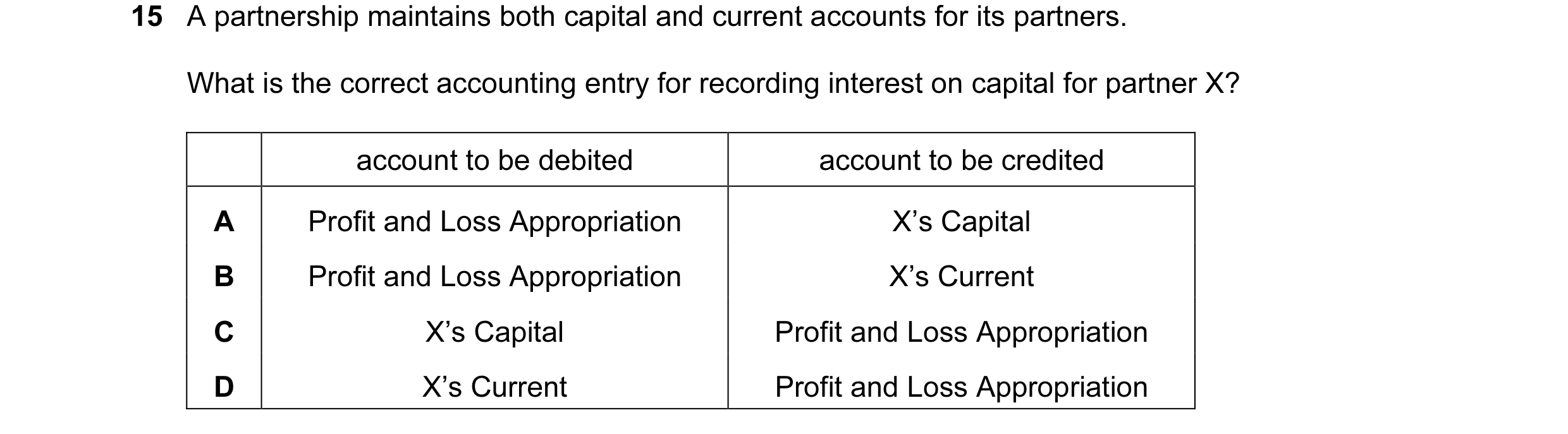
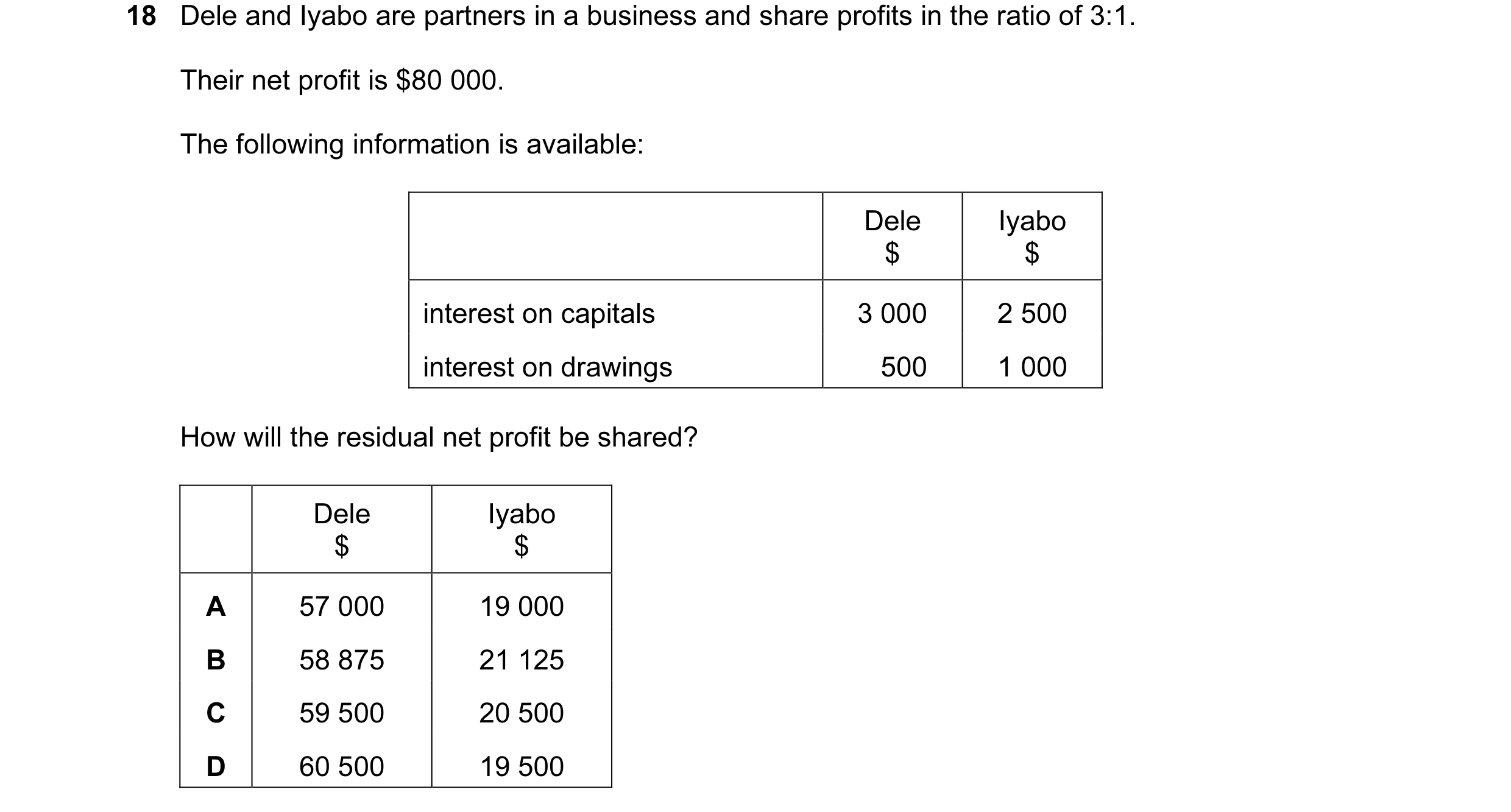
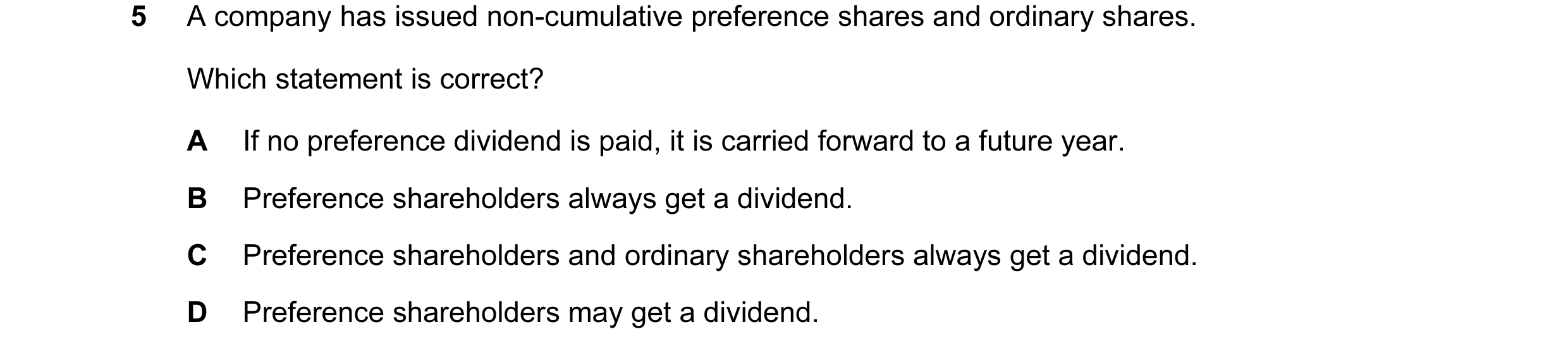 1 / 68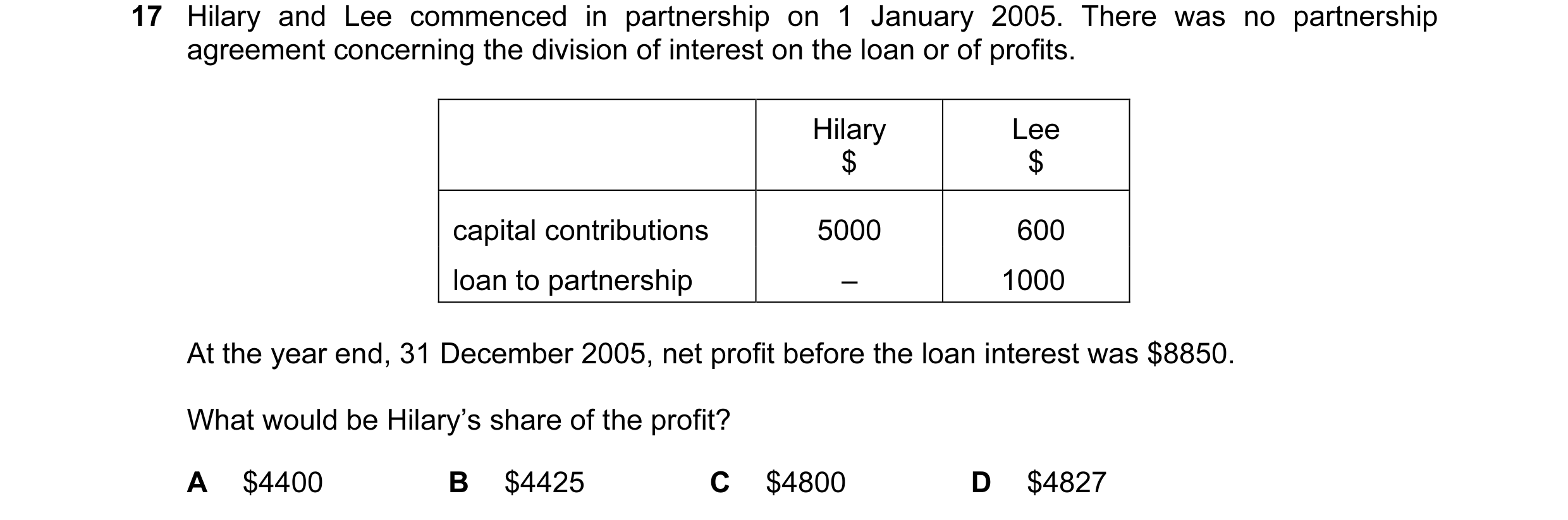
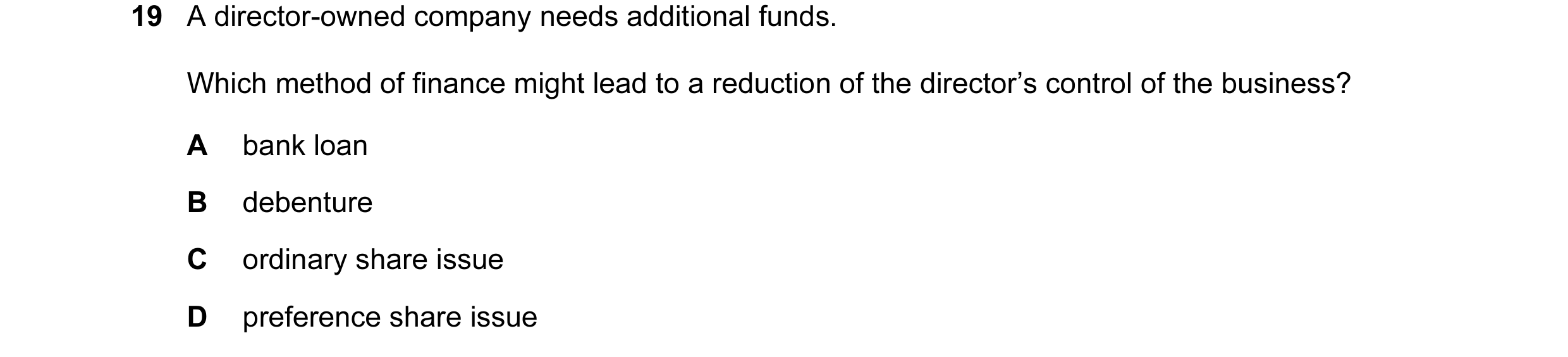
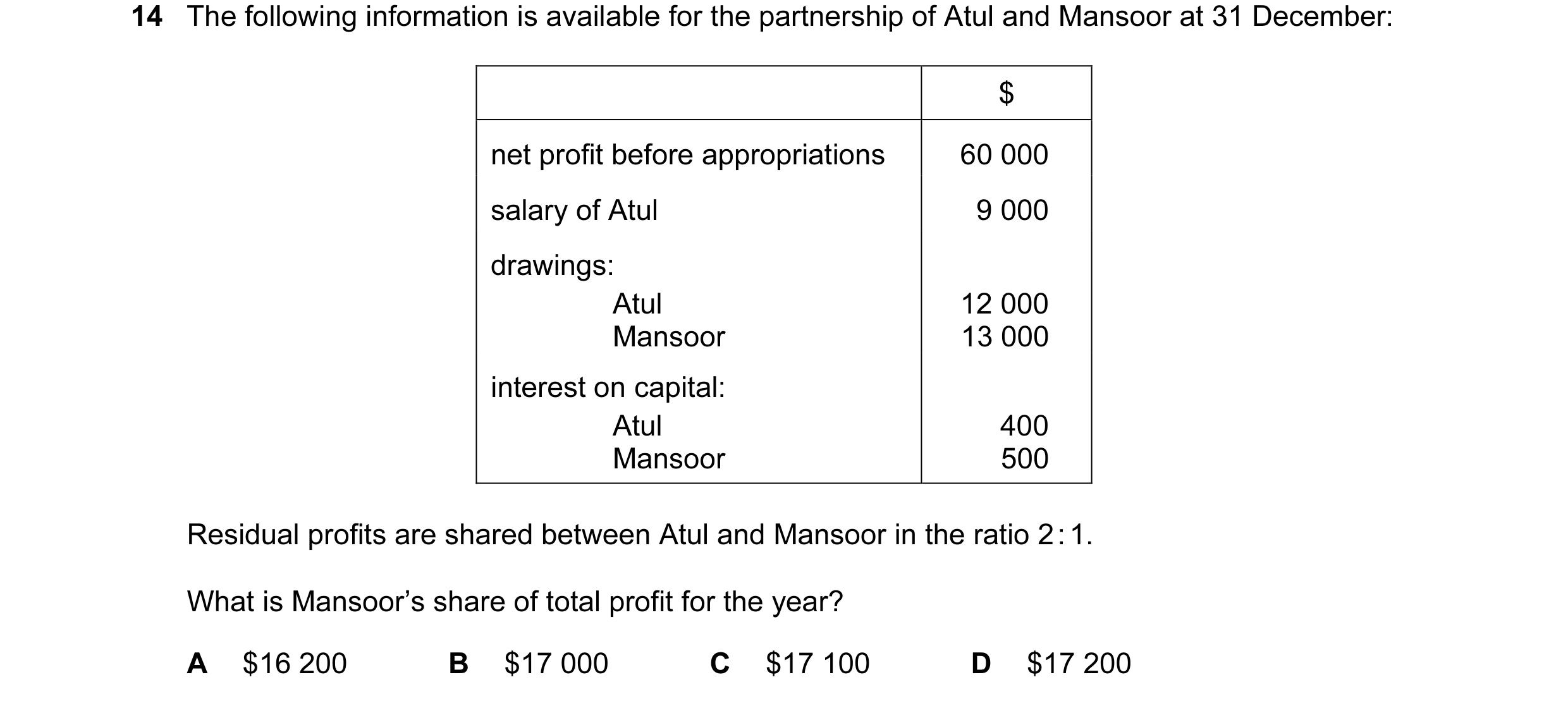
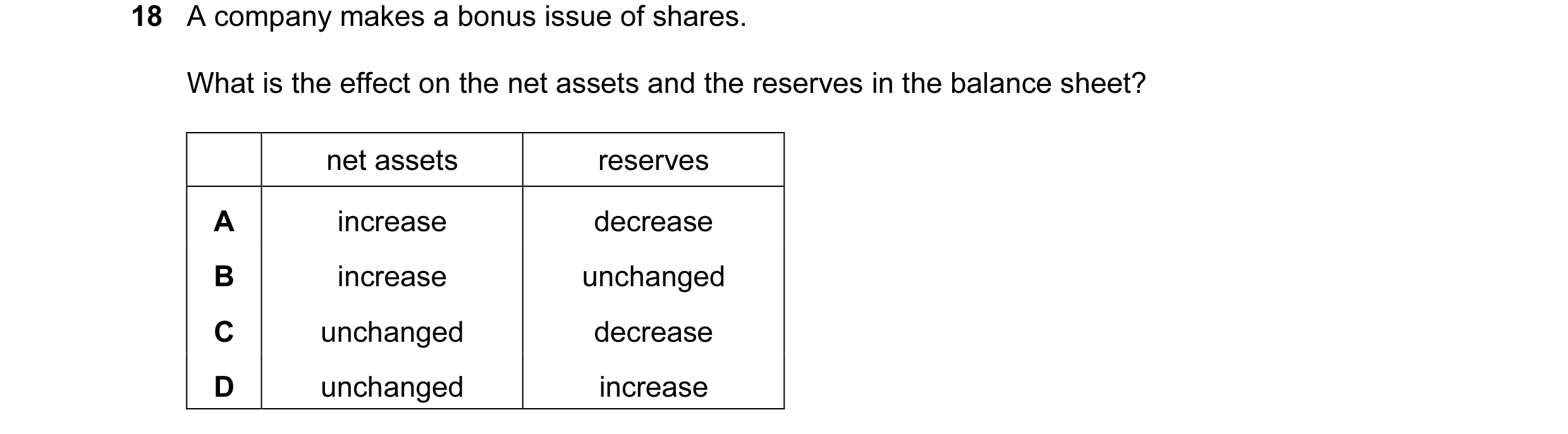 2 / 68
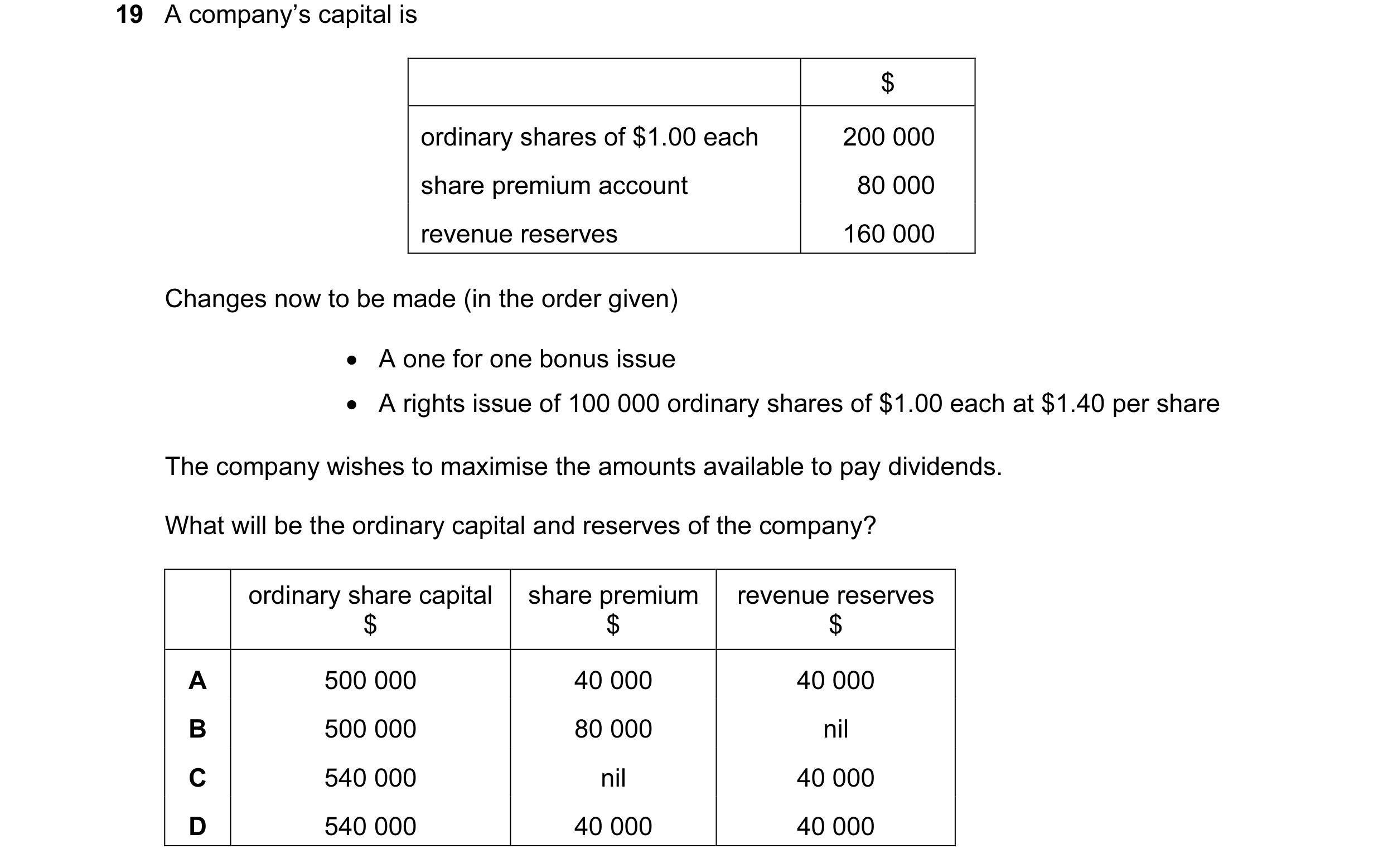 3 / 68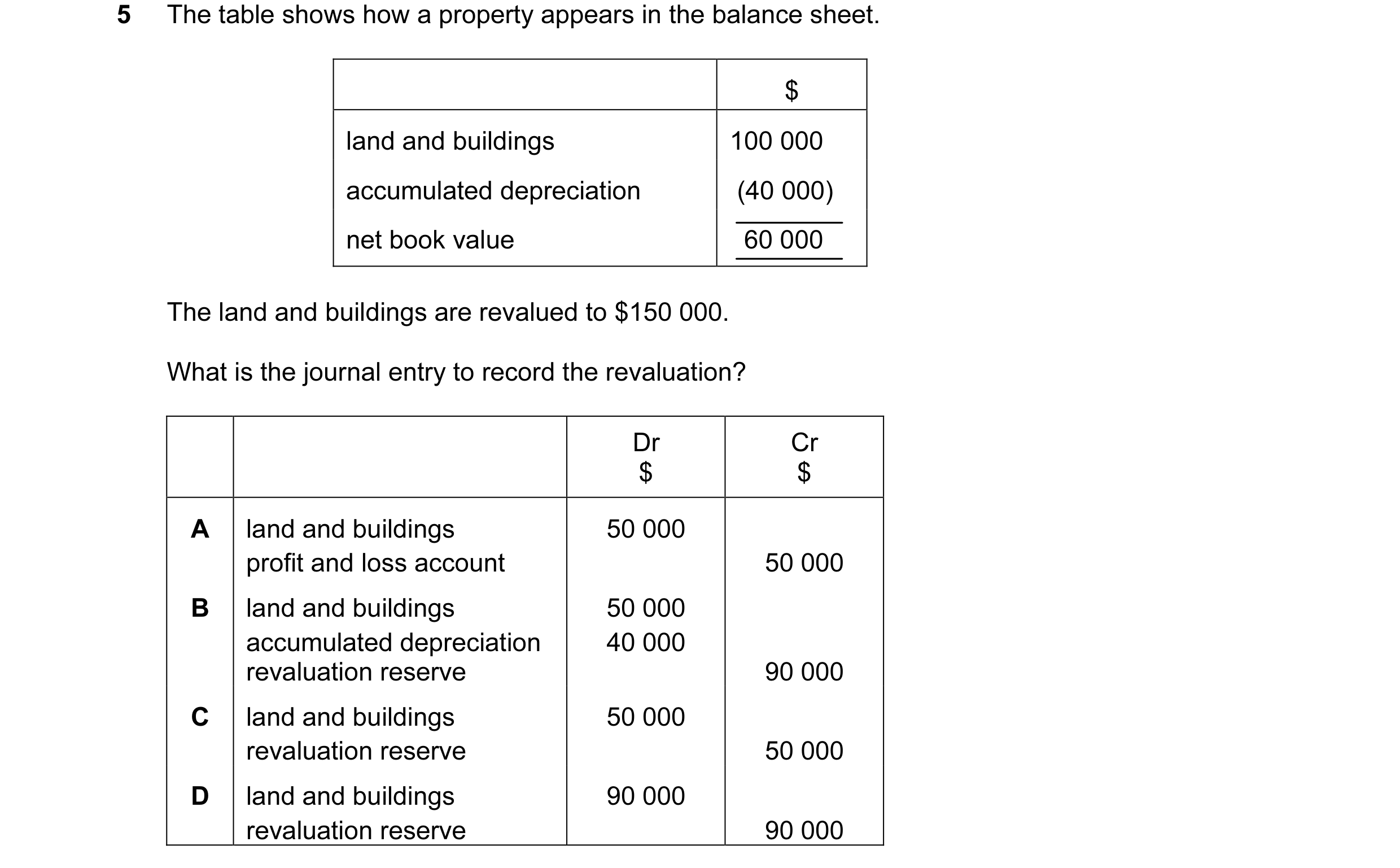
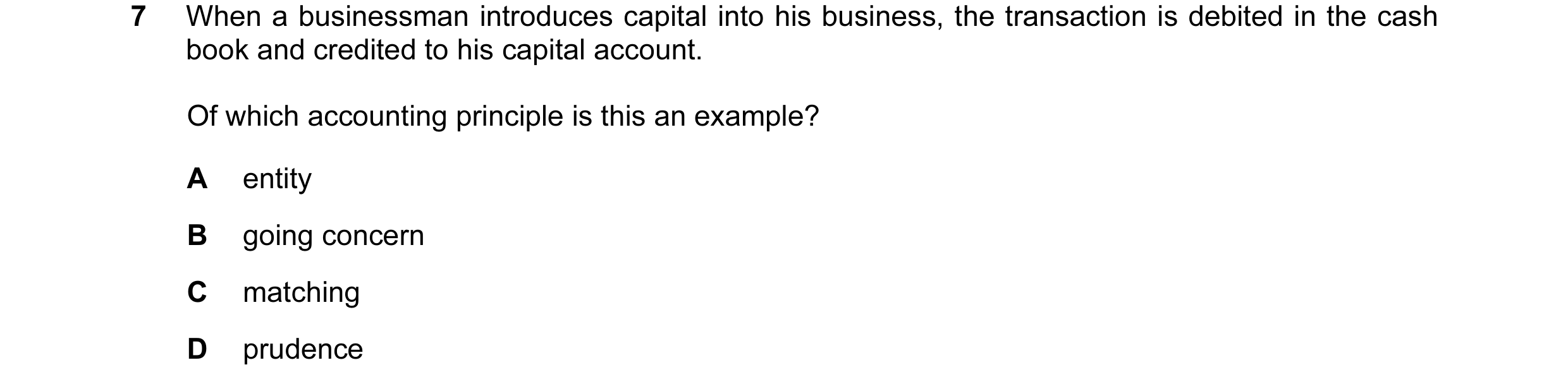

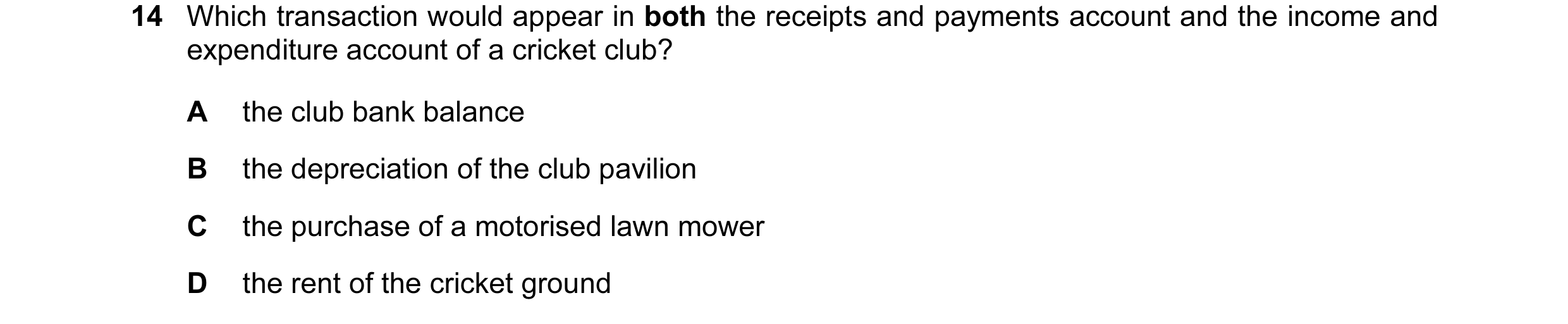 4 / 68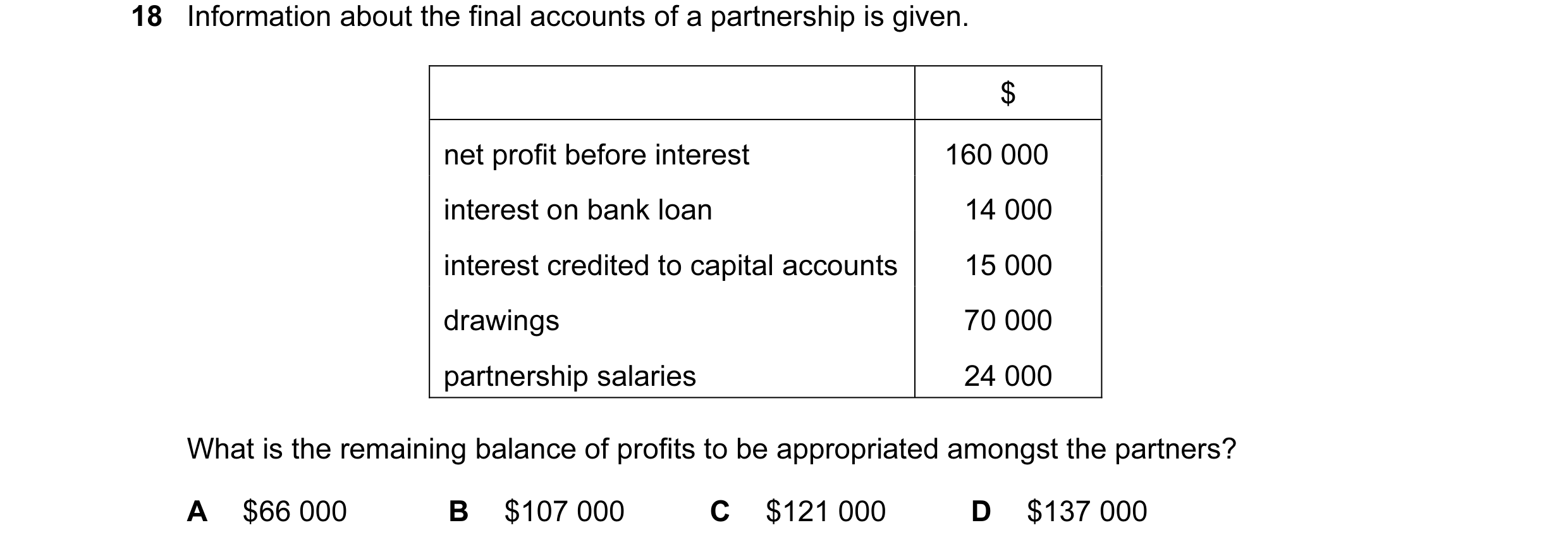


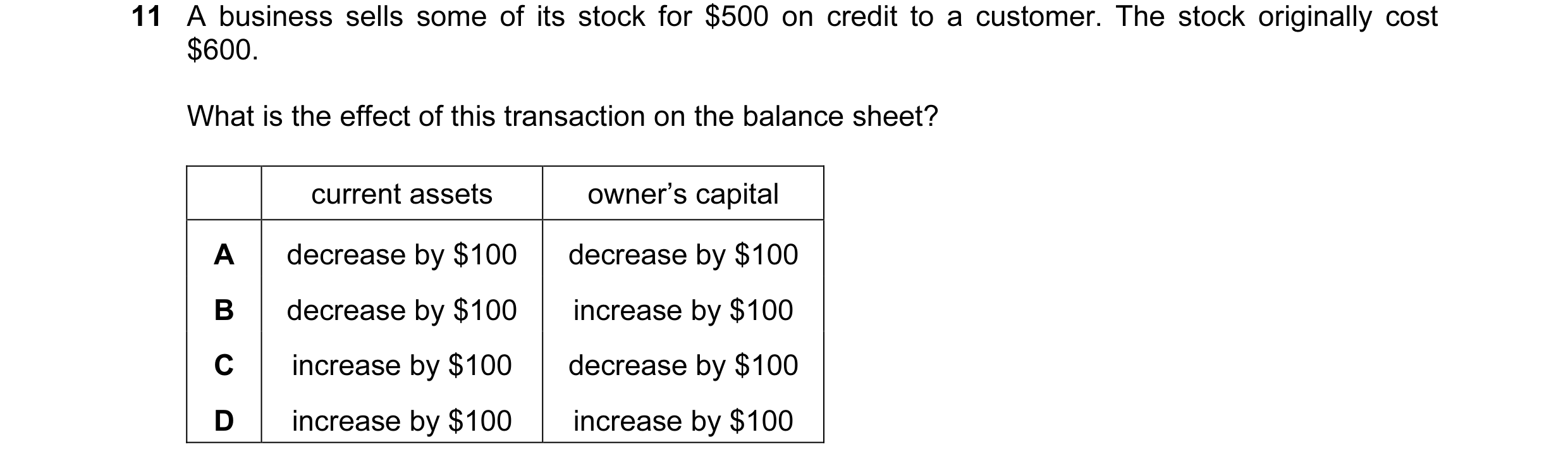 5 / 68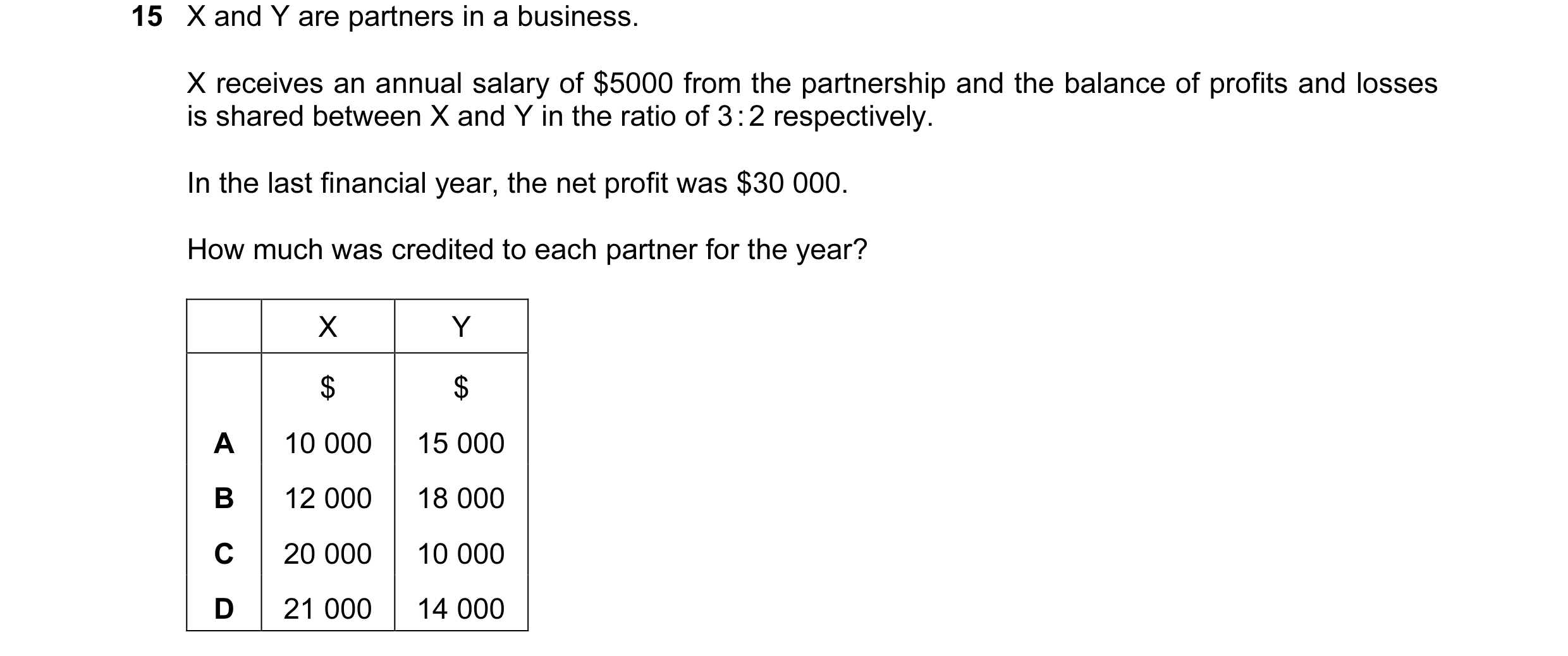
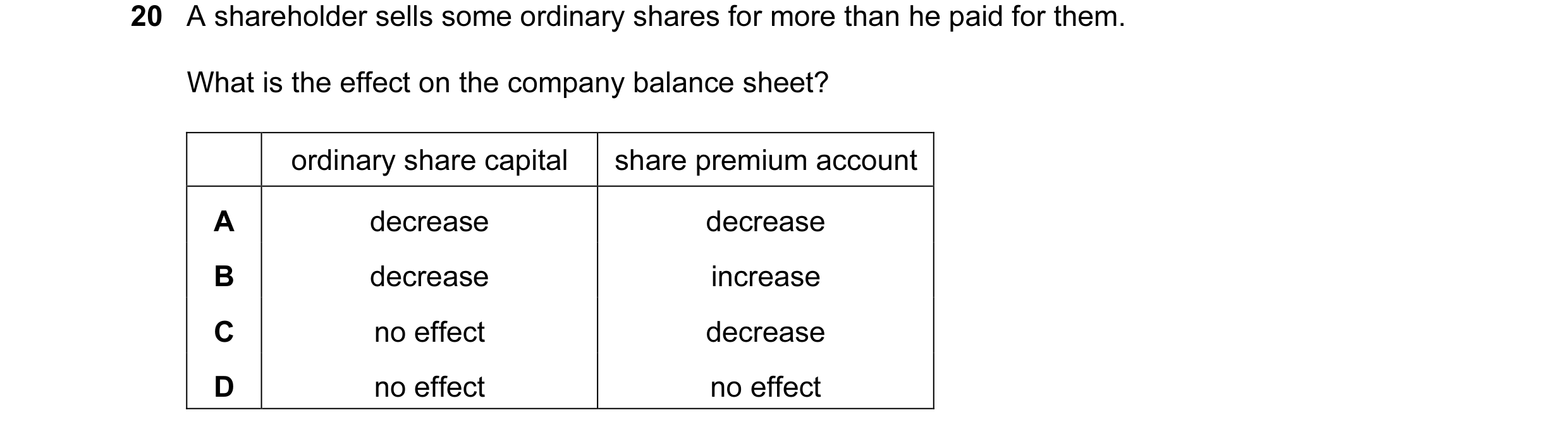

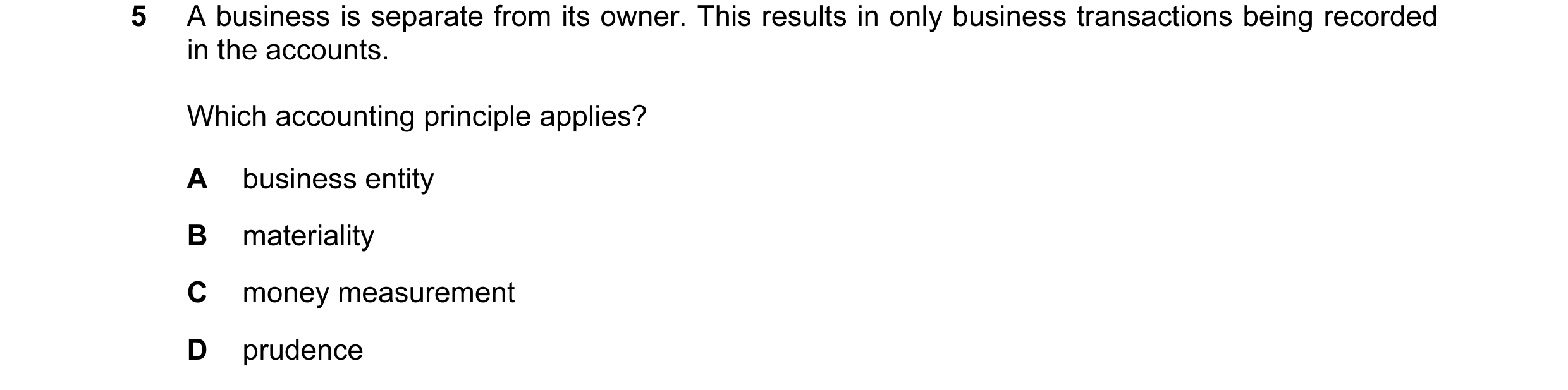
 6 / 68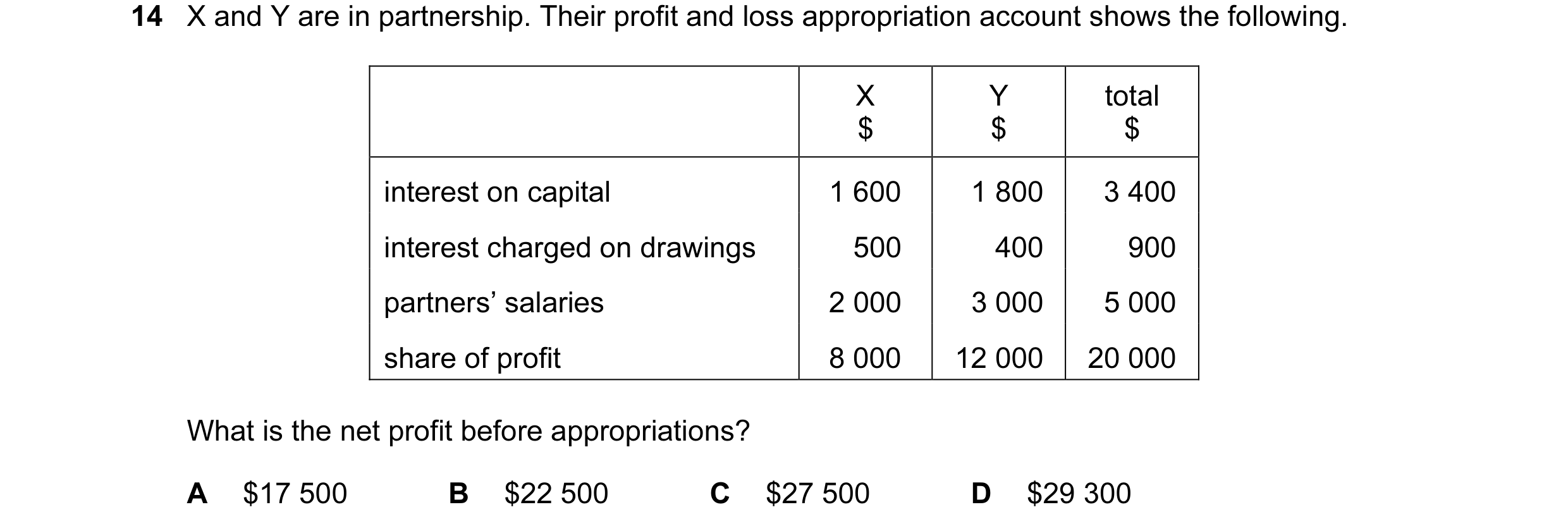

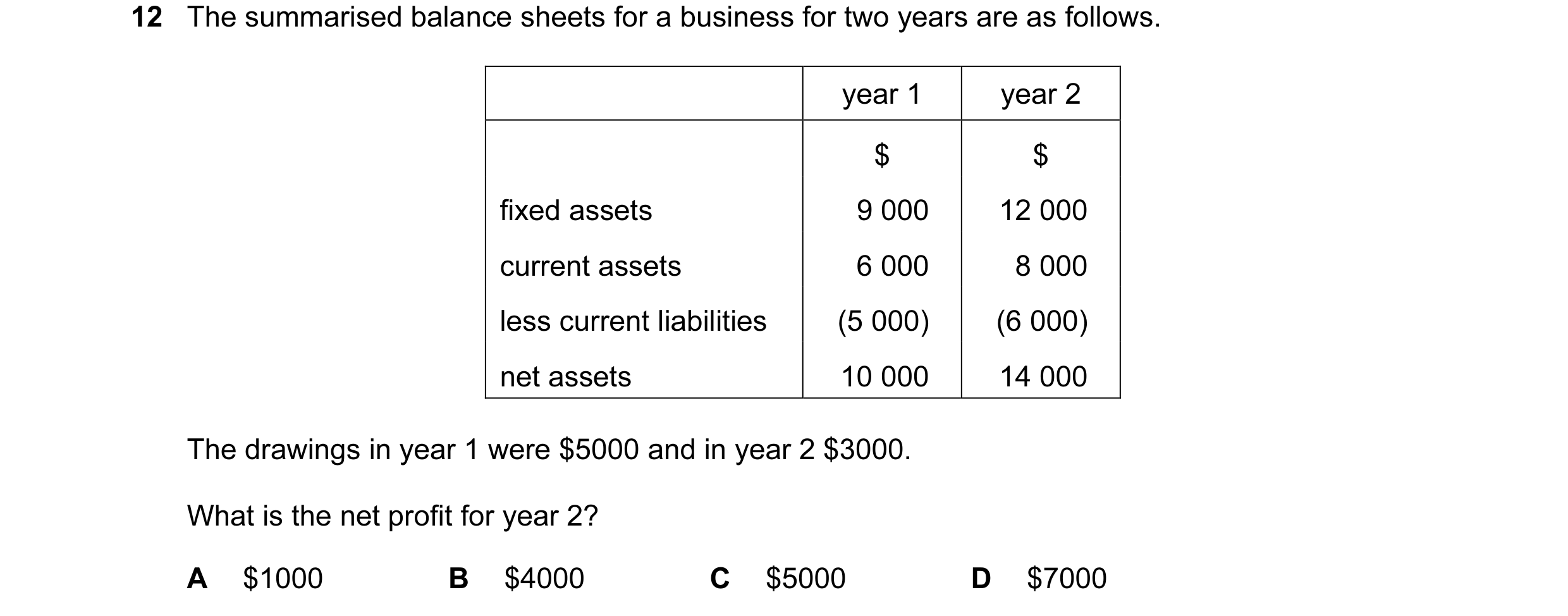
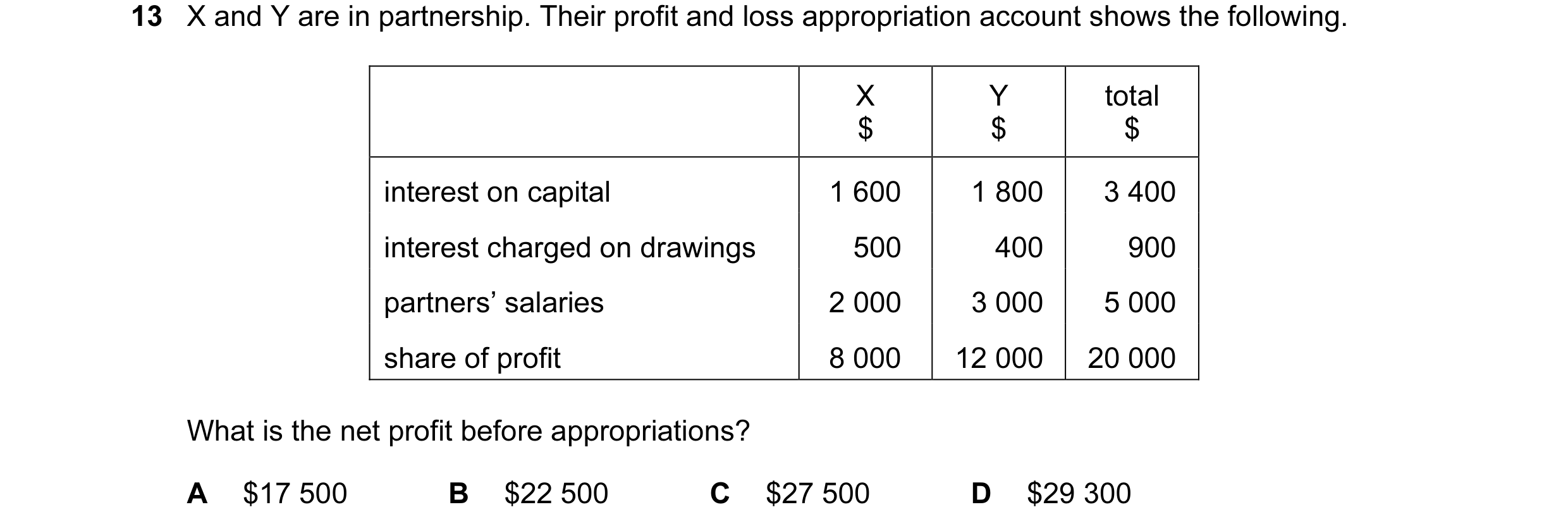 7 / 68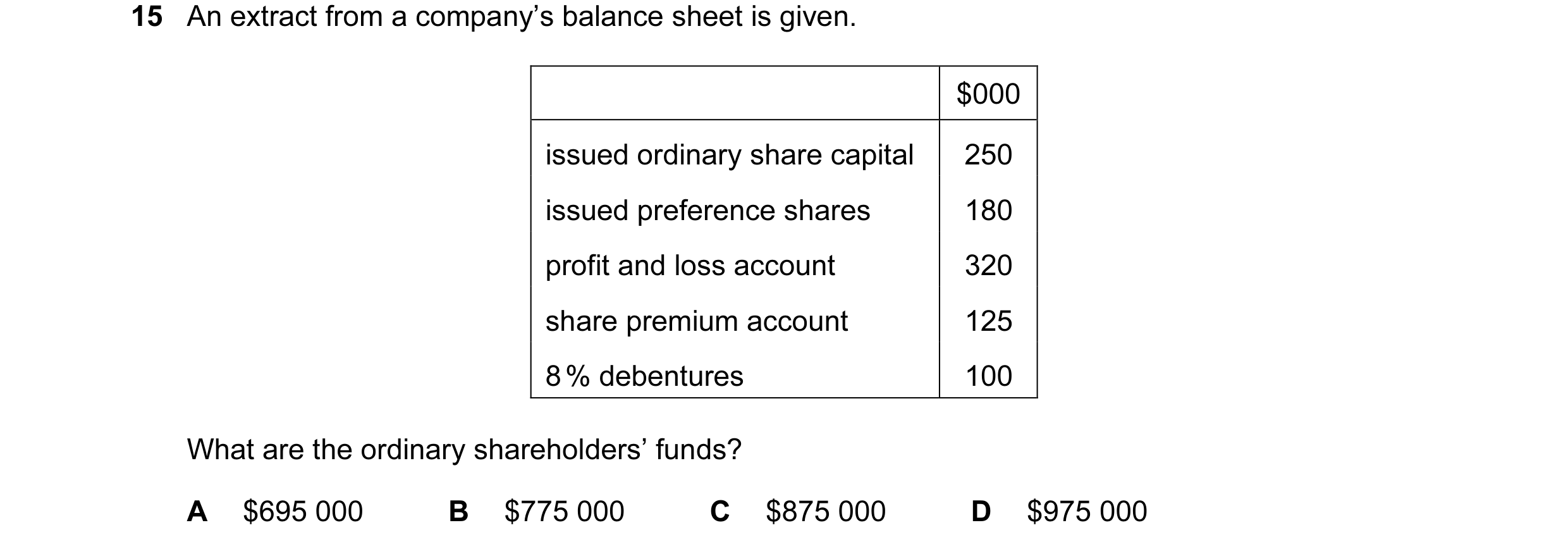
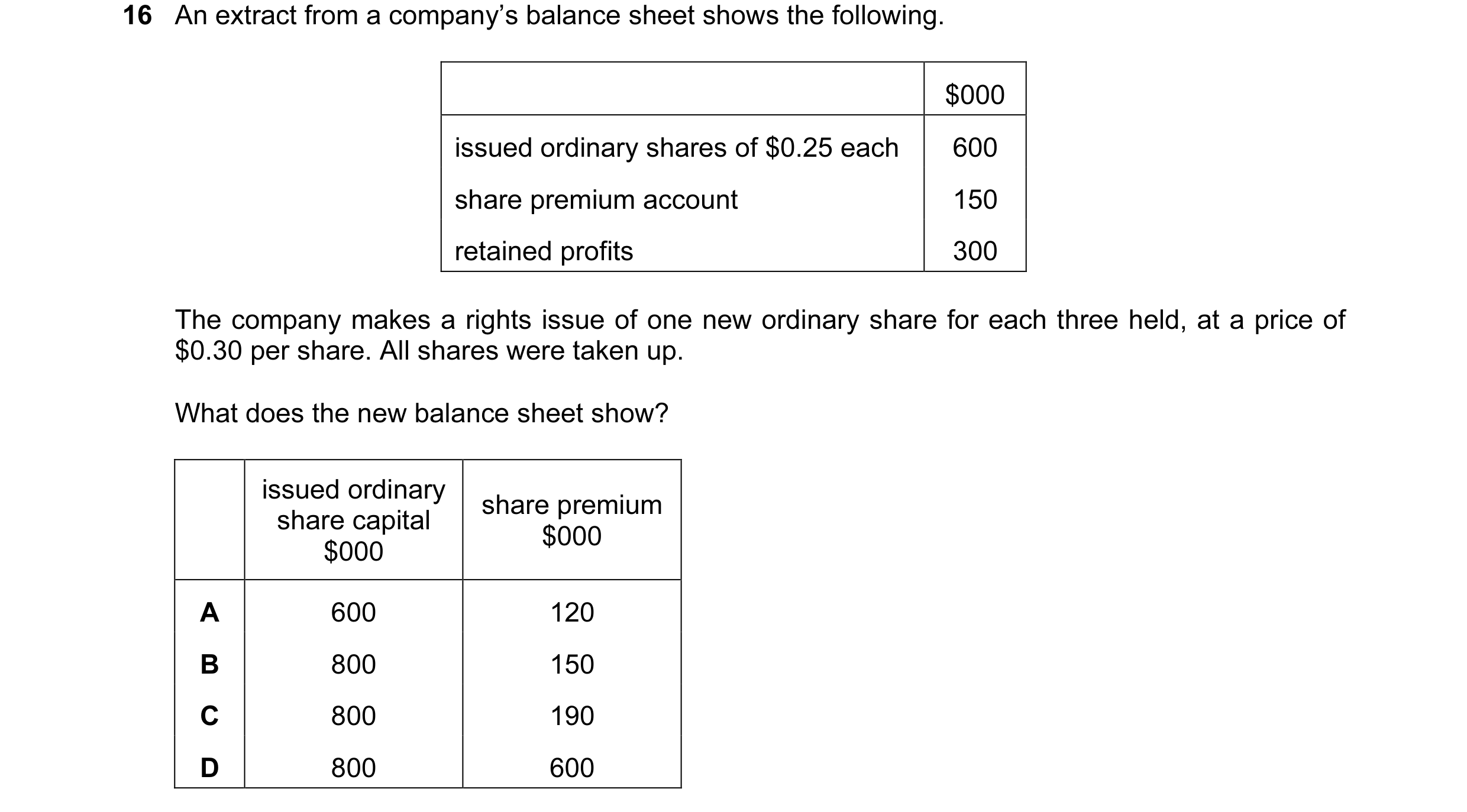
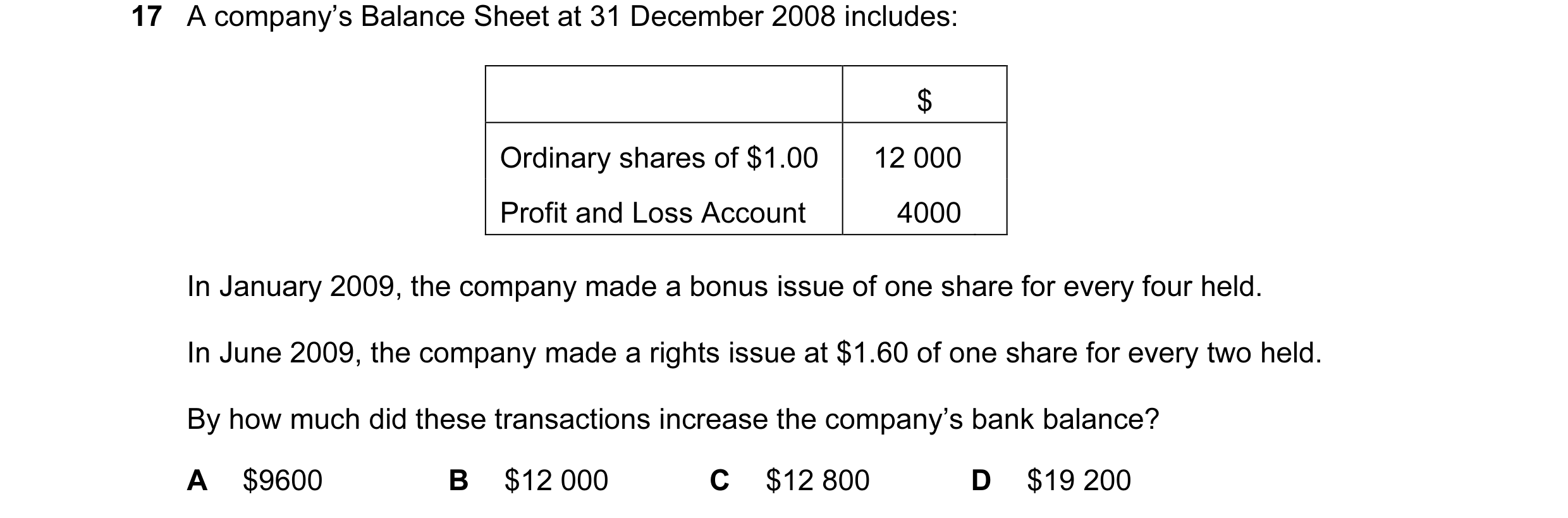 8 / 68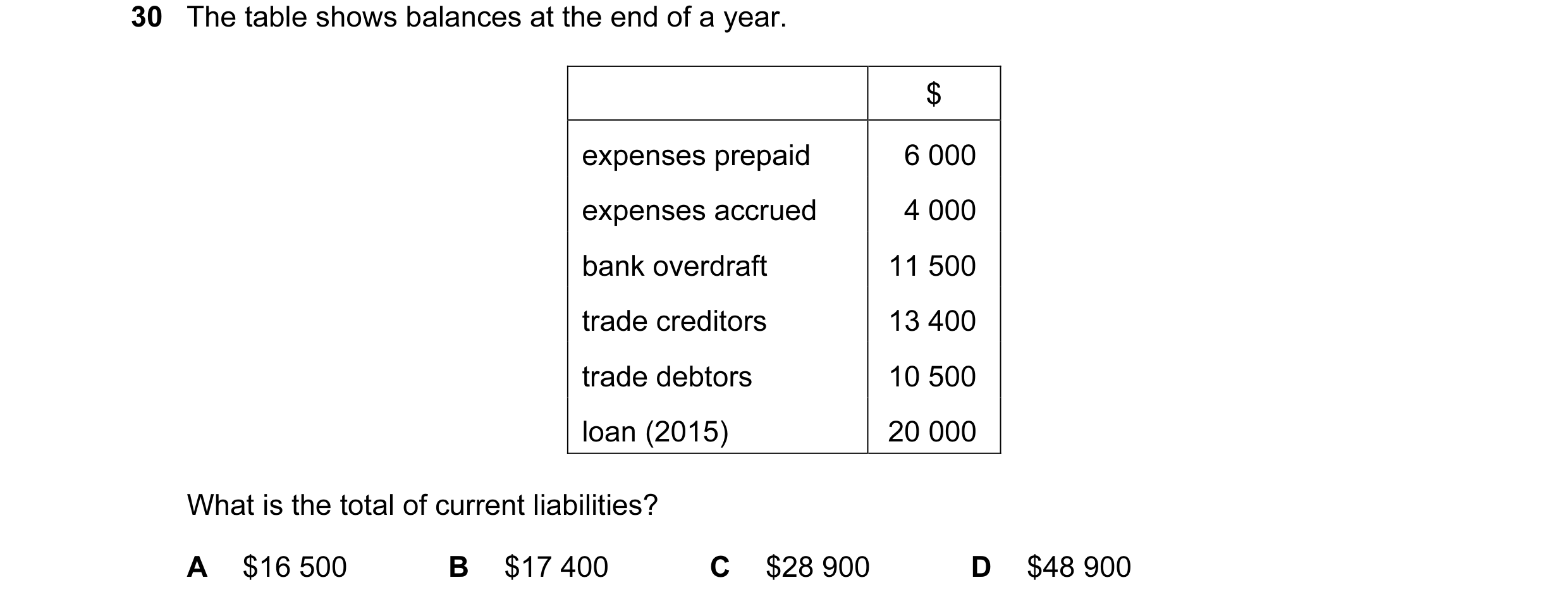
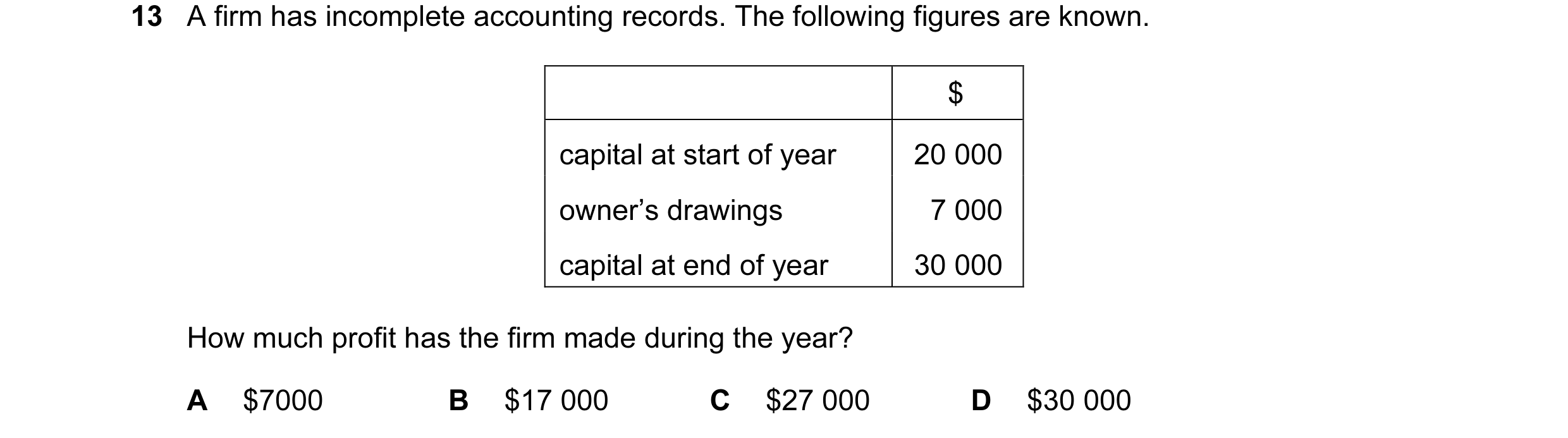 9 / 68
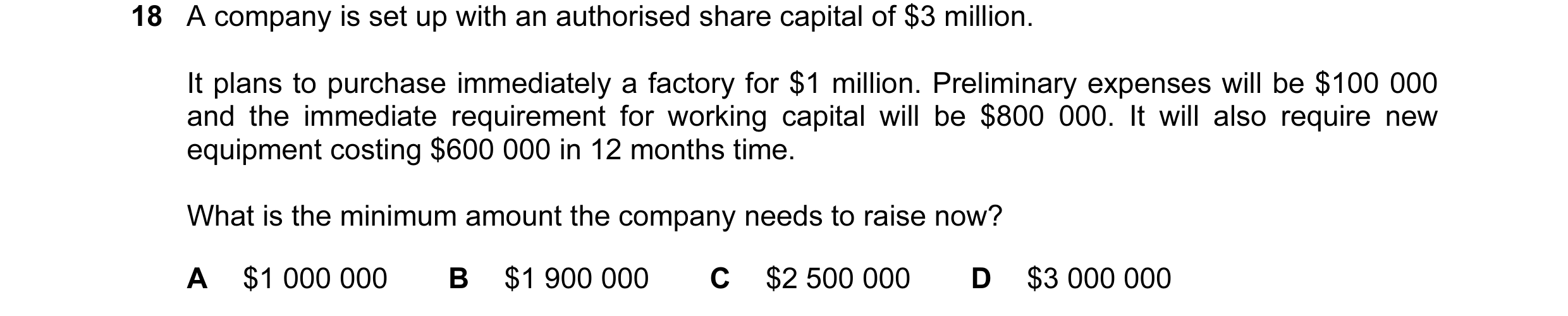
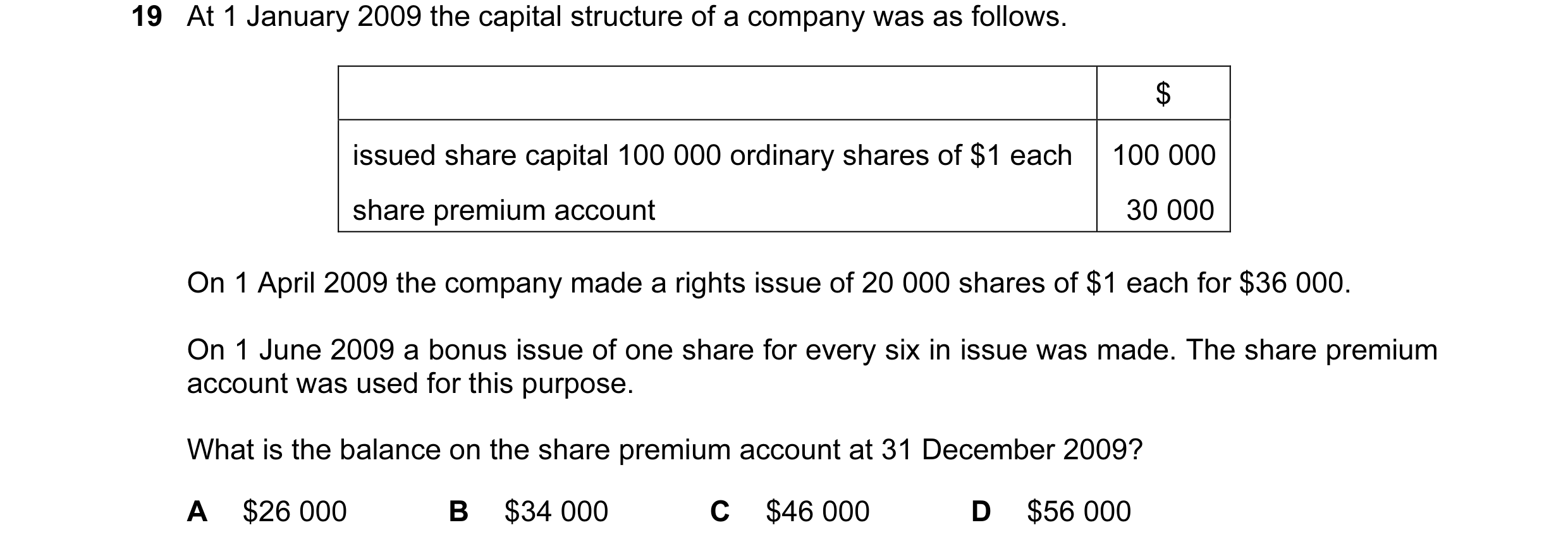 10 / 68
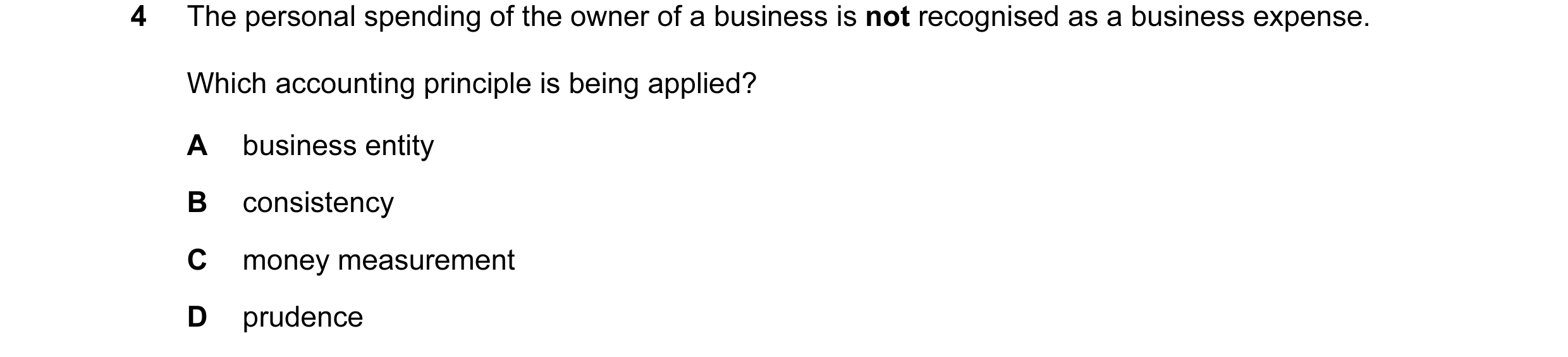
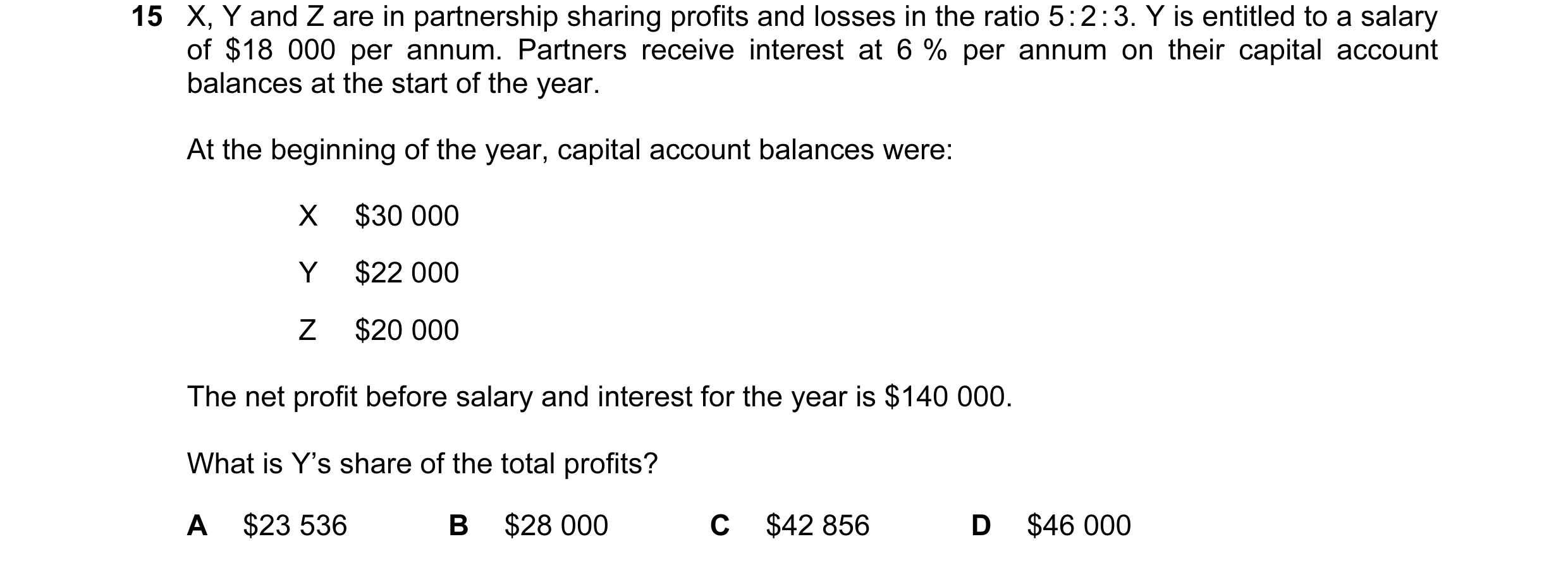
 11 / 68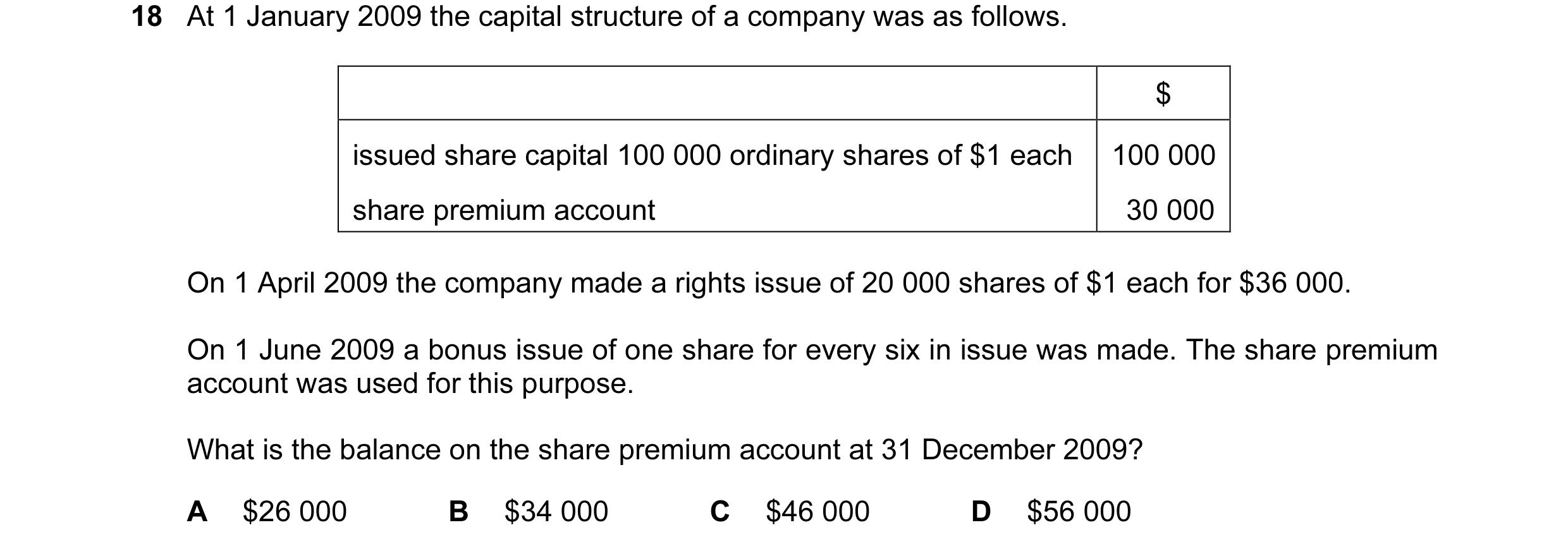

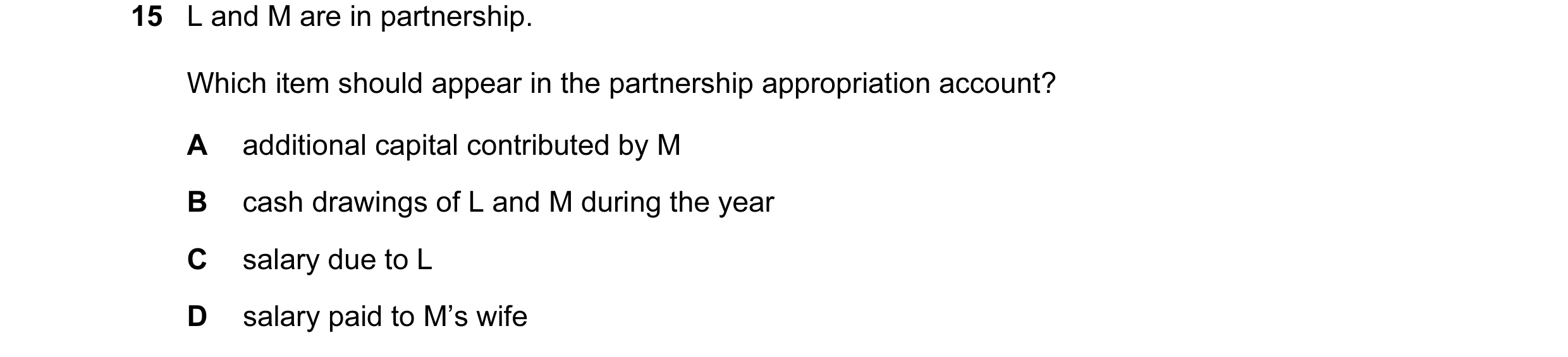 12 / 68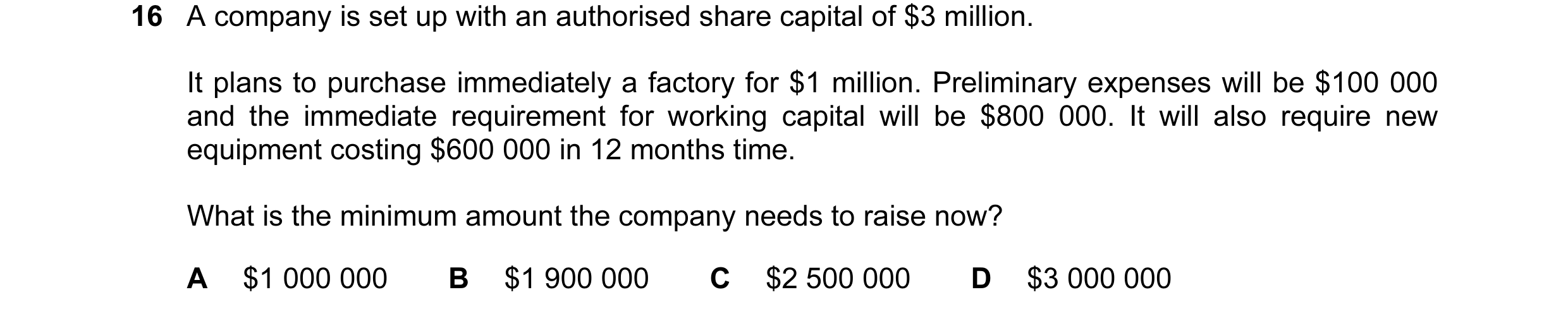
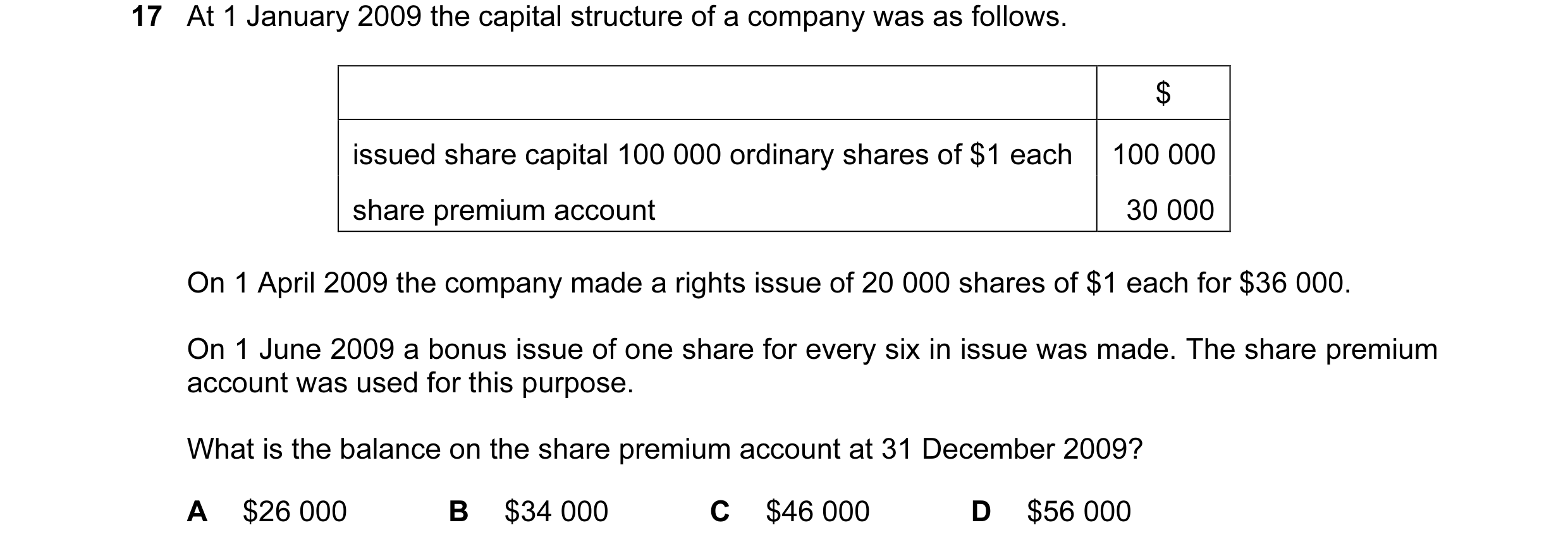

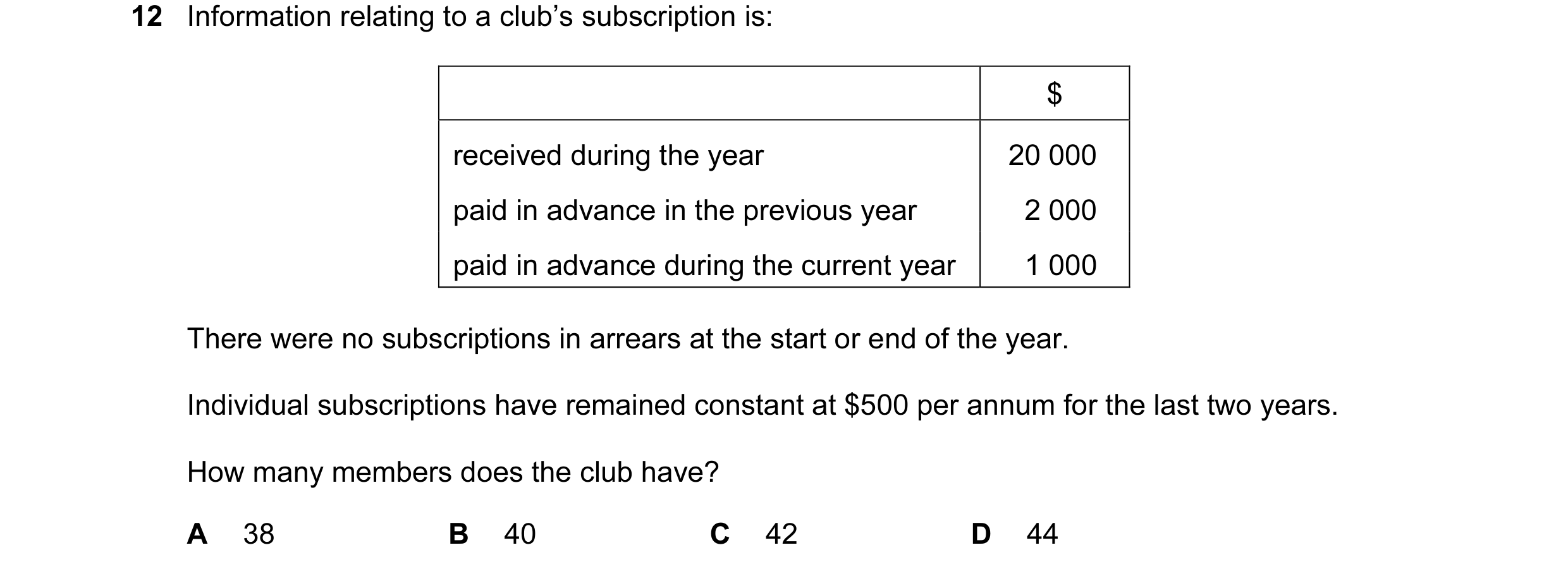 13 / 68

 14 / 68
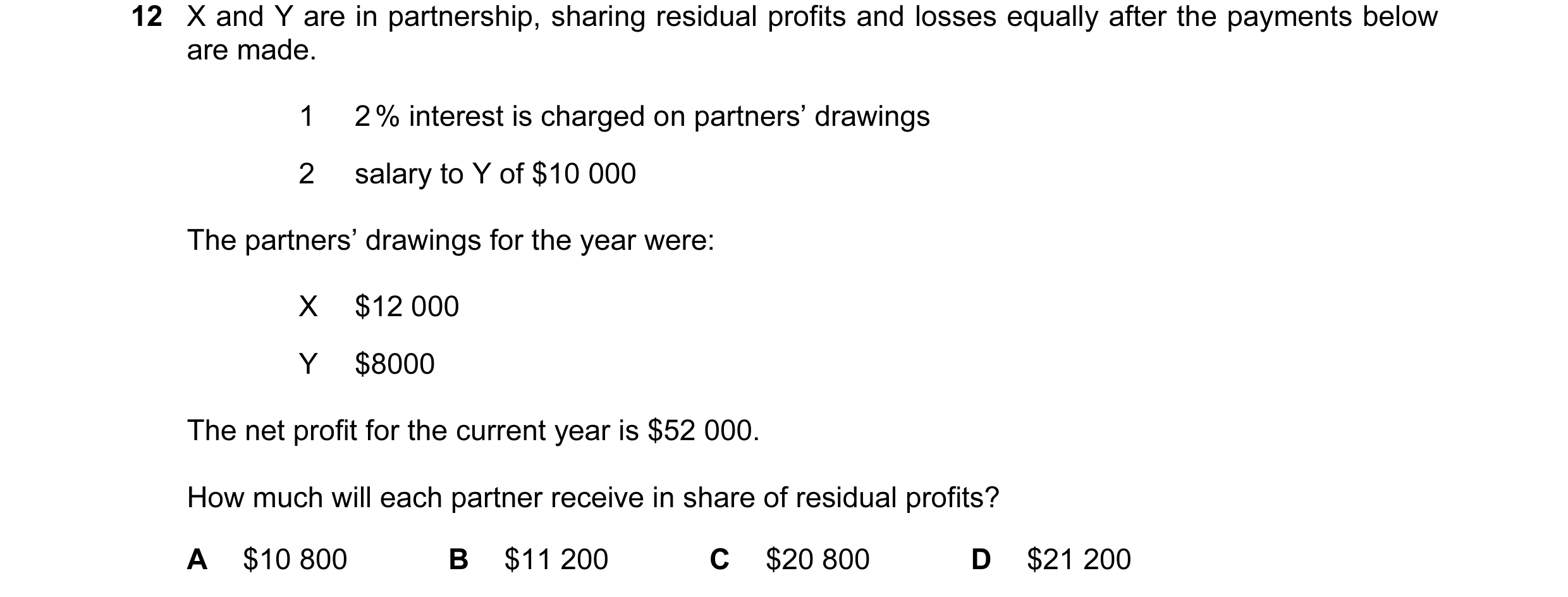
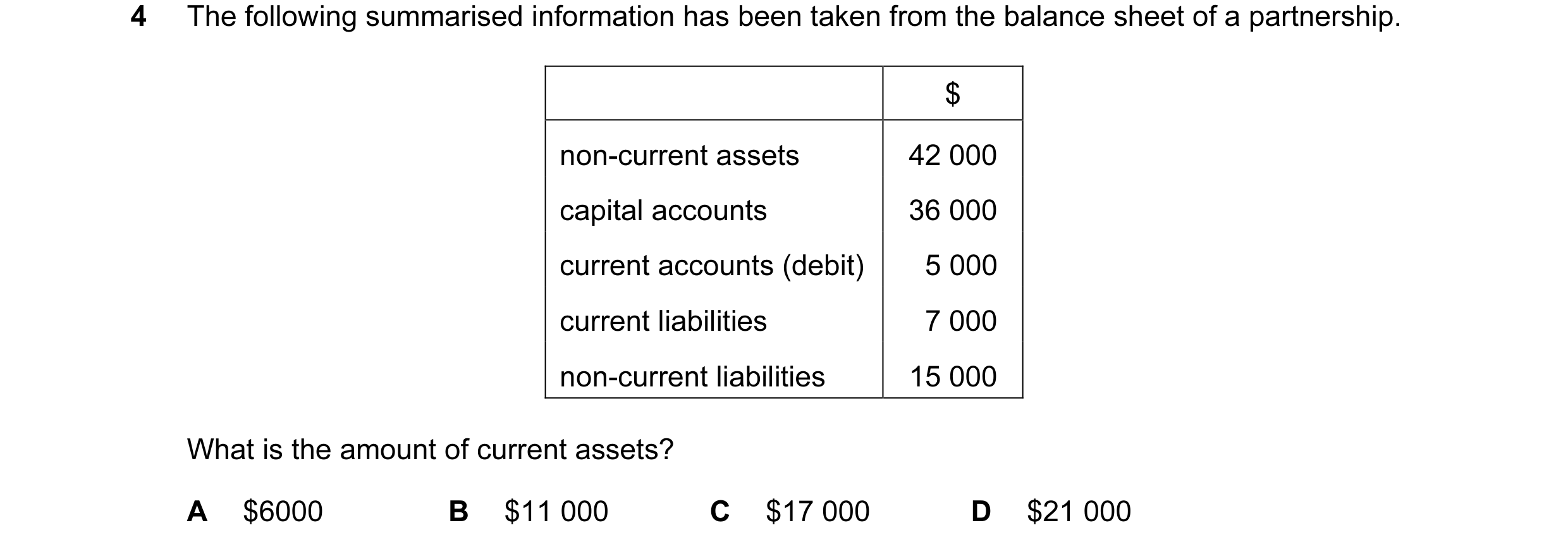
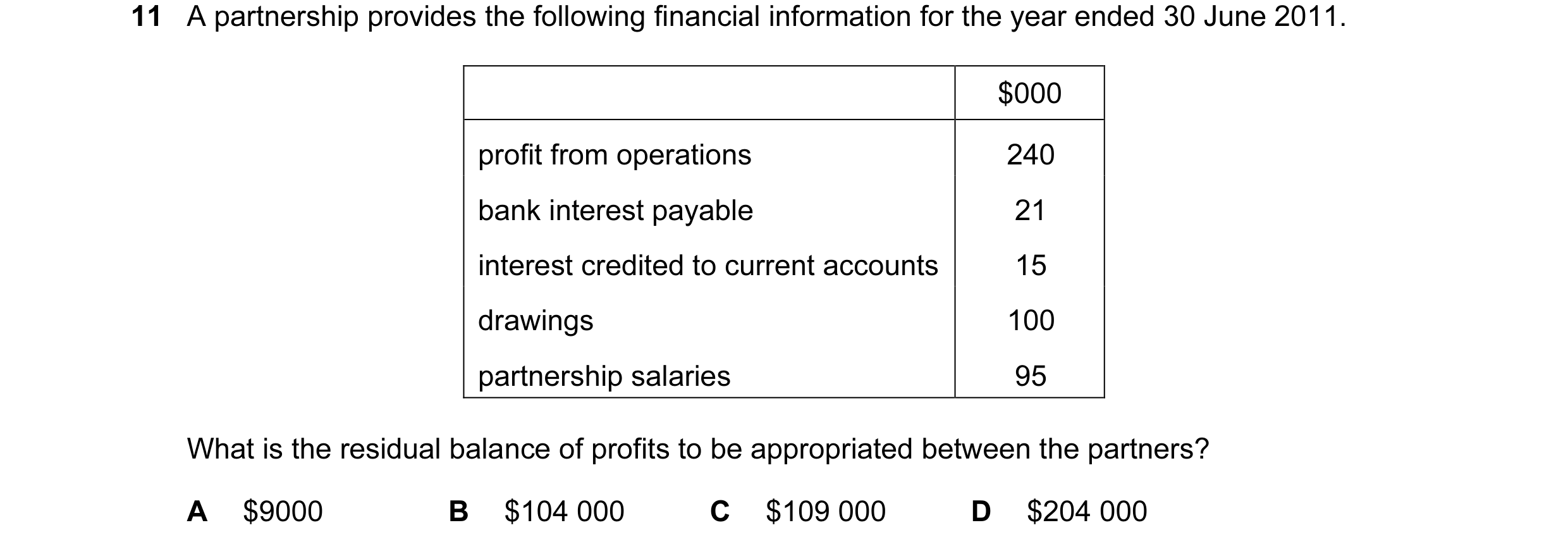 15 / 68
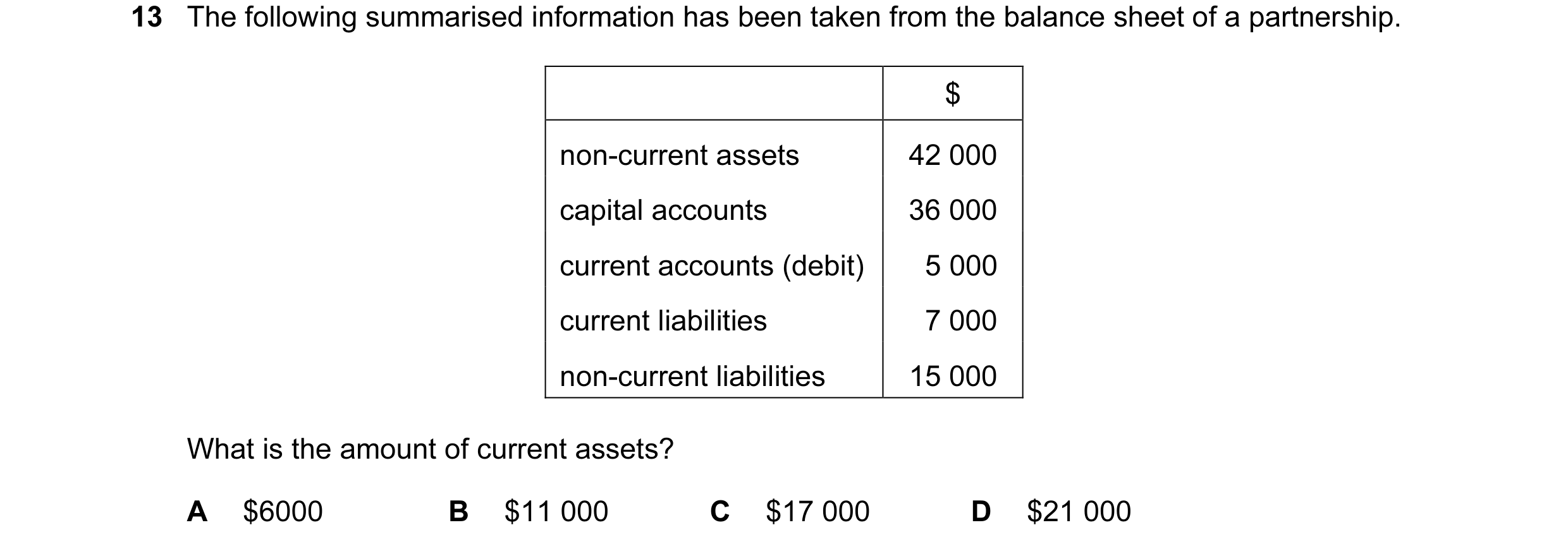
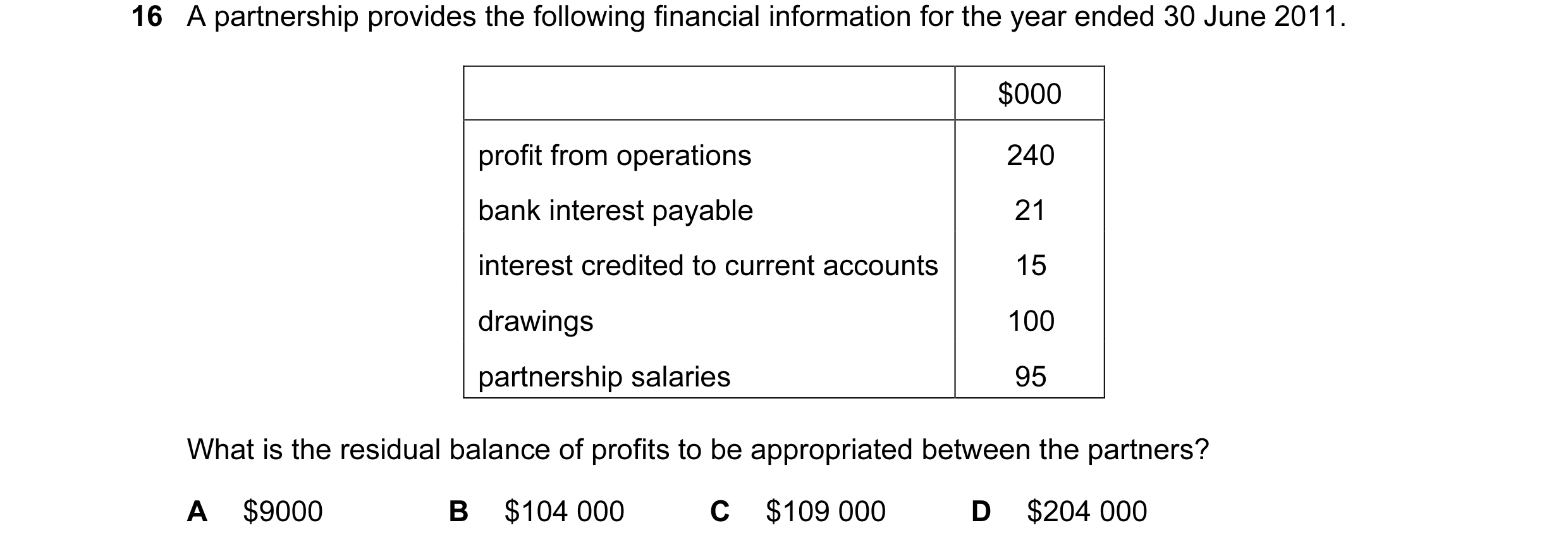
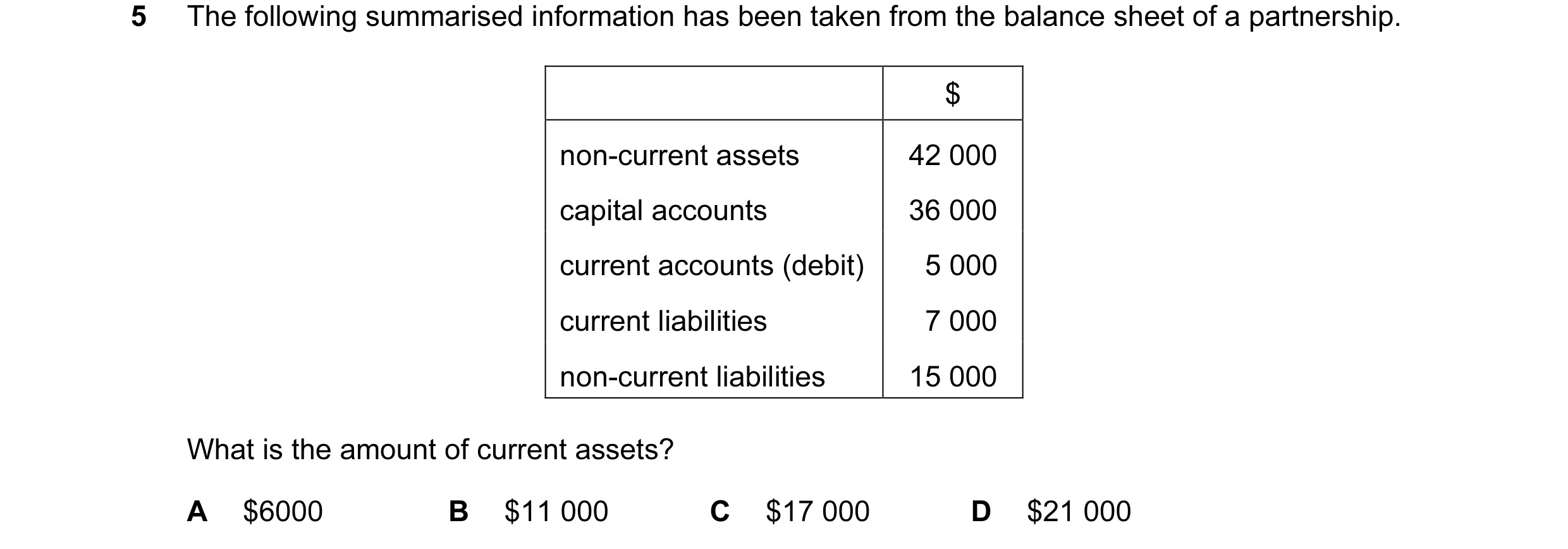 16 / 68


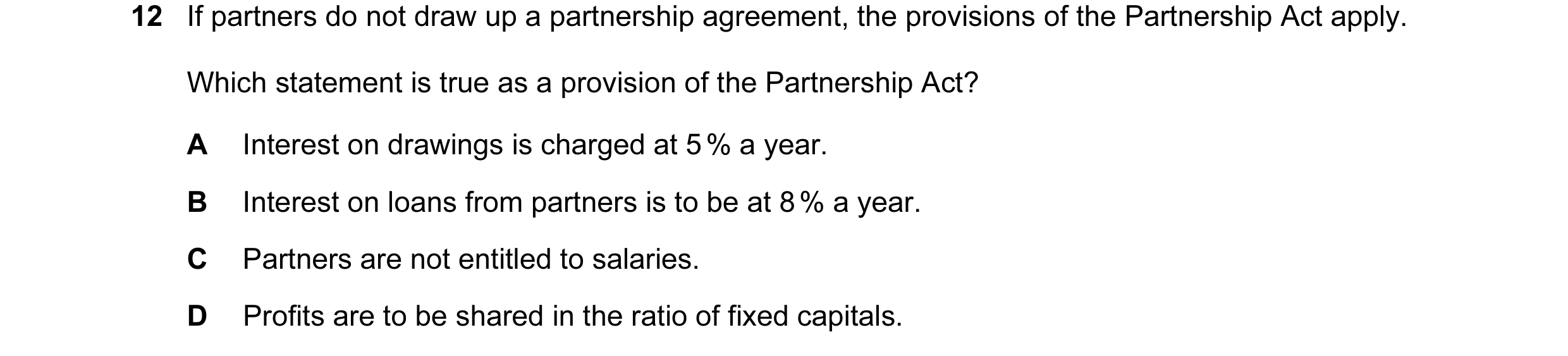
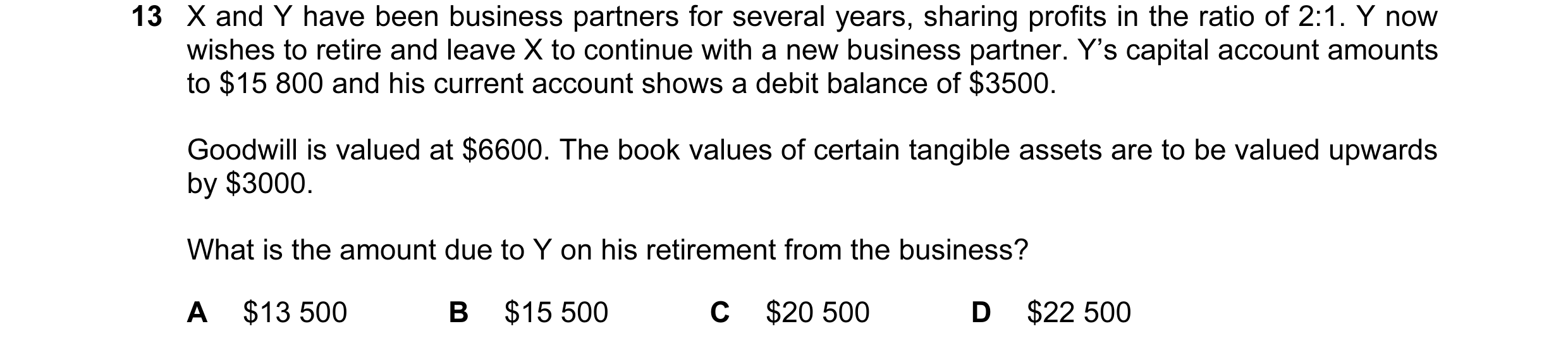
 17 / 68
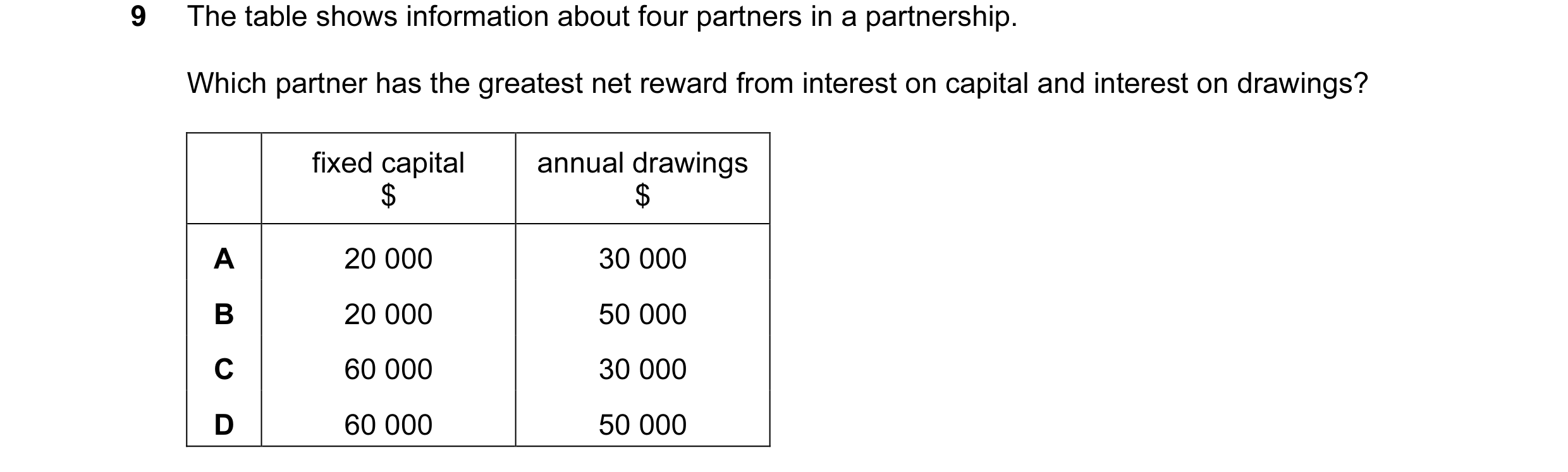
 18 / 68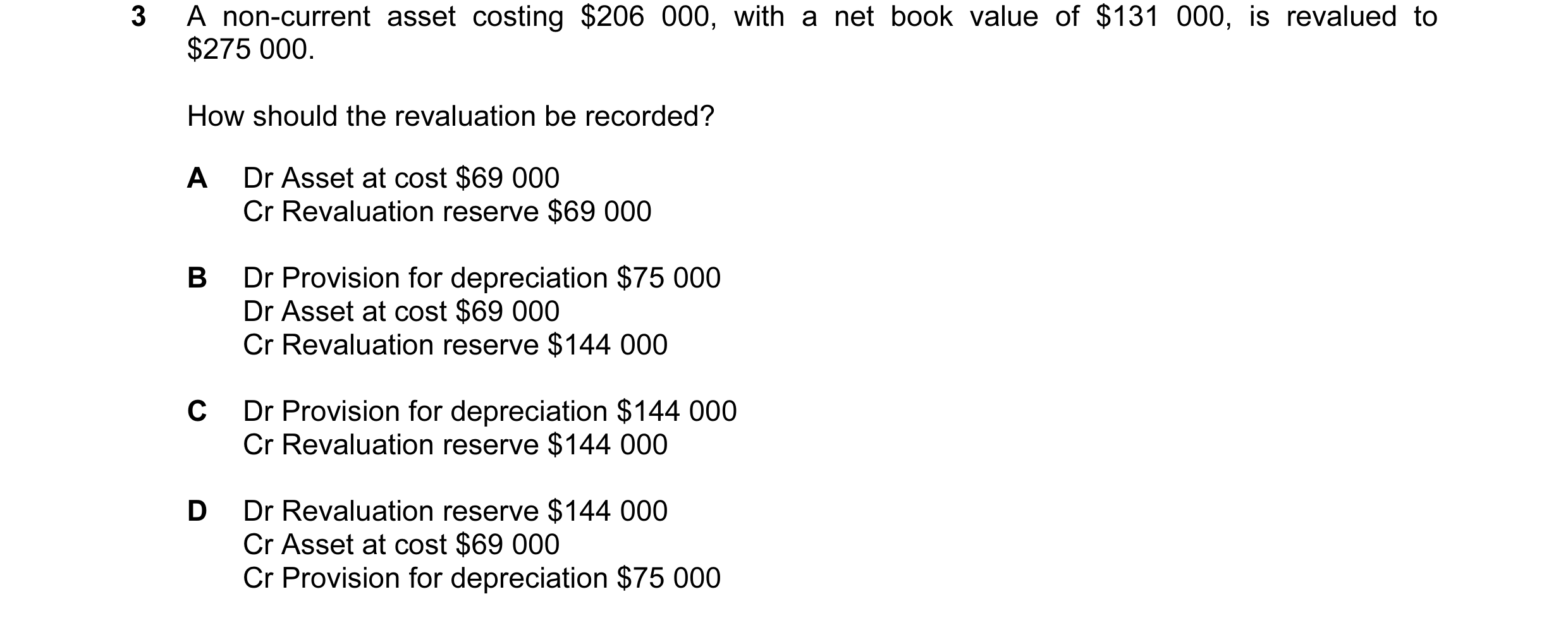
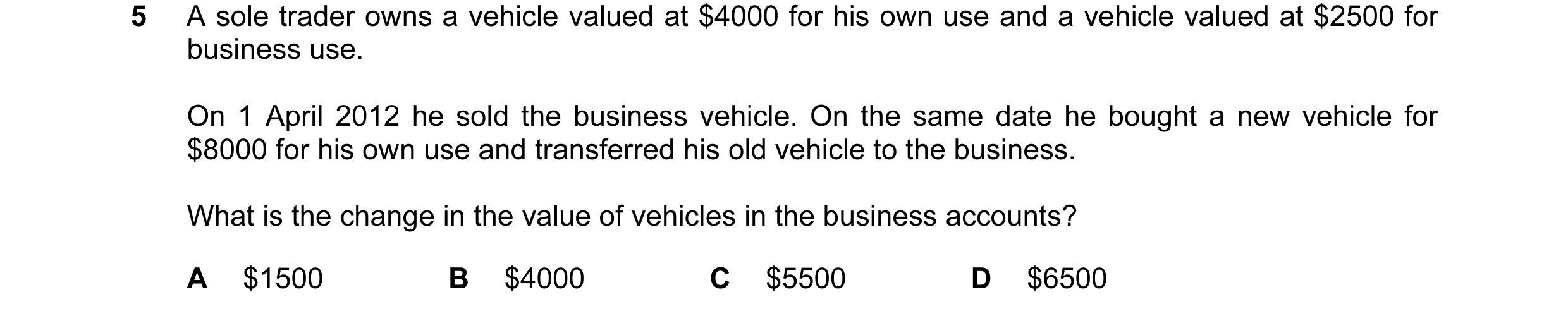
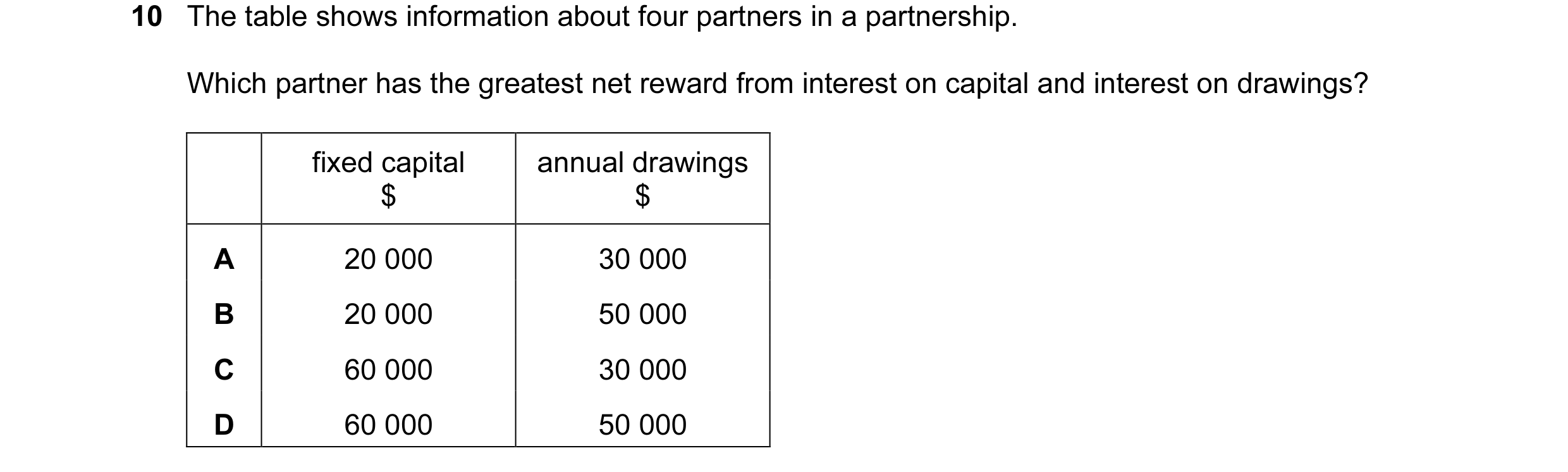
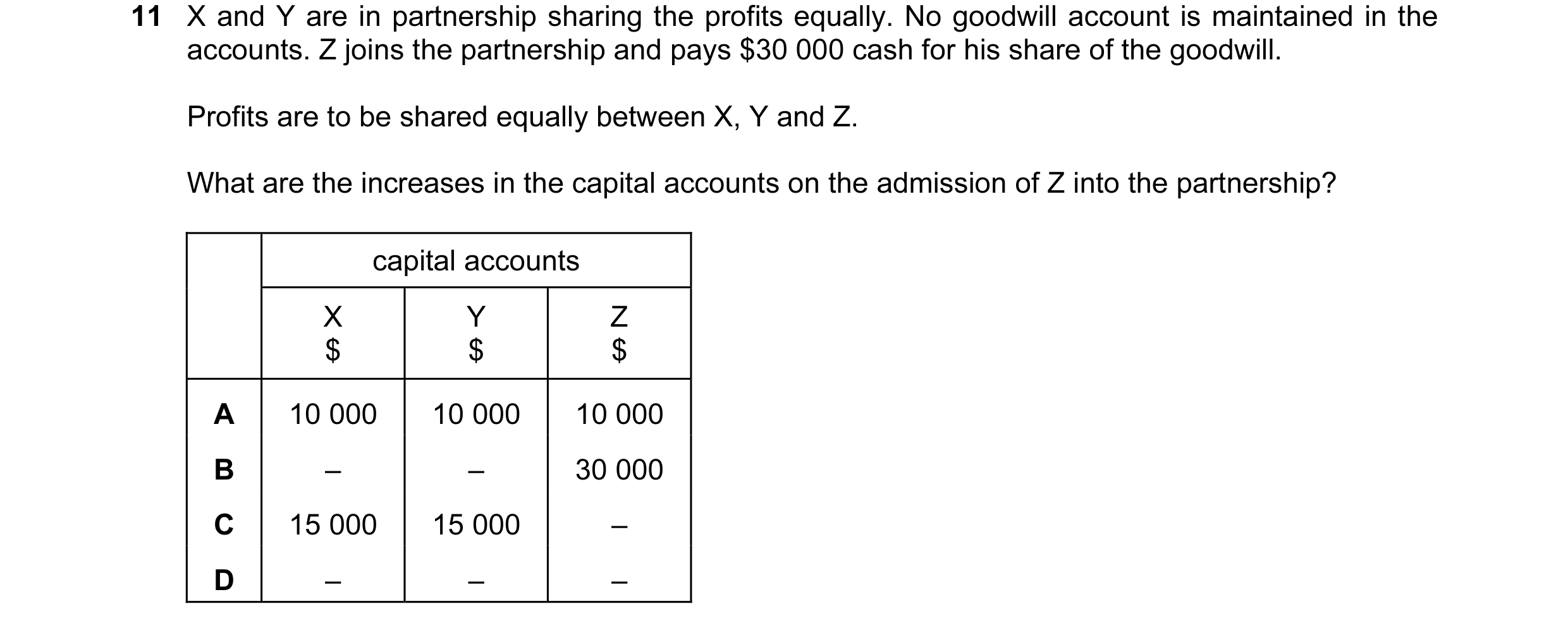 19 / 68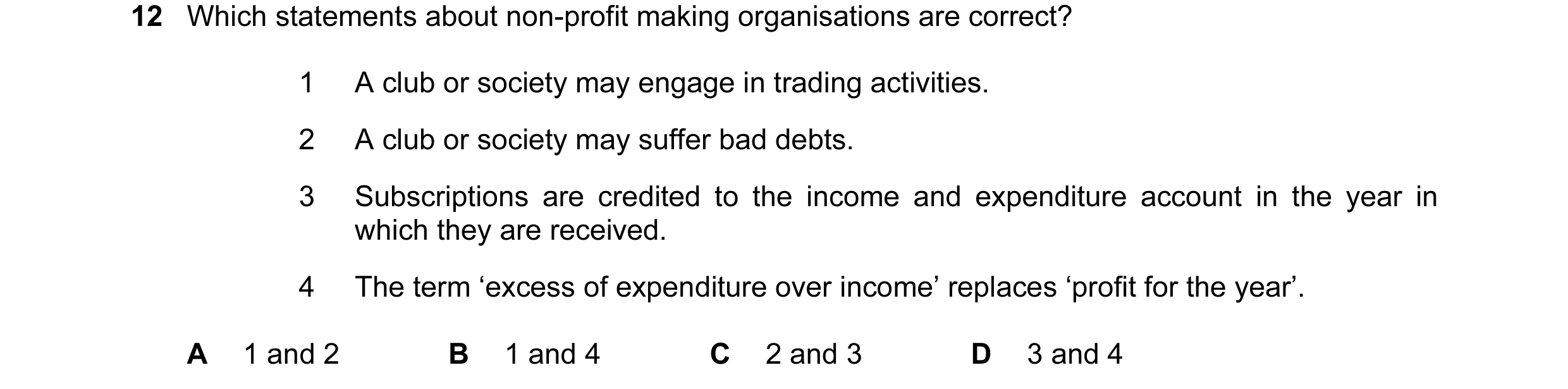
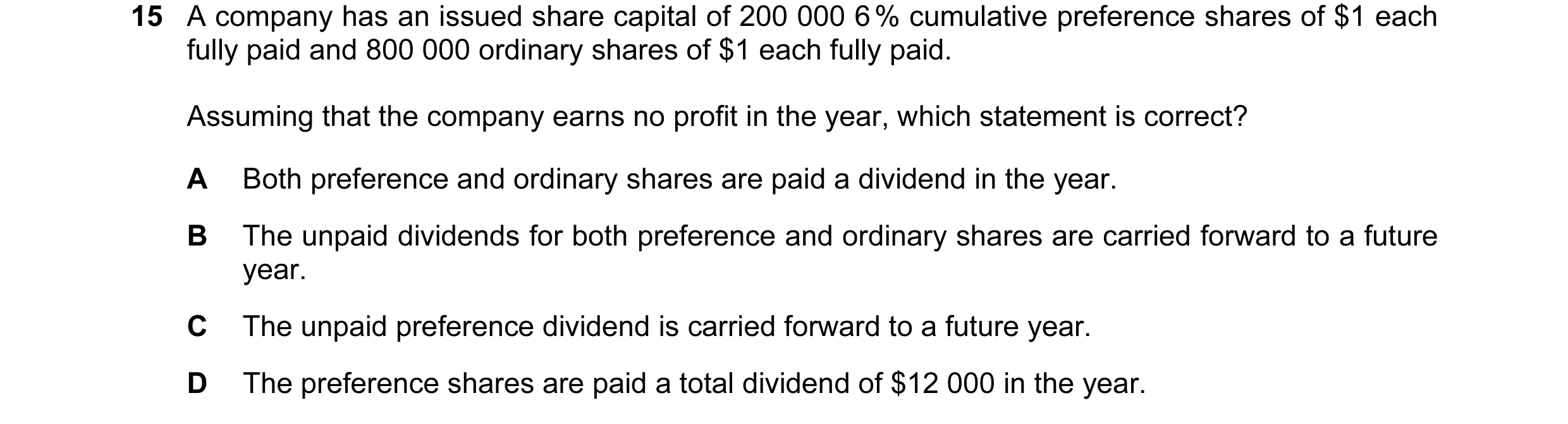
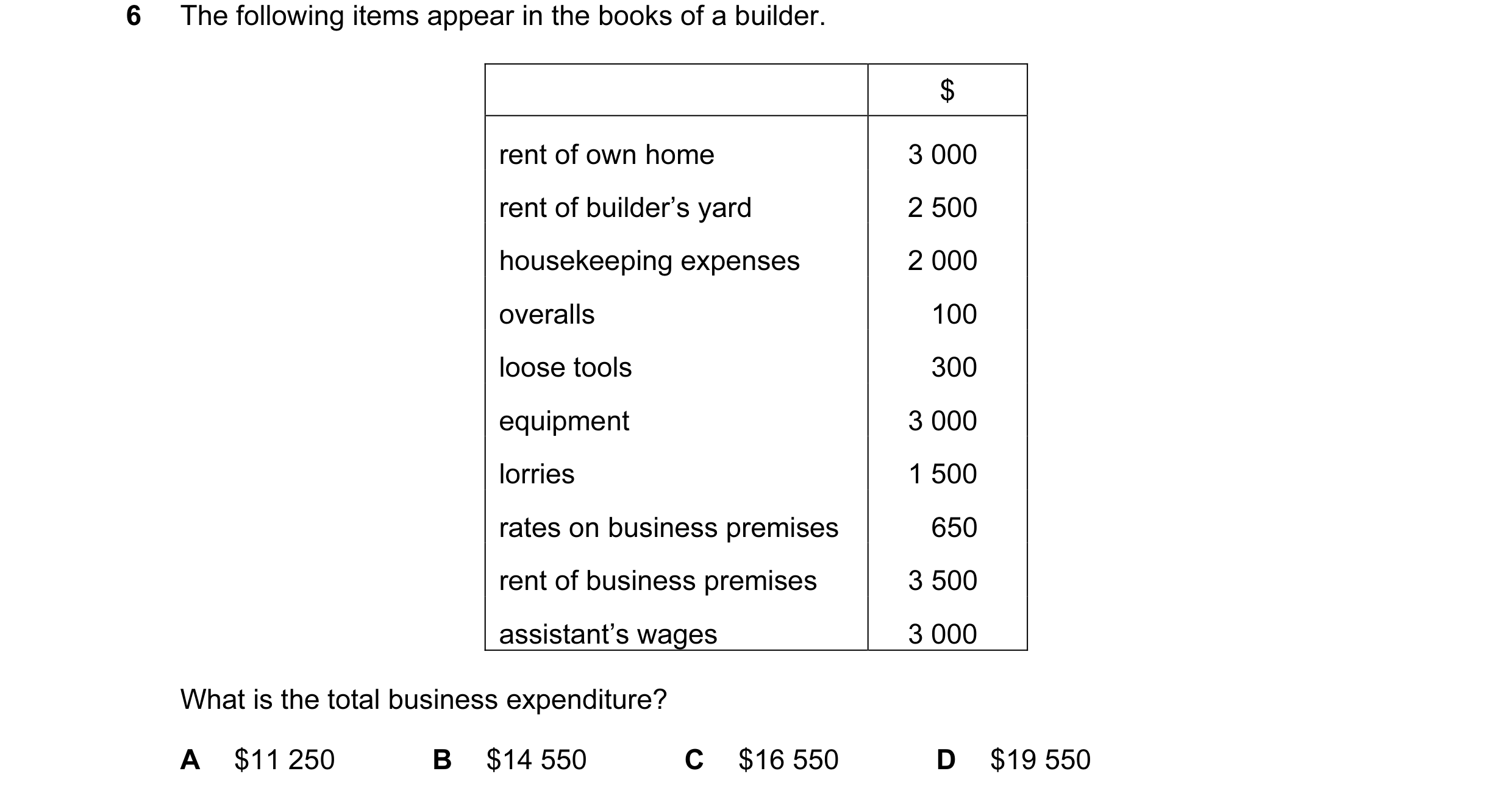
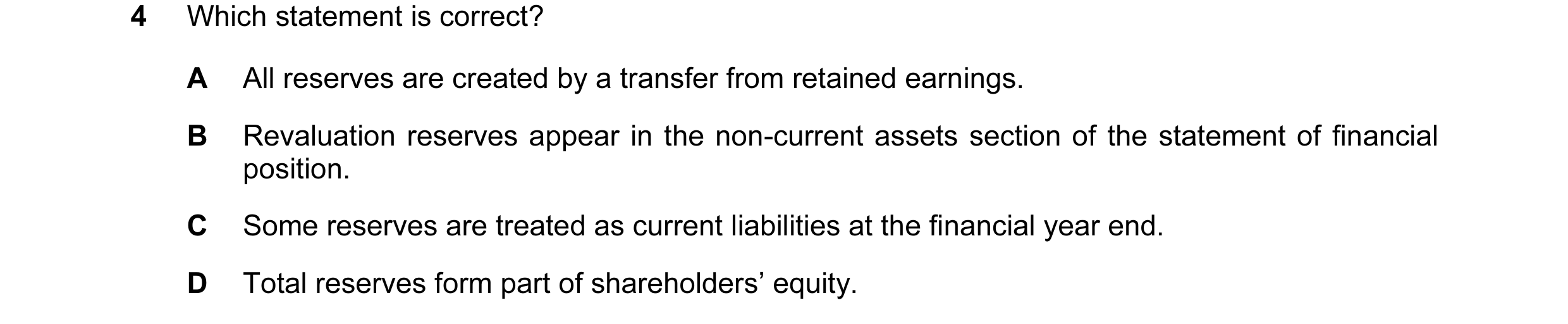 20 / 68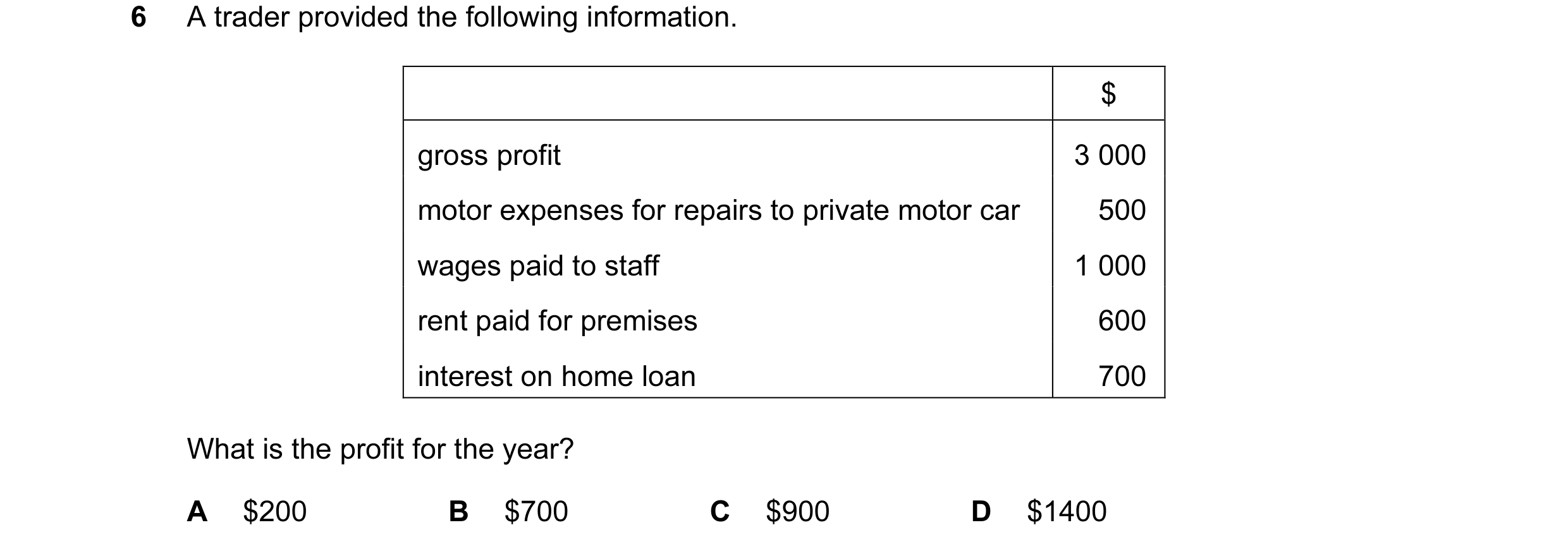
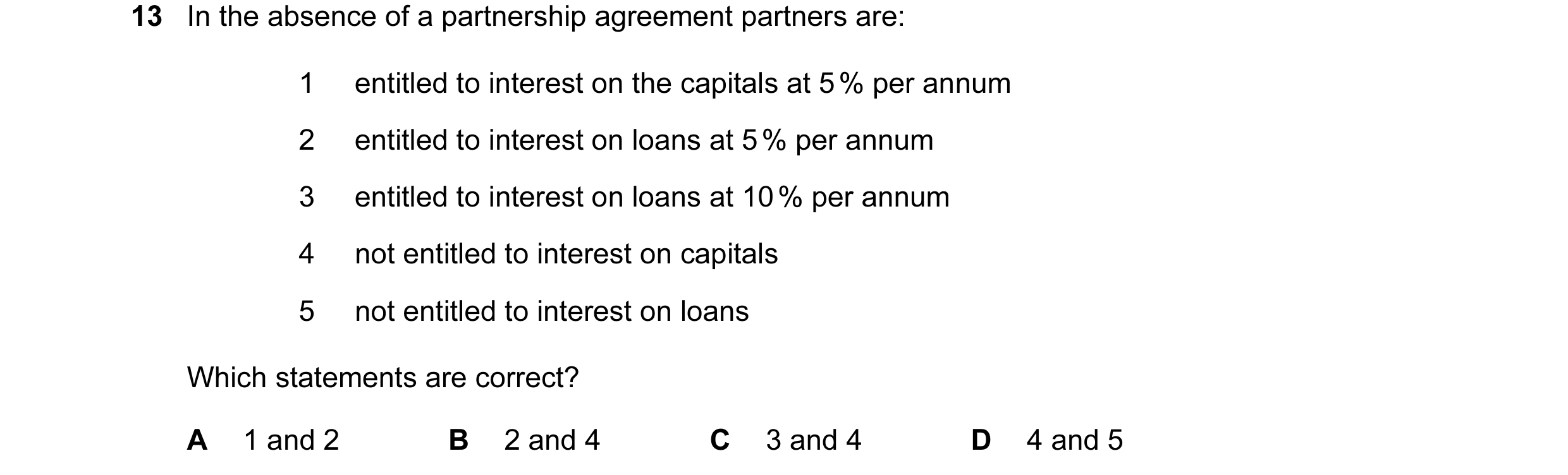
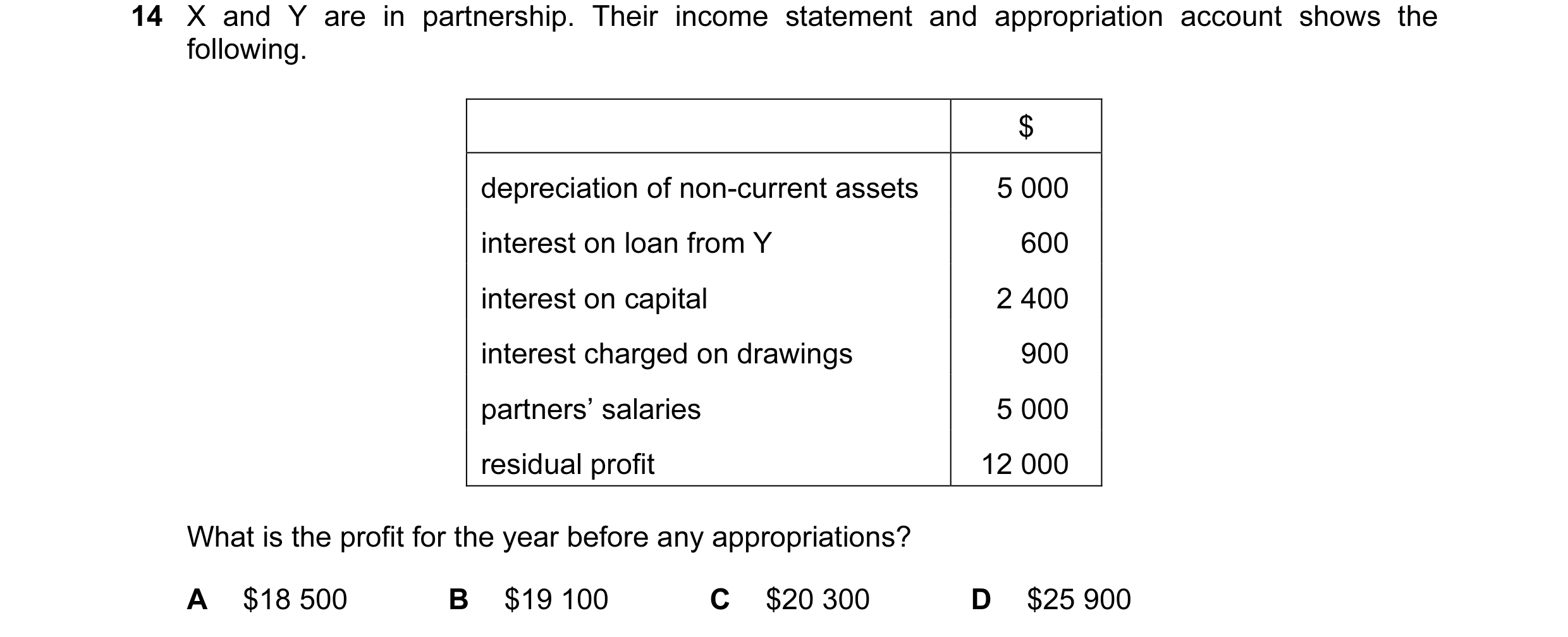
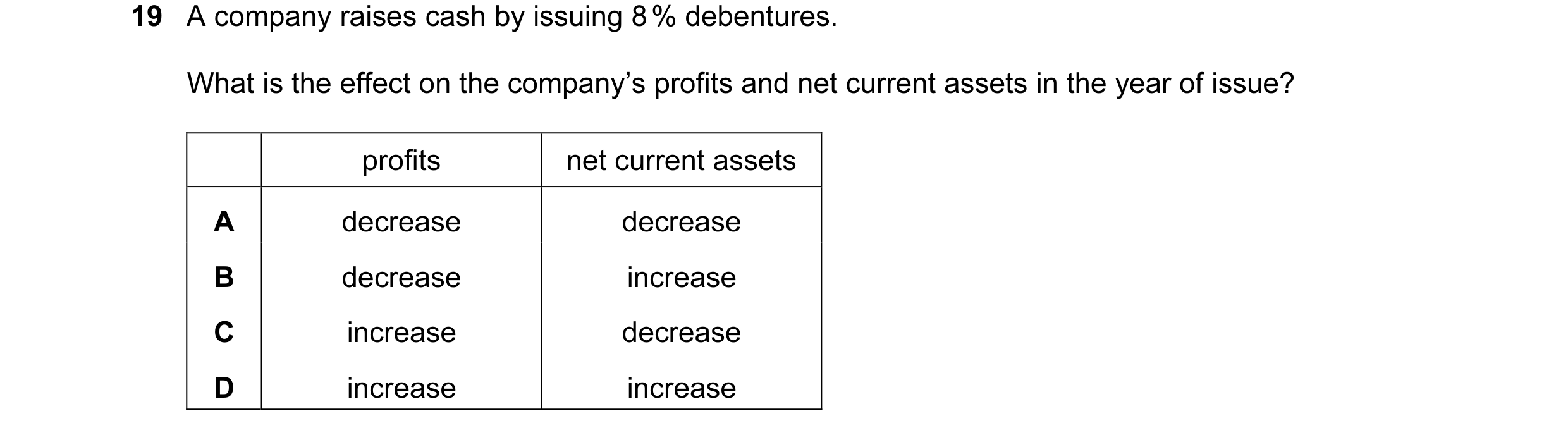 21 / 68
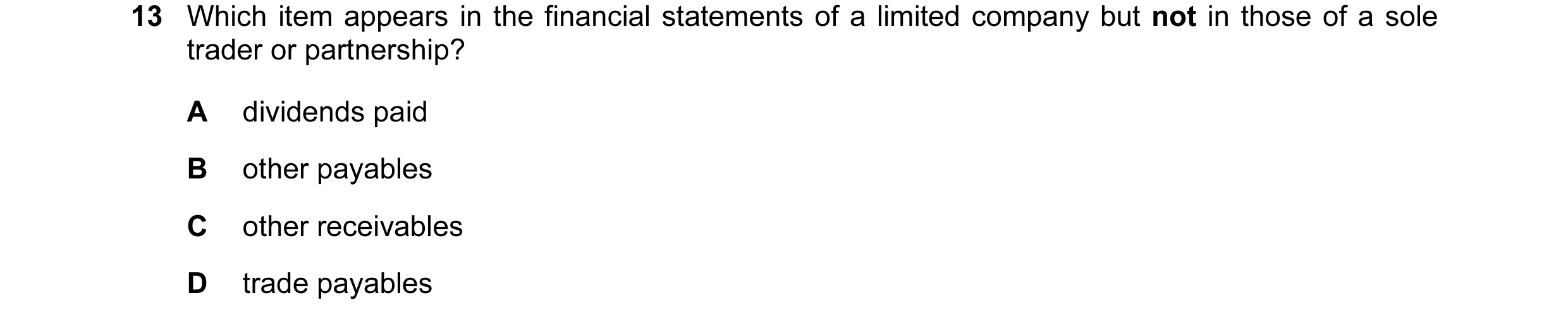
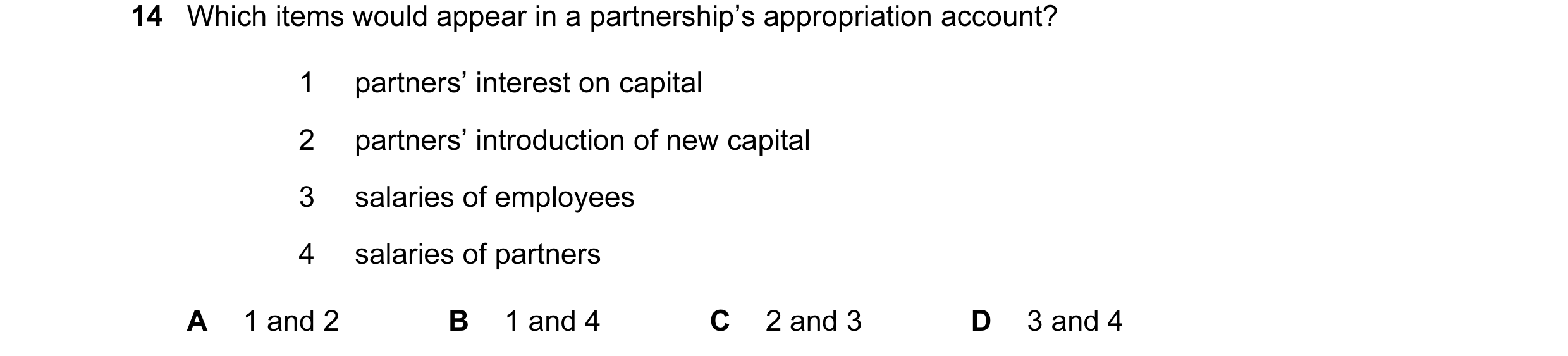
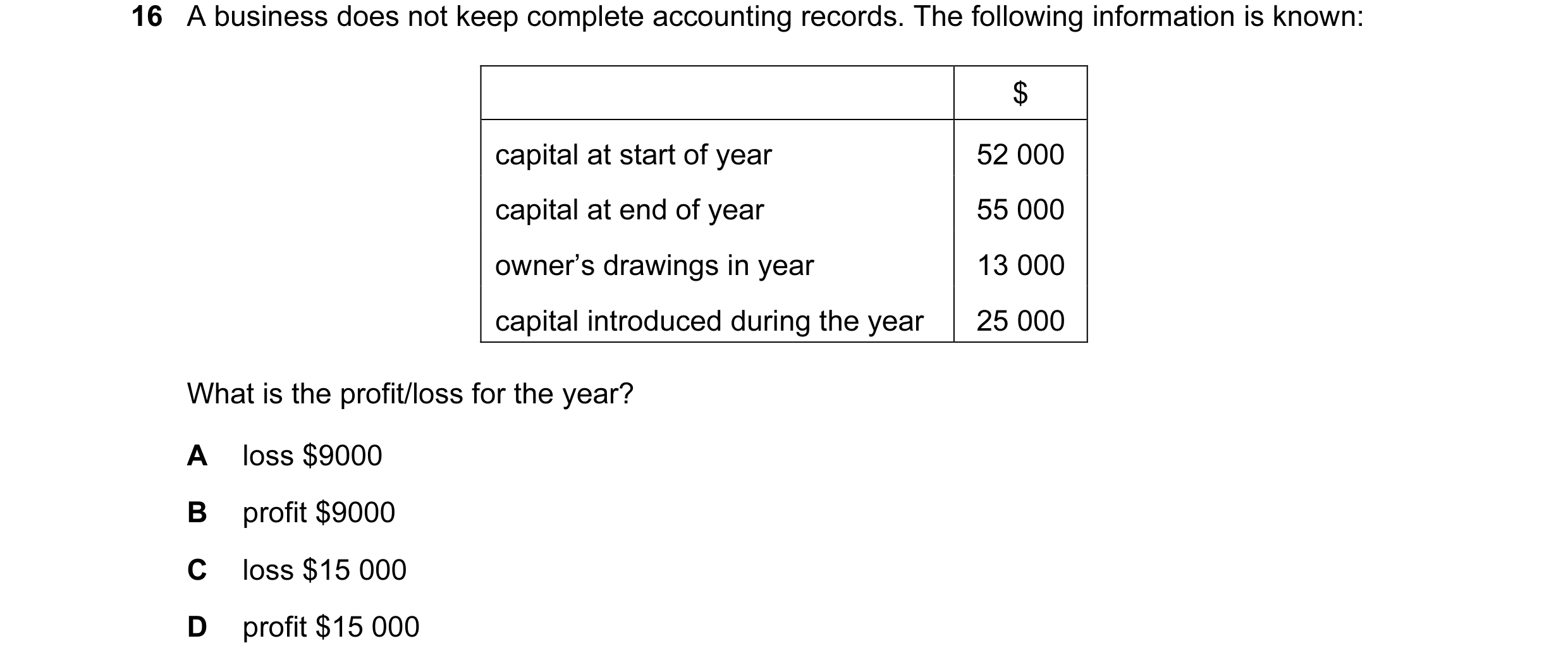
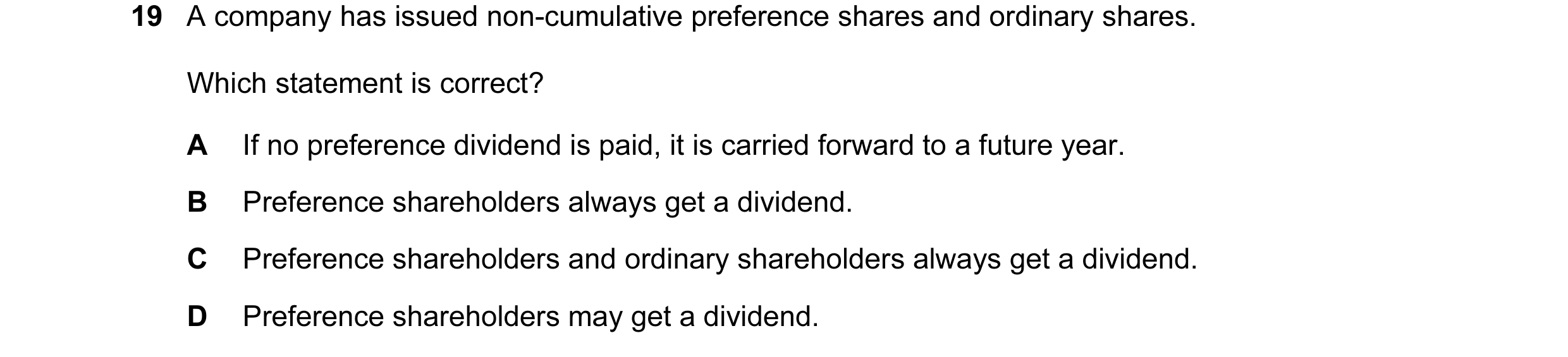 22 / 68
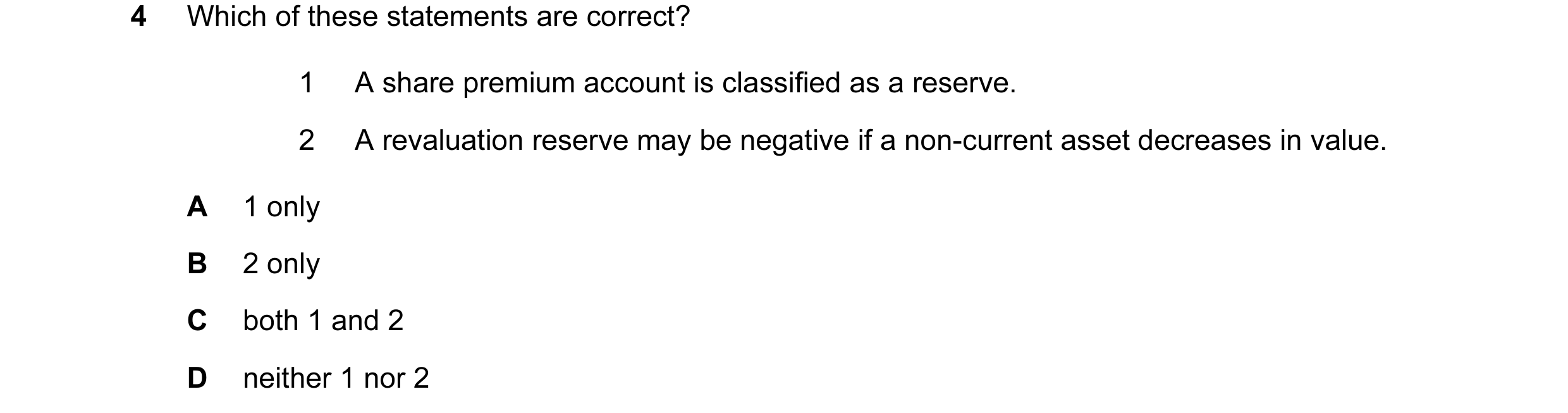
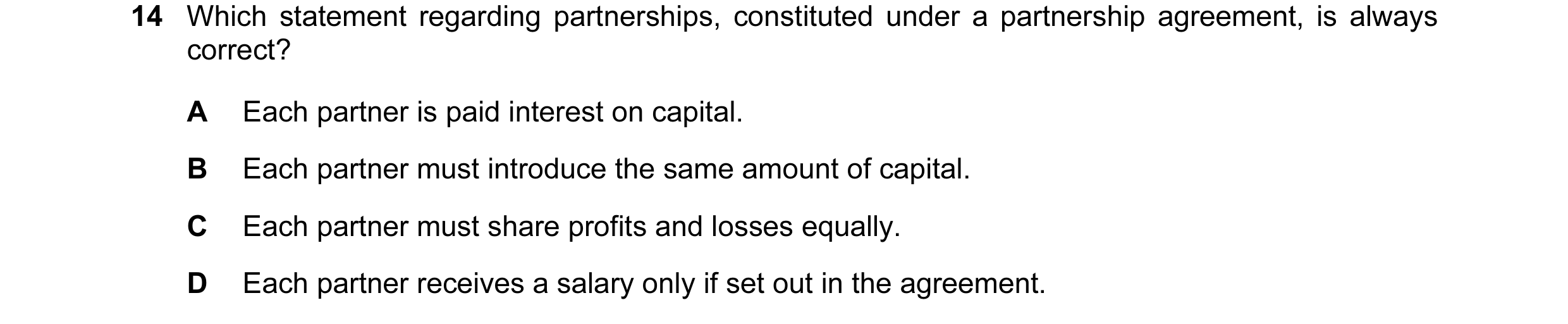
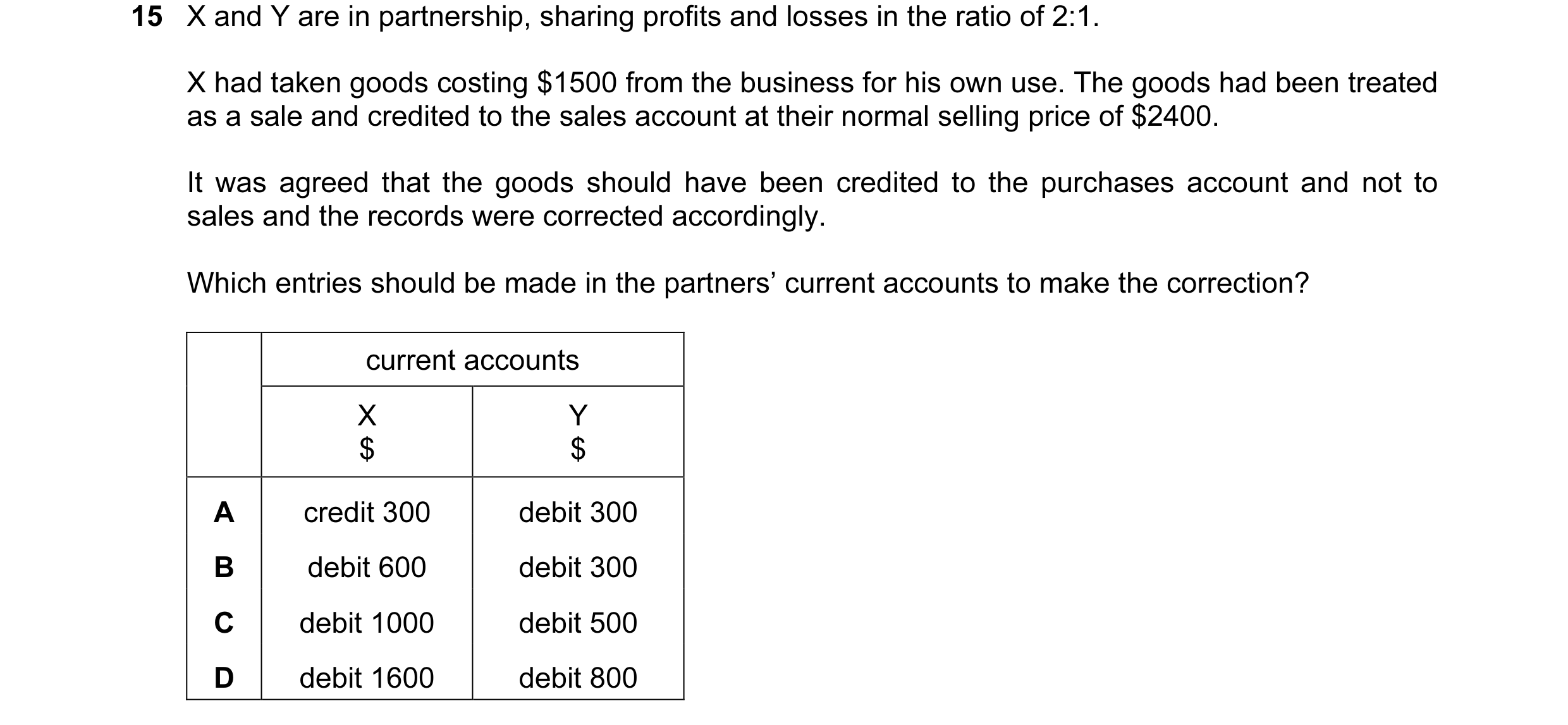
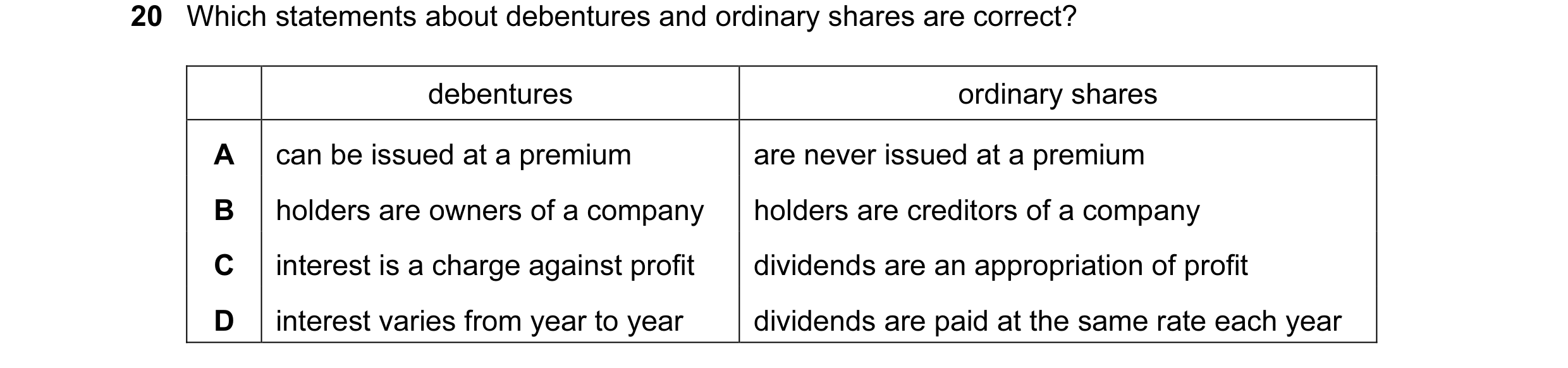 23 / 68



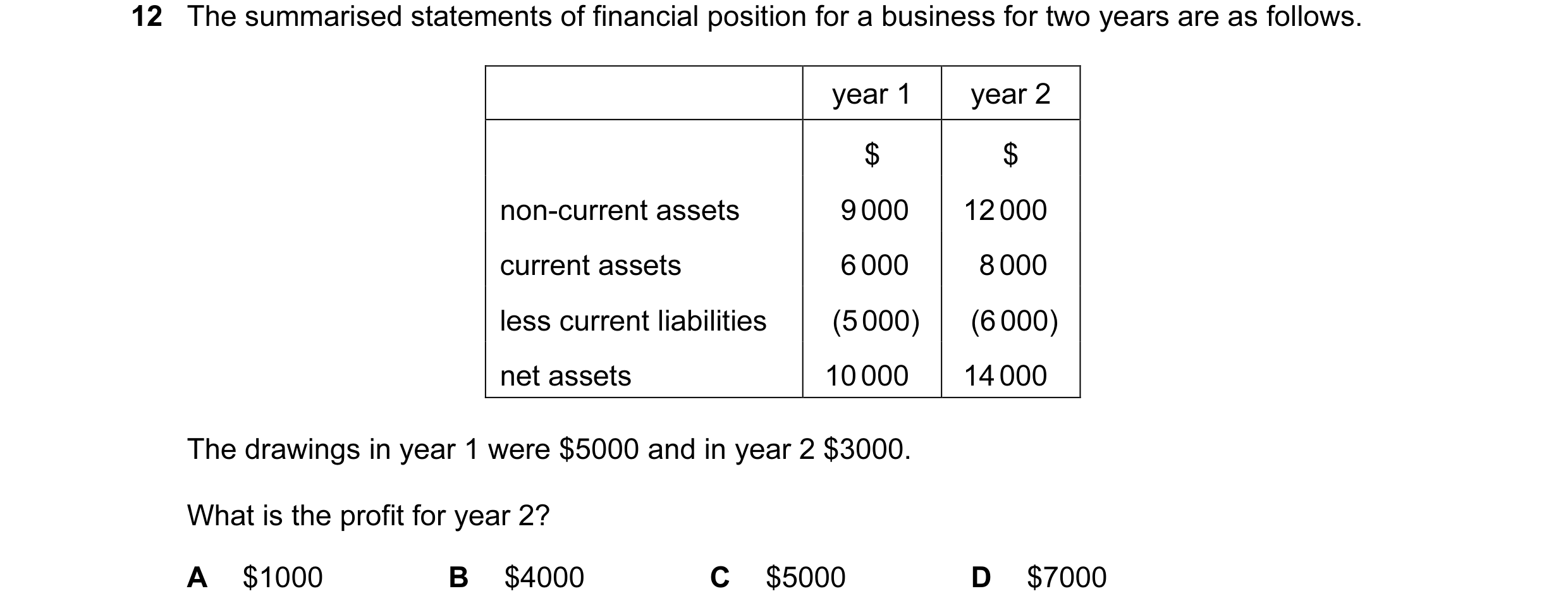 24 / 68

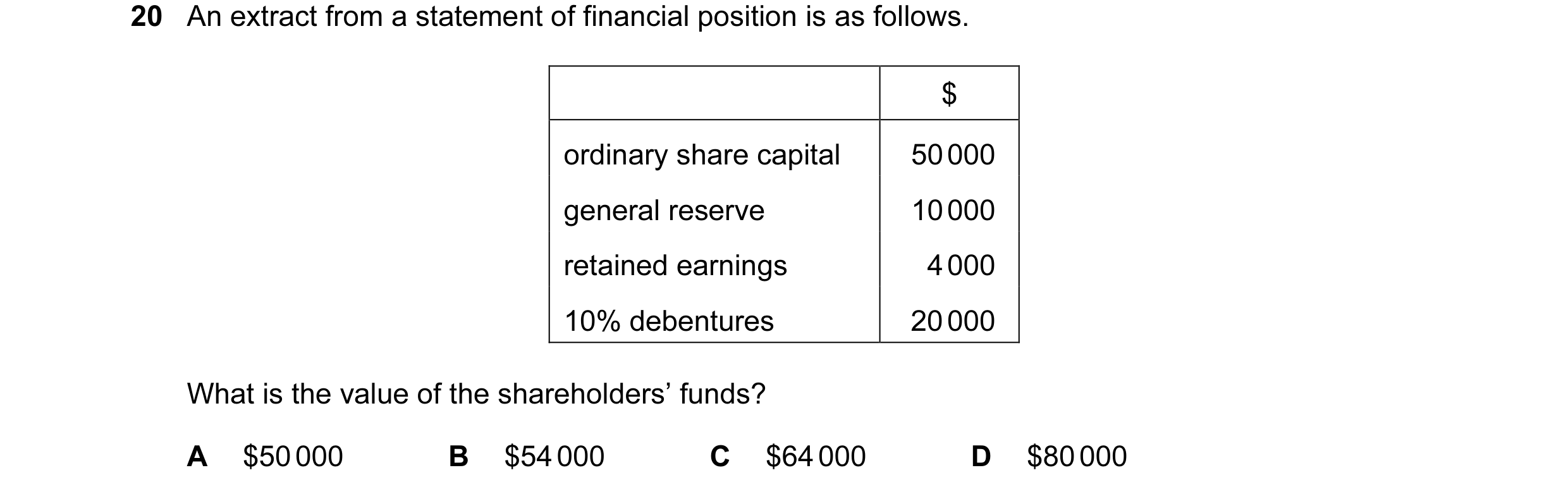 25 / 68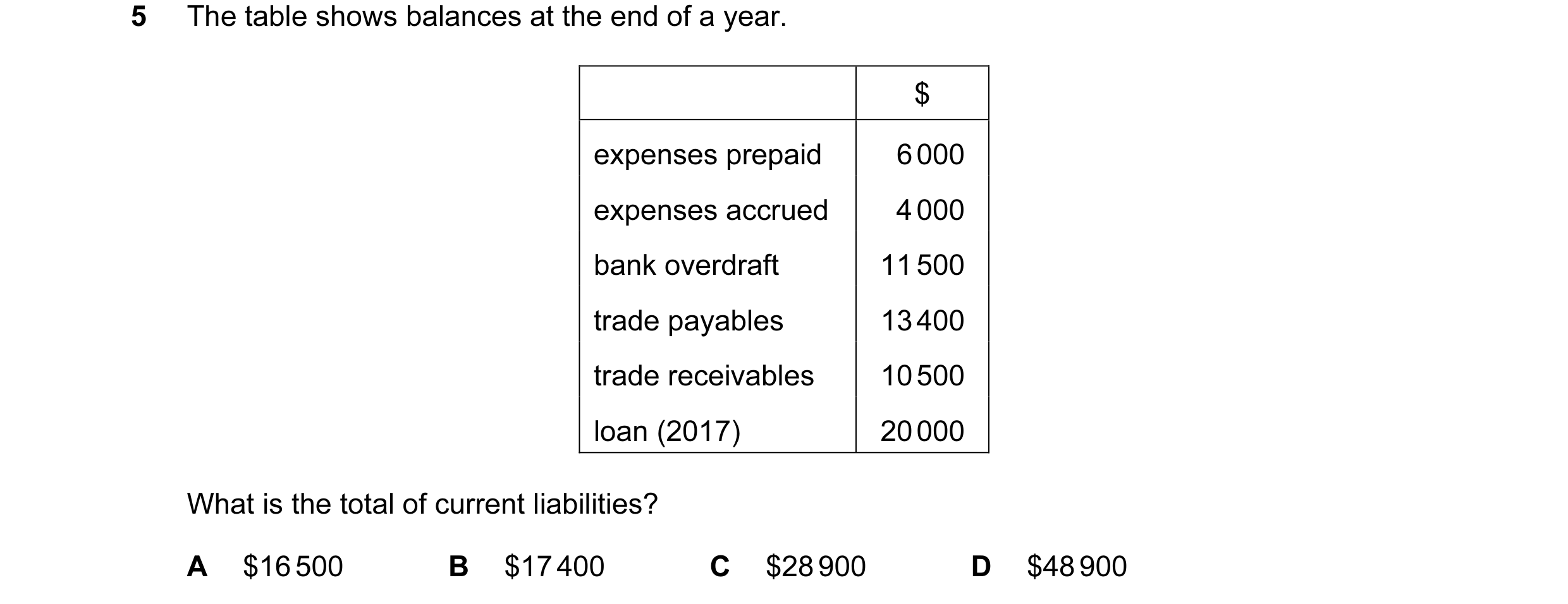
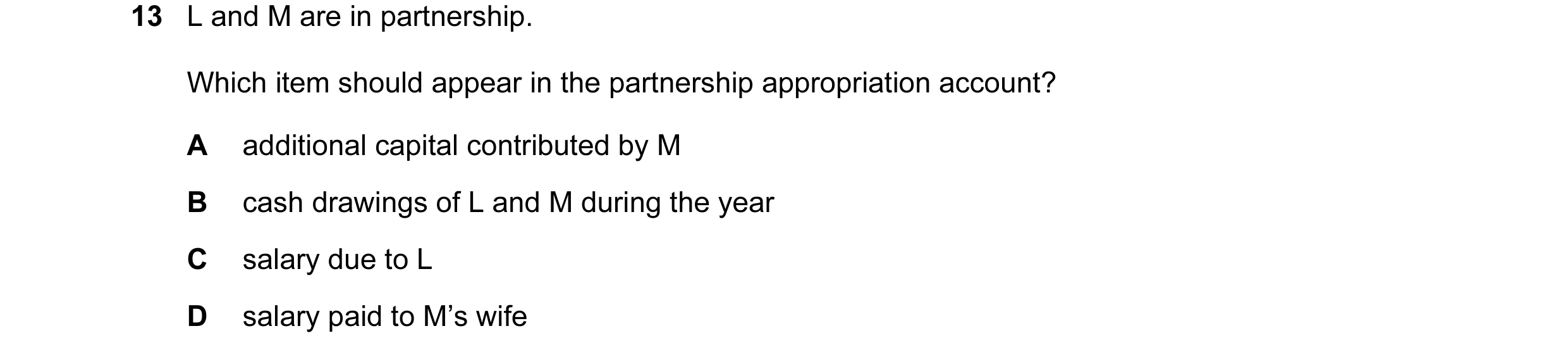

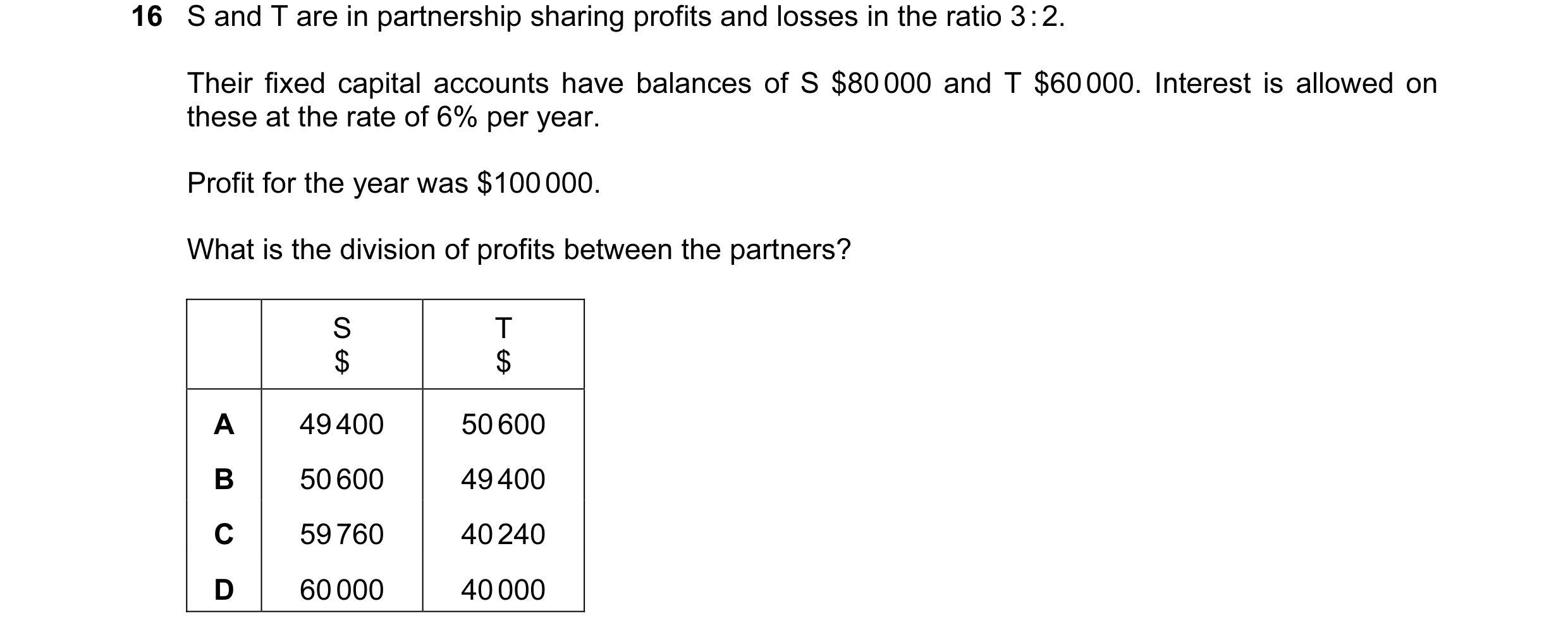 26 / 68
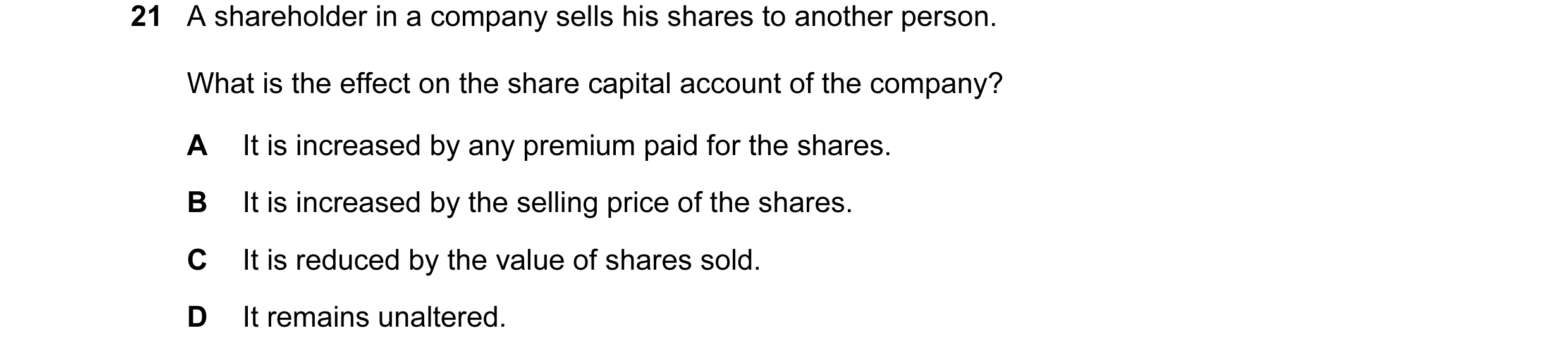
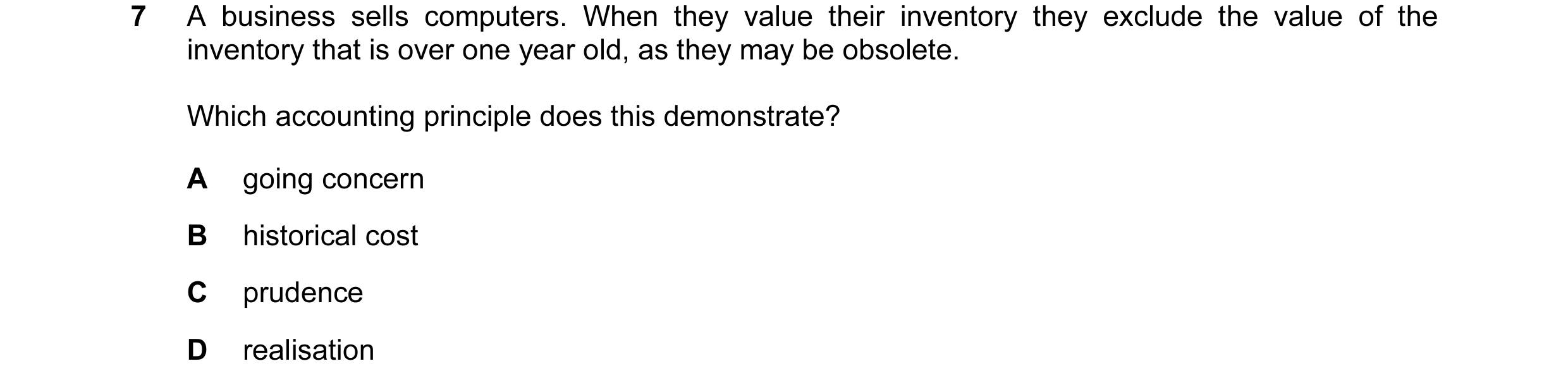
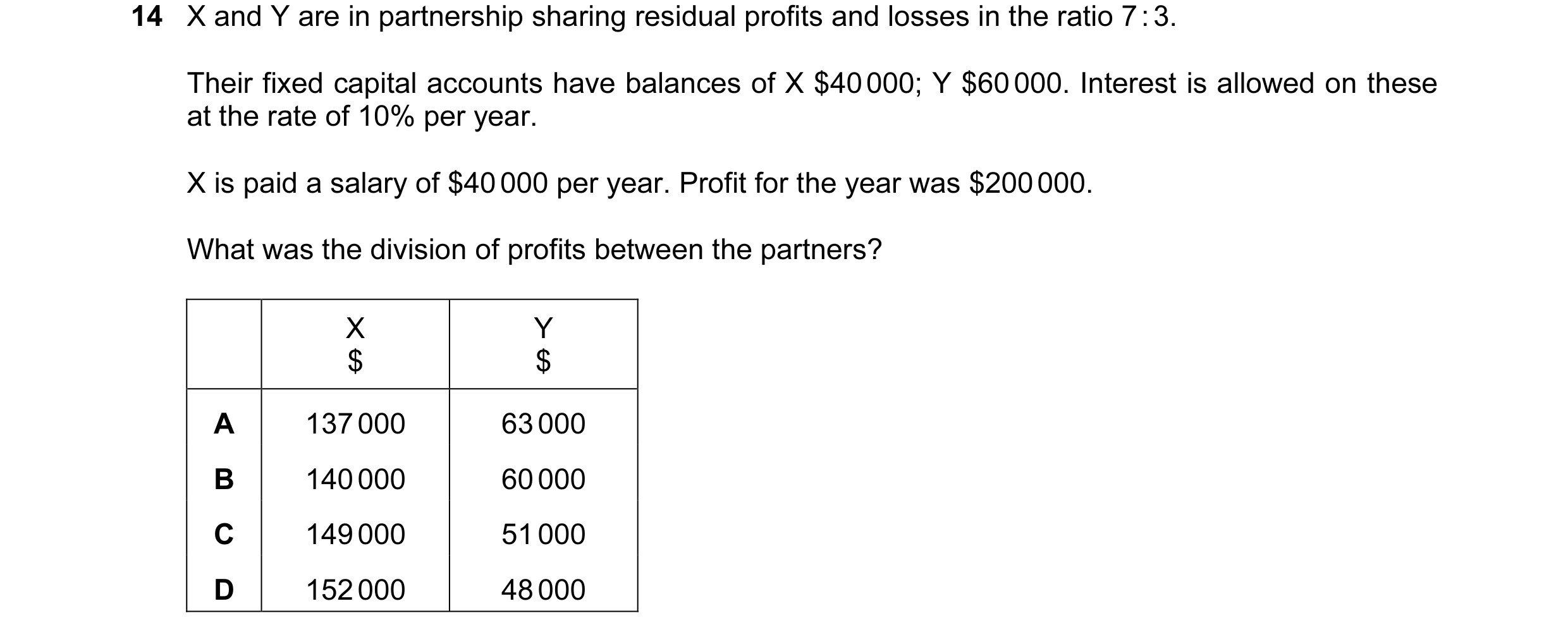 27 / 68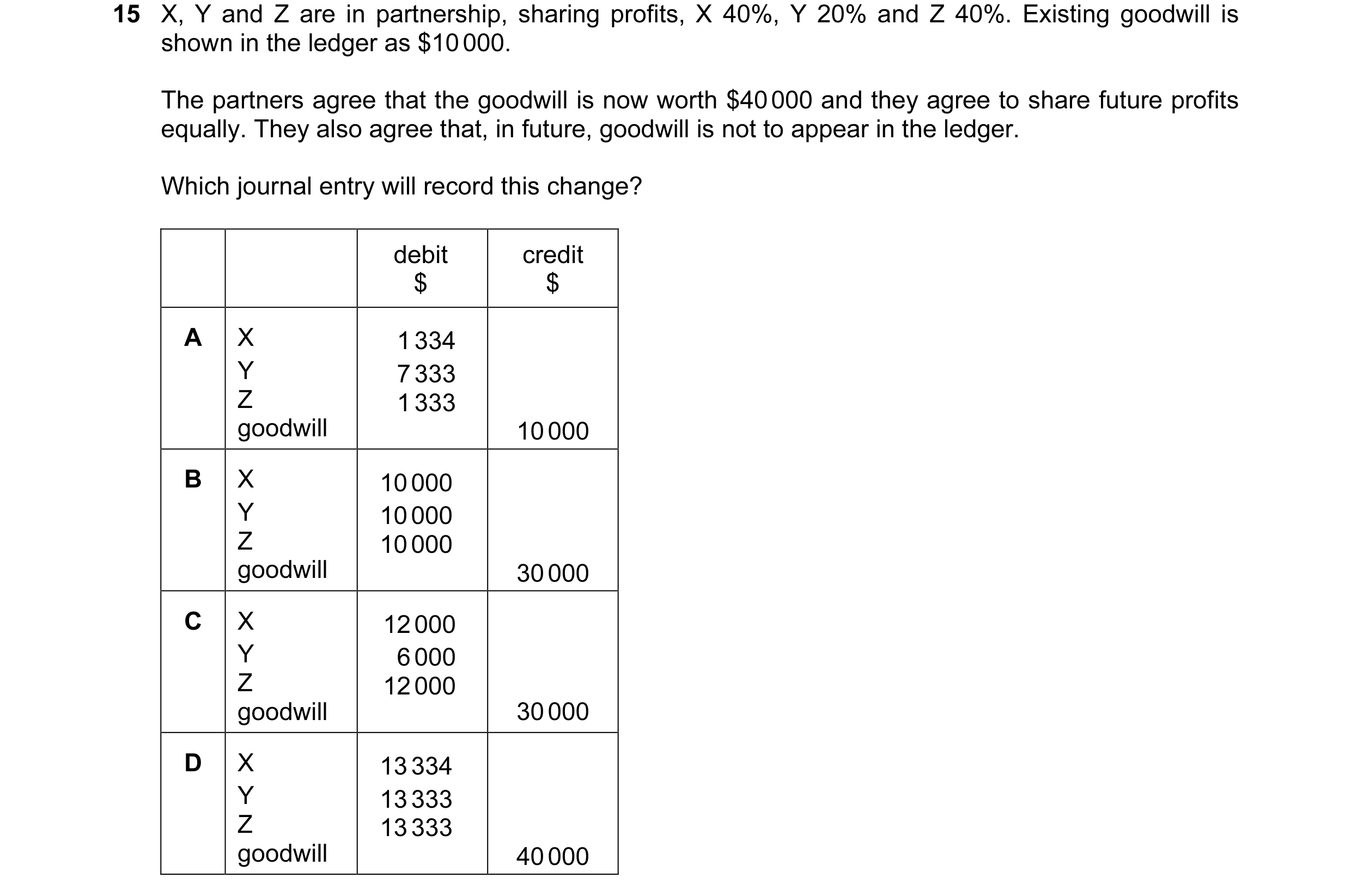

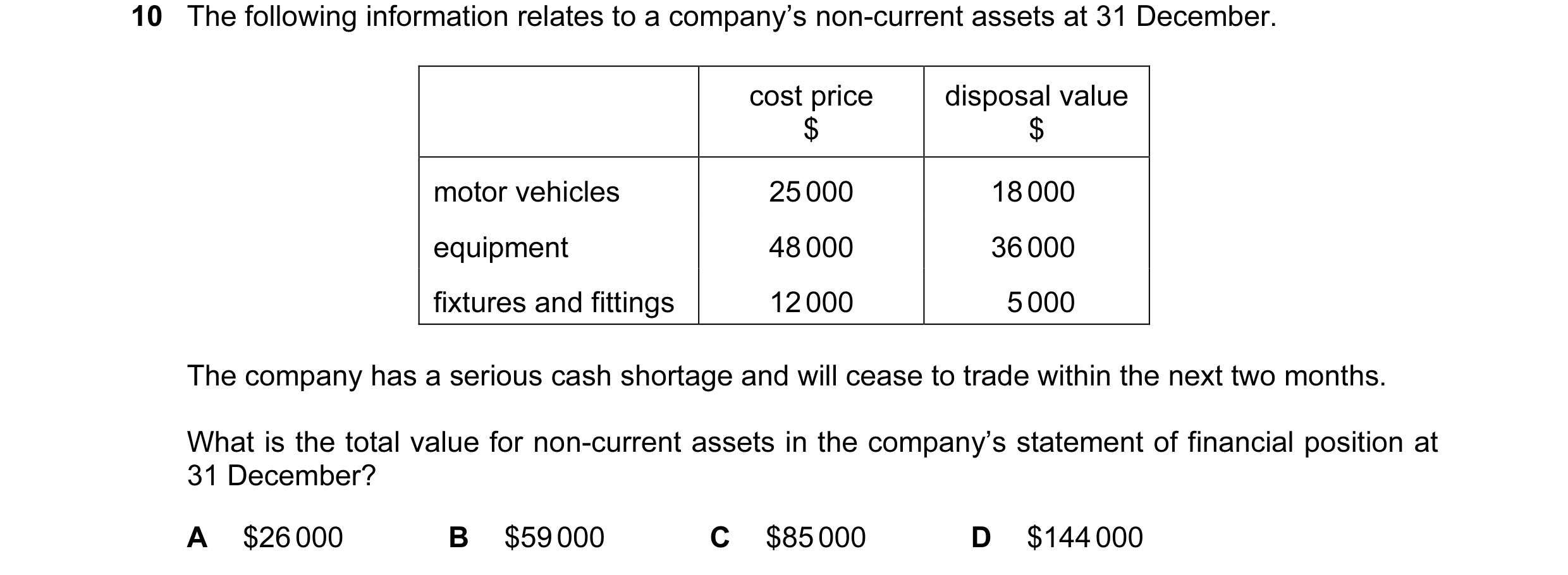 28 / 68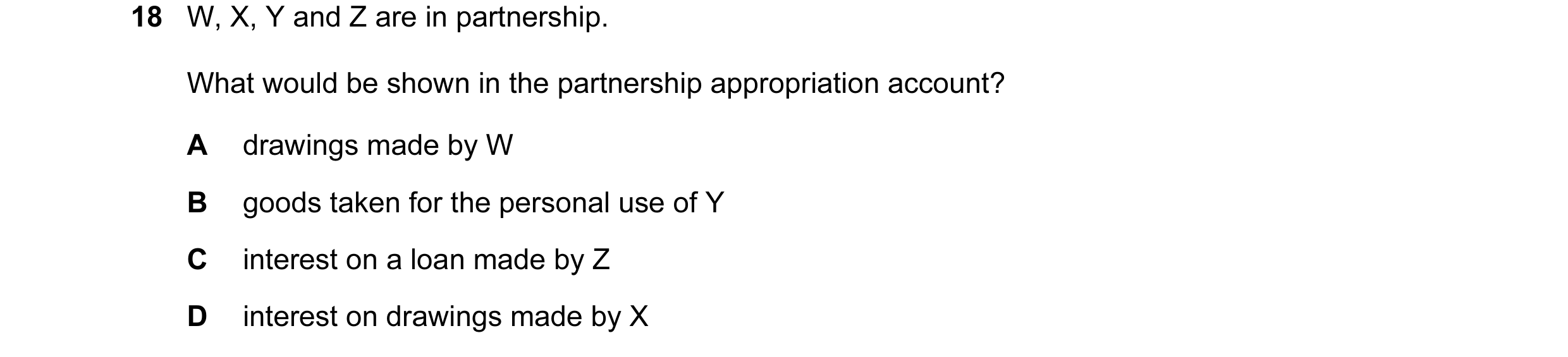

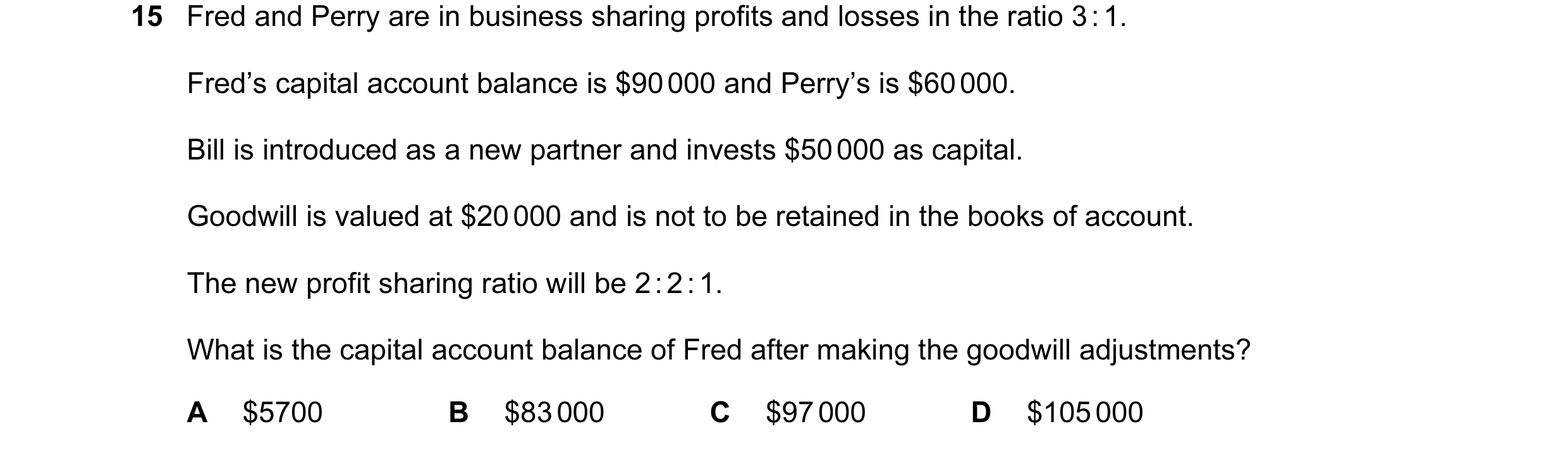
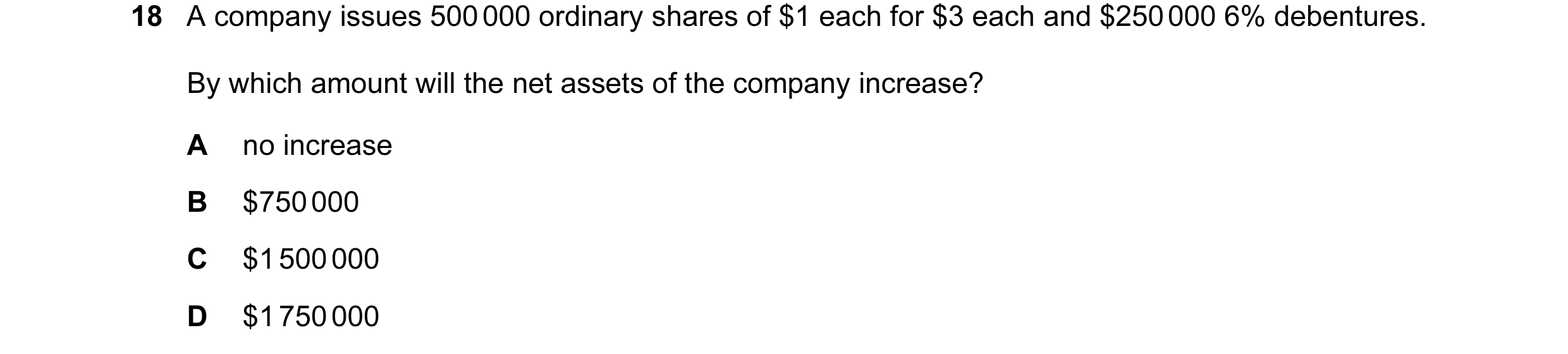
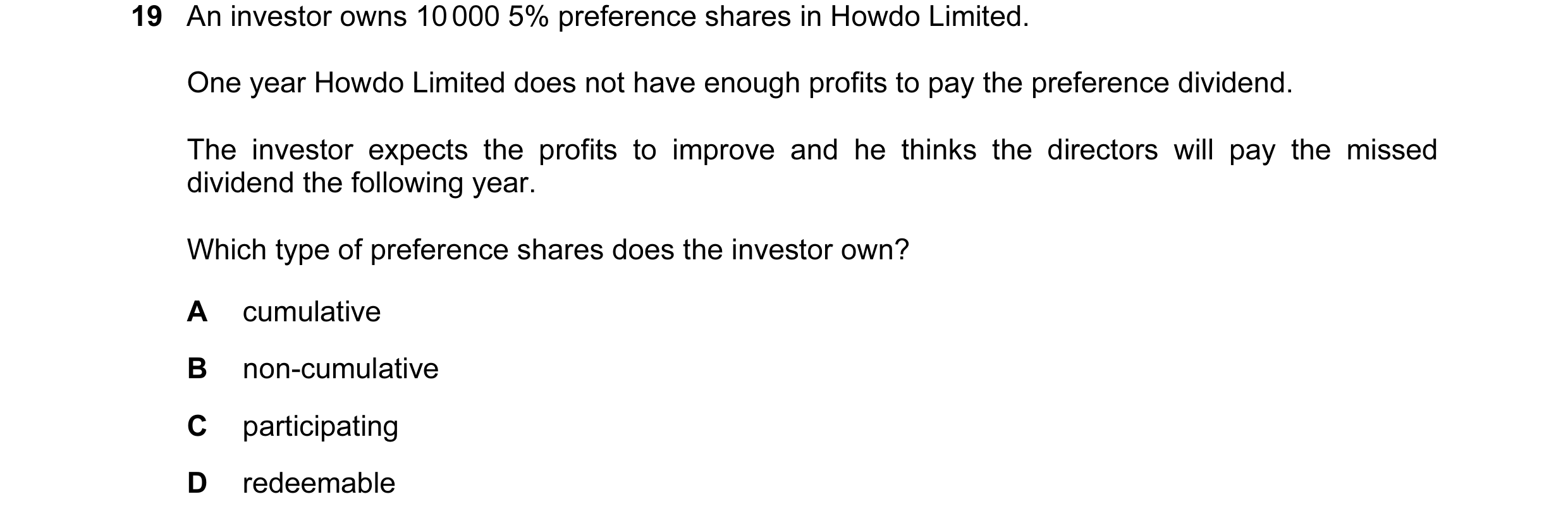 29 / 68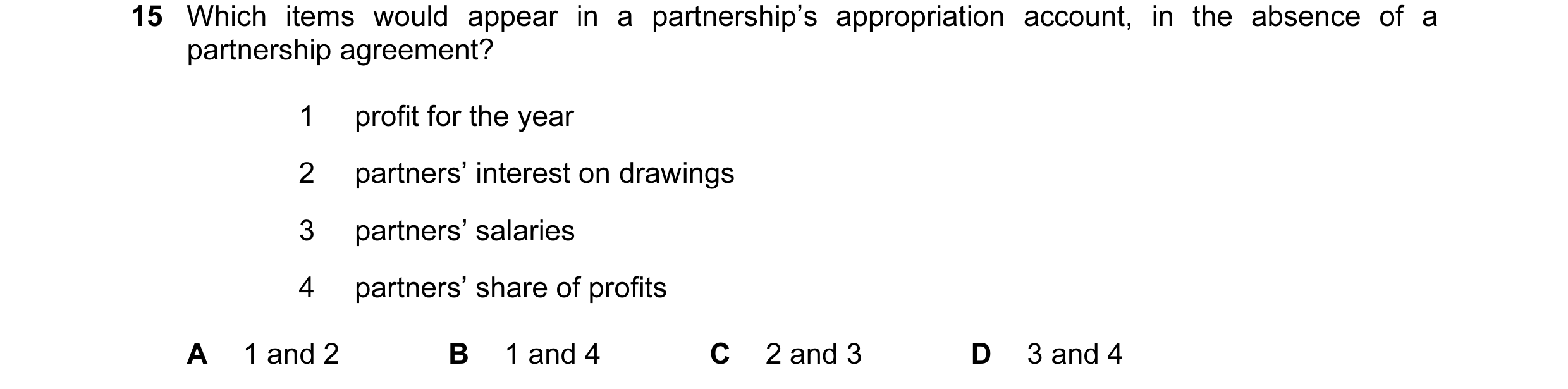
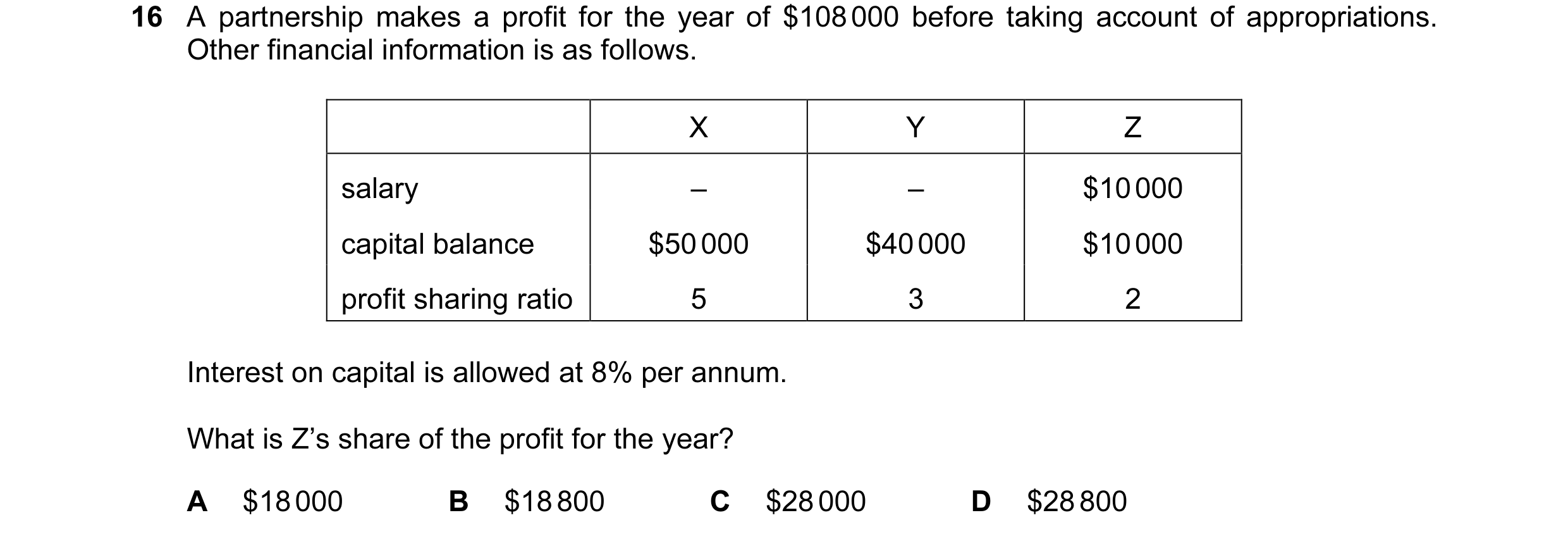
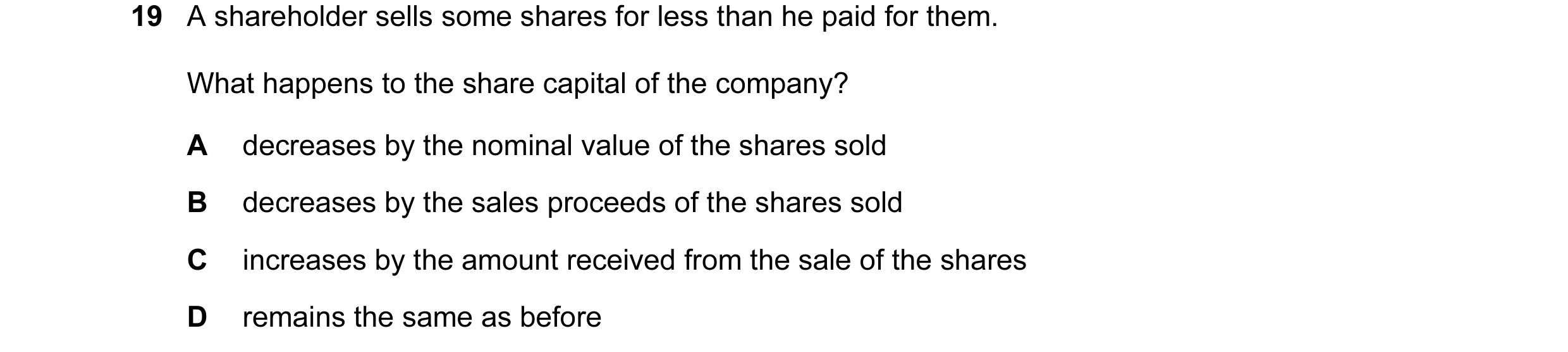

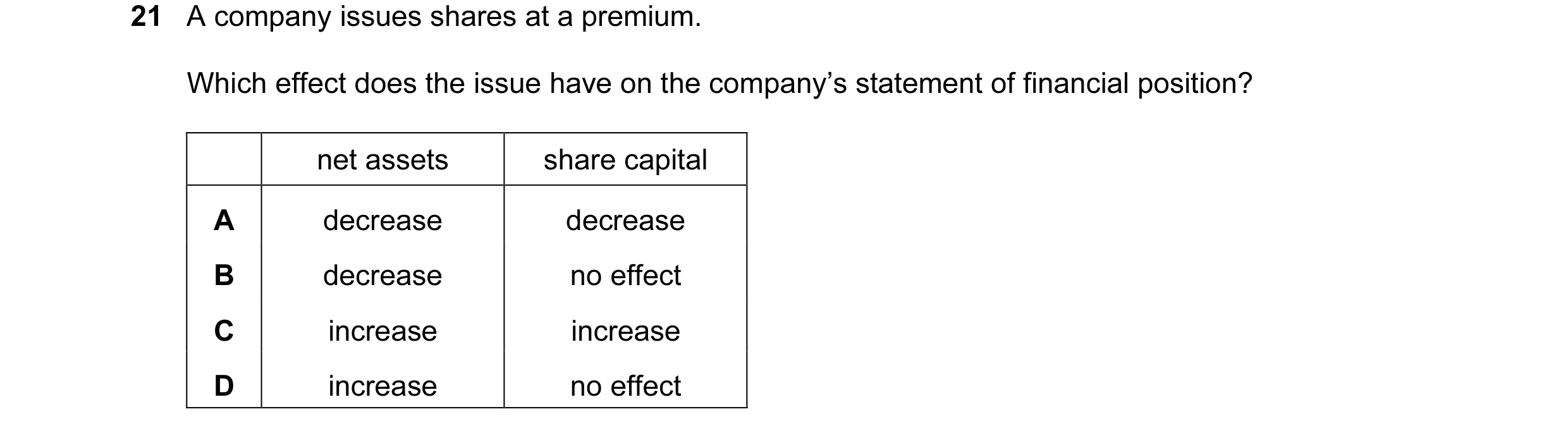 30 / 68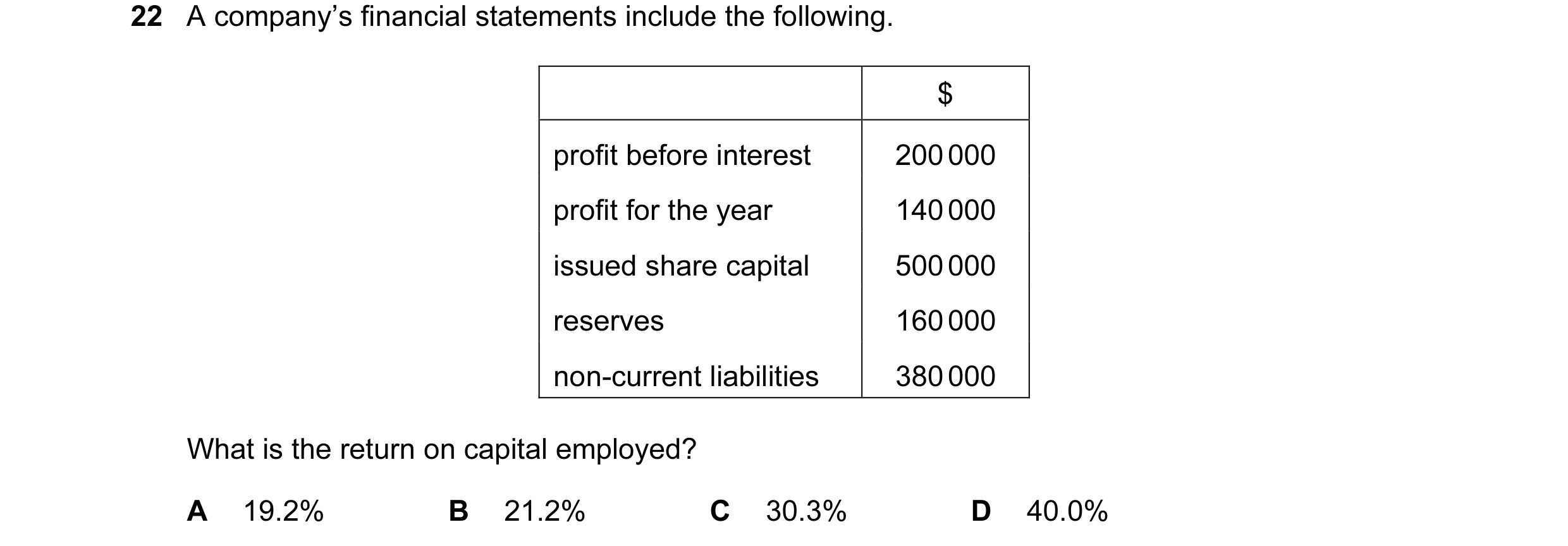
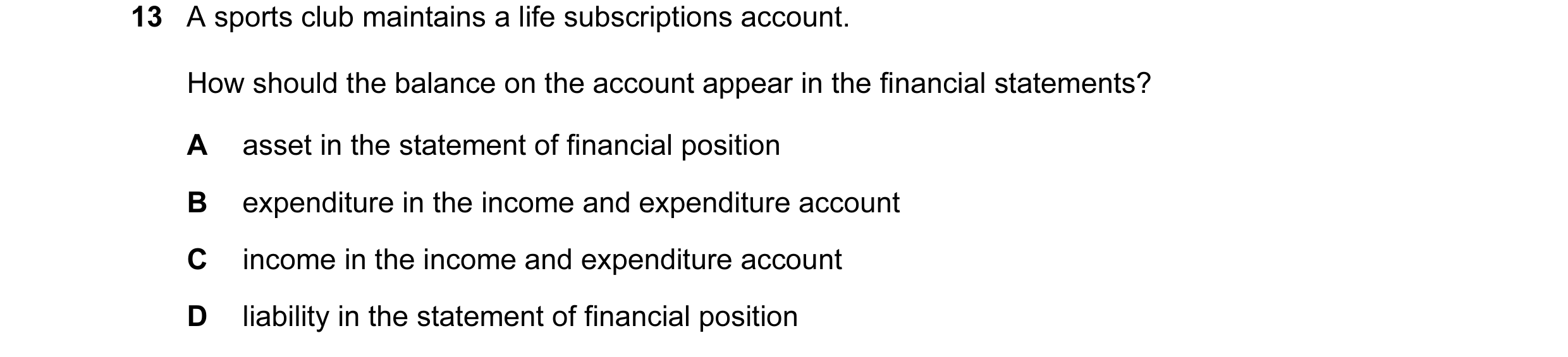
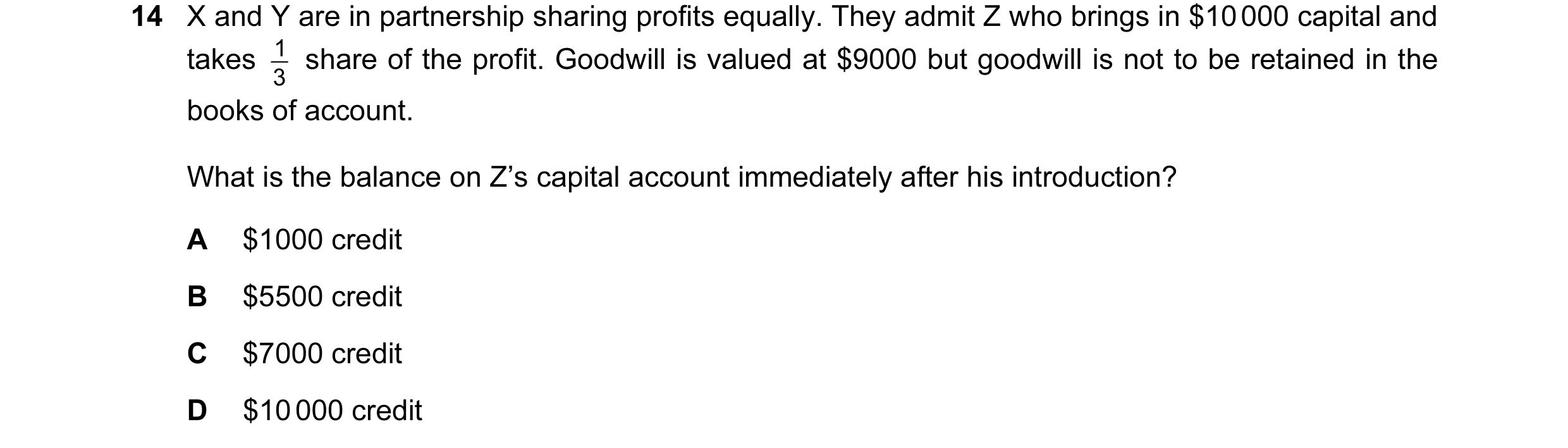

 31 / 68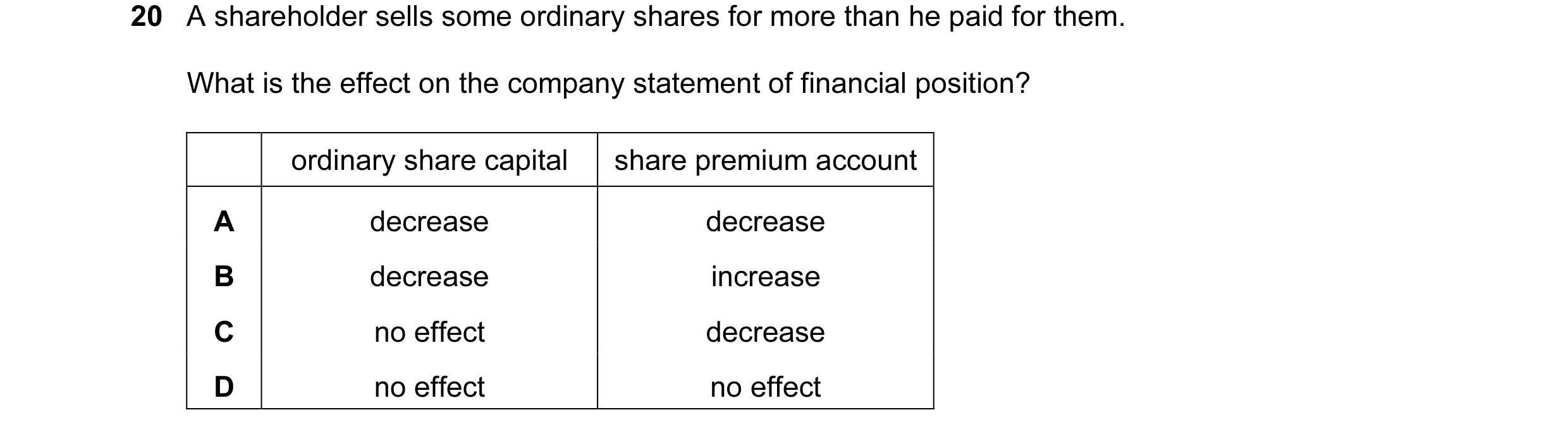
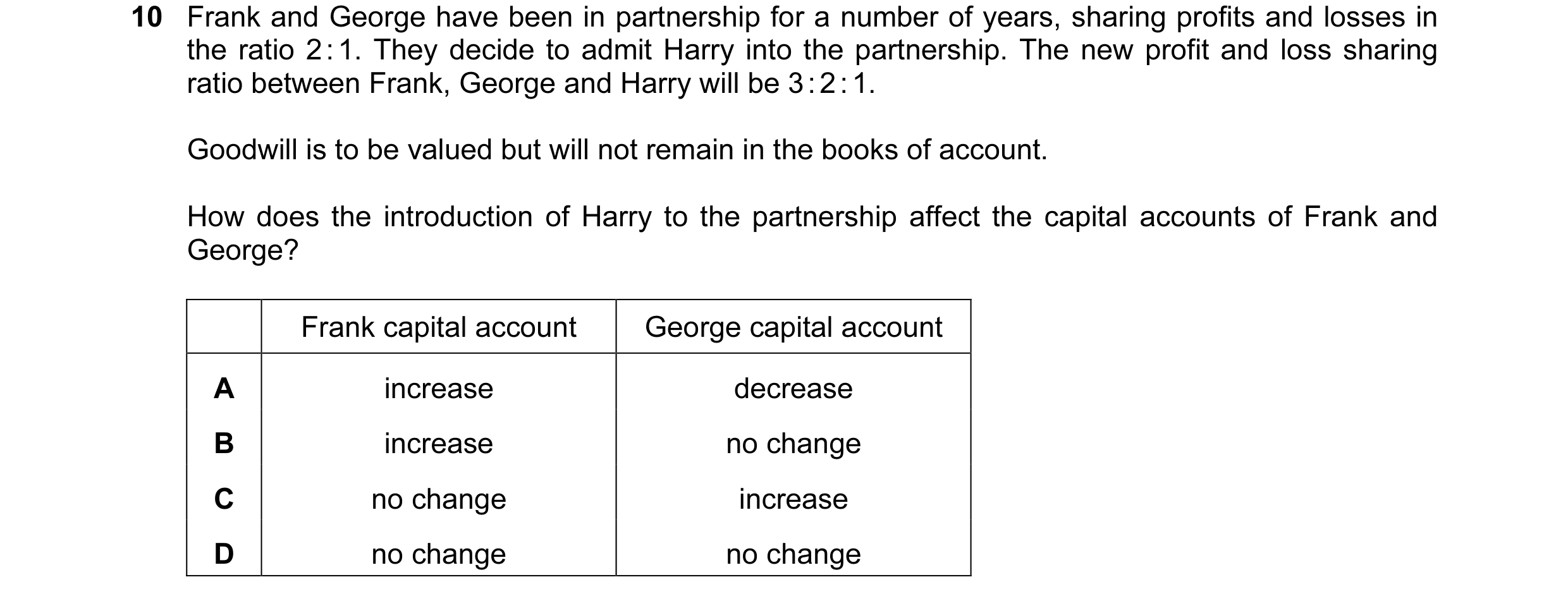

 32 / 68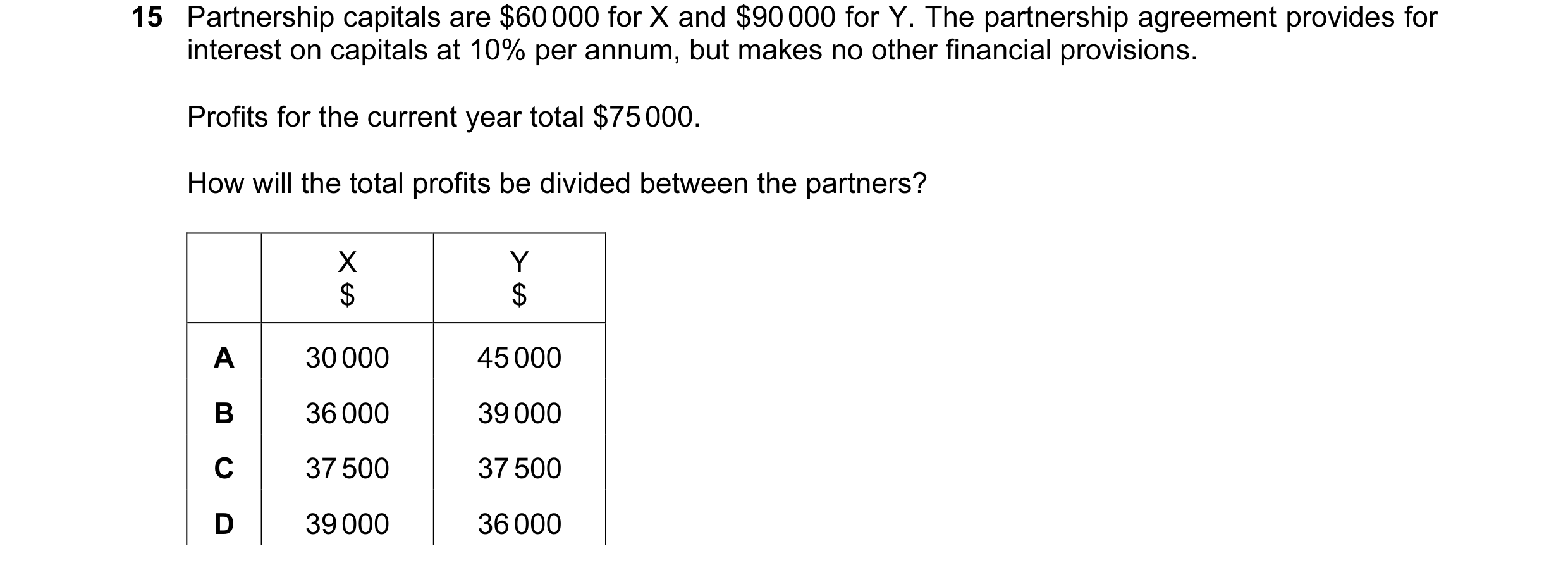
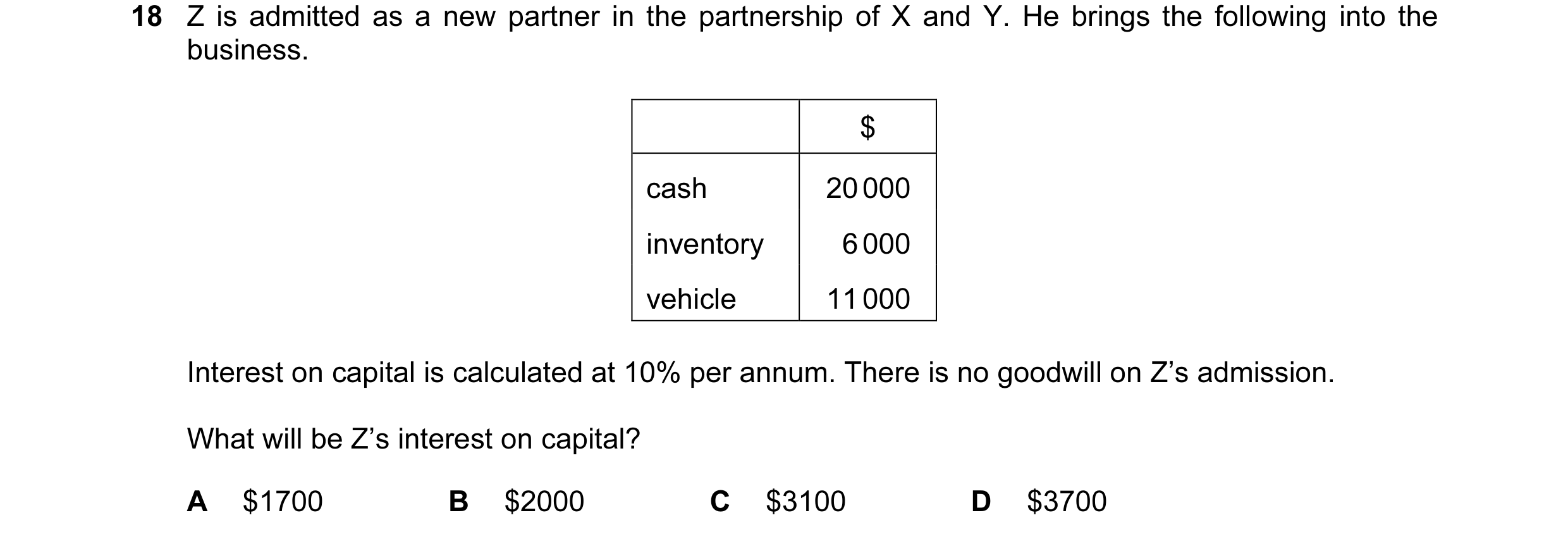
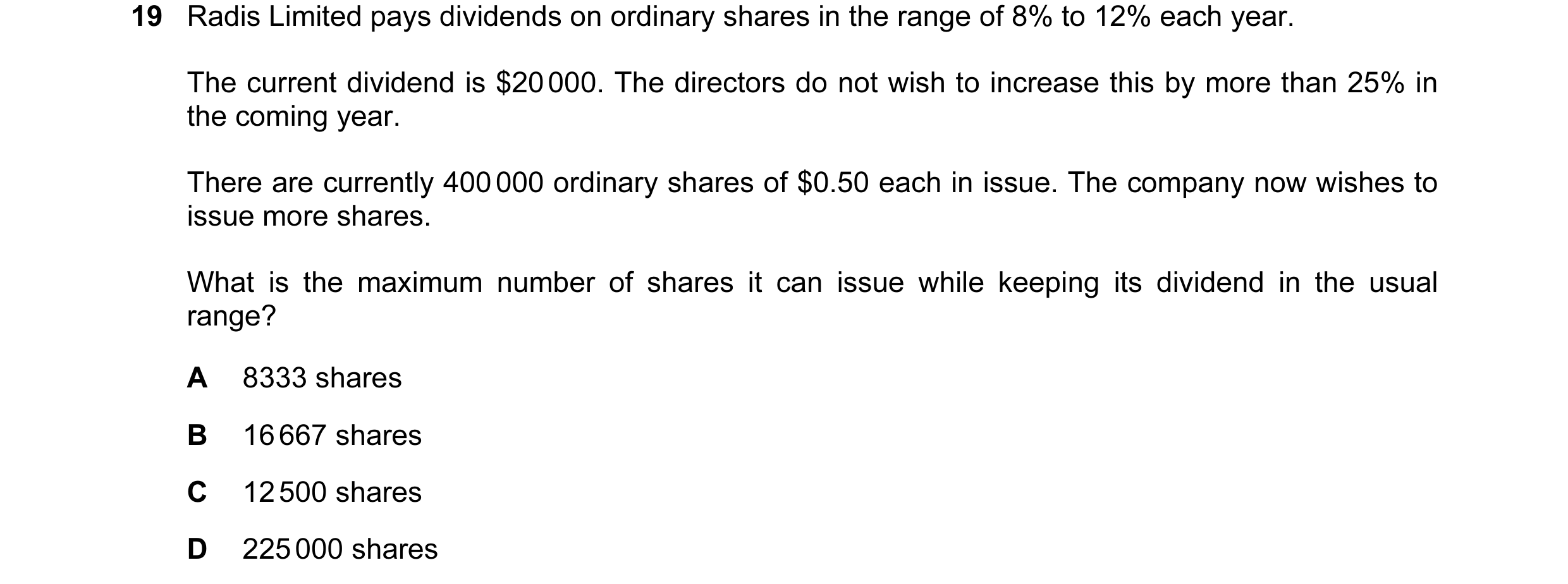
 33 / 68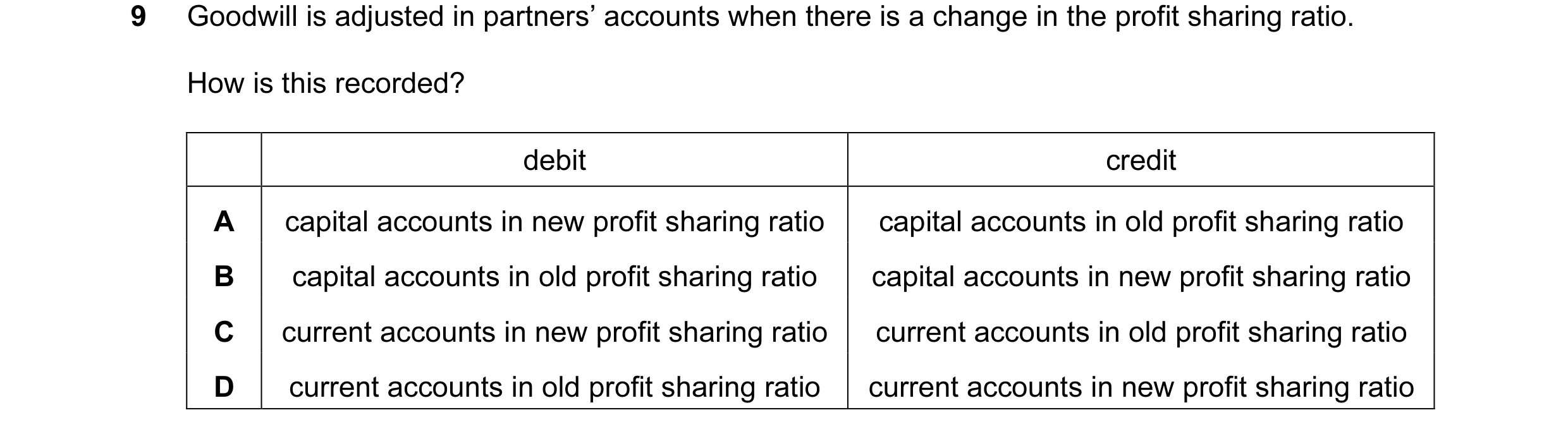
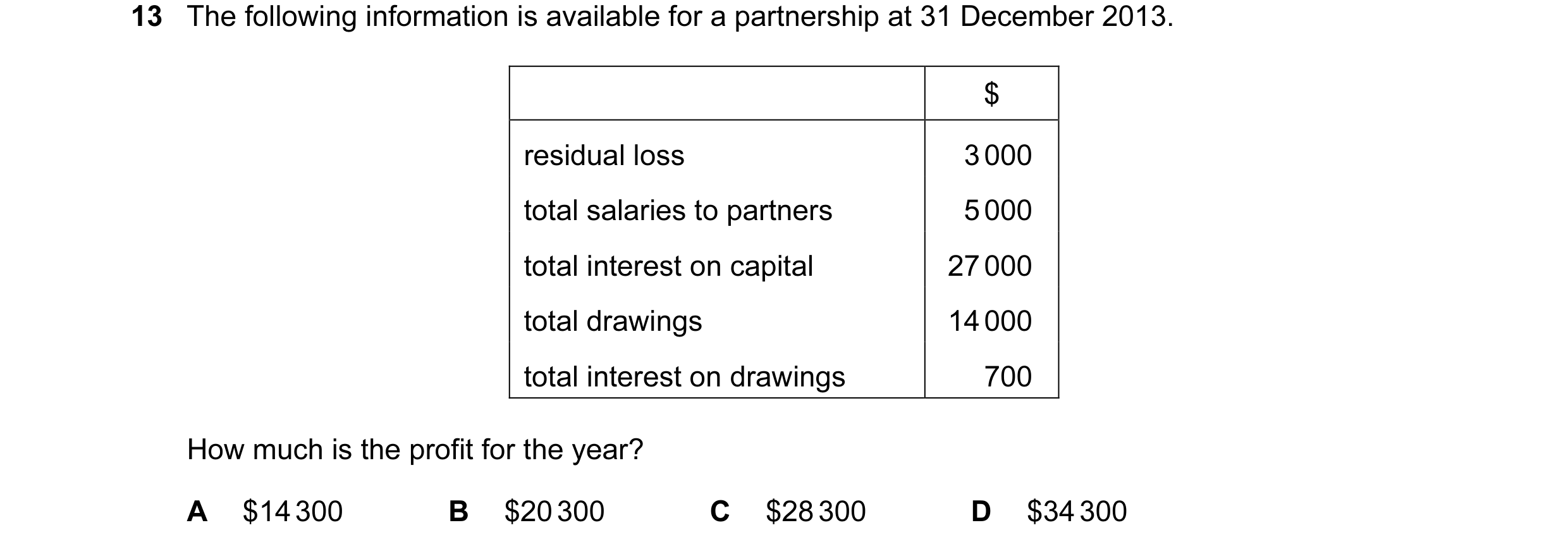
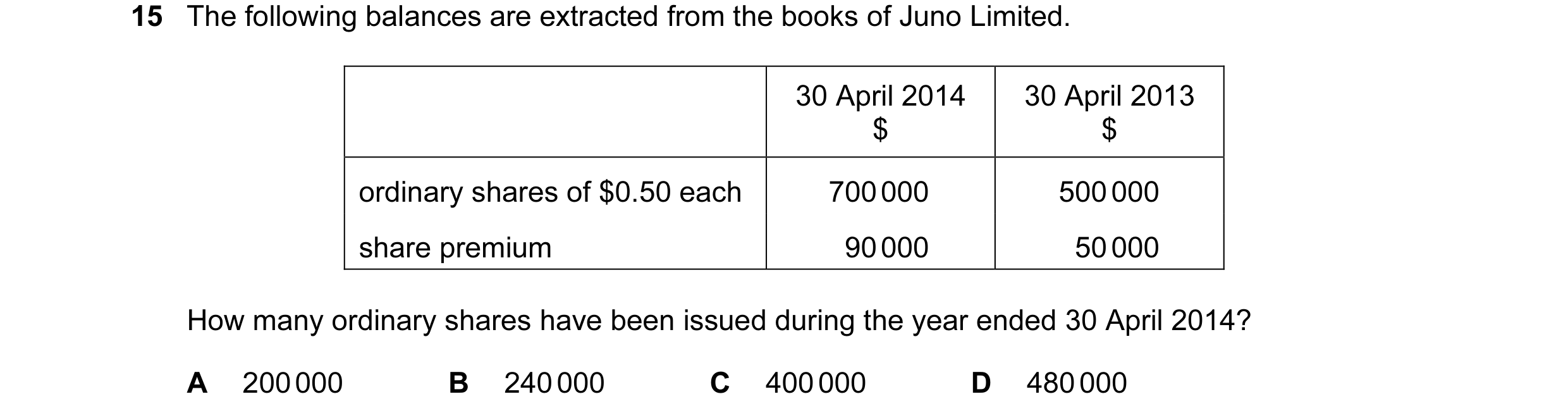

 34 / 68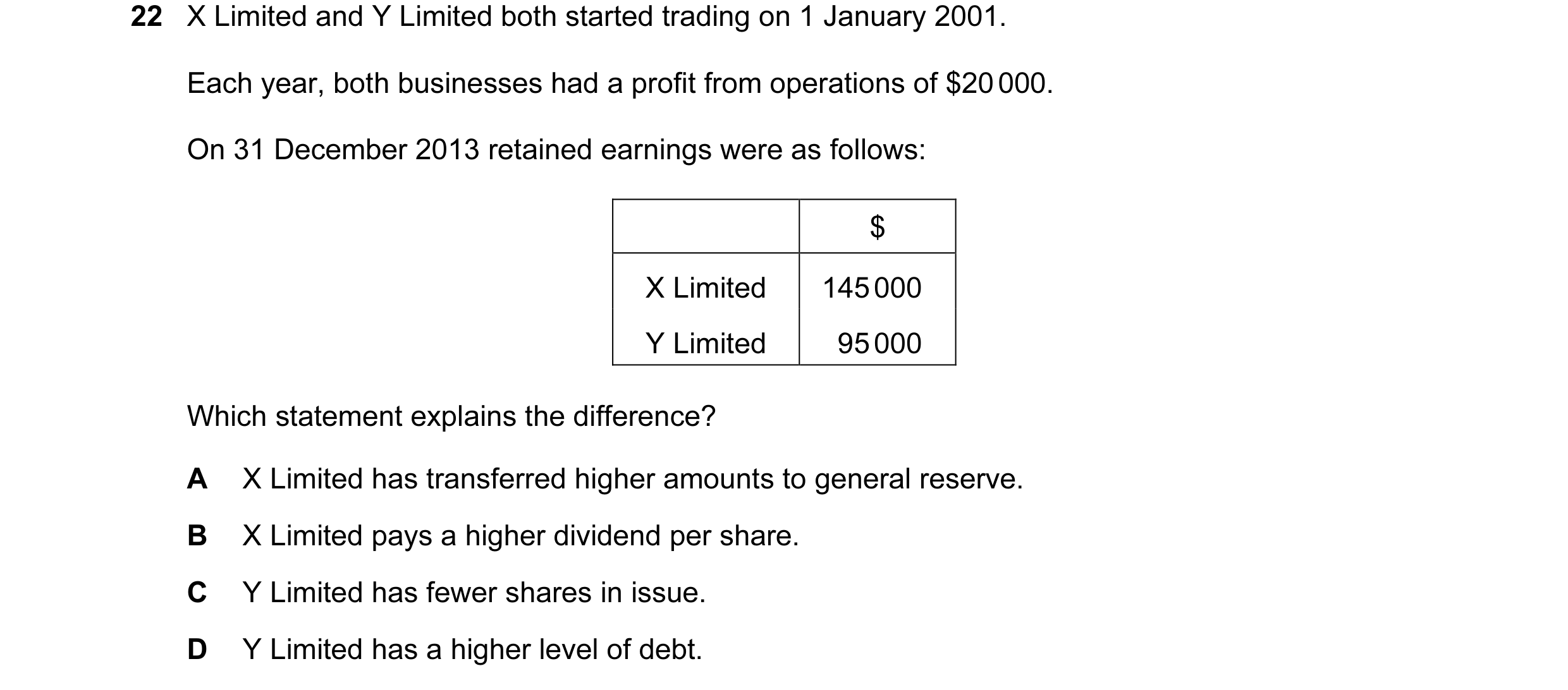

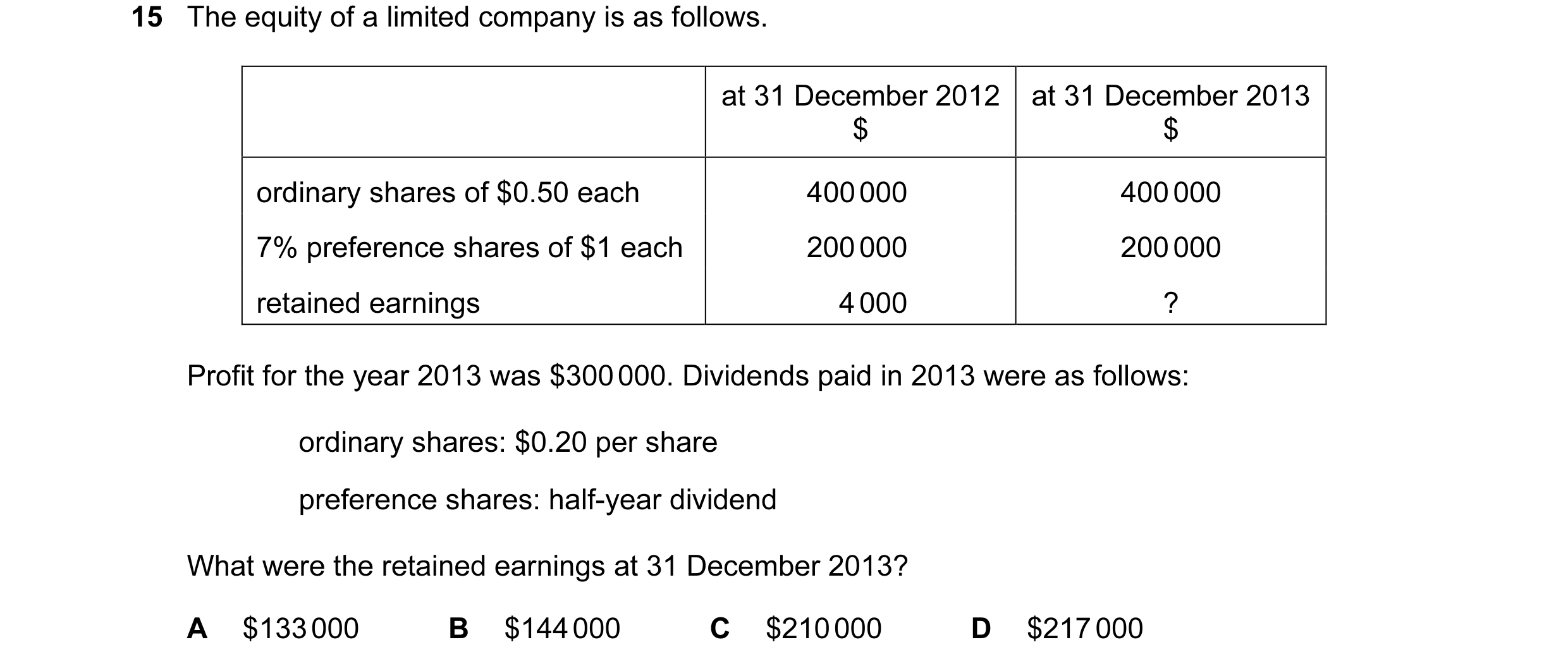
 35 / 68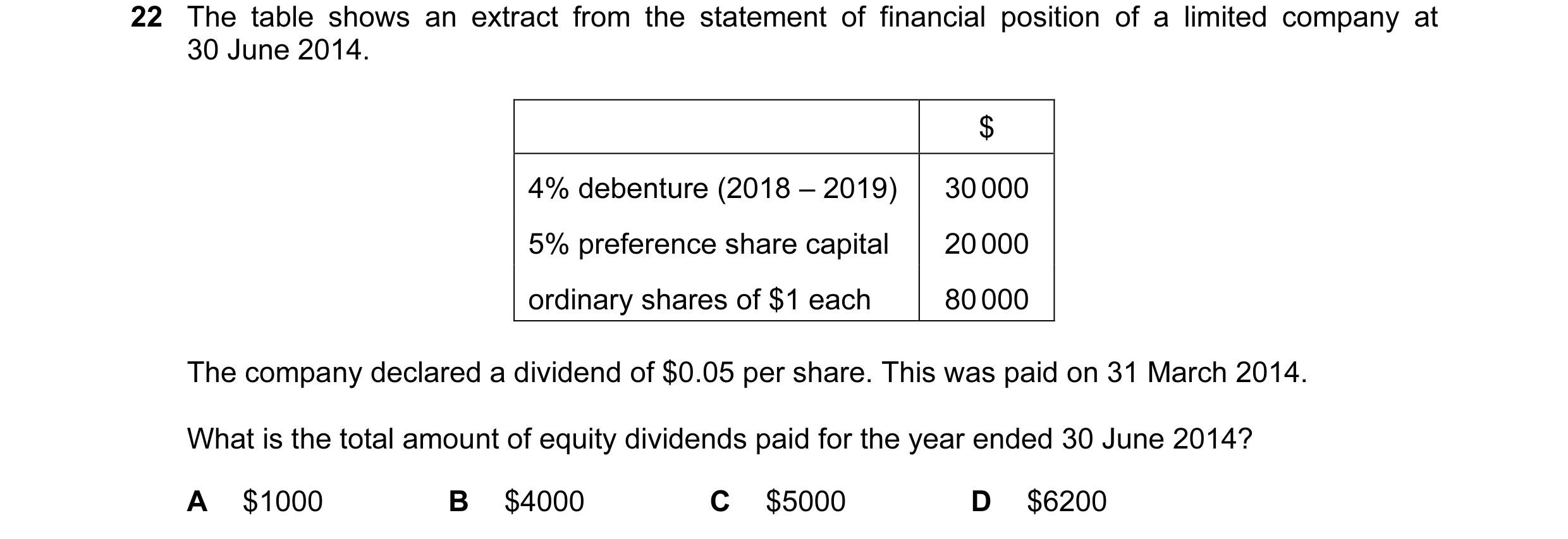
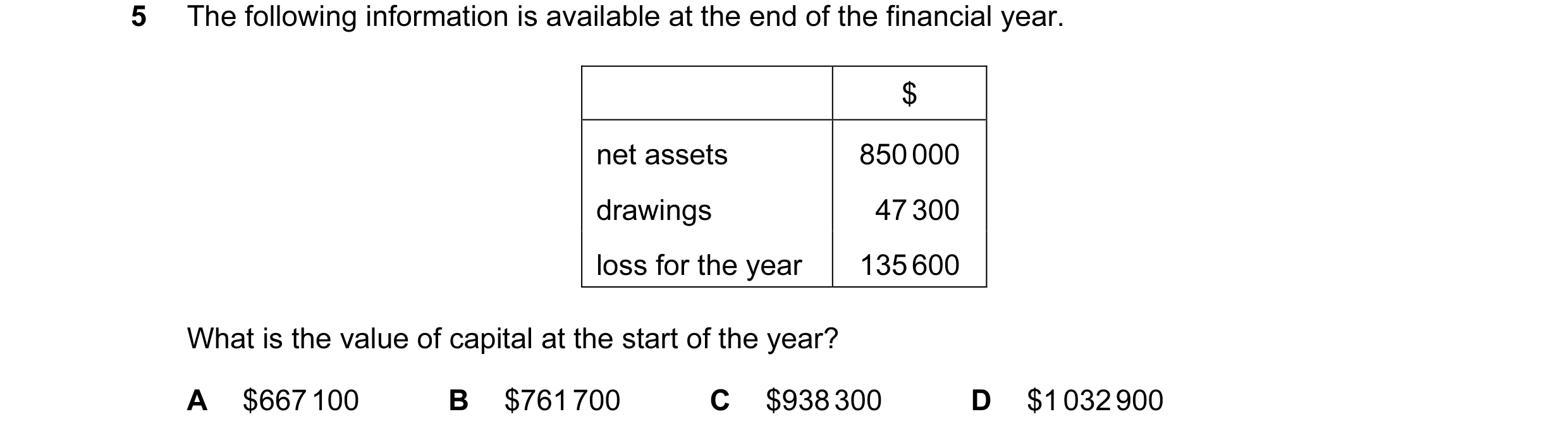
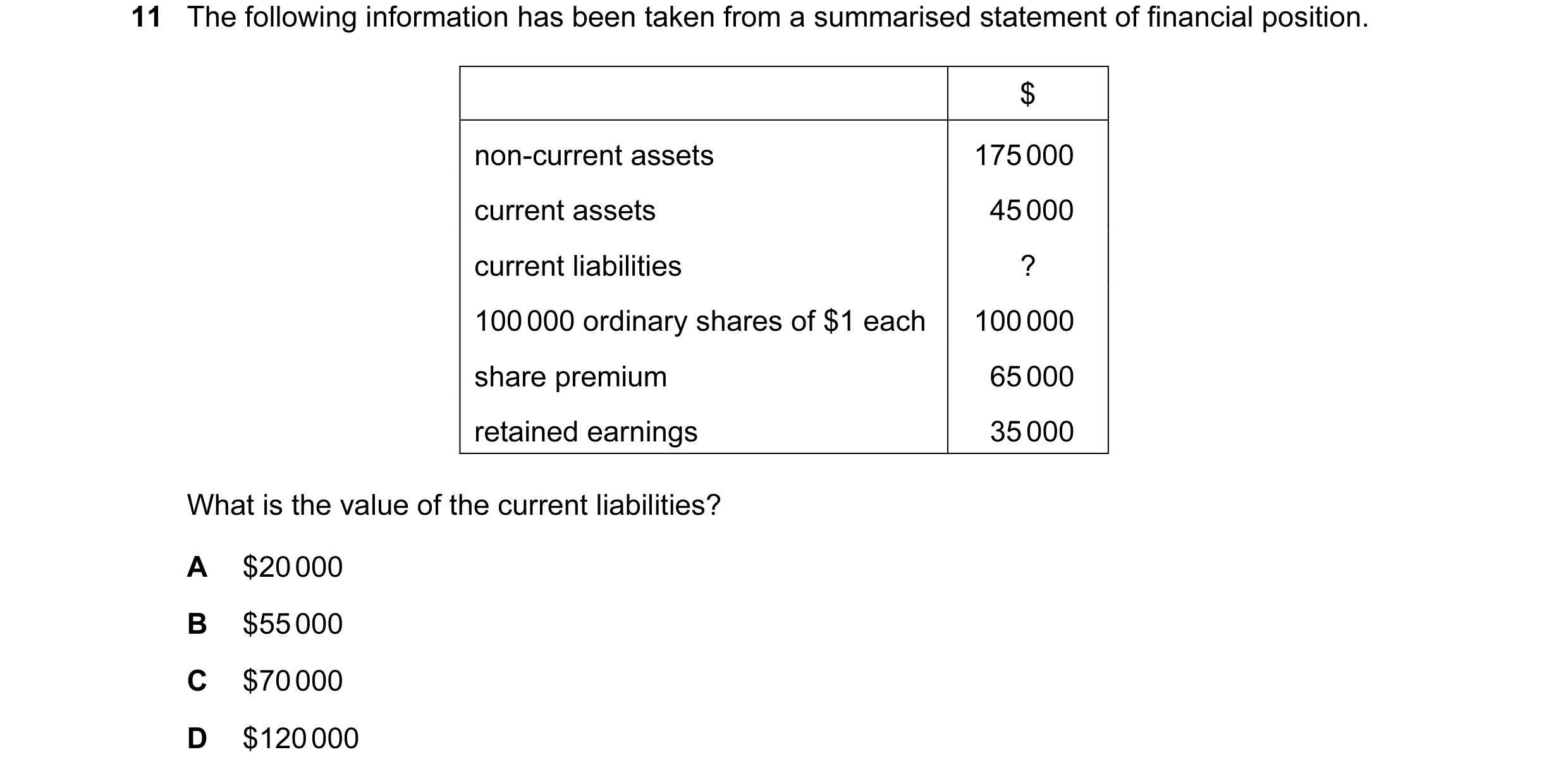
 36 / 68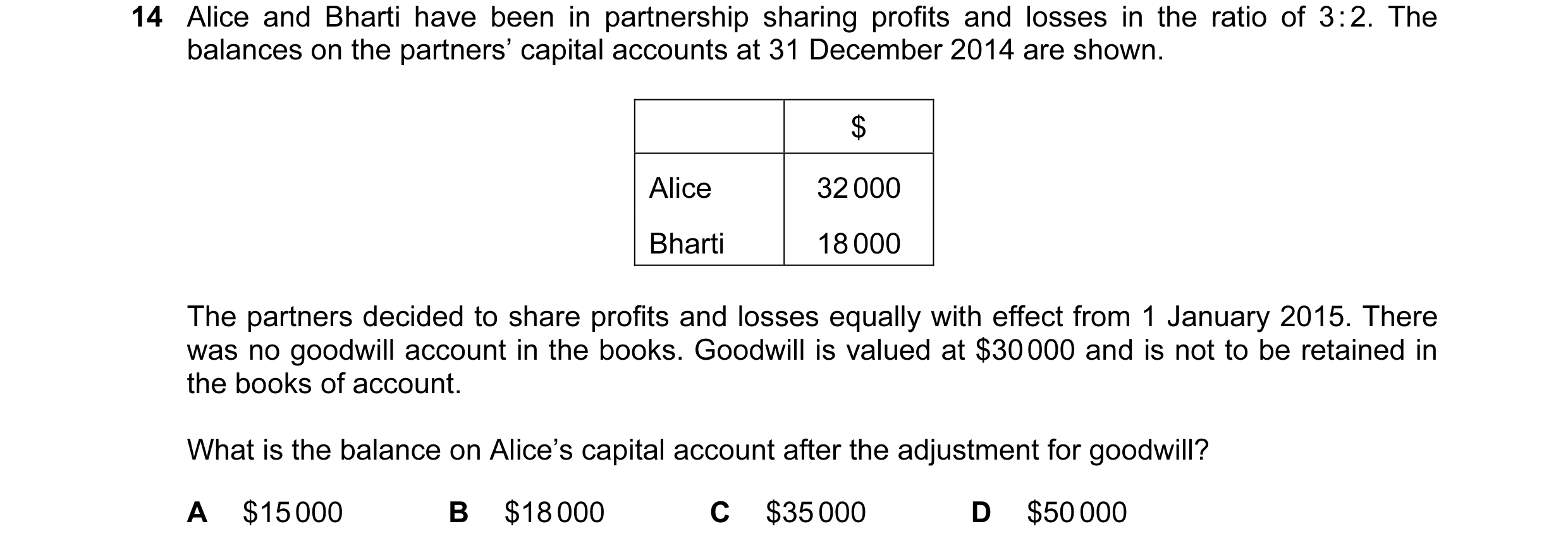

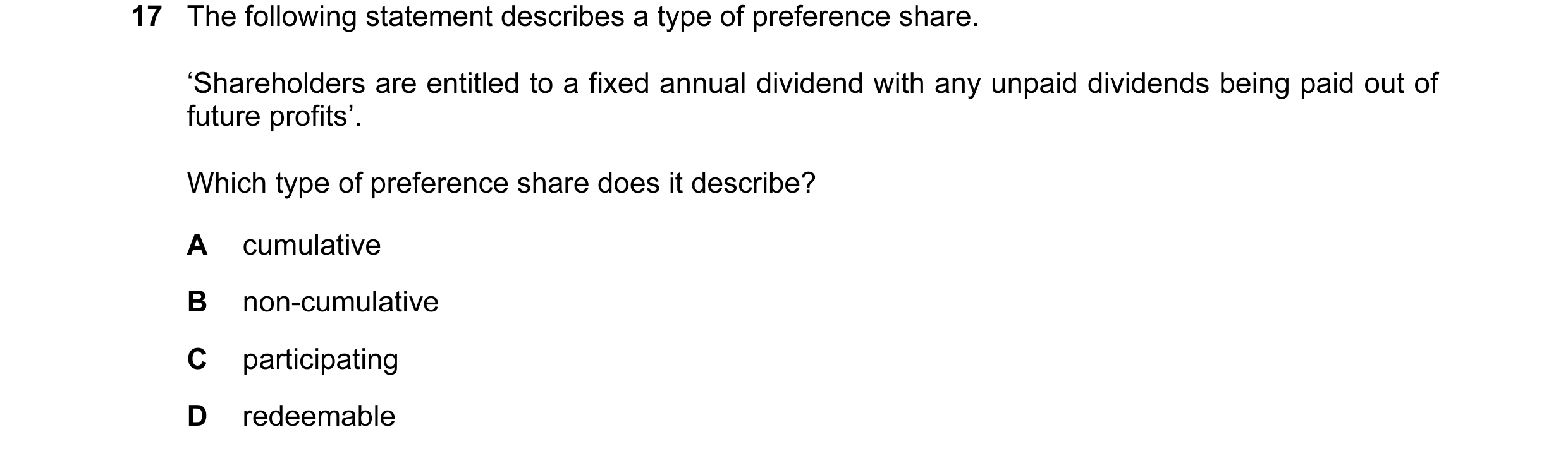

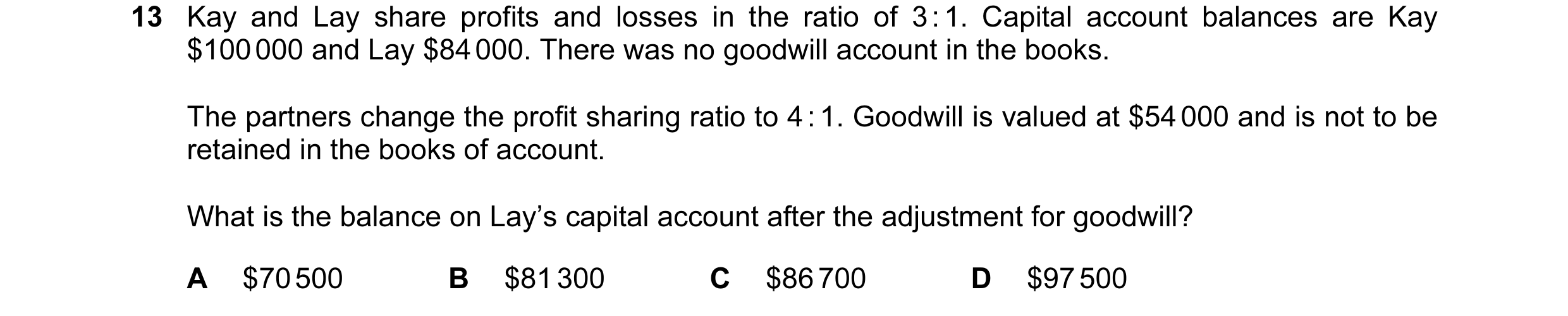 37 / 68
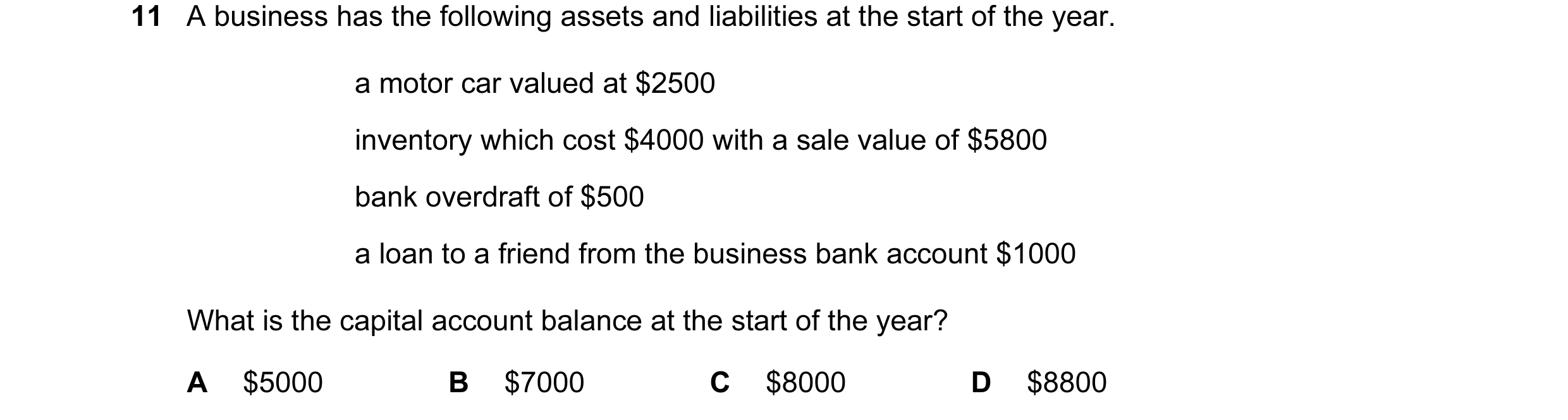
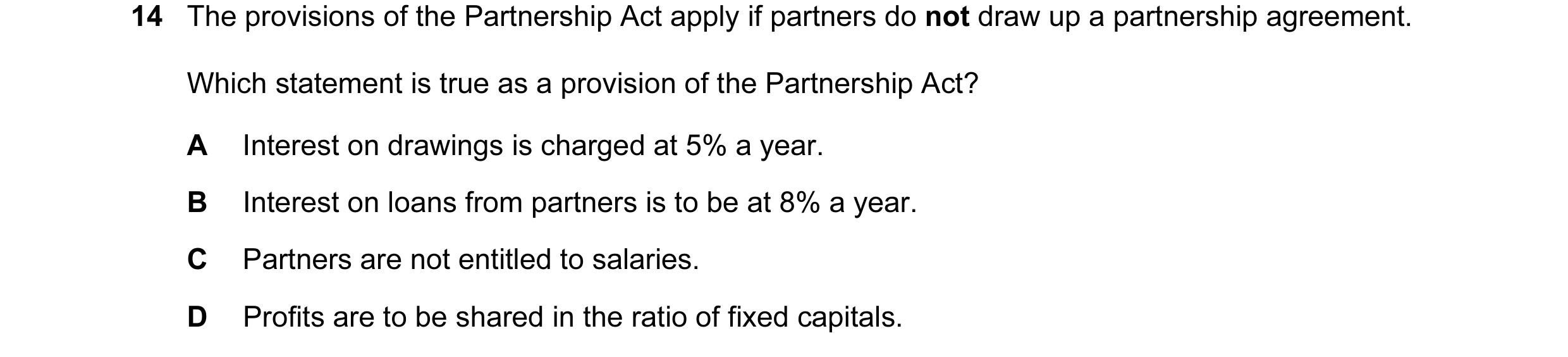
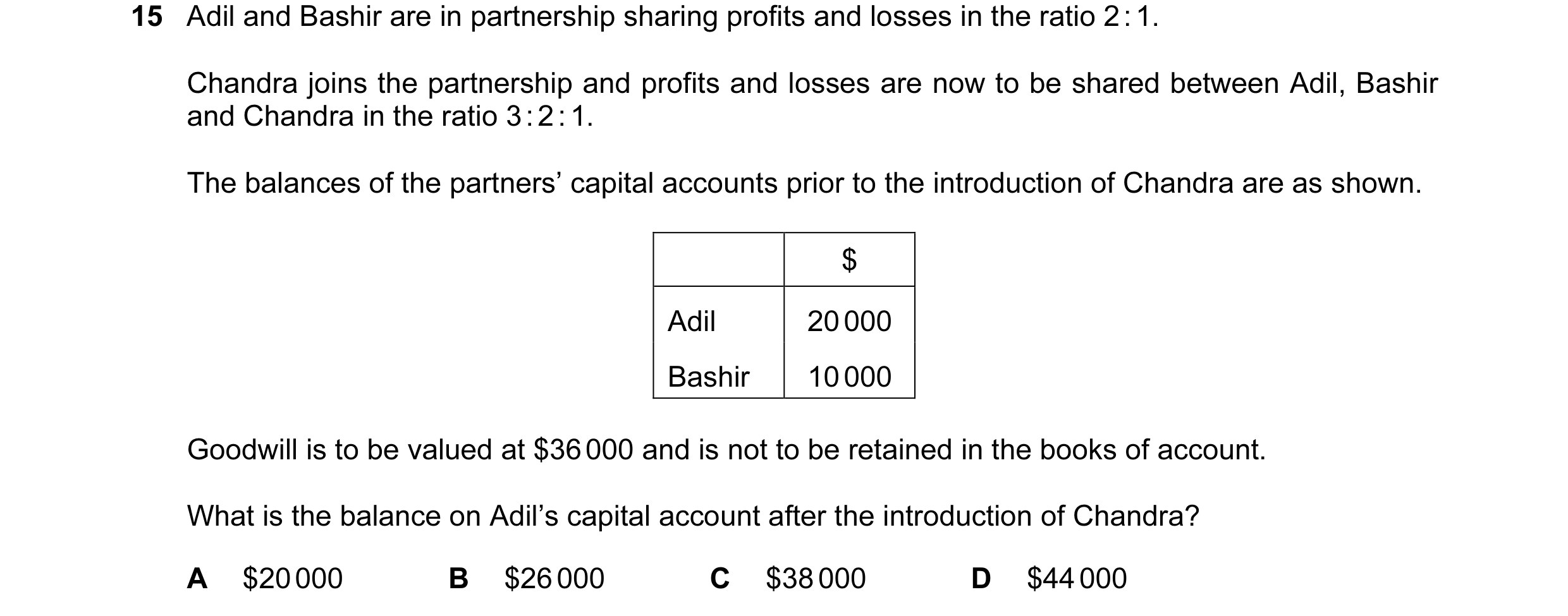
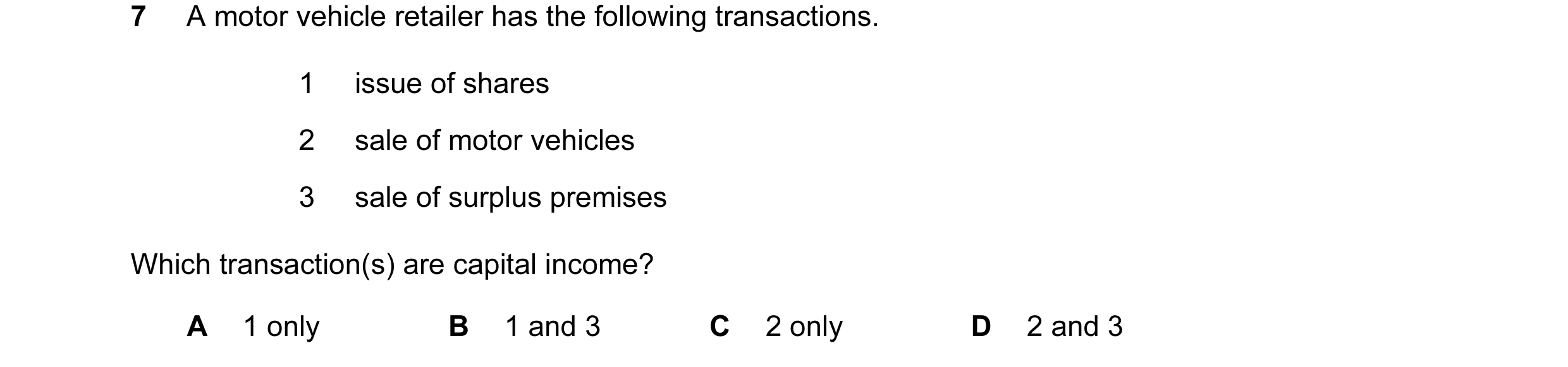 38 / 68
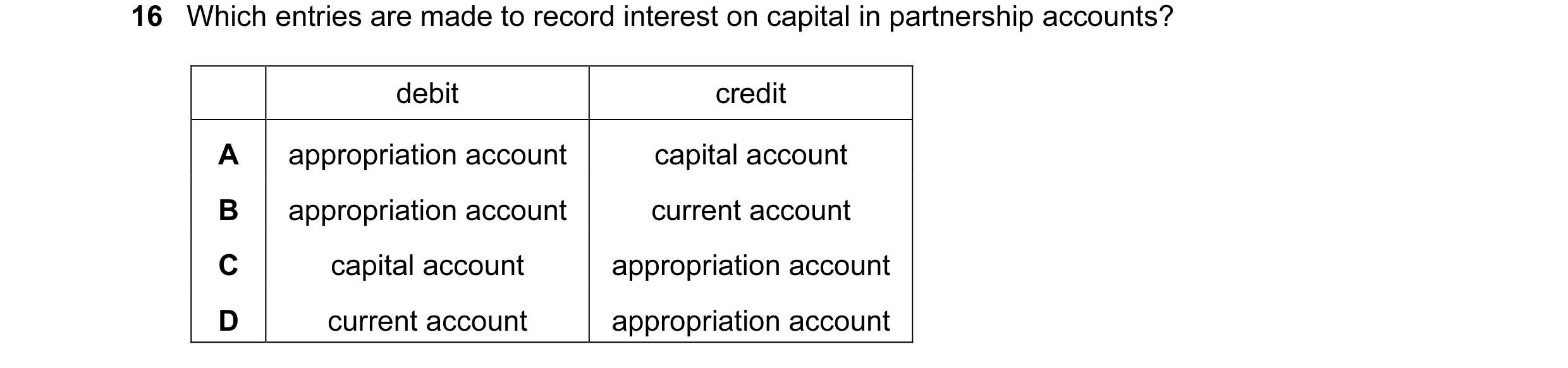
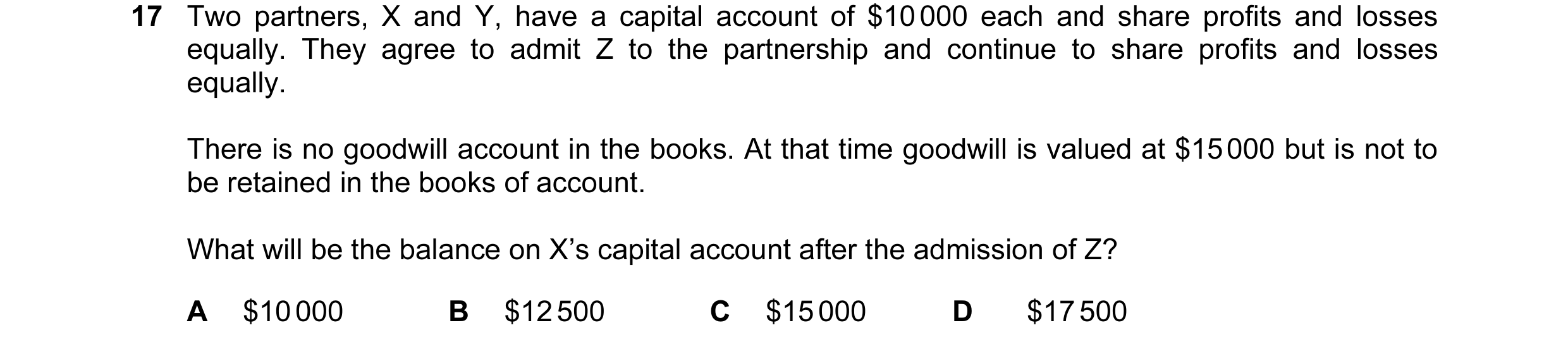
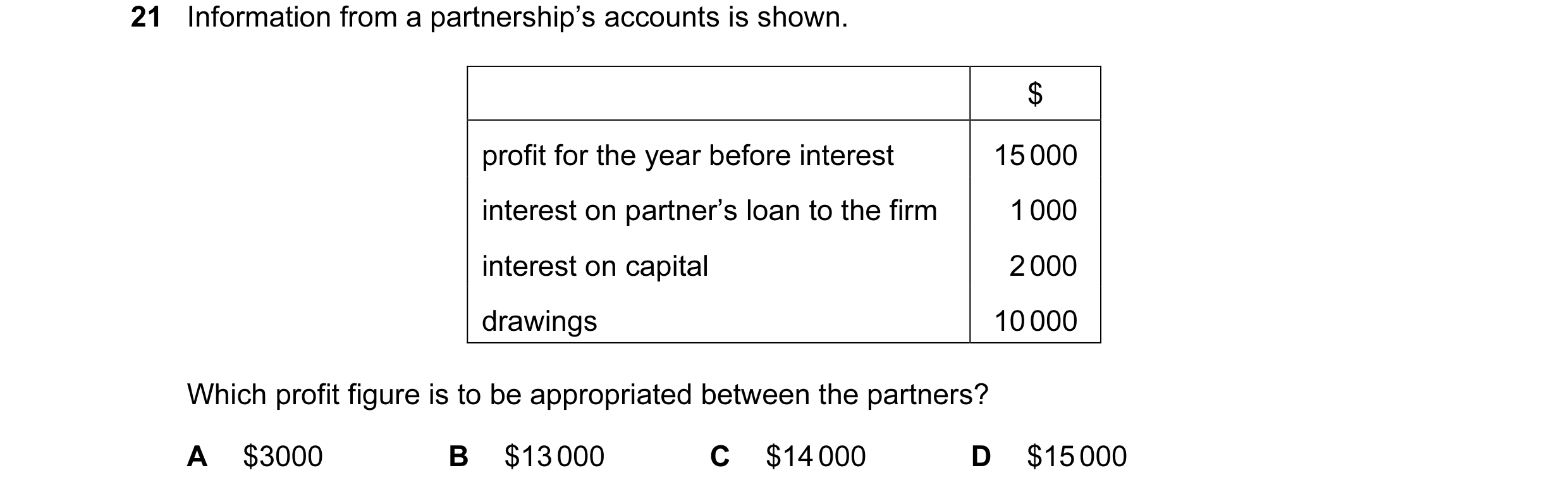
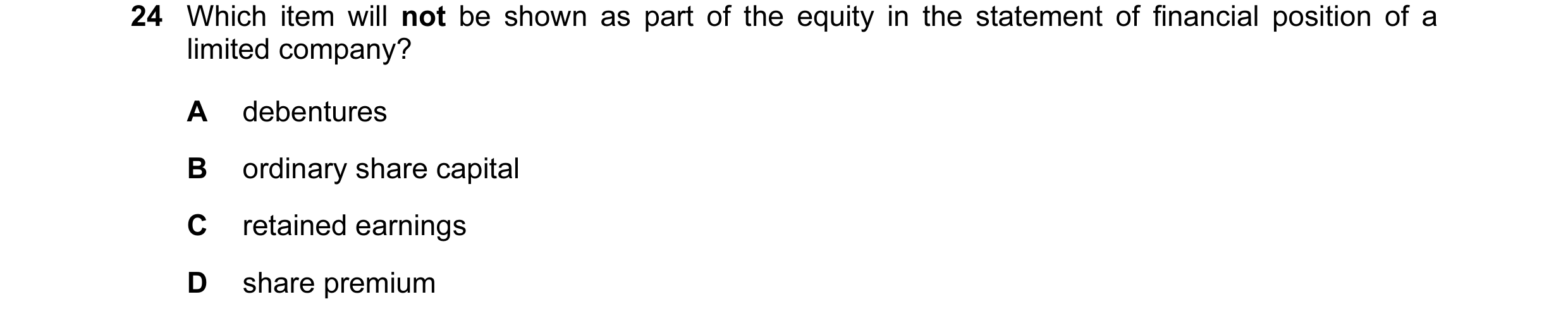 39 / 68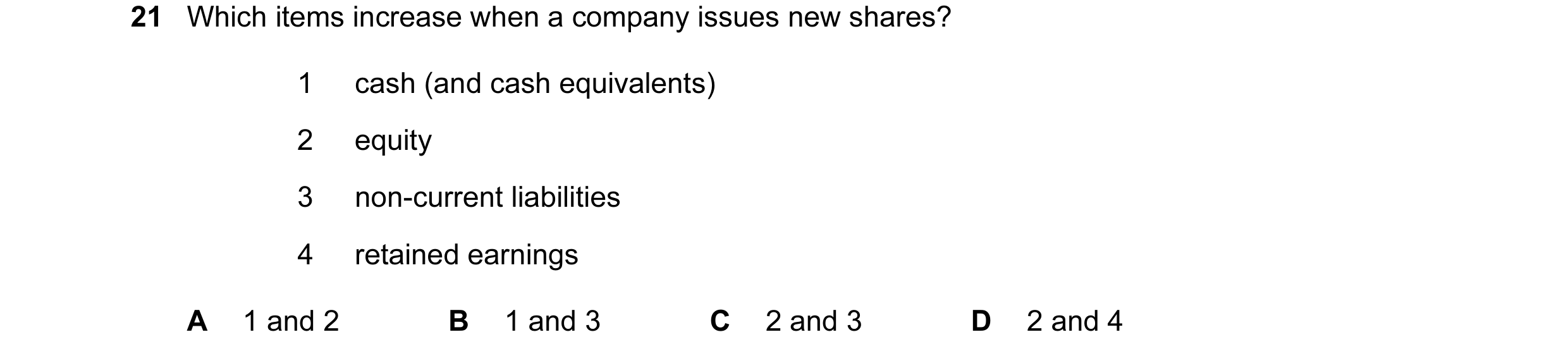
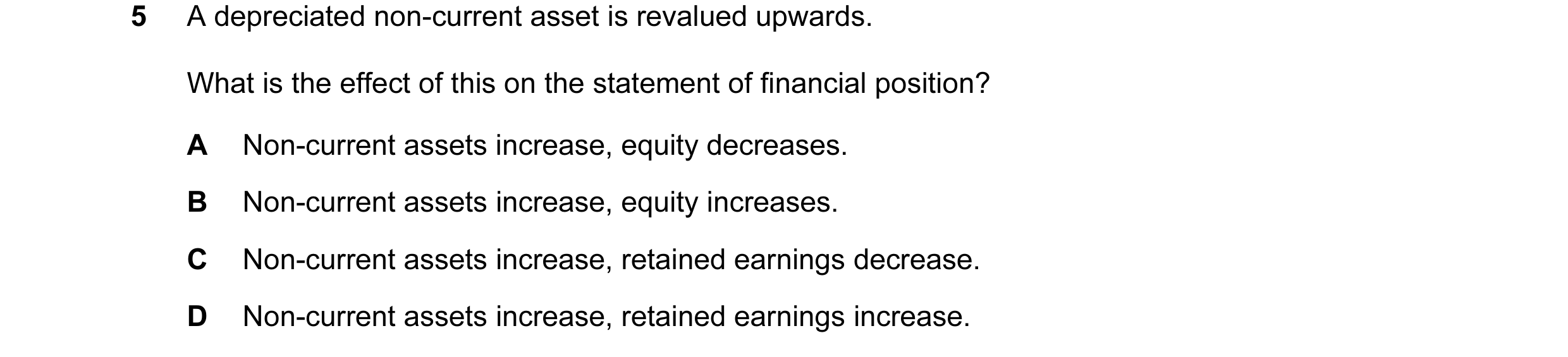
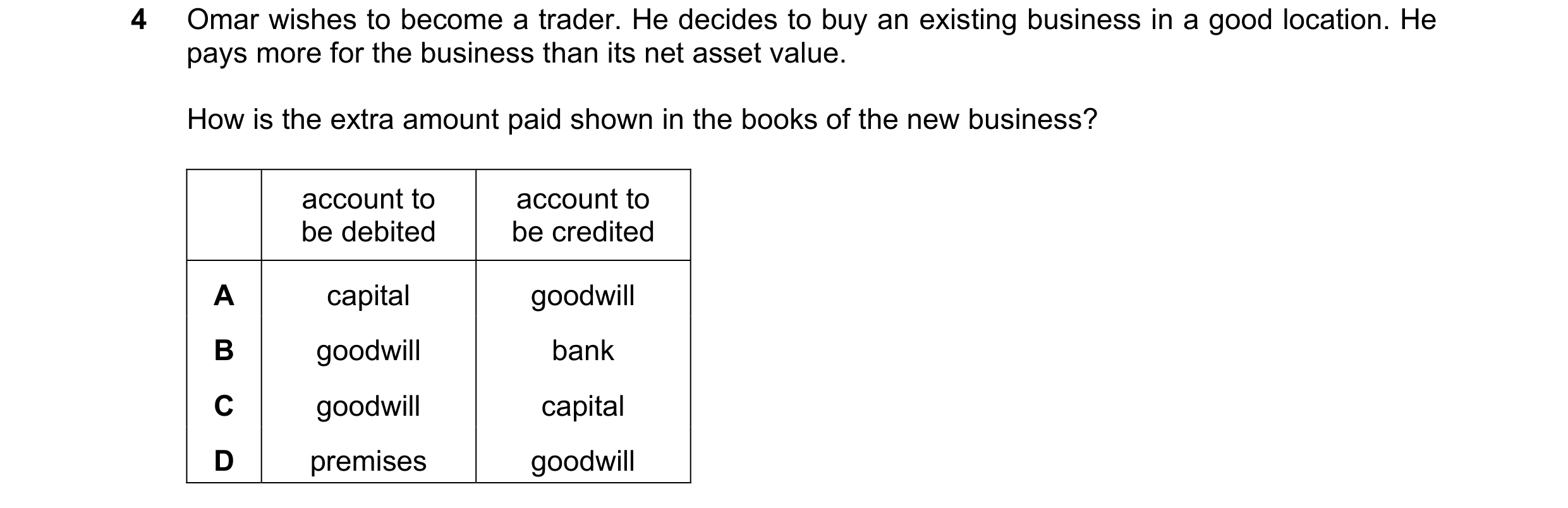
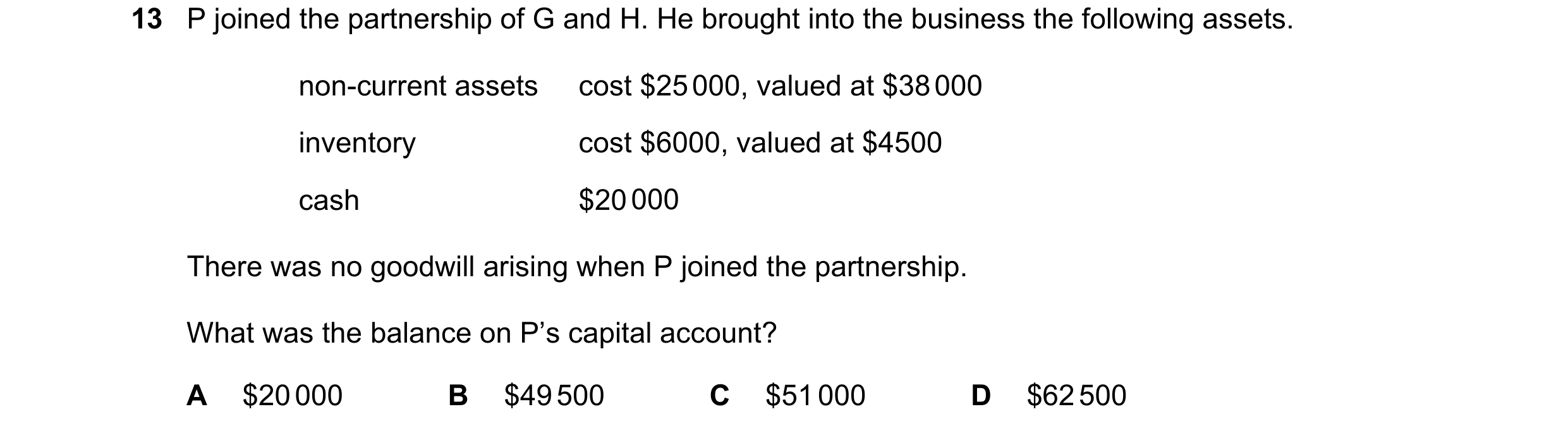
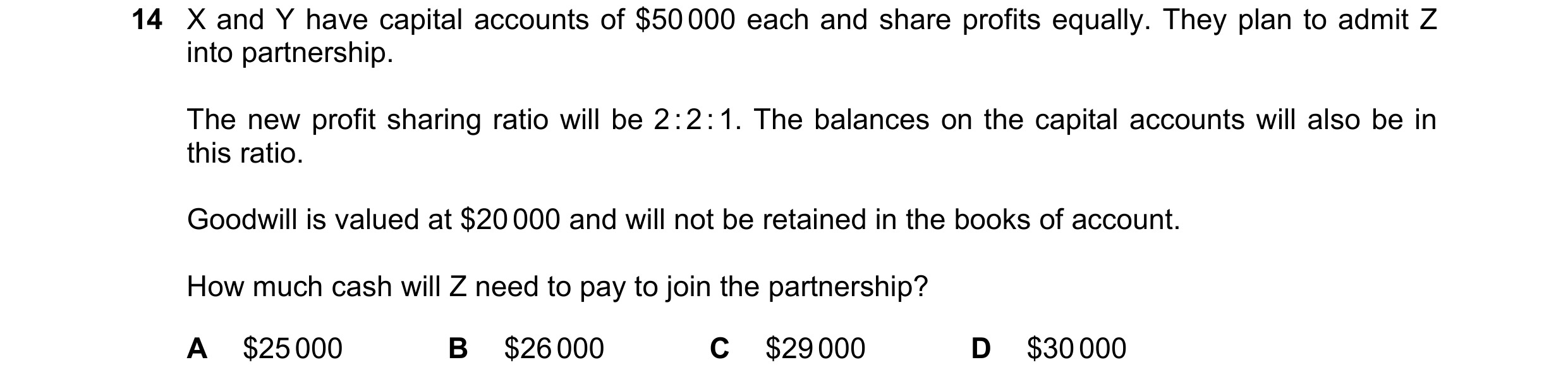 40 / 68


 41 / 68
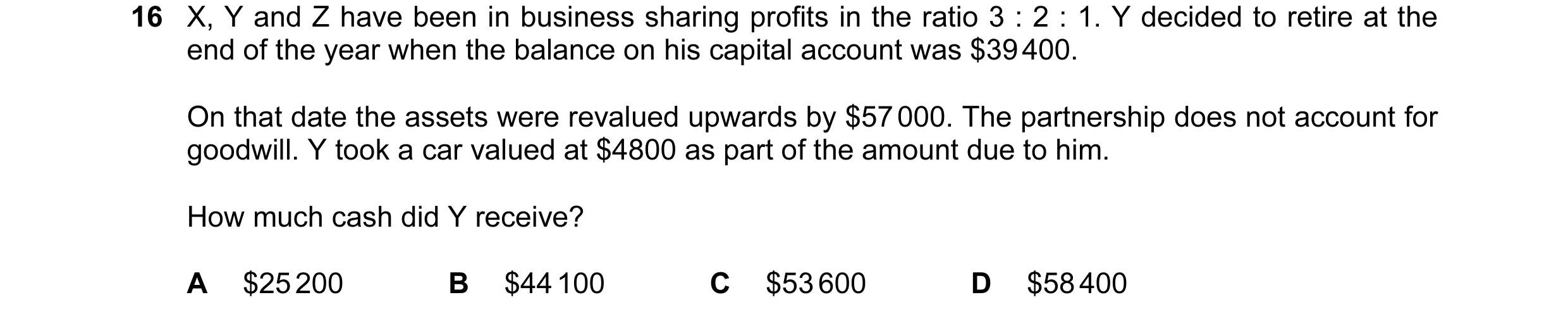
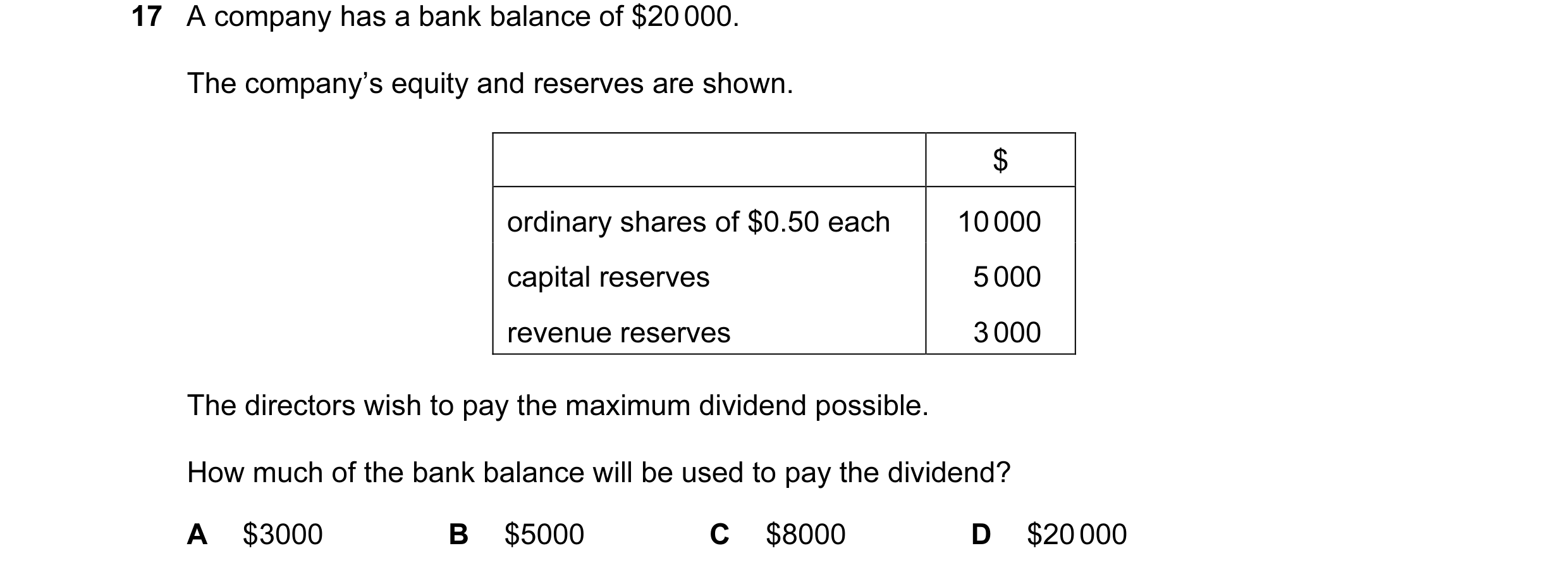

 42 / 68
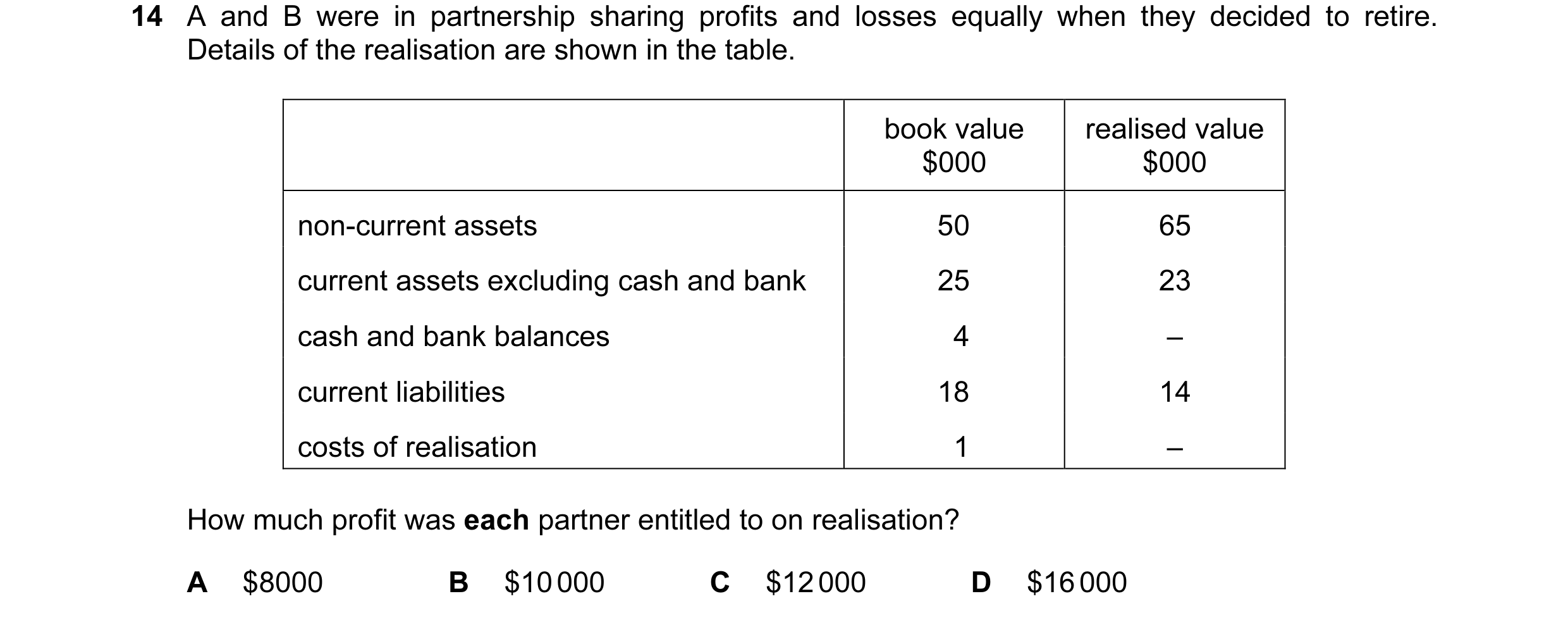
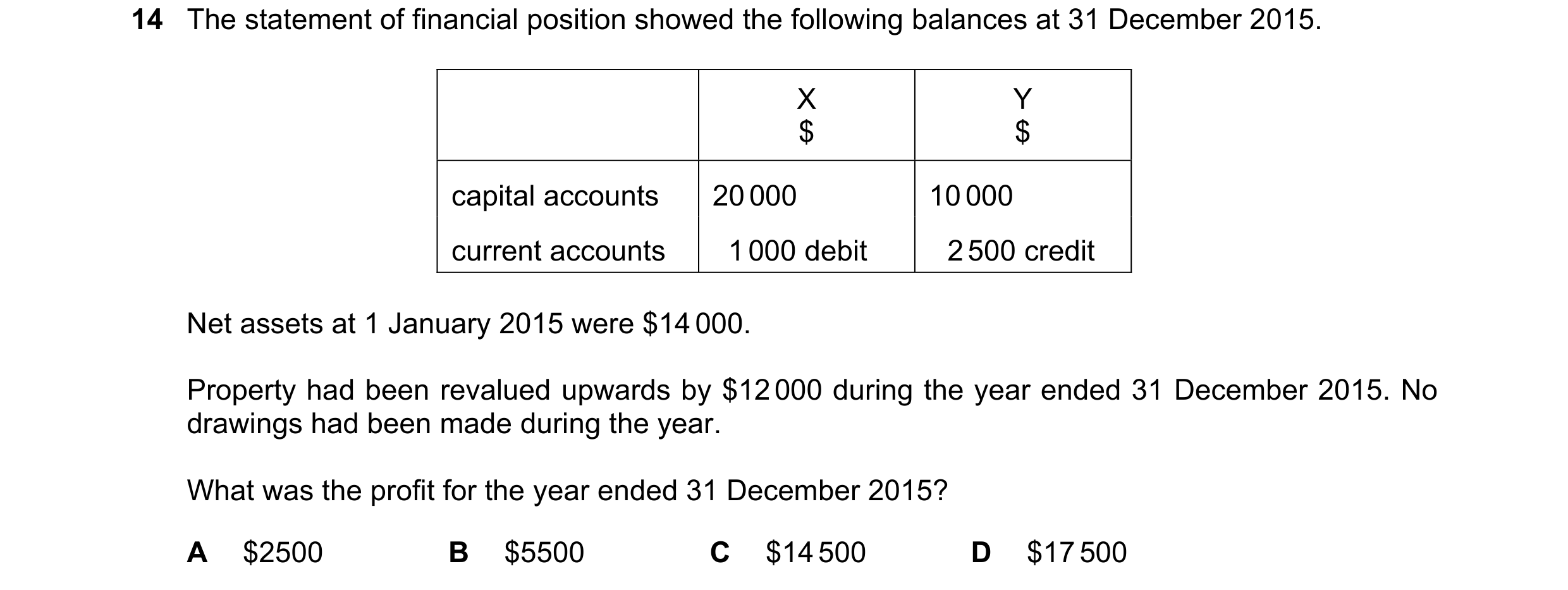 43 / 68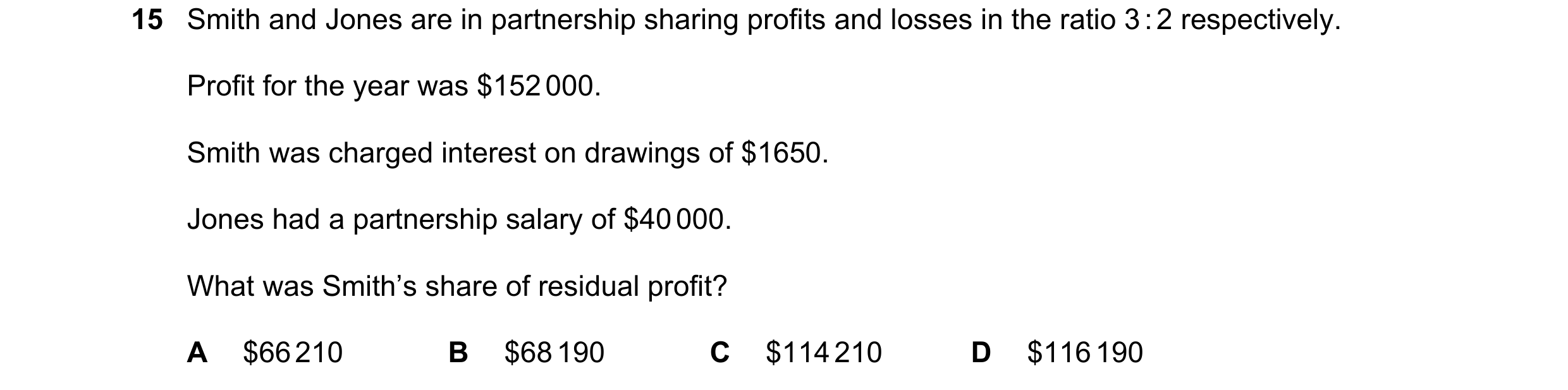
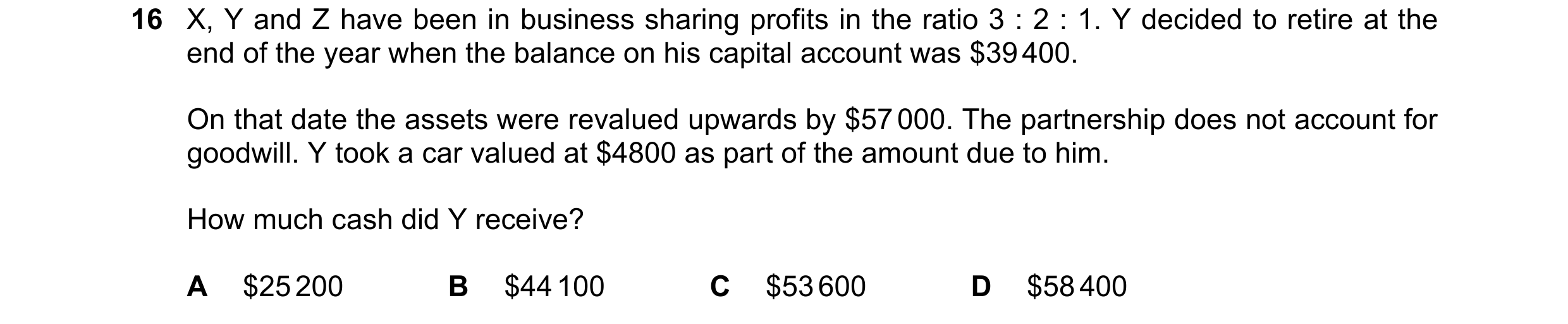
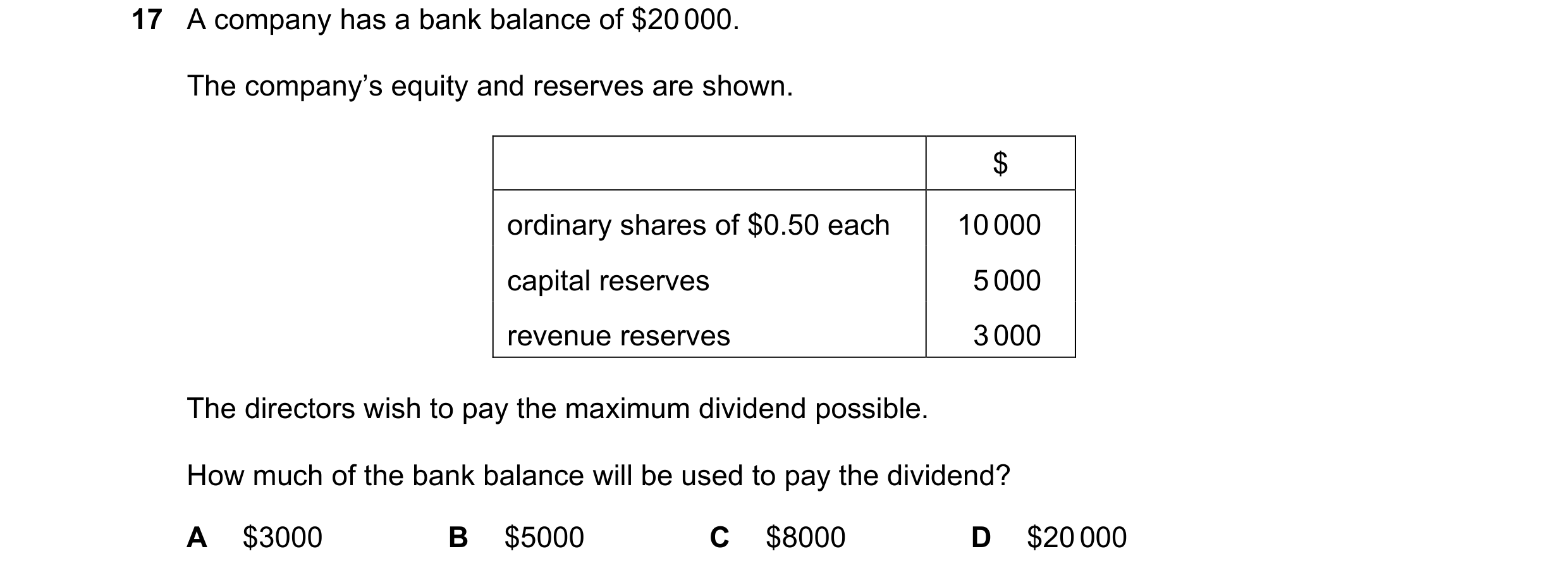

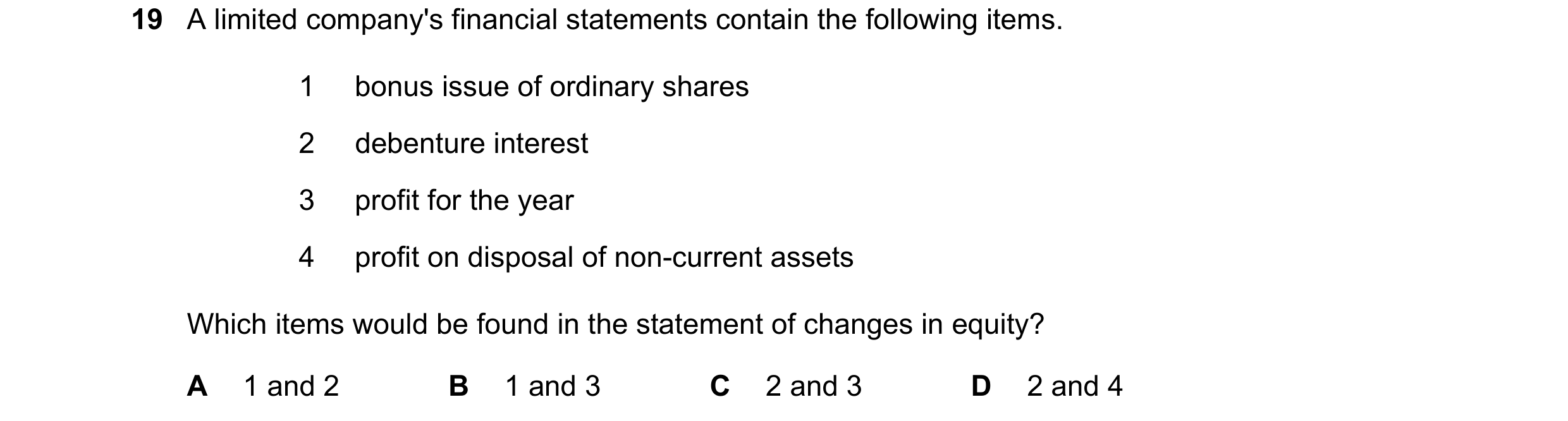 44 / 68
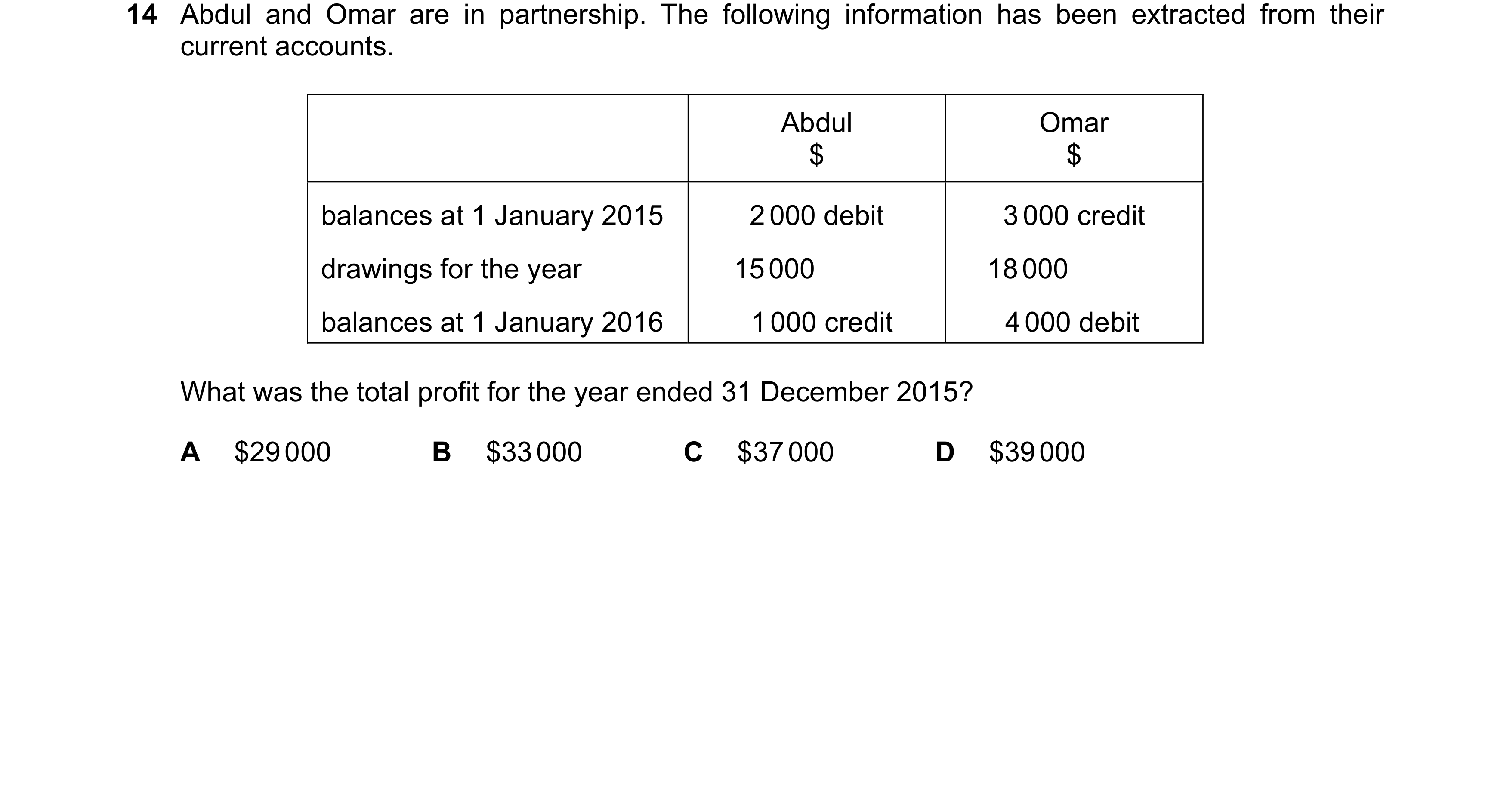

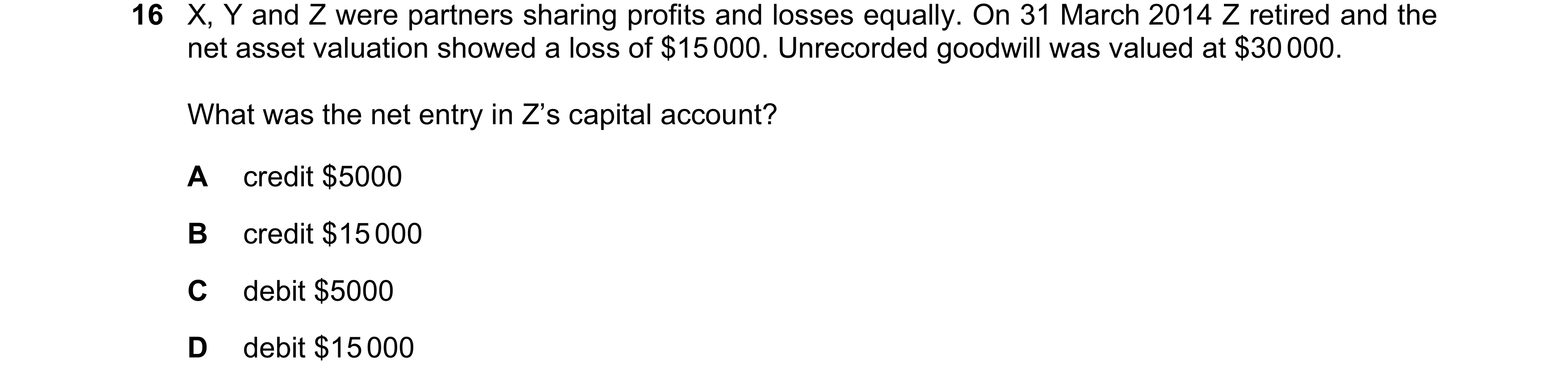
 45 / 68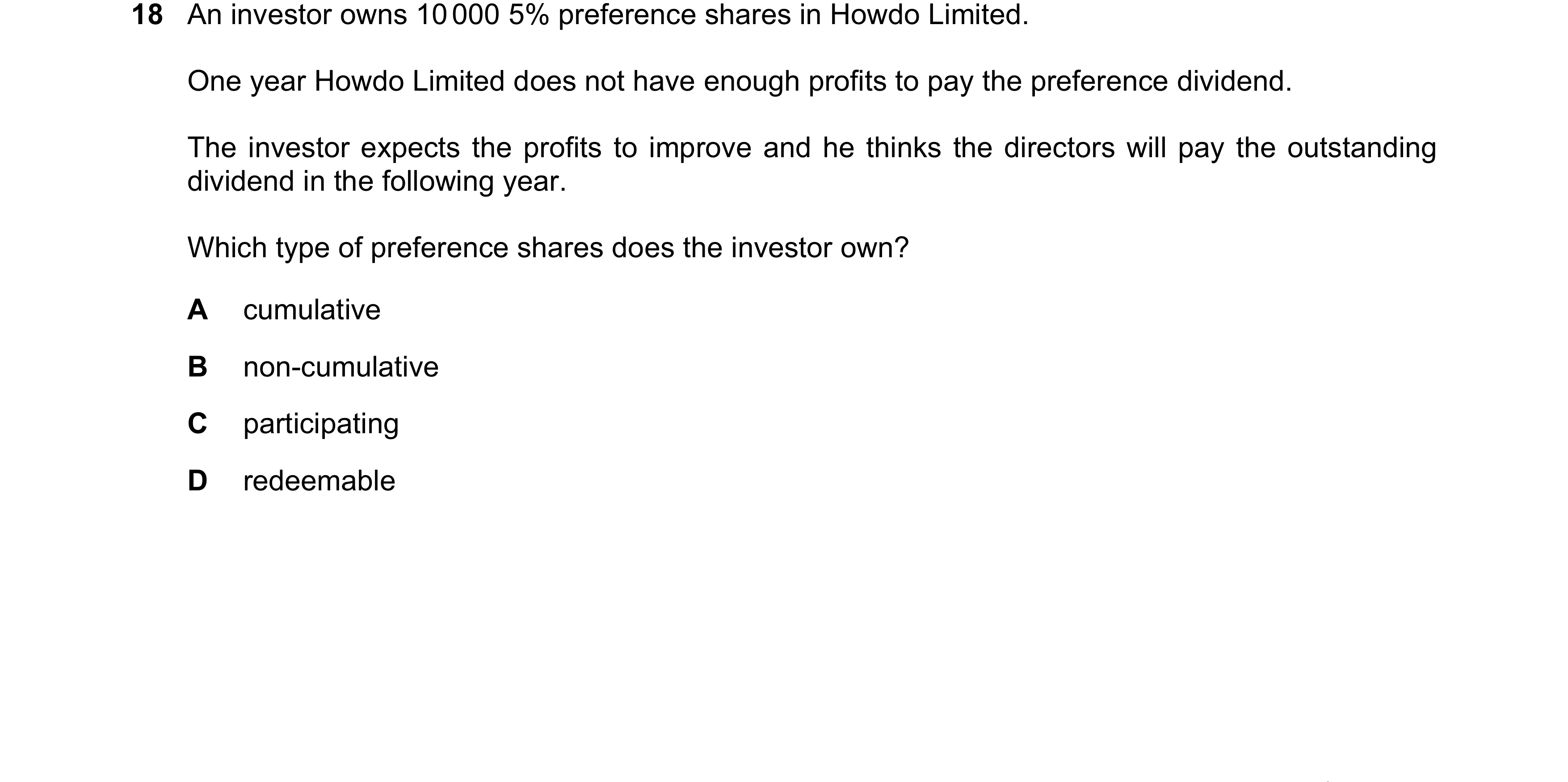

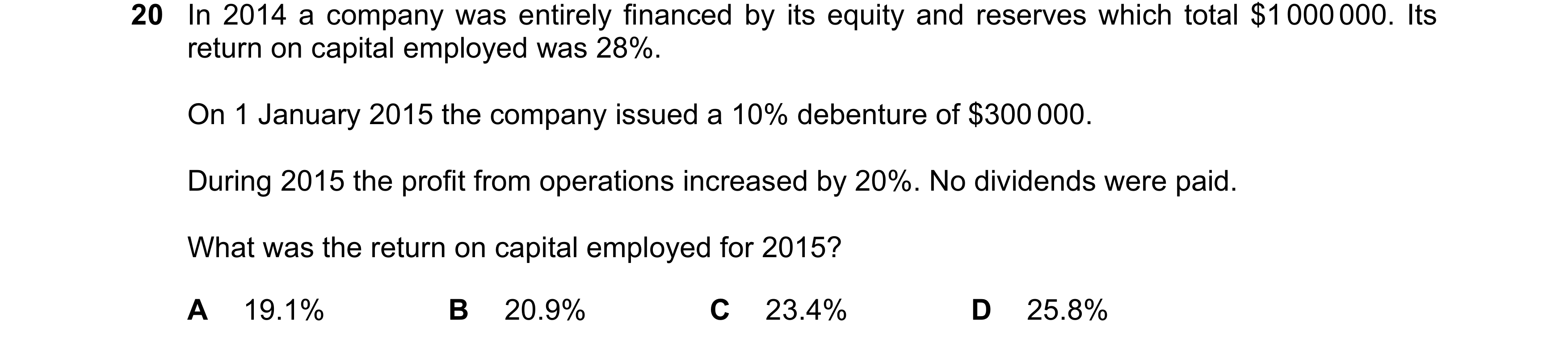
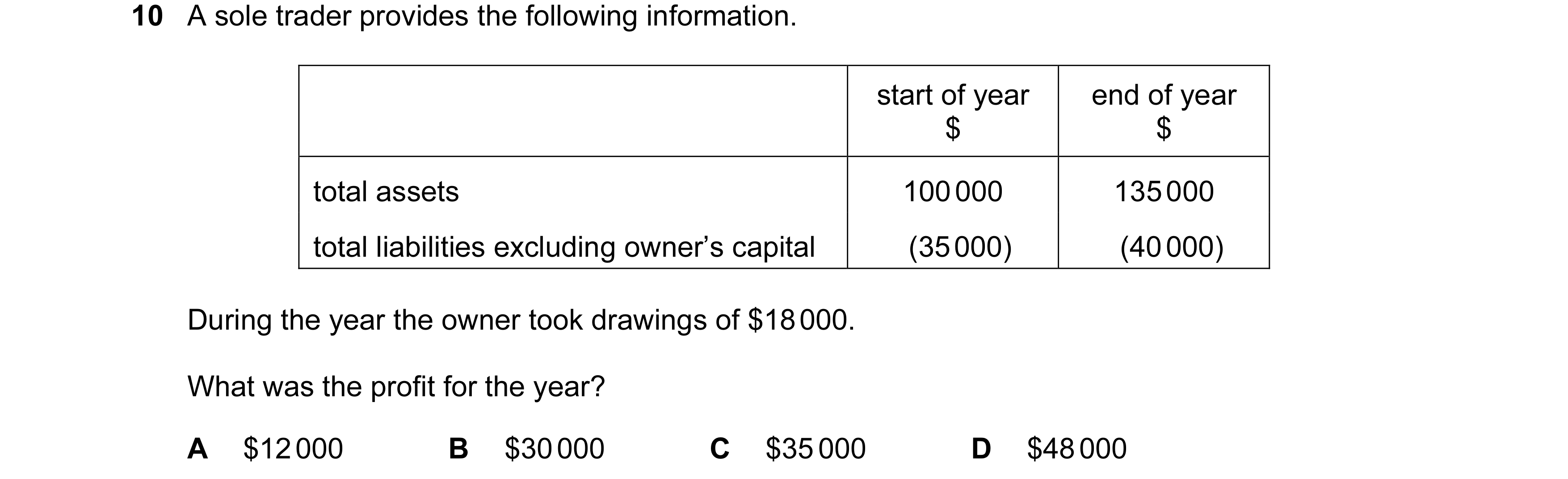 46 / 68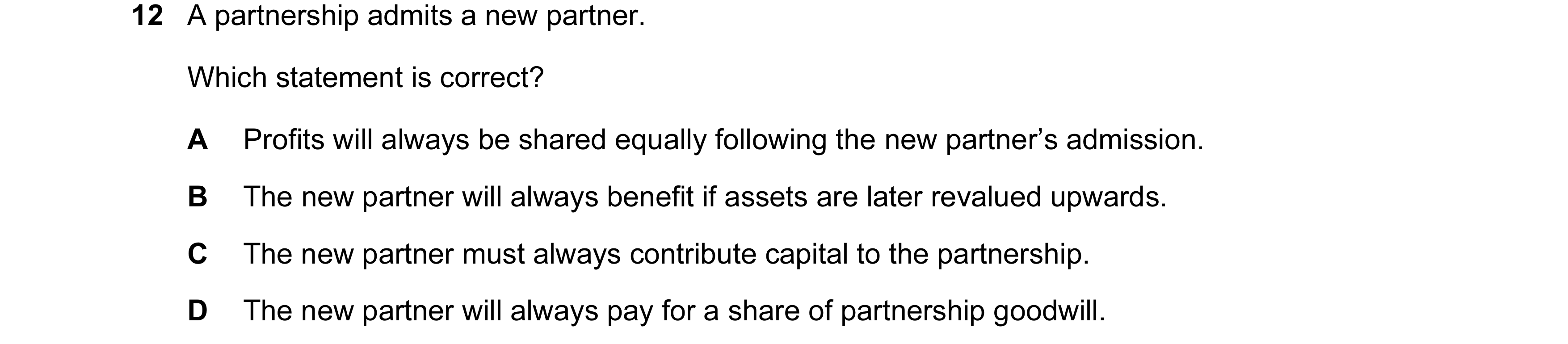
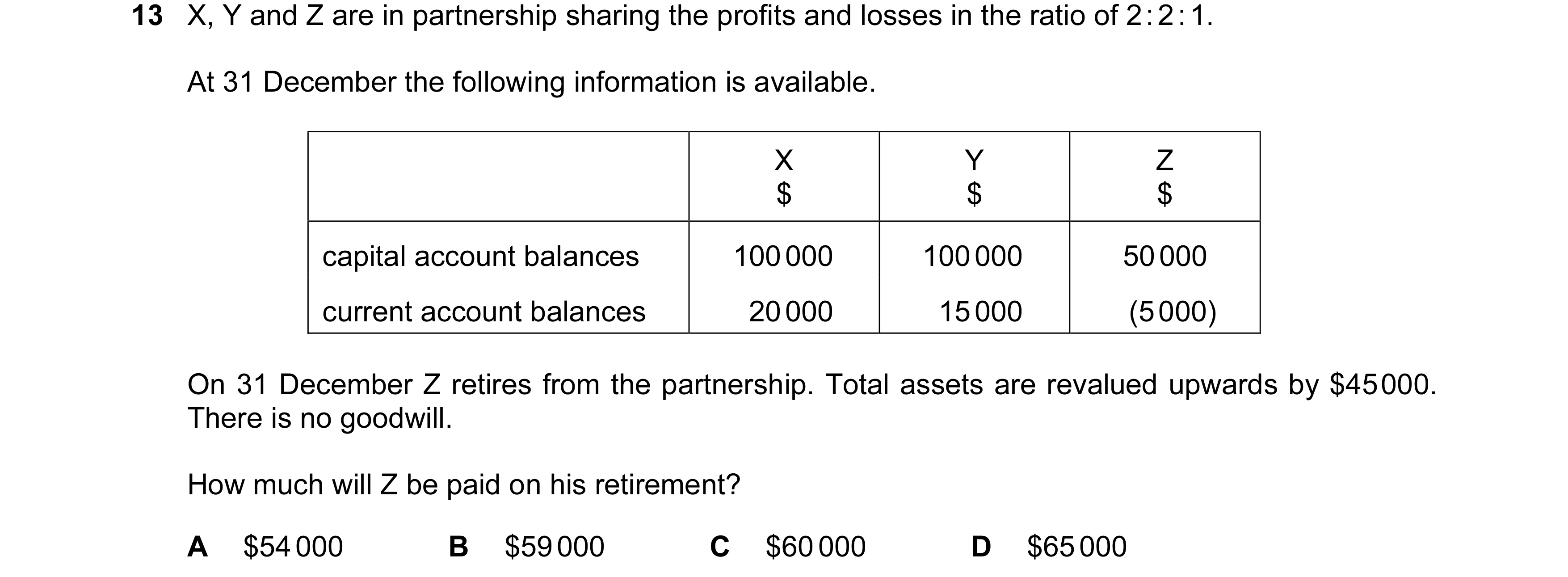
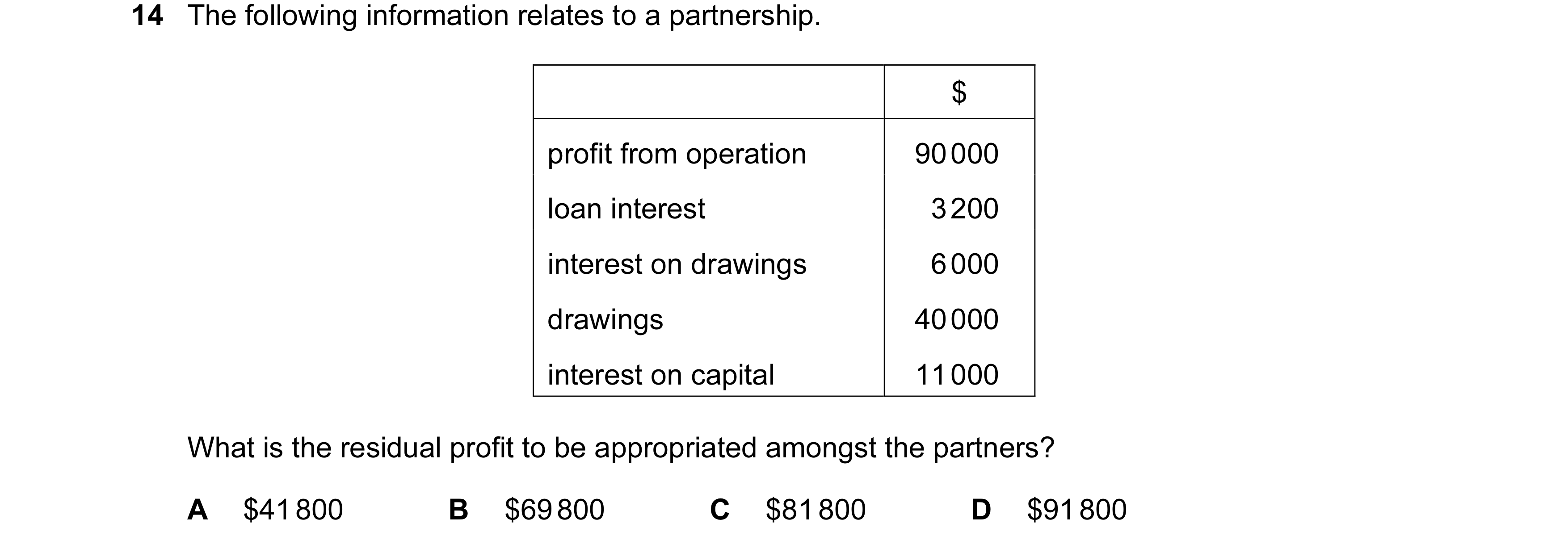
 47 / 68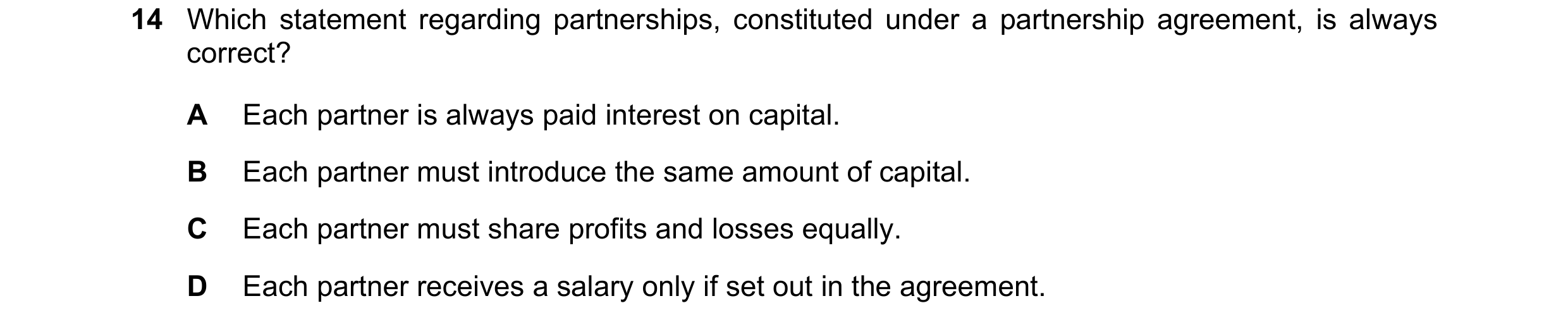
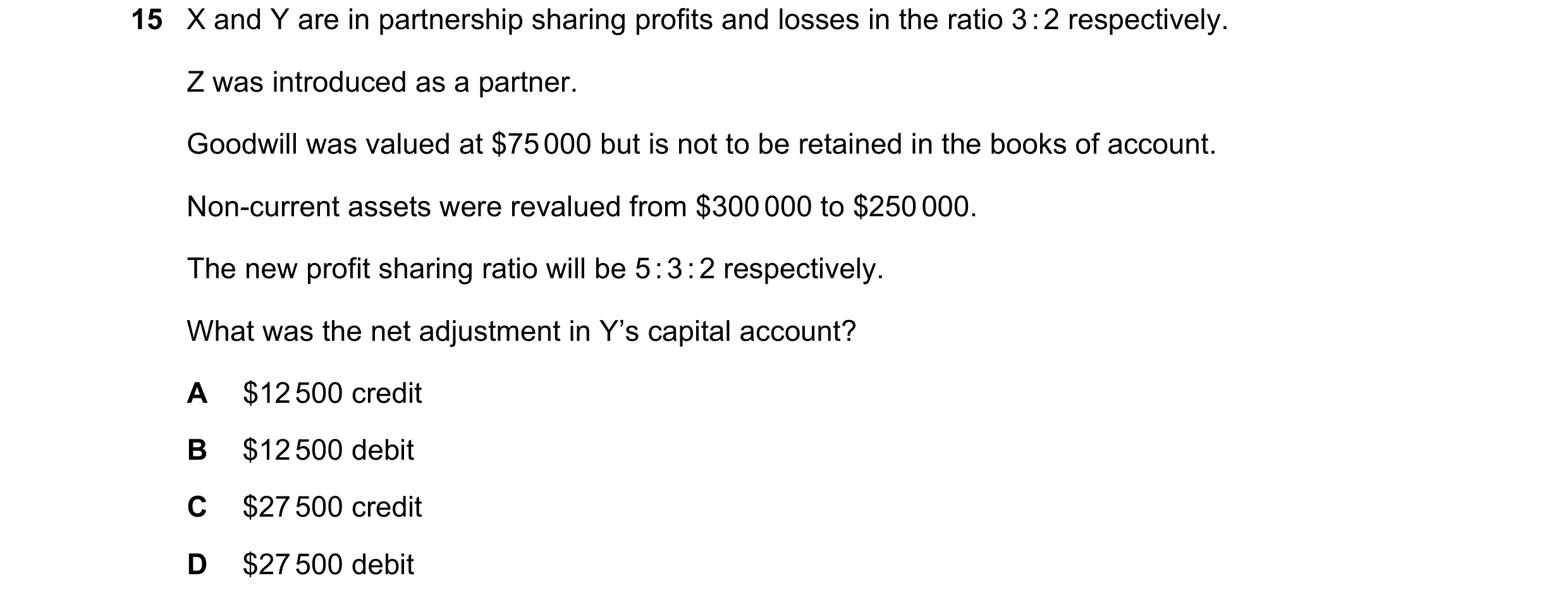
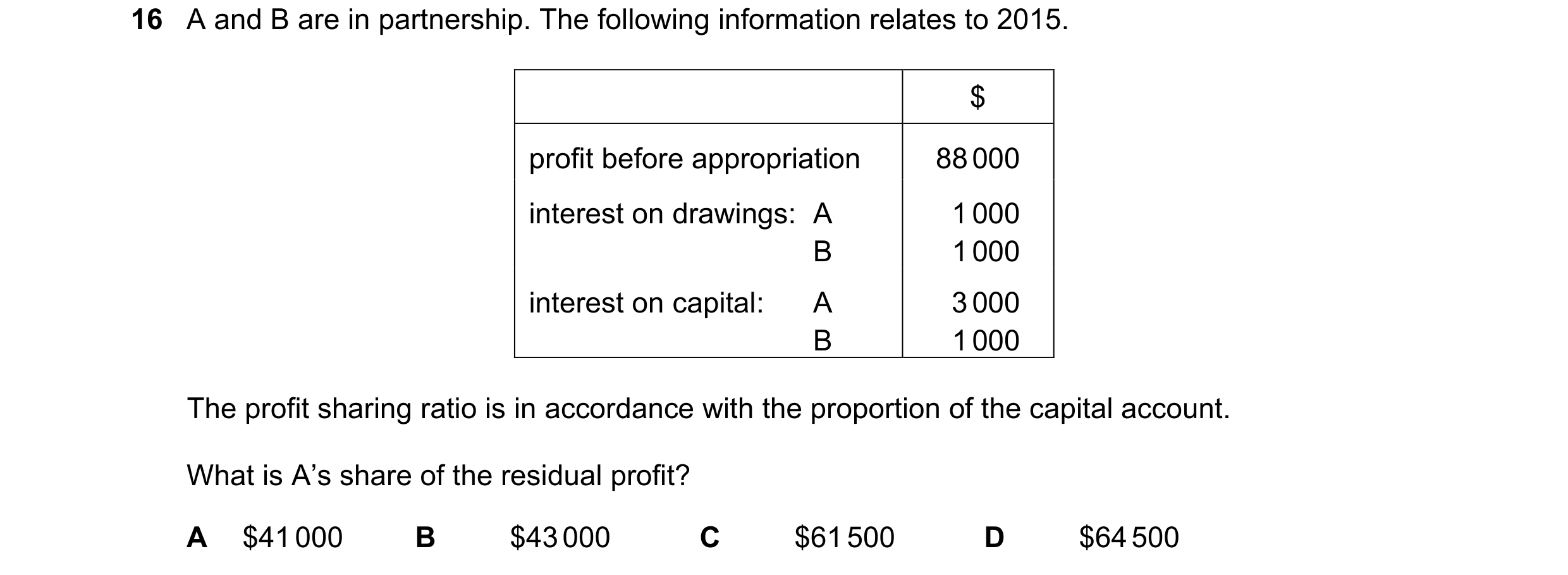
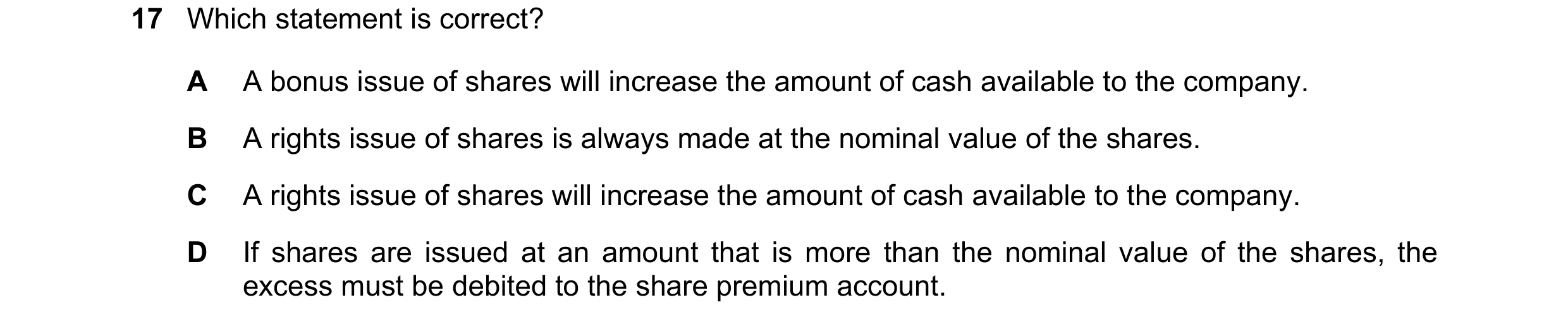 48 / 68
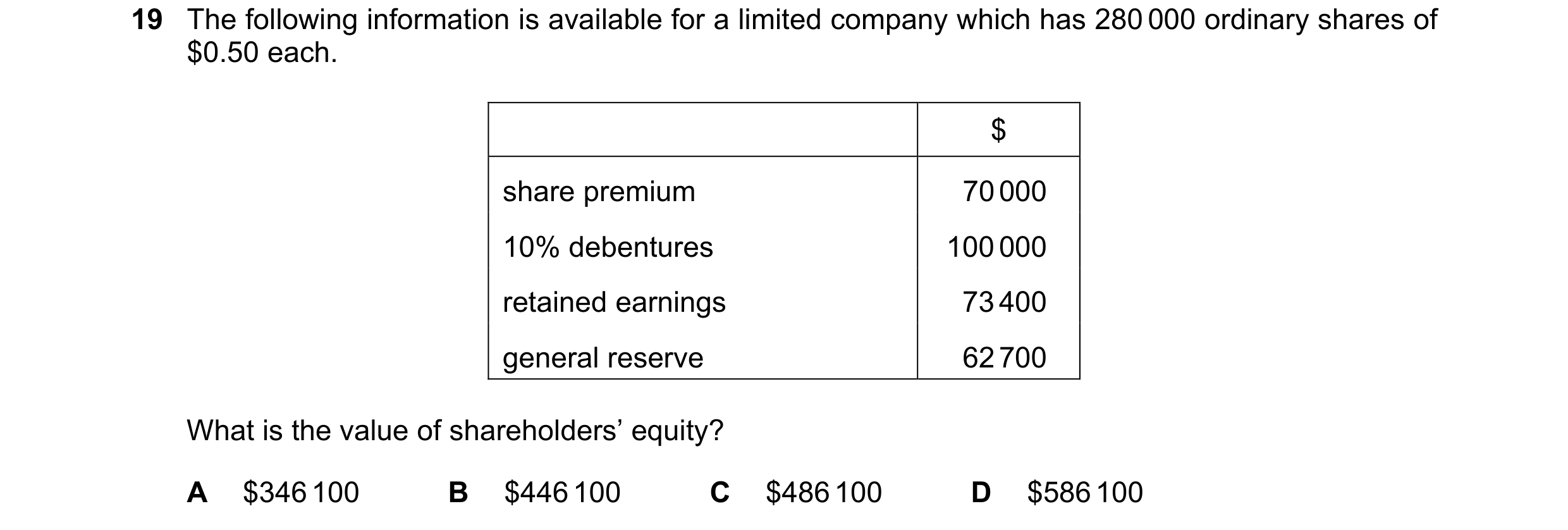
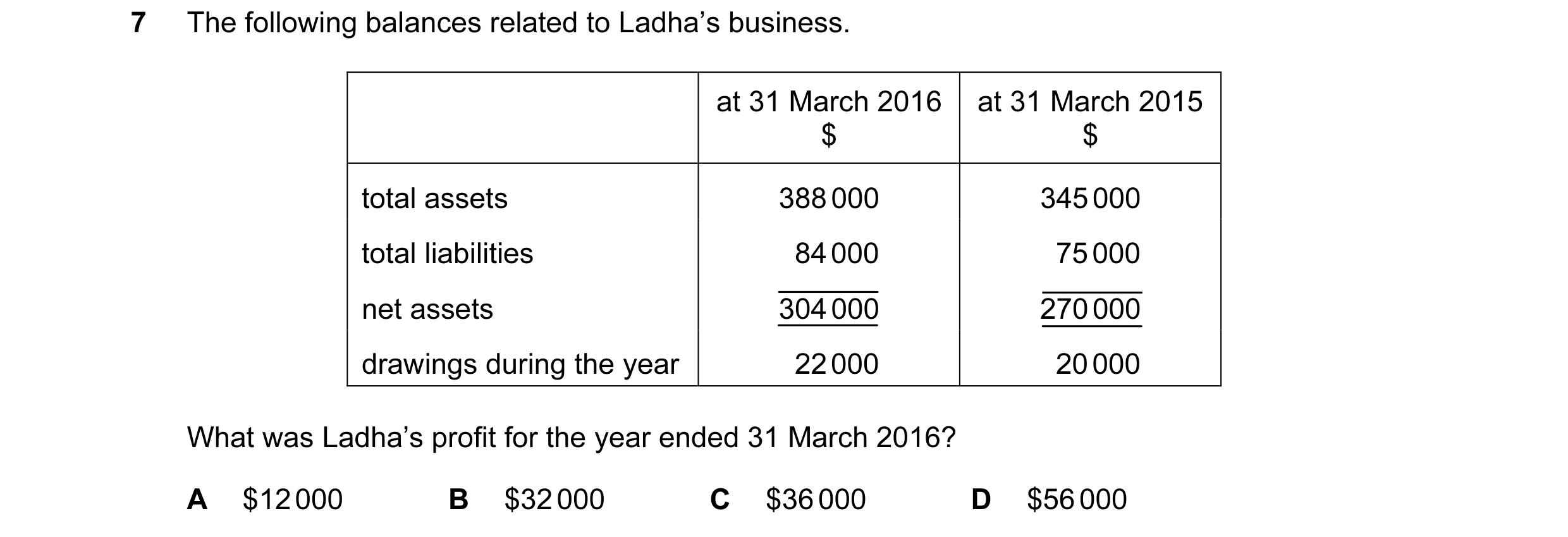

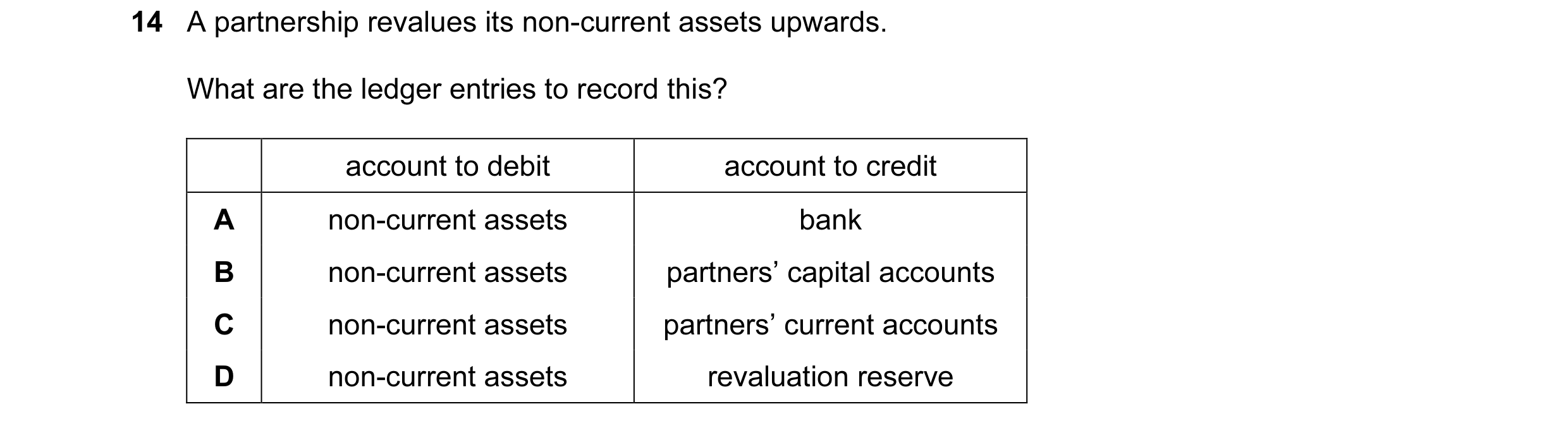 49 / 68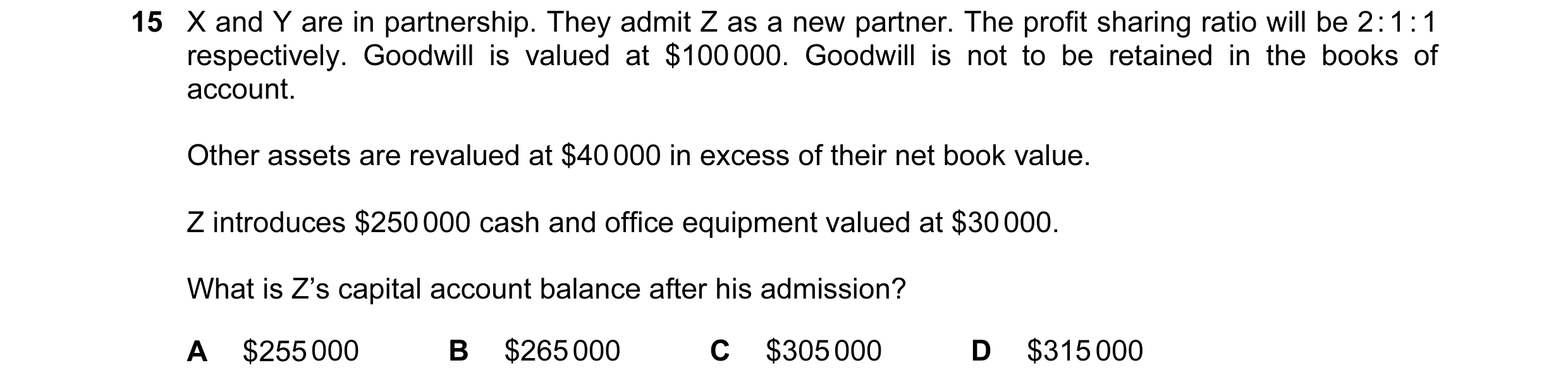
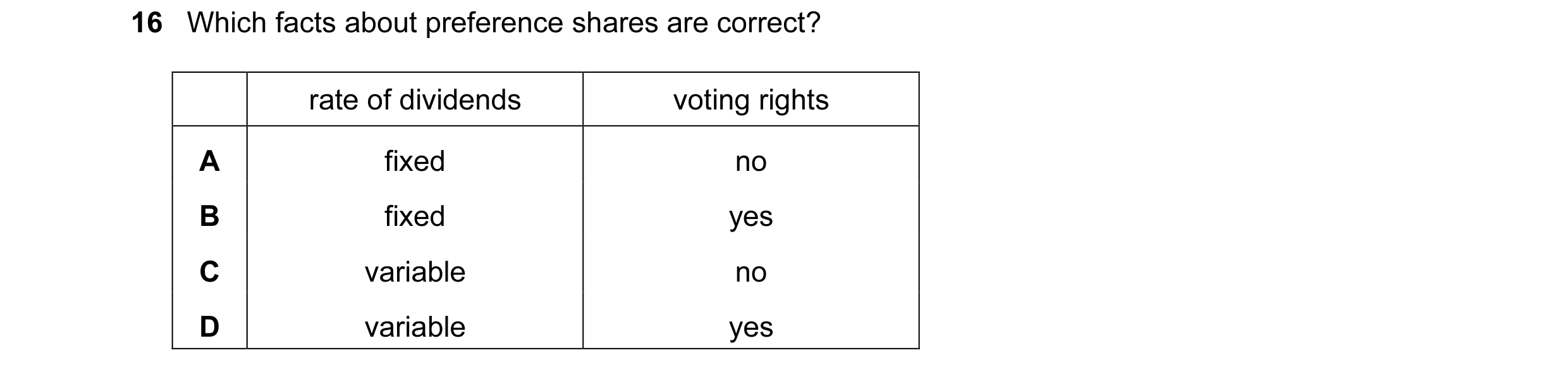
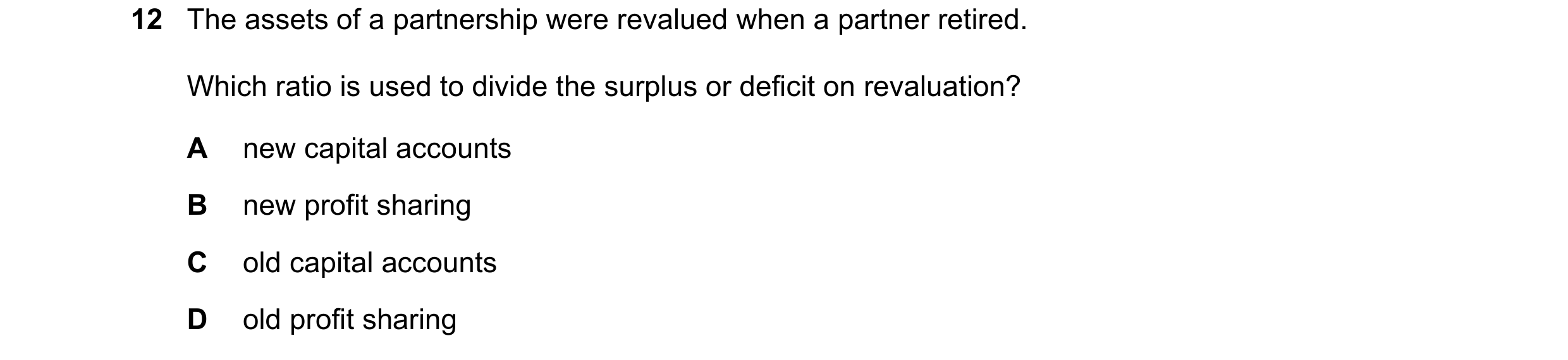
 50 / 68
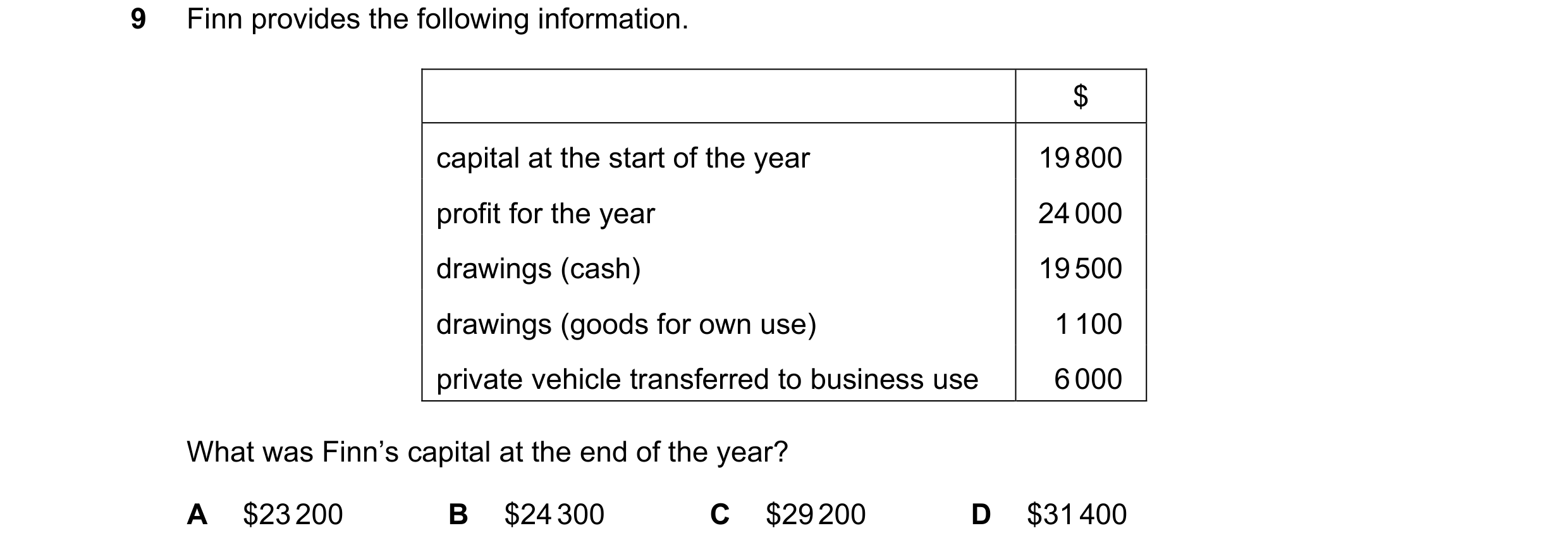
 51 / 68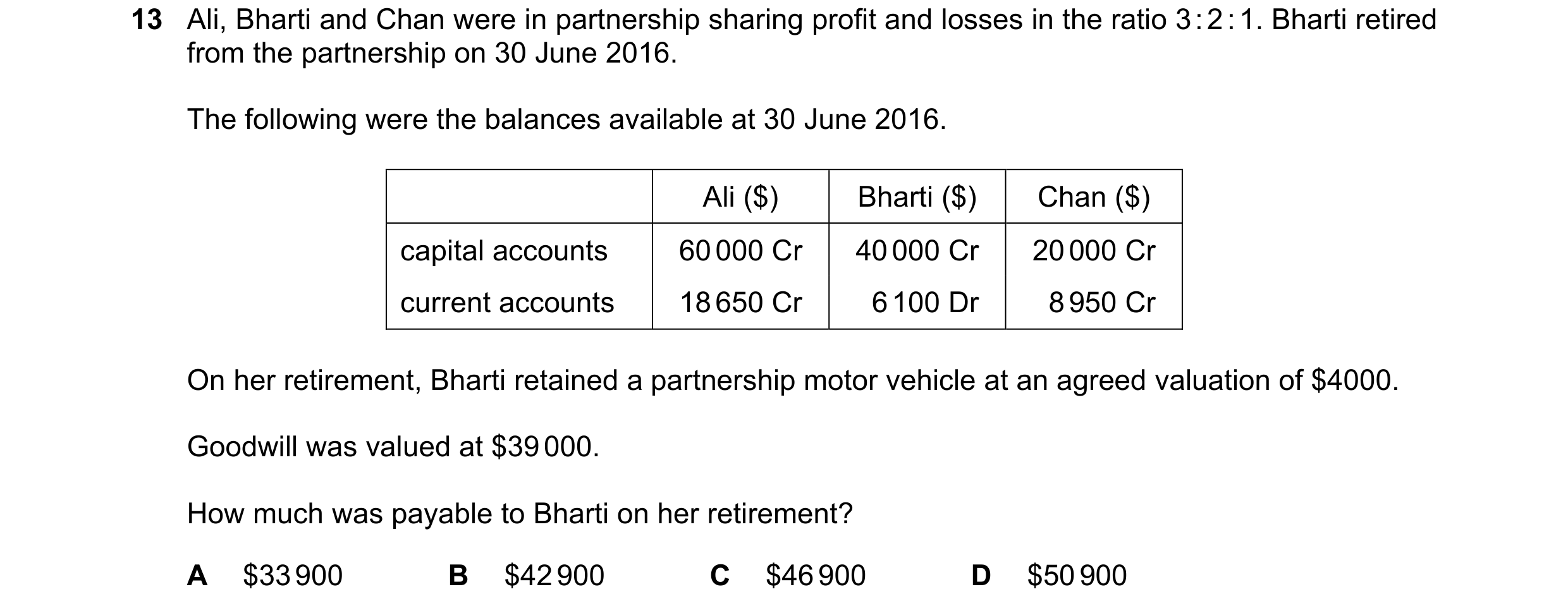
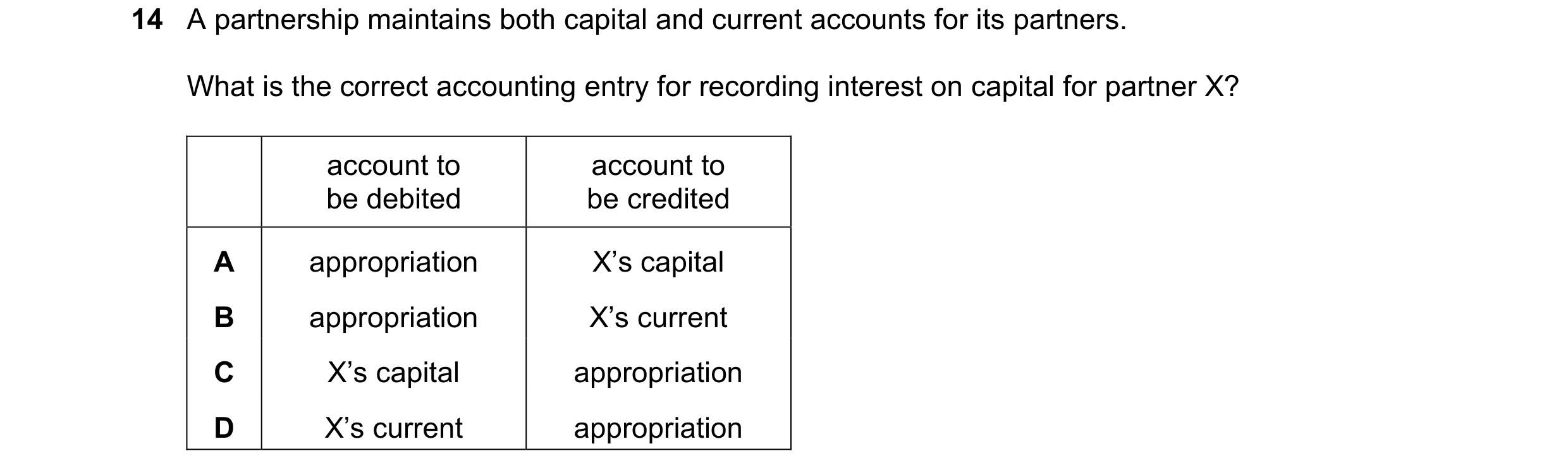

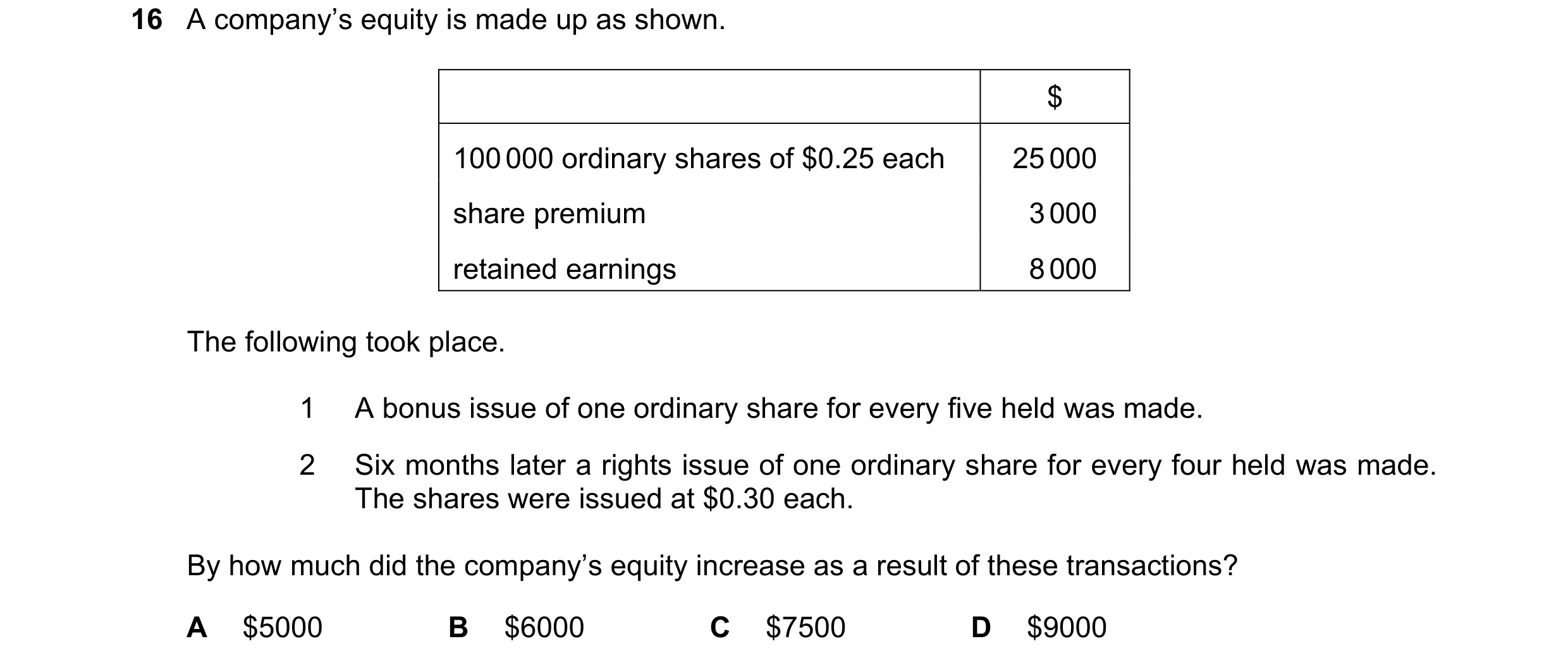 52 / 68

 53 / 68
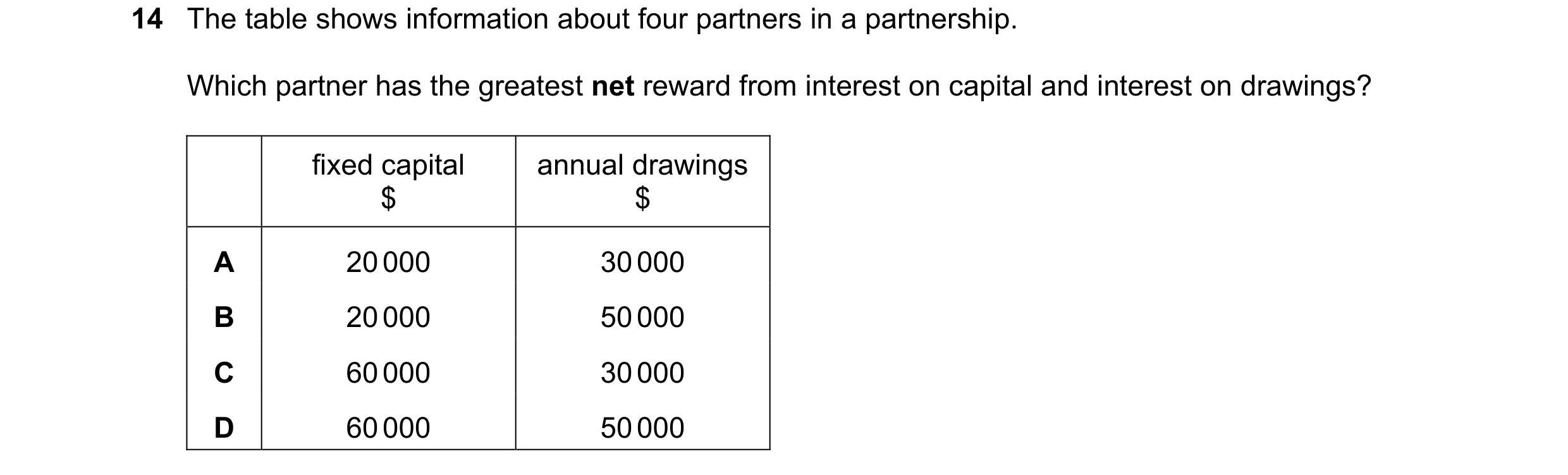
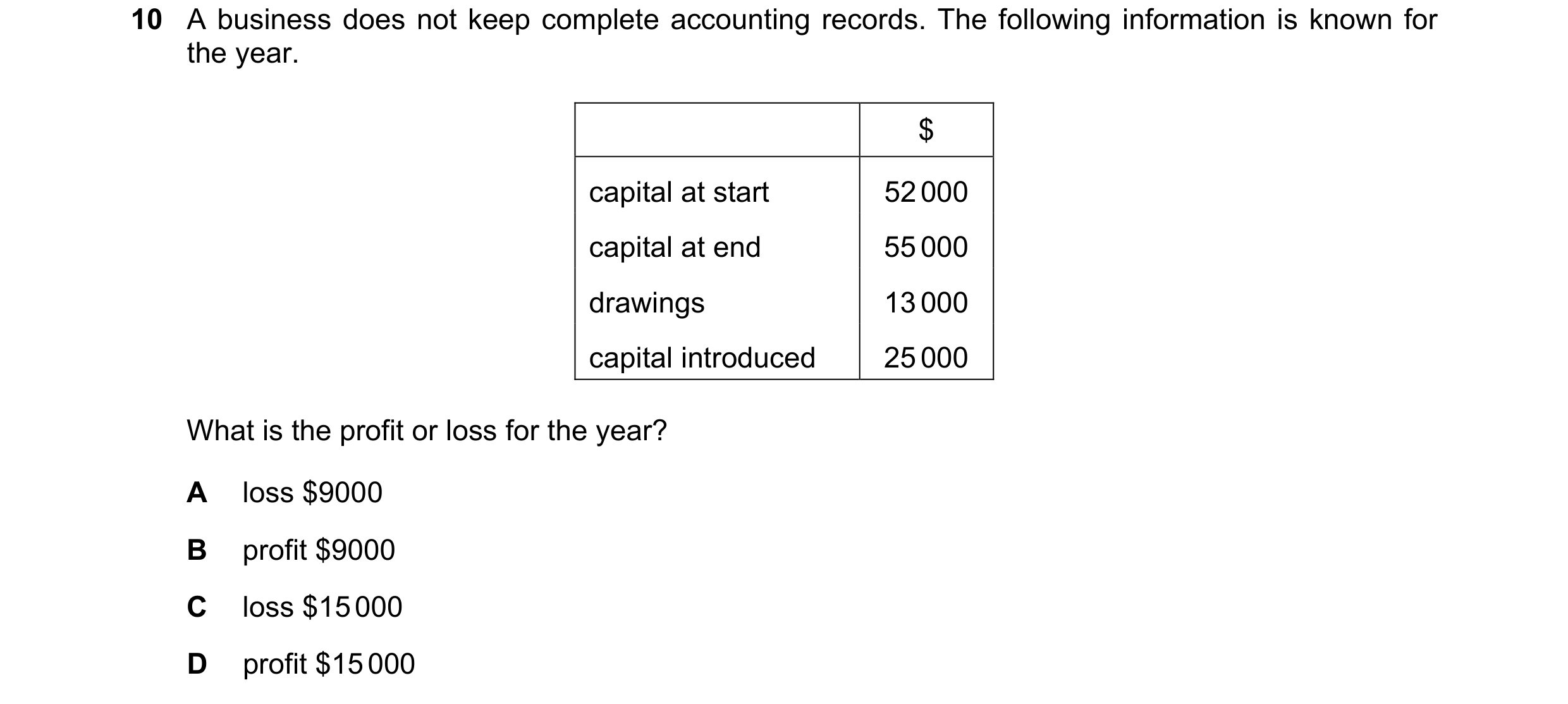
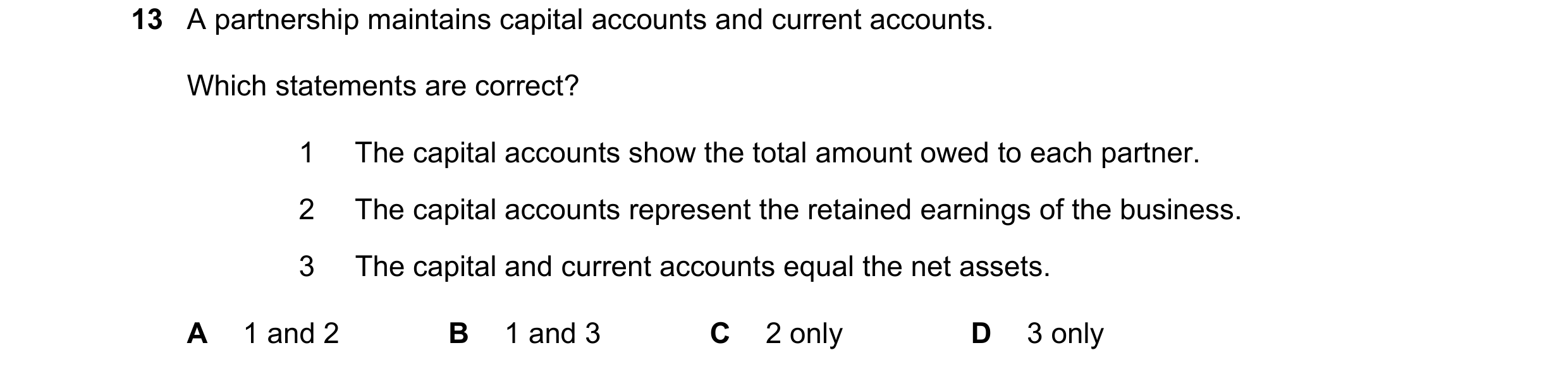 54 / 68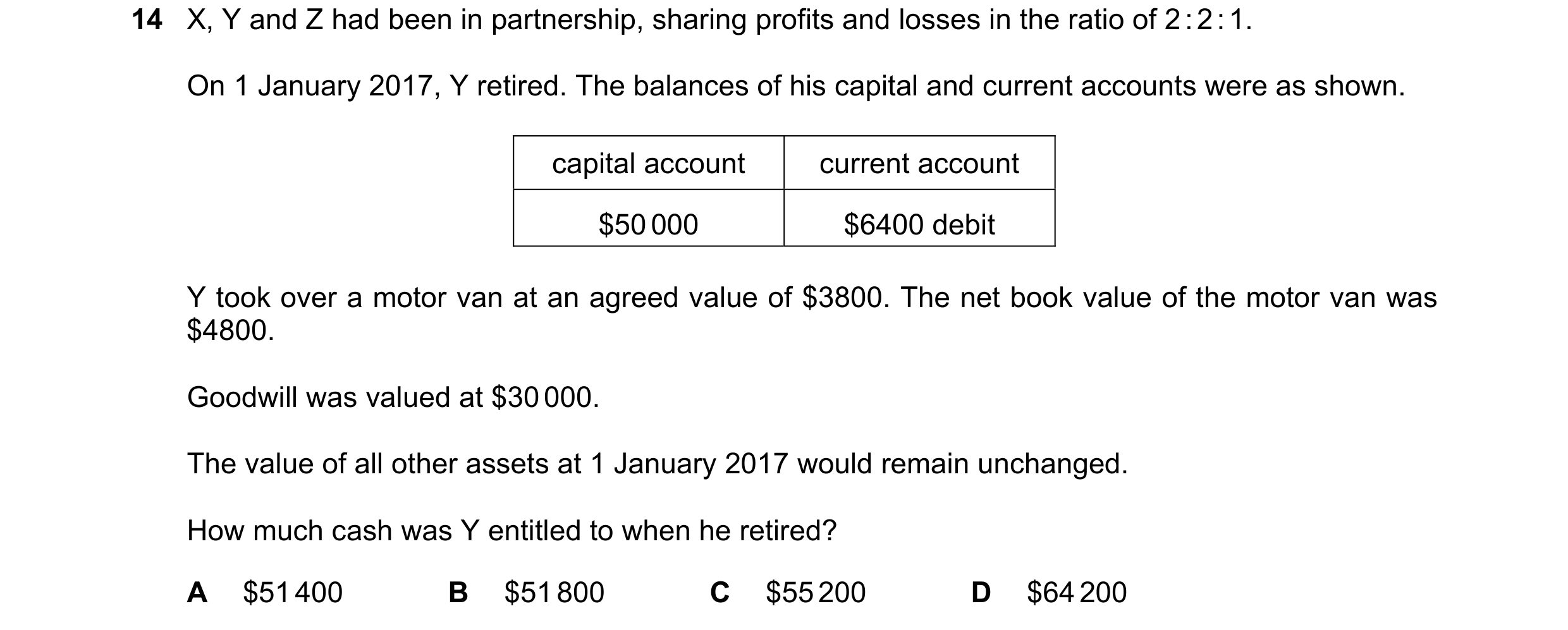
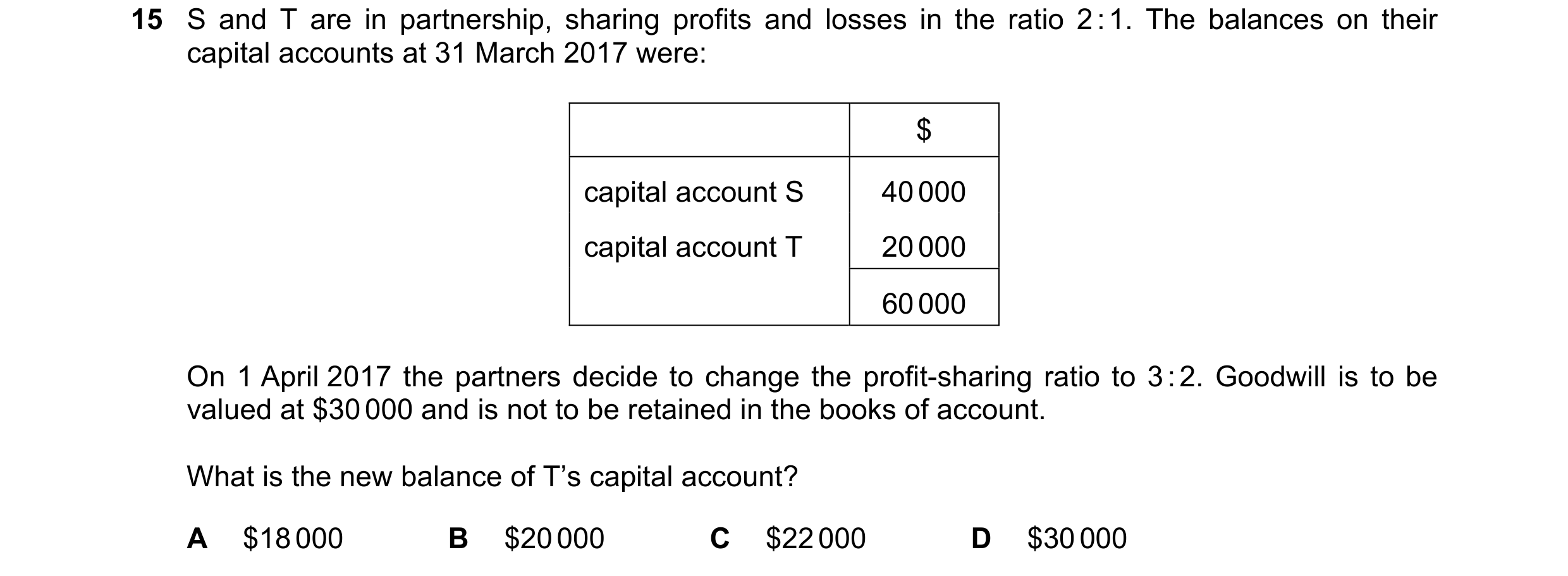
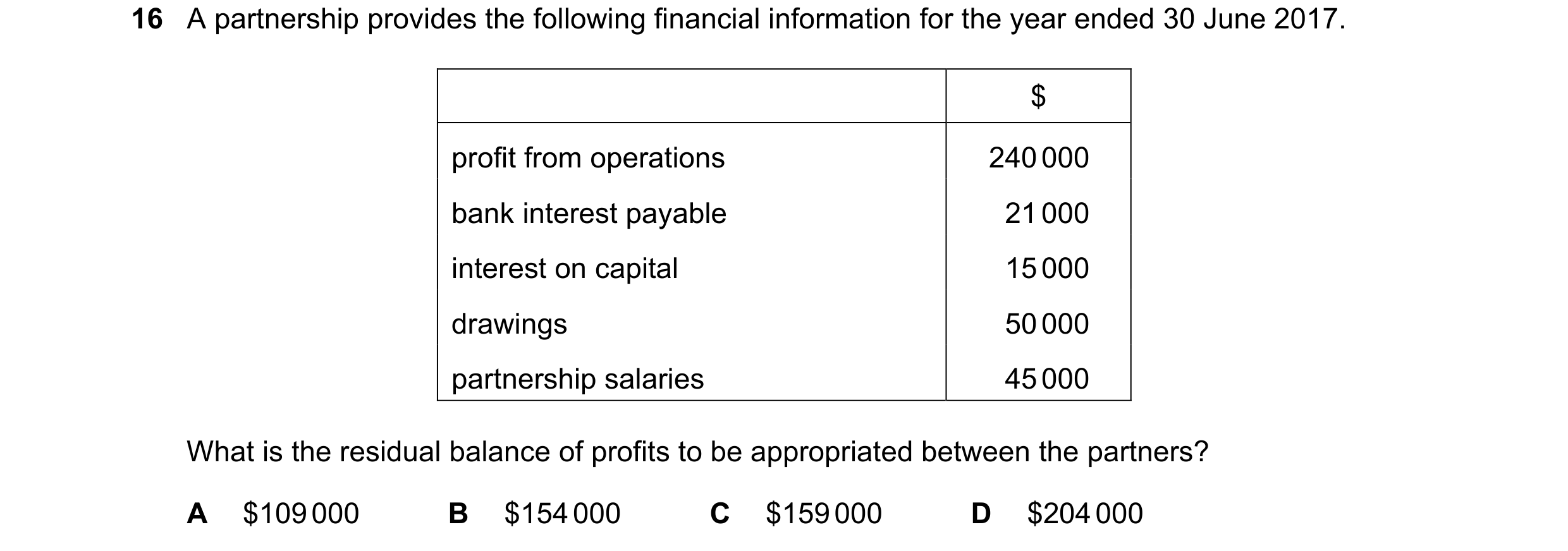 55 / 68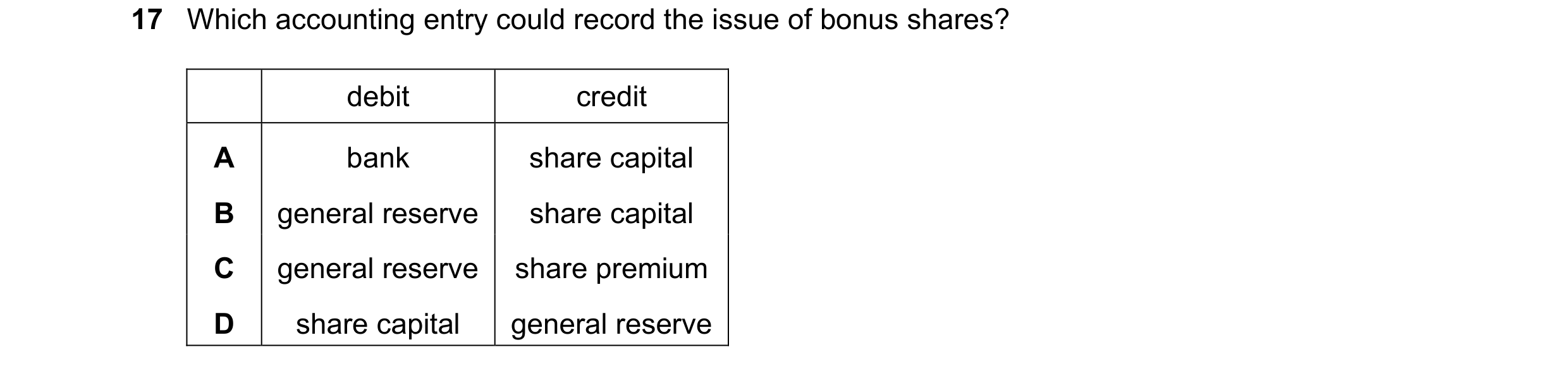
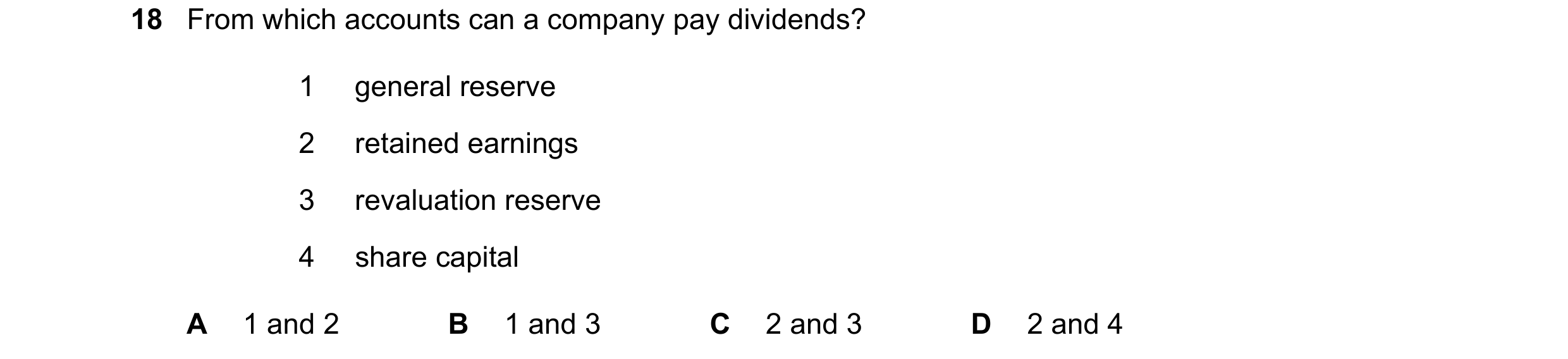

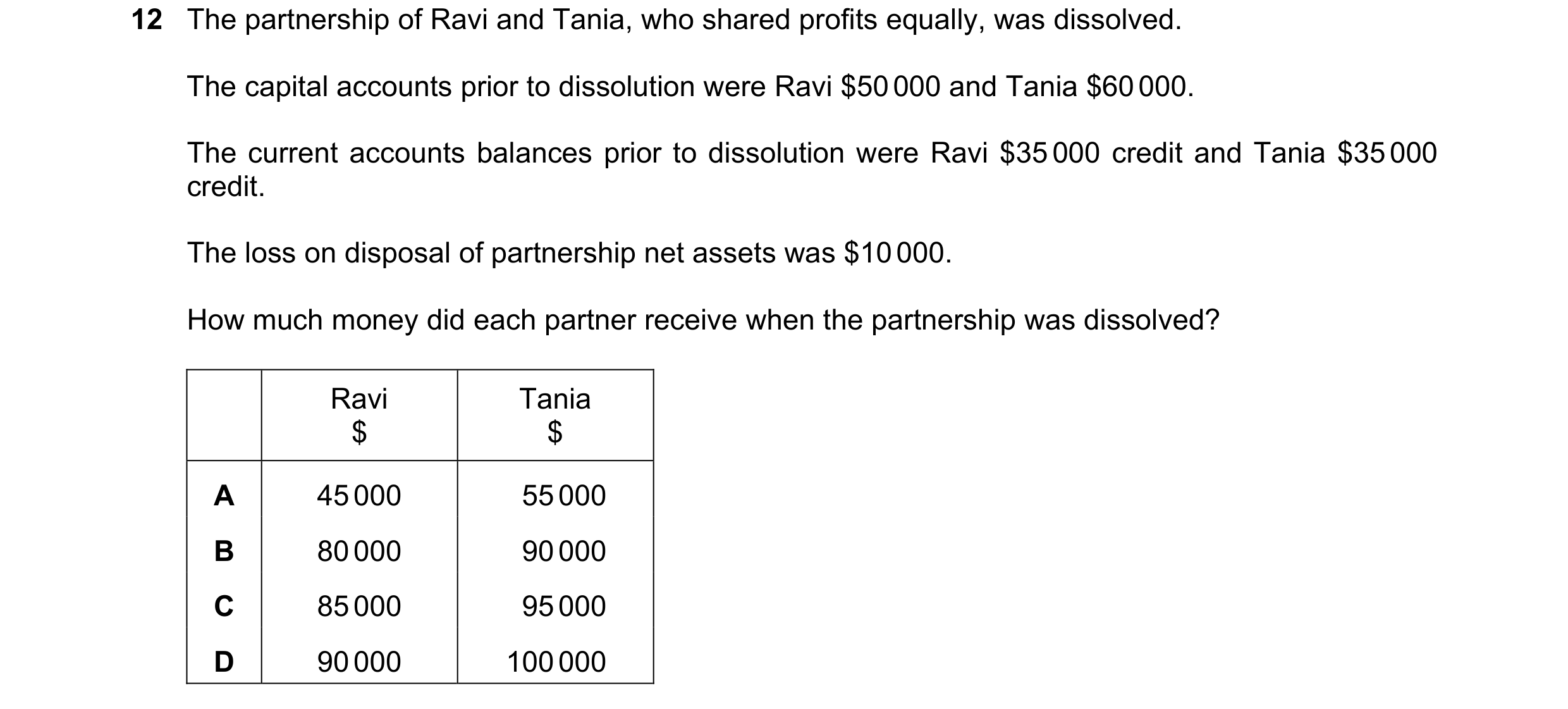
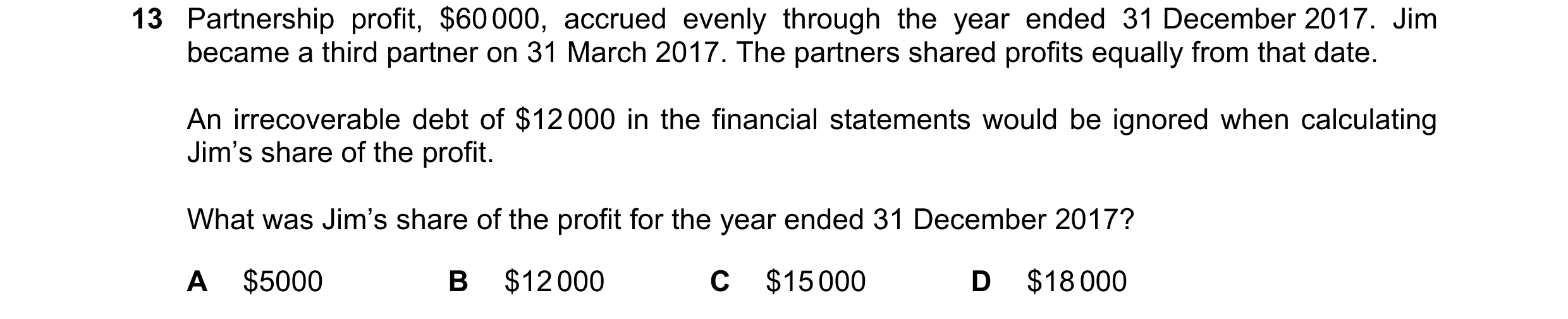 56 / 68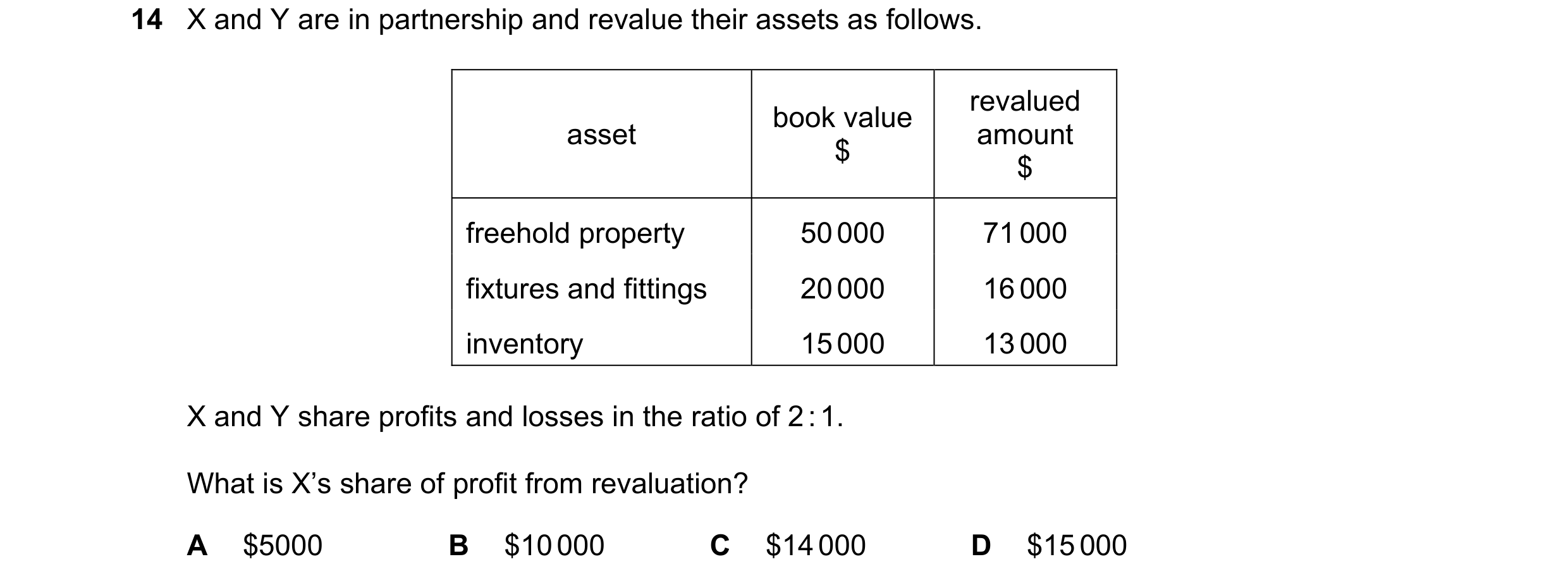
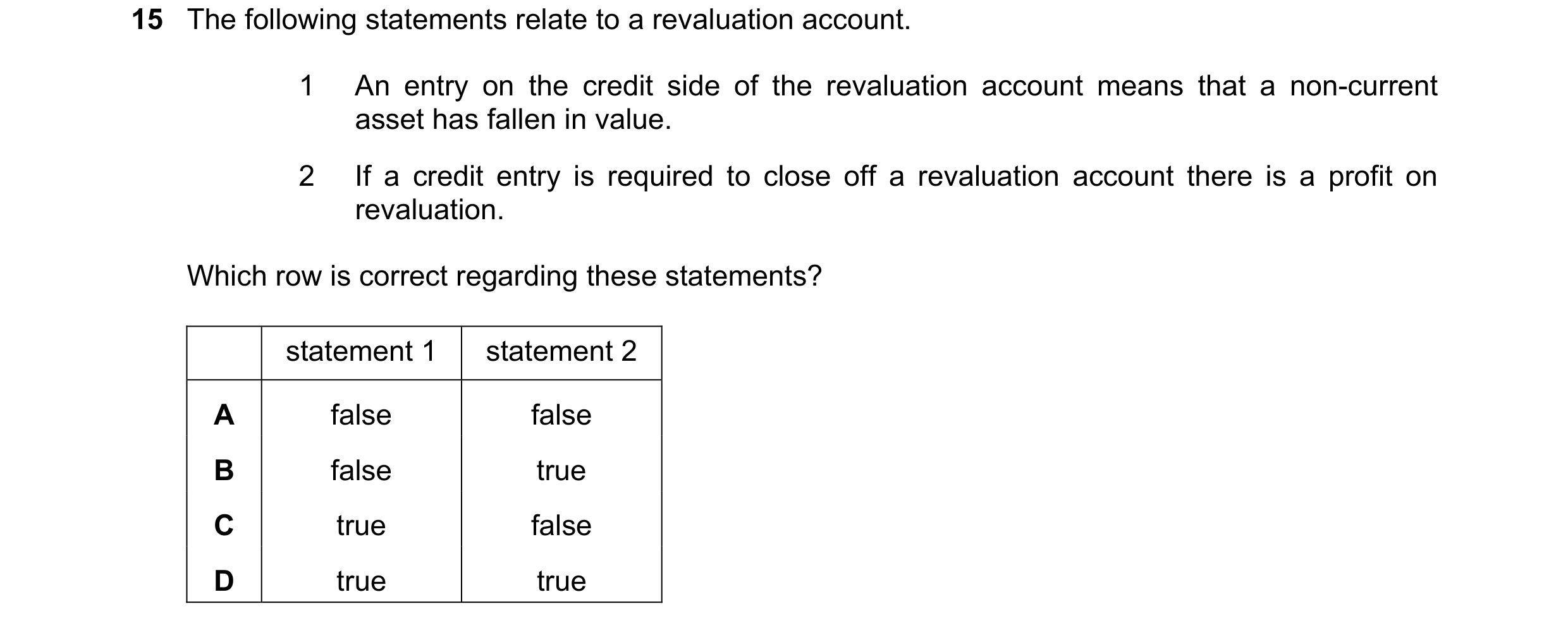
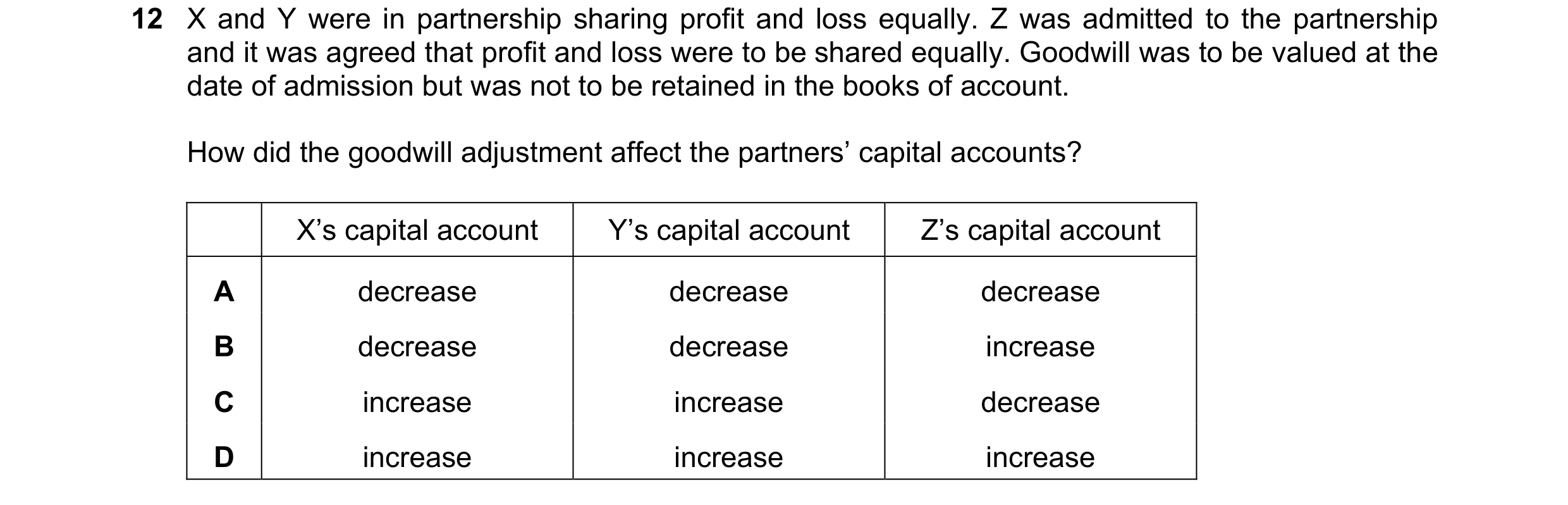 57 / 68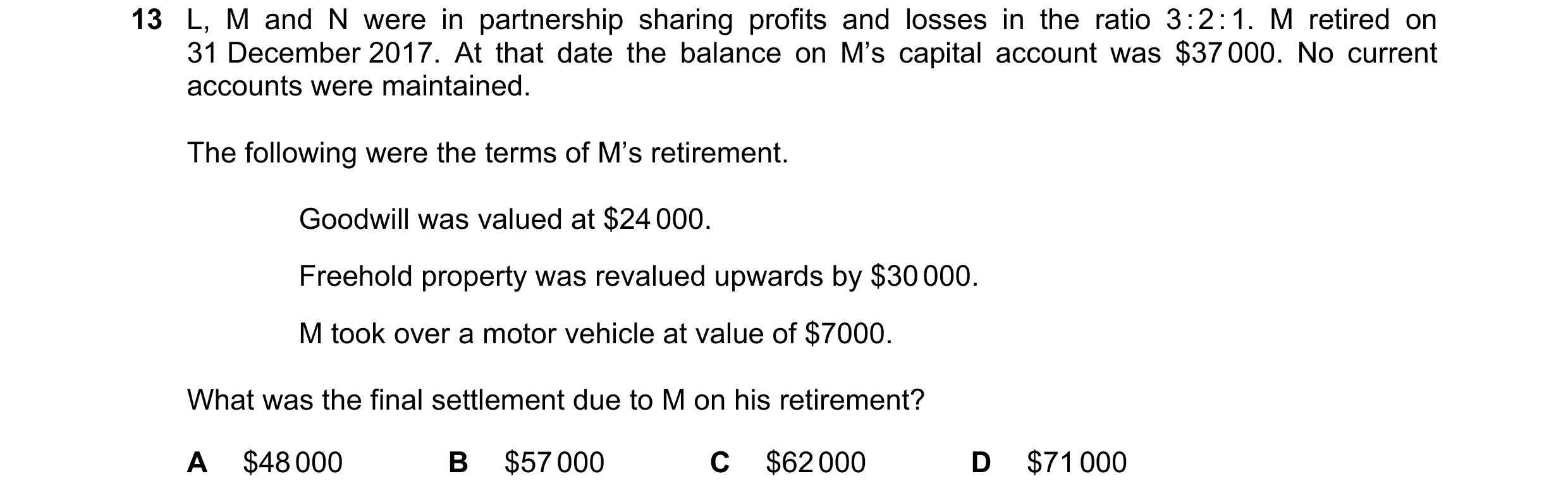
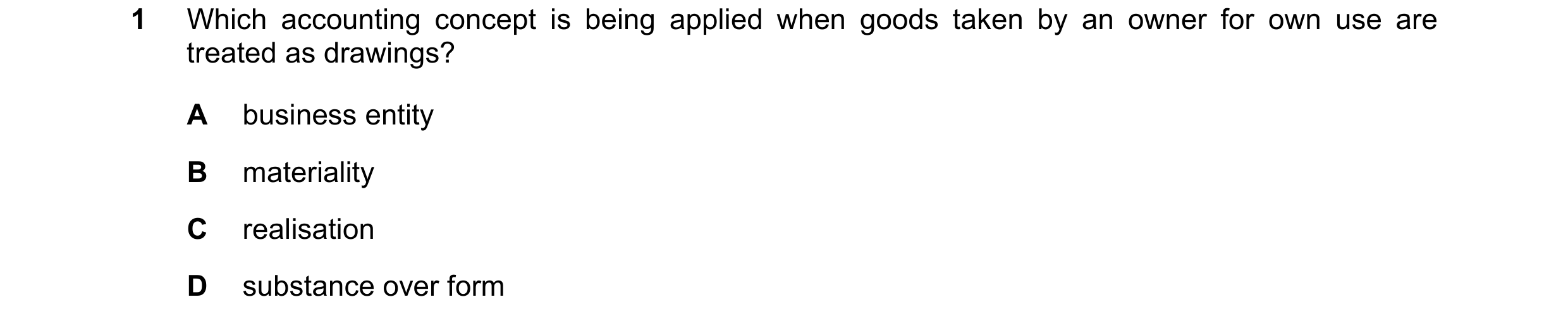
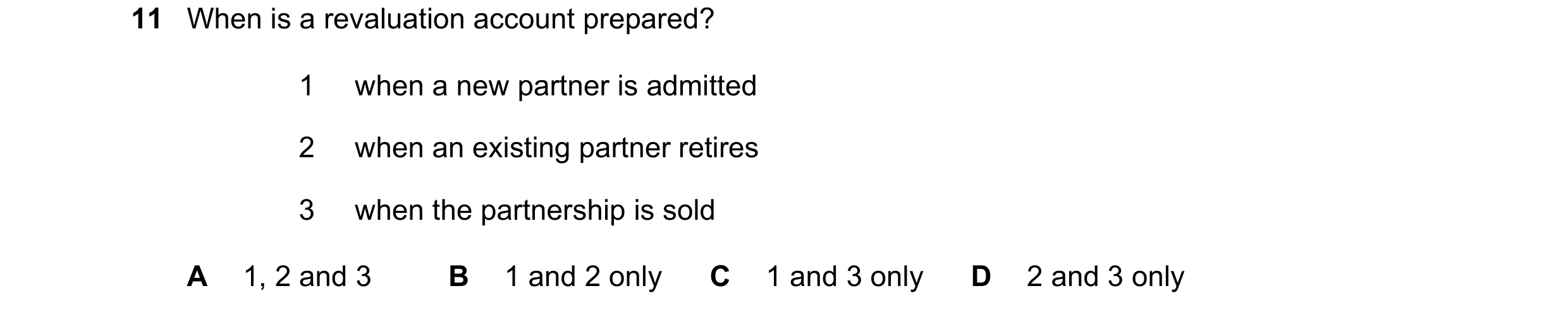
 58 / 68
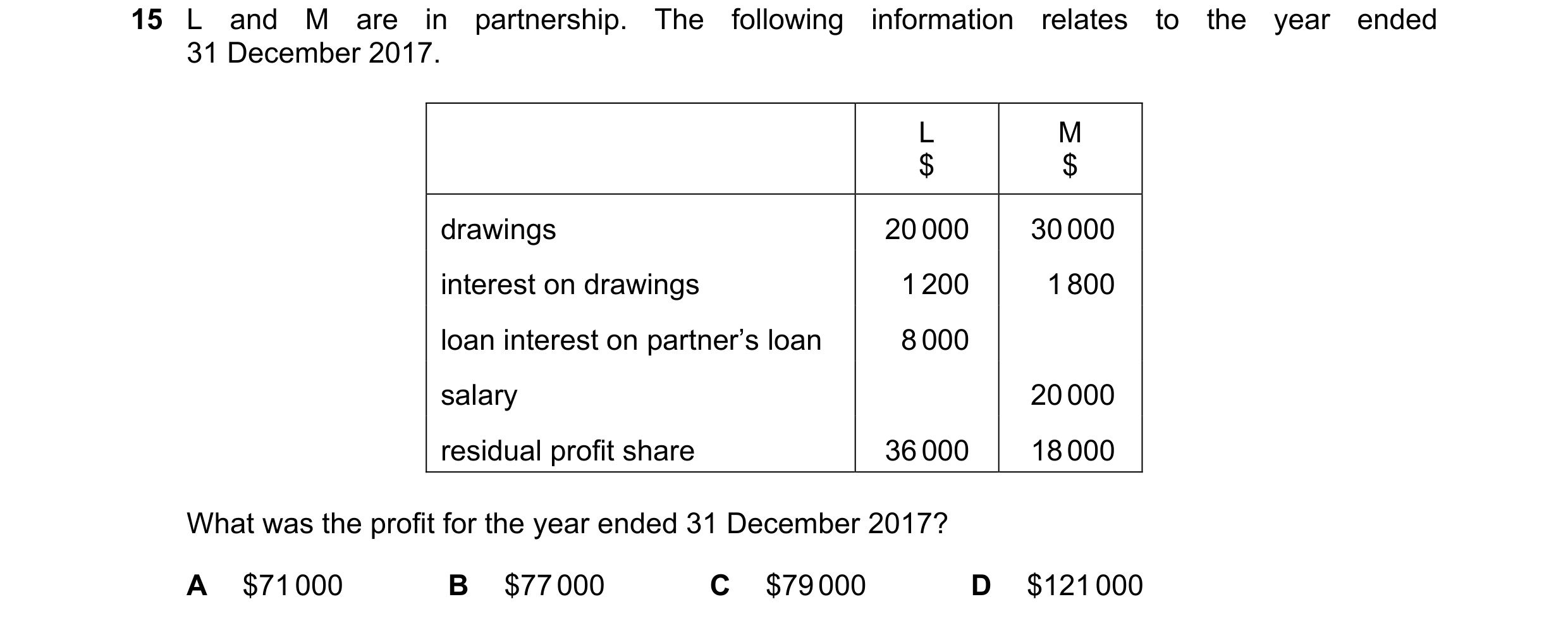 59 / 68
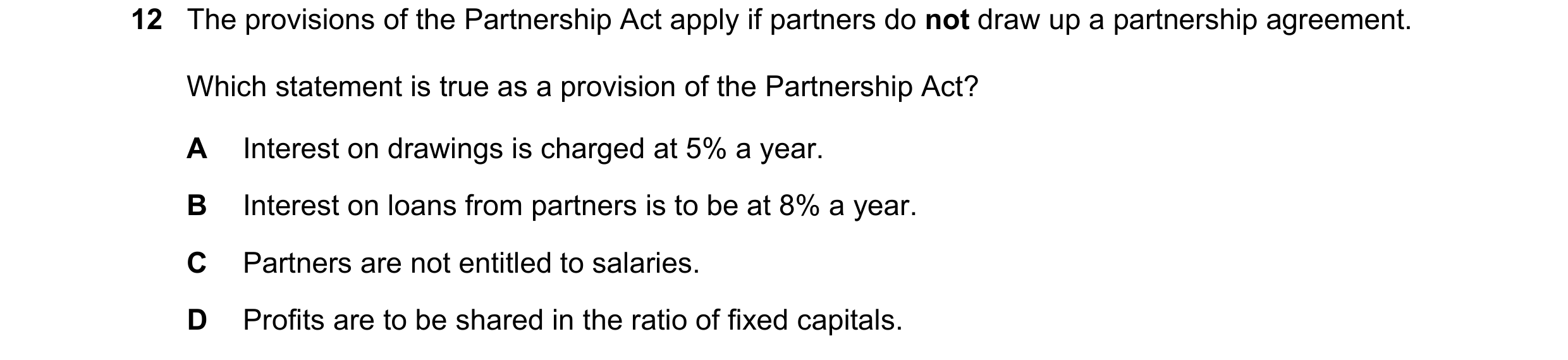
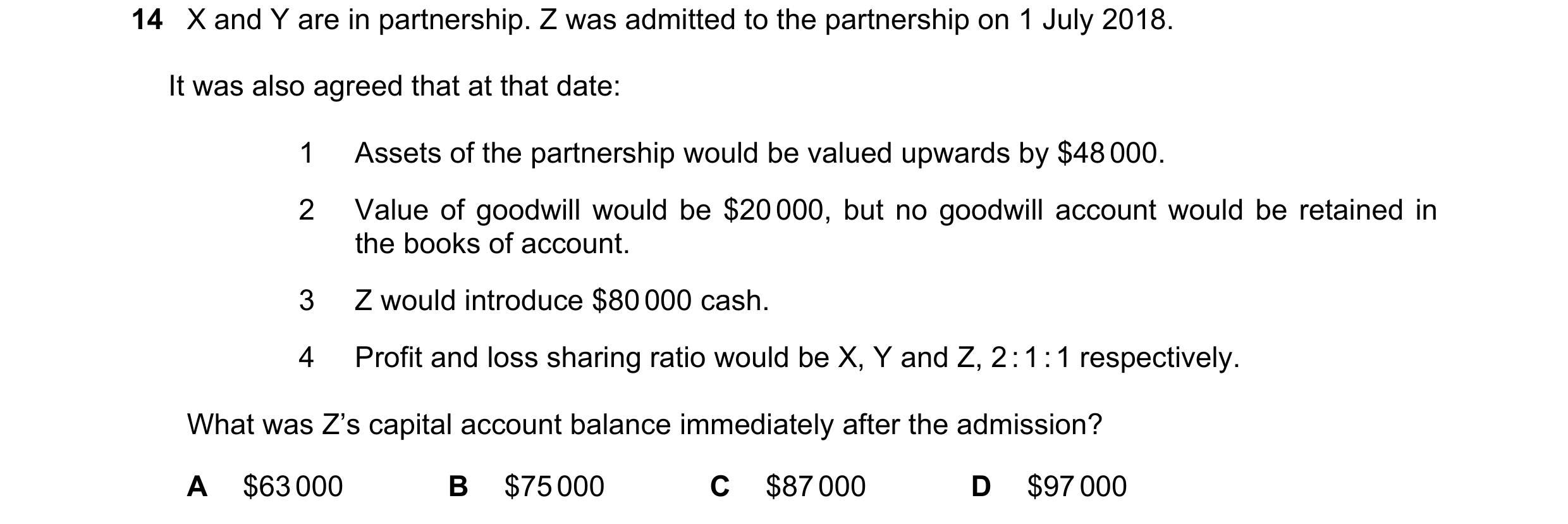
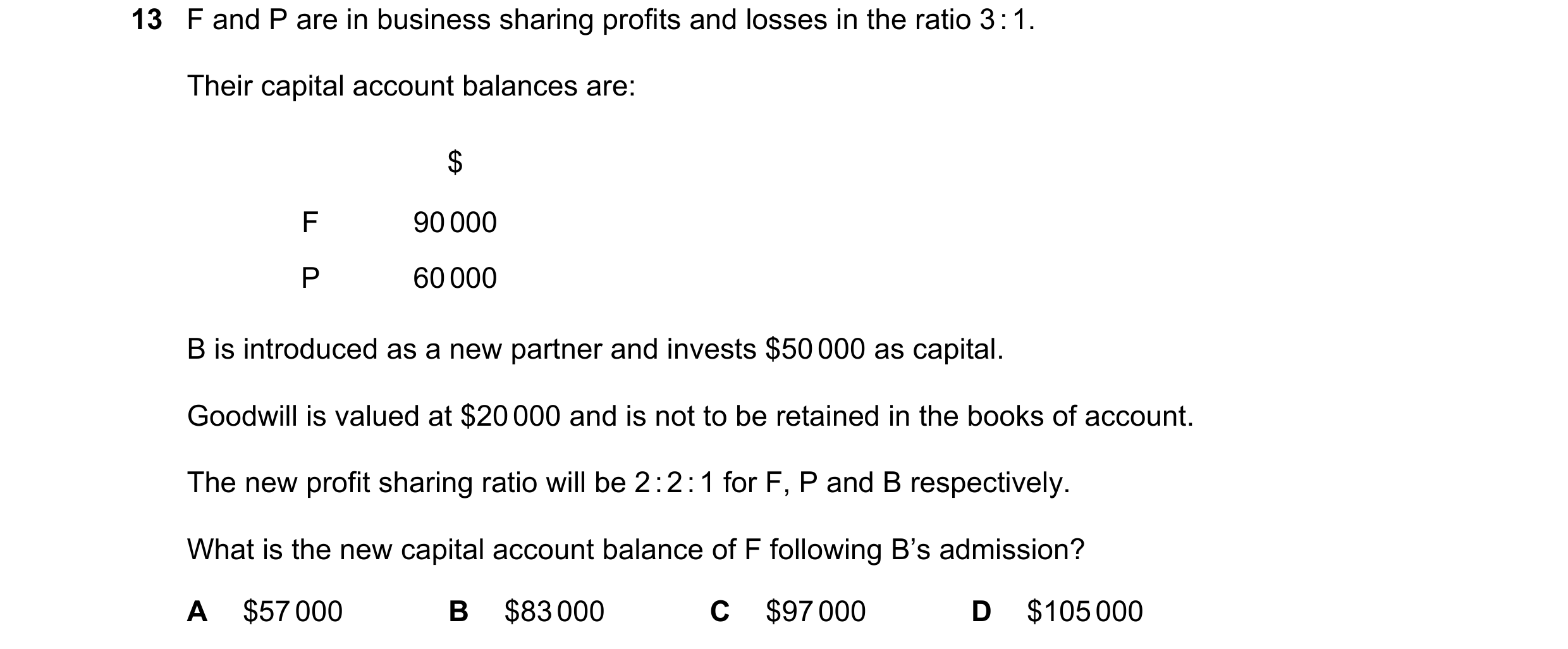 60 / 68
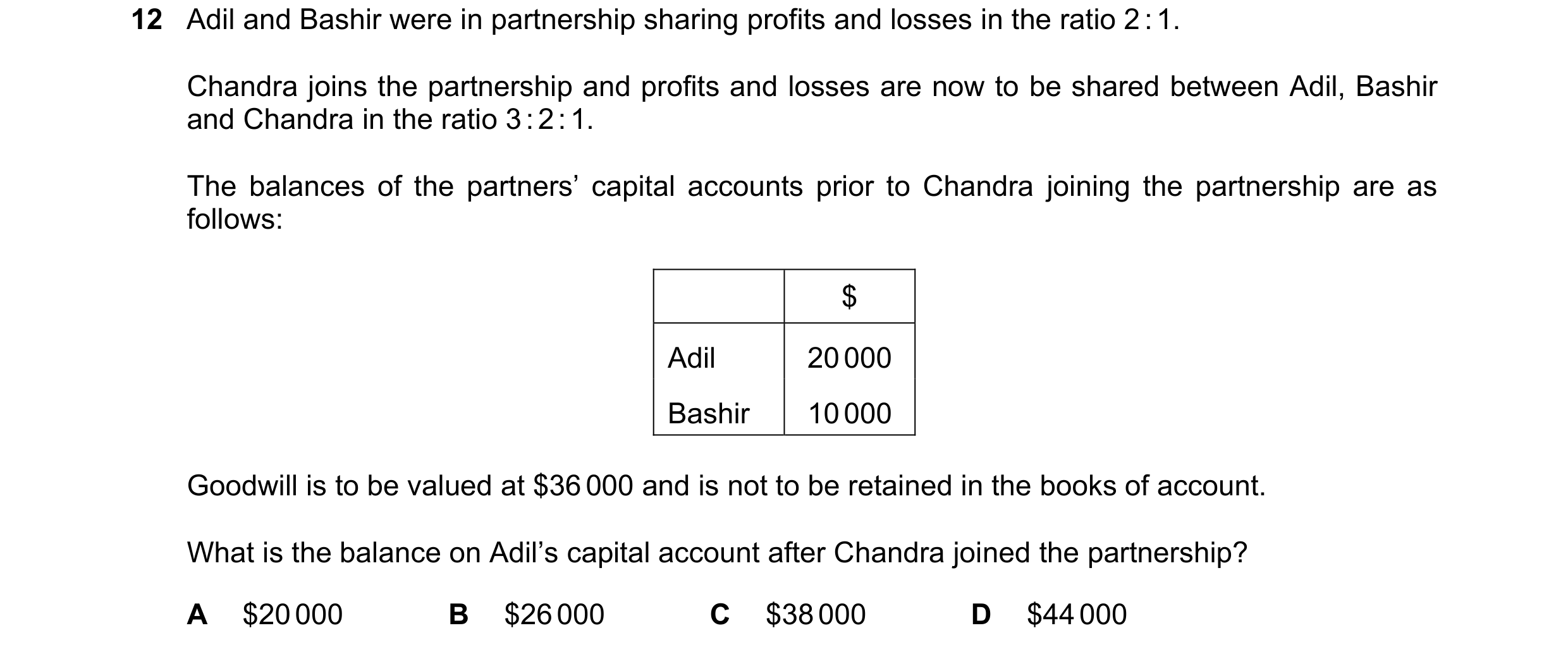
 61 / 68


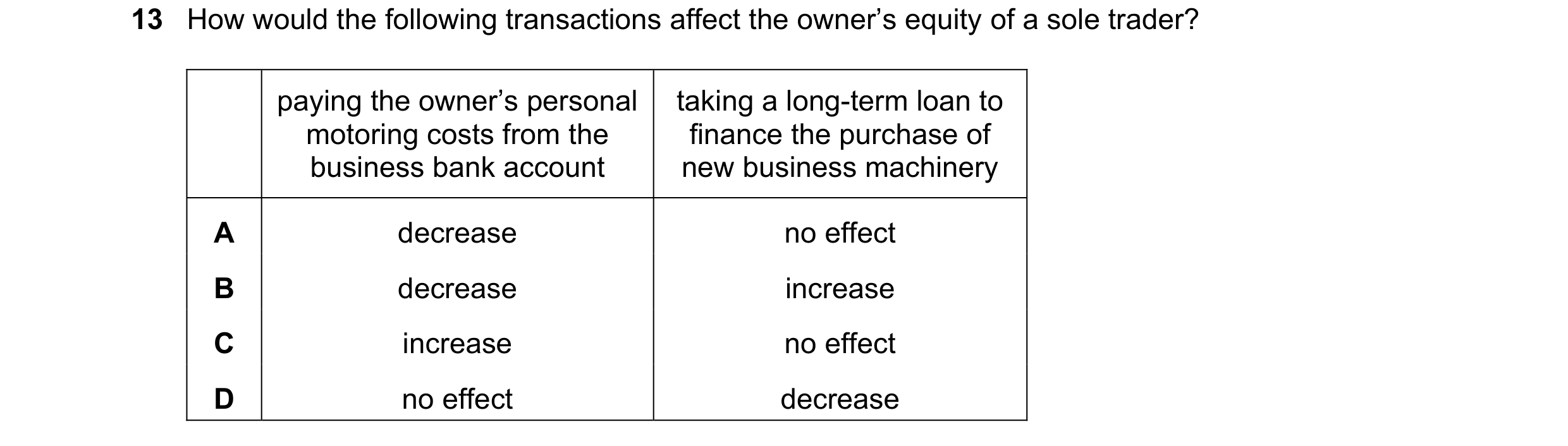
 62 / 68
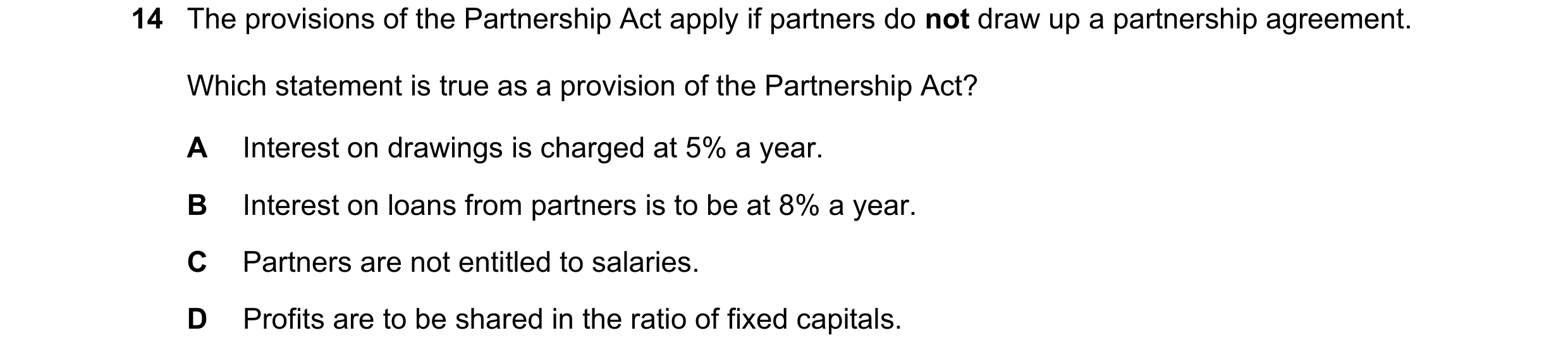
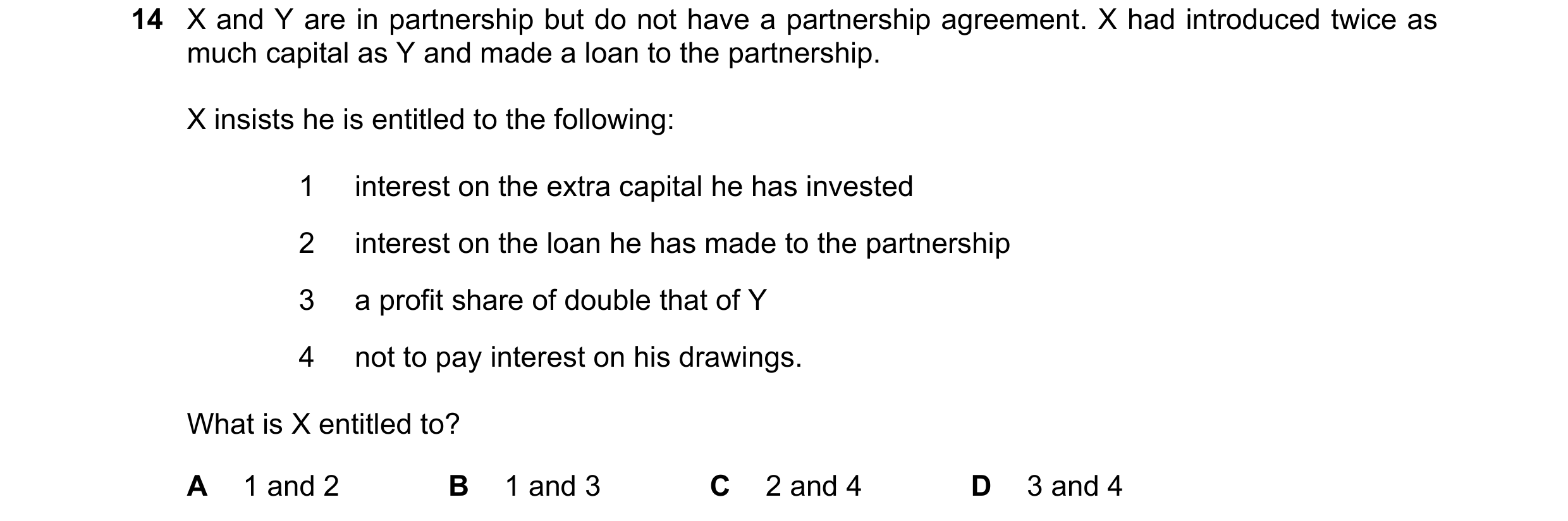


 63 / 68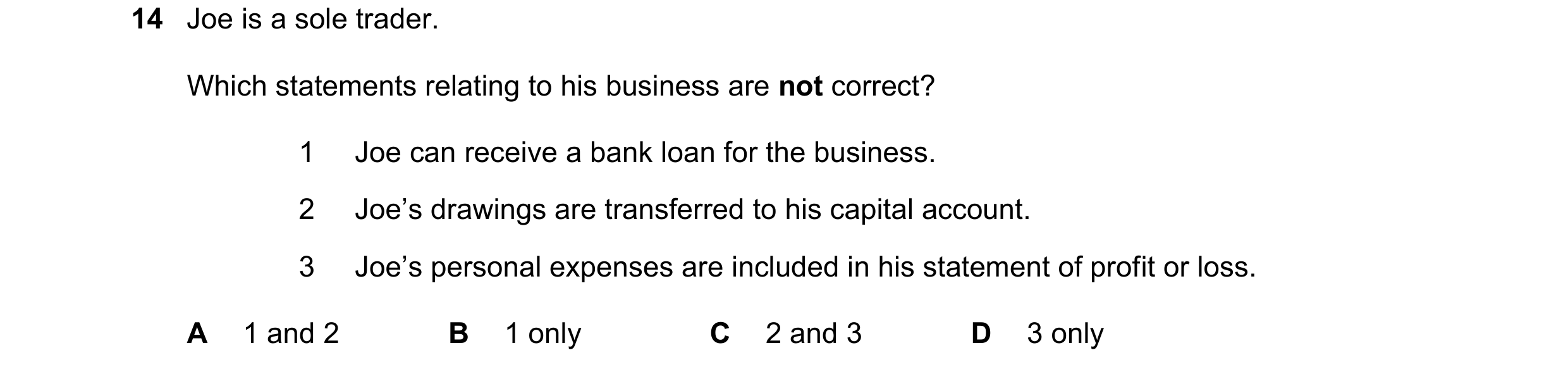
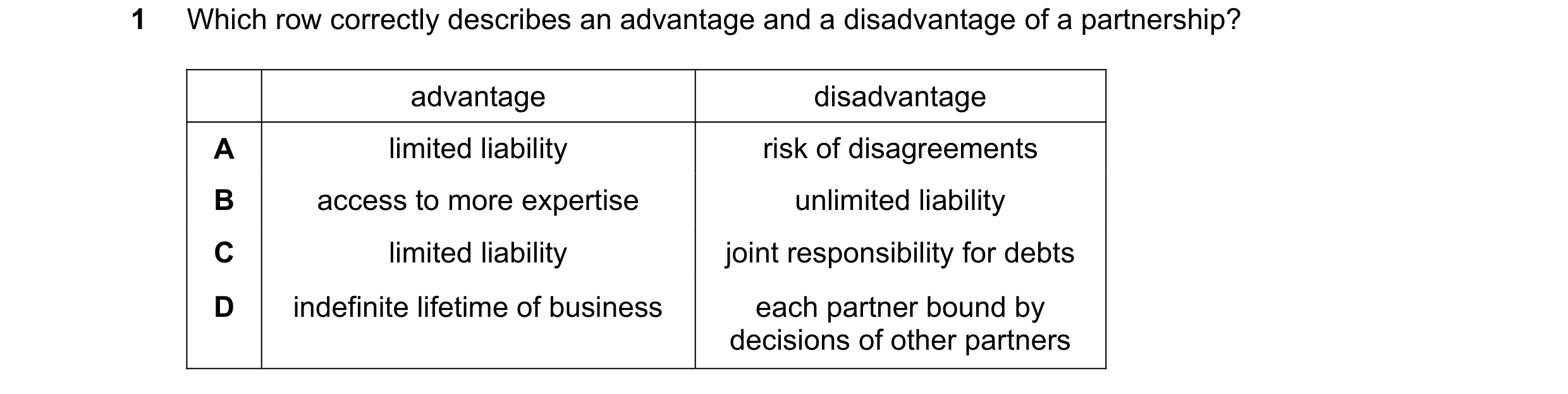
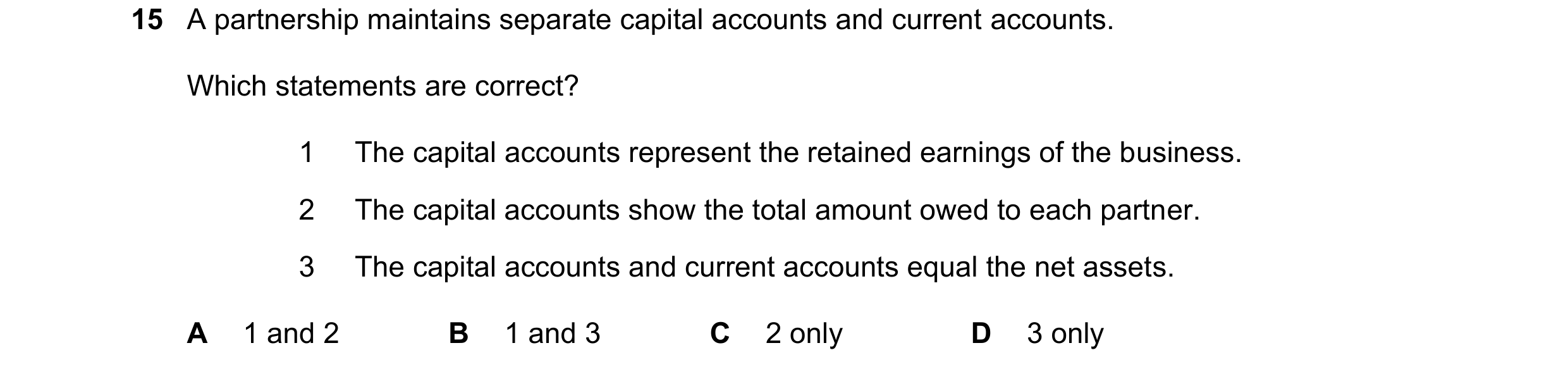
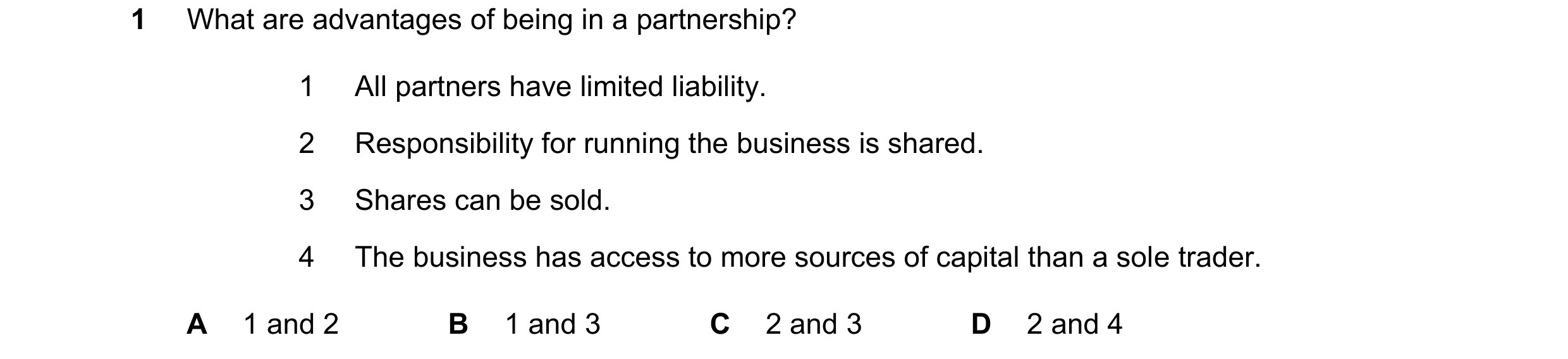
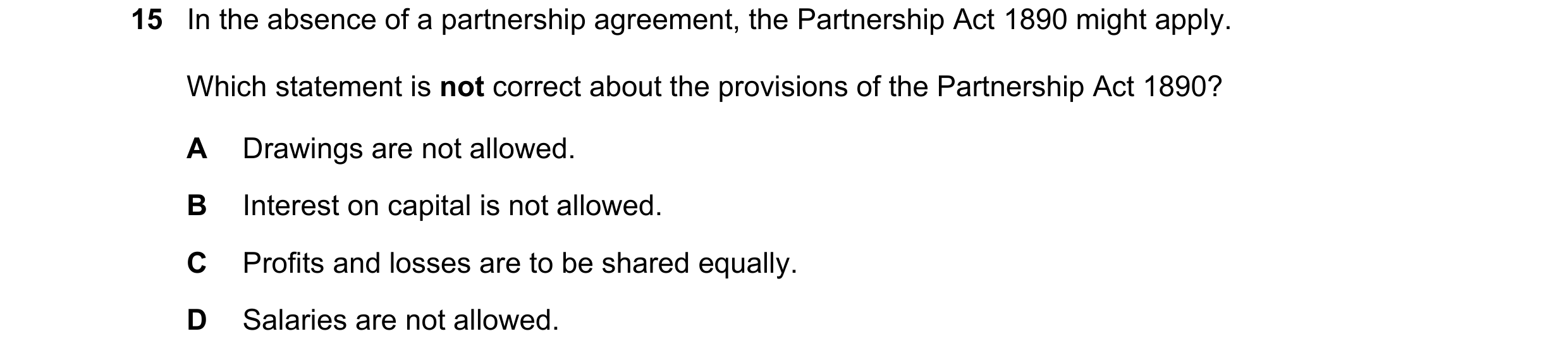 64 / 68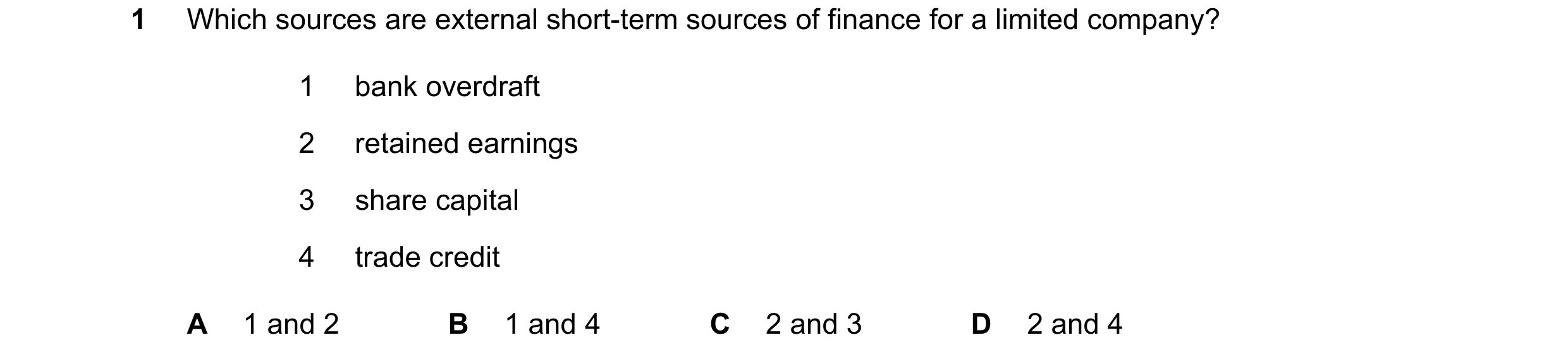



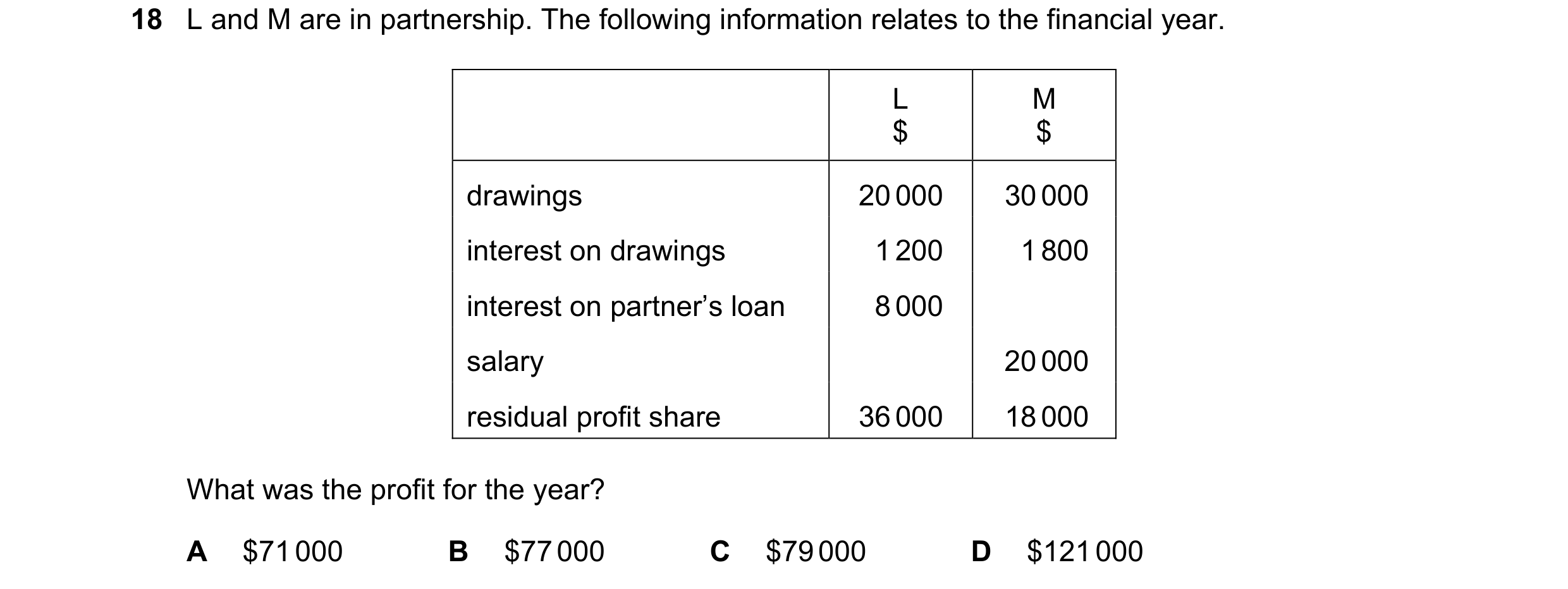 65 / 68


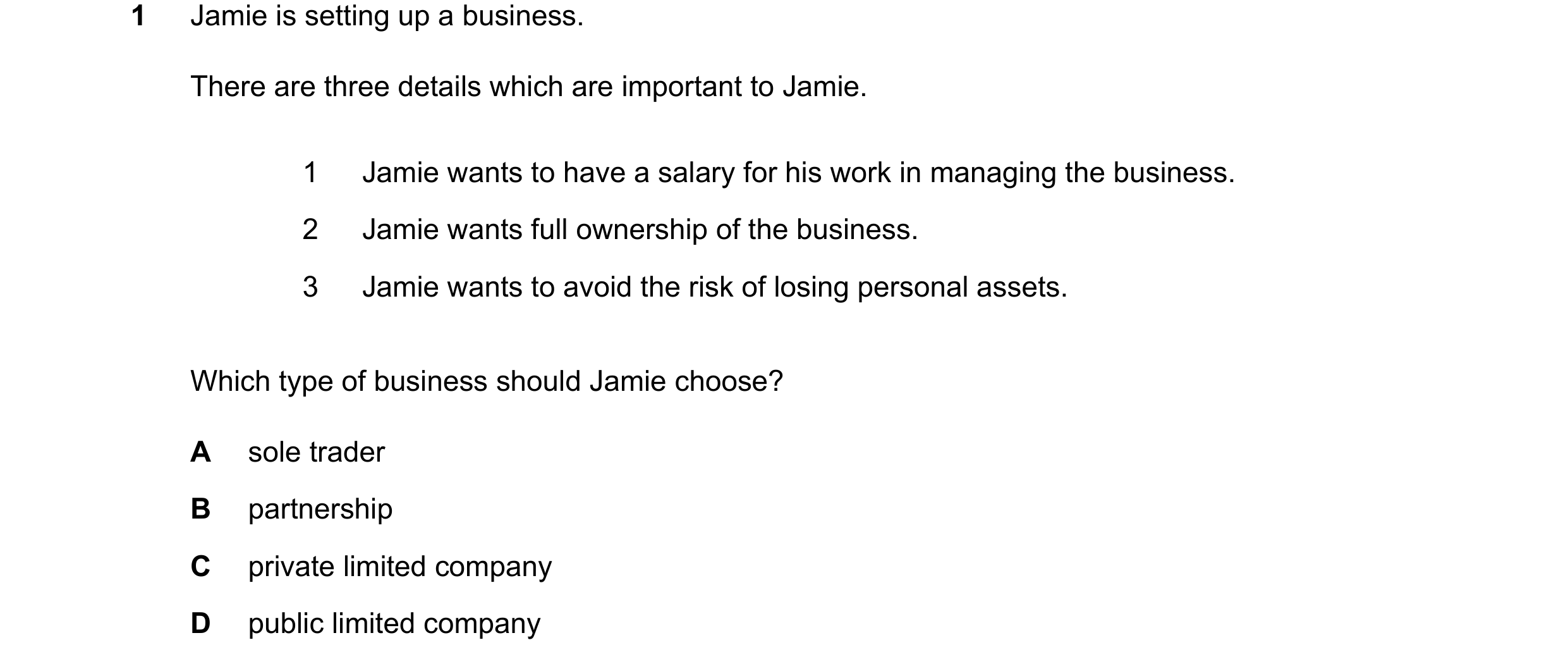
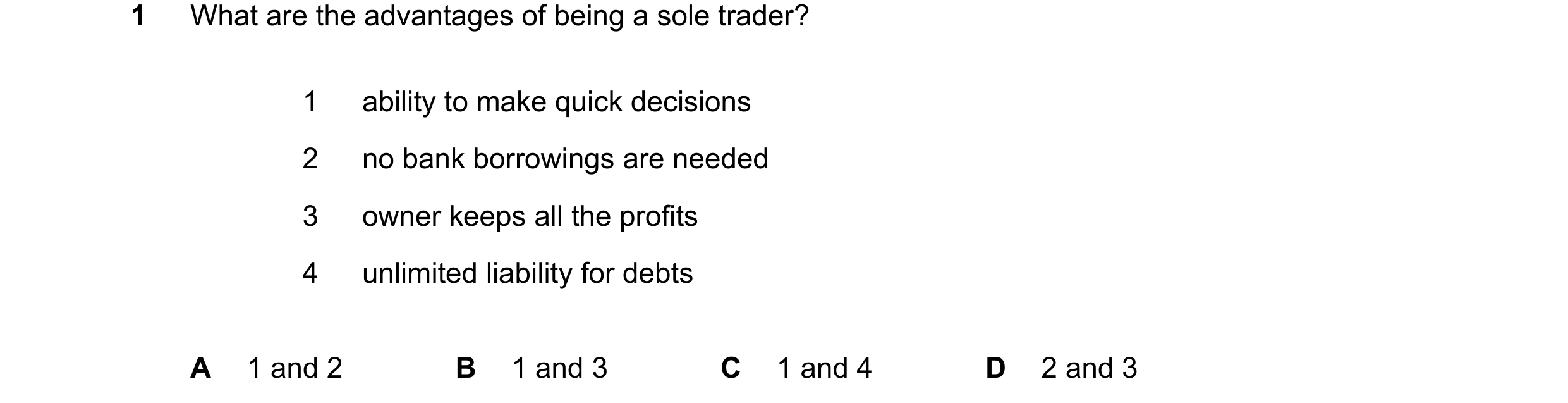 66 / 68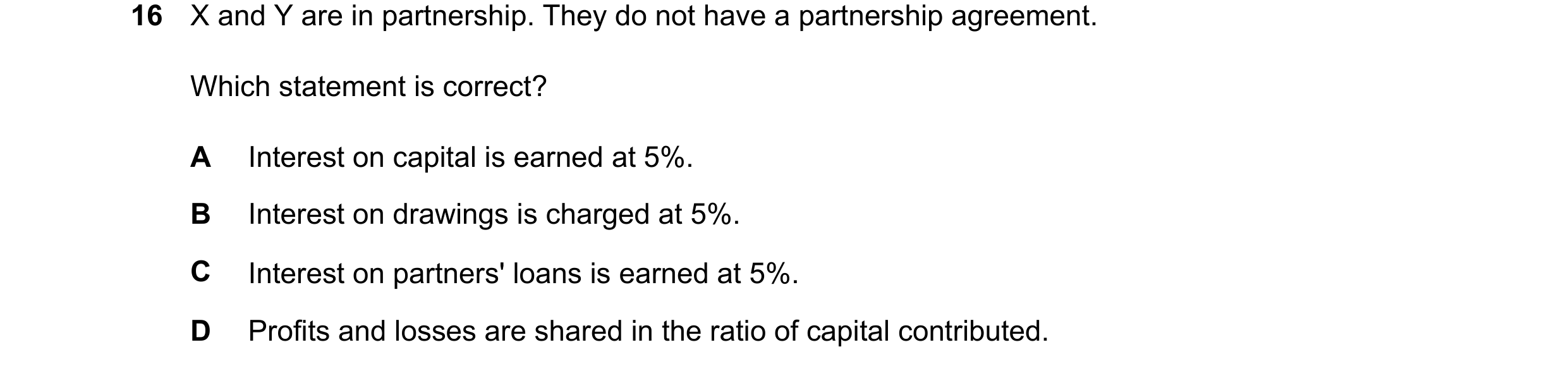
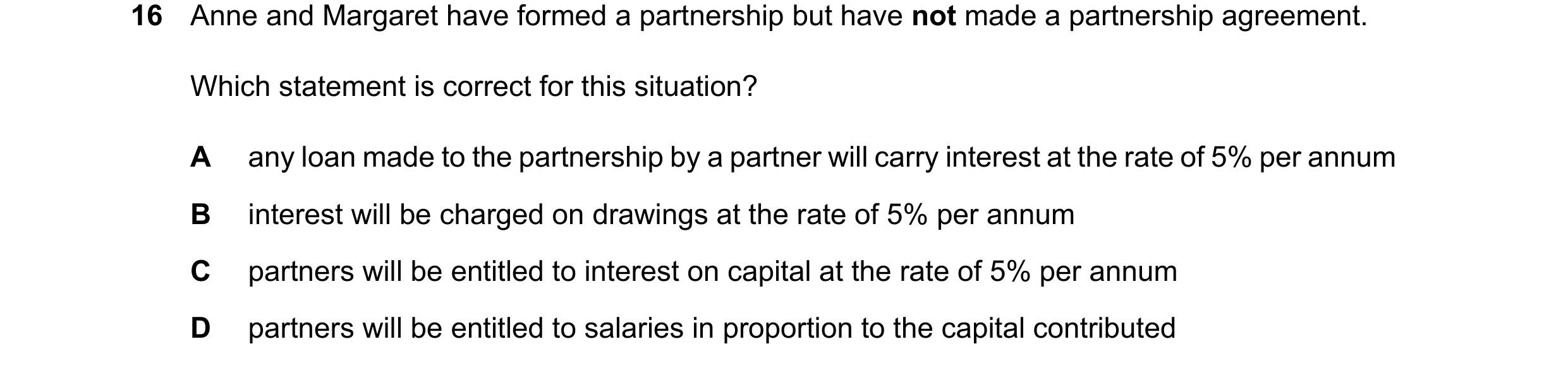

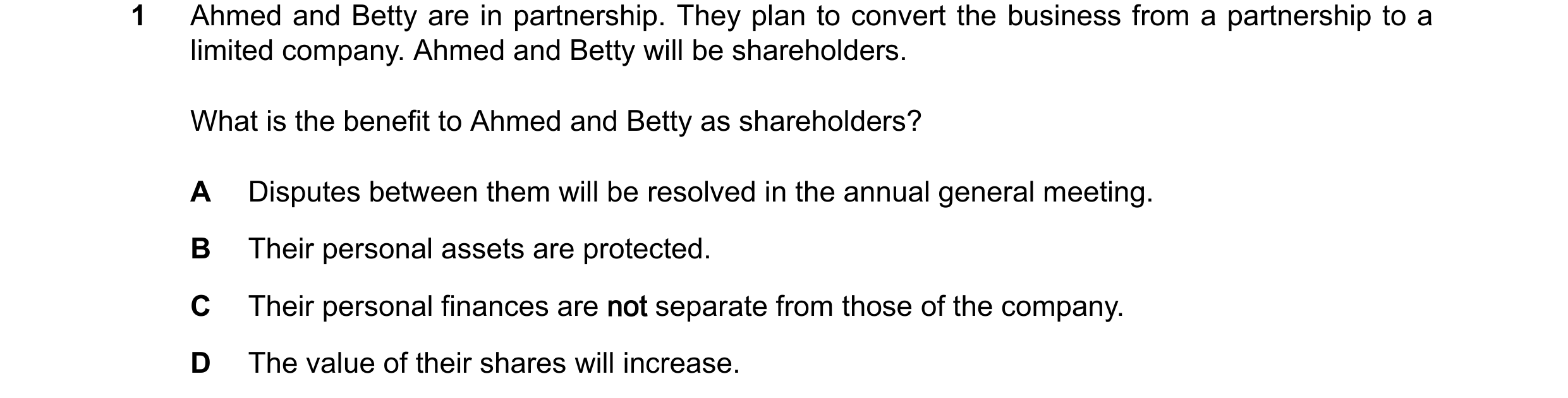
 67 / 68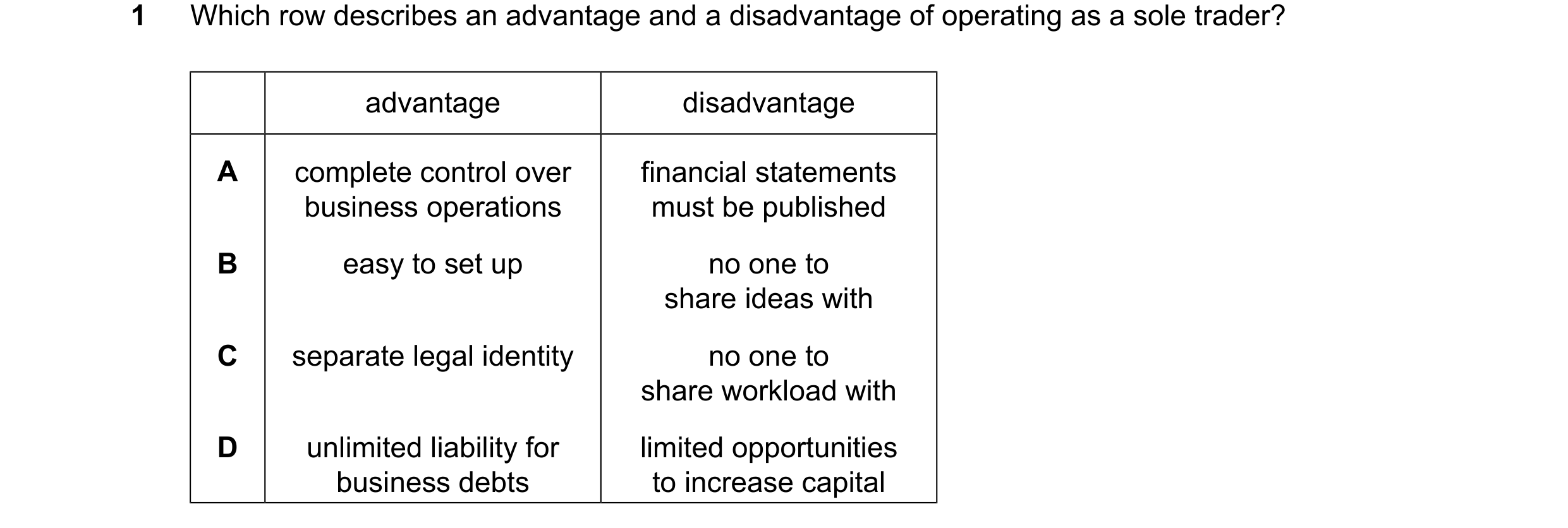
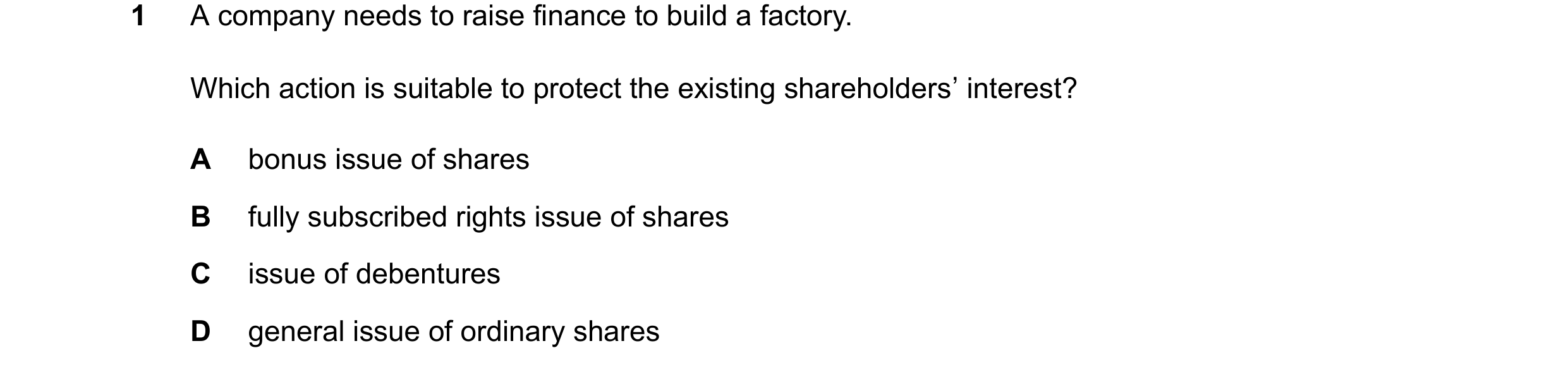
 68 / 68