Questions as text
Q1 · X, Y and Z are in partnership sharing profits 40 %; 40 %; and 20 % 9706/31 Oct/Nov 2009
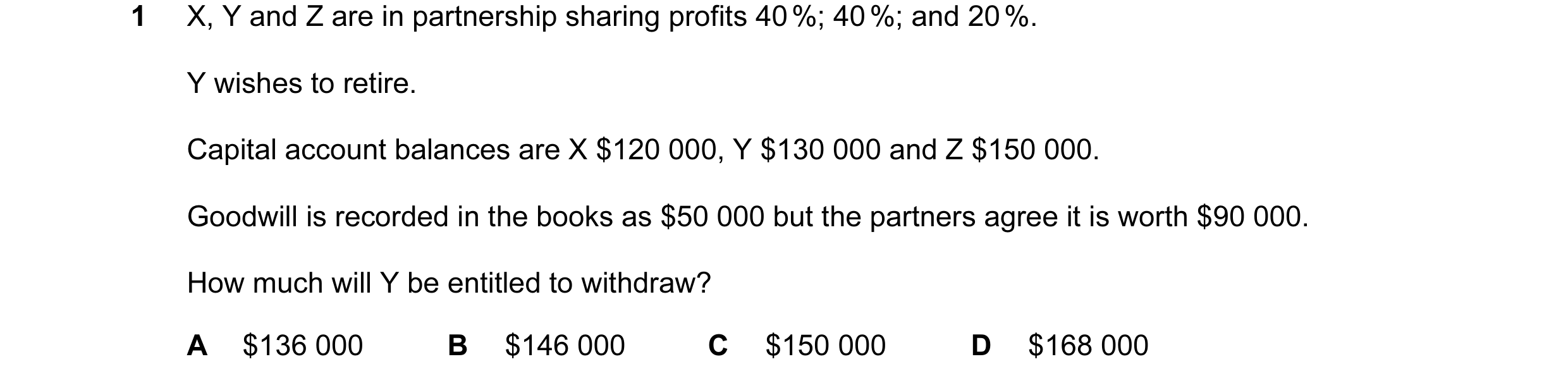
1 X, Y and Z are in partnership sharing profits 40 %; 40 %; and 20 %. Y wishes to retire. Capital account balances are X $120 000, Y $130 000 and Z $150 000. Goodwill is recorded in the books as $50 000 but the partners agree it is worth $90 000. How much will Y be entitled to withdraw? A $136 000 B $146 000 C $150 000 D $168 000
1 marks
Answer: B
This question in 9706/31 Oct/Nov 2009
Q2 · X, Y and Z are in partnership sharing profits 40 %; 40 %; and 20 % 9706/32 Oct/Nov 2009
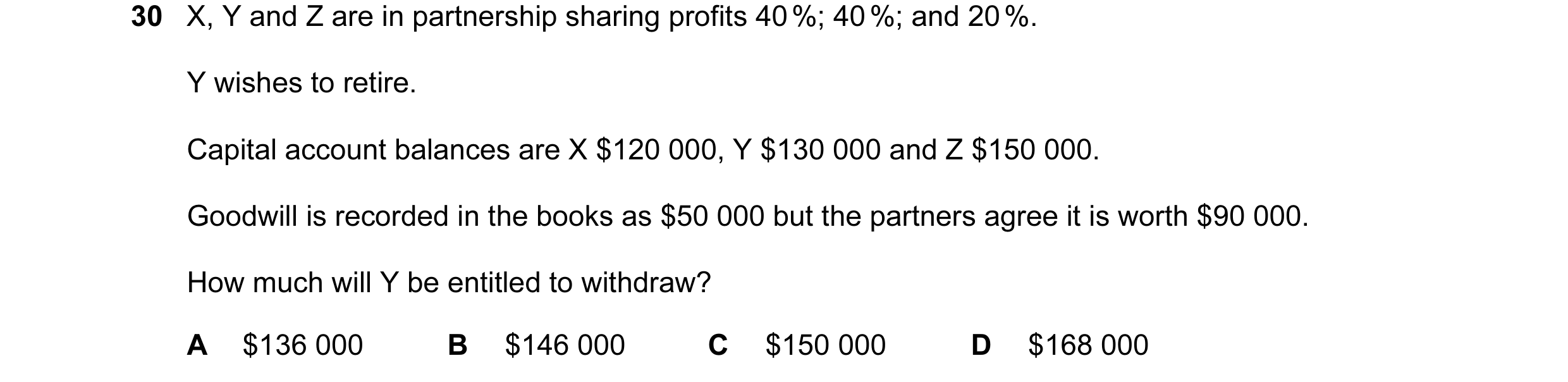
30 X, Y and Z are in partnership sharing profits 40 %; 40 %; and 20 %. Y wishes to retire. Capital account balances are X $120 000, Y $130 000 and Z $150 000. Goodwill is recorded in the books as $50 000 but the partners agree it is worth $90 000. How much will Y be entitled to withdraw? A $136 000 B $146 000 C $150 000 D $168 000
1 marks
Answer: B
This question in 9706/32 Oct/Nov 2009
Q3 · A partnership has been dissolved and $15 000 is left in the bank 9706/32 May/June 2010
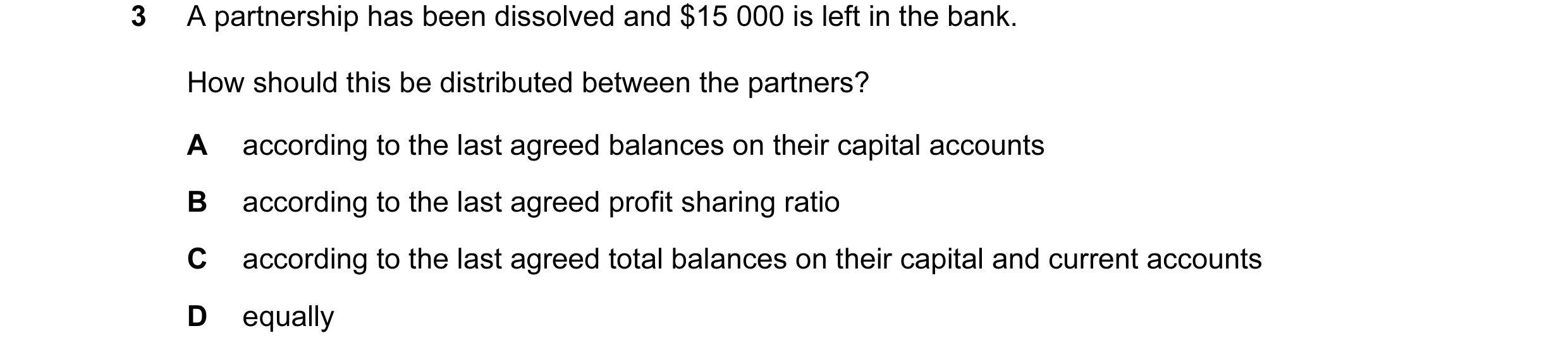
3 A partnership has been dissolved and $15 000 is left in the bank. How should this be distributed between the partners? A according to the last agreed balances on their capital accounts B according to the last agreed profit sharing ratio C according to the last agreed total balances on their capital and current accounts D equally
1 marks
Answer: B
This question in 9706/32 May/June 2010
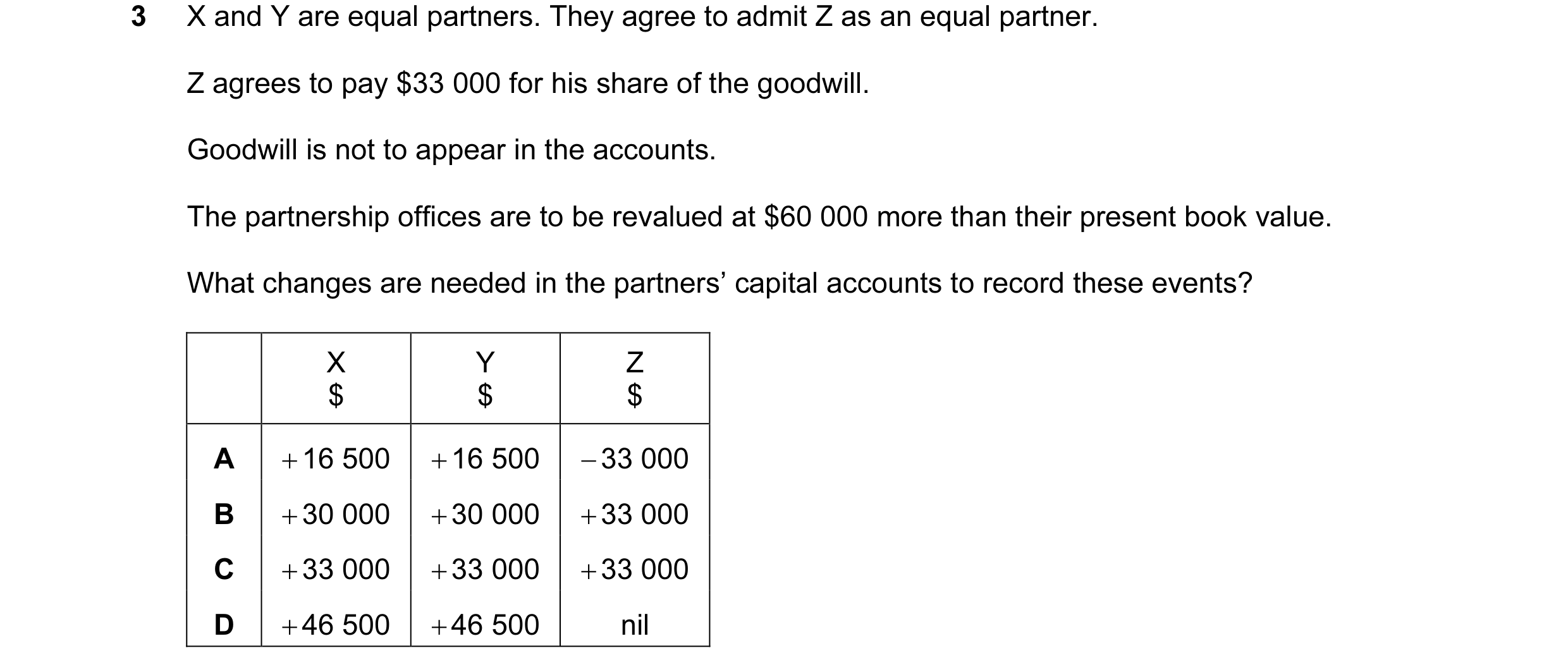
Q4 · X and Y are equal partners 9706/32 May/June 2010
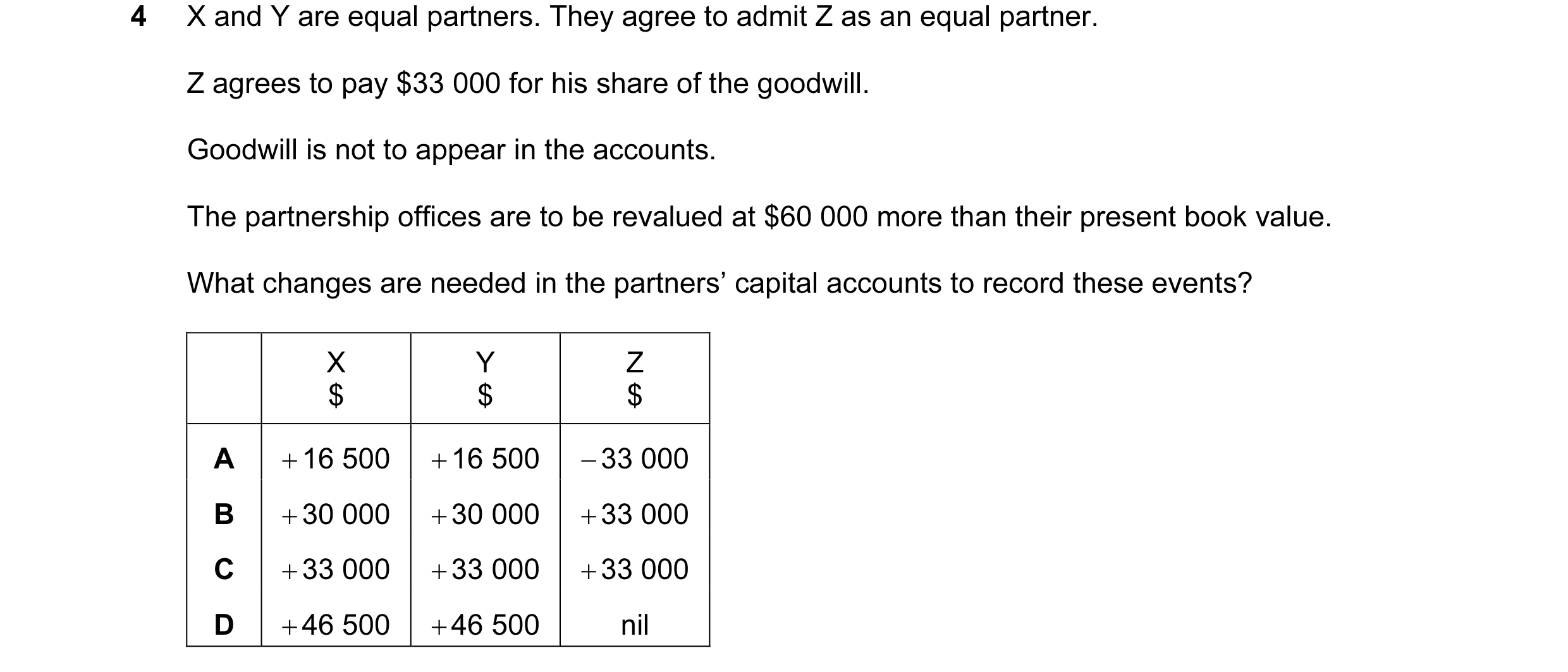
4 X and Y are equal partners. They agree to admit Z as an equal partner. Z agrees to pay $33 000 for his share of the goodwill. Goodwill is not to appear in the accounts. The partnership offices are to be revalued at $60 000 more than their present book value. What changes are needed in the partners’ capital accounts to record these events? X Y Z $ $ $ A + 16 500 + 16 500 − 33 000 B + 30 000 + 30 000 + 33 000 C + 33 000 + 33 000 + 33 000 D + 46 500 + 46 500 nil
1 marks
Answer: D
This question in 9706/32 May/June 2010
Q5 · A partnership has been dissolved and $15 000 is left in the bank 9706/33 May/June 2010
2 A partnership has been dissolved and $15 000 is left in the bank. How should this be distributed between the partners? A according to the last agreed balances on their capital accounts B according to the last agreed profit sharing ratio C according to the last agreed total balances on their capital and current accounts D equally
1 marks
Answer: B
This question in 9706/33 May/June 2010
Q6 · X and Y are equal partners 9706/33 May/June 2010
3 X and Y are equal partners. They agree to admit Z as an equal partner. Z agrees to pay $33 000 for his share of the goodwill. Goodwill is not to appear in the accounts. The partnership offices are to be revalued at $60 000 more than their present book value. What changes are needed in the partners’ capital accounts to record these events? X Y Z $ $ $ A + 16 500 + 16 500 − 33 000 B + 30 000 + 30 000 + 33 000 C + 33 000 + 33 000 + 33 000 D + 46 500 + 46 500 nil
1 marks
Answer: D
This question in 9706/33 May/June 2010
Q7 · Why is goodwill adjusted in the accounts when a new partner is admitted? 9706/31 Oct/Nov 2010
2 Why is goodwill adjusted in the accounts when a new partner is admitted? A a more accurate value of non-current (fixed) assets is shown in the balance sheet B original partners can be credited for their efforts in building up the partnership business C partners can take higher drawings as a result of their share of the goodwill D the new partner knows how much they have to introduce as capital
1 marks
Answer: B
This question in 9706/31 Oct/Nov 2010
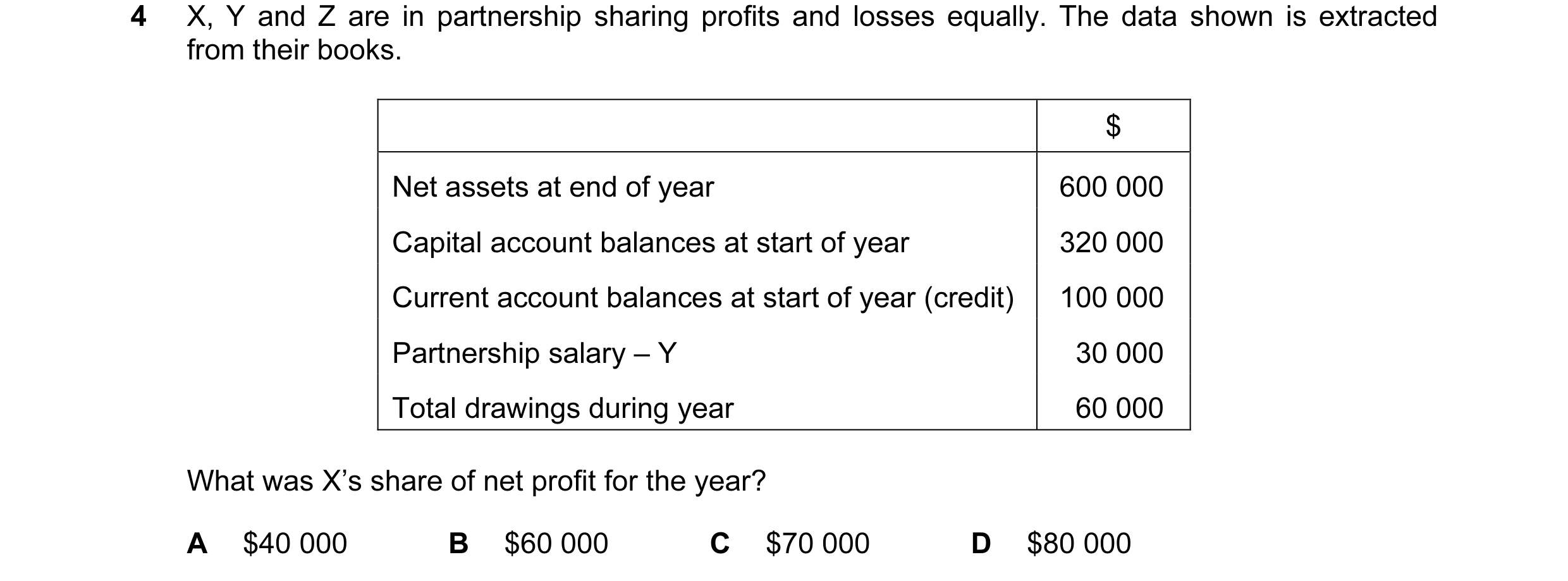
Q8 · X, Y and Z are in partnership sharing profits and losses equally 9706/31 Oct/Nov 2010
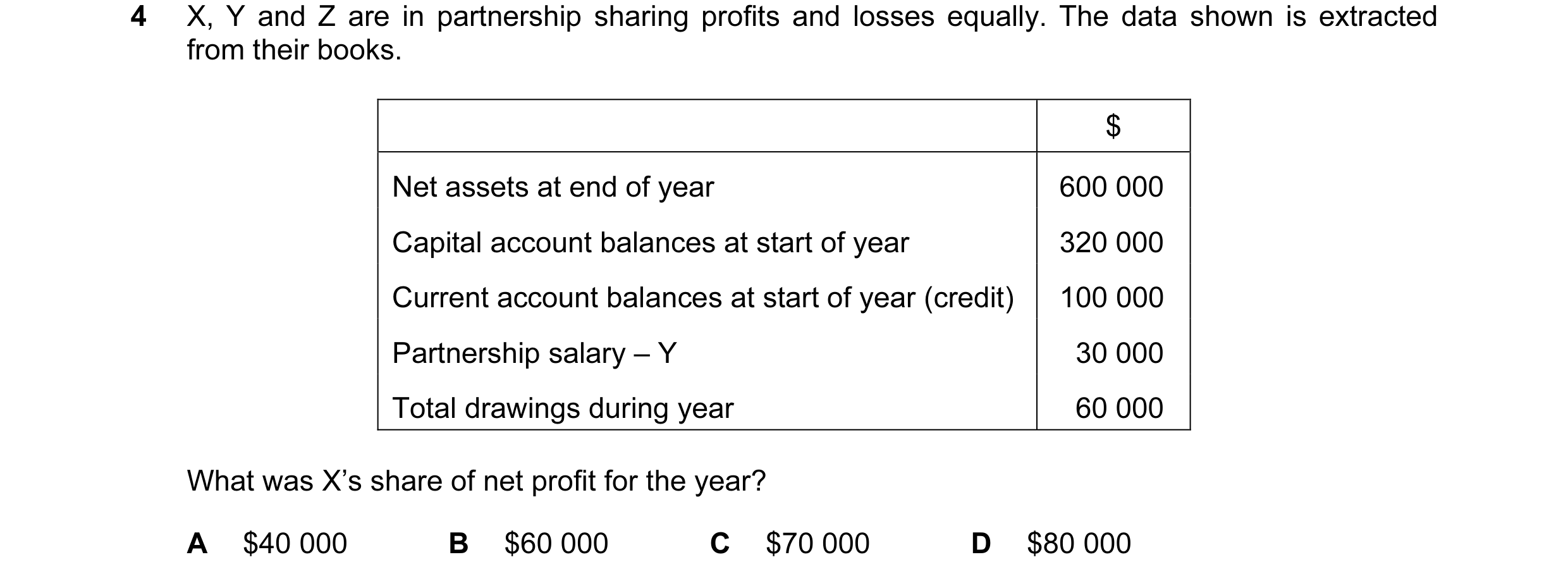
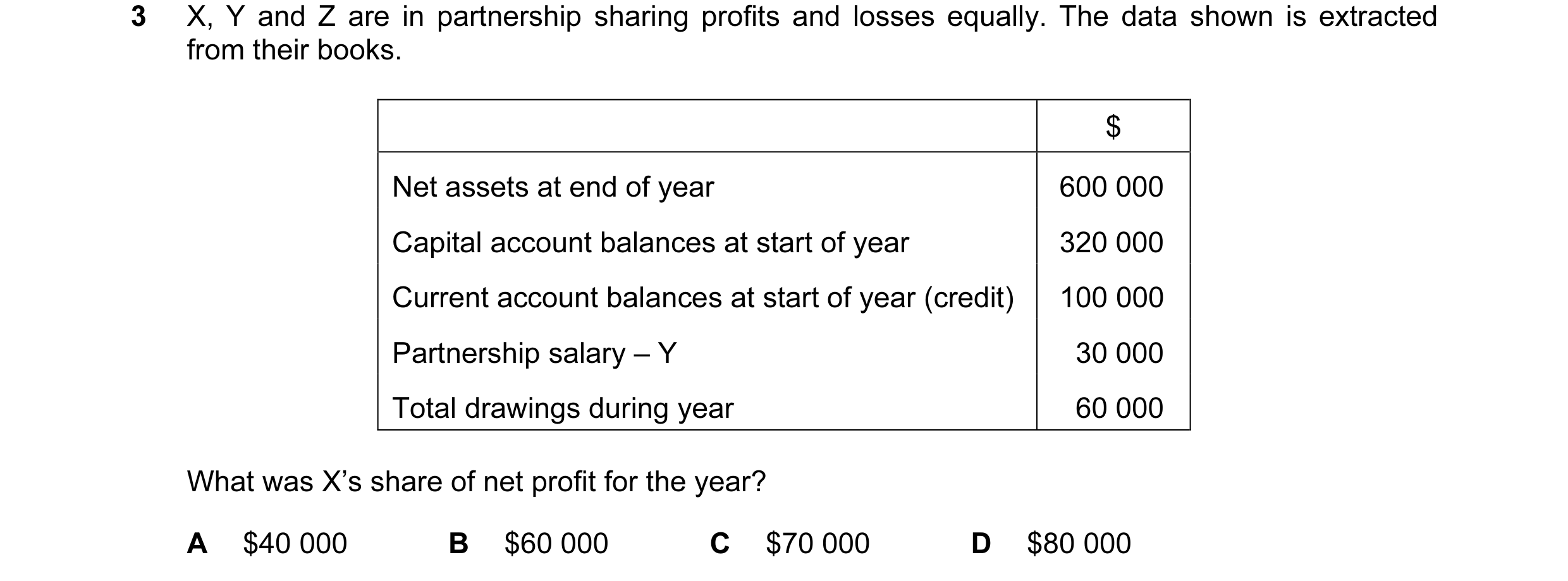
4 X, Y and Z are in partnership sharing profits and losses equally. The data shown is extracted from their books. $ Net assets at end of year 600 000 Capital account balances at start of year 320 000 Current account balances at start of year (credit) 100 000 Partnership salary – Y 30 000 Total drawings during year 60 000 What was X’s share of net profit for the year? A $40 000 B $60 000 C $70 000 D $80 000
1 marks
Answer: C
This question in 9706/31 Oct/Nov 2010
Q9 · A company has been wound up and the only assets that remain have realised $45 000 9706/31 Oct/Nov 2010
5 A company has been wound up and the only assets that remain have realised $45 000. A summary of the company’s capital structure shows the following. $ ordinary shares 20 000 preference shares 40 000 loan stock 30 000 How will the $45 000 be distributed? ordinary shares preference shares loan stock $ $ $ A 10 000 20 000 15 000 B – 15 000 30 000 C 20 000 25 000 – D – 40 000 5 000
1 marks
Answer: B
This question in 9706/31 Oct/Nov 2010
Q10 · Why is goodwill adjusted in the accounts when a new partner is admitted? 9706/32 Oct/Nov 2010
2 Why is goodwill adjusted in the accounts when a new partner is admitted? A a more accurate value of non-current (fixed) assets is shown in the balance sheet B original partners can be credited for their efforts in building up the partnership business C partners can take higher drawings as a result of their share of the goodwill D the new partner knows how much they have to introduce as capital
1 marks
Answer: B
This question in 9706/32 Oct/Nov 2010
Q11 · X, Y and Z are in partnership sharing profits and losses equally 9706/32 Oct/Nov 2010
4 X, Y and Z are in partnership sharing profits and losses equally. The data shown is extracted from their books. $ Net assets at end of year 600 000 Capital account balances at start of year 320 000 Current account balances at start of year (credit) 100 000 Partnership salary – Y 30 000 Total drawings during year 60 000 What was X’s share of net profit for the year? A $40 000 B $60 000 C $70 000 D $80 000
1 marks
Answer: C
This question in 9706/32 Oct/Nov 2010
Q12 · A company has been wound up and the only assets that remain have realised $45 000 9706/32 Oct/Nov 2010
5 A company has been wound up and the only assets that remain have realised $45 000. A summary of the company’s capital structure shows the following. $ ordinary shares 20 000 preference shares 40 000 loan stock 30 000 How will the $45 000 be distributed? ordinary shares preference shares loan stock $ $ $ A 10 000 20 000 15 000 B – 15 000 30 000 C 20 000 25 000 – D – 40 000 5 000
1 marks
Answer: B
This question in 9706/32 Oct/Nov 2010
Q13 · Why is goodwill adjusted in the accounts when a new partner is admitted? 9706/33 Oct/Nov 2010
1 Why is goodwill adjusted in the accounts when a new partner is admitted? A a more accurate value of non-current (fixed) assets is shown in the balance sheet B original partners can be credited for their efforts in building up the partnership business C partners can take higher drawings as a result of their share of the goodwill D the new partner knows how much they have to introduce as capital
1 marks
Answer: B
This question in 9706/33 Oct/Nov 2010
Q14 · X, Y and Z are in partnership sharing profits and losses equally 9706/33 Oct/Nov 2010
3 X, Y and Z are in partnership sharing profits and losses equally. The data shown is extracted from their books. $ Net assets at end of year 600 000 Capital account balances at start of year 320 000 Current account balances at start of year (credit) 100 000 Partnership salary – Y 30 000 Total drawings during year 60 000 What was X’s share of net profit for the year? A $40 000 B $60 000 C $70 000 D $80 000
1 marks
Answer: C
This question in 9706/33 Oct/Nov 2010
Q15 · X and Y are in partnership, sharing profits equally 9706/31 May/June 2011
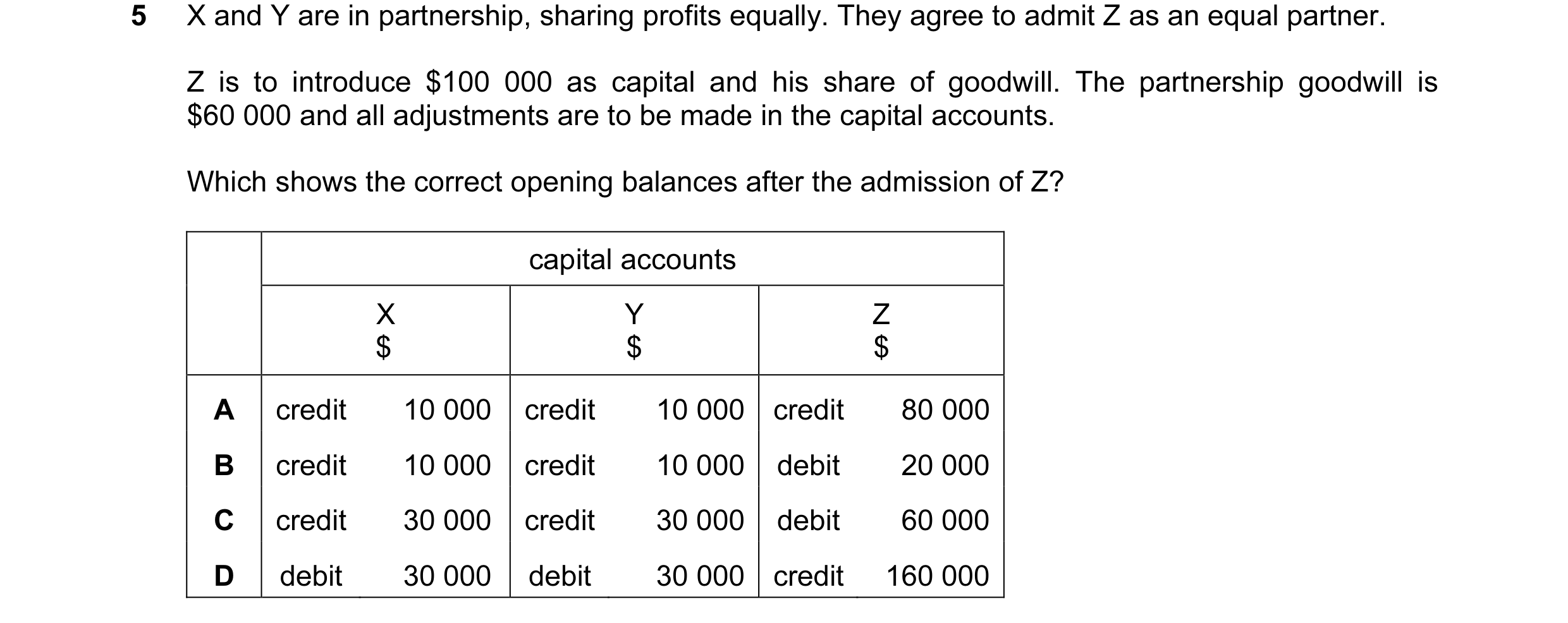
4 X and Y are in partnership, sharing profits equally. They agree to admit Z as an equal partner. Z is to introduce $100 000 as capital and his share of goodwill. The partnership goodwill is $60 000 and all adjustments are to be made in the capital accounts. Which shows the correct opening balances after the admission of Z? capital accounts X Y Z $ $ $ A credit 10 000 credit 10 000 credit 80 000 B credit 10 000 credit 10 000 debit 20 000 C credit 30 000 credit 30 000 debit 60 000 D debit 30 000 debit 30 000 credit 160 000
1 marks
Answer: A
This question in 9706/31 May/June 2011
Q16 · X and Y are in partnership, sharing profits equally 9706/32 May/June 2011
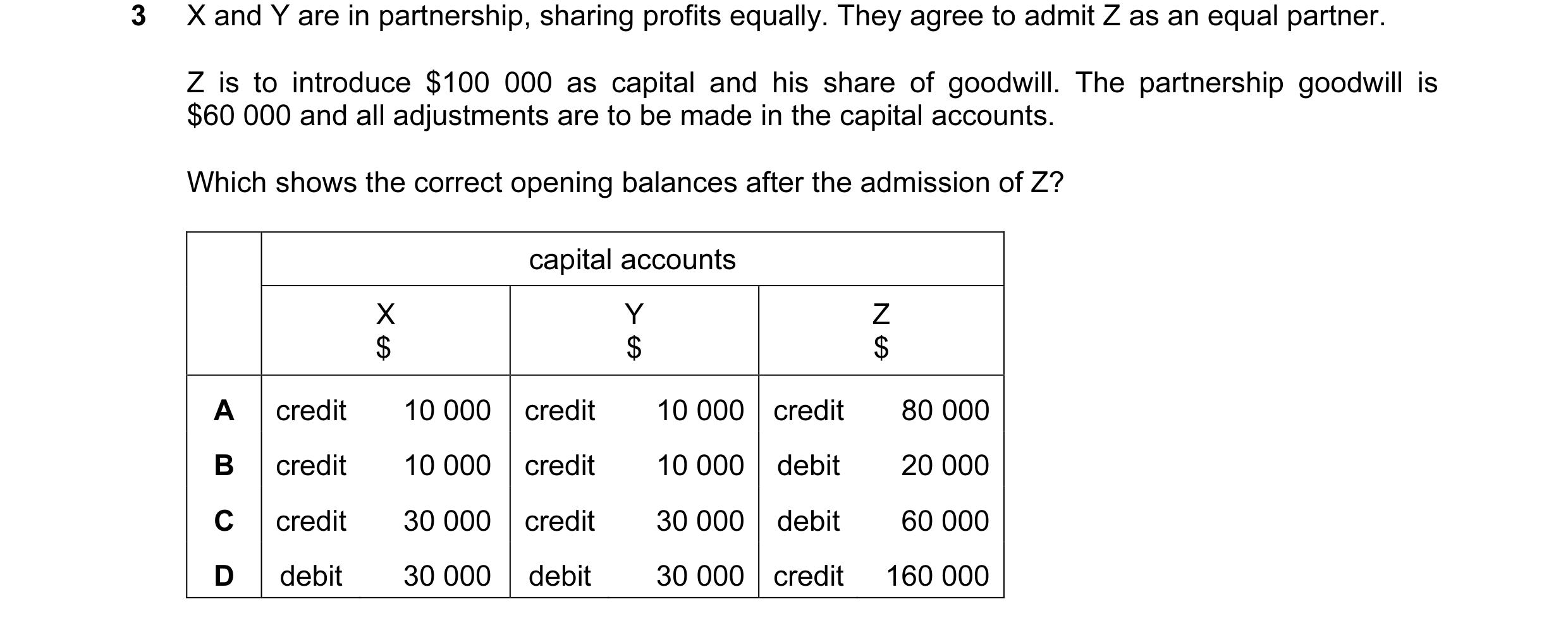
5 X and Y are in partnership, sharing profits equally. They agree to admit Z as an equal partner. Z is to introduce $100 000 as capital and his share of goodwill. The partnership goodwill is $60 000 and all adjustments are to be made in the capital accounts. Which shows the correct opening balances after the admission of Z? capital accounts X Y Z $ $ $ A credit 10 000 credit 10 000 credit 80 000 B credit 10 000 credit 10 000 debit 20 000 C credit 30 000 credit 30 000 debit 60 000 D debit 30 000 debit 30 000 credit 160 000
1 marks
Answer: A
This question in 9706/32 May/June 2011
Q17 · X and Y are in partnership, sharing profits equally 9706/33 May/June 2011
3 X and Y are in partnership, sharing profits equally. They agree to admit Z as an equal partner. Z is to introduce $100 000 as capital and his share of goodwill. The partnership goodwill is $60 000 and all adjustments are to be made in the capital accounts. Which shows the correct opening balances after the admission of Z? capital accounts X Y Z $ $ $ A credit 10 000 credit 10 000 credit 80 000 B credit 10 000 credit 10 000 debit 20 000 C credit 30 000 credit 30 000 debit 60 000 D debit 30 000 debit 30 000 credit 160 000
1 marks
Answer: A
This question in 9706/33 May/June 2011
Q18 · A partnership achieved an average profit during the year of $15 000 per month 9706/32 Oct/Nov 2011
1 A partnership achieved an average profit during the year of $15 000 per month. Halfway through the year X and Y were joined by a new partner Z and profits were shared equally before and after the change. X’s drawings amounted to $60 000 during the year. By how much would the current account balance of X increase as a result of the years trading? A zero B $15 000 C $30 000 D $75 000
1 marks
Answer: B
This question in 9706/32 Oct/Nov 2011
Q19 · X and Y are in partnership 9706/31 May/June 2012
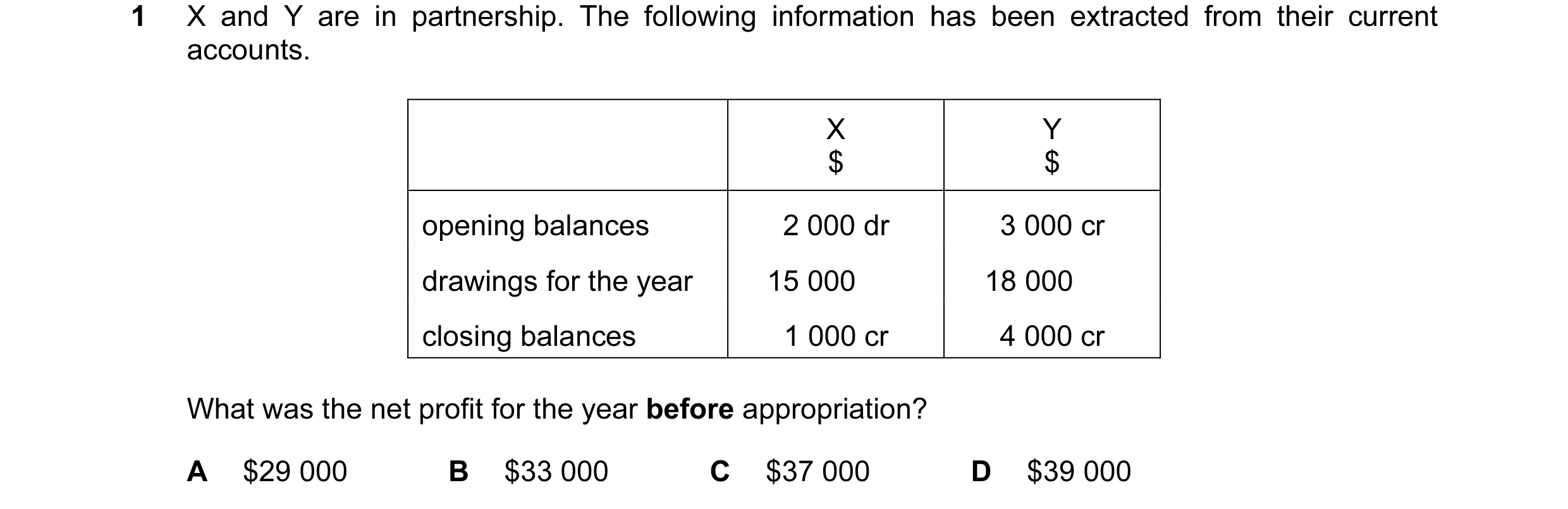
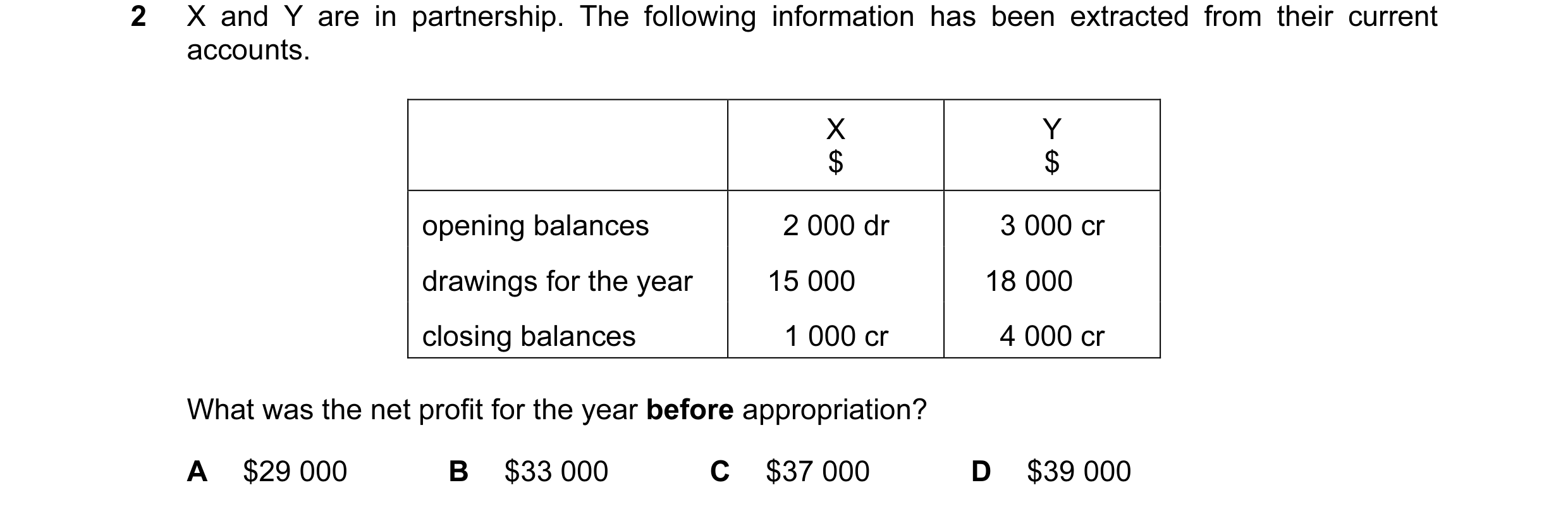
1 X and Y are in partnership. The following information has been extracted from their current accounts. X Y $ $ opening balances 2 000 dr 3 000 cr drawings for the year 15 000 18 000 closing balances 1 000 cr 4 000 cr What was the net profit for the year before appropriation? A $29 000 B $33 000 C $37 000 D $39 000
1 marks
Answer: C
This question in 9706/31 May/June 2012
Q20 · X, Y & Z are in partnership sharing the profits and losses equally 9706/31 May/June 2012
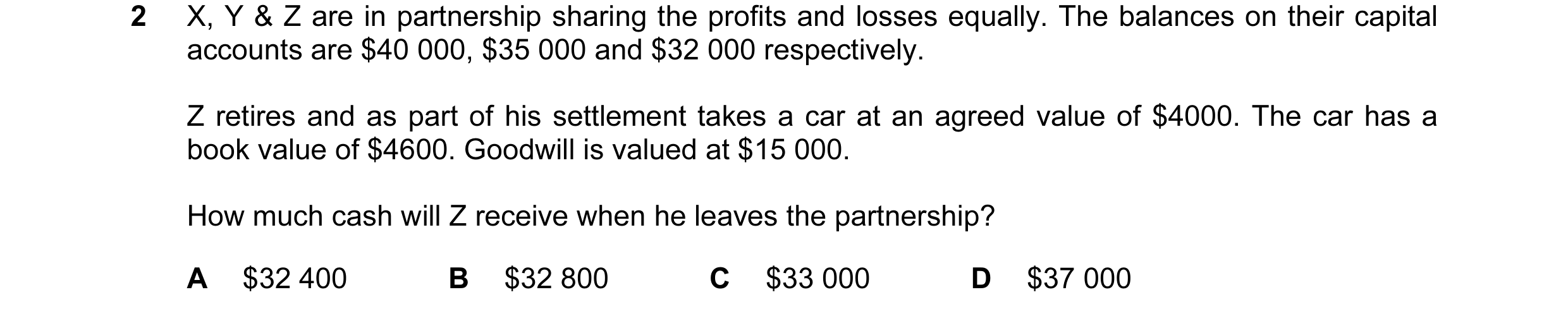
2 X, Y & Z are in partnership sharing the profits and losses equally. The balances on their capital accounts are $40 000, $35 000 and $32 000 respectively. Z retires and as part of his settlement takes a car at an agreed value of $4000. The car has a book value of $4600. Goodwill is valued at $15 000. How much cash will Z receive when he leaves the partnership? A $32 400 B $32 800 C $33 000 D $37 000
1 marks
Answer: B
This question in 9706/31 May/June 2012
Q21 · When goodwill is not adjusted in the books which of the following statements are correct? 9706/31 May/June 2012
3 When goodwill is not adjusted in the books which of the following statements are correct? 1 A new partner does not have to introduce an amount as capital. 2 Non-current assets are undervalued. 3 Partners do not receive credit for their efforts in building up the business. 4 Retiring partners will receive a lower amount of money when leaving the business. A 1 and 2 B 1 and 4 C 2 and 3 D 3 and 4
1 marks
Answer: D
This question in 9706/31 May/June 2012
Q22 · X, Y & Z are in partnership sharing the profits and losses equally 9706/32 May/June 2012
1 X, Y & Z are in partnership sharing the profits and losses equally. The balances on their capital accounts are $40 000, $35 000 and $32 000 respectively. Z retires and as part of his settlement takes a car at an agreed value of $4000. The car has a book value of $4600. Goodwill is valued at $15 000. How much cash will Z receive when he leaves the partnership? A $32 400 B $32 800 C $33 000 D $37 000
1 marks
Answer: B
This question in 9706/32 May/June 2012
Q23 · When goodwill is not adjusted in the books which of the following statements are correct? 9706/32 May/June 2012
2 When goodwill is not adjusted in the books which of the following statements are correct? 1 A new partner does not have to introduce an amount as capital. 2 Non-current assets are undervalued. 3 Partners do not receive credit for their efforts in building up the business. 4 Retiring partners will receive a lower amount of money when leaving the business. A 1 and 2 B 1 and 4 C 2 and 3 D 3 and 4
1 marks
Answer: D
This question in 9706/32 May/June 2012
Q24 · X and Y are in partnership sharing profits in the ratio of 2:1 9706/33 May/June 2012
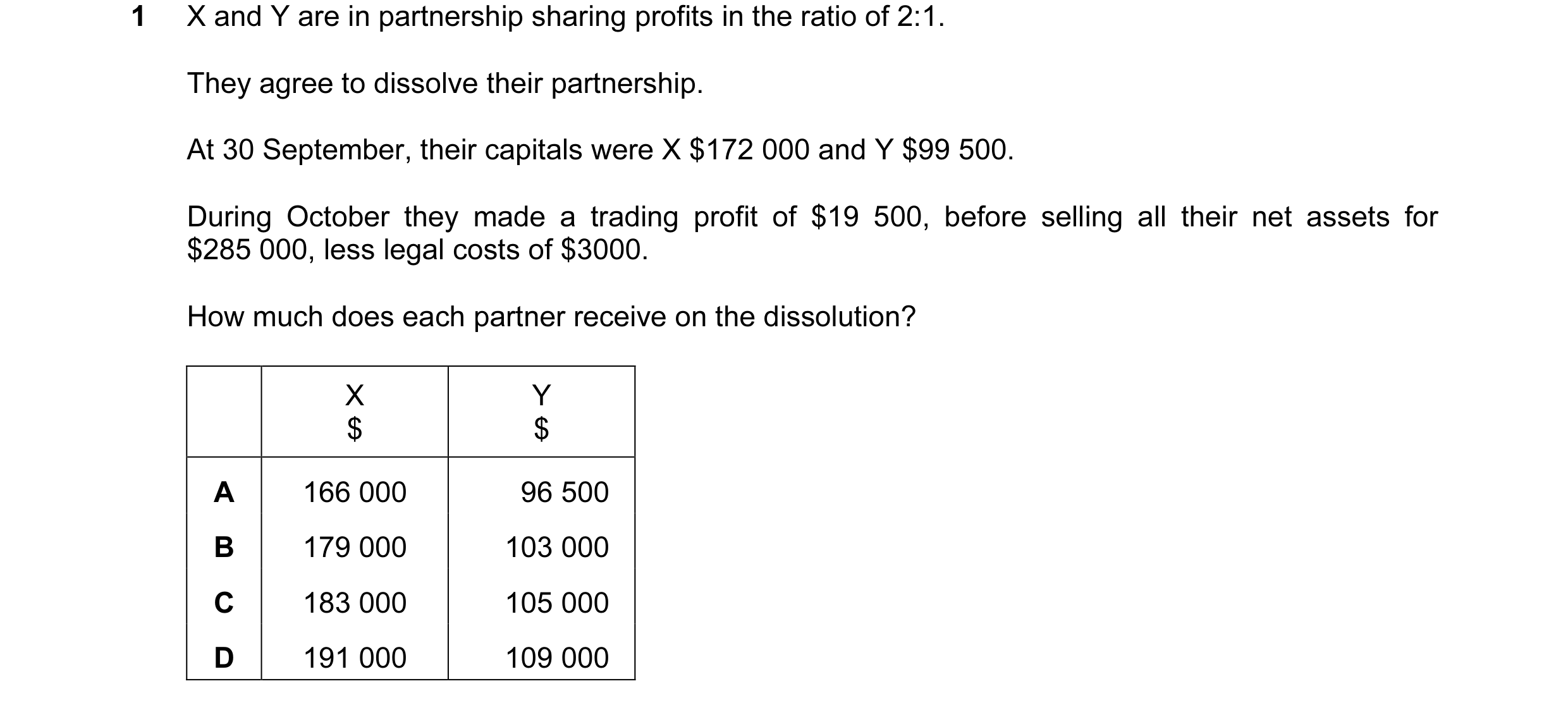
1 X and Y are in partnership sharing profits in the ratio of 2:1. They agree to dissolve their partnership. At 30 September, their capitals were X $172 000 and Y $99 500. During October they made a trading profit of $19 500, before selling all their net assets for $285 000, less legal costs of $3000. How much does each partner receive on the dissolution? X Y $ $ A 166 000 96 500 B 179 000 103 000 C 183 000 105 000 D 191 000 109 000
1 marks
Answer: B
This question in 9706/33 May/June 2012
Q25 · X and Y are in partnership 9706/33 May/June 2012
2 X and Y are in partnership. The following information has been extracted from their current accounts. X Y $ $ opening balances 2 000 dr 3 000 cr drawings for the year 15 000 18 000 closing balances 1 000 cr 4 000 cr What was the net profit for the year before appropriation? A $29 000 B $33 000 C $37 000 D $39 000
1 marks
Answer: C
This question in 9706/33 May/June 2012
Q26 · X and Y are in partnership and revalue their assets as follows 9706/31 Oct/Nov 2012
1 X and Y are in partnership and revalue their assets as follows. revalued book value asset amount $ $ freehold property 50 000 70 000 fixtures and fittings 20 000 16 000 inventory 15 000 14 000 X and Y share profits and losses in the ratio of 2 : 1. How much will the credit to X’s capital account from the revaluation account be? A $5000 B $10 000 C $16 000 D $20 000
1 marks
Answer: B
This question in 9706/31 Oct/Nov 2012
Q27 · X and Y are in partnership with combined capital and current account balances of $125 000 9706/31 Oct/Nov 2012
3 X and Y are in partnership with combined capital and current account balances of $125 000. Z is admitted as a partner, introducing capital of $40 000. At that time, the assets of the partnership are revalued upwards by $50 000 and goodwill was valued at $18 000. What was the total capital employed of the partnership immediately after the admission of Z? A $183 000 B $197 000 C $215 000 D $233 000
1 marks
Answer: C
This question in 9706/31 Oct/Nov 2012
Q28 · X, Y and Z are in partnership sharing the profits 3:2:1 respectively 9706/32 Oct/Nov 2012
1 X, Y and Z are in partnership sharing the profits 3:2:1 respectively. The net profit for the year was $120 000. During the year, Z withdrew a salary of $12 000 in cash. This had not been recorded in the books. What was X’s share of the residual profit? A $22 000 B $30 000 C $36 000 D $54 000
1 marks
Answer: D
This question in 9706/32 Oct/Nov 2012
Q29 · X and Y are in partnership sharing profit and losses equally 9706/32 Oct/Nov 2012
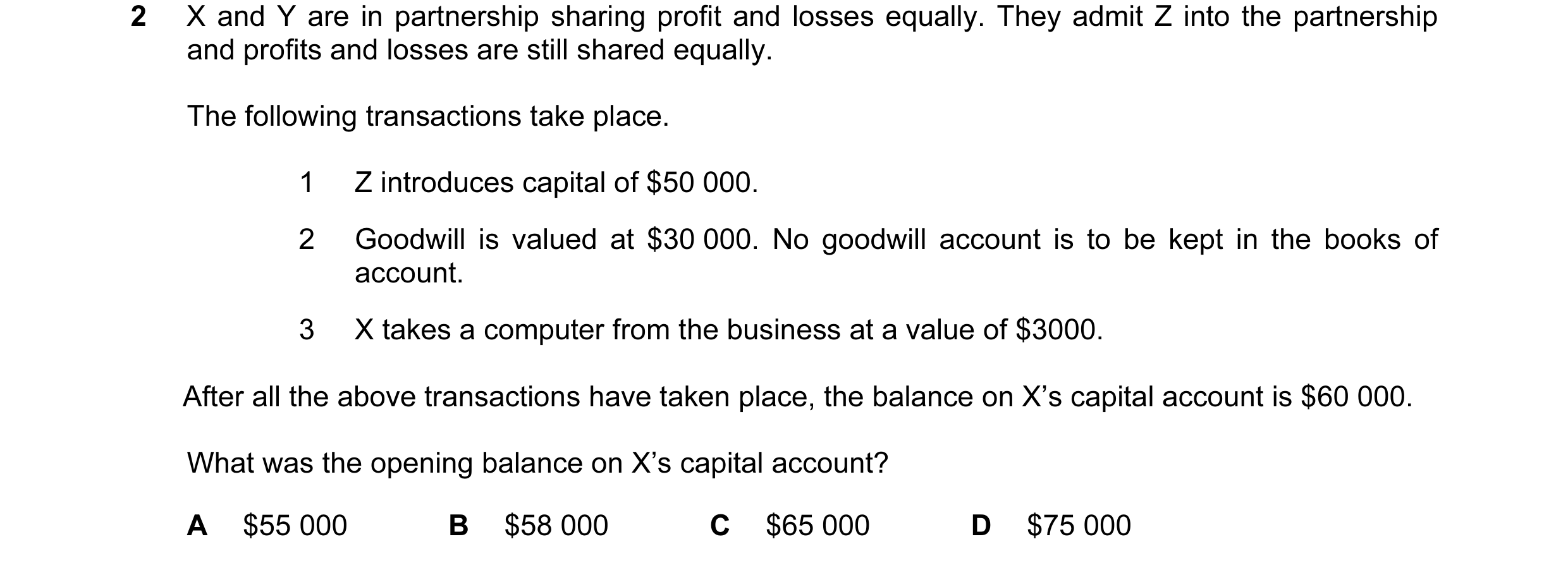
2 X and Y are in partnership sharing profit and losses equally. They admit Z into the partnership and profits and losses are still shared equally. The following transactions take place. 1 Z introduces capital of $50 000. 2 Goodwill is valued at $30 000. No goodwill account is to be kept in the books of account. 3 X takes a computer from the business at a value of $3000. After all the above transactions have taken place, the balance on X’s capital account is $60 000. What was the opening balance on X’s capital account? A $55 000 B $58 000 C $65 000 D $75 000
1 marks
Answer: B
This question in 9706/32 Oct/Nov 2012
Q30 · X and Y are in partnership sharing profits and losses equally 9706/33 Oct/Nov 2012
1 X and Y are in partnership sharing profits and losses equally. They both decide to retire. Details of the realisation are shown in the table. book value realised value $000 $000 non-current assets 50 65 current assets excluding cash and bank 25 23 cash and bank balances 4 current liabilities 18 14 costs of realisation 1 How much profit is each entitled to on realisation? A $6000 B $8000 C $10 000 D $12 000
1 marks
Answer: B
This question in 9706/33 Oct/Nov 2012
Q31 · X and Y are in partnership sharing the profits 2 : 1 9706/33 Oct/Nov 2012
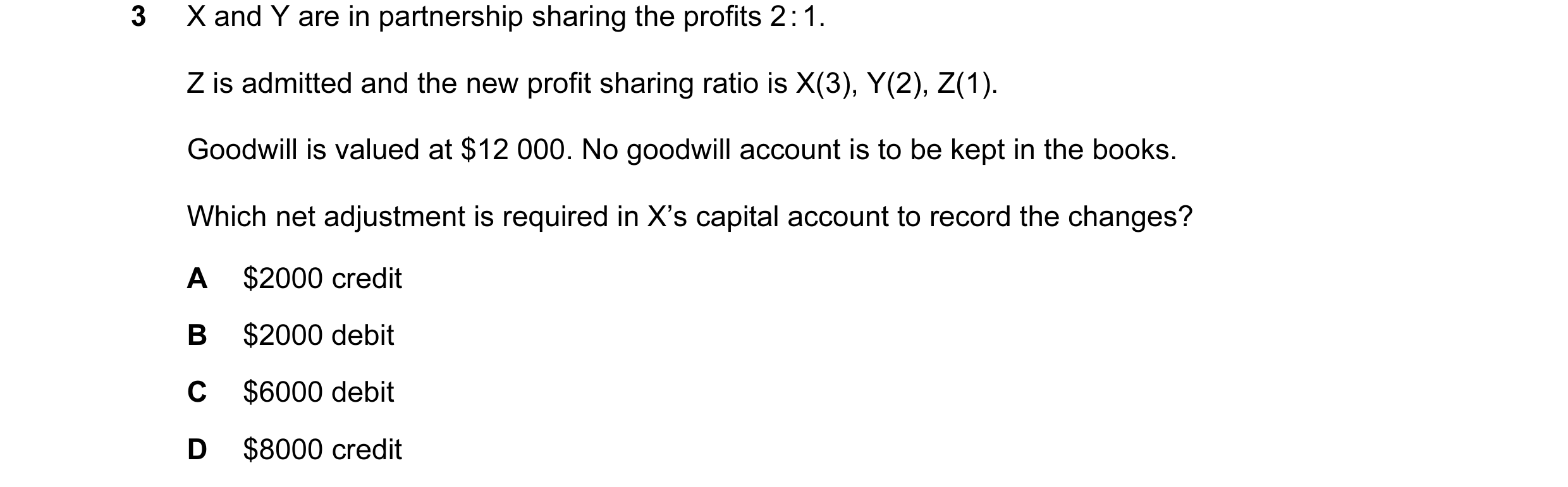
3 X and Y are in partnership sharing the profits 2 : 1. Z is admitted and the new profit sharing ratio is X(3), Y(2), Z(1). Goodwill is valued at $12 000. No goodwill account is to be kept in the books. Which net adjustment is required in X’s capital account to record the changes? A $2000 credit B $2000 debit C $6000 debit D $8000 credit
1 marks
Answer: A
This question in 9706/33 Oct/Nov 2012
Q32 · When do revenue reserves arise? 9706/31 May/June 2013
1 When do revenue reserves arise? A following the revaluation of non-current assets B from a rights issue C from an issue of bonus shares D from the trading activities of a company
1 marks
Answer: D
This question in 9706/31 May/June 2013
Q33 · A company makes a bonus issue of shares 9706/32 May/June 2013
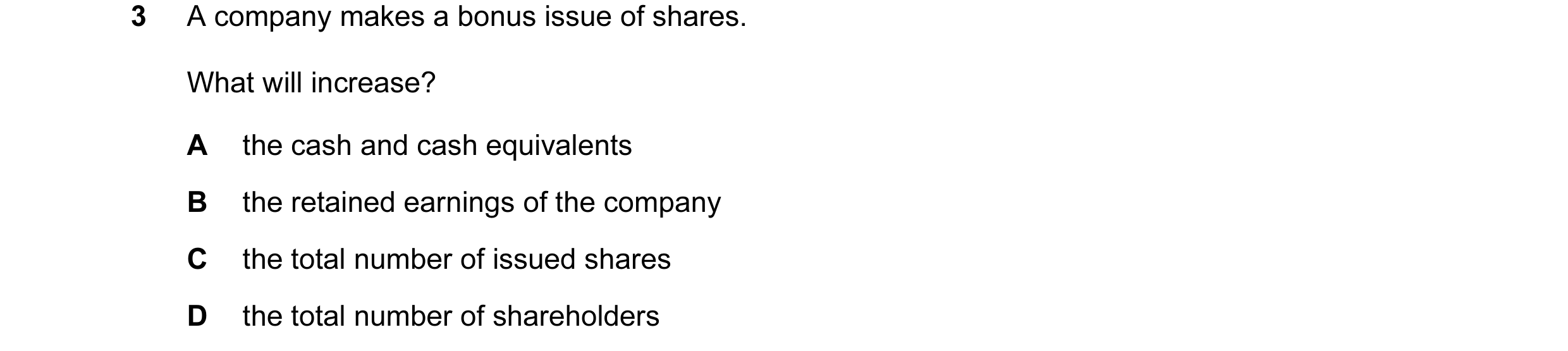
3 A company makes a bonus issue of shares. What will increase? A the cash and cash equivalents B the retained earnings of the company C the total number of issued shares D the total number of shareholders
1 marks
Answer: C
This question in 9706/32 May/June 2013
Q34 · What is a reason for a company issuing bonus shares to its existing shareholders? 9706/32 May/June 2013
16 What is a reason for a company issuing bonus shares to its existing shareholders? A to capitalise reserves B to increase profits available for dividend C to raise additional cash D to raise the market value of shares
1 marks
Answer: A
This question in 9706/32 May/June 2013
Q35 · A company makes a bonus issue of one ordinary share for every three held 9706/32 May/June 2013
17 A company makes a bonus issue of one ordinary share for every three held. The shareholders’ funds immediately before the issue are as follows. $ ordinary share capital 600 000 retained earnings 200 000 share premium account 240 000 The costs of the bonus issue are $20 000. What are the shareholders’ funds after the bonus issue? A $1 020 000 B $1 040 000 C $1 220 000 D $1 240 000
1 marks
Answer: A
This question in 9706/32 May/June 2013
Q36 · The directors of a company carry out the following actions 9706/32 May/June 2013
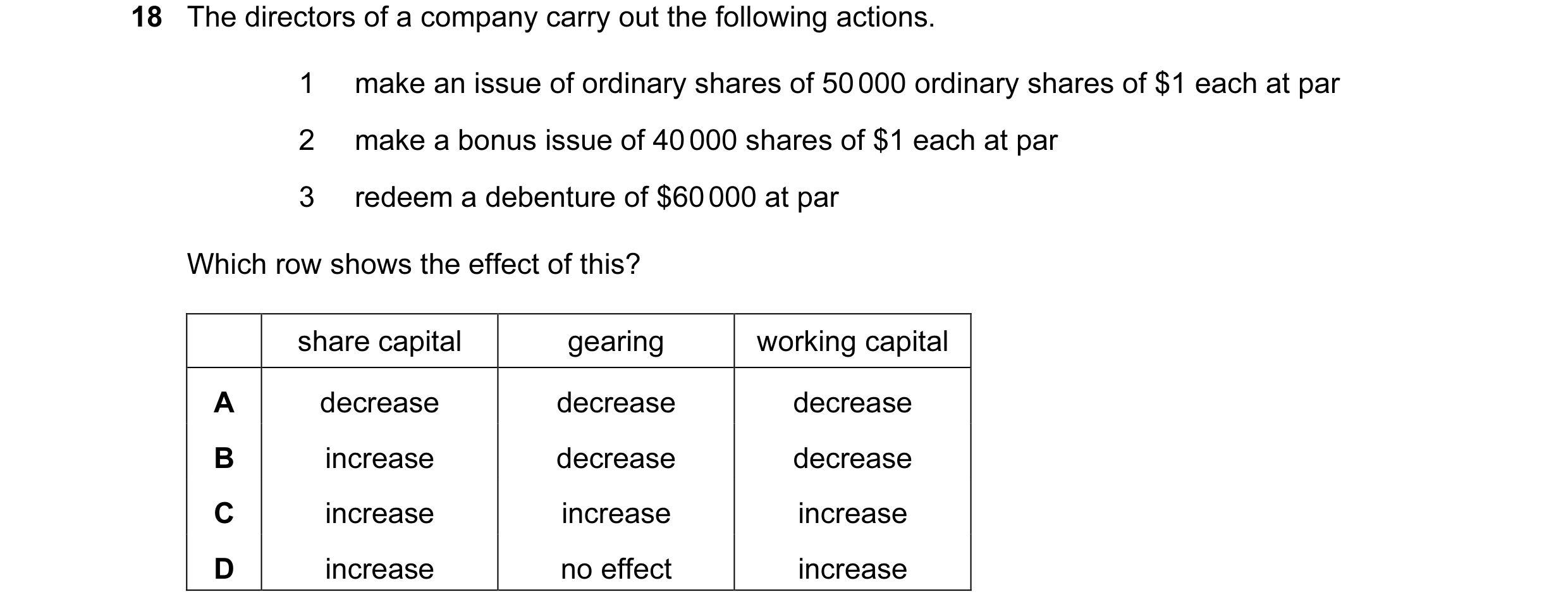
18 The directors of a company carry out the following actions. 1 make an issue of ordinary shares of 50 000 ordinary shares of $1 each at par 2 make a bonus issue of 40 000 shares of $1 each at par 3 redeem a debenture of $60 000 at par Which row shows the effect of this? share capital gearing working capital A decrease decrease decrease B increase decrease decrease C increase increase increase D increase no effect increase
1 marks
Answer: B
This question in 9706/32 May/June 2013
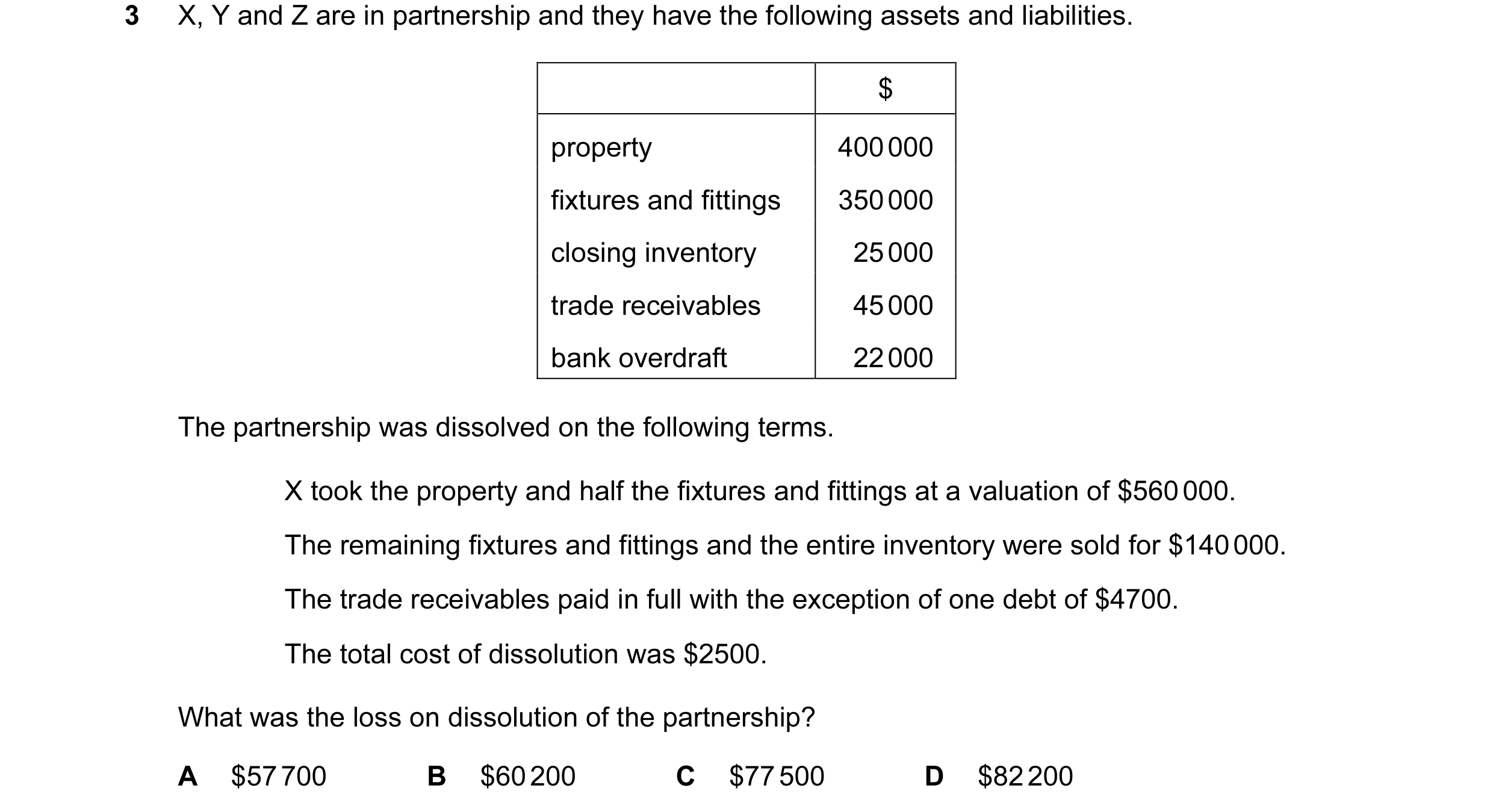
Q37 · X, Y and Z are in partnership and they have the following assets and liabilities 9706/31 Oct/Nov 2013
3 X, Y and Z are in partnership and they have the following assets and liabilities. $ property 400 000 fixtures and fittings 350 000 closing inventory 25 000 trade receivables 45 000 bank overdraft 22 000 The partnership was dissolved on the following terms. X took the property and half the fixtures and fittings at a valuation of $560 000. The remaining fixtures and fittings and the entire inventory were sold for $140 000. The trade receivables paid in full with the exception of one debt of $4700. The total cost of dissolution was $2500. What was the loss on dissolution of the partnership? A $57 700 B $60 200 C $77 500 D $82 200
1 marks
Answer: D
This question in 9706/31 Oct/Nov 2013
Q38 · What type of capital must all limited companies have? 9706/31 Oct/Nov 2013
4 What type of capital must all limited companies have? A convertible loan stock B debentures C ordinary shares D preference shares
1 marks
Answer: C
This question in 9706/31 Oct/Nov 2013
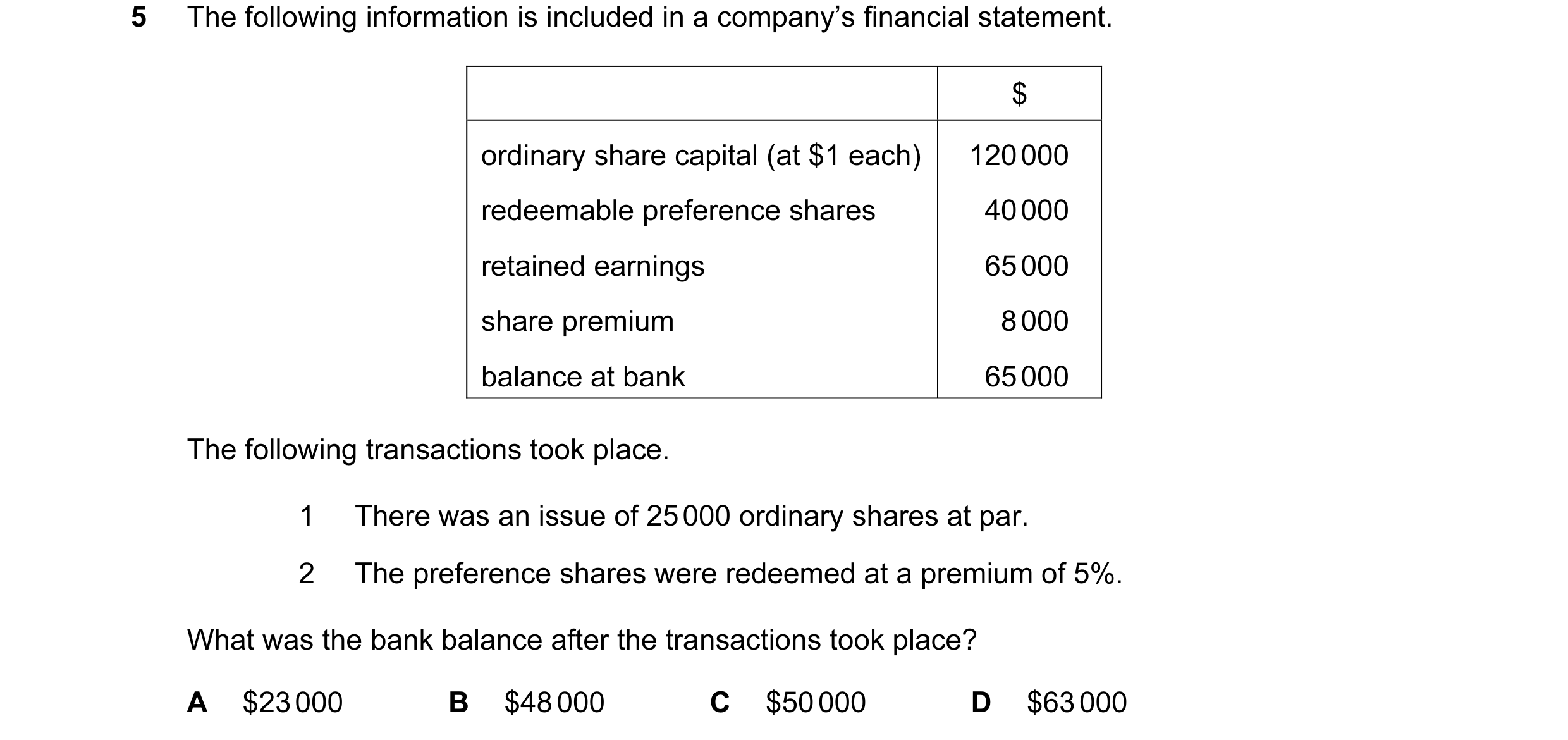
Q39 · The following information is included in a company’s financial statement 9706/31 Oct/Nov 2013
5 The following information is included in a company’s financial statement. $ ordinary share capital (at $1 each) 120 000 redeemable preference shares 40 000 retained earnings 65 000 share premium 8 000 balance at bank 65 000 The following transactions took place. 1 There was an issue of 25 000 ordinary shares at par. 2 The preference shares were redeemed at a premium of 5%. What was the bank balance after the transactions took place? A $23 000 B $48 000 C $50 000 D $63 000
1 marks
Answer: B
This question in 9706/31 Oct/Nov 2013
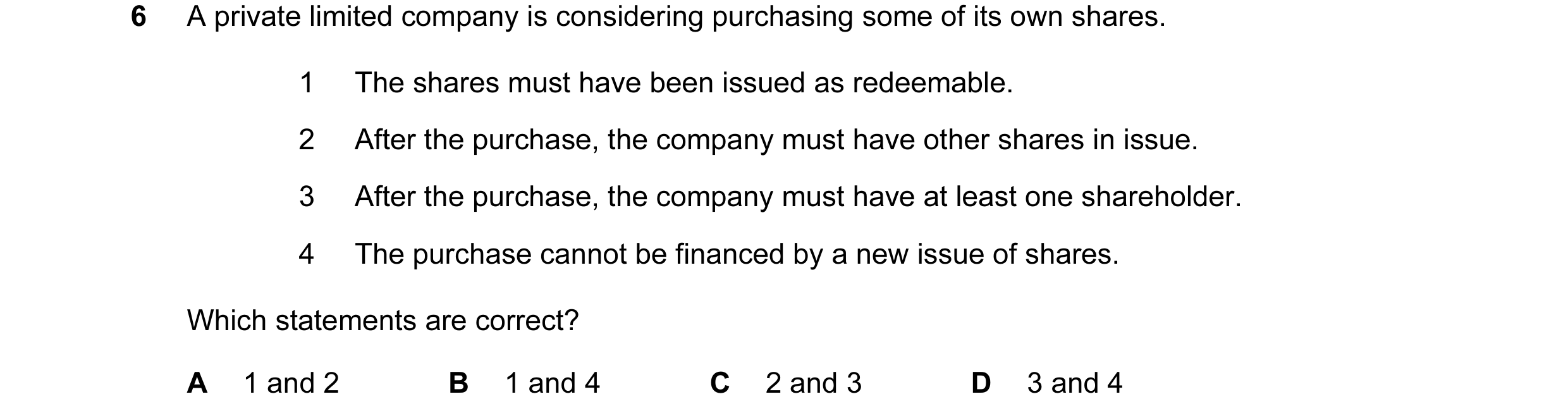
Q40 · A private limited company is considering purchasing some of its own shares 9706/31 Oct/Nov 2013
6 A private limited company is considering purchasing some of its own shares. 1 The shares must have been issued as redeemable. 2 After the purchase, the company must have other shares in issue. 3 After the purchase, the company must have at least one shareholder. 4 The purchase cannot be financed by a new issue of shares. Which statements are correct? A 1 and 2 B 1 and 4 C 2 and 3 D 3 and 4
1 marks
Answer: C
This question in 9706/31 Oct/Nov 2013
Q41 · X and Y agree to merge their businesses and show the following balances on their books 9706/31 Oct/Nov 2013
8 X and Y agree to merge their businesses and show the following balances on their books. X Y $ $ non-current assets 20 000 35 000 current assets 7 000 10 000 current liabilities 3 000 5 000 goodwill 5 000 6 000 non-current liability nil 8 000 They wish to commence business with a total capital of $66 000 shared in the ratio 1 : 2. Which bank adjustment will each have to carry out to complete this arrangement? X Y A pays in $7000 withdraws $6000 B withdraws $2000 pays in $12 000 C withdraws $7000 pays in $6000 D withdraws $13 000 withdraws $4000
1 marks
Answer: C
This question in 9706/31 Oct/Nov 2013
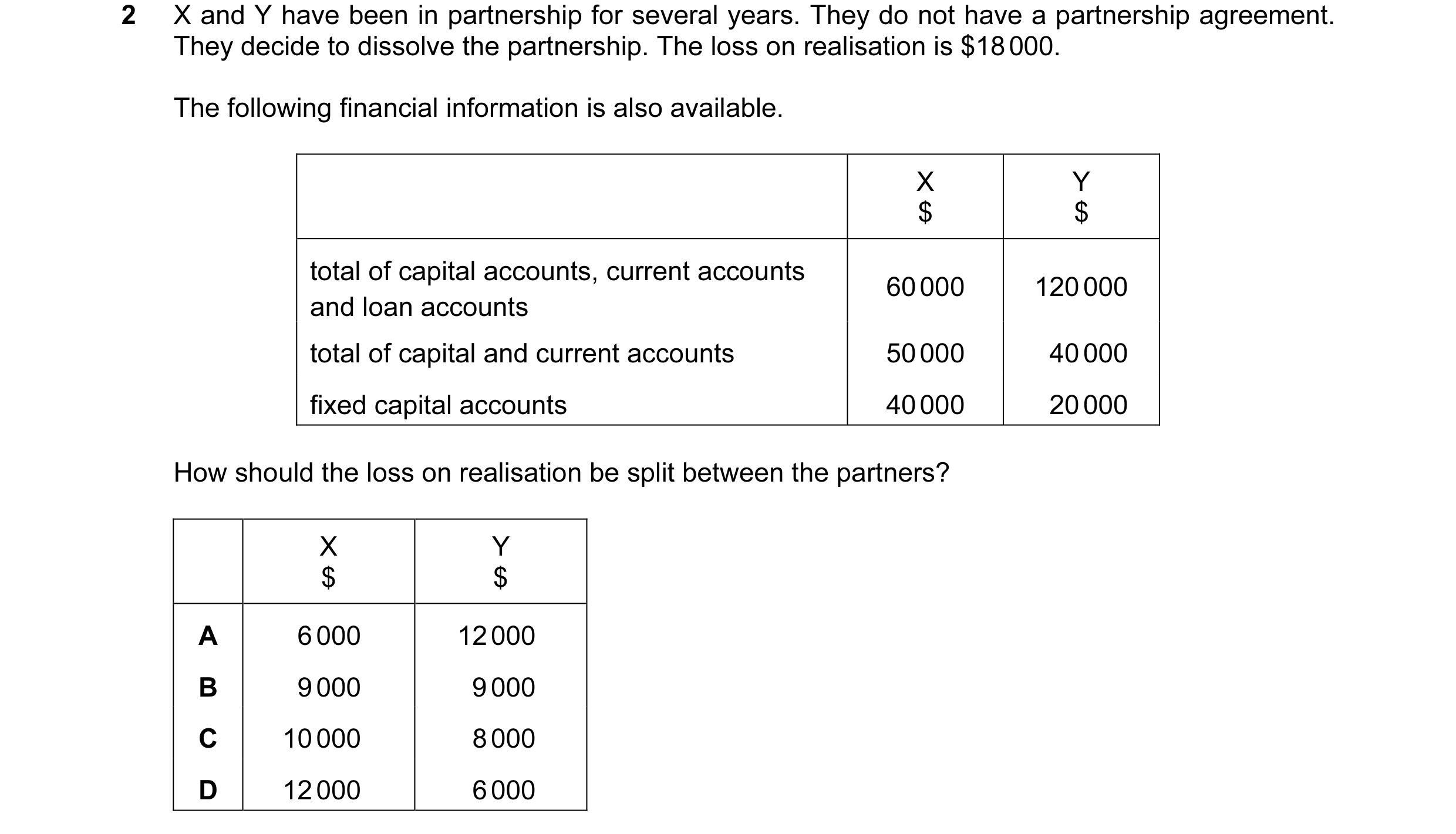
Q42 · X and Y have been in partnership for several years 9706/33 May/June 2014
2 X and Y have been in partnership for several years. They do not have a partnership agreement. They decide to dissolve the partnership. The loss on realisation is $18 000. The following financial information is also available. X Y $ $ total of capital accounts, current accounts 60 000 120 000 and loan accounts total of capital and current accounts 50 000 40 000 fixed capital accounts 40 000 20 000 How should the loss on realisation be split between the partners? X Y $ $ A 6 000 12 000 B 9 000 9 000 C 10 000 8 000 D 12 000 6 000
1 marks
Answer: B
This question in 9706/33 May/June 2014
Q43 · X, Y and Z are in partnership sharing profits and losses equally 9706/33 May/June 2014
4 X, Y and Z are in partnership sharing profits and losses equally. The following information is taken from their books of account. $ capital account balances at start of year 320 000 current account balances at start of year 100 000 net assets at end of year 600 000 partnership salary – Y 30 000 total drawings during year 60 000 What was X’s share of the profit for the year? A $40 000 B $60 000 C $70 000 D $80 000
1 marks
Answer: C
This question in 9706/33 May/June 2014
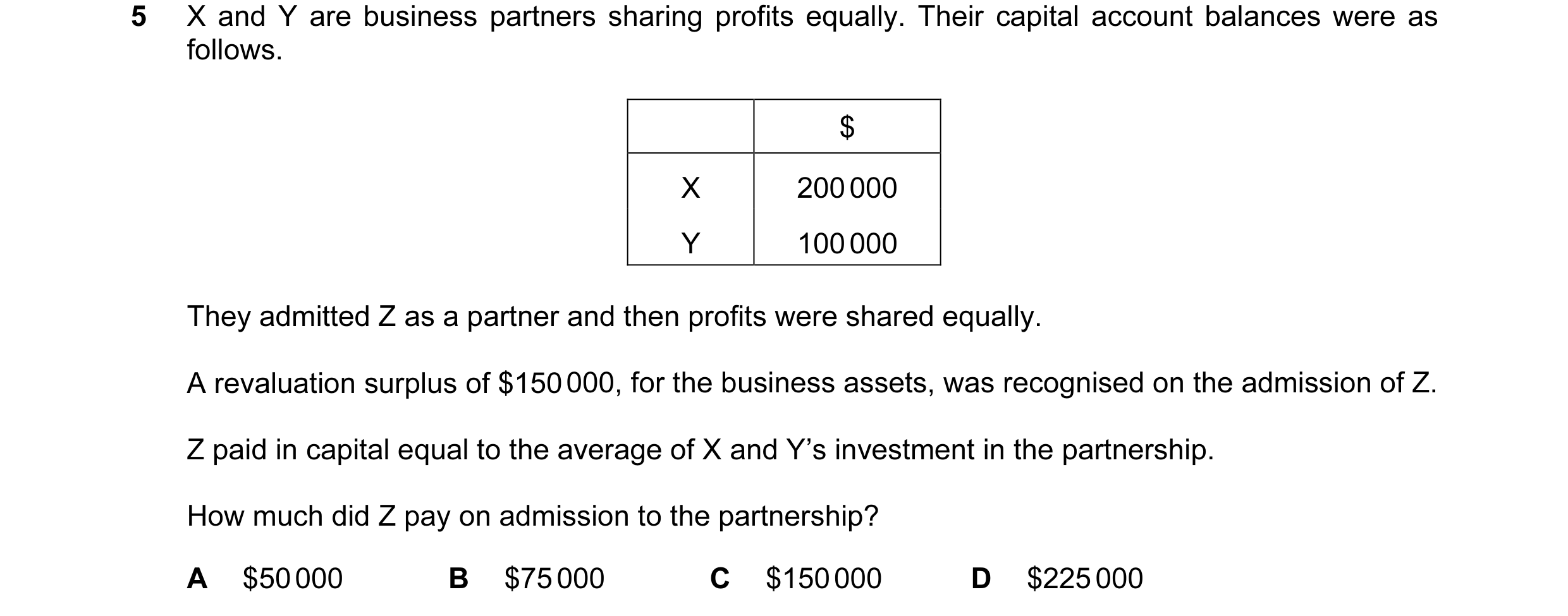
Q44 · X and Y are business partners sharing profits equally 9706/33 May/June 2014
5 X and Y are business partners sharing profits equally. Their capital account balances were as follows. $ X 200 000 Y 100 000 They admitted Z as a partner and then profits were shared equally. A revaluation surplus of $150 000, for the business assets, was recognised on the admission of Z. Z paid in capital equal to the average of X and Y’s investment in the partnership. How much did Z pay on admission to the partnership? A $50 000 B $75 000 C $150 000 D $225 000
1 marks
Answer: D
This question in 9706/33 May/June 2014
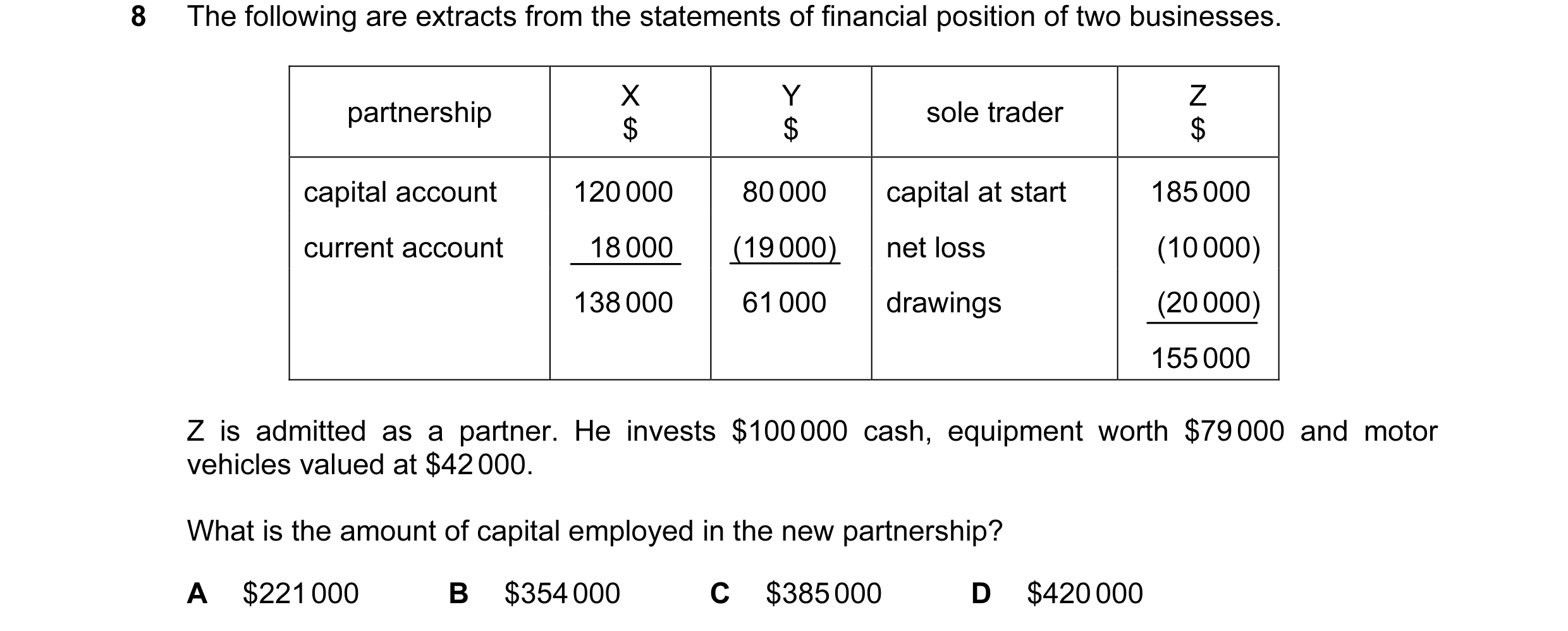
Q45 · The following are extracts from the statements of financial position of two businesses 9706/33 May/June 2014
8 The following are extracts from the statements of financial position of two businesses. X Y Z partnership sole trader $ $ $ capital account 120 000 80 000 capital at start 185 000 current account 18 000 (19 000) net loss (10 000) 138 000 61 000 drawings (20 000) 155 000 Z is admitted as a partner. He invests $100 000 cash, equipment worth $79 000 and motor vehicles valued at $42 000. What is the amount of capital employed in the new partnership? A $221 000 B $354 000 C $385 000 D $420 000
1 marks
Answer: D
This question in 9706/33 May/June 2014
Q46 · X and Y have been in partnership for some years sharing profits and losses equally 9706/31 Oct/Nov 2015
4 X and Y have been in partnership for some years sharing profits and losses equally. On 31 December 2014 their statement of financial position was as follows. $ $ non-current assets 42 000 current assets 17 000 current liabilities - bank 1000 - trade payables 4000 (5 000) 54 000 capital and current accounts - X 31 000 - Y 23 000 54 000 At the start of business on 1 January 2015 the partnership was dissolved. The assets were sold for $69 500 and trade payables were settled at $3500. How much cash was paid out to the partners? A $11 000 B $54 000 C $65 000 D $66 000
1 marks
Answer: C
This question in 9706/31 Oct/Nov 2015
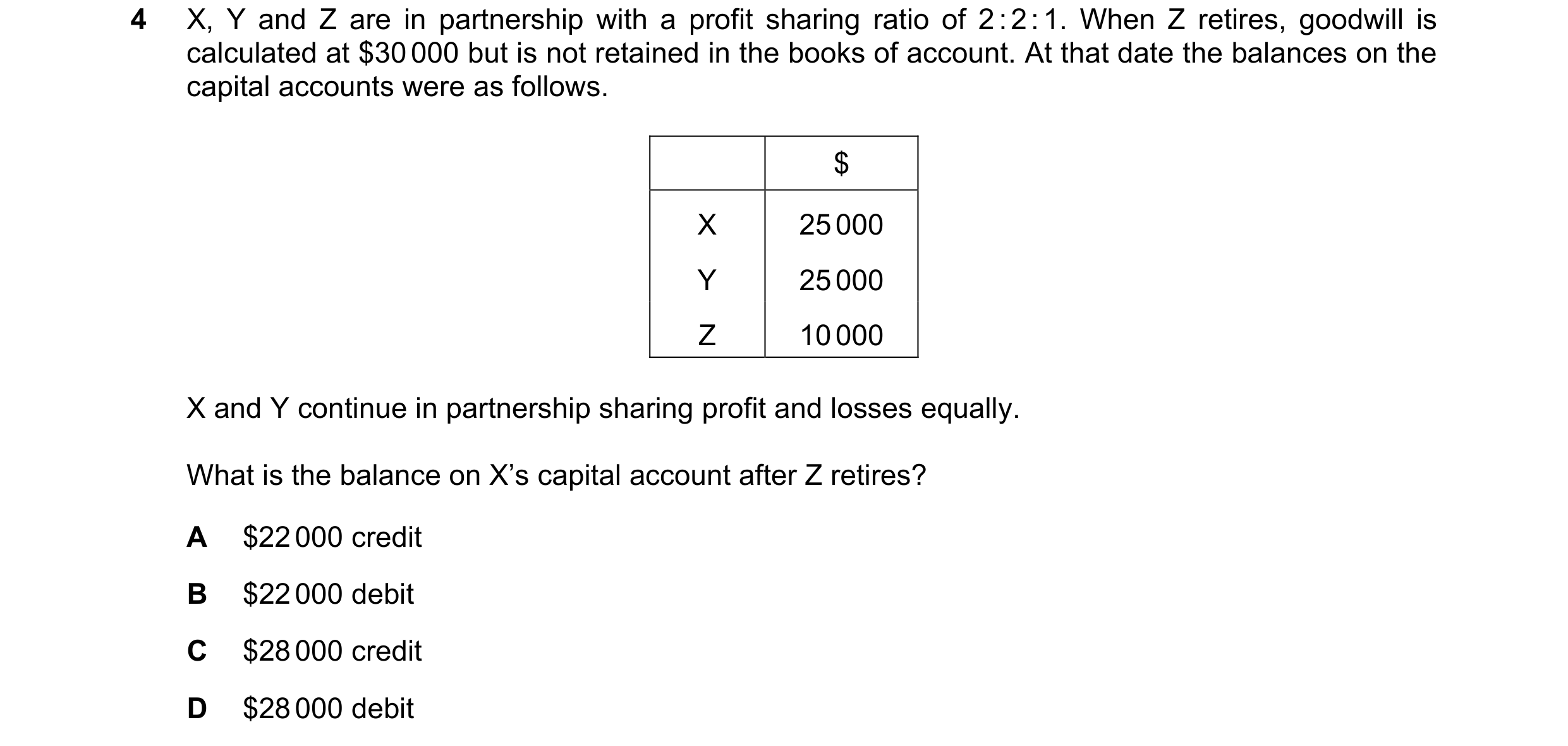
Q47 · X, Y and Z are in partnership with a profit sharing ratio of 2 : 2 : 1 9706/32 Oct/Nov 2015
4 X, Y and Z are in partnership with a profit sharing ratio of 2 : 2 : 1. When Z retires, goodwill is calculated at $30 000 but is not retained in the books of account. At that date the balances on the capital accounts were as follows. $ X 25 000 Y 25 000 Z 10 000 X and Y continue in partnership sharing profit and losses equally. What is the balance on X’s capital account after Z retires? A $22 000 credit B $22 000 debit C $28 000 credit D $28 000 debit
1 marks
Answer: A
This question in 9706/32 Oct/Nov 2015
 1 / 14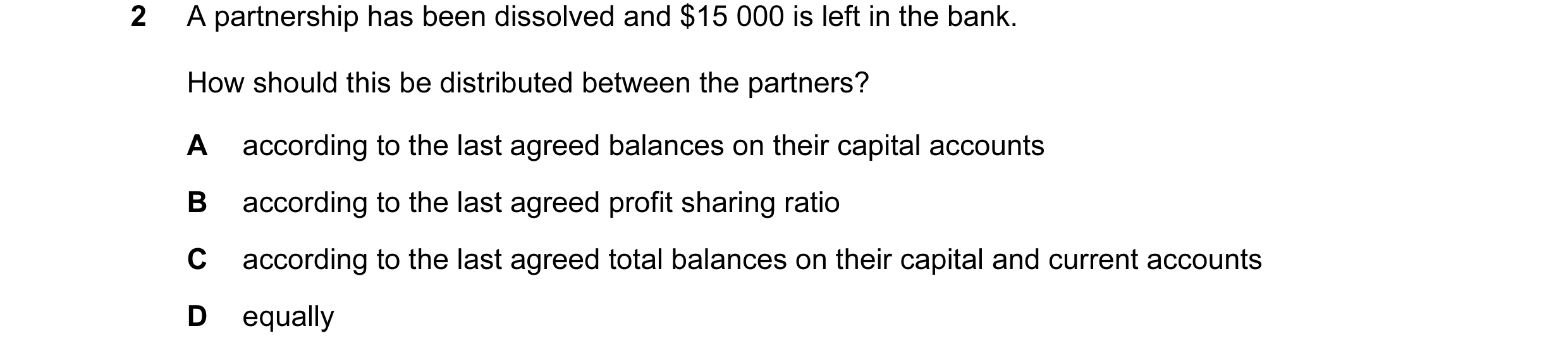

 2 / 14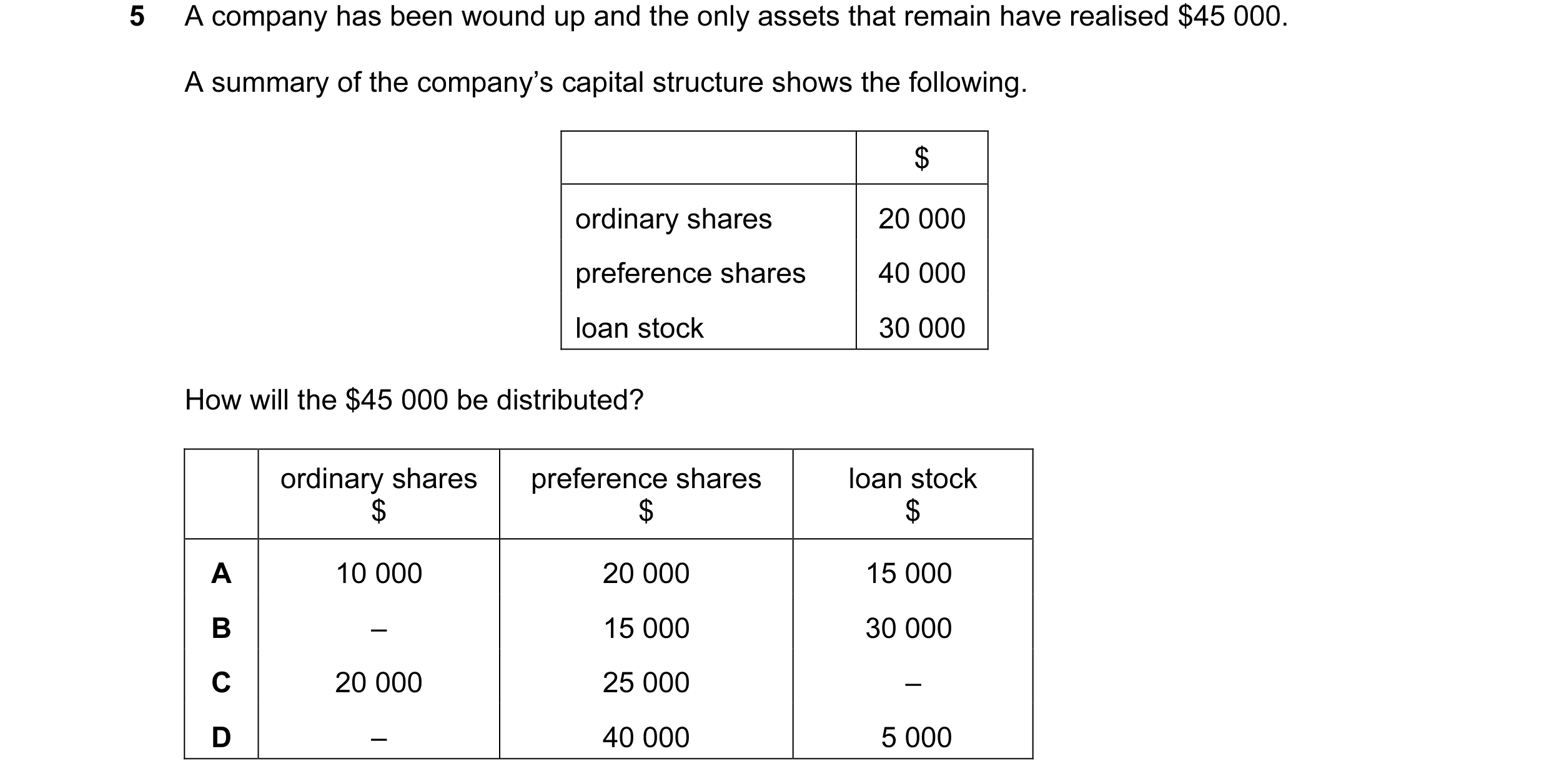

 3 / 14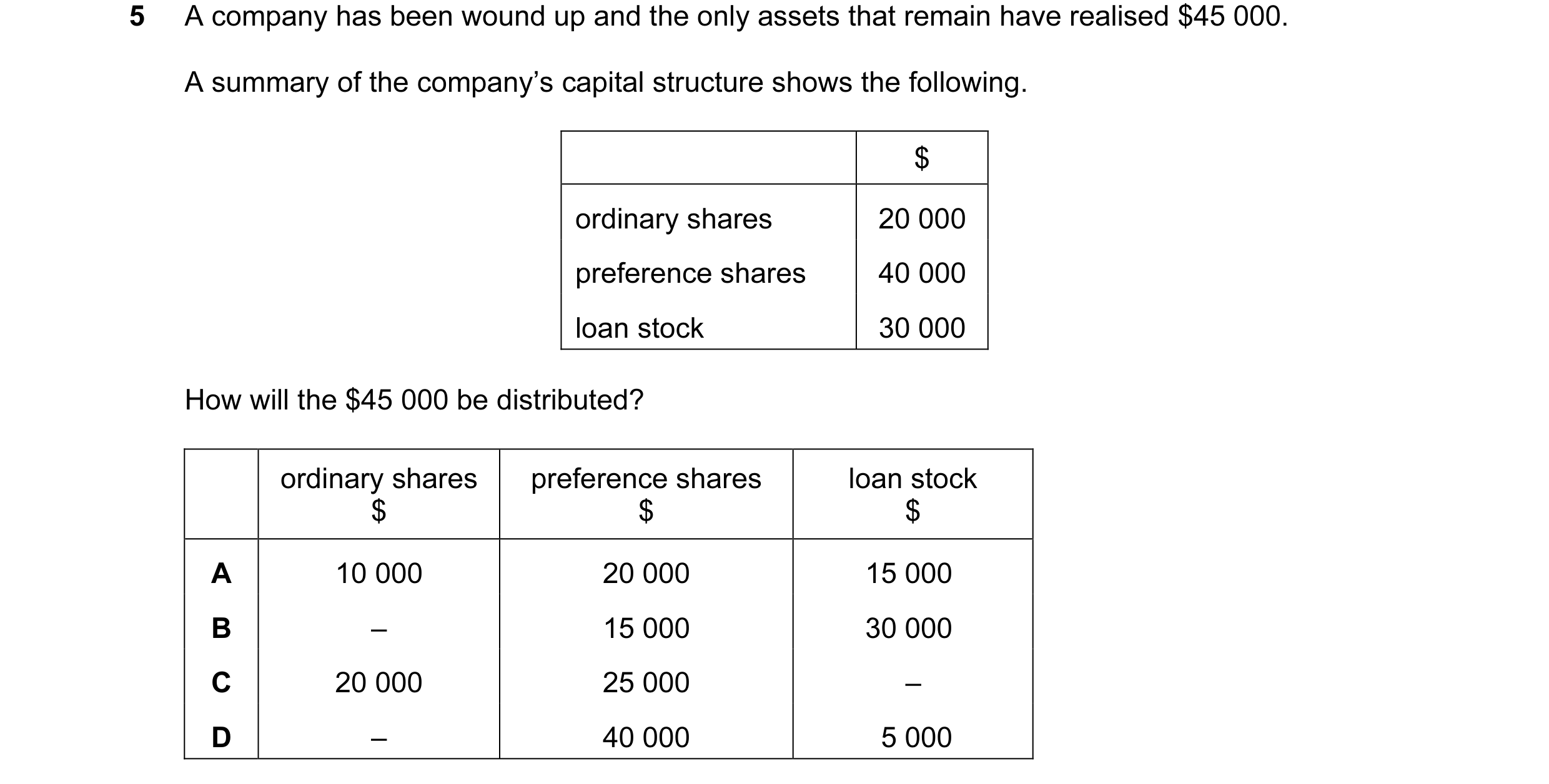

 4 / 14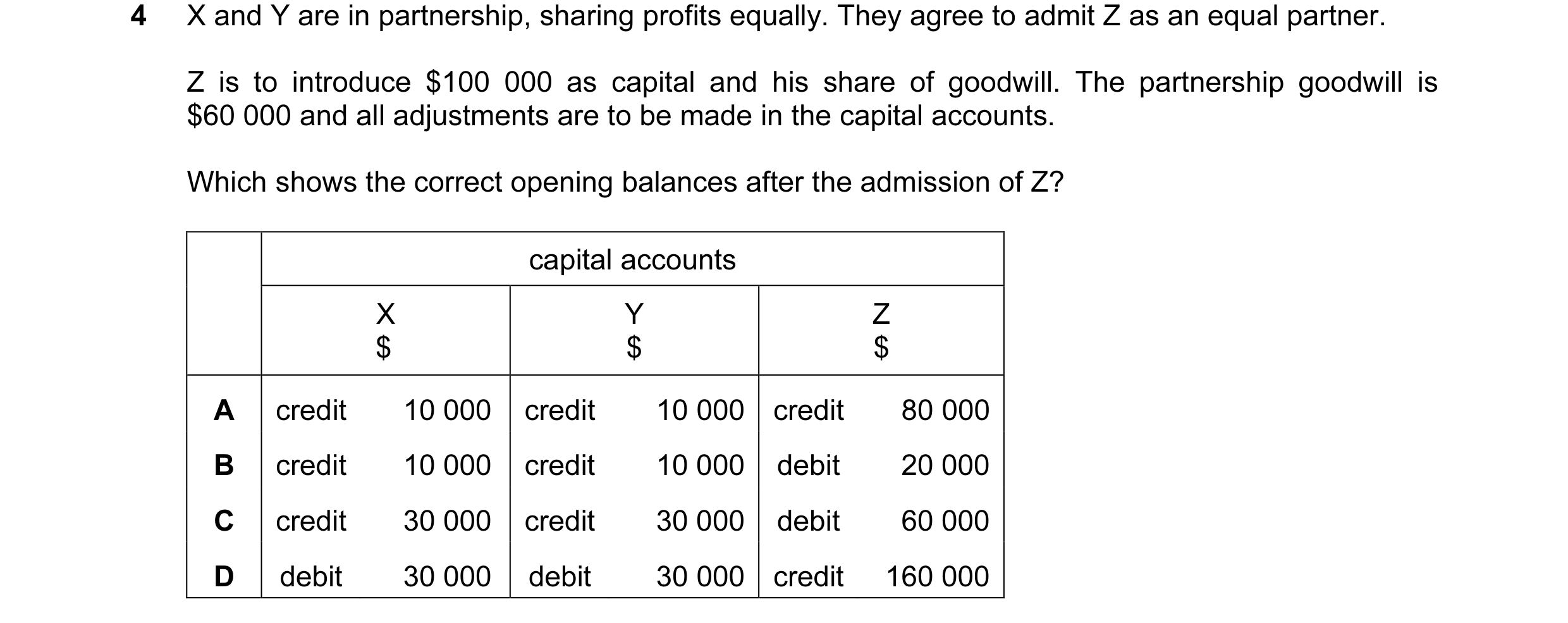
 5 / 14
 6 / 14
 7 / 14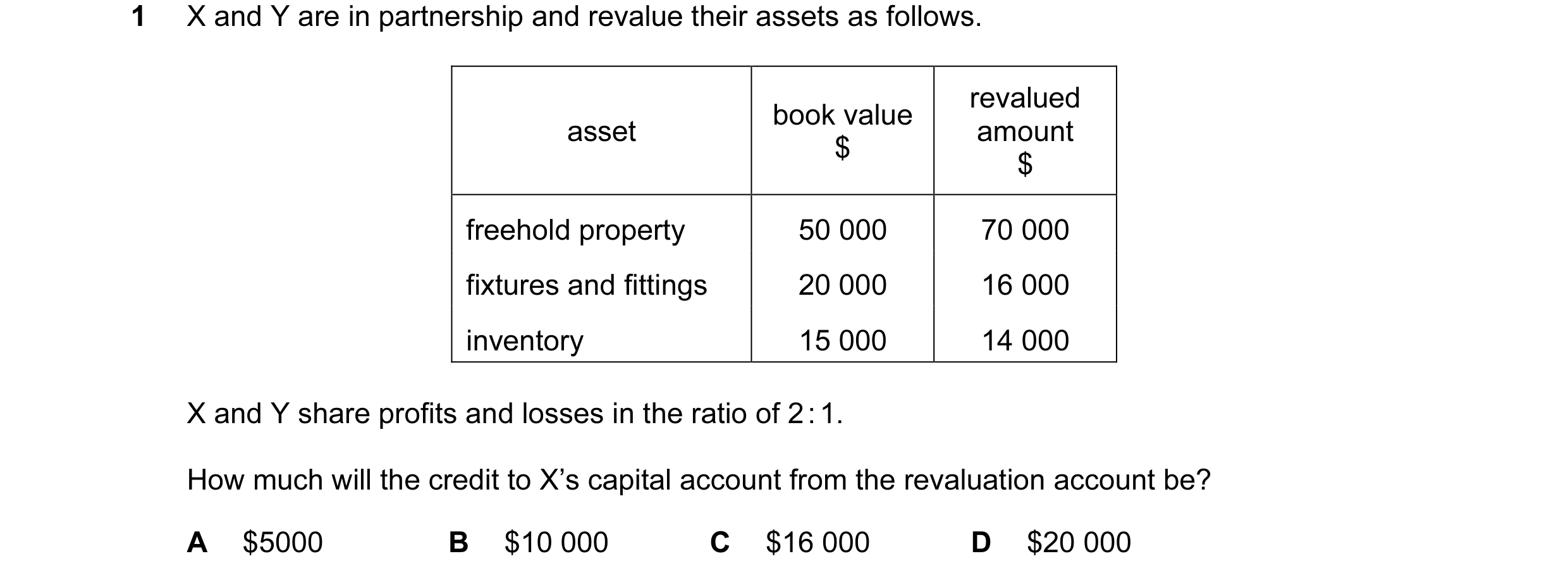


 8 / 14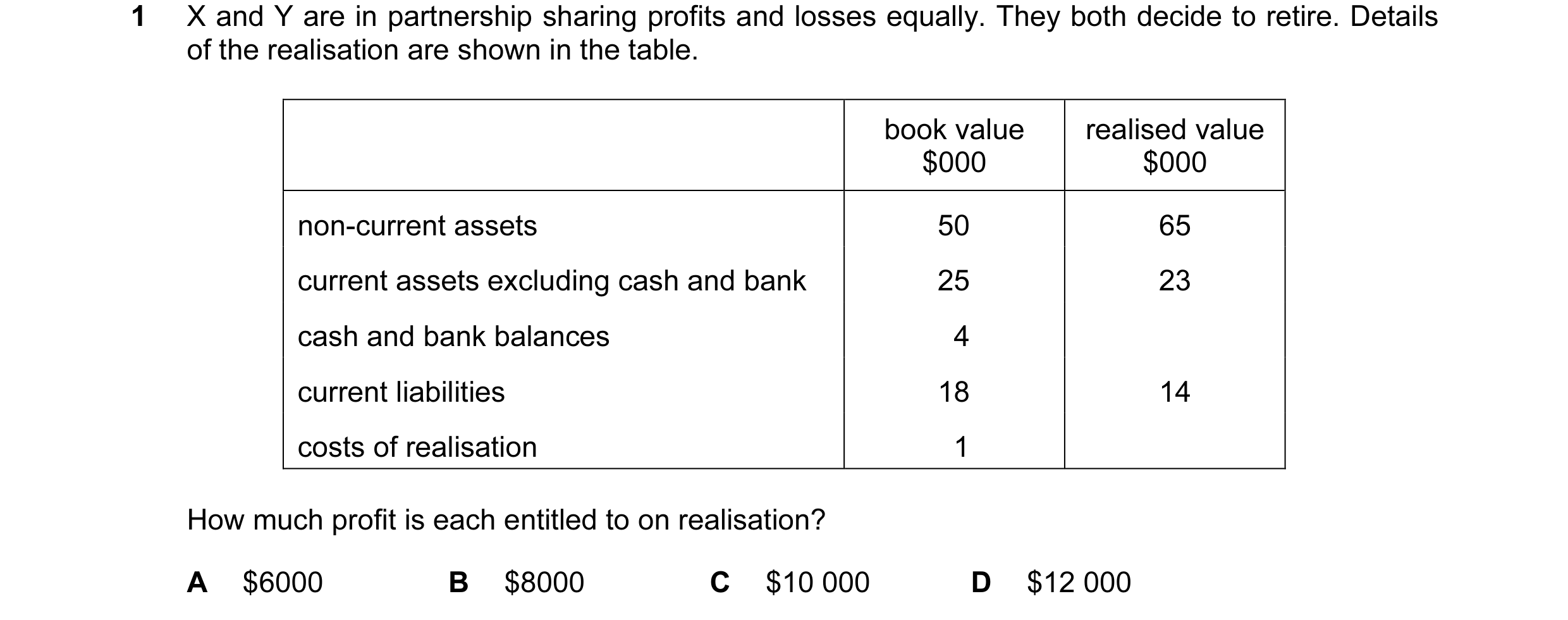

 9 / 14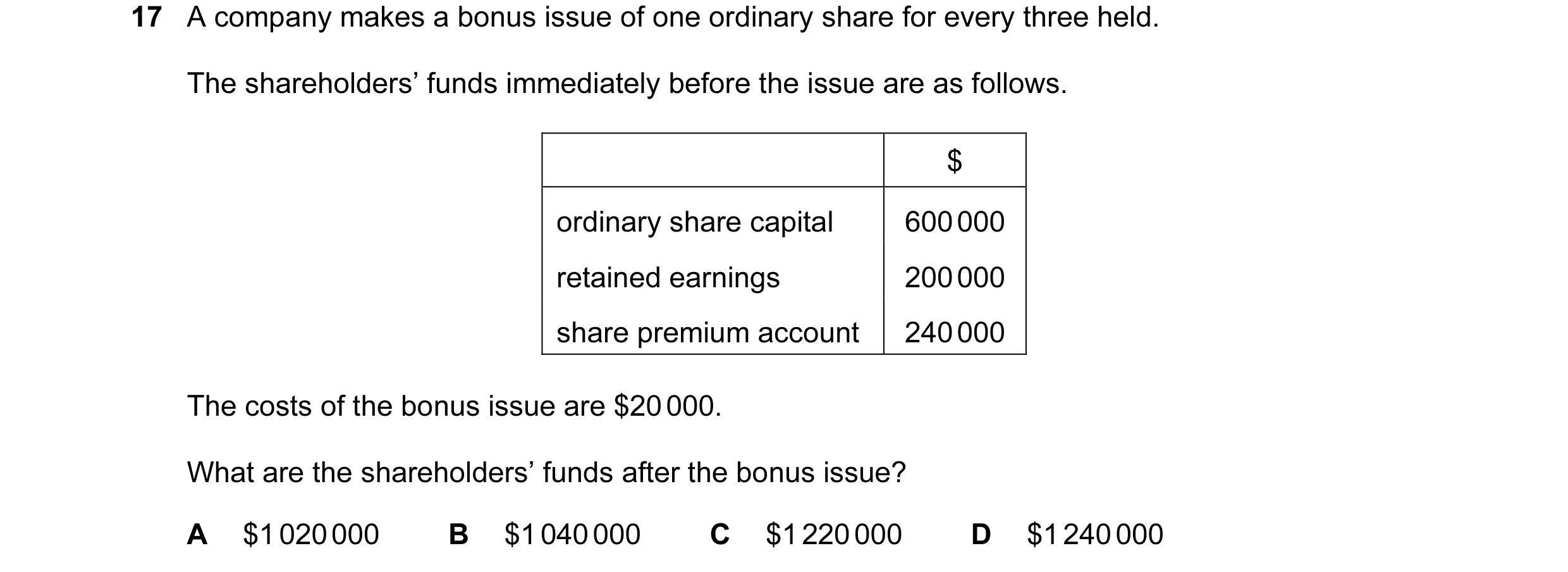
 10 / 14
 11 / 14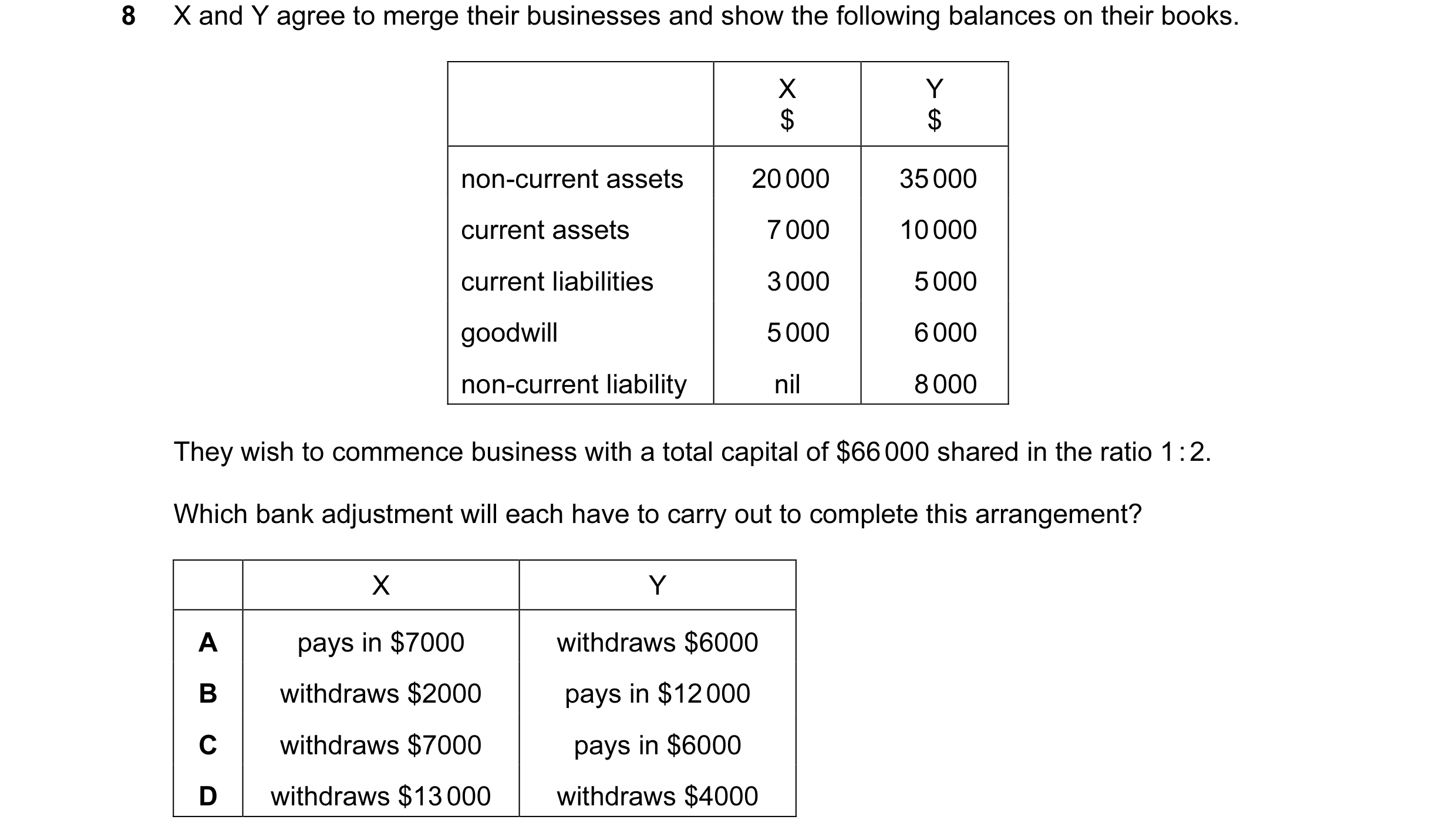
 12 / 14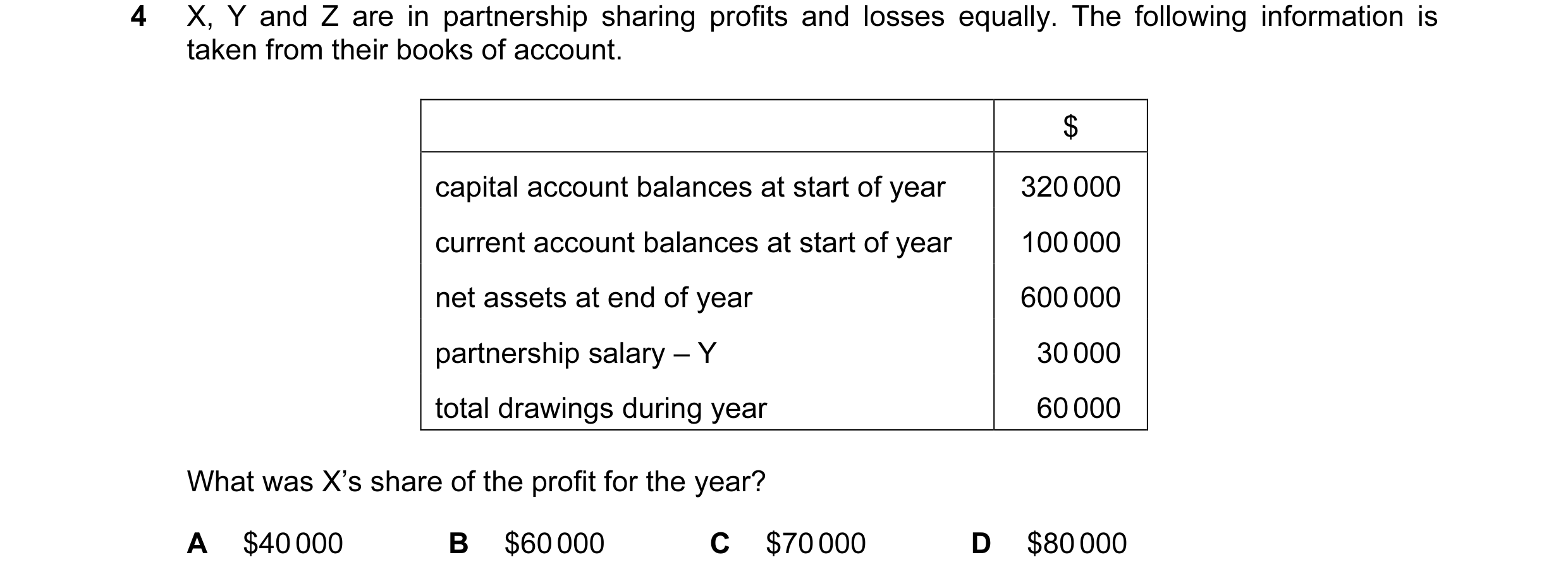
 13 / 14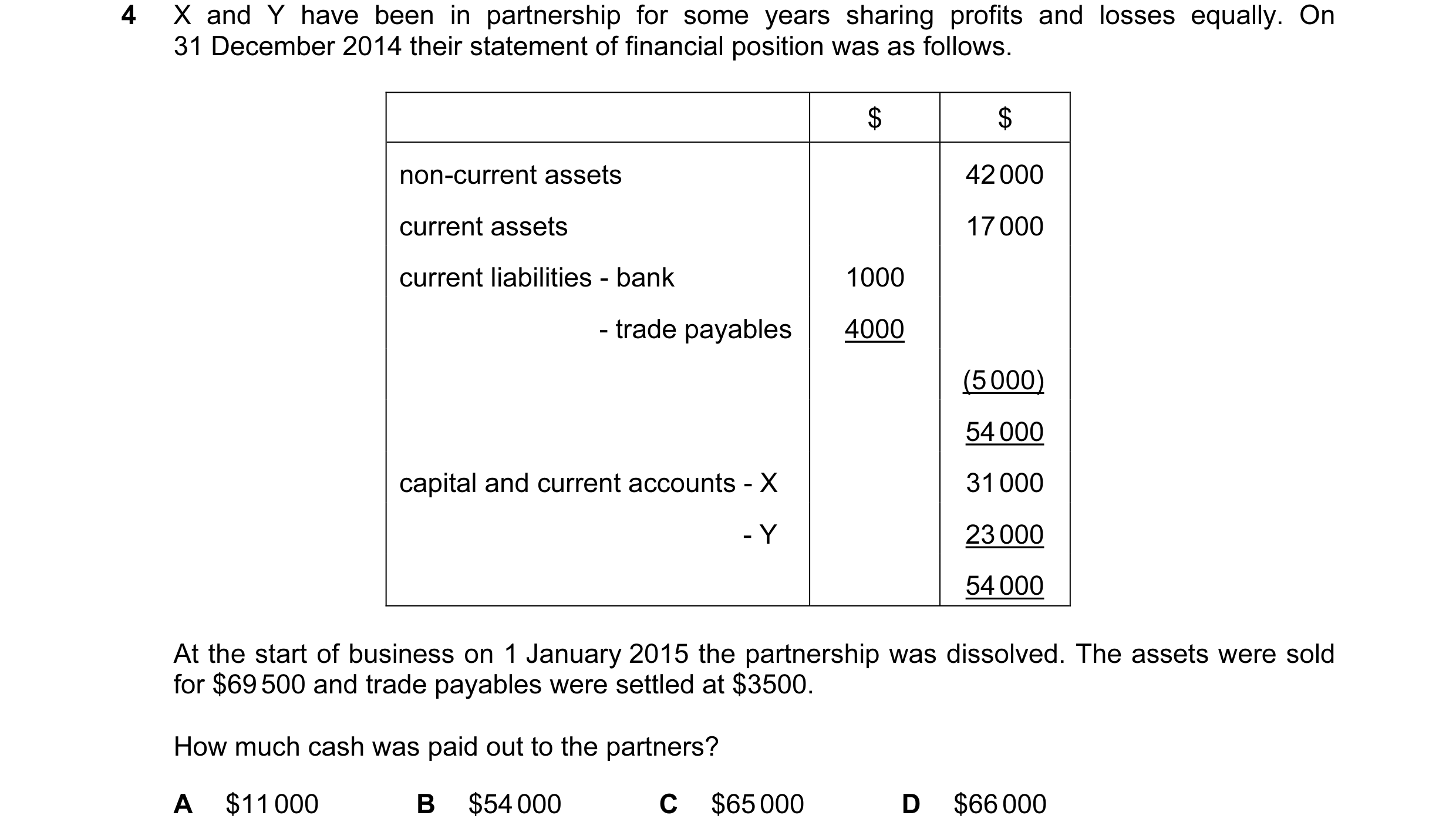
 14 / 14