Questions as text
Q1 · Which function can be carried out by a mature red blood cell? 9700/11 Oct/Nov 2004
27 Which function can be carried out by a mature red blood cell? A active transport B cell division C phagocytosis D protein synthesis
1 marks
Answer: A
This question in 9700/11 Oct/Nov 2004
Q2 · The diagram shows the Bohr Effect 9700/11 May/June 2006
29 The diagram shows the Bohr Effect. 100 80 X O2 saturation of 60 haemoglobin / % 40 Y 20 0 2 4 6 8 10 partial pressure O2 / kPa What causes the shift from X to Y? A decreased levels of carbon dioxide and high pH B decreased levels of carbon dioxide and low pH C increased levels of carbon dioxide and high pH D increased levels of carbon dioxide and low pH
1 marks
Answer: D
This question in 9700/11 May/June 2006
Q3 · What is the function of iron in the haemoglobin molecule? 9700/11 Oct/Nov 2006
10 What is the function of iron in the haemoglobin molecule? A It binds oxygen to the haemoglobin molecule. B It makes the haemoglobin more soluble in the red blood cell. C It stabilises the quaternary structure of the protein. D It undergoes reversible oxidation and reduction.
1 marks
Answer: A
This question in 9700/11 Oct/Nov 2006
Q4 · The graph shows the oxygen dissociation curves of the pigments myoglobin and haemoglobin 9700/11 Oct/Nov 2006
28 The graph shows the oxygen dissociation curves of the pigments myoglobin and haemoglobin. 100 myoglobin haemoglobin 80 60 saturation of pigment / % 40 20 0 0 2 4 6 8 10 12 14 partial pressure of oxygen / kPa Using information contained in the graph, what is the comparison between haemoglobin and myoglobin at a partial pressure of oxygen of 2 kPa? A haemoglobin combines with more oxygen than myoglobin B haemoglobin combines with oxygen when myoglobin releases oxygen C haemoglobin has a lower affinity for oxygen than myoglobin D haemoglobin has a saturation of 20 % when myoglobin is fully saturated
1 marks
Answer: C
This question in 9700/11 Oct/Nov 2006
Q5 · When climbing a very high mountain there is a risk of altitude sickness 9700/11 Oct/Nov 2006
29 When climbing a very high mountain there is a risk of altitude sickness. What causes altitude sickness? A A high concentration of carbon dioxide accumulates in the blood. B Oxygen partial pressure decreases. C Red blood cell production increases. D The proportion of oxygen in the air decreases.
1 marks
Answer: B
This question in 9700/11 Oct/Nov 2006
Q6 · The red blood cell count of humans increases when they remain at high altitudes 9700/11 Oct/Nov 2007
27 The red blood cell count of humans increases when they remain at high altitudes. What is the effect of this? A It increases the Bohr effect. B It increases the rate of oxygen transport. C It reduces the amount of haemoglobin per cell. D It reduces the heart rate.
1 marks
Answer: B
This question in 9700/11 Oct/Nov 2007
Q7 · A molecule of haemoglobin contains four haem groups 9700/11 Oct/Nov 2007
28 A molecule of haemoglobin contains four haem groups. The haem groups contain iron atoms which can bond reversibly with oxygen. How many oxygen atoms can be carried by one haemoglobin molecule? A 4 B 8 C 12 D 16
1 marks
Answer: B
This question in 9700/11 Oct/Nov 2007
Q8 · The graph shows the dissociation curves for adult haemoglobin at two different… 9700/11 Oct/Nov 2008
26 The graph shows the dissociation curves for adult haemoglobin at two different (unidentified) concentrations of carbon dioxide. Which point represents the oxygen concentration in red cells as they leave a resting muscle? 100 75 A % saturation of haemoglobin 50 B with oxygen D 25 C 0 0 1 2 3 4 5 6 7 8 9 10 11 12 13 14 15 partial pressure of O2 / kPa
1 marks
Answer: D
This question in 9700/11 Oct/Nov 2008
Q9 · The graph shows the percentage saturation of haemoglobin with oxygen at different partial… 9700/12 Oct/Nov 2009
28 The graph shows the percentage saturation of haemoglobin with oxygen at different partial pressures of oxygen. Which range of partial pressures of oxygen produces the greatest change of percentage saturation of haemoglobin per unit oxygen tension? 100 D D D C C C 80 60 B B B % saturation of haemoglobin with oxygen 40 A A A 20 0 0 5 10 15 20 partial pressure of oxygen / kPa (oxygen tension)
1 marks
Answer: B
This question in 9700/12 Oct/Nov 2009
Q10 · When red cells leave the lungs, haemoglobin is 98 % saturated 9700/12 Oct/Nov 2010
10 When red cells leave the lungs, haemoglobin is 98 % saturated. How many molecules of oxygen will be carried by the majority of haemoglobin molecules? A 2 B 4 C 6 D 8
1 marks
Answer: B
This question in 9700/12 Oct/Nov 2010
Q11 · In mammals, some carbon dioxide is transported by red blood cells in combination with… 9700/12 Oct/Nov 2010
29 In mammals, some carbon dioxide is transported by red blood cells in combination with haemoglobin. What is the product of this combination? A carbamino-haemoglobin B carbonic acid C carboxyhaemoglobin D haemoglobinic acid
1 marks
Answer: A
This question in 9700/12 Oct/Nov 2010
Q12 · Some babies are born with a hole between the right and left atria 9700/12 Oct/Nov 2010
31 Some babies are born with a hole between the right and left atria. These newly born babies are found to have an increased number of red blood cells. What is the reason for this increase? A More blood is needed because it is pumped faster. B Newly born babies’ haemoglobin has a higher affinity for oxygen. C Newly born babies’ haemoglobin molecules only have one haem group. D There is less oxygen available to the newly born baby.
1 marks
Answer: D
This question in 9700/12 Oct/Nov 2010
Q13 · Which set of statements correctly describes haemoglobin? 9700/11 May/June 2011
8 Which set of statements correctly describes haemoglobin? A four polypeptide iron ions can in each chain, at 50 % saturation, chains, each associate with hydrophobic R two oxygen containing a oxygen forming groups of amino molecules are prosthetic group oxyhaemoglobin acids point towards transported by the the centre of the molecule molecule B polypeptide chains each chain contains two identical alpha each chain can interact to produce a a prosthetic group of chains and two transport an oxygen globular chain amino acids identical beta chains molecule surrounding an iron ion C polypeptide chains an iron ion is quaternary structure each molecule can interact to produce present within each of two alpha chains transport a total of an almost spherical haem group and two beta chains four oxygen atoms molecule D polypeptide chains iron ions in the in each chain, each molecule can produce a loose molecule can bind hydrophobic R transport a total of helical shape, which reversibly with groups of amino eight oxygen atoms curls to form a oxygen acids surround the spherical molecule iron ion
1 marks
Answer: A
This question in 9700/11 May/June 2011
Q14 · There is a decreased partial pressure of oxygen at high altitude compared to sea level 9700/12 May/June 2011
25 There is a decreased partial pressure of oxygen at high altitude compared to sea level. Which row is a correct description and reason for the response of the body to high altitude? description reason A more red blood cells because haemoglobin breaks down more rapidly B red blood cells have genes so red blood cells produce more switched on haemoglobin C oxygen dissociation curve shifts to compensate for an increase to the right in oxygen unloading in tissues D percentage saturation of haemoglobin so more red blood cells are produced with oxygen in lungs decreases to carry more haemoglobin
1 marks
Answer: D
This question in 9700/12 May/June 2011
Q15 · Which set of statements correctly describes haemoglobin? 9700/13 May/June 2011
36 Which set of statements correctly describes haemoglobin? A four polypeptide iron ions can in each chain, at 50 % saturation, chains, each associate with hydrophobic R two oxygen containing a oxygen forming groups of amino molecules are prosthetic group oxyhaemoglobin acids point towards transported by the the centre of the molecule molecule B polypeptide chains each chain contains two identical alpha each chain can interact to produce a a prosthetic group of chains and two transport an oxygen globular chain amino acids identical beta chains molecule surrounding an iron ion C polypeptide chains an iron ion is quaternary structure each molecule can interact to produce present within each of two alpha chains transport a total of an almost spherical haem group and two beta chains four oxygen atoms molecule D polypeptide chains iron ions in the in each chain, each molecule can produce a loose molecule can bind hydrophobic R transport a total of helical shape, which reversibly with groups of amino eight oxygen atoms curls to form a oxygen acids surround the spherical molecule iron ion
1 marks
Answer: A
This question in 9700/13 May/June 2011
Q16 · The diagram shows part played by red blood cells in the transport of carbon dioxide 9700/11 Oct/Nov 2011
26 The diagram shows part played by red blood cells in the transport of carbon dioxide. CO2 1 H2O 2 haemoglobin 3 4 Which row is correct? 1 2 3 4 A carbaminohaemoglobin haemoglobinic hydrogen ions hydrogen acid carbonate ions B carbonic anhydrase carbonic acid hydrogen ions hydrogen carbonate ions C carboxyhaemoglobin carbonic carbonic acid carbon dioxide anhydrase D haemoglobinic acid carbonic acid hydrogen hydrogen ions carbonate ions
1 marks
Answer: B
This question in 9700/11 Oct/Nov 2011
Q17 · The diagram shows part played by red blood cells in the transport of carbon dioxide 9700/13 Oct/Nov 2011
36 The diagram shows part played by red blood cells in the transport of carbon dioxide. CO2 1 H2O 2 haemoglobin 3 4 Which row is correct? 1 2 3 4 A carbaminohaemoglobin haemoglobinic hydrogen ions hydrogen acid carbonate ions B carbonic anhydrase carbonic acid hydrogen ions hydrogen carbonate ions C carboxyhaemoglobin carbonic carbonic acid carbon dioxide anhydrase D haemoglobinic acid carbonic acid hydrogen hydrogen ions carbonate ions
1 marks
Answer: B
This question in 9700/13 Oct/Nov 2011
Q18 · An increase in carbon dioxide in human blood shifts the oxyhaemoglobin dissociation curve… 9700/11 May/June 2012
30 An increase in carbon dioxide in human blood shifts the oxyhaemoglobin dissociation curve to the right. What is the explanation for this effect? A An increase in carbon dioxide concentration increases the ventilation rate. B Carbon dioxide is more soluble than oxygen and displaces it. C Diffusion of carbon dioxide between the alveoli and the blood is more rapid. D Increasing the H+ concentration decreases haemoglobin affinity for oxygen.
1 marks
Answer: D
This question in 9700/11 May/June 2012
Q19 · Which is correct about the affinity between haemoglobin and the gases carbon dioxide… 9700/11 May/June 2012
31 Which is correct about the affinity between haemoglobin and the gases carbon dioxide, carbon monoxide and oxygen? highest affinity lowest affinity A carbon monoxide carbon dioxide oxygen B carbon monoxide oxygen carbon dioxide C oxygen carbon dioxide carbon monoxide D oxygen carbon monoxide carbon dioxide
1 marks
Answer: B
This question in 9700/11 May/June 2012
Q20 · The diagram shows the Bohr effect 9700/12 May/June 2012
28 The diagram shows the Bohr effect. 100 80 X percentage 60 saturation of haemoglobin Y with oxygen 40 20 0 0 2 4 6 8 10 partial pressure of oxygen / kPa What causes the shift from X to Y? A decreased concentration of carbon dioxide and high pH B decreased concentration of carbon dioxide and low pH C increased concentration of carbon dioxide and high pH D increased concentration of carbon dioxide and low pH
1 marks
Answer: D
This question in 9700/12 May/June 2012
Q21 · Which is correct about the affinity between haemoglobin and the gases carbon dioxide… 9700/13 May/June 2012
37 Which is correct about the affinity between haemoglobin and the gases carbon dioxide, carbon monoxide and oxygen? highest affinity lowest affinity A carbon monoxide carbon dioxide oxygen B carbon monoxide oxygen carbon dioxide C oxygen carbon dioxide carbon monoxide D oxygen carbon monoxide carbon dioxide
1 marks
Answer: B
This question in 9700/13 May/June 2012
Q22 · An increase in carbon dioxide in human blood shifts the oxyhaemoglobin dissociation curve… 9700/13 May/June 2012
38 An increase in carbon dioxide in human blood shifts the oxyhaemoglobin dissociation curve to the right. What is the explanation for this effect? A An increase in carbon dioxide concentration increases the ventilation rate. B Carbon dioxide is more soluble than oxygen and displaces it. C Diffusion of carbon dioxide between the alveoli and the blood is more rapid. D Increasing the H+ concentration decreases haemoglobin affinity for oxygen.
1 marks
Answer: D
This question in 9700/13 May/June 2012
Q23 · Which two statements about the Bohr effect are correct? 9700/11 Oct/Nov 2012
27 Which two statements about the Bohr effect are correct? 1 Increasing the partial pressure of oxygen increases the percentage of oxyhaemoglobin. 2 Decreasing the partial pressure of carbon dioxide decreases the percentage of oxyhaemoglobin. 3 Increasing the partial pressure of carbon dioxide shifts the dissociation curve of haemoglobin to the left. 4 In low concentrations of carbon dioxide haemoglobin has a high affinity for oxygen. A 1 and 2 B 1 and 4 C 2 and 3 D 3 and 4
1 marks
Answer: B
This question in 9700/11 Oct/Nov 2012
Q24 · Haemoglobin can bind to carbon dioxide, carbon monoxide and oxygen 9700/11 Oct/Nov 2012
32 Haemoglobin can bind to carbon dioxide, carbon monoxide and oxygen. 1 carbon dioxide 2 carbon monoxide 3 oxygen Which gases share a binding site? A 1 and 2 only B 1 and 3 only C 2 and 3 only D 1, 2 and 3
1 marks
Answer: C
This question in 9700/11 Oct/Nov 2012
Q25 · The diagram shows the effect of three different concentrations of carbon dioxide on the… 9700/12 Oct/Nov 2012
28 The diagram shows the effect of three different concentrations of carbon dioxide on the oxygen dissociation curve for human haemoglobin. 100 X X = partial pressure of Y carbon dioxide: 3.0 kPa percentage saturation of Z Y = partial pressure of haemoglobin carbon dioxide: 5.0 kPa with oxygen Z = partial pressure of carbon dioxide: 7.0 kPa 0 0 12 partial pressure of oxygen / kPa What effect does carbon dioxide have on haemoglobin? A it makes it less efficient at taking up oxygen and also less efficient at releasing it B it makes it less efficient at taking up oxygen and more efficient at releasing it C it makes it more efficient at taking up oxygen and also more efficient at releasing it D it makes it more efficient at taking up oxygen and less efficient at releasing it
1 marks
Answer: B
This question in 9700/12 Oct/Nov 2012
Q26 · Why does the number of red blood cells in a human increase after several weeks at high… 9700/12 Oct/Nov 2012
29 Why does the number of red blood cells in a human increase after several weeks at high altitude? A red blood cells are short-lived B there is a high partial pressure of oxygen C to remove glucose from the tissues D to supply the tissues with enough oxygen
1 marks
Answer: D
This question in 9700/12 Oct/Nov 2012
Q27 · An adult human has approximately 5 dm3 of blood, which circulates about once a minute 9700/12 Oct/Nov 2012
34 An adult human has approximately 5 dm3 of blood, which circulates about once a minute. 100 cm3 of arterial blood carries 19 cm3 of oxygen. 100 cm3 of venous blood carries 12.5 cm3 of oxygen. What is the approximate volume in cm3 of oxygen taken up per minute in the lungs? A 32.5 B 65 C 325 D 950
1 marks
Answer: C
This question in 9700/12 Oct/Nov 2012
Q28 · Why does the red blood cell count of humans increase when they remain at high altitudes? 9700/13 Oct/Nov 2012
26 Why does the red blood cell count of humans increase when they remain at high altitudes? A Haemoglobin is not saturated with oxygen in the lungs. B The partial pressure of oxygen is higher. C The percentage of oxygen in the air has decreased. D There is more carbon dioxide, increasing the Bohr effect.
1 marks
Answer: A
This question in 9700/13 Oct/Nov 2012
Q29 · The graph shows the dissociation of oxygen from haemoglobin at two different pHs 9700/13 Oct/Nov 2012
28 The graph shows the dissociation of oxygen from haemoglobin at two different pHs. 100 curve 1 percentage saturation of haemoglobin curve 2 with oxygen 0 0 oxygen partial pressure Which curve represents the lower pH and in which tissue might the data have been recorded? lower pH tissue A curve 1 active muscle B curve 1 resting muscle C curve 2 active muscle D curve 2 resting muscle
1 marks
Answer: C
This question in 9700/13 Oct/Nov 2012
Q30 · Haemoglobin can bind to carbon dioxide, carbon monoxide and oxygen 9700/11 May/June 2013
30 Haemoglobin can bind to carbon dioxide, carbon monoxide and oxygen. Which statement about the binding sites of haemoglobin is correct? A Carbon dioxide and carbon monoxide bind to one site, oxygen binds to a different site. B Carbon dioxide and oxygen bind to one site, carbon monoxide binds to a different site. C Carbon monoxide and oxygen bind to one site, carbon dioxide binds to a different site. D Carbon monoxide, oxygen and carbon dioxide all bind to different sites.
1 marks
Answer: C
This question in 9700/11 May/June 2013
Q31 · Which substances will displace oxygen from oxyhaemoglobin? 9700/11 May/June 2013
32 Which substances will displace oxygen from oxyhaemoglobin? 1 carbon dioxide 2 carbon monoxide 3 hydrogen carbonate ions 4 hydrogen ions A 1 and 2 only B 1 and 4 only C 2 and 3 only D 2 and 4 only
1 marks
Answer: D
This question in 9700/11 May/June 2013
Q32 · Which statement is true for the Bohr effect? 9700/12 May/June 2013
31 Which statement is true for the Bohr effect? A As the partial pressure of carbon dioxide increases the dissociation curve becomes S- shaped (sigmoid). B At higher partial pressures of carbon dioxide and equal partial pressures of oxygen, the percentage saturation of haemoglobin with oxygen will be higher. C The carbon dioxide in the air prevents haemoglobin becoming fully saturated with oxygen during gas exchange in the lungs. D The release of oxygen from haemoglobin is more likely at higher partial pressures of carbon dioxide.
1 marks
Answer: D
This question in 9700/12 May/June 2013
Q33 · Which row describes the changes in the properties of haemoglobin as a result of the Bohr… 9700/13 May/June 2013
31 Which row describes the changes in the properties of haemoglobin as a result of the Bohr effect? affinity for oxygen oxygen dissociates by haemoglobin from haemoglobin A higher less readily B higher more readily C lower less readily D lower more readily
1 marks
Answer: D
This question in 9700/13 May/June 2013
Q34 · Which reactions will be taking place in blood that is passing through active tissues? 9700/11 Oct/Nov 2013
27 Which reactions will be taking place in blood that is passing through active tissues? 1 HbO8 → Hb + 4O2 2 HbO8 + H+ → HHb + 4O2 3 HCO3 – + H+ → H2CO3 4 H2O + CO2 → H2CO3 A 1, 2, 3, and 4 B 1, 2 and 4 only C 1, 3 and 4 only D 2 and 3 only
1 marks
Answer: B
This question in 9700/11 Oct/Nov 2013
Q35 · Which explains why haemoglobin is able to carry oxygen? 9700/12 Oct/Nov 2013
10 Which explains why haemoglobin is able to carry oxygen? A It consists of four polypeptides. B It contains iron. C It has a quaternary structure. D It is a globular protein.
1 marks
Answer: B
This question in 9700/12 Oct/Nov 2013
Q36 · Which will not be formed in the plasma in capillaries surrounding active tissue? 9700/12 Oct/Nov 2013
30 Which will not be formed in the plasma in capillaries surrounding active tissue? A carbaminohaemoglobin B carbonic acid C hydrogen carbonate D hydrogen ions
1 marks
Answer: A
This question in 9700/12 Oct/Nov 2013
Q37 · Which explains why haemoglobin is suitable as an oxygen carrier? 9700/13 Oct/Nov 2013
7 Which explains why haemoglobin is suitable as an oxygen carrier? 1 The haem group combines with oxygen. 2 The iron combines with oxygen reversibly. 3 Haemoglobin changes shape as oxygen loads. A 1 only B 1 and 2 only C 2 and 3 only D 1, 2 and 3
1 marks
Answer: D
This question in 9700/13 Oct/Nov 2013
Q38 · Which reactions are not likely to occur in blood that is passing through active tissues? 9700/13 Oct/Nov 2013
28 Which reactions are not likely to occur in blood that is passing through active tissues? 1 Hb + 4O2 → HbO8 2 HbO8 + H+ → HHb + 4O2 3 HCO3 – + H+ → H2CO3 4 H2O + CO2 → H2CO3 A 1 and 2 only B 1 and 3 only C 2 and 3 only D 2, 3 and 4 only
1 marks
Answer: B
This question in 9700/13 Oct/Nov 2013
Q39 · The red blood cell count of humans increases when they remain at high altitudes 9700/13 Oct/Nov 2013
30 The red blood cell count of humans increases when they remain at high altitudes. Why does this occur? 1 to increase the Bohr effect 2 to increase the diffusion gradient for oxygen in the lungs 3 to maintain transport of oxygen A 3 only B 1 and 2 only C 2 and 3 only D 1, 2 and 3
1 marks
Answer: A
This question in 9700/13 Oct/Nov 2013
Q40 · Which reactions will be taking place in blood in a capillary next to an alveolus? 9700/11 May/June 2014
30 Which reactions will be taking place in blood in a capillary next to an alveolus? 1 Hb + 4O2 → HbO8 2 H2O + CO2 → H2CO3 3 HHb + 4O2 → HbO8 + H+ A 1 only B 2 only C 1 and 2 D 2 and 3
1 marks
Answer: A
This question in 9700/11 May/June 2014
Q41 · The graph shows the percentage saturation of haemoglobin with oxygen at different partial… 9700/12 May/June 2014
28 The graph shows the percentage saturation of haemoglobin with oxygen at different partial pressures of oxygen and two different concentrations of carbon dioxide. 100 low concentration CO2 75 % saturation haemoglobin 50 high concentration CO2 of haemoglobin with oxygen 25 0 2 4 6 8 10 12 14 partial pressure of O2 / kPa What is the effect of increasing the concentration of carbon dioxide? A It increases the affinity of haemoglobin for oxygen at respiring tissues. B It increases the dissociation of haemoglobinic acid inside red blood cells. C It increases the dissociation of oxygen from haemoglobin at respiring tissues. D It increases the inhibition of carbonic anhydrase enzyme in red blood cells.
1 marks
Answer: C
This question in 9700/12 May/June 2014
Q42 · Some babies are born with a hole between the right and left atria 9700/12 May/June 2014
29 Some babies are born with a hole between the right and left atria. These babies are found to have an increased number of red blood cells. What is the reason for this increase? A More blood is needed because it is pumped faster. B More blood is needed because the pressure is lower. C Their haemoglobin has a higher affinity for oxygen. D There is less oxygen available to the newly born baby.
1 marks
Answer: D
This question in 9700/12 May/June 2014
Q43 · Which process can be carried out by a mature red blood cell? 9700/13 May/June 2014
30 Which process can be carried out by a mature red blood cell? A active transport B cell division C phagocytosis D protein synthesis
1 marks
Answer: A
This question in 9700/13 May/June 2014
Q44 · The diagram shows a magnified section of part of the lungs containing specialised tissues 9700/13 May/June 2014
34 The diagram shows a magnified section of part of the lungs containing specialised tissues. 1 2 3 4 5 6 Where are there a high proportion of carbonic anhydrase, HCO3 – ions and lysosomes? contains high proportion of carbonic – ions HCO3 lysosomes anhydrase A 1 3 4 B 2 4 5 C 3 5 6 D 4 6 1
1 marks
Answer: C
This question in 9700/13 May/June 2014
Q45 · How many molecules of oxygen are bound to one molecule of haemoglobin, when it is fully… 9700/11 Oct/Nov 2014
10 How many molecules of oxygen are bound to one molecule of haemoglobin, when it is fully saturated with oxygen? A 1 B 2 C 4 D 8
1 marks
Answer: C
This question in 9700/11 Oct/Nov 2014
Q46 · Which statement describes the Bohr effect? 9700/11 Oct/Nov 2014
25 Which statement describes the Bohr effect? A In high partial pressure of oxygen and high partial pressure of carbon dioxide, the affinity of haemoglobin for oxygen increases. B In high partial pressure of oxygen and low partial pressure of carbon dioxide, the affinity of haemoglobin for oxygen decreases. C In low partial pressure of oxygen and high partial pressure of carbon dioxide, the affinity of haemoglobin for oxygen decreases. D In low partial pressure of oxygen and low partial pressure of carbon dioxide, the affinity of haemoglobin for oxygen is unchanged.
1 marks
Answer: C
This question in 9700/11 Oct/Nov 2014
Q47 · What is produced by the action of carbonic anhydrase? 9700/11 Oct/Nov 2014
26 What is produced by the action of carbonic anhydrase? A carbaminohaemoglobin B haemoglobinic acid C hydrogencarbonate ions D oxyhaemoglobin
1 marks
Answer: C
This question in 9700/11 Oct/Nov 2014
Q48 · The graph shows a dissociation curve for haemoglobin 9700/12 Oct/Nov 2014
30 The graph shows a dissociation curve for haemoglobin. y-axis x-axis Which are suitable labels for the x-axis and the y-axis? x-axis y-axis A partial pressure of carbon dioxide percentage of haemoglobin B partial pressure of oxygen percentage saturation of haemoglobin with oxygen C percentage of haemoglobin partial pressure of oxygen D percentage saturation of haemoglobin partial pressure of carbon dioxide with oxygen
1 marks
Answer: B
This question in 9700/12 Oct/Nov 2014
Q49 · Which are effects on the body of carbon monoxide in tobacco smoke? 9700/12 Oct/Nov 2014
32 Which are effects on the body of carbon monoxide in tobacco smoke? 1 It reduces the amount of haemoglobin available to transport oxygen. 2 It reduces the rate of diffusion of oxygen from the alveoli into the blood. 3 It inhibits the release of oxygen from haemoglobin. A 1, 2 and 3 B 2 and 3 only C 1 only D 3 only
1 marks
Answer: C
This question in 9700/12 Oct/Nov 2014
Q50 · The graph shows the dissociation curves for adult haemoglobin at two different… 9700/13 Oct/Nov 2014
27 The graph shows the dissociation curves for adult haemoglobin at two different (unidentified) concentrations of carbon dioxide. Which point represents the oxygen concentration in red blood cells as they leave a resting muscle? 100 75 A % saturation of haemoglobin 50 B with oxygen D 25 C 0 0 1 2 3 4 5 6 7 8 9 10 11 12 13 14 15 partial pressure of O2 / kPa
1 marks
Answer: D
This question in 9700/13 Oct/Nov 2014
Q51 · The graph shows the oxygen dissociation curves for haemoglobin from three different… 9700/11 May/June 2015
27 The graph shows the oxygen dissociation curves for haemoglobin from three different animals. 100 X 80 Y percentage Z 60 saturation of haemoglobin with oxygen 40 20 0 0 2 4 6 8 10 12 14 partial pressure of oxygen / kPa Which of the haemoglobins, X, Y or Z, would be present in each of the animals 1, 2 or 3? 1 an adult human 2 a fish living in water that has a very low oxygen concentration 3 a very active mammal whose tissues have a much higher rate of respiration than an adult human 1 2 3 A X Y Z B Y X Z C Y Z X D Z Y X
1 marks
Answer: B
This question in 9700/11 May/June 2015
Q52 · What explains how the uptake of oxygen is maximised as blood passes through the… 9700/11 May/June 2015
28 What explains how the uptake of oxygen is maximised as blood passes through the capillaries of the lungs? A Each haemoglobin molecule can temporarily bind to four oxygen atoms. B Oxyhaemoglobin formation increases the capacity of red blood cells to transport oxygen. C The binding of the first oxygen molecule to haemoglobin decreases the molecule’s affinity for binding other oxygen molecules. D The dissociation of carbon dioxide from carboxyhaemoglobin allows more haemoglobin to be available for oxygen binding.
1 marks
Answer: B
This question in 9700/11 May/June 2015
Q53 · What happens after carbonic anhydrase has catalysed a reaction involved in the transport… 9700/11 May/June 2015
29 What happens after carbonic anhydrase has catalysed a reaction involved in the transport of carbon dioxide? A the dissociation of oxyhaemoglobin to haemoglobin and oxygen B the formation of carbaminohaemoglobin from carbon dioxide and haemoglobin C the formation of carbon dioxide and water from carbonic acid D the formation of oxyhaemoglobin from haemoglobin and oxygen
1 marks
Answer: A
This question in 9700/11 May/June 2015
Q54 · Which reaction takes place in a capillary in the lungs? 9700/12 May/June 2015
27 Which reaction takes place in a capillary in the lungs? A the formation of carbaminohaemoglobin from carbon dioxide and haemoglobin B the formation of carbon dioxide and water from hydrogen carbonate ions and hydrogen ions C the formation of carbonic acid from carbon dioxide and water D the formation of haemoglobinic acid from haemoglobin and hydrogen ions
1 marks
Answer: B
This question in 9700/12 May/June 2015
Q55 · Resting muscle has a lower respiration rate than active muscle 9700/12 May/June 2015
29 Resting muscle has a lower respiration rate than active muscle. The graph shows the oxygen dissociation curves for haemoglobin at carbon dioxide concentrations that are found in a resting muscle and an active muscle. P and Q are at the partial pressures of oxygen found in the lungs. R and S are at the partial pressures of oxygen found in either a resting muscle or an active muscle. P 100 Q percentage saturation of haemoglobin S with oxygen R 0 partial pressure of oxygen / kPa Which statements are correct? 1 The % saturation at P minus the % saturation at S represents the amount of oxygen delivered to a resting muscle. 2 The % saturation at Q represents the amount of oxygen carried to an active muscle. 3 The % saturation at R represents the amount of oxygen required by a resting muscle. 4 The % saturation at P minus the % saturation at Q represents the amount of oxygen delivered to an active muscle. 5 The % saturation at Q minus the % saturation at S represents the amount of oxygen delivered to a resting muscle. A 1 and 2 B 3 and 4 C 1 only D 5
1 marks
Answer: C
This question in 9700/12 May/June 2015
Q56 · What does not help to maximise uptake of oxygen as blood flows through capillaries in the… 9700/12 May/June 2015
30 What does not help to maximise uptake of oxygen as blood flows through capillaries in the lungs? A Dissociation of carbon dioxide from carboxyhaemoglobin allows more haemoglobin to be available for oxygen binding. B Each haemoglobin molecule can temporarily bind to eight oxygen atoms. C Oxyhaemoglobin formation increases the capacity of red blood cells to transport oxygen. D The binding of the first oxygen molecule to haemoglobin increases the molecule’s affinity for binding other oxygen molecules.
1 marks
Answer: A
This question in 9700/12 May/June 2015
Q57 · What is correct about the transport of carbon dioxide by blood? 9700/13 May/June 2015
27 What is correct about the transport of carbon dioxide by blood? 1 The enzyme carbonic anhydrase catalyses the formation of carbonic acid in red blood cells. 2 Carbon dioxide diffuses from respiring cells to red blood cells and reacts with water. 3 Carbonic acid dissociates forming hydrogen ions that combine with haemoglobin to form carbaminoglobin. A 1, 2 and 3 B 1 and 2 only C 2 and 3 only D 3 only
1 marks
Answer: B
This question in 9700/13 May/June 2015
Q58 · The graph shows the effect of different partial pressures of carbon dioxide (CO2) on the… 9700/13 May/June 2015
28 The graph shows the effect of different partial pressures of carbon dioxide (CO2) on the oxygen dissociation curve for haemoglobin. 100 80 partial pressure CO partial pressure CO2 partial pressure CO2 1.0 1.0 kPa 1.0 kPa kPa 60 percentage partial pressure CO2 partial pressure CO partial pressure CO2 saturation of 1.5 1.5 kPa 1.5 kPa kPa haemoglobin with oxygen 40 20 0 0 1 2 3 4 5 6 7 8 9 10 11 12 partial pressure of oxygen / kPa What is the change in percentage oxygen saturation of haemoglobin at a partial pressure of oxygen of 6 kPa as the partial pressure of carbon dioxide changes from 1.0 kPa to 1.5 kPa? A –26% B –20% C 20% D 46%
1 marks
Answer: B
This question in 9700/13 May/June 2015
Q59 · Which effect could be due to a reduced concentration of carbonic anhydrase? 9700/13 May/June 2015
30 Which effect could be due to a reduced concentration of carbonic anhydrase? A carbaminohaemoglobin concentrations will decrease B less oxygen is released from oxyhaemoglobin in respiring tissues C the pH of the blood will be lowered D the rate of dissociation of carbonic acid is increased
1 marks
Answer: B
This question in 9700/13 May/June 2015
Q60 · Which reactions take place in a capillary in the lungs? 9700/11 Oct/Nov 2015
27 Which reactions take place in a capillary in the lungs? 1 carbonic acid is formed from carbon dioxide and water 2 carbaminohaemoglobin is formed from carbon dioxide and haemoglobin 3 haemoglobinic acid is formed from haemoglobin and hydrogen ions 4 carbon dioxide and water are formed from hydrogen carbonate ions and hydrogen ions A 1 and 2 B 3 and 4 C 3 only D 4 only
1 marks
Answer: D
This question in 9700/11 Oct/Nov 2015
Q61 · Red blood cells may contain a molecule known as 2,3-bisphophoglycerate (2,3BPG) 9700/11 Oct/Nov 2015
28 Red blood cells may contain a molecule known as 2,3-bisphophoglycerate (2,3BPG). When 2,3BPG binds to haemoglobin a higher partial pressure of oxygen is needed to bring about 50% saturation of haemoglobin with oxygen. Which statements about the effect of 2,3BPG are correct? 1 2,3BPG in red blood cells causes the oxygen dissociation curve to shift to the left. 2 The binding of 2,3BPG to haemoglobin lowers the affinity of the haemoglobin for oxygen. 3 Binding of 2,3BPG to haemoglobin reduces the Bohr effect. 4 When 2,3BPG is absent, oxyhaemoglobin is less likely to unload oxygen. A 1 and 3 B 2 and 4 C 1 only D 2 only
1 marks
Answer: D
This question in 9700/11 Oct/Nov 2015
Q62 · Which reactions take place in a capillary in an active tissue? 9700/12 Oct/Nov 2015
28 Which reactions take place in a capillary in an active tissue? 1 carbon dioxide and water are formed from hydrogencarbonate ions and hydrogen ions 2 carbonic acid is formed from carbon dioxide and water 3 carbaminohaemoglobin is formed from carbon dioxide and haemoglobin 4 haemoglobin and hydrogen ions are formed from haemoglobinic acid A 1 and 2 B 1 and 3 C 2 and 3 D 2 and 4
1 marks
Answer: C
This question in 9700/12 Oct/Nov 2015
Q63 · Red blood cells may contain a molecule known as 2,3-bisphophoglycerate (2,3BPG) 9700/12 Oct/Nov 2015
30 Red blood cells may contain a molecule known as 2,3-bisphophoglycerate (2,3BPG). When 2,3BPG binds to haemoglobin a higher partial pressure of oxygen is needed to bring about 50% saturation of haemoglobin with oxygen. Which statements about the effect of 2,3BPG are correct? 1 2,3BPG in red blood cells causes the oxygen dissociation curve to shift to the right. 2 The binding of 2,3BPG to haemoglobin reduces the Bohr effect. 3 The binding of 2,3BPG to haemoglobin lowers the affinity of the haemoglobin for oxygen. 4 When 2,3BPG is absent, oxyhaemoglobin is less likely to unload oxygen. A 1 and 2 B 1 and 3 C 2 and 3 D 3 and 4
1 marks
Answer: B
This question in 9700/12 Oct/Nov 2015
Q64 · Which reactions take place in a capillary in an active tissue? 9700/13 Oct/Nov 2015
27 Which reactions take place in a capillary in an active tissue? 1 the formation of carbonic acid from carbon dioxide and water 2 the formation of carbaminohaemoglobin from carbon dioxide and haemoglobin 3 the formation of haemoglobinic acid from haemoglobin and hydrogen ions 4 the formation of carbon dioxide and water from hydrogen carbonate ions and hydrogen ions A 1, 2, 3 and 4 B 1, 2 and 3 only C 2 and 4 only D 3 and 4 only
1 marks
Answer: B
This question in 9700/13 Oct/Nov 2015
Q65 · What is present in the blood in human veins? 9700/13 Oct/Nov 2015
28 What is present in the blood in human veins? 1 collagen 2 carbonic anhydrase 3 oxyhaemoglobin A 1, 2 and 3 B 1 and 2 only C 1 and 3 only D 2 and 3 only
1 marks
Answer: D
This question in 9700/13 Oct/Nov 2015
Q66 · Red blood cells may contain a molecule known as 2,3-bisphophoglycerate (2,3BPG) 9700/13 Oct/Nov 2015
31 Red blood cells may contain a molecule known as 2,3-bisphophoglycerate (2,3BPG). When 2,3BPG binds to haemoglobin a higher partial pressure of oxygen is needed to bring about 50% saturation of haemoglobin with oxygen. Which statement about the effect of 2,3BPG is correct? A 2,3BPG in red blood cells causes the oxygen dissociation curve to shift to the left. B Binding of 2,3BPG to haemoglobin reduces the Bohr effect. C The binding of 2,3BPG to haemoglobin lowers the affinity of the haemoglobin for oxygen. D When 2,3BPG is absent, oxyhaemoglobin is less likely to unload oxygen.
1 marks
Answer: C
This question in 9700/13 Oct/Nov 2015
Q67 · Which reactions take place at a higher rate in a capillary in an alveolus than in a… 9700/12 Feb/March 2016
29 Which reactions take place at a higher rate in a capillary in an alveolus than in a capillary in active muscle? 1 carbon dioxide + water → carbonic acid 2 carbon dioxide + haemoglobin → carboxyhaemoglobin 3 haemoglobin + hydrogen ions → haemoglobinic acid 4 hydrogencarbonate ions + hydrogen ions → carbon dioxide + water A 1 and 2 B 3 and 4 C 1 only D 4 only
1 marks
Answer: D
This question in 9700/12 Feb/March 2016
Q68 · The diagram shows the effect of three different concentrations of carbon dioxide on the… 9700/12 Feb/March 2016
30 The diagram shows the effect of three different concentrations of carbon dioxide on the oxygen dissociation curve for human haemoglobin. 100 X X = partial pressure of Y carbon dioxide: 3.0 kPa percentage saturation of Z Y = partial pressure of haemoglobin carbon dioxide: 5.0 kPa with oxygen Z = partial pressure of carbon dioxide: 7.0 kPa 0 0 12 partial pressure of oxygen / kPa What effect does increasing carbon dioxide concentration have on haemoglobin? A It makes it less efficient at taking up oxygen and less efficient at releasing it. B It makes it less efficient at taking up oxygen and more efficient at releasing it. C It makes it more efficient at taking up oxygen and less efficient at releasing it. D It makes it more efficient at taking up oxygen and more efficient at releasing it.
1 marks
Answer: B
This question in 9700/12 Feb/March 2016
Q69 · Which does not occur when a red blood cell arrives at the alveolus? 9700/11 May/June 2016
30 Which does not occur when a red blood cell arrives at the alveolus? A Carbaminohaemoglobin releases carbon dioxide from the α-globin and β-globin polypeptide chains. B Carbonic acid in the red blood cell forms carbon dioxide and water. C Hydrogencarbonate ions diffuse from the plasma into the red blood cell. D Hydrogen ions are released from haemoglobinic acid and diffuse out of the red blood cell.
1 marks
Answer: D
This question in 9700/11 May/June 2016
Q70 · The graph shows the oxygen dissociation curves for haemoglobin of animals that live at… 9700/11 May/June 2016
31 The graph shows the oxygen dissociation curves for haemoglobin of animals that live at high altitude and animals that live at low altitude. 100 high altitude percentage saturation of haemoglobin low with oxygen altitude 0 partial pressure of oxygen / kPa What explains the oxygen dissociation curve at high altitude? A Haemoglobin has a higher affinity for oxygen. B Haemoglobin releases oxygen more readily. C The change in partial pressure of carbon dioxide causes a Bohr effect. D The decrease in percentage of carbon dioxide causes the curve to shift to the left.
1 marks
Answer: A
This question in 9700/11 May/June 2016
Q71 · Which set of statements correctly describes haemoglobin? 9700/12 May/June 2016
8 Which set of statements correctly describes haemoglobin? A in each chain, at 50 % saturation, four polypeptide iron ions can hydrophobic R two oxygen chains, each associate with groups of amino molecules are containing a haem oxygen forming acids point towards transported by the group oxyhaemoglobin the centre of the molecule molecule B each chain contains consists of two polypeptide chains a haem group of each chain can identical alpha interact to produce a amino acids transport an oxygen chains and two globular chain surrounding an iron molecule identical beta chains ion C polypeptide chains quaternary structure an iron ion is each molecule can interact to produce has two alpha present within each transport a total of an almost spherical chains and two beta haem group four oxygen atoms molecule chains D polypeptide chains in each chain, iron ions in the produce a loose hydrophobic R each molecule can molecule can bind helical shape, which groups of amino transport a total of reversibly with folds to form a acids surround the eight oxygen atoms oxygen spherical molecule iron ion
1 marks
Answer: A
This question in 9700/12 May/June 2016
Q72 · The graph shows changes in percentage saturation of haemoglobin with oxygen in the blood… 9700/12 May/June 2016
29 The graph shows changes in percentage saturation of haemoglobin with oxygen in the blood of a human and of another animal. The partial pressure of carbon dioxide remains constant at 1.0 kPa and the temperature is constant at 25 °C. human 100 animal percentage saturation of haemoglobin with oxygen partial pressure of oxygen / kPa Which conclusion is supported by the graph? A At 25 °C the affinity of haemoglobin for oxygen increases more in humans than in the animal. B Haemoglobin in the animal carries less oxygen than haemoglobin in the human. C Oxygen is more easily released from haemoglobin in animal muscle than in human muscle. D The Bohr effect in the haemoglobin of the animal is greater than in human haemoglobin.
1 marks
Answer: C
This question in 9700/12 May/June 2016
Q73 · Which statements about the formation of haemoglobinic acid are correct? 9700/12 May/June 2016
30 Which statements about the formation of haemoglobinic acid are correct? 1 It can only occur with the dissociation of oxygen from haemoglobin. 2 It acts to prevent excess hydrogen ions causing acidity in blood. 3 It depends on the release of hydrogen ions by the action of carbonic anhydrase. A 1, 2 and 3 B 1 and 2 only C 2 and 3 only D 1 only
1 marks
Answer: A
This question in 9700/12 May/June 2016
Q74 · The photograph shows a type of blood cell 9700/12 May/June 2016
31 The photograph shows a type of blood cell. Which statements about these cells are correct? 1 Oxygen diffuses through the phospholipid bilayer. 2 Sodium ions diffuse through the phospholipid bilayer. 3 Water passes in and out of these cells by osmosis. A 1, 2 and 3 B 1 and 2 only C 1 and 3 only D 2 and 3 only
1 marks
Answer: C
This question in 9700/12 May/June 2016
Q75 · What is correct about the affinity between haemoglobin and the gases carbon dioxide… 9700/12 May/June 2016
34 What is correct about the affinity between haemoglobin and the gases carbon dioxide, carbon monoxide and oxygen? highest affinity lowest affinity A carbon monoxide carbon dioxide oxygen B carbon monoxide oxygen carbon dioxide C oxygen carbon dioxide carbon monoxide D oxygen carbon monoxide carbon dioxide
1 marks
Answer: B
This question in 9700/12 May/June 2016
Q76 · Which row gives the correct labels for the diagram shown? 9700/13 May/June 2016
30 Which row gives the correct labels for the diagram shown? body tissue blood capillary CO2 CO2 + haemoglobin CO2 CO2 + H2O 1 2 H2CO3 HCO3 – + H+ 3 1 2 3 A carbaminohaemoglobin carbonic anhydrase hydrogencarbonate B carbonic anhydrase carbaminohaemoglobin carbon dioxide C carbonic anhydrase carbaminohaemoglobin hydrogencarbonate D hydrogencarbonate carbon dioxide carbonic anhydrase
1 marks
This question in 9700/13 May/June 2016
Q77 · An increase in carbon dioxide in human blood shifts the oxyhaemoglobin dissociation curve… 9700/13 May/June 2016
31 An increase in carbon dioxide in human blood shifts the oxyhaemoglobin dissociation curve to the right. What is the explanation for this effect? A An increase in carbon dioxide concentration increases the breathing rate. B Carbon dioxide is more soluble than oxygen and displaces it. C Diffusion of carbon dioxide between the alveoli and the blood is more rapid. D Increasing the H+ concentration decreases haemoglobin affinity for oxygen.
1 marks
This question in 9700/13 May/June 2016
Q78 · Which statement about haemoglobin is correct? 9700/11 Oct/Nov 2016
28 Which statement about haemoglobin is correct? A Carbon dioxide increases its affinity for oxygen. B Its affinity for oxygen changes with altitude. C It can combine reversibly with carbon monoxide. D It can combine with carbon dioxide.
1 marks
Answer: D
This question in 9700/11 Oct/Nov 2016
Q79 · What is the reason for the increase in red blood cells in humans at high altitudes? 9700/11 Oct/Nov 2016
30 What is the reason for the increase in red blood cells in humans at high altitudes? A to compensate for the low percentage saturation of haemoglobin B to enable haemoglobin to unload more oxygen in the tissues by the Bohr effect C to ensure that haemoglobin is almost 90% saturated when it reaches the tissues D to increase the number of mitochondria in the blood for ATP production
1 marks
Answer: A
This question in 9700/11 Oct/Nov 2016
Q80 · Which statement explains why the oxygen dissociation curve for haemoglobin is S-shaped? 9700/11 Oct/Nov 2016
31 Which statement explains why the oxygen dissociation curve for haemoglobin is S-shaped? A At high oxygen concentrations, oxygen dissociates from the haemoglobin molecule. B Haemoglobin becomes saturated at low partial pressures of oxygen. C Oxygenated haemoglobin accepts hydrogen ions from carbonic acid. D The shape of the haemoglobin molecule changes when oxygen binds to it.
1 marks
Answer: D
This question in 9700/11 Oct/Nov 2016
Q81 · Which reactions take place in a capillary in an alveolus? 9700/11 Oct/Nov 2016
32 Which reactions take place in a capillary in an alveolus? 1 carbon dioxide + water → carbonic acid 2 carbon dioxide + haemoglobin → carbaminohaemoglobin 3 haemoglobinic acid → haemoglobin + hydrogen ions 4 hydrogencarbonate ions + hydrogen ions → carbon dioxide + water A 1 and 2 B 3 and 4 C 3 only D 4 only
1 marks
Answer: B
This question in 9700/11 Oct/Nov 2016
Q82 · Scientists have shown that the oxygen dissociation curves for haemoglobin of smaller… 9700/13 Oct/Nov 2016
28 Scientists have shown that the oxygen dissociation curves for haemoglobin of smaller mammals are to the right of those of larger mammals. What does this suggest about the haemoglobin of smaller mammals? A It carries more oxygen when the partial pressure of oxygen is higher. B It releases oxygen less easily at lower partial pressures of oxygen. C It saturates with oxygen more easily. D It unloads oxygen more easily.
1 marks
Answer: D
This question in 9700/13 Oct/Nov 2016
Q83 · Which statements are correct? 9700/13 Oct/Nov 2016
30 Which statements are correct? 1 The activity of carbonic anhydrase increases the hydrogen ion concentration in blood passing through active tissue. 2 Carbon dioxide can react with haemoglobin in red blood cells to form carboxyhaemoglobin. 3 When haemoglobin binds with the hydrogen ion its affinity for oxygen decreases. A 1, 2 and 3 B 1 and 2 only C 1 and 3 only D 2 and 3 only
1 marks
Answer: C
This question in 9700/13 Oct/Nov 2016
Q84 · The graph shows the oxygen dissociation curves of haemoglobin from two species of mammal… 9700/12 Feb/March 2017
35 The graph shows the oxygen dissociation curves of haemoglobin from two species of mammal, S and T. S percentage saturation of haemoglobin with oxygen T 00 partial pressure of oxygen / kPa Which statements could explain the difference in the oxygen dissociation curves of species S and species T? 1 Species T has a lower haemoglobin concentration in its red blood cells than species S. 2 The haemoglobin in species T has a lower affinity for oxygen than the haemoglobin in species S. 3 Species T lives at higher altitudes than species S. A 1, 2 and 3 B 1 and 2 only C 2 only D 3 only
1 marks
Answer: C
This question in 9700/12 Feb/March 2017
Q85 · Which of these statements could describe the effect of carbon monoxide in cigarette smoke? 9700/12 Feb/March 2017
37 Which of these statements could describe the effect of carbon monoxide in cigarette smoke? 1 It binds irreversibly to haemoglobin. 2 It causes mucus to accumulate in the bronchioles. 3 It results in more carbon dioxide being transported in the blood. 4 It temporarily increases the heart rate. A 1 and 2 B 1 only C 2 and 3 D 3 and 4
1 marks
Answer: B
This question in 9700/12 Feb/March 2017
Q86 · By which process do hydrogencarbonate ions leave red blood cells? 9700/11 May/June 2017
19 By which process do hydrogencarbonate ions leave red blood cells? A active transport B endocytosis C facilitated diffusion D phagocytosis
1 marks
Answer: C
This question in 9700/11 May/June 2017
Q87 · The graph shows oxygen dissociation curves of adult oxyhaemoglobin in different carbon… 9700/11 May/June 2017
36 The graph shows oxygen dissociation curves of adult oxyhaemoglobin in different carbon dioxide concentrations, 1 and 2. 100 1 2 80 percentage 60 saturation of haemoglobin with oxygen 40 20 0 0 2 4 6 8 10 12 14 16 partial pressure of oxygen / kPa Which conditions could change the shape of curve 1 to the shape of curve 2? A high carbon dioxide concentration causing a decrease in pH B high carbon dioxide concentration causing an increase in pH C low carbon dioxide concentration causing a decrease in pH D low carbon dioxide concentration causing an increase in pH
1 marks
Answer: A
This question in 9700/11 May/June 2017
Q88 · When they remain at high altitudes the red blood cell count of humans increases 9700/12 May/June 2017
28 When they remain at high altitudes the red blood cell count of humans increases. Why does this occur? 1 to increase the Bohr effect 2 to increase the diffusion gradient for oxygen in the lungs 3 to maintain transport of oxygen A 1, 2 and 3 B 1 and 2 only C 2 and 3 only D 3 only
1 marks
Answer: D
This question in 9700/12 May/June 2017
Q89 · An athlete who smokes just before a race may not be able to run at their maximum speed… 9700/12 May/June 2017
32 An athlete who smokes just before a race may not be able to run at their maximum speed because less oxygen is carried by the blood. Which explanation is correct? A Carbon dioxide binds to haemoglobin forming carbaminohaemoglobin. B Carbon dioxide binds to haemoglobin forming carboxyhaemoglobin. C Carbon monoxide binds to haemoglobin forming carbaminohaemoglobin. D Carbon monoxide binds to haemoglobin forming carboxyhaemoglobin.
1 marks
Answer: D
This question in 9700/12 May/June 2017
Q90 · How is most carbon dioxide transported in the blood? 9700/13 May/June 2017
28 How is most carbon dioxide transported in the blood? A as carbaminohaemoglobin B as carbonic acid C as hydrogencarbonate ions D in solution in cytoplasm
1 marks
Answer: C
This question in 9700/13 May/June 2017
Q91 · The diagram is an incomplete summary explaining the role of haemoglobin in the carriage… 9700/13 May/June 2017
30 The diagram is an incomplete summary explaining the role of haemoglobin in the carriage of carbon dioxide. 1 3 CO2 in plasma CO2 + 2 4 5 9 6 + 7 8 Cl – Cl – in plasma O2 in plasma 4O2 11 1 10 CO2 in plasma 12 Which set of labels is correct? A 1 = facilitated diffusion, 4 = carbonic acid, 7 = hydrogencarbonate ions B 2 = water, 8 = dissociation, 10 = carbaminohaemoglobin C 3 = carbonic anhydrase, 9 = oxyhaemoglobin, 11 = carbaminohaemoglobin D 5 = carbonic anhydrase, 6 = hydrogen ions, 12 = red blood cell
1 marks
Answer: C
This question in 9700/13 May/June 2017
Q92 · Haemoglobin can bind to carbon dioxide, carbon monoxide and oxygen 9700/12 Oct/Nov 2017
33 Haemoglobin can bind to carbon dioxide, carbon monoxide and oxygen. 1 carbon dioxide 2 carbon monoxide 3 oxygen Which gases share a binding site? A 1, 2 and 3 B 1 and 2 only C 1 and 3 only D 2 and 3 only
1 marks
Answer: D
This question in 9700/12 Oct/Nov 2017
Q93 · Which of these processes are responsible for the Bohr shift? 9700/13 Oct/Nov 2017
34 Which of these processes are responsible for the Bohr shift? 1 Carbon dioxide reacts with haemoglobin to form carbaminohaemoglobin. 2 Carbon dioxide reacts with water to form carbonic acid. 3 Haemoglobinic acid is formed from the dissociation of carbonic acid. A 1, 2 and 3 B 1 only C 2 and 3 only D 3 only
1 marks
Answer: C
This question in 9700/13 Oct/Nov 2017
Q94 · Which of these statements about the formation of haemoglobinic acid are correct? 9700/12 Feb/March 2018
31 Which of these statements about the formation of haemoglobinic acid are correct? 1 It depends on the formation of carbaminohaemoglobin. 2 It removes excess hydrogen ions preventing the blood becoming too acidic. 3 It is linked to the action of carbonic anhydrase. A 1, 2 and 3 B 1 and 2 only C 1 only D 2 and 3 only
1 marks
Answer: D
This question in 9700/12 Feb/March 2018
Q95 · What can combine with the haem group of a haemoglobin molecule? 9700/12 Feb/March 2018
32 What can combine with the haem group of a haemoglobin molecule? 1 oxygen 2 carbon dioxide 3 carbon monoxide A 1, 2 and 3 B 1 and 3 only C 2 and 3 only D 3 only
1 marks
Answer: B
This question in 9700/12 Feb/March 2018
Q96 · Which factors would help a person to adjust from living at a low altitude to living at a… 9700/12 Feb/March 2018
33 Which factors would help a person to adjust from living at a low altitude to living at a high altitude? 1 formation of fewer red blood cells 2 an increase in the oxygen-carrying capacity of the blood 3 an increase in the output of blood by the heart A 1, 2 and 3 B 1 and 2 only C 1 and 3 only D 2 and 3 only
1 marks
Answer: D
This question in 9700/12 Feb/March 2018
Q97 · Which effect could be due to a reduced concentration of carbonic anhydrase? 9700/11 May/June 2018
29 Which effect could be due to a reduced concentration of carbonic anhydrase? A Carbaminohaemoglobin concentrations will decrease. B Less oxygen is released from oxyhaemoglobin for active tissues. C The pH of the blood will be lowered. D The rate of dissociation of carbonic acid is increased.
1 marks
Answer: B
This question in 9700/11 May/June 2018
Q98 · The diagram shows a magnified section of part of the lungs containing specialised tissues 9700/11 May/June 2018
32 The diagram shows a magnified section of part of the lungs containing specialised tissues. 1 2 3 4 5 6 Which row is correct for structures labelled 1 to 6? contains high proportion of carbonic – ions HCO3 lysosomes anhydrase A 1 3 4 B 2 4 5 C 3 5 6 D 4 6 1
1 marks
Answer: C
This question in 9700/11 May/June 2018
Q99 · The graph shows two oxygen dissociation curves, one for a tissue at rest and one for the… 9700/12 May/June 2018
32 The graph shows two oxygen dissociation curves, one for a tissue at rest and one for the same tissue during exercise. 100 tissue at rest tissue during exercise percentage saturation 50 with oxygen 0 pO2 / kPa What factors have caused the difference in the position of the dissociation curve during exercise compared with the dissociation curve for the tissue at rest? 1 increase in pH 2 decrease in pH 3 increase in haemoglobin affinity for O2 4 decrease in haemoglobin affinity for O2 A 1 and 3 B 1 and 4 C 2 and 3 D 2 and 4
1 marks
Answer: D
This question in 9700/12 May/June 2018
Q100 · Which of these statements about the formation of haemoglobinic acid are correct? 9700/12 May/June 2018
33 Which of these statements about the formation of haemoglobinic acid are correct? 1 It can only occur with the dissociation of oxygen from haemoglobin. 2 It removes excess hydrogen ions preventing blood becoming too acidic. 3 It is linked to the action of carbonic anhydrase. A 1, 2 and 3 B 1 and 2 only C 1 only D 2 and 3 only
1 marks
Answer: A
This question in 9700/12 May/June 2018
Q101 · What explains how the maximum uptake of oxygen occurs as blood passes through the… 9700/13 May/June 2018
32 What explains how the maximum uptake of oxygen occurs as blood passes through the capillaries of the lungs? A Each haemoglobin molecule can temporarily bind to four oxygen atoms. B Oxyhaemoglobin formation increases the capacity of red blood cells to transport oxygen. C The binding of the first oxygen molecule to haemoglobin decreases the molecule’s affinity for binding other oxygen molecules. D The dissociation of carbon dioxide from carboxyhaemoglobin allows more haemoglobin to be available for oxygen binding.
1 marks
Answer: B
This question in 9700/13 May/June 2018
Q102 · At high altitudes, the oxygen content of the air may be a third of that at sea level 9700/13 May/June 2018
33 At high altitudes, the oxygen content of the air may be a third of that at sea level. As a person climbs a mountain, their body gradually adjusts to the high altitude. What is increased during this period of adjustment? A the concentration of haemoglobin in the red blood cells B the oxygen-carrying capacity of the haemoglobin C the number of red blood cells per mm3 of blood D the rate at which haemoglobin releases oxygen to the tissues
1 marks
Answer: C
This question in 9700/13 May/June 2018
Q103 · Blood tests on people who regularly smoke cigarettes show that approximately 5% of their… 9700/13 May/June 2018
36 Blood tests on people who regularly smoke cigarettes show that approximately 5% of their haemoglobin carries carbon monoxide. People who smoke e-cigarettes inhale a vapour with no carbon monoxide. A person who smokes cigarettes regularly, switches to e-cigarettes and a blood test is carried out after a month. Which chemical in the blood would be found in a lower concentration in this blood test? A carbaminohaemoglobin B carbonic anhydrase C carboxyhaemoglobin D hydrogencarbonate ions
1 marks
Answer: C
This question in 9700/13 May/June 2018
Q104 · Which row shows the change in concentration of some substances in red blood cells when… 9700/11 Oct/Nov 2018
31 Which row shows the change in concentration of some substances in red blood cells when carbon dioxide diffuses from active cells? carbonic hydrogencarbonate hydrogen anhydrase ions ions A decreases no change no change B increases increases increases C no change decreases increases D no change increases increases
1 marks
Answer: D
This question in 9700/11 Oct/Nov 2018
Q105 · Which process can be carried out by a mature red blood cell? 9700/12 Oct/Nov 2018
31 Which process can be carried out by a mature red blood cell? A active transport B cell division C phagocytosis D protein synthesis
1 marks
Answer: A
This question in 9700/12 Oct/Nov 2018
Q106 · Haemoglobin can bind to carbon dioxide, carbon monoxide and oxygen 9700/12 Oct/Nov 2018
32 Haemoglobin can bind to carbon dioxide, carbon monoxide and oxygen. Which statement about the binding sites of haemoglobin is correct? A Carbon dioxide and carbon monoxide bind to one site, oxygen binds to a different site. B Carbon dioxide and oxygen bind to one site, carbon monoxide binds to a different site. C Carbon monoxide and oxygen bind to one site, carbon dioxide binds to a different site. D Carbon monoxide, oxygen and carbon dioxide all bind to different sites.
1 marks
Answer: C
This question in 9700/12 Oct/Nov 2018
Q107 · Which reactions will be taking place in blood that is passing through active tissues? 9700/13 Oct/Nov 2018
30 Which reactions will be taking place in blood that is passing through active tissues? 1 HbO8 → Hb + 4O2 2 HbO8 + H+ → HHb + 4O2 3 HCO3 – + H+ → H2CO3 4 H2O + CO2 → H2CO3 A 1, 2, 3 and 4 B 1, 2 and 4 only C 1, 3 and 4 only D 2 and 3 only
1 marks
Answer: B
This question in 9700/13 Oct/Nov 2018
Q108 · The graph shows the percentage saturation of haemoglobin with oxygen at a range of… 9700/13 Oct/Nov 2018
31 The graph shows the percentage saturation of haemoglobin with oxygen at a range of partial pressures of oxygen and at two partial pressures of carbon dioxide. One curve is at the partial pressure of carbon dioxide in the lungs and the other curve at the partial pressure of carbon dioxide in the liver. 100 L M percentage saturation of haemoglobin with oxygen J K 0 0 partial pressure of oxygen / kPa Which points on the curves correspond to the percentage saturation of haemoglobin at the lungs and at the liver? A L and J B L and K C M and J D M and K
1 marks
Answer: B
This question in 9700/13 Oct/Nov 2018
Q109 · A person moves from sea level to live at a high altitude 9700/13 Oct/Nov 2018
32 A person moves from sea level to live at a high altitude. After three months living at high altitude, which change would be found in this person when at rest? A increased volume of blood per heartbeat B increased breathing rate C increased heart rate D increased mass of red blood cells
1 marks
Answer: D
This question in 9700/13 Oct/Nov 2018
Q110 · Which statements about the formation of haemoglobinic acid are correct? 9700/12 Feb/March 2019
30 Which statements about the formation of haemoglobinic acid are correct? 1 It is linked to the action of carbonic anhydrase. 2 It prevents blood from becoming too acidic by removing excess hydrogen ions. 3 It can only occur when oxygen associates with haemoglobin. A 1, 2 and 3 B 1 and 2 only C 1 only D 2 and 3 only
1 marks
Answer: B
This question in 9700/12 Feb/March 2019
Q111 · The graph shows the oxygen dissociation curves of haemoglobin for eight species of mammal 9700/12 Feb/March 2019
31 The graph shows the oxygen dissociation curves of haemoglobin for eight species of mammal. 100 key mammals in decreasing order percentage 1 23456 7 8 of size oxygen 50 1 elephant saturation of 2 horse haemoglobin 3 human 4 sheep 5 fox 6 cat 0 7 rat 0 2 4 6 8 10 12 14 8 mouse partial pressure of oxygen / kPa Which conclusion is consistent with the data shown in the graph? A The haemoglobin of larger mammals will combine with oxygen at a lower partial pressure of oxygen than that of smaller mammals. B The haemoglobin of larger mammals will release oxygen at a higher partial pressure of oxygen than that of smaller mammals. C The metabolic activity of the mammal is directly proportional to the ability of its haemoglobin to release oxygen. D The size of the mammal is directly proportional to the ability of its haemoglobin to release oxygen.
1 marks
Answer: A
This question in 9700/12 Feb/March 2019
Q112 · Athletes often move from low altitude to high altitude to train for a race 9700/11 May/June 2019
32 Athletes often move from low altitude to high altitude to train for a race. Which statements about the effect of training at high altitude are correct? 1 Higher concentrations of carbon dioxide stimulate greater oxygen dissociation. 2 Lower concentrations of oxygen stimulate the uptake of more oxygen by red blood cells. 3 Lower partial pressures of oxygen stimulate higher production of red blood cells. A 1 and 2 only B 2 and 3 only C 1 only D 3 only
1 marks
Answer: D
This question in 9700/11 May/June 2019
Q113 · The graph shows the oxygen haemoglobin dissociation curves at pH 7.6 and at pH 7.2 9700/11 May/June 2019
33 The graph shows the oxygen haemoglobin dissociation curves at pH 7.6 and at pH 7.2. Which point on the graph shows the percentage saturation of haemoglobin in the blood leaving an active muscle? pH 7.6 C pH 7.2 A D percentage B saturation of haemoglobin partial pressure of oxygen
1 marks
Answer: B
This question in 9700/11 May/June 2019
Q114 · The diagram shows the pathway for the transport of carbon dioxide that occurs in red… 9700/12 May/June 2019
29 The diagram shows the pathway for the transport of carbon dioxide that occurs in red blood cells. CO2 1 H2O 2 haemoglobin 3 4 Which row is correct? 1 2 3 4 A carbaminohaemoglobin haemoglobinic hydrogen ions hydrogencarbonate acid ions B carbonic anhydrase carbonic acid hydrogen ions hydrogencarbonate ions C carboxyhaemoglobin carbonic carbonic acid carbon dioxide anhydrase D haemoglobinic acid carbonic acid hydrogencarbonate hydrogen ions ions
1 marks
Answer: B
This question in 9700/12 May/June 2019
Q115 · The graph shows the percentage saturation of haemoglobin with oxygen at different partial… 9700/13 May/June 2019
34 The graph shows the percentage saturation of haemoglobin with oxygen at different partial pressures of oxygen. Which range of partial pressures of oxygen results in the greatest change of percentage saturation of haemoglobin per kPa? 100 D C 80 60 percentage B saturation of haemoglobin with oxygen 40 A 20 0 0 5 10 15 20 partial pressure of oxygen / kPa
1 marks
Answer: B
This question in 9700/13 May/June 2019
Q116 · How many layers of cell surface membrane separate an oxygen molecule in the air space of… 9700/13 May/June 2019
35 How many layers of cell surface membrane separate an oxygen molecule in the air space of an alveolus from the nearest haemoglobin molecule? A 3 B 4 C 5 D 6
1 marks
Answer: C
This question in 9700/13 May/June 2019
Q117 · Which biochemical is formed and what happens to the oxygen dissociation curve of adult… 9700/13 May/June 2019
36 Which biochemical is formed and what happens to the oxygen dissociation curve of adult haemoglobin when carbon dioxide combines with haemoglobin? biochemical formed oxygen dissociation curve A carbaminohaemoglobin shifts to the left B carbaminohaemoglobin shifts to the right C carboxyhaemoglobin shifts to the left D carboxyhaemoglobin shifts to the right
1 marks
Answer: B
This question in 9700/13 May/June 2019
Q118 · Which statement about oxygen combining with haemoglobin is correct? 9700/11 Oct/Nov 2019
29 Which statement about oxygen combining with haemoglobin is correct? A All oxygen molecules which combine stop the haemoglobin molecule changing shape. B Four oxygen molecules can combine with each haem group. C The first oxygen molecule to combine does not affect the shape of haemoglobin. D The second oxygen molecule to combine makes it easier for the third to combine.
1 marks
Answer: D
This question in 9700/11 Oct/Nov 2019
Q119 · The diagram shows the Bohr effect 9700/11 Oct/Nov 2019
30 The diagram shows the Bohr effect. 100 80 X percentage 60 saturation of haemoglobin Y with oxygen 40 20 0 0 2 4 6 8 10 partial pressure of oxygen / kPa What causes the shift from X to Y? A decreased concentration of carbon dioxide and high pH B decreased concentration of carbon dioxide and low pH C increased concentration of carbon dioxide and high pH D increased concentration of carbon dioxide and low pH
1 marks
Answer: D
This question in 9700/11 Oct/Nov 2019
Q120 · When active tissues have high carbon dioxide concentrations, oxyhaemoglobin releases… 9700/12 Oct/Nov 2019
30 When active tissues have high carbon dioxide concentrations, oxyhaemoglobin releases oxygen to these tissues. What encourages this release in the presence of high concentrations of carbon dioxide? 1 carboxyhaemoglobin forms more readily 2 oxyhaemoglobin dissociates more readily 3 haemoglobin needs higher concentrations of oxygen to become saturated A 1, 2 and 3 B 1 and 2 only C 1 and 3 only D 2 and 3 only
1 marks
Answer: D
This question in 9700/12 Oct/Nov 2019
Q121 · The graph shows oxygen dissociation curves of haemoglobin at two different carbon dioxide… 9700/12 Oct/Nov 2019
31 The graph shows oxygen dissociation curves of haemoglobin at two different carbon dioxide concentrations. The partial pressure of oxygen in the lungs is 100 mmHg. The partial pressure of oxygen in metabolically active tissues is 35 mmHg. 100 90 80 70 60 percentage saturation of 50 haemoglobin with oxygen 40 30 20 10 0 0 20 40 60 80 100 partial pressure of oxygen / mmHg What is the percentage saturation of haemoglobin with oxygen at the lungs and in metabolically active tissues? percentage saturation of haemoglobin with oxygen metabolically lungs active tissue A 92 40 B 92 66 C 94 40 D 94 66
1 marks
Answer: C
This question in 9700/12 Oct/Nov 2019
Q122 · Red blood cells may contain a molecule known as 2,3-bisphosphoglycerate (2,3-BPG) 9700/13 Oct/Nov 2019
31 Red blood cells may contain a molecule known as 2,3-bisphosphoglycerate (2,3-BPG). When 2,3-BPG binds to haemoglobin a higher partial pressure of oxygen is needed to bring about 50% saturation of haemoglobin with oxygen. Which statements about the effect of 2,3-BPG are correct? 1 2,3-BPG in red blood cells causes the oxygen dissociation curve to shift to the right. 2 The binding of 2,3-BPG to haemoglobin reduces the Bohr effect. 3 The binding of 2,3-BPG to haemoglobin lowers the affinity of the haemoglobin for oxygen. 4 When 2,3-BPG is absent, oxyhaemoglobin is less likely to unload oxygen. A 1 and 2 B 1 and 3 C 2 and 3 D 3 and 4
1 marks
Answer: B
This question in 9700/13 Oct/Nov 2019
Q123 · What explains why the red blood cell count of humans increases when they remain at high… 9700/13 Oct/Nov 2019
33 What explains why the red blood cell count of humans increases when they remain at high altitudes? A Haemoglobin is not saturated with oxygen in the lungs. B The partial pressure of oxygen in the air is higher. C The percentage of oxygen in the air has decreased. D There is more carbon dioxide, increasing the Bohr effect.
1 marks
Answer: A
This question in 9700/13 Oct/Nov 2019
Q124 · How many times must a molecule of oxygen pass through a cell surface membrane as it… 9700/12 Feb/March 2020
34 How many times must a molecule of oxygen pass through a cell surface membrane as it diffuses from inside an alveolus, through a cell in the capillary wall, to bind to a molecule of haemoglobin? A 3 B 4 C 5 D 10
1 marks
Answer: C
This question in 9700/12 Feb/March 2020
Q125 · Which diagram shows the events that occur during transport of carbon dioxide by the blood? 9700/11 May/June 2020
32 Which diagram shows the events that occur during transport of carbon dioxide by the blood? A B CO2 CO2 tissue fluid tissue fluid plasma plasma CO2 + water CO2 + CO2 + carbonic carbamino- haemoglobin water anhydrase haemoglobin carbonic H+ + HCO3 – H2CO3 CO2 + anhydrase haemoglobin H2CO3 carbamino- haemoglobin H+ + HCO3 – red blood red blood cell cell C D CO2 CO2 tissue fluid tissue fluid plasma plasma CO2 + CO2 + CO2 + CO2 + water haemoglobin H2CO3 haemoglobin water carbonic H+ + anhydrase carbonic carbamino- HCO3 – H+ + HCO3 – H2CO3 carbamino- haemoglobin anhydrase haemoglobin red blood red blood cell cell
1 marks
Answer: C
This question in 9700/11 May/June 2020
Q126 · What correctly describes the significance of the increase of the red blood cell count of… 9700/12 May/June 2020
31 What correctly describes the significance of the increase of the red blood cell count of humans who move from living at low altitude to high altitude? A After a few weeks at high altitude, the number of red blood cells increases to compensate for the lower availability of oxygen in the air. B At high altitude, the bone marrow produces more red blood cells to provide binding sites for the increased number of oxygen molecules available. C At high concentrations of oxygen in the blood, a cytokine stimulates the production of red blood cells to increase the oxygen-carrying capacity of the blood. D After only a few days at high altitude the number of red blood cells increases considerably to compensate for the lower availability of oxygen in the air.
1 marks
Answer: A
This question in 9700/12 May/June 2020
Q127 · The enzyme carbonic anhydrase catalyses the reaction: CO2 + H2O → HCO3 – + H+ Which… 9700/13 May/June 2020
30 The enzyme carbonic anhydrase catalyses the reaction: CO2 + H2O → HCO3 – + H+ Which statements describe the role of the enzyme carbonic anhydrase? 1 to speed up the decrease in pH of blood in the presence of carbon dioxide 2 to facilitate the Bohr effect in haemoglobin 3 to speed up the reaction between carbon dioxide and water A 1, 2 and 3 B 1 only C 2 only D 3 only
1 marks
Answer: A
This question in 9700/13 May/June 2020
Q128 · The graph shows the oxygen dissociation curves of adult haemoglobin at two partial… 9700/13 May/June 2020
31 The graph shows the oxygen dissociation curves of adult haemoglobin at two partial pressures of carbon dioxide W and X. 100 80 curve X 60 percentage curve W saturation of haemoglobin with oxygen 40 20 0 0 1 2 3 4 5 6 7 8 9 10 11 12 partial pressure of oxygen / kPa Which pair of statements are correct? 1 Curve W shows the oxygen dissociation curve at a higher concentration of carbon dioxide than curve X. 2 Curve X shows the oxygen dissociation curve at a higher concentration of carbon dioxide than curve W. 3 At a partial pressure of oxygen of 7.0 kPa the haemoglobin from curve W has a higher affinity for oxygen than haemoglobin from curve X. 4 At a partial pressure of oxygen of 7.0 kPa the haemoglobin from curve X has a higher affinity for oxygen than haemoglobin from curve W. A 1 and 3 B 1 and 4 C 2 and 3 D 2 and 4
1 marks
Answer: B
This question in 9700/13 May/June 2020
Q129 · If someone smokes cigarettes, what will be the immediate result of this action on the red… 9700/13 May/June 2020
36 If someone smokes cigarettes, what will be the immediate result of this action on the red blood cells? A Carbon monoxide will combine with the globin in haemoglobin. B Carbon monoxide replaces carbon dioxide in carbaminohaemoglobin. C Less oxyhaemoglobin will form. D More haemoglobinic acid will be formed.
1 marks
Answer: C
This question in 9700/13 May/June 2020
Q130 · The graph shows the effect of three different partial pressures of carbon dioxide on the… 9700/11 Oct/Nov 2020
31 The graph shows the effect of three different partial pressures of carbon dioxide on the oxygen dissociation curve for human haemoglobin. 100 X partial pressure of Y carbon dioxide percentage Z saturation of X = 3.0 kPa haemoglobin with oxygen Y = 5.0 kPa Z = 7.0 kPa 0 0 12 partial pressure of oxygen / kPa What effect does decreasing the partial pressure of carbon dioxide have on haemoglobin? A It is less efficient at taking up oxygen and less efficient at releasing oxygen. B It is less efficient at taking up oxygen and more efficient at releasing oxygen. C It is more efficient at taking up oxygen and less efficient at releasing oxygen. D It is more efficient at taking up oxygen and more efficient at releasing oxygen.
1 marks
Answer: C
This question in 9700/11 Oct/Nov 2020
Q131 · What is correct about the transport of carbon dioxide by blood? 9700/11 Oct/Nov 2020
32 What is correct about the transport of carbon dioxide by blood? 1 The enzyme carbonic anhydrase catalyses the formation of carbonic acid in red blood cells. 2 Carbon dioxide diffuses from active cells to red blood cells and reacts with water. 3 Carbonic acid dissociates forming hydrogen ions that combine with haemoglobin to form carbaminohaemoglobin. A 1, 2 and 3 B 1 and 2 only C 2 and 3 only D 3 only
1 marks
Answer: B
This question in 9700/11 Oct/Nov 2020
Q132 · What effect does decreasing carbon dioxide concentration have on haemoglobin? 9700/13 Oct/Nov 2020
30 What effect does decreasing carbon dioxide concentration have on haemoglobin? A It is less efficient at taking up oxygen and less efficient at releasing oxygen. B It is less efficient at taking up oxygen and more efficient at releasing oxygen. C It is more efficient at taking up oxygen and less efficient at releasing oxygen. D It is more efficient at taking up oxygen and more efficient at releasing oxygen.
1 marks
Answer: C
This question in 9700/13 Oct/Nov 2020
Q133 · Why does the red blood cell count increase in humans as they start living at high… 9700/13 Oct/Nov 2020
31 Why does the red blood cell count increase in humans as they start living at high altitude? A to allow more carbon dioxide to be excreted by the lungs, preventing a fall in blood pH B to allow more oxygen to be taken up by the haemoglobin as the partial pressure of oxygen is lower C to allow more oxygen to be taken up by the lungs as there is a lower percentage of oxygen in the air D to allow more oxygen to be transported as the affinity of haemoglobin for oxygen is lowered
1 marks
Answer: B
This question in 9700/13 Oct/Nov 2020
Q134 · The table shows the results used to draw an oxygen dissociation curve for adult… 9700/12 Feb/March 2021
31 The table shows the results used to draw an oxygen dissociation curve for adult haemoglobin. partial pressure of oxygen 1 2 3 4 5 6 7 / kPa volume of oxygen per gram of haemoglobin / cm3 g–1 0.11 0.32 0.58 0.77 0.96 1.07 1.15 What is the percentage increase in the volume of oxygen per gram of haemoglobin when the partial pressure of oxygen increases from 3 kPa to 5 kPa? A 32.8% B 39.6% C 60.4% D 65.5%
1 marks
Answer: D
This question in 9700/12 Feb/March 2021
Q135 · The graph shows the oxygen dissociation curves for adult haemoglobin at two carbon… 9700/12 Feb/March 2021
32 The graph shows the oxygen dissociation curves for adult haemoglobin at two carbon dioxide concentrations. 100 P Q percentage saturation of haemoglobin with oxygen S R 0 0 partial pressure of oxygen / kPa Which letters show measurements taken in the capillaries of the lungs and in the capillaries of active muscle? lungs active muscle A P R B P S C Q R D Q S
1 marks
Answer: A
This question in 9700/12 Feb/March 2021
Q136 · Which substances can combine with adult haemoglobin and reduce the oxygen-carrying… 9700/12 Feb/March 2021
33 Which substances can combine with adult haemoglobin and reduce the oxygen-carrying capacity of the blood? 1 carbon dioxide 2 carbon monoxide 3 hydrogencarbonate ions 4 hydrogen ions A 1, 2, 3 and 4 B 1, 2 and 4 only C 1 and 3 only D 2 and 4 only
1 marks
Answer: B
This question in 9700/12 Feb/March 2021
Q137 · Which mechanism accounts for the way most of the carbon dioxide is transported in blood? 9700/11 May/June 2021
31 Which mechanism accounts for the way most of the carbon dioxide is transported in blood? A Carbon dioxide dissolves in plasma and is carried in solution. B Carbon dioxide is converted to carbaminohaemoglobin inside red blood cells. C Carbon dioxide is converted to carboxyhaemoglobin inside red blood cells. D Carbon dioxide is converted to hydrogencarbonate ions inside red blood cells.
1 marks
Answer: D
This question in 9700/11 May/June 2021
Q138 · The graph shows the dissociation curves for haemoglobin at two different partial… 9700/11 May/June 2021
32 The graph shows the dissociation curves for haemoglobin at two different partial pressures of carbon dioxide. At which position on the graph, A, B, C, or D, is the concentration of haemoglobinic acid lowest in red blood cells? low carbon dioxide partial pressure C D percentage saturation of haemoglobin with oxygen high carbon dioxide partial pressure A B partial pressure of oxygen / kPa
1 marks
Answer: C
This question in 9700/11 May/June 2021
Q139 · Which graph shows the effect of carbon monoxide on the percentage saturation of… 9700/11 May/June 2021
34 Which graph shows the effect of carbon monoxide on the percentage saturation of haemoglobin with oxygen? A B percentage percentage saturation of saturation of haemoglobin haemoglobin with oxygen with oxygen key = without carbon partial pressure partial pressure monoxide of oxygen of oxygen = with carbon monoxide C D percentage percentage saturation of saturation of haemoglobin haemoglobin with oxygen with oxygen partial pressure partial pressure of oxygen of oxygen
1 marks
Answer: A
This question in 9700/11 May/June 2021
Q140 · What can combine with the haem group of a haemoglobin molecule? 9700/12 May/June 2021
29 What can combine with the haem group of a haemoglobin molecule? 1 oxygen 2 carbon dioxide 3 carbon monoxide A 1, 2 and 3 B 1 and 3 only C 1 only D 2 and 3 only
1 marks
Answer: B
This question in 9700/12 May/June 2021
Q141 · What is the main reaction occurring in blood capillaries at the gas exchange surface in a… 9700/12 May/June 2021
30 What is the main reaction occurring in blood capillaries at the gas exchange surface in a human lung? A Carbonic acid dissociates into carbon dioxide and hydrogen ions. B Carbonic anhydrase converts carbon dioxide into hydrogencarbonate ions. C Carbon dioxide combines with haemoglobin to form carbaminohaemoglobin. D Carbon dioxide is produced from hydrogencarbonate ions by carbonic anhydrase.
1 marks
Answer: D
This question in 9700/12 May/June 2021
Q142 · Which reactions take place in blood that is passing through active tissues? 9700/12 May/June 2021
31 Which reactions take place in blood that is passing through active tissues? 1 HbO8 Hb + 4O2 2 HbO8 + H HHb + 4O2 3 HCO3 – + H H2CO3 4 H2O + CO2 H2CO3 A 1, 2, 3 and 4 B 1, 2 and 4 only C 1, 3 and 4 only D 2 and 3 only
1 marks
Answer: B
This question in 9700/12 May/June 2021
Q143 · At high altitudes, the oxygen content of the air may be a third of that at sea level 9700/13 May/June 2021
33 At high altitudes, the oxygen content of the air may be a third of that at sea level. As a person slowly climbs a mountain, their body gradually adjusts to the high altitude. What is increased during this period of adjustment? A the concentration of haemoglobin in the red blood cells B the oxygen-carrying capacity of the haemoglobin C the number of red blood cells per mm3 of blood D the rate at which haemoglobin releases oxygen into the tissues
1 marks
Answer: C
This question in 9700/13 May/June 2021
Q144 · The diagram shows some of the reactions of carbon dioxide when it enters the blood from… 9700/11 Oct/Nov 2021
31 The diagram shows some of the reactions of carbon dioxide when it enters the blood from cells in a metabolically active tissue. Which reaction is catalysed by the enzyme carbonic anhydrase? CO2 plasma A B CO2 + H2O H2CO3 H+ + HCO3 − C D CO2 + H2O H2CO3 H+ + HCO3 − red blood cell
1 marks
Answer: C
This question in 9700/11 Oct/Nov 2021
Q145 · The graph shows the oxygen dissociation curves for haemoglobin in animals that live at… 9700/11 Oct/Nov 2021
32 The graph shows the oxygen dissociation curves for haemoglobin in animals that live at high altitude and animals that live at low altitude. 100 high altitude percentage saturation of haemoglobin low with oxygen altitude 0 partial pressure of oxygen / kPa What explains the oxygen dissociation curve at high altitude? A Haemoglobin has a higher affinity for oxygen. B Haemoglobin releases oxygen more readily. C The change in partial pressure of carbon dioxide causes a Bohr effect. D The decrease in percentage of carbon dioxide causes the curve to shift to the left.
1 marks
Answer: A
This question in 9700/11 Oct/Nov 2021
Q146 · Which statements about the formation of haemoglobinic acid are correct? 9700/12 Oct/Nov 2021
31 Which statements about the formation of haemoglobinic acid are correct? 1 It can only occur with the dissociation of oxygen from haemoglobin. 2 It removes excess hydrogen ions, preventing blood from becoming too acidic. 3 It is linked to the action of carbonic anhydrase. A 1, 2 and 3 B 1 and 2 only C 1 only D 2 and 3 only
1 marks
Answer: A
This question in 9700/12 Oct/Nov 2021
Q147 · What explains how the maximum volume of oxygen is taken up as blood passes through the… 9700/12 Oct/Nov 2021
32 What explains how the maximum volume of oxygen is taken up as blood passes through the capillaries of the lungs? A Each haemoglobin molecule can temporarily bind to four oxygen atoms. B The dissociation of carbon dioxide from carboxyhaemoglobin allows more haemoglobin to be available for binding oxygen. C The binding of the first oxygen molecule to haemoglobin decreases the affinity of haemoglobin for binding other oxygen molecules. D Oxyhaemoglobin formation increases the ability of red blood cells to transport oxygen.
1 marks
Answer: D
This question in 9700/12 Oct/Nov 2021
Q148 · When active tissues have high carbon dioxide concentrations, oxyhaemoglobin needs to… 9700/13 Oct/Nov 2021
31 When active tissues have high carbon dioxide concentrations, oxyhaemoglobin needs to release oxygen to the tissues. How is the carbon dioxide transported away by the blood from the tissues? 1 as carboxyhaemoglobin 2 as carbaminohaemoglobin 3 as hydrogencarbonate ions A 1, 2 and 3 B 1 and 3 only C 2 and 3 only D 2 only
1 marks
Answer: C
This question in 9700/13 Oct/Nov 2021
Q149 · Which effect does increasing carbon dioxide concentration have on haemoglobin? 9700/13 Oct/Nov 2021
32 Which effect does increasing carbon dioxide concentration have on haemoglobin? A Haemoglobin is less efficient at taking up oxygen and less efficient at releasing oxygen. B Haemoglobin is less efficient at taking up oxygen and more efficient at releasing oxygen. C Haemoglobin is more efficient at taking up oxygen and less efficient at releasing oxygen. D Haemoglobin is more efficient at taking up oxygen and more efficient at releasing oxygen.
1 marks
Answer: B
This question in 9700/13 Oct/Nov 2021
Q150 · The diagram shows a magnified section of part of the lungs containing specialised tissues 9700/13 Oct/Nov 2021
33 The diagram shows a magnified section of part of the lungs containing specialised tissues. 1 2 3 4 5 6 Which row is correct for the structures labelled 1 to 6? contains high proportion of carbonic hydrogencarbonate lysosomes anhydrase ions A 1 3 4 B 2 4 5 C 3 5 6 D 4 6 1
1 marks
Answer: C
This question in 9700/13 Oct/Nov 2021
Q151 · What helps to maintain a steep oxygen concentration gradient between the air in an… 9700/13 Oct/Nov 2021
35 What helps to maintain a steep oxygen concentration gradient between the air in an alveolus and the blood? 1 Breathing in brings in a supply of air with a relatively high concentration of oxygen to the alveolus. 2 Blood flow brings blood with a relatively low concentration of oxygen to the alveolus. 3 The relatively low concentration of carbon dioxide in the alveolus results in the carbon dioxide leaving the red blood cell, allowing haemoglobin to combine with oxygen. A 1, 2 and 3 B 1 and 2 only C 1 and 3 only D 2 and 3 only
1 marks
Answer: A
This question in 9700/13 Oct/Nov 2021
Q152 · Which reactions take place in the capillaries surrounding an alveolus? 9700/11 May/June 2022
33 Which reactions take place in the capillaries surrounding an alveolus? 1 carbon dioxide + water carbonic acid 2 carbon dioxide + haemoglobin carbaminohaemoglobin 3 haemoglobinic acid haemoglobin + hydrogen ions 4 hydrogencarbonate ions + hydrogen ions carbonic acid carbon dioxide + water A 1 and 2 B 3 and 4 C 3 only D 4 only
1 marks
Answer: B
This question in 9700/11 May/June 2022
Q153 · Which statement explains the importance of the chloride shift in red blood cells (RBC)? 9700/11 May/June 2022
34 Which statement explains the importance of the chloride shift in red blood cells (RBC)? A Carbon dioxide diffuses from blood plasma into RBC and chloride ions diffuse out of RBC to maintain a balance of positive and negative ions. B Hydrogencarbonate ions diffuse into plasma from RBC and chloride ions diffuse into RBC to maintain a balance of positive and negative ions. C Carbon dioxide in RBC together with chloride ions stimulate the release of oxygen from haemoglobin to allow increased levels of respiration. D Hydrogencarbonate ions diffuse into RBC from plasma and chloride ions diffuse into plasma to maintain a balance of positive and negative ions.
1 marks
Answer: B
This question in 9700/11 May/June 2022
Q154 · Which row shows the change in concentration of some substances in red blood cells when… 9700/12 May/June 2022
34 Which row shows the change in concentration of some substances in red blood cells when carbon dioxide diffuses from active cells? carbonic hydrogencarbonate hydrogen anhydrase ions ions A decreases no change no change B increases increases increases C no change decreases increases D no change increases increases
1 marks
Answer: D
This question in 9700/12 May/June 2022
Q155 · Which reactions take place in a capillary in the lungs? 9700/13 May/June 2022
34 Which reactions take place in a capillary in the lungs? 1 Carbonic acid is formed from carbon dioxide and water. 2 Carbaminohaemoglobin is formed from carbon dioxide and haemoglobin. 3 Haemoglobinic acid is formed from haemoglobin and hydrogen ions. 4 Carbon dioxide and water are formed from hydrogencarbonate ions and hydrogen ions. A 1 and 2 B 3 and 4 C 3 only D 4 only
1 marks
Answer: D
This question in 9700/13 May/June 2022
Q156 · Red blood cells may contain a molecule known as 2,3-bisphosphoglycerate (2,3-BPG) 9700/11 Oct/Nov 2022
35 Red blood cells may contain a molecule known as 2,3-bisphosphoglycerate (2,3-BPG). When 2,3-BPG binds to haemoglobin, a higher partial pressure of oxygen is needed to bring about 50% saturation of haemoglobin with oxygen. Which statements about the effect of 2,3-BPG are correct? 1 2,3-BPG in red blood cells causes the oxygen dissociation curve to shift to the right. 2 The binding of 2,3-BPG to haemoglobin reduces the Bohr effect. 3 The binding of 2,3-BPG to haemoglobin lowers the affinity of the haemoglobin for oxygen. 4 When 2,3-BPG is not present, oxyhaemoglobin is less likely to unload oxygen. A 1 and 2 B 1 and 3 C 2 and 3 D 3 and 4
1 marks
Answer: B
This question in 9700/11 Oct/Nov 2022
Q157 · Carbon dioxide is continually produced by respiring cells 9700/11 Oct/Nov 2022
36 Carbon dioxide is continually produced by respiring cells. It diffuses into red blood cells and dissociates into hydrogen ions (H+) and hydrogen carbonate ions (HCO3 –). HCO3 – then diffuses out of the cell in exchange for chloride ions (Cl –) in the chloride shift. What is the importance of the chloride shift? A It helps to maintain a neutral pH in the red blood cell by acting as a buffer. B It maintains a balance of positive and negative charge between the cell and the plasma. C It causes the oxygen dissociation curve to shift to the left, releasing more oxygen. D It prevents carbon dioxide combining with haemoglobin, allowing haemoglobin to combine with oxygen.
1 marks
Answer: B
This question in 9700/11 Oct/Nov 2022
Q158 · Which statements about the formation of haemoglobinic acid are correct? 9700/13 Oct/Nov 2022
35 Which statements about the formation of haemoglobinic acid are correct? 1 It is linked to the action of carbonic anhydrase. 2 It prevents blood from becoming too acidic by removing excess hydrogen ions. 3 It can only occur when oxygen associates with haemoglobin. A 1, 2 and 3 B 1 and 2 only C 1 only D 2 and 3 only
1 marks
Answer: B
This question in 9700/13 Oct/Nov 2022
Q159 · The graph shows the dissociation curves for haemoglobin at two different partial… 9700/13 Oct/Nov 2022
36 The graph shows the dissociation curves for haemoglobin at two different partial pressures of carbon dioxide. At which position on the graph would most chloride ions be found in the red blood cells? low carbon dioxide partial pressure C D percentage saturation of haemoglobin with oxygen high carbon dioxide partial pressure A B partial pressure of oxygen / kPa
1 marks
Answer: B
This question in 9700/13 Oct/Nov 2022
Q160 · Scientists have shown that the oxygen dissociation curves for haemoglobin of smaller… 9700/12 Feb/March 2023
34 Scientists have shown that the oxygen dissociation curves for haemoglobin of smaller mammals are to the right of those of larger mammals. What does this suggest about the haemoglobin of smaller mammals? A At low partial pressures of oxygen, it binds to oxygen more strongly than the haemoglobin of larger mammals. B It saturates with oxygen at lower partial pressures of oxygen than the haemoglobin of larger mammals. C It releases oxygen more easily than the haemoglobin of larger mammals. D When the partial pressure of oxygen is high, it carries more oxygen than the haemoglobin of larger mammals.
1 marks
Answer: C
This question in 9700/12 Feb/March 2023
Q161 · What is an effect of an increased concentration of carbon dioxide in the blood? 9700/12 Feb/March 2023
35 What is an effect of an increased concentration of carbon dioxide in the blood? A increased movement of chloride ions out of red blood cells B increased concentration of haemoglobinic acid C decreased concentration of hydrogencarbonate ions in blood plasma D decreased concentration of carbaminohaemoglobin
1 marks
Answer: B
This question in 9700/12 Feb/March 2023
Q162 · Which reactions would be slowed down by an inhibitor of carbonic anhydrase? 9700/11 May/June 2023
31 Which reactions would be slowed down by an inhibitor of carbonic anhydrase? 1 CO2 + haemoglobin → carbaminohaemoglobin 2 CO2 + H2O → H2CO3 3 H2CO3 → H+ + HCO3 – A 1, 2 and 3 B 1 and 2 only C 1 and 3 only D 2 and 3 only
1 marks
Answer: D
This question in 9700/11 May/June 2023
Q163 · Which part of the structure of haemoglobin carries oxygen? 9700/12 May/June 2023
11 Which part of the structure of haemoglobin carries oxygen? A four polypeptide chains B haem groups C hydrogen bonds D hydrophilic R groups
1 marks
Answer: B
This question in 9700/12 May/June 2023
Q164 · The diagram shows some of the events that happen between the plasma and the red blood… 9700/12 May/June 2023
33 The diagram shows some of the events that happen between the plasma and the red blood cells in the circulatory system. plasma red blood cell 1 1 + H2O H2CO3 4 2 3 Hb 4 2 What do the numbers 1, 2, 3 and 4 represent? 1 2 3 4 A Cl – HCO3 – H+ CO2 B CO2 HCO3 – H+ Cl – C HCO3 – Cl – CO2 H+ D CO2 H+ HCO3 – Cl –
1 marks
Answer: B
This question in 9700/12 May/June 2023
Q165 · What is present in the blood in human veins? 9700/13 May/June 2023
33 What is present in the blood in human veins? 1 chloride ions 2 carbonic anhydrase 3 oxyhaemoglobin A 1, 2 and 3 B 1 and 2 only C 1 and 3 only D 2 and 3 only
1 marks
Answer: A
This question in 9700/13 May/June 2023
Q166 · How many times must a molecule of oxygen pass through a cell surface membrane as it… 9700/13 May/June 2023
38 How many times must a molecule of oxygen pass through a cell surface membrane as it diffuses from the airspace inside an alveolus, through a cell in the capillary wall, to bind to a molecule of haemoglobin? A 3 B 4 C 5 D 10
1 marks
Answer: C
This question in 9700/13 May/June 2023
Q167 · Which statement is correct about a red blood cell that has just entered a capillary in a… 9700/12 Oct/Nov 2023
32 Which statement is correct about a red blood cell that has just entered a capillary in a respiring muscle? A There is a net decrease in chloride ions. B There is a net decrease in haemoglobinic acid. C There is a net increase in carbonic anhydrase. D There is a net increase in carbaminohaemoglobin.
1 marks
Answer: D
This question in 9700/12 Oct/Nov 2023
Q168 · Which process can be carried out by a mature red blood cell? 9700/13 Oct/Nov 2023
28 Which process can be carried out by a mature red blood cell? A active transport B cell division C phagocytosis D protein synthesis
1 marks
Answer: A
This question in 9700/13 Oct/Nov 2023
Q169 · What happens when carbon dioxide is transported by red blood cells? 9700/13 Oct/Nov 2023
32 What happens when carbon dioxide is transported by red blood cells? A Hydrogencarbonate ions move into the red blood cells and chloride ions move into the plasma. B Chloride ions move into the red blood cells and bind to haemoglobin. C Chloride ions move into the red blood cells and hydrogen ions move into the plasma. D Chloride ions move into the red blood cells and hydrogencarbonate ions move into the plasma.
1 marks
Answer: D
This question in 9700/13 Oct/Nov 2023
Q170 · Oxyhaemoglobin, carbaminohaemoglobin, haemoglobinic acid and carbonic anhydrase are found… 9700/12 Feb/March 2024
35 Oxyhaemoglobin, carbaminohaemoglobin, haemoglobinic acid and carbonic anhydrase are found inside red blood cells. How many of these substances will show an overall decrease in concentration as a red blood cell passes through capillaries in the lungs? A 1 B 2 C 3 D 4
1 marks
Answer: B
This question in 9700/12 Feb/March 2024
Q171 · The graph shows how changes in oxygen concentration affect the percentage oxygen… 9700/11 May/June 2024
28 The graph shows how changes in oxygen concentration affect the percentage oxygen saturation of human haemoglobin and cat haemoglobin under normal physiological conditions. The partial pressure of carbon dioxide was kept constant at 5.0 kPa and the temperature was kept constant at 37 C. 100 human cat percentage saturation of haemoglobin with oxygen 0 partial pressure of oxygen Which conclusion is supported by the graph? A The affinity of cat haemoglobin for oxygen is greater than the affinity of human haemoglobin for oxygen. B At high partial pressures of oxygen, cat haemoglobin picks up oxygen more easily than human haemoglobin picks up oxygen. C At low partial pressures of oxygen, oxygen is released more easily from cat haemoglobin than from human haemoglobin. D The shift in the oxygen dissociation curve caused by the Bohr effect is larger for cat haemoglobin than for human haemoglobin.
1 marks
Answer: C
This question in 9700/11 May/June 2024
Q172 · Which statement is correct about how oxygen combines with haemoglobin? 9700/11 May/June 2024
29 Which statement is correct about how oxygen combines with haemoglobin? A Combining all four oxygen molecules with haemoglobin does not affect the shape of haemoglobin. B One oxygen molecule can combine with each haem group of the haemoglobin molecule. C The first oxygen molecule to combine with haemoglobin does not affect the shape of haemoglobin. D The third oxygen molecule to combine with haemoglobin makes it more difficult for the fourth oxygen molecule to combine with haemoglobin.
1 marks
Answer: B
This question in 9700/11 May/June 2024
Q173 · Which row correctly describes haemoglobin? 9700/12 May/June 2024
13 Which row correctly describes haemoglobin? A four polypeptide iron ions can in each chain, at 50% saturation, chains, each associate with hydrophobic R-groups two oxygen containing a oxygen, forming of amino acids point molecules are haem group oxyhaemoglobin towards the centre of transported by the the molecule molecule B polypeptide chains each chain consists of two each chain can interact to produce a contains a haem identical alpha chains transport an globular chain group of amino and two identical oxygen molecule acids surrounding beta chains an iron ion C polypeptide chains an iron ion is quaternary structure each molecule can interact to produce present within each has two alpha chains transport a total of an almost spherical haem group and two beta chains four oxygen atoms molecule D polypeptide chains iron ions in the in each chain, each molecule can produce a loose molecule can bind hydrophobic R-groups transport a total of helical shape, which reversibly with of amino acids eight oxygen atoms folds to form a oxygen surround the iron ion spherical molecule
1 marks
Answer: A
This question in 9700/12 May/June 2024
Q174 · The diagram shows the effect of three different concentrations of carbon dioxide on the… 9700/13 May/June 2024
31 The diagram shows the effect of three different concentrations of carbon dioxide on the oxygen dissociation curve for human haemoglobin. 100 X X = partial pressure of Y carbon dioxide: 3.0 kPa percentage saturation of Z Y = partial pressure of haemoglobin carbon dioxide: 5.0 kPa with oxygen Z = partial pressure of carbon dioxide: 7.0 kPa 0 0 12 partial pressure of oxygen / kPa Which effect does increasing carbon dioxide concentration have on haemoglobin? A It makes haemoglobin less efficient at taking up oxygen and less efficient at releasing oxygen. B It makes haemoglobin less efficient at taking up oxygen and more efficient at releasing oxygen. C It makes haemoglobin more efficient at taking up oxygen and less efficient at releasing oxygen. D It makes haemoglobin more efficient at taking up oxygen and more efficient at releasing oxygen.
1 marks
Answer: B
This question in 9700/13 May/June 2024
Q175 · Which reactions will be taking place in blood in a capillary that is next to an alveolus? 9700/13 May/June 2024
32 Which reactions will be taking place in blood in a capillary that is next to an alveolus? 1 Hb + 4O2 HbO8 key 2 H2O + CO2 H2CO3 Hb = haemoglobin 3 H2CO3 H+ + HCO3 – A 1 and 2 B 1 only C 2 and 3 D 2 only
1 marks
Answer: B
This question in 9700/13 May/June 2024
Q176 · Some babies are born with a hole between the right and left atria 9700/11 Oct/Nov 2024
30 Some babies are born with a hole between the right and left atria. These babies are found to have an increased number of red blood cells. What is the reason for this increase in red blood cells in these babies? A Blood is pumped faster, which causes more blood to circulate in the heart. B More blood is needed in the heart because the pressure is lower. C Their haemoglobin has a higher affinity for oxygen. D There is a lower oxygen concentration in the body of the newborn baby.
1 marks
Answer: D
This question in 9700/11 Oct/Nov 2024
Q177 · An increase in carbon dioxide in human blood shifts the oxyhaemoglobin dissociation curve… 9700/11 Oct/Nov 2024
31 An increase in carbon dioxide in human blood shifts the oxyhaemoglobin dissociation curve to the right. What is the explanation for this effect? A An increase in carbon dioxide concentration increases the breathing rate. B Carbon dioxide is more soluble than oxygen and displaces it. C Diffusion of carbon dioxide between the alveoli and the blood is more rapid. D Increasing the H+ concentration decreases haemoglobin affinity for oxygen.
1 marks
Answer: D
This question in 9700/11 Oct/Nov 2024
Q178 · The table shows some information about the polypeptides that make up haemoglobin 9700/12 Oct/Nov 2024
7 The table shows some information about the polypeptides that make up haemoglobin. -globin -globin total number of amino acid 141 146 residues in polypeptide chain position of amino acid cysteine 104 93 and 112 in polypeptide chain Scientists studied the region of the -globin polypeptide chain containing the amino acid cysteine at position 93. They found that: ● this region faces outwards when no oxygen is attached to the haem group ● this region faces inwards when oxygen is attached to the haem group ● replacing cysteine with a different amino acid reduces the Bohr shift. What can be concluded from the information about cysteine in haemoglobin? A More than 1% of the amino acids in one haemoglobin protein are cysteine. B In -globin, there is a cysteine closer to the end of the polypeptide chain with an unreacted carboxyl group than in -globin. C The replacement of the cysteine at position 93 in -globin decreases the affinity of haemoglobin for oxygen at low pH. D The binding of oxygen to the haem group causes the region of -globin containing cysteine at position 93 to become more hydrophilic.
1 marks
Answer: A
This question in 9700/12 Oct/Nov 2024
Q179 · Which statement is correct? 9700/12 Oct/Nov 2024
31 Which statement is correct? A In a red blood cell, CO2 can combine with haemoglobin to form haemoglobinic acid. B Carbonic anhydrase is an enzyme that catalyses the reaction between CO2 and H2O. C At the lungs, carbon dioxide is released when carbonic acid and water react together. D The greater the concentration of CO2 in the blood, the higher the affinity of haemoglobin for oxygen.
1 marks
Answer: B
This question in 9700/12 Oct/Nov 2024
Q180 · The graph shows the effect of different partial pressures of carbon dioxide (CO2) on the… 9700/13 Oct/Nov 2024
30 The graph shows the effect of different partial pressures of carbon dioxide (CO2) on the oxygen dissociation curve for haemoglobin. 100 80 partial pressure CO partial pressure CO2 partial pressure CO2 1.0 1.0 kPa 1.0 kPa kPa 60 percentage partial pressure CO partial pressure CO2 partial pressure CO2 saturation of 1.5 1.5 kPa 1.5 kPa kPa haemoglobin with oxygen 40 20 0 0 1 2 3 4 5 6 7 8 9 10 11 12 partial pressure of oxygen / kPa What is the change in percentage oxygen saturation of haemoglobin at a partial pressure of oxygen of 6 kPa as the partial pressure of carbon dioxide changes from 1.0 kPa to 1.5 kPa? A –26% B –20% C 20% D 46%
1 marks
Answer: B
This question in 9700/13 Oct/Nov 2024
Q181 · The graph shows the dissociation curves for haemoglobin at two different partial… 9700/12 Feb/March 2025
29 The graph shows the dissociation curves for haemoglobin at two different partial pressures of carbon dioxide. Which labelled point on the oxygen dissociation curves will result in the highest concentration of haemoglobinic acid? low carbon dioxide partial pressure C D percentage saturation of haemoglobin with oxygen high carbon dioxide partial pressure A B partial pressure of oxygen
1 marks
Answer: B
This question in 9700/12 Feb/March 2025
Q182 · Which statements about the transport of carbon dioxide in the blood are correct? 9700/12 Feb/March 2025
30 Which statements about the transport of carbon dioxide in the blood are correct? 1 Carbonic anhydrase catalyses the reaction of carbon dioxide and water to form carbonic acid. 2 Carbonic acid dissociates into hydrogen ions and hydrogencarbonate ions. 3 Some carbon dioxide combines with haemoglobin to form carbaminohaemoglobin. 4 Haemoglobin readily combines with hydrogencarbonate ions to form haemoglobinic acid. A 1, 2 and 3 B 1, 2 and 4 C 1, 3 and 4 D 2, 3 and 4
1 marks
Answer: A
This question in 9700/12 Feb/March 2025
Q183 · The graph shows oxygen dissociation curves for three animals 9700/12 May/June 2025
32 The graph shows oxygen dissociation curves for three animals. The shape of each curve is influenced by respiration rate and the affinity of haemoglobin for oxygen. percentage key saturation of animal 1 haemoglobin animal 2 with oxygen animal 3 partial pressure of oxygen What can be concluded from the graph? A Animal 1 has haemoglobin adapted to have a higher affinity for oxygen than animal 2. B Animal 3 has haemoglobin adapted to have a higher affinity for oxygen than animal 2. C Animal 3 has haemoglobin adapted to maintain a lower respiration rate than animal 2. D Animal 1 has haemoglobin adapted to maintain a higher respiration rate than animal 2.
1 marks
Answer: A
This question in 9700/12 May/June 2025
Q184 · How is most carbon dioxide transported in the blood? 9700/12 May/June 2025
34 How is most carbon dioxide transported in the blood? A as carbaminohaemoglobin B as carbonic acid C as hydrogencarbonate ions D in solution in cytoplasm
1 marks
Answer: C
This question in 9700/12 May/June 2025
Q185 · A sample of adult haemoglobin was tested to determine its saturation with oxygen 9700/13 May/June 2025
33 A sample of adult haemoglobin was tested to determine its saturation with oxygen. All other variables were standardised. At a partial pressure of 0 kPa, the saturation was 0%. The saturation reached 97% at a partial pressure of 14 kPa. Which row shows the possible percentage saturation of haemoglobin at some intermediate partial pressures? 2 kPa 4 kPa 7 kPa 12 kPa A 5 10 15 40 B 10 25 40 65 C 15 56 80 93 D 60 80 90 95
1 marks
Answer: C
This question in 9700/13 May/June 2025
Q186 · Which reaction is catalysed by carbonic anhydrase? 9700/14 May/June 2025
34 Which reaction is catalysed by carbonic anhydrase? A the dissociation of carbonic acid B the formation of carbaminohaemoglobin C the formation of hydrogencarbonate ions and hydrogen ions D the association of carbon dioxide and water
1 marks
Answer: D
This question in 9700/14 May/June 2025
Q187 · What directly causes the percentage oxygen saturation of haemoglobin to decrease in… 9700/14 May/June 2025
35 What directly causes the percentage oxygen saturation of haemoglobin to decrease in actively respiring muscles? A hydrogencarbonate ions B carbon dioxide C carbonic acid D hydrogen ions
1 marks
Answer: D
This question in 9700/14 May/June 2025
Q188 · In some people a mutation can affect the beta chains in their haemoglobin molecules 9700/11 Oct/Nov 2025
11 In some people a mutation can affect the beta chains in their haemoglobin molecules. As a result polar amino acids on the outer surfaces of the chains are replaced by non-polar amino acids. What will be the effect on haemoglobin? A Haemoglobin will become less soluble. B Haemoglobin will become more soluble. C Hydrophobic interactions between amino acids will decrease. D More hydrogen bonds will form in the molecule.
1 marks
Answer: A
This question in 9700/11 Oct/Nov 2025
Q189 · The body maintains an average normal blood pH of 7.4 9700/11 Oct/Nov 2025
31 The body maintains an average normal blood pH of 7.4. Which row describes the conditions that would increase the dissociation rate of haemoglobin the most during periods of intense exercise? blood CO2 partial blood pH pressure / kPa A 7.2 5.6 B 7.2 9.5 C 7.6 5.6 D 7.6 9.5
1 marks
Answer: B
This question in 9700/11 Oct/Nov 2025
Q190 · Red blood cells may contain a molecule known as 2,3-bisphosphoglycerate (2,3-BPG) 9700/13 Oct/Nov 2025
32 Red blood cells may contain a molecule known as 2,3-bisphosphoglycerate (2,3-BPG). When 2,3-BPG binds to haemoglobin, a higher partial pressure of oxygen is needed to bring about 50% saturation of haemoglobin with oxygen. Which statements about the effect of 2,3-BPG are correct? 1 2,3-BPG in red blood cells causes the oxygen dissociation curve to shift to the right. 2 The binding of 2,3-BPG to haemoglobin reduces the Bohr effect. 3 The binding of 2,3-BPG to haemoglobin lowers the affinity of the haemoglobin for oxygen. A 1, 2 and 3 B 1 and 2 only C 1 and 3 only D 2 and 3 only
1 marks
Answer: C
This question in 9700/13 Oct/Nov 2025

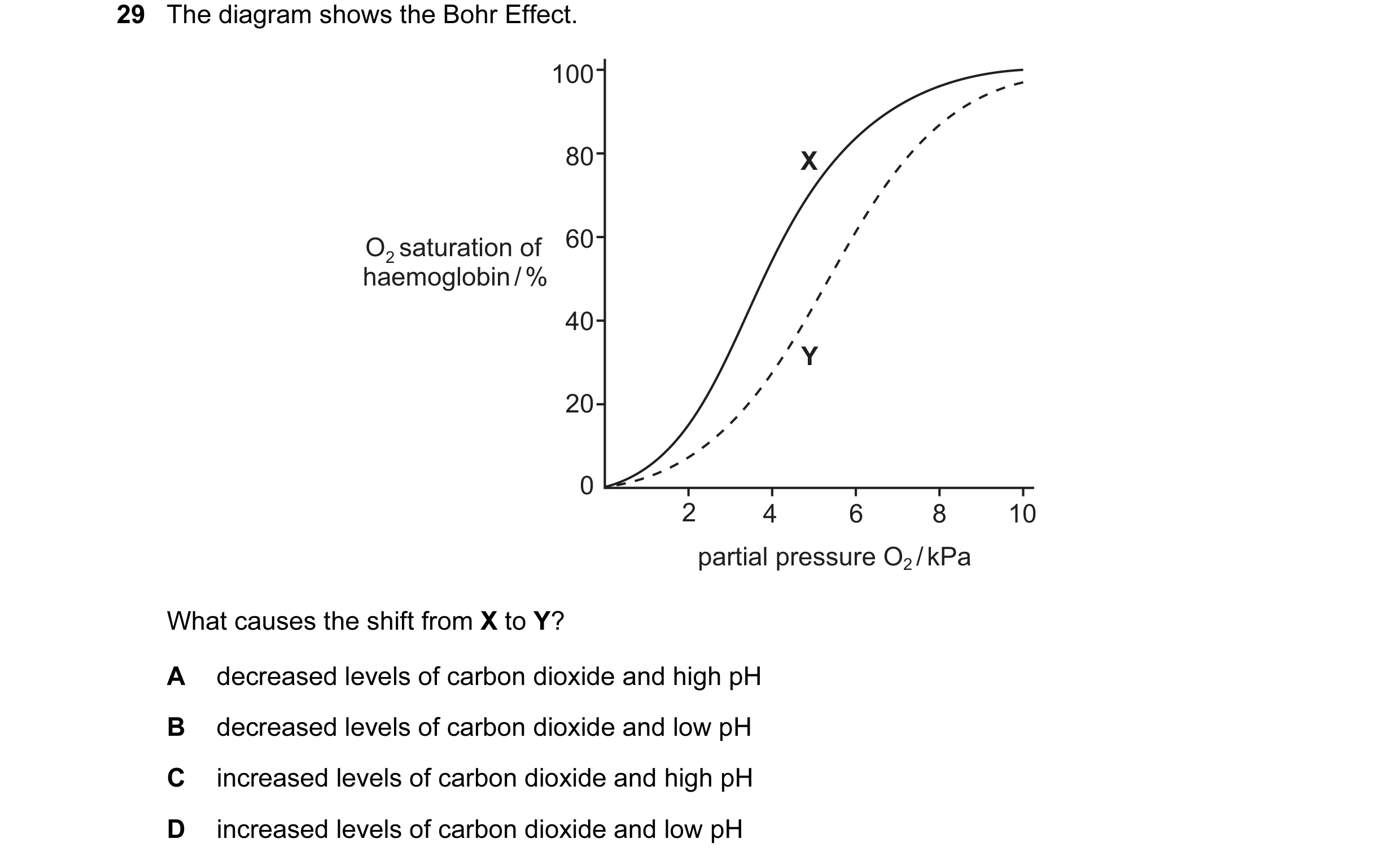
 1 / 59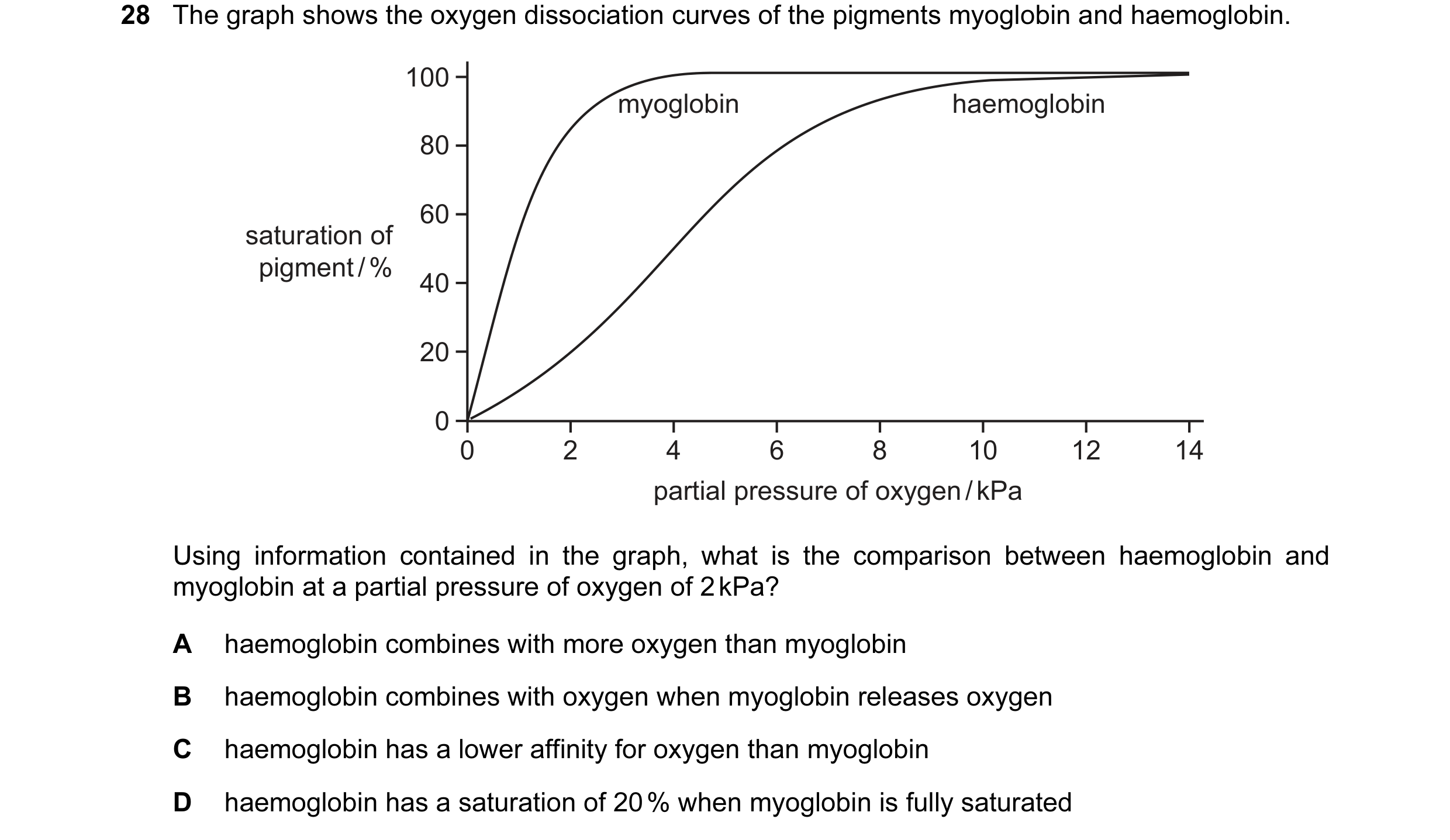
 2 / 59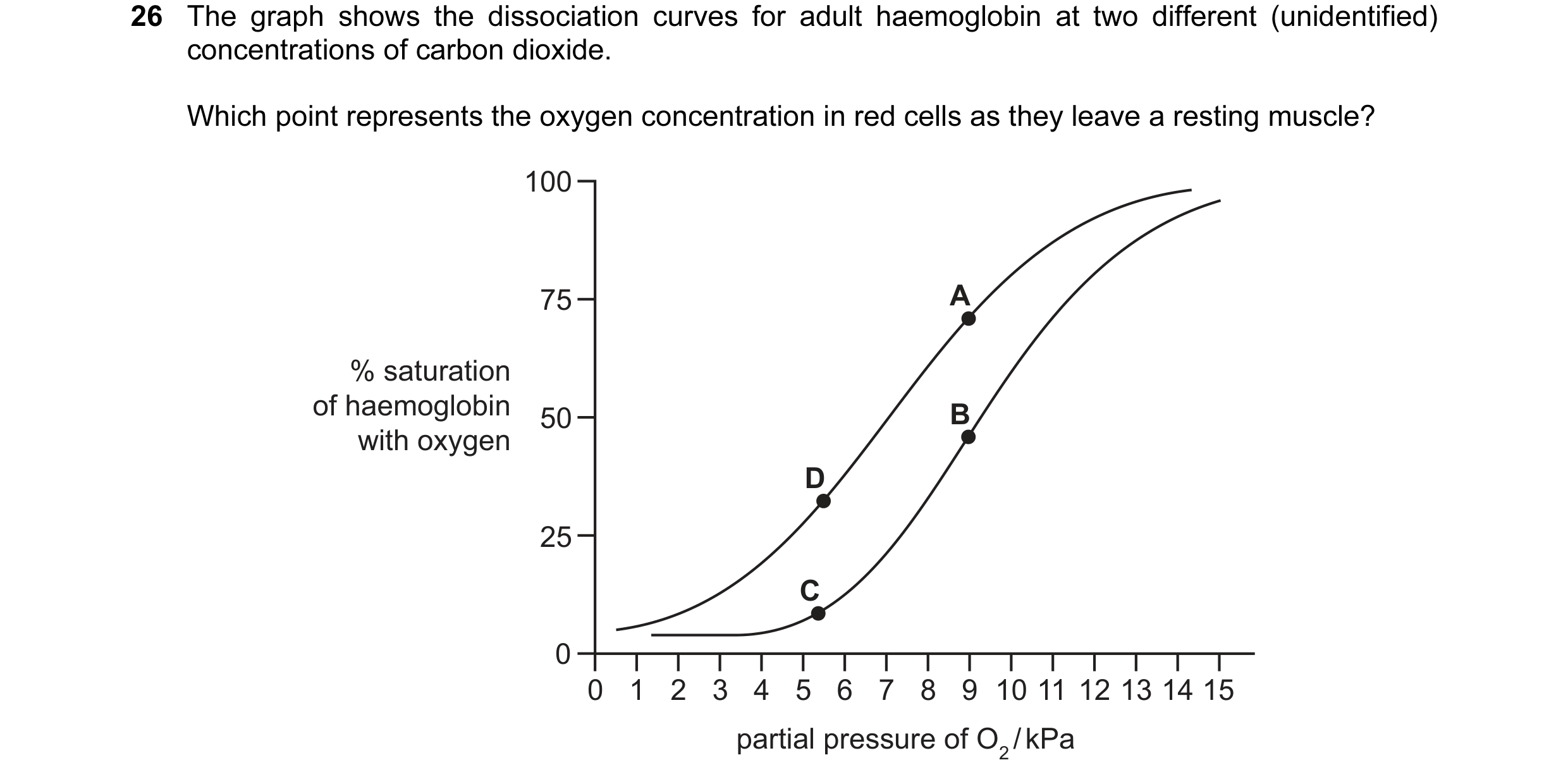
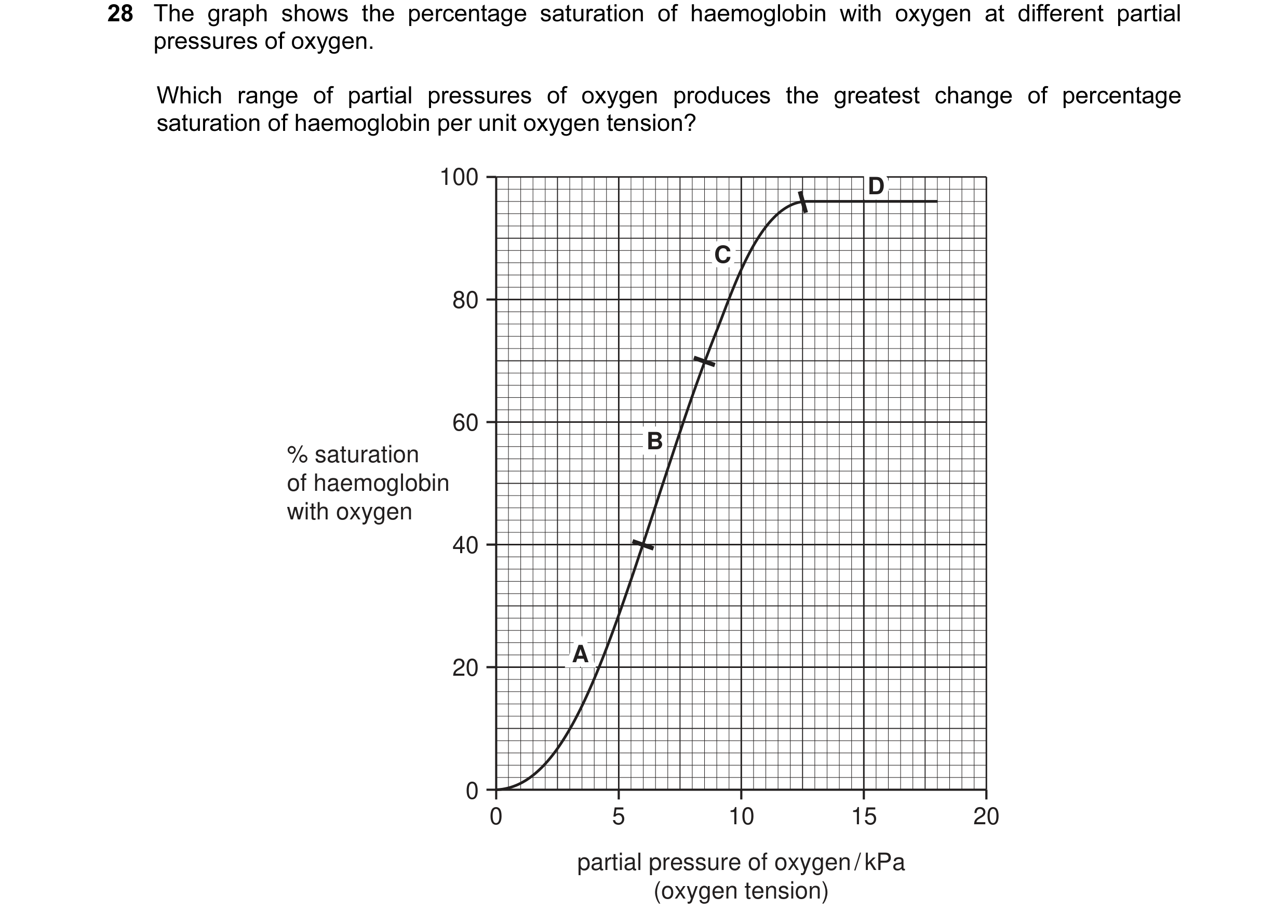
 3 / 59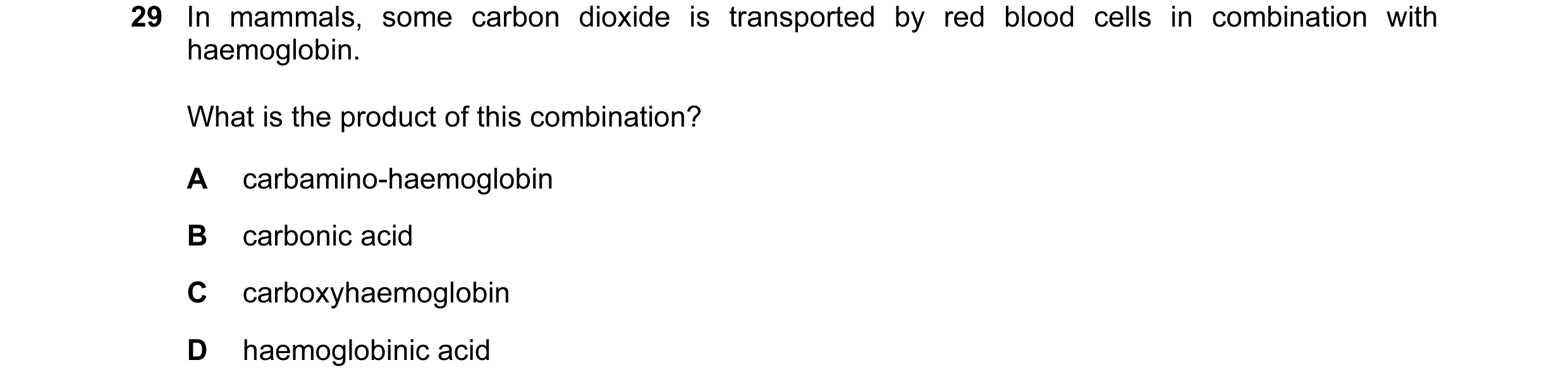
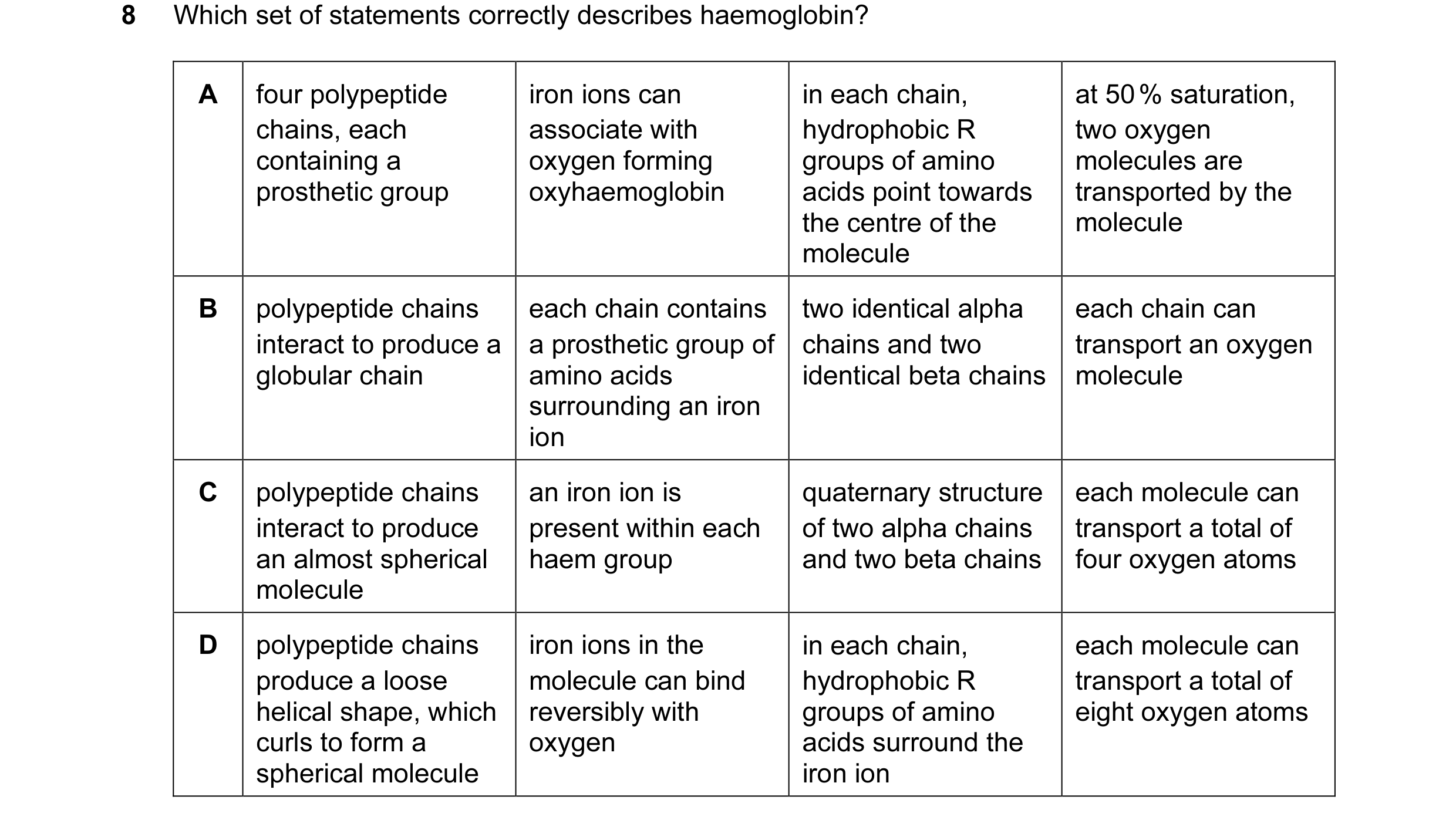 4 / 59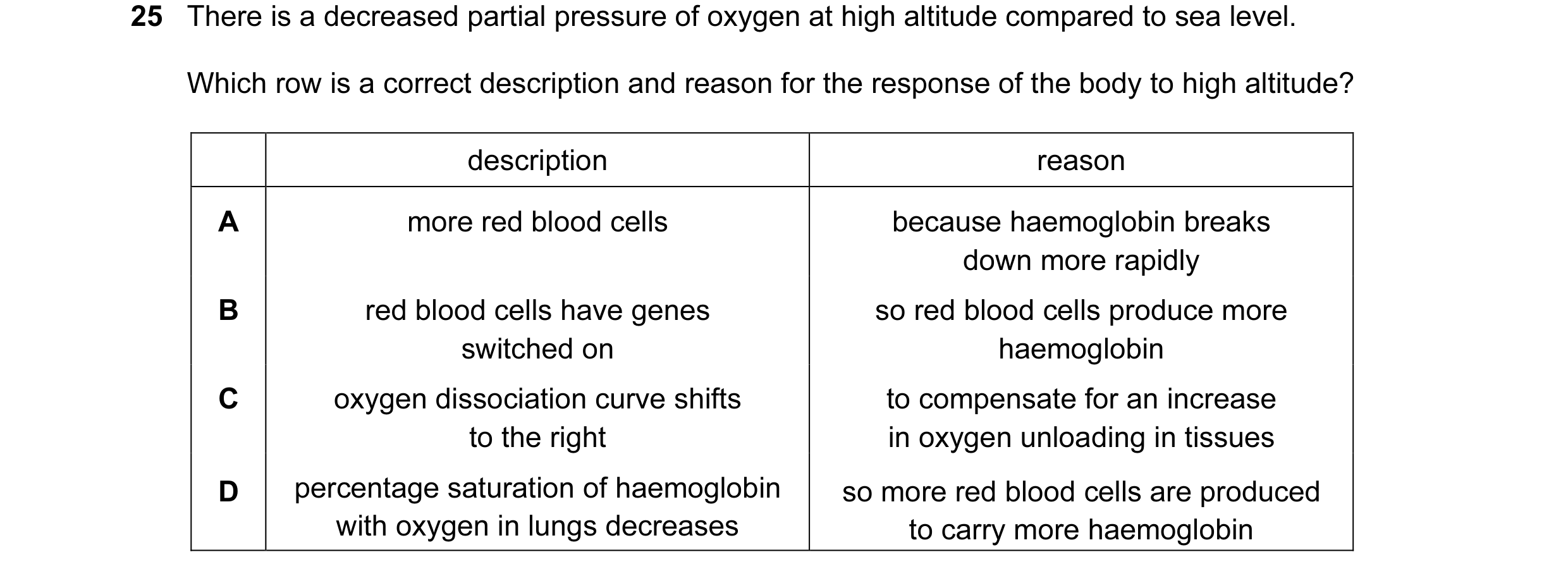
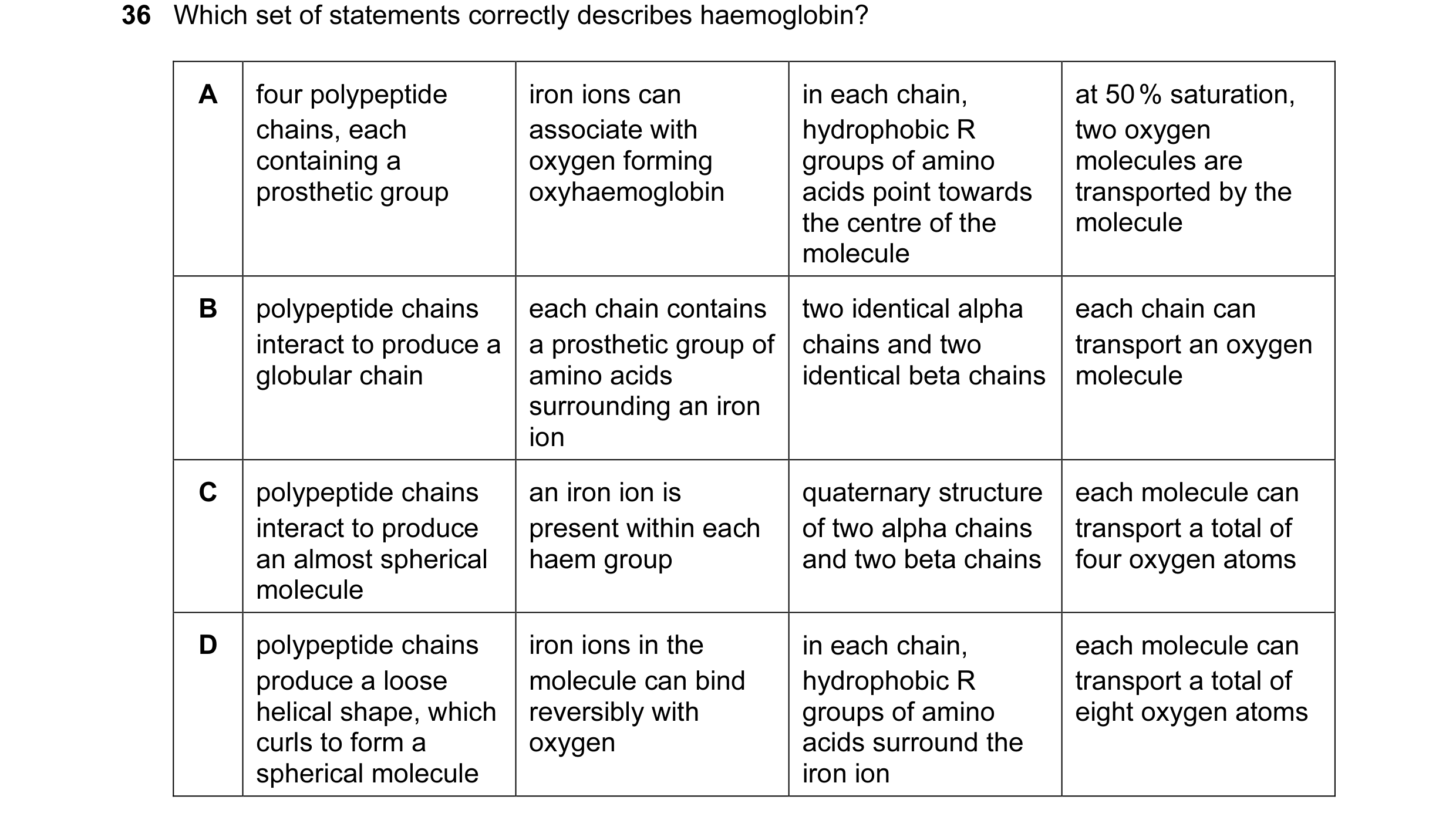 5 / 59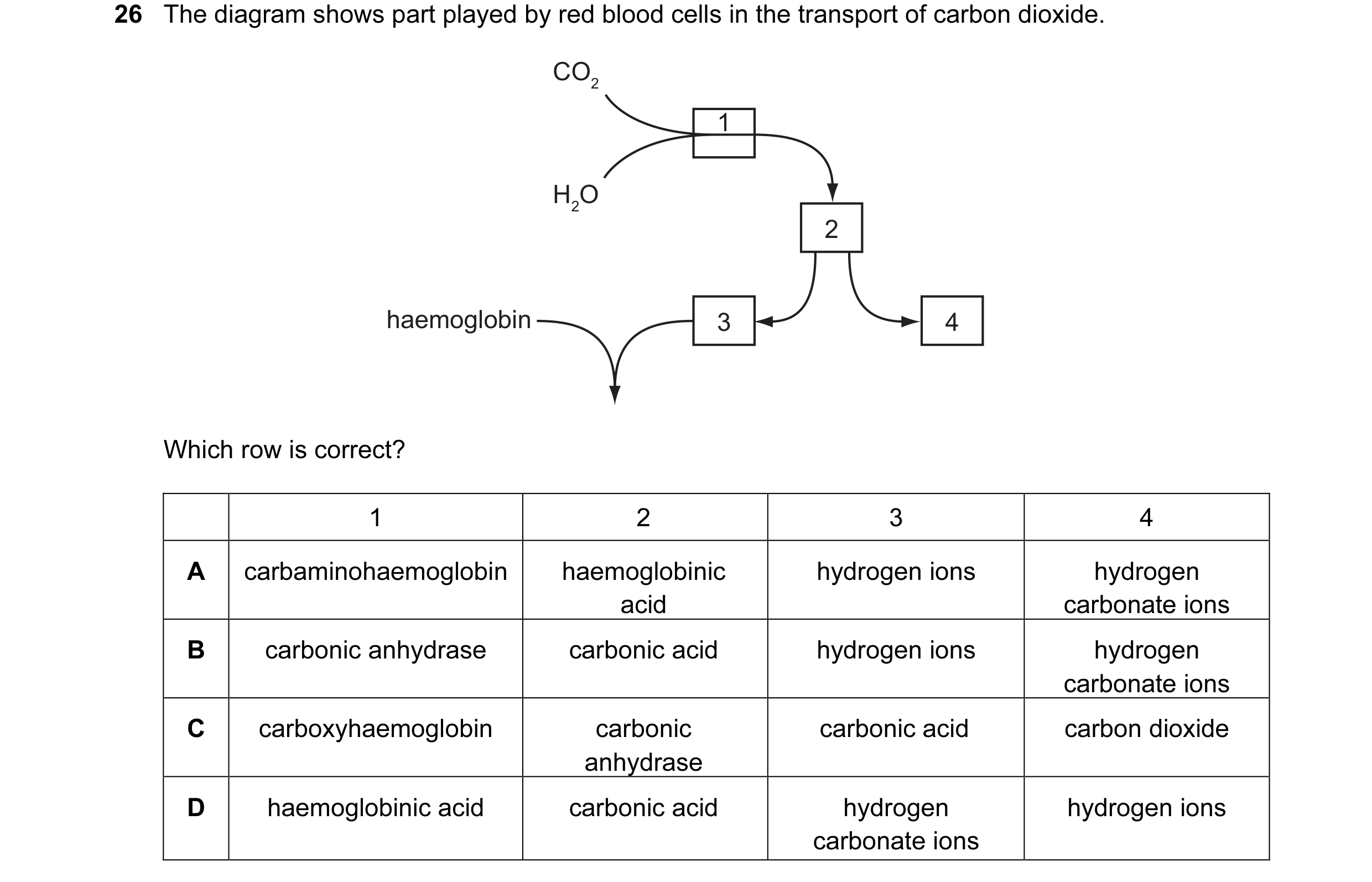
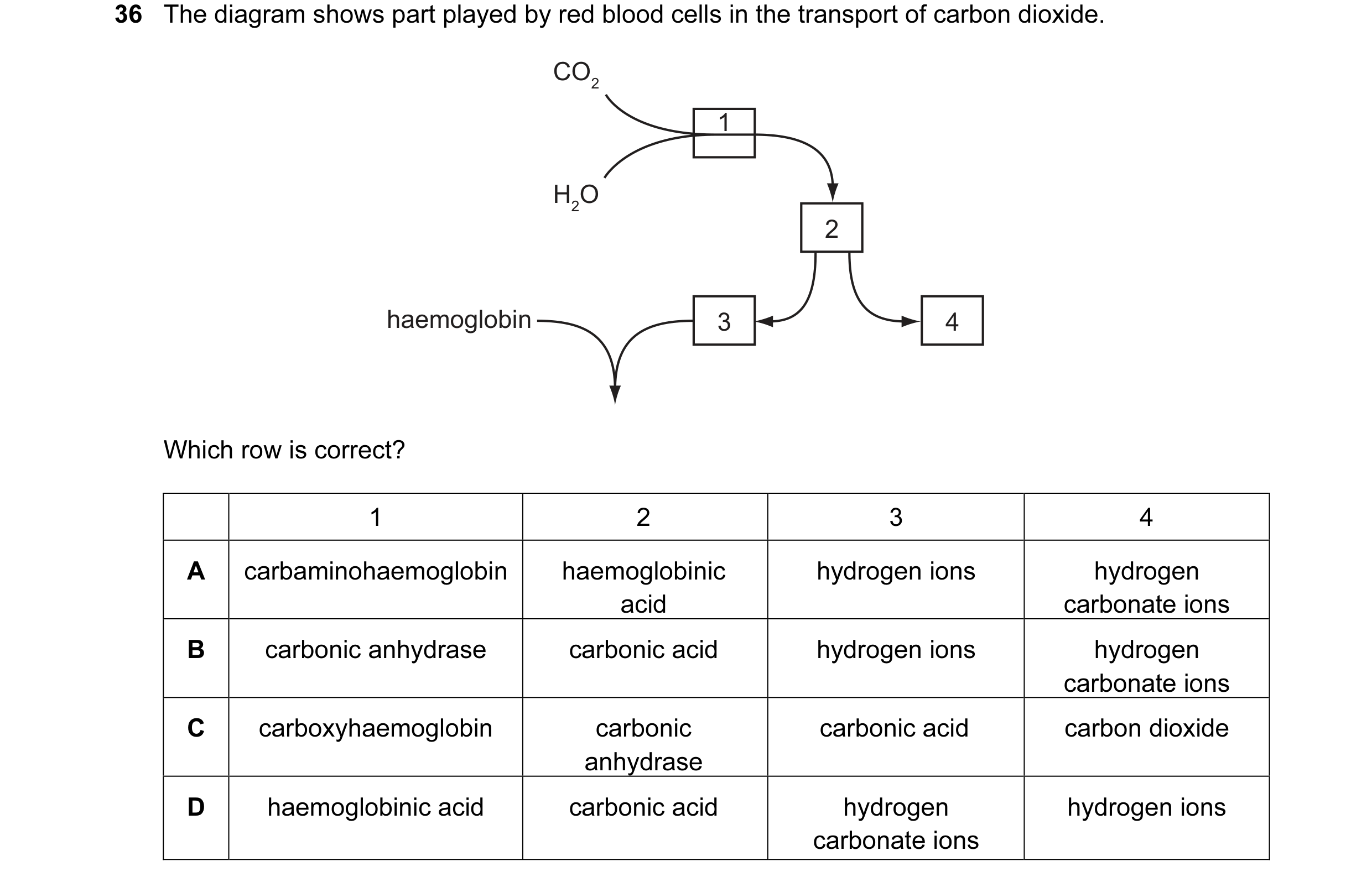 6 / 59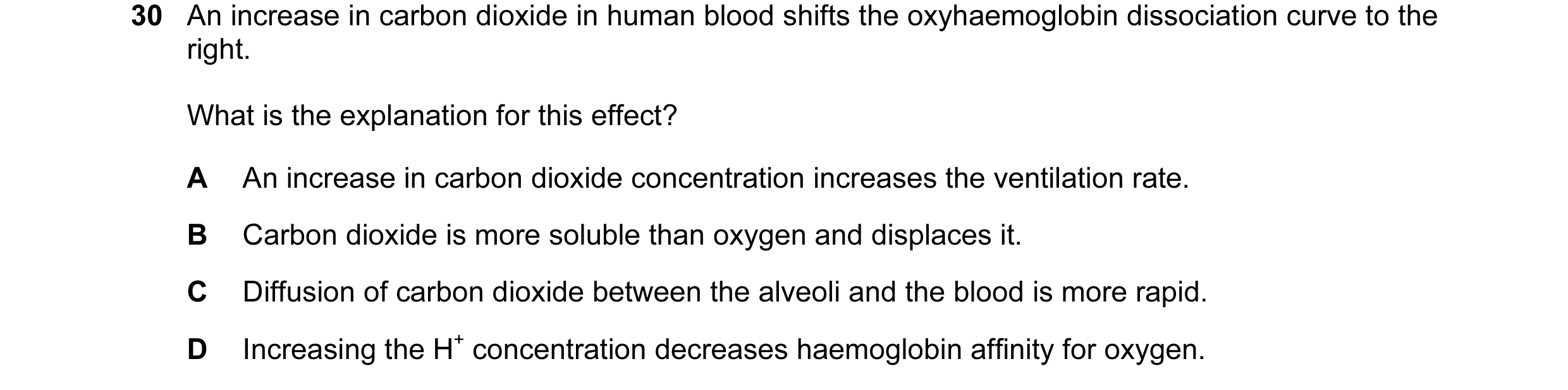
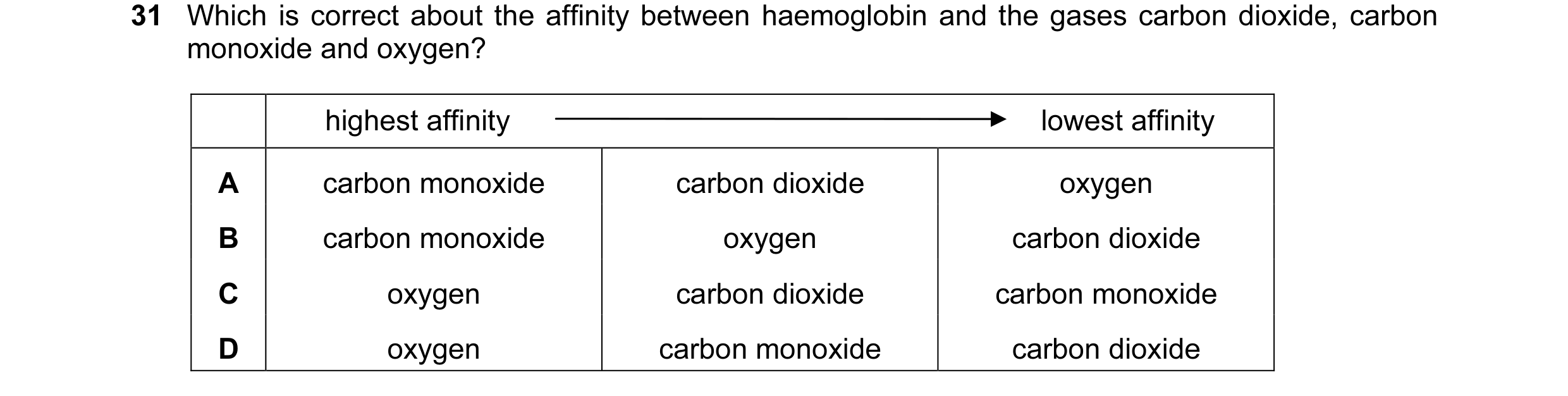
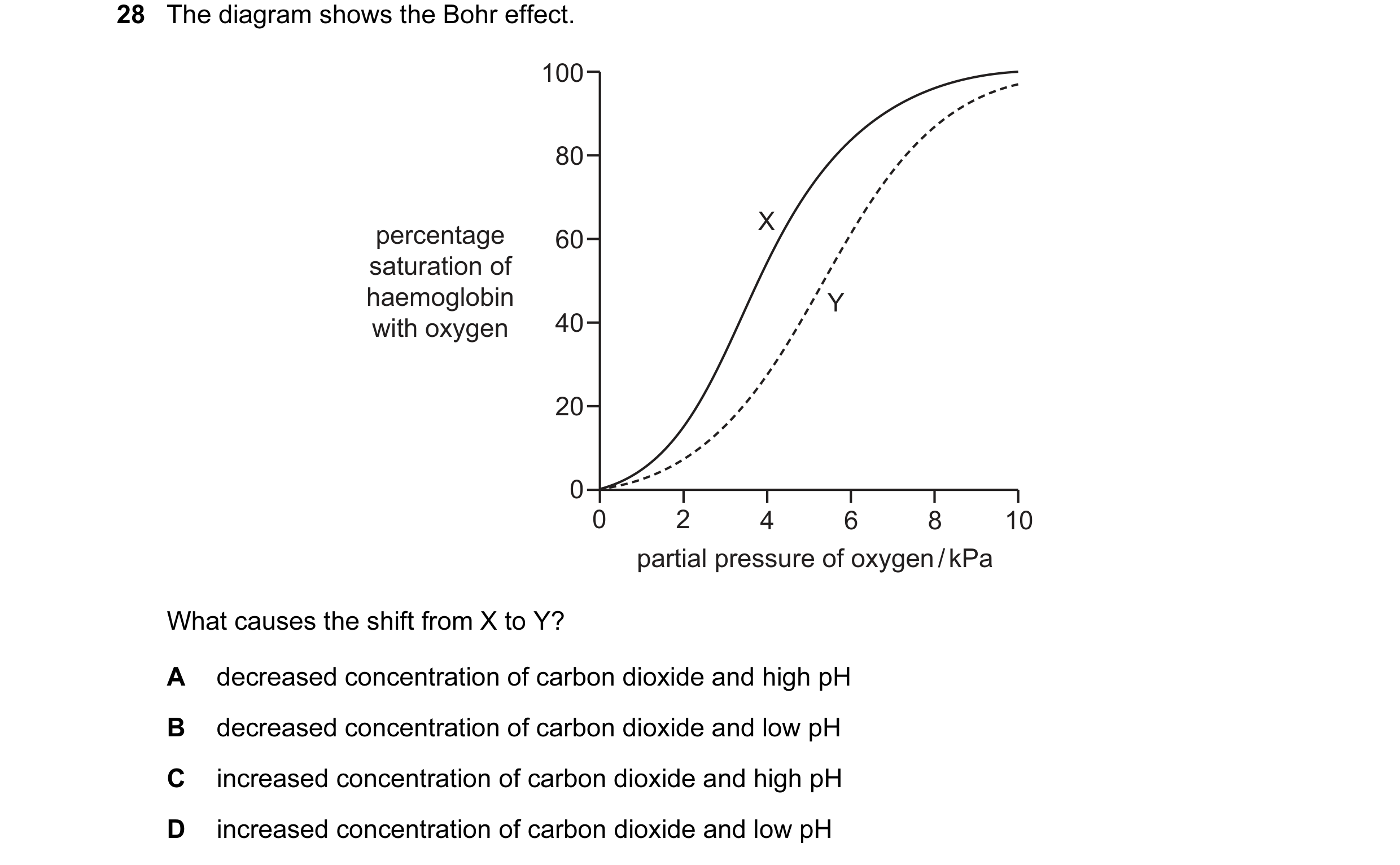 7 / 59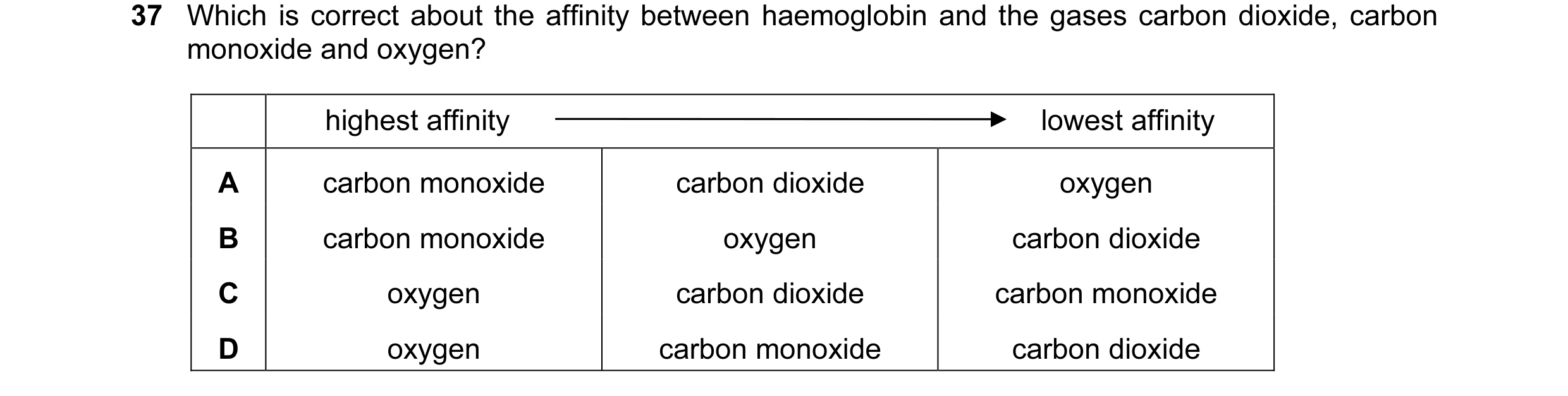
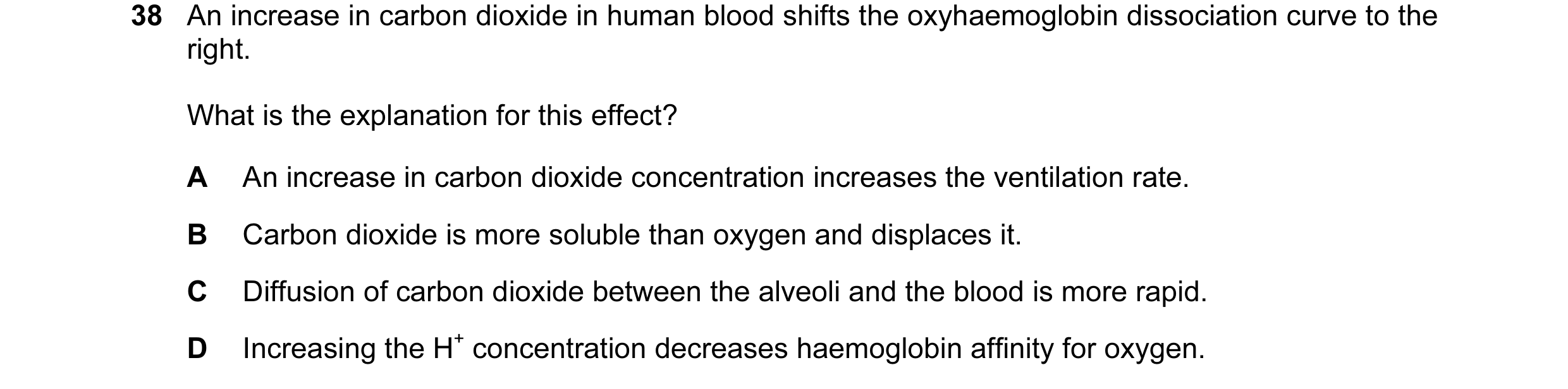
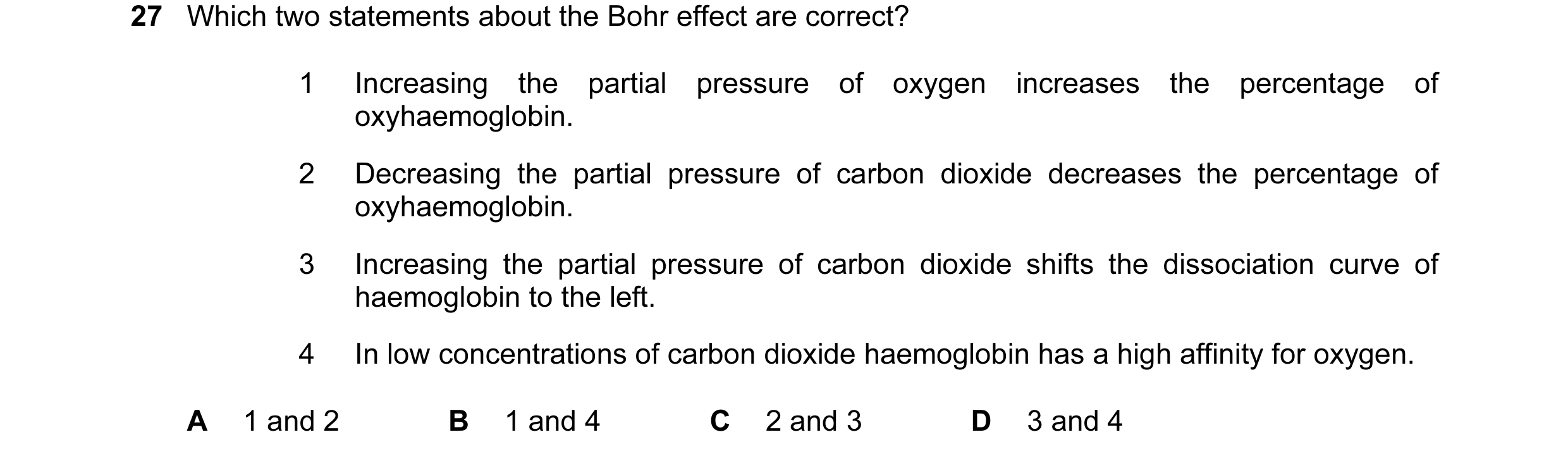
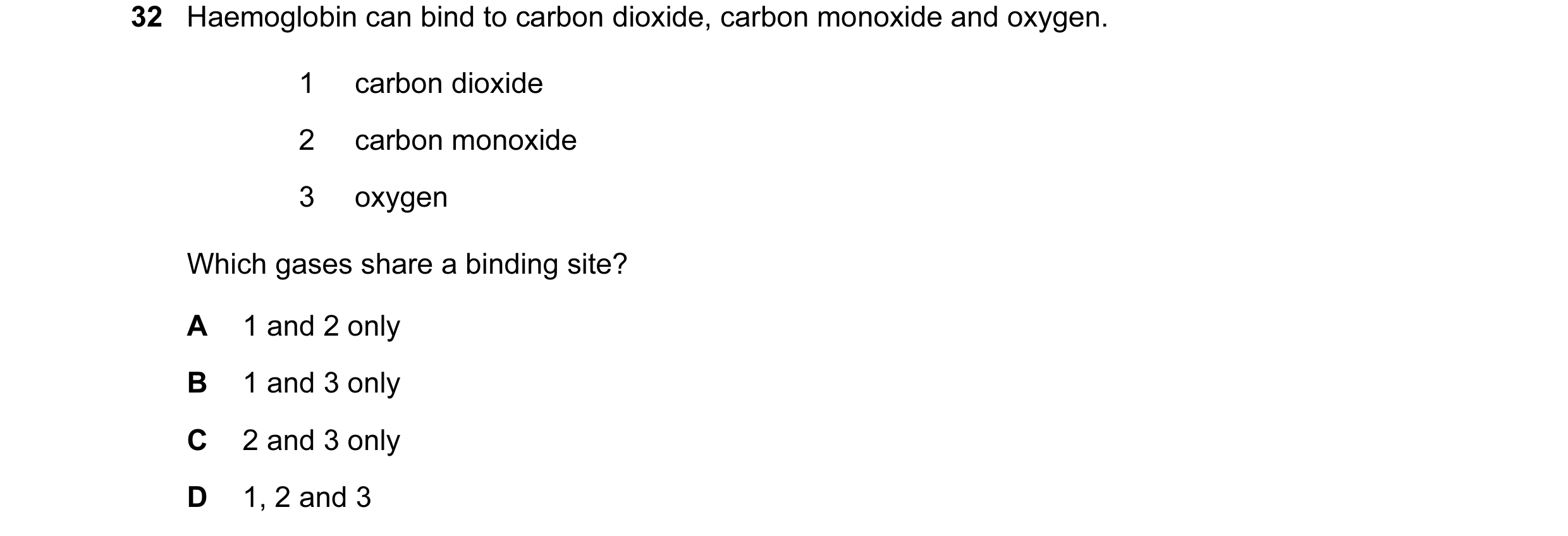 8 / 59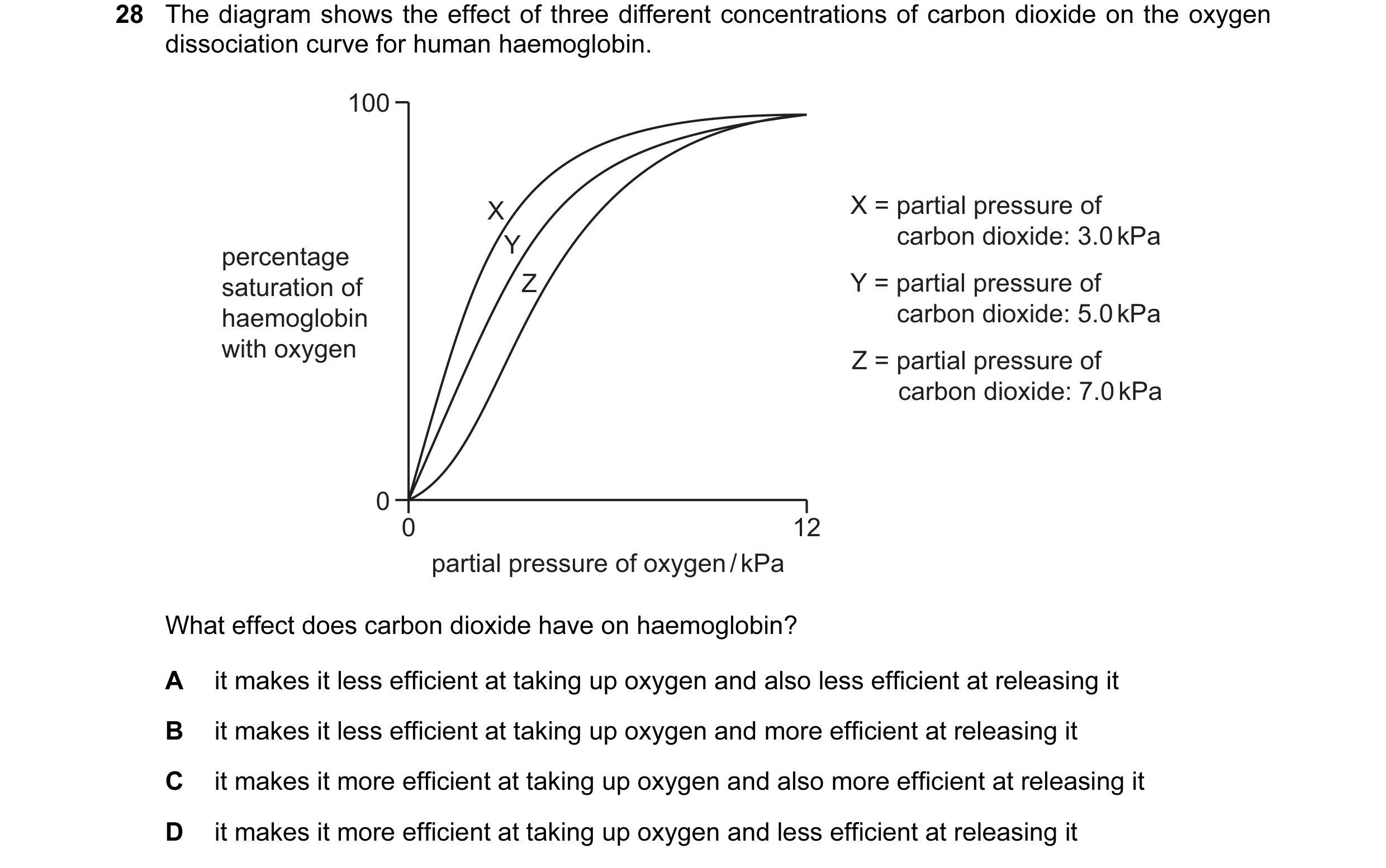


 9 / 59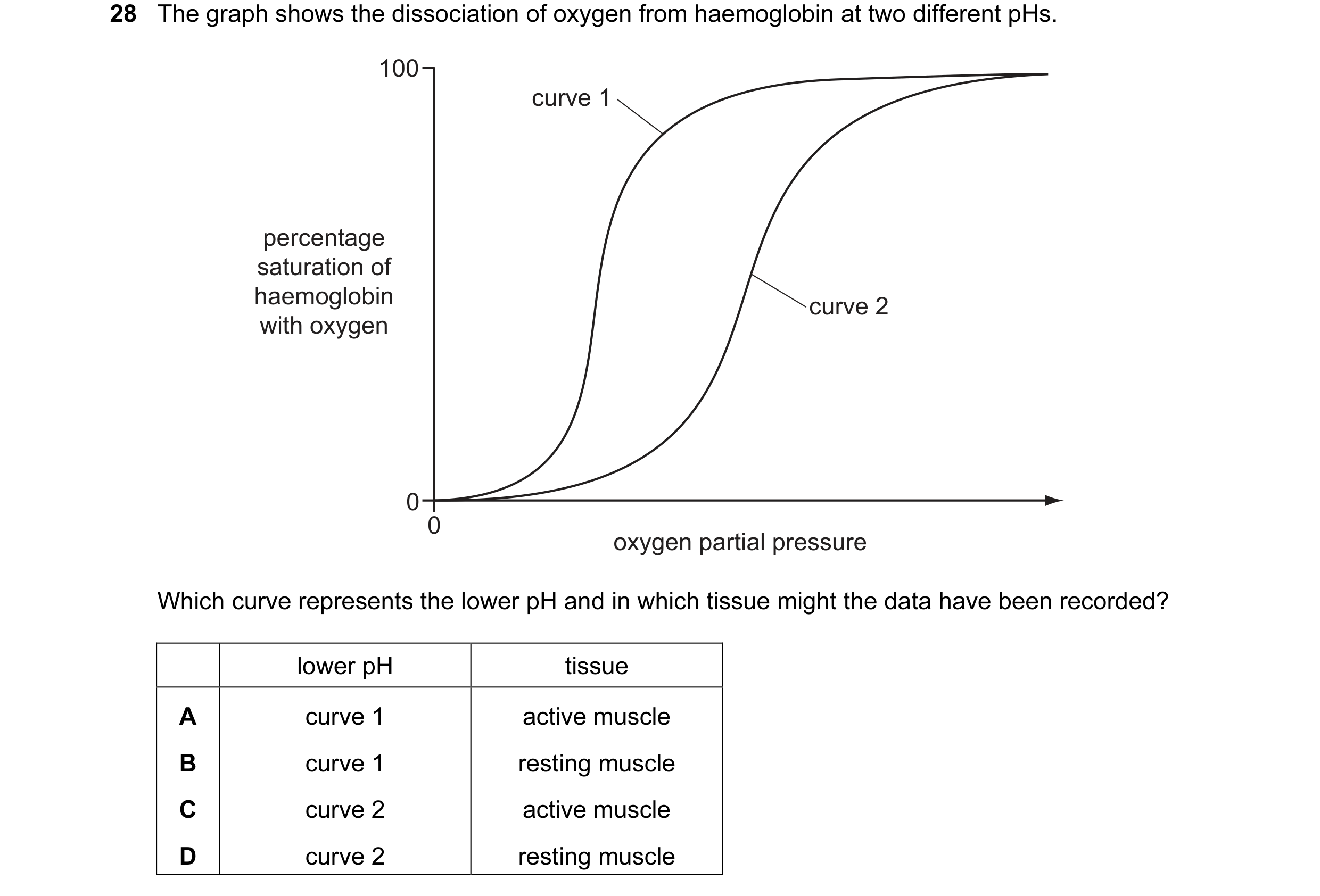
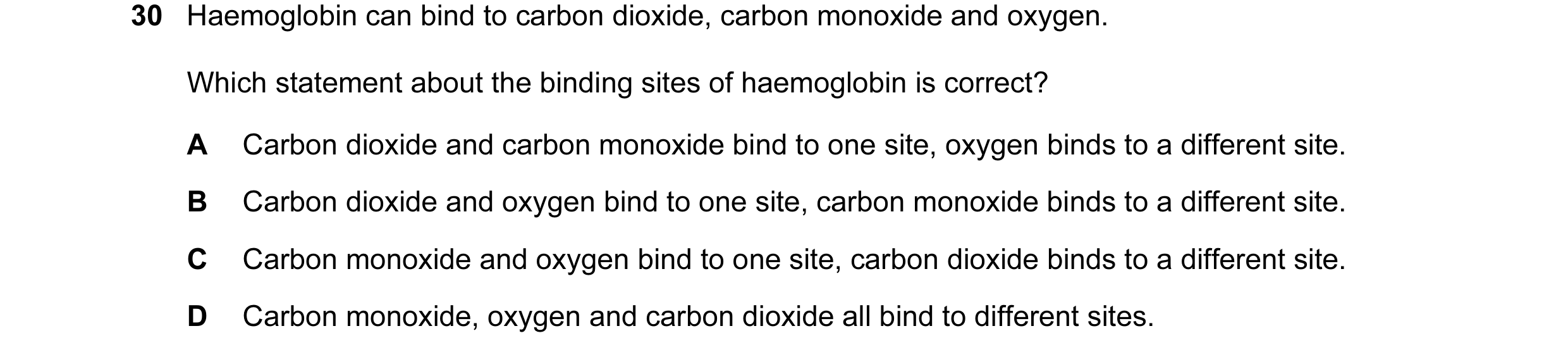
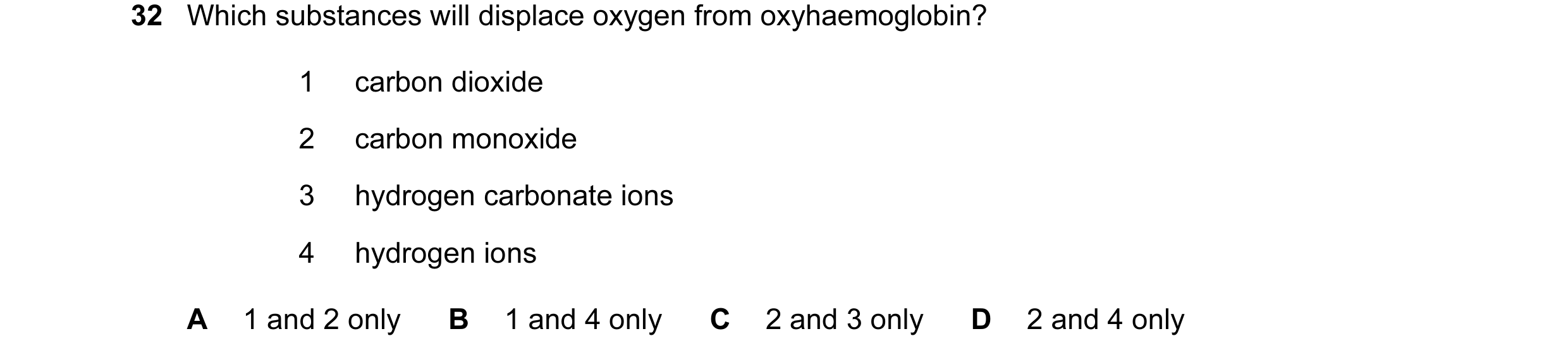 10 / 59
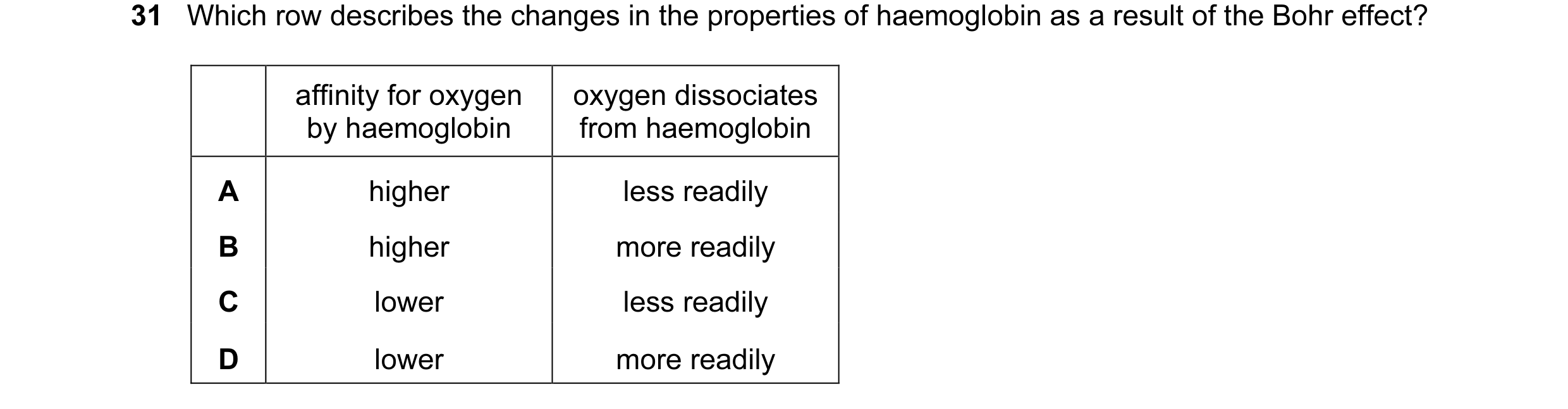
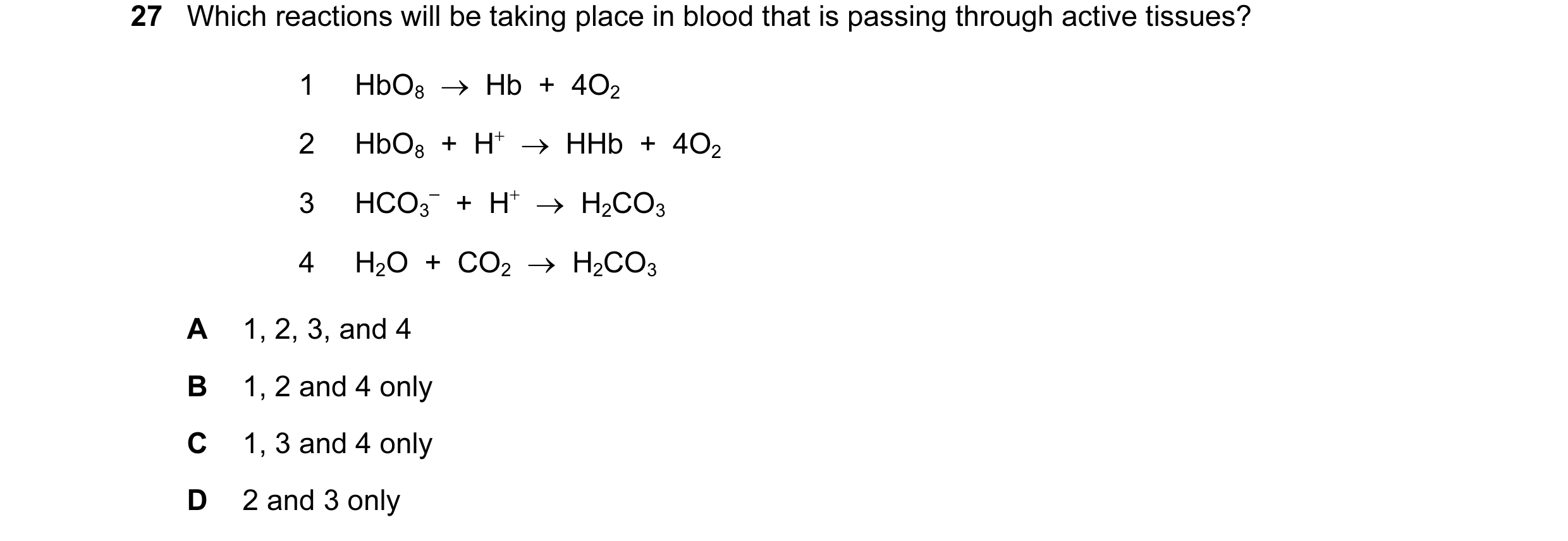

 11 / 59
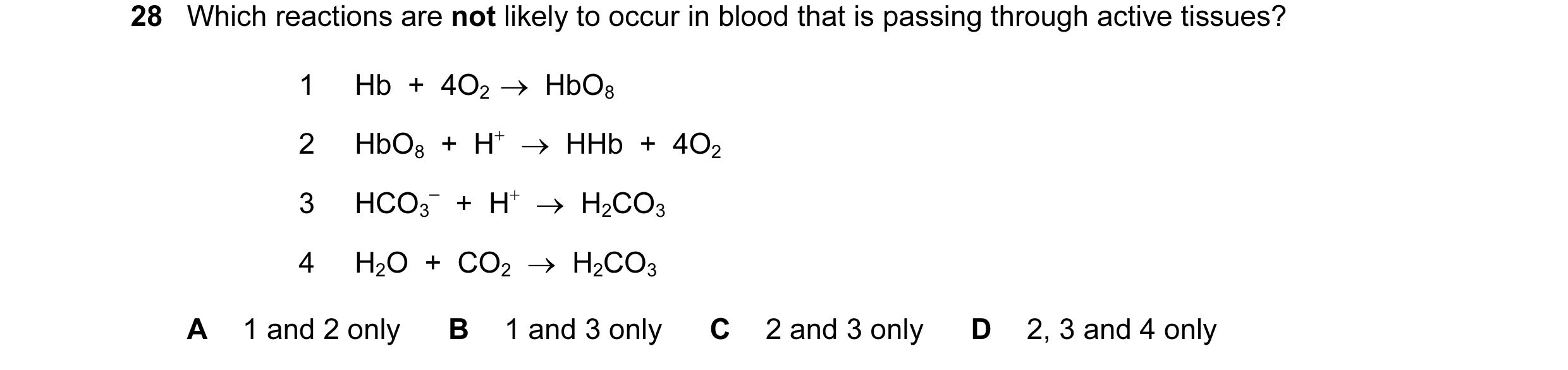
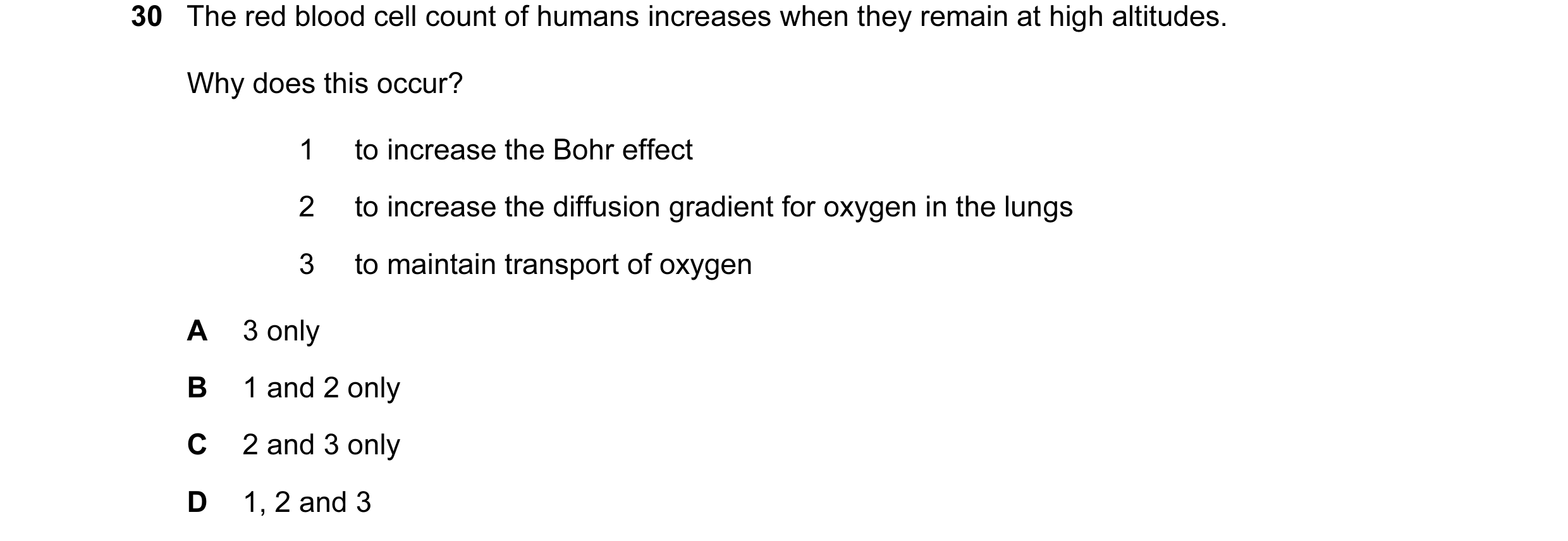
 12 / 59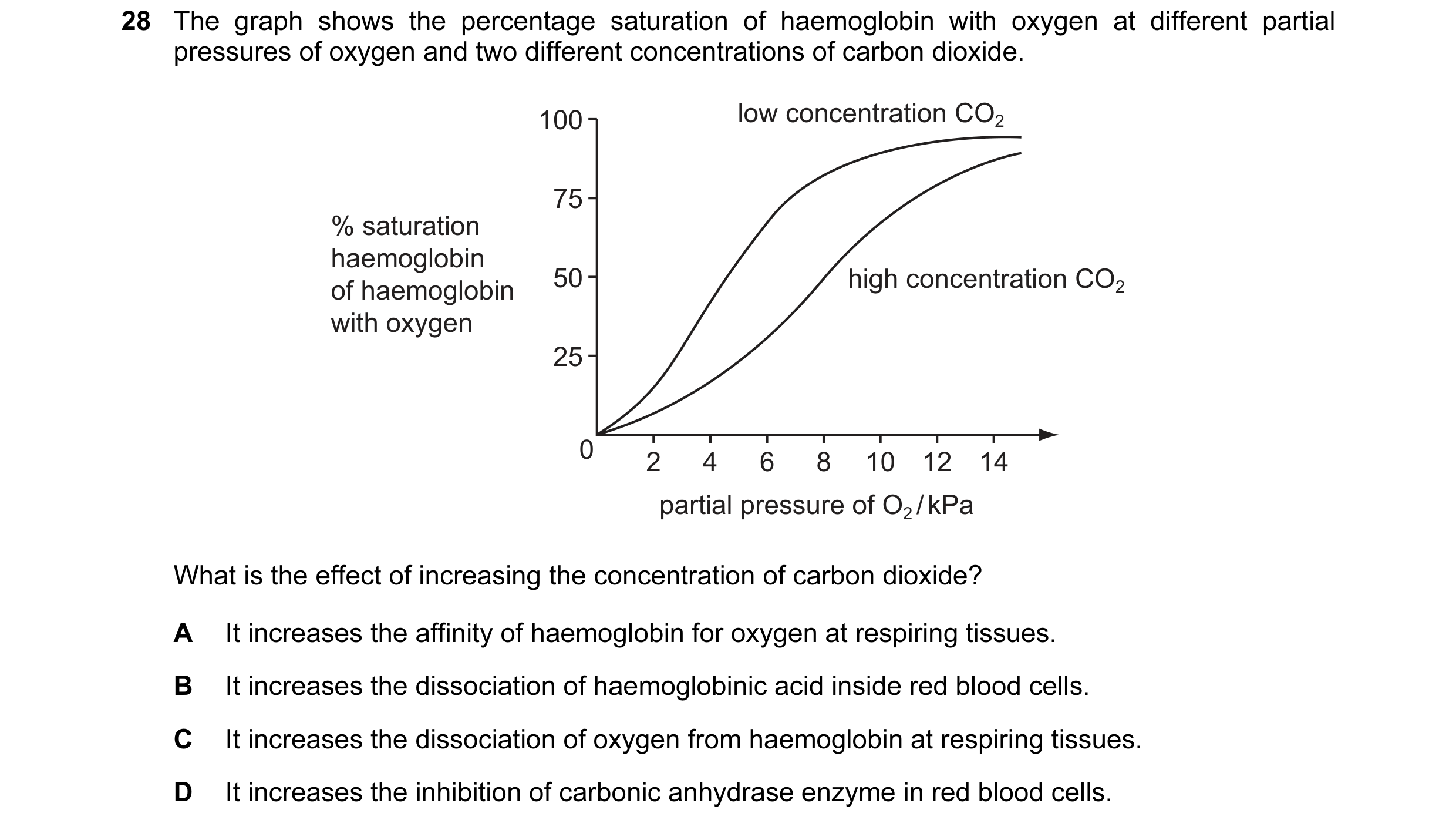
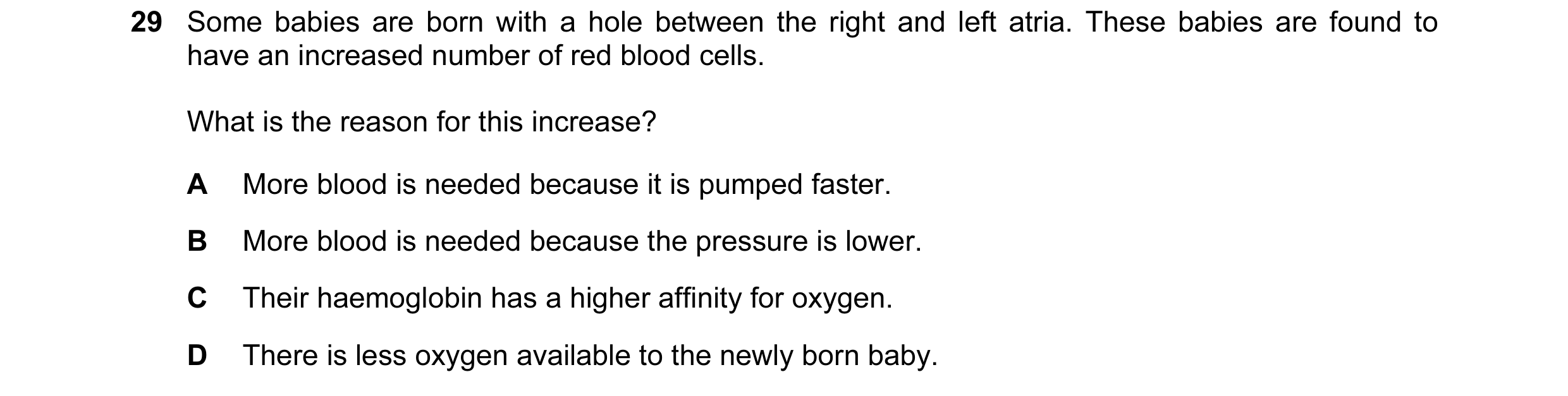
 13 / 59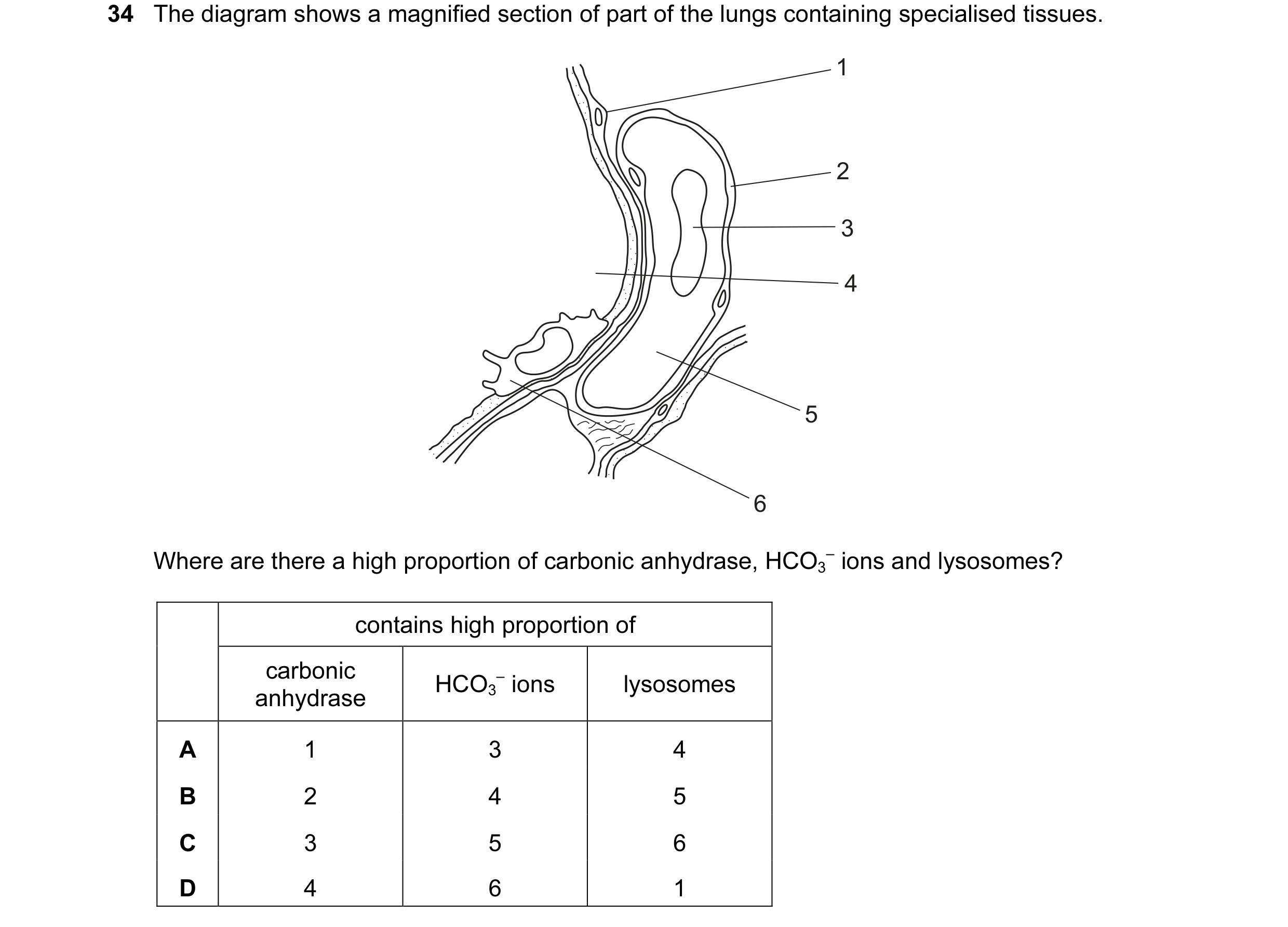

 14 / 59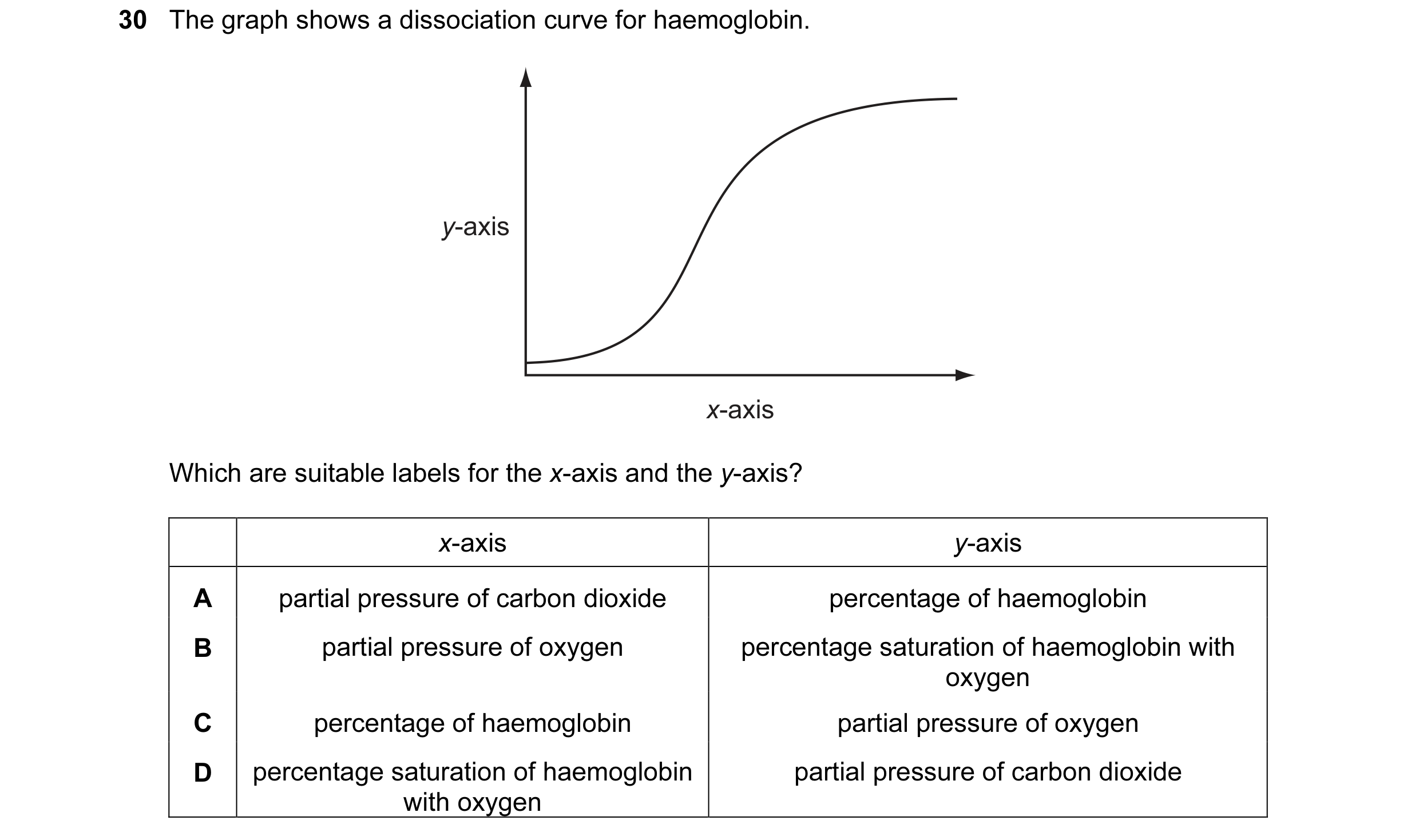

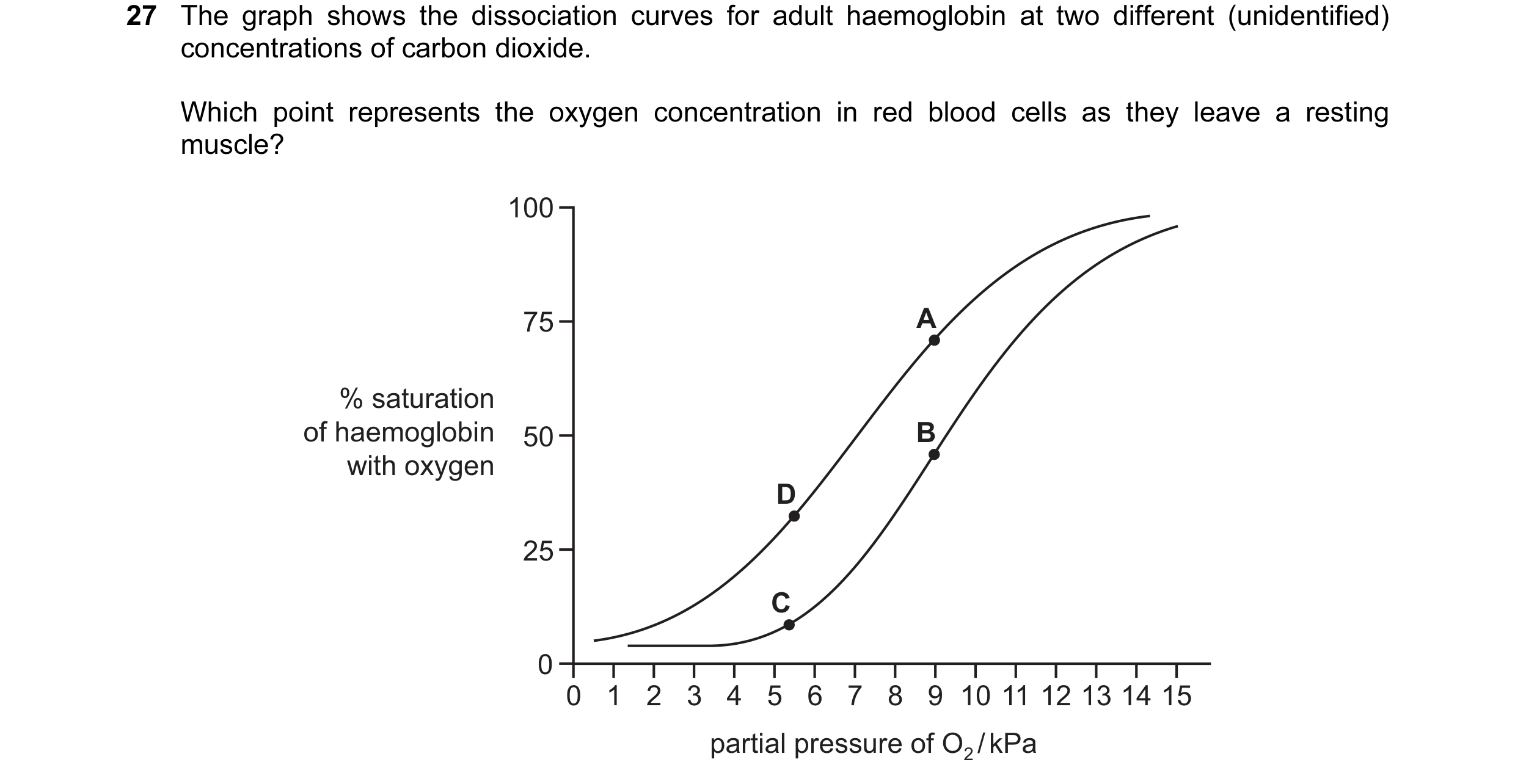 15 / 59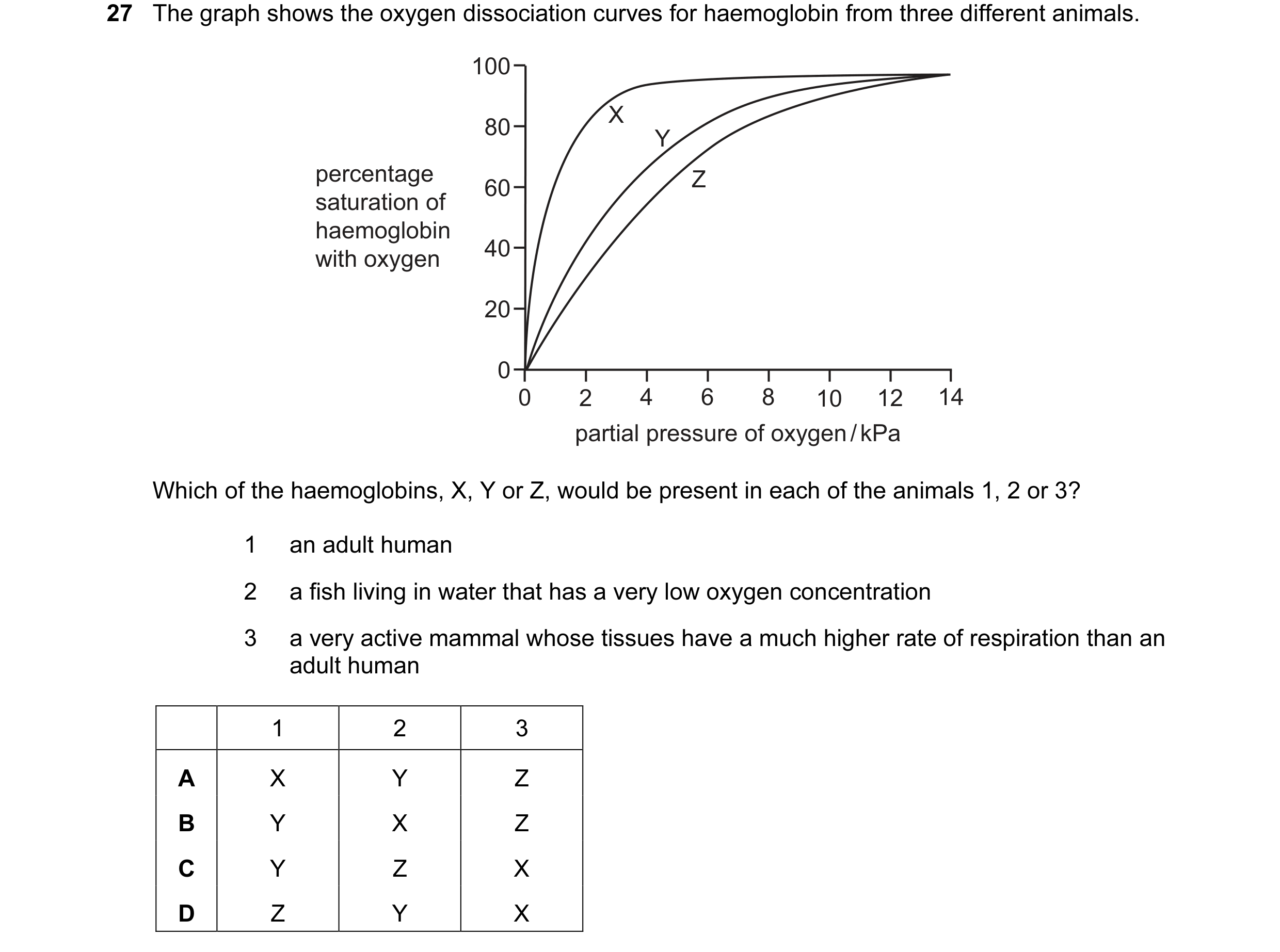
 16 / 59
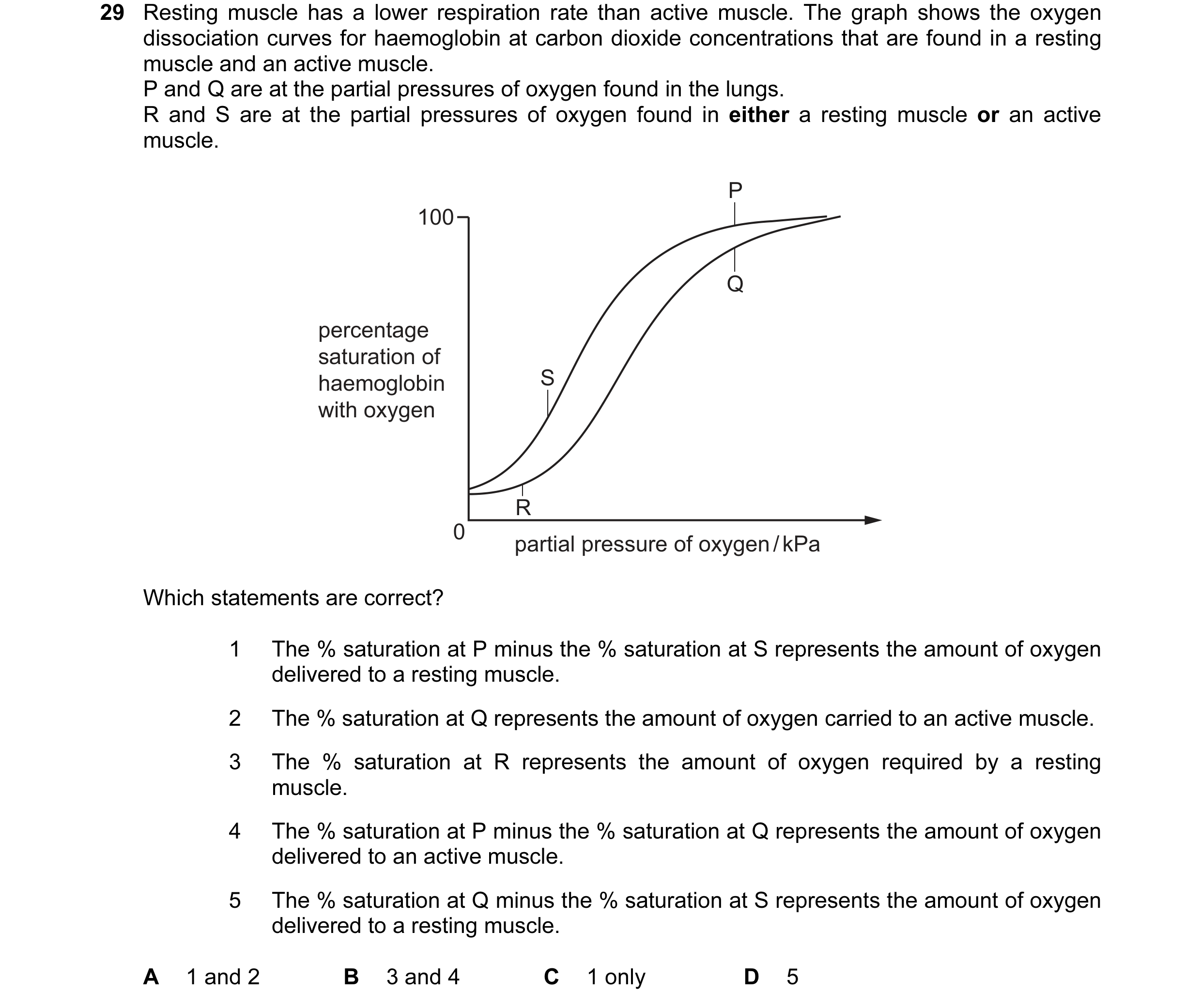
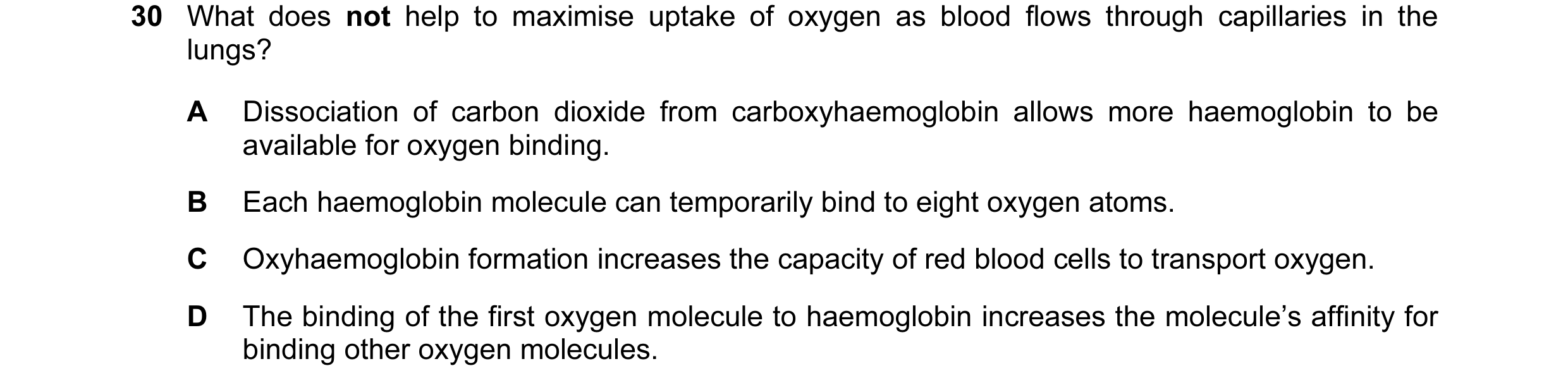 17 / 59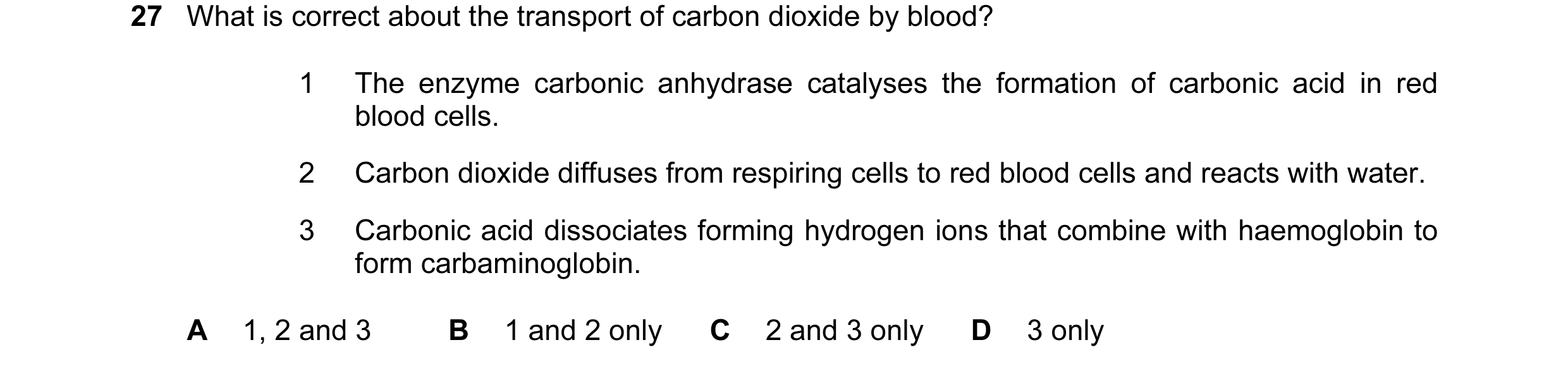
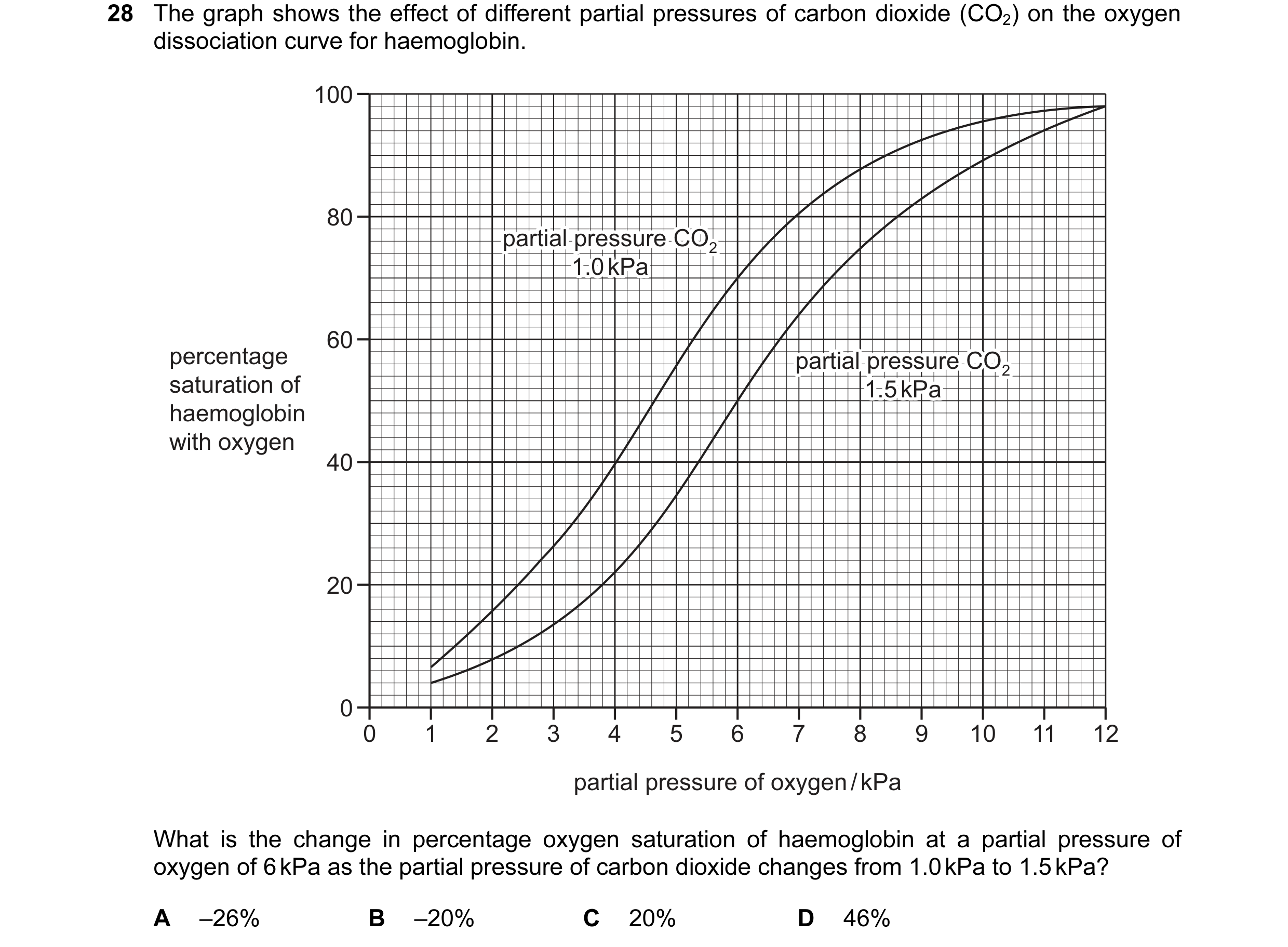
 18 / 59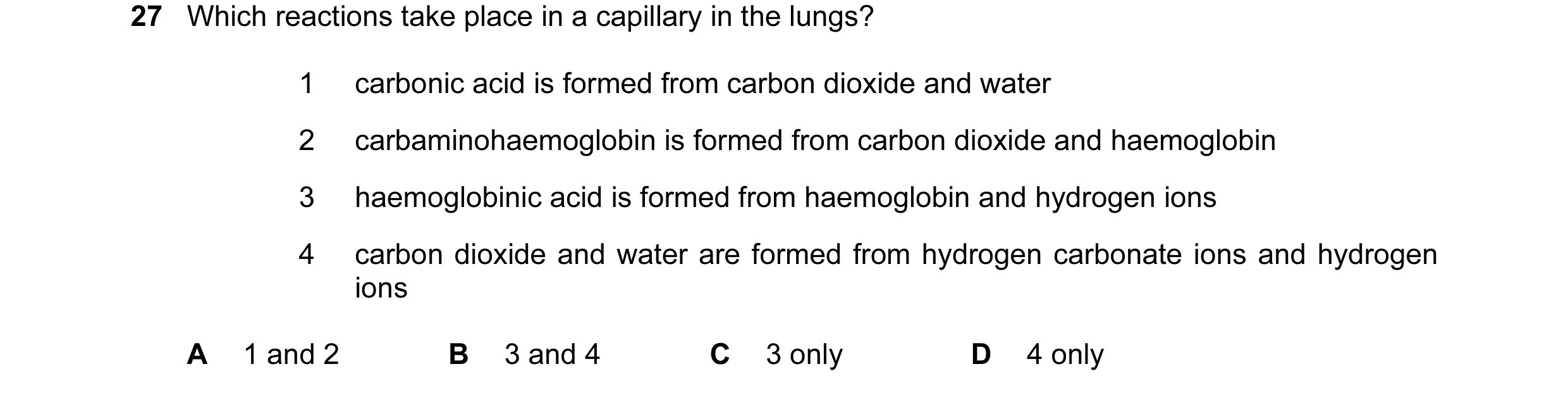
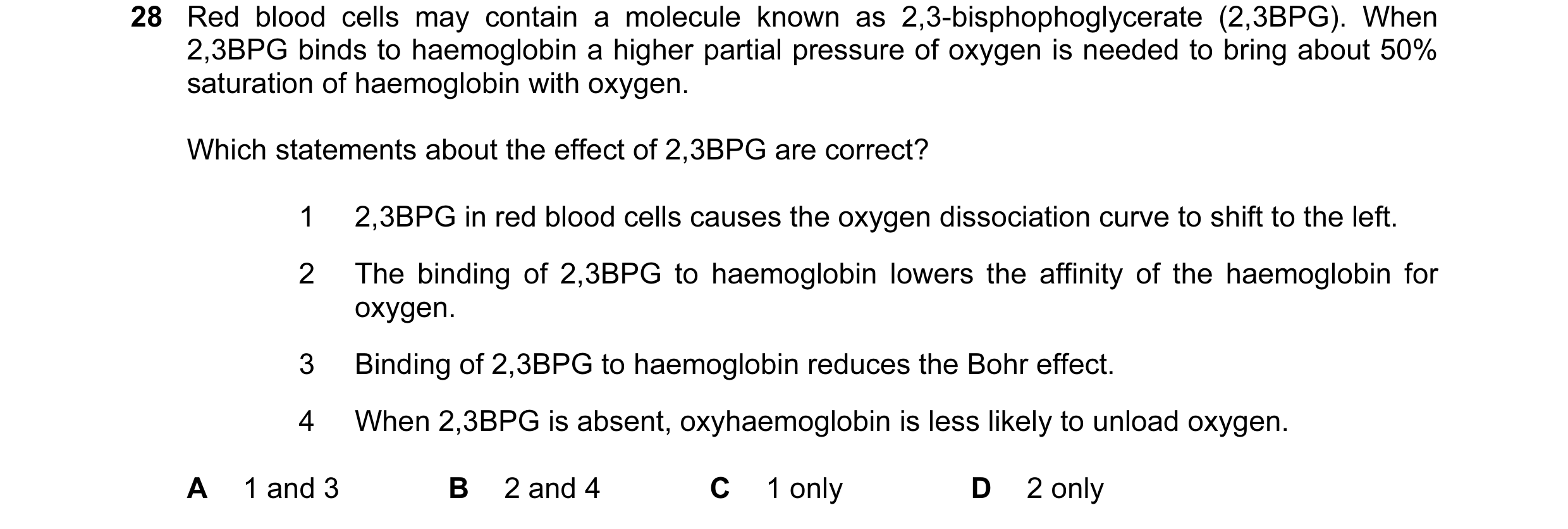
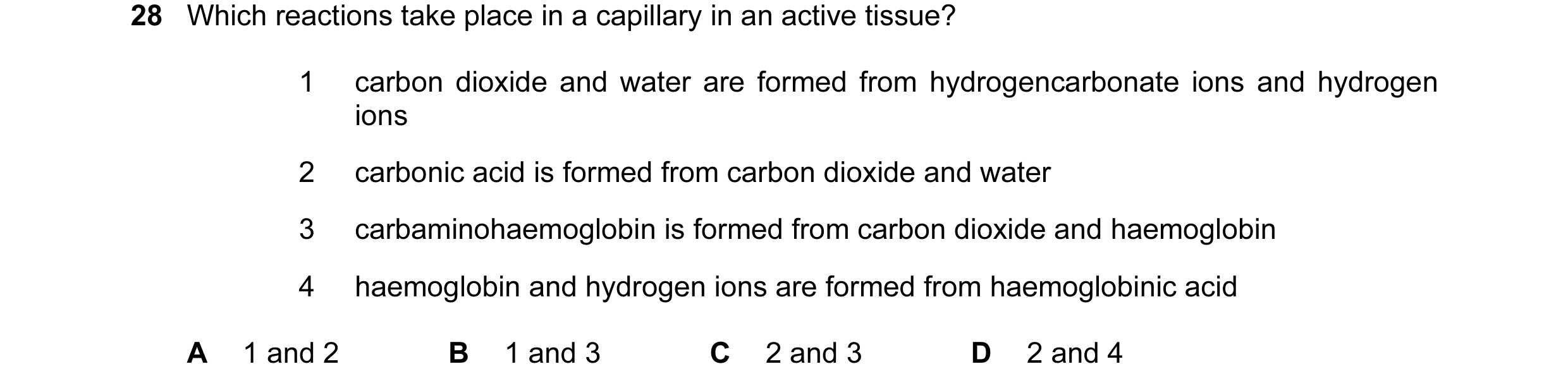
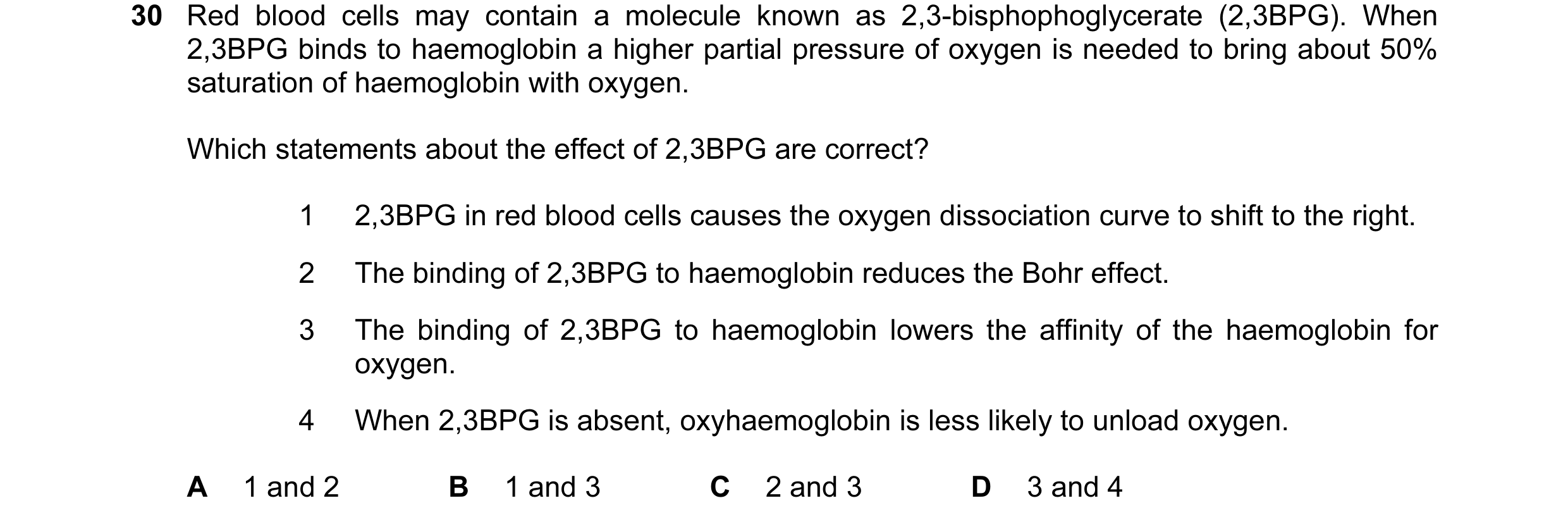 19 / 59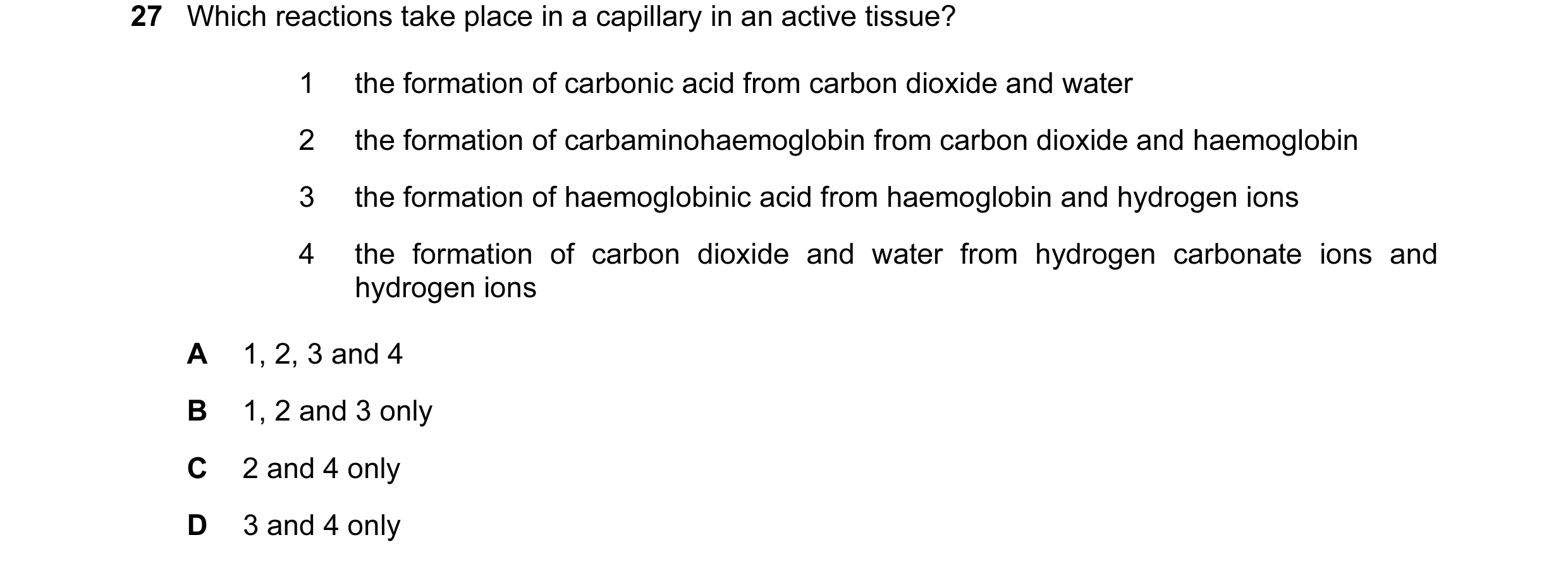

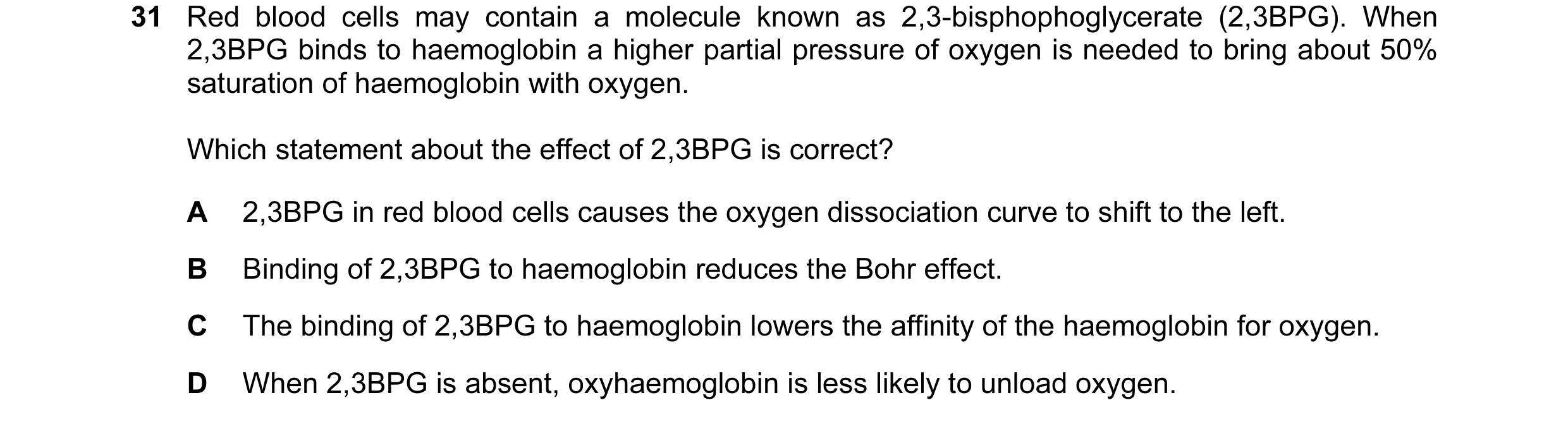
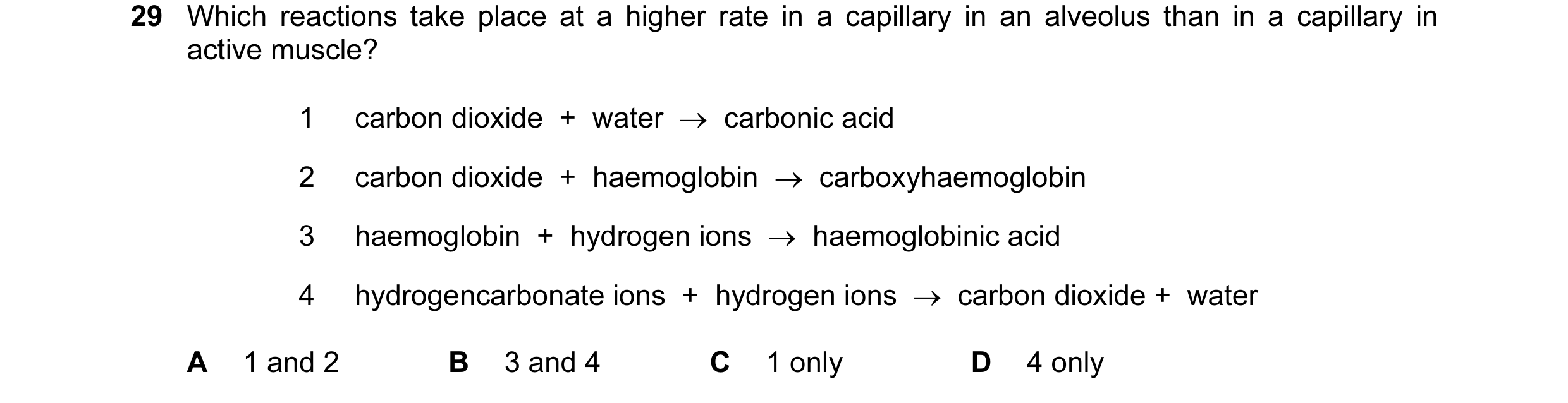 20 / 59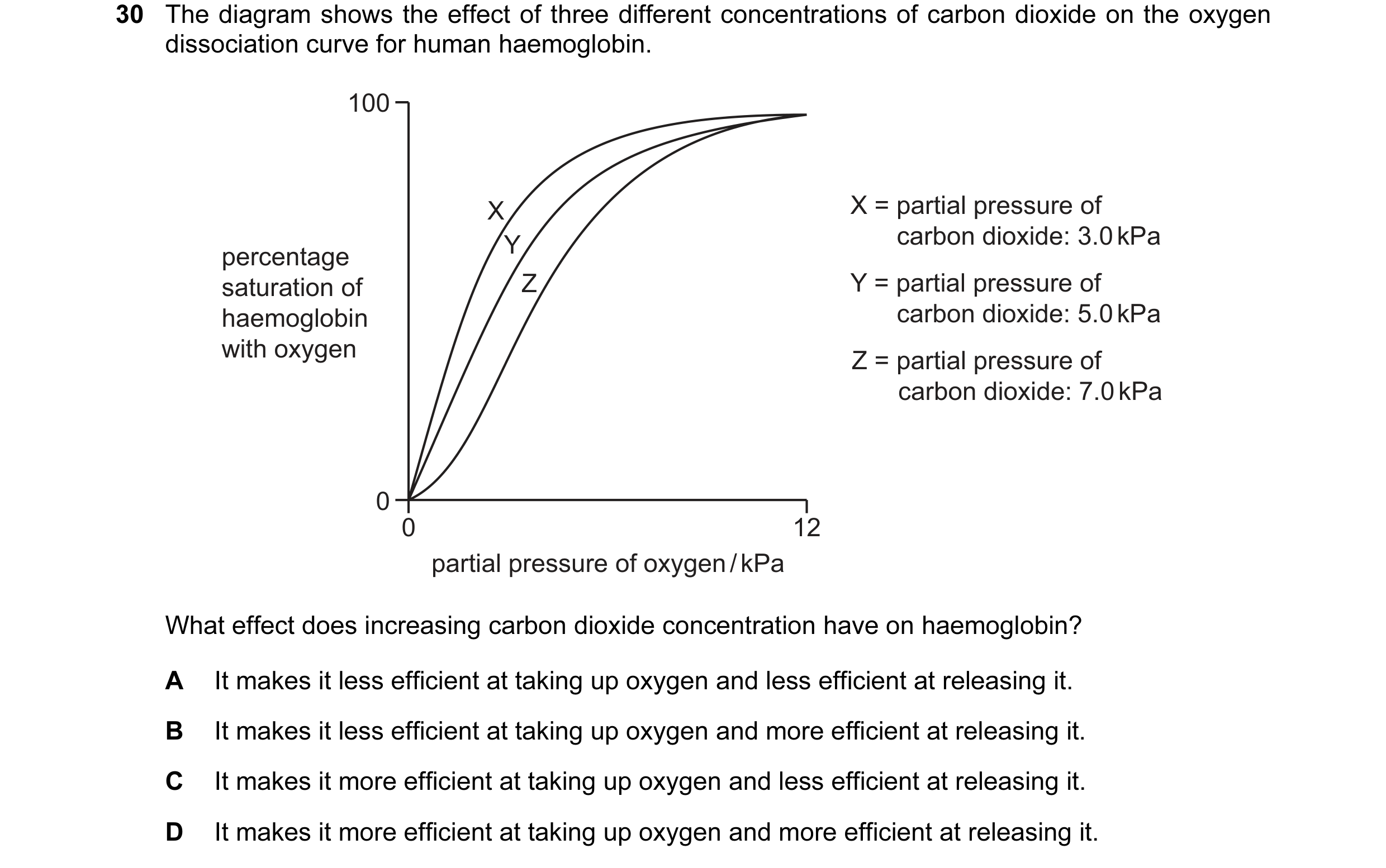
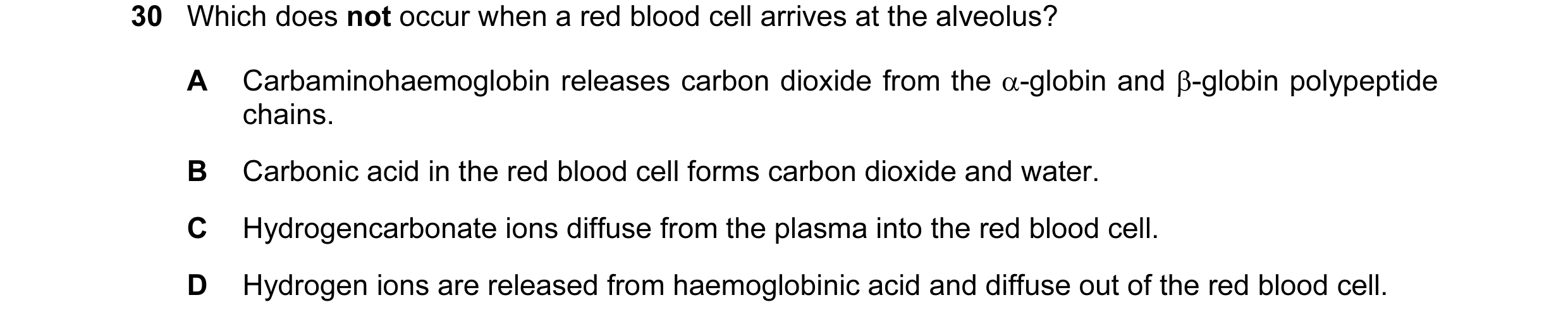 21 / 59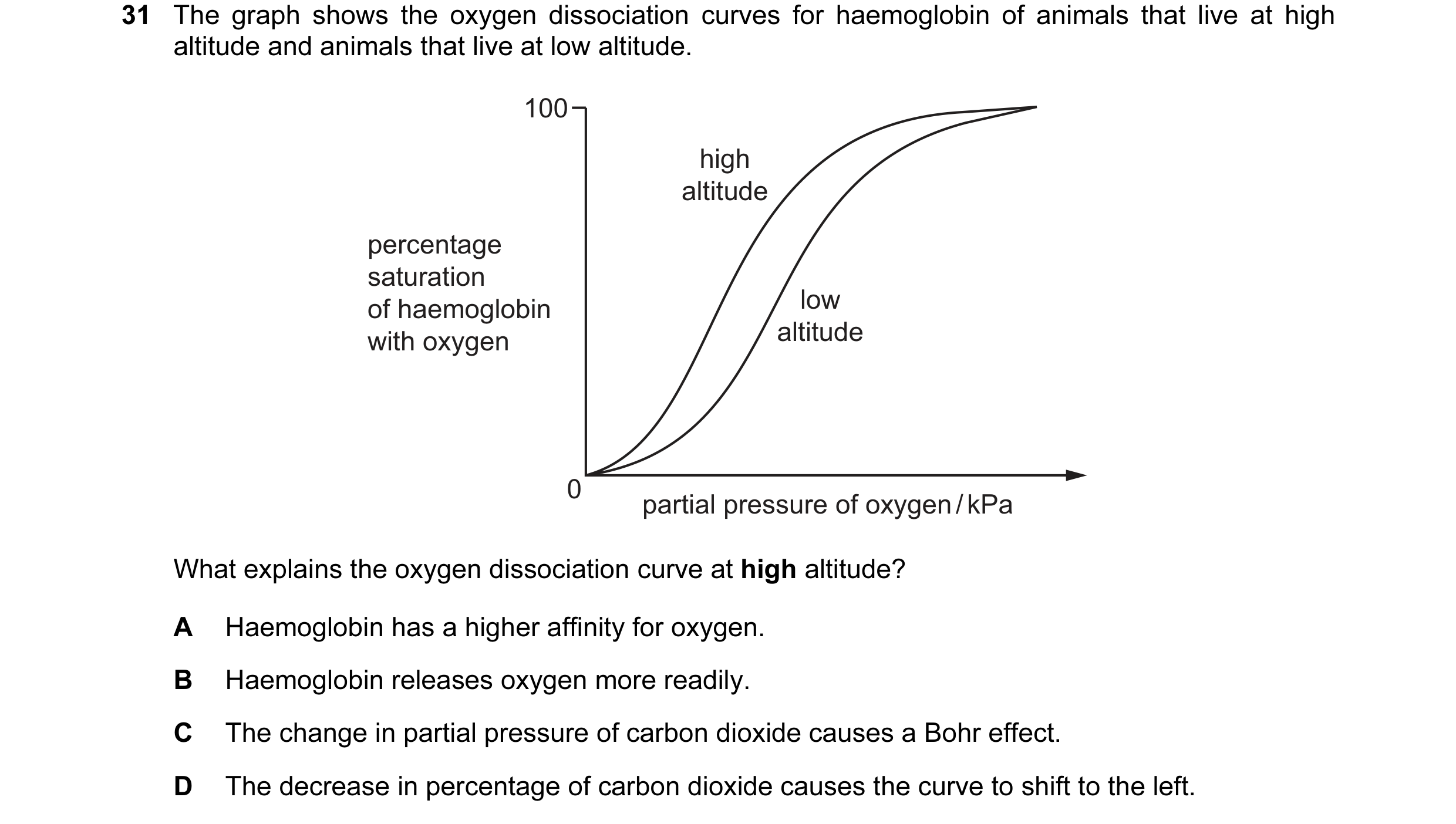
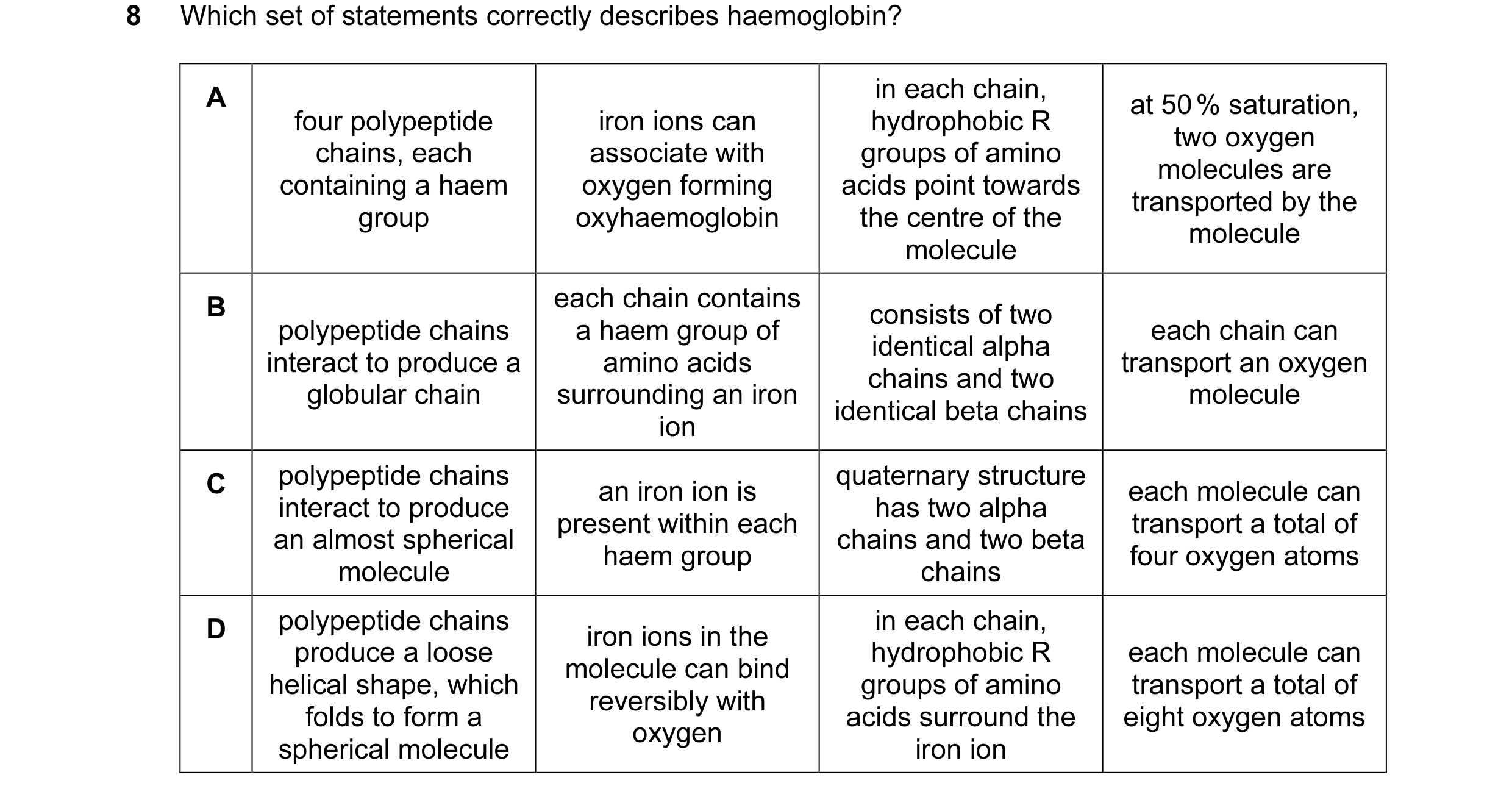 22 / 59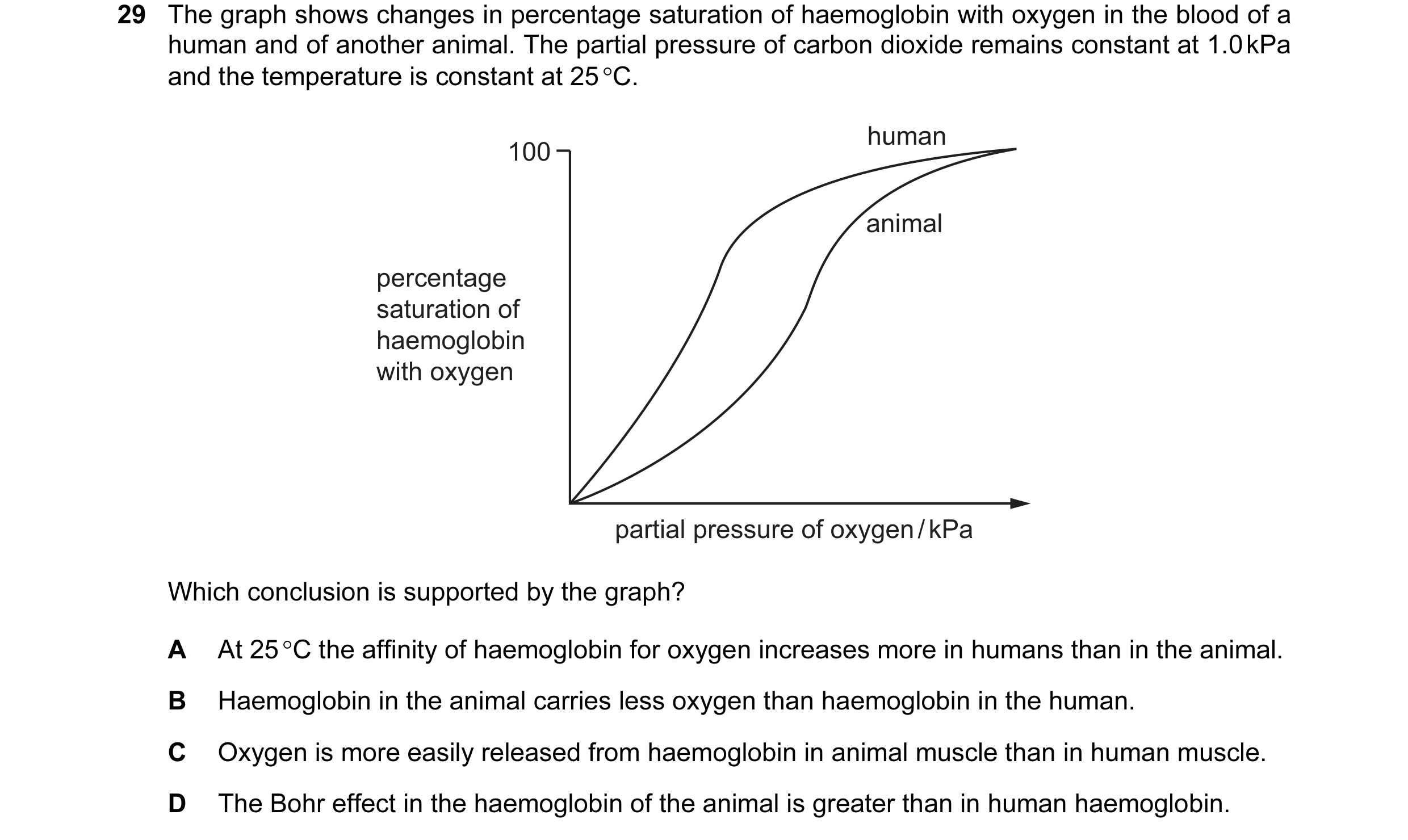
 23 / 59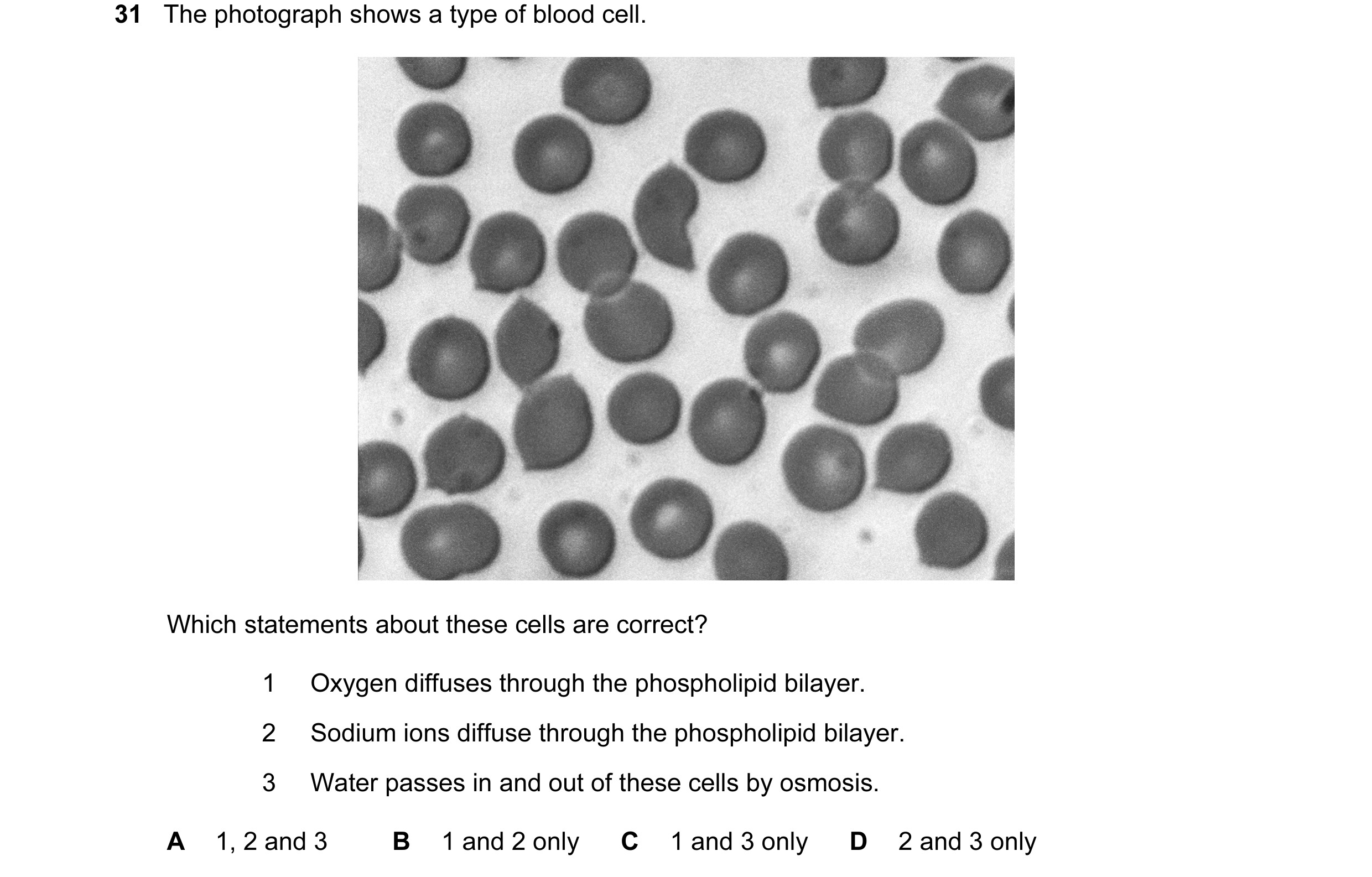
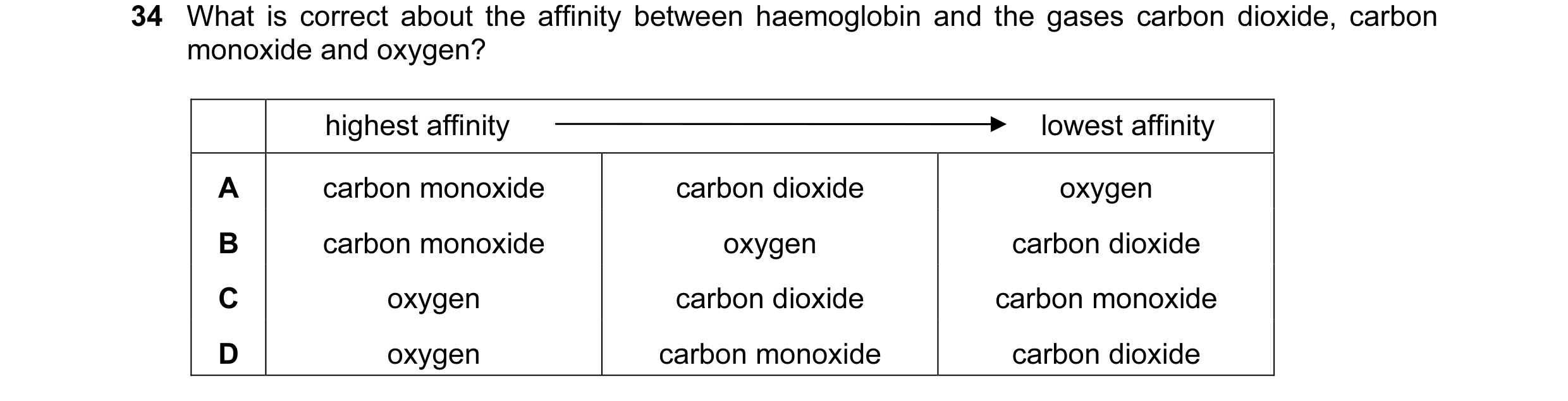 24 / 59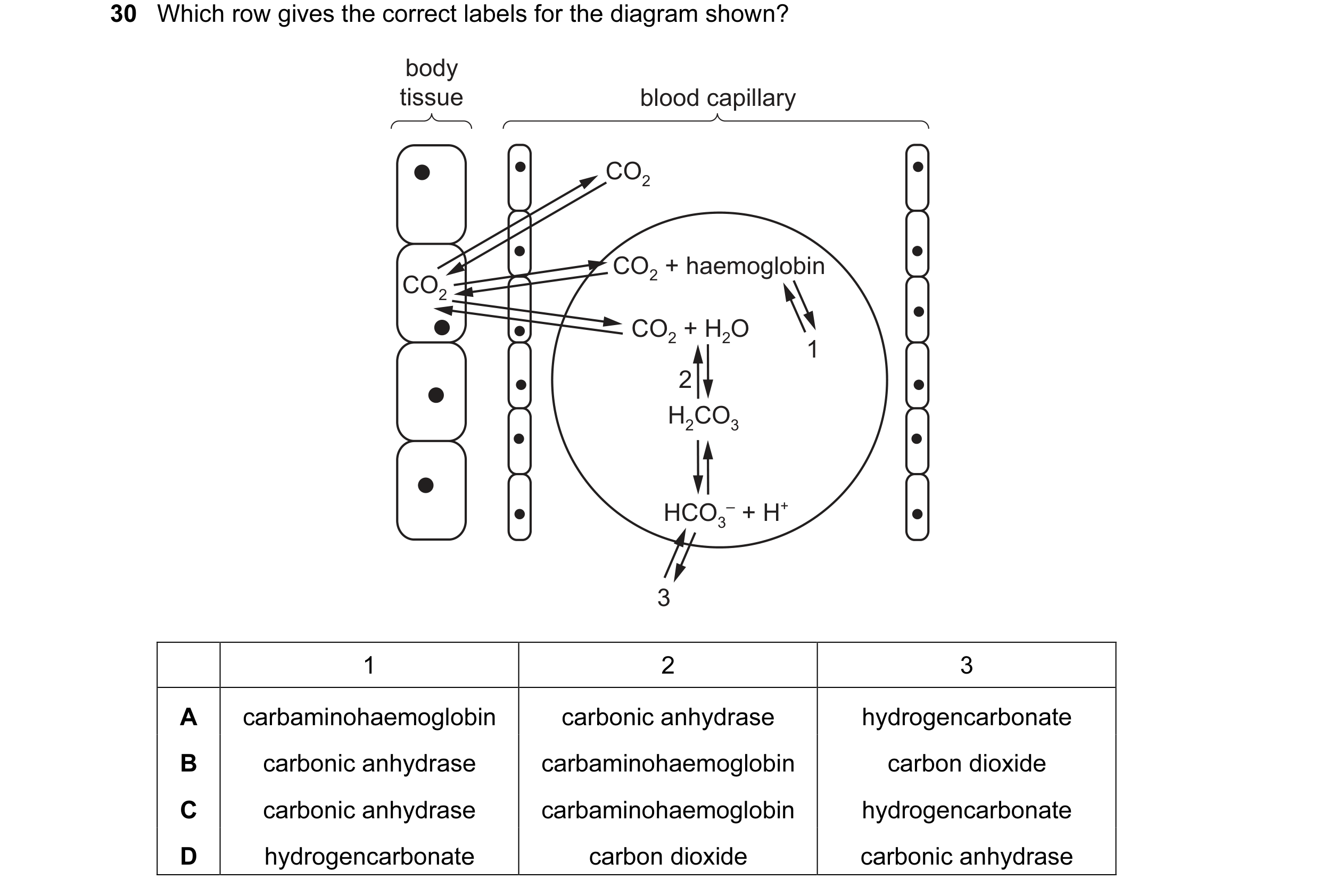
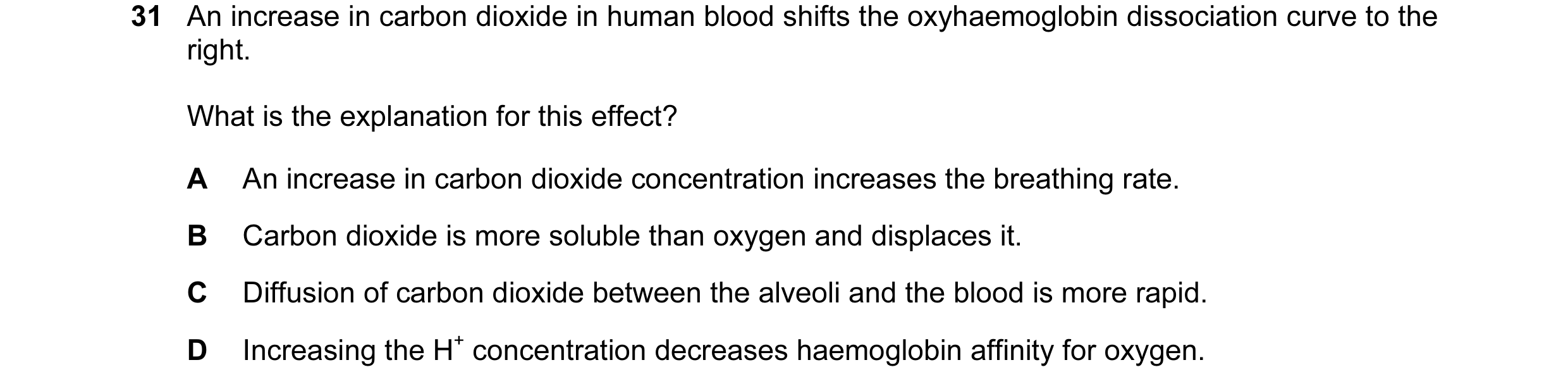

 25 / 59
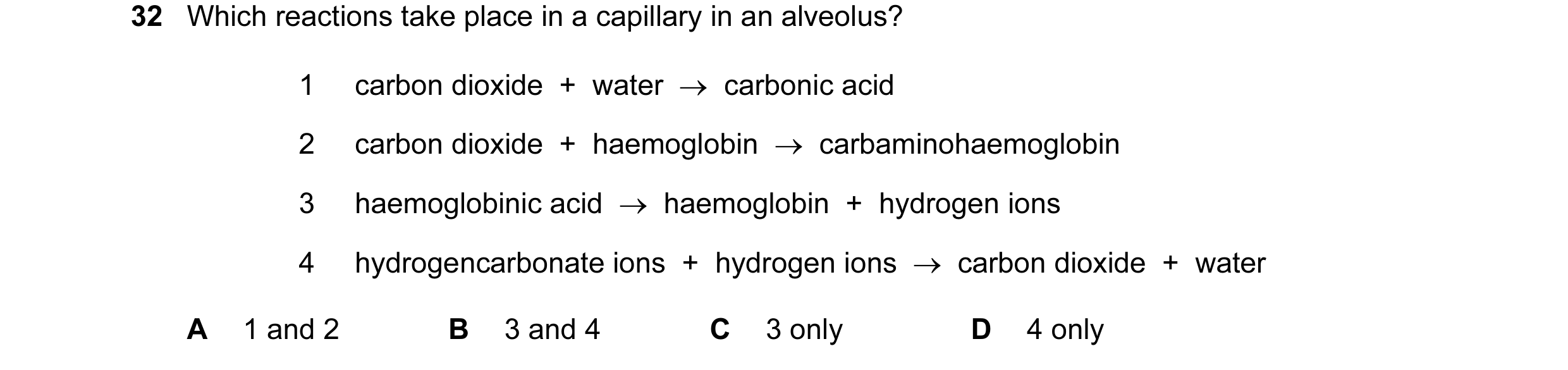
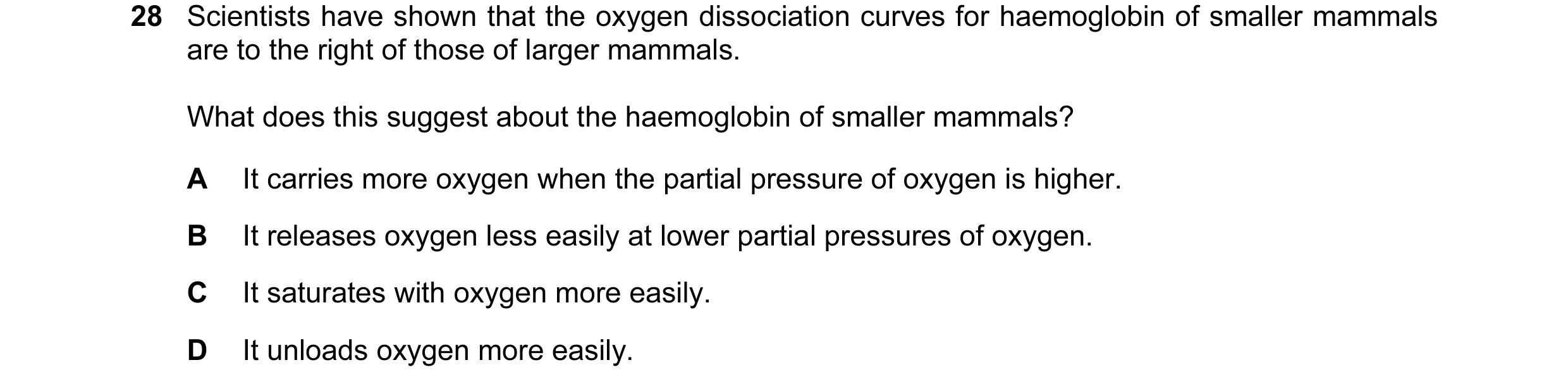
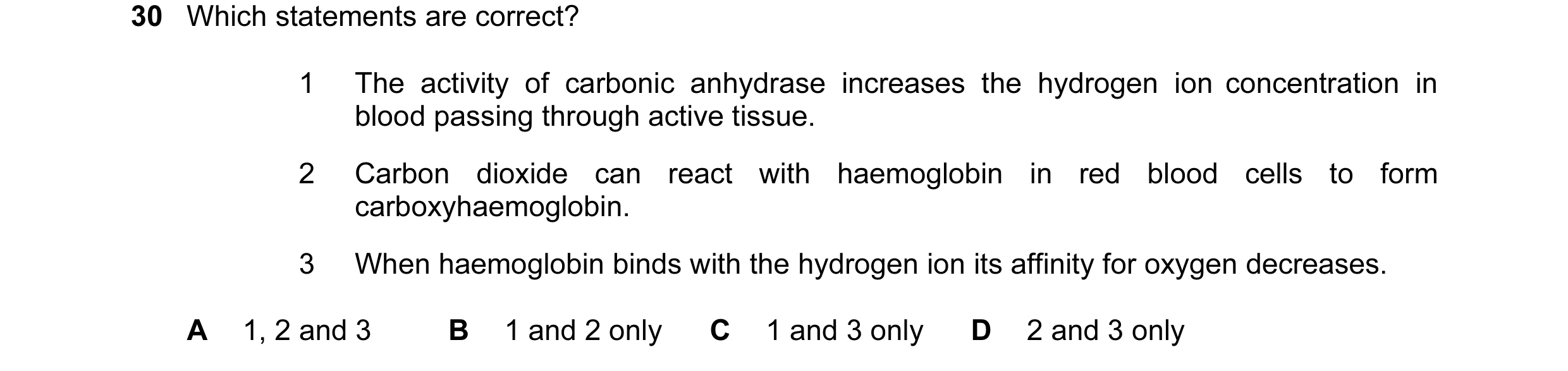 26 / 59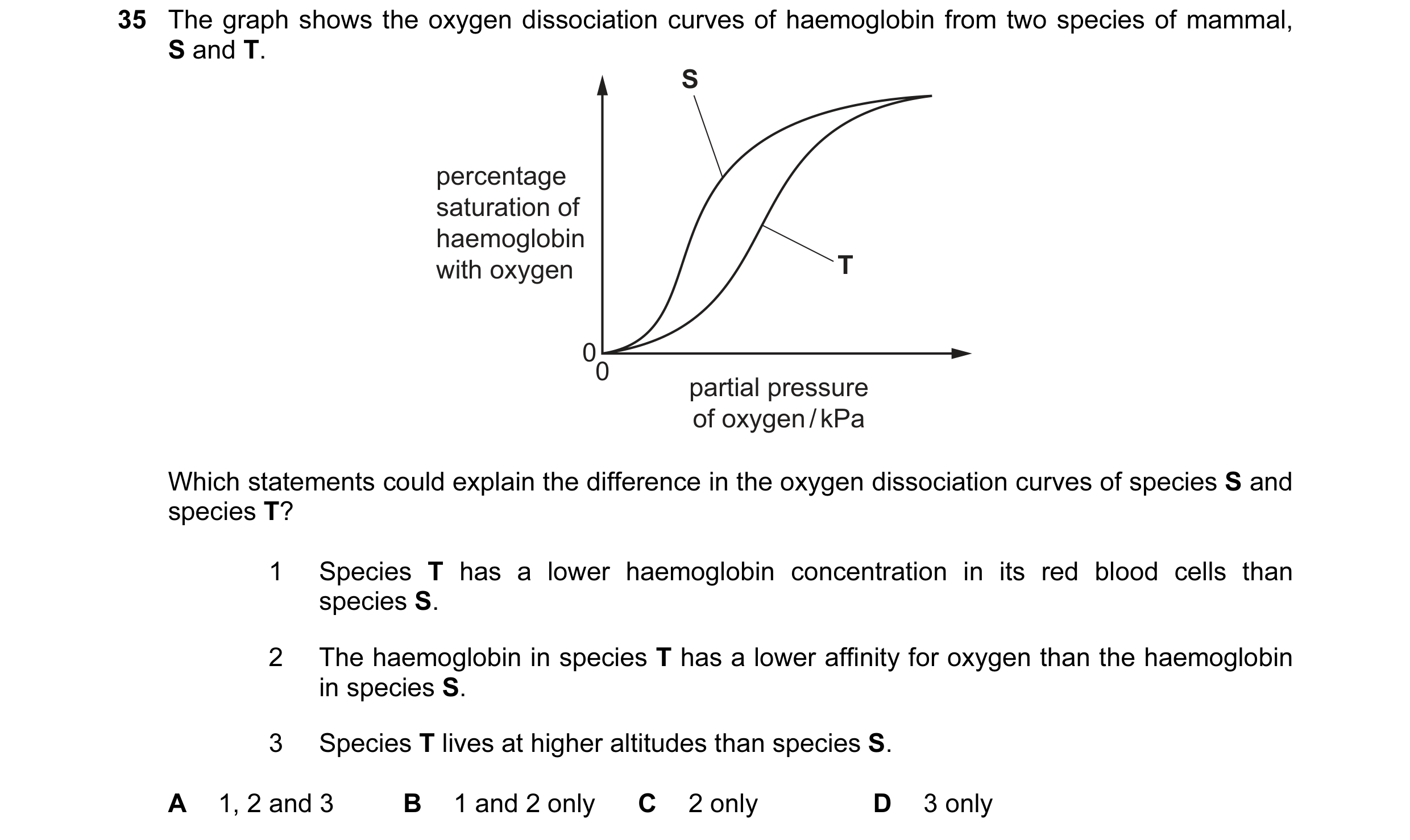
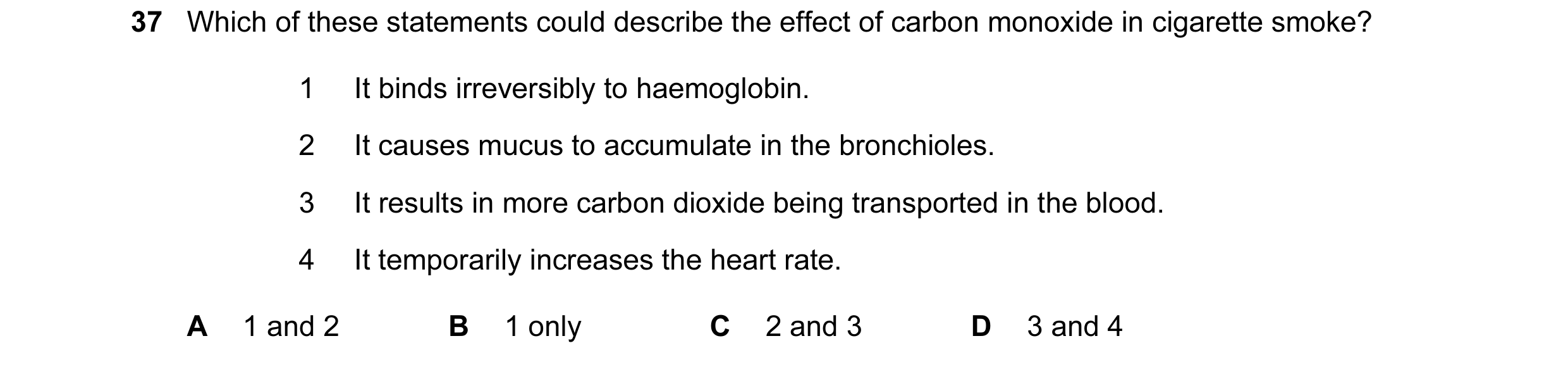
 27 / 59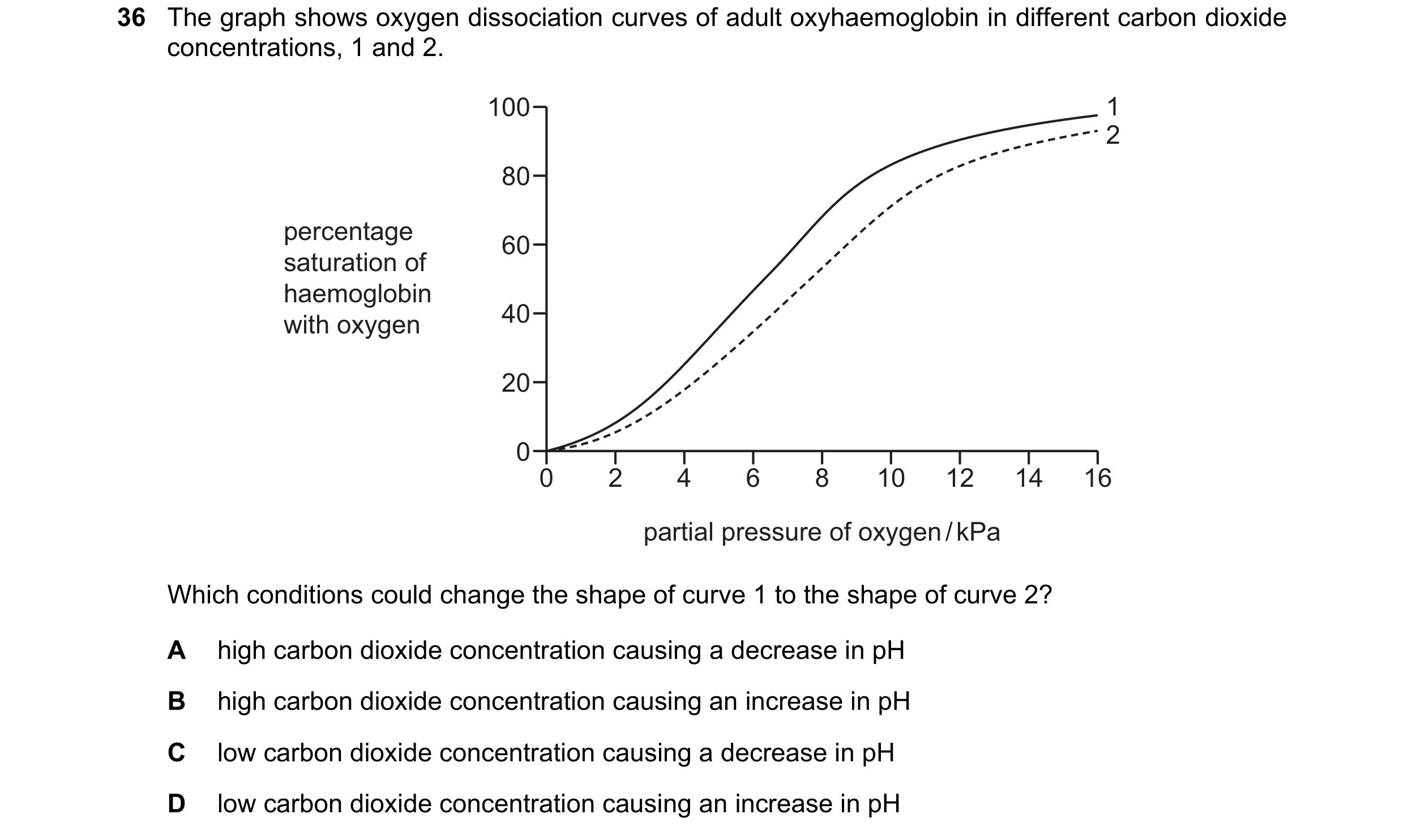
 28 / 59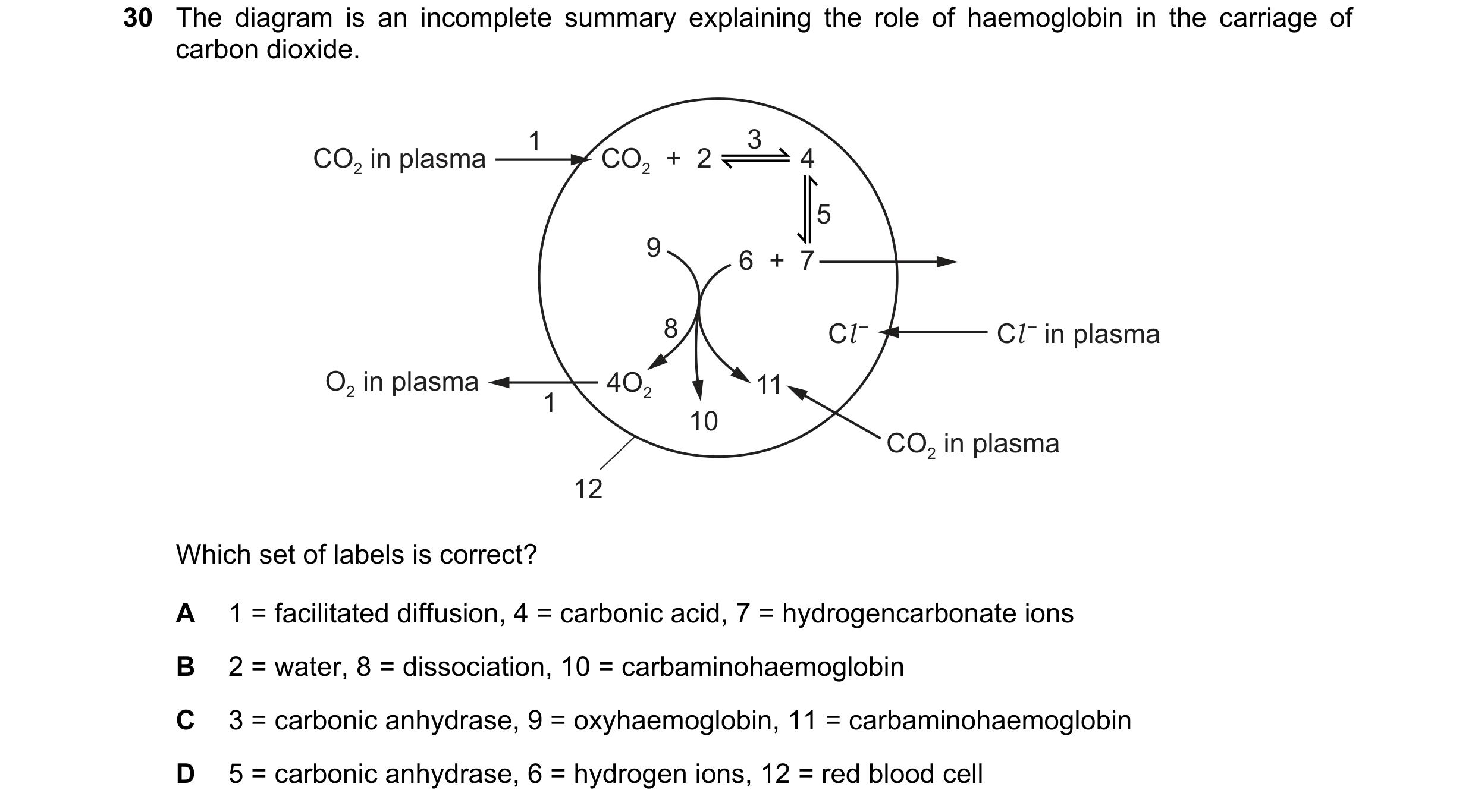

 29 / 59

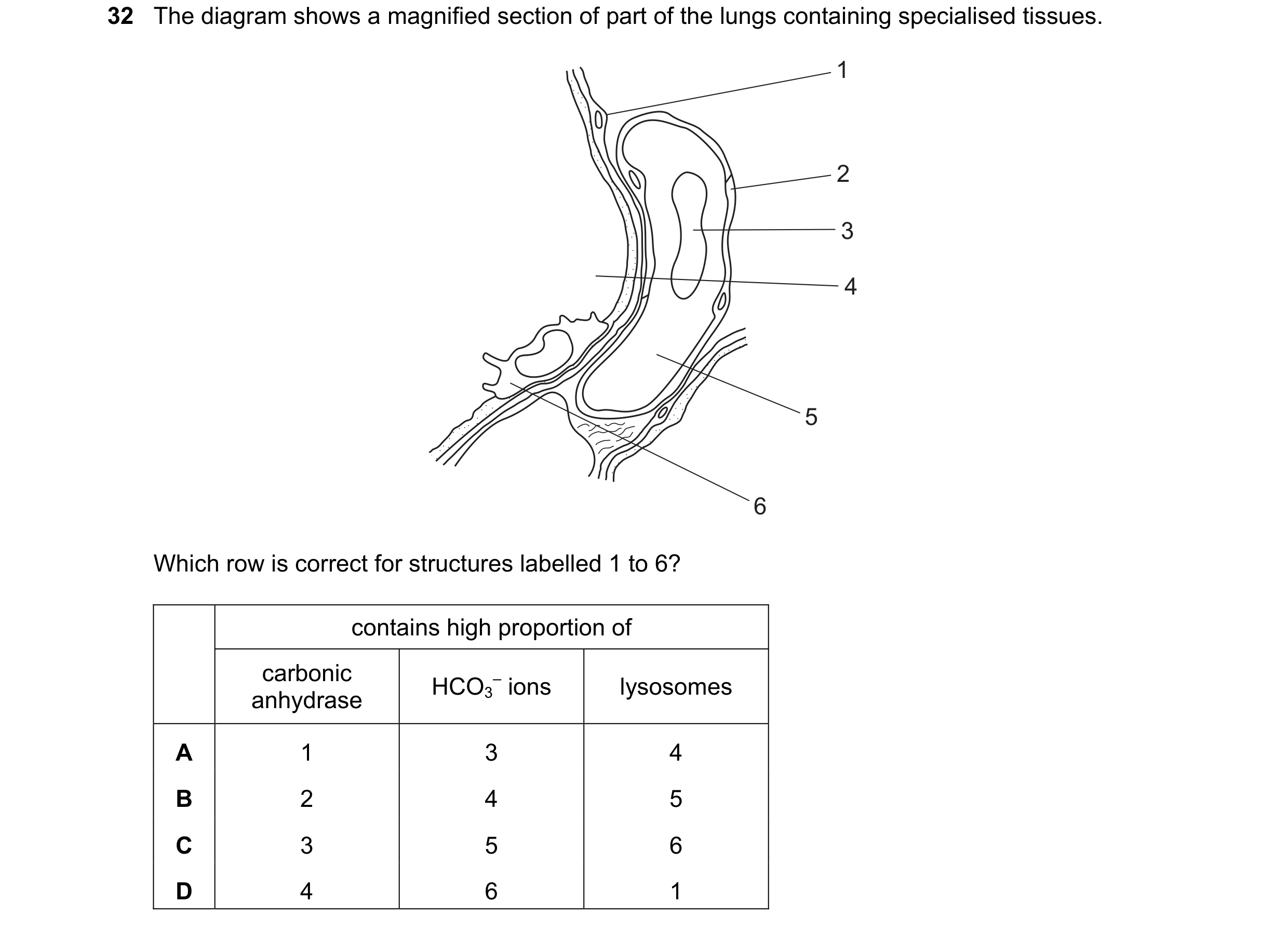 30 / 59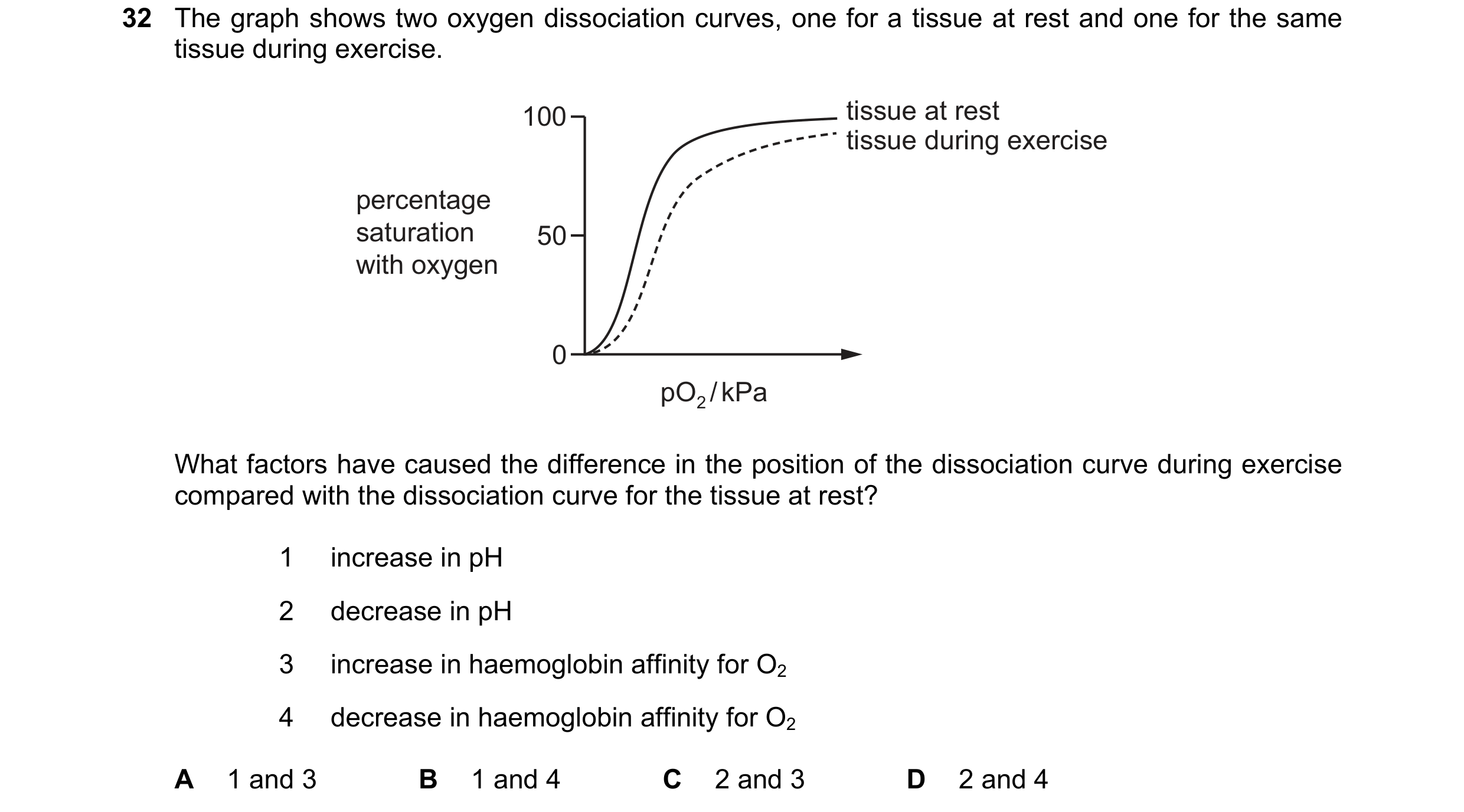

 31 / 59
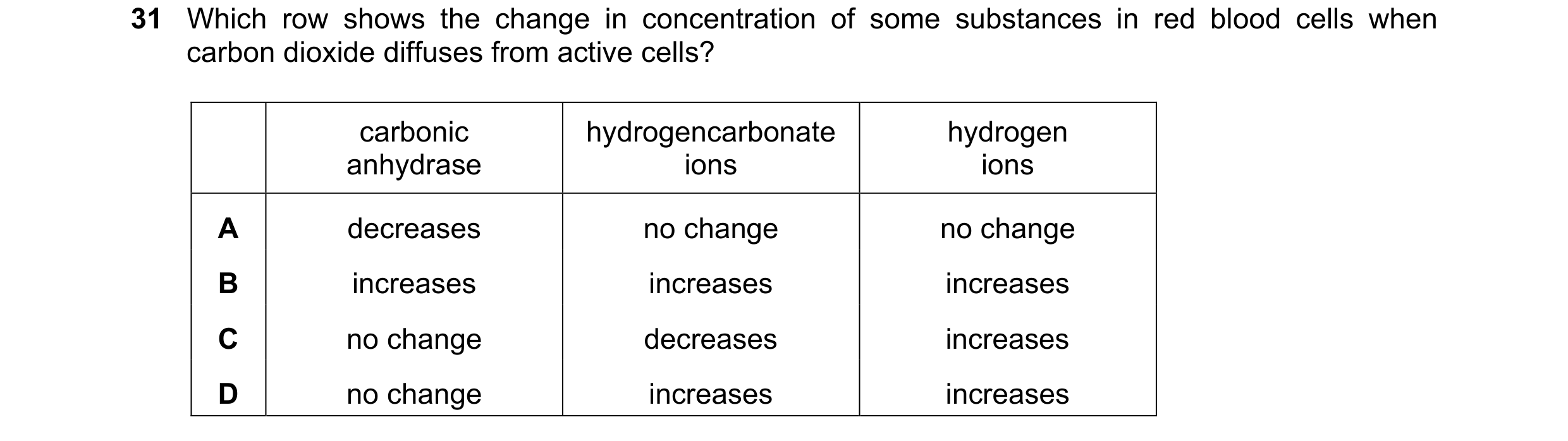

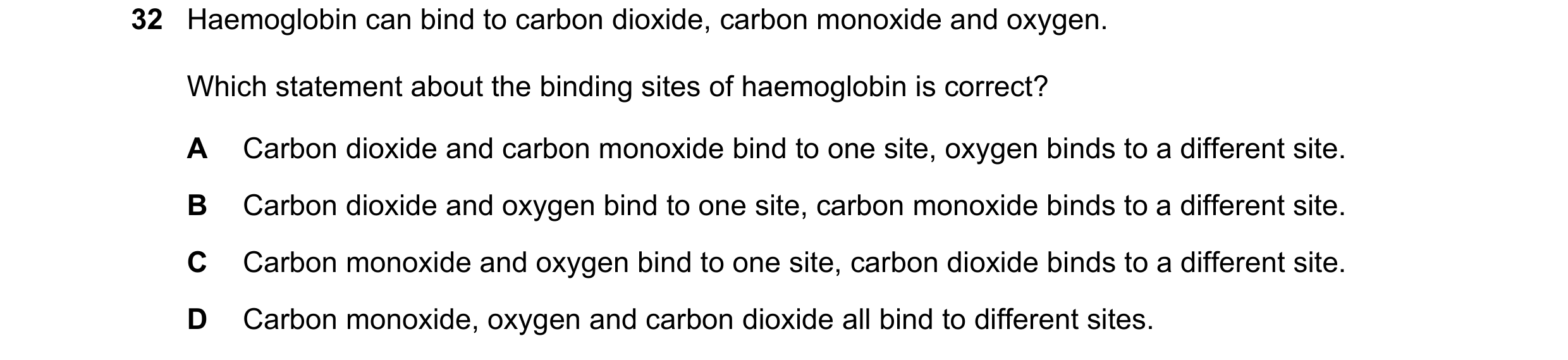 32 / 59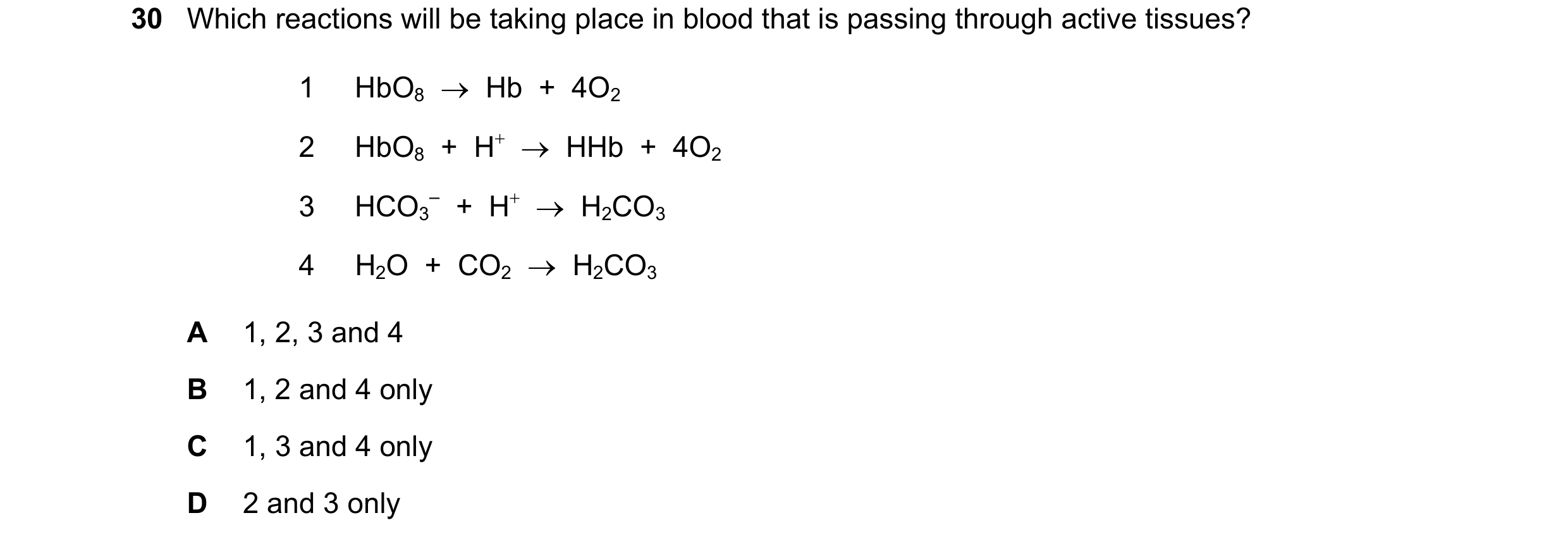
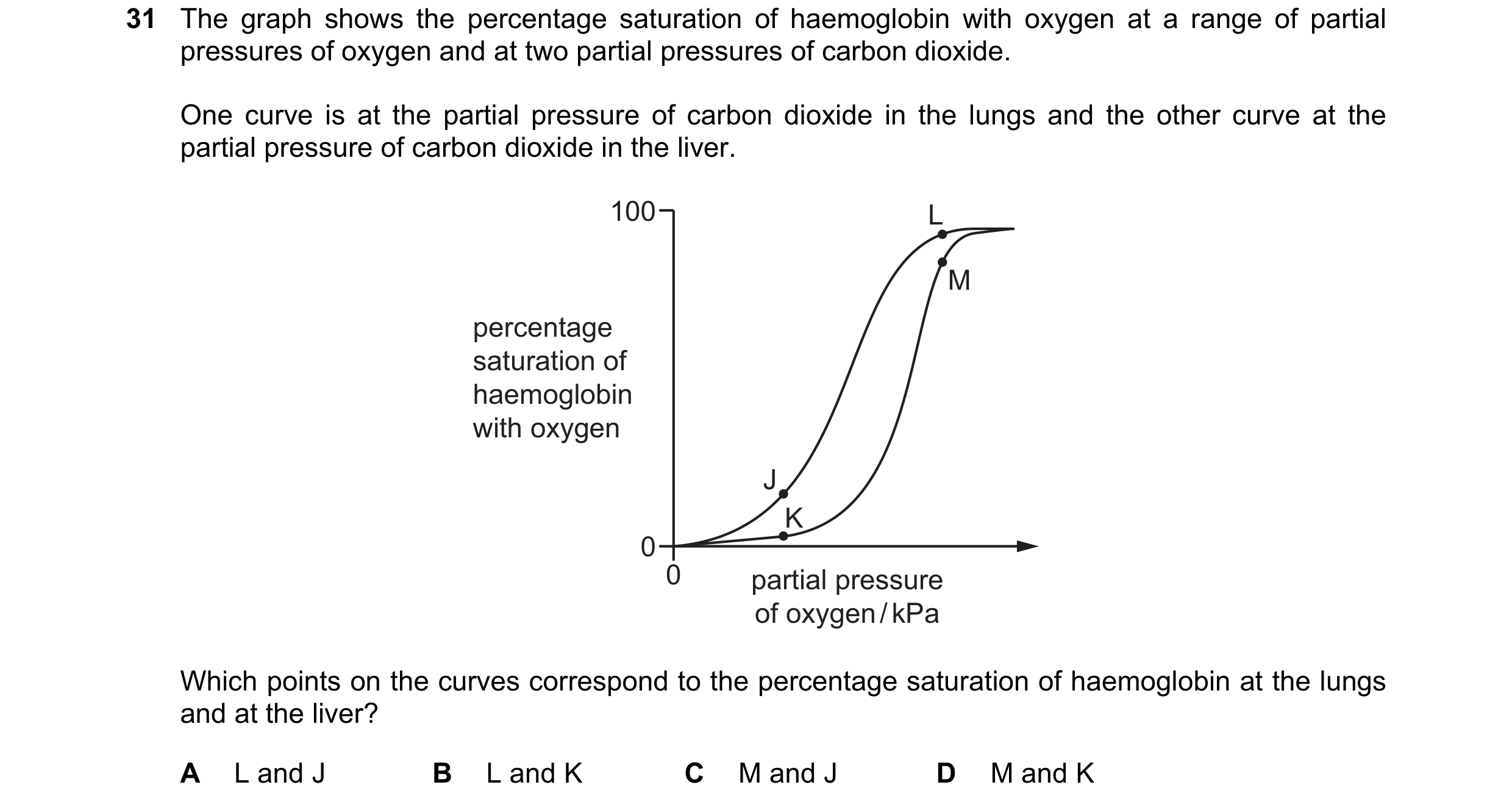
 33 / 59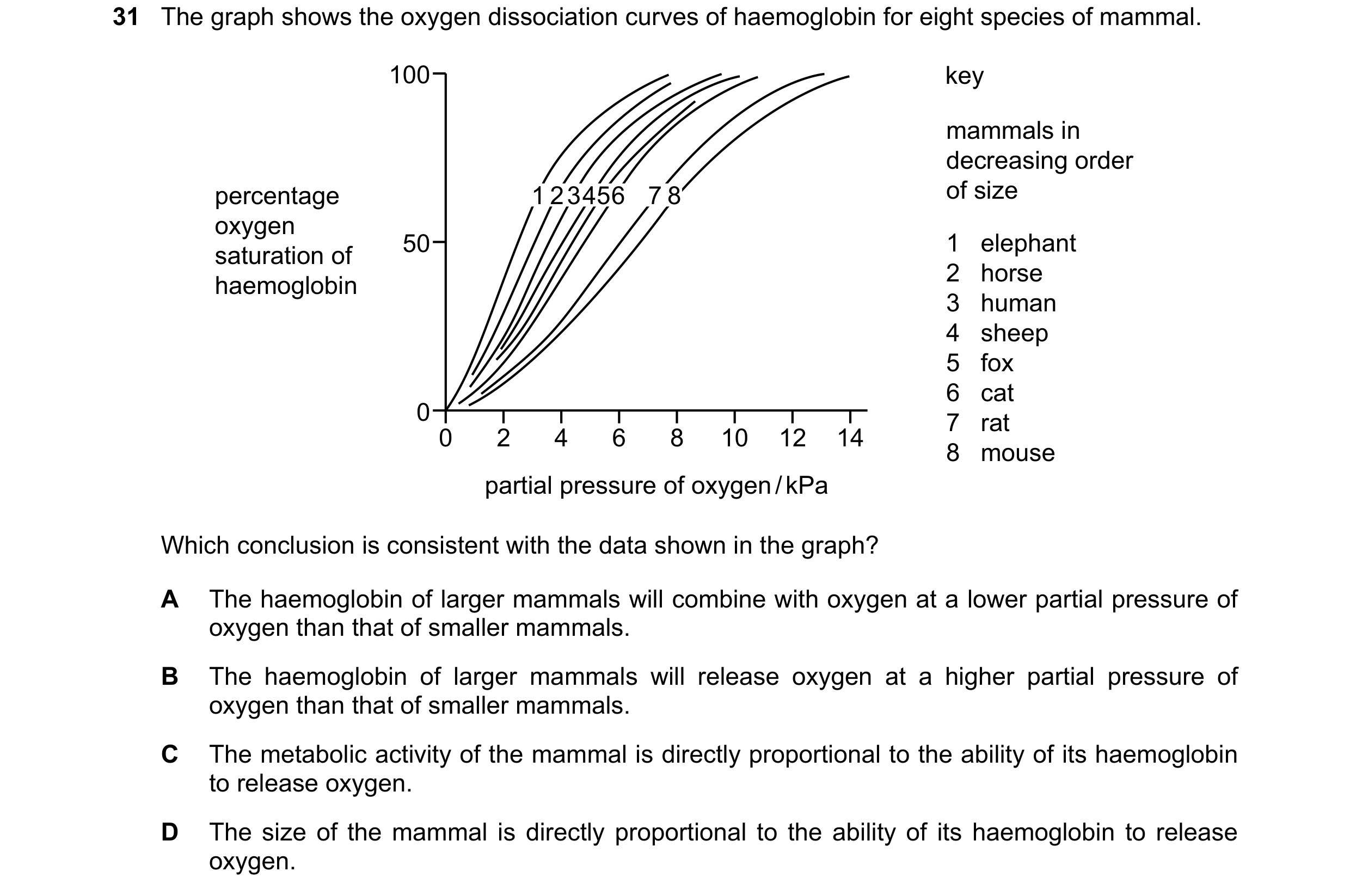
 34 / 59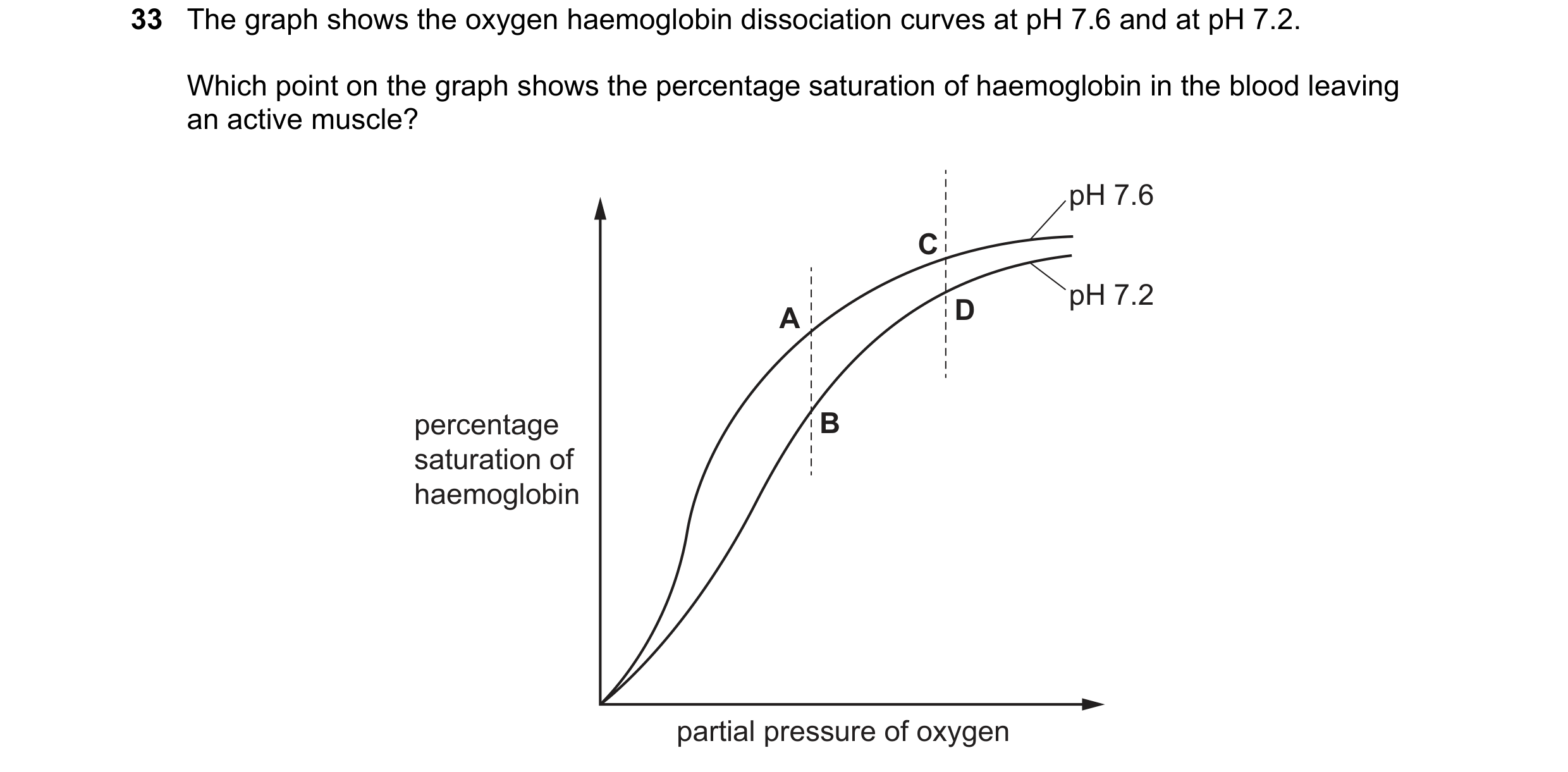
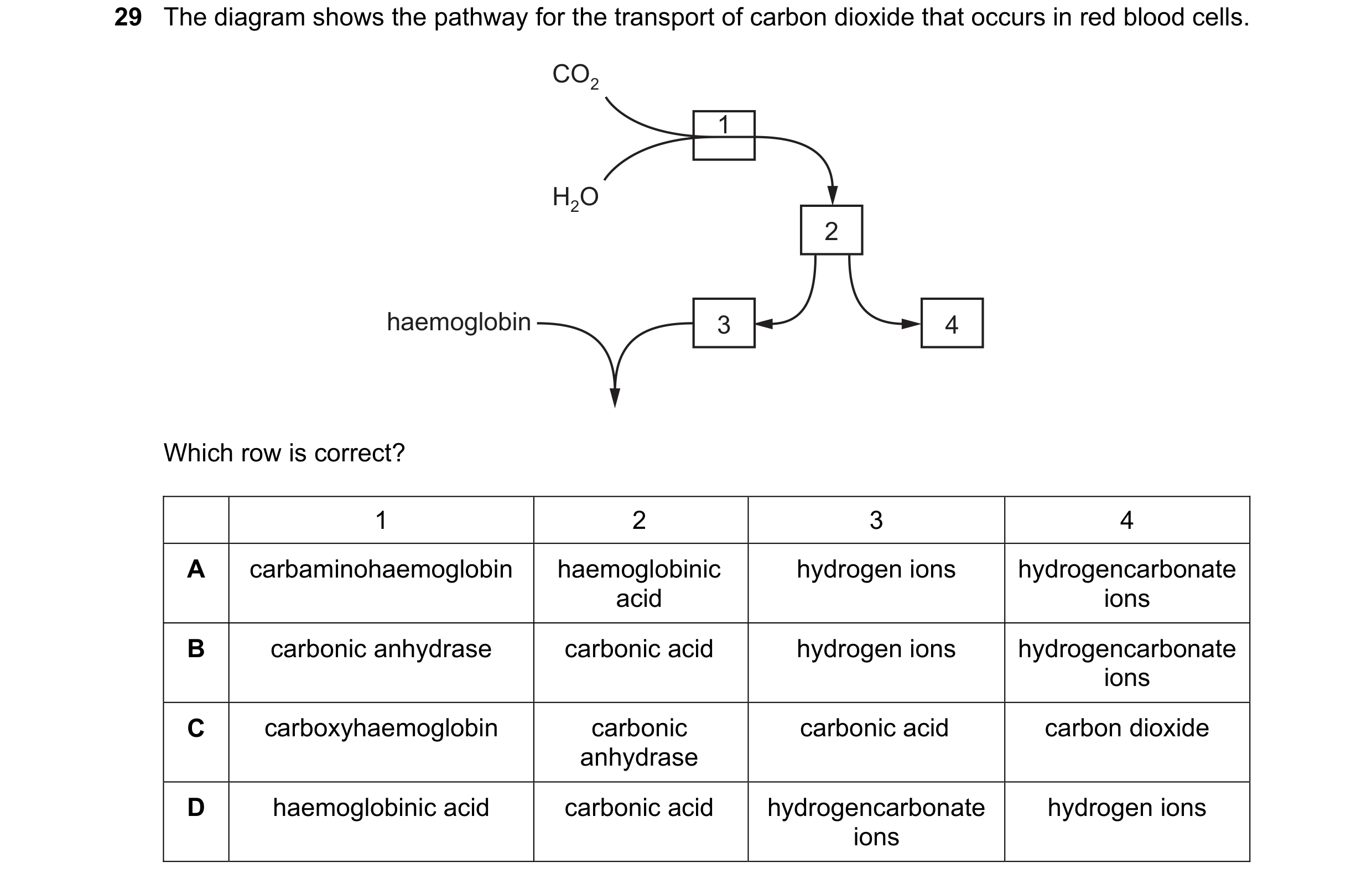 35 / 59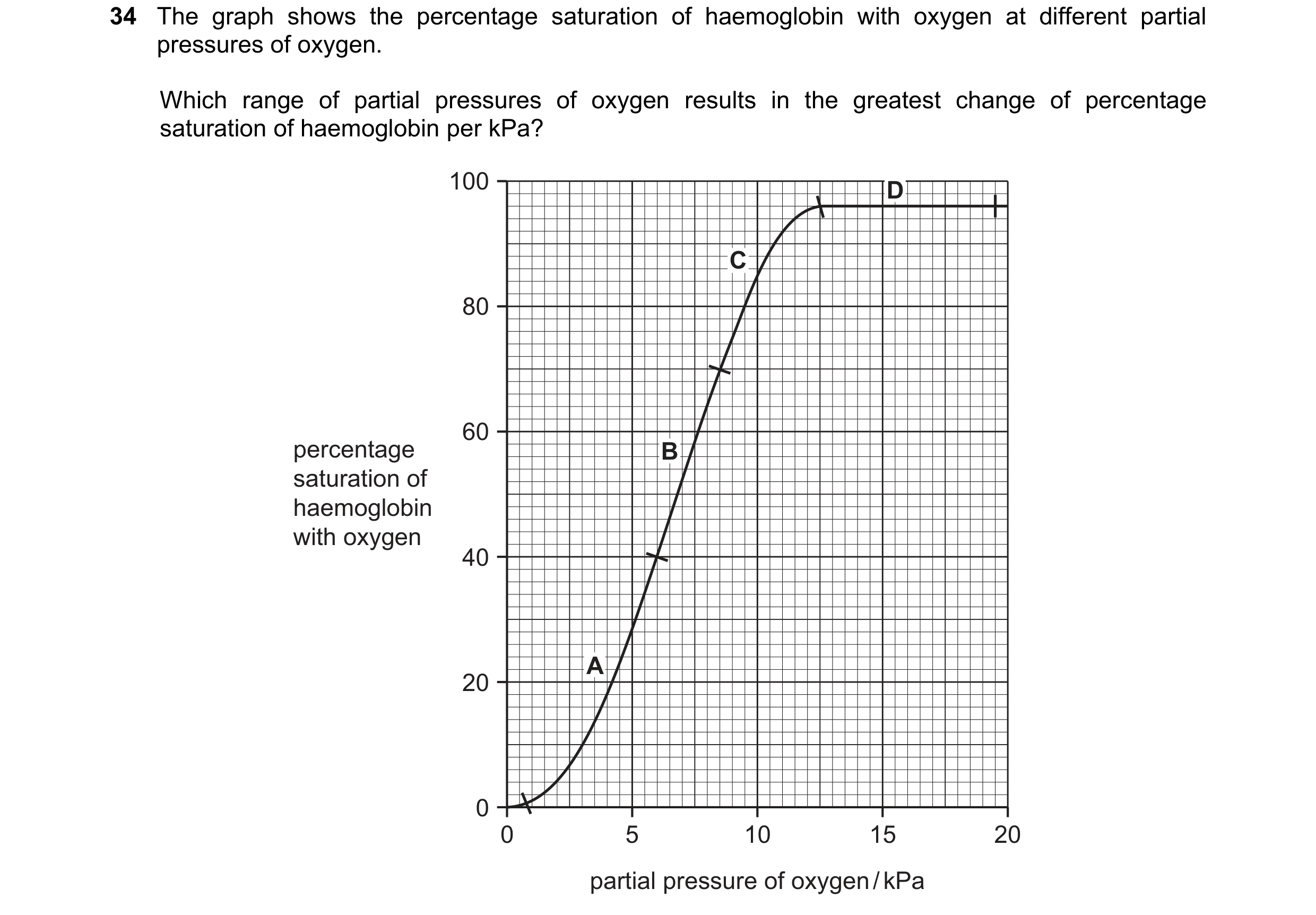

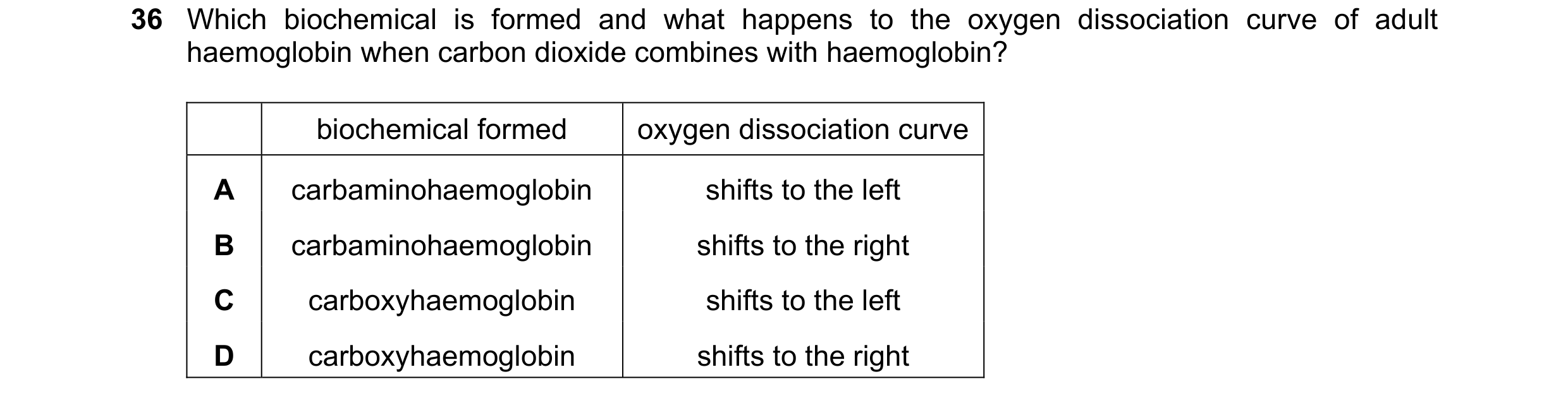
 36 / 59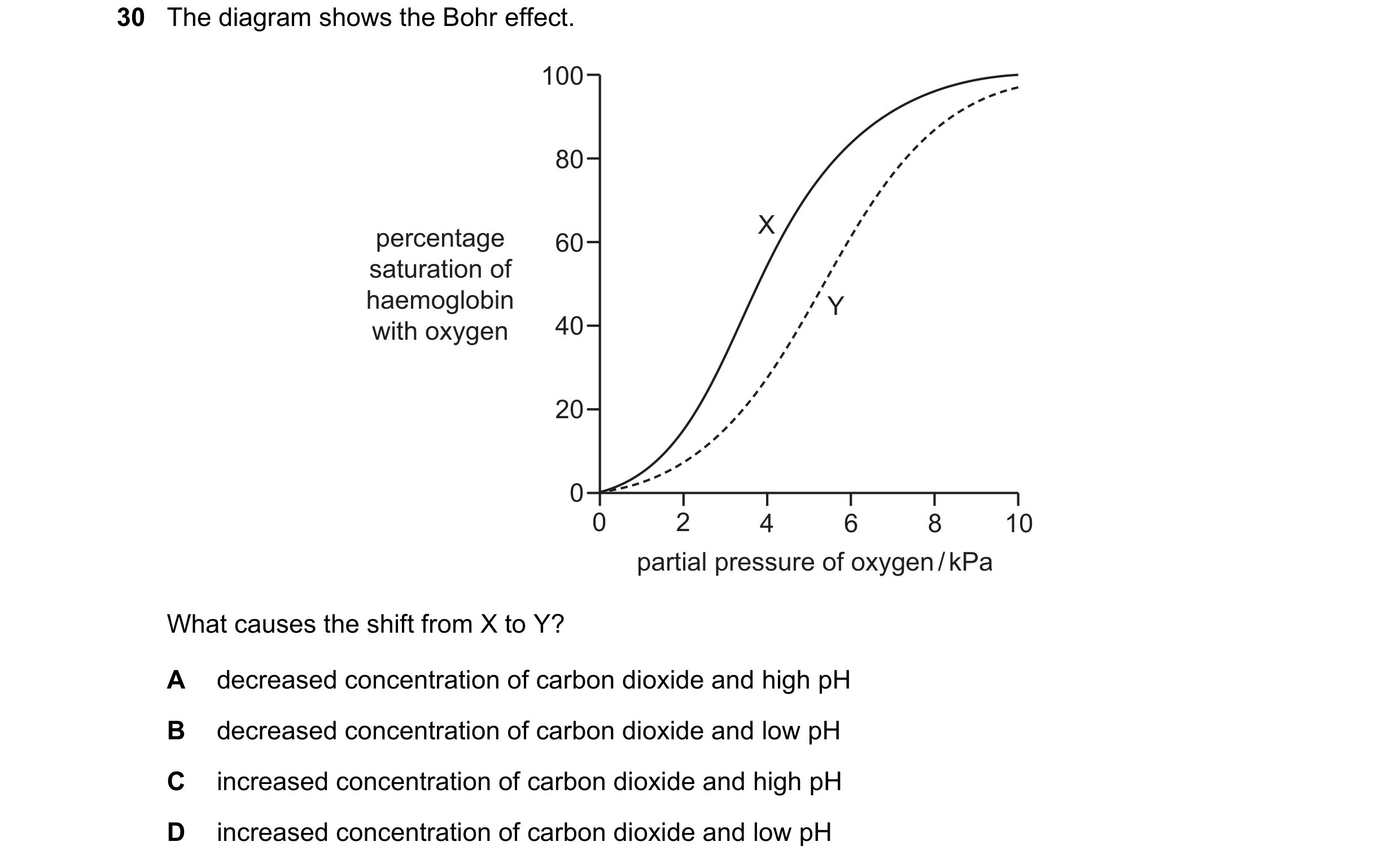
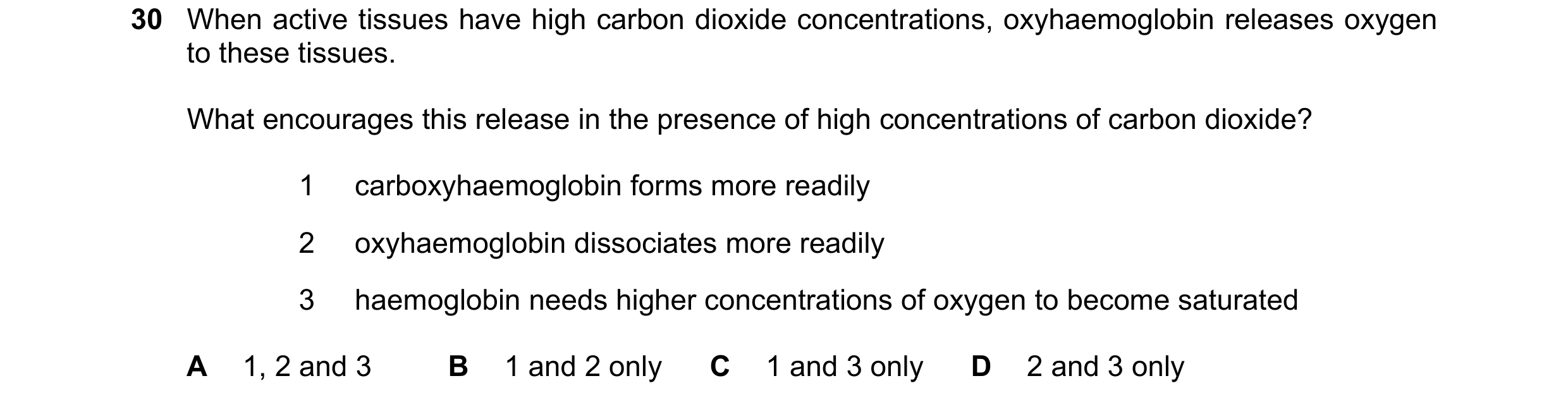 37 / 59
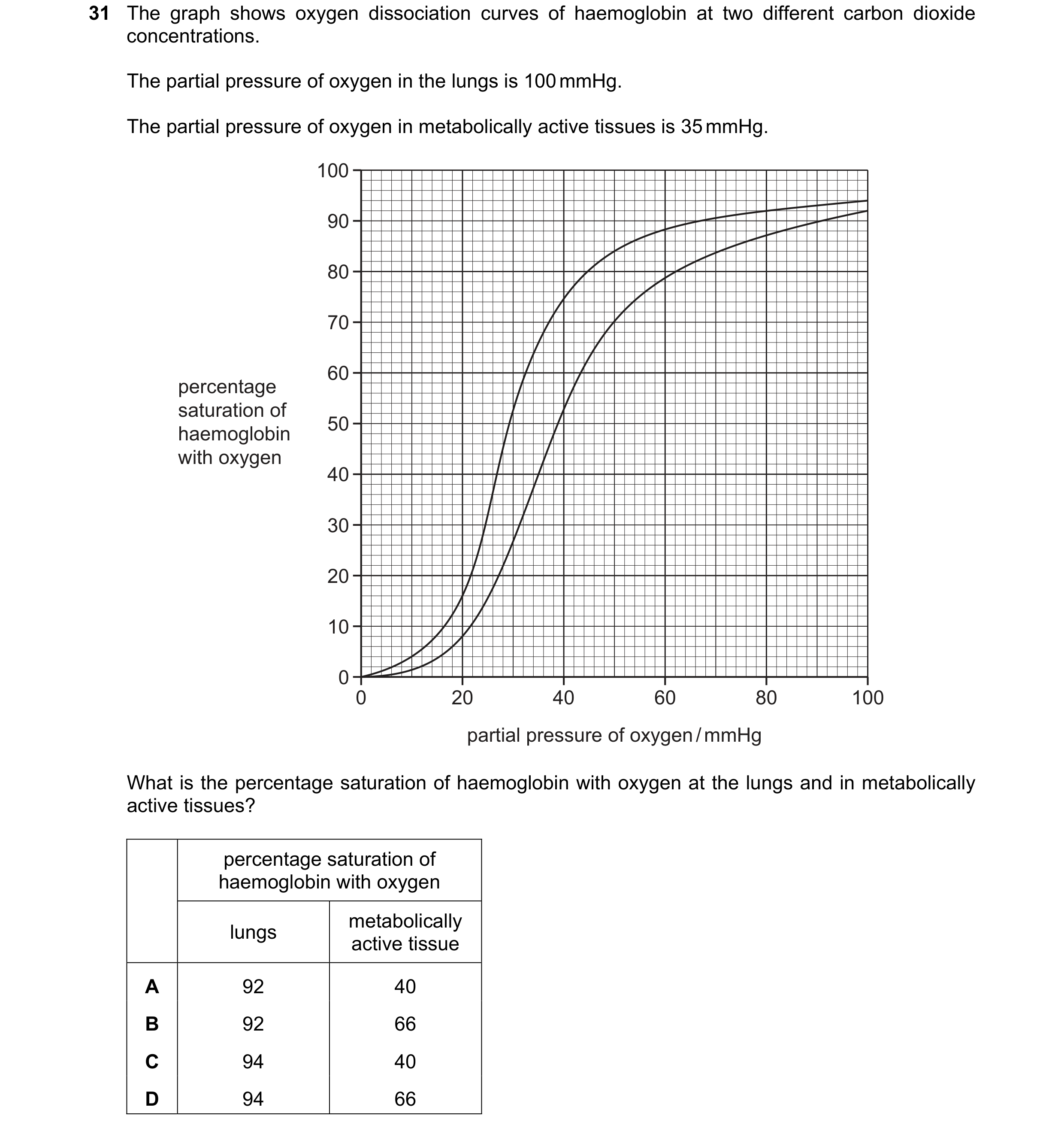 38 / 59
 39 / 59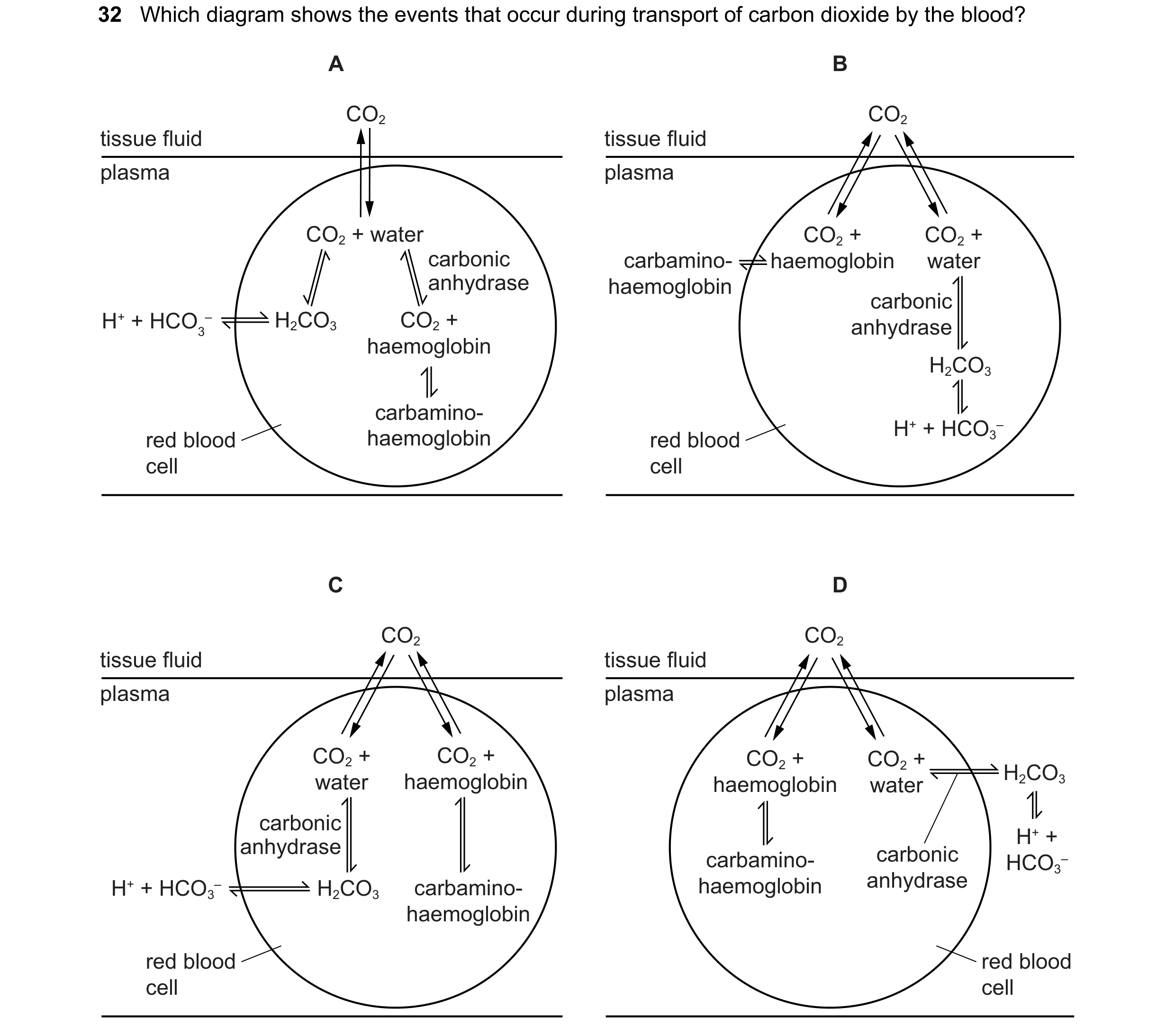
 40 / 59
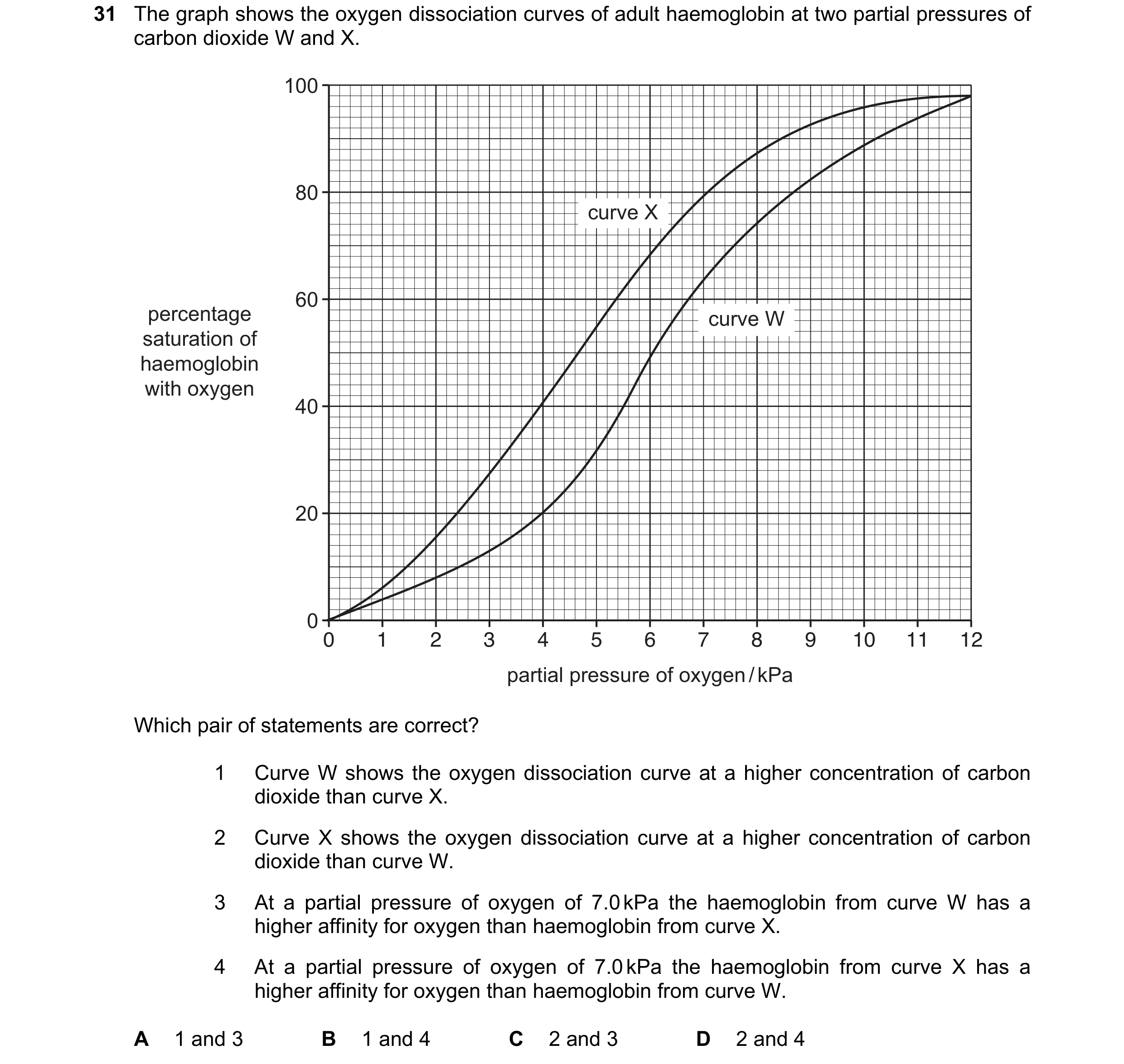 41 / 59
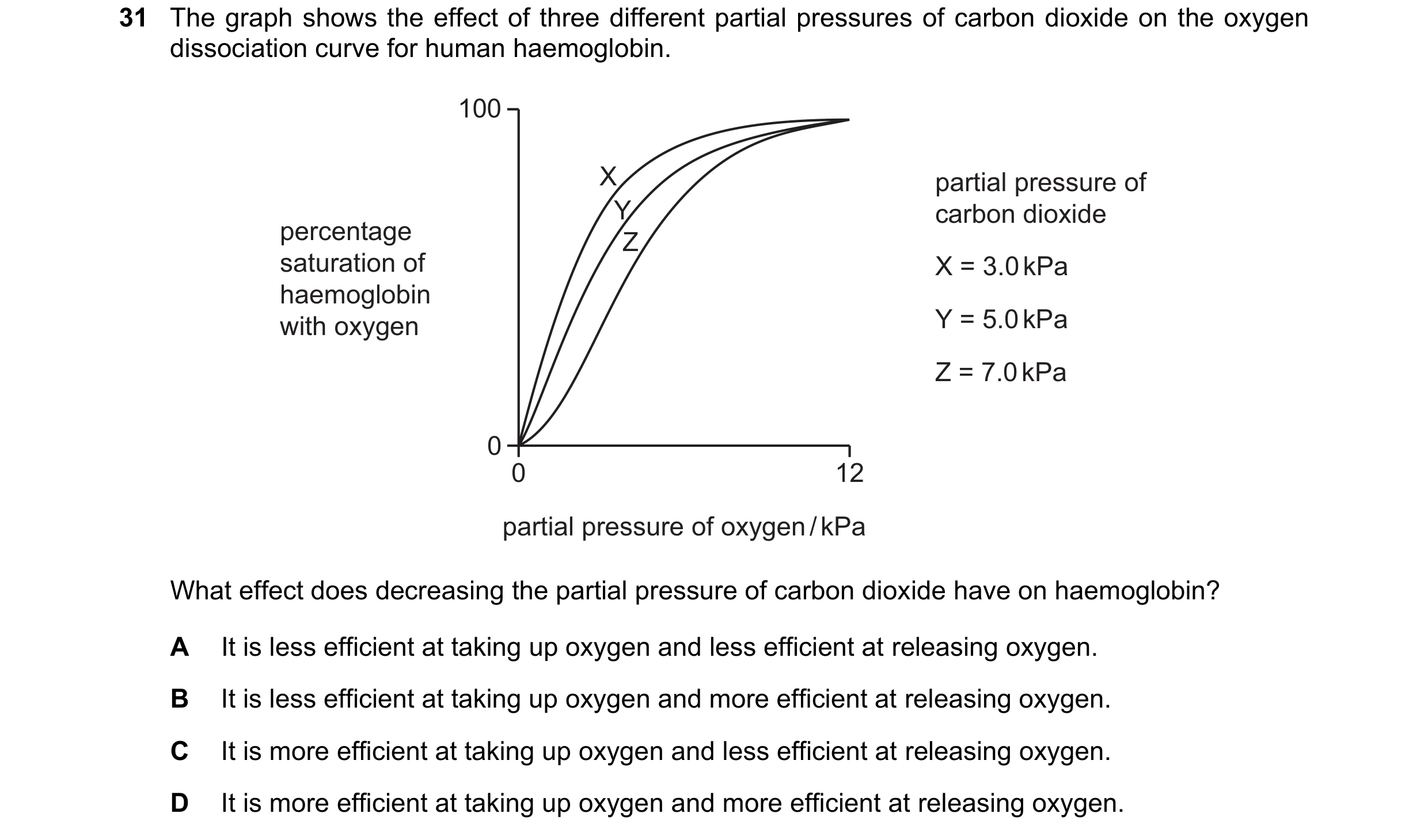
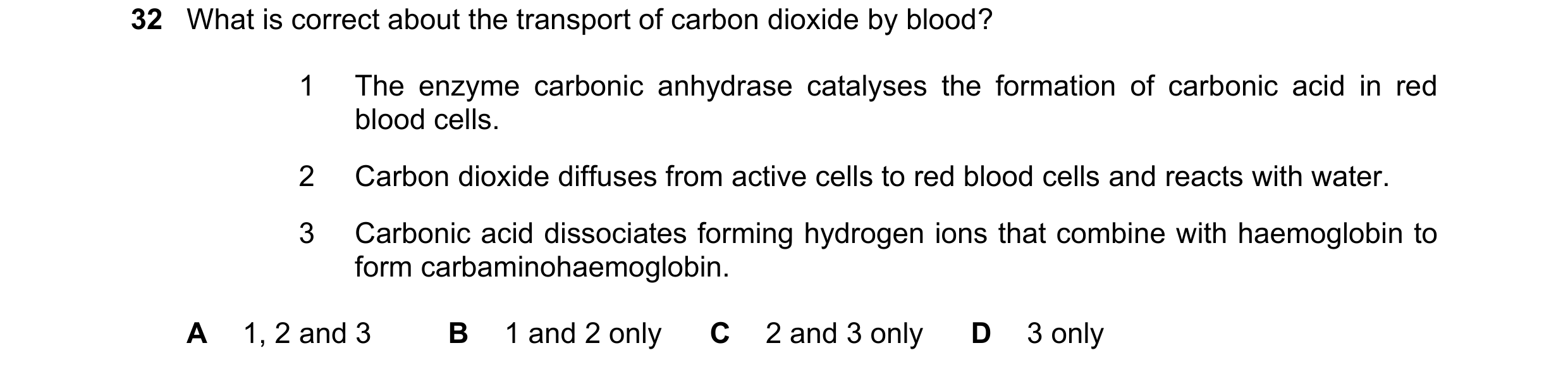
 42 / 59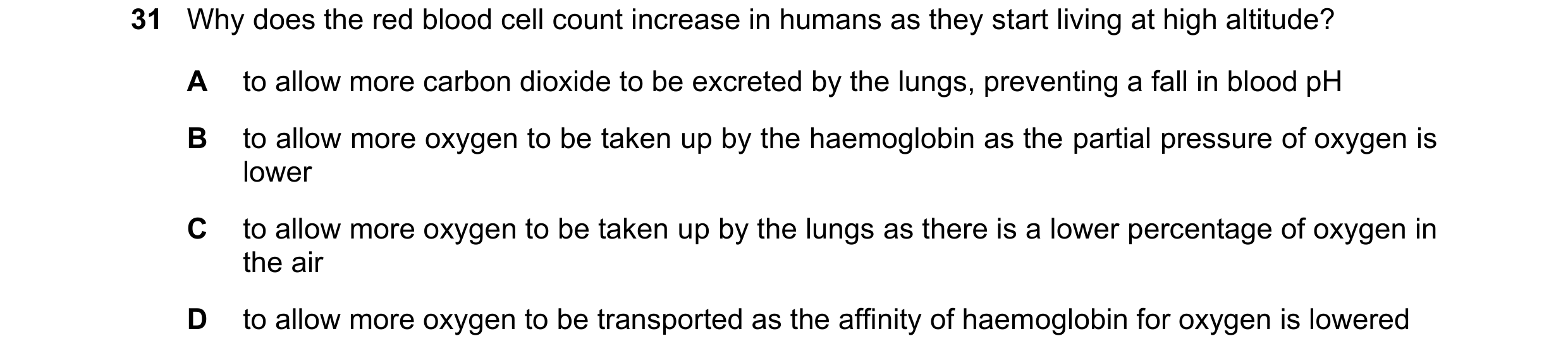
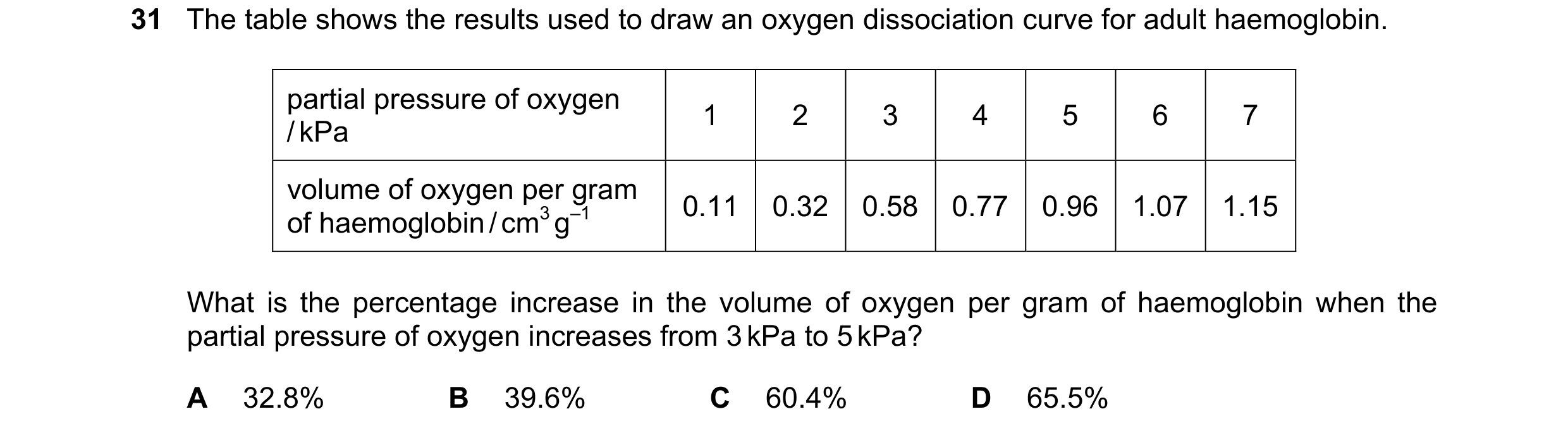
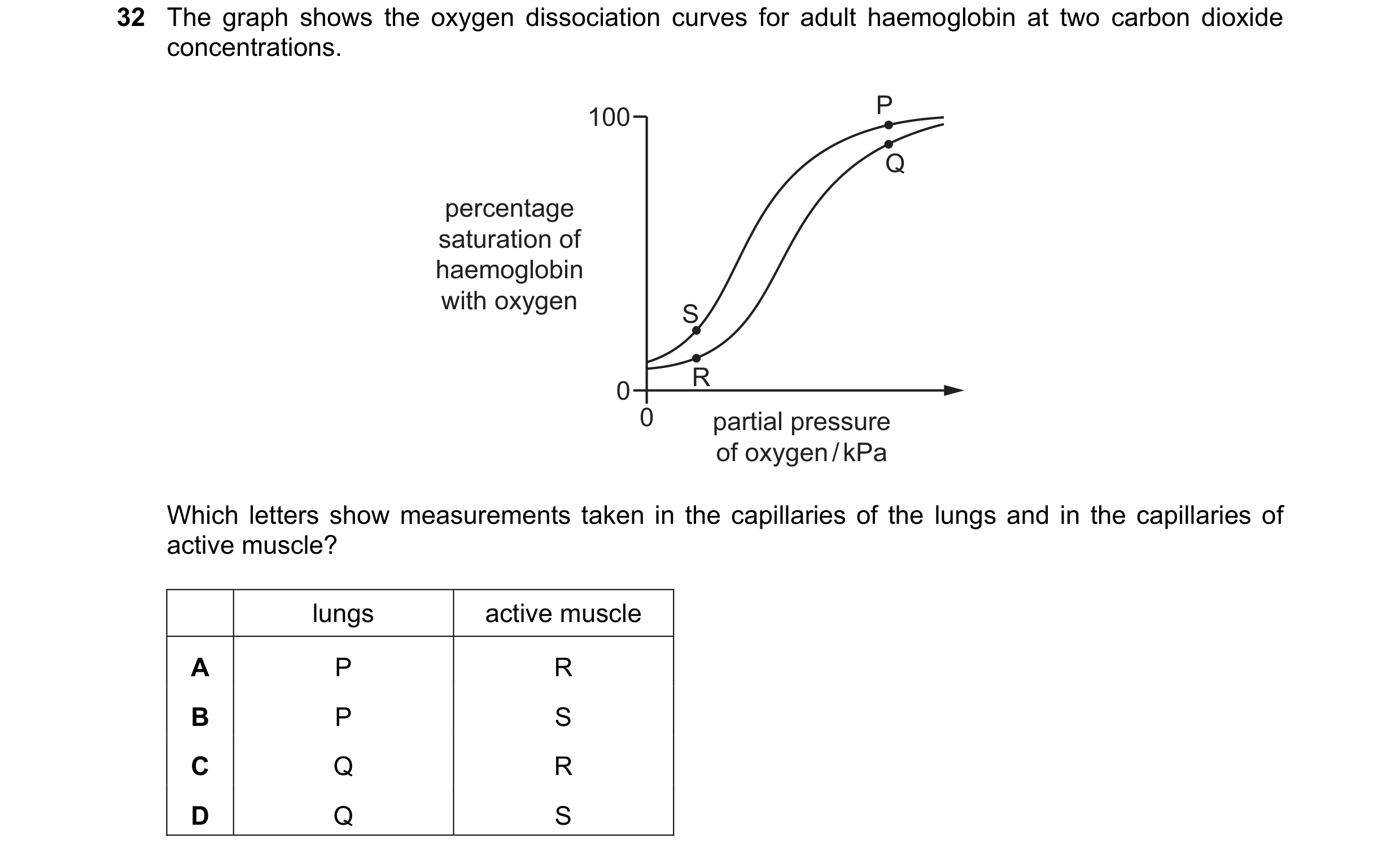 43 / 59

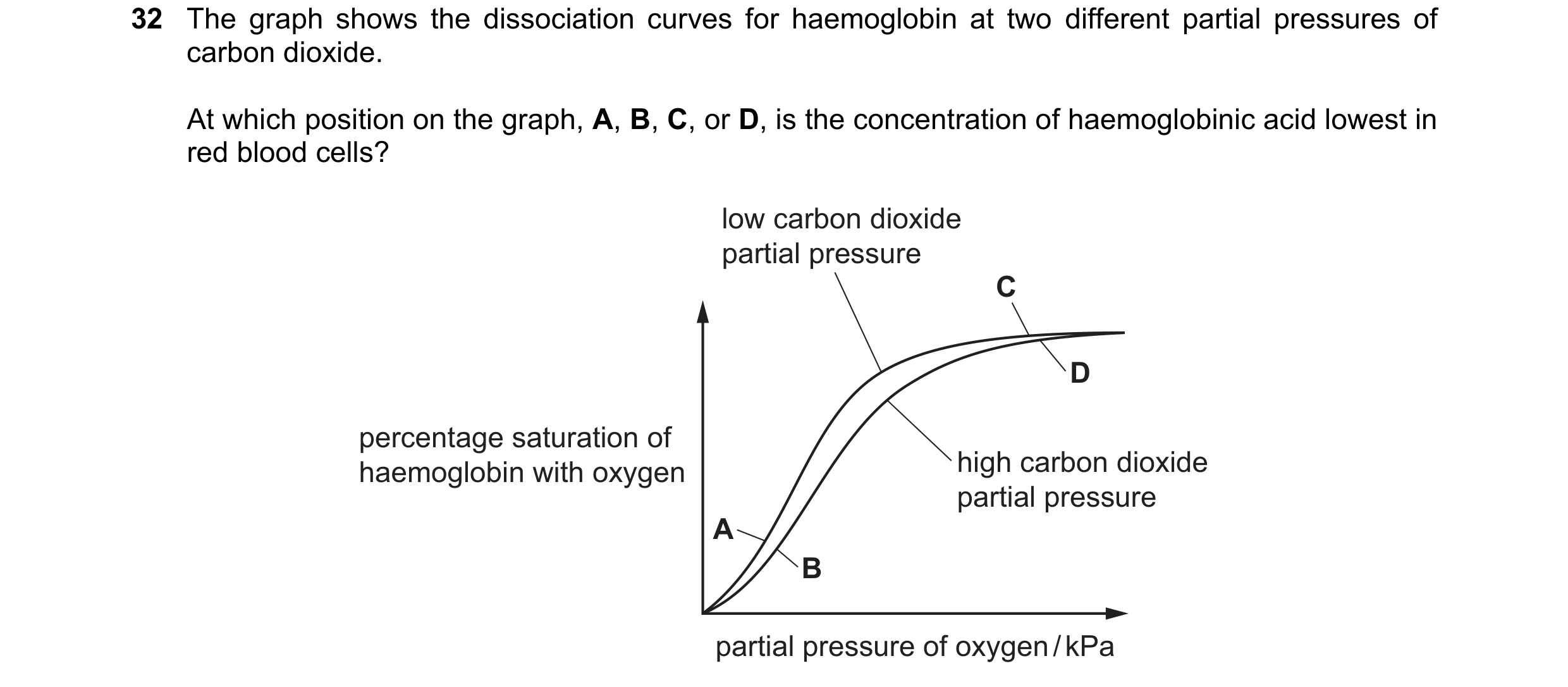 44 / 59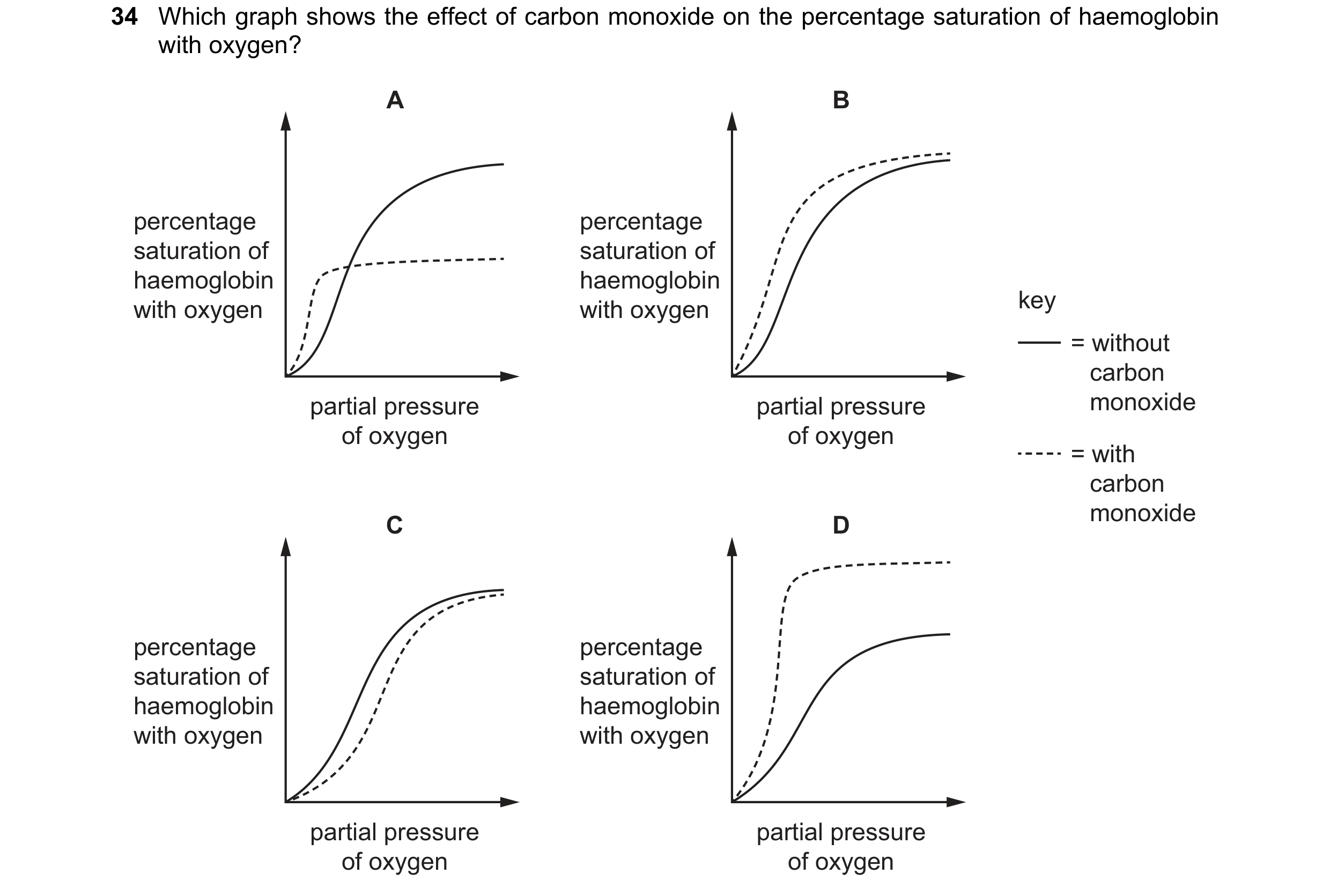

 45 / 59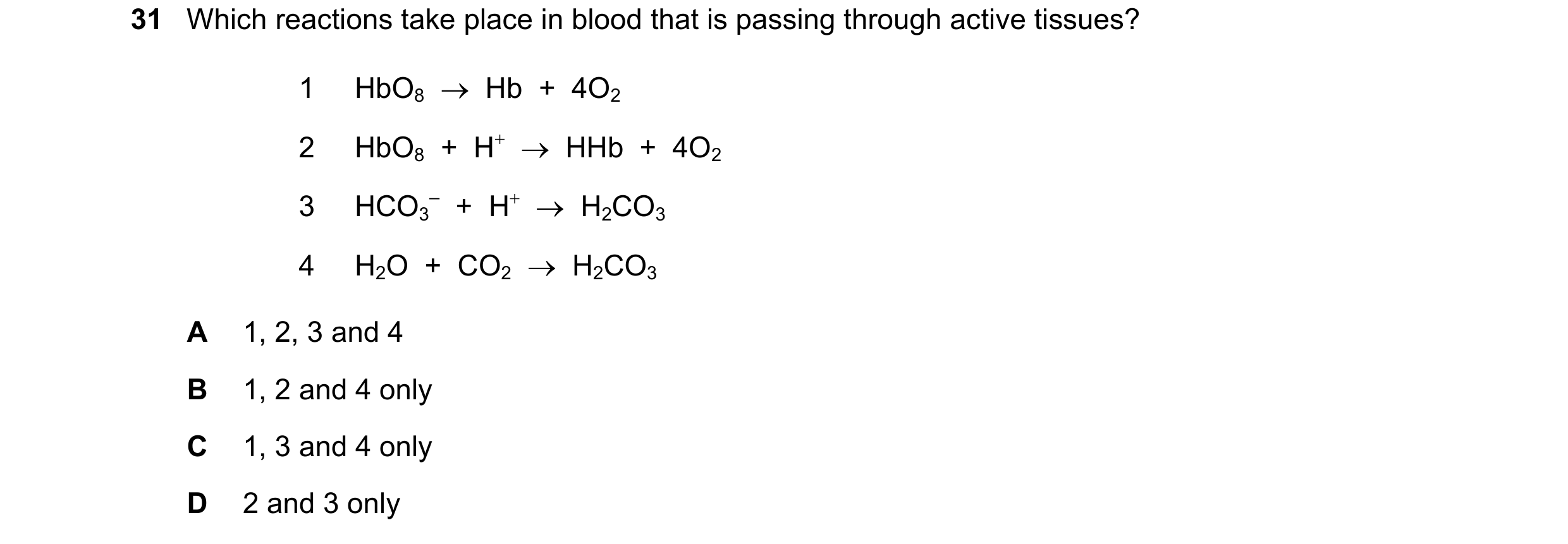
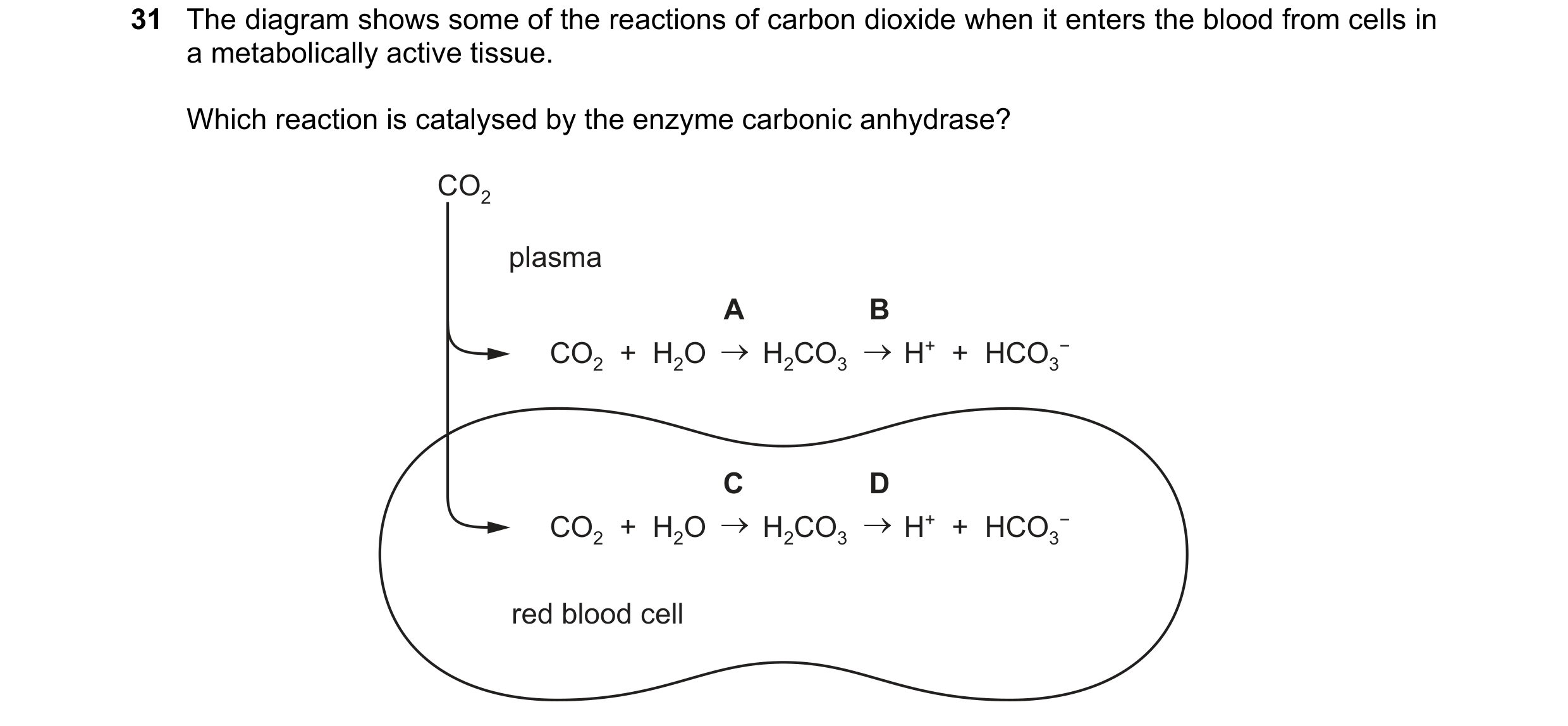 46 / 59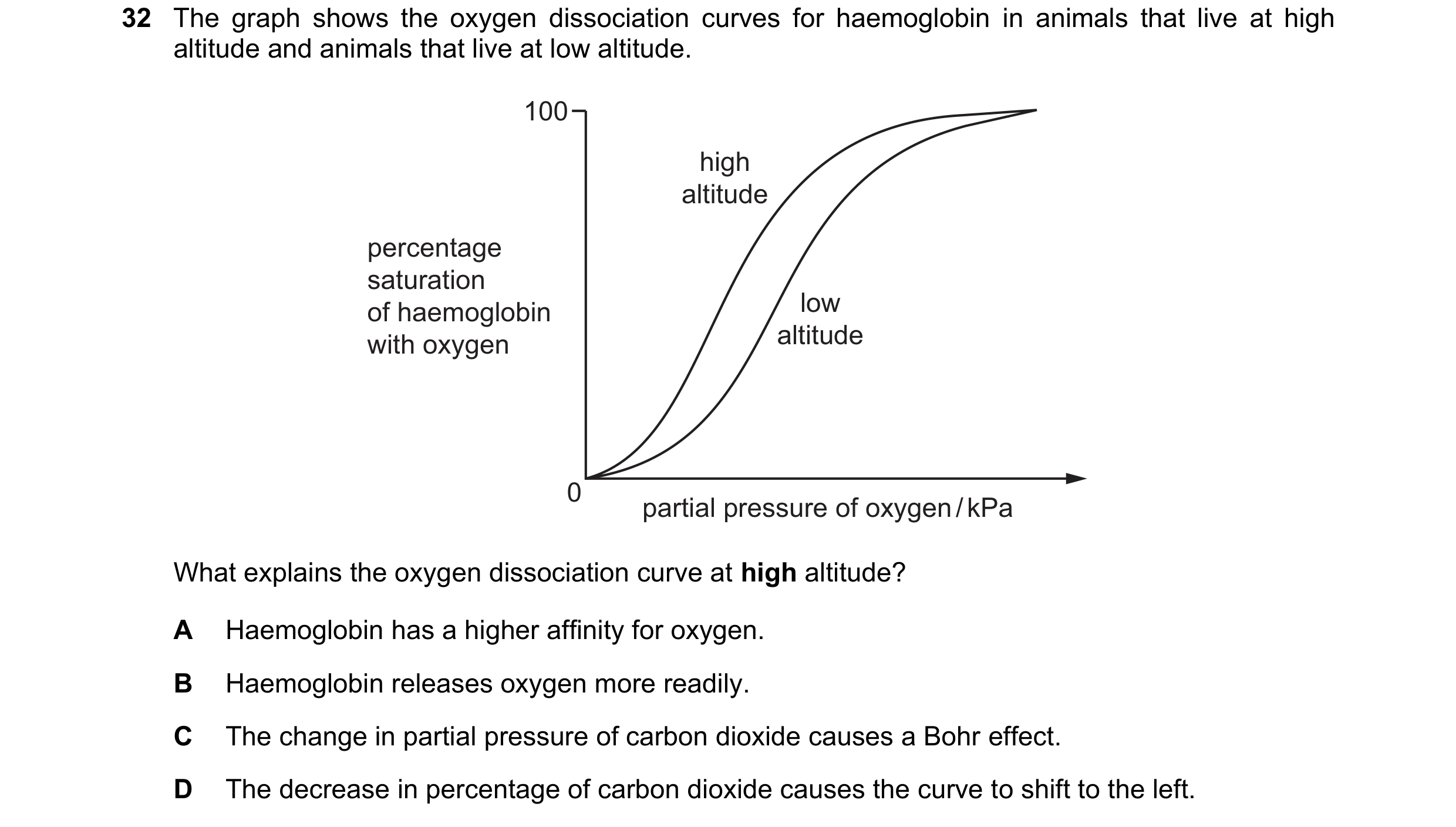

 47 / 59
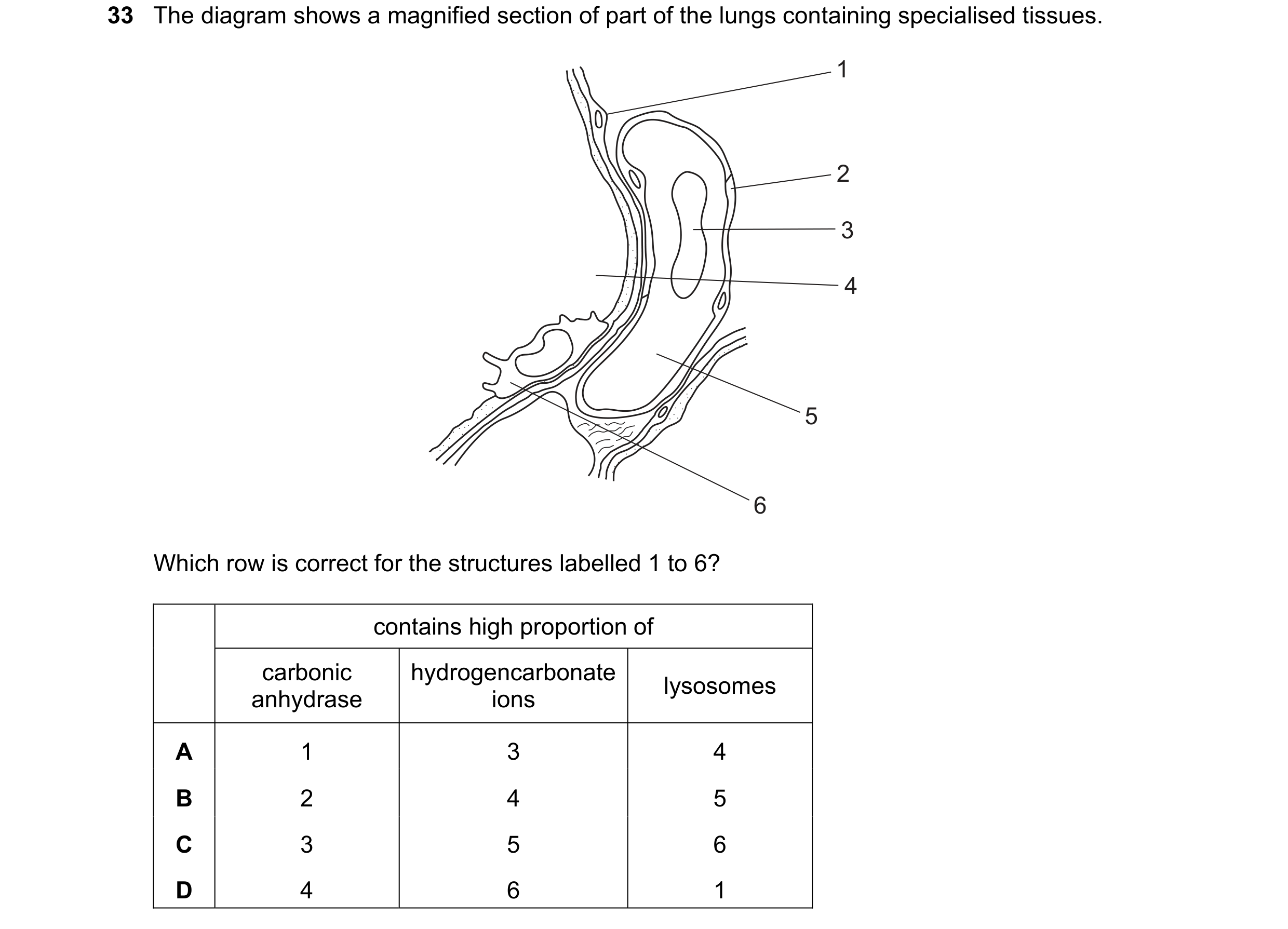
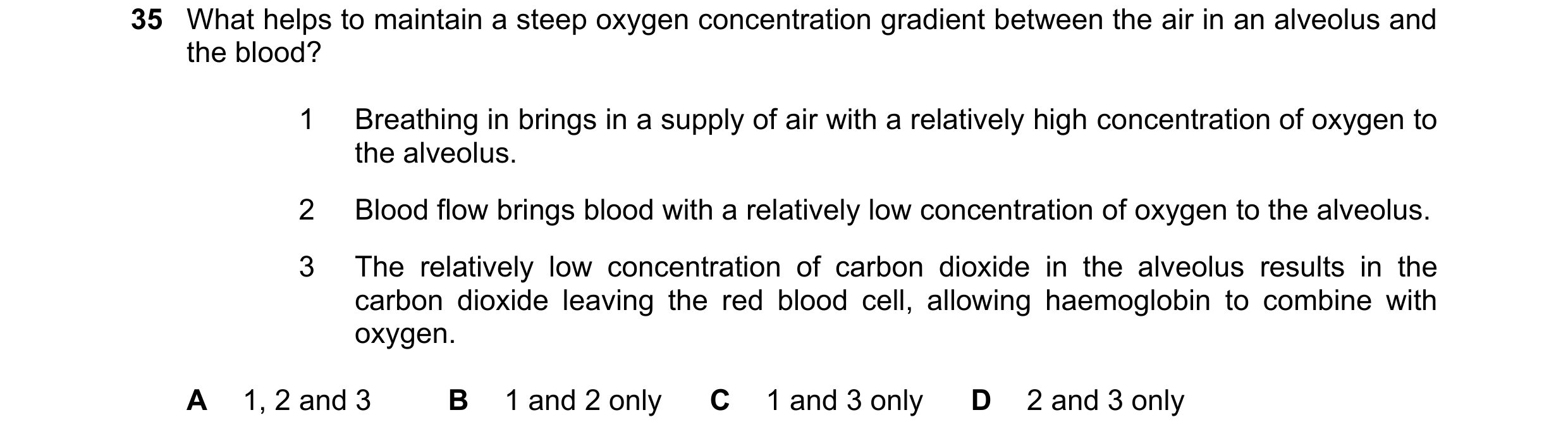 48 / 59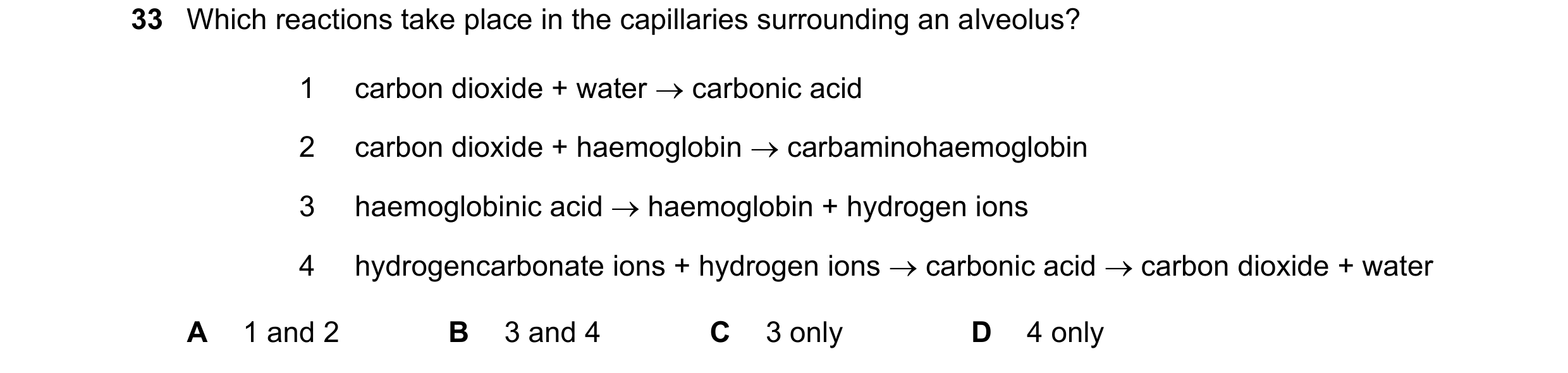
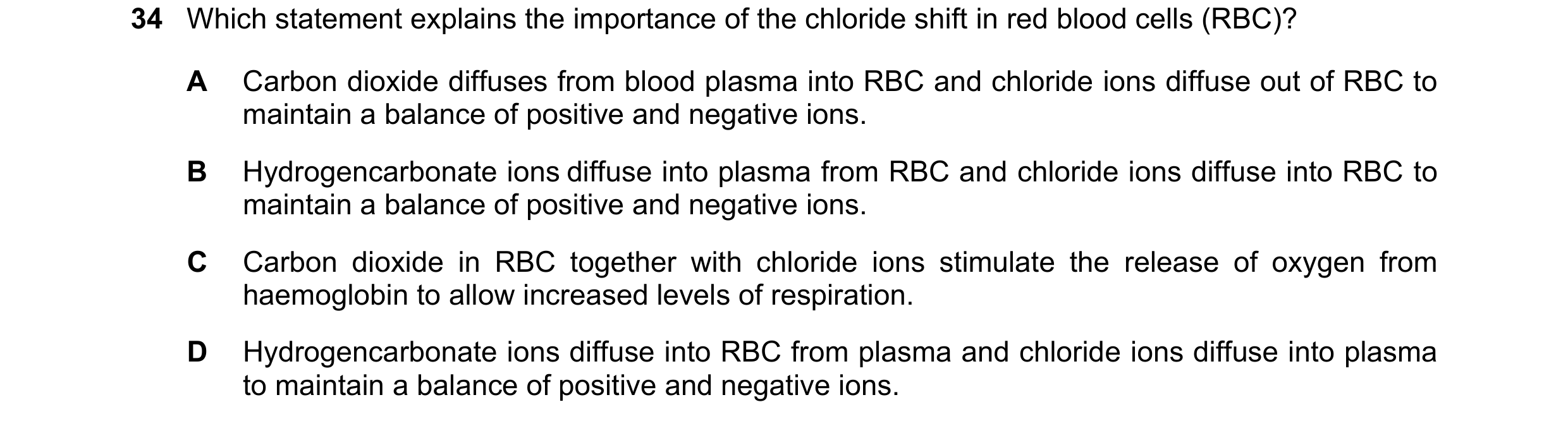
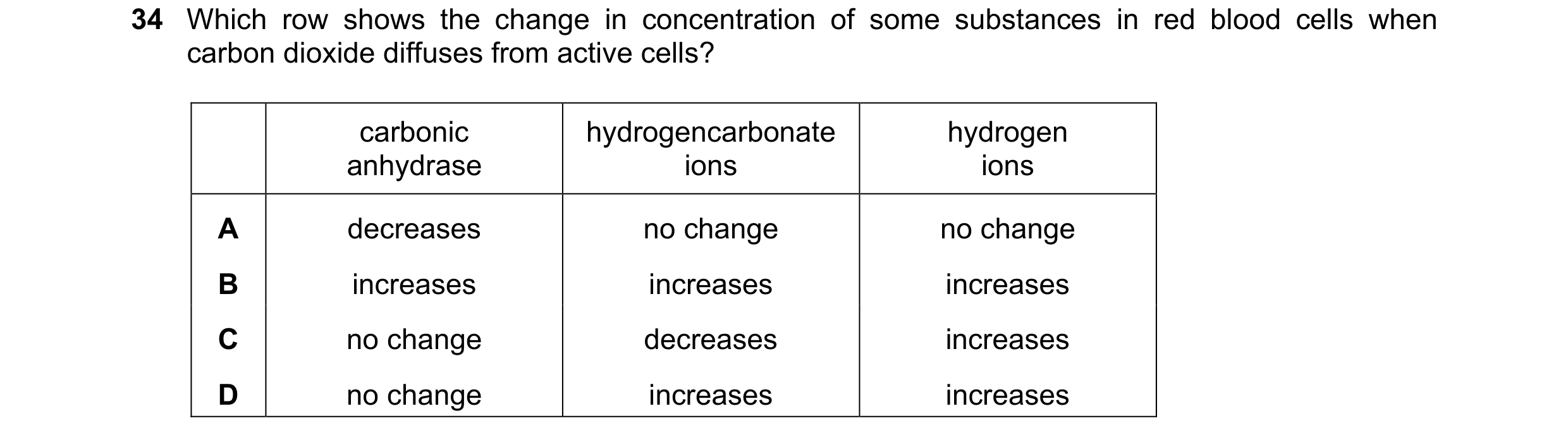
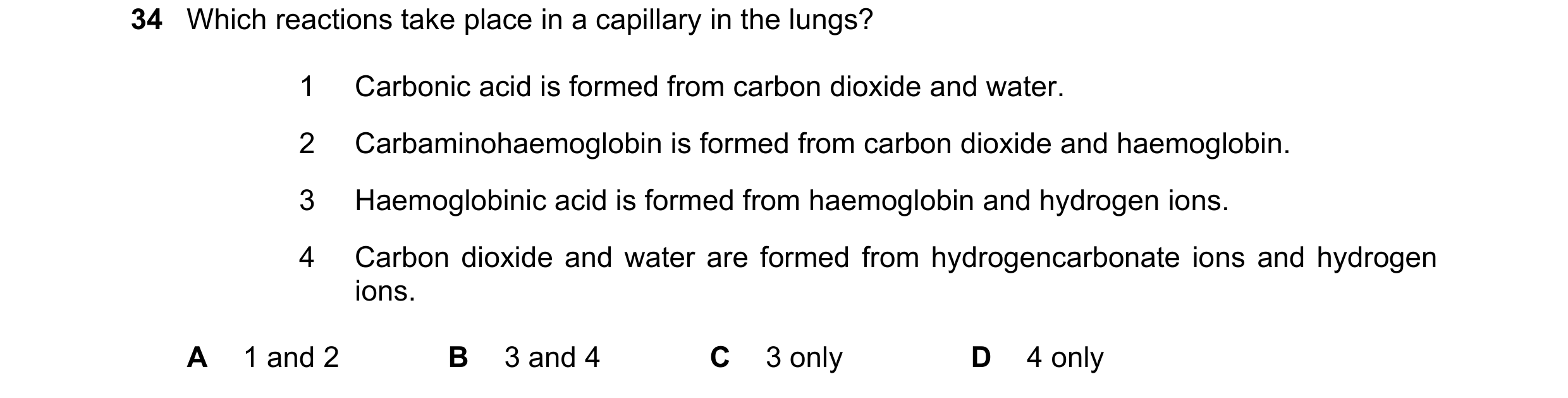 49 / 59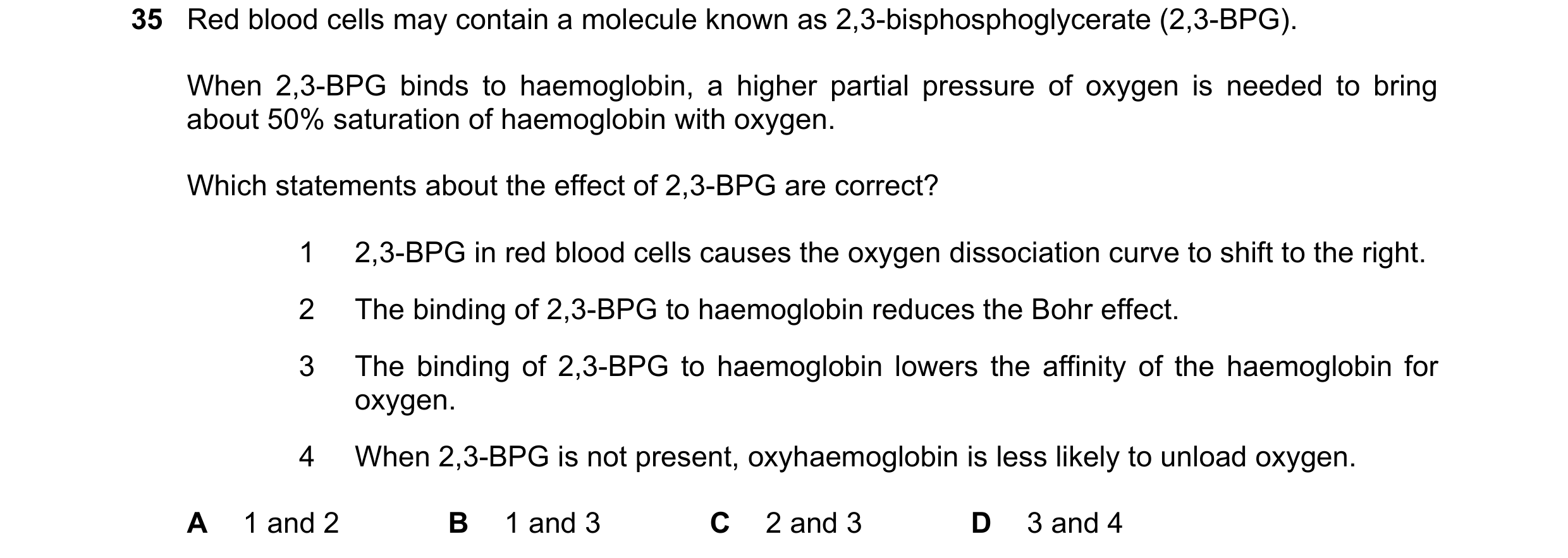
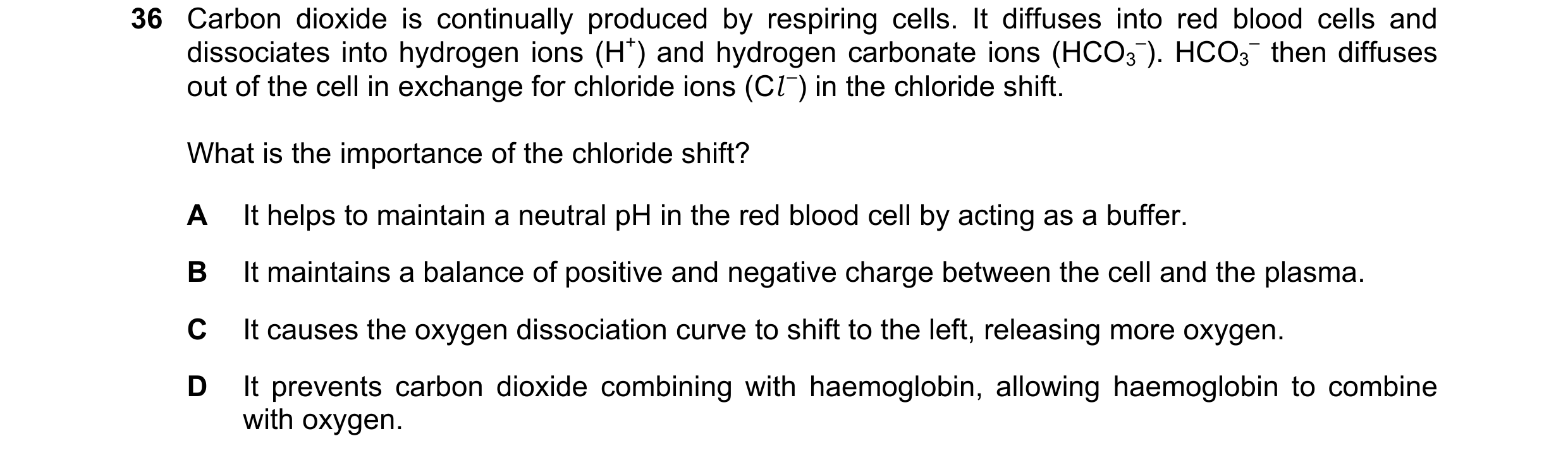

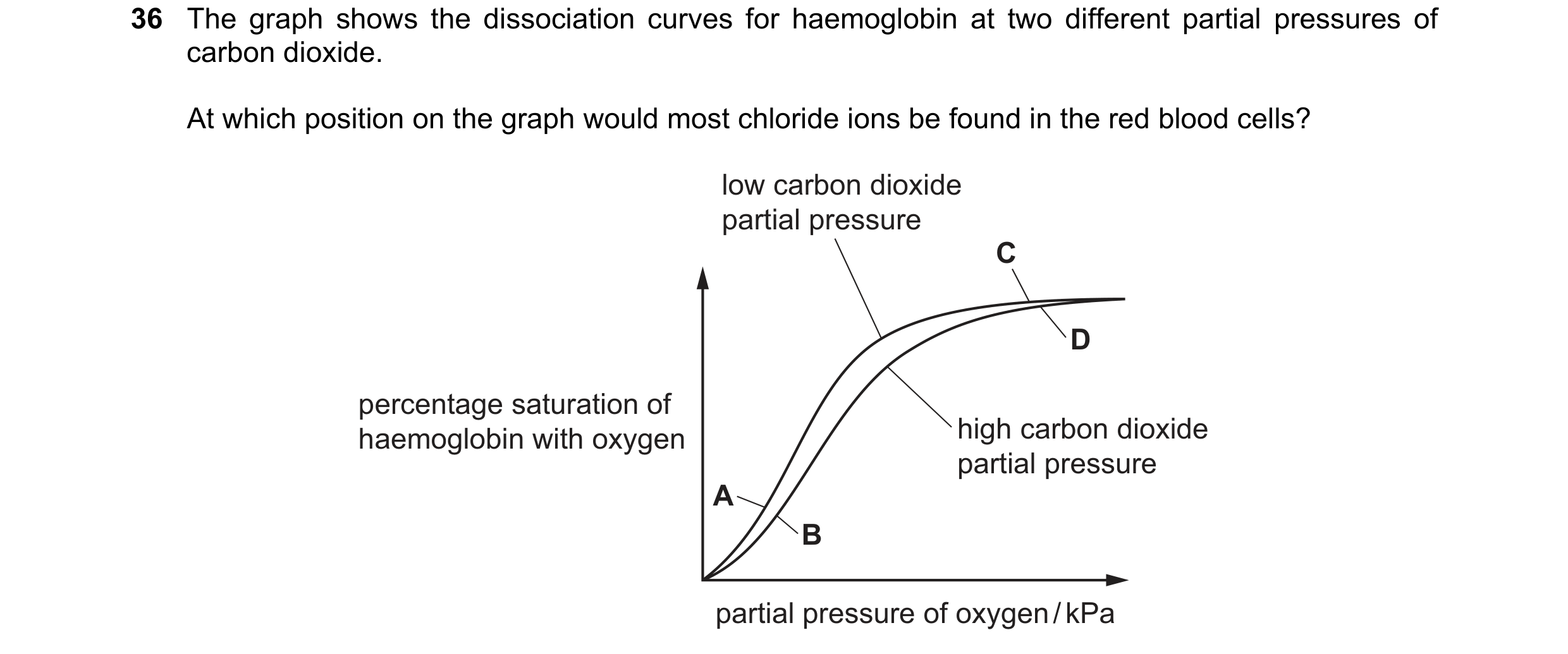 50 / 59

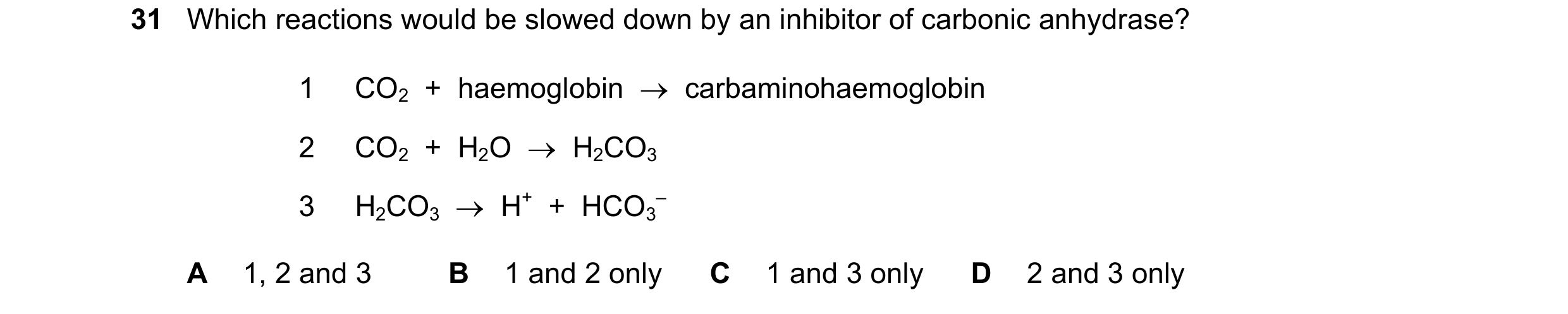
 51 / 59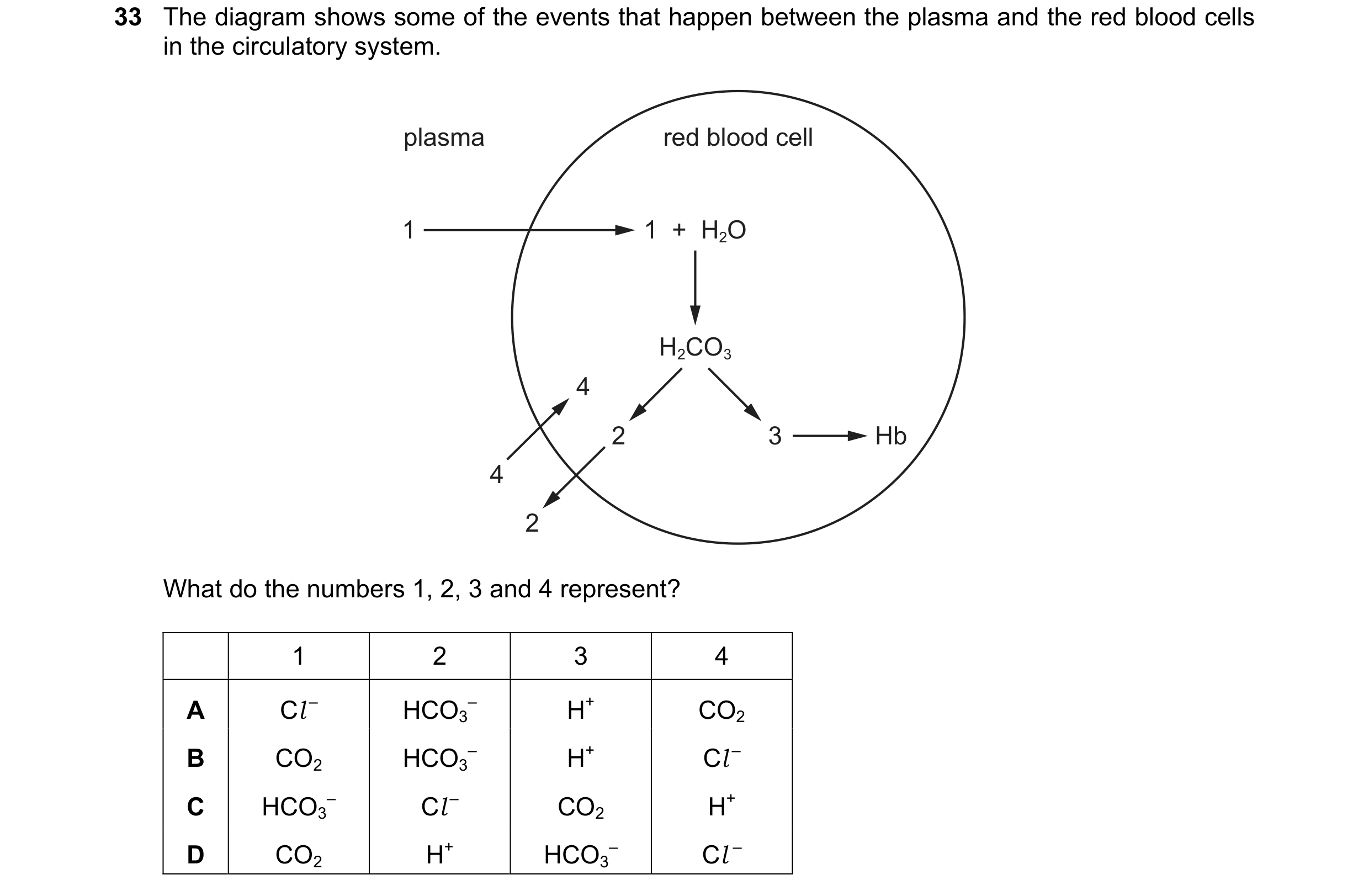


 52 / 59
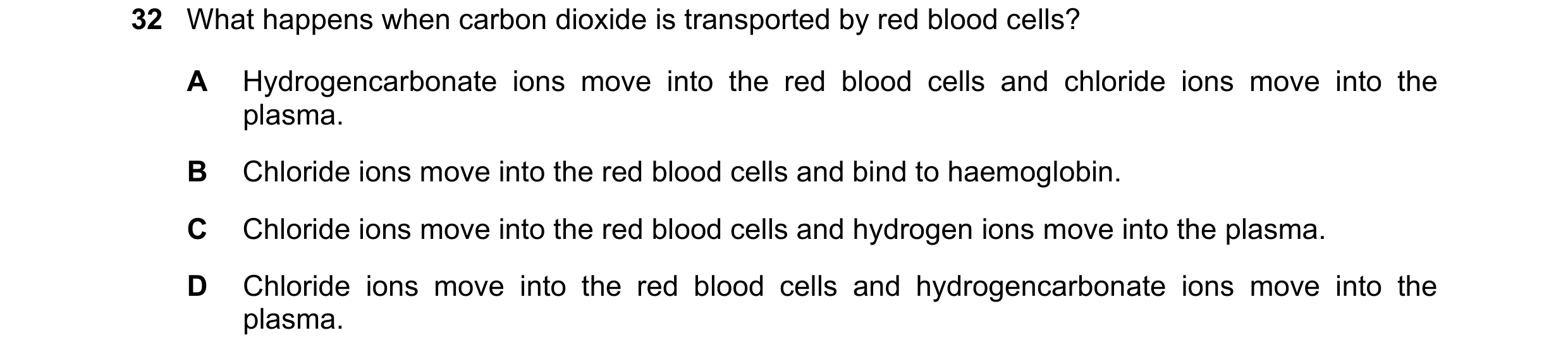

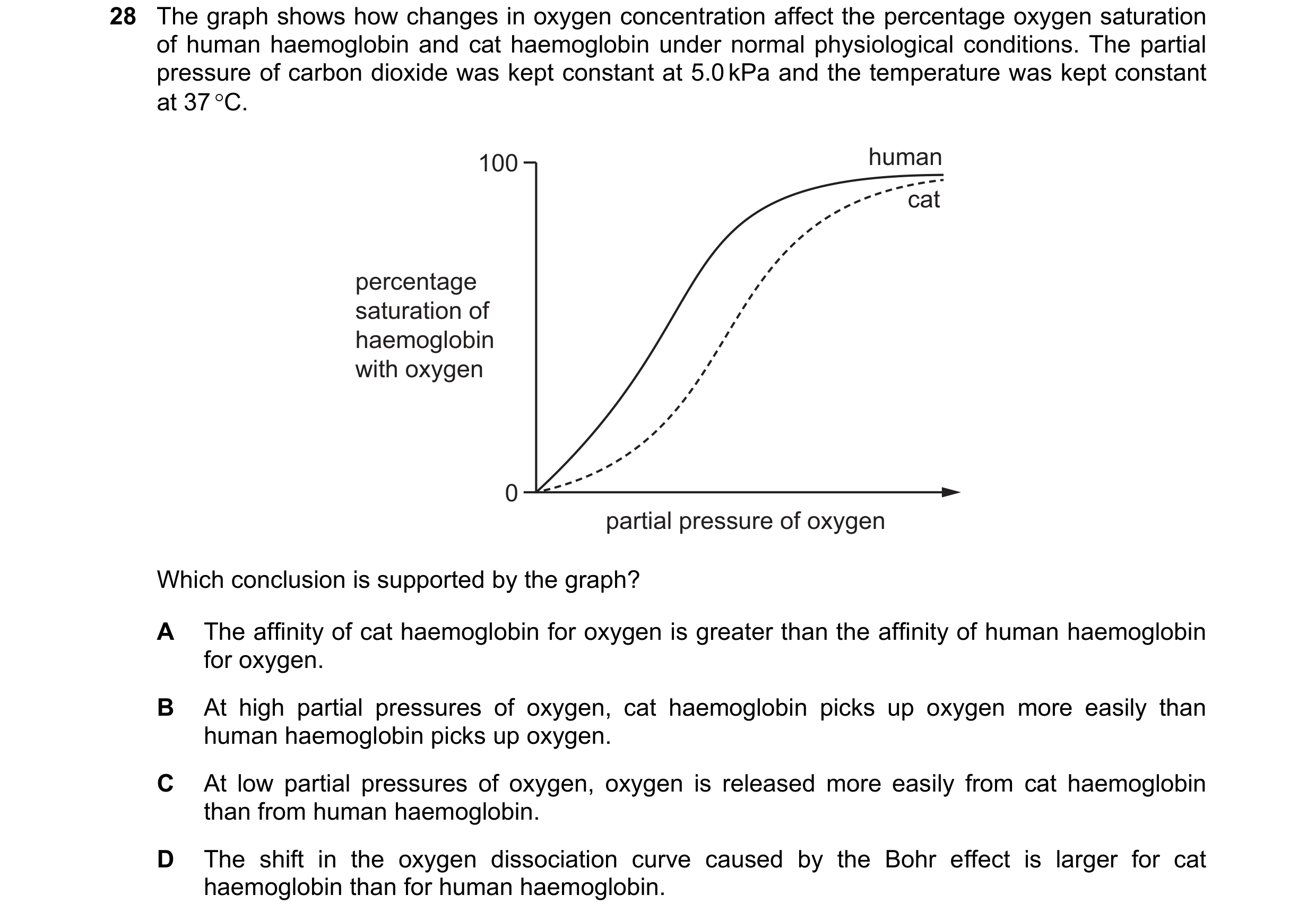 53 / 59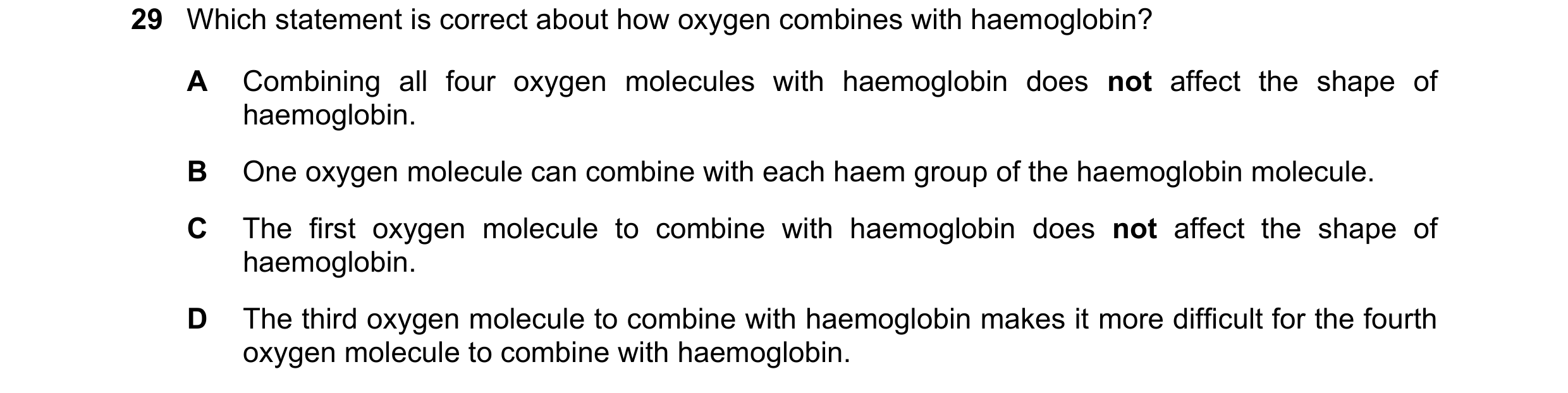
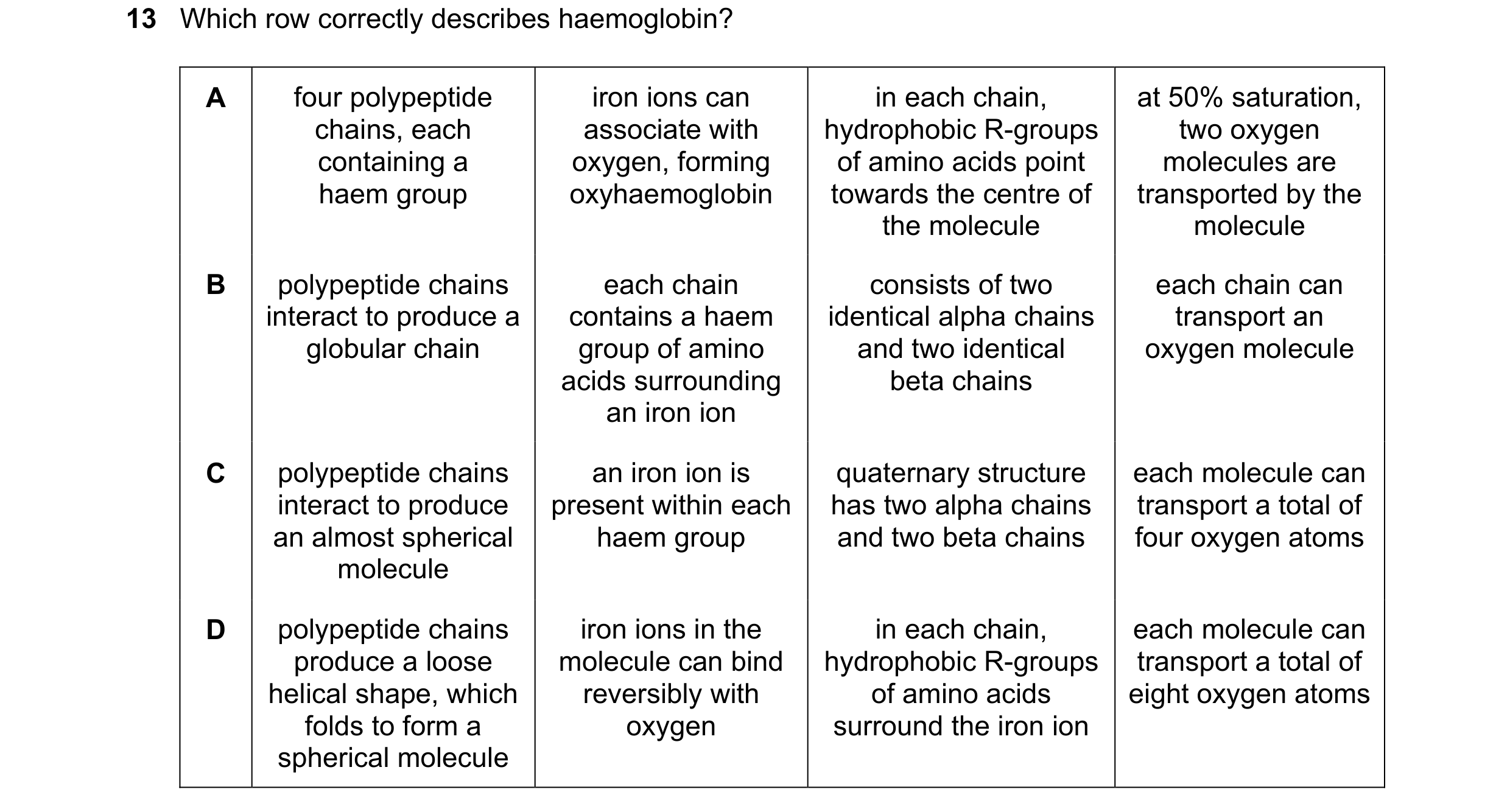 54 / 59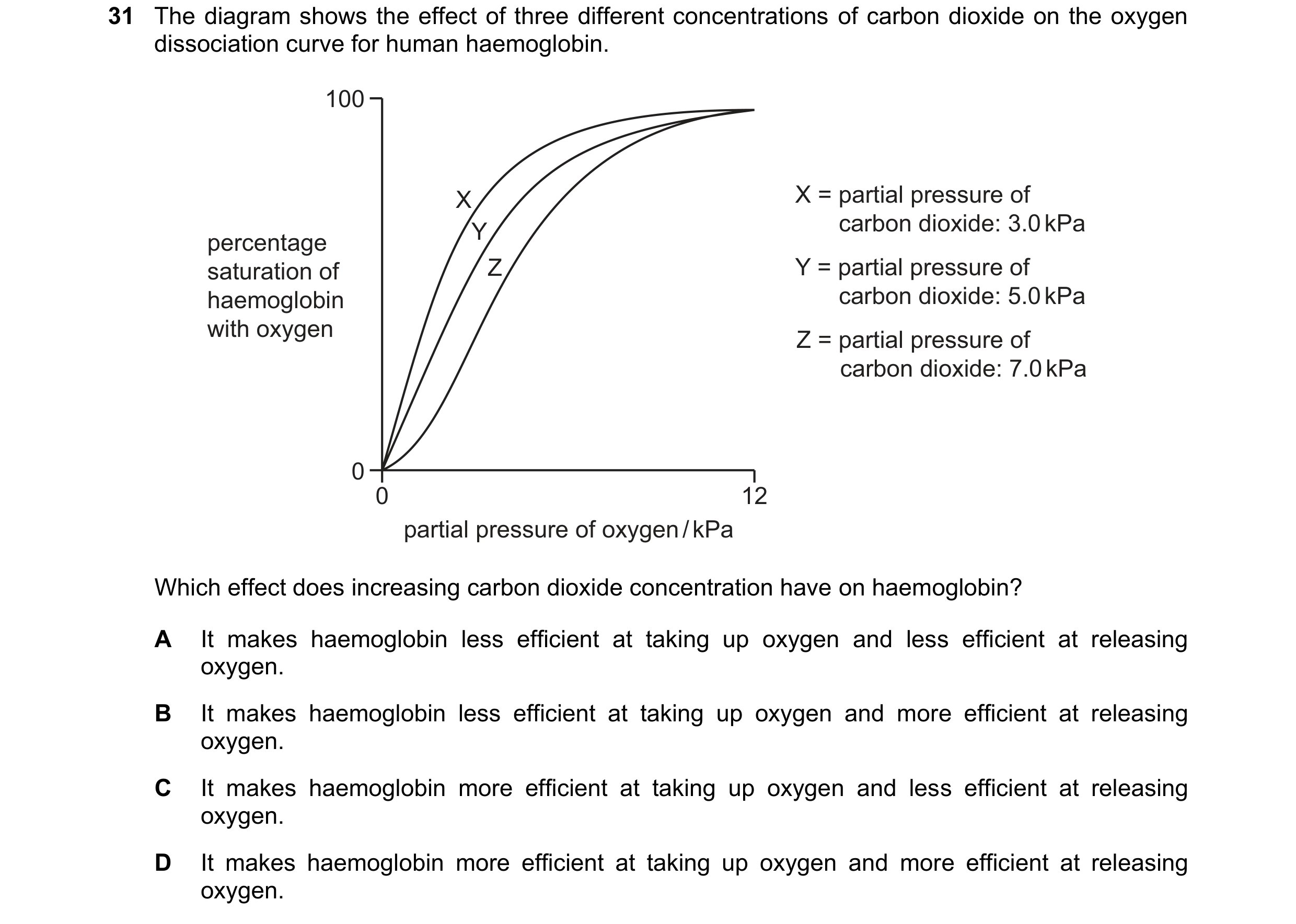
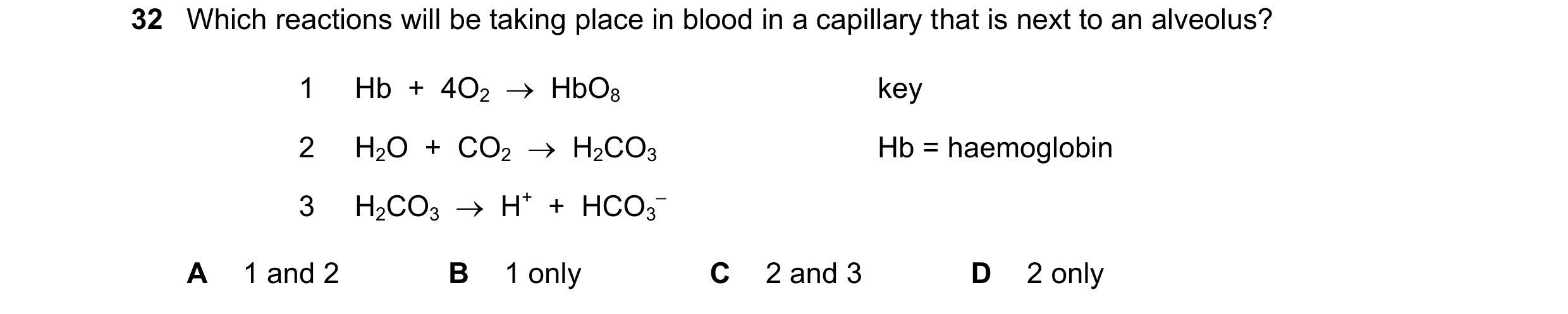
 55 / 59
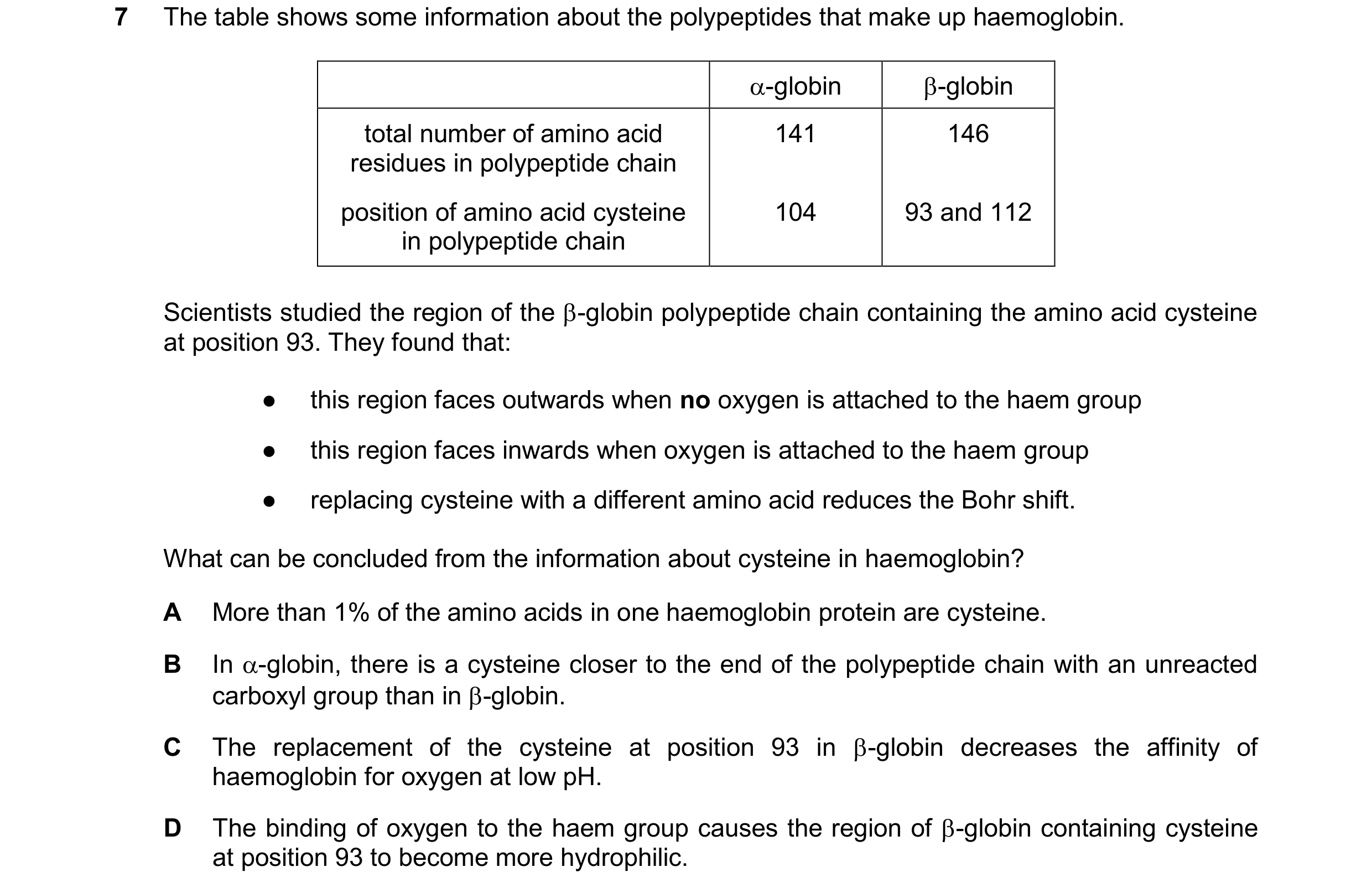
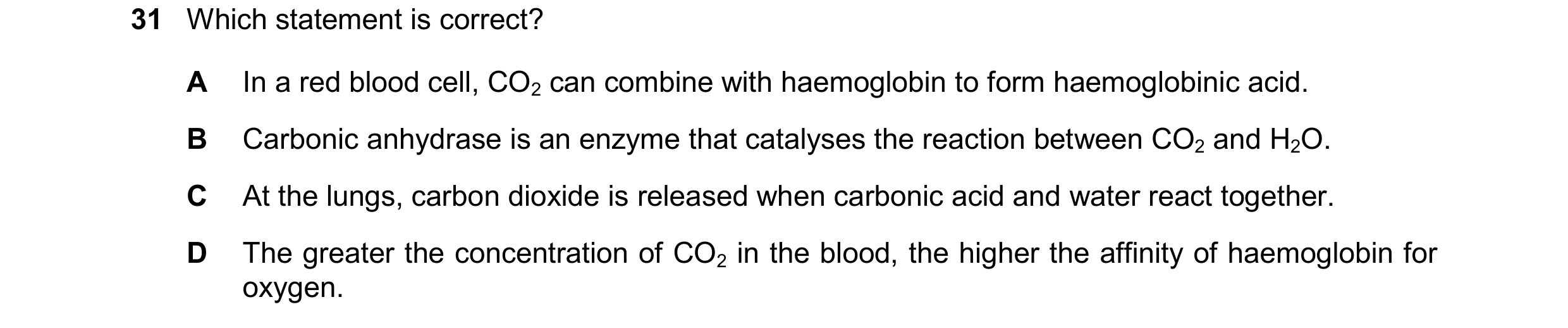 56 / 59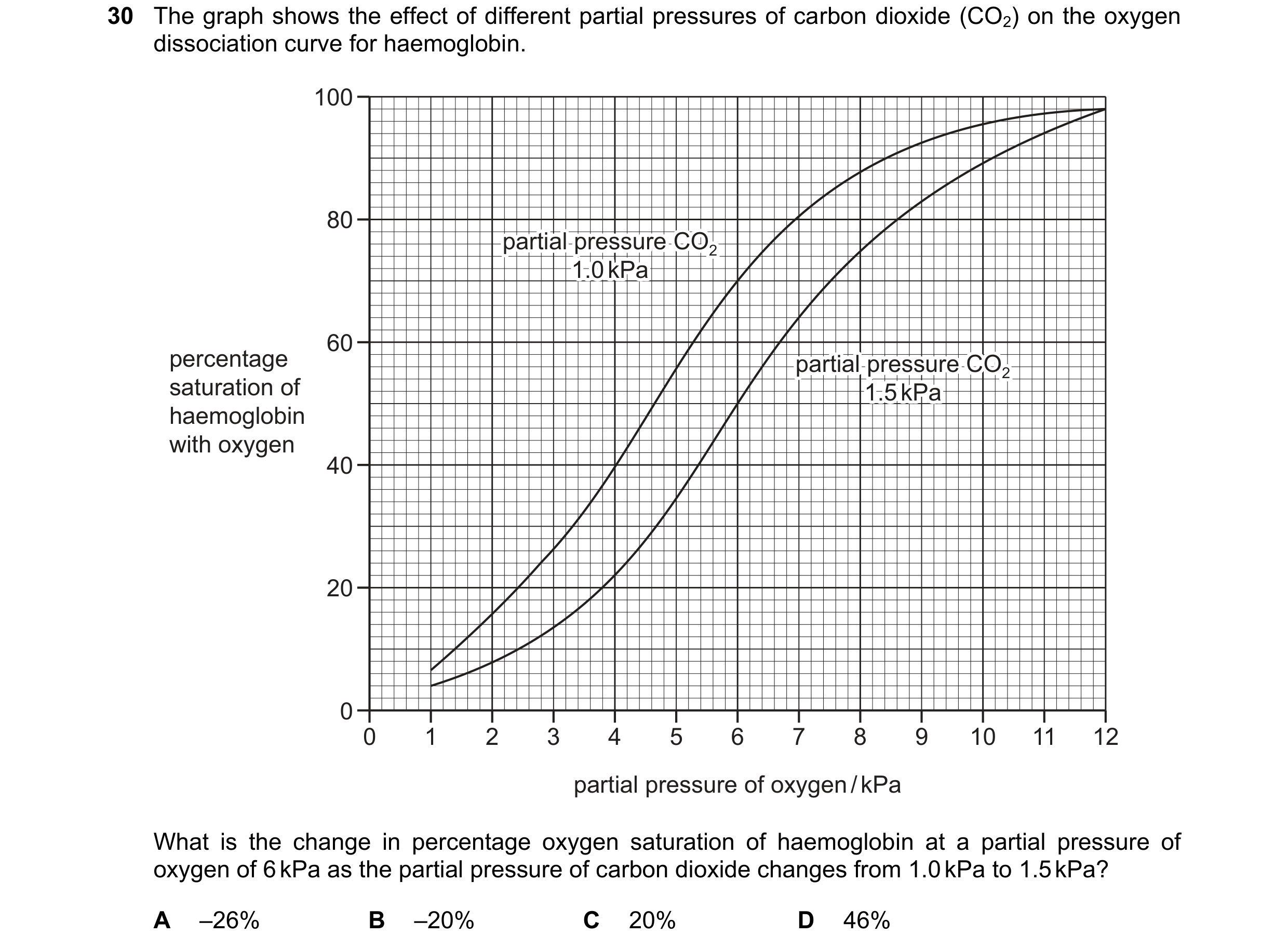
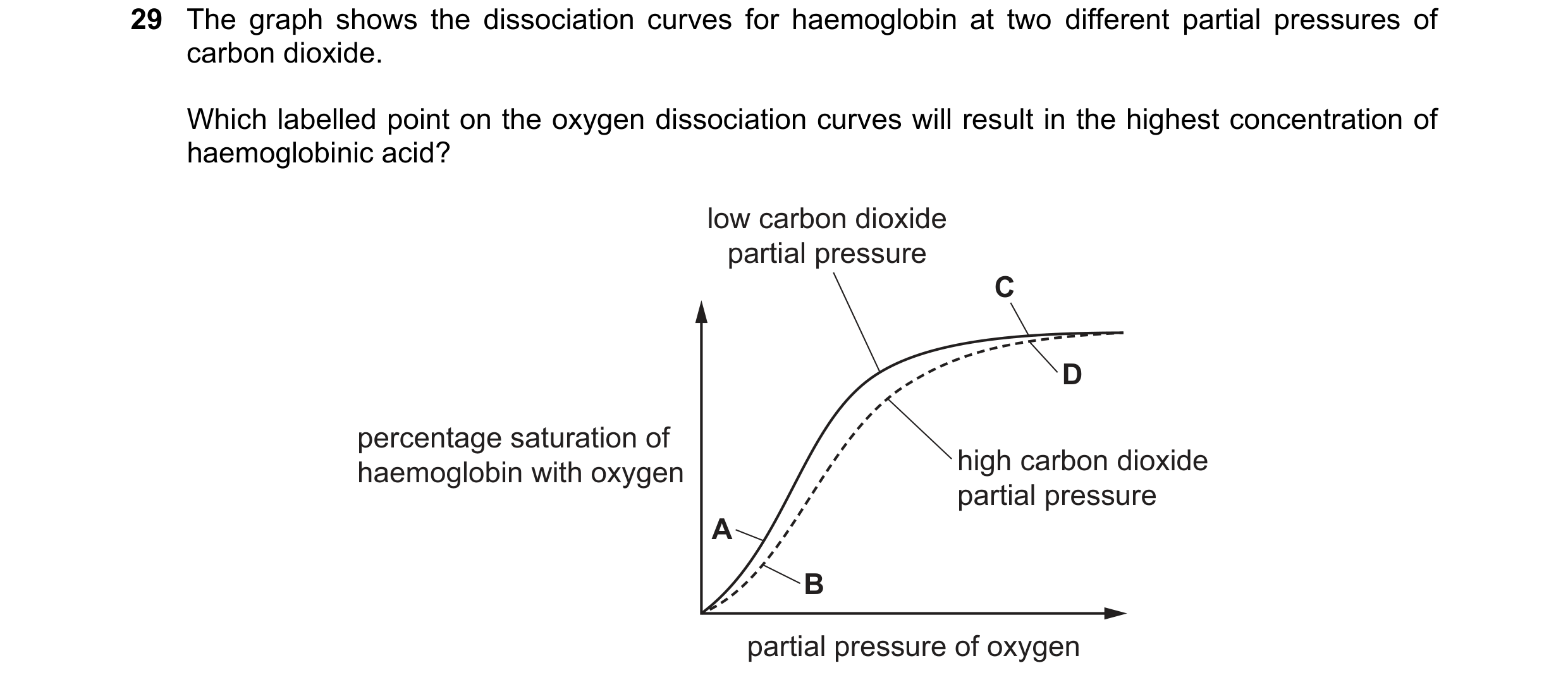 57 / 59
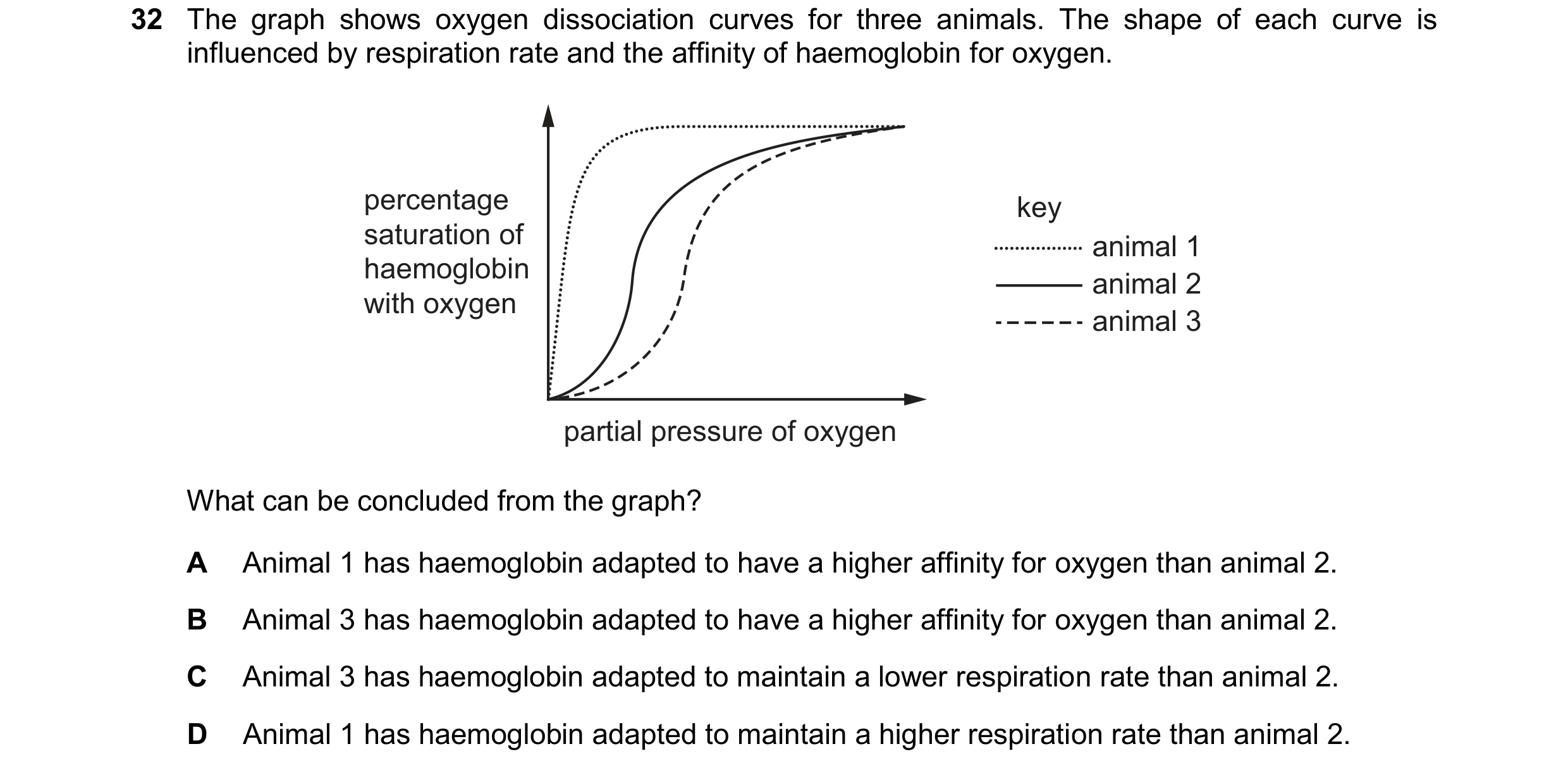

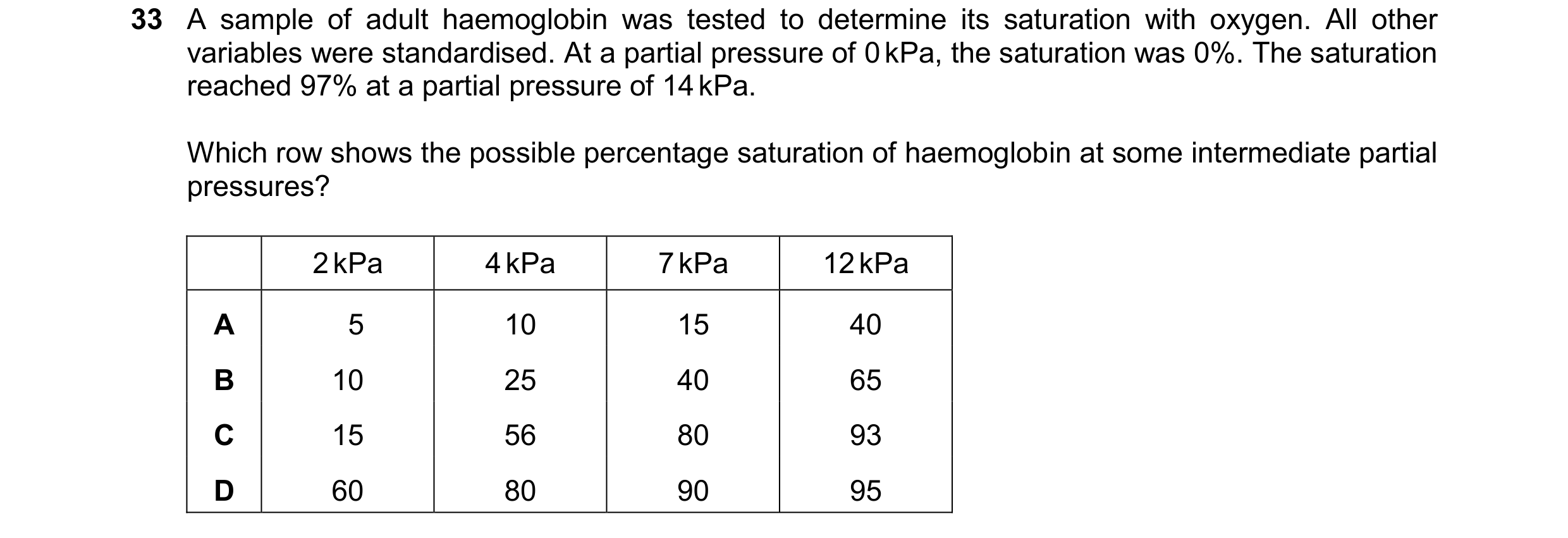 58 / 59
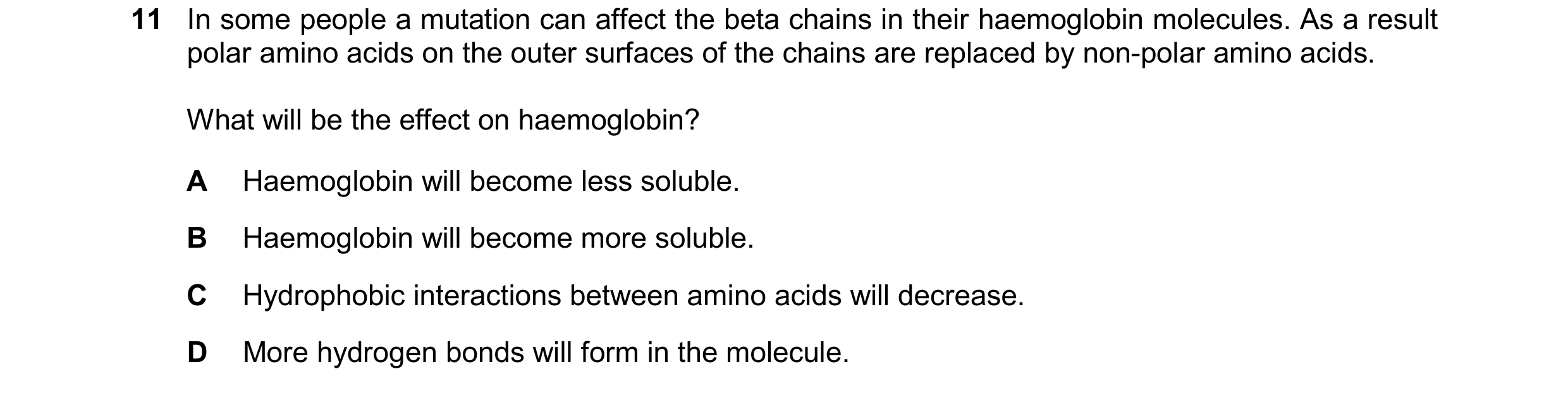
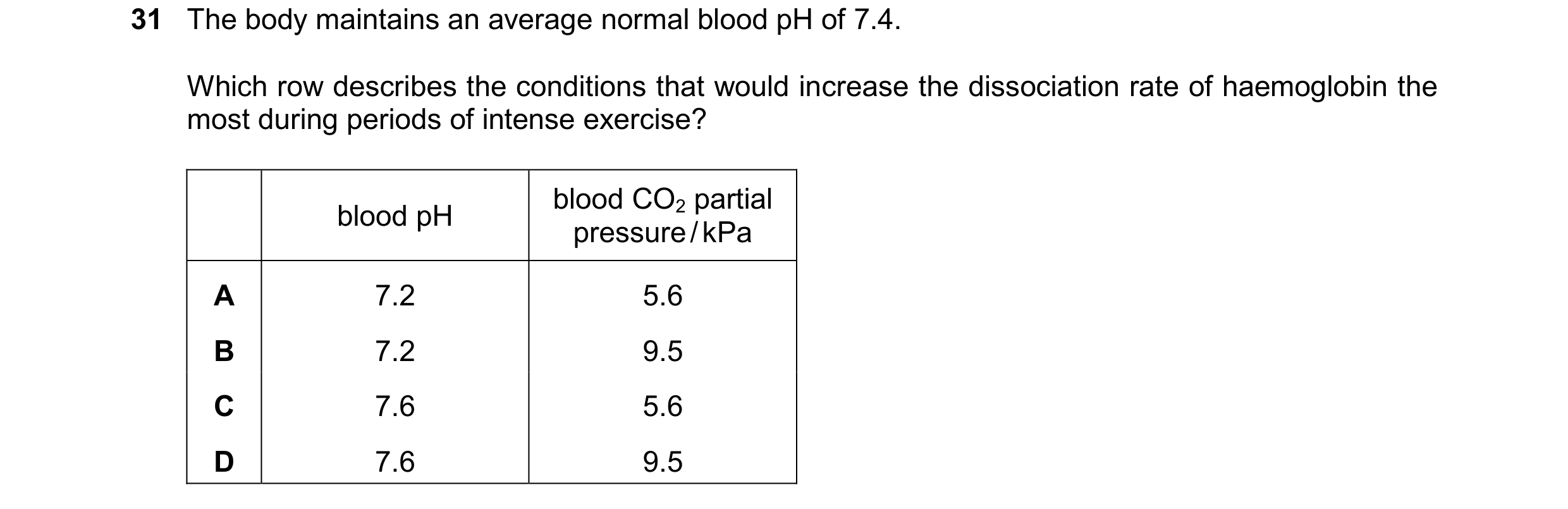
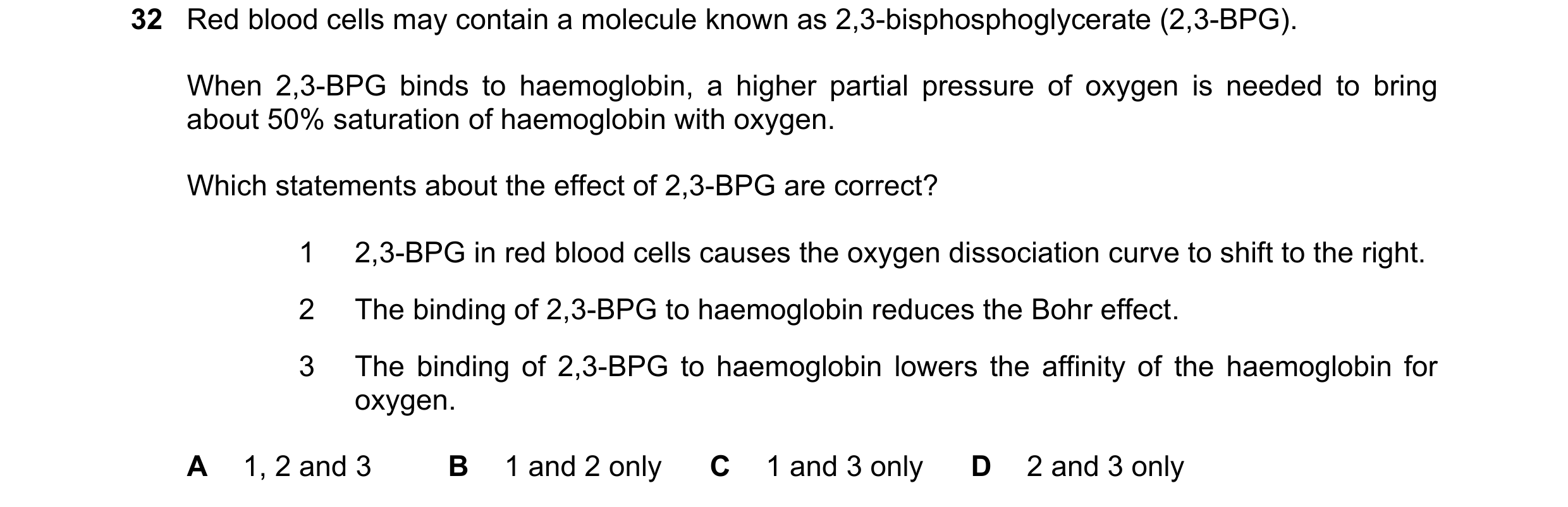 59 / 59