Cambridge A Level Biology 9700 — 2019 Oct/Nov Paper 1 · Variant 1
9700/11/O/N/19 · 40 questions · 40 marks · ≈45 min
The question paper and its mark scheme, free to read here and free to download. This is Cambridge’s own paper, exactly as it was sat.
Question paper20 pages



Mark scheme3 pages
Answers below. Sit the paper first if you are practising.
Questions as text
Q1 · Which cell structure contains cytoplasm?
1 Which cell structure contains cytoplasm? A chloroplasts B mitochondria C plasmodesmata D smooth endoplasmic reticulum
Mark scheme: C
More questions on Cells as the basic units of living organisms
Q2 · Some cell structures are listed in a particular order
2 Some cell structures are listed in a particular order. 1 nucleus 2 ribosome 3 Golgi body 4 vesicle What determines the order in which these cell structures are listed? A sequence used in synthesis of a lipid B sequence used in synthesis of an antibody C size from largest to smallest D size from smallest to largest
Mark scheme: B
More questions on Cells as the basic units of living organisms
Q3 · The drawing has been made from a section showing part of an alveolus and a red blood cell…
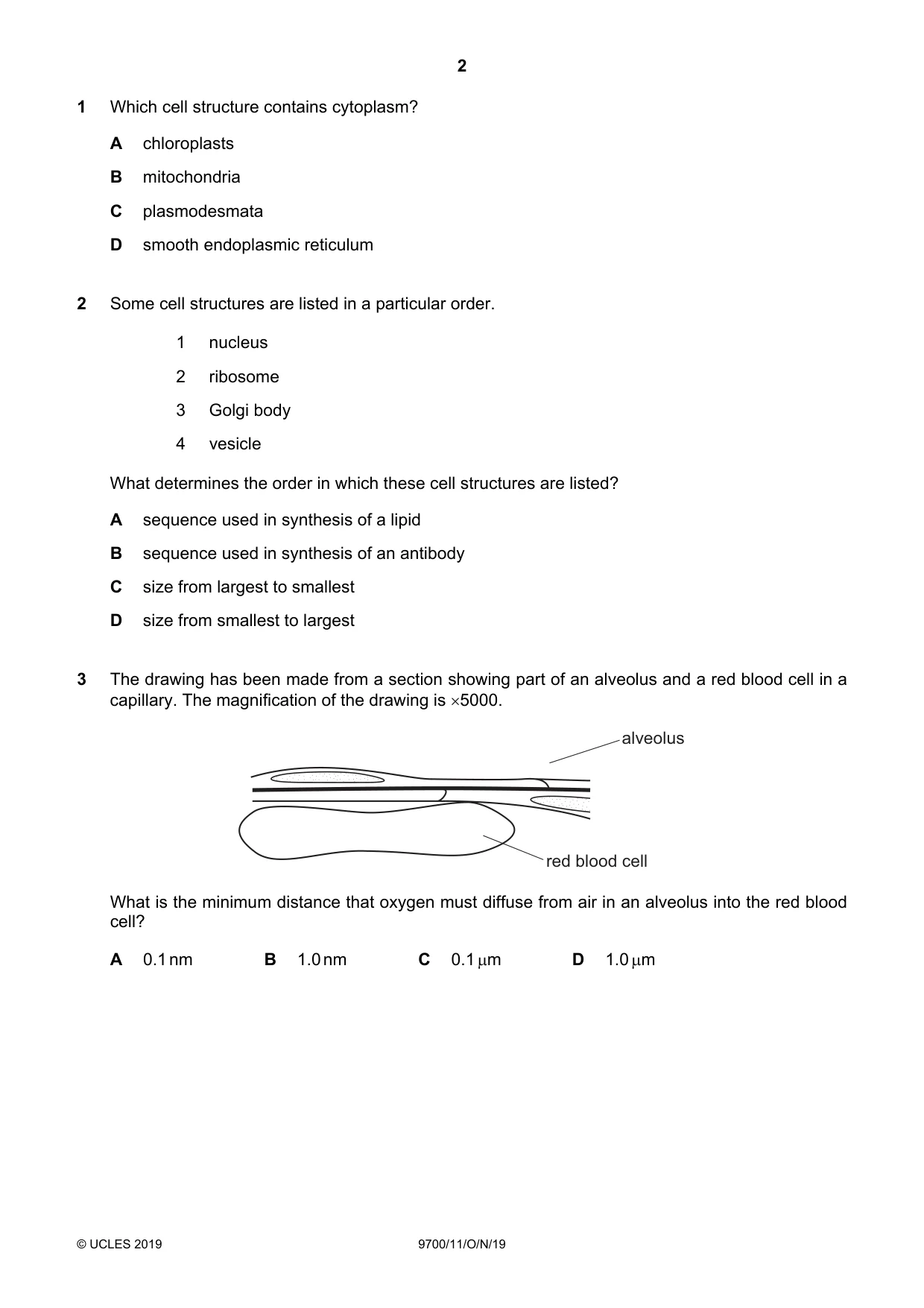
3 The drawing has been made from a section showing part of an alveolus and a red blood cell in a capillary. The magnification of the drawing is ×5000. alveolus red blood cell What is the minimum distance that oxygen must diffuse from air in an alveolus into the red blood cell? A 0.1 nm B 1.0 nm C 0.1 µm D 1.0 µm
Mark scheme: D
Q4 · Four students were asked to match the function with the appearance of some cell…
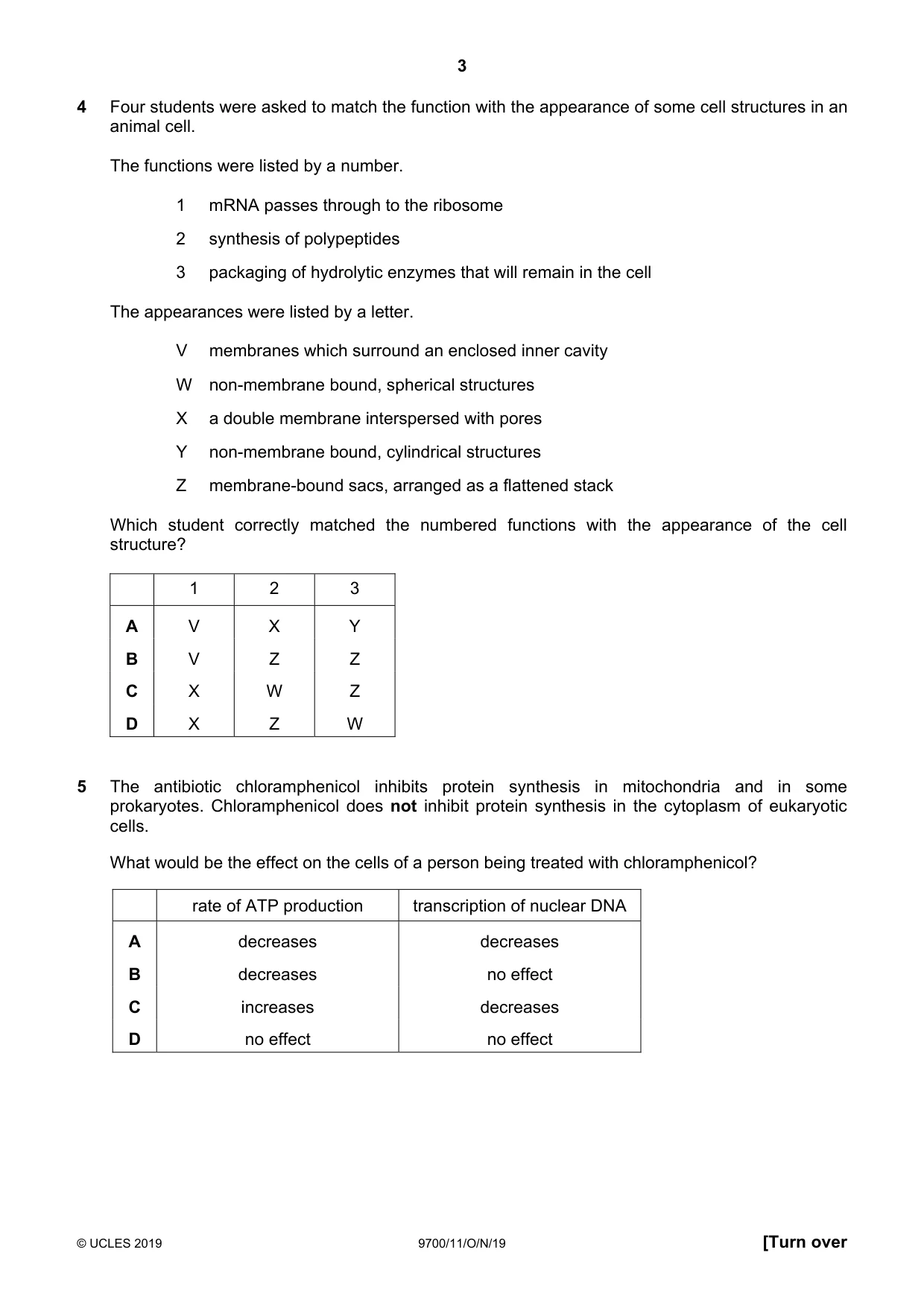
4 Four students were asked to match the function with the appearance of some cell structures in an animal cell. The functions were listed by a number. 1 mRNA passes through to the ribosome 2 synthesis of polypeptides 3 packaging of hydrolytic enzymes that will remain in the cell The appearances were listed by a letter. V membranes which surround an enclosed inner cavity W non-membrane bound, spherical structures X a double membrane interspersed with pores Y non-membrane bound, cylindrical structures Z membrane-bound sacs, arranged as a flattened stack Which student correctly matched the numbered functions with the appearance of the cell structure? 1 2 3 A V X Y B V Z Z C X W Z D X Z W
Mark scheme: C
More questions on Cells as the basic units of living organisms
Q5 · The antibiotic chloramphenicol inhibits protein synthesis in mitochondria and in some…
5 The antibiotic chloramphenicol inhibits protein synthesis in mitochondria and in some prokaryotes. Chloramphenicol does not inhibit protein synthesis in the cytoplasm of eukaryotic cells. What would be the effect on the cells of a person being treated with chloramphenicol? rate of ATP production transcription of nuclear DNA A decreases decreases B decreases no effect C increases decreases D no effect no effect
Mark scheme: A
More questions on Cells as the basic units of living organisms
Q6 · The diagram shows the monosaccharide xylose
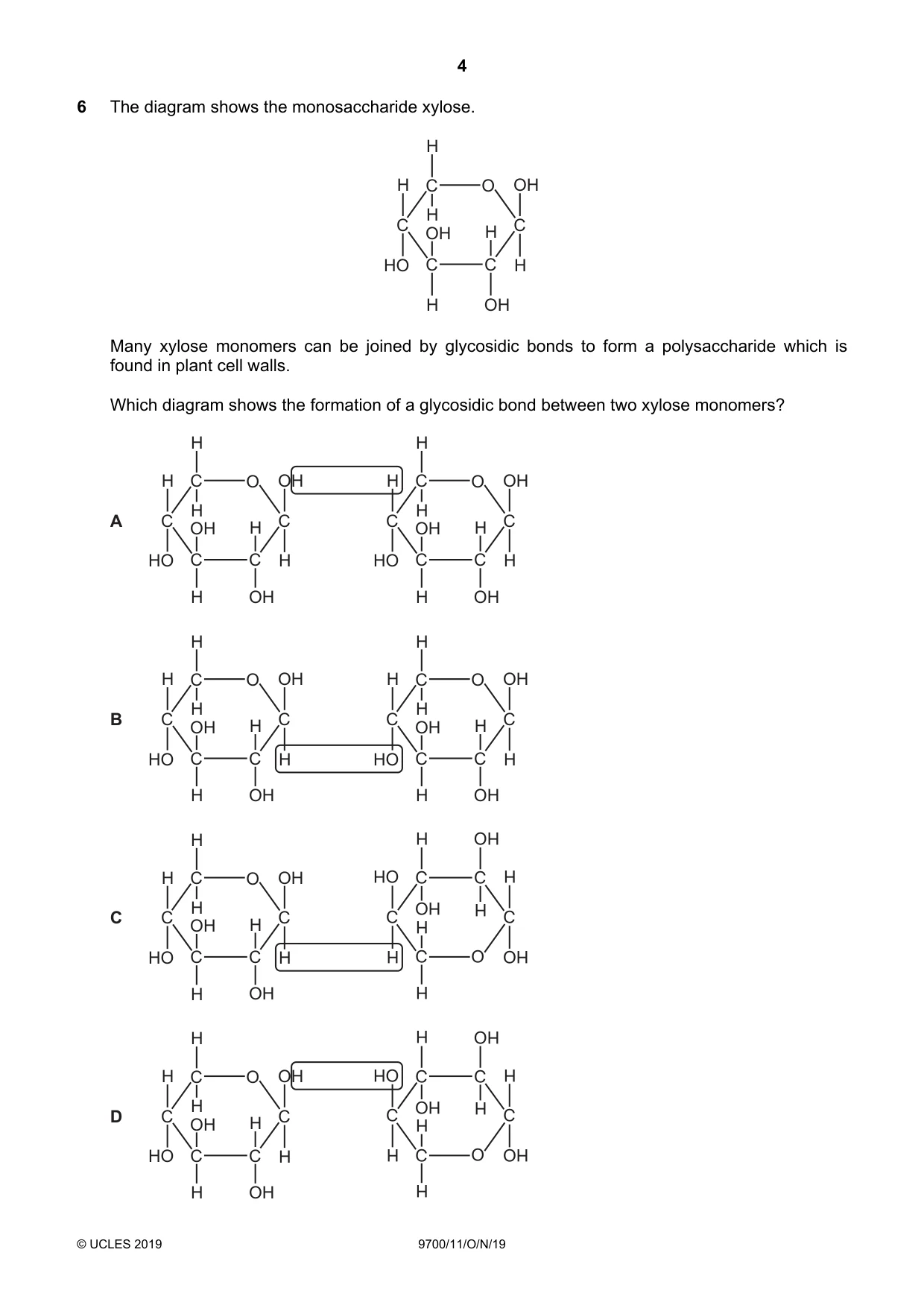
6 The diagram shows the monosaccharide xylose. H H C O OH H C H C OH HO C C H H OH Many xylose monomers can be joined by glycosidic bonds to form a polysaccharide which is found in plant cell walls. Which diagram shows the formation of a glycosidic bond between two xylose monomers? H H H C O OH H C O OH H H A C H C C H C OH OH HO C C H HO C C H H OH H OH H H H C O OH H C O OH H H B C H C C H C OH OH HO C C H HO C C H H OH H OH H H OH H C O OH HO C C H H OH H C C C C C OH H H HO C C H H C O OH H OH H H H OH H C O OH HO C C H H OH H D C C C C OH H H HO C C H H C O OH H OH H
Mark scheme: D
Q7 · Which colour indicates the lowest concentration of reducing sugar present in a solution…
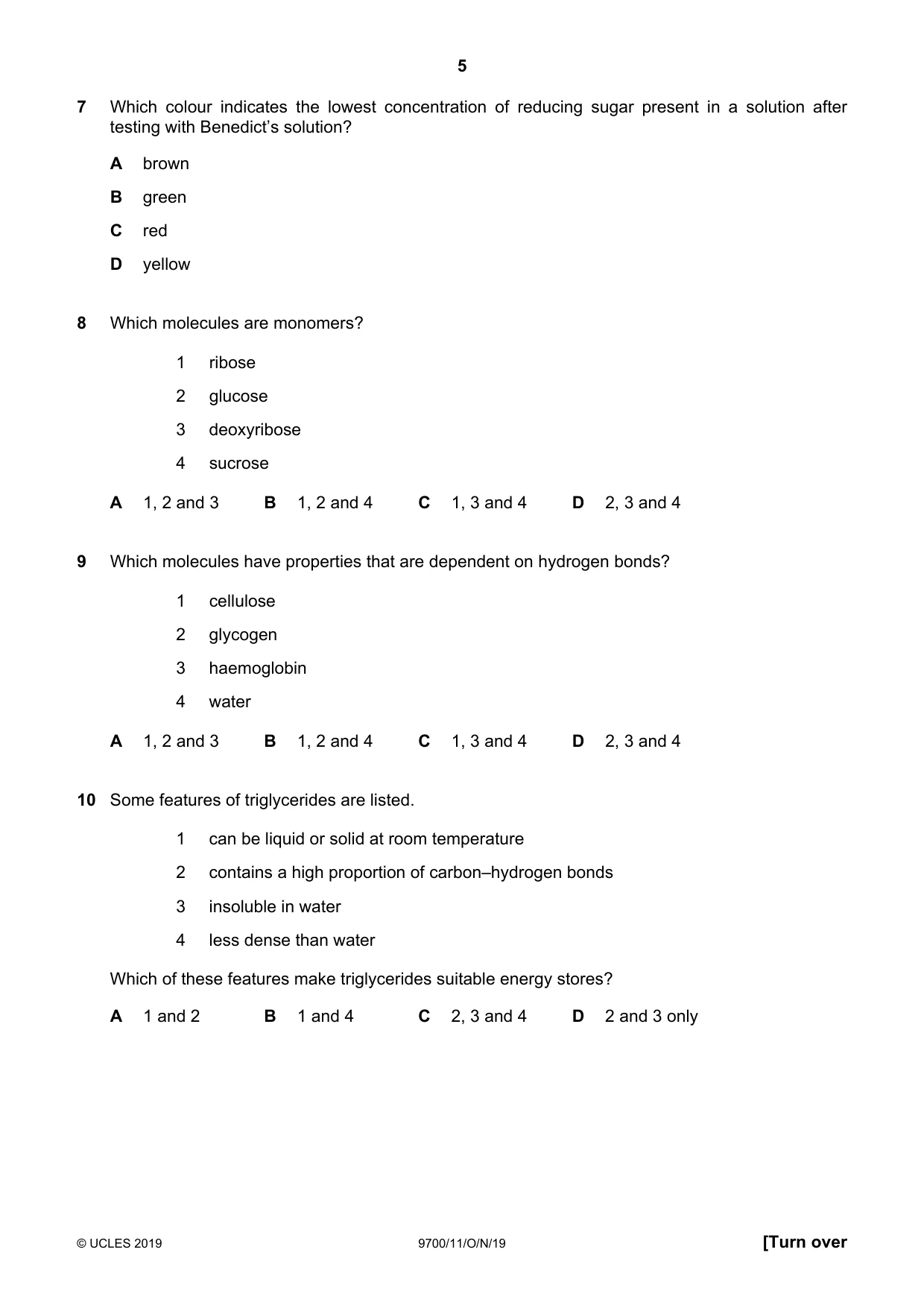
7 Which colour indicates the lowest concentration of reducing sugar present in a solution after testing with Benedict’s solution? A brown B green C red D yellow
Mark scheme: B
Q8 · Which molecules are monomers?
8 Which molecules are monomers? 1 ribose 2 glucose 3 deoxyribose 4 sucrose A 1, 2 and 3 B 1, 2 and 4 C 1, 3 and 4 D 2, 3 and 4
Mark scheme: A
Q9 · Which molecules have properties that are dependent on hydrogen bonds?
9 Which molecules have properties that are dependent on hydrogen bonds? 1 cellulose 2 glycogen 3 haemoglobin 4 water A 1, 2 and 3 B 1, 2 and 4 C 1, 3 and 4 D 2, 3 and 4
Mark scheme: C
Q10 · Some features of triglycerides are listed
10 Some features of triglycerides are listed. 1 can be liquid or solid at room temperature 2 contains a high proportion of carbon–hydrogen bonds 3 insoluble in water 4 less dense than water Which of these features make triglycerides suitable energy stores? A 1 and 2 B 1 and 4 C 2, 3 and 4 D 2 and 3 only
Mark scheme: D
Q11 · Some foods contain hydrogenated vegetable oils
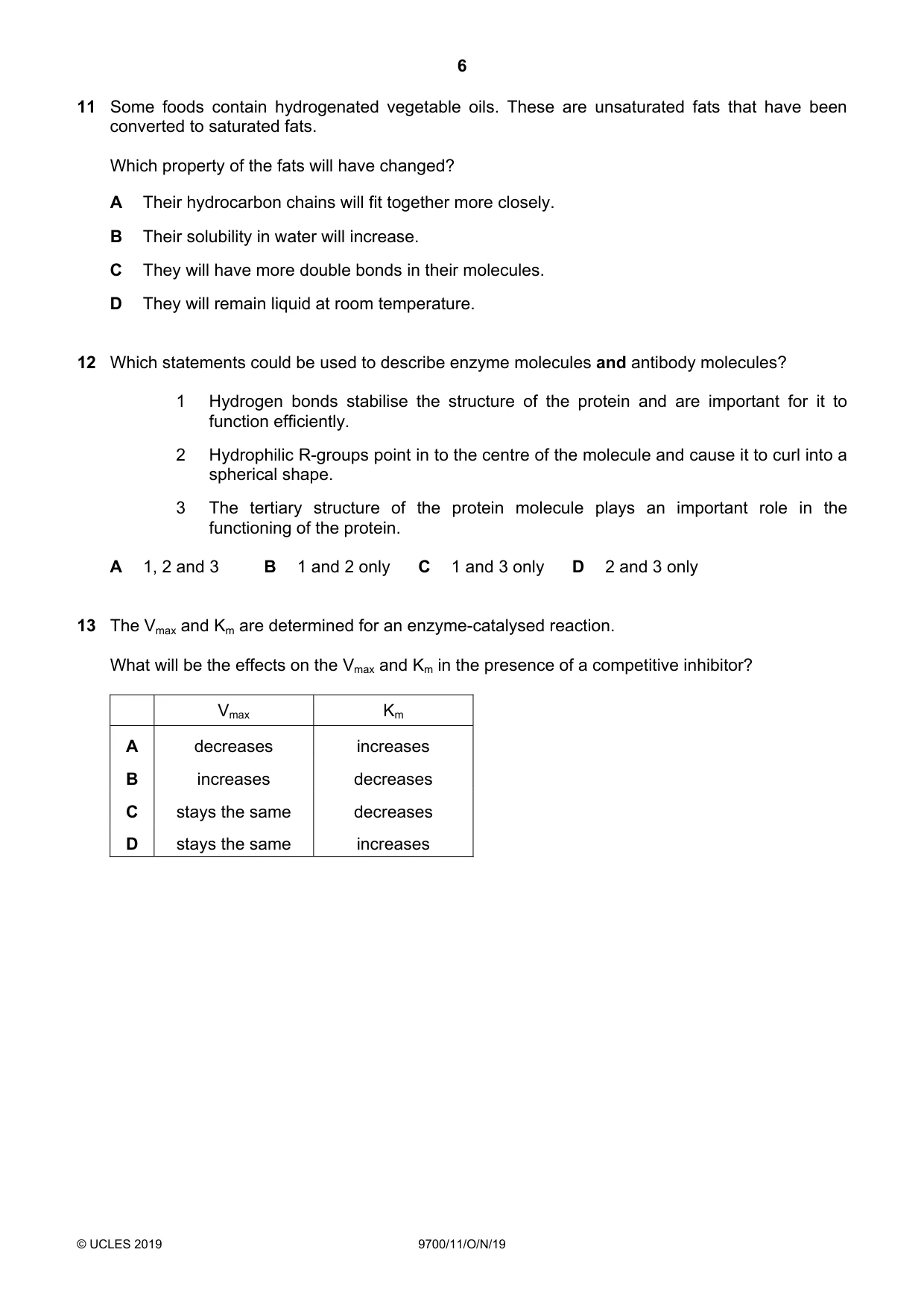
11 Some foods contain hydrogenated vegetable oils. These are unsaturated fats that have been converted to saturated fats. Which property of the fats will have changed? A Their hydrocarbon chains will fit together more closely. B Their solubility in water will increase. C They will have more double bonds in their molecules. D They will remain liquid at room temperature.
Mark scheme: A
Q12 · Which statements could be used to describe enzyme molecules and antibody molecules?
12 Which statements could be used to describe enzyme molecules and antibody molecules? 1 Hydrogen bonds stabilise the structure of the protein and are important for it to function efficiently. 2 Hydrophilic R-groups point in to the centre of the molecule and cause it to curl into a spherical shape. 3 The tertiary structure of the protein molecule plays an important role in the functioning of the protein. A 1, 2 and 3 B 1 and 2 only C 1 and 3 only D 2 and 3 only
Mark scheme: C
Q13 · The Vmax and Km are determined for an enzyme-catalysed reaction
13 The Vmax and Km are determined for an enzyme-catalysed reaction. What will be the effects on the Vmax and Km in the presence of a competitive inhibitor? Vmax Km A decreases increases B increases decreases C stays the same decreases D stays the same increases
Mark scheme: D
Q14 · The graph shows how the concentration of components,1, 2, 3 and 4, of an enzyme-catalysed…
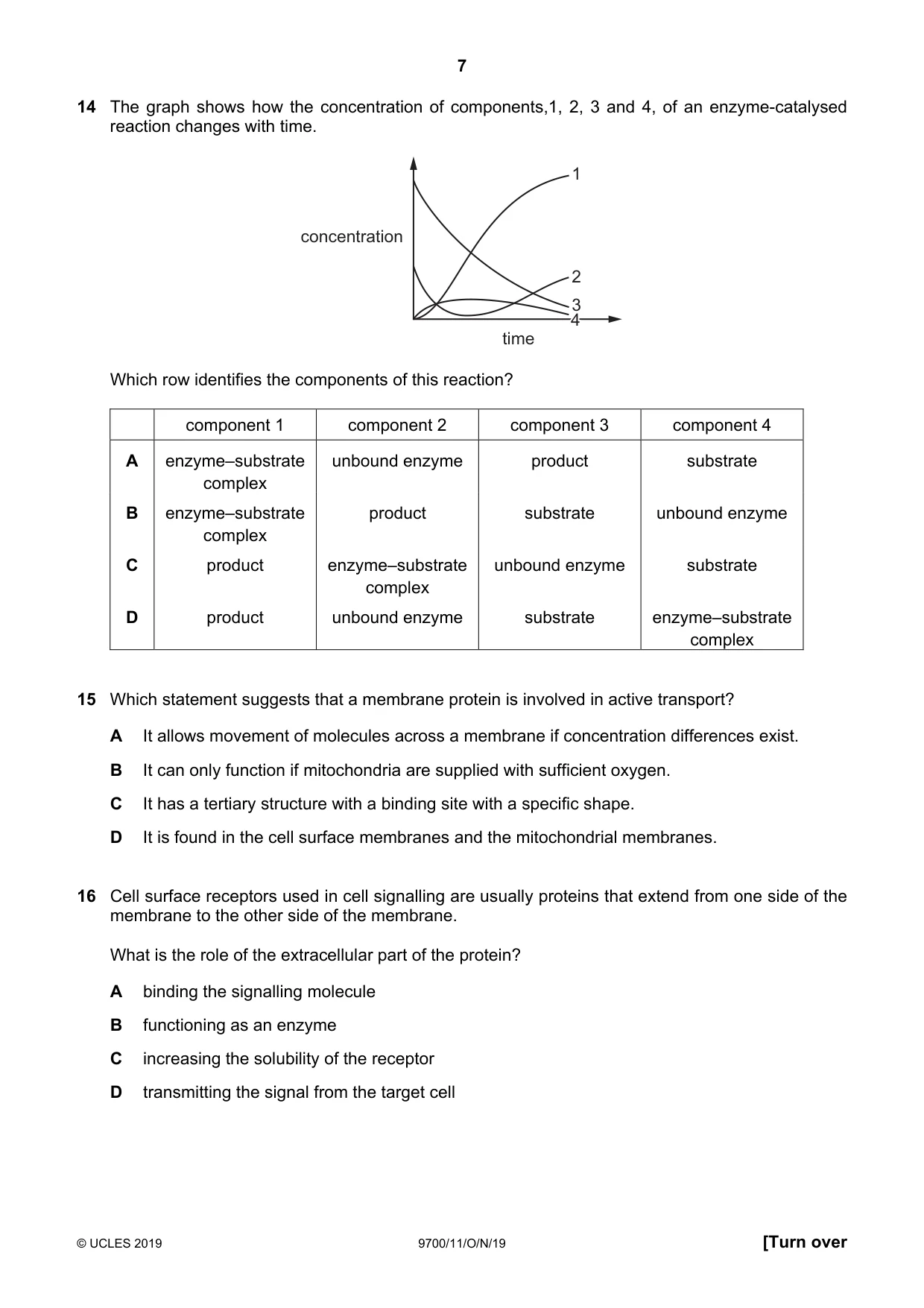
14 The graph shows how the concentration of components,1, 2, 3 and 4, of an enzyme-catalysed reaction changes with time. 1 concentration 2 3 4 time Which row identifies the components of this reaction? component 1 component 2 component 3 component 4 A enzyme–substrate unbound enzyme product substrate complex B enzyme–substrate product substrate unbound enzyme complex C product enzyme–substrate unbound enzyme substrate complex D product unbound enzyme substrate enzyme–substrate complex
Mark scheme: D
Q15 · Which statement suggests that a membrane protein is involved in active transport?
15 Which statement suggests that a membrane protein is involved in active transport? A It allows movement of molecules across a membrane if concentration differences exist. B It can only function if mitochondria are supplied with sufficient oxygen. C It has a tertiary structure with a binding site with a specific shape. D It is found in the cell surface membranes and the mitochondrial membranes.
Mark scheme: B
Q16 · Cell surface receptors used in cell signalling are usually proteins that extend from one…
16 Cell surface receptors used in cell signalling are usually proteins that extend from one side of the membrane to the other side of the membrane. What is the role of the extracellular part of the protein? A binding the signalling molecule B functioning as an enzyme C increasing the solubility of the receptor D transmitting the signal from the target cell
Mark scheme: A
Q17 · Which substances can pass directly through cell surface membranes and do not use a…
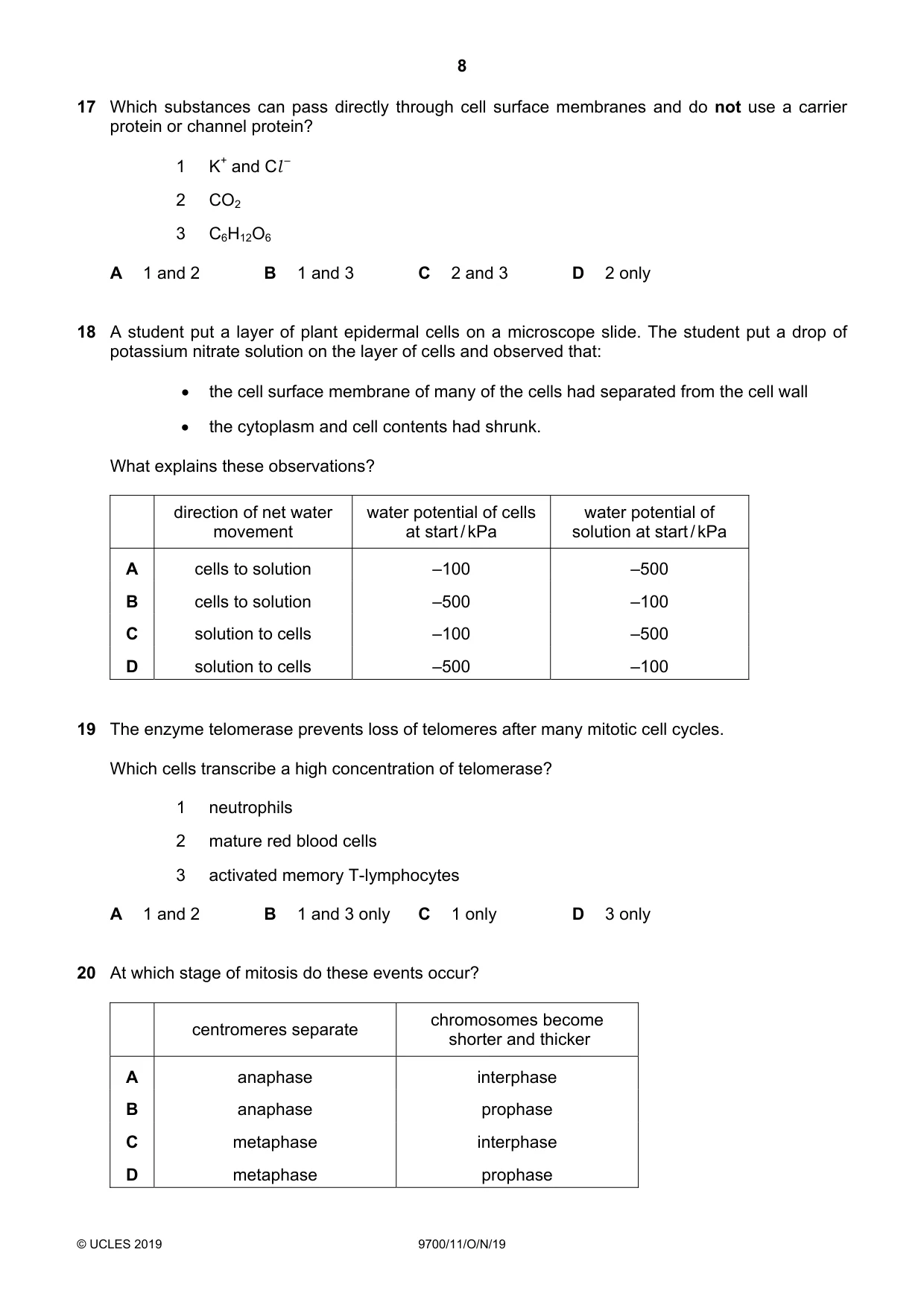
17 Which substances can pass directly through cell surface membranes and do not use a carrier protein or channel protein? 1 K+ and Cl – 2 CO2 3 C6H12O6 A 1 and 2 B 1 and 3 C 2 and 3 D 2 only
Mark scheme: D
Q18 · A student put a layer of plant epidermal cells on a microscope slide
18 A student put a layer of plant epidermal cells on a microscope slide. The student put a drop of potassium nitrate solution on the layer of cells and observed that: • the cell surface membrane of many of the cells had separated from the cell wall • the cytoplasm and cell contents had shrunk. What explains these observations? direction of net water water potential of cells water potential of movement at start / kPa solution at start / kPa A cells to solution –100 –500 B cells to solution –500 –100 C solution to cells –100 –500 D solution to cells –500 –100
Mark scheme: A
Q19 · The enzyme telomerase prevents loss of telomeres after many mitotic cell cycles
19 The enzyme telomerase prevents loss of telomeres after many mitotic cell cycles. Which cells transcribe a high concentration of telomerase? 1 neutrophils 2 mature red blood cells 3 activated memory T-lymphocytes A 1 and 2 B 1 and 3 only C 1 only D 3 only
Mark scheme: D
More questions on Replication and division of nuclei and cells
Q20 · At which stage of mitosis do these events occur?
20 At which stage of mitosis do these events occur? chromosomes become centromeres separate shorter and thicker A anaphase interphase B anaphase prophase C metaphase interphase D metaphase prophase
Mark scheme: B
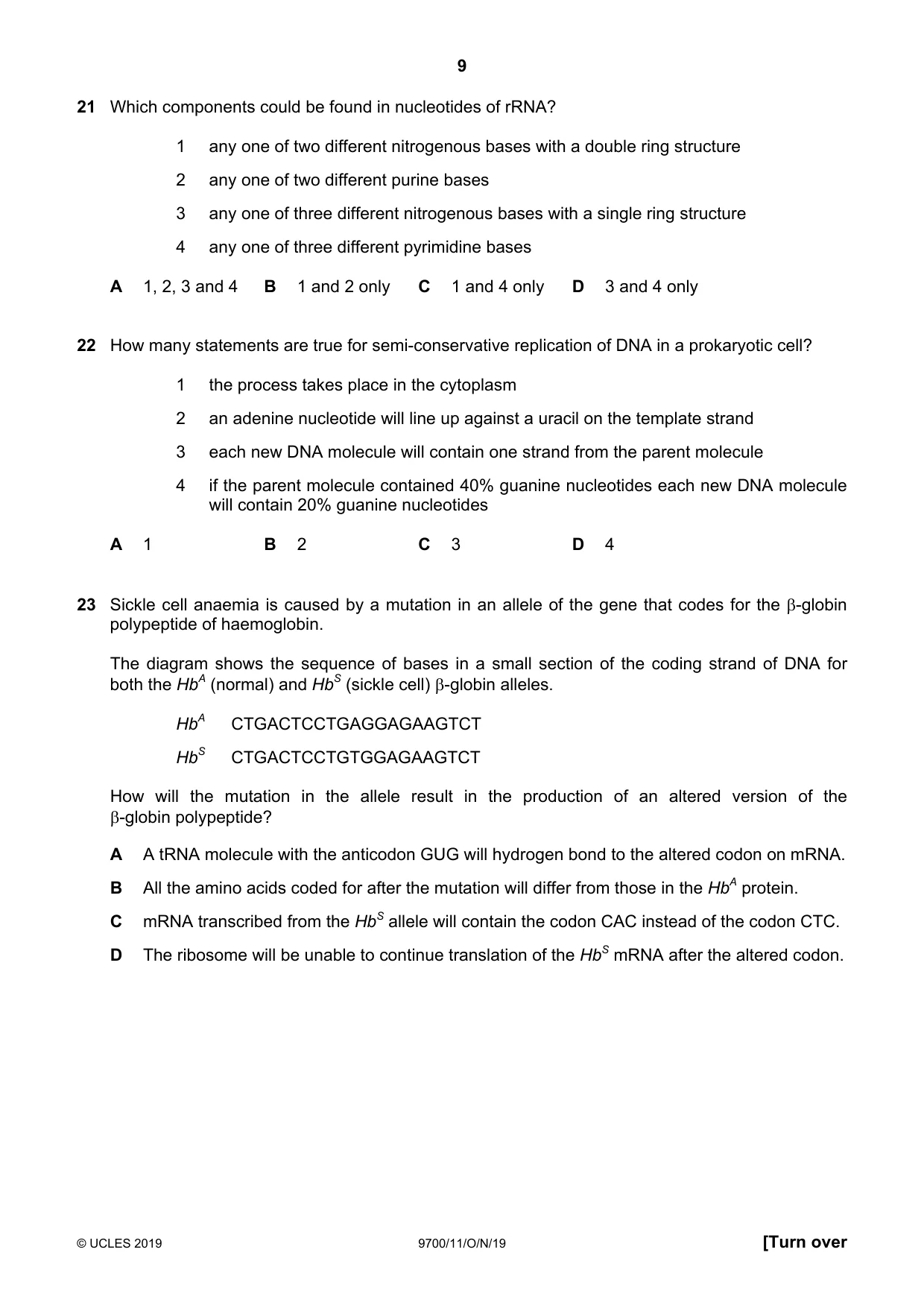
Q21 · Which components could be found in nucleotides of rRNA?
21 Which components could be found in nucleotides of rRNA? 1 any one of two different nitrogenous bases with a double ring structure 2 any one of two different purine bases 3 any one of three different nitrogenous bases with a single ring structure 4 any one of three different pyrimidine bases A 1, 2, 3 and 4 B 1 and 2 only C 1 and 4 only D 3 and 4 only
Mark scheme: B
More questions on Structure of nucleic acids and replication of DNA
Q22 · How many statements are true for semi-conservative replication of DNA in a prokaryotic…
22 How many statements are true for semi-conservative replication of DNA in a prokaryotic cell? 1 the process takes place in the cytoplasm 2 an adenine nucleotide will line up against a uracil on the template strand 3 each new DNA molecule will contain one strand from the parent molecule 4 if the parent molecule contained 40% guanine nucleotides each new DNA molecule will contain 20% guanine nucleotides A 1 B 2 C 3 D 4
Mark scheme: B
More questions on Structure of nucleic acids and replication of DNA
Q23 · Sickle cell anaemia is caused by a mutation in an allele of the gene that codes for the…
23 Sickle cell anaemia is caused by a mutation in an allele of the gene that codes for the β-globin polypeptide of haemoglobin. The diagram shows the sequence of bases in a small section of the coding strand of DNA for both the HbA (normal) and HbS (sickle cell) β-globin alleles. HbA CTGACTCCTGAGGAGAAGTCT HbS CTGACTCCTGTGGAGAAGTCT How will the mutation in the allele result in the production of an altered version of the β-globin polypeptide? A A tRNA molecule with the anticodon GUG will hydrogen bond to the altered codon on mRNA. B All the amino acids coded for after the mutation will differ from those in the HbA protein. C mRNA transcribed from the HbS allele will contain the codon CAC instead of the codon CTC. D The ribosome will be unable to continue translation of the HbS mRNA after the altered codon.
Mark scheme: A
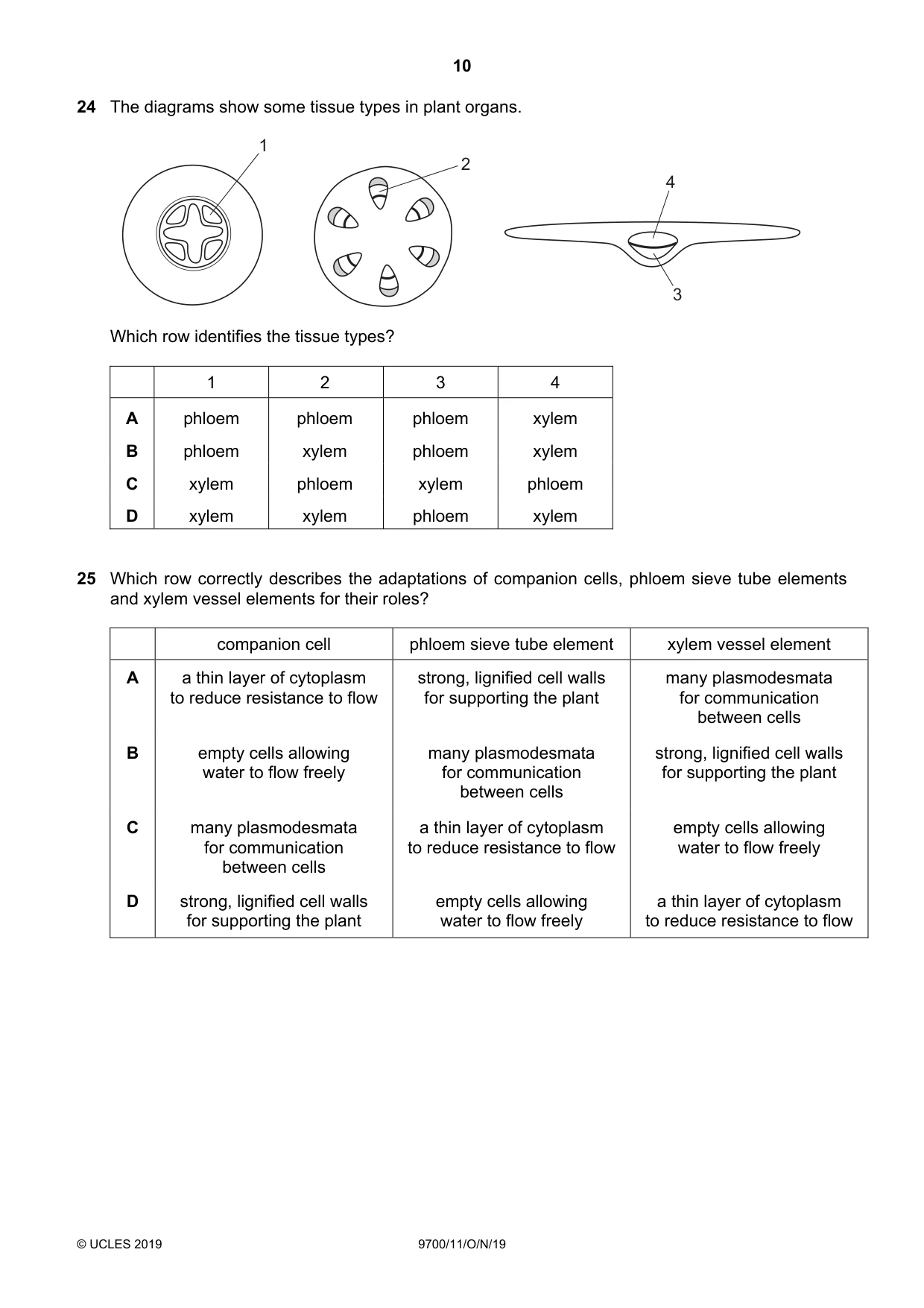
Q24 · The diagrams show some tissue types in plant organs
24 The diagrams show some tissue types in plant organs. 1 2 4 3 Which row identifies the tissue types? 1 2 3 4 A phloem phloem phloem xylem B phloem xylem phloem xylem C xylem phloem xylem phloem D xylem xylem phloem xylem
Mark scheme: A
Q25 · Which row correctly describes the adaptations of companion cells, phloem sieve tube…
25 Which row correctly describes the adaptations of companion cells, phloem sieve tube elements and xylem vessel elements for their roles? companion cell phloem sieve tube element xylem vessel element A a thin layer of cytoplasm strong, lignified cell walls many plasmodesmata to reduce resistance to flow for supporting the plant for communication between cells B empty cells allowing many plasmodesmata strong, lignified cell walls water to flow freely for communication for supporting the plant between cells C many plasmodesmata a thin layer of cytoplasm empty cells allowing for communication to reduce resistance to flow water to flow freely between cells D strong, lignified cell walls empty cells allowing a thin layer of cytoplasm for supporting the plant water to flow freely to reduce resistance to flow
Mark scheme: C
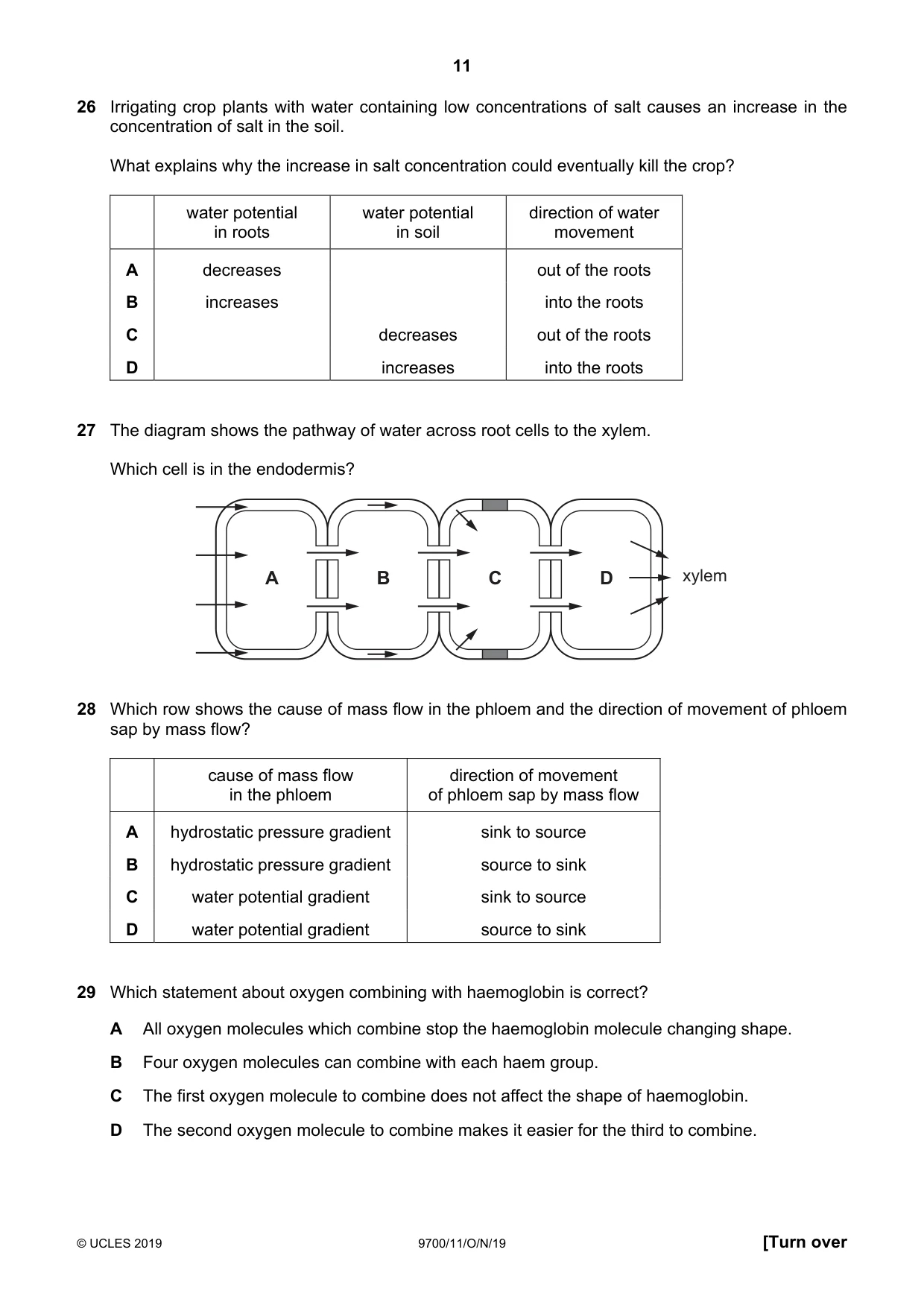
Q26 · Irrigating crop plants with water containing low concentrations of salt causes an…
26 Irrigating crop plants with water containing low concentrations of salt causes an increase in the concentration of salt in the soil. What explains why the increase in salt concentration could eventually kill the crop? water potential water potential direction of water in roots in soil movement A decreases out of the roots B increases into the roots C decreases out of the roots D increases into the roots
Mark scheme: C
Q27 · The diagram shows the pathway of water across root cells to the xylem
27 The diagram shows the pathway of water across root cells to the xylem. Which cell is in the endodermis? A B C D xylem
Mark scheme: C
Q28 · Which row shows the cause of mass flow in the phloem and the direction of movement of…
28 Which row shows the cause of mass flow in the phloem and the direction of movement of phloem sap by mass flow? cause of mass flow direction of movement in the phloem of phloem sap by mass flow A hydrostatic pressure gradient sink to source B hydrostatic pressure gradient source to sink C water potential gradient sink to source D water potential gradient source to sink
Mark scheme: B
Q29 · Which statement about oxygen combining with haemoglobin is correct?
29 Which statement about oxygen combining with haemoglobin is correct? A All oxygen molecules which combine stop the haemoglobin molecule changing shape. B Four oxygen molecules can combine with each haem group. C The first oxygen molecule to combine does not affect the shape of haemoglobin. D The second oxygen molecule to combine makes it easier for the third to combine.
Mark scheme: D
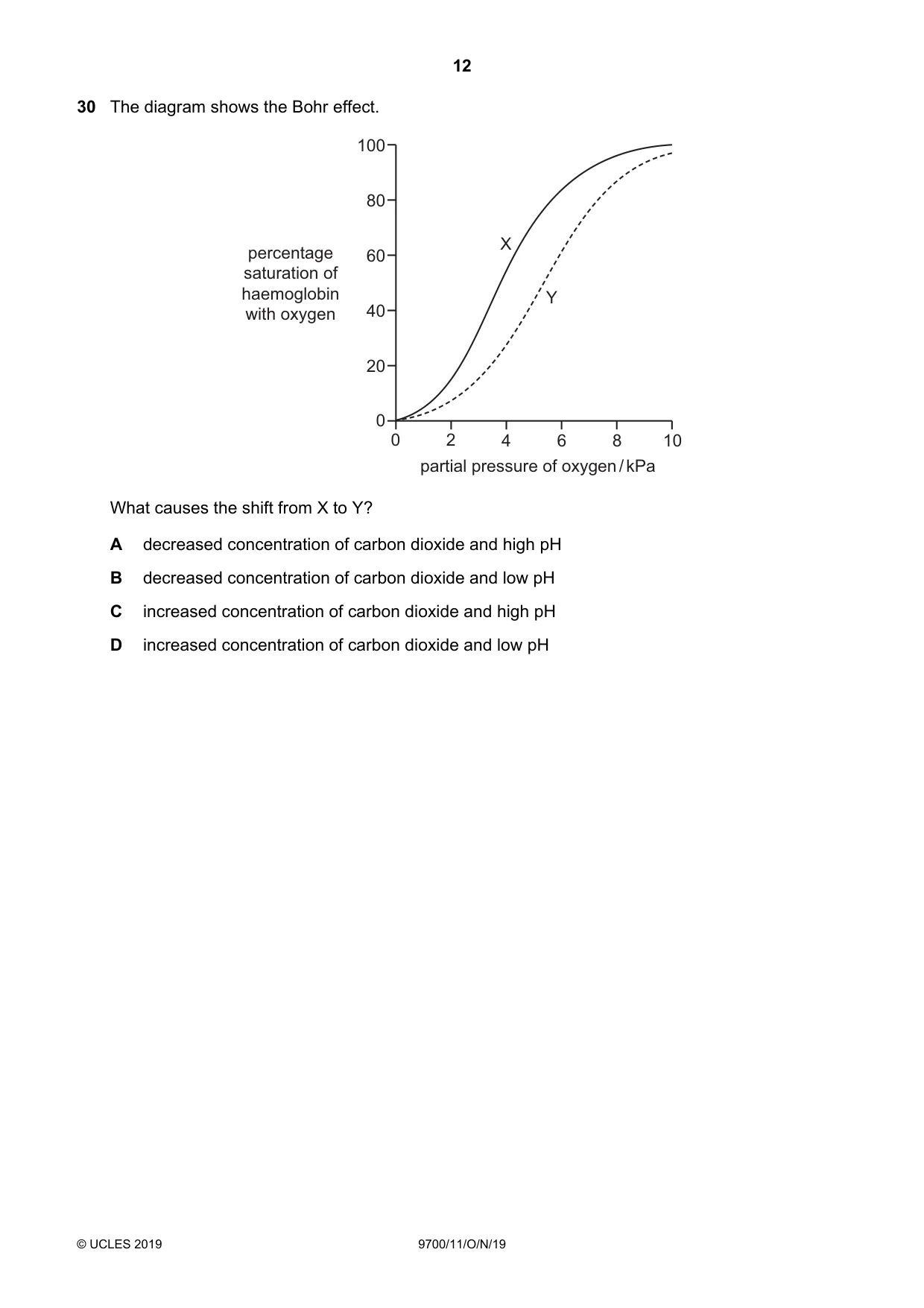
Q30 · The diagram shows the Bohr effect
30 The diagram shows the Bohr effect. 100 80 X percentage 60 saturation of haemoglobin Y with oxygen 40 20 0 0 2 4 6 8 10 partial pressure of oxygen / kPa What causes the shift from X to Y? A decreased concentration of carbon dioxide and high pH B decreased concentration of carbon dioxide and low pH C increased concentration of carbon dioxide and high pH D increased concentration of carbon dioxide and low pH
Mark scheme: D
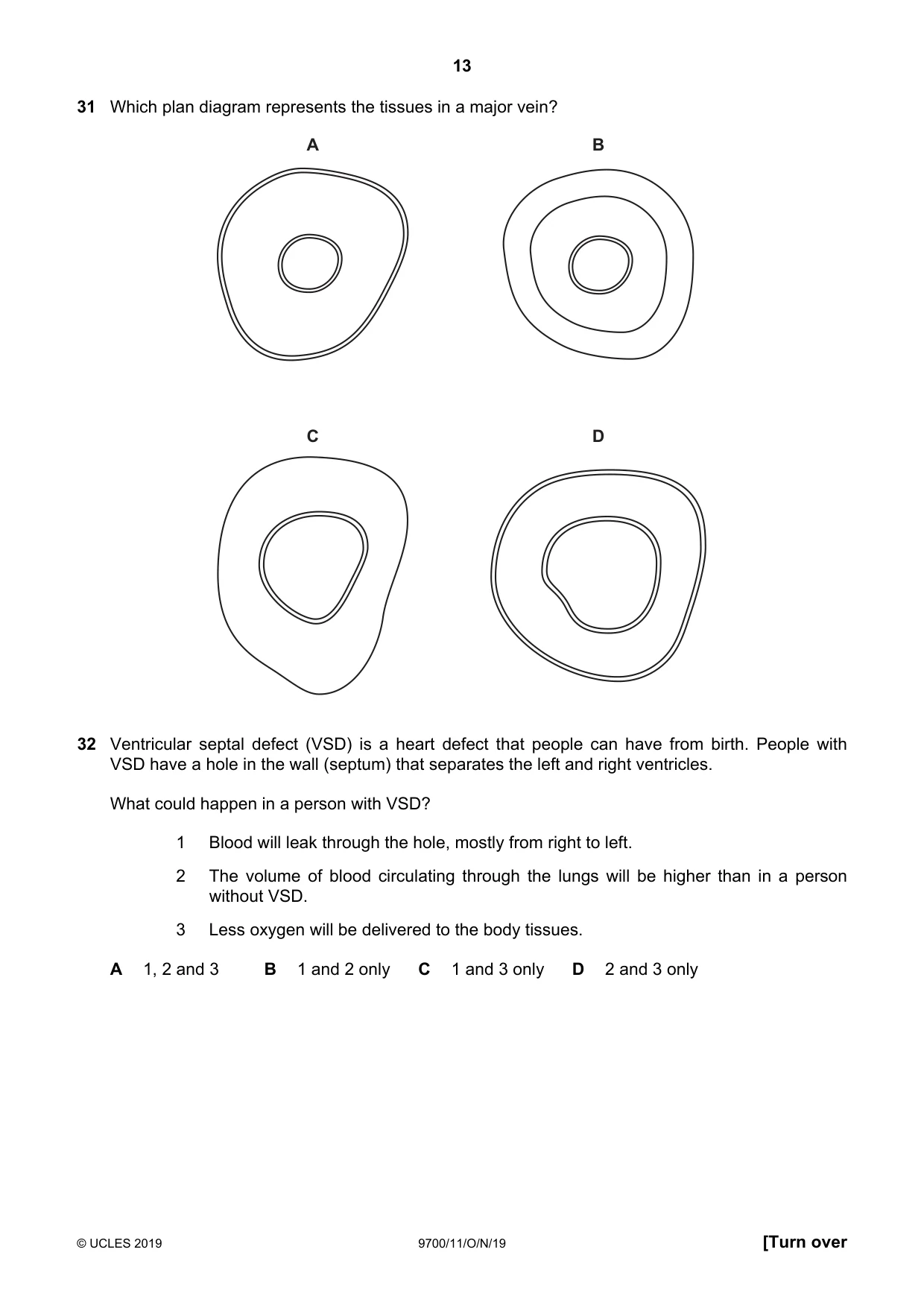
Q31 · Which plan diagram represents the tissues in a major vein?
31 Which plan diagram represents the tissues in a major vein? A B C D
Mark scheme: D
Q32 · Ventricular septal defect (VSD) is a heart defect that people can have from birth
32 Ventricular septal defect (VSD) is a heart defect that people can have from birth. People with VSD have a hole in the wall (septum) that separates the left and right ventricles. What could happen in a person with VSD? 1 Blood will leak through the hole, mostly from right to left. 2 The volume of blood circulating through the lungs will be higher than in a person without VSD. 3 Less oxygen will be delivered to the body tissues. A 1, 2 and 3 B 1 and 2 only C 1 and 3 only D 2 and 3 only
Mark scheme: D
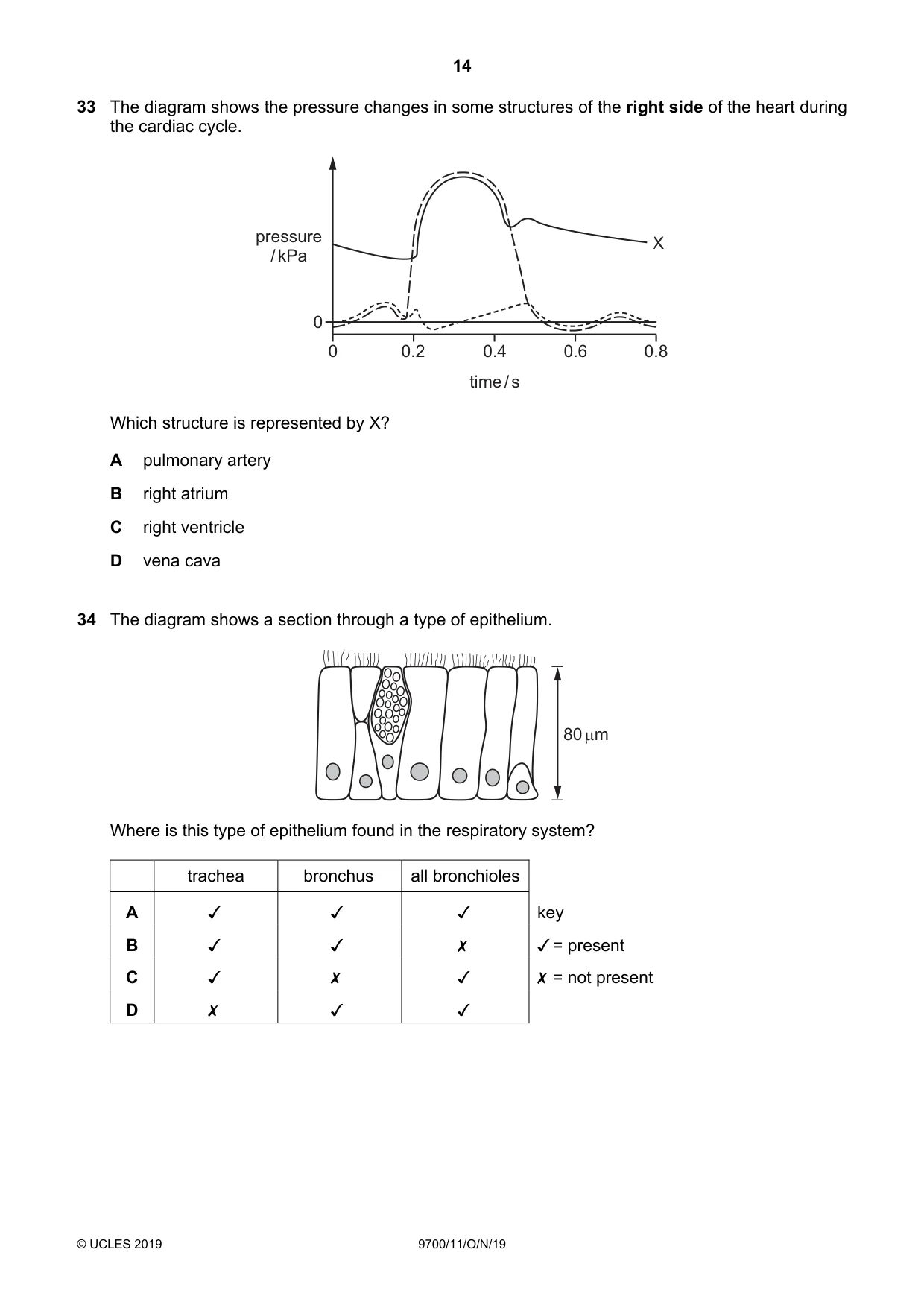
Q33 · The diagram shows the pressure changes in some structures of the right side of the heart…
33 The diagram shows the pressure changes in some structures of the right side of the heart during the cardiac cycle. pressure X / kPa 0 0 0.2 0.4 0.6 0.8 time / s Which structure is represented by X? A pulmonary artery B right atrium C right ventricle D vena cava
Mark scheme: A
Q34 · The diagram shows a section through a type of epithelium
34 The diagram shows a section through a type of epithelium. Where is this type of epithelium found in the respiratory system? trachea bronchus all bronchioles A J J Jv B Jv v x Cc v x JV D x v JV key v¥ = present X = not present
Mark scheme: B
Q35 · In chronic obstructive pulmonary disease (COPD), airflow through the airways is reduced
35 In chronic obstructive pulmonary disease (COPD), airflow through the airways is reduced. Which statements explain the reduced airflow? 1 More mucus is secreted into the airways. 2 Airways and alveoli lose their elasticity. 3 Many of the alveoli are destroyed. 4 Carbon monoxide binds irreversibly to haemoglobin. A 1, 2, 3 and 4 B 1, 2 and 3 only C 1, 3 and 4 only D 2, 3 and 4 only
Mark scheme: B
Q36 · Outbreaks of cholera commonly occur in refugee camps that are set up after a major…
36 Outbreaks of cholera commonly occur in refugee camps that are set up after a major natural disaster such as earthquakes. The list shows some measures that can be taken to limit the spread of cholera in the refugee camps. 1 treating all drinking water supplies with a high concentration of chlorine 2 setting up an emergency treatment centre to isolate cases of cholera and treat them with antibiotics 3 using concentrated disinfectant to clean sewage disposal areas and infected bedding 4 health workers visiting regularly to detect cases 5 keeping good records of the number of cases and deaths at treatment centres Which features of these control measures involve an economic factor? A 1, 2, 3, 4 and 5 B 1, 3 and 5 only C 2, 3, 4 and 5 only D 2 and 4 only
Mark scheme: A
Q37 · Which use of antibiotics helps to reduce the spread of resistance in bacteria?
37 Which use of antibiotics helps to reduce the spread of resistance in bacteria? A using high concentrations of the antibiotic to kill all the bacteria B giving routine preventative antibiotics to people who are having an operation C regularly changing the type of antibiotic used to treat particular bacterial infections D giving antibiotics to treat low level infection caused by a bacterium
Mark scheme: C
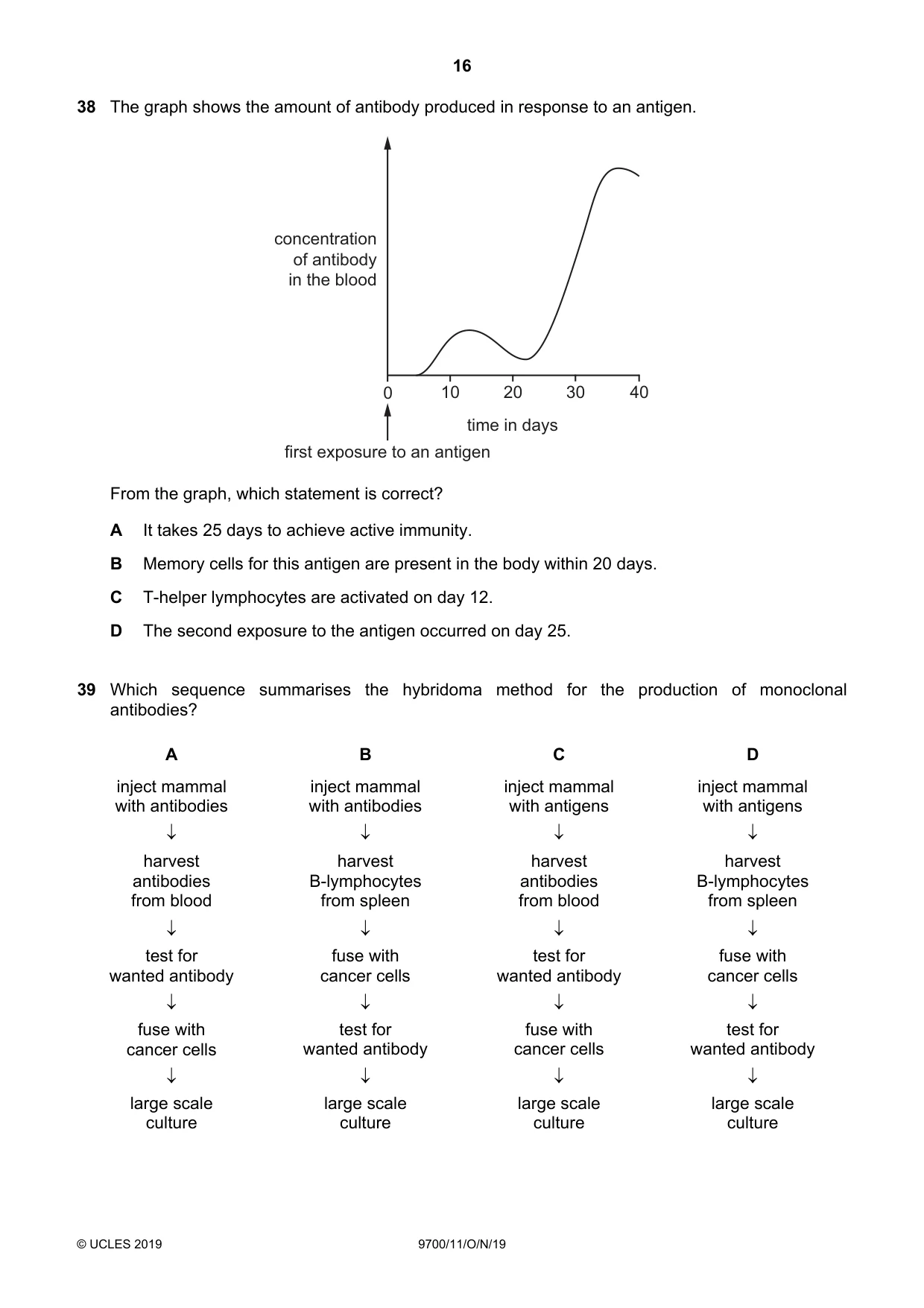
Q38 · The graph shows the amount of antibody produced in response to an antigen
38 The graph shows the amount of antibody produced in response to an antigen. concentration of antibody in the blood 0 10 20 30 40 time in days first exposure to an antigen From the graph, which statement is correct? A It takes 25 days to achieve active immunity. B Memory cells for this antigen are present in the body within 20 days. C T-helper lymphocytes are activated on day 12. D The second exposure to the antigen occurred on day 25.
Mark scheme: B
Q39 · Which sequence summarises the hybridoma method for the production of monoclonal…
39 Which sequence summarises the hybridoma method for the production of monoclonal antibodies? A B C D inject mammal inject mammal inject mammal inject mammal with antibodies with antibodies with antigens with antigens ↓ ↓ ↓ ↓ harvest harvest harvest harvest antibodies B-lymphocytes antibodies B-lymphocytes from blood from spleen from blood from spleen ↓ ↓ ↓ ↓ test for fuse with test for fuse with wanted antibody cancer cells wanted antibody cancer cells ↓ ↓ ↓ ↓ fuse with test for fuse with test for cancer cells wanted antibody cancer cells wanted antibody ↓ ↓ ↓ ↓ large scale large scale large scale large scale culture culture culture culture
Mark scheme: D
Q40 · The vaccination programme for smallpox was a medical success story which resulted in the…
40 The vaccination programme for smallpox was a medical success story which resulted in the World Health Organisation finally declaring the world free from smallpox in 1980. Which statement correctly identifies the reasons for the success of the smallpox vaccination programme? A The virus also infected animals making it easy to stop the transmission cycle. B The virus remained in the body following infection and could become active later. C The virus was stable and not prone to mutations. D The virus was unstable and prone to mutations.
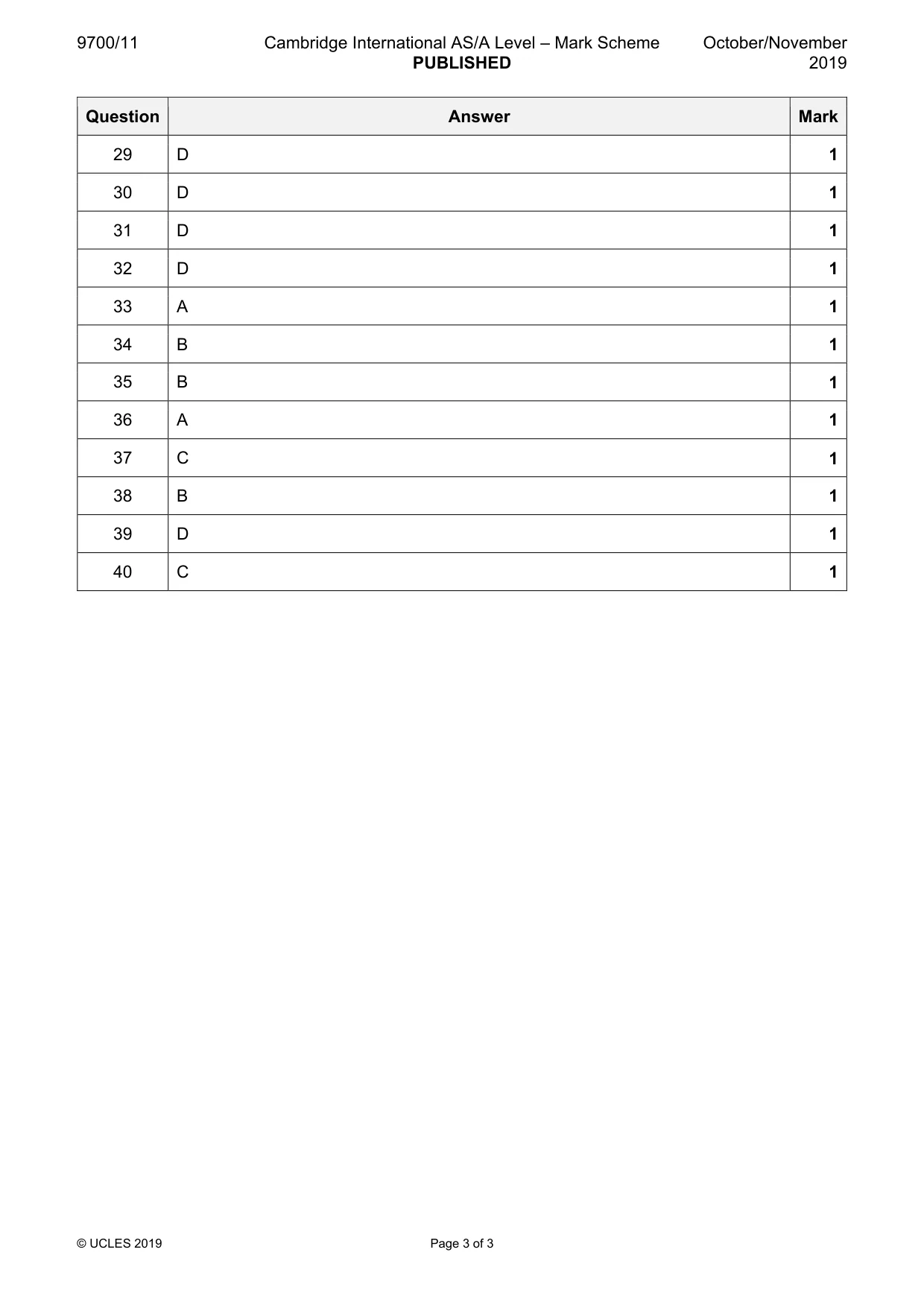
Mark scheme: C
What was in this paper
The subtopics covered by these 40 questions, and how many questions each got. Open one in a new tab to see every Cambridge question on it.
4Cells as the basic units of living organisms4Movement into and out of cells3Transport mechanisms3Antibodies and vaccination2Structure of nucleic acids and replication of DNA2Structure of transport tissues2The gas exchange system2The heart2Transport of oxygen and carbon dioxide2Antibiotics1Chromosome behaviour in mitosis1Factors that affect enzyme action1Fluid mosaic membranes1Infectious diseases1Mode of action of enzymes1Protein synthesis1Proteins1Replication and division of nuclei and cells1Testing for biological molecules1The circulatory system1The immune system1The microscope in cell studies1Water1What you needed in this session
Cambridge’s own grade thresholds for 2019 Oct/Nov, Paper 1 · Variant 1. A higher threshold means an easier paper — the bar moves with how the cohort did.