Cambridge A Level Biology 9700 — 2022 Oct/Nov Paper 1 · Variant 1
9700/11/O/N/22 · 40 questions · 40 marks · ≈45 min
The question paper and its mark scheme, free to read here and free to download. This is Cambridge’s own paper, exactly as it was sat.
Question paper16 pages
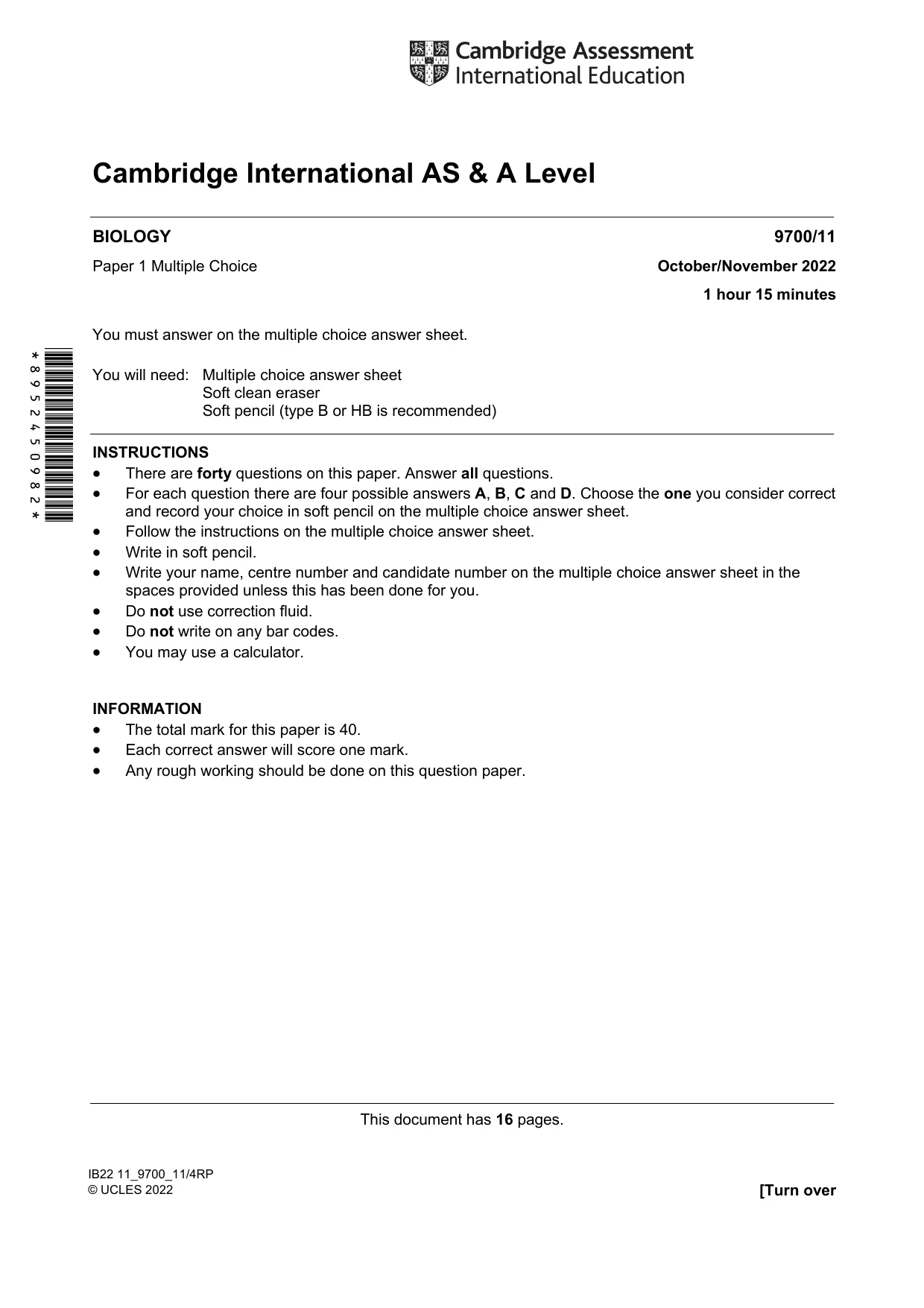
Mark scheme3 pages
Answers below. Sit the paper first if you are practising.
Questions as text
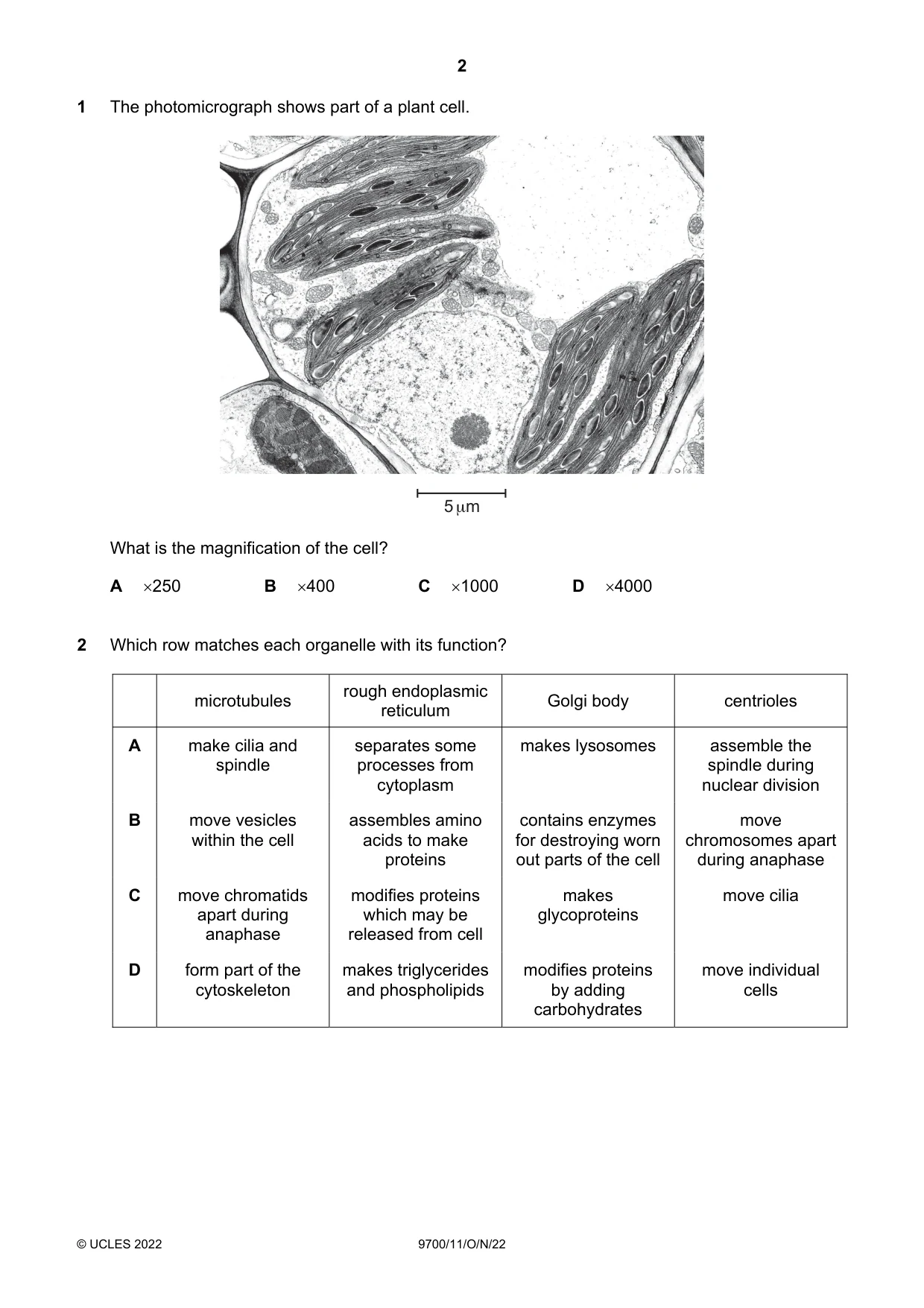
Q1 · The photomicrograph shows part of a plant cell
1 The photomicrograph shows part of a plant cell. 5 μm What is the magnification of the cell? A ×250 B ×400 C ×1000 D ×4000
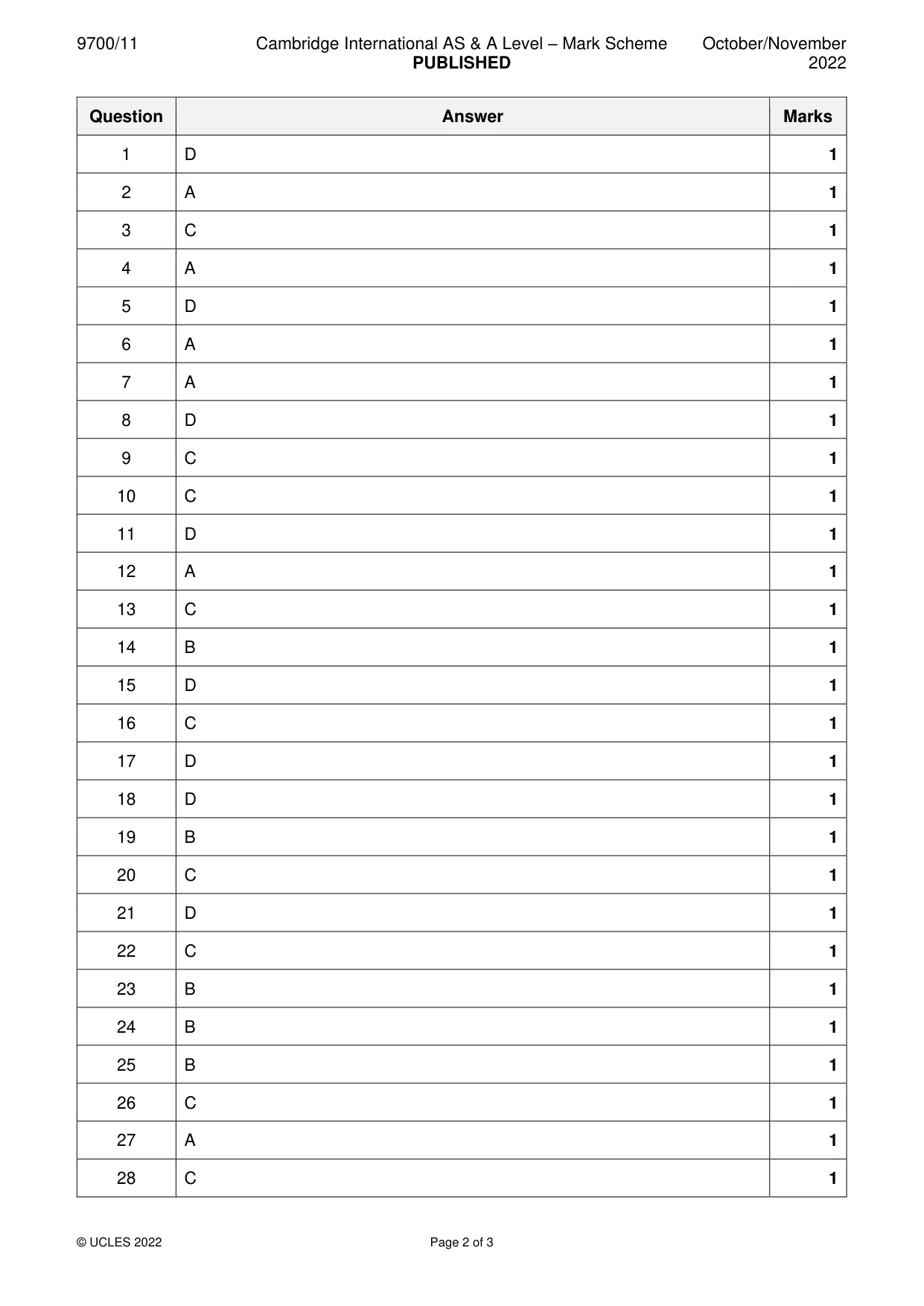
Mark scheme: D
Q2 · Which row matches each organelle with its function?
2 Which row matches each organelle with its function? rough endoplasmic microtubules Golgi body centrioles reticulum A make cilia and separates some makes lysosomes assemble the spindle processes from spindle during cytoplasm nuclear division B move vesicles assembles amino contains enzymes move within the cell acids to make for destroying worn chromosomes apart proteins out parts of the cell during anaphase C move chromatids modifies proteins makes move cilia apart during which may be glycoproteins anaphase released from cell D form part of the makes triglycerides modifies proteins move individual cytoskeleton and phospholipids by adding cells carbohydrates
Mark scheme: A
More questions on Cells as the basic units of living organisms
Q3 · Where are 80S ribosomes found?
3 Where are 80S ribosomes found? 1 chloroplasts 2 cytoplasm of eukaryotes 3 mitochondria 4 cytoplasm of prokaryotes A 1, 2 and 3 B 1 and 3 only C 2 only D 4 only
Mark scheme: C
More questions on Cells as the basic units of living organisms
Q4 · Which feature, when present in an organism, enables it to be identified as a prokaryote?
4 Which feature, when present in an organism, enables it to be identified as a prokaryote? A cytoplasmic DNA B cell wall C nucleus D ribosomes
Mark scheme: A
More questions on Cells as the basic units of living organisms
Q5 · What is the function of the nucleolus?
5 What is the function of the nucleolus? A the formation and breakdown of the nuclear envelope B the formation of rough endoplasmic reticulum C the synthesis of ribosomal proteins D the synthesis of rRNA
Mark scheme: D
More questions on Cells as the basic units of living organisms
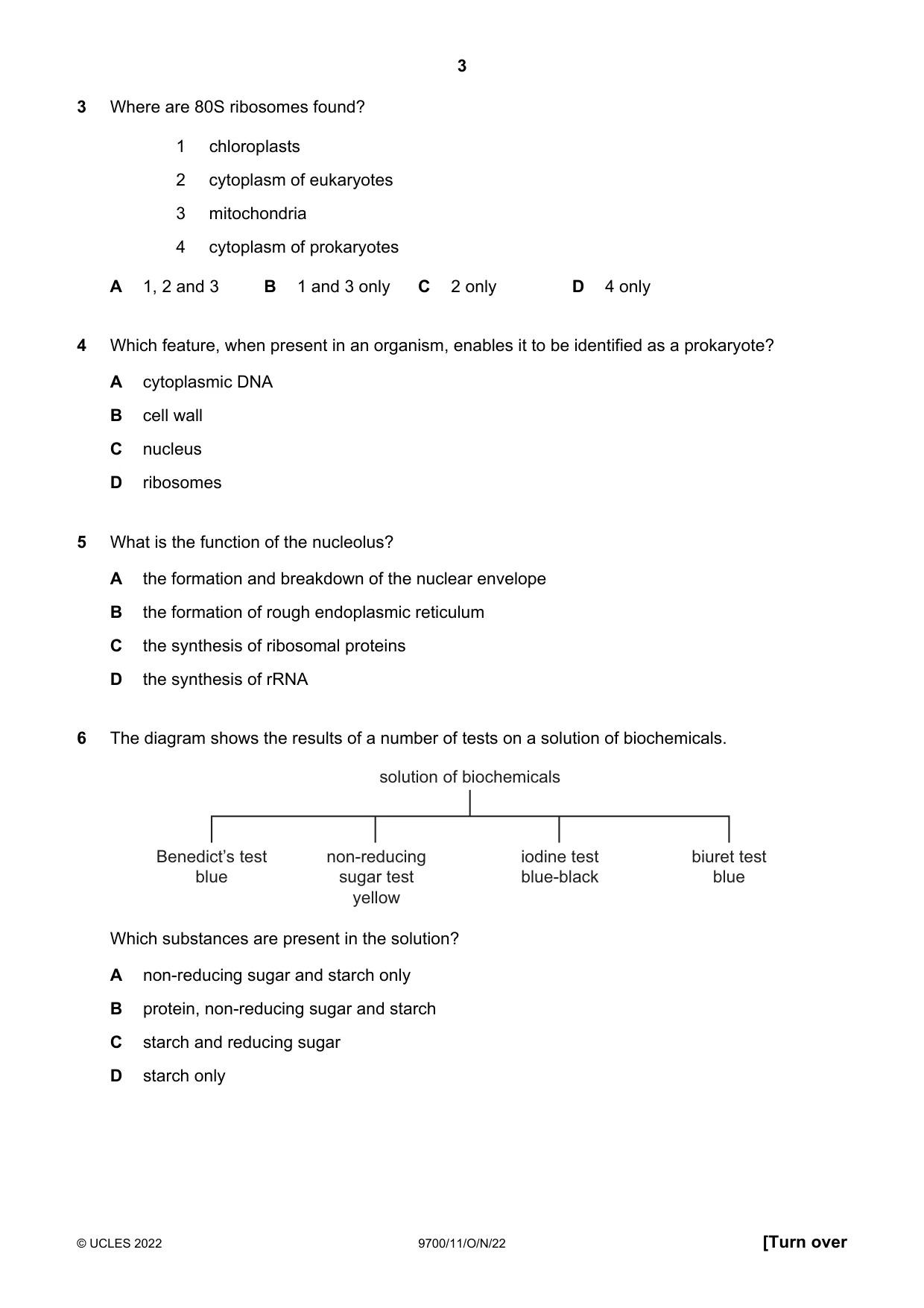
Q6 · The diagram shows the results of a number of tests on a solution of biochemicals
6 The diagram shows the results of a number of tests on a solution of biochemicals. solution of biochemicals Benedict’s test non-reducing iodine test biuret test blue sugar test blue-black blue yellow Which substances are present in the solution? A non-reducing sugar and starch only B protein, non-reducing sugar and starch C starch and reducing sugar D starch only
Mark scheme: A
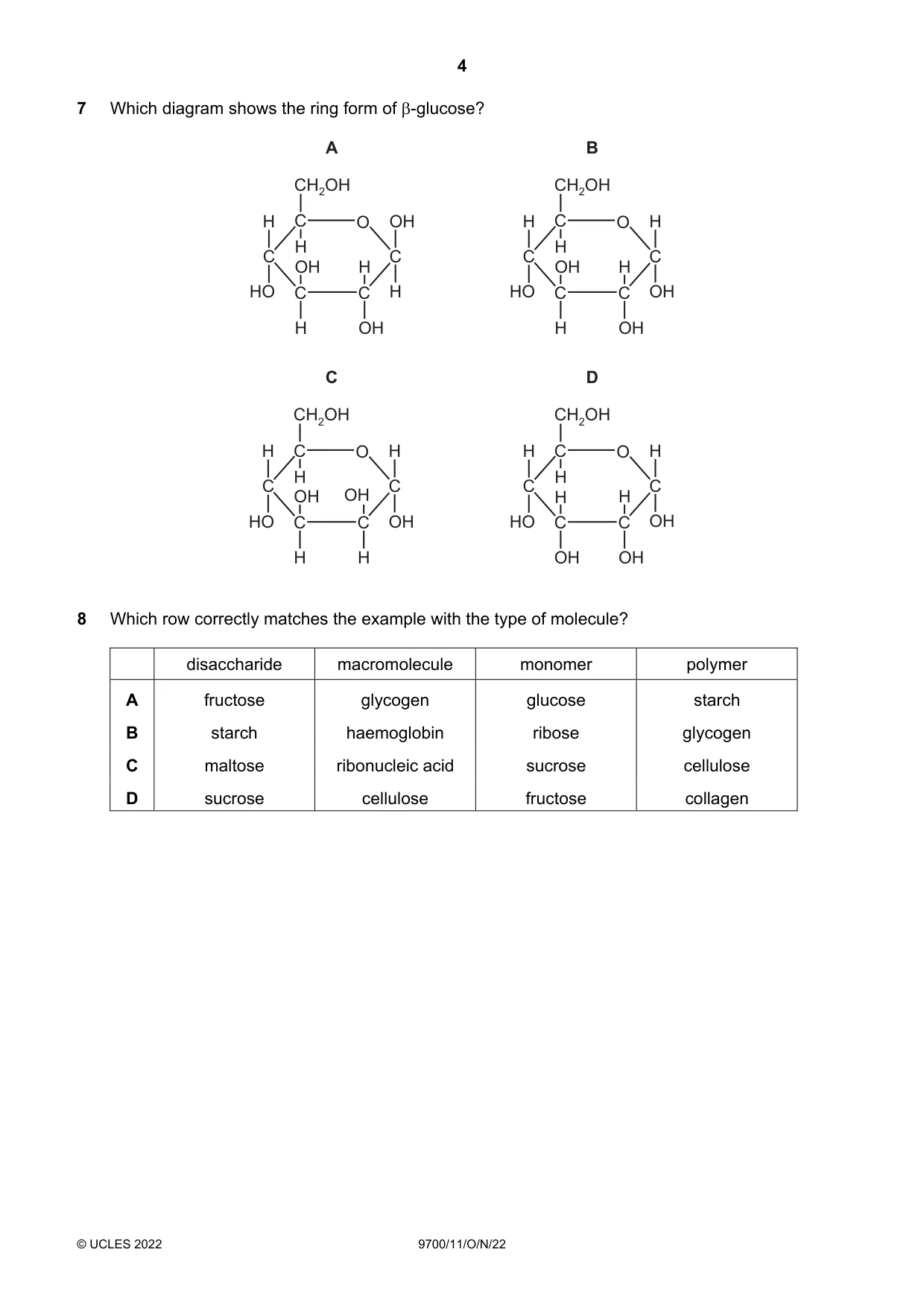
Q7 · Which diagram shows the ring form of β-glucose?
7 Which diagram shows the ring form of β-glucose? A B CH2OH CH2OH H C O OH H C O H H H C C C C OH H OH H HO C C H HO C C OH H OH H OH C D CH2OH CH2OH H C O H H C O H H H C C C C OH OH H H HO C C OH HO C C OH H H OH OH
Mark scheme: A
Q8 · Which row correctly matches the example with the type of molecule?
8 Which row correctly matches the example with the type of molecule? disaccharide macromolecule monomer polymer A fructose glycogen glucose starch B starch haemoglobin ribose glycogen C maltose ribonucleic acid sucrose cellulose D sucrose cellulose fructose collagen
Mark scheme: D
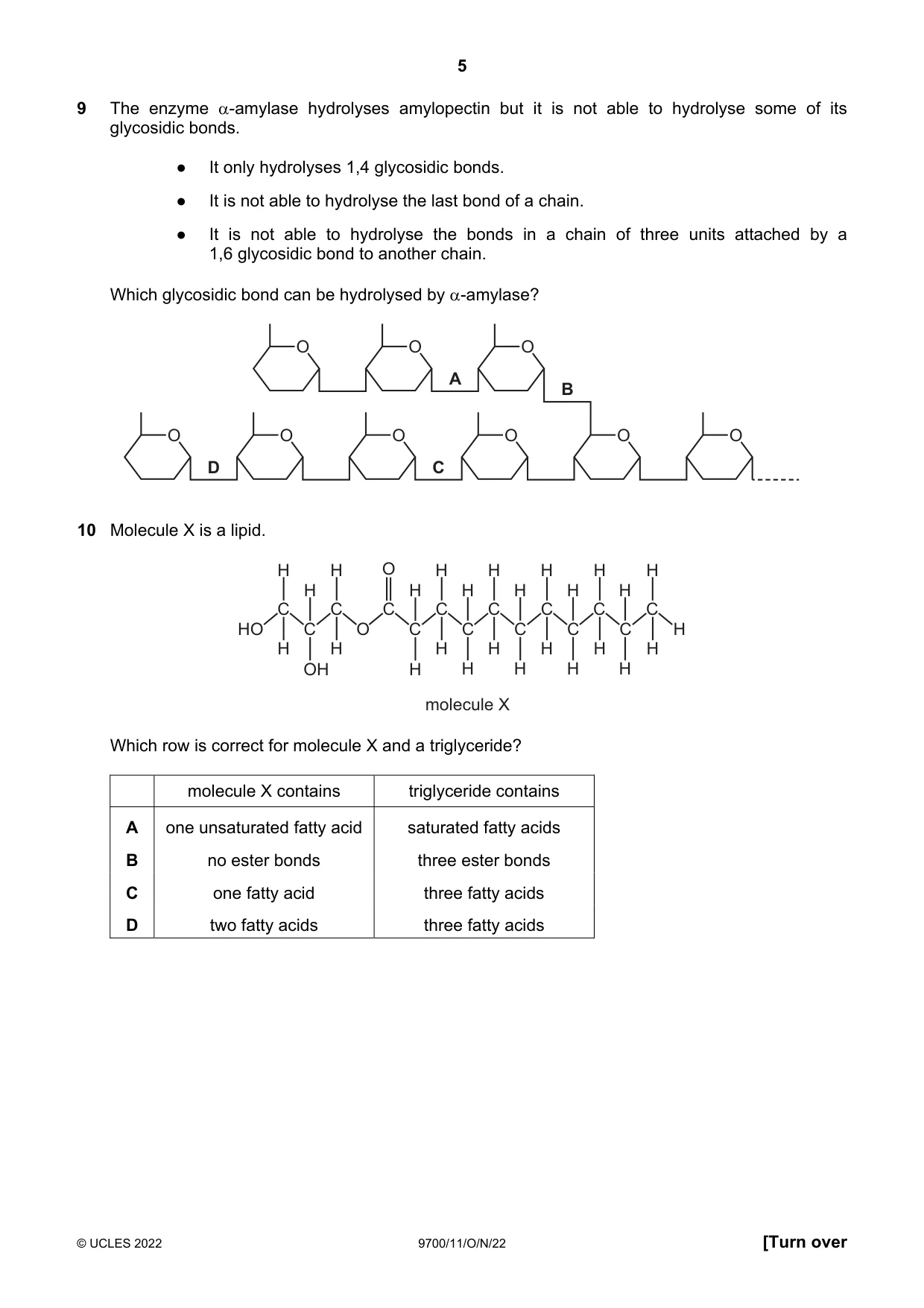
Q9 · The enzyme α-amylase hydrolyses amylopectin but it is not able to hydrolyse some of its…
9 The enzyme α-amylase hydrolyses amylopectin but it is not able to hydrolyse some of its glycosidic bonds. ● It only hydrolyses 1,4 glycosidic bonds. ● It is not able to hydrolyse the last bond of a chain. ● It is not able to hydrolyse the bonds in a chain of three units attached by a 1,6 glycosidic bond to another chain. Which glycosidic bond can be hydrolysed by α-amylase? O O O A B O O O O O O D C
Mark scheme: C
Q10 · Molecule X is a lipid
10 Molecule X is a lipid. H H O H H H H H H H H H H H C C C C C C C C HO C O C C C C C H H H H H H H H OH H H H H H molecule X Which row is correct for molecule X and a triglyceride? molecule X contains triglyceride contains A one unsaturated fatty acid saturated fatty acids B no ester bonds three ester bonds C one fatty acid three fatty acids D two fatty acids three fatty acids
Mark scheme: C
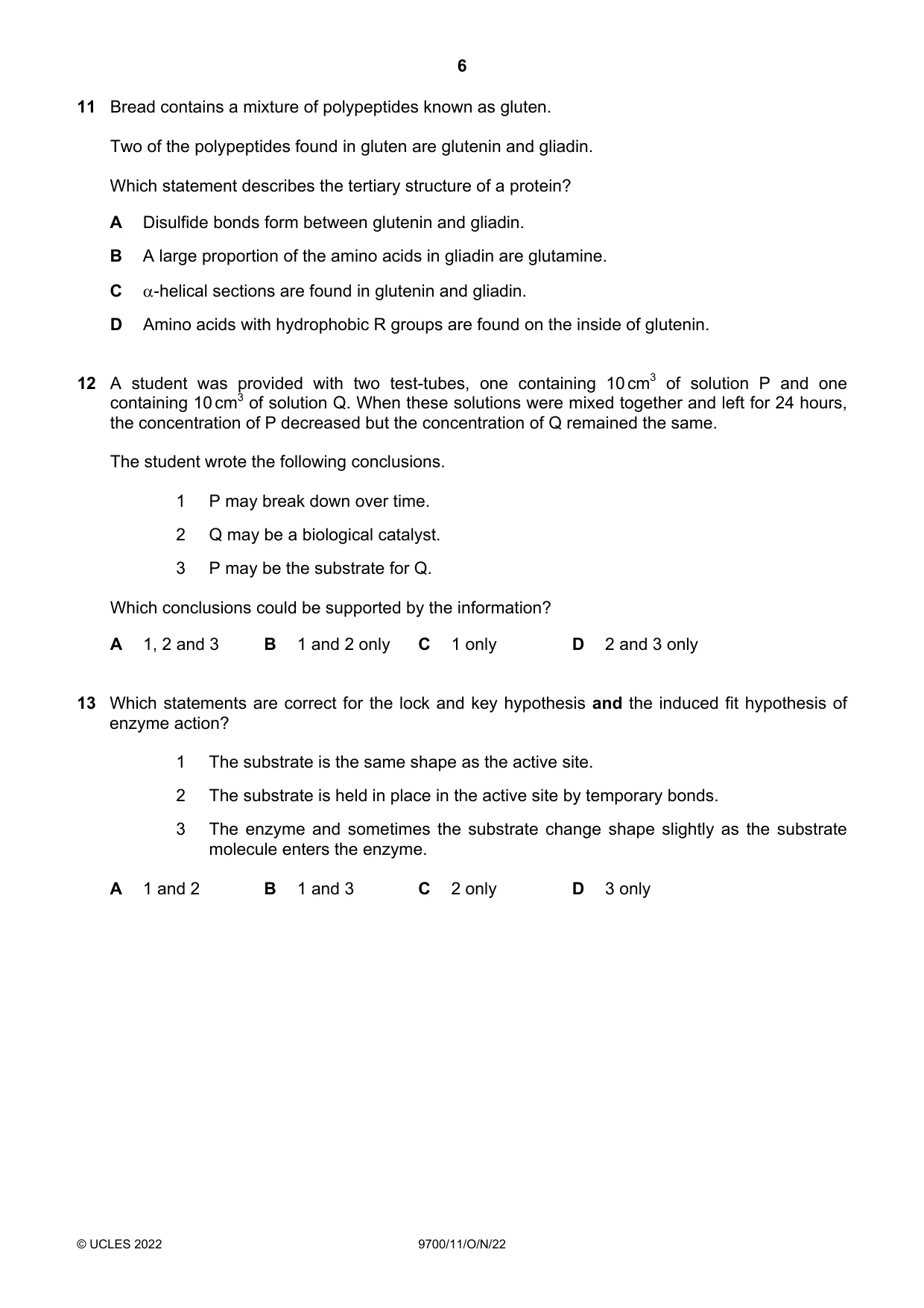
Q11 · Bread contains a mixture of polypeptides known as gluten
11 Bread contains a mixture of polypeptides known as gluten. Two of the polypeptides found in gluten are glutenin and gliadin. Which statement describes the tertiary structure of a protein? A Disulfide bonds form between glutenin and gliadin. B A large proportion of the amino acids in gliadin are glutamine. C α-helical sections are found in glutenin and gliadin. D Amino acids with hydrophobic R groups are found on the inside of glutenin.
Mark scheme: D
Q12 · A student was provided with two test-tubes, one containing 10 cm3 of solution P and one…
12 A student was provided with two test-tubes, one containing 10 cm3 of solution P and one containing 10 cm3 of solution Q. When these solutions were mixed together and left for 24 hours, the concentration of P decreased but the concentration of Q remained the same. The student wrote the following conclusions. 1 P may break down over time. 2 Q may be a biological catalyst. 3 P may be the substrate for Q. Which conclusions could be supported by the information? A 1, 2 and 3 B 1 and 2 only C 1 only D 2 and 3 only
Mark scheme: A
Q13 · Which statements are correct for the lock and key hypothesis and the induced fit…
13 Which statements are correct for the lock and key hypothesis and the induced fit hypothesis of enzyme action? 1 The substrate is the same shape as the active site. 2 The substrate is held in place in the active site by temporary bonds. 3 The enzyme and sometimes the substrate change shape slightly as the substrate molecule enters the enzyme. A 1 and 2 B 1 and 3 C 2 only D 3 only
Mark scheme: C
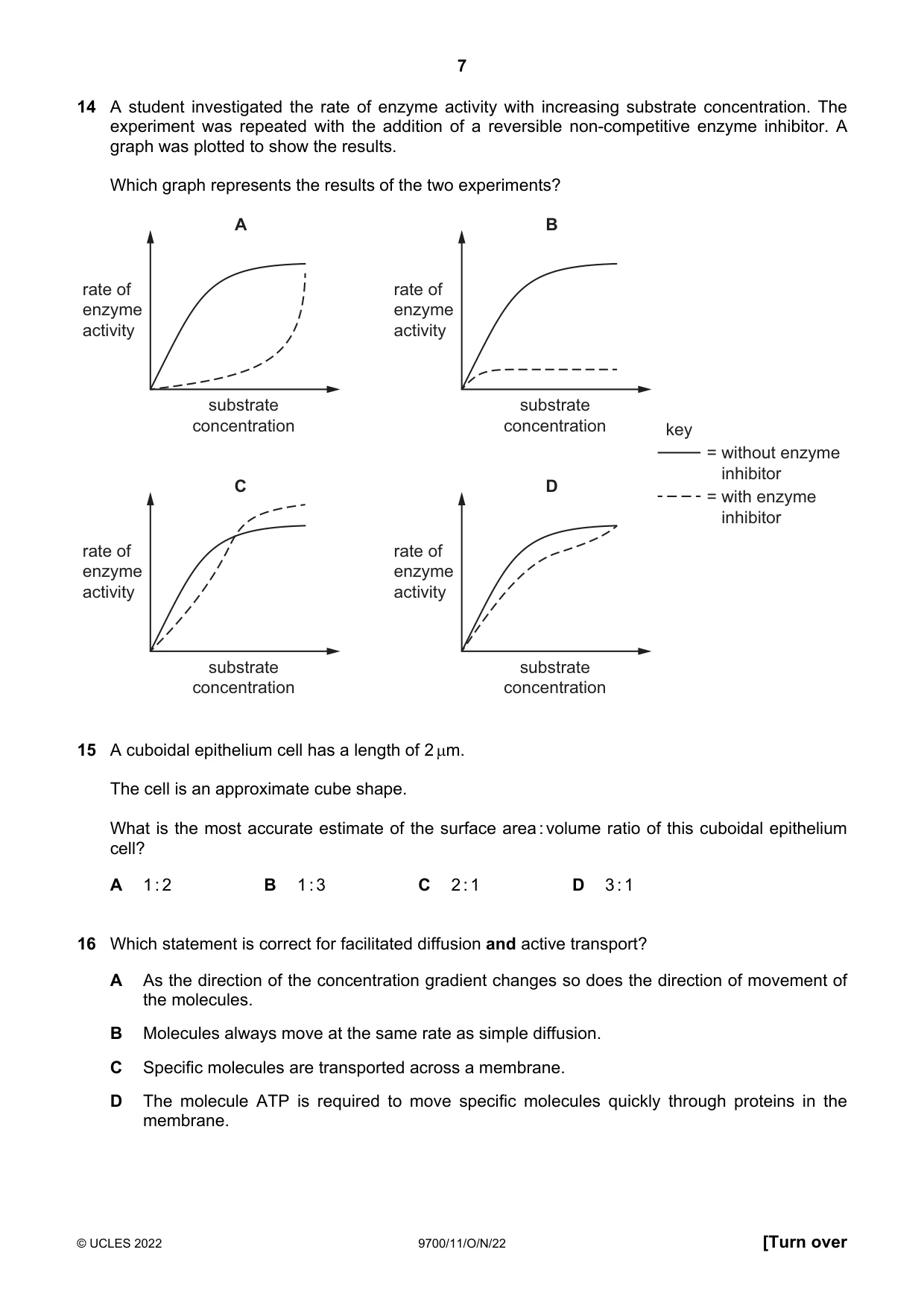
Q14 · A student investigated the rate of enzyme activity with increasing substrate concentration
14 A student investigated the rate of enzyme activity with increasing substrate concentration. The experiment was repeated with the addition of a reversible non-competitive enzyme inhibitor. A graph was plotted to show the results. Which graph represents the results of the two experiments? A B rate of rate of enzyme enzyme activity activity substrate substrate concentration concentration key = without enzyme = inhibitor C D = with enzyme = inhibitor rate of rate of enzyme enzyme activity activity substrate substrate concentration concentration
Mark scheme: B
Q15 · A cuboidal epithelium cell has a length of 2 µm
15 A cuboidal epithelium cell has a length of 2 µm. The cell is an approximate cube shape. What is the most accurate estimate of the surface area : volume ratio of this cuboidal epithelium cell? A 1 : 2 B 1 : 3 C 2 : 1 D 3 : 1
Mark scheme: D
More questions on Cells as the basic units of living organisms
Q16 · Which statement is correct for facilitated diffusion and active transport?
16 Which statement is correct for facilitated diffusion and active transport? A As the direction of the concentration gradient changes so does the direction of movement of the molecules. B Molecules always move at the same rate as simple diffusion. C Specific molecules are transported across a membrane. D The molecule ATP is required to move specific molecules quickly through proteins in the membrane.
Mark scheme: C
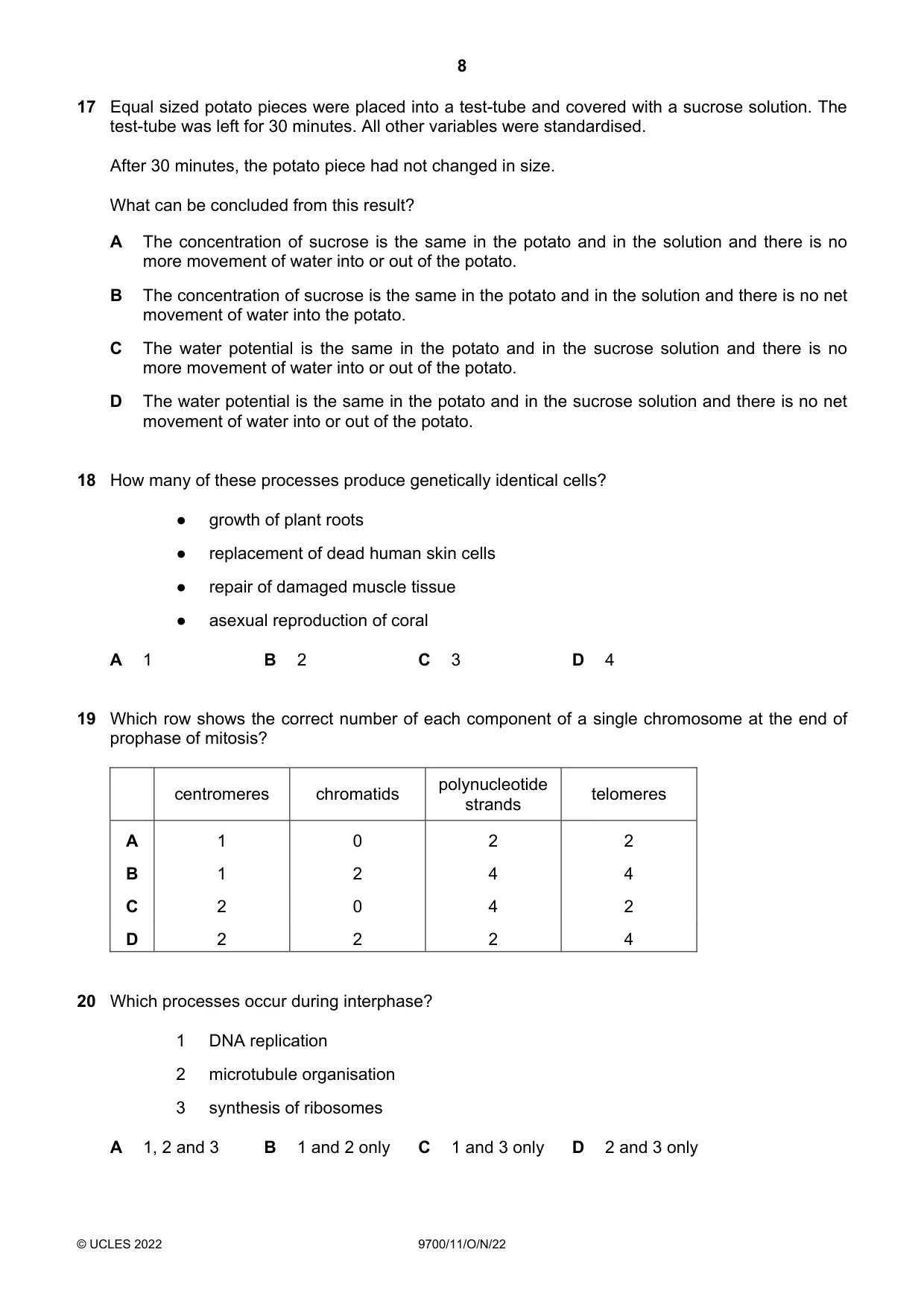
Q17 · Equal sized potato pieces were placed into a test-tube and covered with a sucrose solution
17 Equal sized potato pieces were placed into a test-tube and covered with a sucrose solution. The test-tube was left for 30 minutes. All other variables were standardised. After 30 minutes, the potato piece had not changed in size. What can be concluded from this result? A The concentration of sucrose is the same in the potato and in the solution and there is no more movement of water into or out of the potato. B The concentration of sucrose is the same in the potato and in the solution and there is no net movement of water into the potato. C The water potential is the same in the potato and in the sucrose solution and there is no more movement of water into or out of the potato. D The water potential is the same in the potato and in the sucrose solution and there is no net movement of water into or out of the potato.
Mark scheme: D
Q18 · How many of these processes produce genetically identical cells?
18 How many of these processes produce genetically identical cells? ● growth of plant roots ● replacement of dead human skin cells ● repair of damaged muscle tissue ● asexual reproduction of coral A 1 B 2 C 3 D 4
Mark scheme: D
More questions on Replication and division of nuclei and cells
Q19 · Which row shows the correct number of each component of a single chromosome at the end of…
19 Which row shows the correct number of each component of a single chromosome at the end of prophase of mitosis? polynucleotide centromeres chromatids telomeres strands A 1 0 2 2 B 1 2 4 4 C 2 0 4 2 D 2 2 2 4
Mark scheme: B
Q20 · Which processes occur during interphase?
20 Which processes occur during interphase? 1 DNA replication 2 microtubule organisation 3 synthesis of ribosomes A 1, 2 and 3 B 1 and 2 only C 1 and 3 only D 2 and 3 only
Mark scheme: C
More questions on Replication and division of nuclei and cells
Q21 · Embryonic stem cells are able to replicate continuously
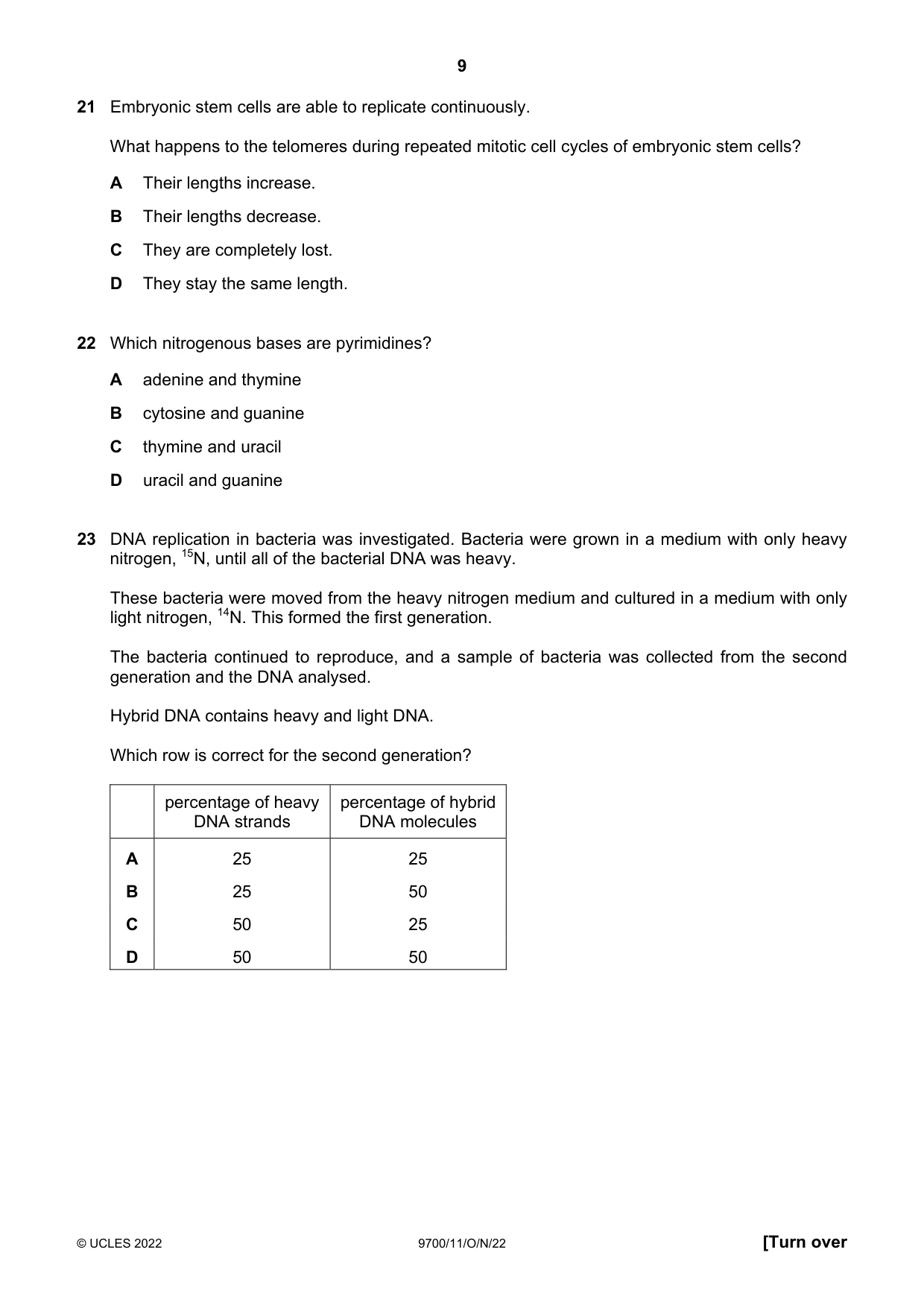
21 Embryonic stem cells are able to replicate continuously. What happens to the telomeres during repeated mitotic cell cycles of embryonic stem cells? A Their lengths increase. B Their lengths decrease. C They are completely lost. D They stay the same length.
Mark scheme: D
More questions on Replication and division of nuclei and cells
Q22 · Which nitrogenous bases are pyrimidines?
22 Which nitrogenous bases are pyrimidines? A adenine and thymine B cytosine and guanine C thymine and uracil D uracil and guanine
Mark scheme: C
More questions on Structure of nucleic acids and replication of DNA
Q23 · DNA replication in bacteria was investigated
23 DNA replication in bacteria was investigated. Bacteria were grown in a medium with only heavy nitrogen, 15N, until all of the bacterial DNA was heavy. These bacteria were moved from the heavy nitrogen medium and cultured in a medium with only light nitrogen, 14N. This formed the first generation. The bacteria continued to reproduce, and a sample of bacteria was collected from the second generation and the DNA analysed. Hybrid DNA contains heavy and light DNA. Which row is correct for the second generation? percentage of heavy percentage of hybrid DNA strands DNA molecules A 25 25 B 25 50 C 50 25 D 50 50
Mark scheme: B
More questions on Structure of nucleic acids and replication of DNA
Q24 · The sequence shows the series of bases at the start of a gene
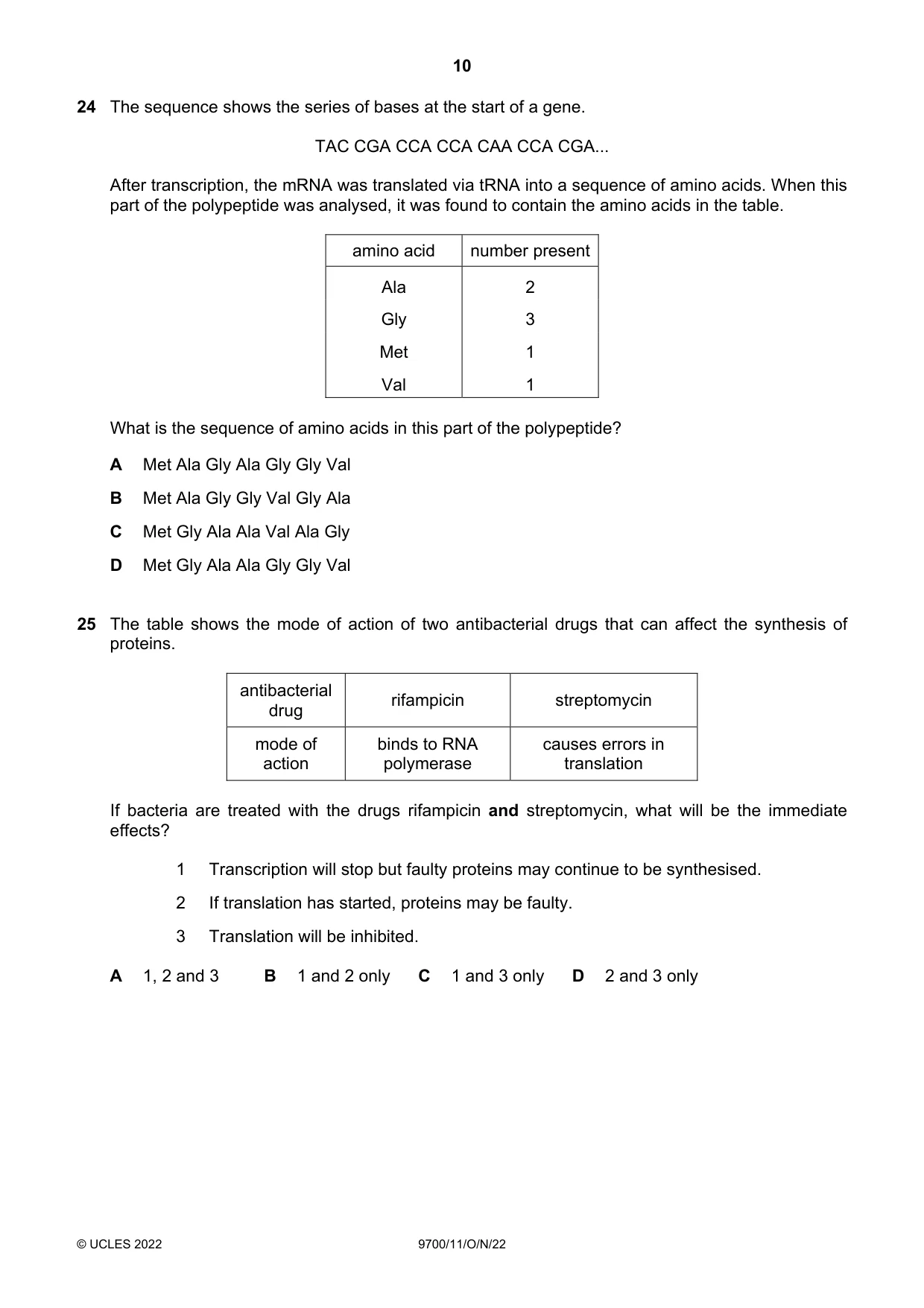
24 The sequence shows the series of bases at the start of a gene. TAC CGA CCA CCA CAA CCA CGA... After transcription, the mRNA was translated via tRNA into a sequence of amino acids. When this part of the polypeptide was analysed, it was found to contain the amino acids in the table. amino acid number present Ala 2 Gly 3 Met 1 Val 1 What is the sequence of amino acids in this part of the polypeptide? A Met Ala Gly Ala Gly Gly Val B Met Ala Gly Gly Val Gly Ala C Met Gly Ala Ala Val Ala Gly D Met Gly Ala Ala Gly Gly Val
Mark scheme: B
Q25 · The table shows the mode of action of two antibacterial drugs that can affect the…
25 The table shows the mode of action of two antibacterial drugs that can affect the synthesis of proteins. antibacterial rifampicin streptomycin drug mode of binds to RNA causes errors in action polymerase translation If bacteria are treated with the drugs rifampicin and streptomycin, what will be the immediate effects? 1 Transcription will stop but faulty proteins may continue to be synthesised. 2 If translation has started, proteins may be faulty. 3 Translation will be inhibited. A 1, 2 and 3 B 1 and 2 only C 1 and 3 only D 2 and 3 only
Mark scheme: B
Q26 · The electron micrograph shows a cross-section of a leaf vein and some neighbouring cells
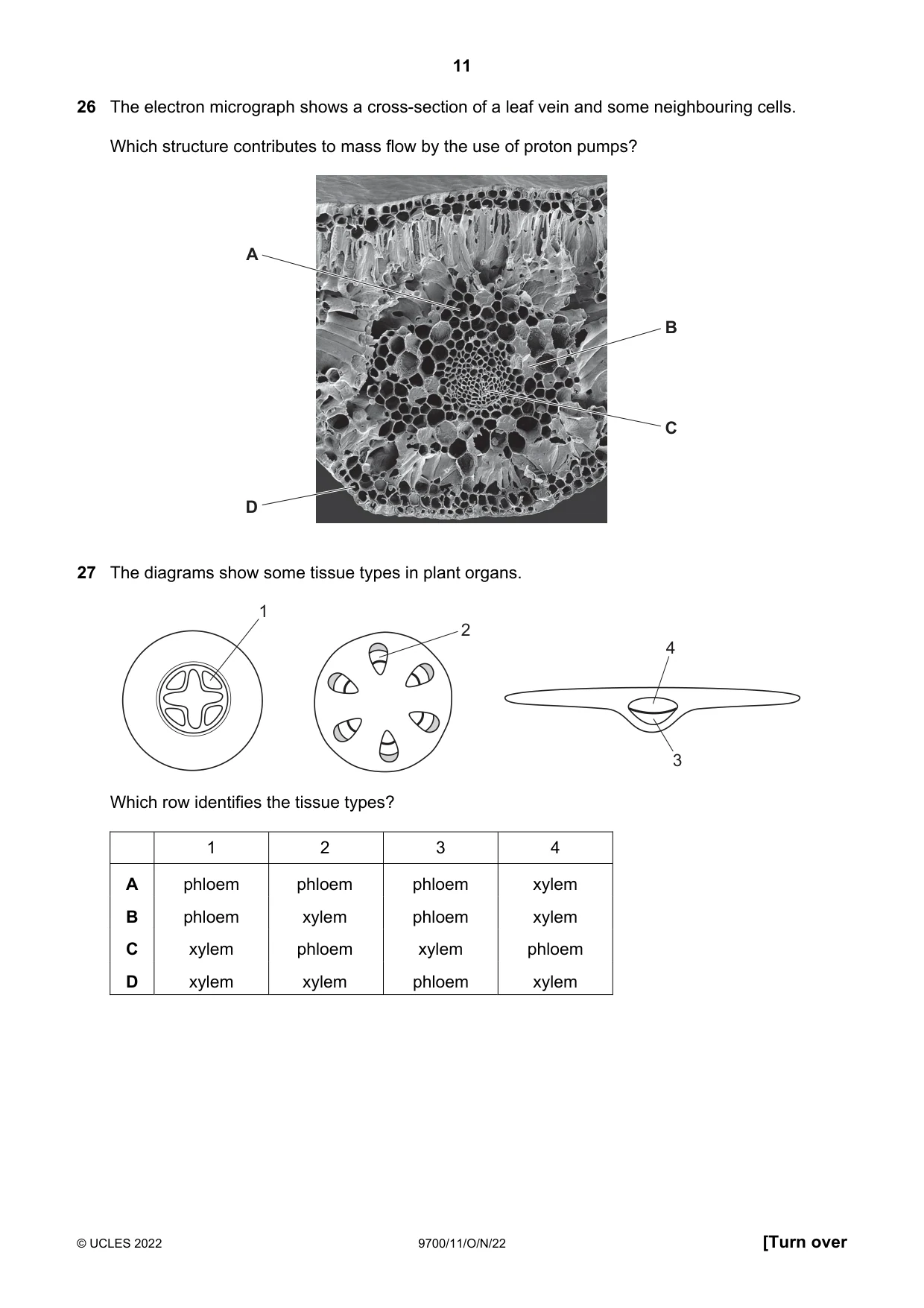
26 The electron micrograph shows a cross-section of a leaf vein and some neighbouring cells. Which structure contributes to mass flow by the use of proton pumps? A B C D
Mark scheme: C
Q27 · The diagrams show some tissue types in plant organs
27 The diagrams show some tissue types in plant organs. 1 2 4 3 Which row identifies the tissue types? 1 2 3 4 A phloem phloem phloem xylem B phloem xylem phloem xylem C xylem phloem xylem phloem D xylem xylem phloem xylem
Mark scheme: A
Q28 · Which description of xylem vessel elements is correct?
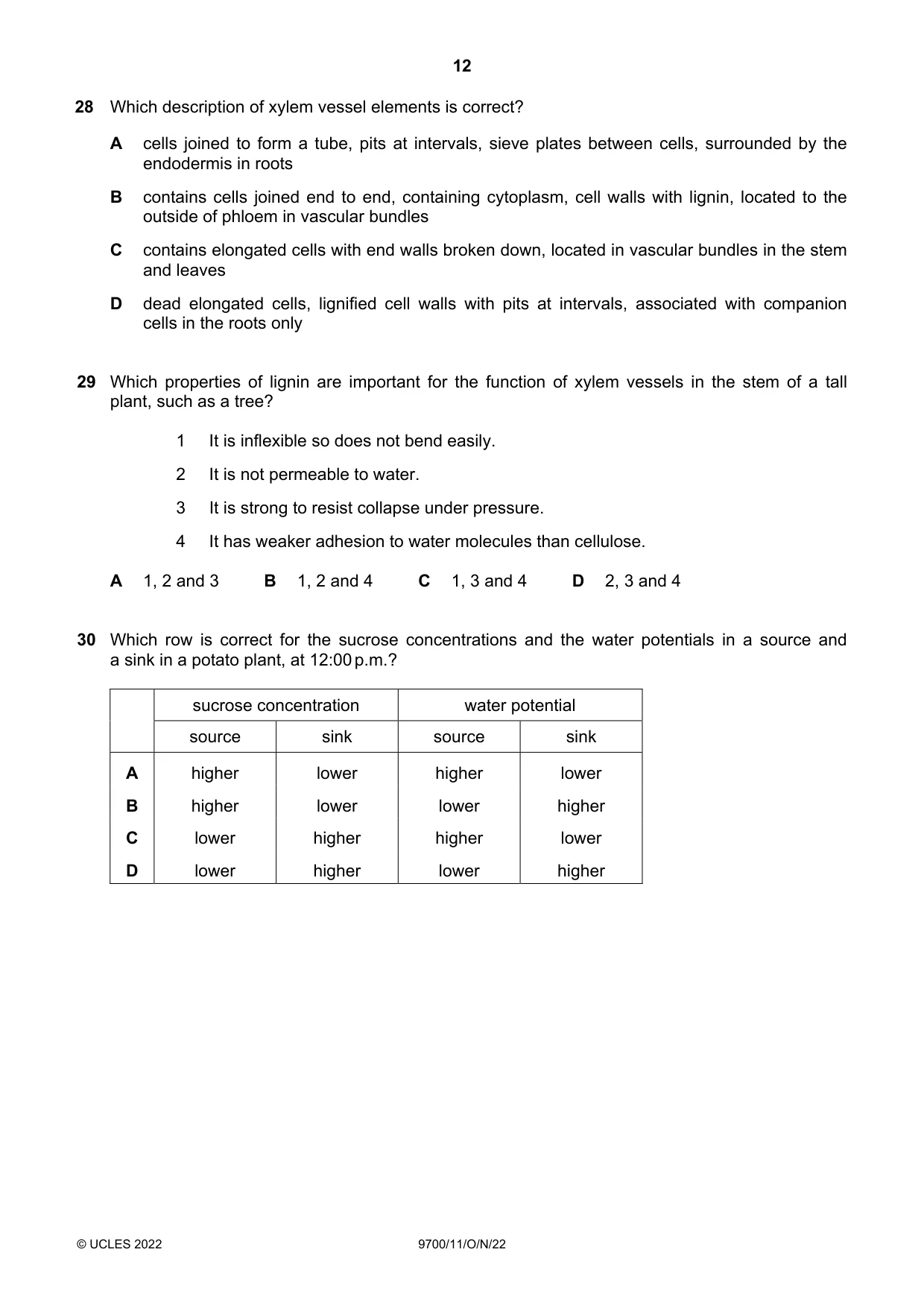
28 Which description of xylem vessel elements is correct? A cells joined to form a tube, pits at intervals, sieve plates between cells, surrounded by the endodermis in roots B contains cells joined end to end, containing cytoplasm, cell walls with lignin, located to the outside of phloem in vascular bundles C contains elongated cells with end walls broken down, located in vascular bundles in the stem and leaves D dead elongated cells, lignified cell walls with pits at intervals, associated with companion cells in the roots only
Mark scheme: C
Q29 · Which properties of lignin are important for the function of xylem vessels in the stem of…
29 Which properties of lignin are important for the function of xylem vessels in the stem of a tall plant, such as a tree? 1 It is inflexible so does not bend easily. 2 It is not permeable to water. 3 It is strong to resist collapse under pressure. 4 It has weaker adhesion to water molecules than cellulose. A 1, 2 and 3 B 1, 2 and 4 C 1, 3 and 4 D 2, 3 and 4
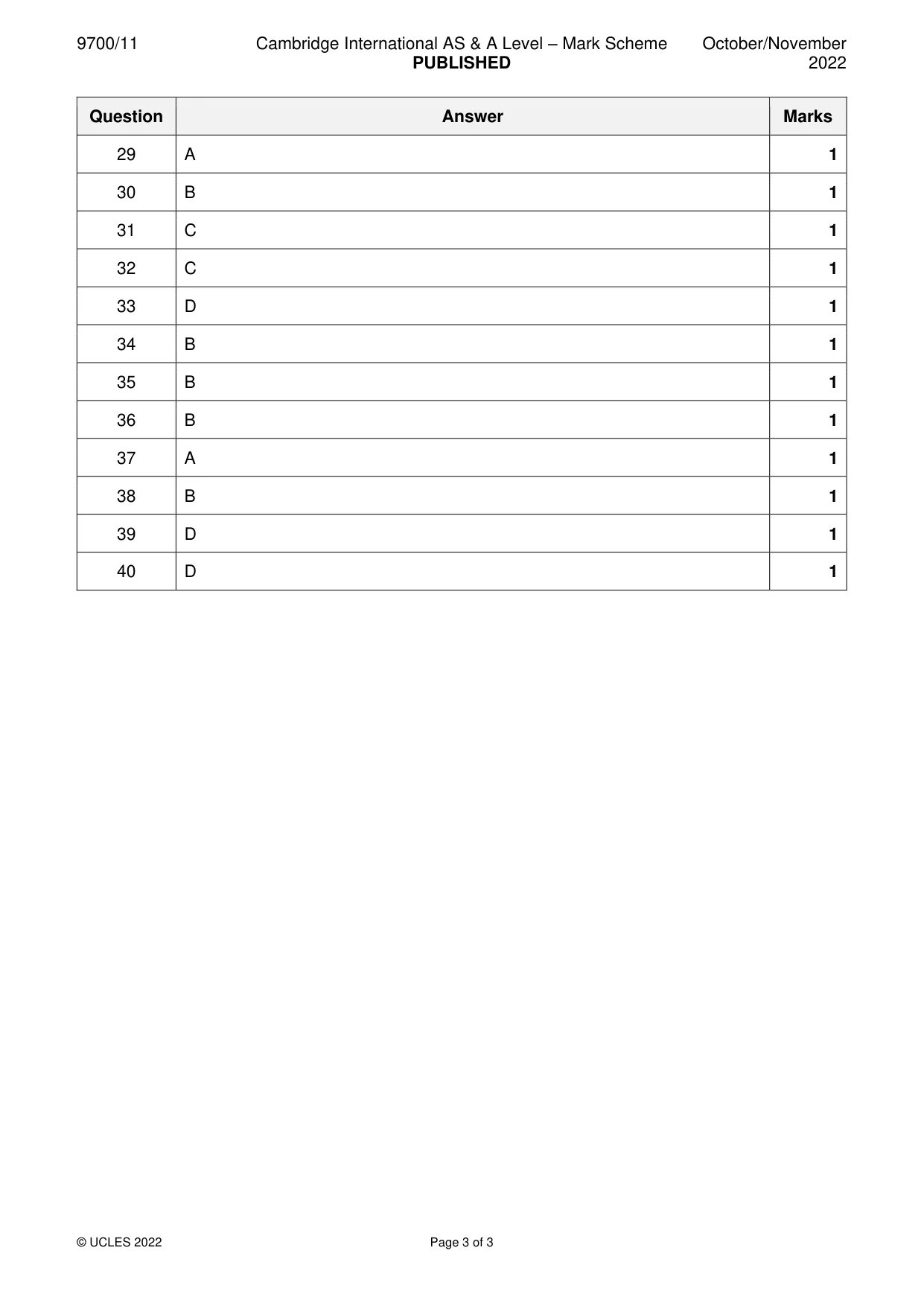
Mark scheme: A
Q30 · Which row is correct for the sucrose concentrations and the water potentials in a source…
30 Which row is correct for the sucrose concentrations and the water potentials in a source and a sink in a potato plant, at 12:00 p.m.? sucrose concentration water potential source sink source sink A higher lower higher lower B higher lower lower higher C lower higher higher lower D lower higher lower higher
Mark scheme: B
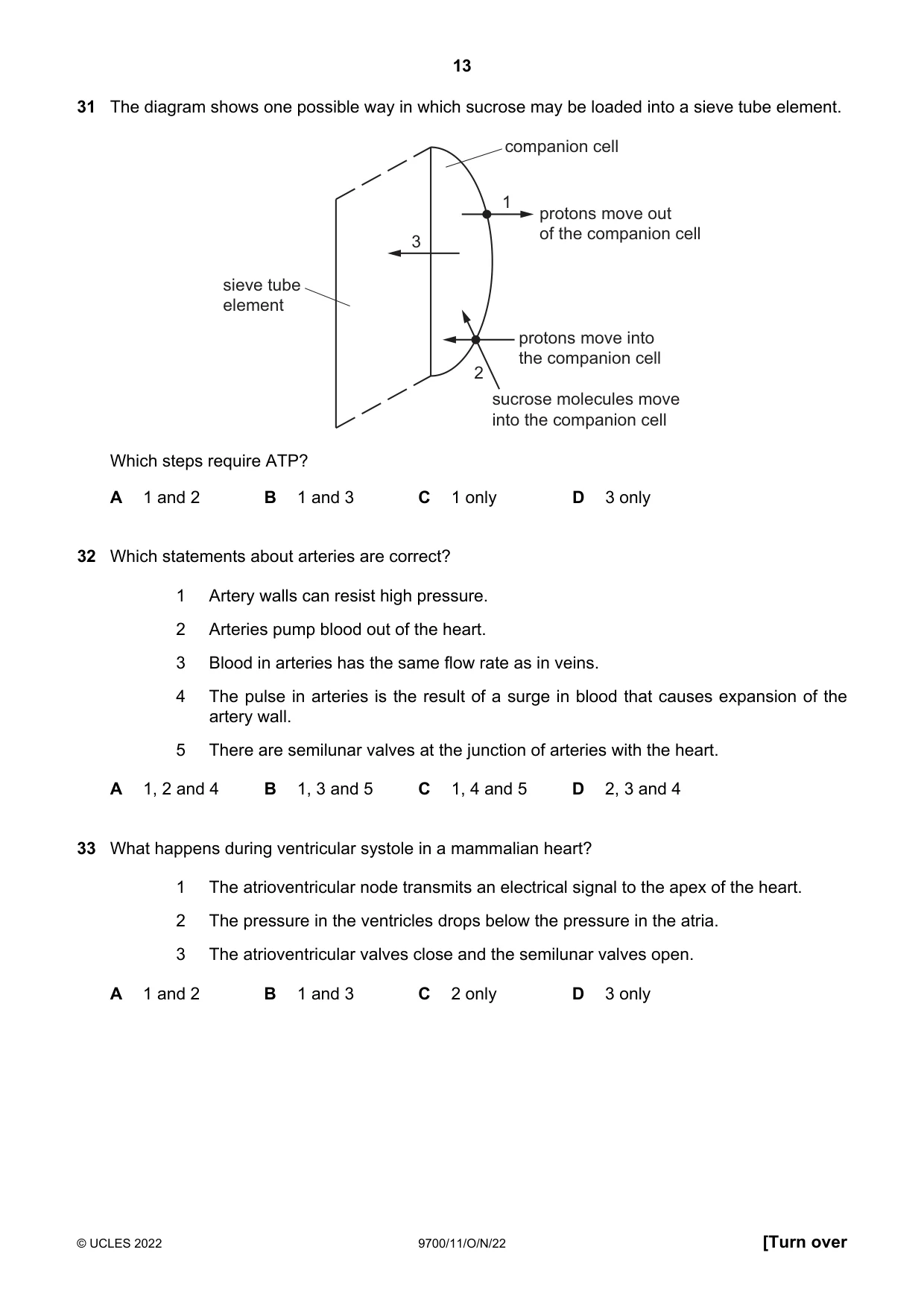
Q31 · The diagram shows one possible way in which sucrose may be loaded into a sieve tube…
31 The diagram shows one possible way in which sucrose may be loaded into a sieve tube element. companion cell 1 protons move out of the companion cell 3 sieve tube element protons move into the companion cell 2 sucrose molecules move into the companion cell Which steps require ATP? A 1 and 2 B 1 and 3 C 1 only D 3 only
Mark scheme: C
Q32 · Which statements about arteries are correct?
32 Which statements about arteries are correct? 1 Artery walls can resist high pressure. 2 Arteries pump blood out of the heart. 3 Blood in arteries has the same flow rate as in veins. 4 The pulse in arteries is the result of a surge in blood that causes expansion of the artery wall. 5 There are semilunar valves at the junction of arteries with the heart. A 1, 2 and 4 B 1, 3 and 5 C 1, 4 and 5 D 2, 3 and 4
Mark scheme: C
Q33 · What happens during ventricular systole in a mammalian heart?
33 What happens during ventricular systole in a mammalian heart? 1 The atrioventricular node transmits an electrical signal to the apex of the heart. 2 The pressure in the ventricles drops below the pressure in the atria. 3 The atrioventricular valves close and the semilunar valves open. A 1 and 2 B 1 and 3 C 2 only D 3 only
Mark scheme: D
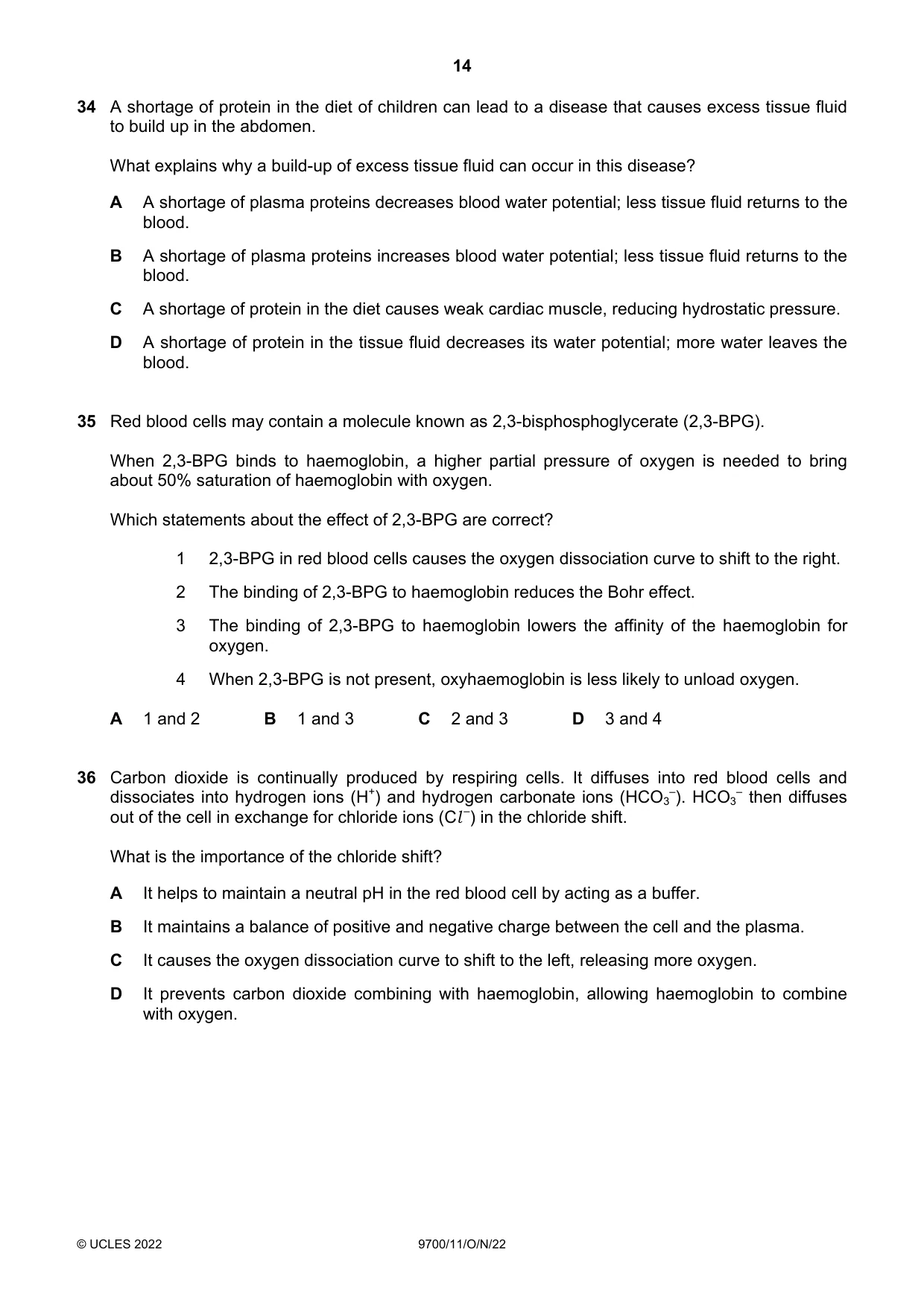
Q34 · A shortage of protein in the diet of children can lead to a disease that causes excess…
34 A shortage of protein in the diet of children can lead to a disease that causes excess tissue fluid to build up in the abdomen. What explains why a build-up of excess tissue fluid can occur in this disease? A A shortage of plasma proteins decreases blood water potential; less tissue fluid returns to the blood. B A shortage of plasma proteins increases blood water potential; less tissue fluid returns to the blood. C A shortage of protein in the diet causes weak cardiac muscle, reducing hydrostatic pressure. D A shortage of protein in the tissue fluid decreases its water potential; more water leaves the blood.
Mark scheme: B
Q35 · Red blood cells may contain a molecule known as 2,3-bisphosphoglycerate (2,3-BPG)
35 Red blood cells may contain a molecule known as 2,3-bisphosphoglycerate (2,3-BPG). When 2,3-BPG binds to haemoglobin, a higher partial pressure of oxygen is needed to bring about 50% saturation of haemoglobin with oxygen. Which statements about the effect of 2,3-BPG are correct? 1 2,3-BPG in red blood cells causes the oxygen dissociation curve to shift to the right. 2 The binding of 2,3-BPG to haemoglobin reduces the Bohr effect. 3 The binding of 2,3-BPG to haemoglobin lowers the affinity of the haemoglobin for oxygen. 4 When 2,3-BPG is not present, oxyhaemoglobin is less likely to unload oxygen. A 1 and 2 B 1 and 3 C 2 and 3 D 3 and 4
Mark scheme: B
Q36 · Carbon dioxide is continually produced by respiring cells
36 Carbon dioxide is continually produced by respiring cells. It diffuses into red blood cells and dissociates into hydrogen ions (H+) and hydrogen carbonate ions (HCO3 –). HCO3 – then diffuses out of the cell in exchange for chloride ions (Cl –) in the chloride shift. What is the importance of the chloride shift? A It helps to maintain a neutral pH in the red blood cell by acting as a buffer. B It maintains a balance of positive and negative charge between the cell and the plasma. C It causes the oxygen dissociation curve to shift to the left, releasing more oxygen. D It prevents carbon dioxide combining with haemoglobin, allowing haemoglobin to combine with oxygen.
Mark scheme: B
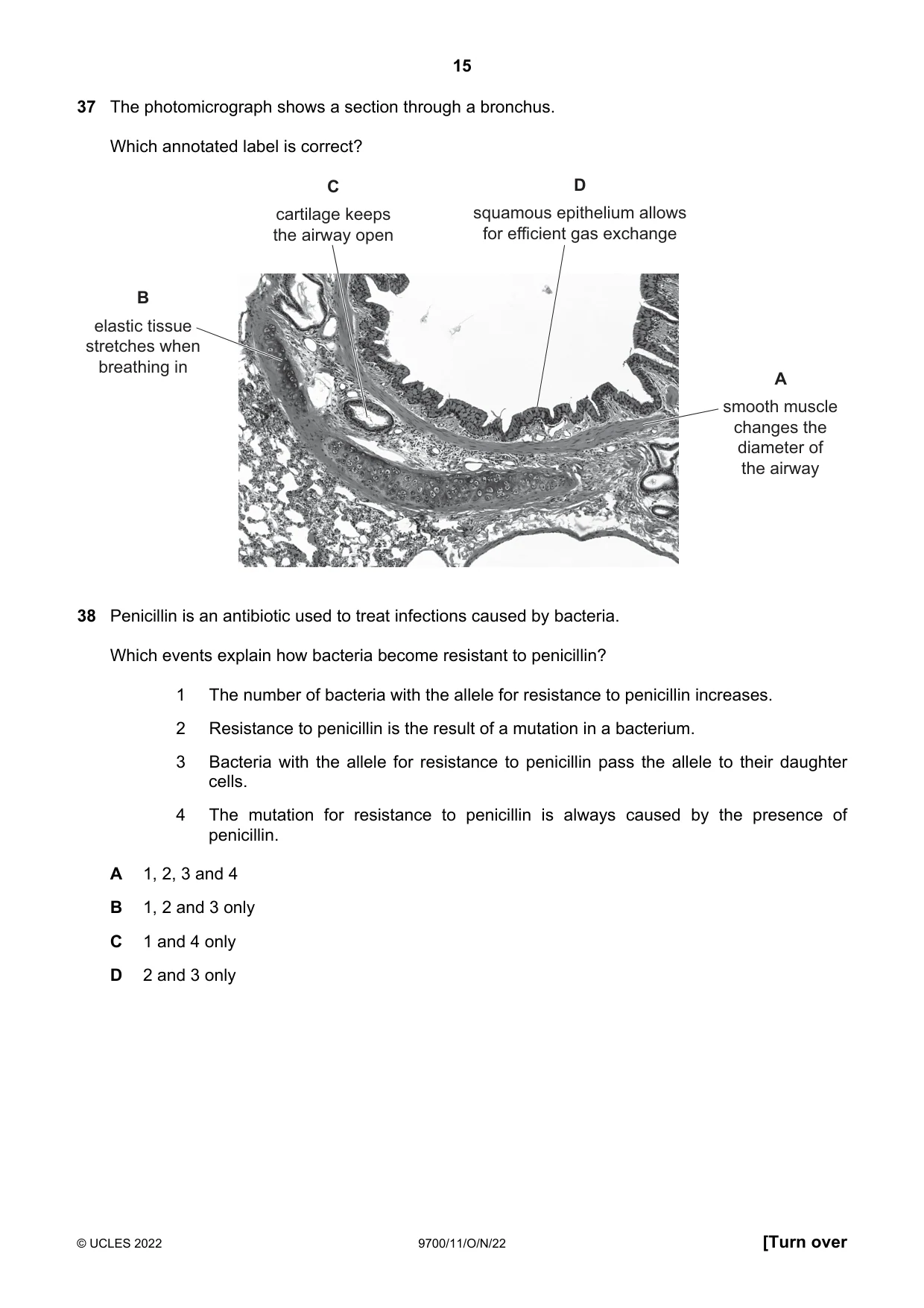
Q37 · The photomicrograph shows a section through a bronchus
37 The photomicrograph shows a section through a bronchus. Which annotated label is correct? C D cartilage keeps squamous epithelium allows the airway open for efficient gas exchange B elastic tissue stretches when breathing in A smooth muscle changes the diameter of the airway
Mark scheme: A
Q38 · Penicillin is an antibiotic used to treat infections caused by bacteria
38 Penicillin is an antibiotic used to treat infections caused by bacteria. Which events explain how bacteria become resistant to penicillin? 1 The number of bacteria with the allele for resistance to penicillin increases. 2 Resistance to penicillin is the result of a mutation in a bacterium. 3 Bacteria with the allele for resistance to penicillin pass the allele to their daughter cells. 4 The mutation for resistance to penicillin is always caused by the presence of penicillin. A 1, 2, 3 and 4 B 1, 2 and 3 only C 1 and 4 only D 2 and 3 only
Mark scheme: B
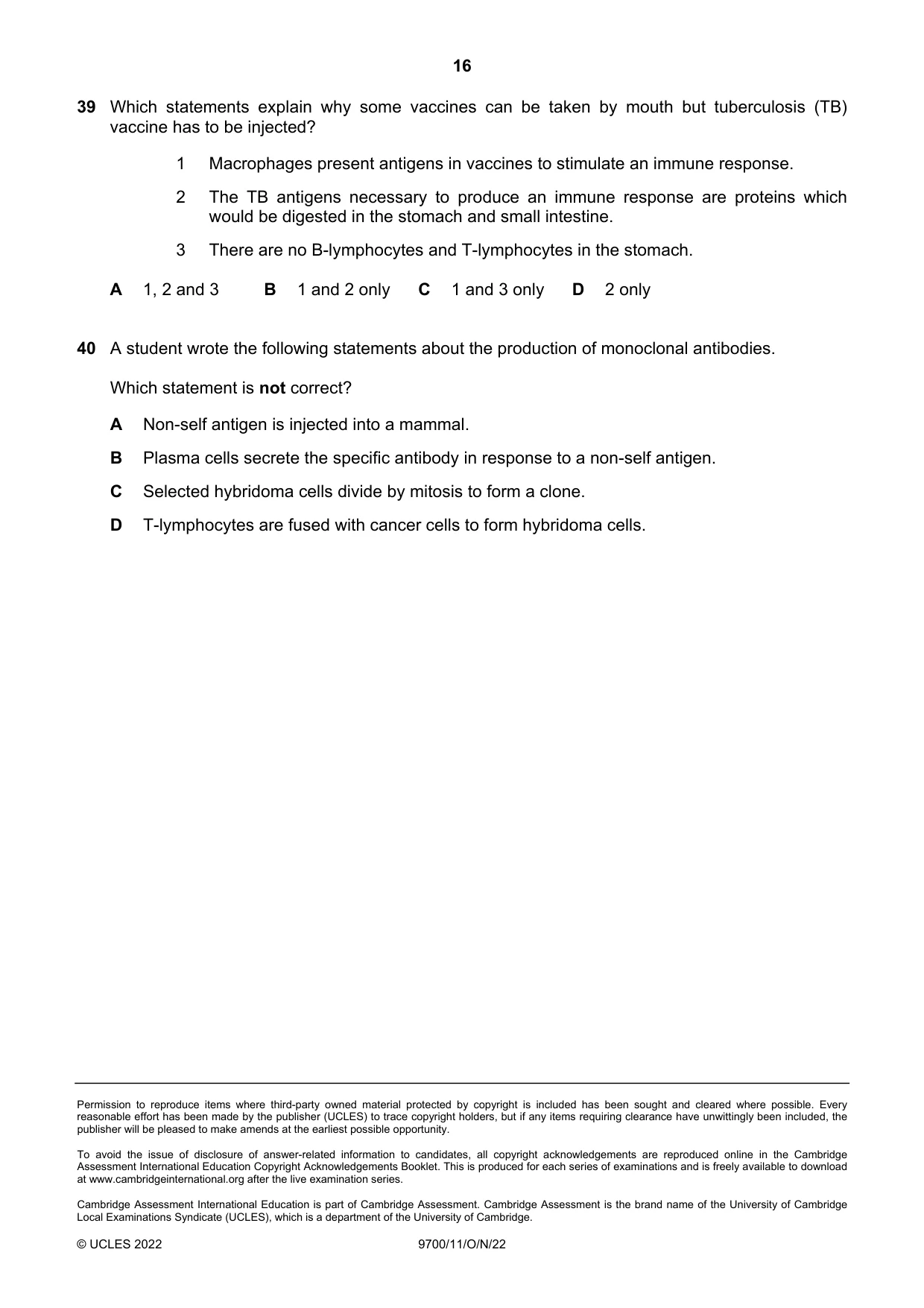
Q39 · Which statements explain why some vaccines can be taken by mouth but tuberculosis (TB)…
39 Which statements explain why some vaccines can be taken by mouth but tuberculosis (TB) vaccine has to be injected? 1 Macrophages present antigens in vaccines to stimulate an immune response. 2 The TB antigens necessary to produce an immune response are proteins which would be digested in the stomach and small intestine. 3 There are no B-lymphocytes and T-lymphocytes in the stomach. A 1, 2 and 3 B 1 and 2 only C 1 and 3 only D 2 only
Mark scheme: D
Q40 · A student wrote the following statements about the production of monoclonal antibodies
40 A student wrote the following statements about the production of monoclonal antibodies. Which statement is not correct? A Non-self antigen is injected into a mammal. B Plasma cells secrete the specific antibody in response to a non-self antigen. C Selected hybridoma cells divide by mitosis to form a clone. D T-lymphocytes are fused with cancer cells to form hybridoma cells.
Mark scheme: D
What was in this paper
The subtopics covered by these 40 questions, and how many questions each got. Open one in a new tab to see every Cambridge question on it.
5Carbohydrates and lipids4Replication and division of nuclei and cells3Structure of transport tissues3Transport mechanisms3Antibiotics2Antibodies and vaccination2Mode of action of enzymes2Movement into and out of cells2Structure of nucleic acids and replication of DNA2The circulatory system2Transport of oxygen and carbon dioxide2Chromosome behaviour in mitosis1Factors that affect enzyme action1Protein synthesis1Proteins1Testing for biological molecules1The gas exchange system1The heart1The microscope in cell studies1What you needed in this session
Cambridge’s own grade thresholds for 2022 Oct/Nov, Paper 1 · Variant 1. A higher threshold means an easier paper — the bar moves with how the cohort did.