Cambridge A Level Biology 9700 — 2006 Oct/Nov Paper 1 · Variant 1
9700/11/O/N/06 · 40 questions · 40 marks · ≈45 min
The question paper and its mark scheme, free to read here and free to download. This is Cambridge’s own paper, exactly as it was sat.
Question paper20 pages

Mark scheme2 pages
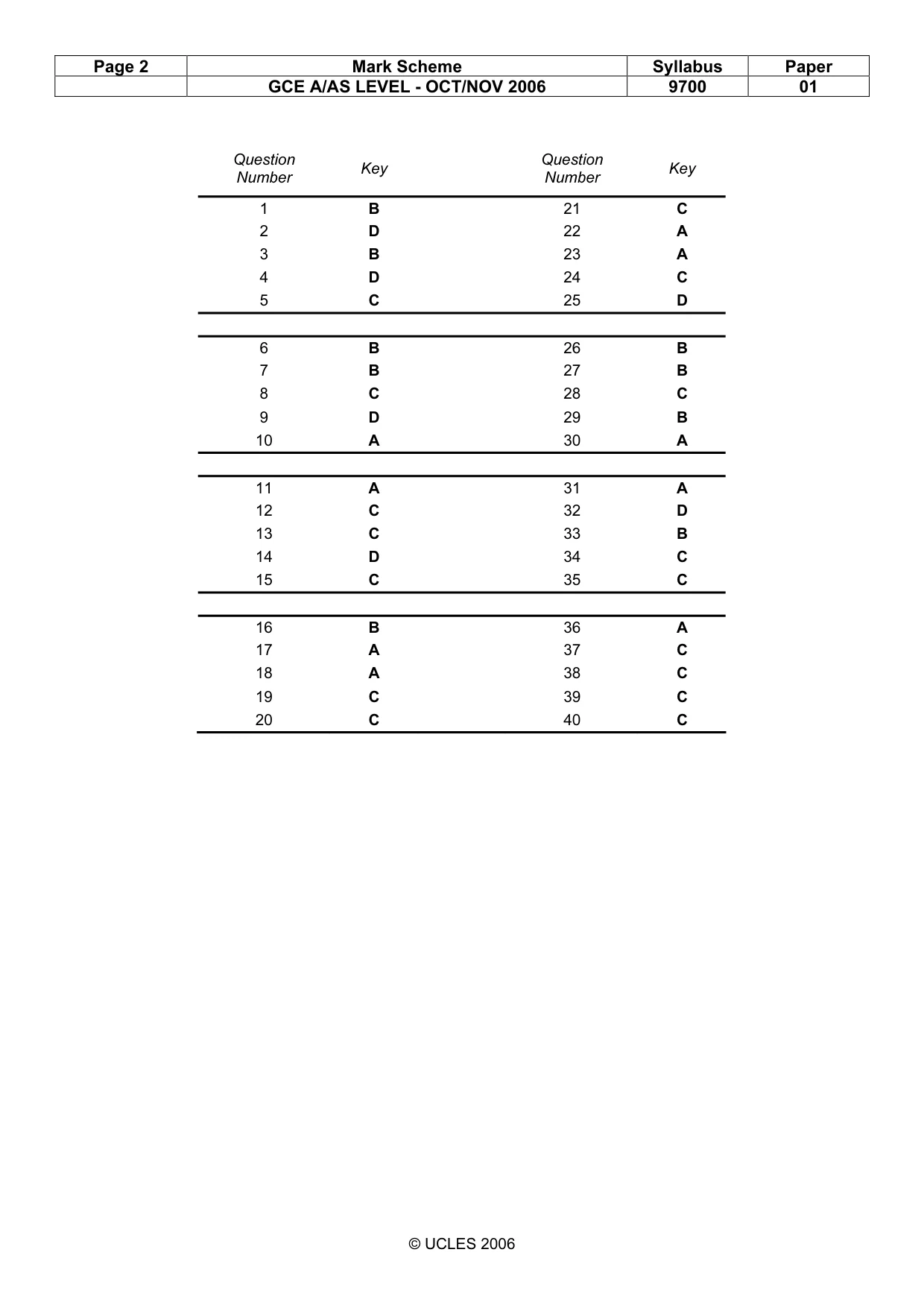
Answers below. Sit the paper first if you are practising.
Questions as text
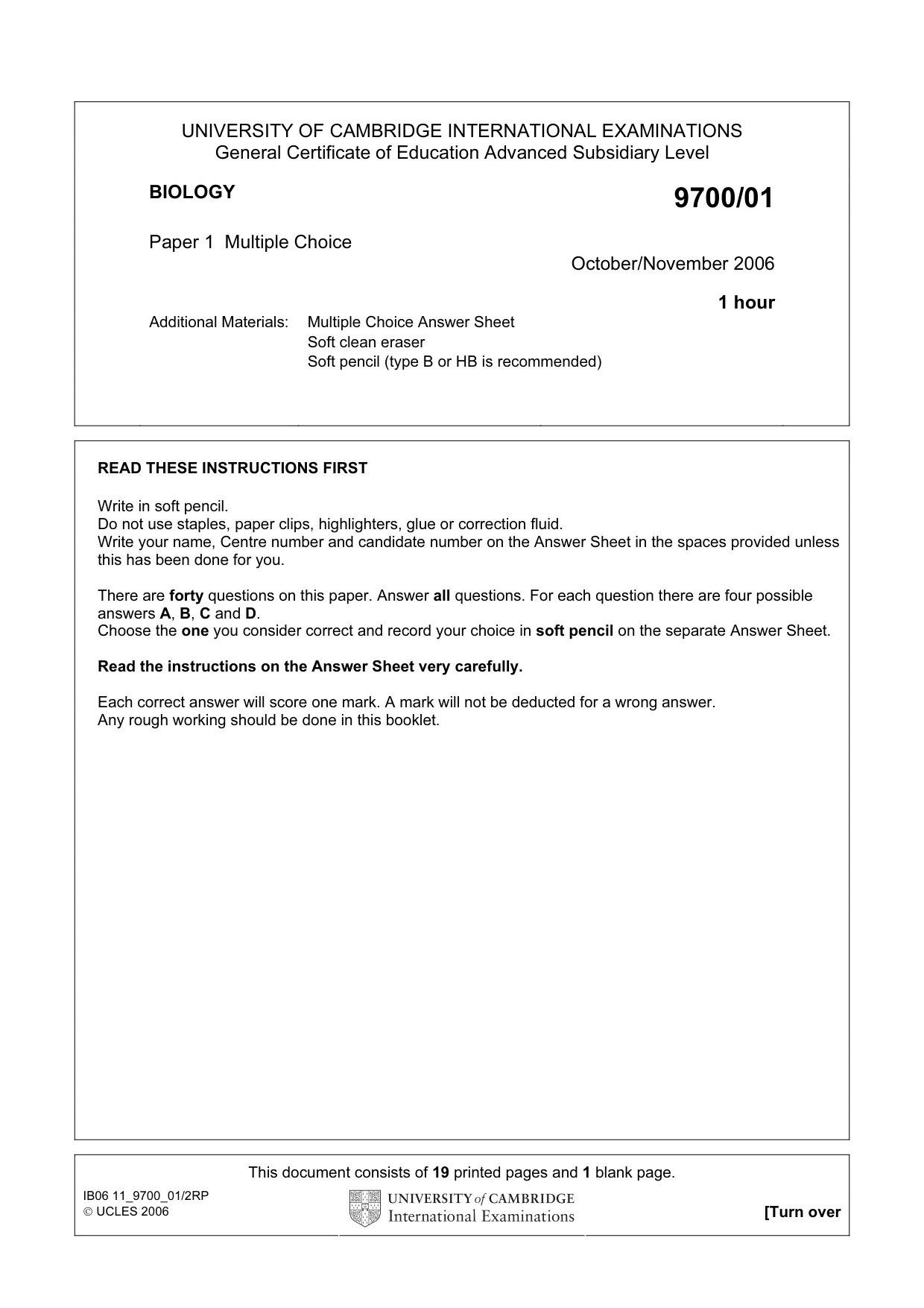
Q1 · The diagram shows a stage micrometer on which the small divisions are 0.1 mm
1 The diagram shows a stage micrometer on which the small divisions are 0.1 mm. It is viewed through an eyepiece containing a graticule. 0 10 20 30 40 50 60 70 80 90 100 The stage micrometer is replaced by a slide of a plant cell. 0 10 20 30 40 50 60 70 80 90 100 What is the width of a chloroplast? A 5 µm B 10 µm C 50 µm D 100 µm
Mark scheme: B
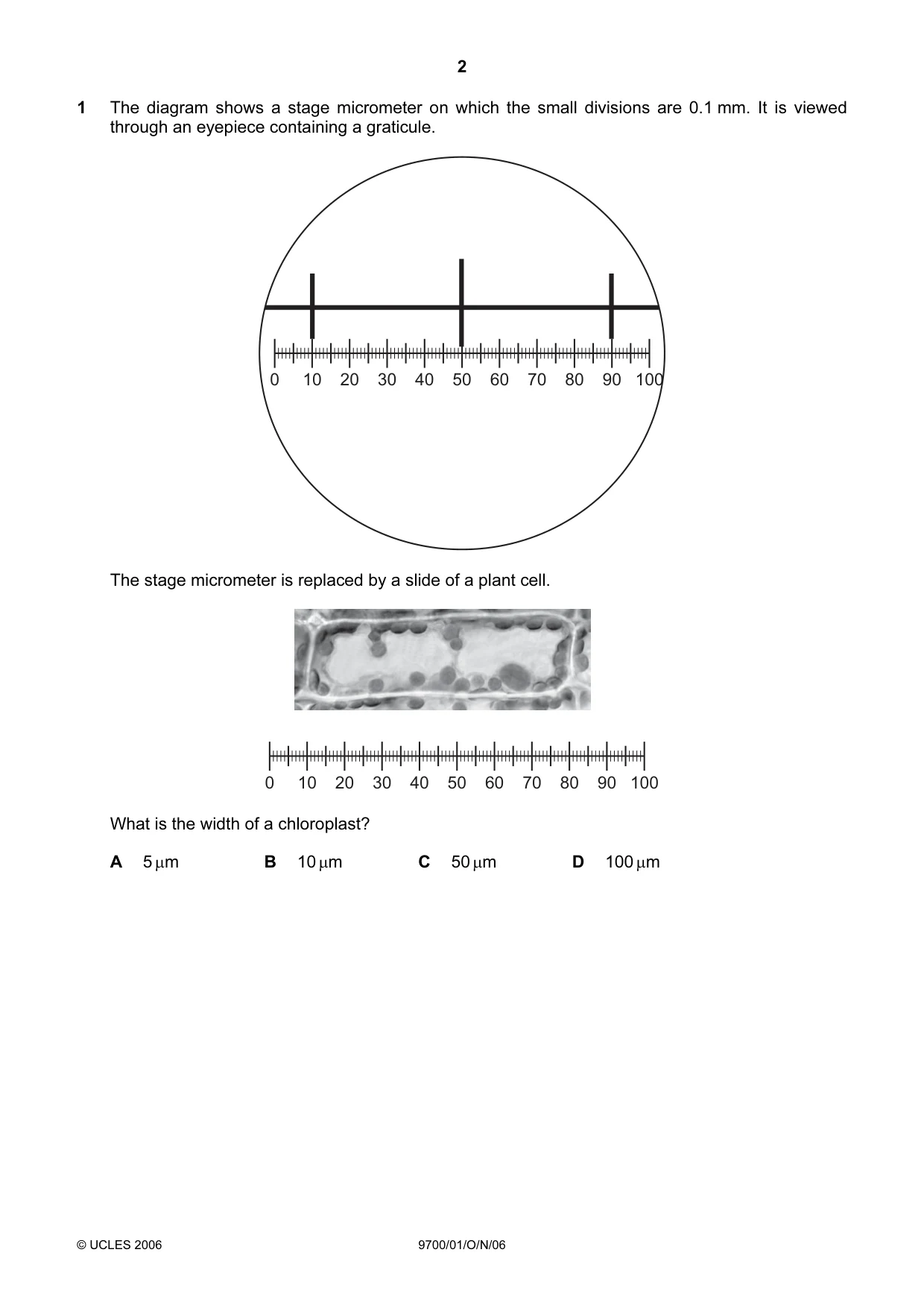
Q2 · The diagram shows an electron micrograph of a typical animal cell
2 The diagram shows an electron micrograph of a typical animal cell. X What is the function of the membrane system labelled X? A carbohydrate metabolism B lipid synthesis C protein synthesis D protein synthesis and transport
Mark scheme: D
More questions on Cells as the basic units of living organisms
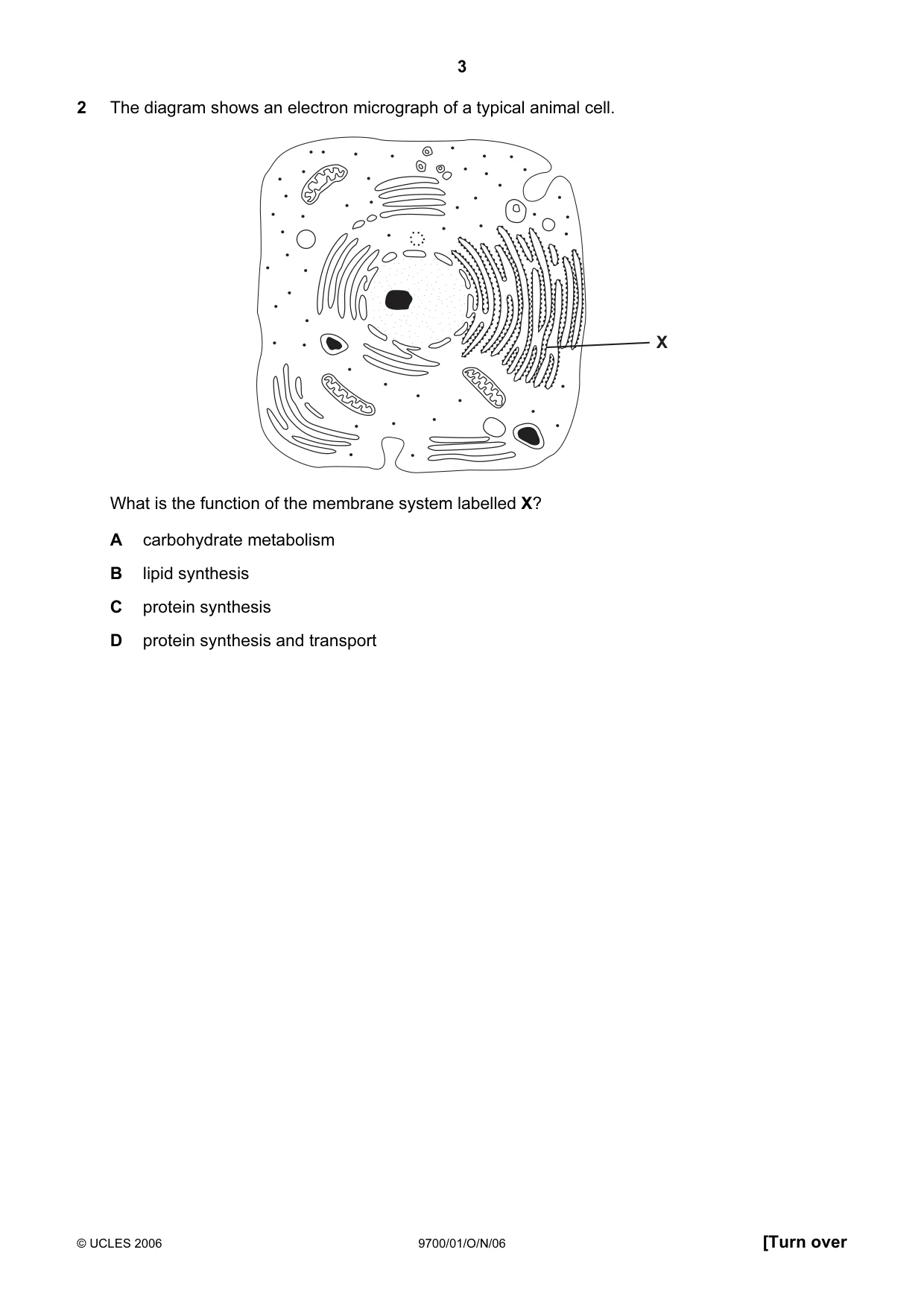
Q3 · The diagram shows an electron micrograph of a plant cell
3 The diagram shows an electron micrograph of a plant cell. X Y Z What do structures X, Y and Z contain? X Y Z A air chlorophyll protein B mineral ions starch DNA and RNA C water mineral ions starch D starch DNA and RNA mineral ions
Mark scheme: B
More questions on Cells as the basic units of living organisms
Q4 · Which organelles are found in the cells of both eukaryotes and prokaryotes?
4 Which organelles are found in the cells of both eukaryotes and prokaryotes? A chloroplasts B Golgi apparatus C mitochondria D ribosomes
Mark scheme: D
More questions on Cells as the basic units of living organisms
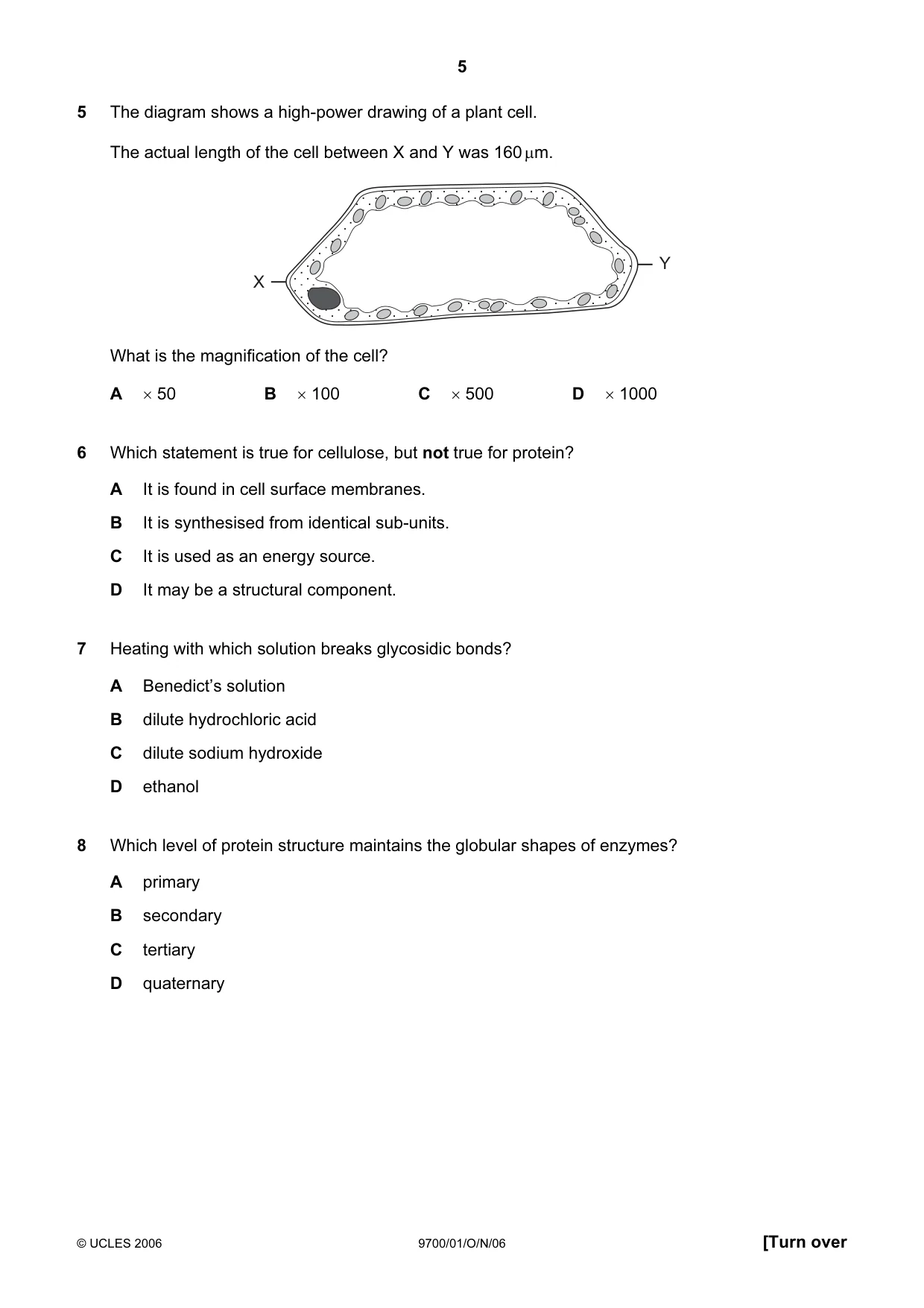
Q5 · The diagram shows a high-power drawing of a plant cell
5 The diagram shows a high-power drawing of a plant cell. The actual length of the cell between X and Y was 160 µm. Y X What is the magnification of the cell? A × 50 B × 100 C × 500 D × 1000
Mark scheme: C
Q6 · Which statement is true for cellulose, but not true for protein?
6 Which statement is true for cellulose, but not true for protein? A It is found in cell surface membranes. B It is synthesised from identical sub-units. C It is used as an energy source. D It may be a structural component.
Mark scheme: B
Q7 · Heating with which solution breaks glycosidic bonds?
7 Heating with which solution breaks glycosidic bonds? A Benedict’s solution B dilute hydrochloric acid C dilute sodium hydroxide D ethanol
Mark scheme: B
Q8 · Which level of protein structure maintains the globular shapes of enzymes?
8 Which level of protein structure maintains the globular shapes of enzymes? A primary B secondary C tertiary D quaternary
Mark scheme: C
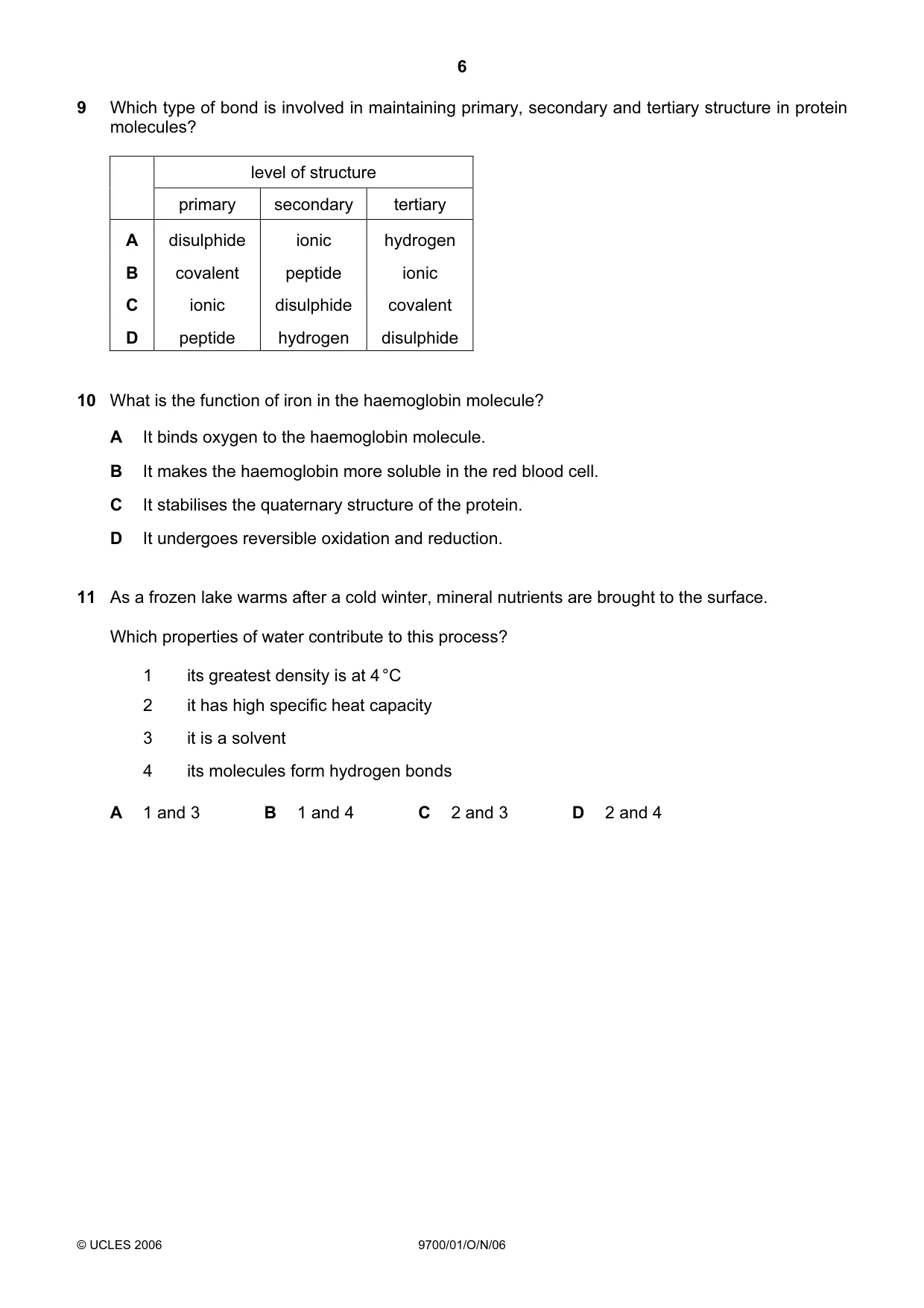
Q9 · Which type of bond is involved in maintaining primary, secondary and tertiary structure…
9 Which type of bond is involved in maintaining primary, secondary and tertiary structure in protein molecules? level of structure primary secondary tertiary A disulphide ionic hydrogen B covalent peptide ionic C ionic disulphide covalent D peptide hydrogen disulphide
Mark scheme: D
Q10 · What is the function of iron in the haemoglobin molecule?
10 What is the function of iron in the haemoglobin molecule? A It binds oxygen to the haemoglobin molecule. B It makes the haemoglobin more soluble in the red blood cell. C It stabilises the quaternary structure of the protein. D It undergoes reversible oxidation and reduction.
Mark scheme: A
Q11 · As a frozen lake warms after a cold winter, mineral nutrients are brought to the surface
11 As a frozen lake warms after a cold winter, mineral nutrients are brought to the surface. Which properties of water contribute to this process? 1 its greatest density is at 4 °C 2 it has high specific heat capacity 3 it is a solvent 4 its molecules form hydrogen bonds A 1 and 3 B 1 and 4 C 2 and 3 D 2 and 4
Mark scheme: A
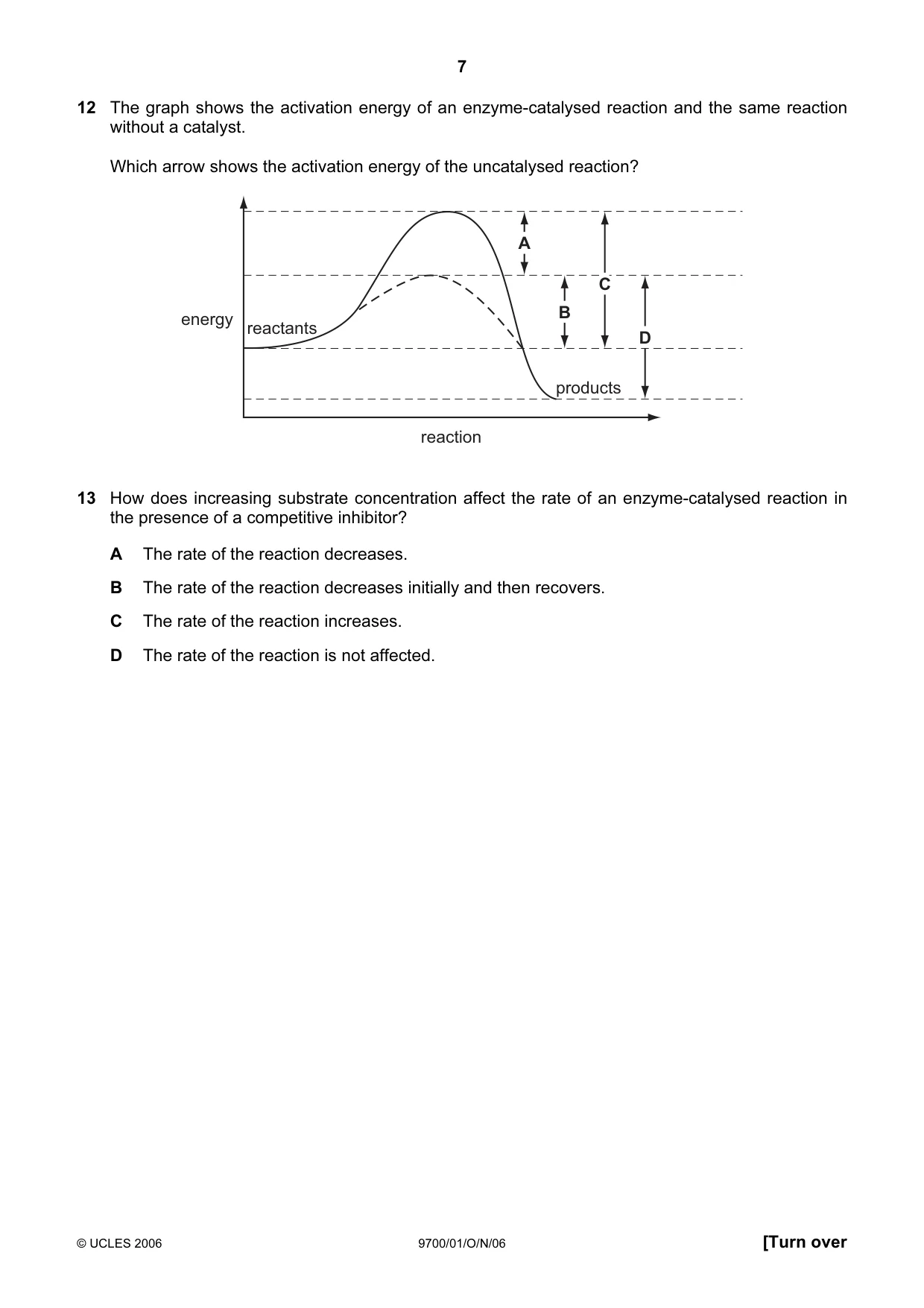
Q12 · The graph shows the activation energy of an enzyme-catalysed reaction and the same…
12 The graph shows the activation energy of an enzyme-catalysed reaction and the same reaction without a catalyst. Which arrow shows the activation energy of the uncatalysed reaction? A C energy B reactants D products reaction
Mark scheme: C
Q13 · How does increasing substrate concentration affect the rate of an enzyme-catalysed…
13 How does increasing substrate concentration affect the rate of an enzyme-catalysed reaction in the presence of a competitive inhibitor? A The rate of the reaction decreases. B The rate of the reaction decreases initially and then recovers. C The rate of the reaction increases. D The rate of the reaction is not affected.
Mark scheme: C
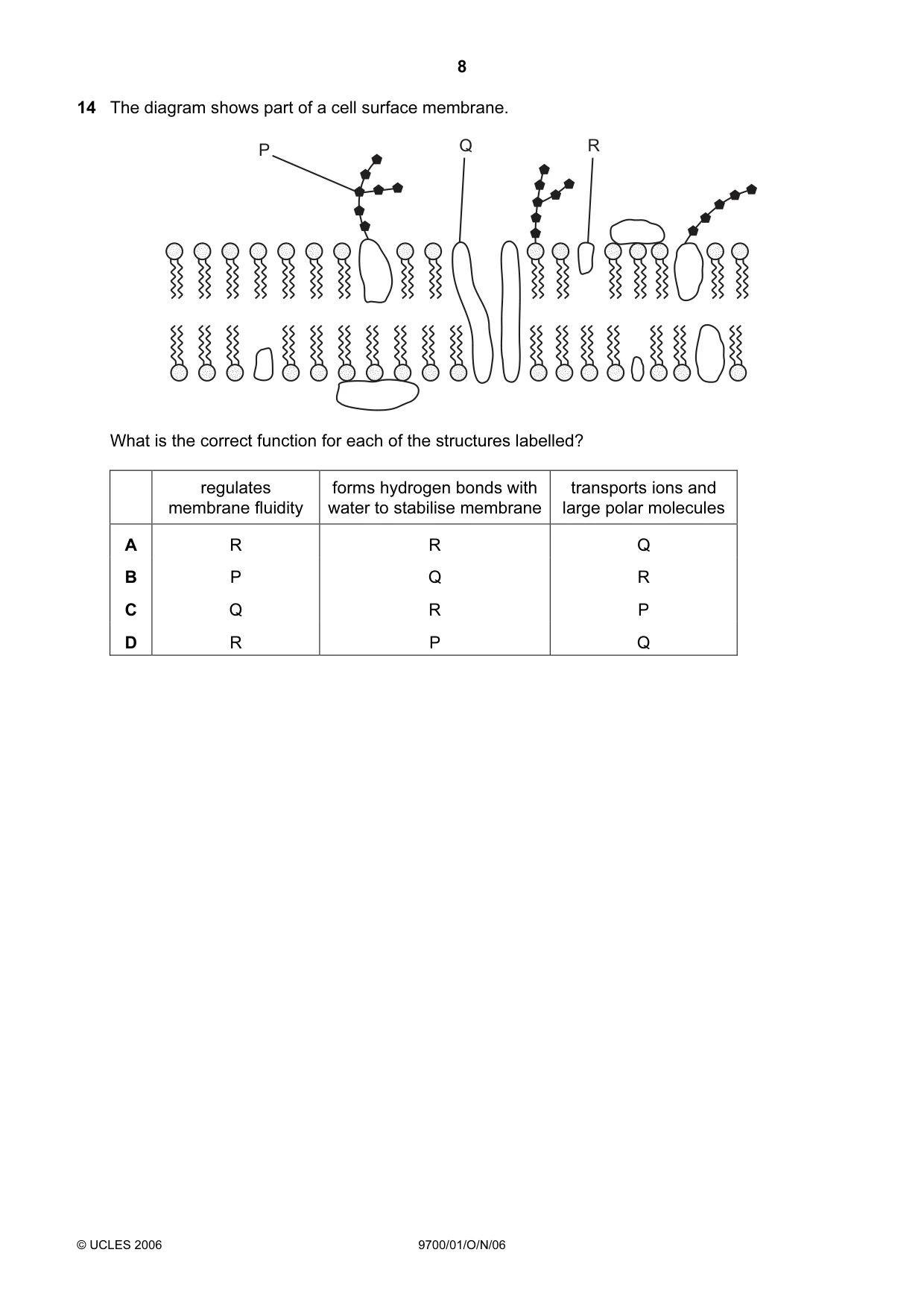
Q14 · The diagram shows part of a cell surface membrane
14 The diagram shows part of a cell surface membrane. P Q R What is the correct function for each of the structures labelled? regulates forms hydrogen bonds with transports ions and membrane fluidity water to stabilise membrane large polar molecules A R R Q B P Q R C Q R P D R P Q
Mark scheme: D
Q15 · Strips of potato tuber tissue were immersed in distilled water or in sucrose solutions of…
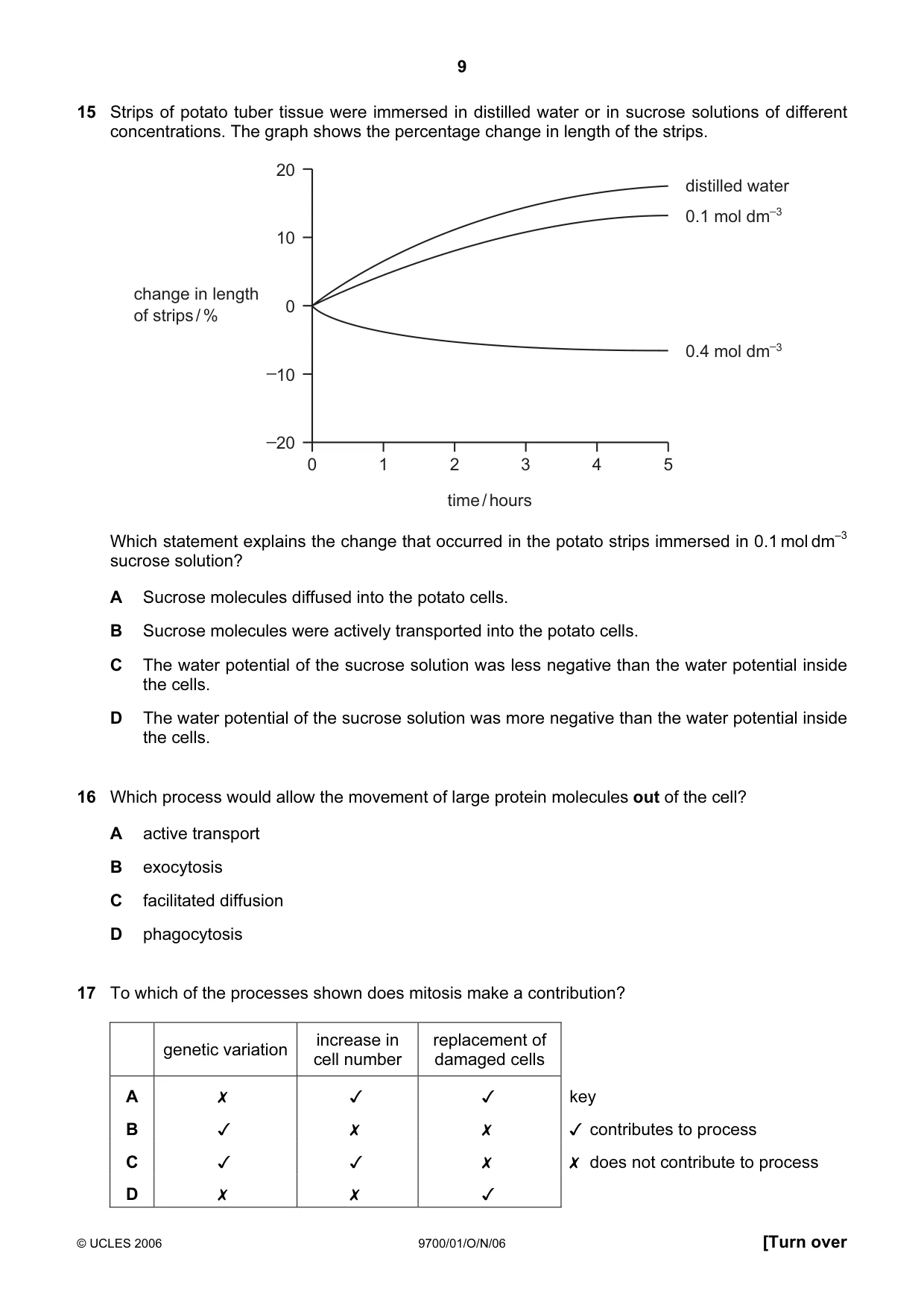
15 Strips of potato tuber tissue were immersed in distilled water or in sucrose solutions of different concentrations. The graph shows the percentage change in length of the strips. 20 distilled water 0.1 mol dm _3 10 change in length 0 of strips / % 0.4 mol dm _3 _10 _20 0 1 2 3 4 5 time / hours Which statement explains the change that occurred in the potato strips immersed in 0.1 mol dm–3 sucrose solution? A Sucrose molecules diffused into the potato cells. B Sucrose molecules were actively transported into the potato cells. C The water potential of the sucrose solution was less negative than the water potential inside the cells. D The water potential of the sucrose solution was more negative than the water potential inside the cells.
Mark scheme: C
Q16 · Which process would allow the movement of large protein molecules out of the cell?
16 Which process would allow the movement of large protein molecules out of the cell? A active transport B exocytosis C facilitated diffusion D phagocytosis
Mark scheme: B
Q17 · To which of the processes shown does mitosis make a contribution?
17 To which of the processes shown does mitosis make a contribution? enetic variation increase in replacement of g cell number damaged cells A x v Jv B Jv x x Cc v v x D x x v key Y contributes to process X does not contribute to process
Mark scheme: A
More questions on Replication and division of nuclei and cells
Q18 · The diagram shows the chromosomes of a cell at late prophase of mitosis
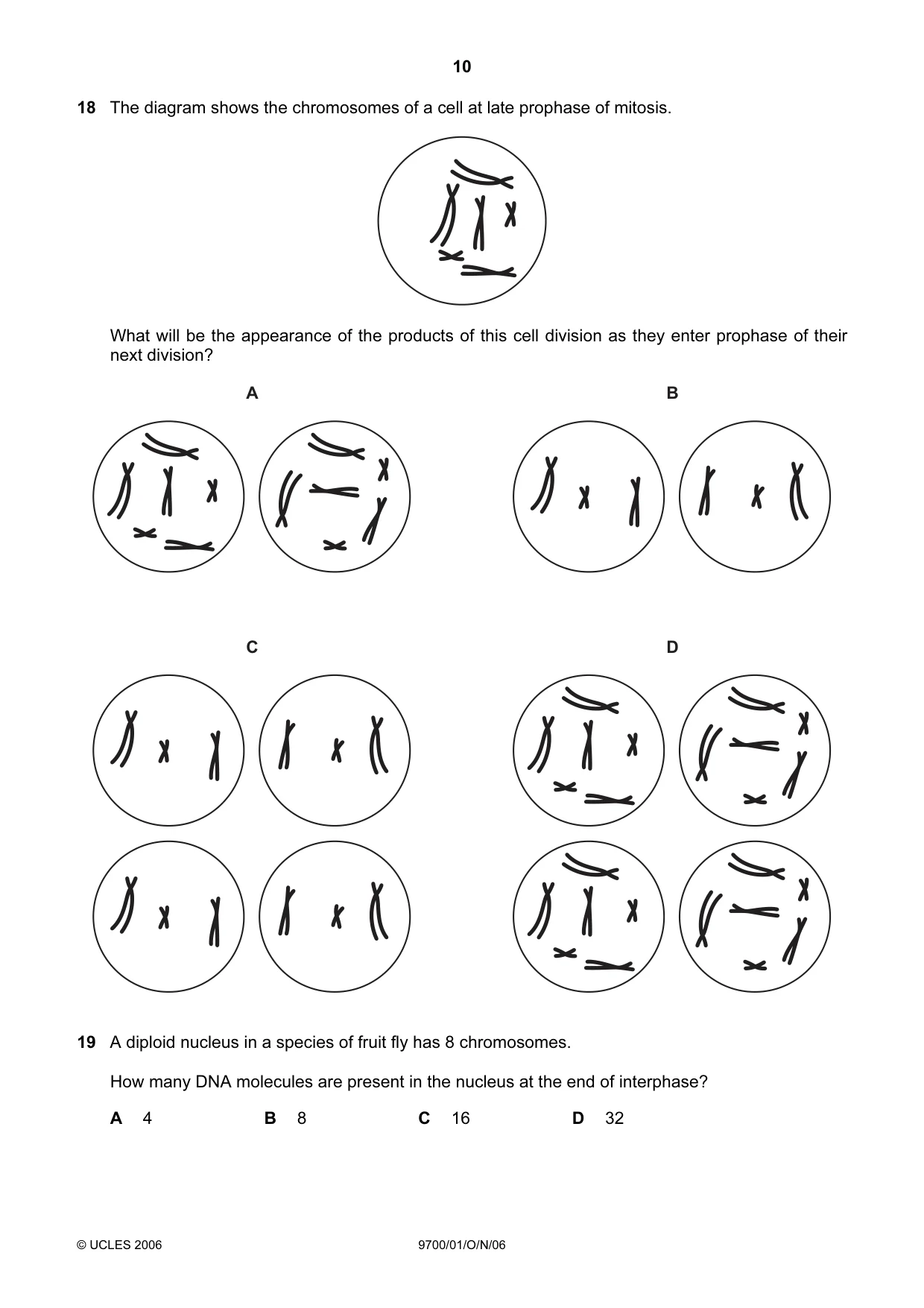
18 The diagram shows the chromosomes of a cell at late prophase of mitosis. What will be the appearance of the products of this cell division as they enter prophase of their next division? A B C D
Mark scheme: A
Q19 · A diploid nucleus in a species of fruit fly has 8 chromosomes
19 A diploid nucleus in a species of fruit fly has 8 chromosomes. How many DNA molecules are present in the nucleus at the end of interphase? A 4 B 8 C 16 D 32
Mark scheme: C
More questions on Replication and division of nuclei and cells
Q20 · What is the function of the enzyme DNA polymerase in a cell?
20 What is the function of the enzyme DNA polymerase in a cell? A to synthesise a polypeptide using DNA as a template B to synthesise a strand of DNA using a polypeptide as a template C to synthesise a strand of DNA using DNA as a template D to synthesise a strand of mRNA using DNA as a template
Mark scheme: C
More questions on Structure of nucleic acids and replication of DNA
Q21 · A culture of bacteria had all its DNA labelled with the heavy isotope of nitrogen, 15N
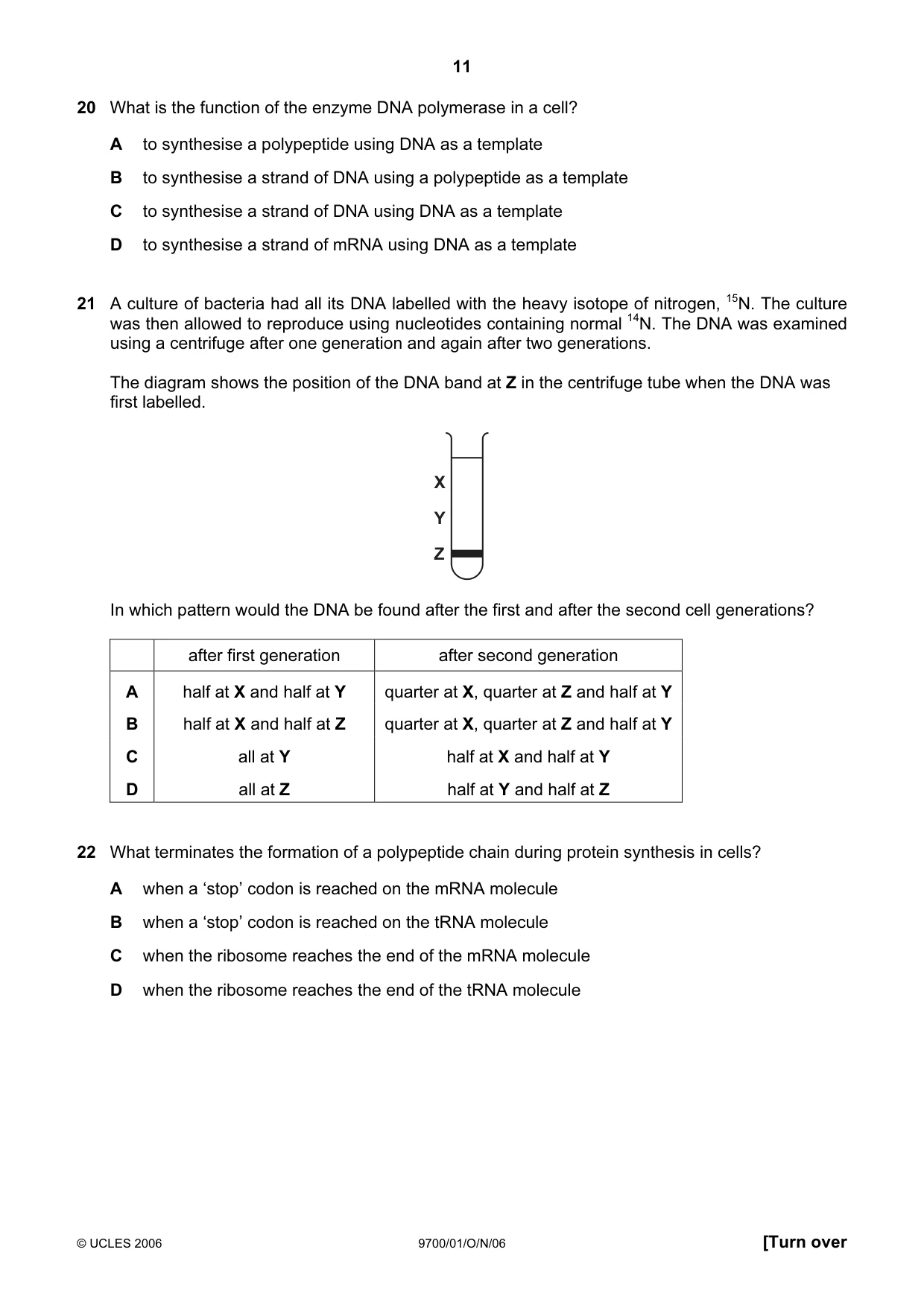
21 A culture of bacteria had all its DNA labelled with the heavy isotope of nitrogen, 15N. The culture was then allowed to reproduce using nucleotides containing normal 14N. The DNA was examined using a centrifuge after one generation and again after two generations. The diagram shows the position of the DNA band at Z in the centrifuge tube when the DNA was first labelled. X Y Z In which pattern would the DNA be found after the first and after the second cell generations? after first generation after second generation A half at X and half at Y quarter at X, quarter at Z and half at Y B half at X and half at Z quarter at X, quarter at Z and half at Y C all at Y half at X and half at Y D all at Z half at Y and half at Z
Mark scheme: C
More questions on Structure of nucleic acids and replication of DNA
Q22 · What terminates the formation of a polypeptide chain during protein synthesis in cells?
22 What terminates the formation of a polypeptide chain during protein synthesis in cells? A when a ‘stop’ codon is reached on the mRNA molecule B when a ‘stop’ codon is reached on the tRNA molecule C when the ribosome reaches the end of the mRNA molecule D when the ribosome reaches the end of the tRNA molecule
Mark scheme: A
Q23 · Mammalian skin cells in tissue culture were supplied with a source of radioactive thymine
23 Mammalian skin cells in tissue culture were supplied with a source of radioactive thymine. At which stage in the cell cycle will the thymine be used in the nuclei? A interphase B metaphase C prophase D telophase
Mark scheme: A
More questions on Replication and division of nuclei and cells
Q24 · Which organelles occur in large numbers in companion cells in phloem?
24 Which organelles occur in large numbers in companion cells in phloem? A chloroplasts B lysosomes C mitochondria D starch grains
Mark scheme: C
Q25 · A water potential gradient causes water to move through xylem
25 A water potential gradient causes water to move through xylem. Which process is mainly responsible for this water potential gradient? A capillarity B osmosis C translocation D transpiration
Mark scheme: D
Q26 · During transpiration, what is the site of evaporation of water in the leaves?
26 During transpiration, what is the site of evaporation of water in the leaves? A air spaces B mesophyll cell walls C stomata D walls of xylem vessels
Mark scheme: B
Q27 · The table summarises some characteristics of arteries, veins and capillaries
27 The table summarises some characteristics of arteries, veins and capillaries. characteristics arteries veins capillaries 1 blood pressure high low low 2 lumen wide narrow narrow 3 wall thick thin single cell Which lines in the table are correct? A 1 and 2 only B 1 and 3 only C 2 and 3 only D 1, 2 and 3
Mark scheme: B
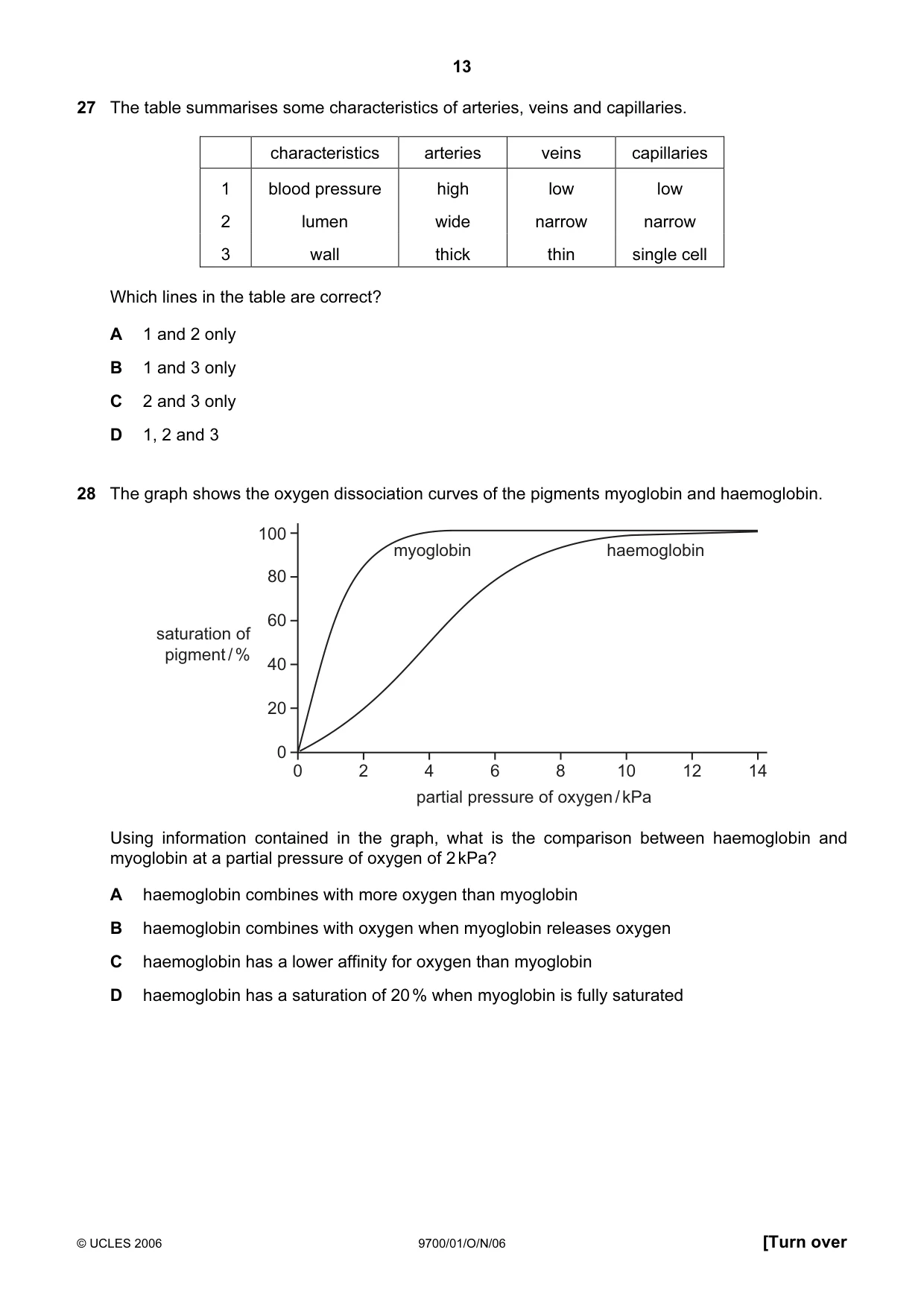
Q28 · The graph shows the oxygen dissociation curves of the pigments myoglobin and haemoglobin
28 The graph shows the oxygen dissociation curves of the pigments myoglobin and haemoglobin. 100 myoglobin haemoglobin 80 60 saturation of pigment / % 40 20 0 0 2 4 6 8 10 12 14 partial pressure of oxygen / kPa Using information contained in the graph, what is the comparison between haemoglobin and myoglobin at a partial pressure of oxygen of 2 kPa? A haemoglobin combines with more oxygen than myoglobin B haemoglobin combines with oxygen when myoglobin releases oxygen C haemoglobin has a lower affinity for oxygen than myoglobin D haemoglobin has a saturation of 20 % when myoglobin is fully saturated
Mark scheme: C
Q29 · When climbing a very high mountain there is a risk of altitude sickness
29 When climbing a very high mountain there is a risk of altitude sickness. What causes altitude sickness? A A high concentration of carbon dioxide accumulates in the blood. B Oxygen partial pressure decreases. C Red blood cell production increases. D The proportion of oxygen in the air decreases.
Mark scheme: B
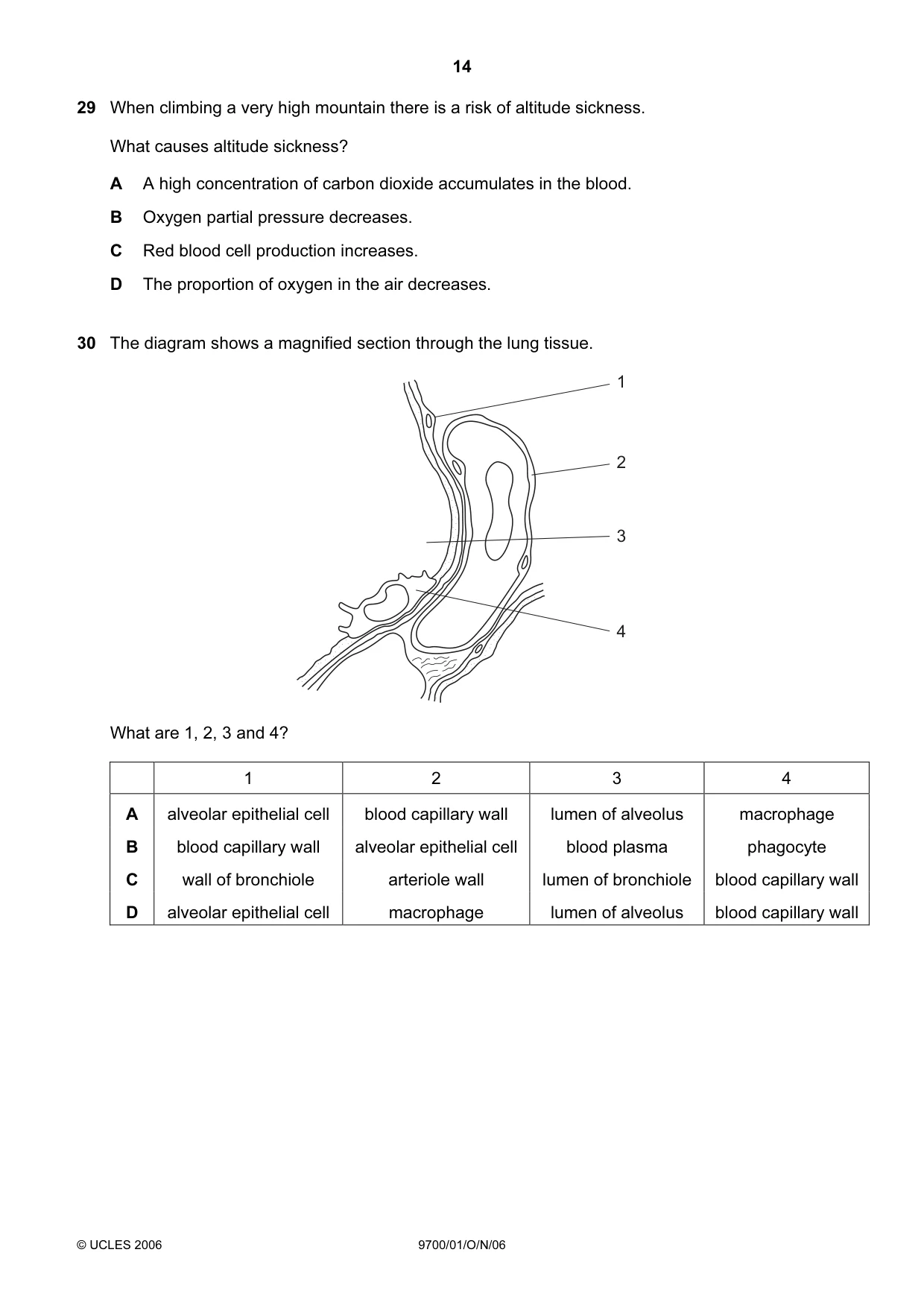
Q30 · The diagram shows a magnified section through the lung tissue
30 The diagram shows a magnified section through the lung tissue. 1 2 3 4 What are 1, 2, 3 and 4? 1 2 3 4 A alveolar epithelial cell blood capillary wall lumen of alveolus macrophage B blood capillary wall alveolar epithelial cell blood plasma phagocyte C wall of bronchiole arteriole wall lumen of bronchiole blood capillary wall D alveolar epithelial cell macrophage lumen of alveolus blood capillary wall
Mark scheme: A
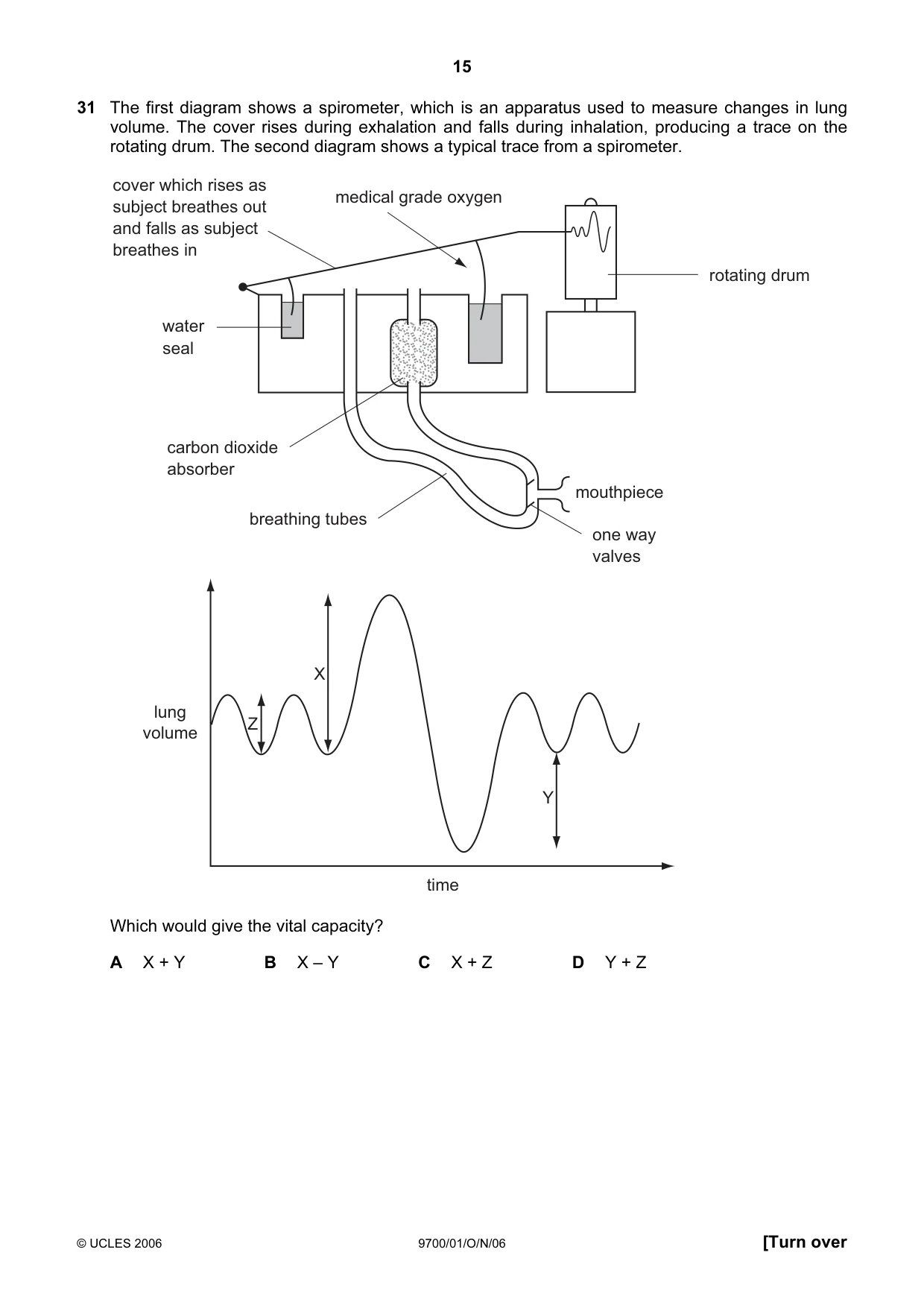
Q31 · The first diagram shows a spirometer, which is an apparatus used to measure changes in…
31 The first diagram shows a spirometer, which is an apparatus used to measure changes in lung volume. The cover rises during exhalation and falls during inhalation, producing a trace on the rotating drum. The second diagram shows a typical trace from a spirometer. cover which rises as medical grade oxygen subject breathes out and falls as subject breathes in rotating drum water seal carbon dioxide absorber mouthpiece breathing tubes one way valves X lung Z volume Y time Which would give the vital capacity? A X + Y B X – Y C X + Z D Y + Z
Mark scheme: A
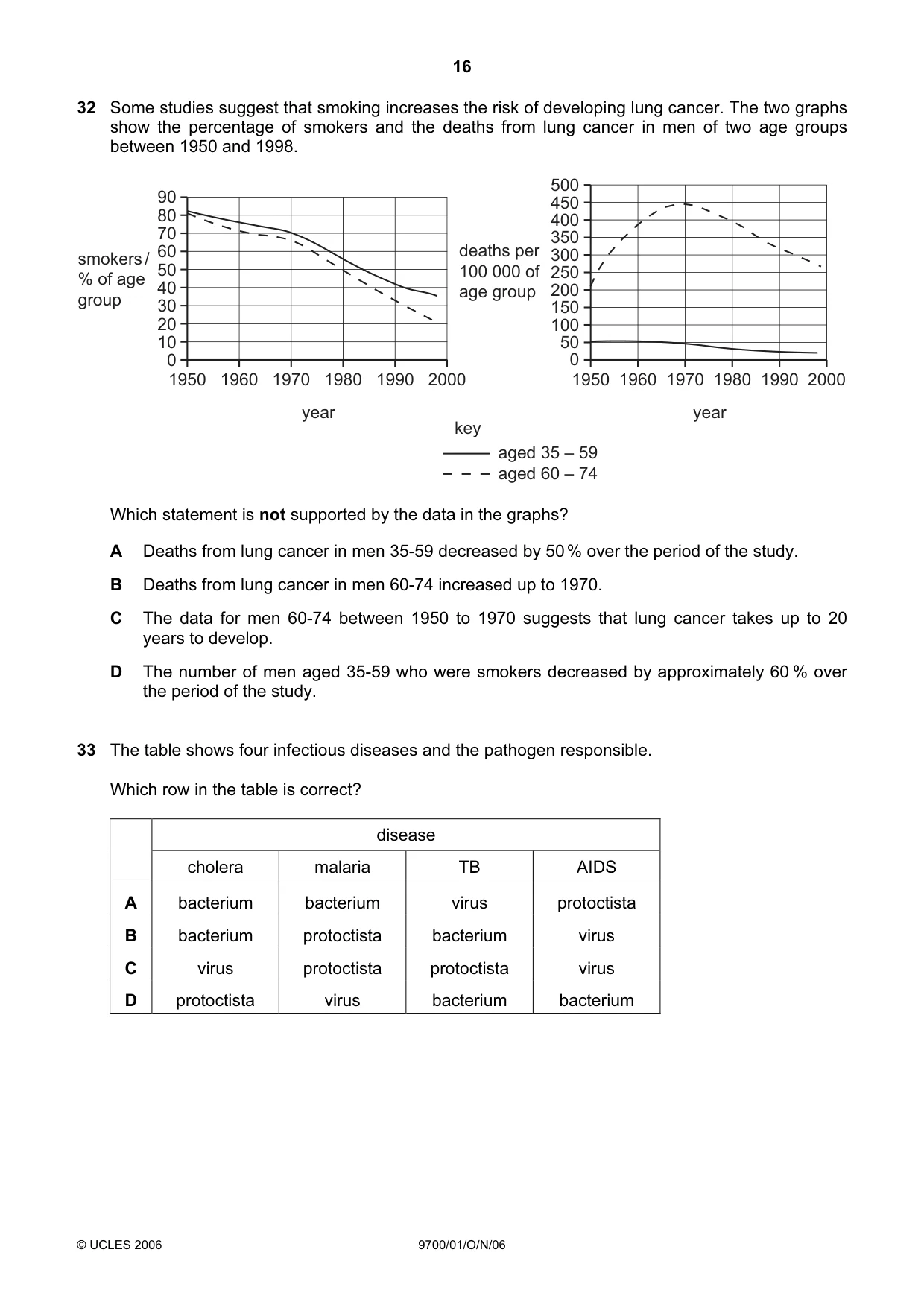
Q32 · Some studies suggest that smoking increases the risk of developing lung cancer
32 Some studies suggest that smoking increases the risk of developing lung cancer. The two graphs show the percentage of smokers and the deaths from lung cancer in men of two age groups between 1950 and 1998. 500 90 450 80 400 70 350 smokers / 60 deaths per 300 50 100 000 of 250 % of age 40 age group 200 group 30 150 20 100 10 50 0 0 1950 1960 1970 1980 1990 2000 1950 1960 1970 1980 1990 2000 year year key aged 35 – 59 aged 60 – 74 Which statement is not supported by the data in the graphs? A Deaths from lung cancer in men 35-59 decreased by 50 % over the period of the study. B Deaths from lung cancer in men 60-74 increased up to 1970. C The data for men 60-74 between 1950 to 1970 suggests that lung cancer takes up to 20 years to develop. D The number of men aged 35-59 who were smokers decreased by approximately 60 % over the period of the study.
Mark scheme: D
Q33 · The table shows four infectious diseases and the pathogen responsible
33 The table shows four infectious diseases and the pathogen responsible. Which row in the table is correct? disease cholera malaria TB AIDS A bacterium bacterium virus protoctista B bacterium protoctista bacterium virus C virus protoctista protoctista virus D protoctista virus bacterium bacterium
Mark scheme: B
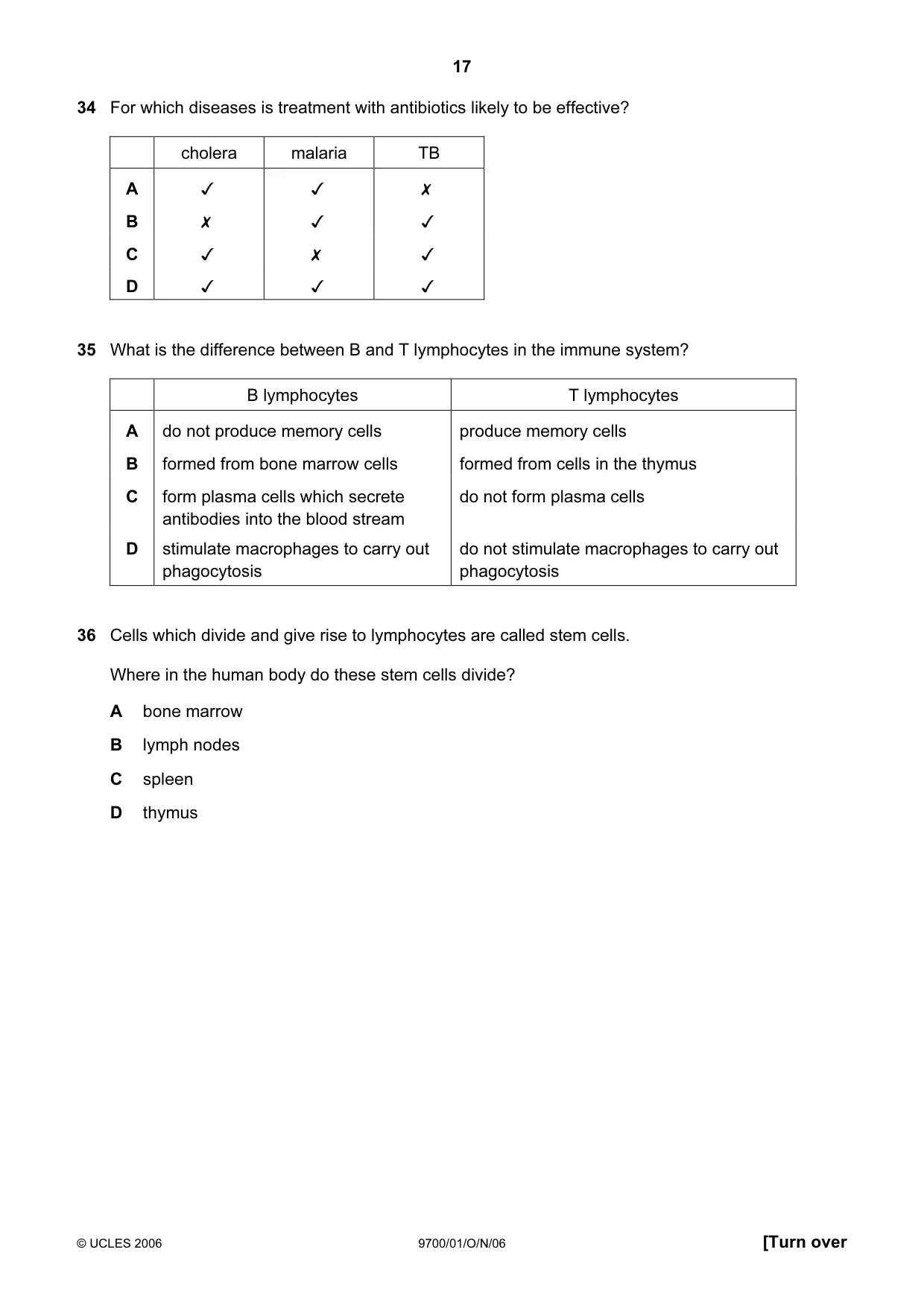
Q34 · For which diseases is treatment with antibiotics likely to be effective?
34 For which diseases is treatment with antibiotics likely to be effective? cholera malaria TB 0 0O WwW > << x Ko 4 <4 x
Mark scheme: C
Q35 · What is the difference between B and T lymphocytes in the immune system?
35 What is the difference between B and T lymphocytes in the immune system? B lymphocytes T lymphocytes A do not produce memory cells produce memory cells B formed from bone marrow cells formed from cells in the thymus C form plasma cells which secrete do not form plasma cells antibodies into the blood stream D stimulate macrophages to carry out do not stimulate macrophages to carry out phagocytosis phagocytosis
Mark scheme: C
Q36 · Cells which divide and give rise to lymphocytes are called stem cells
36 Cells which divide and give rise to lymphocytes are called stem cells. Where in the human body do these stem cells divide? A bone marrow B lymph nodes C spleen D thymus
Mark scheme: A
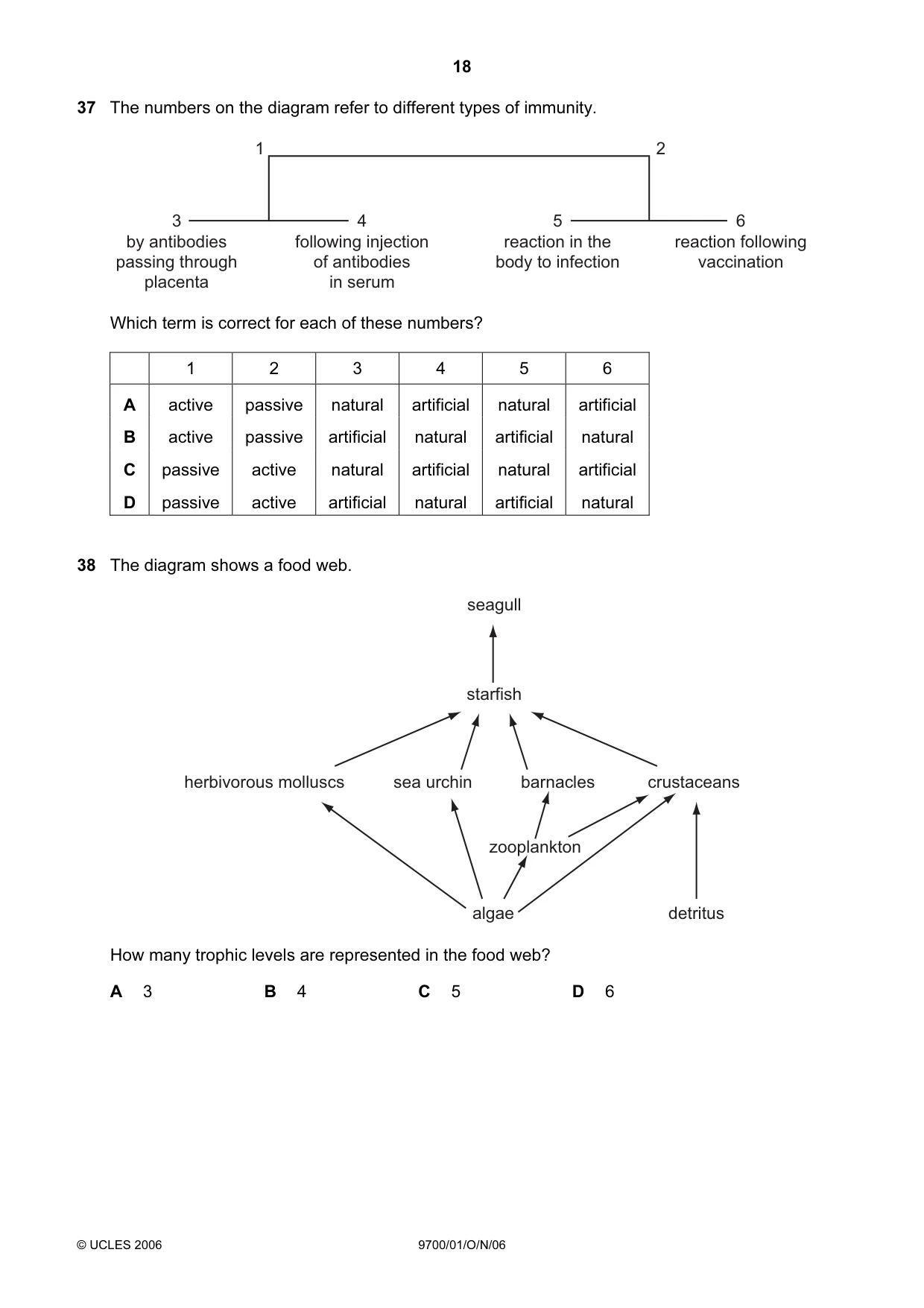
Q37 · The numbers on the diagram refer to different types of immunity
37 The numbers on the diagram refer to different types of immunity. 1 2 3 4 5 6 by antibodies following injection reaction in the reaction following passing through of antibodies body to infection vaccination placenta in serum Which term is correct for each of these numbers? 1 2 3 4 5 6 A active passive natural artificial natural artificial B active passive artificial natural artificial natural C passive active natural artificial natural artificial D passive active artificial natural artificial natural
Mark scheme: C
Q38 · The diagram shows a food web
38 The diagram shows a food web. seagull starfish herbivorous molluscs sea urchin barnacles crustaceans zooplankton algae detritus How many trophic levels are represented in the food web? A 3 B 4 C 5 D 6
Mark scheme: C
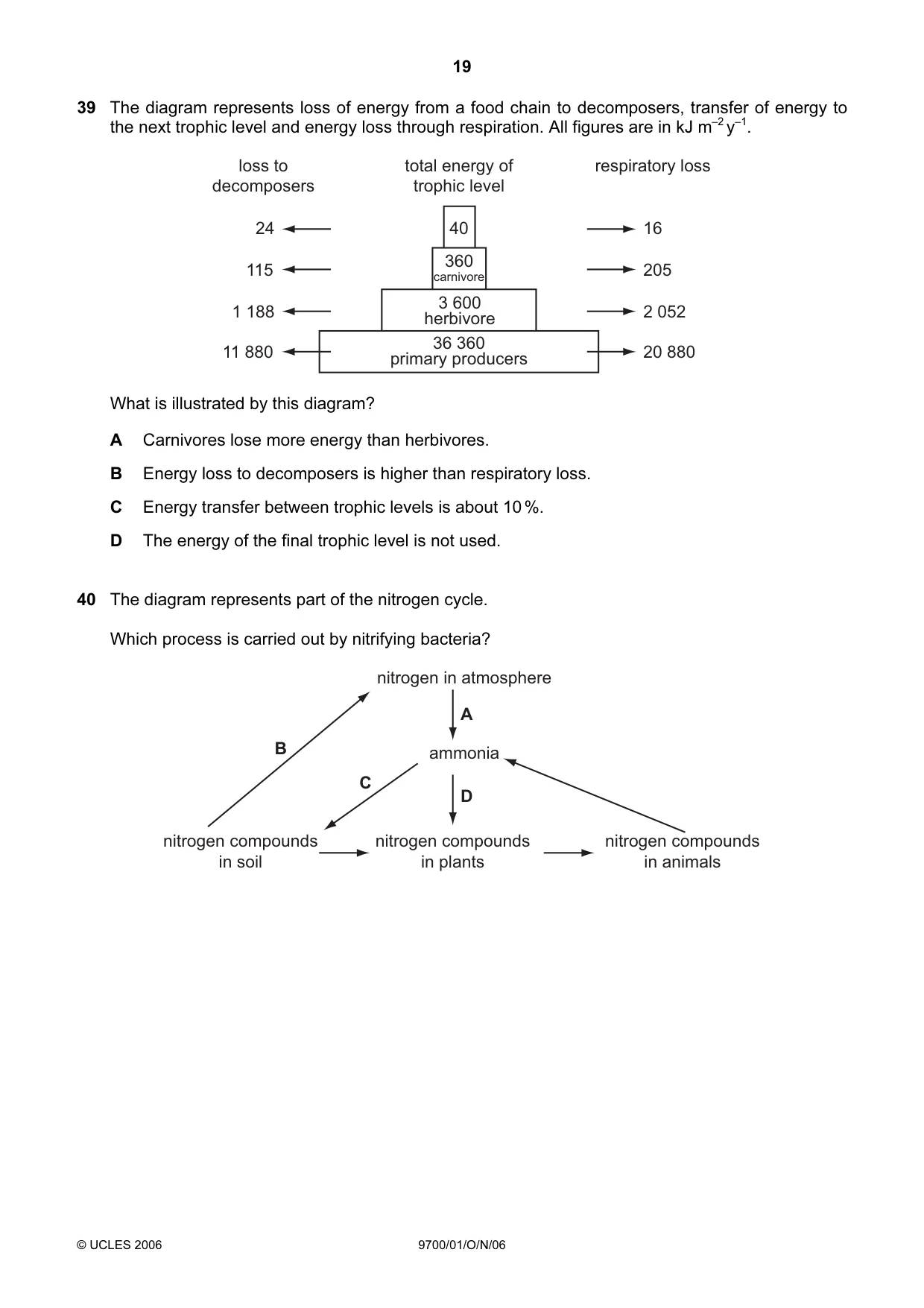
Q39 · The diagram represents loss of energy from a food chain to decomposers, transfer of…
39 The diagram represents loss of energy from a food chain to decomposers, transfer of energy to the next trophic level and energy loss through respiration. All figures are in kJ m–2 y–1. loss to total energy of respiratory loss decomposers trophic level 24 40 16 360 115 205 carnivore 3 600 1 188 herbivore 2 052 36 360 11 880 primary producers 20 880 What is illustrated by this diagram? A Carnivores lose more energy than herbivores. B Energy loss to decomposers is higher than respiratory loss. C Energy transfer between trophic levels is about 10 %. D The energy of the final trophic level is not used.
Mark scheme: C
Q40 · The diagram represents part of the nitrogen cycle
40 The diagram represents part of the nitrogen cycle. Which process is carried out by nitrifying bacteria? nitrogen in atmosphere A B ammonia C D nitrogen compounds nitrogen compounds nitrogen compounds in soil in plants in animals
Mark scheme: C
What was in this paper
The subtopics covered by these 40 questions, and how many questions each got. Open one in a new tab to see every Cambridge question on it.
3Replication and division of nuclei and cells3Transport of oxygen and carbon dioxide3Infectious diseases2Movement into and out of cells2Proteins2Structure of nucleic acids and replication of DNA2The gas exchange system2The immune system2The microscope in cell studies2Transport mechanisms2Antibiotics1Antibodies and vaccination1Biodiversity1Carbohydrates and lipids1Chromosome behaviour in mitosis1Conservation1Energy1Factors that affect enzyme action1Fluid mosaic membranes1Mode of action of enzymes1Protein synthesis1Structure of transport tissues1Testing for biological molecules1The circulatory system1Water1What you needed in this session
Cambridge’s own grade thresholds for 2006 Oct/Nov, Paper 1 · Variant 1. A higher threshold means an easier paper — the bar moves with how the cohort did.