Cambridge A Level Biology 9700 — 2023 Feb/March Paper 1 · Variant 2
9700/12/F/M/23 · 40 questions · 40 marks · ≈45 min
The question paper and its mark scheme, free to read here and free to download. This is Cambridge’s own paper, exactly as it was sat.
Question paper16 pages
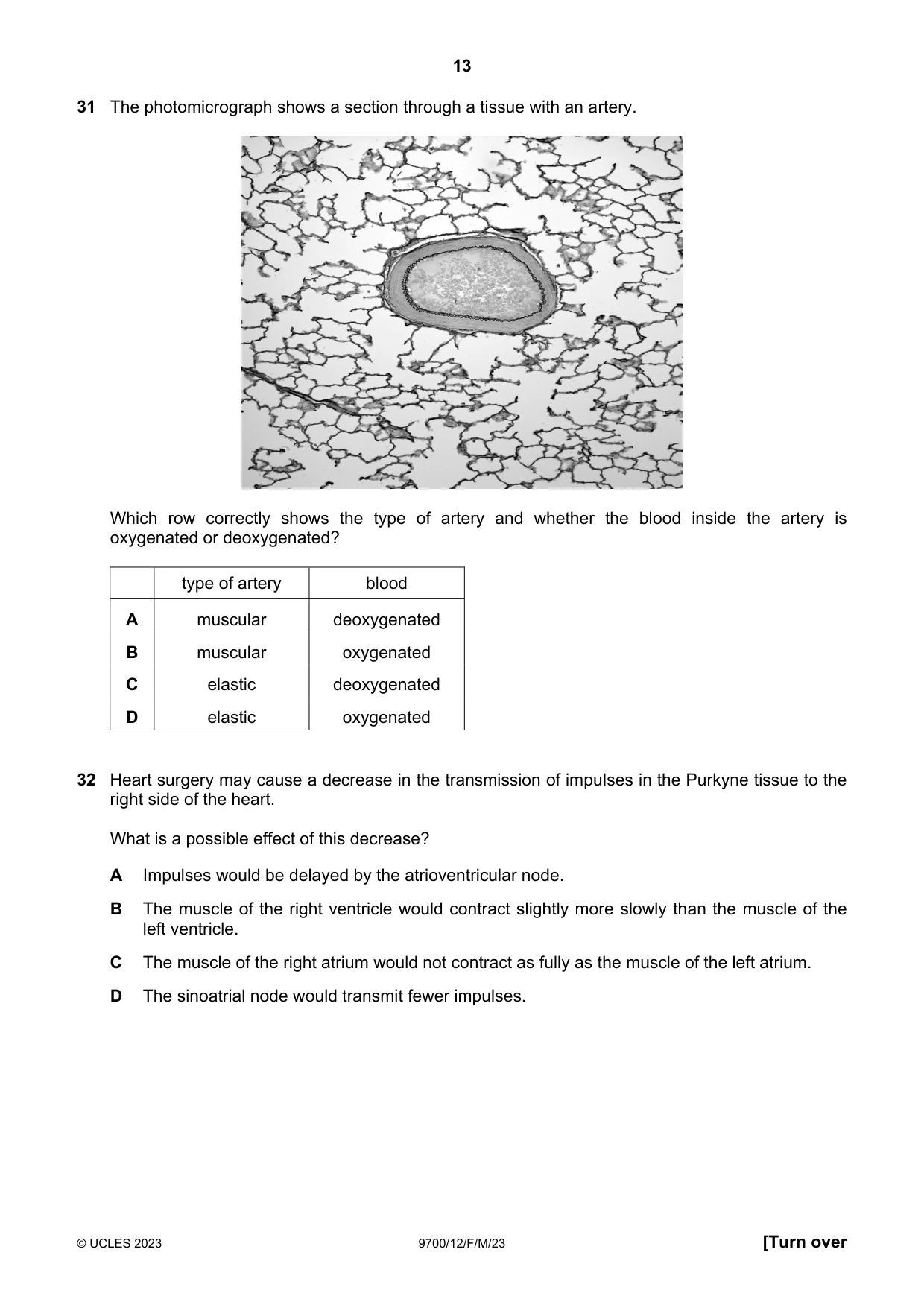
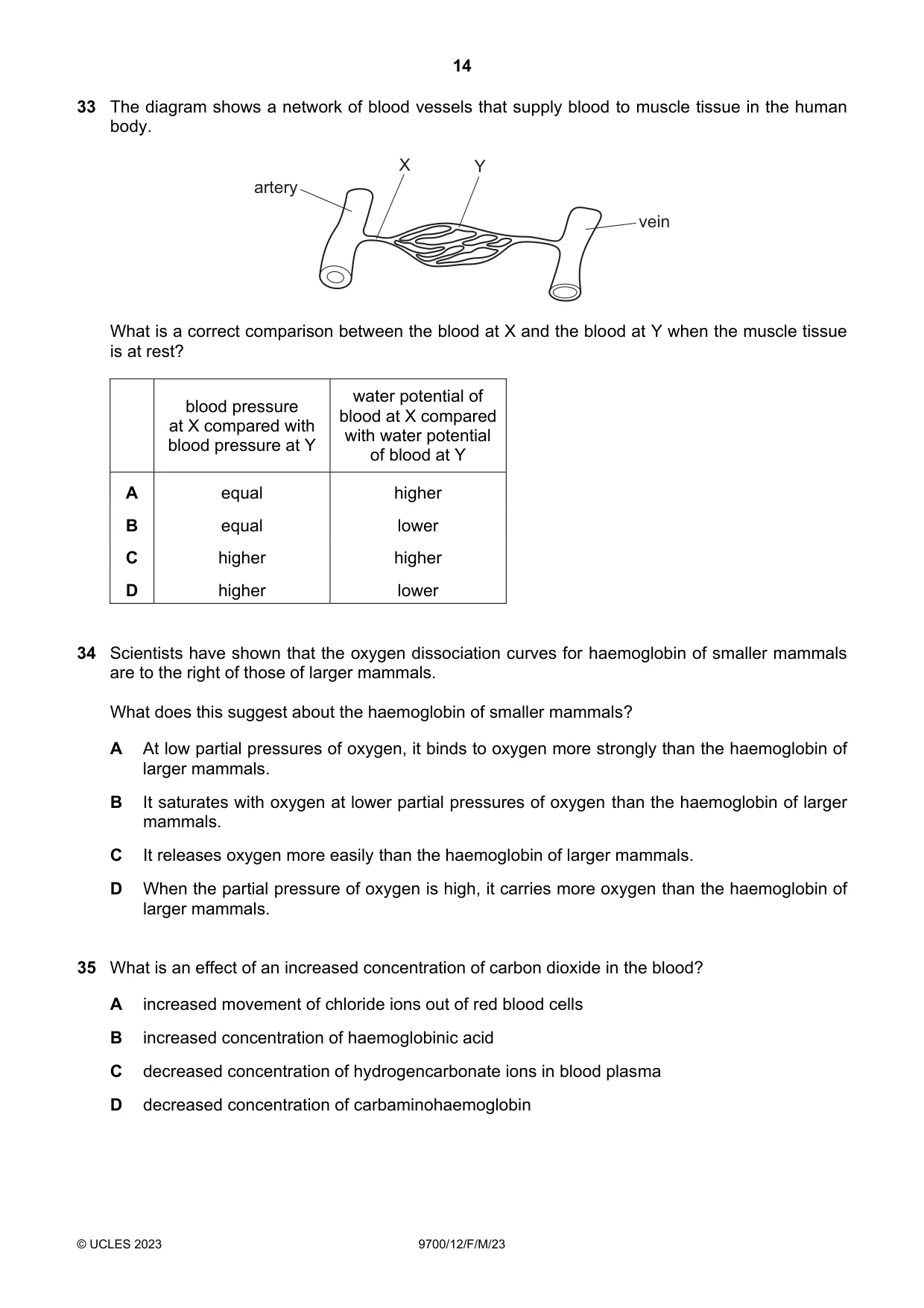
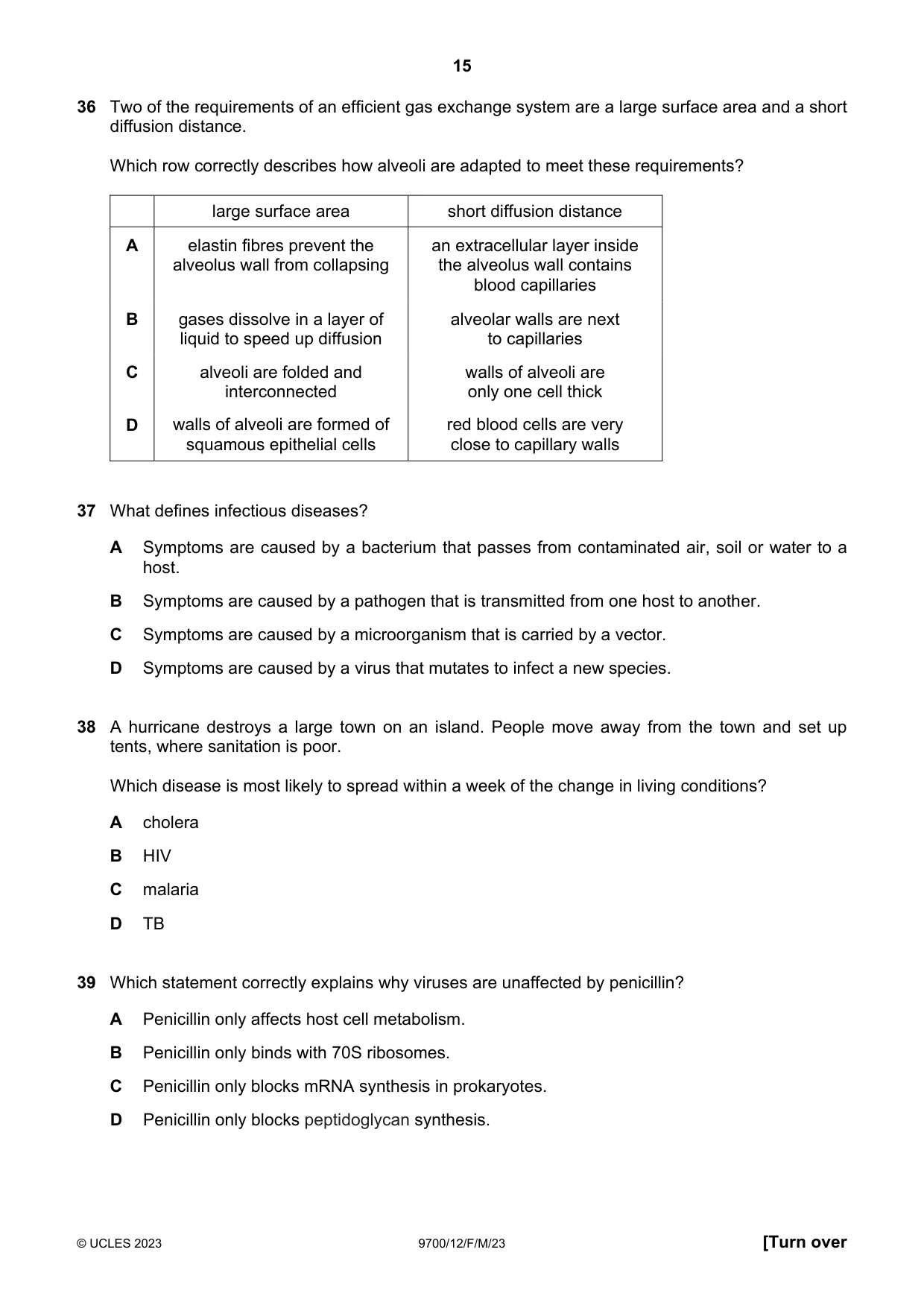
Mark scheme3 pages
Answers below. Sit the paper first if you are practising.
Questions as text
Q1 · The photomicrograph shows cells from a human blood smear
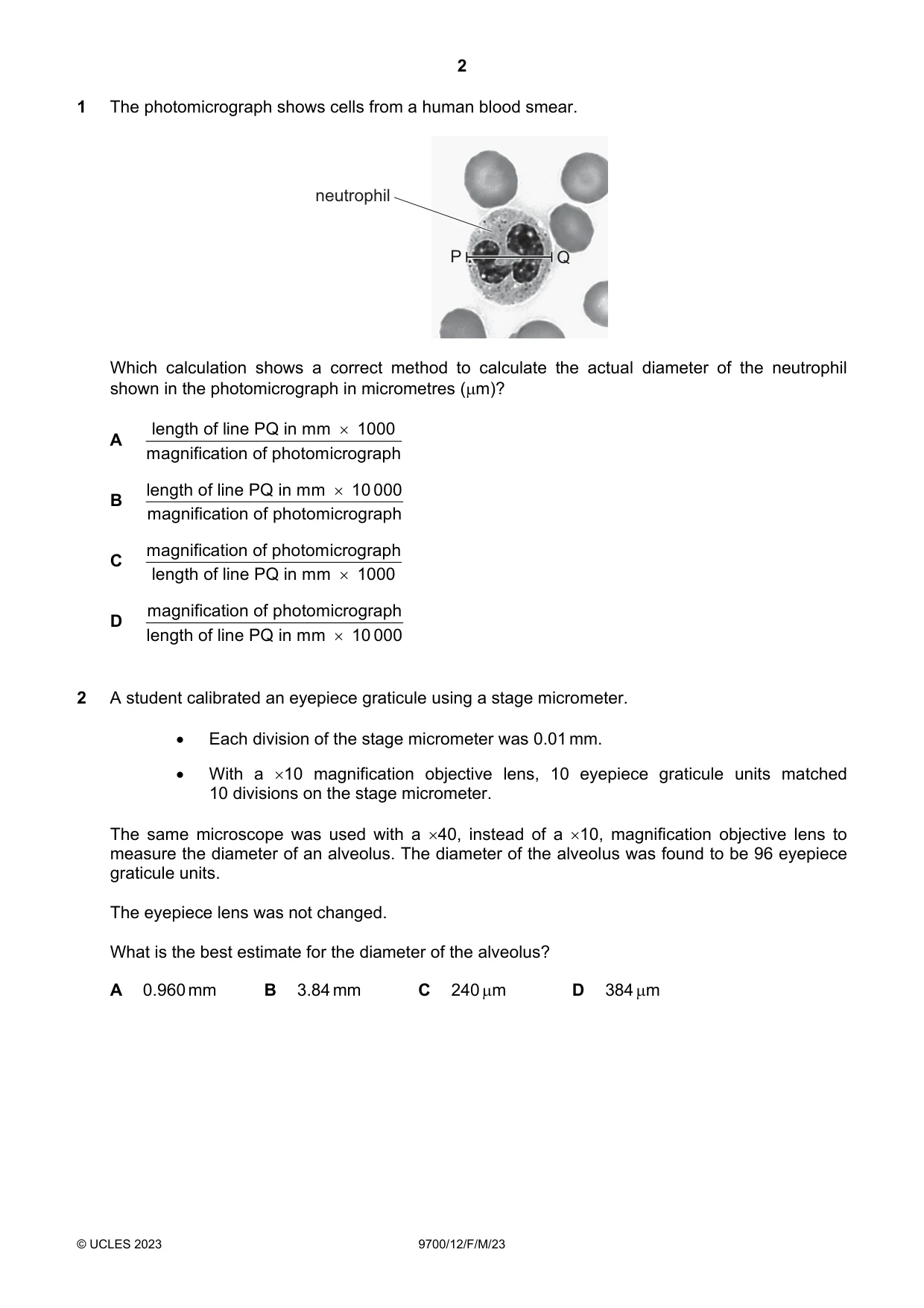
1 The photomicrograph shows cells from a human blood smear. neutrophil P Q Which calculation shows a correct method to calculate the actual diameter of the neutrophil shown in the photomicrograph in micrometres (m)? length of line PQ in mm 1000 A magnification of photomicrograph length of line PQ in mm 10 000 B magnification of photomicrograph magnification of photomicrograph C length of line PQ in mm 1000 magnification of photomicrograph D length of line PQ in mm 10 000
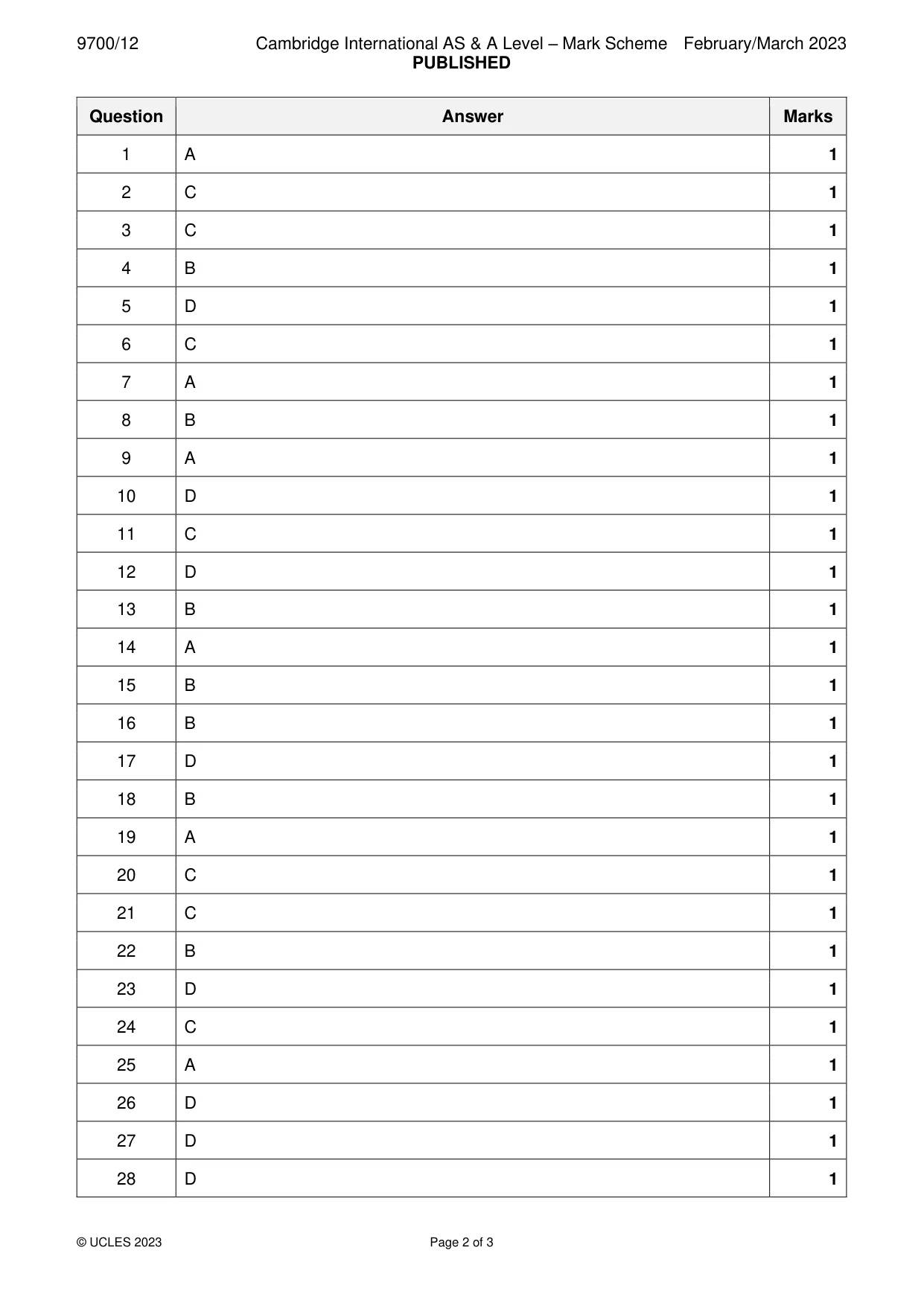
Mark scheme: A
Q2 · A student calibrated an eyepiece graticule using a stage micrometer
2 A student calibrated an eyepiece graticule using a stage micrometer. Each division of the stage micrometer was 0.01 mm. With a 10 magnification objective lens, 10 eyepiece graticule units matched 10 divisions on the stage micrometer. The same microscope was used with a 40, instead of a 10, magnification objective lens to measure the diameter of an alveolus. The diameter of the alveolus was found to be 96 eyepiece graticule units. The eyepiece lens was not changed. What is the best estimate for the diameter of the alveolus? A 0.960 mm B 3.84 mm C 240 m D 384 m
Mark scheme: C
Q3 · Which statements are correct for chloroplasts and also for mitochondria?
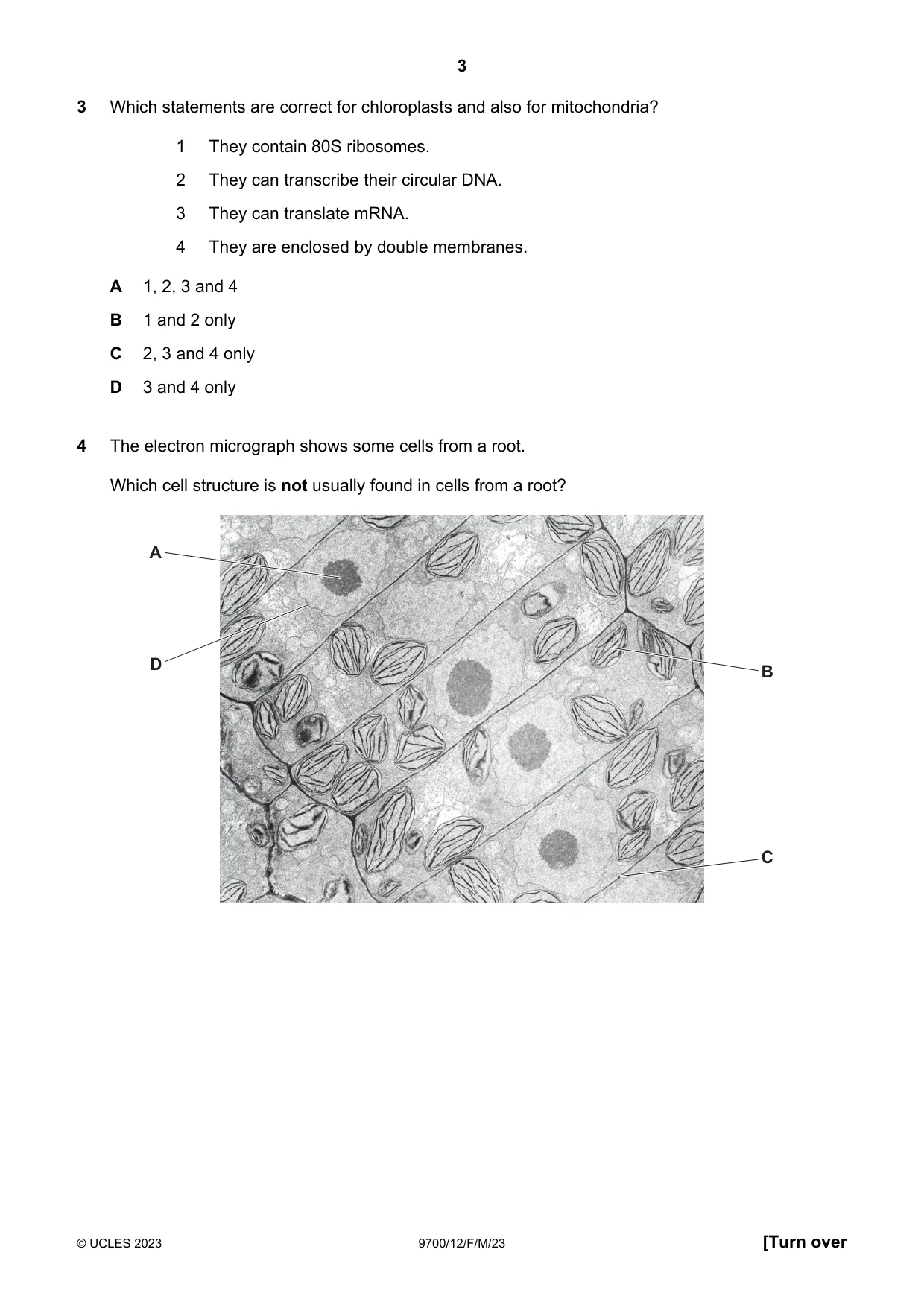
3 Which statements are correct for chloroplasts and also for mitochondria? 1 They contain 80S ribosomes. 2 They can transcribe their circular DNA. 3 They can translate mRNA. 4 They are enclosed by double membranes. A 1, 2, 3 and 4 B 1 and 2 only C 2, 3 and 4 only D 3 and 4 only
Mark scheme: C
More questions on Cells as the basic units of living organisms
Q4 · The electron micrograph shows some cells from a root
4 The electron micrograph shows some cells from a root. Which cell structure is not usually found in cells from a root? A D B C
Mark scheme: B
More questions on Cells as the basic units of living organisms
Q5 · Dialysis (Visking) tubing is an artificial partially permeable membrane with pore sizes…
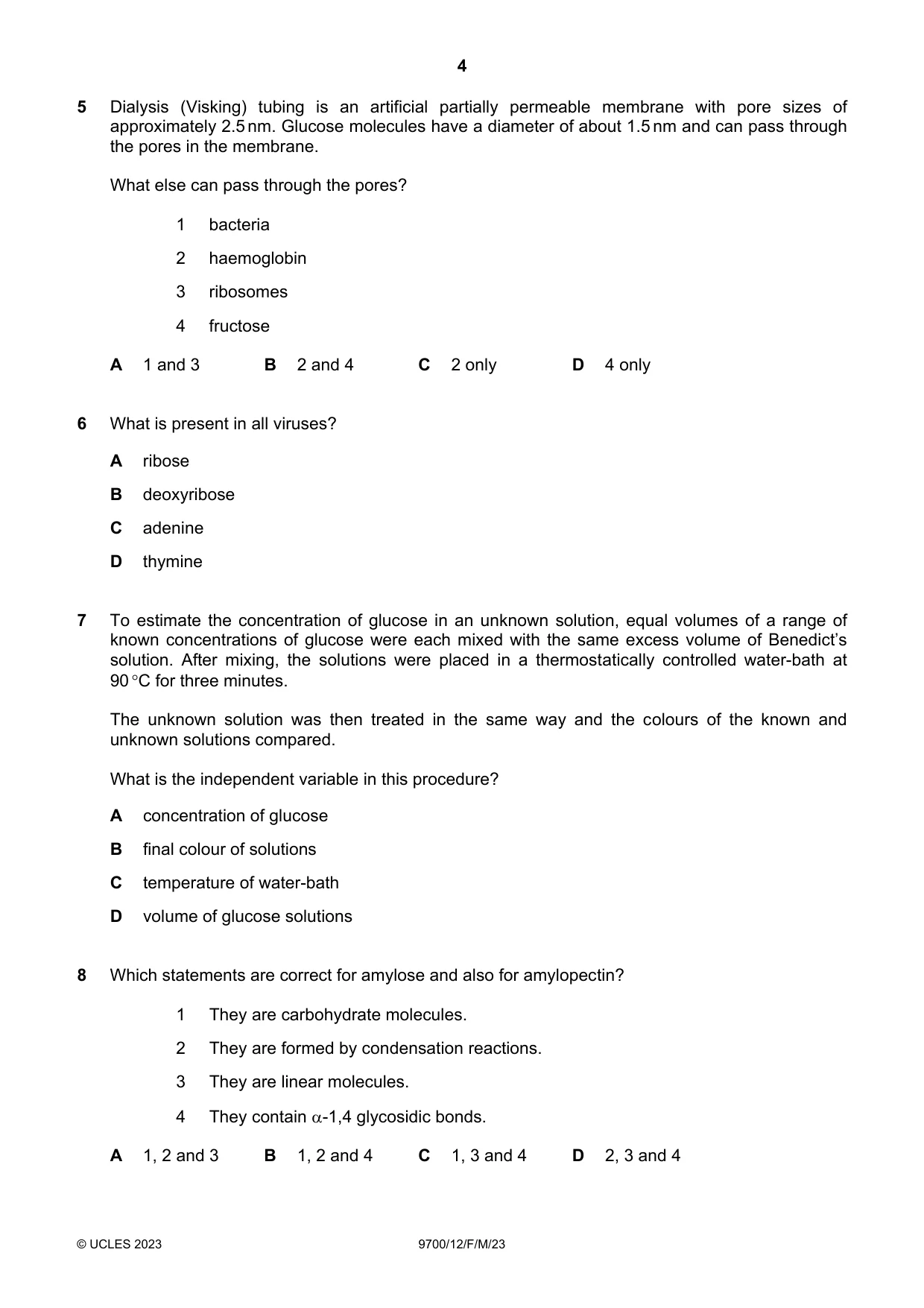
5 Dialysis (Visking) tubing is an artificial partially permeable membrane with pore sizes of approximately 2.5 nm. Glucose molecules have a diameter of about 1.5 nm and can pass through the pores in the membrane. What else can pass through the pores? 1 bacteria 2 haemoglobin 3 ribosomes 4 fructose A 1 and 3 B 2 and 4 C 2 only D 4 only
Mark scheme: D
Q6 · What is present in all viruses?
6 What is present in all viruses? A ribose B deoxyribose C adenine D thymine
Mark scheme: C
More questions on Cells as the basic units of living organisms
Q7 · To estimate the concentration of glucose in an unknown solution, equal volumes of a range…
7 To estimate the concentration of glucose in an unknown solution, equal volumes of a range of known concentrations of glucose were each mixed with the same excess volume of Benedict’s solution. After mixing, the solutions were placed in a thermostatically controlled water-bath at 90 C for three minutes. The unknown solution was then treated in the same way and the colours of the known and unknown solutions compared. What is the independent variable in this procedure? A concentration of glucose B final colour of solutions C temperature of water-bath D volume of glucose solutions
Mark scheme: A
Q8 · Which statements are correct for amylose and also for amylopectin?
8 Which statements are correct for amylose and also for amylopectin? 1 They are carbohydrate molecules. 2 They are formed by condensation reactions. 3 They are linear molecules. 4 They contain -1,4 glycosidic bonds. A 1, 2 and 3 B 1, 2 and 4 C 1, 3 and 4 D 2, 3 and 4
Mark scheme: B
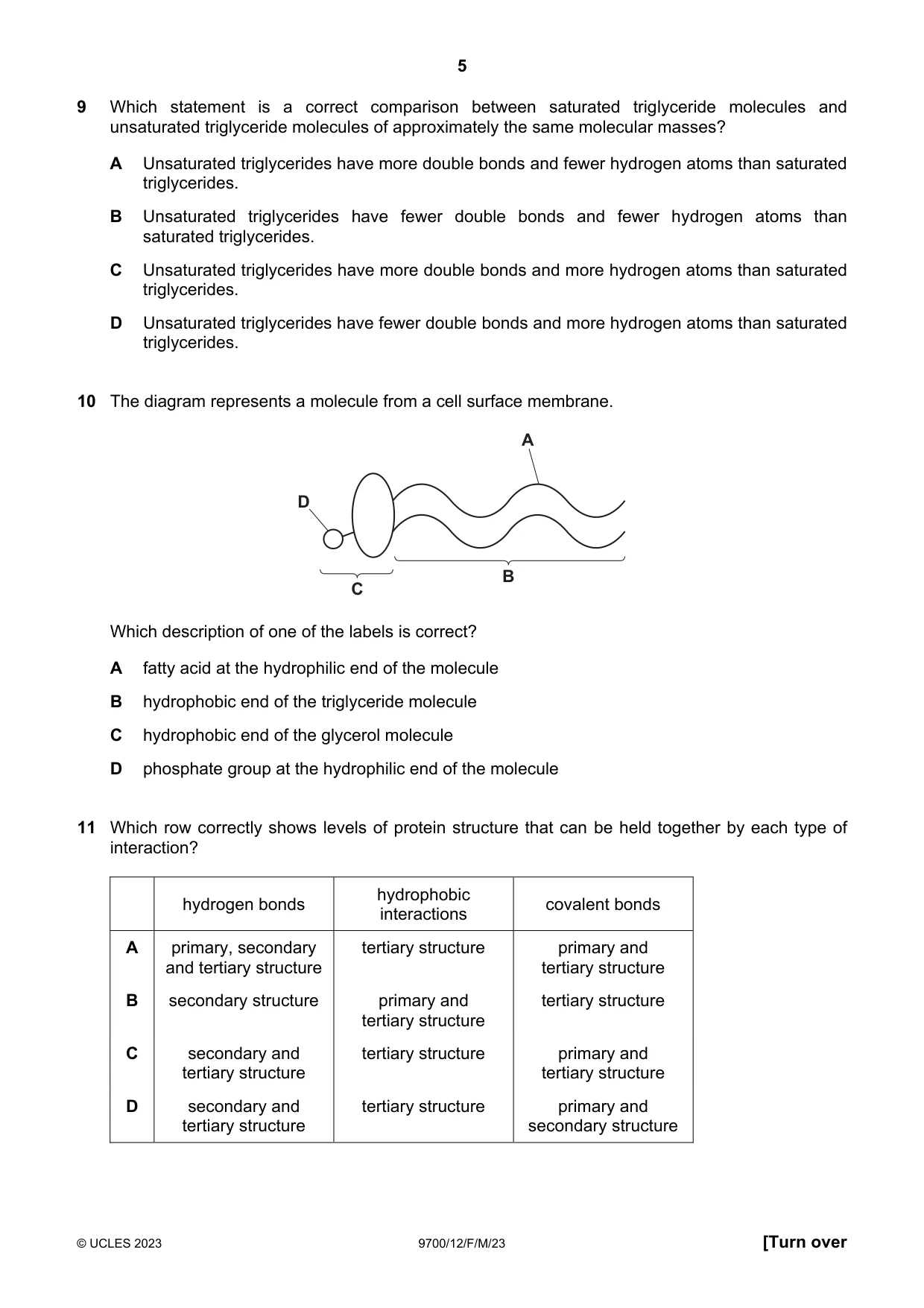
Q9 · Which statement is a correct comparison between saturated triglyceride molecules and…
9 Which statement is a correct comparison between saturated triglyceride molecules and unsaturated triglyceride molecules of approximately the same molecular masses? A Unsaturated triglycerides have more double bonds and fewer hydrogen atoms than saturated triglycerides. B Unsaturated triglycerides have fewer double bonds and fewer hydrogen atoms than saturated triglycerides. C Unsaturated triglycerides have more double bonds and more hydrogen atoms than saturated triglycerides. D Unsaturated triglycerides have fewer double bonds and more hydrogen atoms than saturated triglycerides.
Mark scheme: A
Q10 · The diagram represents a molecule from a cell surface membrane
10 The diagram represents a molecule from a cell surface membrane. A D B C Which description of one of the labels is correct? A fatty acid at the hydrophilic end of the molecule B hydrophobic end of the triglyceride molecule C hydrophobic end of the glycerol molecule D phosphate group at the hydrophilic end of the molecule
Mark scheme: D
Q11 · Which row correctly shows levels of protein structure that can be held together by each…
11 Which row correctly shows levels of protein structure that can be held together by each type of interaction? hydrophobic hydrogen bonds covalent bonds interactions A primary, secondary tertiary structure primary and and tertiary structure tertiary structure B secondary structure primary and tertiary structure tertiary structure C secondary and tertiary structure primary and tertiary structure tertiary structure D secondary and tertiary structure primary and tertiary structure secondary structure
Mark scheme: C
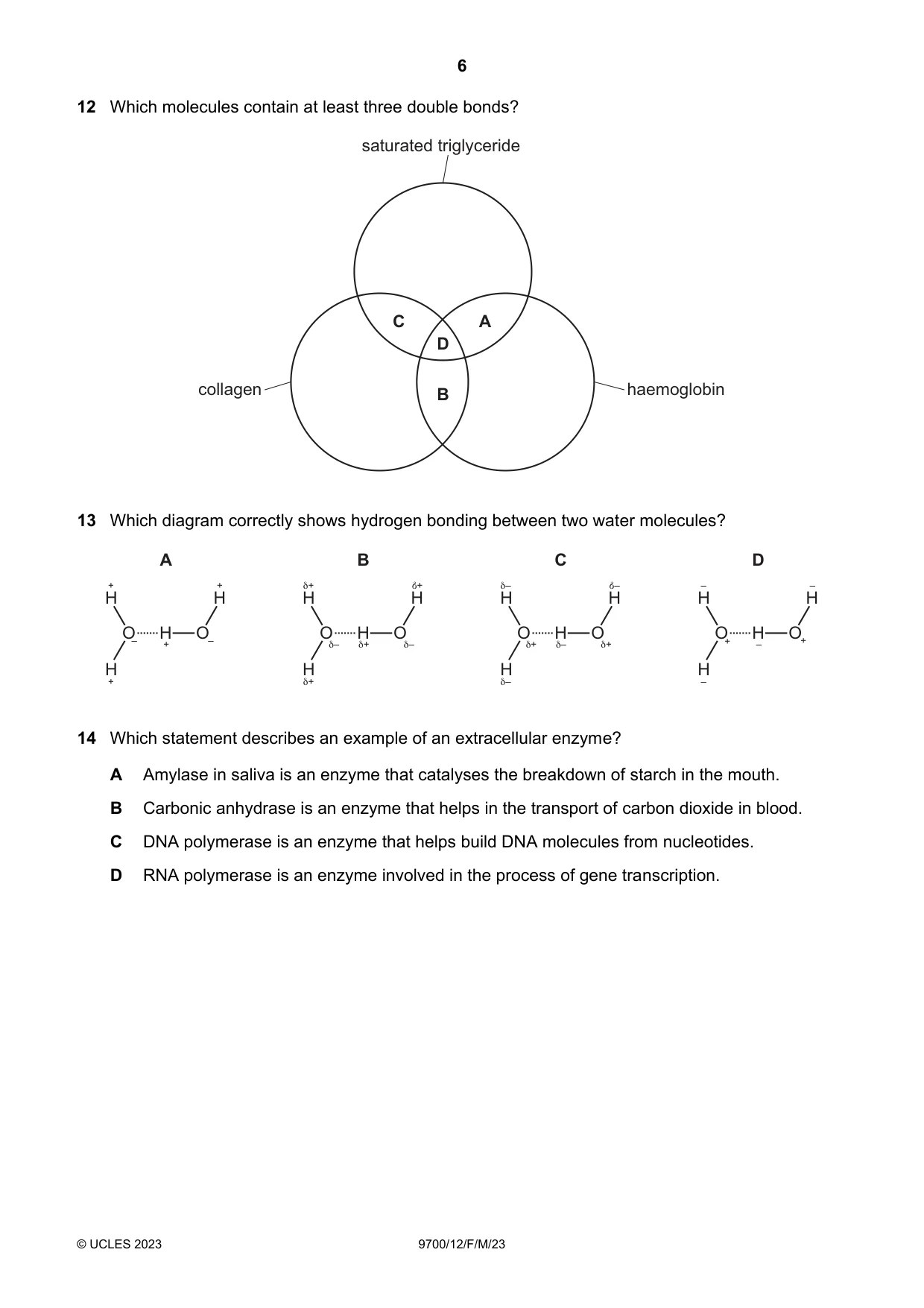
Q12 · Which molecules contain at least three double bonds?
12 Which molecules contain at least three double bonds? saturated triglyceride C A D collagen B haemoglobin
Mark scheme: D
Q13 · Which diagram correctly shows hydrogen bonding between two water molecules?
13 Which diagram correctly shows hydrogen bonding between two water molecules? A B C D + + δ+ +δ δ– –δ – – H H H H H H H H O H O O H O O H O O H O – + – δ– δ+ δ– δ+ δ– δ+ + – + H H H H + δ+ δ– –
Mark scheme: B
Q14 · Which statement describes an example of an extracellular enzyme?
14 Which statement describes an example of an extracellular enzyme? A Amylase in saliva is an enzyme that catalyses the breakdown of starch in the mouth. B Carbonic anhydrase is an enzyme that helps in the transport of carbon dioxide in blood. C DNA polymerase is an enzyme that helps build DNA molecules from nucleotides. D RNA polymerase is an enzyme involved in the process of gene transcription.
Mark scheme: A
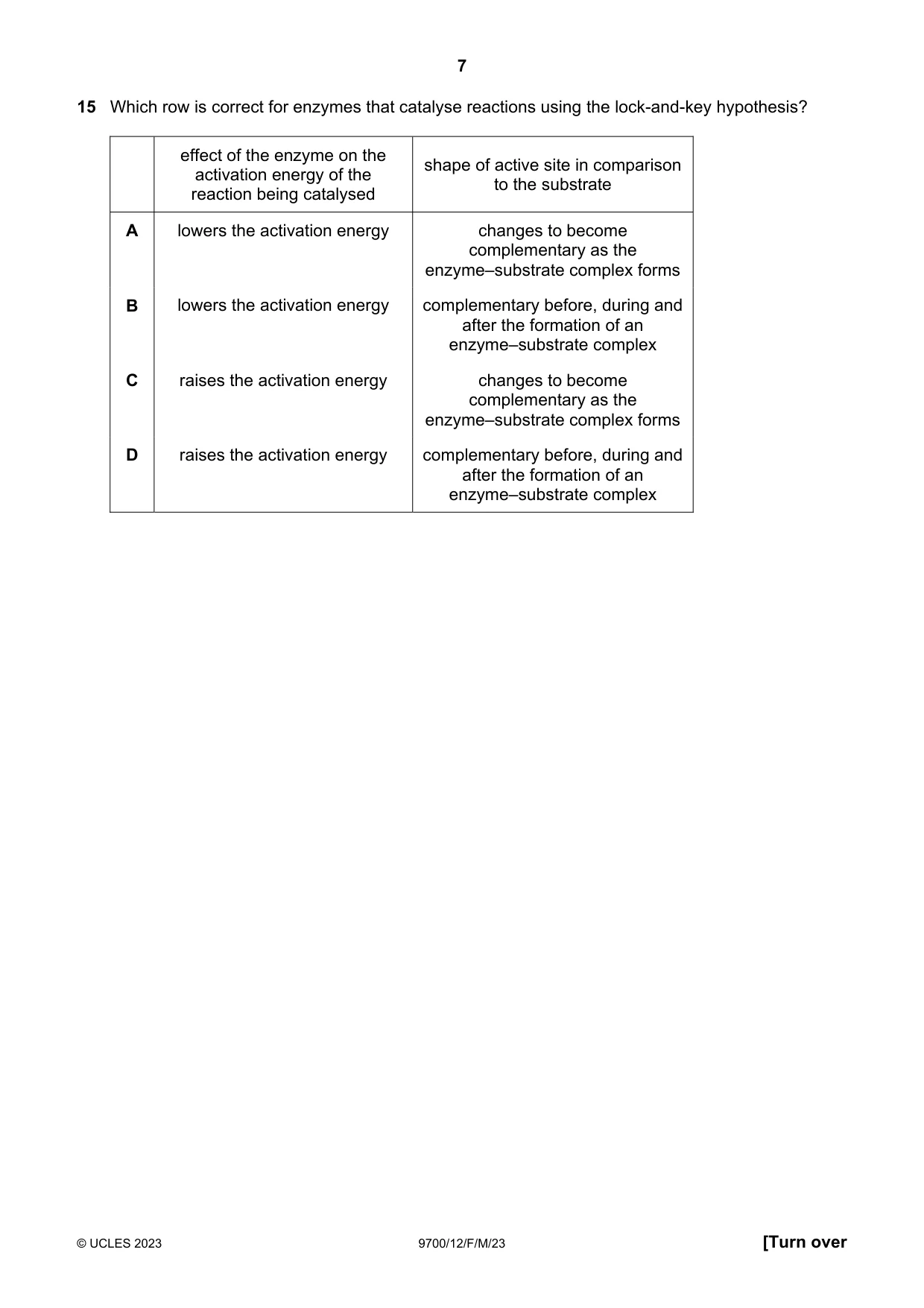
Q15 · Which row is correct for enzymes that catalyse reactions using the lock-and-key…
15 Which row is correct for enzymes that catalyse reactions using the lock-and-key hypothesis? effect of the enzyme on the shape of active site in comparison activation energy of the to the substrate reaction being catalysed A lowers the activation energy changes to become complementary as the enzyme–substrate complex forms B lowers the activation energy complementary before, during and after the formation of an enzyme–substrate complex C raises the activation energy changes to become complementary as the enzyme–substrate complex forms D raises the activation energy complementary before, during and after the formation of an enzyme–substrate complex
Mark scheme: B
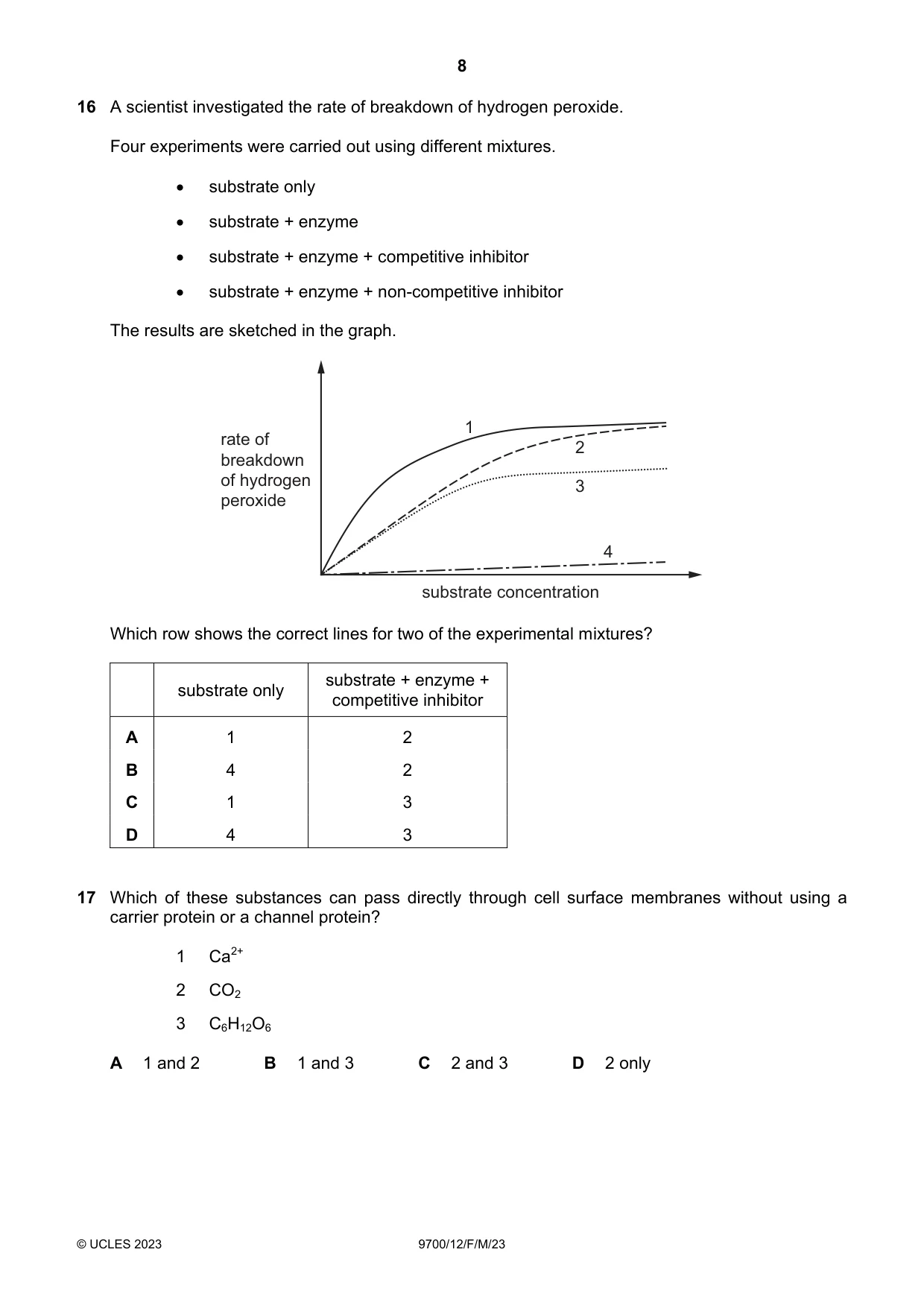
Q16 · A scientist investigated the rate of breakdown of hydrogen peroxide
16 A scientist investigated the rate of breakdown of hydrogen peroxide. Four experiments were carried out using different mixtures. substrate only substrate + enzyme substrate + enzyme + competitive inhibitor substrate + enzyme + non-competitive inhibitor The results are sketched in the graph. 1 rate of 2 breakdown of hydrogen 3 peroxide 4 substrate concentration Which row shows the correct lines for two of the experimental mixtures? substrate + enzyme + substrate only competitive inhibitor A 1 2 B 4 2 C 1 3 D 4 3
Mark scheme: B
Q17 · Which of these substances can pass directly through cell surface membranes without using…
17 Which of these substances can pass directly through cell surface membranes without using a carrier protein or a channel protein? 1 Ca2+ 2 CO2 3 C6H12O6 A 1 and 2 B 1 and 3 C 2 and 3 D 2 only
Mark scheme: D
Q18 · What happens to the surface area to volume ratio of a cube when the length of each side…
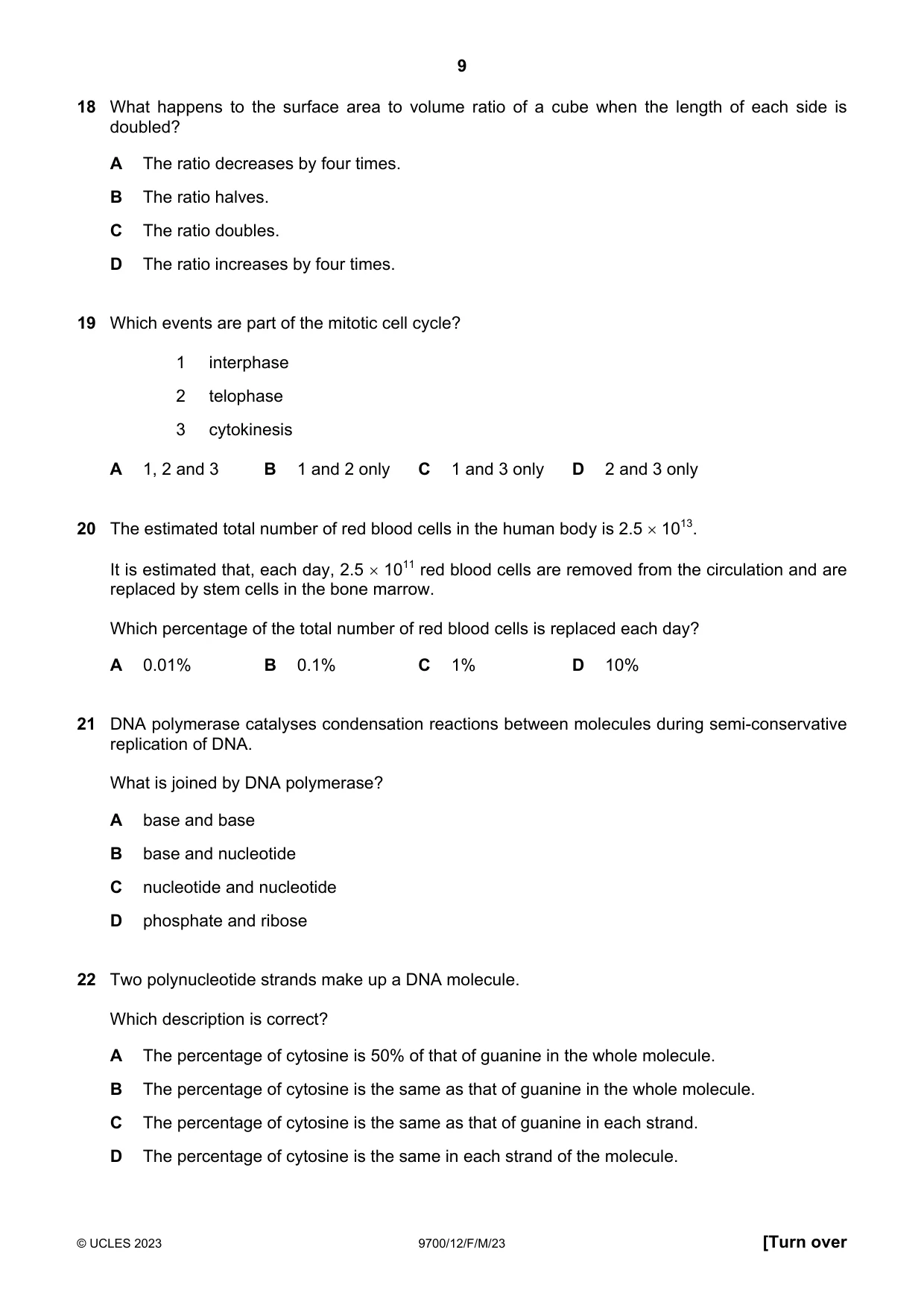
18 What happens to the surface area to volume ratio of a cube when the length of each side is doubled? A The ratio decreases by four times. B The ratio halves. C The ratio doubles. D The ratio increases by four times.
Mark scheme: B
More questions on Cells as the basic units of living organisms
Q19 · Which events are part of the mitotic cell cycle?
19 Which events are part of the mitotic cell cycle? 1 interphase 2 telophase 3 cytokinesis A 1, 2 and 3 B 1 and 2 only C 1 and 3 only D 2 and 3 only
Mark scheme: A
More questions on Replication and division of nuclei and cells
Q20 · The estimated total number of red blood cells in the human body is 2.5 1013
20 The estimated total number of red blood cells in the human body is 2.5 1013. It is estimated that, each day, 2.5 1011 red blood cells are removed from the circulation and are replaced by stem cells in the bone marrow. Which percentage of the total number of red blood cells is replaced each day? A 0.01% B 0.1% C 1% D 10%
Mark scheme: C
More questions on Replication and division of nuclei and cells
Q21 · DNA polymerase catalyses condensation reactions between molecules during…
21 DNA polymerase catalyses condensation reactions between molecules during semi-conservative replication of DNA. What is joined by DNA polymerase? A base and base B base and nucleotide C nucleotide and nucleotide D phosphate and ribose
Mark scheme: C
More questions on Structure of nucleic acids and replication of DNA
Q22 · Two polynucleotide strands make up a DNA molecule
22 Two polynucleotide strands make up a DNA molecule. Which description is correct? A The percentage of cytosine is 50% of that of guanine in the whole molecule. B The percentage of cytosine is the same as that of guanine in the whole molecule. C The percentage of cytosine is the same as that of guanine in each strand. D The percentage of cytosine is the same in each strand of the molecule.
Mark scheme: B
More questions on Structure of nucleic acids and replication of DNA
Q23 · The PDx1 protein is found in a wide range of animal species where it is regarded as…
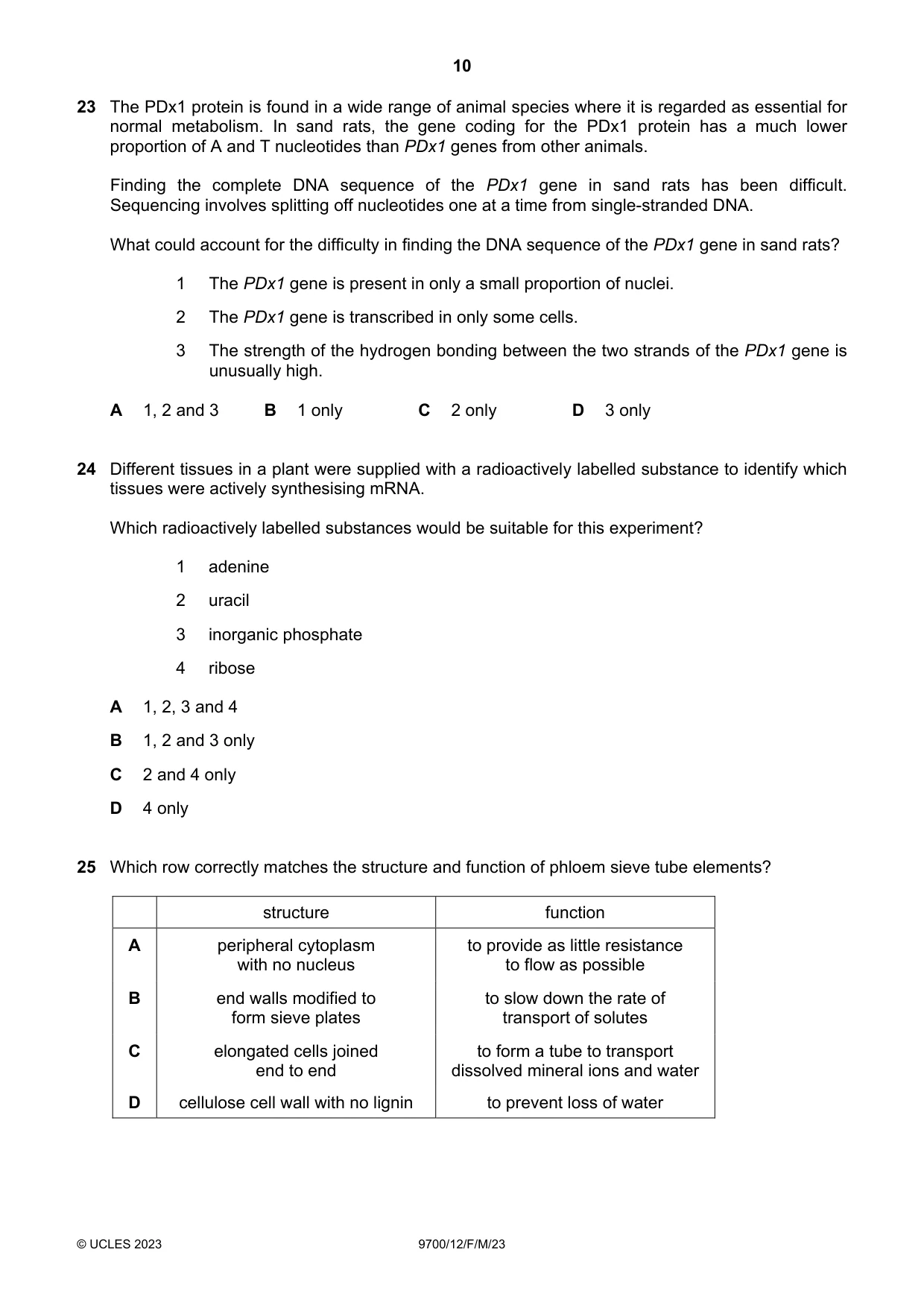
23 The PDx1 protein is found in a wide range of animal species where it is regarded as essential for normal metabolism. In sand rats, the gene coding for the PDx1 protein has a much lower proportion of A and T nucleotides than PDx1 genes from other animals. Finding the complete DNA sequence of the PDx1 gene in sand rats has been difficult. Sequencing involves splitting off nucleotides one at a time from single-stranded DNA. What could account for the difficulty in finding the DNA sequence of the PDx1 gene in sand rats? 1 The PDx1 gene is present in only a small proportion of nuclei. 2 The PDx1 gene is transcribed in only some cells. 3 The strength of the hydrogen bonding between the two strands of the PDx1 gene is unusually high. A 1, 2 and 3 B 1 only C 2 only D 3 only
Mark scheme: D
More questions on Structure of nucleic acids and replication of DNA
Q24 · Different tissues in a plant were supplied with a radioactively labelled substance to…
24 Different tissues in a plant were supplied with a radioactively labelled substance to identify which tissues were actively synthesising mRNA. Which radioactively labelled substances would be suitable for this experiment? 1 adenine 2 uracil 3 inorganic phosphate 4 ribose A 1, 2, 3 and 4 B 1, 2 and 3 only C 2 and 4 only D 4 only
Mark scheme: C
Q25 · Which row correctly matches the structure and function of phloem sieve tube elements?
25 Which row correctly matches the structure and function of phloem sieve tube elements? structure function A peripheral cytoplasm to provide as little resistance with no nucleus to flow as possible B end walls modified to to slow down the rate of form sieve plates transport of solutes C elongated cells joined to form a tube to transport end to end dissolved mineral ions and water D cellulose cell wall with no lignin to prevent loss of water
Mark scheme: A
Q26 · Which feature of xylem vessel elements helps adhesion during transpiration?
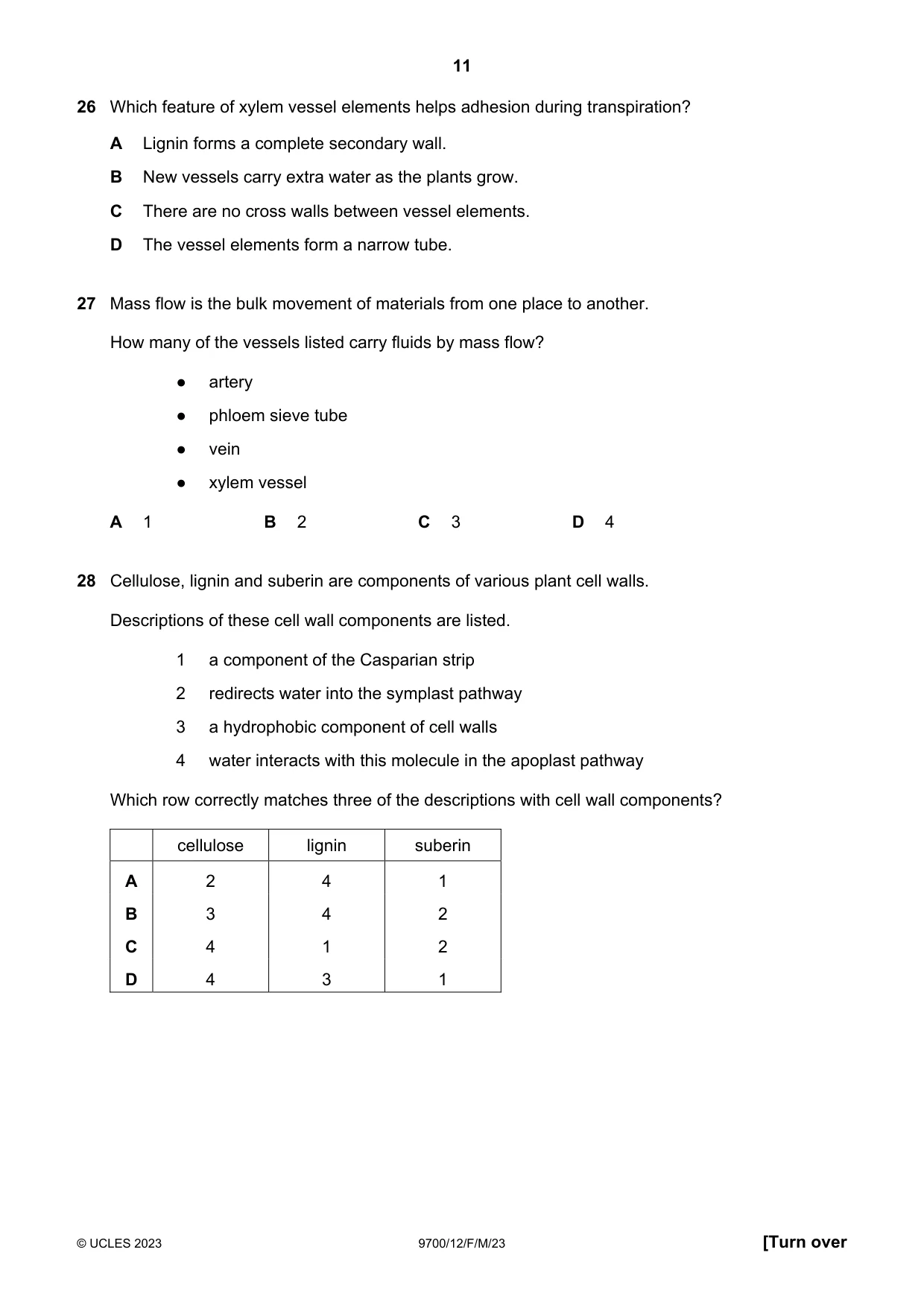
26 Which feature of xylem vessel elements helps adhesion during transpiration? A Lignin forms a complete secondary wall. B New vessels carry extra water as the plants grow. C There are no cross walls between vessel elements. D The vessel elements form a narrow tube.
Mark scheme: D
Q27 · Mass flow is the bulk movement of materials from one place to another
27 Mass flow is the bulk movement of materials from one place to another. How many of the vessels listed carry fluids by mass flow? ● artery ● phloem sieve tube ● vein ● xylem vessel A 1 B 2 C 3 D 4
Mark scheme: D
Q28 · Cellulose, lignin and suberin are components of various plant cell walls
28 Cellulose, lignin and suberin are components of various plant cell walls. Descriptions of these cell wall components are listed. 1 a component of the Casparian strip 2 redirects water into the symplast pathway 3 a hydrophobic component of cell walls 4 water interacts with this molecule in the apoplast pathway Which row correctly matches three of the descriptions with cell wall components? cellulose lignin suberin A 2 4 1 B 3 4 2 C 4 1 2 D 4 3 1
Mark scheme: D
Q29 · The arrows show the direction of water movement across a plant root, from water in the…
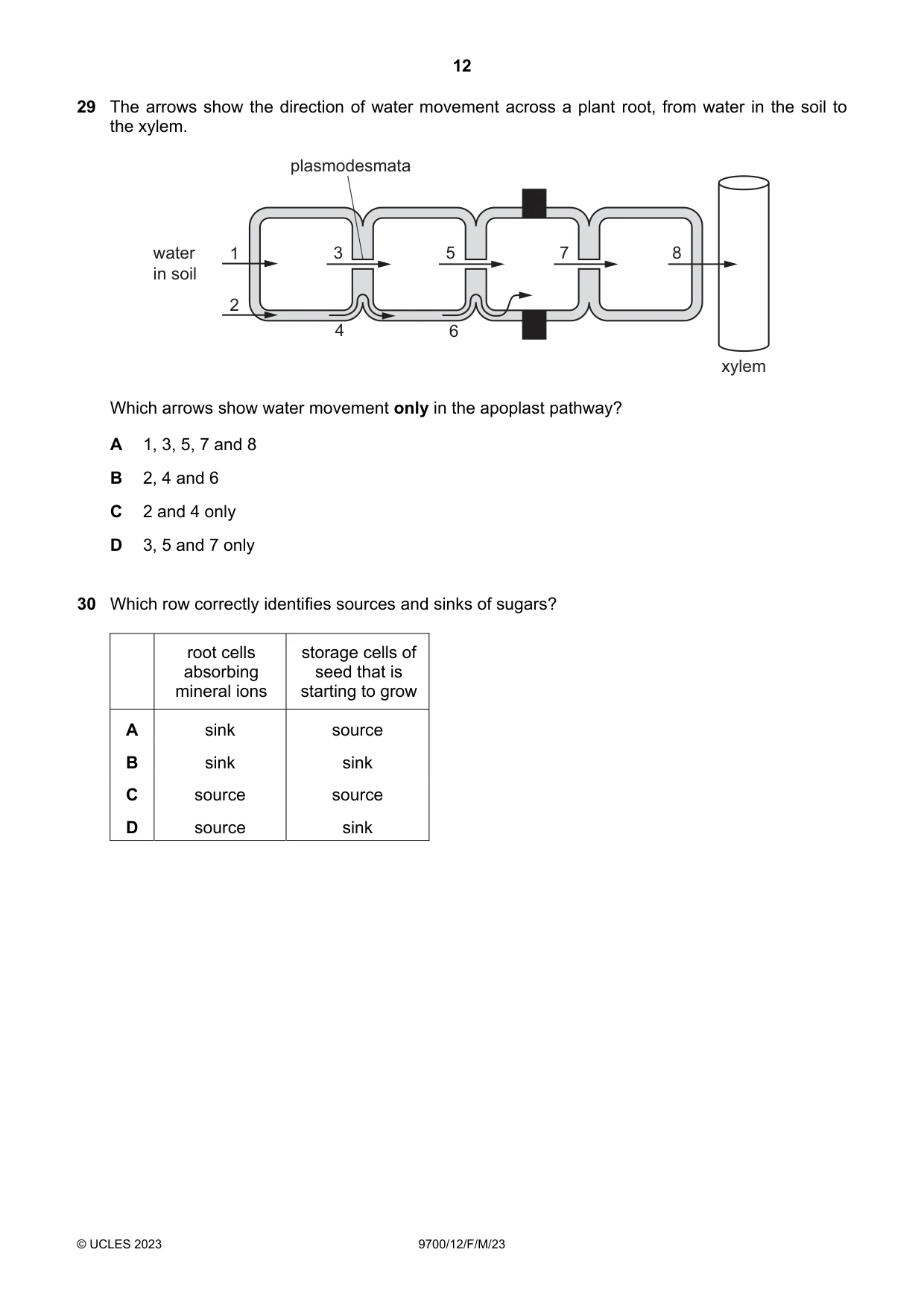
29 The arrows show the direction of water movement across a plant root, from water in the soil to the xylem. plasmodesmata water 1 3 5 7 8 in soil 2 4 6 xylem Which arrows show water movement only in the apoplast pathway? A 1, 3, 5, 7 and 8 B 2, 4 and 6 C 2 and 4 only D 3, 5 and 7 only
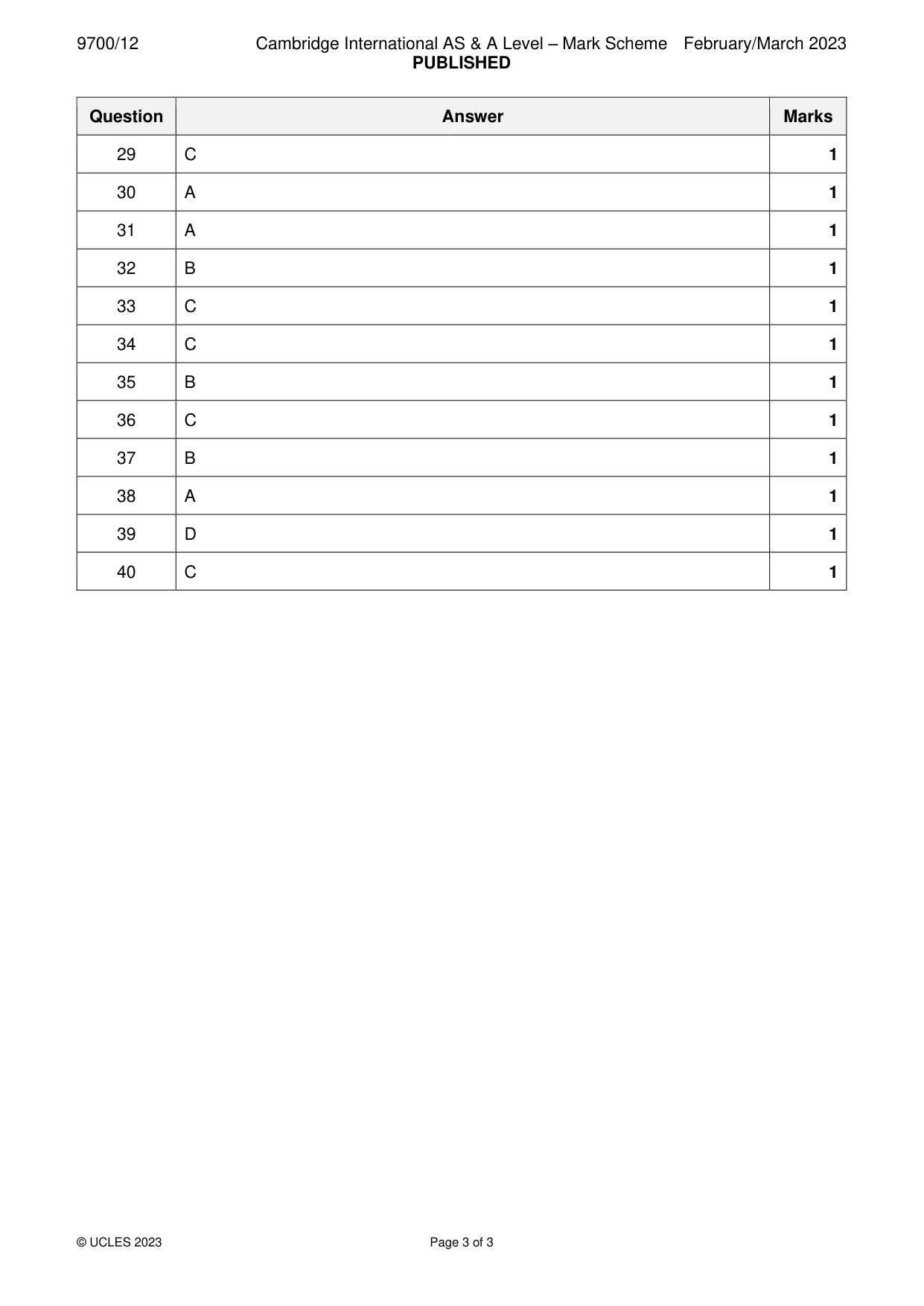
Mark scheme: C
Q30 · Which row correctly identifies sources and sinks of sugars?
30 Which row correctly identifies sources and sinks of sugars? root cells storage cells of absorbing seed that is mineral ions starting to grow A sink source B sink sink C source source D source sink
Mark scheme: A
Q31 · The photomicrograph shows a section through a tissue with an artery
31 The photomicrograph shows a section through a tissue with an artery. Which row correctly shows the type of artery and whether the blood inside the artery is oxygenated or deoxygenated? type of artery blood A muscular deoxygenated B muscular oxygenated C elastic deoxygenated D elastic oxygenated
Mark scheme: A
Q32 · Heart surgery may cause a decrease in the transmission of impulses in the Purkyne tissue…
32 Heart surgery may cause a decrease in the transmission of impulses in the Purkyne tissue to the right side of the heart. What is a possible effect of this decrease? A Impulses would be delayed by the atrioventricular node. B The muscle of the right ventricle would contract slightly more slowly than the muscle of the left ventricle. C The muscle of the right atrium would not contract as fully as the muscle of the left atrium. D The sinoatrial node would transmit fewer impulses.
Mark scheme: B
Q33 · The diagram shows a network of blood vessels that supply blood to muscle tissue in the…
33 The diagram shows a network of blood vessels that supply blood to muscle tissue in the human body. X Y artery vein What is a correct comparison between the blood at X and the blood at Y when the muscle tissue is at rest? water potential of blood pressure blood at X compared at X compared with with water potential blood pressure at Y of blood at Y A equal higher B equal lower C higher higher D higher lower
Mark scheme: C
Q34 · Scientists have shown that the oxygen dissociation curves for haemoglobin of smaller…
34 Scientists have shown that the oxygen dissociation curves for haemoglobin of smaller mammals are to the right of those of larger mammals. What does this suggest about the haemoglobin of smaller mammals? A At low partial pressures of oxygen, it binds to oxygen more strongly than the haemoglobin of larger mammals. B It saturates with oxygen at lower partial pressures of oxygen than the haemoglobin of larger mammals. C It releases oxygen more easily than the haemoglobin of larger mammals. D When the partial pressure of oxygen is high, it carries more oxygen than the haemoglobin of larger mammals.
Mark scheme: C
Q35 · What is an effect of an increased concentration of carbon dioxide in the blood?
35 What is an effect of an increased concentration of carbon dioxide in the blood? A increased movement of chloride ions out of red blood cells B increased concentration of haemoglobinic acid C decreased concentration of hydrogencarbonate ions in blood plasma D decreased concentration of carbaminohaemoglobin
Mark scheme: B
Q36 · Two of the requirements of an efficient gas exchange system are a large surface area and…
36 Two of the requirements of an efficient gas exchange system are a large surface area and a short diffusion distance. Which row correctly describes how alveoli are adapted to meet these requirements? large surface area short diffusion distance A elastin fibres prevent the an extracellular layer inside alveolus wall from collapsing the alveolus wall contains blood capillaries B gases dissolve in a layer of alveolar walls are next liquid to speed up diffusion to capillaries C alveoli are folded and walls of alveoli are interconnected only one cell thick D walls of alveoli are formed of red blood cells are very squamous epithelial cells close to capillary walls
Mark scheme: C
Q37 · What defines infectious diseases?
37 What defines infectious diseases? A Symptoms are caused by a bacterium that passes from contaminated air, soil or water to a host. B Symptoms are caused by a pathogen that is transmitted from one host to another. C Symptoms are caused by a microorganism that is carried by a vector. D Symptoms are caused by a virus that mutates to infect a new species.
Mark scheme: B
Q38 · A hurricane destroys a large town on an island
38 A hurricane destroys a large town on an island. People move away from the town and set up tents, where sanitation is poor. Which disease is most likely to spread within a week of the change in living conditions? A cholera B HIV C malaria D TB
Mark scheme: A
Q39 · Which statement correctly explains why viruses are unaffected by penicillin?
39 Which statement correctly explains why viruses are unaffected by penicillin? A Penicillin only affects host cell metabolism. B Penicillin only binds with 70S ribosomes. C Penicillin only blocks mRNA synthesis in prokaryotes. D Penicillin only blocks peptidoglycan synthesis.
Mark scheme: D
Q40 · Which processes characterise the mode of action of phagocytes?
40 Which processes characterise the mode of action of phagocytes? 1 antibody production 2 receptor binding 3 endocytosis 4 exocytosis 5 hydrolysis A 1, 2 and 4 B 1 and 4 only C 2, 3, 4 and 5 D 3 and 5 only
Mark scheme: C
What was in this paper
The subtopics covered by these 40 questions, and how many questions each got. Open one in a new tab to see every Cambridge question on it.
4Transport mechanisms4Carbohydrates and lipids3Structure of nucleic acids and replication of DNA3Infectious diseases2Mode of action of enzymes2Movement into and out of cells2Replication and division of nuclei and cells2Structure of transport tissues2The circulatory system2The microscope in cell studies2Transport of oxygen and carbon dioxide2Antibiotics1Factors that affect enzyme action1Fluid mosaic membranes1Protein synthesis1Proteins1Testing for biological molecules1The gas exchange system1The heart1The immune system1Water1What you needed in this session
Cambridge’s own grade thresholds for 2023 Feb/March, Paper 1 · Variant 2. A higher threshold means an easier paper — the bar moves with how the cohort did.