Cambridge A Level Biology 9700 — 2010 Oct/Nov Paper 1 · Variant 2
9700/12/O/N/10 · 40 questions · 40 marks · ≈45 min
The question paper and its mark scheme, free to read here and free to download. This is Cambridge’s own paper, exactly as it was sat.
Question paper20 pages

Mark scheme2 pages
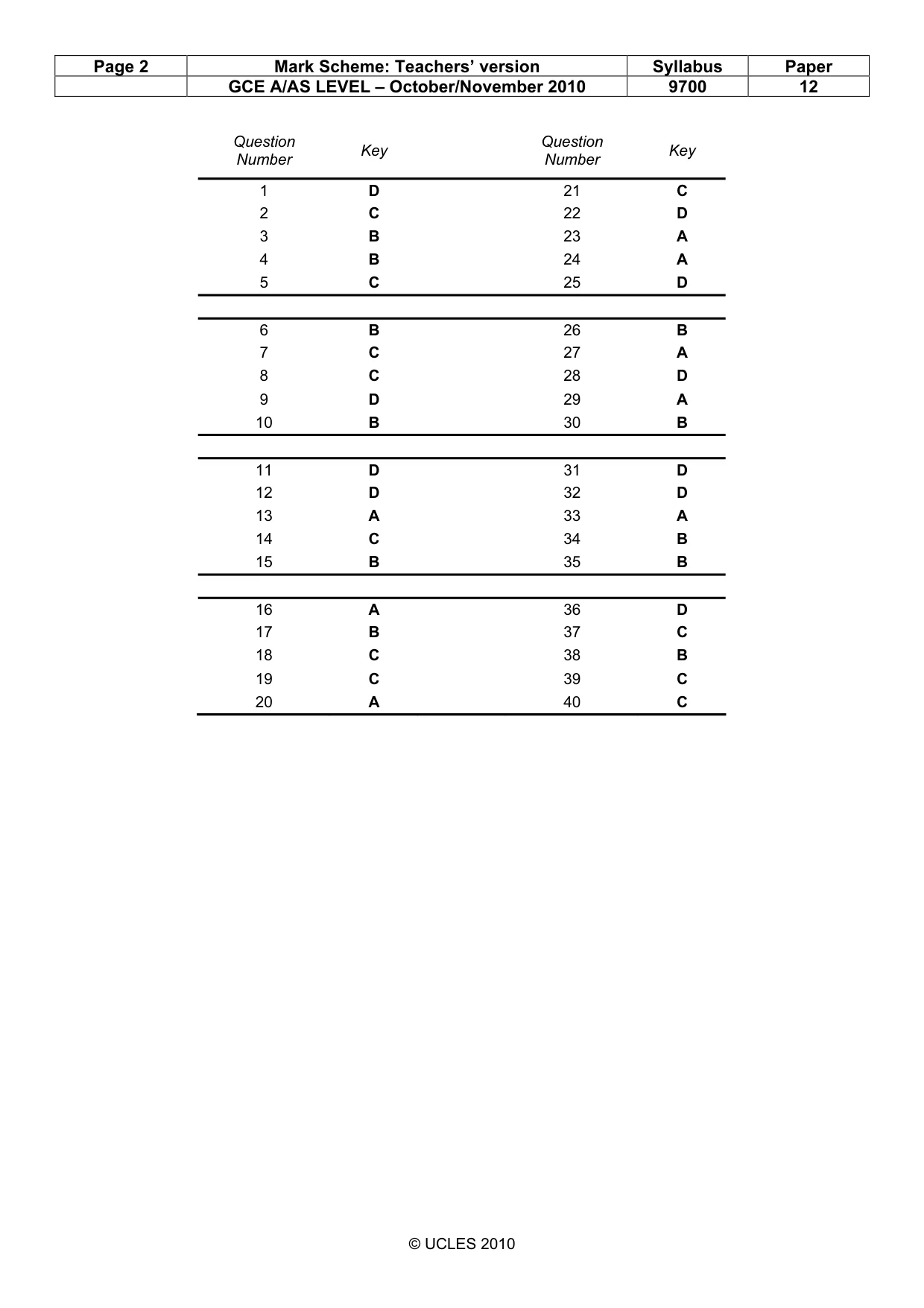
Answers below. Sit the paper first if you are practising.
Questions as text
Q1 · Which steps are needed to find the actual width of a xylem vessel viewed in transverse…
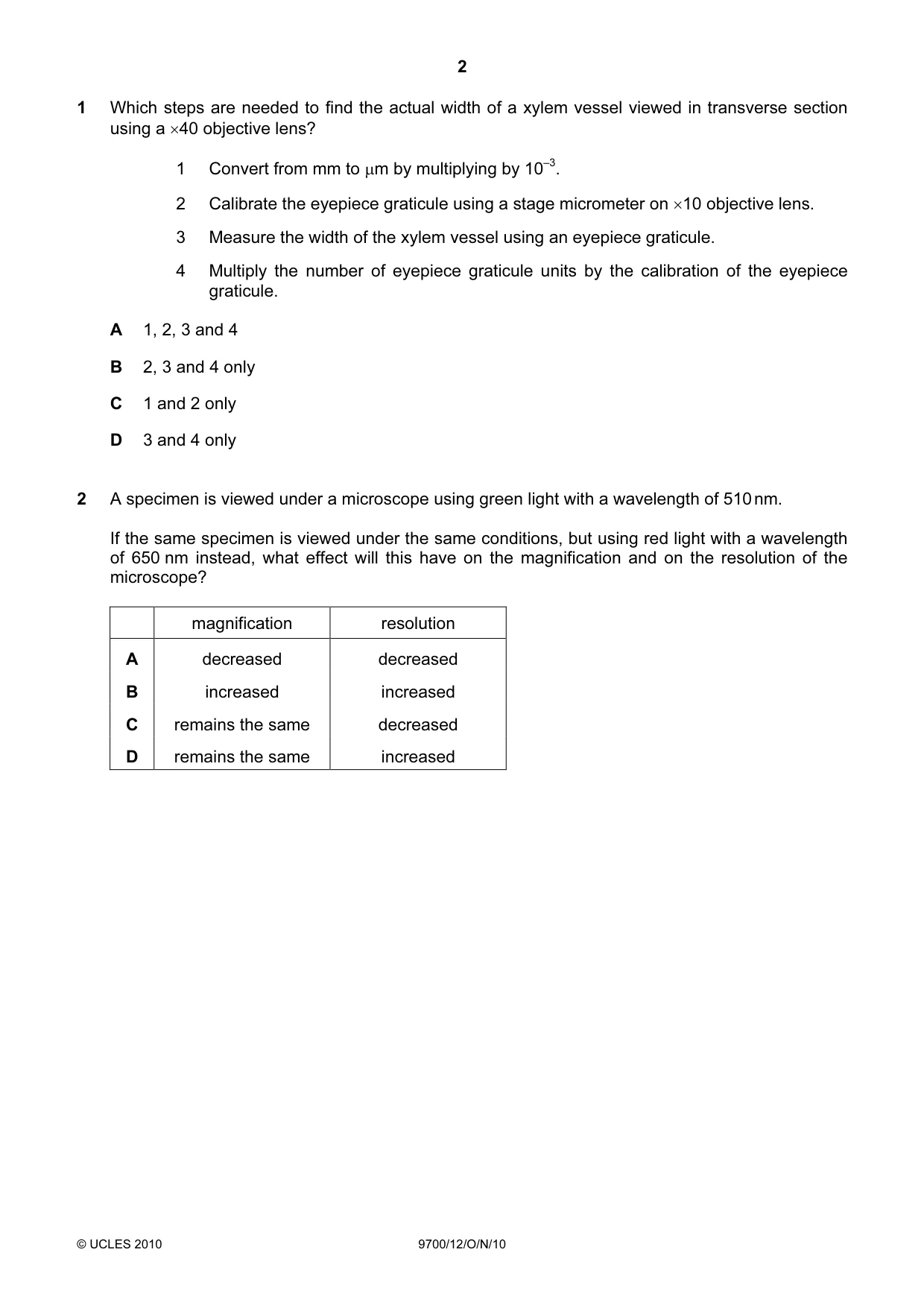
1 Which steps are needed to find the actual width of a xylem vessel viewed in transverse section using a ×40 objective lens? 1 Convert from mm to µm by multiplying by 10–3. 2 Calibrate the eyepiece graticule using a stage micrometer on ×10 objective lens. 3 Measure the width of the xylem vessel using an eyepiece graticule. 4 Multiply the number of eyepiece graticule units by the calibration of the eyepiece graticule. A 1, 2, 3 and 4 B 2, 3 and 4 only C 1 and 2 only D 3 and 4 only
Mark scheme: D
Q2 · A specimen is viewed under a microscope using green light with a wavelength of 510 nm
2 A specimen is viewed under a microscope using green light with a wavelength of 510 nm. If the same specimen is viewed under the same conditions, but using red light with a wavelength of 650 nm instead, what effect will this have on the magnification and on the resolution of the microscope? magnification resolution A decreased decreased B increased increased C remains the same decreased D remains the same increased
Mark scheme: C
Q3 · Which cell organelle does not contain nucleic acid?
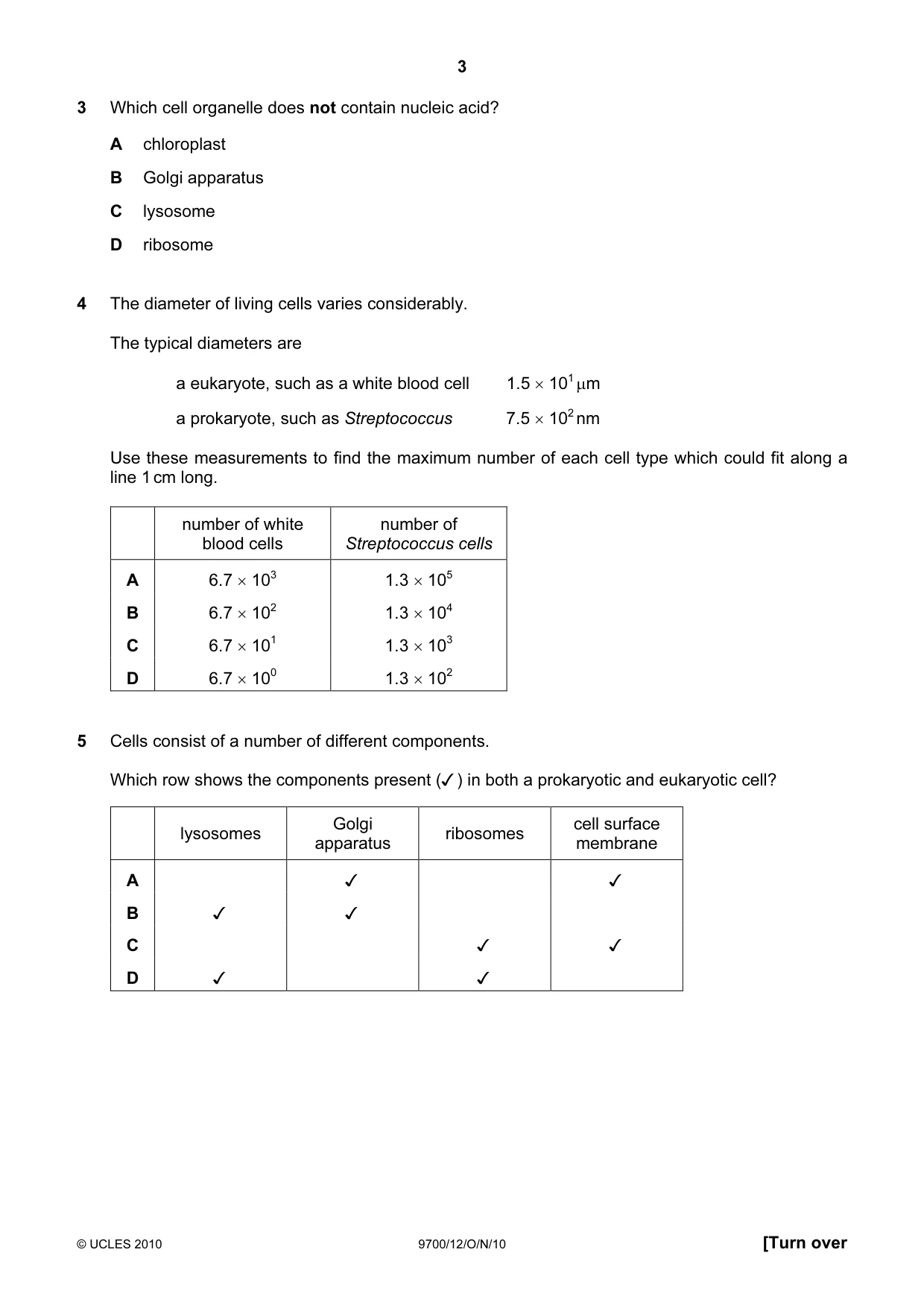
3 Which cell organelle does not contain nucleic acid? A chloroplast B Golgi apparatus C lysosome D ribosome
Mark scheme: B
More questions on Cells as the basic units of living organisms
Q4 · The diameter of living cells varies considerably
4 The diameter of living cells varies considerably. The typical diameters are a eukaryote, such as a white blood cell 1.5 × 101 µm a prokaryote, such as Streptococcus 7.5 × 10² nm Use these measurements to find the maximum number of each cell type which could fit along a line 1 cm long. number of white number of blood cells Streptococcus cells A 6.7 × 10³ 1.3 × 10⁵ B 6.7 × 10² 1.3 × 10⁴ C 6.7 × 101 1.3 × 10³ D 6.7 × 100 1.3 × 10²
Mark scheme: B
More questions on Cells as the basic units of living organisms
Q5 · Cells consist of a number of different components
5 Cells consist of a number of different components. Which row shows the components present (/ ) in both a prokaryotic and eukaryotic cell? Golgi ; cell surface lysosomes ribosomes apparatus membrane A v v B v v Cc v v D v v
Mark scheme: C
More questions on Cells as the basic units of living organisms
Q6 · The diagram shows part of a carbohydrate molecule
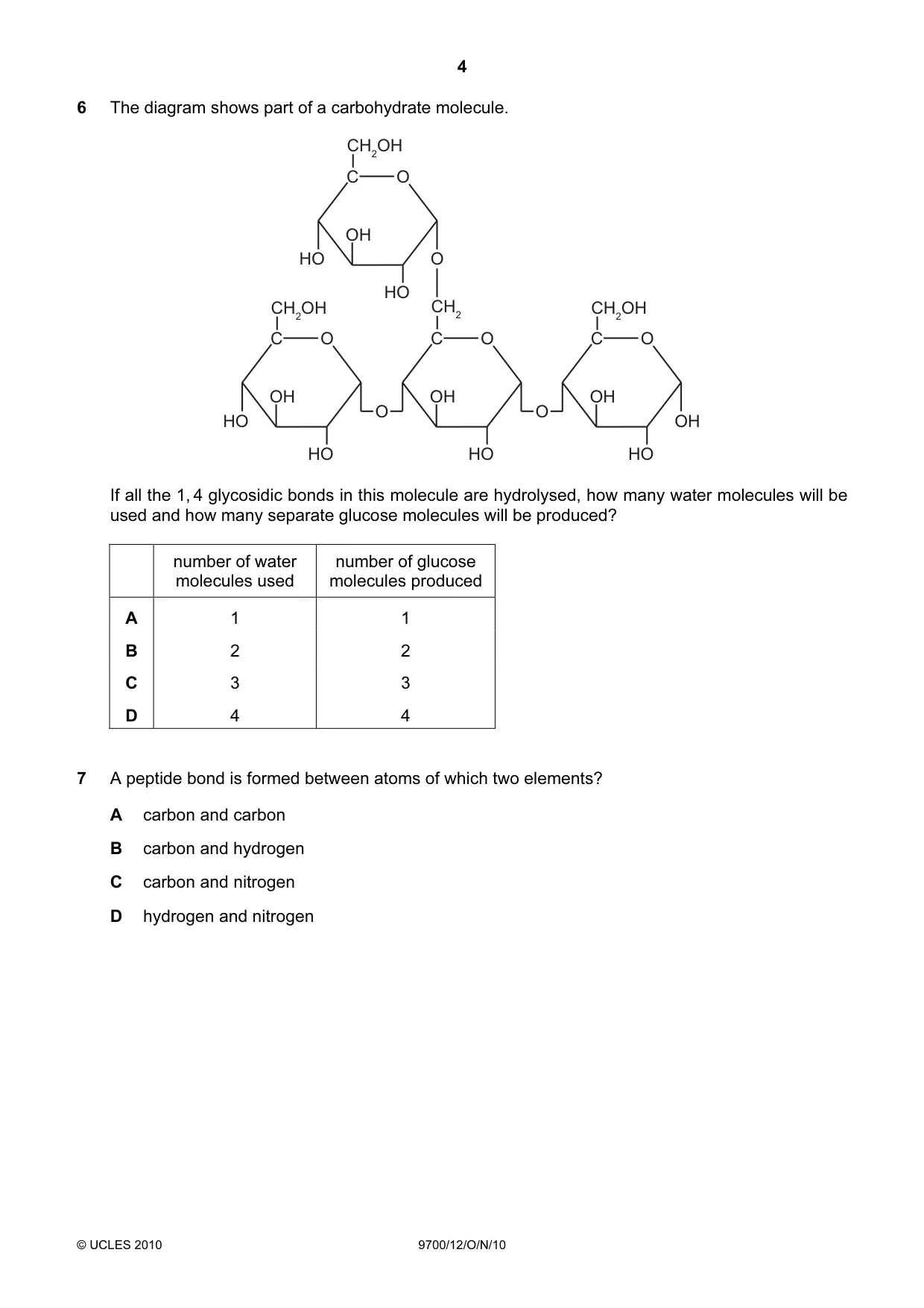
6 The diagram shows part of a carbohydrate molecule. CH2OH C O OH HO O HO CH2OH CH2 CH2OH C O C O C O OH OH OH O O HO OH HO HO HO If all the 1, 4 glycosidic bonds in this molecule are hydrolysed, how many water molecules will be used and how many separate glucose molecules will be produced? number of water number of glucose molecules used molecules produced A 1 1 B 2 2 C 3 3 D 4 4
Mark scheme: B
Q7 · A peptide bond is formed between atoms of which two elements?
7 A peptide bond is formed between atoms of which two elements? A carbon and carbon B carbon and hydrogen C carbon and nitrogen D hydrogen and nitrogen
Mark scheme: C
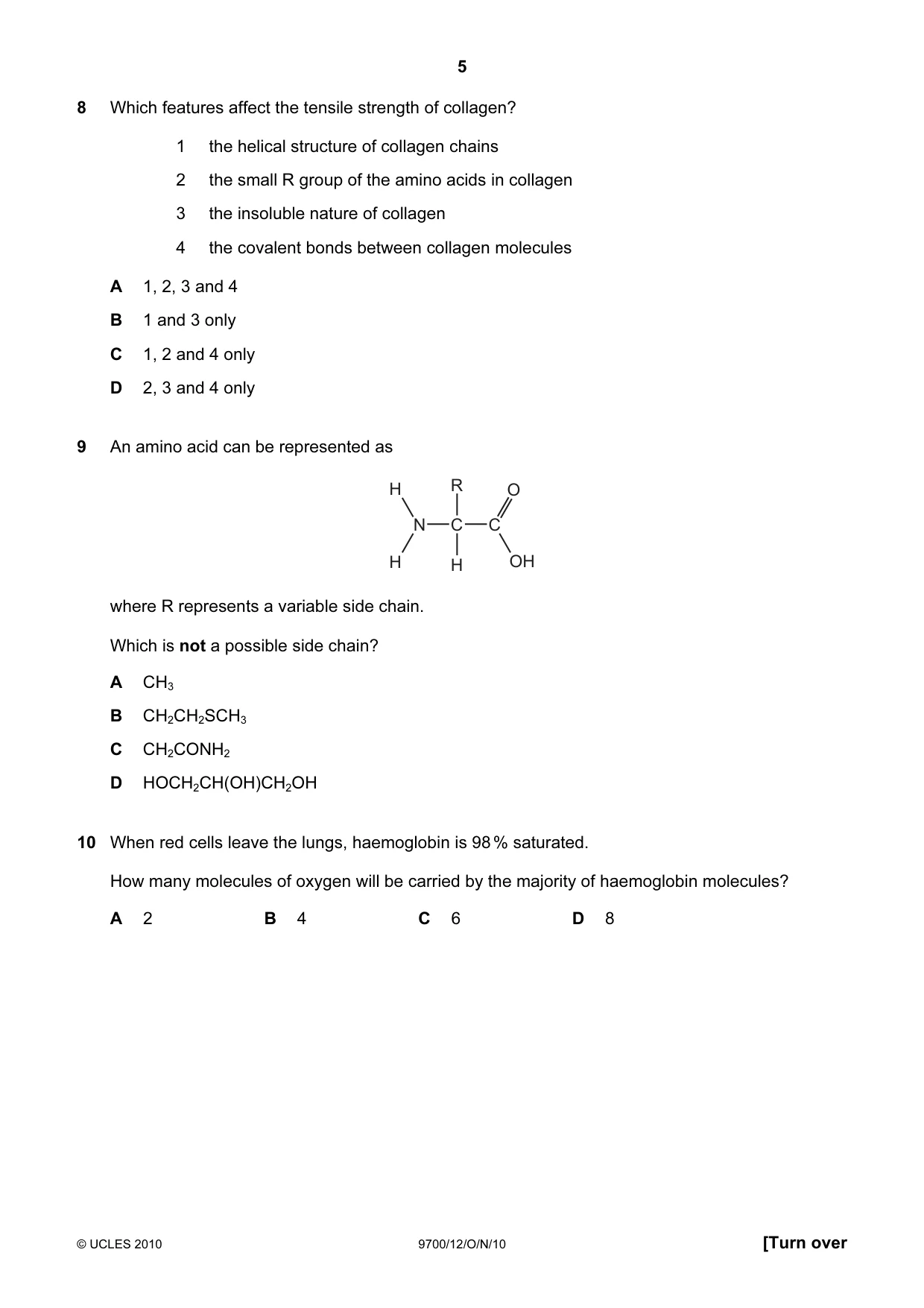
Q8 · Which features affect the tensile strength of collagen?
8 Which features affect the tensile strength of collagen? 1 the helical structure of collagen chains 2 the small R group of the amino acids in collagen 3 the insoluble nature of collagen 4 the covalent bonds between collagen molecules A 1, 2, 3 and 4 B 1 and 3 only C 1, 2 and 4 only D 2, 3 and 4 only
Mark scheme: C
Q9 · An amino acid can be represented as H R O N C C H H OH where R represents a variable side…
9 An amino acid can be represented as H R O N C C H H OH where R represents a variable side chain. Which is not a possible side chain? A CH3 B CH2CH2SCH3 C CH2CONH2 D HOCH2CH(OH)CH2OH
Mark scheme: D
Q10 · When red cells leave the lungs, haemoglobin is 98 % saturated
10 When red cells leave the lungs, haemoglobin is 98 % saturated. How many molecules of oxygen will be carried by the majority of haemoglobin molecules? A 2 B 4 C 6 D 8
Mark scheme: B
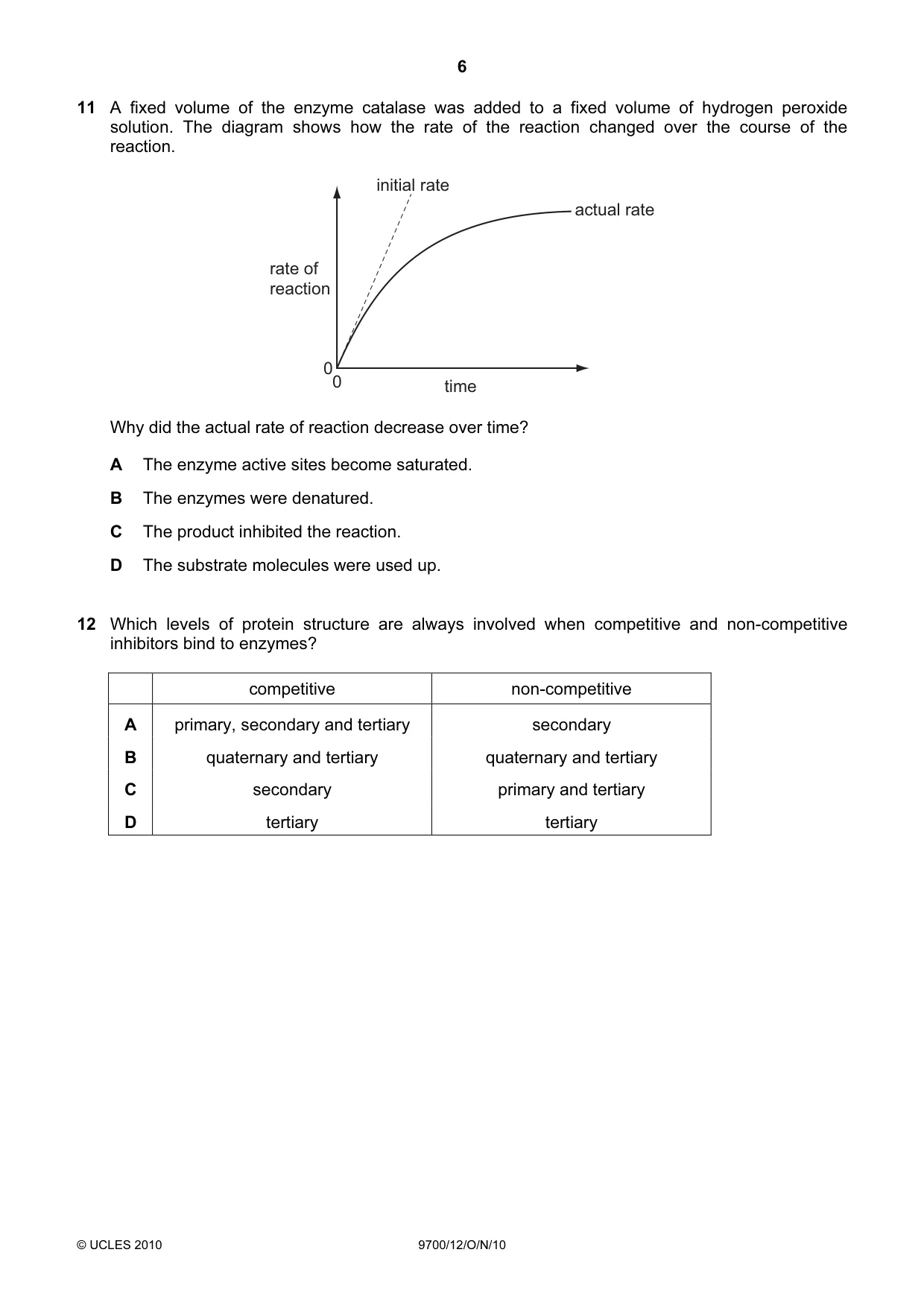
Q11 · A fixed volume of the enzyme catalase was added to a fixed volume of hydrogen peroxide…
11 A fixed volume of the enzyme catalase was added to a fixed volume of hydrogen peroxide solution. The diagram shows how the rate of the reaction changed over the course of the reaction. initial rate actual rate rate of reaction 00 time Why did the actual rate of reaction decrease over time? A The enzyme active sites become saturated. B The enzymes were denatured. C The product inhibited the reaction. D The substrate molecules were used up.
Mark scheme: D
Q12 · Which levels of protein structure are always involved when competitive and…
12 Which levels of protein structure are always involved when competitive and non-competitive inhibitors bind to enzymes? competitive non-competitive A primary, secondary and tertiary secondary B quaternary and tertiary quaternary and tertiary C secondary primary and tertiary D tertiary tertiary
Mark scheme: D
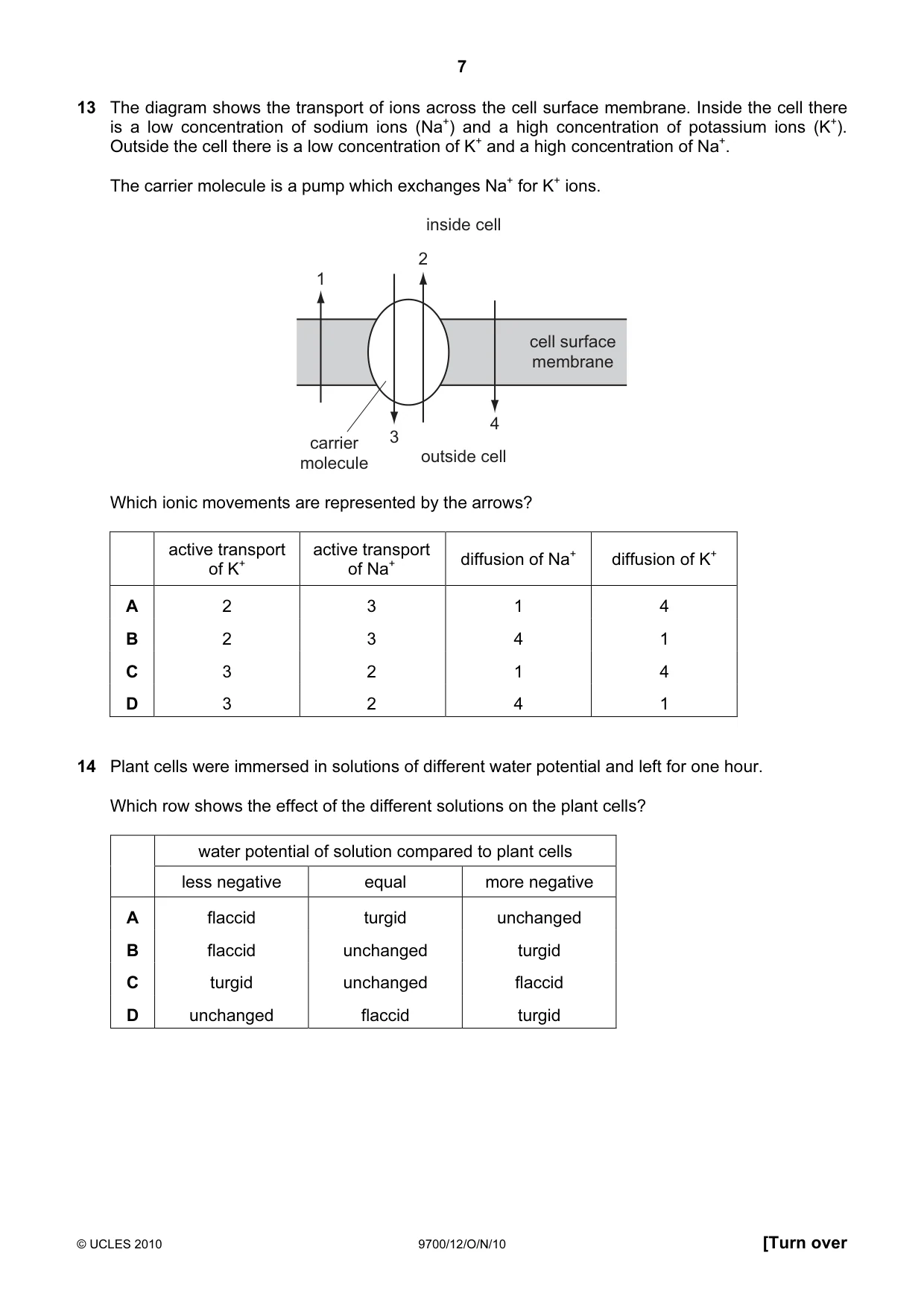
Q13 · The diagram shows the transport of ions across the cell surface membrane
13 The diagram shows the transport of ions across the cell surface membrane. Inside the cell there is a low concentration of sodium ions (Na+) and a high concentration of potassium ions (K+). Outside the cell there is a low concentration of K+ and a high concentration of Na+. The carrier molecule is a pump which exchanges Na+ for K+ ions. inside cell 2 1 cell surface membrane 4 carrier 3 molecule outside cell Which ionic movements are represented by the arrows? active transport active transport diffusion of Na+ diffusion of K+ of K+ of Na+ A 2 3 1 4 B 2 3 4 1 C 3 2 1 4 D 3 2 4 1
Mark scheme: A
Q14 · Plant cells were immersed in solutions of different water potential and left for one hour
14 Plant cells were immersed in solutions of different water potential and left for one hour. Which row shows the effect of the different solutions on the plant cells? water potential of solution compared to plant cells less negative equal more negative A flaccid turgid unchanged B flaccid unchanged turgid C turgid unchanged flaccid D unchanged flaccid turgid
Mark scheme: C
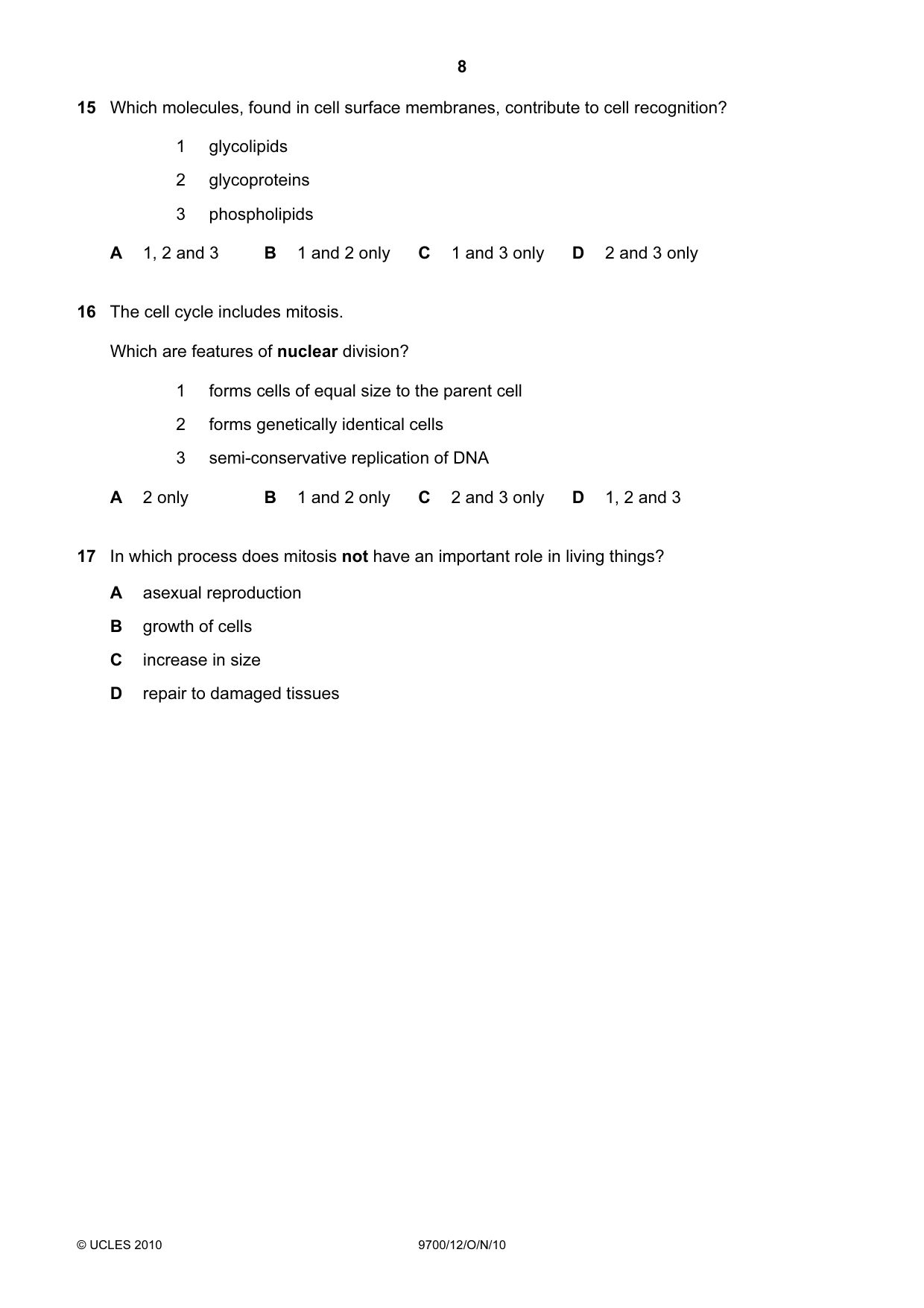
Q15 · Which molecules, found in cell surface membranes, contribute to cell recognition?
15 Which molecules, found in cell surface membranes, contribute to cell recognition? 1 glycolipids 2 glycoproteins 3 phospholipids A 1, 2 and 3 B 1 and 2 only C 1 and 3 only D 2 and 3 only
Mark scheme: B
Q16 · The cell cycle includes mitosis
16 The cell cycle includes mitosis. Which are features of nuclear division? 1 forms cells of equal size to the parent cell 2 forms genetically identical cells 3 semi-conservative replication of DNA A 2 only B 1 and 2 only C 2 and 3 only D 1, 2 and 3
Mark scheme: A
More questions on Replication and division of nuclei and cells
Q17 · In which process does mitosis not have an important role in living things?
17 In which process does mitosis not have an important role in living things? A asexual reproduction B growth of cells C increase in size D repair to damaged tissues
Mark scheme: B
More questions on Replication and division of nuclei and cells
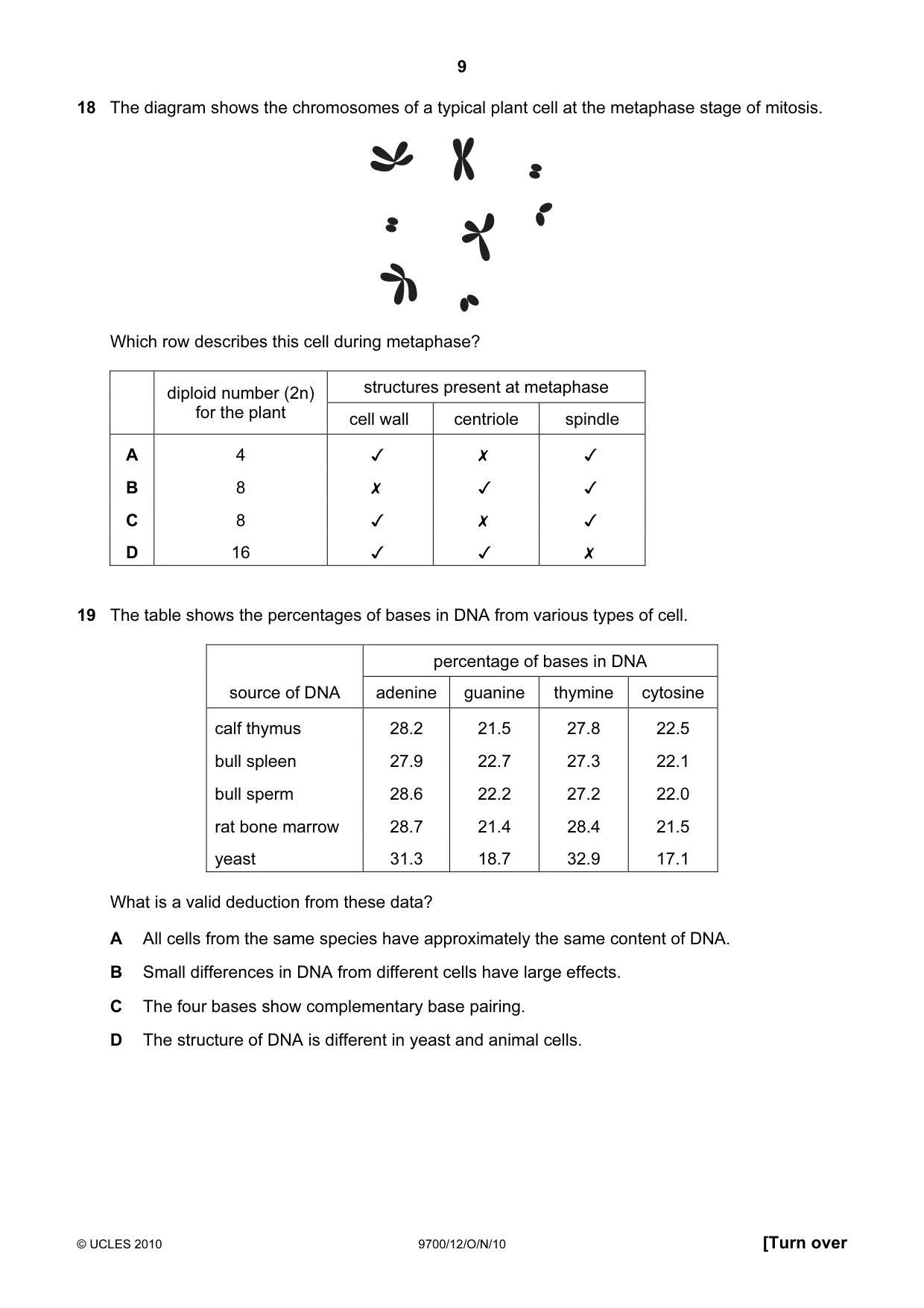
Q18 · The diagram shows the chromosomes of a typical plant cell at the metaphase stage of…
18 The diagram shows the chromosomes of a typical plant cell at the metaphase stage of mitosis. “xX : a D4 Which row describes this cell during metaphase? diploid number (2n) | structures present at metaphase for the plant cell wall centriole spindle A 4 v x v B 8 x v v Cc 8 v x v D 16 v v x
Mark scheme: C
Q19 · The table shows the percentages of bases in DNA from various types of cell
19 The table shows the percentages of bases in DNA from various types of cell. percentage of bases in DNA source of DNA adenine guanine thymine cytosine calf thymus 28.2 21.5 27.8 22.5 bull spleen 27.9 22.7 27.3 22.1 bull sperm 28.6 22.2 27.2 22.0 rat bone marrow 28.7 21.4 28.4 21.5 yeast 31.3 18.7 32.9 17.1 What is a valid deduction from these data? A All cells from the same species have approximately the same content of DNA. B Small differences in DNA from different cells have large effects. C The four bases show complementary base pairing. D The structure of DNA is different in yeast and animal cells.
Mark scheme: C
More questions on Structure of nucleic acids and replication of DNA
Q20 · Which row shows the correct combination?
20 Which row shows the correct combination? triplet code codon anticodon A DNA mRNA tRNA B DNA tRNA mRNA C mRNA DNA tRNA D tRNA mRNA DNA
Mark scheme: A
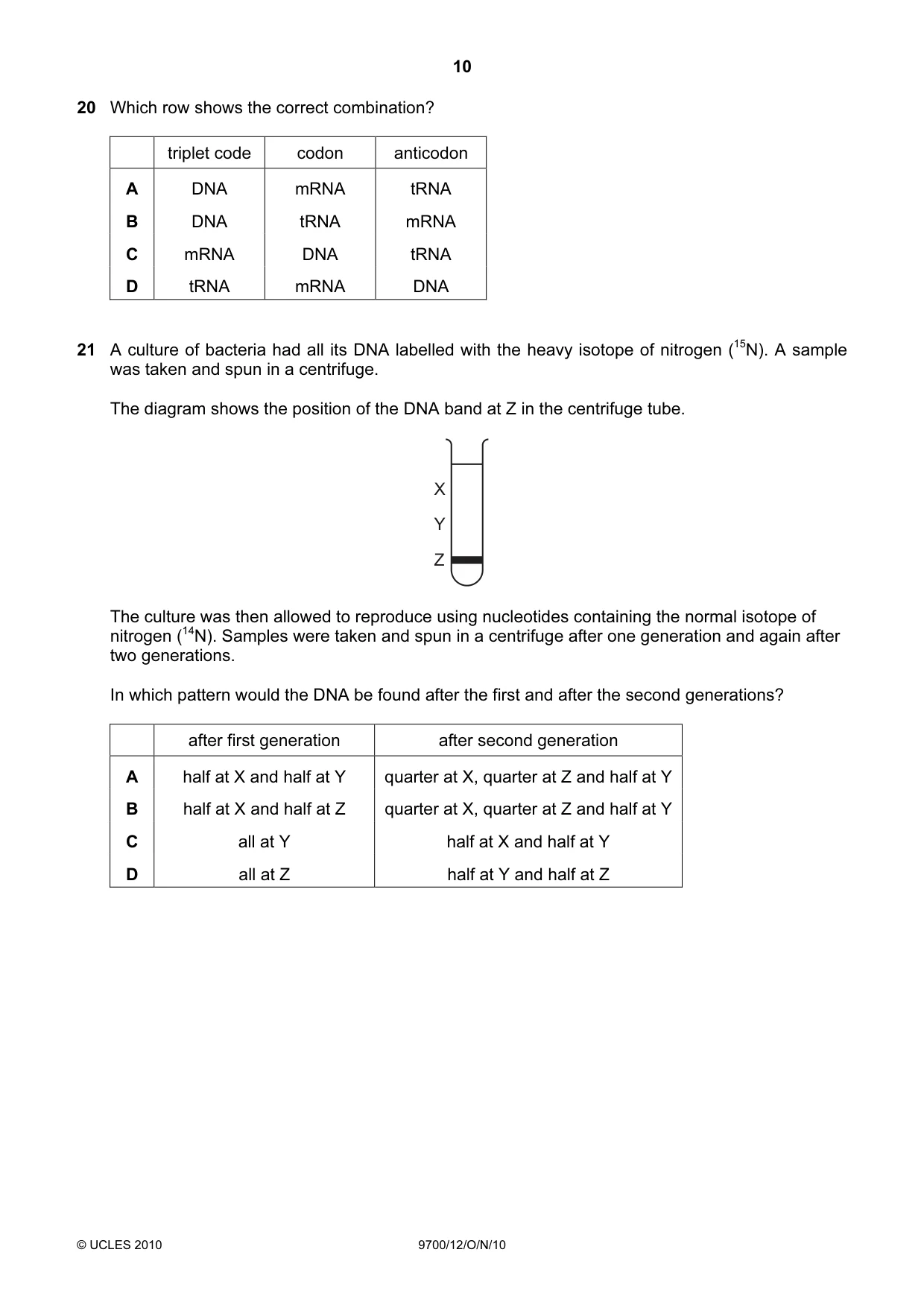
Q21 · A culture of bacteria had all its DNA labelled with the heavy isotope of nitrogen (15N)
21 A culture of bacteria had all its DNA labelled with the heavy isotope of nitrogen (15N). A sample was taken and spun in a centrifuge. The diagram shows the position of the DNA band at Z in the centrifuge tube. X Y Z The culture was then allowed to reproduce using nucleotides containing the normal isotope of nitrogen (14N). Samples were taken and spun in a centrifuge after one generation and again after two generations. In which pattern would the DNA be found after the first and after the second generations? after first generation after second generation A half at X and half at Y quarter at X, quarter at Z and half at Y B half at X and half at Z quarter at X, quarter at Z and half at Y C all at Y half at X and half at Y D all at Z half at Y and half at Z
Mark scheme: C
More questions on Structure of nucleic acids and replication of DNA
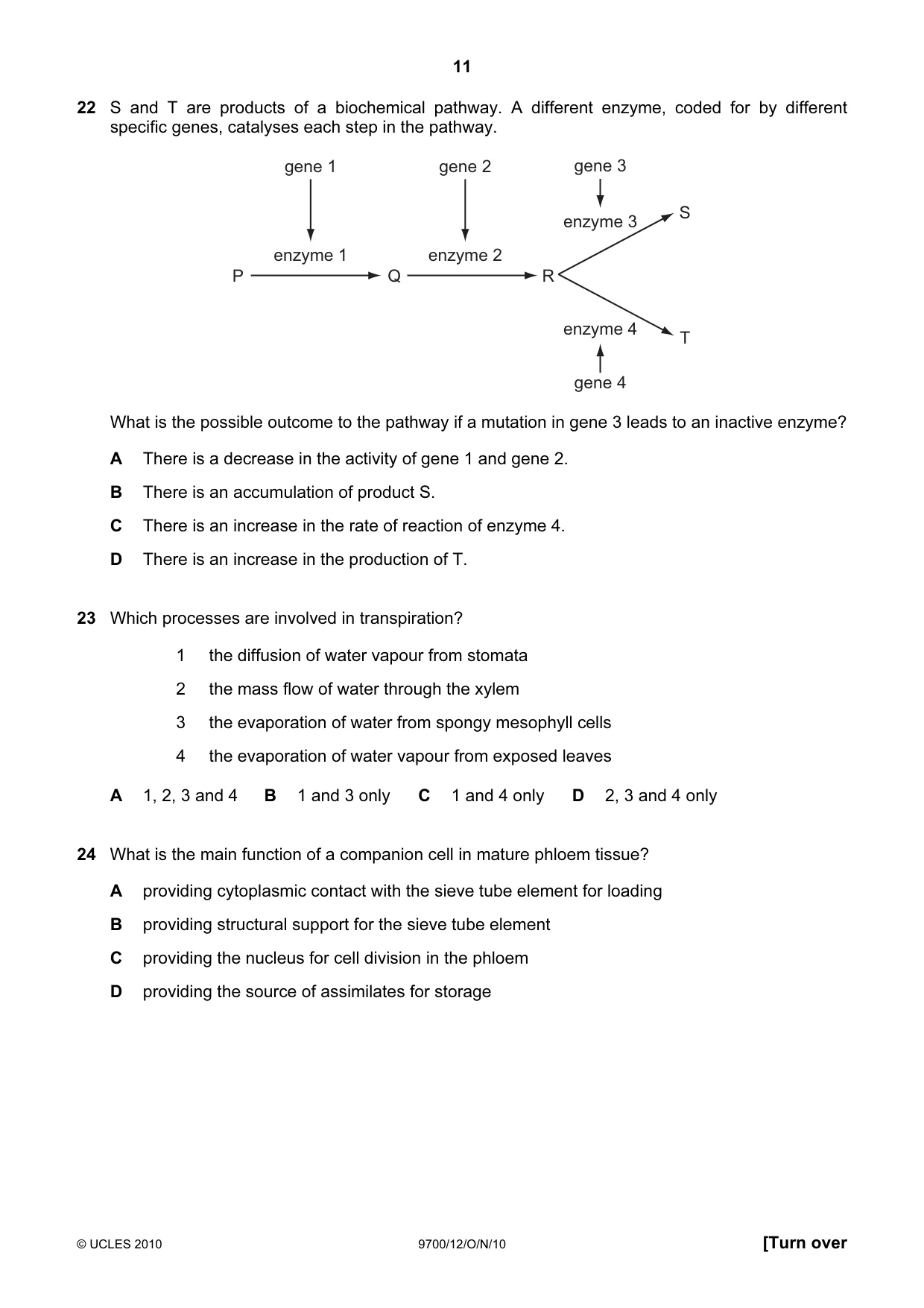
Q22 · S and T are products of a biochemical pathway
22 S and T are products of a biochemical pathway. A different enzyme, coded for by different specific genes, catalyses each step in the pathway. gene 1 gene 2 gene 3 S enzyme 3 enzyme 1 enzyme 2 P Q R enzyme 4 T gene 4 What is the possible outcome to the pathway if a mutation in gene 3 leads to an inactive enzyme? A There is a decrease in the activity of gene 1 and gene 2. B There is an accumulation of product S. C There is an increase in the rate of reaction of enzyme 4. D There is an increase in the production of T.
Mark scheme: D
Q23 · Which processes are involved in transpiration?
23 Which processes are involved in transpiration? 1 the diffusion of water vapour from stomata 2 the mass flow of water through the xylem 3 the evaporation of water from spongy mesophyll cells 4 the evaporation of water vapour from exposed leaves A 1, 2, 3 and 4 B 1 and 3 only C 1 and 4 only D 2, 3 and 4 only
Mark scheme: A
Q24 · What is the main function of a companion cell in mature phloem tissue?
24 What is the main function of a companion cell in mature phloem tissue? A providing cytoplasmic contact with the sieve tube element for loading B providing structural support for the sieve tube element C providing the nucleus for cell division in the phloem D providing the source of assimilates for storage
Mark scheme: A
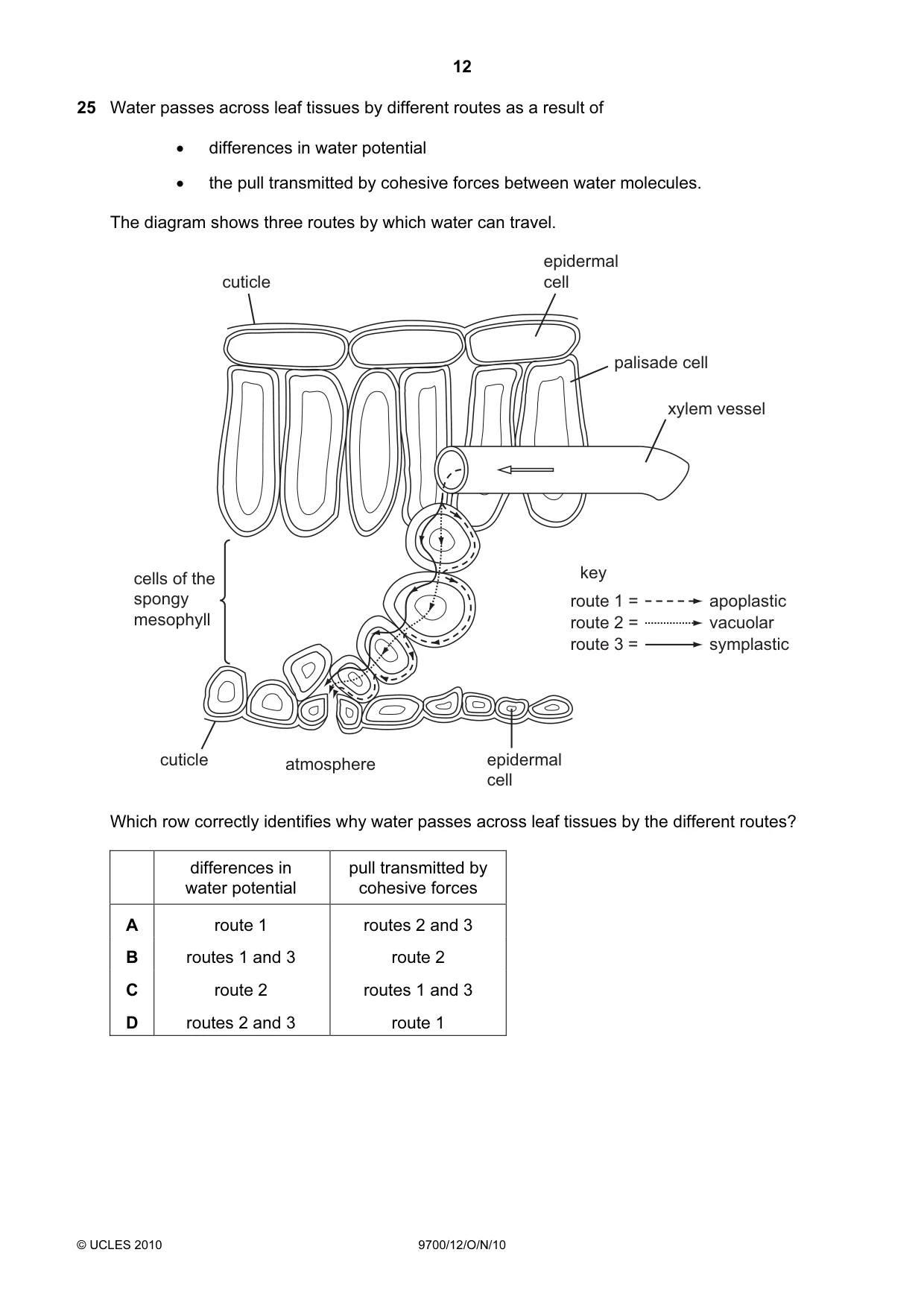
Q25 · Water passes across leaf tissues by different routes as a result of • differences in…
25 Water passes across leaf tissues by different routes as a result of • differences in water potential • the pull transmitted by cohesive forces between water molecules. The diagram shows three routes by which water can travel. epidermal cuticle cell palisade cell xylem vessel cells of the key spongy route 1 = apoplastic mesophyll route 2 = vacuolar route 3 = symplastic cuticle atmosphere epidermal cell Which row correctly identifies why water passes across leaf tissues by the different routes? differences in pull transmitted by water potential cohesive forces A route 1 routes 2 and 3 B routes 1 and 3 route 2 C route 2 routes 1 and 3 D routes 2 and 3 route 1
Mark scheme: D
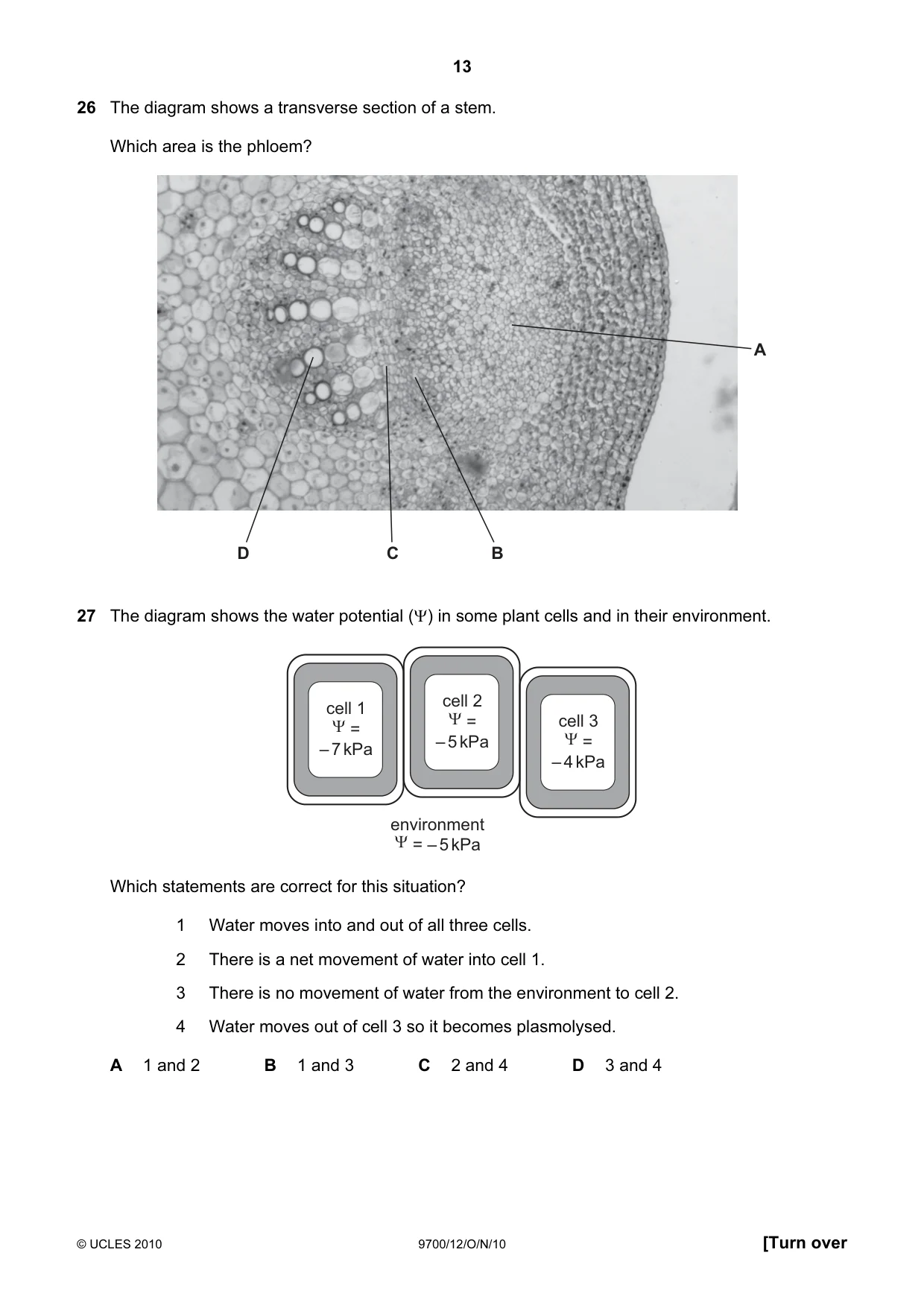
Q26 · The diagram shows a transverse section of a stem
26 The diagram shows a transverse section of a stem. Which area is the phloem? A D C B
Mark scheme: B
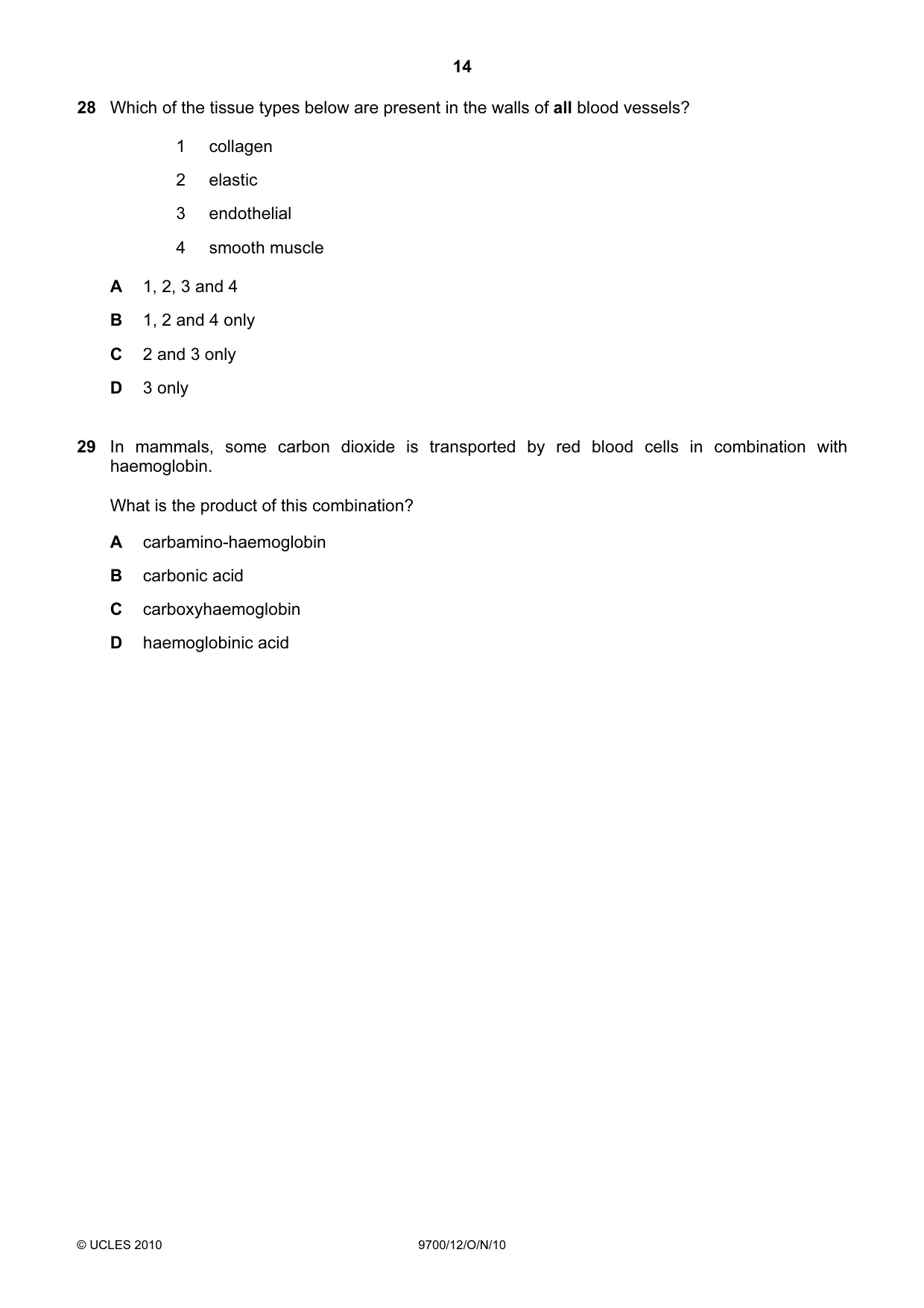
Q27 · The diagram shows the water potential (Ψ) in some plant cells and in their environment
27 The diagram shows the water potential (Ψ) in some plant cells and in their environment. cell 1 cell 2 Ψ = Ψ = cell 3 – 5 kPa Ψ = – 7 kPa – 4 kPa environment Ψ = – 5 kPa Which statements are correct for this situation? 1 Water moves into and out of all three cells. 2 There is a net movement of water into cell 1. 3 There is no movement of water from the environment to cell 2. 4 Water moves out of cell 3 so it becomes plasmolysed. A 1 and 2 B 1 and 3 C 2 and 4 D 3 and 4
Mark scheme: A
Q28 · Which of the tissue types below are present in the walls of all blood vessels?
28 Which of the tissue types below are present in the walls of all blood vessels? 1 collagen 2 elastic 3 endothelial 4 smooth muscle A 1, 2, 3 and 4 B 1, 2 and 4 only C 2 and 3 only D 3 only
Mark scheme: D
Q29 · In mammals, some carbon dioxide is transported by red blood cells in combination with…
29 In mammals, some carbon dioxide is transported by red blood cells in combination with haemoglobin. What is the product of this combination? A carbamino-haemoglobin B carbonic acid C carboxyhaemoglobin D haemoglobinic acid
Mark scheme: A
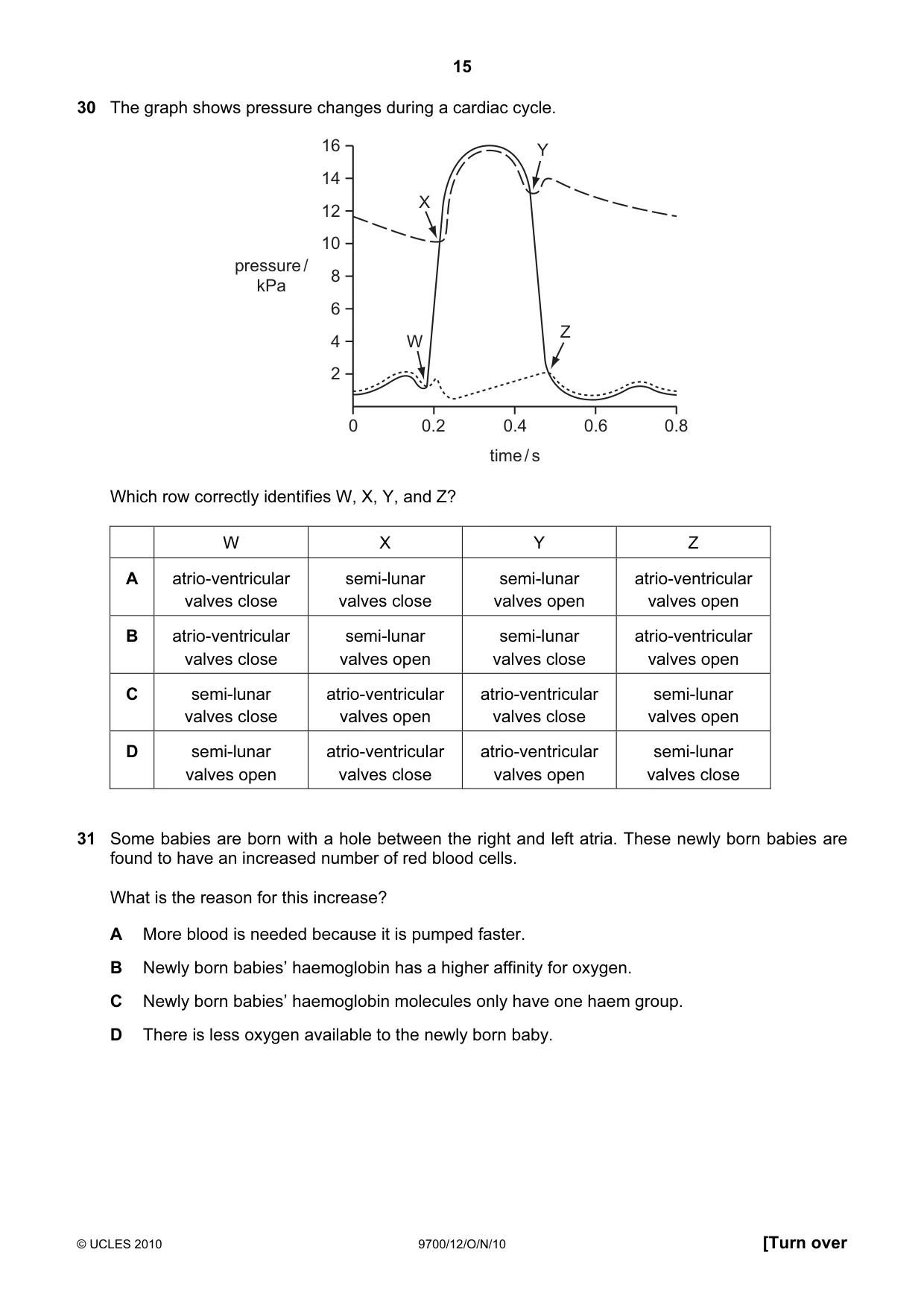
Q30 · The graph shows pressure changes during a cardiac cycle
30 The graph shows pressure changes during a cardiac cycle. 16 Y 14 X 12 10 pressure / 8 kPa 6 Z 4 W 2 0 0.2 0.4 0.6 0.8 time / s Which row correctly identifies W, X, Y, and Z? W X Y Z A atrio-ventricular semi-lunar semi-lunar atrio-ventricular valves close valves close valves open valves open B atrio-ventricular semi-lunar semi-lunar atrio-ventricular valves close valves open valves close valves open C semi-lunar atrio-ventricular atrio-ventricular semi-lunar valves close valves open valves close valves open D semi-lunar atrio-ventricular atrio-ventricular semi-lunar valves open valves close valves open valves close
Mark scheme: B
Q31 · Some babies are born with a hole between the right and left atria
31 Some babies are born with a hole between the right and left atria. These newly born babies are found to have an increased number of red blood cells. What is the reason for this increase? A More blood is needed because it is pumped faster. B Newly born babies’ haemoglobin has a higher affinity for oxygen. C Newly born babies’ haemoglobin molecules only have one haem group. D There is less oxygen available to the newly born baby.
Mark scheme: D
Q32 · Which row correctly shows the areas of the respiratory tract that contain cartilage…
32 Which row correctly shows the areas of the respiratory tract that contain cartilage, cilia (ciliated epithelium), goblet cells and smooth muscle? cartilage cilia goblet cells smooth muscle A bronchiole, bronchus bronchiole, trachea bronchus, trachea bronchiole, trachea B bronchus, trachea bronchiole, bronchus bronchus, trachea bronchiole, trachea C bronchiole, trachea bronchus, trachea bronchiole, bronchus bronchiole, bronchus, trachea D bronchus, trachea bronchiole, bronchus, trachea bronchiole, bronchus, trachea bronchus, trachea
Mark scheme: D
Q33 · In some cases where a person has lung disease, the partial pressure of oxygen in the…
33 In some cases where a person has lung disease, the partial pressure of oxygen in the pulmonary veins is less than the partial pressure of oxygen in the alveoli. Which would contribute to the description above? 1 A high proportion of alveoli are collapsed and do not have enough alveolar capillaries. 2 The degree of alveolar ventilation is too low for the cardiac output supplying most of the alveoli. 3 The partial pressure of oxygen in the pulmonary arteries is lower than in the alveolar air. 4 The rate of diffusion of oxygen from the alveolar air to the surrounding alveolar capillaries is too slow. A 1, 2 and 4 B 1, 3 and 4 C 1 and 2 only D 3 and 4 only
Mark scheme: A
Q34 · Which of the effects listed occur as a result of inhaling both carbon monoxide and…
34 Which of the effects listed occur as a result of inhaling both carbon monoxide and nicotine from cigarette smoke? 1 increased heart rate 2 increased risk of cardiovascular disease 3 increased risk of emphysema 4 increased risk of lung cancer A 1, 2 and 3 B 1 and 2 only C 2, 3 and 4 D 3 and 4 only
Mark scheme: B
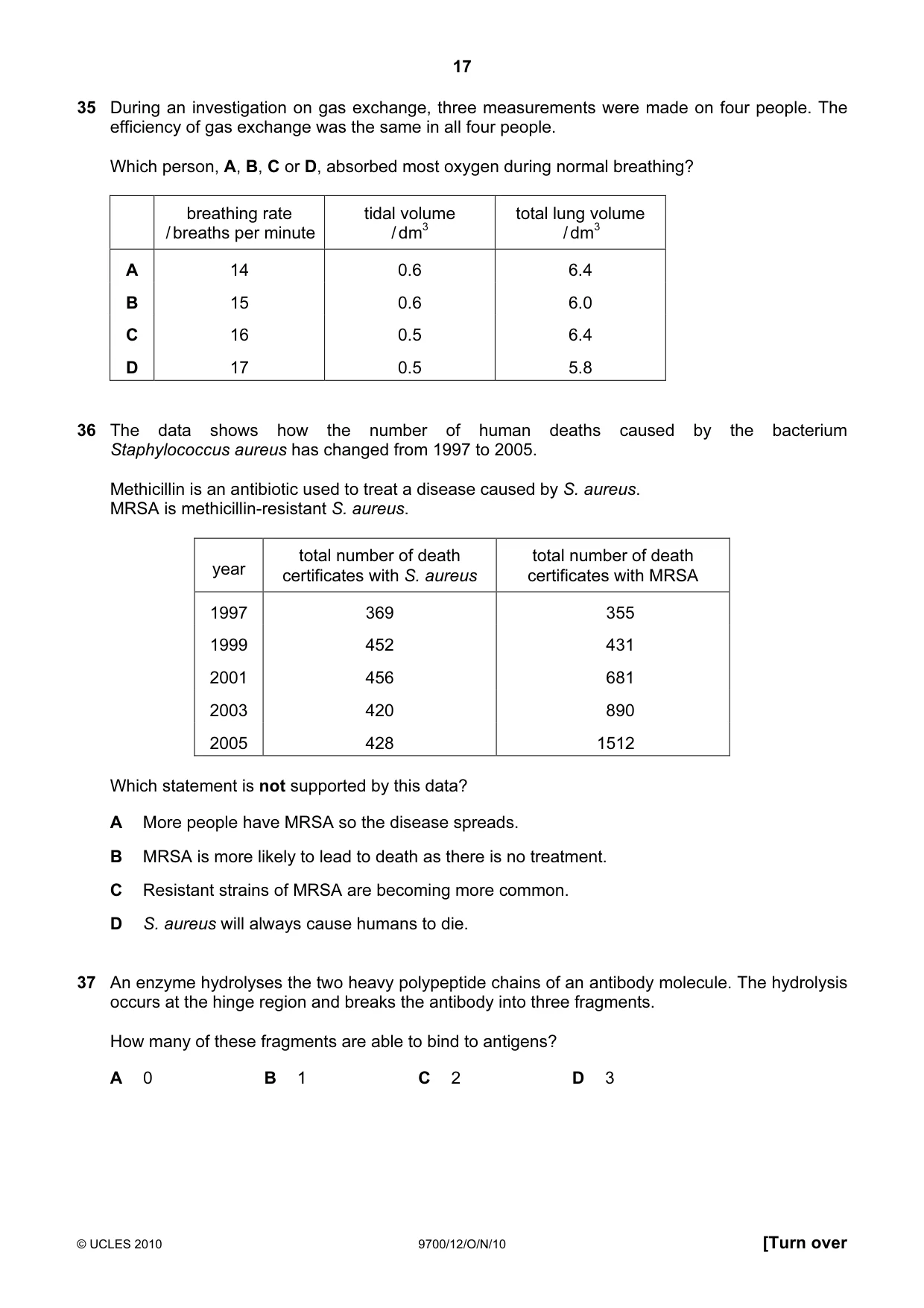
Q35 · During an investigation on gas exchange, three measurements were made on four people
35 During an investigation on gas exchange, three measurements were made on four people. The efficiency of gas exchange was the same in all four people. Which person, A, B, C or D, absorbed most oxygen during normal breathing? breathing rate tidal volume total lung volume / breaths per minute / dm3 / dm3 A 14 0.6 6.4 B 15 0.6 6.0 C 16 0.5 6.4 D 17 0.5 5.8
Mark scheme: B
Q36 · The data shows how the number of human deaths caused by the bacterium Staphylococcus…
36 The data shows how the number of human deaths caused by the bacterium Staphylococcus aureus has changed from 1997 to 2005. Methicillin is an antibiotic used to treat a disease caused by S. aureus. MRSA is methicillin-resistant S. aureus. total number of death total number of death year certificates with S. aureus certificates with MRSA 1997 369 355 1999 452 431 2001 456 681 2003 420 890 2005 428 1512 Which statement is not supported by this data? A More people have MRSA so the disease spreads. B MRSA is more likely to lead to death as there is no treatment. C Resistant strains of MRSA are becoming more common. D S. aureus will always cause humans to die.
Mark scheme: D
Q37 · An enzyme hydrolyses the two heavy polypeptide chains of an antibody molecule
37 An enzyme hydrolyses the two heavy polypeptide chains of an antibody molecule. The hydrolysis occurs at the hinge region and breaks the antibody into three fragments. How many of these fragments are able to bind to antigens? A 0 B 1 C 2 D 3
Mark scheme: C
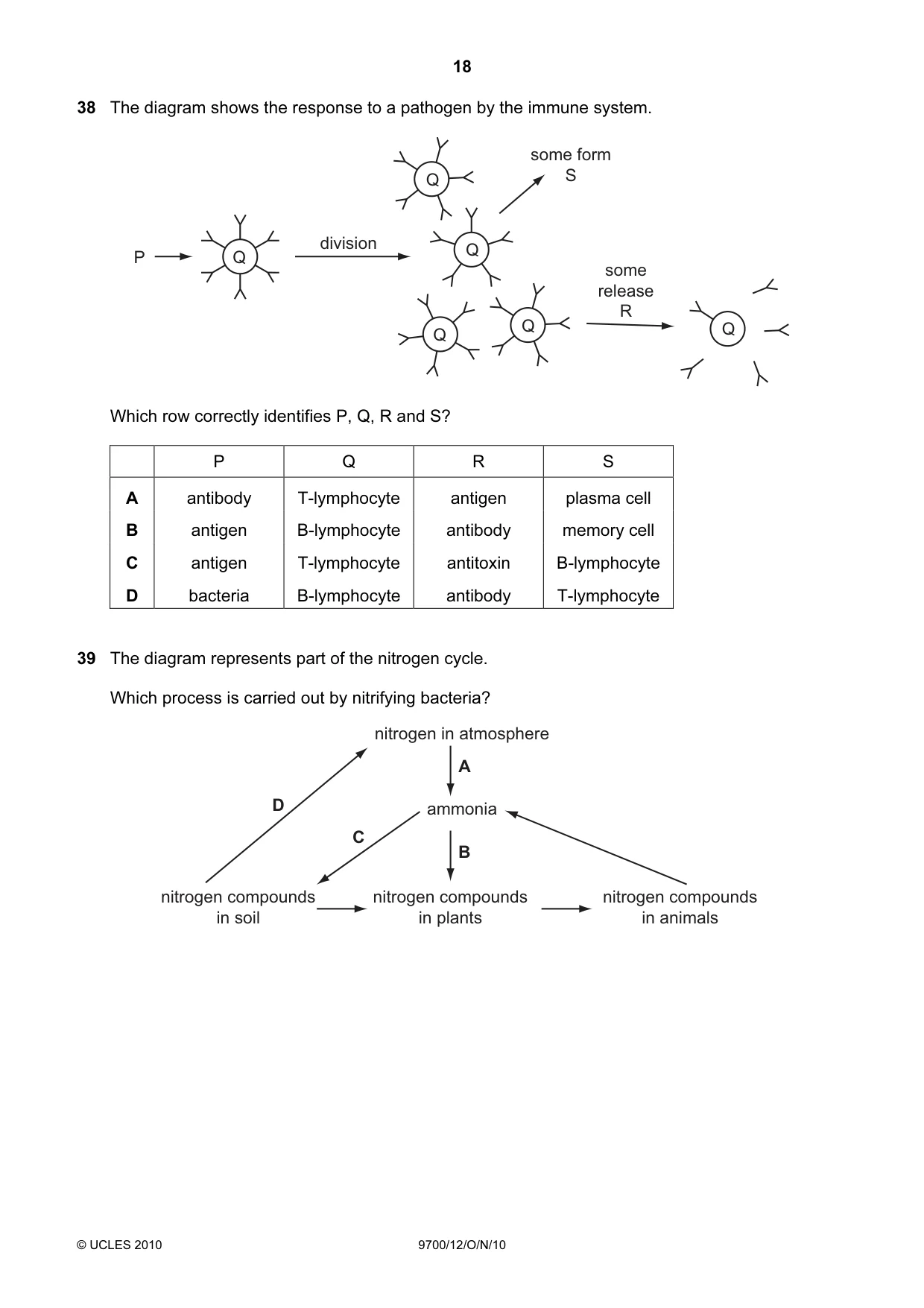
Q38 · The diagram shows the response to a pathogen by the immune system
38 The diagram shows the response to a pathogen by the immune system. some form Q S division Q P Q some release R Q Q Q Which row correctly identifies P, Q, R and S? P Q R S A antibody T-lymphocyte antigen plasma cell B antigen B-lymphocyte antibody memory cell C antigen T-lymphocyte antitoxin B-lymphocyte D bacteria B-lymphocyte antibody T-lymphocyte
Mark scheme: B
Q39 · The diagram represents part of the nitrogen cycle
39 The diagram represents part of the nitrogen cycle. Which process is carried out by nitrifying bacteria? nitrogen in atmosphere A D ammonia C B nitrogen compounds nitrogen compounds nitrogen compounds in soil in plants in animals
Mark scheme: C
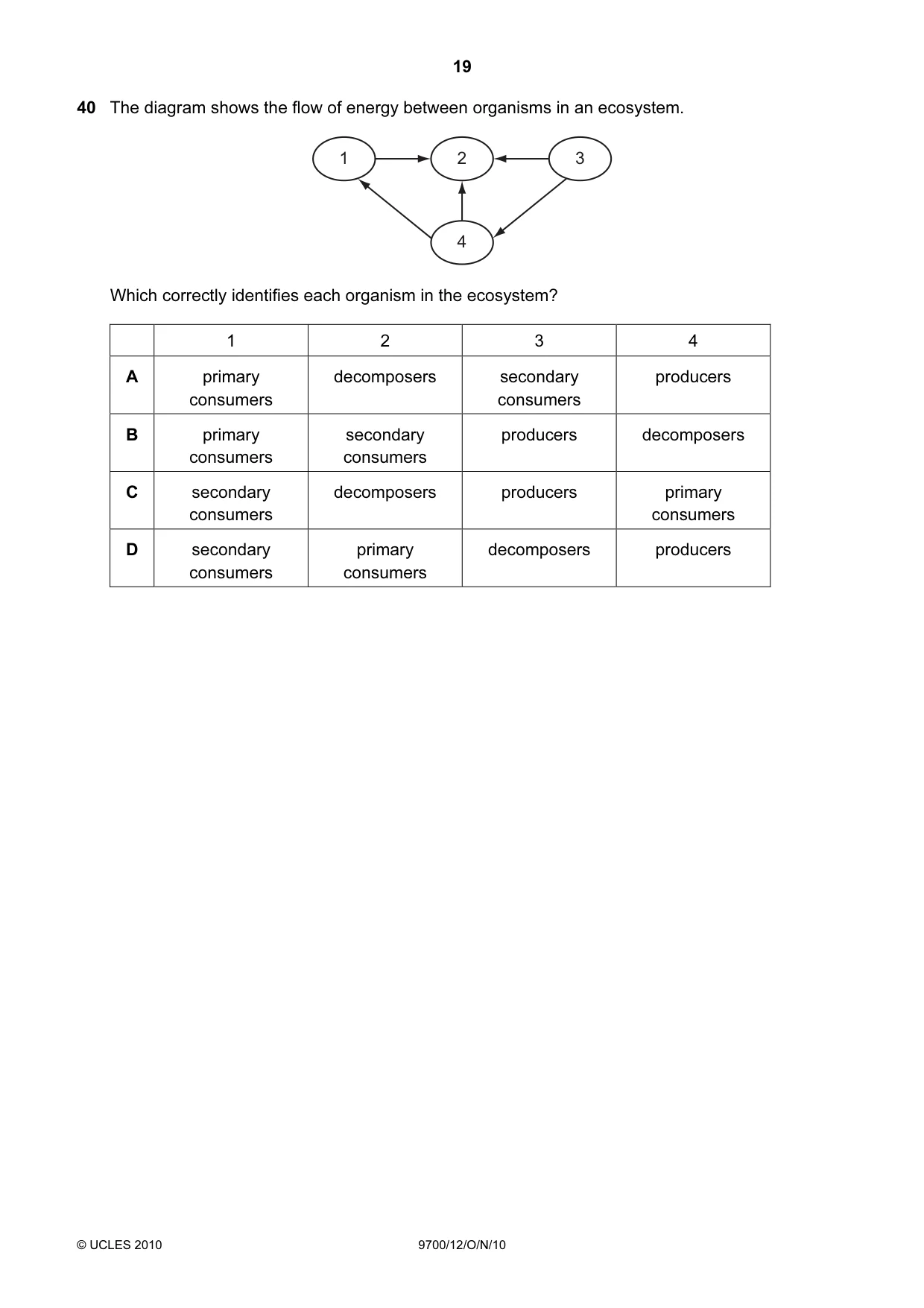
Q40 · The diagram shows the flow of energy between organisms in an ecosystem
40 The diagram shows the flow of energy between organisms in an ecosystem. 1 2 3 4 Which correctly identifies each organism in the ecosystem? 1 2 3 4 A primary decomposers secondary producers consumers consumers B primary secondary producers decomposers consumers consumers C secondary decomposers producers primary consumers consumers D secondary primary decomposers producers consumers consumers
Mark scheme: C
What was in this paper
The subtopics covered by these 40 questions, and how many questions each got. Open one in a new tab to see every Cambridge question on it.
4Cells as the basic units of living organisms3Proteins3Transport mechanisms3Transport of oxygen and carbon dioxide3Biodiversity2Movement into and out of cells2Replication and division of nuclei and cells2Structure of nucleic acids and replication of DNA2Structure of transport tissues2The microscope in cell studies2Antibiotics1Antibodies and vaccination1Carbohydrates and lipids1Chromosome behaviour in mitosis1Factors that affect enzyme action1Fluid mosaic membranes1Mode of action of enzymes1Protein synthesis1The circulatory system1The heart1The immune system1The roles of genes in1What you needed in this session
Cambridge’s own grade thresholds for 2010 Oct/Nov, Paper 1 · Variant 2. A higher threshold means an easier paper — the bar moves with how the cohort did.