Cambridge A Level Biology 9700 — 2021 Oct/Nov Paper 1 · Variant 3
9700/13/O/N/21 · 40 questions · 40 marks · ≈45 min
The question paper and its mark scheme, free to read here and free to download. This is Cambridge’s own paper, exactly as it was sat.
Question paper20 pages
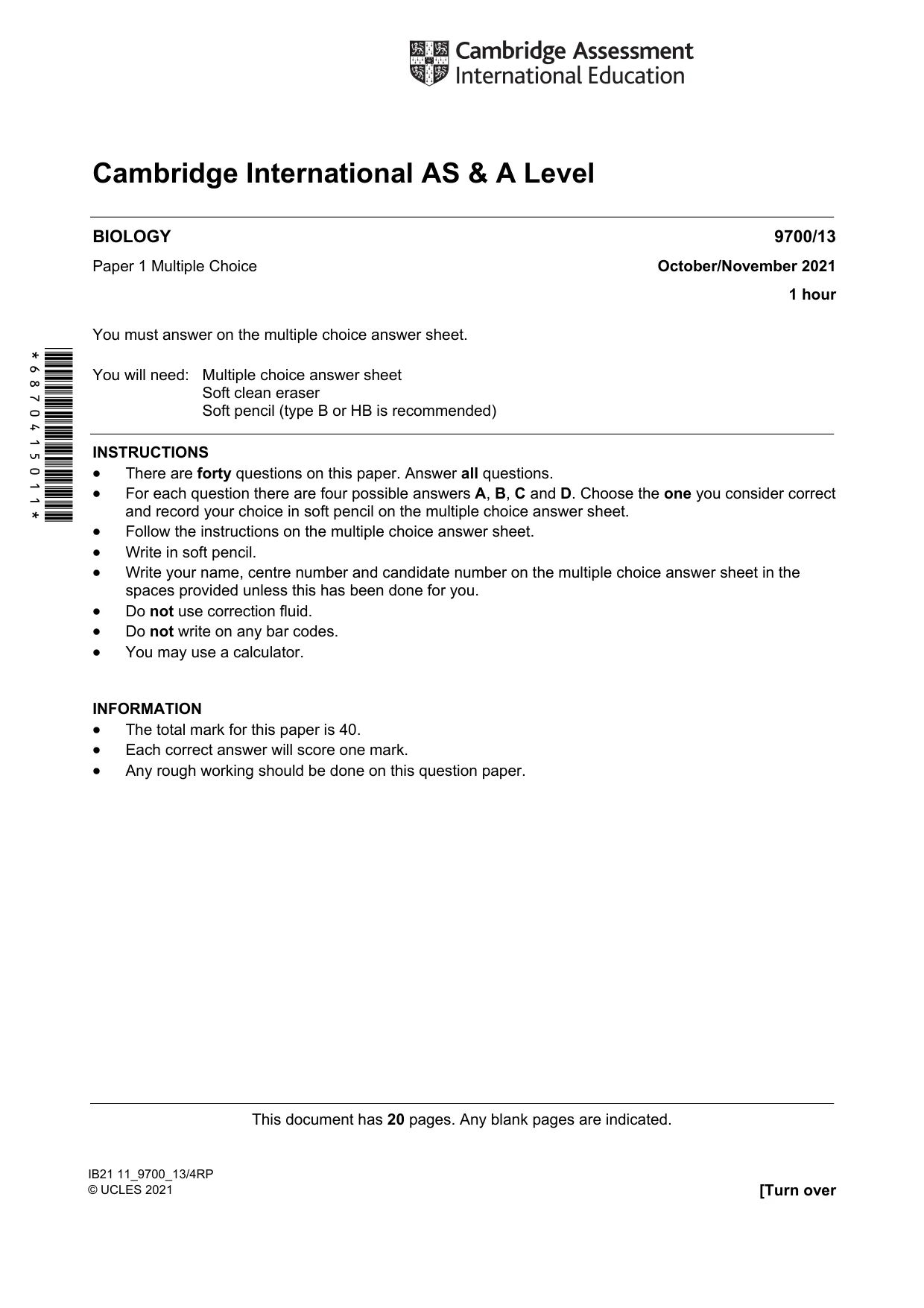



Mark scheme3 pages
Answers below. Sit the paper first if you are practising.
Questions as text
Q1 · A student was asked to use the scale bar shown to calculate the magnification of a cell…
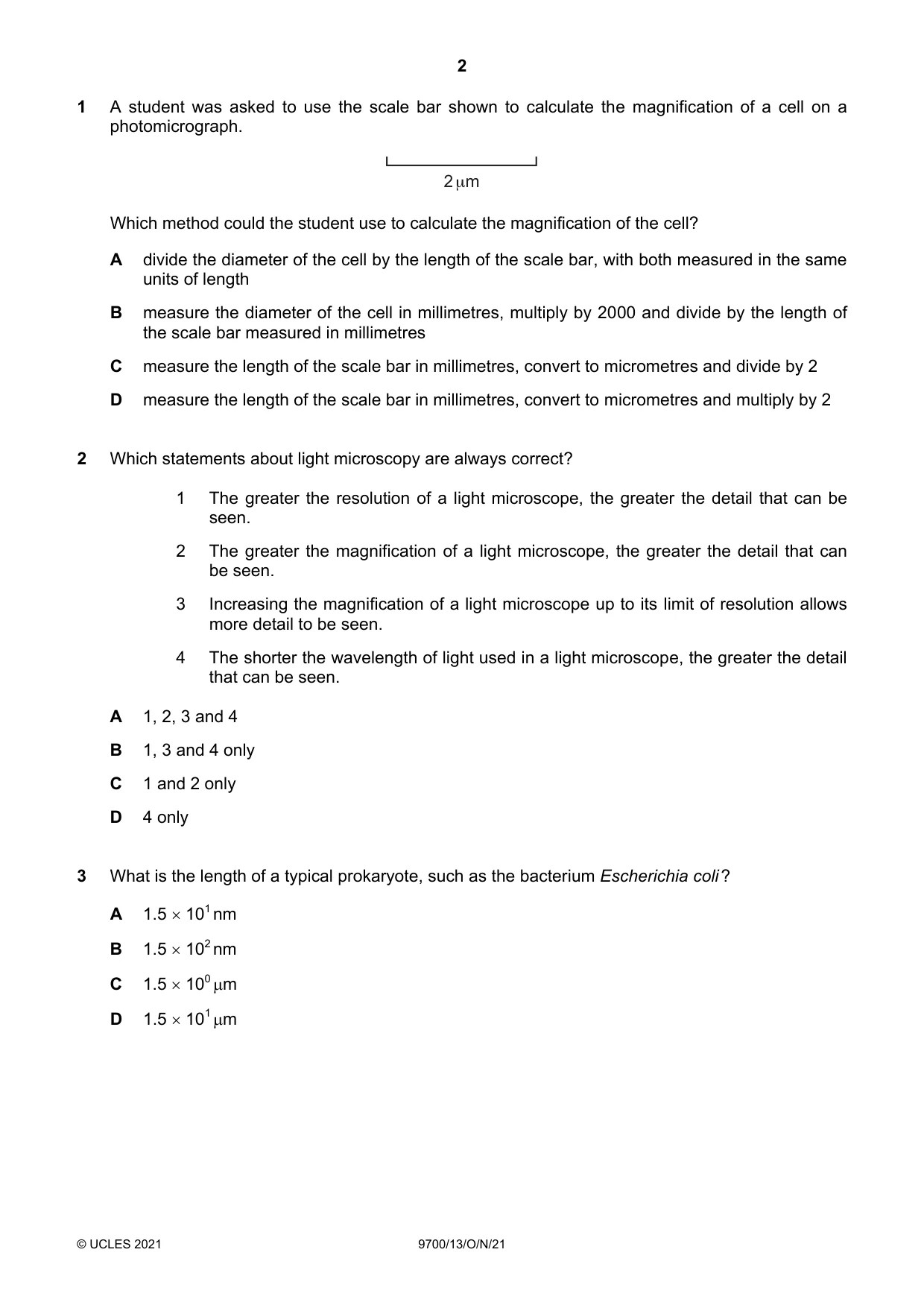
1 A student was asked to use the scale bar shown to calculate the magnification of a cell on a photomicrograph. 2 μm Which method could the student use to calculate the magnification of the cell? A divide the diameter of the cell by the length of the scale bar, with both measured in the same units of length B measure the diameter of the cell in millimetres, multiply by 2000 and divide by the length of the scale bar measured in millimetres C measure the length of the scale bar in millimetres, convert to micrometres and divide by 2 D measure the length of the scale bar in millimetres, convert to micrometres and multiply by 2
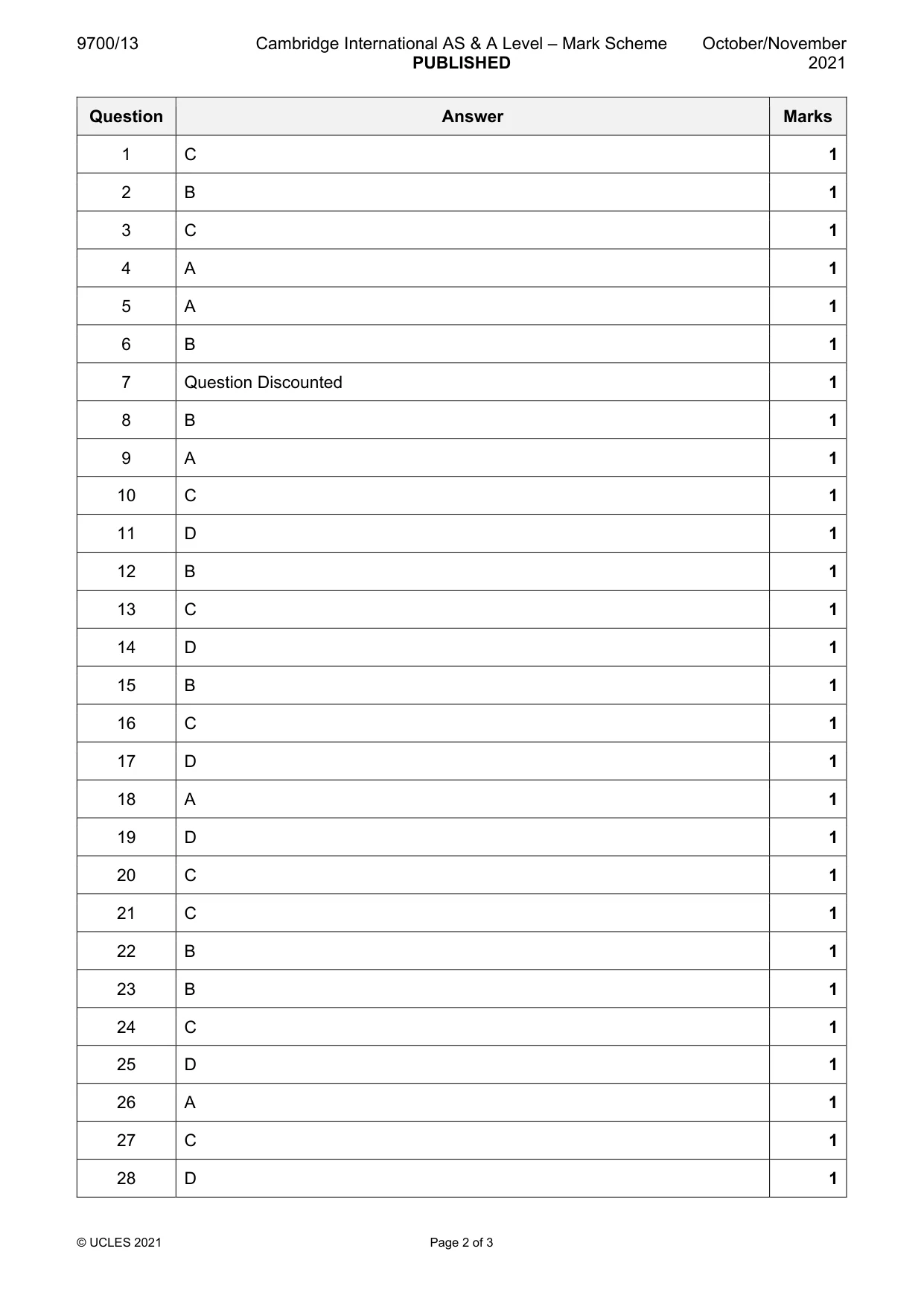
Mark scheme: C
Q2 · Which statements about light microscopy are always correct?
2 Which statements about light microscopy are always correct? 1 The greater the resolution of a light microscope, the greater the detail that can be seen. 2 The greater the magnification of a light microscope, the greater the detail that can be seen. 3 Increasing the magnification of a light microscope up to its limit of resolution allows more detail to be seen. 4 The shorter the wavelength of light used in a light microscope, the greater the detail that can be seen. A 1, 2, 3 and 4 B 1, 3 and 4 only C 1 and 2 only D 4 only
Mark scheme: B
Q3 · What is the length of a typical prokaryote, such as the bacterium Escherichia coli ?
3 What is the length of a typical prokaryote, such as the bacterium Escherichia coli ? A 1.5 101 nm B 1.5 102 nm C 1.5 100 m D 1.5 101 m
Mark scheme: C
More questions on Cells as the basic units of living organisms
Q4 · Which cell structures are present in Plasmodium?
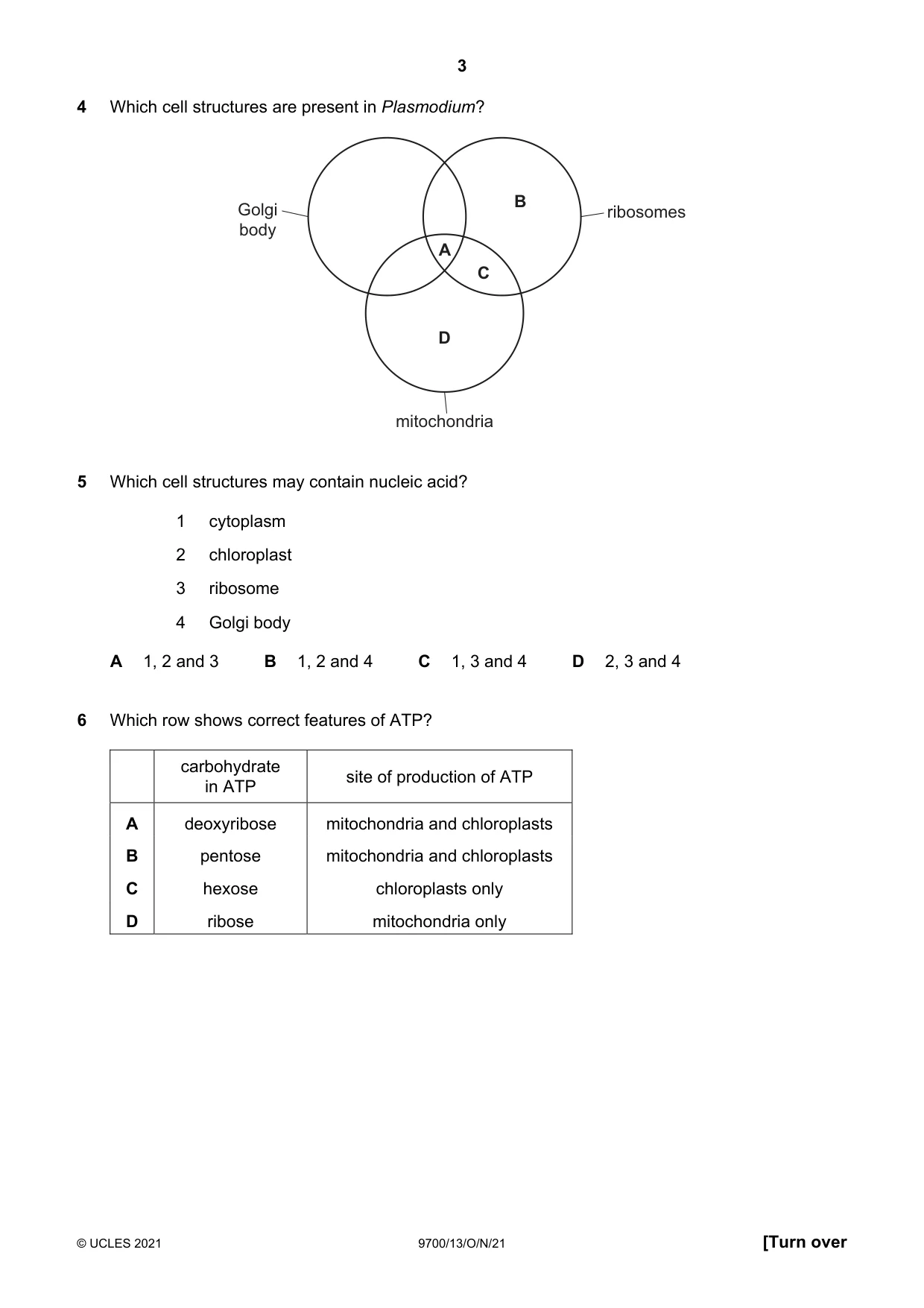
4 Which cell structures are present in Plasmodium? B Golgi ribosomes body A C D mitochondria
Mark scheme: A
More questions on Cells as the basic units of living organisms
Q5 · Which cell structures may contain nucleic acid?
5 Which cell structures may contain nucleic acid? 1 cytoplasm 2 chloroplast 3 ribosome 4 Golgi body A 1, 2 and 3 B 1, 2 and 4 C 1, 3 and 4 D 2, 3 and 4
Mark scheme: A
More questions on Cells as the basic units of living organisms
Q6 · Which row shows correct features of ATP?
6 Which row shows correct features of ATP? carbohydrate site of production of ATP in ATP A deoxyribose mitochondria and chloroplasts B pentose mitochondria and chloroplasts C hexose chloroplasts only D ribose mitochondria only
Mark scheme: B
Q7 · Which tests will identify biological molecules that contain monomers with a carboxyl…
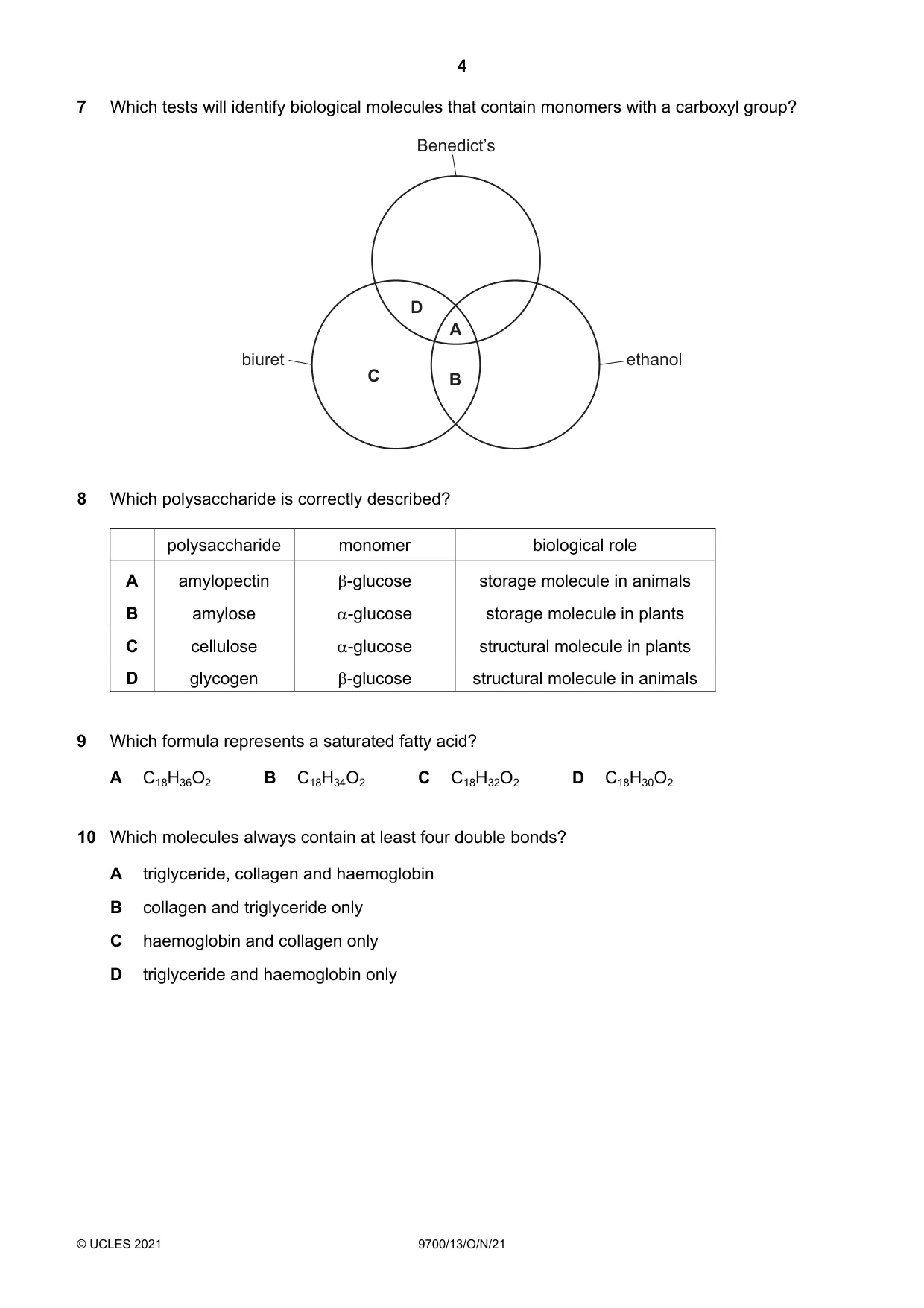
7 Which tests will identify biological molecules that contain monomers with a carboxyl group? Benedict’s D A biuret ethanol C B
Q8 · Which polysaccharide is correctly described?
8 Which polysaccharide is correctly described? polysaccharide monomer biological role A amylopectin -glucose storage molecule in animals B amylose -glucose storage molecule in plants C cellulose -glucose structural molecule in plants D glycogen -glucose structural molecule in animals
Mark scheme: B
Q9 · Which formula represents a saturated fatty acid?
9 Which formula represents a saturated fatty acid? A C18H36O2 B C18H34O2 C C18H32O2 D C18H30O2
Mark scheme: A
Q10 · Which molecules always contain at least four double bonds?
10 Which molecules always contain at least four double bonds? A triglyceride, collagen and haemoglobin B collagen and triglyceride only C haemoglobin and collagen only D triglyceride and haemoglobin only
Mark scheme: C
Q11 · Which row about the structure of proteins is correct?
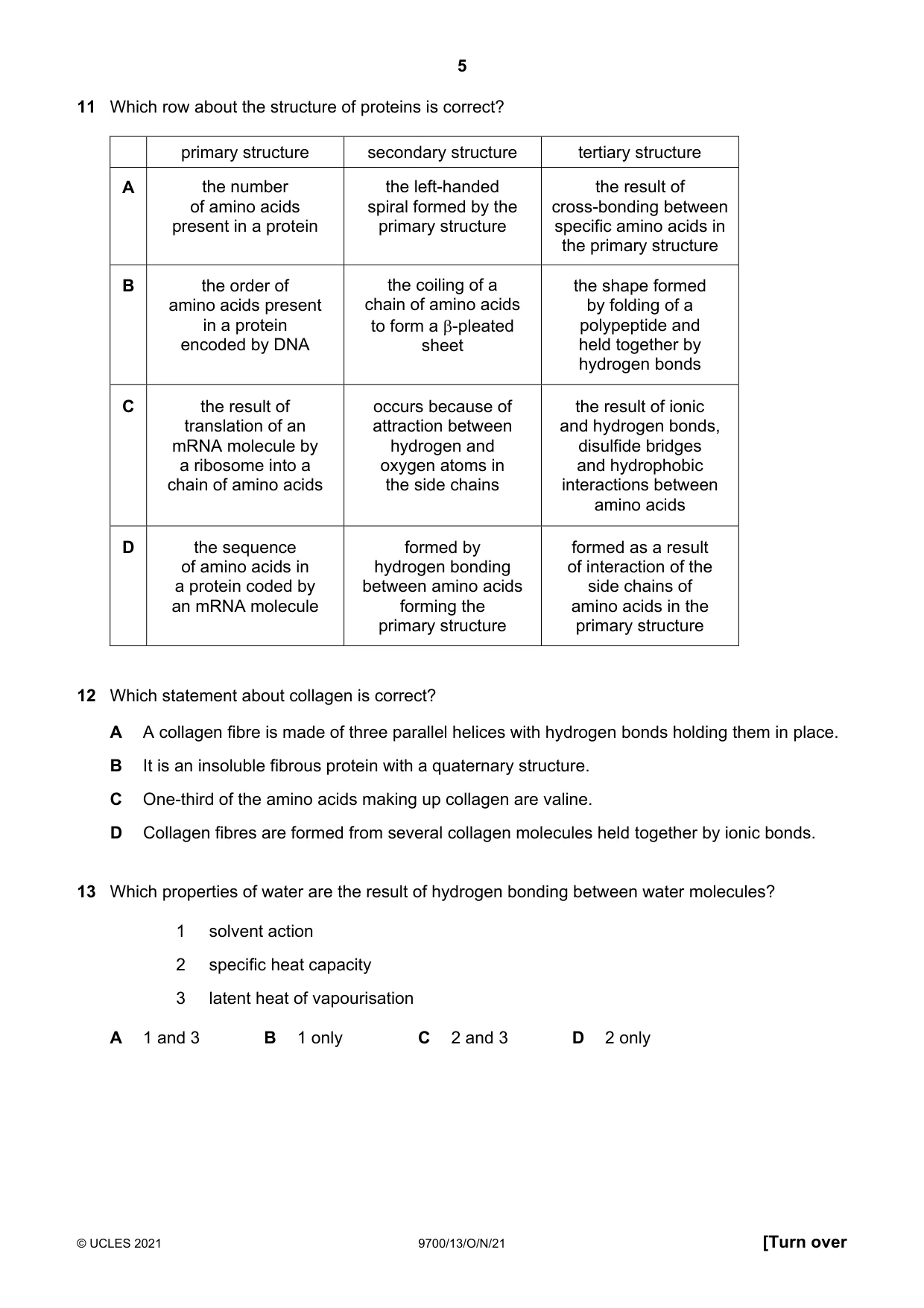
11 Which row about the structure of proteins is correct? primary structure secondary structure tertiary structure A the number the left-handed the result of of amino acids spiral formed by the cross-bonding between present in a protein primary structure specific amino acids in the primary structure B the order of the coiling of a the shape formed amino acids present chain of amino acids by folding of a in a protein to form a -pleated polypeptide and encoded by DNA sheet held together by hydrogen bonds C the result of occurs because of the result of ionic translation of an attraction between and hydrogen bonds, mRNA molecule by hydrogen and disulfide bridges a ribosome into a oxygen atoms in and hydrophobic chain of amino acids the side chains interactions between amino acids D the sequence formed by formed as a result of amino acids in hydrogen bonding of interaction of the a protein coded by between amino acids side chains of an mRNA molecule forming the amino acids in the primary structure primary structure
Mark scheme: D
Q12 · Which statement about collagen is correct?
12 Which statement about collagen is correct? A A collagen fibre is made of three parallel helices with hydrogen bonds holding them in place. B It is an insoluble fibrous protein with a quaternary structure. C One-third of the amino acids making up collagen are valine. D Collagen fibres are formed from several collagen molecules held together by ionic bonds.
Mark scheme: B
Q13 · Which properties of water are the result of hydrogen bonding between water molecules?
13 Which properties of water are the result of hydrogen bonding between water molecules? 1 solvent action 2 specific heat capacity 3 latent heat of vapourisation A 1 and 3 B 1 only C 2 and 3 D 2 only
Mark scheme: C
Q14 · Which descriptions about all enzymes are correct?
14 Which descriptions about all enzymes are correct? 1 catalyse the breakdown of large molecules into smaller molecules 2 only function inside cells 3 form temporary bonds with the substrate 4 have a tertiary structure A 1 and 2 B 1 and 3 C 2 and 3 D 3 and 4
Mark scheme: D
Q15 · The cells in the roots of beetroot plants contain a red pigment
15 The cells in the roots of beetroot plants contain a red pigment. When pieces of root tissue are soaked in cold water, some of the red pigment leaks out of the cells into the water. An experiment was carried out to investigate the effect of temperature on the loss of red pigment from the root cells. It was found that the higher the temperature of the water, the higher the rate of loss of red pigment from the root cells. Which statements could explain this trend? 1 Enzymes in the cells denature as the temperature increases, so the pigment can no longer be used for reactions inside the cells and diffuses out. 2 As the temperature increases, the tertiary structure of protein molecules in the cell surface membrane changes, increasing the permeability of the membrane. 3 Phospholipid molecules gain kinetic energy as the temperature rises, increasing the fluidity of the phospholipid bilayer and allowing pigment molecules to diffuse out more easily. A 1 and 2 B 2 and 3 C 2 only D 3 only
Mark scheme: B
Q16 · The diagram shows a partially plasmolysed plant cell
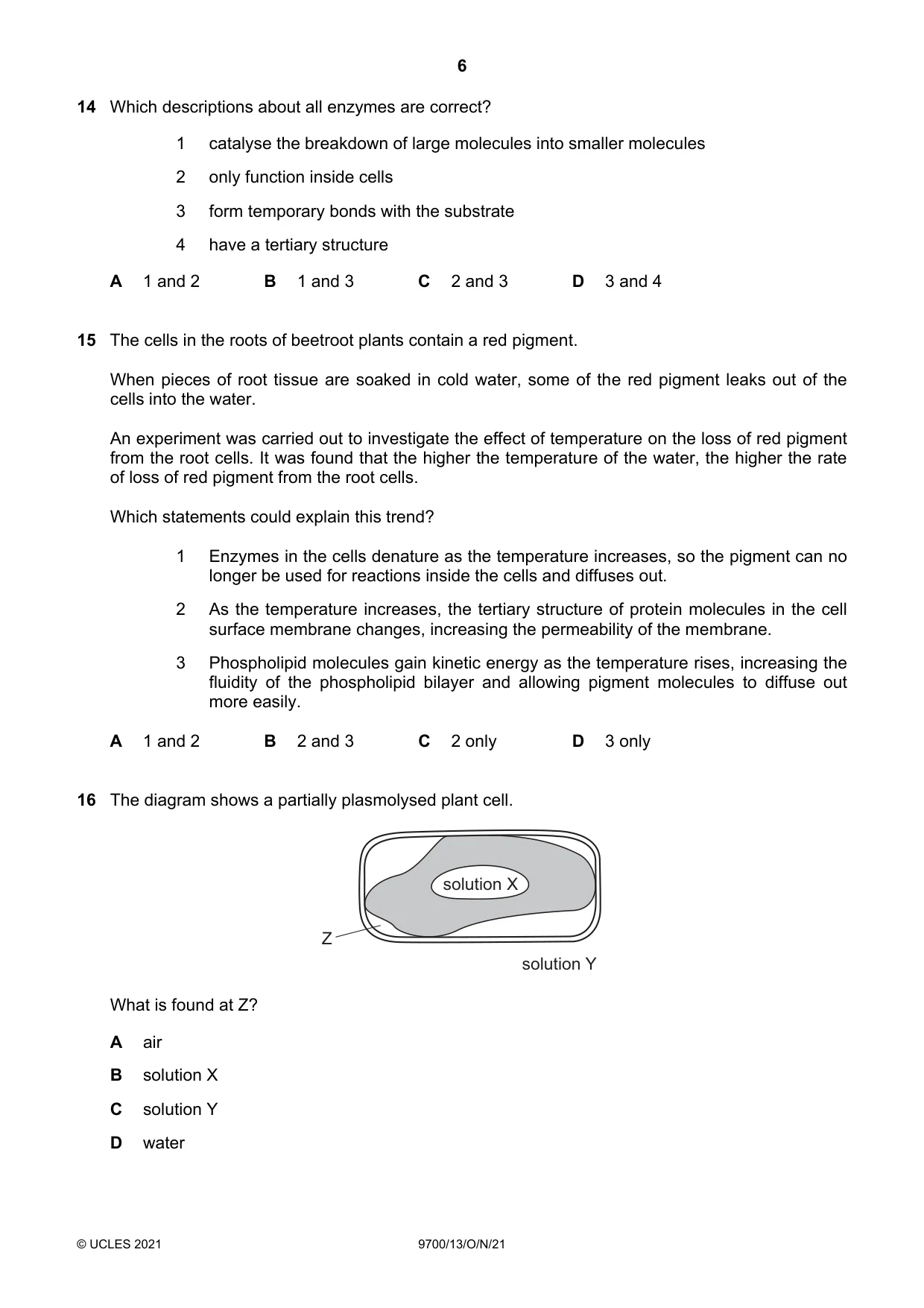
16 The diagram shows a partially plasmolysed plant cell. solution X Z solution Y What is found at Z? A air B solution X C solution Y D water
Mark scheme: C
Q17 · A single-celled organism lives in freshwater
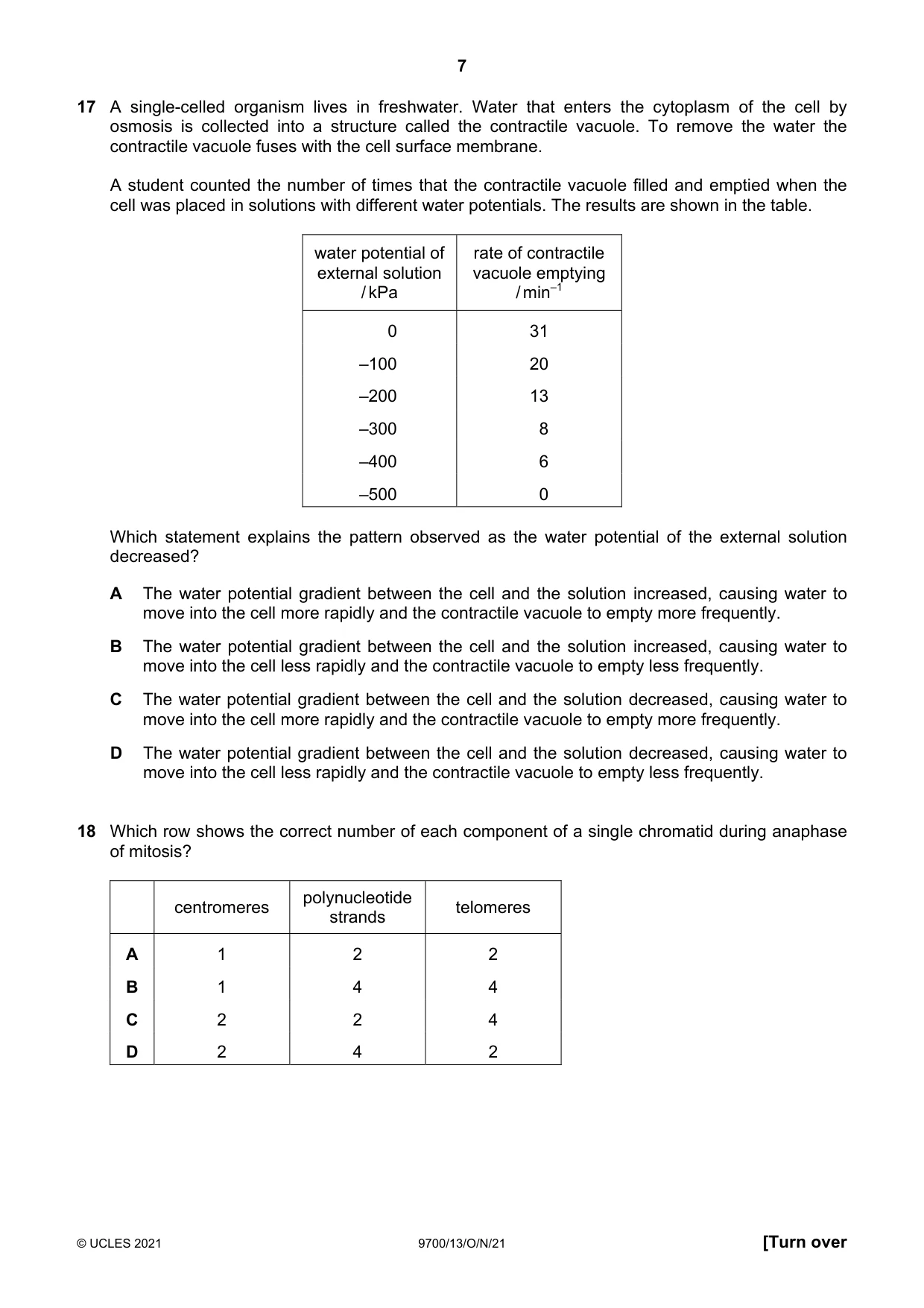
17 A single-celled organism lives in freshwater. Water that enters the cytoplasm of the cell by osmosis is collected into a structure called the contractile vacuole. To remove the water the contractile vacuole fuses with the cell surface membrane. A student counted the number of times that the contractile vacuole filled and emptied when the cell was placed in solutions with different water potentials. The results are shown in the table. water potential of rate of contractile external solution vacuole emptying / kPa / min–1 0 31 –100 20 –200 13 –300 8 –400 6 –500 0 Which statement explains the pattern observed as the water potential of the external solution decreased? A The water potential gradient between the cell and the solution increased, causing water to move into the cell more rapidly and the contractile vacuole to empty more frequently. B The water potential gradient between the cell and the solution increased, causing water to move into the cell less rapidly and the contractile vacuole to empty less frequently. C The water potential gradient between the cell and the solution decreased, causing water to move into the cell more rapidly and the contractile vacuole to empty more frequently. D The water potential gradient between the cell and the solution decreased, causing water to move into the cell less rapidly and the contractile vacuole to empty less frequently.
Mark scheme: D
Q18 · Which row shows the correct number of each component of a single chromatid during…
18 Which row shows the correct number of each component of a single chromatid during anaphase of mitosis? polynucleotide centromeres telomeres strands A 1 2 2 B 1 4 4 C 2 2 4 D 2 4 2
Mark scheme: A
Q19 · Some processes are listed
19 Some processes are listed. cytokinesis differentiation DNA replication mitosis How many of the listed processes occur during tissue repair by stem cells? A 1 B 2 C 3 D 4
Mark scheme: D
More questions on Replication and division of nuclei and cells
Q20 · The photomicrographs show cells in various stages of the cell cycle
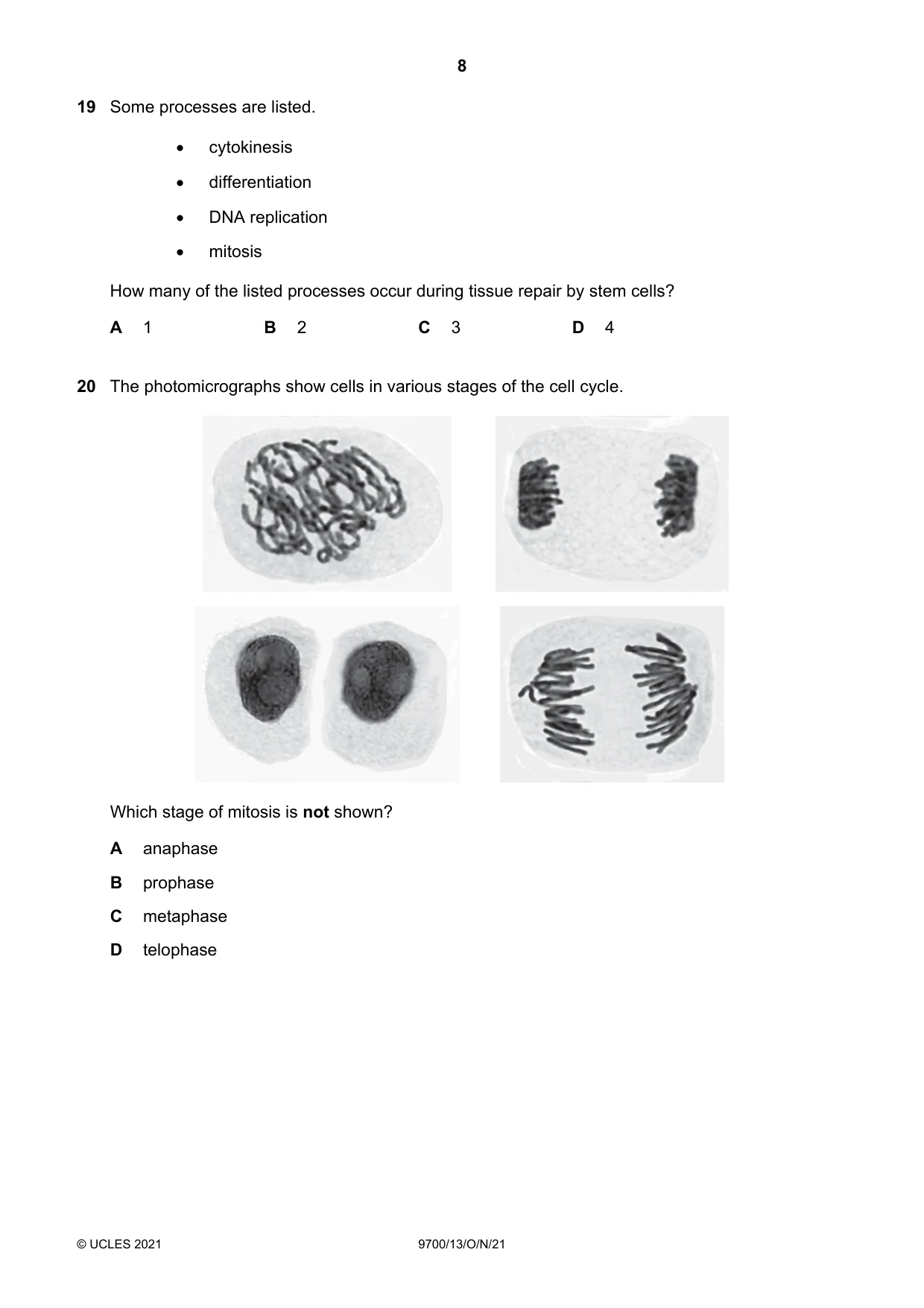
20 The photomicrographs show cells in various stages of the cell cycle. Which stage of mitosis is not shown? A anaphase B prophase C metaphase D telophase
Mark scheme: C
Q21 · Which letter in the key describes uracil?
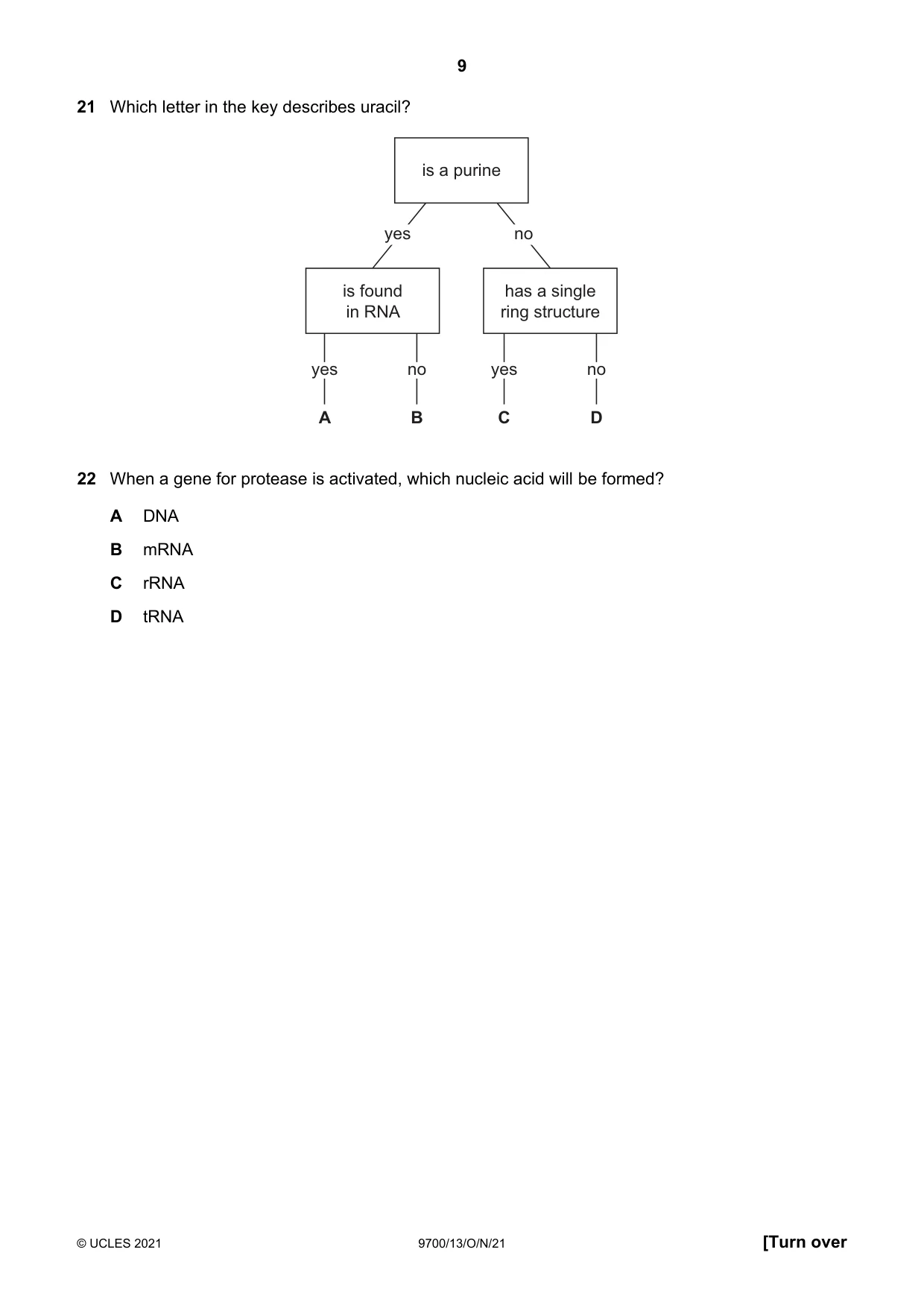
21 Which letter in the key describes uracil? is a purine yes no is found has a single in RNA ring structure yes no yes no A B C D
Mark scheme: C
More questions on Structure of nucleic acids and replication of DNA
Q22 · When a gene for protease is activated, which nucleic acid will be formed?
22 When a gene for protease is activated, which nucleic acid will be formed? A DNA B mRNA C rRNA D tRNA
Mark scheme: B
Q23 · The diagram shows a vascular bundle from the stem of a plant
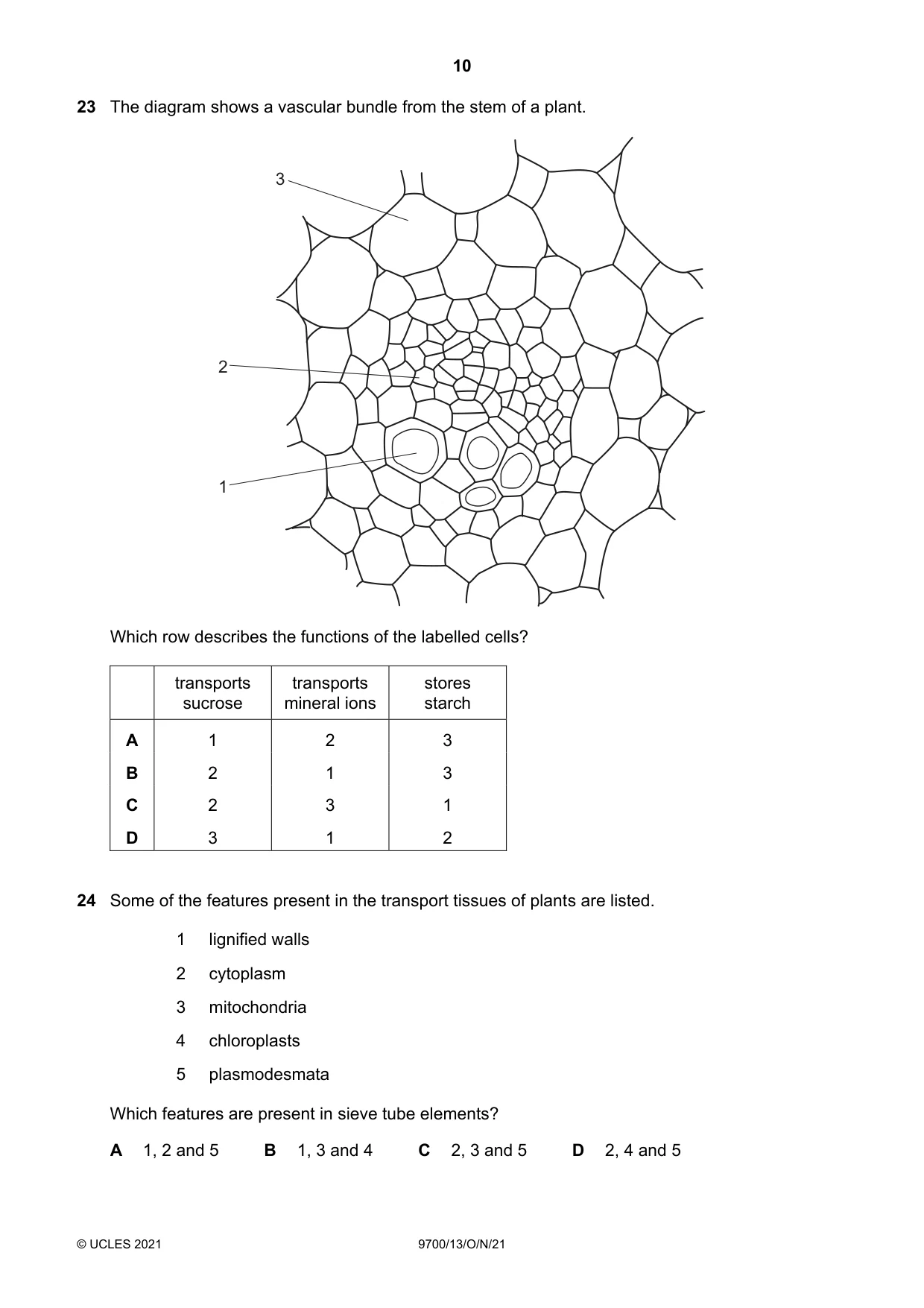
23 The diagram shows a vascular bundle from the stem of a plant. 3 2 1 Which row describes the functions of the labelled cells? transports transports stores sucrose mineral ions starch A 1 2 3 B 2 1 3 C 2 3 1 D 3 1 2
Mark scheme: B
Q24 · Some of the features present in the transport tissues of plants are listed
24 Some of the features present in the transport tissues of plants are listed. 1 lignified walls 2 cytoplasm 3 mitochondria 4 chloroplasts 5 plasmodesmata Which features are present in sieve tube elements? A 1, 2 and 5 B 1, 3 and 4 C 2, 3 and 5 D 2, 4 and 5
Mark scheme: C
Q25 · Which statements explain why transpiration is an inevitable consequence of gas exchange…
25 Which statements explain why transpiration is an inevitable consequence of gas exchange in plants? 1 Hydrolysis reactions are taking place in cells. 2 ATP production is occurring. 3 Stomata must be open. A 1, 2 and 3 B 1 and 2 only C 2 and 3 only D 3 only
Mark scheme: D
Q26 · In an investigation, a leafy shoot was attached to a potometer and exposed to a variety…
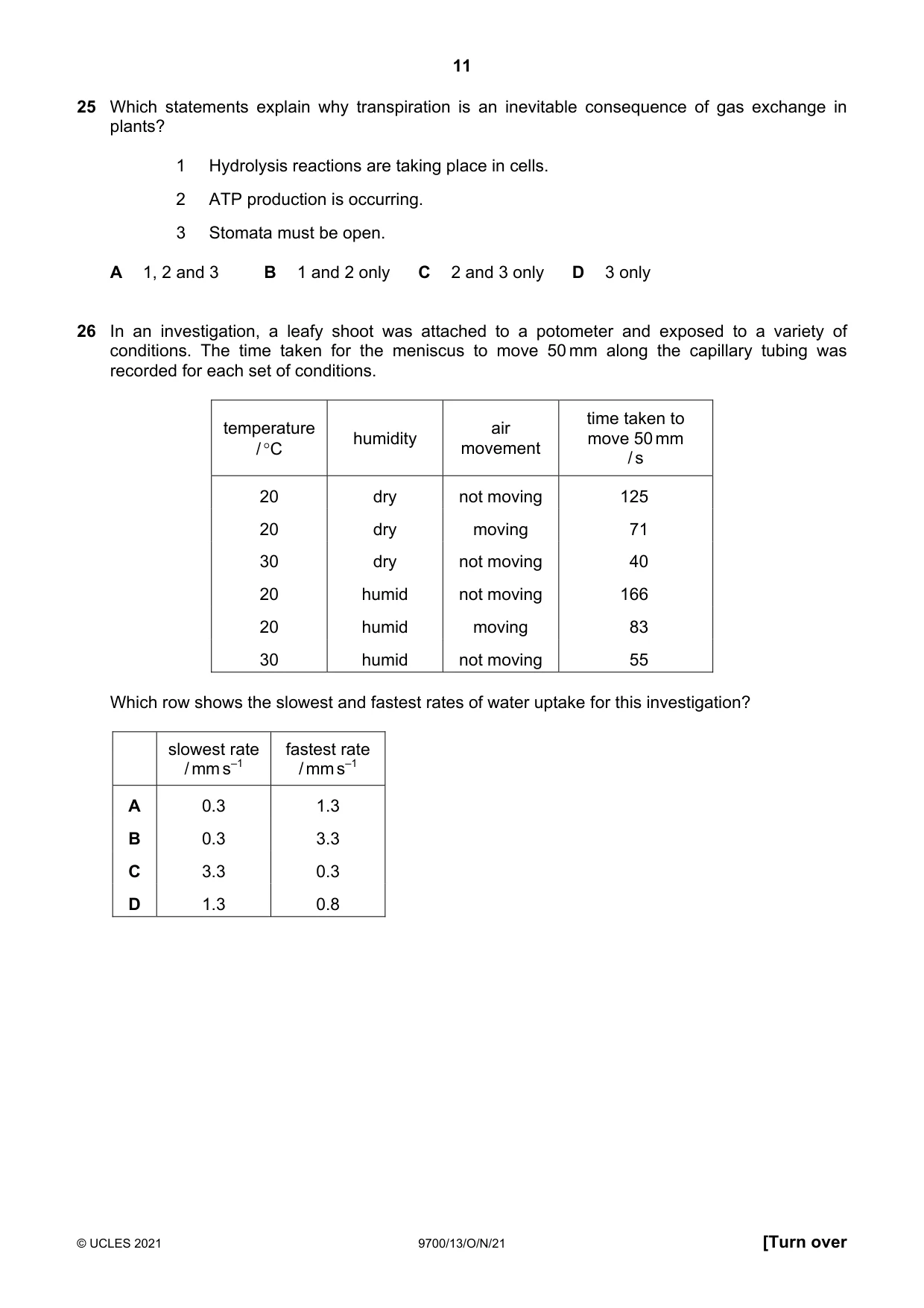
26 In an investigation, a leafy shoot was attached to a potometer and exposed to a variety of conditions. The time taken for the meniscus to move 50 mm along the capillary tubing was recorded for each set of conditions. time taken to temperature air humidity move 50 mm / C movement / s 20 dry not moving 125 20 dry moving 71 30 dry not moving 40 20 humid not moving 166 20 humid moving 83 30 humid not moving 55 Which row shows the slowest and fastest rates of water uptake for this investigation? slowest rate fastest rate / mm s–1 / mm s–1 A 0.3 1.3 B 0.3 3.3 C 3.3 0.3 D 1.3 0.8
Mark scheme: A
Q27 · Proton pumps (H+ pumps) and co-transporters are used by plants when loading sucrose into…
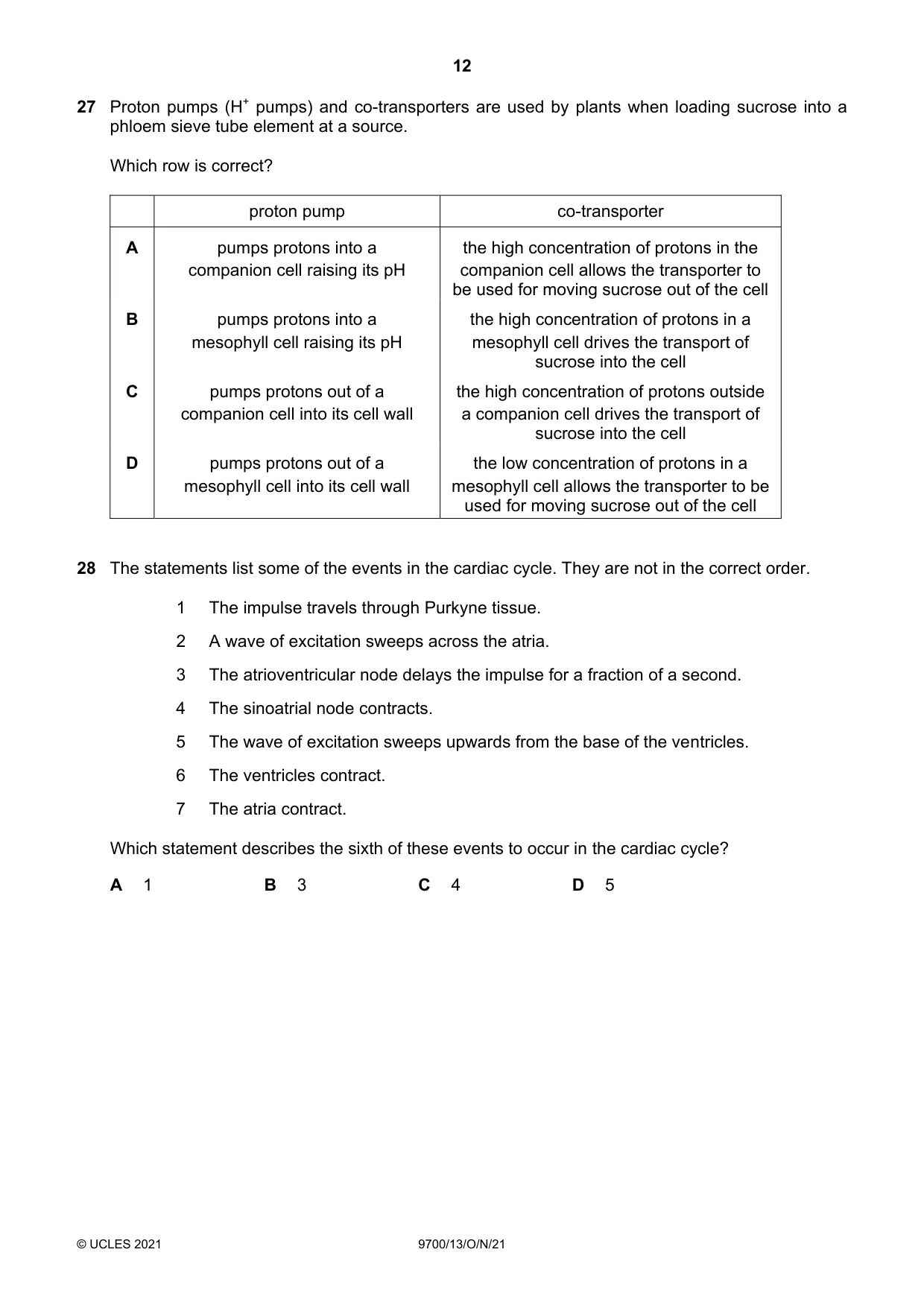
27 Proton pumps (H+ pumps) and co-transporters are used by plants when loading sucrose into a phloem sieve tube element at a source. Which row is correct? proton pump co-transporter A pumps protons into a the high concentration of protons in the companion cell raising its pH companion cell allows the transporter to be used for moving sucrose out of the cell B pumps protons into a the high concentration of protons in a mesophyll cell raising its pH mesophyll cell drives the transport of sucrose into the cell C pumps protons out of a the high concentration of protons outside companion cell into its cell wall a companion cell drives the transport of sucrose into the cell D pumps protons out of a the low concentration of protons in a mesophyll cell into its cell wall mesophyll cell allows the transporter to be used for moving sucrose out of the cell
Mark scheme: C
Q28 · The statements list some of the events in the cardiac cycle
28 The statements list some of the events in the cardiac cycle. They are not in the correct order. 1 The impulse travels through Purkyne tissue. 2 A wave of excitation sweeps across the atria. 3 The atrioventricular node delays the impulse for a fraction of a second. 4 The sinoatrial node contracts. 5 The wave of excitation sweeps upwards from the base of the ventricles. 6 The ventricles contract. 7 The atria contract. Which statement describes the sixth of these events to occur in the cardiac cycle? A 1 B 3 C 4 D 5
Mark scheme: D
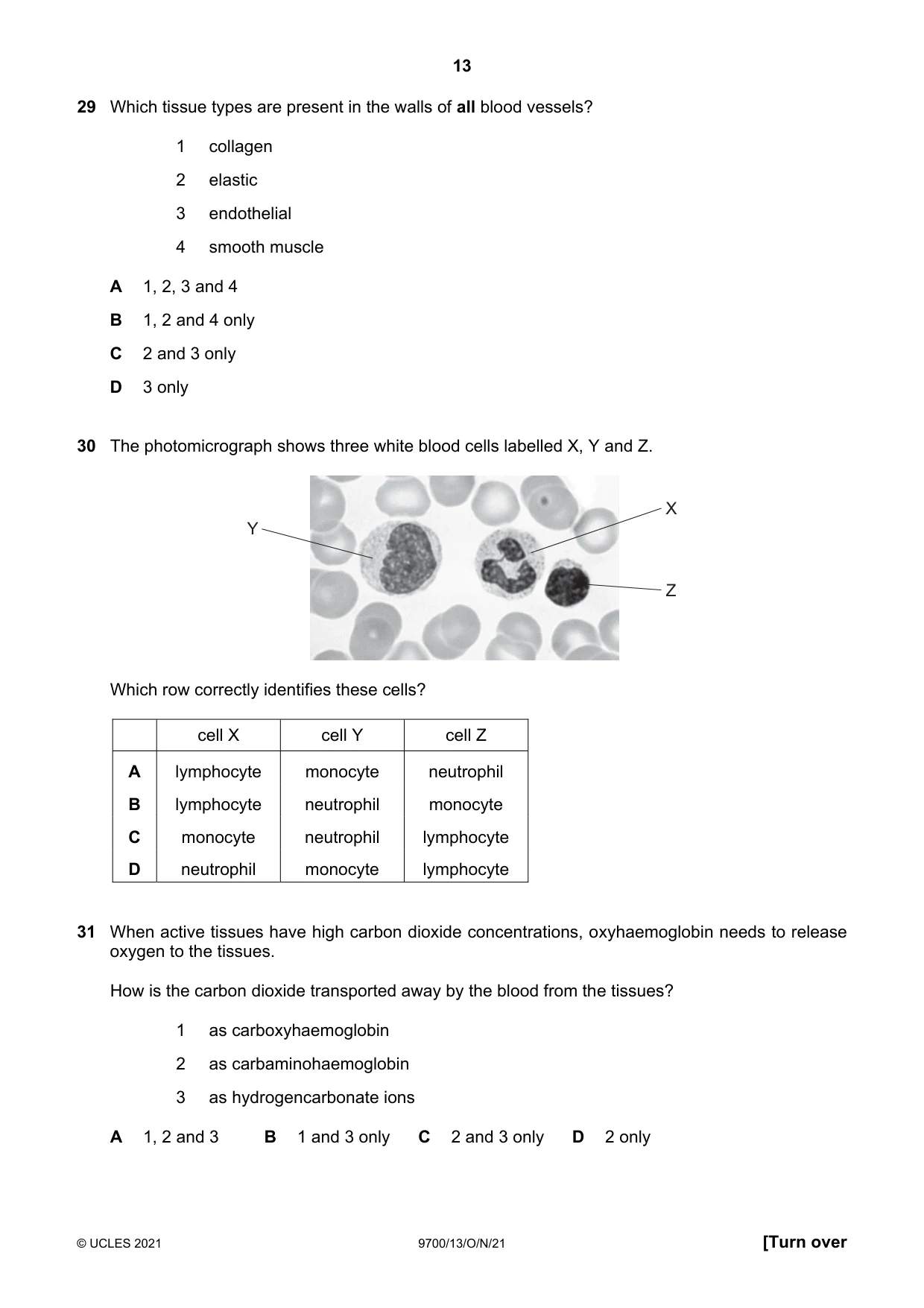
Q29 · Which tissue types are present in the walls of all blood vessels?
29 Which tissue types are present in the walls of all blood vessels? 1 collagen 2 elastic 3 endothelial 4 smooth muscle A 1, 2, 3 and 4 B 1, 2 and 4 only C 2 and 3 only D 3 only
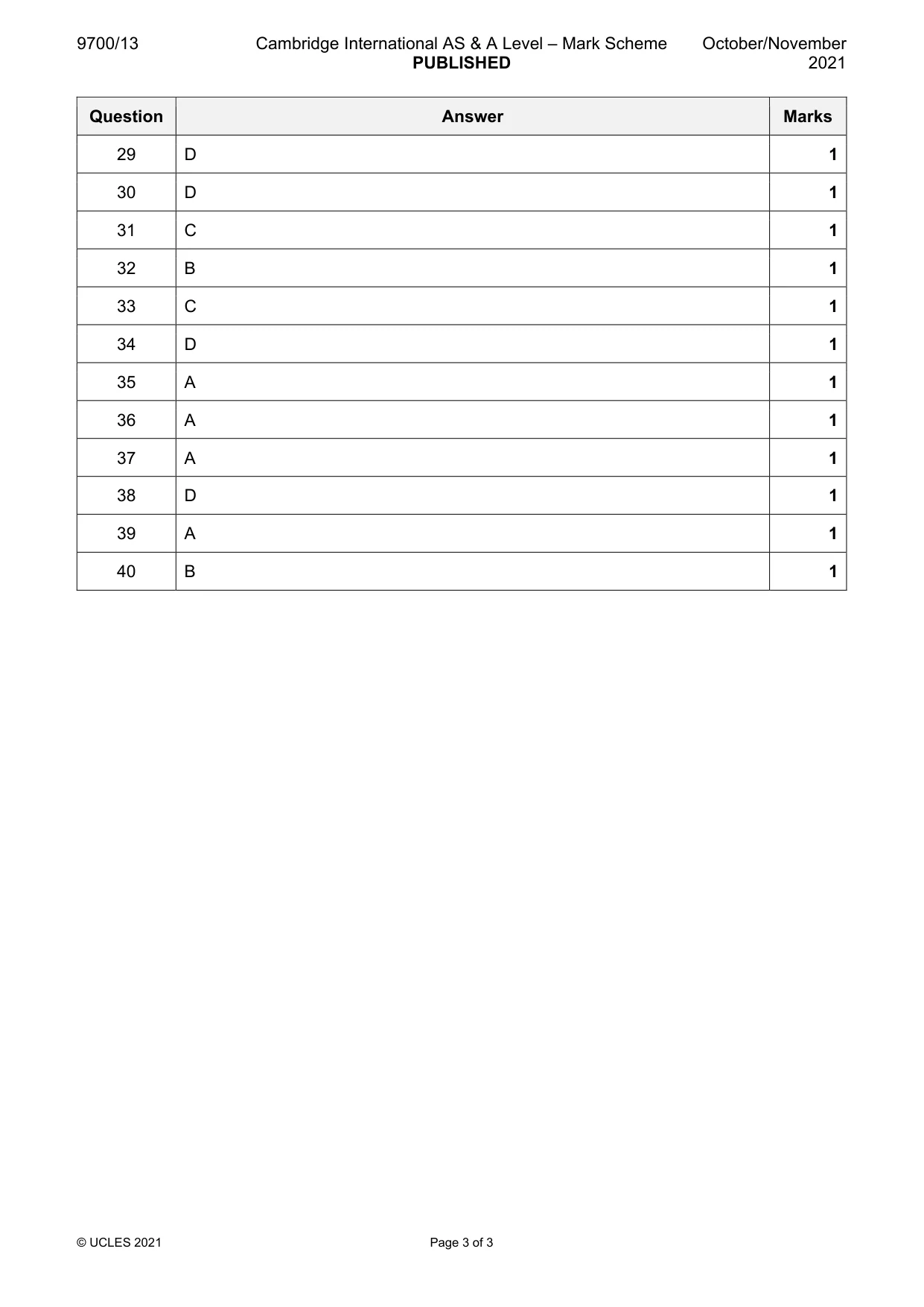
Mark scheme: D
Q30 · The photomicrograph shows three white blood cells labelled X, Y and Z
30 The photomicrograph shows three white blood cells labelled X, Y and Z. X Y Z Which row correctly identifies these cells? cell X cell Y cell Z A lymphocyte monocyte neutrophil B lymphocyte neutrophil monocyte C monocyte neutrophil lymphocyte D neutrophil monocyte lymphocyte
Mark scheme: D
Q31 · When active tissues have high carbon dioxide concentrations, oxyhaemoglobin needs to…
31 When active tissues have high carbon dioxide concentrations, oxyhaemoglobin needs to release oxygen to the tissues. How is the carbon dioxide transported away by the blood from the tissues? 1 as carboxyhaemoglobin 2 as carbaminohaemoglobin 3 as hydrogencarbonate ions A 1, 2 and 3 B 1 and 3 only C 2 and 3 only D 2 only
Mark scheme: C
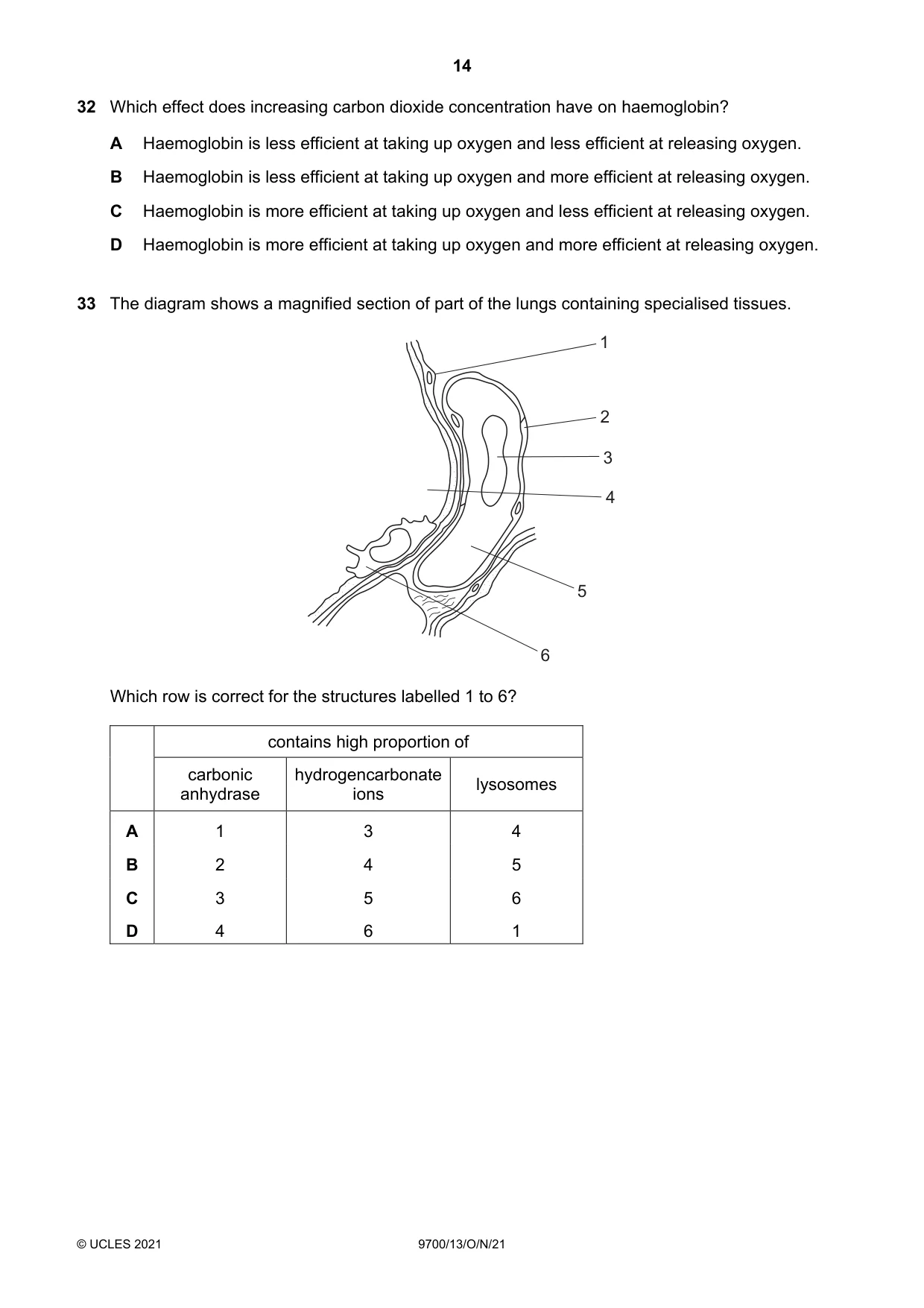
Q32 · Which effect does increasing carbon dioxide concentration have on haemoglobin?
32 Which effect does increasing carbon dioxide concentration have on haemoglobin? A Haemoglobin is less efficient at taking up oxygen and less efficient at releasing oxygen. B Haemoglobin is less efficient at taking up oxygen and more efficient at releasing oxygen. C Haemoglobin is more efficient at taking up oxygen and less efficient at releasing oxygen. D Haemoglobin is more efficient at taking up oxygen and more efficient at releasing oxygen.
Mark scheme: B
Q33 · The diagram shows a magnified section of part of the lungs containing specialised tissues
33 The diagram shows a magnified section of part of the lungs containing specialised tissues. 1 2 3 4 5 6 Which row is correct for the structures labelled 1 to 6? contains high proportion of carbonic hydrogencarbonate lysosomes anhydrase ions A 1 3 4 B 2 4 5 C 3 5 6 D 4 6 1
Mark scheme: C
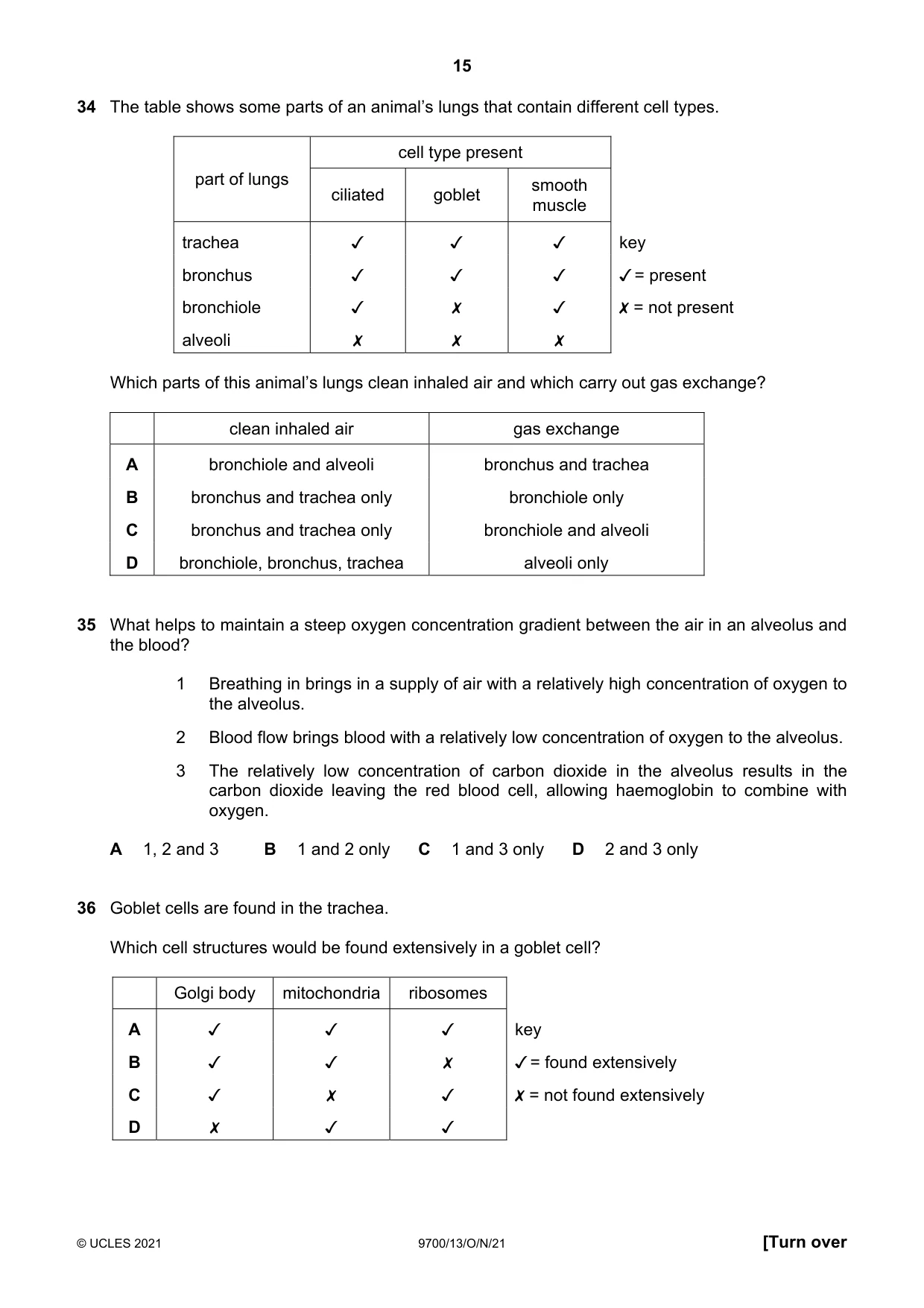
Q34 · The table shows some parts of an animal’s lungs that contain different cell types
34 The table shows some parts of an animal’s lungs that contain different cell types. cell type present Partoflungs |) itiated | goblet smooin trachea v v v bronchus v v v bronchiole v x v alveoli x x x key / = present X = not present Which parts of this animal’s lungs clean inhaled air and which carry out gas exchange? clean inhaled air gas exchange 0 0O WwW > bronchiole and alveoli bronchus and trachea only bronchus and trachea only bronchiole, bronchus, trachea bronchus and trachea bronchiole only bronchiole and alveoli alveoli only
Mark scheme: D
Q35 · What helps to maintain a steep oxygen concentration gradient between the air in an…
35 What helps to maintain a steep oxygen concentration gradient between the air in an alveolus and the blood? 1 Breathing in brings in a supply of air with a relatively high concentration of oxygen to the alveolus. 2 Blood flow brings blood with a relatively low concentration of oxygen to the alveolus. 3 The relatively low concentration of carbon dioxide in the alveolus results in the carbon dioxide leaving the red blood cell, allowing haemoglobin to combine with oxygen. A 1, 2 and 3 B 1 and 2 only C 1 and 3 only D 2 and 3 only
Mark scheme: A
Q36 · Goblet cells are found in the trachea
36 Goblet cells are found in the trachea. Which cell structures would be found extensively in a goblet cell? Golgi body | mitochondria | ribosomes v v v key ¥ = found extensively 00 WwW > v v x v Xx v X = not found extensively x v v
Mark scheme: A
More questions on Cells as the basic units of living organisms
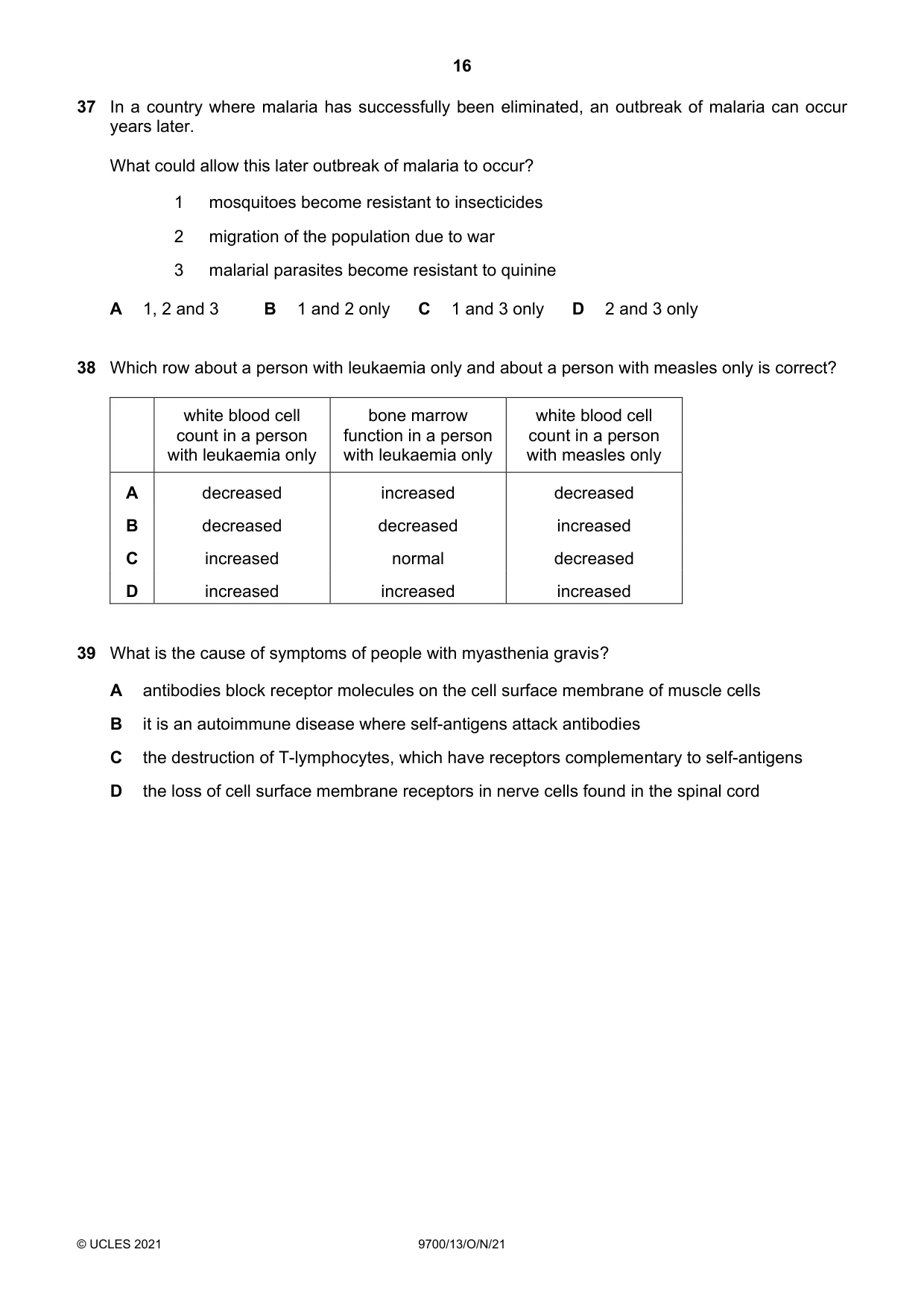
Q37 · In a country where malaria has successfully been eliminated, an outbreak of malaria can…
37 In a country where malaria has successfully been eliminated, an outbreak of malaria can occur years later. What could allow this later outbreak of malaria to occur? 1 mosquitoes become resistant to insecticides 2 migration of the population due to war 3 malarial parasites become resistant to quinine A 1, 2 and 3 B 1 and 2 only C 1 and 3 only D 2 and 3 only
Mark scheme: A
Q38 · Which row about a person with leukaemia only and about a person with measles only is…
38 Which row about a person with leukaemia only and about a person with measles only is correct? white blood cell bone marrow white blood cell count in a person function in a person count in a person with leukaemia only with leukaemia only with measles only A decreased increased decreased B decreased decreased increased C increased normal decreased D increased increased increased
Mark scheme: D
Q39 · What is the cause of symptoms of people with myasthenia gravis?
39 What is the cause of symptoms of people with myasthenia gravis? A antibodies block receptor molecules on the cell surface membrane of muscle cells B it is an autoimmune disease where self-antigens attack antibodies C the destruction of T-lymphocytes, which have receptors complementary to self-antigens D the loss of cell surface membrane receptors in nerve cells found in the spinal cord
Mark scheme: A
Q40 · Tetanus is a bacterial infection
40 Tetanus is a bacterial infection. The graph shows the blood antibody concentration of two people. On day 0, person G was injected with antibodies to the tetanus toxin and person H was injected with the vaccine for tetanus. 25 G H 20 antibody 15 concentration / arbitrary units 10 5 0 0 5 10 15 20 time / days time of injection What could be the result if G and H were infected with the tetanus bacteria on day 20? A Tetanus antibodies would not be produced in person G. B Antibody production would peak after day 32 in person G. C Antibody concentration would stay constant in person H. D A second antibody peak would occur in person H that would be lower than the first peak.
Mark scheme: B
What was in this paper
The subtopics covered by these 40 questions, and how many questions each got. Open one in a new tab to see every Cambridge question on it.
4Proteins3Transport mechanisms3Transport of oxygen and carbon dioxide3Carbohydrates and lipids2Chromosome behaviour in mitosis2Movement into and out of cells2Structure of transport tissues2The circulatory system2The gas exchange system2The immune system2The microscope in cell studies2Antibodies and vaccination1Energy1Fluid mosaic membranes1Infectious diseases1Mode of action of enzymes1Protein synthesis1Replication and division of nuclei and cells1Structure of nucleic acids and replication of DNA1Testing for biological molecules1The heart1Water1What you needed in this session
Cambridge’s own grade thresholds for 2021 Oct/Nov, Paper 1 · Variant 3. A higher threshold means an easier paper — the bar moves with how the cohort did.