Cambridge A Level Biology 9700 — 2018 May/June Paper 1 · Variant 3
9700/13/M/J/18 · 40 questions · 40 marks · ≈45 min
The question paper and its mark scheme, free to read here and free to download. This is Cambridge’s own paper, exactly as it was sat.
Question paper16 pages
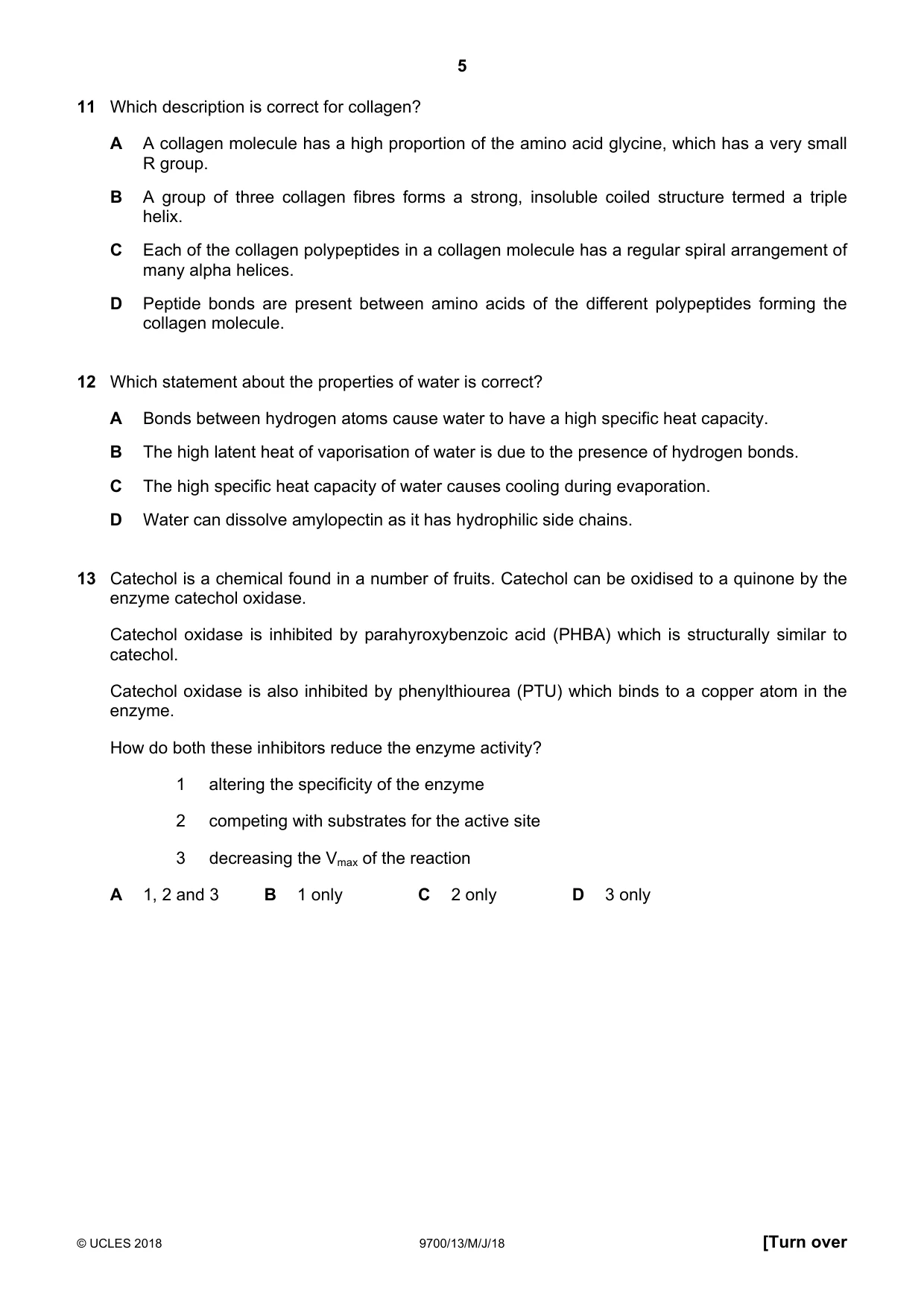
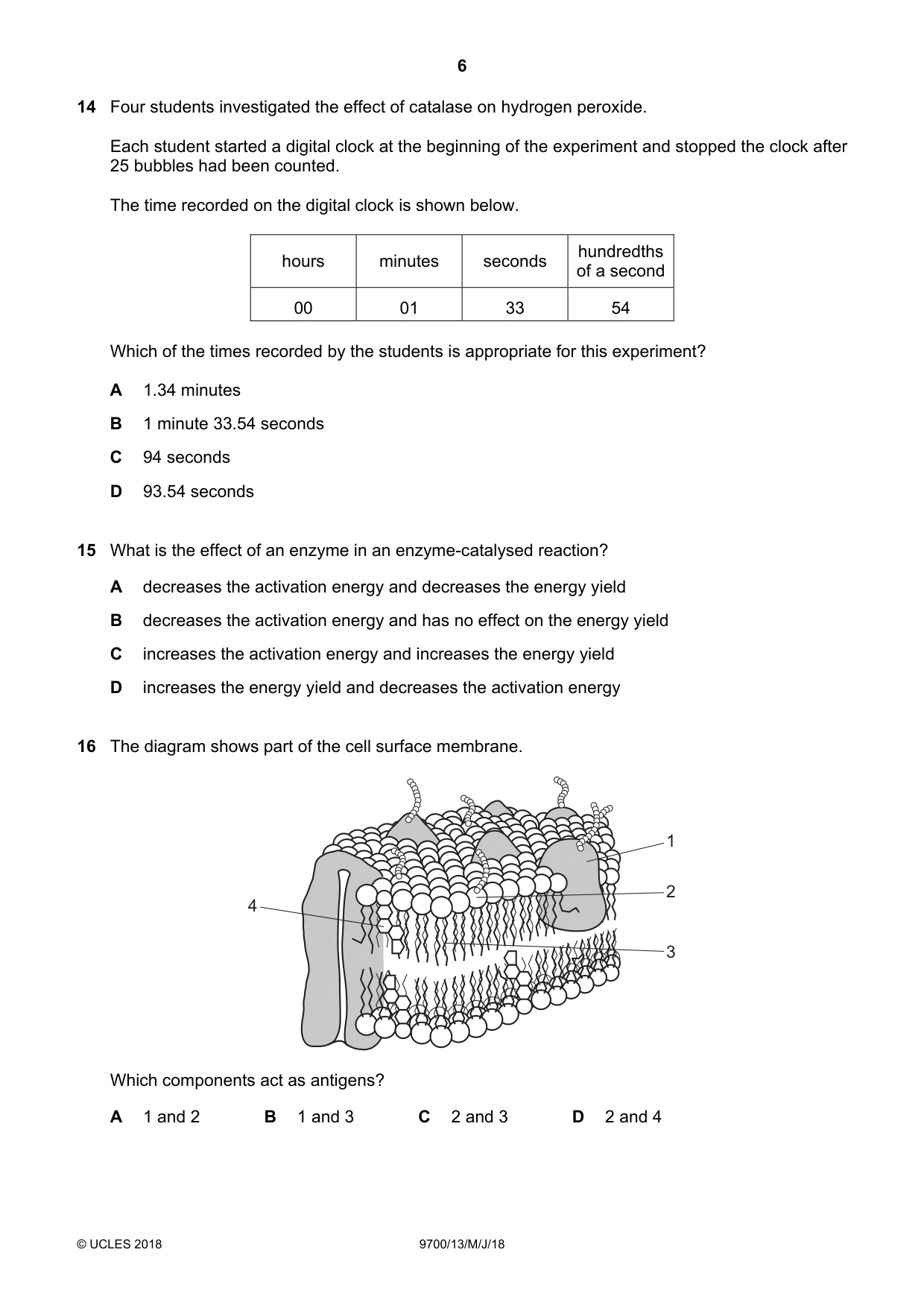
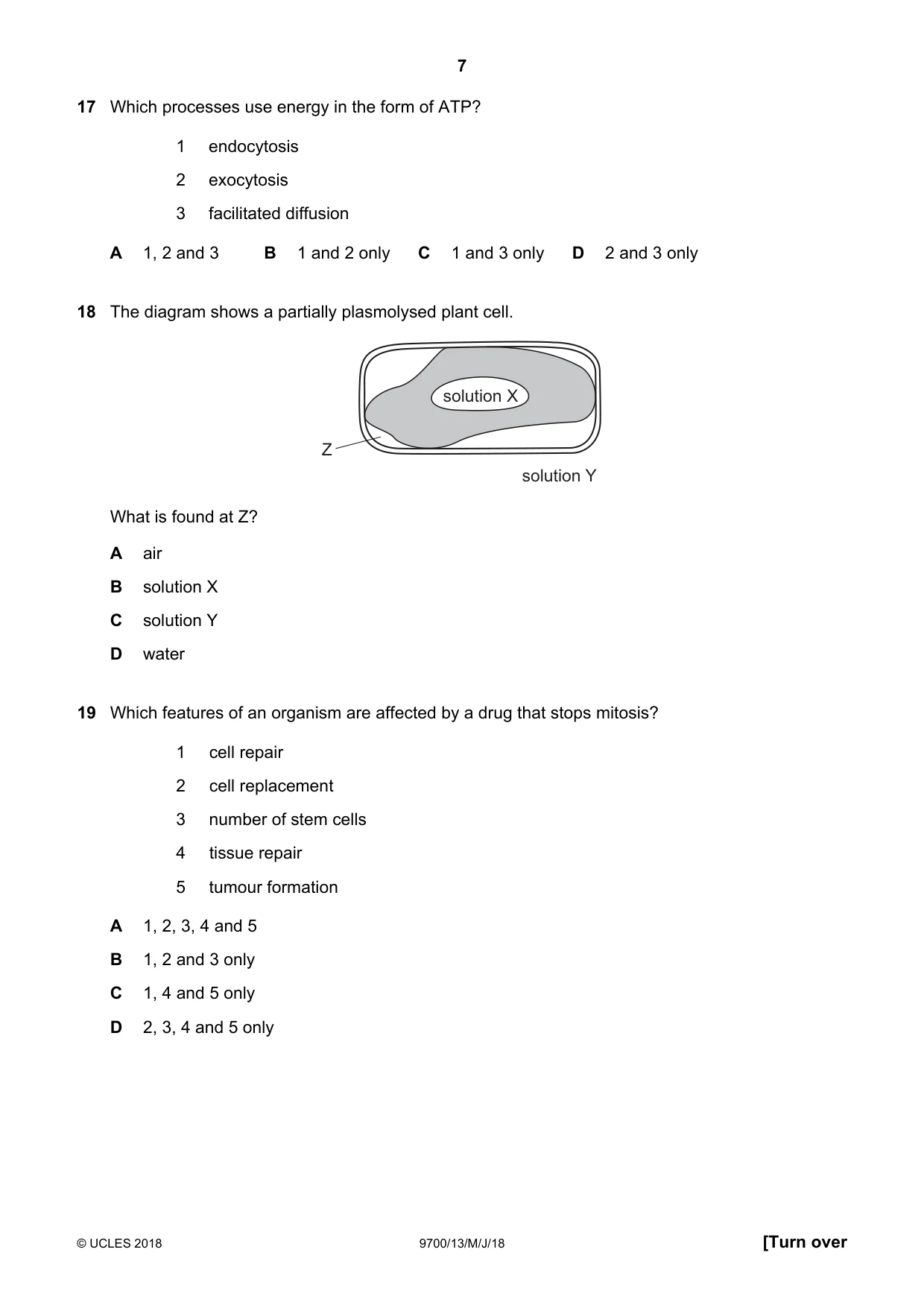
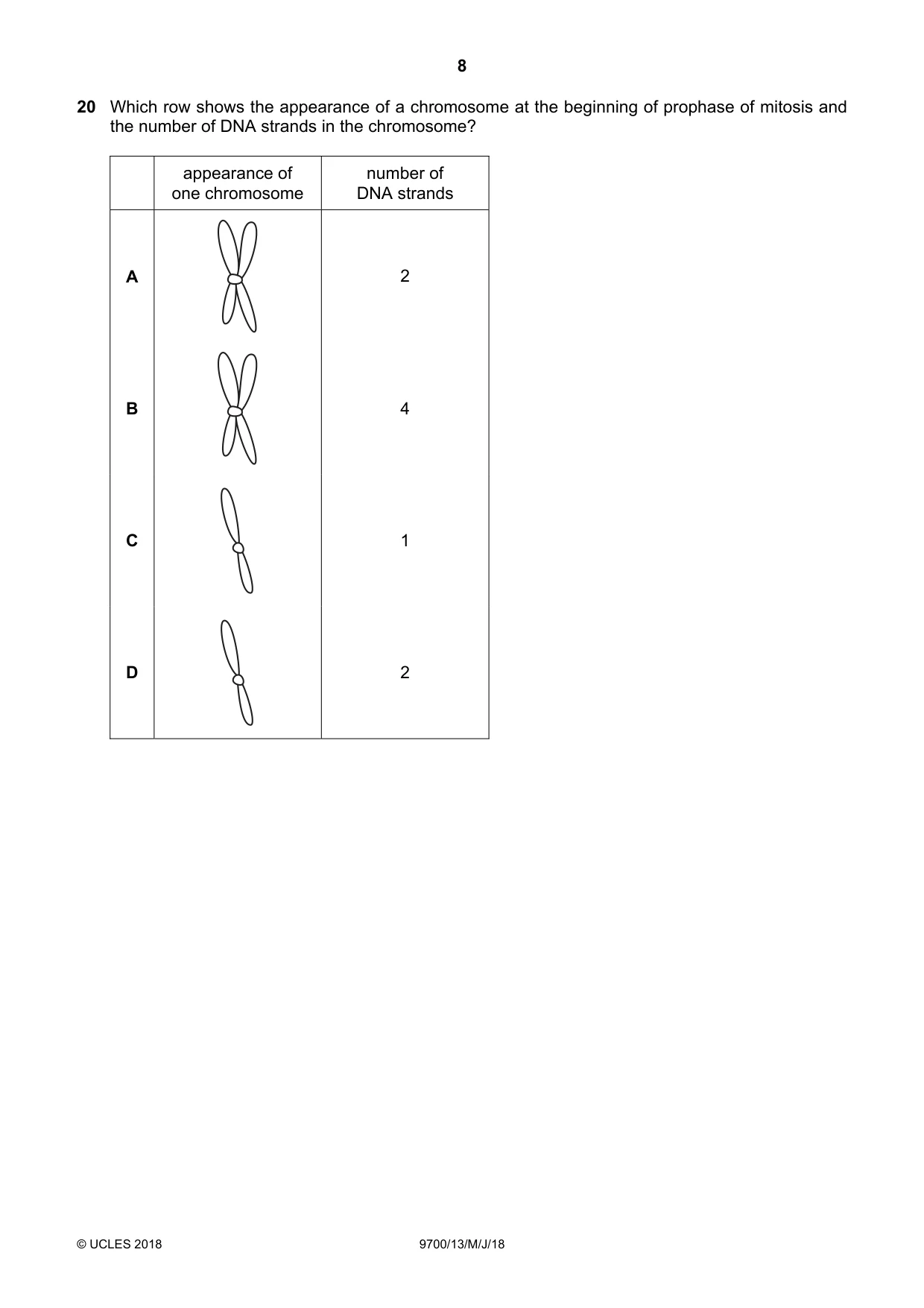
Mark scheme3 pages
Answers below. Sit the paper first if you are practising.
Questions as text
Q1 · Which steps are needed to find the actual width of a xylem vessel viewed in transverse…
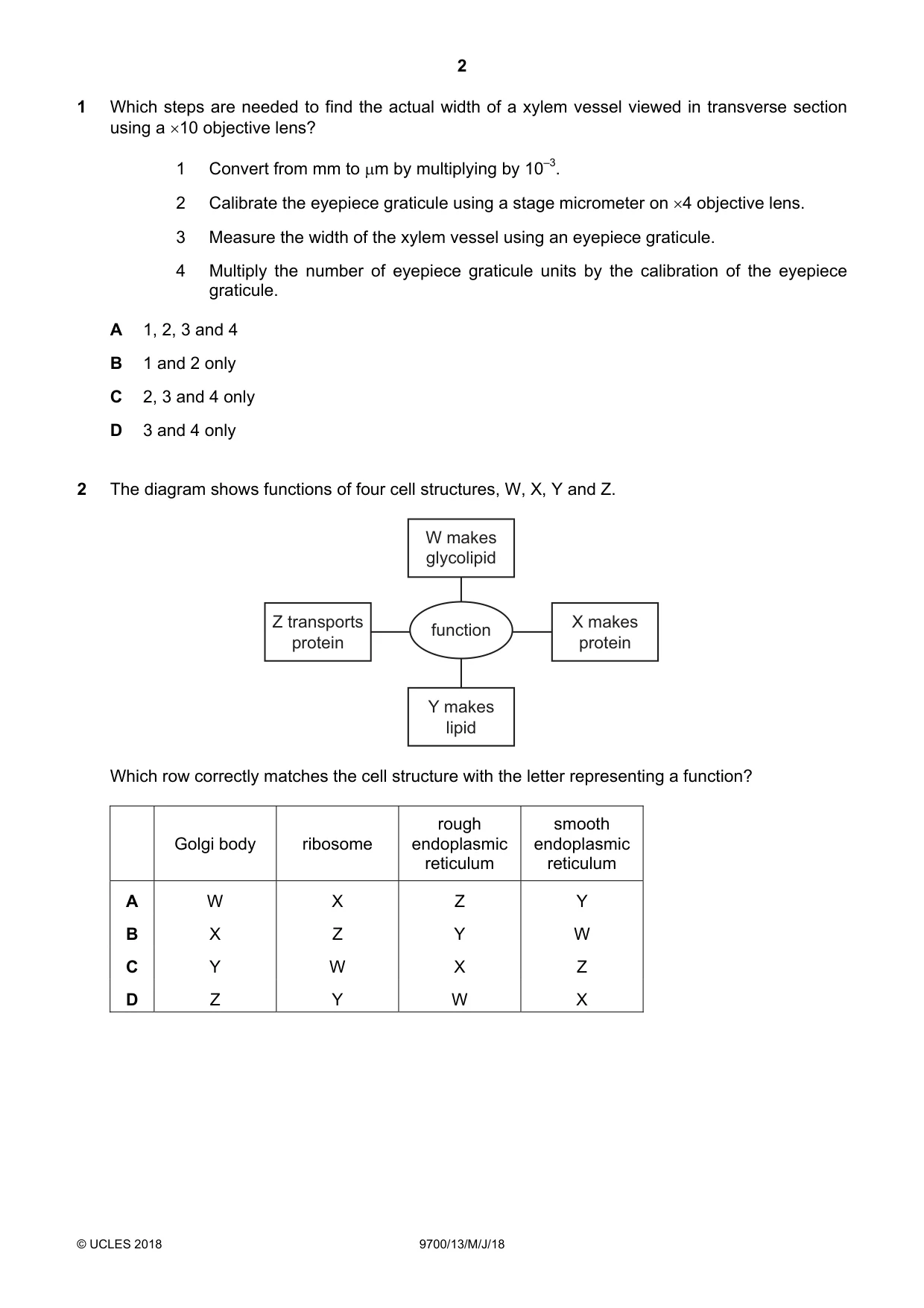
1 Which steps are needed to find the actual width of a xylem vessel viewed in transverse section using a ×10 objective lens? 1 Convert from mm to µm by multiplying by 10–3. 2 Calibrate the eyepiece graticule using a stage micrometer on ×4 objective lens. 3 Measure the width of the xylem vessel using an eyepiece graticule. 4 Multiply the number of eyepiece graticule units by the calibration of the eyepiece graticule. A 1, 2, 3 and 4 B 1 and 2 only C 2, 3 and 4 only D 3 and 4 only
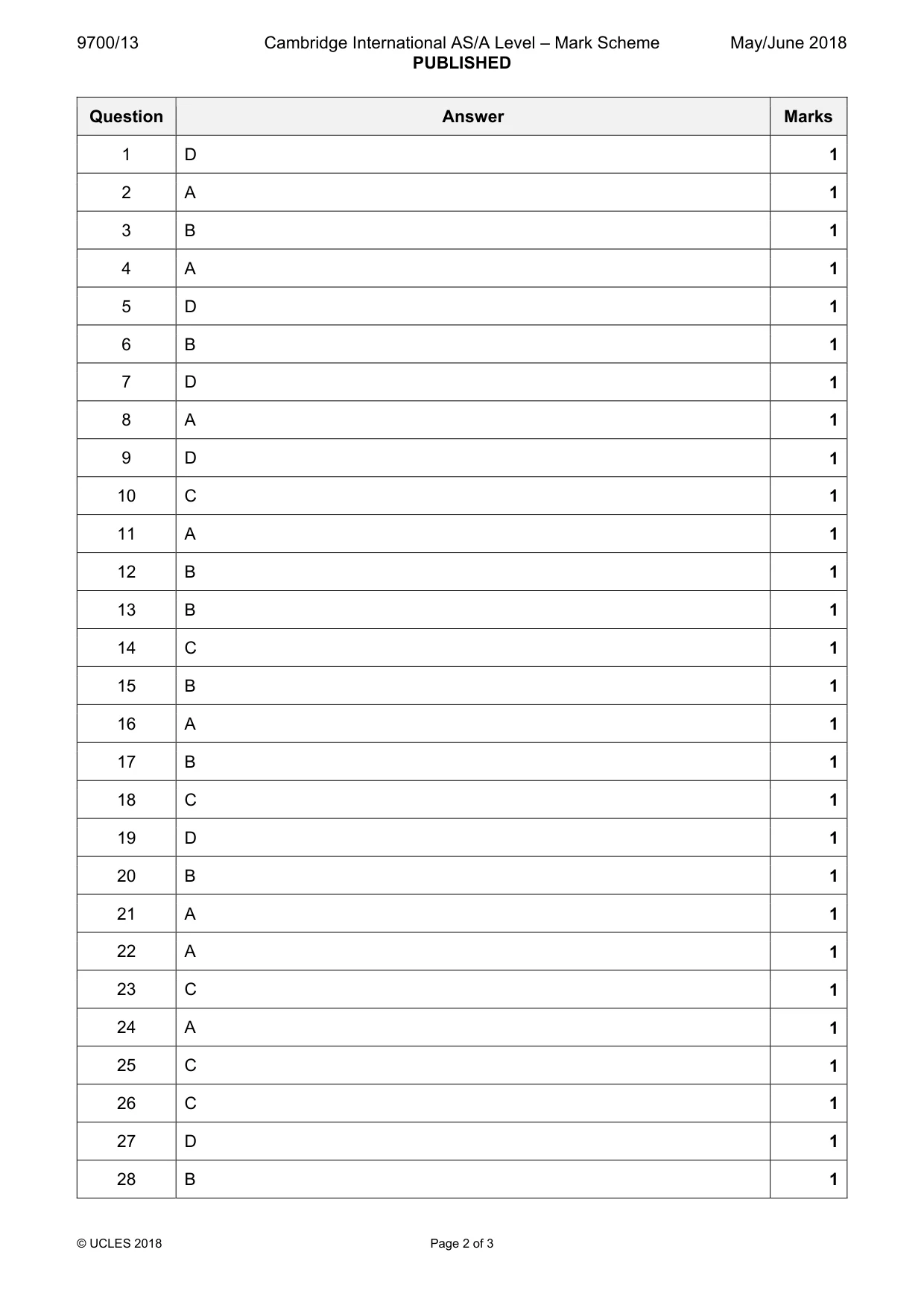
Mark scheme: D
Q2 · The diagram shows functions of four cell structures, W, X, Y and Z
2 The diagram shows functions of four cell structures, W, X, Y and Z. W makes glycolipid Z transports X makes function protein protein Y makes lipid Which row correctly matches the cell structure with the letter representing a function? rough smooth Golgi body ribosome endoplasmic endoplasmic reticulum reticulum A W X Z Y B X Z Y W C Y W X Z D Z Y W X
Mark scheme: A
More questions on Cells as the basic units of living organisms
Q3 · Which cell structures produce ATP?
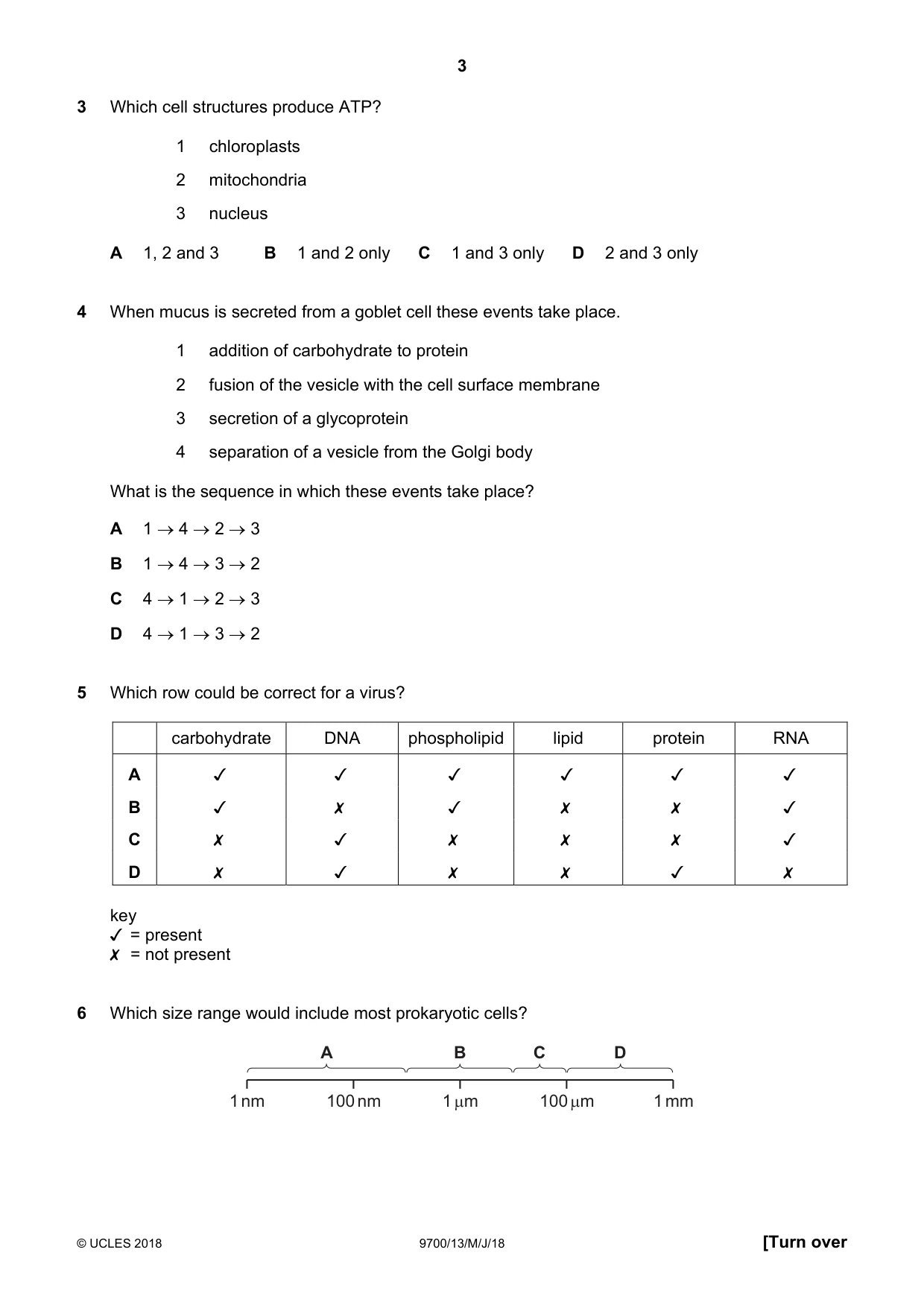
3 Which cell structures produce ATP? 1 chloroplasts 2 mitochondria 3 nucleus A 1, 2 and 3 B 1 and 2 only C 1 and 3 only D 2 and 3 only
Mark scheme: B
More questions on Cells as the basic units of living organisms
Q4 · When mucus is secreted from a goblet cell these events take place
4 When mucus is secreted from a goblet cell these events take place. 1 addition of carbohydrate to protein 2 fusion of the vesicle with the cell surface membrane 3 secretion of a glycoprotein 4 separation of a vesicle from the Golgi body What is the sequence in which these events take place? A 1 → 4 → 2 → 3 B 1 → 4 → 3 → 2 C 4 → 1 → 2 → 3 D 4 → 1 → 3 → 2
Mark scheme: A
More questions on Cells as the basic units of living organisms
Q5 · Which row could be correct for a virus?
5 Which row could be correct for a virus? carbohydrate DNA phospholipid lipid protein RNA A J J Jv J Jv J B v x Jv x x v Cc x J x x x J D x Jv x x v x key v = present X =not present
Mark scheme: D
More questions on Cells as the basic units of living organisms
Q6 · Which size range would include most prokaryotic cells?
6 Which size range would include most prokaryotic cells? A B C D 1 nm 100 nm 1 µm 100 µm 1 mm
Mark scheme: B
More questions on Cells as the basic units of living organisms
Q7 · Solutions of three biological molecules are tested for sugars
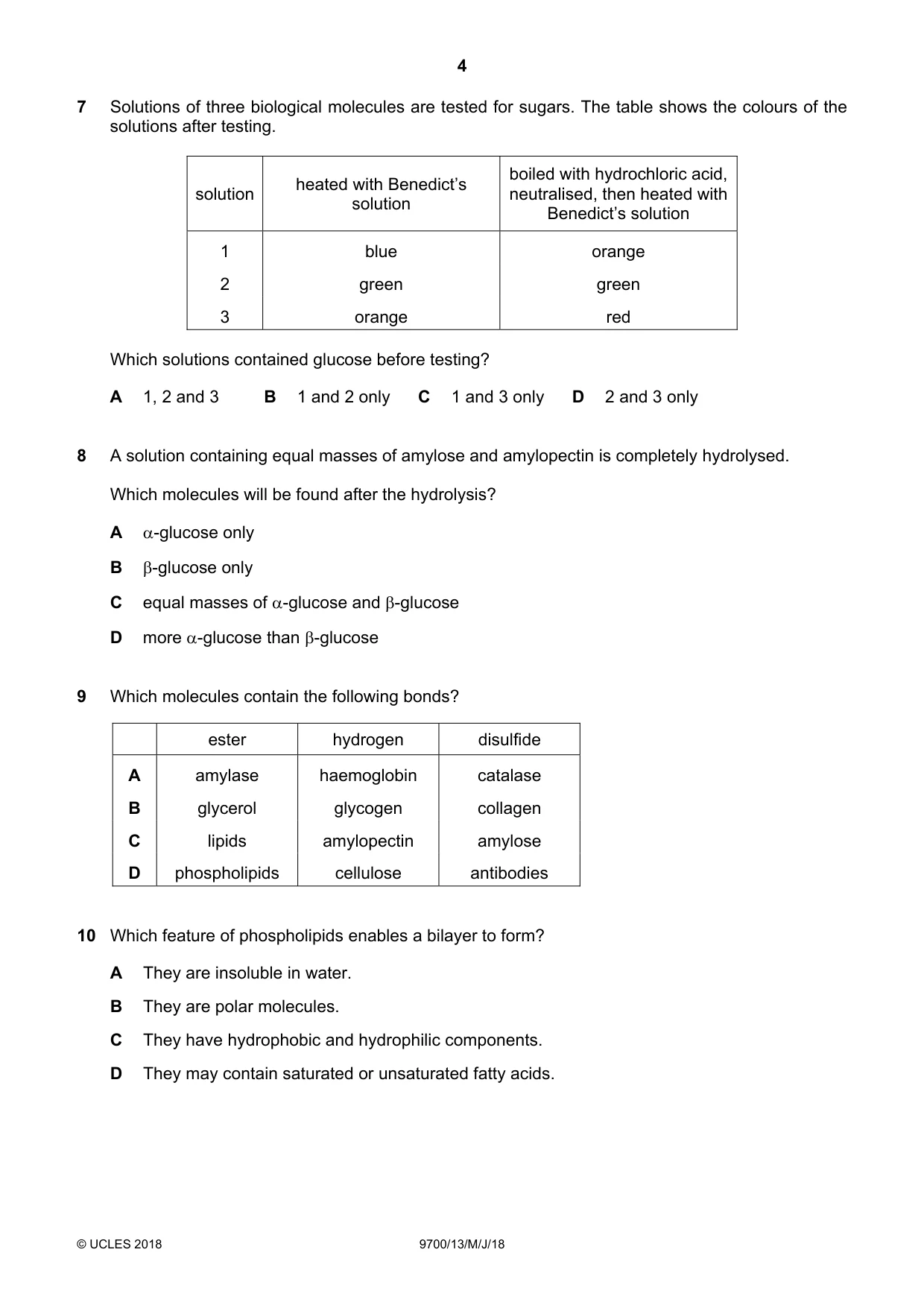
7 Solutions of three biological molecules are tested for sugars. The table shows the colours of the solutions after testing. boiled with hydrochloric acid, heated with Benedict’s solution neutralised, then heated with solution Benedict’s solution 1 blue orange 2 green green 3 orange red Which solutions contained glucose before testing? A 1, 2 and 3 B 1 and 2 only C 1 and 3 only D 2 and 3 only
Mark scheme: D
Q8 · A solution containing equal masses of amylose and amylopectin is completely hydrolysed
8 A solution containing equal masses of amylose and amylopectin is completely hydrolysed. Which molecules will be found after the hydrolysis? A α-glucose only B β-glucose only C equal masses of α-glucose and β-glucose D more α-glucose than β-glucose
Mark scheme: A
Q9 · Which molecules contain the following bonds?
9 Which molecules contain the following bonds? ester hydrogen disulfide A amylase haemoglobin catalase B glycerol glycogen collagen C lipids amylopectin amylose D phospholipids cellulose antibodies
Mark scheme: D
Q10 · Which feature of phospholipids enables a bilayer to form?
10 Which feature of phospholipids enables a bilayer to form? A They are insoluble in water. B They are polar molecules. C They have hydrophobic and hydrophilic components. D They may contain saturated or unsaturated fatty acids.
Mark scheme: C
Q11 · Which description is correct for collagen?
11 Which description is correct for collagen? A A collagen molecule has a high proportion of the amino acid glycine, which has a very small R group. B A group of three collagen fibres forms a strong, insoluble coiled structure termed a triple helix. C Each of the collagen polypeptides in a collagen molecule has a regular spiral arrangement of many alpha helices. D Peptide bonds are present between amino acids of the different polypeptides forming the collagen molecule.
Mark scheme: A
Q12 · Which statement about the properties of water is correct?
12 Which statement about the properties of water is correct? A Bonds between hydrogen atoms cause water to have a high specific heat capacity. B The high latent heat of vaporisation of water is due to the presence of hydrogen bonds. C The high specific heat capacity of water causes cooling during evaporation. D Water can dissolve amylopectin as it has hydrophilic side chains.
Mark scheme: B
Q13 · Catechol is a chemical found in a number of fruits
13 Catechol is a chemical found in a number of fruits. Catechol can be oxidised to a quinone by the enzyme catechol oxidase. Catechol oxidase is inhibited by parahyroxybenzoic acid (PHBA) which is structurally similar to catechol. Catechol oxidase is also inhibited by phenylthiourea (PTU) which binds to a copper atom in the enzyme. How do both these inhibitors reduce the enzyme activity? 1 altering the specificity of the enzyme 2 competing with substrates for the active site 3 decreasing the Vmax of the reaction A 1, 2 and 3 B 1 only C 2 only D 3 only
Mark scheme: B
Q14 · Four students investigated the effect of catalase on hydrogen peroxide
14 Four students investigated the effect of catalase on hydrogen peroxide. Each student started a digital clock at the beginning of the experiment and stopped the clock after 25 bubbles had been counted. The time recorded on the digital clock is shown below. hundredths hours minutes seconds of a second 00 01 33 54 Which of the times recorded by the students is appropriate for this experiment? A 1.34 minutes B 1 minute 33.54 seconds C 94 seconds D 93.54 seconds
Mark scheme: C
Q15 · What is the effect of an enzyme in an enzyme-catalysed reaction?
15 What is the effect of an enzyme in an enzyme-catalysed reaction? A decreases the activation energy and decreases the energy yield B decreases the activation energy and has no effect on the energy yield C increases the activation energy and increases the energy yield D increases the energy yield and decreases the activation energy
Mark scheme: B
Q16 · The diagram shows part of the cell surface membrane
16 The diagram shows part of the cell surface membrane. 1 2 4 3 Which components act as antigens? A 1 and 2 B 1 and 3 C 2 and 3 D 2 and 4
Mark scheme: A
Q17 · Which processes use energy in the form of ATP?
17 Which processes use energy in the form of ATP? 1 endocytosis 2 exocytosis 3 facilitated diffusion A 1, 2 and 3 B 1 and 2 only C 1 and 3 only D 2 and 3 only
Mark scheme: B
Q18 · The diagram shows a partially plasmolysed plant cell
18 The diagram shows a partially plasmolysed plant cell. solution X Z solution Y What is found at Z? A air B solution X C solution Y D water
Mark scheme: C
Q19 · Which features of an organism are affected by a drug that stops mitosis?
19 Which features of an organism are affected by a drug that stops mitosis? 1 cell repair 2 cell replacement 3 number of stem cells 4 tissue repair 5 tumour formation A 1, 2, 3, 4 and 5 B 1, 2 and 3 only C 1, 4 and 5 only D 2, 3, 4 and 5 only
Mark scheme: D
More questions on Replication and division of nuclei and cells
Q20 · Which row shows the appearance of a chromosome at the beginning of prophase of mitosis…
20 Which row shows the appearance of a chromosome at the beginning of prophase of mitosis and the number of DNA strands in the chromosome? appearance of number of one chromosome DNA strands A 2 B 4 C 1 D 2
Mark scheme: B
Q21 · The graph shows measurements taken during one mitotic cell cycle
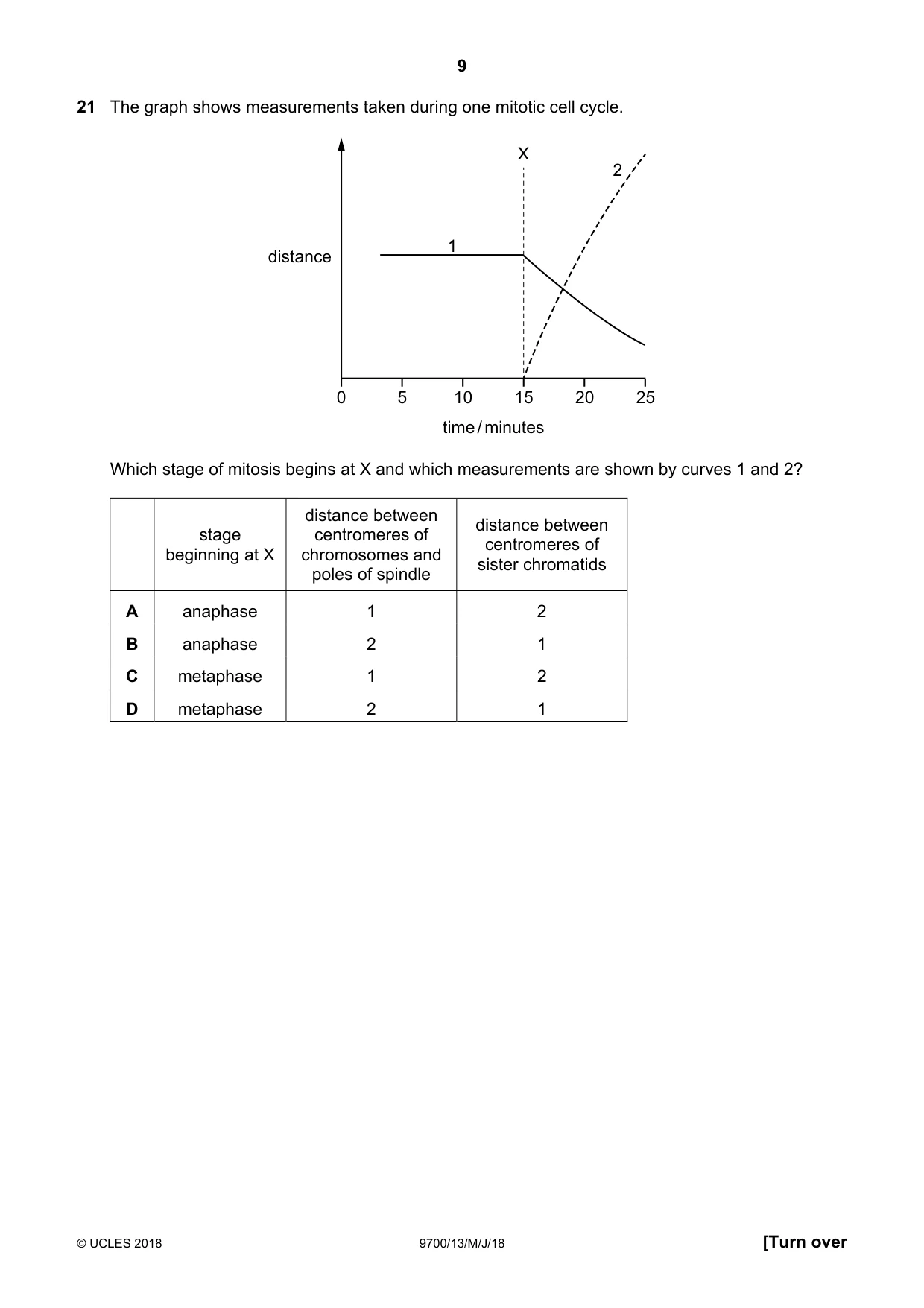
21 The graph shows measurements taken during one mitotic cell cycle. X 2 1 distance 0 5 10 15 20 25 time / minutes Which stage of mitosis begins at X and which measurements are shown by curves 1 and 2? distance between distance between stage centromeres of centromeres of beginning at X chromosomes and sister chromatids poles of spindle A anaphase 1 2 B anaphase 2 1 C metaphase 1 2 D metaphase 2 1
Mark scheme: A
Q22 · The diagram shows the outline structure of two nucleotide bases which occur in DNA
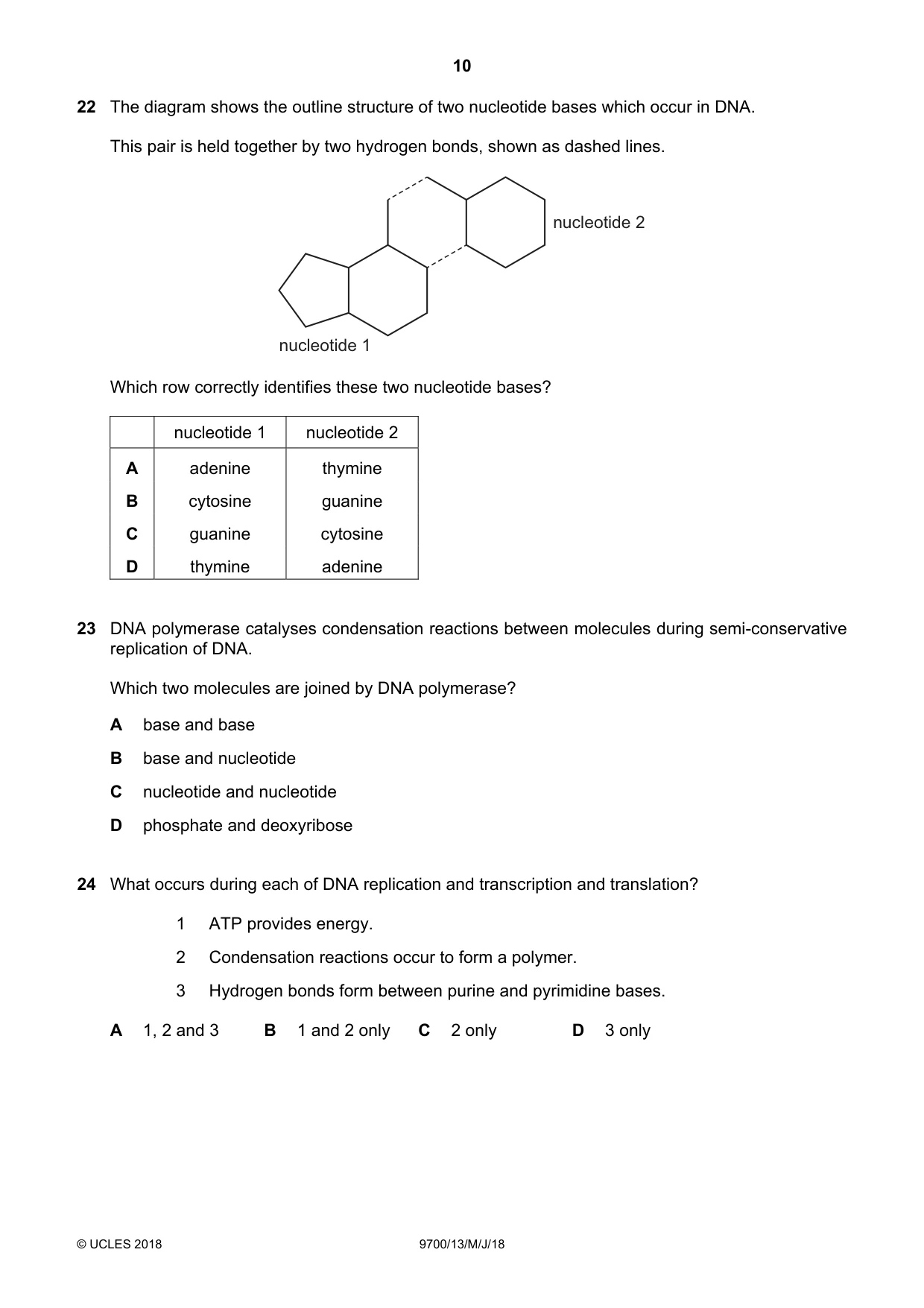
22 The diagram shows the outline structure of two nucleotide bases which occur in DNA. This pair is held together by two hydrogen bonds, shown as dashed lines. nucleotide 2 nucleotide 1 Which row correctly identifies these two nucleotide bases? nucleotide 1 nucleotide 2 A adenine thymine B cytosine guanine C guanine cytosine D thymine adenine
Mark scheme: A
More questions on Structure of nucleic acids and replication of DNA
Q23 · DNA polymerase catalyses condensation reactions between molecules during…
23 DNA polymerase catalyses condensation reactions between molecules during semi-conservative replication of DNA. Which two molecules are joined by DNA polymerase? A base and base B base and nucleotide C nucleotide and nucleotide D phosphate and deoxyribose
Mark scheme: C
More questions on Structure of nucleic acids and replication of DNA
Q24 · What occurs during each of DNA replication and transcription and translation?
24 What occurs during each of DNA replication and transcription and translation? 1 ATP provides energy. 2 Condensation reactions occur to form a polymer. 3 Hydrogen bonds form between purine and pyrimidine bases. A 1, 2 and 3 B 1 and 2 only C 2 only D 3 only
Mark scheme: A
Q25 · Part of a sequence of DNA from a person with a genetic disease is: TAGTAACCACAAAGG The…
25 Part of a sequence of DNA from a person with a genetic disease is: TAGTAACCACAAAGG The corresponding sequence of DNA from a person without this genetic disease is: TAGTAAAAACCACAAAGG The possible mRNA codons for some amino acids are shown in the table. amino acid mRNA codons 1 GGU GGC GGA GGG 2 AUU AUC AUA 3 UUU UUC 4 UCU UCC UCA UCG Which amino acid is missing from a person with this genetic disease? A 1 B 2 C 3 D 4
Mark scheme: C
Q26 · The photomicrograph shows a section through a plant organ
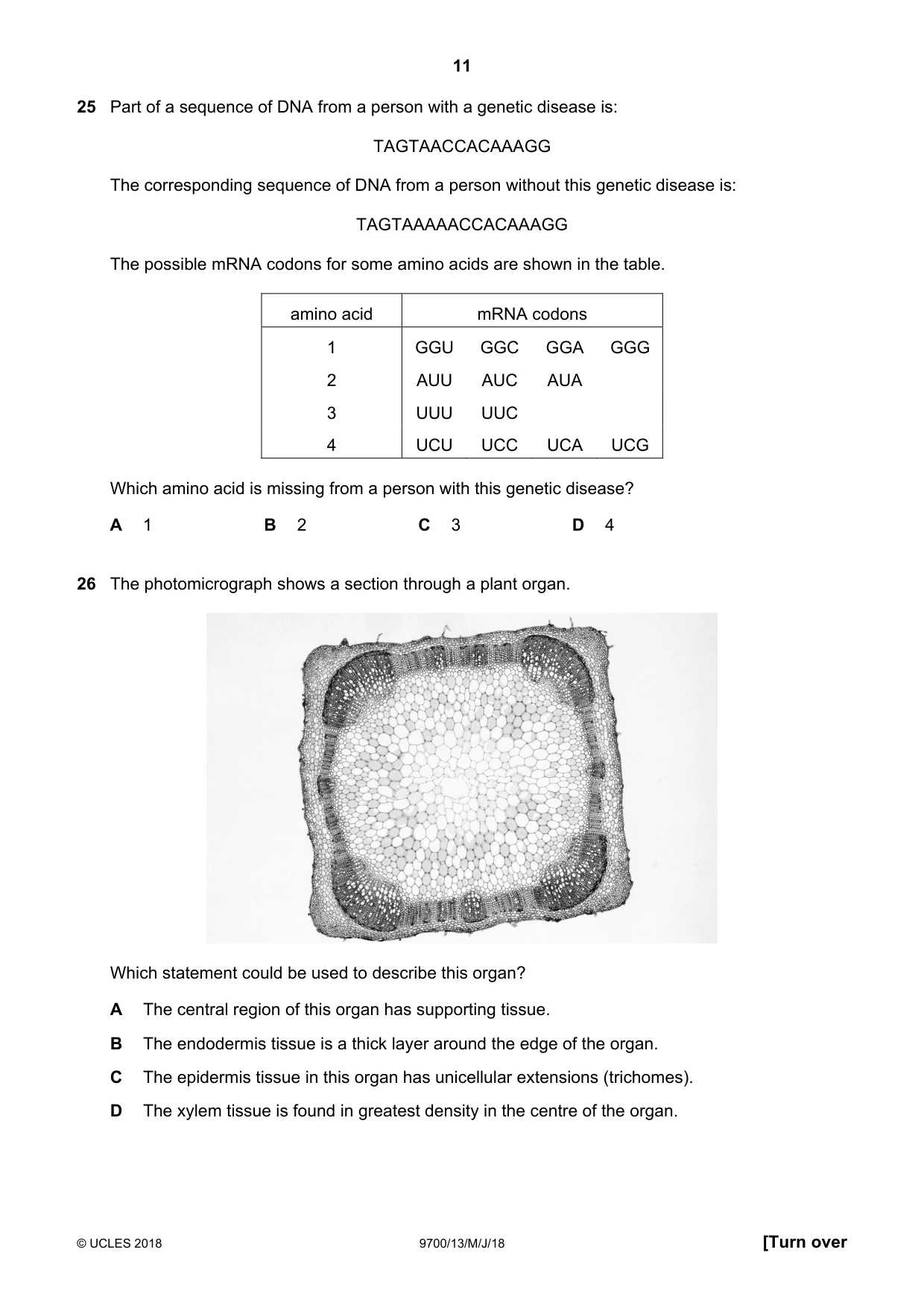
26 The photomicrograph shows a section through a plant organ. Which statement could be used to describe this organ? A The central region of this organ has supporting tissue. B The endodermis tissue is a thick layer around the edge of the organ. C The epidermis tissue in this organ has unicellular extensions (trichomes). D The xylem tissue is found in greatest density in the centre of the organ.
Mark scheme: C
Q27 · Which diagram correctly represents part of a sieve tube element?
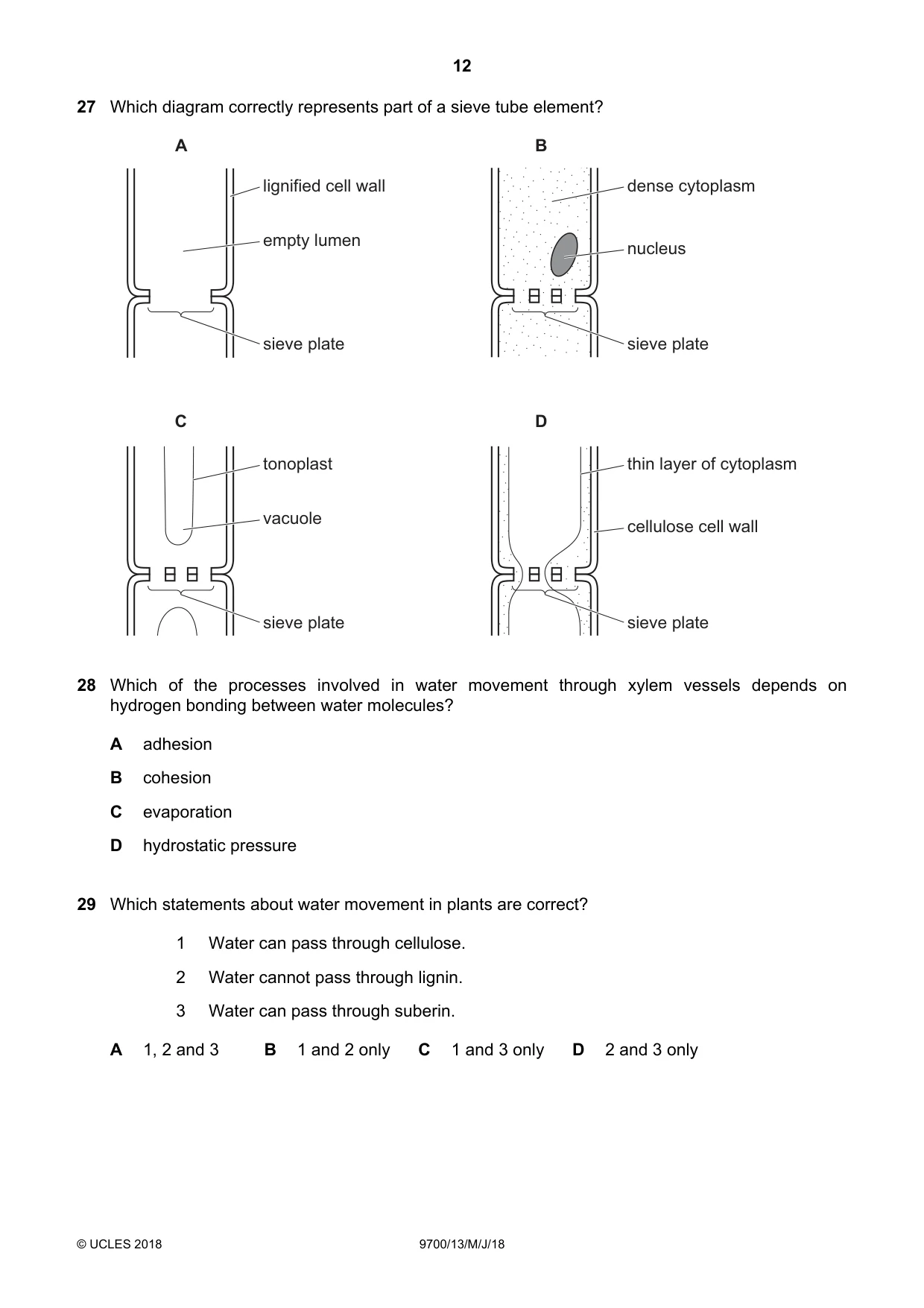
27 Which diagram correctly represents part of a sieve tube element? A B lignified cell wall dense cytoplasm empty lumen nucleus sieve plate sieve plate C D tonoplast thin layer of cytoplasm vacuole cellulose cell wall sieve plate sieve plate
Mark scheme: D
Q28 · Which of the processes involved in water movement through xylem vessels depends on…
28 Which of the processes involved in water movement through xylem vessels depends on hydrogen bonding between water molecules? A adhesion B cohesion C evaporation D hydrostatic pressure
Mark scheme: B
Q29 · Which statements about water movement in plants are correct?
29 Which statements about water movement in plants are correct? 1 Water can pass through cellulose. 2 Water cannot pass through lignin. 3 Water can pass through suberin. A 1, 2 and 3 B 1 and 2 only C 1 and 3 only D 2 and 3 only
Mark scheme: B
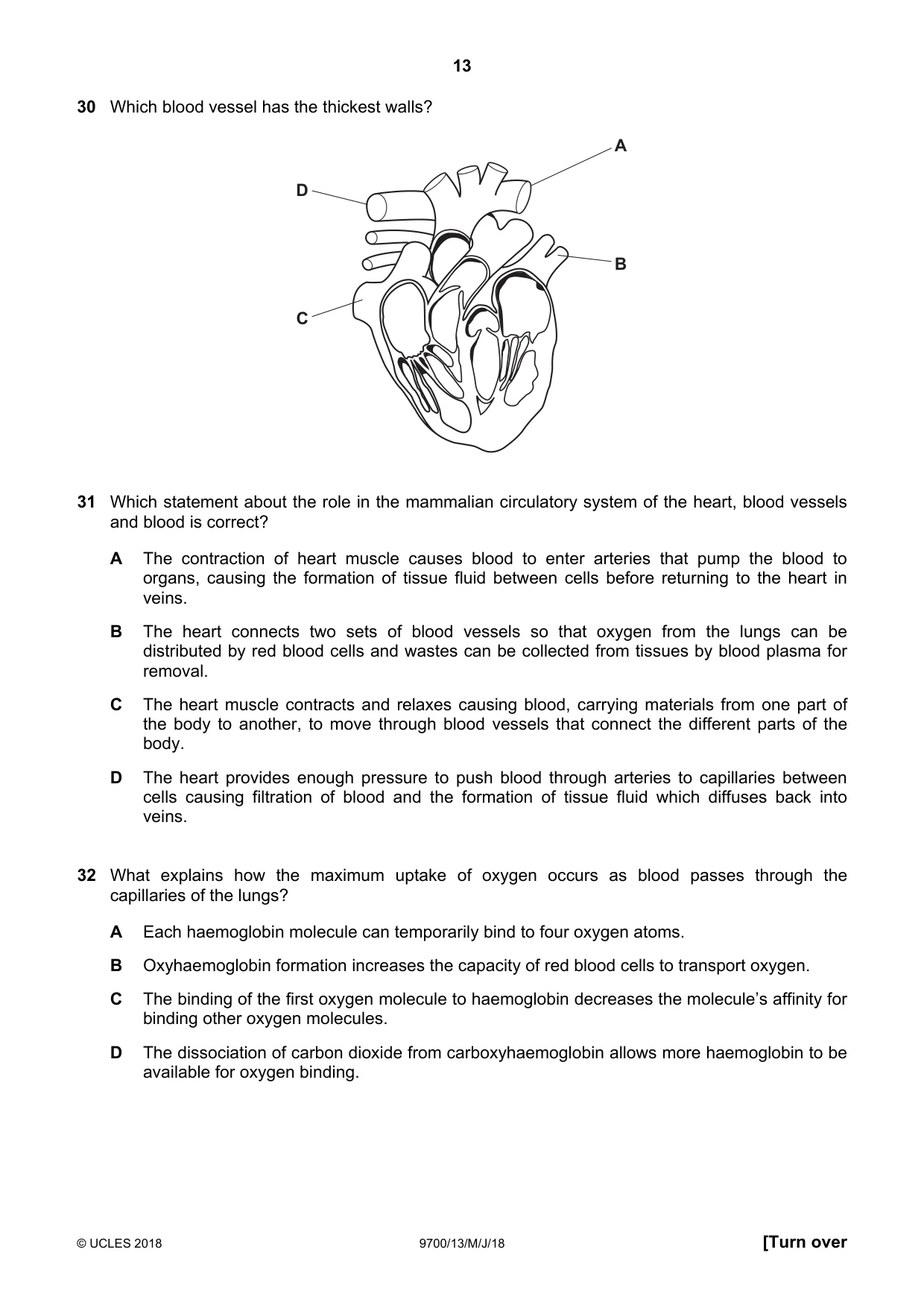
Q30 · Which blood vessel has the thickest walls?
30 Which blood vessel has the thickest walls? A D B C
Mark scheme: A
Q31 · Which statement about the role in the mammalian circulatory system of the heart, blood…
31 Which statement about the role in the mammalian circulatory system of the heart, blood vessels and blood is correct? A The contraction of heart muscle causes blood to enter arteries that pump the blood to organs, causing the formation of tissue fluid between cells before returning to the heart in veins. B The heart connects two sets of blood vessels so that oxygen from the lungs can be distributed by red blood cells and wastes can be collected from tissues by blood plasma for removal. C The heart muscle contracts and relaxes causing blood, carrying materials from one part of the body to another, to move through blood vessels that connect the different parts of the body. D The heart provides enough pressure to push blood through arteries to capillaries between cells causing filtration of blood and the formation of tissue fluid which diffuses back into veins.
Mark scheme: C
Q32 · What explains how the maximum uptake of oxygen occurs as blood passes through the…
32 What explains how the maximum uptake of oxygen occurs as blood passes through the capillaries of the lungs? A Each haemoglobin molecule can temporarily bind to four oxygen atoms. B Oxyhaemoglobin formation increases the capacity of red blood cells to transport oxygen. C The binding of the first oxygen molecule to haemoglobin decreases the molecule’s affinity for binding other oxygen molecules. D The dissociation of carbon dioxide from carboxyhaemoglobin allows more haemoglobin to be available for oxygen binding.
Mark scheme: B
Q33 · At high altitudes, the oxygen content of the air may be a third of that at sea level
33 At high altitudes, the oxygen content of the air may be a third of that at sea level. As a person climbs a mountain, their body gradually adjusts to the high altitude. What is increased during this period of adjustment? A the concentration of haemoglobin in the red blood cells B the oxygen-carrying capacity of the haemoglobin C the number of red blood cells per mm3 of blood D the rate at which haemoglobin releases oxygen to the tissues
Mark scheme: C
Q34 · What helps to maintain a concentration gradient between blood and the air in the alveolus?
34 What helps to maintain a concentration gradient between blood and the air in the alveolus? A the flow of blood through the lungs B the presence of haemoglobin in blood cells C the single-celled alveolar walls D the squamous epithelium of capillaries
Mark scheme: A
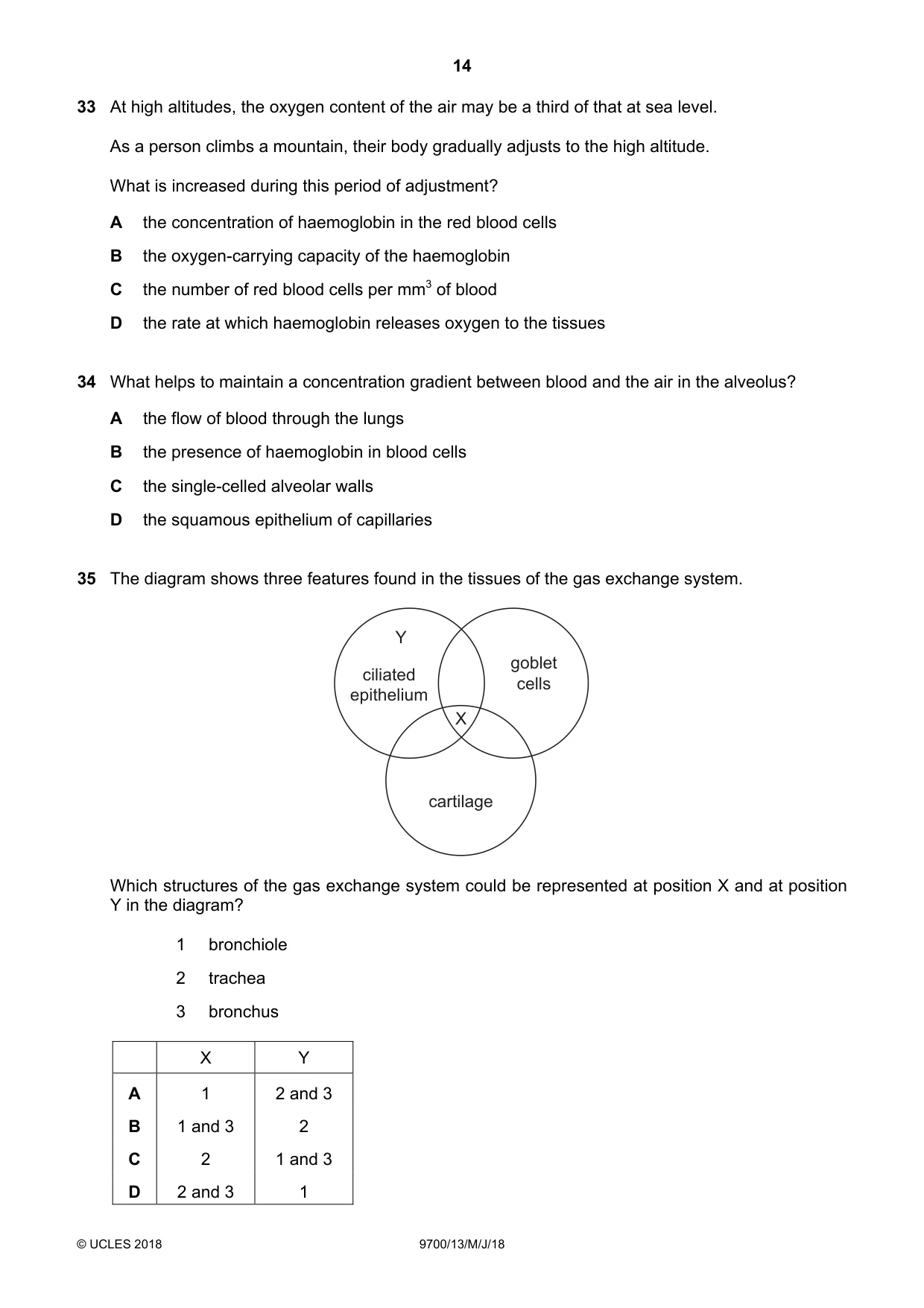
Q35 · The diagram shows three features found in the tissues of the gas exchange system
35 The diagram shows three features found in the tissues of the gas exchange system. Y goblet ciliated cells epithelium X cartilage Which structures of the gas exchange system could be represented at position X and at position Y in the diagram? 1 bronchiole 2 trachea 3 bronchus X Y A 1 2 and 3 B 1 and 3 2 C 2 1 and 3 D 2 and 3 1
Mark scheme: D
Q36 · Blood tests on people who regularly smoke cigarettes show that approximately 5% of their…
36 Blood tests on people who regularly smoke cigarettes show that approximately 5% of their haemoglobin carries carbon monoxide. People who smoke e-cigarettes inhale a vapour with no carbon monoxide. A person who smokes cigarettes regularly, switches to e-cigarettes and a blood test is carried out after a month. Which chemical in the blood would be found in a lower concentration in this blood test? A carbaminohaemoglobin B carbonic anhydrase C carboxyhaemoglobin D hydrogencarbonate ions
Mark scheme: C
Q37 · Emphysema is a type of chronic obstructive pulmonary disease, COPD
37 Emphysema is a type of chronic obstructive pulmonary disease, COPD. People with emphysema have a very low level of a plasma protein which inhibits the enzyme elastase. Elastase breaks down the elastic fibres in the bronchioles and alveoli. Which are effects of the low levels of inhibitor in people with emphysema? 1 alveoli do not stretch and recoil properly during inhalation and exhalation 2 blood is poorly oxygenated resulting in a rapid breathing rate 3 bronchioles collapse during exhalation trapping air in the alveoli A 1, 2 and 3 B 1 and 3 only C 1 only D 2 and 3 only
Mark scheme: A
Q38 · Some antibiotics work by binding to ribosomes
38 Some antibiotics work by binding to ribosomes. Which statement explains why these antibiotics kill bacteria cells but do not kill most human cells? A mRNA in bacteria is formed in the cytoplasm from naked DNA. B The antibiotics cannot pass through human cell membranes. C The codes used for amino acids in bacteria are different from those used by humans. D The ribosomes of bacteria have a different structure from those of humans.
Mark scheme: D
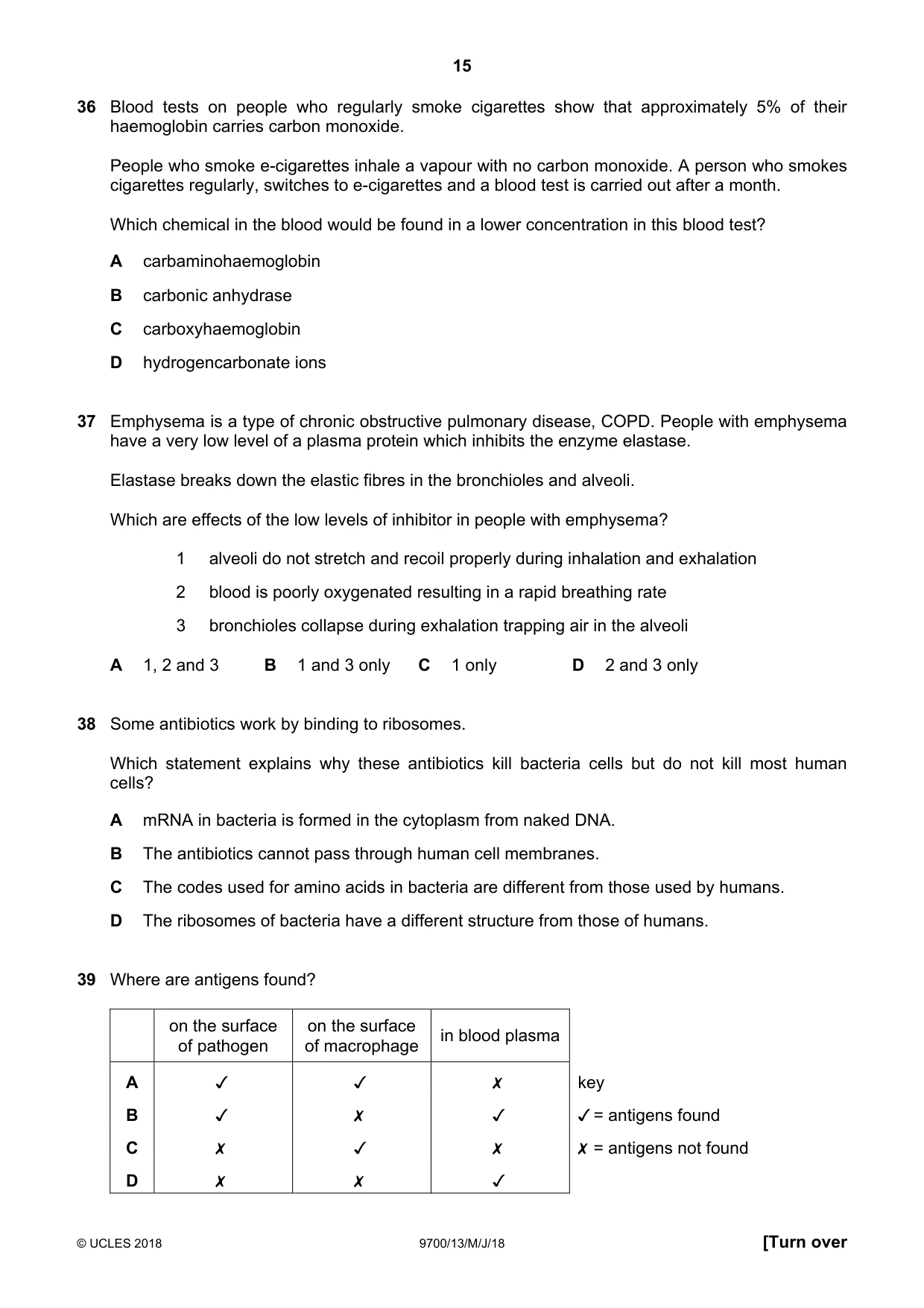
Q39 · Where are antigens found?
39 Where are antigens found? 0 0O WwW > on the surface of pathogen «x «4 on the surface of macrophage x < x in blood plasma Kj « < x key ¥ = antigens found X = antigens not found
Mark scheme: A
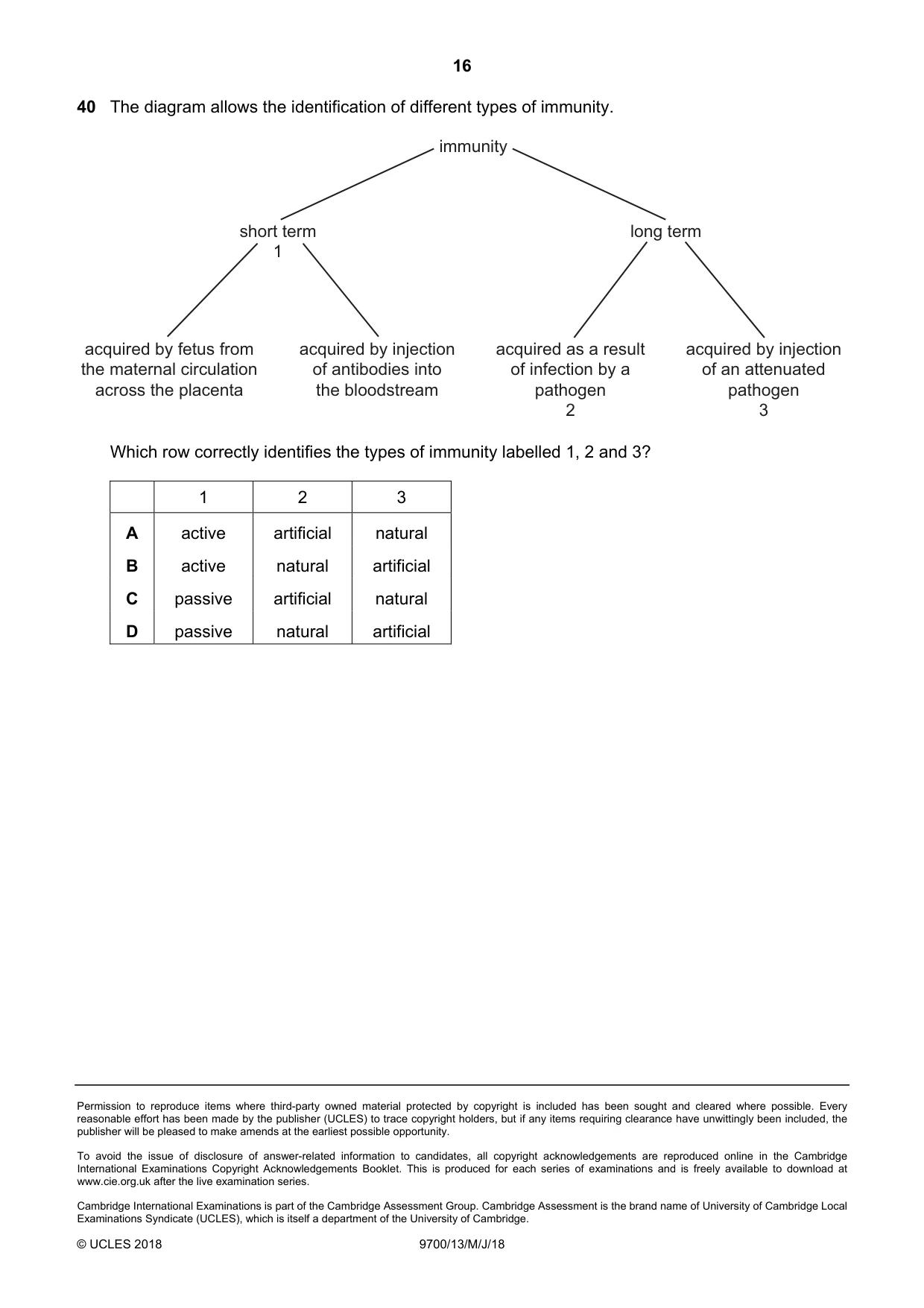
Q40 · The diagram allows the identification of different types of immunity
40 The diagram allows the identification of different types of immunity. immunity short term long term 1 acquired by fetus from acquired by injection acquired as a result acquired by injection the maternal circulation of antibodies into of infection by a of an attenuated across the placenta the bloodstream pathogen pathogen 2 3 Which row correctly identifies the types of immunity labelled 1, 2 and 3? 1 2 3 A active artificial natural B active natural artificial C passive artificial natural D passive natural artificial
Mark scheme: D
What was in this paper
The subtopics covered by these 40 questions, and how many questions each got. Open one in a new tab to see every Cambridge question on it.
5The gas exchange system3Transport of oxygen and carbon dioxide3Chromosome behaviour in mitosis2Factors that affect enzyme action2Fluid mosaic membranes2Movement into and out of cells2Protein synthesis2Proteins2Structure of nucleic acids and replication of DNA2Structure of transport tissues2The circulatory system2Transport mechanisms2Antibiotics1Antibodies and vaccination1Carbohydrates and lipids1Mode of action of enzymes1Replication and division of nuclei and cells1Testing for biological molecules1The immune system1The microscope in cell studies1Water1What you needed in this session
Cambridge’s own grade thresholds for 2018 May/June, Paper 1 · Variant 3. A higher threshold means an easier paper — the bar moves with how the cohort did.