Cambridge A Level Biology 9700 — 2017 May/June Paper 1 · Variant 3
9700/13/M/J/17 · 40 questions · 40 marks · ≈45 min
The question paper and its mark scheme, free to read here and free to download. This is Cambridge’s own paper, exactly as it was sat.
Question paper20 pages


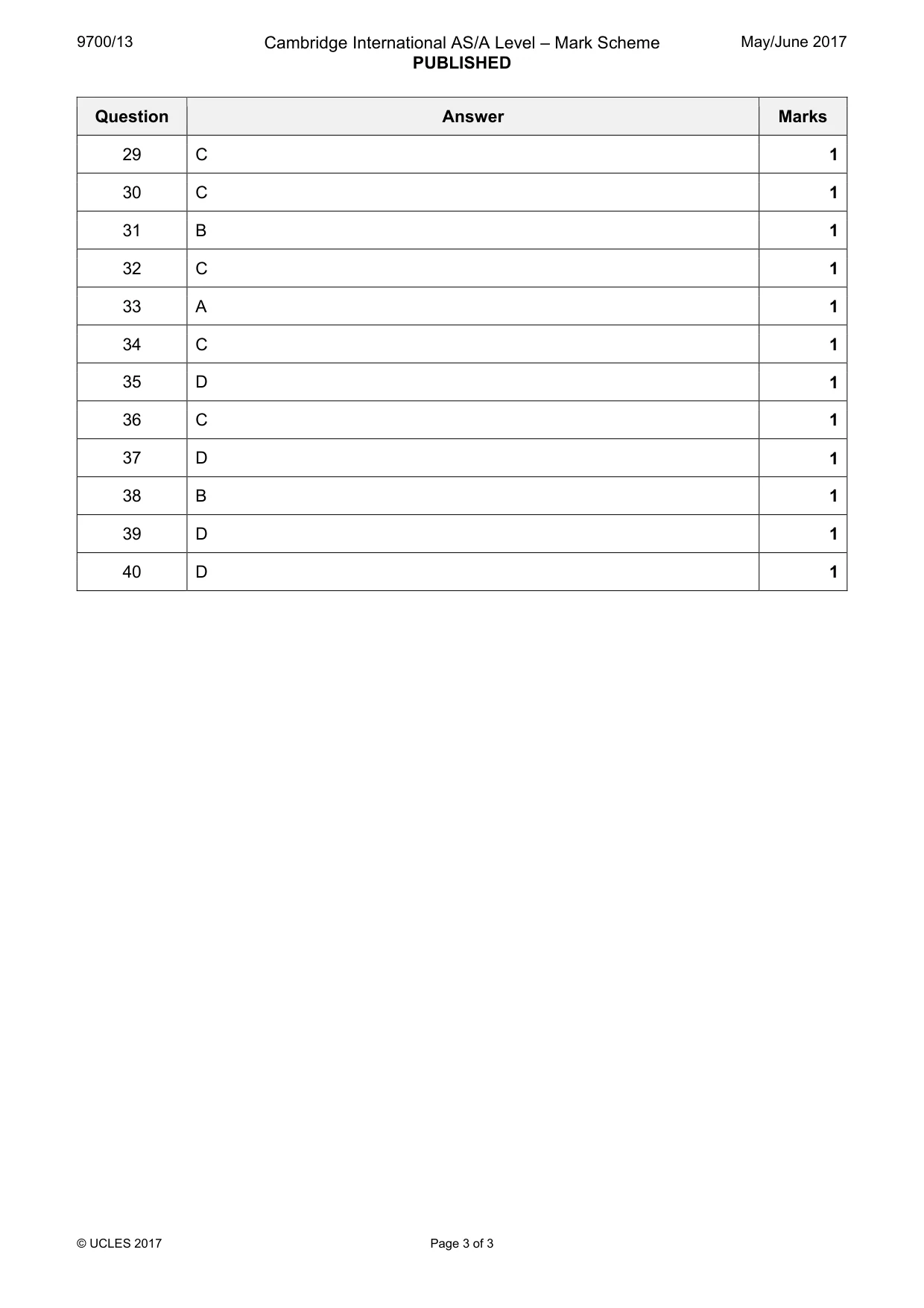
Mark scheme3 pages
Answers below. Sit the paper first if you are practising.
Questions as text
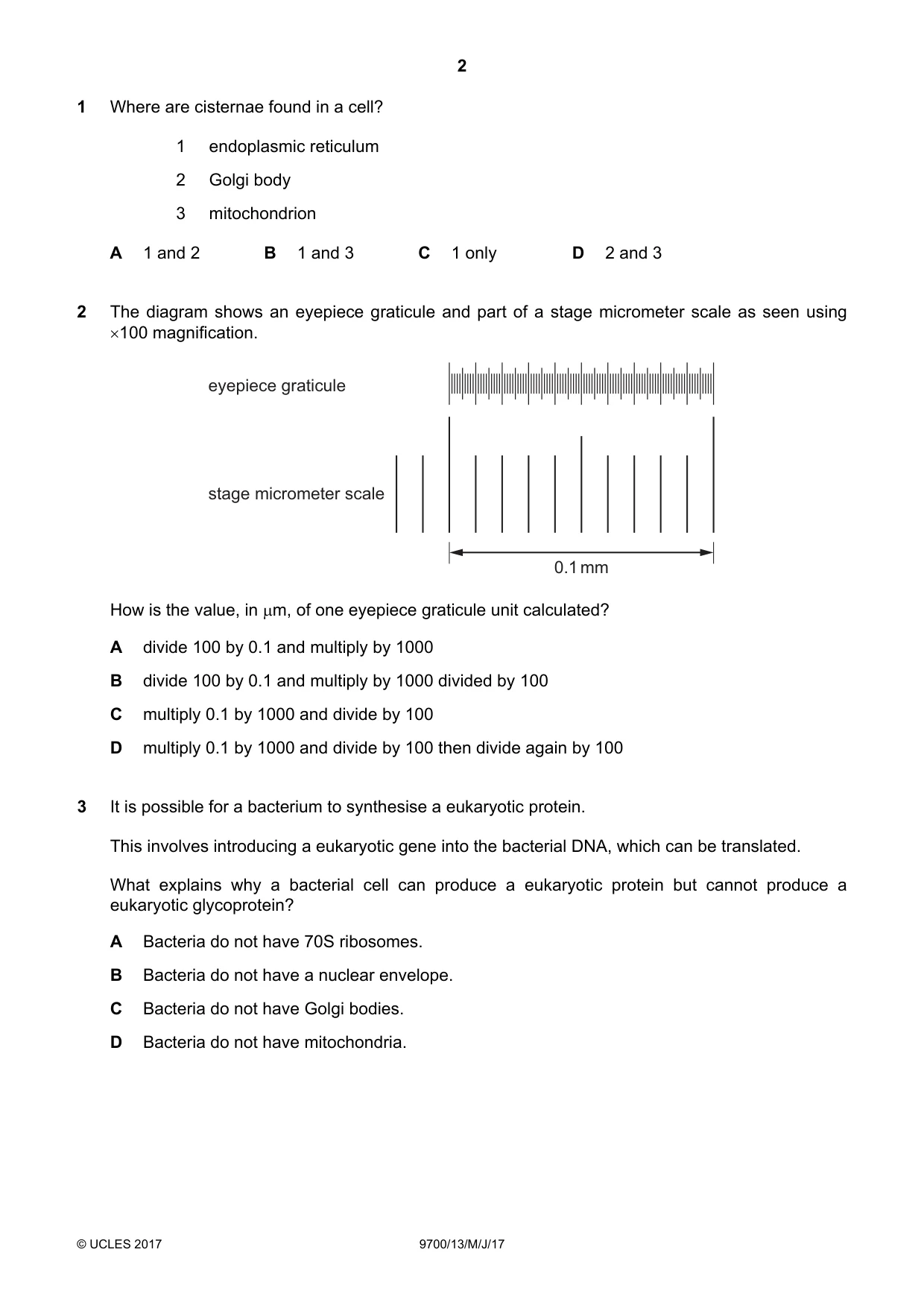
Q1 · Where are cisternae found in a cell?
1 Where are cisternae found in a cell? 1 endoplasmic reticulum 2 Golgi body 3 mitochondrion A 1 and 2 B 1 and 3 C 1 only D 2 and 3
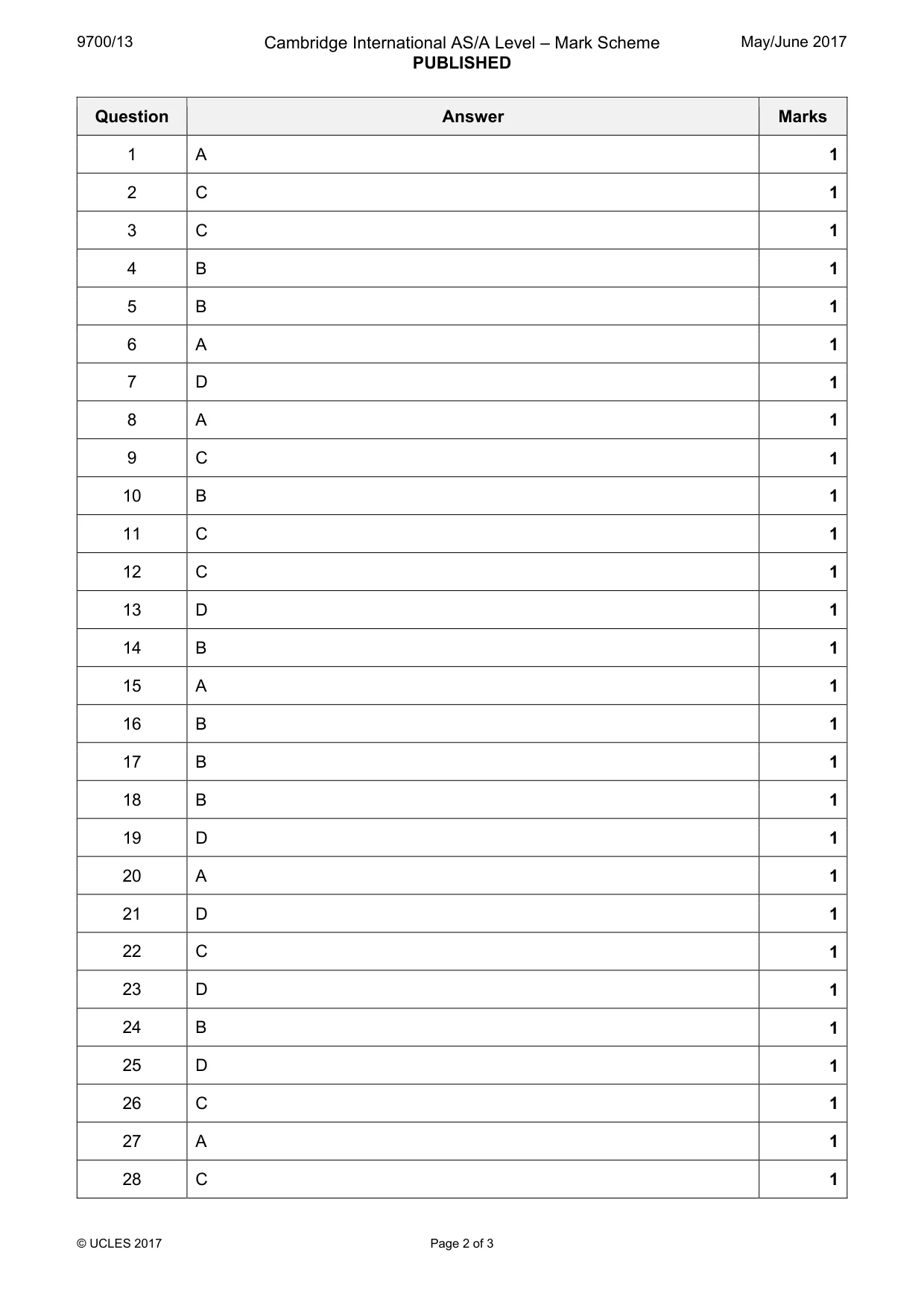
Mark scheme: A
More questions on Cells as the basic units of living organisms
Q2 · The diagram shows an eyepiece graticule and part of a stage micrometer scale as seen…
2 The diagram shows an eyepiece graticule and part of a stage micrometer scale as seen using ×100 magnification. eyepiece graticule stage micrometer scale 0.1 mm How is the value, in µm, of one eyepiece graticule unit calculated? A divide 100 by 0.1 and multiply by 1000 B divide 100 by 0.1 and multiply by 1000 divided by 100 C multiply 0.1 by 1000 and divide by 100 D multiply 0.1 by 1000 and divide by 100 then divide again by 100
Mark scheme: C
Q3 · It is possible for a bacterium to synthesise a eukaryotic protein
3 It is possible for a bacterium to synthesise a eukaryotic protein. This involves introducing a eukaryotic gene into the bacterial DNA, which can be translated. What explains why a bacterial cell can produce a eukaryotic protein but cannot produce a eukaryotic glycoprotein? A Bacteria do not have 70S ribosomes. B Bacteria do not have a nuclear envelope. C Bacteria do not have Golgi bodies. D Bacteria do not have mitochondria.
Mark scheme: C
More questions on Cells as the basic units of living organisms
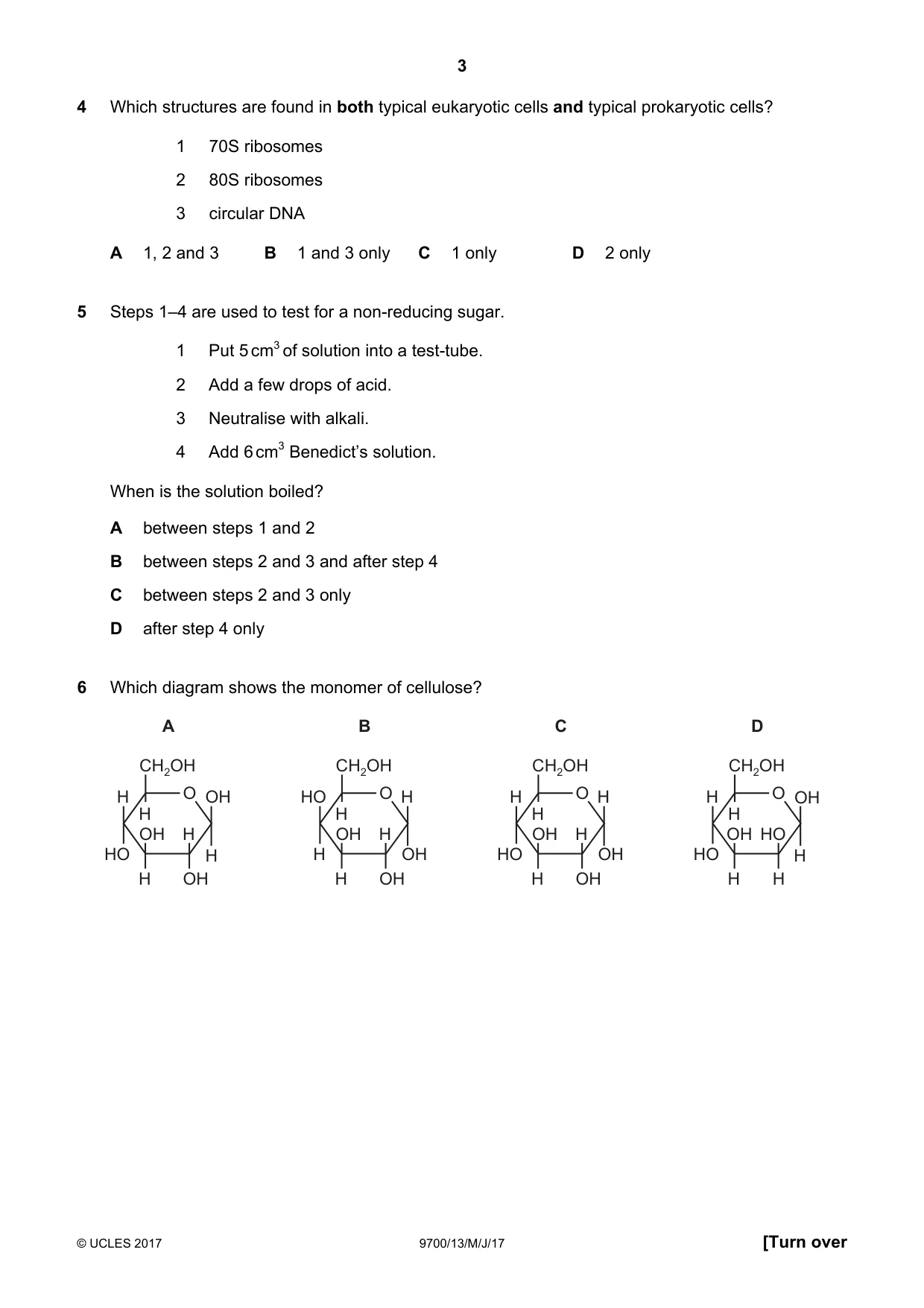
Q4 · Which structures are found in both typical eukaryotic cells and typical prokaryotic cells?
4 Which structures are found in both typical eukaryotic cells and typical prokaryotic cells? 1 70S ribosomes 2 80S ribosomes 3 circular DNA A 1, 2 and 3 B 1 and 3 only C 1 only D 2 only
Mark scheme: B
More questions on Cells as the basic units of living organisms
Q5 · Steps 1–4 are used to test for a non-reducing sugar
5 Steps 1–4 are used to test for a non-reducing sugar. 1 Put 5 cm3 of solution into a test-tube. 2 Add a few drops of acid. 3 Neutralise with alkali. 4 Add 6 cm3 Benedict’s solution. When is the solution boiled? A between steps 1 and 2 B between steps 2 and 3 and after step 4 C between steps 2 and 3 only D after step 4 only
Mark scheme: B
Q6 · Which diagram shows the monomer of cellulose?
6 Which diagram shows the monomer of cellulose? A B C D CH2OH CH2OH CH2OH CH2OH H O OH HO O H H O H H O OH H H H H OH H OH H OH H OH HO HO H H OH HO OH HO H H OH H OH H OH H H
Mark scheme: A
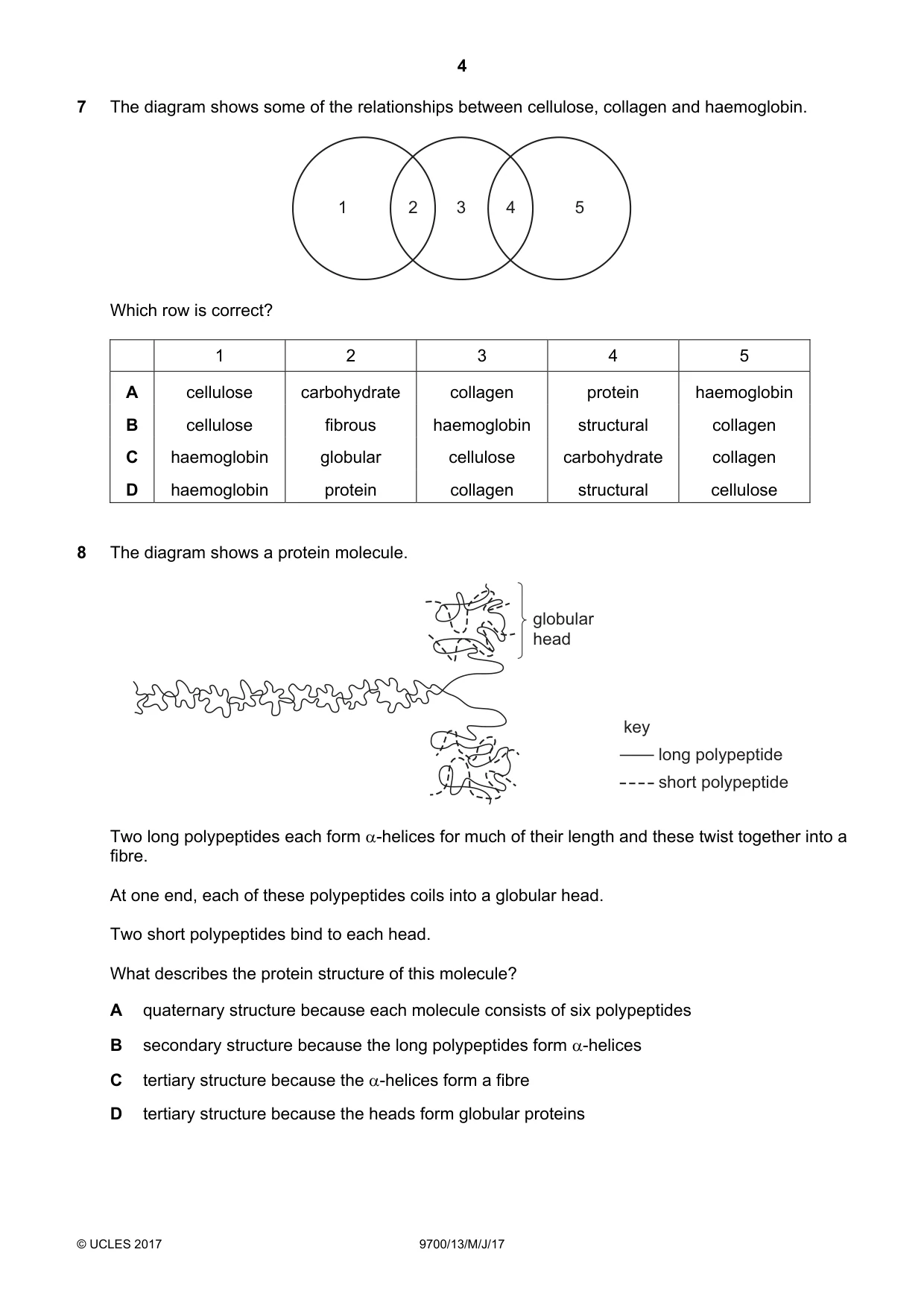
Q7 · The diagram shows some of the relationships between cellulose, collagen and haemoglobin
7 The diagram shows some of the relationships between cellulose, collagen and haemoglobin. 1 2 3 4 5 Which row is correct? 1 2 3 4 5 A cellulose carbohydrate collagen protein haemoglobin B cellulose fibrous haemoglobin structural collagen C haemoglobin globular cellulose carbohydrate collagen D haemoglobin protein collagen structural cellulose
Mark scheme: D
Q8 · The diagram shows a protein molecule
8 The diagram shows a protein molecule. globular head key long polypeptide short polypeptide Two long polypeptides each form α-helices for much of their length and these twist together into a fibre. At one end, each of these polypeptides coils into a globular head. Two short polypeptides bind to each head. What describes the protein structure of this molecule? A quaternary structure because each molecule consists of six polypeptides B secondary structure because the long polypeptides form α-helices C tertiary structure because the α-helices form a fibre D tertiary structure because the heads form globular proteins
Mark scheme: A
Q9 · Which statements about both amylose and amylopectin are correct?
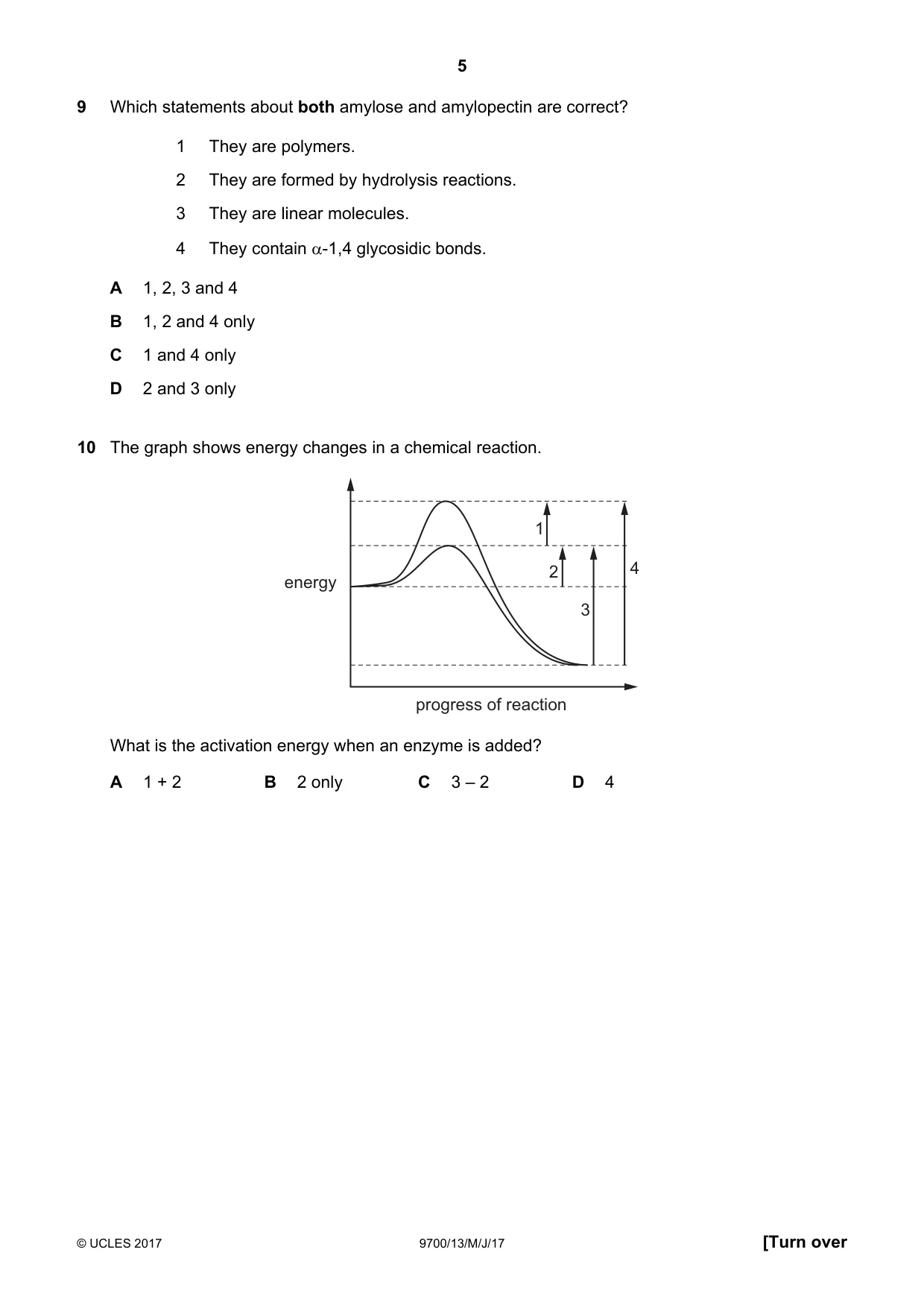
9 Which statements about both amylose and amylopectin are correct? 1 They are polymers. 2 They are formed by hydrolysis reactions. 3 They are linear molecules. 4 They contain α-1,4 glycosidic bonds. A 1, 2, 3 and 4 B 1, 2 and 4 only C 1 and 4 only D 2 and 3 only
Mark scheme: C
Q10 · The graph shows energy changes in a chemical reaction
10 The graph shows energy changes in a chemical reaction. 1 2 4 energy 3 progress of reaction What is the activation energy when an enzyme is added? A 1 + 2 B 2 only C 3 – 2 D 4
Mark scheme: B
Q11 · The graph shows the results of investigations into the effect of amylase on the…
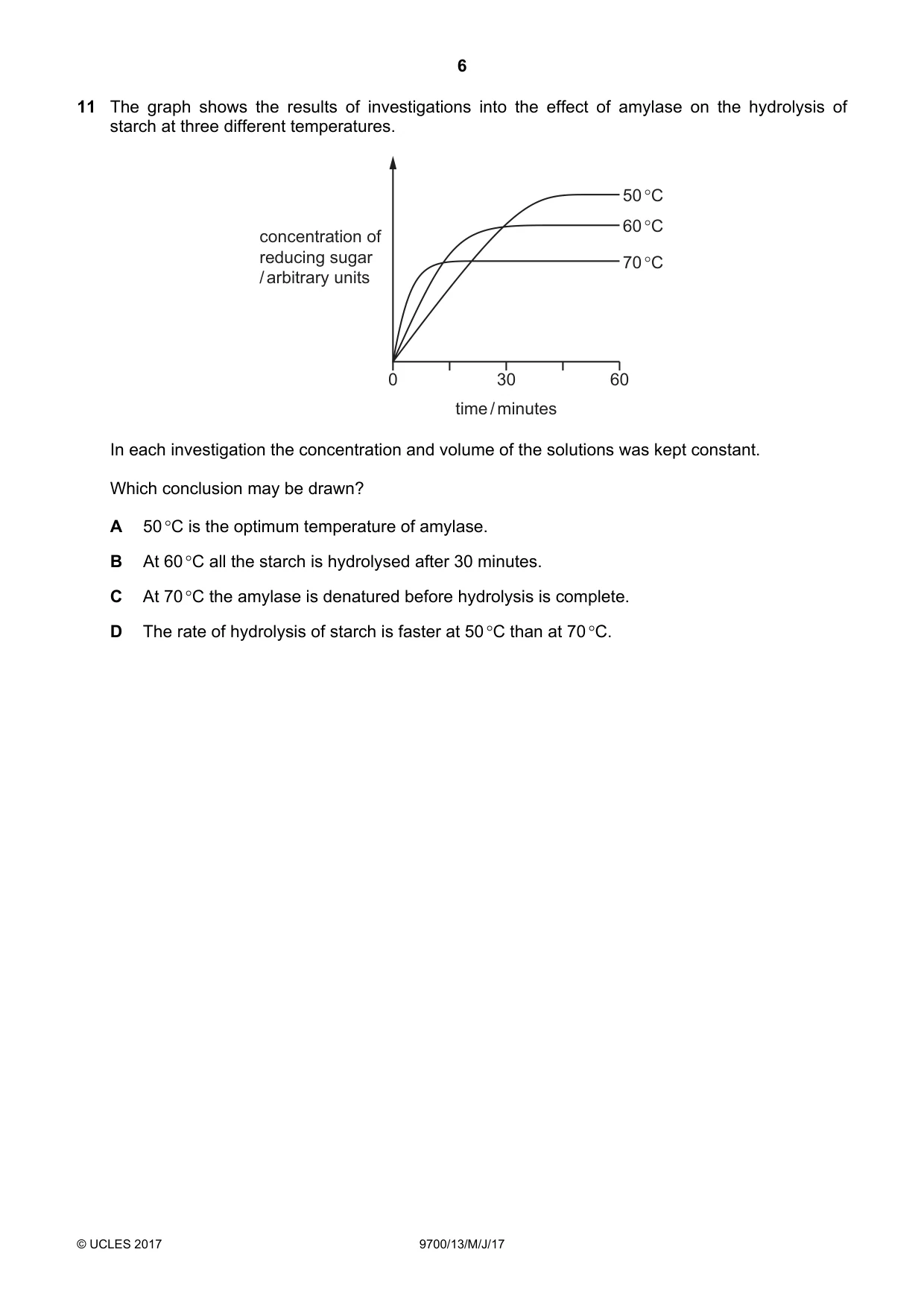
11 The graph shows the results of investigations into the effect of amylase on the hydrolysis of starch at three different temperatures. 50 °C 60 °C concentration of reducing sugar 70 °C / arbitrary units 0 30 60 time / minutes In each investigation the concentration and volume of the solutions was kept constant. Which conclusion may be drawn? A 50 °C is the optimum temperature of amylase. B At 60 °C all the starch is hydrolysed after 30 minutes. C At 70 °C the amylase is denatured before hydrolysis is complete. D The rate of hydrolysis of starch is faster at 50 °C than at 70 °C.
Mark scheme: C
Q12 · The graph compares the effect of temperature on the activity of the protease enzyme…
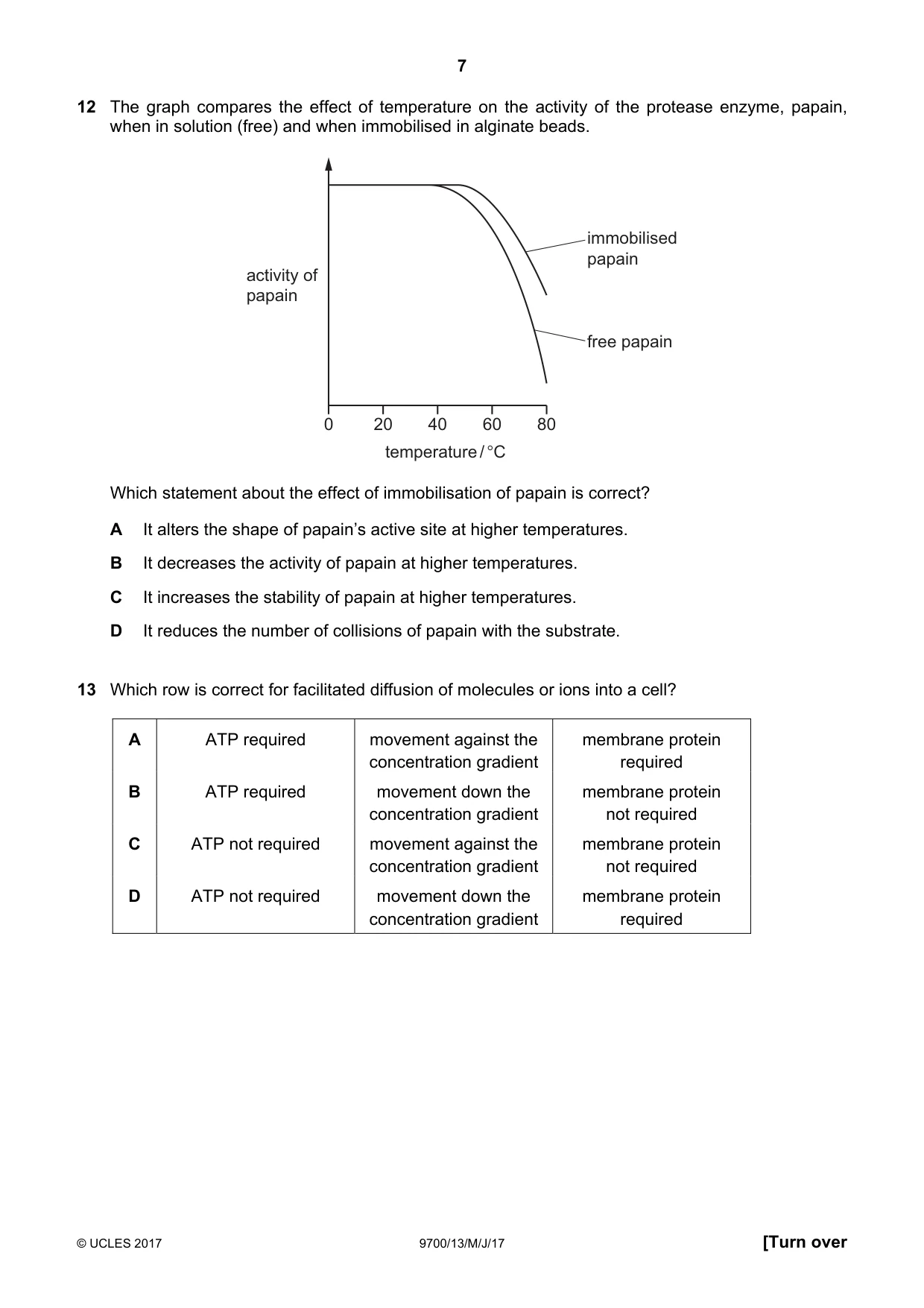
12 The graph compares the effect of temperature on the activity of the protease enzyme, papain, when in solution (free) and when immobilised in alginate beads. immobilised papain activity of papain free papain 0 20 40 60 80 temperature / °C Which statement about the effect of immobilisation of papain is correct? A It alters the shape of papain’s active site at higher temperatures. B It decreases the activity of papain at higher temperatures. C It increases the stability of papain at higher temperatures. D It reduces the number of collisions of papain with the substrate.
Mark scheme: C
Q13 · Which row is correct for facilitated diffusion of molecules or ions into a cell?
13 Which row is correct for facilitated diffusion of molecules or ions into a cell? A ATP required movement against the membrane protein concentration gradient required B ATP required movement down the membrane protein concentration gradient not required C ATP not required movement against the membrane protein concentration gradient not required D ATP not required movement down the membrane protein concentration gradient required
Mark scheme: D
Q14 · The diagram represents an experiment where two solutions, P and Q, were separated by a…
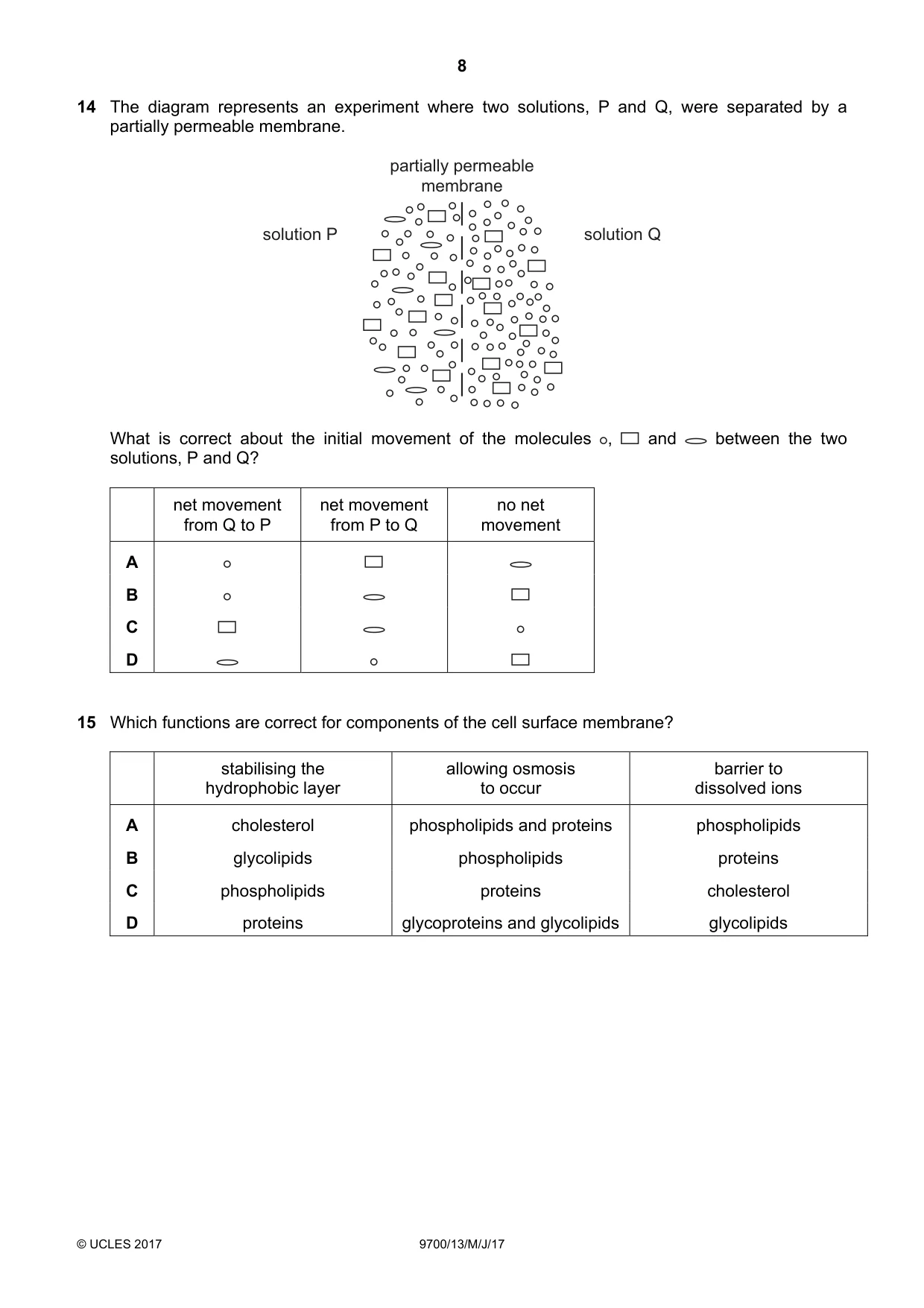
14 The diagram represents an experiment where two solutions, P and Q, were separated by a partially permeable membrane. partially permeable membrane solution P solution Q What is correct about the initial movement of the molecules , and between the two solutions, P and Q? net movement net movement no net from Q to P from P to Q movement A B C D
Mark scheme: B
Q15 · Which functions are correct for components of the cell surface membrane?
15 Which functions are correct for components of the cell surface membrane? stabilising the allowing osmosis barrier to hydrophobic layer to occur dissolved ions A cholesterol phospholipids and proteins phospholipids B glycolipids phospholipids proteins C phospholipids proteins cholesterol D proteins glycoproteins and glycolipids glycolipids
Mark scheme: A
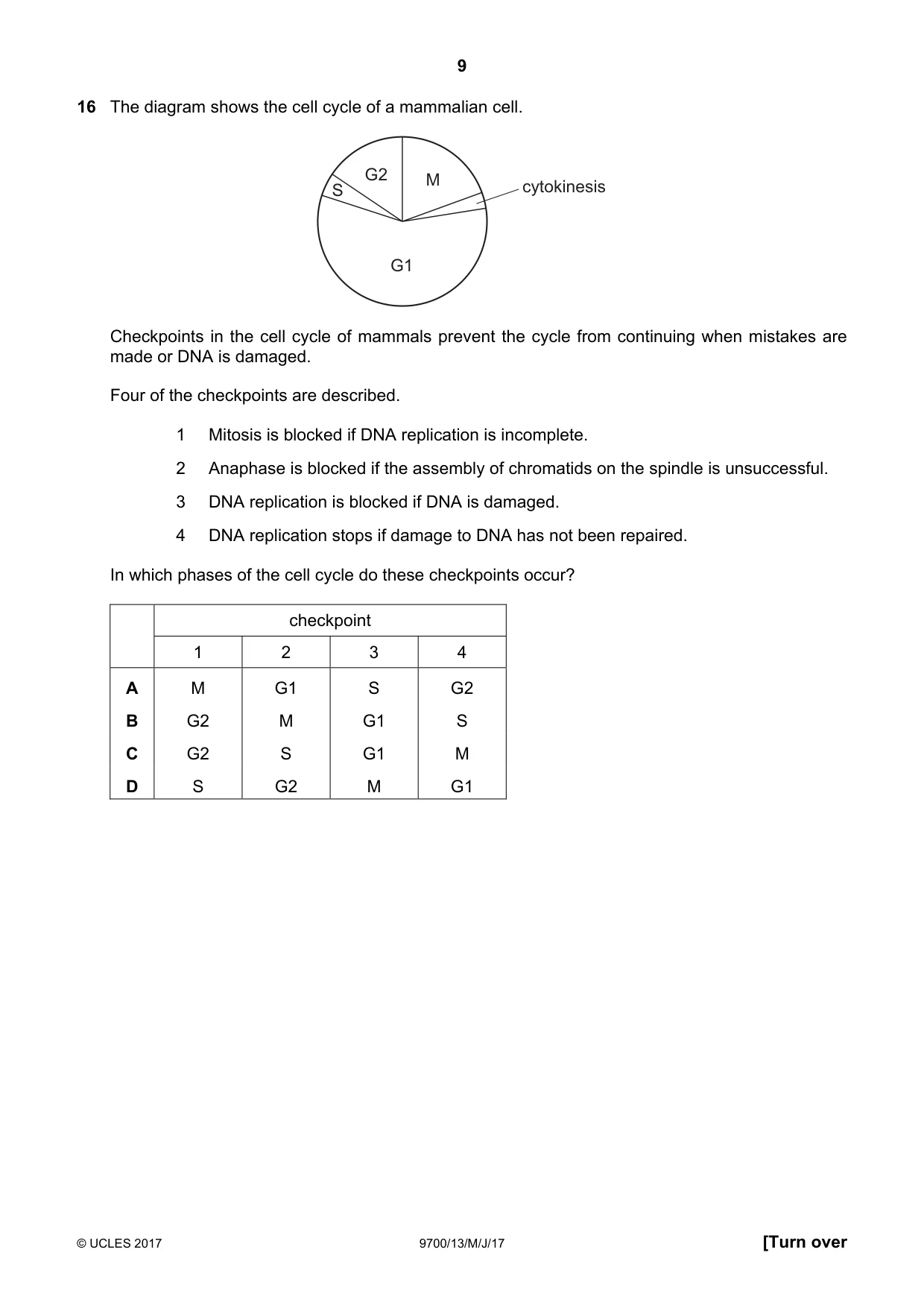
Q16 · The diagram shows the cell cycle of a mammalian cell
16 The diagram shows the cell cycle of a mammalian cell. G2 M S cytokinesis G1 Checkpoints in the cell cycle of mammals prevent the cycle from continuing when mistakes are made or DNA is damaged. Four of the checkpoints are described. 1 Mitosis is blocked if DNA replication is incomplete. 2 Anaphase is blocked if the assembly of chromatids on the spindle is unsuccessful. 3 DNA replication is blocked if DNA is damaged. 4 DNA replication stops if damage to DNA has not been repaired. In which phases of the cell cycle do these checkpoints occur? checkpoint 1 2 3 4 A M G1 S G2 B G2 M G1 S C G2 S G1 M D S G2 M G1
Mark scheme: B
More questions on Replication and division of nuclei and cells
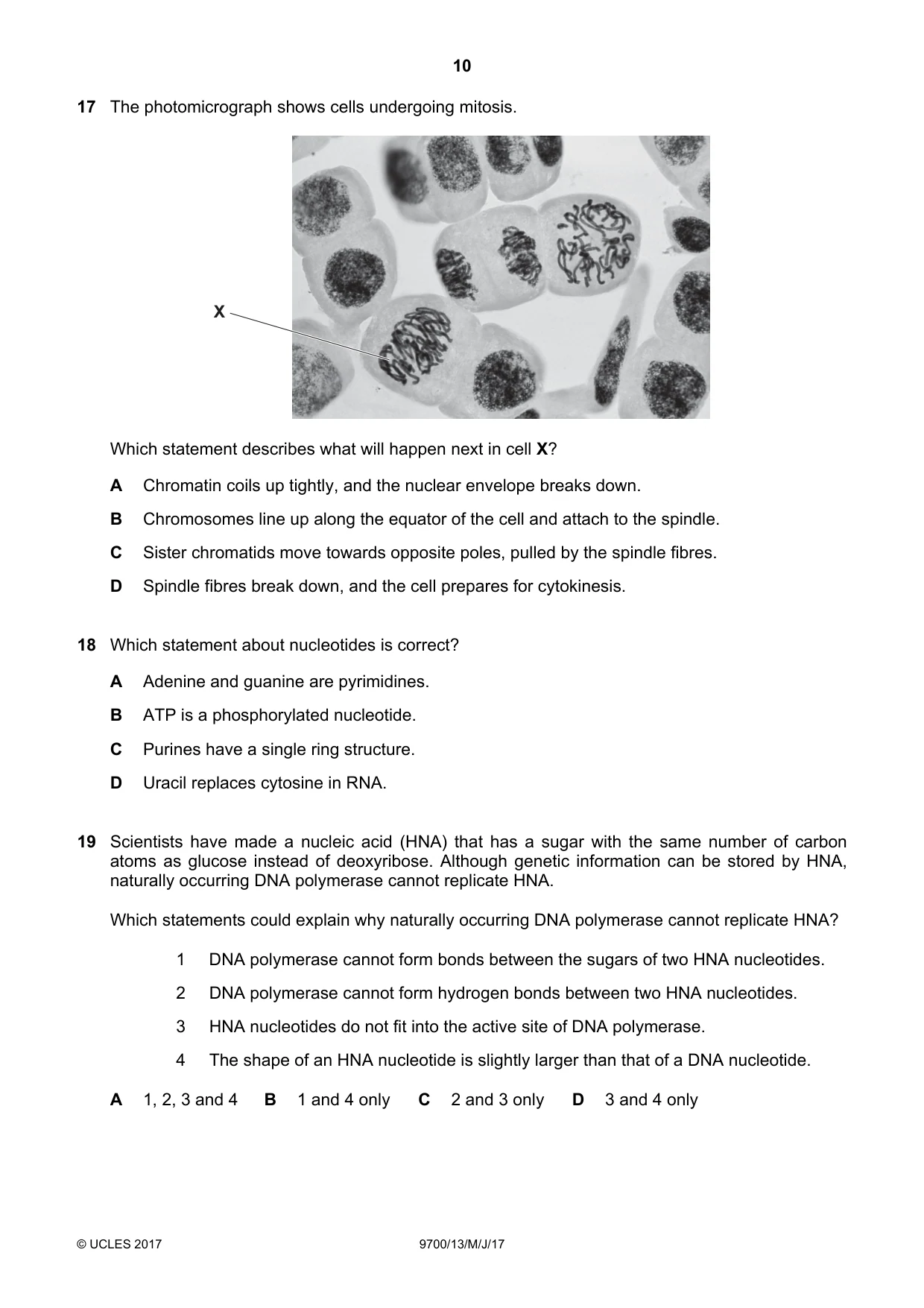
Q17 · The photomicrograph shows cells undergoing mitosis
17 The photomicrograph shows cells undergoing mitosis. X Which statement describes what will happen next in cell X? A Chromatin coils up tightly, and the nuclear envelope breaks down. B Chromosomes line up along the equator of the cell and attach to the spindle. C Sister chromatids move towards opposite poles, pulled by the spindle fibres. D Spindle fibres break down, and the cell prepares for cytokinesis.
Mark scheme: B
Q18 · Which statement about nucleotides is correct?
18 Which statement about nucleotides is correct? A Adenine and guanine are pyrimidines. B ATP is a phosphorylated nucleotide. C Purines have a single ring structure. D Uracil replaces cytosine in RNA.
Mark scheme: B
More questions on Structure of nucleic acids and replication of DNA
Q19 · Scientists have made a nucleic acid (HNA) that has a sugar with the same number of carbon…
19 Scientists have made a nucleic acid (HNA) that has a sugar with the same number of carbon atoms as glucose instead of deoxyribose. Although genetic information can be stored by HNA, naturally occurring DNA polymerase cannot replicate HNA. Which statements could explain why naturally occurring DNA polymerase cannot replicate HNA? 1 DNA polymerase cannot form bonds between the sugars of two HNA nucleotides. 2 DNA polymerase cannot form hydrogen bonds between two HNA nucleotides. 3 HNA nucleotides do not fit into the active site of DNA polymerase. 4 The shape of an HNA nucleotide is slightly larger than that of a DNA nucleotide. A 1, 2, 3 and 4 B 1 and 4 only C 2 and 3 only D 3 and 4 only
Mark scheme: D
More questions on Structure of nucleic acids and replication of DNA
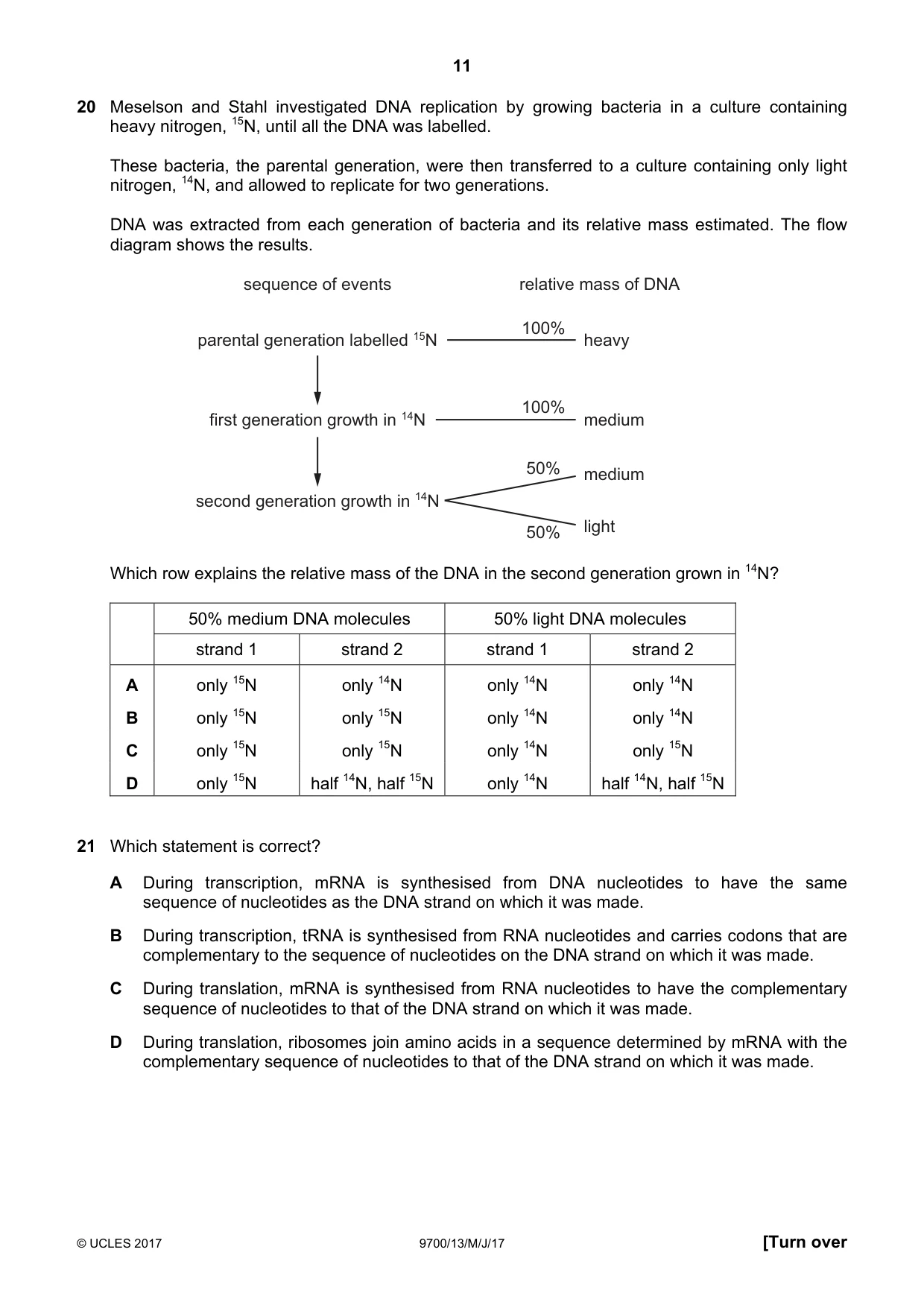
Q20 · Meselson and Stahl investigated DNA replication by growing bacteria in a culture…
20 Meselson and Stahl investigated DNA replication by growing bacteria in a culture containing heavy nitrogen, 15N, until all the DNA was labelled. These bacteria, the parental generation, were then transferred to a culture containing only light nitrogen, 14N, and allowed to replicate for two generations. DNA was extracted from each generation of bacteria and its relative mass estimated. The flow diagram shows the results. sequence of events relative mass of DNA 100% parental generation labelled 15N heavy 100% first generation growth in 14N medium 50% medium second generation growth in 14N 50% light Which row explains the relative mass of the DNA in the second generation grown in 14N? 50% medium DNA molecules 50% light DNA molecules strand 1 strand 2 strand 1 strand 2 A only 15N only 14N only 14N only 14N B only 15N only 15N only 14N only 14N C only 15N only 15N only 14N only 15N D only 15N half 14N, half 15N only 14N half 14N, half 15N
Mark scheme: A
More questions on Structure of nucleic acids and replication of DNA
Q21 · Which statement is correct?
21 Which statement is correct? A During transcription, mRNA is synthesised from DNA nucleotides to have the same sequence of nucleotides as the DNA strand on which it was made. B During transcription, tRNA is synthesised from RNA nucleotides and carries codons that are complementary to the sequence of nucleotides on the DNA strand on which it was made. C During translation, mRNA is synthesised from RNA nucleotides to have the complementary sequence of nucleotides to that of the DNA strand on which it was made. D During translation, ribosomes join amino acids in a sequence determined by mRNA with the complementary sequence of nucleotides to that of the DNA strand on which it was made.
Mark scheme: D
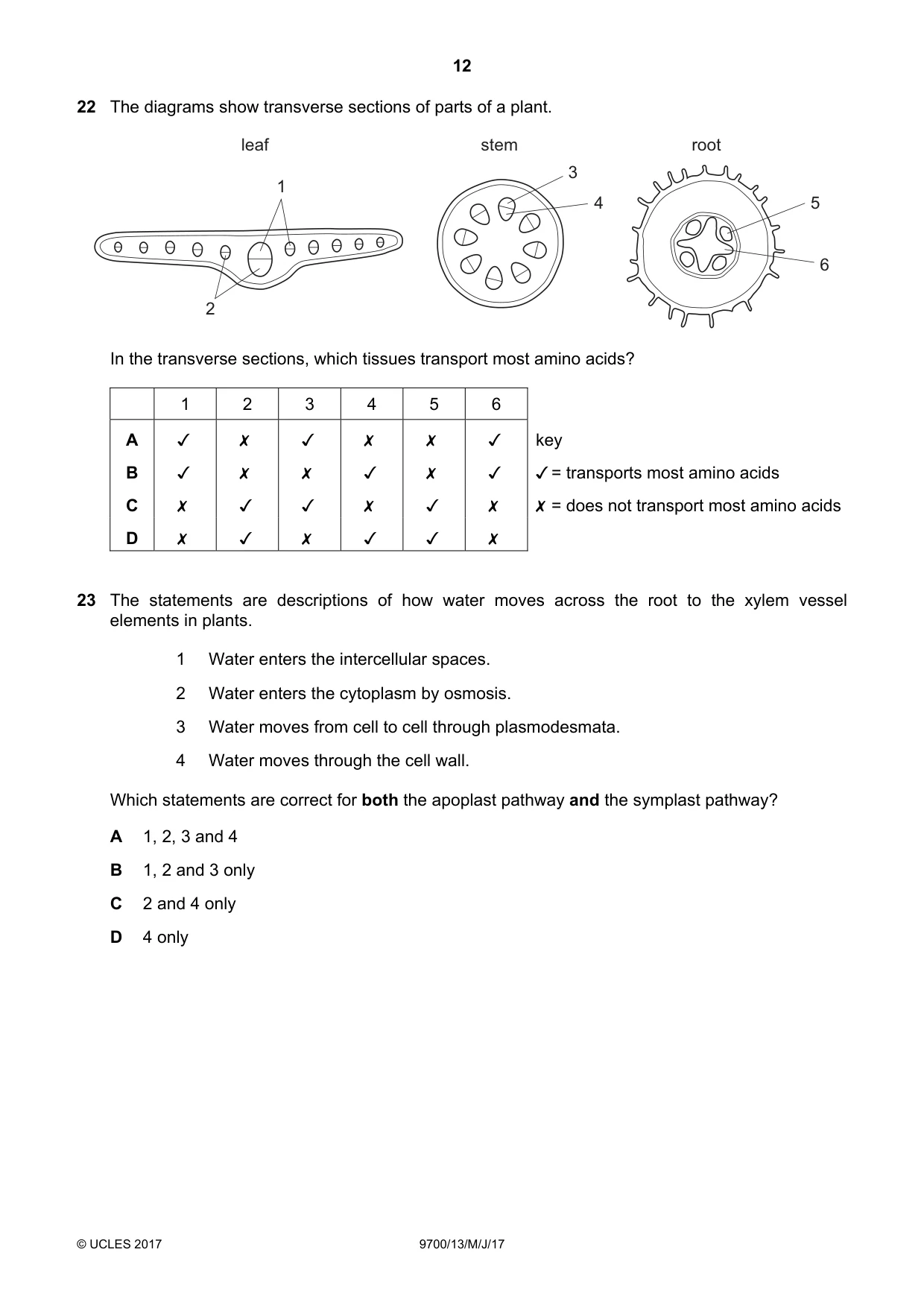
Q22 · The diagrams show transverse sections of parts of a plant
22 The diagrams show transverse sections of parts of a plant. leaf stem root Suen - , Oe bet 6 In the transverse sections, which tissues transport most amino acids? 1 2 3 4 5 6 A v x v x x v key B Jv x x Jv x Jv ¥ = transports most amino acids Cc x Jv Jv x Jv x X = does not transport most amino acids D x v x v v x
Mark scheme: C
Q23 · The statements are descriptions of how water moves across the root to the xylem vessel…
23 The statements are descriptions of how water moves across the root to the xylem vessel elements in plants. 1 Water enters the intercellular spaces. 2 Water enters the cytoplasm by osmosis. 3 Water moves from cell to cell through plasmodesmata. 4 Water moves through the cell wall. Which statements are correct for both the apoplast pathway and the symplast pathway? A 1, 2, 3 and 4 B 1, 2 and 3 only C 2 and 4 only D 4 only
Mark scheme: D
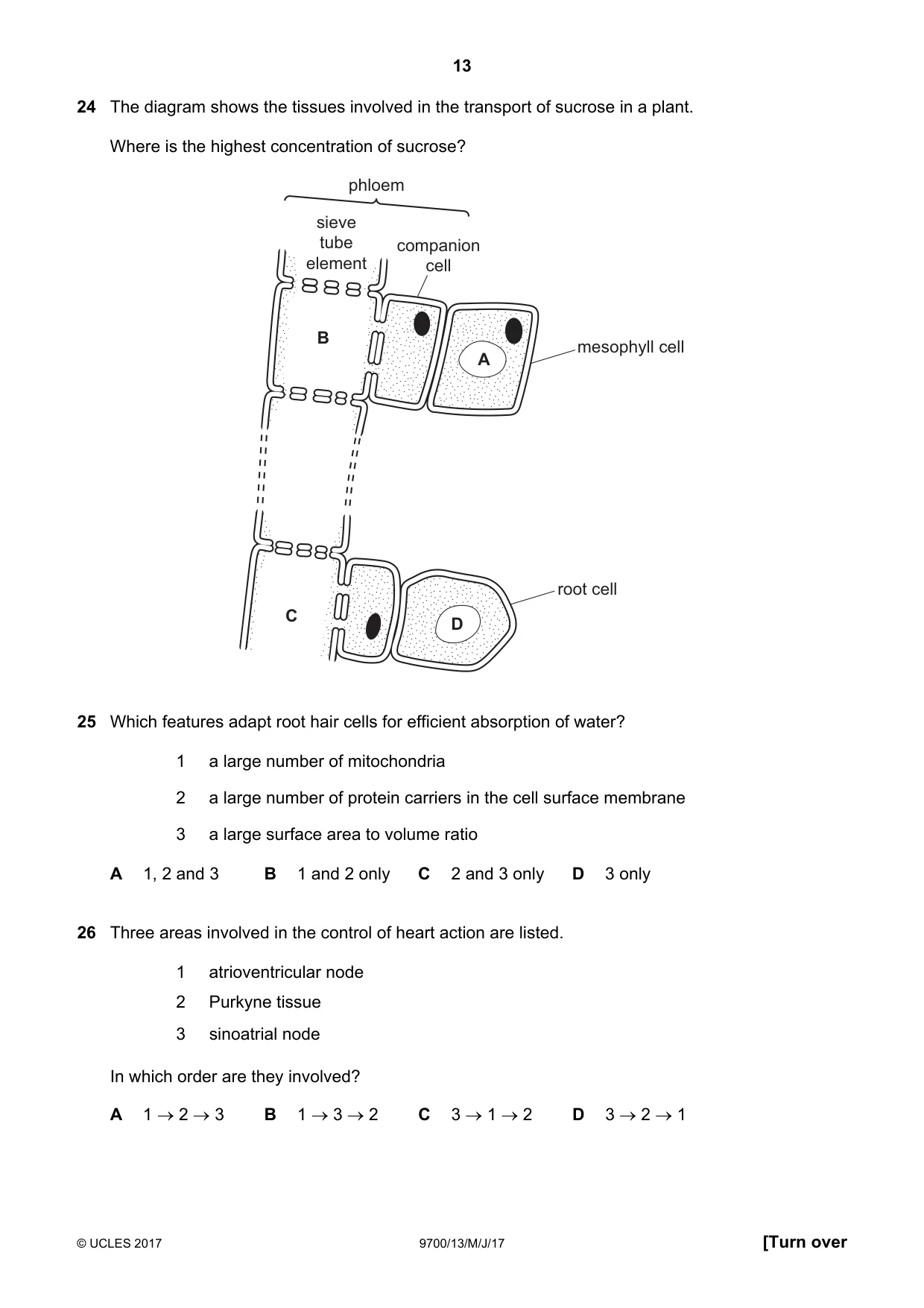
Q24 · The diagram shows the tissues involved in the transport of sucrose in a plant
24 The diagram shows the tissues involved in the transport of sucrose in a plant. Where is the highest concentration of sucrose? phloem sieve tube companion element cell B mesophyll cell A root cell C D
Mark scheme: B
Q25 · Which features adapt root hair cells for efficient absorption of water?
25 Which features adapt root hair cells for efficient absorption of water? 1 a large number of mitochondria 2 a large number of protein carriers in the cell surface membrane 3 a large surface area to volume ratio A 1, 2 and 3 B 1 and 2 only C 2 and 3 only D 3 only
Mark scheme: D
Q26 · Three areas involved in the control of heart action are listed
26 Three areas involved in the control of heart action are listed. 1 atrioventricular node 2 Purkyne tissue 3 sinoatrial node In which order are they involved? A 1 → 2 → 3 B 1 → 3 → 2 C 3 → 1 → 2 D 3 → 2 → 1
Mark scheme: C
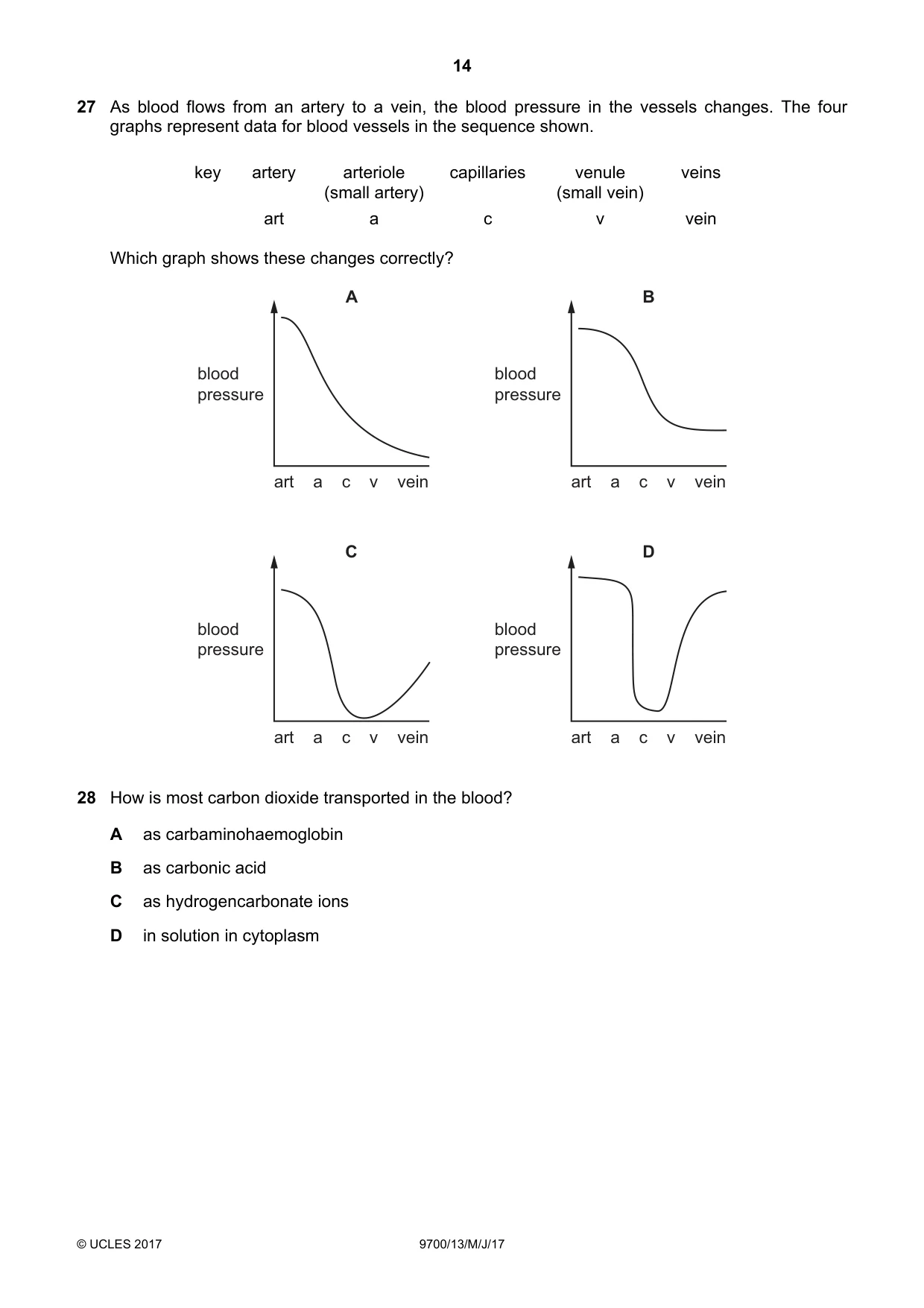
Q27 · As blood flows from an artery to a vein, the blood pressure in the vessels changes
27 As blood flows from an artery to a vein, the blood pressure in the vessels changes. The four graphs represent data for blood vessels in the sequence shown. key artery arteriole capillaries venule veins (small artery) (small vein) art a c v vein Which graph shows these changes correctly? A B blood blood pressure pressure art a c v vein art a c v vein C D blood blood pressure pressure art a c v vein art a c v vein
Mark scheme: A
Q28 · How is most carbon dioxide transported in the blood?
28 How is most carbon dioxide transported in the blood? A as carbaminohaemoglobin B as carbonic acid C as hydrogencarbonate ions D in solution in cytoplasm
Mark scheme: C
Q29 · When a doctor or nurse takes a blood sample from a person they use a needle to penetrate…
29 When a doctor or nurse takes a blood sample from a person they use a needle to penetrate a vein, not an artery. Which reasons explain why veins are used? 1 Arteries carry blood under more pressure than veins. 2 Arteries have a thicker middle layer than veins. 3 Veins carry deoxygenated blood. 4 Veins have a larger lumen than arteries. A 1, 2, 3 and 4 B 1, 2 and 3 only C 1, 2 and 4 only D 3 and 4 only
Mark scheme: C
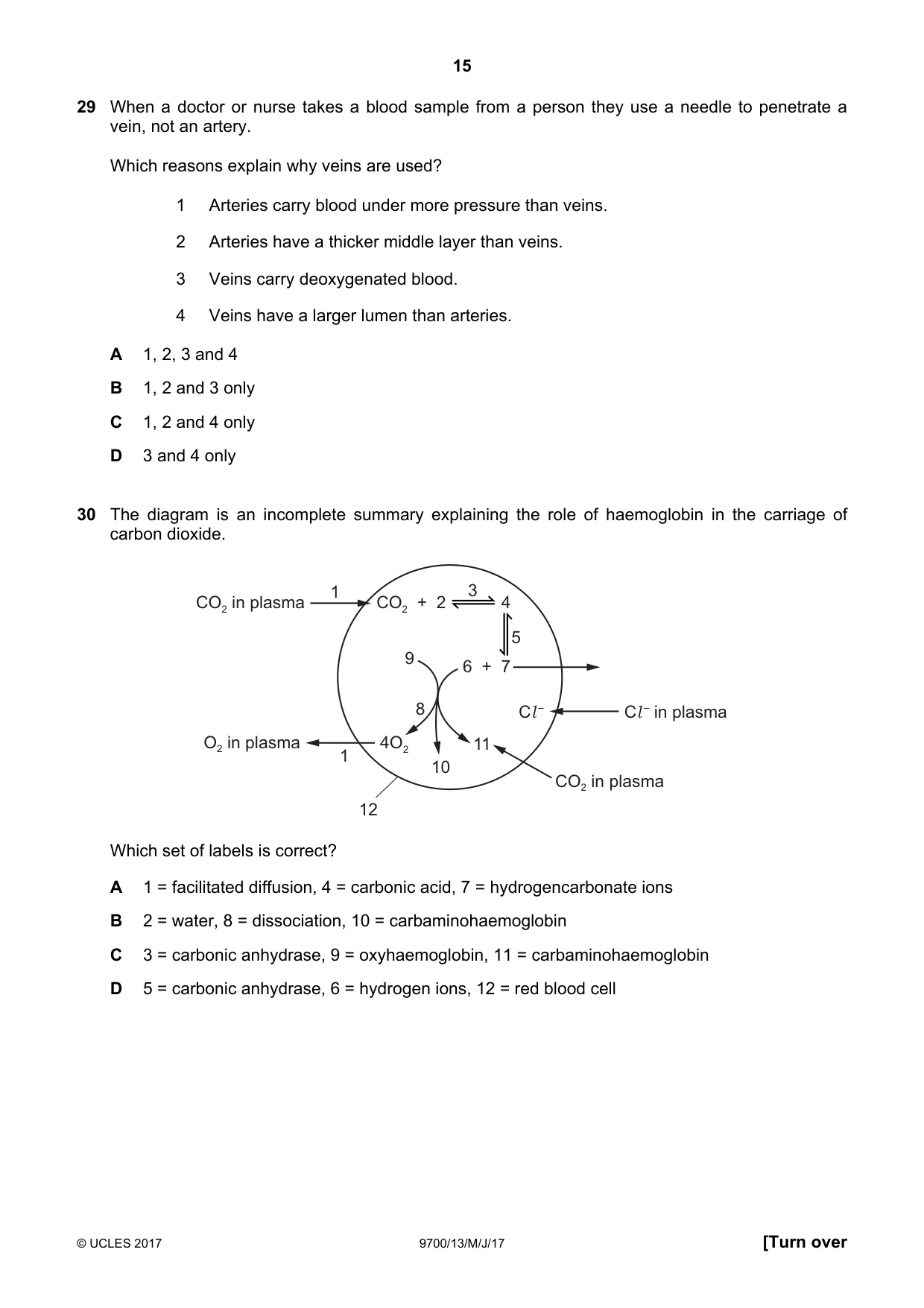
Q30 · The diagram is an incomplete summary explaining the role of haemoglobin in the carriage…
30 The diagram is an incomplete summary explaining the role of haemoglobin in the carriage of carbon dioxide. 1 3 CO2 in plasma CO2 + 2 4 5 9 6 + 7 8 Cl – Cl – in plasma O2 in plasma 4O2 11 1 10 CO2 in plasma 12 Which set of labels is correct? A 1 = facilitated diffusion, 4 = carbonic acid, 7 = hydrogencarbonate ions B 2 = water, 8 = dissociation, 10 = carbaminohaemoglobin C 3 = carbonic anhydrase, 9 = oxyhaemoglobin, 11 = carbaminohaemoglobin D 5 = carbonic anhydrase, 6 = hydrogen ions, 12 = red blood cell
Mark scheme: C
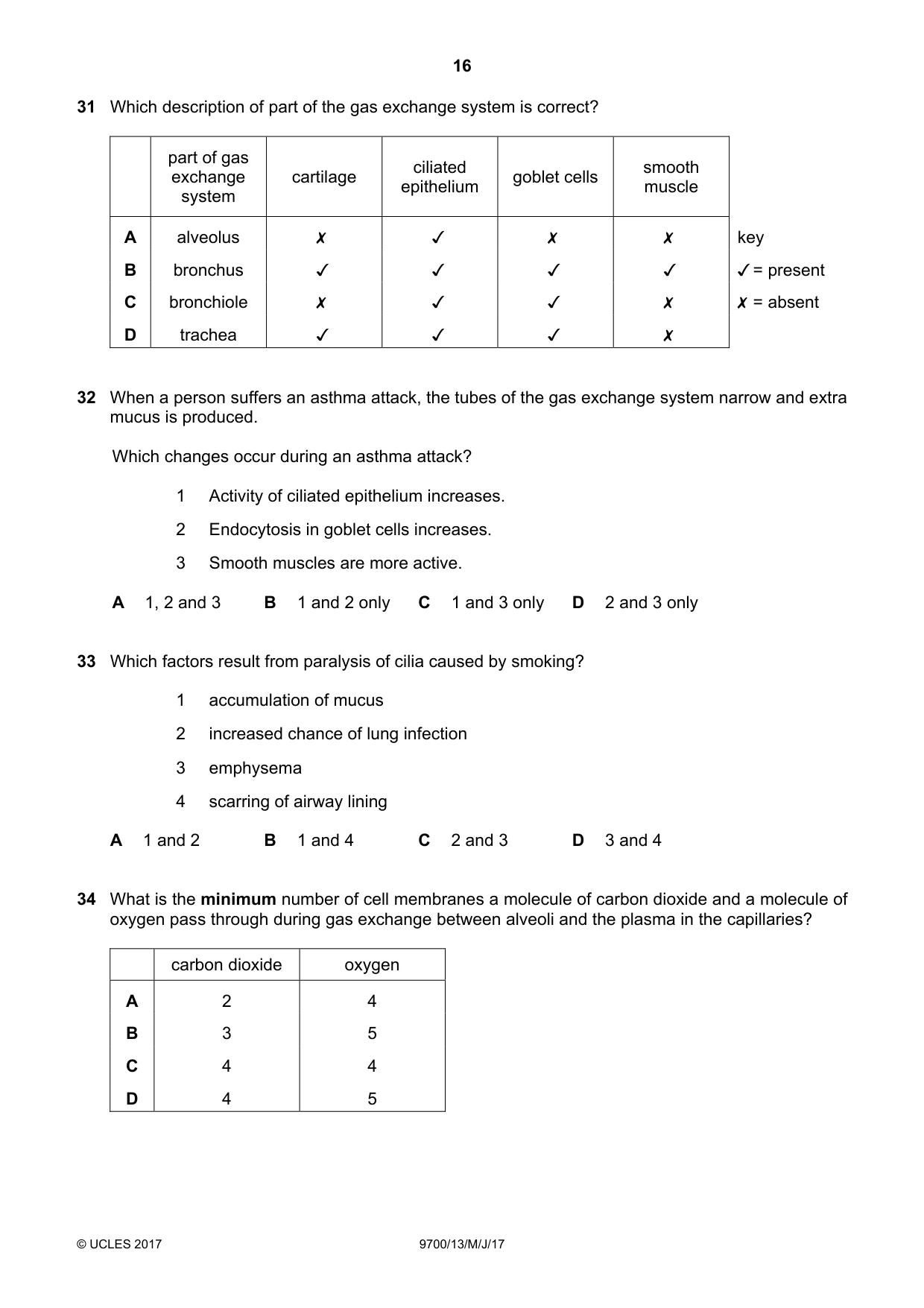
Q31 · Which description of part of the gas exchange system is correct?
31 Which description of part of the gas exchange system is correct? part of gas exchange system cartilage ciliated epithelium goblet cells smooth muscle 0 Oo WwW > alveolus bronchus bronchiole trachea Kj « < x S48 4 S <4 x x « & x key J/ = present X = absent
Mark scheme: B
Q32 · When a person suffers an asthma attack, the tubes of the gas exchange system narrow and…
32 When a person suffers an asthma attack, the tubes of the gas exchange system narrow and extra mucus is produced. Which changes occur during an asthma attack? 1 Activity of ciliated epithelium increases. 2 Endocytosis in goblet cells increases. 3 Smooth muscles are more active. A 1, 2 and 3 B 1 and 2 only C 1 and 3 only D 2 and 3 only
Mark scheme: C
Q33 · Which factors result from paralysis of cilia caused by smoking?
33 Which factors result from paralysis of cilia caused by smoking? 1 accumulation of mucus 2 increased chance of lung infection 3 emphysema 4 scarring of airway lining A 1 and 2 B 1 and 4 C 2 and 3 D 3 and 4
Mark scheme: A
Q34 · What is the minimum number of cell membranes a molecule of carbon dioxide and a molecule…
34 What is the minimum number of cell membranes a molecule of carbon dioxide and a molecule of oxygen pass through during gas exchange between alveoli and the plasma in the capillaries? carbon dioxide oxygen A 2 4 B 3 5 C 4 4 D 4 5
Mark scheme: C
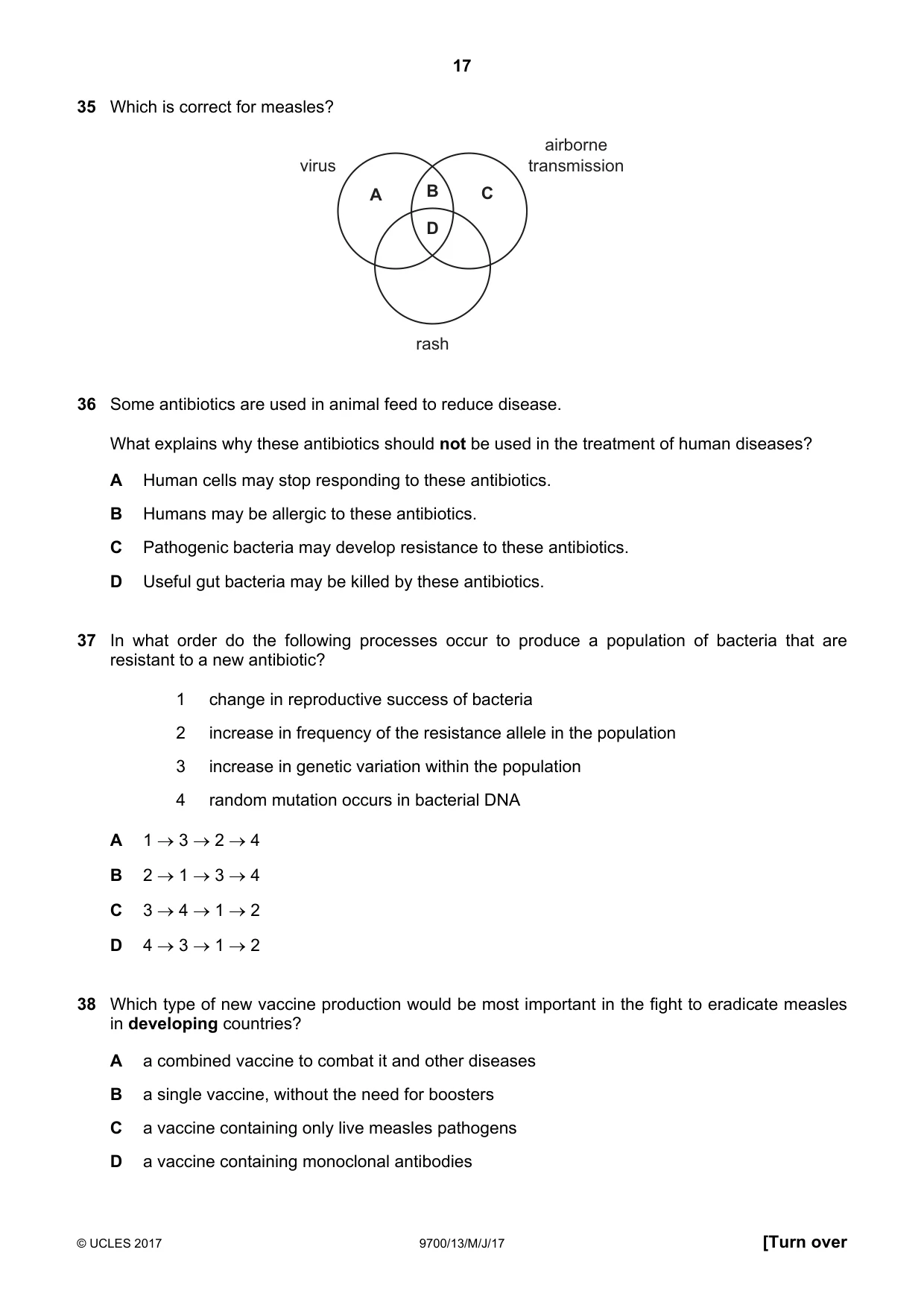
Q35 · Which is correct for measles?
35 Which is correct for measles? airborne virus transmission A B C D rash
Mark scheme: D
Q36 · Some antibiotics are used in animal feed to reduce disease
36 Some antibiotics are used in animal feed to reduce disease. What explains why these antibiotics should not be used in the treatment of human diseases? A Human cells may stop responding to these antibiotics. B Humans may be allergic to these antibiotics. C Pathogenic bacteria may develop resistance to these antibiotics. D Useful gut bacteria may be killed by these antibiotics.
Mark scheme: C
Q37 · In what order do the following processes occur to produce a population of bacteria that…
37 In what order do the following processes occur to produce a population of bacteria that are resistant to a new antibiotic? 1 change in reproductive success of bacteria 2 increase in frequency of the resistance allele in the population 3 increase in genetic variation within the population 4 random mutation occurs in bacterial DNA A 1 → 3 → 2 → 4 B 2 → 1 → 3 → 4 C 3 → 4 → 1 → 2 D 4 → 3 → 1 → 2
Mark scheme: D
Q38 · Which type of new vaccine production would be most important in the fight to eradicate…
38 Which type of new vaccine production would be most important in the fight to eradicate measles in developing countries? A a combined vaccine to combat it and other diseases B a single vaccine, without the need for boosters C a vaccine containing only live measles pathogens D a vaccine containing monoclonal antibodies
Mark scheme: B
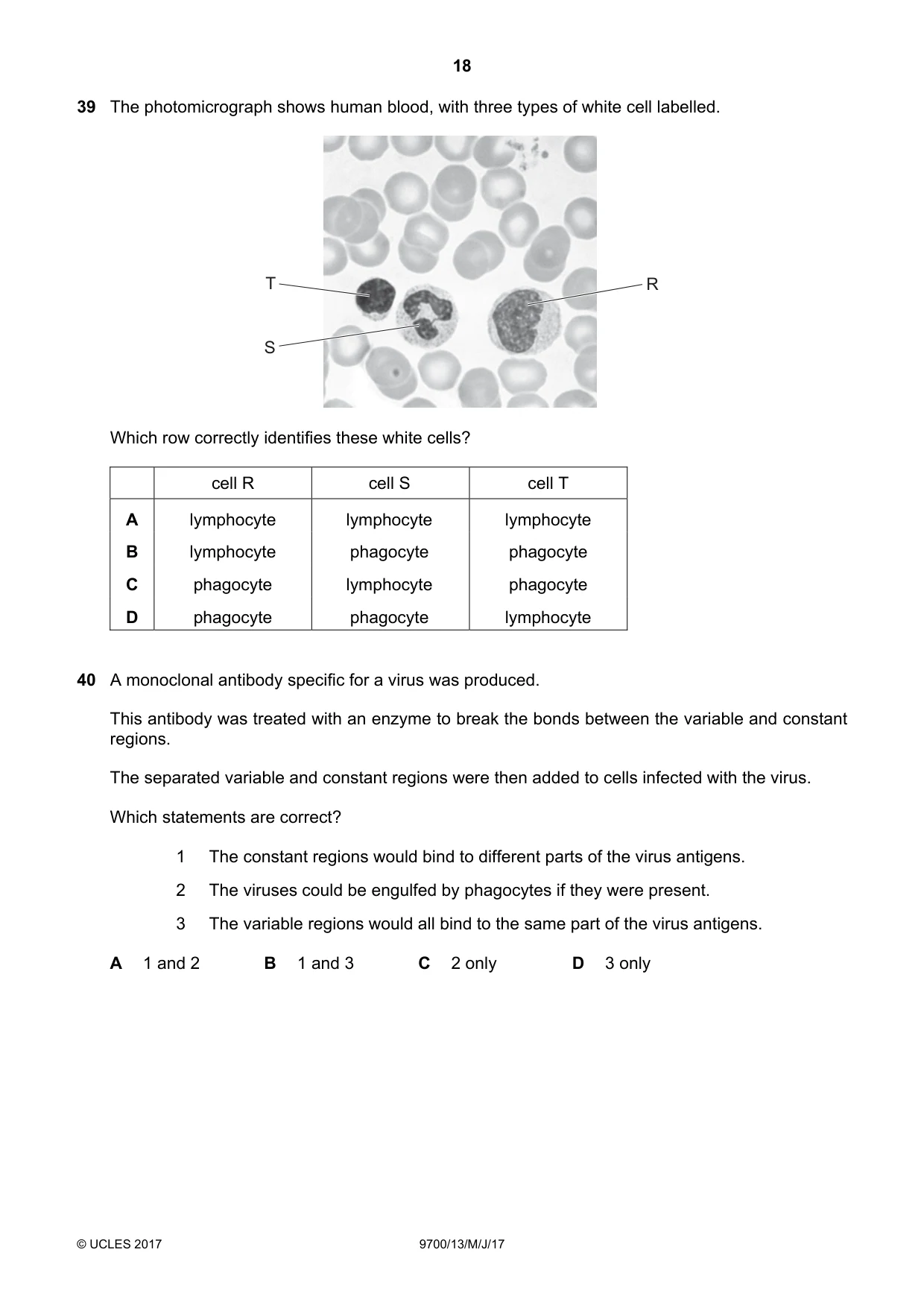
Q39 · The photomicrograph shows human blood, with three types of white cell labelled
39 The photomicrograph shows human blood, with three types of white cell labelled. T R S Which row correctly identifies these white cells? cell R cell S cell T A lymphocyte lymphocyte lymphocyte B lymphocyte phagocyte phagocyte C phagocyte lymphocyte phagocyte D phagocyte phagocyte lymphocyte
Mark scheme: D
Q40 · A monoclonal antibody specific for a virus was produced
40 A monoclonal antibody specific for a virus was produced. This antibody was treated with an enzyme to break the bonds between the variable and constant regions. The separated variable and constant regions were then added to cells infected with the virus. Which statements are correct? 1 The constant regions would bind to different parts of the virus antigens. 2 The viruses could be engulfed by phagocytes if they were present. 3 The variable regions would all bind to the same part of the virus antigens. A 1 and 2 B 1 and 3 C 2 only D 3 only
Mark scheme: D
What was in this paper
The subtopics covered by these 40 questions, and how many questions each got. Open one in a new tab to see every Cambridge question on it.
4Cells as the basic units of living organisms3Structure of nucleic acids and replication of DNA3Transport mechanisms3Antibiotics2Antibodies and vaccination2Carbohydrates and lipids2Factors that affect enzyme action2Movement into and out of cells2Proteins2The circulatory system2Transport of oxygen and carbon dioxide2Chromosome behaviour in mitosis1Fluid mosaic membranes1Infectious diseases1Mode of action of enzymes1Protein synthesis1Replication and division of nuclei and cells1Structure of transport tissues1Testing for biological molecules1The heart1The immune system1The microscope in cell studies1What you needed in this session
Cambridge’s own grade thresholds for 2017 May/June, Paper 1 · Variant 3. A higher threshold means an easier paper — the bar moves with how the cohort did.