Cambridge A Level Biology 9700 — 2018 Oct/Nov Paper 1 · Variant 2
9700/12/O/N/18 · 40 questions · 40 marks · ≈45 min
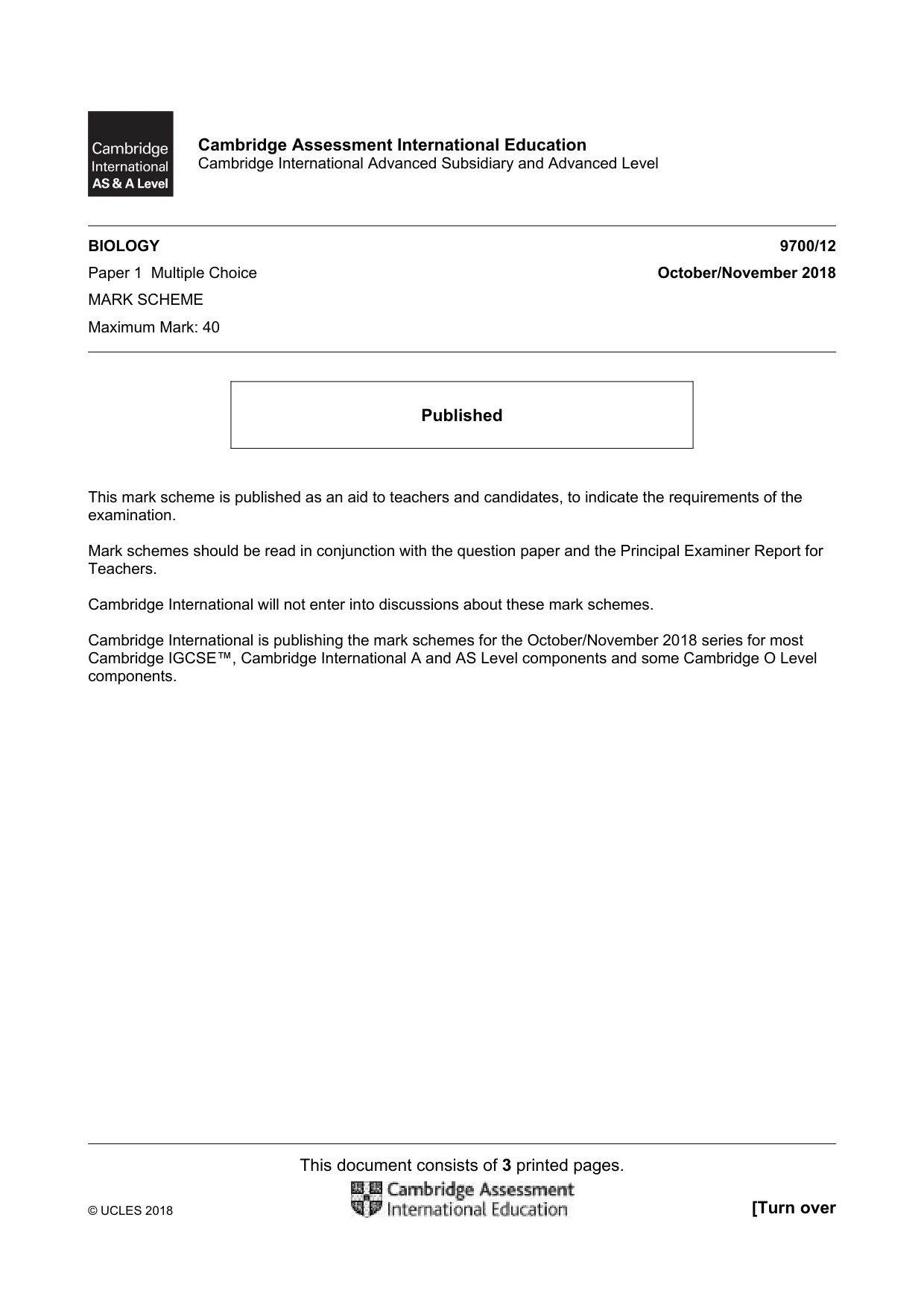
The question paper and its mark scheme, free to read here and free to download. This is Cambridge’s own paper, exactly as it was sat.
Question paper16 pages
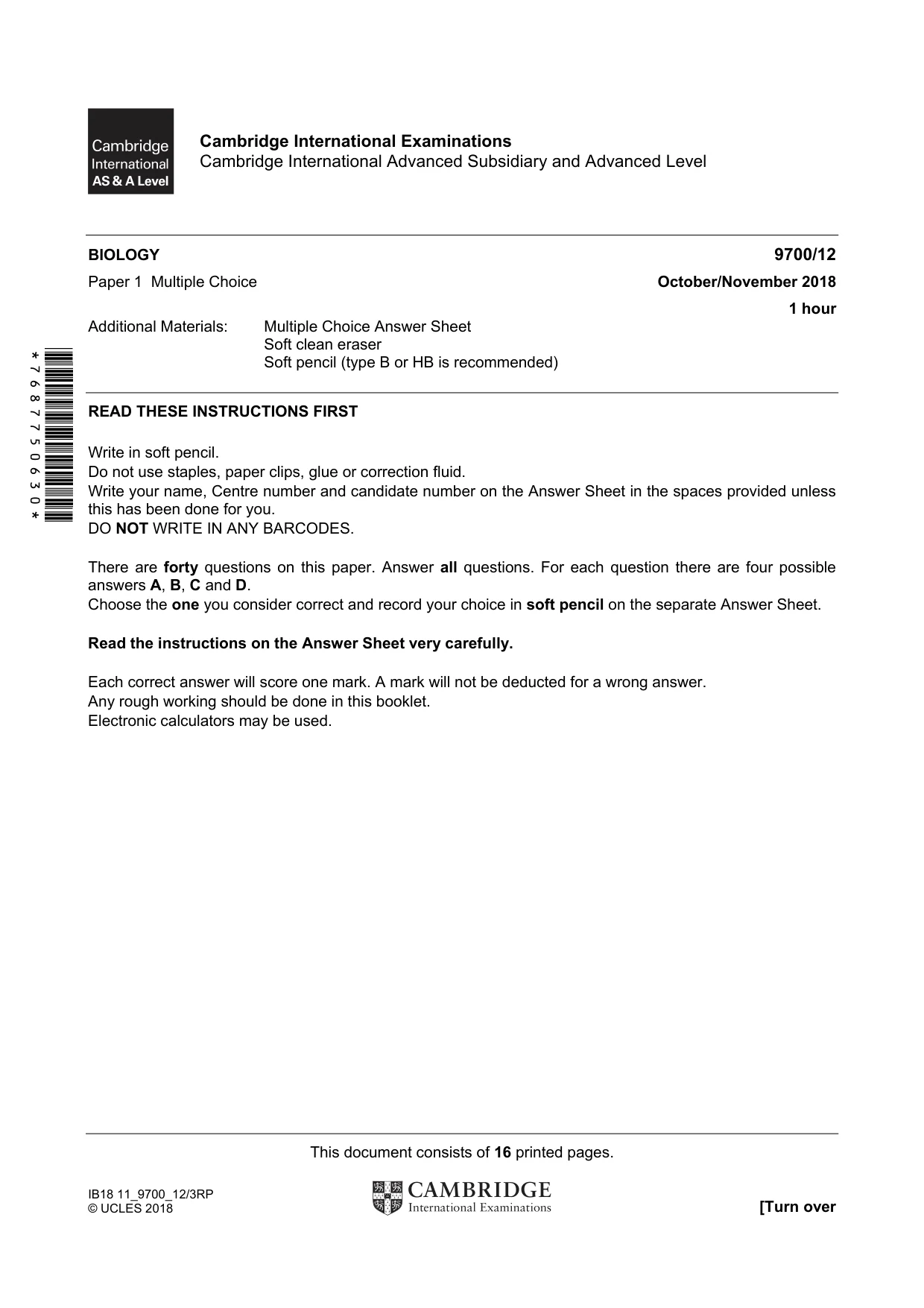
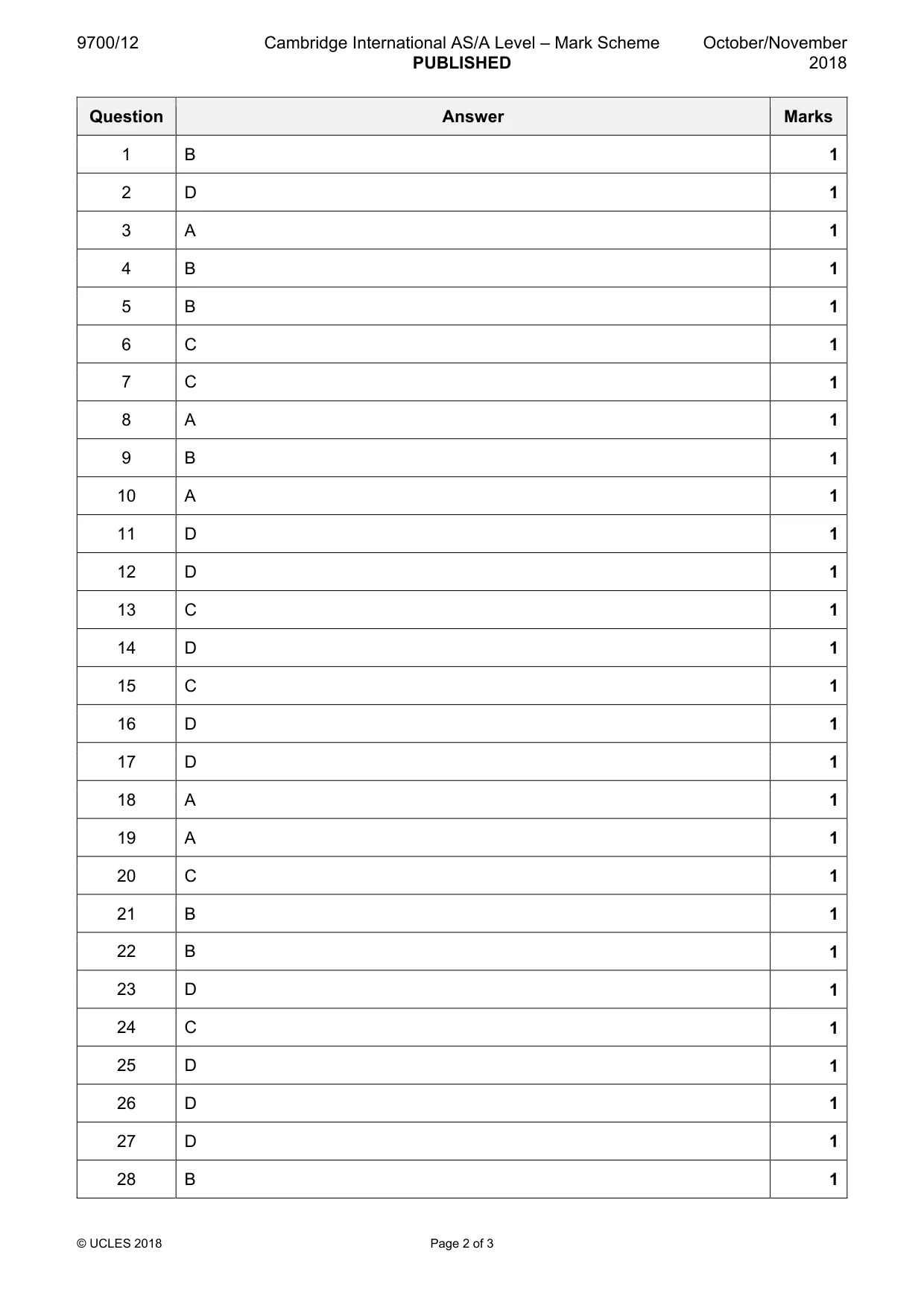
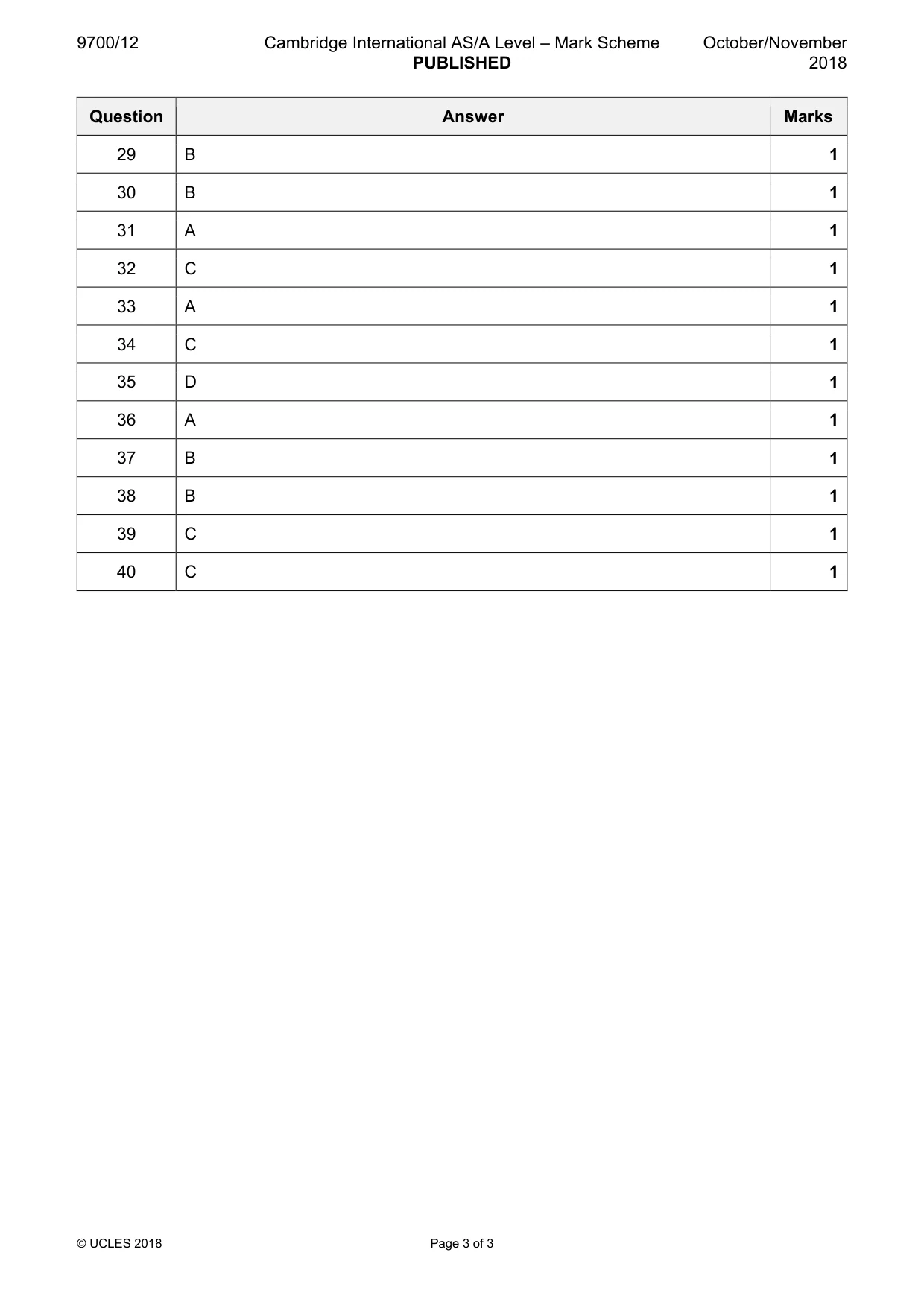
Mark scheme3 pages
Answers below. Sit the paper first if you are practising.
Questions as text
Q1 · What is the diameter of a typical prokaryote, such as Streptococcus?
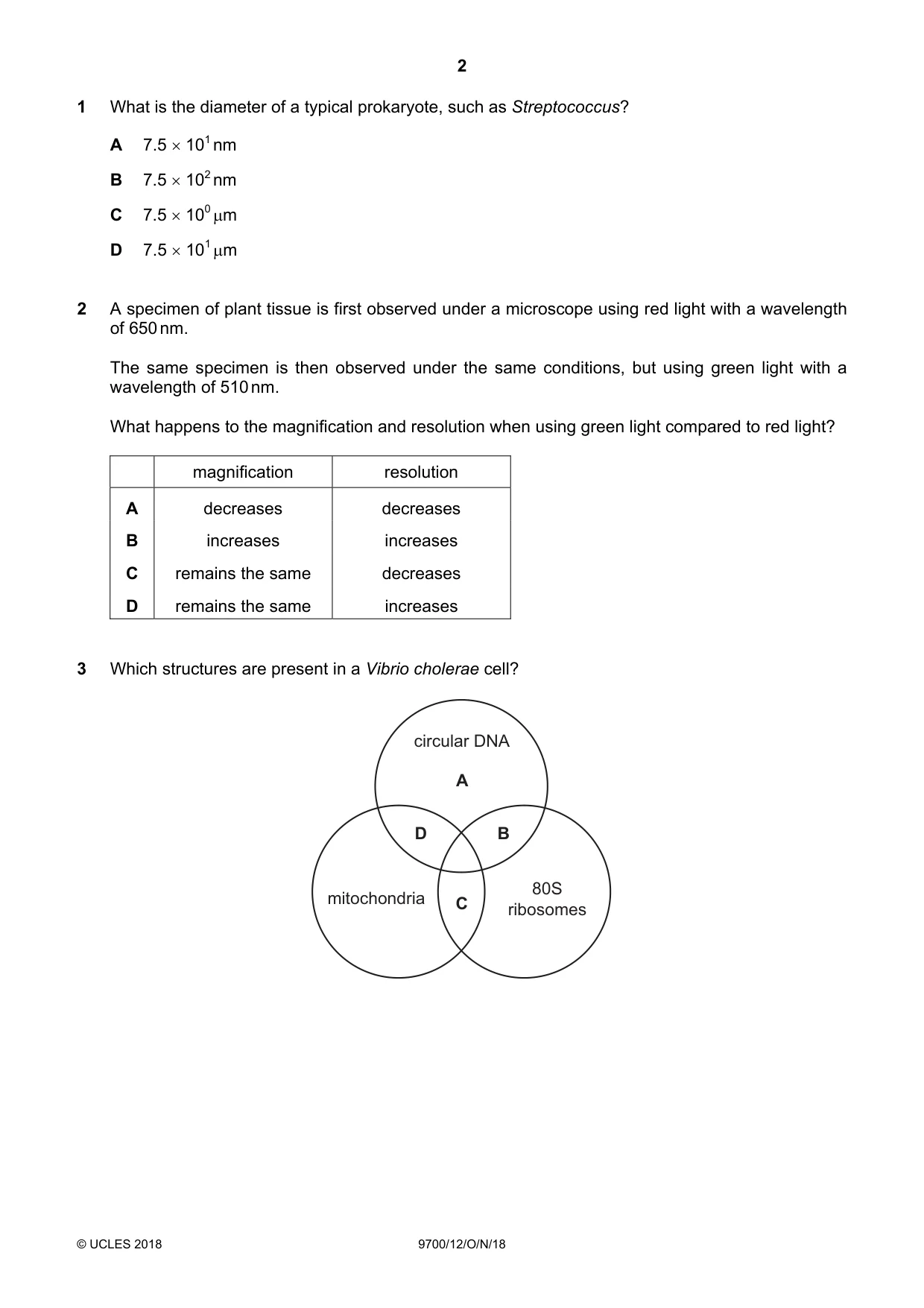
1 What is the diameter of a typical prokaryote, such as Streptococcus? A 7.5 × 101 nm B 7.5 × 10² nm C 7.5 × 100 µm D 7.5 × 101 µm
Mark scheme: B
More questions on Cells as the basic units of living organisms
Q2 · A specimen of plant tissue is first observed under a microscope using red light with a…
2 A specimen of plant tissue is first observed under a microscope using red light with a wavelength of 650 nm. The same specimen is then observed under the same conditions, but using green light with a wavelength of 510 nm. What happens to the magnification and resolution when using green light compared to red light? magnification resolution A decreases decreases B increases increases C remains the same decreases D remains the same increases
Mark scheme: D
Q3 · Which structures are present in a Vibrio cholerae cell?
3 Which structures are present in a Vibrio cholerae cell? circular DNA A D B 80S mitochondria C ribosomes
Mark scheme: A
More questions on Cells as the basic units of living organisms
Q4 · The removal of a plant cell wall by enzyme digestion leaves an intact membrane-bound…
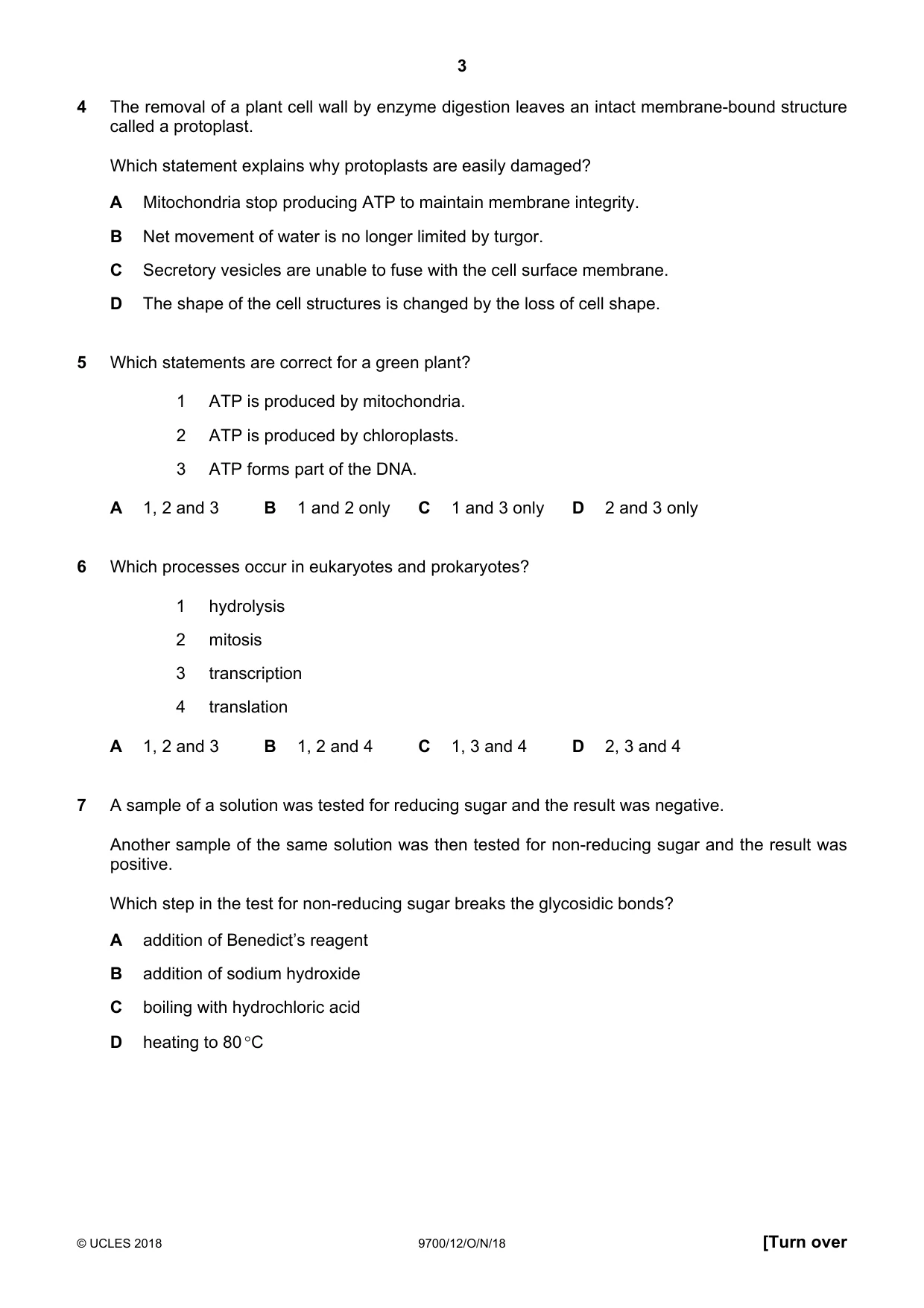
4 The removal of a plant cell wall by enzyme digestion leaves an intact membrane-bound structure called a protoplast. Which statement explains why protoplasts are easily damaged? A Mitochondria stop producing ATP to maintain membrane integrity. B Net movement of water is no longer limited by turgor. C Secretory vesicles are unable to fuse with the cell surface membrane. D The shape of the cell structures is changed by the loss of cell shape.
Mark scheme: B
Q5 · Which statements are correct for a green plant?
5 Which statements are correct for a green plant? 1 ATP is produced by mitochondria. 2 ATP is produced by chloroplasts. 3 ATP forms part of the DNA. A 1, 2 and 3 B 1 and 2 only C 1 and 3 only D 2 and 3 only
Mark scheme: B
Q6 · Which processes occur in eukaryotes and prokaryotes?
6 Which processes occur in eukaryotes and prokaryotes? 1 hydrolysis 2 mitosis 3 transcription 4 translation A 1, 2 and 3 B 1, 2 and 4 C 1, 3 and 4 D 2, 3 and 4
Mark scheme: C
More questions on Cells as the basic units of living organisms
Q7 · A sample of a solution was tested for reducing sugar and the result was negative
7 A sample of a solution was tested for reducing sugar and the result was negative. Another sample of the same solution was then tested for non-reducing sugar and the result was positive. Which step in the test for non-reducing sugar breaks the glycosidic bonds? A addition of Benedict’s reagent B addition of sodium hydroxide C boiling with hydrochloric acid D heating to 80 °C
Mark scheme: C
Q8 · Which row correctly identifies three polysaccharides α-glucose α-glucose β-glucose…
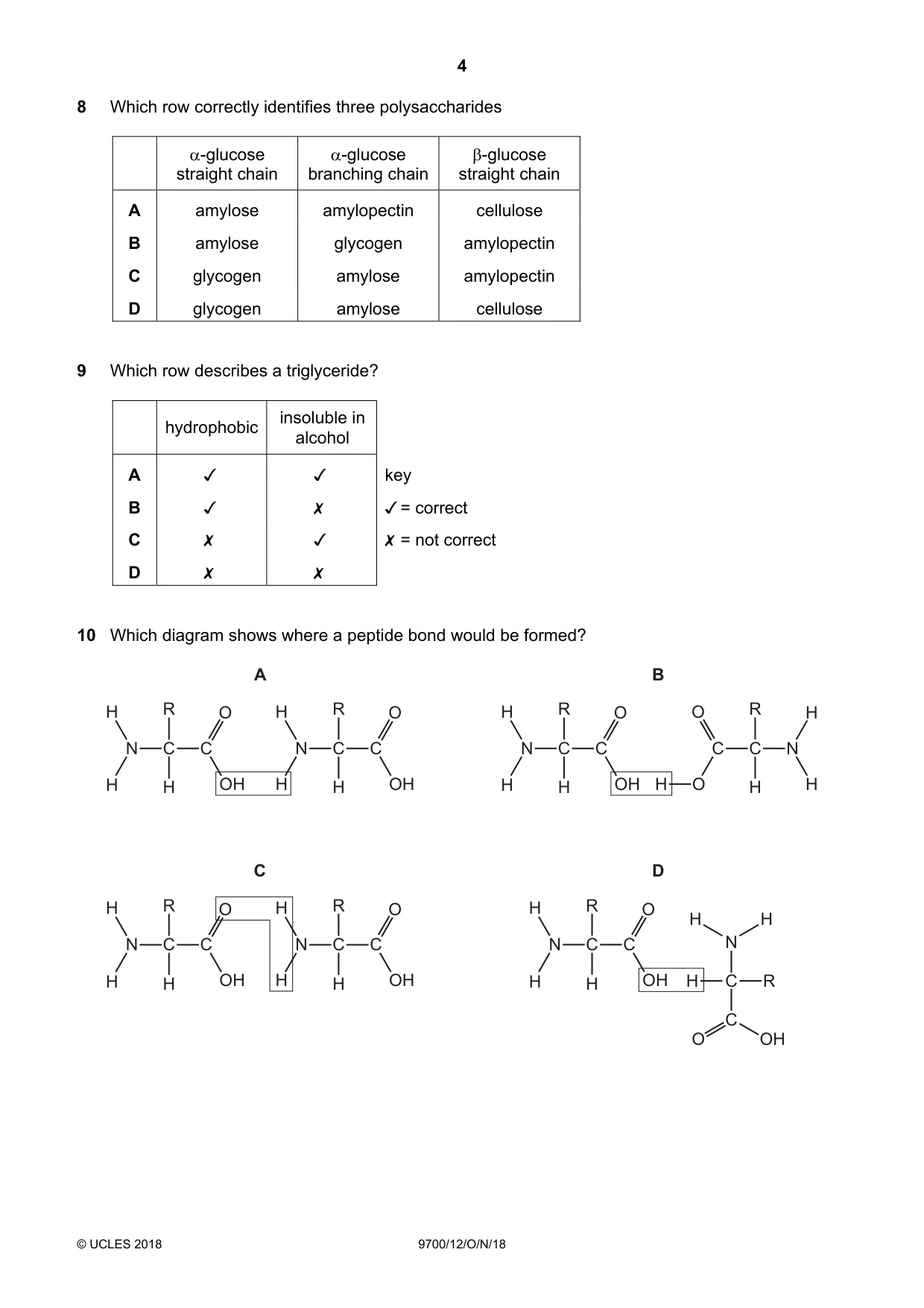
8 Which row correctly identifies three polysaccharides α-glucose α-glucose β-glucose straight chain branching chain straight chain A amylose amylopectin cellulose B amylose glycogen amylopectin C glycogen amylose amylopectin D glycogen amylose cellulose
Mark scheme: A
Q9 · Which row describes a triglyceride?
9 Which row describes a triglyceride? hydrophobic nso in A Jv Jv key B v x ¥ = correct Cc x v X = not correct D x x
Mark scheme: B
Q10 · Which diagram shows where a peptide bond would be formed?
10 Which diagram shows where a peptide bond would be formed? A B H R O H R O H R O O R H N C C N C C N C C C C N H H OH H H OH H H OH H O H H C D H R O H R O H R O H H N C C N C C N C C N H H OH H H OH H H OH H C R C O OH
Mark scheme: A
Q11 · Which statements about collagen molecules are correct?
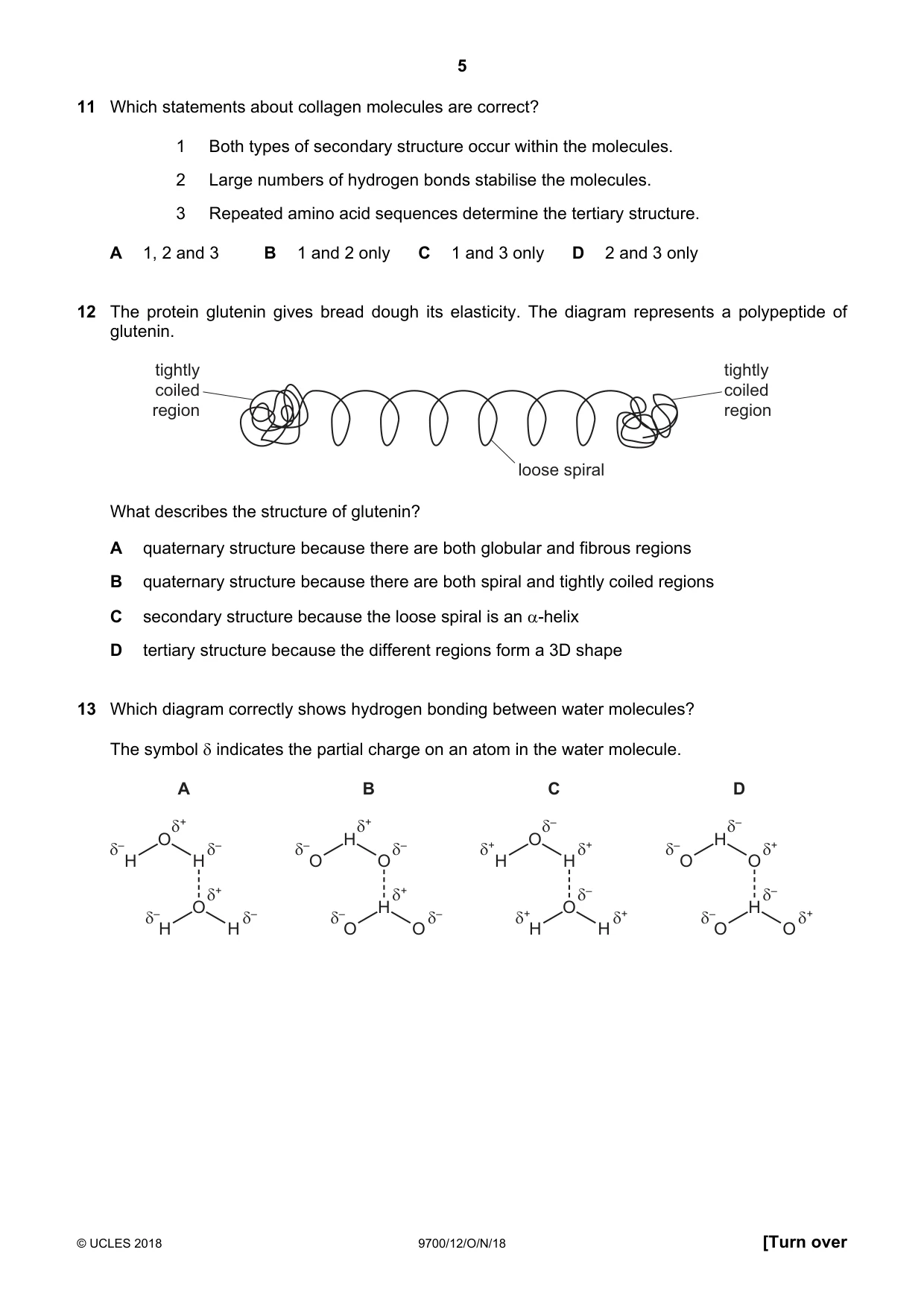
11 Which statements about collagen molecules are correct? 1 Both types of secondary structure occur within the molecules. 2 Large numbers of hydrogen bonds stabilise the molecules. 3 Repeated amino acid sequences determine the tertiary structure. A 1, 2 and 3 B 1 and 2 only C 1 and 3 only D 2 and 3 only
Mark scheme: D
Q12 · The protein glutenin gives bread dough its elasticity
12 The protein glutenin gives bread dough its elasticity. The diagram represents a polypeptide of glutenin. tightly tightly coiled coiled region region loose spiral What describes the structure of glutenin? A quaternary structure because there are both globular and fibrous regions B quaternary structure because there are both spiral and tightly coiled regions C secondary structure because the loose spiral is an α-helix D tertiary structure because the different regions form a 3D shape
Mark scheme: D
Q13 · Which diagram correctly shows hydrogen bonding between water molecules?
13 Which diagram correctly shows hydrogen bonding between water molecules? The symbol δ indicates the partial charge on an atom in the water molecule. A B C D δ+ δ+ δ– δ– O H O H δ– δ– δ– δ– δ+ δ+ δ– δ+ H H O O H H O O δ+ δ+ δ– δ– O H O H δ– δ– δ– δ– δ+ δ+ δ– δ+ H H O O H H O O
Mark scheme: C
Q14 · Aspirin inhibits an enzyme by reacting with an amino acid that forms an essential part of…
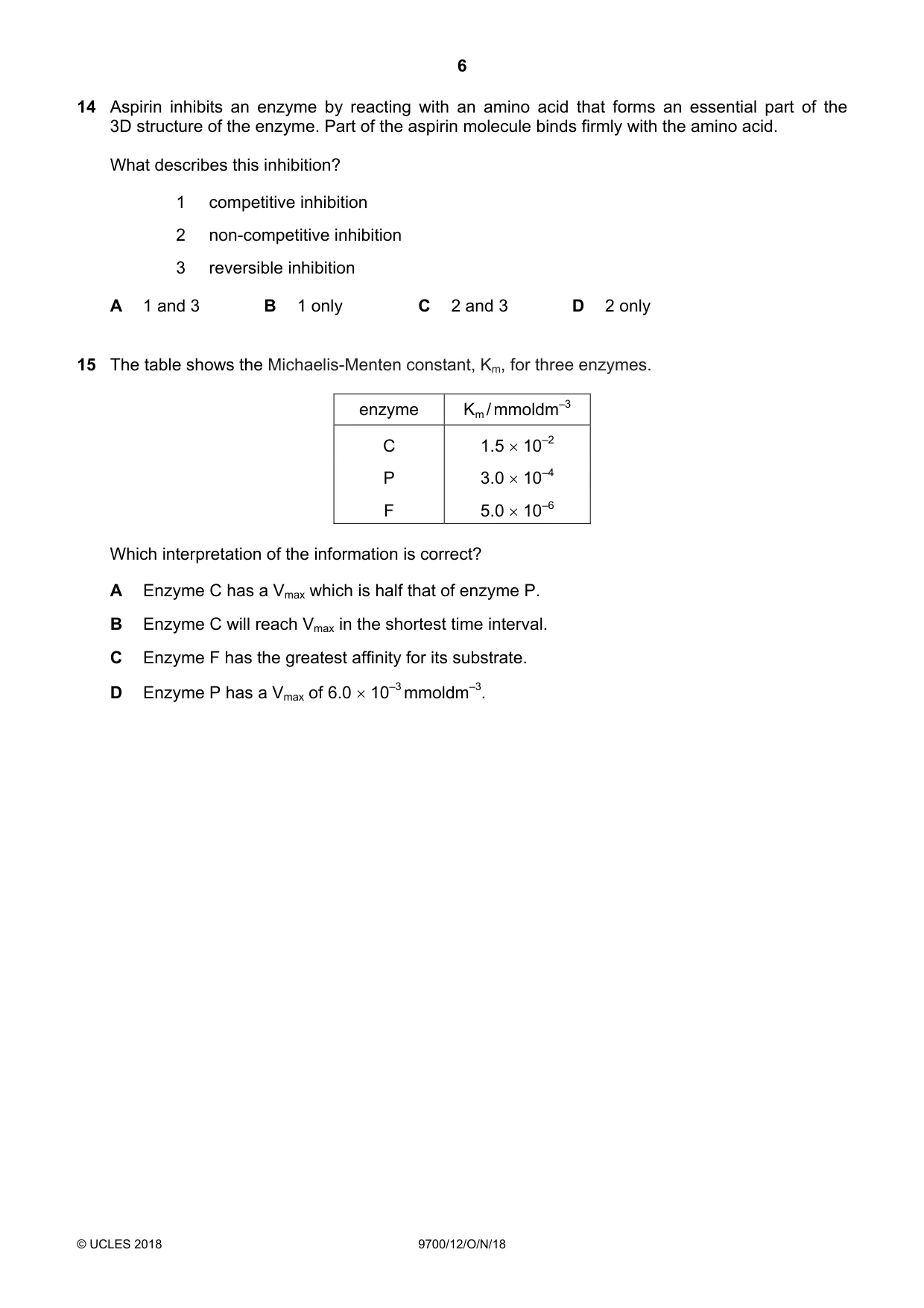
14 Aspirin inhibits an enzyme by reacting with an amino acid that forms an essential part of the 3D structure of the enzyme. Part of the aspirin molecule binds firmly with the amino acid. What describes this inhibition? 1 competitive inhibition 2 non-competitive inhibition 3 reversible inhibition A 1 and 3 B 1 only C 2 and 3 D 2 only
Mark scheme: D
Q15 · The table shows the Michaelis-Menten constant, Km, for three enzymes
15 The table shows the Michaelis-Menten constant, Km, for three enzymes. enzyme Km / mmoldm–3 C 1.5 × 10⁻² P 3.0 × 10⁻⁴ F 5.0 × 10⁻⁶ Which interpretation of the information is correct? A Enzyme C has a Vmax which is half that of enzyme P. B Enzyme C will reach Vmax in the shortest time interval. C Enzyme F has the greatest affinity for its substrate. D Enzyme P has a Vmax of 6.0 × 10⁻³ mmoldm–3.
Mark scheme: C
Q16 · The diagram is a drawing from an electron micrograph of a typical animal cell
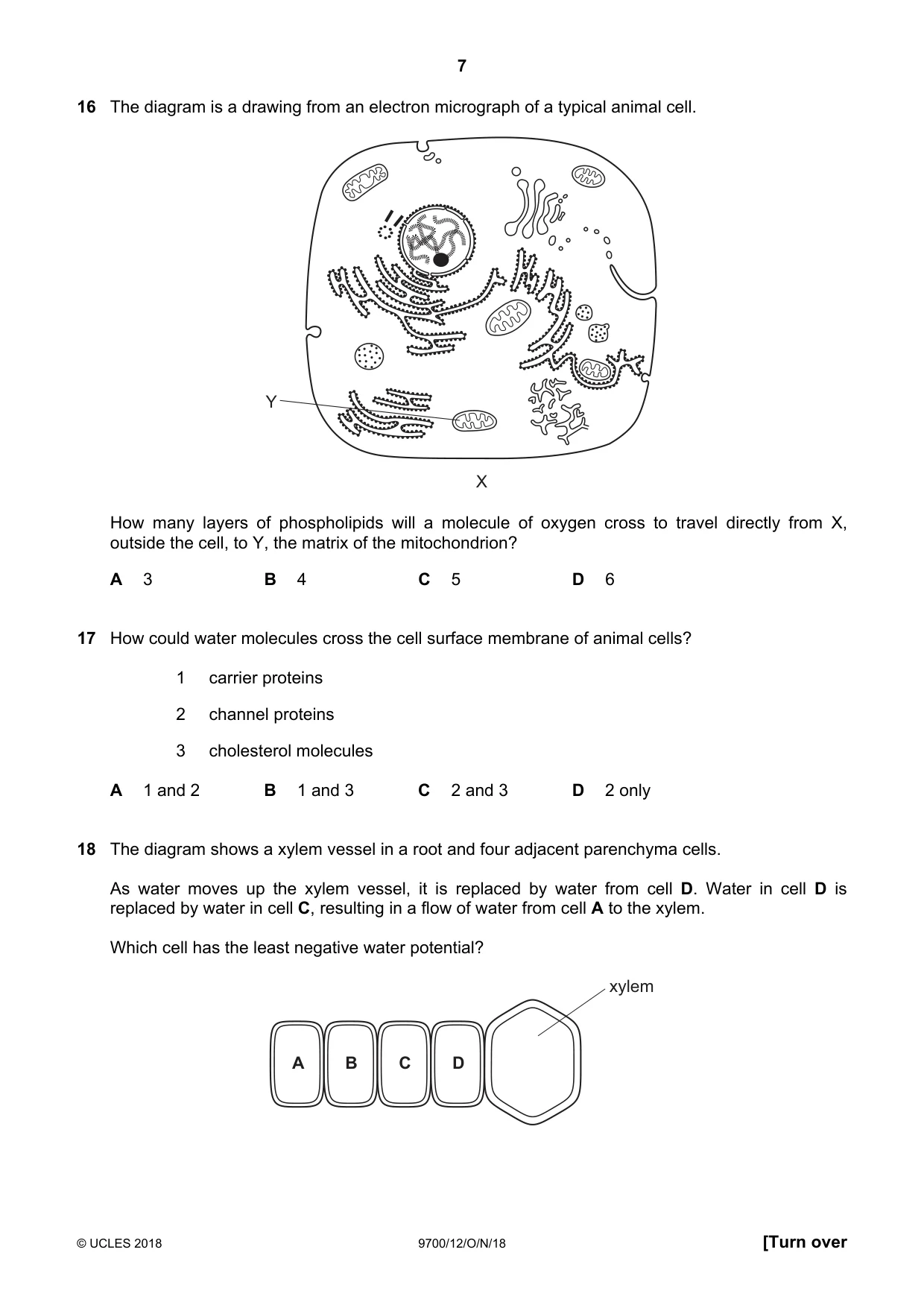
16 The diagram is a drawing from an electron micrograph of a typical animal cell. Y X How many layers of phospholipids will a molecule of oxygen cross to travel directly from X, outside the cell, to Y, the matrix of the mitochondrion? A 3 B 4 C 5 D 6
Mark scheme: D
Q17 · How could water molecules cross the cell surface membrane of animal cells?
17 How could water molecules cross the cell surface membrane of animal cells? 1 carrier proteins 2 channel proteins 3 cholesterol molecules A 1 and 2 B 1 and 3 C 2 and 3 D 2 only
Mark scheme: D
Q18 · The diagram shows a xylem vessel in a root and four adjacent parenchyma cells
18 The diagram shows a xylem vessel in a root and four adjacent parenchyma cells. As water moves up the xylem vessel, it is replaced by water from cell D. Water in cell D is replaced by water in cell C, resulting in a flow of water from cell A to the xylem. Which cell has the least negative water potential? xylem A B C D
Mark scheme: A
Q19 · Agar cubes can be used to demonstrate the effect of changing surface area to volume ratio…
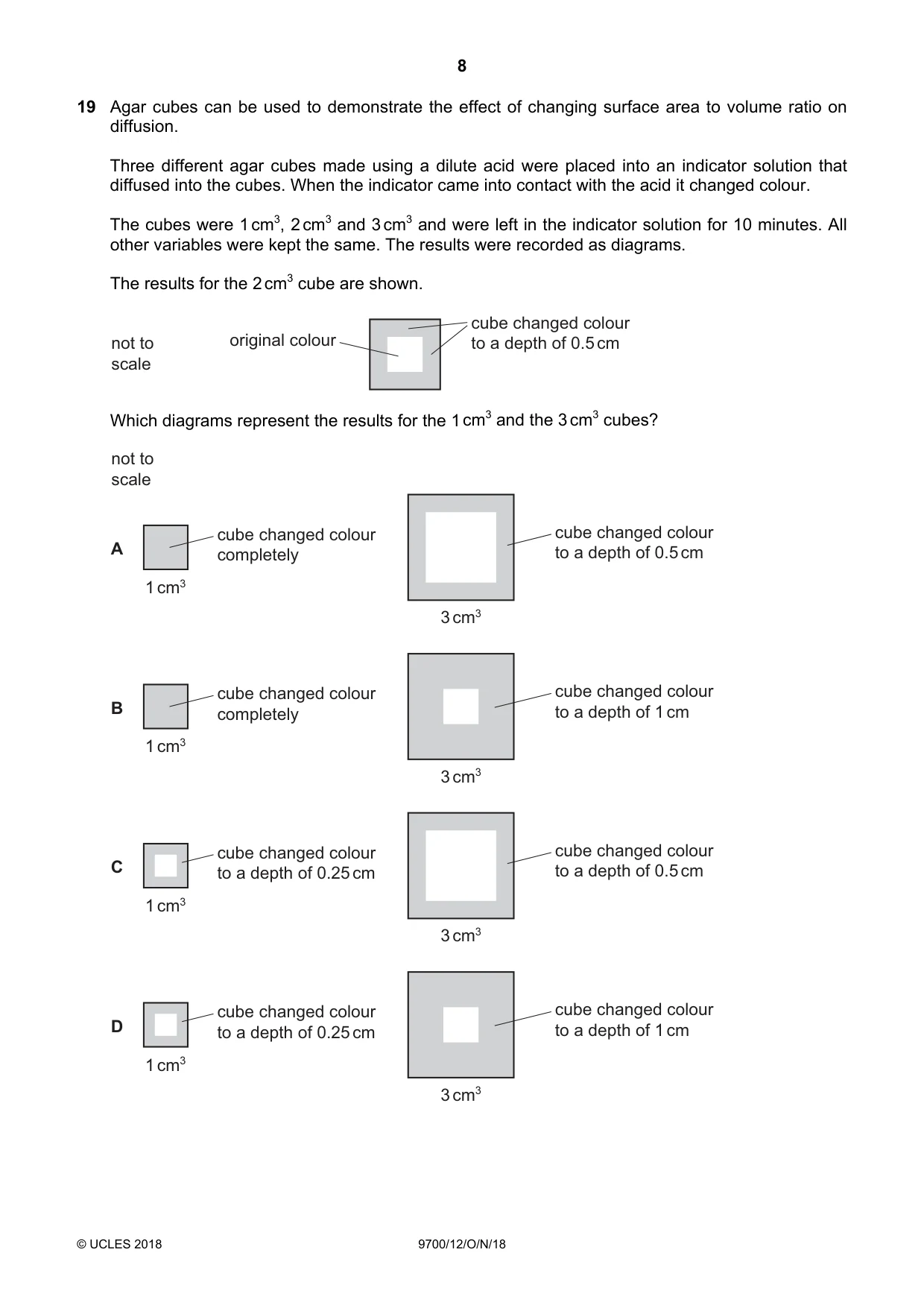
19 Agar cubes can be used to demonstrate the effect of changing surface area to volume ratio on diffusion. Three different agar cubes made using a dilute acid were placed into an indicator solution that diffused into the cubes. When the indicator came into contact with the acid it changed colour. The cubes were 1 cm3, 2 cm3 and 3 cm3 and were left in the indicator solution for 10 minutes. All other variables were kept the same. The results were recorded as diagrams. The results for the 2 cm3 cube are shown. cube changed colour not to original colour to a depth of 0.5 cm scale Which diagrams represent the results for the 1 cm3 and the 3 cm3 cubes? not to scale cube changed colour cube changed colour A completely to a depth of 0.5 cm 1 cm3 3 cm3 cube changed colour cube changed colour B completely to a depth of 1 cm 1 cm3 3 cm3 cube changed colour cube changed colour C to a depth of 0.25 cm to a depth of 0.5 cm 1 cm3 3 cm3 cube changed colour cube changed colour D to a depth of 0.25 cm to a depth of 1 cm 1 cm3 3 cm3
Mark scheme: A
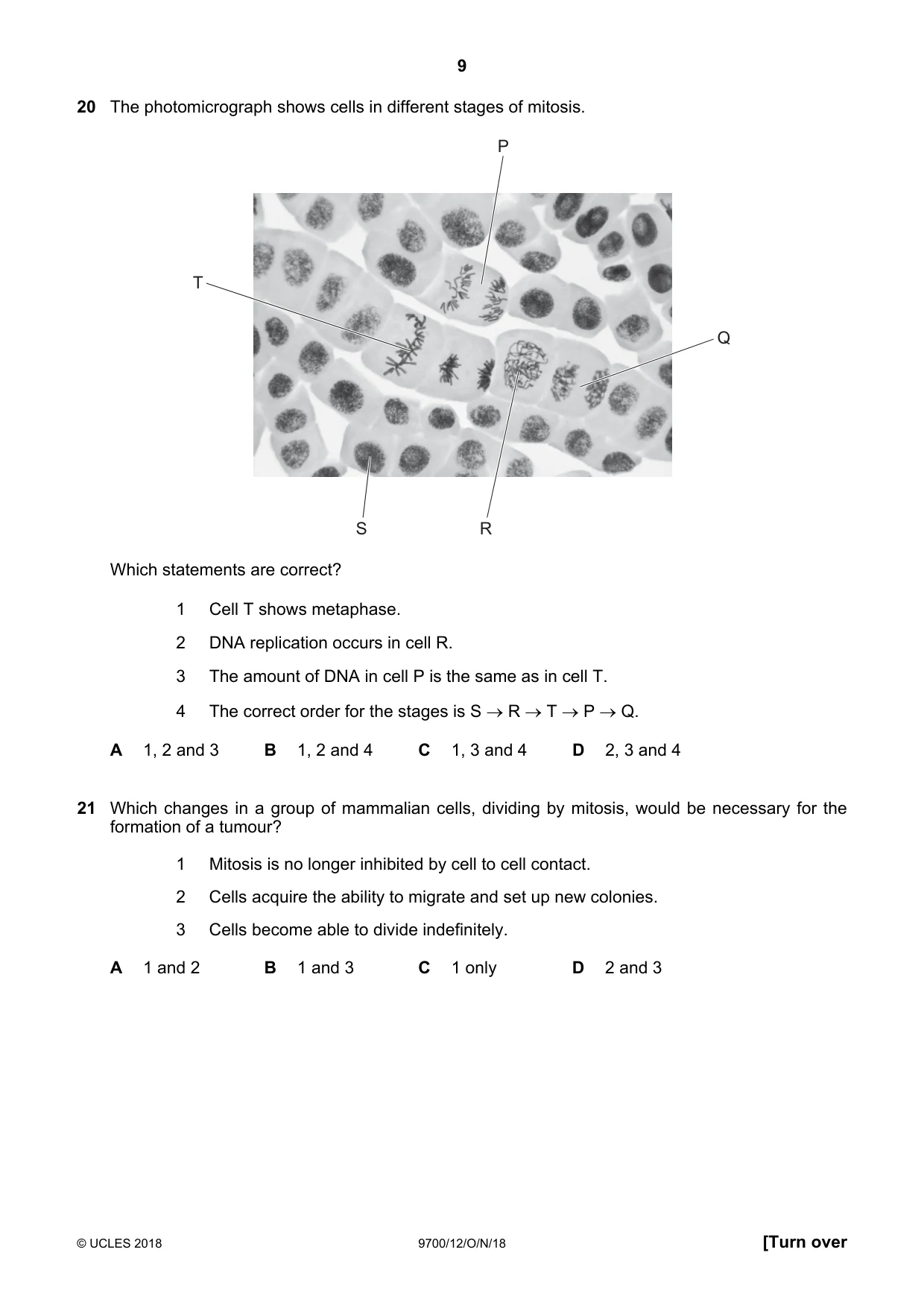
Q20 · The photomicrograph shows cells in different stages of mitosis
20 The photomicrograph shows cells in different stages of mitosis. P T Q S R Which statements are correct? 1 Cell T shows metaphase. 2 DNA replication occurs in cell R. 3 The amount of DNA in cell P is the same as in cell T. 4 The correct order for the stages is S → R → T → P → Q. A 1, 2 and 3 B 1, 2 and 4 C 1, 3 and 4 D 2, 3 and 4
Mark scheme: C
Q21 · Which changes in a group of mammalian cells, dividing by mitosis, would be necessary for…
21 Which changes in a group of mammalian cells, dividing by mitosis, would be necessary for the formation of a tumour? 1 Mitosis is no longer inhibited by cell to cell contact. 2 Cells acquire the ability to migrate and set up new colonies. 3 Cells become able to divide indefinitely. A 1 and 2 B 1 and 3 C 1 only D 2 and 3
Mark scheme: B
More questions on Replication and division of nuclei and cells
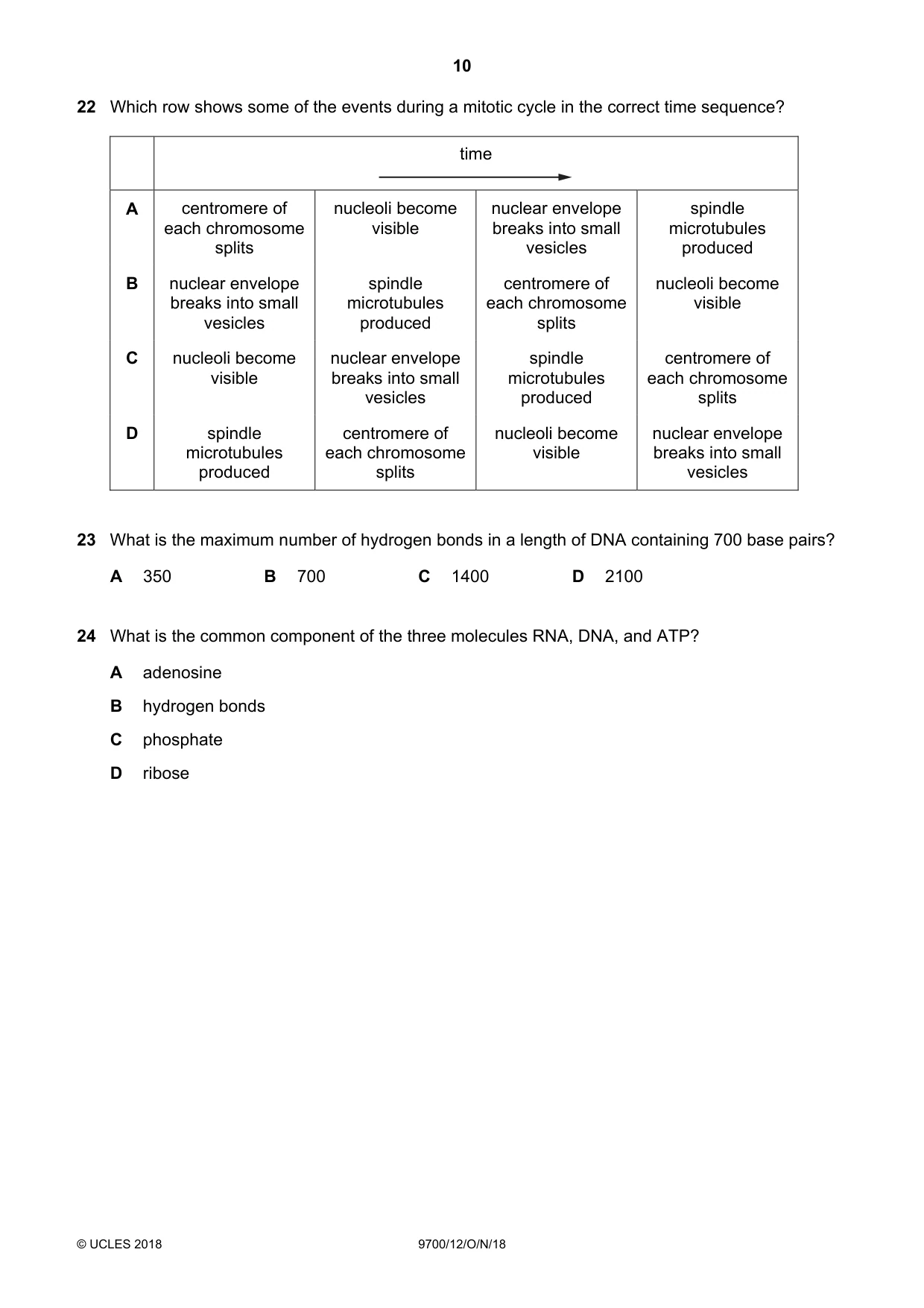
Q22 · Which row shows some of the events during a mitotic cycle in the correct time sequence?
22 Which row shows some of the events during a mitotic cycle in the correct time sequence? time A centromere of nucleoli become nuclear envelope spindle each chromosome visible breaks into small microtubules splits vesicles produced B nuclear envelope spindle centromere of nucleoli become breaks into small microtubules each chromosome visible vesicles produced splits C nucleoli become nuclear envelope spindle centromere of visible breaks into small microtubules each chromosome vesicles produced splits D spindle centromere of nucleoli become nuclear envelope microtubules each chromosome visible breaks into small produced splits vesicles
Mark scheme: B
Q23 · What is the maximum number of hydrogen bonds in a length of DNA containing 700 base pairs?
23 What is the maximum number of hydrogen bonds in a length of DNA containing 700 base pairs? A 350 B 700 C 1400 D 2100
Mark scheme: D
More questions on Structure of nucleic acids and replication of DNA
Q24 · What is the common component of the three molecules RNA, DNA, and ATP?
24 What is the common component of the three molecules RNA, DNA, and ATP? A adenosine B hydrogen bonds C phosphate D ribose
Mark scheme: C
More questions on Structure of nucleic acids and replication of DNA
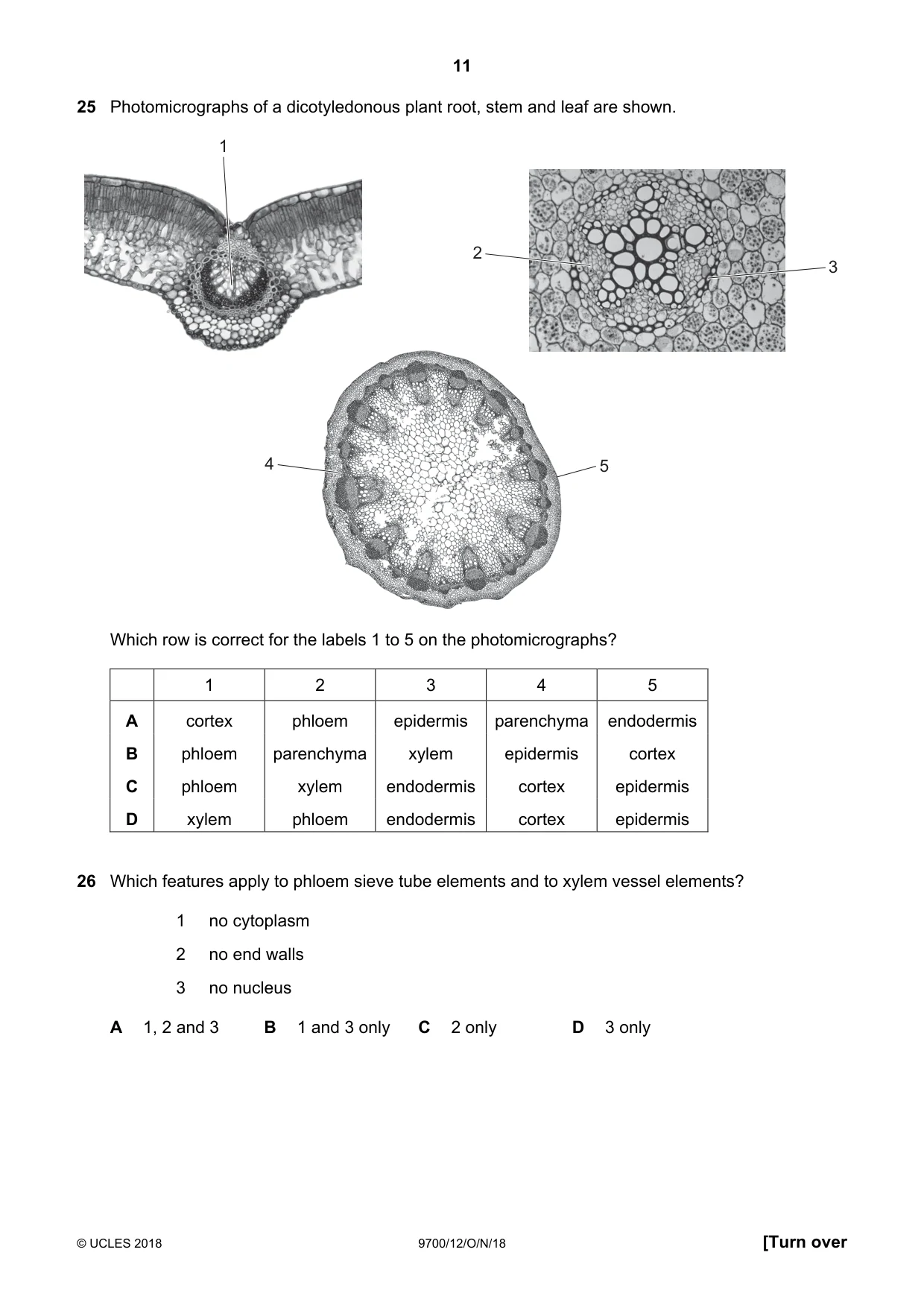
Q25 · Photomicrographs of a dicotyledonous plant root, stem and leaf are shown
25 Photomicrographs of a dicotyledonous plant root, stem and leaf are shown. 1 2 3 4 5 Which row is correct for the labels 1 to 5 on the photomicrographs? 1 2 3 4 5 A cortex phloem epidermis parenchyma endodermis B phloem parenchyma xylem epidermis cortex C phloem xylem endodermis cortex epidermis D xylem phloem endodermis cortex epidermis
Mark scheme: D
Q26 · Which features apply to phloem sieve tube elements and to xylem vessel elements?
26 Which features apply to phloem sieve tube elements and to xylem vessel elements? 1 no cytoplasm 2 no end walls 3 no nucleus A 1, 2 and 3 B 1 and 3 only C 2 only D 3 only
Mark scheme: D
Q27 · Which statement correctly describes an event in the process of mass flow in phloem sieve…
27 Which statement correctly describes an event in the process of mass flow in phloem sieve tube elements? A Any part of a plant where sucrose is loaded into a sieve tube element is called a sink. B Loading sucrose into a sieve tube element increases the water potential inside it. C Mass flow in the phloem is a passive process occurring at the same rate as diffusion. D Sucrose moves down a hydrostatic pressure gradient in the phloem from source to sink.
Mark scheme: D
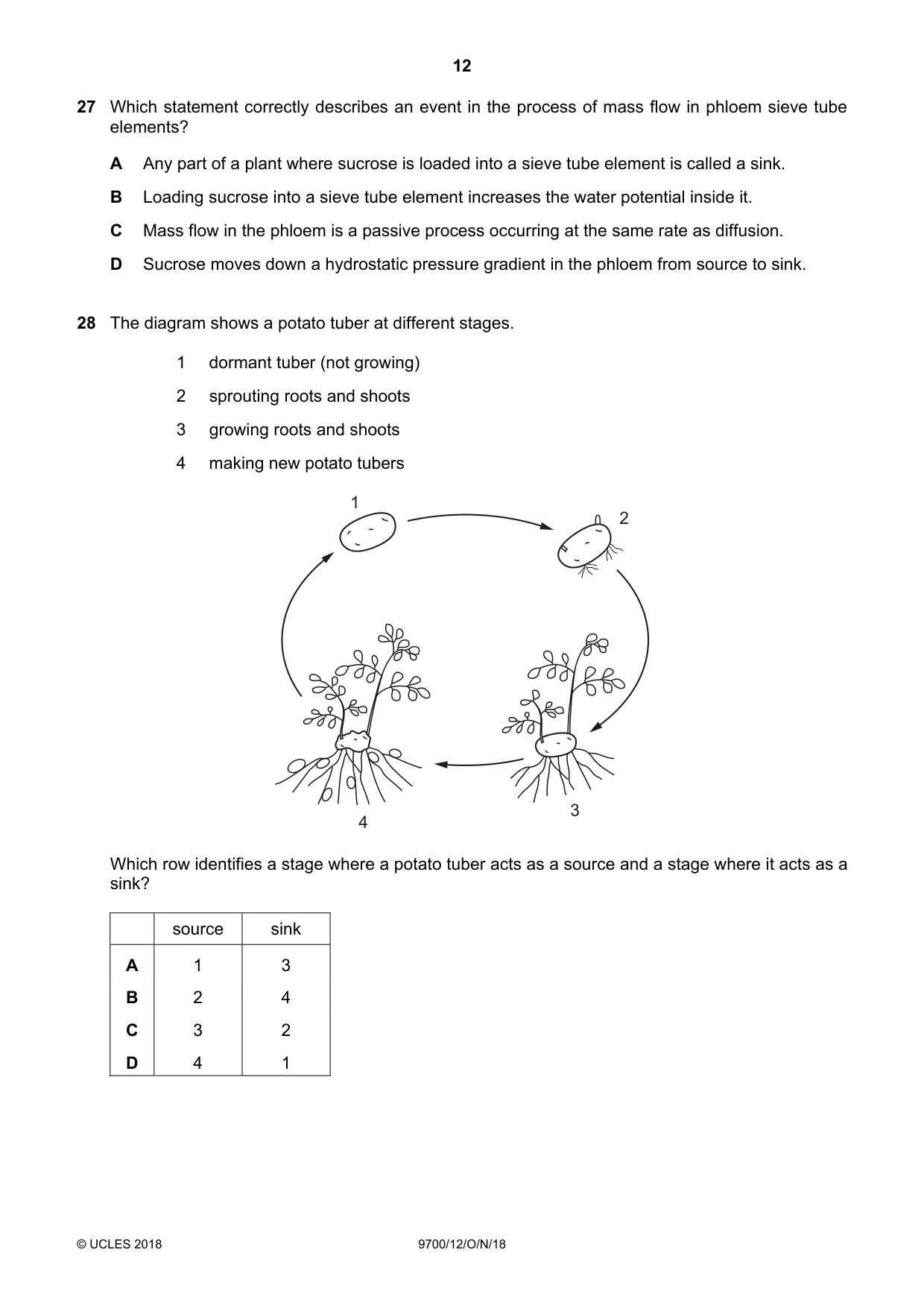
Q28 · The diagram shows a potato tuber at different stages
28 The diagram shows a potato tuber at different stages. 1 dormant tuber (not growing) 2 sprouting roots and shoots 3 growing roots and shoots 4 making new potato tubers 1 2 3 4 Which row identifies a stage where a potato tuber acts as a source and a stage where it acts as a sink? source sink A 1 3 B 2 4 C 3 2 D 4 1
Mark scheme: B
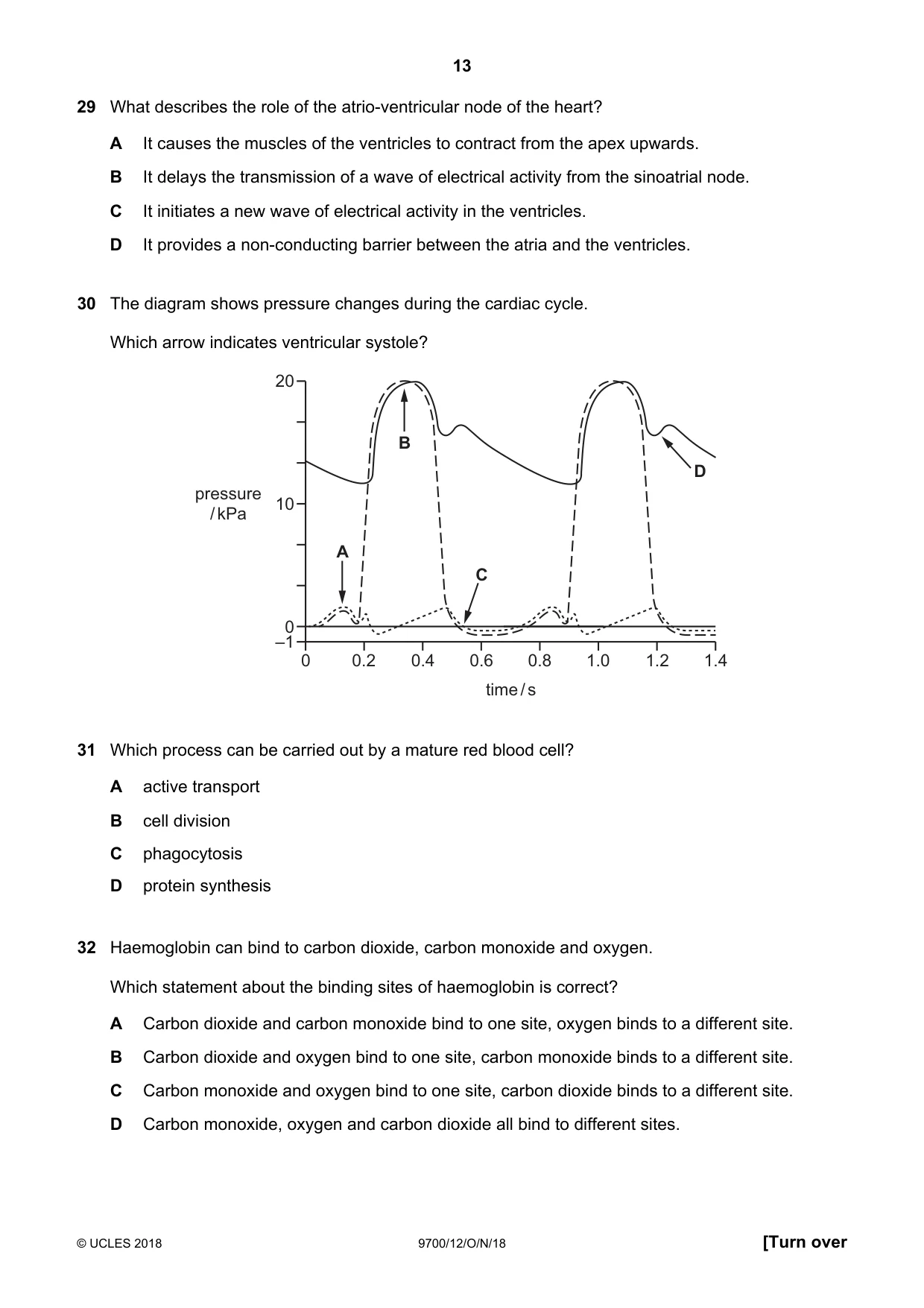
Q29 · What describes the role of the atrio-ventricular node of the heart?
29 What describes the role of the atrio-ventricular node of the heart? A It causes the muscles of the ventricles to contract from the apex upwards. B It delays the transmission of a wave of electrical activity from the sinoatrial node. C It initiates a new wave of electrical activity in the ventricles. D It provides a non-conducting barrier between the atria and the ventricles.
Mark scheme: B
Q30 · The diagram shows pressure changes during the cardiac cycle
30 The diagram shows pressure changes during the cardiac cycle. Which arrow indicates ventricular systole? 20 B D pressure 10 / kPa A C 0 –1 0 0.2 0.4 0.6 0.8 1.0 1.2 1.4 time / s
Mark scheme: B
Q31 · Which process can be carried out by a mature red blood cell?
31 Which process can be carried out by a mature red blood cell? A active transport B cell division C phagocytosis D protein synthesis
Mark scheme: A
Q32 · Haemoglobin can bind to carbon dioxide, carbon monoxide and oxygen
32 Haemoglobin can bind to carbon dioxide, carbon monoxide and oxygen. Which statement about the binding sites of haemoglobin is correct? A Carbon dioxide and carbon monoxide bind to one site, oxygen binds to a different site. B Carbon dioxide and oxygen bind to one site, carbon monoxide binds to a different site. C Carbon monoxide and oxygen bind to one site, carbon dioxide binds to a different site. D Carbon monoxide, oxygen and carbon dioxide all bind to different sites.
Mark scheme: C
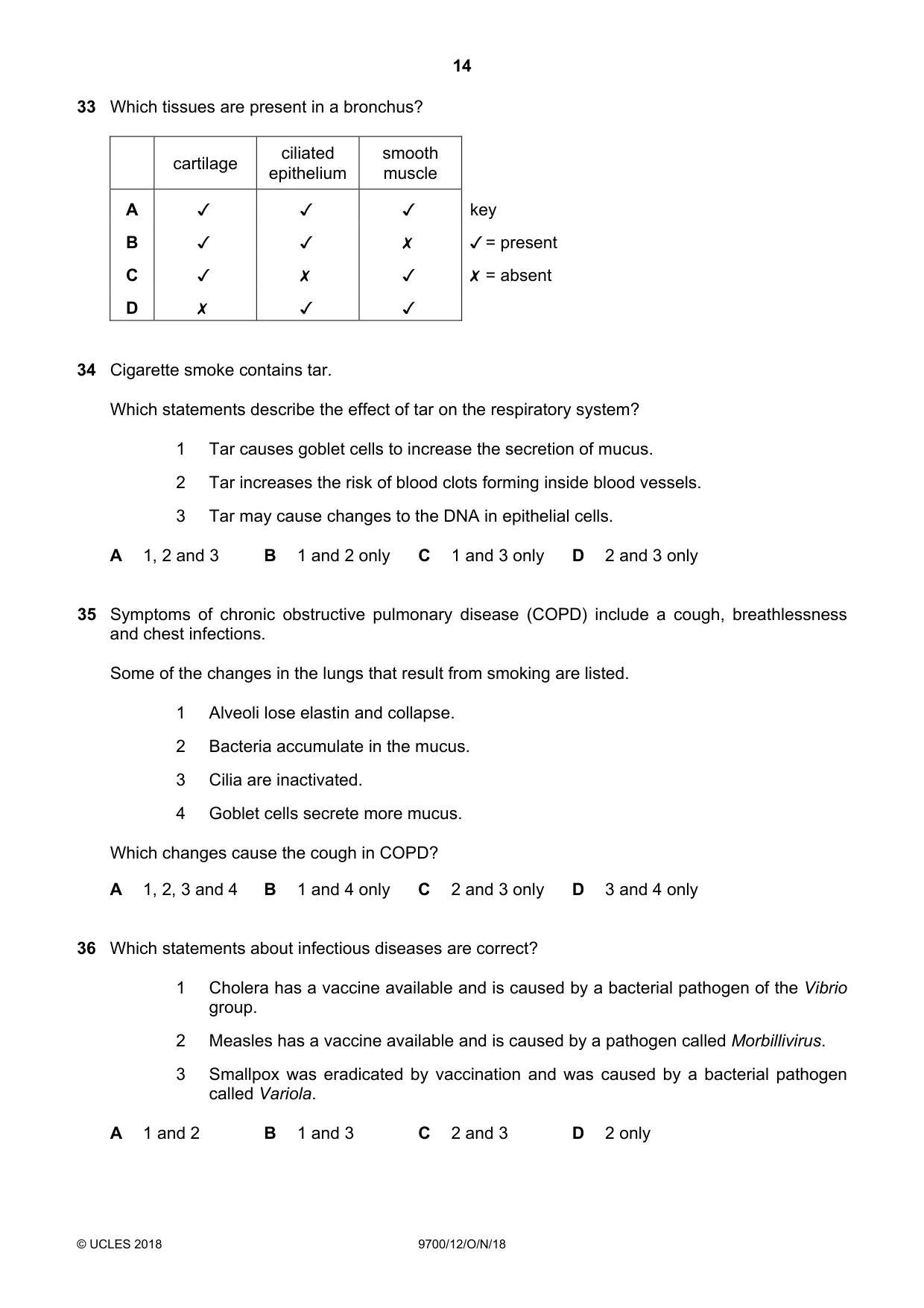
Q33 · Which tissues are present in a bronchus?
33 Which tissues are present in a bronchus? cartilage ciliated smooth epithelium muscle A Jv J J B Jv J x Cc v x v D x J J key J/ = present X = absent
Mark scheme: A
Q34 · Cigarette smoke contains tar
34 Cigarette smoke contains tar. Which statements describe the effect of tar on the respiratory system? 1 Tar causes goblet cells to increase the secretion of mucus. 2 Tar increases the risk of blood clots forming inside blood vessels. 3 Tar may cause changes to the DNA in epithelial cells. A 1, 2 and 3 B 1 and 2 only C 1 and 3 only D 2 and 3 only
Mark scheme: C
Q35 · Symptoms of chronic obstructive pulmonary disease (COPD) include a cough, breathlessness…
35 Symptoms of chronic obstructive pulmonary disease (COPD) include a cough, breathlessness and chest infections. Some of the changes in the lungs that result from smoking are listed. 1 Alveoli lose elastin and collapse. 2 Bacteria accumulate in the mucus. 3 Cilia are inactivated. 4 Goblet cells secrete more mucus. Which changes cause the cough in COPD? A 1, 2, 3 and 4 B 1 and 4 only C 2 and 3 only D 3 and 4 only
Mark scheme: D
Q36 · Which statements about infectious diseases are correct?
36 Which statements about infectious diseases are correct? 1 Cholera has a vaccine available and is caused by a bacterial pathogen of the Vibrio group. 2 Measles has a vaccine available and is caused by a pathogen called Morbillivirus. 3 Smallpox was eradicated by vaccination and was caused by a bacterial pathogen called Variola. A 1 and 2 B 1 and 3 C 2 and 3 D 2 only
Mark scheme: A
Q37 · The antibiotic tetracycline binds to the small subunit of bacterial ribosomes, stopping…
37 The antibiotic tetracycline binds to the small subunit of bacterial ribosomes, stopping protein synthesis. Bacteria have become resistant to tetracycline due to the effect of mutations. Which effect could produce resistance to tetracycline? A preventing tetracycline from binding to the bacterial cell wall B preventing tetracycline from entering the bacterial cell C preventing tetracycline from inhibiting transcription D preventing the production of tetracycline by ribosomes
Mark scheme: B
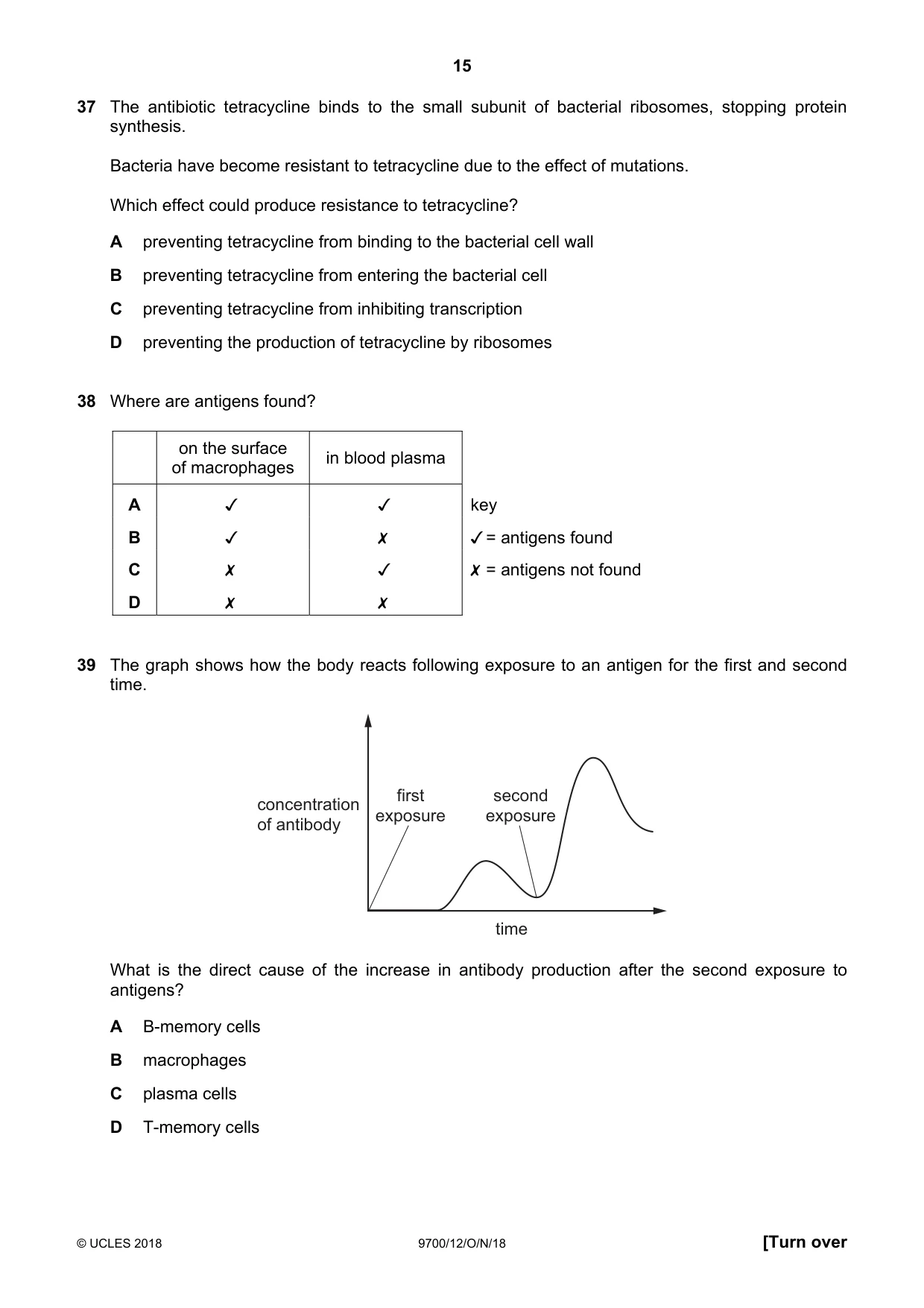
Q38 · Where are antigens found?
38 Where are antigens found? on the surface of macrophages in blood plasma v key ¥ = antigens found X = antigens not found 09D > ~*~ KOK OX v x x
Mark scheme: B
Q39 · The graph shows how the body reacts following exposure to an antigen for the first and…
39 The graph shows how the body reacts following exposure to an antigen for the first and second time. first second concentration exposure exposure of antibody time What is the direct cause of the increase in antibody production after the second exposure to antigens? A B-memory cells B macrophages C plasma cells D T-memory cells
Mark scheme: C
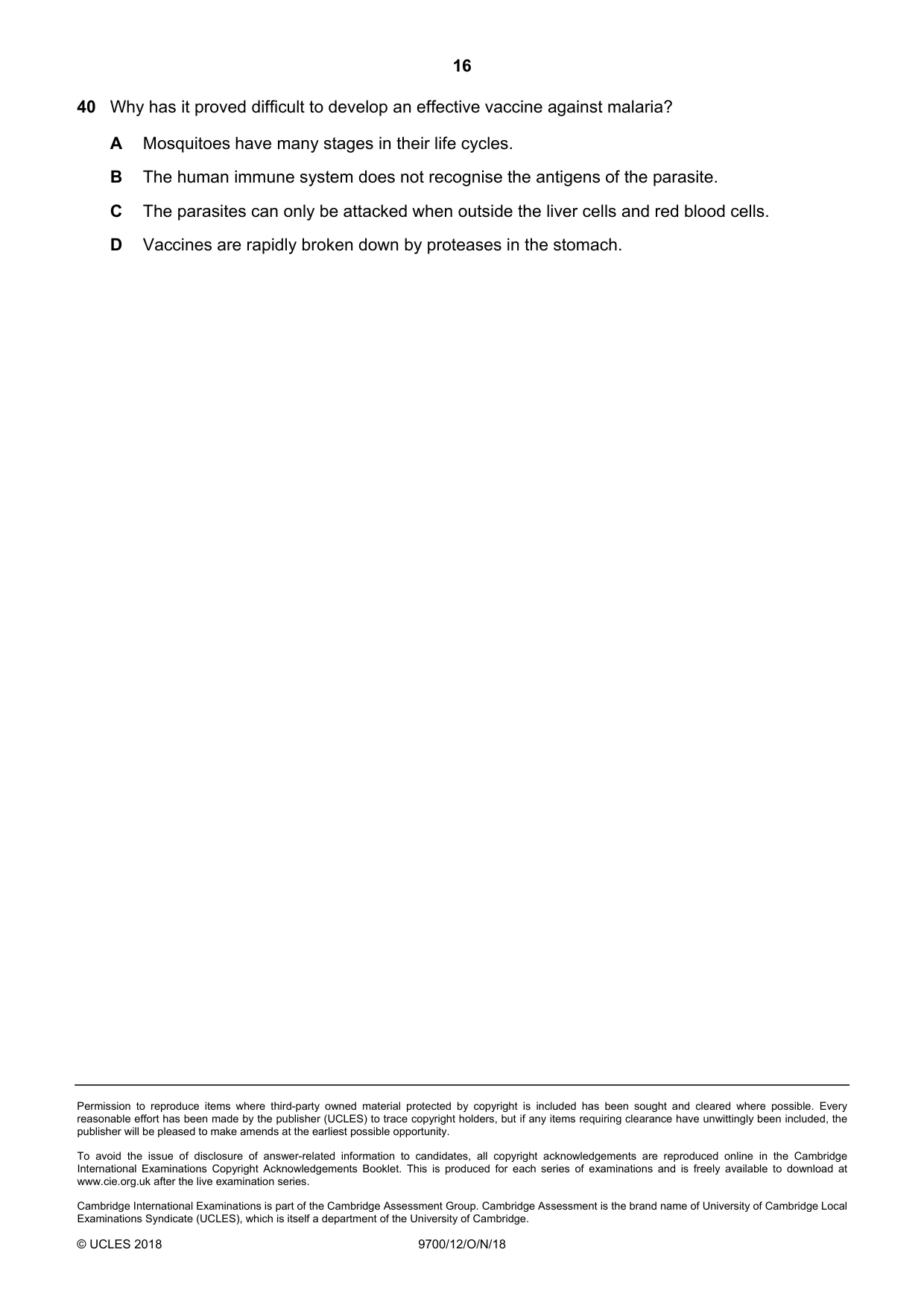
Q40 · Why has it proved difficult to develop an effective vaccine against malaria?
40 Why has it proved difficult to develop an effective vaccine against malaria? A Mosquitoes have many stages in their life cycles. B The human immune system does not recognise the antigens of the parasite. C The parasites can only be attacked when outside the liver cells and red blood cells. D Vaccines are rapidly broken down by proteases in the stomach.
Mark scheme: C
What was in this paper
The subtopics covered by these 40 questions, and how many questions each got. Open one in a new tab to see every Cambridge question on it.
3Proteins3The gas exchange system3Transport mechanisms3Antibodies and vaccination2Carbohydrates and lipids2Chromosome behaviour in mitosis2Factors that affect enzyme action2Fluid mosaic membranes2Movement into and out of cells2Structure of nucleic acids and replication of DNA2Structure of transport tissues2The heart2Transport of oxygen and carbon dioxide2Antibiotics1Infectious diseases1Replication and division of nuclei and cells1Respiration1Testing for biological molecules1The immune system1The microscope in cell studies1Water1What you needed in this session
Cambridge’s own grade thresholds for 2018 Oct/Nov, Paper 1 · Variant 2. A higher threshold means an easier paper — the bar moves with how the cohort did.