Cambridge A Level Biology 9700 — 2016 Oct/Nov Paper 1 · Variant 3
9700/13/O/N/16 · 40 questions · 40 marks · ≈45 min
The question paper and its mark scheme, free to read here and free to download. This is Cambridge’s own paper, exactly as it was sat.
Question paper20 pages



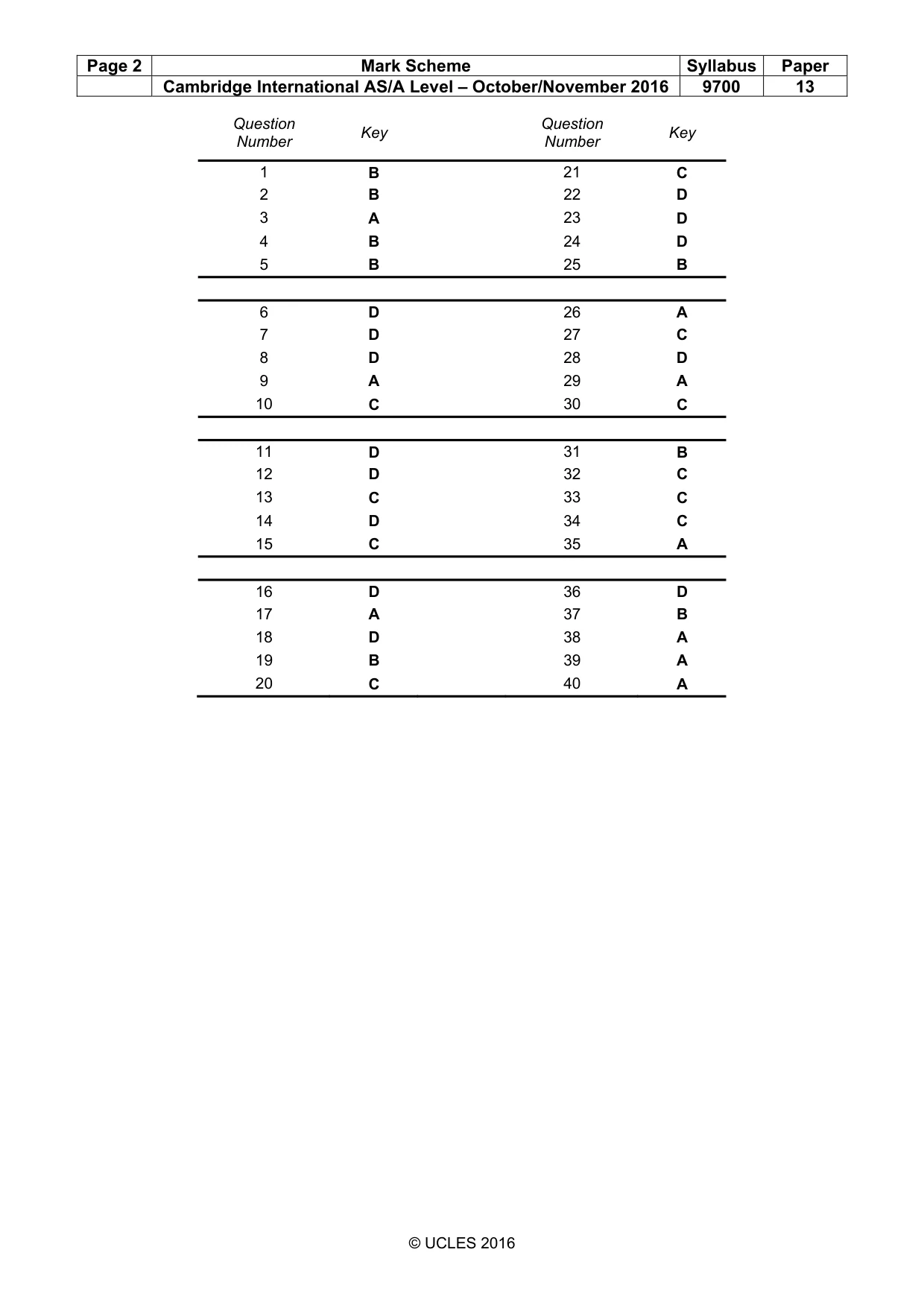
Mark scheme2 pages
Answers below. Sit the paper first if you are practising.
Questions as text
Q1 · Which structure is only found in typical eukaryotic animal cells?
1 Which structure is only found in typical eukaryotic animal cells? A cell surface membrane B centriole C Golgi body D ribosome
Mark scheme: B
More questions on Cells as the basic units of living organisms
Q2 · Which letter on the logarithmic scale corresponds to the size of a typical prokaryote?
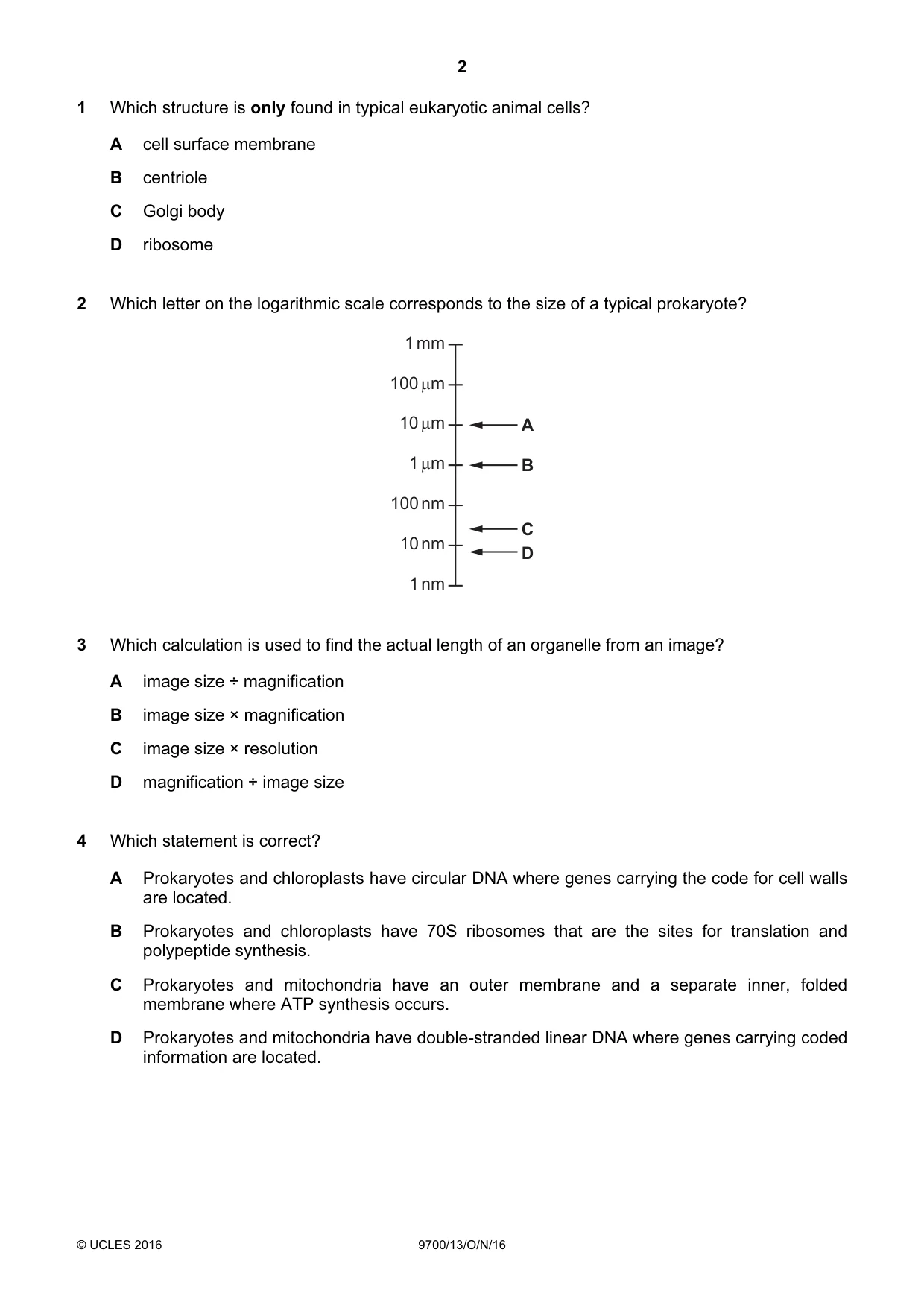
2 Which letter on the logarithmic scale corresponds to the size of a typical prokaryote? 1 mm 100 µm 10 µm A 1 µm B 100 nm C 10 nm D 1 nm
Mark scheme: B
More questions on Cells as the basic units of living organisms
Q3 · Which calculation is used to find the actual length of an organelle from an image?
3 Which calculation is used to find the actual length of an organelle from an image? A image size ÷ magnification B image size × magnification C image size × resolution D magnification ÷ image size
Mark scheme: A
Q4 · Which statement is correct?
4 Which statement is correct? A Prokaryotes and chloroplasts have circular DNA where genes carrying the code for cell walls are located. B Prokaryotes and chloroplasts have 70S ribosomes that are the sites for translation and polypeptide synthesis. C Prokaryotes and mitochondria have an outer membrane and a separate inner, folded membrane where ATP synthesis occurs. D Prokaryotes and mitochondria have double-stranded linear DNA where genes carrying coded information are located.
Mark scheme: B
More questions on Cells as the basic units of living organisms
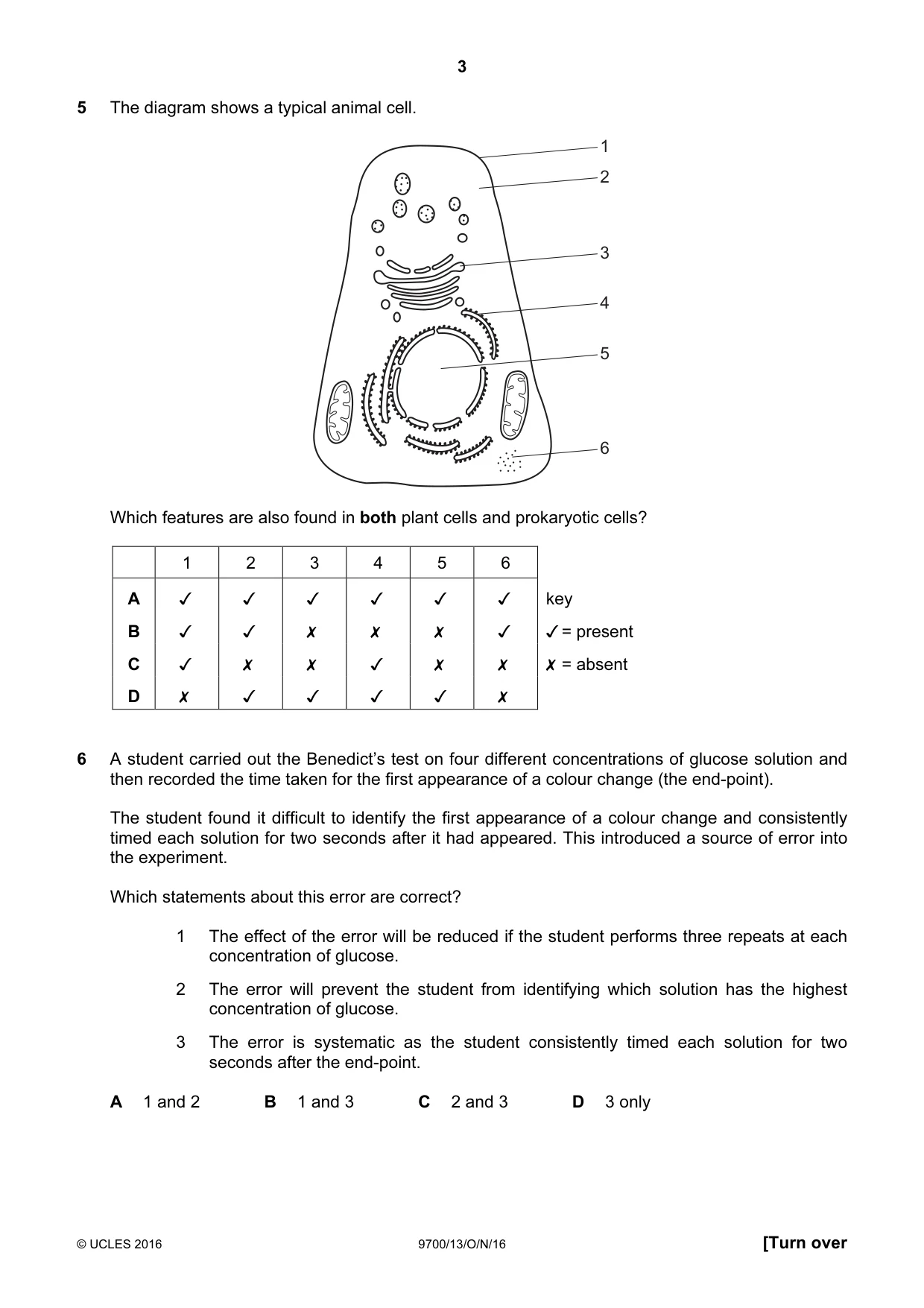
Q5 · The diagram shows a typical animal cell
5 The diagram shows a typical animal cell. Which features are also found in both plant cells and prokaryotic cells? 1 2 3 4 5 6 A v v v v v v key B v Jv x x x J /¥ = present Cc v x x v x x X = absent D x v v v v x
Mark scheme: B
More questions on Cells as the basic units of living organisms
Q6 · A student carried out the Benedict’s test on four different concentrations of glucose…
6 A student carried out the Benedict’s test on four different concentrations of glucose solution and then recorded the time taken for the first appearance of a colour change (the end-point). The student found it difficult to identify the first appearance of a colour change and consistently timed each solution for two seconds after it had appeared. This introduced a source of error into the experiment. Which statements about this error are correct? 1 The effect of the error will be reduced if the student performs three repeats at each concentration of glucose. 2 The error will prevent the student from identifying which solution has the highest concentration of glucose. 3 The error is systematic as the student consistently timed each solution for two seconds after the end-point. A 1 and 2 B 1 and 3 C 2 and 3 D 3 only
Mark scheme: D
Q7 · Which row is correct for each of the molecules?
7 Which row is correct for each of the molecules? collagen haemoglobin sucrose A has a structural contains the formed by function, found in elements carbon, releasing a blood vessel hydrogen, iron, molecule of water walls nitrogen and in a hydrolysis sulfur reaction B molecules consist each non-protein composed of two of three haem group monosaccharides polypeptide contains a central linked by a chains, linked by iron ion glycosidic bond ionic bonds C molecules lie has two identical formed by parallel to each α chains and two condensation of other, with cross- identical β chains two identical links and monosaccharides staggered ends D polypeptide has all four levels digestion yields chains interact to of protein glucose and produce a fibrous structure and at fructose in equal protein least four types of proportions bond
Mark scheme: D
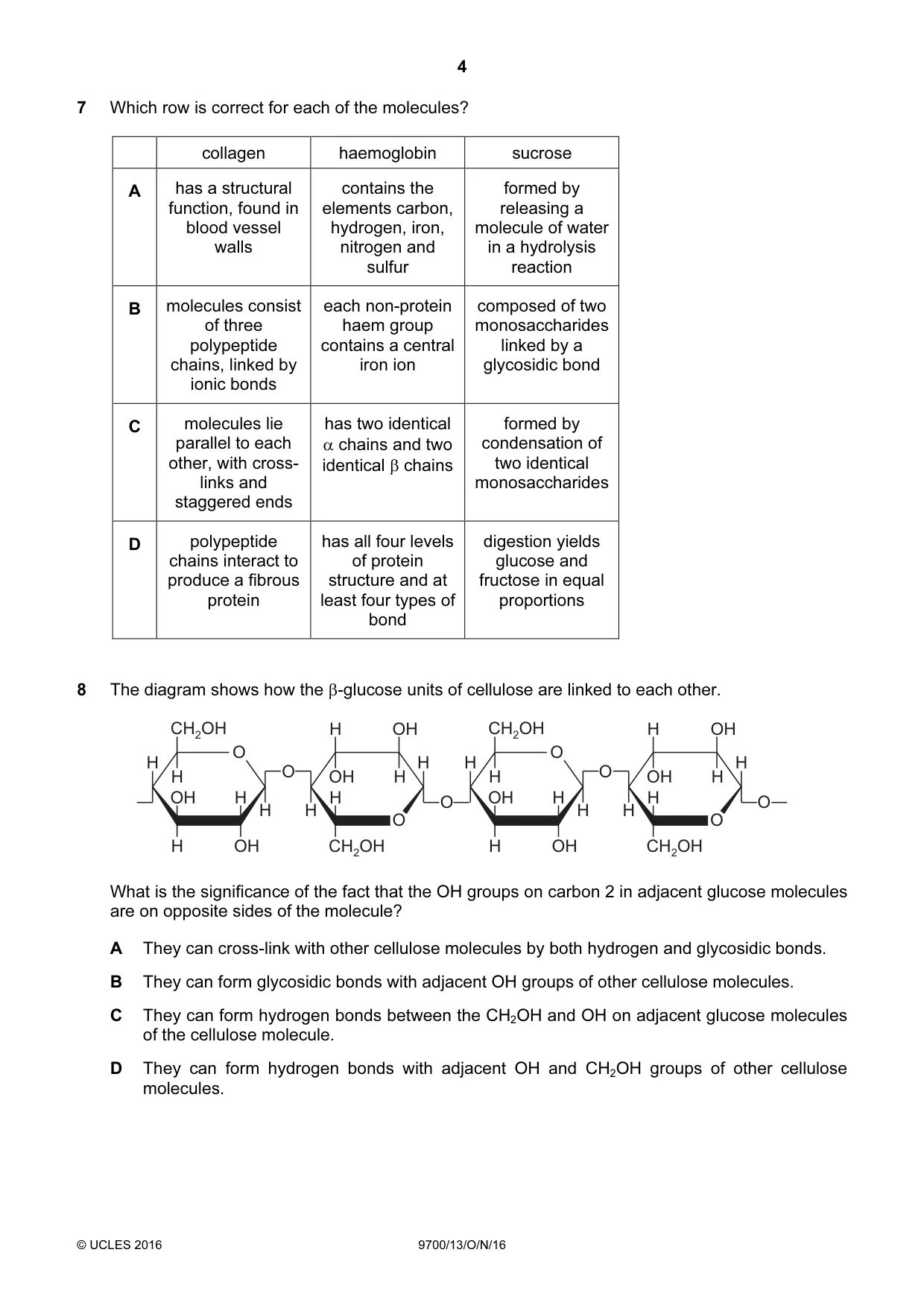
Q8 · The diagram shows how the β-glucose units of cellulose are linked to each other
8 The diagram shows how the β-glucose units of cellulose are linked to each other. CH2OH H OH CH2OH H OH O O H H H H H O OH H H O OH H OH H H O OH H H O H H H H O O H OH CH2OH H OH CH2OH What is the significance of the fact that the OH groups on carbon 2 in adjacent glucose molecules are on opposite sides of the molecule? A They can cross-link with other cellulose molecules by both hydrogen and glycosidic bonds. B They can form glycosidic bonds with adjacent OH groups of other cellulose molecules. C They can form hydrogen bonds between the CH2OH and OH on adjacent glucose molecules of the cellulose molecule. D They can form hydrogen bonds with adjacent OH and CH2OH groups of other cellulose molecules.
Mark scheme: D
Q9 · Threonylvaline is a dipeptide formed from the two amino acids, threonine and valine
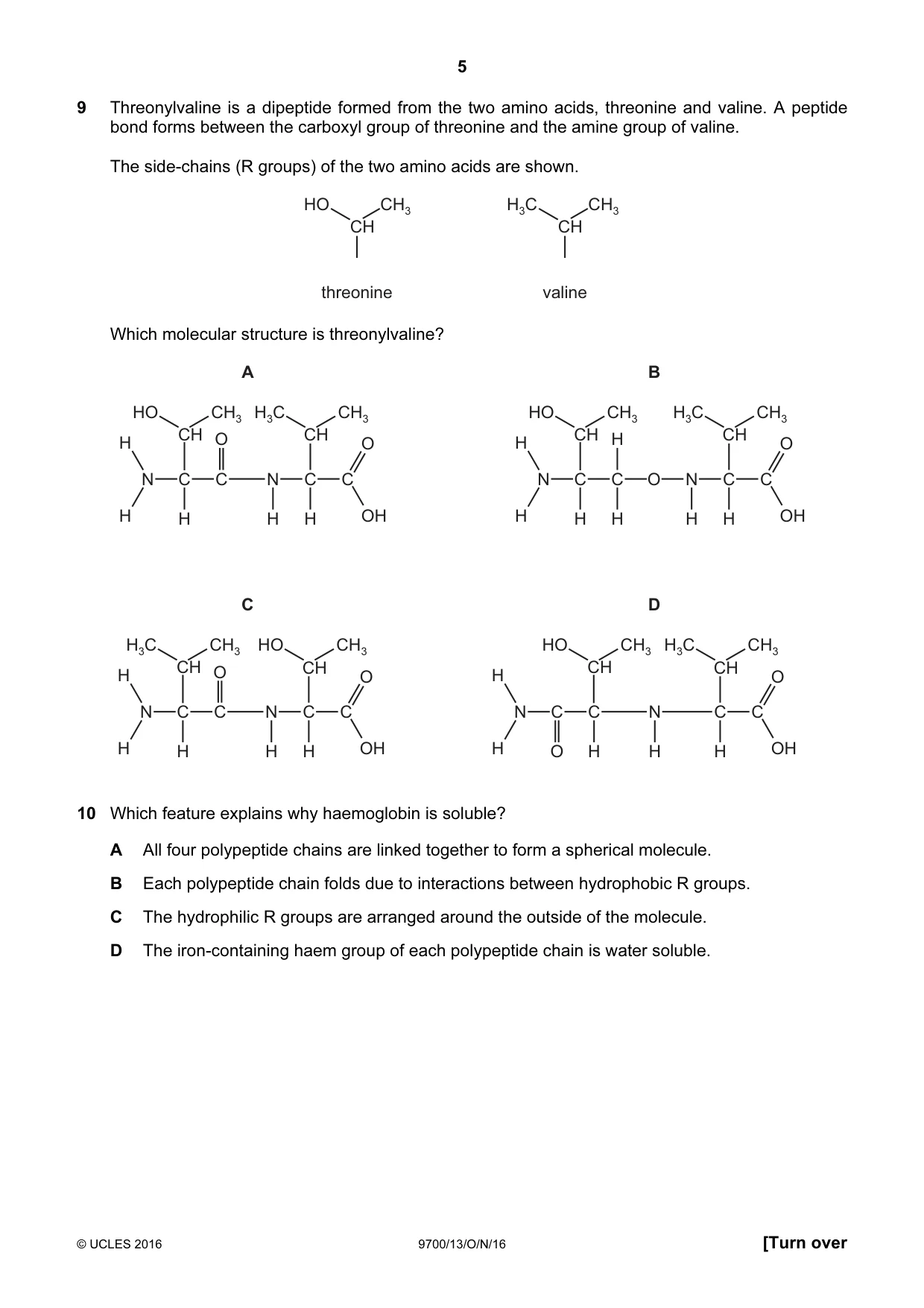
9 Threonylvaline is a dipeptide formed from the two amino acids, threonine and valine. A peptide bond forms between the carboxyl group of threonine and the amine group of valine. The side-chains (R groups) of the two amino acids are shown. HO CH3 H3C CH3 CH CH threonine valine Which molecular structure is threonylvaline? A B HO CH3 H3C CH3 HO CH3 H3C CH3 CH O CH CH H CH H O H O N C C N C C N C C O N C C H H H H OH H H H H H OH C D H3C CH3 HO CH3 HO CH3 H3C CH3 CH O CH CH CH H O H O N C C N C C N C C N C C H H H H OH H O H H H OH
Mark scheme: A
Q10 · Which feature explains why haemoglobin is soluble?
10 Which feature explains why haemoglobin is soluble? A All four polypeptide chains are linked together to form a spherical molecule. B Each polypeptide chain folds due to interactions between hydrophobic R groups. C The hydrophilic R groups are arranged around the outside of the molecule. D The iron-containing haem group of each polypeptide chain is water soluble.
Mark scheme: C
Q11 · An investigation into the rate of an enzyme-catalysed reaction was carried out
11 An investigation into the rate of an enzyme-catalysed reaction was carried out. During the investigation the concentration of the substrate was kept higher than the concentration of the enzyme. During this investigation, which change in the variables would always lead to an increase in the rate of the reaction? 1 increase in enzyme concentration 2 increase in pH 3 increase in temperature A 1 and 2 B 1 and 3 C 2 and 3 D 1 only
Mark scheme: D
Q12 · The enzymes glucokinase in the liver and hexokinase in the brain both catalyse the…
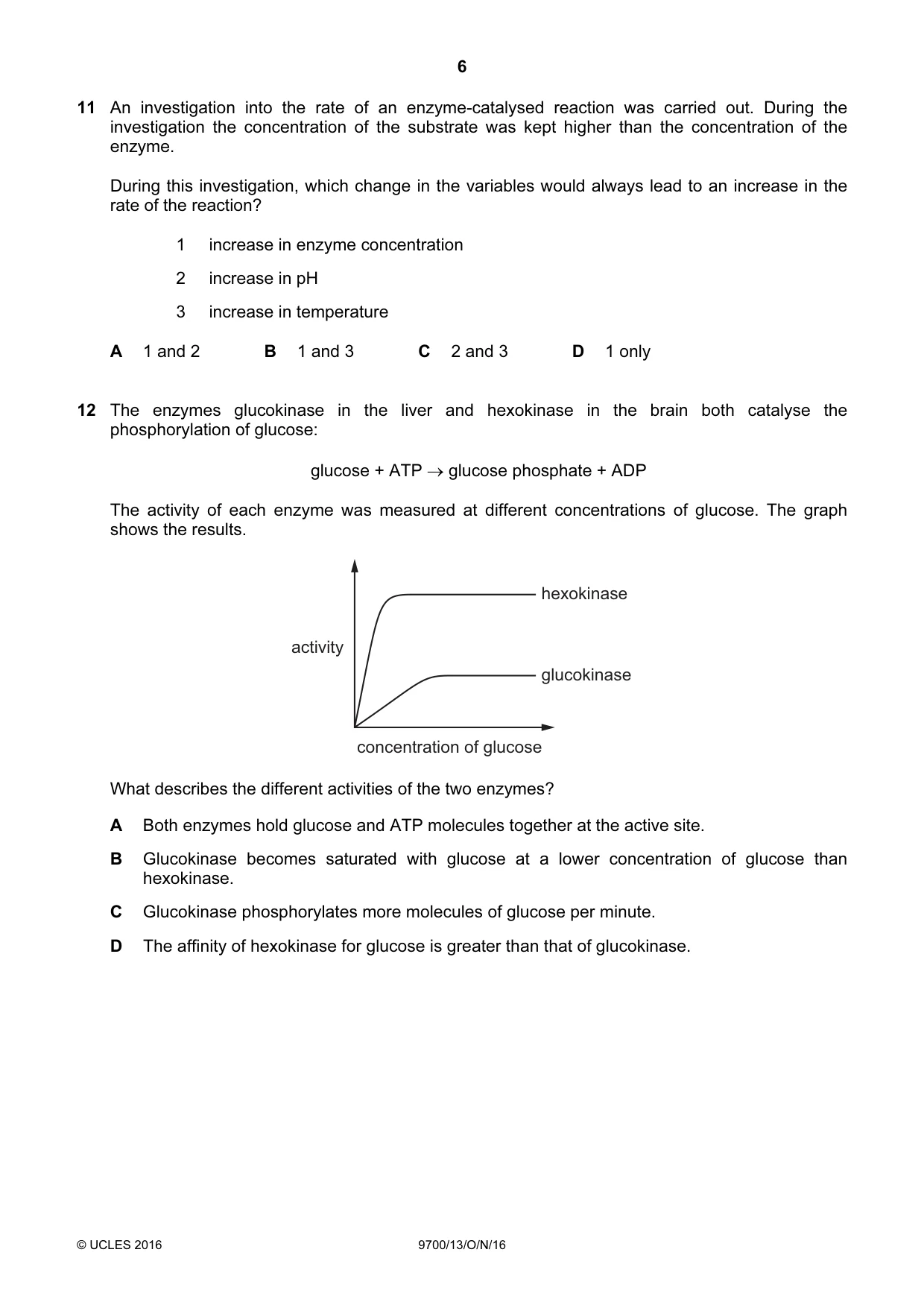
12 The enzymes glucokinase in the liver and hexokinase in the brain both catalyse the phosphorylation of glucose: glucose + ATP → glucose phosphate + ADP The activity of each enzyme was measured at different concentrations of glucose. The graph shows the results. hexokinase activity glucokinase concentration of glucose What describes the different activities of the two enzymes? A Both enzymes hold glucose and ATP molecules together at the active site. B Glucokinase becomes saturated with glucose at a lower concentration of glucose than hexokinase. C Glucokinase phosphorylates more molecules of glucose per minute. D The affinity of hexokinase for glucose is greater than that of glucokinase.
Mark scheme: D
Q13 · The value Km is the substrate concentration at which the rate of an enzyme-catalysed…
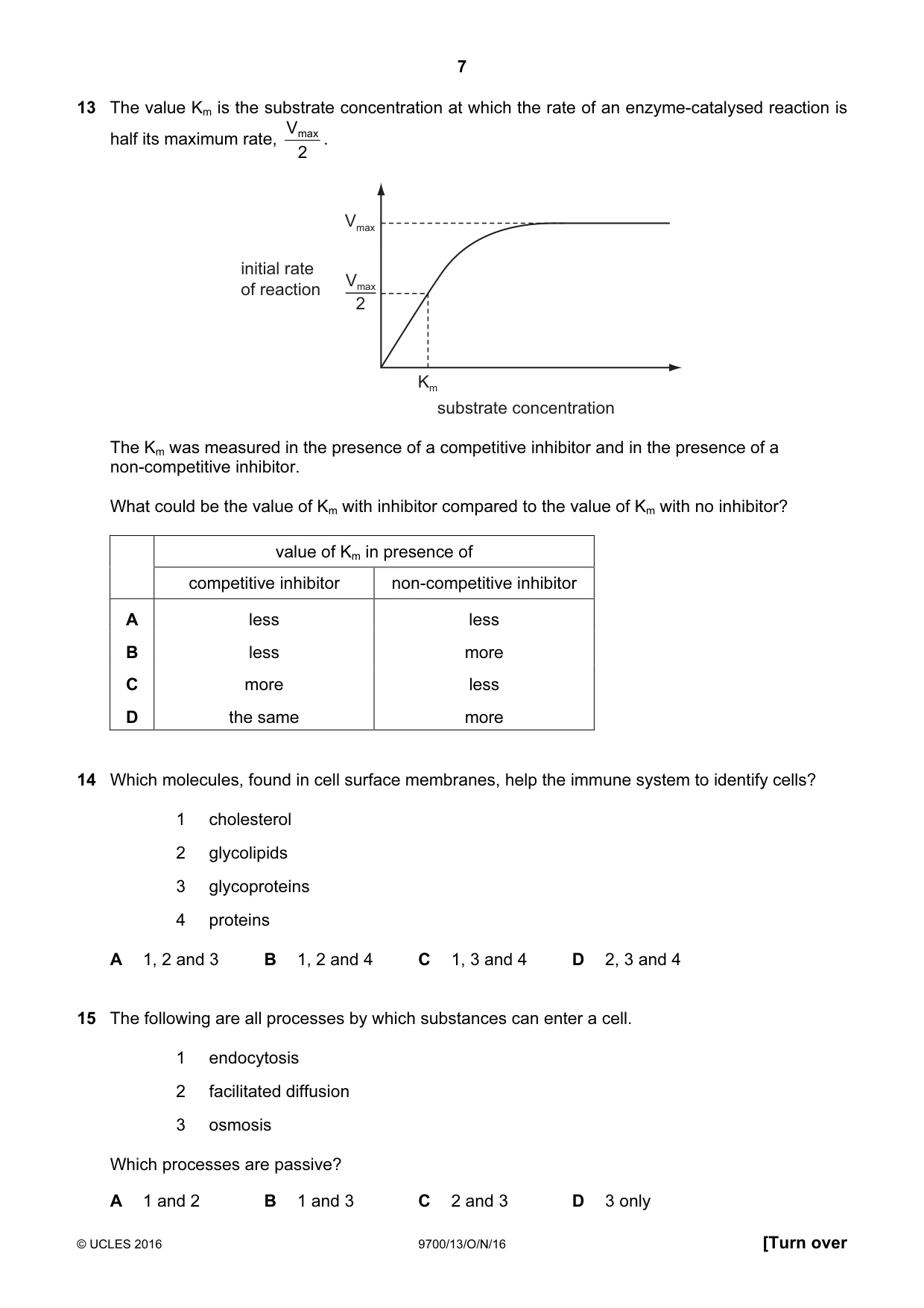
13 The value Km is the substrate concentration at which the rate of an enzyme-catalysed reaction is Vmax . half its maximum rate, 2 Vmax initial rate Vmax of reaction 2 Km substrate concentration The Km was measured in the presence of a competitive inhibitor and in the presence of a non-competitive inhibitor. What could be the value of Km with inhibitor compared to the value of Km with no inhibitor? value of Km in presence of competitive inhibitor non-competitive inhibitor A less less B less more C more less D the same more
Mark scheme: C
Q14 · Which molecules, found in cell surface membranes, help the immune system to identify…
14 Which molecules, found in cell surface membranes, help the immune system to identify cells? 1 cholesterol 2 glycolipids 3 glycoproteins 4 proteins A 1, 2 and 3 B 1, 2 and 4 C 1, 3 and 4 D 2, 3 and 4
Mark scheme: D
Q15 · The following are all processes by which substances can enter a cell
15 The following are all processes by which substances can enter a cell. 1 endocytosis 2 facilitated diffusion 3 osmosis Which processes are passive? A 1 and 2 B 1 and 3 C 2 and 3 D 3 only
Mark scheme: C
Q16 · Equal volumes of five concentrations of sodium chloride solution were placed into five…
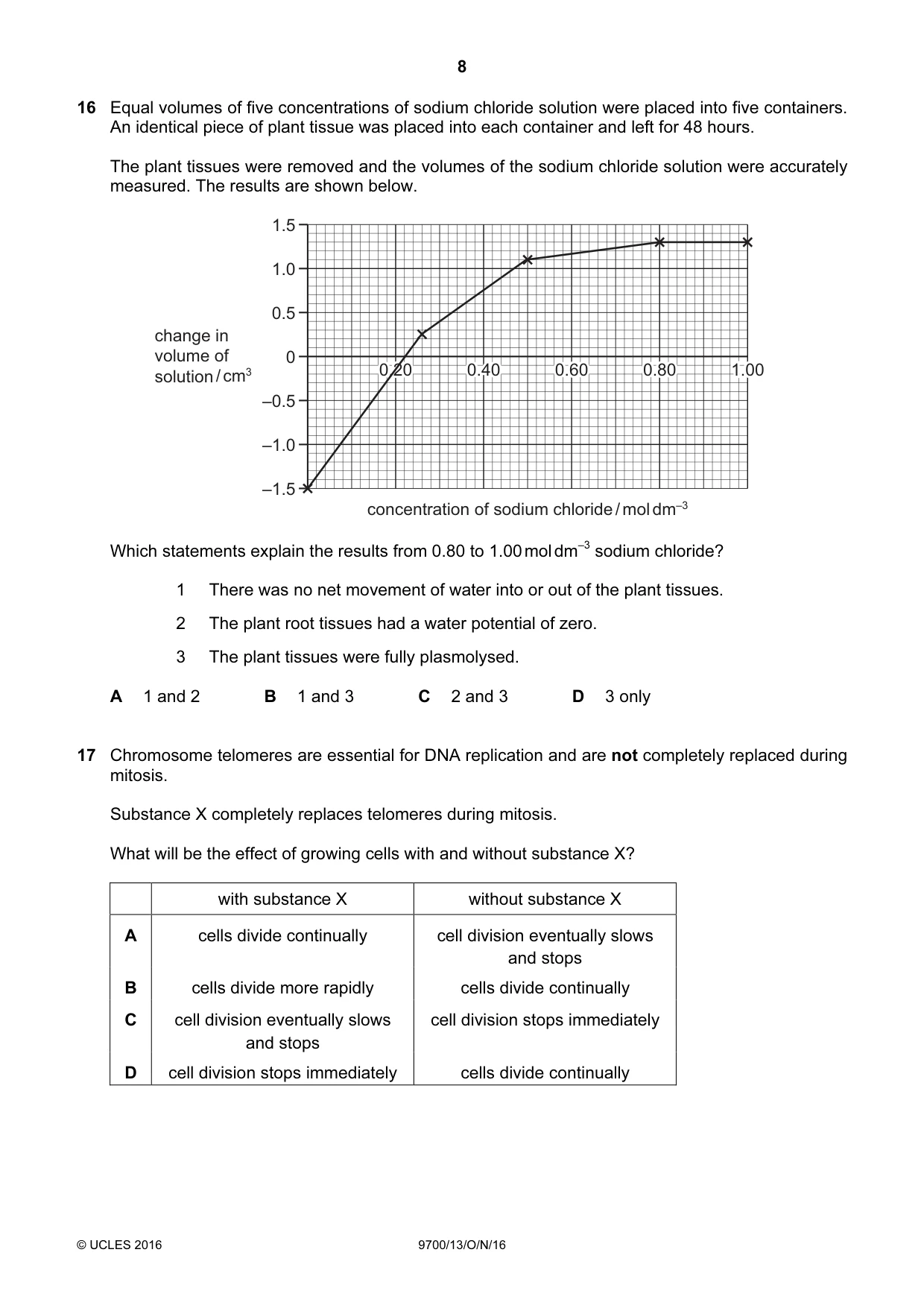
16 Equal volumes of five concentrations of sodium chloride solution were placed into five containers. An identical piece of plant tissue was placed into each container and left for 48 hours. The plant tissues were removed and the volumes of the sodium chloride solution were accurately measured. The results are shown below. 1.5 1.0 0.5 change in volume of 0 solution / cm3 0.20 0.20 0.20 0.40 0.40 0.40 0.60 0.60 0.60 0.80 0.80 0.80 1.00 1.00 1.00 –0.5 –1.0 –1.5 concentration of sodium chloride / mol dm–3 Which statements explain the results from 0.80 to 1.00 mol dm–3 sodium chloride? 1 There was no net movement of water into or out of the plant tissues. 2 The plant root tissues had a water potential of zero. 3 The plant tissues were fully plasmolysed. A 1 and 2 B 1 and 3 C 2 and 3 D 3 only
Mark scheme: D
Q17 · Chromosome telomeres are essential for DNA replication and are not completely replaced…
17 Chromosome telomeres are essential for DNA replication and are not completely replaced during mitosis. Substance X completely replaces telomeres during mitosis. What will be the effect of growing cells with and without substance X? with substance X without substance X A cells divide continually cell division eventually slows and stops B cells divide more rapidly cells divide continually C cell division eventually slows cell division stops immediately and stops D cell division stops immediately cells divide continually
Mark scheme: A
More questions on Replication and division of nuclei and cells
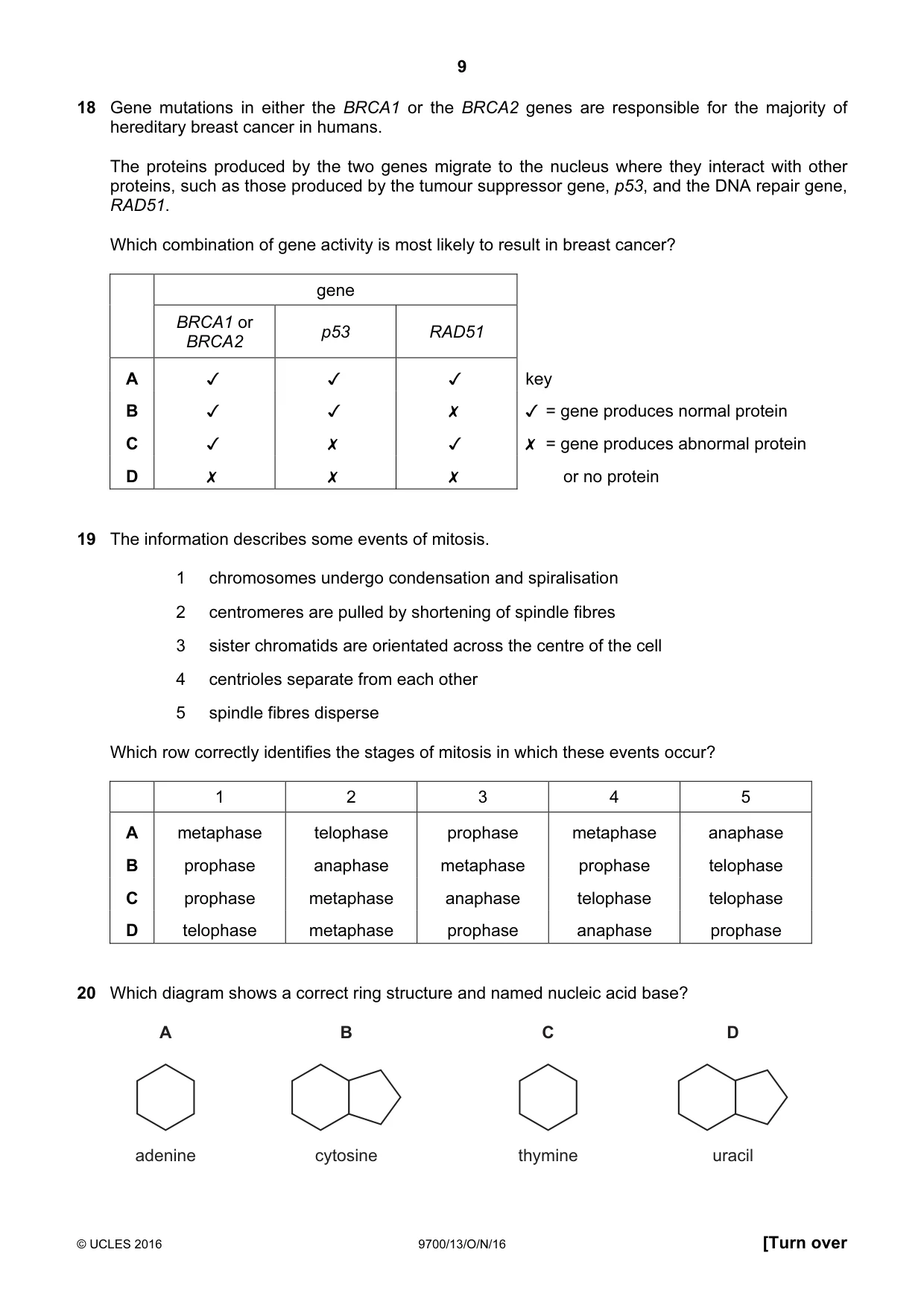
Q18 · Gene mutations in either the BRCA7 or the BRCA2 genes are responsible for the majority of…
18 Gene mutations in either the BRCA7 or the BRCA2 genes are responsible for the majority of hereditary breast cancer in humans. The proteins produced by the two genes migrate to the nucleus where they interact with other proteins, such as those produced by the tumour suppressor gene, p53, and the DNA repair gene, RADS1. Which combination of gene activity is most likely to result in breast cancer? gene Ona > p53 RAD51 A J J V B J J x Cc J x V D x x x key / = gene produces normal protein X =gene produces abnormal protein or no protein
Mark scheme: D
Q19 · The information describes some events of mitosis
19 The information describes some events of mitosis. 1 chromosomes undergo condensation and spiralisation 2 centromeres are pulled by shortening of spindle fibres 3 sister chromatids are orientated across the centre of the cell 4 centrioles separate from each other 5 spindle fibres disperse Which row correctly identifies the stages of mitosis in which these events occur? 1 2 3 4 5 A metaphase telophase prophase metaphase anaphase B prophase anaphase metaphase prophase telophase C prophase metaphase anaphase telophase telophase D telophase metaphase prophase anaphase prophase
Mark scheme: B
Q20 · Which diagram shows a correct ring structure and named nucleic acid base?
20 Which diagram shows a correct ring structure and named nucleic acid base? A B C D adenine cytosine thymine uracil
Mark scheme: C
More questions on Structure of nucleic acids and replication of DNA
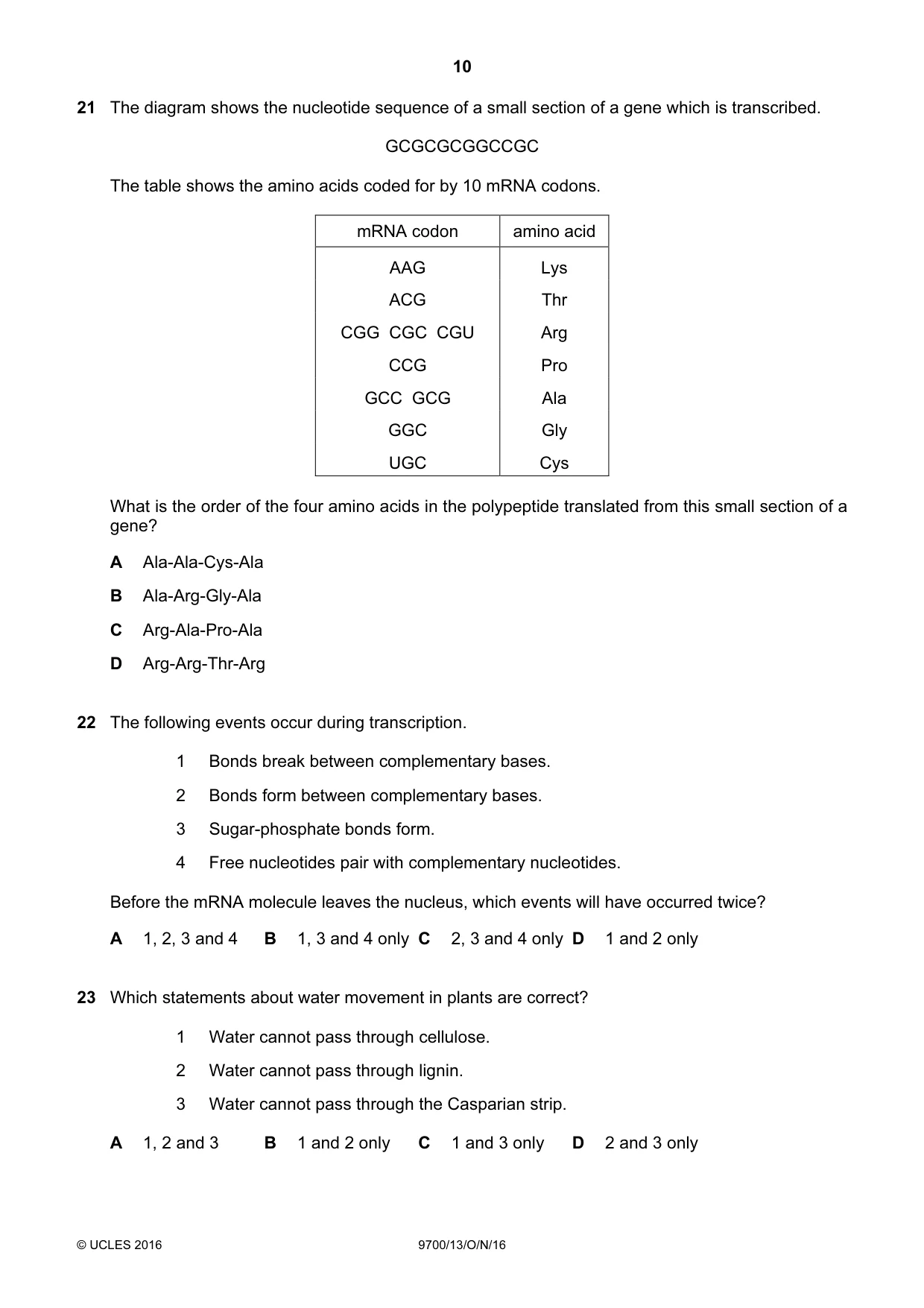
Q21 · The diagram shows the nucleotide sequence of a small section of a gene which is…
21 The diagram shows the nucleotide sequence of a small section of a gene which is transcribed. GCGCGCGGCCGC The table shows the amino acids coded for by 10 mRNA codons. mRNA codon amino acid AAG Lys ACG Thr CGG CGC CGU Arg CCG Pro GCC GCG Ala GGC Gly UGC Cys What is the order of the four amino acids in the polypeptide translated from this small section of a gene? A Ala-Ala-Cys-Ala B Ala-Arg-Gly-Ala C Arg-Ala-Pro-Ala D Arg-Arg-Thr-Arg
Mark scheme: C
Q22 · The following events occur during transcription
22 The following events occur during transcription. 1 Bonds break between complementary bases. 2 Bonds form between complementary bases. 3 Sugar-phosphate bonds form. 4 Free nucleotides pair with complementary nucleotides. Before the mRNA molecule leaves the nucleus, which events will have occurred twice? A 1, 2, 3 and 4 B 1, 3 and 4 only C 2, 3 and 4 only D 1 and 2 only
Mark scheme: D
Q23 · Which statements about water movement in plants are correct?
23 Which statements about water movement in plants are correct? 1 Water cannot pass through cellulose. 2 Water cannot pass through lignin. 3 Water cannot pass through the Casparian strip. A 1, 2 and 3 B 1 and 2 only C 1 and 3 only D 2 and 3 only
Mark scheme: D
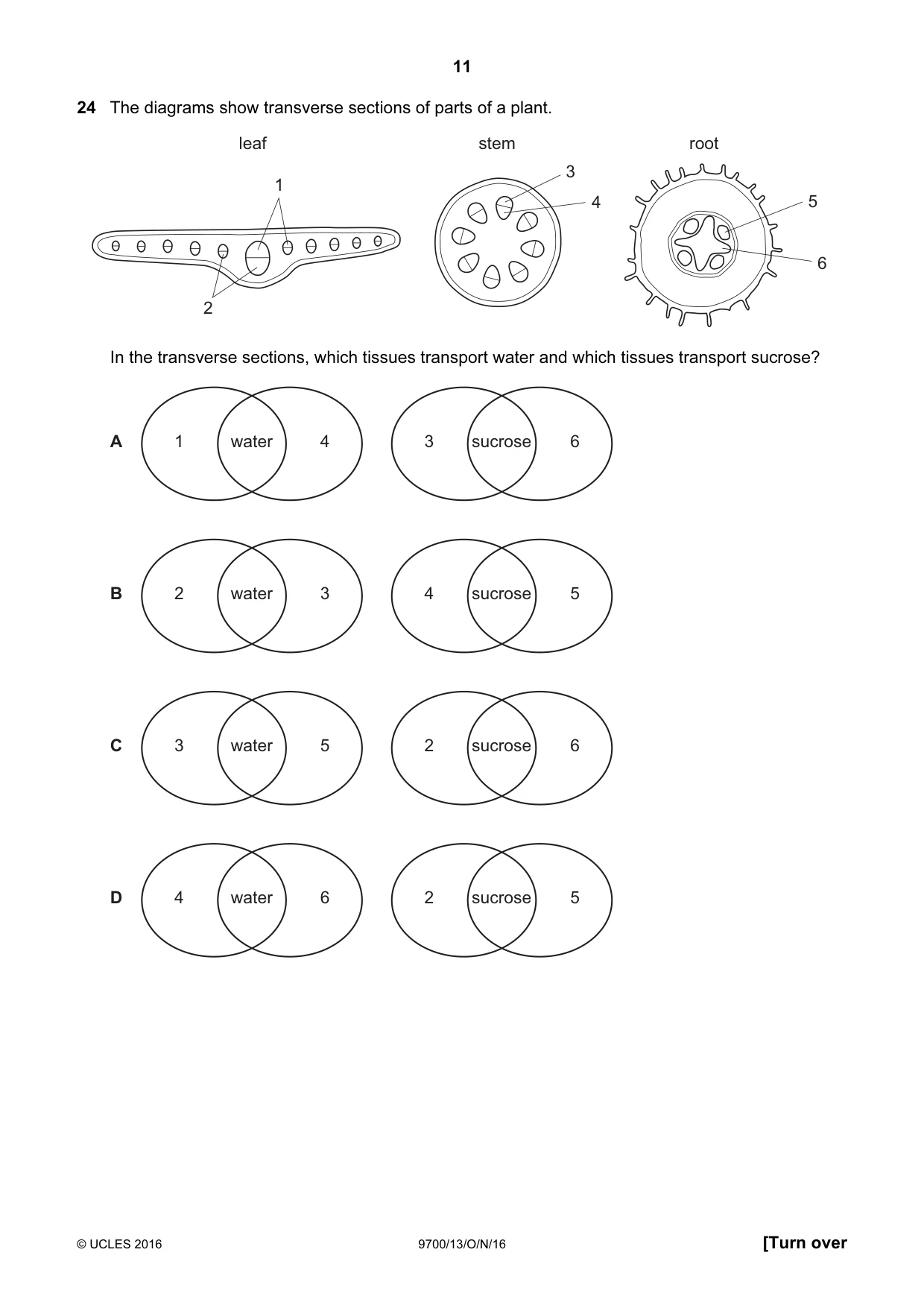
Q24 · The diagrams show transverse sections of parts of a plant
24 The diagrams show transverse sections of parts of a plant. leaf stem root 3 1 4 5 6 2 In the transverse sections, which tissues transport water and which tissues transport sucrose? A 1 water 4 3 sucrose 6 B 2 water 3 4 sucrose 5 C 3 water 5 2 sucrose 6 D 4 water 6 2 sucrose 5
Mark scheme: D
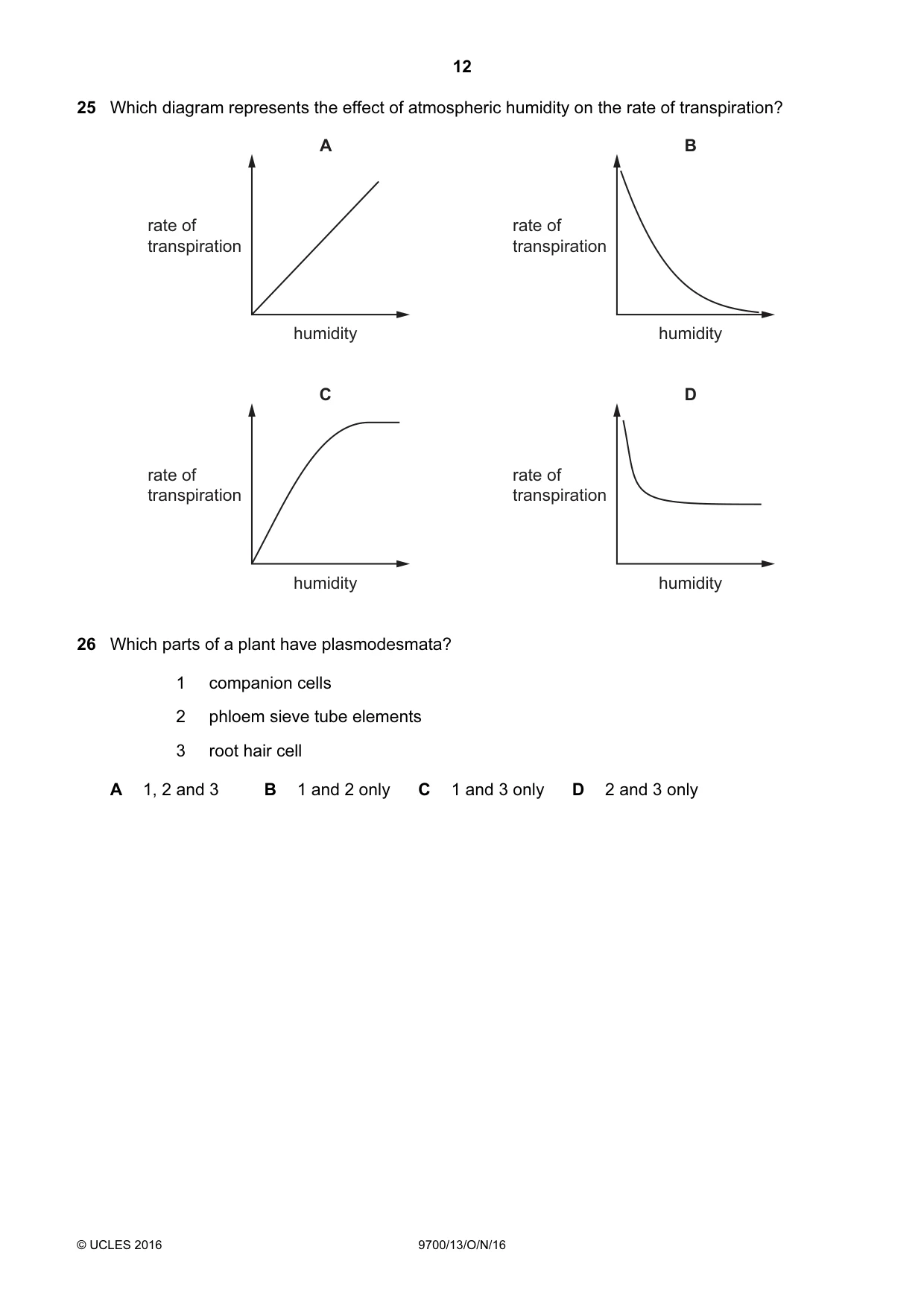
Q25 · Which diagram represents the effect of atmospheric humidity on the rate of transpiration?
25 Which diagram represents the effect of atmospheric humidity on the rate of transpiration? A B rate of rate of transpiration transpiration humidity humidity C D rate of rate of transpiration transpiration humidity humidity
Mark scheme: B
Q26 · Which parts of a plant have plasmodesmata?
26 Which parts of a plant have plasmodesmata? 1 companion cells 2 phloem sieve tube elements 3 root hair cell A 1, 2 and 3 B 1 and 2 only C 1 and 3 only D 2 and 3 only
Mark scheme: A
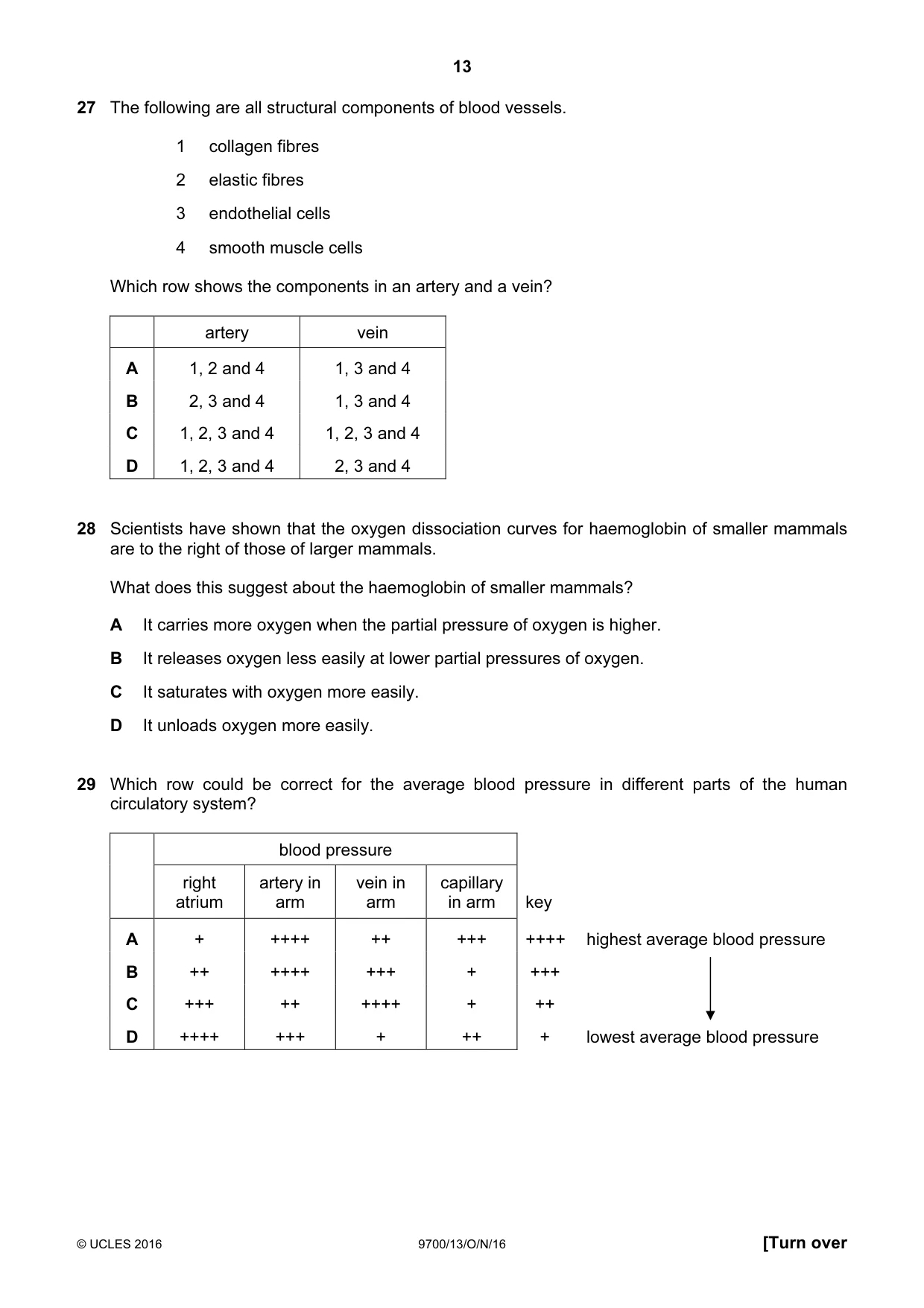
Q27 · The following are all structural components of blood vessels
27 The following are all structural components of blood vessels. 1 collagen fibres 2 elastic fibres 3 endothelial cells 4 smooth muscle cells Which row shows the components in an artery and a vein? artery vein A 1, 2 and 4 1, 3 and 4 B 2, 3 and 4 1, 3 and 4 C 1, 2, 3 and 4 1, 2, 3 and 4 D 1, 2, 3 and 4 2, 3 and 4
Mark scheme: C
Q28 · Scientists have shown that the oxygen dissociation curves for haemoglobin of smaller…
28 Scientists have shown that the oxygen dissociation curves for haemoglobin of smaller mammals are to the right of those of larger mammals. What does this suggest about the haemoglobin of smaller mammals? A It carries more oxygen when the partial pressure of oxygen is higher. B It releases oxygen less easily at lower partial pressures of oxygen. C It saturates with oxygen more easily. D It unloads oxygen more easily.
Mark scheme: D
Q29 · Which row could be correct for the average blood pressure in different parts of the human…
29 Which row could be correct for the average blood pressure in different parts of the human circulatory system? blood pressure right artery in vein in capillary atrium arm arm in arm key A + ++++ ++ +++ ++++ highest average blood pressure B ++ ++++ +++ + +++ C +++ ++ ++++ + ++ D ++++ +++ + ++ + lowest average blood pressure
Mark scheme: A
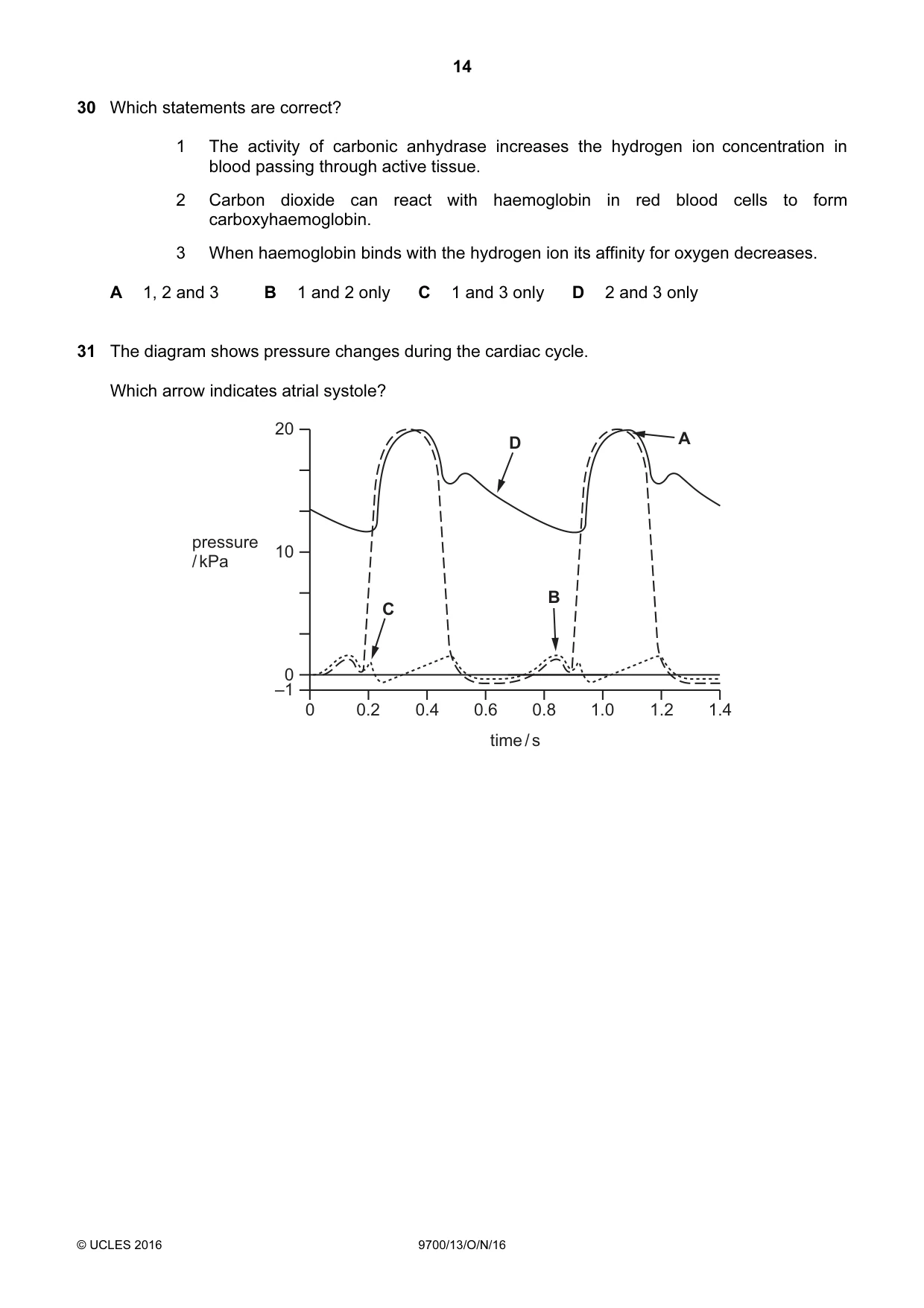
Q30 · Which statements are correct?
30 Which statements are correct? 1 The activity of carbonic anhydrase increases the hydrogen ion concentration in blood passing through active tissue. 2 Carbon dioxide can react with haemoglobin in red blood cells to form carboxyhaemoglobin. 3 When haemoglobin binds with the hydrogen ion its affinity for oxygen decreases. A 1, 2 and 3 B 1 and 2 only C 1 and 3 only D 2 and 3 only
Mark scheme: C
Q31 · The diagram shows pressure changes during the cardiac cycle
31 The diagram shows pressure changes during the cardiac cycle. Which arrow indicates atrial systole? 20 D A pressure 10 / kPa B C 0 –1 0 0.2 0.4 0.6 0.8 1.0 1.2 1.4 time / s
Mark scheme: B
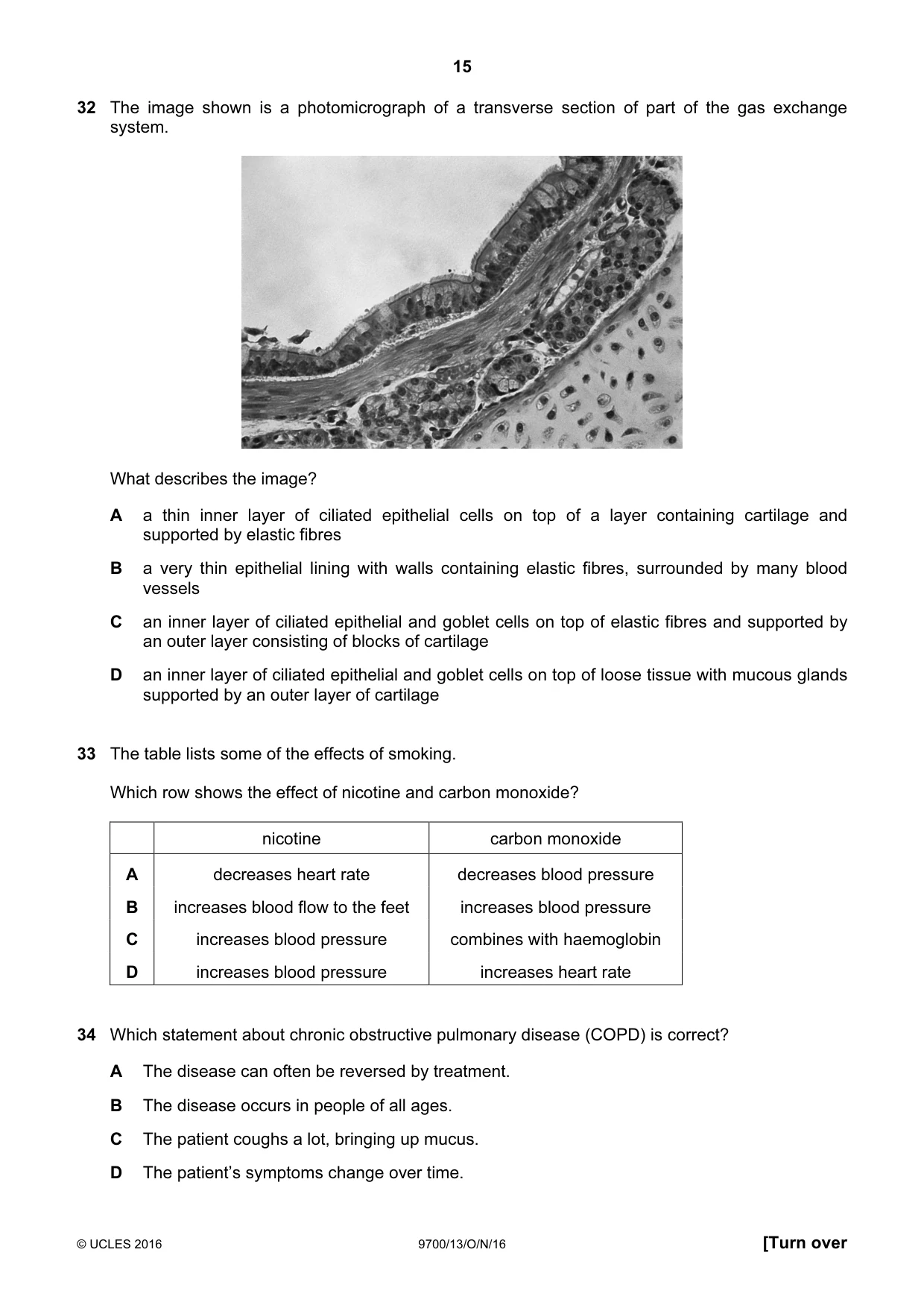
Q32 · The image shown is a photomicrograph of a transverse section of part of the gas exchange…
32 The image shown is a photomicrograph of a transverse section of part of the gas exchange system. What describes the image? A a thin inner layer of ciliated epithelial cells on top of a layer containing cartilage and supported by elastic fibres B a very thin epithelial lining with walls containing elastic fibres, surrounded by many blood vessels C an inner layer of ciliated epithelial and goblet cells on top of elastic fibres and supported by an outer layer consisting of blocks of cartilage D an inner layer of ciliated epithelial and goblet cells on top of loose tissue with mucous glands supported by an outer layer of cartilage
Mark scheme: C
Q33 · The table lists some of the effects of smoking
33 The table lists some of the effects of smoking. Which row shows the effect of nicotine and carbon monoxide? nicotine carbon monoxide A decreases heart rate decreases blood pressure B increases blood flow to the feet increases blood pressure C increases blood pressure combines with haemoglobin D increases blood pressure increases heart rate
Mark scheme: C
Q34 · Which statement about chronic obstructive pulmonary disease (COPD) is correct?
34 Which statement about chronic obstructive pulmonary disease (COPD) is correct? A The disease can often be reversed by treatment. B The disease occurs in people of all ages. C The patient coughs a lot, bringing up mucus. D The patient’s symptoms change over time.
Mark scheme: C
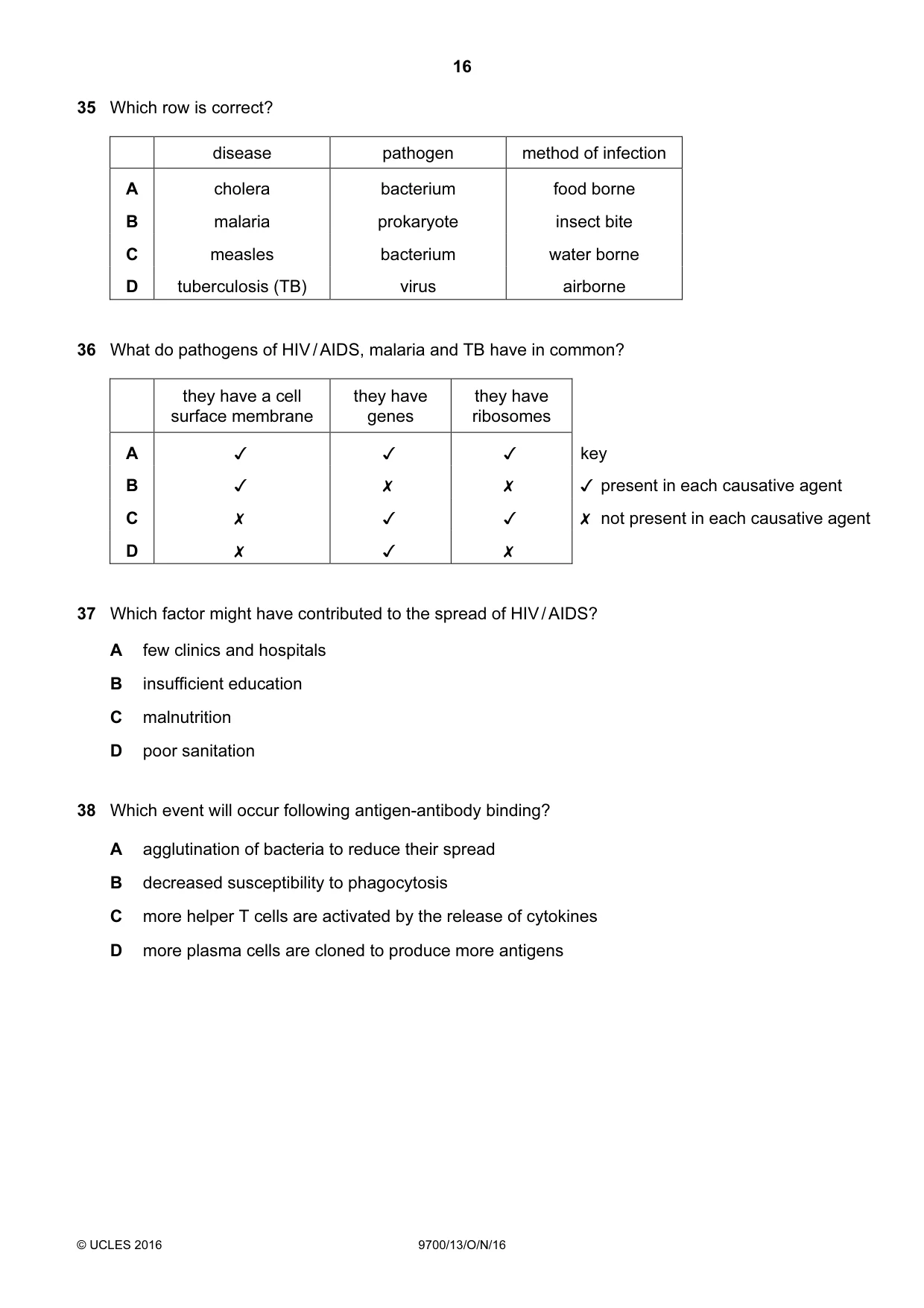
Q35 · Which row is correct?
35 Which row is correct? disease pathogen method of infection A cholera bacterium food borne B malaria prokaryote insect bite C measles bacterium water borne D tuberculosis (TB) virus airborne
Mark scheme: A
Q36 · What do pathogens of HIV/AIDS, malaria and TB have in common?
36 What do pathogens of HIV/AIDS, malaria and TB have in common? they have a cell they have they have surface membrane genes ribosomes A v v v B v x x Cc x v v D x v x key ¥ present in each causative agent X not present in each causative agent
Mark scheme: D
Q37 · Which factor might have contributed to the spread of HIV / AIDS?
37 Which factor might have contributed to the spread of HIV / AIDS? A few clinics and hospitals B insufficient education C malnutrition D poor sanitation
Mark scheme: B
Q38 · Which event will occur following antigen-antibody binding?
38 Which event will occur following antigen-antibody binding? A agglutination of bacteria to reduce their spread B decreased susceptibility to phagocytosis C more helper T cells are activated by the release of cytokines D more plasma cells are cloned to produce more antigens
Mark scheme: A
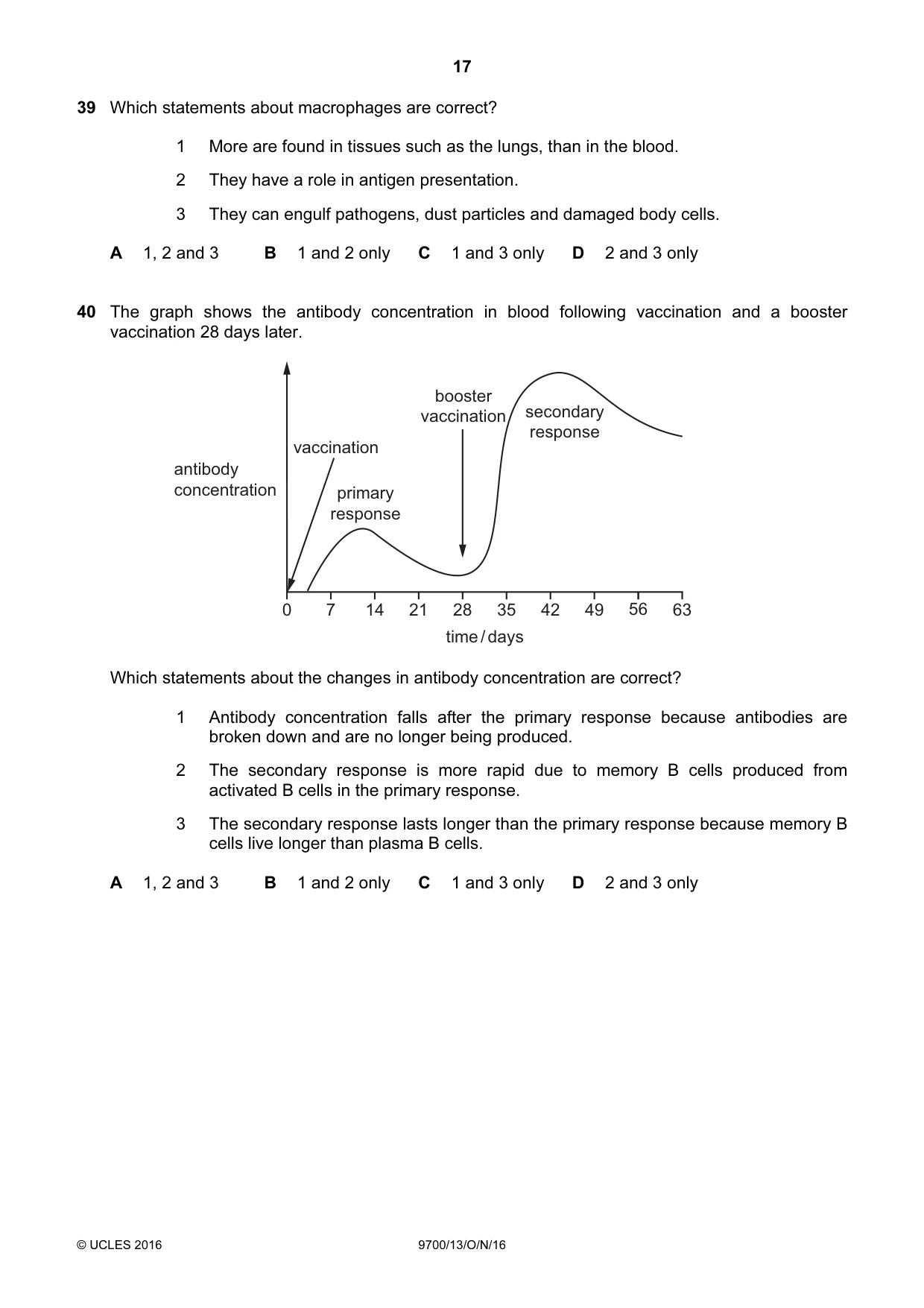
Q39 · Which statements about macrophages are correct?
39 Which statements about macrophages are correct? 1 More are found in tissues such as the lungs, than in the blood. 2 They have a role in antigen presentation. 3 They can engulf pathogens, dust particles and damaged body cells. A 1, 2 and 3 B 1 and 2 only C 1 and 3 only D 2 and 3 only
Mark scheme: A
Q40 · The graph shows the antibody concentration in blood following vaccination and a booster…
40 The graph shows the antibody concentration in blood following vaccination and a booster vaccination 28 days later. booster vaccination secondary response vaccination antibody concentration primary response 0 7 14 21 28 35 42 49 56 63 time / days Which statements about the changes in antibody concentration are correct? 1 Antibody concentration falls after the primary response because antibodies are broken down and are no longer being produced. 2 The secondary response is more rapid due to memory B cells produced from activated B cells in the primary response. 3 The secondary response lasts longer than the primary response because memory B cells live longer than plasma B cells. A 1, 2 and 3 B 1 and 2 only C 1 and 3 only D 2 and 3 only
Mark scheme: A
What was in this paper
The subtopics covered by these 40 questions, and how many questions each got. Open one in a new tab to see every Cambridge question on it.
4Infectious diseases3Proteins3The gas exchange system3Antibodies and vaccination2Factors that affect enzyme action2Movement into and out of cells2Protein synthesis2Structure of transport tissues2The circulatory system2Transport mechanisms2Transport of oxygen and carbon dioxide2Carbohydrates and lipids1Chromosome behaviour in mitosis1Fluid mosaic membranes1Mode of action of enzymes1Replication and division of nuclei and cells1Structure of nucleic acids and replication of DNA1Testing for biological molecules1The heart1The immune system1The microscope in cell studies1The roles of genes in1What you needed in this session
Cambridge’s own grade thresholds for 2016 Oct/Nov, Paper 1 · Variant 3. A higher threshold means an easier paper — the bar moves with how the cohort did.