Cambridge A Level Biology 9700 — 2019 Oct/Nov Paper 1 · Variant 3
9700/13/O/N/19 · 40 questions · 40 marks · ≈45 min
The question paper and its mark scheme, free to read here and free to download. This is Cambridge’s own paper, exactly as it was sat.
Question paper20 pages



Mark scheme3 pages
Answers below. Sit the paper first if you are practising.
Questions as text
Q1 · Plant cells are stained and then seen with a simple light microscope using daylight as…
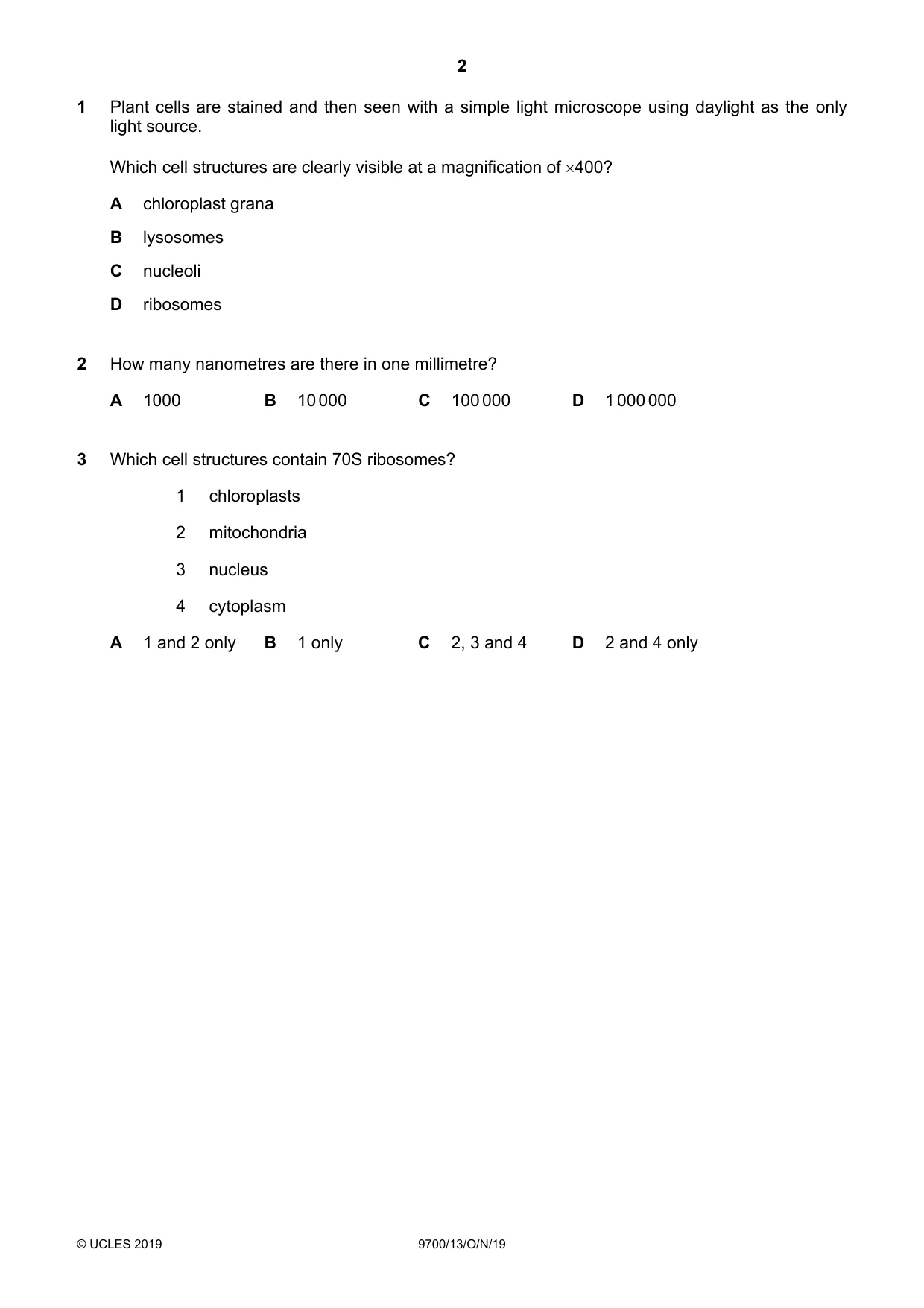
1 Plant cells are stained and then seen with a simple light microscope using daylight as the only light source. Which cell structures are clearly visible at a magnification of ×400? A chloroplast grana B lysosomes C nucleoli D ribosomes
Mark scheme: C
Q2 · How many nanometres are there in one millimetre?
2 How many nanometres are there in one millimetre? A 1000 B 10 000 C 100 000 D 1 000 000
Mark scheme: D
Q3 · Which cell structures contain 70S ribosomes?
3 Which cell structures contain 70S ribosomes? 1 chloroplasts 2 mitochondria 3 nucleus 4 cytoplasm A 1 and 2 only B 1 only C 2, 3 and 4 D 2 and 4 only
Mark scheme: A
More questions on Cells as the basic units of living organisms
Q4 · The electron micrograph shows part of a plant cell
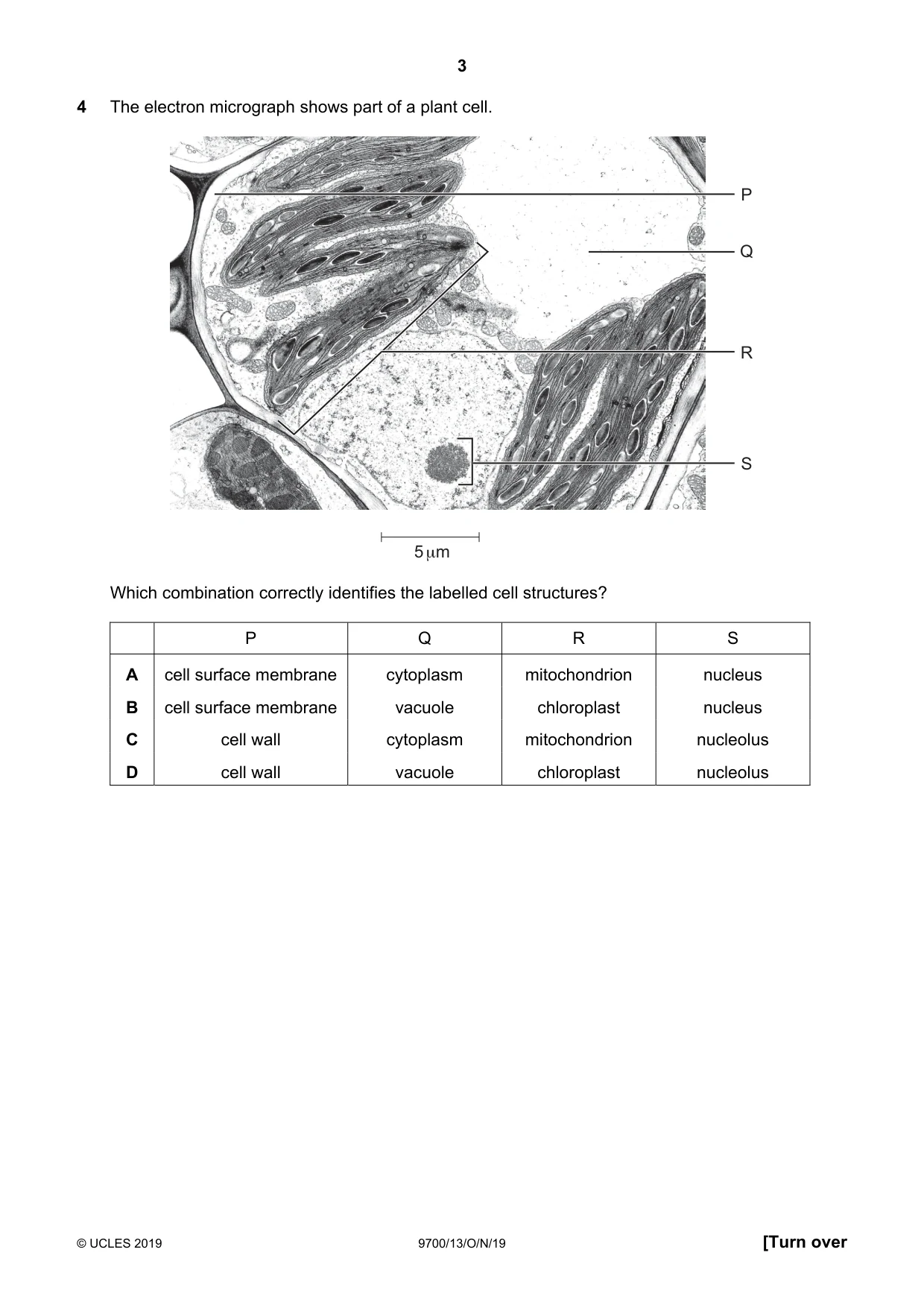
4 The electron micrograph shows part of a plant cell. P Q R S 5 μm Which combination correctly identifies the labelled cell structures? P Q R S A cell surface membrane cytoplasm mitochondrion nucleus B cell surface membrane vacuole chloroplast nucleus C cell wall cytoplasm mitochondrion nucleolus D cell wall vacuole chloroplast nucleolus
Mark scheme: D
More questions on Cells as the basic units of living organisms
Q5 · Four students were asked to match the function with the appearance of some cell…
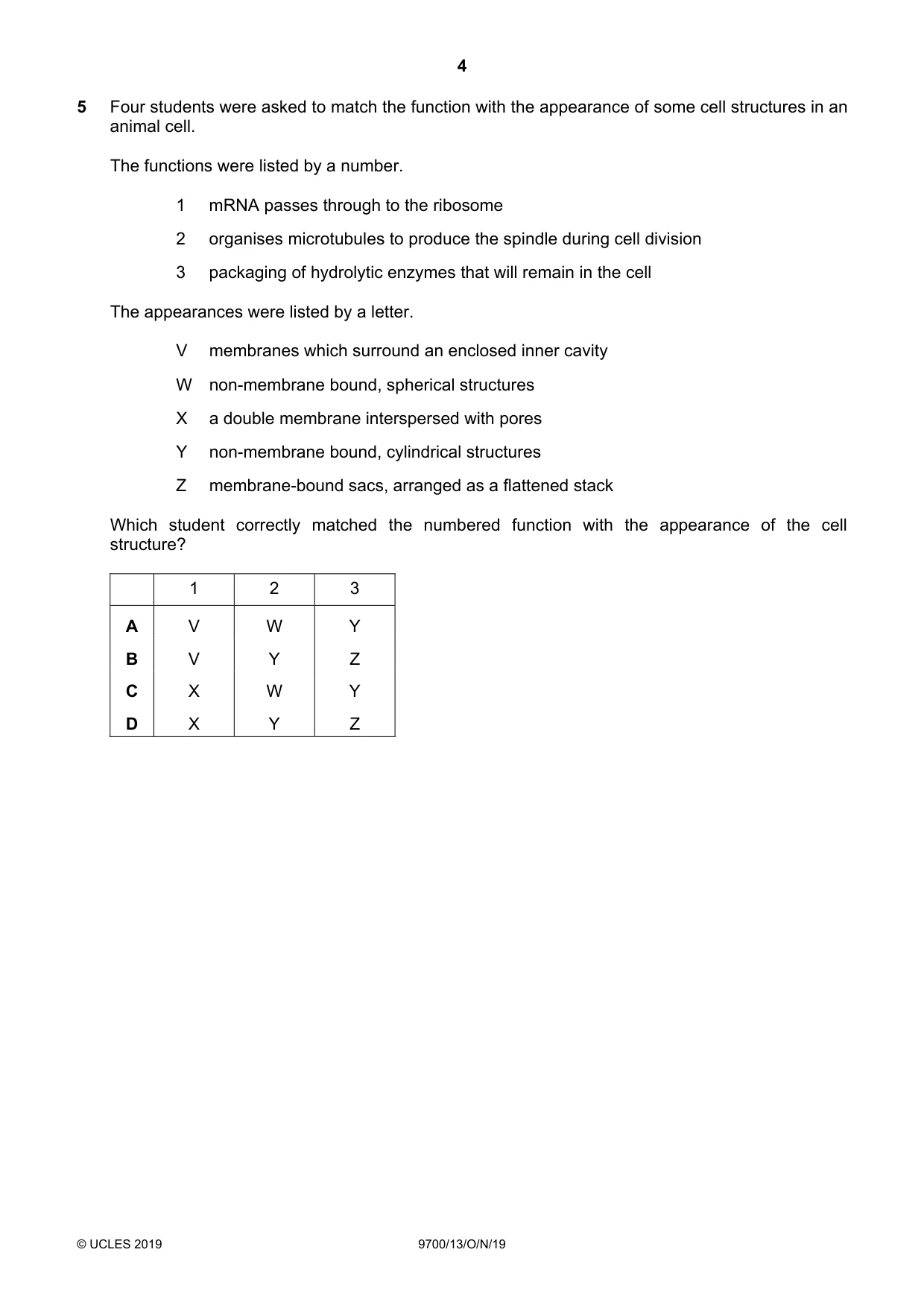
5 Four students were asked to match the function with the appearance of some cell structures in an animal cell. The functions were listed by a number. 1 mRNA passes through to the ribosome 2 organises microtubules to produce the spindle during cell division 3 packaging of hydrolytic enzymes that will remain in the cell The appearances were listed by a letter. V membranes which surround an enclosed inner cavity W non-membrane bound, spherical structures X a double membrane interspersed with pores Y non-membrane bound, cylindrical structures Z membrane-bound sacs, arranged as a flattened stack Which student correctly matched the numbered function with the appearance of the cell structure? 1 2 3 A V W Y B V Y Z C X W Y D X Y Z
Mark scheme: D
More questions on Cells as the basic units of living organisms
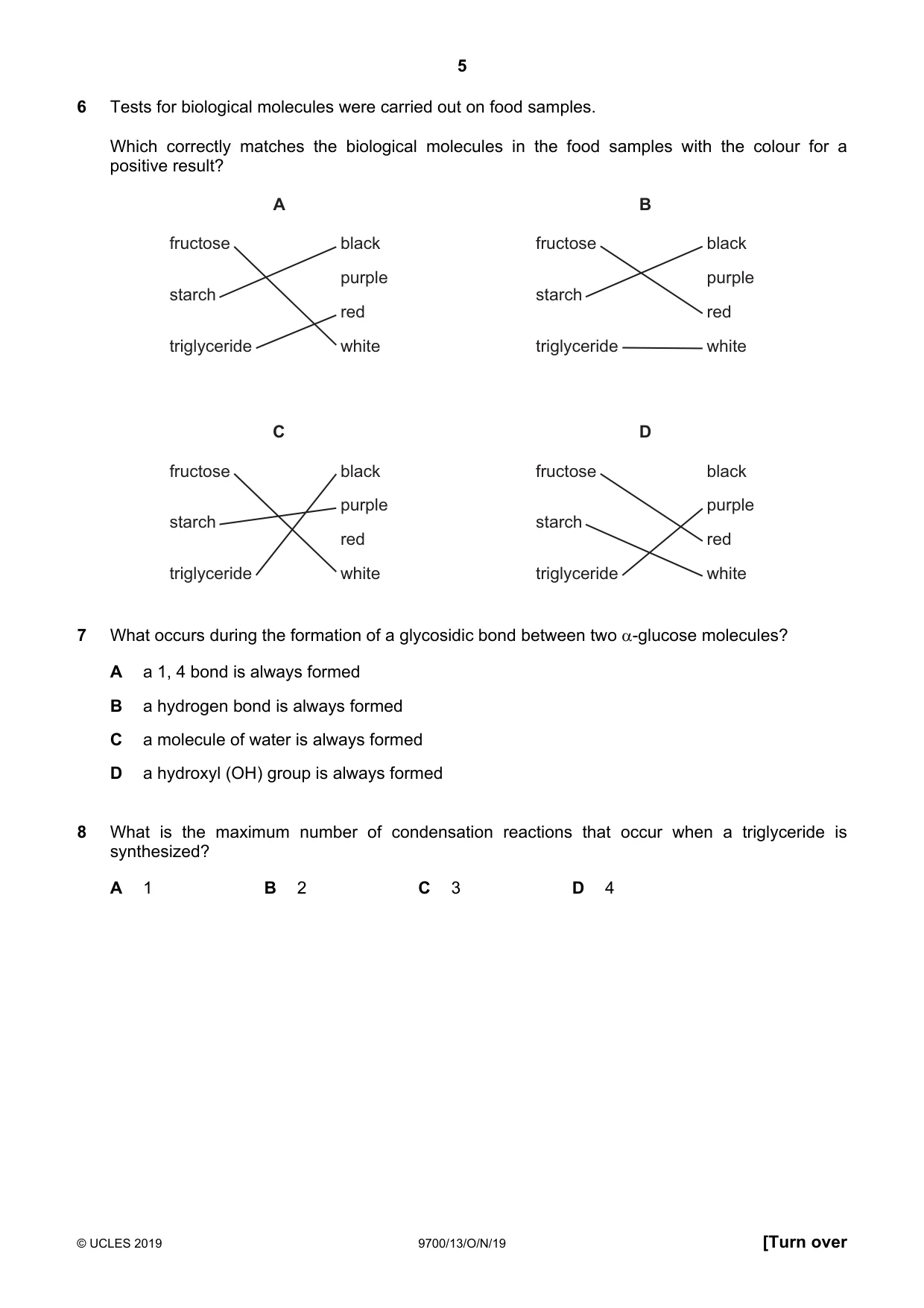
Q6 · Tests for biological molecules were carried out on food samples
6 Tests for biological molecules were carried out on food samples. Which correctly matches the biological molecules in the food samples with the colour for a positive result? A B fructose black fructose black purple purple starch starch red red triglyceride white triglyceride white C D fructose black fructose black purple purple starch starch red red triglyceride white triglyceride white
Mark scheme: B
Q7 · What occurs during the formation of a glycosidic bond between two α-glucose molecules?
7 What occurs during the formation of a glycosidic bond between two α-glucose molecules? A a 1, 4 bond is always formed B a hydrogen bond is always formed C a molecule of water is always formed D a hydroxyl (OH) group is always formed
Mark scheme: C
Q8 · What is the maximum number of condensation reactions that occur when a triglyceride is…
8 What is the maximum number of condensation reactions that occur when a triglyceride is synthesized? A 1 B 2 C 3 D 4
Mark scheme: C
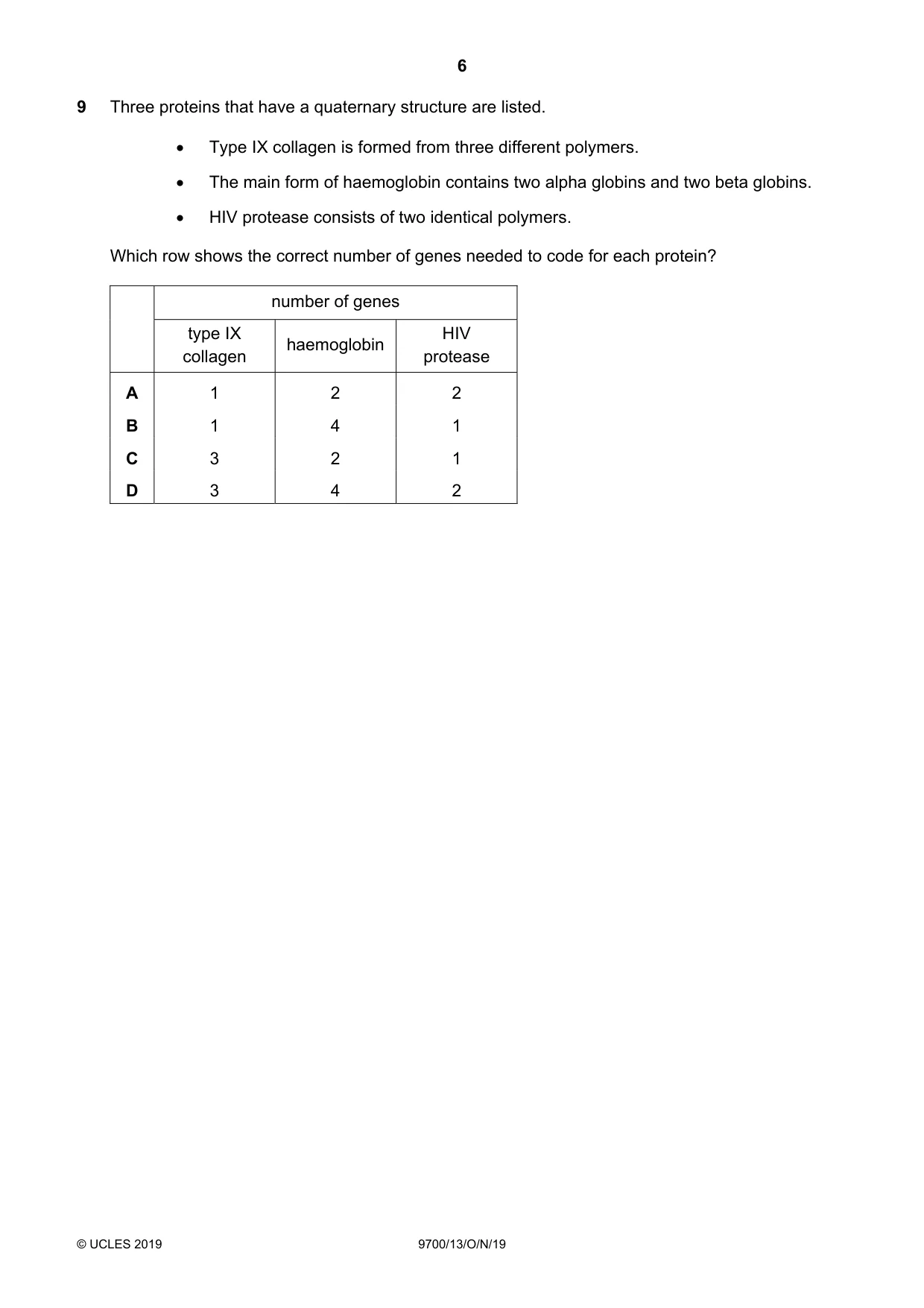
Q9 · Three proteins that have a quaternary structure are listed
9 Three proteins that have a quaternary structure are listed. • Type IX collagen is formed from three different polymers. • The main form of haemoglobin contains two alpha globins and two beta globins. • HIV protease consists of two identical polymers. Which row shows the correct number of genes needed to code for each protein? number of genes type IX HIV haemoglobin collagen protease A 1 2 2 B 1 4 1 C 3 2 1 D 3 4 2
Mark scheme: C
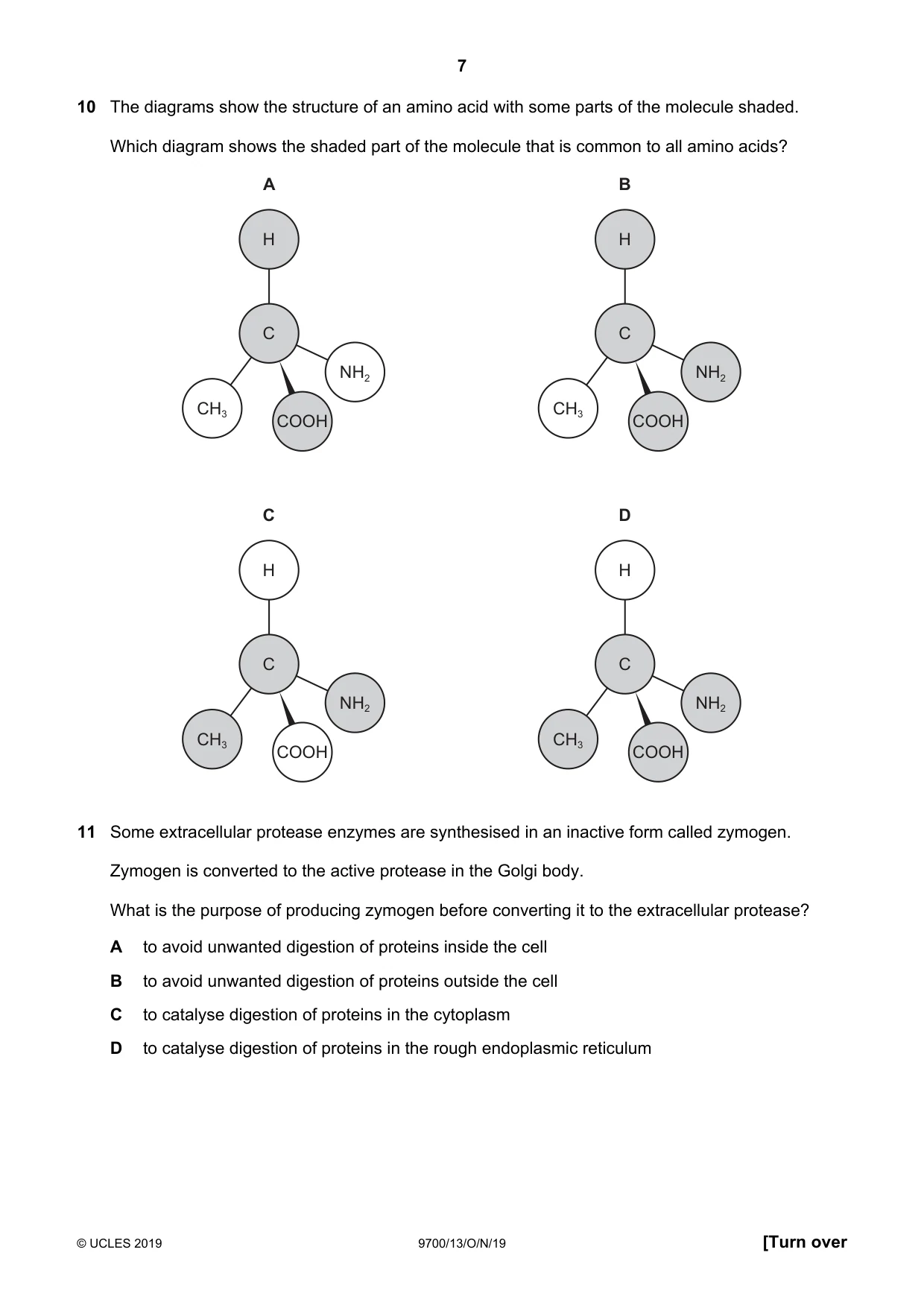
Q10 · The diagrams show the structure of an amino acid with some parts of the molecule shaded
10 The diagrams show the structure of an amino acid with some parts of the molecule shaded. Which diagram shows the shaded part of the molecule that is common to all amino acids? A B H H C C NH2 NH2 CH3 CH3 COOH COOH C D H H C C NH2 NH2 CH3 CH3 COOH COOH
Mark scheme: B
Q11 · Some extracellular protease enzymes are synthesised in an inactive form called zymogen
11 Some extracellular protease enzymes are synthesised in an inactive form called zymogen. Zymogen is converted to the active protease in the Golgi body. What is the purpose of producing zymogen before converting it to the extracellular protease? A to avoid unwanted digestion of proteins inside the cell B to avoid unwanted digestion of proteins outside the cell C to catalyse digestion of proteins in the cytoplasm D to catalyse digestion of proteins in the rough endoplasmic reticulum
Mark scheme: A
Q12 · The Michaelis-Menten constant for an enzyme-catalysed reaction is referred to as Km, and…
12 The Michaelis-Menten constant for an enzyme-catalysed reaction is referred to as Km, and the maximum velocity of such a reaction is known as Vmax. Which statement about Km and Vmax is correct? A An enzyme with a high value of Km can reach its Vmax at a low substrate concentration. B An enzyme with a high value of Km has a high affinity to its substrate. C An enzyme with a low value of Km can reach its Vmax at a high substrate concentration. D An enzyme with a low value of Km has a high affinity to its substrate.
Mark scheme: D
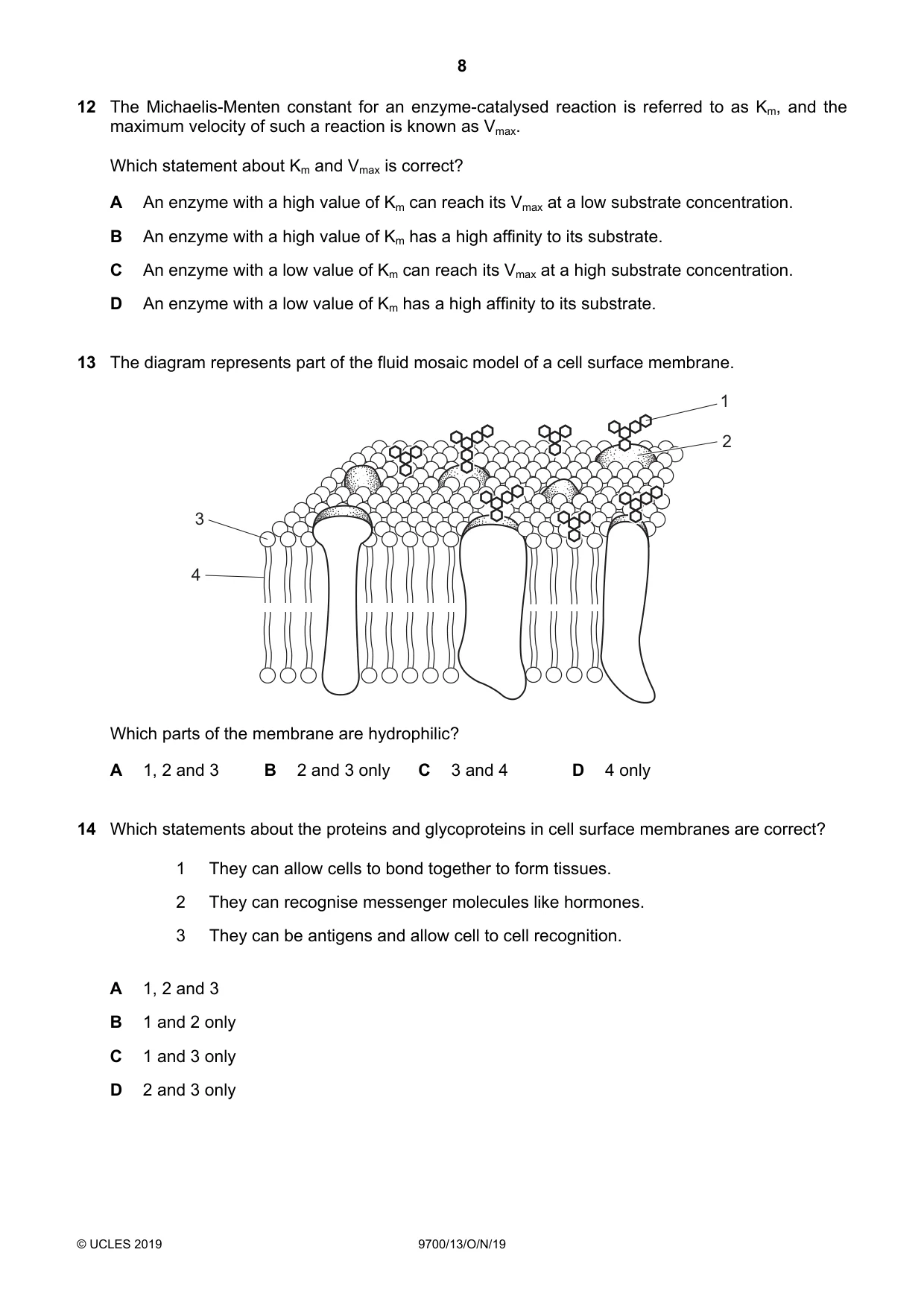
Q13 · The diagram represents part of the fluid mosaic model of a cell surface membrane
13 The diagram represents part of the fluid mosaic model of a cell surface membrane. 1 2 3 4 Which parts of the membrane are hydrophilic? A 1, 2 and 3 B 2 and 3 only C 3 and 4 D 4 only
Mark scheme: A
Q14 · Which statements about the proteins and glycoproteins in cell surface membranes are…
14 Which statements about the proteins and glycoproteins in cell surface membranes are correct? 1 They can allow cells to bond together to form tissues. 2 They can recognise messenger molecules like hormones. 3 They can be antigens and allow cell to cell recognition. A 1, 2 and 3 B 1 and 2 only C 1 and 3 only D 2 and 3 only
Mark scheme: A
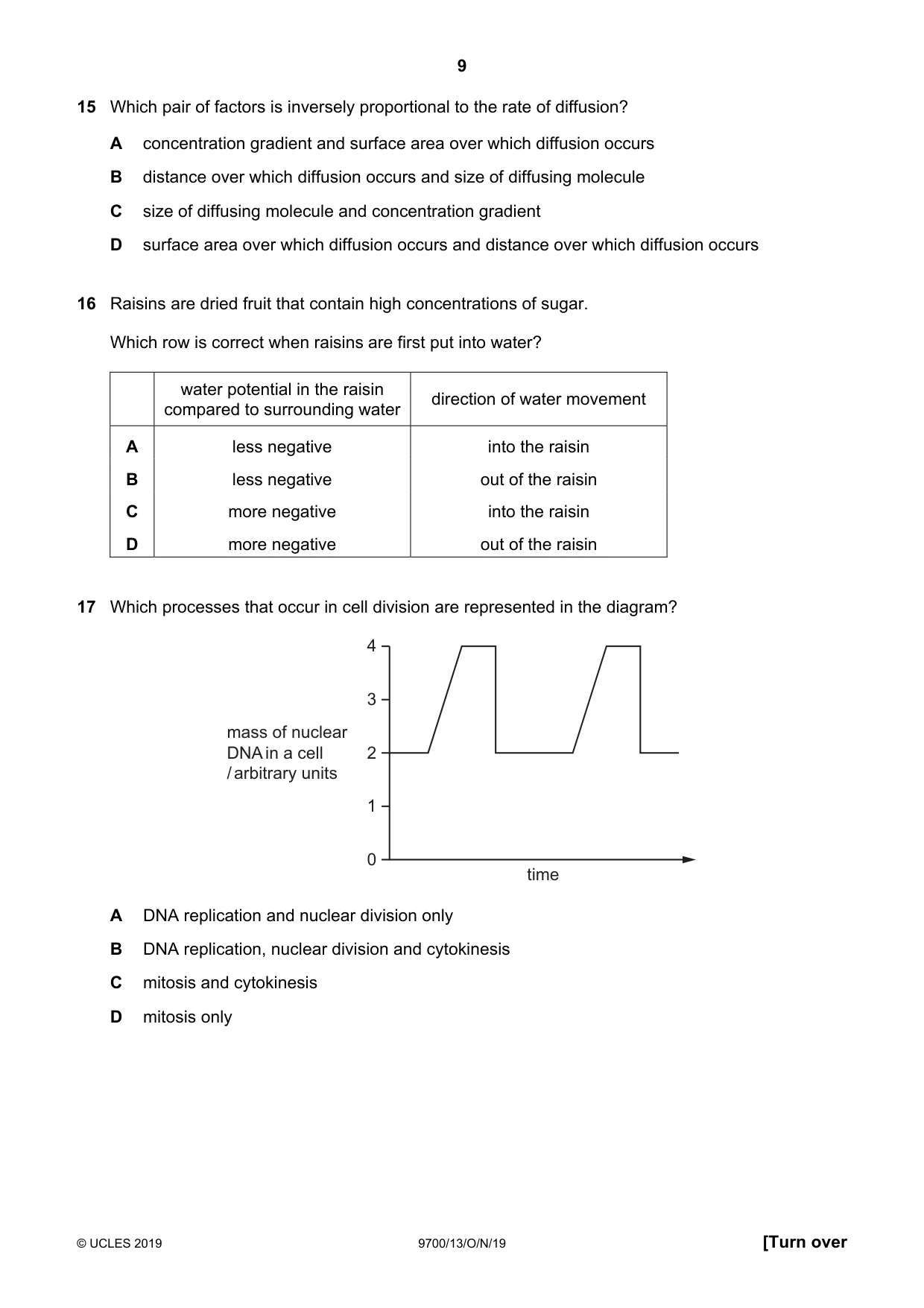
Q15 · Which pair of factors is inversely proportional to the rate of diffusion?
15 Which pair of factors is inversely proportional to the rate of diffusion? A concentration gradient and surface area over which diffusion occurs B distance over which diffusion occurs and size of diffusing molecule C size of diffusing molecule and concentration gradient D surface area over which diffusion occurs and distance over which diffusion occurs
Mark scheme: B
Q16 · Raisins are dried fruit that contain high concentrations of sugar
16 Raisins are dried fruit that contain high concentrations of sugar. Which row is correct when raisins are first put into water? water potential in the raisin direction of water movement compared to surrounding water A less negative into the raisin B less negative out of the raisin C more negative into the raisin D more negative out of the raisin
Mark scheme: C
Q17 · Which processes that occur in cell division are represented in the diagram?
17 Which processes that occur in cell division are represented in the diagram? 4 3 mass of nuclear DNA in a cell 2 / arbitrary units 1 0 time A DNA replication and nuclear division only B DNA replication, nuclear division and cytokinesis C mitosis and cytokinesis D mitosis only
Mark scheme: B
More questions on Replication and division of nuclei and cells
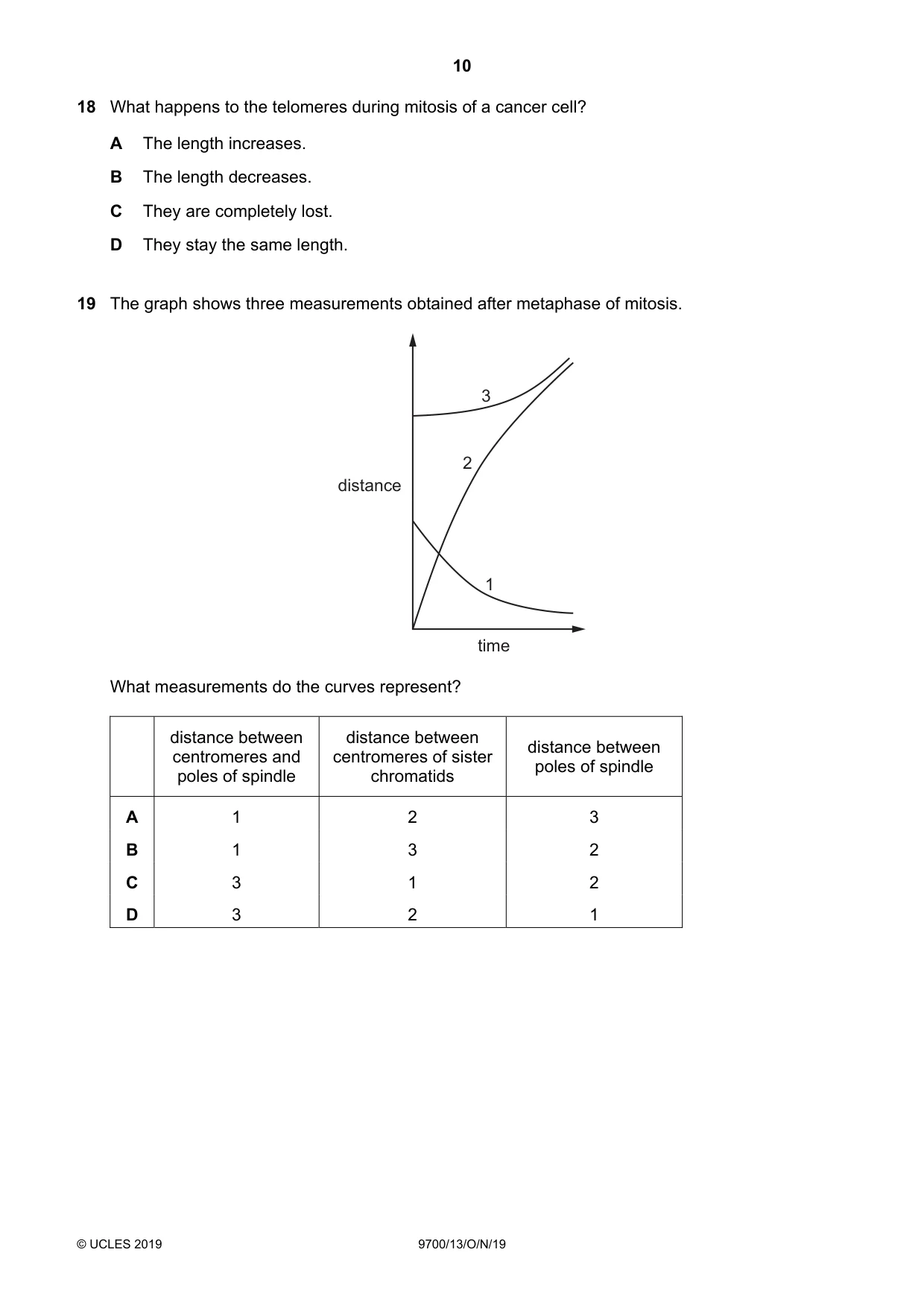
Q18 · What happens to the telomeres during mitosis of a cancer cell?
18 What happens to the telomeres during mitosis of a cancer cell? A The length increases. B The length decreases. C They are completely lost. D They stay the same length.
Mark scheme: D
More questions on Replication and division of nuclei and cells
Q19 · The graph shows three measurements obtained after metaphase of mitosis
19 The graph shows three measurements obtained after metaphase of mitosis. 3 2 distance 1 time What measurements do the curves represent? distance between distance between distance between centromeres and centromeres of sister poles of spindle poles of spindle chromatids A 1 2 3 B 1 3 2 C 3 1 2 D 3 2 1
Mark scheme: A
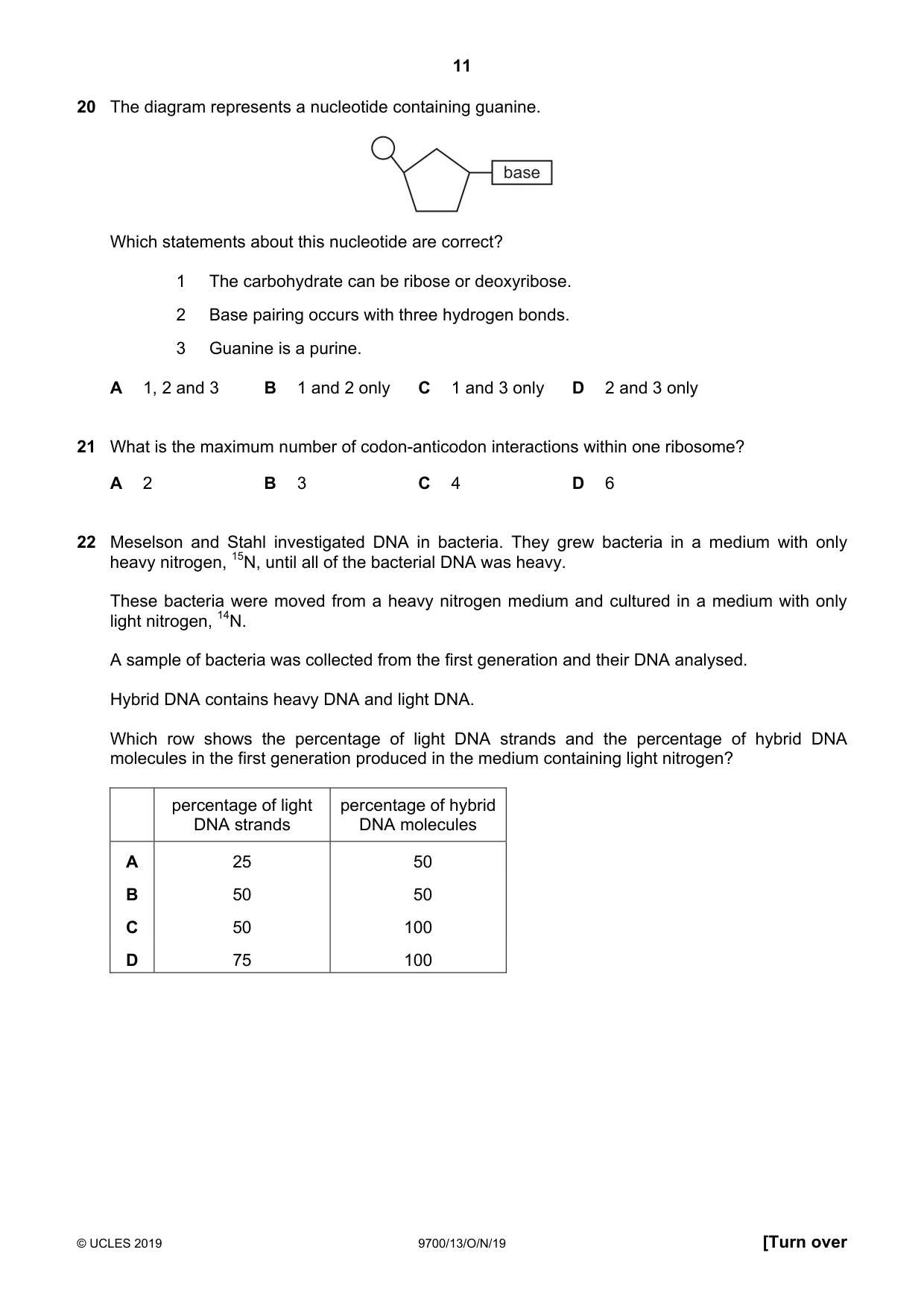
Q20 · The diagram represents a nucleotide containing guanine
20 The diagram represents a nucleotide containing guanine. base Which statements about this nucleotide are correct? 1 The carbohydrate can be ribose or deoxyribose. 2 Base pairing occurs with three hydrogen bonds. 3 Guanine is a purine. A 1, 2 and 3 B 1 and 2 only C 1 and 3 only D 2 and 3 only
Mark scheme: A
More questions on Structure of nucleic acids and replication of DNA
Q21 · What is the maximum number of codon-anticodon interactions within one ribosome?
21 What is the maximum number of codon-anticodon interactions within one ribosome? A 2 B 3 C 4 D 6
Mark scheme: A
Q22 · Meselson and Stahl investigated DNA in bacteria
22 Meselson and Stahl investigated DNA in bacteria. They grew bacteria in a medium with only heavy nitrogen, 15N, until all of the bacterial DNA was heavy. These bacteria were moved from a heavy nitrogen medium and cultured in a medium with only light nitrogen, 14N. A sample of bacteria was collected from the first generation and their DNA analysed. Hybrid DNA contains heavy DNA and light DNA. Which row shows the percentage of light DNA strands and the percentage of hybrid DNA molecules in the first generation produced in the medium containing light nitrogen? percentage of light percentage of hybrid DNA strands DNA molecules A 25 50 B 50 50 C 50 100 D 75 100
Mark scheme: C
More questions on Structure of nucleic acids and replication of DNA
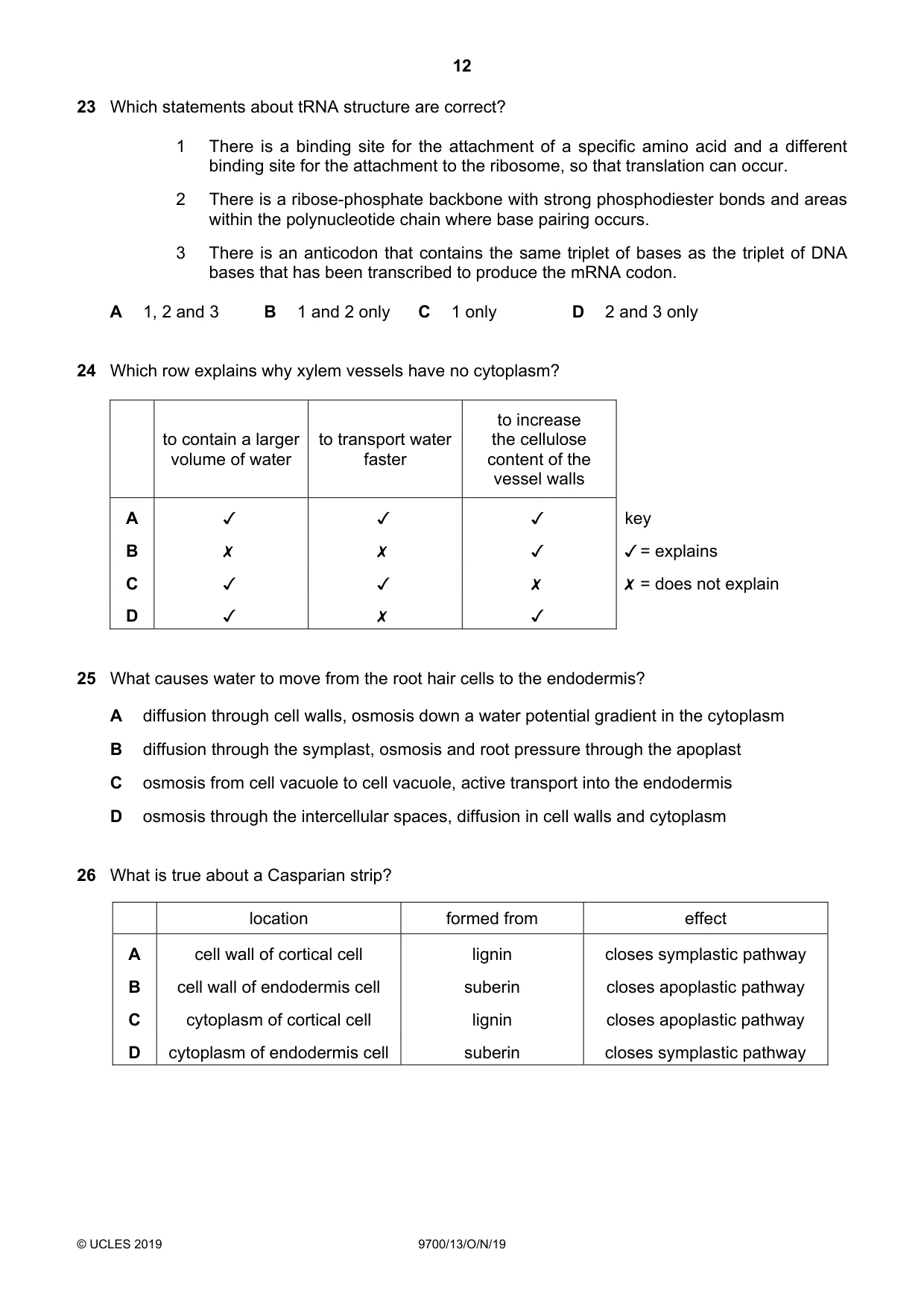
Q23 · Which statements about tRNA structure are correct?
23 Which statements about tRNA structure are correct? 1 There is a binding site for the attachment of a specific amino acid and a different binding site for the attachment to the ribosome, so that translation can occur. 2 There is a ribose-phosphate backbone with strong phosphodiester bonds and areas within the polynucleotide chain where base pairing occurs. 3 There is an anticodon that contains the same triplet of bases as the triplet of DNA bases that has been transcribed to produce the mRNA codon. A 1, 2 and 3 B 1 and 2 only C 1 only D 2 and 3 only
Mark scheme: B
Q24 · Which row explains why xylem vessels have no cytoplasm?
24 Which row explains why xylem vessels have no cytoplasm? 0 0O WwW D> to contain a larger volume of water KS 4&4 to transport water faster ~« {Kw K& to increase the cellulose content of the vessel walls Ke 4 key / = explains X = does not explain
Mark scheme: C
Q25 · What causes water to move from the root hair cells to the endodermis?
25 What causes water to move from the root hair cells to the endodermis? A diffusion through cell walls, osmosis down a water potential gradient in the cytoplasm B diffusion through the symplast, osmosis and root pressure through the apoplast C osmosis from cell vacuole to cell vacuole, active transport into the endodermis D osmosis through the intercellular spaces, diffusion in cell walls and cytoplasm
Mark scheme: A
Q26 · What is true about a Casparian strip?
26 What is true about a Casparian strip? location formed from effect A cell wall of cortical cell lignin closes symplastic pathway B cell wall of endodermis cell suberin closes apoplastic pathway C cytoplasm of cortical cell lignin closes apoplastic pathway D cytoplasm of endodermis cell suberin closes symplastic pathway
Mark scheme: B
Q27 · Which xerophytic adaptations reduce the water potential gradient between leaf surface and…
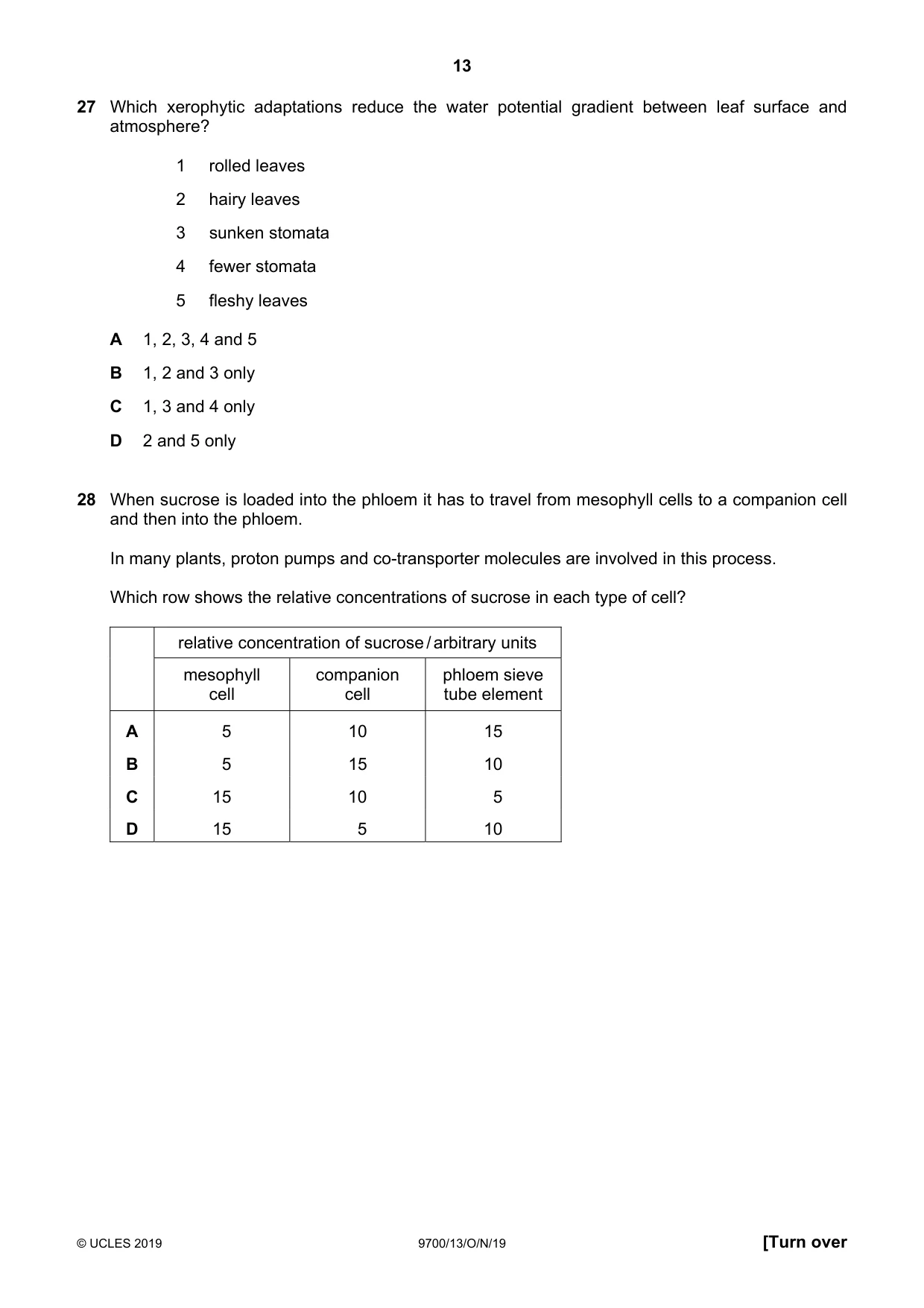
27 Which xerophytic adaptations reduce the water potential gradient between leaf surface and atmosphere? 1 rolled leaves 2 hairy leaves 3 sunken stomata 4 fewer stomata 5 fleshy leaves A 1, 2, 3, 4 and 5 B 1, 2 and 3 only C 1, 3 and 4 only D 2 and 5 only
Mark scheme: B
Q28 · When sucrose is loaded into the phloem it has to travel from mesophyll cells to a…
28 When sucrose is loaded into the phloem it has to travel from mesophyll cells to a companion cell and then into the phloem. In many plants, proton pumps and co-transporter molecules are involved in this process. Which row shows the relative concentrations of sucrose in each type of cell? relative concentration of sucrose / arbitrary units mesophyll companion phloem sieve cell cell tube element A 5 10 15 B 5 15 10 C 15 10 5 D 15 5 10
Mark scheme: B
Q29 · The image shows three white blood cells labelled X, Y and Z
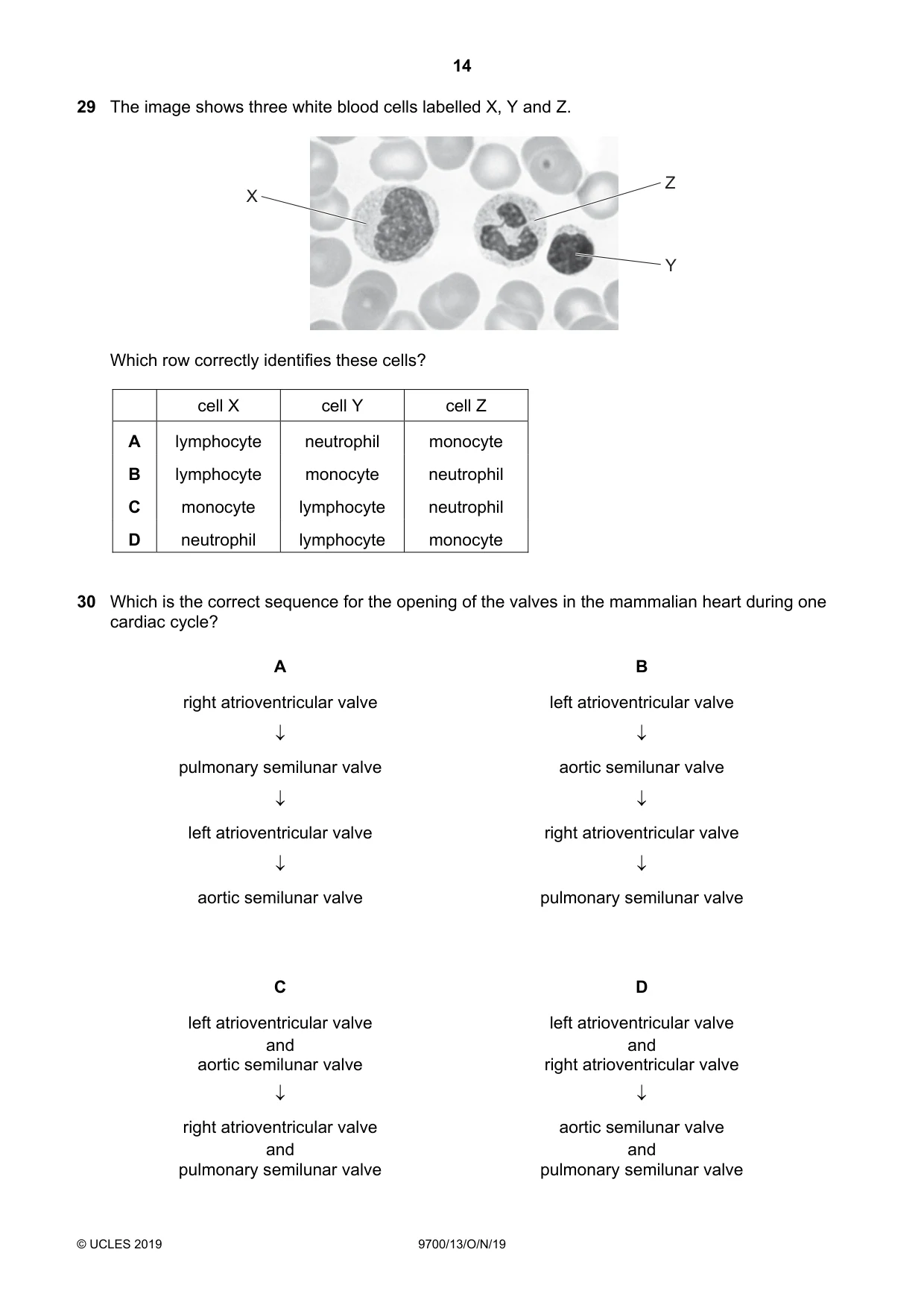
29 The image shows three white blood cells labelled X, Y and Z. Z X Y Which row correctly identifies these cells? cell X cell Y cell Z A lymphocyte neutrophil monocyte B lymphocyte monocyte neutrophil C monocyte lymphocyte neutrophil D neutrophil lymphocyte monocyte
Mark scheme: C
Q30 · Which is the correct sequence for the opening of the valves in the mammalian heart during…
30 Which is the correct sequence for the opening of the valves in the mammalian heart during one cardiac cycle? A B right atrioventricular valve left atrioventricular valve ↓ ↓ pulmonary semilunar valve aortic semilunar valve ↓ ↓ left atrioventricular valve right atrioventricular valve ↓ ↓ aortic semilunar valve pulmonary semilunar valve C D left atrioventricular valve left atrioventricular valve and and aortic semilunar valve right atrioventricular valve ↓ ↓ right atrioventricular valve aortic semilunar valve and and pulmonary semilunar valve pulmonary semilunar valve
Mark scheme: D
Q31 · Red blood cells may contain a molecule known as 2,3-bisphosphoglycerate (2,3-BPG)
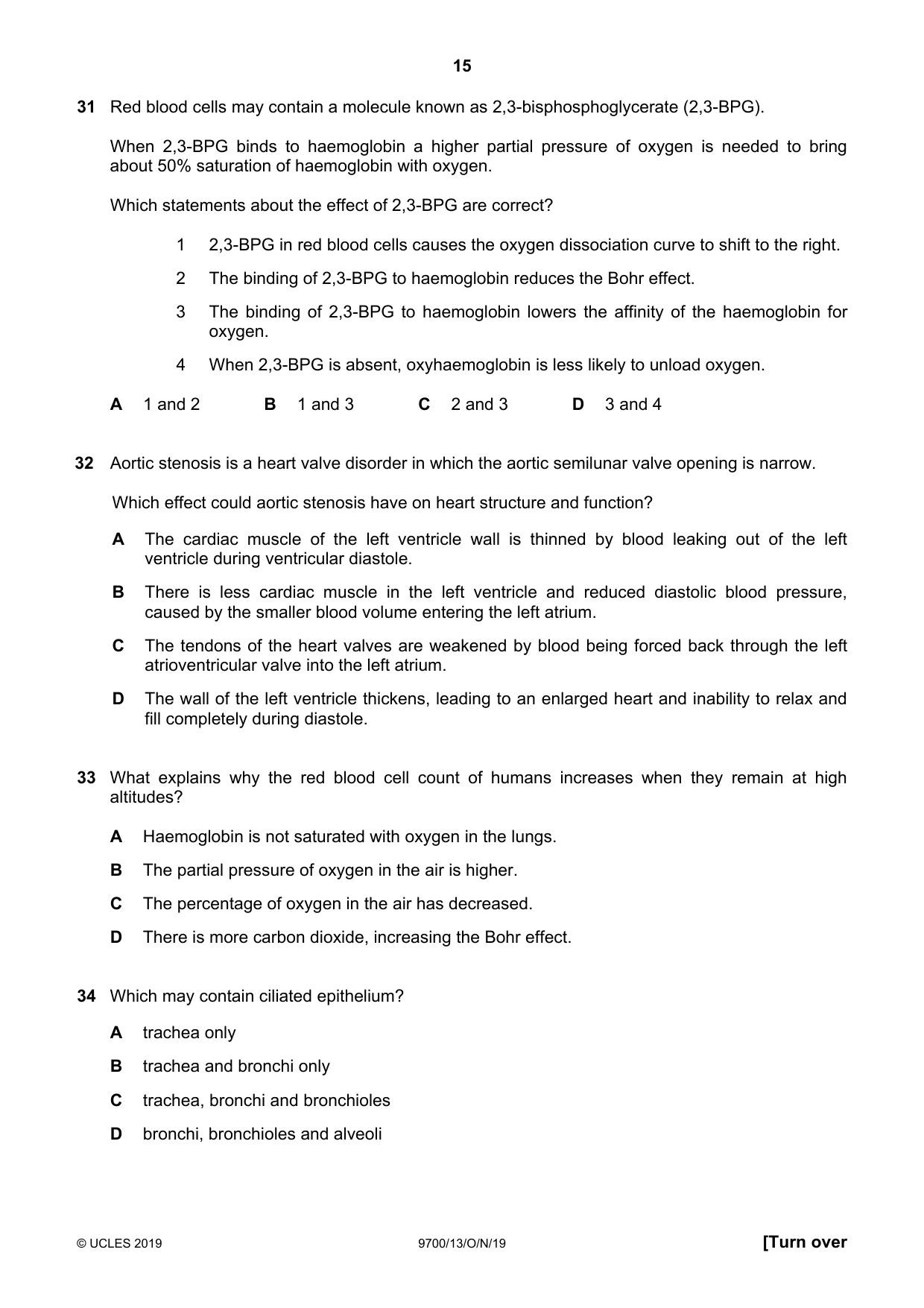
31 Red blood cells may contain a molecule known as 2,3-bisphosphoglycerate (2,3-BPG). When 2,3-BPG binds to haemoglobin a higher partial pressure of oxygen is needed to bring about 50% saturation of haemoglobin with oxygen. Which statements about the effect of 2,3-BPG are correct? 1 2,3-BPG in red blood cells causes the oxygen dissociation curve to shift to the right. 2 The binding of 2,3-BPG to haemoglobin reduces the Bohr effect. 3 The binding of 2,3-BPG to haemoglobin lowers the affinity of the haemoglobin for oxygen. 4 When 2,3-BPG is absent, oxyhaemoglobin is less likely to unload oxygen. A 1 and 2 B 1 and 3 C 2 and 3 D 3 and 4
Mark scheme: B
Q32 · Aortic stenosis is a heart valve disorder in which the aortic semilunar valve opening is…
32 Aortic stenosis is a heart valve disorder in which the aortic semilunar valve opening is narrow. Which effect could aortic stenosis have on heart structure and function? A The cardiac muscle of the left ventricle wall is thinned by blood leaking out of the left ventricle during ventricular diastole. B There is less cardiac muscle in the left ventricle and reduced diastolic blood pressure, caused by the smaller blood volume entering the left atrium. C The tendons of the heart valves are weakened by blood being forced back through the left atrioventricular valve into the left atrium. D The wall of the left ventricle thickens, leading to an enlarged heart and inability to relax and fill completely during diastole.
Mark scheme: D
Q33 · What explains why the red blood cell count of humans increases when they remain at high…
33 What explains why the red blood cell count of humans increases when they remain at high altitudes? A Haemoglobin is not saturated with oxygen in the lungs. B The partial pressure of oxygen in the air is higher. C The percentage of oxygen in the air has decreased. D There is more carbon dioxide, increasing the Bohr effect.
Mark scheme: A
Q34 · Which may contain ciliated epithelium?
34 Which may contain ciliated epithelium? A trachea only B trachea and bronchi only C trachea, bronchi and bronchioles D bronchi, bronchioles and alveoli
Mark scheme: C
Q35 · Which row shows the effects of chronic bronchitis?
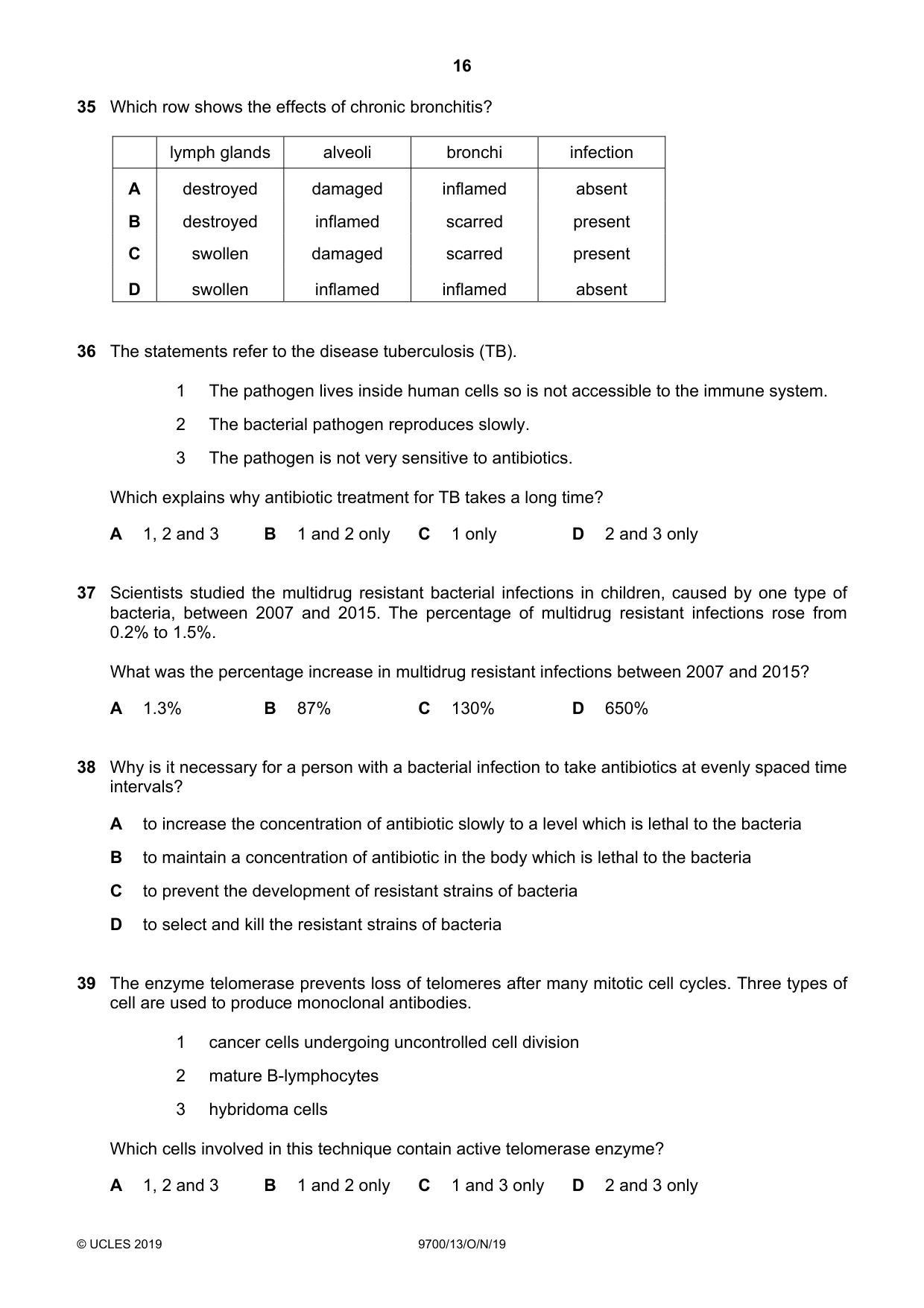
35 Which row shows the effects of chronic bronchitis? lymph glands alveoli bronchi infection A destroyed damaged inflamed absent B destroyed inflamed scarred present C swollen damaged scarred present D swollen inflamed inflamed absent
Mark scheme: C
Q36 · The statements refer to the disease tuberculosis (TB)
36 The statements refer to the disease tuberculosis (TB). 1 The pathogen lives inside human cells so is not accessible to the immune system. 2 The bacterial pathogen reproduces slowly. 3 The pathogen is not very sensitive to antibiotics. Which explains why antibiotic treatment for TB takes a long time? A 1, 2 and 3 B 1 and 2 only C 1 only D 2 and 3 only
Mark scheme: D
Q37 · Scientists studied the multidrug resistant bacterial infections in children, caused by…
37 Scientists studied the multidrug resistant bacterial infections in children, caused by one type of bacteria, between 2007 and 2015. The percentage of multidrug resistant infections rose from 0.2% to 1.5%. What was the percentage increase in multidrug resistant infections between 2007 and 2015? A 1.3% B 87% C 130% D 650%
Mark scheme: D
Q38 · Why is it necessary for a person with a bacterial infection to take antibiotics at evenly…
38 Why is it necessary for a person with a bacterial infection to take antibiotics at evenly spaced time intervals? A to increase the concentration of antibiotic slowly to a level which is lethal to the bacteria B to maintain a concentration of antibiotic in the body which is lethal to the bacteria C to prevent the development of resistant strains of bacteria D to select and kill the resistant strains of bacteria
Mark scheme: B
Q39 · The enzyme telomerase prevents loss of telomeres after many mitotic cell cycles
39 The enzyme telomerase prevents loss of telomeres after many mitotic cell cycles. Three types of cell are used to produce monoclonal antibodies. 1 cancer cells undergoing uncontrolled cell division 2 mature B-lymphocytes 3 hybridoma cells Which cells involved in this technique contain active telomerase enzyme? A 1, 2 and 3 B 1 and 2 only C 1 and 3 only D 2 and 3 only
Mark scheme: C
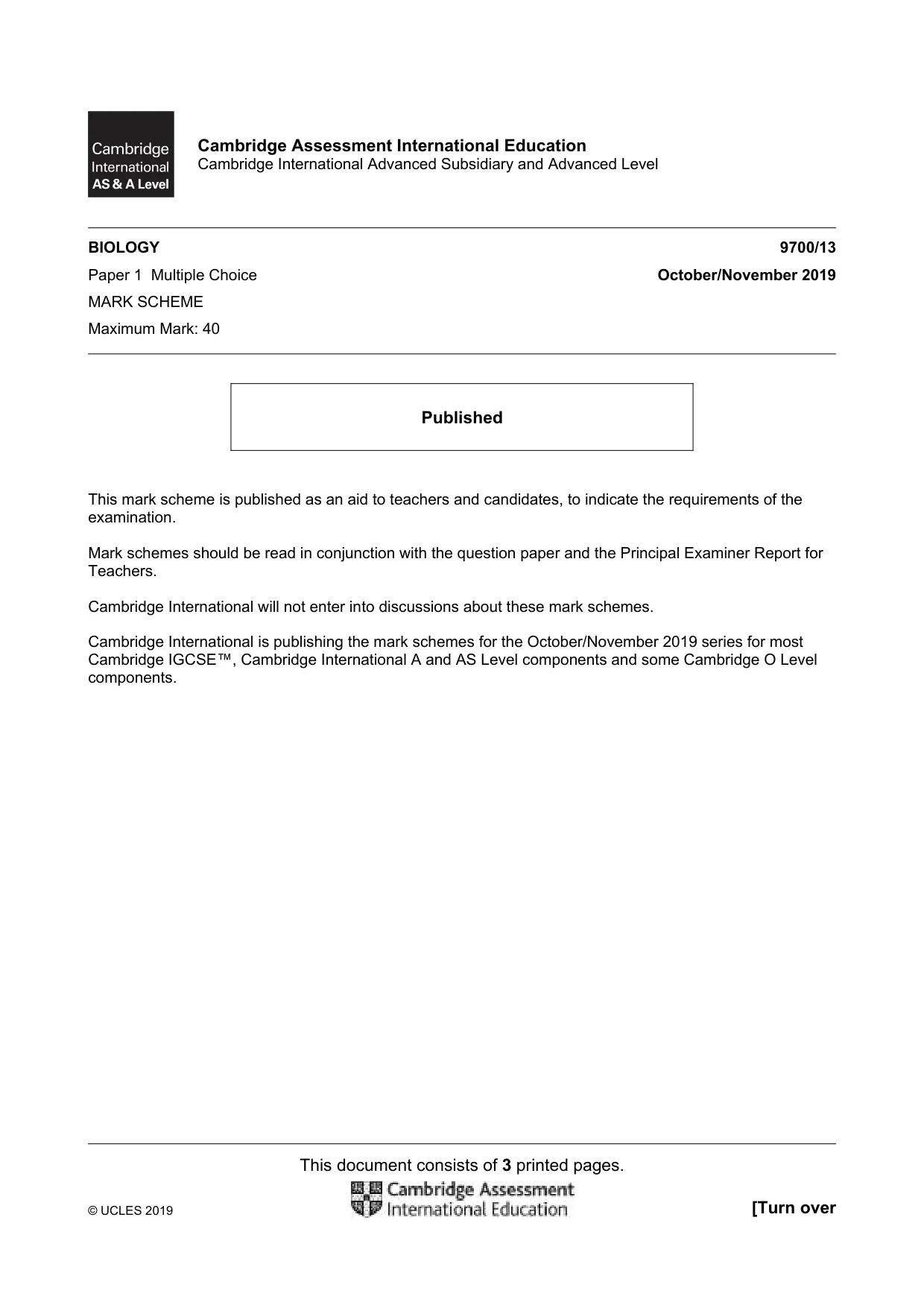
Q40 · What explains why monoclonal antibodies are useful in the diagnosis of disease?
40 What explains why monoclonal antibodies are useful in the diagnosis of disease? A They bind to and neutralise one type of antibody. B They bind to and neutralise one type of pathogen. C Their shape is complementary to one specific antibody. D Their shape is complementary to one specific antigen.
Mark scheme: D
What was in this paper
The subtopics covered by these 40 questions, and how many questions each got. Open one in a new tab to see every Cambridge question on it.
4Cells as the basic units of living organisms3Antibiotics2Antibodies and vaccination2Carbohydrates and lipids2Fluid mosaic membranes2Movement into and out of cells2Protein synthesis2Proteins2Replication and division of nuclei and cells2Structure of nucleic acids and replication of DNA2The gas exchange system2The heart2The microscope in cell studies2Transport of oxygen and carbon dioxide2Chromosome behaviour in mitosis1Factors that affect enzyme action1Infectious diseases1Mode of action of enzymes1Structure of transport tissues1Testing for biological molecules1The immune system1What you needed in this session
Cambridge’s own grade thresholds for 2019 Oct/Nov, Paper 1 · Variant 3. A higher threshold means an easier paper — the bar moves with how the cohort did.