Cambridge A Level Biology 9700 — 2011 Oct/Nov Paper 1 · Variant 1
9700/11/O/N/11 · 40 questions · 40 marks · ≈45 min
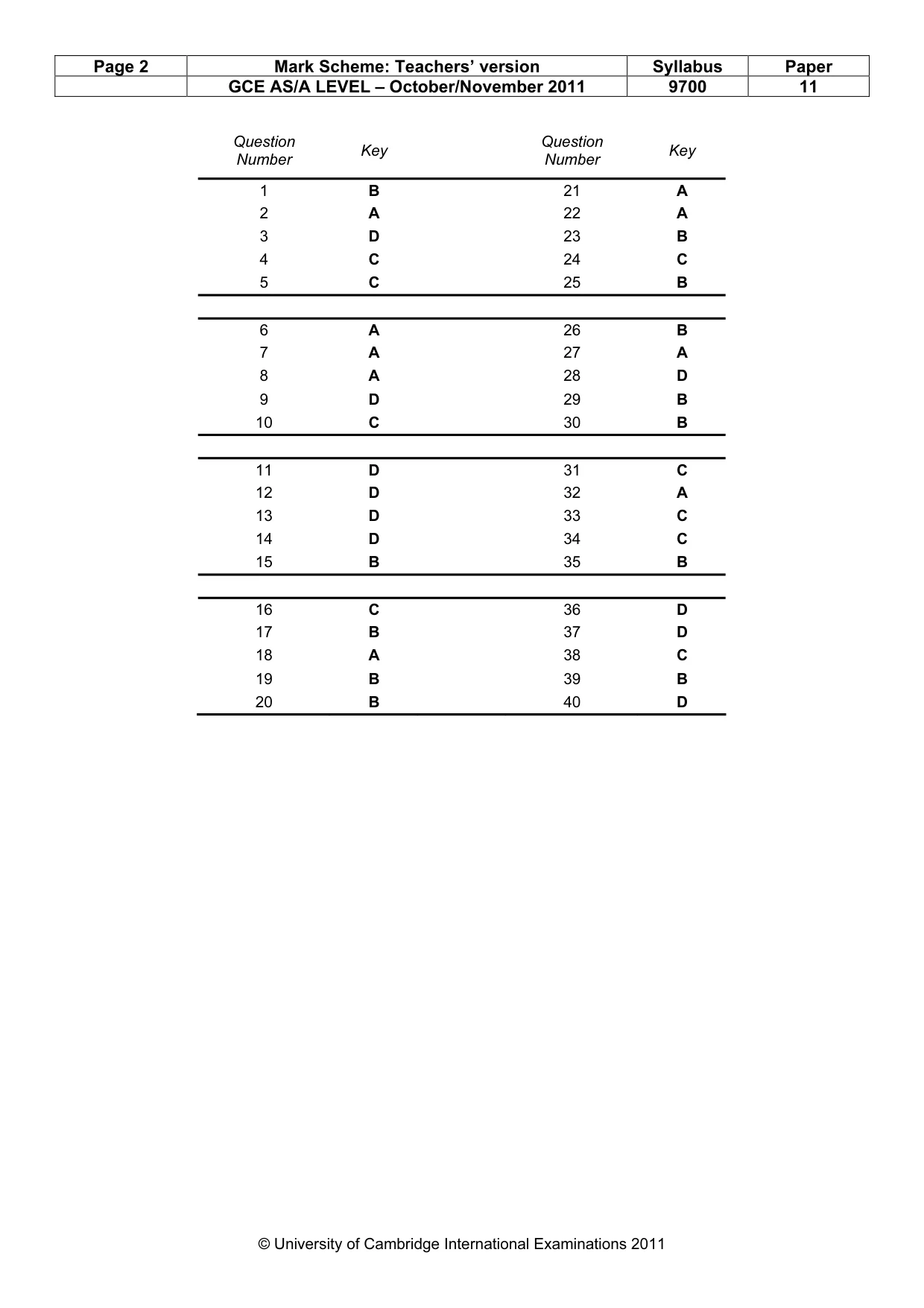
The question paper and its mark scheme, free to read here and free to download. This is Cambridge’s own paper, exactly as it was sat.
Question paper16 pages

Mark scheme2 pages
Answers below. Sit the paper first if you are practising.
Questions as text
Q1 · What is the diameter of a typical prokaryote, such as Streptococcus?
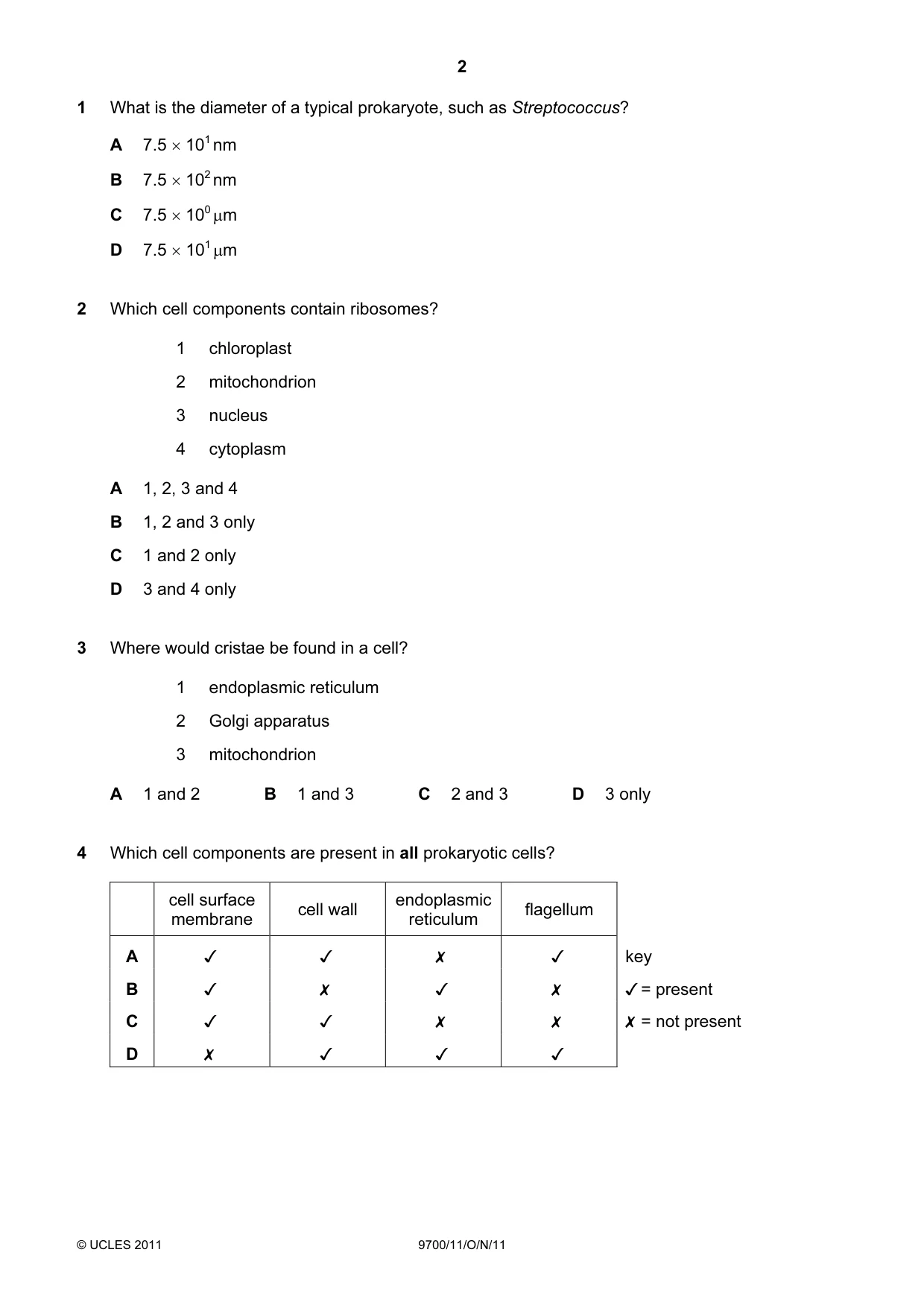
1 What is the diameter of a typical prokaryote, such as Streptococcus? A 7.5 × 101 nm B 7.5 × 10² nm C 7.5 × 100 µm D 7.5 × 101 µm
Mark scheme: B
More questions on Cells as the basic units of living organisms
Q2 · Which cell components contain ribosomes?
2 Which cell components contain ribosomes? 1 chloroplast 2 mitochondrion 3 nucleus 4 cytoplasm A 1, 2, 3 and 4 B 1, 2 and 3 only C 1 and 2 only D 3 and 4 only
Mark scheme: A
More questions on Cells as the basic units of living organisms
Q3 · Where would cristae be found in a cell?
3 Where would cristae be found in a cell? 1 endoplasmic reticulum 2 Golgi apparatus 3 mitochondrion A 1 and 2 B 1 and 3 C 2 and 3 D 3 only
Mark scheme: D
More questions on Cells as the basic units of living organisms
Q4 · Which cell components are present in all prokaryotic cells?
4 Which cell components are present in all prokaryotic cells? cell surface endoplasmic cell wall flagellum membrane reticulum A v v x v B v Xx v x Cc v v x x D x v v v key J/ = present X = not present
Mark scheme: C
More questions on Cells as the basic units of living organisms
Q5 · The diagram shows a stage micrometer on which the small divisions are 0.1 mm
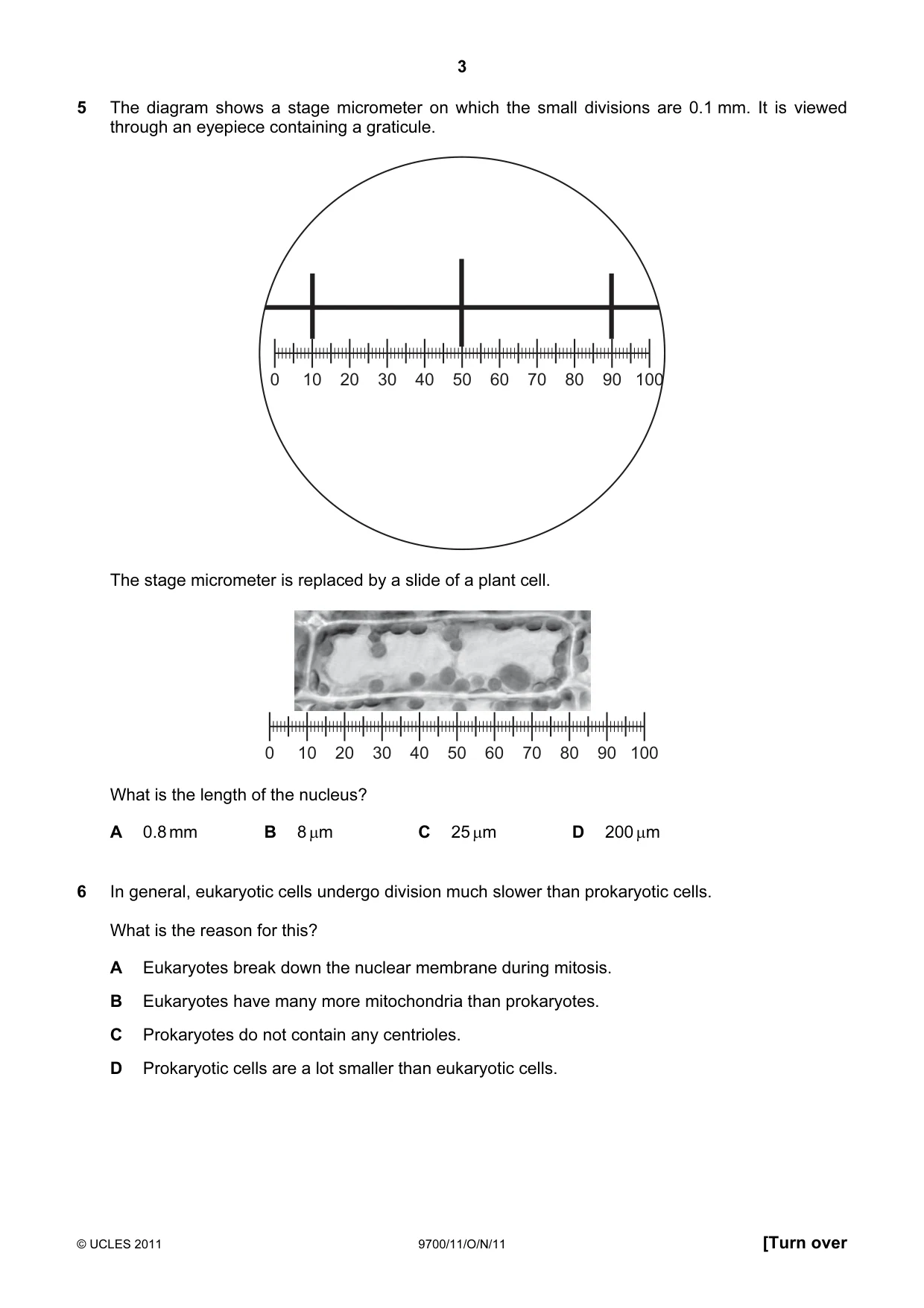
5 The diagram shows a stage micrometer on which the small divisions are 0.1 mm. It is viewed through an eyepiece containing a graticule. 0 10 20 30 40 50 60 70 80 90 100 The stage micrometer is replaced by a slide of a plant cell. 0 10 20 30 40 50 60 70 80 90 100 What is the length of the nucleus? A 0.8 mm B 8 µm C 25 µm D 200 µm
Mark scheme: C
Q6 · In general, eukaryotic cells undergo division much slower than prokaryotic cells
6 In general, eukaryotic cells undergo division much slower than prokaryotic cells. What is the reason for this? A Eukaryotes break down the nuclear membrane during mitosis. B Eukaryotes have many more mitochondria than prokaryotes. C Prokaryotes do not contain any centrioles. D Prokaryotic cells are a lot smaller than eukaryotic cells.
Mark scheme: A
More questions on Replication and division of nuclei and cells
Q7 · Which is the strongest type of bonding found in proteins?
7 Which is the strongest type of bonding found in proteins? A disulfide bonds B hydrogen bonds C hydrophobic interactions D ionic bonds
Mark scheme: A
Q8 · Two disaccharides are maltose and sucrose
8 Two disaccharides are maltose and sucrose. Maltose is formed from two molecules of glucose, whilst sucrose is formed from fructose and glucose. Which row shows the molecular formulae of the two disaccharides? maltose sucrose A C12H22O11 C12H22O11 B C12H22O11 C12H24O12 C C12H24O12 C12H22O11 D C12H24O12 C12H24O12
Mark scheme: A
Q9 · The diagram shows a carbohydrate molecule
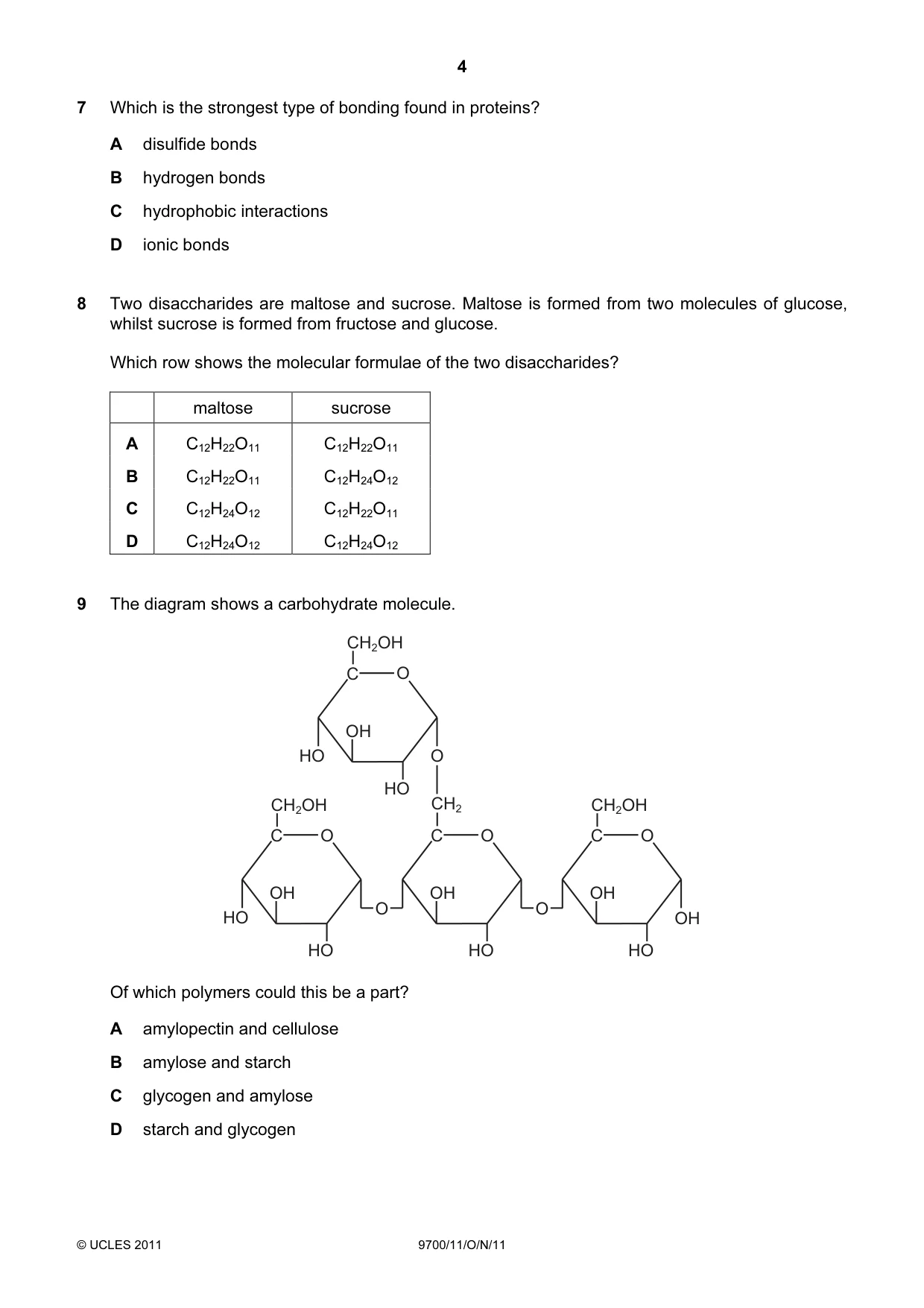
9 The diagram shows a carbohydrate molecule. CH2OH C O OH HO O HO CH2OH CH2 CH2OH C O C O C O OH OH OH O O HO OH HO HO HO Of which polymers could this be a part? A amylopectin and cellulose B amylose and starch C glycogen and amylose D starch and glycogen
Mark scheme: D
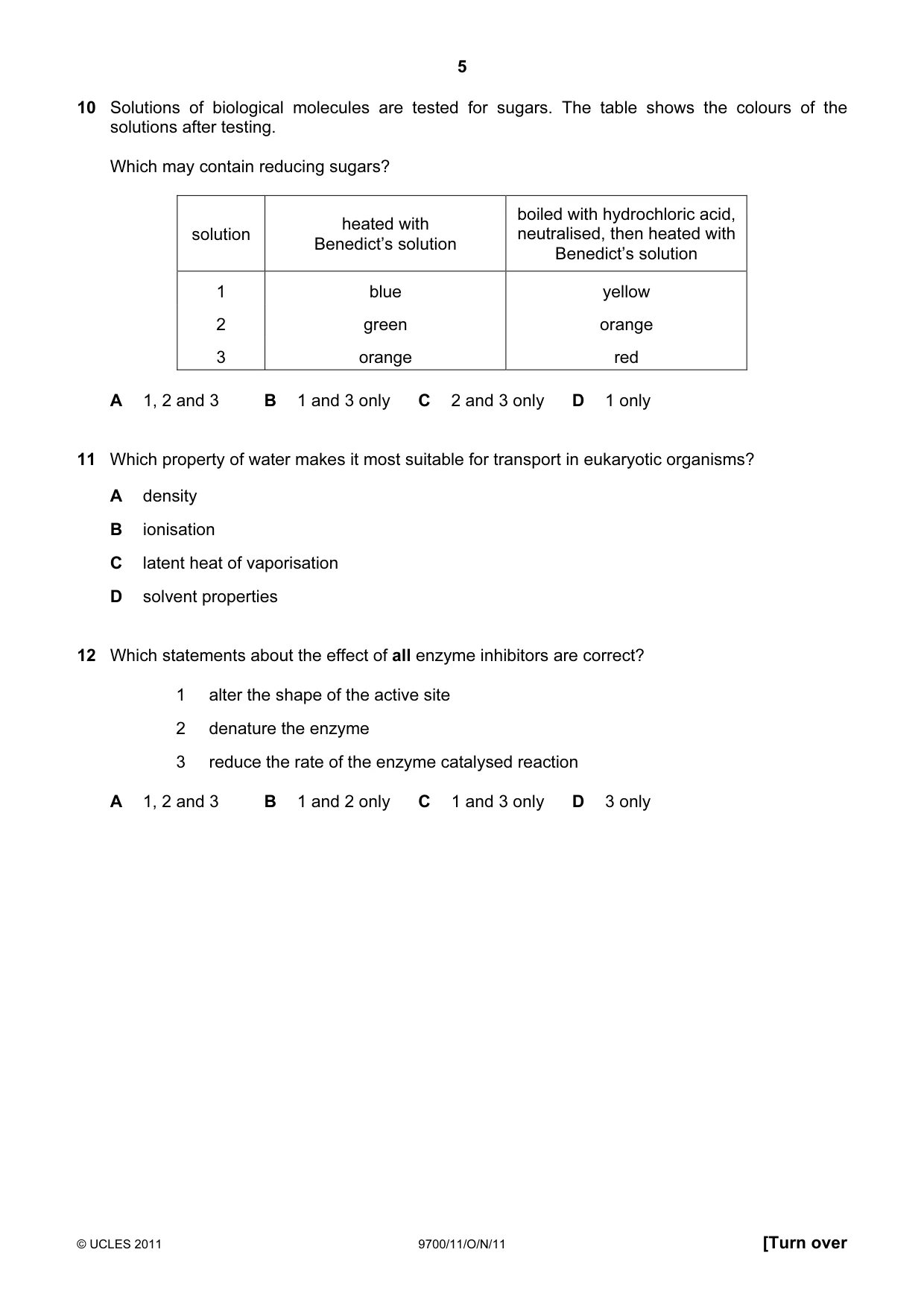
Q10 · Solutions of biological molecules are tested for sugars
10 Solutions of biological molecules are tested for sugars. The table shows the colours of the solutions after testing. Which may contain reducing sugars? boiled with hydrochloric acid, heated with solution neutralised, then heated with Benedict’s solution Benedict’s solution 1 blue yellow 2 green orange 3 orange red A 1, 2 and 3 B 1 and 3 only C 2 and 3 only D 1 only
Mark scheme: C
Q11 · Which property of water makes it most suitable for transport in eukaryotic organisms?
11 Which property of water makes it most suitable for transport in eukaryotic organisms? A density B ionisation C latent heat of vaporisation D solvent properties
Mark scheme: D
Q12 · Which statements about the effect of all enzyme inhibitors are correct?
12 Which statements about the effect of all enzyme inhibitors are correct? 1 alter the shape of the active site 2 denature the enzyme 3 reduce the rate of the enzyme catalysed reaction A 1, 2 and 3 B 1 and 2 only C 1 and 3 only D 3 only
Mark scheme: D
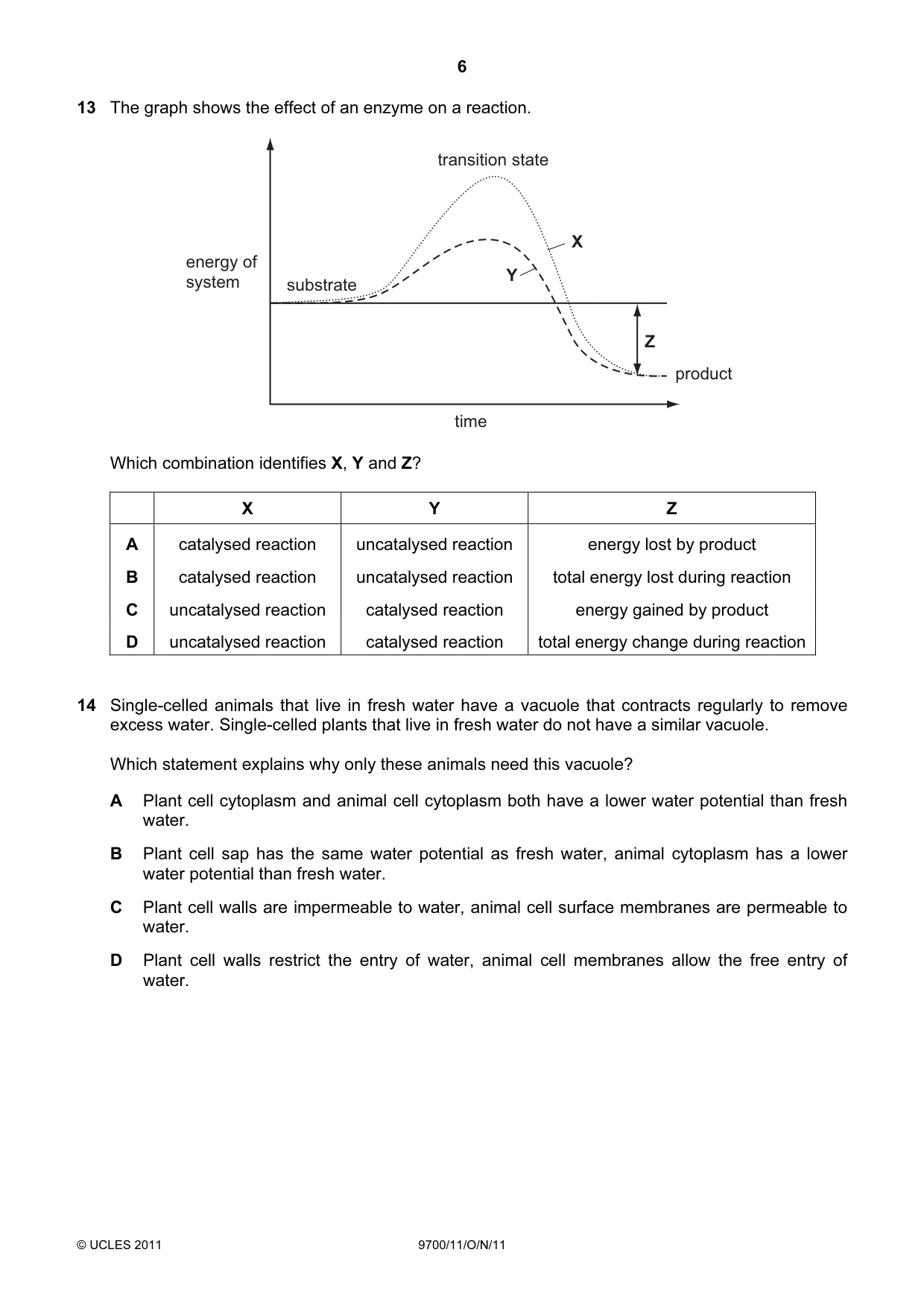
Q13 · The graph shows the effect of an enzyme on a reaction
13 The graph shows the effect of an enzyme on a reaction. transition state X energy of system Y substrate Z product time Which combination identifies X, Y and Z? X Y Z A catalysed reaction uncatalysed reaction energy lost by product B catalysed reaction uncatalysed reaction total energy lost during reaction C uncatalysed reaction catalysed reaction energy gained by product D uncatalysed reaction catalysed reaction total energy change during reaction
Mark scheme: D
Q14 · Single-celled animals that live in fresh water have a vacuole that contracts regularly to…
14 Single-celled animals that live in fresh water have a vacuole that contracts regularly to remove excess water. Single-celled plants that live in fresh water do not have a similar vacuole. Which statement explains why only these animals need this vacuole? A Plant cell cytoplasm and animal cell cytoplasm both have a lower water potential than fresh water. B Plant cell sap has the same water potential as fresh water, animal cytoplasm has a lower water potential than fresh water. C Plant cell walls are impermeable to water, animal cell surface membranes are permeable to water. D Plant cell walls restrict the entry of water, animal cell membranes allow the free entry of water.
Mark scheme: D
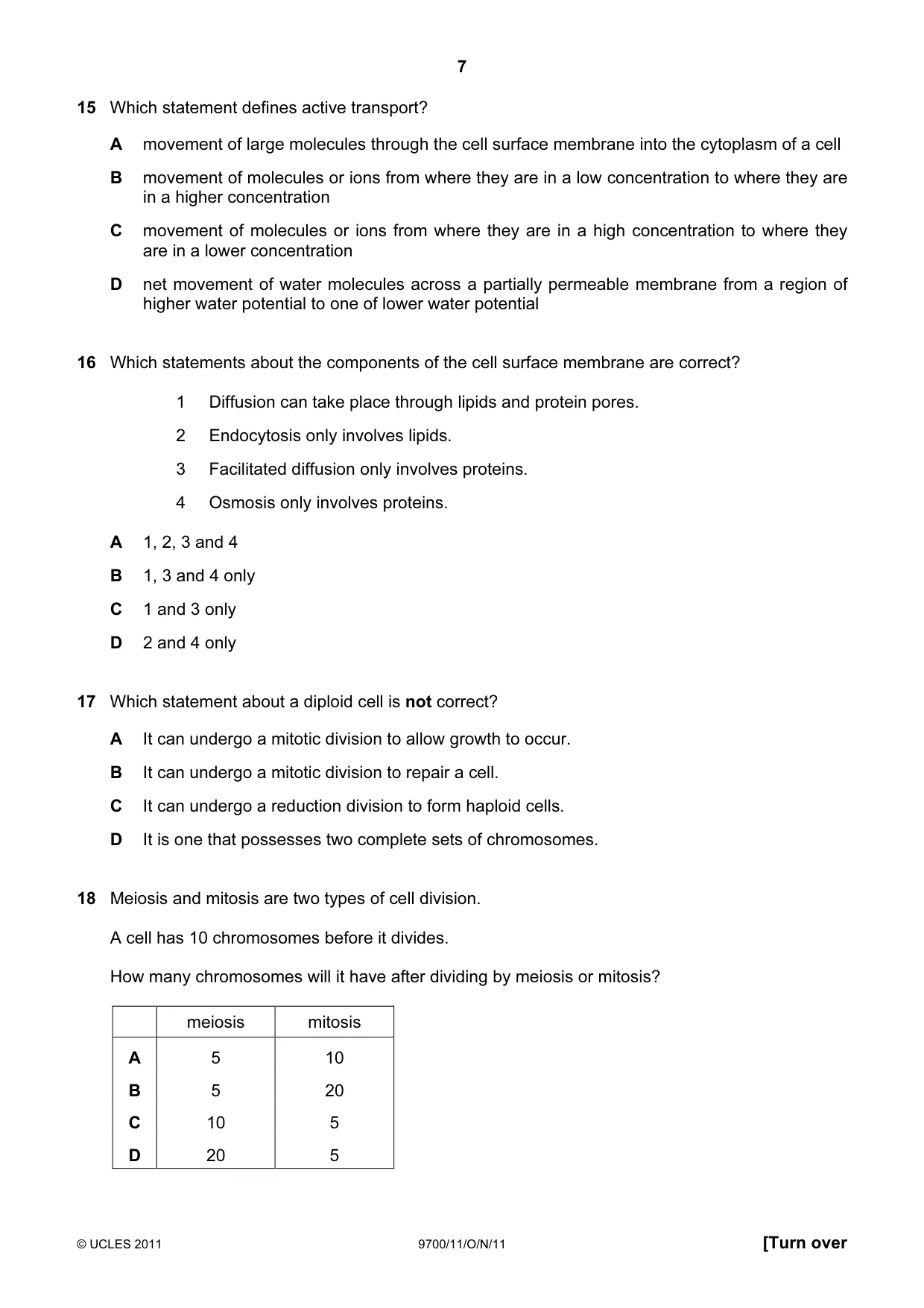
Q15 · Which statement defines active transport?
15 Which statement defines active transport? A movement of large molecules through the cell surface membrane into the cytoplasm of a cell B movement of molecules or ions from where they are in a low concentration to where they are in a higher concentration C movement of molecules or ions from where they are in a high concentration to where they are in a lower concentration D net movement of water molecules across a partially permeable membrane from a region of higher water potential to one of lower water potential
Mark scheme: B
Q16 · Which statements about the components of the cell surface membrane are correct?
16 Which statements about the components of the cell surface membrane are correct? 1 Diffusion can take place through lipids and protein pores. 2 Endocytosis only involves lipids. 3 Facilitated diffusion only involves proteins. 4 Osmosis only involves proteins. A 1, 2, 3 and 4 B 1, 3 and 4 only C 1 and 3 only D 2 and 4 only
Mark scheme: C
Q17 · Which statement about a diploid cell is not correct?
17 Which statement about a diploid cell is not correct? A It can undergo a mitotic division to allow growth to occur. B It can undergo a mitotic division to repair a cell. C It can undergo a reduction division to form haploid cells. D It is one that possesses two complete sets of chromosomes.
Mark scheme: B
More questions on Replication and division of nuclei and cells
Q18 · Meiosis and mitosis are two types of cell division
18 Meiosis and mitosis are two types of cell division. A cell has 10 chromosomes before it divides. How many chromosomes will it have after dividing by meiosis or mitosis? meiosis mitosis A 5 10 B 5 20 C 10 5 D 20 5
Mark scheme: A
More questions on Replication and division of nuclei and cells
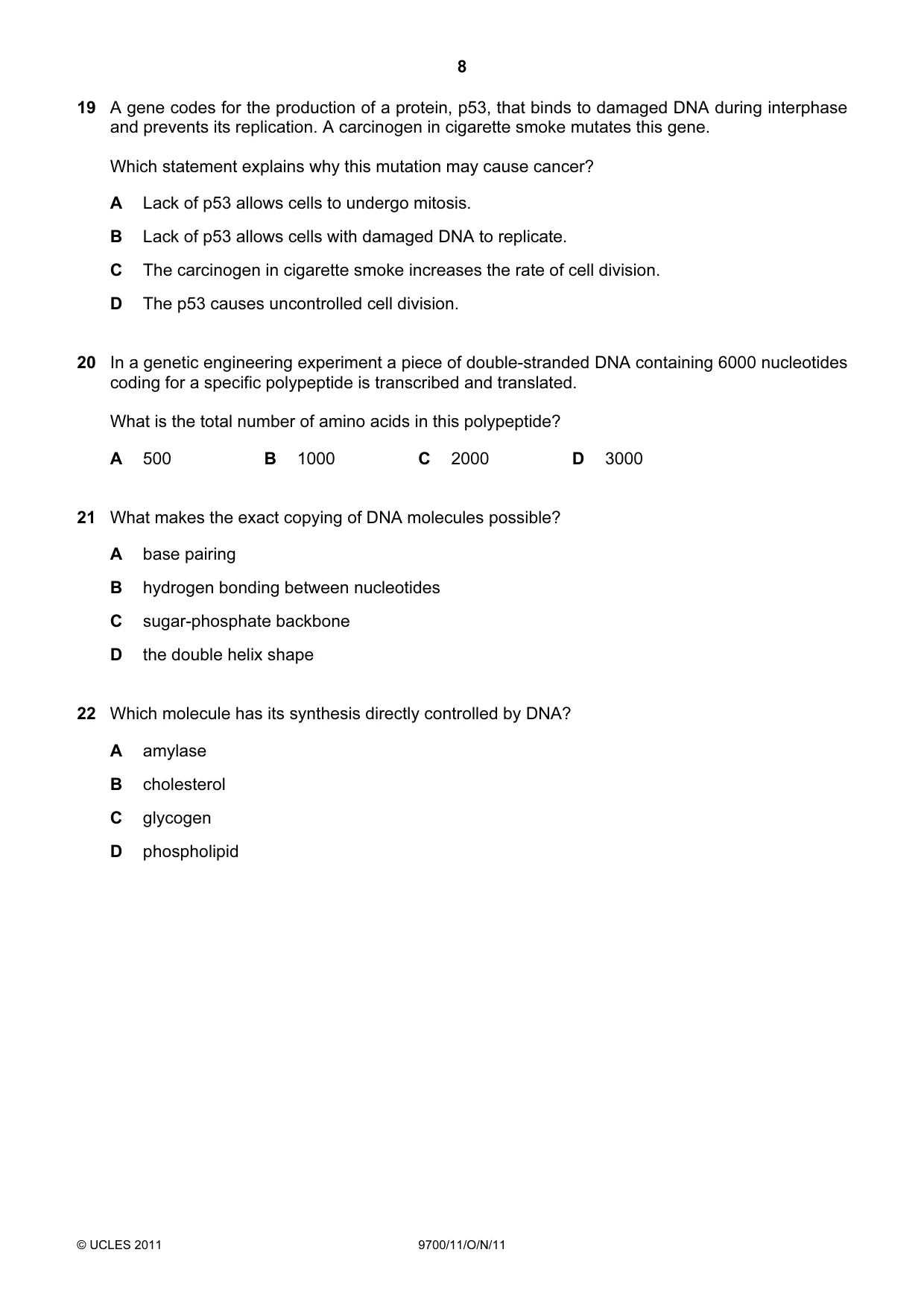
Q19 · A gene codes for the production of a protein, p53, that binds to damaged DNA during…
19 A gene codes for the production of a protein, p53, that binds to damaged DNA during interphase and prevents its replication. A carcinogen in cigarette smoke mutates this gene. Which statement explains why this mutation may cause cancer? A Lack of p53 allows cells to undergo mitosis. B Lack of p53 allows cells with damaged DNA to replicate. C The carcinogen in cigarette smoke increases the rate of cell division. D The p53 causes uncontrolled cell division.
Mark scheme: B
More questions on Replication and division of nuclei and cells
Q20 · In a genetic engineering experiment a piece of double-stranded DNA containing 6000…
20 In a genetic engineering experiment a piece of double-stranded DNA containing 6000 nucleotides coding for a specific polypeptide is transcribed and translated. What is the total number of amino acids in this polypeptide? A 500 B 1000 C 2000 D 3000
Mark scheme: B
Q21 · What makes the exact copying of DNA molecules possible?
21 What makes the exact copying of DNA molecules possible? A base pairing B hydrogen bonding between nucleotides C sugar-phosphate backbone D the double helix shape
Mark scheme: A
More questions on Structure of nucleic acids and replication of DNA
Q22 · Which molecule has its synthesis directly controlled by DNA?
22 Which molecule has its synthesis directly controlled by DNA? A amylase B cholesterol C glycogen D phospholipid
Mark scheme: A
Q23 · Bacteria were grown in a medium containing 15N
23 Bacteria were grown in a medium containing 15N. After several generations, all of the DNA contained 15N. Some of these bacteria were transferred to a medium containing the common isotope of nitrogen, 14N. The bacteria were allowed to divide once. The DNA of some of these bacteria was extracted and analysed. This DNA was all hybrid DNA containing equal amounts of 14N and 15N. The remaining bacteria were left in the medium with 14N and allowed to divide one more time. The DNA of some of these bacteria was extracted and analysed. What is the composition of this DNA? A 25 % hybrid DNA B 50 % hybrid DNA C 75 % hybrid DNA D 100 % hybrid DNA
Mark scheme: B
More questions on Structure of nucleic acids and replication of DNA
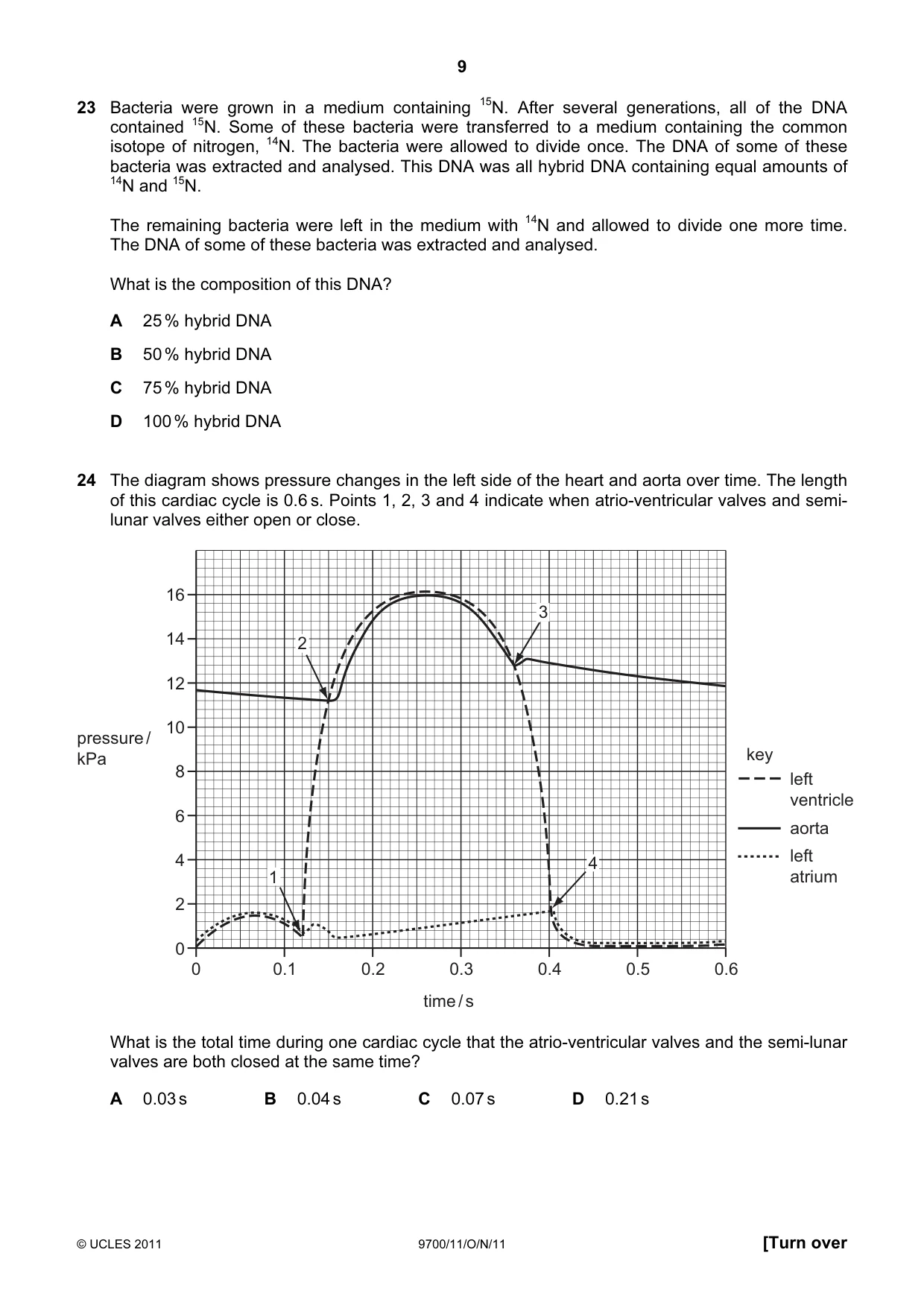
Q24 · The diagram shows pressure changes in the left side of the heart and aorta over time
24 The diagram shows pressure changes in the left side of the heart and aorta over time. The length of this cardiac cycle is 0.6 s. Points 1, 2, 3 and 4 indicate when atrio-ventricular valves and semi- lunar valves either open or close. 16 3 14 2 12 10 pressure / kPa key 8 left ventricle 6 aorta 4 4 left 1 atrium 2 0 0 0.1 0.2 0.3 0.4 0.5 0.6 time / s What is the total time during one cardiac cycle that the atrio-ventricular valves and the semi-lunar valves are both closed at the same time? A 0.03 s B 0.04 s C 0.07 s D 0.21 s
Mark scheme: C
Q25 · The large arteries close to the heart have a thick elastic layer in their walls
25 The large arteries close to the heart have a thick elastic layer in their walls. Which statements about this layer are correct? 1 evens out the blood flow from the heart 2 reduces friction within these blood vessels 3 prevents too much pressure bursting the artery wall A 1 and 2 only B 1 and 3 only C 2 and 3 only D 3 only
Mark scheme: B
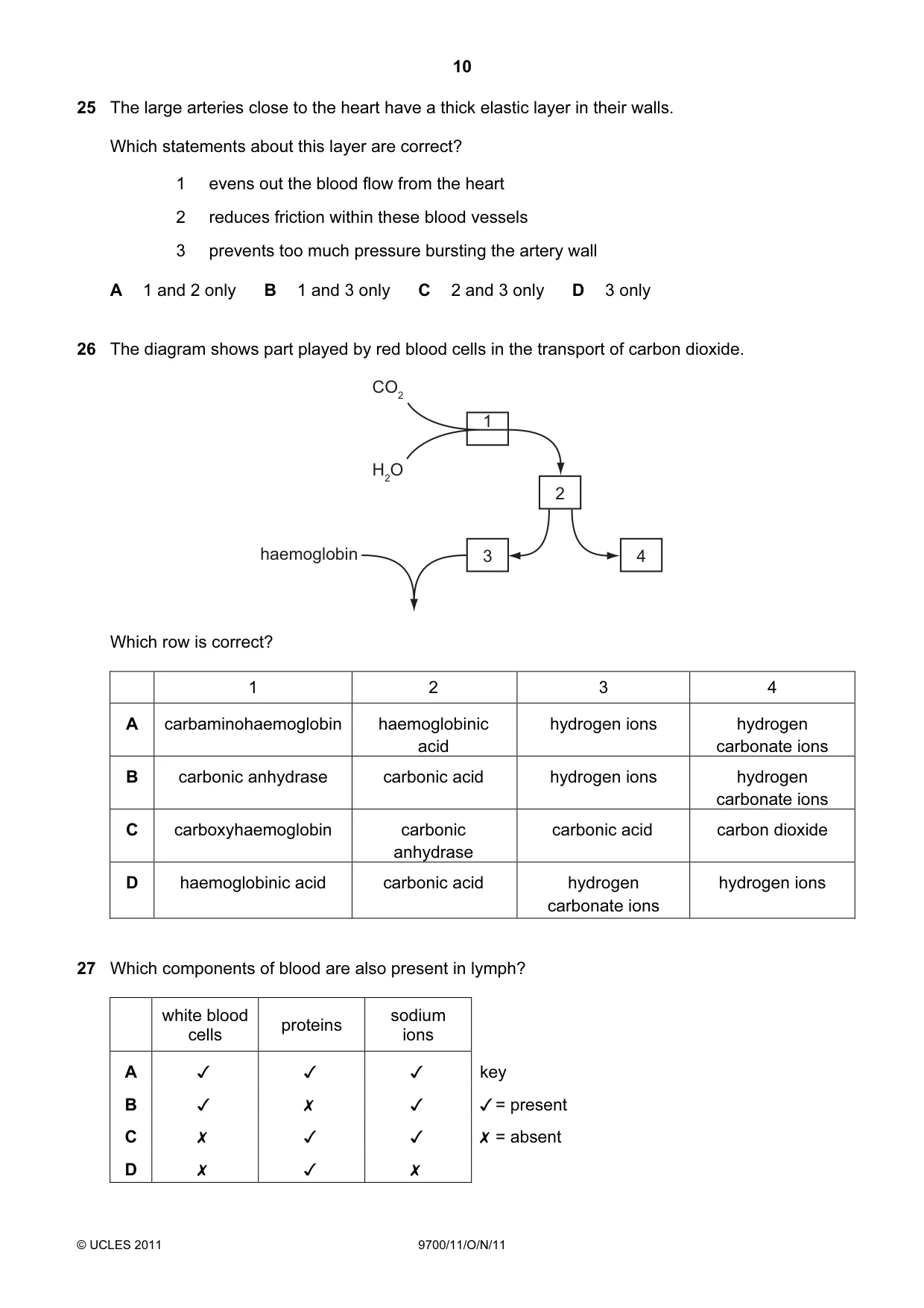
Q26 · The diagram shows part played by red blood cells in the transport of carbon dioxide
26 The diagram shows part played by red blood cells in the transport of carbon dioxide. CO2 1 H2O 2 haemoglobin 3 4 Which row is correct? 1 2 3 4 A carbaminohaemoglobin haemoglobinic hydrogen ions hydrogen acid carbonate ions B carbonic anhydrase carbonic acid hydrogen ions hydrogen carbonate ions C carboxyhaemoglobin carbonic carbonic acid carbon dioxide anhydrase D haemoglobinic acid carbonic acid hydrogen hydrogen ions carbonate ions
Mark scheme: B
Q27 · Which components of blood are also present in lymph?
27 Which components of blood are also present in lymph? white blood . sodium proteins : cells ions A Jv Jv Jv B Jv x J Cc x Jv Jv D x J x key /¥ = present X = absent
Mark scheme: A
Q28 · In which combination of environmental conditions are the stomata of a plant most likely…
28 In which combination of environmental conditions are the stomata of a plant most likely to close? atmospheric soil water wind humidity potential speed A high low high B high low low C low high high D low low high
Mark scheme: D
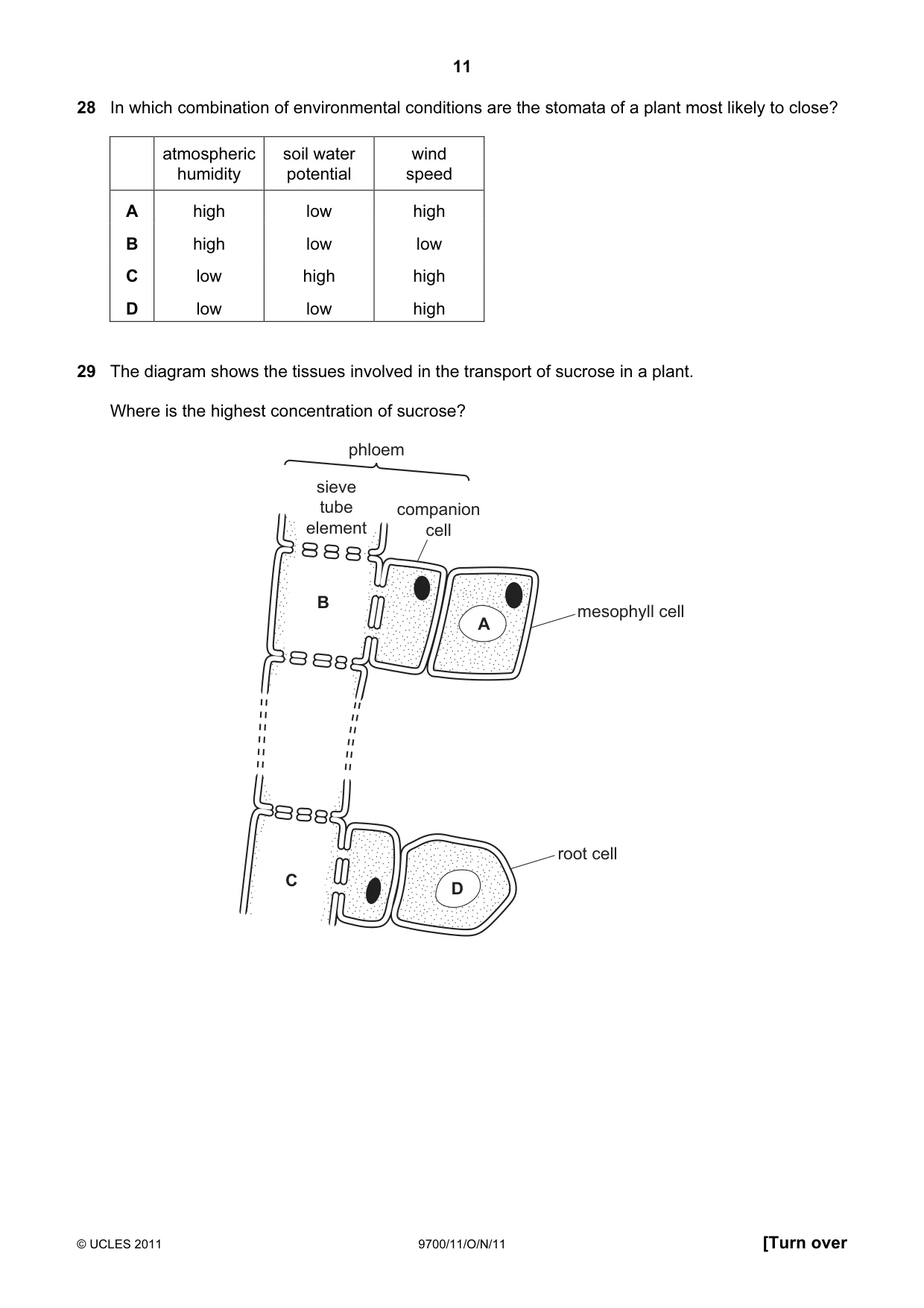
Q29 · The diagram shows the tissues involved in the transport of sucrose in a plant
29 The diagram shows the tissues involved in the transport of sucrose in a plant. Where is the highest concentration of sucrose? phloem sieve tube companion element cell B mesophyll cell A root cell C D
Mark scheme: B
Q30 · Which evidence supports the cohesion-tension theory for the movement of water in…
30 Which evidence supports the cohesion-tension theory for the movement of water in flowering plants? 1 When the rate of transpiration of a tree is maximum, the diameter of the trunk is minimum. 2 When a plant shoot is removed close to the base of the stem, sap leaks out from the cut. 3 Evaporation of water from a porous pot can exert a force that draws water up a glass tube attached underneath the pot. 4 Droplets of water form at the edge of leaves of plants growing in conditions of soil with high water content and air with high humidity. A 1 and 2 B 1 and 3 C 2 and 3 D 2 and 4
Mark scheme: B
Q31 · What describes how smoking contributes to cardiovascular disease?
31 What describes how smoking contributes to cardiovascular disease? 1 Both nicotine and carbon monoxide speed up the development of plaques in arteries. 2 Nicotine increases blood pressure and heart rate and so increases the body’s demand for oxygen. 3 Smoking interacts with other risk factors and increases the blood cholesterol level. 4 Tar is deposited in the lining of artery walls and increases the development of atherosclerosis. A 4 only B 2 and 4 only C 1, 2 and 3 only D 1, 2, 3 and 4
Mark scheme: C
Q32 · Where in the respiratory system are both goblet cells and ciliated epithelium found?
32 Where in the respiratory system are both goblet cells and ciliated epithelium found? trachea bronchi bronchioles v v x key J/ = found 0 0O DW > Jv x x x Jv Jv X = not found x x Jv
Mark scheme: A
Q33 · What is an effect of inhaling tobacco smoke?
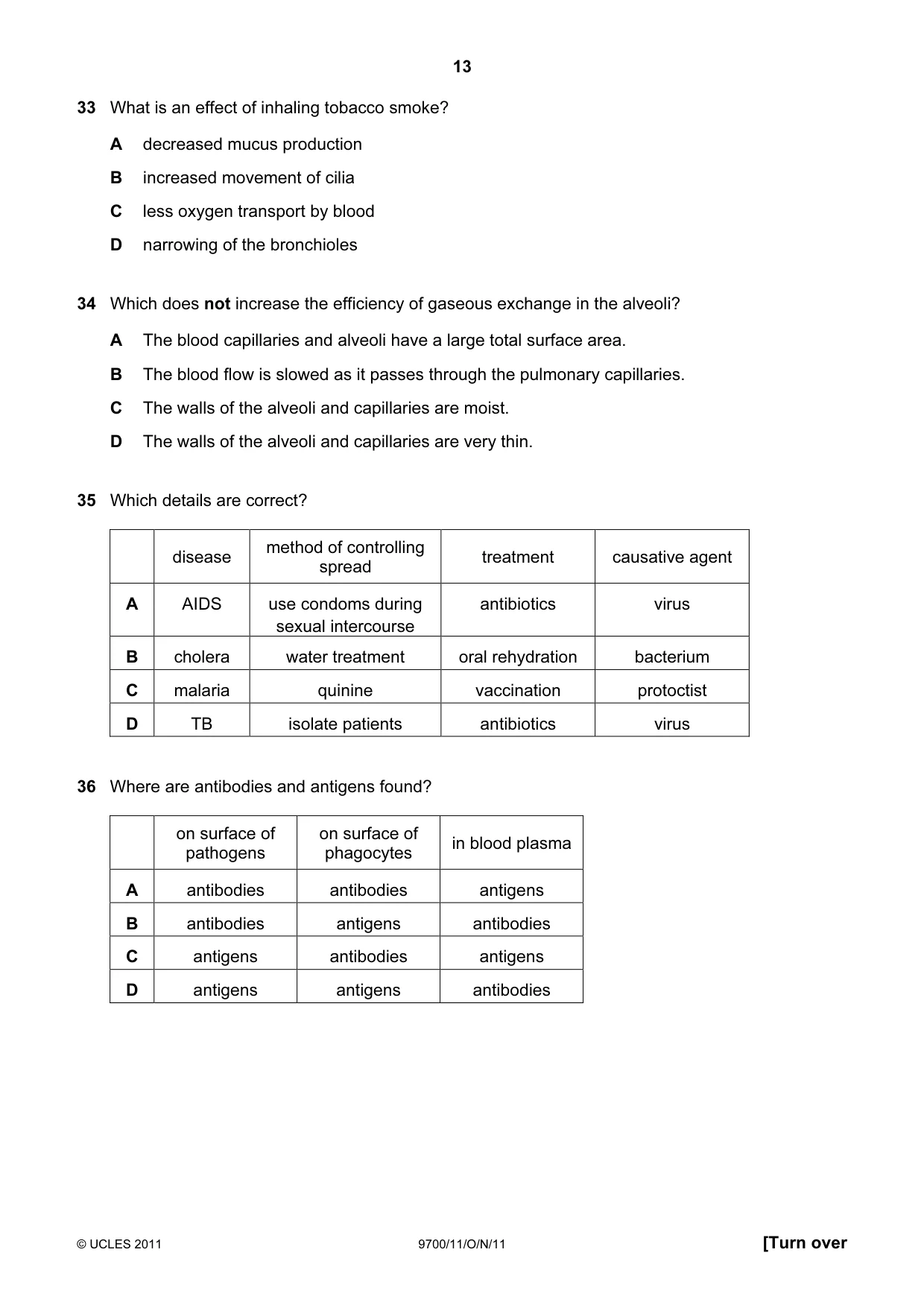
33 What is an effect of inhaling tobacco smoke? A decreased mucus production B increased movement of cilia C less oxygen transport by blood D narrowing of the bronchioles
Mark scheme: C
Q34 · Which does not increase the efficiency of gaseous exchange in the alveoli?
34 Which does not increase the efficiency of gaseous exchange in the alveoli? A The blood capillaries and alveoli have a large total surface area. B The blood flow is slowed as it passes through the pulmonary capillaries. C The walls of the alveoli and capillaries are moist. D The walls of the alveoli and capillaries are very thin.
Mark scheme: C
Q35 · Which details are correct?
35 Which details are correct? method of controlling disease treatment causative agent spread A AIDS use condoms during antibiotics virus sexual intercourse B cholera water treatment oral rehydration bacterium C malaria quinine vaccination protoctist D TB isolate patients antibiotics virus
Mark scheme: B
Q36 · Where are antibodies and antigens found?
36 Where are antibodies and antigens found? on surface of on surface of in blood plasma pathogens phagocytes A antibodies antibodies antigens B antibodies antigens antibodies C antigens antibodies antigens D antigens antigens antibodies
Mark scheme: D
Q37 · Breast milk produced by the mother for a new-born baby contains antibodies
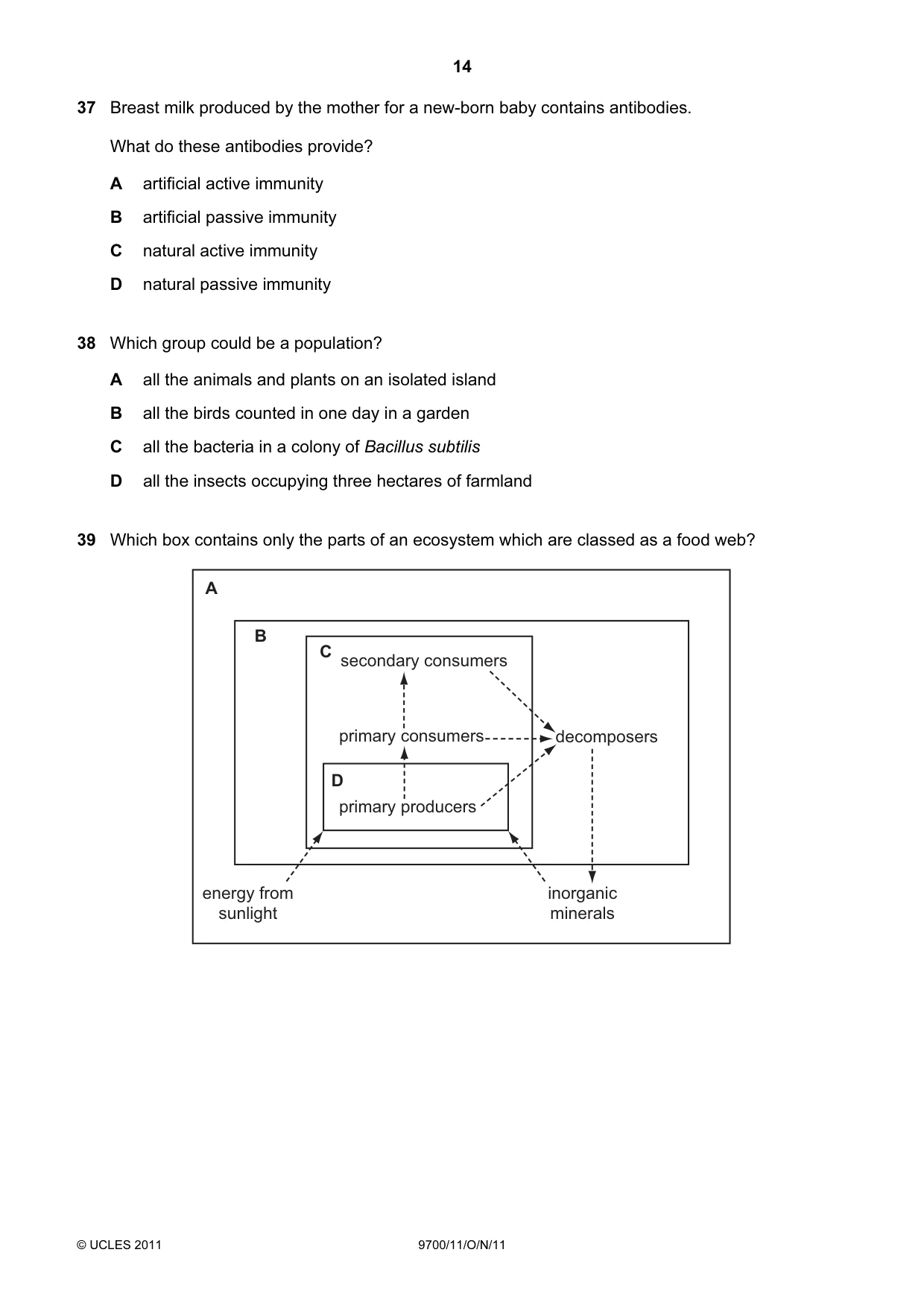
37 Breast milk produced by the mother for a new-born baby contains antibodies. What do these antibodies provide? A artificial active immunity B artificial passive immunity C natural active immunity D natural passive immunity
Mark scheme: D
Q38 · Which group could be a population?
38 Which group could be a population? A all the animals and plants on an isolated island B all the birds counted in one day in a garden C all the bacteria in a colony of Bacillus subtilis D all the insects occupying three hectares of farmland
Mark scheme: C
Q39 · Which box contains only the parts of an ecosystem which are classed as a food web?
39 Which box contains only the parts of an ecosystem which are classed as a food web? A B C secondary consumers primary consumers decomposers D primary producers energy from inorganic sunlight minerals
Mark scheme: B
Q40 · The graph shows the annual changes of the following factors in a lake
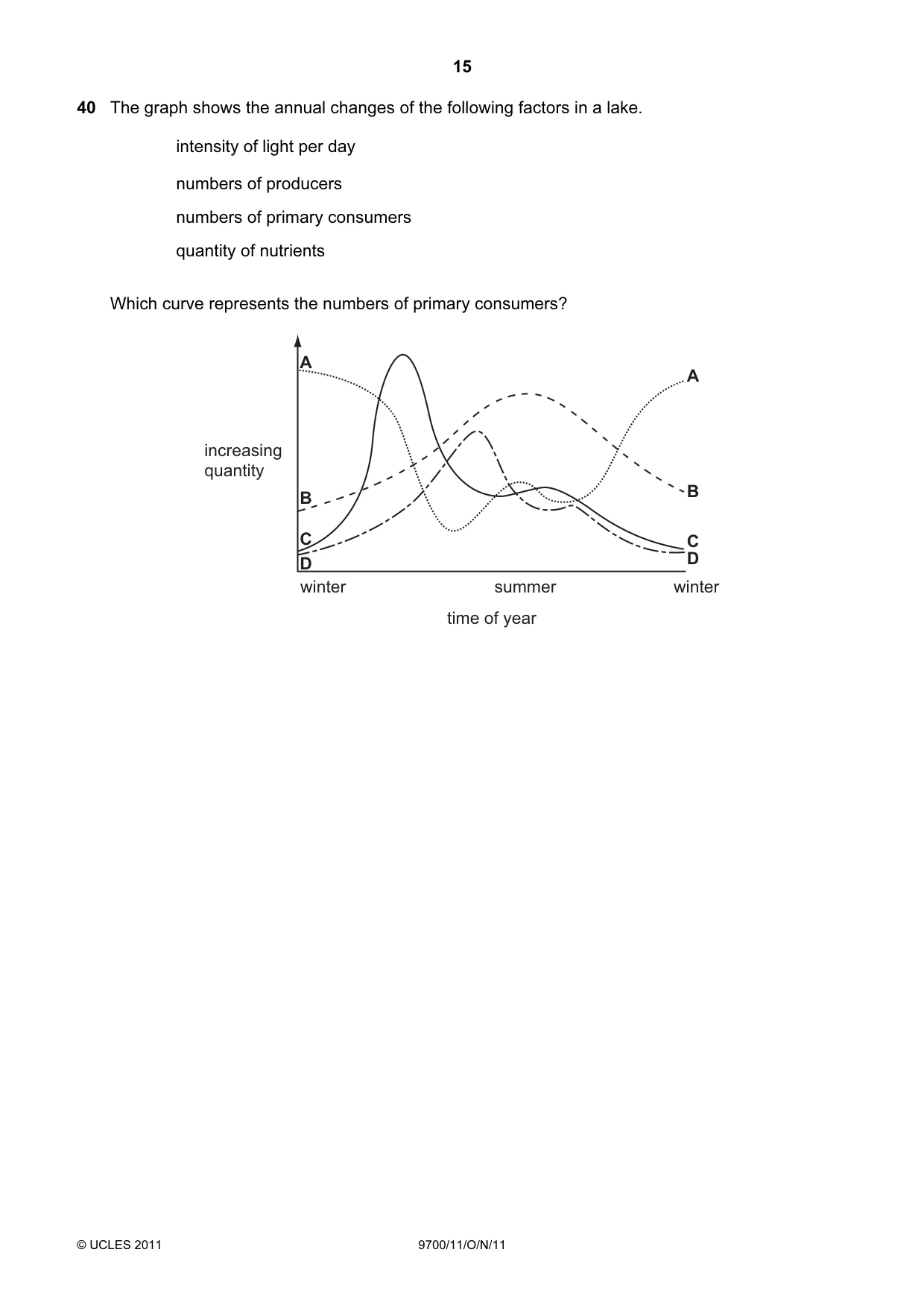
40 The graph shows the annual changes of the following factors in a lake. intensity of light per day numbers of producers numbers of primary consumers quantity of nutrients Which curve represents the numbers of primary consumers? A A increasing quantity B B C C D D winter summer winter time of year
Mark scheme: D
What was in this paper
The subtopics covered by these 40 questions, and how many questions each got. Open one in a new tab to see every Cambridge question on it.
4Replication and division of nuclei and cells4Biodiversity3Movement into and out of cells3The circulatory system3The gas exchange system3Carbohydrates and lipids2Protein synthesis2Structure of nucleic acids and replication of DNA2Transport mechanisms2Antibodies and vaccination1Factors that affect enzyme action1Homeostasis in plants1Infectious diseases1Mode of action of enzymes1Proteins1Testing for biological molecules1The heart1The immune system1The microscope in cell studies1Transport of oxygen and carbon dioxide1Water1What you needed in this session
Cambridge’s own grade thresholds for 2011 Oct/Nov, Paper 1 · Variant 1. A higher threshold means an easier paper — the bar moves with how the cohort did.