Cambridge A Level Biology 9700 — 2024 May/June Paper 1 · Variant 3
9700/13/M/J/24 · 40 questions · 40 marks · ≈45 min
The question paper and its mark scheme, free to read here and free to download. This is Cambridge’s own paper, exactly as it was sat.
Question paper20 pages
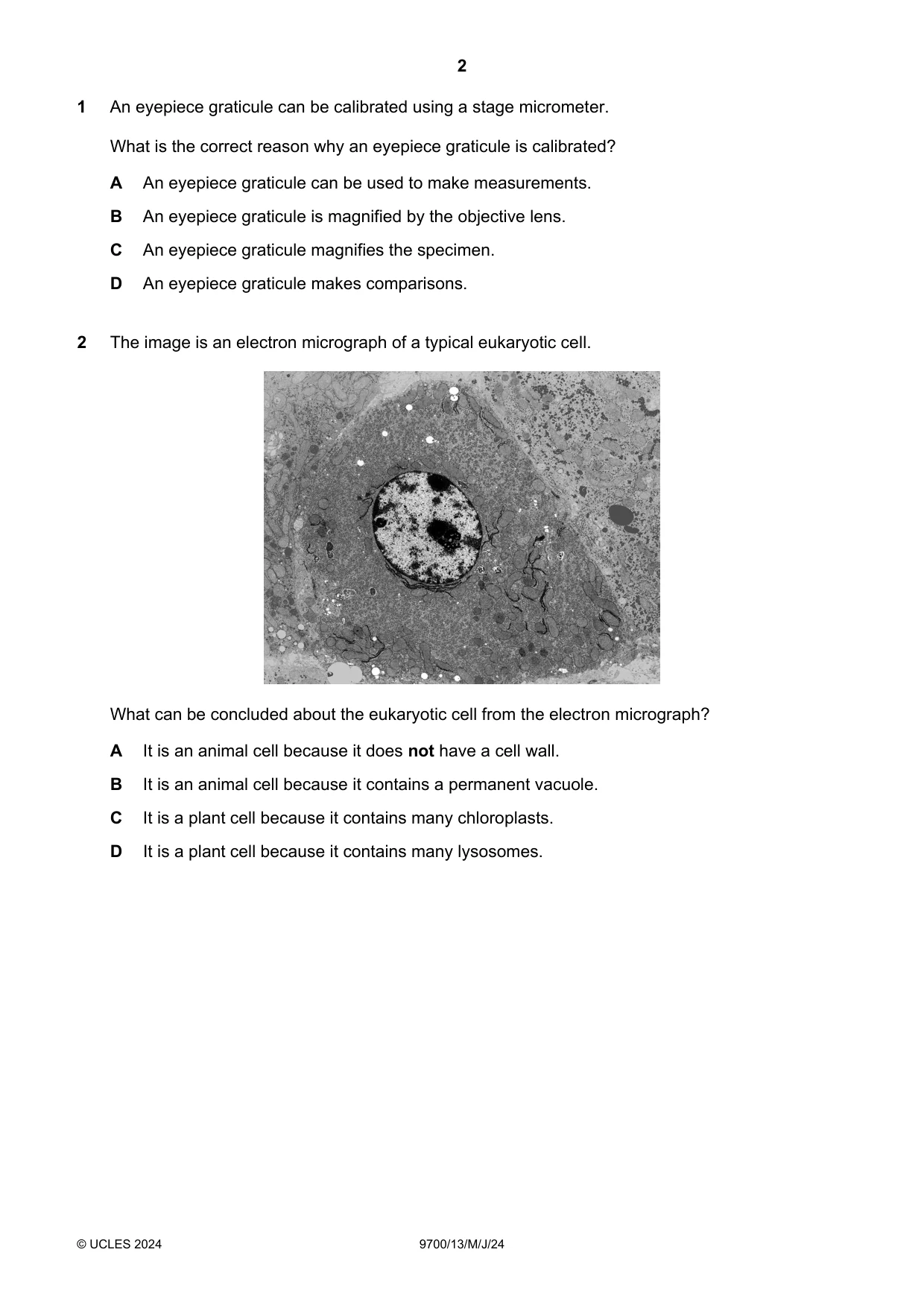
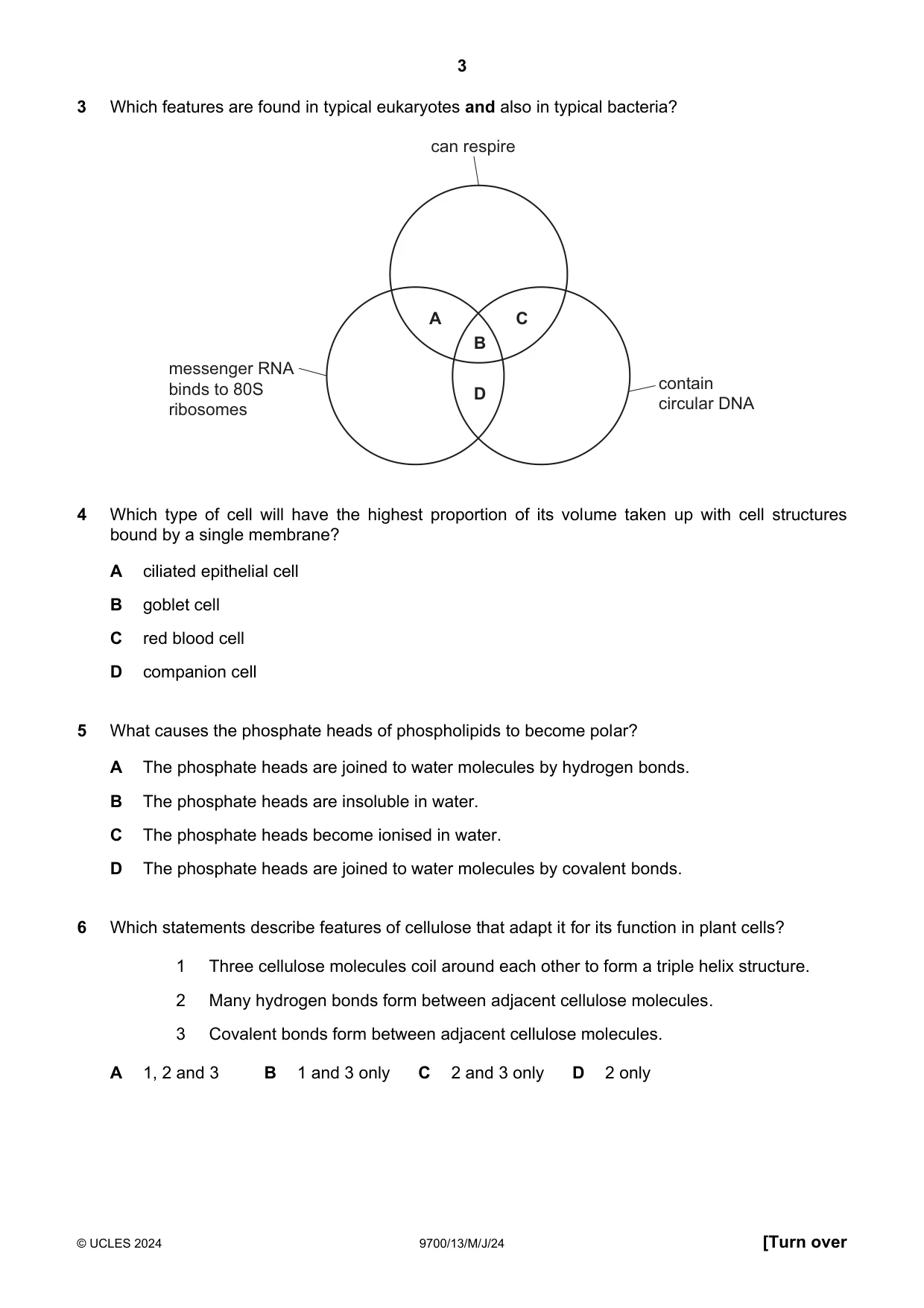
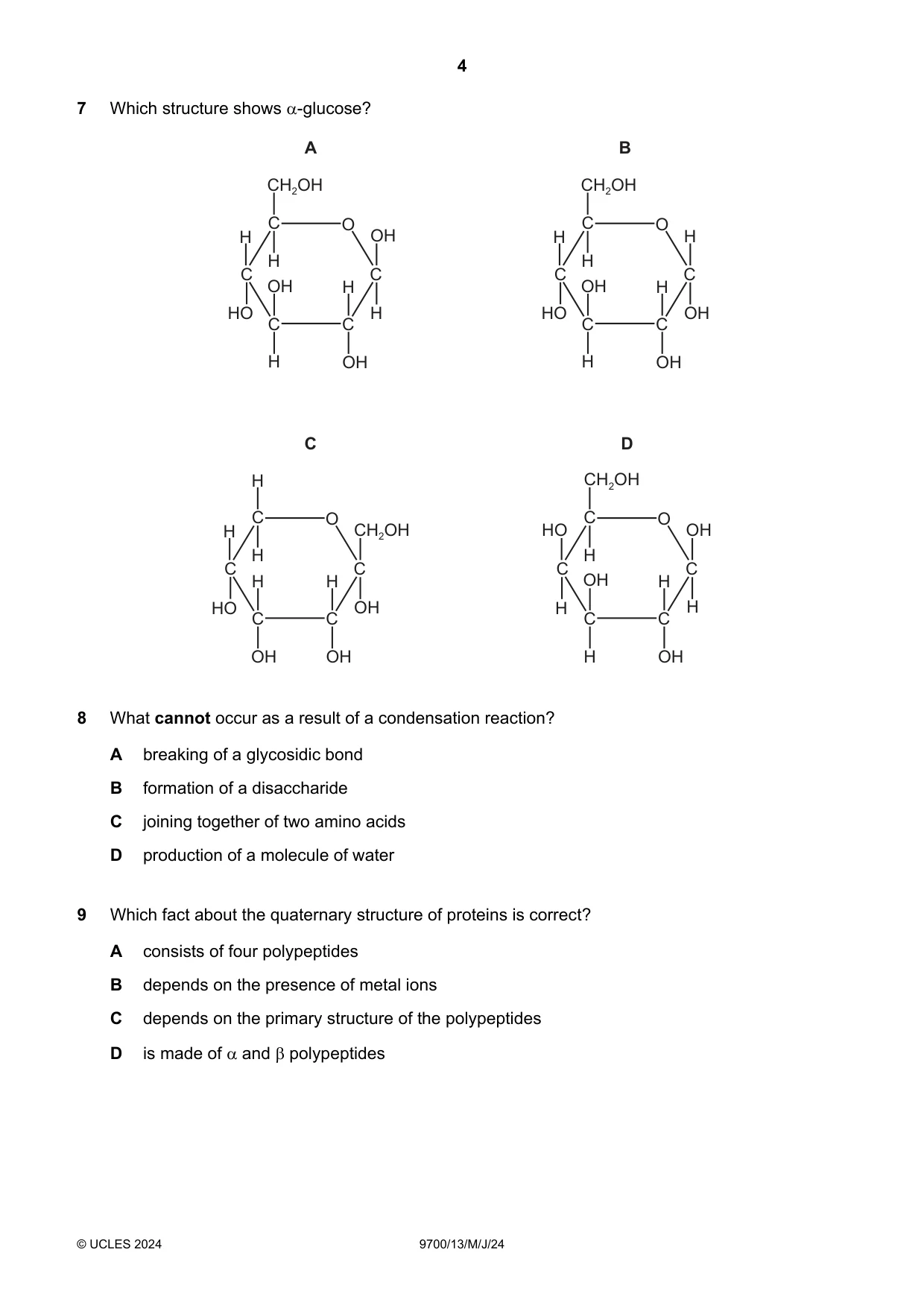

Mark scheme3 pages
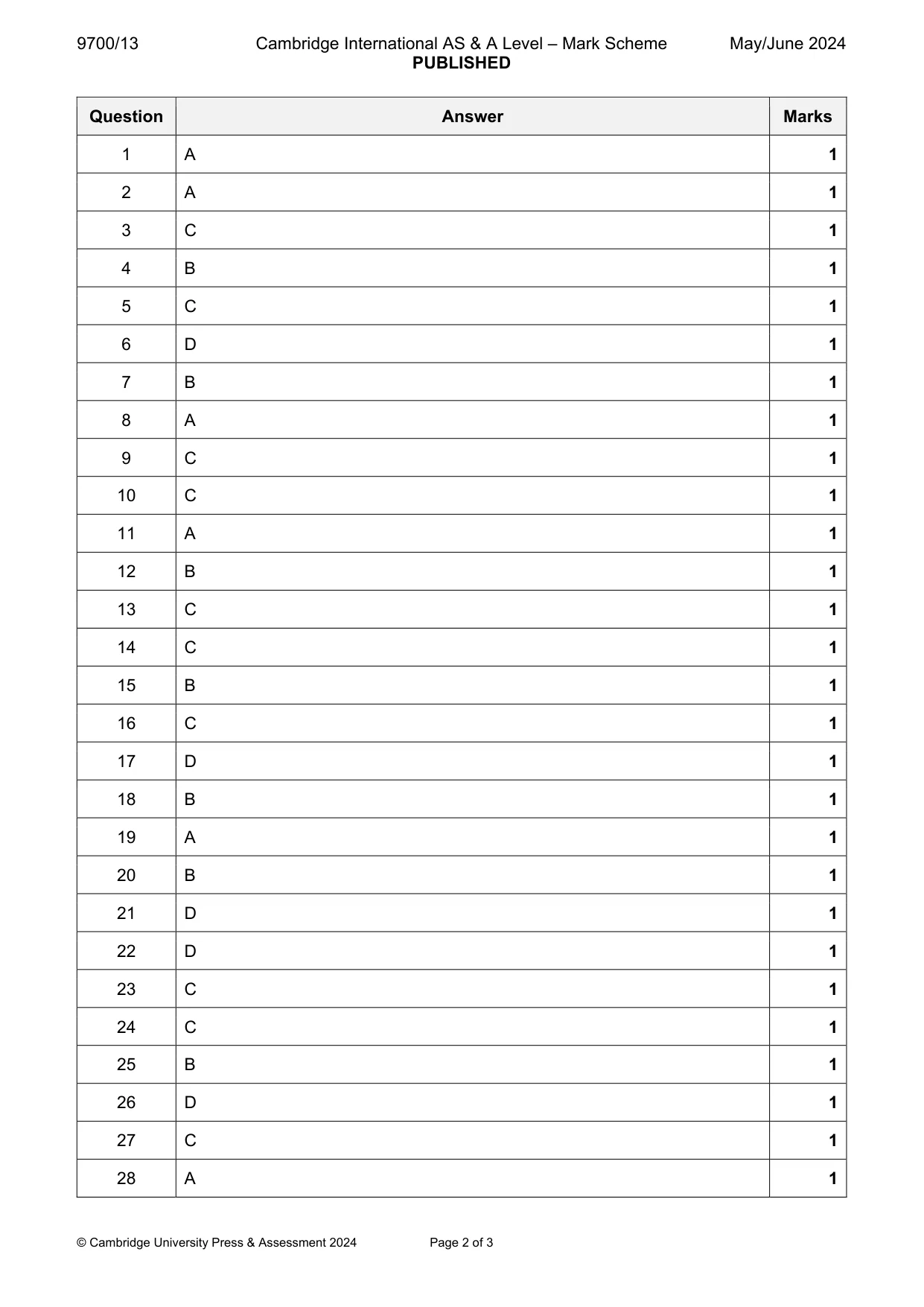
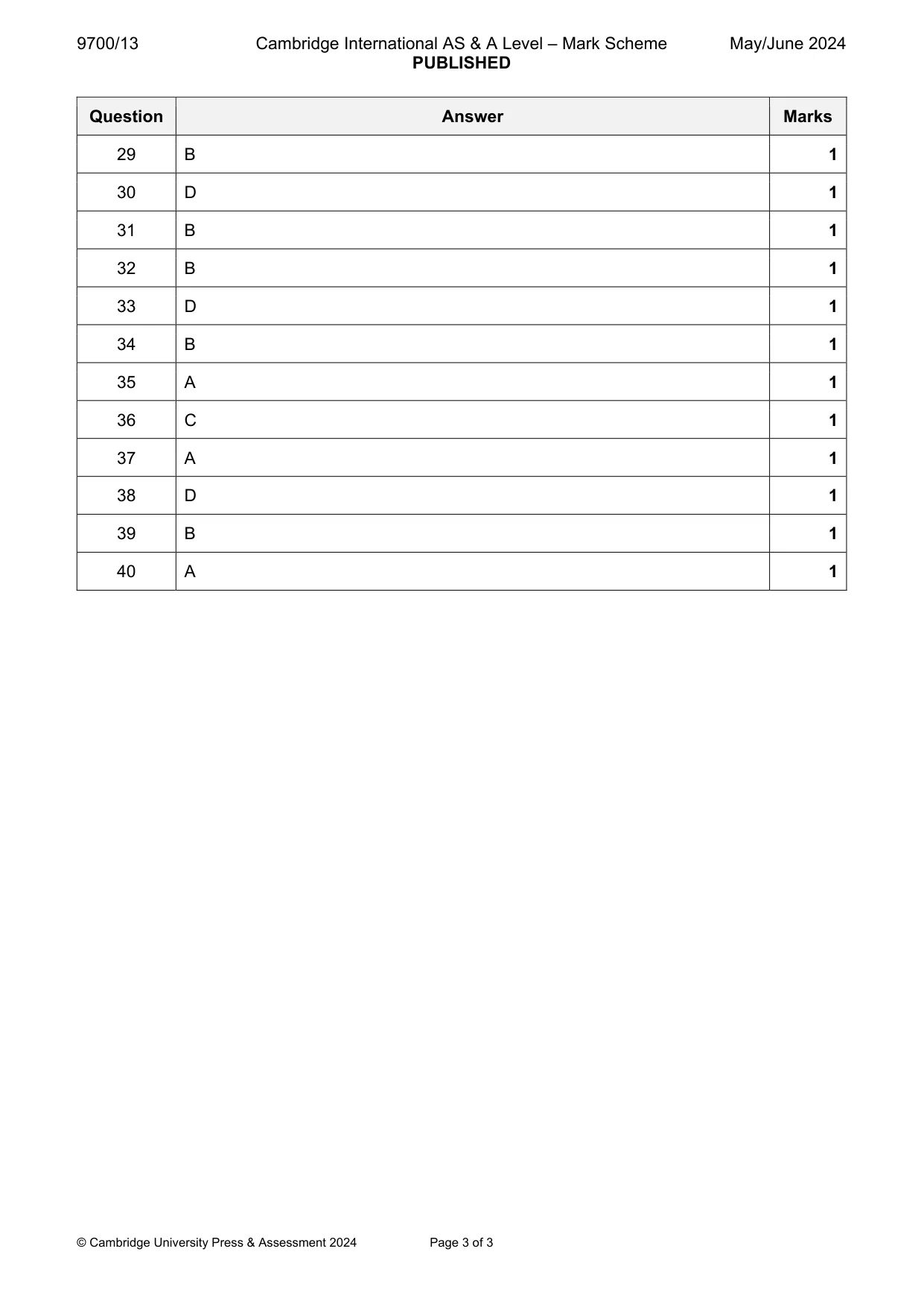
Answers below. Sit the paper first if you are practising.
Questions as text
Q1 · An eyepiece graticule can be calibrated using a stage micrometer
1 An eyepiece graticule can be calibrated using a stage micrometer. What is the correct reason why an eyepiece graticule is calibrated? A An eyepiece graticule can be used to make measurements. B An eyepiece graticule is magnified by the objective lens. C An eyepiece graticule magnifies the specimen. D An eyepiece graticule makes comparisons.
Mark scheme: A
Q2 · The image is an electron micrograph of a typical eukaryotic cell
2 The image is an electron micrograph of a typical eukaryotic cell. What can be concluded about the eukaryotic cell from the electron micrograph? A It is an animal cell because it does not have a cell wall. B It is an animal cell because it contains a permanent vacuole. C It is a plant cell because it contains many chloroplasts. D It is a plant cell because it contains many lysosomes.
Mark scheme: A
More questions on Cells as the basic units of living organisms
Q3 · Which features are found in typical eukaryotes and also in typical bacteria?
3 Which features are found in typical eukaryotes and also in typical bacteria? can respire A C B messenger RNA binds to 80S contain D ribosomes circular DNA
Mark scheme: C
More questions on Cells as the basic units of living organisms
Q4 · Which type of cell will have the highest proportion of its volume taken up with cell…
4 Which type of cell will have the highest proportion of its volume taken up with cell structures bound by a single membrane? A ciliated epithelial cell B goblet cell C red blood cell D companion cell
Mark scheme: B
More questions on Cells as the basic units of living organisms
Q5 · What causes the phosphate heads of phospholipids to become polar?
5 What causes the phosphate heads of phospholipids to become polar? A The phosphate heads are joined to water molecules by hydrogen bonds. B The phosphate heads are insoluble in water. C The phosphate heads become ionised in water. D The phosphate heads are joined to water molecules by covalent bonds.
Mark scheme: C
Q6 · Which statements describe features of cellulose that adapt it for its function in plant…
6 Which statements describe features of cellulose that adapt it for its function in plant cells? 1 Three cellulose molecules coil around each other to form a triple helix structure. 2 Many hydrogen bonds form between adjacent cellulose molecules. 3 Covalent bonds form between adjacent cellulose molecules. A 1, 2 and 3 B 1 and 3 only C 2 and 3 only D 2 only
Mark scheme: D
Q7 · Which structure shows -glucose?
7 Which structure shows -glucose? A B CH2OH CH2OH C O C O H OH H H H H C C C C OH H OH H HO H HO OH C C C C H OH H OH C D H CH2OH C O C O H CH2OH HO OH H H C C C C H H OH H HO OH H H C C C C OH OH H OH
Mark scheme: B
Q8 · What cannot occur as a result of a condensation reaction?
8 What cannot occur as a result of a condensation reaction? A breaking of a glycosidic bond B formation of a disaccharide C joining together of two amino acids D production of a molecule of water
Mark scheme: A
Q9 · Which fact about the quaternary structure of proteins is correct?
9 Which fact about the quaternary structure of proteins is correct? A consists of four polypeptides B depends on the presence of metal ions C depends on the primary structure of the polypeptides D is made of and polypeptides
Mark scheme: C
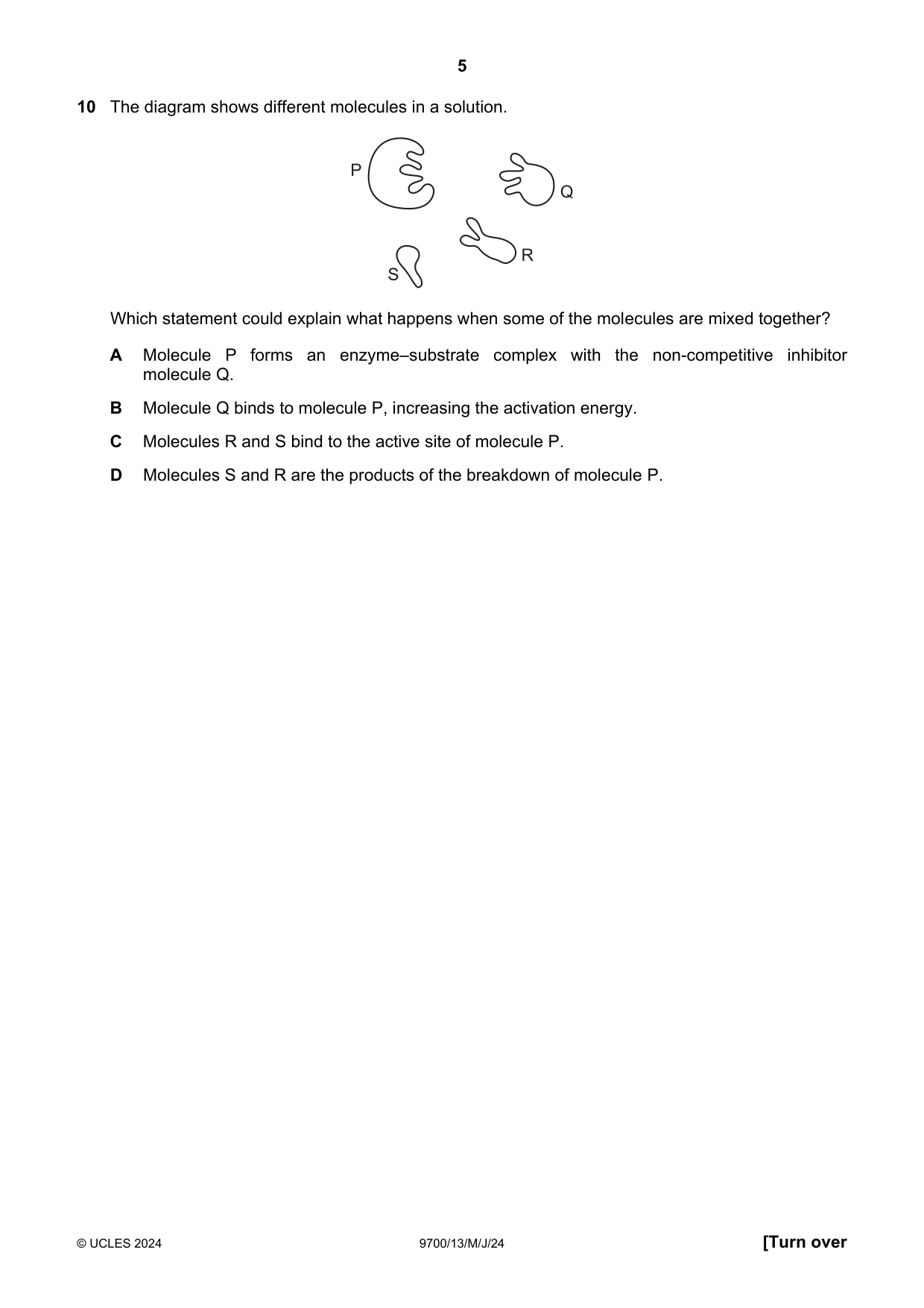
Q10 · The diagram shows different molecules in a solution
10 The diagram shows different molecules in a solution. P Q R S Which statement could explain what happens when some of the molecules are mixed together? A Molecule P forms an enzyme–substrate complex with the non-competitive inhibitor molecule Q. B Molecule Q binds to molecule P, increasing the activation energy. C Molecules R and S bind to the active site of molecule P. D Molecules S and R are the products of the breakdown of molecule P.
Mark scheme: C
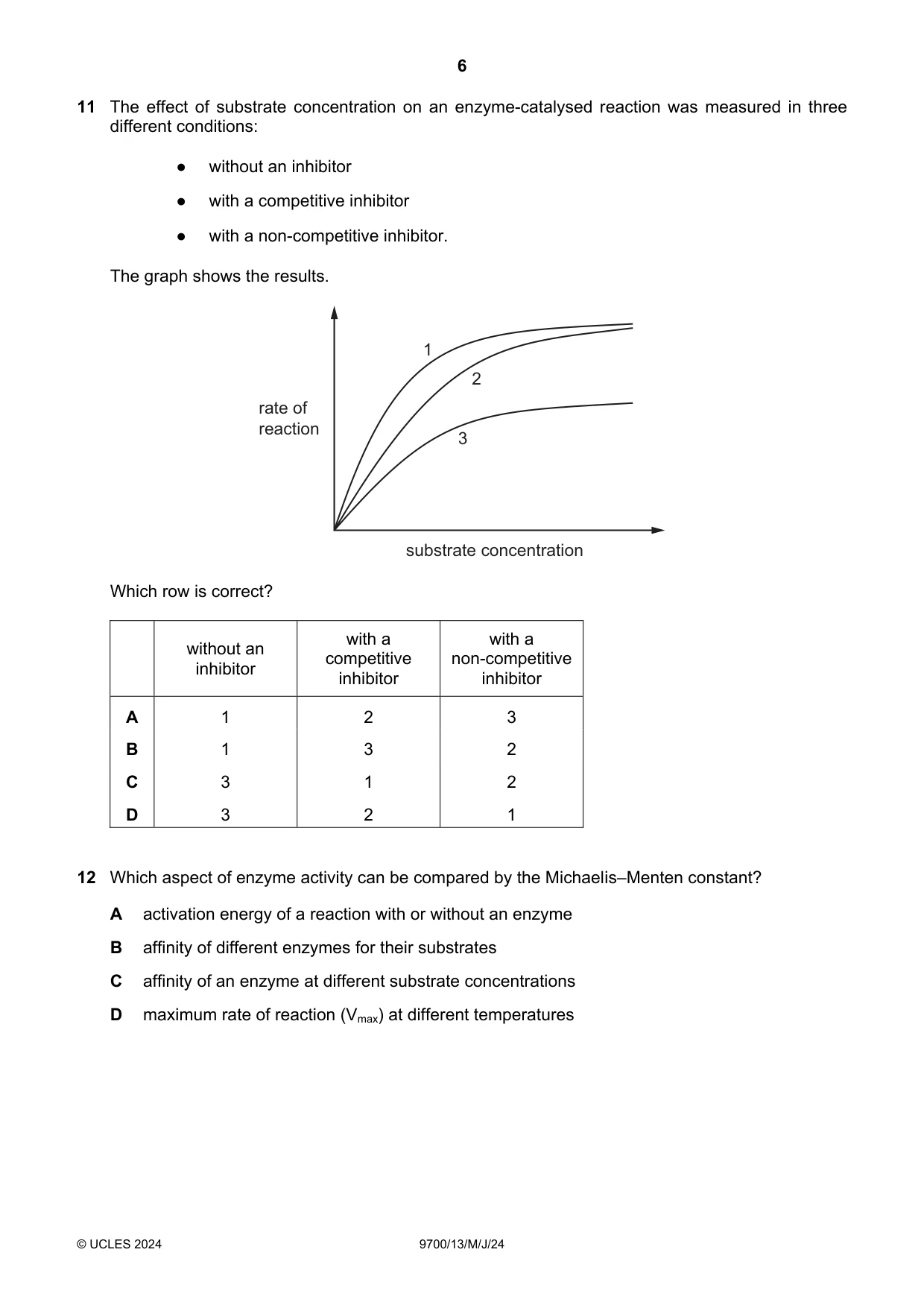
Q11 · The effect of substrate concentration on an enzyme-catalysed reaction was measured in…
11 The effect of substrate concentration on an enzyme-catalysed reaction was measured in three different conditions: ● without an inhibitor ● with a competitive inhibitor ● with a non-competitive inhibitor. The graph shows the results. 1 2 rate of reaction 3 substrate concentration Which row is correct? with a with a without an competitive non-competitive inhibitor inhibitor inhibitor A 1 2 3 B 1 3 2 C 3 1 2 D 3 2 1
Mark scheme: A
Q12 · Which aspect of enzyme activity can be compared by the Michaelis–Menten constant?
12 Which aspect of enzyme activity can be compared by the Michaelis–Menten constant? A activation energy of a reaction with or without an enzyme B affinity of different enzymes for their substrates C affinity of an enzyme at different substrate concentrations D maximum rate of reaction (Vmax) at different temperatures
Mark scheme: B
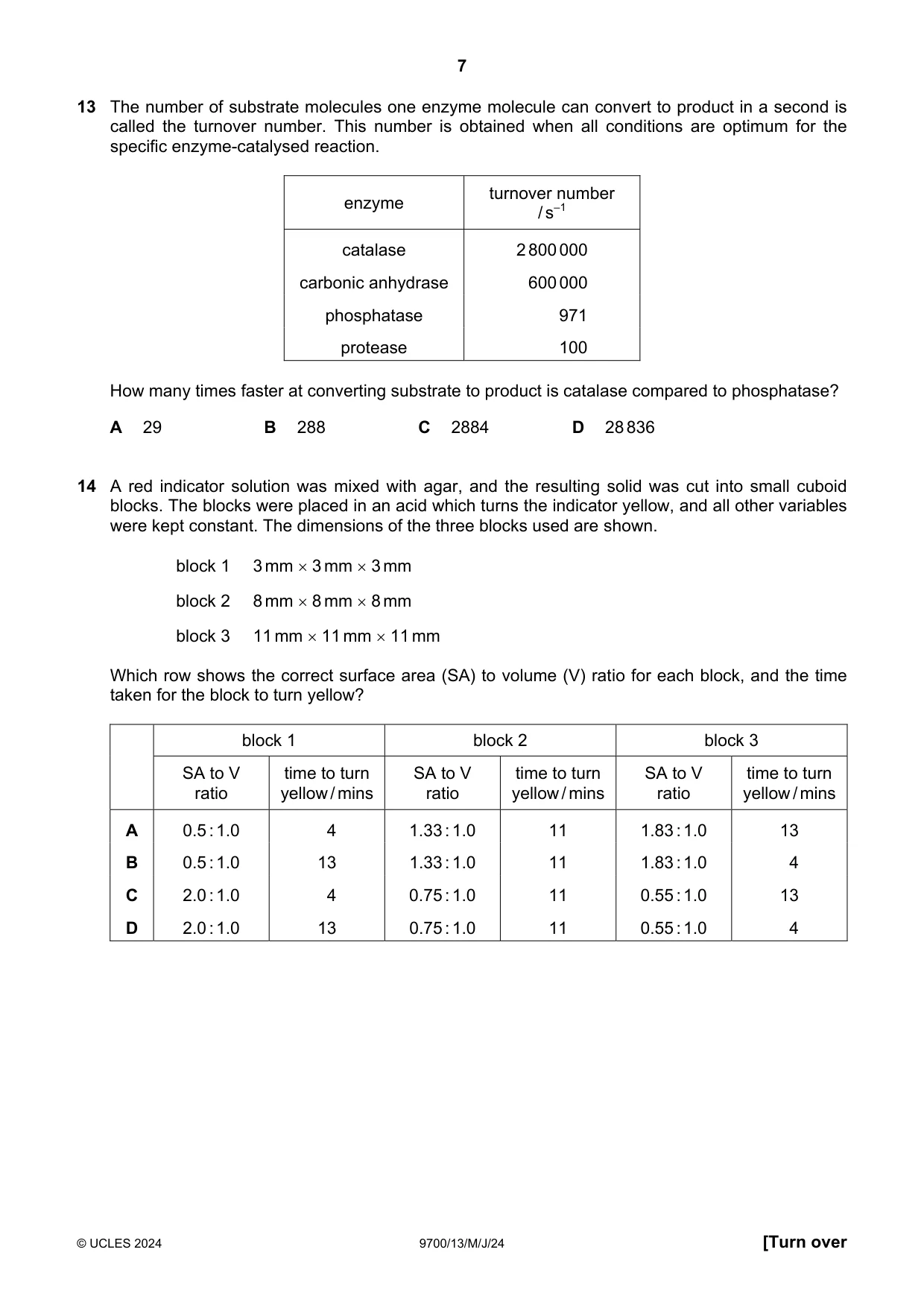
Q13 · The number of substrate molecules one enzyme molecule can convert to product in a second…
13 The number of substrate molecules one enzyme molecule can convert to product in a second is called the turnover number. This number is obtained when all conditions are optimum for the specific enzyme-catalysed reaction. turnover number enzyme / s–1 catalase 2 800 000 carbonic anhydrase 600 000 phosphatase 971 protease 100 How many times faster at converting substrate to product is catalase compared to phosphatase? A 29 B 288 C 2884 D 28 836
Mark scheme: C
Q14 · A red indicator solution was mixed with agar, and the resulting solid was cut into small…
14 A red indicator solution was mixed with agar, and the resulting solid was cut into small cuboid blocks. The blocks were placed in an acid which turns the indicator yellow, and all other variables were kept constant. The dimensions of the three blocks used are shown. block 1 3 mm 3 mm 3 mm block 2 8 mm 8 mm 8 mm block 3 11 mm 11 mm 11 mm Which row shows the correct surface area (SA) to volume (V) ratio for each block, and the time taken for the block to turn yellow? block 1 block 2 block 3 SA to V time to turn SA to V time to turn SA to V time to turn ratio yellow / mins ratio yellow / mins ratio yellow / mins A 0.5 : 1.0 4 1.33 : 1.0 11 1.83 : 1.0 13 B 0.5 : 1.0 13 1.33 : 1.0 11 1.83 : 1.0 4 C 2.0 : 1.0 4 0.75 : 1.0 11 0.55 : 1.0 13 D 2.0 : 1.0 13 0.75 : 1.0 11 0.55 : 1.0 4
Mark scheme: C
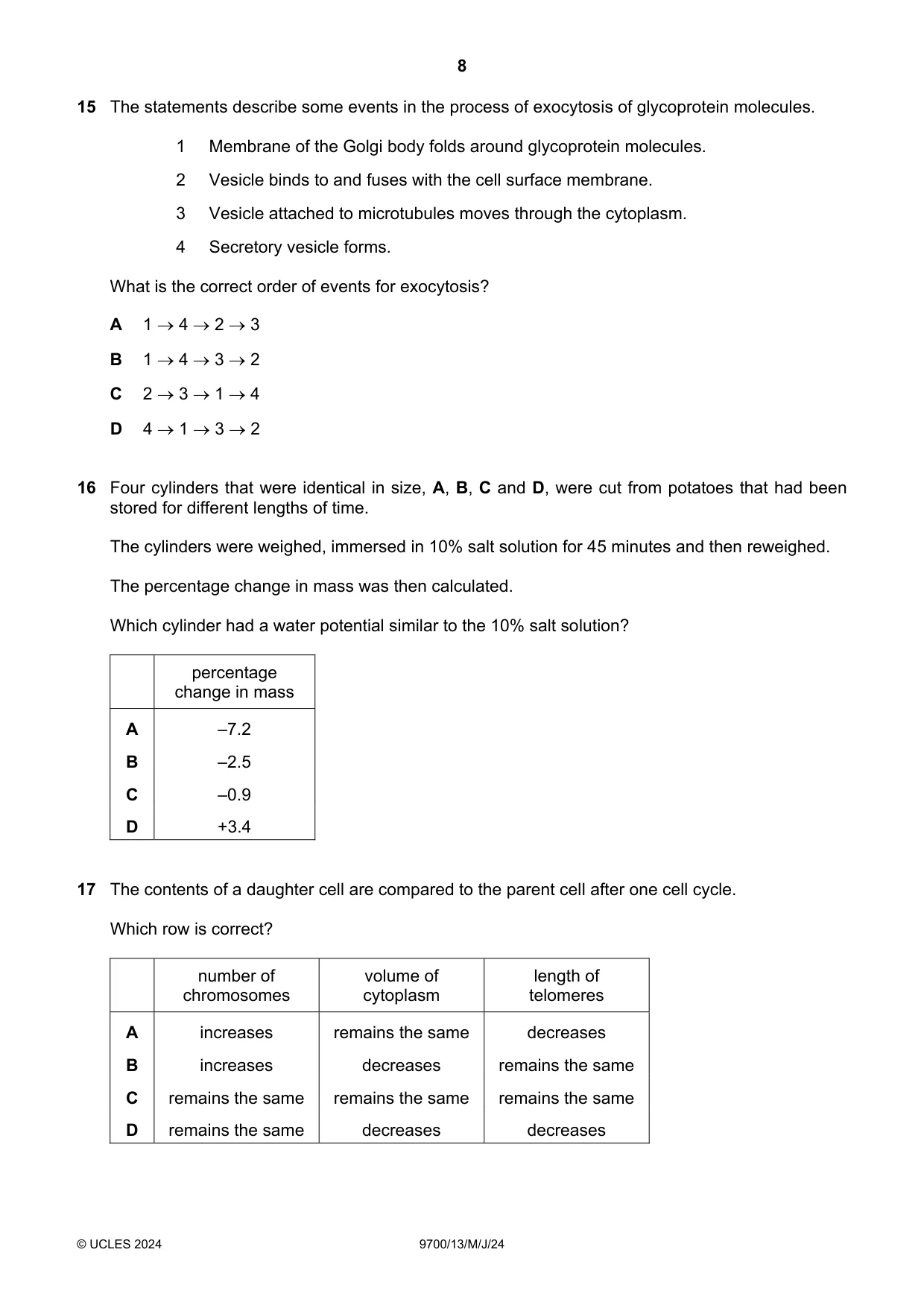
Q15 · The statements describe some events in the process of exocytosis of glycoprotein molecules
15 The statements describe some events in the process of exocytosis of glycoprotein molecules. 1 Membrane of the Golgi body folds around glycoprotein molecules. 2 Vesicle binds to and fuses with the cell surface membrane. 3 Vesicle attached to microtubules moves through the cytoplasm. 4 Secretory vesicle forms. What is the correct order of events for exocytosis? A 1 4 2 3 B 1 4 3 2 C 2 3 1 4 D 4 1 3 2
Mark scheme: B
Q16 · Four cylinders that were identical in size, A, B, C and D, were cut from potatoes that…
16 Four cylinders that were identical in size, A, B, C and D, were cut from potatoes that had been stored for different lengths of time. The cylinders were weighed, immersed in 10% salt solution for 45 minutes and then reweighed. The percentage change in mass was then calculated. Which cylinder had a water potential similar to the 10% salt solution? percentage change in mass A –7.2 B –2.5 C –0.9 D +3.4
Mark scheme: C
Q17 · The contents of a daughter cell are compared to the parent cell after one cell cycle
17 The contents of a daughter cell are compared to the parent cell after one cell cycle. Which row is correct? number of volume of length of chromosomes cytoplasm telomeres A increases remains the same decreases B increases decreases remains the same C remains the same remains the same remains the same D remains the same decreases decreases
Mark scheme: D
More questions on Replication and division of nuclei and cells
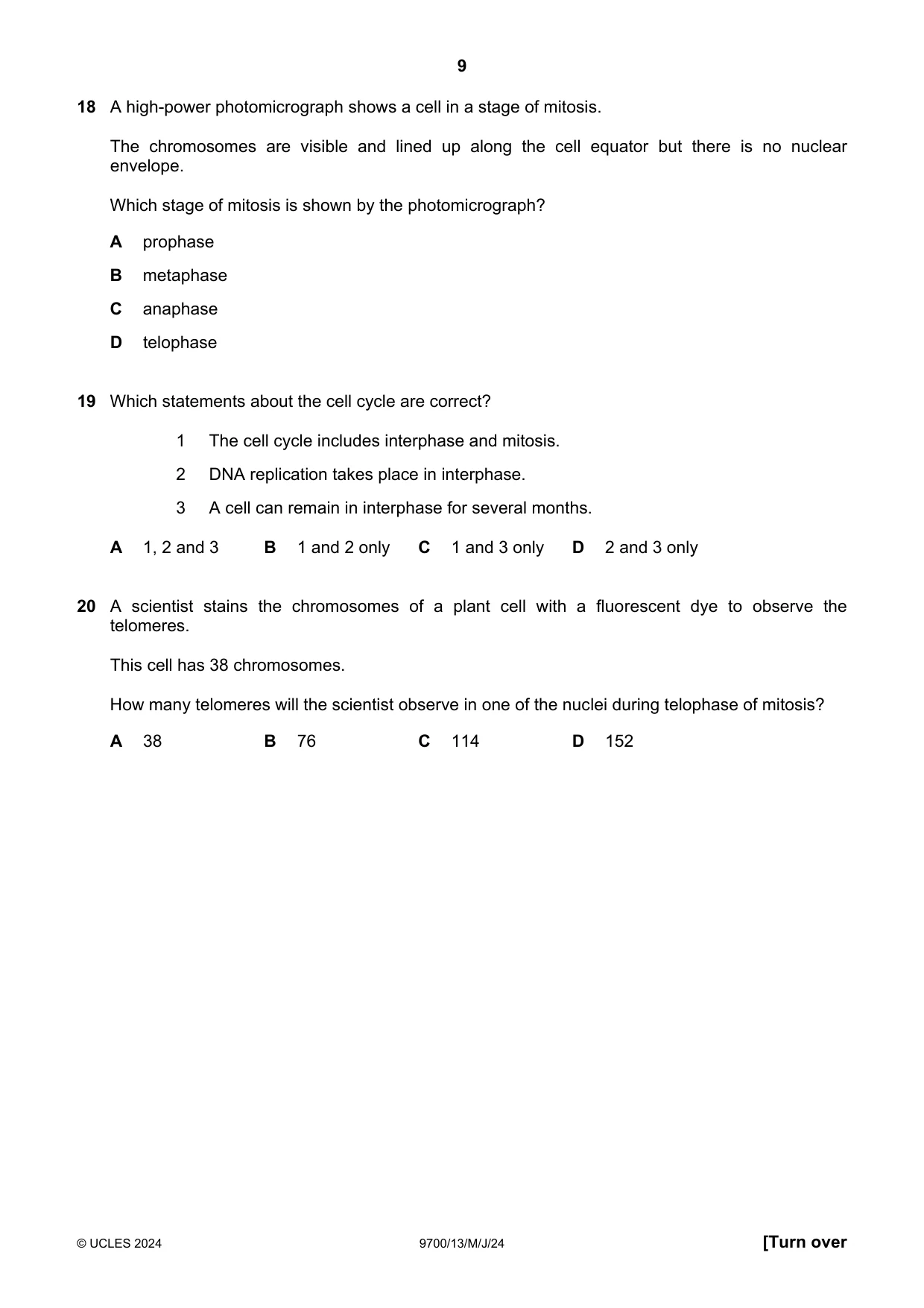
Q18 · A high-power photomicrograph shows a cell in a stage of mitosis
18 A high-power photomicrograph shows a cell in a stage of mitosis. The chromosomes are visible and lined up along the cell equator but there is no nuclear envelope. Which stage of mitosis is shown by the photomicrograph? A prophase B metaphase C anaphase D telophase
Mark scheme: B
Q19 · Which statements about the cell cycle are correct?
19 Which statements about the cell cycle are correct? 1 The cell cycle includes interphase and mitosis. 2 DNA replication takes place in interphase. 3 A cell can remain in interphase for several months. A 1, 2 and 3 B 1 and 2 only C 1 and 3 only D 2 and 3 only
Mark scheme: A
More questions on Replication and division of nuclei and cells
Q20 · A scientist stains the chromosomes of a plant cell with a fluorescent dye to observe the…
20 A scientist stains the chromosomes of a plant cell with a fluorescent dye to observe the telomeres. This cell has 38 chromosomes. How many telomeres will the scientist observe in one of the nuclei during telophase of mitosis? A 38 B 76 C 114 D 152
Mark scheme: B
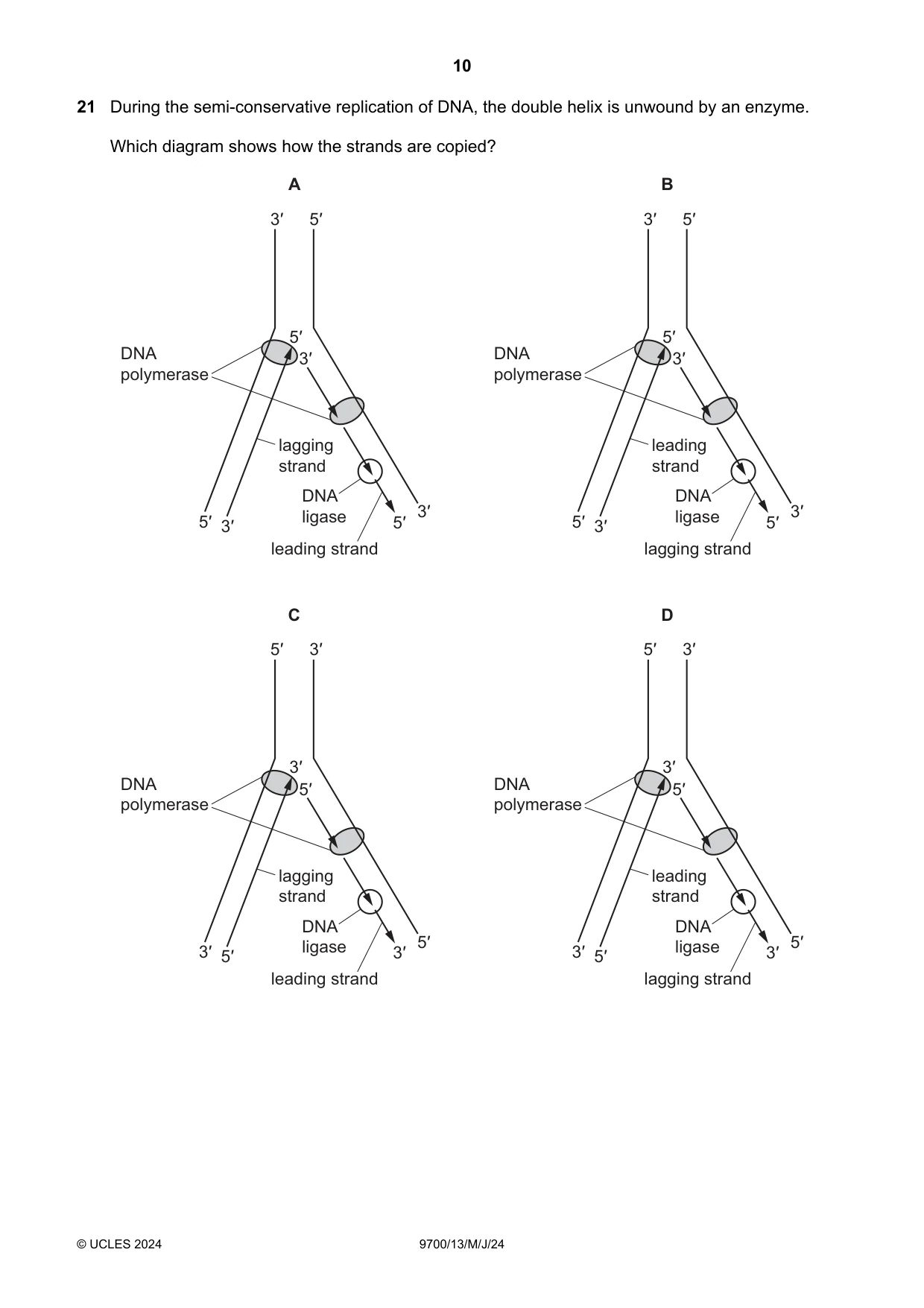
Q21 · During the semi-conservative replication of DNA, the double helix is unwound by an enzyme
21 During the semi-conservative replication of DNA, the double helix is unwound by an enzyme. Which diagram shows how the strands are copied? A B 3′ 5′ 3′ 5′ 5′ 5′ DNA 3′ DNA 3′ polymerase polymerase lagging leading strand strand DNA DNA ligase 3′ ligase 3′ 5′ 3′ 5′ 5′ 3′ 5′ leading strand lagging strand C D 5′ 3′ 5′ 3′ 3′ 3′ DNA 5′ DNA 5′ polymerase polymerase lagging leading strand strand DNA DNA ligase 5′ ligase 5′ 3′ 5′ 3′ 3′ 5′ 3′ leading strand lagging strand
Mark scheme: D
More questions on Structure of nucleic acids and replication of DNA
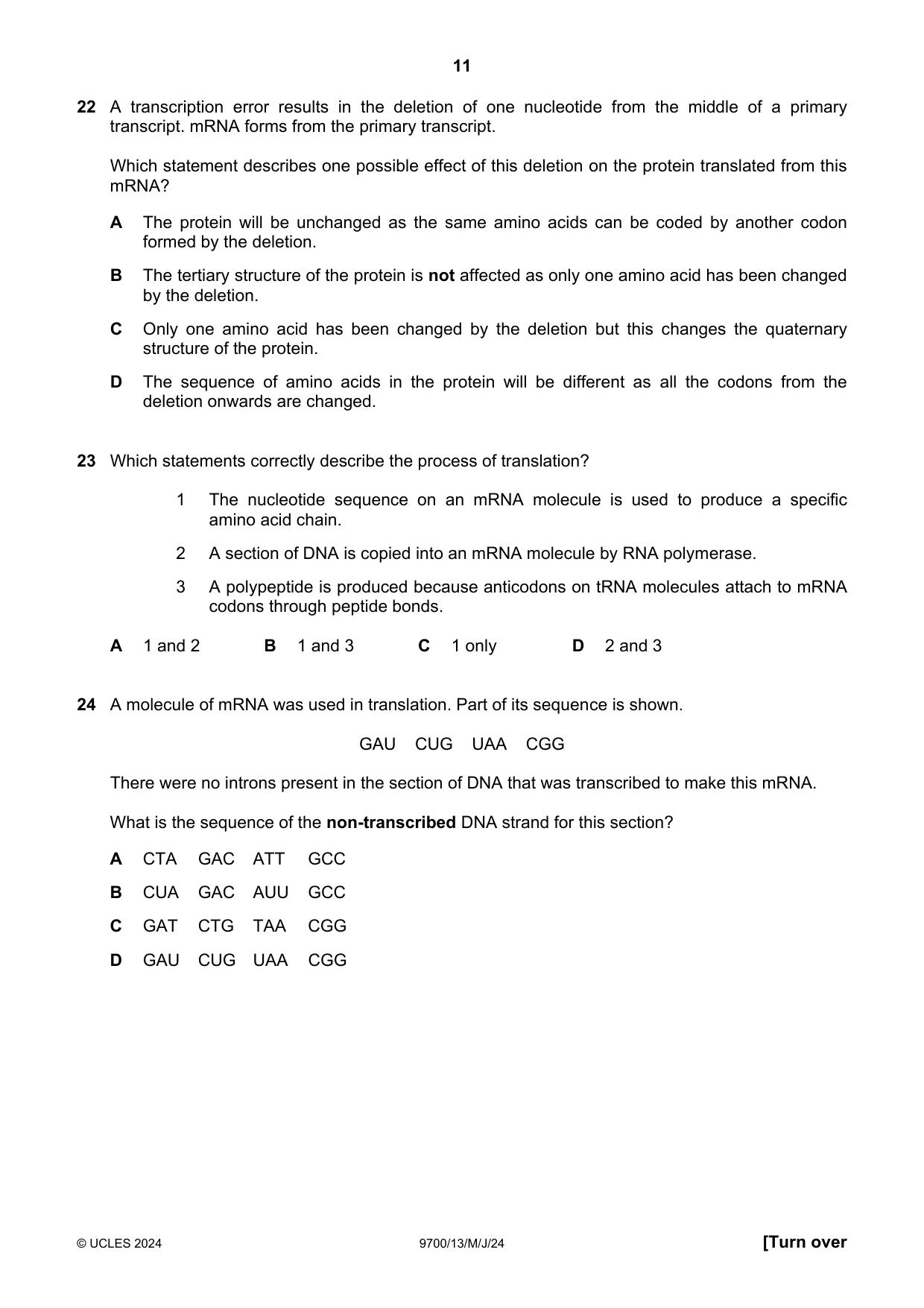
Q22 · A transcription error results in the deletion of one nucleotide from the middle of a…
22 A transcription error results in the deletion of one nucleotide from the middle of a primary transcript. mRNA forms from the primary transcript. Which statement describes one possible effect of this deletion on the protein translated from this mRNA? A The protein will be unchanged as the same amino acids can be coded by another codon formed by the deletion. B The tertiary structure of the protein is not affected as only one amino acid has been changed by the deletion. C Only one amino acid has been changed by the deletion but this changes the quaternary structure of the protein. D The sequence of amino acids in the protein will be different as all the codons from the deletion onwards are changed.
Mark scheme: D
Q23 · Which statements correctly describe the process of translation?
23 Which statements correctly describe the process of translation? 1 The nucleotide sequence on an mRNA molecule is used to produce a specific amino acid chain. 2 A section of DNA is copied into an mRNA molecule by RNA polymerase. 3 A polypeptide is produced because anticodons on tRNA molecules attach to mRNA codons through peptide bonds. A 1 and 2 B 1 and 3 C 1 only D 2 and 3
Mark scheme: C
Q24 · A molecule of mRNA was used in translation
24 A molecule of mRNA was used in translation. Part of its sequence is shown. GAU CUG UAA CGG There were no introns present in the section of DNA that was transcribed to make this mRNA. What is the sequence of the non-transcribed DNA strand for this section? A CTA GAC ATT GCC B CUA GAC AUU GCC C GAT CTG TAA CGG D GAU CUG UAA CGG
Mark scheme: C
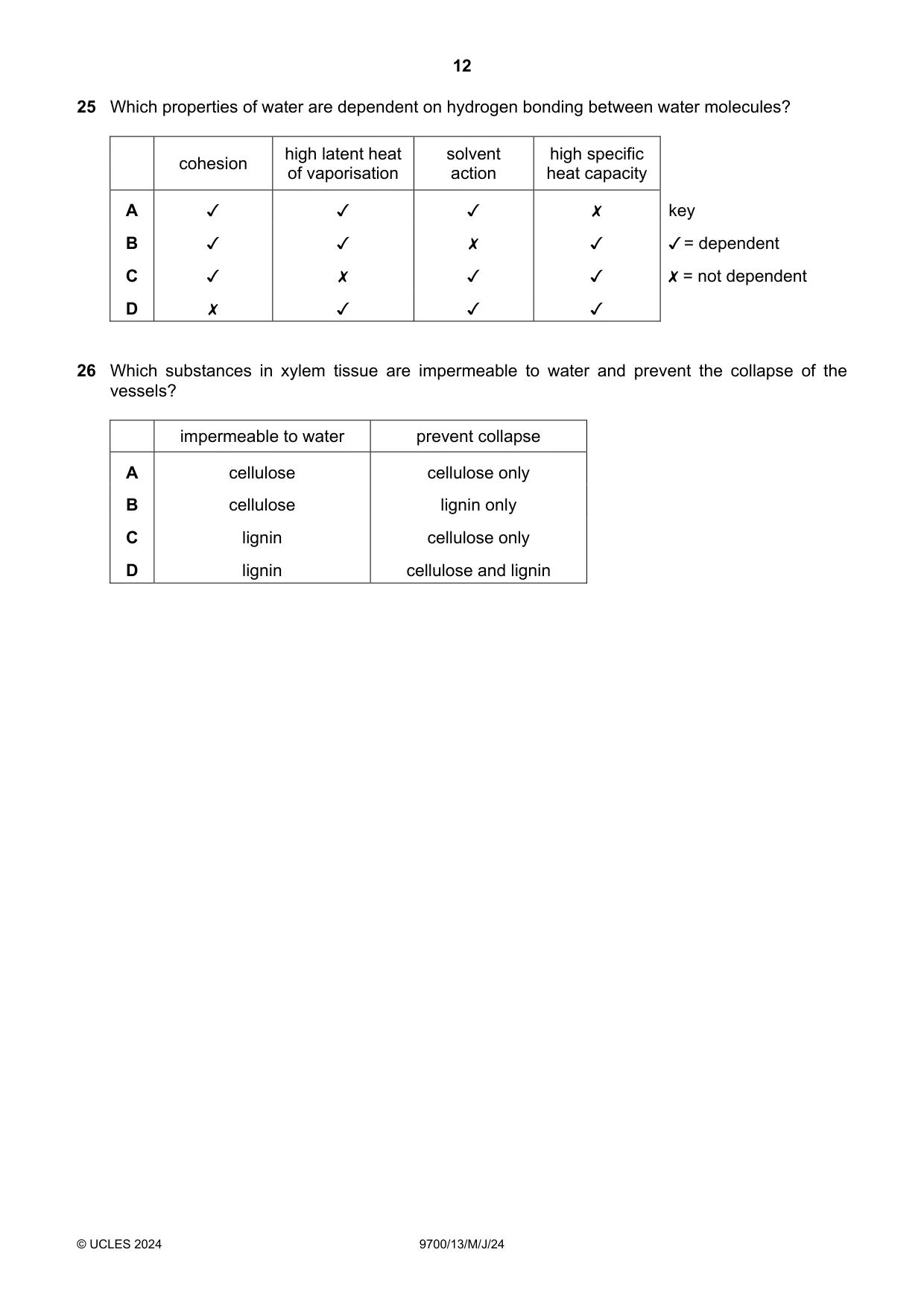
Q25 · Which properties of water are dependent on hydrogen bonding between water molecules?
25 Which properties of water are dependent on hydrogen bonding between water molecules? cohesion high latent heat solvent high specific of vaporisation action heat capacity A v v v x B v v x v Cc v x v v D x v v v key Jv = dependent X = not dependent
Mark scheme: B
Q26 · Which substances in xylem tissue are impermeable to water and prevent the collapse of the…
26 Which substances in xylem tissue are impermeable to water and prevent the collapse of the vessels? impermeable to water prevent collapse A cellulose cellulose only B cellulose lignin only C lignin cellulose only D lignin cellulose and lignin
Mark scheme: D
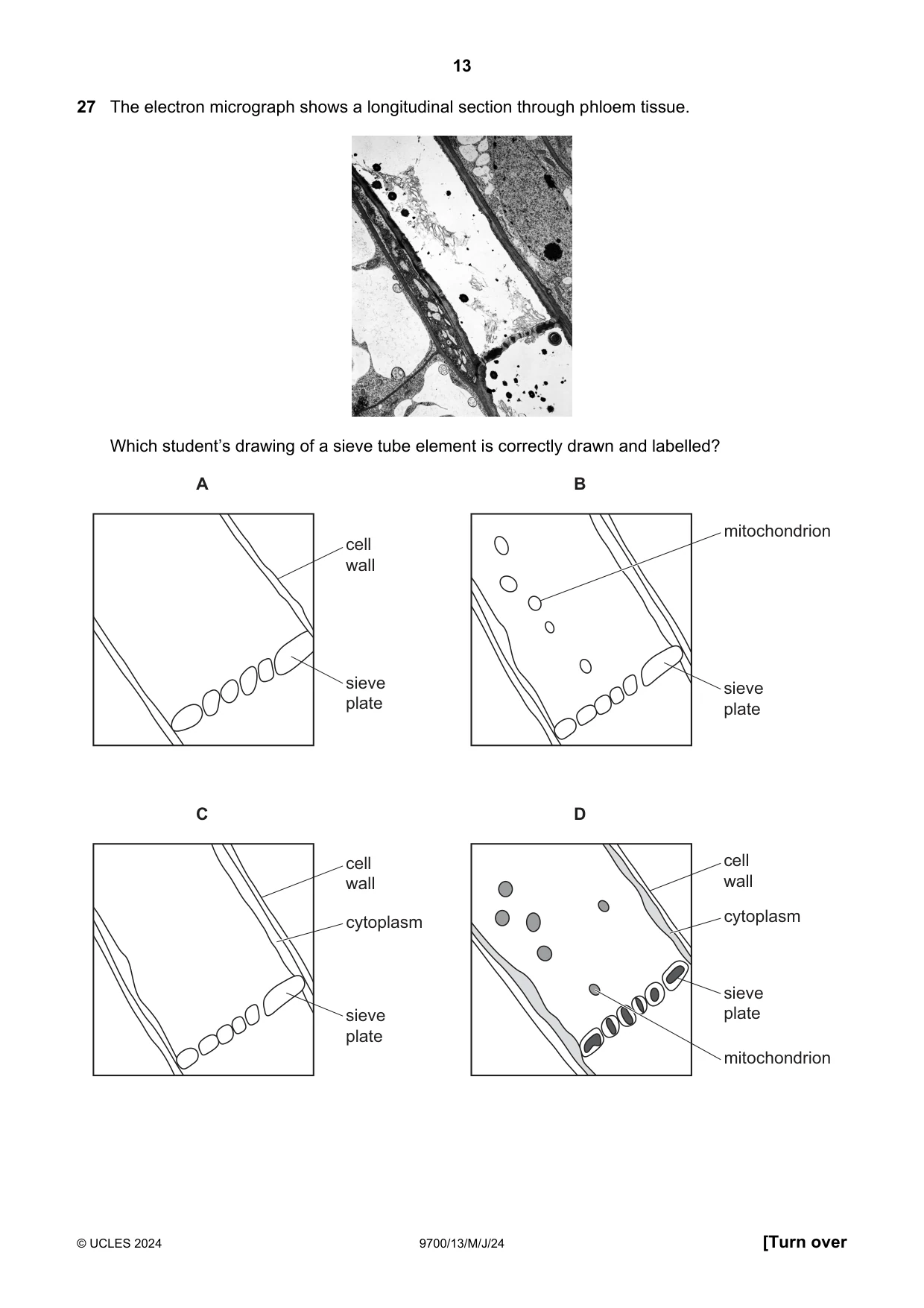
Q27 · The electron micrograph shows a longitudinal section through phloem tissue
27 The electron micrograph shows a longitudinal section through phloem tissue. Which student’s drawing of a sieve tube element is correctly drawn and labelled? A B mitochondrion cell wall sieve sieve plate plate C D cell cell wall wall cytoplasm cytoplasm sieve sieve plate plate mitochondrion
Mark scheme: C
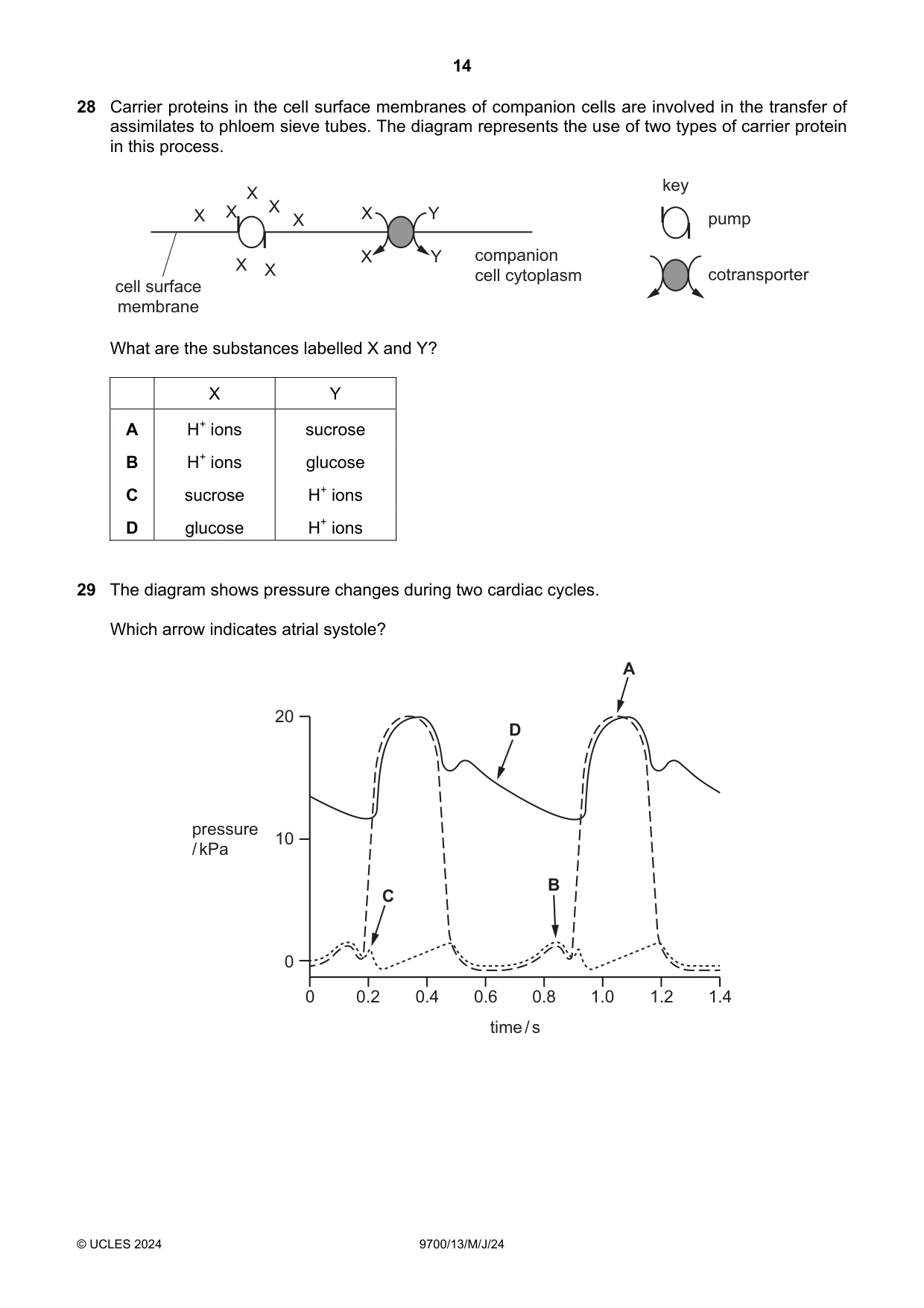
Q28 · Carrier proteins in the cell surface membranes of companion cells are involved in the…
28 Carrier proteins in the cell surface membranes of companion cells are involved in the transfer of assimilates to phloem sieve tubes. The diagram represents the use of two types of carrier protein in this process. key X X X X Y X X pump X Y companion X X cell cytoplasm cotransporter cell surface membrane What are the substances labelled X and Y? X Y A H+ ions sucrose B H+ ions glucose C sucrose H+ ions D glucose H+ ions
Mark scheme: A
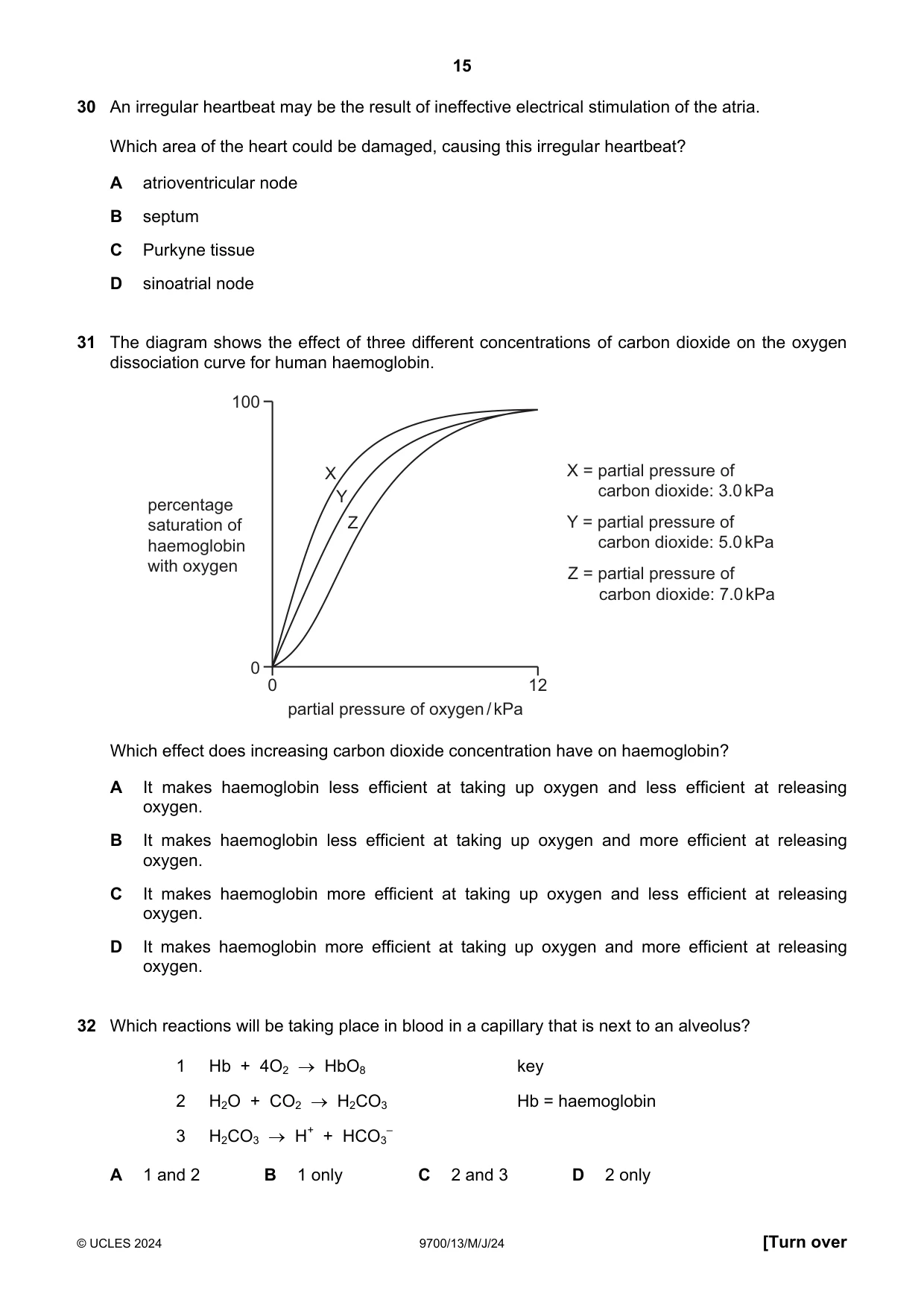
Q29 · The diagram shows pressure changes during two cardiac cycles
29 The diagram shows pressure changes during two cardiac cycles. Which arrow indicates atrial systole? A 20 D pressure 10 / kPa B C 0 0 0.2 0.4 0.6 0.8 1.0 1.2 1.4 time / s
Mark scheme: B
Q30 · An irregular heartbeat may be the result of ineffective electrical stimulation of the…
30 An irregular heartbeat may be the result of ineffective electrical stimulation of the atria. Which area of the heart could be damaged, causing this irregular heartbeat? A atrioventricular node B septum C Purkyne tissue D sinoatrial node
Mark scheme: D
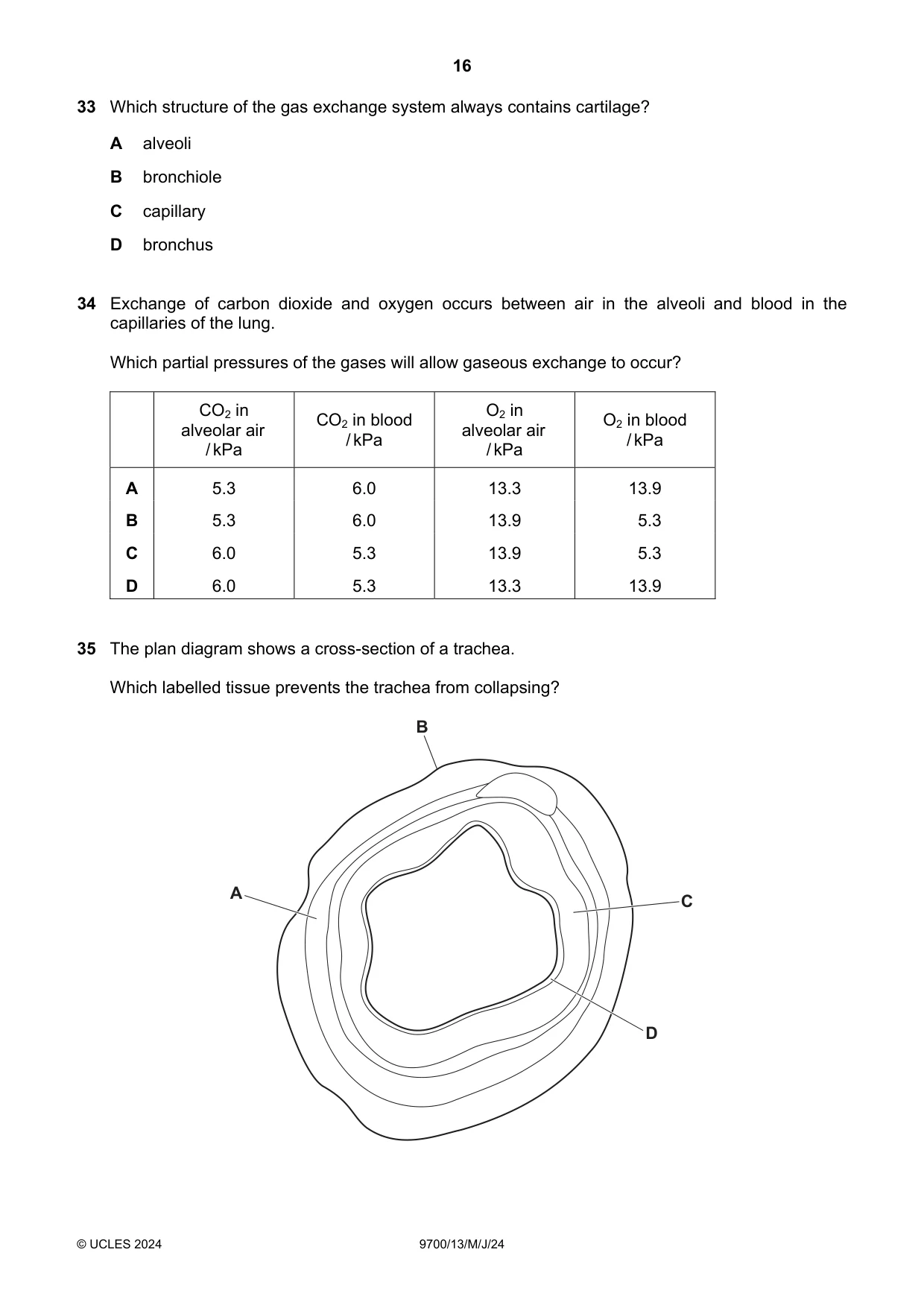
Q31 · The diagram shows the effect of three different concentrations of carbon dioxide on the…
31 The diagram shows the effect of three different concentrations of carbon dioxide on the oxygen dissociation curve for human haemoglobin. 100 X X = partial pressure of Y carbon dioxide: 3.0 kPa percentage saturation of Z Y = partial pressure of haemoglobin carbon dioxide: 5.0 kPa with oxygen Z = partial pressure of carbon dioxide: 7.0 kPa 0 0 12 partial pressure of oxygen / kPa Which effect does increasing carbon dioxide concentration have on haemoglobin? A It makes haemoglobin less efficient at taking up oxygen and less efficient at releasing oxygen. B It makes haemoglobin less efficient at taking up oxygen and more efficient at releasing oxygen. C It makes haemoglobin more efficient at taking up oxygen and less efficient at releasing oxygen. D It makes haemoglobin more efficient at taking up oxygen and more efficient at releasing oxygen.
Mark scheme: B
Q32 · Which reactions will be taking place in blood in a capillary that is next to an alveolus?
32 Which reactions will be taking place in blood in a capillary that is next to an alveolus? 1 Hb + 4O2 HbO8 key 2 H2O + CO2 H2CO3 Hb = haemoglobin 3 H2CO3 H+ + HCO3 – A 1 and 2 B 1 only C 2 and 3 D 2 only
Mark scheme: B
Q33 · Which structure of the gas exchange system always contains cartilage?
33 Which structure of the gas exchange system always contains cartilage? A alveoli B bronchiole C capillary D bronchus
Mark scheme: D
Q34 · Exchange of carbon dioxide and oxygen occurs between air in the alveoli and blood in the…
34 Exchange of carbon dioxide and oxygen occurs between air in the alveoli and blood in the capillaries of the lung. Which partial pressures of the gases will allow gaseous exchange to occur? CO2 in O2 in CO2 in blood O2 in blood alveolar air alveolar air / kPa / kPa / kPa / kPa A 5.3 6.0 13.3 13.9 B 5.3 6.0 13.9 5.3 C 6.0 5.3 13.9 5.3 D 6.0 5.3 13.3 13.9
Mark scheme: B
Q35 · The plan diagram shows a cross-section of a trachea
35 The plan diagram shows a cross-section of a trachea. Which labelled tissue prevents the trachea from collapsing? B A C D
Mark scheme: A
Q36 · Which layers of cells does an oxygen molecule diffuse through when moving from an…
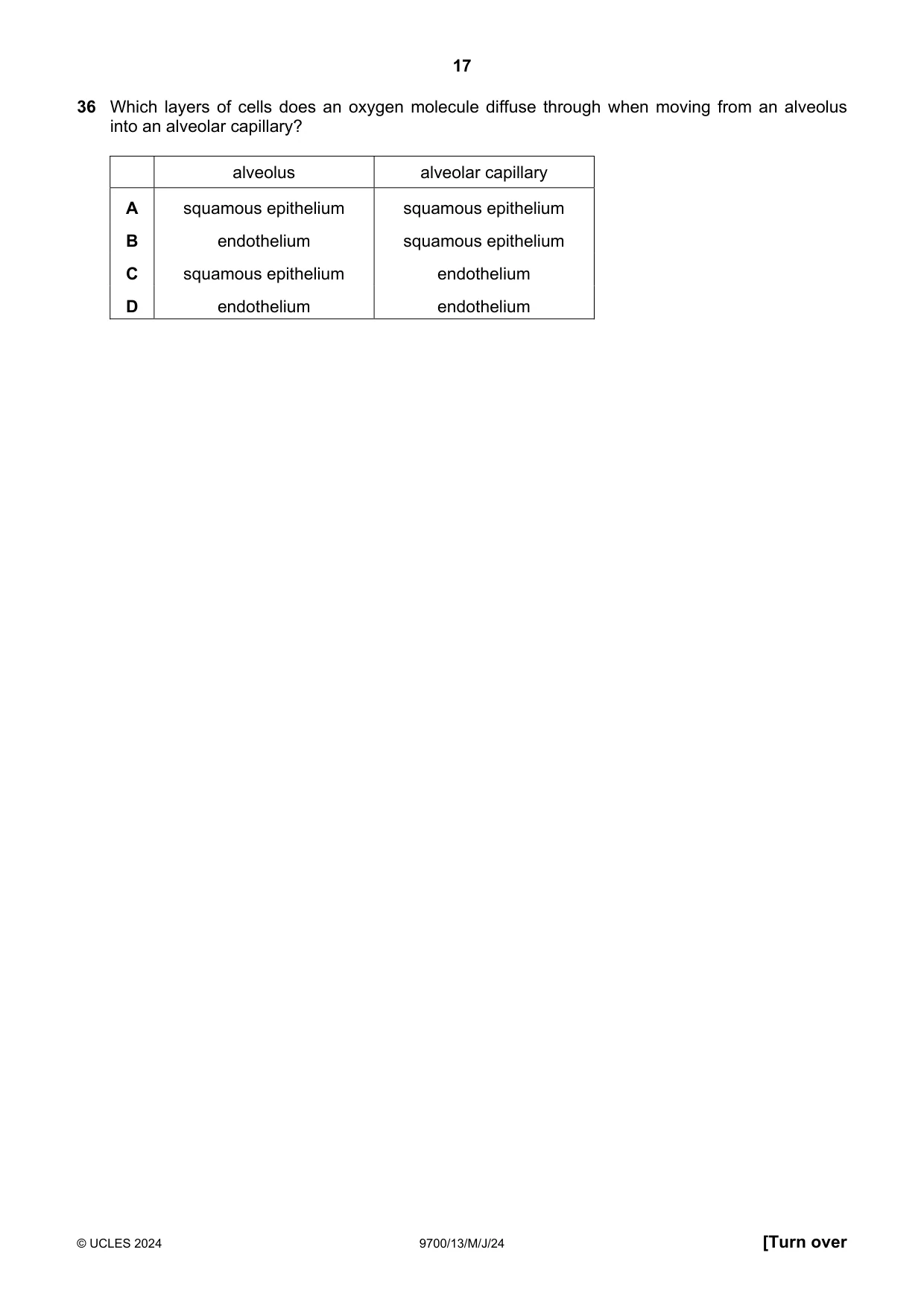
36 Which layers of cells does an oxygen molecule diffuse through when moving from an alveolus into an alveolar capillary? alveolus alveolar capillary A squamous epithelium squamous epithelium B endothelium squamous epithelium C squamous epithelium endothelium D endothelium endothelium
Mark scheme: C
Q37 · Bacteria may be classified according to differences in cell wall structure
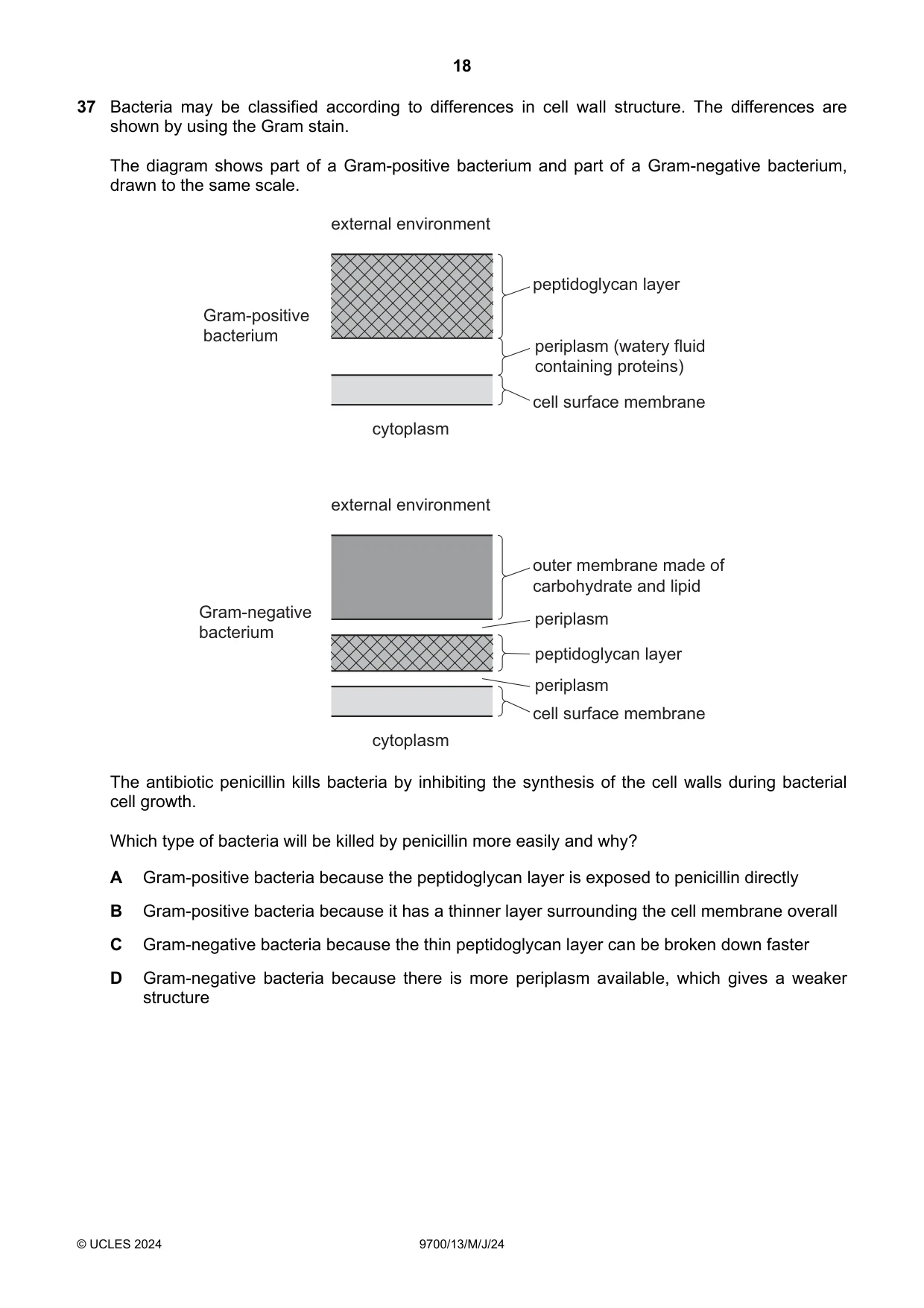
37 Bacteria may be classified according to differences in cell wall structure. The differences are shown by using the Gram stain. The diagram shows part of a Gram-positive bacterium and part of a Gram-negative bacterium, drawn to the same scale. external environment peptidoglycan layer Gram-positive bacterium periplasm (watery fluid containing proteins) cell surface membrane cytoplasm external environment outer membrane made of carbohydrate and lipid Gram-negative periplasm bacterium peptidoglycan layer periplasm cell surface membrane cytoplasm The antibiotic penicillin kills bacteria by inhibiting the synthesis of the cell walls during bacterial cell growth. Which type of bacteria will be killed by penicillin more easily and why? A Gram-positive bacteria because the peptidoglycan layer is exposed to penicillin directly B Gram-positive bacteria because it has a thinner layer surrounding the cell membrane overall C Gram-negative bacteria because the thin peptidoglycan layer can be broken down faster D Gram-negative bacteria because there is more periplasm available, which gives a weaker structure
Mark scheme: A
Q38 · Which facts relate to the disease TB or its pathogen?
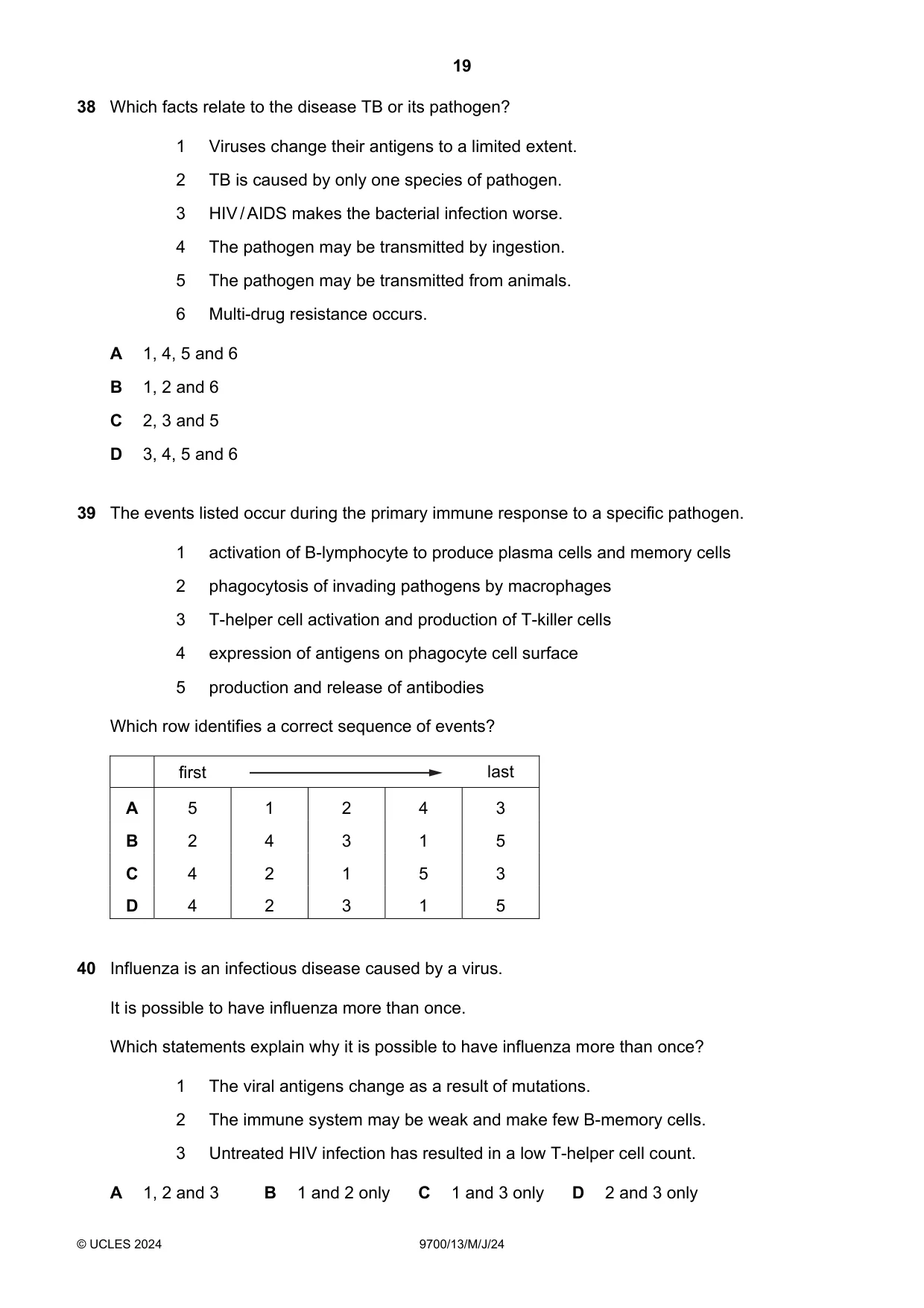
38 Which facts relate to the disease TB or its pathogen? 1 Viruses change their antigens to a limited extent. 2 TB is caused by only one species of pathogen. 3 HIV / AIDS makes the bacterial infection worse. 4 The pathogen may be transmitted by ingestion. 5 The pathogen may be transmitted from animals. 6 Multi-drug resistance occurs. A 1, 4, 5 and 6 B 1, 2 and 6 C 2, 3 and 5 D 3, 4, 5 and 6
Mark scheme: D
Q39 · The events listed occur during the primary immune response to a specific pathogen
39 The events listed occur during the primary immune response to a specific pathogen. 1 activation of B-lymphocyte to produce plasma cells and memory cells 2 phagocytosis of invading pathogens by macrophages 3 T-helper cell activation and production of T-killer cells 4 expression of antigens on phagocyte cell surface 5 production and release of antibodies Which row identifies a correct sequence of events? first last A 5 1 2 4 3 B 2 4 3 1 5 C 4 2 1 5 3 D 4 2 3 1 5
Mark scheme: B
Q40 · Influenza is an infectious disease caused by a virus
40 Influenza is an infectious disease caused by a virus. It is possible to have influenza more than once. Which statements explain why it is possible to have influenza more than once? 1 The viral antigens change as a result of mutations. 2 The immune system may be weak and make few B-memory cells. 3 Untreated HIV infection has resulted in a low T-helper cell count. A 1, 2 and 3 B 1 and 2 only C 1 and 3 only D 2 and 3 only
Mark scheme: A
What was in this paper
The subtopics covered by these 40 questions, and how many questions each got. Open one in a new tab to see every Cambridge question on it.
4Carbohydrates and lipids3Cells as the basic units of living organisms3Movement into and out of cells3Protein synthesis3Chromosome behaviour in mitosis2Factors that affect enzyme action2Mode of action of enzymes2Replication and division of nuclei and cells2Structure of transport tissues2The heart2Transport of oxygen and carbon dioxide2Antibiotics1Antibodies and vaccination1Fluid mosaic membranes1Infectious diseases1Proteins1Structure of nucleic acids and replication of DNA1The immune system1The microscope in cell studies1Transport mechanisms1Water1What you needed in this session
Cambridge’s own grade thresholds for 2024 May/June, Paper 1 · Variant 3. A higher threshold means an easier paper — the bar moves with how the cohort did.