Cambridge A Level Biology 9700 — 2018 Feb/March Paper 1 · Variant 2
9700/12/F/M/18 · 40 questions · 40 marks · ≈45 min
The question paper and its mark scheme, free to read here and free to download. This is Cambridge’s own paper, exactly as it was sat.
Question paper16 pages

Mark scheme3 pages
Answers below. Sit the paper first if you are practising.
Questions as text
Q1 · The eyepiece lens of a microscope can be fitted with an eyepiece graticule
1 The eyepiece lens of a microscope can be fitted with an eyepiece graticule. Which of these statements about eyepiece graticules are correct? 1 They measure the actual length of cells in micrometres. 2 They help biologists to draw cells with correct proportions. 3 They change in size when the objective lens is changed from ×10 to ×40. A 1, 2 and 3 B 1 and 3 only C 1 only D 2 only
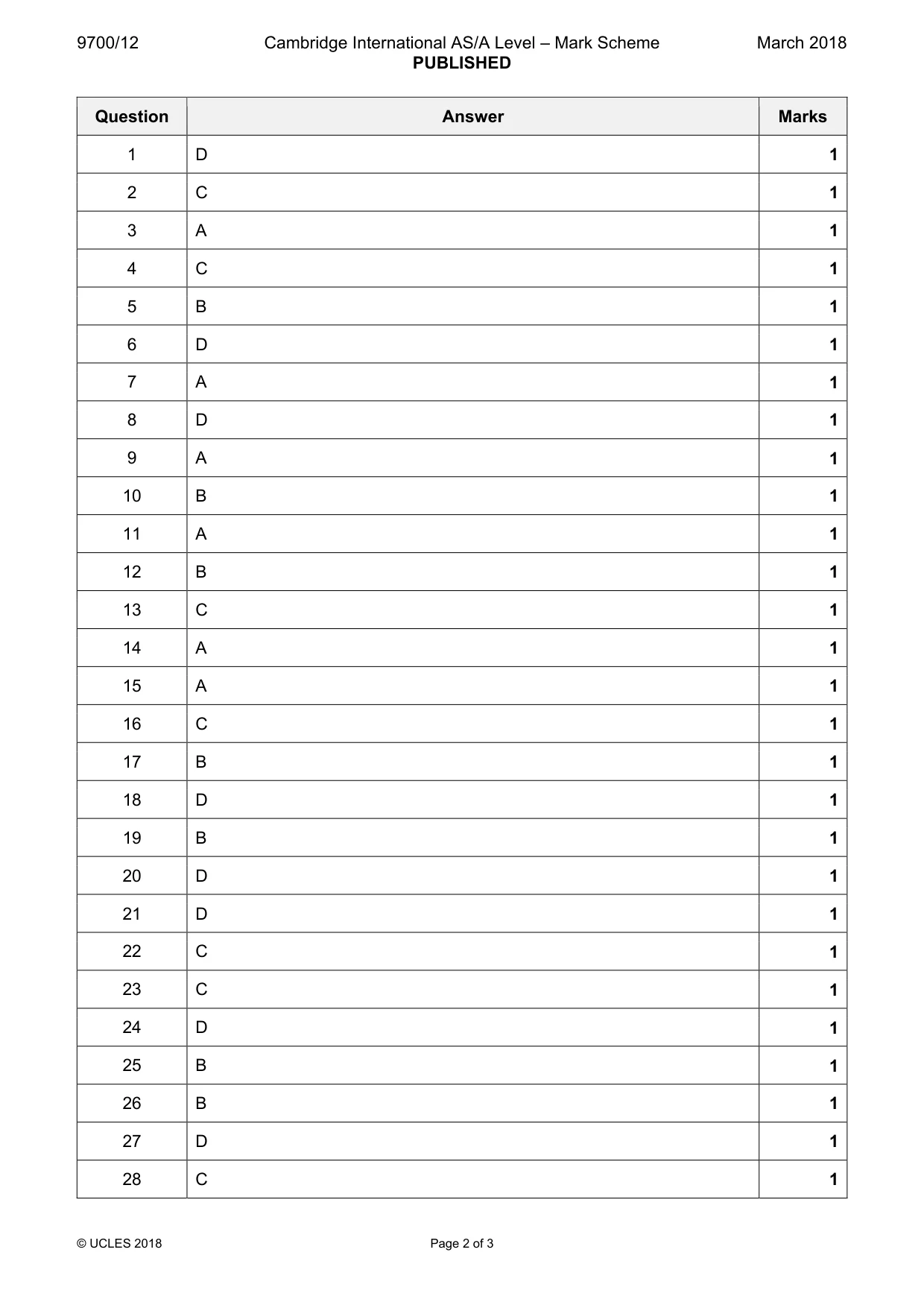
Mark scheme: D
Q2 · A student was asked to use the scale bar shown to calculate the magnification of a cell…
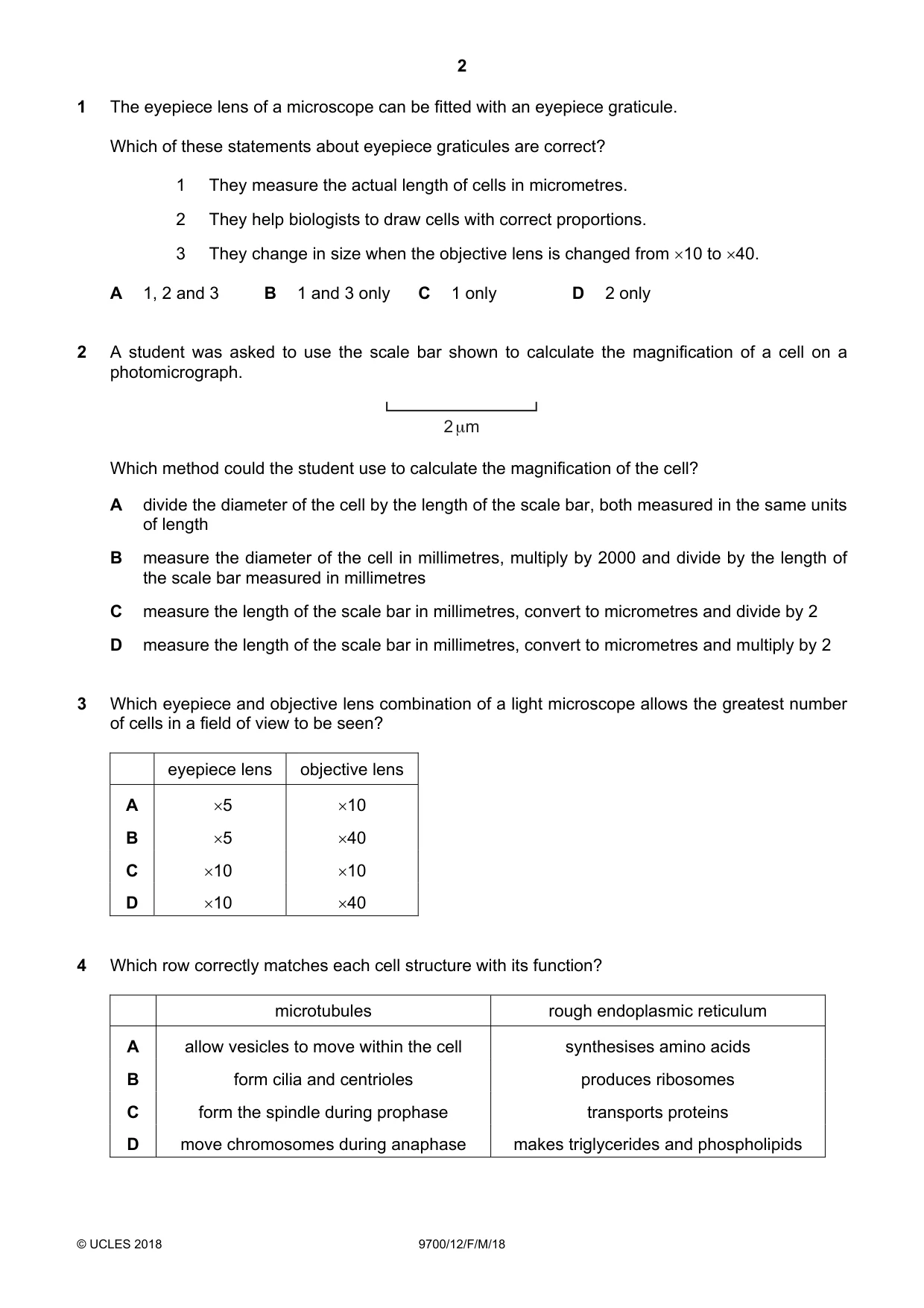
2 A student was asked to use the scale bar shown to calculate the magnification of a cell on a photomicrograph. 2 μm Which method could the student use to calculate the magnification of the cell? A divide the diameter of the cell by the length of the scale bar, both measured in the same units of length B measure the diameter of the cell in millimetres, multiply by 2000 and divide by the length of the scale bar measured in millimetres C measure the length of the scale bar in millimetres, convert to micrometres and divide by 2 D measure the length of the scale bar in millimetres, convert to micrometres and multiply by 2
Mark scheme: C
Q3 · Which eyepiece and objective lens combination of a light microscope allows the greatest…
3 Which eyepiece and objective lens combination of a light microscope allows the greatest number of cells in a field of view to be seen? eyepiece lens objective lens A ×5 ×10 B ×5 ×40 C ×10 ×10 D ×10 ×40
Mark scheme: A
Q4 · Which row correctly matches each cell structure with its function?
4 Which row correctly matches each cell structure with its function? microtubules rough endoplasmic reticulum A allow vesicles to move within the cell synthesises amino acids B form cilia and centrioles produces ribosomes C form the spindle during prophase transports proteins D move chromosomes during anaphase makes triglycerides and phospholipids
Mark scheme: C
More questions on Cells as the basic units of living organisms
Q5 · Which animal cells would have the most extensive Golgi bodies?
5 Which animal cells would have the most extensive Golgi bodies? A ciliated epithelial cells B goblet cells C red blood cells D smooth muscle cells
Mark scheme: B
More questions on Cells as the basic units of living organisms
Q6 · Which of these processes will require ATP?
6 Which of these processes will require ATP? 1 transport of water in the xylem 2 semi-conservative replication of DNA 3 facilitated diffusion of amino acids into the cell A 1, 2 and 3 B 1 and 2 only C 2 and 3 only D 2 only
Mark scheme: D
Q7 · Which concentrations could be produced by a serial dilution of an 8.00% glucose solution?
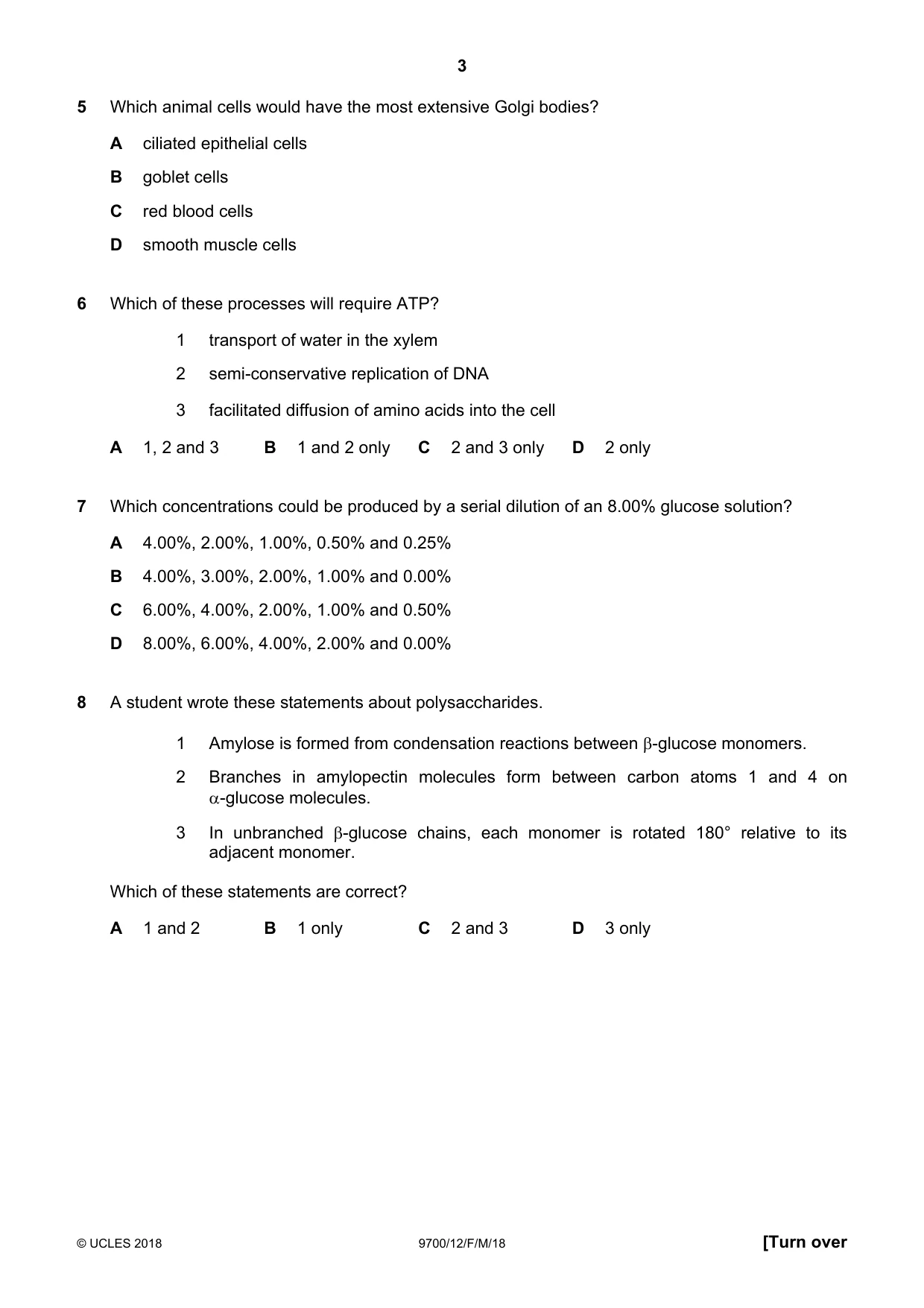
7 Which concentrations could be produced by a serial dilution of an 8.00% glucose solution? A 4.00%, 2.00%, 1.00%, 0.50% and 0.25% B 4.00%, 3.00%, 2.00%, 1.00% and 0.00% C 6.00%, 4.00%, 2.00%, 1.00% and 0.50% D 8.00%, 6.00%, 4.00%, 2.00% and 0.00%
Mark scheme: A
Q8 · A student wrote these statements about polysaccharides
8 A student wrote these statements about polysaccharides. 1 Amylose is formed from condensation reactions between β-glucose monomers. 2 Branches in amylopectin molecules form between carbon atoms 1 and 4 on α-glucose molecules. 3 In unbranched β-glucose chains, each monomer is rotated 180° relative to its adjacent monomer. Which of these statements are correct? A 1 and 2 B 1 only C 2 and 3 D 3 only
Mark scheme: D
Q9 · Which diagram correctly shows the formation of a peptide bond between two amino acids?
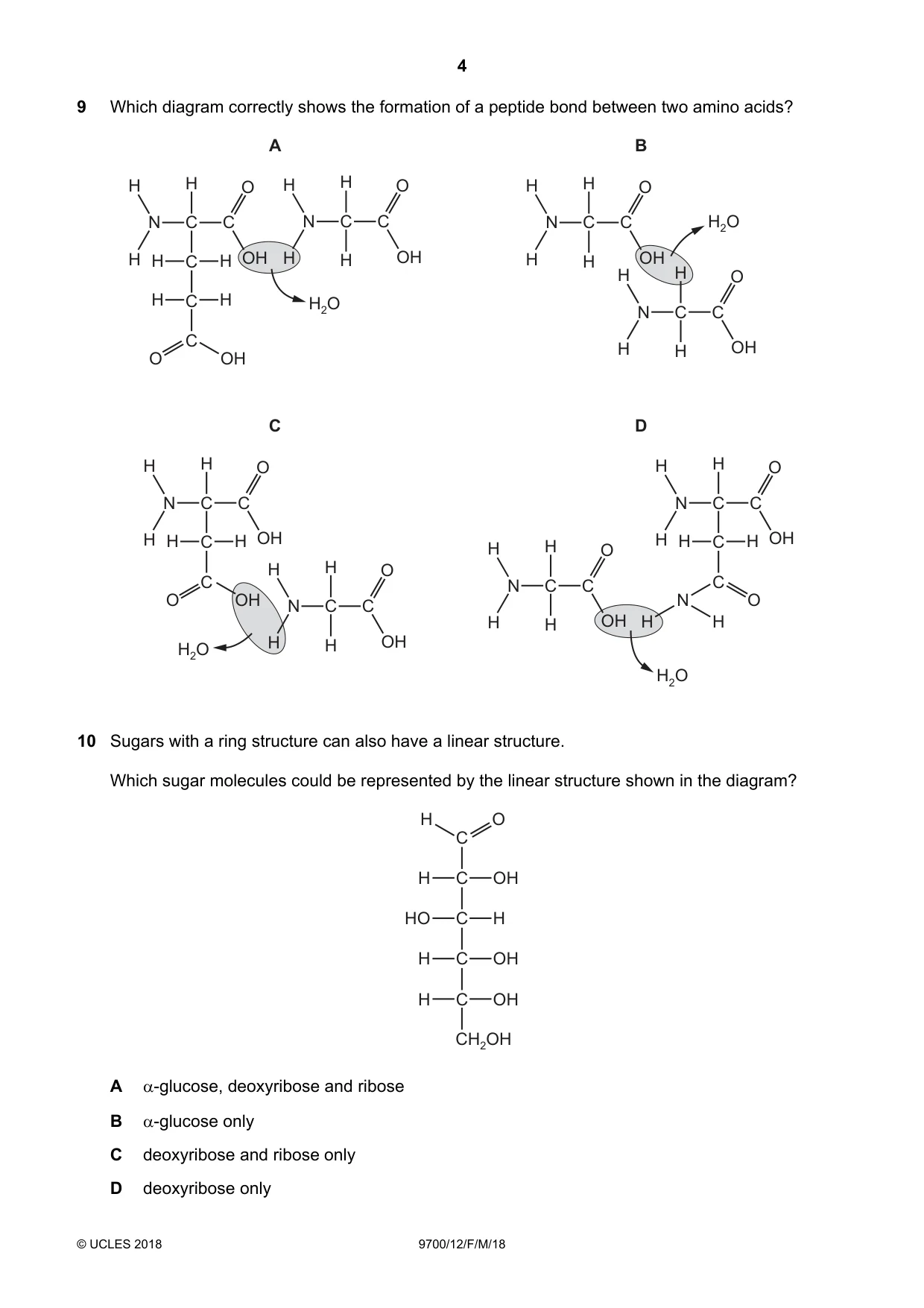
9 Which diagram correctly shows the formation of a peptide bond between two amino acids? A B H H O H H O H H O N C C N C C N C C H2O H H C H OH H H OH H H OH H H O H C H H2O N C C C OH H H O OH C D H H O H H O N C C N C C H H C H OH H H C H OH H H O H H O C N C C C O OH N C C N O H H OH H H H2O H H OH H2O
Mark scheme: A
Q10 · Sugars with a ring structure can also have a linear structure
10 Sugars with a ring structure can also have a linear structure. Which sugar molecules could be represented by the linear structure shown in the diagram? H O C H C OH HO C H H C OH H C OH CH2OH A α-glucose, deoxyribose and ribose B α-glucose only C deoxyribose and ribose only D deoxyribose only
Mark scheme: B
Q11 · Which molecules are globular proteins?
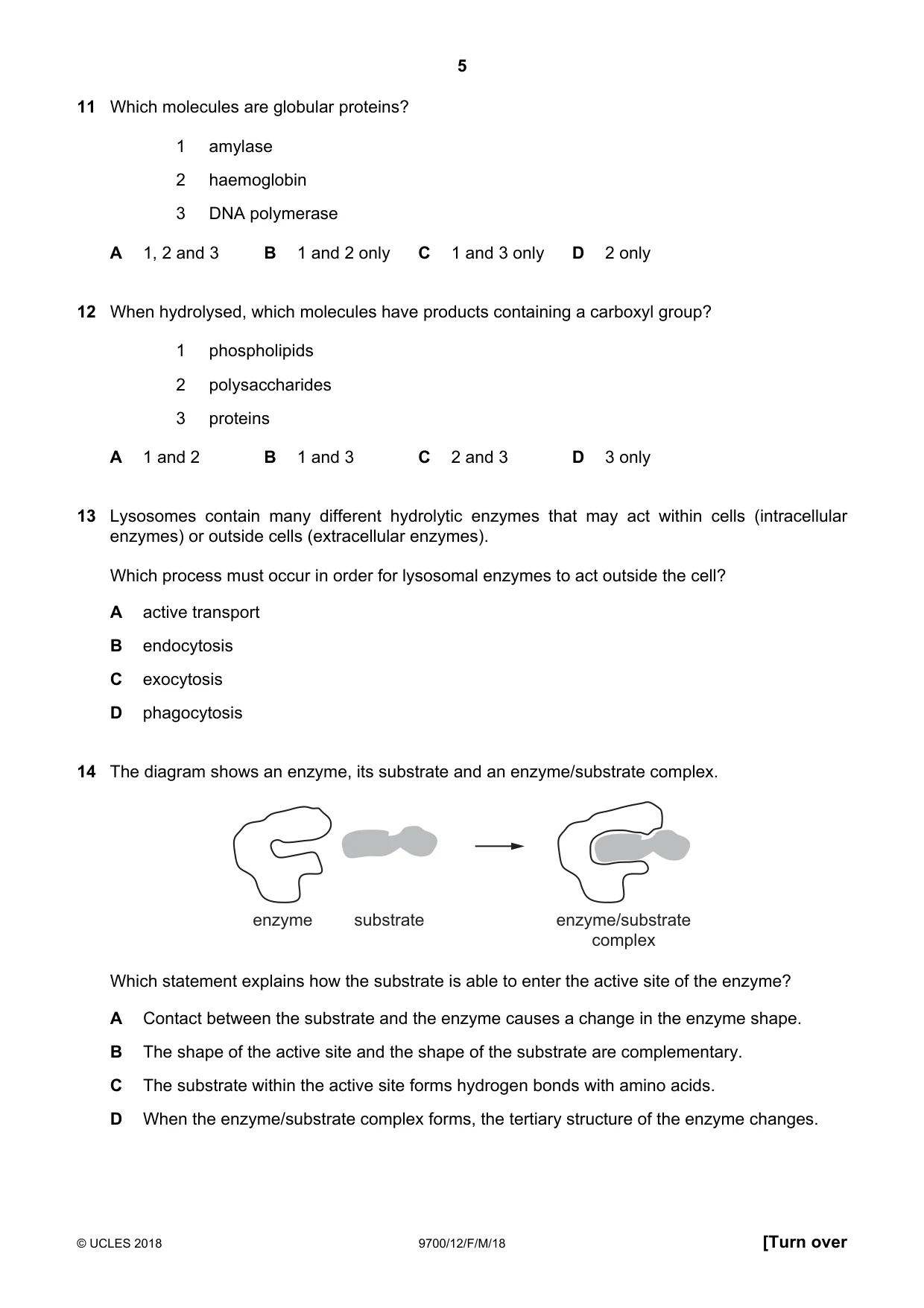
11 Which molecules are globular proteins? 1 amylase 2 haemoglobin 3 DNA polymerase A 1, 2 and 3 B 1 and 2 only C 1 and 3 only D 2 only
Mark scheme: A
Q12 · When hydrolysed, which molecules have products containing a carboxyl group?
12 When hydrolysed, which molecules have products containing a carboxyl group? 1 phospholipids 2 polysaccharides 3 proteins A 1 and 2 B 1 and 3 C 2 and 3 D 3 only
Mark scheme: B
Q13 · Lysosomes contain many different hydrolytic enzymes that may act within cells…
13 Lysosomes contain many different hydrolytic enzymes that may act within cells (intracellular enzymes) or outside cells (extracellular enzymes). Which process must occur in order for lysosomal enzymes to act outside the cell? A active transport B endocytosis C exocytosis D phagocytosis
Mark scheme: C
More questions on Cells as the basic units of living organisms
Q14 · The diagram shows an enzyme, its substrate and an enzyme/substrate complex
14 The diagram shows an enzyme, its substrate and an enzyme/substrate complex. enzyme substrate enzyme/substrate complex Which statement explains how the substrate is able to enter the active site of the enzyme? A Contact between the substrate and the enzyme causes a change in the enzyme shape. B The shape of the active site and the shape of the substrate are complementary. C The substrate within the active site forms hydrogen bonds with amino acids. D When the enzyme/substrate complex forms, the tertiary structure of the enzyme changes.
Mark scheme: A
Q15 · What could be used to calculate the rate of an enzyme-catalysed reaction?
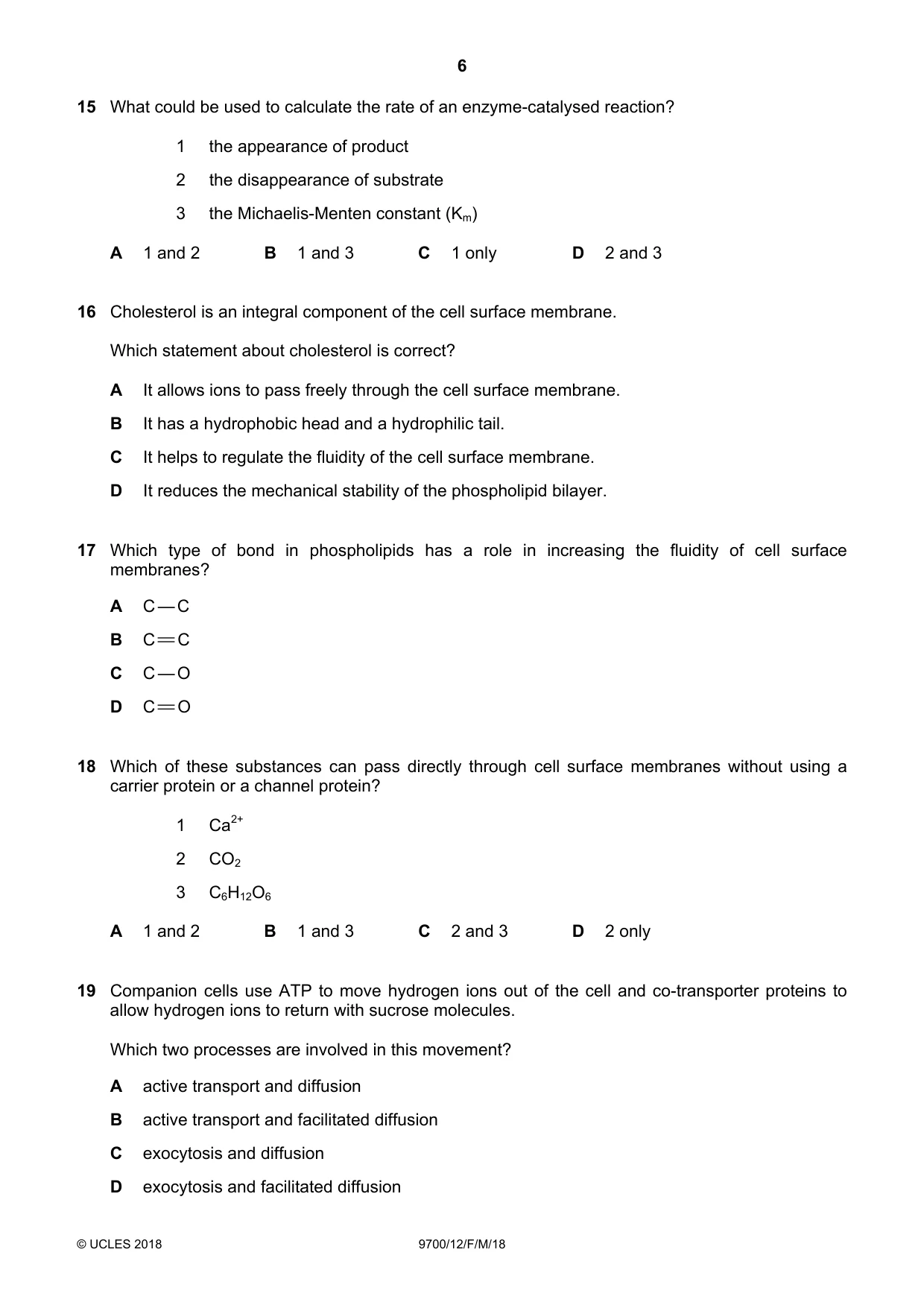
15 What could be used to calculate the rate of an enzyme-catalysed reaction? 1 the appearance of product 2 the disappearance of substrate 3 the Michaelis-Menten constant (Km) A 1 and 2 B 1 and 3 C 1 only D 2 and 3
Mark scheme: A
Q16 · Cholesterol is an integral component of the cell surface membrane
16 Cholesterol is an integral component of the cell surface membrane. Which statement about cholesterol is correct? A It allows ions to pass freely through the cell surface membrane. B It has a hydrophobic head and a hydrophilic tail. C It helps to regulate the fluidity of the cell surface membrane. D It reduces the mechanical stability of the phospholipid bilayer.
Mark scheme: C
Q17 · Which type of bond in phospholipids has a role in increasing the fluidity of cell surface…
17 Which type of bond in phospholipids has a role in increasing the fluidity of cell surface membranes? A C — C B C C C C — O D C O
Mark scheme: B
Q18 · Which of these substances can pass directly through cell surface membranes without using…
18 Which of these substances can pass directly through cell surface membranes without using a carrier protein or a channel protein? 1 Ca2+ 2 CO2 3 C6H12O6 A 1 and 2 B 1 and 3 C 2 and 3 D 2 only
Mark scheme: D
Q19 · Companion cells use ATP to move hydrogen ions out of the cell and co-transporter proteins…
19 Companion cells use ATP to move hydrogen ions out of the cell and co-transporter proteins to allow hydrogen ions to return with sucrose molecules. Which two processes are involved in this movement? A active transport and diffusion B active transport and facilitated diffusion C exocytosis and diffusion D exocytosis and facilitated diffusion
Mark scheme: B
Q20 · How many copies of each different DNA molecule will be found in a cell at the start of…
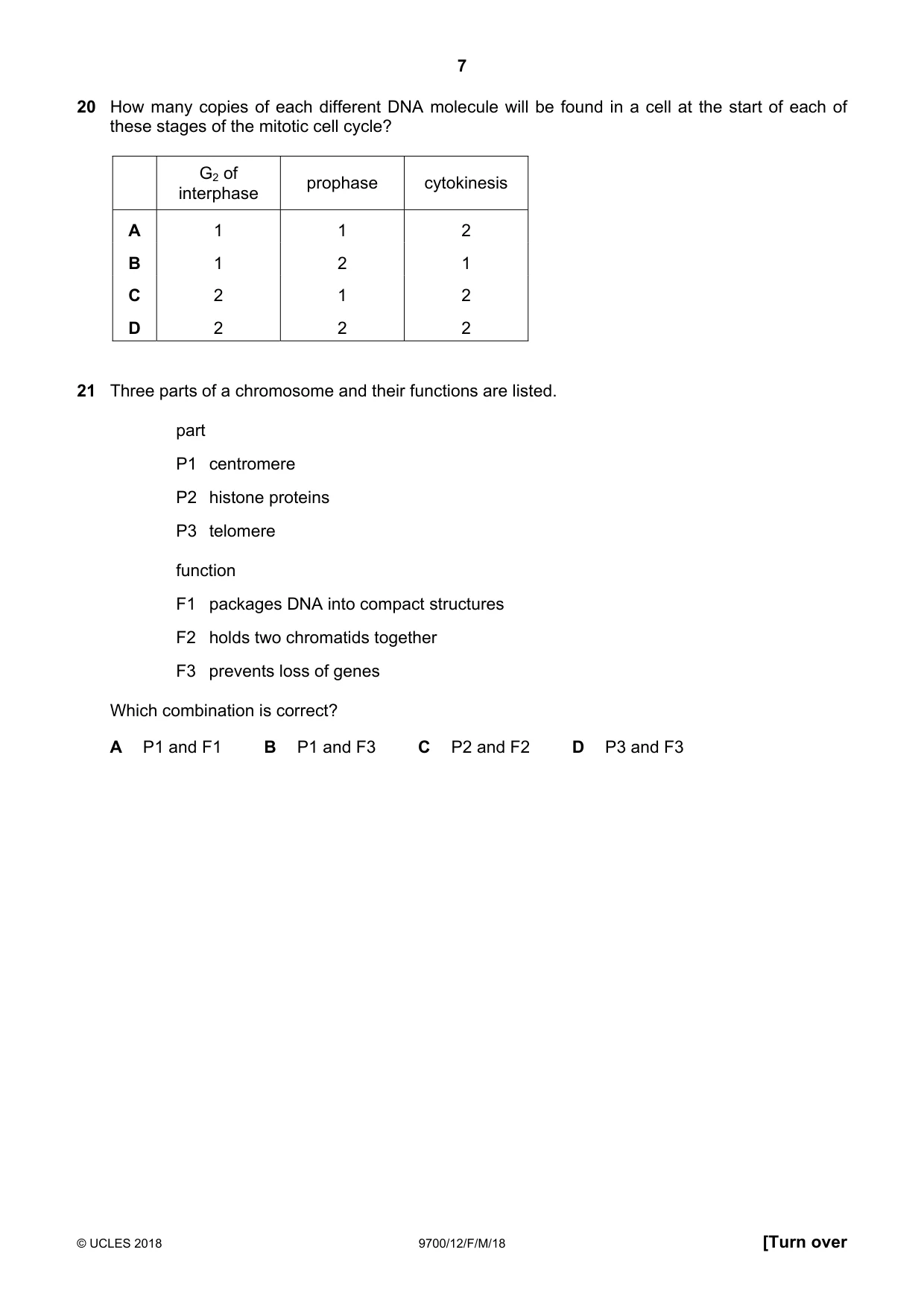
20 How many copies of each different DNA molecule will be found in a cell at the start of each of these stages of the mitotic cell cycle? G2 of prophase cytokinesis interphase A 1 1 2 B 1 2 1 C 2 1 2 D 2 2 2
Mark scheme: D
More questions on Replication and division of nuclei and cells
Q21 · Three parts of a chromosome and their functions are listed
21 Three parts of a chromosome and their functions are listed. part P1 centromere P2 histone proteins P3 telomere function F1 packages DNA into compact structures F2 holds two chromatids together F3 prevents loss of genes Which combination is correct? A P1 and F1 B P1 and F3 C P2 and F2 D P3 and F3
Mark scheme: D
Q22 · The graphs show various distance measurements taken from metaphase of mitosis onwards
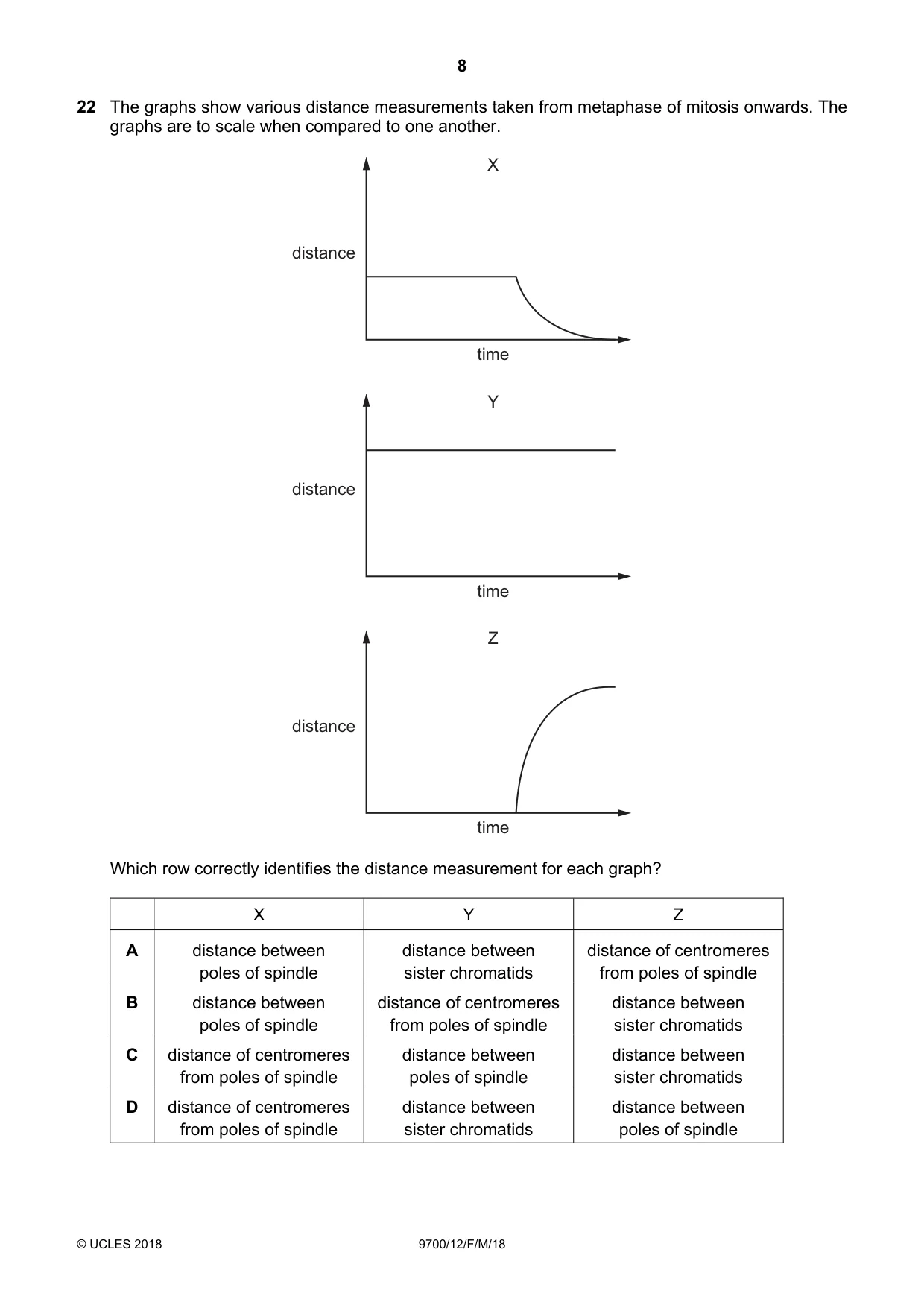
22 The graphs show various distance measurements taken from metaphase of mitosis onwards. The graphs are to scale when compared to one another. X distance time Y distance time Z distance time Which row correctly identifies the distance measurement for each graph? X Y Z A distance between distance between distance of centromeres poles of spindle sister chromatids from poles of spindle B distance between distance of centromeres distance between poles of spindle from poles of spindle sister chromatids C distance of centromeres distance between distance between from poles of spindle poles of spindle sister chromatids D distance of centromeres distance between distance between from poles of spindle sister chromatids poles of spindle
Mark scheme: C
Q23 · A culture of bacteria was allowed to reproduce using nucleotides containing the heavy…
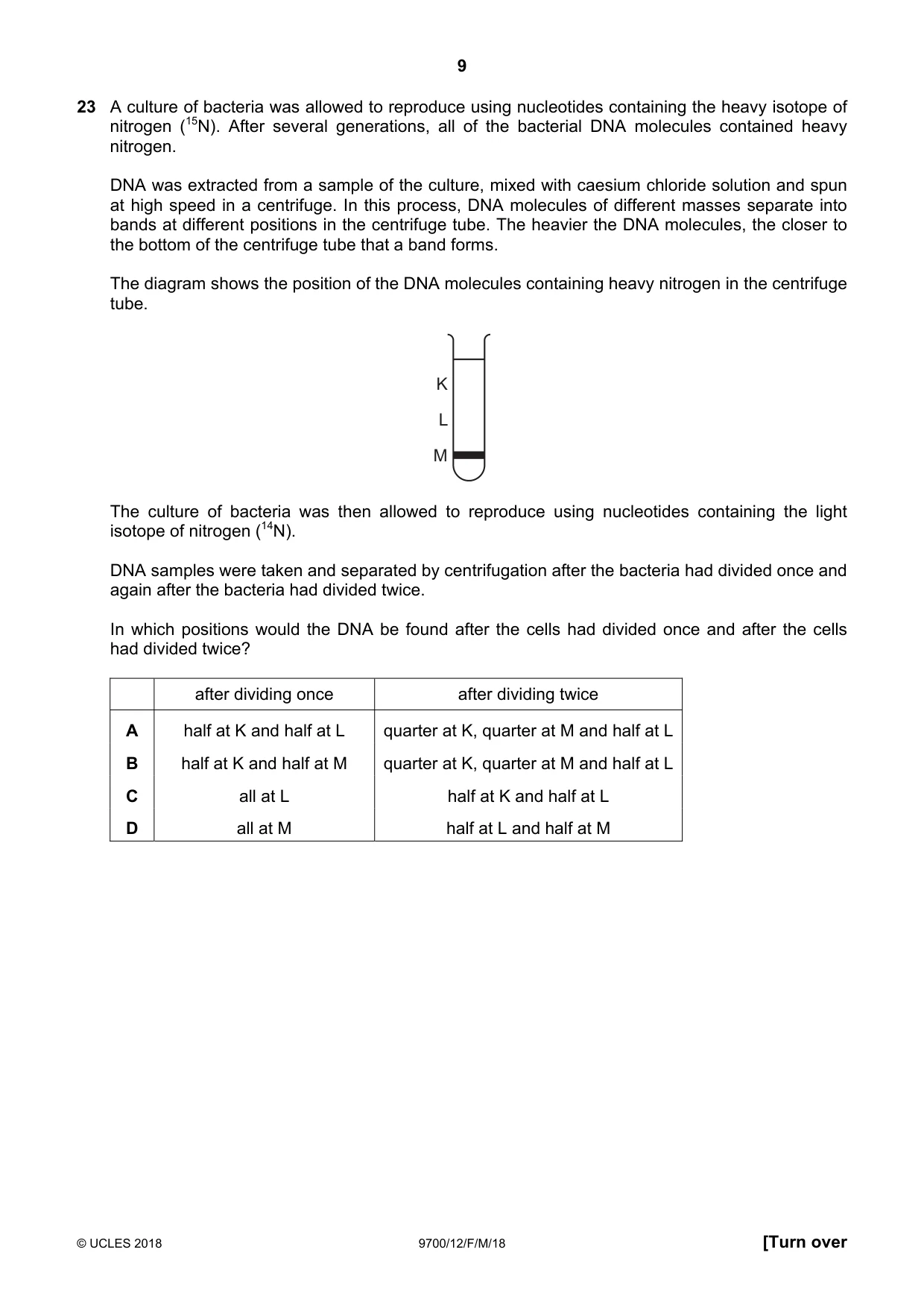
23 A culture of bacteria was allowed to reproduce using nucleotides containing the heavy isotope of nitrogen (15N). After several generations, all of the bacterial DNA molecules contained heavy nitrogen. DNA was extracted from a sample of the culture, mixed with caesium chloride solution and spun at high speed in a centrifuge. In this process, DNA molecules of different masses separate into bands at different positions in the centrifuge tube. The heavier the DNA molecules, the closer to the bottom of the centrifuge tube that a band forms. The diagram shows the position of the DNA molecules containing heavy nitrogen in the centrifuge tube. K L M The culture of bacteria was then allowed to reproduce using nucleotides containing the light isotope of nitrogen (14N). DNA samples were taken and separated by centrifugation after the bacteria had divided once and again after the bacteria had divided twice. In which positions would the DNA be found after the cells had divided once and after the cells had divided twice? after dividing once after dividing twice A half at K and half at L quarter at K, quarter at M and half at L B half at K and half at M quarter at K, quarter at M and half at L C all at L half at K and half at L D all at M half at L and half at M
Mark scheme: C
More questions on Structure of nucleic acids and replication of DNA
Q24 · The diagram represents a molecule of ATP
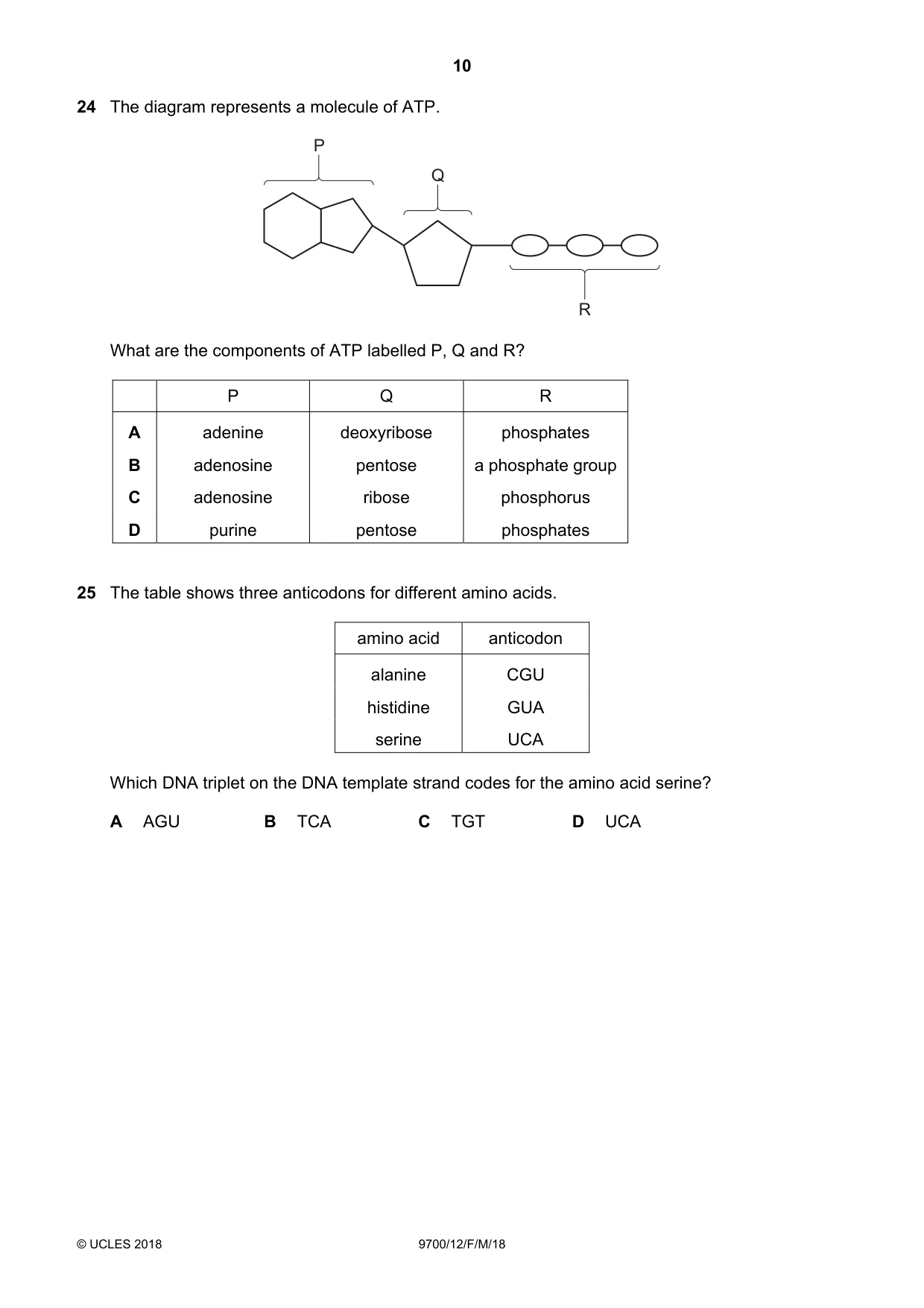
24 The diagram represents a molecule of ATP. P Q R What are the components of ATP labelled P, Q and R? P Q R A adenine deoxyribose phosphates B adenosine pentose a phosphate group C adenosine ribose phosphorus D purine pentose phosphates
Mark scheme: D
Q25 · The table shows three anticodons for different amino acids
25 The table shows three anticodons for different amino acids. amino acid anticodon alanine CGU histidine GUA serine UCA Which DNA triplet on the DNA template strand codes for the amino acid serine? A AGU B TCA C TGT D UCA
Mark scheme: B
Q26 · The photomicrograph shows a transport tissue in the stem of a grape vine
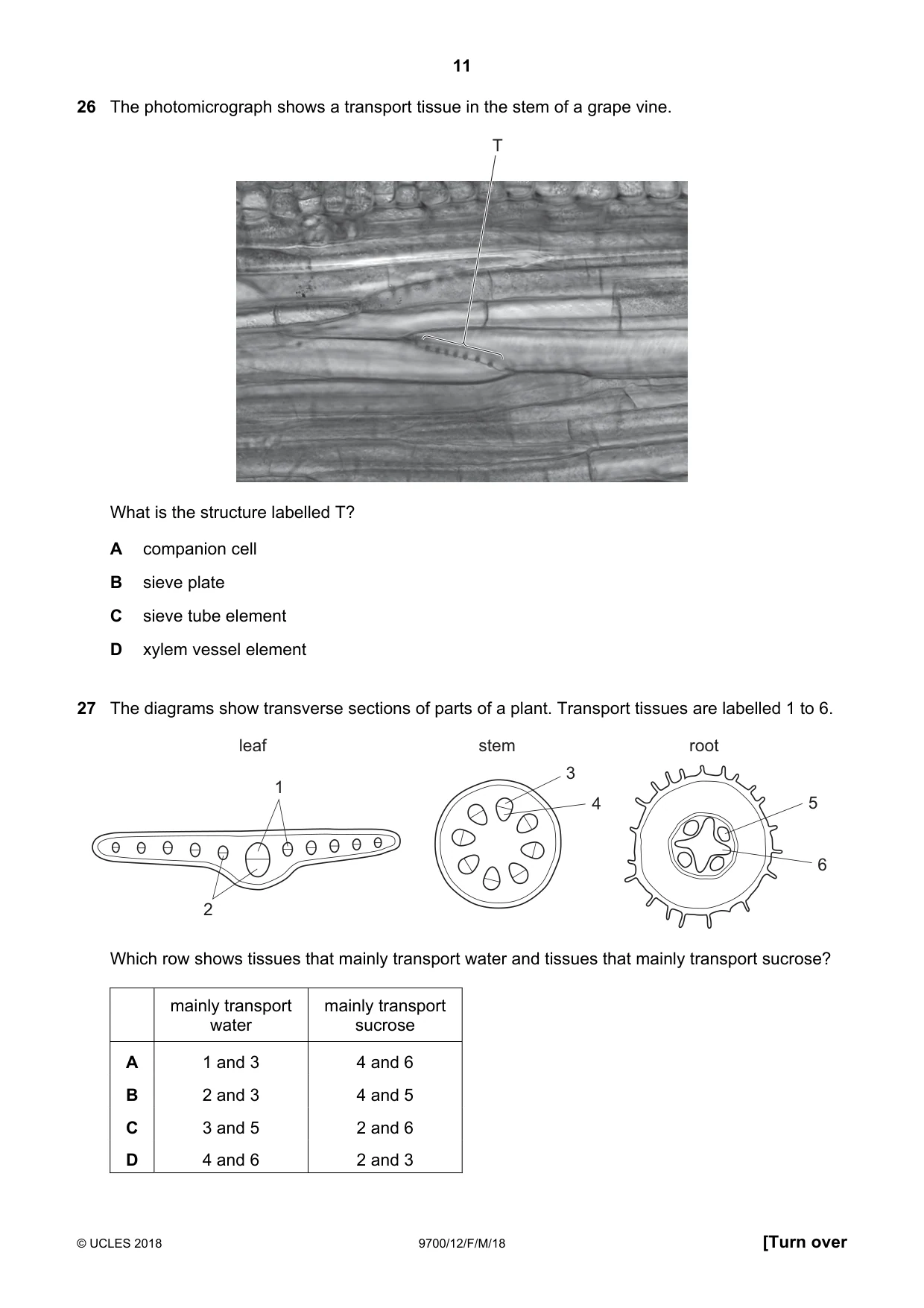
26 The photomicrograph shows a transport tissue in the stem of a grape vine. T What is the structure labelled T? A companion cell B sieve plate C sieve tube element D xylem vessel element
Mark scheme: B
Q27 · The diagrams show transverse sections of parts of a plant
27 The diagrams show transverse sections of parts of a plant. Transport tissues are labelled 1 to 6. leaf stem root 3 1 4 5 6 2 Which row shows tissues that mainly transport water and tissues that mainly transport sucrose? mainly transport mainly transport water sucrose A 1 and 3 4 and 6 B 2 and 3 4 and 5 C 3 and 5 2 and 6 D 4 and 6 2 and 3
Mark scheme: D
Q28 · What will increase the rate of transpiration?
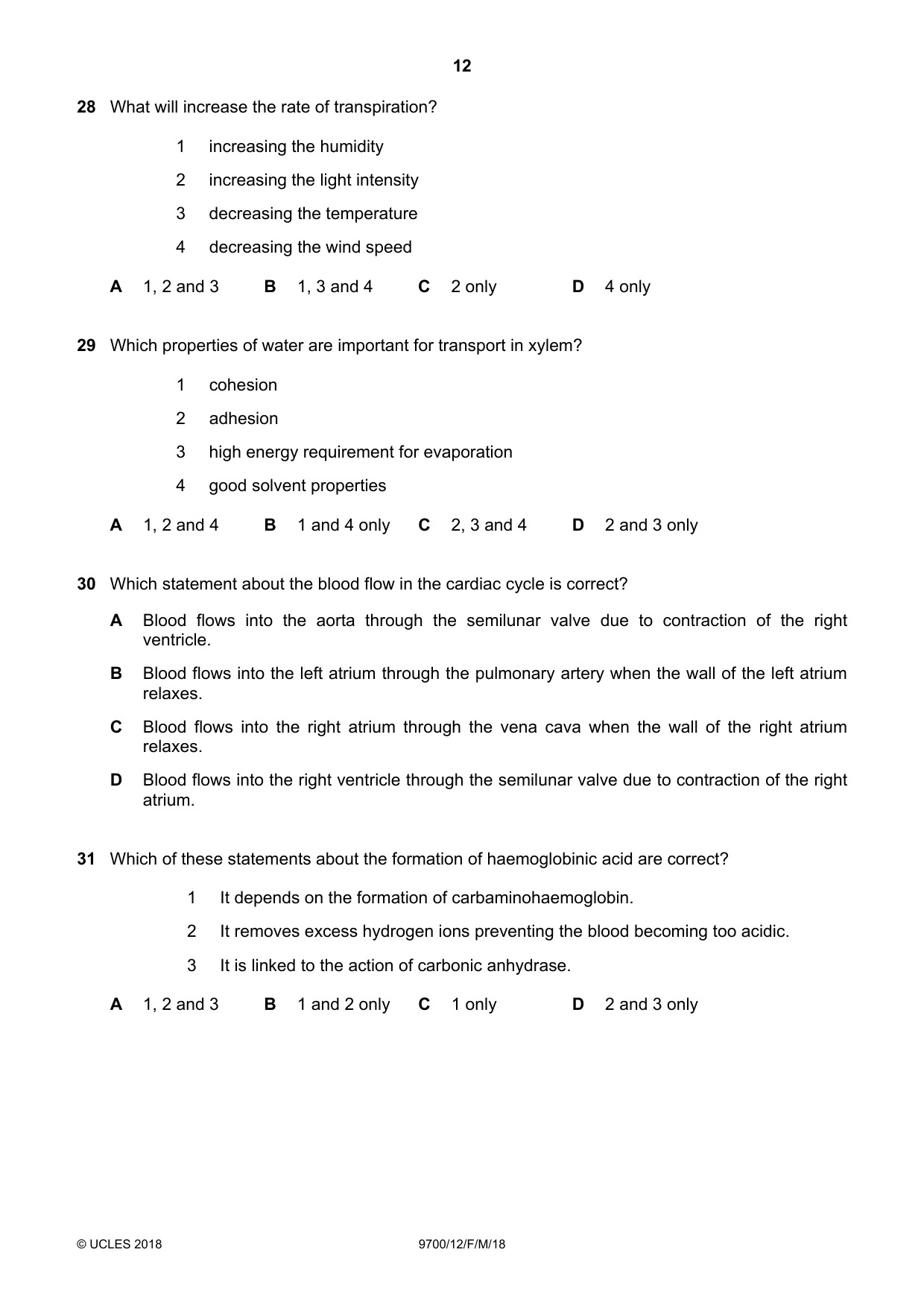
28 What will increase the rate of transpiration? 1 increasing the humidity 2 increasing the light intensity 3 decreasing the temperature 4 decreasing the wind speed A 1, 2 and 3 B 1, 3 and 4 C 2 only D 4 only
Mark scheme: C
Q29 · Which properties of water are important for transport in xylem?
29 Which properties of water are important for transport in xylem? 1 cohesion 2 adhesion 3 high energy requirement for evaporation 4 good solvent properties A 1, 2 and 4 B 1 and 4 only C 2, 3 and 4 D 2 and 3 only
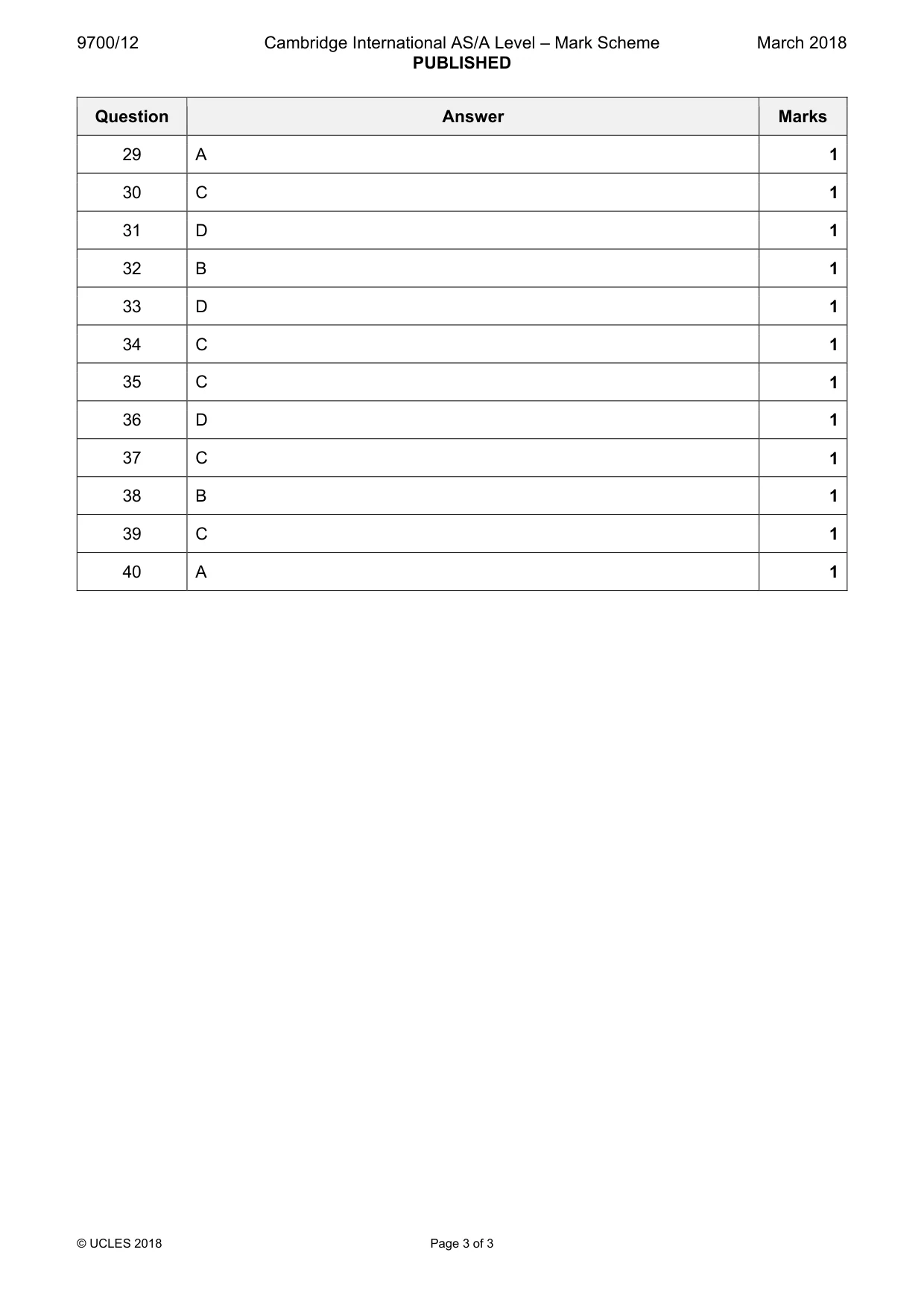
Mark scheme: A
Q30 · Which statement about the blood flow in the cardiac cycle is correct?
30 Which statement about the blood flow in the cardiac cycle is correct? A Blood flows into the aorta through the semilunar valve due to contraction of the right ventricle. B Blood flows into the left atrium through the pulmonary artery when the wall of the left atrium relaxes. C Blood flows into the right atrium through the vena cava when the wall of the right atrium relaxes. D Blood flows into the right ventricle through the semilunar valve due to contraction of the right atrium.
Mark scheme: C
Q31 · Which of these statements about the formation of haemoglobinic acid are correct?
31 Which of these statements about the formation of haemoglobinic acid are correct? 1 It depends on the formation of carbaminohaemoglobin. 2 It removes excess hydrogen ions preventing the blood becoming too acidic. 3 It is linked to the action of carbonic anhydrase. A 1, 2 and 3 B 1 and 2 only C 1 only D 2 and 3 only
Mark scheme: D
Q32 · What can combine with the haem group of a haemoglobin molecule?
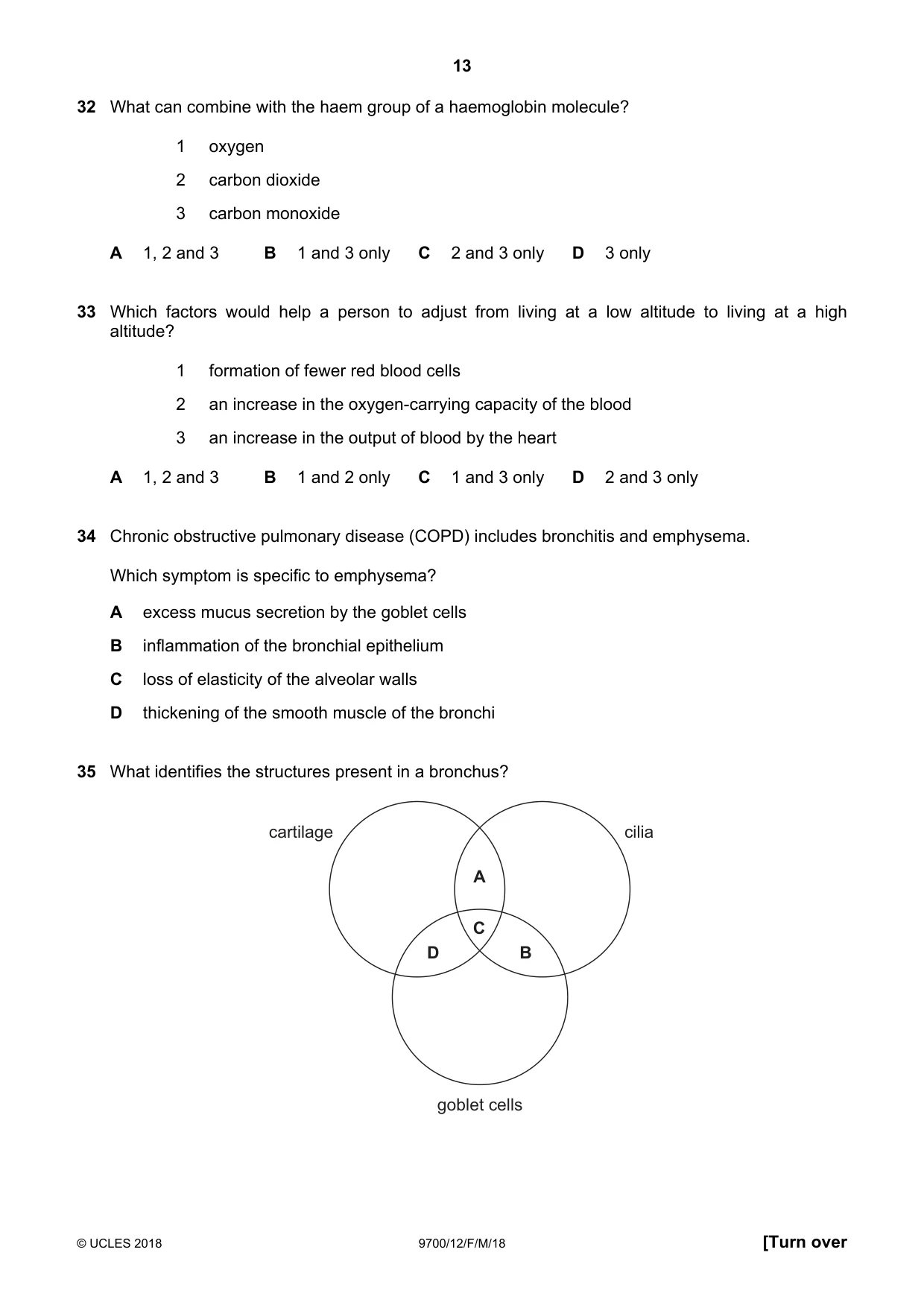
32 What can combine with the haem group of a haemoglobin molecule? 1 oxygen 2 carbon dioxide 3 carbon monoxide A 1, 2 and 3 B 1 and 3 only C 2 and 3 only D 3 only
Mark scheme: B
Q33 · Which factors would help a person to adjust from living at a low altitude to living at a…
33 Which factors would help a person to adjust from living at a low altitude to living at a high altitude? 1 formation of fewer red blood cells 2 an increase in the oxygen-carrying capacity of the blood 3 an increase in the output of blood by the heart A 1, 2 and 3 B 1 and 2 only C 1 and 3 only D 2 and 3 only
Mark scheme: D
Q34 · Chronic obstructive pulmonary disease (COPD) includes bronchitis and emphysema
34 Chronic obstructive pulmonary disease (COPD) includes bronchitis and emphysema. Which symptom is specific to emphysema? A excess mucus secretion by the goblet cells B inflammation of the bronchial epithelium C loss of elasticity of the alveolar walls D thickening of the smooth muscle of the bronchi
Mark scheme: C
Q35 · What identifies the structures present in a bronchus?
35 What identifies the structures present in a bronchus? cartilage cilia A C D B goblet cells
Mark scheme: C
Q36 · Which of these terms can be used to describe the role of mosquitoes in the transmission…
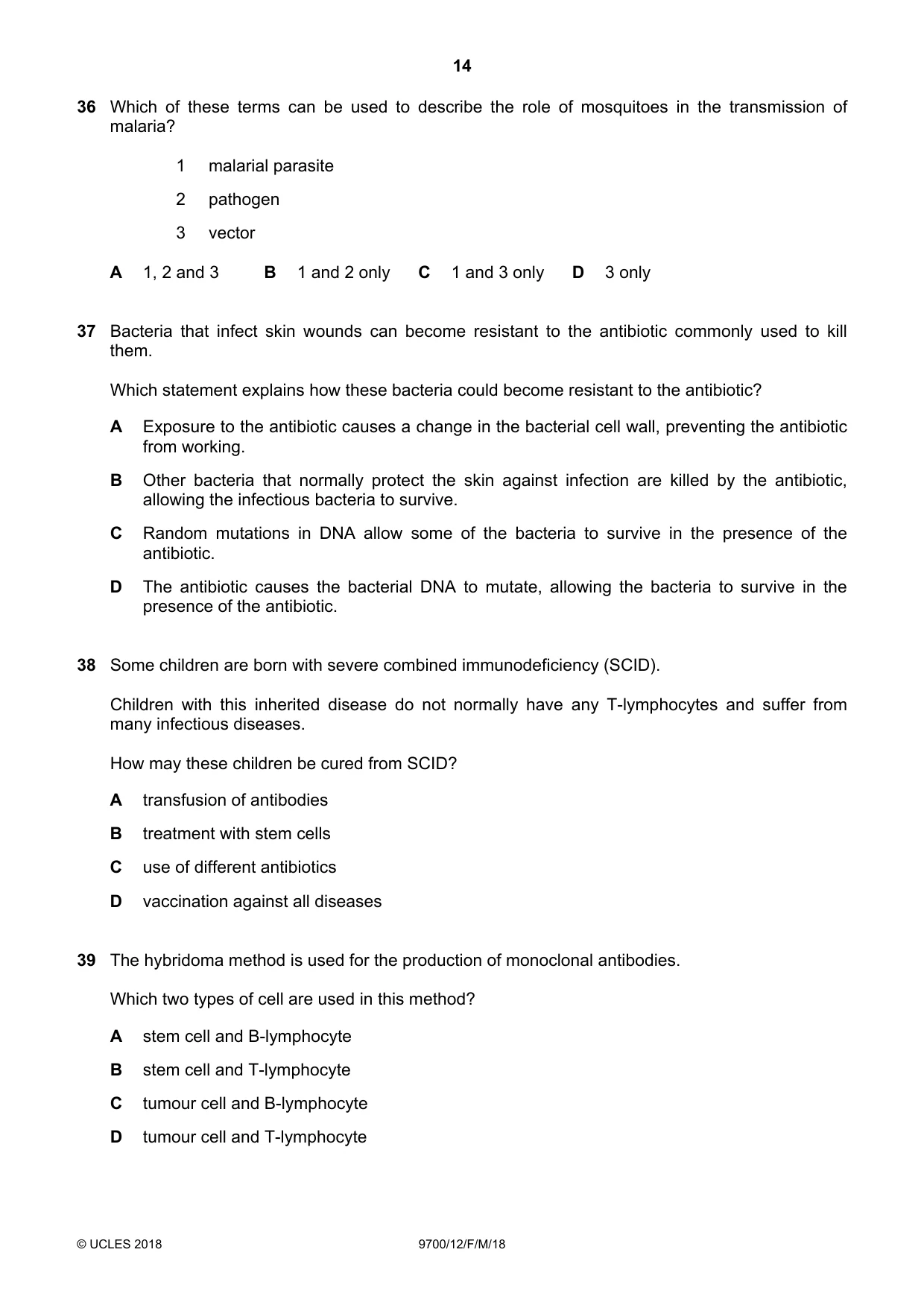
36 Which of these terms can be used to describe the role of mosquitoes in the transmission of malaria? 1 malarial parasite 2 pathogen 3 vector A 1, 2 and 3 B 1 and 2 only C 1 and 3 only D 3 only
Mark scheme: D
Q37 · Bacteria that infect skin wounds can become resistant to the antibiotic commonly used to…
37 Bacteria that infect skin wounds can become resistant to the antibiotic commonly used to kill them. Which statement explains how these bacteria could become resistant to the antibiotic? A Exposure to the antibiotic causes a change in the bacterial cell wall, preventing the antibiotic from working. B Other bacteria that normally protect the skin against infection are killed by the antibiotic, allowing the infectious bacteria to survive. C Random mutations in DNA allow some of the bacteria to survive in the presence of the antibiotic. D The antibiotic causes the bacterial DNA to mutate, allowing the bacteria to survive in the presence of the antibiotic.
Mark scheme: C
Q38 · Some children are born with severe combined immunodeficiency (SCID)
38 Some children are born with severe combined immunodeficiency (SCID). Children with this inherited disease do not normally have any T-lymphocytes and suffer from many infectious diseases. How may these children be cured from SCID? A transfusion of antibodies B treatment with stem cells C use of different antibiotics D vaccination against all diseases
Mark scheme: B
Q39 · The hybridoma method is used for the production of monoclonal antibodies
39 The hybridoma method is used for the production of monoclonal antibodies. Which two types of cell are used in this method? A stem cell and B-lymphocyte B stem cell and T-lymphocyte C tumour cell and B-lymphocyte D tumour cell and T-lymphocyte
Mark scheme: C
Q40 · A vaccine is used to create artificial active immunity
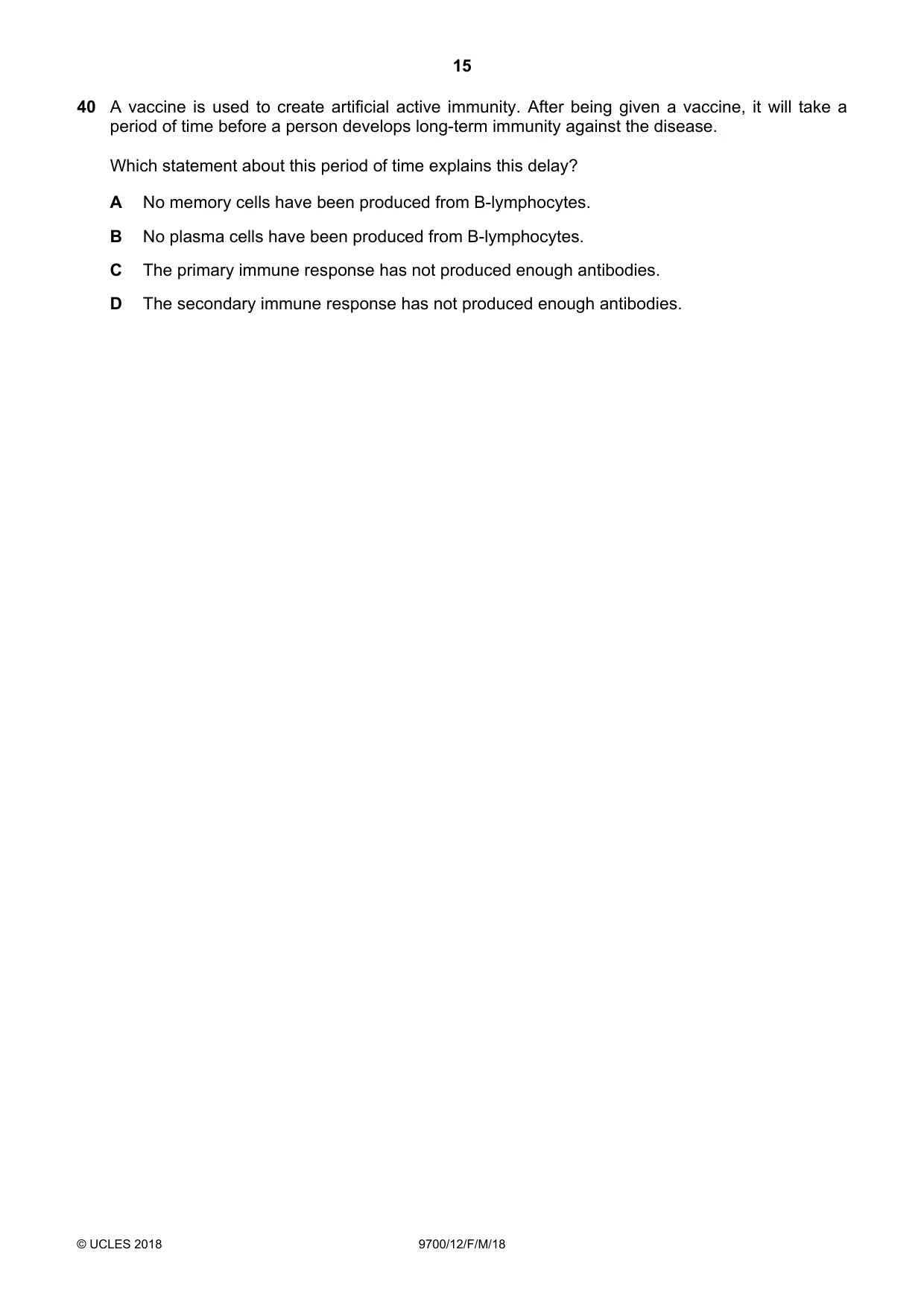
40 A vaccine is used to create artificial active immunity. After being given a vaccine, it will take a period of time before a person develops long-term immunity against the disease. Which statement about this period of time explains this delay? A No memory cells have been produced from B-lymphocytes. B No plasma cells have been produced from B-lymphocytes. C The primary immune response has not produced enough antibodies. D The secondary immune response has not produced enough antibodies.
Mark scheme: A
What was in this paper
The subtopics covered by these 40 questions, and how many questions each got. Open one in a new tab to see every Cambridge question on it.
3Cells as the basic units of living organisms3The microscope in cell studies3Transport of oxygen and carbon dioxide3Antibodies and vaccination2Chromosome behaviour in mitosis2Energy2Fluid mosaic membranes2Movement into and out of cells2Proteins2Structure of transport tissues2The gas exchange system2Transport mechanisms2Antibiotics1Factors that affect enzyme action1Infectious diseases1Mode of action of enzymes1Protein synthesis1Replication and division of nuclei and cells1Structure of nucleic acids and replication of DNA1Testing for biological molecules1The heart1The immune system1What you needed in this session
Cambridge’s own grade thresholds for 2018 Feb/March, Paper 1 · Variant 2. A higher threshold means an easier paper — the bar moves with how the cohort did.