Cambridge A Level Biology 9700 — 2025 May/June Paper 1 · Variant 4
9700/14/M/J/25 · 40 questions · 40 marks · 75 min
The question paper and its mark scheme, free to read here and free to download. This is Cambridge’s own paper, exactly as it was sat.
Question paper20 pages



Mark scheme3 pages
Answers below. Sit the paper first if you are practising.
Questions as text
Q1 · Plant cells are stained and then viewed with a simple light microscope, using daylight as…
1 Plant cells are stained and then viewed with a simple light microscope, using daylight as the only light source. Which cell structures are clearly visible at a magnification of 400? A chloroplast grana B lysosomes C nucleoli D ribosomes
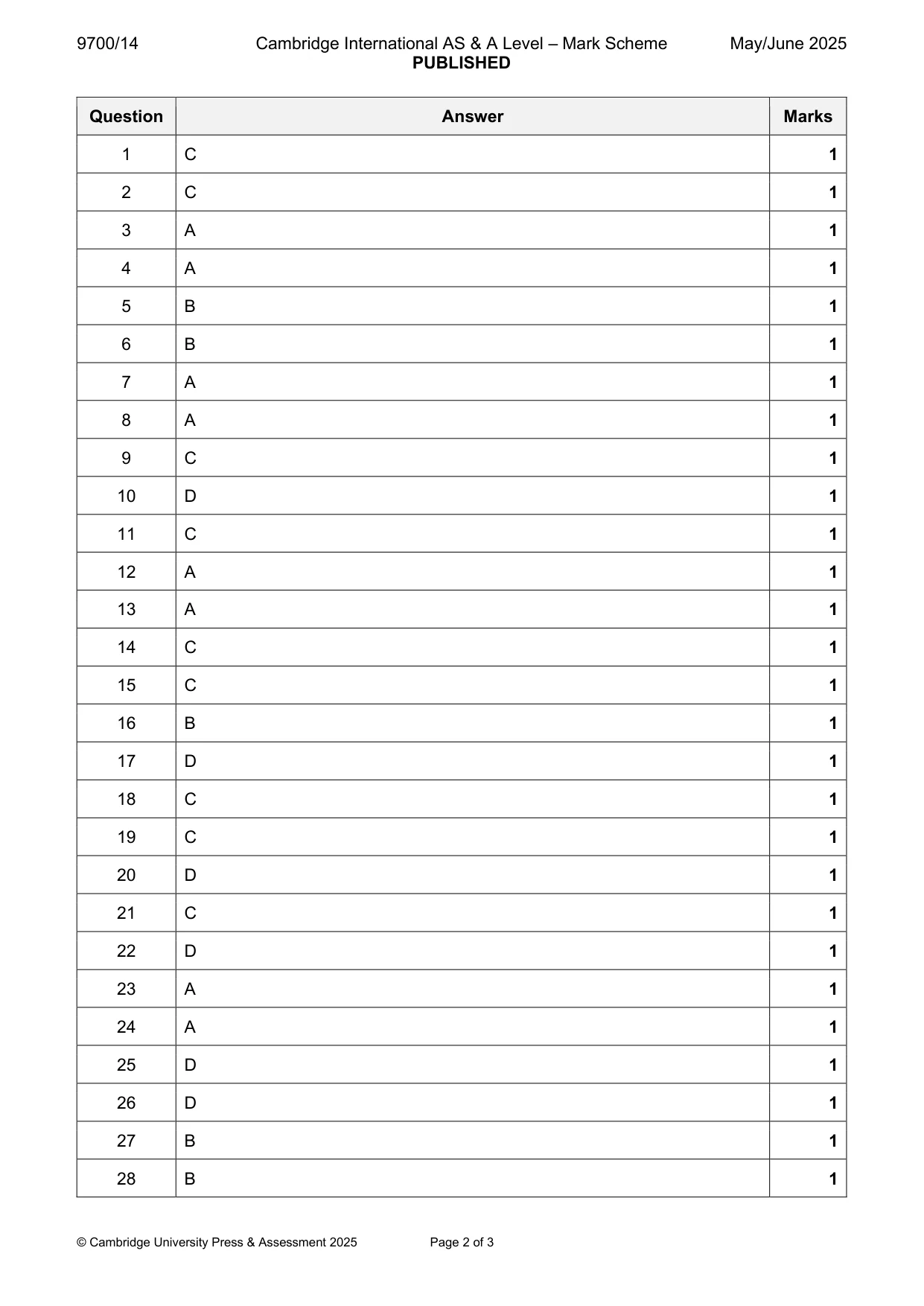
Mark scheme: C
Q2 · The diagram shows an image of a cell with a scale bar
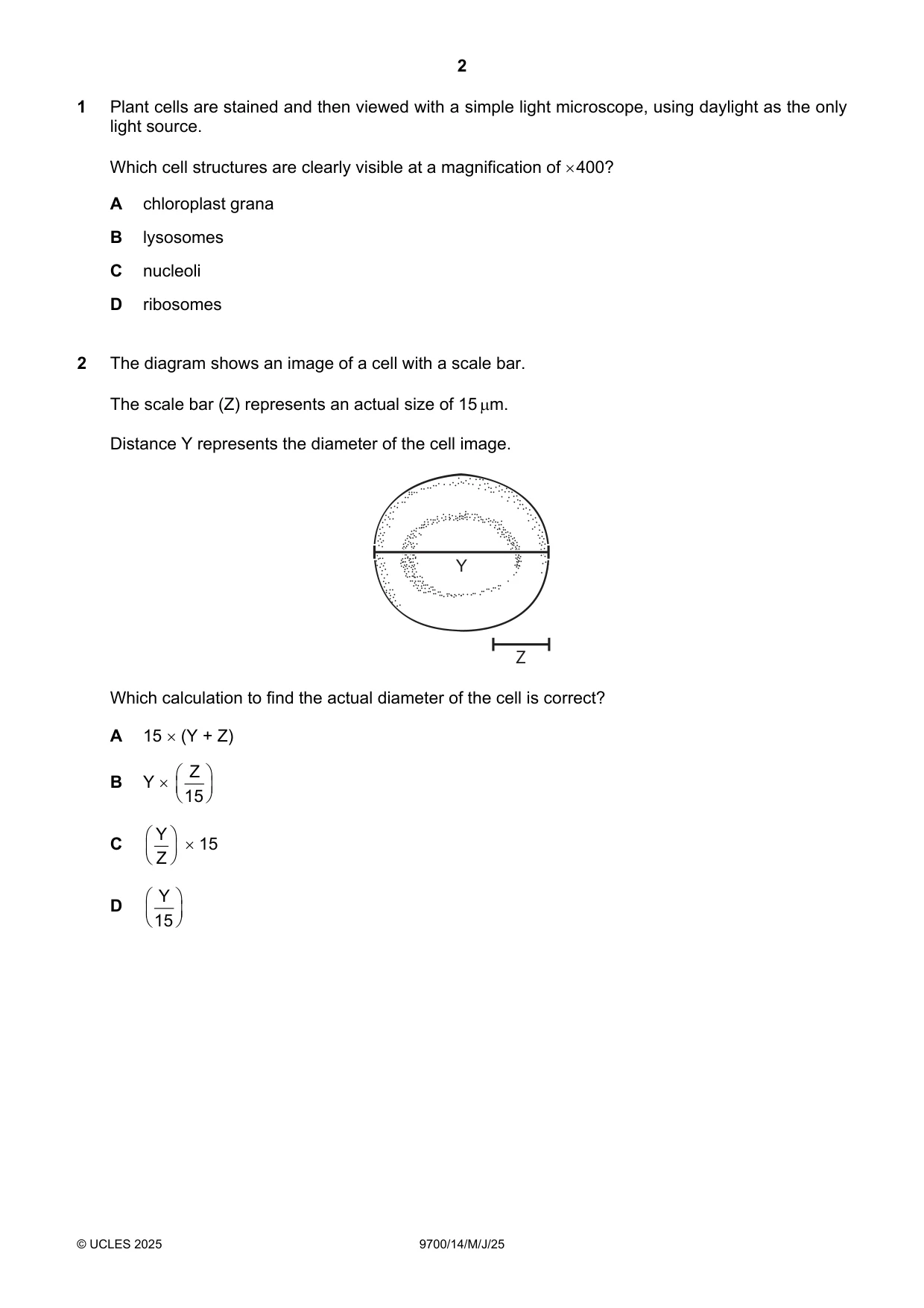
2 The diagram shows an image of a cell with a scale bar. The scale bar (Z) represents an actual size of 15 m. Distance Y represents the diameter of the cell image. Y Z Which calculation to find the actual diameter of the cell is correct? A 15 (Y + Z) Z B Y 15 Y C 15 Z Y D 15
Mark scheme: C
Q3 · The diagram shows a stage micrometer, with divisions of 0.1 mm, viewed using an eyepiece…
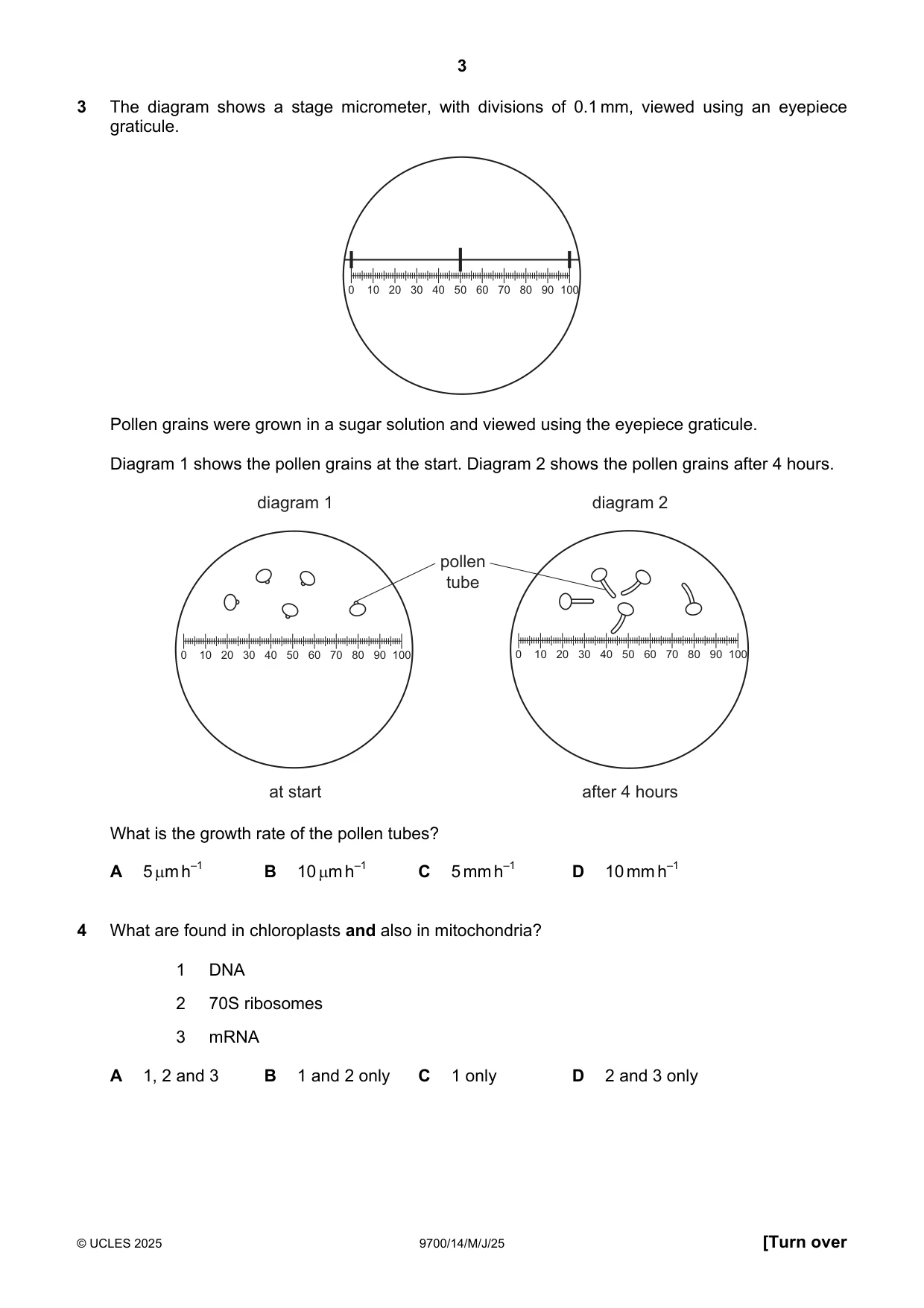
3 The diagram shows a stage micrometer, with divisions of 0.1 mm, viewed using an eyepiece graticule. 0 10 20 30 40 50 60 70 80 90 100 Pollen grains were grown in a sugar solution and viewed using the eyepiece graticule. Diagram 1 shows the pollen grains at the start. Diagram 2 shows the pollen grains after 4 hours. diagram 1 diagram 2 pollen tube 0 10 20 30 40 50 60 70 80 90 100 0 10 20 30 40 50 60 70 80 90 100 at start after 4 hours What is the growth rate of the pollen tubes? A 5 m h–1 B 10 m h–1 C 5 mm h–1 D 10 mm h–1
Mark scheme: A
Q4 · What are found in chloroplasts and also in mitochondria?
4 What are found in chloroplasts and also in mitochondria? 1 DNA 2 70S ribosomes 3 mRNA A 1, 2 and 3 B 1 and 2 only C 1 only D 2 and 3 only
Mark scheme: A
More questions on Cells as the basic units of living organisms
Q5 · A long-distance runner has become adapted to run faster for longer after regular training
5 A long-distance runner has become adapted to run faster for longer after regular training. Which cell structure in a muscle cell has increased in number to allow this adaptation? A lysosome B mitochondrion C nucleus D smooth endoplasmic reticulum
Mark scheme: B
More questions on Cells as the basic units of living organisms
Q6 · Some functions carried out within eukaryotic cells are listed
6 Some functions carried out within eukaryotic cells are listed. 1 lysosome production 2 polypeptide modification 3 exocytosis Which functions are carried out by the Golgi body? A 1, 2 and 3 B 1 and 2 only C 1 and 3 only D 2 and 3 only
Mark scheme: B
More questions on Cells as the basic units of living organisms
Q7 · The diagram shows the structure of a unicellular organism
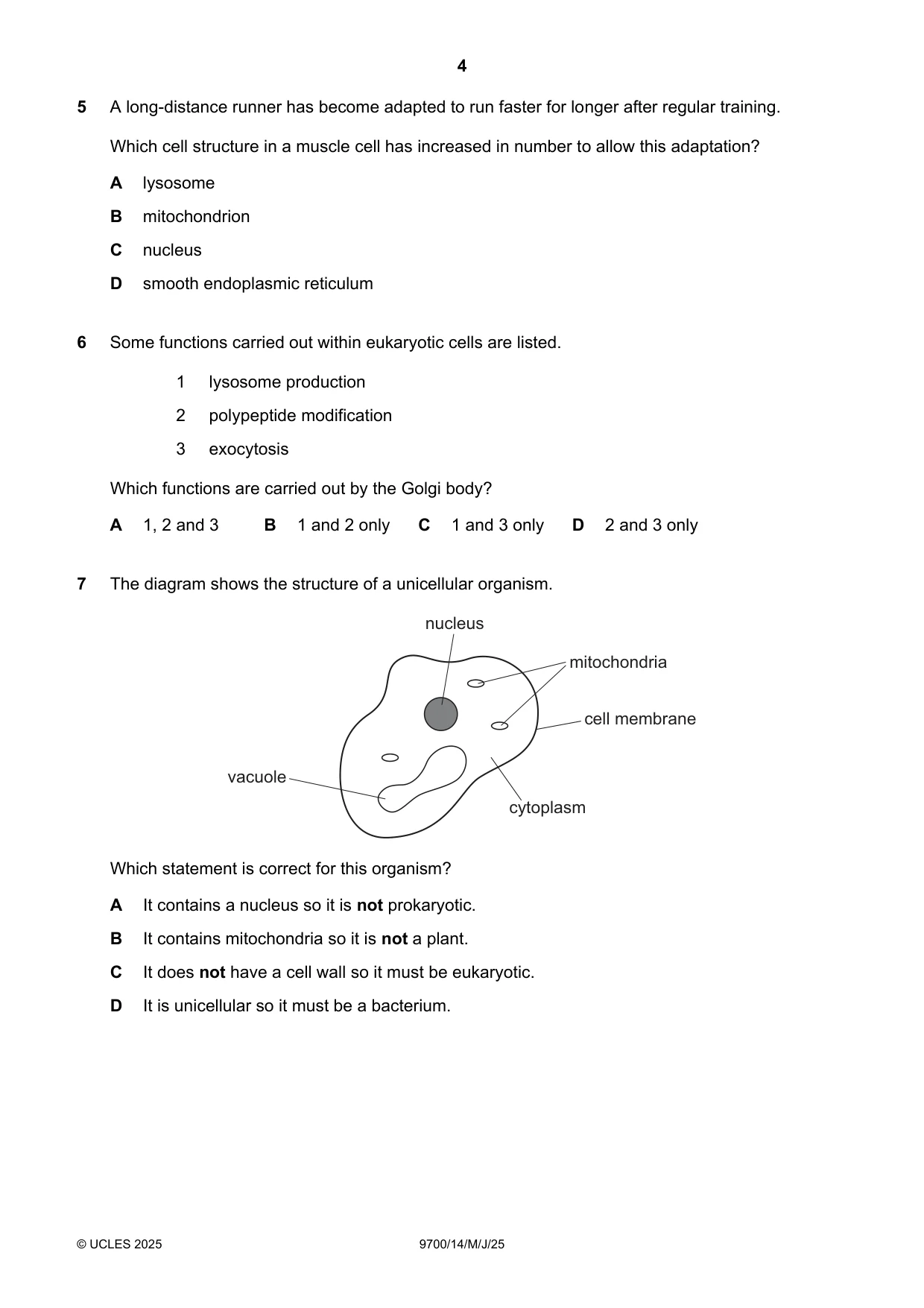
7 The diagram shows the structure of a unicellular organism. nucleus mitochondria cell membrane vacuole cytoplasm Which statement is correct for this organism? A It contains a nucleus so it is not prokaryotic. B It contains mitochondria so it is not a plant. C It does not have a cell wall so it must be eukaryotic. D It is unicellular so it must be a bacterium.
Mark scheme: A
More questions on Cells as the basic units of living organisms
Q8 · Diastase is an enzyme that breaks down starch into maltose
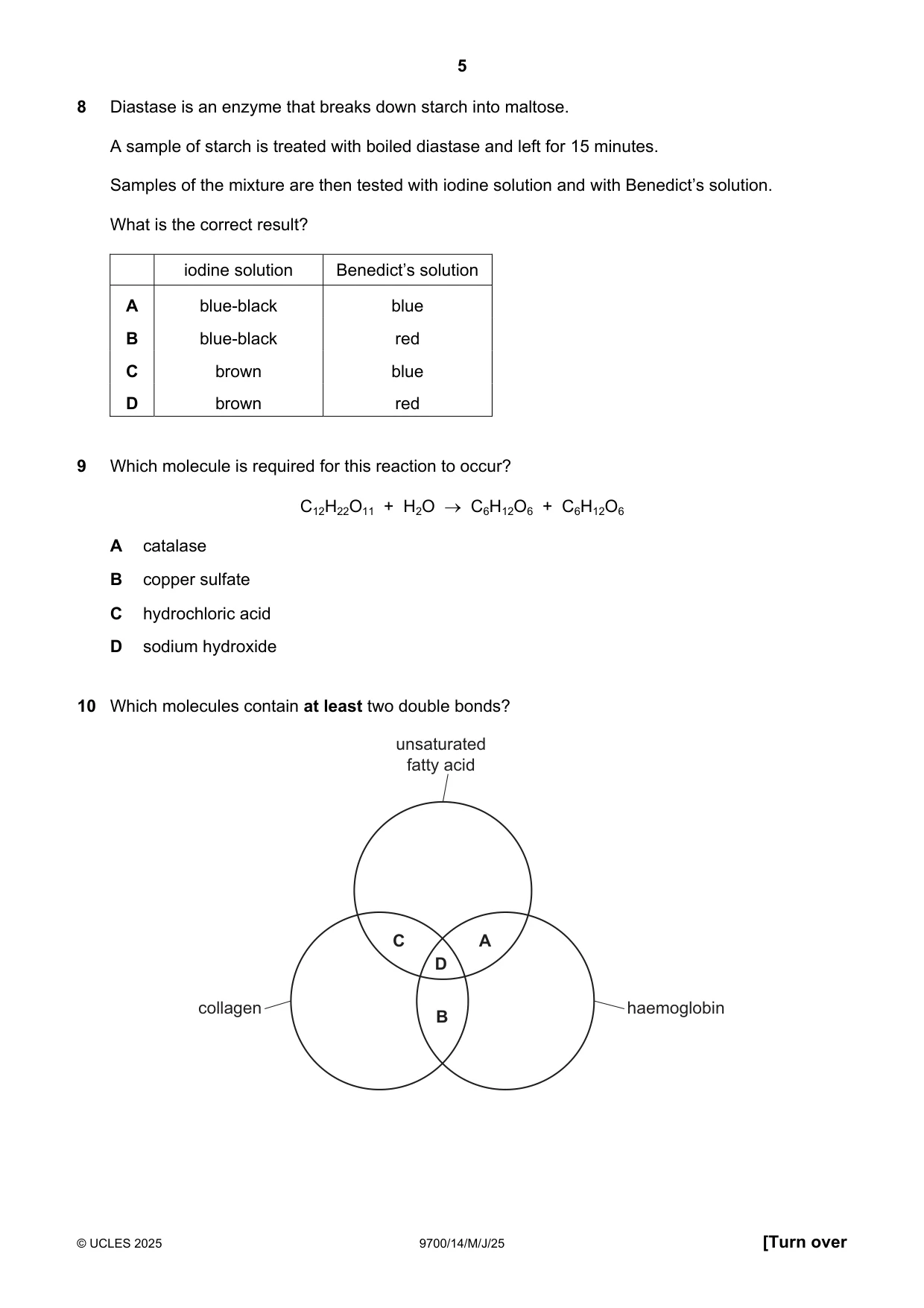
8 Diastase is an enzyme that breaks down starch into maltose. A sample of starch is treated with boiled diastase and left for 15 minutes. Samples of the mixture are then tested with iodine solution and with Benedict’s solution. What is the correct result? iodine solution Benedict’s solution A blue-black blue B blue-black red C brown blue D brown red
Mark scheme: A
Q9 · Which molecule is required for this reaction to occur?
9 Which molecule is required for this reaction to occur? C12H22O11 + H2O C6H12O6 + C6H12O6 A catalase B copper sulfate C hydrochloric acid D sodium hydroxide
Mark scheme: C
Q10 · Which molecules contain at least two double bonds?
10 Which molecules contain at least two double bonds? unsaturated fatty acid C A D collagen haemoglobin B
Mark scheme: D
Q11 · Which description of globular proteins is correct?
11 Which description of globular proteins is correct? A They are only found in cell surface membranes. B They only contain amino acids with hydrophilic R groups. C They can change shape by using energy from ATP. D They always have a quaternary structure of at least three polypeptides.
Mark scheme: C
Q12 · Which diagram shows where a hydrogen bond occurs between two water molecules?
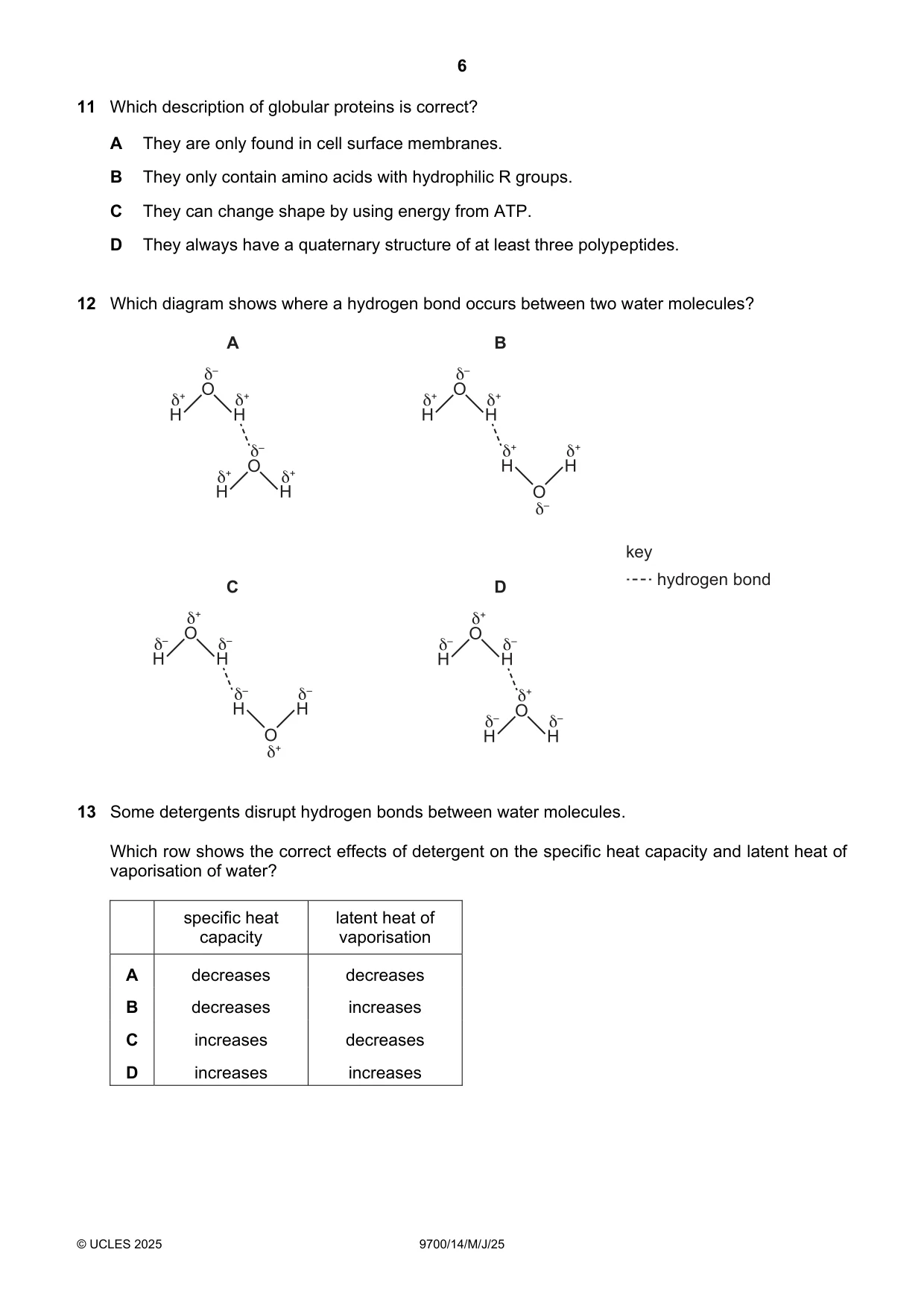
12 Which diagram shows where a hydrogen bond occurs between two water molecules? A B δ– δ– O O δ+ δ+ δ+ δ+ H H H H δ– δ+ δ+ O H H δ+ δ+ H H O δ– key C D hydrogen bond δ+ δ+ O O δ– δ– δ– δ– H H H H δ– δ– δ+ H H O δ– δ– O H H δ+
Mark scheme: A
Q13 · Some detergents disrupt hydrogen bonds between water molecules
13 Some detergents disrupt hydrogen bonds between water molecules. Which row shows the correct effects of detergent on the specific heat capacity and latent heat of vaporisation of water? specific heat latent heat of capacity vaporisation A decreases decreases B decreases increases C increases decreases D increases increases
Mark scheme: A
Q14 · An investigation was carried out to see if compound X could improve the thermostability…
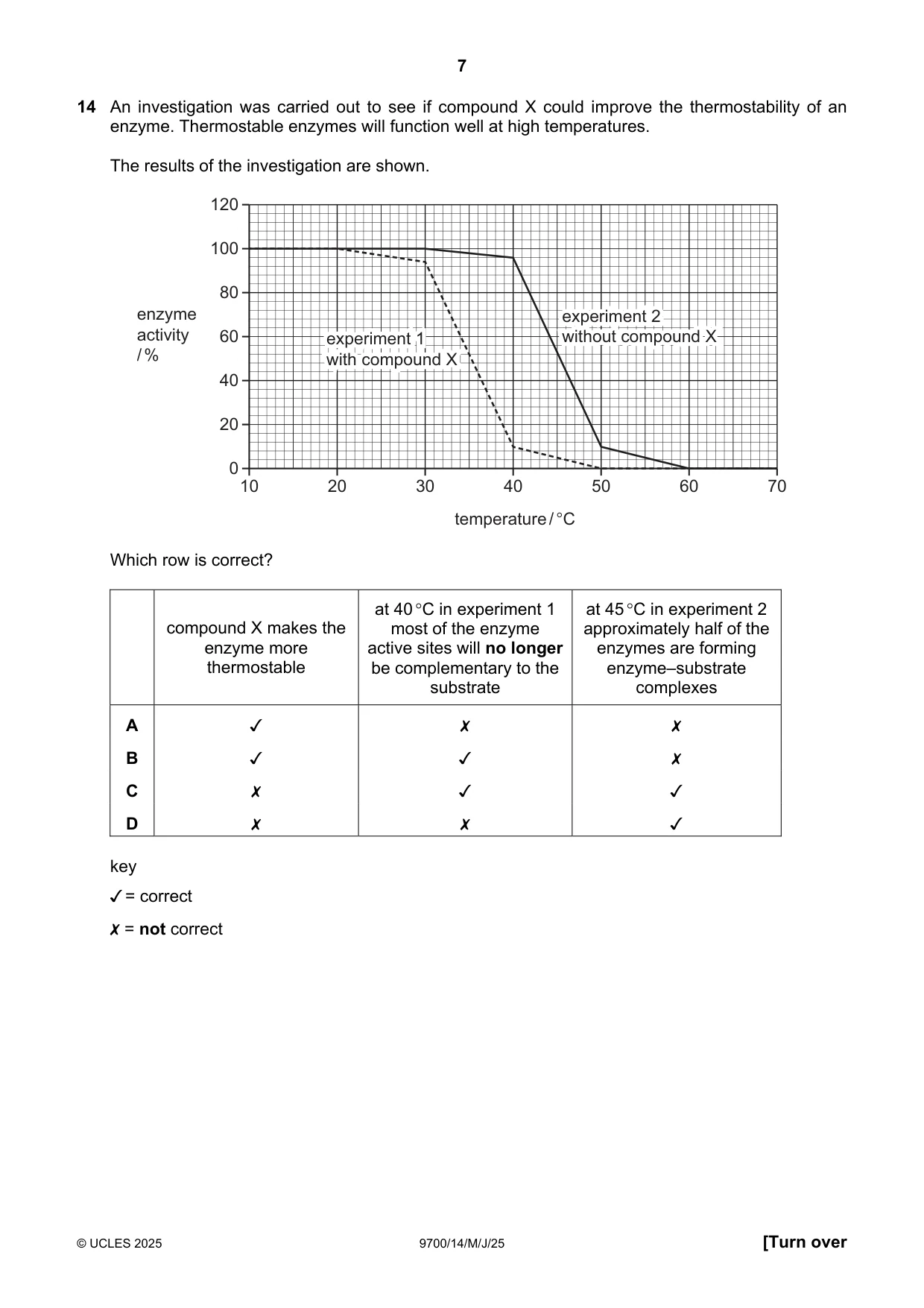
14 An investigation was carried out to see if compound X could improve the thermostability of an enzyme. Thermostable enzymes will function well at high temperatures. The results of the investigation are shown. 120 100 80 enzyme ‘ xperiment 2 activity 60 experiment 1——--*s without compound -X I% with compound XC 40 © 20 ‘ @) = 10 20 30 40 50 60 70 temperature /°C Which row is correct? compound X makes the enzyme more thermostable at 40°C in experiment 1 most of the enzyme active sites will no longer be complementary to the at 45°C in experiment 2 approximately half of the enzymes are forming enzyme-—substrate substrate complexes A Jv x x B Jv v x Cc x v v D x x v key ¥ = correct X = not correct
Mark scheme: C
Q15 · The table shows the results from an investigation into the effect of temperature on an…
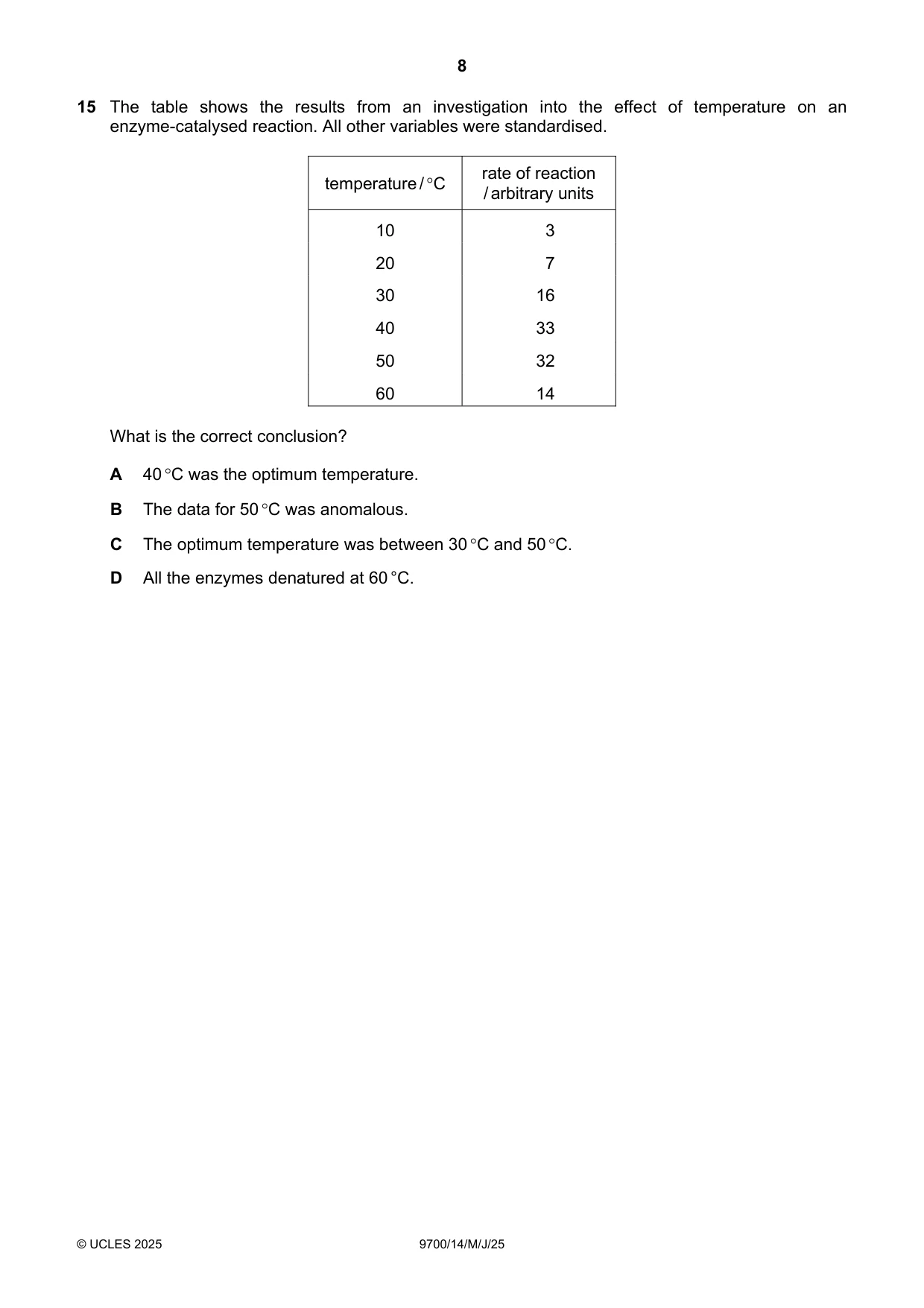
15 The table shows the results from an investigation into the effect of temperature on an enzyme-catalysed reaction. All other variables were standardised. rate of reaction temperature / C / arbitrary units 10 3 20 7 30 16 40 33 50 32 60 14 What is the correct conclusion? A 40 C was the optimum temperature. B The data for 50 C was anomalous. C The optimum temperature was between 30 C and 50 C. D All the enzymes denatured at 60 °C.
Mark scheme: C
Q16 · The graph shows how the rate of a reaction changes with substrate concentration in the…
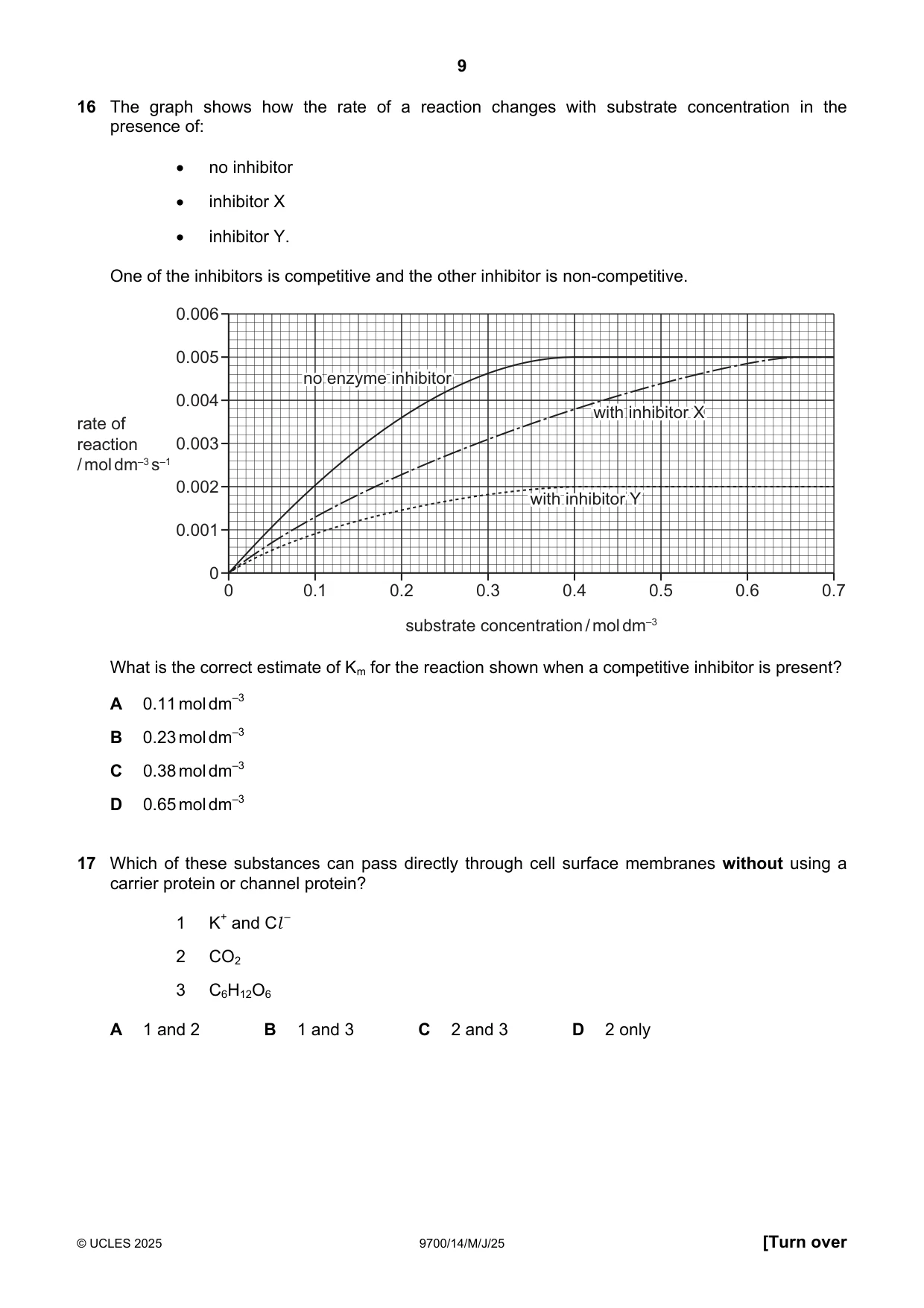
16 The graph shows how the rate of a reaction changes with substrate concentration in the presence of: no inhibitor inhibitor X inhibitor Y. One of the inhibitors is competitive and the other inhibitor is non-competitive. 0.006 0.005 no enzyme inhibitor no enzyme inhibitor no enzyme inhibitor 0.004 with inhibitor X with inhibitor X with inhibitor X rate of reaction 0.003 / mol dm–3 s–1 0.002 with inhibitor Y with inhibitor Y with inhibitor Y 0.001 0 0 0.1 0.2 0.3 0.4 0.5 0.6 0.7 substrate concentration / mol dm–3 What is the correct estimate of Km for the reaction shown when a competitive inhibitor is present? A 0.11 mol dm–3 B 0.23 mol dm–3 C 0.38 mol dm–3 D 0.65 mol dm–3
Mark scheme: B
Q17 · Which of these substances can pass directly through cell surface membranes without using…
17 Which of these substances can pass directly through cell surface membranes without using a carrier protein or channel protein? 1 K+ and Cl – 2 CO2 3 C6H12O6 A 1 and 2 B 1 and 3 C 2 and 3 D 2 only
Mark scheme: D
Q18 · Which of these statements about facilitated diffusion are correct?
18 Which of these statements about facilitated diffusion are correct? 1 It is limited by the number of transport proteins. 2 It transports molecules against their concentration gradient. 3 It requires a source of ATP. A 1, 2 and 3 B 1 and 3 only C 1 only D 2 and 3 only
Mark scheme: C
Q19 · A cell absorbs amino acids
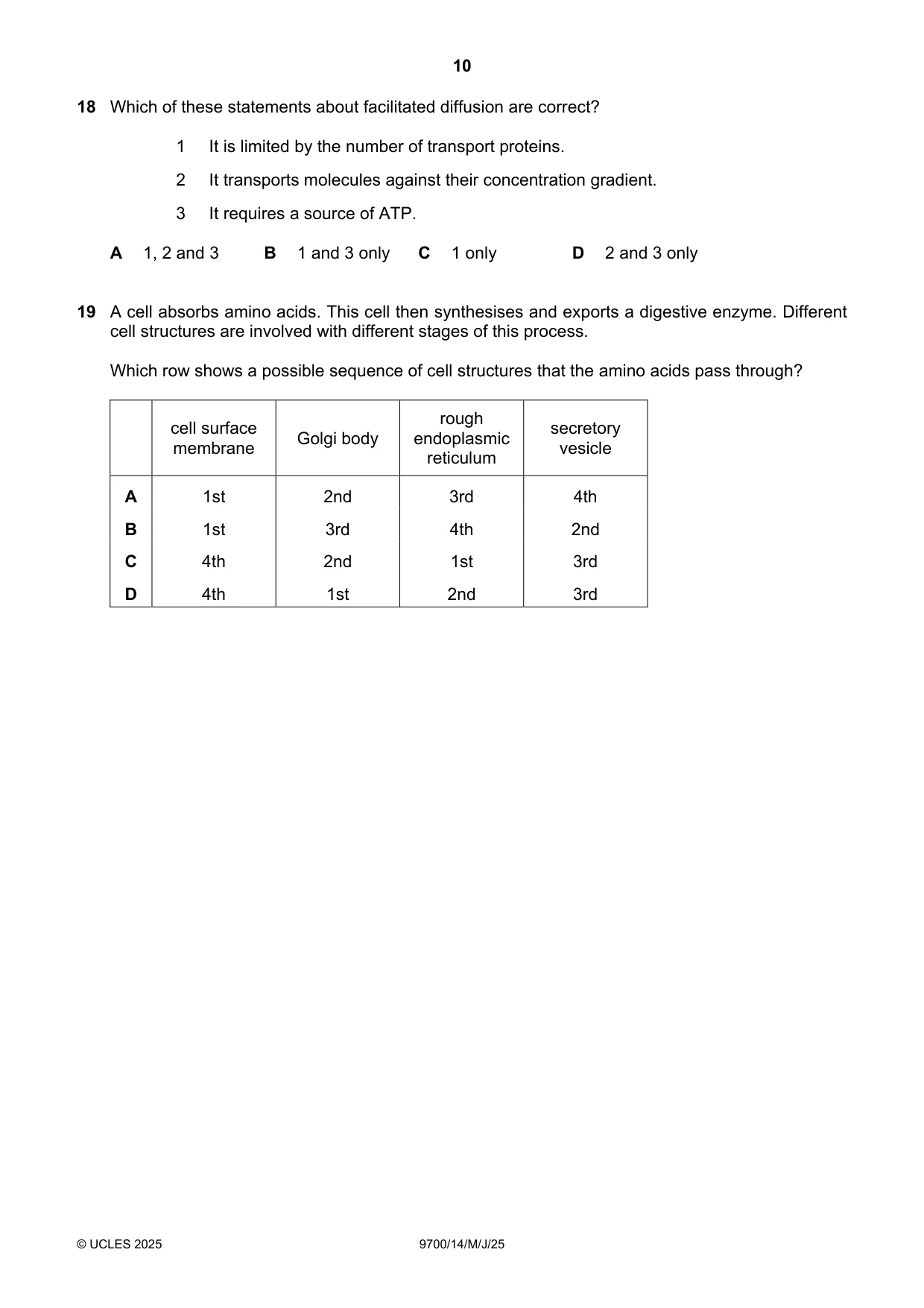
19 A cell absorbs amino acids. This cell then synthesises and exports a digestive enzyme. Different cell structures are involved with different stages of this process. Which row shows a possible sequence of cell structures that the amino acids pass through? rough cell surface secretory Golgi body endoplasmic membrane vesicle reticulum A 1st 2nd 3rd 4th B 1st 3rd 4th 2nd C 4th 2nd 1st 3rd D 4th 1st 2nd 3rd
Mark scheme: C
Q20 · The diagram shows apparatus set up to investigate the effect of changing the initial…
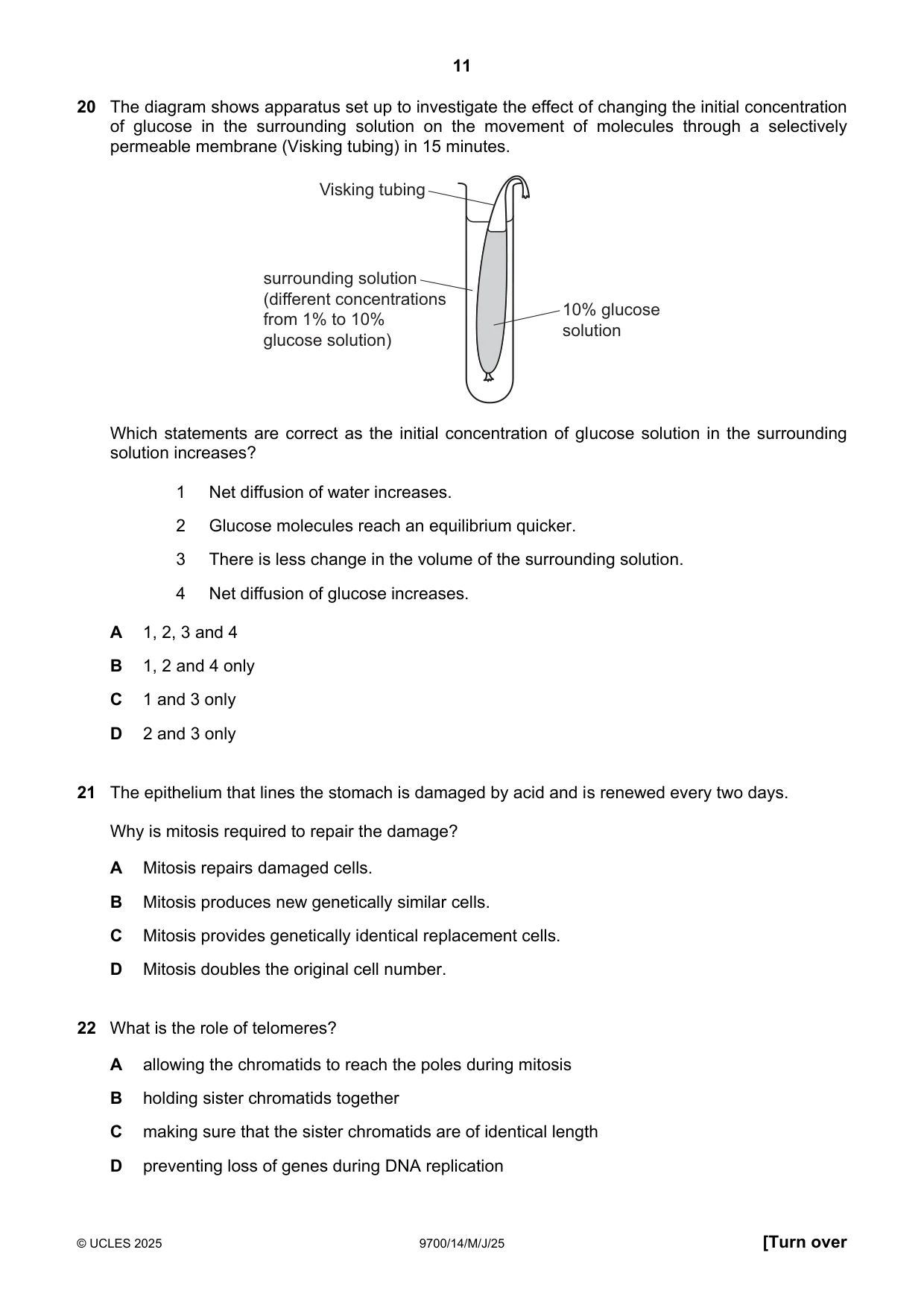
20 The diagram shows apparatus set up to investigate the effect of changing the initial concentration of glucose in the surrounding solution on the movement of molecules through a selectively permeable membrane (Visking tubing) in 15 minutes. Visking tubing surrounding solution (different concentrations 10% glucose from 1% to 10% solution glucose solution) Which statements are correct as the initial concentration of glucose solution in the surrounding solution increases? 1 Net diffusion of water increases. 2 Glucose molecules reach an equilibrium quicker. 3 There is less change in the volume of the surrounding solution. 4 Net diffusion of glucose increases. A 1, 2, 3 and 4 B 1, 2 and 4 only C 1 and 3 only D 2 and 3 only
Mark scheme: D
Q21 · The epithelium that lines the stomach is damaged by acid and is renewed every two days
21 The epithelium that lines the stomach is damaged by acid and is renewed every two days. Why is mitosis required to repair the damage? A Mitosis repairs damaged cells. B Mitosis produces new genetically similar cells. C Mitosis provides genetically identical replacement cells. D Mitosis doubles the original cell number.
Mark scheme: C
More questions on Replication and division of nuclei and cells
Q22 · What is the role of telomeres?
22 What is the role of telomeres? A allowing the chromatids to reach the poles during mitosis B holding sister chromatids together C making sure that the sister chromatids are of identical length D preventing loss of genes during DNA replication
Mark scheme: D
Q23 · Which features of mitosis help to maintain the genetic composition of the cell?
23 Which features of mitosis help to maintain the genetic composition of the cell? 1 the longitudinal division of the centromeres 2 the DNA of the parent cells replicates before mitosis begins 3 the pulling apart of the chromatids to opposite poles A 1, 2 and 3 B 1 and 3 only C 1 only D 2 and 3 only
Mark scheme: A
Q24 · DNA forms a leading strand and a lagging strand during semi-conservative replication
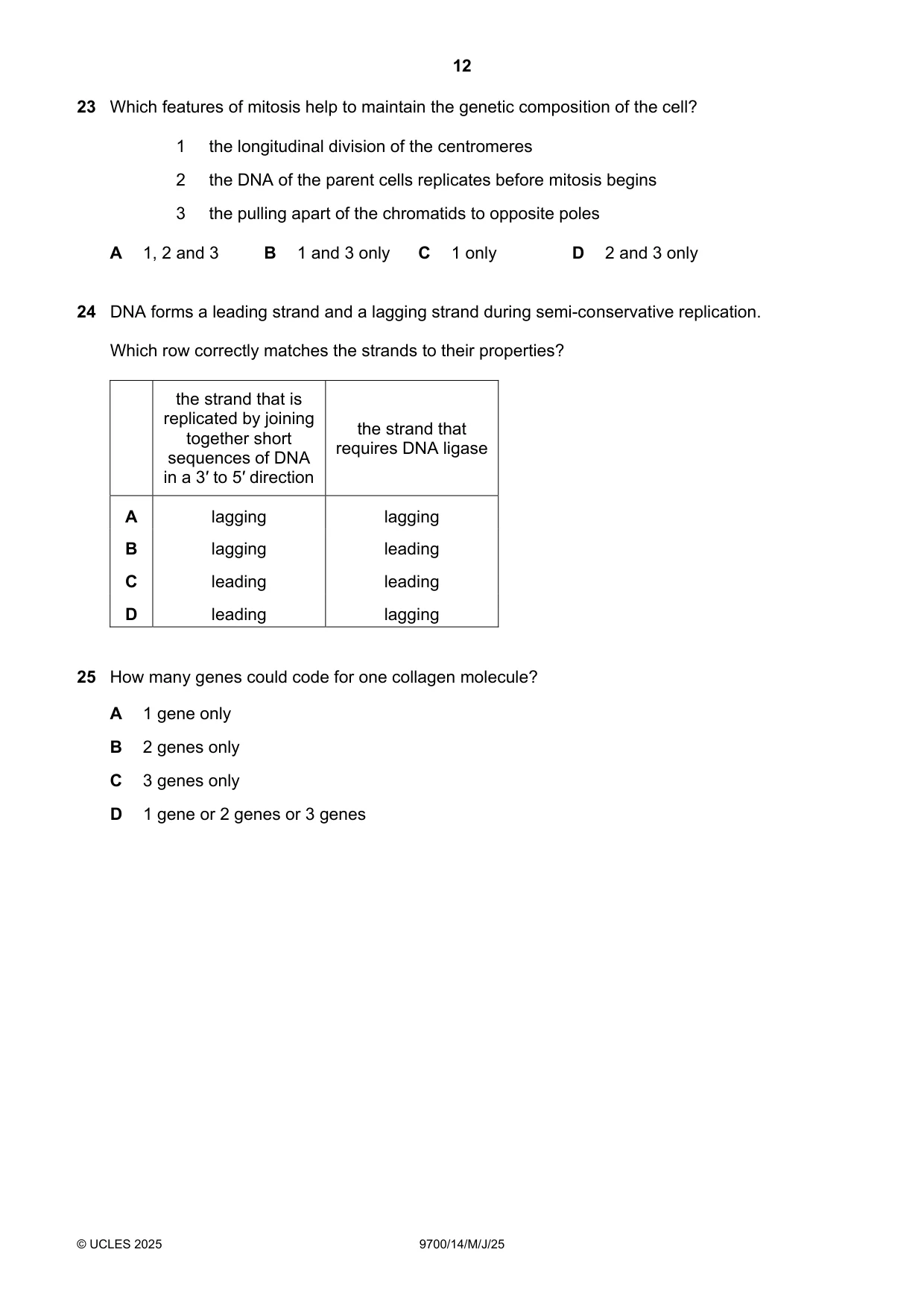
24 DNA forms a leading strand and a lagging strand during semi-conservative replication. Which row correctly matches the strands to their properties? the strand that is replicated by joining the strand that together short requires DNA ligase sequences of DNA in a 3′ to 5′ direction A lagging lagging B lagging leading C leading leading D leading lagging
Mark scheme: A
More questions on Structure of nucleic acids and replication of DNA
Q25 · How many genes could code for one collagen molecule?
25 How many genes could code for one collagen molecule? A 1 gene only B 2 genes only C 3 genes only D 1 gene or 2 genes or 3 genes
Mark scheme: D
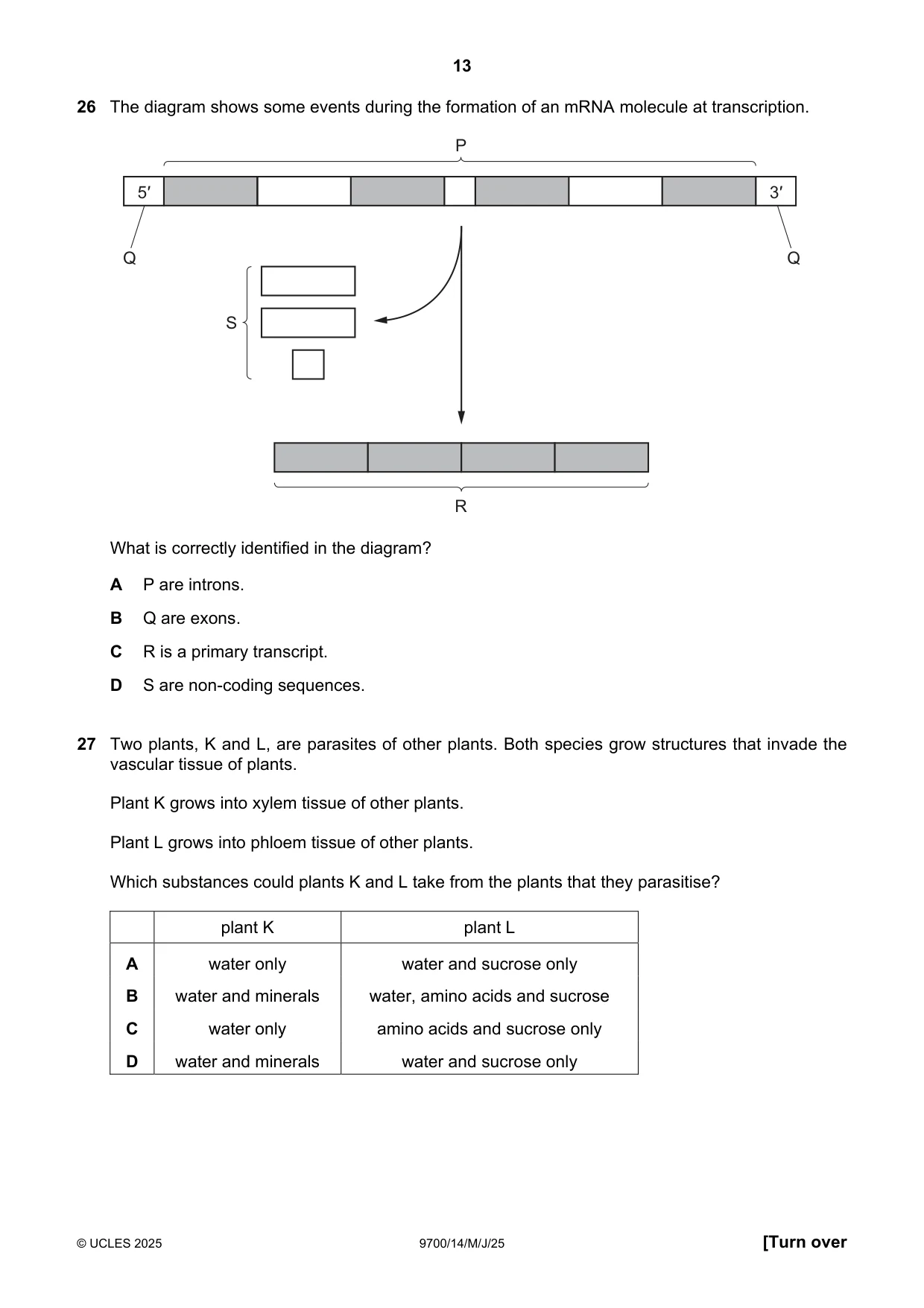
Q26 · The diagram shows some events during the formation of an mRNA molecule at transcription
26 The diagram shows some events during the formation of an mRNA molecule at transcription. P 5′ 3′ Q Q S R What is correctly identified in the diagram? A P are introns. B Q are exons. C R is a primary transcript. D S are non-coding sequences.
Mark scheme: D
Q27 · Two plants, K and L, are parasites of other plants
27 Two plants, K and L, are parasites of other plants. Both species grow structures that invade the vascular tissue of plants. Plant K grows into xylem tissue of other plants. Plant L grows into phloem tissue of other plants. Which substances could plants K and L take from the plants that they parasitise? plant K plant L A water only water and sucrose only B water and minerals water, amino acids and sucrose C water only amino acids and sucrose only D water and minerals water and sucrose only
Mark scheme: B
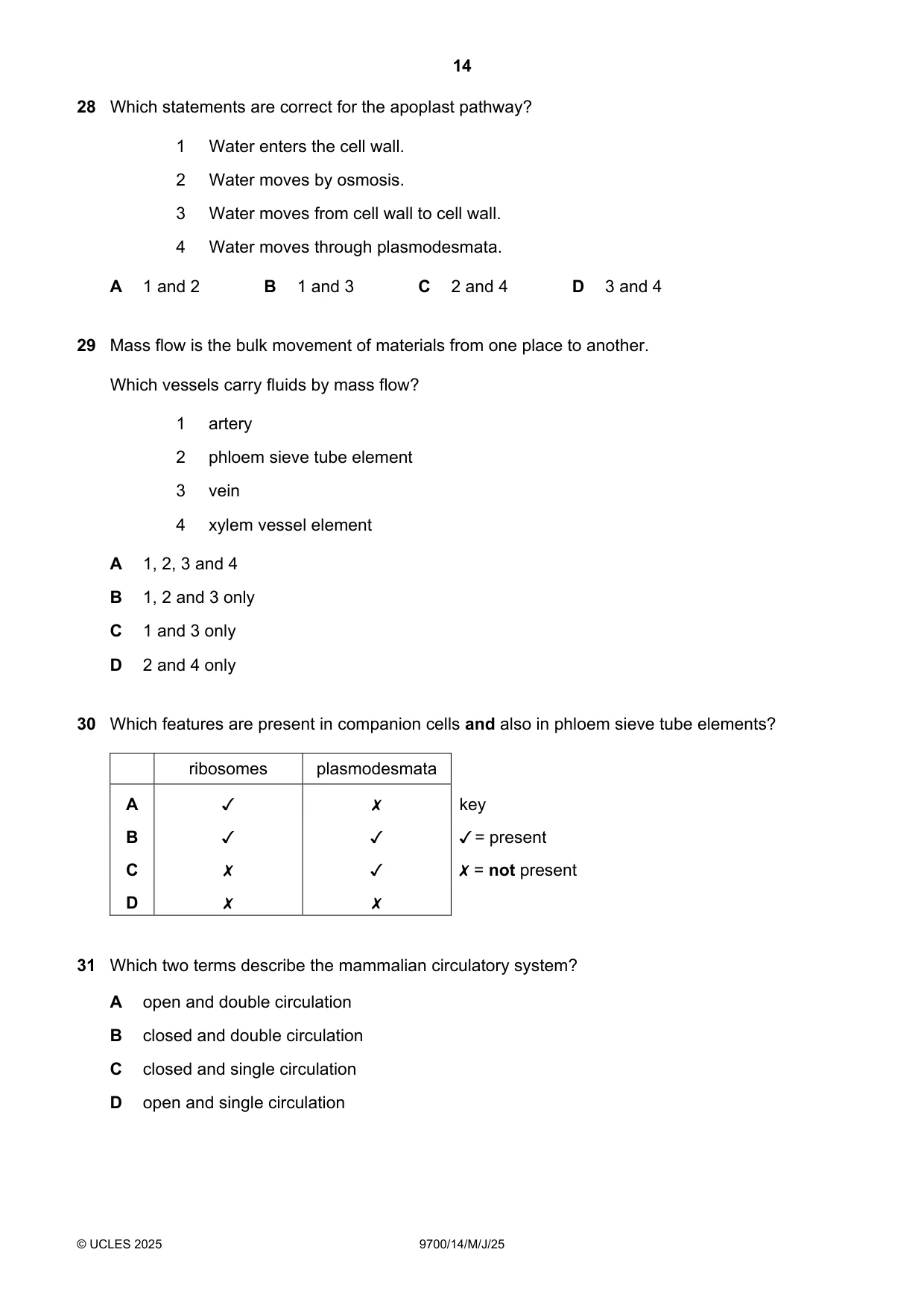
Q28 · Which statements are correct for the apoplast pathway?
28 Which statements are correct for the apoplast pathway? 1 Water enters the cell wall. 2 Water moves by osmosis. 3 Water moves from cell wall to cell wall. 4 Water moves through plasmodesmata. A 1 and 2 B 1 and 3 C 2 and 4 D 3 and 4
Mark scheme: B
Q29 · Mass flow is the bulk movement of materials from one place to another
29 Mass flow is the bulk movement of materials from one place to another. Which vessels carry fluids by mass flow? 1 artery 2 phloem sieve tube element 3 vein 4 xylem vessel element A 1, 2, 3 and 4 B 1, 2 and 3 only C 1 and 3 only D 2 and 4 only
Mark scheme: A
Q30 · Which features are present in companion cells and also in phloem sieve tube elements?
30 Which features are present in companion cells and also in phloem sieve tube elements? ribosomes plasmodesmata v x key / = present 0 0O WwW > v v x v X = not present x x
Mark scheme: B
Q31 · Which two terms describe the mammalian circulatory system?
31 Which two terms describe the mammalian circulatory system? A open and double circulation B closed and double circulation C closed and single circulation D open and single circulation
Mark scheme: B
Q32 · One function of an arteriole is to increase or decrease the flow of blood to tissues
32 One function of an arteriole is to increase or decrease the flow of blood to tissues. Which of these must be present in an arteriole wall to allow this function? 1 collagen 2 endothelium 3 smooth muscle A 1, 2 and 3 B 1 and 3 only C 2 only D 3 only
Mark scheme: D
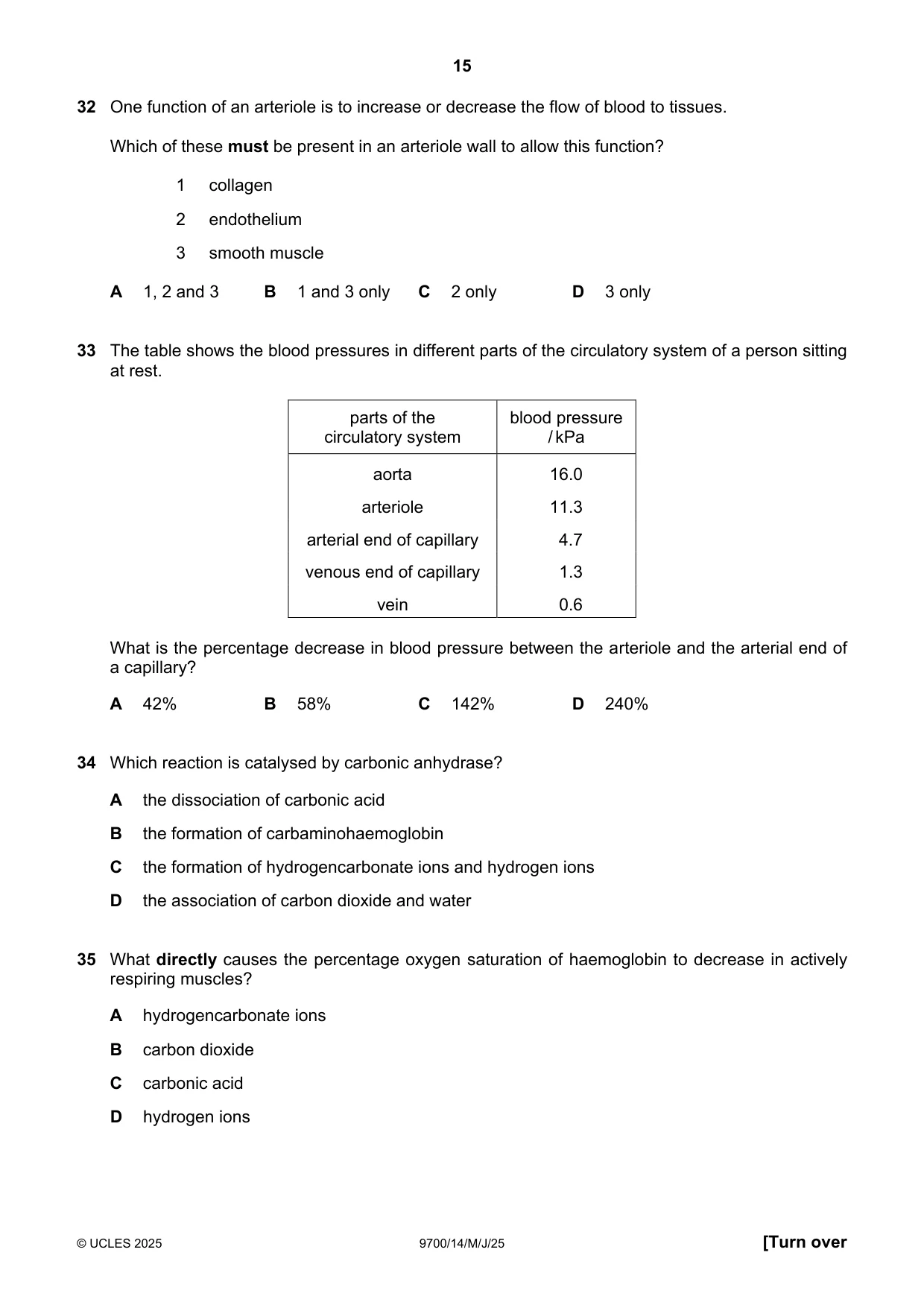
Q33 · The table shows the blood pressures in different parts of the circulatory system of a…
33 The table shows the blood pressures in different parts of the circulatory system of a person sitting at rest. parts of the blood pressure circulatory system / kPa aorta 16.0 arteriole 11.3 arterial end of capillary 4.7 venous end of capillary 1.3 vein 0.6 What is the percentage decrease in blood pressure between the arteriole and the arterial end of a capillary? A 42% B 58% C 142% D 240%
Mark scheme: B
Q34 · Which reaction is catalysed by carbonic anhydrase?
34 Which reaction is catalysed by carbonic anhydrase? A the dissociation of carbonic acid B the formation of carbaminohaemoglobin C the formation of hydrogencarbonate ions and hydrogen ions D the association of carbon dioxide and water
Mark scheme: D
Q35 · What directly causes the percentage oxygen saturation of haemoglobin to decrease in…
35 What directly causes the percentage oxygen saturation of haemoglobin to decrease in actively respiring muscles? A hydrogencarbonate ions B carbon dioxide C carbonic acid D hydrogen ions
Mark scheme: D
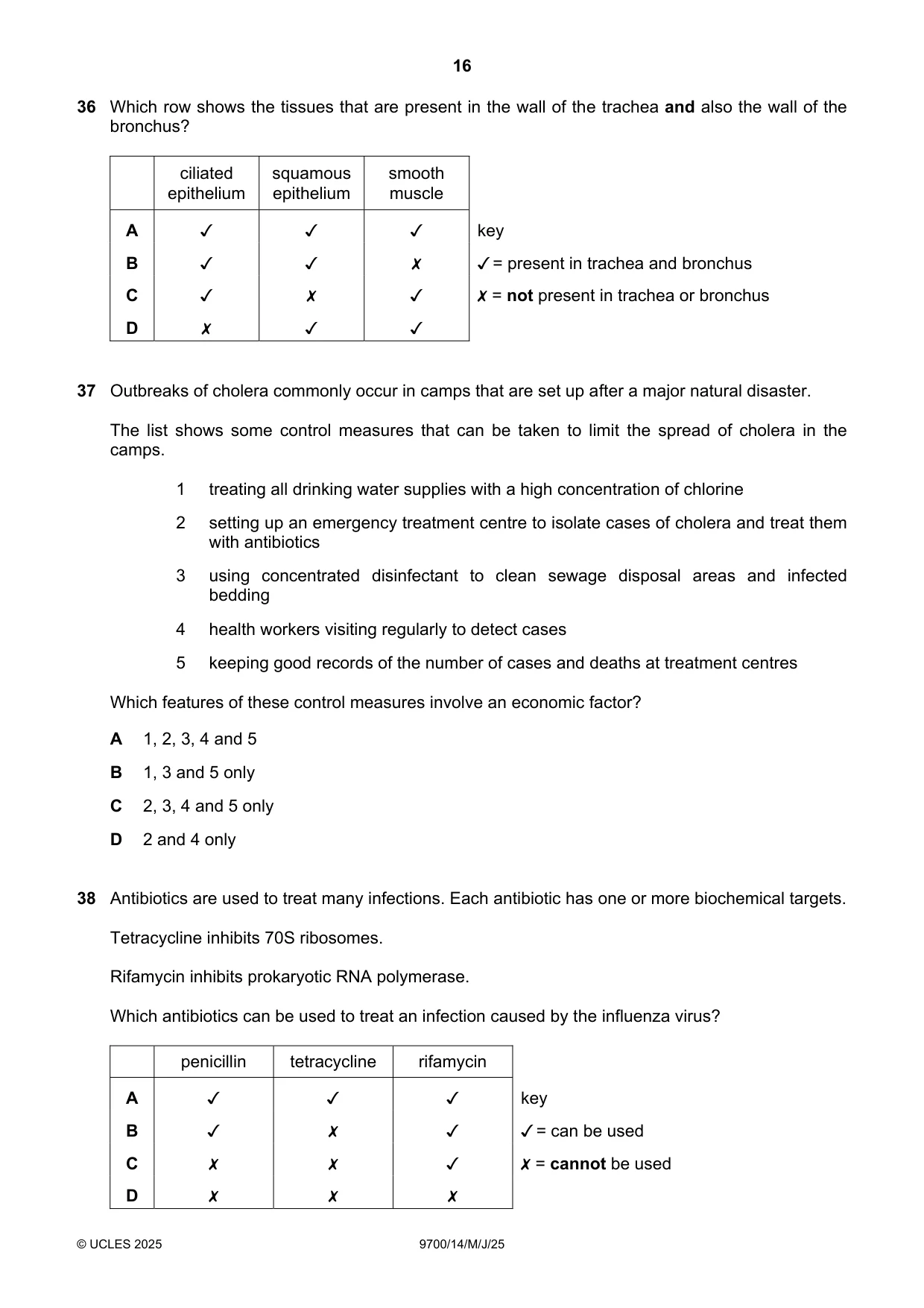
Q36 · Which row shows the tissues that are present in the wall of the trachea and also the wall…
36 Which row shows the tissues that are present in the wall of the trachea and also the wall of the bronchus? ciliated squamous smooth epithelium | epithelium muscle A J Jv Jv B J Jv x Cc Jv x JV D x Jv Jv key / = present in trachea and bronchus X = not present in trachea or bronchus
Mark scheme: C
Q37 · Outbreaks of cholera commonly occur in camps that are set up after a major natural…
37 Outbreaks of cholera commonly occur in camps that are set up after a major natural disaster. The list shows some control measures that can be taken to limit the spread of cholera in the camps. 1 treating all drinking water supplies with a high concentration of chlorine 2 setting up an emergency treatment centre to isolate cases of cholera and treat them with antibiotics 3 using concentrated disinfectant to clean sewage disposal areas and infected bedding 4 health workers visiting regularly to detect cases 5 keeping good records of the number of cases and deaths at treatment centres Which features of these control measures involve an economic factor? A 1, 2, 3, 4 and 5 B 1, 3 and 5 only C 2, 3, 4 and 5 only D 2 and 4 only
Mark scheme: A
Q38 · Antibiotics are used to treat many infections
38 Antibiotics are used to treat many infections. Each antibiotic has one or more biochemical targets. Tetracycline inhibits 70S ribosomes. Rifamycin inhibits prokaryotic RNA polymerase. Which antibiotics can be used to treat an infection caused by the influenza virus? penicillin tetracycline rifamycin A v v v B v x v Cc x x Jv D x x x key / =can be used X = cannot be used
Mark scheme: D
Q39 · Which cells involved in the primary immune response are phagocytes?
39 Which cells involved in the primary immune response are phagocytes? A monocytes B plasma cells C T-helper cells D T-killer cells
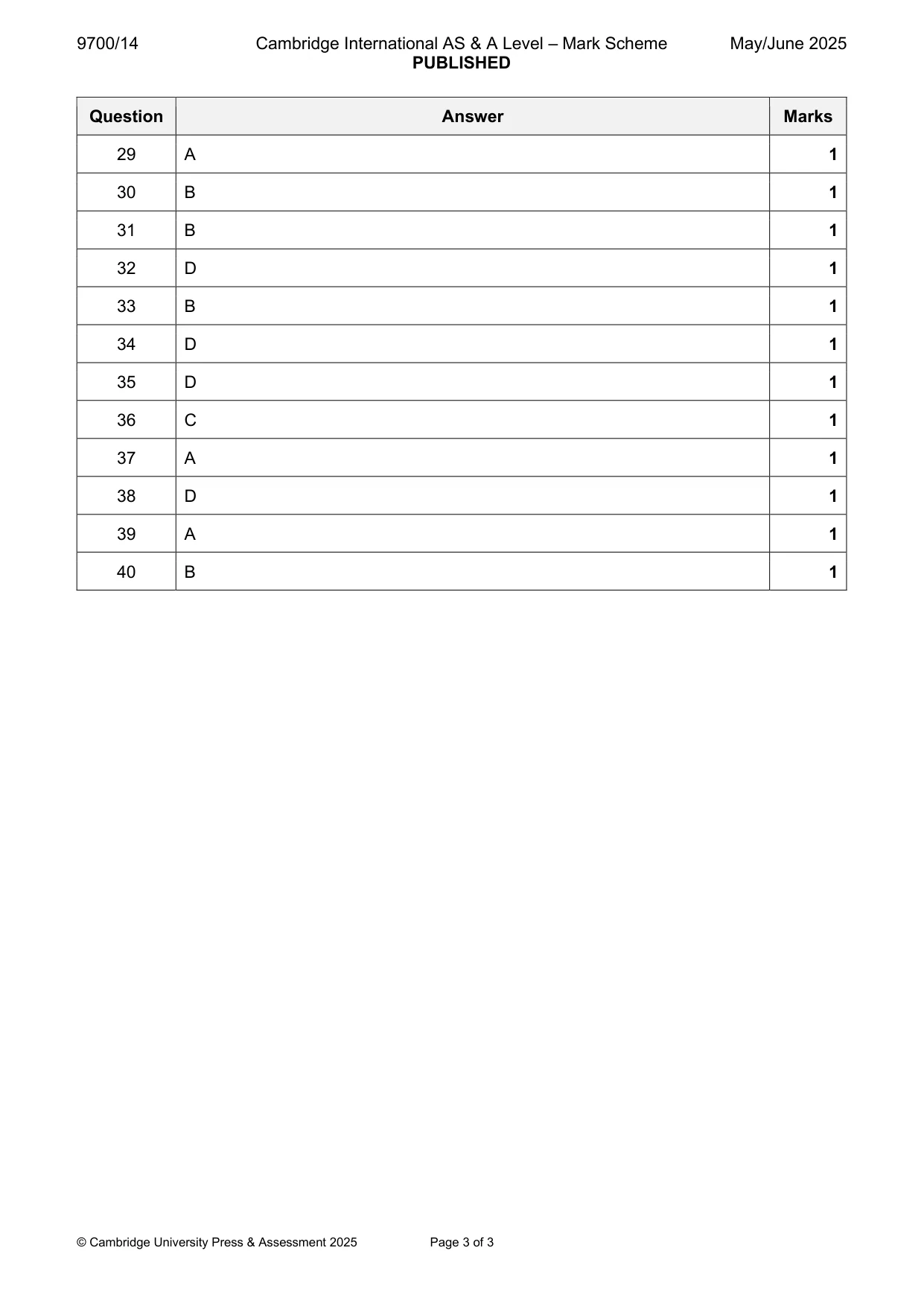
Mark scheme: A
Q40 · Some ways in which different types of monoclonal antibodies can work are described
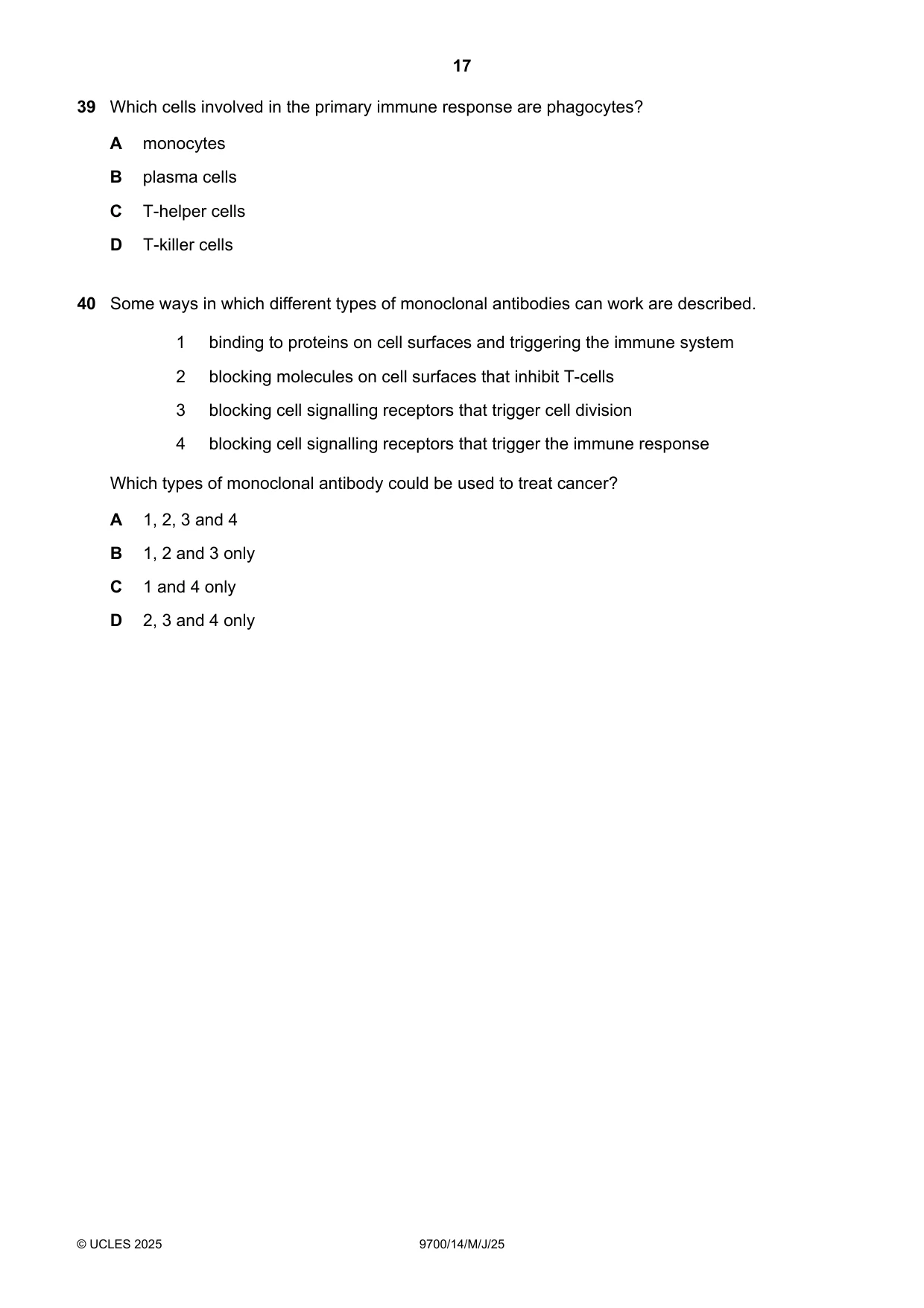
40 Some ways in which different types of monoclonal antibodies can work are described. 1 binding to proteins on cell surfaces and triggering the immune system 2 blocking molecules on cell surfaces that inhibit T-cells 3 blocking cell signalling receptors that trigger cell division 4 blocking cell signalling receptors that trigger the immune response Which types of monoclonal antibody could be used to treat cancer? A 1, 2, 3 and 4 B 1, 2 and 3 only C 1 and 4 only D 2, 3 and 4 only
Mark scheme: B
What was in this paper
The subtopics covered by these 40 questions, and how many questions each got. Open one in a new tab to see every Cambridge question on it.
4Movement into and out of cells4The circulatory system4Factors that affect enzyme action3The microscope in cell studies3Carbohydrates and lipids2Chromosome behaviour in mitosis2Protein synthesis2Transport mechanisms2Transport of oxygen and carbon dioxide2Water2Antibiotics1Antibodies and vaccination1Infectious diseases1Proteins1Replication and division of nuclei and cells1Structure of nucleic acids and replication of DNA1Structure of transport tissues1Testing for biological molecules1The gas exchange system1The immune system1What you needed in this session
Cambridge’s own grade thresholds for 2025 May/June, Paper 1 · Variant 4. A higher threshold means an easier paper — the bar moves with how the cohort did.