Cambridge A Level Biology 9700 — 2020 Oct/Nov Paper 1 · Variant 3
9700/13/O/N/20 · 40 questions · 40 marks · ≈45 min
The question paper and its mark scheme, free to read here and free to download. This is Cambridge’s own paper, exactly as it was sat.
Question paper16 pages

Mark scheme3 pages
Answers below. Sit the paper first if you are practising.
Questions as text
Q1 · What are the appropriate units for measuring diameters of alveoli, diameters of white…
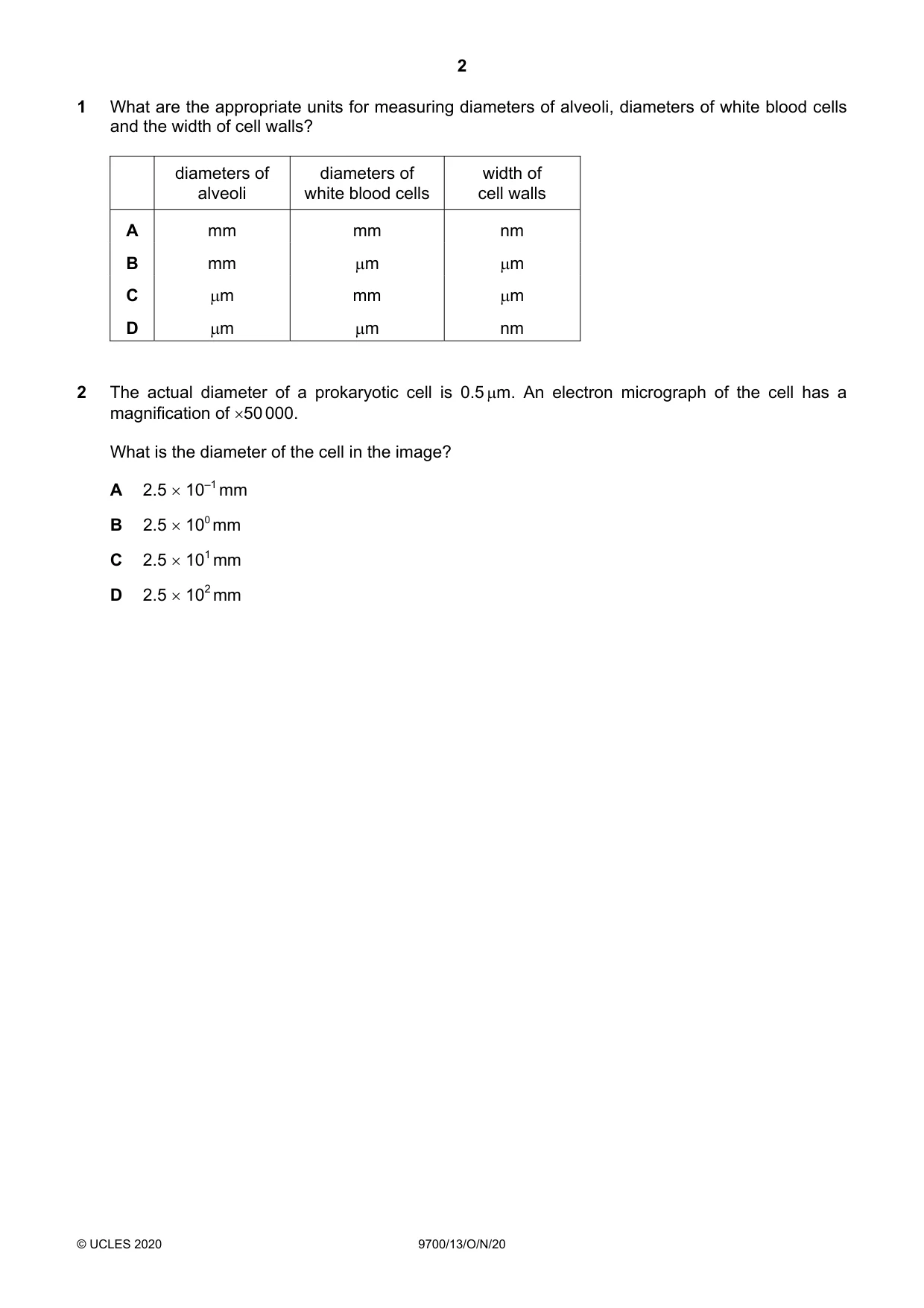
1 What are the appropriate units for measuring diameters of alveoli, diameters of white blood cells and the width of cell walls? diameters of diameters of width of alveoli white blood cells cell walls A mm mm nm B mm m m C m mm m D m m nm
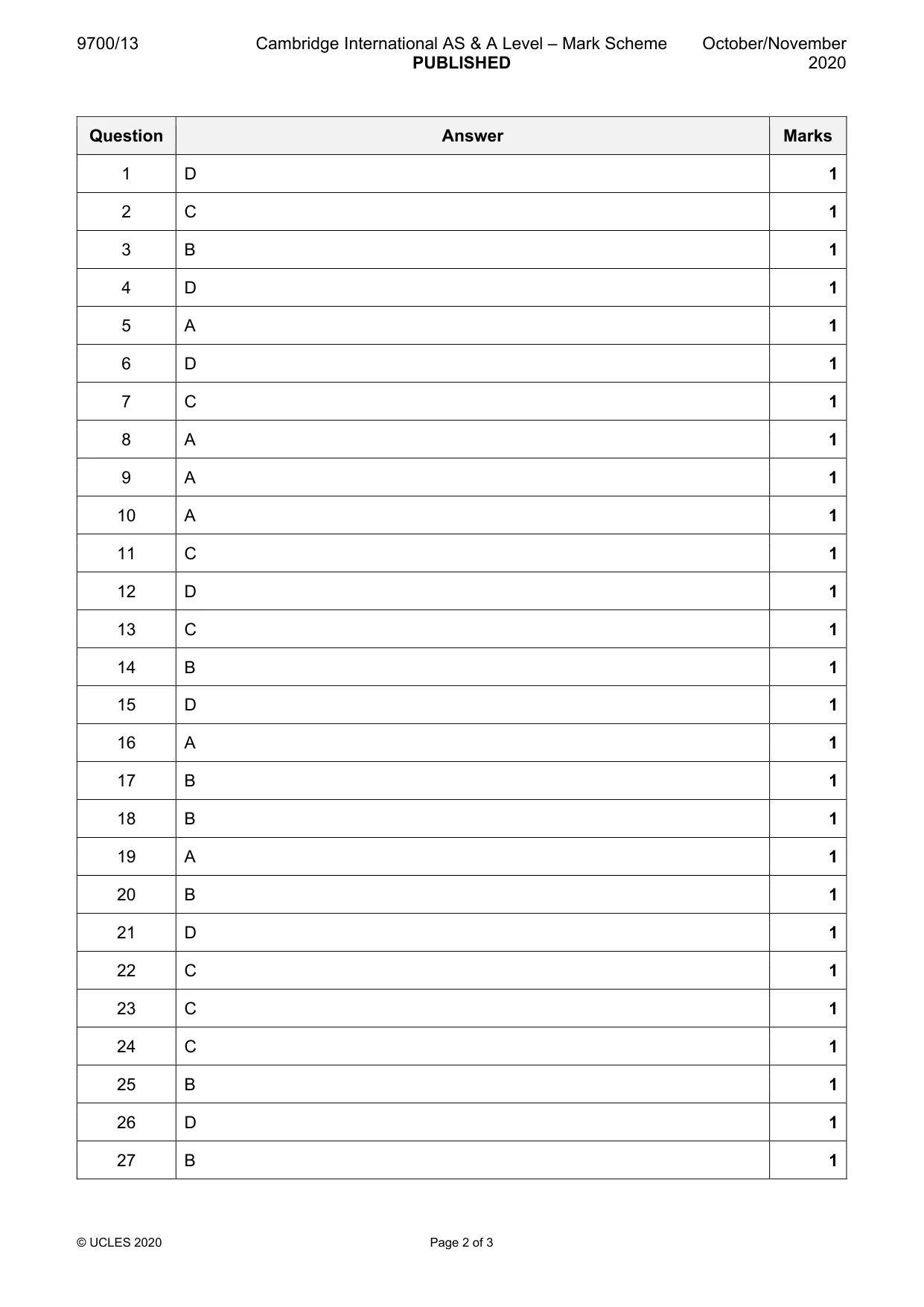
Mark scheme: D
Q2 · The actual diameter of a prokaryotic cell is 0.5 m
2 The actual diameter of a prokaryotic cell is 0.5 m. An electron micrograph of the cell has a magnification of 50 000. What is the diameter of the cell in the image? A 2.5 10–1 mm B 2.5 100 mm C 2.5 101 mm D 2.5 102 mm
Mark scheme: C
Q3 · The electron micrograph shows some cell structures
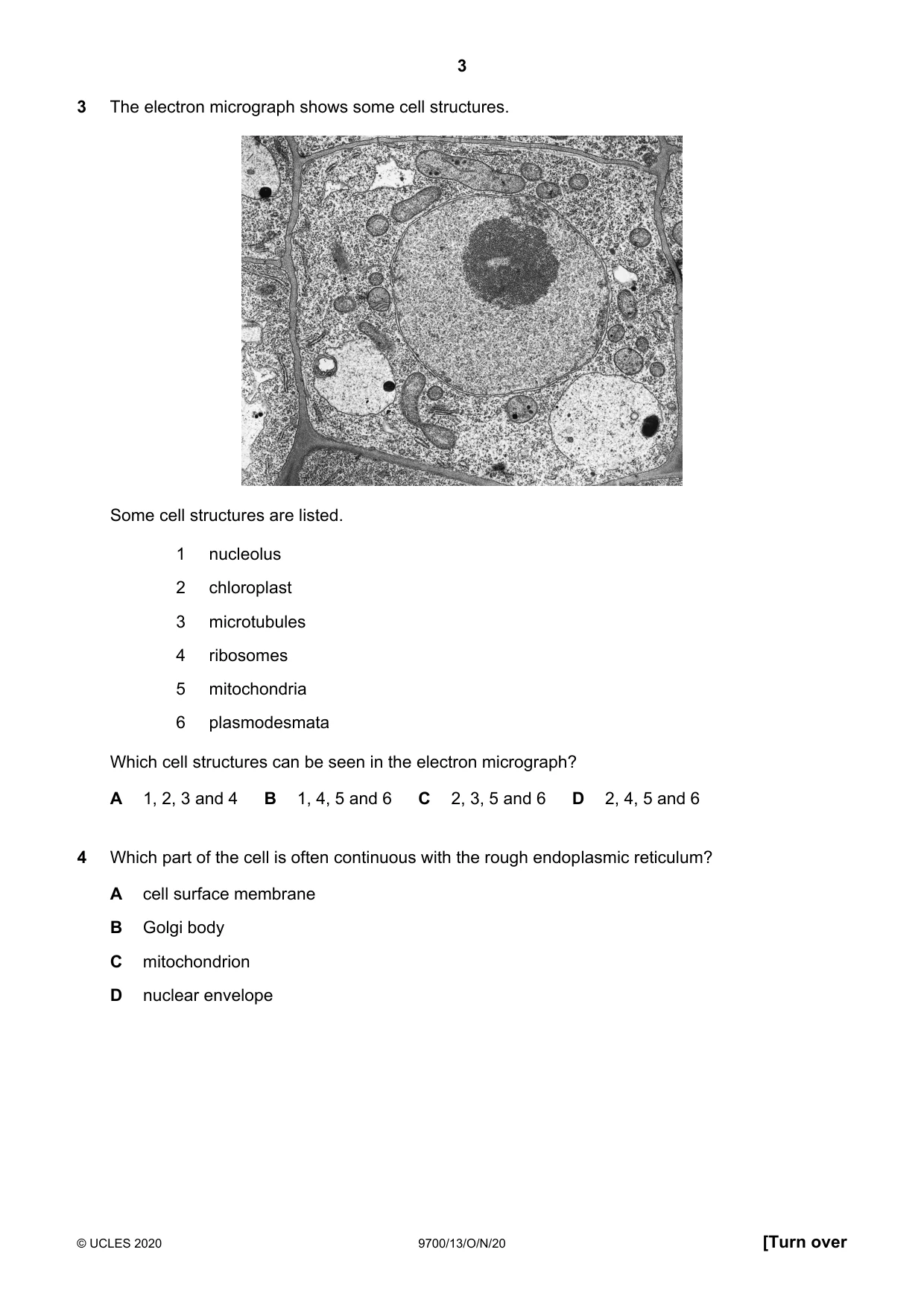
3 The electron micrograph shows some cell structures. Some cell structures are listed. 1 nucleolus 2 chloroplast 3 microtubules 4 ribosomes 5 mitochondria 6 plasmodesmata Which cell structures can be seen in the electron micrograph? A 1, 2, 3 and 4 B 1, 4, 5 and 6 C 2, 3, 5 and 6 D 2, 4, 5 and 6
Mark scheme: B
Q4 · Which part of the cell is often continuous with the rough endoplasmic reticulum?
4 Which part of the cell is often continuous with the rough endoplasmic reticulum? A cell surface membrane B Golgi body C mitochondrion D nuclear envelope
Mark scheme: D
More questions on Cells as the basic units of living organisms
Q5 · Which statements about ATP are correct?
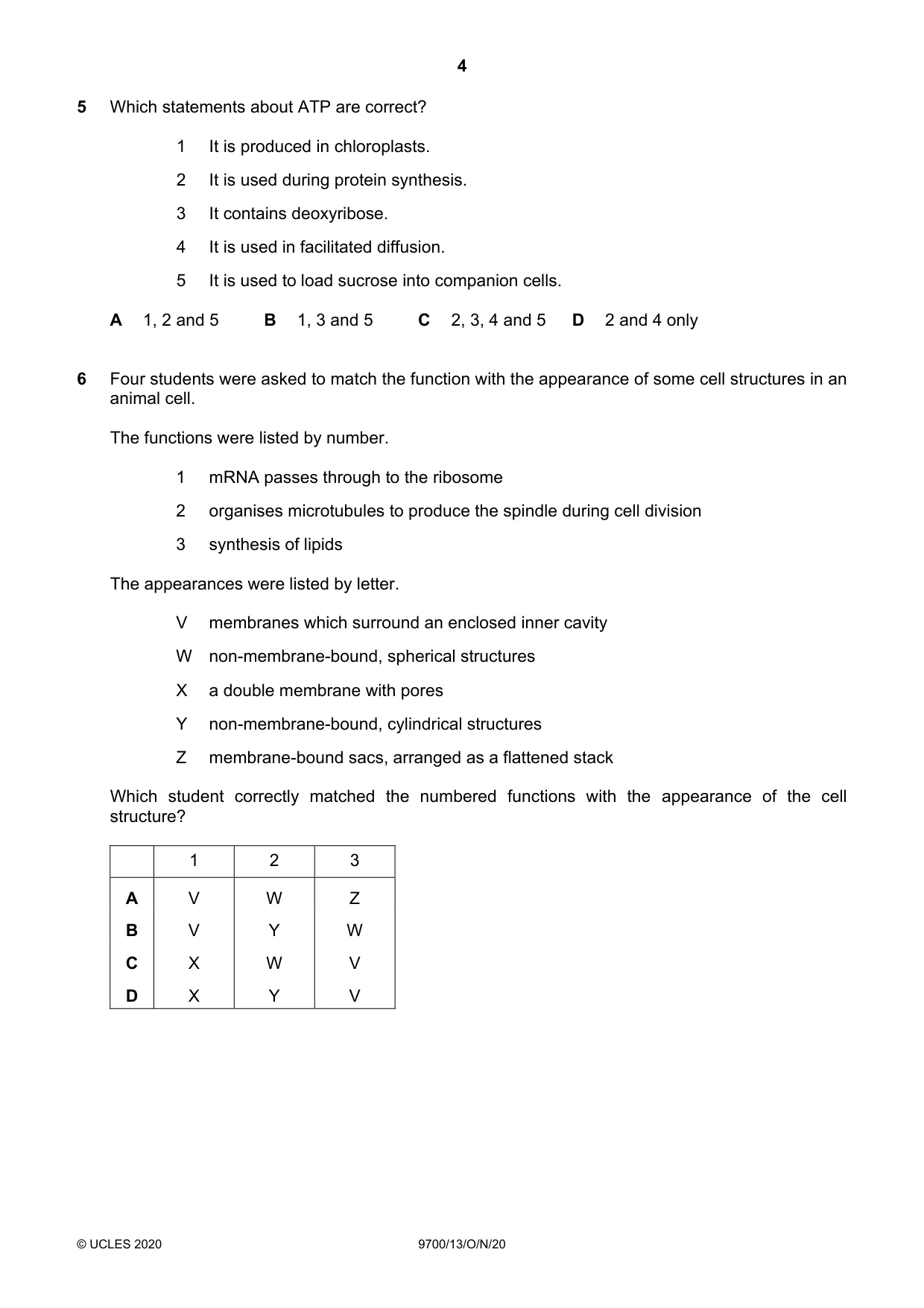
5 Which statements about ATP are correct? 1 It is produced in chloroplasts. 2 It is used during protein synthesis. 3 It contains deoxyribose. 4 It is used in facilitated diffusion. 5 It is used to load sucrose into companion cells. A 1, 2 and 5 B 1, 3 and 5 C 2, 3, 4 and 5 D 2 and 4 only
Mark scheme: A
Q6 · Four students were asked to match the function with the appearance of some cell…
6 Four students were asked to match the function with the appearance of some cell structures in an animal cell. The functions were listed by number. 1 mRNA passes through to the ribosome 2 organises microtubules to produce the spindle during cell division 3 synthesis of lipids The appearances were listed by letter. V membranes which surround an enclosed inner cavity W non-membrane-bound, spherical structures X a double membrane with pores Y non-membrane-bound, cylindrical structures Z membrane-bound sacs, arranged as a flattened stack Which student correctly matched the numbered functions with the appearance of the cell structure? 1 2 3 A V W Z B V Y W C X W V D X Y V
Mark scheme: D
More questions on Cells as the basic units of living organisms
Q7 · A student carried out tests for biological molecules on the same sample of milk
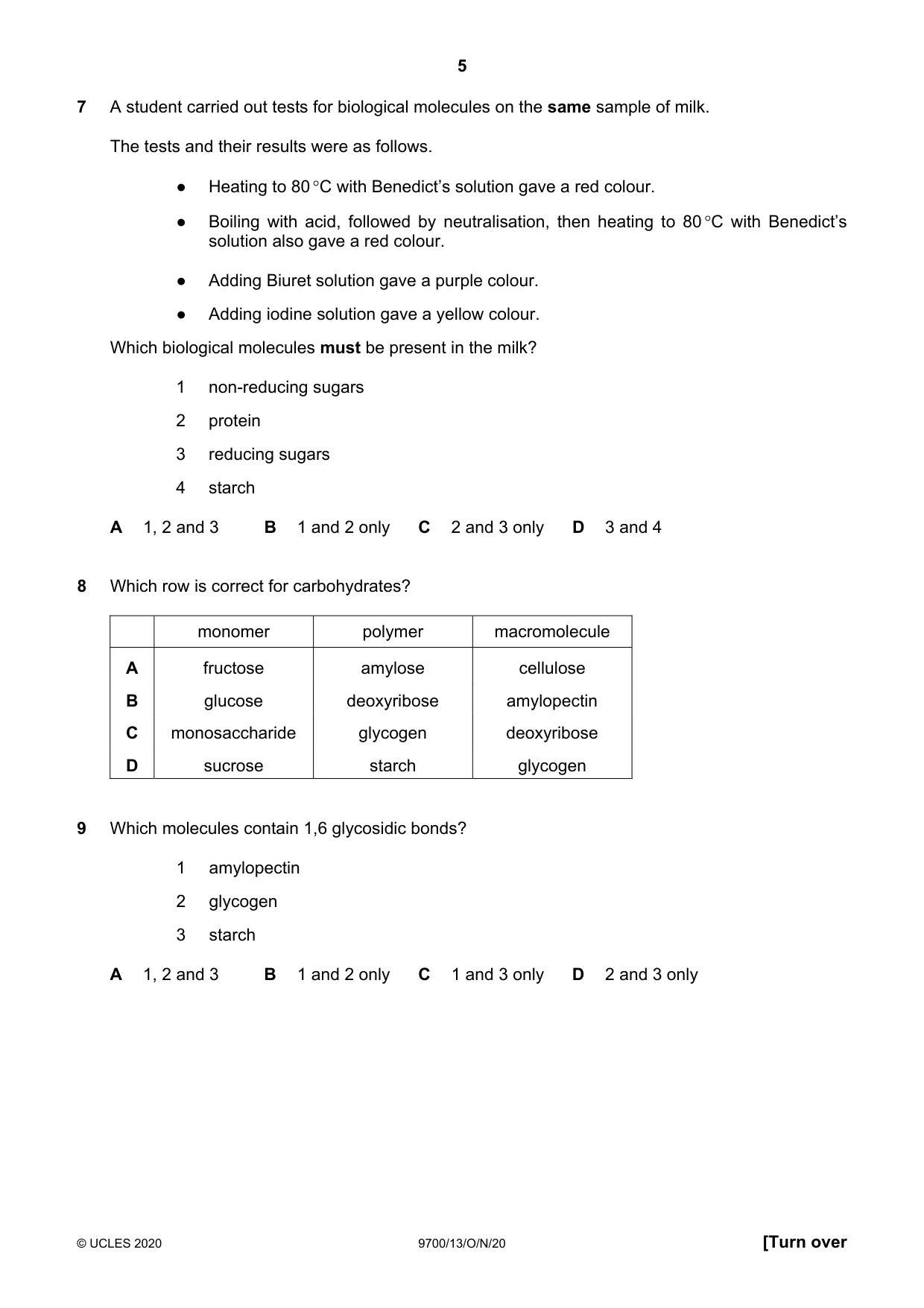
7 A student carried out tests for biological molecules on the same sample of milk. The tests and their results were as follows. ● Heating to 80 C with Benedict’s solution gave a red colour. ● Boiling with acid, followed by neutralisation, then heating to 80 C with Benedict’s solution also gave a red colour. ● Adding Biuret solution gave a purple colour. ● Adding iodine solution gave a yellow colour. Which biological molecules must be present in the milk? 1 non-reducing sugars 2 protein 3 reducing sugars 4 starch A 1, 2 and 3 B 1 and 2 only C 2 and 3 only D 3 and 4
Mark scheme: C
Q8 · Which row is correct for carbohydrates?
8 Which row is correct for carbohydrates? monomer polymer macromolecule A fructose amylose cellulose B glucose deoxyribose amylopectin C monosaccharide glycogen deoxyribose D sucrose starch glycogen
Mark scheme: A
Q9 · Which molecules contain 1,6 glycosidic bonds?
9 Which molecules contain 1,6 glycosidic bonds? 1 amylopectin 2 glycogen 3 starch A 1, 2 and 3 B 1 and 2 only C 1 and 3 only D 2 and 3 only
Mark scheme: A
Q10 · Which row correctly shows the ratio of carbon atoms to hydrogen atoms for glucose, a…
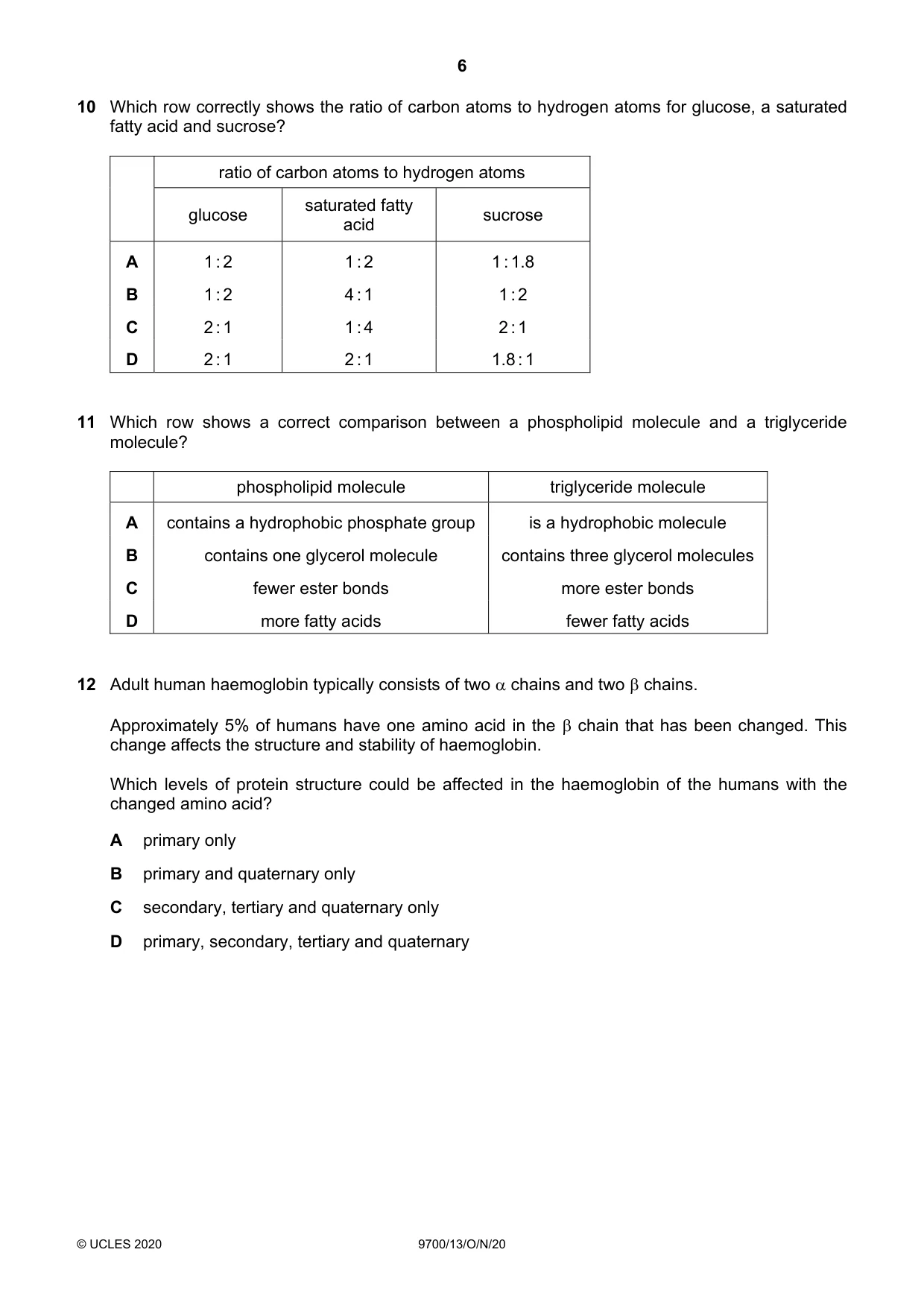
10 Which row correctly shows the ratio of carbon atoms to hydrogen atoms for glucose, a saturated fatty acid and sucrose? ratio of carbon atoms to hydrogen atoms saturated fatty glucose sucrose acid A 1 : 2 1 : 2 1 : 1.8 B 1 : 2 4 : 1 1 : 2 C 2 : 1 1 : 4 2 : 1 D 2 : 1 2 : 1 1.8 : 1
Mark scheme: A
Q11 · Which row shows a correct comparison between a phospholipid molecule and a triglyceride…
11 Which row shows a correct comparison between a phospholipid molecule and a triglyceride molecule? phospholipid molecule triglyceride molecule A contains a hydrophobic phosphate group is a hydrophobic molecule B contains one glycerol molecule contains three glycerol molecules C fewer ester bonds more ester bonds D more fatty acids fewer fatty acids
Mark scheme: C
Q12 · Adult human haemoglobin typically consists of two chains and two chains
12 Adult human haemoglobin typically consists of two chains and two chains. Approximately 5% of humans have one amino acid in the chain that has been changed. This change affects the structure and stability of haemoglobin. Which levels of protein structure could be affected in the haemoglobin of the humans with the changed amino acid? A primary only B primary and quaternary only C secondary, tertiary and quaternary only D primary, secondary, tertiary and quaternary
Mark scheme: D
Q13 · Lysozyme occurs in human tears, saliva, milk and mucus
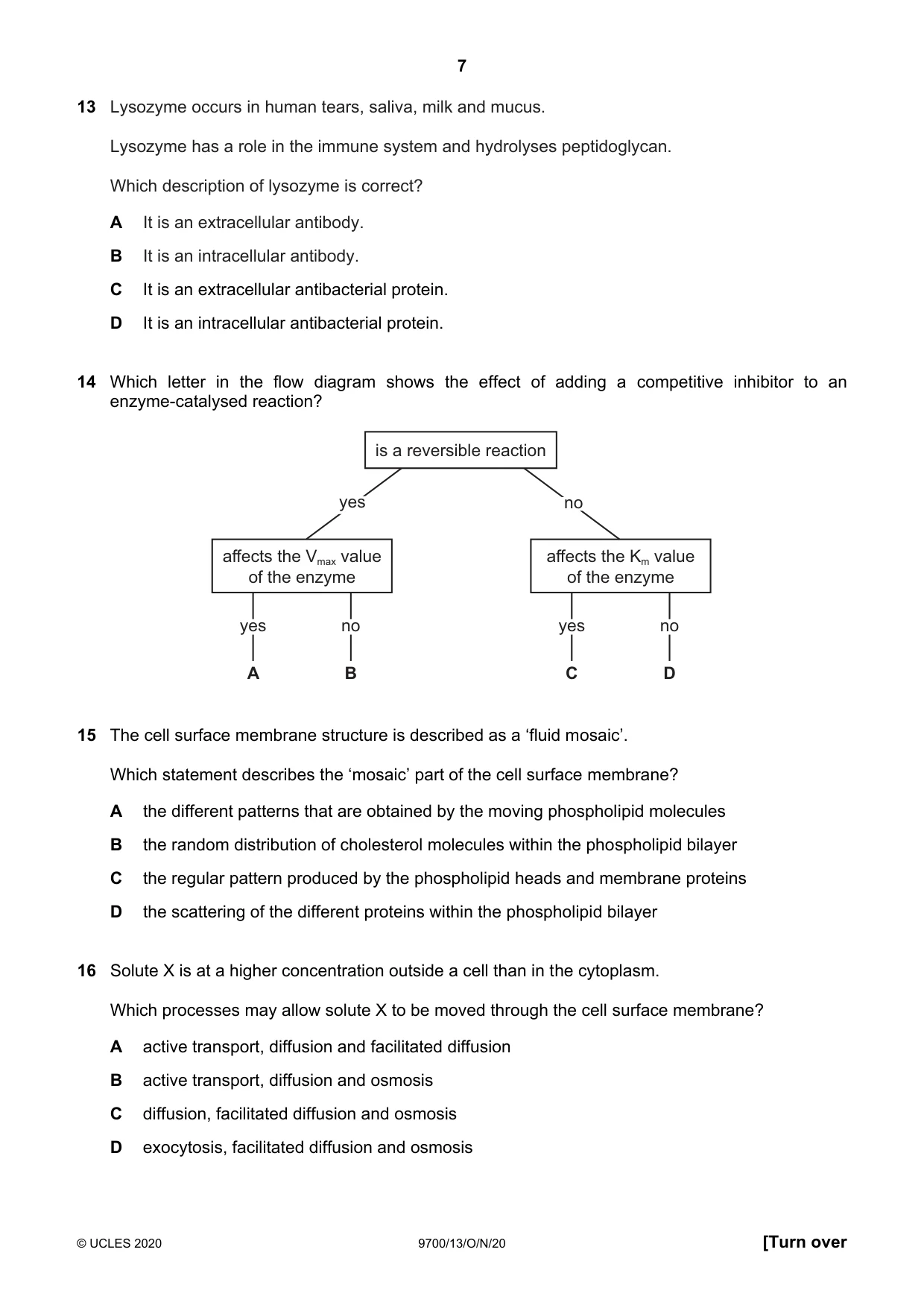
13 Lysozyme occurs in human tears, saliva, milk and mucus. Lysozyme has a role in the immune system and hydrolyses peptidoglycan. Which description of lysozyme is correct? A It is an extracellular antibody. B It is an intracellular antibody. C It is an extracellular antibacterial protein. D It is an intracellular antibacterial protein.
Mark scheme: C
Q14 · Which letter in the flow diagram shows the effect of adding a competitive inhibitor to an…
14 Which letter in the flow diagram shows the effect of adding a competitive inhibitor to an enzyme-catalysed reaction? is a reversible reaction yes no affects the Vmax value affects the Km value of the enzyme of the enzyme yes no yes no A B C D
Mark scheme: B
Q15 · The cell surface membrane structure is described as a ‘fluid mosaic’
15 The cell surface membrane structure is described as a ‘fluid mosaic’. Which statement describes the ‘mosaic’ part of the cell surface membrane? A the different patterns that are obtained by the moving phospholipid molecules B the random distribution of cholesterol molecules within the phospholipid bilayer C the regular pattern produced by the phospholipid heads and membrane proteins D the scattering of the different proteins within the phospholipid bilayer
Mark scheme: D
Q16 · Solute X is at a higher concentration outside a cell than in the cytoplasm
16 Solute X is at a higher concentration outside a cell than in the cytoplasm. Which processes may allow solute X to be moved through the cell surface membrane? A active transport, diffusion and facilitated diffusion B active transport, diffusion and osmosis C diffusion, facilitated diffusion and osmosis D exocytosis, facilitated diffusion and osmosis
Mark scheme: A
Q17 · Three molecules found in prokaryotes are listed
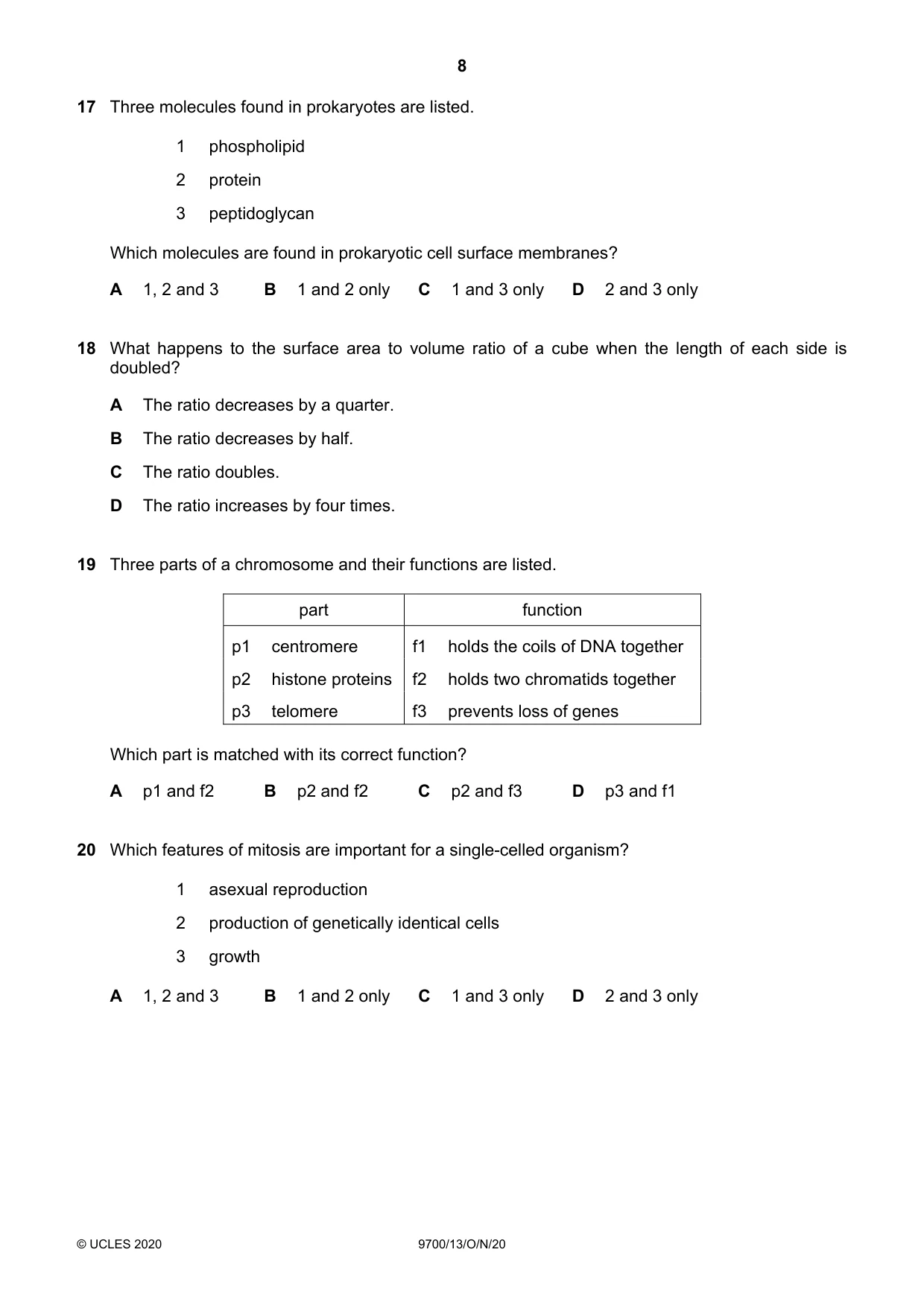
17 Three molecules found in prokaryotes are listed. 1 phospholipid 2 protein 3 peptidoglycan Which molecules are found in prokaryotic cell surface membranes? A 1, 2 and 3 B 1 and 2 only C 1 and 3 only D 2 and 3 only
Mark scheme: B
Q18 · What happens to the surface area to volume ratio of a cube when the length of each side…
18 What happens to the surface area to volume ratio of a cube when the length of each side is doubled? A The ratio decreases by a quarter. B The ratio decreases by half. C The ratio doubles. D The ratio increases by four times.
Mark scheme: B
More questions on Cells as the basic units of living organisms
Q19 · Three parts of a chromosome and their functions are listed
19 Three parts of a chromosome and their functions are listed. part function p1 centromere f1 holds the coils of DNA together p2 histone proteins f2 holds two chromatids together p3 telomere f3 prevents loss of genes Which part is matched with its correct function? A p1 and f2 B p2 and f2 C p2 and f3 D p3 and f1
Mark scheme: A
Q20 · Which features of mitosis are important for a single-celled organism?
20 Which features of mitosis are important for a single-celled organism? 1 asexual reproduction 2 production of genetically identical cells 3 growth A 1, 2 and 3 B 1 and 2 only C 1 and 3 only D 2 and 3 only
Mark scheme: B
More questions on Replication and division of nuclei and cells
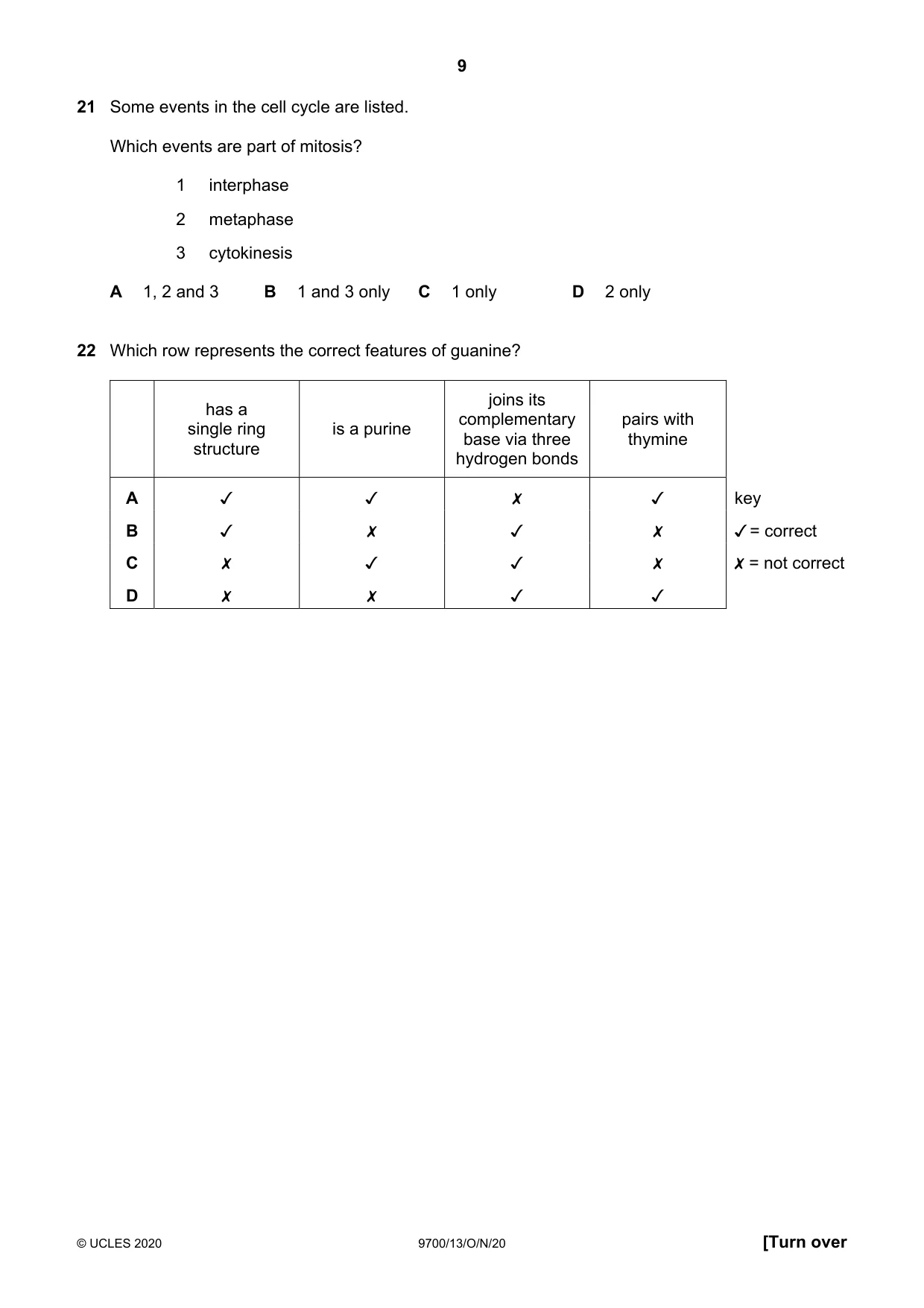
Q21 · Some events in the cell cycle are listed
21 Some events in the cell cycle are listed. Which events are part of mitosis? 1 interphase 2 metaphase 3 cytokinesis A 1, 2 and 3 B 1 and 3 only C 1 only D 2 only
Mark scheme: D
More questions on Replication and division of nuclei and cells
Q22 · Which row represents the correct features of guanine?
22 Which row represents the correct features of guanine? joins its has a ; . . : . . complementary pairs with single ring IS @ purine base via three thymine structure hydrogen bonds A v Jv x v B v x v x Cc x Jv v x D x x v v key / = correct X = not correct
Mark scheme: C
More questions on Structure of nucleic acids and replication of DNA
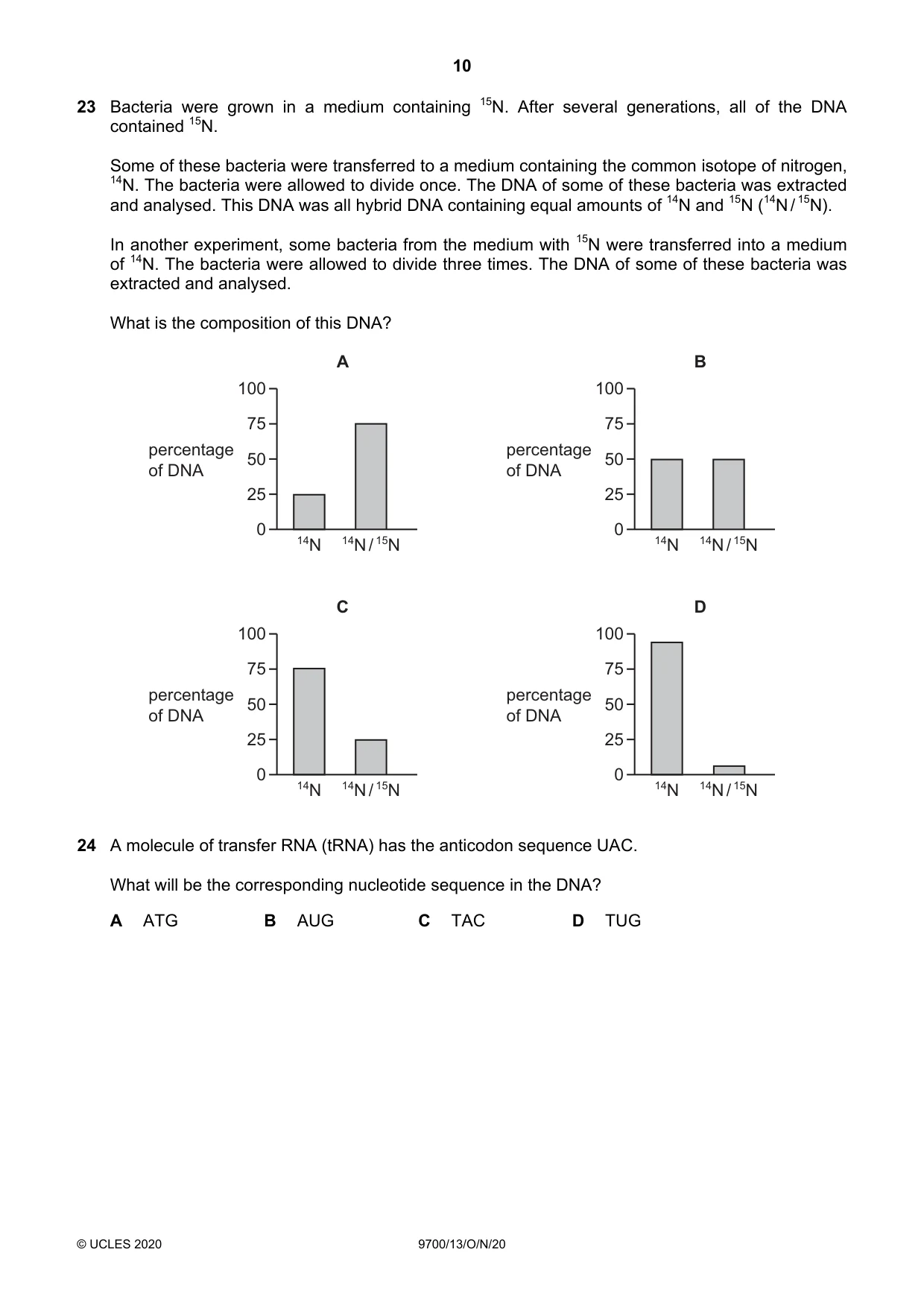
Q23 · Bacteria were grown in a medium containing 15N
23 Bacteria were grown in a medium containing 15N. After several generations, all of the DNA contained 15N. Some of these bacteria were transferred to a medium containing the common isotope of nitrogen, 14N. The bacteria were allowed to divide once. The DNA of some of these bacteria was extracted and analysed. This DNA was all hybrid DNA containing equal amounts of 14N and 15N (14N / 15N). In another experiment, some bacteria from the medium with 15N were transferred into a medium of 14N. The bacteria were allowed to divide three times. The DNA of some of these bacteria was extracted and analysed. What is the composition of this DNA? A B 100 100 75 75 percentage percentage 50 50 of DNA of DNA 25 25 0 0 14N 14N / 15N 14N 14N / 15N C D 100 100 75 75 percentage percentage 50 50 of DNA of DNA 25 25 0 0 14N 14N / 15N 14N 14N / 15N
Mark scheme: C
More questions on Structure of nucleic acids and replication of DNA
Q24 · A molecule of transfer RNA (tRNA) has the anticodon sequence UAC
24 A molecule of transfer RNA (tRNA) has the anticodon sequence UAC. What will be the corresponding nucleotide sequence in the DNA? A ATG B AUG C TAC D TUG
Mark scheme: C
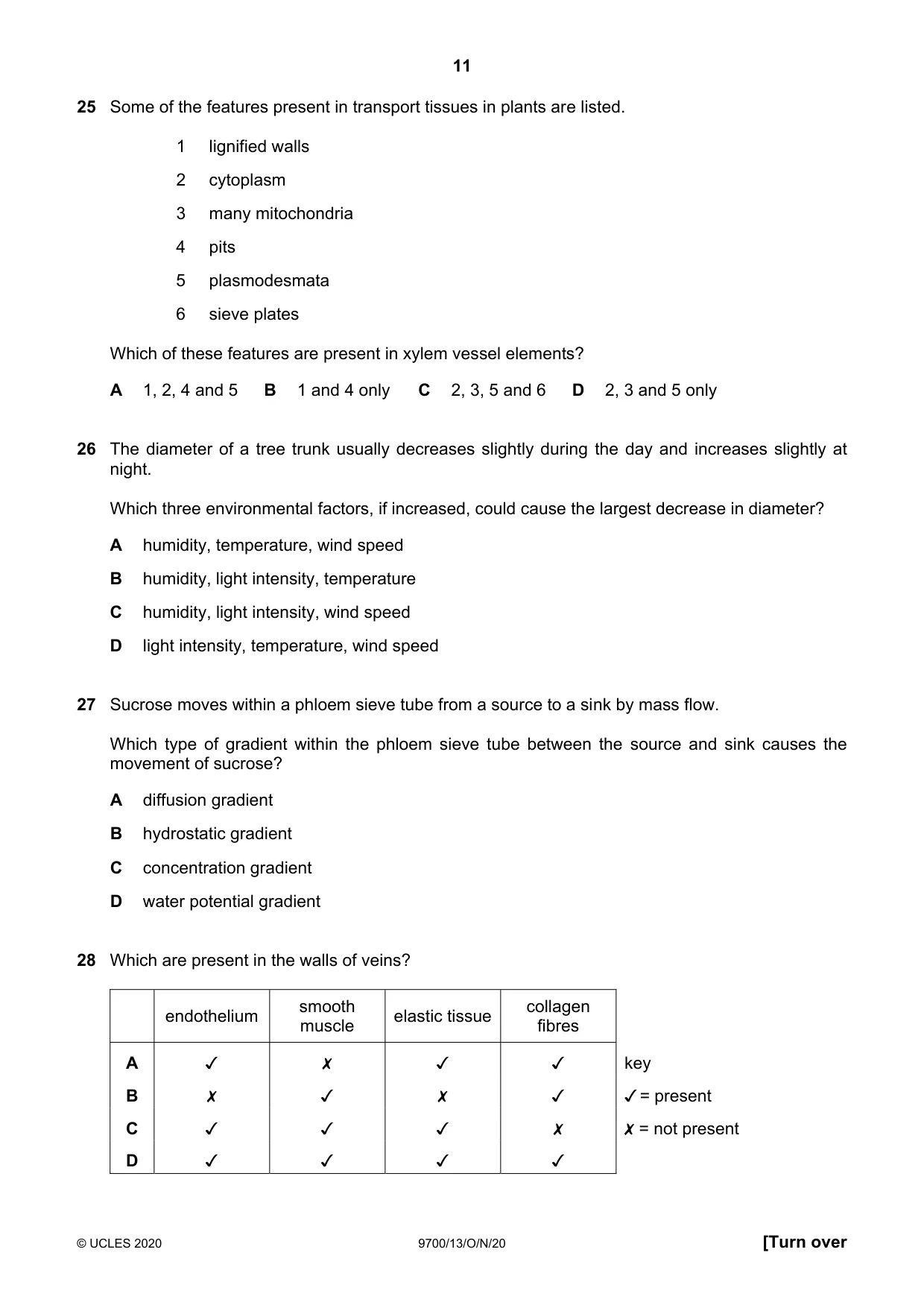
Q25 · Some of the features present in transport tissues in plants are listed
25 Some of the features present in transport tissues in plants are listed. 1 lignified walls 2 cytoplasm 3 many mitochondria 4 pits 5 plasmodesmata 6 sieve plates Which of these features are present in xylem vessel elements? A 1, 2, 4 and 5 B 1 and 4 only C 2, 3, 5 and 6 D 2, 3 and 5 only
Mark scheme: B
Q26 · The diameter of a tree trunk usually decreases slightly during the day and increases…
26 The diameter of a tree trunk usually decreases slightly during the day and increases slightly at night. Which three environmental factors, if increased, could cause the largest decrease in diameter? A humidity, temperature, wind speed B humidity, light intensity, temperature C humidity, light intensity, wind speed D light intensity, temperature, wind speed
Mark scheme: D
Q27 · Sucrose moves within a phloem sieve tube from a source to a sink by mass flow
27 Sucrose moves within a phloem sieve tube from a source to a sink by mass flow. Which type of gradient within the phloem sieve tube between the source and sink causes the movement of sucrose? A diffusion gradient B hydrostatic gradient C concentration gradient D water potential gradient
Mark scheme: B
Q28 · Which are present in the walls of veins?
28 Which are present in the walls of veins? endothelium smoomn elastic tissue co fagen A Jv x Jv Jv B x Jv x JV Cc Jv Jv Jv x D Jv Jv Jv Jv key / = present X = not present
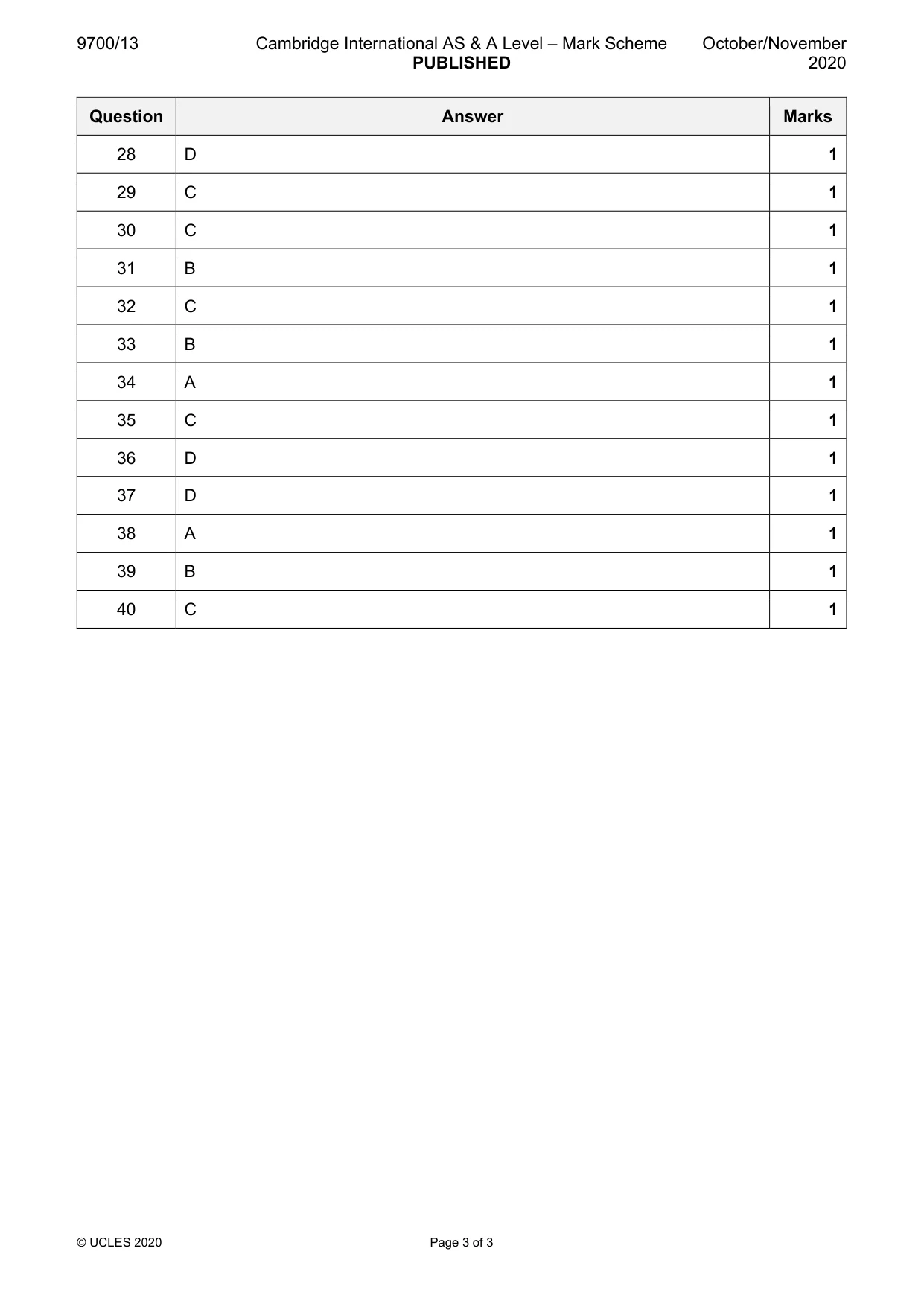
Mark scheme: D
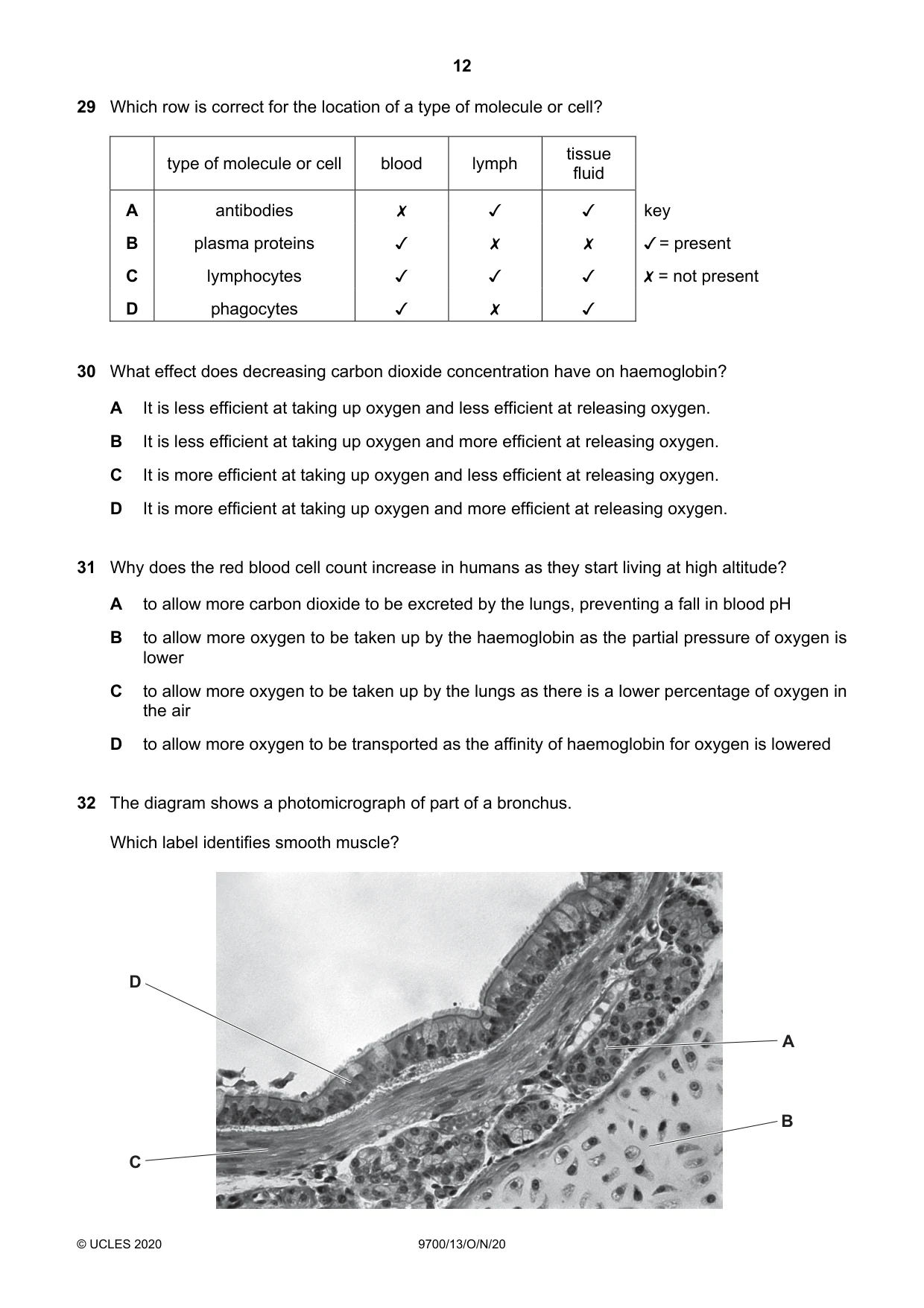
Q29 · Which row is correct for the location of a type of molecule or cell?
29 Which row is correct for the location of a type of molecule or cell? type of molecule or cell blood lymph ou A antibodies Xx v v B plasma proteins Jv x x Cc lymphocytes v v v D phagocytes v x v key / = present X = not present
Mark scheme: C
Q30 · What effect does decreasing carbon dioxide concentration have on haemoglobin?
30 What effect does decreasing carbon dioxide concentration have on haemoglobin? A It is less efficient at taking up oxygen and less efficient at releasing oxygen. B It is less efficient at taking up oxygen and more efficient at releasing oxygen. C It is more efficient at taking up oxygen and less efficient at releasing oxygen. D It is more efficient at taking up oxygen and more efficient at releasing oxygen.
Mark scheme: C
Q31 · Why does the red blood cell count increase in humans as they start living at high…
31 Why does the red blood cell count increase in humans as they start living at high altitude? A to allow more carbon dioxide to be excreted by the lungs, preventing a fall in blood pH B to allow more oxygen to be taken up by the haemoglobin as the partial pressure of oxygen is lower C to allow more oxygen to be taken up by the lungs as there is a lower percentage of oxygen in the air D to allow more oxygen to be transported as the affinity of haemoglobin for oxygen is lowered
Mark scheme: B
Q32 · The diagram shows a photomicrograph of part of a bronchus
32 The diagram shows a photomicrograph of part of a bronchus. Which label identifies smooth muscle? D A B C
Mark scheme: C
Q33 · Which statements about all bronchioles are correct?
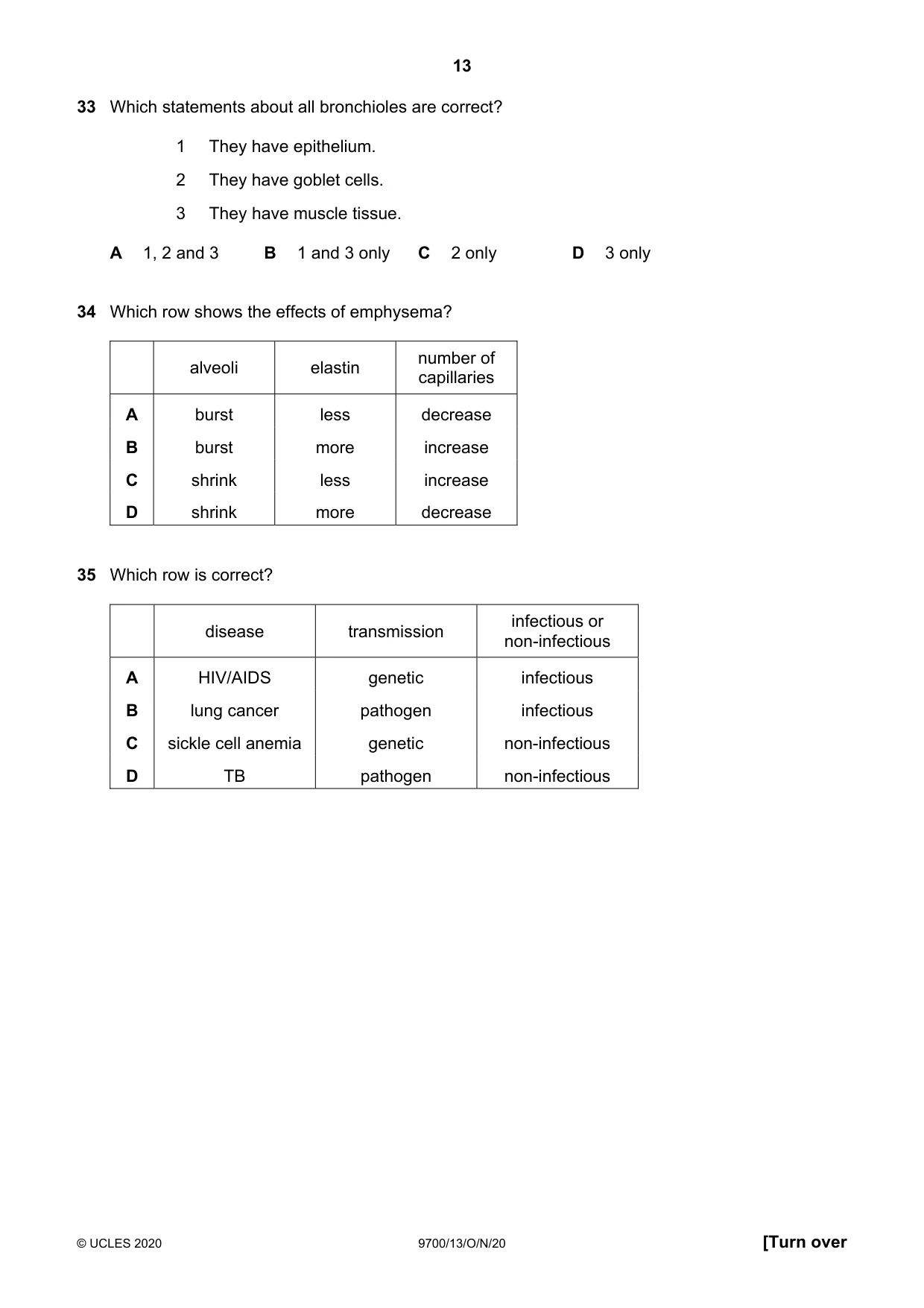
33 Which statements about all bronchioles are correct? 1 They have epithelium. 2 They have goblet cells. 3 They have muscle tissue. A 1, 2 and 3 B 1 and 3 only C 2 only D 3 only
Mark scheme: B
Q34 · Which row shows the effects of emphysema?
34 Which row shows the effects of emphysema? number of alveoli elastin capillaries A burst less decrease B burst more increase C shrink less increase D shrink more decrease
Mark scheme: A
Q35 · Which row is correct?
35 Which row is correct? infectious or disease transmission non-infectious A HIV/AIDS genetic infectious B lung cancer pathogen infectious C sickle cell anemia genetic non-infectious D TB pathogen non-infectious
Mark scheme: C
Q36 · The diagrams show the result of incubating two species of bacteria, P and R, on separate…
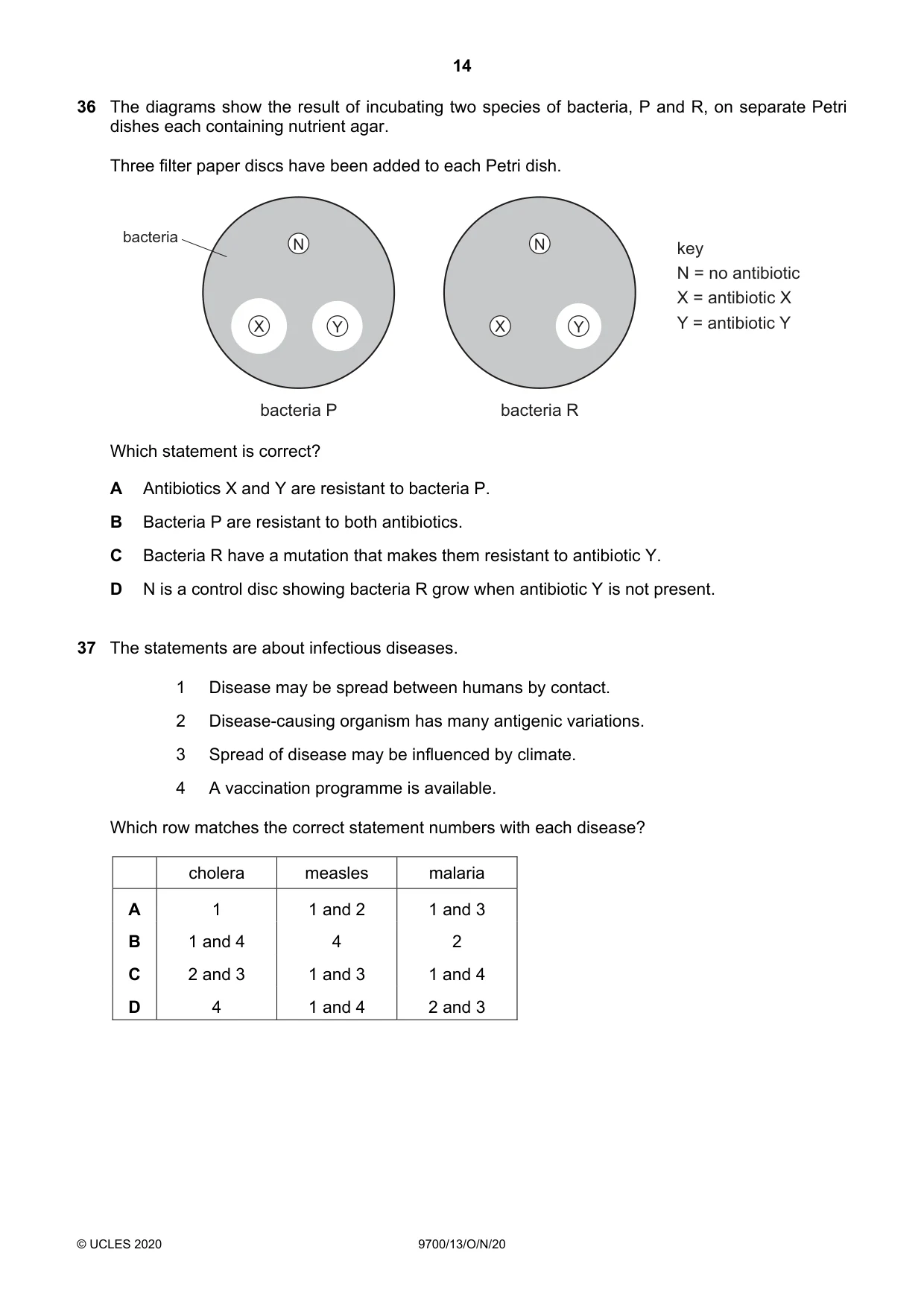
36 The diagrams show the result of incubating two species of bacteria, P and R, on separate Petri dishes each containing nutrient agar. Three filter paper discs have been added to each Petri dish. bacteria N N key N = no antibiotic X = antibiotic X X Y X Y Y = antibiotic Y bacteria P bacteria R Which statement is correct? A Antibiotics X and Y are resistant to bacteria P. B Bacteria P are resistant to both antibiotics. C Bacteria R have a mutation that makes them resistant to antibiotic Y. D N is a control disc showing bacteria R grow when antibiotic Y is not present.
Mark scheme: D
Q37 · The statements are about infectious diseases
37 The statements are about infectious diseases. 1 Disease may be spread between humans by contact. 2 Disease-causing organism has many antigenic variations. 3 Spread of disease may be influenced by climate. 4 A vaccination programme is available. Which row matches the correct statement numbers with each disease? cholera measles malaria A 1 1 and 2 1 and 3 B 1 and 4 4 2 C 2 and 3 1 and 3 1 and 4 D 4 1 and 4 2 and 3
Mark scheme: D
Q38 · Muscle cells have cell surface receptors for the neurotransmitter, ACh
38 Muscle cells have cell surface receptors for the neurotransmitter, ACh. These receptors allow the muscle to respond to a nerve impulse. In the condition myasthenia gravis, the helper T cells stimulate a clone of B cells to become plasma cells and secrete antibodies that bind to and block these ACh receptors. The muscles cannot be stimulated and begin to break down. A short-term treatment for myasthenia gravis is to inject monoclonal antibodies into the blood. What is the target of these monoclonal antibodies? A antibodies that bind to ACh receptors B muscle cell surface ACh receptors C plasma cells secreting anti-ACh receptor antibodies D the stimulating neurotransmitter ACh
Mark scheme: A
Q39 · The diagram shows the simplified structure of an antibody
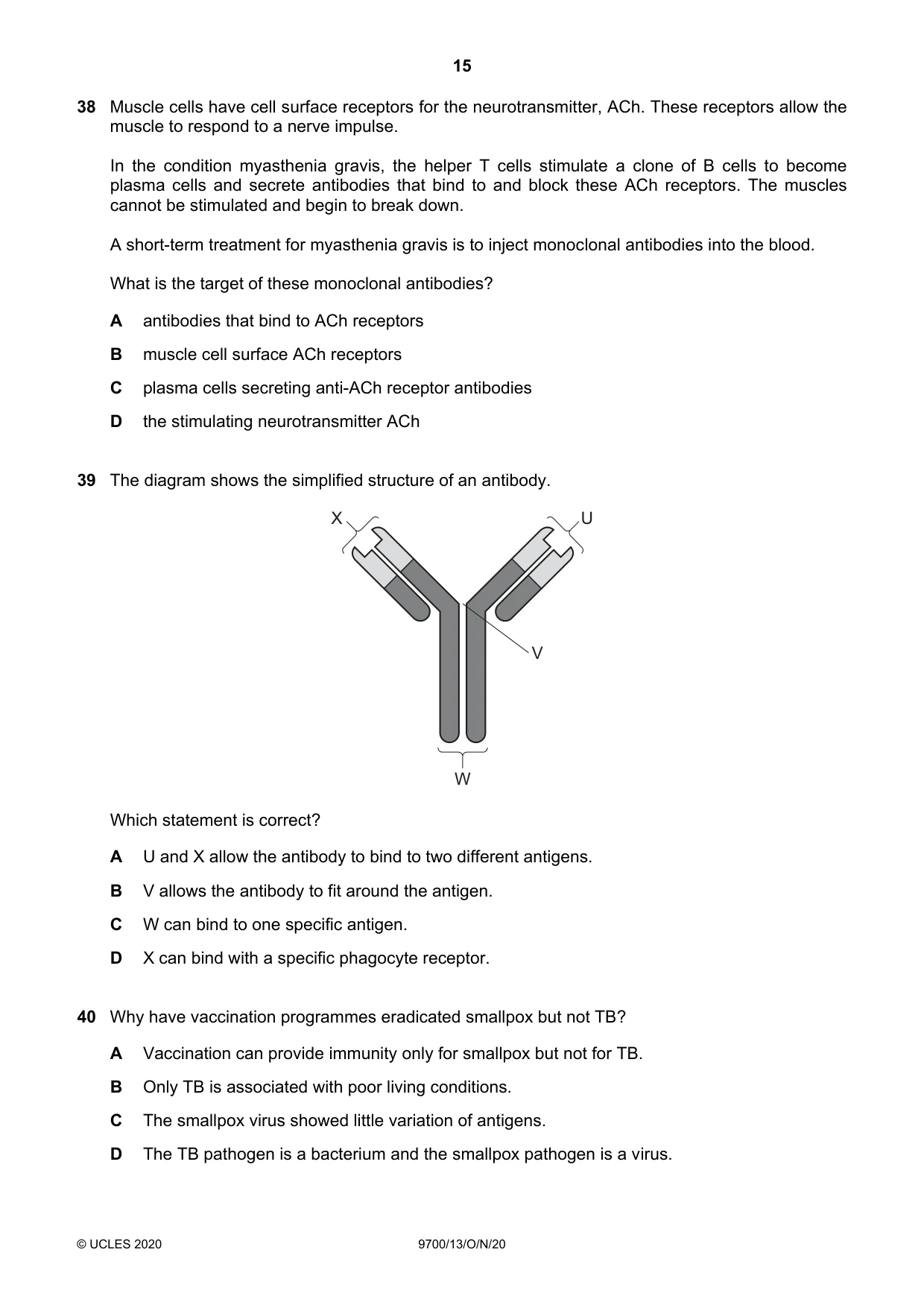
39 The diagram shows the simplified structure of an antibody. X U V W Which statement is correct? A U and X allow the antibody to bind to two different antigens. B V allows the antibody to fit around the antigen. C W can bind to one specific antigen. D X can bind with a specific phagocyte receptor.
Mark scheme: B
Q40 · Why have vaccination programmes eradicated smallpox but not TB?
40 Why have vaccination programmes eradicated smallpox but not TB? A Vaccination can provide immunity only for smallpox but not for TB. B Only TB is associated with poor living conditions. C The smallpox virus showed little variation of antigens. D The TB pathogen is a bacterium and the smallpox pathogen is a virus.
Mark scheme: C
What was in this paper
The subtopics covered by these 40 questions, and how many questions each got. Open one in a new tab to see every Cambridge question on it.
4Cells as the basic units of living organisms3The gas exchange system3The microscope in cell studies3Antibodies and vaccination2Fluid mosaic membranes2Infectious diseases2Proteins2Replication and division of nuclei and cells2Structure of nucleic acids and replication of DNA2The circulatory system2Transport mechanisms2Transport of oxygen and carbon dioxide2Antibiotics1Chromosome behaviour in mitosis1Energy1Factors that affect enzyme action1Movement into and out of cells1Protein synthesis1Structure of transport tissues1Testing for biological molecules1The immune system1What you needed in this session
Cambridge’s own grade thresholds for 2020 Oct/Nov, Paper 1 · Variant 3. A higher threshold means an easier paper — the bar moves with how the cohort did.