Cambridge A Level Biology 9700 — 2023 May/June Paper 1 · Variant 2
9700/12/M/J/23 · 40 questions · 40 marks · ≈45 min
The question paper and its mark scheme, free to read here and free to download. This is Cambridge’s own paper, exactly as it was sat.
Question paper20 pages
Mark scheme3 pages
Answers below. Sit the paper first if you are practising.
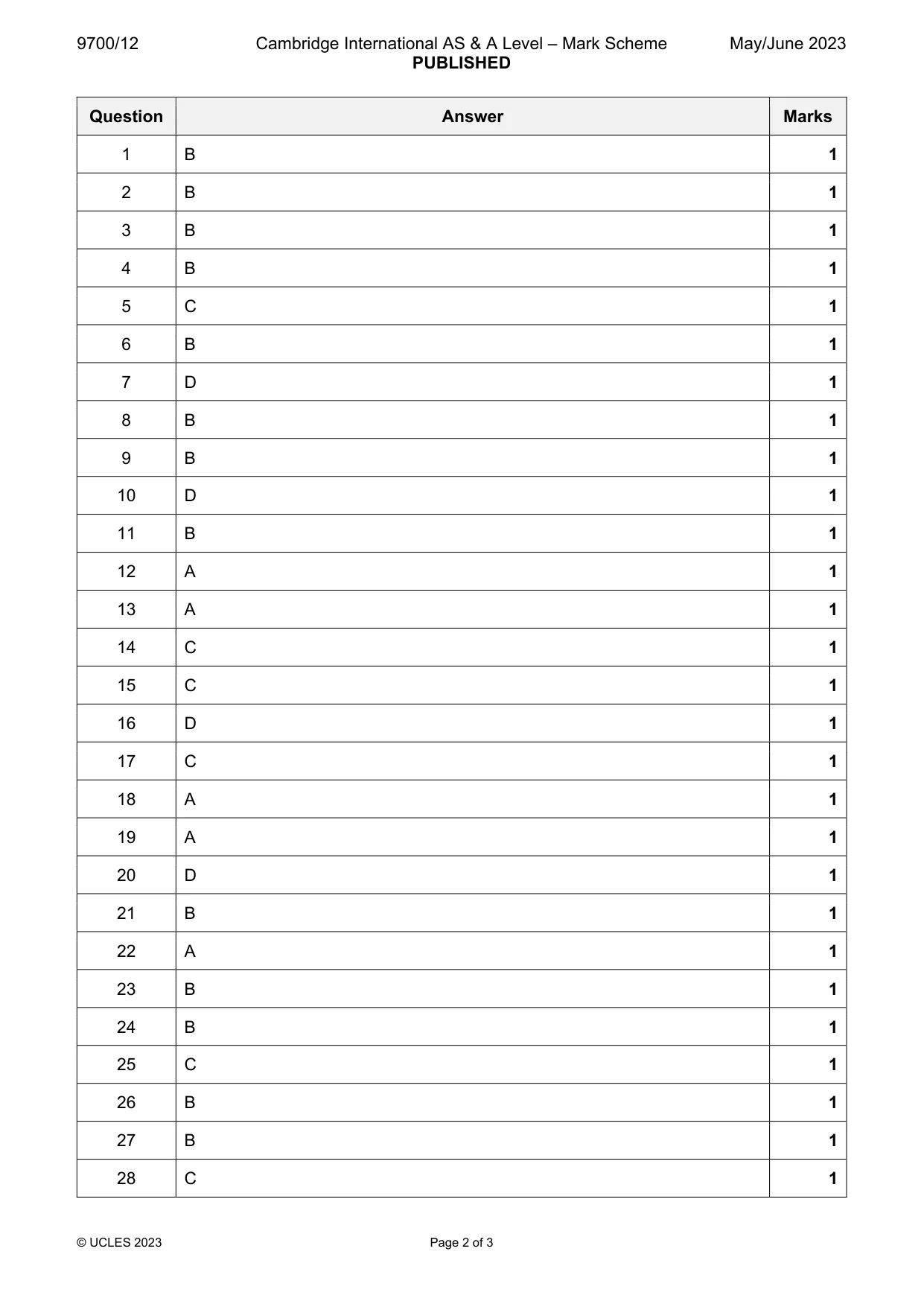
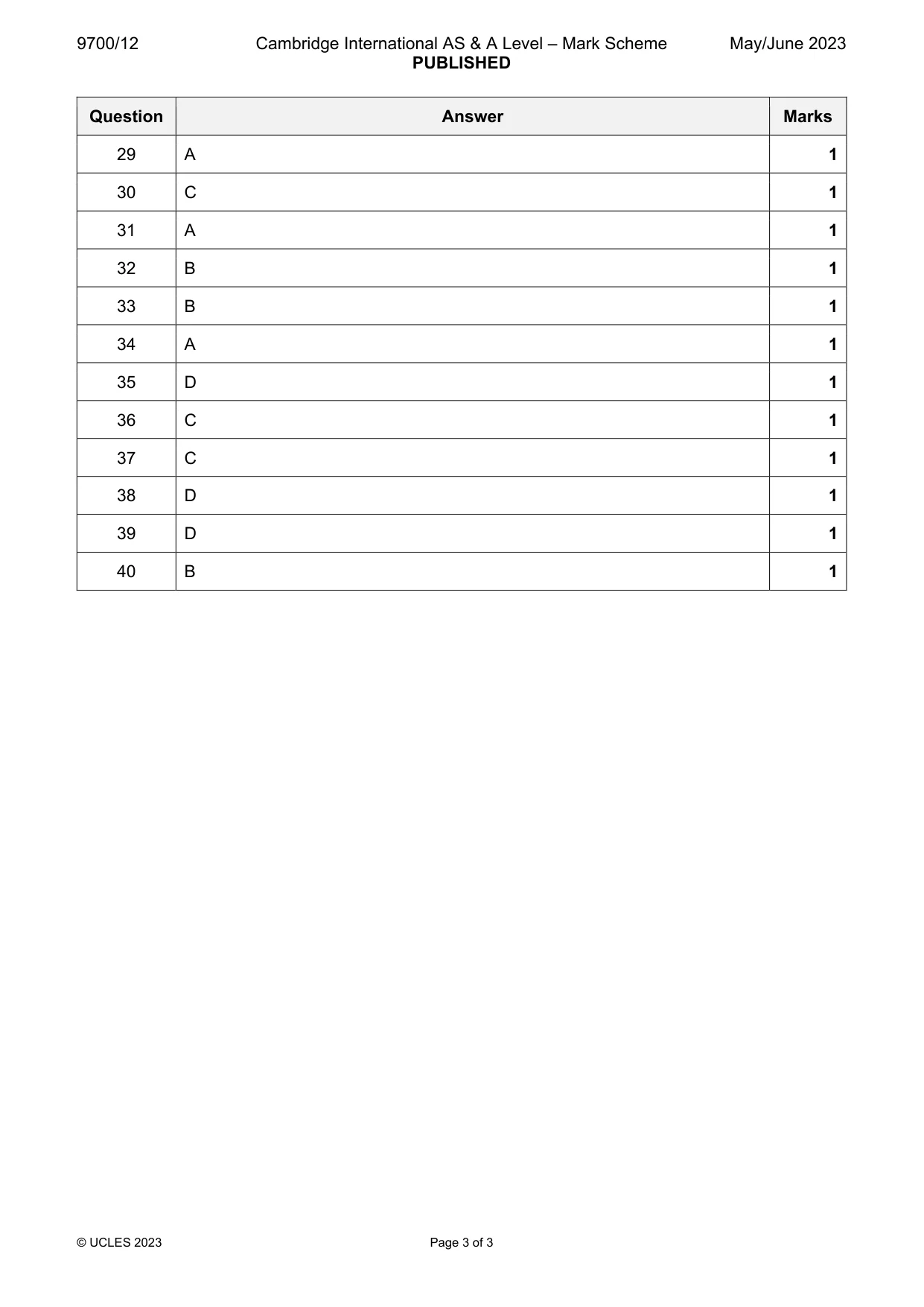
Questions as text
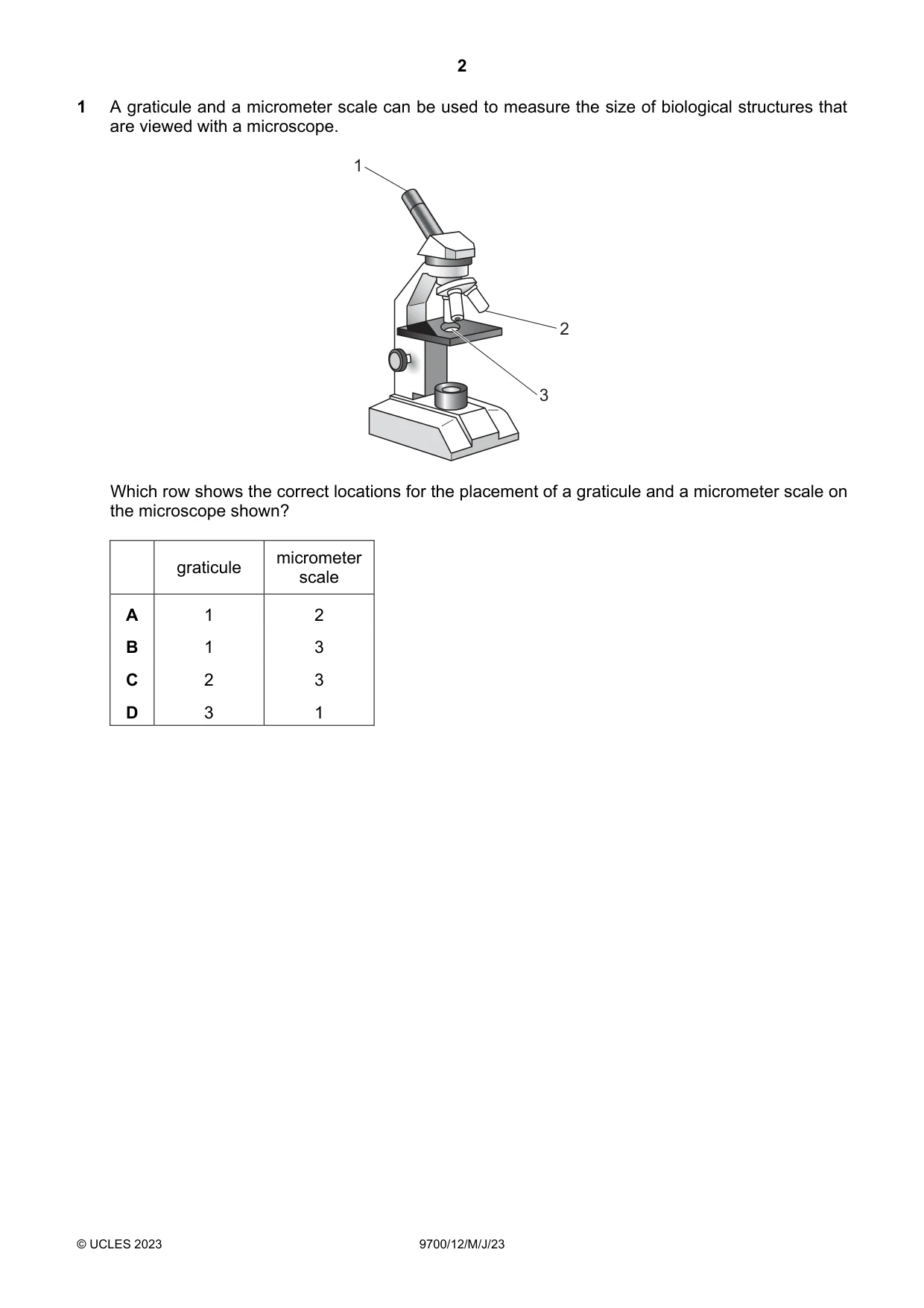
Q1 · A graticule and a micrometer scale can be used to measure the size of biological…
1 A graticule and a micrometer scale can be used to measure the size of biological structures that are viewed with a microscope. 1 2 3 Which row shows the correct locations for the placement of a graticule and a micrometer scale on the microscope shown? micrometer graticule scale A 1 2 B 1 3 C 2 3 D 3 1
Mark scheme: B
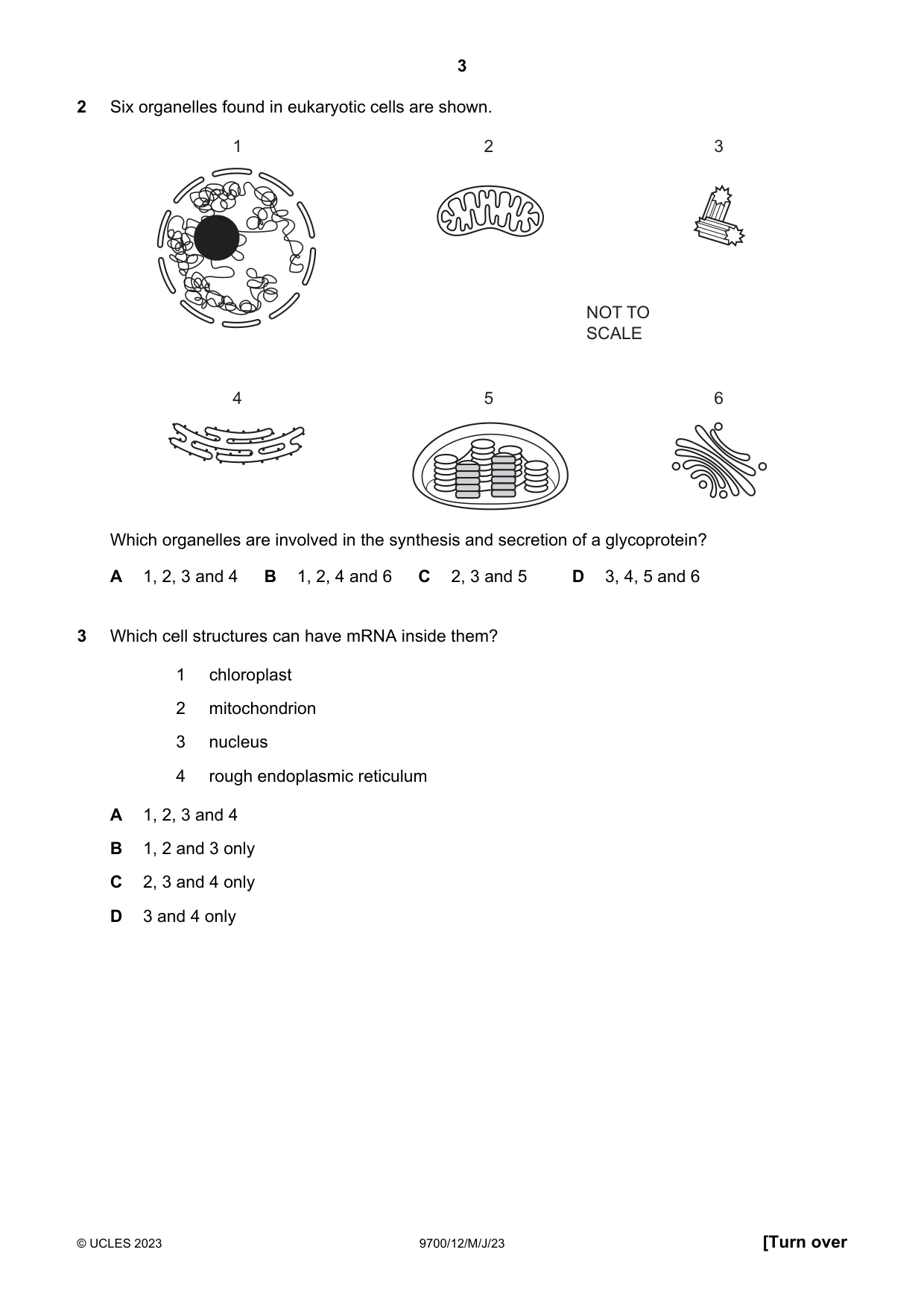
Q2 · Six organelles found in eukaryotic cells are shown
2 Six organelles found in eukaryotic cells are shown. 1 2 3 NOT TO SCALE 4 5 6 Which organelles are involved in the synthesis and secretion of a glycoprotein? A 1, 2, 3 and 4 B 1, 2, 4 and 6 C 2, 3 and 5 D 3, 4, 5 and 6
Mark scheme: B
More questions on Cells as the basic units of living organisms
Q3 · Which cell structures can have mRNA inside them?
3 Which cell structures can have mRNA inside them? 1 chloroplast 2 mitochondrion 3 nucleus 4 rough endoplasmic reticulum A 1, 2, 3 and 4 B 1, 2 and 3 only C 2, 3 and 4 only D 3 and 4 only
Mark scheme: B
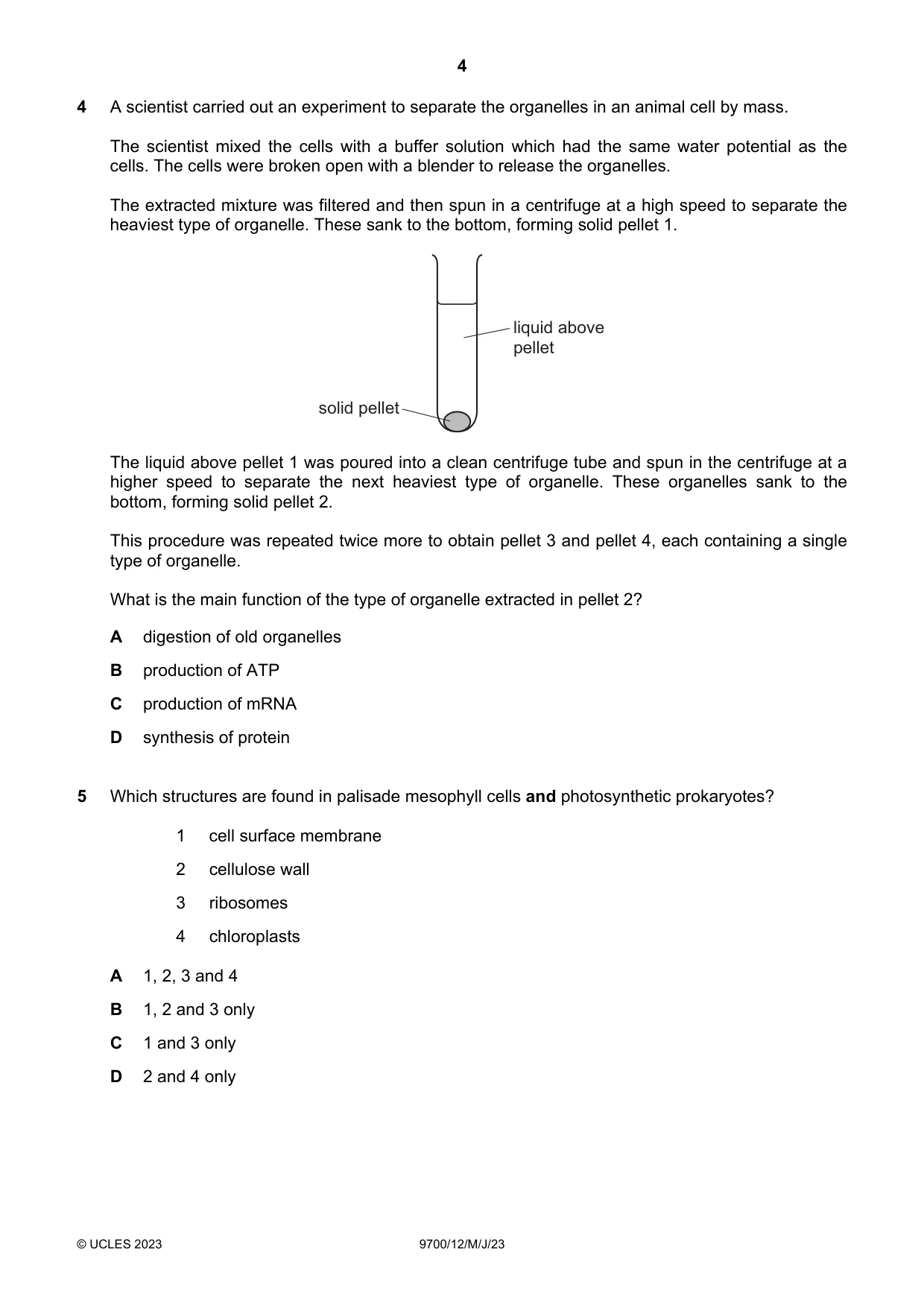
Q4 · A scientist carried out an experiment to separate the organelles in an animal cell by mass
4 A scientist carried out an experiment to separate the organelles in an animal cell by mass. The scientist mixed the cells with a buffer solution which had the same water potential as the cells. The cells were broken open with a blender to release the organelles. The extracted mixture was filtered and then spun in a centrifuge at a high speed to separate the heaviest type of organelle. These sank to the bottom, forming solid pellet 1. liquid above pellet solid pellet The liquid above pellet 1 was poured into a clean centrifuge tube and spun in the centrifuge at a higher speed to separate the next heaviest type of organelle. These organelles sank to the bottom, forming solid pellet 2. This procedure was repeated twice more to obtain pellet 3 and pellet 4, each containing a single type of organelle. What is the main function of the type of organelle extracted in pellet 2? A digestion of old organelles B production of ATP C production of mRNA D synthesis of protein
Mark scheme: B
More questions on Cells as the basic units of living organisms
Q5 · Which structures are found in palisade mesophyll cells and photosynthetic prokaryotes?
5 Which structures are found in palisade mesophyll cells and photosynthetic prokaryotes? 1 cell surface membrane 2 cellulose wall 3 ribosomes 4 chloroplasts A 1, 2, 3 and 4 B 1, 2 and 3 only C 1 and 3 only D 2 and 4 only
Mark scheme: C
More questions on Cells as the basic units of living organisms
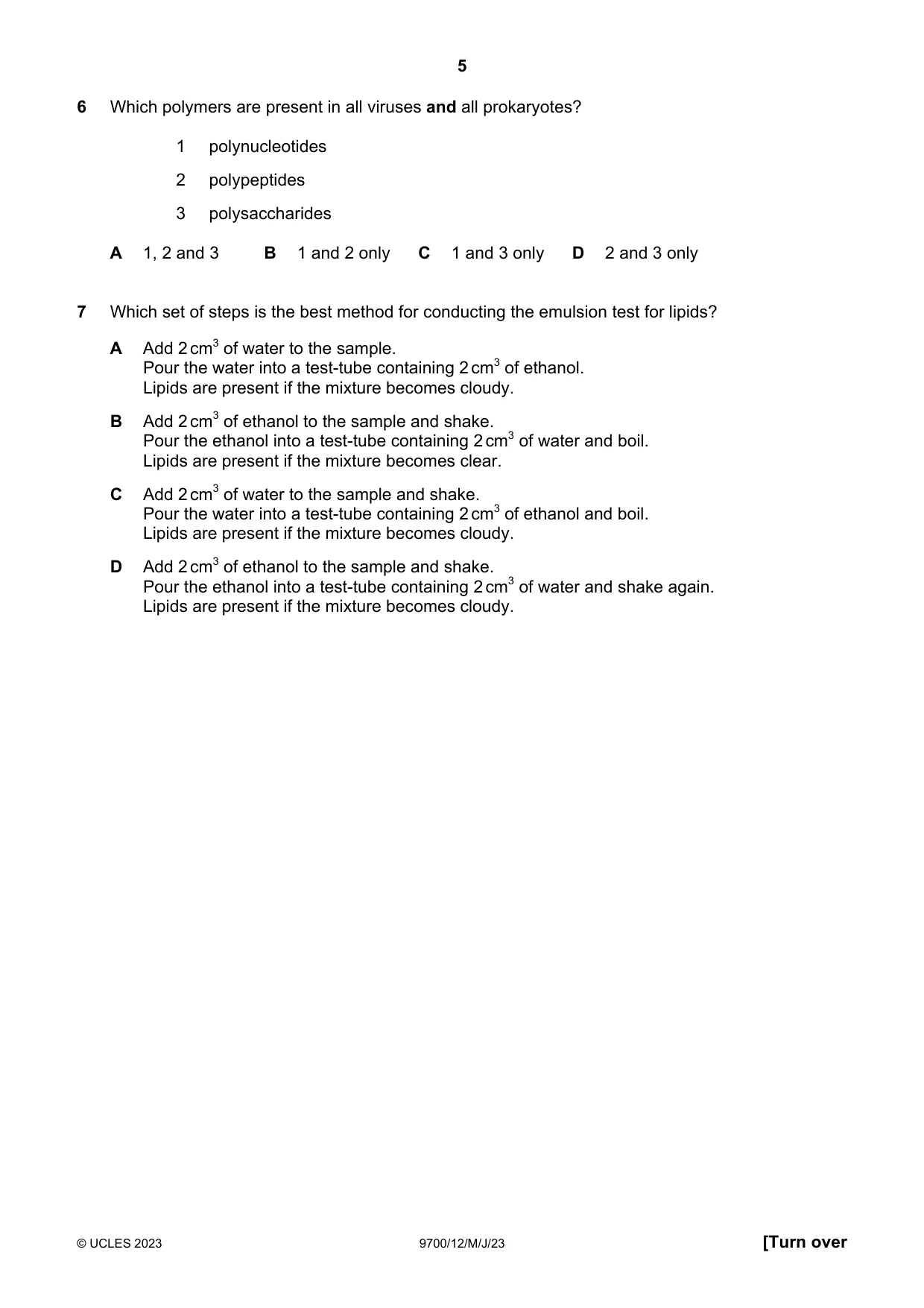
Q6 · Which polymers are present in all viruses and all prokaryotes?
6 Which polymers are present in all viruses and all prokaryotes? 1 polynucleotides 2 polypeptides 3 polysaccharides A 1, 2 and 3 B 1 and 2 only C 1 and 3 only D 2 and 3 only
Mark scheme: B
Q7 · Which set of steps is the best method for conducting the emulsion test for lipids?
7 Which set of steps is the best method for conducting the emulsion test for lipids? A Add 2 cm3 of water to the sample. Pour the water into a test-tube containing 2 cm3 of ethanol. Lipids are present if the mixture becomes cloudy. B Add 2 cm3 of ethanol to the sample and shake. Pour the ethanol into a test-tube containing 2 cm3 of water and boil. Lipids are present if the mixture becomes clear. C Add 2 cm3 of water to the sample and shake. Pour the water into a test-tube containing 2 cm3 of ethanol and boil. Lipids are present if the mixture becomes cloudy. D Add 2 cm3 of ethanol to the sample and shake. Pour the ethanol into a test-tube containing 2 cm3 of water and shake again. Lipids are present if the mixture becomes cloudy.
Mark scheme: D
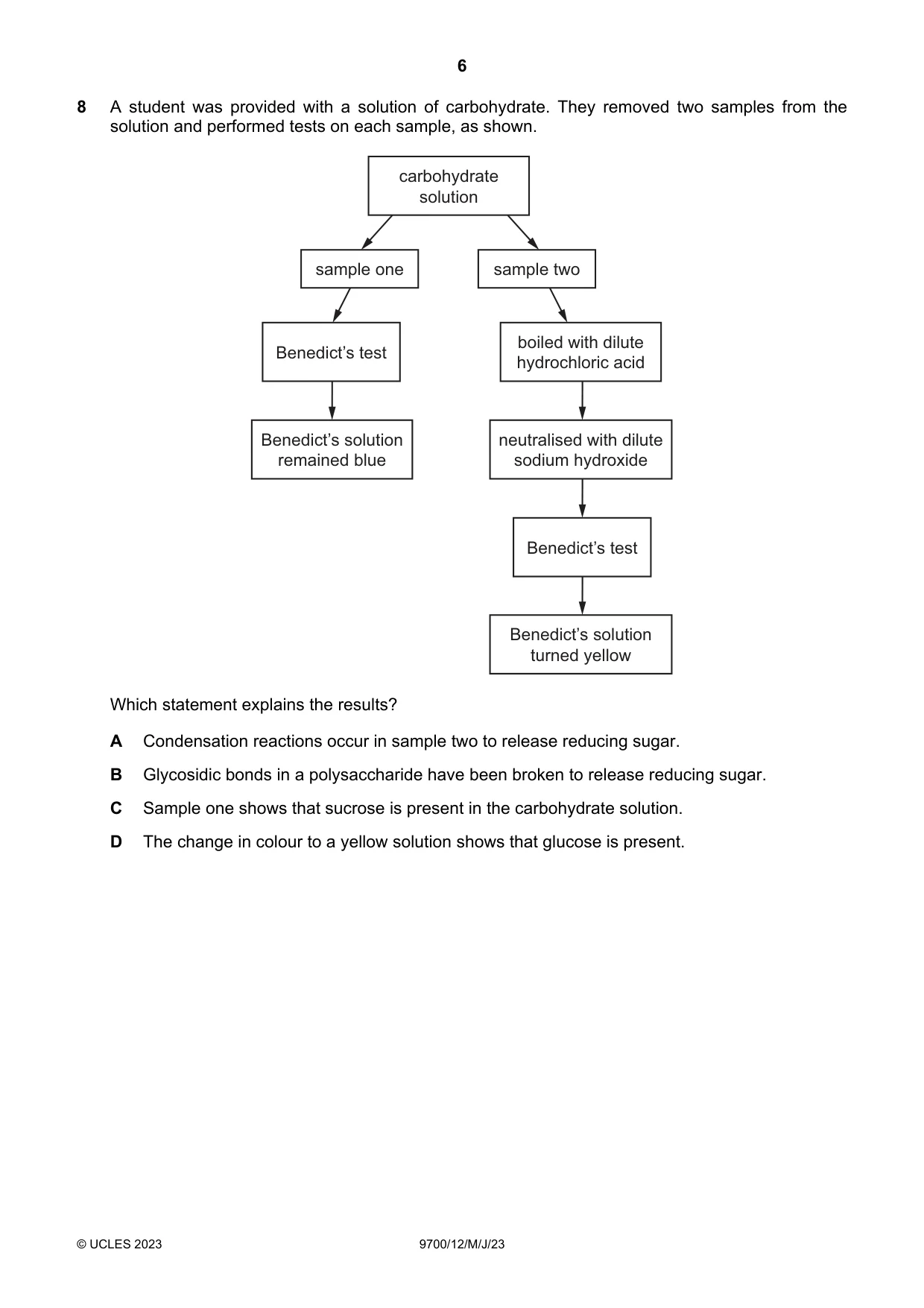
Q8 · A student was provided with a solution of carbohydrate
8 A student was provided with a solution of carbohydrate. They removed two samples from the solution and performed tests on each sample, as shown. carbohydrate solution sample one sample two boiled with dilute Benedict’s test hydrochloric acid Benedict’s solution neutralised with dilute remained blue sodium hydroxide Benedict’s test Benedict’s solution turned yellow Which statement explains the results? A Condensation reactions occur in sample two to release reducing sugar. B Glycosidic bonds in a polysaccharide have been broken to release reducing sugar. C Sample one shows that sucrose is present in the carbohydrate solution. D The change in colour to a yellow solution shows that glucose is present.
Mark scheme: B
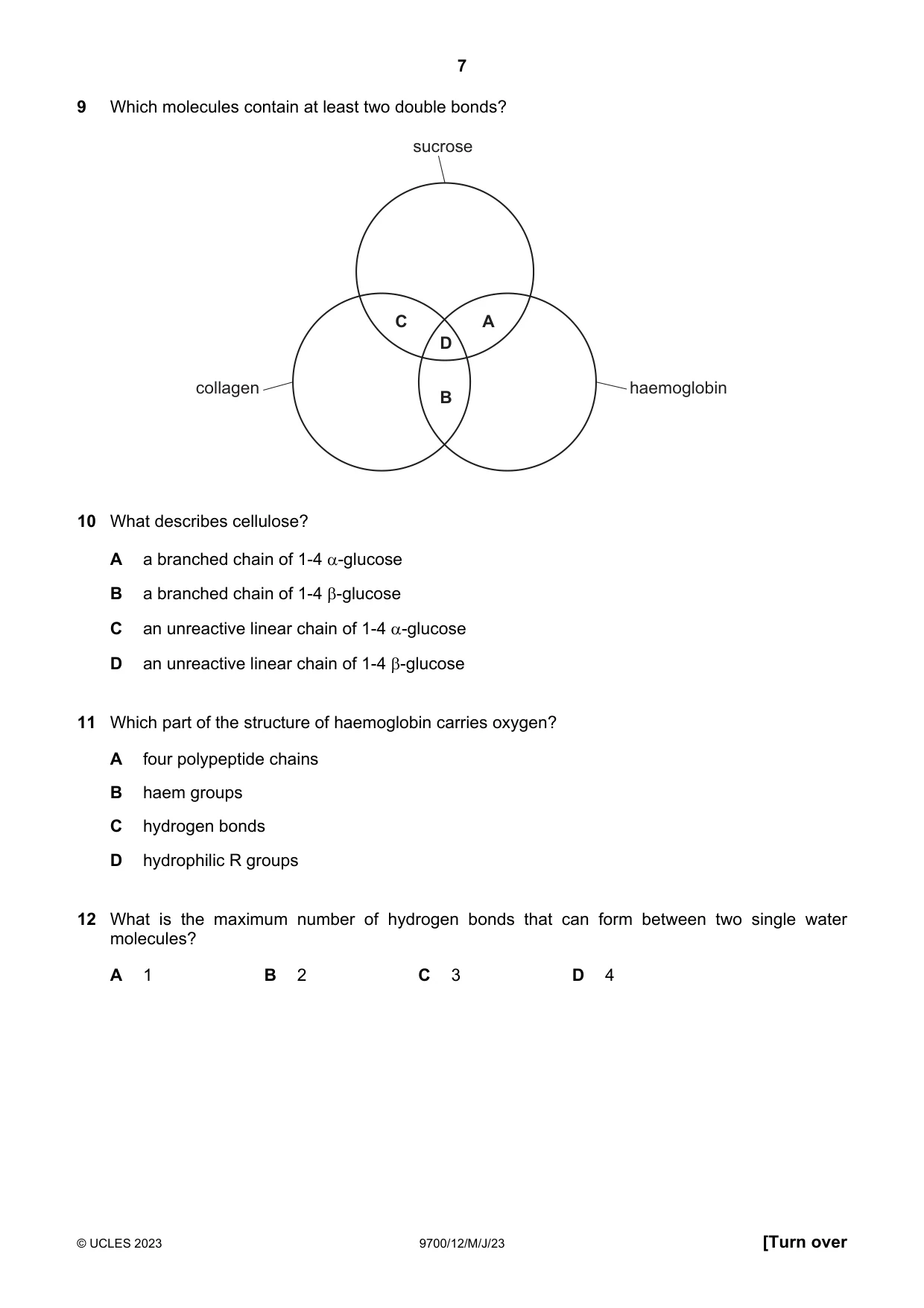
Q9 · Which molecules contain at least two double bonds?
9 Which molecules contain at least two double bonds? sucrose C A D collagen haemoglobin B
Mark scheme: B
Question 10
10 What describes cellulose? A a branched chain of 1-4 α-glucose B a branched chain of 1-4 β-glucose C an unreactive linear chain of 1-4 α-glucose D an unreactive linear chain of 1-4 β-glucose
Mark scheme: D
Q11 · Which part of the structure of haemoglobin carries oxygen?
11 Which part of the structure of haemoglobin carries oxygen? A four polypeptide chains B haem groups C hydrogen bonds D hydrophilic R groups
Mark scheme: B
Q12 · What is the maximum number of hydrogen bonds that can form between two single water…
12 What is the maximum number of hydrogen bonds that can form between two single water molecules? A 1 B 2 C 3 D 4
Mark scheme: A
Q13 · CYP3A4 is an important enzyme in the human digestive system where it is needed to break…
13 CYP3A4 is an important enzyme in the human digestive system where it is needed to break down a range of different toxins. The activity of CYP3A4 has been shown to be reduced by substances called furanocoumarins. Furanocoumarins are found in some fruits and so dangerous concentrations of toxins may develop in the human digestive system when fruits containing furanocoumarins are eaten. From the information provided, what can be concluded about molecules of the enzyme CYP3A4? A They lower the activation energy of the toxin breakdown reactions. B They bind specifically through the active site to a substrate found in some fruits. C They change permanently when acted upon by furanocoumarin molecules. D They resume normal activity when concentrations of furanocoumarins decrease.
Mark scheme: A
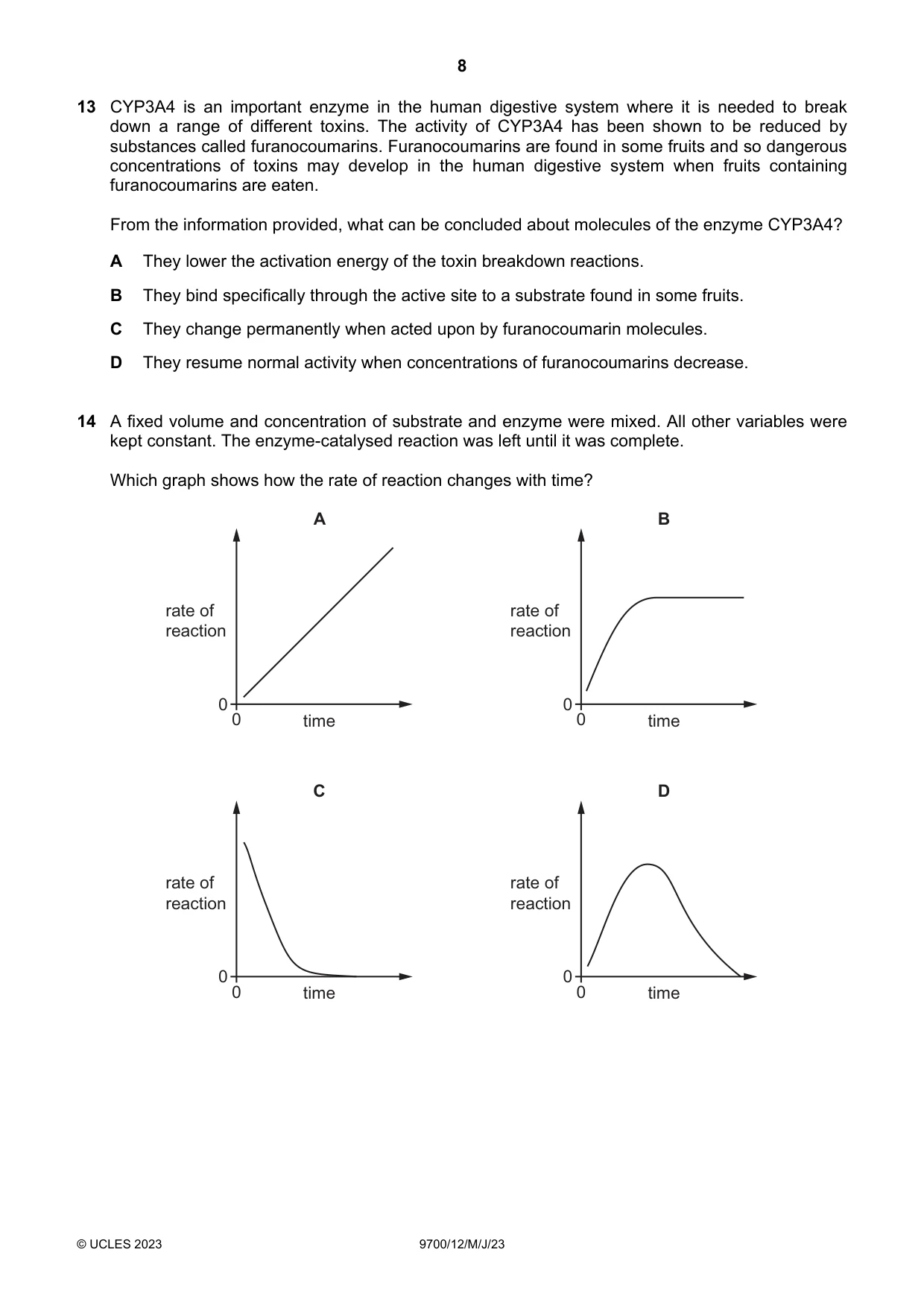
Q14 · A fixed volume and concentration of substrate and enzyme were mixed
14 A fixed volume and concentration of substrate and enzyme were mixed. All other variables were kept constant. The enzyme-catalysed reaction was left until it was complete. Which graph shows how the rate of reaction changes with time? A B rate of rate of reaction reaction 0 0 0 time 0 time C D rate of rate of reaction reaction 0 0 0 time 0 time
Mark scheme: C
Q15 · Which molecules in cell surface membranes are typically involved in cell recognition?
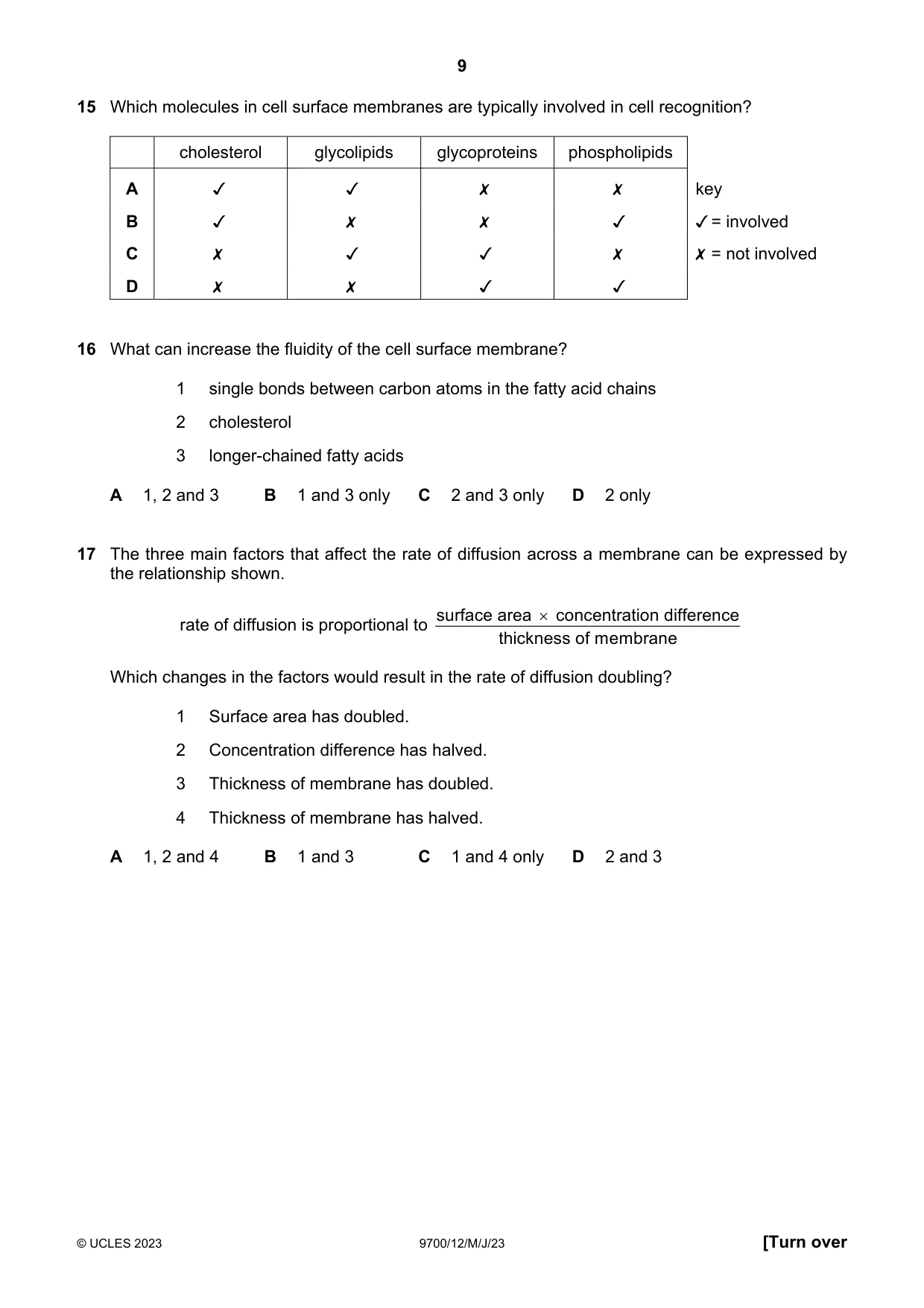
15 Which molecules in cell surface membranes are typically involved in cell recognition? cholesterol glycolipids glycoproteins | phospholipids A J Jv x x B J x x Jv Cc x Jv Jv x D x x Jv JV key JV = involved X = not involved
Mark scheme: C
Q16 · What can increase the fluidity of the cell surface membrane?
16 What can increase the fluidity of the cell surface membrane? 1 single bonds between carbon atoms in the fatty acid chains 2 cholesterol 3 longer-chained fatty acids A 1, 2 and 3 B 1 and 3 only C 2 and 3 only D 2 only
Mark scheme: D
Q17 · The three main factors that affect the rate of diffusion across a membrane can be…
17 The three main factors that affect the rate of diffusion across a membrane can be expressed by the relationship shown. surface area × concentration difference rate of diffusion is proportional to thickness of membrane Which changes in the factors would result in the rate of diffusion doubling? 1 Surface area has doubled. 2 Concentration difference has halved. 3 Thickness of membrane has doubled. 4 Thickness of membrane has halved. A 1, 2 and 4 B 1 and 3 C 1 and 4 only D 2 and 3
Mark scheme: C
Q18 · A student measured the time taken for complete diffusion of a dye into agar blocks of…
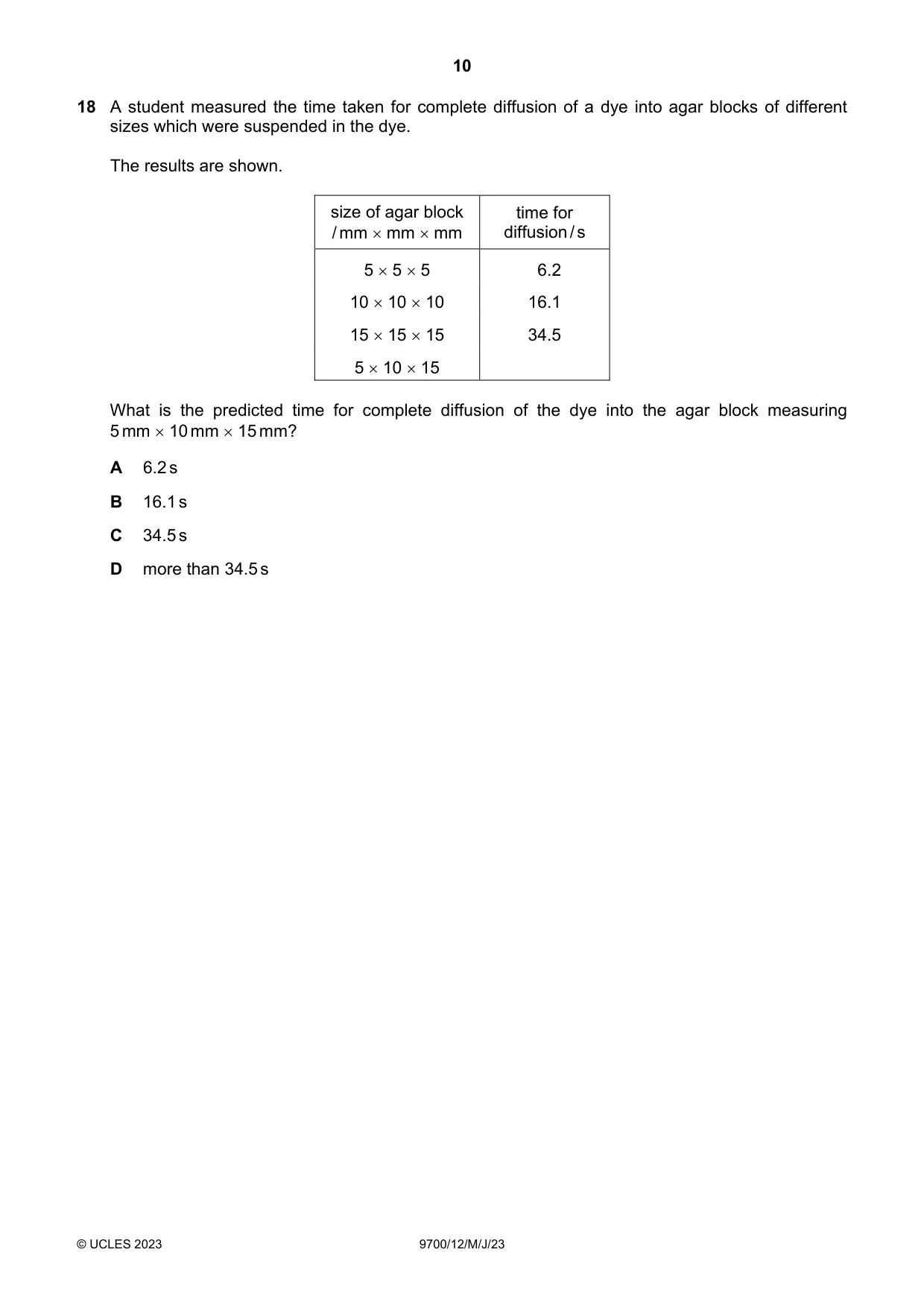
18 A student measured the time taken for complete diffusion of a dye into agar blocks of different sizes which were suspended in the dye. The results are shown. size of agar block time for / mm × mm × mm diffusion / s 5 × 5 × 5 6.2 10 × 10 × 10 16.1 15 × 15 × 15 34.5 5 × 10 × 15 What is the predicted time for complete diffusion of the dye into the agar block measuring 5 mm × 10 mm × 15 mm? A 6.2 s B 16.1 s C 34.5 s D more than 34.5 s
Mark scheme: A
Q19 · An experiment was carried out to investigate the effect of concentration of sucrose…
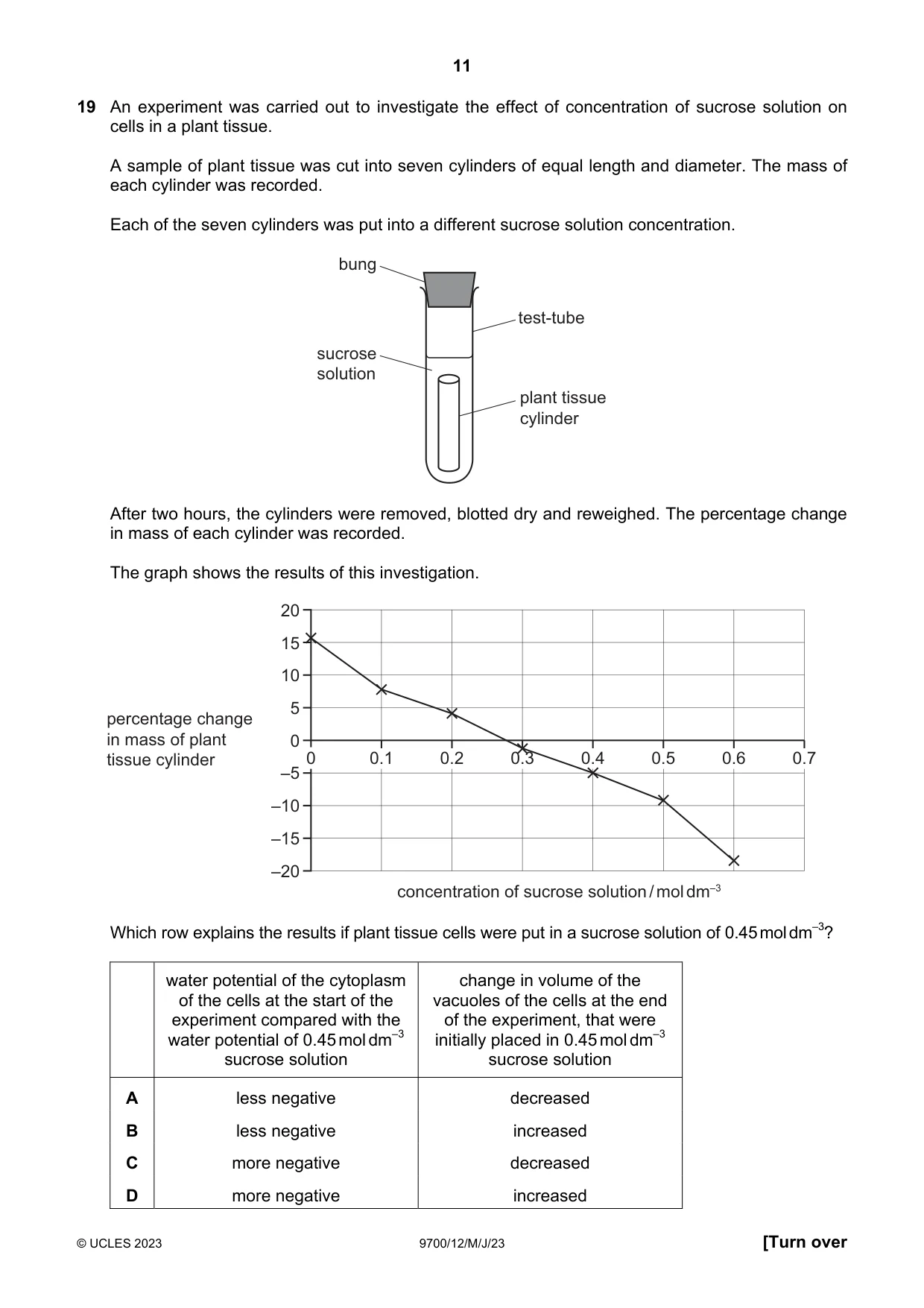
19 An experiment was carried out to investigate the effect of concentration of sucrose solution on cells in a plant tissue. A sample of plant tissue was cut into seven cylinders of equal length and diameter. The mass of each cylinder was recorded. Each of the seven cylinders was put into a different sucrose solution concentration. bung test-tube sucrose solution plant tissue cylinder After two hours, the cylinders were removed, blotted dry and reweighed. The percentage change in mass of each cylinder was recorded. The graph shows the results of this investigation. 20 15 10 5 percentage change in mass of plant 0 tissue cylinder 0 0.1 0.2 0.3 0.4 0.5 0.6 0.7 –5 –10 –15 –20 concentration of sucrose solution / mol dm–3 Which row explains the results if plant tissue cells were put in a sucrose solution of 0.45 mol dm–3? water potential of the cytoplasm change in volume of the of the cells at the start of the vacuoles of the cells at the end experiment compared with the of the experiment, that were water potential of 0.45 mol dm–3 initially placed in 0.45 mol dm–3 sucrose solution sucrose solution A less negative decreased B less negative increased C more negative decreased D more negative increased
Mark scheme: A
Q20 · The diagram shows part of the organisation of a section of a DNA molecule and the…
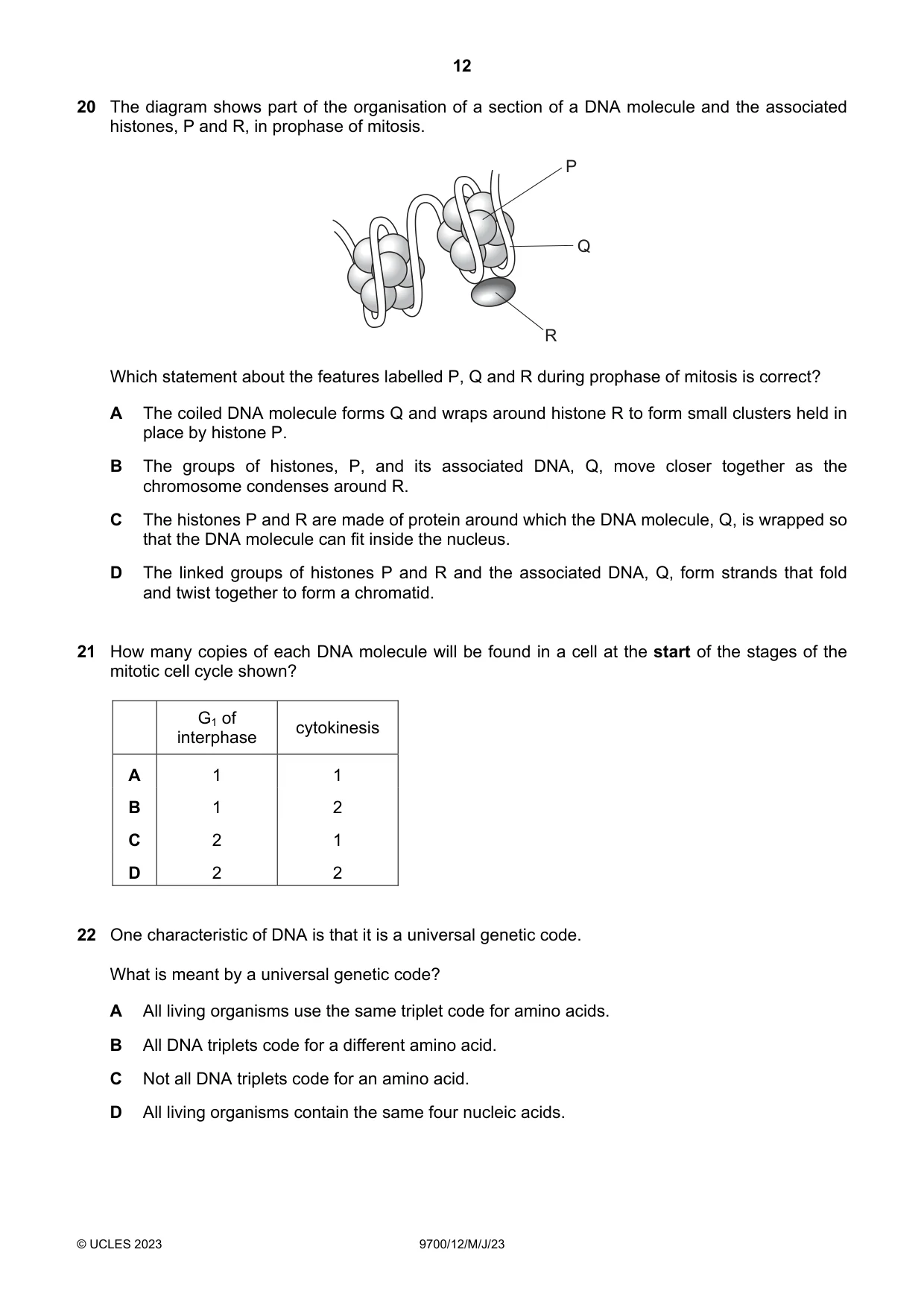
20 The diagram shows part of the organisation of a section of a DNA molecule and the associated histones, P and R, in prophase of mitosis. P Q R Which statement about the features labelled P, Q and R during prophase of mitosis is correct? A The coiled DNA molecule forms Q and wraps around histone R to form small clusters held in place by histone P. B The groups of histones, P, and its associated DNA, Q, move closer together as the chromosome condenses around R. C The histones P and R are made of protein around which the DNA molecule, Q, is wrapped so that the DNA molecule can fit inside the nucleus. D The linked groups of histones P and R and the associated DNA, Q, form strands that fold and twist together to form a chromatid.
Mark scheme: D
Q21 · How many copies of each DNA molecule will be found in a cell at the start of the stages…
21 How many copies of each DNA molecule will be found in a cell at the start of the stages of the mitotic cell cycle shown? G1 of cytokinesis interphase A 1 1 B 1 2 C 2 1 D 2 2
Mark scheme: B
More questions on Replication and division of nuclei and cells
Q22 · One characteristic of DNA is that it is a universal genetic code
22 One characteristic of DNA is that it is a universal genetic code. What is meant by a universal genetic code? A All living organisms use the same triplet code for amino acids. B All DNA triplets code for a different amino acid. C Not all DNA triplets code for an amino acid. D All living organisms contain the same four nucleic acids.
Mark scheme: A
Q23 · Which statement about mRNA is correct?
23 Which statement about mRNA is correct? A It is a polymer made of nucleotides all joined with hydrogen bonds. B Each nucleotide subunit contains the sugar ribose. C It always has an equal proportion of adenine and uracil. D The mRNA sequence is identical to the template strand of DNA.
Mark scheme: B
Q24 · The diagram shows part of the process of translation
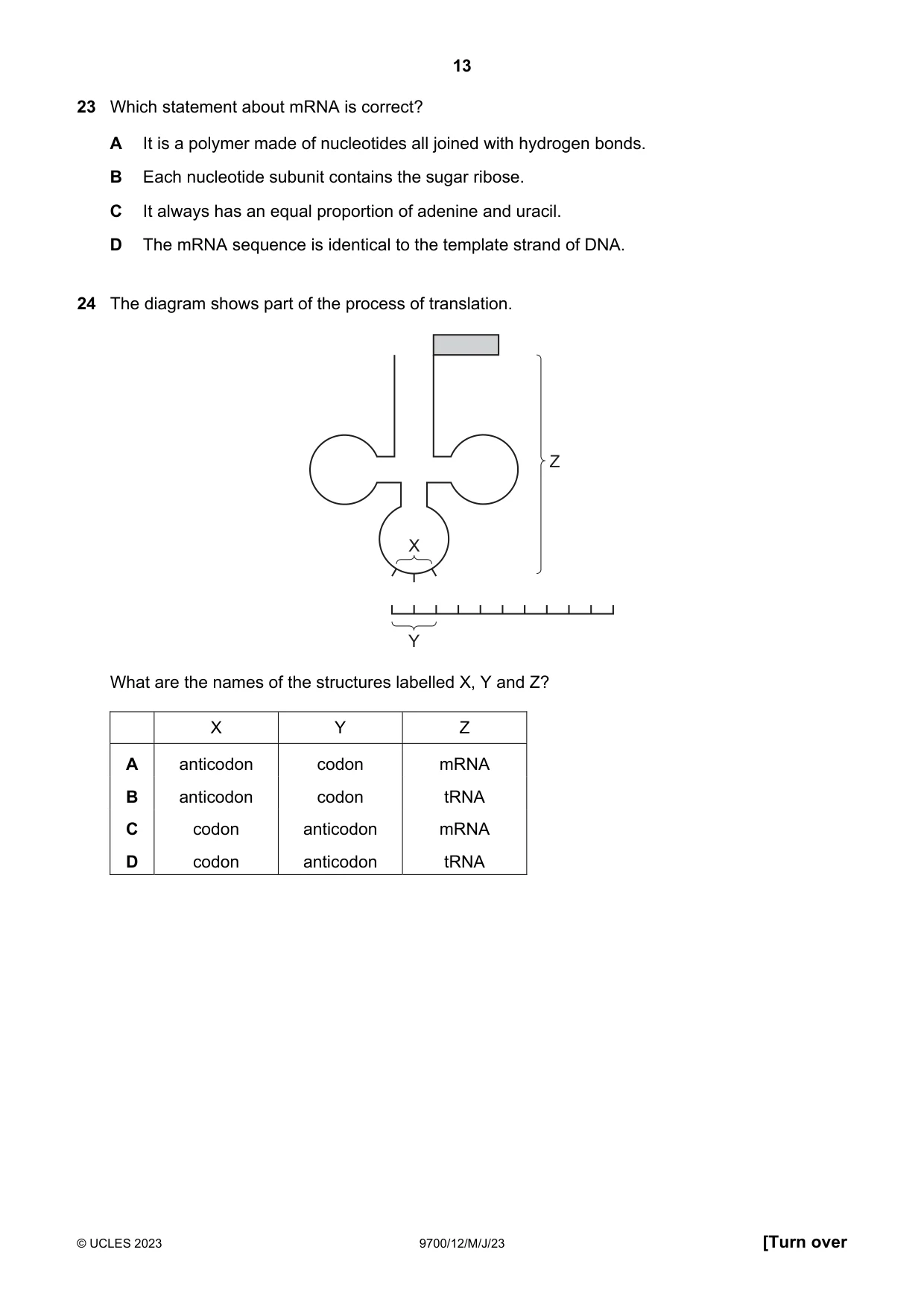
24 The diagram shows part of the process of translation. Z X Y What are the names of the structures labelled X, Y and Z? X Y Z A anticodon codon mRNA B anticodon codon tRNA C codon anticodon mRNA D codon anticodon tRNA
Mark scheme: B
Q25 · The DNA triplets of genes are translated as amino acids or stop signals during protein…
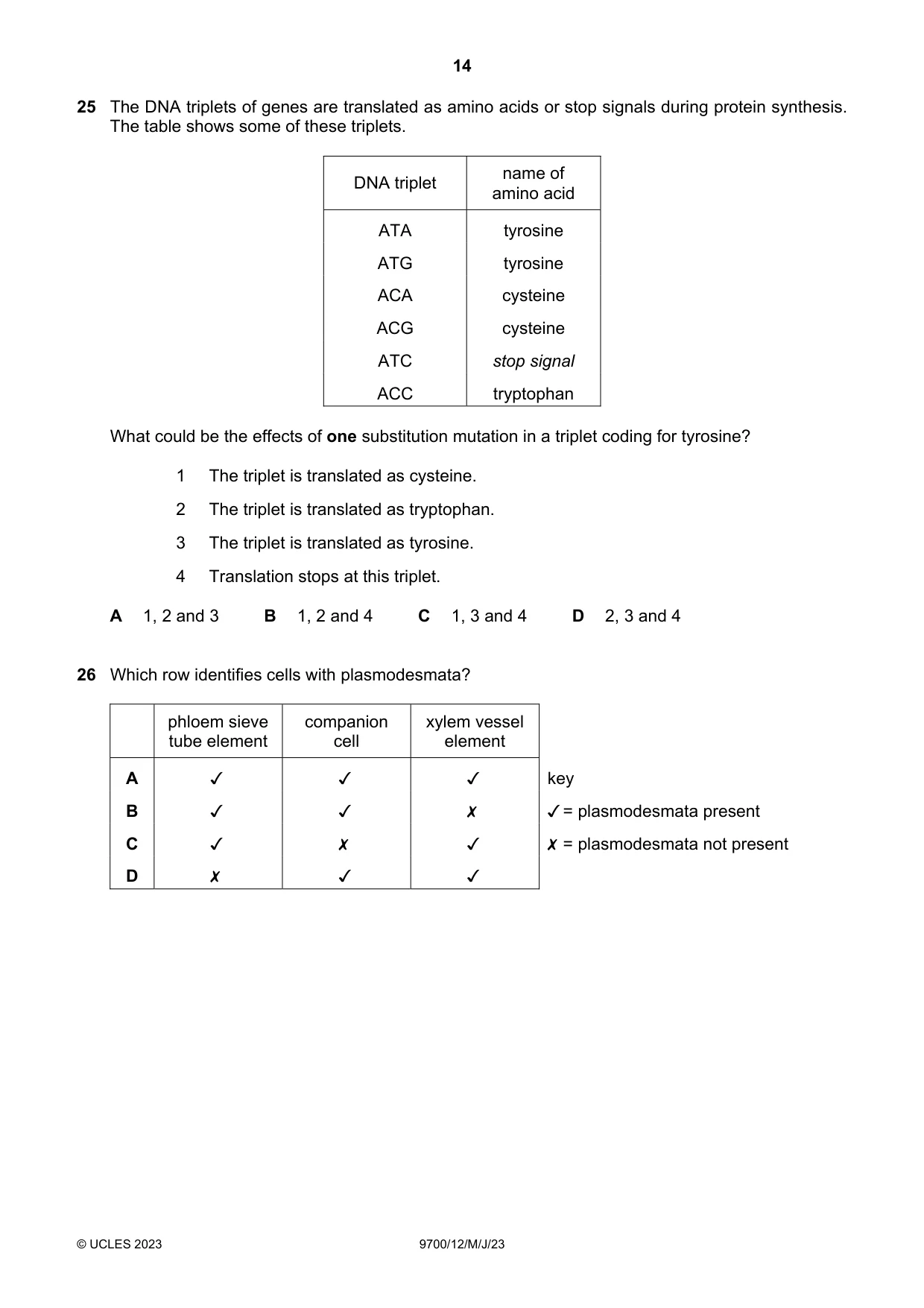
25 The DNA triplets of genes are translated as amino acids or stop signals during protein synthesis. The table shows some of these triplets. name of DNA triplet amino acid ATA tyrosine ATG tyrosine ACA cysteine ACG cysteine ATC stop signal ACC tryptophan What could be the effects of one substitution mutation in a triplet coding for tyrosine? 1 The triplet is translated as cysteine. 2 The triplet is translated as tryptophan. 3 The triplet is translated as tyrosine. 4 Translation stops at this triplet. A 1, 2 and 3 B 1, 2 and 4 C 1, 3 and 4 D 2, 3 and 4
Mark scheme: C
Q26 · Which row identifies cells with plasmodesmata?
26 Which row identifies cells with plasmodesmata? phloem sieve tube element companion cell xylem vessel element Jv v Jv key / = plasmodesmata present X = plasmodesmata not present v v x v x v x v v
Mark scheme: B
Q27 · Which statements about the apoplast and symplast pathways are correct?
27 Which statements about the apoplast and symplast pathways are correct? 1 In the apoplast pathway, water molecules move through free spaces in the cellulose cell walls of plant roots. 2 In the symplast pathway, water molecules diffuse through the cytoplasm and plasmodesmata of cells. 3 Water molecules travelling through plant tissue move by mass flow along the apoplast pathway. 4 The Casparian strip blocks the symplast pathway and forces all water molecules to enter the cytoplasm of endodermis cells. A 1, 2, 3 and 4 B 1, 2 and 3 only C 1 and 2 only D 3 and 4 only
Mark scheme: B
Q28 · Where does water evaporate from during transpiration?
28 Where does water evaporate from during transpiration? A intercellular spaces B leaf surface C mesophyll cell walls D stomatal pores
Mark scheme: C
Q29 · The diagram shows the outline of three xerophytic leaves of the same type in three…
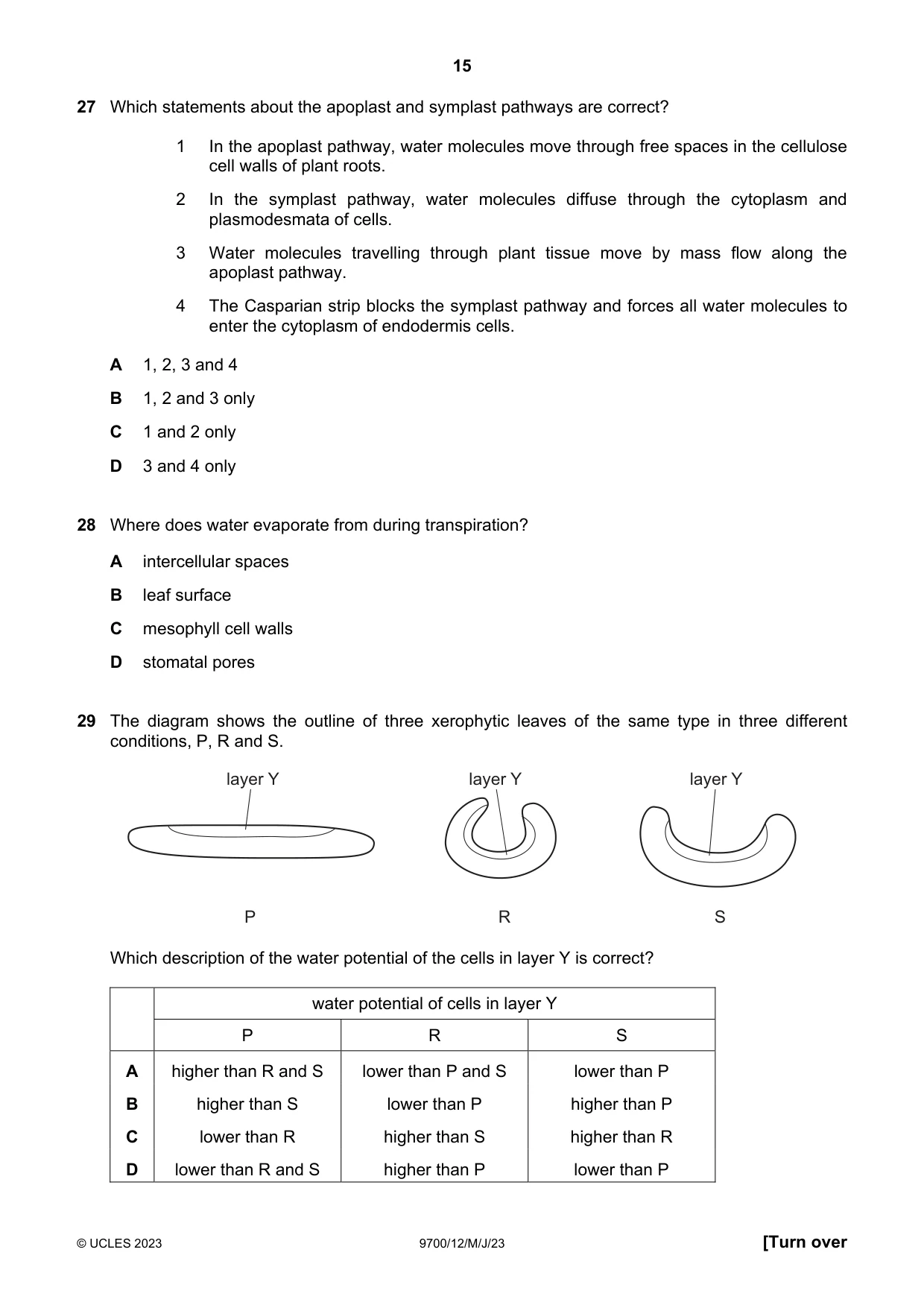
29 The diagram shows the outline of three xerophytic leaves of the same type in three different conditions, P, R and S. layer Y layer Y layer Y P R S Which description of the water potential of the cells in layer Y is correct? water potential of cells in layer Y P R S A higher than R and S lower than P and S lower than P B higher than S lower than P higher than P C lower than R higher than S higher than R D lower than R and S higher than P lower than P
Mark scheme: A
Q30 · The photomicrograph shows a transverse section of the leaf of a species of grass
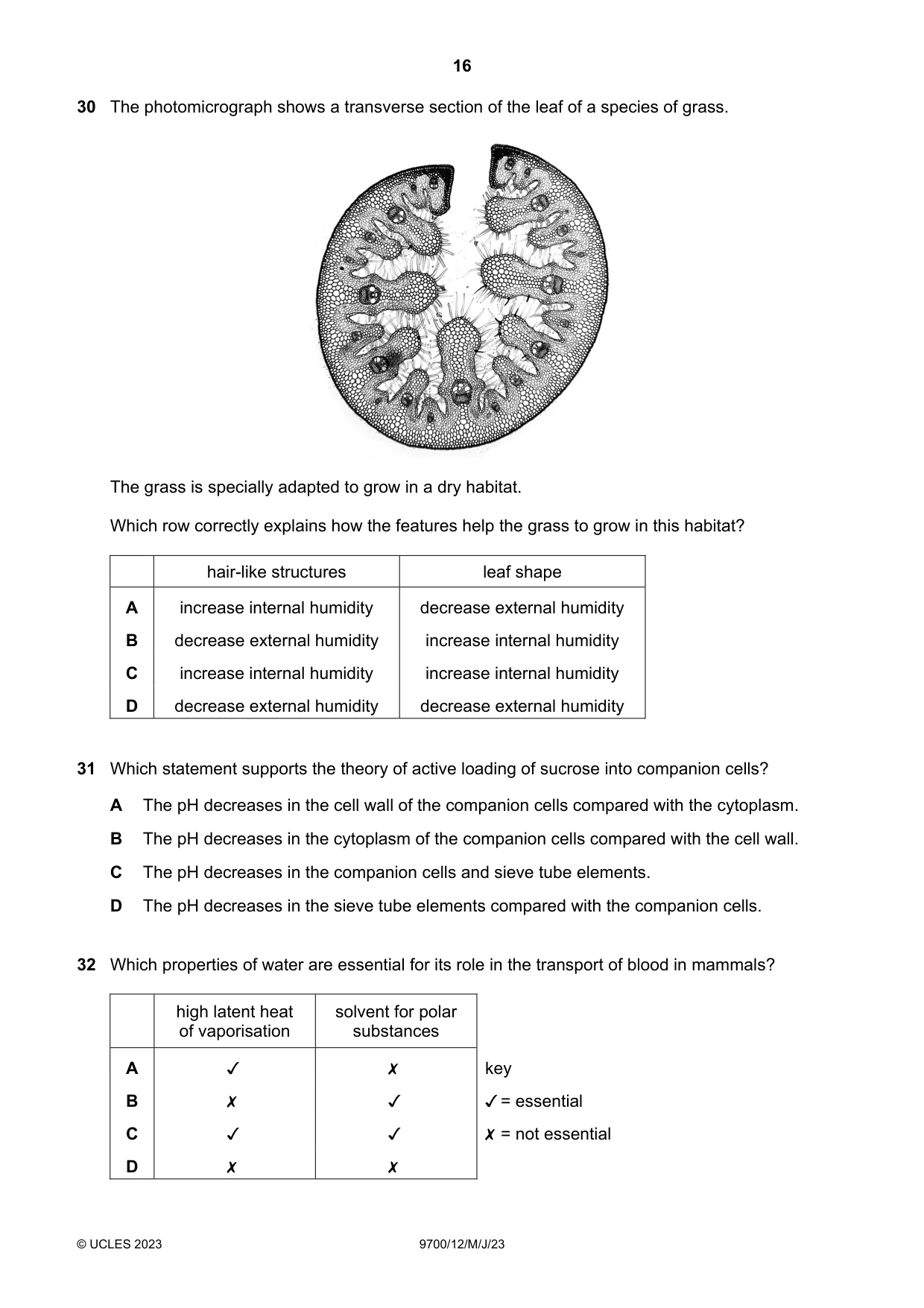
30 The photomicrograph shows a transverse section of the leaf of a species of grass. The grass is specially adapted to grow in a dry habitat. Which row correctly explains how the features help the grass to grow in this habitat? hair-like structures leaf shape A increase internal humidity decrease external humidity B decrease external humidity increase internal humidity C increase internal humidity increase internal humidity D decrease external humidity decrease external humidity
Mark scheme: C
Q31 · Which statement supports the theory of active loading of sucrose into companion cells?
31 Which statement supports the theory of active loading of sucrose into companion cells? A The pH decreases in the cell wall of the companion cells compared with the cytoplasm. B The pH decreases in the cytoplasm of the companion cells compared with the cell wall. C The pH decreases in the companion cells and sieve tube elements. D The pH decreases in the sieve tube elements compared with the companion cells.
Mark scheme: A
Q32 · Which properties of water are essential for its role in the transport of blood in mammals?
32 Which properties of water are essential for its role in the transport of blood in mammals? high latent heat solvent for polar of vaporisation substances A v x key B x v ¥ = essential Cc v v X = not essential D x x
Mark scheme: B
Q33 · The diagram shows some of the events that happen between the plasma and the red blood…
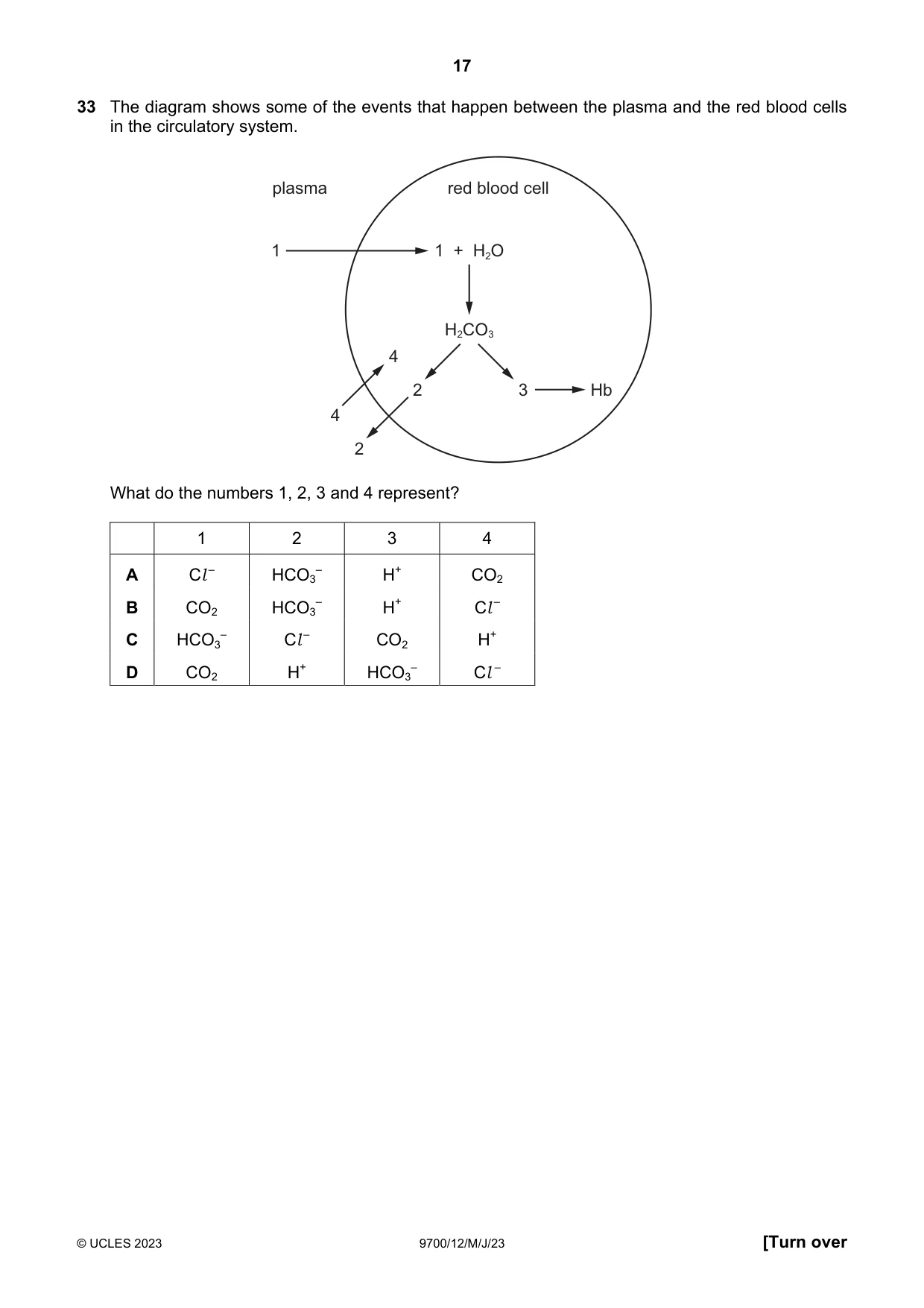
33 The diagram shows some of the events that happen between the plasma and the red blood cells in the circulatory system. plasma red blood cell 1 1 + H2O H2CO3 4 2 3 Hb 4 2 What do the numbers 1, 2, 3 and 4 represent? 1 2 3 4 A Cl – HCO3 – H+ CO2 B CO2 HCO3 – H+ Cl – C HCO3 – Cl – CO2 H+ D CO2 H+ HCO3 – Cl –
Mark scheme: B
Q34 · The diagrams show the valves in the heart when viewed in cross-section from above at…
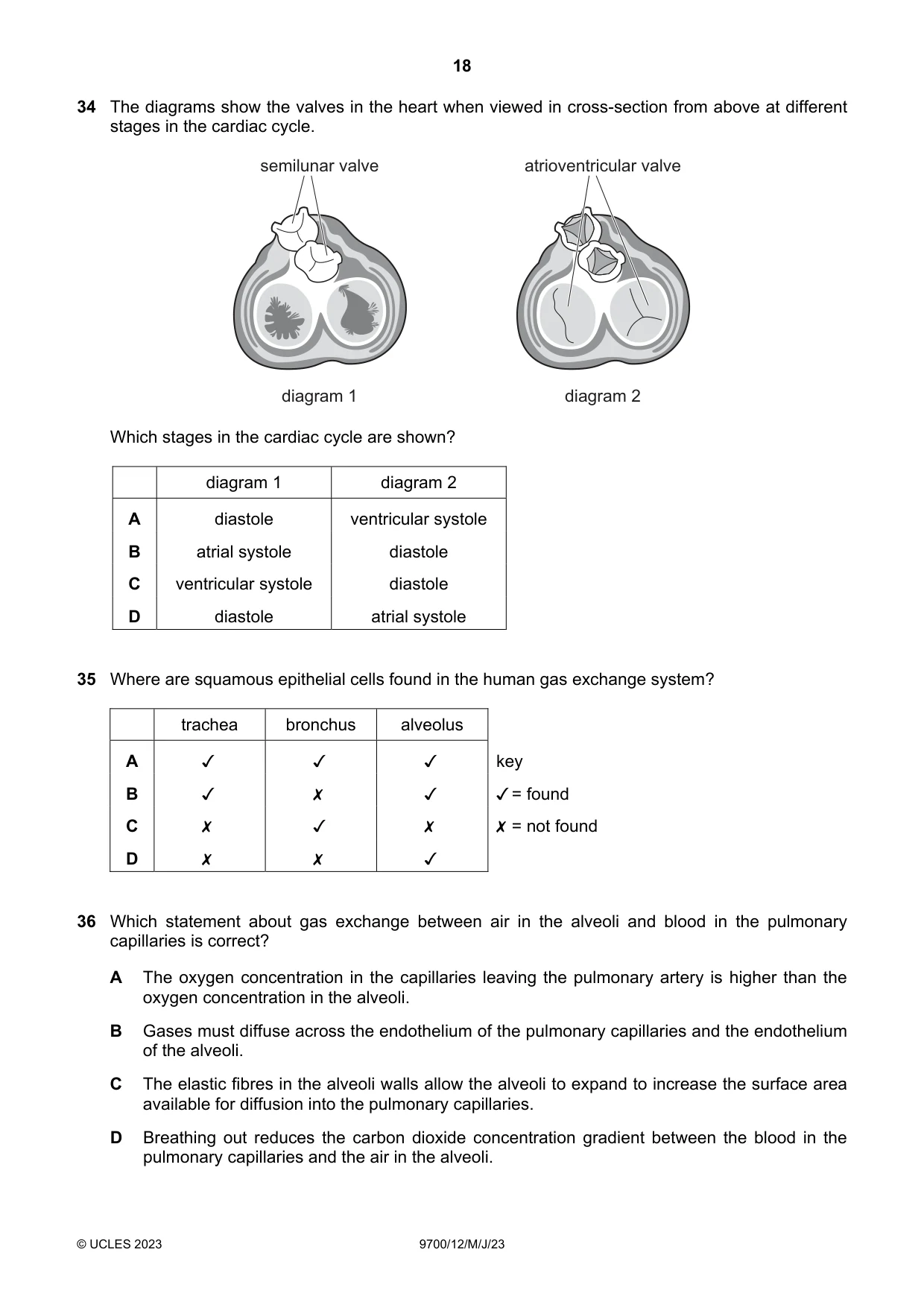
34 The diagrams show the valves in the heart when viewed in cross-section from above at different stages in the cardiac cycle. semilunar valve atrioventricular valve diagram 1 diagram 2 Which stages in the cardiac cycle are shown? diagram 1 diagram 2 A diastole ventricular systole B atrial systole diastole C ventricular systole diastole D diastole atrial systole
Mark scheme: A
Q35 · Where are squamous epithelial cells found in the human gas exchange system?
35 Where are squamous epithelial cells found in the human gas exchange system? trachea bronchus alveolus v v v key v = found X = not found 0 OD > x « & x < x KK
Mark scheme: D
Q36 · Which statement about gas exchange between air in the alveoli and blood in the pulmonary…
36 Which statement about gas exchange between air in the alveoli and blood in the pulmonary capillaries is correct? A The oxygen concentration in the capillaries leaving the pulmonary artery is higher than the oxygen concentration in the alveoli. B Gases must diffuse across the endothelium of the pulmonary capillaries and the endothelium of the alveoli. C The elastic fibres in the alveoli walls allow the alveoli to expand to increase the surface area available for diffusion into the pulmonary capillaries. D Breathing out reduces the carbon dioxide concentration gradient between the blood in the pulmonary capillaries and the air in the alveoli.
Mark scheme: C
Q37 · The average thicknesses for some structures in the human respiratory system are shown
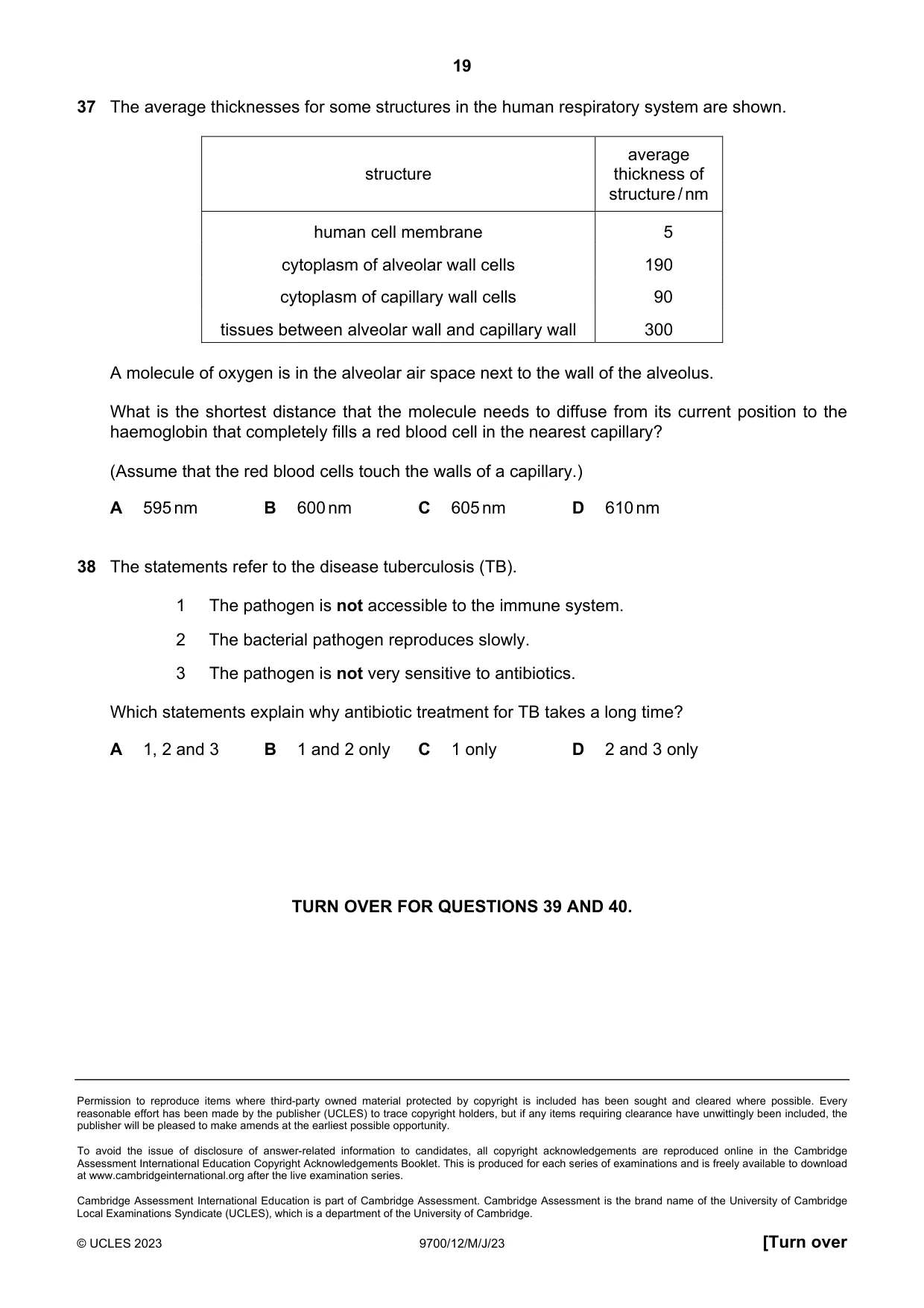
37 The average thicknesses for some structures in the human respiratory system are shown. average structure thickness of structure / nm human cell membrane 5 cytoplasm of alveolar wall cells 190 cytoplasm of capillary wall cells 90 tissues between alveolar wall and capillary wall 300 A molecule of oxygen is in the alveolar air space next to the wall of the alveolus. What is the shortest distance that the molecule needs to diffuse from its current position to the haemoglobin that completely fills a red blood cell in the nearest capillary? (Assume that the red blood cells touch the walls of a capillary.) A 595 nm B 600 nm C 605 nm D 610 nm
Mark scheme: C
Q38 · The statements refer to the disease tuberculosis (TB)
38 The statements refer to the disease tuberculosis (TB). 1 The pathogen is not accessible to the immune system. 2 The bacterial pathogen reproduces slowly. 3 The pathogen is not very sensitive to antibiotics. Which statements explain why antibiotic treatment for TB takes a long time? A 1, 2 and 3 B 1 and 2 only C 1 only D 2 and 3 only TURN OVER FOR QUESTIONS 39 AND 40.
Mark scheme: D
Q39 · The average sizes of some pathogens are shown
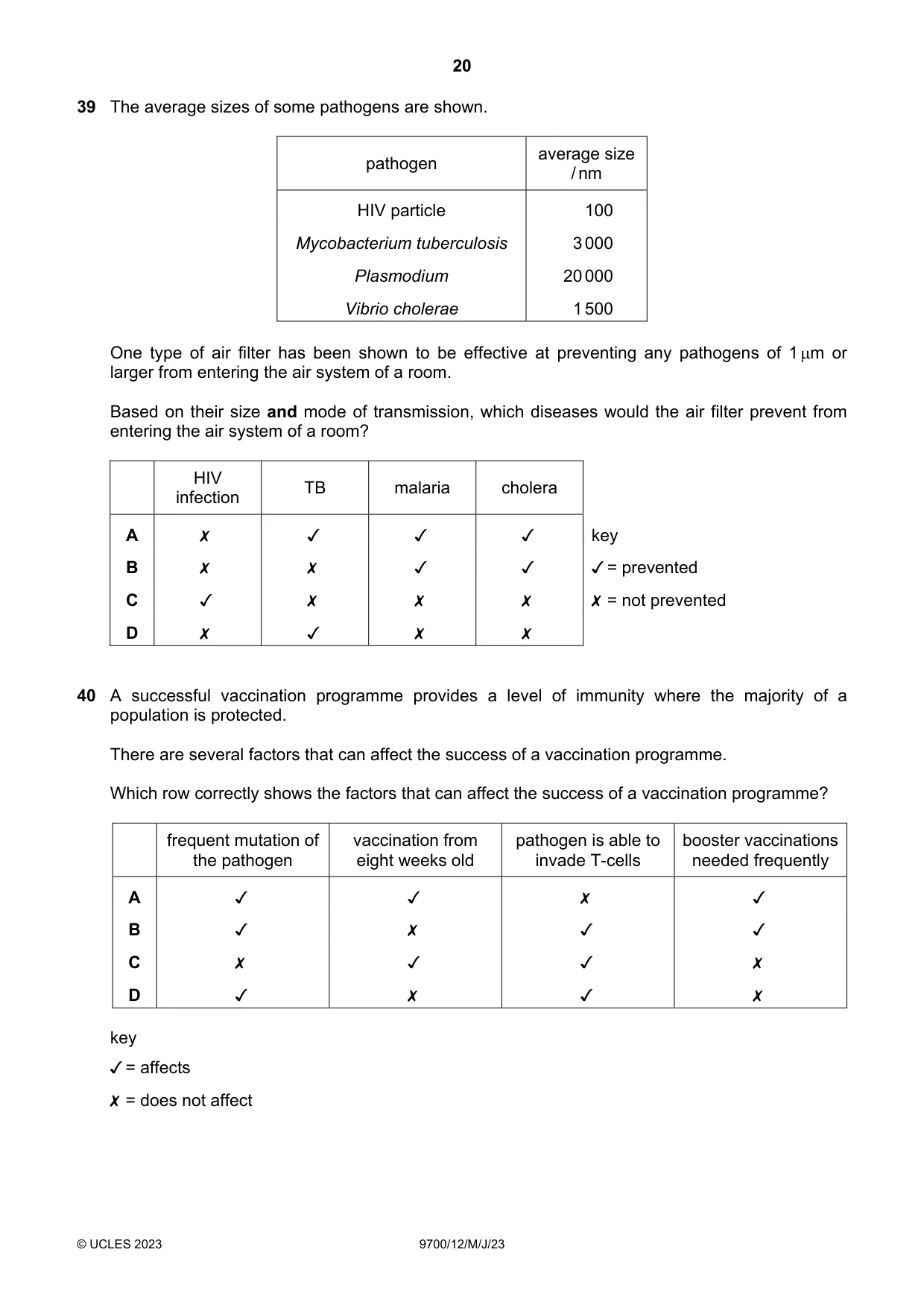
39 The average sizes of some pathogens are shown. pathogen average size HIV particle 100 Mycobacterium tuberculosis 3000 Plasmodium 20000 Vibrio cholerae 1500 One type of air filter has been shown to be effective at preventing any pathogens of 1um or larger from entering the air system of a room. Based on their size and mode of transmission, which diseases would the air filter prevent from entering the air system of a room? HIV infection malaria cholera key / = prevented X = not prevented x KOK
Mark scheme: D
Q40 · A successful vaccination programme provides a level of immunity where the majority of a…
40 A successful vaccination programme provides a level of immunity where the majority of a population is protected. There are several factors that can affect the success of a vaccination programme. Which row correctly shows the factors that can affect the success of a vaccination programme? frequent mutation of the pathogen vaccination from eight weeks old pathogen is able to invade T-cells booster vaccinations needed frequently A Jv Jv x J B Jv x J J Cc x Jv J x D v x Jv x key ¥ = affects X = does not affect
Mark scheme: B
What was in this paper
The subtopics covered by these 40 questions, and how many questions each got. Open one in a new tab to see every Cambridge question on it.
5Cells as the basic units of living organisms3Movement into and out of cells3The gas exchange system3Transport mechanisms3Carbohydrates and lipids2Factors that affect enzyme action2Fluid mosaic membranes2Homeostasis in plants2Infectious diseases2Testing for biological molecules2Transport of oxygen and carbon dioxide2Water2Antibodies and vaccination1Chromosome behaviour in mitosis1Proteins1Replication and division of nuclei and cells1Structure of transport tissues1The heart1The microscope in cell studies1What you needed in this session
Cambridge’s own grade thresholds for 2023 May/June, Paper 1 · Variant 2. A higher threshold means an easier paper — the bar moves with how the cohort did.