Cambridge A Level Biology 9700 — 2014 May/June Paper 1 · Variant 3
9700/13/M/J/14 · 40 questions · 40 marks · ≈45 min
The question paper and its mark scheme, free to read here and free to download. This is Cambridge’s own paper, exactly as it was sat.
Question paper16 pages
Mark scheme2 pages
Answers below. Sit the paper first if you are practising.
Questions as text
Q1 · The eyepiece lens of a microscope is fitted with an eyepiece graticule
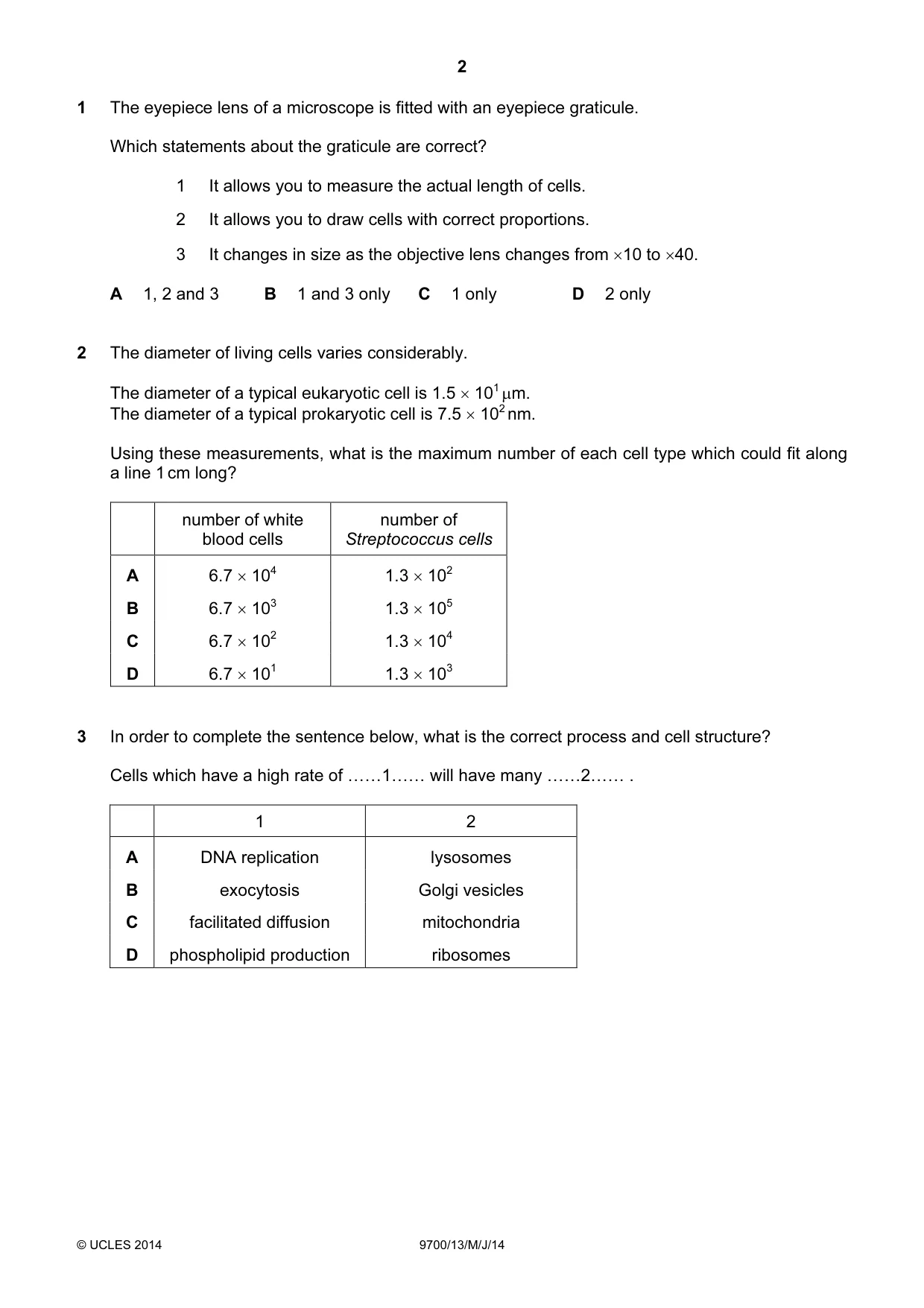
1 The eyepiece lens of a microscope is fitted with an eyepiece graticule. Which statements about the graticule are correct? 1 It allows you to measure the actual length of cells. 2 It allows you to draw cells with correct proportions. 3 It changes in size as the objective lens changes from ×10 to ×40. A 1, 2 and 3 B 1 and 3 only C 1 only D 2 only
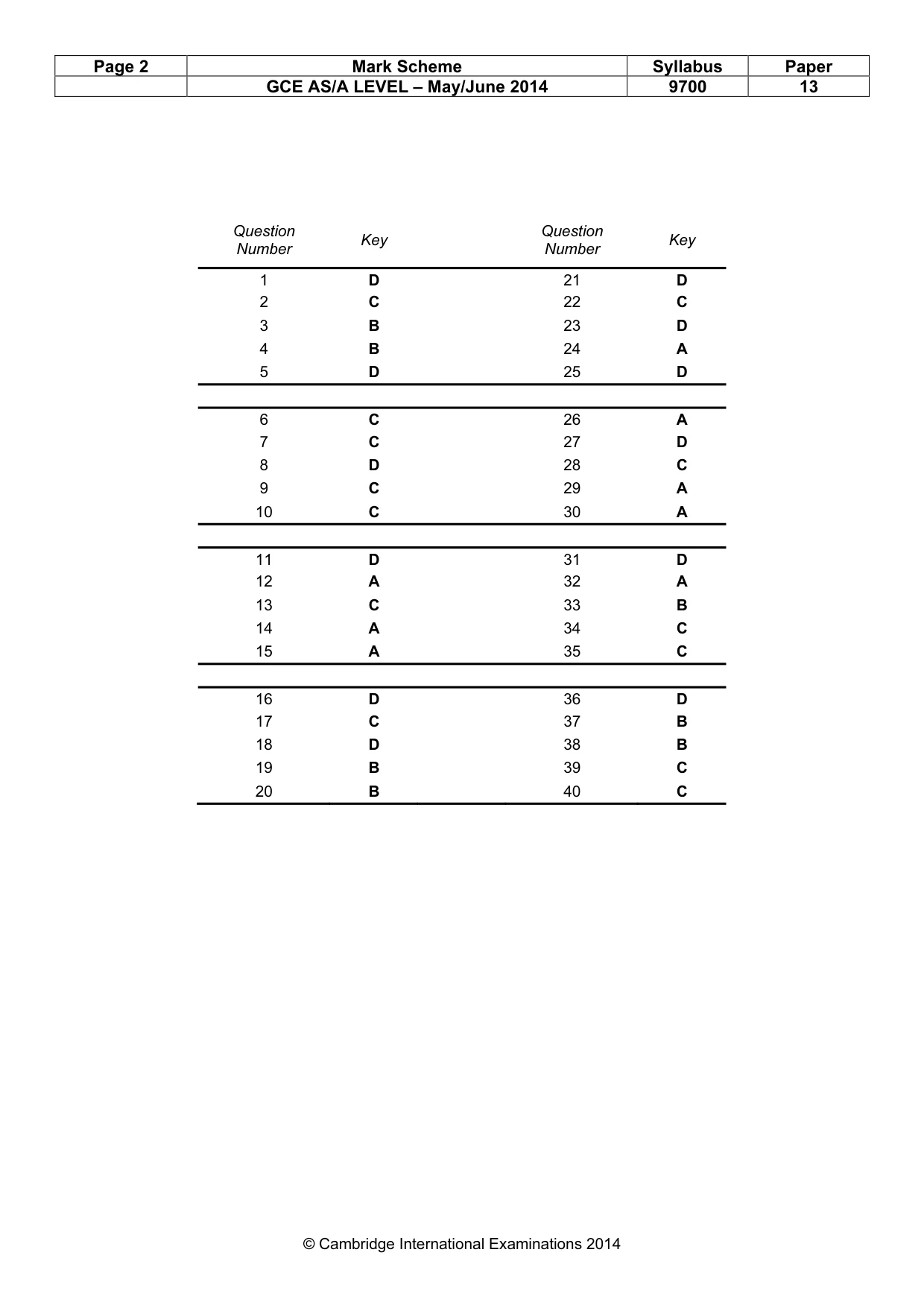
Mark scheme: D
Q2 · The diameter of living cells varies considerably
2 The diameter of living cells varies considerably. The diameter of a typical eukaryotic cell is 1.5 × 101 µm. The diameter of a typical prokaryotic cell is 7.5 × 10² nm. Using these measurements, what is the maximum number of each cell type which could fit along a line 1 cm long? number of white number of blood cells Streptococcus cells A 6.7 × 10⁴ 1.3 × 10² B 6.7 × 10³ 1.3 × 10⁵ C 6.7 × 10² 1.3 × 10⁴ D 6.7 × 101 1.3 × 10³
Mark scheme: C
More questions on Cells as the basic units of living organisms
Q3 · In order to complete the sentence below, what is the correct process and cell structure?
3 In order to complete the sentence below, what is the correct process and cell structure? Cells which have a high rate of ……1…… will have many ……2…… . 1 2 A DNA replication lysosomes B exocytosis Golgi vesicles C facilitated diffusion mitochondria D phospholipid production ribosomes
Mark scheme: B
More questions on Cells as the basic units of living organisms
Q4 · A cell secreting glycoproteins is supplied with radioactively-labelled glucose which is…
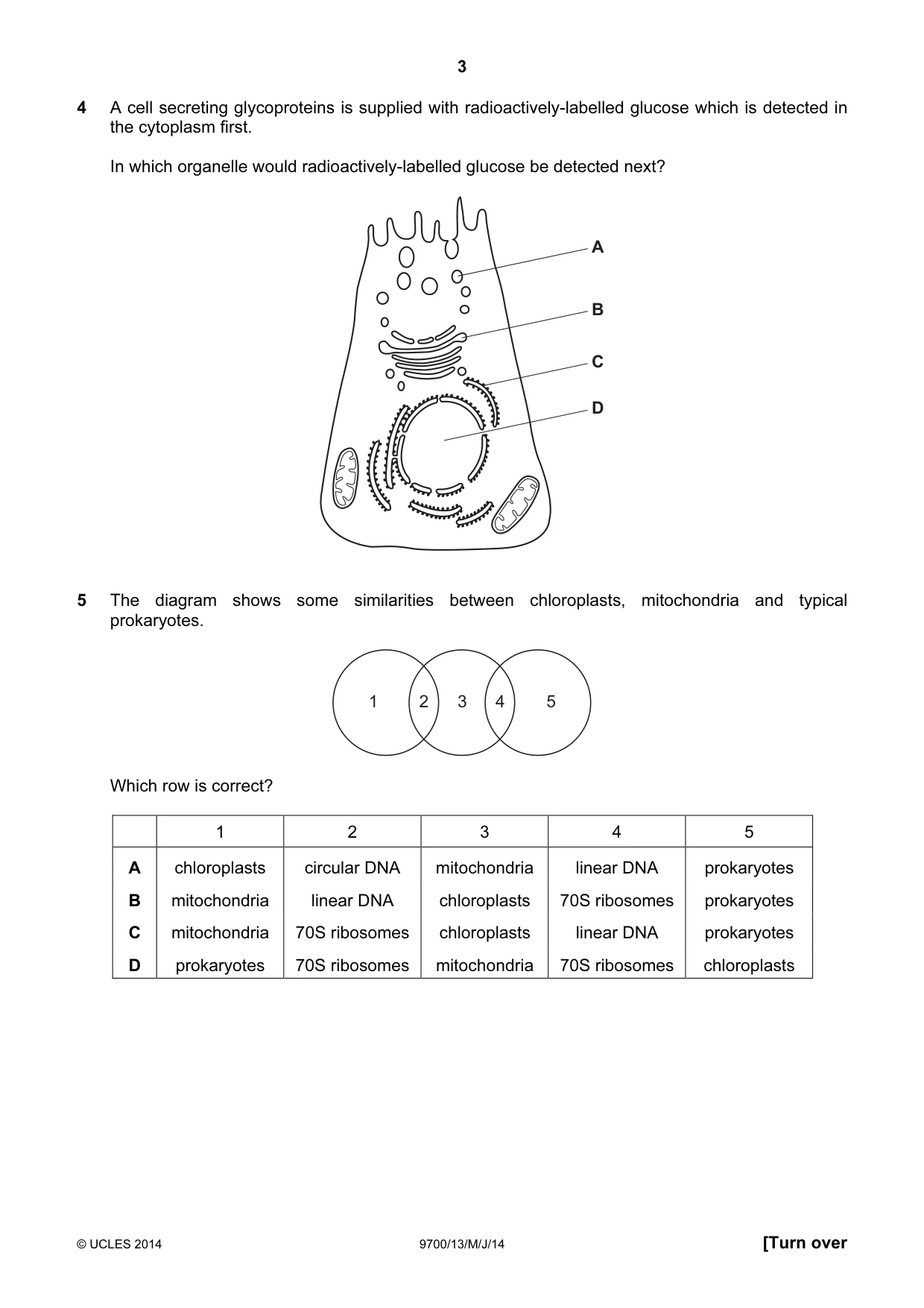
4 A cell secreting glycoproteins is supplied with radioactively-labelled glucose which is detected in the cytoplasm first. In which organelle would radioactively-labelled glucose be detected next? A B C D
Mark scheme: B
More questions on Cells as the basic units of living organisms
Q5 · The diagram shows some similarities between chloroplasts, mitochondria and typical…
5 The diagram shows some similarities between chloroplasts, mitochondria and typical prokaryotes. 1 2 3 4 5 Which row is correct? 1 2 3 4 5 A chloroplasts circular DNA mitochondria linear DNA prokaryotes B mitochondria linear DNA chloroplasts 70S ribosomes prokaryotes C mitochondria 70S ribosomes chloroplasts linear DNA prokaryotes D prokaryotes 70S ribosomes mitochondria 70S ribosomes chloroplasts
Mark scheme: D
More questions on Cells as the basic units of living organisms
Q6 · A student carried out four tests for biological molecules on a solution
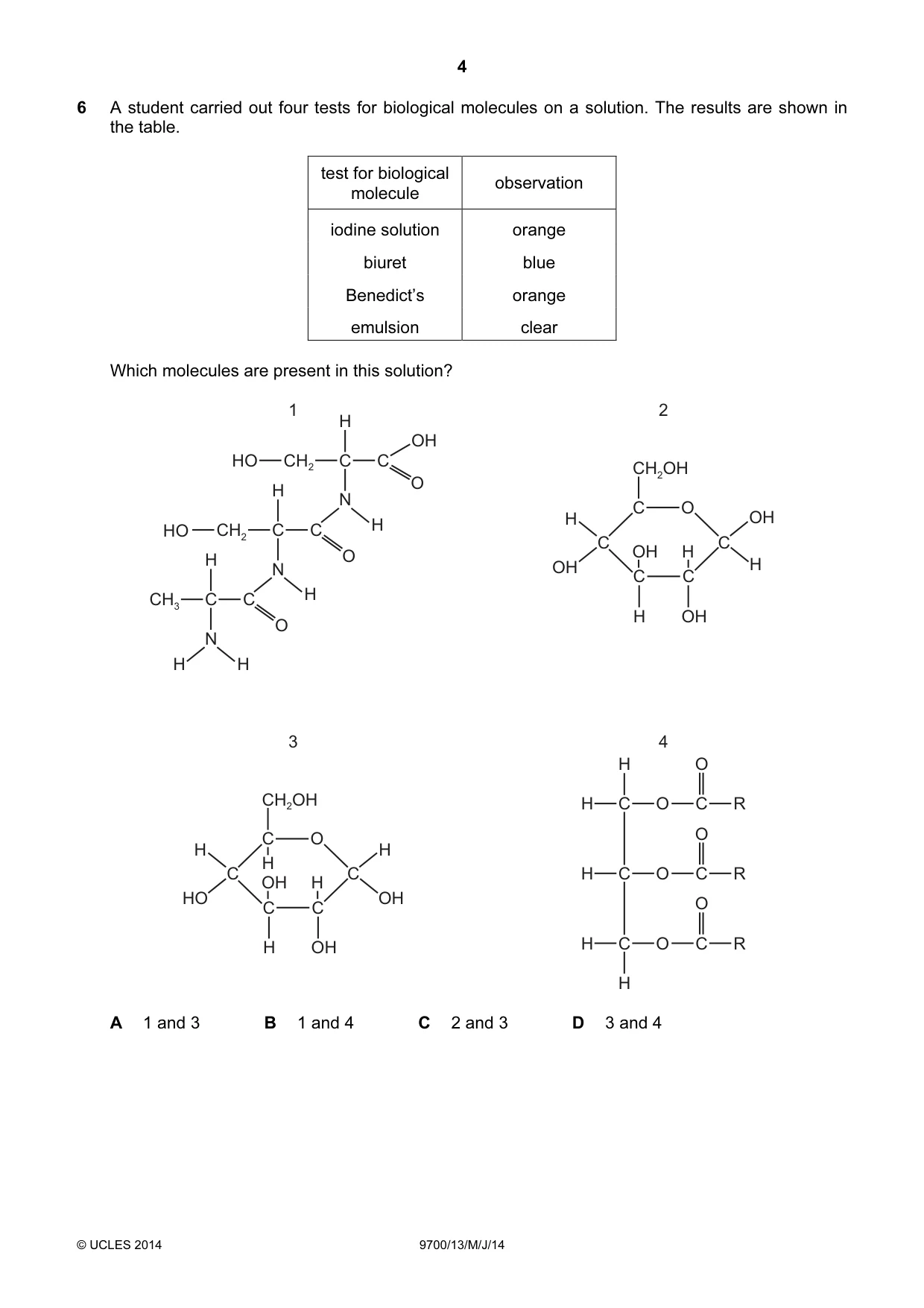
6 A student carried out four tests for biological molecules on a solution. The results are shown in the table. test for biological observation molecule iodine solution orange biuret blue Benedict’s orange emulsion clear Which molecules are present in this solution? 1 2 H OH HO CH2 C C CH2OH H O N C O H H OH HO CH2 C C C C O OH H H OH H N C C CH3 C C H H OH O N H H 3 4 H O CH2OH H C O C R C O O H H H C C H C O C R OH H HO OH O C C H OH H C O C R H A 1 and 3 B 1 and 4 C 2 and 3 D 3 and 4
Mark scheme: C
Q7 · Which bonds will be broken when a molecule of amylose is hydrolysed?
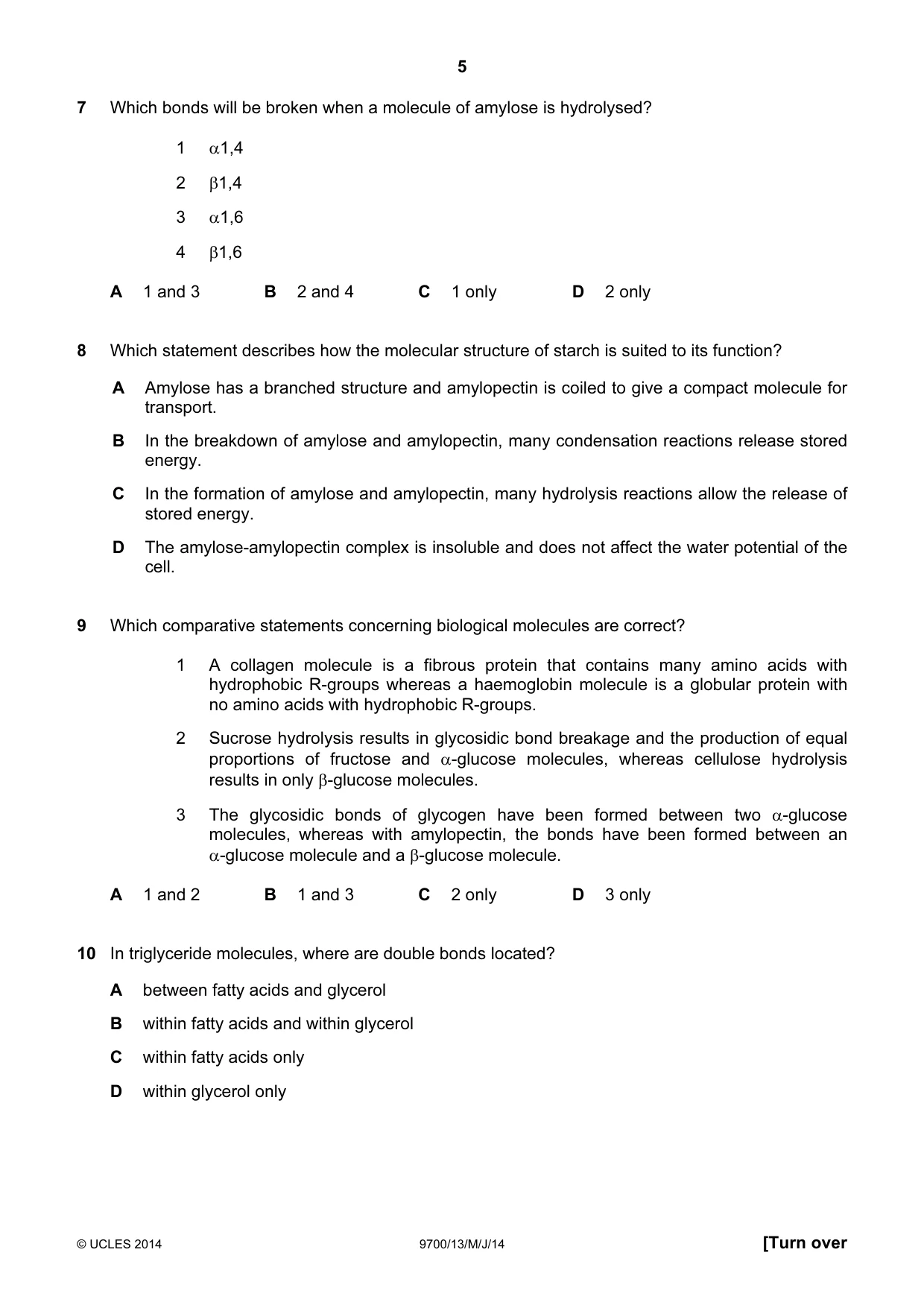
7 Which bonds will be broken when a molecule of amylose is hydrolysed? 1 α1,4 2 β1,4 3 α1,6 4 β1,6 A 1 and 3 B 2 and 4 C 1 only D 2 only
Mark scheme: C
Q8 · Which statement describes how the molecular structure of starch is suited to its function?
8 Which statement describes how the molecular structure of starch is suited to its function? A Amylose has a branched structure and amylopectin is coiled to give a compact molecule for transport. B In the breakdown of amylose and amylopectin, many condensation reactions release stored energy. C In the formation of amylose and amylopectin, many hydrolysis reactions allow the release of stored energy. D The amylose-amylopectin complex is insoluble and does not affect the water potential of the cell.
Mark scheme: D
Q9 · Which comparative statements concerning biological molecules are correct?
9 Which comparative statements concerning biological molecules are correct? 1 A collagen molecule is a fibrous protein that contains many amino acids with hydrophobic R-groups whereas a haemoglobin molecule is a globular protein with no amino acids with hydrophobic R-groups. 2 Sucrose hydrolysis results in glycosidic bond breakage and the production of equal proportions of fructose and α-glucose molecules, whereas cellulose hydrolysis results in only β-glucose molecules. 3 The glycosidic bonds of glycogen have been formed between two α-glucose molecules, whereas with amylopectin, the bonds have been formed between an α-glucose molecule and a β-glucose molecule. A 1 and 2 B 1 and 3 C 2 only D 3 only
Mark scheme: C
Q10 · In triglyceride molecules, where are double bonds located?
10 In triglyceride molecules, where are double bonds located? A between fatty acids and glycerol B within fatty acids and within glycerol C within fatty acids only D within glycerol only
Mark scheme: C
Q11 · The diagram represents an amino acid
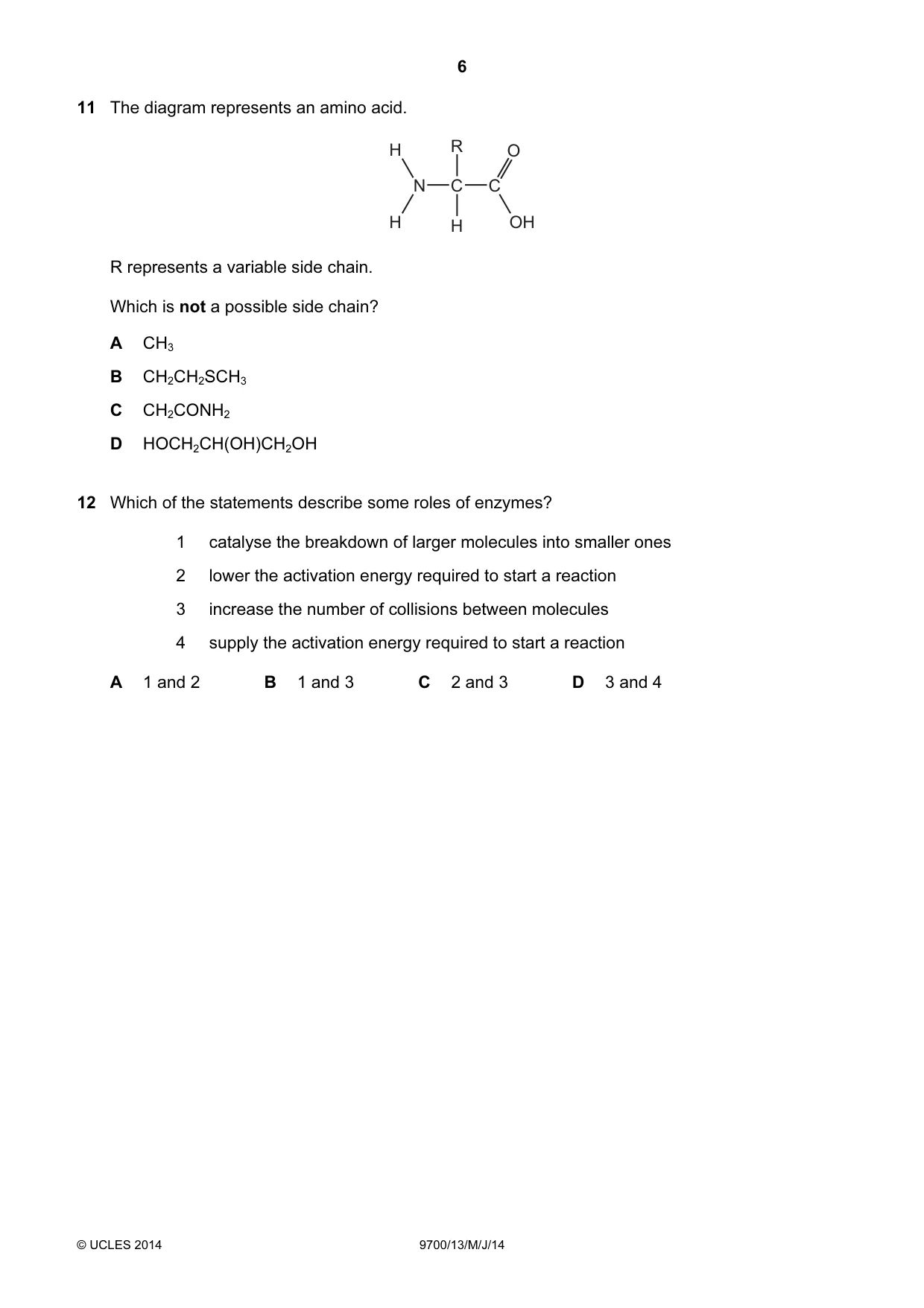
11 The diagram represents an amino acid. H R O N C C H H OH R represents a variable side chain. Which is not a possible side chain? A CH3 B CH2CH2SCH3 C CH2CONH2 D HOCH2CH(OH)CH2OH
Mark scheme: D
Q12 · Which of the statements describe some roles of enzymes?
12 Which of the statements describe some roles of enzymes? 1 catalyse the breakdown of larger molecules into smaller ones 2 lower the activation energy required to start a reaction 3 increase the number of collisions between molecules 4 supply the activation energy required to start a reaction A 1 and 2 B 1 and 3 C 2 and 3 D 3 and 4
Mark scheme: A
Q13 · The graph shows the rate of activity of the enzyme sucrase plotted against the…
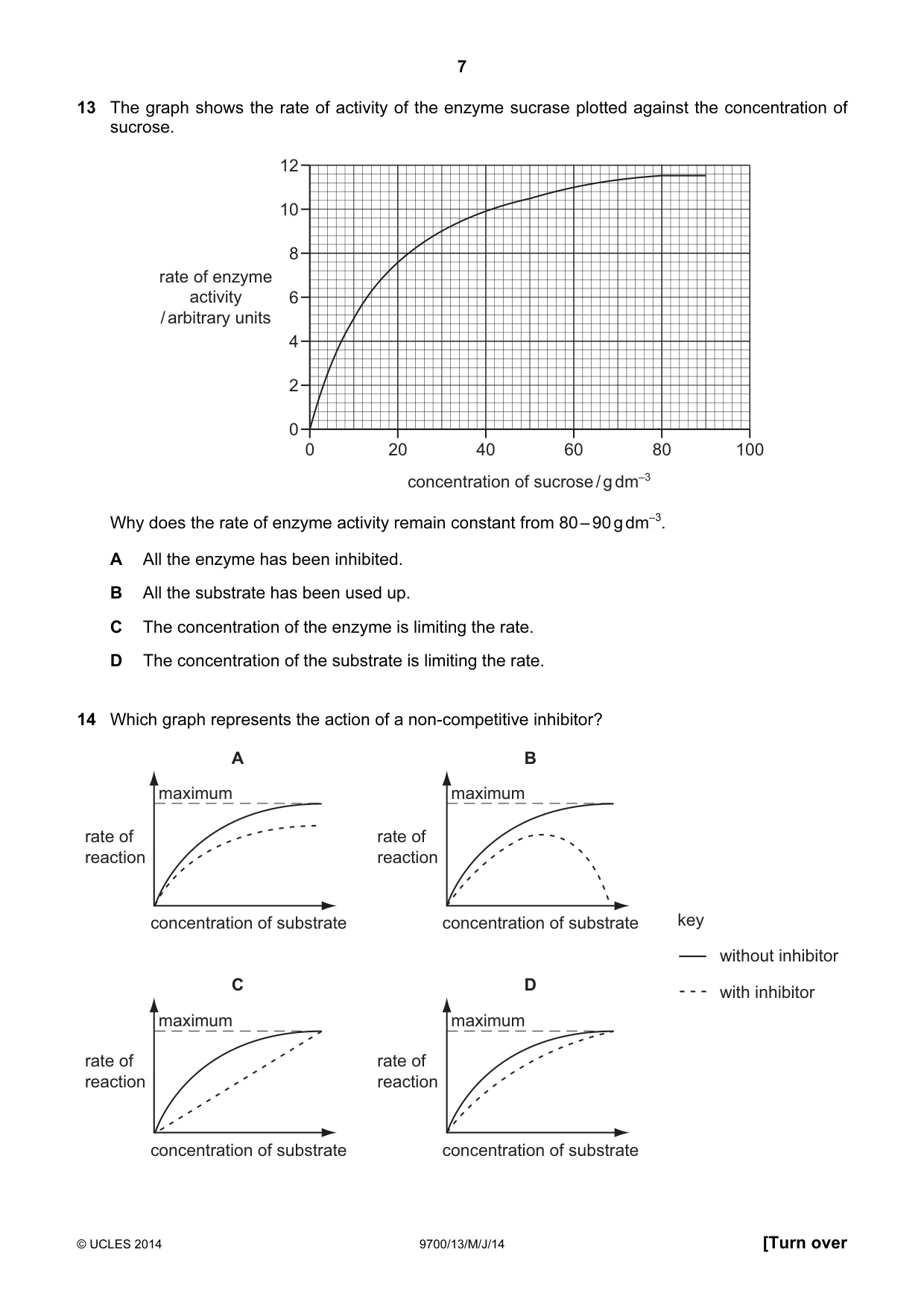
13 The graph shows the rate of activity of the enzyme sucrase plotted against the concentration of sucrose. 12 10 8 rate of enzyme activity 6 / arbitrary units 4 2 0 0 20 40 60 80 100 concentration of sucrose / g dm–3 Why does the rate of enzyme activity remain constant from 80 – 90 g dm–3. A All the enzyme has been inhibited. B All the substrate has been used up. C The concentration of the enzyme is limiting the rate. D The concentration of the substrate is limiting the rate.
Mark scheme: C
Q14 · Which graph represents the action of a non-competitive inhibitor?
14 Which graph represents the action of a non-competitive inhibitor? A B maximum maximum rate of rate of reaction reaction concentration of substrate concentration of substrate key without inhibitor C D with inhibitor maximum maximum rate of rate of reaction reaction concentration of substrate concentration of substrate
Mark scheme: A
Q15 · The diagram shows part of a cell surface membrane
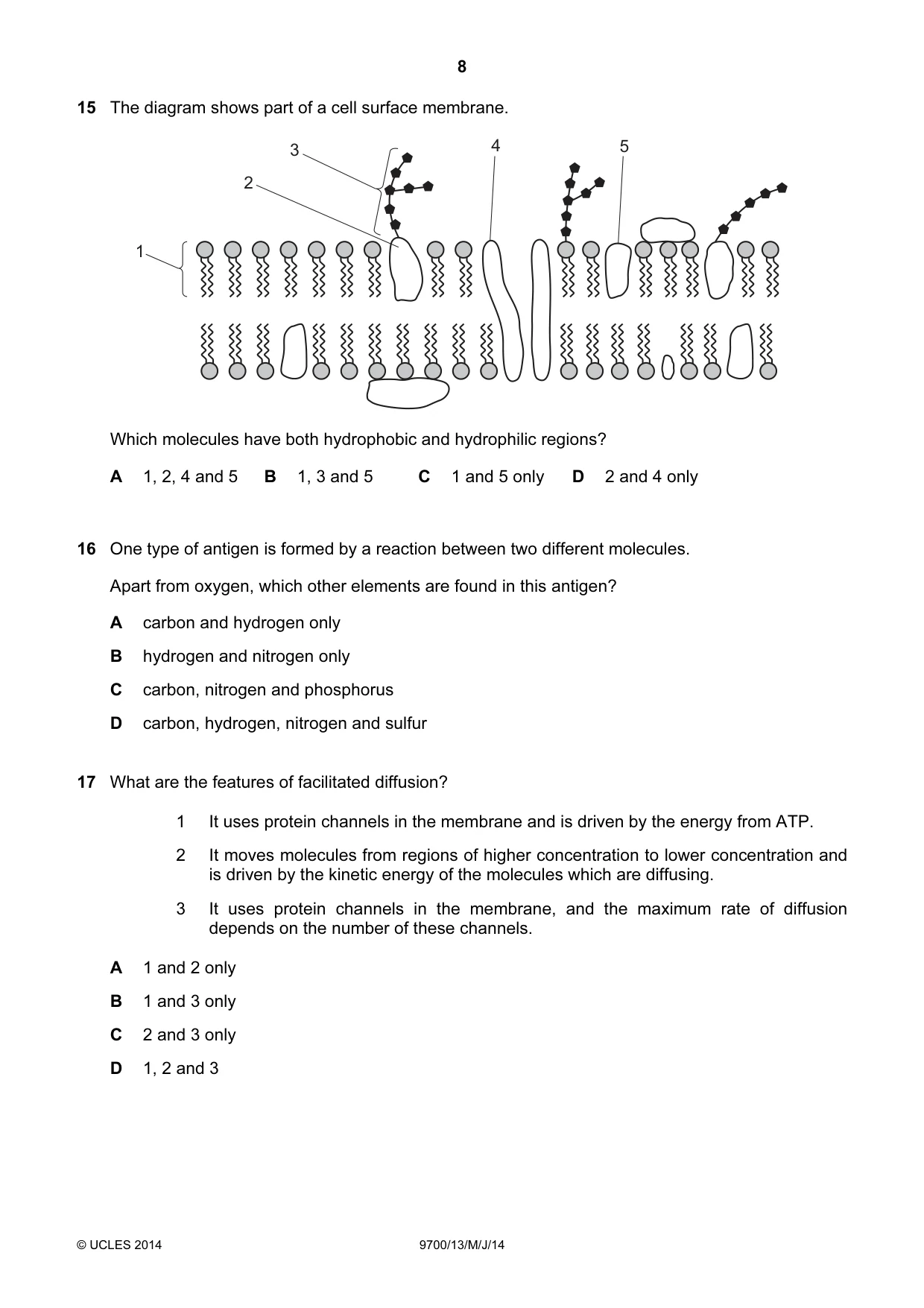
15 The diagram shows part of a cell surface membrane. 3 4 5 2 1 Which molecules have both hydrophobic and hydrophilic regions? A 1, 2, 4 and 5 B 1, 3 and 5 C 1 and 5 only D 2 and 4 only
Mark scheme: A
Q16 · One type of antigen is formed by a reaction between two different molecules
16 One type of antigen is formed by a reaction between two different molecules. Apart from oxygen, which other elements are found in this antigen? A carbon and hydrogen only B hydrogen and nitrogen only C carbon, nitrogen and phosphorus D carbon, hydrogen, nitrogen and sulfur
Mark scheme: D
Q17 · What are the features of facilitated diffusion?
17 What are the features of facilitated diffusion? 1 It uses protein channels in the membrane and is driven by the energy from ATP. 2 It moves molecules from regions of higher concentration to lower concentration and is driven by the kinetic energy of the molecules which are diffusing. 3 It uses protein channels in the membrane, and the maximum rate of diffusion depends on the number of these channels. A 1 and 2 only B 1 and 3 only C 2 and 3 only D 1, 2 and 3
Mark scheme: C
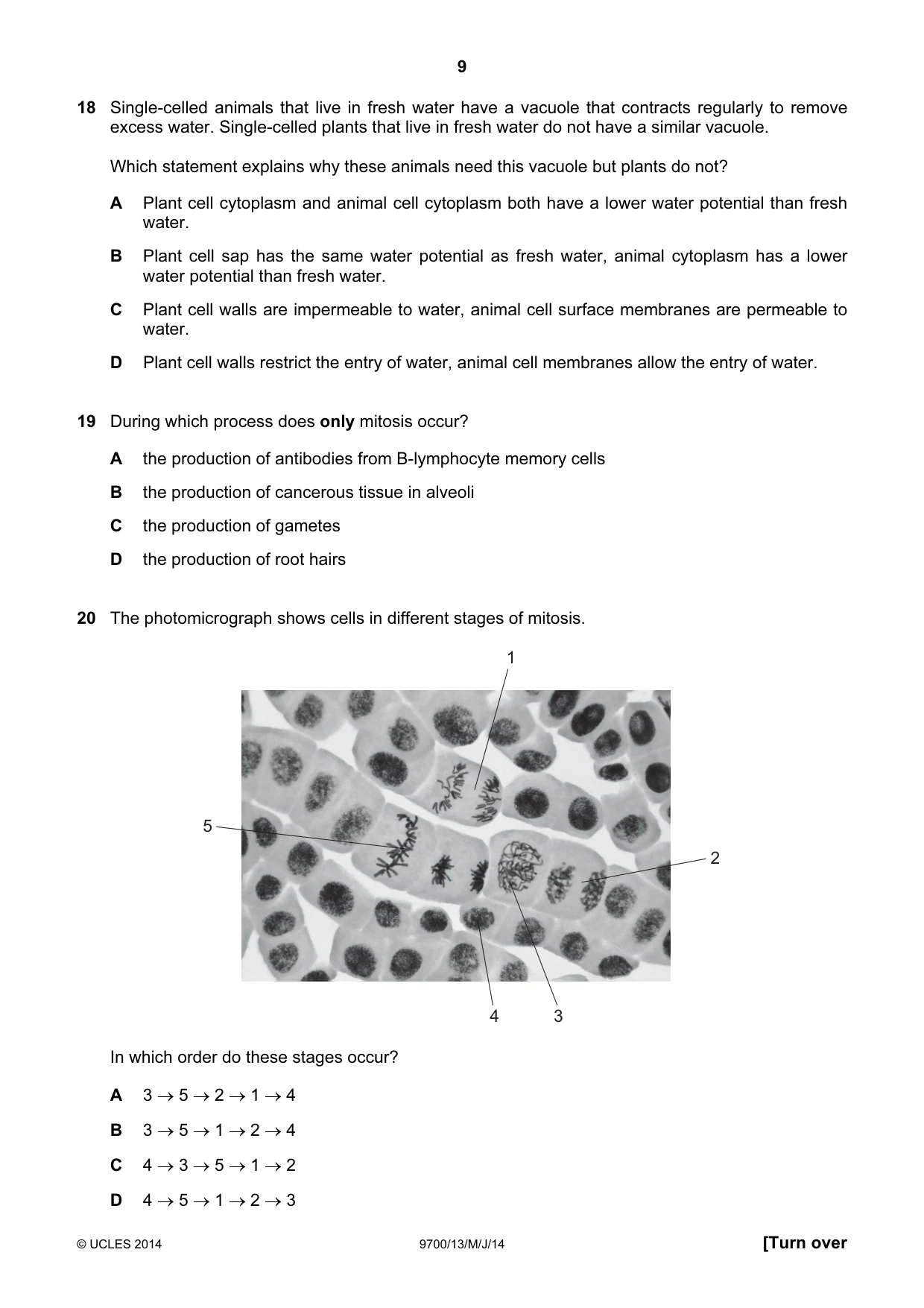
Q18 · Single-celled animals that live in fresh water have a vacuole that contracts regularly to…
18 Single-celled animals that live in fresh water have a vacuole that contracts regularly to remove excess water. Single-celled plants that live in fresh water do not have a similar vacuole. Which statement explains why these animals need this vacuole but plants do not? A Plant cell cytoplasm and animal cell cytoplasm both have a lower water potential than fresh water. B Plant cell sap has the same water potential as fresh water, animal cytoplasm has a lower water potential than fresh water. C Plant cell walls are impermeable to water, animal cell surface membranes are permeable to water. D Plant cell walls restrict the entry of water, animal cell membranes allow the entry of water.
Mark scheme: D
Q19 · During which process does only mitosis occur?
19 During which process does only mitosis occur? A the production of antibodies from B-lymphocyte memory cells B the production of cancerous tissue in alveoli C the production of gametes D the production of root hairs
Mark scheme: B
More questions on Replication and division of nuclei and cells
Q20 · The photomicrograph shows cells in different stages of mitosis
20 The photomicrograph shows cells in different stages of mitosis. 1 5 2 4 3 In which order do these stages occur? A 3 → 5 → 2 → 1 → 4 B 3 → 5 → 1 → 2 → 4 C 4 → 3 → 5 → 1 → 2 D 4 → 5 → 1 → 2 → 3
Mark scheme: B
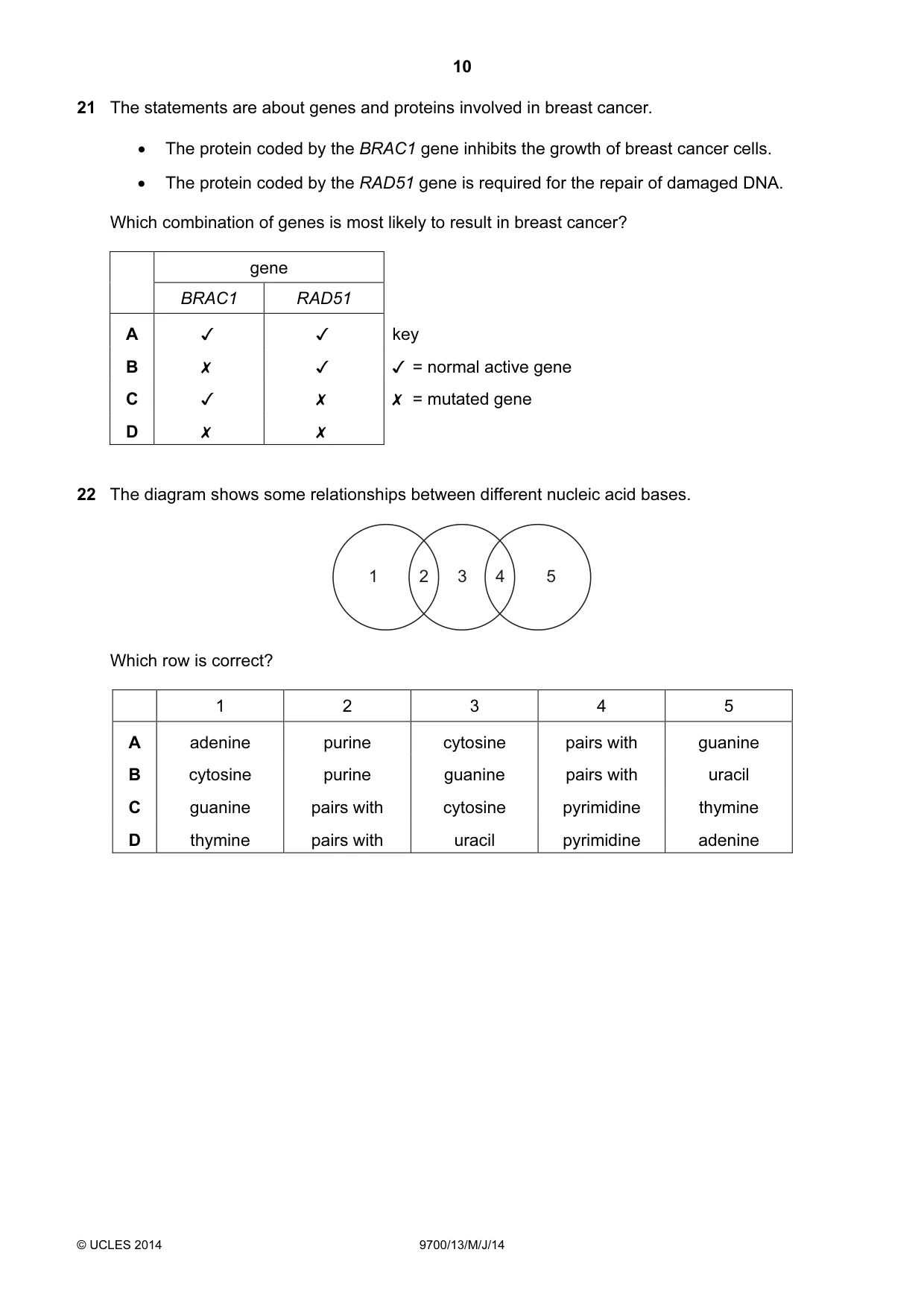
Q21 · The statements are about genes and proteins involved in breast cancer
21 The statements are about genes and proteins involved in breast cancer. e The protein coded by the BRAC7 gene inhibits the growth of breast cancer cells. e The protein coded by the RAD57 gene is required for the repair of damaged DNA. Which combination of genes is most likely to result in breast cancer? gene BRAC1 RAD51 v v key ¥ =normal active gene X = mutated gene 0 OW D> ~ «K & x v x
Mark scheme: D
Q22 · The diagram shows some relationships between different nucleic acid bases
22 The diagram shows some relationships between different nucleic acid bases. 1 2 3 4 5 Which row is correct? 1 2 3 4 5 A adenine purine cytosine pairs with guanine B cytosine purine guanine pairs with uracil C guanine pairs with cytosine pyrimidine thymine D thymine pairs with uracil pyrimidine adenine
Mark scheme: C
More questions on Structure of nucleic acids and replication of DNA
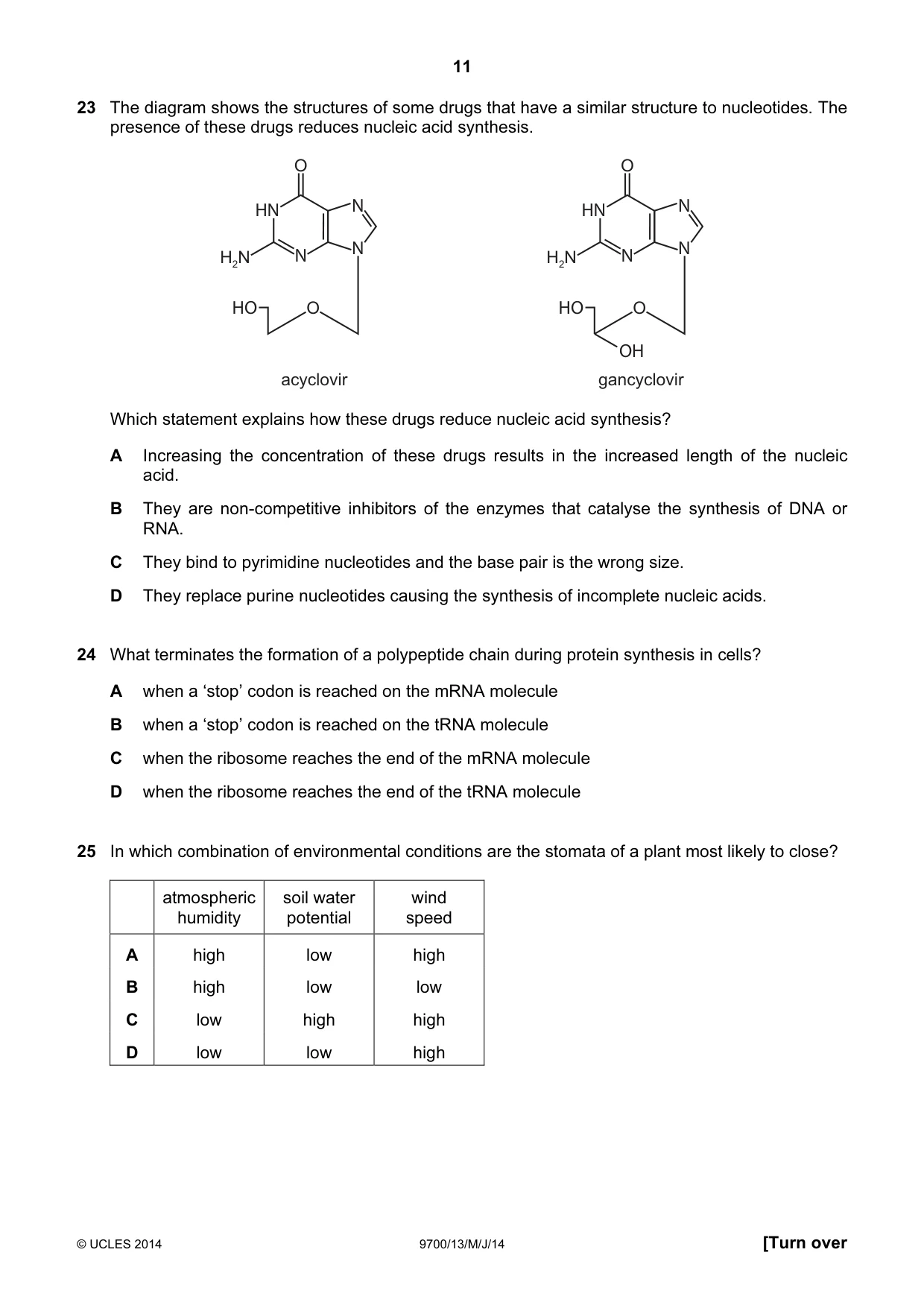
Q23 · The diagram shows the structures of some drugs that have a similar structure to…
23 The diagram shows the structures of some drugs that have a similar structure to nucleotides. The presence of these drugs reduces nucleic acid synthesis. O O HN N HN N N N N N H2N H2N HO O HO O OH acyclovir gancyclovir Which statement explains how these drugs reduce nucleic acid synthesis? A Increasing the concentration of these drugs results in the increased length of the nucleic acid. B They are non-competitive inhibitors of the enzymes that catalyse the synthesis of DNA or RNA. C They bind to pyrimidine nucleotides and the base pair is the wrong size. D They replace purine nucleotides causing the synthesis of incomplete nucleic acids.
Mark scheme: D
More questions on Structure of nucleic acids and replication of DNA
Q24 · What terminates the formation of a polypeptide chain during protein synthesis in cells?
24 What terminates the formation of a polypeptide chain during protein synthesis in cells? A when a ‘stop’ codon is reached on the mRNA molecule B when a ‘stop’ codon is reached on the tRNA molecule C when the ribosome reaches the end of the mRNA molecule D when the ribosome reaches the end of the tRNA molecule
Mark scheme: A
Q25 · In which combination of environmental conditions are the stomata of a plant most likely…
25 In which combination of environmental conditions are the stomata of a plant most likely to close? atmospheric soil water wind humidity potential speed A high low high B high low low C low high high D low low high
Mark scheme: D
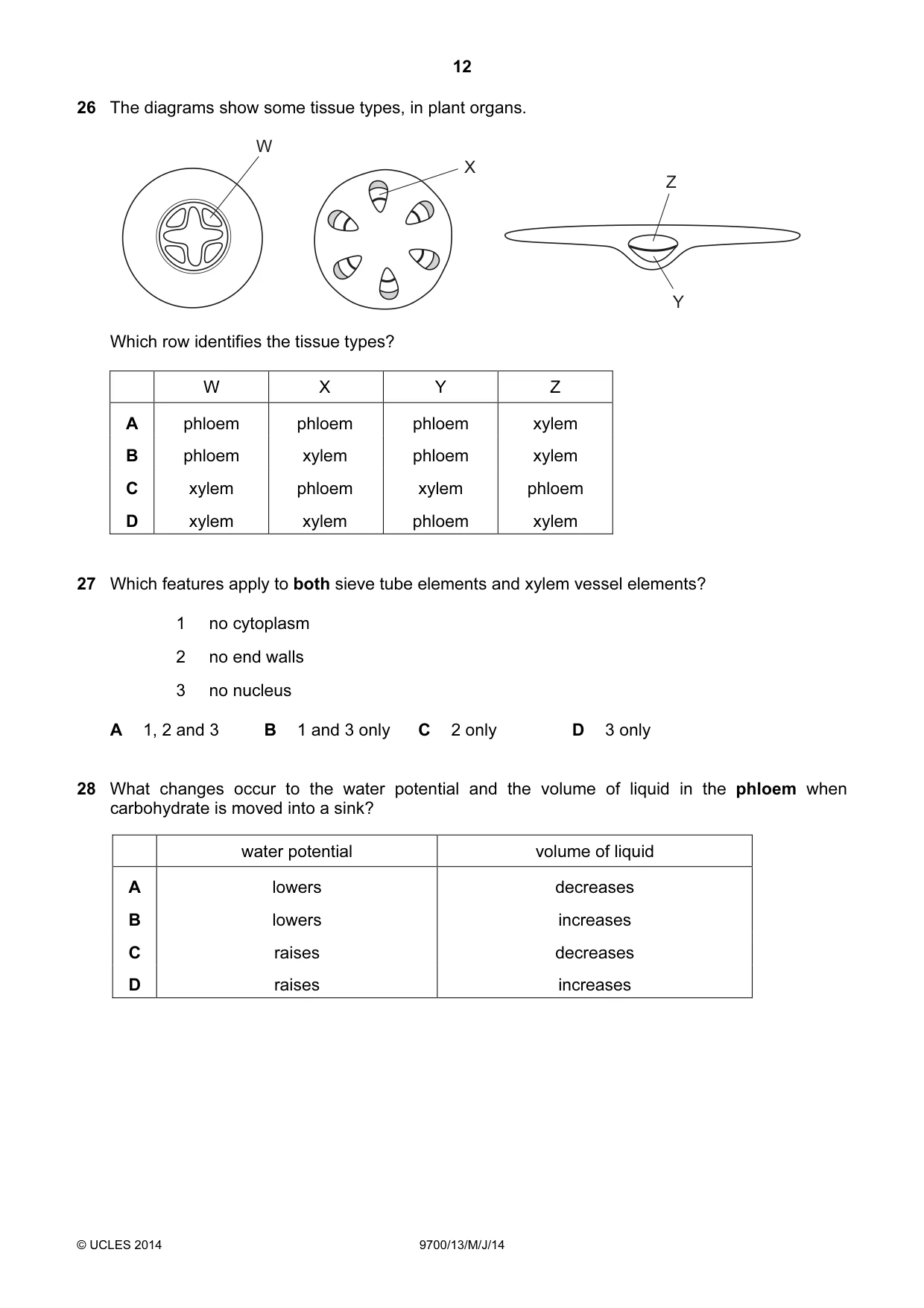
Q26 · The diagrams show some tissue types, in plant organs
26 The diagrams show some tissue types, in plant organs. W X Z Y Which row identifies the tissue types? W X Y Z A phloem phloem phloem xylem B phloem xylem phloem xylem C xylem phloem xylem phloem D xylem xylem phloem xylem
Mark scheme: A
Q27 · Which features apply to both sieve tube elements and xylem vessel elements?
27 Which features apply to both sieve tube elements and xylem vessel elements? 1 no cytoplasm 2 no end walls 3 no nucleus A 1, 2 and 3 B 1 and 3 only C 2 only D 3 only
Mark scheme: D
Q28 · What changes occur to the water potential and the volume of liquid in the phloem when…
28 What changes occur to the water potential and the volume of liquid in the phloem when carbohydrate is moved into a sink? water potential volume of liquid A lowers decreases B lowers increases C raises decreases D raises increases
Mark scheme: C
Q29 · Some plant species can take up heavy metal contaminants that are dissolved in soil water…
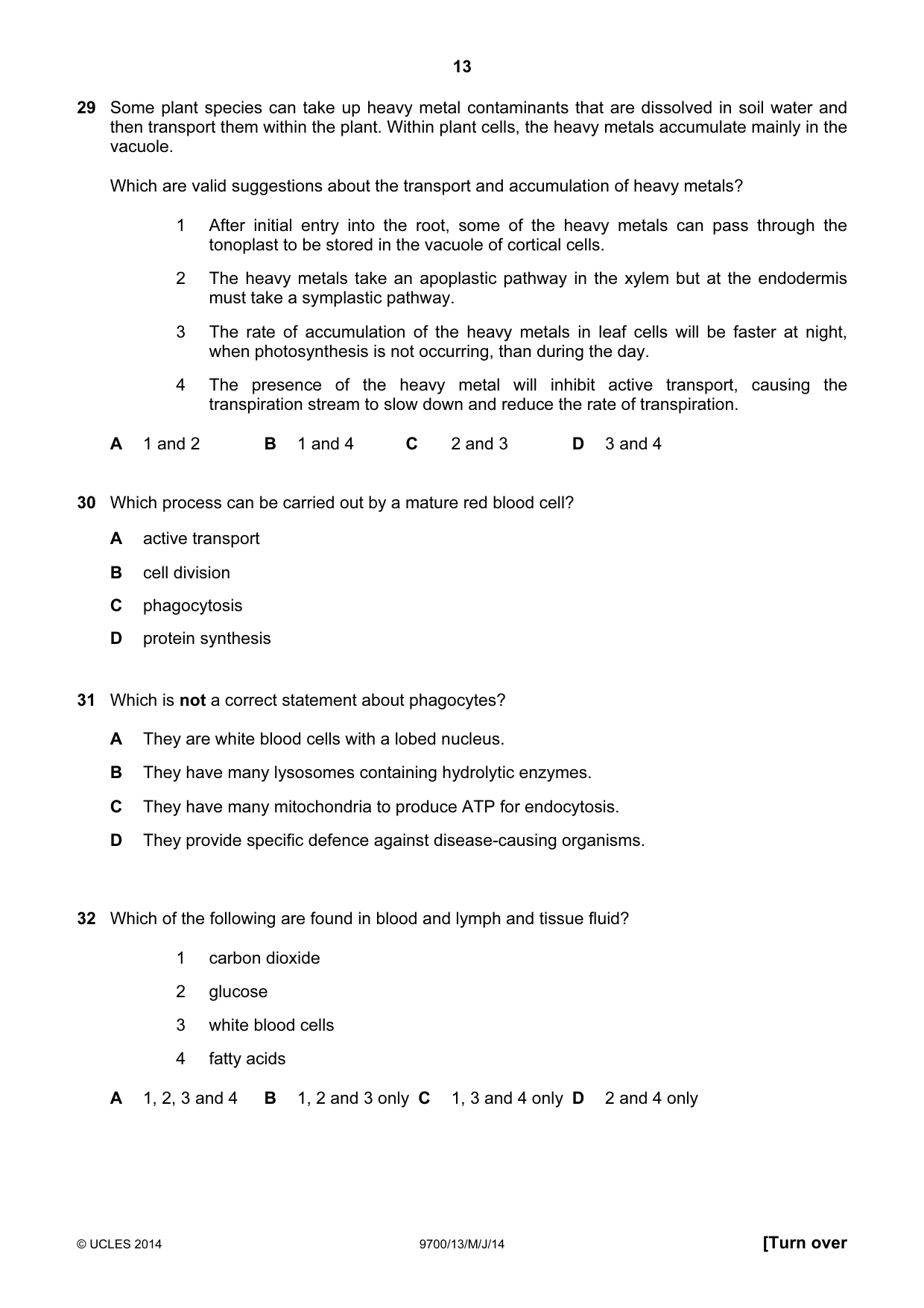
29 Some plant species can take up heavy metal contaminants that are dissolved in soil water and then transport them within the plant. Within plant cells, the heavy metals accumulate mainly in the vacuole. Which are valid suggestions about the transport and accumulation of heavy metals? 1 After initial entry into the root, some of the heavy metals can pass through the tonoplast to be stored in the vacuole of cortical cells. 2 The heavy metals take an apoplastic pathway in the xylem but at the endodermis must take a symplastic pathway. 3 The rate of accumulation of the heavy metals in leaf cells will be faster at night, when photosynthesis is not occurring, than during the day. 4 The presence of the heavy metal will inhibit active transport, causing the transpiration stream to slow down and reduce the rate of transpiration. A 1 and 2 B 1 and 4 C 2 and 3 D 3 and 4
Mark scheme: A
Q30 · Which process can be carried out by a mature red blood cell?
30 Which process can be carried out by a mature red blood cell? A active transport B cell division C phagocytosis D protein synthesis
Mark scheme: A
Q31 · Which is not a correct statement about phagocytes?
31 Which is not a correct statement about phagocytes? A They are white blood cells with a lobed nucleus. B They have many lysosomes containing hydrolytic enzymes. C They have many mitochondria to produce ATP for endocytosis. D They provide specific defence against disease-causing organisms.
Mark scheme: D
Q32 · Which of the following are found in blood and lymph and tissue fluid?
32 Which of the following are found in blood and lymph and tissue fluid? 1 carbon dioxide 2 glucose 3 white blood cells 4 fatty acids A 1, 2, 3 and 4 B 1, 2 and 3 only C 1, 3 and 4 only D 2 and 4 only
Mark scheme: A
Q33 · The diagram shows a section through a type of epithelium
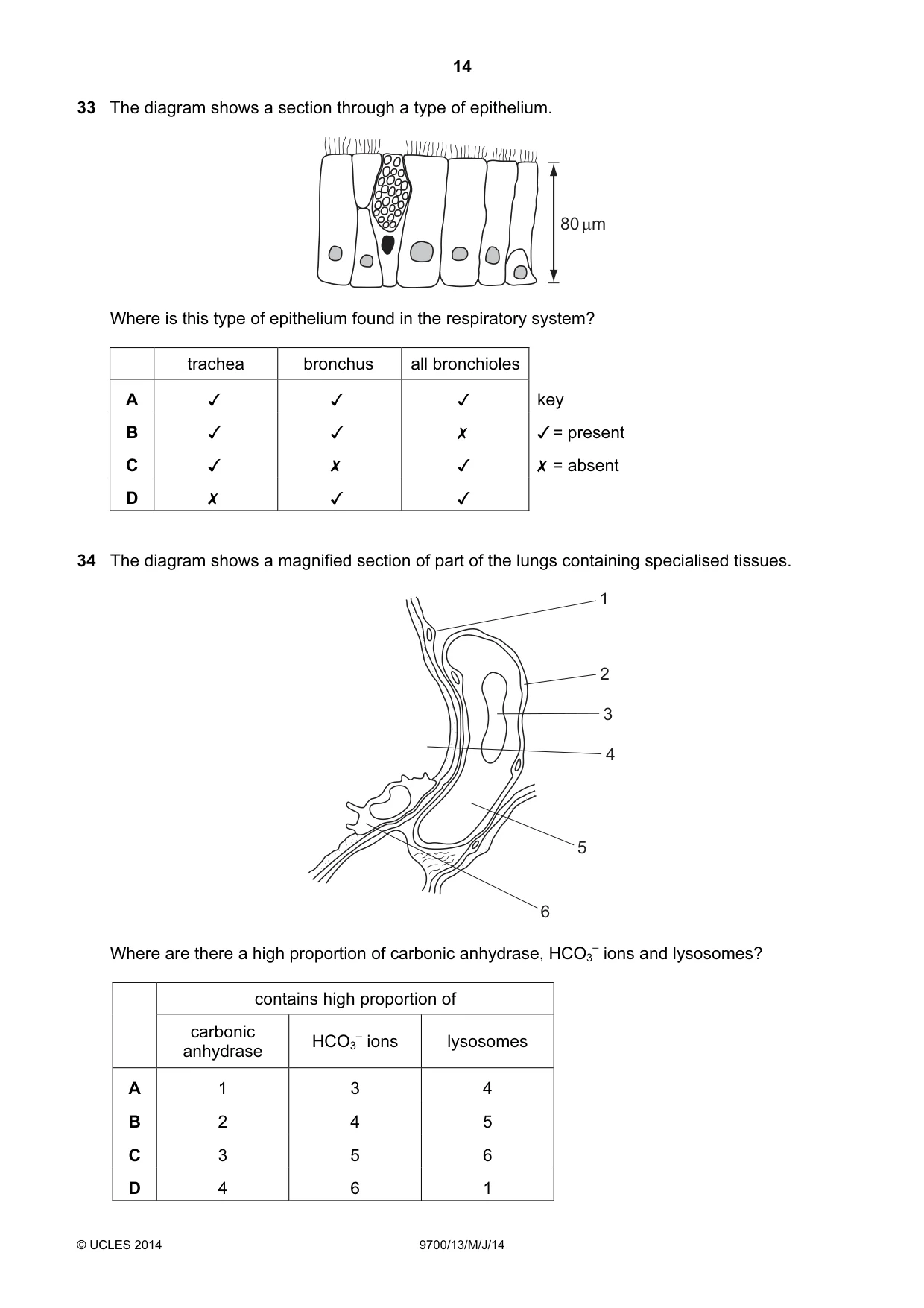
33 The diagram shows a section through a type of epithelium. Where is this type of epithelium found in the respiratory system? trachea bronchus all bronchioles A v v v B v v x Cc v x v D x v v key /¥ = present X = absent
Mark scheme: B
Q34 · The diagram shows a magnified section of part of the lungs containing specialised tissues
34 The diagram shows a magnified section of part of the lungs containing specialised tissues. 1 2 3 4 5 6 Where are there a high proportion of carbonic anhydrase, HCO3 – ions and lysosomes? contains high proportion of carbonic – ions HCO3 lysosomes anhydrase A 1 3 4 B 2 4 5 C 3 5 6 D 4 6 1
Mark scheme: C
Q35 · Which row correctly identifies the effects of carbon monoxide, nicotine and tar?
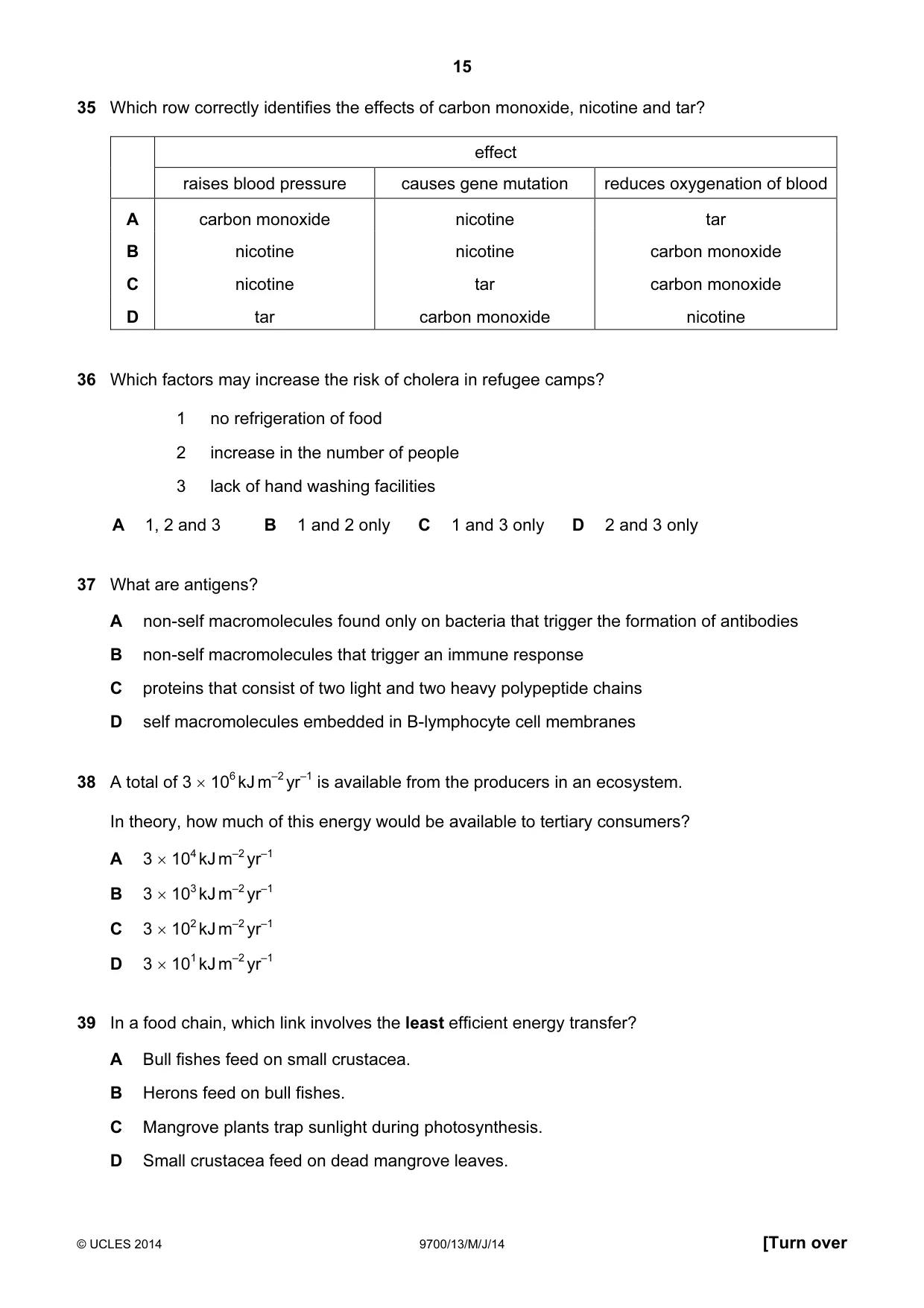
35 Which row correctly identifies the effects of carbon monoxide, nicotine and tar? effect raises blood pressure causes gene mutation reduces oxygenation of blood A carbon monoxide nicotine tar B nicotine nicotine carbon monoxide C nicotine tar carbon monoxide D tar carbon monoxide nicotine
Mark scheme: C
Q36 · Which factors may increase the risk of cholera in refugee camps?
36 Which factors may increase the risk of cholera in refugee camps? 1 no refrigeration of food 2 increase in the number of people 3 lack of hand washing facilities A 1, 2 and 3 B 1 and 2 only C 1 and 3 only D 2 and 3 only
Mark scheme: D
Question 37
37 What are antigens? A non-self macromolecules found only on bacteria that trigger the formation of antibodies B non-self macromolecules that trigger an immune response C proteins that consist of two light and two heavy polypeptide chains D self macromolecules embedded in B-lymphocyte cell membranes
Mark scheme: B
Q38 · A total of 3 × 10⁶ kJ m–2 yr–1 is available from the producers in an ecosystem
38 A total of 3 × 10⁶ kJ m–2 yr–1 is available from the producers in an ecosystem. In theory, how much of this energy would be available to tertiary consumers? A 3 × 10⁴ kJ m–2 yr–1 B 3 × 10³ kJ m–2 yr–1 C 3 × 10² kJ m–2 yr–1 D 3 × 101 kJ m–2 yr–1
Mark scheme: B
Q39 · In a food chain, which link involves the least efficient energy transfer?
39 In a food chain, which link involves the least efficient energy transfer? A Bull fishes feed on small crustacea. B Herons feed on bull fishes. C Mangrove plants trap sunlight during photosynthesis. D Small crustacea feed on dead mangrove leaves.
Mark scheme: C
Q40 · The growth of crop plants is often limited by the availability of nitrogen in the soil
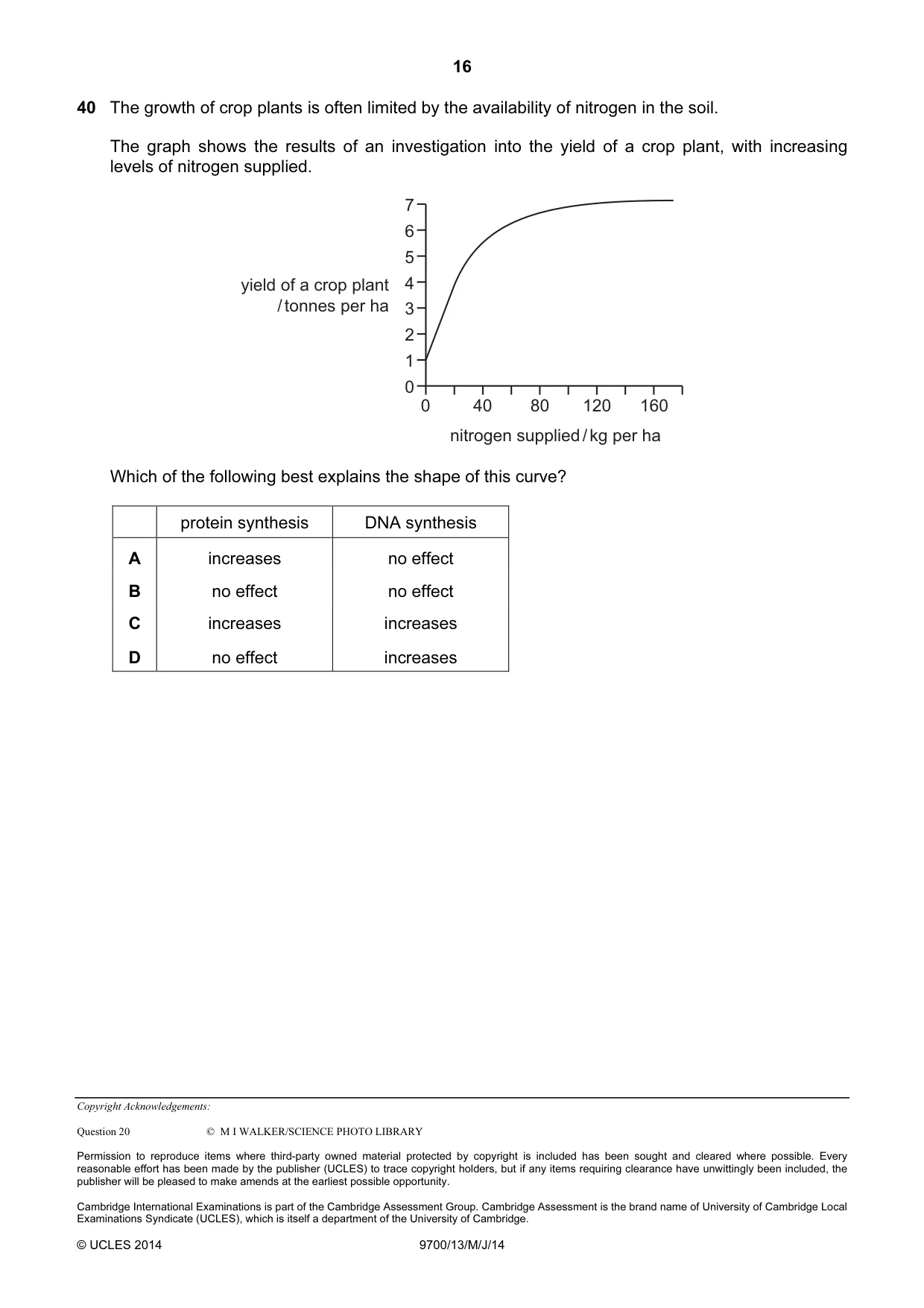
40 The growth of crop plants is often limited by the availability of nitrogen in the soil. The graph shows the results of an investigation into the yield of a crop plant, with increasing levels of nitrogen supplied. 7 6 5 yield of a crop plant 4 / tonnes per ha 3 2 1 0 0 40 80 120 160 nitrogen supplied / kg per ha Which of the following best explains the shape of this curve? protein synthesis DNA synthesis A increases no effect B no effect no effect C increases increases D no effect increases
Mark scheme: C
What was in this paper
The subtopics covered by these 40 questions, and how many questions each got. Open one in a new tab to see every Cambridge question on it.
4Cells as the basic units of living organisms4Proteins3Transport mechanisms3Energy2Factors that affect enzyme action2Movement into and out of cells2Structure of nucleic acids and replication of DNA2Structure of transport tissues2The gas exchange system2The immune system2Transport of oxygen and carbon dioxide2Chromosome behaviour in mitosis1Fluid mosaic membranes1Infectious diseases1Mode of action of enzymes1Protein synthesis1Replication and division of nuclei and cells1Testing for biological molecules1The circulatory system1The microscope in cell studies1The roles of genes in1What you needed in this session
Cambridge’s own grade thresholds for 2014 May/June, Paper 1 · Variant 3. A higher threshold means an easier paper — the bar moves with how the cohort did.