Cambridge A Level Biology 9700 — 2019 Feb/March Paper 1 · Variant 2
9700/12/F/M/19 · 40 questions · 40 marks · ≈45 min
The question paper and its mark scheme, free to read here and free to download. This is Cambridge’s own paper, exactly as it was sat.
Question paper16 pages
Mark scheme3 pages
Answers below. Sit the paper first if you are practising.
Questions as text
Q1 · The diagram below was drawn from an electron micrograph of an animal cell
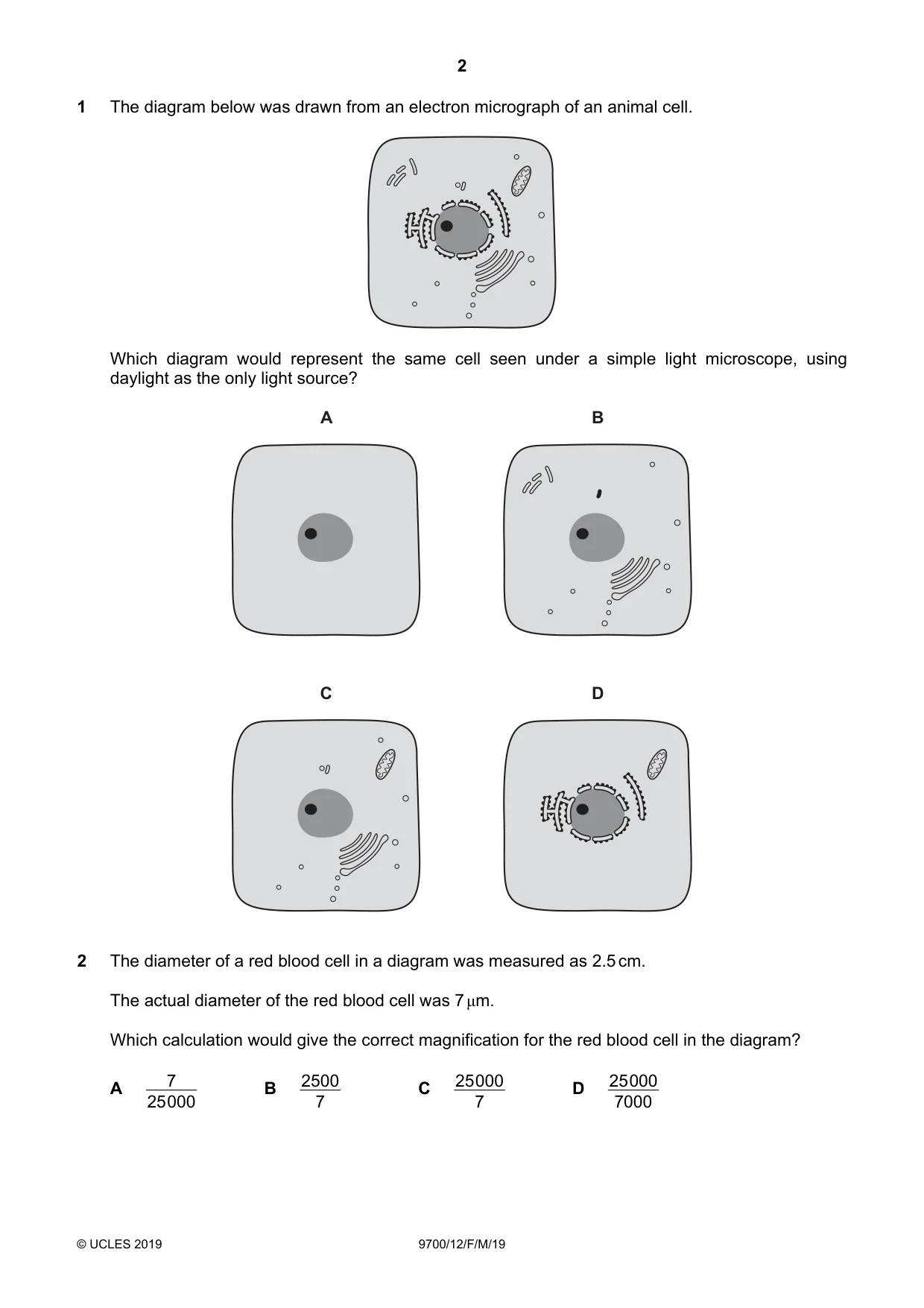
1 The diagram below was drawn from an electron micrograph of an animal cell. Which diagram would represent the same cell seen under a simple light microscope, using daylight as the only light source? A B C D
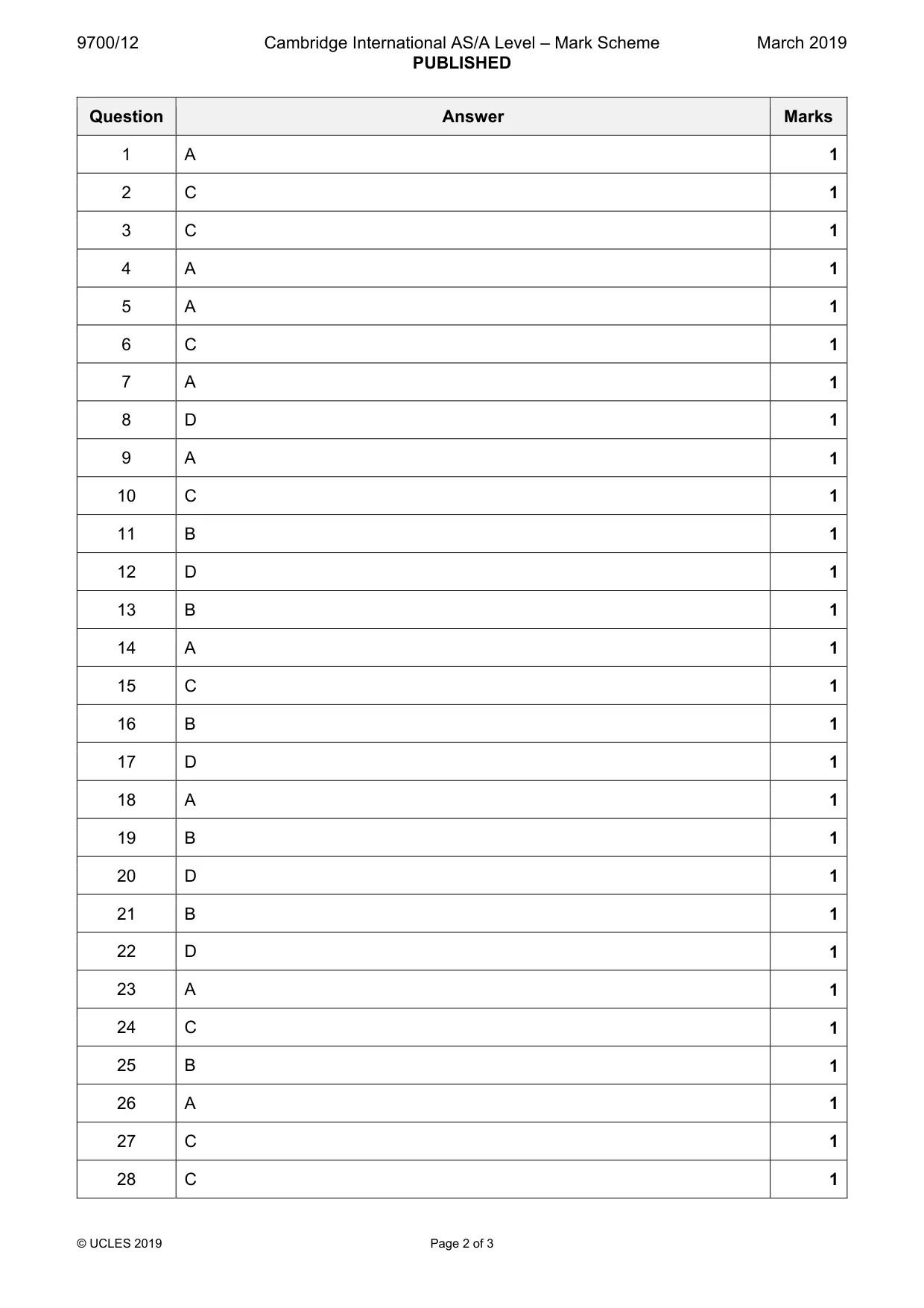
Mark scheme: A
Q2 · The diameter of a red blood cell in a diagram was measured as 2.5 cm
2 The diameter of a red blood cell in a diagram was measured as 2.5 cm. The actual diameter of the red blood cell was 7 µm. Which calculation would give the correct magnification for the red blood cell in the diagram? 7 2500 25 000 25 000 A B C D 25 000 7 7 7000
Mark scheme: C
Q3 · The diagram shows a fin whale drawn to scale
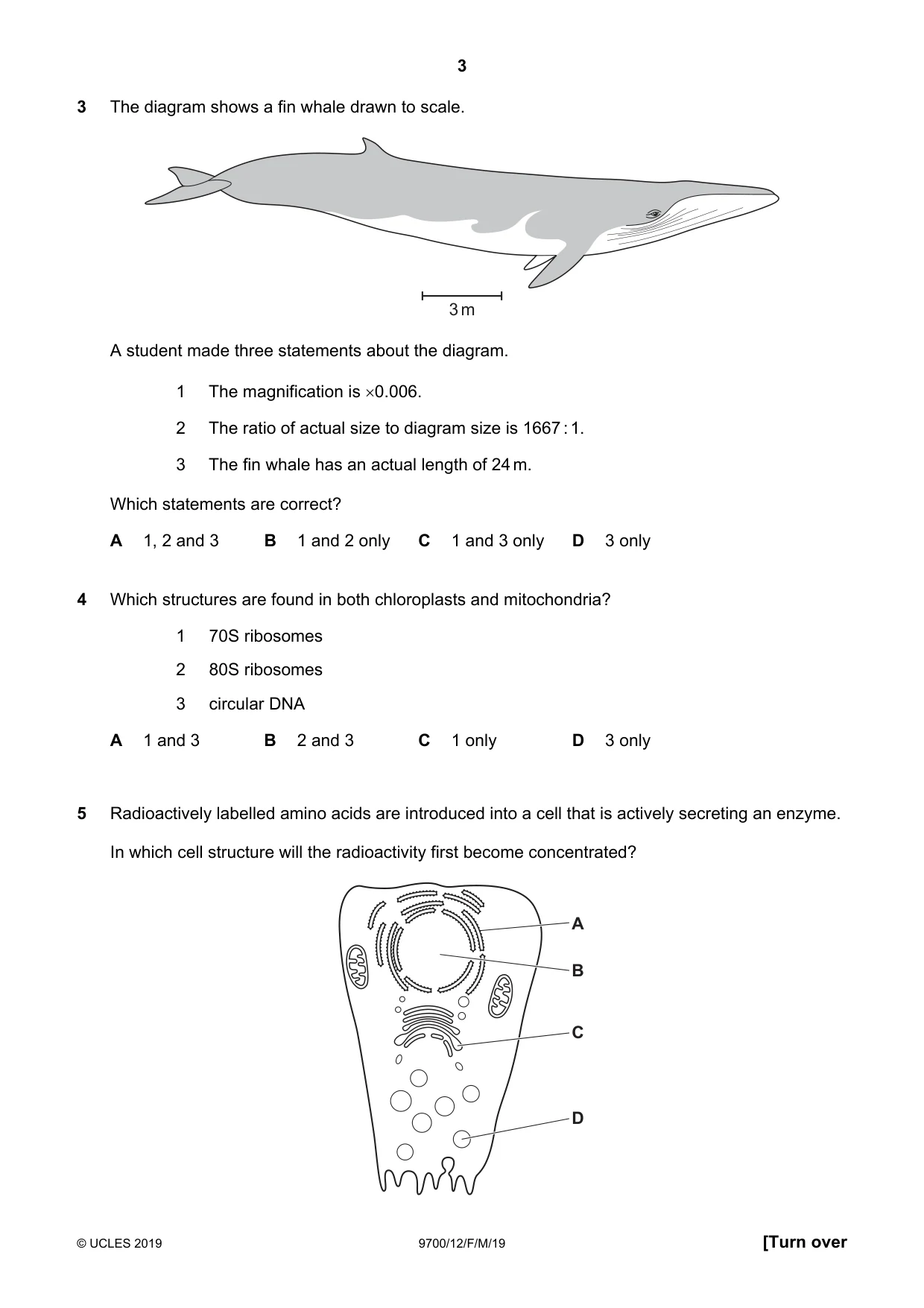
3 The diagram shows a fin whale drawn to scale. 3 m A student made three statements about the diagram. 1 The magnification is ×0.006. 2 The ratio of actual size to diagram size is 1667 : 1. 3 The fin whale has an actual length of 24 m. Which statements are correct? A 1, 2 and 3 B 1 and 2 only C 1 and 3 only D 3 only
Mark scheme: C
Q4 · Which structures are found in both chloroplasts and mitochondria?
4 Which structures are found in both chloroplasts and mitochondria? 1 70S ribosomes 2 80S ribosomes 3 circular DNA A 1 and 3 B 2 and 3 C 1 only D 3 only
Mark scheme: A
More questions on Cells as the basic units of living organisms
Q5 · Radioactively labelled amino acids are introduced into a cell that is actively secreting…
5 Radioactively labelled amino acids are introduced into a cell that is actively secreting an enzyme. In which cell structure will the radioactivity first become concentrated? A B C D
Mark scheme: A
More questions on Cells as the basic units of living organisms
Q6 · Ribosomes exist as separate subunits that are bound together during protein synthesis
6 Ribosomes exist as separate subunits that are bound together during protein synthesis. What do these subunits consist of? A mRNA and protein B mRNA and tRNA C rRNA and protein D rRNA and tRNA
Mark scheme: C
Q7 · Four solutions were tested with Benedict’s solution
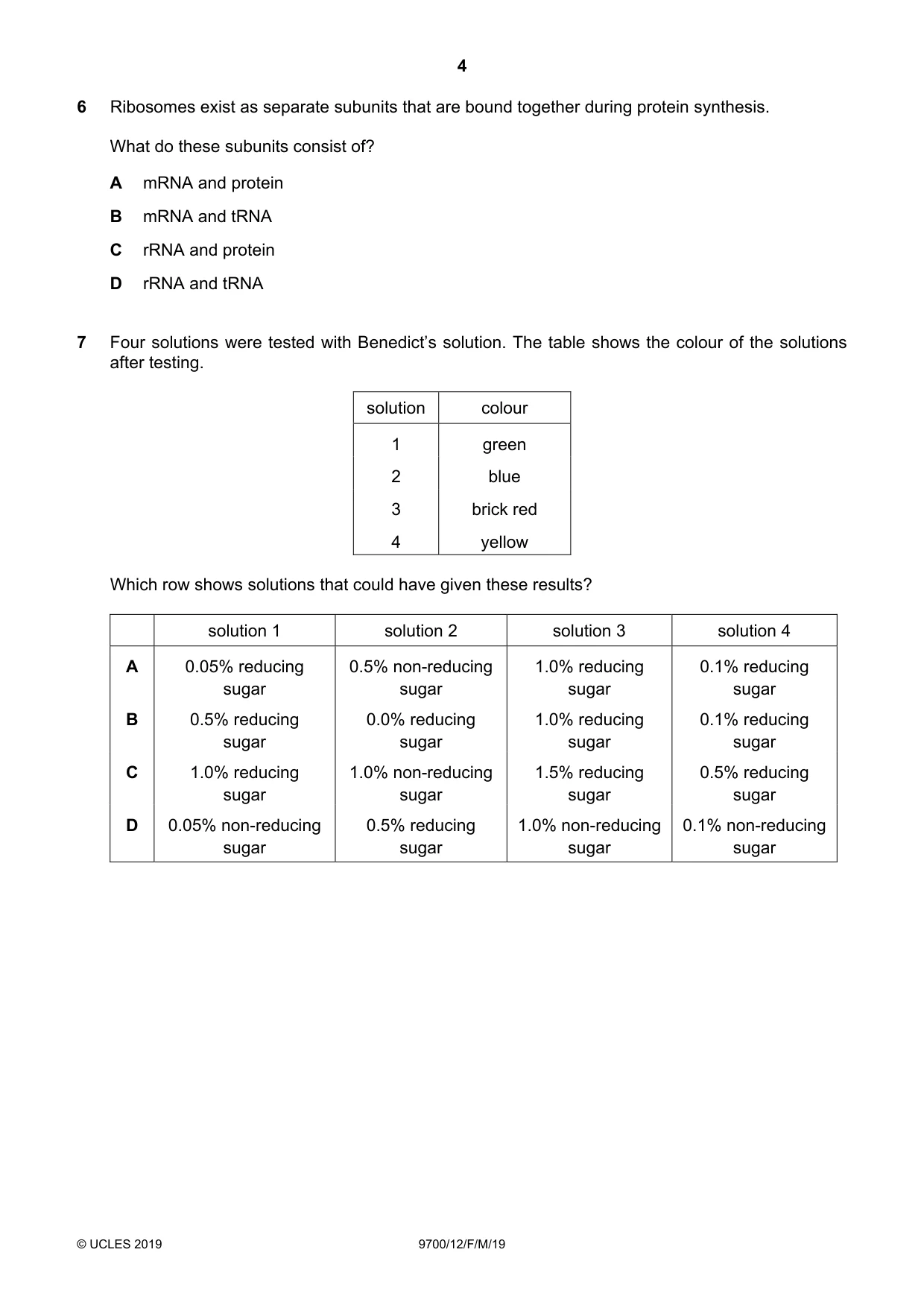
7 Four solutions were tested with Benedict’s solution. The table shows the colour of the solutions after testing. solution colour 1 green 2 blue 3 brick red 4 yellow Which row shows solutions that could have given these results? solution 1 solution 2 solution 3 solution 4 A 0.05% reducing 0.5% non-reducing 1.0% reducing 0.1% reducing sugar sugar sugar sugar B 0.5% reducing 0.0% reducing 1.0% reducing 0.1% reducing sugar sugar sugar sugar C 1.0% reducing 1.0% non-reducing 1.5% reducing 0.5% reducing sugar sugar sugar sugar D 0.05% non-reducing 0.5% reducing 1.0% non-reducing 0.1% non-reducing sugar sugar sugar sugar
Mark scheme: A
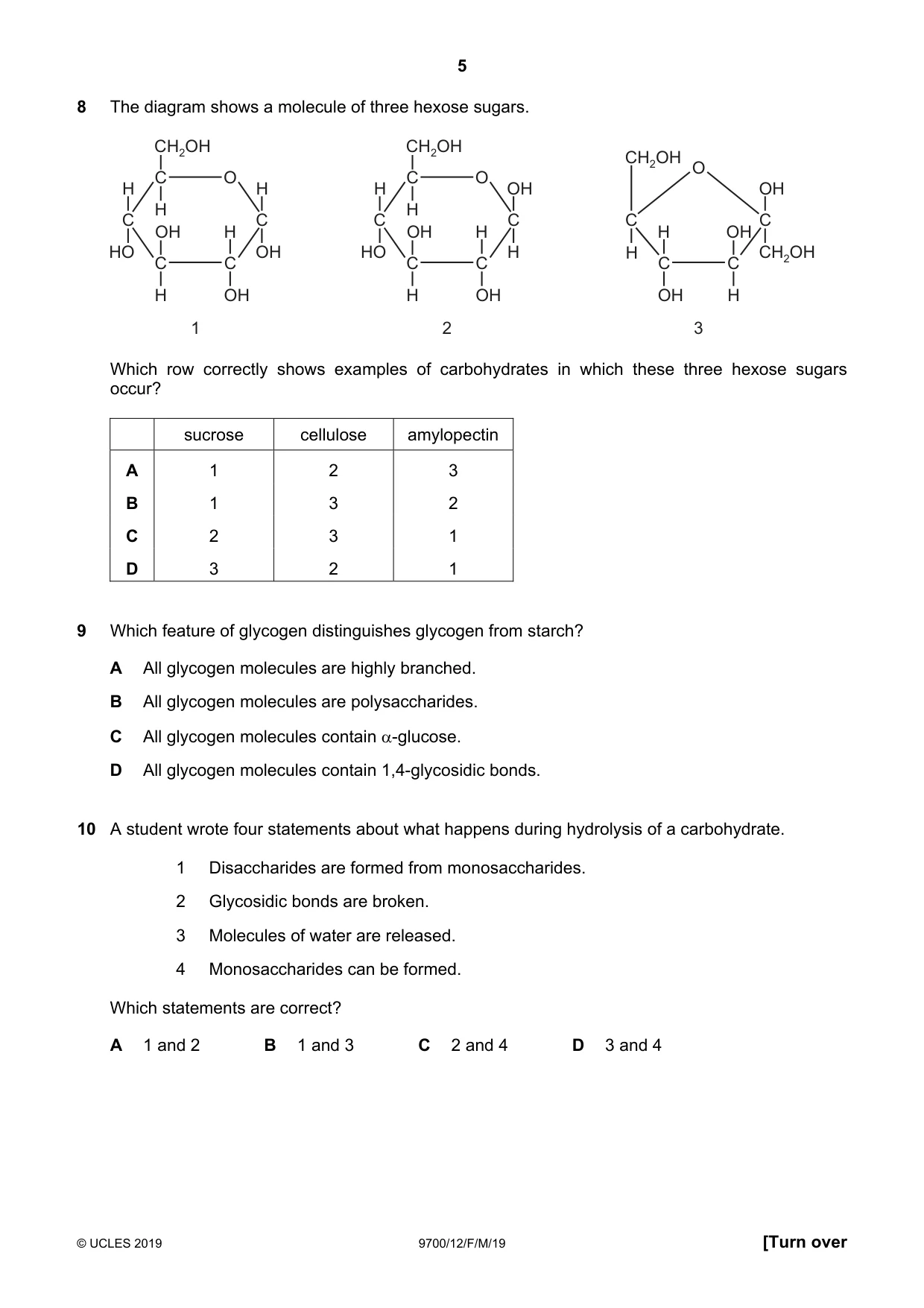
Q8 · The diagram shows a molecule of three hexose sugars
8 The diagram shows a molecule of three hexose sugars. CH2OH CH2OH CH2OH O C O C O H H H OH OH H H C C C C C C OH H OH H H OH HO OH HO H H CH2OH C C C C C C H OH H OH OH H 1 2 3 Which row correctly shows examples of carbohydrates in which these three hexose sugars occur? sucrose cellulose amylopectin A 1 2 3 B 1 3 2 C 2 3 1 D 3 2 1
Mark scheme: D
Q9 · Which feature of glycogen distinguishes glycogen from starch?
9 Which feature of glycogen distinguishes glycogen from starch? A All glycogen molecules are highly branched. B All glycogen molecules are polysaccharides. C All glycogen molecules contain α-glucose. D All glycogen molecules contain 1,4-glycosidic bonds.
Mark scheme: A
Q10 · A student wrote four statements about what happens during hydrolysis of a carbohydrate
10 A student wrote four statements about what happens during hydrolysis of a carbohydrate. 1 Disaccharides are formed from monosaccharides. 2 Glycosidic bonds are broken. 3 Molecules of water are released. 4 Monosaccharides can be formed. Which statements are correct? A 1 and 2 B 1 and 3 C 2 and 4 D 3 and 4
Mark scheme: C
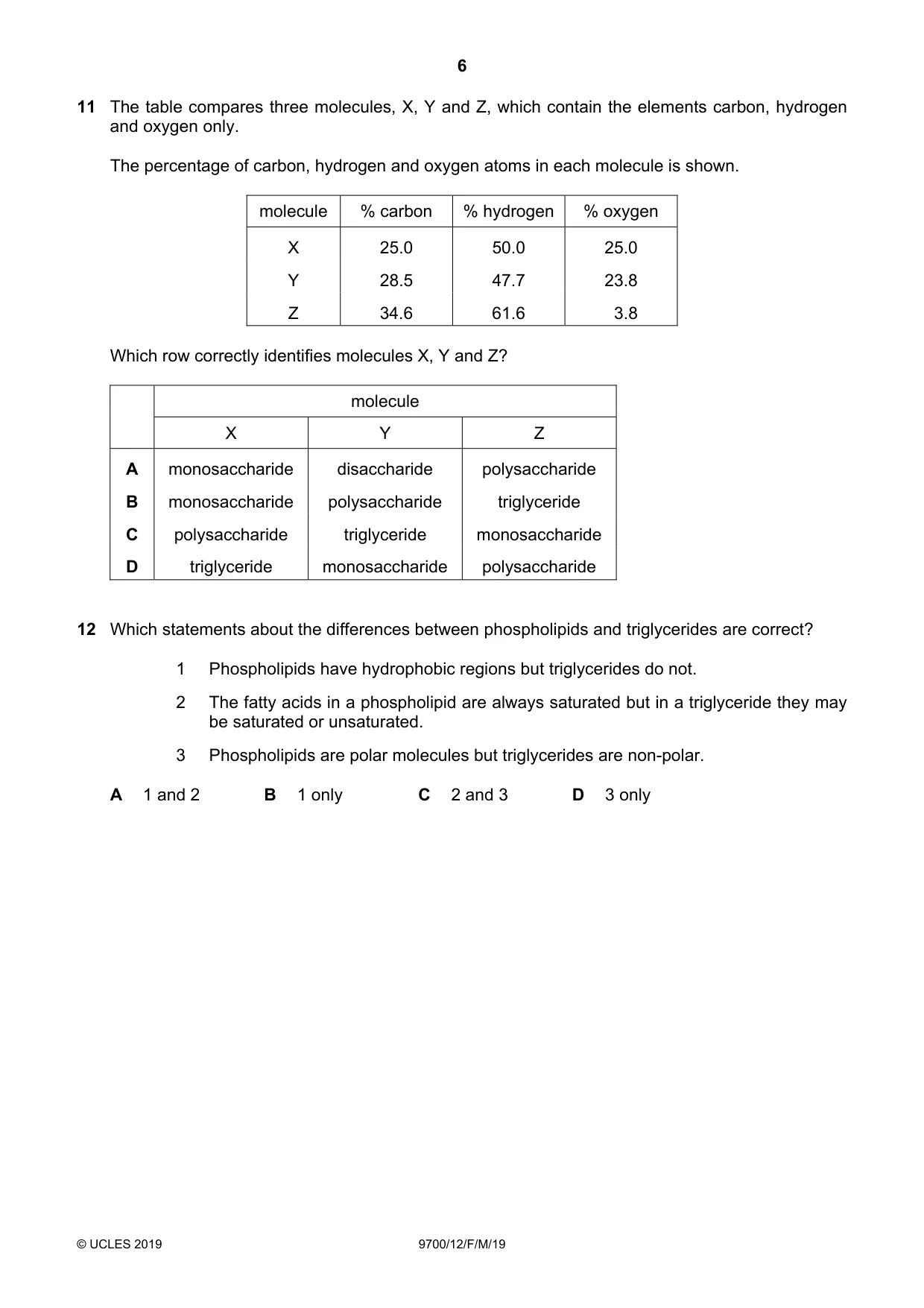
Q11 · The table compares three molecules, X, Y and Z, which contain the elements carbon…
11 The table compares three molecules, X, Y and Z, which contain the elements carbon, hydrogen and oxygen only. The percentage of carbon, hydrogen and oxygen atoms in each molecule is shown. molecule % carbon % hydrogen % oxygen X 25.0 50.0 25.0 Y 28.5 47.7 23.8 Z 34.6 61.6 3.8 Which row correctly identifies molecules X, Y and Z? molecule X Y Z A monosaccharide disaccharide polysaccharide B monosaccharide polysaccharide triglyceride C polysaccharide triglyceride monosaccharide D triglyceride monosaccharide polysaccharide
Mark scheme: B
Q12 · Which statements about the differences between phospholipids and triglycerides are…
12 Which statements about the differences between phospholipids and triglycerides are correct? 1 Phospholipids have hydrophobic regions but triglycerides do not. 2 The fatty acids in a phospholipid are always saturated but in a triglyceride they may be saturated or unsaturated. 3 Phospholipids are polar molecules but triglycerides are non-polar. A 1 and 2 B 1 only C 2 and 3 D 3 only
Mark scheme: D
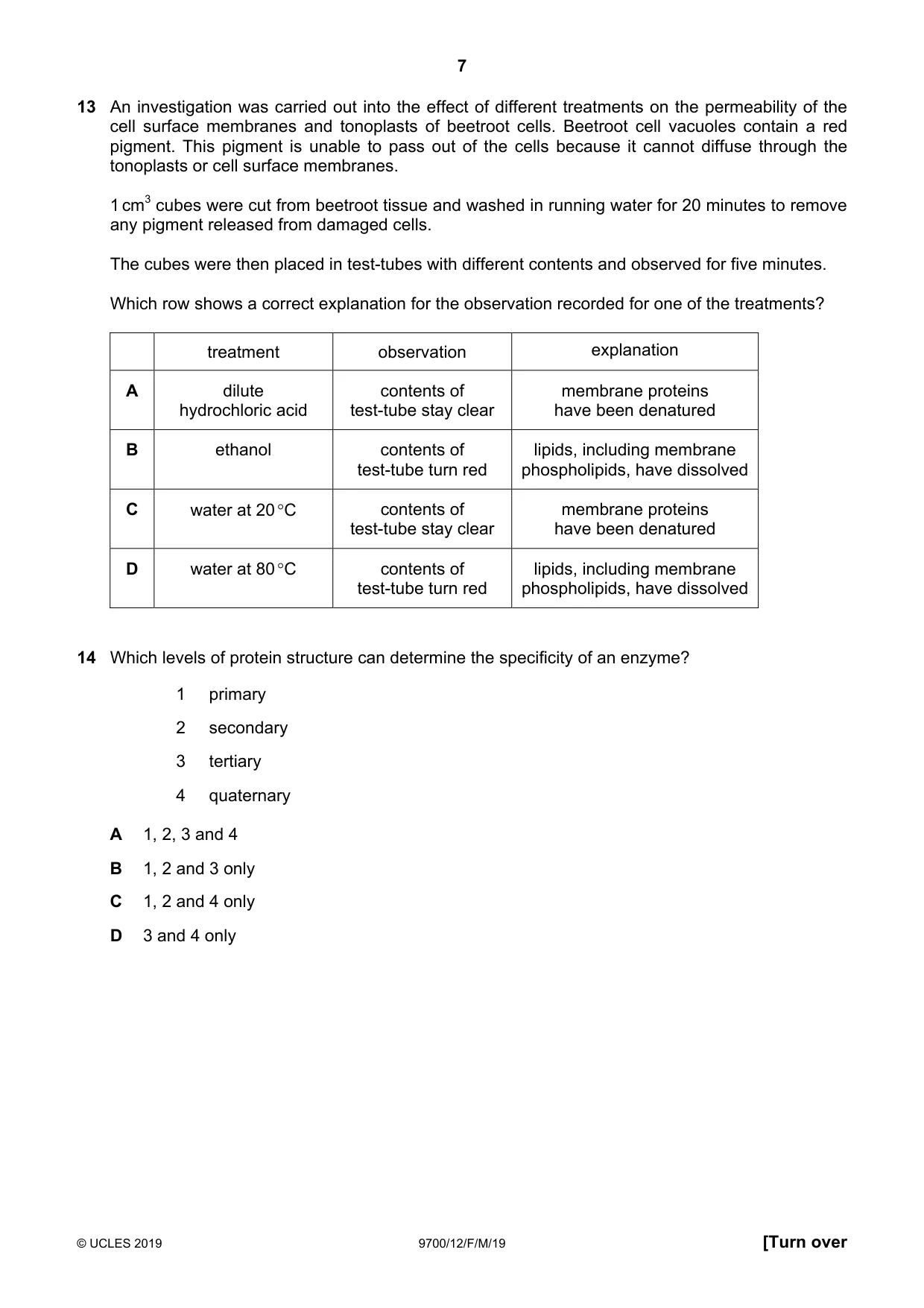
Q13 · An investigation was carried out into the effect of different treatments on the…
13 An investigation was carried out into the effect of different treatments on the permeability of the cell surface membranes and tonoplasts of beetroot cells. Beetroot cell vacuoles contain a red pigment. This pigment is unable to pass out of the cells because it cannot diffuse through the tonoplasts or cell surface membranes. 1 cm3 cubes were cut from beetroot tissue and washed in running water for 20 minutes to remove any pigment released from damaged cells. The cubes were then placed in test-tubes with different contents and observed for five minutes. Which row shows a correct explanation for the observation recorded for one of the treatments? treatment observation explanation A dilute contents of membrane proteins hydrochloric acid test-tube stay clear have been denatured B ethanol contents of lipids, including membrane test-tube turn red phospholipids, have dissolved C water at 20 °C contents of membrane proteins test-tube stay clear have been denatured D water at 80 °C contents of lipids, including membrane test-tube turn red phospholipids, have dissolved
Mark scheme: B
Q14 · Which levels of protein structure can determine the specificity of an enzyme?
14 Which levels of protein structure can determine the specificity of an enzyme? 1 primary 2 secondary 3 tertiary 4 quaternary A 1, 2, 3 and 4 B 1, 2 and 3 only C 1, 2 and 4 only D 3 and 4 only
Mark scheme: A
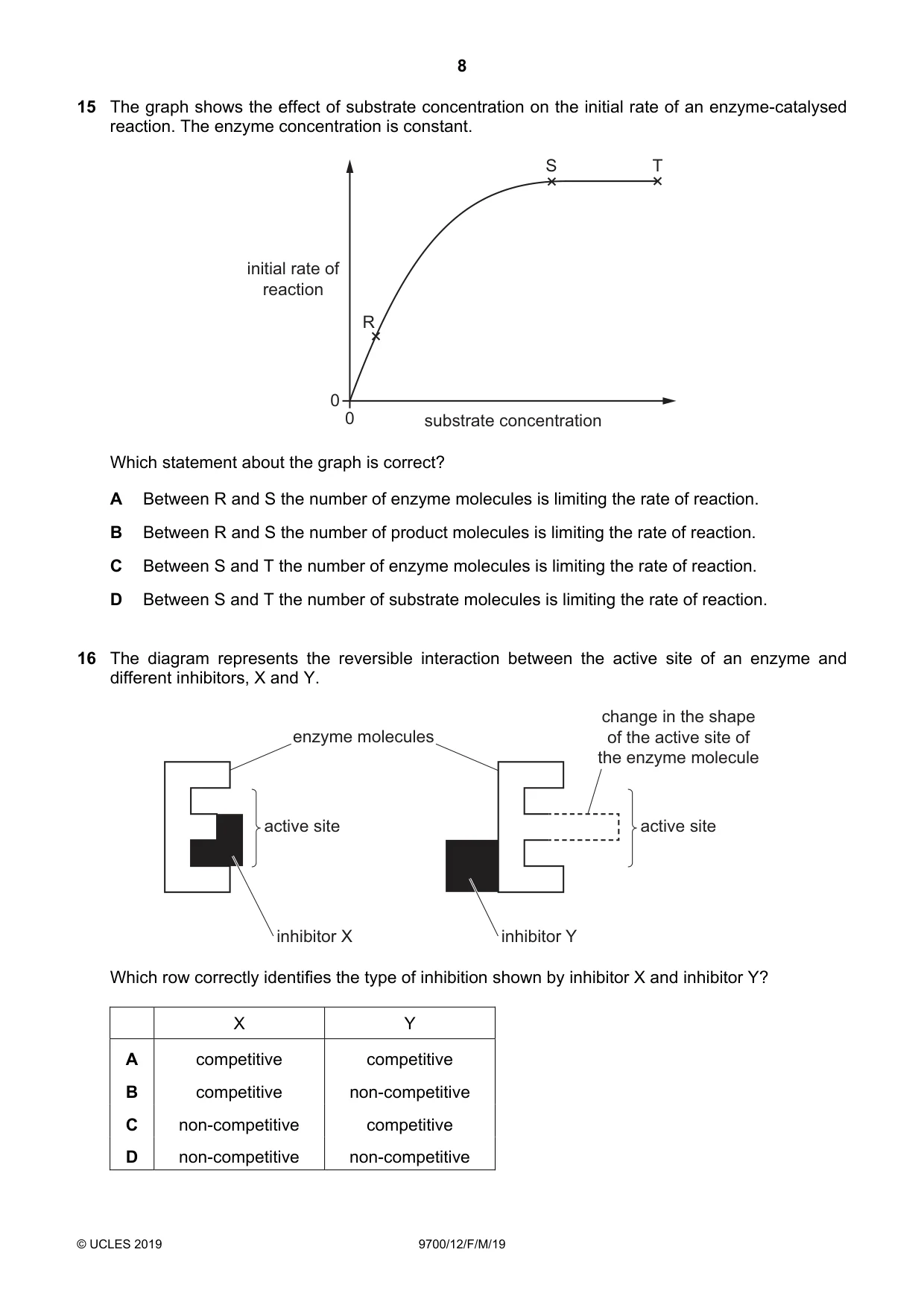
Q15 · The graph shows the effect of substrate concentration on the initial rate of an…
15 The graph shows the effect of substrate concentration on the initial rate of an enzyme-catalysed reaction. The enzyme concentration is constant. S T initial rate of reaction R 0 0 substrate concentration Which statement about the graph is correct? A Between R and S the number of enzyme molecules is limiting the rate of reaction. B Between R and S the number of product molecules is limiting the rate of reaction. C Between S and T the number of enzyme molecules is limiting the rate of reaction. D Between S and T the number of substrate molecules is limiting the rate of reaction.
Mark scheme: C
Q16 · The diagram represents the reversible interaction between the active site of an enzyme…
16 The diagram represents the reversible interaction between the active site of an enzyme and different inhibitors, X and Y. change in the shape enzyme molecules of the active site of the enzyme molecule active site active site inhibitor X inhibitor Y Which row correctly identifies the type of inhibition shown by inhibitor X and inhibitor Y? X Y A competitive competitive B competitive non-competitive C non-competitive competitive D non-competitive non-competitive
Mark scheme: B
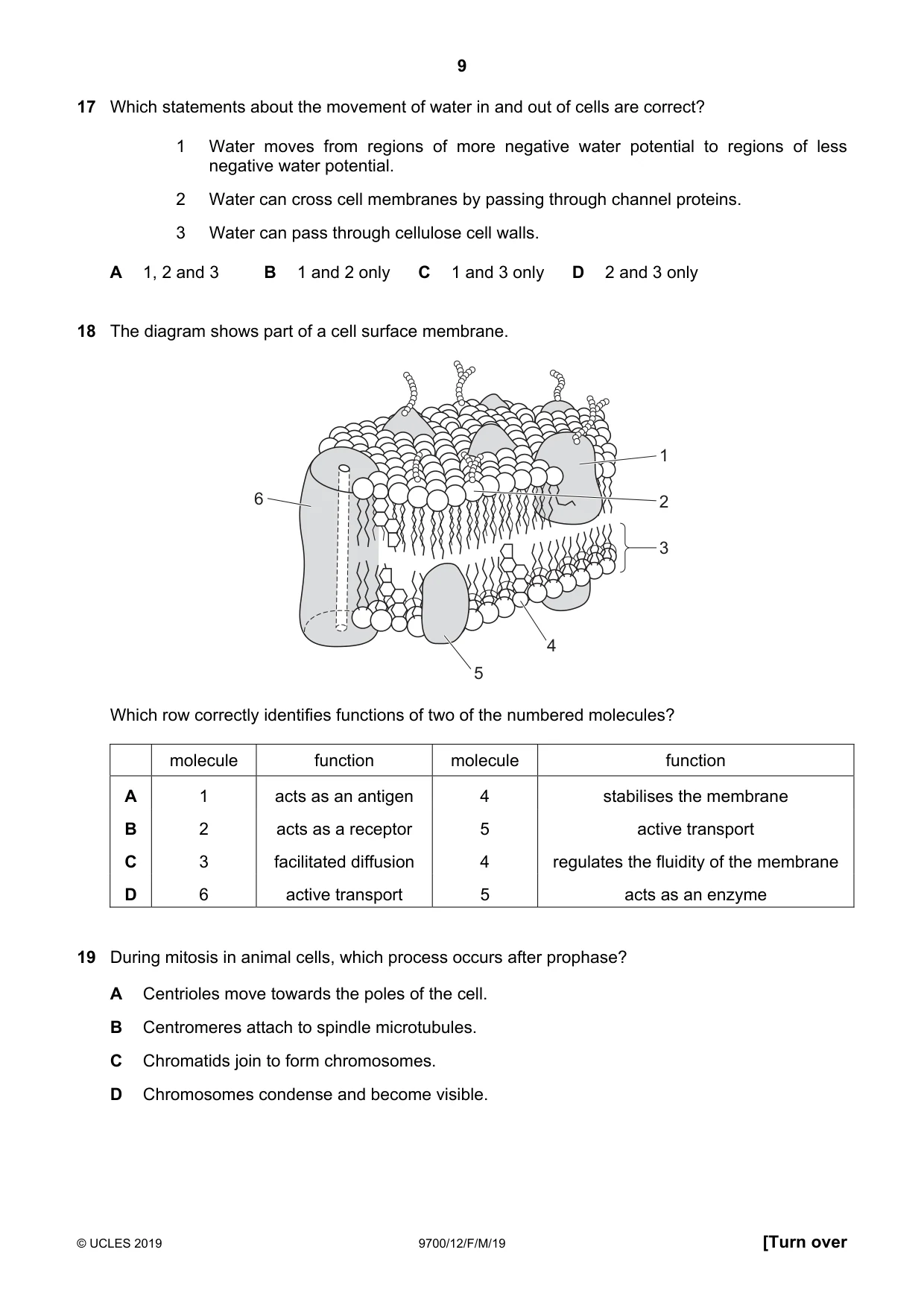
Q17 · Which statements about the movement of water in and out of cells are correct?
17 Which statements about the movement of water in and out of cells are correct? 1 Water moves from regions of more negative water potential to regions of less negative water potential. 2 Water can cross cell membranes by passing through channel proteins. 3 Water can pass through cellulose cell walls. A 1, 2 and 3 B 1 and 2 only C 1 and 3 only D 2 and 3 only
Mark scheme: D
Q18 · The diagram shows part of a cell surface membrane
18 The diagram shows part of a cell surface membrane. 1 6 2 3 4 5 Which row correctly identifies functions of two of the numbered molecules? molecule function molecule function A 1 acts as an antigen 4 stabilises the membrane B 2 acts as a receptor 5 active transport C 3 facilitated diffusion 4 regulates the fluidity of the membrane D 6 active transport 5 acts as an enzyme
Mark scheme: A
Q19 · During mitosis in animal cells, which process occurs after prophase?
19 During mitosis in animal cells, which process occurs after prophase? A Centrioles move towards the poles of the cell. B Centromeres attach to spindle microtubules. C Chromatids join to form chromosomes. D Chromosomes condense and become visible.
Mark scheme: B
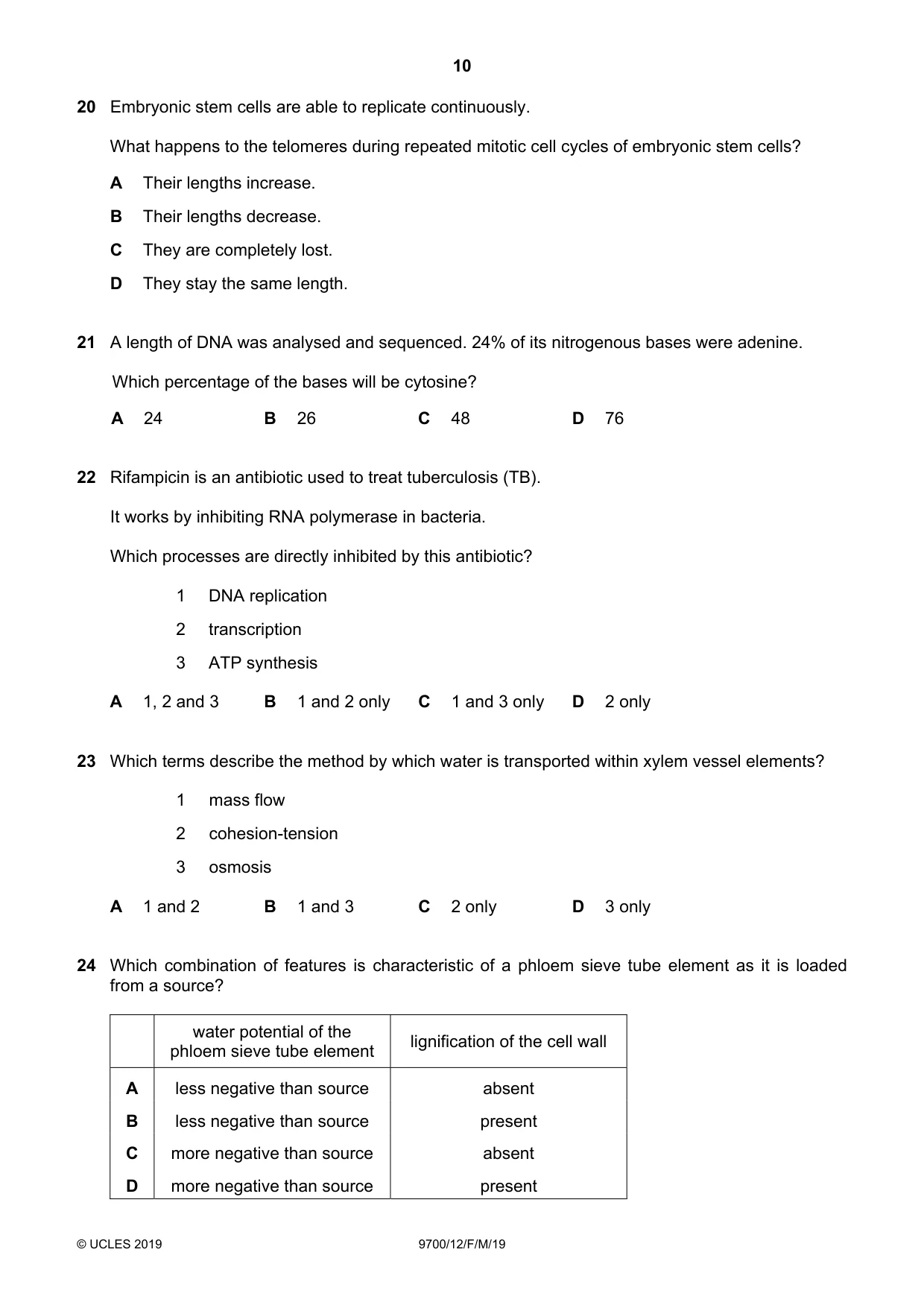
Q20 · Embryonic stem cells are able to replicate continuously
20 Embryonic stem cells are able to replicate continuously. What happens to the telomeres during repeated mitotic cell cycles of embryonic stem cells? A Their lengths increase. B Their lengths decrease. C They are completely lost. D They stay the same length.
Mark scheme: D
More questions on Replication and division of nuclei and cells
Q21 · A length of DNA was analysed and sequenced
21 A length of DNA was analysed and sequenced. 24% of its nitrogenous bases were adenine. Which percentage of the bases will be cytosine? A 24 B 26 C 48 D 76
Mark scheme: B
More questions on Structure of nucleic acids and replication of DNA
Q22 · Rifampicin is an antibiotic used to treat tuberculosis (TB)
22 Rifampicin is an antibiotic used to treat tuberculosis (TB). It works by inhibiting RNA polymerase in bacteria. Which processes are directly inhibited by this antibiotic? 1 DNA replication 2 transcription 3 ATP synthesis A 1, 2 and 3 B 1 and 2 only C 1 and 3 only D 2 only
Mark scheme: D
Q23 · Which terms describe the method by which water is transported within xylem vessel…
23 Which terms describe the method by which water is transported within xylem vessel elements? 1 mass flow 2 cohesion-tension 3 osmosis A 1 and 2 B 1 and 3 C 2 only D 3 only
Mark scheme: A
Q24 · Which combination of features is characteristic of a phloem sieve tube element as it is…
24 Which combination of features is characteristic of a phloem sieve tube element as it is loaded from a source? water potential of the lignification of the cell wall phloem sieve tube element A less negative than source absent B less negative than source present C more negative than source absent D more negative than source present
Mark scheme: C
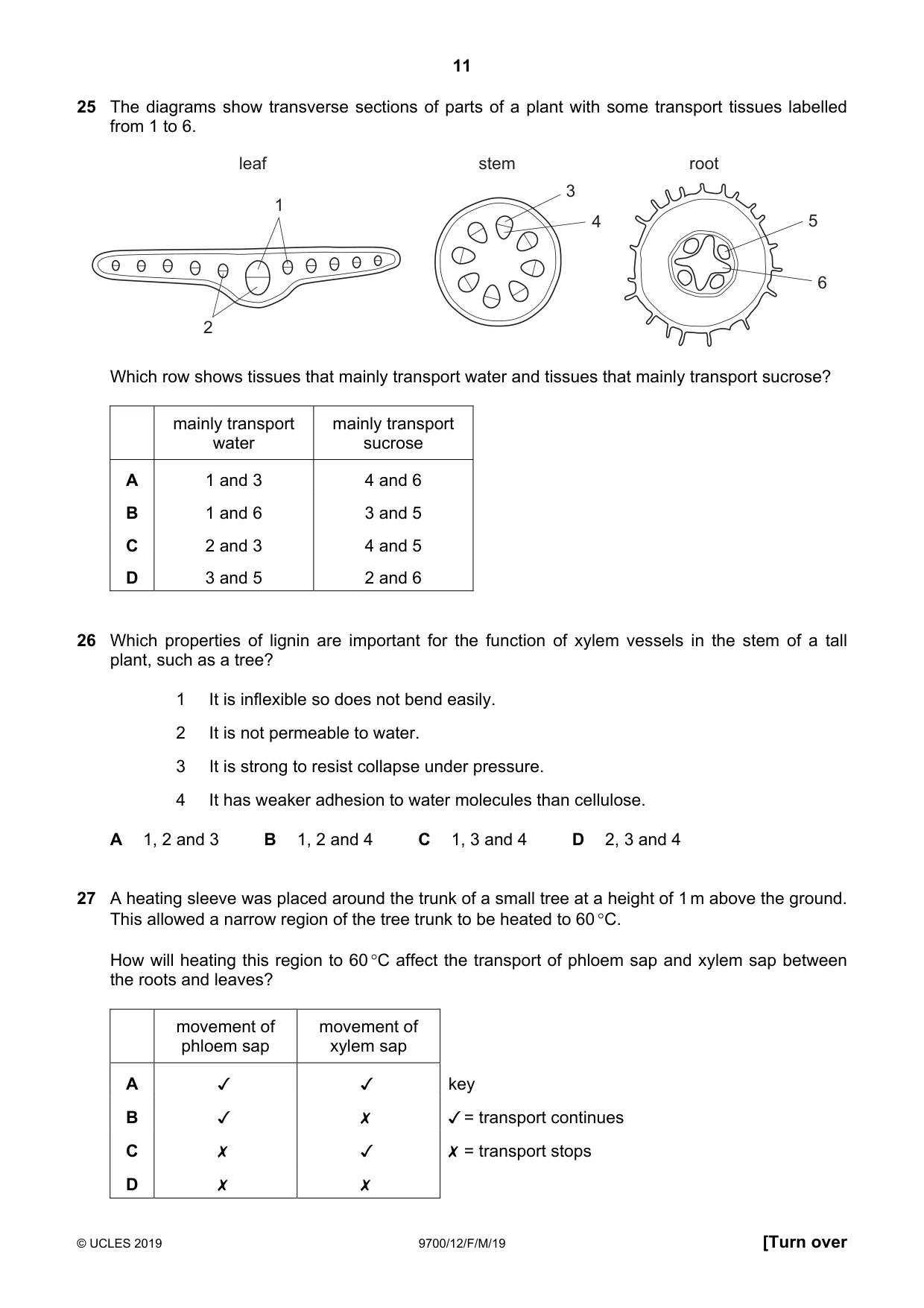
Q25 · The diagrams show transverse sections of parts of a plant with some transport tissues…
25 The diagrams show transverse sections of parts of a plant with some transport tissues labelled from 1 to 6. leaf stem root 3 1 4 5 6 2 Which row shows tissues that mainly transport water and tissues that mainly transport sucrose? mainly transport mainly transport water sucrose A 1 and 3 4 and 6 B 1 and 6 3 and 5 C 2 and 3 4 and 5 D 3 and 5 2 and 6
Mark scheme: B
Q26 · Which properties of lignin are important for the function of xylem vessels in the stem of…
26 Which properties of lignin are important for the function of xylem vessels in the stem of a tall plant, such as a tree? 1 It is inflexible so does not bend easily. 2 It is not permeable to water. 3 It is strong to resist collapse under pressure. 4 It has weaker adhesion to water molecules than cellulose. A 1, 2 and 3 B 1, 2 and 4 C 1, 3 and 4 D 2, 3 and 4
Mark scheme: A
Q27 · A heating sleeve was placed around the trunk of a small tree at a height of 1m above the…
27 A heating sleeve was placed around the trunk of a small tree at a height of 1m above the ground. This allowed a narrow region of the tree trunk to be heated to 60°C. How will heating this region to 60°C affect the transport of phloem sap and xylem sap between the roots and leaves? movement of movement of phloem sap xylem sap A J Jv B Jv x Cc x v D x x key / = transport continues X = transport stops
Mark scheme: C
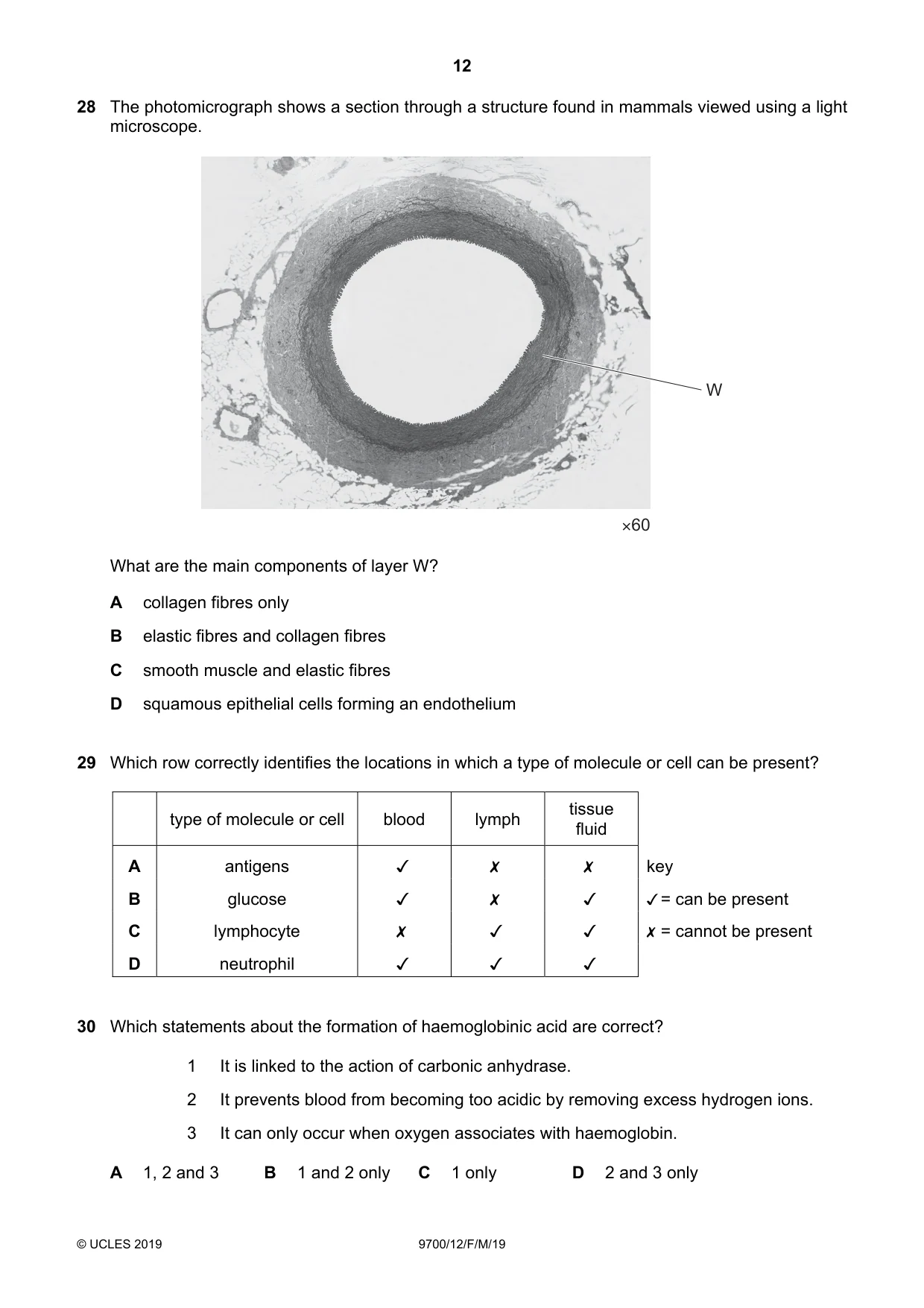
Q28 · The photomicrograph shows a section through a structure found in mammals viewed using a…
28 The photomicrograph shows a section through a structure found in mammals viewed using a light microscope. W ×60 What are the main components of layer W? A collagen fibres only B elastic fibres and collagen fibres C smooth muscle and elastic fibres D squamous epithelial cells forming an endothelium
Mark scheme: C
Q29 · Which row correctly identifies the locations in which a type of molecule or cell can be…
29 Which row correctly identifies the locations in which a type of molecule or cell can be present? type of molecule or cell blood lymph tsue A antigens v x x key B glucose v x Jv Y= can be present Cc lymphocyte x v Jv X = cannot be present D neutrophil Jv Jv v
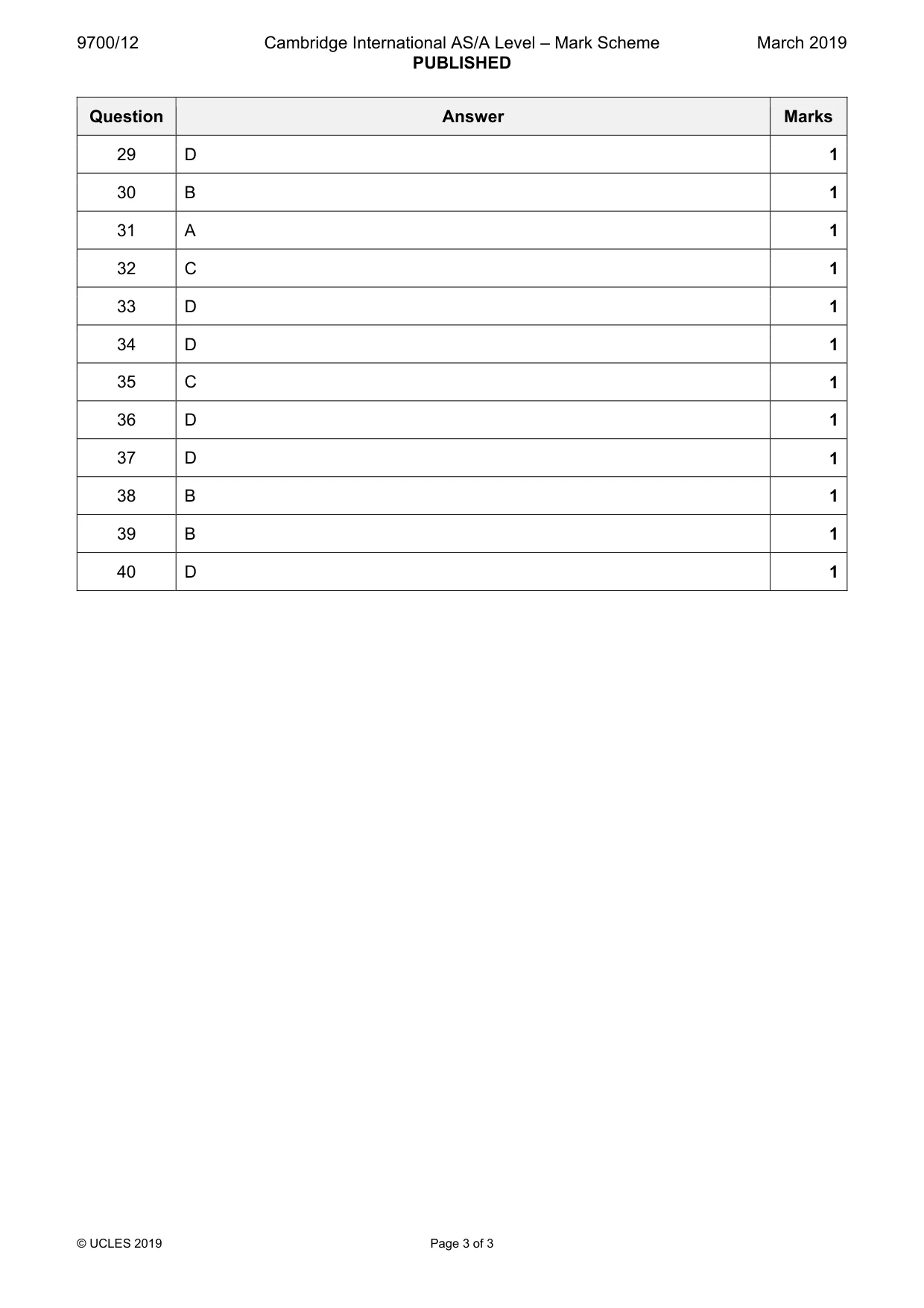
Mark scheme: D
Q30 · Which statements about the formation of haemoglobinic acid are correct?
30 Which statements about the formation of haemoglobinic acid are correct? 1 It is linked to the action of carbonic anhydrase. 2 It prevents blood from becoming too acidic by removing excess hydrogen ions. 3 It can only occur when oxygen associates with haemoglobin. A 1, 2 and 3 B 1 and 2 only C 1 only D 2 and 3 only
Mark scheme: B
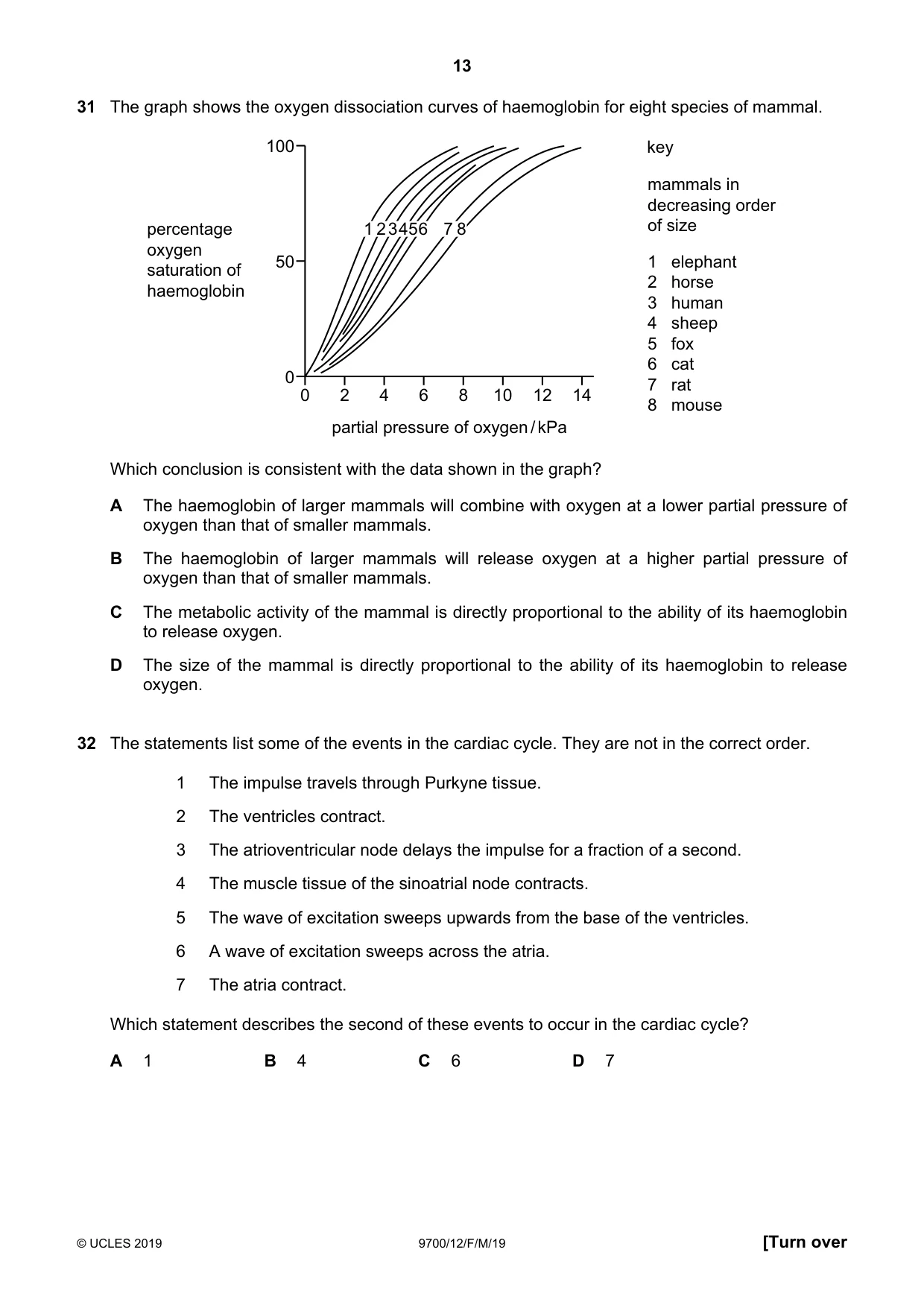
Q31 · The graph shows the oxygen dissociation curves of haemoglobin for eight species of mammal
31 The graph shows the oxygen dissociation curves of haemoglobin for eight species of mammal. 100 key mammals in decreasing order percentage 1 23456 7 8 of size oxygen 50 1 elephant saturation of 2 horse haemoglobin 3 human 4 sheep 5 fox 6 cat 0 7 rat 0 2 4 6 8 10 12 14 8 mouse partial pressure of oxygen / kPa Which conclusion is consistent with the data shown in the graph? A The haemoglobin of larger mammals will combine with oxygen at a lower partial pressure of oxygen than that of smaller mammals. B The haemoglobin of larger mammals will release oxygen at a higher partial pressure of oxygen than that of smaller mammals. C The metabolic activity of the mammal is directly proportional to the ability of its haemoglobin to release oxygen. D The size of the mammal is directly proportional to the ability of its haemoglobin to release oxygen.
Mark scheme: A
Q32 · The statements list some of the events in the cardiac cycle
32 The statements list some of the events in the cardiac cycle. They are not in the correct order. 1 The impulse travels through Purkyne tissue. 2 The ventricles contract. 3 The atrioventricular node delays the impulse for a fraction of a second. 4 The muscle tissue of the sinoatrial node contracts. 5 The wave of excitation sweeps upwards from the base of the ventricles. 6 A wave of excitation sweeps across the atria. 7 The atria contract. Which statement describes the second of these events to occur in the cardiac cycle? A 1 B 4 C 6 D 7
Mark scheme: C
Q33 · Which statement about typical bronchioles is correct?
33 Which statement about typical bronchioles is correct? A They have cartilage and ciliated cells. B They have goblet cells and smooth muscle. C They have smooth muscle and cartilage. D They have smooth muscle and ciliated cells.
Mark scheme: D
Q34 · Tobacco smoke contains substances that affect the functioning of the human body
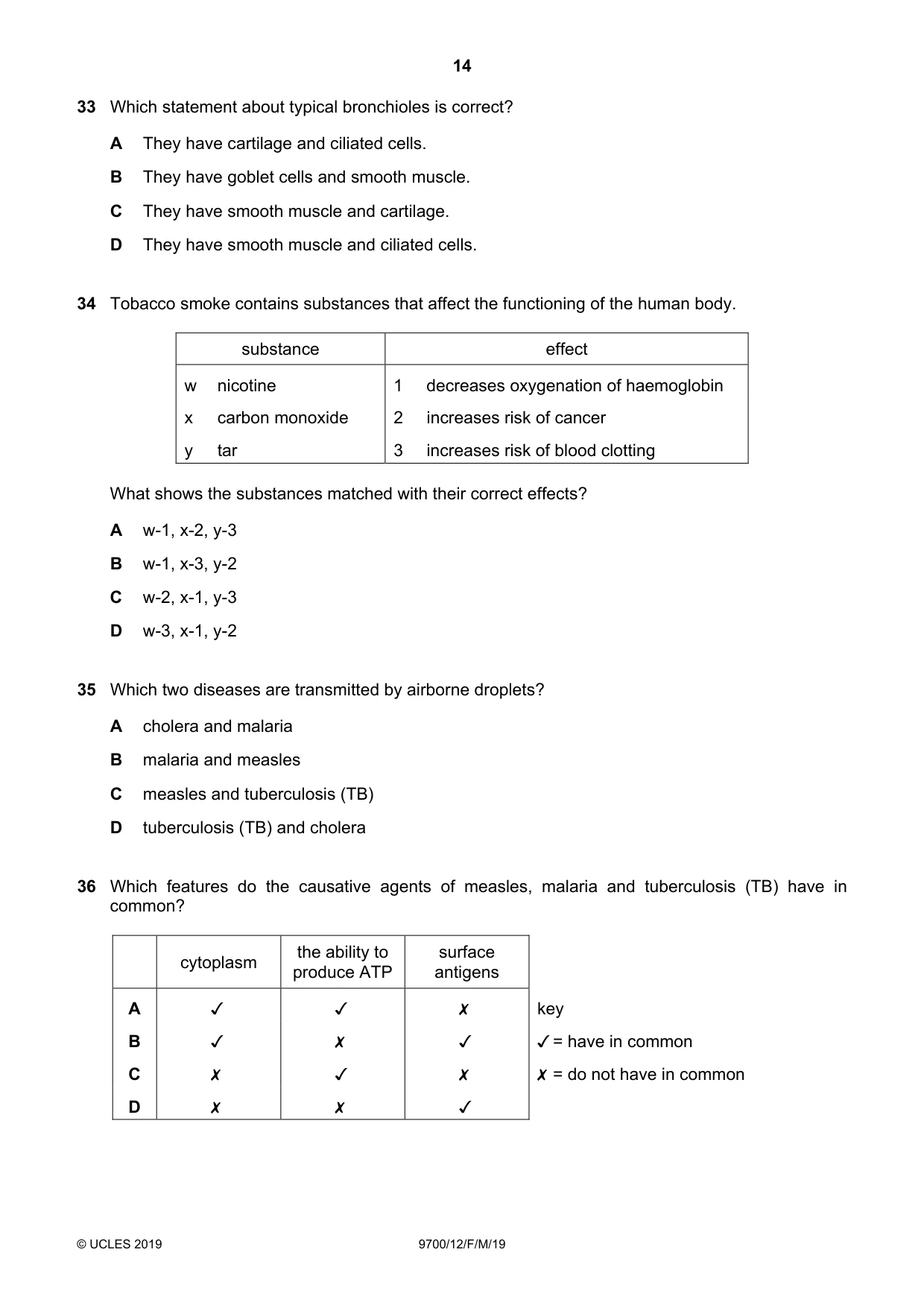
34 Tobacco smoke contains substances that affect the functioning of the human body. substance effect w nicotine 1 decreases oxygenation of haemoglobin x carbon monoxide 2 increases risk of cancer y tar 3 increases risk of blood clotting What shows the substances matched with their correct effects? A w-1, x-2, y-3 B w-1, x-3, y-2 C w-2, x-1, y-3 D w-3, x-1, y-2
Mark scheme: D
Q35 · Which two diseases are transmitted by airborne droplets?
35 Which two diseases are transmitted by airborne droplets? A cholera and malaria B malaria and measles C measles and tuberculosis (TB) D tuberculosis (TB) and cholera
Mark scheme: C
Q36 · Which features do the causative agents of measles, malaria and tuberculosis (TB) have in…
36 Which features do the causative agents of measles, malaria and tuberculosis (TB) have in common? cytoplasm sroduce ATP sntigons A v v x key B v x v v = have in common Cc x v x X = do not have in common D x x Jv
Mark scheme: D
Q37 · What explains why most viruses that cause diseases in humans are unaffected by…
37 What explains why most viruses that cause diseases in humans are unaffected by antibiotics? A Viral antigens do not bind to antibiotics. B Viral nucleic acids are protected by a protein coat. C Viruses contain no ribosomes or mRNA. D Viruses reproduce inside living eukaryotic cells.
Mark scheme: D
Q38 · Why does the white blood cell count increase in people with leukaemia?
38 Why does the white blood cell count increase in people with leukaemia? A More antibodies are required so there are more B-lymphocytes. B More lymphocytes are produced in bone marrow. C More memory cells are produced in plasma. D More T-lymphocytes are required to stimulate the immune system.
Mark scheme: B
Q39 · Where are antibodies found during an immune response?
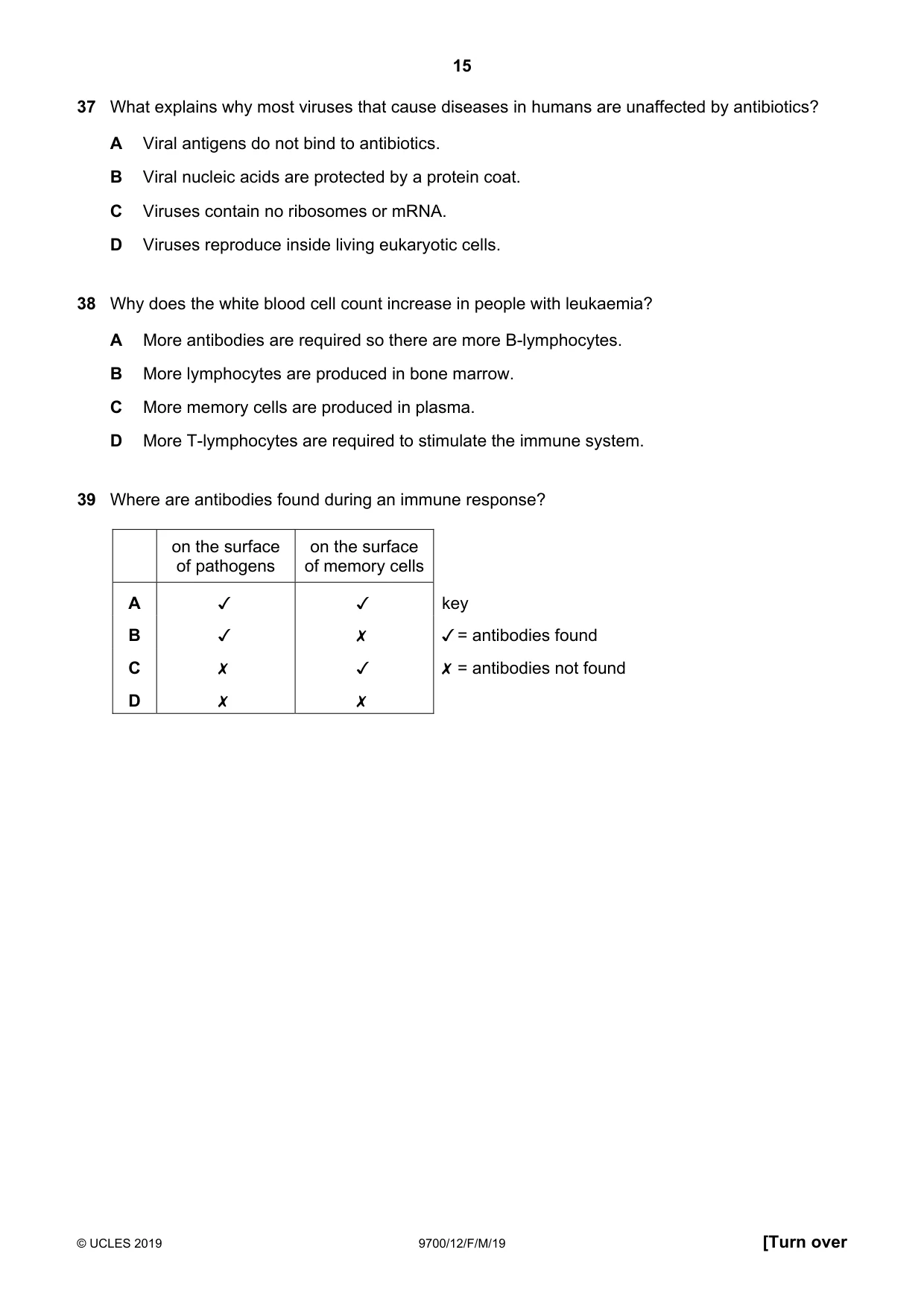
39 Where are antibodies found during an immune response? on the surface of pathogens ~ Kw & on the surface of memory cells x < x key JY = antibodies found X = antibodies not found
Mark scheme: B
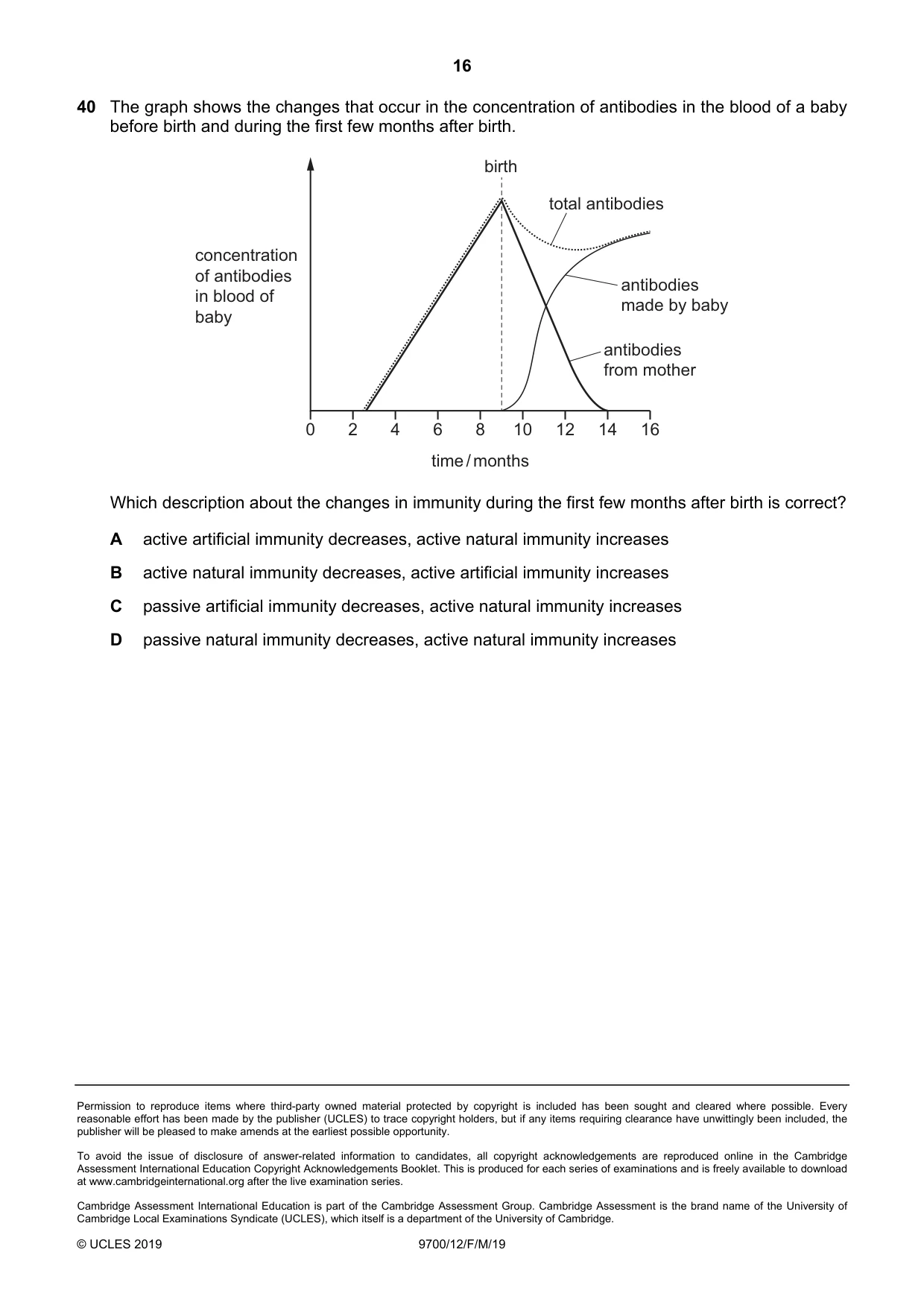
Q40 · The graph shows the changes that occur in the concentration of antibodies in the blood of…
40 The graph shows the changes that occur in the concentration of antibodies in the blood of a baby before birth and during the first few months after birth. birth total antibodies concentration of antibodies antibodies in blood of made by baby baby antibodies from mother 0 2 4 6 8 10 12 14 16 time / months Which description about the changes in immunity during the first few months after birth is correct? A active artificial immunity decreases, active natural immunity increases B active natural immunity decreases, active artificial immunity increases C passive artificial immunity decreases, active natural immunity increases D passive natural immunity decreases, active natural immunity increases
Mark scheme: D
What was in this paper
The subtopics covered by these 40 questions, and how many questions each got. Open one in a new tab to see every Cambridge question on it.
5The microscope in cell studies3Transport mechanisms3Cells as the basic units of living organisms2Factors that affect enzyme action2Fluid mosaic membranes2Infectious diseases2Protein synthesis2Structure of transport tissues2The circulatory system2The gas exchange system2The immune system2Transport of oxygen and carbon dioxide2Antibiotics1Antibodies and vaccination1Chromosome behaviour in mitosis1Mode of action of enzymes1Movement into and out of cells1Replication and division of nuclei and cells1Structure of nucleic acids and replication of DNA1Testing for biological molecules1The heart1What you needed in this session
Cambridge’s own grade thresholds for 2019 Feb/March, Paper 1 · Variant 2. A higher threshold means an easier paper — the bar moves with how the cohort did.