Cambridge A Level Biology 9700 — 2018 Oct/Nov Paper 1 · Variant 1
9700/11/O/N/18 · 40 questions · 40 marks · ≈45 min
The question paper and its mark scheme, free to read here and free to download. This is Cambridge’s own paper, exactly as it was sat.
Question paper16 pages
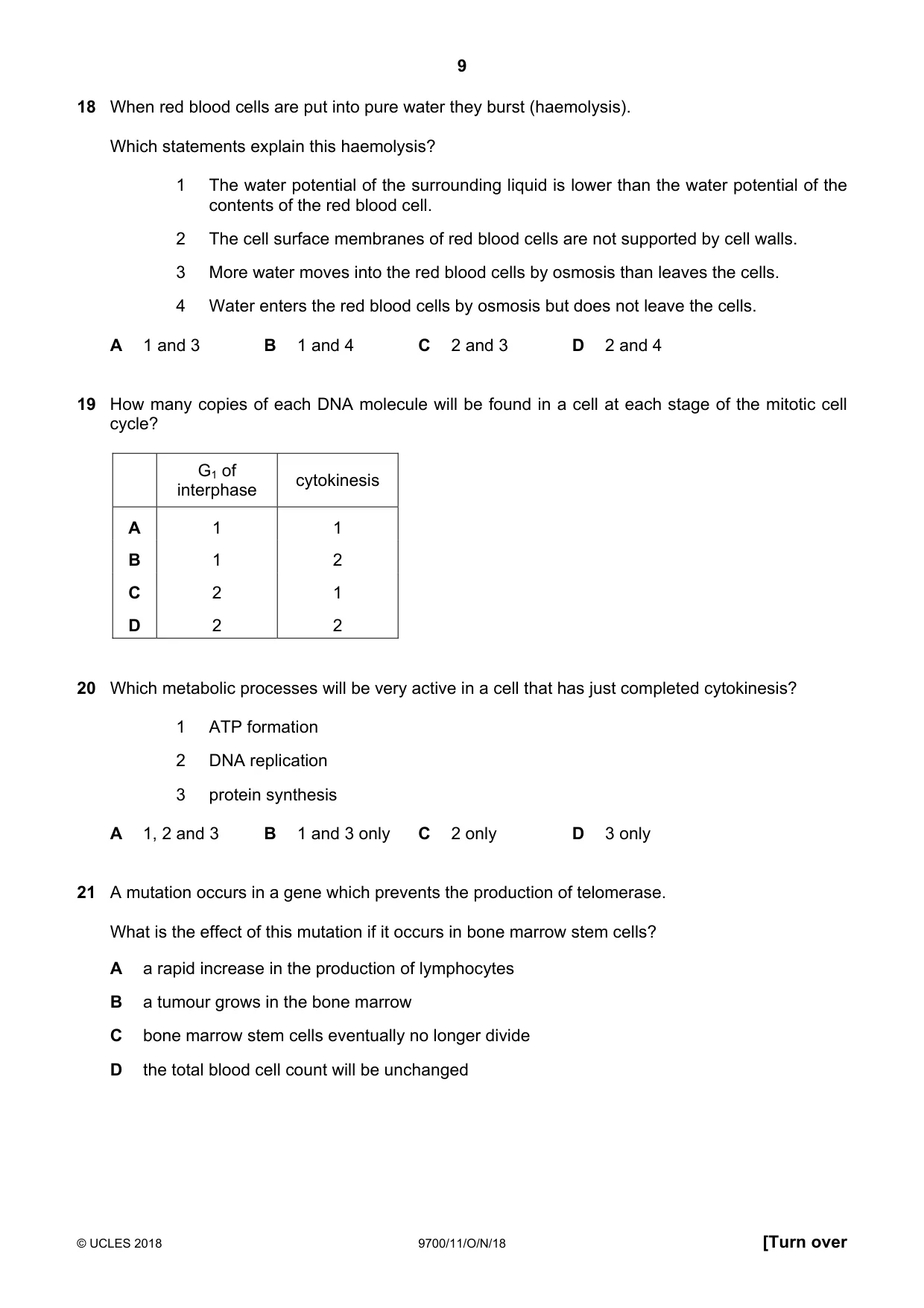
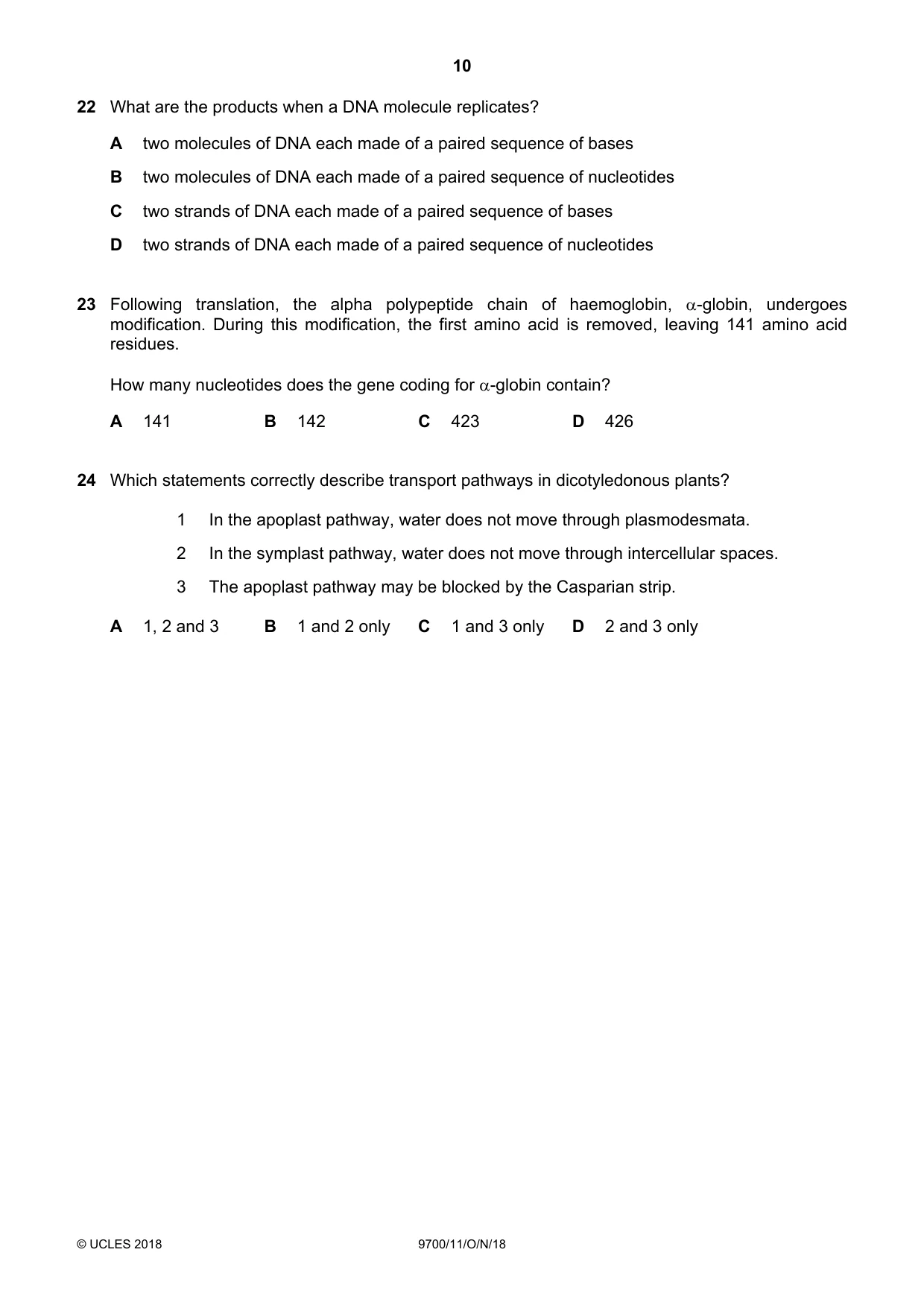
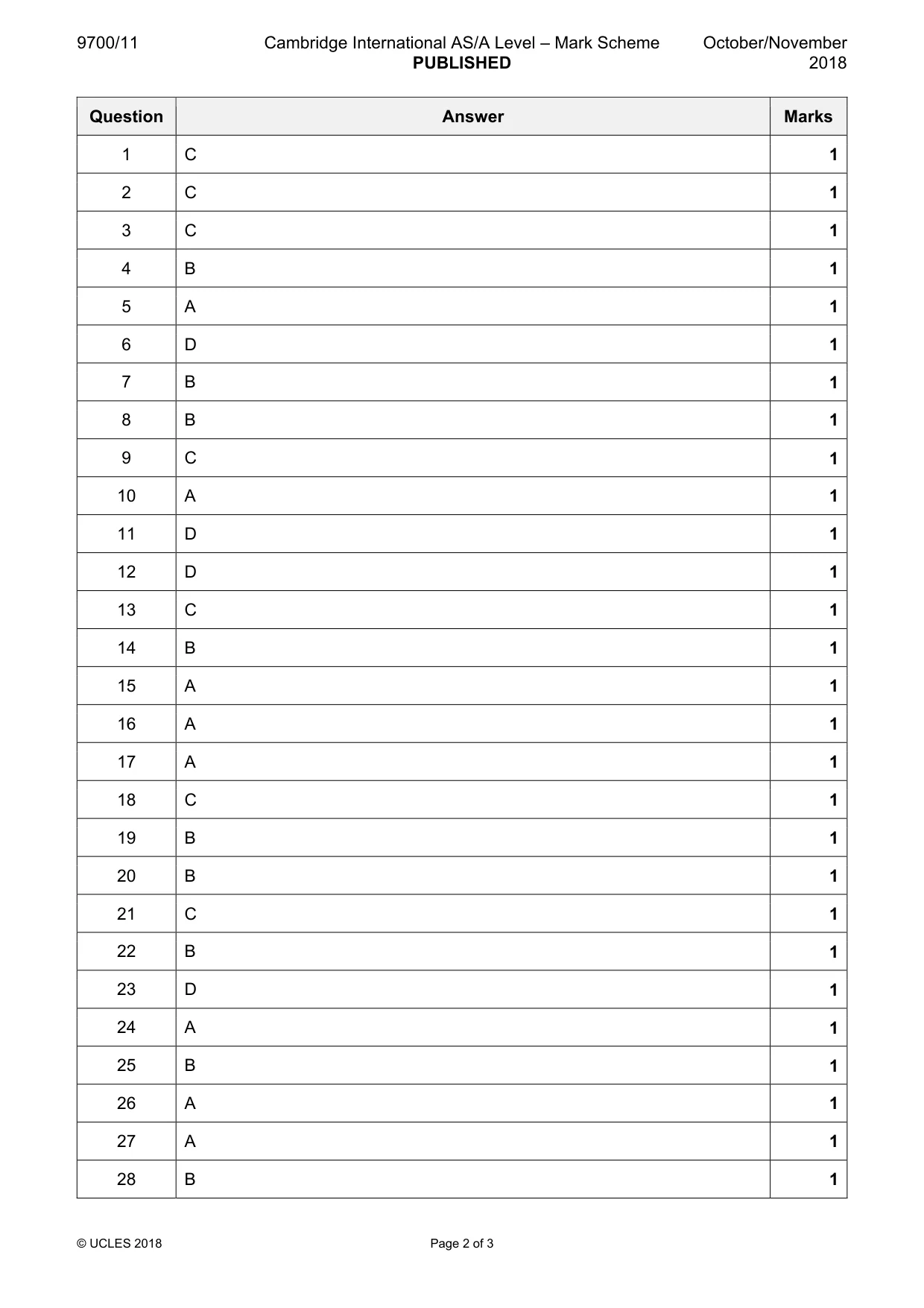
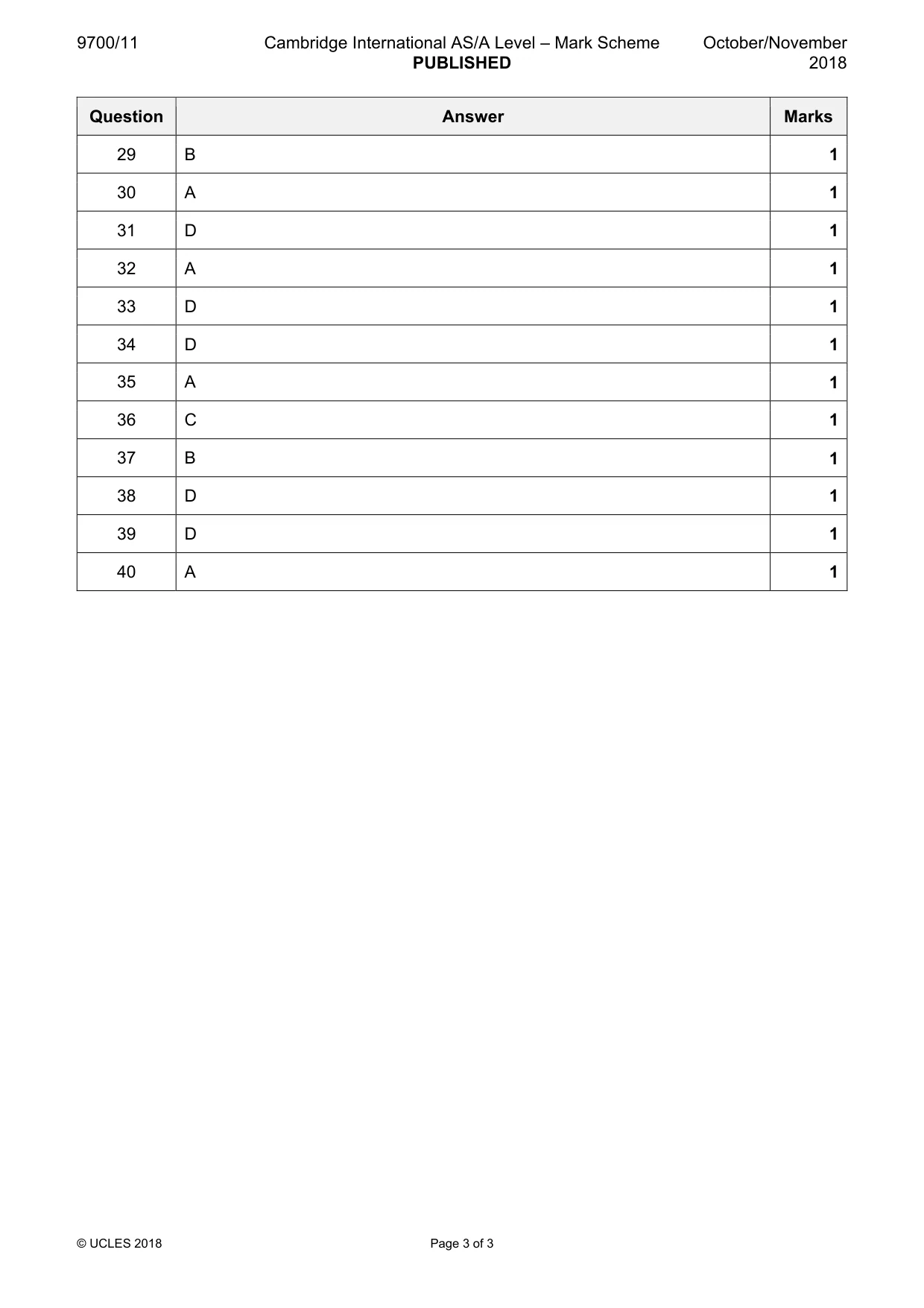
Mark scheme3 pages
Answers below. Sit the paper first if you are practising.
Questions as text
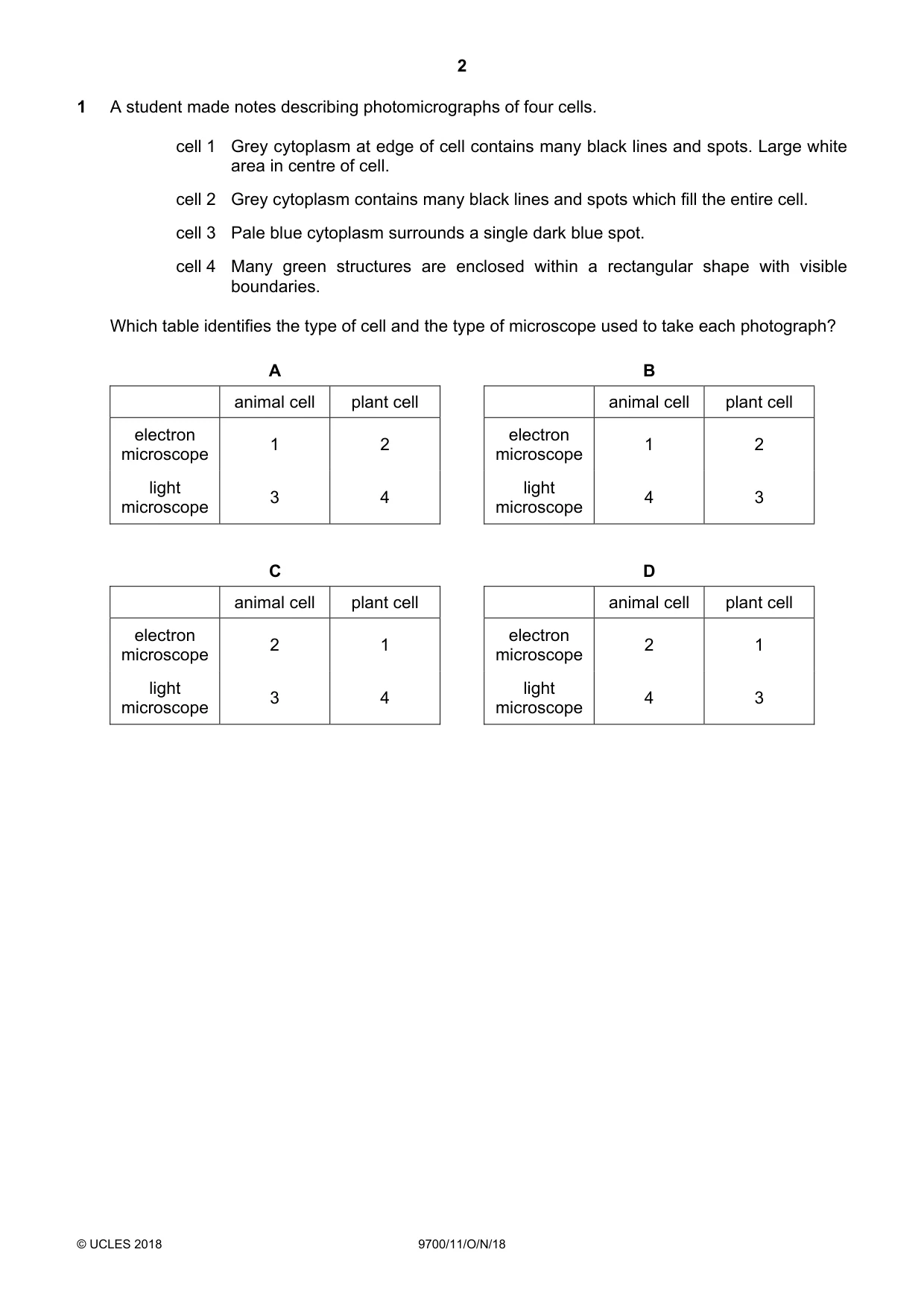
Q1 · A student made notes describing photomicrographs of four cells
1 A student made notes describing photomicrographs of four cells. cell 1 Grey cytoplasm at edge of cell contains many black lines and spots. Large white area in centre of cell. cell 2 Grey cytoplasm contains many black lines and spots which fill the entire cell. cell 3 Pale blue cytoplasm surrounds a single dark blue spot. cell 4 Many green structures are enclosed within a rectangular shape with visible boundaries. Which table identifies the type of cell and the type of microscope used to take each photograph? A B animal cell plant cell animal cell plant cell electron electron 1 2 1 2 microscope microscope light light 3 4 4 3 microscope microscope C D animal cell plant cell animal cell plant cell electron electron 2 1 2 1 microscope microscope light light 3 4 4 3 microscope microscope
Mark scheme: C
Q2 · The diagram shows a slide of a transverse section of a stem
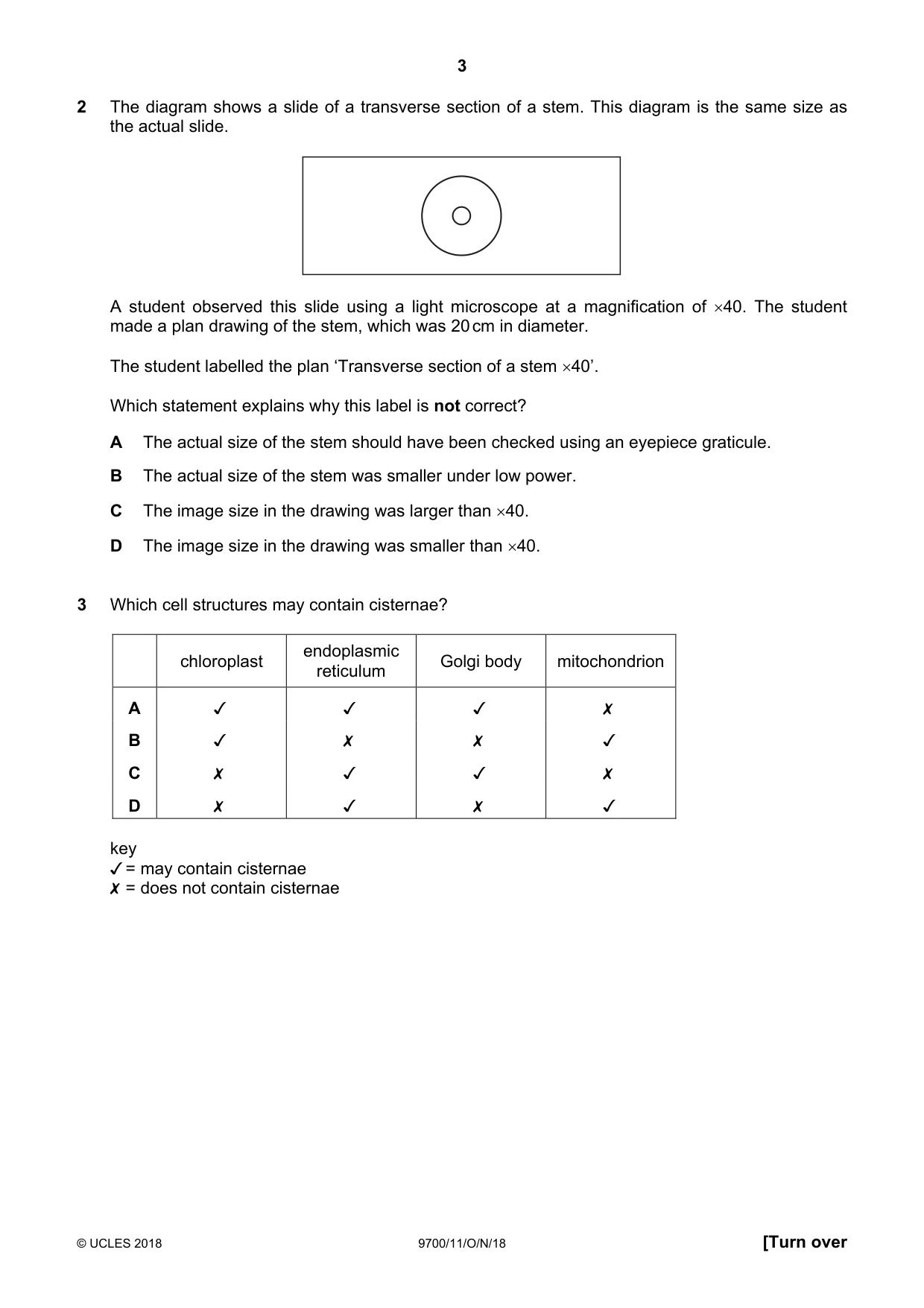
2 The diagram shows a slide of a transverse section of a stem. This diagram is the same size as the actual slide. A student observed this slide using a light microscope at a magnification of ×40. The student made a plan drawing of the stem, which was 20 cm in diameter. The student labelled the plan ‘Transverse section of a stem ×40’. Which statement explains why this label is not correct? A The actual size of the stem should have been checked using an eyepiece graticule. B The actual size of the stem was smaller under low power. C The image size in the drawing was larger than ×40. D The image size in the drawing was smaller than ×40.
Mark scheme: C
Q3 · Which cell structures may contain cisternae?
3. Which cell structures may contain cisternae? endoplasmic chloroplast reticulum Golgi body mitochondrion A Jv Jv Jv x B J x x J Cc x J Jv x D x Jv x Jv v= may contain cisternae X = does not contain cisternae
Mark scheme: C
More questions on Cells as the basic units of living organisms
Q4 · Which row correctly describes the function of the cell structures?
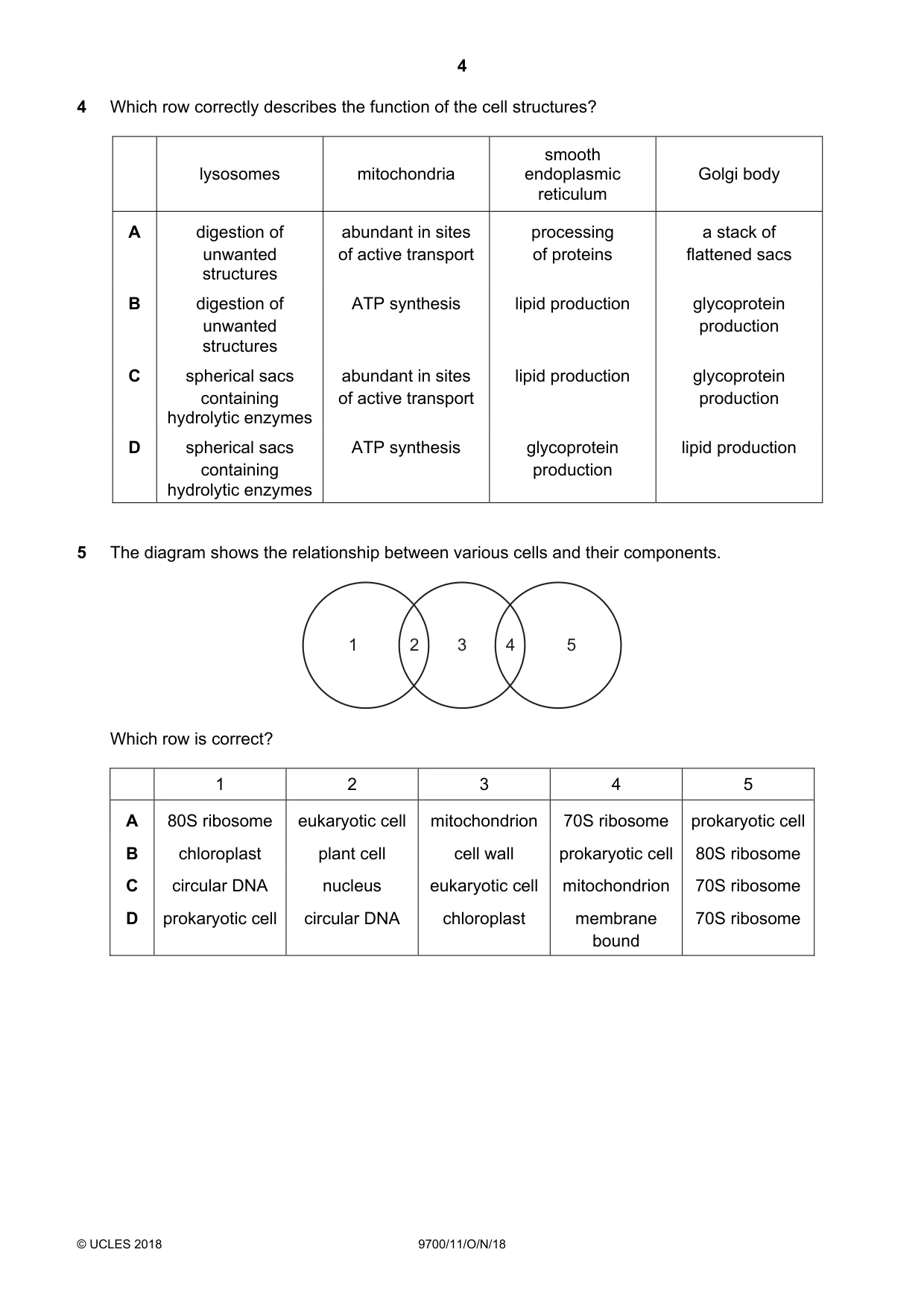
4 Which row correctly describes the function of the cell structures? smooth lysosomes mitochondria endoplasmic Golgi body reticulum A digestion of abundant in sites processing a stack of unwanted of active transport of proteins flattened sacs structures B digestion of ATP synthesis lipid production glycoprotein unwanted production structures C spherical sacs abundant in sites lipid production glycoprotein containing of active transport production hydrolytic enzymes D spherical sacs ATP synthesis glycoprotein lipid production containing production hydrolytic enzymes
Mark scheme: B
More questions on Cells as the basic units of living organisms
Q5 · The diagram shows the relationship between various cells and their components
5 The diagram shows the relationship between various cells and their components. 1 2 3 4 5 Which row is correct? 1 2 3 4 5 A 80S ribosome eukaryotic cell mitochondrion 70S ribosome prokaryotic cell B chloroplast plant cell cell wall prokaryotic cell 80S ribosome C circular DNA nucleus eukaryotic cell mitochondrion 70S ribosome D prokaryotic cell circular DNA chloroplast membrane 70S ribosome bound
Mark scheme: A
More questions on Cells as the basic units of living organisms
Q6 · Which comparison of bacteria cell walls and plant cell walls is correct?
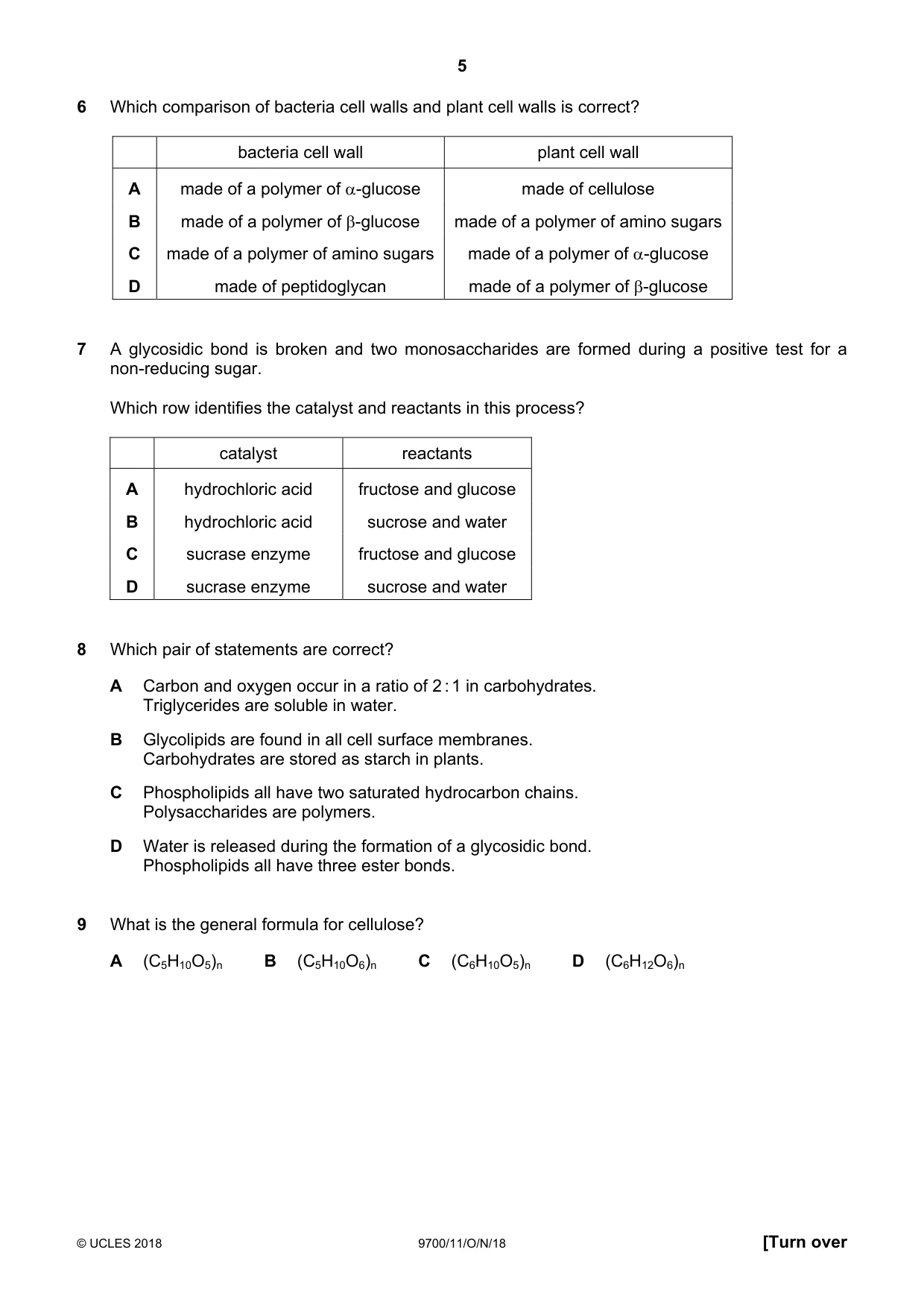
6 Which comparison of bacteria cell walls and plant cell walls is correct? bacteria cell wall plant cell wall A made of a polymer of α-glucose made of cellulose B made of a polymer of β-glucose made of a polymer of amino sugars C made of a polymer of amino sugars made of a polymer of α-glucose D made of peptidoglycan made of a polymer of β-glucose
Mark scheme: D
More questions on Cells as the basic units of living organisms
Q7 · A glycosidic bond is broken and two monosaccharides are formed during a positive test for…
7 A glycosidic bond is broken and two monosaccharides are formed during a positive test for a non-reducing sugar. Which row identifies the catalyst and reactants in this process? catalyst reactants A hydrochloric acid fructose and glucose B hydrochloric acid sucrose and water C sucrase enzyme fructose and glucose D sucrase enzyme sucrose and water
Mark scheme: B
Q8 · Which pair of statements are correct?
8 Which pair of statements are correct? A Carbon and oxygen occur in a ratio of 2 : 1 in carbohydrates. Triglycerides are soluble in water. B Glycolipids are found in all cell surface membranes. Carbohydrates are stored as starch in plants. C Phospholipids all have two saturated hydrocarbon chains. Polysaccharides are polymers. D Water is released during the formation of a glycosidic bond. Phospholipids all have three ester bonds.
Mark scheme: B
Q9 · What is the general formula for cellulose?
9 What is the general formula for cellulose? A (C5H10O5)n B (C5H10O6)n C (C6H10O5)n D (C6H12O6)n
Mark scheme: C
Q10 · A triglyceride consists of glycerol and three different fatty acids, linoleic acid (L)…
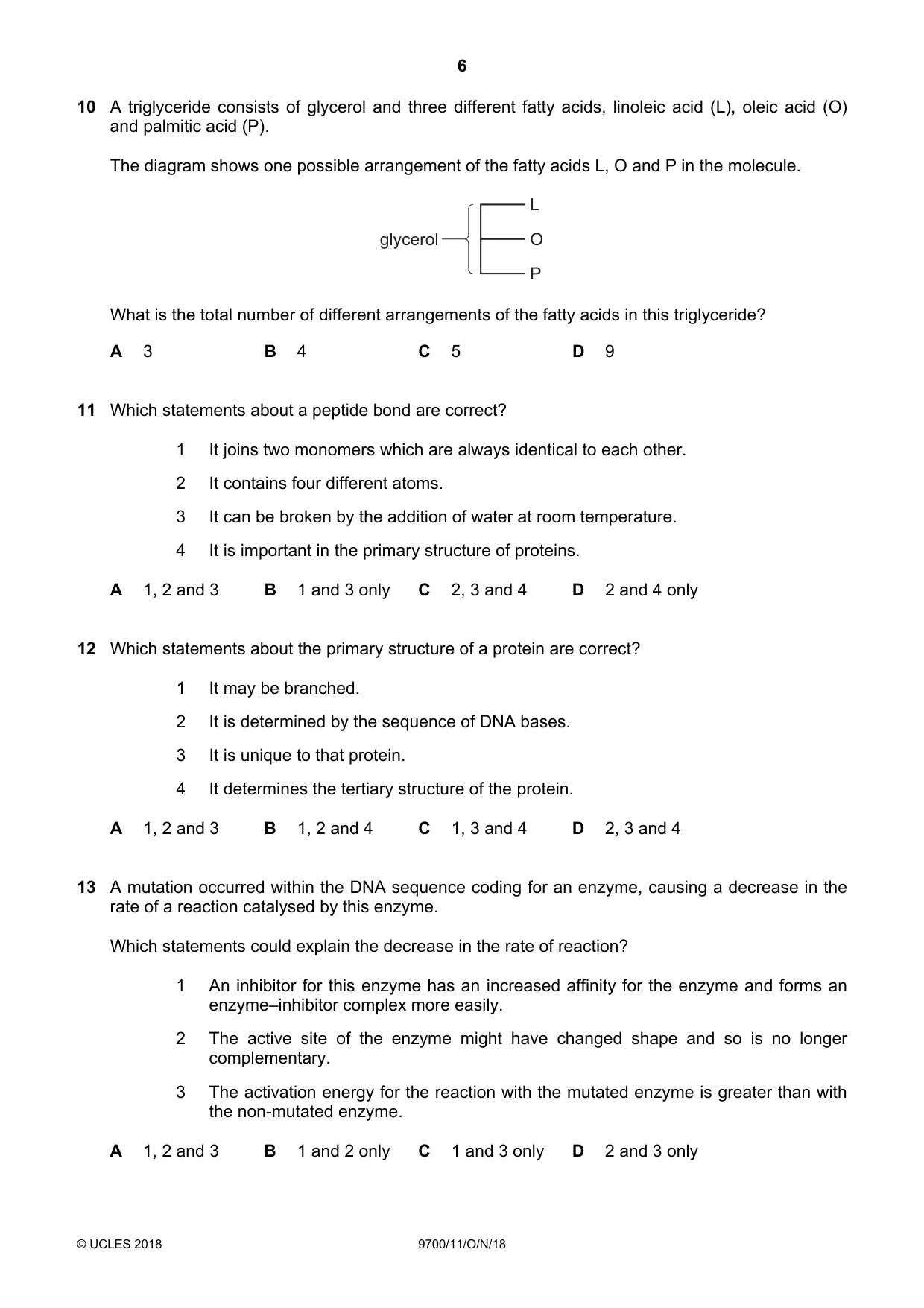
10 A triglyceride consists of glycerol and three different fatty acids, linoleic acid (L), oleic acid (O) and palmitic acid (P). The diagram shows one possible arrangement of the fatty acids L, O and P in the molecule. L glycerol O P What is the total number of different arrangements of the fatty acids in this triglyceride? A 3 B 4 C 5 D 9
Mark scheme: A
Q11 · Which statements about a peptide bond are correct?
11 Which statements about a peptide bond are correct? 1 It joins two monomers which are always identical to each other. 2 It contains four different atoms. 3 It can be broken by the addition of water at room temperature. 4 It is important in the primary structure of proteins. A 1, 2 and 3 B 1 and 3 only C 2, 3 and 4 D 2 and 4 only
Mark scheme: D
Q12 · Which statements about the primary structure of a protein are correct?
12 Which statements about the primary structure of a protein are correct? 1 It may be branched. 2 It is determined by the sequence of DNA bases. 3 It is unique to that protein. 4 It determines the tertiary structure of the protein. A 1, 2 and 3 B 1, 2 and 4 C 1, 3 and 4 D 2, 3 and 4
Mark scheme: D
Q13 · A mutation occurred within the DNA sequence coding for an enzyme, causing a decrease in…
13 A mutation occurred within the DNA sequence coding for an enzyme, causing a decrease in the rate of a reaction catalysed by this enzyme. Which statements could explain the decrease in the rate of reaction? 1 An inhibitor for this enzyme has an increased affinity for the enzyme and forms an enzyme–inhibitor complex more easily. 2 The active site of the enzyme might have changed shape and so is no longer complementary. 3 The activation energy for the reaction with the mutated enzyme is greater than with the non-mutated enzyme. A 1, 2 and 3 B 1 and 2 only C 1 and 3 only D 2 and 3 only
Mark scheme: C
Q14 · Which row is correct for an enzyme with a low Michaelis-Menten constant?
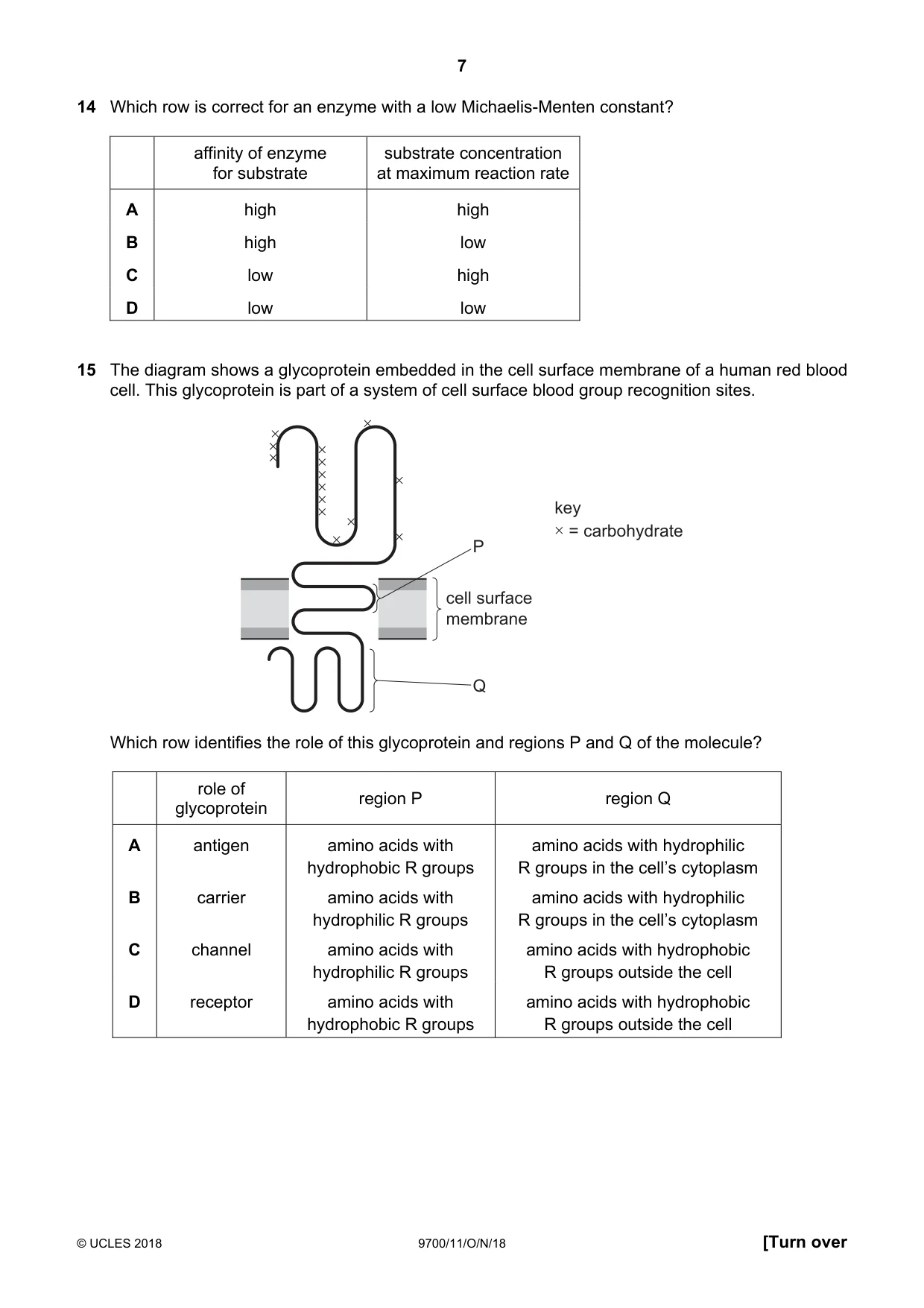
14 Which row is correct for an enzyme with a low Michaelis-Menten constant? affinity of enzyme substrate concentration for substrate at maximum reaction rate A high high B high low C low high D low low
Mark scheme: B
Q15 · The diagram shows a glycoprotein embedded in the cell surface membrane of a human red…
15 The diagram shows a glycoprotein embedded in the cell surface membrane of a human red blood cell. This glycoprotein is part of a system of cell surface blood group recognition sites. key = carbohydrate P cell surface membrane Q Which row identifies the role of this glycoprotein and regions P and Q of the molecule? role of region P region Q glycoprotein A antigen amino acids with amino acids with hydrophilic hydrophobic R groups R groups in the cell’s cytoplasm B carrier amino acids with amino acids with hydrophilic hydrophilic R groups R groups in the cell’s cytoplasm C channel amino acids with amino acids with hydrophobic hydrophilic R groups R groups outside the cell D receptor amino acids with amino acids with hydrophobic hydrophobic R groups R groups outside the cell
Mark scheme: A
Q16 · The diagram shows the transport of ions across the cell surface membrane
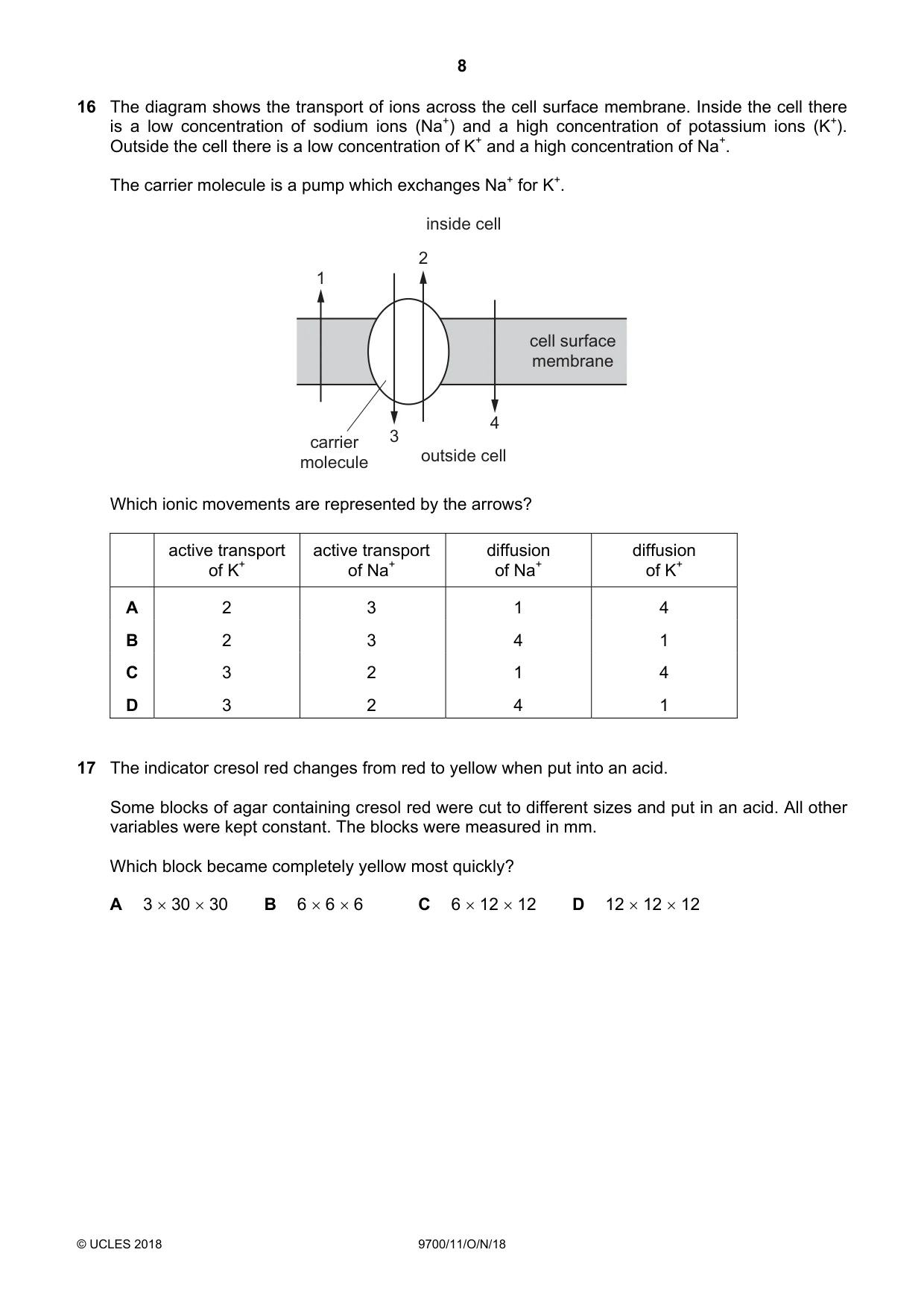
16 The diagram shows the transport of ions across the cell surface membrane. Inside the cell there is a low concentration of sodium ions (Na+) and a high concentration of potassium ions (K+). Outside the cell there is a low concentration of K+ and a high concentration of Na+. The carrier molecule is a pump which exchanges Na+ for K+. inside cell 2 1 cell surface membrane 4 carrier 3 molecule outside cell Which ionic movements are represented by the arrows? active transport active transport diffusion diffusion of K+ of Na+ of Na+ of K+ A 2 3 1 4 B 2 3 4 1 C 3 2 1 4 D 3 2 4 1
Mark scheme: A
Q17 · The indicator cresol red changes from red to yellow when put into an acid
17 The indicator cresol red changes from red to yellow when put into an acid. Some blocks of agar containing cresol red were cut to different sizes and put in an acid. All other variables were kept constant. The blocks were measured in mm. Which block became completely yellow most quickly? A 3 × 30 × 30 B 6 × 6 × 6 C 6 × 12 × 12 D 12 × 12 × 12
Mark scheme: A
Q18 · When red blood cells are put into pure water they burst (haemolysis)
18 When red blood cells are put into pure water they burst (haemolysis). Which statements explain this haemolysis? 1 The water potential of the surrounding liquid is lower than the water potential of the contents of the red blood cell. 2 The cell surface membranes of red blood cells are not supported by cell walls. 3 More water moves into the red blood cells by osmosis than leaves the cells. 4 Water enters the red blood cells by osmosis but does not leave the cells. A 1 and 3 B 1 and 4 C 2 and 3 D 2 and 4
Mark scheme: C
Q19 · How many copies of each DNA molecule will be found in a cell at each stage of the mitotic…
19 How many copies of each DNA molecule will be found in a cell at each stage of the mitotic cell cycle? G1 of cytokinesis interphase A 1 1 B 1 2 C 2 1 D 2 2
Mark scheme: B
More questions on Replication and division of nuclei and cells
Q20 · Which metabolic processes will be very active in a cell that has just completed…
20 Which metabolic processes will be very active in a cell that has just completed cytokinesis? 1 ATP formation 2 DNA replication 3 protein synthesis A 1, 2 and 3 B 1 and 3 only C 2 only D 3 only
Mark scheme: B
More questions on Replication and division of nuclei and cells
Q21 · A mutation occurs in a gene which prevents the production of telomerase
21 A mutation occurs in a gene which prevents the production of telomerase. What is the effect of this mutation if it occurs in bone marrow stem cells? A a rapid increase in the production of lymphocytes B a tumour grows in the bone marrow C bone marrow stem cells eventually no longer divide D the total blood cell count will be unchanged
Mark scheme: C
More questions on Replication and division of nuclei and cells
Q22 · What are the products when a DNA molecule replicates?
22 What are the products when a DNA molecule replicates? A two molecules of DNA each made of a paired sequence of bases B two molecules of DNA each made of a paired sequence of nucleotides C two strands of DNA each made of a paired sequence of bases D two strands of DNA each made of a paired sequence of nucleotides
Mark scheme: B
More questions on Structure of nucleic acids and replication of DNA
Q23 · Following translation, the alpha polypeptide chain of haemoglobin, α-globin, undergoes…
23 Following translation, the alpha polypeptide chain of haemoglobin, α-globin, undergoes modification. During this modification, the first amino acid is removed, leaving 141 amino acid residues. How many nucleotides does the gene coding for α-globin contain? A 141 B 142 C 423 D 426
Mark scheme: D
Q24 · Which statements correctly describe transport pathways in dicotyledonous plants?
24 Which statements correctly describe transport pathways in dicotyledonous plants? 1 In the apoplast pathway, water does not move through plasmodesmata. 2 In the symplast pathway, water does not move through intercellular spaces. 3 The apoplast pathway may be blocked by the Casparian strip. A 1, 2 and 3 B 1 and 2 only C 1 and 3 only D 2 and 3 only
Mark scheme: A
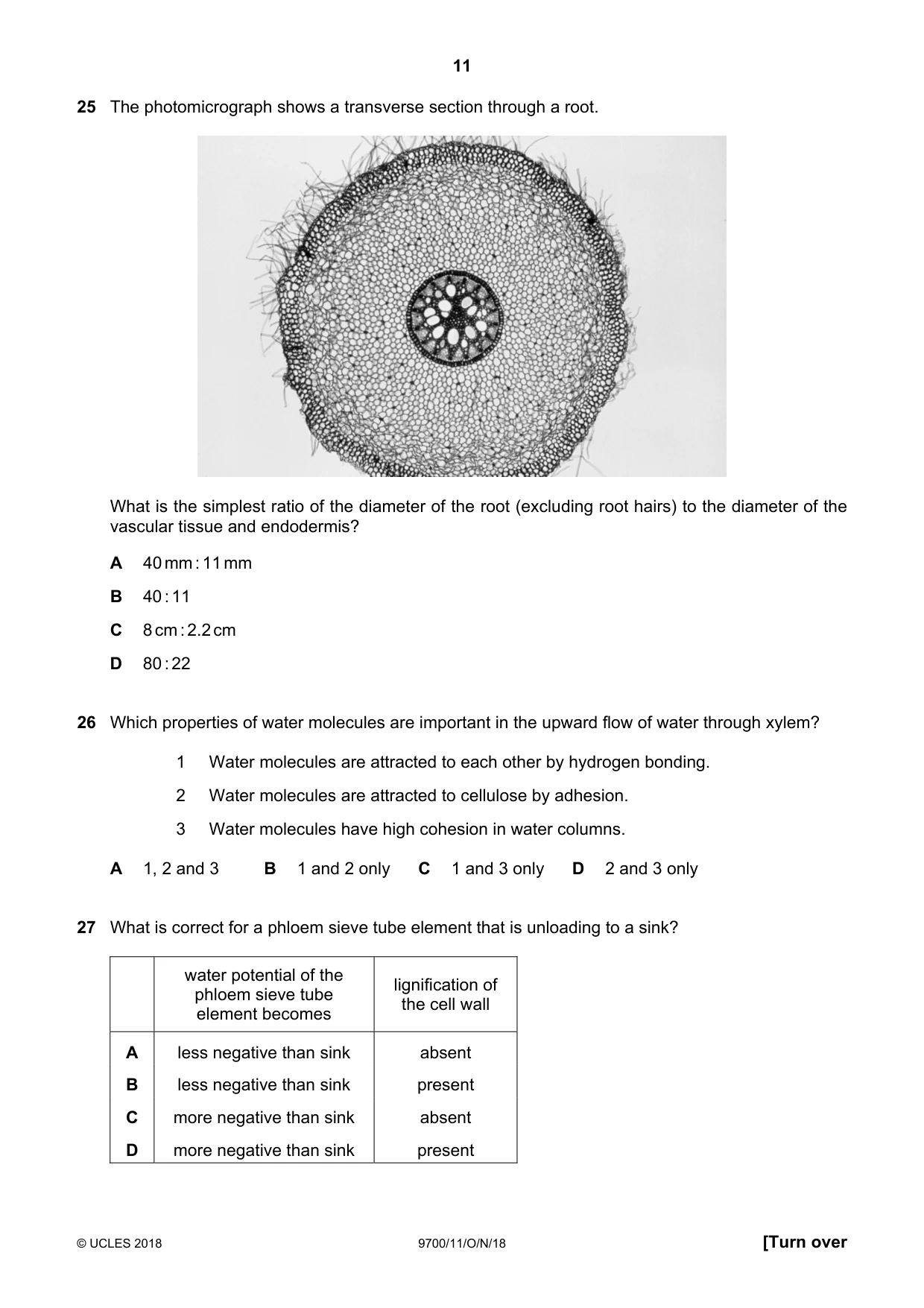
Q25 · The photomicrograph shows a transverse section through a root
25 The photomicrograph shows a transverse section through a root. What is the simplest ratio of the diameter of the root (excluding root hairs) to the diameter of the vascular tissue and endodermis? A 40 mm : 11 mm B 40 : 11 C 8 cm : 2.2 cm D 80 : 22
Mark scheme: B
Q26 · Which properties of water molecules are important in the upward flow of water through…
26 Which properties of water molecules are important in the upward flow of water through xylem? 1 Water molecules are attracted to each other by hydrogen bonding. 2 Water molecules are attracted to cellulose by adhesion. 3 Water molecules have high cohesion in water columns. A 1, 2 and 3 B 1 and 2 only C 1 and 3 only D 2 and 3 only
Mark scheme: A
Q27 · What is correct for a phloem sieve tube element that is unloading to a sink?
27 What is correct for a phloem sieve tube element that is unloading to a sink? water potential of the lignification of phloem sieve tube the cell wall element becomes A less negative than sink absent B less negative than sink present C more negative than sink absent D more negative than sink present
Mark scheme: A
Q28 · Which statement concerning transpiration is correct?
28 Which statement concerning transpiration is correct? A On a humid day, the water potential gradient between the intercellular air space and the external atmosphere increases to stimulate water loss by evaporation. B Water arriving at the spongy mesophyll cells via the symplast pathway must move by osmosis through the cell surface membrane before evaporation from the surface of the cells. C Water diffuses down the water potential gradient from the saturated air space through the guard cells before evaporating from the surface of the cells into the atmosphere. D Water moves up the xylem in the apoplast pathway and can continue on this pathway by osmosis to reach the spongy mesophyll cells before evaporating into the intercellular air space.
Mark scheme: B
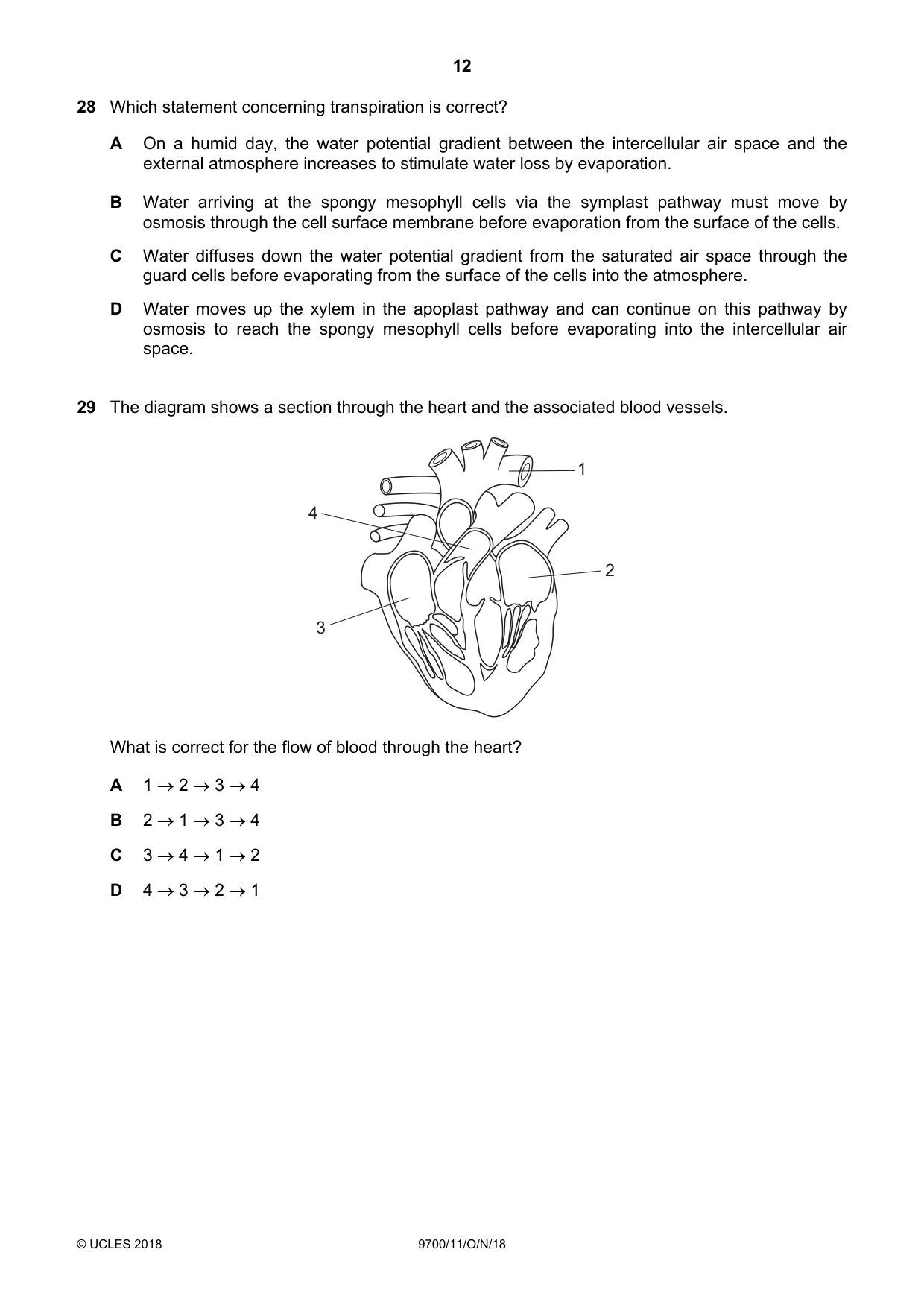
Q29 · The diagram shows a section through the heart and the associated blood vessels
29 The diagram shows a section through the heart and the associated blood vessels. 1 4 2 3 What is correct for the flow of blood through the heart? A 1 → 2 → 3 → 4 B 2 → 1 → 3 → 4 C 3 → 4 → 1 → 2 D 4 → 3 → 2 → 1
Mark scheme: B
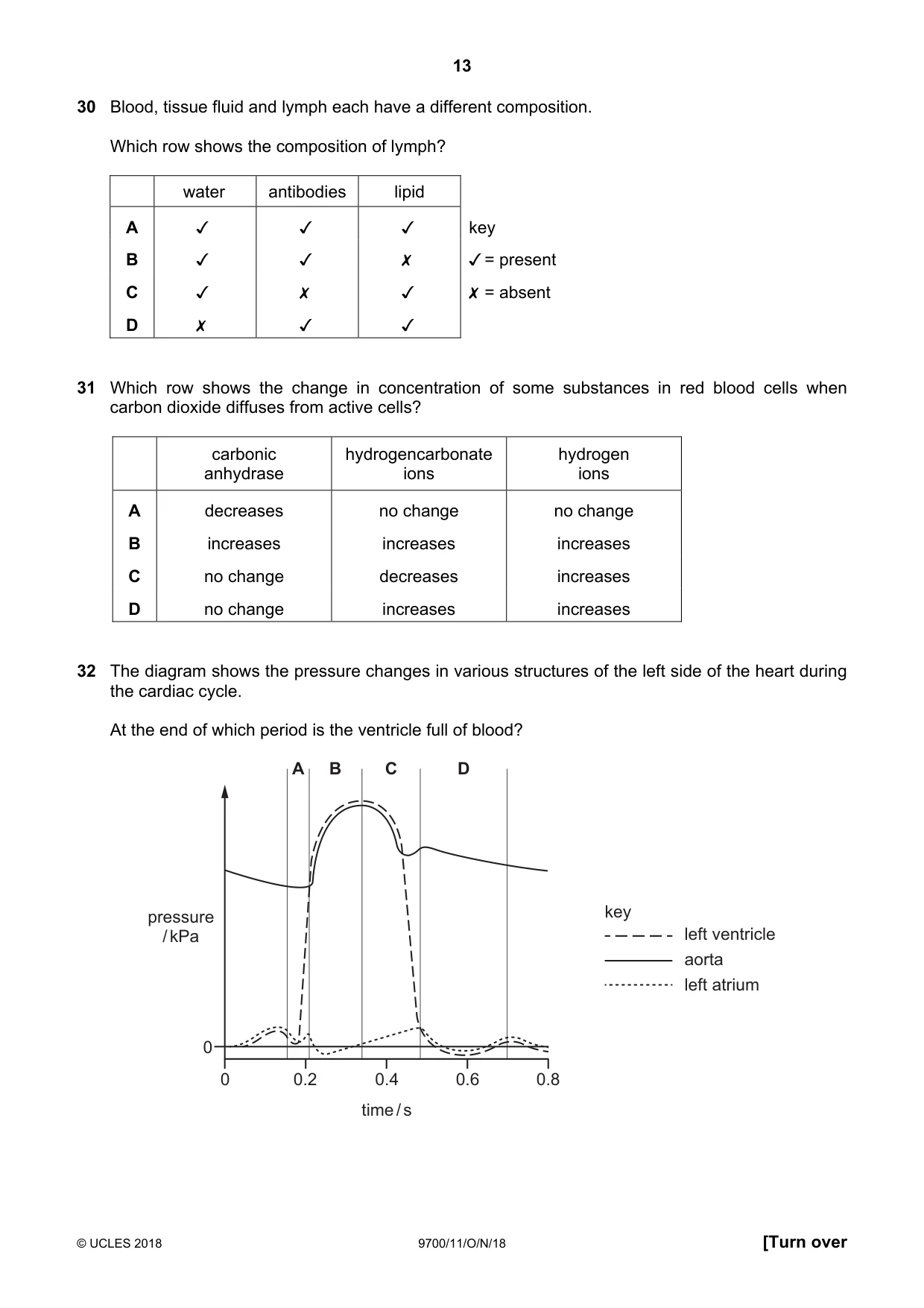
Q30 · Blood, tissue fluid and lymph each have a different composition
30 Blood, tissue fluid and lymph each have a different composition. Which row shows the composition of lymph? water antibodies lipid v v v v v x v x v x v v key / = present X = absent
Mark scheme: A
Q31 · Which row shows the change in concentration of some substances in red blood cells when…
31 Which row shows the change in concentration of some substances in red blood cells when carbon dioxide diffuses from active cells? carbonic hydrogencarbonate hydrogen anhydrase ions ions A decreases no change no change B increases increases increases C no change decreases increases D no change increases increases
Mark scheme: D
Q32 · The diagram shows the pressure changes in various structures of the left side of the…
32 The diagram shows the pressure changes in various structures of the left side of the heart during the cardiac cycle. At the end of which period is the ventricle full of blood? A B C D pressure key / kPa left ventricle aorta left atrium 0 0 0.2 0.4 0.6 0.8 time / s
Mark scheme: A
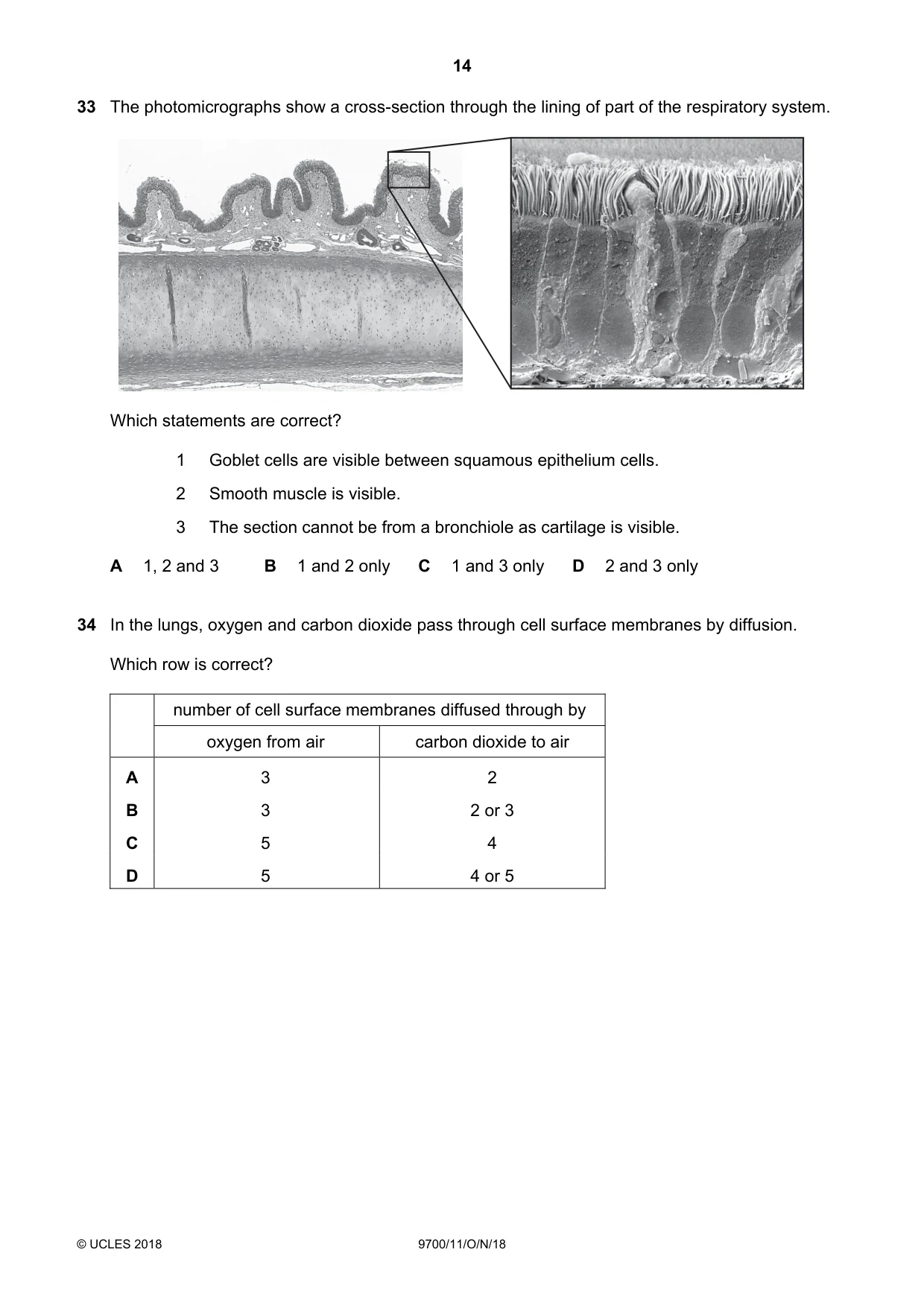
Q33 · The photomicrographs show a cross-section through the lining of part of the respiratory…
33 The photomicrographs show a cross-section through the lining of part of the respiratory system. Which statements are correct? 1 Goblet cells are visible between squamous epithelium cells. 2 Smooth muscle is visible. 3 The section cannot be from a bronchiole as cartilage is visible. A 1, 2 and 3 B 1 and 2 only C 1 and 3 only D 2 and 3 only
Mark scheme: D
Q34 · In the lungs, oxygen and carbon dioxide pass through cell surface membranes by diffusion
34 In the lungs, oxygen and carbon dioxide pass through cell surface membranes by diffusion. Which row is correct? number of cell surface membranes diffused through by oxygen from air carbon dioxide to air A 3 2 B 3 2 or 3 C 5 4 D 5 4 or 5
Mark scheme: D
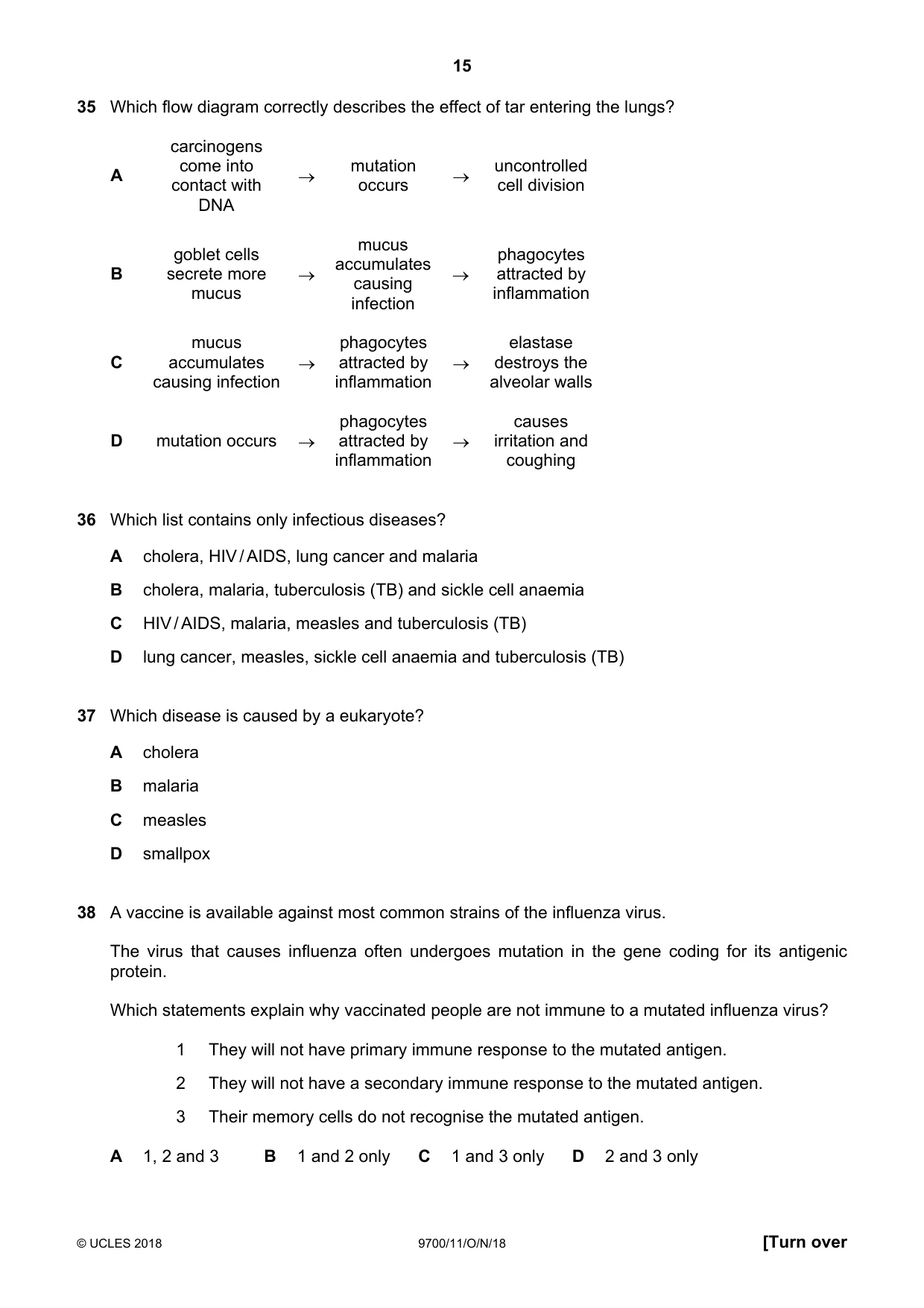
Q35 · Which flow diagram correctly describes the effect of tar entering the lungs?
35 Which flow diagram correctly describes the effect of tar entering the lungs? carcinogens come into mutation uncontrolled A → → contact with occurs cell division DNA mucus goblet cells phagocytes accumulates B secrete more → → attracted by causing mucus inflammation infection mucus phagocytes elastase C accumulates → attracted by → destroys the causing infection inflammation alveolar walls phagocytes causes D mutation occurs → attracted by → irritation and inflammation coughing
Mark scheme: A
Q36 · Which list contains only infectious diseases?
36 Which list contains only infectious diseases? A cholera, HIV / AIDS, lung cancer and malaria B cholera, malaria, tuberculosis (TB) and sickle cell anaemia C HIV / AIDS, malaria, measles and tuberculosis (TB) D lung cancer, measles, sickle cell anaemia and tuberculosis (TB)
Mark scheme: C
Q37 · Which disease is caused by a eukaryote?
37 Which disease is caused by a eukaryote? A cholera B malaria C measles D smallpox
Mark scheme: B
Q38 · A vaccine is available against most common strains of the influenza virus
38 A vaccine is available against most common strains of the influenza virus. The virus that causes influenza often undergoes mutation in the gene coding for its antigenic protein. Which statements explain why vaccinated people are not immune to a mutated influenza virus? 1 They will not have primary immune response to the mutated antigen. 2 They will not have a secondary immune response to the mutated antigen. 3 Their memory cells do not recognise the mutated antigen. A 1, 2 and 3 B 1 and 2 only C 1 and 3 only D 2 and 3 only
Mark scheme: D
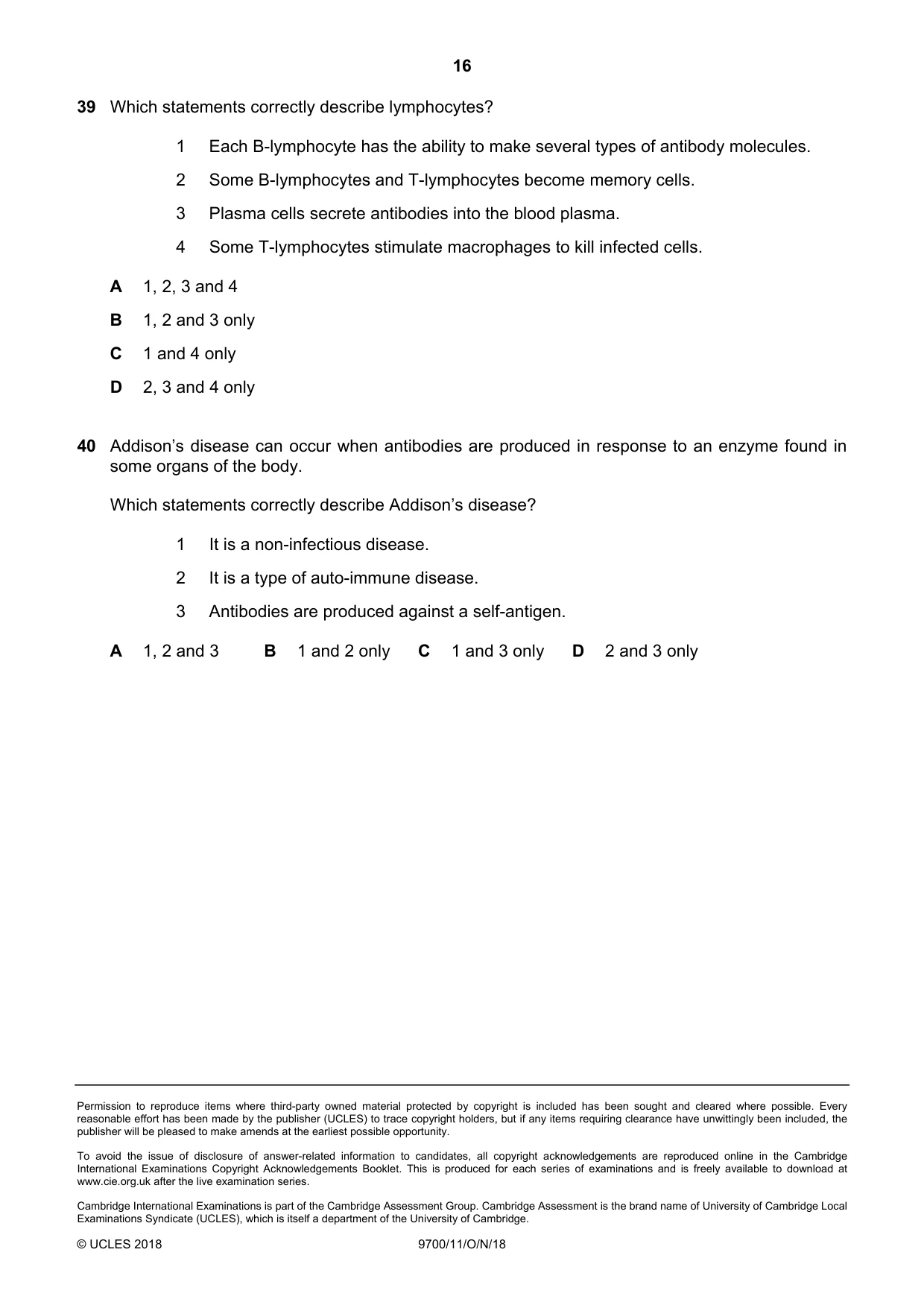
Q39 · Which statements correctly describe lymphocytes?
39 Which statements correctly describe lymphocytes? 1 Each B-lymphocyte has the ability to make several types of antibody molecules. 2 Some B-lymphocytes and T-lymphocytes become memory cells. 3 Plasma cells secrete antibodies into the blood plasma. 4 Some T-lymphocytes stimulate macrophages to kill infected cells. A 1, 2, 3 and 4 B 1, 2 and 3 only C 1 and 4 only D 2, 3 and 4 only
Mark scheme: D
Q40 · Addison’s disease can occur when antibodies are produced in response to an enzyme found…
40 Addison’s disease can occur when antibodies are produced in response to an enzyme found in some organs of the body. Which statements correctly describe Addison’s disease? 1 It is a non-infectious disease. 2 It is a type of auto-immune disease. 3 Antibodies are produced against a self-antigen. A 1, 2 and 3 B 1 and 2 only C 1 and 3 only D 2 and 3 only
Mark scheme: A
What was in this paper
The subtopics covered by these 40 questions, and how many questions each got. Open one in a new tab to see every Cambridge question on it.
4Transport mechanisms4Carbohydrates and lipids3Movement into and out of cells3Replication and division of nuclei and cells3The gas exchange system3Factors that affect enzyme action2Infectious diseases2Proteins2The heart2The immune system2The microscope in cell studies2Antibodies and vaccination1Fluid mosaic membranes1Protein synthesis1Structure of nucleic acids and replication of DNA1Structure of transport tissues1Testing for biological molecules1The circulatory system1Transport of oxygen and carbon dioxide1What you needed in this session
Cambridge’s own grade thresholds for 2018 Oct/Nov, Paper 1 · Variant 1. A higher threshold means an easier paper — the bar moves with how the cohort did.